Skip to content · ⁨דלג לתוכן⁩

19th-Century Perspectives and Political Developments, c. 1815 to c. 1914

AP European History · ⁨היסטוריה אירופאית - AP⁩ · Topic 7 · ⁨נושא 7⁩

Video lesson for this topic · ⁨שיעור וידאו לנושא זה⁩ Open the video page · ⁨פתח את עמוד הוידאו⁩
8:32

Unit 7: 19th-Century Perspectives and Political Developments

Contextualizing nineteenth-century perspectives covers about eighteen hundred and fifteen to nineteen hundred and fourteen. If you learn one thing from this…

English narration · English + 中文 subtitles burned in · ⁨קריאת קול באנגלית · תרגום אנגלי + סינית שרוף בתוך הסרטון⁩

7.1

Contextualizing 19th-Century Perspectives · ⁨הקשרה של נקודות מבט מהמאה ה-19⁩

Syllabus · ⁨סיילבוס⁩
English

7.1 Contextualizing 19th-Century Perspectives and Political Developments

Learning Objective Unit 7.A: Explain the context in which nationalistic and imperialistic sentiments developed in Europe from 1815 to 1914.

  • KC-3.4 European states struggled to maintain international stability in an age of nationalism and revolutions.
    • KC-3.4.II The breakdown of the Concert of Europe opened the door for movements of national unification in Italy and Germany as well as liberal reforms elsewhere.
    • KC-3.4.III The unification of Italy and Germany transformed the European balance of power and led to efforts to construct a new diplomatic order.
  • KC-3.5 A variety of motives and methods led to the intensification of European global control and increased tensions among the Great Powers.
    • KC-3.5.II Industrial and technological developments (e.g., the second industrial revolution) facilitated European control of global empires.
  • KC-3.6 European ideas and culture expressed a tension between objectivity and scientific realism on one hand, and subjectivity and individual expression on the other.
    • KC-3.6.II Following the revolutions of 1848, Europe turned toward a realist and materialist worldview.
עברית

7.1 הקשרה של נקודות מבט ופיתוחים פוליטיים במאה ה-19

מטרות למידה ליחידה 7.A: הסבר ההקשר שבו התפתחו רגשות לאומניות ואימפריאליסטיות באירופה משנת 1815 ועד 1914.

  • KC-3.4 מדינות אירופאיות struggled לשמור על יציבות בינלאומית בתקופת הלאומניות והמהפכות.
    • KC-3.4.II קריסת הקונצרט האירופאי פתחה את הדלת לתנועות איחוד לאומי באיטליה ובגרמניה, כמו גם לרפורמות ליברליות במקומות אחרים.
    • KC-3.4.III האיחוד של איטליה וגרמניה שינה מאזן הכוחות באירופה והוביל לניסיונות לבנות סדר דיפלומטי חדש.
  • KC-3.5 מגוון מוטיבים ושיטות הובילו לה intensification של השליטה הגלובלית האירופאית ולהגברת המתיחות בין העוצמות הגדולות.
    • KC-3.5.II פיתוחים תעשייתיים וטכנולוגיים (למשל, המהפכה התעשייתית השנייה) קילים את השליטה האירופאית על האימפריות הגלובליות.
  • KC-3.6 רעיונות ותרבות אירופאיים הביעו מתח בין אובייקטיביות ומציאות מדעית מצד אחד, לבין סובייקטיביות והבעת פרטנות מצד שני.
    • KC-3.6.II לאחר מהפכות 1848, אירופה פנה לעולם ריאליסטי וחומרני.
Source: College Board AP Course and Exam Description · ⁨מקור: תיאור הקורס והמבחן של College Board AP⁩

English

Unit 7 runs over the same years as Unit 6 - c. 1815 to c. 1914 - but follows politics, empire, and ideas rather than industry. Three key concepts frame it:

  • European states struggled to maintain international stability in an age of nationalism and revolutions.
  • A variety of motives and methods led to the intensification of European global control and increased tensions among the Great Powers.
  • European ideas and culture expressed a tension between objectivity and scientific realism on one hand and subjectivity and individual expression 主观性与个人表达 on the other.

That third tension is the unit's cultural thread, and it explains why Romanticism, realism, positivism, and modern art all belong in the same unit rather than in a separate art history.

עברית

יחידה 7 מכסה אותן שנים כמו יחידה 6 - כ-1815 עד כ-1914 - אך עוקבת אחרי פוליטיקה, אימפריה ורעיונות ולא תעשייה. שלושה מושגים מרכזיים מסגרים אותה:

  • מדינות אירופאיות נאבקו לשמור על יציבות בינלאומית בתקופת לאומיות ומהפכות.
  • מגוון מוטיבים ושיטות הביאו להחדת השליטה הגלובלית האירופאית ולהגברת המתחים בין המדינות הגדולות.
  • רעיונות ואמנות אירופאיים ביטרו מתח בין אובייקטיביות ומציאות מדעית מאחד ועם סובייקטיביות וביטוי אישי מאחד.

המתח השלישי הזה הוא החוט התרבותי של היחידה, והוא מסביר מדוע רומנטיזם, ריאליזם, פוזיטיביזם ואמנות מודרנית כולם שייכים ליחידה אחת ולא בספר היסטוריה של האמנות.

7.2

Nationalism · ⁨לאומיות⁩

Syllabus · ⁨סיילבוס⁩
English

7.2 Nationalism

Thematic Focus (NEI): National and European Identity — Definitions and perceptions of regional, cultural, national, and European identity have developed and been challenged over time, with varied and often profound effects on the political, social, and cultural order in Europe.

Learning Objective Unit 7.B: Explain how the development and spread of nationalism affected Europe from 1815 to 1914.

  • KC-3.3.I.F Nationalists encouraged loyalty to the nation in a variety of ways, including romantic idealism, liberal reform, political unification, racialism with a concomitant anti-Semitism, and chauvinism justifying national aggrandizement.
  • KC-3.3.I.G While during the 19th century western European Jews became more socially and politically acculturated, Zionism, a form of Jewish nationalism, developed late in the century as a response to growing anti-Semitism throughout Europe.
  • KC-3.4.II.B A new generation of conservative leaders, including Napoleon III, Cavour, and Bismarck, used popular nationalism to create or strengthen the state.
  • KC-3.4.II.C The creation of the dual monarchy of Austria-Hungary, which recognized the political power of the largest ethnic minority, was an attempt to stabilize the state by reconfiguring national unity.

Illustrative examples:

  • Nationalists: §Bullet J. G. Fichte §Bullet Grimm Brothers §Bullet Giuseppe Mazzini §Bullet Pan-Slavists Anti-Semitism: §Bullet Dreyfus affair §Bullet Christian Social Party in Germany §Bullet Karl Lueger, mayor of Vienna Zionists: §Bullet Theodor Herzl
עברית

7.2 לאומיות

מיקוד נושאי (NEI): זהות לאומית ואירופאית — הגדרות וקליטות של זהות אזורית, תרבותית, לאומית ואירופאית התפתחו ונבדקו לאורך זמן, עם השפעות מגוונות ולעיתים עמוקות על הסדר הפוליטי, החברתי והתרבותי באירופה.

מטרות למידה ליחידה 7.B: הסבר כיצד התפתחות והתפשטות הלאומיות השפיעו על אירופה משנת 1815 ועד 1914.

  • KC-3.3.I.F לאומנים עודדו נאמנות למדינה בדרכים שונות, כולל אידיאליזם רומנטי, רפורמה ליברלית, איחוד פוליטי, גזענות עם אנטישמיות לוואי, ושאוביניזם שמצדיק הרחבת לאומית.
  • KC-3.3.I.G בעוד שבמהלך המאה ה-19 יהודי אירופה המערבית הפכו ליותר משולבים חברתית ופוליטית, הציונות, צורת לאומיות יהודית, התפתחה בסוף המאה כתגובה לגידול האנטישמיות בכל אירופה.
  • KC-3.4.II.B דור חדש של מנהיגים שמרניים, כולל נפוליאון השלישי, קאוור ובismarck, השתמשו בלאומיות עממית ליצירה או לחיזוק המדינה.
  • KC-3.4.II.C היצירת המלוכה הכפולה של אוסטריה-הונגריה, שהכירה בכוח הפוליטי של המיעוט האתני הגדול ביותר, הייתה ניסיון ליצב את המדינה על ידי ארגון מחדש של אחידות לאומית.

דוגמאות מדגמיות:

  • לאומנים: §Bullet J. G. Fichte §Bullet אחיי גרים §Bullet ג'וזפה מזיני §Bullet פאן-סלאביסטים אנטישמיות: §Bullet פרשת דרייפוס §Bullet המפלגה הנוצרית-סוציאלית בגרמניה §Bullet קרל לואגר, ראש עיריית וינה ציונים: §Bullet תאודור הרצל

Source: College Board AP Course and Exam Description · ⁨מקור: תיאור הקורס והמבחן של College Board AP⁩

English

Nationalists encouraged loyalty to the nation in a variety of ways, including romantic idealism 浪漫主义理想, liberal reform, political unification, and racialism - so nationalism has no single political colour and can be attached to very different programmes.

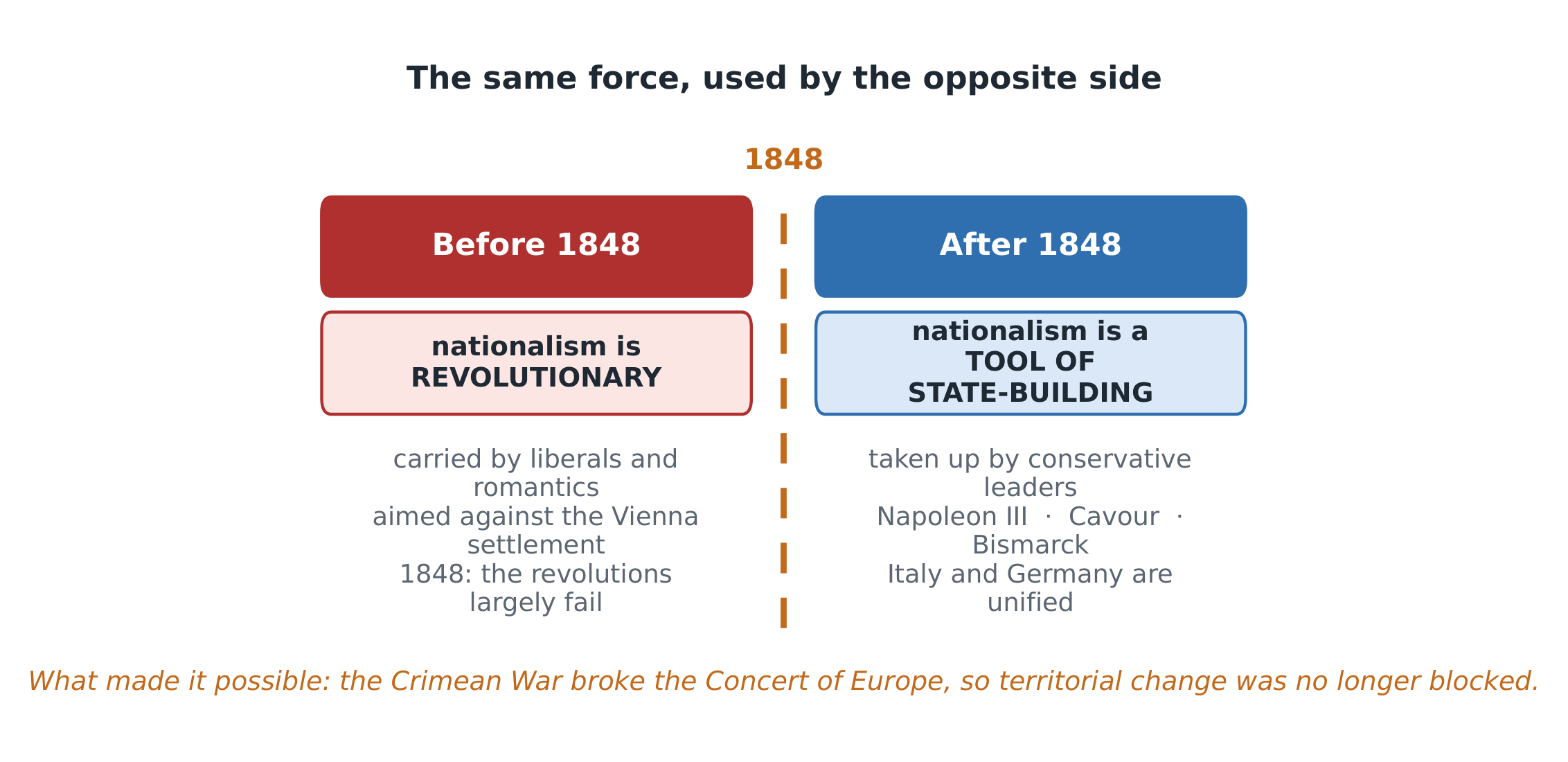
The turn that matters most: a new generation of conservative leaders, including Napoleon III 拿破仑三世, Cavour 加富尔, and Bismarck 俾斯麦, used popular nationalism to create or strengthen states. Before 1848 nationalism was mainly a revolutionary threat to the settlement of Vienna; after 1848 it became a tool of state-building in conservative hands. If you learn one thing from this unit, learn that reversal.

Two further points are examinable:

  • While western European Jews became more socially and politically acculturated during the century, Zionism 犹太复国主义 - a form of Jewish nationalism - developed in response to continued exclusion.
  • The creation of the dual monarchy of Austria-Hungary 奥匈二元帝国, which recognised the political power of the largest ethnic minority, was an attempt to manage nationalism within a multi-ethnic empire rather than to suppress it.
עברית
הסיבוב שמגדיר את היחידה: אותו כוח, המשמש בצד הנגדי
לפני 1848 הלאומיות מאיימת על הסדר; לאחר 1848 שמרנים בונים מדינות באמצעותה

לאומנים עודדו נאמנות לאומה בדרכים מגוונות, כולל אידיאליזם רומנטי, רפורמה ליברלית, איחוד פוליטי וגזענות - כך שהלאומיות אין לה צבע פוליטי יחיד וניתן לחבר אותה לתוכניות שונות מאוד.

הסיבוב שחשוב ביותר: דור חדש של מנהיגים שמרניים, כולל נפוליאון השלישי, קאוור וביסמרק, השתמשו בלאומיות עממית ליצירה או לחיזוק מדינות. לפני 1848 הלאומיות הייתה בעיקר איום מהפכני על הסדר בווינה; לאחר 1848 היא הפכה לכלי לבניית מדינה בידי יד שמרנית. אם תלמידים דבר אחד מיחידה זו, תלמידו את ההפוך.

שתי נקודות נוספות ייבדקו:

  • בעוד שהיהודים באירופה המערבית הפכו לאקלטים יותר חברתית ופוליטית לאורך המאה, ציונות - צורת לאומיות יהודית - התפתחה כתגובה לגירושין מתמשכים.
  • יצירת המונרכיה הכפולה של אוסטריה-הונגריה, שזיהתה את הכוח הפוליטי של הקבוצה האתנית הגדולה ביותר, הייתה ניסיון לנהל את הלאומיות בתוך אימפריה רב-אתנית ולא לדכא אותה.
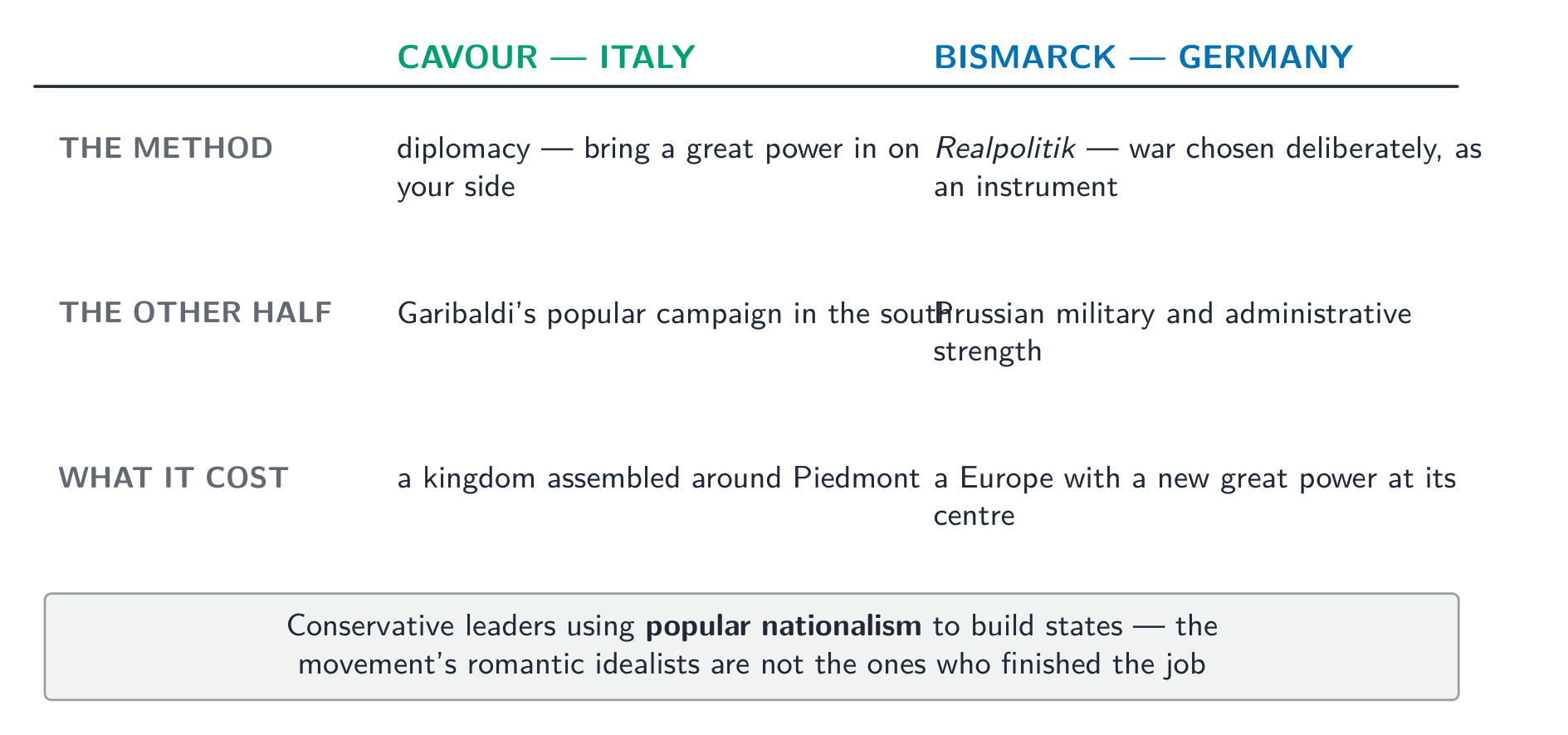
שוווי Cavour ו-Bismarck לפי שיטה - שמרנים המשתמשים בלאומיות עממית
Vocabulary · ⁨מילון מונחים⁩ Train · ⁨אימון⁩
English עברית
subjectivity and individual expression/ˌsʌbdʒɪkˈtɪvɪti ænd ˌɪndɪˈvɪdʒuːəl ekˈspreʃn/ סובייקטיביות וביטוי אישי
romantic idealism/rəʊˈmæntɪk aɪˈdɪəlɪzəm/ רומנטיות אידיאלית
Napoleon III/nəˈpəʊliən ðə θɜːd/ נפוליאון השלישי
Cavour/kəˈvɜː/ קאוור
Bismarck/ˈbɪsmɑːk/ ביסמרק
Zionism/ˈzaɪənɪzəm/ ציונות
dual monarchy of Austria-Hungary/ˈdjuːəl ˈmɒnəki ɒv ˈɒstrɪə ˈhʌŋɡəri/ המונוכיה הכפולה של אוסטריה-הונגריה
Crimean War/kraɪˈmɪən wɔː/ מלחמת קרים
Garibaldi's/ˌɡɑːrɪˈbɔːldiz/ של גאריבלדי
Bismarck used Realpolitik/ˈbɪsmɑːk juːzd ˈrɪəlpəlɪtɪk/ ביסמרק השתמש בריאלפוליטיק
complex system of alliances/ˈkɒmpleks ˈsɪstəm ɒv əˈlaɪənsɪz/ מערכת בריתות מורכבת
mutually antagonistic alliances/ˈmjuːtʃuːəli ænˈtæɡənɪstɪk əˈlaɪənsɪz/ בריתות מתנגדות הדדית
Charles Darwin/tʃɑːlz ˈdɑːwɪn/ צ'ארלס דarwin
Social Darwinism/ˈsəʊʃl ˈdɑːwɪnɪzəm/ דארוויניזם חברתי
Positivism/ˈpɒzɪtɪvɪzəm/ פוזיטיביזם
new relativism in values/njuː ˈrelətɪvɪzəm ɪn ˈvæljuːz/ רילטיביזם חדש בערכים
modernism/ˈmɒdənɪzəm/ מודרניזם
Communication and transportation technologies/kəˌmjuːnɪˈkeɪʃn ænd trænspɔːˈteɪʃn tekˈnɒlədʒiz/ טכנולוגיות תקשורת והובלה
Advances in medicine/ədˈvænsɪz ɪn ˈmedsn/ התקדמות בתחום הרפואה
Realist and materialist/ˈrɪəlɪst ænd məˈtɪərɪəlɪst/ ריאליסטי וחומרני
Impressionism, Post-Impressionism, and Cubism/ɪmˈpreʃənɪzəm pəʊst ɪmˈpreʃənɪzəm ænd ˈkjuːbɪzəm/ אימפרסיוניזם, פוסט-אימפרסיוניזם וקוביזם
7.3

National Unification and Diplomatic Tensions · ⁨איחון לאומי ומתיחות דיפלומטיות⁩

Syllabus · ⁨סיילבוס⁩
English

7.3 National Unification and Diplomatic Tensions

Thematic Focus (NEI): National and European Identity — Definitions and perceptions of regional, cultural, national, and European identity have developed and been challenged over time, with varied and often profound effects on the political, social, and cultural order in Europe.

Thematic Focus (SOP): States and Other Institutions of Power — European states and nations developed governmental and civil institutions from 1450 to the present to organize society and consolidate political power, with a variety of social, cultural, and economic effects.

Learning Objective Unit 7.C: Explain the factors that resulted in Italian unification and German unification.

  • KC-3.4.II.A The Crimean War demonstrated the weakness of the Ottoman Empire and contributed to the breakdown of the Concert of Europe, thereby creating the conditions in which Italy and Germany could be unified after centuries of fragmentation.
  • KC-3.4.III.A Cavour’s diplomatic strategies, combined with the popular Garibaldi’s military campaigns, led to the unification of Italy.
  • KC-3.4.III.B Bismarck used Realpolitik, employing diplomacy, industrialized warfare, weaponry, and the manipulation of democratic mechanisms to unify Germany.

Learning Objective Unit 7.D: Explain how nationalist sentiment and political alliances led to tension between and among European powers from 1815 to 1914.

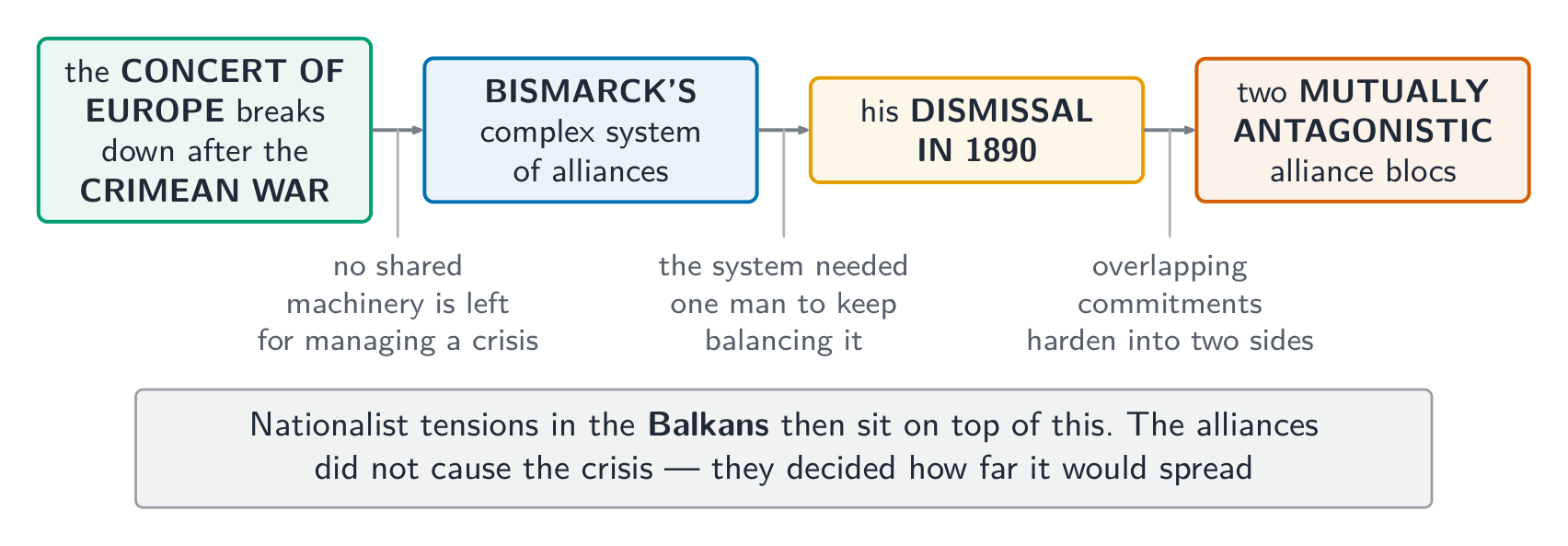
  • KC-3.4.III.C After 1871, Bismarck attempted to maintain the balance of power through a complex system of alliances directed at isolating France.
  • KC-3.4.III.D Bismarck’s dismissal in 1890 eventually led to a system of mutually antagonistic alliances and heightened international tensions.
  • KC-3.4.III.E Nationalist tensions in the Balkans drew the Great Powers into a series of crises, leading up to World War I.

Illustrative examples:

  • Bismarck’s alliances: §Bullet Three Emperors’ League §Bullet Triple Alliance §Bullet Reinsurance Treaty Nationalist tensions in the Balkans: §Bullet Congress of Berlin in 1878 §Bullet Growing influence of Serbia §Bullet Bosnia-Herzegovina annexation crisis (1908) §Bullet First Balkan War §Bullet Second Balkan War
עברית

7.3 איחוד לאומי ומתיחות דיפלומטיות

מיקוד נושאי (NEI): זהות לאומית ואירופאית — הגדרות וקליטות של זהות אזורית, תרבותית, לאומית ואירופאית התפתחו ונבדקו לאורך זמן, עם השפעות מגוונות ולעיתים עמוקות על הסדר הפוליטי, החברתי והתרבותי באירופה.

מיקוד נושאי (SOP): מדינות ומוסדות כוח אחרים — מדינות ואומות אירופיות פיתחו מוסדות ממשליים ואזרחיים משנת 1450 ועד היום כדי לארגן את החברה ולחזק את הכוח הפוליטי, עם מגוון השפעות חברתיות, תרבותיות וכלכליות.

מטרות למידה ליחידה 7.C: הסבר הגורמים שגרמו לאיחוד האיטלקי ולאיחוד הגרמני.

  • KC-3.4.II.A מלחמת קרים הוכיחה את חולשתה של האימפריה העות'מאנית ותרמה להתפרקות הקונצרט האירופי, ובכך יצרה את התנאים שבהם איטליה וגרמניה יכלו להיאחד לאחר מאות שנות פיצול.
  • KC-3.4.III.A אסטרטגיות המדיניות של קאוור, בשילוב עם המערכות הצבאיות הפופולריות של גריבאלדי, הביאו לאיחוד איטליה.
  • KC-3.4.III.B ביסמרק השתמש בריאלפוליטיק, תוך שימוש במדיניות, מלחמות ממוכנות, נשק והטעת מכניזמים דמוקרטיים כדי לאחד את גרמניה.

מטרת למידה לימודית 7.D: הסבר כיצד רגש לאומי ובריתות פוליטיות הובילו למתיחות בין ובין כוחות אירופיים משנת 1815 ועד 1914.

  • KC-3.4.III.C לאחר 1871, ניסה ביסמרק לשמור על איזון הכוחות באמצעות מערכת מורכבת של בריתות שמטרתה הייתה לבודד את צרפת.
  • KC-3.4.III.D ההתנגשות של ביסמרק בשנת 1890 הובילה לבסוף למערכת של בריתות מתנגדות הדדית ומתיחות בינלאומיות מוגברת.
  • KC-3.4.III.E מתיחות לאומיות בבalkans (בלקן) הגרשו את הכוחות הגדולים לסדרה של משברים, שהובילו למלחמת העולם הראשונה.

דוגמאות מדגמיות:

  • בריתותיו של ביסמרק: §ברית שלו הקיסרים §ברית המשולשת §חוק הסיכון החוזר מתיחות לאומיות בבלקן: §הקונגרס בברלין ב-1878 §השפעה עולה של סרביה §משבר הלחימה בבוסניה והרצגובינה (1908) §מלחמת הבלקן הראשונה §מלחמת הבלקן השנייה

Source: College Board AP Course and Exam Description · ⁨מקור: תיאור הקורס והמבחן של College Board AP⁩

English

The Crimean War 克里米亚战争 demonstrated the weakness of the Ottoman Empire and contributed to the breakdown of the Concert of Europe - which is what made unification possible, because the system designed to prevent territorial change no longer functioned.

  • Italy: Cavour's diplomatic strategies, combined with Garibaldi's 加里波第 popular military campaigns, led to unification. Diplomacy plus popular movement - two mechanisms, and the CED names both.
  • Germany: Bismarck used Realpolitik 现实政治, employing diplomacy, industrialised warfare and weaponry, and the manipulation of democratic mechanisms to achieve unification under Prussia.

Then the diplomatic consequences, which run directly into Unit 8:

  • After 1871 Bismarck attempted to maintain the balance of power through a complex system of alliances 联盟体系 aimed at isolating France.
  • Bismarck's dismissal in 1890 eventually produced a system of mutually antagonistic alliances 彼此敌对的联盟 and heightened international tension.
  • Nationalist tensions in the Balkans drew the Great Powers into a series of crises leading up to the First World War.
עברית

מלחמת קרים הדגימה את חולשת האימפריה העות'מאנית ותרמה לפירוק הקונצרט של אירופה - מה שהיה בדיוק מה שהפך את האיחון לאפשרי, מכיוון שהמערכת שנועדה למנוע שינויים טריטוריאליים הפסיקה לתפקד.

  • איטליה: האסטרטגיות הדיפלומטיות של Cavour, בשילוב עם המסעות הצבאיים העממיים של Garibaldi, הובילו לאיחון. דיפלומציה בשילוב תנועה עממית - שני מנגנונים, וה-CED מציינת את שניהם.
  • גרמניה: Bismarck השתמש ב-Reallpolitik, באמצעות דיפלומציה, מלחמה תעשייתית ונשק, ועל ידי שימוש במנגנונים דמוקרטיים כדי להגיע לאיחון תחת פרוסיה.

לאחר מכן הבוא ההשלכות הדיפלומטיות, הנוגעות ישירות ליחידה 8:

  • לאחר 1871 Bismarck נסה לשמור על מאזן הכוחות באמצעות מערכת מסובכת של בריתות שנועדה לבודד את צרפת.
  • פיטורו של Bismarck ב-1890 הביא בסוף ליצירת מערכת של בריתות מתנגדות זה לזה ומתיחות בינלאומית מוגברת.
  • המתיחות הלאומיות בבאלקנים גרמו לעצמות הגדולות להיכנס לסדרה של משברים שהובילו למלחמת העולם הראשונה.
מערכת שנבנתה לשמירה על השלום הופכת לשתי מחנות עוינים - נקודת המעבר היא פיטור
Explore · ⁨חקור⁩

Follow a peace system into two hostile blocs · ⁨לעקוב אחר מערכת שלום לשני בלוקים עוינים⁩

Bismarck's alliances were built to prevent a general war. The turning point is a dismissal, not a treaty. · ⁨בריתותיו של ביסמרק נבנו למניעת מלחמת עולם. נקודת המפנה היא פיטורין, לא הסכם.⁩

7.4

Darwinism and Social Darwinism · ⁨דארווینیזם ודארווין סוציאלי⁩

Syllabus · ⁨סיילבוס⁩
English

7.4 Darwinism, Social Darwinism

Thematic Focus (TSI): Technological and Scientific Innovation — Scientific and technological innovations have increased efficiency, improved daily life, and shaped human development and interactions, having both intended and unintended consequences.

Learning Objective Unit 7.E: Explain how Darwin’s theories influenced scientific and social developments from 1815 to 1914.

  • KC-3.6.II.B Charles Darwin provided a scientific and material account of biological change and the development of human beings as a species, and inadvertently, a justification for racialist theories that became known as Social Darwinism.
עברית

7.4 דארווینیזם, דארווینیזם חברתי

מיקוד נושאי (TSI): חדשנות טכנולוגית ומדעית — חדשונות מדעיים וטכנולוגיים הגדילו את היעילות, שיפרו את החיים היומיומיים ועיצבו את הפיתוח והאינטראקציה האנושיים, עם תוצאות מתוכננות ולא מתוכננות.

מטרת למידה לימודית 7.E: הסבר כיצד תיאוריותיו של דארווין השפיעו על פיתוחים מדעיים וחברתיים משנת 1815 ועד 1914.

  • KC-3.6.II.B צ'ארלס דארווין סיפק חשבון מדעי וחומרי לשינוי ביולוגי ולפיתוח בני האדם כמינים, ובאופן בלתי צפוי, גם הצדקה לתאוריות גזעניות שהפכו ידועות כתאוריות דארווینیזם חברתי.

Source: College Board AP Course and Exam Description · ⁨מקור: תיאור הקורס והמבחן של College Board AP⁩

English

Charles Darwin 达尔文 provided a scientific and material account of biological change and of the development of human beings as a species.

His theory was then applied well beyond biology. Social Darwinism 社会达尔文主义 took the language of competition and selection and used it to justify racial, national, and class hierarchies - and, in the next topic, imperial expansion. Keep the distinction sharp in an essay: Darwin's biology and Social Darwinism are not the same claim, and the second does not follow from the first.

עברית

צ'ארלס דארווין סיפק חיבור מדעי וחומרי לשינוי ביולוגי ולתהליך התפתחות בני האדם כמין.

התיאוריה שלו הוחלה לאחר מכן גם מחוץ לתחום הביולוגיה. דארווין סוציאלי לקח את השפה של תחרות ובחירה והשתמש בה כדי להצדיק היררכיות גזעיות, לאומיות ומעמדיות - ואף, בנושא הבא, הרחבה אימפריאלית. שמור על ההבחנה החדה במאמר: הביולוגיה של דארווין והדארווין הסוציאלי אינם טענה אחת, והשנייה אינה נובעת מהראשונה.

7.5

The Age of Progress and Modernity · ⁨עידן ההתקדמות והמודרניות⁩

Syllabus · ⁨סיילבוס⁩
English

7.5 The Age of Progress and Modernity

Thematic Focus (TSI): Technological and Scientific Innovation — Scientific and technological innovations have increased efficiency, improved daily life, and shaped human development and interactions, having both intended and unintended consequences.

Learning Objective Unit 7.F: Explain how science and other intellectual disciplines developed and changed throughout the period from 1815 to 1914.

  • KC-3.6.II.A Positivism, or the philosophy that science alone provides knowledge, emphasized the rational and scientific analysis of nature and human affairs.
  • KC-3.6.III In the later 19th century, a new relativism in values and the loss of confidence in the objectivity of knowledge led to modernism in intellectual and cultural life.
    • KC-3.6.III.A Philosophy largely moved from rational interpretations of nature and human society to an emphasis on irrationality and impulse, a view that contributed to the belief that conflict and struggle led to progress.
    • KC-3.6.III.B Freudian psychology offered a new account of human nature that emphasized the role of the irrational and the struggle between the conscious and subconscious.
    • KC-3.6.III.C Developments in the natural sciences, such as quantum mechanics and Einstein’s theory of relativity, undermined the primacy of Newtonian physics as an objective description of nature.

Illustrative examples:

  • Philosophers who emphasized the irrational: §Bullet Friedrich Nietzsche §Bullet Georges Sorel §Bullet Henri Bergson Scientists who undermined the notion that Newtonian physics provided an objective knowledge of nature: §Bullet Max Planck
עברית

7.5 עידן ההתקדמות והמודרניות

מיקוד נושאי (TSI): חדשנות טכנולוגית ומדעית — חדשונות מדעיים וטכנולוגיים הגדילו את היעילות, שיפרו את החיים היומיומיים ועיצבו את הפיתוח והאינטראקציה האנושיים, עם תוצאות מתוכננות ולא מתוכננות.

מטרת למידה לימודית 7.F: הסבר כיצד מדע ותחומי מחקר אינטלקטואליים אחרים התפתחו ושנו לאורך תקופה זו משנת 1815 ועד 1914.

  • KC-3.6.II.A פוזיטיביזם, או הפילוסופיה הטוענת שמדע בלבד מספק ידע, הדגישה את הניתוח הרציונלי והמדעי של הטבע והעניינים האנושיים.
  • KC-3.6.III בסוף המאה ה-19, רליטיביזם חדש בערכים ואובדן האמון באובייקטיביות הידע הובילו למודרניזם בחיי האינטלקט והתרבות.
    • KC-3.6.III.A פילוסופיה נטלה בעיקר מהפרשנות הרציונלית של הטבע והחברה האנושית להדגשת אי-רציונליות ודחפים, מבט שתרם לעמדה לפיה סכסוך ומאבק מובילים להתקדמות.
    • KC-3.6.III.B פסיכולוגיה פרוידית הציעה חשבון חדש לטבע האנושי שהדגיש את תפקיד האי-רציונליות והמאבק בין המודע לחסר המודע.
    • KC-3.6.III.C פיתוחים במדעי הטבע, כמו מכניקת הקוונטים ותורת היחסות של איינשטיין, תחתו את ראשוניות הפיזיקה הניוטונית כתיאור אובייקטיבי של הטבע.

דוגמאות מדגמיות:

  • פילוסופים שהדגישו את האי-רציונליות: §פרידריך ניטשה §ג'ורג' סורל §אנרי ברגסון מדענים שתחתו את הרעיון לפיו פיזיקה ניוטונית מספקת ידע אובייקטיבי של הטבע: §מקס פלאנק

Source: College Board AP Course and Exam Description · ⁨מקור: תיאור הקורס והמבחן של College Board AP⁩

English

Positivism 实证主义 - the philosophy that science alone provides knowledge - emphasised the rational and scientific analysis of nature and human affairs, and represents the confident pole of the century's thinking.

Then, in the later nineteenth century, a new relativism in values 价值相对主义 and a loss of confidence in the objectivity of knowledge led to modernism 现代主义. The two together are the tension named in 7.1: the same culture produced both the belief that science would explain everything and the suspicion that objectivity itself was an illusion.

עברית

פוזיטיביזם - הפילוסופיה לפיה מדע לבדו מספק ידע - הדגישה ניתוח רציונלי ומדעי של הטבע וענייני האדם, ומהווה את הקוטב הבטוח של מחשבת המאה.

לאחר מכן, בסוף המאה התשע עשרה, ריגול主义 חדש בערכים ואובדן ביטחון באובייקטיביות הידע הובילו למודרניזם. שניהם יחד הם המתח שנקרא ב-7.1: אותו תרבות ייצרה גם את האמונה שהמדע יסביר הכל וגם את הספק שאפילו האובייקטיביות עצמה היא אשליה.

7.6

New Imperialism: Motivations and Methods · ⁨אימפריאליזם חדש: מניעים ושיטות⁩

Syllabus · ⁨סיילבוס⁩
English

7.6 New Imperialism: Motivations and Methods

Thematic Focus (INT): Interaction of Europe and the World — Motivated by a variety of factors, Europe’s interaction with the world led to political, economic, social, and cultural exchanges that influenced both European and non-European societies.

Thematic Focus (TSI): Technological and Scientific Innovation — Scientific and technological innovations have increased efficiency, improved daily life, and shaped human development and interactions, having both intended and unintended consequences.

Learning Objective Unit 7.G: Explain the motivations that led to European imperialism in the period from 1815 to 1914.

  • KC-3.5.I European nations were driven by economic, political, and cultural motivations in their new imperial ventures in Asia and Africa.
    • KC-3.5.I.A European national rivalries and strategic concerns fostered imperial expansion and competition for colonies.
    • KC-3.5.I.B The search for raw materials and markets for manufactured goods, as well as strategic and nationalistic considerations, drove Europeans to colonize Africa and Asia, even as European colonies in the Americas broke free politically, if not economically.
    • IKC-3.5.I.C European imperialists justified overseas expansion and rule by claiming cultural and racial superiority.

Learning Objective Unit 7.H: Explain how technological advances enabled European imperialism from 1815 to 1914.

  • KC-3.5.II.A The development of advanced weaponry ensured the military advantage of Europeans over colonized areas.
  • KC-3.5.II.B Communication and transportation technologies facilitated the creation and expansion of European empires.
  • KC-3.5.II.C Advances in medicine enabled European survival in Africa and Asia.

Illustrative examples:

  • Ideas of cultural and racial superiority: §Bullet “The White Man’s Burden” §Bullet Mission civilisatrice §Bullet Social Darwinism Advanced weaponry: §Bullet Minié ball (bullet) §Bullet Breech-loading rifle §Bullet Machine gun Communication and transportation technologies: §Bullet Steamships
    • Telegraph
    • Photography
  • Advances in medicine: §Bullet Louis Pasteur’s germ theory of disease §Bullet Anesthesia and antiseptics §Bullet Public health projects §Bullet Quinine
עברית

7.6 אימפריאליזם חדש: מotivations and Methods

התמקדות נושאית (INT): אינטראקציה של אירופה עם העולם — בתמנוע מגורמים שונים, האינטראקציה של אירופה עם העולם הביאה להחלפות פוליטיים, כלכליים, חברתיים ותרבותיים שהשפיעו גם על החברות האירופאיות וגם על אלו שאינן אירופאיות.

מיקוד נושאי (TSI): חדשנות טכנולוגית ומדעית — חדשונות מדעיים וטכנולוגיים הגדילו את היעילות, שיפרו את החיים היומיומיים ועיצבו את הפיתוח והאינטראקציה האנושיים, עם תוצאות מתוכננות ולא מתוכננות.

מטרות לימוד לפרק 7.G: הסבר על המניעים שהובילו לאימפריאליזם האירופאי בתקופה שבין 1815 ל-1914.

  • KC-3.5.I מדינות אירופאיות הונעו ממניעים כלכליים, פוליטיים ותרבותיים במסגרת עסקאות האימפריאליסטיות החדשות שלהן באסיה ובאפריקה.
    • KC-3.5.I.A יריבות לאומיות ואכפתות אסטרטגיות באירופה קידמו הרחבה אימפריאליסטית ותחרות על מושבות.
    • KC-3.5.I.B החפש אחרי חומרי גלם ושוקים לסחורות תוצרת, לצד שיקולים אסטרטגיים ולאומיים, דחפו את האירופאים להתיישב באפריקה ובאסיה, גם כאשר המושבות האירופאיות באמריקות השתחררו ממשלתית (אם לא כלכלית).
    • IKC-3.5.I.C האימפריאליסטים האירופאים הצדיקו הרחבה ומשלט מעבר לים על ידי טענת עליונות תרבותית וגזעית.

מטרות לימוד לפרק 7.H: הסבר כיצד התקדמות טכנולוגית אפשרה את האימפריאליזם האירופאי משנת 1815 ועד 1914.

  • KC-3.5.II.A פיתוח נשק מתקדם הבטיח לערבים יתרונות צבאיים על פני אזורים מושבים.
  • KC-3.5.II.B טכנולוגיות תקשורת והובלה הקלו על יצירת והרחבת האימפריות האירופאיות.
  • KC-3.5.II.C התקדמות ברפואה אפשרה הישרדות אירופאית באפריקה ובאסיה.

דוגמאות מדגמיות:

  • רעיונות של עליונות תרבותית וגזעית: §Bullet “The White Man’s Burden” §Bullet Mission civilisatrice §Bullet Social Darwinism נשק מתקדם: §Bullet Minié ball (bullet) §Bullet Breech-loading rifle §Bullet Machine gun טכנולוגיות תקשורת והובלה: §Bullet Steamships
    • Telegraph
    • Photography
  • התקדמות ברפואה: §Bullet Louis Pasteur’s germ theory of disease §Bullet Anesthesia and antiseptics §Bullet Public health projects §Bullet Quinine

Source: College Board AP Course and Exam Description · ⁨מקור: תיאור הקורס והמבחן של College Board AP⁩

English

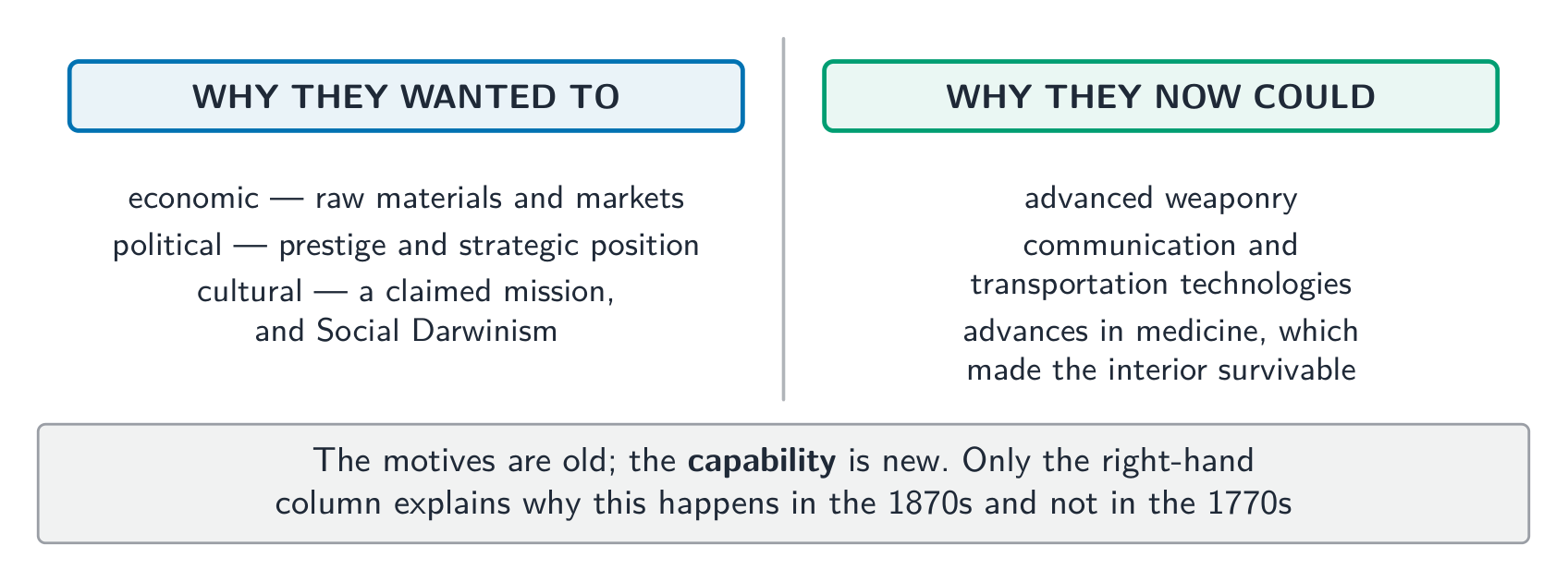
European nations were driven by economic, political, and cultural motivations in their new imperial ventures in Asia and Africa.

The CED then gives the enabling technologies separately, and there are exactly three:

  • Advanced weaponry ensured European military advantage over colonised areas.
  • Communication and transportation technologies 通信与运输技术 made empires possible to create and administer.
  • Advances in medicine 医学进步 enabled European survival in Africa and Asia - the one students forget, and often the decisive factor.
עברית

המדינות האירופאיות הונעו על ידי מניעות כלכליות, פוליטיות ותרבותיות במסגרת המיזמים האימפריאליים החדשים שלהם באסיה ובאפריקה.

ה-CED מציג אחר כך את הטכנולוגיות המקדמות בנפרד, ויש בדיוק שלוש מהן:

  • נשק מתקדם הבטיח יתרון צבאי אירופאי על פני האזורים המושבתים.
  • טכנולוגיות תקשורת והובלה אפשרו יצירה ושליטה באימפריות.
  • התקדמויות ברפואה אפשרו הישרדות אירופאים באפריקה ובאסיה - הדבר ש学生 (סטודנטים) שוכחים לעיתים קרובות, ולעיתים קרובות הגורם הקובע.
המניעות ישנות, היכולת חדשה - רק העמודה השנייה מסבירה את הזמן
Explore · ⁨חקור⁩

Separate wanting to from being able to · ⁨להפריד בין רצון לביצוע⁩

Motives for empire are old; capability is new. Only the second column explains why this happens in the 1870s. · ⁨המניעים לקיסרון ישנים; היכולת חדשה. רק העמוד השני מסביר מדוע הדבר קורה בשנות ה-1870.⁩

7.7

Imperialism's Global Effects · ⁨השפעות גלובליות של אימפריאליזם⁩

Syllabus · ⁨סיילבוס⁩

7.7 Imperialism’s Global Effects

Thematic FocusLearning ObjectiveHistorical Developments

INT
Interaction of Europe and the World — Motivated by a variety of factors, Europe’s interaction with the world led to political, economic, social, and cultural exchanges that influenced both European and non-European societies.

Unit 7.I
Explain how European imperialism affected both European and non-European societies.

  • KC-3.5.III Imperial endeavors significantly affected society, diplomacy, and culture in Europe and created resistance to foreign control abroad.
    • KC-3.5.III.A Imperialism created diplomatic tensions among European states that strained alliance systems.
    • KC-3.5.III.B Imperial encounters with non-European peoples influenced the styles and subject matter of artists and writers and provoked debate over the acquisition of colonies.
    • KC-3.5.III.C Especially as non-Europeans became educated in Western values, they challenged European imperialism through nationalist movements and by modernizing local economies and societies.

Illustrative examples:

  • Diplomatic tensions: §Bullet Berlin Conference (1884–1885) §Bullet Fashoda crisis (1898) §Bullet Moroccan crises (1905, 1911) Participants in the imperialism debate: §Bullet Pan-German League §Bullet J. A. Hobson’s and Vladimir Lenin’s anti-imperialism §Bullet Congo Reform Association Responses to European imperialism: §Bullet Indian Congress Party §Bullet Zulu Resistance §Bullet India’s Sepoy Mutiny §Bullet China’s Boxer Rebellion §Bullet Japan’s Meiji Restoration

Source: College Board AP Course and Exam Description · ⁨מקור: תיאור הקורס והמבחן של College Board AP⁩

English

Imperial endeavours significantly affected society, diplomacy, and culture in Europe, and created resistance to foreign control abroad.

Both directions matter. In Europe, empire fed nationalism, shaped popular culture, and turned colonial disputes into Great Power crises. Abroad, it produced organised resistance. An answer that treats imperialism as something Europe did to other places, with no return effect and no response, is incomplete on both counts.

עברית

מיזמי האימפריאליזם השפיעו משמעותית על החברה, הדיפלומטיה והתרבות באירופה, ויצרו התנגדות לשלטון זר מחוץ לגבולות.

שתי הכיוונים חשובים. באירופה, האימפריה חיזקה לאומניות, עיצבה תרבות עממית והפכה מחלוקות מושבתיות למשברים כוחות על. מחוץ לגבולות, היא ייצרה התנגדות מאורגנת. תשובה שמתייחסת לאימפריאליזם כמשהו שאירופה עשתה ל מקומות אחרים, ללא השבה וללא תגובה, היא חסרה בשני המובנים.

7.8

19th-Century Culture and Arts · ⁨תרבות ואמנות במאה ה-19⁩

Syllabus · ⁨סיילבוס⁩
English

7.8 19th-Century Culture and Arts

Thematic Focus (CID): Cultural and Intellectual Developments — The creation and transmission of knowledge, including the relationship between traditional sources of authority and the development of differing world views, had significant political, intellectual, economic, cultural, and social effects on European and world societies.

Learning Objective Unit 7.J: Explain the continuities and changes in European artistic expression from 1815 to 1914.

  • KC-3.6.I Romanticism broke with Neoclassical forms of artistic representation and with rationalism, placing more emphasis on intuition and emotion.
  • KC-3.6.I.A Romantic artists and composers broke from classical artistic forms to emphasize emotion, nature, individuality, intuition, the supernatural, and national histories in their works.
  • KC-3.6.I.B Romantic writers expressed similar themes while responding to the Industrial Revolution and to various political revolutions.
  • KC-3.6.II.D Realist and materialist themes and attitudes influenced art and literature as painters and writers depicted the lives of ordinary people and drew attention to social problems.
  • KC-3.6.III.D Modern art, including Impressionism, Post-Impressionism, and Cubism, moved beyond the representational to the subjective, abstract, and expressive and often provoked audiences that believed that art should reflect shared and idealized values, including beauty and patriotism.

Illustrative examples:

  • Romantic artists: §Bullet Francisco Goya §Bullet Caspar David Friedrich §Bullet J. M. W. Turner §Bullet John Constable §Bullet Eugène Delacroix Romantic composers: §Bullet Ludwig van Beethoven §Bullet Frédéric Chopin §Bullet Richard Wagner §Bullet Pyotr Ilyich Tchaikovsky Romantic writers: §Bullet Johann Wolfgang von Goethe §Bullet William Wordsworth §Bullet Lord Byron §Bullet Percy Shelley §Bullet John Keats §Bullet Mary Shelley §Bullet Victor Hugo Realist artists and authors: §Bullet Honoré de Balzac §Bullet Honoré Daumier §Bullet Charles Dickens §Bullet George Eliot (Mary Ann Evans) §Bullet Gustave Courbet §Bullet Fyodor Dostoevsky §Bullet Jean-François Millet §Bullet Leo Tolstoy §Bullet Émile Zola §Bullet Thomas Hardy (CONT’D) Modern artists: §Bullet Claude Monet §Bullet Paul Cézanne §Bullet Henri Matisse §Bullet Edgar Degas §Bullet Pablo Picasso §Bullet Vincent Van Gogh
עברית

7.8 תרבות ואמנות במאה ה-19

הדגשה נושאית (CID): התפתחויות תרבותיות ואינטלקטואליות — יצירת ומעבר המידע, כולל הקשר בין מקורות סמכות מסורתיים להתפתחות עולמות ראייה שונים, היו בעלי השפעה משמעותית על החברות האירופאיות והעולמיות בתחומים פוליטיים, אינטלקטואליים, כלכליים, תרבותיים וחברתיים.

מטרות למידה ליחידה 7.J: הסבר על הרציפות והשינויים בביטוי האמנותי האירופאי מ-1815 עד 1914.

  • KC-3.6.I הרומנטיקה שברה עם צורות ההצגה האמנותיות הנאו-קלאסיות ועם הרציונליזם, ונתנה משקל רב יותר לאינטואיציה ולרגש.
  • KC-3.6.I.A אמנים ומלחינים רומנטיים שברו עם הצורות האמנותיות הקלאסיות כדי להדגיש רגש, טבע, אינדיווידואליזם, אינטואיציה, על-טבעי והיסטוריות לאומיות ביצירותיהם.
  • KC-3.6.I.B סופרים רומנטיים הביעו נושאים דומים תוך תגובה למהפכה התעשייתית ולמהפכות פוליטיות שונות.
  • KC-3.6.II.D נושאים וגישות ריאליסטיים וחומריים השפיעו על אמנות וספרות כאשר ציירים וסופרים תיארו את חייהם של אנשים רגילים וקראו לתשומת לב לבעיות חברתיות.
  • KC-3.6.III.D אמנות מודרנית, כולל אימפרסיוניזם, פוסט-אימפרסיוניזם וקוביזם, עברה מעבר מהייצוגי אל הסובייקטיבי, האבסטרקטי והאקספרסיבי ולעיתים קרובות גררה קהל קהל שאמן שהאמנות צריכה לשקף ערכים משותפים ואידאליים, כולל יופי וגיאווה לאומית.

דוגמאות מדגמיות:

  • אמנים רומנטיים: §Bullet פרנסיסקו גויה §Bullet קספר דוד פרידריך §Bullet J. M. W. טורנר §Bullet ג'ון קונסטבל §Bullet אוגן דלאקרואז מלחינים רומנטיים: §Bullet לודוויג פון ביטהובן §Bullet פרידריק שופן §Bullet ריכרד וגנר §Bullet פיוטר איליץ' צ'ייקובסקי סופרים רומנטיים: §Bullet יוהאן וולפגנג פון גתה §Bullet ויליאם וורדסוורת' §Bullet לורד בייארן §Bullet פרסי שלי §Bullet ג'ון קייטס §Bullet מרי שילי §Bullet ויקטור הייגו אמנים וסופרים ריאליסטים: §Bullet אונורה דה בלק §Bullet אונורה דומיيه §Bullet צ'ארלס דינקנס §Bullet ג'ורג' אליאט (מרי אנן איוונס) §Bullet גוסטב קורבה §Bullet פיודור דוסטויבסקי §Bullet ז'אן-פרנסואה מייה §Bullet לאו טולסטוי §Bullet אמיל זולה §Bullet תומאס הרדי (המשך) אמנים מודרניים: §Bullet קלווד מונה §Paul Cézanne §Henri Matisse §Edgar Degas §Pablo Picasso §Vincent Van Gogh

Source: College Board AP Course and Exam Description · ⁨מקור: תיאור הקורס והמבחן של College Board AP⁩

English

The century's art tracks its intellectual tension exactly:

  • Romanticism broke with Neoclassical forms and with rationalism, emphasising intuition, emotion, nature, individuality, and the supernatural; Romantic writers expressed the same themes while responding to the Industrial Revolution and to political revolution.
  • Realist and materialist 现实主义与唯物主义 themes influenced art and literature, as painters and writers depicted the lives of ordinary people.
  • Modern art - Impressionism, Post-Impressionism, and Cubism 印象派、后印象派与立体主义 - moved beyond the representational to the subjective, abstract, and expressive.
עברית

האמנות במאה זו משקפת את המתח האינטלקטואלי שלה במדויק:

  • רומנטיזם שבר עם צורות נאו-קלאסיסטיות ועם רציונליזם, ומדגיש אינטואיציה, רגשות, טבע, אינדיווידואליזם ואת הבלתי-נסתר; סופרים רומנטיים הביעו אותם נושאים בעת שהגיבו למהפכה התעשייתית ולמהפכה הפוליטית.
  • נושאים ריאליסטיים וחומריים השפיעו על אמנות וספרות, כאשר ציירים וסופרים תיארו חיי אנשים רגילים.
  • אמנות מודרנית - אימפרסיוניזם, פוסט-אימפרסיוניזם וקוביזם - עברו מעבר מהייצוגי אל הסובייקטיבי, האבסטרקטי והבעותי.
7.9

Causation in 19th-Century Developments · ⁨סיבתיות בפיתוחים במאה ה-19⁩

Syllabus · ⁨סיילבוס⁩
English

7.9 Causation in 19th-Century Perspectives and Political Developments

Learning Objective Unit 7.K: Explain the influence of nationalist and imperialist movements on European and global stability.

  • KC-3.4 European states struggled to maintain international stability in an age of nationalism and revolutions.
    • KC-3.4.II The breakdown of the Concert of Europe opened the door for movements of national unification in Italy and Germany as well as liberal reforms elsewhere.
    • KC-3.4.III The unification of Italy and Germany transformed the European balance of power and led to efforts to construct a new diplomatic order.
  • KC-3.5 A variety of motives and methods led to the intensification of European global control and increased tensions among the Great Powers.
    • KC-3.5.II Industrial and technological developments (e.g., the second industrial revolution) facilitated European control of global empires.
  • KC-3.6 European ideas and culture expressed a tension between objectivity and scientific realism on one hand, and subjectivity and individual expression on the other.
    • KC-3.6.II Following the revolutions of 1848, Europe turned toward a realist and materialist worldview.
עברית

7.9 סיבתיות בתפיסות ובתפתוחים פוליטיים במאה ה-19

מטרות למידה ליחידה 7.K: הסבר על השפעת תנועות לאומניות ואימפריאליסטיות על יציבות אירופאית וגלובלית.

  • KC-3.4 מדינות אירופאיות struggled לשמור על יציבות בינלאומית בתקופת הלאומניות והמהפכות.
    • KC-3.4.II קריסת הקונצרט האירופאי פתחה את הדלת לתנועות איחוד לאומי באיטליה ובגרמניה, כמו גם לרפורמות ליברליות במקומות אחרים.
    • KC-3.4.III האיחוד של איטליה וגרמניה שינה מאזן הכוחות באירופה והוביל לניסיונות לבנות סדר דיפלומטי חדש.
  • KC-3.5 מגוון מוטיבים ושיטות הובילו לה intensification של השליטה הגלובלית האירופאית ולהגברת המתיחות בין העוצמות הגדולות.
    • KC-3.5.II פיתוחים תעשייתיים וטכנולוגיים (למשל, המהפכה התעשייתית השנייה) קילים את השליטה האירופאית על האימפריות הגלובליות.
  • KC-3.6 רעיונות ותרבות אירופאיים הביעו מתח בין אובייקטיביות ומציאות מדעית מצד אחד, לבין סובייקטיביות והבעת פרטנות מצד שני.
    • KC-3.6.II לאחר מהפכות 1848, אירופה פנה לעולם ריאליסטי וחומרני.
Source: College Board AP Course and Exam Description · ⁨מקור: תיאור הקורס והמבחן של College Board AP⁩

English

The unit's reasoning skill is causation.

Worked example (a real AP exam question). AP European History short-answer questions here ask, for example, to "Explain one way in which nationalism contributed to the unification of Germany or Italy in the nineteenth century." A full-mark answer names the mechanism rather than the sentiment: "Bismarck used popular nationalist feeling as an instrument of Prussian state-building: by presenting wars against Denmark, Austria, and France as national causes, he made the smaller German states' rulers politically unable to resist unification under Prussia, and turned a dynastic expansion into a national one." Notice the shape: nationalism is shown doing something, not merely existing.

עברית

מיומנות ההסתדרות היחידה היא גורמים.

דוגמה מפורטת (שאלה אמיתית מבחן AP). שאלות מענה קצר בהיסטוריה אירופאית של AP מבקשות כאן, לדוגמה, ל*",הסבר דרך אחת שבה לאומיות תרמה לאיחוד גרמניה או איטליה במאה התשע עשרה."* תשובה בנקודה מלאה מציגה את המנגנון ולא את הרגש: ",ביסמרק השתמש ברגש הלאומי העממי ככלי לבניית מדינת פרוסיה: על ידי הצגת מלחמות נגד דנמרק, אוסטריה וצרפת כנושאים לאומיים, הוא הפך את שליטי המדינות הגרמניות הקטנות לפוליטית בלתי יכולות להתנגד לאיחוד תחת פרוסיה, והפך הרחבה דינסטית לאיחוד לאומי." שימו לב לצורה: הלאומיות מוצגת עושה משהו, ולא רק קיימת.

7.9

Exam tips · ⁨טיפים לבחינות⁩

English
  • The reversal is the unit: before 1848 nationalism threatens the order; after 1848 conservatives use it to build states.
  • The breakdown of the Concert of Europe after Crimea is what made unification possible. Name it as the enabling condition.
  • Italy needed both Cavour's diplomacy and Garibaldi's campaigns. Germany needed Bismarck's Realpolitik. Different mechanisms, same outcome.
  • Give three enabling technologies of imperialism - weaponry, transport and communication, and medicine.
  • Keep Darwin and Social Darwinism apart. The second is a use of the first, not a consequence of it.
  • Imperialism acted on Europe as well as abroad, and it produced resistance. Both are examinable.
עברית
  • ההפיכה היא במונח: לפני 1848 לאומיות מאיים על הסדר; לאחר 1848 השומרנים משתמשים בו כדי לבנות מדינות.
  • קריסת הקונצרט של אירופה לאחר מלחמת קרים הוא מה שהפך את האיחוד לאפשרי. שמו כהתנאי המקדם.
  • איטליה צרכה גם דיפלומטיה של קאוור וגם מצעדים של גריבאלדי. גרמניה צרכה את ה-Realpolitik של ביסמרק. מנגנונים שונים, תוצאה זהה.
  • נתן שלוש טכנולוגיות מקדמות של אימפריאליזם - נשק, הובלה ותקשורת, ורפואה.
  • להפריד בין דרווין לבין דרווניזם חברתי. השני הוא שימוש בראשון, ולא תוצאה ממנו.
  • האימפריאליזם פעל באירופה וגם מחוצה לה, ויצר התנגדות. שניהם נבדקים בבחינות.

Interactive lessons on this topic · ⁨שיעורים אינטראקטיביים בנושא זה⁩

Work through it step by step, with instant-check exercises. · ⁨לעבור על הדברים צעד אחר צעד, עם תרגילים לבדיקה מיידית.⁩

Past Papers · ⁨מבחני עבר⁩

More topics in AP European History · ⁨היסטוריה אירופאית - AP⁩ · ⁨נושאים נוספים בAP European History · ⁨היסטוריה אירופאית - AP⁩⁩

Log in or create account · ⁨היכנס או צור חשבון⁩

IGCSE, A-Level & AP