Skip to content · ⁨דלג לתוכן⁩

Line of Reasoning and Methods of Development · ⁨קו רעיוני ומתודולוגיות לפיתוח⁩

AP English Language and Composition · ⁨שפה ואנגלית כתיבה יצירתית - AP⁩ · Topic 3 · ⁨נושא 3⁩

Video lesson for this topic · ⁨שיעור וידאו לנושא זה⁩ Open the video page · ⁨פתח את עמוד הוידאו⁩
5:57

יחידה 3: קו מחשבה ומתודולוגיות לפיתוח

יחידה 3 היא הנקודה שבה הקורס מפסיק להיות עוסק בחלקים מתחיל לעסוק במבנה, והנה המבחן שיגלה אם יש לך מושג על כך. קח את העריכה שלך…

English narration · English + 中文 subtitles burned in · ⁨קריאת קול באנגלית · תרגום אנגלי + סינית שרוף בתוך הסרטון⁩

3.1

Identifying Claims and Evidence · ⁨זיהוי טענות ועדויות⁩

Syllabus · ⁨סיילבוס⁩
English

Enduring Understanding (CLE-1): Writers make claims about subjects, rely on evidence that supports the reasoning that justifies the claim, and often acknowledge or respond to other, possibly opposing, arguments.

Learning Objective 3.A: Reading – Identify and explain claims and evidence within an argument.

  • CLE-1.K Effective use of evidence uses commentary to establish a logical relationship between the evidence and the claim it supports.
  • CLE-1.L Writers introduce source material by using commentary to properly integrate it into their line of reasoning.
  • CLE-1.M Synthesis requires consideration, explanation, and integration of others’ arguments into one’s own argument.
  • CLE-1.N Writers must acknowledge words, ideas, images, texts, and other intellectual property of others through attribution, citation, or reference.
עברית

הבנה מתמשכת (CLE-1): כותבים מטילים טענות בנושאים, נסמכים על עדויות התומכות בלוגיקה המצדיקה את הטענה, ולעיתים קרובות מכירים או מגיבים לטענות אחרות, אולי מתנגדות.

מטרות למידה 3.A: קריאה – זיהוי והסבר טענות ועדויות בתוך ארגומנט.

  • CLE-1.K שימוש יעיל בממצאים משתמש בתגובה כדי לקיים קשר לוגי בין הממצא לבין הטענה שהוא תומך בה.
  • CLE-1.L סופרים מציגים חומר מקור על ידי שימוש בתגובה כדי לשלב אותו באופן תקין בקו ההסברה שלהם.
  • CLE-1.M סינתזה דורשת בחינה, הסבר ושילוב של טיעונים אחרים לטיעון האישי.
  • CLE-1.N סופרים חייבים להכיר במילים, רעיונות, תמונות, טקסטים וזכויות רוחניות אחרות של אחרים באמצעות ייחוס, ציטוט או הפניה.
Source: College Board AP Course and Exam Description · ⁨מקור: תיאור הקורס והמבחן של College Board AP⁩

English

Unit 3 is where the course stops being about parts and starts being about structure. Its subject is the line of reasoning 推理线索 - the path an argument takes from where it starts to what it proves.

First, four claims about how evidence gets into an argument properly:

  • Effective use of evidence uses commentary 评述 to establish a logical relationship between the evidence and the claim.
  • Writers introduce source material using commentary to integrate it into their line of reasoning - so commentary comes before as well as after.
  • Synthesis 综合 requires consideration, explanation, and integration of others' arguments into one's own. That is the exact skill Question 1 tests, and the word integration rules out a paragraph that simply summarises each source in turn.
  • Writers must acknowledge the words, ideas, images, and texts of others through attribution and citation 归属与引用.
עברית

יחידה 3 היא הנקודה שבה הקורס מפסיק לעסוק בחלקים ומתחיל לעסוק במבנה. נושא הדבר הוא קו ההיכרות 推理线索 - הדרך שהטיעון עובר מהנקודה שבה הוא מתחיל ועד למה שהוא מוכיח.

תחילה, ארבע טענות לגבי האופן שבו עדות נכנסת באופן תקין לטיעון:

  • שימוש יעיל בעדות משתמש בתגובה 评述 כדי לקיים קשר לוגי בין העדות לבין הטיעון.
  • כותבים מציגים חומר ממקור באמצעות תגובה כדי לשלב אותו בקו ההיכרות שלהם - כך שתגובה מגיע גם לפני וגם אחרי.
  • שילוב 综合 דורש שיקול, הסבר ושילוב של טיעוני אחרים לתוך הטוען האישי. זו בדיוק המיומנות שמבחן שאלה 1 בודק, והמילה שילוב פוסלת פרק שמפשוט מסכם כל מקור בתורו.
  • כותבים חייבים להכיר במילים, רעיונות, תמונות וטקסטים של אחרים דרך יחס וציטוט 归属与引用.
3.2

Developing a Paragraph with Claim and Evidence · ⁨פיתוח פרק עם טענה ועדות⁩

Syllabus · ⁨סיילבוס⁩
English

Enduring Understanding (CLE-1): Writers make claims about subjects, rely on evidence that supports the reasoning that justifies the claim, and often acknowledge or respond to other, possibly opposing, arguments.

Learning Objective 4.A: Writing – Develop a paragraph that includes a claim and evidence supporting the claim.

  • CLE-1.K Effective use of evidence uses commentary to establish a logical relationship between the evidence and the claim it supports.
  • CLE-1.L Writers introduce source material by using commentary to properly integrate it into their line of reasoning.
  • CLE-1.M Synthesis requires consideration, explanation, and integration of others’ arguments into one’s own argument.
  • CLE-1.N Writers must acknowledge words, ideas, images, texts, and other intellectual property of others through attribution, citation, or reference.
עברית

הבנה מתמשכת (CLE-1): כותבים מטילים טענות בנושאים, נסמכים על עדויות התומכות בלוגיקה המצדיקה את הטענה, ולעיתים קרובות מכירים או מגיבים לטענות אחרות, אולי מתנגדות.

מטרות למידה 4.A: כתיבה – פתח פרק הכולל טענה ועדויות התומכות בטענה.

  • CLE-1.K שימוש יעיל בממצאים משתמש בתגובה כדי לקיים קשר לוגי בין הממצא לבין הטענה שהוא תומך בה.
  • CLE-1.L סופרים מציגים חומר מקור על ידי שימוש בתגובה כדי לשלב אותו באופן תקין בקו ההסברה שלהם.
  • CLE-1.M סינתזה דורשת בחינה, הסבר ושילוב של טיעונים אחרים לטיעון האישי.
  • CLE-1.N סופרים חייבים להכיר במילים, רעיונות, תמונות, טקסטים וזכויות רוחניות אחרות של אחרים באמצעות ייחוס, ציטוט או הפניה.
Source: College Board AP Course and Exam Description · ⁨מקור: תיאור הקורס והמבחן של College Board AP⁩

English

Applied to your own writing, the change from Unit 2 is that commentary now has two jobs, not one: it introduces the evidence into the reasoning, and it explains the relationship afterwards.

A paragraph that does both reads: claim - a sentence positioning the evidence - the evidence, embedded - commentary establishing the logical relationship - the link onward. The sentence before the quotation is doing as much work as the one after it, and most students write neither.

עברית

באופן היישום לכתיבה שלך, השינוי ביחס ליחידה 2 הוא שתגובה כעת מבצעת שני משימות, ולא אחת: היא מציגה את העדות להיכרות, והיא מסבירה את הקשר לאחר מכן.

פרק שמבצע את השניים קורא: הטיעון - משפט הממקם את העדות - העדות, משולבת - תגובה המקימה את הקשר הלוגי - הקישור המשך. המשפט לפני ההפניה עושה אותה כמות עבודה כמו זה שלאחריה, וכמעט כל הסטודנטים אינם כותבים אף אחד מהם.

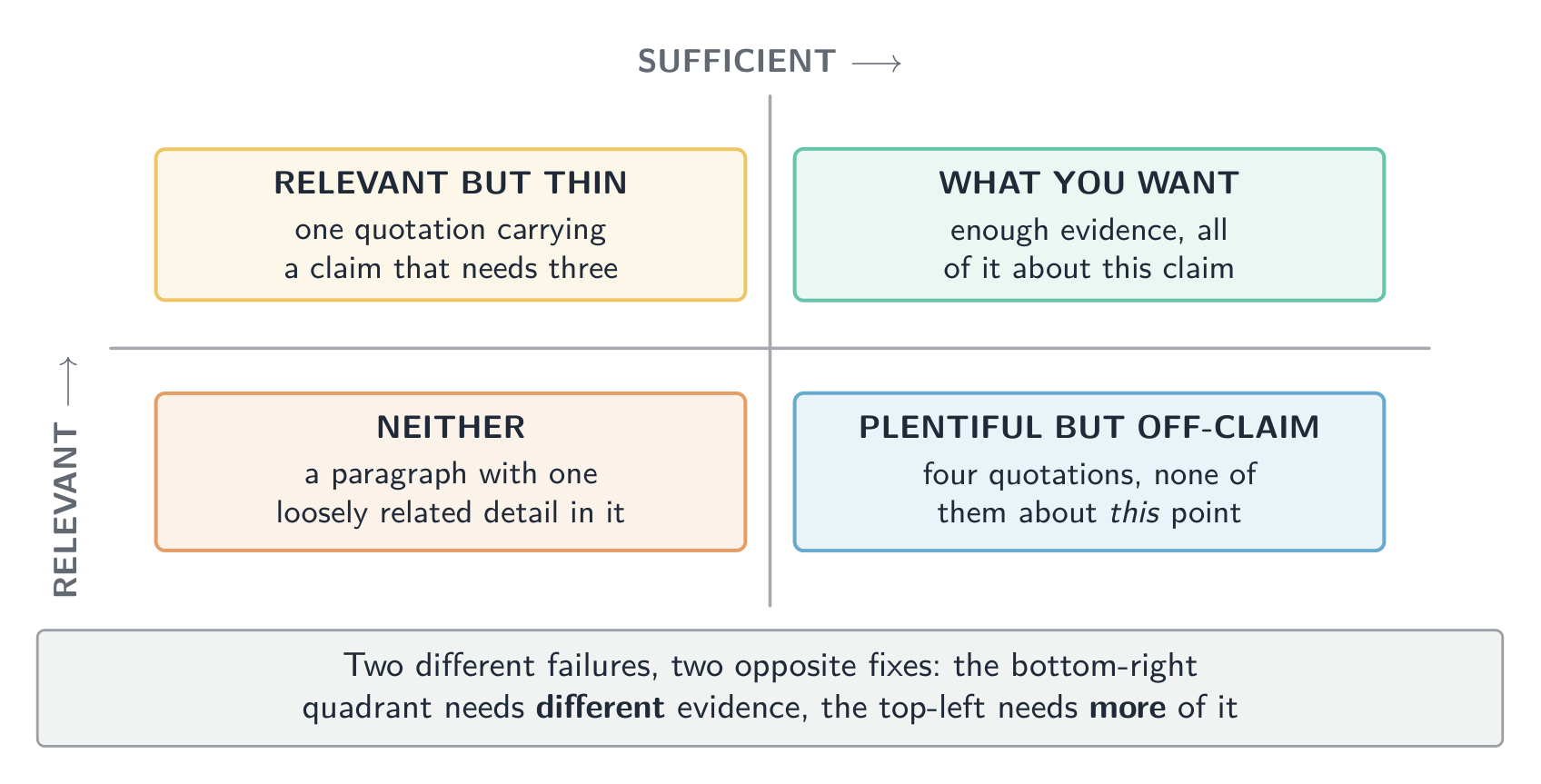
המתאים והמספיק הם שתי כישלים שונים עם שתי פתרונות מנוגדים
Explore · ⁨חקור⁩

Diagnose the evidence problem · ⁨אבחן את בעיית העדויות⁩

Relevant and sufficient are two different failures with two opposite fixes. · ⁨רלוונטיות ומספיקות הן שני סוגי כשל שונים עם שני פתרונות הפוכים.⁩

3.3

Describing the Line of Reasoning · ⁨תיאור קו ההיכרות⁩

Syllabus · ⁨סיילבוס⁩
English

Enduring Understanding (REO-1): Writers guide understanding of a text’s lines of reasoning and claims through that text’s organization and integration of evidence.

Learning Objective 5.A: Reading – Describe the line of reasoning and explain whether it supports an argument’s overarching thesis.

  • REO-1.A Writers may lead readers through a line of reasoning and then arrive at a thesis.
  • REO-1.B Writers may express a claim and then develop a line of reasoning to justify the claim.
  • REO-1.C Writers explain their reasoning through commentary that connects chosen evidence to a claim.
  • REO-1.D Commentary explains the significance and relevance of evidence in relation to the line of reasoning.
  • REO-1.E The sequence of paragraphs in a text reveals the argument’s line of reasoning.
  • REO-1.F Flaws in a line of reasoning may render an argument specious or illogical.
עברית

הבנה מתמשכת (REO-1): סופרים מדרכים את הבנת קווי ההסברה והטענות של טקסט דרך הארגון והשילוב של הממצאים בטקסט.

מטרות למידה 5.A: קריאה – תארו את קו ההסברה והסבירו האם הוא תומך בטענת העל של הטיעון.

  • REO-1.A סופרים עשויים להוביל קוראים דרך קו הסברה ולאחר מכן להגיע לטענה.
  • REO-1.B סופרים עשויים להביע טענה ולאחר מכן לפתח קו הסברה כדי להצדיק את הטענה.
  • REO-1.C סופרים מסבירים את הסברה שלהם באמצעות תגובה המקשרת ממצאים שנבחרו לטענה.
  • REO-1.D תגובה מסבירה את החשיבות והרלוונטיות של הממצאים ביחס לקו ההסברה.
  • REO-1.E הרצף של הפרקים בטקסט חושף את קו ההסברה של הטיעון.
  • REO-1.F פגמים בקו ההסברה עשויים להפוך טיעון לספקולטיבי או בלוגי.

Source: College Board AP Course and Exam Description · ⁨מקור: תיאור הקורס והמבחן של College Board AP⁩

English

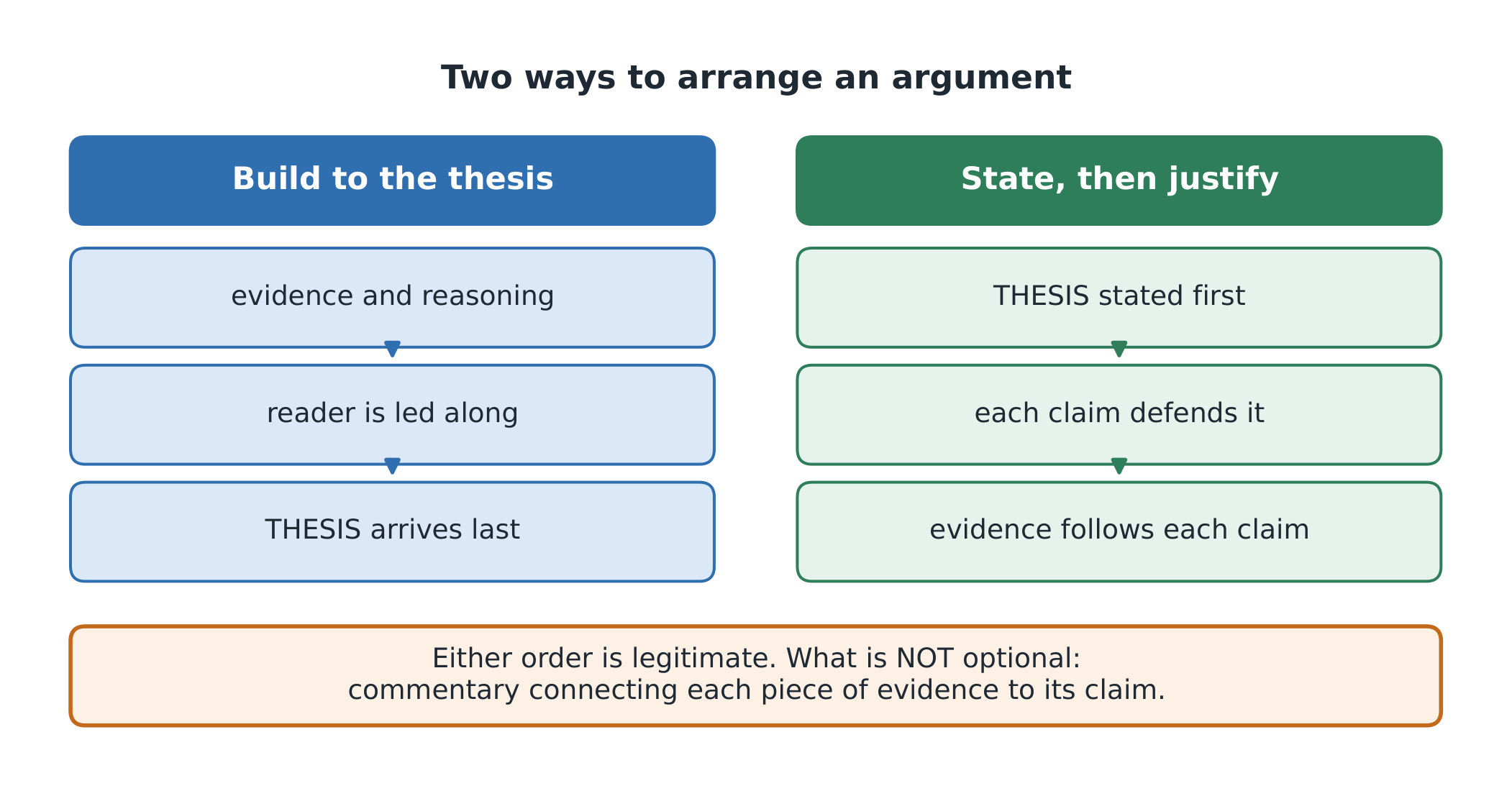
The CED allows two arrangements, and both are valid:

  • Writers may lead readers through a line of reasoning and then arrive at a thesis - the argument builds to its claim.
  • Writers may express a claim and then develop a line of reasoning to justify it - the argument declares and then defends.

Whichever order is used, the same requirements hold:

  • Writers explain their reasoning through commentary that connects chosen evidence to a claim.
  • Commentary explains the significance and relevance of evidence in relation to the line of reasoning.
  • The sequence of paragraphs in a text reveals the argument's line of reasoning - which is the practical tool for reading. To find a writer's reasoning, write one sentence per paragraph and read the list.
  • Flaws in a line of reasoning may render an argument specious or illogical.
עברית
שתי סדרים חוקיים, דרישה אחת - והדרישה היא התגובה
הסדר הוא בחירה; רקמת הקישור אינה

ה-CED מאפשר שני סידורים, ושניהם תקפים:

  • כותבים יכולים להוביל את הקוראים דרך קו היכרות ולאחר מכן להגיע לעיקר התיזה - הטיעון בונה את עצמו עד לטענתו.
  • כותבים יכולים לבטא טיעון ולאחר מכן לפתח קו היכרות כדי להצדיק אותו - הטיעון מכריז ולאחר מכן מגן על עצמו.

לא משנה איזה סדר משמש, אותם דרישות מתקיימות:

  • כותבים מסבירים את ההיגיון שלהם דרך הערות המקשרות הוכחות נבחרות לטענה.
  • הערות מסבירות את החשיבות והרלוונטיות של ההוכחה בהקשר לקו ההיגיון.
  • הרצף של הפרקים בטקסט חושף את קו ההיכרות של הטיעון - שהוא הכלי המעשי לקריאה. למצוא את ההיכרות של הכותב, כתוב משפט אחד לכל פרק וקרא את הרשימה.
  • פגמים בקו ההיכרות עשויים להפוך את הטיעון לזויף או לא לוגי.
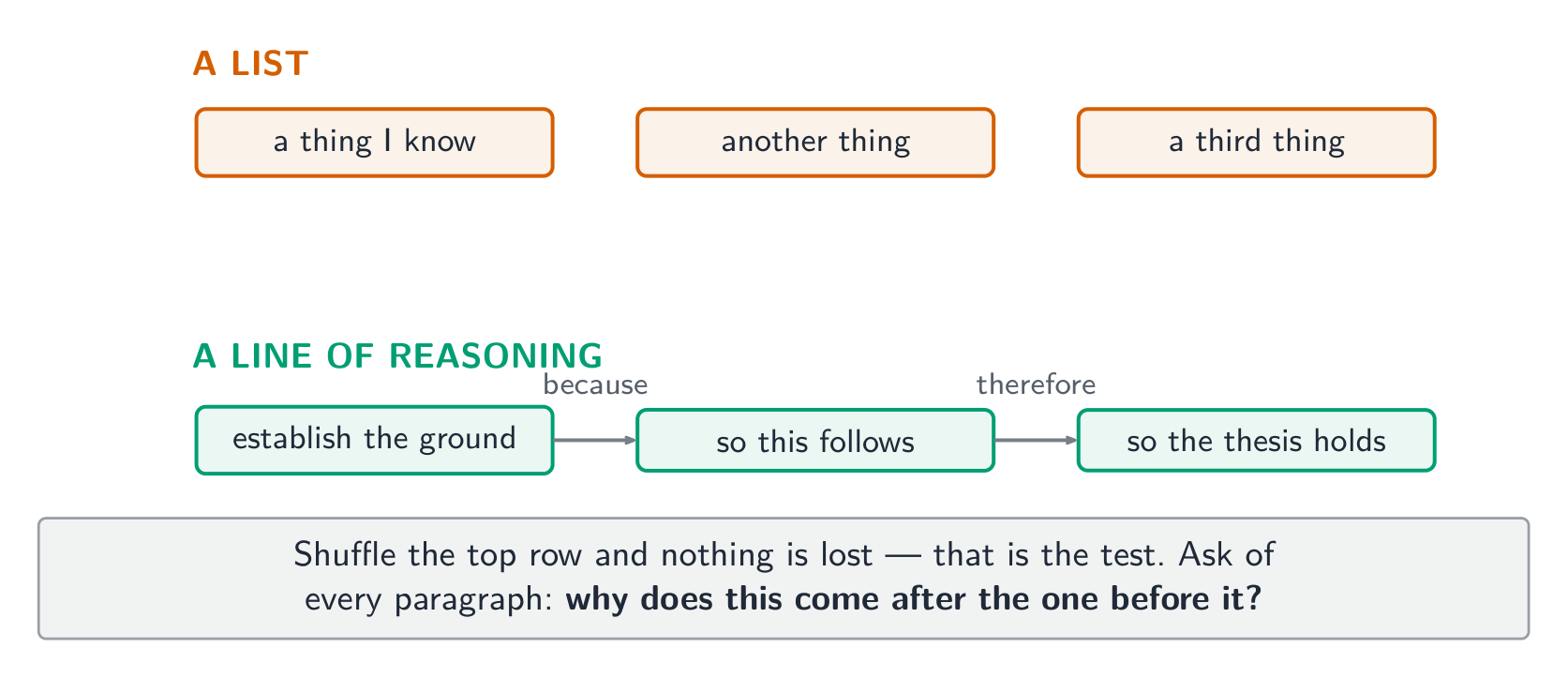
מבחן ההחלפה: אם ניתן לשנות את סדר הפרקים ללא אובדן, מדובר ברשימה
Vocabulary · ⁨מילון מונחים⁩ Train · ⁨אימון⁩
English עברית
line of reasoning/laɪn ɒv ˈriːzənɪŋ/ קו חשיבה
3.4

Developing a Line of Reasoning and Commentary · ⁨פיתוח קו טיעון ופירוש⁩

Syllabus · ⁨סיילבוס⁩
English

Enduring Understanding (REO-1): Writers guide understanding of a text’s lines of reasoning and claims through that text’s organization and integration of evidence.

Learning Objective 6.A: Writing – Develop a line of reasoning and commentary that explains it throughout an argument.

  • REO-1.A Writers may lead readers through a line of reasoning and then arrive at a thesis.
  • REO-1.B Writers may express a claim and then develop a line of reasoning to justify the claim.
  • REO-1.C Writers explain their reasoning through commentary that connects chosen evidence to a claim.
  • REO-1.D Commentary explains the significance and relevance of evidence in relation to the line of reasoning.
  • REO-1.E The sequence of paragraphs in a text reveals the argument’s line of reasoning.
  • REO-1.F Flaws in a line of reasoning may render an argument specious or illogical.
עברית

הבנה מתמשכת (REO-1): סופרים מדרכים את הבנת קווי ההסברה והטענות של טקסט דרך הארגון והשילוב של הממצאים בטקסט.

מטרות למידה 6.A: כתיבה – פתחו קו הסברה ותגובה המסבירים אותו לאורך כל הטיעון.

  • REO-1.A סופרים עשויים להוביל קוראים דרך קו הסברה ולאחר מכן להגיע לטענה.
  • REO-1.B סופרים עשויים להביע טענה ולאחר מכן לפתח קו הסברה כדי להצדיק את הטענה.
  • REO-1.C סופרים מסבירים את הסברה שלהם באמצעות תגובה המקשרת ממצאים שנבחרו לטענה.
  • REO-1.D תגובה מסבירה את החשיבות והרלוונטיות של הממצאים ביחס לקו ההסברה.
  • REO-1.E הרצף של הפרקים בטקסט חושף את קו ההסברה של הטיעון.
  • REO-1.F פגמים בקו ההסברה עשויים להפוך טיעון לספקולטיבי או בלוגי.

Source: College Board AP Course and Exam Description · ⁨מקור: תיאור הקורס והמבחן של College Board AP⁩

English

For your own essays, the useful discipline is to decide the order of your claims before writing any of them. An essay whose paragraphs could be shuffled without loss has no line of reasoning - it has a list.

Test a draft by asking of each paragraph: why does this come after the one before it? If the only answer is "it is another thing I know about the topic", the structure is a list and the reasoning point is at risk.

עברית

במאמרים האישיים שלך, המשמעויות המועילות הן לקבוע את סדר הטענות לפני שכותבים אותן. מאמר שפרקים בו ניתן להחליף ללא אובדן אינו מכיל קו טיעון - הוא רשימה.

בדוק גרסה ראשונית על ידי השאלה בכל פרק: למה זה בא אחרי הקודם לו? אם התשובה היחידה היא "זה עוד דבר שאני יודע בנושא", המבנה הוא רשימה והטיעון בסכנת סכנה.

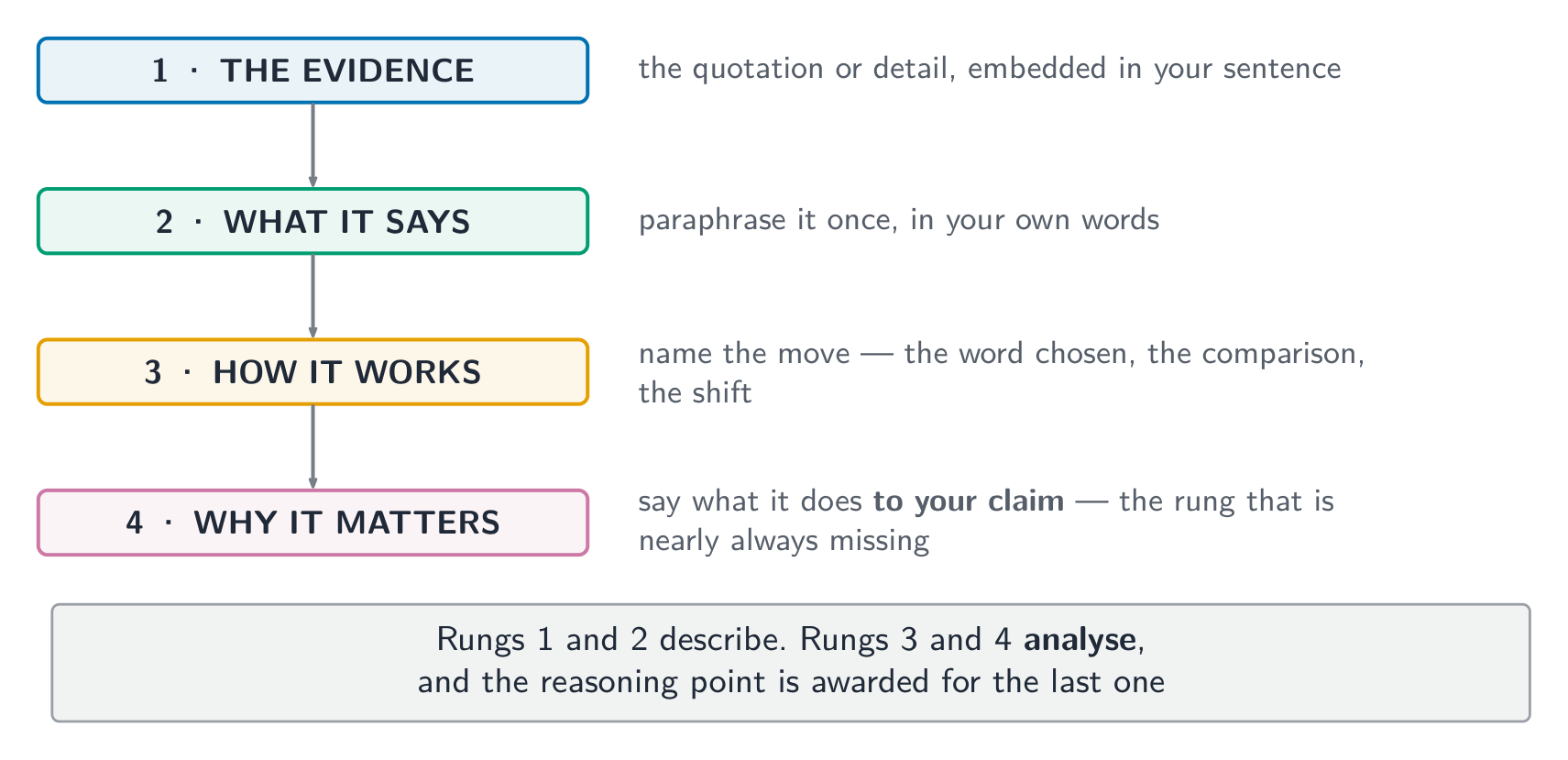
פירוש כארבע מדרגות - נקודת הטיעון מוענקת עבור האחרונה
Explore · ⁨חקור⁩

Climb the four rungs of commentary · ⁨להטפס על ארבע המדרגות של ההערות⁩

'Explain your evidence' is unusable. Four questions, each answerable in a sentence, make it a procedure. · ⁨'הסבר את העובדות שלך' הוא בלתי שימושי. ארבעה שאלות, שתשובה לכל אחת נכתבת במשפט, הופכות זאת ל procedure.⁩

Vocabulary · ⁨מילון מונחים⁩ Train · ⁨אימון⁩
English עברית
commentary/ˈkɒməntri/ תגובה
Synthesis/ˈsɪnθəsɪs/ סינתזה
attribution and citation/ətrɪˈbjuːʃn ænd saɪˈteɪʃn/ יחס הוצאה ומקורות
Methods of development/ˈmeθədz ɒv dɪˈveləpmənt/ שיטות פיתוח
narration/nəˈreɪʃn/ ספירה
cause-effect/kɔːz ɪˈfekt/ סיבה-תוצאה
3.5

Recognizing Methods of Development · ⁨זיהוי שיטות פיתוח⁩

Syllabus · ⁨סיילבוס⁩
English

Enduring Understanding (REO-1): Writers guide understanding of a text’s lines of reasoning and claims through that text’s organization and integration of evidence.

Learning Objective 5.C: Reading – Recognize and explain the use of methods of development to accomplish a purpose.

  • REO-1.G Methods of development are common approaches writers frequently use to develop and organize the reasoning of their arguments. A method of development provides an audience with the means to trace a writer’s reasoning in an argument.
  • REO-1.H Some typical methods of development are narration, cause-effect, comparison-contrast, definition, and description.
  • REO-1.I When developing ideas through narration, writers offer details about real-life experiences and offer reflections and insights on the significance of those experiences.
  • REO-1.J When developing ideas through cause-effect, writers present a cause, assert effects or consequences of that cause, or present a series of causes and the subsequent effect(s).
עברית

הבנה מתמשכת (REO-1): סופרים מדרכים את הבנת קווי ההסברה והטענות של טקסט דרך הארגון והשילוב של הממצאים בטקסט.

מטרות למידה 5.C: קריאה – לזהות ולהסביר את השימוש בשיטות פיתוח כדי להשגת מטרה.

  • REO-1.G שיטות פיתוח הן גישות נפוצות שסופרים משתמשים בהן לעיתים קרובות לפיתוח ולארגון ההיכרות של הארגומנט שלהם. שיטת פיתוח מספקת לקהל את האמצעים לעקוב אחר ההיכרות של הסופר בארגומנט.
  • REO-1.H חלק משיטות הפיתוח הנפוצות הן ניצול, סיבה-תוצאה, השוואה-ניגוד, הגדרה ותיאור.
  • REO-1.I כאשר מפתחים רעיונות באמצעות ניצול, סופרים מציעים פרטים על חוויות מהחיים האמיתיים ומציעים תפיסות ותובנות לגבי החשיבות של חוויות אלו.
  • REO-1.J כאשר מפתחים רעיונות באמצעות סיבה-תוצאה, סופרים מציגים סיבה, טוענים לתוצאות או consequences של הסיבה זו, או מציגים סדרה של סיבות והתוצאה(ות) הבאה(ות) אחריהן.

Source: College Board AP Course and Exam Description · ⁨מקור: תיאור הקורס והמבחן של College Board AP⁩

English

Methods of development 展开方法 are common approaches writers use to develop and organise the reasoning of an argument. The CED's list: narration, cause-effect, comparison-contrast, definition, and description. This unit treats the first two.

  • Developing through narration 叙述: writers offer details about real-life experiences and reflections on them. The reflection is what makes narration an argument rather than a story - an anecdote with no reflection has supplied no reasoning.
  • Developing through cause-effect 因果: writers present a cause, then assert the effects or consequences of that cause - or begin from an effect and trace it back.
עברית

שיטות פיתוח 展开方法 הן גישה נפוצה שמשתמשים בה כותבים לפיתוח ולארגון הטיעון של ארגומנט. הרשימה של CED: סיפור, סיבה-תוצאה, השוואה-הבדל, הגדרה ותיאור. יחידה זו עוסקת בשתי הראשונות.

  • פיתוח דרך סיפור 叙述: כותבים מציעים פרטים על חוויות מהחיים האמיתיים ועל הרהורים לגביהן. ההרהור הוא מה שהופך את הסיפור לטיעון ולא לסטורי - אנקדוט ללא הרהור לא מספק טיעון.
  • פיתוח דרך סיבה-תוצאה 因果: כותבים מצגים סיבה, ואז טוענים את ההשלכות או התוצאות שלה - או מתחילים מתוצאה ועוקבים אחריה לאחור.
3.6

Using Methods of Development · ⁨שימוש בשיטות פיתוח⁩

Syllabus · ⁨סיילבוס⁩
English

Enduring Understanding (REO-1): Writers guide understanding of a text’s lines of reasoning and claims through that text’s organization and integration of evidence.

Learning Objective 6.C: Writing – Use appropriate methods of development to advance an argument.

  • REO-1.G Methods of development are common approaches writers frequently use to develop and organize the reasoning of their arguments. A method of development provides an audience with the means to trace a writer’s reasoning in an argument.
  • REO-1.H Some typical methods of development are narration, cause-effect, comparison-contrast, definition, and description.
  • REO-1.I When developing ideas through narration, writers offer details about real-life experiences and offer reflections and insights on the significance of those experiences.
  • REO-1.J When developing ideas through cause-effect, writers present a cause, assert effects or consequences of that cause, or present a series of causes and the subsequent effect(s).
עברית

הבנה מתמשכת (REO-1): סופרים מדרכים את הבנת קווי ההסברה והטענות של טקסט דרך הארגון והשילוב של הממצאים בטקסט.

מטרות למידה 6.C: כתיבה – להשתמש בשיטות פיתוח מתאימות כדי לקדם ארגומנט.

  • REO-1.G שיטות פיתוח הן גישות נפוצות שסופרים משתמשים בהן לעיתים קרובות לפיתוח ולארגון ההיכרות של הארגומנט שלהם. שיטת פיתוח מספקת לקהל את האמצעים לעקוב אחר ההיכרות של הסופר בארגומנט.
  • REO-1.H חלק משיטות הפיתוח הנפוצות הן ניצול, סיבה-תוצאה, השוואה-ניגוד, הגדרה ותיאור.
  • REO-1.I כאשר מפתחים רעיונות באמצעות ניצול, סופרים מציעים פרטים על חוויות מהחיים האמיתיים ומציעים תפיסות ותובנות לגבי החשיבות של חוויות אלו.
  • REO-1.J כאשר מפתחים רעיונות באמצעות סיבה-תוצאה, סופרים מציגים סיבה, טוענים לתוצאות או consequences של הסיבה זו, או מציגים סדרה של סיבות והתוצאה(ות) הבאה(ות) אחריהן.

Source: College Board AP Course and Exam Description · ⁨מקור: תיאור הקורס והמבחן של College Board AP⁩

English

Choosing a method is a rhetorical decision, not a stylistic one. Narration works when the audience needs to feel the situation before they will accept a claim about it. Cause-effect works when the audience already accepts the facts but not the connection between them.

Worked example (a real AP exam task). On a Question 1 synthesis prompt, compare two paragraphs using the same two sources. The weak version: "Source A says X. Source C says Y. Both discuss the issue." That is summary in sequence - no claim, no integration, no reasoning. The strong version: "The strongest objection to the proposal is not that it fails but that it succeeds too narrowly: Source A's data show the intended outcome improving, while Source C's account of the same programme records the second-order costs that the measurement in Source A was never designed to capture." Here the sources are integrated into the writer's own claim, and the commentary establishes the logical relationship - which is what the four evidence-and-commentary points are awarded for.

עברית

בחירת שיטה היא החלטה רטורית, לא סגנונית. סיפור עובד כאשר הקהל צריך להרגיש את המצב לפני שהוא מקבל טענה עליו. סיבה-תוצאה עובד כאשר הקהל כבר מקבל את העובדות אך לא את הקשר ביניהן.

דוגמה פתורה (משימת ביקום אמיתית). בשאלת סינתוז מס' 1, השוו שני פרקים המשתמשים באותם שני מקורות. הגרסה החלשה: "מקור A אומר X. מקור C אומר Y. שניהם דנים בנושא." זהו סיכום ברצף - אין טענה, אין אינטגרציה, אין טיעון. הגרסה החזקה: "ההתנגדות החזקה ביותר להצעה אינה that היא נכשלת אלא that היא מצליחה בצורה צרה מדי: הנתונים של מקור A מראים את השיפור בתוצאה הרצויה, בעוד שתיאורו של מקור C של אותו תוכנית מקליט את העלויות משניות שהמדידה במקור A מעולם לא נועדה לתפוס." כאן המקורות מושלב עם הטענה של הכותב עצמו, והפירוש מקיים את הקשר הלוגי - וזה בדיוק מה שעבורו מוענקות ארבע נקודות של הוכחה ופירוש.

3.6

Exam tips · ⁨טיפים לבחינות⁩

English
  • Commentary has two jobs: introducing evidence into the reasoning, and explaining the relationship afterwards. Write both sentences.
  • Synthesis means integration, not summary in sequence. A paragraph per source is the classic low-scoring shape.
  • To find a writer's line of reasoning, summarise each paragraph in one sentence and read the list.
  • Ask of your own paragraphs: why does this one follow that one? No answer means no line of reasoning.
  • Narration needs reflection. An anecdote without it has told a story, not made an argument.
  • Choose a method of development for a rhetorical reason and be able to say what it is.
עברית
  • לפירוש יש שתי מטרות: הכנסת הוכחה לטיעון, והסברת הקשר לאחר מכן. כתוב שתי המשפטים.
  • סינתוז משמעוה אינטגרציה, לא סיכום ברצף. פרק אחד למקור הוא הצורה הקלאסית שקולטת ציון נמוך.
  • כדי למצוא קו טיעון של כותב, סכם כל פרק במשפט אחד וקרא את הרשימה.
  • שאל את הפרקים שלך: למה זה בא אחרי זה? אין תשובה = אין קו טיעון.
  • סיפור צריך הרהור. אנקדוט ללא זה סיפר סיפור, לא עשה טיעון.
  • בחר שיטת פיתוח לסיבה רטורית ויכול להיות לומר מה היא.

Interactive lessons on this topic · ⁨שיעורים אינטראקטיביים בנושא זה⁩

Work through it step by step, with instant-check exercises. · ⁨לעבור על הדברים צעד אחר צעד, עם תרגילים לבדיקה מיידית.⁩

Past Papers · ⁨מבחני עבר⁩

More topics in AP English Language and Composition · ⁨שפה ואנגלית כתיבה יצירתית - AP⁩ · ⁨נושאים נוספים בAP English Language and Composition · ⁨שפה ואנגלית כתיבה יצירתית - AP⁩⁩

Log in or create account · ⁨היכנס או צור חשבון⁩

IGCSE, A-Level & AP