הפעילו אוזניות ביטול רעשים, והרעש המוטה של מנוע מטוס מתמתק לשקט. אך הנה החלק המוזר: הן אינן חוסמות את הצליל — הן…
English narration · English + 中文 subtitles burned in · קריאת קול באנגלית · תרגום אנגלי + סינית שרוף בתוך הסרטון
8.1
Principle of superposition · עקרון החפיפה
Syllabus · סיילבוס
English
explain and use the principle of superposition
show an understanding of experiments that demonstrate stationary waves using microwaves, stretched strings and air columns (it will be assumed that end corrections are negligible; knowledge of the concept of end corrections is not required)
explain the formation of a stationary wave using a graphical method, and identify nodes and antinodes
understand how wavelength may be determined from the positions of nodes or antinodes of a stationary wave
עברית
להסביר ולשתמש בעקרון הסופרפוזיציה
להראות הבנה בניסויים המדגימים גלים עומדים באמצעות מיקרוגלים, מיתרים מתוחים ועמודות אוויר (ייחשב כי תיקוני הקצה זניחים; ידע בנושא תיקוני הקצה אינו נדרש)
להסביר את היווצרותו של גל עומד באמצעות שיטה גרפית, ולזהות נקודות קיטוב ונקודות עמידה
הבנת האופן שבו ניתן לקבוע אורך גל מתוך מיקום הצמתים או קודקודי הגל העומד
Source: Cambridge International syllabus · מקור: הסיילבוס הבינלאומי של קמבריד'ג'
English
Two waves make a standing wave
When two or more waves 波 overlap at a point, the displacement 位移 there is the vector sum 矢量和 of the displacements each wave would make on its own. This is the principle of superposition 叠加.
The waves pass through each other and come out unchanged. Superposition is the base of everything in this topic.
For the two-mark statement: when two or more waves meet at a point, the resultant displacement is the sum of the displacements of the individual waves. It is the displacements that add, not the amplitudes or the intensities, and the principle applies whenever waves of the same type overlap; the waves do not have to be coherent or of equal amplitude.
If two waves of amplitude 振幅$A_{1}$ and $A_{2}$ meet:
in phase 同相 (crest 波峰 meets crest): the amplitude is $A_{1} + A_{2}$ (constructive interference 相长干涉).
exactly out of phase (crest meets trough 波谷, phase difference 相位差$\pi$): the amplitude is $|A_{1} - A_{2}|$ (destructive interference 相消干涉).
any other phase difference $\phi$: the amplitude is somewhere between these two.
For intensity 强度, $I \propto A^{2}$. Two equal waves meeting in phase give intensity $(2A)^{2} = 4A^{2}$ — four times the intensity of one wave alone.
Because $I \propto A^{2}$, work in amplitudes first. Two waves of intensities $I$ and $4I$ have amplitudes $A$ and $2A$: superposing in phase gives amplitude $3A$ and intensity $9I$, in antiphase amplitude $A$ and intensity $I$. So two coherent waves of different intensities never cancel completely: the minima have intensity $(A_{2} - A_{1})^{2}$, not zero. A wave of amplitude $2A$ meeting one of amplitude $A/2$ travelling the opposite way gives a resultant that varies between $2.5A$ and $1.5A$, a stationary pattern with no true nodes. Doubling the amplitude of one of two equal waves that meet in phase takes the resultant from $2A$ to $3A$, so the intensity rises from $4A^{2}$ to $9A^{2}$: $2.25$ times.
עברית
שני גלים יוצרים גל עומד
כאשר שניים או יותר גלים חופפים בנקודה מסוימת, ההסה שם היא הסכום הווקטורי של ההסות שכל גל היה גורם לה לבדו. זוהי עקרון החפיפה.
הגלים חודרים זה דרך זה ויוצאים ללא שינוי. עקרון החפיפה הוא בסיס לכל הדבר בנושא זה.
למשפט בעל שתי נקודות: כאשר שניים או יותר גלים פוגעים בנקודה, ההסה הנתונה היא סכום ההסות של הגלים הבודדים. מה שמחושף הוא ההסה, לא המשרעות או העוצמות, ועקרון זה חל בכל פעם שגלים מאותו סוג חופפים; אין צורך שהגלים יהיו קוהרנטיים או בעלי משרעת שווה.
בדיוק מול פאזה (שיא פוגע בשפל, הפרש פאזה$\pi$): המשרעת היא $|A_{1} - A_{2}|$ (התאבקות הורסת).
כל הפרש פאזה אחר $\phi$: המשרעת נמצאת somewhere בין שתי אפשרויות אלו.
שני גלים הנכנסים בשלב נוספים כדי לתת כפול משרעת (בונה)שני גלים הנכנסים בדיוק מולשבים מבטלים זה את זה לאפס (הורסית)
עבור אינטנסיביות, $I \propto A^{2}$. שני גלים שווים הנפגשים בפזה נותנים אינטנסיביות $(2A)^{2} = 4A^{2}$ — ארבע פעמים האינטנסיביות של גל בודד.
מכיוון שה-$I \propto A^{2}$, עובדים עם אפליטודות תחילה. לשני גלים בעלי אינטנסיביות $I$ ו-$4I$ יש אפליטודות $A$ ו-$2A$: חפיפה בפזה נותנת אפליטודה $3A$ ואינטנסיביות $9I$, ובנגד פזה אפליטודה $A$ ואינטנסיביות $I$. לכן שני גלים קורנטים בעלי אינטנסיביות שונות לעולם לא מתאפסים לחלוטין: המינימום הוא בעל אינטנסיביות $(A_{2} - A_{1})^{2}$, ולא אפס. גל בעל אפליטודה $2A$ הנפגש עם גל בעל אפליטודה $A/2$ הנעים בכיוון הפוך נותן תוצאה המשתנה בין $2.5A$ ל-$1.5A$, דוגמה עצמית ללא נקודות קיצון אמיתיות. הכפלת האפליטודה של אחד משני הגלים השווים הנפגשים בפזה מביאה את התוצאה מ-$2A$ ל-$3A$, ולכן האינטנסיביות עולה מ-$4A^{2}$ ל-$9A^{2}$: פי $2.25$.
Explore · חקור
Adding two waves · חיבור שני גלים
Two waves overlap and add. Line them up for constructive interference, or oppose them for destructive — change the phase to see both. · שני גלים חופפים ומתחברים. סדרו אותם להפרעה בונה, או נגדו להפרעה הורסת — שינו את הפאזה כדי לראות את שניהם.
When two identical progressive waves 行波 travel in opposite directions and overlap, they make a stationary wave 驻波. Examples: a wave on a string reflected 反射 from a fixed end overlapping the incoming wave; sound in an air column reflected from a closed end; microwaves between an emitter and a metal sheet.
Explain how the stationary wave is formed (three or four marks, asked for a string, an air column and microwaves alike): the wave from the source travels to the far end (the wall, the closed end, the metal plate) and is reflected; the incident and reflected waves have the same frequency, wavelength and speed and travel in opposite directions; they superpose where they overlap; at the points where they always meet in phase the displacements add to give the maximum amplitude, an antinode, and at the points where they always meet in antiphase they cancel, a node. For "state the conditions": two waves of the same type, with the same frequency (and wavelength) and speed, travelling in opposite directions along the same line; equal amplitudes are needed only for the nodes to have zero amplitude. The metal plate in the microwave experiment is there to reflect the waves back along their own path.
Nodes and antinodes
In a stationary wave:
node 波节 — a point that is always at zero displacement (the two waves always cancel). The distance between next-door nodes is $\lambda/2$.
antinode 波腹 — a point of largest amplitude (the two waves always add). The distance between next-door antinodes is $\lambda/2$.
a node and the next antinode are $\lambda/4$ apart.
Particles between two nodes oscillate in phase with each other, but with different amplitudes (largest at the antinode, zero at the nodes). Particles on opposite sides of a node oscillate in antiphase 反相 (phase difference $\pi$).
So the phase difference between two points on the same loop (between adjacent nodes) is $0°$; between points on neighbouring loops it is $180°$; and between points on loops separated by one whole loop it is $0°$ again. Every point reaches its maximum displacement at the same instant and passes through zero at the same instant. A sketch of the string a quarter of a cycle after the instant of maximum displacement is a straight line along the rest position; half a cycle later it is the mirror image of the first sketch. In one period a particle at an antinode travels four amplitudes, so a particle that moves $72\ \text{mm}$ in one and a half periods has an amplitude of $12\ \text{mm}$.
Worked example. A string of length $0.80\ \text{m}$ is fixed at both ends and vibrates in its fundamental mode, where the wave speed is $240\ \text{m s}^{-1}$. Find the fundamental frequency.
One loop fits the string, so $\lambda = 2L = 1.60\ \text{m}$. Then
How a stationary wave differs from a progressive wave: it does not carry energy 能量 along its length, the pattern does not move along, and the nodes stay fixed; a progressive wave has the same amplitude everywhere and carries energy. The three differences the scheme lists: a progressive wave transfers energy and a stationary wave does not; in a progressive wave every point has the same amplitude, in a stationary wave the amplitude varies from zero at a node to a maximum at an antinode; in a progressive wave neighbouring points differ in phase, in a stationary wave all the points between two nodes are in phase.
Measuring wavelength from node spacing
Drive a string with a vibrator at frequency $f$ until a stationary pattern appears. Measure the distance between two well-separated nodes and divide by the number of half-wavelengths 波长 between them. Then $\lambda$ is known, and $v = f\lambda$ gives the wave speed.
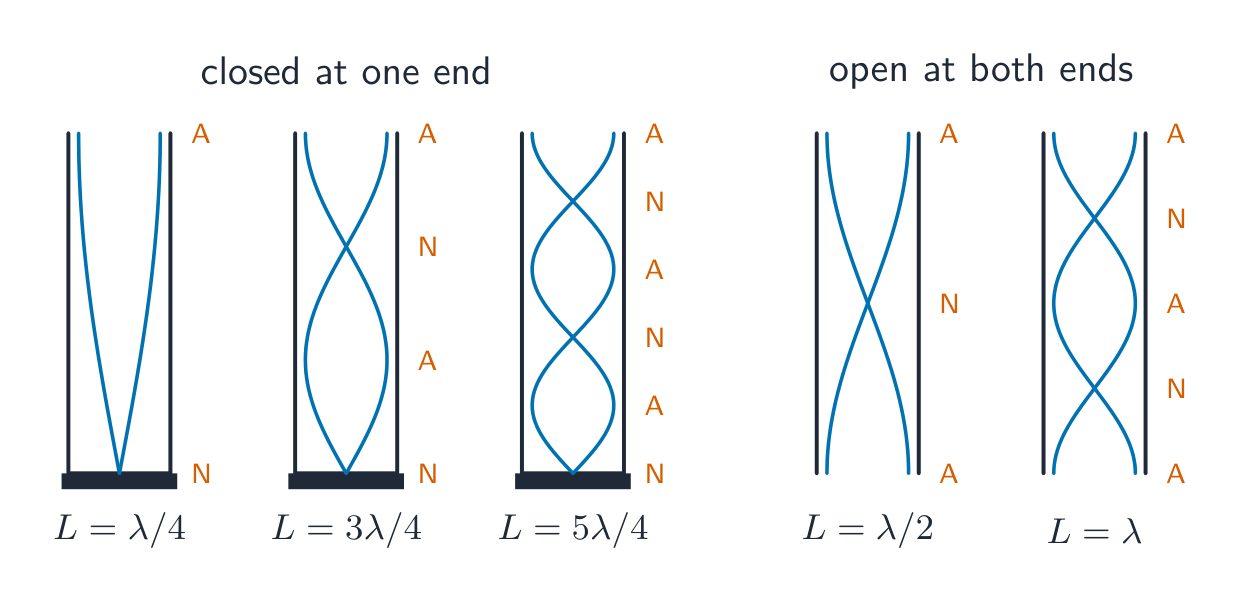
For a tube closed at one end and open at the other (a resonance tube 共鸣管), the closed end is a displacement node and the open end is a displacement antinode. The fundamental 基频 has $L = \lambda/4$; the next resonance is at $L = 3\lambda/4$; and so on. For a tube open at both ends, both ends are antinodes; the fundamental is at $L = \lambda/2$.
The general rule: a closed end is a node and an open end an antinode, and a string fixed at both ends has a node at each end. So a closed pipe fits an odd number of quarter-wavelengths ($L = \lambda/4, 3\lambda/4, 5\lambda/4, \ldots$), while an open pipe and a fixed string fit whole half-wavelengths ($L = \lambda/2, \lambda, 3\lambda/2, \ldots$); a pipe open at both ends with $n$ nodes has $n + 1$ antinodes. Frequencies follow from $f = v/\lambda$: a closed pipe whose lowest note is $820\ \text{Hz}$ has $\lambda = 4L$, and a corridor $13.2\ \text{m}$ long with a reflecting door at each end resonates lowest at $f = v/2L = 330/26.4 = 12.5\ \text{Hz}$.
Worked example. A loudspeaker at the open end of a tube $0.51\ \text{m}$ long, closed at the other end, sets up a stationary wave with two nodes and two antinodes. Find the wavelength and, with $v = 340\ \text{m s}^{-1}$, the frequency.
Two nodes and two antinodes is the second mode of a closed pipe, $L = 3\lambda/4$, so $\lambda = 4 \times 0.51 / 3 = 0.68\ \text{m}$ and $f = 340 / 0.68 = 500\ \text{Hz}$. The longest wavelength that can resonate in this tube is $4L = 2.0\ \text{m}$.
The experiments the syllabus names all measure $\lambda$ from node or antinode spacing. In the resonance tube, a tube is raised out of water while a loudspeaker or tuning fork sounds at its open end; the sound is suddenly loud at the first resonance, when the air column is $\lambda/4$ long, and again at $3\lambda/4$, so the tube moves $\lambda/2$ between the two (a student needs no equipment to detect the resonance: the note becomes loud). In a dust tube, fine powder settles into heaps at the displacement nodes, $\lambda/2$ apart. With microwaves, a receiver moved along the line between the transmitter and a metal reflecting plate reads a minimum every $\lambda/2$: a receiver that starts at a minimum and passes six more minima in $1.05\ \text{m}$ has crossed $3\lambda$, so $\lambda = 0.35\ \text{m}$ and, with $v = 340\ \text{m s}^{-1}$ for the equivalent sound experiment, $f = 970\ \text{Hz}$. A stationary wave in a microwave oven melts chocolate at the antinodes, $\lambda/2$ apart, so the spot spacing and the oven's frequency ($2.45\ \text{GHz}$) give the speed of light from $c = f\lambda$.
עברית
כאשר שני גלים הולכים זהים נעים ב-כיוונים מנוגדים ומתחפים, הם יוצרים גל עצמי. דוגמאות: גל על מיתר הסתפק מקצה קבוע והתחפש עם הגל הנכנס; קול בעמודת אוויר ההסתפק מקצה סגור; גלי מיקרו-גל בין מעביט לצלחת מתכת.
הסבר כיצד נוצר הגל העצמי (שלוש או ארבע נקודות, נשאל למיתר, עמודת אוויר וגלי מיקרו-גל): הגל מהמקור נע לקצה הרחוק (הקיר, הקצה הסגור, הצלחת המתכת) והסתפק; הגל הנכנס והגל המסתפק הם בעלי אותה תדר, אורך גל ומהירות ונעים ב-כיוונים מנוגדים; הם מתחפים במקום בו הם נפגשים; בנקודות בהן הם תמיד נפגשים בפזה ההזחות מחוברות ליצירת אפליטודה מקסימלית, אנטי-נודה, ובנקודות בהן הם תמיד נפגשים בנגד פזה הן מתאפסות, נודה. עבור "ציין את התנאים": שני גלים מאותו סוג, עם אותה תדר (ואורך גל) ומהירות, הנעים בכיוונים מנוגדים לאורך אותו קו; אפליטודות שוות נדרשות רק כדי שהנודות יהיו בעלות אפליטודה אפס. צלחת המתכת בניסוי המיקרו-גל נמצאת שם כדי להסתפק את הגלים בחזרה לאורך מסלולם.
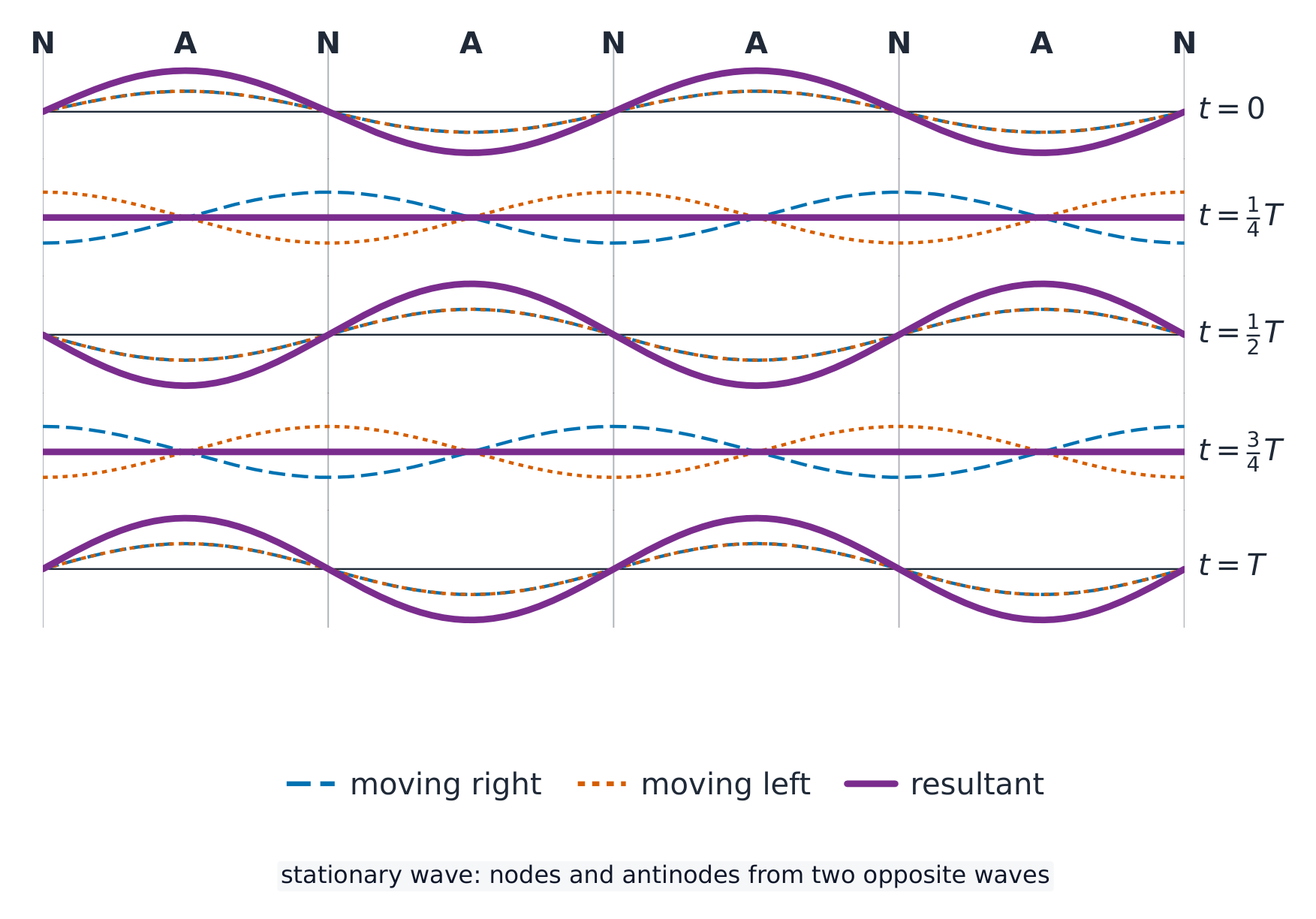
גל עצמי נוצר בשנית שבו שני גלים מנוגדים מתחפים (N מסמנת נודה, A אנטי-נודה)
נודות ואנטי-נודות
בגל עצמי:
נודה — נקודה הנמצאת תמיד באפס הזחה (שני הגלים תמיד מתאפסים). המרחק בין נודות סמוכות הוא $\lambda/2$.
אנטי-נודה — נקודה בעלת אפליטודה מקסימלית (שני הגלים תמיד מחברים). המרחק בין אנטי-נודות סמוכות הוא $\lambda/2$.
נודה ואנטי-נודה הבאה נפרדות ב-$\lambda/4$.
חלקיקים בין שתי נודות רועמים בפזה זה עם זה, אך עם אפליטודות שונות (הגדולה ביותר באנטי-נודה, אפס בנודות). חלקיקים בצדדים מנוגדים של נודה רועמים ב-נגד פזה (הפרש פזה $\pi$).
לכן הפרש הפזה בין שתי נקודות באותו לולאה (בין נודות סמוכות) הוא $0°$; בין נקודות בלולאות סמוכות הוא $180°$; ובין נקודות בלולאות המופרדות על ידי לולאה שלמה אחת הוא שוב $0°$. כל נקודה מגיעה להזחה המקסימלית בזמן זהה ועוברת באפס בזמן זהה. טיוטה של המיתר רבע מחזור לאחר רגע ההזחה המקסימלית היא קו ישר לאורך המצב השקט; מחצית מחזור לאחר מכן היא תמונת הרפלקס של הטיוטה הראשונה. בתקופה אחת, חלקיק באנטי-נודה עובר ארבע אפליטודות, ולכן חלקיק שנע $72\ \text{mm}$ במשך שנה וחצי תקופות יש לו אפליטודה של $12\ \text{mm}$.
מצב היסוד על מיתר מתוח — לולאה אחת, כאשר L שווה לחצי מאורך גל
דוגמה מופעלת. מיתר באורך $0.80\ \text{m}$ קבוע בשני קציו ורועם במצב היסוד שלו, כאשר מהירות הגל היא $240\ \text{m s}^{-1}$. מצא את התדר היסודי.
לולאה אחת מתאימה למיתר, ולכן $\lambda = 2L = 1.60\ \text{m}$. אז
כיצד גל עצמי שונה מגל הולך: הוא אינו מוביל אנרגיה לאורך אורכו, הדגם אינו נע לאורך, והנודות נשארות קבועות; לגל הולך יש אותה אפליטודה בכל מקום והוא מוביל אנרגיה. השלוש הבדלים שמפורטים בסכמת הניקוד: גל הולך מעביר אנרגיה וגל עצמי אינו עושה זאת; בגל הולך לכל נקודה יש אותה אפליטודה, בגל עצמי האפליטודה משתנה מאפס בנודה למקסימום באנטי-נודה; בגל הולך נקודות סמוכות שונות בפזה, בגל עצמי כל הנקודות בין שתי נודות הן בפזה.
מדידת אורך גל ממרווח בין נקודות קיפאון
הנעו מיתר עם רונדן בתדר $f$ עד שנוצר דפוס עומד. מדדו את המרחק בין שתי נקודות קיפאון הרחוקות זו מזו וחלקו במספר חצי-אורכי הגל ביניהן. לאחר מכן $\lambda$ ידוע, ו-$v = f\lambda$ מספק את מהירות הגל.
בורג סגור בקצה אחד ופתוח בקצה השני (בורג תהודה), הקצה הסגור הוא נקודת קיפאון תזוזה והקצה הפתוח הוא נקודת התנגדות תזוזה. ה-בסיסי כולל $L = \lambda/4$; התהודה הבאה היא ב-$L = 3\lambda/4$; וכך הלאה. עבור בורג פתוח בשני קצוותיו, שני הקצוות הם נקודות התנגדות; הבסיסי נמצא ב-$L = \lambda/2$.
הכלל הכללי: קצה סגור הוא נקודת קיפאון וקצה פתוח הוא נקודת התנגדות, ומיתר הקבוע בשני קצוותיו יש נקודת קיפאון בכל קצה. לכן צינור סגור מתאים למספר אי-זוגי של רבעי אורך גל ($L = \lambda/4, 3\lambda/4, 5\lambda/4, \ldots$), בעוד שצינור פתוח ומיתר הקבוע מתאימים לחצי אורכי גל שלמים ($L = \lambda/2, \lambda, 3\lambda/2, \ldots$); צינור פתוח בשני קצוותיו עם $n$ נקודות קיפאון מכיל $n + 1$ נקודות התנגדות. התדרים נובעים מ-$f = v/\lambda$: צינור סגור שהתווית הנמוכה ביותר שלו היא $820\ \text{Hz}$, בעל $\lambda = 4L$, וממ corridor $13.2\ \text{m}$ באורך עם דלת מחזירת קול בכל קצה מתהדה בשפלה ב-$f = v/2L = 330/26.4 = 12.5\ \text{Hz}$.
מצבי עמודת אוויר: קצה סגור הוא נקודת קיפאון, קצה פתוח הוא נקודת התנגדות
דוגמה מופתרת. רמקול בקצה הפתוח של צינור ב-$0.51\ \text{m}$ אורך, סגור בקצה השני, יוצר גל עומד עם שתי נקודות קיפאון ושתי נקודות התנגדות. מצאו את אורך הגל וב-$v = 340\ \text{m s}^{-1}$, את התדר.
שתי נקודות קיפאון ושתי נקודות התנגדות הן המצב השני של צינור סגור, $L = 3\lambda/4$, ולכן $\lambda = 4 \times 0.51 / 3 = 0.68\ \text{m}$ ו-$f = 340 / 0.68 = 500\ \text{Hz}$. אורך הגל הארוך ביותר שיכול להתהדד בצינור זה הוא $4L = 2.0\ \text{m}$.
כל הניסויים שהמסלול מיישם מדדים $\lambda$ מתוך מרווח בין נקודת קיט או נקודת זעזוע. ב-צינור תהודה, צינור מורם מהמים בעוד רמקול או מזמזם פועל בקצה הפתוח שלו; הצלם הופך לפתאום לחזק בתהודה הראשונה, כאשר עמודת האוויר היא $\lambda/4$ באורך, ושוב ב-$3\lambda/4$, כך שהצינור זז $\lambda/2$ בין השתיים (סטודנט אינו זקוק לציוד כדי לזהות תהודה: הצלם הופך לחזק). ב-צינור אבק, אבקה עדינה יושבת על ערימות בנקודות הקיט, מרוחקות $\lambda/2$ זו מזו. עם גלי מיקרו, מקלט שנע לאורך הקו בין המשדר ללוח מתכת מחזיר משתנה כל $\lambda/2$: מקלט שמתחיל במינימום ועובר עוד שישה מינימוסים ב-$1.05\ \text{m}$ עבר $3\lambda$, כך ש-$\lambda = 0.35\ \text{m}$, ועם $v = 340\ \text{m s}^{-1}$ לניסוי הסאונד המקביל, $f = 970\ \text{Hz}$. גל עומד בתנור מיקרו-גלים ממיס שוקולד בנקודות הזעזוע, מרוחקות $\lambda/2$ זו מזו, כך שמרווח הנקודות ותדר התנור ($2.45\ \text{GHz}$) נותנים את מהירות האור מ-$c = f\lambda$.
המצב הבסיסי בצינור סגור — נקודת קיפאון בקצה הסגור, נקודת התנגדות בקצה הפתוח
A string fixed at both ends only resonates at its harmonics. Drag n to see the nodes, antinodes and how the wavelength changes. · מיתר הקבוע בשני קציוויו רזונטי רק בהרמוניות שלו. גרור את ⟦n⟧ כדי לראות את הנקודות הקבועות, הנקודות המשתנות ואיך אורך הגל משתנה.
Explore · חקור
Stationary waves · גלים עומדים
y = y₁ + y₂
Two waves superpose: where they reinforce you get antinodes, where they cancel, nodes. · שני גלים מת叠加ים: במקום שבו הם מחזקים זה את זה מתקבלות נקודות משתנות, ובמקום שבו הם מבטלים זה את זה מתקבלות נקודות קבועות.
show an understanding of experiments that demonstrate diffraction including the qualitative effect of the gap width relative to the wavelength of the wave; for example diffraction of water waves in a ripple tank
עברית
הסבר משמעות המונח עקיפה
הבנת ניסויים המדגימים עקיפה, כולל ההשפעה האיכותית של רוחב הפתח ביחס ל-אורך הגל של הגל; לדוגמה: עקיפת גלי מים באגן תנודות
Source: Cambridge International syllabus · מקור: הסיילבוס הבינלאומי של קמבריד'ג'
English
Diffraction 衍射 is the spreading of a wave after it passes through a gap or around an obstacle 障碍物. All waves diffract — water, sound, light, microwaves.
For the two-mark "state what is meant by diffraction": the spreading of a wave as it passes through a gap (an aperture) or around the edge of an obstacle, into the region behind it. Diffraction changes the direction the wave travels in, but not its speed, frequency or wavelength.
The amount of spreading depends on the ratio of wavelength to gap width:
gap much wider than $\lambda$: very little spreading; the wave goes nearly straight through.
gap about the size of$\lambda$: a lot of spreading; the wave fans out.
gap smaller than$\lambda$: very strong spreading; the gap acts almost like a point source.
Show this with water waves in a ripple tank 水波槽: straight waves meet a barrier with a gap, and the waves curve more as the gap is made narrower. The same idea is why you can hear someone around a corner (speech has $\lambda$ near 1 m, close to the gap size) but cannot see them (visible light has $\lambda \sim 500\ \text{nm}$, far smaller than the gap).
For the strongest spreading the gap should be about one wavelength wide. So to increase the diffraction of a given wave, make the gap narrower; for a given gap, use a longer wavelength, which means a lower frequency. Radio waves of wavelength $1.5\ \text{km}$ diffract around a mountain and reach an aerial behind it; microwaves of $1.5\ \text{cm}$ do not. Sound of $0.44\ \text{kHz}$ in air has $\lambda = 330 / 440 = 0.75\ \text{m}$, so features of about $0.75\ \text{m}$ diffract it most, and of the sounds passing through a doorway $0.80\ \text{m}$ wide the low frequencies spread out most. Making the gap many wavelengths wide, or raising the frequency, reduces the spreading.
עברית
פיזור הוא התפשטותו של גל לאחר שעבר דרך חריץ או סביב מכשול. כל הגלים מתפזרים — מים, קול, אור, גלי מיקרו.
עבור שאלת ה-2 נקודות "ציינו מהו הפיזור": התפשטותו של גל כאשר הוא עובר דרך חריץ (פתח) או סביב קצהו של מכשול, לתוך האזור שמאחוריו. פיזור משנה את הכיוון בו הגל נע, אך לא את מהירותו, תדרו או אורכו.
מידת ההתפשטות תלויה ביחס בין אורך הגל לבין רוחב החריץ:
חריץ רחב יותר משמעותית מ-$\lambda$: מעט מאוד התפשטות; הגל עובר כמעט ישר.
חריץ בגודל דומה ל-$\lambda$: הרבה התפשטות; הגל מתפזר כמו מאוורר.
חריץ קטן מ-$\lambda$: התפשטות חזקה מאוד; החריץ פועל כמעט כמקור נקודתי.
הראו זאת עם גלי מים במיכל גלים: גלים ישרים פוגעים בחוסם עם חריץ, והגלים מתעקמים יותר ככל שהחריץ הופך צר יותר. אותו עיקרון מסביר מדוע ניתן לשמוע מישהו סביב פינה (לדיבור יש $\lambda$ קרוב ל-1 מ', קרוב לגודל החריץ) אך לא לראות אותו (לאור הנראה יש $\lambda \sim 500\ \text{nm}$, קטן משמעותית מהחריץ).
עבור ההתפשטות החזקה ביותר, החריץ צריך להיות רחב כ-אורך גל אחד. לכן כדי להגדיל את הפיזור של גל נתון, הופכים את החריץ לצר יותר; עבור חריץ נתון, משתמשים באורך גל ארוך יותר, מה שמעיד על תדר נמוך יותר. גלי רדיו באורך גל $1.5\ \text{km}$ מתפזרים סביב הר ומגיעים לקלטן מאחוריו; גלי מיקרו באורך $1.5\ \text{cm}$ לא עושים זאת. קול באורך $0.44\ \text{kHz}$ באוויר יש לו $\lambda = 330 / 440 = 0.75\ \text{m}$, ולכן תכונות בגודל כ-$0.75\ \text{m}$ מפזרות אותו הכי טוב, ובין הצלילים העוברים דרך דלת ב-$0.80\ \text{m}$ רוחב, התדרים הנמוכים מתפזרים הכי הרבה. הופעת החריץ לרבות אורכי גל, או העלאת התדר, מפחיתה את ההתפשטות.
התפרקות באגן גלים — פתח רחב (a) מפזר את הגלים מעט, פתח צר (b) הרבה יותר
Explore · חקור
Waves adding and cancelling · גלים שמצטברים ומבידדים
Two overlapping waves add where they are in phase and cancel where out of phase — change the phase to see the result. This is what makes diffraction patterns. · שני גלים המשתלבים מצטברים שם שהם בפאזה ומבידדים שם שהם מחוצה לפאזה – שינוי הפאזה כדי לראות את התוצאה. זה מה שיוצר דפוסי עקיפה.
show an understanding of experiments that demonstrate two-source interference using water waves in a ripple tank, sound, light and microwaves
understand the conditions required if two-source interference fringes are to be observed
recall and use $\lambda = ax / D$ for double-slit interference using light
עברית
הבנת המונחים התאבכות ו-קוהרנטיות
הבנת ניסויים המדגימים התאבכות מקור כפול באמצעות גלי מים באגן תנודות, קול, אור ומיקרוגלים
הבנת התנאים הנדרשים כדי לצפות ב-פסי התאבכות מההתאבכות מקור כפול
זיכרון והשתמש ב-$\lambda = ax / D$ עבור התאבכות סדרי כפולים באמצעות אור
Source: Cambridge International syllabus · מקור: הסיילבוס הבינלאומי של קמבריד'ג'
English
Two-slit interference
Interference 干涉 is the superposition of two coherent 相干 waves to give a steady pattern of high-amplitude regions (constructive) and low-amplitude regions (destructive).
Coherence
Two sources are coherent when they emit waves with a constant phase difference (which also needs the same frequency). Two separate lamps are not coherent — their phase changes randomly, so any pattern flickers too fast to see and you get only an average.
The one-mark definition: coherent waves have a constant phase difference, which requires the same frequency. They need not be in phase with each other: two coherent sources emitting $180°$ apart give a pattern whose central line is a minimum. Two separate lasers, or a lamp and a laser, are not coherent even when their frequencies happen to match, so no steady pattern forms.
To make coherent light from one source, pass it through two slits 狭缝 in a double-slit 双缝 setup. Both slits are lit by the same wavefront, so the two beams keep a fixed phase relationship.
Conditions for a clear pattern
To see two-source fringes you need:
two coherent sources (constant phase difference).
roughly equal amplitudes (or the dark regions are not very dark).
the waves overlap where you look.
for light (a transverse wave), the same plane of polarisation 偏振.
In practice, for light: a single slit (or a laser) makes the two slits coherent; the slits are narrow, so each diffracts the light into the region where the two beams overlap; and the slits are close together with the screen far away, so that the fringes are wide enough to see.
Path difference
For two coherent sources, what happens at a point depends on the path difference 路程差$\Delta x$ between the two waves arriving there:
destructive: $\Delta x = (n + \tfrac{1}{2})\lambda$.
The path difference fixes the phase difference: one wavelength of path is $360°$. Waves that have travelled $100\ \text{cm}$ and $80\ \text{cm}$ from two in-phase sources of wavelength $8.0\ \text{cm}$ arrive with a path difference of $2.5\lambda$, a phase difference of $180°$, and cancel; microwaves of wavelength $4\ \text{cm}$ whose paths differ by $6\ \text{cm}$ ($1.5\lambda$) give a minimum, of zero intensity only if the two amplitudes are equal. Lowering both source frequencies equally lengthens the wavelength, so the same path difference is a smaller number of wavelengths and the point is no longer a minimum.
Double-slit (Young's) experiment
For two slits a distance $a$ apart, with a screen a distance $D$ away (assume $D \gg a$), light of wavelength $\lambda$ makes fringes on the screen.
The fringe spacing 条纹间距$x$ (one fringe 条纹 to the next) is
$$\lambda = \frac{a x}{D}, \qquad x = \frac{\lambda D}{a}.$$
Bright fringes (maximum 极大) are where the path difference is a whole number of $\lambda$; dark fringes (minimum 极小) where it is $(n + \tfrac{1}{2})\lambda$. The fringes are equally spaced.
To make the fringe spacing smaller: increase $a$ (slits further apart), reduce $D$ (screen closer), or use a shorter $\lambda$ (bluer light).
Explain how the pattern of bright and dark fringes is formed (three marks): the light diffracts at each slit; the two diffracted beams overlap and superpose; where the path difference from the two slits is a whole number of wavelengths the waves arrive in phase and interfere constructively, giving a bright fringe, and where it is an odd number of half-wavelengths they arrive in antiphase and interfere destructively, giving a dark fringe. A brighter source makes the bright fringes brighter but does not change their spacing; changing to blue light makes the spacing smaller, so to keep the same spacing the slits must be moved closer together; making each slit narrower increases the diffraction, so fringes appear across a wider region, with the spacing unchanged.
Worked example. In a double-slit experiment the slits are $0.50\ \text{mm}$ apart and lit by light of wavelength $600\ \text{nm}$. The screen is $2.0\ \text{m}$ away. Find the fringe spacing.
Worked example. Red light of wavelength $680\ \text{nm}$ falls on slits $0.16\ \text{mm}$ apart. The distance between the centres of the first and ninth dark fringes is $3.2\ \text{cm}$. Find the distance $D$ to the screen.
Eight fringe spacings make $3.2\ \text{cm}$, so $x = 4.0\ \text{mm}$ and $D = ax / \lambda = (0.16 \times 10^{-3})(4.0 \times 10^{-3}) / (680 \times 10^{-9}) = 0.94\ \text{m}$. On a screen $5.0\ \text{cm}$ wide centred on the pattern, with $x = 2.4\ \text{mm}$, ten bright fringes fit on each side of the central one: $21$ in all. A graph of $x$ against $a$ is a curve falling as $1/a$; a graph of $x$ against $\lambda$ (or against $D$) is a straight line through the origin with gradient $D/a$ (or $\lambda/a$), from which $a$ can be found.
עברית
התאכזבות בשתי חריציםהצבעים המשתנים בסבון הבועה נובעים מהתאכזבות של אור.
התאכזבות היא סופרפוזיציה של שני גלים קוהרנטיים ויוצרת תבנית יציבה של אזורים בעוצמה גבוהה (התאכזבות בונה) ואזורים בעוצמה נמוכה (התאכזבות הורסת).
שני מקורות קוherents נותנים קווים של תזוזה מקסימלית כאשר גבעות פוגעות בגבעותאותה אפקט באמבט גלים אמיתי — שני מקורות קוהרנטיים נותנים תבנית התאכזבות יציבה
קוהרנטיות
שני מקורות הם קוהרנטיים כאשר הם פולטים גלים עם פרש זמן קבוע (שהוא גם זקוק לתדר זהה). שני מנורות נפרדות אינן קוהרנטיות — הפרש הזמן שלהן משתנה אקראית, ולכן כל תבנית מהבהבת במהירות שלא ניתן לראות אותה ואתה מקבל רק ממוצע.
ההגדרה של סימן אחד: גלים קוהרנטיים יש להם פרש זמן קבוע, הדורש את אותו תדר. אין צורך שהם יהיו בזמן זהה זה לזה: שני מקורות קוהרנטיים הפולטים $180°$ זה מזה נותנים תבנית שבה הקו המרכזי הוא מינימום. שני לייזרים נפרדים, או מנורה ולייזר, אינם קוהרנטיים גם כשהתדרים שלהם מתאימים מקרה, ולכן לא נוצרת תבנית יציבה.
כדי ליצור אור קוהרנטי ממקור אחד, העבר אותו דרך שני חריצים בהתקנת דו-חריץ. שני החריצים מוארים על ידי אותו קדמי גל, ולכן שני הקרניים שומרות על יחס פרש זמן קבוע.
תנאים לתבנית ברורה
כדי לראות פסמים של שני מקורות אתה צריך:
שני מקורות קוהרנטיים (פרש זמן קבוע).
עוצמות דומות בערך (או האזורים הכהים אינם כהים מאוד).
הגלים חופפים במקום שבו אתה מסתכל.
עבור אור (גל רוחבי), אותו מישור קוטביות.
בפועל, עבור אור: חריץ בודד (או לייזר) הופך את שני החריצים לקוהרנטיים; החריצים צרים, כך שכל אחד מהם גורם להתפרקות האור לאזור בו הקרניים נפגשות; והחריצים קרובים זה לזה עם המסך רחוק, כך שהפסים רחבים מספיק כדי להיות נראים.
הפרש מסלול
עבור שני מקורות קוהרנטיים, מה שקורה בנקודה תלויה ב-הפרש המסלול$\Delta x$ בין שתי הגלים הגיעו לשם:
הפרש המסלול קובע את הפרש הפאזה: אורך גל אחד במסלול הוא $360°$. גלים שעברו $100\ \text{cm}$ ו-$80\ \text{cm}$ משני מקורות בסכום פאזה בעל אורך גל $8.0\ \text{cm}$ מגיעים עם הפרש מסלול של $2.5\lambda$, הפרש פאזה של $180°$, ומתבטלים; גלי מיקרו בעל אורך גל $4\ \text{cm}$ שבהם הפרש המסלולים הוא $6\ \text{cm}$ ($1.5\lambda$) נותנים מינימום, של עוצמה אפסית רק אם שתי המשרעות שוות. הורדת התדרים של שני המקורות באופן שווה מאריך את אורך הגל, כך שה אותו הפרש מסלול הוא כמות קטנה יותר של אורכי גל והנקודה אינה עוד מינימום.
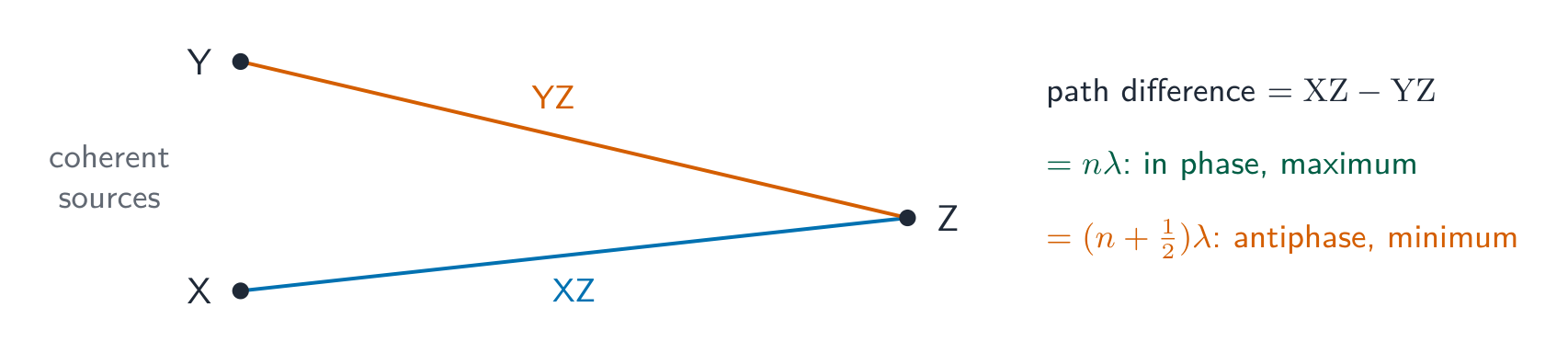
מה שקורה ב-Z תלוי בהפרש המסלול XZ − YZ, הנמדד באורכי גל
ניסוי החריץ הכפול (ניוס)
עבור שני חריצים במרחק $a$ זה מזה, עם מסך במרחק $D$ (נניח $D \gg a$), אור בעל אורך גל $\lambda$ יוצר פסים על המסך.
ניסוי החריצים הכפול של יאנג — החריץ הבודד הופך את שני החריצים למקורות קוהרנטיים
המרווח בין הפסים$x$ (פס אחד לפס הבא) הוא
$$\lambda = \frac{a x}{D}, \qquad x = \frac{\lambda D}{a}.$$
פסים בהירים (מקסימום) הם שם שהפרש המסלול הוא מספר שלם של $\lambda$; פסים כהים (מינימום) שם שהוא $(n + \tfrac{1}{2})\lambda$. הפסים מפוזרים במרווחים שווים.
כדי להקטין את המרווח בין הפסים: להגדיל $a$ (חריצים רחוקים יותר זה מזה), להקטין $D$ (מסך קרוב יותר), או להשתמש באורך גל קצר יותר ($\lambda$) (אור כחול).
הסבר כיצד נוצרת תבנית הפסים בהירים וכהים (שלוש נקודות): האור מתפרק בכל חריץ; שתי הקרניים המתפרקות נפגשות ומתחברות; שם שהפרש המסלול משני החריצים הוא מספר שלם של אורכי גל הגלים מגיעים בסכום פאזה ומתאבכים בנייה, ויוצרים פס בהיר, ושם שהוא מספר אי-זוגי של מחציות אורך גל הם מגיעים בשלב הפוך ומתאבכים הרסנית, ויוצרים פס כהה. מקור בהיר יותר הופך את הפסים בהירים יותר אך אינו משנה את המרווח ביניהם; מעבר לאור כחול מקטין את המרווח, ולכן כדי לשמור על אותו מרווח יש להזיז את החריצים קרוב יותר זה לזה; הצרת כל חריץ מגבירה את ההתפרקות, כך שפסים מופיעים על פני אזור רחב יותר, עם המרווח unchanged.
דוגמה פותרת. בניסוי החריץ הכפול החריצים נמצאים במרחק $0.50\ \text{mm}$ זה מזה ומאירים באור בעל אורך גל $600\ \text{nm}$. המסך נמצא במרחק $2.0\ \text{m}$. מצאו את המרווח בין הפסים.
דוגמה פותרת. אור אדום בעל אורך גל $680\ \text{nm}$ נוטה על חריצים במרחק $0.16\ \text{mm}$ זה מזה. המרחק בין מרכזי הפס הכה הראשון והתשיעי הוא $3.2\ \text{cm}$. מצאו את המרחק $D$ אל המסך.
שמונה מרווחי פסים עושים $3.2\ \text{cm}$, ולכן $x = 4.0\ \text{mm}$ ו-$D = ax / \lambda = (0.16 \times 10^{-3})(4.0 \times 10^{-3}) / (680 \times 10^{-9}) = 0.94\ \text{m}$. על מסך בעל רוחב $5.0\ \text{cm}$ שמרוכז בתבנית, עם $x = 2.4\ \text{mm}$, עשרה פסים בהירים נכנסים בצד אחד של הפס המרכזי: $21$ בסך הכל. גרף של $x$ כנגד $a$ הוא עקומה הולכת וירודה כאשר $1/a$; גרף של $x$ כנגד $\lambda$ (או כנגד $D$) הוא קו ישר העובר דרך נקודת האפס עם שיפוע $D/a$ (או $\lambda/a$), ממנו ניתן למצוא את $a$.
Explore · חקור
Interference · הפרעה
y = y₁ + y₂
In phase → constructive (bright/loud); antiphase → destructive (dark/quiet). · בפזה → בונה (בהיר/רועש); נגד פזה → הורס (כהה/שקט).
describe the use of a diffraction grating to determine the wavelength of light (the structure and use of the spectrometer are not included)
עברית
זיכרון והשתמש ב-$d \sin \theta = n\lambda$
תיאור השימוש ברשת עקיפה לקביעת אורך גל של אור (המבנה והשימוש בספקטרומטר אינם כלולים)
Source: Cambridge International syllabus · מקור: הסיילבוס הבינלאומי של קמבריד'ג'
English
A diffraction grating 衍射光栅 has many equally spaced slits — often hundreds or thousands per millimetre. Each slit is a coherent source. A maximum is seen at angle $\theta$ from the normal 法线 to the grating when
$$d \sin\theta = n \lambda,$$
where $d$ is the slit spacing 缝间距 (centre to centre), $n = 0, \pm 1, \pm 2, \ldots$ is the order 级次, and $\lambda$ is the wavelength.
Worked example. A diffraction grating has $500$ lines per mm. Light of wavelength $600\ \text{nm}$ is shone normally on it. Find the angle of the first-order ($n = 1$) maximum.
The slit spacing is $d = \dfrac{1}{500}\ \text{mm} = 2.0 \times 10^{-6}\ \text{m}$, so
Compared with the double slit, a grating gives much sharper maxima, because more slits add together — every other direction is cancelled by many slits.
To describe the diffraction at the grating: the light spreads out (diffracts) at every slit, and the waves from all the slits superpose; in the directions where the path difference between neighbouring slits is a whole number of wavelengths they are all in phase, so sharp maxima form there and almost nothing in between. A graph of intensity against angle is a set of narrow peaks at $\theta = 0$ and at $\pm\theta_{1}, \pm\theta_{2}, \ldots$, where $\sin\theta_{n} = n\lambda/d$: equally spaced in $\sin\theta$, so slightly further apart in $\theta$ at the higher orders.
Worked example. Light of wavelength $680\ \text{nm}$ is incident normally on a grating with $450$ lines per mm. Find the angle between the two second-order maxima.
$d = 1/450\ \text{mm} = 2.22 \times 10^{-6}\ \text{m}$, so $\sin\theta_{2} = 2 \times 680 \times 10^{-9} / (2.22 \times 10^{-6}) = 0.612$ and $\theta_{2} = 37.7°$; the two second-order beams are $2\theta_{2} = 75°$ apart.
Slit spacing from "lines per mm"
If a grating has $N$ lines per millimetre, then $d = 1/N$ millimetres $= 10^{-3}/N$ metres. For $450$ lines per mm, $d = 1/450\ \text{mm} \approx 2.22\ \mu\text{m}$.
Highest order
For a given grating and wavelength, $\sin\theta = n\lambda/d$ cannot be more than $1$, so the highest order seen is
If $d/\lambda = 3.27$, orders up to $n = 3$ exist; $n = 4$ would need $\sin\theta > 1$ and is not seen.
So the total number of maxima on a wide screen is $2n_{\text{max}} + 1$: for $700\ \text{nm}$ light and $400$ lines per mm, $d/\lambda = 3.57$, so $n_{\text{max}} = 3$ and seven beams are seen. A shorter wavelength gives more orders at smaller angles. With white light every order except the zero order is a spectrum, violet nearest the centre and red furthest out, because $\theta$ grows with $\lambda$; the zero order stays white. Two wavelengths give a maximum at the same angle when $n_{1}\lambda_{1} = n_{2}\lambda_{2}$: the third order of $400\ \text{nm}$ coincides with the second order of $600\ \text{nm}$.
Finding $\lambda$ with a grating
Shine parallel light of unknown wavelength straight at the grating. Measure the angle $\theta_{1}$ of the first-order maximum from the centre. Then $\lambda = d \sin\theta_{1}$. Repeating for higher orders and averaging reduces error.
Measure the angle between the first-order maxima on the two sides and halve it, which cancels any error in setting the zero; higher orders give larger angles and so a smaller percentage uncertainty; and plotting $\sin\theta$ against $n$ for several orders gives a straight line through the origin of gradient $\lambda/d$, so $\lambda = Gd$ (or, for a known wavelength, $d = \lambda/G$). Two things must be right: $\theta$ is measured from the normal to the grating, not from its surface, and $d$ is the distance between adjacent lines, so $400$ lines per mm means $d = 2.5\ \mu\text{m}$, never $400$.
עברית
לסריג קירוח ישנם חריצים רבים במרווחים שווים — לעיתים מאות או אלפים למילימטר. כל חריץ הוא מקור קוהרנטי. מקסימום נצפה בזווית $\theta$ מהאנך לסריג כאשר
$$d \sin\theta = n \lambda,$$
כאן $d$ היא מרחק החרירים (ממרכז למרכז), $n = 0, \pm 1, \pm 2, \ldots$ היא דרגת הקירוח, ו$\lambda$ הוא האורך הגלי.
דוגמה מפורטת. לסריג קירוח יש $500$ קווים למ"מ. אור באורך גל $600\ \text{nm}$ פונה אנכית אליו. מצאו את הזווית של המקסימום בדרגה הראשונה ($n = 1$).
מרחק החרירים הוא $d = \dfrac{1}{500}\ \text{mm} = 2.0 \times 10^{-6}\ \text{m}$, ולכן
בהשוואה לחריכיים כפולים, לסריג נותן מקסימומים חדים הרבה יותר, מכיוון שמספר גדול יותר של חריכים מתחבר — כל כיוון אחר מבטל על ידי רבות החריכים.
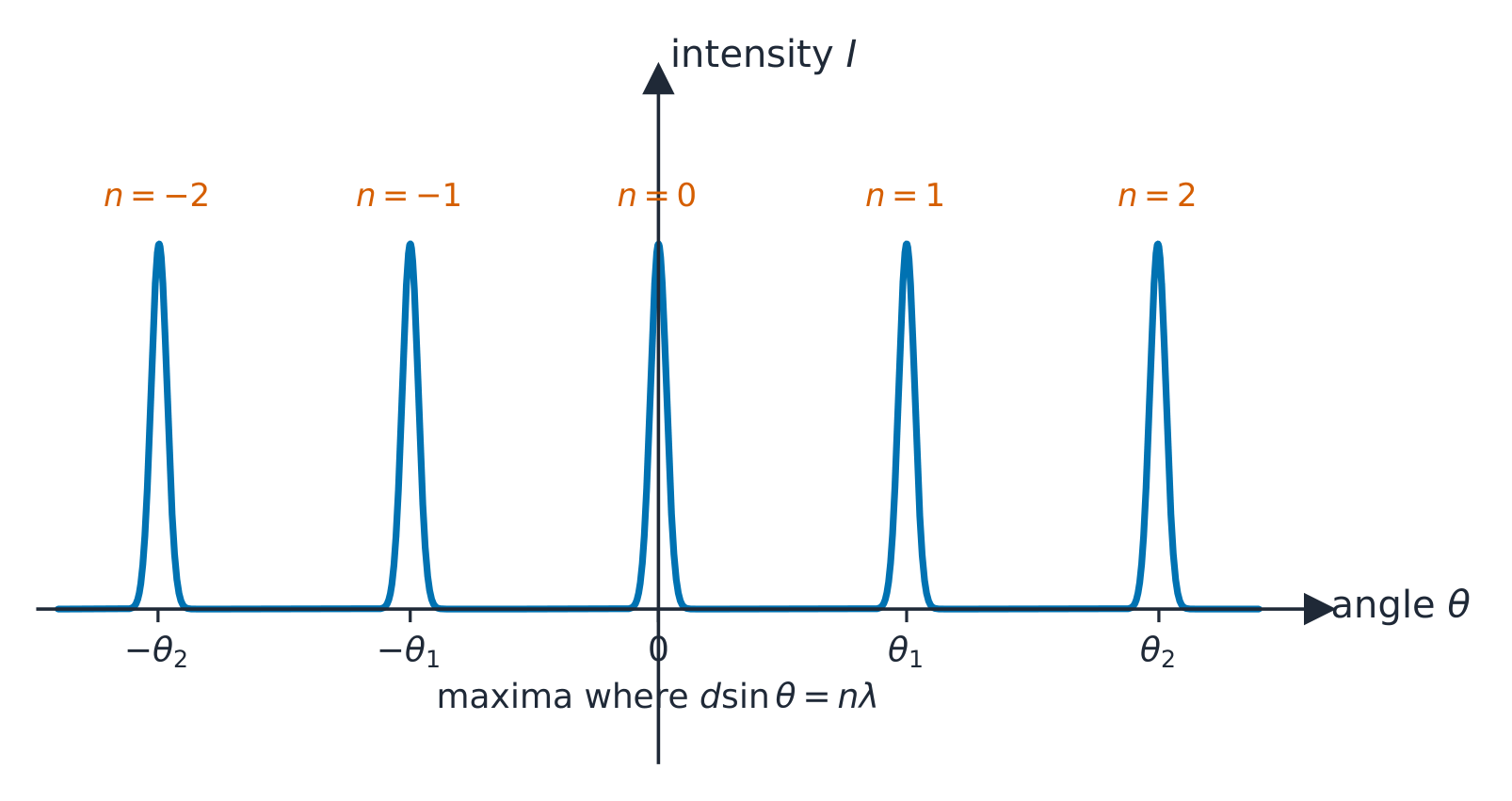
כדי לתאר את הקירוח בסריג: האור מתפשט (מתקירח) בכל חריץ, וגלים מכל החרירים סופרים זה עם זה; בכיוונים שבהם ההפרש במסלול בין חריכים סמוכים הוא מספר שלם של אורכי גל, הם כולם בפאזה, ולכן נוצרים שם מקסימומים חדשים וכמעט אין דבר ביניהם. גרף של עוצמה כנגד זוויות הוא סדרה של שיאים צרים ב$\theta = 0$ וב$\pm\theta_{1}, \pm\theta_{2}, \ldots$, כאשר $\sin\theta_{n} = n\lambda/d$: מרווחים שווים ב$\sin\theta$, ולכן מרווחים מעט יותר ב$\theta$ בדרגות גבוהות יותר.
עוצמה כנגד זוויות לסריג: מקסימומים חדשים כאשר $d\sin\theta = n\lambda$
דוגמה מפורטת. אור באורך גל $680\ \text{nm}$ פוגע אנכית בסריג בעל $450$ קווים למ"מ. מצאו את הזווית בין שני המקסימוסים בדרגה השנייה.
$d = 1/450\ \text{mm} = 2.22 \times 10^{-6}\ \text{m}$, ולכן $\sin\theta_{2} = 2 \times 680 \times 10^{-9} / (2.22 \times 10^{-6}) = 0.612$ ו$\theta_{2} = 37.7°$; שני קרני הדרגה השנייה מרוחקים ב$2\theta_{2} = 75°$ זה מזה.
רשת פיזור מפצלת אור חד-צבעי למקסימומים חדים על מסך
חישוב מרחק החרירים מ-"קווים למ"מ"
אם לסריג יש $N$ קווים למילימטר, אזי $d = 1/N$ מילימטרים שווים ל$= 10^{-3}/N$ מטרים. עבור $450$ קווים למ"מ, מתקבל $d = 1/450\ \text{mm} \approx 2.22\ \mu\text{m}$.
הדרגה הגבוהה ביותר
עבור סריג ואורך גל נתונים, $\sin\theta = n\lambda/d$ לא יכול להיות גדול יותר מ$1$, ולכן הדרגה הגבוהה הנראית היא
אם $d/\lambda = 3.27$, קיימות דרגות עד $n = 3$; $n = 4$ יזדקק ל$\sin\theta > 1$ ולא ייראה.
לכן המספר הכולל של מקסימוסים על מסך רחב הוא $2n_{\text{max}} + 1$: עבור אור ב-$700\ \text{nm}$ ו-sריג עם $400$ קווים למ"מ, מתקבל $d/\lambda = 3.57$, ולכן נראים $n_{\text{max}} = 3$ ושבעה קרניים. אורך גל קצר יותר נותן יותר דרגות בזוויות קטנות יותר. עם אור לבן, כל דרגה פרט לדרגה אפס היא ספקטרום, ויולט קרוב יותר למרכז ואדום הרחוק ביותר, מכיוון ש-$\theta$ גדל עם $\lambda$; הדרגה אפס נשארת לבנה. שני אורכי גל נותנים מקסימום באותה זווית כאשר $n_{1}\lambda_{1} = n_{2}\lambda_{2}$: הדרגה השלישית של $400\ \text{nm}$ חופפת עם הדרגה השנייה של $600\ \text{nm}$.
מציאת $\lambda$ עם סריג קירוח
ברק אור מקביל בעל אורך גל לא ידיון ישירות אל הרשת. מדוד את הזווית $\theta_{1}$ של המקסימום מסדר ראשון מהמרכז. לאחר מכן $\lambda = d \sin\theta_{1}$. חזרה על המדידה לסדרים גבוהים יותר ולקחת את הממוצע מפחית שגיאה.
מדוד את הזווית בין המקסימומים מסדר ראשון בשני הצדדים וחלק אותה ב-2, דבר המבטל כל שגיאת כיונון האפס; סדרים גבוהים יותר נותנים זוויות גדולות יותר ולכן אי-ודאות אחוזית קטנה יותר; וציור $\sin\theta$ כנגד $n$ עבור מספר סדרים נותן ישר העובר דרך הראשית עם שיפוע $\lambda/d$, כך שניתן למצוא $\lambda = Gd$ (או, עבור אורך גל ידוע, $d = \lambda/G$). שני הדברים חייבים להיות נכונים: $\theta$ נמדדת מהנורמל לרשת ולא משטחה, ו$d$ היא המרחק בין קווים סמוכים, כך ש$400$ קווים למ"מ פירושו $d = 2.5\ \mu\text{m}$, לעולם לא $400$.
Explore · חקור
Why the grating gives sharp maxima · למה רשת נותנת מקסימומים חדים
Two waves add when in phase and cancel when out of phase — change the phase and watch the resultant. A grating's many slits make the bright fringes razor-sharp. · שתי גלים מתווספים כאשר הן באותו פאזה ומבטלות זו את זו כאשר הן מולפאזיות — שינוי הפאזה ותצפה בתוצאה. מספר גדול של חריצים ברשת הופך את פסי האור לחדים כמו להב סכין.
Definitions the examiner accepts · הגדרות מקובלות בקורס
English
A definition question is marked against fixed wording. Learn these exactly, and give one answer only.
Term
Definition
principle of superposition
when two or more waves meet at a point, the resultant displacement is the sum of the displacements of the individual waves
stationary wave
the pattern formed when two progressive waves of the same frequency and speed travel in opposite directions and superpose, with nodes and antinodes that do not move
node
a point on a stationary wave where the displacement is always zero
antinode
a point on a stationary wave where the amplitude is a maximum
diffraction
the spreading of a wave as it passes through a gap or around the edge of an obstacle
interference
the superposition of waves from coherent sources, giving a steady pattern of maxima and minima
coherence
waves that have a constant phase difference (and so the same frequency)
path difference
the difference between the distances travelled by two waves from their sources to a point
fringe spacing
the distance between the centres of two adjacent bright (or dark) fringes
order of a maximum
the whole number $n$ in $d\sin\theta = n\lambda$, the number of wavelengths of path difference between adjacent slits
עברית
שאלת הגדרה מוקדמת לפי טקסט קבוע. לימודן במדויק, ותן תשובה אחת בלבד.
מונח
הגדרה
עקרון הסופרפוזיציה
כאשר שתי גלים או יותר פוגשים בנקודה, ההזזה הנתונת היא סכום ההזזות של הגלים הבודדים
גל עומד
הדגם הנוצר כאשר שני גלים הולכים באותו תדר ומהירות נעים בכיוונים הפוכים ומתאחדים, עם נקודות קיבוע ואנט-קיבוע שאינן זזות
נקודת קיבוע
נקודה בגל עומד בה ההזזה היא תמיד אפס
נקודת אנטי-קיבוע
נקודה בגל עומד בה האמפליטודה היא מקסימלית
התפרקות
התפשטות הגל כאשר הוא עובר דרך חריץ או סביב קצה מכשול
התאבכות
הסופרפוזיציה של גלים ממקורות קוהרנטיים, הנותנת דגם יציב של מקסימומים ומינימומים
קוהרנטיות
גלים שיש להם הפרשי פאזה קבועים (ולכן אותו תדר)
הפרש מסלול
ההפרש בין המרחקים שנסעו שני גלים ממקורותיהם לנקודה
מרווח פסים
המרחק בין מרכזים של שני פסים בהירים (או כהים) סמוכים
סדר של מקסימום
המספר השלם $n$ ב$d\sin\theta = n\lambda$, מספר אורכי הגלים של הפרש המסלול בין חריצים סמוכים
8.4
Exam tips · טיפים לבחינות
English
Two-source interference: constructive when path difference $= n\lambda$, destructive when $= (n + \tfrac{1}{2})\lambda$; the sources must be coherent.
On a stationary wave mark nodes and antinodes; adjacent nodes are $\lambda/2$ apart; it stores energy but does not transfer it.
A stationary wave needs two waves of the same frequency travelling in opposite directions.
Common mistakes
Adding amplitudes or intensities in the principle of superposition. Displacements add; the intensity then follows from the resultant amplitude squared.
"Adjacent nodes are one wavelength apart." Half a wavelength; a node to the next antinode is a quarter.
Using $d =$ lines per millimetre in $d\sin\theta = n\lambda$. Invert: $d = 10^{-3}/N$ metres.
Measuring $\theta$ from the grating surface, or forgetting that the angle between the two first-order beams is $2\theta_{1}$.
Writing "in phase" for coherent. Coherent means a constant phase difference; the sources may be permanently out of step.
Saying the fringe spacing changes when the source is made brighter, or that narrower slits change the spacing. Brightness and slit width change the contrast and the number of visible fringes, not $x = \lambda D/a$.
עברית
התאבכות מעטרת מקורות: בונה כאשר הפרש המסלול $= n\lambda$, הורסתית כאשר $= (n + \tfrac{1}{2})\lambda$; המקורות חייבים להיות קוהרנטיים.
חריץ כפול: $\lambda = ax/D$; רשת התפרקות: $d\sin\theta = n\lambda$ – לדעת כל סימן.
על גל עומד סמן נקודות קיבוע ואנטי-קיבוע; נקודות קיבוע סמוכות נמצאות במרחק $\lambda/2$ זו מזו; הגל מאחסן אנרגיה אך אינו מעביר אותה.
גל עומד דורש שני גלים באותו תדר הנעים בכיוונים הפוכים.
טעויות נפוצות
חיבור אמפליטודות או עוצמות בעקרון הסופרפוזיציה. ההזזות מתחברות; העוצמה נובעת מאחר כך מהריבוע של האמפליטודה הנתונה.
"נקודות קיבוע סמוכות נפרדות במרחק של אורך גל." חצי אורך גל; מנקודת קיבוע לאנטי-קיבוע הבא הוא רבע.
שימוש ב$d =$ קווים למ"מ ב$d\sin\theta = n\lambda$. הפוך: $d = 10^{-3}/N$ מטרים.
מדידת $\theta$ משטח הרשת, או שכחון שהזווית בין שני הקרניים מסדר ראשון היא $2\theta_{1}$.
כתיבת "בפזה" עבור מקור קוהרנטי. קוהרנטיות פירושה הפרש פזה קבוע; ייתכן שמקורות המקור יהיו לעולם מחוצים זה מזה.
טענה שהמרווח בין פריזות משתנה כאשר המקור נהיה בהיר יותר, או שצמצומ רחב הפריזות משנה את המרווח. הבהירות ורוחב הפריזות משנים את ניגוד התמונה ומספר הפריזות הנראות, אך לא $x = \lambda D/a$.
Interactive lessons on this topic · שיעורים אינטראקטיביים בנושא זה
Work through it step by step, with instant-check exercises. · לעבור על הדברים צעד אחר צעד, עם תרגילים לבדיקה מיידית.
Pick one and the site follows you — notes, papers, videos and practice all open on it. · בחרו נושא אחד והאתר יעקוב אחריו — הערות, מסמכים, וידאו ותרגולים פתוחים בו.
Type to search notes, lessons, code, vocabulary and past-paper questions across every subject. · הקלד כדי לחפש הערות, שיעורים, קוד, אוצר מילים ושאלות מבחנים בכל הנושאים.