הסתכלו בשמש. כל שנייה היא ממירה ארבעה מיליון טון ממנה — נעלם, אבוד — לאנרגיה טהורה. לא בוערת. מומרת. המסה שאבדה…
English narration · English + 中文 subtitles burned in · קריאת קול באנגלית · תרגום אנגלי + סינית שרוף בתוך הסרטון
23.1
Mass-energy equivalence · שקילות מסה-אנרגיה
Syllabus · סיילבוס
English
understand the equivalence between energy and mass as represented by $E = mc^2$ and recall and use this equation
represent simple nuclear reactions by nuclear equations of the form $^{14}_{7}\text{N} + ^{4}_{2}\text{He} \rightarrow ^{17}_{8}\text{O} + ^{1}_{1}\text{H}$
define and use the terms mass defect and binding energy
sketch the variation of binding energy per nucleon with nucleon number
explain what is meant by nuclear fusion and nuclear fission
explain the relevance of binding energy per nucleon to nuclear reactions, including nuclear fusion and nuclear fission
calculate the energy released in nuclear reactions using $E = c^2 \Delta m$
עברית
להבין את השוואה בין אנרגיה למסה המיוצגת על ידי $E = mc^2$ ולזכור ולהשתמש במשוואה זו
לצייר בקיצוב את השינוי באנרגיית קישור לכל נוקלאון בתלות במספר הנוקלאונים
להסביר את המשמעות של היתוך גרעיני וסדק גרעיני
להסביר את הרלוונטיות של אנרגיית הקישור לכל נוקלאון לתגובות גרעينية, כולל היתוך גרעיני וסדק גרעיני
לחשב את האנרגיה המשתחררת בתגובות גרעניות באמצעות $E = c^2 \Delta m$
Source: Cambridge International syllabus · מקור: הסיילבוס הבינלאומי של קמבריד'ג'
English
Einstein's special relativity gives the famous link (mass-energy equivalence 质能等价):
$$E = m c^{2},$$
where $c = 3.00 \times 10^{8}\ \text{m s}^{-1}$. A mass $m$ matches an energy 能量$E$ — the two can change into each other. For a mass change $\Delta m$:
Worked example. The star Sirius loses mass through nuclear fusion at $1.09 \times 10^{11}\ \text{kg s}^{-1}$. Find the power it radiates.
Every kilogram that disappears leaves as energy: $P = c^{2} \times (\text{mass lost per second}) = (3.00 \times 10^{8})^{2}(1.09 \times 10^{11}) = 9.8 \times 10^{27}\ \text{W}$. This is the star's luminosity 光度 (Topic 25); the Sun's is $3.8 \times 10^{26}\ \text{W}$, so it loses about $4$ million tonnes a second. The same idea in reverse: a power station producing $1\ \text{GW}$ for a year converts $E/c^{2} = 3.2 \times 10^{16}/9.0 \times 10^{16} = 0.35\ \text{kg}$ of mass, which is why the fuel weighs almost the same afterwards.
$$\Delta E = c^{2} \Delta m.$$
In nuclear physics the masses are tiny but $c^{2}$ is huge, so a small mass change means a large energy. A mass change of $1\ \text{u}$ ($1.661 \times 10^{-27}\ \text{kg}$) matches $\Delta E \approx 1.49 \times 10^{-10}\ \text{J}$. This gives a conversion you will use again and again:
היחסות המיוחדת של איינשטיין מניחה את הקשר המפורסם (שקילות מסה-אנרגיה):
מסה ואנרגיה הן שקולות ויכולות להפוך זו לזו
$$E = m c^{2},$$
כאשר $c = 3.00 \times 10^{8}\ \text{m s}^{-1}$. מסה $m$ תואמת אנרגיה$E$ — שתי המוחות יכולות להפוך זו לזו. עבור שינוי במסה $\Delta m$:
דוגמה מופיעה. הכוכב סיריוס מאבד מסה דרך היתוך גרעיני ב-$1.09 \times 10^{11}\ \text{kg s}^{-1}$. חשב את ההספק הרדיאלי שלו.
כל קילוגרם שנעלם משחרר באנרגיה: $P = c^{2} \times (\text{mass lost per second}) = (3.00 \times 10^{8})^{2}(1.09 \times 10^{11}) = 9.8 \times 10^{27}\ \text{W}$. זהו בהירות הכוכב (נושא 25); בהירות השמש היא $3.8 \times 10^{26}\ \text{W}$, ולכן היא מאבדת כ-$4$ מיליון טון בשנייה. אותה עיקר בהפך: תחנת כוח המייצרת $1\ \text{GW}$ למשך שנה ממירה $E/c^{2} = 3.2 \times 10^{16}/9.0 \times 10^{16} = 0.35\ \text{kg}$ של מסה, ולכן הדלק שוקל כמעט אותו דבר לאחר מכן.
$$\Delta E = c^{2} \Delta m.$$
בפיזיקה גרעينية המסות הן זעירות אך $c^{2}$ גדול מאוד, לכן שינוי קטן במסה מוביל לאנרגיה גדולה. שינוי במסה של $1\ \text{u}$ ($1.661 \times 10^{-27}\ \text{kg}$) תואם $\Delta E \approx 1.49 \times 10^{-10}\ \text{J}$. זה נותן לך קונVERSION שתשתמש בו שוב ושוב:
with nucleon number 核子数 conserved (top numbers: $14 + 4 = 17 + 1$) and charge conserved (bottom numbers: $7 + 2 = 8 + 1$) — this is conservation of charge 电荷守恒. Use these to fill in an unknown: identify the species, then balance the top and bottom numbers.
The decay equations. Alpha decay removes $^{4}_{2}\text{He}$, so $A$ falls by 4 and $Z$ by 2: $^{211}_{84}\text{Po} \to {}^{207}_{82}\text{Pb} + {}^{4}_{2}\text{He}$. Beta-minus decay turns a neutron into a proton, emitting an electron and an antineutrino: $^{15}_{6}\text{C} \to {}^{15}_{7}\text{N} + {}^{0}_{-1}\text{e} + \bar{\nu}$ ($A$ unchanged, $Z$ up by 1). Beta-plus decay turns a proton into a neutron, emitting a positron 正电子 and a neutrino 中微子: $^{18}_{9}\text{F} \to {}^{18}_{8}\text{O} + {}^{0}_{+1}\text{e} + \nu$ ($Z$ down by 1). Gamma emission changes neither number. In a chain of decays just keep the books: a nucleus W that emits $\beta^{-}$, then $\alpha$, then $\beta^{-}$ ends with $A - 4$ and $Z + 1 - 2 + 1 = Z$, an isotope of W. Check both lines of every equation you complete, and remember the neutrino: the mark scheme includes it.
עם מספר נוקלאונים שמור (מספרים עליונים: $14 + 4 = 17 + 1$) ומטען שמור (מספרים תחתונים: $7 + 2 = 8 + 1$) — זהו שימור מטען. השתמש בזה כדי למלא נוסחאות לא ידועות: זיהוי הסוג, ולאזן את המספרים העליונים והתחתונים.
משוואות הדעיכה. דעיכת אלפא מסירה $^{4}_{2}\text{He}$, ולכן $A$ יורד ב-4 ו-$Z$ ב-2: $^{211}_{84}\text{Po} \to {}^{207}_{82}\text{Pb} + {}^{4}_{2}\text{He}$. דעיכת בטא מינוס ממירה נטרון לפרוטון, פולטת אלקטרון ואנטרינו: $^{15}_{6}\text{C} \to {}^{15}_{7}\text{N} + {}^{0}_{-1}\text{e} + \bar{\nu}$ ($A$ לא משתנה, $Z$ עולה ב-1). דעיכת בטא פלוס ממירה פרוטון לנטרון, פולטת פוזיטרון ו-ניטרנו: $^{18}_{9}\text{F} \to {}^{18}_{8}\text{O} + {}^{0}_{+1}\text{e} + \nu$ ($Z$ יורד ב-1). פליעת גמא אינה משנה אף אחד מהמספרים. ברצף של דעכים פשוט שמור על החשבונות: גרעין W שמפליק $\beta^{-}$, אחר כך $\alpha$, ואחרי כך $\beta^{-}$ יסתיים עם $A - 4$ ו-$Z + 1 - 2 + 1 = Z$, איזוטופ של W. בדוק את שתי השורות בכל משוואה שמשלם, ואל תשכח את הניטרנו: המפתח כולל אותו.
23.1
Mass defect and binding energy · תרופת מסה ואנרגיית קישור
English
The mass of a nucleus 原子核 is less than the total mass of its separate protons 质子 and neutrons 中子. The difference is the mass defect 质量亏损$\Delta m$:
$$\Delta m = (Z m_{\text{p}} + N m_{\text{n}}) - m_{\text{nucleus}}.$$
By $E = mc^{2}$, this "missing" mass was released as energy when the nucleus formed. To pull the nucleus fully apart you must put that energy back — the binding energy 结合能$B$:
$$B = \Delta m \cdot c^{2}.$$
Worked example. A helium-4 nucleus has a mass defect of $\Delta m = 0.0304\ \text{u}$. Find its binding energy. ($1\ \text{u}$ corresponds to $931\ \text{MeV}$.)
A more tightly bound nucleus has a larger mass defect and larger binding energy. The binding energy per nucleon 比结合能 is $B/A$ (usually in MeV per nucleon) — a measure of how tightly each nucleon is held, useful for comparing nuclides.
The two-mark definitions.The mass defect of a nucleus is the difference between the total mass of its separate nucleons and the mass of the nucleus.The binding energy is the minimum energy required to separate the nucleus into its individual nucleons (equivalently, the energy released when the nucleus is formed from separate nucleons). Say "separate nucleons" or "individual protons and neutrons"; "the energy holding the nucleus together" scores nothing. Binding energy is released, not stored: the nucleus has less energy than its parts.
Worked example. The masses are: proton $1.007\,276\ \text{u}$, neutron $1.008\,665\ \text{u}$, polonium-212 nucleus $211.945\,4\ \text{u}$. Find the mass defect and the binding energy per nucleon of $^{212}_{84}\text{Po}$.
$Z = 84$ protons and $N = 212 - 84 = 128$ neutrons: total $84 \times 1.007\,276 + 128 \times 1.008\,665 = 84.611\,2 + 129.109\,1 = 213.720\,3\ \text{u}$. Mass defect $\Delta m = 213.720\,3 - 211.945\,4 = 1.774\,9\ \text{u}$. Binding energy $= 1.774\,9 \times 931.5 = 1653\ \text{MeV}$, so per nucleon $1653/212 = 7.80\ \text{MeV}$, on the falling part of the curve. Keep every decimal place until the subtraction: the defect is a small difference of two large numbers.
Binding energy per nucleon vs nucleon number
A graph of $B/A$ against $A$ has a typical shape:
for light nuclei ($A < 20$), $B/A$ rises quickly (with a spike at the very stable $^{4}_{2}\text{He}$).
around $A \sim 56$ (iron), $B/A$ reaches its maximum of about $8.8\ \text{MeV}$. Iron-56 is the most stable nucleus.
for heavy nuclei ($A > 100$), $B/A$ falls slowly, to about $7.5\ \text{MeV}$ for uranium.
So the curve is dome-shaped, rising to iron then falling.
Sketching the curve. The exam gives blank axes ($A$ from 1 to 250, $B/A$ up to about $9\ \text{MeV}$) and marks: a steep rise from near zero at $A = 1$, a maximum near $A = 56$ at about $8.8\ \text{MeV}$, then a slow, gentle fall to about $7.5\ \text{MeV}$ at $A = 238$. Do not start the curve at the origin exactly (hydrogen-1 has no binding energy but is a single point), do not make the fall as steep as the rise, and do not let the curve reach zero on the right. Asked to mark a nucleus that undergoes alpha decay, put X on the far right, $A > 200$; a nucleus that undergoes fusion goes at the far left, $A < 10$; both are at low $B/A$, moving up the curve when they react.
עברית
מסת גרעין היא קטנה יותר מהמסה הכוללת של ה-פרוטונים והנטרונים הפרודים שלה. ההפרש הוא תרופת המסה$\Delta m$:
$$\Delta m = (Z m_{\text{p}} + N m_{\text{n}}) - m_{\text{nucleus}}.$$
על פי $E = mc^{2}$, המסה ה"חסרה" זו שוחררה כאנרגיה כאשר הגרעין נוצר. כדי לפרק את הגרעין לחלוטין יש להחזיר אנרגיה זו — אנרגיית הקשר$B$:
$$B = \Delta m \cdot c^{2}.$$
*הגרעין המאוחד בעל מסה קטנה מזו של הנוקלאונים המבודדים שלו; המסה החסורה משוחררת כאנרגיית קשר
דוגמה פותרת. לגרעין הליום-4 יש פגם מסה של $\Delta m = 0.0304\ \text{u}$. מצא את אנרגיית הקשר שלו. ($1\ \text{u}$ תואם ל$931\ \text{MeV}$.)
גרעין הקשור בצמוד יותר יש לו פגם מסה ואנרגיית קשר גדולים יותר. אנרגיית הקשר לכל נוקלאון היא $B/A$ (בדרך כלל ב-MeV לכל נוקלאון) — מדד לכך עד כמה כל נוקלאון מוחזק בחוזקה, שימושי להשוואה בין גרעינים.
הגדרות בשתי נקודות.פגם המסה של גרעין הוא ההפרש בין המסה הכוללת של הנוקלאונים המבודדים לבין המסה של הגרעין.אנרגיית הקשר היא האנרגיה המינימלית הנדרשת לפצול את הגרעין לנוקלאונים בודדים (או באופן שקול, האנרגיה השוחררת כאשר הגרעין נוצר מנוקלאונים בודדים). יש לומר "נוקלאונים בודדים" או "פרוטונים וניטרונים בודדים"; הביטוי "האנרגיה שמחזיקה את הגרעין יחד" אינו זוכה לנקודות. אנרגיית הקשר שוחררת, אינה מאוחסת: לגרעין יש פחות אנרגיה מאשר לחלקים שלו.
דוגמה פותרת. המסות הן: פרוטון $1.007\,276\ \text{u}$, ניטרון $1.008\,665\ \text{u}$, גרעין פולוניום-212 $211.945\,4\ \text{u}$. מצא את פגם המסה ואנרגיית הקשר לכל נוקלאון של $^{212}_{84}\text{Po}$.
$Z = 84$ פרוטונים ו$N = 212 - 84 = 128$ ניטרונים: סך הכל $84 \times 1.007\,276 + 128 \times 1.008\,665 = 84.611\,2 + 129.109\,1 = 213.720\,3\ \text{u}$. פגם מסה $\Delta m = 213.720\,3 - 211.945\,4 = 1.774\,9\ \text{u}$. אנרגיית קשר $= 1.774\,9 \times 931.5 = 1653\ \text{MeV}$, ולכן לכל נוקלאון $1653/212 = 7.80\ \text{MeV}$, על החלק היורד של העקומה. שמור על כל הספרות העשרוניות עד לביצוע החיסור: פגם המסה הוא הפרש קטן בין שני מספרים גדולים.
אנרגיית קשר לכל נוקלאון לעומת מספר נוקלאון
גרף של $B/A$ מול $A$ בעל צורה אופיינית:
עבור גרעינים קלים ($A < 20$), $B/A$ עולה במהירות (עם שיא בגרעין היציב ביותר, $^{4}_{2}\text{He}$).
סביב $A \sim 56$ (ברזל), $B/A$ מגיע ל-שיא של כ-$8.8\ \text{MeV}$. ברזל-56 הוא הגרעין היציב ביותר.
עבור גרעינים כבדים ($A > 100$), $B/A$ יורד לאט, עד לכ-$7.5\ \text{MeV}$ לאורניום.
לכן העקומה היא בצורת כיפה, עולה אל ברזל ואז יורדת.
שרטוט העקומה. במבחן נתונים צירים חלופיים ($A$ מ-1 עד 250, $B/A$ עד כ-$9\ \text{MeV}$) ומסומנים: עלייה תלולה מלכידות בקרבת $A = 1$, שיא בקרבת $A = 56$ בכ-$8.8\ \text{MeV}$, ולאחר מכן ירידה איטית ועדינה לכ-$7.5\ \text{MeV}$ ב$A = 238$. אל תתחיל את העקומה בדיוק באותו נקודה (ברזל-1 אין לו אנרגיית קשר אך הוא נקודה בודדת), אל תעשה את הירידה תלולה כמו העלייה, ואל תניאש העקומה לאפס בצד ימין. אם מבוקש לסמן גרעין שעובר דה-אלקה, שים X בצד הרחוק ביותר, $A > 200$; גרעין שעובר היתוך נמצא בצד הרחוק השמאלי, $A < 10$; שניהם ב$B/A$ נמוכה, נעים מעלה בעקומה כשהם מגיבים.
*אנרגיית הקשר לכל נוקלאון מגיעה לשיא בסביבת ברזל ($A \approx 56$); גרעינים קלים וכבדים יותר קשורים בחוזקה פחותה
Explore · חקור
Mass defect energy lab · מעבדת חוסר מסה ואנרגיית קשר
E = delta m c^2
Change mass defect and see binding energy rise with E = mc^2. · שנה את חוסר המסה וראה את עליית אנרגיית הקשר לפי E = mc^2.
The product has greater binding energy per nucleon than the reactants, so energy is released. Fusion powers stars. It needs very high temperatures (millions of kelvin) so the nuclei have enough kinetic energy 动能 to beat their electrostatic 静电 repulsion and get close enough for the strong nuclear force 强核力 to take over.
Nuclear fission
Nuclear fission 核裂变 splits a heavy nucleus into two lighter ones:
The products have higher binding energy per nucleon than $^{235}$U, so energy is released. The extra neutrons can cause more fissions — a chain reaction 链式反应 in a large enough mass of fuel (the critical mass 临界质量). This is the basis of nuclear power and weapons.
"Describe the differences between fission and fusion." Fission: a heavy nucleus (large $A$) splits into two lighter nuclei of roughly similar mass, usually after absorbing a neutron, releasing further neutrons. Fusion: two light nuclei (small $A$) join to form one heavier nucleus; it needs very high temperature and pressure to overcome the electrostatic repulsion between the nuclei. Both release energy, but per kilogram of fuel fusion releases more.
"Explain, with reference to the curve, why energy is released." In both processes the products lie higher on the binding-energy-per-nucleon curve than the reactants: each nucleon ends up more tightly bound, so the total binding energy increases. The extra binding energy is released (as the kinetic energy of the products and as photons), and the total mass of the products is less than that of the reactants by $\Delta E/c^{2}$. A nucleus near the peak (iron) can release energy by neither process, which is why the stars' fusion stops at iron.
Calculating the energy released
find the total mass of the reactants.
find the total mass of the products.
mass change $\Delta m = m_{\text{reactants}} - m_{\text{products}}$ (positive when energy is released).
energy released $\Delta E = c^{2} \Delta m$.
In kg this gives joules; in atomic mass units use $\Delta E\ (\text{MeV}) = \Delta m\ (\text{u}) \times 931$.
Worked example. In a nuclear reaction the total mass decreases by $0.020\ \text{u}$. Find the energy released.
Worked example (fusion). The mass defect of deuterium $^{2}_{1}\text{H}$ is $0.002\,388\ \text{u}$ and that of helium-4 is $0.030\,377\ \text{u}$. Find the energy released when two deuterium nuclei fuse to form one helium-4 nucleus.
Energy released $=$ (binding energy of the products) $-$ (binding energy of the reactants) $= [0.030\,377 - 2 \times 0.002\,388] \times 931.5 = 0.025\,601 \times 931.5 = 23.8\ \text{MeV}$ ($3.82 \times 10^{-12}\ \text{J}$). Mass defects can be used directly like this because the number of nucleons is the same on both sides; the difference in the defects is the mass converted. Per kilogram of deuterium this is $5.7 \times 10^{14}\ \text{J}$, about a million times a chemical fuel.
Worked example (fission).$^{235}_{92}\text{U} + {}^{1}_{0}\text{n} \to {}^{141}_{56}\text{Ba} + {}^{92}_{36}\text{Kr} + 3\,{}^{1}_{0}\text{n}$. Masses: U-235 $235.043\,9\ \text{u}$, n $1.008\,665\ \text{u}$, Ba-141 $140.914\,4\ \text{u}$, Kr-92 $91.926\,2\ \text{u}$. Find the energy released.
Reactants: $235.043\,9 + 1.008\,665 = 236.052\,6\ \text{u}$. Products: $140.914\,4 + 91.926\,2 + 3 \times 1.008\,665 = 235.866\,6\ \text{u}$. $\Delta m = 0.186\,0\ \text{u}$, so $\Delta E = 0.186\,0 \times 931.5 = 173\ \text{MeV} = 2.8 \times 10^{-11}\ \text{J}$ per fission. Count the three neutrons on the right and the one on the left: forgetting one changes the answer by a whole nucleon mass.
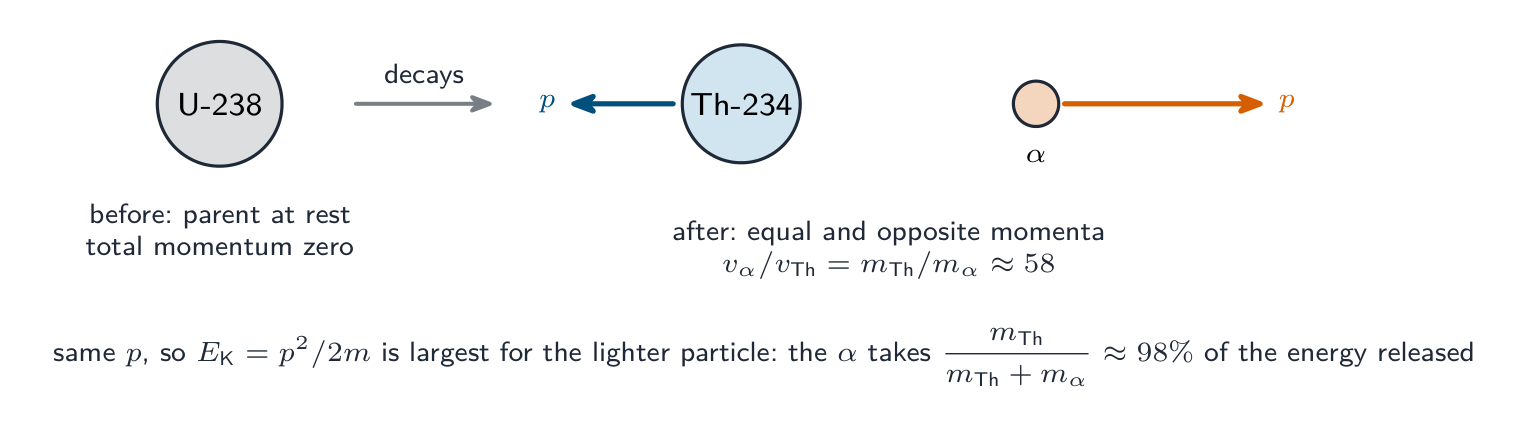
Worked example (alpha decay and momentum). A stationary $^{238}_{92}\text{U}$ nucleus decays to $^{234}_{90}\text{Th}$ by emitting an $\alpha$-particle; the total kinetic energy released is $4.27\ \text{MeV}$. Find the kinetic energy of the $\alpha$-particle.
Momentum is conserved and the parent was at rest, so the $\alpha$ and the thorium nucleus have equal and opposite momenta $p$. With $E_{\text{K}} = p^{2}/2m$, the energies are in the inverse ratio of the masses: $E_{\alpha}/E_{\text{Th}} = m_{\text{Th}}/m_{\alpha} = 234/4$. So $E_{\alpha} = 4.27 \times 234/238 = 4.20\ \text{MeV}$ and the thorium recoil 反冲 takes only $0.07\ \text{MeV}$. The $\alpha$-particles from a given decay are all emitted with this one energy, which is the sign that the energy is shared between just two bodies.
Worked example (a radioactive power source). A space probe is powered by $0.874\ \text{kg}$ of plutonium-238, half-life $87.7$ years, each decay releasing $5.59\ \text{MeV}$. Find the power available at launch.
Number of nuclei: $N = 0.874/(238 \times 1.661 \times 10^{-27}) = 2.21 \times 10^{24}$. Decay constant: $\lambda = 0.693/(87.7 \times 3.156 \times 10^{7}) = 2.50 \times 10^{-10}\ \text{s}^{-1}$. Activity: $A = \lambda N = 5.53 \times 10^{14}\ \text{Bq}$. Power $= A \times E = 5.53 \times 10^{14} \times 5.59 \times 1.60 \times 10^{-13} = 490\ \text{W}$, falling to half after $87.7$ years. A nuclide with a shorter half-life would give more power per kilogram but would not last the mission; polonium-210 ($138$ days) would be far more powerful at first and useless within two years.
עברית
תחנת כוח גרעינית משחררת אנרגיה באמצעות סדק גרעיני.
אנרגיה משוחררת כאשר גרעינים נעים עבר שיא הברזל — על ידי איחוי גרעינים קלים או פיצול גרעינים כבדים.
איחוי מחבר גרעינים קלים; סדק מפצל גרעין כבד — ושניהם משחררים אנרגיה על ידי התקרבות לשיא הברזל
איחוי גרעיני
איחוי גרעיני מחבר שני גרעינים קלים לגרעין כבד יותר:
למוצר יש אנרגיית קישור גדולה יותר לכל נוקליון מאשר למגיבים, ולכן אנרגיה משוחררת. איחוי הוא המקור לאנרגיה בכוכבים. הוא דורש טמפרטורות גבוהות מאוד (מיליוני קלווין) כדי שהגרעינים יצליחו להשיג אנרגיה קינטית מספקת כדי להתגבר על הדחייה אלקטרוסטטית ולתת למשיכה הגרעינית החזקה להשתלט.
למוצרים יש אנרגיית קישור גבוהה יותר לכל נוקליון מאשר ל-$^{235}$U, ולכן אנרגיה משוחררת. הנוקלאונים העודפים יכולים לגרום לסדקים נוספים — תגובת שרשרת במסה מספיק גדולה של דלק (מסה קריטית). זו הבסיס לתחנות כוח גרעיניות ולנשק גרעיני.
"מתאר את ההבדלים בין סדק לאיחוי." סדק: גרעין כבד (מסה $A$ גדולה) מתפצל לשני גרעינים קלים יותר בעלות מסה דומה בקירוב, לרוב לאחר בליעת נוקלאון, ומשחרר נוקלאונים נוספים. איחוי: שני גרעינים קלים (מסה $A$ קטנה) מתאחדים ליצירת גרעין כבד יותר; הוא דורש טמפרטורה ולחץ גבוהים מאוד כדי להתגבר על הדחייה האלקטרוסטטית בין הגרעינים. שניהם משחררים אנרגיה, אך לכל קילוגרם של דלק, האיחוי משחרר יותר.
"הסבר, בהתייחס לעקומה, מדוע אנרגיה משוחררת." בשני התהליכים המוצרים נמצאים גבוה יותר על עקומת אנרגיית הקישור לכל נוקליון מאשר המגיבים: כל נוקליון נותר קשור בחוזקה רבה יותר, ולכן אנרגיית הקישור הכוללת גוברת. אנרגיית הקישור העודפת משוחררת (כאנרגיה קינטית של המוצרים וכפוטונים), והמסה הכוללת של המוצרים היא פחות מזו של המגיבים ב-$\Delta E/c^{2}$. גרעין הסמוך לשיא (ברזל) אינו יכול לשחרר אנרגיה באף אחד מהתהליכים, ולכן האיחוי בכוכבים נפסק בברזל.
בתגובת שרשרת לא מבוקרת, כל סדק של אורניום-235 משחרר נוקלאונים הגורמים לסדקים נוספים
חישוב האנרגיה השוחררת
מצאו את המסה הכוללת של המגיבים.
מצאו את המסה הכוללת של המוצרים.
שינוי מסה $\Delta m = m_{\text{reactants}} - m_{\text{products}}$ (חיובי כאשר אנרגיה משתחררת).
אנרגיה משתחררת $\Delta E = c^{2} \Delta m$.
בק"ג זה נותן ג'אול; ביחידות מסה אטומית השתמש ב$\Delta E\ (\text{MeV}) = \Delta m\ (\text{u}) \times 931$.
דוגמה מופתרת. בתגובה גרעينية המסה הכוללת מצטמצמת ב$0.020\ \text{u}$. חשב את האנרגיה המשחררת.
דוגמה מופתרת (מיזוג). תיקון המסה של דטריום $^{2}_{1}\text{H}$ הוא $0.002\,388\ \text{u}$ ותיקון המסה של הליום-4 הוא $0.030\,377\ \text{u}$. חשב את האנרגיה המשחררת כשני גרעיני דטריום מתמזגים ליצירת גרעין הליום-4 אחד.
אנרגיה משתחררת $=$ (אנרגיית קישור של התוצרים) $-$ (אנרגיית קישור של המגיבים) $= [0.030\,377 - 2 \times 0.002\,388] \times 931.5 = 0.025\,601 \times 931.5 = 23.8\ \text{MeV}$ ($3.82 \times 10^{-12}\ \text{J}$). ניתן להשתמש ישירות בתיקוני המסה如此 כי מספר הנוקליונים זהה בשני הצדדים; ההבדל בתיקונים הוא המסה שהוסבה לאנרגיה. לכל ק"ג דטריום ערך זה $5.7 \times 10^{14}\ \text{J}$, פי מיליון מקרם כימי.
דוגמה מופתרת (סדירה).$^{235}_{92}\text{U} + {}^{1}_{0}\text{n} \to {}^{141}_{56}\text{Ba} + {}^{92}_{36}\text{Kr} + 3\,{}^{1}_{0}\text{n}$. מסות: U-235 $235.043\,9\ \text{u}$, n $1.008\,665\ \text{u}$, Ba-141 $140.914\,4\ \text{u}$, Kr-92 $91.926\,2\ \text{u}$. חשב את האנרגיה המשחררת.
מגיבים: $235.043\,9 + 1.008\,665 = 236.052\,6\ \text{u}$. תוצרים: $140.914\,4 + 91.926\,2 + 3 \times 1.008\,665 = 235.866\,6\ \text{u}$. $\Delta m = 0.186\,0\ \text{u}$, ולכן $\Delta E = 0.186\,0 \times 931.5 = 173\ \text{MeV} = 2.8 \times 10^{-11}\ \text{J}$ לסדרה אחת. ספור את שלושת הנוטרונים בצד ימין ואחד בצד שמאל: שכחת נוטרון אחת משנה את התשובה במסת נוקליון שלמה.
פירוק אלפא משקט: תנעים שווים ונגדיים, ולכן החלקיק האלפא הקל נושא כ-98% מהאנרגיה המשחררת והגרעין הכבד אינו מתנדנד כמעט
דוגמה מופתרת (פירוק אלפא ותנע). גרעין $^{238}_{92}\text{U}$ רדוף מתפרק ל$^{234}_{90}\text{Th}$ על ידי פליטת חלקיק $\alpha$; האנרגיה הקינטית הכוללת המשחררת היא $4.27\ \text{MeV}$. חשב את האנרגיה הקינטית של החלקיק $\alpha$.
התנע נשמר והגרעין האב היה בשקט, ולכן החלקיק $\alpha$ וגרעין התוריום הם בעלי תנעים שווים ונגדיים$p$. עם $E_{\text{K}} = p^{2}/2m$, האנרגיות נמצאות ביחס הפוך למסות: $E_{\alpha}/E_{\text{Th}} = m_{\text{Th}}/m_{\alpha} = 234/4$. לכן החלקיק $E_{\alpha} = 4.27 \times 234/238 = 4.20\ \text{MeV}$ והתוריום מתנדדים רק ב$0.07\ \text{MeV}$. החלקיקים $\alpha$ מפירוק נתון נפלטים כולם באותו אנרגיה זו, מה שמעיד שהאנרגיה מחולקת בין שני גופים בלבד.
דוגמה מופתרת (מקור כוח רדיואקטיבי). חוקר חלל מופעל על ידי $0.874\ \text{kg}$ של פלוטוניום-238, מחצית חיים של $87.7$ שנים, כל פירוק משחרר $5.59\ \text{MeV}$. חשב את ההספק הזמין בזמן השיגור.
מספר הגרעינים: $N = 0.874/(238 \times 1.661 \times 10^{-27}) = 2.21 \times 10^{24}$. קבוע הפירוק: $\lambda = 0.693/(87.7 \times 3.156 \times 10^{7}) = 2.50 \times 10^{-10}\ \text{s}^{-1}$. פעילות: $A = \lambda N = 5.53 \times 10^{14}\ \text{Bq}$. הספק $= A \times E = 5.53 \times 10^{14} \times 5.59 \times 1.60 \times 10^{-13} = 490\ \text{W}$, הנמוך לחצי לאחר $87.7$ שנים. ניוקליד עם מחצית חיים קצרה יותר יניב יותר הספק לק"ג אך לא יחייך את המשימה; פולוניום-210 ($138$ ימים) יהיה הרבה יותר הספקי בהתחלה אך חסר תועלת תוך שנתיים.
A neutron splits a heavy nucleus, releasing energy and more neutrons — which split more nuclei. · נאוטרון מפצל גרעין כבד, ומשחרר אנרגיה ונאוטרונים נוספים — אלו מפצלים עוד גרעינים.
understand that fluctuations in count rate provide evidence for the random nature of radioactive decay
understand that radioactive decay is both spontaneous and random
define activity and decay constant, and recall and use $A = \lambda N$
define half-life
use $\lambda = 0.693 / t_{\frac{1}{2}}$
understand the exponential nature of radioactive decay, and sketch and use the relationship $x = x_0 e^{-\lambda t}$, where $x$ could represent activity, number of undecayed nuclei or received count rate
עברית
להבין ששינויים בקצב הספירה מספקים עדות לטבע האקראי של התפרקות רדיואקטיבית
להבין שהתפרקות רדיואקטיבית היא גם ספונטנית וגם אקראית
להגדיר פעילות וקבוע דעיכה, ולזכור ולהשתמש ב $A = \lambda N$
להגדיר חצי חיים
להשתמש ב $\lambda = 0.693 / t_{\frac{1}{2}}$
להבין את הטבע האקספוננציאלי של ההתפרקות הרדיואקטיבית, ולערוך גרף ולהשתמש בקשר $x = x_0 e^{-\lambda t}$, כאשר $x$ יכול לייצג פעילות, מספר גרעינים שלא דעכו או קצב ספירה שנמדד
Source: Cambridge International syllabus · מקור: הסיילבוס הבינלאומי של קמבריד'ג'
English
Radioactive decay & half-life
Random and spontaneous
Radioactive decay is:
spontaneous 自发 — it happens with no outside trigger, and the rate is not changed by temperature, pressure or chemical state; and
random 随机 — you cannot predict when a given nucleus will decay, only the probability that it decays in a time.
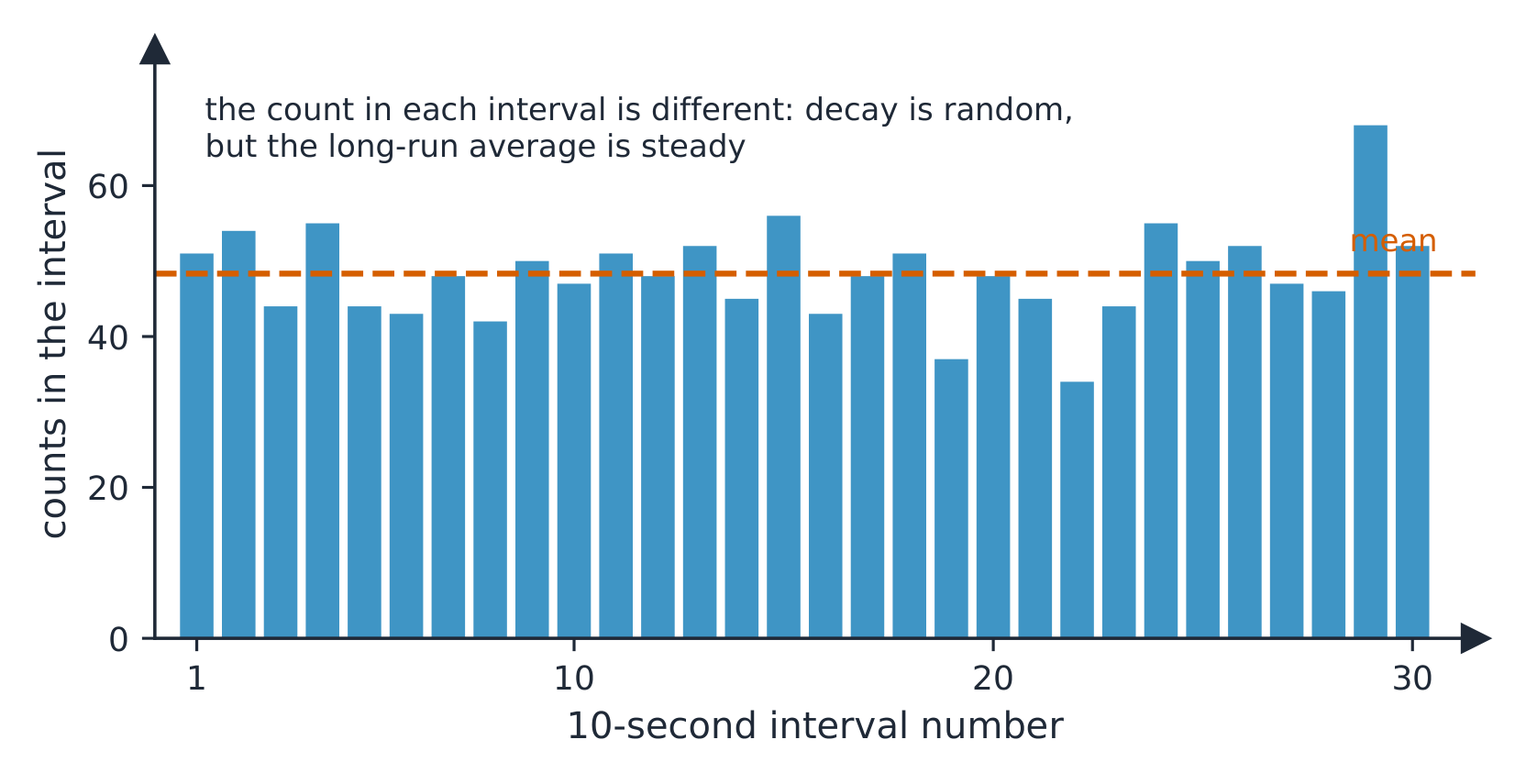
Evidence for randomness: the count rate fluctuates. A Geiger counter 盖革计数器 next to a source clicks at uneven intervals — never a steady stream — although the long-run mean rate is well-defined.
The two-mark definitions.Radioactive decay is the spontaneous and random emission of a particle ($\alpha$ or $\beta$) or a photon ($\gamma$) from an unstable nucleus.Spontaneous means the decay is not affected by external factors: temperature, pressure, chemical state, or the presence of other nuclei. Random means it is impossible to predict which nucleus will decay next, or when a given nucleus will decay; only a probability can be given. Evidence for randomness: the count rate fluctuates from one interval to the next, even for a source whose activity is not changing over the experiment.
Activity and decay constant
For $N$ undecayed nuclei of a radionuclide 放射性核素, the rate of decay is
$$A = \lambda N.$$
$A$ is the activity 活度 — decays per unit time. Unit: becquerel 贝克勒尔 (Bq) $= \text{s}^{-1}$.
$\lambda$ is the decay constant 衰变常数 — the probability per unit time that a nucleus decays. Unit: $\text{s}^{-1}$.
$\lambda$ is fixed for a nuclide; a larger sample (larger $N$) has proportionally larger activity.
The one-mark definitions.Activity is the number of decays (of nuclei) per unit time, or the rate of decay. The decay constant is the probability per unit time that a (given) nucleus will decay. Not "the rate of decay": that is the activity. Note the units are the same, $\text{s}^{-1}$, but $A$ counts events and $\lambda$ is a probability per second.
Worked example. Fluorine-18 has a half-life of $110$ minutes. Show that its decay constant is $1.05 \times 10^{-4}\ \text{s}^{-1}$, and find the activity of $2.1 \times 10^{-12}\ \text{kg}$ of fluorine-18.
$\lambda = 0.693/(110 \times 60) = 1.05 \times 10^{-4}\ \text{s}^{-1}$. The number of nuclei is the mass divided by the mass of one nucleus: $N = 2.1 \times 10^{-12}/(18 \times 1.661 \times 10^{-27}) = 7.0 \times 10^{13}$. So $A = \lambda N = 1.05 \times 10^{-4} \times 7.0 \times 10^{13} = 7.4 \times 10^{9}\ \text{Bq}$. A tiny mass gives a huge activity because the half-life is short; the same mass of uranium-238 (half-life $4.5 \times 10^{9}$ years) would give about $10^{-5}\ \text{Bq}$.
Exponential decay
Since $\lambda$ is the fractional decay rate, $\dfrac{dN}{dt} = -\lambda N$, whose solution is an exponential decay 指数衰减:
$$N = N_{0} e^{-\lambda t}.$$
Because $A = \lambda N$, the activity (and any count rate 计数率 proportional to it) decays the same way:
$$A = A_{0} e^{-\lambda t}.$$
Why exponential? For each nucleus, $\lambda$ is a fixed probability per unit time, independent of the others and of the nucleus's age. So the same fraction decays in each time interval, which gives exponential decay.
Writing the explanation (three marks). (1) The decay constant is the probability per unit time of decay and is the same for every nucleus of the nuclide, whatever its age. (2) So the rate of decay, the activity, is proportional to the number of undecayed nuclei present: $A = \lambda N$. (3) A rate of change proportional to the quantity itself gives an exponential change; equivalently, the same fraction of the remaining nuclei decays in every equal time interval, so the number never reaches zero but halves in every half-life.
Half-life
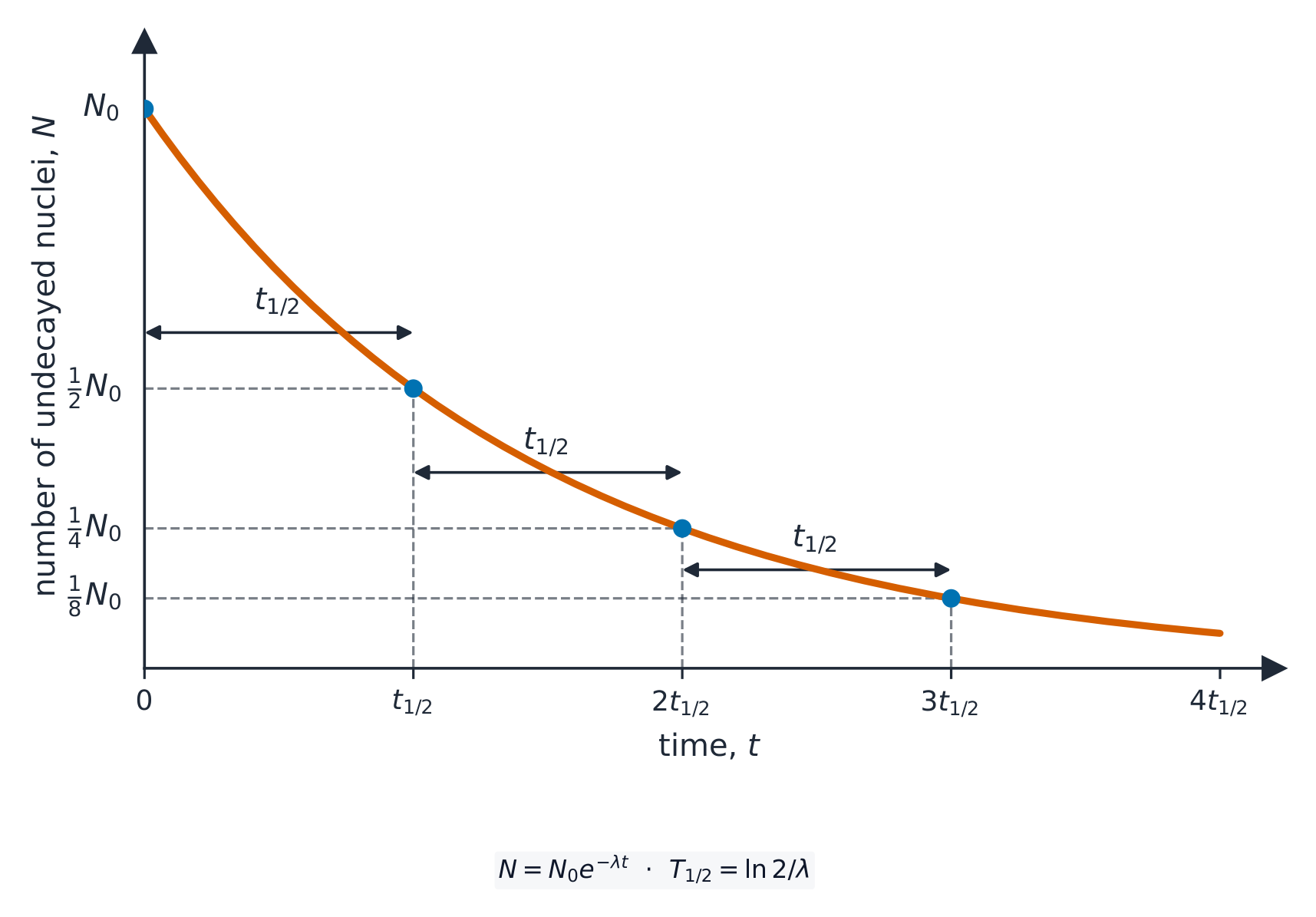
The half-life 半衰期$t_{1/2}$ is the time for the number of undecayed nuclei (or the activity, or the count rate) to fall to half. From $N = N_{0} e^{-\lambda t}$ with $N = N_{0}/2$:
A larger decay constant means a shorter half-life. After $n$ half-lives the surviving fraction is $(1/2)^{n}$; after 5 half-lives only about 3% remains.
The definition of half-life.The time taken for the number of undecayed nuclei (or the activity) of a sample to fall to half its initial value. "Half the atoms decay" is accepted; "half the sample disappears" is not, since the decayed nuclei are still there as the daughter product.
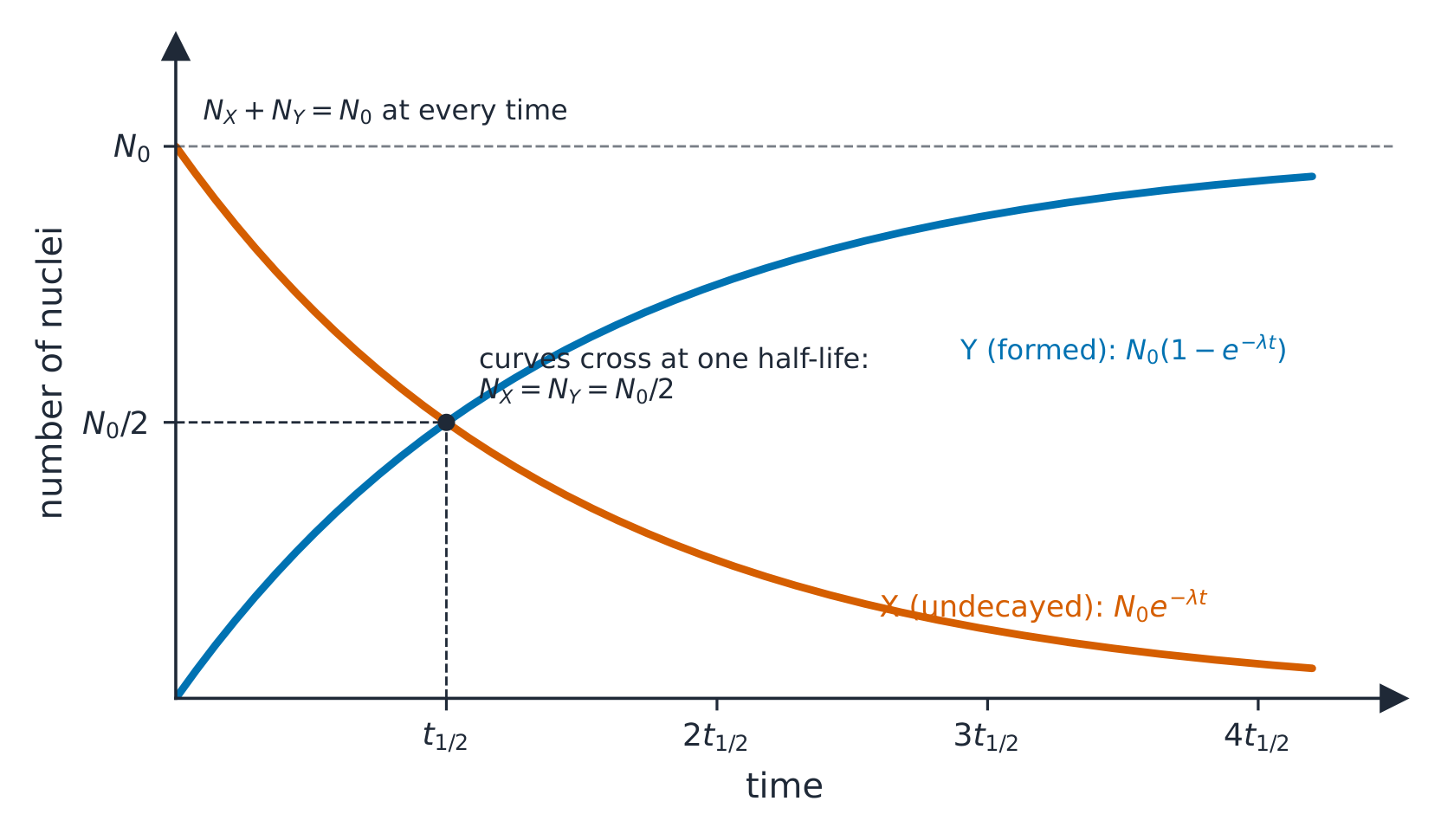
Reading a two-isotope graph. When X decays to a stable Y, $N_{\text{Y}} = N_{0} - N_{\text{X}} = N_{0}(1 - e^{-\lambda t})$. The half-life is the time at which the curves cross ($N_{\text{X}} = N_{\text{Y}} = N_{0}/2$), or the time for $N_{\text{X}}$ to halve. If the graph gives the initial number $N_{0}$ and the initial mass $m$, the nucleon number follows from $m = N_{0} A u$: for $m = 7.3 \times 10^{-4}\ \text{kg}$ and $N_{0} = 2.0 \times 10^{21}$, $A = m/(N_{0} u) = 7.3 \times 10^{-4}/(2.0 \times 10^{21} \times 1.661 \times 10^{-27}) = 220$.
Worked example. A sample of a single radioactive isotope has an activity of $180\ \text{Bq}$ at $t = 0$ and $45\ \text{Bq}$ at $t = 8.4$ minutes. Find the half-life and the decay constant, and the activity after a further $8.4$ minutes.
$45/180 = 1/4 = (1/2)^{2}$: two half-lives in $8.4$ minutes, so $t_{1/2} = 4.2\ \text{min} = 252\ \text{s}$ and $\lambda = 0.693/252 = 2.8 \times 10^{-3}\ \text{s}^{-1}$. After another two half-lives the activity is $45/4 = 11\ \text{Bq}$. When the ratio is not a neat power of two, use $t = \ln(A_{0}/A)/\lambda$: for the activity to fall from $180$ to $50\ \text{Bq}$ takes $\ln(3.6)/2.75 \times 10^{-3} = 466\ \text{s}$. Always convert the half-life to seconds before finding $\lambda$ if the activity is in becquerels.
Taking logs of $A = A_{0} e^{-\lambda t}$ gives $\ln A = \ln A_{0} - \lambda t$, so a plot of $\ln A$ against $t$ is a straight line with gradient $-\lambda$. Use this with several data points.
Count rate is not activity. A detector records only the radiation that reaches it and is absorbed in it: a fraction set by the solid angle it covers, by absorption in the air and in the source itself, and by its efficiency. So the measured count rate is smaller than the activity, but proportional to it, and the half-life obtained from a count-rate graph is correct. Subtract the background radiation 本底辐射 (measured with the source removed) from every reading before taking ratios or logarithms; an unsubtracted background makes the curve flatten and the half-life appear too long.
Tracers in medicine. Fluorine-18 and oxygen-15 are $\beta^{+}$ emitters used as tracers 示踪剂 in PET scanning (Topic 24): the positron annihilates with an electron, giving two gamma photons that leave in opposite directions and reveal where the tracer is. A short half-life ($110$ minutes, $2$ minutes) is chosen so that the activity falls quickly after the scan and the dose to the patient stays small, at the price of having to make the isotope close to the hospital and use it at once.
עברית
פירוק רדיואקטיבי ומחצית חיים
אקראי ובטבעי
פירוק רדיואקטיבי הוא:
בטבעי — הוא מתרחש ללא גירוי חיצוני, והקצב אינו משתנה עקב טמפרטורה, לחץ או מצב כימי; ו
אקראי — לא ניתן לחזות מתי גרעין נתון יתפרק, אלא רק את הסיכוי שיתפרק בתוך זמן מסוים.
עדויות לאקראיות: קצב הספירה מתנודד. גלאי גייגר בסמוך למקור נשמע בקליקים במרווחים בלתי-סדירים — לעולם לא בזרימה רציפה — אם כי הממוצע הטווח הארוך של הקצב מוגדר היטב.
הספירות בתחנות זמן שוות מאותו מקור לעולם אינן זהות פעמיים; התנודה היא העדות לכך שהפירוק הוא אקראי, בעוד שממוצע היציב מעיד על כך שהסיכוי הוא קבוע
ההגדרות לשני נקודות.פירוק רדיואקטיבי הוא פליטה ספונטנית ואקראית של חלקיק ($\alpha$ או $\beta$) או פוטון ($\gamma$) מגרעין לא יציב.ספונטני פירונו שהפירוק אינו מושפע מגורמים חיצוניים: טמפרטורה, לחץ, מצב כימי, או נוכחות גרעינים אחרים. אקראי פירונו שאינו אפשר לחזות איזה גרעין יתפרק הבא, או מתי גרעין נתון יתפרק; ניתן לציין רק סיכוי. עדויות לאקראיות: קצב הספירה מתנודד מתחנה לתחנה, גם עבור מקור whose activity is not changing over the experiment.
כל חלקיק בטה מהמקור משאיר מסלול דק בתא ערפל – עדות ישירה לפירוקים נפרדים ואקראיים
פעילות וקבוע פירוק
עבור $N$ גרעינים לא-מפורקים של רדיונוקליד, קצב הפירוק הוא
$$A = \lambda N.$$
$A$ היא הפעילות — פירוקים ליחידת זמן. יחידה: בקוורל (Bq) $= \text{s}^{-1}$.
$\lambda$ הוא קבוע הפירוק — הסיכוי ליחידת זמן שגרעין יתפרק. יחידה: $\text{s}^{-1}$.
$\lambda$ קבוע לנוקליד; דוגמה גדולה יותר (עם $N$ גדול יותר) בעלת פעילות פרופורציונלית גדולה יותר.
ההגדרות לנקודה אחת.הפעילות היא מספר הפירוקים (של גרעינים) ליחידת זמן, או קצב הפירוק. קבוע הפירוק הוא הסיכוי ליחידת זמן ש(גרעין נתון) יתפרק. לא "קצב הפירוק": זהו הפעילות. שימו לב שהיחידות זהות, $\text{s}^{-1}$, אך $A$ סופר אירועים ו$\lambda$ הוא סיכוי לשנייה.
דוגמה מוצגת. פלואורין-18 בעל חיי מחצית של $110$ דקות. הוכיחו שקבוע הפירוק שלו הוא $1.05 \times 10^{-4}\ \text{s}^{-1}$, ומצאו את הפעילות של $2.1 \times 10^{-12}\ \text{kg}$ פלואורין-18.
$\lambda = 0.693/(110 \times 60) = 1.05 \times 10^{-4}\ \text{s}^{-1}$. מספר הגרעינים הוא המסה מחולקת במסת גרעין אחד: $N = 2.1 \times 10^{-12}/(18 \times 1.661 \times 10^{-27}) = 7.0 \times 10^{13}$. לכן $A = \lambda N = 1.05 \times 10^{-4} \times 7.0 \times 10^{13} = 7.4 \times 10^{9}\ \text{Bq}$. מסה זעירה נותנת פעילות עצומה משום שהזמן המחציתי קצר; אותה מסה של אורניום-238 (זמן מחציתי $4.5 \times 10^{9}$ שנים) תניב כ-$10^{-5}\ \text{Bq}$.
פירוק אקספוננציאלי
מכיוון ש$\lambda$ הוא קצב הפירוק השבריתי, $\dfrac{dN}{dt} = -\lambda N$, שפתרון שלו הוא פירוק אקספוננציאלי:
$$N = N_{0} e^{-\lambda t}.$$
מכיוון ש$A = \lambda N$, הפעילות (וכל קצב ספירה פרופורציונלי לה) מתפרק באותו אופן:
$$A = A_{0} e^{-\lambda t}.$$
מדוע אקספוננציאלית? עבור כל גרעין, $\lambda$ היא סבירות קבועה ליחידת זמן, בלתי תלויה בגרעינים אחרים ובגיל הגרעין. לכן אותו חלק מתפרק בכל מרווח זמן, מה שנותן דעיכה אקספוננציאלית.
כתיבת ההסבר (שלוש נקודות). (1) קבוע הדעיכה הוא ה-סבירות ליחידת זמן לדעיכה והוא זהה לכל גרעין של Nuclid זה, ללא קשר לגילו. (2) לכן קצב הדעיכה, הפעילות, הוא יחסית למספר הגרעינים שלא התפרקו הקיימים: $A = \lambda N$. (3) קצב שינוי היחסית לכמות עצמה נותן שינוי אקספוננציאלי; באופן שקול, אותו חלק מגרעינים הנותרים מתפרק בכל מרווח זמן שווה, כך שמספרם לעולם לא מגיע לאפס אלא מחצה בכל חצי חיים.
חצי חיים
חצי החיים$t_{1/2}$ הוא הזמן הנדרש כדי שמספר הגרעינים שלא התפרקו (או הפעילות, או קצב הספירה) ירד ל-חצי. ממ $N = N_{0} e^{-\lambda t}$ עם $N = N_{0}/2$:
קבוע דעיכה גדול יותר משמעותו חצי חיים קצר יותר. לאחר $n$ חצי חיים, החלק הנותר הוא $(1/2)^{n}$; לאחר 5 חצי חיים נותר רק כ-3%.
ההגדרה לחצי חיים.הזמן הנדרש כדי שמספר הגרעינים שלא התפרקו (או הפעילות) של דוגמה ירד לחציו הערך ההתחלתי. "חצי האטומים מתפרקים" מתקבל; "חציו מדוגמה נעלמת" לא מתקבל, מכיוון שגרעינים שהתפרקו עדיין קיימים כמוצר הבת.
הורה המתפרק לבת יציבה: מה X מאבד, Y מוסיף, ולכן העקומים נחתכים לאחר חצי חיים אחד וחצי החיים ניתן לקרוא מהנקודת החיתוך
קריאת גרף של שני איזוטופים. כאשר X מתפרק ל-Y יציבה, $N_{\text{Y}} = N_{0} - N_{\text{X}} = N_{0}(1 - e^{-\lambda t})$. חצי החיים הוא הזמן שבו העקומים נחתכים ($N_{\text{X}} = N_{\text{Y}} = N_{0}/2$), או הזמן הנדרש כדי ש-$N_{\text{X}}$ ירד לחציו. אם הגרף נותן את המספר ההתחלתי $N_{0}$ והמסה ההתחלתית $m$, מספר הנוקלונים נובע מ-$m = N_{0} A u$: עבור $m = 7.3 \times 10^{-4}\ \text{kg}$ ו-$N_{0} = 2.0 \times 10^{21}$, $A = m/(N_{0} u) = 7.3 \times 10^{-4}/(2.0 \times 10^{21} \times 1.661 \times 10^{-27}) = 220$.
דוגמה פותרת. דוגמה של איזוטופ רדיואקטיבי יחיד יש לה פעילות של $180\ \text{Bq}$ ב-$t = 0$ ו-$45\ \text{Bq}$ ב-$t = 8.4$ דקות. מצאו את חצי החיים ואת קבוע הדעיכה, ואת הפעילות לאחר עוד $8.4$ דקות.
$45/180 = 1/4 = (1/2)^{2}$: שני חצי חיים ב-$8.4$ דקות, לכן $t_{1/2} = 4.2\ \text{min} = 252\ \text{s}$ ו-$\lambda = 0.693/252 = 2.8 \times 10^{-3}\ \text{s}^{-1}$. לאחר עוד שני חצי חיים הפעילות היא $45/4 = 11\ \text{Bq}$. כאשר היחס אינו מעריך נקי של 2, השתמשו ב-$t = \ln(A_{0}/A)/\lambda$: כדי שהפעילות תרד מ-$180$ ל-$50\ \text{Bq}$ לוקח $\ln(3.6)/2.75 \times 10^{-3} = 466\ \text{s}$. תמיד המירו את חצי החיים ל-שניות לפני שמצאים $\lambda$ אם הפעילות היא בבקרלים.
לקיחת לוגריתם טבעי של $A = A_{0} e^{-\lambda t}$ נותנת $\ln A = \ln A_{0} - \lambda t$, ולכן גרף של $\ln A$ כנגד $t$ הוא קו ישר עם שיפוע $-\lambda$. השתמש בכך עם מספר נקודות נתונים.
הקצב אינו פעילות. גלאי מקליט רק את הקרינה שמגיעה אליו ונבלעת בו: חלק שקבוע על ידי הזווית המוצקה שכיסה, על ידי בליעה באוויר ובמקור עצמו, ועל ידי היעילות שלו. לכן, הקצב הנמדד הוא קטן יותר מהפעילות, אך יחסי אליה, והחצי-חיים שהתקבלו מגרף קצב ספירה הם נכונים. חסרו את הקרינה הרקעית (נמדדת עם המקור הוסר) מכל קריאה לפני לקיחת יחסים או לוגריתמים; רקע שאינו מחוסר גורם לעקומה להשטח ולהביא לחצי-חיים שנראה ארוך מדי.
מתעדים ברפואה. פלואורין-18 וחמצן-15 הם פולטי $\beta^{+}$ המשמשים כמתעדים בסריקת PET (נושא 24): הפוזיטרון מתאבד עם אלקטרון, ומייצר שני פוטונים גמא היוצאים בכיוונים מנוגדים וחושפים את מיקום המתעד. נבחר חצי-חיים קצר ($110$ דקות, $2$ דקות) כדי שהפעילות תרד במהירות לאחר הסריקה והמינון למטופל יישאר קטן, בתמורה לצורך בייצור האיזוטופ בקרבת בית החולים ובשימוש בו מיד.
גרף של $\ln A$ נגד זמן הוא קו ישר עם שיפוע $-\lambda$
Choose a decay type; the daughter nuclide is fixed so the nucleon number A and the proton number Z both balance. · בחר סוג דעיכה; הגרעין הבת הוא קבוע ולכן מספר Nuclides A ומספר הפרוטונים Z מאוזנים.
Each nucleus has a fixed chance of decaying, at random. Move time forward: about half the remaining nuclei decay every half-life — so the count halves, then halves again. · לכל גרעין יש סיכוי קבוע לדעיכה, באופן אקראי. קדימה בזמן: כחצי מהגרעינים הנותרים דועכים בכל זמן מחצית — ולכן הספירה מכפלת, ואז מכפלת שוב.
Definitions the examiner accepts · הגדרות מקובלות בקורס
English
A definition question is marked against fixed wording. Learn these exactly, and give one answer only.
Term
Definition
mass defect
the difference between the total mass of the separate nucleons and the mass of the nucleus
binding energy
the minimum energy needed to separate a nucleus into its individual nucleons (the energy released when it forms from them)
nuclear fusion
two light nuclei combine to form a single heavier nucleus
nuclear fission
a heavy nucleus splits into two lighter nuclei of similar mass (usually after absorbing a neutron)
radioactive decay
the spontaneous and random emission of α, β or γ radiation from an unstable nucleus
spontaneous
not affected by external factors such as temperature, pressure or chemical state
random
it cannot be predicted which nucleus will decay, or when a given nucleus will decay
activity
the number of nuclei decaying per unit time
decay constant
the probability per unit time that a nucleus decays
half-life
the time for the number of undecayed nuclei (or the activity) to fall to half its initial value
עברית
שאלת הגדרה מוקדמת לפי טקסט קבוע. לימודן במדויק, ותן תשובה אחת בלבד.
מונח
הגדרה
תת-מסה
ההפרש בין המסה הכוללת של הנקלאונים הנפרדים לבין המסה של הגרעין
אנרגיית קשר
האנרגיה המינימלית הנדרשת להפרדת גרעין לנקלאונים בודדים (האנרגיה משתחררת כאשר הוא נוצר מהם)
היסות גרעינית
שני גרעינים קלים מתאחדים ליצירת גרעין כבד יחיד
סדק גרעיני
גרעין כבד נשבר לשני גרעינים קלים יותר בעלי מסה דומה (בדרך כלל לאחר ספיגת נייטרון)
דעיכה רדיואקטיבית
פליטה ספונטנית ואקראית של קרינה α, β או γ מגרעין לא יציב
ספונטנית
אינה מושפעת מגורמים חיצוניים כמו טמפרטורה, לחץ או מצב כימי
אקראית
לא ניתן לחזות איזה גרעין ידעך או מתי גרעין מסוים ידעך
פעילות
מספר הגרעינים הנדככים ביחידת זמן
קבוע דעיכה
הסבירות ליחידת זמן שגרעין ידעך
זמן מחציתי
הזמן הדרוש למספר הגרעינים שלא דעכו (או לפעילות) להגיע לחצי מערכו ההתחלתי
23.2
Exam tips · טיפים לבחינות
English
$E = mc^{2}$ with $1\ \text{u} = 931.5\ \text{MeV}$: work in u and MeV for reactions, then convert to joules only if asked ($1\ \text{MeV} = 1.60 \times 10^{-13}\ \text{J}$).
Energy released $=$ (total mass before $-$ total mass after) $\times c^{2}$, or (binding energy after $-$ binding energy before). Mass defects can be subtracted directly when the nucleon count is unchanged.
The curve: steep rise, peak $8.8\ \text{MeV}$ near $A = 56$, gentle fall. Products higher on the curve means energy released; fusion on the left, fission (and α-decay) on the right.
Balance every equation twice: nucleon numbers along the top, proton numbers along the bottom; β decays carry a neutrino or antineutrino.
$A = \lambda N$, $\lambda = 0.693/t_{1/2}$ with $t_{1/2}$ in seconds; $N$ from mass: $N = m/(A u)$. Ratios of $1/2$, $1/4$, $1/8$ mean whole half-lives; otherwise $t = \ln(x_{0}/x)/\lambda$.
Explanations are marked on the words: constant probability, rate proportional to number, same fraction per interval; fluctuating count rate for randomness; unaffected by external conditions for spontaneous.
Common mistakes
Defining binding energy as "the energy holding the nucleus together" or "the energy stored in the nucleus"; it is the energy to separate the nucleons.
Subtracting masses the wrong way round and reporting a negative energy release, or forgetting the neutron(s) on one side of a fission equation.
Drawing the binding-energy curve falling as steeply as it rises, or reaching zero at large $A$.
Using a half-life in minutes or years with an activity in becquerels; convert to seconds first.
Confusing the decay constant (a probability per second) with the activity (decays per second).
Saying "half the sample disappears" for a half-life, or that after two half-lives nothing is left.
Giving "random" as "it happens at any time" without "cannot predict which nucleus or when", or "spontaneous" without "unaffected by external factors".
Treating the count rate as the activity, or forgetting to subtract background.
Assuming the α-particle and the recoil nucleus share the energy equally; they share the momentum equally.
עברית
$E = mc^{2}$ עם $1\ \text{u} = 931.5\ \text{MeV}$: עבדו ב-u וב-MeV לתגובות, ולאחר מכן ממירו לג'אול רק אם נדרש ($1\ \text{MeV} = 1.60 \times 10^{-13}\ \text{J}$).
אנרגיה משתחררת $=$ (מסה כוללת לפני $-$ מסה כוללת אחרי) $\times c^{2}$, או (אנרגיית קשר אחרי $-$ אנרגיית קשר לפני). ניתן לחסור תת-מסה ישירות כאשר מספר הנקלאונים אינו משתנה.
העקומה: עלייה תלולה, שיא $8.8\ \text{MeV}$ בקרבת $A = 56$, ירידה עדינה. מוצרים הנמצאים גבוה יותר בעקומה מעידים על שחרור אנרגיה; מיזום בצד שמאל, גרימה (ופליטת α) בצד ימין.
מאזנו כל משוואה פעמיים: מספרי נקלאונים בשורה העליונה, מספרי פרוטונים בשורה התחתונה; פילוטיות β כוללות נ्यूטרינו או אנטי-ניוטרינו.
$A = \lambda N$, $\lambda = 0.693/t_{1/2}$ עם $t_{1/2}$ בשניות; $N$ ממסה: $N = m/(A u)$. יחסים של $1/2$, $1/4$, $1/8$ משמעם חצי-חיים שלמים; אחרת $t = \ln(x_{0}/x)/\lambda$.
הסברים מסומנים במילים: הסתברות קבועה, קצב יחסי למספר, אותו שבר לכל מרווח; תנודות בקצב הספירה עבור אקראיות; אינו מושפע מתנאים חיצוניים עבור ספונטניות.
טעויות נפוצות
הגדרת אנרגיית הקישור כ"האנרגיה המחזיקה את הגרעין יחד" או "האנרגיה האגורה בגרעין"; זוהי האנרגיה הנדרשת לפרק את הנוקלאונים.
חיסור המסה בסדר הלא נכון ודיווח על שחרור אנרגיה שלילי, או שכחון באמצעונית(ים) בצד אחד משווי ההתפצלות.
ציור עקומת אנרגיית הקישור הירודה במידה דומה לזו שבה היא עולה, או הגעה לאפס בערכים גדולים $A$.
שימוש בחצי-חיים בדקות או בשנים לצד פעילות בבקרל; יש להמיר לשניות תחילה.
בלבול בין קבוע הדעיכה (הסתברות לשנייה אחת) לבין הפעילות (דעיכות לשנייה אחת).
אמירה כי"החצי מדגם נעלם" לגבי חצי-חיים, או כי לאחר שני חצי-חיים לא נותר כלום.
מתן "אקראי" כ"זה קורה בכל זמן" ללא "אי אפשר לחזות איזה גרעין או מתי", או "ספונטני" ללא "בלתי מושפע מגורמים חיצוניים".
היחסה לקצב הספירה כפעילות, או שכחון בהחסרת הרקע.
הנחה כי חלקיק אלפא וגרעין ההתרחשות מחלקים את האנרגיה בשווה; הם מחלקים תנע בשווה.
Interactive lessons on this topic · שיעורים אינטראקטיביים בנושא זה
Work through it step by step, with instant-check exercises. · לעבור על הדברים צעד אחר צעד, עם תרגילים לבדיקה מיידית.
Pick one and the site follows you — notes, papers, videos and practice all open on it. · בחרו נושא אחד והאתר יעקוב אחריו — הערות, מסמכים, וידאו ותרגולים פתוחים בו.
Type to search notes, lessons, code, vocabulary and past-paper questions across every subject. · הקלד כדי לחפש הערות, שיעורים, קוד, אוצר מילים ושאלות מבחנים בכל הנושאים.


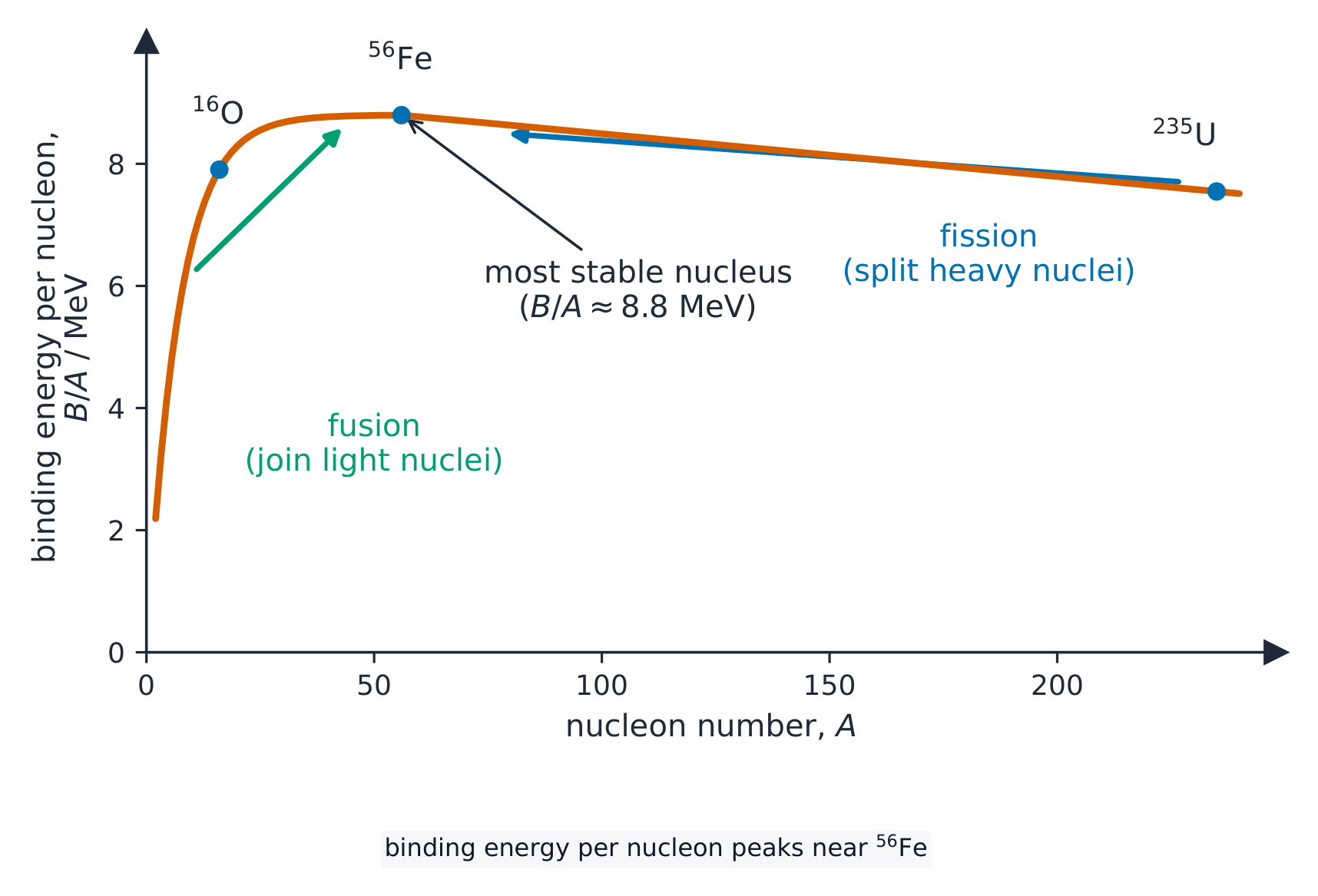 *אנרגיית הקשר לכל נוקלאון מגיעה לשיא בסביבת ברזל (