החשמל בקיר שלך אינו שקט. חמישים פעם בשנייה — לעיתים שישים — הוא משנה כיוון, זורם לכיוון אחד, ואז לכיוון השני. זהו…
English narration · English + 中文 subtitles burned in · קריאת קול באנגלית · תרגום אנגלי + סינית שרוף בתוך הסרטון
21.1
Alternating current basics · בסיסי זרח מתחלף
Syllabus · סיילבוס
English
understand and use the terms period, frequency and peak value as applied to an alternating current or voltage
use equations of the form $x = x_0 \sin \omega t$ representing a sinusoidally alternating current or voltage
recall and use the fact that the mean power in a resistive load is half the maximum power for a sinusoidal alternating current
distinguish between root-mean-square (r.m.s.) and peak values and recall and use $I_{\text{r.m.s.}} = I_0 / \sqrt{2}$ and $V_{\text{r.m.s.}} = V_0 / \sqrt{2}$ for a sinusoidal alternating current
עברית
הבנה ושימוש במונחים תקופה, תדר וערך שיא בהתייחס לזרם מתחלף או מתח
שימוש במשוואות מהצורה $x = x_0 \sin \omega t$ המייצגות זרם או מתח מתחלף סינוסואלי
זיכרון ושימוש בעובדה שההספק הממוצע בעומס התנגדותי הוא מחצית ההספק המקסימלי עבור זרם מתחלף סינוסואלי
הבחנה בין ערך יעיל רב-ריבועי (r.m.s.) לבין ערכי שיא, וזיכרון ושימוש ב$I_{\text{r.m.s.}} = I_0 / \sqrt{2}$ ו$V_{\text{r.m.s.}} = V_0 / \sqrt{2}$ עבור זרם מתחלף סינוסואלי
Source: Cambridge International syllabus · מקור: הסיילבוס הבינלאומי של קמבריד'ג'
English
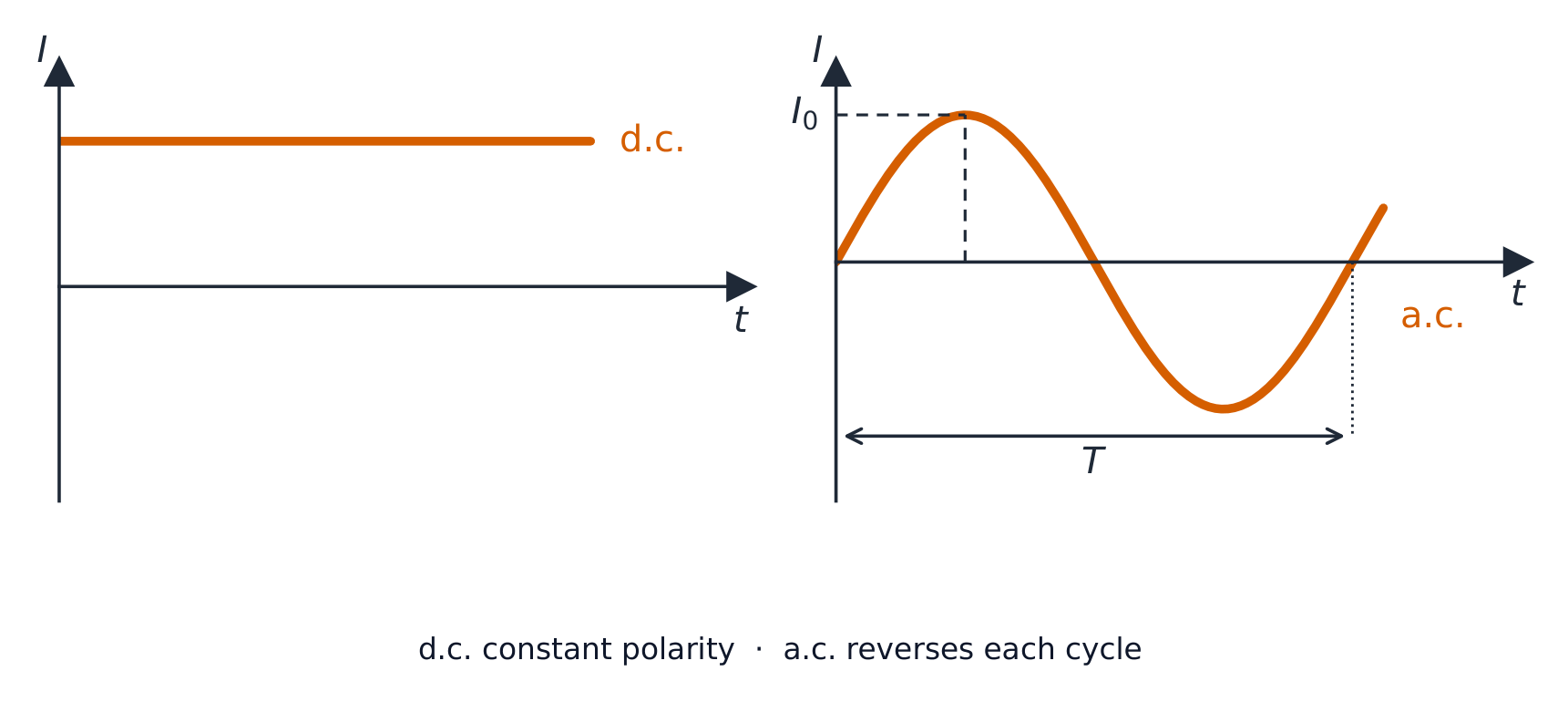
An alternating current 交流电 (a.c.) keeps reversing direction. Mains supply is sinusoidal a.c.: $I$ or $V$ follows a sine wave in time:
(For a purely resistive load the voltage 电压 and current 电流 are in phase, which is the case in this syllabus.)
Key terms
period 周期$T$ — the time for one full cycle. Unit: s.
frequency 频率$f$ — cycles per second; $f = 1/T$. Mains is often $50\ \text{Hz}$ or $60\ \text{Hz}$.
angular frequency 角频率$\omega = 2\pi f = 2\pi/T$.
peak value 峰值$I_{0}$ or $V_{0}$ — the largest value in a cycle (also called the amplitude).
peak-to-peak value 峰峰值$2 I_{0}$ — from $+I_{0}$ to $-I_{0}$. Useful when reading an oscilloscope.
The two-mark definitions.The frequency of an alternating current is the number of complete cycles per unit time (say "per second" or "per unit time", and "complete cycles" or "oscillations"). The period is the time for one complete cycle, and the peak value is the maximum value of the current or voltage during a cycle. Note that the mean value of a sinusoidal current over a cycle is zero, which is exactly why the r.m.s. value is needed to describe it.
Reading the equation. In $V = V_{0} \sin(\omega t)$ the number in front is the peak value and the number multiplying $t$ is $\omega = 2\pi f$; the angle $\omega t$ is in radians 弧度, so set the calculator to radians before evaluating. A supply written with $\cos$ instead of $\sin$ is the same wave starting at its peak rather than at zero.
Worked example. The output of a supply is $V = 320 \sin(100\pi t)$ (volts, seconds). Find the peak value, the frequency, the period and the r.m.s. value, and the first time after $t = 0$ at which $V = 160\ \text{V}$.
Peak $V_{0} = 320\ \text{V}$. $\omega = 100\pi\ \text{rad s}^{-1}$, so $f = \omega/2\pi = 50\ \text{Hz}$ and $T = 1/f = 0.020\ \text{s}$. $V_{\text{r.m.s.}} = 320/\sqrt{2} = 226\ \text{V}$. For $V = 160\ \text{V}$: $\sin(100\pi t) = 0.5$, so $100\pi t = \pi/6$ and $t = 1/600 = 1.7 \times 10^{-3}\ \text{s}$. (For $V = 18\cos(40\pi t)$ the same reading gives $V_{0} = 18\ \text{V}$, $f = 20\ \text{Hz}$, $T = 50\ \text{ms}$, and a sketch that starts at $+18\ \text{V}$.)
Reading a CRO trace
Same as for any wave (Topic 7), using a cathode-ray oscilloscope 示波器:
horizontal divisions × time-base 时基 → period $T$, so $f = 1/T$.
vertical divisions × $y$-gain → peak voltage $V_{0}$ (measure centre to peak, or peak-to-peak then halve).
עברית
שנאי תחנה מעלה או מוריד את המתח המשתנה.
זרח מתחלף (a.c.) הופך כיוון באופן רציף. אספקת החשמל הביתית היא זרח מתחלף סינוסואידי: $I$ או $V$ עוקבים אחרי גל סינוס בזמן:
(עומס נטו התנגדותי, ה-מתח והזרח הם בפאזה, שזה המקרה בסילבוס זה.)
זרח ישיר יציב בהשוואה לזרח משתנה סינוסואידי עם שיא $I_0$ ופרק $T$
מונחים מרכזיים
פרק$T$ — הזמן למחזור מלא אחד. יחידה: שניות.
תדר$f$ — מחזורים לשנייה; $f = 1/T$. אספקת החשמל הביתית היא לעיתים קרובות $50\ \text{Hz}$ או $60\ \text{Hz}$.
תדר זוויתי$\omega = 2\pi f = 2\pi/T$.
ערך שיא$I_{0}$ או $V_{0}$ — הערך הגדול ביותר במחזור (נקרא גם אמפליטודה).
ערך שיא-לשיא$2 I_{0}$ — מ$+I_{0}$ עד $-I_{0}$. שימושי בקריאת אוסקילוסקופ.
הגדרות דו-נקודות.התדר של זרח משתנה הוא מספר המחזורים המלאים ליחידת זמן (למשל "לשנייה" או "ליחידת זמן", ו"מחזורים מלאים" או "תנודות"). הפרק הוא הזמן למחזור מלא אחד, וערך השיא הוא הערך המרבי של הזרח או המתח במהלך מחזור. שים לב שהערך הממוצע של זרח סינוסואידי לאורך מחזור הוא אפס, ומכאן בדיוק הצורך בערך היעילות (r.m.s.) כדי לתאר אותו.
קריאת המשוואה. ב$V = V_{0} \sin(\omega t)$ המספר מול הוא ערך השיא והמספר שמכפיל את $t$ הוא $\omega = 2\pi f$; הזווית $\omega t$ היא ברדיאנים, ולכן יש להגדיר את המחשבון לרדיאנים לפני החישוב. אספקה הכתובה עם $\cos$ במקום $\sin$ היא אותה גל שמתחיל בשיאו ולא באפס.
דוגמה פתורה. הפלט של אספקה הוא $V = 320 \sin(100\pi t)$ (וולטים, שניות). מצא את ערך השיא, התדר, הפרק וערך היעילות, ואת הזמן הראשון לאחר $t = 0$ בו $V = 160\ \text{V}$.
כמו לכל גל (נושא 7), באמצעות אוסקילוסקופ קרן קתודית:
חלוקות אופקיות × בסיס זמן → פרק $T$, לכן $f = 1/T$.
חלוקות אנכיות × $y$-הגבר → מתח שיא $V_{0}$ (מדוד מאמצע לשיא, או שיא-לשיא ואז חלק בשניים).
Explore · חקור
Alternating current · זרם מתחלף
I = a sin(bt)
AC is a sine wave — amplitude is the peak, b sets the frequency. · ז.מ. הוא סינוס — האמפליטודה היא השיא, b קובעת את התדר.
21.1
Power delivered to a resistor · הספק המסופק למנגנון התנגדות
English
For a resistive load $R$, the instant power 功率 is $P(t) = I(t)^{2} R$. With $I = I_{0}\sin(\omega t)$:
$$P(t) = I_{0}^{2} R \sin^{2}(\omega t).$$
This is always positive, with peak $I_{0}^{2} R$ and minimum zero, oscillating at twice the frequency of $I$. The mean of $\sin^{2}(\omega t)$ over a cycle is $\tfrac{1}{2}$, so the average power is
$$\langle P \rangle = \tfrac{1}{2} I_{0}^{2} R = \tfrac{1}{2} P_{\text{peak}}.$$
Average a.c. power in a resistor is half the peak power.
"Show by calculation that the mean power is half the peak power." A supply of peak value $12\ \text{V}$ drives a $680\ \Omega$ resistor. Peak power: $P_{0} = V_{0}^{2}/R = 12^{2}/680 = 0.212\ \text{W}$, the instantaneous power at the moment the voltage is at its peak. Mean power: use the r.m.s. value, $V_{\text{r.m.s.}} = 12/\sqrt{2} = 8.49\ \text{V}$, so $\langle P \rangle = V_{\text{r.m.s.}}^{2}/R = 8.49^{2}/680 = 0.106\ \text{W}$, exactly half. The two calculations must be shown separately; writing "$\tfrac{1}{2}$ of $0.212$" scores nothing, because that is the thing being shown. The $\tfrac{1}{2}$ is $(1/\sqrt{2})^{2}$: squaring the r.m.s. factor.
עברית
עבור עומס התנגדותי $R$, ההספק הרגעی הוא $P(t) = I(t)^{2} R$. עם $I = I_{0}\sin(\omega t)$:
ההספק במנגנון התנגדות פולסי; הערך הממוצע הוא חצי מהערך המקסימלי
$$P(t) = I_{0}^{2} R \sin^{2}(\omega t).$$
זו תמיד ערך חיובי, עם מקסימום $I_{0}^{2} R$ ומינימום אפס, מתנדנד בתדר כפול מזה של $I$. הערך הממוצע של $\sin^{2}(\omega t)$ במחזור הוא $\tfrac{1}{2}$, ולכן ההספק הממוצע הוא
$$\langle P \rangle = \tfrac{1}{2} I_{0}^{2} R = \tfrac{1}{2} P_{\text{peak}}.$$
ההספק AC ממוצע במנגנון התנגדות הוא חצי מההספק המקסימלי.
"הראו בחישוב שההספק הממוצע הוא חצי מההספק המקסימלי." מקור מתח בערך מקסימלי $12\ \text{V}$ מזין נגד $680\ \Omega$. הספק מקסימלי: $P_{0} = V_{0}^{2}/R = 12^{2}/680 = 0.212\ \text{W}$, ההספק הרגעאי ברגע שבו המתח הוא במקסימום. הספק ממוצע: השתמשו בערך היעיל (r.m.s.) $V_{\text{r.m.s.}} = 12/\sqrt{2} = 8.49\ \text{V}$, כך $\langle P \rangle = V_{\text{r.m.s.}}^{2}/R = 8.49^{2}/680 = 0.106\ \text{W}$, בדיוק חצי. יש להציג את שני החישובים בנפרד; כתיבה "$\tfrac{1}{2}$ של $0.212$" אינה מעניקה נקודות, מכיוון שזהו הדבר שצריך להוכיח. ה-$\tfrac{1}{2}$ היא $(1/\sqrt{2})^{2}$: הריבוע של גורם הערך היעיל.
The r.m.s. current $I_{\text{r.m.s.}}$ is the steady direct current that would give the same average power in the same resistance 电阻$R$. From $\langle P \rangle = I_{\text{r.m.s.}}^{2} R = \tfrac{1}{2} I_{0}^{2} R$:
The $\sqrt{2}$ comes from the name root-mean-square 均方根: $I_{\text{r.m.s.}} = \sqrt{\langle I^{2} \rangle}$ and $\langle \sin^{2}\rangle = \tfrac{1}{2}$. (Only the sinusoidal case is needed.)
The two-mark definition.The r.m.s. value of an alternating current is the value of the direct (steady) current that would dissipate the same (mean) power in the same resistor. "By reference to the heating effect" means exactly this sentence: same resistor, same power (or same heating), direct current. A definition that only says "$I_{0}/\sqrt{2}$" scores nothing, because that formula is true only for a sine wave.
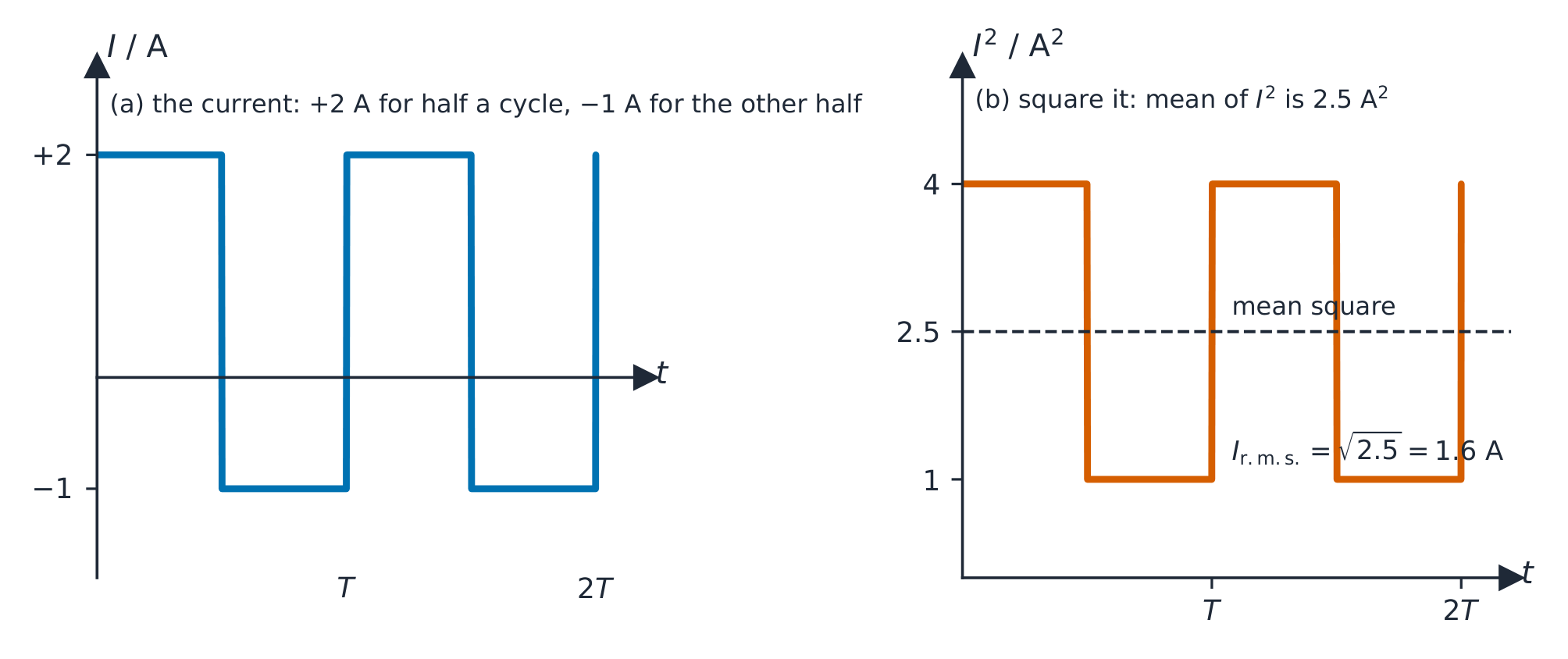
Worked example (non-sinusoidal). A current through a resistor is $+2.0\ \text{A}$ for the first half of each cycle and $-1.0\ \text{A}$ for the second half, a square wave 方波. Find its r.m.s. value and the mean power in a $10\ \Omega$ resistor.
Square the current: $4.0\ \text{A}^{2}$ for half the time and $1.0\ \text{A}^{2}$ for the other half, so the mean square is $(4.0 + 1.0)/2 = 2.5\ \text{A}^{2}$ and $I_{\text{r.m.s.}} = \sqrt{2.5} = 1.6\ \text{A}$. Mean power $= I_{\text{r.m.s.}}^{2} R = 2.5 \times 10 = 25\ \text{W}$. The sign of the current does not matter to the heating (it is squared away), and $I_{0}/\sqrt{2}$ would have given the wrong answer, $1.4\ \text{A}$: that shortcut is for sine waves only.
Why r.m.s. matters
Quoted a.c. values are r.m.s. values. "$230\ \text{V}$ mains" means $V_{\text{r.m.s.}} = 230\ \text{V}$, with peak $V_{0} = 230\sqrt{2} \approx 325\ \text{V}$. Components must be rated for the peak, not the r.m.s. Average power then takes the d.c. form:
$$\langle P \rangle = I_{\text{r.m.s.}}^{2} R = V_{\text{r.m.s.}}^{2} / R = V_{\text{r.m.s.}} I_{\text{r.m.s.}}.$$
Worked example. A heater of resistance $50\ \Omega$ is connected to the $230\ \text{V}$ r.m.s. mains. Find the r.m.s. current and the average power dissipated.
Worked example. A sinusoidal supply of r.m.s. value $4.2\ \text{V}$ and frequency $50\ \text{kHz}$ is connected across a $150\ \Omega$ resistor. Find the peak current, the mean power, and write down an equation for the current.
$V_{0} = 4.2\sqrt{2} = 5.9\ \text{V}$, so $I_{0} = V_{0}/R = 5.9/150 = 0.040\ \text{A}$ (or $I_{\text{r.m.s.}} = 4.2/150 = 0.028\ \text{A}$ and then $\times\sqrt{2}$). Mean power $= V_{\text{r.m.s.}}^{2}/R = 4.2^{2}/150 = 0.12\ \text{W}$. With $\omega = 2\pi f = 2\pi \times 5.0 \times 10^{4} = 3.1 \times 10^{5}\ \text{rad s}^{-1}$: $I = 0.040 \sin(3.1 \times 10^{5} t)$ (amps, seconds). Keep the two families apart: peak values go into the equation and into component ratings; r.m.s. values go into power.
עברית
הזרם היעיל $I_{\text{r.m.s.}}$ הוא הזרם הישר הקבוע שייתן אותו הספק ממוצע באותה התנגדות$R$. מ-$\langle P \rangle = I_{\text{r.m.s.}}^{2} R = \tfrac{1}{2} I_{0}^{2} R$:
הגדרה לשתי נקודות.הערך היעיל של זרם מתחלף הוא ערך הזרם הישר (הקבוע) שיפזר אותו (ממוצע) הספק באותו נגד. "בהתייחס לאפקט החימום" פירושו בדיוק המשפט הזה: אותה התנגדות, אותו הספק (או אותה חום), זרם ישר. הגדרה שאומרת רק "$I_{0}/\sqrt{2}$" אינה מעניקה נקודות, מכיוון שנוסחה זו נכונה רק לגל סינוסואלי.
שורש-ממוצע-ריבוע, לפי משמעות המילה: רבעו את הזרם, קבלו את הממוצע של הריבועים במחזור, לקחו את השורש. עבור זרם שאינו סינוסואלי זהו הדרך היחידה; $I_0/\sqrt{2}$ חל רק על גל סינוסואלי
דוגמה מפורטת (לא סינוסואלית). זרם העובר דרך נגד הוא $+2.0\ \text{A}$ בחצי הראשון של כל מחזור ו-$-1.0\ \text{A}$ בחצי השני, גל ריבועי. מצאו את הערך היעיל שלו וההספק הממוצע בנגד $10\ \Omega$.
העלה בריבוע את הזרם הנוכחי: $4.0\ \text{A}^{2}$ למחצית הזמן ו$1.0\ \text{A}^{2}$ למחצית האחרת, כך שהממוצע של הריבוע הוא $(4.0 + 1.0)/2 = 2.5\ \text{A}^{2}$ ו$I_{\text{r.m.s.}} = \sqrt{2.5} = 1.6\ \text{A}$. הספק ממוצע $= I_{\text{r.m.s.}}^{2} R = 2.5 \times 10 = 25\ \text{W}$. סימן הזרם אינו רלוונטי לחימום (הוא מוסיף לריבוע), ו$I_{0}/\sqrt{2}$ היה נותן תשובה שגויה, $1.4\ \text{A}$: קיצור דרך זה מתאים רק לגלי סינוס.
מדוע ערך יעיל (r.m.s.) חשוב
ערכי AC המצוינים הם ערכים יעילים. "$230\ \text{V}$ חשמל ביתי" פירושו $V_{\text{r.m.s.}} = 230\ \text{V}$, עם שיא $V_{0} = 230\sqrt{2} \approx 325\ \text{V}$. רכיבים חייבים להיות מסומנים לערך השיא ולא לערך היעיל. הספק ממוצע אז מקבל את צורת ה-DC:
$$\langle P \rangle = I_{\text{r.m.s.}}^{2} R = V_{\text{r.m.s.}}^{2} / R = V_{\text{r.m.s.}} I_{\text{r.m.s.}}."$$
דוגמה מופתרת. גוף חימום בעל התנגדות $50\ \Omega$ מחובר ל$230\ \text{V}$ חשמל ביתי יעיל. מצא את הזרם היעיל ואת הספק הממוצע המפורק.
דוגמה מופתרת. ספק סינוסי בערך יעיל $4.2\ \text{V}$ ובתדר $50\ \text{kHz}$ מחובר לצדדים של נגד $150\ \Omega$. מצא את זרם השיא, את הספק הממוצע, והצג משוואה עבור הזרם.
$V_{0} = 4.2\sqrt{2} = 5.9\ \text{V}$, ולכן $I_{0} = V_{0}/R = 5.9/150 = 0.040\ \text{A}$ (או $I_{\text{r.m.s.}} = 4.2/150 = 0.028\ \text{A}$ ואז $\times\sqrt{2}$). הספק ממוצע $= V_{\text{r.m.s.}}^{2}/R = 4.2^{2}/150 = 0.12\ \text{W}$. עם $\omega = 2\pi f = 2\pi \times 5.0 \times 10^{4} = 3.1 \times 10^{5}\ \text{rad s}^{-1}$: $I = 0.040 \sin(3.1 \times 10^{5} t)$ (אמפרים, שניות). שמור על הפרדה בין שני המשפחות: ערכי השיא נכנסים למשוואה ולסיומי הרכיבים; ערכים יעילים נכנסים לחישוב הספק.
distinguish graphically between half-wave and full-wave rectification
explain the use of a single diode for the half-wave rectification of an alternating current
explain the use of four diodes (bridge rectifier) for the full-wave rectification of an alternating current
analyse the effect of a single capacitor in smoothing, including the effect of the values of capacitance and the load resistance
עברית
הבחנה גרפית בין תיקון למחצית גל לבין תיקון לגל מלא
הסבר השימוש בדיודה אחת לתיקון למחצית גל של זרם מתחלף
הסבר השימוש בארבע דיודות (גשר תיקון) לתיקון לגל מלא של זרם מתחלף
ניתוח השפעת קבל אחד בחלקה, כולל השפעת ערכי הקיבול וההתנגדות העומס
Source: Cambridge International syllabus · מקור: הסיילבוס הבינלאומי של קמבריד'ג'
English
Rectification 整流 turns an alternating voltage into a one-direction (d.c.-like) voltage, using diodes 二极管 (which conduct in only one direction).
"State what is meant by rectification."The conversion of an alternating current (or voltage) into a direct current (or voltage): one that flows in one direction only, however much it varies. A diode conducts only when it is forward-biased 正向偏置, that is, when its anode (the flat end of the symbol's triangle) is more positive than its cathode (the bar); otherwise it is reverse-biased and behaves like an open switch. Treat it as ideal: zero resistance one way, infinite the other.
Half-wave rectification
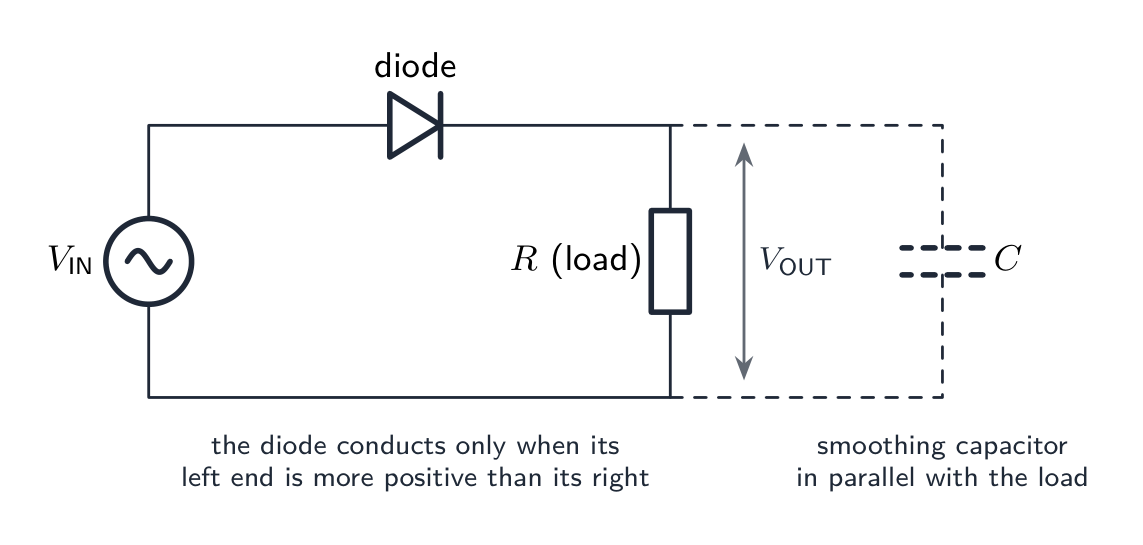
A single diode in series with the load passes only the positive half of each cycle; in the negative half the diode is reverse-biased 反向偏置 and no current flows. This is half-wave rectification 半波整流.
Output: positive half-waves with flat zero gaps. The mean output is $V_{0}/\pi \approx 0.32 V_{0}$. Drawback: half the input is wasted and the output is very uneven.
Completing the circuit. "Complete the diagram to produce half-wave rectification" needs one diode in series between the supply and the load, with the triangle pointing the way the output current must flow, and $V_{\text{OUT}}$ taken across the load. If a capacitor is to smooth the output it goes across the load (in parallel); a capacitor in series would block the d.c. altogether.
Full-wave rectification (bridge rectifier)
A bridge rectifier 桥式整流器 uses four diodes arranged so the current through the load always flows the same way, whichever a.c. terminal is positive — full-wave rectification 全波整流. On each half-cycle a different pair of diodes conducts, but the load always sees the same direction.
Explaining the bridge (the standard four-marker). When terminal P is positive, current leaves P, passes through the diode pointing away from P to the top of the load, flows down through the load and returns to Q through the diode pointing towards Q; the other two diodes are reverse-biased and carry nothing. When Q is positive the other pair conducts, but they are arranged so that the current still enters the load at the top: the load current is in the same direction in both half-cycles. Name the diodes in each half-cycle and say which end of the load is positive.
Completing a bridge. Given a bridge with diodes missing, remember the rule for every diode: conventional current flows through it in the direction of the triangle. Both diodes joined to the positive output terminal must point towards it; both joined to the negative output terminal must point away from it. A bridge with a diode the wrong way round either short-circuits the supply on one half-cycle or passes nothing.
Output: a continuous run of positive half-waves (no gaps), at twice the input frequency. The mean output is $2V_{0}/\pi \approx 0.64 V_{0}$ — double the half-wave value. It uses all the input and is smoother and easier to filter.
Drawing the diagrams
half-wave: a.c. source — single diode — load $R$, in series.
full-wave bridge: four diodes as the arms of a "diamond"; the a.c. input goes to one pair of opposite corners, the load $R$ across the other pair. The diode directions make the load terminals keep the same polarity for either input polarity.
"State the difference between half-wave and full-wave rectification." In half-wave rectification only one half of each input cycle appears at the output and the other half is blocked (the output is zero for half the time); in full-wave rectification both halves appear, one of them inverted, so there are no gaps and the output has twice the input frequency. A sketch should show, for half-wave, positive humps separated by flat zero sections of equal length; for full-wave, positive humps joined at the zero line.
עברית
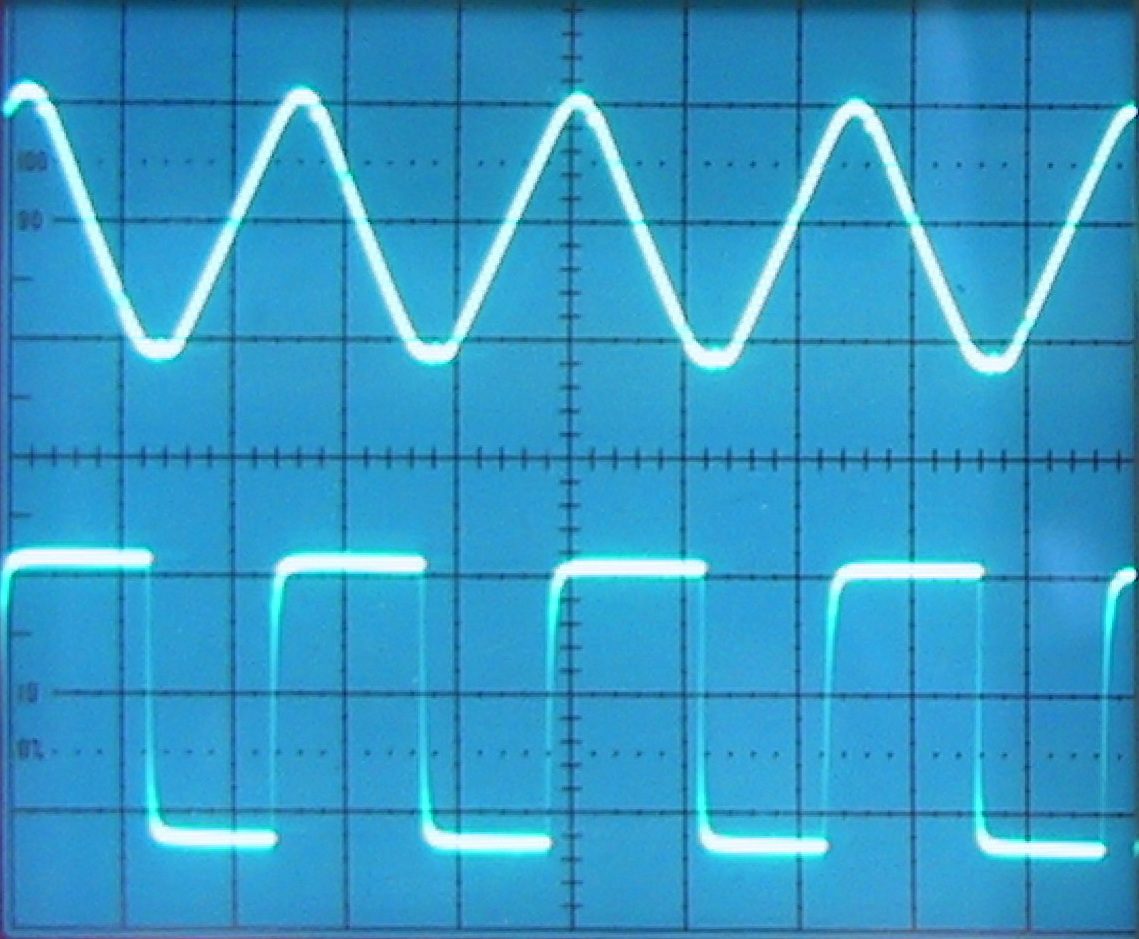
אוסקילוסקופ מראה כיצד מתח משתנה לאורך זמן.
הישרה ממירה מתח AC למתח חד-כיווני (דומה ל-DC), באמצעות דיודות (שעובר בהן זרם רק בכיוון אחד).
"הגדר מהי הישרה." המרה של זרם (או מתח) AC לזרם (או מתח) DC: זרם שעובר בכיוון אחד בלבד, ללא תלות בגודל השינויים שלו. דיודה מוליכה רק כאשר היא מותבת קדימה, כלומר כאשר האנודה (הקצה השטוח של משולש הסמל) חיובית יותר מהקתודה (הקו); אחרת היא מותבת אחורה ומתנהגת כמו מתג פתוח. התעלם מהתנגדות בפועל והתעלם כפייה אידיאלית: אפס התנגדות בכיוון אחד ואינסוף בכיוון השני.
הישרה בחצי גל
דיודה בודדת בסדרה עם העומס מעבירה רק את החצי החיובי של כל מחזור; בחצי השלילי הדיודה מותבת אחורה ואין זרם. זה נקרא הישרה בחצי גל.
פלט: חצאי גלים חיוביים עם רווחים שטוחים באפס. הפלט הממוצע הוא $V_{0}/\pi \approx 0.32 V_{0}$. חיסרון: מחצית מהכניסה מבוזבזת והפלט מאוד לא אחיד.
בהישרה בחצי גל דיודה בודדת מעבירה רק מחציות גל חיוביותמעגל ההישרה בחצי גל שמבחן מבקש לצייר: מקור, דיודה, עומס בסדרה, פלט על העומס; קבל התיכנות, אם רוצים, נמצא במקביל לעומס, לעולם לא בסדרה
השלמת המעגל. "השלם את הדיאגרמה כדי להפיק הישרה בחצי גל" דורשת דיודה אחת בסדרה בין המקור לעומס, עם המשולש מצביע לכיוון שבו זרם הפלט חייב לזרום, ו$V_{\text{OUT}}$ נלקח על העומס. אם קבל אמור להתיינות את הפלט, הוא נמצאעל העומס (במקביל); קבל בסדרה חוסם את ה-DC לחלוטין.
יישור גל מלא (מיישר גשר)
מיישר גשר משתמש ב-ארבע דיודות המסודרות כך שהזרם דרך העומס תמיד זורם באותה כיוון, ללא קשר לאיזה מוצא חשמלי AC הוא חיובי — יישור גל מלא. בכל מחצית של מחזור מתח שונה זוג דיודות מסוננות, אך העומס תמיד רואה את אותה כיוון.
גשר ארבע הדיודות שולח את זרם העומס באותה כיוון ללא קשר לאיזה מוצא AC הוא חיובי
הסבר לגבי הגשר (הסימן הסטנדרטי של ארבע נקודות). כאשר P חיובי, הזרם יוצא מ-P, עובר דרך הדיודה המופנית הרחוקה מ-P אל העליון של העומס, זורם למטה דרך העומס וחוזר ל-Q דרך הדיודה המופנת לכיוון Q; שתי הדיודות האחרות הן בעלות טעינה הפוכה ואינן מעבירות זרם. כאשר Q חיובי, הזוג השני מסונן, אך הן מסודרות כך שהזרם עדיין נכנס לעומס מהעליון: זרם העומס הוא באותו כיוון בשתי המחציות. ספק שמן הדיודות בכל מחצית ואיפה החיובי של העומס נמצא.
השלמת גשר. נתון גשר עם דיודות חסרות, זכור את הכלל לכל דיודה: זרם מקובל זורם דרכה בכיוון המשולש. שתי הדיודות המחוברות למוצא חיובי חייבות להיות מופנות אליו; שתי הדיודות המחוברות למוצא שלילי חייבות להיות מופנות רחוק ממנו. גשר עם דיודה הפוכה גורם לשימוש בקצר במקור במחצית אחת או שאינם מעבירים כלל זרם.
הנפץ: רצף רציף של מחציות גל חיוביות (ללא רווחים), בתדר כפול לתדר הקלט. המתח הממוצע הוא $2V_{0}/\pi \approx 0.64 V_{0}$ — כפול מערך מחצית הגל. הוא משתמש בכל הקלט ומחלק יותר וקל יותר לסננו.
ביישור גל מלא כל מחצית מחזור משמשת, ונוצר רצף רציף של כיסים חיוביים
ציור התרשימים
יישור מחצית גל: מקור AC — דיודה בודדת — עומס $R$, בסדרה.
גשר יישור גל מלא: ארבע דיודות כזרועות של "יהלום"; הקלט AC נכנס לצמד קודקודים מוליים, העומס $R$ ממוקם בין הצמד השני. כיווני הדיודות מבטיחים שהמוצאים של העומס ישמרו על אותה פולריזציה לכל פולריזציה של הקלט.
"פרט את ההבדל בין יישור מחצית גל ליישור גל מלא." ביישור מחצית גל רק מחצית אחת של כל מחזור הקלט מופיעה בהנפץ והמחצית השנייה חסומה (ההנפץ הוא אפס למחצית הזמן); ביישור גל מלא שתי המחציות מופיעות, אחת מהן הפוכה, ולכן אין רווחים וההנפץ הוא בתדר כפול לתדר הקלט. סקיצה צריכה להראות, עבור יישור מחצית גל, כיסים חיוביים מופרדים על ידי אזורים שטוחים של אפס באורך זהה; עבור יישור גל מלא, כיסים חיוביים מחוברים בקו האפס.
Explore · חקור
Rectifier and smoothing route · ממיר וחישוק
Watch alternating input become a smoother direct output. · צפה בזרם מתחלף הופך ליציאת DC חלקה יותר.
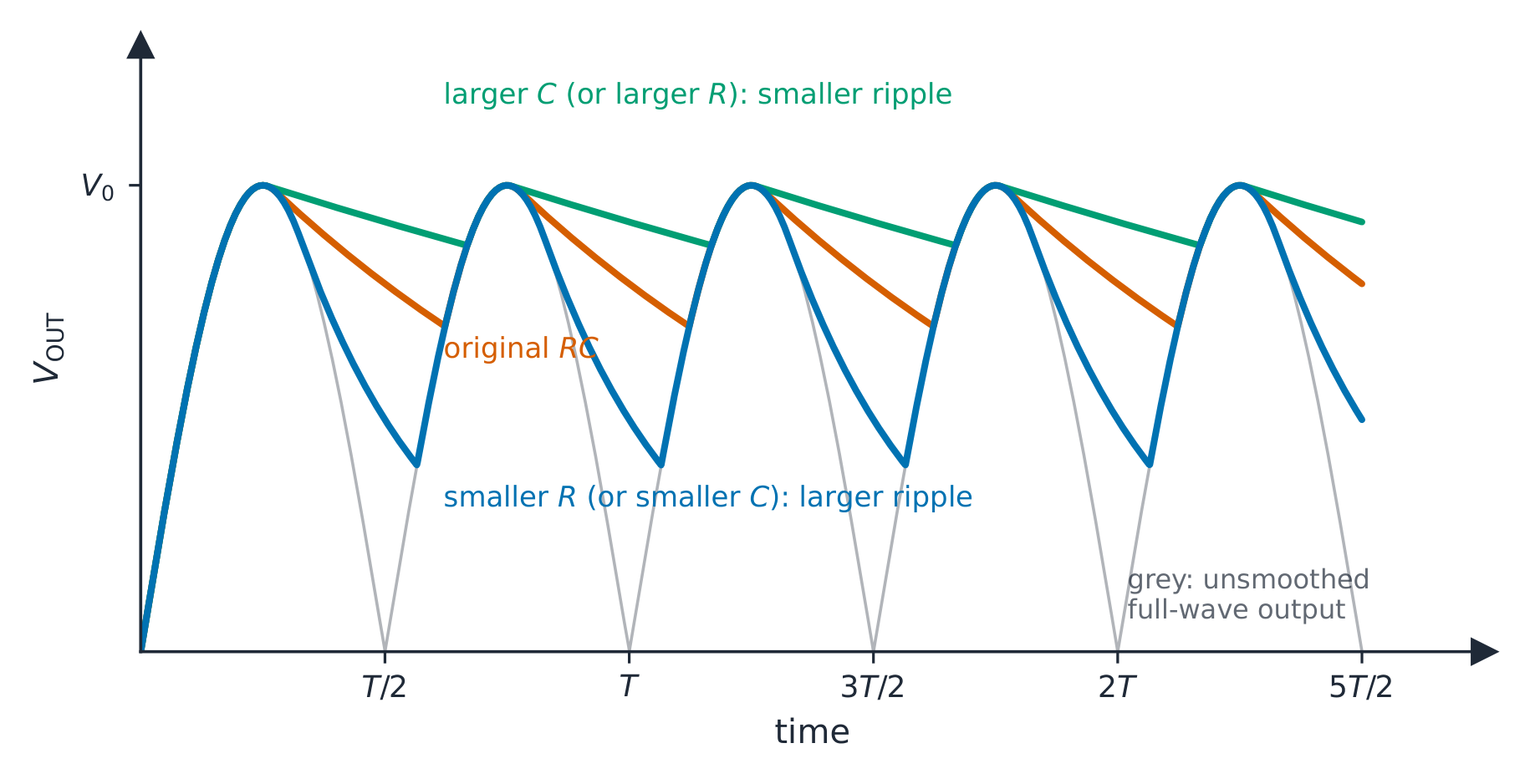
A rectifier's output is still bumpy. To smooth it, put a capacitor 电容器$C$in parallel with the load$R$.
How it works
on the rising part of each pulse, the capacitor charges up to near the peak.
on the falling part (and any gap), the diodes are reverse-biased, so the capacitor discharges through the load, keeping current flowing. The voltage falls with time constant 时间常数$RC$ (Topic 19).
at the next peak, the capacitor charges again, and the cycle repeats.
The output now sits near the peak with small dips. The size of the dips is the ripple 纹波 (this whole step is called smoothing 平滑).
Worked example. A half-wave rectifier fed from a $50\ \text{Hz}$ supply has a $470\ \mu\text{F}$ capacitor across its $1.2\ \text{k}\Omega$load 负载. Estimate the fractional fall in the output between peaks, and say how it changes with a bridge rectifier.
The peaks are $T = 1/50 = 20\ \text{ms}$ apart (half-wave: one peak per cycle). The time constant is $RC = (1.2 \times 10^{3})(470 \times 10^{-6}) = 0.56\ \text{s}$. Between peaks the capacitor discharges to $V_{0} e^{-t/RC} = V_{0} e^{-0.020/0.56} = 0.965\,V_{0}$, a fall of about $3.5\%$. With full-wave rectification the peaks are $10\ \text{ms}$ apart, so the fall is only $1.8\%$; doubling the capacitance would halve it again. Because $t \ll RC$ the fall is approximately $V_{0}\, t/(RC)$: the ripple is proportional to the time between peaks and inversely proportional to both $R$ and $C$. (A network of capacitors across the output combines by the rules of Topic 19 before it is used here.)
What reduces the ripple
larger $C$ → more stored charge → smaller dip between peaks → smaller ripple.
higher rectified frequency (full-wave is twice the input) → less time to discharge between peaks → smaller ripple.
In short, a large $RC$ compared with the time between peaks gives a smoother output.
Sketching the smoothed output. Draw the unsmoothed humps faintly first. The smoothed curve touches each peak, then falls along a gentle curve (steepest just after the peak) until the next hump rises to meet it, where it turns sharply upwards and follows the hump to the peak. It never falls to zero, and it never rises above the peak. For half-wave rectification the decay has to last through the missing half-cycle as well, so the ripple is about twice that of full-wave for the same $RC$. If the question changes $C$ or $R$, redraw on the same axes: a larger $RC$ hugs the peak line more closely; a smaller $RC$ sags further.
Purpose in summary
The smoothing capacitor reduces the ripple, giving a steadier d.c. voltage suitable for sensitive electronics.
עברית
ההנפץ של המיישר עדיין אינו חלק. כדי לחלק אותו, יש להניח קבל$C$במקביל לעומס$R$.
איך זה עובד
בחלק העולה של כל פעמה, הקבל נטען עד לקרוב לשיא.
בחלק היורד (ובכל רווח), הדיודות נמצאות בטעינה הפוכה, ולכן הקבל מפרק דרך העומס, שומר על זרימת הזרם. המתח יורד עם קבוע זמן$RC$ (נושא 19).
בשיא הבא, הקבל נטען שוב, והמחזור חוזר על עצמו.
ההנפץ עכשיו יושב קרוב לשיא עם ירידות קטנות. גודל הירידות הוא הגלים (שלב זה כולו מכונה חלקיקה).
קבל בשילוב מקביל לעומס מחלק את פלט ההישרות, ומשאיר רק גלגול קטןאותו אספקת חשמל מיושרת ומחולקת בעזרת קבועי זמן שונים: קיבול גדול יותר ($RC$) (קיבול גדול יותר, או התנגדות עומס גדולה יותר) דוהה פחות בין שיאים, ולכן הגלגול קטן יותר
דוגמה מודגמת. מעגל יישור למחצית גל המוזין מאספקת $50\ \text{Hz}$, כולל קבל $470\ \mu\text{F}$ על פני המנגנון העומס $1.2\ \text{k}\Omega$ שלו. העריך את הירידה השברית בפלט בין שיאים, וצין כיצד זה משתנה במעגל יישור גשר.
הפסגות נפרדות ב$T = 1/50 = 20\ \text{ms}$ (חצי-גל: פסגה אחת כל מחזור). קבוע הזמן הוא ⟨$RC = (1.2 \times 10^{3})(470 \times 10^{-6}) = 0.56\ \text{s}$⟩. בין הפסגות הקבל מפרק ל$V_{0} e^{-t/RC} = V_{0} e^{-0.020/0.56} = 0.965\,V_{0}$⟩, ירידה של כ-$3.5\%$⟩. עם ממיר גל מלא, הפסגות נפרדות ב$10\ \text{ms}$⟩, ולכן הירידה היא רק ⟨$1.8\%$⟩; הכפלת הקיבולת תחלק בה שוב. מכיוון ש$t \ll RC$⟩ הירידה היא בקירוב ⟨$V_{0}\, t/(RC)$⟩: הגלים פרופורציונליים לזמן בין הפסגות ופרופורציונליים הפוך לכל מהש-$R$⟩ וה-$C$⟩. (רשת של קבלים באופן מקביל ליציאה מתמזגת לפי חוקי נושא ⟨19⟩ לפני השימוש בכך כאן.)
מה מפחית את הגלגול
$C$ גדול יותר → מטען מאוסף יותר → ירידה קטנה יותר בין השיאים → גלגול קטן יותר.
$R$ גדול יותר → זרם עומס קטן יותר → פריקה איטית יותר → גלגול קטן יותר.
תדר הישרות מוגבה (הישרה מלאה היא פי שניים מהתדר הנכנס) → פחות זמן לפריקה בין השיאים → גלגול קטן יותר.
בקיצור, $RC$ גדול ביחס למרווח בין השיאים נותן פלט חלק יותר.
ציור הפלט המחולק. צייר תחילה את הגלים הלא מחולקים בחולשה. העקומה המחולקת נגעת בכל שיא, ואז יורדת לאורך עקומה רכה (הכי תלולה מיד אחרי השיא) עד שהגל הבא עולה ומגיע אליה, שם היא מסתובבת כלפי מעלה בעקבייה ונוסעת לאורך הגל לשיא. היא לעולם לא יורדת לאפס, ולעולם לא עולה מעל השיא. עבור הישרת חצי-גל, הדעיכה צריכה להימשך גם דרך מחצית הגל החסרה, ולכן הגלגול הוא כפי השניים מההישרה המלאה עבור אותו $RC$. אם השאלה משנה את ה-$C$ או את ה-$R$, צייר מחדש על אותם צירים: $RC$ גדול יותר נדבק יותר לקו השיאים; $RC$ קטן יותר שקוע יותר.
סיכום המטרה
הקבלת החלקה מצמצמת את הגלגול, ומספקת מתח DC יציב המתאים לאלקטרוניקה רגישה.
Definitions the examiner accepts · הגדרות מקובלות בקורס
English
A definition question is marked against fixed wording. Learn these exactly, and give one answer only.
Term
Definition
alternating current
a current that reverses its direction periodically (varies sinusoidally with time about zero)
period
the time for one complete cycle
frequency
the number of complete cycles per unit time
peak value
the maximum value of the current or voltage in a cycle
r.m.s. value
the value of the direct (steady) current that would dissipate the same power in the same resistor
rectification
the conversion of an alternating current into a direct (one-direction) current
half-wave rectification
only one half of each cycle is passed to the output; the other half is blocked
full-wave rectification
both halves of each cycle appear at the output in the same direction
smoothing
using a capacitor across the load to reduce the variation (ripple) of a rectified output
עברית
שאלת הגדרה מוקדמת לפי טקסט קבוע. לימודן במדויק, ותן תשובה אחת בלבד.
מונח
הגדרה
זרח סה"מ
זרם המשנה כיוונו באופן תקופתי (משתנה סינוסואידלית בזמן סביב אפס)
מחזור
הזמן לקיום מחזור מלא אחד
תדר
מספר המחזורים המלאים ליחידת זמן
ערך שיא
הערך המקסימלי של הזרם או המתח במחזור
ערך אפקטיבי (r.m.s.)
הערך של הזרם הישר (היציב) שיפזר את אותה הספק באותו התנגדות
הישרות
המרת זרח סה"מ לזרם ישיר (חד-כיווני)
ישרון חצי-גל
רק מחצית אחת מכל מחזור עוברת ליציאה; המחצית השנייה נחסמת
ישרון גל מלא
שתי מחציות כל מחזור מופיעות ביציאה באותה כיוון
חלקה
שימוש בקבל על פני העומס להפחתת התנודות (הריבול) של יציאת הממיר
21.2
Exam tips · טיפים לבחינות
English
$V = V_{0} \sin\omega t$ with $\omega = 2\pi f$ in radians per second: read $V_{0}$ and $\omega$ straight off the equation; radian mode for any time calculation.
$I_{\text{r.m.s.}} = I_{0}/\sqrt{2}$ and $V_{\text{r.m.s.}} = V_{0}/\sqrt{2}$ for a sine wave only; otherwise square, average, root. Quoted mains values are r.m.s.; components are rated for the peak.
Mean power in a resistor is $I_{\text{r.m.s.}}^{2}R = V_{\text{r.m.s.}}^{2}/R = \tfrac{1}{2} I_{0}^{2} R$, half the peak power; the mean current is zero, the mean power is not.
One diode in series gives half-wave rectification; a four-diode bridge gives full-wave, with the load current always in the same direction and the output at twice the input frequency.
Smoothing: capacitor across the load; ripple falls with a larger $C$, a larger $R$ (smaller load current) and a higher rectified frequency, because the decay between peaks is $V_{0}e^{-t/RC}$.
Sketches are marked on shape: humps that touch the peak line, a decay that never reaches zero, flat zero gaps for half-wave, none for full-wave.
Common mistakes
Using the peak value in a power calculation, or the r.m.s. value as the amplitude in $V = V_{0}\sin\omega t$.
Writing $\omega = f$ or $\omega = 2\pi/f$; it is $2\pi f = 2\pi/T$.
Defining the r.m.s. value as "the peak divided by $\sqrt{2}$", or leaving out "same power" and "same resistor".
Applying $I_{0}/\sqrt{2}$ to a square or triangular wave.
Drawing a diode backwards, or a bridge in which two diodes joined to the same output terminal point opposite ways.
Putting the smoothing capacitor in series with the load.
A smoothed output sketched falling to zero between peaks, or rising above the peak.
Saying a larger load resistance gives a larger ripple; a larger $R$ means a smaller current, a slower discharge and a smaller ripple.
Stating that full-wave rectification gives a steady d.c.; without a capacitor it is a series of humps with a large ripple.
עברית
$V = V_{0} \sin\omega t$ עם $\omega = 2\pi f$ ברדיאנים לשנייה: לקרוא $V_{0}$ ו$\omega$ ישירות מהמשוואה; מצב רדיאנים לכל חישוב זמן.
$I_{\text{r.m.s.}} = I_{0}/\sqrt{2}$ ו$V_{\text{r.m.s.}} = V_{0}/\sqrt{2}$ עבור גל סינואי בלבד; אחרת ריבוע, ממוצע, שורש. ערכי הרשת המצוינים הם r.m.s.; רכיבים מסומנים לפי הערך המקסימלי.
הספק ממוצע במנגנון הוא $I_{\text{r.m.s.}}^{2}R = V_{\text{r.m.s.}}^{2}/R = \tfrac{1}{2} I_{0}^{2} R$, מחצית ההספק המקסימלי; הזרם הממוצע הוא אפס, אך ההספק הממוצע אינו אפס.
דיודה אחת בסדרתית תניב ישרון חצי-גל; גשר ארבע דיודות יניב ישרון גל מלא, כאשר זרם העומס תמיד בכיוון אחד והיציאה בתדירות הכפולה מתדירות הכניסה.
חלקה: קבל על פני העומס; הריבול יורד עם $C$ גדול יותר, $R$ גדול יותר (זרם עומס קטן יותר) ותדירות ממירה גבוהה יותר, מכיוון שהירידה בין השיאים היא $V_{0}e^{-t/RC}$.
סקיצות מסומנות בצורה: גבוקים שמגיעים לקו השיא, ירידה לעולם לא לאלפס, רווחים שטוחים באלפס לחצי-גל, אין לגל מלא.
טעויות נפוצות
שימוש בערך המקסימלי בחישוב הספק, או בערך ה-r.m.s. כמשרעת ב$V = V_{0}\sin\omega t$.
כתיבת $\omega = f$ או $\omega = 2\pi/f$; זהו $2\pi f = 2\pi/T$.
הגדרת הערך ה-r.m.s. כ"השיא חלקי $\sqrt{2}$", או השמדת "אותו הספק" ו"אותו מנגנון".
יישום $I_{0}/\sqrt{2}$ על גל ריבועי או משולש.
ציור דיודה הפוכה, או גשר שבו שתי דיודות מחוברות לאותו מקום יציאה מכוונות לכיוונים הפוכים.
הנחת קבל החלקה בסדרתית עם העומס.
ציור יציאה מחולקת שנפילה לאלפס בין השיאים, או עולה מעל השיא.
טענה שנגד עומס גדול יותר נובע ריבול גדול יותר; $R$ גדול יותר פירושו זרם קטן יותר, פריקה איטית יותר וריבול קטן יותר.
טענה שיישרון גל מלא מספק זרם דירק (d.c.) יציב; ללא קבל מדובר בסדרת גבוקים עם ריבול גדול.
Interactive lessons on this topic · שיעורים אינטראקטיביים בנושא זה
Work through it step by step, with instant-check exercises. · לעבור על הדברים צעד אחר צעד, עם תרגילים לבדיקה מיידית.
Pick one and the site follows you — notes, papers, videos and practice all open on it. · בחרו נושא אחד והאתר יעקוב אחריו — הערות, מסמכים, וידאו ותרגולים פתוחים בו.
Type to search notes, lessons, code, vocabulary and past-paper questions across every subject. · הקלד כדי לחפש הערות, שיעורים, קוד, אוצר מילים ושאלות מבחנים בכל הנושאים.