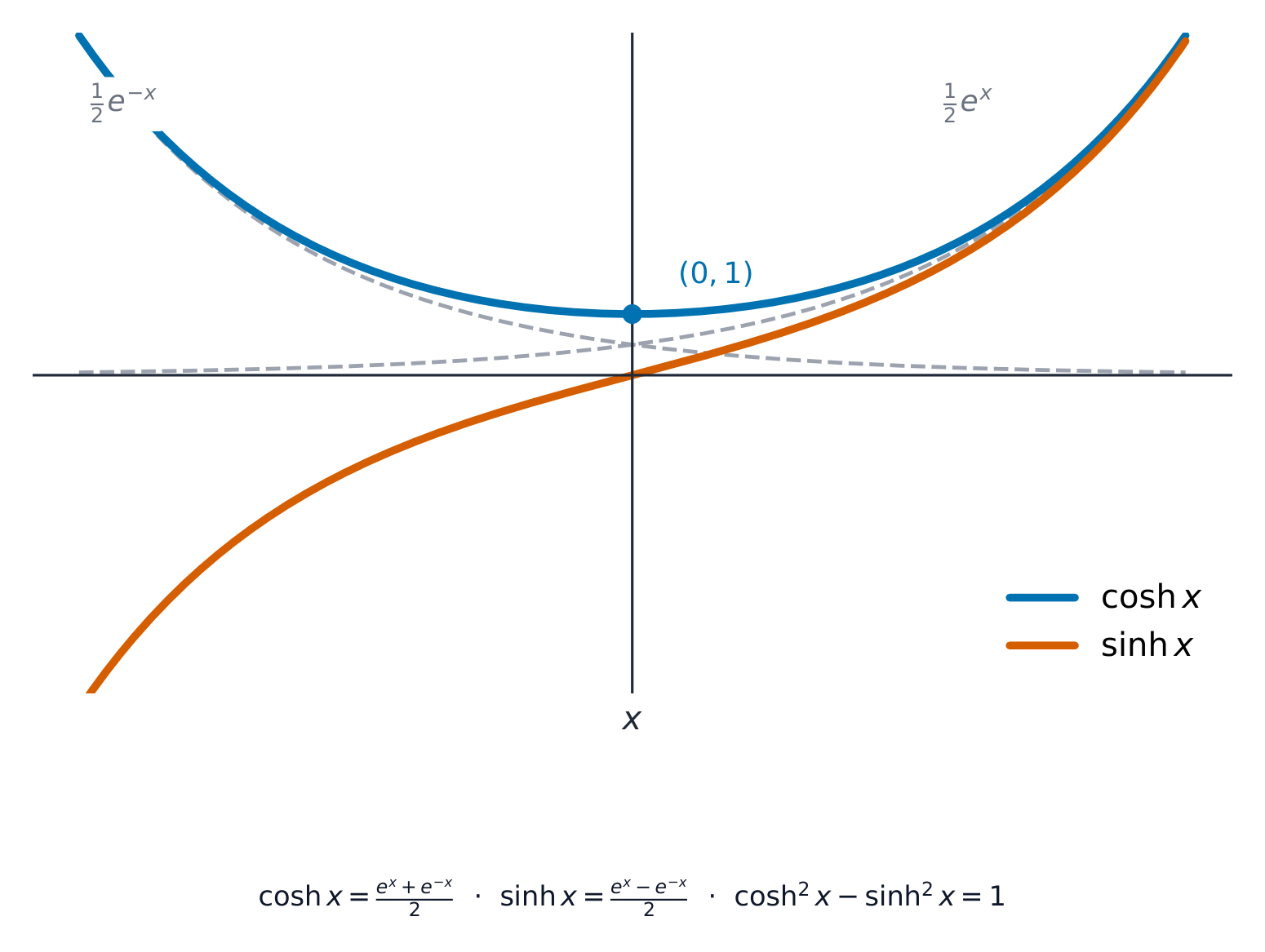
הסתכלו על כל שרשרת תלויה, כל כבל חשמל או כל כבל תלייה. הם מתרגעים תמיד לעקומה ייחודית אחת. אולי תנחשו פרבולה — אבל זו לא. זו…
English narration · English + 中文 subtitles burned in · קריאת קול באנגלית · תרגום אנגלי + סינית שרוף בתוך הסרטון
English
This handout covers Topic 2: Further Pure Mathematics 进阶纯数学 2. It adds hyperbolic functions, eigenvalues, new differentiation and integration, de Moivre's theorem, and methods for differential equations.
עברית
דף זה מכסה את הנושא 2: מתמטיקה נקייה מתקדמת 2. הוא מוסיף פונקציות היפרבוליות, ערכים עצמיים, נגזרות ואינטגרלים חדשים, משפט דה מואבר ושיטות לפתרון משוואות דיפרנציאליות.
2.1
Hyperbolic functions · פונקציות היפרבוליות
Syllabus · סיילבוס
English
Candidates should be able to:
Notes and examples
understand the definitions of the hyperbolic functions$\sinh x$, $\cosh x$, $\tanh x$, $\text{sech } x$, $\text{cosech } x$, $\text{coth } x$ in terms of the exponential function
sketch the graphs of hyperbolic functions
prove and use identities involving hyperbolic functions
e.g. $\cosh^2 x - \sinh^2 x \equiv 1$, $\sinh 2x \equiv 2 \sinh x \cosh x$, and similar results corresponding to the standard trigonometric identities.
understand and use the definitions of the inverse hyperbolic functions and derive and use the logarithmic forms
לדוגמה: $\cosh^2 x - \sinh^2 x \equiv 1$, $\sinh 2x \equiv 2 \sinh x \cosh x$ ותוצאות דומות המקבילות לזהויות טריגונומטריות סטנדרטיות.
הבנה והשתמשות בהגדרות של פונקציות ההיפרבוליות ההפוכות וגזירה והשתמשות בצורות הלוגריתמיות שלהן
Source: Cambridge International syllabus · מקור: הסיילבוס הבינלאומי של קמבריד'ג'
English
cosh and sinh built from exponentials
The hyperbolic functions 双曲函数 are built from the exponential function:
$$\cosh x = \frac{e^x + e^{-x}}{2}, \qquad \sinh x = \frac{e^x - e^{-x}}{2}, \qquad \tanh x = \frac{\sinh x}{\cosh x}.$$
They obey identities much like the trigonometric ones, the main one being $\cosh^2 x - \sinh^2 x = 1$. The three reciprocals complete the set: $\operatorname{sech} x = \dfrac{1}{\cosh x}$, $\operatorname{cosech} x = \dfrac{1}{\sinh x}$, and $\coth x = \dfrac{1}{\tanh x} = \dfrac{\cosh x}{\sinh x}$ – all built from $e^x$ too, and worth recognising in integrals and mark schemes. The inverse hyperbolic functions 反双曲函数 have a logarithmic form 对数形式, for example $\sinh^{-1} x = \ln\!\left(x + \sqrt{x^2 + 1}\right)$.
Worked example. Show that $\cosh^2 x - \sinh^2 x = 1$.
$$\cosh x = \frac{e^x + e^{-x}}{2}, \qquad \sinh x = \frac{e^x - e^{-x}}{2}, \qquad \tanh x = \frac{\sinh x}{\cosh x}.$$
$\cosh$ הוא הממוצע של $e^x$ ו-$e^{-x}$; $\sinh$ הוא מחצית ההפרש שלהם.
הן מקיימות זהויות דומות מאוד לאלו הטריגונומטריות, והעיקר בהן הוא $\cosh^2 x - \sinh^2 x = 1$. השלושה הופכים משלים את הסט: $\operatorname{sech} x = \dfrac{1}{\cosh x}$, $\operatorname{cosech} x = \dfrac{1}{\sinh x}$, ו-$\coth x = \dfrac{1}{\tanh x} = \dfrac{\cosh x}{\sinh x}$ – כולם בנויים גם כן מ-$e^x$, וחשוב לזהות אותם באינטגרלים ובמפתח ציונים. הפונקציות ההיפרבוליות ההפוכות להן צורה לוגاریتمית, לדוגמה $\sinh^{-1} x = \ln\!\left(x + \sqrt{x^2 + 1}\right)$.
דוגמה מפורטת. הראו כי $\cosh^2 x - \sinh^2 x = 1$.
cosh is the catenary (a hanging chain) — even, with its minimum at (0, a). · cosh הוא הקטנריה (שרשרת תלויה) — פונקציה זוגית, עם מינימום בנקודה (0, a).
2.2
Matrices · מטריצות
Syllabus · סיילבוס
English
Candidates should be able to:
Notes and examples
formulate a problem involving the solution of 3 linear simultaneous equations in 3 unknowns as a problem involving the solution of a matrix equation, or vice versa
understand the cases that may arise concerning the consistency or inconsistency of 3 linear simultaneous equations, relate them to the singularity or otherwise of the corresponding matrix, solve consistent systems, and interpret geometrically in terms of lines and planes
e.g. three planes meeting in a common point, or in a common line, or having no common points.
understand the terms 'characteristic equation', 'eigenvalue' and 'eigenvector', as applied to square matrices
Including use of the definition $\mathbf{Ae} = \lambda \mathbf{e}$ to prove simple properties, e.g. that $\lambda^n$ is an eigenvalue of $\mathbf{A}^n$.
find eigenvalues and eigenvectors of $2 \times 2$ and $3 \times 3$ matrices
Restricted to cases where the eigenvalues are real and distinct.
express a square matrix in the form $\mathbf{QDQ}^{-1}$, where $\mathbf{D}$ is a diagonal matrix of eigenvalues and $\mathbf{Q}$ is a matrix whose columns are eigenvectors, and use this expression
e.g. in calculating powers of $2 \times 2$ or $3 \times 3$ matrices.
use the fact that a square matrix satisfies its own characteristic equation.
e.g. in finding successive powers of a matrix or finding an inverse matrix; restricted to $2 \times 2$ or $3 \times 3$ matrices only.
עברית
המועמדים אמורים להיות מסוגלים:
הערות לדוגמאות
ניסוח בעיה הכוללת פתרון של 3 משוואות ליניאריות מקבילות ב3 נעלמים כבעיה הכוללת פתרון של משוואת מטריצות, או להפך
הבנת המקרים העלולים להתרחש לגבי התאמה או אי-התאמה של 3 משוואות ליניאריות סמוכות, קשר אותם לסינגולריות או אי-היא של המטריצה המתאימה, פתרון מערכות תואמות, ופרשנות גיאומטרית במונחים של קווים ומישורים
לדוגמה: שלושה מישורים שנפגשים בנקודה משותפת, או בקו משותף, או שאינם משתפים נקודות כלל.
הבנת המונחים 'משוואה אופיינית', 'ערך אופייני' ו'וקטור אופייני', כפי שהם חלים על מטריצות ריבועיות
כולל השימוש בהגדרה $\mathbf{Ae} = \lambda \mathbf{e}$ להוכחת תכונות פשוטות, לדוגמה: כי $\lambda^n$ הוא ערך אופייני של $\mathbf{A}^n$.
מציאת ערכים אופייניים ווקטורים אופייניים של מטריצות $2 \times 2$ ו$3 \times 3$
מוגבל למקרים שבהם הערכים האופייניים הם ממשיים ושונים זה מזה.
ביטוי מטריצה ריבועית בצורה $\mathbf{QDQ}^{-1}$, כאשר $\mathbf{D}$ היא מטריצה אלכסונית של ערכים אופייניים ו$\mathbf{Q}$ היא מטריצה שעמודותיה הן וקטורים אופייניים, והשתמשות בביטוי זה
לדוגמה: בחישוב חזקות של מטריצות $2 \times 2$ או $3 \times 3$.
השתמש בעובדה שמטריצה ריבועית מקיימת את המשוואה האופיינית שלה.
לדוגמה: במציאת חזקות עוקבות של מטריצה או במציאת מטריצה הפוכה; מוגבל רק למטריצות $2 \times 2$ או $3 \times 3$.
Source: Cambridge International syllabus · מקור: הסיילבוס הבינלאומי של קמבריד'ג'
English
A matrix moves the plane
You can write three linear equations in three unknowns as a single matrix equation 矩阵方程$A\mathbf{x} = \mathbf{b}$. If $A$ is non-singular there is one solution; if $A$ is singular the equations are either inconsistent (no solution) or have infinitely many.
For a square matrix $A$, the characteristic equation 特征方程 is $\det(A - \lambda I) = 0$. Its solutions are the eigenvalues 特征值$\lambda$, and for each one the vector $\mathbf{v}$ with $A\mathbf{v} = \lambda\mathbf{v}$ is an eigenvector 特征向量. You can then write $A = QDQ^{-1}$, where $D$ is a diagonal matrix 对角矩阵 of eigenvalues and the columns of $Q$ are the eigenvectors.
Worked example. Find the eigenvalues of $A = \begin{pmatrix} 2 & 1 \\ 1 & 2 \end{pmatrix}$.
So $\lambda = 1$ or $\lambda = 3$. (The eigenvector for $\lambda = 3$ is $\begin{pmatrix} 1 \\ 1 \end{pmatrix}$ and for $\lambda = 1$ is $\begin{pmatrix} 1 \\ -1 \end{pmatrix}$.)
עברית
מטריצה מזיזה את המישור
ניתן לכתוב שלושה משוואות ליניאריות בשלושה נעלמים כמשוואת מטריצה אחת $A\mathbf{x} = \mathbf{b}$. אם $A$ היא לא סינגולרית יש פתרון אחד; אם $A$ היא סינגולרית, המשוואות או אינן תואמות (ללא פתרון) או שיש להן אינסוף פתרונות.
למטריצה ריבועית $A$, המשוואה האופיינית היא $\det(A - \lambda I) = 0$. הפתרונות שלה הם הערכים המיוחדים$\lambda$, ולכל אחד מהם הווקטור $\mathbf{v}$ המקיים $A\mathbf{v} = \lambda\mathbf{v}$ הוא ווקטור מיוחד. לאחר מכן ניתן לכתוב $A = QDQ^{-1}$, כאשר $D$ היא מטריצה אלכסונית של ערכים מיוחדים ועמודות ה-$Q$ הן הווקטורים המיוחדים.
הכפלת ווקטור מיוחד ב-$A$ רק מושכת אותו; וקטור כללי מסתובב לכיוון חדש.
דוגמה מפורטת. מצאו את הערכים המיוחדים של $A = \begin{pmatrix} 2 & 1 \\ 1 & 2 \end{pmatrix}$.
לכן $\lambda = 1$ או $\lambda = 3$. (הווקטור המיוחד עבור $\lambda = 3$ הוא $\begin{pmatrix} 1 \\ 1 \end{pmatrix}$ ועבור $\lambda = 1$ הוא $\begin{pmatrix} 1 \\ -1 \end{pmatrix}$.)
Explore · חקור
Transformations and the determinant · הפיכות והדיטרמיננטה
Change the matrix to rotate, stretch or shear the unit square; the determinant shows how area changes. · שנו את המטריצה כדי לסובב, למתוח או לעוות את הריבוע היחיד; ה-דטרמיננטה מראה כיצד השטח משתנה.
• differentiate hyperbolic functions and differentiate $\sin^{-1}x$, $\cos^{-1}x$, $\sinh^{-1}x$, $\cosh^{-1}x$ and $\tanh^{-1}x$
• obtain an expression for $\frac{\text{d}^2y}{\text{d}x^2}$ in cases where the relation between $x$ and $y$ is defined implicitly or parametrically
• derive and use the first few terms of a Maclaurin's series for a function.
Derivation of a general term is not included, but successive 'implicit' differentiation steps may be required, e.g. for $y = \tan x$ following an initial differentiation rearranged as $y' = 1 + y^2$.
• קבל ביטוי עבור $\frac{\text{d}^2y}{\text{d}x^2}$ במקרים שבהם הקשר בין $x$ ל-$y$ מוגדר אינפלסיטיבית או פרמטרית
• נגזר ושתמש במונחים הראשונים מסדרת מקלורן עבור פונקציה.
הגזרת איבר כללי אינה נכללת, אך ייתכן שיידרשו צעדים עוקבים של גזירה סתומה, לדוגמה עבור $y = \tan x$ לאחר הסדר התחלתי שנעשה על ידי טרנספורמציה כזו: $y' = 1 + y^2$.
Source: Cambridge International syllabus · מקור: הסיילבוס הבינלאומי של קמבריד'ג'
English
You can now differentiate the hyperbolic functions and the inverse functions $\sin^{-1}x$, $\tan^{-1}x$, $\sinh^{-1}x$ and so on. You can also find $\dfrac{d^2y}{dx^2}$ for curves given implicitly or parametrically.
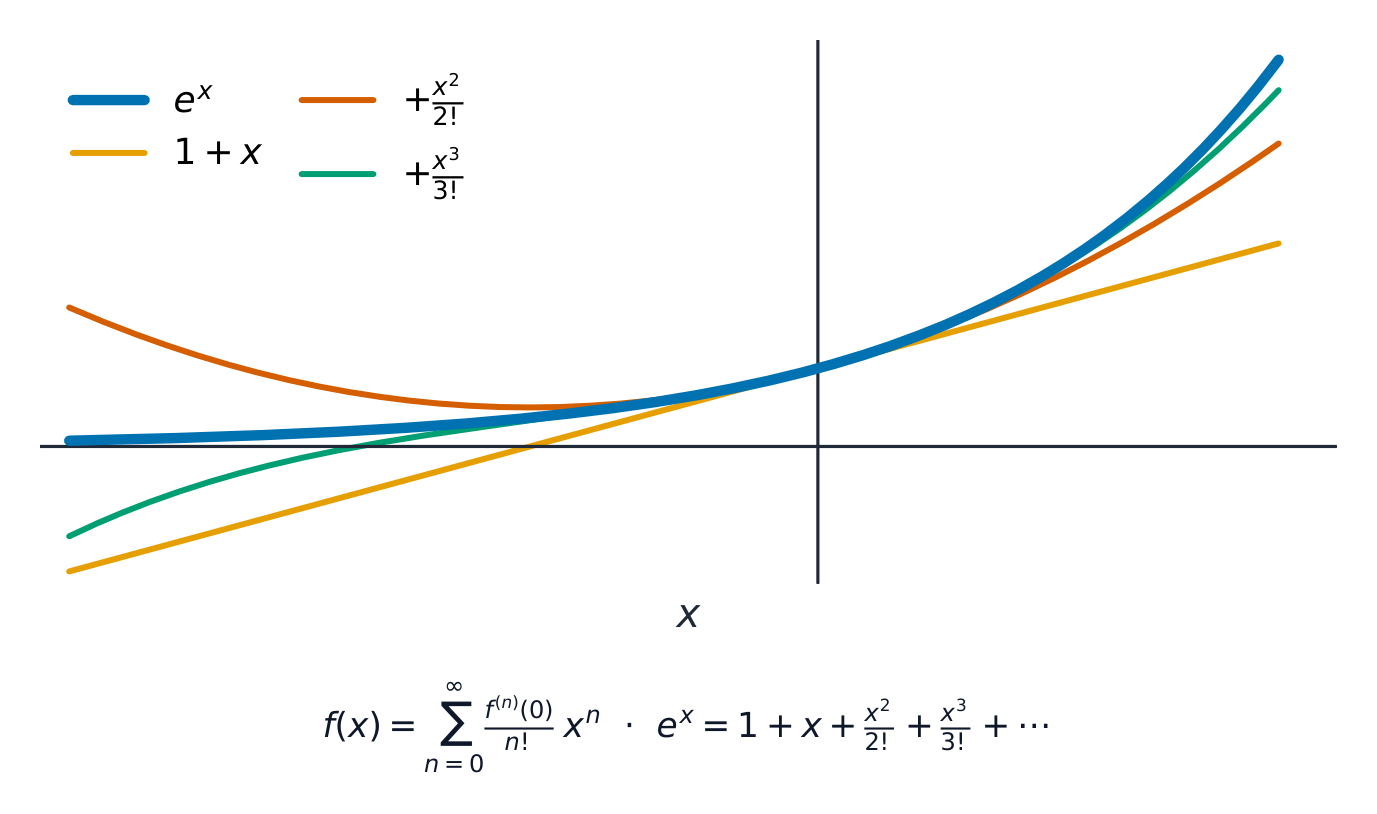
A Maclaurin's series 麦克劳林级数 writes a function as a power series:
For example $e^x = 1 + x + \dfrac{x^2}{2!} + \dfrac{x^3}{3!} + \cdots$
Worked example. Find the Maclaurin series of $f(x) = \ln(1+x)$ up to the term in $x^3$.
$f(0) = 0$; $f'(x) = \dfrac{1}{1+x}$ so $f'(0) = 1$; $f''(x) = \dfrac{-1}{(1+x)^2}$ so $f''(0) = -1$; $f'''(x) = \dfrac{2}{(1+x)^3}$ so $f'''(0) = 2$. Substituting into the series:
$$\ln(1+x) = x - \frac{x^2}{2} + \frac{x^3}{3} - \cdots$$
עברית
עתה ניתן לגזור את הפונקציות ההיפרבוליות ואת הפונקציות ההפוכות $\sin^{-1}x$, $\tan^{-1}x$, $\sinh^{-1}x$ וכדומה. ניתן גם למצוא $\dfrac{d^2y}{dx^2}$ לעקומות נתונות באופן איפלט או פרמטרי.
• integrate hyperbolic functions and recognise integrals of functions of the form $\frac{1}{\sqrt{a^2 - x^2}}$, $\frac{1}{\sqrt{x^2 + a^2}}$ and $\frac{1}{\sqrt{x^2 - a^2}}$, and integrate associated functions using trigonometric substitutions or hyperbolic substitutions as appropriate
Including use of completing the square where necessary, e.g. to integrate $\frac{1}{\sqrt{x^2 + x}}$.
• derive and use reduction formulae for the evaluation of definite integrals
e.g. $\int_0^{\frac{1}{2}\pi} \sin^n x \text{ d}x$, $\int_0^1 \text{e}^{-x}(1-x)^n \text{ d}x$. In harder cases hints may be given, e.g. $\int_0^{\frac{1}{4}\pi} \sec^n x \text{ d}x$ by considering $\frac{\text{d}}{\text{d}x}(\tan x \sec^n x)$.
• understand how the area under a curve may be approximated by areas of rectangles, and use rectangles to estimate or set bounds for the area under a curve or to derive inequalities or limits concerning sums
Questions may involve either rectangles of unit width or rectangles whose width can tend to zero, e.g. $1 + \ln n > \sum_{r=1}^n \frac{1}{r} > \ln(n+1)$, $\sum_{r=1}^n \frac{1}{n}\left(1 + \frac{r}{n}\right)^{-1} \approx \int_0^1 (1+x)^{-1} \text{ d}x$. continued
• use integration to find – arc lengths for curves with equations in Cartesian coordinates, including the use of a parameter, or in polar coordinates – surface areas of revolution about one of the axes for curves with equations in Cartesian coordinates, including the use of a parameter.
Any questions involving integration may require techniques from Cambridge International A Level Mathematics (9709) applied to more difficult cases, e.g. integration by parts for $\int e^x \sin x \mathrm{d}x$, or use of the substitution $t = \tan \frac{1}{2}x$. Surface areas of revolution for curves with equations in polar coordinates will not be required.
עברית
המועמדים אמורים להיות מסוגלים:
הערות לדוגמאות
• אינטגרל פונקציות היפרבוליות והכר זא אינטגרלים של פונקציות מהצורה $\frac{1}{\sqrt{a^2 - x^2}}$, $\frac{1}{\sqrt{x^2 + a^2}}$ ו-$\frac{1}{\sqrt{x^2 - a^2}}$, ואינטגרל פונקציות קשורות באמצעות החלפות טריגונומטריות או החלפות היפרבוליות בהתאם
כולל שימוש ב-השלמת ריבוע כאשר יש צורך, לדוגמה כדי לאינטגרל $\frac{1}{\sqrt{x^2 + x}}$.
• נגזר ושתמש ב-נוסחות הורדה לחישוב אינטגרלים מוגדרים
לדוגמה: $\int_0^{\frac{1}{2}\pi} \sin^n x \text{ d}x$, $\int_0^1 \text{e}^{-x}(1-x)^n \text{ d}x$. במקרים קשים יותר ייתכן שתנתנו רמזים, לדוגמה $\int_0^{\frac{1}{4}\pi} \sec^n x \text{ d}x$ על ידי בחינת $\frac{\text{d}}{\text{d}x}(\tan x \sec^n x)$.
• הבן כיצד ניתן לקרב את השטח תחת עקומה באמצעות שטחי מלבנים, ושתמש במלבנים להערכת שטח תחת עקומה או לקביעת גבולים לשטח זה, או לגזירת אי-שוויונות או גבולות הקשורים לסכומים
ייתכן שהשאלות יכללו מלבנים בעלות רוחב יחיד או מלבנים שרוחבם יכול להתקרב לאפס, לדוגמה: $1 + \ln n > \sum_{r=1}^n \frac{1}{r} > \ln(n+1)$, $\sum_{r=1}^n \frac{1}{n}\left(1 + \frac{r}{n}\right)^{-1} \approx \int_0^1 (1+x)^{-1} \text{ d}x$. המשך...
• השתמש ב-אינטגרציה כדי למצוא – אורכי קשת לעקומות עם משוואות בקואורדינטות קרטזיות, כולל שימוש בפראמטר, או בשטחי פני שטח של סיבוב סביב אחד הצירים לעקומות עם משוואות בקואורדינטות קרטזיות, כולל שימוש בפראמטר.
כל שאלה המכילה אינטגרציה עשויה דורשת טכניקות מתוך Cambridge International A Level Mathematics (9709) המיושמות על מקרים קשים יותר, לדוגמה אינטגרציה בחלקים עבור $\int e^x \sin x \mathrm{d}x$, או שימוש בהחלפה $t = \tan \frac{1}{2}x$. לא יידרש חישוב שטחי פני שטח של סיבוב לעקומות עם משוואות בקואורדינטות קוטביות.
Source: Cambridge International syllabus · מקור: הסיילבוס הבינלאומי של קמבריד'ג'
A trigonometric substitution, a hyperbolic substitution, or completing the square 配方法 in the denominator handles related forms. A reduction formula 递推公式 links an integral $I_n$ to $I_{n-1}$, so you can work down step by step. Integration also gives the arc length 弧长 of a curve and the surface area of revolution 旋转曲面面积 when a curve is turned about an axis.
Worked example. Find $\displaystyle\int \frac{1}{\sqrt{4 - x^2}}\,dx$.
Bounding a sum by an integral. Draw rectangles of unit width under, or over, a decreasing curve such as $y=\frac1x$. Each rectangle of height $\frac1r$ is trapped between two integral strips, so summing gives
$$\ln(n+1) < \sum_{r=1}^{n}\frac1r < 1 + \ln n.$$
Shrinking the rectangle width to $\frac1n\to 0$ turns such a sum into a Riemann sum 黎曼和 that equals the integral in the limit, e.g. $\displaystyle\lim_{n\to\infty}\frac1n\sum_{r=1}^{n}f\!\left(\frac{r}{n}\right)=\int_0^1 f(x)\,dx$.
הצבה טריגונומטרית, הצבה היפרבולית או השלמה לריבוע במכנה מטפלים בצורות הקשורות. נוסחת הפחתה מקשרת אינטגרל $I_n$ ל$I_{n-1}$, כך שניתן לחשב צעד אחר צעד. אינטגרציה מספקת גם את אורך הקשת של עקומה ואת שטח המשטח הנוצר מהיפוך עקומה סביב ציר.
דוגמה מפורטת. מצא $\displaystyle\int \frac{1}{\sqrt{4 - x^2}}\,dx$.
גבול לסכום באמצעות אינטגרל. שרטטו מלבנים בעובי יחיד מתחת או מעל עקומה יורדת כמו $y=\frac1x$. כל מלבן בגובה $\frac1r$ כלוא בין שתי רצועות אינטגרל, ולכן הסכום נותן
$$\ln(n+1) < \sum_{r=1}^{n}\frac1r < 1 + \ln n.$$
צמצום עובי המלבן ל$\frac1n\to 0$ הופך סכום זה לסכום רימן השווה לאינטגרל בגבול, לדוגמה $\displaystyle\lim_{n\to\infty}\frac1n\sum_{r=1}^{n}f\!\left(\frac{r}{n}\right)=\int_0^1 f(x)\,dx$.
Explore · חקור
The area under the curve · השטח תחת העקומה
area = ∫ f(x) dx · שטח = ∫ f(x) dx
Every integral measures the area under the curve — drag the limits. · כל אינטגרל מודד את השטח תחת העקומה — גרור את הגבולות.
• understand de Moivre’s theorem, for a positive or negative integer exponent, in terms of the geometrical effect of multiplication and division of complex numbers
• prove de Moivre’s theorem for a positive integer exponent
e.g. by induction.
• use de Moivre’s theorem for a positive or negative rational exponent
e.g. expressing $\cos 5\theta$ in terms of $\cos \theta$ or $\tan 5\theta$ in terms of $\tan \theta$.
– to express trigonometrical ratios of multiple angles in terms of powers of trigonometrical ratios of the fundamental angle
e.g. expressing $\sin^6 \theta$ in terms of $\cos 2\theta$, $\cos 4\theta$ and $\cos 6\theta$.
– to express powers of $\sin \theta$ and $\cos \theta$ in terms of multiple angles
– in the summation of series
e.g. using the '$C + \mathrm{i}S$' method to sum series such as $\sum_{r=1}^{n} \binom{n}{r} \sin r\theta$.
– in finding and using the $n$th roots of unity.
עברית
המועמדים אמורים להיות מסוגלים:
הערות לדוגמאות
• הבן את משפט דה מואבר, עבור מעריך שלם חיובי או שלילי, במובן ההשפעה הגיאומטרית של הכפלה וחילוק מספרים מרוכבים
• הוכח את משפט דה מואבר עבור מעריך שלם חיובי
לדוגמה: באמצעות אינדוקציה.
• השתמש ב-משפט דה מואבר עבור מעריך רציונלי חיובי או שלילי
לדוגמה: הביע $\cos 5\theta$ באמצעות $\cos \theta$ או $\tan 5\theta$ באמצעות $\tan \theta$.
– ביטוי היחסים הטריגונומטריים של זוויות כפולות באמצעות חזקות של היחסים הטריגונומטריים של הזווית היסודית
לדוגמה: ביטוי $\sin^6 \theta$ באמצעות $\cos 2\theta$, $\cos 4\theta$ ו-$\cos 6\theta$.
– כדי לבטא חזקות של $\sin \theta$ ו-$\cos \theta$ באמצעות זוויות כפולות
– בסכום סדרות
לדוגמה: שיטת ה-'$C + \mathrm{i}S$' לסכום סדרות כמו $\sum_{r=1}^{n} \binom{n}{r} \sin r\theta$.
– במציאה ובשימוש ב-שורשים ה-$n$ של היחידה.
Source: Cambridge International syllabus · מקור: הסיילבוס הבינלאומי של קמבריד'ג'
English
The nth roots of unity form a polygonMultiplying complex numbers: lengths multiply, angles addMultiplying by i is a rotation
A complex number 复数 in polar form is $z = r(\cos\theta + i\sin\theta)$. De Moivre's theorem 棣莫弗定理 says that for any integer $n$,
It is used to expand $\cos n\theta$ and $\sin n\theta$ in powers, to sum series, and to find the $n$roots of unity 单位根 (the solutions of $z^n = 1$, equally spaced around the unit circle).
Worked example. Use de Moivre's theorem to express $\cos 3\theta$ in terms of $\cos\theta$.
Take the real part of $(\cos\theta + i\sin\theta)^3 = \cos 3\theta + i\sin 3\theta$:
השורשים ה-n-יים של היחידות יוצרים רבועוןהכפלת מספרים מרוכבים: האורכים מכפילים, הזוויות מחברותהכפלה ב-i היא סיבובתבניות סמי-דומות כמו כרוב רומנסקו נוצרות על ידי איטרציה של פונקציות במישור המרוכב.
מספר מרוכב בצורה קוטבית הוא $z = r(\cos\theta + i\sin\theta)$. משפט דה מואבר אומר כי לכל מספר שלם $n$,
הוא משמש לפיתוח $\cos n\theta$ ו$\sin n\theta$ בחזקות, לסכום סדרות ולמציאת ה$n$שורשי היחידה (פתרונות המשוואה $z^n = 1$, המפוזרים באופן שווה סביב מעגל היחידה).
חמישת הפתרונות של $z^5=1$ מפוזרים באופן שווה במרחק $72^\circ$ זה מזה על מעגל היחידה.
דוגמה מופתרת. השתמש במשפט דה מואבר כדי לבטא את $\cos 3\theta$ באמצעות $\cos\theta$.
לקח את החלק הממשי של $(\cos\theta + i\sin\theta)^3 = \cos 3\theta + i\sin 3\theta$:
Drag the point to explore modulus and argument — the language of complex numbers in polar (modulus–argument) form. · גרור את הנקודה לחקר המודולוס והארגומנט — לשון המספרים המרוכבים בצורת קוטבית (מודולוס–ארגומנט).
• find an integrating factor for a first order linear differential equation, and use an integrating factor to find the general solution
e.g. $\frac{\mathrm{d}y}{\mathrm{d}x} - 2y = x^2$, $x\frac{\mathrm{d}y}{\mathrm{d}x} - y = x^4$, $\frac{\mathrm{d}y}{\mathrm{d}x} + y\coth x = \cosh x$.
• recall the meaning of the terms 'complementary function' and 'particular integral' in the context of linear differential equations, and recall that the general solution is the sum of the complementary function and a particular integral
find the complementary function for a first or second order linear differential equation with constant coefficients
For second order equations, including the cases where the auxiliary equation has distinct real roots, a repeated real root or conjugate complex roots.
recall the form of, and find, a particular integral for a first or second order linear differential equation in the cases where a polynomial or $ae^{bx}$ or $a\cos px + b\sin px$ is a suitable form, and in other simple cases find the appropriate coefficient(s) given a suitable form of particular integral
e.g. evaluate $k$ given that $kx \cos 2x$ is a particular integral of
use a given substitution to reduce a differential equation to a first or second order linear equation with constant coefficients or to a first order equation with separable variables
e.g. the substitution $x = e^t$ to reduce to linear form a differential equation with terms of the form
use initial conditions to find a particular solution to a differential equation, and interpret a solution in terms of a problem modelled by a differential equation.
עברית
המועמדים אמורים להיות מסוגלים:
הערות לדוגמאות
• מציאת גורם אינטגרציה למשוואה דיפרנציאלית ליניארית מסדר ראשון, ושימוש בגורם זה למציאת הפתרון הכללי
לדוגמה: $\frac{\mathrm{d}y}{\mathrm{d}x} - 2y = x^2$, $x\frac{\mathrm{d}y}{\mathrm{d}x} - y = x^4$, $\frac{\mathrm{d}y}{\mathrm{d}x} + y\coth x = \cosh x$.
• לשחזר את משמעות המונחים פונקציה משלימה ו-אינטגרל פרטי בהקשר של משוואות דיפרנציאליות ליניאריות, ולשחזר שהפתרון הכללי הוא סכום הפונקציה המשלימה והאינטגרל הפרטי
למצוא את הפונקציה המשלימה עבור משוואה דיפרנציאלית ליניארית מסדר ראשון או שני עם מקדמים קבועים
עבור משוואות מסדר שני, כולל המקרים שבהם למשוואה העזרית יש שורשים מציאיים נפרדים, שורש מציאית כפולה או שורשים מרוכבים זוגיים.
הזכרת הצורה ולמציאת אינטגרל פרטי למשוואה דיפרנציאלית ליניארית מסדר ראשון או שני במקרים שבהם פולינום או $ae^{bx}$ או $a\cos px + b\sin px$ הם צורות מתאימות, ובמקרים פשוטים אחרים מציאת המקדם(ים) המתאימים בהינתן צורה מתאימה לאינטגרל פרטי
לדוגמה: חישוב $k$ בהינתן ש-$kx \cos 2x$ הוא אינטגרל פרטי של
להשתמש בתנאי התחלה כדי למצוא פתרון פרטי למשוואה דיפרנציאלית, ולפרש פתרון בהקשר של דגם בעיה המודל על ידי משוואה דיפרנציאלית.
Source: Cambridge International syllabus · מקור: הסיילבוס הבינלאומי של קמבריד'ג'
English
For a first order linear equation $\dfrac{dy}{dx} + P(x)\,y = Q(x)$, multiply by the integrating factor 积分因子$\mu = e^{\int P\,dx}$. The left side then becomes $\dfrac{d}{dx}(\mu y)$, so you can integrate directly.
For a linear equation with constant coefficients, the general solution 通解 is the sum of two parts: the complementary function 余函数 (the solution of the equation with the right side set to $0$, found from the auxiliary equation) and a particular integral 特积分 (any one solution of the full equation). Initial conditions then fix the constants to give the particular solution 特解; simpler equations with separable variables 可分离变量 are integrated directly.
Worked example. Solve $\dfrac{dy}{dx} + 2y = e^x$.
The integrating factor is $\mu = e^{\int 2\,dx} = e^{2x}$. Multiplying through gives $\dfrac{d}{dx}\!\left(y\,e^{2x}\right) = e^{3x}$, so
$$y\,e^{2x} = \tfrac13 e^{3x} + C \;\Rightarrow\; y = \tfrac13 e^x + C e^{-2x}.$$
Second order, constant coefficients. For $\dfrac{d^2y}{dx^2}+b\dfrac{dy}{dx}+cy=f(x)$, solve the auxiliary equation 辅助方程$m^2+bm+c=0$. The complementary function depends on its roots:
two distinct real roots $m_1,m_2$: $y=Ae^{m_1x}+Be^{m_2x}$;
Then add a particular integral by trying a form matching $f(x)$ (a polynomial, $ae^{bx}$, or $a\cos px+b\sin px$); if that trial already appears in the complementary function, multiply it by $x$.
Worked example. Solve $\dfrac{d^2y}{dx^2}-4\dfrac{dy}{dx}+4y=0$. The auxiliary equation $m^2-4m+4=(m-2)^2=0$ has a repeated root $m=2$, so $y=(A+Bx)e^{2x}$.
עברית
עבור משוואה ליניארית מסדר ראשון $\dfrac{dy}{dx} + P(x)\,y = Q(x)$, כפל ב-גורם האינטגרציה$\mu = e^{\int P\,dx}$. צד שמאל יהפוך אז ל$\dfrac{d}{dx}(\mu y)$, כך שתוכל לאינטגרל ישירות.
עבור משוואה ליניארית עם מקדמים קבועים, הפתרון הכללי הוא סכום של שני חלקים: הפונקציה המשלימה (הפתרון למשוואה כאשר הצד ימני מוגדר כ$0$, שנמצא מהמשוואה העזר) והאינטגרל פרטי (כל פתרון אחד של המשוואה המלאה). תנאי התחלה קובעים את הקבועים ומניבים את הפתרון הפרטי; משוואות פשוטות יותר עם משתנים ניתנים להפרדה אינטגרלות ישירות.
עקומת פתרון עוברת לאורך שדה השיפוע, נשארת מגעת למקטעים הקטנים בכל מקום.
דוגמה מופתרת. פתור את $\dfrac{dy}{dx} + 2y = e^x$.
גורם האינטגרציה הוא $\mu = e^{\int 2\,dx} = e^{2x}$. הכפלה במונה מניבה $\dfrac{d}{dx}\!\left(y\,e^{2x}\right) = e^{3x}$, ולכן
$$y\,e^{2x} = \tfrac13 e^{3x} + C \;\Rightarrow\; y = \tfrac13 e^x + C e^{-2x}.$$
דרגה שנייה, מקדמים קבועים. עבור $\dfrac{d^2y}{dx^2}+b\dfrac{dy}{dx}+cy=f(x)$, פתור את המשוואה העזרית$m^2+bm+c=0$. הפונקציה המשלימה תלויה בשורשים שלה:
שני שורשים ממשיים שונים $m_1,m_2$: $y=Ae^{m_1x}+Be^{m_2x}$;
לאחר מכן הוסף אינטגרל פרטי על ידי ניסיון צורה התואמת את $f(x)$ (פולינום, $ae^{bx}$ או $a\cos px+b\sin px$); אם צורה זו מופיעה כבר בפונקציה המשלימה, כפול אותה ב$x$.
דוגמה מופתרת. פתור את $\dfrac{d^2y}{dx^2}-4\dfrac{dy}{dx}+4y=0$. המשוואה העזר $m^2-4m+4=(m-2)^2=0$ היא בעלת שורש כפול $m=2$, ולכן $y=(A+Bx)e^{2x}$.
Explore · חקור
Differential equations · משוואות דיפרנציאליות
dy/dx = a y
The equation sets the slope everywhere; the solution follows those slopes. · המשוואה קובעת את השיפוע בכל מקום; הפתרון עוקב אחר שיפועים אלו.
Pick one and the site follows you — notes, papers, videos and practice all open on it. · בחרו נושא אחד והאתר יעקוב אחריו — הערות, מסמכים, וידאו ותרגולים פתוחים בו.
Type to search notes, lessons, code, vocabulary and past-paper questions across every subject. · הקלד כדי לחפש הערות, שיעורים, קוד, אוצר מילים ושאלות מבחנים בכל הנושאים.