לפני צילום רנטגן של הקיבה, מבקשים מהמטופל לשתות נוזל לבן עבה. הוא מלא בבריום – ויוני הבריום רעילים. בליעת מלח בריום מסיס…
English narration · English + 中文 subtitles burned in · קריאת קול באנגלית · תרגום אנגלי + סינית שרוף בתוך הסרטון
10.1
The Group 2 metals · מתכות הקבוצה 2
Syllabus · סיילבוס
English
describe, and write equations for, the reactions of the elements with oxygen, water and dilute hydrochloric and sulfuric acids
describe, and write equations for, the reactions of the oxides, hydroxides and carbonates with water and dilute hydrochloric and sulfuric acids
describe, and write equations for, the thermal decomposition of the nitrates and carbonates, to include the trend in thermal stabilities
describe, and make predictions from, the trends in physical and chemical properties of the elements involved in the reactions in 10.1.1 and the compounds involved in 10.1.2, 10.1.3 and 10.1.5
state the variation in the solubilities of the hydroxides and sulfates
עברית
לתאר ולכתוב משוואות לכימיה של יסודות עם חמצן, מים וחומצות הידרוכלורית וסולפורית מדוללות
לתאר ולכתוב משוואות לכימיה של תחמוצות, הידרוקסידים וקרबונטים עם מים וחומצות הידרוכלורית וסולפורית מדוללות
לתאר ולכתוב משוואות לפירוק תרמי של ניטרטים וקרבונטים, כולל המגמה ביציבות תרמית
לציין את השינויים בהתמוססות של הידרוקסידים וסולفات
Source: Cambridge International syllabus · מקור: הסיילבוס הבינלאומי של קמבריד'ג'
English
Group 族 2 holds the metals magnesium, calcium, strontium and barium. They all have two outer electrons, which they lose to form $2+$ ions. Going down the group, the atoms get larger and the outer electrons are easier to lose, so the metals get more reactive — their reactivity 反应活性 increases down the group.
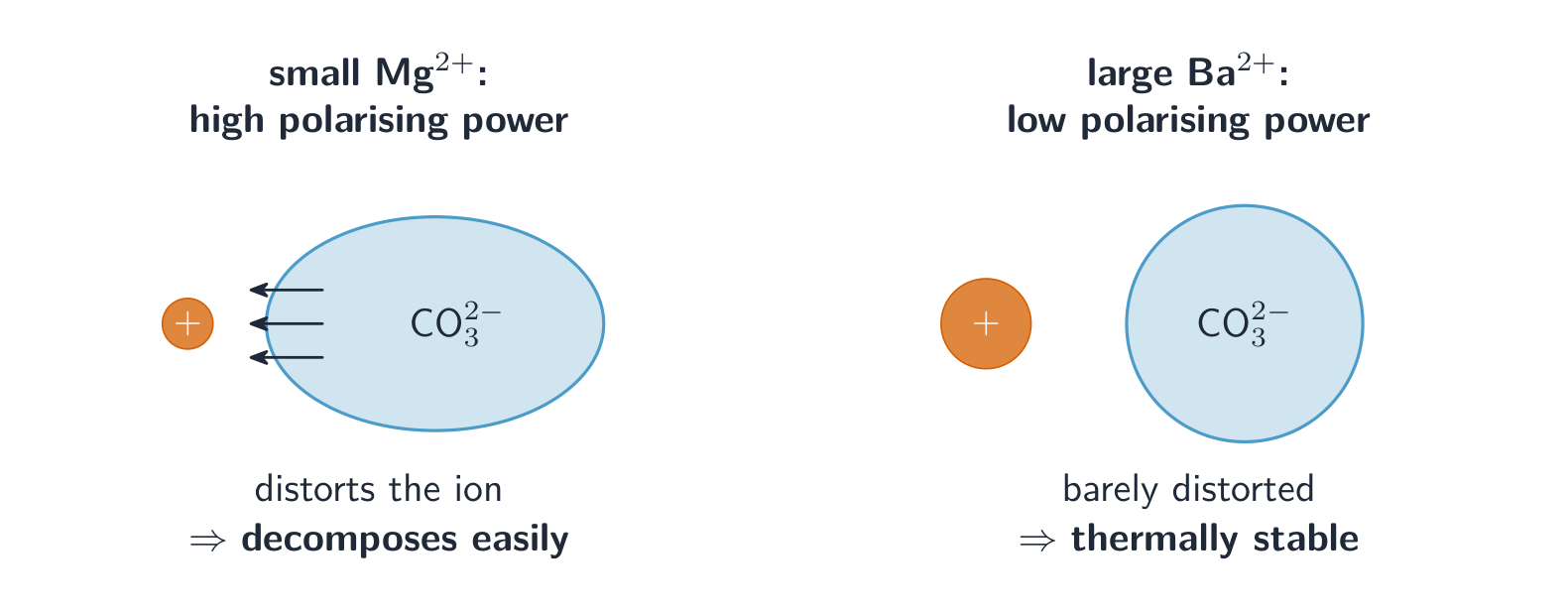
The thermal stability 热稳定性 of both the carbonates and the nitrates increases down the group. A larger metal ion pulls less on the carbonate or nitrate ion, so the compound is harder to break apart — it needs a higher temperature. So magnesium carbonate decomposes most easily, and barium carbonate is the hardest.
Trends in solubility
Compound
Trend in solubility 溶解度 down the group
hydroxides
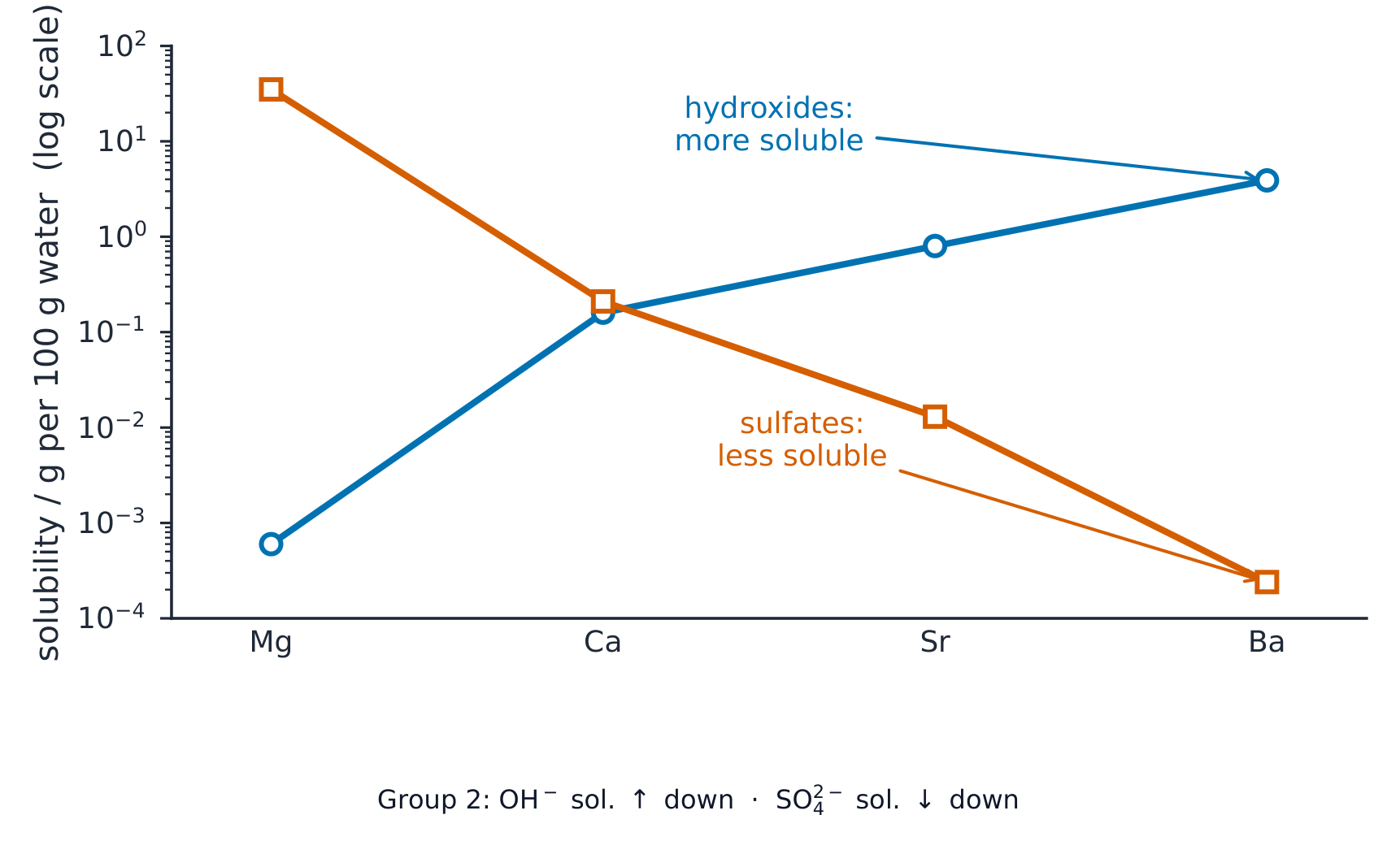
increase (Mg(OH)$_2$ almost insoluble; Ba(OH)$_2$ soluble)
sulfates
decrease (MgSO$_4$ soluble; BaSO$_4$ insoluble)
From these trends you can predict the properties of the next element down, radium, and of its compounds.
Worked example.$\text{MgCO}_3$ decomposes at about $540\ °\text{C}$ and $\text{BaCO}_3$ at about $1360\ °\text{C}$. Explain the trend and predict where $\text{CaCO}_3$ sits. Going down Group 2 the cation gets larger, so its charge is spread over a bigger surface and its polarising power falls. A less polarising cation distorts the carbonate ion less, so the $\text{C-O}$ bond is weakened less and more heat is needed to break it. Thermal stability therefore increases down the group, and $\text{CaCO}_3$, lying between Mg and Ba, decomposes at an intermediate temperature of about $900\ °\text{C}$. Argue the whole chain - cation size, then polarising power, then distortion of the anion; "it is more reactive" explains nothing here.
עברית
אבן גיר היא סידן קربونات — תרכובת של המתכת מסדרה 2 סידן.
קבוצה 2 כוללת את המתכות מגנזיום, סידן, סטרונציום ובריום. לכל אחת מהן יש שתי אלקטרונים בשכבת הערכים החיצונית, שהם מאבדים כדי ליצור יוני $2+$. בהלכה מטה לקבוצה, האטומים גדלים והאלקטרונים החיצוניים נשארים קלים יותר לאובדן, ולכן המתכות הופכות לרעילות יותר—ה-רעילות שלהן עולה במטה הקבוצה.
רעילות עולה במטה קבוצה 2: אטומים גדולים מחזיקים את שני אלקטרוני הערכים החיצוניים פחות חזק, ולכן הם נשארים קלים יותר לאובדן
היציבות התרמית של גם הקרבונטים וגם הניטרטים עולה כלפי מטה בסדרה. יון מתכת גדול יותר מושך פחות את יון הקרבונט או הניטרט, ולכן התרכובת קשה יותר לשבור — היא דורשת טמפרטורה גבוהה יותר. כך שקרבונט המגנזיום מתפרק בקלות הרבה ביותר, וקרבונט בריום הוא הקשה ביותר לשבירה.
היציבות תרמית עולה כלפי מטה בסדרה: קטיון קטן מקוטב (מעוות) יותר את יון הקרבונט, מהחליש אותו ולכן הוא מתפרק בקלות יותר
מגמות בפתילותות
תרכובת
מגמה במסיסות לאורך הקבוצה
הידרוקסידים
גדילה (Mg(OH)$_2$ כמעט חסר פתרון; Ba(OH)$_2$ מומס)
גופריתות
ירידה (MgSO$_4$ מומס; BaSO$_4$ חסר פתרון)
לאורך קבוצה 2 ההידרוקסידים הופכים למעולמים יותר בעוד שהגופריתות הופכות לפחות מומסות (שימו לב לסקאלה הלוגריתמית)
ממגמות אלו ניתן לחזות את המאפיינים של האלמנט הבא בתור, הרדיום, ושל התרכובות שלו.
דוגמה מופתרת.$\text{MgCO}_3$ מתפרק בטמפרטורה של כ-$540\ °\text{C}$ ו-$\text{BaCO}_3$ בטמפרטורה של כ-$1360\ °\text{C}$. הסבירו את המגמה וחזו היכן ממוקם $\text{CaCO}_3$. בהליכה למטה בקבוצה 2 הקטיון הופך גדול יותר, ולכן הטעון שלו מתפזר על שטח גדול יותר וה-כוח הקיוטובי שלו יורד. קטיון בעל כוח קיוטובי נמוך יותר מעוות פחות את יון הפחמימת, ולכן קשר ה-$\text{C-O}$ מתחלש פחות ונדרשת יותר אנרגיה כדי לשבור אותו. לכן, היציבות התרמית גוברת למטה בקבוצה, ו-$\text{CaCO}_3$, הנמצא בין Mg לבין Ba, מתפרק בטמפרטורה בינונית של כ-$900\ °\text{C}$. נסבירו את כל השלשלת הסיבה-תוצאה - גודל הקטיון, ולאחר כך כוח הקיוטובי, ולאחר כך העיוות של האניון; "זה יותר ריאקטיבי" אינו מסביר כאן דבר כלשהו.
Explore · חקור
Group 2 reactivity ladder · מדרגת התגובתיות של קבוצה 2
Move down Group 2 and see why reactions become more vigorous. · ירדו לאורך קבוצה 2 וראו מדוע התגובות נעשות אינטנסיביות יותר.
Explore · חקור
Group 2 trend lab · מעבדה: מגמות בקבוצה 2
Compare thermal stability and solubility trends down Group 2. · השוו את המגמות של יציבות תרמית ותכונת התמסרות כלפי מטה בקבוצה 2.
Pick one and the site follows you — notes, papers, videos and practice all open on it. · בחרו נושא אחד והאתר יעקוב אחריו — הערות, מסמכים, וידאו ותרגולים פתוחים בו.
Type to search notes, lessons, code, vocabulary and past-paper questions across every subject. · הקלד כדי לחפש הערות, שיעורים, קוד, אוצר מילים ושאלות מבחנים בכל הנושאים.