Passer au contenu
Sujets

GRE · GRE Subject Test · GRE Mathematics

  • 1

    C.1 · Calcul différentiel et intégral à une variable et applications

    1

    Champ d'application et prérequis

    Préparation GRE niveau universitaire. Objectifs locaux dans le périmètre ETS examiné ; il s'agit d'un enseignement original, pas d'un test officiel ni d'un prédicteur de score.

    Prérequis : Algèbre exacte, trigonométrie en radians, fonctions et inégalités.

    • Utiliser les limites, la continuité et la dérivabilité
    • Appliquer les dérivées, les intégrales et le théorème fondamental
    • Reconnaître les sommes de Riemann et les distinguer des séries infinies

    continuité : Concordance de la valeur d'une fonction avec sa limite.

    convergence : Approche vers une valeur limite finie.

    Vocabulaire Entrainer
    English Français
    continuity/kɒntɪˈnjuːɪti/ continuité
    convergence/kənˈvɜːdʒəns/ convergence
    1

    Choisir et justifier une méthode

    Une limite décrit les valeurs proches d'un point, sans nécessiter que la fonction y soit définie. La continuité ajoute l'exigence que la valeur de la fonction existe et concorde avec la limite. La simplification algébrique n'est valide qu'à l'écart du zéro simplifié, mais elle peut révéler une limite supprimable. Les limites latérales doivent concorder pour une limite bilatérale. Pour les limites de quotients, vérifiez le dénominateur et les hypothèses avant d'appliquer une règle ; 0/0 est une forme indéterminée, pas une réponse.

    Une dérivée est une limite de quotients auxiliaires et implique la continuité ; la réciproque est fausse, comme le montre |x| en zéro. Les règles du produit, du quotient et de la chaîne décrivent des structures différentes : la dérivée de f(g(x)) est f′(g(x))g′(x), pas un produit de valeurs indépendantes. Dériver une composition une deuxième fois produit généralement deux termes. Vérifiez les domaines, les dénominateurs non nuls et les hypothèses de dérivabilité avant d'utiliser une expression symbolique comme dérivée.

    Le théorème fondamental stipule que la dérivée de ∫ de a à x d'un intégrande continu f(t) est f(x). Avec une borne supérieure variable h(x), multipliez par h′(x) ; avec deux bornes variables, soustrayez la contribution correspondante de la borne inférieure. Une intégrale définie apparaît également comme une limite de sommes de Riemann. Réécrivez la somme sous la forme (1/n)Σf(k/n) avant d'identifier l'intégrale sur [0,1], plutôt que de traiter les termes dépendants de n comme des constantes.

    Par exemple, Σ de k=1 à n de n/(n²+k²) est égal à (1/n)Σ1/(1+(k/n)²), tendant vers ∫₀¹1/(1+t²)dt=π/4. Cette limite utilise la continuité et la largeur de partition 1/n. Une série sur un nombre illimité de termes est une limite différente : des termes tendant vers zéro ne garantissent pas seuls la convergence. Pour Σ1/k, les sommes partielles divergent ; comparez, estimez ou appliquez un test de série valide au lieu d'utiliser la condition nécessaire des termes comme suffisante.

    1

    Raisonnement worked

    Pour F(x)=integral de 0 à x² de e^t dt, le théorème fondamental et la règle de la chaîne donnent F′(x)=e^(x²)·2x. En x=1, F′(1)=2e. La borne supérieure est x², donc omettre 2x ignore sa vitesse de variation.

    Calcul différentiel et intégral à une variable et applications : exemple de cours
    Illustration de cours originale ; ses valeurs appartiennent à l'exemple résolu, pas à la pratique ultérieure.
    1

    Conditions et contre-exemples

    Le calcul différentiel et intégral du niveau A-level constitue une matière préalable utile mais ne couvre pas l'analyse universitaire et ses applications évaluées ici.

    1

    Application guidée

    Soit $F(x)=\int_x^{x^2}(1+t^2)\,dt$. Trouvez $F'(x)$ et $F'(2)$. Indiquez pourquoi le théorème s'applique.

    Solution détaillée

    L'intégrande est continue sur la droite réelle. Le théorème fondamental et la règle de dérivation en chaîne s'appliquent aux deux bornes :

    $$F'(x)=(1+x^4)2x-(1+x^2).$$
    $$F'(2)=(1+2^4)\,2\cdot2-(1+2^2)=63.$$
    Indépendamment, une primitive est $t+t^3/3$. Ainsi $F=x^2+x^6/3-x-x^3/3$, avec la même dérivée.

    1

    Transfert indépendant

    Trouver $\lim_{n\to\infty}\sum_{k=1}^n k/(n^2+k^2)$. Expliquer pourquoi il s'agit d'une limite de somme de Riemann. Puis décider si $\sum_{k=1}^{\infty}1/k$ converge.

    Vérification après tentative

    Réécrire chaque terme sous la forme $\frac1n\frac{k/n}{1+(k/n)^2}$. La fonction continue $f(t)=t/(1+t^2)$ sur $[0,1]$ et le maillage $1/n$ donnent

    $$L=\int_0^1\frac{t}{1+t^2}\,dt=\frac12\ln2.$$
    La série harmonique diverge : le bloc allant de $2^{j-1}+1$ à $2^j$ contient au moins $2^{j-1}$ termes chacun supérieur ou égal à $1/2^j$, donc chaque bloc ajoute au moins $1/2$. Le fait que les termes tendent vers zéro est nécessaire mais non suffisant. L'intégrande de la somme finie ici dépend de l'indice mis à l'échelle ; ce n'est pas la série harmonique.

  • 2

    C.2 · Calcul multivarié et analyse vectorielle

    2

    Scope and prerequisites

    English

    Undergraduate GRE preparation. Local objectives within the reviewed ETS scope; this is original teaching, not an official test or score predictor.

    Prerequisites: Single-variable derivatives, dot products and iterated integration.

    • Compute partial derivatives, gradients and directional derivatives
    • Use multiple integrals and coordinate changes
    • Use derivative conditions to distinguish planes from curved surfaces

    gradient 梯度: Vector of partial derivatives.

    Jacobian 雅可比行列式: The local area or volume scaling in a coordinate change.

    Vocabulaire Entrainer
    English Français
    gradient/ˈɡreɪdɪənt/ gradient
    Jacobian/dʒæˈkəʊbɪən/ jacobien
    2

    Choose and justify a method

    English

    A partial derivative changes one coordinate while fixing the others. For f=x²+3xy, f_x=2x+3y and f_y=3x. The gradient collects these derivatives; if f is differentiable, the directional derivative along a unit vector v is grad f·v. Normalise the direction before taking this dot product. A direction vector of length two would double the answer if used without normalisation.

    Differentiability means a valid linear approximation, not merely the existence of some partial derivatives at one point. Continuous first partials in a neighbourhood are a sufficient condition. For a composition f(x(t),y(t)), the chain rule gives f_x x′+f_y y′. Second derivatives can introduce both direct and mixed terms; a zero mixed partial alone places no restriction on the pure second partials.

    A multiple integral sums contributions over a specified region. Describe the region before choosing iterated limits; nonrectangular bounds may change when the order changes. In polar coordinates area is r dr dtheta, not just dr dtheta. A general coordinate change uses the absolute Jacobian determinant. Sign belongs to oriented vector quantities, while area and volume scaling use a nonnegative factor.

    If both first partials of a globally defined function on R² are constant, f_x=a and f_y=b, integrating successively gives f=ax+by+c, a plane. This cannot be inferred from parallel straight level sets alone: e^x has vertical parallel level lines but a curved graph. Nor do f_xy=f_yx=0 force a plane: x²+y² is a counterexample. Distinguish first-derivative constancy from absent mixed dependence and from the shape of selected level sets.

    2

    Worked reasoning

    English

    For f(x,y)=x²+3y², gradient f=(2x,6y). At (1,1) this is (2,6). In direction (3,4), the unit vector is (3/5,4/5), giving directional derivative 2·3/5+6·4/5=6.

    Multivariable calculus and vector analysis: course example
    Original course illustration; its values belong to the worked example, not the later practice.
    2

    Conditions and counterexamples

    English

    A non-unit direction vector gives a scaled directional rate, not the derivative per unit distance.

    2

    Guided application

    English

    For $f(x,y)=x^2+xy+2y^2$, find the directional derivative at $(1,-1)$ towards $(3,4)$. Evaluate $\iint_D(x^2+y^2)\,dA$ for the unit disk $D$.

    Worked solution

    The polynomial is differentiable. Normalise the direction: $u=(3/5,4/5)$. The gradient is $(2x+y,x+4y)$, hence $(1,-3)$ at the point.

    $$D_uf(1,-1)=\nabla f(1,-1)\cdot u=1\cdot3/5-3\cdot4/5=-9/5.$$
    Polar coordinates give $x^2+y^2=r^2$ and $dA=r\,dr\,d\theta$:
    $$I=\int_0^{2\pi}\int_0^1r^3\,dr\,d\theta=\pi/2.$$

    2

    Independent transfer

    English

    Define $g(x,y)=xy/\sqrt{x^2+y^2}$ away from the origin and $g(0,0)=0$. Both partial derivatives at the origin are zero. Is $g$ differentiable there? Is it continuous?

    Check after attempting

    Along each axis $g=0$, so both partials are zero. Continuity follows from $|xy|\le(x^2+y^2)/2$, which gives $|g(x,y)|\le\sqrt{x^2+y^2}/2\to0$. If differentiable, its linear derivative would be zero. Along $x=y=t\ne0$,

    $$\frac{|g(t,t)|}{\sqrt{t^2+t^2}}=\frac12.$$
    The required remainder ratio does not tend to zero. Thus continuity and existing partial derivatives do not establish differentiability.

  • 3

    A.1 · Algèbre linéaire

    3

    Scope and prerequisites

    English

    Undergraduate GRE preparation. Local objectives within the reviewed ETS scope; this is original teaching, not an official test or score predictor.

    Prerequisites: Linear equations, matrix multiplication, polynomials and complex roots.

    • Relate rank, nullity and solutions of linear systems
    • Analyse vector spaces and linear transformations
    • Compute eigenvalues, determinants and diagonalisation conditions

    rank 秩: Dimension of the image of a linear map.

    eigenvalue 特征值: A scalar satisfying Av=λv for a nonzero v.

    Vocabulaire Entrainer
    English Français
    rank/ræŋk/ rang
    eigenvalue/ˈaɪdʒənvæljuː/ valeur propre
    3

    Choose and justify a method

    English

    A real vector space is closed under its specified addition and scalar multiplication and satisfies the vector-space axioms. A basis is an independent spanning list: every vector has a unique coordinate representation in that list. To test independence of matrix columns, solve the homogeneous system Ac=0; only the zero coefficient vector means independence. A spanning set can contain redundant vectors, so spanning alone does not make a basis.

    Row reduction exposes pivots and free variables without changing the solution set of a linear system. Rank is the dimension of the column image, equivalently the number of pivots. Nullity is the kernel dimension: for a map from an n-dimensional domain, rank+nullity=n. In a nonhomogeneous system, a zero coefficient row with nonzero right side means inconsistency; free variables give infinitely many solutions only after consistency has been established. The codomain dimension need not equal rank.

    A square matrix is invertible exactly when its determinant is nonzero, its kernel is zero and its rank equals its size. These statements do not require each entry to be nonzero. Triangular determinants are products of diagonal entries, so a matrix depending on a complex variable can be singular at complex roots absent from a real-only calculation. Row swaps reverse determinant sign; adding a multiple of one row to another leaves it unchanged. Check singularity before applying an inverse formula.

    An eigenvector is nonzero and satisfies Av=λv, so eigenvalues are roots of det(A−λI). Diagonalisation requires a full independent eigenvector basis over the chosen field. Distinct eigenvalues give independent eigenvectors, while repeated eigenvalues may have too small an eigenspace. A real symmetric matrix has a real orthonormal eigenbasis. A real odd-dimensional matrix has at least one real eigenvalue because its real characteristic polynomial has odd degree; that alone does not imply diagonalisation or all eigenvalues real.

    3

    Worked reasoning

    English

    A=[[1,1],[0,1]] has characteristic polynomial (1−λ)². Eigenvectors satisfy y=0, so its eigenspace has dimension one. Two independent eigenvectors are needed to diagonalise a 2×2 matrix; A is not diagonalizable.

    Linear algebra: course example
    Original course illustration; its values belong to the worked example, not the later practice.
    3

    Conditions and counterexamples

    English

    The algebraic multiplicity of an eigenvalue is not automatically the dimension of its eigenspace.

    3

    Guided application

    English

    For $T:\mathbb R^3\to\mathbb R^2$ with $T(x,y,z)=(x+2y+z,2x+4y+2z)$, find bases of the kernel and image. Solve $T(v)=(3,6)$ and $T(v)=(3,7)$.

    Worked solution

    The second row is twice the first, so rank is one. The homogeneous equation gives $x=-2y-z$.

    $$\ker T=\operatorname{span}\{(-2,1,0),(-1,0,1)\}.$$
    The two displayed vectors are independent. Every output is $(s,2s)$, and $(1,2)$ occurs; this is an image basis. Rank plus nullity is $1+2=3$, the domain dimension. For $(3,6)$, all solutions are $(3-2a-b,a,b)$, with $a,b\in\mathbb R$. For $(3,7)$ there is no solution, since $7\ne2\cdot3$.

    3

    Independent transfer

    English

    Let $A=\begin{pmatrix}2&1\\0&2\end{pmatrix}$. Determine its eigenvalues, determinant and diagonalisation over $\mathbb R$ and $\mathbb C$. Find $A^n$ for integers $n\ge1$ without repeated multiplication.

    Check after attempting

    The characteristic polynomial is $(2-\lambda)^2$ and $\det A=4$. Solving $(A-2I)v=0$ gives $v_2=0$, so the eigenspace has dimension one over either field. Two independent eigenvectors are required; the matrix is invertible but not diagonalizable over either field. Write $A=2I+N$ where $N^2=0$. The commuting binomial expansion leaves only two terms:

    $$A^n=2^nI+n2^{n-1}N=\begin{pmatrix}2^n&n2^{n-1}\\0&2^n\end{pmatrix}.$$
    Multiplying this expression by $A$ gives the formula at $n+1$, independently checking the coefficient.

  • 4

    A.2 · Algèbre abstraite et théorie des nombres

    4

    Champ d'application et prérequis

    Préparation GRE niveau universitaire. Objectifs locaux dans le périmètre ETS examiné ; il s'agit d'un enseignement original, pas d'un test officiel ni d'un prédicteur de score.

    Prérequis : Arithmétique entière, ensembles, fonctions et preuve par contre-exemple.

    • Utiliser les groupes, sous-groupes, homomorphismes et structures quotientes
    • Distinuer anneaux, domaines d'intégrité et corps
    • Appliquer la divisibilité, les congruences et la théorie élémentaire des nombres

    homomorphisme : Une application préservant l'opération pertinente.

    corps : Un anneau commutatif où chaque élément non nul possède un inverse.

    Vocabulaire Entrainer
    English Français
    homomorphism/ˈhɒməmɔːfɪzəm/ homomorphisme
    field/fiːld/ corps
    4

    Choisir et justifier une méthode

    Un groupe nécessite la fermeté, l'associativité, l'identité et les inverses. La commutativité est une condition supplémentaire.

    Un homomorphisme préserve l'opération. Son noyau est un sous-groupe normal et identifie les éléments s'envoyant dans l'élément neutre.

    Un corps permet la division par tout élément non nul. Les entiers forment un anneau mais pas un corps.

    Travailler avec les congruences modulo n. Une classe résiduelle a a un inverse multiplicatif exactement lorsque gcd(a,n)=1.

    4

    Raisonnement worked

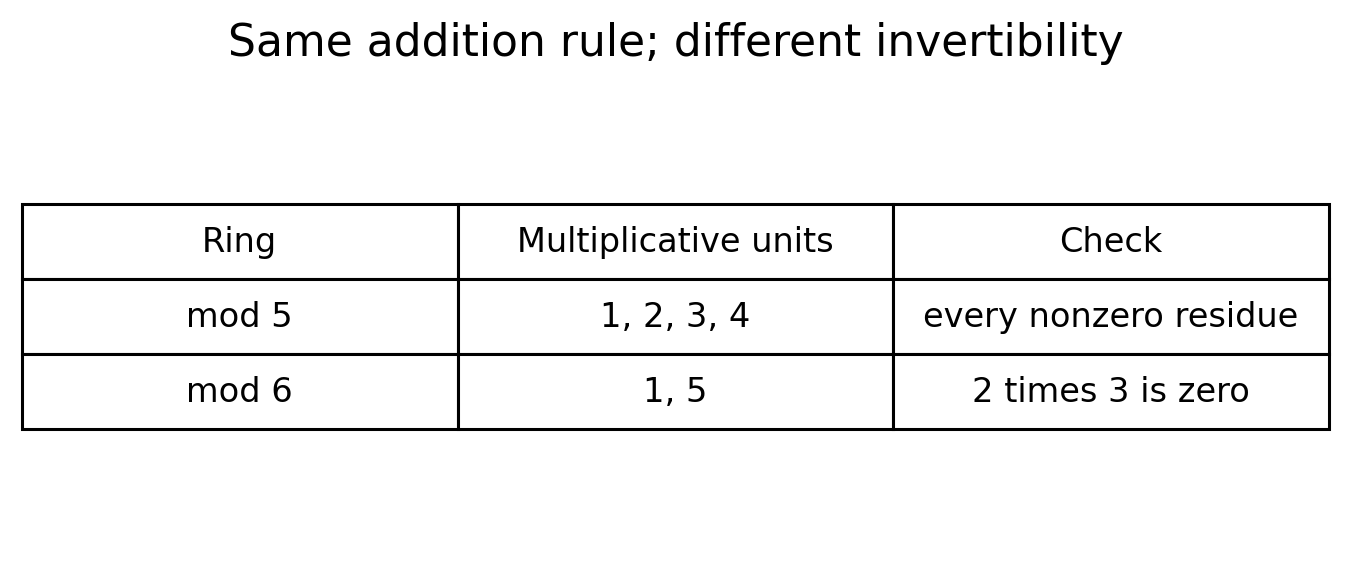
    Modulo 8, 3 a pour inverse 3 car 3·3=9≡1. Mais 2 n'a pas d'inverse car gcd(2,8)=2. Modulo un nombre premier, toute classe résiduelle non nulle possède un inverse ; cela forme un corps fini.

    Algèbre abstraite et théorie des nombres : exemple de cours
    Illustration de cours originale ; ses valeurs appartiennent à l'exemple résolu, pas à la pratique ultérieure.
    4

    Conditions et contre-exemples

    Ne pas simplifier un facteur dans une équation modulaire sans vérifier qu'il est inversible.

    4

    Application guidée

    Comparer les groupes additifs et les structures multiplicatives de $\mathbb Z/5\mathbb Z$ et $\mathbb Z/6\mathbb Z$. Énumérer toutes les unités multiplicatives dans chacun. Expliquer pourquoi retirer zéro ne laisse pas toujours un groupe multiplicatif.

    Solution détaillée

    Les deux ensembles de classes résiduelles complètes sont des groupes additifs : la fermeté, l'associativité et l'identité proviennent de l'addition des entiers, et $-a$ est un inverse additif. Une classe résiduelle multiplicative est une unité précisément lorsque son plus grand commun diviseur avec le module est un. Les unités modulo cinq sont $1,2,3,4$ ; modulo six, elles sont $1,5$. Modulo six, $2\cdot3=0$ bien que les deux facteurs soient non nuls. L'ensemble des éléments non nuls n'est même pas stable par multiplication. Modulo cinq, toute classe résiduelle non nulle a un inverse ; cet anneau est un corps. Un anneau, son groupe additif et son groupe d'unités sont des structures différentes.

    4

    Transfert indépendant

    La carte de réduction $\phi:\mathbb Z\to\mathbb Z/6\mathbb Z$ est donnée par $\phi(n)=[n]$. Déterminer son noyau, son image et son quotient. Résoudre $2x\equiv2\pmod6$ complètement et expliquer pourquoi l'annulation de 2 modulo 6 échoue.

    Vérification après tentative

    L'application préserve l'addition et la multiplication. Son noyau est $6\mathbb Z$ et son image est l'ensemble des six classes résiduelles. Le quotient identifie les entiers ayant le même reste, donc $\mathbb Z/\ker\phi\cong\mathbb Z/6\mathbb Z$. La congruence signifie $6\mid2(x-1)$, équivalentement $3\mid x-1$. Donc $x\equiv1\pmod3$, donnant les classes résiduelles $1$ et $4$ modulo six. Elles satisfont toutes deux correctement. Annuler 2 tout en conservant le module six éliminerait 4 ; 2 n'y possède pas d'inverse multiplicatif.

  • 5

    T.1 · Analyse réelle et topologie

    5

    Champ d'application et prérequis

    Préparation GRE niveau universitaire. Objectifs locaux dans le périmètre ETS examiné ; il s'agit d'un enseignement original, pas d'un test officiel ni d'un prédicteur de score.

    Prérequis : Énoncés quantifiés, inégalités, suites et fonctions continues.

    • Appliquer les définitions des limites de suites et de fonctions
    • Distinguer compacité, connexité et complétude
    • Utiliser le raisonnement en espace métrique et topologie élémentaire

    compacité : Tout recouvrement ouvert admet un sous-recouvrement fini.

    supremum : La plus petite borne supérieure d'un ensemble.

    Vocabulaire Entrainer
    English Français
    supremum/suːˈpreməm/ suprémum
    5

    Choisir et justifier une méthode

    Un énoncé epsilon-delta contrôle toutes les entrées suffisamment proches. L'ordre des quantificateurs est important.

    Dans l'espace euclidien réel, les ensembles fermés et bornés sont compacts. Ne pas appliquer cette équivalence à tout espace métrique.

    Les images continues d'ensembles compacts sont compactes ; ainsi, une fonction réelle continue sur un domaine compact atteint ses extrema.

    La connexité exclut toute séparation en parties ouvertes disjointes non vides. La continuité préserve la connexité ; la complétude est une propriété distincte.

    Vocabulaire Entrainer
    English Français
    compact/kəmˈpækt/ compact
    5

    Raisonnement worked

    f(x)=x sur (0,1) est continue et bornée mais n'atteint jamais son supremum 1. Sur [0,1], la même fonction atteint son maximum en 1. L'extrémité manquante explique pourquoi le théorème du domaine compact ne s'applique pas au premier cas.

    Analyse réelle et topologie : exemple de cours
    Illustration de cours originale ; ses valeurs appartiennent à l'exemple résolu, pas à la pratique ultérieure.
    5

    Conditions et contre-exemples

    La conclusion d'un théorème ne peut être utilisée avant que ses hypothèses n'aient été vérifiées.

    5

    Application guidée

    Démontrer la continuité de $f(x)=x^2$ en 2 par un choix explicite epsilon-delta. Expliquer séparément pourquoi elle atteint un minimum sur $[1,3]$.

    Solution détaillée

    Étant donné $\epsilon>0$, choisir $\delta=\min(1,\epsilon/5)$. Si $|x-2|<\delta$, alors $1<x<3$, donc $|x+2|<5$.

    $$|x^2-4|=|x-2||x+2|<5\delta\le\epsilon.$$
    Le choix dépend de epsilon, pas de l'entrée ultérieure x. L'intervalle $[1,3]$ est non vide et compact dans la métrique réelle usuelle. La continuité garantit l'atteinte des extrema. Ici $x^2\ge1$, avec égalité en 1, donc le minimum est 1.

    5

    Transfert indépendant

    Dans l'espace métrique $X=(0,1)$ avec la distance usuelle, X est-il borné ? Est-il fermé en lui-même ? Est-il compact ou complet ? Expliquer pourquoi « fermé et borné implique compact » ne s'applique pas ici.

    Vérification après tentative

    X est borné et fermé relativement à lui-même, car son complémentaire dans X est vide. La suite de Cauchy $1/(n+2)$ n'a pas de limite dans X, donc X n'est pas complet et par conséquent pas compact comme espace métrique. Directement, le recouvrement relatif ouvert $\{(1/n,1):n\ge2\}$ couvre X mais n'admet pas de sous-recouvrement fini. Heine-Borel exige d'être fermé et borné en tant que sous-ensemble de l'espace euclidien, et non simplement fermé dans un espace arbitraire choisi. X n'est pas fermé dans $\mathbb R$. Aucune hypothèse de théorème ne peut changer son espace ambiant en cours de raisonnement.

  • 6

    T.2 · Mathématiques discrètes, probabilités et méthodes numériques

    6

    Scope and prerequisites

    English

    Undergraduate GRE preparation. Local objectives within the reviewed ETS scope; this is original teaching, not an official test or score predictor.

    Prerequisites: Finite counting, elementary probability, recurrences and derivatives.

    • Use counting, recurrences, graph reasoning and logic
    • Calculate probabilities and distribution properties
    • Apply numerical approximation and assess error

    recurrence 递推关系: A rule linking a sequence term to earlier terms.

    mutually exclusive 互斥的: Events that cannot happen together.

    Vocabulaire Entrainer
    English Français
    recurrence/rɪˈkʌrəns/ relation de récurrence
    mutually exclusive/ˈmjuːtʃuːəli eksˈkluːsɪv/ mutuellement exclusifs
    6

    Choose and justify a method

    English

    Choose the counting model first: ordered selections of r distinct objects use n(n−1)⋯(n−r+1), while unordered subsets use C(n,r). A complete simple graph on n vertices has one edge per unordered vertex pair, giving n(n−1)/2 edges; loops and multiple edges would change the model. For n lines in general position in a plane, the kth line crosses the prior k−1 lines in distinct points and adds k regions. The total is 1+n(n+1)/2; parallels or triple concurrence invalidate that count.

    Use complements to count at least one occurrence, and condition on the actual remaining population after a draw without replacement. For r iid outcomes chosen from n equally likely values, the probability that all are distinct is n(n−1)⋯(n−r+1)/n^r when r≤n. Its complement counts repeated outcomes. For a binomial count with N independent trials and fixed success probability p, mean is Np and variance Np(1−p). Identical probabilities alone do not establish independence.

    A recurrence describes later values from earlier ones and needs enough initial data to determine a sequence. Separate the index from the value: a_n=2a_(n−1) with a_0=3 gives a_n=3·2^n. Graph and algorithm arguments often establish a recurrence by identifying what a new vertex or step adds. A closed formula should satisfy both the recurrence and its initial conditions; fitting a few observed terms does not prove it for every index.

    Numerical approximation needs an error argument. Bisection preserves a sign-changing bracket for a continuous function and halves its width at each step; a zero may be absent if continuity fails. Newton’s update is x_new=x−f(x)/f′(x), requiring a nonzero derivative at the current point; convergence is not automatic from every starting value. An approximation’s residual and its error in x are different. State the method’s assumptions and a stopping criterion, rather than treating extra displayed decimals as accuracy.

    6

    Worked reasoning

    English

    For f(x)=x²−2 and x₀=1, Newton’s step gives 1−(1−2)/2=1.5. The next value is 1.5−0.25/3=1.4167. These approximate sqrt(2), but f′(0)=0 makes zero an invalid starting point.

    Discrete mathematics, probability and numerical methods: course example
    Original course illustration; its values belong to the worked example, not the later practice.
    6

    Conditions and counterexamples

    English

    Events with positive probabilities cannot be both independent and mutually exclusive.

    6

    Guided application

    English

    Four labelled draws are independent and uniform from five symbols, with replacement. Find the probability that at least two draws agree. Compare the number of ordered and unordered selections of four distinct symbols.

    Worked solution

    There are $5^4$ equally likely ordered draw strings. The no-repeat strings number $5\cdot4\cdot3\cdot2=120$.

    $$P(\text{repeat})=1-\frac{5\cdot4\cdot3\cdot2}{5^4}=\frac{101}{125}.$$
    Ordered distinct selections number 120; unordered subsets number $\binom54=5$. Each subset occurs in $4!=24$ orders. Dividing by $4!$ is appropriate only for the unordered count, not the draw probability denominator.

    6

    Independent transfer

    English

    Apply bisection to $f(x)=x^3-2$ on $[1,2]$. Give the first two retained brackets and a bound for midpoint error after ten bisections. Would a sign change alone justify bisection for $1/x$ on $[-1,1]$?

    Check after attempting

    The polynomial is continuous; $f(1)<0<f(2)$. The first midpoint is $1.5$ with positive value, retaining $[1,1.5]$. The next is $1.25$ with negative value, retaining $[1.25,1.5]$. After ten halvings, width is $2^{-10}$ and the midpoint of that retained bracket differs from the bracketed root by at most $2^{-11}=1/2048$. The error bound uses the bracket, not a small residual alone. For $1/x$, zero is a singularity and there is no root. Continuity on the bracket fails; opposite endpoint signs do not justify the method.

  • 7

    T.3 · Analyse complexe et résidus

    7

    Champ d'application et prérequis

    Préparation GRE niveau universitaire. Objectifs locaux dans le périmètre ETS examiné ; il s'agit d'un enseignement original, pas d'un test officiel ni d'un prédicteur de score.

    Prérequis : Arithmétique complexe, dérivées partielles, séries et contours orientés.

    • Tester la différentiabilité complexe
    • Utiliser les intégrales de contour et les résidus
    • Évaluer les intégrales de contour avec des résidus de pôles simples et d'ordre supérieur

    analytique : Différentiablement complexe dans un voisinage entier.

    résidu : Coefficient de (z−a)^−1 dans une série de Laurent.

    7

    Choisir et justifier une méthode

    Écrivez f(z)=u(x,y)+iv(x,y). La dérivabilité complexe impose u_x=v_y et u_y=−v_x ; avec des dérivées partielles premières continues localement, les équations de Cauchy–Riemann établissent l'analyticité en ce point. Elles diffèrent de la dérivabilité réelle d'une application à deux coordonnées. La fonction conjuguée x−iy ne satisfait pas ces équations sur aucun voisinage ouvert, bien que les dérivées partielles réelles existent. Indiquez la région à vérifier, et non seulement un point commode.

    Une fonction analytique est dérivable en tout point d'un voisinage et admet une série entière convergente locale. Une singularité amovible peut être comblée analytiquement lorsque la fonction est bornée près du point manquant. Un pôle possède une partie principale finie dans sa série de Laurent ; une singularité essentielle présente une infinité de termes à puissances négatives. Le résidu est le coefficient de (z−a)⁻¹, et non nécessairement le terme dominant ou celui à plus forte puissance négative.

    Pour un pôle isolé d'ordre m, écrivez f(z)=g(z)/(z−a)^m avec g analytique en a. Le résidu est g^(m−1)(a)/(m−1)!. Un pôle simple utilise g(a) ; un pôle double utilise g′(a). Cela découle du développement de g en série de Taylor. Ainsi, e^z/(z−a)² a pour résidu e^a, tandis qu'un numérateur constant sur un pôle double pur a un résidu nul. L'ordre du pôle seul ne détermine pas l'intégrale de contour.

    Pour un contour orienté positivement entourant des singularités isolées, le théorème des résidus donne ∮f(z)dz=2πi fois la somme des résidus inclus, à condition que la fonction soit analytique sur le contour et ailleurs dans l'intérieur requis. Inverser l'orientation change le signe. La formule des dérivées de Cauchy s'écrit ∮g(z)/(z−a)^(m+1)dz=2πi g^(m)(a)/m! sous ses hypothèses de domaine analytique. Une singularité située sur le contour empêche l'application directe ; une singularité extérieure ne contribue pas à cette intégrale de contour.

    Vocabulaire Entrainer
    English Français
    analytic/ˌænəˈlɪtɪk/ analytique
    residue/ˈresɪdjuː/ résidu
    7

    Raisonnement worked

    Pour f(z)=conjugué(z), u=x et v=−y. Alors u_x=1 mais v_y=−1, donc f n'est pas différentiable au sens complexe. Pour 1/(z−2), un cercle orienté positivement |z−2|=1 englobe un pôle simple de résidu 1, d'où l'intégrale vaut 2πi.

    Analyse complexe et résidus : exemple de cours
    Illustration de cours originale ; ses valeurs appartiennent à l'exemple résolu, pas à la pratique ultérieure.
    7

    Conditions et contre-exemples

    La continuité ou la différentiabilité réelle seule n'implique pas l'analyticité complexe.

    7

    Application guidée

    Utilisez les équations de Cauchy–Riemann pour comparer $z^2$ et $\overline z$. Trouvez le résidu de $e^z/z^2$ en zéro et son intégrale autour du cercle unité parcouru dans le sens antihoraire.

    Solution détaillée

    Pour $z^2$, $u=x^2-y^2$ et $v=2xy$ : $u_x=2x=v_y$ et $u_y=-2y=-v_x$. Les dérivées partielles sont continues partout, donc la fonction est analytique partout. Pour $\overline z$, $u=x,v=-y$ et $u_x=1\ne-1=v_y$ ; elle n'est dérivable en aucun point complexe. Puisque $e^z=1+z+z^2/2+\cdots$, le coefficient de $z^{-1}$ dans $e^z/z^2$ est 1. Par conséquent, le résidu est 1 et l'intégrale est $2\pi i$. Le pôle double n'impose pas un résidu nul.

    7

    Transfert indépendant

    Intégrez $1/[z(z-2)]$ autour de $|z|=1$, d'abord dans le sens antihoraire puis dans le sens horaire. Le même argument basé sur le théorème des résidus peut-il être appliqué à $|z|=2$ ?

    Vérification après tentative

    Seul zéro se trouve à l'intérieur du cercle unité. Son résidu est $\lim_{z\to0}1/(z-2)=-1/2$. Ainsi, l'intégrale antihoraire est $-\pi i$ et l'intégrale horaire est $\pi i$. Le pôle en 2 est extérieur et ne contribue rien. Le cercle $|z|=2$ passe par un pôle. L'intégrale de contour ordinaire n'est pas définie par cette formule ; le théorème exige l'analyticité sur le contour. Une indentation ou une prescription de valeur principale constituerait un problème différent explicitement spécifié.

  • 8

    C.3 · Équations différentielles et conditions initiales

    8

    Scope and prerequisites

    English

    Undergraduate GRE preparation. Local objectives within the reviewed ETS scope; this is original teaching, not an official test or score predictor.

    Prerequisites: Differentiation, integration, exponentials and quadratic equations.

    • Solve separable first-order equations
    • Solve constant-coefficient second-order equations
    • Use initial conditions and uniqueness conditions

    initial condition 初始条件: A value of the solution or derivative specified at a starting point.

    characteristic root 特征根: A root of the polynomial governing exponential solutions.

    Vocabulaire Entrainer
    English Français
    initial condition/ɪˈnɪʃl kənˈdɪʃn/ condition initiale
    characteristic root/ˌkærɪktəˈrɪstɪk ruːt/ racine caractéristique
    8

    Choose and justify a method

    English

    For y′=ky, separation and integration give y=Ce^(kt); recover the zero solution if division by y was used. An initial value determines C.

    A linear second-order constant-coefficient equation uses a characteristic polynomial. Distinct roots yield exponentials; a repeated root requires (C1+C2t)e^(rt).

    Complex roots α±iβ give e^(αt)(C1 cos βt+C2 sin βt). The real motion includes both amplitude and phase information.

    Existence and uniqueness depend on hypotheses near the initial point. A singular coefficient or a failure of local Lipschitz behaviour can defeat the familiar uniqueness conclusion.

    8

    Worked reasoning

    English

    Solve y″+4y=0 with y(0)=3 and y′(0)=4. The characteristic roots are ±2i, so y=A cos2t+B sin2t. The first condition gives A=3; differentiating gives y′(0)=2B=4, so B=2.

    Differential equations and initial conditions: course example
    Original course illustration; its values belong to the worked example, not the later practice.
    8

    Conditions and counterexamples

    English

    A repeated characteristic root needs the factor t; two copies of the same exponential are not independent solutions.

    8

    Guided application

    English

    Solve $y''-4y'+4y=0$ with $y(0)=1$, $y'(0)=0$. Check both initial conditions and the equation.

    Worked solution

    The characteristic polynomial is $(r-2)^2$. Independent solutions are $e^{2t}$ and $te^{2t}$, hence $y=(C_1+C_2t)e^{2t}$. The initial value gives $C_1=1$; the derivative at zero gives $2C_1+C_2=0$, so $C_2=-2$.

    $$y(t)=(1-2t)e^{2t},\quad y'(t)=-4te^{2t},\quad y''(t)=(-4-8t)e^{2t}.$$
    Substitution gives $y''-4y'+4y=0$, and the two initial values hold. Two copies of $e^{2t}$ would not span the solution space.

    8

    Independent transfer

    English

    Show that the initial-value problem $y'=2\sqrt{|y|}$, $y(0)=0$ has more than one solution for $t\ge0$. Identify the missing standard uniqueness hypothesis.

    Check after attempting

    One solution is identically zero. For any $a\ge0$, set $y_a(t)=0$ for $0\le t\le a$ and $y_a(t)=(t-a)^2$ for $t>a$. The derivative is zero on the first interval and $2(t-a)$ on the second; both sides have derivative zero at a. Therefore $y_a$ is differentiable and satisfies the equation and initial value. The right side is continuous but is not locally Lipschitz in y at zero: $|2\sqrt h-0|/|h|=2/\sqrt h$ is unbounded. Existence does not imply uniqueness, and division by $\sqrt y$ would lose the waiting-time solutions.

  • 9

    A.3 · Groupes, cosets et applications quotients

    9

    Champ d'application et prérequis

    Préparation GRE niveau universitaire. Objectifs locaux dans le périmètre ETS examiné ; il s'agit d'un enseignement original, pas d'un test officiel ni d'un prédicteur de score.

    Prérequis : axiomes de groupe, fonctions, divisibilité des entiers et permutations.

    • Vérifier la structure de groupe et calculer les ordres des éléments et les indices des sous-groupes
    • Utiliser les noyaux et les images pour identifier les groupes quotients
    • Distinguer les sous-groupes normaux des sous-groupes arbitraires
    • Classifier la conjugaison des permutations par type de cycle

    classe latérale : Une translatée d'un sous-groupe qui constitue une partie de la partition en classes latérales.

    sous-groupe normal : Un sous-groupe invariant sous conjugaison par chaque élément du groupe.

    9

    Choisir et justifier une méthode

    Avant de calculer un ordre, vérifiez la clôture, l'associativité, un élément neutre et un inverse pour chaque élément selon l'opération indiquée. Un sous-ensemble peut hériter de l'associativité tout en échouant à la clôture ou en omettant l'élément neutre. Dans un groupe fini, l'ordre d'un élément est la plus petite puissance positive donnant l'élément neutre. Dans le groupe additif Z/nZ, c'est le plus petit multiple positif donnant zéro ; l'ordre de la classe résiduelle a est n/gcd(a,n). Le théorème de Lagrange stipule que les ordres des sous-groupes divisent l'ordre du groupe. La réciproque n'est pas un théorème d'existence général, et l'ordre d'un groupe n'est pas l'ordre de chacun de ses éléments.

    Une classe latérale gauche gH est une translatée d'un sous-groupe H. Les classes latérales ont la même taille et partitionnent le groupe, donc l'index est |G|/|H| dans un groupe fini. Dans un groupe additif, on écrit g+H. Appartenir à la même classe latérale signifie que la différence appartient à H. Une classe latérale n'est généralement pas elle-même un sous-groupe car elle peut omettre l'élément neutre.

    Un homomorphisme préserve l'opération. Son noyau consiste en les éléments envoyés à l'identité, et son image consiste en les valeurs réellement atteintes. Tout noyau est normal. Le premier théorème d'isomorphisme identifie G/ker(phi) avec im(phi) ; ne remplacez pas l'image par tout le codomaine sauf si la carte est surjective.

    La multiplication quotient est bien définie seulement lorsque H est normal. Tous les sous-groupes d'un groupe abélien sont normaux. Dans un groupe non abélien, testez gHg^−1=H ; un sous-groupe d'index deux est normal. Pour les permutations, composez selon la convention indiquée ici, de droite à gauche. Les longueurs de cycles disjoints donnent l'ordre de la permutation par leur plus petit commun multiple. La conjugaison hσh⁻¹ renomme les éléments dans les cycles de σ, préservant ainsi leurs longueurs ; réciproquement, les permutations ayant les mêmes longueurs de cycles peuvent être reliées par un renommage. Ainsi, les classes de conjugaison dans S_n correspondent aux partitions de n, y compris les cycles de points fixes. Dans S4, les types sont 1+1+1+1, 2+1+1, 2+2, 3+1 et 4 : cinq classes, et non une classe pour chaque ordre d'élément possible. Les types 2+1+1 et 2+2 ont tous deux l'ordre deux mais ne sont pas conjugués.

    9

    Raisonnement worked

    Définissez phi de Z/12Z vers Z/3Z en réduisant les résidus modulo 3. Il est surjectif et préserve l'addition. Son noyau H est {0,3,6,9}, donc |H|=4 et l'index est 12/4=3. Les autres classes latérales sont {1,4,7,10} et {2,5,8,11}. Ainsi (Z/12Z)/H est isomorphe à Z/3Z. L'élément 3 du groupe original a pour ordre 12/gcd(3,12)=4, et non 3.

    Groupes, sous-groupes et applications quotient : exemple de cours
    Illustration de cours originale ; ses valeurs appartiennent à l'exemple résolu, pas à la pratique ultérieure.
    9

    Conditions et contre-exemples

    Un quotient possède un élément par coset, et non un élément par élément de son noyau. Un homomorphisme n'est pas nécessairement surjectif sur son codomaine spécifié.

    Vocabulaire Entrainer
    English Français
    coset/ˈkɒset/ classe latérale
    normal subgroup/ˈnɔːml ˈsʌbɡruːp/ sous-groupe normal
    9

    Application guidée

    Dans le groupe additif $\mathbb Z/18\mathbb Z$, soit $H=\langle6\rangle$. Énumérer H et ses classes latérales. Déterminer l'ordre de 6 et identifier le quotient.

    Solution détaillée

    $H=\{0,6,12\}$ a pour cardinal trois. Les six classes latérales sont $r+H=\{r,r+6,r+12\}$ pour $r=0,1,2,3,4,5$. Elles partitionnent tous les résidus 18. L'élément 6 est d'ordre trois, tandis que le quotient est d'ordre six. La réduction modulo six est surjective à noyau H, donc $(\mathbb Z/18\mathbb Z)/H\cong\mathbb Z/6\mathbb Z$. La normalité est acquise car le groupe initial est abélien.

    9

    Transfert indépendant

    Dans $S_3$, soit $H=\{e,(12)\}$. Vérifier si $H$ est normal, et décider si la multiplication des classes latérales définit un groupe quotient. Trouver séparément l'ordre de $(123)(45)$ dans $S_5$.

    Vérification après tentative

    La conjugaison par $(123)$ envoie $(12)$ sur $(23)$, qui n'appartient pas à H. Ainsi H n'est pas normal. Les classes latérales gauches partitionnent toujours $S_3$, mais leur multiplication n'est pas bien définie indépendamment des représentants. Les cycles disjoints dans $(123)(45)$ ont pour longueurs trois et deux, donc son ordre est $\operatorname{lcm}(3,2)=6$. L'ordre d'un élément et l'indice d'un sous-groupe sont des notions distinctes.

  • 10

    A.4 · Anneaux, idéaux et modules

    10

    Scope and prerequisites

    English

    Undergraduate GRE preparation. Local objectives within the reviewed ETS scope; this is original teaching, not an official test or score predictor.

    Prerequisites: Rings, fields, additive subgroups and homomorphisms.

    • Distinguish units, zero divisors and integral domains
    • Identify ideals and interpret quotient rings
    • Compare modules over rings with vector spaces over fields
    • Derive Boolean-ring properties without assuming commutativity

    ideal 理想: An additive subgroup of a ring absorbing multiplication by all ring elements.

    torsion 挠性: An element is annihilated by a nonzero scalar in the stated module.

    Vocabulaire Entrainer
    English Français
    ideal/aɪˈdɪəl/ idéal
    torsion/ˈtɔːʃn/ torsion
    10

    Choose and justify a method

    English

    For the domain, ideal and quotient examples below, use a commutative ring with identity 1 distinct from 0. A source problem may specify a general ring instead; do not assume its multiplication commutes unless stated or proved. A unit has a multiplicative inverse. A nonzero zero divisor multiplies some nonzero element to zero. An integral domain has no such zero divisors; cancellation of a nonzero factor then works. A field is a domain in which every nonzero element is a unit. Z is a domain but not a field; Z/6Z is neither.

    An ideal I is an additive subgroup that absorbs multiplication by every ring element. This is stronger than being a subring. In Z, nZ is an ideal; quotient elements are integer residue classes modulo n. In a commutative ring, R/I is a field exactly when I is maximal, and it is a domain exactly when I is prime. The ideal must be proper in both statements.

    A module allows scalars from a ring instead of requiring a field. Every abelian group is a Z-module by repeated addition, but it need not have a vector-space basis. In Z/6Z as a Z-module, 6 times the nonzero residue 1 is zero; this is torsion. For a vector space over a field, a nonzero scalar is invertible and cannot annihilate a nonzero vector.

    A submodule is closed under addition and all permitted scalar actions. A linear map of modules preserves both. The kernel and image are submodules, and the quotient by the kernel is isomorphic to the image. Do not apply finite-dimensional rank-nullity to an arbitrary module without establishing an appropriate free-module setting; integer row operations and field row operations permit different divisions. In a general Boolean ring, every a satisfies a²=a. Do not assume commutativity to prove it: idempotence of a+a gives 4a=2a, hence 2a=0. Expanding (a+b)²=a+b gives ab+ba=0, and characteristic two makes −ba=ba; therefore ab=ba. Idempotence does not imply nilpotence: in F2, the nonzero element 1 satisfies 1^n=1 for every positive n.

    10

    Worked reasoning

    English

    In Z/6Z, 2·3=0, so 2 and 3 are zero divisors. The units are 1 and 5 because their gcd with 6 is 1. In Z, the ideal 5Z gives the field Z/5Z, while 6Z gives a quotient with zero divisors. As Z-modules, the map from Z to Z/6Z has kernel 6Z; the quotient identifies integers differing by a multiple of 6, rather than producing a real vector space.

    Rings, ideals and modules: course example
    Original course illustration; its values belong to the worked example, not the later practice.
    10

    Conditions and counterexamples

    English

    A set can be a submodule without being a vector space over the rationals. Scalar division is valid only when the scalar inverse belongs to the structure.

    10

    Guided application

    English

    In $\mathbb Z/12\mathbb Z$, list the units and nonzero zero divisors. Is the ideal $(4)$ prime or maximal?

    Worked solution

    Units are the residues coprime to 12: $1,5,7,11$. The remaining nonzero residues $2,3,4,6,8,9,10$ are zero divisors. For each such a, $a\cdot(12/\gcd(a,12))=0$ modulo 12, with the second factor nonzero. The ideal $(4)=\{0,4,8\}$ gives quotient isomorphic to $\mathbb Z/4\mathbb Z$. This is not a domain, since $2\cdot2=0$, and is not a field. Hence the ideal is neither prime nor maximal.

    10

    Independent transfer

    English

    As a $\mathbb Z$-module, can $\mathbb Z/6\mathbb Z$ be free? Compare the ideals $(2)$ and $(x)$ in $\mathbb Z$ and $\mathbb Q[x]$, respectively, using their quotients.

    Check after attempting

    A nonzero free $\mathbb Z$-module has no nonzero vector annihilated by a nonzero integer: examine each integer coordinate. But $6[1]=0$ in $\mathbb Z/6\mathbb Z$. It is not free; a field-style basis argument is invalid. $\mathbb Z/(2)\cong\mathbb F_2$ is a field, so $(2)$ is maximal and prime. Evaluation at zero maps $\mathbb Q[x]$ onto $\mathbb Q$ with kernel $(x)$; its quotient is a field too. Both arguments use proper ideals in commutative rings with identity.

  • 11

    A.5 · Polynômes et extensions de corps

    11

    Scope and prerequisites

    English

    Undergraduate GRE preparation. Local objectives within the reviewed ETS scope; this is original teaching, not an official test or score predictor.

    Prerequisites: Polynomial division, fields and vector-space dimension.

    • Test polynomial irreducibility over the specified field
    • Construct small finite fields from irreducible polynomials
    • Use extension degrees and the tower law
    • Use cyclotomic roots and coefficient relations to compute sums and products

    irreducible polynomial 不可约多项式: A positive-degree polynomial with no factorisation into smaller positive degrees over the stated field.

    extension degree 扩张次数: The dimension of an extension field as a vector space over its base field.

    Vocabulaire Entrainer
    English Français
    irreducible polynomial/ɪrɪˈdjuːsɪbl ˌpɒlɪˈnəʊmɪəl/ polynôme irréductible
    extension degree/ekˈstenʃn dɪˈɡriː/ degré d'extension
    11

    Choose and justify a method

    English

    A polynomial is irreducible over a field if it has positive degree and no factorisation into polynomials of smaller positive degrees there. A quadratic or cubic is irreducible exactly when it has no root in that field. This root test alone fails for degree four or higher; for instance (x²+1)(x²+2) has no real root but is reducible over R. Always name the base field.

    The quotient F[x]/(p) is a field when p is irreducible. Reduce powers using p(alpha)=0, where alpha is the residue class of x. If F has q elements and p has degree d, the quotient has q^d elements represented by polynomials of degree below d. Z/4Z has four elements but has zero divisors, so it is not the field with four elements.

    Over F2, p(x)=x²+x+1 has values 1 at both 0 and 1 and is irreducible. In its quotient alpha²=alpha+1 because subtraction equals addition in characteristic two. The four elements are 0,1,alpha,alpha+1. All three nonzero elements must be units; compute their products rather than treating alpha as an ordinary real number.

    For nested finite-degree fields K inside L inside M, the tower law gives [M:K]=[M:L][L:K]. The degree of an algebraic element is the degree of its minimal polynomial. A finite extension of degree two does not contain an element of degree three over the base field. Over Q, sqrt(2) has degree two; adjoining sqrt(3) as well produces a degree-four extension, since sqrt(3) is not in Q(sqrt(2)). Over C, primitive nth roots of unity have exact order n and are the roots of the cyclotomic polynomial Φ_n. For n=10, divide x⁵+1 by x+1 to exclude the order-two root −1: Φ_10=x⁴−x³+x²−x+1. Vieta’s formulas give sum 1 and product 1 of its four primitive roots. Do not sum all tenth roots, or assume every nontrivial tenth root is primitive; a root’s order must be checked. For a monic degree d polynomial, product of its roots is (−1)^d times the constant coefficient.

    11

    Worked reasoning

    English

    In F2[alpha] with alpha²+alpha+1=0, multiply alpha(alpha+1) = alpha² + alpha = (alpha+1) + alpha = 1. Thus alpha^−1=alpha+1. Also alpha³=1 and alpha is not 1, so its multiplicative order is 3. This produces a field of four elements. By contrast 2·2=0 in Z/4Z, proving that quotient is not a field.

    Polynomials and field extensions: course example
    Original course illustration; its values belong to the worked example, not the later practice.
    11

    Conditions and counterexamples

    English

    Polynomial reducibility changes with the coefficient field. The polynomial x²−2 is irreducible over Q but splits over R.

    11

    Guided application

    English

    Construct $\mathbb F_2[x]/(x^2+x+1)$. List its elements and find the inverse of the residue $\alpha=[x]$.

    Worked solution

    The quadratic takes value one at both elements of $\mathbb F_2$, so it has no root and is irreducible. Its quotient is a field. Division leaves a representative of degree below two: $0,1,\alpha,1+\alpha$. The relation is $\alpha^2=\alpha+1$ in characteristic two. Consequently $\alpha(\alpha+1)=\alpha^2+\alpha=1$, so $\alpha^{-1}=\alpha+1$. This is not $\mathbb Z/4\mathbb Z$, which has a nonzero zero divisor.

    11

    Independent transfer

    English

    Is $x^4+4$ irreducible over $\mathbb Q$? Does the absence of rational roots answer that question? Can a degree-two extension of $\mathbb Q$ contain a root of an irreducible cubic over $\mathbb Q$?

    Check after attempting

    Direct multiplication gives $x^4+4=(x^2-2x+2)(x^2+2x+2)$, so it is reducible over $\mathbb Q$ despite having no real, hence no rational, roots. The no-root test characterises irreducibility only for degree two or three over a field. If an irreducible cubic root $\beta$ belonged to a degree-two extension L, then $\mathbb Q\subset\mathbb Q(\beta)\subset L$ and the tower law would make 3 divide 2. This is impossible. The conclusion uses irreducibility, not merely a cubic equation.

  • 12

    A.6 · Congruences, divisibilité et fonctions arithmétiques

    12

    Scope and prerequisites

    English

    Undergraduate GRE preparation. Local objectives within the reviewed ETS scope; this is original teaching, not an official test or score predictor.

    Prerequisites: Euclidean algorithm, prime factors and modular arithmetic.

    • Solve linear congruences using gcd conditions
    • Combine coprime congruences with the Chinese remainder theorem
    • Apply Euler's theorem only to invertible residues
    • Use prime-exponent divisibility to find least admissible integers

    congruence 同余: Equality of residues because the modulus divides their difference.

    totient 欧拉函数: The count of residues coprime to the positive integer modulus.

    Vocabulaire Entrainer
    English Français
    congruence/ˈkɒŋɡruːəns/ congruence
    totient/ˈtəʊʃənt/ fonction entotiente
    12

    Choose and justify a method

    English

    The equation ax≡b modulo n has a solution exactly when d=gcd(a,n) divides b. If it does, divide a,b,n by d to obtain an equation with an invertible coefficient. It has one residue solution modulo n/d and d distinct solutions modulo n. Dividing the coefficient but leaving the original modulus generally loses solutions. Prime factorisation gives another divisibility tool: if n^k must be divisible by a product of prime powers p^a, each prime exponent in n must be at least ceil(a/k). These minimum exponents independently produce the least positive admissible n. For n⁴ divisible by 2⁷·3⁵, n must contain 2² and 3², so the least value is 36. This is a prime-exponent condition, not a congruence solved by modular division.

    The extended Euclidean algorithm expresses gcd(a,n) as ua+vn. When the gcd is 1, u is an inverse of a modulo n. Choose a representative in the required range after reduction. For 7 and 26, 1=15·7−4·26, so 15 is the inverse of 7 modulo 26; verify the product to catch a sign error.

    For coprime positive moduli m,n, the Chinese remainder theorem gives exactly one solution modulo mn for each pair of residue conditions. Substitute x=r+mk into the second congruence and solve for k. If the moduli are not coprime, their residue values must agree modulo gcd(m,n); when consistent, uniqueness is modulo the least common multiple, not the product.

    Euler's totient phi(n) counts residues coprime to n. For distinct prime divisors p, phi(n)=n times the product of (1−1/p). Euler's theorem gives a^phi(n)≡1 only when gcd(a,n)=1. The prime case is Fermat's little theorem. Reduce exponents only after checking this condition; a nonunit can become zero under repeated powers instead.

    12

    Worked reasoning

    English

    Solve 6x≡9 modulo 15. The gcd is 3 and divides 9. Divide all three quantities to get 2x≡3 modulo 5; the inverse of 2 is 3, so x≡9≡4 modulo 5. The original solutions modulo 15 are 4,9,14. For x≡2 modulo 4 and x≡3 modulo 7, write x=2+4k; then 4k≡1 modulo 7, giving k≡2. Hence x≡10 modulo 28.

    Congruences, divisibility and arithmetic functions: course example
    Original course illustration; its values belong to the worked example, not the later practice.
    12

    Conditions and counterexamples

    English

    The expression a^phi(n)≡1 is false for arbitrary a. For example 2 is not invertible modulo 8 and 2^4 is zero modulo 8.

    12

    Guided application

    English

    Solve $8x\equiv12\pmod{20}$ completely. Find an inverse of 7 modulo 20. Explain why Euler's theorem cannot be used to replace $2^8$ by 1 modulo 20.

    Worked solution

    The gcd is four and divides 12. Dividing all three numbers gives $2x\equiv3\pmod5$, so $x\equiv4\pmod5$. Modulo 20 the four answers are $4,9,14,19$; substitution gives remainder 12 each time. Since $7\cdot3=21$, the inverse of 7 is 3. Although $\phi(20)=8$, Euler's theorem requires a unit. The gcd of 2 and 20 is two, and $2^8=256\equiv16$, not 1.

    12

    Independent transfer

    English

    Solve $x\equiv2\pmod6$, $x\equiv5\pmod9$, or prove inconsistency. State the modulus for uniqueness. Find the least positive n such that $2^5\cdot3^7$ divides $n^3$.

    Check after attempting

    The residues agree modulo the gcd three. Put $x=2+6k$: then $6k\equiv3\pmod9$, hence $2k\equiv1\pmod3$ and $k\equiv2\pmod3$. Thus $x\equiv14\pmod{18}$. The modulus is the lcm, not 54. For the divisibility problem, write prime exponents in n. They must satisfy $3a\ge5$, $3b\ge7$, so $a\ge2$, $b\ge3$. The least n is $2^2\cdot3^3=108$; other prime factors can only increase it.

  • 13

    T.4 · Suites, séries et convergence uniforme

    13

    Scope and prerequisites

    English

    Undergraduate GRE preparation. Local objectives within the reviewed ETS scope; this is original teaching, not an official test or score predictor.

    Prerequisites: Sequence limits, supremum, continuity and numerical series.

    • Use Cauchy, monotone convergence and subsequence criteria
    • Distinguish pointwise from uniform convergence of functions
    • Check hypotheses before interchanging limits and integrals

    Cauchy sequence 柯西序列: A sequence whose sufficiently late terms are arbitrarily close to one another.

    uniform convergence 一致收敛: Convergence with one error threshold index valid at every point of the domain.

    Vocabulaire Entrainer
    English Français
    Cauchy sequence/ˈkɔːtʃi ˈsiːkwəns/ suite de Cauchy
    uniform convergence/ˈjuːnɪfɔːm kənˈvɜːdʒəns/ convergence uniforme
    13

    Choose and justify a method

    English

    A convergent real sequence is Cauchy, and every real Cauchy sequence converges because R is complete. In Q a Cauchy sequence can approach an irrational number and fail to converge within Q. A bounded monotone real sequence converges. A bounded sequence need not converge, but Bolzano–Weierstrass guarantees a convergent subsequence; (-1)^n has two different subsequential limits.

    For a numerical series, absolute convergence implies convergence; conditional convergence does not allow arbitrary rearrangement without affecting the sum. The alternating harmonic series converges but its absolute-value series diverges. In a ratio test, a limit below 1 proves absolute convergence and one above 1 proves divergence; a limit equal to 1 is inconclusive, as both sum 1/n and sum 1/n² demonstrate.

    Pointwise convergence chooses an index N separately for each x and tolerance. Uniform convergence chooses one N that works for every x in the domain. For real-valued functions, check the supremum of |f_n−f| over the whole domain. A continuous pointwise limit does not by itself prove uniform convergence. Domain endpoints and shrinking peaks often distinguish the two notions.

    A uniform limit of continuous functions is continuous. On a closed bounded interval, uniform convergence of Riemann-integrable functions permits exchanging limit and integral. Exchanging derivatives needs extra hypotheses; uniform convergence of the functions alone is insufficient. The Weierstrass M-test establishes uniform absolute convergence of a series of functions if each term is bounded by M_n on the whole domain and sum M_n converges.

    13

    Worked reasoning

    English

    On [0,1], f_n(x)=x^n tends to 0 for x<1 and to 1 at x=1. The limit is discontinuous, so convergence cannot be uniform; directly, the supremum error is 1, approached below 1. On [0,a] with 0≤a<1, the limit is zero and the supremum is a^n, which tends to zero, so convergence is uniform. Changing the domain changes the conclusion.

    Sequences, series and uniform convergence: course example
    Original course illustration; its values belong to the worked example, not the later practice.
    13

    Conditions and counterexamples

    English

    Checking several fixed x values proves neither a supremum bound nor uniform convergence. The point producing the largest error may move with n.

    13

    Guided application

    English

    Determine pointwise and uniform convergence of $f_n(x)=x^n$ on $[0,1]$ and on $[0,a]$ for fixed $0<a<1$. Compare $\sum1/n^2$ with the alternating harmonic series for absolute convergence.

    Worked solution

    On $[0,1]$, the limit is zero for $x<1$ and one at 1. This limit is discontinuous, so continuous $f_n$ cannot converge uniformly. More directly the supremum error on $[0,1)$ is one. On $[0,a]$ the supremum is $a^n\to0$, so convergence is uniform to zero. The p-series with p=2 converges absolutely. The alternating harmonic series converges by decreasing terms tending to zero, but the absolute series diverges; its convergence is conditional.

    13

    Independent transfer

    English

    Let $g_n(x)=\sin(nx)/n$ on $\mathbb R$. Is convergence uniform? May its derivatives converge to the derivative of its limit? Use an explicit point to decide.

    Check after attempting

    $\sup_{x\in\mathbb R}|g_n(x)|=1/n\to0$, so the functions converge uniformly to zero. But $g_n'(x)=\cos(nx)$, and at $x=0$ these derivatives are all 1. The derivative of the zero limit is 0. Thus uniform convergence of the functions alone does not justify differentiating a limit; additional derivative-convergence hypotheses are needed.

  • 14

    T.5 · Ensembles ouverts, compacité et connexité

    14

    Scope and prerequisites

    English

    Undergraduate GRE preparation. Local objectives within the reviewed ETS scope; this is original teaching, not an official test or score predictor.

    Prerequisites: Sets, relative open sets, continuous functions and sequences.

    • Compute closure, interior and boundary in a stated space
    • Apply compactness and connectedness to continuous maps
    • Distinguish relative topology from the ambient Euclidean topology

    relative topology 相对拓扑: Open subsets inherited by intersecting a subspace with ambient open sets.

    connectedness 连通性: Absence of a separation into disjoint nonempty relatively open subsets.

    Vocabulaire Entrainer
    English Français
    relative topology/ˈrelətɪv təˈpɒlədʒi/ topologie relative
    connectedness/kəˈnektɪdnəs/ connexité
    14

    Choose and justify a method

    English

    In a metric space, an open set contains a small ball around each of its points. The interior consists of such points; the closure includes all limit points; the boundary is closure minus interior. Open and closed are not mutually exclusive labels; the empty set and the whole space are both. In R, the set [0,1) has interior (0,1), closure [0,1] and boundary {0,1}.

    In a subspace X, an open set has the form X intersected with an ambient open set. Thus [0,1) is open relative to [0,2], using intersection with (-1,1), although it is not open in R. A set may also be relatively closed without being closed in the ambient space. Always state which space defines neighbourhoods and which metric is used.

    Compactness means every open cover has a finite subcover. In Euclidean R^n, Heine–Borel makes this equivalent to closed and bounded. In a metric space, compactness is equivalent to sequential compactness; completeness and boundedness alone do not suffice in arbitrary metric spaces. A continuous image of a compact set is compact, giving attained maxima and minima for real continuous functions on a nonempty compact domain.

    Connected sets cannot be separated into two disjoint nonempty relatively open parts; connected subsets of R are precisely intervals. A continuous image of a connected set is connected, which yields the intermediate value theorem. Path connectedness implies connectedness, but not conversely in every space. A compact set need not be connected, and a connected set need not be compact; a finite two-point set and an open interval supply the contrasting cases.

    14

    Worked reasoning

    English

    Let X=[0,1] with its usual relative topology. The set U=[0,0.5) equals X intersected with (-1,0.5), so U is open in X. Its closure in X is [0,0.5], and its boundary in X is {0.5}; zero is an interior point relative to X. For a continuous f on X with f(0)<0<f(1), connectedness ensures a zero, while compactness separately ensures attained extrema.

    Open sets, compactness and connectedness: course example
    Original course illustration; its values belong to the worked example, not the later practice.
    14

    Conditions and counterexamples

    English

    Heine–Borel's closed-and-bounded test is a Euclidean-space theorem. Connectedness and compactness answer different questions.

    14

    Guided application

    English

    In $X=[0,2]$ with its relative topology, find the interior, closure and boundary of $A=[0,1)$. Is A open or closed in X?

    Worked solution

    $A=X\cap(-1,1)$ is open in X, so its relative interior is A. Its closure is $[0,1]$ and its boundary is $\{1\}$. Zero is interior relative to X because a sufficiently small ball in X has no negative part. A is not closed in X: the sequence $1-1/n$ for $n\ge2$ tends to the missing point 1. In the ambient real line, interior and boundary would instead be $(0,1)$ and $\{0,1\}$.

    14

    Independent transfer

    English

    Give a compact disconnected real set and a connected noncompact real set. Must a continuous real function on the latter attain an extreme value? Explain which property gives the intermediate value theorem.

    Check after attempting

    The finite set $\{0,2\}$ is compact but disconnected. The interval $(0,1)$ is connected but not compact. The continuous identity function on $(0,1)$ attains neither a maximum nor a minimum. Connectedness makes a continuous real image an interval and therefore supplies intermediate values. Compactness instead makes a nonempty continuous real image attain its extreme values. Neither property substitutes for the other.

  • 15

    C.4 · Développements de Taylor et bornes des séries entières

    15

    Scope and prerequisites

    English

    Undergraduate GRE preparation. Local objectives within the reviewed ETS scope; this is original teaching, not an official test or score predictor.

    Prerequisites: Derivatives, geometric series and convergence tests.

    • Construct Taylor polynomials and control approximation error
    • Determine radii of convergence and test endpoints separately
    • Differentiate and integrate power series within their interval of convergence

    radius of convergence 收敛半径: The distance from the series centre inside which a power series converges absolutely.

    remainder 余项: The difference between a function and its finite approximation.

    Vocabulaire Entrainer
    English Français
    radius of convergence/ˈreɪdɪəs ɒv kənˈvɜːdʒəns/ rayon de convergence
    remainder/rɪˈmeɪndə/ reste
    15

    Choose and justify a method

    English

    The Taylor polynomial of degree m at a is the sum of f^(k)(a)(x−a)^k/k! for k from zero to m. The factorial belongs to each coefficient. If the next derivative is bounded in magnitude by M between a and x, the Lagrange remainder has magnitude at most M|x−a|^(m+1)/(m+1)!. Smoothness alone does not guarantee that the infinite Taylor series equals the function everywhere.

    A power series sum c_n(x−a)^n converges absolutely inside its radius R and diverges outside it. Ratio or root tests usually determine R, with possible values zero and infinity. At x=a−R and x=a+R the test often becomes inconclusive; substitute each endpoint into the original series. The two endpoint behaviours may differ.

    Within the open interval of convergence, termwise differentiation and integration preserve the radius. They can change whether endpoints are included. Start from the geometric series 1/(1−x)=sum x^n for |x|<1, then integrate from zero to x to obtain −ln(1−x)=sum x^n/n for n≥1. Check the integration constant and the real logarithm domain.

    Series also resolve removable limit forms. To evaluate (e^x−1−x)/x² near zero, retain the first surviving term x²/2 rather than using only e^x≈1+x. An asymptotic truncation establishes the limit; a finite-interval inequality needs a separate remainder sign or magnitude argument. Do not substitute into a series outside its convergence interval.

    15

    Worked reasoning

    English

    For sum x^n/n with n≥1, the ratio test gives radius 1. At x=1 it is the divergent harmonic series; at x=−1 it is an alternating convergent series. Thus its real convergence interval is [−1,1). Differentiating inside gives sum x^(n−1)=1/(1−x), which converges at neither endpoint. The radius stayed 1 while the endpoint inclusion changed.

    Taylor expansions and power-series endpoints: course example
    Original course illustration; its values belong to the worked example, not the later practice.
    15

    Conditions and counterexamples

    English

    A radius is not a complete interval of convergence. Endpoint tests and factorial coefficients must be checked explicitly.

    15

    Guided application

    English

    Find the convergence interval of $\sum_{n=1}^{\infty}x^n/n$ and of its termwise derivative. Approximate $e^{0.1}$ by its quadratic Taylor polynomial with a justified error bound.

    Worked solution

    The ratio test gives radius one. At 1 the original harmonic series diverges; at -1 the alternating series converges. Thus the original interval is $[-1,1)$. The derivative is $\sum_{n=1}^{\infty}x^{n-1}=1/(1-x)$ only for $|x|<1$; its terms do not tend to zero at either endpoint. $P_2(0.1)=1+0.1+0.1^2/2=1.105$. On $[0,0.1]$, the third derivative is $e^x<2$. The Lagrange bound gives $|R_2|\le2(0.1)^3/6=1/3000$. The bound is deliberately conservative, not a claim of exact error.

    15

    Independent transfer

    English

    Evaluate $\lim_{x\to0}(\cos x-1+x^2/2)/x^4$. Explain why replacing cosine by only $1-x^2/2$ cannot determine this limit.

    Check after attempting

    Taylor's theorem near zero gives $\cos x=1-x^2/2+x^4/24+O(x^6)$. Subtraction cancels the constant and quadratic terms, leaving $x^4/24+O(x^6)$. After division the limit is $1/24$. A truncation with remainder merely $o(x^2)$ gives no control after division by $x^4$; retain and bound the first surviving order.

  • 16

    C.5 · Intégrales impropre et applications géométriques

    16

    Scope and prerequisites

    English

    Undergraduate GRE preparation. Local objectives within the reviewed ETS scope; this is original teaching, not an official test or score predictor.

    Prerequisites: Antiderivatives, limits, comparison and geometric integration.

    • Define improper integrals by limits at each singular boundary
    • Select area, volume and arc-length formulas from the geometry
    • Separate convergence of integrals from signed cancellation

    improper integral 反常积分: An integral defined by limits at infinite or singular boundaries.

    principal value 主值: A limit using prescribed symmetric cancellation that may exist when an ordinary improper integral diverges.

    Vocabulaire Entrainer
    English Français
    improper integral/ɪmˈprɒpə ˈɪntɪɡrəl/ intégrale impropre
    principal value/ˈprɪnsɪpl ˈvæljuː/ valeur principale
    16

    Choose and justify a method

    English

    An infinite integration endpoint is replaced by a finite bound and a limit. At a singular point inside the interval, split the integral and require both one-sided integrals to converge separately. Symmetric cancellation can define a Cauchy principal value but does not prove convergence of the ordinary improper integral. For 1/x across zero, the two sides diverge even though symmetric cutoffs cancel.

    The integral of x^(−p) from 1 to infinity converges exactly when p>1. From zero to 1 it converges exactly when p<1. The same exponent behaves differently at the two boundaries. For positive integrands, comparison transfers convergence from a larger integrable function or divergence from a smaller nonintegrable one; keep the inequality direction correct. For an integral of a maximum or minimum, solve branch crossings and check which expression dominates each interval. For max(√(1−x²),x+1) on [−1,1], the interior crossing is zero; use the semicircle on [−1,0] and the line on [0,1]. The area is π/4+3/2, not the integral of either branch over the entire interval.

    For rotation around the x-axis, disks or washers integrate π(R²−r²) dx. Cylindrical shells use 2π times radius times height and integrate in the matching variable. Select the method by the geometry and verify nonnegative radii. Area between curves integrates upper minus lower, splitting where their order changes. A signed integral is not automatically geometric area.

    For a differentiable plane curve y=f(x), arc length is the integral of sqrt(1+(f′(x))²) dx. A surface formed by rotating a nonnegative f around the x-axis has area integral 2πf sqrt(1+(f′)²) dx. These are different quantities from volume. If an interval is unbounded, the geometric formula still needs a convergence test.

    16

    Worked reasoning

    English

    Rotate y=1/x for x≥1 around the x-axis. The disk volume is π times the integral of 1/x², so V=π. The lateral surface integrand is 2π(1/x)sqrt(1+1/x⁴), at least 2π/x; its improper integral diverges. Finite volume therefore does not imply finite surface area. This comparison avoids trying to find an unnecessary antiderivative.

    Improper integrals and geometric applications: course example
    Original course illustration; its values belong to the worked example, not the later practice.
    16

    Conditions and counterexamples

    English

    Never count a principal value as a convergent improper integral, or infer one geometric quantity's finiteness from another.

    16

    Guided application

    English

    For which real p does $\int_0^\infty x^{-p}\,dx$ converge? Compare the ordinary improper integral of $1/x$ on $[-1,1]$ with its symmetric principal value.

    Worked solution

    Split at 1. Near zero, convergence requires $p<1$; near infinity, it requires $p>1$. No real p meets both, and p=1 diverges logarithmically at both ends. Both one-sided parts must converge independently. For $1/x$ across zero, the negative and positive parts diverge separately, so the ordinary improper integral diverges. Symmetric cutoffs cancel to zero, yielding a principal value only. The zero is not the value of the ordinary integral.

    16

    Independent transfer

    English

    Rotate the region under $y=1/x$, $x\ge1$, around the x-axis. Prove its volume is finite and its lateral surface area is infinite.

    Check after attempting

    Disks give $V=\pi\lim_{b\to\infty}\int_1^b x^{-2}\,dx=\pi\lim(1-1/b)=\pi$. For surface area, $y'=-1/x^2$ and

    $$S=2\pi\int_1^\infty x^{-1}\sqrt{1+x^{-4}}\,dx.$$
    Its nonnegative integrand is at least $2\pi/x$, whose integral diverges. Comparison proves infinite lateral area. This includes neither an end cap nor a claim that finite volume implies finite area.

  • 17

    C.6 · Extrema multivariés et optimisation sous contraintes

    17

    Champ d'application et prérequis

    Préparation GRE niveau universitaire. Objectifs locaux dans le périmètre ETS examiné ; il s'agit d'un enseignement original, pas d'un test officiel ni d'un prédicteur de score.

    Prérequis : Dérivées partielles, formes quadratiques, compacité et contraintes.

    • Classifier les points critiques à deux variables avec la Hessianne
    • Utiliser les multiplicateurs de Lagrange avec une contrainte régulière
    • Comparer les extrema et les valeurs atteignables sous des contraintes régulières

    Hessien : La matrice des dérivées partielles d'ordre deux utilisée pour étudier la courbure locale.

    Multiplicateur de Lagrange : Un scalaire reliant les gradients de l'objectif et de la contrainte régulière à un extremum contraint.

    Vocabulaire Entrainer
    English Français
    Hessian/ˈheʃn/ Hessienne
    Lagrange multiplier/ˈlæɡreɪndʒ ˌmʌltɪˈplaɪə/ multiplicateur de Lagrange
    17

    Choisir et justifier une méthode

    Pour une fonction dérivable sur un domaine ouvert, un extremum local intérieur a un gradient nul. Cette condition est nécessaire, mais non suffisante. Pour deux variables en un point critique, posons D=f_xx f_yy−(f_xy)². Si D>0, f_xx>0 donne un minimum local strict et f_xx<0 donne un maximum local strict ; D<0 indique un col. Ces tests exigent une régularité appropriée des dérivées secondes autour du point.

    Lorsque D=0, le test des dérivées secondes est concluant par défaut, ce qui n'est pas une preuve d'un col. Les fonctions x⁴+y⁴ et x⁴−y⁴ ont le même Hessien nul à l'origine, mais l'une admet un minimum strict tandis que l'autre change de signe. Évaluez selon des directions opposées ou utilisez une inégalité directe. Pour une forme quadratique, la positive définité fournit une interprétation plus générale du Hessien.

    Sur une égalité régulière g(x,y)=c à gradient non nul g, résolvez gradient f=lambda gradient g conjointement avec g=c. Ces équations génèrent des candidats ; elles ne classifient ni ne garantissent un extremum global. Si le gradient de la contrainte s'annule, la condition de régularité échoue et les équations de multiplicateur peuvent passer à côté d'un extremum contraint. Traitez ces points séparément. Pour x²+y²=a et xy=b>0, (x−y)²=a−2b montre la nécessité a≥2b. C'est aussi suffisant : prenez s=√(a+2b), d=√(a−2b), x=(s+d)/2 et y=(s−d)/2. Ces valeurs réelles vérifient xy=b et x²+y²=a. Une condition de minimum seule nécessite cette vérification d'atteignabilité pour établir la solvabilité.

    Une fonction continue sur un ensemble réalisable compact atteint ses extrema globaux. Pour les trouver, comparez tous les candidats intérieurs et toutes les pièces de bord, y compris les coins et les extrémités. Pour un rectangle, optimisez les restrictions sur chaque arête. Pour un disque, le bord circulaire peut utiliser un paramètre ou un multiplicateur. Résoudre uniquement le gradient non contraint ignore les gagnants possibles sur le bord.

    17

    Raisonnement worked

    Minimiser x²+y² sous la contrainte x+y=6. Le gradient de la contrainte est (1,1), donc 2x=lambda et 2y=lambda. Ainsi x=y et la contrainte donne x=y=3, avec valeur 18. Compléter le carré sur la droite donne x²+(6−x)²=2(x−3)²+18, prouvant un minimum global. Il n'y a pas de maximum sur cette droite non bornée, malgré l'existence d'un candidat multiplicateur.

    Extrema multivariés et optimisation contrainte : exemple de cours
    Illustration de cours originale ; ses valeurs appartiennent à l'exemple résolu, pas à la pratique ultérieure.
    17

    Conditions et contre-exemples

    Une solution par multiplicateurs de Lagrange est un candidat, pas automatiquement un maximum ou un minimum. Vérifiez la régularité et l'ensemble des contraintes complet.

    17

    Application guidée

    Classez l'origine pour $f(x,y)=x^2-y^2$ et pour $g(x,y)=x^4+y^4$. Indiquez ce qu'un déterminant de Hessien nul permet de conclure.

    Solution détaillée

    Pour f, le Hessien est $\operatorname{diag}(2,-2)$ avec un déterminant -4 ; l'origine est un col. Le long des axes, les valeurs ont des signes opposés. Pour g, le Hessien en zéro est nul, donc le test des dérivées secondes est concluant par défaut. Néanmoins $x^4+y^4\ge0$, avec égalité seulement à l'origine ; c'est un minimum global strict. Un test concluant par défaut n'est pas une classification du point.

    17

    Transfert indépendant

    Trouvez tous les extrema de $f(x,y)=xy$ sous contrainte $x^2+y^2=2$. Comparez avec la minimisation de $x^2+y^2$ sur la droite $x+y=4$, y compris l'existence éventuelle de maxima.

    Vérification après tentative

    Le cercle est compact et son gradient de contrainte $(2x,2y)$ ne s'y annule jamais. Les multiplicateurs donnent $y=2\lambda x$, $x=2\lambda y$. Aucune coordonnée ne peut être nulle en un point stationnaire ; ainsi $y=\pm x$. Les quatre candidats $(1,1),(-1,-1),(1,-1),(-1,1)$ donnent un maximum global 1 et un minimum -1. La borne $2|xy|\le x^2+y^2=2$ vérifie l'exhaustivité. Sur la droite, $x^2+(4-x)^2=2(x-2)^2+8$, donc le minimum est 8 en $(2,2)$. Il n'y a pas de maximum car l'expression est non bornée. Les seuls candidats multiplicateurs ne suffisent pas à établir la compacité.

  • 18

    C.7 · Changements de coordonnées et théorèmes intégraux vectoriels

    18

    Scope and prerequisites

    English

    Undergraduate GRE preparation. Local objectives within the reviewed ETS scope; this is original teaching, not an official test or score predictor.

    Prerequisites: Multiple integrals, partial derivatives and oriented boundaries.

    • Transform double and triple integrals with their Jacobians
    • Apply Green, Stokes and divergence theorems with correct orientation
    • Check domain singularities before asserting path independence

    divergence 散度: The sum of a vector field's coordinate-wise partial derivatives measuring local outward flow.

    conservative field 保守场: A vector field equal to a scalar potential gradient with path-independent line integrals.

    Vocabulaire Entrainer
    English Français
    divergence/daɪˈvɜːdʒəns/ divergence
    conservative field/kənˈsɜːvətɪv fiːld/ champ conservatif
    18

    Choose and justify a method

    English

    Changing variables scales area or volume by the absolute Jacobian determinant. Polar coordinates use r dr dtheta; cylindrical coordinates use r dr dtheta dz; spherical coordinates with phi measured from the positive z-axis use rho² sin(phi) dρ dphi dtheta. State angle conventions and transform both the integrand and the region. A missing Jacobian changes a uniform density integral into the wrong physical quantity.

    Green's theorem equates positively oriented planar boundary circulation integral P dx+Q dy with the double integral of Q_x−P_y on the region. The usual hypotheses require first derivatives continuous on an open set containing the region. A hole needs its own negatively oriented inner boundary, or another valid treatment of the missing domain. The theorem cannot integrate across a field singularity.

    Stokes' theorem equates circulation on a surface boundary with the surface integral of curl F dot the oriented normal. The right-hand rule links boundary direction to the normal. The divergence theorem equates outward flux across a closed surface with the volume integral of div F. Circulation, flux, curl and divergence are distinct; a closed surface is required for the usual divergence theorem.

    A gradient field has path-independent line integrals, determined by endpoint potential differences. A continuously differentiable curl-free field on a simply connected open domain is conservative. Curl-free alone on a domain with a hole is insufficient. For F=(−y/(x²+y²),x/(x²+y²)), the origin is excluded; unit-circle circulation is 2π, although the curl is zero wherever the field is defined.

    18

    Worked reasoning

    English

    For F=(x,y,z), divergence is 3. The outward flux through the sphere of radius 2 is therefore 3 times its volume, or 3·(4π·2³/3)=32π. This avoids a surface parameterisation. For the planar field (−y,x), Green's theorem gives counterclockwise unit-circle circulation as integral of 1−(−1)=2 over the disk, hence 2π. Reversing the orientation changes the circulation sign.

    Coordinate changes and vector integral theorems: course example
    Original course illustration; its values belong to the worked example, not the later practice.
    18

    Conditions and counterexamples

    English

    Zero curl is not enough when the domain has a hole. Outward flux and counterclockwise circulation use different theorems and orientation rules.

    18

    Guided application

    English

    Evaluate $\iint_D(x^2+y^2)\,dA$ on $1\le x^2+y^2\le4$. Find the outward flux of $F=(x,y,z)$ across the unit sphere.

    Worked solution

    The annulus has polar bounds $1\le r\le2$, $0\le\theta\le2\pi$. Including the Jacobian,

    $$I=\int_0^{2\pi}\int_1^2r^3\,dr\,d\theta=15\pi/2.$$
    F is continuously differentiable on the whole ball and has divergence three. The divergence theorem gives outward flux $3(4\pi/3)=4\pi$. Inward orientation would reverse its sign.

    18

    Independent transfer

    English

    Let $G=(-y/(x^2+y^2),x/(x^2+y^2))$ on the punctured plane. Its scalar curl is zero there. Evaluate its circulation on the counterclockwise unit circle. Explain why Green's theorem does not make it zero.

    Check after attempting

    Parameterise $r(t)=(\cos t,\sin t)$ for $0\le t\le2\pi$. Then $G(r(t))=(-\sin t,\cos t)=r'(t)$, so $G\cdot r'=1$ and the integral is $2\pi$. The field is undefined at the origin inside the disk. Green's theorem requires the needed smoothness on a neighbourhood of the region, not just on its boundary. Zero curl on a punctured domain does not establish a global potential; a closed nonexact field can circulate around its hole.

  • 19

    T.6 · Fonctions, branches inverses et composition

    19

    Scope and prerequisites

    English

    Undergraduate GRE preparation. Local objectives within the reviewed ETS scope; this is original teaching, not an official test or score predictor.

    Prerequisites: Function domains, quadratic equations and composition.

    • Distinguish injectivity and surjectivity using the stated domain and codomain
    • Choose and verify an inverse branch by composing in both directions
    • Trace repeated function composition while preserving the domain

    bijection 双射: A function that is both injective and surjective between its specified sets.

    involution 对合: A function whose composition with itself is the identity on its domain.

    Vocabulaire Entrainer
    English Français
    bijection/baɪˈdʒekʃn/ bijection
    involution/ɪnvəˈluːʃn/ involution
    19

    Choose and justify a method

    English

    A function assigns exactly one output to each allowed input. Injective means equal outputs force equal inputs; surjective means every element of the stated codomain is reached. The map x↦x² from R to [0,∞) is surjective but not injective. From [0,∞) to [0,∞) it is both, hence bijective. From [0,∞) to R it remains injective but fails surjectivity. Keep domain, image and codomain separate when testing each claim.

    An inverse function reverses a bijection. Solve y=f(x) for x, then use the original domain to choose a branch. For f(x)=(x−2)²−5 on x≥2, the inverse is 2+√(y+5) on y≥−5. The minus branch would return inputs outside the chosen domain. Check f⁻¹(f(x))=x for allowed x and f(f⁻¹(y))=y for allowed y; one unchecked composition can conceal a domain error.

    The inverse graph reflects the original graph across y=x; it does not take reciprocals of output values. A self-inverse function, or involution, satisfies f(f(x))=x wherever the composition is defined. Both −x on R and 1/x on R excluding zero are involutions. A strictly increasing involution on an interval must be the identity: if f(x)>x, increasingness gives f(f(x))>f(x)>x, and the analogous argument rules out f(x)<x.

    Iteration fⁿ means repeated composition, not the power (f(x))ⁿ. Calculate the first few compositions and check their domains before looking for a period. For f(x)=1/(1−x) on R excluding 0 and 1, f²(x)=(x−1)/x and f³(x)=x. The image stays in the same allowed domain. Therefore reduce an iteration count modulo three. A displayed formula equal to x after cancellation does not restore forbidden inputs.

    19

    Worked reasoning

    English

    For f(x)=(x−2)²−5 with x≥2, f(5)=4 and f⁻¹(4)=2+√9=5. The unrestricted quadratic would have two inputs, −1 and 5, giving output 4. For g(x)=1/(1−x), the orbit 3→−1/2→2/3→3 has period three, so g⁸(3)=2/3; the count concerns compositions, not eighth powers.

    Functions, inverse branches and composition: course example
    Original course illustration; its values belong to the worked example, not the later practice.
    19

    Conditions and counterexamples

    English

    Changing a codomain changes surjectivity. Reflection across y=x is an inverse graph; reciprocating y-values is a different operation. Do not cancel away excluded inputs.

    19

    Guided application

    English

    Restrict $f(x)=(x-1)^2+2$ to $x\ge1$. State its image and inverse, including domains. Verify both inverse compositions.

    Worked solution

    The image is $[2,\infty)$. Solving $y=(x-1)^2+2$ with $x\ge1$ selects $x=1+\sqrt{y-2}$. Thus $f^{-1}:[2,\infty)\to[1,\infty)$ has that formula. For allowed x, $1+\sqrt{(x-1)^2}=x$ because $x-1\ge0$. For allowed y, $(\sqrt{y-2})^2+2=y$. The negative square-root branch belongs to a different restriction, not a second inverse on this domain.

    19

    Independent transfer

    English

    Let $h(x)=1/(1-x)$. Determine the domain of $h\circ h\circ h$ and its formula. May the simplified expression be extended to the excluded points without changing the original composite?

    Check after attempting

    The first stage requires $x\ne1$. The second requires $h(x)\ne1$, which excludes x=0. For $x\ne0,1$, $h^2(x)=(x-1)/x$. This never equals one, so the third stage adds no exclusion. Then $h^3(x)=x$ on $\mathbb R\setminus\{0,1\}$. The identity formula is defined more widely, but adding 0 or 1 defines an extension, not the original composite. Each intermediate input must be permitted before cancellation.

  • 20

    T.7 · Set images, equivalence relations and logical negation

    20

    Champ d'application et prérequis

    Préparation GRE niveau universitaire. Objectifs locaux dans le périmètre ETS examiné ; il s'agit d'un enseignement original, pas d'un test officiel ni d'un prédicteur de score.

    Prérequis : Opérations sur les ensembles, quantificateurs, fonctions et preuve élémentaire.

    • Démontrer des identités d'images et distinguer l'inclusion de l'égalité
    • Vérifier la réflexivité, la symétrie et la transitivité avec des cas explicites
    • Négater des implications et des énoncés quantifiés sans en modifier la portée

    préimage : L'ensemble des entrées dont les sorties se trouvent dans un ensemble cible spécifié.

    relation d'équivalence : Une relation qui est réflexive, symétrique et transitive.

    Vocabulaire Entrainer
    English Français
    preimage/ˌpriːˈɪmɪdʒ/ image réciproque
    equivalence relation/ɪˈkwɪvələns rɪˈleɪʃn/ relation d'équivalence
    20

    Choisir et justifier une méthode

    Pour f:X→Y et A⊆X, l'image f(A) consiste en toutes les sorties f(a) avec a dans A. Un point est dans f(A∪B) exactement s'il provient de A ou B, donc f(A∪B)=f(A)∪f(B). Si A⊆B, alors f(A)⊆f(B). Pour une intersection seule, f(A∩B)⊆f(A)∩f(B) est automatique : la même sortie peut provenir de différentes entrées. Utilisez f(x)=x², A={−1}, B={1} ; l'image de gauche est vide tandis que l'intersection de droite est {1}.

    Les préimages se comportent différemment. Pour C⊆Y, f⁻¹(C) désigne ici l'ensemble de toutes les entrées envoyées dans C, même si f n'a pas de fonction inverse. L'appartenance à deux préimages signifie que la même entrée mappe vers les deux ensembles cibles. Par conséquent, les préimages préservent les unions, les intersections et les compléments par rapport au domaine/codomaine indiqué. Ne transférez pas un théorème sur les préimages aux images. Si f est injective, les intersections d'images deviennent alors égales, car des sorties égales imposent alors une entrée commune.

    Une relation R sur X est réflexive quand xRx pour tout x, symétrique quand xRy implique yRx, et transitive quand xRy et yRz impliquent xRz. Les trois constituent une relation d'équivalence ; ses classes partitionnent X. Sur les entiers, xRy quand x et y ont le même reste modulo quatre donne quatre classes. La relation |x−y|≤1 est réflexive et symétrique mais pas transitive : 0R1 et 1R2 tandis que 0 n'est pas relié à 2. Vérifier uniquement un diagramme ou deux propriétés est insuffisant.

    Une implication P⇒Q est fausse exactement quand P est vraie et Q fausse. Ainsi la négation de P⇒(Q∧R) est P∧(¬Q∨¬R), et non ¬P⇒(¬Q∧¬R). Négater « tout x possède la propriété A » donne « il existe x sans A » ; négater « il existe x » donne « tout x ne ». Un contre-exemple peut réfuter une affirmation universelle, tandis que des exemples ne peuvent pas la prouver. Les quantificateurs conservent leur ordre lors de la négation individuelle : ¬(∀x∃y S(x,y)) est ∃x∀y ¬S(x,y).

    20

    Raisonnement worked

    Laissez f mapper a et b vers le libellé L. Avec A={a}, B={b}, f(A∩B)=∅ mais f(A)∩f(B)={L}. Pour xRy défini par x=y ou x=−y sur ℝ, la réflexivité et la symétrie suivent directement, et deux changements de signe donnent encore z=±x, prouvant la transitivité. Les classes sont {x,−x}, avec {0} un singleton. Une fausse affirmation « chaque fichier stocké a un hash » signifie qu'au moins un fichier stocké n'a pas de hash ; cela ne signifie pas que tous les fichiers manquent de hashes.

    Images d'ensembles, relations d'équivalence et négation logique : exemple de cours
    Illustration de cours originale ; ses valeurs appartiennent à l'exemple résolu, pas à la pratique ultérieure.
    20

    Conditions et contre-exemples

    f⁻¹(C) peut signifier un ensemble image réciproque sans fonction inverse. Une relation réflexive et symétrique peut encore échouer à être transitive. Néguez l'énoncé entier avant de simplifier ses parties.

    20

    Application guidée

    Démontrez $f(A\cap B)\subseteq f(A)\cap f(B)$. Donnez un exemple d'inclusion stricte. Sous quelle hypothèse supplémentaire sur f l'égalité suit-elle pour tout A et B ?

    Solution détaillée

    Si $y=f(x)$ pour $x\in A\cap B$, alors x appartient à chaque ensemble, donc y appartient à chaque image. Pour la stricteté, mappez des a,b distincts vers le même c et prenez $A=\{a\}$, $B=\{b\}$. L'image de gauche est vide et l'intersection de droite est $\{c\}$. Si f est injective et $y=f(a)=f(b)$ avec $a\in A,b\in B$, l'injectivité donne a=b dans l'intersection, prouvant l'inclusion réciproque. Inversement, l'exemple du singleton montre que l'égalité pour toute paire impose l'injectivité.

    20

    Transfert indépendant

    Sur les entiers, définissez $aRb$ lorsque $a-b$ est divisible par 4. Montrez que c'est une relation d'équivalence et décrivez chaque classe. Négation : « Pour tout entier n, il existe un entier m supérieur à n ayant la propriété P. »

    Vérification après tentative

    La réflexivité utilise $a-a=0$ ; la symétrie utilise l'opposé d'un multiple de quatre ; la transitivité utilise la somme de deux tels multiples. Les classes sont les quatre résidus modulo quatre ; la classe de a est $a+4\mathbb Z$. La négation est : il existe un entier n tel que tout entier m supérieur à n ne satisfait pas P. Équivalentement $\exists n\,\forall m\,(m>n\Rightarrow\neg P(m))$. Cela n'affirme pas que P échoue pour tout entier, ni que m est au plus n pour tout m.

  • 21

    T.8 · Conditionnement, inférence bayésienne et erreur d'échantillonnage

    21

    Scope and prerequisites

    English

    Undergraduate GRE preparation. Local objectives within the reviewed ETS scope; this is original teaching, not an official test or score predictor.

    Prerequisites: Probability tables, expectation, variance and independent sampling.

    • Separate conditional, joint and independent-event probabilities
    • Calculate posterior probabilities with a complete base-rate table
    • Use variance and sample size to determine a sample mean standard error

    posterior probability 后验概率: A probability conditional on the observed evidence after accounting for prior proportions.

    standard error 标准误: The standard deviation of a statistic across repeated samples.

    Vocabulaire Entrainer
    English Français
    posterior probability/pɒˈstɪərɪə ˌprɒbəˈbɪlɪti/ probabilité a posteriori
    standard error/ˈstændəd ˈerə/ erreur standard
    21

    Choose and justify a method

    English

    For P(B)>0, P(A|B)=P(A∩B)/P(B): restrict the population to B before computing the fraction in A. Independence means P(A∩B)=P(A)P(B), equivalently P(A|B)=P(A) when the denominator is nonzero. Mutually exclusive events with positive probabilities cannot be independent, because their joint probability is zero. Sampling without replacement usually changes later probabilities; a fixed denominator for successive draws would describe a different experiment.

    Build joint probabilities by multiplying a prior category proportion by the relevant conditional probability. If D is the condition and + a positive result, P(D∩+)=P(D)P(+|D). The total positive probability is P(D)P(+|D)+P(not D)P(+|not D), because these are disjoint and cover every positive result. Bayes divides the first joint probability by this total. Sensitivity is P(+|D), while specificity is P(−|not D); the false-positive rate is one minus specificity.

    For a hypothetical test with prevalence 2%, sensitivity 90% and specificity 95%, use a population of 10,000 for clarity. Of 200 people with the condition, 180 test positive. Of 9,800 without it, 490 test positive. Therefore 180 of 670 positive results have the condition: posterior 18/67, about 26.9%. Reversing the conditional would give 90%, answering a different question. This is a mathematical model, not a recommendation about clinical decisions.

    For independent identically distributed observations with finite variance σ², the sample mean has expectation μ and variance σ²/n; its standard error is σ/√n. This is spread of repeated sample means, not the spread of individual observations. Quadrupling n halves the standard error, rather than quartering it. Normal population data give an exactly normal mean; otherwise a central-limit approximation needs adequate conditions and sample size. Correlation invalidates the simple independent variance calculation.

    21

    Worked reasoning

    English

    Let P(A)=0.4, P(B)=0.5 and P(A∩B)=0.3. Then P(A|B)=0.6, so A and B are not independent, since 0.3≠0.4·0.5. If a variable has standard deviation 12, an independent sample of size 36 has mean standard error 2. Increasing the sample size to 144 gives 1; the individual-observation standard deviation stays 12.

    Conditioning, Bayesian inference and sampling error: course example
    Original course illustration; its values belong to the worked example, not the later practice.
    21

    Conditions and counterexamples

    English

    Do not reverse P(+|D) into P(D|+). Include false positives in the posterior denominator. Standard deviation of individual observations and standard error of their mean have different sample-size behaviour.

    21

    Guided application

    English

    In a stated model, 10% of devices have a defect. A test is positive for 80% of defective and 5% of nondefective devices. Find the probability of a defect given a positive result using 1000 expected devices.

    Worked solution

    Expected counts are 100 defective and 900 nondefective. Positive counts are $100(0.8)=80$ and $900(0.05)=45$, respectively. The conditioned group contains 125 positives, hence

    $$P(D\mid+)={80\over80+45}={16\over25}=0.64.$$
    Negative counts 20 and 855 check both row totals. The sensitivity 0.8 is $P(+\mid D)$, not the requested reversed condition. These are illustrative model rates, not measured performance claims.

    21

    Independent transfer

    English

    Independent observations have variance 25. Find the standard error of their mean for n=100. If instead every distinct pair has covariance 1, find the mean's variance. Does quadrupling n necessarily halve the standard error in that second model?

    Check after attempting

    Independence gives $\operatorname{Var}(\overline X)=25/n$ and at 100 standard error $5/10=0.5$. With covariance one,

    $$\operatorname{Var}(\overline X)=\frac{25n+n(n-1)}{n^2}=1+\frac{24}{n}.$$
    At 100 it is 1.24. The standard error tends to one as n grows, rather than to zero; quadrupling n need not halve it. Covariance terms may be dropped only under justified uncorrelatedness, with independence a sufficient condition.

  • 22

    T.9 · Similitude, mise à l'échelle et lieux de distance conique

    22

    Champ d'application et prérequis

    Préparation GRE niveau universitaire. Objectifs locaux dans le périmètre ETS examiné ; il s'agit d'un enseignement original, pas d'un test officiel ni d'un prédicteur de score.

    Prérequis : triangles semblables, formule de la distance et équations du second degré.

    • Établir la correspondance des sommets par les angles égaux avant de former un rapport de côtés
    • Appliquer les facteurs d'échelle de longueur, d'aire et de volume aux changements géométriques
    • Identifier les conditions de distance conique et conserver une branche signée de l'hyperbole

    semblable : Égalité des angles homologues et rapport commun des longueurs homologues.

    foyer : Point fixe utilisé dans une définition de distance conique.

    Vocabulaire Entrainer
    English Français
    similarity/ˌsɪmɪˈlærɪti/ similarité
    focus/ˈfəʊkəs/ foyer
    22

    Choisir et justifier une méthode

    Les triangles sont semblables lorsque leurs angles homologues coïncident ; leurs rapports de côtés homologues sont alors égaux. Écrire explicitement la correspondance des sommets. Si le triangle APQ a l'angle A égal à l'angle A de ABC et l'angle P égal à l'angle C, sa correspondance ordonnée est A↔A, P↔C, Q↔B. Ainsi AP/AC=AQ/AB=PQ/CB. Le côté AP se trouve sur AB mais correspond à AC ; s'appuyer sur l'emplacement d'un côté ou sur la lettre P peut donner le mauvais rapport.

    Avec un facteur d'échelle de longueur commun k>0, les longueurs multiplient par k, les aires par k² et les volumes par k³. Une augmentation de 30% de la longueur signifie k=1.30, donc une augmentation d'aire de 1.30²−1=0.69, soit 69%; ce n'est pas 60%. Pour des solides semblables avec un rapport de volumes de 27, le rapport de longueurs est 3 et le rapport des aires de surface 9. Les variations en pourcentage et les différences absolues sont des quantités distinctes ; écrire le nouveau-ancien ratio avant de le convertir en pourcentage.

    Un cercle fixe la distance à un point. Une ellipse fixe la somme des distances à deux foyers. Une hyperbole fixe la valeur absolue de ces distances ; une parabole fixe l'égalité de la distance à un foyer et à une directrice. Ce sont des définitions d'ensembles de points, pas des croquis à mémoriser. Pour les foyers (−c,0) et (c,0), une ellipse utilise une somme 2a avec a>c. Une hyperbole non dégénérée utilise une valeur absolue de différence 2a avec 0<a<c ; une différence signée distingue ses deux branches.

    Pour l'hyperbole à axe transverse horizontal, c²=a²+b² et l'équation est x²/a²−y²/b²=1. Soit r_A la distance à (−c,0) et r_B la distance à (c,0). La condition r_A−r_B=2a>0 sélectionne la branche droite x≥a ; la condition négative sélectionne la gauche. Mettre au carré peut perdre ce signe, donc vérifier la condition de distance originale après obtenir l'équation. Une différence zéro donne la médiatrice plutôt qu'une hyperbole ; une différence dépassant la séparation focale est impossible par l'inégalité triangulaire.

    22

    Raisonnement worked

    Soit AB=10, AC=15 et BC=20. Un point P sur AB vérifie AP=6, et Q sur AC rend l'angle APQ égal à l'angle ACB. Alors AP/AC=6/15=2/5, donc PQ=8 et AQ=4. Séparément, des foyers situés à (−5,0),(5,0) et la différence de distance vers le gauche moins la distance vers la droite égale à 6 donnent a=3, b²=25−9=16 : x²/9−y²/16=1 avec x≥3. Le point (−3,0) satisfait l'équation au carré mais échoue la condition signée.

    Similitude, mise à l'échelle et lieux de distance conique : exemple de cours
    Illustration de cours originale ; ses valeurs appartiennent à l'exemple résolu, pas à la pratique ultérieure.
    22

    Conditions et contre-exemples

    Faire correspondre les angles avant les côtés. Les pourcentages d'aire utilisent le carré du facteur linéaire. Une équation de distance au carré peut décrire les deux branches même lorsque le problème original ne demande qu'une seule.

    22

    Application guidée

    Les solides semblables ont un rapport d'aires de surface 9:25. Trouver leurs rapports de longueurs et de volumes correspondants. Expliquer pourquoi la correspondance des sommets est nécessaire avant de former un rapport de triangle.

    Solution détaillée

    Prendre les racines carrées positives donne le rapport de longueurs 3:5. L'élever au cube donne le rapport de volumes 27:125. Le rapport d'aires n'est pas lui-même un facteur d'échelle linéaire. Les sommets correspondants doivent faire coïncider les angles égaux ; sinon les rapports peuvent comparer des côtés sans lien. La similitude est ici une hypothèse ; les rapports d'aires seuls ne prouvent pas que des solides arbitraires sont semblables.

    22

    Transfert indépendant

    Pour les foyers $A=(-5,0)$ et $B=(5,0)$, trouver le lieu $|PA|-|PB|=6$. Dériver son équation standard, choisir sa branche et vérifier le sommet dans la relation non carrée. Que se passe-t-il si la différence demandée est 12?

    Vérification après tentative

    Écrire $r_A=\sqrt{(x+5)^2+y^2}$ et $r_B=\sqrt{(x-5)^2+y^2}$. La condition originale est $r_A-r_B=6$. Puisque $r_A^2-r_B^2=20x$, multiplier la différence de distance par leur somme donne $r_A+r_B=10x/3$. Donc $r_B=5x/3-3$, qui doit être non négatif. Mettre cette égalité au carré donne $(x-5)^2+y^2=(5x/3-3)^2$. Développer et regrouper donne $16x^2/9-y^2=16$. Ainsi la demi-distance focale est c=5, la demi-différence est a=3, et l'hyperbole est $x^2/9-y^2/16=1$, utilisant $b^2=c^2-a^2=16$. La différence positive originale sélectionne la branche droite $x\ge3$. En $(3,0)$, les distances sont 8 et 2, différence six ; en $(-3,0)$, la différence est moins six. Mettre au carré seul conserve cette branche invalide. Une différence de 12 dépasse $|AB|=10$ et est impossible par l'inégalité triangulaire inverse.

  • 23

    C.8 · Phase trigonométrique et courbes paramétriques

    23

    Scope and prerequisites

    English

    Undergraduate GRE preparation. Local objectives within the reviewed ETS scope; this is original teaching, not an official test or score predictor.

    Prerequisites: Radian trigonometry, derivatives and curve parametrisation.

    • Distinguish amplitude, angular frequency, phase angle and horizontal shift
    • Eliminate a parameter while retaining its domain and tracing direction
    • Use parametric derivatives without assuming a vertical tangent is stationary

    phase angle 相位角: The angle offset inside a periodic function argument, defined modulo a full period.

    parametric curve 参数曲线: A curve whose coordinates are specified as functions of a shared parameter.

    Vocabulaire Entrainer
    English Français
    phase angle/feɪz ˈæŋɡl/ angle de phase
    parametric curve/ˌpærəˈmetrɪk kɜːv/ courbe paramétrique
    23

    Choose and justify a method

    English

    For y=A cos(ωx−φ) with A>0 and ω>0, amplitude is A, period is 2π/ω, and horizontal shift is φ/ω. The phase angle φ is measured inside the cosine argument; it is not itself the horizontal shift unless ω=1. Start with peak-to-peak spacing for the period and midline-to-peak distance for amplitude. To find phase, substitute a known point and check the direction of motion there. Equivalent phases differ by 2π.

    For y=−2 cos(3x), rewrite the model with positive amplitude as 2 cos(3x−π). Its amplitude is 2, period 2π/3, and phase π; the equivalent right shift is π/3. Peaks occur where 3x−π is a multiple of 2π. A graph point at x=0 and y=0 alone cannot determine phase uniquely: slopes or another point distinguish the possible angles. Units and angle conventions matter; ordinary calculus trigonometric derivatives use radians.

    A parametric curve specifies x=x(t), y=y(t). Eliminating t describes a point set but can lose restrictions and direction. For x=cos³t, y=sin³t, real cube roots give |x|^(2/3)+|y|^(2/3)=1, an astroid with cusps on the axes. As t runs from 0 to 2π it starts at (1,0), passes (0,1) at π/2 and travels counterclockwise. Restricting t to [0,π/2] gives only the first-quadrant arc, not the entire implicit locus.

    When dx/dt≠0, dy/dx=(dy/dt)/(dx/dt). A horizontal tangent generally requires dy/dt=0 and dx/dt≠0; a vertical tangent generally reverses those conditions. If both vanish, inspect a limit or the local expansion rather than taking 0/0 as a slope. For x=t²,y=t³ at t=0, the quotient for t≠0 is 3t/2 and tends to zero: the cusp has a horizontal tangent. A zero parameter velocity is not by itself a local maximum or minimum of y as a function of x.

    23

    Worked reasoning

    English

    For y=−2 cos(3x), minima include x=0 and maxima include x=π/3. The phase representation 2 cos(3x−π) gives the same values. For x=2 cos t,y=sin t, elimination gives x²/4+y²=1; at t=π/4, dx/dt=−√2 and dy/dt=√2/2, hence slope −1/2. The full parameter interval [0,2π] traces the ellipse once counterclockwise.

    Trigonometric phase and parametric curves: course example
    Original course illustration; its values belong to the worked example, not the later practice.
    23

    Conditions and counterexamples

    English

    Phase angle and horizontal shift differ by the frequency factor. An implicit equation can add untraced parts of a curve. If both parameter derivatives vanish, use local reasoning instead of labelling every such point an extremum.

    23

    Guided application

    English

    For $y=-3\cos(2x)$, state amplitude, period, a positive-amplitude phase representation and the corresponding horizontal shift. Parameterise the ellipse $x^2/9+y^2/4=1$ counterclockwise.

    Worked solution

    Amplitude is three and period $2\pi/2=\pi$. Write $y=3\cos(2x-\pi)$, with phase $\pi$ and rightward shift $\pi/2$. Phase and shift are not the same. One parametrisation is $x=3\cos t,y=2\sin t$, $0\le t\le2\pi$, which begins at $(3,0)$ and initially moves upward. Eliminating t checks the ellipse equation.

    23

    Independent transfer

    English

    For $x=t^2,y=t^3$ on $-1\le t\le1$, determine the traced locus and tangent at t=0. Does vanishing parameter velocity prove there is no tangent? Does the implicit equation alone retain the whole parameter restriction?

    Check after attempting

    Elimination gives $y^2=x^3$, with $0\le x\le1$ and both signs of y. For t nonzero, $dy/dx=3t/2\to0$. The secant slope from the origin is $y/x=t\to0$ too, so the cusp has horizontal tangent. Both parameter derivatives vanish at zero, making the raw quotient $0/0$ inconclusive, not proving absence of a tangent. The unrestricted implicit equation also has points with x>1; the interval restriction must be carried separately.

  • 24

    T.10 · Géométrie vectorielle, projections et aire orientée

    24

    Scope and prerequisites

    English

    Undergraduate GRE preparation. Local objectives within the reviewed ETS scope; this is original teaching, not an official test or score predictor.

    Prerequisites: Coordinate vectors, dot/cross products and norms.

    • Use dot products to classify angles and compute projections
    • Calculate triangle area and orientation using a cross product
    • Construct or rule out planar dot-product sign configurations

    orthogonal 正交: Having a zero dot product in a real inner-product space.

    cross product 叉积: An oriented perpendicular vector in three dimensions whose magnitude is spanned parallelogram area.

    Vocabulaire Entrainer
    English Français
    orthogonal/ɔːˈθɒɡənl/ orthogonal
    cross product/krɒs ˈprɒdʌkt/ produit vectoriel
    24

    Choose and justify a method

    English

    For nonzero real vectors u,v, u·v=|u||v| cos θ. A positive, zero or negative dot product corresponds to an acute, right or obtuse smaller angle. The scalar projection of v along u is (v·u)/|u|; its vector projection is ((v·u)/(u·u))u. The difference from this projection is orthogonal to u. Do not confuse a projected vector with its signed scalar component. The zero vector is orthogonal to every vector but has no defined angle direction.

    For three-dimensional vectors, u×v is perpendicular to both with length |u||v| sin θ. Coordinate calculation uses (u₂v₃−u₃v₂, u₃v₁−u₁v₃, u₁v₂−u₂v₁). This length is the parallelogram area, so a triangle from two edge vectors has half that area. Reversing their order reverses the cross product but preserves area. Build both edge vectors from the same vertex; crossing two unrelated position vectors generally measures the wrong triangle.

    The plane through a point p with nonzero normal n has equation n·(x−p)=0. Distance from q to the plane is |n·(q−p)|/|n|; the denominator normalises the scale of the equation. A scalar triple product u·(v×w) gives signed parallelepiped volume; its absolute value is geometric volume. Zero triple product means dependence of the three edge vectors, not necessarily that each pair is perpendicular or parallel.

    For four planar vectors, there are six unordered dot products. The configuration e₁,−e₁,e₂,−e₂ has two negative products and four zeros; e₁,e₁,e₂,e₂ has two positive products and four zeros. Four nonzero vectors cannot have every pairwise dot product negative. Order their directions around the circle: each consecutive angular gap would have to exceed 90°, forcing the sum of four gaps above 360°. A zero vector cannot rescue a strict-negative requirement, because its dot products vanish.

    24

    Worked reasoning

    English

    With p=(0,0,0), q=(2,0,0), r=(0,3,0), the edges are u=(2,0,0), v=(0,3,0). Their cross product is (0,0,6), giving triangle area 3. For w=(3,4) and u=(1,0), the vector projection is (3,0) and the orthogonal remainder is (0,4). The plane 2x−y+2z=6 has normal length 3, so its distance from the origin is 6/3=2.

    Vector geometry, projections and oriented area: course example
    Original course illustration; its values belong to the worked example, not the later practice.
    24

    Conditions and counterexamples

    English

    A cross-product magnitude is parallelogram area, so halve it for a triangle. Dot-product zero is an algebraic orthogonality statement even for a zero vector. Plane distance must divide by normal length.

    24

    Guided application

    English

    Project $v=(2,3,6)$ onto $u=(1,0,2)$. Find the area of the triangle with vertices O, u and v. Check the projection residual is orthogonal to u.

    Worked solution

    $v\cdot u=14$ and $u\cdot u=5$, so the vector projection is $(14/5)u=(14/5,0,28/5)$. The residual is $(-4/5,3,2/5)$, whose dot product with u is zero. The cross product is $u\times v=(-6,-2,3)$ with norm seven. Triangle area is half the parallelogram area, or $7/2$. Both edge vectors start at O; crossing unrelated position vectors would not generally compute the requested triangle.

    24

    Independent transfer

    English

    Can four nonzero vectors in $\mathbb R^2$ have all six pairwise dot products strictly negative? Give a proof. How does allowing zero products change the possibilities?

    Check after attempting

    Order their directions around the circle. Every consecutive gap must exceed $\pi/2$: if a gap were at most $\pi/2$, that pair would have nonnegative dot product. Four such gaps would sum to more than $2\pi$, impossible. Therefore not all six products can be strictly negative. With nonpositive products, $e_1,e_2,-e_1,-e_2$ works: consecutive pairs are perpendicular and opposite pairs have negative products. A zero vector cannot satisfy strict negativity.

  • 25

    C.9 · Integrating factors and nonhomogeneous differential equations

    25

    Scope and prerequisites

    English

    Undergraduate GRE preparation. Local objectives within the reviewed ETS scope; this is original teaching, not an official test or score predictor.

    Prerequisites: First-order product rule, exponentials and characteristic equations.

    • Solve first-order linear equations using an integrating factor
    • Construct the homogeneous and particular parts of a constant-coefficient solution
    • Handle resonance and verify the result in the original equation

    integrating factor 积分因子: A multiplier that turns a first-order linear equation into a product derivative.

    particular solution 特解: One solution supplying the specified nonhomogeneous forcing.

    Vocabulaire Entrainer
    English Français
    integrating factor/ˈɪntɪɡreɪtɪŋ ˈfæktə/ facteur intégrant
    particular solution/pəˈtɪkjʊlə səˈluːʃn/ solution particulière
    25

    Choose and justify a method

    English

    A first-order linear equation has the form y′+p(x)y=q(x) on an interval where its coefficients are continuous. It need not be separable. Set μ(x)=exp(∫p(x)dx). Since μ′=pμ, multiplying gives (μy)′=μq, hence y=μ⁻¹(∫μq dx+C). Choose any convenient antiderivative for p; its integration constant only rescales μ and cancels from the solution. Apply initial data after integration, and keep any singular coefficient points outside the chosen interval.

    For y′+2xy=x with y(0)=1, μ=e^(x²). Then (e^(x²)y)′=x e^(x²), whose integral is e^(x²)/2+C. Thus y=1/2+C e^(−x²), and the initial condition gives C=1/2. Direct substitution checks y′+2xy=x. The integrating factor makes the left side a product derivative; it is not an extra factor that remains multiplying the original right side in the final answer.

    For ay″+by′+cy=r(x) with a nonzero, solve the characteristic equation aλ²+bλ+c=0 for the homogeneous part. Distinct real roots give two exponentials; a repeated root λ gives (C₁+C₂x)e^(λx); roots α±iβ give e^(αx)(C₁ cos βx+C₂ sin βx). The complete solution is y_h+y_p. A polynomial forcing suggests a polynomial particular trial; an exponential or sine/cosine forcing suggests the corresponding family, with enough coefficients to account for differentiation.

    If a particular trial duplicates a homogeneous solution, it cannot produce the forcing: multiply by x once for a simple root, twice for a repeated root. For y″−3y′+2y=e^x, the naive Ke^x is annihilated. Trying Kxe^x gives −Ke^x, so y_p=−xe^x. Initial conditions determine the homogeneous constants only after adding y_p. Substitute the final function into the original equation to check signs and forcing; an initial-value check alone cannot verify the differential equation.

    25

    Worked reasoning

    English

    For y″−3y′+2y=4, the characteristic roots are 1 and 2. A constant particular solution y_p=2 gives 2y_p=4, so y=C₁e^x+C₂e^(2x)+2. For y′+2xy=x and y(0)=1, the separate first-order solution is y=(1+e^(−x²))/2. These illustrate distinct methods; neither equation becomes homogeneous just because its left side is linear.

    Integrating factors and nonhomogeneous differential equations: course example
    Original course illustration; its values belong to the worked example, not the later practice.
    25

    Conditions and counterexamples

    English

    Keep the particular solution. A resonant trial needs an x factor. The integrating-factor derivation applies on a valid coefficient interval and should not divide by y or silently discard zero solutions.

    25

    Guided application

    English

    Solve $y'+2y=e^x$, $y(0)=1$, by an integrating factor. Check the answer directly.

    Worked solution

    The coefficients are continuous everywhere. The integrating factor is $\mu=e^{2x}$. Multiplication gives $(e^{2x}y)'=e^{3x}$. Integration gives $y=e^x/3+Ce^{-2x}$. The initial condition yields C=2/3, so $y=e^x/3+2e^{-2x}/3$. Differentiation gives $y'=e^x/3-4e^{-2x}/3$; adding 2y gives $e^x$, and y(0)=1.

    25

    Independent transfer

    English

    Solve $y''-2y'+y=e^x$ with $y(0)=0,y'(0)=0$. Explain why neither $Ke^x$ nor $Kxe^x$ is a sufficient particular trial.

    Check after attempting

    The homogeneous root is 1 with multiplicity two, so $y_h=(C_1+C_2x)e^x$. Both suggested trials already belong to that homogeneous space and are annihilated. Put $y=e^xv$; then $y''-2y'+y=e^xv''$. Therefore $v''=1$ and $v=x^2/2+C_2x+C_1$. The two initial conditions give $C_1=C_2=0$, hence $y=x^2e^x/2$. This substitution also checks the forcing without relying only on initial values.

  • 26

    T.11 · Compositions faibles, invariants de boucle et traçage de diagrammes de flux

    26

    Scope and prerequisites

    English

    Undergraduate GRE preparation. Local objectives within the reviewed ETS scope; this is original teaching, not an official test or score predictor.

    Prerequisites: Binomial coefficients, complements and assignment tracing.

    • Count indistinguishable allocations with nonnegative or positive constraints
    • Trace a flowchart in statement order with correct reset behaviour
    • Use a loop invariant and a progress measure to justify an algorithm

    weak composition 弱组合分拆: An ordered allocation of a total into nonnegative integer parts.

    loop invariant 循环不变量: A property preserved before and after each iteration of a loop.

    Vocabulaire Entrainer
    English Français
    weak composition/wiːk ˌkɒmpəˈzɪʃn/ compositon faible
    loop invariant/luːp ɪnˈveərɪənt/ invariant de boucle
    26

    Choose and justify a method

    English

    The number of nonnegative integer solutions of x₁+⋯+x_k=n is C(n+k−1,k−1), for n≥0 and k≥1. Represent n identical stars separated into k named boxes by k−1 bars; adjacent bars and end bars allow zero entries. Boxes are distinguishable, objects are not. Counting distinct tokens would instead assign each token independently, giving k^n before other constraints. Decide the model from what the objects and recipients represent, not from a familiar-looking binomial coefficient.

    For positive allocations x_i≥1, put z_i=x_i−1; the remaining total is n−k, giving C(n−1,k−1) when n≥k. More general lower bounds x_i≥a_i are handled by subtracting each a_i. At least one zero is the complement of every entry positive: subtract C(n−1,k−1) from the nonnegative total. Overlapping cases such as exactly two empty boxes need a different count; subtracting each empty-box case independently double-counts their intersections.

    Trace a flowchart one executed statement at a time, recording variables in a table. Distinguish assignment from a mathematical equality test; the right side of an assignment uses the old value before replacement. Record which branch executes next and which variables reset. A new outer-loop candidate may reset an inner sum without resetting the candidate itself. For a process that adds 1,3,5,… to S from zero, after m additions S=m² and the next addend is 2m+1.

    A loop invariant is true before and after each iteration. The square-sum invariant holds initially at m=0 and is preserved because m²+(2m+1)=(m+1)². An invariant alone does not prove termination. To test whether an integer N≥0 is square by adding odd numbers until S≥N, S grows without bound; equivalently m increases and must reach a bound such as N. At exit, equality means square and overshoot means nonsquare. A printed value must be reached on an actual execution path; a plausible numerical pattern alone is not a trace.

    26

    Worked reasoning

    English

    Distribute 11 identical tokens among 4 named boxes. Nonnegative allocations number C(14,3)=364; all-positive allocations number C(10,3)=120. Therefore 244 allocations have at least one empty box. For the odd-sum test with N=10, S progresses 0,1,4,9,16; it overshoots and rejects 10. For N=9 it exits at S=9 after three additions. The next addends are 1,3,5,7,9; sum and next-addend columns must not be confused.

    Weak compositions, loop invariants and flowchart tracing: course example
    Original course illustration; its values belong to the worked example, not the later practice.
    26

    Conditions and counterexamples

    English

    Identical objects and distinct objects use different models. At least one empty box is not the same as exactly one. In a flowchart, preserve update order and reset only variables that the executed path actually resets.

    26

    Guided application

    English

    Count nonnegative solutions of $a+b+c=8$ with $a\ge2$. How many also have $b,c\ge1$? How many of the first set have at least one of b,c equal to zero?

    Worked solution

    Put $u=a-2$. Then $u+b+c=6$ has $\binom82=28$ nonnegative solutions. Requiring b,c positive and subtracting one from each gives total four in three nonnegative variables, counted by $\binom62=15$. The complement count is $28-15=13$. Directly b=0 gives seven, c=0 gives seven, and both zero is counted twice, giving $7+7-1=13$.

    26

    Independent transfer

    English

    Trace this algorithm for N=15 and N=16: initialise S=0, k=1; while S<N, execute S=S+k, then k=k+2; report whether S=N. State an invariant, and justify termination for integer $N\ge0$.

    Check after attempting

    After m iterations, $S=m^2$ and $k=2m+1$. The trace pairs (S,k) are $(0,1),(1,3),(4,5),(9,7),(16,9)$. Thus 15 is rejected by overshoot and 16 accepted. The invariant holds initially and is preserved since $m^2+(2m+1)=(m+1)^2$. The sum grows without bound, so it eventually reaches or exceeds N; for example m=N suffices when N is positive. For N=0 the loop is skipped and equality holds. An invariant alone would not establish termination.

  • 27

    C.10 · Différentiation implicite et jacobien inverse

    27

    Champ d'application et prérequis

    Préparation GRE niveau universitaire. Objectifs locaux dans le périmètre ETS examiné ; il s'agit d'un enseignement original, pas d'un test officiel ni d'un prédicteur de score.

    Prérequis : Règle de la chaîne, inversion matricielle et hypothèses d'inverse local.

    • Différencier un système implicite couplé comme un système linéaire
    • Utiliser un déterminant jacobien non nul pour justifier un inverse local
    • Distiguer les dérivées partielles inverses des règles de réciproques scalaires

    matrice jacobienne : La matrice des dérivées partielles premières d'une application vectorielle.

    inverse locale : Une inverse définie sur des voisinages d'un point d'entrée et de sortie particulier.

    Vocabulaire Entrainer
    English Français
    Jacobian matrix/dʒæˈkəʊbɪən ˈmeɪtrɪks/ matrice jacobienne
    local inverse/ˈləʊkl ɪnˈvɜːs/ inverse locale
    27

    Choisir et justifier une méthode

    Pour une application différentiable F(u,v)=(x,y)=(f(u,v),g(u,v)), son Jacobien est J=[[f_u,f_v],[g_u,g_v]]. De petits changements satisfont [dx,dy] (transposé)=J[du,dv] (transposé) au premier ordre. Pour trouver u_x tout en maintenant y fixe, dériver les deux équations définissant par rapport à x : f_u u_x+f_v v_x=1 et g_u u_x+g_v v_x=0. Il s'agit d'un système linéaire couplé, et non de deux règles scalaires inverses indépendantes.

    Si f et g sont continûment différentiables près du point et que det J=f_u g_v−f_v g_u est non nul à cet endroit, le théorème des fonctions implicites fournit une inverse locale différentiable. Sa dérivée est J⁻¹=(1/det J)[[g_v,−f_v],[−g_u,f_u]]. Ainsi u_x=g_v/det J, u_y=−f_v/det J, v_x=−g_u/det J et v_y=f_u/det J. Évaluer toutes les dérivées au point correspondant. Une inverse locale ne doit pas nécessairement s'étendre à une inverse globale.

    Pour les équations implicites H(u,v,x,y)=0 et K(u,v,x,y)=0, dériver tout en fixant la coordonnée indépendante demandée. Résoudre [[H_u,H_v],[K_u,K_v]][u_x,v_x] (transposé)=−[H_x,K_x] (transposé). Le déterminant dans les variables inconnues u,v doit être non nul pour utiliser le théorème usuel des fonctions implicites. Les signes à droite proviennent du déplacement des dérivées connues de l'autre côté. Si le déterminant s'annule, ce théorème est sans conclusion ; il ne prouve pas par lui-même qu'aucune inverse ou aucune solution implicite n'existe.

    Le raccourci scalaire du/dx=1/(dx/du) est valide pour une inverse à une variable avec une dérivée non nulle, mais échoue généralement pour un système couplé car v change pour maintenir y fixe. Pour x=u+v,y=u+2v, J=[[1,1],[1,2]] a pour déterminant 1 et pour inverse [[2,−1],[−1,1]]. Par conséquent u_x=2 tandis que 1/f_u=1. Un Jacobien inverse transforme les sensibilités différentielles ; une intégrale de changement de variables utilise quant à elle le déterminant absolu pour l'échelle d'aire ou de volume, et non une entrée sélectionnée de l'inverse.

    27

    Raisonnement worked

    Prenez x=u²+v et y=u−v. En (u,v)=(1,0), la sortie est (1,1), et J=[[2,1],[1,−1]] a pour déterminant −3. L'inverse est [[1/3,1/3],[1/3,−2/3]], donc u_x=1/3 et v_y=−2/3 à cet endroit. Multiplier J par cet inverse donne l'identité. La réciproque 1/f_u=1/2 n'est pas u_x car changer u nécessite aussi de changer v pour maintenir y fixe.

    Dérivation implicite et Jacobien inverse : exemple de cours
    Illustration de cours originale ; ses valeurs appartiennent à l'exemple résolu, pas à la pratique ultérieure.
    27

    Conditions et contre-exemples

    Différenciez les deux équations et précisez quelle sortie est maintenue fixe. Un déterminant non nul garantit un inverse local sous les hypothèses de régularité ; un déterminant nul n'est pas une preuve d'impossibilité. Utilisez une entrée d'inverse pour les sensibilités et un déterminant absolu pour l'intégration.

    27

    Application guidée

    Soit $x=u^2+v,y=u-v$. À $(u,v)=(1,0)$, trouver le Jacobien inverse et les quatre dérivées partielles inverses. Vérifier par multiplication.

    Solution détaillée

    La sortie correspondante est $(1,1)$. Le Jacobien est $J=\begin{pmatrix}2&1\\1&-1\end{pmatrix}$ avec un déterminant de -3, non nul. Des dérivées partielles continues garantissent une inverse locale différentiable. Ainsi

    $$J^{-1}=\begin{pmatrix}1/3&1/3\\1/3&-2/3\end{pmatrix}.$$
    Lire les lignes comme (u_x,u_y) et (v_x,v_y), toutes à la sortie (1,1). La multiplication donne l'identité. En particulier $u_x=1/3$, et non $1/x_u=1/2$ : v change pour maintenir y fixe.

    27

    Transfert indépendant

    Pour $F(u,v)=(u^2-v^2,2uv)$, décider si sa dérivée est inversible à l'extérieur de l'origine et si F est globalement injective sur le plan privé de l'origine. Que établit par lui-même un déterminant nul à l'origine ?

    Vérification après tentative

    $\det DF=4(u^2+v^2)>0$ à l'extérieur de zéro, donc le théorème des fonctions implicites fournit une inverse locale à chaque tel point. Mais $F(u,v)=F(-u,-v)$, donc elle n'est pas globalement injective sur le plan privé de l'origine. Un déterminant s'annulant en zéro signifie que ce théorème ne peut garantir une inverse locale différentiable à cet endroit. Ce n'est pas, par lui-même, une preuve générale qu'aucune inverse ensembles-théorique locale ne peut exister pour toute application ; par exemple, la fonction scalaire cubique est bijective malgré une dérivée nulle en zéro.

  • 28

    A.7 · Factorisation LU et nullité des applications composées

    28

    Scope and prerequisites

    English

    Undergraduate GRE preparation. Local objectives within the reviewed ETS scope; this is original teaching, not an official test or score predictor.

    Prerequisites: Row operations, triangular systems and rank-nullity.

    • Solve a factored linear system by forward and backward substitution
    • Apply row permutations consistently when pivoting is required
    • Bound the kernel dimension of a composition using image-kernel intersections

    forward substitution 前代: Solving a lower triangular system from its first equation downward.

    nullity 零度: The dimension of the kernel of a linear map.

    Vocabulaire Entrainer
    English Français
    forward substitution/ˈfɔːwəd ˌsʌbstɪˈtjuːʃn/ substitution directe
    nullity/ˈnʌlɪti/ nullité
    28

    Choose and justify a method

    English

    A factorisation A=LU expresses a square matrix as lower triangular L and upper triangular U. With unit diagonal L, forward substitution is especially simple. An invertible matrix need not admit this form without row exchanges: a zero leading pivot can require a permutation. For PA=LU, solve Ly=Pb, then Ux=y. The permutation acts on the right side as well as the coefficient matrix. Nonzero leading principal pivots justify the usual no-exchange elimination, not invertibility alone.

    In Ly=b, compute y from top to bottom, subtracting terms already known; divide by the current diagonal unless it is one. In Ux=y, compute x from bottom to top. For each equation substitute back into the original row as a check. Reusing LU for many right sides avoids repeating the elimination: dense factorisation takes cubic-order work in dimension, while each triangular solve takes quadratic-order work. Exact arithmetic can check small examples; numerical pivoting reduces some roundoff problems but cannot remove inherent ill-conditioning.

    For B:V→W and A:W→Z, ker B is contained in ker(A∘B), but the latter can be larger. Extra vectors are those mapped by B into ker A. Restrict B to ker(A∘B): its image is im B∩ker A and its kernel is ker B. Rank-nullity on this restricted map gives dim ker(A∘B)=dim ker B+dim(im B∩ker A). The intersection, not the whole kernel of A, determines the extra nullity.

    For endomorphisms of R⁶ with nullity A=2 and nullity B=3, rank B=3 and the intersection dimension can range from 0 to 2. Thus nullity of A∘B ranges from 3 to 5. Bounds depend on the common intermediate space: for subspaces of dimensions r and s in an m-dimensional space, their intersection has dimension between max(0,r+s−m) and min(r,s). Reversing the composition can change its nullity, even though AB and BA are both defined. Choose compatible spaces before applying these formulas.

    28

    Worked reasoning

    English

    Let L=[[1,0,0],[2,1,0],[−1,3,1]], U=[[2,1,−1],[0,3,2],[0,0,4]], and b=(−1,−1,12). Forward substitution gives y=(−1,1,8). Back substitution gives x₃=2, x₂=(1−4)/3=−1, and x₁=(−1−(−1)+2)/2=1. Therefore x=(1,−1,2). Multiplying Ux gives y and multiplying Ly gives b, independently checking the factor order.

    LU factorisation and nullity of composed maps: course example
    Original course illustration; its values belong to the worked example, not the later practice.
    28

    Conditions and counterexamples

    English

    Solve with L first and U second, and permute b if PA=LU. A composition’s nullity is not automatically the sum of the two nullities; only the image-kernel intersection adds to nullity B.

    28

    Guided application

    English

    Let $L=\begin{pmatrix}1&0\\2&1\end{pmatrix}$, $U=\begin{pmatrix}3&1\\0&2\end{pmatrix}$ and $b=(5,12)^T$. Solve LUx=b and verify in the multiplied matrix. For PA=LU, where does P act when solving Ax=b?

    Worked solution

    First solve Ly=b: $y_1=5$, $2y_1+y_2=12$, so $y_2=2$. Then Ux=y gives $x_2=1$ and $3x_1+1=5$, hence $x_1=4/3$. The product matrix is $A=\begin{pmatrix}3&1\\6&4\end{pmatrix}$; applying it to $(4/3,1)^T$ gives $(5,12)^T$. If PA=LU, multiply the original equation by P and solve Ly=Pb, followed by Ux=y. Omitting P on b solves a different system.

    28

    Independent transfer

    English

    Let A and B be endomorphisms of $\mathbb R^5$ with nullities two and three, respectively. Find all possible nullities of AB, and justify both the bound and attainability.

    Check after attempting

    Rank B is two. Restrict B to $\ker(AB)$ to get

    $$\dim\ker(AB)=\dim\ker B+\dim(\operatorname{im}B\cap\ker A).$$
    The two subspaces in the intersection both have dimension two in five dimensions, so intersection dimension may be zero, one or two. Thus nullity is 3, 4 or 5. To realise each, take $\ker A=\operatorname{span}(e_1,e_2)$ and image B respectively $\operatorname{span}(e_3,e_4)$, $\operatorname{span}(e_1,e_3)$ or $\operatorname{span}(e_1,e_2)$. Choose any rank-two B onto that image. These constructions prove attainability rather than only a loose interval bound.

  • 29

    C.11 · Intégration par parties, inversion d'ordre et symétrie

    29

    Scope and prerequisites

    English

    Undergraduate GRE preparation. Local objectives within the reviewed ETS scope; this is original teaching, not an official test or score predictor.

    Prerequisites: Product rule, improper limits and planar integration regions.

    • Derive integration-by-parts reductions with valid endpoint limits
    • Reverse a double integral by reconstructing its region
    • Use reflection symmetry while checking removable endpoint behaviour

    integration by parts 分部积分: An integration identity derived from the product rule with a boundary term.

    reflection symmetry 反射对称: A relation between integrand values at points mirrored across an interval midpoint.

    Vocabulaire Entrainer
    English Français
    integration by parts/ˌɪntɪˈɡreɪʃn baɪ pɑːts/ intégration par parties
    reflection symmetry/rɪˈflekʃn ˈsɪmətri/ symétrie par réflexion
    29

    Choose and justify a method

    English

    Integration by parts comes from the product rule: ∫u dv=uv−∫v du. For definite integrals include the boundary term at both ends. With I_n(x)=∫₁ˣ(ln t)^n dt, choose u=(ln t)^n and dv=dt. For n≥1 the lower boundary vanishes, giving I_n=x(ln x)^n−n I_(n−1). A plus sign would violate the differentiated identity. Keep the same lower limit in a recurrence; changing it changes the constants.

    For improper integrals first apply the identity on finite endpoints, then justify the limiting boundary and remaining integral. If ∫₋∞^∞e^(−x²)dx=√π, set u=x and dv=x e^(−x²)dx for ∫x²e^(−x²)dx. Since v=−e^(−x²)/2 and x e^(−x²)→0 at both infinities, the full second moment is √π/2. Evenness gives the positive-half-line moment √π/4. The vanished boundary is part of the argument, not an automatic property of every improper integral.

    To reverse ∫₀¹∫ₓ¹F(x,y)dy dx, describe the triangle 0≤x≤y≤1, then rewrite it as ∫₀¹integral from 0 to yF(x,y)dx dy. Both the outer interval and inner bounds change; swapping symbols alone changes the region. For F=e^(y²), integrating over x first gives ∫₀¹y e^(y²)dy=(e−1)/2. Continuity on this compact triangle makes order reversal valid; singular or conditionally convergent cases require stronger care.

    If an integrable function on [a,b] satisfies f(a+b−x)=−f(x), reflection makes its integral equal to its negative, hence zero. For sin(2mx)/sin x on [0,π] with positive integer m, reflection x↦π−x changes the numerator sign and preserves the denominator. The apparent endpoint singularities are removable: limits are 2m at zero and −2m at π. Check these limits before invoking symmetry; cancellation is not a substitute for integrability.

    29

    Worked reasoning

    English

    For I₂(x)=∫₁ˣ(ln t)²dt, the recurrence gives x(ln x)²−2I₁(x), with I₁(x)=x ln x−x+1. Therefore I₂=x[(ln x)²−2ln x+2]−2. The constant −2 ensures I₂(1)=0. Separately, reversing the triangular e^(y²) integral produces a factor y from the inner x-length; dropping that factor would restore the original difficulty and change the value.

    Integration by parts, order reversal and symmetry: course example
    Original course illustration; its values belong to the worked example, not the later practice.
    29

    Conditions and counterexamples

    English

    Improper integration by parts needs endpoint limits. Reconstruct the region before reversing order. An odd-looking reflected integrand must be integrable, including any removable endpoints.

    29

    Guided application

    English

    Evaluate $\int_0^1\int_x^1 e^{y^2}\,dy\,dx$ by reversing order. Describe the region before and after reversal. Derive a formula for $I_2(x)=\int_1^x(\ln t)^2\,dt$, $x>0$.

    Worked solution

    The region is $0\le x\le y\le1$. In the reversed order, y ranges from zero to one and x from zero to y. Continuity on the compact triangle permits order reversal, giving $\int_0^1 ye^{y^2}\,dy=(e-1)/2$. Integration by parts with $u=(\ln t)^2$, $dv=dt$ gives $I_2=x(\ln x)^2-2I_1$. Since $I_1=x\ln x-x+1$,

    $$I_2=x[(\ln x)^2-2\ln x+2]-2.$$
    Differentiation checks the integrand; substituting x=1 checks the constant.

    29

    Independent transfer

    English

    For positive integer m, evaluate $\int_0^{\pi}\sin(2mx)/\sin x\,dx$. Justify endpoint integrability before invoking symmetry.

    Check after attempting

    The endpoint limits are 2m at zero and -2m at pi, by the first-order sine limit. Both singularities are removable, so the continuously extended integrand is integrable. Reflection $x\mapsto\pi-x$ preserves the denominator and reverses the numerator. The integral equals its negative and therefore is zero. Symmetric cancellation would not establish convergence for a genuinely divergent endpoint; the removable limits are essential.

  • 30

    C.12 · Taux de variation et limites quotients amovibles

    30

    Scope and prerequisites

    English

    Undergraduate GRE preparation. Local objectives within the reviewed ETS scope; this is original teaching, not an official test or score predictor.

    Prerequisites: Chain rule, circular cross-sections and limits.

    • Translate a geometric rate into a derivative of the relevant quantity
    • Derive and differentiate a spherical-cap volume formula
    • Separate continuous quotient extension from differentiable extension

    related rate 相关变化率: A rate obtained by differentiating the relationship between changing quantities.

    removable limit 可去极限: A finite nearby limit used to fill in a missing function value continuously.

    Vocabulaire Entrainer
    English Français
    related rate/rɪˈleɪtɪd reɪt/ taux liés
    removable limit/rɪˈmuːvəbl ˈlɪmɪt/ limites amovibles
    30

    Choose and justify a method

    English

    For a quantity V depending on a changing depth h(t), the chain rule gives dV/dt=V′(h) dh/dt. A draining tank has dh/dt<0, so signed dV/dt is negative; an outflow magnitude is its negative. Draw the geometry and name the instantaneous depth before substituting numbers. Do not treat the rate as a static volume divided by elapsed time unless the situation actually specifies a constant average rate.

    A spherical tank of radius R has cross-section radius squared R²−(R−h)²=2Rh−h² at depth h from the bottom. Integrating these circular areas gives the cap volume V(h)=π(Rh²−h³/3), for 0≤h≤2R. Its derivative π(2Rh−h²) is the current cross-sectional area. At R=3,h=1,dh/dt=−1/4, signed volume rate is −5π/4 and outflow magnitude 5π/4. The formula works for both shallow and deep caps within the stated range.

    If f and g are continuously differentiable near zero, f(0)=g(0)=0 and g′(0)≠0, then f(x)/g(x) tends to f′(0)/g′(0). This follows from f(x)=f′(0)x+o(x) and g(x)=g′(0)x+o(x); continuity of g′ keeps the quotient defined nearby except at zero. Filling in this limit gives a continuous extension. The argument does not require f′(0) nonzero, and it does not prove the extended quotient differentiable.

    For f(x)=x|x| and g(x)=x, both are continuously differentiable, f(0)=g(0)=0 and g′(0)=1. Their quotient for x≠0 is |x|, which extends continuously at zero but has unequal one-sided derivatives there. For (f²−f)/(2g−g³), factor to (f/g)(f−1)/(2−g²); its removable limit is −f′(0)/(2g′(0)). Additional factors approach −1 and 2. Distinguish the limit of the quotient from the derivative of its extension.

    30

    Worked reasoning

    English

    For a sphere with R=3 and depth h=1, cross-sectional area is π(6−1)=5π. A depth decrease of 1/4 per time unit therefore removes volume at magnitude 5π/4 per time unit. For f(x)=sin(2x),g(x)=3x, the quotient extends at zero with value 2/3. This limit says nothing about the size of a tank and should not be substituted as a derivative rate without identifying the dependent quantities.

    Related rates and removable quotient limits: course example
    Original course illustration; its values belong to the worked example, not the later practice.
    30

    Conditions and counterexamples

    English

    Use instantaneous cross-section area, not total tank surface area. Report a signed volume change or a positive outflow as requested. A finite removable quotient limit establishes continuity, not differentiability of the filled-in quotient.

    30

    Guided application

    English

    A spherical tank has radius 2 m and water depth h measured from its bottom. Derive V(h). At h=1 m and $dh/dt=-0.1\ \mathrm{m/min}$, find signed volume change and outflow magnitude.

    Worked solution

    At depth s, the cross-sectional radius obeys $r(s)^2=2Rs-s^2$. Integrating disks gives $V(h)=\pi(Rh^2-h^3/3)$ for $0\le h\le2R$.

    $$\frac{dV}{dt}=\pi(2Rh-h^2)\frac{dh}{dt}.$$
    $$\frac{dV}{dt}=\pi[2(2\ \mathrm m)(1\ \mathrm m)-(1\ \mathrm m)^2](-0.1\ \mathrm{m/min})=-0.3\pi\ \mathrm{m^3/min}.$$
    The outflow magnitude is $0.3\pi\ \mathrm{m^3/min}$. The sign describes loss of stored water, not negative physical outflow.

    30

    Independent transfer

    English

    Suppose f,g are continuously differentiable near zero, $f(0)=g(0)=0$, $f'(0)=4$, $g'(0)=2$. Find the removable limit of $(f^2-f)/(2g-g^3)$. Do these assumptions imply differentiability of the extended quotient? Give a counterexample to that general implication.

    Check after attempting

    Since g'(0) is nonzero, the denominator is nonzero near zero except at zero. Factor the expression as $(f/g)(f-1)/(2-g^2)$. Its limit is $(4/2)(-1)/2=-1$. First-order differentiability gives $f/g\to f'(0)/g'(0)$; it does not give second-order control. For a counterexample preserving these derivatives, take $f(x)=4x+x|x|$ and $g(x)=2x$. They are continuously differentiable. For nonzero x the quotient becomes $(2+|x|/2)(-1+4x+x|x|)/(2-4x^2)$. Its expansion is $-1+4x-|x|/4+O(x^2)$, giving different one-sided derivatives. Thus the extension is continuous but not differentiable.

  • 31

    T.12 · Complétude métrique et fermeture à partir d'une base

    31

    Champ d'application et prérequis

    Préparation GRE niveau universitaire. Objectifs locaux dans le périmètre ETS examiné ; il s'agit d'un enseignement original, pas d'un test officiel ni d'un prédicteur de score.

    Prérequis : axiomes de la métrique, suites de Cauchy et topologie à partir d'une base.

    • Vérifier une métrique tirée par les propriétés de sa carte définissante
    • Décider de la complétude via l'image d'une isométrie
    • Déterminer la fermeture en utilisant tous les voisinages de base plutôt que l'intuition euclidienne

    espace métrique complet : Un espace métrique dans lequel toute suite de Cauchy converge vers un point de cet espace.

    base de voisinages : Voisinages de base suffisants pour tester les propriétés topologiques locales.

    Vocabulaire Entrainer
    English Français
    complete metric space/kəmˈpliːt ˈmetrɪk speɪs/ espace métrique complet
    neighbourhood basis/ˈneɪbəhʊd ˈbeɪsɪs/ base d'voisinages
    31

    Choisir et justifier une méthode

    Pour une application injective h:X→R, d(x,y)=|h(x)−h(y)| est une métrique : la symétrie et l'inégalité triangulaire proviennent de R, et l'injectivité garantit que d(x,y)=0 seulement si x=y. La carte h est une isométrie sur son image h(X). Si h n'est pas injective, cette construction peut être seulement une pseudo-métrique. Des distances bornées ne prouvent pas qu'un espace est complet, et un ensemble familier de points peut avoir un comportement de Cauchy très différent sous différentes métriques.

    La métrique tirée est complète exactement lorsque l'image h(X) est complète pour la distance réelle ordinaire. Une partie fermée de R est complète. Pour h(x)=arctan x sur R, l'image est (−π/2,π/2), qui omet ses extrémités. La suite n est de Cauchy dans la métrique tirée car arctan n → π/2, mais aucun réel x n'a arctan x=π/2, donc la métrique est incomplète. Pour h(x)=x³, l'image est tout R et la métrique tirée est complète. L'équivalence topologique seule ne préserve pas la complétude.

    Dans une topologie avec une base, x appartient à la fermeture de A lorsque chaque voisinage ouvert élémentaire de x rencontre A. C'est un critère d'appartenance, pas automatiquement une opération d'extrémité euclidienne. La base doit recouvrir l'espace, et pour un point appartenant à deux ensembles de base, il doit exister un plus petit ensemble de base le contenant dans leur intersection. Un point peut appartenir à la fermeture d'un singleton même s'il n'en est pas le point ; cette possibilité dépend de la topologie.

    Sur X={2,3,4,…}, prendre les ensembles élémentaires U_k={n in X: n divides k}, pour k≥2. Ils couvrent X car x∈U_x ; leurs intersections sont U_gcd(k,l) lorsque le pgcd est au moins 2, ou vides. Un point x appartient à la fermeture de {n} exactement lorsque tout k divisible par x est aussi divisible par n : équivalentement n divise x. Plus directement, le plus petit voisinage élémentaire U_x contient n précisément quand n divise x, et tout autre voisinage contenant x inclut ces diviseurs. Ainsi la fermeture de {8} consiste en les multiples positifs de 8, et non les diviseurs de 8.

    31

    Raisonnement worked

    Sous d(x,y)=|arctan x−arctan y|, la suite d'entiers tend vers une extrémité d'image manquante plutôt que vers un point de ℝ, donc elle est de Cauchy sans convergence dans cet espace. Dans la base des diviseurs, 16 appartient à la fermeture de {8}, car tout ensemble élémentaire contenant 16 contient aussi 8. Mais 4 non : U_4={2,4} est un voisinage de 4 qui exclut 8. Cela sépare explicitement les multiples des diviseurs.

    Complétude métrique et fermeture à partir d'une base : exemple de cours
    Illustration de cours originale ; ses valeurs appartiennent à l'exemple résolu, pas à la pratique ultérieure.
    31

    Conditions et contre-exemples

    Une limite de Cauchy doit appartenir au même espace. La complétude est une propriété métrique, pas seulement topologique. Pour la fermeture, tester chaque voisinage du point candidat, plutôt que chaque voisinage de la valeur singleton.

    31

    Application guidée

    Sur $\mathbb R$ comparer $d_1(x,y)=|x^3-y^3|$ et $d_2(x,y)=|\arctan x-\arctan y|$. Prouver qu'ils sont des métriques et décider de la complétude.

    Solution détaillée

    Les deux cartes définissantes sont injectives, assurant une séparation positive ; la distance absolue donne la symétrie et l'inégalité triangulaire. Chaque carte est une isométrie sur son image réelle. La cubique a pour image tout $\mathbb R$, un espace complet, donc d1 est complète. L'image de l'arctangente est l'intervalle ouvert $(-\pi/2,\pi/2)$, qui est incomplet. La suite n est d2-de Cauchy car arctan n tend vers pi/2, mais aucun point réel n'a cette image, donc elle n'a pas de limite d2. Des valeurs de métrique bornées n'impliquent pas la complétude.

    31

    Transfert indépendant

    Sur $X=\{2,3,4,\ldots\}$ utiliser la base des diviseurs $U_k=\{n\in X:n\mid k\}$. Trouver la fermeture de $\{6\}$ et l'intérieur de $\{6\}$. Vérifier les conditions de base, y compris les intersections vides.

    Vérification après tentative

    Tout x appartient à Ux. Une intersection est $U_{\gcd(k,l)}$ si le pgcd est au moins deux, et est vide pour un pgcd de un. Ainsi un point dans une intersection possède un voisinage élémentaire contenu dedans. Le plus petit voisinage élémentaire de x est Ux, inclus dans tout Uk qui contient x. Il rencontre {6} exactement quand $6\mid x$. Par conséquent la fermeture est $\{6,12,18,\ldots\}$, les multiples de six. Le point six n'est pas intérieur à son singleton car U6 contient aussi deux et trois. Aucun autre point n'est dans ce singleton, donc son intérieur est vide. Ce calcul de fermeture utilise tous les voisinages de base, pas l'intuition euclidienne.

Se connecter ou créer un compte

IGCSE, A-Level & AP