Skip to content · ⁨Saltar al contenido⁩
Subjects · ⁨Temas⁩

English Grammar · B2 · ⁨Gramática Inglesa · B2⁩

  • 1 Narrative tenses · ⁨Tiempos narrativos⁩
    1.1

    一般过去时与过去进行时

    English

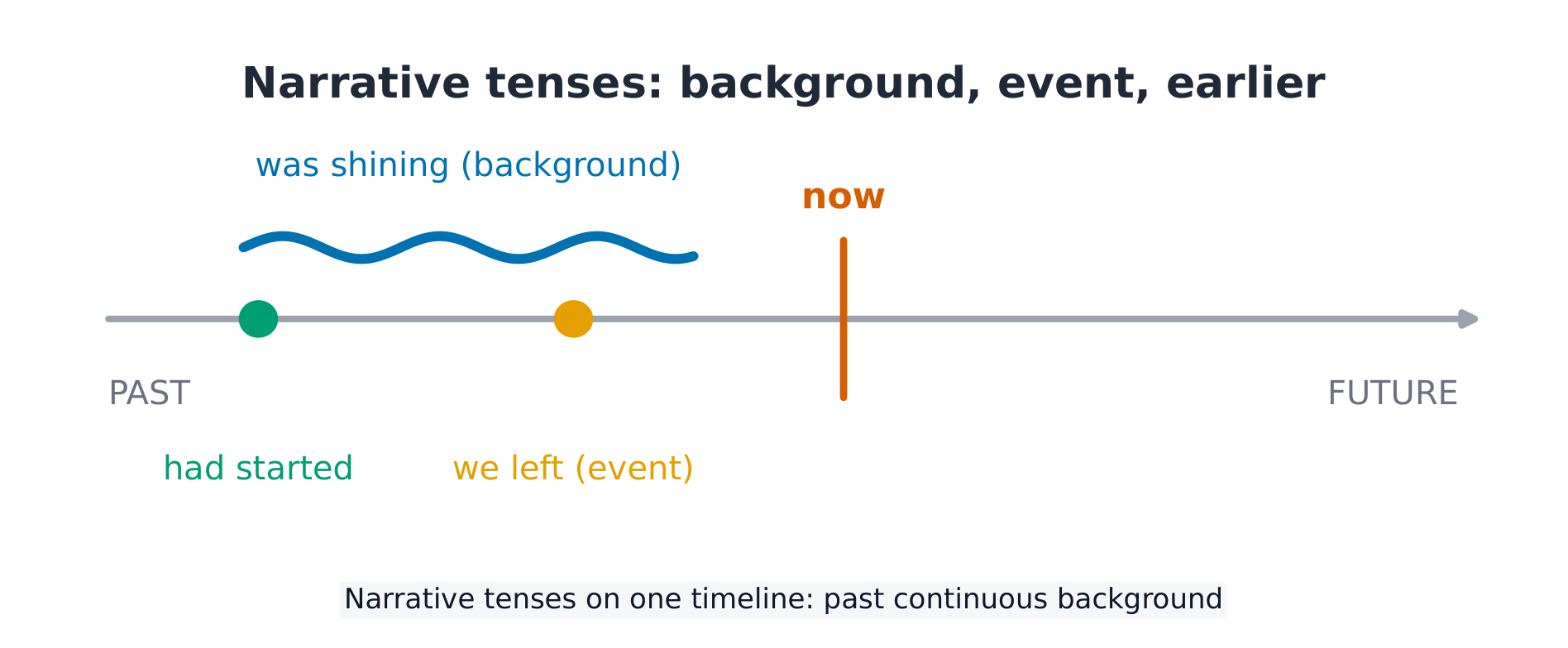
    When telling stories, English uses a set of narrative tenses in combination. The most basic two are:

    • Simple Past: The main actions that advance the plot (one after another).
    • Past Continuous: Setting the background, describing what was happening at that time.

    (冠词)The 太阳sun (过去进行)was 照耀shining 当...时when 我们we 出发left.

    We set off while the sun was shining brightly. (Background + main action)

    她She (过去进行)was 做饭cooking 当...时when (冠词)the 电话phone 响了rang.

    Her phone rang while she was cooking.

    Note A long background action uses the past continuous (was cooking); a short action interrupting it uses the simple past (rang).
    Español
    叙事时态:背景、事件、更早

    Al contar una historia, el inglés utiliza un conjunto de tiempos narrativos (narrative tenses) en combinación. Los dos más básicos son:

    • 一般过去时:推进情节的主要动作(一件接一件)。
    • 过去进行时:设置背景,描述当时正在进行的事。

    (冠词)The 太阳sun (过去进行)was 照耀shining 当...时when 我们we 出发left.

    我们出发时,阳光正灿烂。(背景 + 主要动作)

    她She (过去进行)was 做饭cooking 当...时when (冠词)the 电话phone 响了rang.

    她做饭时电话响了。

    Nota: Las acciones largas de contexto usan pasado continuo (was cooking); las acciones cortas que interrumpen usan pasado simple (rang).

    1.2

    过去完成时表更早的过去

    English

    To indicate an action that occurred before another past action, use the past perfect (had + past participle).

    当...时When 我们we 到达arrived (冠词), the 电影film (过去完成)had 已经already 开始started.

    By the time we arrived, the film had already started. (Started first, arrived later)

    Combination in Narrative:

    • Earliest → Past Perfect (had started).
    • Later → Simple Past (arrived).
    • Background → Past Continuous (was raining).

    Note These three tenses combined clearly convey the timeline of a story.

    Español

    Cuando se necesita expresar que una acción ocurrió antes de otra acción pasada, se usa el pasado perfecto (had + participio pasado).

    当...时When 我们we 到达arrived (冠词), the 电影film (过去完成)had 已经already 开始started.

    我们到时,电影已经开始了。(先开始,后到)

    叙事中的配合:

    • Lo más antiguo → Pasado perfecto (had started).
    • Lo posterior → Pasado simple (arrived).
    • El contexto → Pasado continuo (was raining).

    注意 这三种时态一起,能把一个故事的时间层次讲清楚。

    1.3

    过去完成进行时

    English

    The past perfect continuous (had been + V-ing) emphasizes an action that continued up until a specific point in the past.

    她She (过去)was 累tired 因为because 她she (过去完成)had (进行)been 工作working 一整天all day.

    She was tired because she had been working all day.

    Difference from Past Perfect:

    • Past Perfect Continuous: Emphasizes the continuous process / duration (had been working — kept doing it).
    • Past Perfect: Emphasizes completion / result (had finished — got it done).

    Note Stative verbs (know, be) do not take the continuous form: use had known, not ~~had been knowing~~.

    Common Errors

    • ❌ ~~When the phone rang, she cooked dinner.~~ (Meaning: "was cooking") → ✓ …she was cooking dinner. — Using simple past implies she started cooking after the phone rang.
    • ❌ ~~While I walked home, I was meeting a friend.~~ → ✓ While I was walking home, I met a friend. — Long background actions use continuous tense; short actions use simple past. Do not reverse this.
    • ❌ ~~She had finished the report, then she had sent it.~~ → ✓ She finished the report, then sent it. — When narrating in chronological order, simple past is sufficient; past perfect is only used to look back at an earlier event.
    • ❌ ~~It was the first time I saw snow.~~ → ✓ It was the first time I had seen snow. — "First time" in past narration requires past perfect.
    Español

    El pasado perfecto continuo (had been + V-ing) enfatiza una acción que se mantuvo continua hasta antes de un punto específico del pasado.

    她She (过去)was 累tired 因为because 她she (过去完成)had (进行)been 工作working 一整天all day.

    她很累,因为她一整天都在工作。

    与过去完成时的区别:

    • Pasado perfecto continuo: enfatiza el proceso continuo / duración (had been working — estaba haciendo algo constantemente).
    • Pasado perfecto: enfatiza la finalización / resultado (had finished — terminó de hacer algo).

    Nota: Los verbos de estado (know, be) no se usan en tiempo continuo: se dice had known, no ~~had been knowing~~.

    常见错误

    • ❌ ~~When the phone rang, she cooked dinner.~~ (Quería decir "estaba cocinando") → ✓ …she was cooking dinner. — Si se usa pasado simple, significaría "empezó a cocinar después de que sonó el teléfono".
    • ❌ ~~While I walked home, I was meeting a friend.~~ → ✓ While I was walking home, I met a friend. — La acción larga de contexto debe estar en continuo, y la acción corta en pasado simple; no se deben invertir.
    • ❌ ~~She had finished the report, then she had sent it.~~ → ✓ She finished the report, then sent it. — Al narrar según el orden cronológico de los eventos, basta con el pasado simple; el pasado perfecto solo se usa para "retroceder" y mencionar algo anterior.
    • ❌ ~~It was the first time I saw snow.~~ → ✓ It was the first time I had seen snow. — En la narrativa en pasado, "por primera vez" requiere pasado perfecto.
  • 2 Future continuous and perfect · ⁨Futuro continuo y perfecto⁩
    2.1

    Futuro Continuo (will be + V-ing)

    English

    Future Continuous indicates an action that will be in progress at a specific moment in the future.

    Structure: will be + 动词-ing

    这个时候This time 明天tomorrow 我, I 将will (进行)be 飞flying 去to 巴黎Paris.

    At this time tomorrow, I will be flying to Paris.

    不要Don't 打电话call 在at 八点eight 我们; we 将will (进行)be 吃having 晚饭dinner.

    Don't call at eight; we'll be having dinner then.

    Note: It is also frequently used to politely ask about someone's plans: Will you be using the car tonight?

    Español
    将来进行时与将来完成时

    El futuro continuo (future continuous) se utiliza para expresar acciones que estarán en progreso en un momento específico del futuro.

    结构: will be + 动词-ing

    这个时候This time 明天tomorrow 我, I 将will (进行)be 飞flying 去to 巴黎Paris.

    明天这个时候,我将在飞往巴黎的途中。

    不要Don't 打电话call 在at 八点eight 我们; we 将will (进行)be 吃having 晚饭dinner.

    八点别打电话,我们那时在吃晚饭。

    Nota: También se usa frecuentemente para preguntar educadamente sobre los planes de alguien: Will you be using the car tonight? (¿Vas a usar el coche esta noche?)

    2.2

    Futuro Perfecto (will have + participio pasado)

    English

    Future Perfect indicates an action that will be completed before a specific moment in the future.

    Structure: will have + 过去分词, often used with by + future time.

    到...时By 明年next year 我, I 将will (完成)have 完成finished 我的my 学业studies.

    By next year, I will have graduated.

    他们They 将will (完成)have 离开left 在...之前by ...时候the time 你you 到达arrive.

    They will have left by the time you arrive.

    Note: Common collocation by + time point (e.g., by 2030, by then, by the time…), meaning "by that time."

    Common Errors

    • ❌ ~~By 2030, I will finish my degree.~~ → ✓ By 2030, I will have finished my degree. — "by + future time" is a strong signal for future perfect.
    • ❌ ~~This time tomorrow I will fly to Paris.~~ → ✓ …I will be flying to Paris. — "Action in progress at a future moment" uses will be + -ing; will fly merely states a decision.
    • ❌ ~~I will have finish it by Friday.~~ → ✓ I will have finished it. — Past participle follows will have.
    • ❌ ~~When you will arrive, I will have cooked dinner.~~ → ✓ When you arrive, I will have cooked dinner. — Time clauses still take simple present; no exceptions even with advanced main clauses.
    Español

    El futuro perfecto (future perfect) indica acciones que habrán terminado antes de un momento específico del futuro.

    Estructura: will have + 过去分词, generalmente acompañado de by + tiempo futuro.

    到...时By 明年next year 我, I 将will (完成)have 完成finished 我的my 学业studies.

    到明年,我就会完成学业了。

    他们They 将will (完成)have 离开left 在...之前by ...时候the time 你you 到达arrive.

    你到的时候,他们已经走了。

    Nota: La construcción común es by + punto temporal (by 2030, por ese entonces, hasta que...), que significa "para entonces".

    常见错误

    • ❌ ~~By 2030, I will finish my degree.~~ → ✓ By 2030, I will have finished my degree. — "by + punto temporal" es una señal fuerte del futuro perfecto.
    • ❌ ~~This time tomorrow I will fly to Paris.~~ → ✓ …I will be flying to Paris. — Para una acción en progreso en un momento futuro se usa will be + -ing; "will fly" solo expresa una decisión.
    • ❌ ~~I will have finish it by Friday.~~ → ✓ I will have finished it. — Después de "will have" debe ir el participio pasado.
    • ❌ ~~When you will arrive, I will have cooked dinner.~~ → ✓ When you arrive, I will have cooked dinner. — En las oraciones temporales se mantiene el presente simple; la oración principal no es una excepción.
  • 3 Third and mixed conditionals · ⁨Condicionales de tercer tipo y mixtos⁩
    3.1

    第三条件句

    English

    Third Conditional discusses the past—an unreal assumption and its hypothetical result.

    Structure: If + 过去完成时, would have + 过去分词

    如果If 我I (过去完成)had 学习studied 我, I 会would (完成)have 通过passed.

    If I had studied, I would have passed. (But I didn't study, and I didn't pass)

    Note: It expresses a hypothesis contrary to past facts; often conveys regret or blame. Abbreviations: I'd have, would've.

    Español
    第三与混合条件句

    El tercer condicional (third conditional) habla de situaciones en el pasado: una hipótesis que no ocurrió y su resultado hipotético.

    结构: If + 过去完成时, would have + 过去分词

    如果If 我I (过去完成)had 学习studied 我, I 会would (完成)have 通过passed.

    如果我当时学习了,就会通过了。(其实没学,也没通过)

    Nota: Expresa una suposición contraria a los hechos pasados; suele implicar arrepentimiento o reproche. Abreviaturas: I'd have, would've.

    3.2

    混合条件句

    English

    Mixed Conditional mixes different times. The most common type is: Past cause → Present result.

    Structure: If + 过去完成时, would + 动词原形

    如果If 我I (过去完成)had 存saved 钱money 我, I 会would (是)be 富有rich 现在now.

    If I had saved money, I would be rich now. (Past cause, present result)

    Note: Use would + base verb in the main clause (referring to present), not would have (which refers to the past).

    Español

    Los condicionales mixtos (mixed conditional) combinan tiempos diferentes. El más común es: causa en el pasado → resultado actual.

    结构: If + 过去完成时, would + 动词原形

    如果If 我I (过去完成)had 存saved 钱money 我, I 会would (是)be 富有rich 现在now.

    如果我当初存了钱,现在就富有了。(过去的原因,现在的结果)

    Nota: Preste atención a que la oración principal usa would + infinitivo (refiriéndose al presente), no would have (que se refiere al pasado).

    3.3

    条件句总览

    English

    Comparing all four conditionals together:

    • Zero Conditional: If + present, present. (Universal truths)
    • First Conditional: If + present, will + base verb. (Real future)
    • Second Conditional: If + past, would + base verb. (Unreal present)
    • Third Conditional: If + past perfect, would have + past participle. (Unreal past)

    如果If 我I 是were 你you 我, I 会would 道歉apologize.

    If I were you, I would apologize. (Second conditional)

    Note: Identify the tense of the if-clause: present / past / past perfect determines the conditional type.

    Common Errors

    • ❌ ~~If I would have known, I would have come.~~ → ✓ If I had known, I would have come. — Never use would in the if-clause; this is the most frequent error in spoken English (especially influenced by American TV dramas).
    • ❌ ~~If I had studied, I would pass the exam yesterday.~~ → ✓ …I would have passed the exam. — Past results require would have + past participle.
    • Mixed conditionals are not "random mixing": Only logical combinations like past cause → present result (If I had saved money, I would be rich now) work correctly.
    • Decoding abbreviations: I'd followed by have + past participle → I'd = I would; I'd followed directly by a past participle → I'd = I had. I'd have helped (would) vs. I'd finished (had).
    Español

    把四种条件句放在一起对比:

    • Cero condicional: If + presente, presente. (Verdades generales)
    • Primer condicional: If + presente, will + infinitivo. (Futuro real)
    • Segundo condicional: If + pasado, would + infinitivo. (Irrealidad actual)
    • Tercer condicional: If + pasado perfecto, would have + participio pasado. (Irrealidad pasada)

    如果If 我I 是were 你you 我, I 会would 道歉apologize.

    我要是你,就会道歉。(第二条件句)

    Nota: La clave está en el tiempo verbal del cláusula con if: presente / pasado / pasado perfecto determina qué tipo de condicional es.

    常见错误

    • ❌ ~~If I would have known, I would have come.~~ → ✓ If I had known, I would have come. — Nunca use would después de if; este es el error más frecuente en el habla coloquial (especialmente influenciada por series de TV americanas).
    • ❌ ~~If I had studied, I would pass the exam yesterday.~~ → ✓ …I would have passed the exam. — Un resultado pasado requiere would have + participio.
    • Los condicionales mixtos no son una "mezcla arbitraria": solo funciona cuando hay una causa pasada → resultado actual (If I had saved money, I would be rich now); las partes deben tener coherencia lógica.
    • Descodificando la abreviatura I'd: seguido de have + participio → I'd = I would; seguido directamente de un participio pasado → I'd = I had. I'd have helped (would) vs. I'd finished (had).
  • 4 wish and if only · ⁨wish e if only⁩
    4.1

    wish + pasado (arrepentimiento sobre el presente)

    English

    wish expresses a desire or regret. For dissatisfaction with the present, use past simple (subjunctive) after wish.

    Structure: wish + 一般过去时

    我I 但愿wish 我I 有had 更多more 时间time.

    I wish I had more time. (But I don't)

    她She 但愿wishes 她she 住lived 在by (冠词)the 海边sea.

    She wishes she lived by the sea. (But she doesn't)

    Note: Like the second conditional, the verb be is commonly were: I wish I were taller.

    Español
    wish / if only

    wish se utiliza para expresar deseos o arrepentimientos. Cuando se está insatisfecho con una situación del presente, después de wish se usa el pretérito imperfecto (subjuntivo).

    结构: wish + 一般过去时

    我I 但愿wish 我I 有had 更多more 时间time.

    但愿我有更多时间。(其实没有)

    她She 但愿wishes 她she 住lived 在by (冠词)the 海边sea.

    她希望自己住在海边。(其实没有)

    Nota: Al igual que con la segunda condicional, el verbo be suele usarse como were: I wish I were taller. (Ojalá fuera más alto.)

    4.2

    wish + pasado perfecto / would

    English

    Two advanced usages:

    • Regret about the past: wish + 过去完成时 (should have… but didn't).
    • Dissatisfaction with others' behavior / desire for change: wish + 主语 + would.

    我I 但愿wish 我I (过去完成)had 学习studied 更努力harder.

    I wish I had studied harder. (Regret about the past)

    我I 但愿wish 你you 会would 听listen.

    I wish you could listen. (Dissatisfaction with others' behavior)

    Note: if only functions like wish but with stronger emphasis: If only I had known!

    Common Errors

    • ❌ ~~I wish I have more time.~~ → ✓ I wish I had more time. — Tense must "step back" after wish.
    • ❌ ~~I wish I studied harder last year.~~ → ✓ I wish I had studied harder last year. — Regrets about the past require past perfect.
    • ❌ ~~I wish I would be taller.~~ → ✓ I wish I were taller. — wish + would applies only to dissatisfaction with others' behavior, never oneself.
    • ❌ ~~I wish you will pass the exam.~~ → ✓ I hope you pass the exam. — Wishes for real possibilities use hope; wish + clause expresses "unreality" (except fixed phrases like I wish you good luck).
    Español

    两种进阶用法:

    • 对过去的遗憾:wish + 过去完成时(本该……却没有)。
    • 对别人行为的不满 / 希望改变:wish + 主语 + would。

    我I 但愿wish 我I (过去完成)had 学习studied 更努力harder.

    但愿我当初更努力学习。(过去的遗憾)

    我I 但愿wish 你you 会would 听listen.

    我希望你能听一听。(对别人行为的不满)

    Nota: if only tiene el mismo uso que wish, pero con un tono más fuerte: If only I had known! (¡Si tan solo lo hubiera sabido!)

    常见错误

    • ❌ ~~I wish I have more time.~~ → ✓ I wish I had more time. — El tiempo verbal después de wish debe "retroceder".
    • ❌ ~~I wish I studied harder last year.~~ → ✓ I wish I had studied harder last year. — Para arrepentirse del pasado, se debe retroceder al pasado perfecto.
    • ❌ ~~I wish I would be taller.~~ → ✓ I wish I were taller. — Wish + would solo se usa para expresar insatisfacción con el comportamiento de otros, no con uno mismo.
    • ❌ ~~I wish you will pass the exam.~~ → ✓ I hope you pass the exam. — Para deseos que pueden ocurrir en la realidad se usa hope; wish + oración expresa algo "contrario a la realidad" (excepto en fórmulas fijas como I wish you good luck).
  • 5 Advanced passive · ⁨Voz pasiva avanzada⁩
    5.1

    各种时态的被动

    English

    The passive voice can be used in any tense—simply change the form of be, which is always followed by a past participle.

    Tense Passive Structure
    Present Simple am / is / are + past participle
    Past Simple was / were + past participle
    Present Perfect has / have been + past participle
    Future will be + past participle
    Modal can / must be + past participle

    (冠词)The 桥bridge (完成)has (被动)been 修理repaired.

    This bridge has already been repaired. (Present Perfect Passive)

    (冠词)The 工作work 将will (被动)be 完成done 很快soon.

    The work will soon be completed. (Future Passive)

    Note: Regardless of the tense, the core of the passive structure is always be (changing) + past participle (unchanged).

    Español
    各时态的被动

    El pasivo puede usarse en cualquier tiempo verbal; solo se cambia la forma del verbo be, seguido siempre de un participio pasado.

    时态 被动结构
    Presente simple am / is / are + participio pasado
    Pasado simple was / were + participio pasado
    Presente perfecto has / have been + participio pasado
    Futuro will be + participio pasado
    Modal can / must be + participio pasado

    (冠词)The 桥bridge (完成)has (被动)been 修理repaired.

    这座桥已经修好了。(现在完成被动)

    (冠词)The 工作work 将will (被动)be 完成done 很快soon.

    工作很快就会完成。(将来被动)

    Nota: Independientemente del tiempo verbal, el núcleo del pasivo es siempre be (conjugado) + participio pasado (invariable).

    5.2

    Pasivo impersonal (it is said that…)

    English

    When reporting general opinions or rumors without specifying who said it, we often use the passive reporting structure:

    • It is said / believed / thought that + clause.
    • Subject + is said / believed to + infinitive / base verb.

    (形式主语)It (被动)is 说said (连词)that 他he 是is 非常very 富有rich.

    He is said to be very rich.

    他He (被动)is 说said (不定式)to 是be 非常very 富有rich.

    It is said that he is very rich. (Same meaning, subject moved forward)

    Note: Such structures are common in news and formal writing, allowing for objective reporting of unverified information.

    Common Errors

    • ❌ ~~The bridge has repaired.~~ → ✓ The bridge has been repaired. — In the perfect passive, been is easily omitted; without been, it means "the bridge repaired something else".
    • ❌ ~~The problem must be solve.~~ → ✓ The problem must be solved. — Modal passive = modal verb + be + past participle.
    • ❌ ~~He is said that he is rich.~~ → ✓ It is said that he is rich. / He is said to be rich. — The two "said" structures cannot be combined.
    • Additional: There is also a continuous passive — am / is / are being + past participle: The road is being repaired. (The road is currently being repaired.)
    Español

    当转述大家的看法 / 传闻、却不想指明是谁说时,常用被动转述结构:

    • It is said / believed / thought that + oración.
    • Sujeto + is said / believed to + infinitivo.

    (形式主语)It (被动)is 说said (连词)that 他he 是is 非常very 富有rich.

    据说他很有钱。

    他He (被动)is 说said (不定式)to 是be 非常very 富有rich.

    据说他很有钱。(同义,主语提前)

    注意 这类结构在新闻和正式写作里很常见,能客观地转述未经证实的信息。

    常见错误

    • ~~The bridge has repaired.~~ → ✓ The bridge has been repaired. — Es fácil omitir been en el perfecto; sin been, la frase significa "el puente reparó (algo más)".
    • ❌ ~~The problem must be solve.~~ → ✓ The problem must be solved. — El pasivo con modal = modal + be + participio pasado.
    • ❌ ~~He is said that he is rich.~~ → ✓ It is said that he is rich. / He is said to be rich. — No se deben mezclar las dos estructuras de "se dice".
    • Complemento: también existe el pasivo continuo — am / is / are being + participio pasado: The road is being repaired. (La carretera está siendo reparada).
  • 6 Reported questions and commands · ⁨Preguntas y mandatos indirectos⁩
    6.1

    间接疑问句

    English

    When reporting a question, the word order changes back to statement word order (subject + verb), and the question mark is removed.

    • Yes/No questions → introduced by if / whether.
    • Wh- questions → introduced by the original question word (what, where…).

    她She 问asked 哪里where 我I 住lived.

    She asked me where I lived. (Original: "Where do you live?")

    他He 问asked 是否if 我I (过去)was 忙busy.

    He asked me if I was busy. (Original: "Are you busy?")

    Note: In indirect questions, auxiliary verbs do / does / did are not used, and there is no inversion: ~~where did I live~~ ✗ → where I lived ✓.

    Español
    间接疑问句与命令

    转述问题时,语序要变回陈述句语序(主语 + 动词),并去掉问号。

    • Preguntas de sí/no → Se introducen con if / whether.
    • Preguntas wh- → Se introducen con la misma palabra interrogativa original (what, where...).

    她She 问asked 哪里where 我I 住lived.

    Ella me preguntó dónde vivía. (Original: "Where do you live?")

    他He 问asked 是否if 我I (过去)was 忙busy.

    Él me preguntó si estaba ocupado. (Original: "Are you busy?")

    Nota: En las preguntas indirectas no se usa el auxiliar do / does / did, ni tampoco hay inversión del sujeto y el verbo: ~~where did I live~~ ✗ → where I lived ✓.

    6.2

    间接命令与请求

    English

    When reporting a command, request, or suggestion, use tell / ask / advise + someone + (not) to + base verb.

    她She 叫told 我me (不定式)to 等wait.

    She told me to wait a moment. (Original: "Wait.")

    他He 请asked 我me 不要not to (是)be 迟到late.

    He asked me not to be late. (Original: "Please don't be late.")

    Note: Negative commands use not to: asked me not to go (asked me not to go).

    Common Errors

    • ❌ ~~He asked me am I busy.~~ → ✓ He asked me if I was busy. — You cannot simply insert the original sentence; it must become if + statement word order.
    • ❌ ~~She said me to wait.~~ → ✓ She told me to wait. — For reporting commands, use tell / ask / advise + person + to do; say cannot take this construction.
    • ❌ ~~He told me don't be late.~~ → ✓ He told me not to be late. — Negative commands become not to; don't cannot be inserted directly into reported speech.
    • ❌ ~~She suggested me to go home.~~ → ✓ She suggested that I (should) go home. / She suggested going home. — suggest cannot be followed by "person + to do".
    Español

    Al reportar una orden, petición o sugerencia, se utiliza tell / ask / advise + alguien + (not) to + infinitivo.

    她She 叫told 我me (不定式)to 等wait.

    Ella me dijo que esperara. (Original: "Wait.")

    他He 请asked 我me 不要not to (是)be 迟到late.

    Él me pidió que no llegara tarde. (Original: "Please don't be late.")

    Nota: Las órdenes negativas usan not to: asked me not to go (me pidió que no fuera).

    常见错误

    • ❌ ~~He asked me am I busy.~~ → ✓ He asked me if I was busy. — No se puede insertar la oración original directamente; debe convertirse en if + orden afirmativo.
    • ❌ ~~She said me to wait.~~ → ✓ She told me to wait. — Para reportar órdenes se usa tell / ask / advise + persona + to do; say no se utiliza de esta forma.
    • ❌ ~~He told me don't be late.~~ → ✓ He told me not to be late. — Las órdenes negativas se transforman en not to; no se transcribe don't literalmente.
    • ❌ ~~She suggested me to go home.~~ → ✓ She suggested that I (should) go home. / She suggested going home. — Suggest no puede ir seguido de "persona + to do".
  • 7 Past modals · ⁨Modales del pasado⁩
    7.1

    must have / can't have (deducción)

    English

    When speculating about the past, use modal verb + have + past participle. When you are certain:

    • must have + past participle: Must have been… (in the past).
    • can't have + past participle: Cannot have been… (in the past).

    他He 一定must (完成)have 忘记forgotten.

    He must have forgotten. (A definite positive speculation about the past)

    她She 不可能can't (完成)have 看见seen 我们us.

    She can't have seen us.

    Note: Negative speculation uses can't have, not mustn't have.

    Español
    过去情态动词:推测/遗憾/可能

    Para hablar de deducciones sobre el pasado, se utiliza verbo modal + have + participio pasado. Cuando se tiene mucha seguridad:

    • must have + participio pasado: debe haber sido... (seguridad afirmativa sobre el pasado).
    • can't have + participio pasado: no puede haber sido... (seguridad negativa sobre el pasado).

    他He 一定must (完成)have 忘记forgotten.

    他一定是忘了。(对过去很确定的肯定推测)

    她She 不可能can't (完成)have 看见seen 我们us.

    她不可能看见我们了。

    Nota Para la deducción negativa se usa can't have, no mustn't have.

    7.2

    should have (arrepentimiento, crítica)

    English

    should have + past participle indicates "should have done but didn’t

    我I 本该should (完成)have 学习studied 更努力harder.

    I should have studied harder. (Regret)

    你You 本不该shouldn't (完成)have 说said 那that.

    You shouldn't have said that. (Criticism)

    Note: It refers to something not done (or done) in the past that is now regretted.

    Español

    should have + participio pasado indica "habría debido hacer algo pero no lo hizo" — suele implicar arrepentimiento o crítica.

    我I 本该should (完成)have 学习studied 更努力harder.

    我本该更努力学习的。(遗憾)

    你You 本不该shouldn't (完成)have 说said 那that.

    你本不该说那句话。(批评)

    注意 它说的是过去没做(或做了)、现在后悔的事。

    7.3

    could have / might have (posibilidad)

    English

    could have / might have + past participle indicates something that was possible in the past (but not certain).

    他们They 可能might (完成)have 错过missed (冠词)the 火车train.

    They may have missed the train.

    (它)It 本可能could (完成)have 是been 更糟worse.

    Things could have been worse.

    Note: could have can also mean "could have done but didn't": I could have helped, but I didn't. (I could have helped, but I didn't.)

    Common Errors

    • ❌ ~~He must forgot.~~ → ✓ He must have forgotten. — Speculation about the past requires "modal + have + past participle"; there is no form like "must forgot".
    • ❌ ~~I should have went.~~ / Mishearing as oral speech ~~should of gone~~ → ✓ I should have gone. — After have comes the past participle; connected speech sounds like "of," but it must be written as "have."
    • ❌ ~~I could help you yesterday, but I was busy.~~ → ✓ I could have helped you yesterday… — "Could have done" expresses "could have but didn't"; could + base verb only expresses general ability in the past.
    • ❌ ~~You should had called.~~ → ✓ You should have called. — After a modal verb always comes the base form "have," never "had."
    Español

    could have / might have + participio pasado indica algo que podría haber ocurrido en el pasado (pero con incertidumbre).

    他们They 可能might (完成)have 错过missed (冠词)the 火车train.

    他们可能错过了火车。

    (它)It 本可能could (完成)have 是been 更糟worse.

    情况本可能更糟的。

    Nota Could have también puede significar "habría podido hacer algo pero no lo hizo": I could have helped, but I didn't. (Podría haber ayudado, pero no lo hice).

    常见错误

    • ❌ ~~He must forgot.~~ → ✓ He must have forgotten. — Para una deducción sobre el pasado es necesario "verbo modal + have + participio pasado"; no existe la forma must forgot.
    • ❌ ~~I should have went.~~ / Error al escuchar ~~should of gone~~ → ✓ I should have gone. — Después de have va el participio pasado; en el habla coloquial la pronunciación suena como of, pero siempre se escribe have.
    • ❌ ~~I could help you yesterday, but I was busy.~~ → ✓ I could have helped you yesterday… — Para expresar "habría podido hacerlo pero no lo hizo" se usa could have done; could + infinitivo sin have solo indica capacidad general en el pasado.
    • ❌ ~~You should had called.~~ → ✓ You should have called. — Después de un verbo modal siempre va el infinitivo have, nunca had.
  • 8 Relative clauses (defining and non-defining) · ⁨Oraciones relativas (defining y non-defining)⁩
    8.1

    Restrictivo vs No restrictivo

    English

    Relative clauses are divided into two types, distinguished by whether the information is essential:

    • Restrictive (defining): Provides essential information, identifying "which one," with no comma.
    • Non-restrictive (non-defining): Provides extra information; removing it does not affect identification, so it is set off by commas.

    (冠词)The 男人man (关系代词)who 打电话called 是is 我的my 老板boss.

    The man who called is my boss. (Restrictive: identifies which man)

    我的My 老板boss (关系代词), who 是is 非常very 友善kind 打电话, called 我me.

    My boss called me, and he is a very nice person. (Non-restrictive: supplementary information)

    Note: A comma signals a non-restrictive clause, indicating the information is an aside.

    Español
    Restrictivo vs no restrictivo

    定语从句分两种,区别在于信息是否必不可少:

    • Restrictiva (defining): Aporta información necesaria para identificar el sustantivo ("cuál"), sin comas.
    • No restrictiva (non-defining): Aporta información adicional, que se puede eliminar sin perder la identidad del sustantivo; se separa con comas.

    (冠词)The 男人man (关系代词)who 打电话called 是is 我的my 老板boss.

    打电话来的那个男人是我老板。(限制性:指明是哪个男人)

    我的My 老板boss (关系代词), who 是is 非常very 友善kind 打电话, called 我me.

    我老板打电话给我,他人非常好。(非限制性:补充信息)

    注意 看到逗号就知道是非限制性,里面的信息是"顺便一提"。

    8.2

    Comas y which

    English

    There are also differences in the choice of relative pronouns between the two types of clauses:

    • Restrictive: Use who / that for people, which / that for things; may be omitted when functioning as an object.
    • Non-restrictive: Use who for people, which for things; that cannot be used, and it cannot be omitted.

    这This 书book (关系代词), which 我I 读read 去年last year 是, is 优秀excellent.

    *I read this book last year, which was excellent. (Non-restrictive, use which)

    Note: that is never used in non-restrictive clauses: ~~My boss, that is kind, …~~ ✗ → My boss, who is kind, … ✓.

    Common Errors

    • ❌ ~~My mother who lives in Beijing is a teacher.~~ → ✓ My mother**, who** lives in Beijing**,** is a teacher. — Unique people or things (mother, Beijing, sun) can only take non-restrictive clauses; omitting commas implies "you have several mothers".
    • ❌ ~~He failed the exam, it made his parents angry.~~ → ✓ …the exam**, which** made his parents angry. — A comma cannot directly join two sentences; a comma plus which refers to the entire preceding situation.
    • ❌ ~~My boss, I met yesterday, is kind.~~ → ✓ My boss, who(m) I met yesterday, is kind. — The relative pronoun in a non-restrictive clause cannot be omitted.
    • Commas must appear in pairs: When a clause is inserted mid-sentence, it requires commas on both sides: My boss, who is kind, called me.
    Español

    两种从句在关系代词的选择上也有区别:

    • Restrictiva: Para personas usamos who / that; para cosas, which / that. Al funcionar como objeto, pueden omitirse.
    • No restrictiva: Para personas usamos who; para cosas, which. No se usa that y no se puede omitir.

    这This 书book (关系代词), which 我I 读read 去年last year 是, is 优秀excellent.

    Este libro que leí el año pasado es excelente. (No restrictiva, uso de which)

    Atención: En las oraciones no restrictivas nunca se usa that: ~~My boss, that is kind, …~~ ✗ → My boss, who is kind, … ✓.

    常见错误

    • ❌ ~~My mother who lives in Beijing is a teacher.~~ → ✓ My mother**, who** lives in Beijing**,** is a teacher. — Las personas o cosas únicas (madre, Pekín, el sol) solo admiten oraciones no restrictivas; no poner comas implicaría que tienes varias madres.
    • ❌ ~~He failed the exam, it made his parents angry.~~ → ✓ …the exam**, which** made his parents angry. — Una coma no puede unir dos oraciones independientes; "coma + which" permite referirse a toda la situación anterior.
    • ❌ ~~My boss, I met yesterday, is kind.~~ → ✓ My boss, who(m) I met yesterday, is kind. — El pronombre relativo en una oración no restrictiva no se puede omitir.
    • Las comas deben ir en pares: cuando la oración va insertada entre otras partes, debe tener coma antes y después: My boss, who is kind, called me.
  • 9 The causative · ⁨El causativo⁩
    9.1

    have something done

    English

    The causative structure expresses having someone else do something for you, rather than doing it yourself.

    Structure: have + 宾语 + 过去分词

    我I (使役)had 我的my 头发hair 剪cut 昨天yesterday.

    I got my hair cut yesterday. (Not by myself)

    我们We (be)are (使役)having 我们的our 房子house 粉刷painted.

    We are getting the house painted. (By someone else)

    Note: Pay attention to word order: have + object + past participle. I had my car repaired. (I sent it to be fixed) differs from I repaired my car. (I did it myself).

    Español
    Estructura causativa: have/get something done

    Estructura causativa (the causative) significa "hacer que alguien haga algo por ti", en lugar de hacerlo tú mismo.

    结构: have + 宾语 + 过去分词

    我I (使役)had 我的my 头发hair 剪cut 昨天yesterday.

    我昨天(请人)剪了头发。(不是自己剪的)

    我们We (be)are (使役)having 我们的our 房子house 粉刷painted.

    我们正在(请人)粉刷房子。

    Nota Presta atención al orden: have + cosa + participio pasado. I had my car repaired. (Llevé mi coche a reparar.) y I repaired my car. (Lo reparé yo mismo) tienen significados diferentes.

    9.2

    get something done

    English

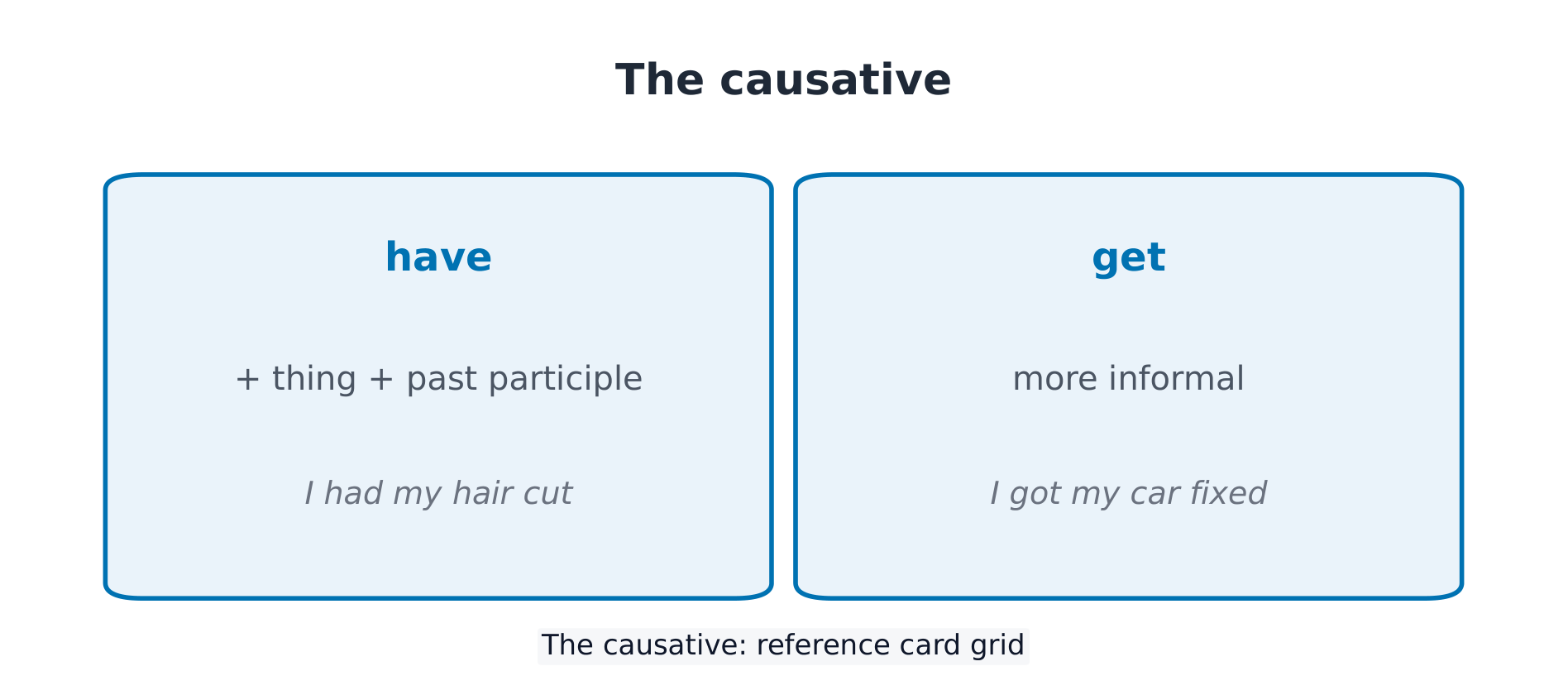
    get + object + past participle functions similarly to have, but is more informal.

    我I 需要need to (使役)get 我的my 手机phone 修理fixed.

    *I need to get my phone repaired.

    她She (使役)got 她的her 照片photo 拍taken.

    She got a photo taken. (By someone else)

    Note: In causative structures, have and get are largely interchangeable; get carries a more casual, conversational tone.

    Common Errors

    • ❌ ~~I cut my hair yesterday.~~ (Actually at the salon) → ✓ I had my hair cut yesterday. — Using the active voice implies you cut it yourself with scissors.
    • ❌ Incorrect word order: ~~I had cut my hair~~ is the past perfect tense ("I had already cut it before then"), not causative; the causative form is have + object + past participle: I had my hair cut.
    • ❌ ~~I had my hair cutted.~~ → ✓ …cut. — The past participle in the causative structure must also be correct: cut–cut–cut remains unchanged.
    • To ask someone to do it: have + person + base form, get + person + to do: I'll have John fix it. / I'll get John to fix it.
    Español

    get + objeto + participio pasado tiene un uso muy similar al de have, pero es más coloquial.

    我I 需要need to (使役)get 我的my 手机phone 修理fixed.

    我得把手机拿去修。

    她She (使役)got 她的her 照片photo 拍taken.

    她(请人)拍了张照片。

    Nota En la estructura causativa, have y get son intercambiables en la mayoría de los casos; sin embargo, get suena más informal y coloquial.

    常见错误

    • ❌ ~~I cut my hair yesterday.~~ (Fue en la peluquería) → ✓ I had my hair cut yesterday. — Decirlo en voz activa implica que te lo cortaste con las tijeras tú mismo.
    • ❌ Invertir el orden: ~~I had cut my hair~~ está en pretérito pluscuamperfecto ("ya me había cortado antes"), no es causativo; la estructura causativa es have + objeto + participio pasado: I had my hair cut.
    • ❌ ~~I had my hair cutted.~~ → ✓ …cut. — El participio pasado en la estructura causativa también debe ser correcto: cut–cut–cut no cambia.
    • Para pedirle a alguien que haga algo: have + persona + infinitivo sin "to", get + persona + to + infinitivo: I'll have John fix it. / I'll get John to fix it.
  • 10 Contrast linkers · ⁨Conectores de contraste⁩
    10.1

    although, though, even though

    English

    These conjunctions express contrast / concession ("although...but..."). They are followed by a complete sentence (subject + verb).

    • although / though: Although. even though: Stronger tone, meaning "even if / despite the fact that".

    虽然Although (天气it)it (过去)was 下雨raining 我们, we 去went 外出out.

    *Although it was raining, we still went out.

    他He 通过passed 尽管, even though 他he 没有hadn't 学习studied.

    *Even though he didn't study, he still passed.

    Note: though can also appear at the end of a sentence to mean "however" (informal): It's expensive. I like it, though.

    Español
    对比连接词:although/despite/however

    这些连接词表示转折 / 让步("虽然……但是……")。它们后面跟一个完整的句子(主语 + 动词)。

    • although / though: aunque. even though: tiene un tono más fuerte, "a pesar de que".

    虽然Although (天气it)it (过去)was 下雨raining 我们, we 去went 外出out.

    虽然在下雨,我们还是出门了。

    他He 通过passed 尽管, even though 他he 没有hadn't 学习studied.

    尽管他没学习,还是通过了。

    Nota: though también puede ir al final de la oración, significando "sin embargo" (coloquial): It's expensive. I like it, though.

    10.2

    despite, in spite of

    English

    despite and in spite of have the same meaning as although, but they are followed by nouns / gerunds, not complete sentences.

    尽管Despite (冠词)the 雨rain 我们, we 去went 外出out.

    *Despite the rain, we still went out.

    尽管In spite of 是being 累tired 她, she 继续kept 工作working.

    *Despite being very tired, she continued working.

    Note: Key distinction: although + sentence; despite / in spite of + noun / -ing. ~~despite it was raining~~ ✗ → despite the rain ✓.

    Español

    despite e in spite of tienen el mismo significado que although, pero van seguidos de un sustantivo / gerundio, no de una oración completa.

    尽管Despite (冠词)the 雨rain 我们, we 去went 外出out.

    尽管下着雨,我们还是出门了。

    尽管In spite of 是being 累tired 她, she 继续kept 工作working.

    尽管很累,她还是继续工作。

    Nota: Diferencia clave: although + oración; despite / in spite of + sustantivo / -ing. ~~despite it was raining~~ ✗ → despite the rain ✓.

    10.3

    however, nevertheless

    English

    however and nevertheless are conjunctive adverbs that connect two sentences, usually placed at the beginning of a sentence followed by a comma.

    (它)It (过去)was 贵expensive 然而. However 我们, we 买bought 它it.

    *It was expensive. However, we still bought it.

    Note: However typically forms its own sentence separated by a comma; do not use it to directly join two clauses like but.

    Common Errors

    • ❌ ~~Although it was raining, but we went out.~~ → ✓ Keep only one: Although it was raining, we went out. / It was raining, but we went out. — Chinese "although...but..." appears in pairs, but English allows only one.
    • ❌ ~~Despite of the rain…~~ → ✓ despite the rain / in spite of the rain — despite never takes of; in spite always takes of; do not mix them.
    • ❌ ~~Even he studied hard, he failed.~~ → ✓ Even though he studied hard… — even alone is not a conjunction; use even though / even if.
    • ❌ ~~It was expensive, however we bought it.~~ → ✓ It was expensive. However, we bought it. (Or using a semicolon: …expensive**; however,** we…) — However cannot join two clauses with just a comma like but.
    Español

    however y nevertheless son adverbios conectivos que enlazan dos oraciones; suelen colocarse al inicio de la oración seguidos de coma.

    (它)It (过去)was 贵expensive 然而. However 我们, we 买bought 它it.

    它很贵。然而,我们还是买了。

    Nota: however suele formar una oración separada, con coma; no debe usarse para unir directamente dos cláusulas como hace but.

    常见错误

    • ❌ ~~Although it was raining, but we went out.~~ → ✓ Dejar solo uno: Although it was raining, we went out. / It was raining, but we went out. — En chino "aunque... pero..." se usan en pareja, en inglés solo se escoge uno.
    • ❌ ~~Despite of the rain…~~ → ✓ despite the rain / in spite of the rain — despite nunca lleva de; in spite siempre lleva de; no mezclarlos.
    • ❌ ~~Even he studied hard, he failed.~~ → ✓ Even though he studied hard… — even por sí solo no es conjunción, debe ser even though / even if.
    • ❌ ~~It was expensive, however we bought it.~~ → ✓ It was expensive. However, we bought it. (o usar punto y coma: …expensive**; however,** we…) — however no une dos cláusulas con una coma como lo haría but.
  • 11 Articles (advanced) · ⁨Artículos (avanzado)⁩
    11.1

    Artículos indefinidos vs. definidos

    English

    At B2 level, the difficulty with articles lies in distinguishing generic reference from specific reference:

    • Generic reference (whole categories): Plural / uncountable nouns, no the.
    • Specific reference (particular ones): Use the.

    老虎Tigers 是are 危险dangerous.

    *Tigers are dangerous. (Refers to tigers in general, no the)

    (特指)The 老虎tigers 在at (冠词)the 动物园zoo 是are 困倦sleepy.

    *The tigers in the zoo are sleepy. (Specific, use the)

    Note: Abstract nouns are also used without the for generic reference: Love is important. (Love is important.) But the love of a mother uses the when referring specifically.

    Español
    Seleccionar artículo: a/an · the · artículo cero

    到了 B2,冠词的难点在于区分泛指和特指:

    • Uso indefinido (toda una clase de cosas): sustantivos plurales / incontables, sin the.
    • Uso definido (los específicos): con the.

    老虎Tigers 是are 危险dangerous.

    Tigres son peligrosos. (Se refiere a todos los tigres en general, sin the)

    (特指)The 老虎tigers 在at (冠词)the 动物园zoo 是are 困倦sleepy.

    Los tigres del zoológico son soñolientos. (Referencia específica, con the)

    Nota: Los sustantivos abstractos también van sin the cuando se usan en sentido indefinido: Love is important. (El amor es importante). Pero si se refieren específicamente, sí llevan the: the love of a mother (el amor de una madre).

    11.2

    固定搭配

    English

    In many collocations, article usage is fixed and must be memorized as a whole:

    • No article: go to bed / school / work, by car / bus, at home, have breakfast.
    • Use the: in the morning, play the piano, the same, listen to the radio.

    我I 去go (介词)to 上班work 乘by 公交bus.

    *I go to work by bus. (Neither go to work nor by bus takes an article)

    Note: These collocations lack much logical reasoning; memorizing them as fixed phrases is most effective.

    Common Errors

    • ❌ ~~the China / the Japan~~ → ✓ China / Japan; but ✓ the US, the UK, the Netherlands, the Philippines — Only countries with plural forms or "organizational" names take the.
    • ❌ ~~Most of people agree.~~ → ✓ Most people agree. / Most of the people in this room agree. — most goes directly before a noun; most of must be followed by the / my / these etc.
    • Distinguish (British English): be in hospital (admitted as a patient) vs. go to the hospital (go to the building, e.g., to visit someone). The same applies to in prison / at school.
    • the + adjective refers to a class of people: The rich should help the poor.
    Español

    很多搭配里冠词的用法是固定的,要整体记:

    • Sin artículo: go to bed / school / work, by car / bus, at home, have breakfast.
    • Con the: in the morning, play the piano, the same, listen to the radio.

    我I 去go (介词)to 上班work 乘by 公交bus.

    Voy al trabajo en autobús. (Ni "go to work" ni "by bus" llevan artículo)

    注意 这些搭配没有太多道理,当作固定短语背下来最有效。

    常见错误

    • ❌ ~~the China / the Japan~~ → ✓ China / Japan; pero ✓ the US, the UK, the Netherlands, the Philippines — solo los nombres de países en plural o con forma de organización llevan the.
    • ❌ ~~Most of people agree.~~ → ✓ Most people agree. / Most of the people in this room agree. — most va seguido directamente del sustantivo; most of requiere obligatoriamente the, my, these u otros determinantes.
    • Diferencia (inglés británico): be in hospital(estar internado, estar enfermo) vs. go to the hospital(ir al edificio del hospital, por ejemplo, para visitar a alguien). Lo mismo aplica para in prison / at school.
    • the + adjetivo para referirse a un grupo de personas: The rich should help the poor. (Los ricos deben ayudar a los pobres).
  • 12 Emphasis · ⁨Énfasis⁩
    12.1

    so y such para enfatizar

    English

    so and such are used to intensify meaning ('so...that' or 'such...that'), often followed by that to introduce a result.

    • so + adjective / adverb (+ that …).
    • such + (a/an) + adjective + noun (+ that …).

    (它)It (过去)was 如此so 冷cold 以至于that (冠词)the 湖lake 结冰froze.

    It is so cold that the lake has frozen over.

    (它)It (过去)was 如此such 一个a 好good 电影film 以至于that 我I 哭了cried.

    That movie was so good that I cried.

    Note: Follow so with an adjective (so cold); follow such with a noun phrase (such a good film).

    Español
    Énfasis: so / such / do

    so y such se utilizan para intensificar el significado ("tan... que...", "tan... tal que..."), seguidos frecuentemente por that para introducir un resultado.

    • so + adjetivo / adverbio (+ that …).
    • such + (a/an) + adjetivo + sustantivo (+ that …).

    (它)It (过去)was 如此so 冷cold 以至于that (冠词)the 湖lake 结冰froze.

    Hacía tanto frío que el lago se heló.

    (它)It (过去)was 如此such 一个a 好good 电影film 以至于that 我I 哭了cried.

    La película era tan buena que lloré.

    Nota: Después de so va un adjetivo (so cold); después de such va un grupo nominal (such a good film).

    12.2

    so do I, neither do I

    English

    To express "Me too" or "Me neither," English uses a short inverted structure where the auxiliary verb must match the previous sentence:

    • Affirmative agreement: So + auxiliary verb + subject (So do I / So am I / So can I).
    • Negative agreement: Neither + auxiliary verb + subject (Neither do I / Neither am I).

    "I like tea." — 也So (助动词)do 我I.

    "I like tea." — "Me too."

    "I can't swim." — 也不Neither (助动词)can 我I.

    "I can't swim." — "Neither can I."

    Note: The auxiliary verb must match the tense/verb of the previous sentence: if the previous sentence uses are → So are they; if it uses don't → Neither do I.

    Common Errors

    • ❌ "I love this song." — ~~So am I.~~ → ✓ So do I. — The agreeing auxiliary must match the previous sentence: main verbs → do / does / did; be → am / is; can → can.
    • ❌ "I don't like it." — ~~Me too.~~ → ✓ Me neither. / Neither do I. — Do not use too for negative agreements.
    • ❌ "I can't swim." — ~~So can't I.~~ → ✓ Neither can I. — Negative inversion begins with neither / nor, never so + negative.
    • To emphasize "really," avoid using very + verb: ❌ ~~I very like it.~~ → ✓ I do like it. / I really like it. — Placing the auxiliary do before the verb creates emphasis.
    Español

    Para expresar "yo también / yo tampoco", en inglés se utiliza una estructura corta con inversión, donde el auxiliar debe concordar con la oración anterior:

    • Afirmativo: So + auxiliar + sujeto (So do I / So am I / So can I).
    • Negativo: Neither + auxiliar + sujeto (Neither do I / Neither am I).

    "I like tea." — 也So (助动词)do 我I.

    "Me gusta el té." — "A mí también."

    "I can't swim." — 也不Neither (助动词)can 我I.

    "No sé nadar." — "Yo tampoco."

    Nota: El auxiliar debe coincidir con el tiempo verbal / verbo de la oración anterior: si la anterior es are → So are they; si es don't → Neither do I.

    Errores comunes

    • ❌ "I love this song." — ~~So am I.~~ → ✓ So do I. — El auxiliar de afirmación debe concordar con la oración anterior: verbo de acción → do / does / did; verbo ser/estar → am / is; modales → can.
    • ❌ "I don't like it." — ~~Me too.~~ → ✓ Me neither. / Neither do I. — En oraciones negativas no se usa too.
    • ❌ "I can't swim." — ~~So can't I.~~ → ✓ Neither can I. — La inversión negativa comienza con neither o nor, no con so más negativo.
    • Para enfatizar "de verdad", no uses very + verbo: ❌ ~~I very like it.~~ → ✓ I do like it. / I really like it. — Colocar el auxiliar do antes del verbo sirve para dar énfasis.

Log in or create account · ⁨Iniciar sesión o crear cuenta⁩

IGCSE, A-Level & AP