Skip to content · ⁨الانتقال إلى المحتوى⁩
Subjects · ⁨المواد⁩

English Grammar · B1 · ⁨قواعد اللغة الإنجليزية · B1⁩

  • 1 Present perfect vs past simple
    1.1

    الماضي المؤكد مقابل المرتبط بالحاضر

    English

    Both tenses refer to the past, but they differ based on whether a specific time is mentioned and whether there is a connection to the present:

    • Past Simple: The action ended at a definite time in the past and has no relevance to the present.
    • Present Perfect: No specific time is mentioned; it emphasizes the impact on or experience related to the present.

    我I 看saw 他him 昨天yesterday.

    I saw him yesterday. (Definite time → Past Simple)

    我I (完成时)have 看seen 那部that 电影film.

    I have seen that movie. (Experience, no specific time mentioned → Present Perfect)

    Note: Once definite past time markers such as yesterday, last week, in 2019, or ago appear, use the Past Simple, not the Present Perfect.

    العربية
    الماضي البسيط مقابل المضارع التام

    كلا الزمنين يتكلمان عن الماضي، لكن الفرق يكمن في ذكر وقت محدد أو ارتباطه بالآن:

    • الماضي البسيط (past simple): حدث انتهى في زمن ماضٍ محدد ولا علاقة له بالحاضر.
    • المضارع التام (present perfect): لا يُذكر وقت محدد، بل يُركز على التأثير الحالي أو التجربة.

    我I 看saw 他him 昨天yesterday.

    رأيتُه أمس. (وقت محدد → ماضٍ بسيط)

    我I (完成时)have 看seen 那部that 电影film.

    شاهدتُ هذا الفيلم. (خبرة دون تحديد وقت → ماضٍ تام)

    تنبيه: عند ظهور زمن ماضٍ محدد مثل yesterday، last week، in 2019، ago، استخدم زمن الماضي البسيط، لا الماضي التام.

    1.2

    الكلمات الدالة

    English

    Pay attention to these words to help you determine which tense to use:

    • Past Simple: yesterday, last night, ... ago, in 2019, then, when.
    • Present Perfect: just, already, yet, ever, never, so far, recently, since, for.

    她She (完成时)has 刚刚just 到达arrived.

    She has just arrived. (just → Present Perfect)

    他们They 离开left 一an 小时hour 前ago.

    They left an hour ago. (ago → Past Simple)

    Note: Do not mix them within the same sentence: ~~I have seen him yesterday~~ ✗ → I saw him yesterday ✓.

    العربية

    انتبه لهذه الكلمات، فهي تساعدك على تحديد الزمن المناسب:

    • الماضي البسيط: yesterday، last night، … ago، in 2019، then، when.
    • الحاضر التام: just، already، yet، ever، never، so far، recently، since، for.

    她She (完成时)has 刚刚just 到达arrived.

    لقد وصلت للتو. (just → الحاضر التام)

    他们They 离开left 一an 小时hour 前ago.

    لقد غادروا منذ ساعة. (ago → الماضي البسيط)

    تنبيه: لا تخلط بين الزمنين في نفس الجملة: ~~I have seen him yesterday~~ ✗ → I saw him yesterday ✓.

    1.3

    been و gone

    English

    Both are forms related to go, but they have different meanings:

    • Have been to: Have visited (and returned) — indicates experience.
    • Have gone to: Have gone (and are still there / on the way).

    他He (完成时)has 去过been (介词)to 日本Japan.

    He has been to Japan. (Visited, and has returned now)

    她She (完成时)has 去了gone (介词)to (冠词)the 银行bank.

    She has gone to the bank. (Not here now, still over there)

    Note: Use been to for "have visited somewhere"; use gone to for "have gone and haven't returned yet".

    Common Errors

    • ❌ ~~When have you arrived?~~ → ✓ When did you arrive? — When asks for a specific past time, so the Past Simple must be used.
    • ❌ ~~I have finished it just now.~~ → ✓ I finished it just now. / I have just finished it. — Just now (a moment ago) pairs with the Past Tense; just (very recently) pairs with the Present Perfect.
    • ❌ ~~I lost my keys — can you help me look?~~ → ✓ I have lost my keys… — The keys have not been found yet, and the effect continues into the present, so the Present Perfect is more accurate.
    • ❌ ~~This is the first time I go there.~~ → ✓ This is the first time I have been there. — The pattern "the first time / the best time" is fixed with the Present Perfect: the first time / the best film I have ever seen.
    العربية

    كلاهما صيغ مرتبطة بـ go، لكن معناه مختلف:

    • have been to: زار (وعاد بالفعل) — للدلالة على تجربة.
    • have gone to: ذهب (ولا يزال هناك / في الطريق).

    他He (完成时)has 去过been (介词)to 日本Japan.

    ذهب إلى اليابان. (ذهب وعاد الآن)

    她She (完成时)has 去了gone (介词)to (冠词)the 银行bank.

    ذهبت إلى البنك. (غير موجودة الآن، لا تزال هناك)

    تنبيه "زار مكانًا" استخدم been to؛ "ذهب ولم يعد بعد" استخدم gone to.

    ** الأخطاء الشائعة **

    • ❌ ~~When have you arrived?~~ → ✓ When did you arrive? — when تسأل عن وقت ماضٍ محدد، يجب استخدام الماضي البسيط.
    • ❌ ~~I have finished it just now.~~ → ✓ I finished it just now. / I have just finished it. — just now (قبل قليل) تأخذ الماضي البسيط؛ just (للأحدث) تأخذ الحاضر التام.
    • ❌ ~~I lost my keys — can you help me look?~~ → ✓ I have lost my keys… — المفاتيح لم تُجد حتى الآن، والتأثير مستمر حتى الآن، الحاضر التام أدق.
    • ❌ ~~This is the first time I go there.~~ → ✓ This is the first time I have been there. — نمط "الأول مرة / الأفضل" يرتبط دائمًا بالحاضر التام: the first time / the best film I have ever seen.
  • 2 Present perfect continuous
    2.1

    التركيب (have been + V-ing)

    English

    The Present Perfect Continuous emphasizes an action that started in the past and continues up to the present, and often implies it is still ongoing.

    Structure: 主语 + have / has + been + 动词-ing

    我I (完成时)have (进行)been 等待waiting (持续)for 一an 小时hour.

    I have been waiting for an hour. (May still be waiting)

    (天气it)It (完成时)has (进行)been 下雨raining 整all 天day.

    It has been raining all day.

    Note: Negative form: haven't / hasn't been + V-ing. Question form: Have / Has + subject + been + V-ing?

    العربية
    المضارع التام المستمر: مستمر حتى الآن

    الحاضر التام المستمر (present perfect continuous) يركز على فعل استمر من الماضي إلى الآن، وغالبًا ما لا يزال مستمراً.

    ** البنية:** 主语 + have / has + been + 动词-ing

    我I (完成时)have (进行)been 等待waiting (持续)for 一an 小时hour.

    أنتظر منذ ساعة. (ربما ما زلت أنتظر)

    (天气it)It (完成时)has (进行)been 下雨raining 整all 天day.

    المطر يهطل طوال اليوم.

    تنبيه النفي: haven't / hasn't been + V-ing. السؤال: Have / Has + الفاعل + been + V-ing؟

    2.2

    مستمر حتى الآن

    English

    This tense focuses on the ongoing process and duration, and is frequently used with for and since:

    • For + duration: for two hours.
    • Since + starting point: since this morning.

    她She (完成时)has (进行)been 学习studying 自从since 九点nine.

    She has been studying since nine o'clock.

    Difference from Present Perfect:

    • Present Perfect Continuous: Emphasizes the process / duration (I have been reading —一直在读).
    • Present Perfect: Emphasizes the result / completion (I have read it — 读完了).

    Note: Stative verbs (know, like, be) generally do not use the continuous form: ~~I have been knowing~~ ✗ → I have known ✓.

    Common Errors

    • ❌ ~~I am waiting for an hour.~~ → ✓ I have been waiting for an hour. — To express "waiting for an hour and still waiting," the Present Perfect Continuous must be used; the Present Continuous cannot indicate how long something has already lasted.
    • ❌ ~~How long are you living here?~~ → ✓ How long have you been living here? — How long asks about duration, so it pairs with the Perfect (Continuous) tense.
    • ❌ ~~She has been finished her essay.~~ → ✓ She has finished her essay. — For active voice, simply use has/have + past participle (has finished); do not add been. Been is used in the continuous form (has been studying) or passive voice (Her essay has been finished, without an object), but never in an active perfect tense with an object.
    • ❌ ~~I have been reading three books this week.~~ → ✓ I have read three books this week. — To report a "completed quantity," use the Present Perfect; the continuous form only emphasizes the process, not the result.
    العربية

    يركز هذا الزمن على المستمر والمدة الزمنية، ويرتبط غالباً بـ for و since:

    • for + فترة زمنية: for two hours.
    • since + نقطة البداية: since this morning.

    她She (完成时)has (进行)been 学习studying 自从since 九点nine.

    تستمر في الدراسة منذ الساعة التاسعة.

    الفرق عن المضارع التام:

    • الحاضر التام المستمر: يركز على المستمر / المدة (I have been reading — كان يقرأ باستمرار).
    • الحاضر التام: يركز على النتيجة / الاكتمال (I have read it — أتم قراءته).

    تنبيه الأفعال الدالة على الحالة (know، like، be) عادةً لا تستخدم في الاستمرار: ~~I have been knowing~~ ✗ → I have known ✓.

    ** الأخطاء الشائعة **

    • ❌ ~~I am waiting for an hour.~~ → ✓ I have been waiting for an hour. — "انتظر لساعة ولا يزال ينتظر" يتطلب الحاضر التام المستمر؛ المضارع المستمر لا يمكن أن يحتوي على "كم استمر".
    • ❌ ~~How long are you living here?~~ → ✓ How long have you been living here? — how long تسأل عن المدة، ترتبط بالحاضر التام (المستمر).
    • ❌ ~~She has been finished her essay.~~ → ✓ She has finished her essay. — للمبني للمعلوم استخدم has/have + التصريف الثالث مباشرة (has finished)، لا تزدِ been. يُستخدم been في المستمر (has been studying) أو المبني للمجهول (Her essay has been finished، بدون مفعول به) في الحاضر التام، ولا في المبني للمعلوم الذي يحتوي على مفعول به.
    • ❌ ~~I have been reading three books this week.~~ → ✓ I have read three books this week. — للإبلاغ عن "عدد مكتمل" استخدم الحاضر التام؛ المستمر يركز فقط على المستمر، لا على النتائج.
  • 3 Past perfect · ⁨الماضي التام⁩
    3.1

    التركيب (had +过去分词)

    English

    The Past Perfect expresses the "past of the past" — an action that was completed before a specific point in the past.

    Structure: 主语 + had + 过去分词(same for all persons)

    当...时When 我I 到达arrived (冠词), the 火车train (过去完成)had 离开left.

    By the time I arrived, the train had already left. (Left first, then arrived)

    她She (过去完成)had 完成finished 她的her 工作work 在...之前before 午饭lunch.

    She had finished her work before lunch.

    Note Contraction: I'd, she'd, they'd (= had).

    العربية
    الماضي التام: الماضي السابق

    الماضي التام (past perfect) يعبر عن "ما قبل الماضي" — فعل تم إكماله قبل نقطة زمنية معينة في الماضي.

    ** البنية:** 主语 + had + 过去分词(متشابهة لجميع الضمائر)

    当...时When 我I 到达arrived (冠词), the 火车train (过去完成)had 离开left.

    عندما وصلت، كان القطار قد غادر بالفعل. (غادر أولاً، ثم وصلت)

    她She (过去完成)had 完成finished 她的her 工作work 在...之前before 午饭lunch.

    كانت قد أنهت عملها قبل الغداء.

    تنبيه الاختصارات: I'd، she'd، they'd (= had).

    3.2

    الحدث الأقدم بين حدثين في الماضي

    English

    The past perfect tense is used along with the simple past tense to indicate which of two past events happened first or second:

    • The earlier event → Past Perfect Tense (had done).
    • The later event → Simple Past Tense (did).

    (冠词)The 电影film (过去完成)had 开始started 当...时when 我们we 到达got 那里there.

    We got there, and the movie had already started.

    Timeline Comparison: had started (earlier) → got there (later).

    Note The past perfect is only used when it is necessary to emphasize the sequence; for straightforward chronological narration, the simple past can be used for both actions.

    Common Errors

    • ❌ ~~After he had left, I had cleaned the room.~~ → ✓ After he had left, I cleaned the room. — Only the action that happened earlier takes the past perfect, not both.
    • ❌ ~~When I had arrived, the train left.~~ → ✓ When I arrived, the train had left. — Whichever happened first uses had done; reversing them reverses the timeline.
    • ❌ ~~I had seen this film.~~ (standalone sentence) → ✓ I have seen this film. — The past perfect requires a "past reference point"; without one, use the present perfect or simple past.
    • Remember strong signal words: by the time + simple past, the main clause usually takes the past perfect: By the time we arrived, the film had started.
    العربية

    يستخدم الماضي التام غالباً مع الماضي البسيط معاً لتحديد أي الحدثين حدث أولاً: *

    • حدث أقدم → الماضي التام (had done).
    • حدث أحدث → الماضي البسيط (did).

    (冠词)The 电影film (过去完成)had 开始started 当...时when 我们we 到达got 那里there.

    عندما وصلنا، كان الفيلم قد بدأ بالفعل.

    خط زمني مقارن: had started (أقدم) → got there (أحدث).

    انتبه: يُستخدم الماضي التام فقط عند الحاجة لتأكيد التسلسل الزمني؛ يمكن استخدام الماضي البسيط للترتيب السلس للأحداث.

    ** الأخطاء الشائعة **

    • ❌ ~~After he had left, I had cleaned the room.~~ → ✓ After he had left, I cleaned the room. — فقط الفعل الأقدم يأخذ الماضي التام، ليس كلاهما.
    • ❌ ~~When I had arrived, the train left.~~ → ✓ When I arrived, the train had left. — من حدث أولاً يأخذ had done؛ إذا عكسنا العلامة، نعكس التسلسل الزمني.
    • ❌ ~~I had seen this film.~~(جملة منفصلة)→ ✓ I have seen this film. — الماضي التام يحتاج always إلى "نقطة مرجع ماضية"؛ بدون مرجع، استخدم الحاضر التام أو الماضي البسيط.
    • احفظ الإشارات القوية: by the time + ماضي بسيط، الجملة الرئيسية غالباً تأخذ الماضي التام: By the time we arrived, the film had started.
  • 4 used to
    4.1

    العادات والحالات في الماضي

    English

    used to indicates habits that were done frequently in the past but are no longer done now, or past states.

    Structure: 主语 + used to + 动词原形

    我I 过去常used to 踢play 足球football.

    I used to play football. (I don't anymore now)

    (有)There 过去used to 有be 一家a 电影院cinema 这里here.

    There used to be a cinema here.

    Note used to refers only to the past; for current habits, use the simple present (I play football now).

    العربية
    used to: العادات الماضية

    used to تعبر عن عادة كانت تحدث في الماضي وتوقفت الآن، أو حالة في الماضي.

    ** البنية:** 主语 + used to + 动词原形

    我I 过去常used to 踢play 足球football.

    كنت أمارس كرة القدم في الماضي. (لم أعد أمارسها الآن)

    (有)There 过去used to 有be 一家a 电影院cinema 这里here.

    كانت هناك دار سينما هنا سابقاً.

    تنبيه used to تتحدث فقط عن الماضي؛ للحديث عن عادات حالية، استخدم المضارع البسيط (I play football now).

    4.2

    النفي والاستفهام

    English

    For negation and questions, auxiliary did is required, and used reverts to use:

    • Negation: didn't use to + base verb.
    • Question: Did + subject + use to + base verb ?

    我I (否定)didn't 过去use to 喜欢like 咖啡coffee.

    I didn't use to like coffee.

    (助动词)Did 你you 过去use to 住live 这里here?

    Did you use to live here?

    Note In negatives / questions it is use to (without d): ~~didn't used to~~ ✗ → didn't use to ✓.

    Common Errors

    • ❌ ~~I am used to play football.~~ → Do not mix up these two distinct structures: ✓ I used to play football. (Used to do, but don't now) vs ✓ I am used to playing football. (Accustomed to doing)— Here, to is a preposition followed by -ing; also note get used to (gradually becoming accustomed).
    • ❌ ~~I use to get up early.~~ (meaning current habit) → ✓ I usually get up early. — use to has no present tense form; use usually for current habits.
    • ❌ ~~She used to living in Shanghai.~~ → ✓ She used to live in Shanghai. — used to is followed by the base verb.
    العربية

    النفي والسؤال يتطلبان استخدام did، وإرجاع used إلى use:

    • النفي: didn't use to + الفعل المصدر.
    • السؤال: Did + الفاعل + use to + الفعل المصدر ؟

    我I (否定)didn't 过去use to 喜欢like 咖啡coffee.

    لم أحب القهوة في الماضي.

    (助动词)Did 你you 过去use to 住live 这里here?

    هل كنت تسكن هنا سابقاً؟

    تنبيه في النفي / السؤال هو use to(بدون d): ~~didn't used to~~ ✗ → didn't use to ✓.

    ** الأخطاء الشائعة **

    • ❌ ~~I am used to play football.~~ → لا تخلط بين طريقتين مختلفتين: ✓ I used to play football.(كان يلعب كرة القدم بانتظام في الماضي، لم يعد يفعل) vs ✓ I am used to playing football.(معتاد على اللعب) — to في الثانية حرف جر يتبعه -ing؛ يوجد أيضاً get used to(التعود تدريجياً).
    • ❌ ~~I use to get up early.~~(يقصد العادة الحالية)→ ✓ I usually get up early. — use to ليس له مضارع؛ العادة الحالية都用 usually.
    • ❌ ~~She used to living in Shanghai.~~ → ✓ She used to live in Shanghai. — بعد used to يأتي الفعل المصدر.
  • 5 Future forms review
    5.1

    will vs be going to

    English

    When talking about the future, will and be going to each have specific focuses:

    • will: spontaneous decisions, predictions, promises.
    • be going to: existing plans, predictions based on evidence.

    我I 觉得think (天气it)it 会will (是)be 冷cold.

    I think it's going to be cold. (Prediction → will)

    我们We (be)are 打算going to 搬move 家house.

    We are going to move house. (Plan → be going to)

    Note Spontaneous decisions made at the moment always take will: The bag is heavy — I'll carry it.

    العربية
    صيغ المستقبل: will / going to / المستمر

    للحديث عن المستقبل، لكل من will و be going to تركيز خاص:

    • will: قرار فوري، تنبؤ، وعد.
    • be going to: خطة سابقة، تنبؤ مبني على دليل.

    我I 觉得think (天气it)it 会will (是)be 冷cold.

    أعتقد أنه سيكون بارداً. (تنبؤ → will)

    我们We (be)are 打算going to 搬move 家house.

    نحن نخطط للانتقال. (خطة → be going to)

    تنبيه القرار الفوري المؤقت يتطلب will دائماً: The bag is heavy — I'll carry it.

    5.2

    المضارع المستمر للتخطيط

    English

    The present continuous can express future arrangements that have already been booked/confirmed (often with specific times or locations):

    我I (be)am 见meeting (冠词)the 医生doctor 在at 三点three.

    I'm seeing the doctor at three o'clock. (Appointment confirmed)

    Note be going to emphasizes "intention," while the present continuous emphasizes "already arranged." They are often interchangeable.

    العربية

    المضارع المستمر يمكن أن يعبر عن تخططات مستقبلية مؤكدة مسبقاً (غالباً مع وقت/مكان محدد):

    我I (be)am 见meeting (冠词)the 医生doctor 在at 三点three.

    سأقابل الطبيب الساعة الثالثة. (موعد مؤكد)

    تنبيه: "be going to" تؤكد على "النية"، بينما المضارع المستمر يؤكد على "التنظيم المسبق", وكلاهما قابل للتبديل غالبًا.

    5.3

    جمل الزمان

    English

    In time clauses introduced by when, as soon as, before, after, until, even when referring to the future, use the simple present tense:

    我I 会will 打电话call 你you 当...时when 我I 到达arrive.

    I'll call you as soon as I arrive.

    等Wait 这里here 直到until (冠词)the 雨rain 停stops.

    Wait here until the rain stops.

    Note Do not use will in time clauses: ~~when I will arrive~~ ✗ → when I arrive ✓.

    Common Errors

    • ❌ ~~I will meeting him tomorrow.~~ → ✓ I will meet him. / I am meeting him. — will + base verb, be + -ing; these two structures cannot be combined.
    • ❌ ~~What will you do tonight?~~ (asking about someone else's arrangement) → ✓ What are you doing tonight? — For asking about established arrangements, the present continuous sounds more natural.
    • ❌ ~~I'll go to the dentist tomorrow — I booked it last week.~~ → ✓ I am going to the dentist tomorrow. — For things already scheduled, do not use the spontaneous decision marker will.
    • Use Shall for suggestions in questions: Shall we go? (Shall we go?) Shall I open the window? (Shall I open the window?)
    العربية

    في الجمل الزمنية التي تقودها when, as soon as, before, after, until, حتى لو كان الحديث عن المستقبل، نستخدم المضارع البسيط:

    我I 会will 打电话call 你you 当...时when 我I 到达arrive.

    اتصل بك فور وصولي.

    等Wait 这里here 直到until (冠词)the 雨rain 停stops.

    انتظر هنا حتى ينتهي المطر.

    تنبيه: في الجمل الزمنية لا نستخدم will: ~~when I will arrive~~ ✗ → when I arrive ✓.

    ** الأخطاء الشائعة **

    • ❌ ~~I will meeting him tomorrow.~~ → ✓ I will meet him. / I am meeting him. — will + الفعل المصدر، be + -ing، لا يمكن دمج هاتين البنية معًا.
    • ❌ ~~What will you do tonight?~~ (سؤال عن ترتيبات الطرف الآخر) → ✓ What are you doing tonight? — للسؤال عن الترتيبات القائمة، يكون المضارع المستمر أكثر طبيعية.
    • ❌ ~~I'll go to the dentist tomorrow — I booked it last week.~~ → ✓ I am going to the dentist tomorrow. — للأشياء المحجوزة مسبقًا لا نستخدم "will" التي تعبر عن القرار الفوري.
    • تُستخدم Shall في جمل الاقتراح:Shall we go?(هل نمضي؟)* Shall I open the window?(هل أفتح النافذة؟)
  • 6 Conditionals · ⁨الشروط الشرطية⁩
    6.1

    الجملة الشرطية الصفرية والأولى

    English
    • Zero Conditional (general truths): If + 一般现在时, 一般现在时.
    • First Conditional (future possibilities): If + 一般现在时, will + 动词原形.

    如果If 你you 加热heat 水water (它), it 沸腾boils.

    If you heat water, it boils. (General truth)

    如果If (天气it)it 下雨rains 我们, we 将will 留stay (在内)in.

    If it rains, we will stay at home. (Possible future)

    Note Use the simple present tense in the if-clause, even when referring to the future: ~~If it will rain~~ ✗ → If it rains ✓.

    العربية
    الشرطية الأولى والثانية
    • الشرطية الصفرية (حقائق عامة):If + 一般现在时, 一般现在时.
    • الشرطية الأولى (احتمال مستقبلي حقيقي):If + 一般现在时, will + 动词原形.

    如果If 你you 加热heat 水water (它), it 沸腾boils.

    إذا قمت بتسخين الماء، يغلي. (حقيقة عامة)

    如果If (天气it)it 下雨rains 我们, we 将will 留stay (在内)in.

    إذا أمطر، سنبقى في المنزل. (احتمال مستقبلي)

    تنبيه: في جمل if نستخدم المضارع البسيط، حتى لو كان الحديث عن المستقبل:~~If it will rain~~ ✗ → If it rains ✓.

    6.2

    الشرطية الثانية

    English

    The Second Conditional describes hypothetical situations regarding the present or future that are unreal or unlikely:

    Structure: If + 一般过去时, would + 动词原形

    如果If 我I 有had (冠词)a 很多lot (的)of 钱money 我, I 会would 旅行travel.

    If I had a lot of money, I would travel. (But I don't actually)

    Note In the Second Conditional, the verb be is typically standardized as were: If I were you, I would rest. (If I were you, I would rest.)

    العربية

    الشرطية الثانية تتحدث عن افتراضات غير حقيقية في الحاضر/المستقبل أو غير محتملة: *

    ** البنية:** If + 一般过去时, would + 动词原形

    如果If 我I 有had (冠词)a 很多lot (的)of 钱money 我, I 会would 旅行travel.

    لو كان لدي الكثير من المال، لسافرت. (في الواقع ليس لدي)

    تنبيه: في الجملة الشرطية الثانية، يُستبدل فعل be عادةً بـ were: If I were you, I would rest.(لو كنت مكانك، لكانت استرحت.)*

    6.3

    unless

    English

    unless means "except if / if ... not", equivalent to if … not:

    你You 会will (是)be 迟到late 除非unless 你you 快点hurry.

    You'll be late unless you hurry. (= if you don't hurry)

    Note unless already contains a negative meaning, so do not add not afterwards: ~~unless you don't hurry~~ ✗.

    Common Errors

    • ❌ ~~If I would be rich, I would travel.~~ → ✓ If I were rich, I would travel. — would appears only in the main clause; use the past tense in the if-clause.
    • ❌ ~~If it rains, we would stay home.~~ → ✓ If it rains, we will stay home. / If it rained, we would stay home. — Do not mix First and Second Conditionals; the entire sentence must follow one pattern.
    • ❌ ~~If I was you, I would rest.~~ → While heard in spoken English, use ✓ If I were you for exams and writing.
    • Comma Rule: If the if-clause comes before, add a comma (If it rains**,** we stay in.); if it comes after, no comma is needed (We stay in if it rains.).
    العربية

    unless تعني "إلا إذا / ما لم"، وهي تكافئ if … not:

    你You 会will (是)be 迟到late 除非unless 你you 快点hurry.

    لن تتأخر إذا لم تسرع. (= if you don't hurry)

    تنبيه: لأن unless تحتوي على نفي أصلي، لا نضيف not بعدها:~~unless you don't hurry~~ ✗.

    ** الأخطاء الشائعة **

    • ❌ ~~If I would be rich, I would travel.~~ → ✓ If I were rich, I would travel. — comes only in the main clause; use past tense in the if-clause.
    • ❌ ~~If it rains, we would stay home.~~ → ✓ If it rains, we will stay home. / If it rained, we would stay home. — لا يمكن مزج الجملة الشرطية الأولى والثانية معًا، يجب أن تكون متطابقة.
    • ❌ ~~If I was you, I would rest.~~ — مقبول في العامية، لكن في الامتحانات والكتابة استخدم ✓ If I were you.
    • قاعدة الفاصلة: إذا جاء جملة if في البداية نضع فاصلة (If it rains**,** we stay in.)؛ أما إذا جاء في النهاية فلا نضعها (We stay in if it rains.).
  • 7 The passive · ⁨صيغة المبني للمجهول⁩
    7.1

    المبني للمجهول في المضارع البسيط/الماضي البسيط

    English

    The passive voice places the receiver of the action in the subject position, emphasizing "what happened to" rather than who performed the action.

    Structure: 主语 + be + 过去分词(the tense of be determines the sentence's tense)

    • Present Simple Passive: am / is / are + past participle.
    • Past Simple Passive: was / were + past participle.

    英语English (被动)is 说spoken 这里here.

    English is spoken here.

    (冠词)The 窗户window (被动)was 打破broken.

    The window was broken.

    Note Active to Passive: The object moves to the subject position, and the verb changes to be + past participle. They built it. → It was built.

    العربية
    فعل المعلوم → فعل المجهول

    صيغة المبني للمجهول (the passive) تضع مفعول به في موضع الفاعل، مما يركز على "ماذا حدث" بدلاً من من قام بالفعل.

    البنية: 主语 + be + 过去分词(زمن فعل be يحدد زمن الجملة)

    • المبني للمجهول في المضارع البسيط: am / is / are + التصريف الثالث.
    • المبني للمجهول في الماضي البسيط: was / were + التصريف الثالث.

    英语English (被动)is 说spoken 这里here.

    تُتحدث الإنجليزية هنا / تُتحدث الإنجليزية هنا.

    (冠词)The 窗户window (被动)was 打破broken.

    كسر النافذة.

    تنبيه: عند التحويل من المعلوم للمجهول: يتقدم المفعول به ليصبح فاعلاً، ويتحول الفعل إلى be + التصريف الثالث. They built it. → It was built.

    7.2

    by + فاعل الفعل

    English

    To specify "by whom" the action was done, use by + agent:

    这This 书book (被动)was 写written 被by 鲁迅Lu Xun.

    This book was written by Lu Xun.

    When to use the passive?

    • When the doer is unknown or unimportant: The road was repaired.
    • To emphasize the receiver: The painting was bought by a museum.

    Note If the agent is unimportant, by … is often omitted: The shop is closed.

    Common Errors

    • ❌ ~~The window was broke. / The book was wrote by him.~~ → ✓ was broken / was written — Use the past participle for the passive, not the past simple; memorize the third column of irregular verbs.
    • ❌ ~~It was happened last night.~~ → ✓ It happened last night. — Intransitive verbs like happen, appear, and die do not have a passive form.
    • ❌ ~~My phone was stolen by someone.~~ → ✓ My phone was stolen. — by someone / by people is redundant; delete it directly.
    • Chinese says "I was born in…" using an active structure, but English always uses the passive: ✓ I was born in Chengdu.
    العربية

    إذا أردت توضيح "بواسطة من" تم الفعل، استخدم by + فاعل الفعل:

    这This 书book (被动)was 写written 被by 鲁迅Lu Xun.

    هذا الكتاب كُتب بواسطة لو شون.

    متى نستخدم المبني للمجهول؟

    • عندما لا نعرف أو لا يهم من فعله: The road was repaired.(تم إصلاح الطريق.)*
    • للتأكيد على المفعول به: The painting was bought by a museum.

    تنبيه: إذا كان الفاعل غير مهم، غالبًا ما يتم حذف by …: The shop is closed.(متجر مغلق.)*

    ** الأخطاء الشائعة **

    • ❌ ~~The window was broke. / The book was wrote by him.~~ → ✓ was broken / was written — في المبني للمجهول نستخدم التصريف الثالث، وليس الماضي؛ يجب حفظ الأفعال الشاذة من العمود الثالث.
    • ❌ ~~It was happened last night.~~ → ✓ It happened last night. — الأفعال اللازمة مثل happen وappear وdie ليس لها مبني للمجهول.
    • ❌ ~~My phone was stolen by someone.~~ → ✓ My phone was stolen. — by someone / by people هي زائدة، احذفها مباشرة.
    • التعبير الصيني "ولد في..." يكون معلوماً، لكن في الإنجليزية نستخدم دائماً المبني للمجهول: ✓ I was born in Chengdu.
  • 8 Reported speech · ⁨الكلام المنقول⁩
    8.1

    تحويل الجمل الخبرية

    English

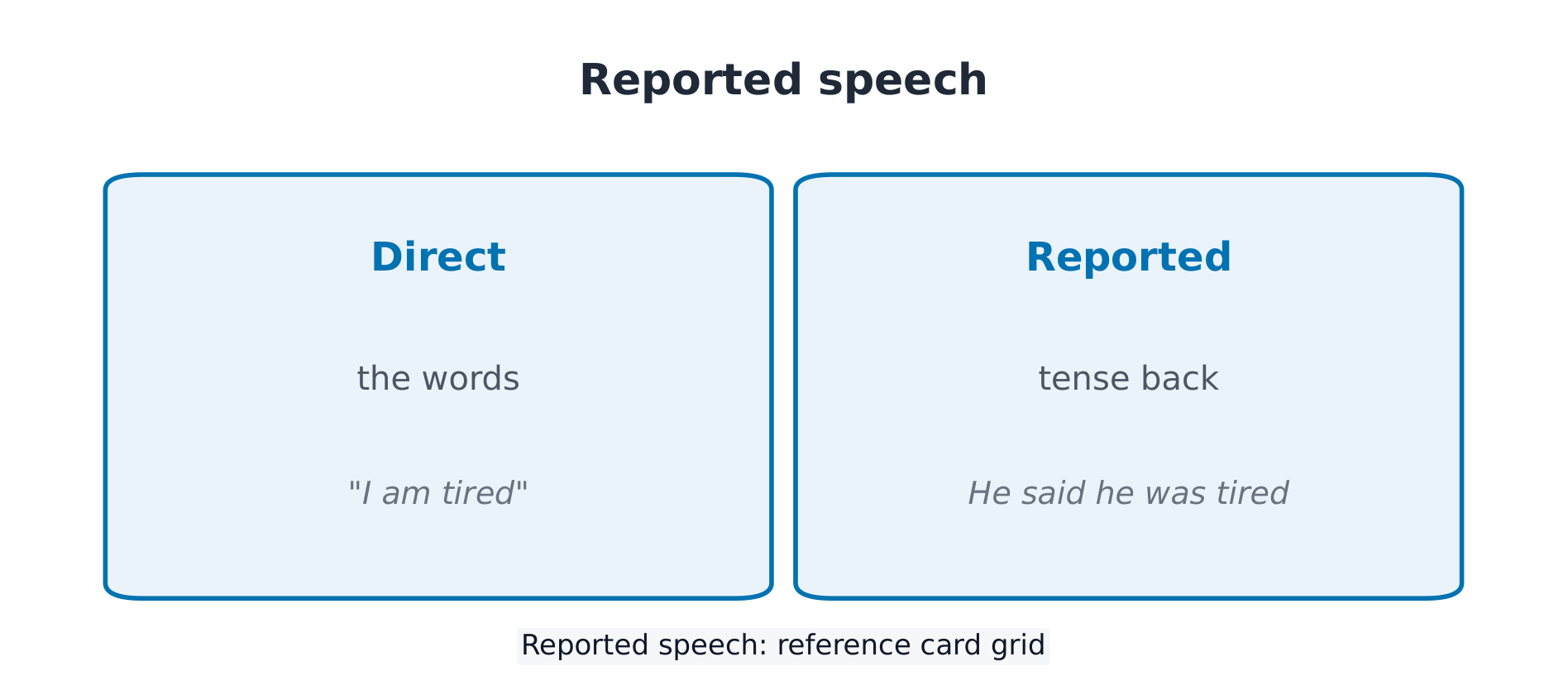
    Reported speech is used to report what someone said, without quotation marks. Common reporting verbs are said or told:

    • say is followed without the listener: He said (that) …
    • tell is followed with the listener: He told me (that) …

    他He 说said (连词)that 他he (过去)was 累tired.

    He said he was tired. (Original quote: "I am tired.")

    Note that can be omitted: He said he was tired. The meaning remains the same.

    العربية
    النص المباشر → النص غير المباشر

    الكلام المنقول (reported speech) يُستخدم لـ نقل ما قاله شخص آخر بدون علامات اقتباس. نستخدم عادةً said أو told:

    • say لا يأتي بعدها الشخص الموجه للكلام: He said (that) …
    • tell يجب أن يأتي بعده الشخص الموجه للكلام: He told me (that) …

    他He 说said (连词)that 他he (过去)was 累tired.

    قال إنه مرهق. (الكلام الأصلي: "I am tired.")

    تنبيه: يمكن حذف that: He said he was tired. نفس المعنى.

    8.2

    الانسحاب الزمني

    English

    When reporting, if the reporting verb is in the past tense (said / told), the tense in the reported clause usually shifts back one step:

    • am / is → was; are → were; do / does → did.
    • will → would; can → could; present perfect / past simple → past perfect.

    Direct Speech: "I will help you," she said.

    Indirect Speech:

    她She 说said 她she 会would 帮help 我me.

    She said she would help me. (will → would, I → she, you → me)

    Pronouns and time expressions also change: I → he / she, now → then, today → that day, tomorrow → the next day.

    Note If reporting a general truth, tenses need not shift: He said the sun rises in the east.

    Common Errors

    • ❌ ~~He said me the truth.~~ / ~~He told that he was busy.~~ → ✓ He told me… / He said (that)… — say does not take a listener, tell must take a listener; this is the opposite of common mistakes.
    • ❌ ~~He asked me where did I live.~~ → ✓ He asked me where I lived. — Reported questions must change to statement word order, removing did.
    • ❌ ~~She asked me that I was hungry.~~ → ✓ She asked me if / whether I was hungry. — Report yes/no questions using if / whether, not that.
    • ❌ ~~He said he will come tomorrow.~~ → ✓ He said he would come the next day. — Tenses and time expressions must shift together.
    العربية

    عند النقل، إذا كان فعل القول في الماضي (said / told)، فإن زمن الجملة الفرعية عادةً ما يتراجع خطوة واحدة:

    • am / is → was; are → were; do / does → did.
    • will → would; can → could; المضارع التام / الماضي البسيط → الماضي التام.

    الكلام المباشر: "I will help you," she said.(الكلام الأصلي)

    النص غير المباشر:

    她She 说said 她she 会would 帮help 我me.

    قالت أنها ستساعدني. (will → would, I → she, you → me)

    ضمائر الزمن والكلمات الزمنية أيضاً تتغير: I → he / she, now → then, today → that day, tomorrow → the next day.

    تنبيه: إذا كان المنقول حقيقة عامة، يمكن عدم تراجع الزمن: He said the sun rises in the east.

    ** الأخطاء الشائعة **

    • ❌ ~~He said me the truth.~~ / ~~He told that he was busy.~~ → ✓ He told me… / He said (that)… — say لا تأخذ مفعولاً به للشخص، وtell يجب أن تأخذه، والعكس صحيح تماماً.
    • ❌ ~~He asked me where did I live.~~ → ✓ He asked me where I lived. — عند نقل السؤال يجب تحويله إلى ترتيب خبري، ويختفي did.
    • ❌ ~~She asked me that I was hungry.~~ → ✓ She asked me if / whether I was hungry. — عند نقل سؤال نعم/لا نستخدم if / whether، ولا نستخدم that.
    • ❌ ~~He said he will come tomorrow.~~ → ✓ He said he would come the next day. — يجب تراجع الزمن والكلمات الزمنية معاً.
  • 9 Relative clauses · ⁨الجمل النسبية⁩
    9.1

    who و which / that

    English

    Relative clauses provide additional information about a preceding noun. They are introduced by relative pronouns:

    • who: refers to people.
    • which: refers to things.
    • that: refers to either people or things (common in informal speech).

    (冠词)The 女人woman (关系代词)who 住lives 隔壁next door 是is 一名a 医生doctor.

    The woman living next door is a doctor.

    这This 是is (冠词)the 书book (关系代词)which 获得won (冠词)the 奖prize.

    That is the award-winning book.

    Note Relative pronouns go immediately after the noun they refer to, introducing supplementary information.

    العربية
    الضمائر الوصلة: who/which/where/whose

    الجمل الصفة (relative clauses) تستخدم لـ توضيح الاسم الذي يسبقها. نستخدم ضمائر وصلة للربط:

    • who: تشير إلى الأشخاص.
    • which: تشير إلى الأشياء.
    • that: يمكن أن تشير إلى شخص أو شيء (شائع في العامية).

    (冠词)The 女人woman (关系代词)who 住lives 隔壁next door 是is 一名a 医生doctor.

    السيدة التي تعيش بجوارنا هي طبيبة.

    这This 是is (冠词)the 书book (关系代词)which 获得won (冠词)the 奖prize.

    هذا هو الكتاب الفائزة بالجائزة.

    انتبه: ضمير الوصل يأتي بعد الاسم الذي يشير إليه، لمقدمة معلومات إضافية.

    9.2

    where, when, whose

    English
    • where: refers to place. when: refers to time. whose: indicates possession ("'s").

    那是That's (冠词)the 镇town (在那里)where 我I 长大grew up.

    That is the town where I grew up.

    她是She's (冠词)the 作家writer (谁的)whose 书books 我I 喜爱love.

    She is the writer whose works I like.

    Note whose is followed directly by a noun (whose books), indicating "that person's books".

    العربية
    • where: تشير إلى المكان. when: تشير إلى الزمن. whose: تدل على الملكية ("... الخاص بـ").

    那是That's (冠词)the 镇town (在那里)where 我I 长大grew up.

    هذا هو البلدة التي نشأت فيها.

    她是She's (冠词)the 作家writer (谁的)whose 书books 我I 喜爱love.

    هي الكاتبة التي أعجبني أعمالها.

    تنبيه: comes directly after whose noun (whose books), meaning "the person's books".

    9.3

    حذف ضمير الوصل

    English

    When the relative pronoun acts as the object in the clause, it can be omitted (common in both speech and writing):

    (冠词)The 电影film 我们(that) we 看saw (是)was 很棒great.

    The movie (that) we watched was great.

    How to decide:

    • If the relative pronoun is the subject (followed immediately by a verb) → cannot omit.
    • If the relative pronoun is the object (followed by "subject + verb") → can omit.

    Note Must be retained when acting as subject: the man who called (cannot omit who).

    Common Errors

    • ❌ ~~The man which lives next door…~~ → ✓ The man who / that… — Do not use which for people.
    • ❌ ~~The book what I read…~~ → ✓ The book that / which I read… — English has no usage of what as a relative pronoun.
    • ❌ ~~This is the house which I live.~~ → ✓ …the house where I live / …the house which I live in. — When the clause lacks a preposition, either use where or supply the missing preposition.
    • ❌ ~~The friend who I met him yesterday…~~ → ✓ The friend who I met yesterday… — Since the relative pronoun already replaces the object, him / it cannot appear again in the clause.
    العربية

    عندما يعمل ضمير الوصل كـ مفعول به في الجملة الفرعية، يمكن حذفه (شائع في المحادثة والكتابة):

    (冠词)The 电影film 我们(that) we 看saw (是)was 很棒great.

    الفيلم الذي شاهدناه رائع. (يمكن حذف that)

    طريقة التحديد:

    • إذا كان ضمير الوصل فاعلاً (يليته فعل مباشرة) → لا يمكن حذفه.
    • إذا كان ضمير الوصل مفعولاً به (يليته "فاعل + فعل") → يمكن حذفه.

    تنبيه: يجب إبقاؤها إذا كانت فاعلاً: the man who called (لا يمكن حذف who).

    ** الأخطاء الشائعة **

    • ❌ ~~The man which lives next door…~~ → ✓ The man who / that… — عند الإشارة إلى الأشخاص لا نستخدم which.
    • ❌ ~~The book what I read…~~ → ✓ The book that / which I read… — في الإنجليزية لا يُستخدم "what" كاسم وصل (relative pronoun).
    • ❌ ~~This is the house which I live.~~ → ✓ …the house where I live / …the house which I live in. — عندما ينقص الجملة من الجملية حرف الجر، إما استخدام "where" أو استعادة "in".
    • ❌ ~~The friend who I met him yesterday…~~ → ✓ The friend who I met yesterday… — الاسم الوصل قد حل محل المفعول به بالفعل، لذا لا يمكن تكرار ضميره مثل him / it داخل الجملة.
  • 10 Modals of deduction · ⁨الأفعال المساعدة للاستنتاج⁩
    10.1

    must مع can't (يقين)

    English

    Modal verbs can also express deduction. When you are very certain:

    • must: must be (definite positive deduction).
    • can't: can't be (definite negative deduction).

    她She 一定must 是be 累tired.

    She must be very tired. (Very certain)

    他He 不可能can't 是be 饿hungry 他; he 刚just 吃ate.

    He can't be hungry; he just ate.

    Note Use can't for negative deduction (impossible), not mustn't (which means "prohibited").

    العربية
    الأفعال المساعدة للتقدير: درجة اليقين

    الأفعال المساعدة يمكن أن تعبر أيضاً عن التقدير. عندما تكون متأكداً جداً: *

    • must: يجب أن يكون (استنتاج مؤكد مثبت).
    • can't: لا يمكن أن يكون (استنتاج منفٍ مؤكد).

    她She 一定must 是be 累tired.

    لابد أنها متعبة جداً. (متأكد تماماً)

    他He 不可能can't 是be 饿hungry 他; he 刚just 吃ate.

    لا يمكن أن يكون جائعاً، لقد تناول الطعام للتو.

    تنبيه للتعبير عن الاستنتاج المنفي نستخدم can't (من المستحيل)، ولا نستخدم mustn't (والذي يعني "يُحظر").

    10.2

    might, may, could (احتمال)

    English

    When you are not entirely sure, but only feel that something is possible:

    • might / may / could: possible, perhaps.

    (天气it)It 可能might 下雨rain 稍后later.

    It might rain later.

    他们They 可能may 在be (在)at 家home.

    They might be at home.

    Degree of Certainty Comparison:

    • Very certain: must (is) / can't (is not).
    • Uncertain: might / may / could (possible).

    Note All these modal verbs are followed by the base form of the verb: might be, must be (not might is).

    Common Errors

    • ❌ ~~It can be John at the door.~~ → ✓ It could / might be John. — Use could / might for speculation about a specific instance; can only indicates "general possibility."
    • ❌ ~~He might not can come.~~ → ✓ He might not be able to come. — Two modal verbs cannot be used together; replace the second with be able to / have to.
    • ❌ ~~Maybe he be late. / It may be rain.~~ → ✓ Maybe he is late. / It may rain. — maybe is an adverb and follows normal sentence structure; may is a modal verb and is followed by the base form. Do not mix them up.
    • ❌ ~~She must is tired.~~ → ✓ She must be tired. — A modal verb is always followed by the base form of the verb.
    العربية

    عندما تكون غير متأكد وتشعر فقط بـ إمكانية: *

    • might / may / could: ربما، قد، ممكن.

    (天气it)It 可能might 下雨rain 稍后later.

    ربما تمطر لاحقاً.

    他们They 可能may 在be (在)at 家home.

    ربما يكونون في المنزل.

    مقارنة درجات اليقين:

    • يقين كبير:must(هو/هي) / can't(ليس/ليست).
    • عدم اليقين:might / may / could(ربما).

    تنبيه هذه الأفعال المساعدة يتبعها دائماً الفعل المصدر: might be، must be (وليس might is).

    ** الأخطاء الشائعة **

    • ❌ ~~It can be John at the door.~~ → ✓ It could / might be John. — للاستنتاج حول حدث محدد نستخدم could / might؛ أما can فتعني "من الممكن بشكل عام".
    • ❌ ~~He might not can come.~~ → ✓ He might not be able to come. — لا يجوز دمج فعلين مساعدين معاً؛ نستبدل الثاني بـ be able to / have to.
    • ❌ ~~Maybe he be late. / It may be rain.~~ → ✓ Maybe he is late. / It may rain. — maybe ظرف، وتأتي الجملة بعد الفعل كما هي؛ أما may فعل مساعد يتبعه المصدر مباشرة. لا تخلط بينهما.
    • ❌ ~~She must is tired.~~ → ✓ She must be tired. — الفعل المساعد يتبعه دائماً الفعل المصدر.
  • 11 Gerunds and infinitives · ⁨الأفعال المصاحبة والمصدر⁩
    11.1

    فعل + -ing

    English

    Some verbs are followed by a gerund (verb-ing). Common examples include: enjoy, like, love, hate, finish, stop, mind, suggest, avoid.

    我I 喜欢enjoy 阅读reading.

    I enjoy reading.

    她She 完成finished 做doing 她的her 作业homework.

    She finished her homework.

    Note A gerund functions as a noun; its form is verb-ing.

    العربية
    بعد الفعل: -ing أم to

    بعض الأفعال يتبعها المفعول الصريح (gerund / فعل-ing). شائعة منها: enjoy, like, love, hate, finish, stop, mind, suggest, avoid.

    我I 喜欢enjoy 阅读reading.

    أحب القراءة.

    她She 完成finished 做doing 她的her 作业homework.

    أنهت واجباتها.

    تنبيه المفعول الصريح (gerund) هو الفعل يستخدم كاسم، وصيغته فعل-ing.

    11.2

    الفعل + المصدر

    English

    Other verbs are followed by an infinitive (to + base form). Common examples include: want, need, decide, hope, promise, learn, would like, plan.

    我I 想want (不定式)to 学learn 英语English.

    I want to learn English.

    他们They 决定decided (不定式)to 留下stay.

    They decided to stay.

    Note Some verbs accept both forms with similar meanings: like, love, start, begin. I like swimming. = I like to swim.

    العربية

    أفعال أخرى يتبعها المصدر (to + الفعل المصدر). شائعة منها: want, need, decide, hope, promise, learn, would like, plan.

    我I 想want (不定式)to 学learn 英语English.

    أريد تعلم اللغة الإنجليزية.

    他们They 决定decided (不定式)to 留下stay.

    قرروا البقاء.

    تنبيه بعض الأفعال تقبل الاثنين بمعنى متقارب: like, love, start, begin. I like swimming. = I like to swim.

    11.3

    بعد حرف الجر نستخدم -ing

    English

    After a preposition (in, on, at, of, about, for, good at, interested in…), the verb must take the -ing form:

    她She's 擅长good at 画画drawing.

    She is good at painting.

    谢谢Thank you 因为for 帮助helping 我me.

    Thank you for helping me.

    Note The base form of a verb never follows a preposition: ~~good at draw~~ ✗ → good at drawing ✓.

    Common Errors

    • ❌ ~~I enjoy to read.~~ / ~~I want reading.~~ → ✓ I enjoy reading. / I want to read. — Which verb takes which form is fixed; memorize the collocations, do not swap them.
    • Distinguish the two meanings of stop: He stopped smoking. (Quit smoking) vs. He stopped to smoke. (Stopped what he was doing to go smoke)— The meanings are completely different.
    • ❌ ~~I look forward to see you.~~ → ✓ I look forward to seeing you. — Here, to is a preposition and is followed by -ing.
    • ❌ ~~Swim is good exercise.~~ → ✓ Swimming is good exercise. — When a verb acts as the subject, use the -ing form.
    العربية

    بعد حروف الجر (in, on, at, of, about, for, good at, interested in…) يأتي الفعل بصيغة -ing:

    她She's 擅长good at 画画drawing.

    هي جيدة في الرسم.

    谢谢Thank you 因为for 帮助helping 我me.

    شكراً لمساعدتك.

    تنبيه لا يتبع حرف جر أبداً الفعل المصدر: ~~good at draw~~ ✗ → good at drawing ✓.

    ** الأخطاء الشائعة **

    • ❌ ~~I enjoy to read.~~ / ~~I want reading.~~ → ✓ I enjoy reading. / I want to read. — نوع الصيغة التي يتبعها كل فعل ثابت، احفظ التراكيب ولا عكسها.
    • تمييز معنيين لـ stop: He stopped smoking.(توقف عن التدخين) vs He stopped to smoke.(توقف ليبدأ التدخين)— المعنى مختلف تماماً.
    • ❌ ~~I look forward to see you.~~ → ✓ I look forward to seeing you. — هنا to حرف جر، فيأتي بعدها -ing.
    • ❌ ~~Swim is good exercise.~~ → ✓ Swimming is good exercise. — عند استخدام الفعل كفاعل يجب أن يأتي بصيغة -ing.
  • 12 too, enough, so, such
    12.1

    too مع enough

    English

    too and enough indicate degree, but their position and meaning differ:

    • too + adjective = "too..." (negative excess), placed before the adjective.
    • enough = "sufficient," placed after the adjective and before the noun.

    这This 咖啡coffee 是is 太too 烫hot.

    This coffee is too hot.

    他He 不够isn't 大old 足够enough (不定式)to 开车drive.

    He isn't old enough to drive.

    Note enough comes after the adjective (old enough) but before the noun (enough money).

    العربية
    too و enough

    too و enough يعبران عن الدرجة، لكن موقعهما ومعناهما مختلفان:

    • too + صفة = "جداً..." (إفراط سلبي)، تأتي قبل الصفة.
    • enough = "كافٍ/مقدار كافٍ"، تأتي بعد الصفة وقبل الاسم.

    这This 咖啡coffee 是is 太too 烫hot.

    هذا القهوة ساخنة جداً.

    他He 不够isn't 大old 足够enough (不定式)to 开车drive.

    هو صغير جداً ليقود السيارة.

    تنبيه enough تأتي بعد الصفة (old enough)، لكنها تأتي قبل الاسم (enough money).

    12.2

    so مع such

    English

    so and such both mean "so / such," used to intensify the tone:

    • so + adjective / adverb: so hot, so quickly.
    • such + (a/an) + (adjective) + noun: such a hot day.

    (冠词)The 电影film (是)was 如此so 无聊boring.

    That movie was so boring.

    (这)It 是was 如此such 一个a 好good 主意idea.

    That was really such a good idea.

    Note Follow so with an adjective (so good); follow such with a noun phrase (such a good idea).

    Common Errors

    • ❌ To praise "very happy" but say ~~I'm too happy!~~ → ✓ I'm so happy! — too carries a negative connotation ("excessively, to the point of being bad"); use so for praise and exclamation.
    • ❌ ~~The box is too much heavy.~~ → ✓ The box is much too heavy. — To intensify too, use much too; the word order is much first.
    • ❌ ~~The tea is too hot to drink it.~~ → ✓ The tea is too hot to drink. — In the too…to structure, the sentence subject serves as the object of drink, so do not write it.
    • ❌ ~~It was so a good idea.~~ → ✓ It was such a good idea. / The idea was so good. — If there is a noun, switch to such.
    العربية

    so و such كلاهما يعني "كثيرًا / جداً"، لتقوية الأسلوب:

    • so + صفة / حال: so hot, so quickly.
    • such + (a/an) + (صفة) + اسم: such a hot day.

    (冠词)The 电影film (是)was 如此so 无聊boring.

    هذا الفيلم ممل للغاية.

    (这)It 是was 如此such 一个a 好good 主意idea.

    إنه حقاً فكرة جيدة.

    تنبيه بعد so نضع صفة (so good)، وبعد such نضع مجموعة اسمية (such a good idea).

    ** الأخطاء الشائعة **

    • عندما تريد التعجب بـ "سعيد جداً" وتقول ~~I'm too happy!~~ → ✓ I'm so happy! — too تحمل معنى سلبياً تلقائياً ("أكثر مما ينبغي")، للتعجب والإعجاب نستخدم so.
    • ❌ ~~The box is too much heavy.~~ → ✓ The box is much too heavy. — لتقوية too نستخدم much too، والترتيب يكون much أولاً.
    • ❌ ~~The tea is too hot to drink it.~~ → ✓ The tea is too hot to drink. — في تركيب too…to الفاعل هو مفعول به للفعل drink، فلا نكتب it.
    • ❌ ~~It was so a good idea.~~ → ✓ It was such a good idea. / The idea was so good. — إذا كان هناك اسم نستخدم such.

Log in or create account · ⁨تسجيل الدخول أو إنشاء حساب⁩

IGCSE, A-Level & AP