Skip to content · ⁨الانتقال إلى المحتوى⁩
Subjects · ⁨المواد⁩

AP Physics 1 · ⁨AP الفيزياء 1⁩

Tips

فيزياء AP 1 هي ميكانيكا تعتمد على الجبر: الحركيات، القوى، الشغل والطاقة والقوة، الزخم، عزم القوة والدوران، الاهتزازات والموائع. لا حاجة للتفاضل والتكامل — وهو ما يجعلها أصعب مفاهيمياً، ليس أسهل. تستنتج حول المواقف بدلاً من مجرد تدوير مقبض.

يفصل قسم الإجابة المقترحة الدرجات. يطلب منك التبرير، مقارنة موقفين، وشرح نتيجة بكلمات. الرقم الصحيح بدون استنتاج يكتسب القليل جداً.

سمِّ المبدأ أولاً. "لأن الزخم محفوظ ولا توجد قوة خارجية أفقية تعمل..." هو الجملة التي تريدها معايير التصحيح. ارسم مخطط الجسم الحر لكل مشكلة، حتى عندما يبدو الأمر غير ضروري — فهي أعلى عادة قيمة في المقرر.

تمتد الملاحظات أدناه وحدة بوحدة عبر CED، من الحركيات إلى الحركة التوافقية البسيطة، كل منها مع أمثلة محلولة. الأسئلة المحررة الإجابة المقترحة ومعايير التصحيح الخاصة بها في المكتبة، وسؤال التصميم التجريبي يستحق التدريب بشكل مستقل — حيث يظهر كل عام ويكافئ إجراء واضحاً بدلاً من صيغة.

  • 1

    Kinematics · ⁨الحركية⁩

    Watch lesson · ⁨شاهد الدرس⁩
    1.1

    Scalars and Vectors in One Dimension

    Syllabus · ⁨المنهج⁩
    English

    Learning Objective 1.1.A: Describe a scalar or vector quantity using magnitude and direction, as appropriate.

    • 1.1.A.1 Scalars are quantities described by magnitude only; vectors are quantities described by both magnitude and direction.
    • 1.1.A.2 Vectors can be visually modeled as arrows with appropriate direction and lengths proportional to their magnitude.
    • 1.1.A.3 Distance and speed are examples of scalar quantities, while position, displacement, velocity, and acceleration are examples of vector quantities.
      • 1.1.A.3.i Vectors are notated with an arrow above the symbol for that quantity.
        • Equation: $\vec{v} = \vec{v}_0 + \vec{a}t$
      • 1.1.A.3.ii Vector notation is not required for vector components along an axis. In one dimension, the sign of the component completely describes the direction of that component.
        • Derived equation: $v_x = v_{x0} + a_x t$

    Learning Objective 1.1.B: Describe a vector sum in one dimension.

    • 1.1.B.1 When determining a vector sum in a given one-dimensional coordinate system, opposite directions are denoted by opposite signs.
    العربية

    هدف التعلم 1.1.A: وصف الكمية القياسية أو المتجهة باستخدام المقدار والاتجاه، حسب الحاجة.

    • 1.1.A.1 الكميات القياسية هي كميات يُوصفها المقدار فقط؛ أما المتجهات فهي كميات يُوصفها المقدار والاتجاه معاً.
    • 1.1.A.2 يمكن تمثيل المتجهات بصرياً بأسهم ذات اتجاه مناسب وأطوال متناسبة مع مقدارها.
    • 1.1.A.3 المسافة والسرعة أمثلة على الكميات القياسية، بينما الموقع والإزاحة والسرعة والتسارع أمثلة على الكميات المتجهة.
      • 1.1.A.3.i تُكتب المتجهات بسهم فوق الرمز الخاص بتلك الكمية.
        • معادلة: $\vec{v} = \vec{v}_0 + \vec{a}t$
      • 1.1.A.3.ii لا يُشترط استخدام كتابة المتجهات لمركباتها على طول محور. في بُعد واحد، يصف إشارة المركبة بالكامل اتجاه ذلك المركب.
        • معادلة مشتقة: $v_x = v_{x0} + a_x t$

    هدف التعلم 1.1.B: وصف مجموع متجهات في بُعد واحد.

    • 1.1.B.1 عند تحديد مجموع متجهات في نظام إحداثي أحادي البُعد مُعطى، تُشار إلى الاتجاهات المعاكسة بإشارات معاكسة.
    Source: College Board AP Course and Exam Description · ⁨المصدر: وصف دورة وامتحان College Board AP⁩

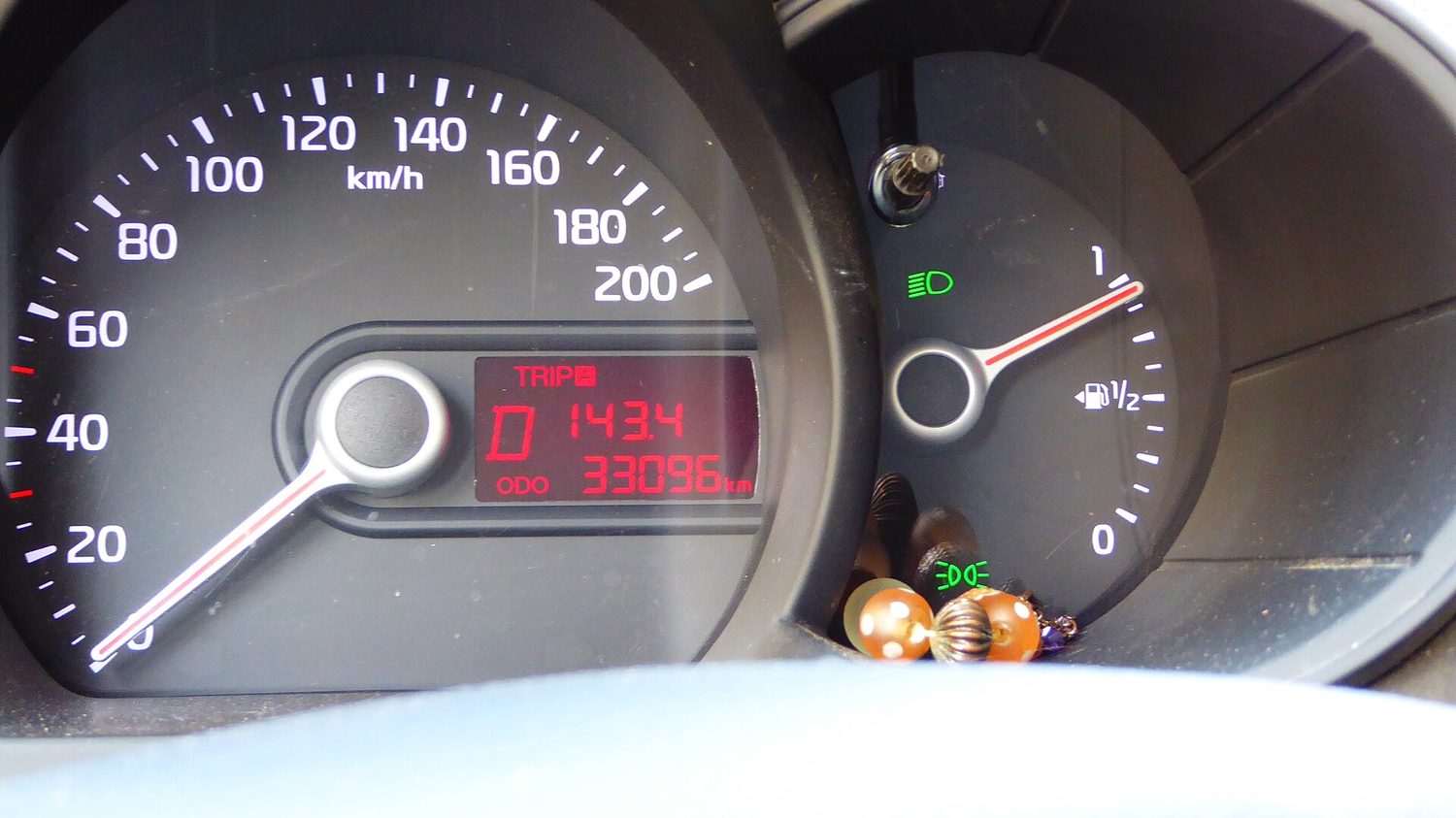
    A car speedometer: speed is the magnitude of velocity — a scalar rate of motion
    A car speedometer: speed is the magnitude of velocity — a scalar rate of motion

    Kinematics 运动学 describes how objects move, without asking why. First, two kinds of quantity:

    • A scalar 标量 has only size (magnitude 大小): distance 距离, speed, time, mass.
    • A vector 矢量 has magnitude and direction: displacement, velocity, acceleration, force.

    The difference matters. Distance is the total path length travelled – a scalar that only grows. Displacement is the straight-line change in position, with a direction. Walk $3\ \text{m}$ east then $1\ \text{m}$ back west: the distance is $4\ \text{m}$, but the displacement is only $2\ \text{m}$ east.

    In one dimension, direction is just a sign (+ or −) along a chosen axis. Choosing the positive direction first is essential – every vector's sign depends on it. A velocity of $-5\ \text{m/s}$ does not mean "slow"; it means $5\ \text{m/s}$ in the negative direction.

    Vocabulary · ⁨مفردات⁩ Train · ⁨تدريب⁩
    English العربية
    Kinematics/ˌkɪnɪˈmætɪks/ الحركية
    scalar/ˈskeɪlə/ كمية قياسية
    magnitude/ˈmæɡnɪtjuːd/ المقدار
    vector/ˈvektə/ شعاعية
    distance/ˈdɪstəns/ المسافة
    1.2

    Displacement, Velocity, and Acceleration

    Syllabus · ⁨المنهج⁩
    English

    Learning Objective 1.2.A: Describe a change in an object's position.

    • 1.2.A.1 When using the object model, the size, shape, and internal configuration are ignored. The object may be treated as a single point with extensive properties such as mass and charge.
    • 1.2.A.2 Displacement is the change in an object's position.
      • Equation: $\Delta x = x - x_0$

    Learning Objective 1.2.B: Describe the average velocity and acceleration of an object.

    • 1.2.B.1 Averages of velocity and acceleration are calculated considering the initial and final states of an object over an interval of time.
    • 1.2.B.2 Average velocity is the displacement of an object divided by the interval of time in which that displacement occurs.
      • Equation: $\vec{v}_{avg} = \dfrac{\Delta \vec{x}}{\Delta t}$
    • 1.2.B.3 Average acceleration is the change in velocity divided by the interval of time in which that change in velocity occurs.
      • Equation: $\vec{a}_{avg} = \dfrac{\Delta \vec{v}}{\Delta t}$

    Learning Objective 1.2.B: Describe the velocity and acceleration of an object.

    • 1.2.B.4 An object is accelerating if the magnitude and/or direction of the object's velocity are changing.
    • 1.2.B.5 Calculating average velocity or average acceleration over a very small time interval yields a value that is very close to the instantaneous velocity or instantaneous acceleration.
    العربية

    هدف التعلم 1.2.A: وصف تغير موقع جسم ما.

    • 1.2.A.1 عند استخدام نموذج الجسم، يتم إهمال الحجم والشكل والتكوين الداخلي. يمكن التعامل مع الجسم كنقطة واحدة بخصائص واسعة مثل الكتلة والشحنة.
    • 1.2.A.2 الإزاحة هي التغير في موقع جسم ما.
      • المعادلة: $\Delta x = x - x_0$

    هدف التعلم 1.2.B: وصف السرعة المتوسطة والتسارع المتوسط لجسم ما.

    • 1.2.B.1 تُحسب متوسطات السرعة والتسارع مع مراعاة الحالات الأولية والنهائية للجسم خلال فترة زمنية.
    • 1.2.B.2 السرعة المتوسطة هي إزاحة جسم مقسومة على الفترة الزمنية التي حدثت فيها تلك الإزاحة.
      • المعادلة: $\vec{v}_{avg} = \dfrac{\Delta \vec{x}}{\Delta t}$
    • 1.2.B.3 التسارع المتوسط هو التغير في السرعة مقسوماً على الفترة الزمنية الذي حدث فيها ذلك التغير في السرعة.
      • المعادلة: $\vec{a}_{avg} = \dfrac{\Delta \vec{v}}{\Delta t}$

    هدف التعلم 1.2.B: وصف سرعة وتسارع جسم ما.

    • 1.2.B.4 يكون الجسم في حالة تسارع إذا كان مقدار و/أو اتجاه سرعته يتغيران.
    • 1.2.B.5 حساب السرعة المتوسطة أو التسارع المتوسط خلال فترة زمنية صغيرة جداً يعطي قيمة قريبة جداً من السرعة اللحظية أو التسارع اللحظي.

    Source: College Board AP Course and Exam Description · ⁨المصدر: وصف دورة وامتحان College Board AP⁩

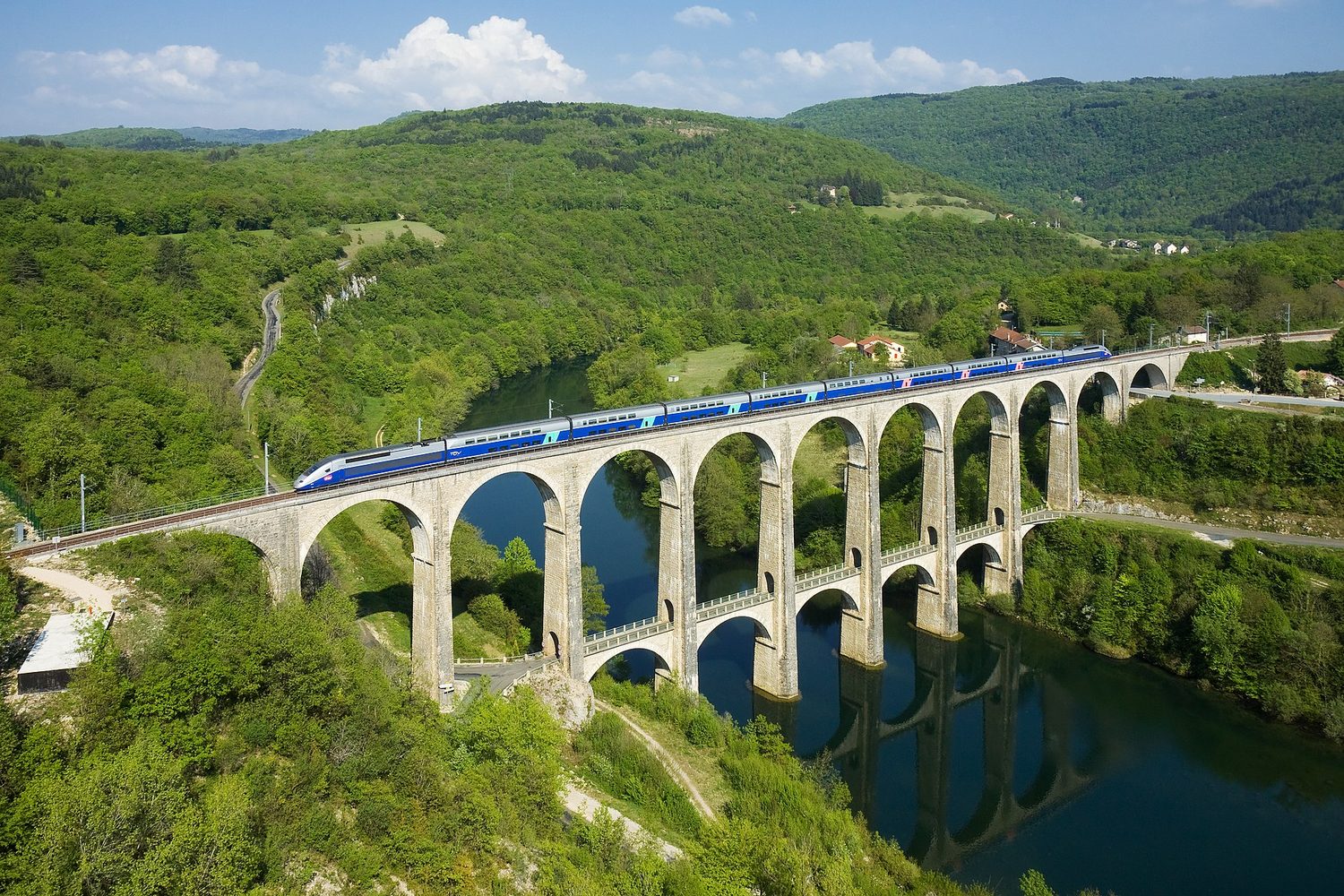
    A high-speed train: kinematics describes displacement, velocity and acceleration over time
    A high-speed train: kinematics describes displacement, velocity and acceleration over time
    Projectile motion is two independent motions

    Three linked vectors describe motion along a line:

    • Displacement 位移 $\Delta x$ is the change in position – a vector from start to end (not the total path length, which is distance).
    • Velocity 速度 is the rate of change of position, $v=\dfrac{\Delta x}{\Delta t}$. Its sign gives direction; its magnitude is speed 速率.
    • Acceleration 加速度 is the rate of change of velocity, $a=\dfrac{\Delta v}{\Delta t}$.

    Be careful to separate average velocity 平均速度 (total displacement over total time) from instantaneous velocity 瞬时速度 (the velocity at one instant, the slope of the position–time graph at that point). They are equal only when the velocity is constant.

    An object speeds up when $v$ and $a$ have the same sign, and slows down (deceleration 减速) when they have opposite signs. Note that a negative acceleration does not always mean slowing down – a ball falling faster and faster has negative velocity and negative acceleration.

    For constant acceleration, the four kinematic equations (often called SUVAT) apply:

    $$v=v_0+at,\qquad \Delta x=v_0 t+\tfrac{1}{2}at^2,\qquad v^2=v_0^2+2a\,\Delta x,\qquad \Delta x=\tfrac{1}{2}(v_0+v)\,t.$$
    Pick the equation that contains the three quantities you know plus the one you want, so only one unknown is left. They apply only while $a$ is constant.

    Worked example. A car starts from rest and accelerates uniformly at $2.0\ \text{m/s}^2$ for $6.0\ \text{s}$. Find its final velocity and the distance it travels.

    List what you know: $v_0=0$, $a=2.0\ \text{m/s}^2$, $t=6.0\ \text{s}$.

    $$v=v_0+at=0+2.0\times 6.0=12\ \text{m/s},$$
    $$\Delta x=v_0 t+\tfrac12 at^2=0+\tfrac12\times 2.0\times 6.0^2=36\ \text{m}.$$

    Worked example (free fall). A ball is thrown straight up at $15\ \text{m/s}$. Taking $g=9.8\ \text{m/s}^2$ and up as positive, how high does it rise, and how long is it in the air before returning to the thrower's hand?

    At the highest point the velocity is momentarily zero, and $a=-g=-9.8\ \text{m/s}^2$ throughout (this is free fall 自由落体, ignoring air resistance 空气阻力):

    $$v^2=v_0^2+2a\,\Delta x \;\Rightarrow\; 0=15^2+2(-9.8)\Delta x \;\Rightarrow\; \Delta x=\frac{225}{19.6}=11.5\ \text{m}.$$
    Time to the top: $0=15-9.8\,t \Rightarrow t=1.53\ \text{s}$. By symmetry the fall takes the same time, so the total is $3.1\ \text{s}$.

    Vocabulary · ⁨مفردات⁩ Train · ⁨تدريب⁩
    English العربية
    Displacement/dɪˈspleɪsmənt/ إزاحة
    Velocity/vəˈlɒsɪti/ السرعة
    speed/spiːd/ السرعة القياسية
    Acceleration/əkˌseləˈreɪʃn/ التسارع
    average velocity/ˈævrɪdʒ vəˈlɒsɪti/ السرعة المتوسطة
    instantaneous velocity/ˌɪnstənˈteɪnɪəs vəˈlɒsɪti/ السرعة اللحظية
    deceleration/dɪˌseləˈreɪʃn/ إبطاء
    free fall/friː fɔːl/ السقوط الحر
    air resistance/eə rɪˈzɪstəns/ مقاومة الهواء
    1.3

    Representing Motion

    Syllabus · ⁨المنهج⁩
    English

    Learning Objective 1.3.A: Describe the position, velocity, and acceleration of an object using representations of that object's motion.

    • 1.3.A.1 Motion can be represented by motion diagrams, figures, graphs, equations, and narrative descriptions.
    • 1.3.A.2 For constant acceleration, three kinematic equations can be used to describe instantaneous linear motion in one dimension:
      • Equation: $v_x = v_{x0} + a_x t$
      • Equation: $x = x_0 + v_{x0}t + \dfrac{1}{2}a_x t^2$
      • Equation: $v_x^2 = v_{x0}^2 + 2a_x(x - x_0)$
      • Note: The equations above are written to indicate motion in the x-direction, but these equations can be used in any single dimension as appropriate.
    • 1.3.A.3 Near the surface of Earth, the vertical acceleration caused by the force of gravity is downward, constant, and has a measured value approximately equal to $a_g = g \approx 10 \ m/s^2$.
    • 1.3.A.4 Graphs of position, velocity, and acceleration as functions of time can be used to find the relationships between those quantities.
      • 1.3.A.4.i An object's instantaneous velocity is the rate of change of the object's position, which is equal to the slope of a line tangent to a point on a graph of the object's position as a function of time.
      • 1.3.A.4.ii An object's instantaneous acceleration is the rate of change of the object's velocity, which is equal to the slope of a line tangent to a point on a graph of the object's velocity as a function of time.
      • 1.3.A.4.iii The displacement of an object during a time interval is equal to the area under the curve of a graph of the object's velocity as a function of time (i.e., the area bounded by the function and the horizontal axis for the appropriate interval).
      • 1.3.A.4.iv The change in velocity of an object during a time interval is equal to the area under the curve of a graph of the acceleration of the object as a function of time.

    Boundary statement: AP Physics 1 does not expect students to quantitatively analyze nonuniform acceleration. However, students will be expected to be able to qualitatively analyze, sketch appropriate graphs of, and discuss situations in which acceleration is nonuniform.

    Boundary statement: For all situations in which a numerical quantity is required for $g$, the value $g \approx 10 \ m/s^2$ will be used. However, students will not be penalized for correctly using the more precise commonly accepted values of $g = 9.81 \ \text{m/s}^2$ or $g = 9.8 \ \text{m/s}^2$.

    العربية

    هدف التعلم 1.3.A: وصف موقع وسرعة وتسارع جسم ما باستخدام تمثيلات لحركته.

    • 1.3.A.1 يمكن تمثيل الحركة بمخططات الحركة، الأشكال، الرسوم البيانية، المعادلات، والأوصاف السردية.
    • 1.3.A.2 بالنسبة للتسارع الثابت، يمكن استخدام ثلاث معادلات حركية لوصف الحركة الخطية اللحظية في بُعد واحد:
      • المعادلة: $v_x = v_{x0} + a_x t$
      • المعادلة: $x = x_0 + v_{x0}t + \dfrac{1}{2}a_x t^2$
      • المعادلة: $v_x^2 = v_{x0}^2 + 2a_x(x - x_0)$
      • ملاحظة: المعادلات أعلاه مكتوبة للإشارة إلى الحركة في اتجاه x، ولكن يمكن استخدام هذه المعادلات في أي بُعد فردي حسب الحاجة.
    • 1.3.A.3 بالقرب من سطح الأرض، التسارع الرأسي الناتج عن قوة الجاذبية يكون لأسفل، ثابتاً، وقيمته المقاسة تساوي تقريباً $a_g = g \approx 10 \ m/s^2$.
    • 1.3.A.4 يمكن استخدام رسوم بيانية للموقع والسرعة والتسارع كدوال للزمن لإيجاد العلاقات بين تلك الكميات.
      • 1.3.A.4.i السرعة اللحظية لجسم ما هي معدل تغير موقعه، وتساوي ميل خط مماس لنقطة على رسم بياني لموقع الجسم كدالة للزمن.
      • 1.3.A.4.ii التسارع اللحظي لجسم ما هو معدل تغير سرعته، ويساوي ميل خط مماس لنقطة على رسم بياني لسرعته كدالة للزمن.
      • 1.3.A.4.iii إزاحة جسم ما خلال فترة زمنية تساوي المساحة تحت منحنى رسم بياني لسرعته كدالة للزمن (أي المساحة المحصورة بين الدالة والمحور الأفقي للفترة المناسبة).
      • 1.3.A.4.iv التغير في سرعة جسم ما خلال فترة زمنية يساوي المساحة تحت منحنى رسم بياني لتسارعه كدالة للزمن.

    عبارة حدود: لا يتوقع امتحان الفيزياء AP 1 من الطلاب إجراء تحليل كمي للتسارع غير المنتظم. ومع ذلك، سيُتوقع منهم أن يكونوا قادرين على إجراء تحليل نوعي، ورسم الرسوم البيانية المناسبة، ومناقشة المواقف التي يكون فيها التسارع غير منتظم.

    عبارة حدود: لجميع المواقف التي يُطلب فيها كمية رقمية لـ $g$، سيتم استخدام القيمة $g \approx 10 \ m/s^2$. ومع ذلك، لن يُعاقب الطلاب عن استخدام القيم الدقيقة المقبولة عموماً لـ $g = 9.81 \ \text{m/s}^2$ أو $g = 9.8 \ \text{m/s}^2$ بشكل صحيح.

    Source: College Board AP Course and Exam Description · ⁨المصدر: وصف دورة وامتحان College Board AP⁩

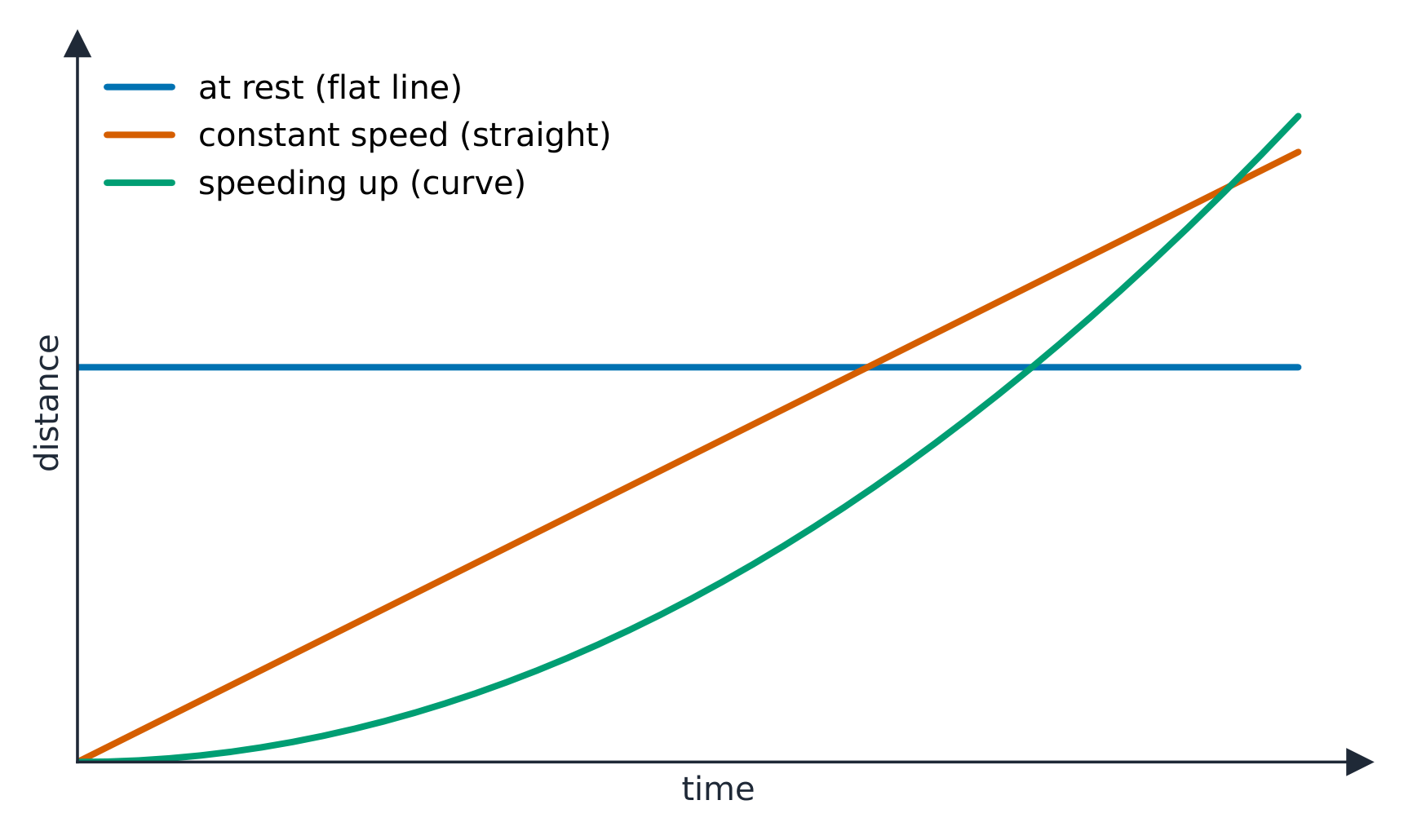
    The same motion appears as a description, a graph, a table, or an equation, and you should move between them:

    Reading a distance-time graph: flat means at rest, a straight slope means constant speed
    Reading a distance-time graph: flat means at rest, a straight slope means constant speed
    • On a position–time graph, the slope is velocity (steeper = faster; a curve = changing velocity).
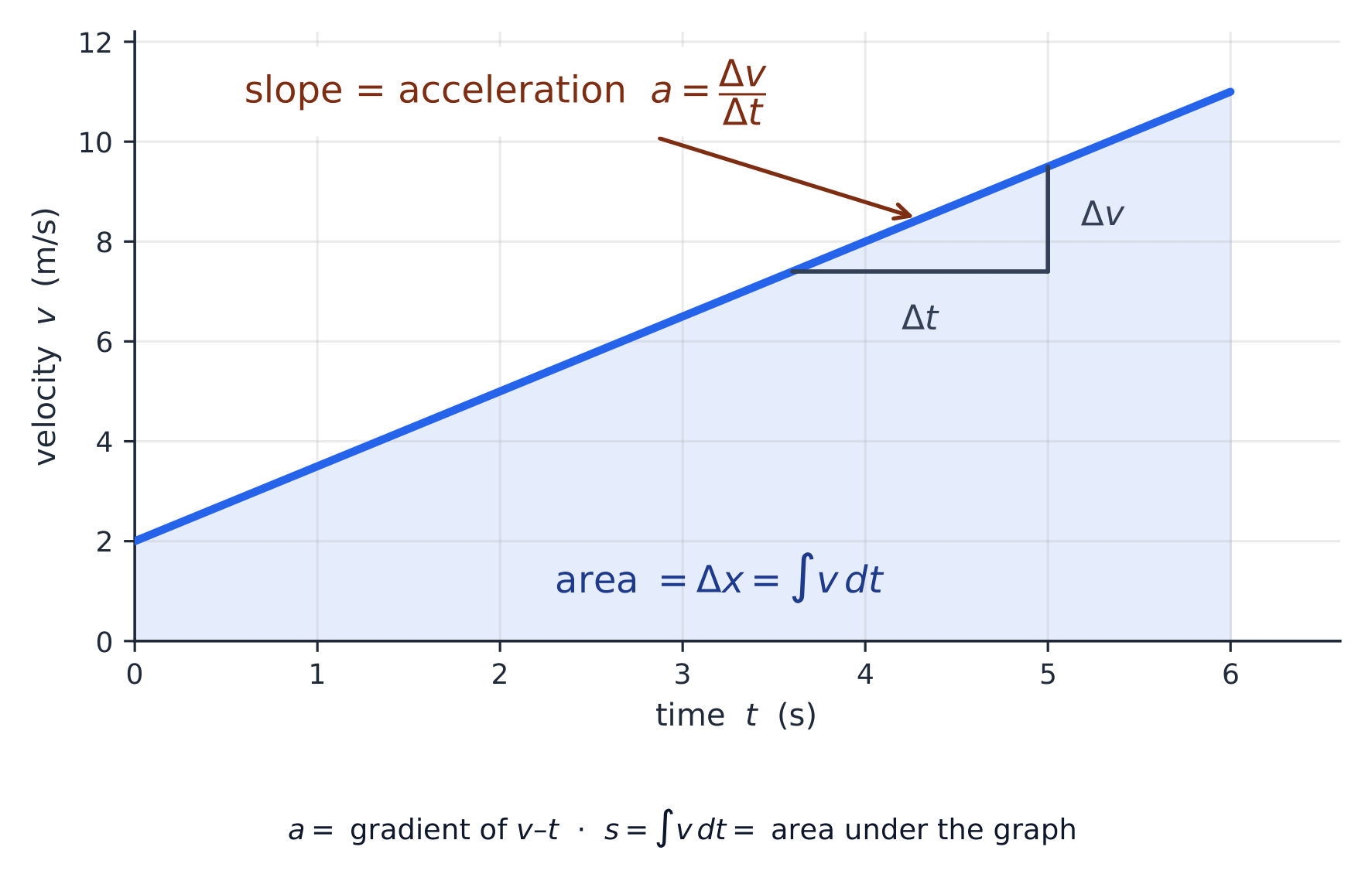
    • On a velocity–time graph, the slope is acceleration, and the area under the line is displacement.

    Reading slopes and areas off graphs is a core exam skill. To get displacement from a velocity–time graph, split the area into triangles and rectangles and add them up; area below the time axis counts as negative displacement (motion the other way).

    On a velocity-time graph the slope is the acceleration and the shaded area is the displacement
    On a velocity-time graph the slope is the acceleration and the shaded area is the displacement

    Worked example. A cyclist speeds up uniformly from rest to $8.0\ \text{m/s}$ in $4.0\ \text{s}$, then holds $8.0\ \text{m/s}$ for $6.0\ \text{s}$. Find the total distance from the velocity–time graph.

    The area is a triangle followed by a rectangle:

    $$\Delta x=\underbrace{\tfrac12\times 4.0\times 8.0}_{\text{triangle}}+\underbrace{6.0\times 8.0}_{\text{rectangle}}=16+48=64\ \text{m}.$$

    Explore · ⁨استكشف⁩

    Explore the velocity–time graph · ⁨استكشف رسم السرعة-الزمن⁩

    Change the start velocity $u$ and the acceleration $a$. The gradient (slope) of the line is the acceleration; the area between the line and the time axis is the displacement. · ⁨غيّر السرعة الابتدائية $u$ والتسارع $a$. الميل (المدرج) للمستقيم هو التسارع؛ والمساحة بين المستقيم ومحور الزمن هي الإزاحة.⁩

    1.4

    Reference Frames and Relative Motion

    Syllabus · ⁨المنهج⁩
    English

    Learning Objective 1.4.A: Describe the reference frame of a given observer.

    • 1.4.A.1 The choice of reference frame will determine the direction and magnitude of quantities measured by an observer in that reference frame.

    Learning Objective 1.4.B: Describe the motion of objects as measured by observers in different inertial reference frames.

    • 1.4.B.1 Measurements from a given reference frame may be converted to measurements from another reference frame.
    • 1.4.B.2 The observed velocity of an object results from the combination of the object's velocity and the velocity of the observer's reference frame.
      • 1.4.B.2.i Combining the motion of an object and the motion of an observer in a given reference frame involves the addition or subtraction of vectors.
      • 1.4.B.2.ii The acceleration of any object is the same as measured from all inertial reference frames.

    Boundary statement: Unless otherwise stated, the frame of reference of any problem may be assumed to be inertial.

    Boundary statement: Adding or subtracting vectors to find relative velocities is restricted to motion along one dimension for AP Physics 1.

    العربية

    هدف التعلم 1.4.A: وصف إطار المرجع لمراقب معين.

    • 1.4.A.1 يحدد اختيار إطار مرجعي اتجاه وكميات الكمية المقاسة من قبل مراقب في ذلك الإطار المرجعي.

    الهدف التعليمي 1.4.B: وصف حركة الأجسام كما تقيسها مراقب في إطارات مرجعية قصورية مختلفة.

    • 1.4.B.1 يمكن تحويل القياسات من إطار مرجعي محدد إلى قياسات من إطار مرجعي آخر.
    • 1.4.B.2 ناتج السرعة الظاهرية لجسم ما هو نتاج دمج سرعة الجسم مع سرعة الإطار المرجعي للمراقب.
      • 1.4.B.2.i يتضمن دمج حركة جسم وحركة مراقب في إطار مرجعي معين عملية جمع أو طرح المتجهات.
      • 1.4.B.2.ii تسارع أي جسم يكون نفسه عند قياسه من جميع الإطارات المرجعية القصورية.

    عبارة الحدود: ما لم يُذكر خلاف ذلك، يمكن افتراض أن الإطار المرجعي لأي مسألة هو إطار قصوري.

    عبارة الحدود: بالنسبة لـ AP Physics 1، يقتصر جمع أو طرح المتجهات لإيجاد السرعات النسبية على الحركة في بُعد واحد.

    Source: College Board AP Course and Exam Description · ⁨المصدر: وصف دورة وامتحان College Board AP⁩

    All motion is measured against a reference frame 参考系. Velocities measured in different frames differ, and you combine them by vector addition. The velocity of A relative to C is

    $$\vec{v}_{A/C}=\vec{v}_{A/B}+\vec{v}_{B/C}.$$
    A person walking on a moving train has one velocity relative to the train and another relative to the ground – this is relative motion 相对运动. A useful shortcut: the velocity of A relative to B is $\vec{v}_{A/B}=\vec{v}_A-\vec{v}_B$ (subtract B's velocity).

    A frame that is not accelerating is an inertial reference frame 惯性参考系: one in which a free object (no net force) obeys Newton's first law, staying at rest or moving at constant velocity. A frame that accelerates – a braking car – is non-inertial, where objects seem to speed up with no force acting on them.

    Worked example. A boat points straight across a river and moves at $3.0\ \text{m/s}$ relative to the water. The current flows at $4.0\ \text{m/s}$ along the river. Find the boat's speed and direction relative to the bank.

    The two velocities are perpendicular, so add them as a right triangle:

    $$v=\sqrt{3.0^2+4.0^2}=5.0\ \text{m/s},\qquad \theta=\tan^{-1}\!\frac{4.0}{3.0}=53^{\circ}\ \text{downstream from straight across.}$$

    Vocabulary · ⁨مفردات⁩ Train · ⁨تدريب⁩
    English العربية
    reference frame/ˈrefrəns freɪm/ إطار مرجعي
    relative motion/ˈrelətɪv ˈməʊʃn/ الحركة النسبية
    inertial reference frame/ɪˈnɜːʃl ˈrefrəns freɪm/ إطار مرجعي قسري
    1.5

    Vectors and Motion in Two Dimensions

    Syllabus · ⁨المنهج⁩
    English

    Learning Objective 1.5.A: Describe the perpendicular components of a vector.

    • 1.5.A.1 Vectors can be mathematically modeled as the resultant of two perpendicular components.
    • 1.5.A.2 Vectors can be resolved into components using a chosen coordinate system.
    • 1.5.A.3 Vectors can be resolved into perpendicular components using trigonometric functions and relationships.
      • Equation: $\sin \theta = \dfrac{a}{c}$
      • Equation: $\cos \theta = \dfrac{b}{c}$
      • Equation: $\tan \theta = \dfrac{a}{b}$
      • Equation: $a^2 + b^2 = c^2$

    Learning Objective 1.5.B: Describe the motion of an object moving in two dimensions.

    • 1.5.B.1 Motion in two dimensions can be analyzed using one-dimensional kinematic relationships if the motion is separated into components.
    • 1.5.B.2 Projectile motion is a special case of two-dimensional motion that has zero acceleration in one dimension and constant, nonzero acceleration in the second dimension.
    العربية

    الهدف التعليمي 1.5.A: وصف المركبات المتعامدة للمتجه.

    • 1.5.A.1 يمكن نمذجة المتجهات رياضيًا كناتج مركبتين متعامدتين.
    • 1.5.A.2 يمكن تحليل المتجهات إلى مركبات باستخدام نظام إحداثيات مختار.
    • 1.5.A.3 يمكن تحليل المتجهات إلى مركبات متعامدة باستخدام الدوال المثلثية والعلاقات الهندسية.
      • المعادلة: $\sin \theta = \dfrac{a}{c}$
      • المعادلة: $\cos \theta = \dfrac{b}{c}$
      • المعادلة: $\tan \theta = \dfrac{a}{b}$
      • المعادلة: $a^2 + b^2 = c^2$

    الهدف التعليمي 1.5.B: وصف حركة جسم يتحرك في بعدين.

    • 1.5.B.1 يمكن تحليل الحركة في بعدين باستخدام العلاقات الحركية أحادية البعد إذا تم فصل الحركة إلى مركبات.
    • 1.5.B.2 حركة المقذوفات هي حالة خاصة من الحركة ثنائية الأبعاد تتميز بصفر تسارع في بُعد واحد وتسارع ثابت وغير صفري في البُعد الثاني.

    Source: College Board AP Course and Exam Description · ⁨المصدر: وصف دورة وامتحان College Board AP⁩

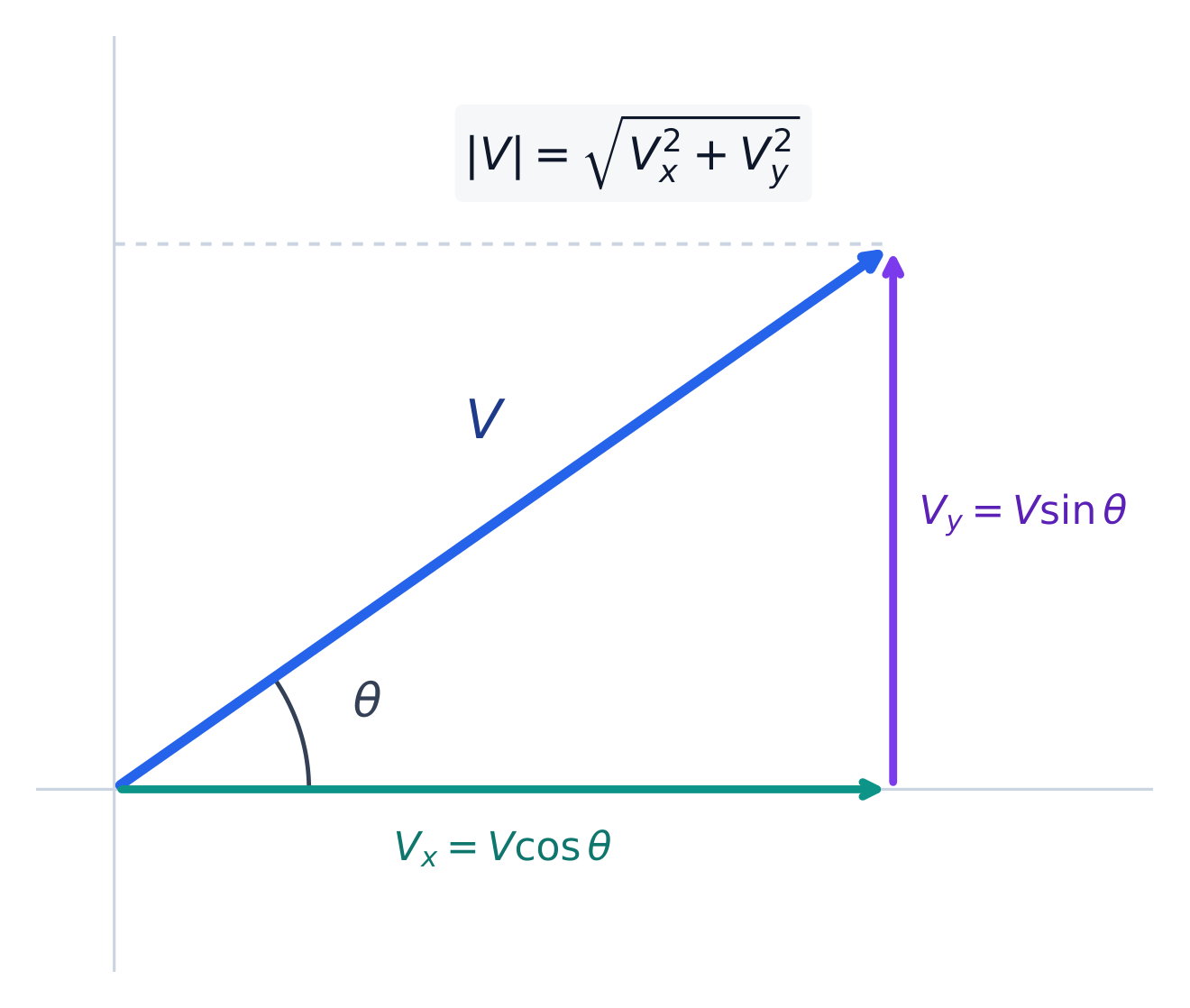
    In two dimensions, resolve each vector into components 分量 along perpendicular axes ($x$ and $y$), handle each axis separately, then recombine. A velocity $v$ at angle $\theta$ to the horizontal has components $v_x=v\cos\theta$ and $v_y=v\sin\theta$.

    A velocity vector resolved into its horizontal and vertical components
    A velocity vector resolved into its horizontal and vertical components

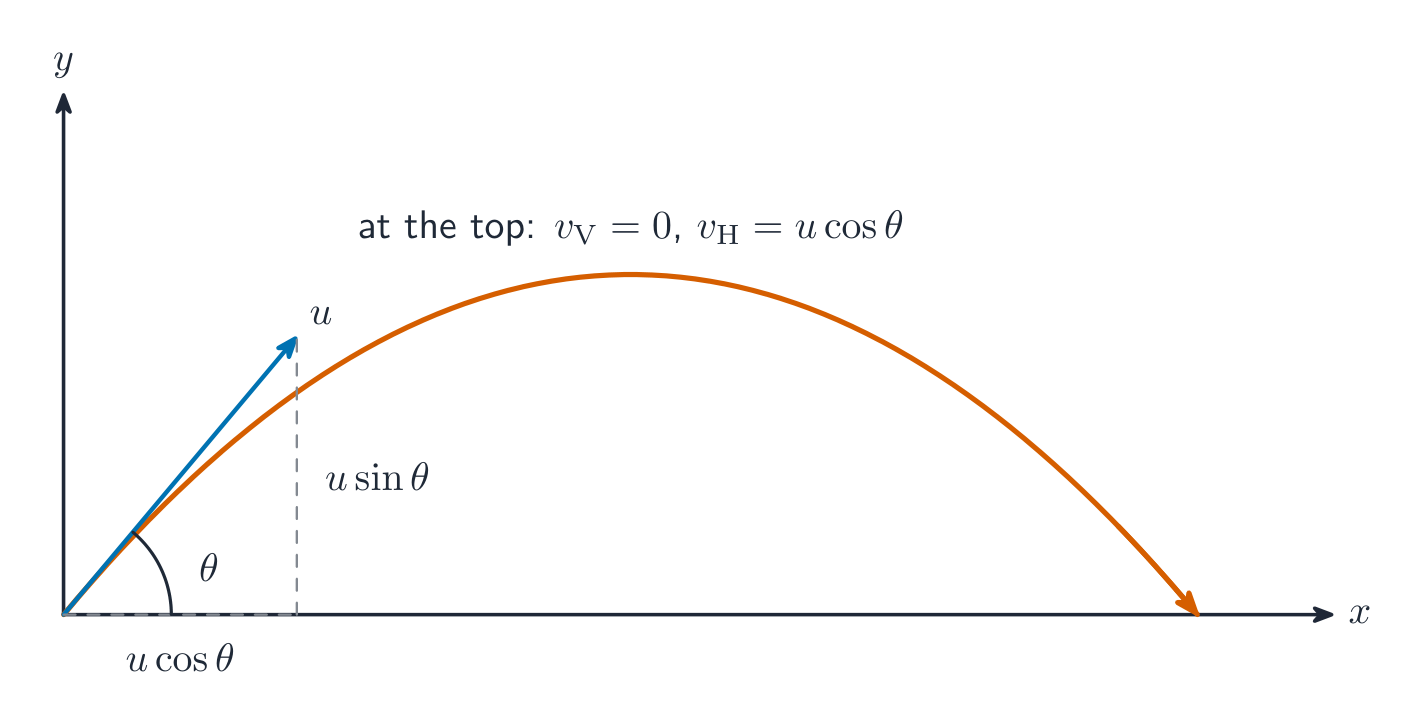
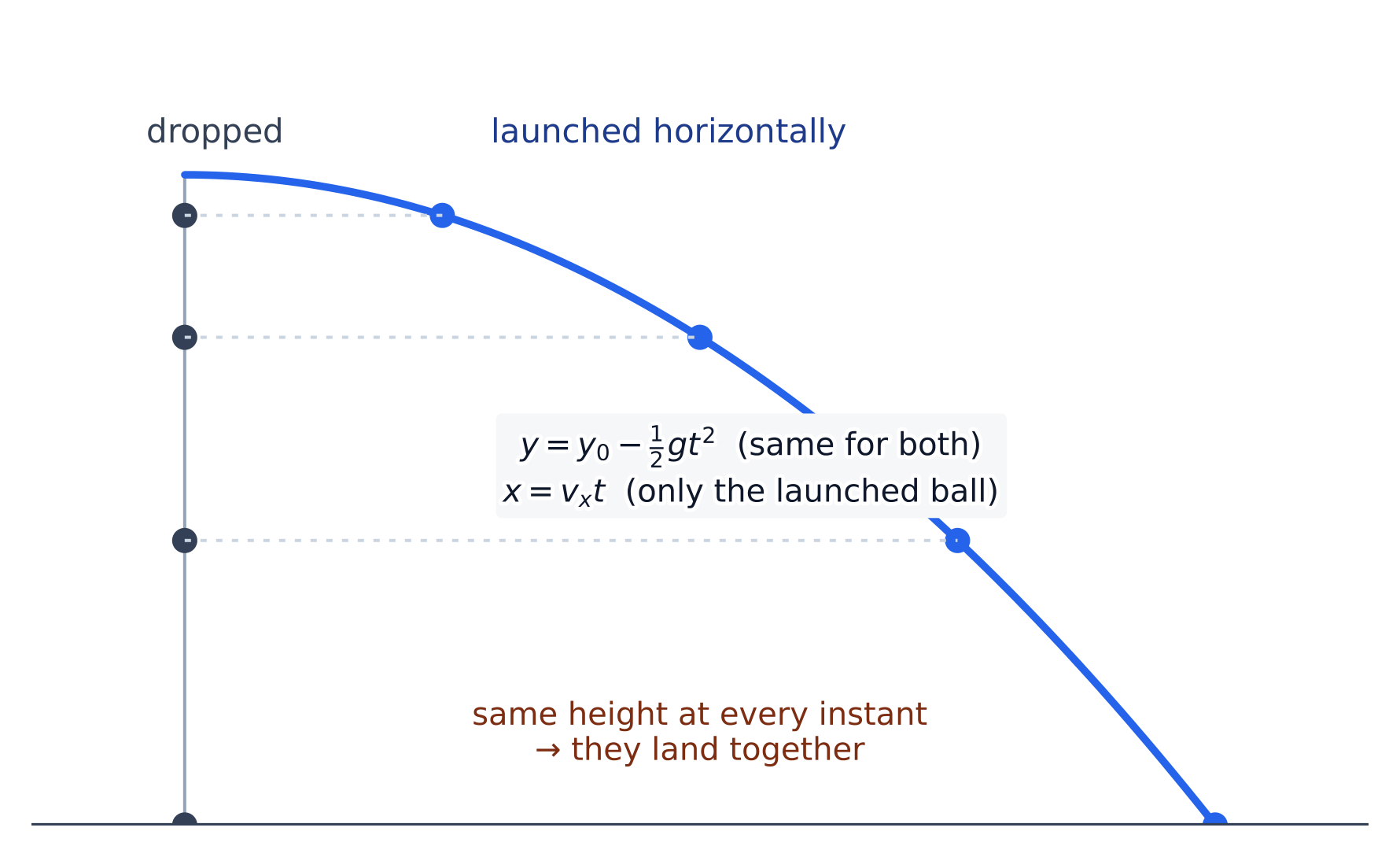
    For projectile motion 抛体运动 (an object moving under gravity alone): the horizontal and vertical motions are independent. Horizontally, velocity is constant ($a_x=0$); vertically, acceleration is $-g$ (down). The two motions share only the time. So a projectile's path (its trajectory 轨迹) is a parabola, and you solve it as two one-dimensional problems joined by $t$.

    A projectile launched at an angle: the horizontal and vertical motions are independent
    A projectile launched at an angle: the horizontal and vertical motions are independent
    A dropped ball and a horizontally launched ball fall together – the vertical motions are identical
    A dropped ball and a horizontally launched ball fall together – the vertical motions are identical

    Worked example. A ball is kicked at $20\ \text{m/s}$, $30^{\circ}$ above the horizontal. Taking $g=9.8\ \text{m/s}^2$, find the time of flight, the maximum height, and the horizontal range 射程 (assume it lands at launch height).

    Split the launch velocity into components:

    $$v_{0x}=20\cos 30^{\circ}=17.3\ \text{m/s},\qquad v_{0y}=20\sin 30^{\circ}=10\ \text{m/s}.$$
    Vertical motion sets the time. At the top $v_y=0$, so $0=10-9.8\,t \Rightarrow t_{\text{up}}=1.02\ \text{s}$, and the total flight is $2t_{\text{up}}=2.0\ \text{s}$. The maximum height is
    $$\Delta y=\frac{v_{0y}^2}{2g}=\frac{10^2}{19.6}=5.1\ \text{m}.$$
    Horizontal motion runs at constant $v_{0x}$ for the whole flight, so the range is
    $$R=v_{0x}\times t_{\text{flight}}=17.3\times 2.0=35\ \text{m}.$$

    A common trap: at the top of the flight the vertical velocity is zero, but the ball is not at rest – its horizontal velocity $v_{0x}$ never changes. The speed at the top equals $v_{0x}=17.3\ \text{m/s}$.

    Explore · ⁨استكشف⁩

    Explore projectile motion · ⁨استكشف حركة المقذوفات⁩

    Fire the ball, then change the angle and speed. The horizontal motion stays steady while gravity pulls it down — together they trace a parabola. Find the launch angle that gives the longest range, and try the Moon. · ⁨أطلق الكرة، ثم غيّر الزاوية والسرعة. يبقى الحركة الأفقية ثابتة بينما تجرها الجاذبية لأسفل — معاً يرسمان قطعاً مكافئاً. جد زاوية الإطلاق التي تعطي مدى أطول، وحاول القمر.⁩

    Explore · ⁨استكشف⁩

    Explore vectors and their components · ⁨استكشف المتجهات ومكوناتها⁩

    Drag the vectors to change their $x$- and $y$-components. See how a single vector is built from independent horizontal and vertical parts, and how two vectors add tip-to-tail into a resultant. · ⁨اسحب المتجهات لتغيير مركباتها $x$-و$y$. رَأِ كيف تُبنى متجه واحد من أجزاء أفقية وعمودية مستقلة، وكيف يُجمَع متجهان رأساً لذيل لتكون متجهة محصلة.⁩

    Vocabulary · ⁨مفردات⁩ Train · ⁨تدريب⁩
    English العربية
    components/kəmˈpəʊnənts/ مكونات
    projectile motion/prəˈdʒektaɪl ˈməʊʃn/ حركة المقذوفات
    trajectory/trəˈdʒektəri/ المسار
    range/reɪndʒ/ المدى
    1.5

    Exam tips

    • Choose the right kinematic equation by listing the three quantities you know plus the one you want, so only one unknown remains; the SUVAT equations apply only while acceleration is constant.
    • Fix a positive direction first — every displacement, velocity, and acceleration then carries a sign; a negative velocity means "moving the other way", not "slow".
    • Treat a projectile as two independent 1-D problems sharing only the time $t$: constant velocity horizontally, $a=-g$ vertically. At the top $v_y=0$ but $v_x$ is unchanged.
    • On a velocity–time graph the gradient is the acceleration and the area is the displacement (area below the axis is negative).
    • Distinguish distance (scalar, total path) from displacement (vector, start-to-end), and speed from velocity.
  • 2

    Force and Translational Dynamics · ⁨القوة والديناميكا الانتقالية⁩

    Watch lesson · ⁨شاهد الدرس⁩
    2.1

    Systems and Center of Mass

    Syllabus · ⁨المنهج⁩
    English

    Learning Objective 2.1.A: Describe the properties and interactions of a system.

    • 2.1.A.1 System properties are determined by the interactions between objects within the system.
    • 2.1.A.2 If the properties or interactions of the constituent objects within a system are not important in modeling the behavior of the macroscopic system, the system can itself be treated as a single object.
    • 2.1.A.3 Systems may allow interactions between constituent parts of the system and the environment, which may result in the transfer of energy or mass.
    • 2.1.A.4 Individual objects within a chosen system may behave differently from each other as well as from the system as a whole.
    • 2.1.A.5 The internal structure of a system affects the analysis of that system.
    • 2.1.A.6 As variables external to a system are changed, the system's substructure may change.

    Learning Objective 2.1.B: Describe the location of a system's center of mass with respect to the system's constituent parts.

    • 2.1.B.1 For systems with symmetrical mass distributions, the center of mass is located on lines of symmetry.
    • 2.1.B.2 The location of a system's center of mass along a given axis can be calculated using the equation
      • Equation: $\vec{x}_{cm} = \dfrac{\sum m_i \vec{x}_i}{\sum m_i}$
    • 2.1.B.3 A system can be modeled as a singular object that is located at the system's center of mass.

    Boundary statement: AP Physics 1 only expects students to calculate the center of mass for systems of five or fewer particles arranged in a two-dimensional configuration or for systems that are highly symmetrical.

    العربية

    الهدف التعليمي 2.1.A: وصف خصائص وتفاعلات النظام.

    • 2.1.A.1 تُحدد خصائص النظام من خلال التفاعلات بين الأجسام داخل النظام.
    • 2.1.A.2 إذا لم تكن خصائص أو تفاعلات الأجسام المكونة للنظام مهمة في نمذجة سلوك النظام العياني، يمكن اعتبار النظام ككائن واحد.
    • 2.1.A.3 قد تسمح الأنظمة بالتفاعلات بين أجزاء النظام المكونة والبيئة، مما قد يؤدي إلى انتقال الطاقة أو الكتلة.
    • 2.1.A.4 قد تتصرف الأجسام الفردية داخل نظام مختار بشكل مختلف عن بعضها البعض وكذلك عن النظام بأكمله.
    • 2.1.A.5 يؤثر البنية الداخلية للنظام على تحليل هذا النظام.
    • 2.1.A.6 عندما تتغير المتغيرات الخارجية للنظام، قد تتغير البنية الفرعية للنظام.

    الهدف التعليمي 2.1.B: وصف موقع مركز كتلة النظام بالنسبة لأجزائه المكونة.

    • 2.1.B.1 بالنسبة للأنظمة ذات توزيع كتلة متماثل، يقع مركز الكتلة على خطوط التماثل.
    • 2.1.B.2 يمكن حساب موقع مركز كتلة النظام على طول محور معين باستخدام المعادلة ⟦number⟧
      • المعادلة: $\vec{x}_{cm} = \dfrac{\sum m_i \vec{x}_i}{\sum m_i}$
    • 2.1.B.3 يمكن نمذجة النظام ككائن مفرد يقع في مركز كتلة النظام.

    عبارة الحدود: يتوقع من طلاب AP Physics 1 فقط حساب مركز الكتلة لأنظمة مكونة من خمسة جسيمات أو أقل مرتبة في تكوين ثنائي الأبعاد، أو لأنظمة ذات تماثل عالٍ.

    Source: College Board AP Course and Exam Description · ⁨المصدر: وصف دورة وامتحان College Board AP⁩

    A system 系统 is the object or group of objects you choose to analyze. A system can be treated as a single point at its center of mass 质心 – the average position of its mass. External forces change the motion of the center of mass; internal forces (between parts of the system) do not.

    This is why a wrench spinning across a table still has its center of mass move in a straight line: the spinning is internal, and only the (near-zero) external force matters for the center of mass. For two masses $m_1,m_2$ on a line at positions $x_1,x_2$, the center of mass sits at $x_{\text{cm}}=\dfrac{m_1x_1+m_2x_2}{m_1+m_2}$ – always closer to the heavier mass.

    Vocabulary · ⁨مفردات⁩ Train · ⁨تدريب⁩
    English العربية
    system/ˈsɪstəm/ نظام
    center of mass/ˈsentə ɒv mæs/ مركز الكتلة
    2.2

    Forces and Free-Body Diagrams

    Syllabus · ⁨المنهج⁩
    English

    Learning Objective 2.2.A: Describe a force as an interaction between two objects or systems.

    • 2.2.A.1 Forces are vector quantities that describe the interactions between objects or systems.
      • 2.2.A.1.i A force exerted on an object or system is always due to the interaction of that object with another object or system.
      • 2.2.A.1.ii An object or system cannot exert a net force on itself.
    • 2.2.A.2 Contact forces describe the interaction of an object or system touching another object or system and are macroscopic effects of interatomic electric forces.

    Learning Objective 2.2.B: Describe the forces exerted on an object or system using a free-body diagram.

    • 2.2.B.1 Free-body diagrams are useful tools for visualizing forces being exerted on a single object or system and for determining the equations that represent a physical situation.
    • 2.2.B.2 The free-body diagram of an object or system shows each of the forces exerted on the object by the environment.
    • 2.2.B.3 Forces exerted on an object or system are represented as vectors originating from the representation of the center of mass, such as a dot. A system is treated as though all of its mass is located at the center of mass.
    • 2.2.B.4 A coordinate system with one axis parallel to the direction of acceleration of the object or system simplifies the translation from free-body diagram to algebraic representation. For example, in a free-body diagram of an object on an inclined plane, it is useful to set one axis parallel to the surface of the incline.

    Boundary statement: AP Physics 1 only expects students to depict the forces exerted on objects, not the force components on free-body diagrams. On the AP Physics exams, individual forces represented on a free-body diagram must be drawn as individual straight arrows, originating on the dot and pointing in the direction of the force. Individual forces that are in the same direction must be drawn side by side, not overlapping.

    العربية

    الهدف التعليمي 2.2.A: وصف القوة كتفاعل بين جسمين أو نظامين.

    • 2.2.A.1 القوى كميات متجهة تصف التفاعلات بين الأجسام أو النظم.
      • 2.2.A.1.i تكون القوة المؤثرة على جسم أو نظام دائمًا نتيجة لتفاعل ذلك الجسم مع جسم أو نظام آخر.
      • 2.2.A.1.ii لا يمكن لجسم أو نظام أن يمارس قوة صافية على نفسه.
    • 2.2.A.2 تصف قوى التلامس تفاعل جسم أو نظام يلمس جسمًا أو نظامًا آخر، وهي تأثيرات عيانية لقوى كهربائية بين الذرات.

    الهدف التعليمي 2.2.B: وصف القوى المؤثرة على جسم أو نظام باستخدام مخطط الجسم الحر.

    • 2.2.B.1 تُعد مخططات الجسم الحر أدوات مفيدة لتصوير القوى المؤثرة على جسم أو نظام واحد ولتحديد المعادلات التي تمثل الحالة الفيزيائية.
    • 2.2.B.2 يُظهر مخطط الجسم الحر لكل القوى المؤثرة على الجسم بواسطة البيئة المحيطة.
    • 2.2.B.3 يتم تمثيل القوى المؤثرة على جسم أو نظام كمتجهات تنطلق من تمثيل مركز الكتلة، مثل نقطة. يُعامل النظام وكأن كتلته كلها تقع في مركز الكتلة.
    • 2.2.B.4 تبسيط نظام إحداثي يحتوي على محور موازٍ لاتجاه تسارع الجسم أو النظام يسهّل التحويل من مخطط الجسم الحر إلى التمثيل الجبري. على سبيل المثال، في مخطط جسم حر لجسم على سطح مائل، يكون من المفيد جعل أحد المحاور موازيًا لسطح الانحدار.

    عبارة الحدود: يتوقع من طلاب AP Physics 1 فقط تصوير القوى المؤثرة على الأجسام، وليس مركبات القوى على مخططات الجسم الحر. في امتحانات AP Physics، يجب رسم القوى الفردية الممثلة على مخطط الجسم الحر作为 أسهم مستقيمة فردية، تنطلق من النقطة وتشير في اتجاه القوة. يجب رسم القوى الفردية المتشابهة الاتجاه جنبًا إلى جنب، دون تداخل.

    Source: College Board AP Course and Exam Description · ⁨المصدر: وصف دورة وامتحان College Board AP⁩

    A skydiver: free-body diagrams balance gravity and air resistance at terminal speed
    A skydiver: free-body diagrams balance gravity and air resistance at terminal speed
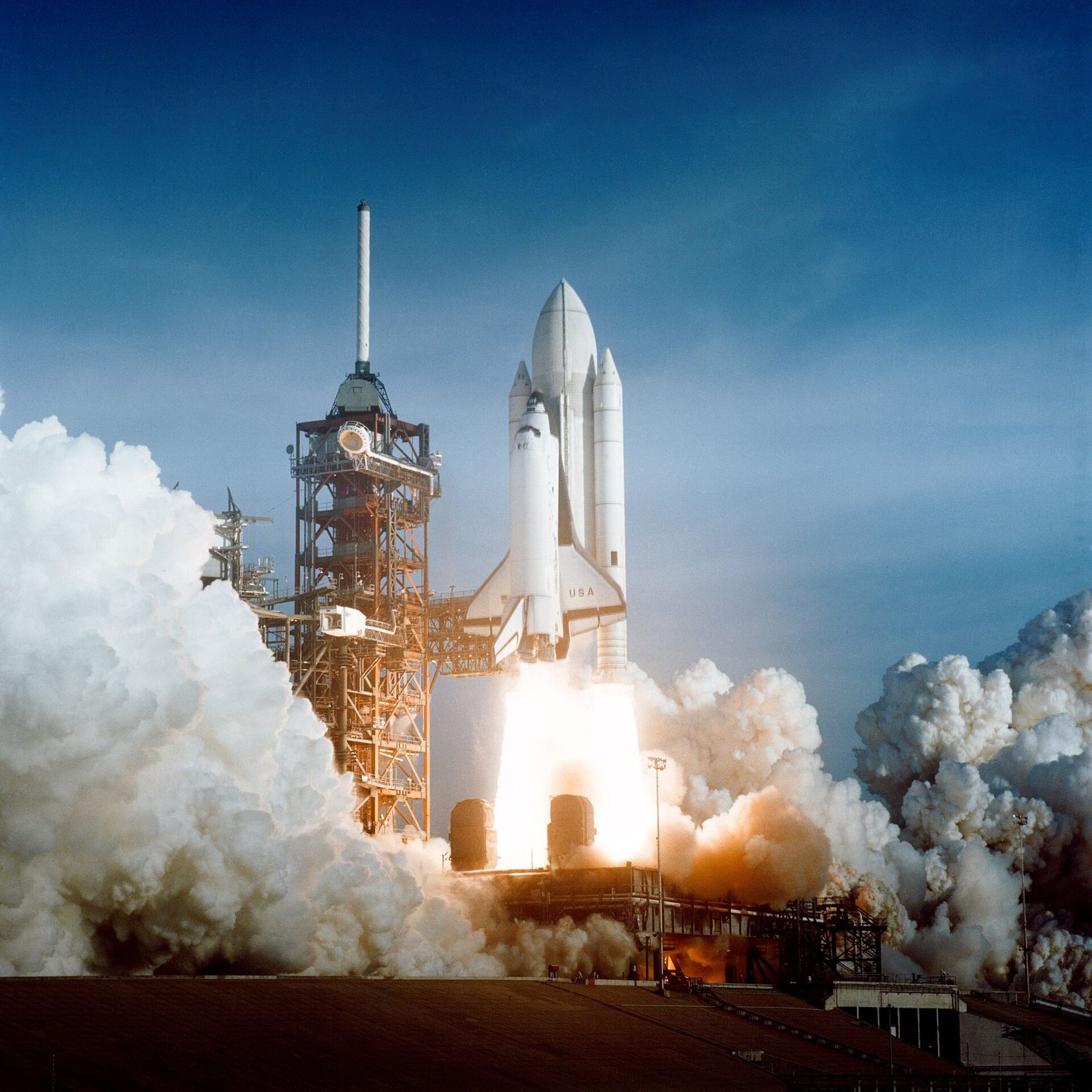
    A rocket launch: net force changes momentum — F_net = ma for translational dynamics
    A rocket launch: net force changes momentum — F_net = ma for translational dynamics

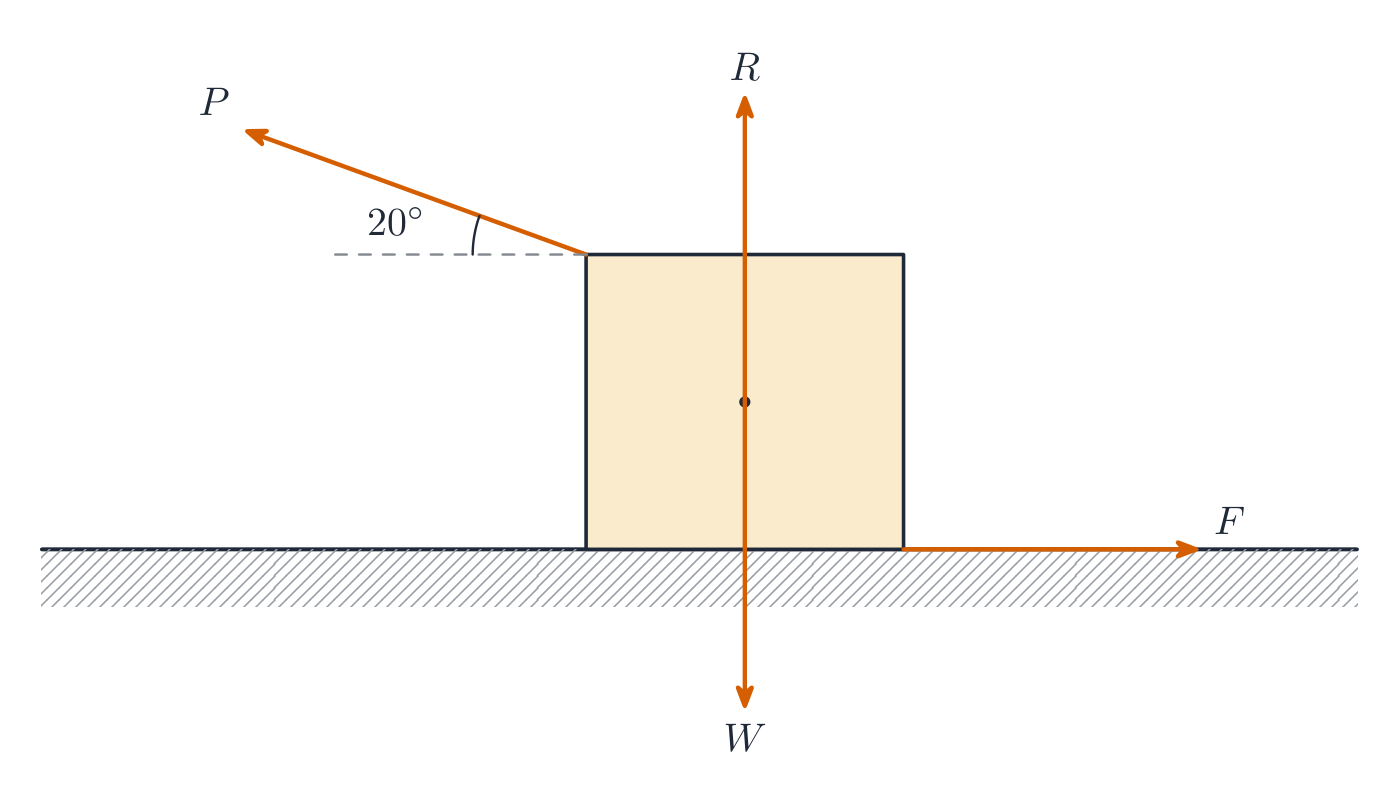
    A force 力 is a push or pull – a vector, measured in newtons (N). A free-body diagram 受力图 shows one object as a dot with arrows for every force acting on it (weight 重力, normal, tension 张力, friction, applied), each labelled and pointing the right way. Draw it before any dynamics problem; it is where most marks are won or lost.

    A free-body diagram shows every force acting on one object
    A free-body diagram shows every force acting on one object

    Two rules keep free-body diagrams honest: draw only forces acting on the chosen object (not forces it exerts on other things), and draw only real, physical forces (a rope, a surface, gravity, a hand) – never an "$ma$" arrow, which is the result of the forces, not a force itself.

    Explore · ⁨استكشف⁩

    Balance the forces on a free-body diagram · ⁨وزّن القوى في مخطط الجسم الحر⁩

    A free-body diagram shows every force on one object as an arrow. The object accelerates only if the forces don't cancel — the net force sets $a=F/m$. · ⁨المخطط الحر للجسم يُظهر كل قوة تؤثر على جسم واحد كسهم. يتسارع الجسم فقط إذا لم تلغِ القوى بعضها البعض — حيث يحدد القوة المحصلة $a=F/m$.⁩

    Vocabulary · ⁨مفردات⁩ Train · ⁨تدريب⁩
    English العربية
    force/fɔːs/ القوة
    free-body diagram/friː ˈbɒdi ˈdaɪəɡræm/ مخطط الجسم الحر
    weight/weɪt/ الوزن
    tension/ˈtenʃn/ قوة الشد
    2.3

    Newton's Third Law

    Syllabus · ⁨المنهج⁩
    English

    Learning Objective 2.3.A: Describe the interaction of two objects using Newton's third law and a representation of paired forces exerted on each object.

    • 2.3.A.1 Newton's third law describes the interaction of two objects in terms of the paired forces that each exerts on the other.
      • Equation: $\vec{F}_{\text{A on B}} = -\vec{F}_{\text{B on A}}$
    • 2.3.A.2 Interactions between objects within a system (internal forces) do not influence the motion of a system's center of mass.
    • 2.3.A.3 Tension is the macroscopic net result of forces that segments of a string, cable, chain, or similar system exert on each other in response to an external force.
      • 2.3.A.3.i An ideal string has negligible mass and does not stretch when under tension.
      • 2.3.A.3.ii The tension in an ideal string is the same at all points within the string.
      • 2.3.A.3.iii In a string with nonnegligible mass, tension may not be the same at all points within the string.
      • 2.3.A.3.iv An ideal pulley is a pulley that has negligible mass and rotates about an axle through its center of mass with negligible friction.

    Boundary statement: AP Physics 1 only expects students to describe tension qualitatively in a string, cable, chain, or similar system with mass. For example, students might note that the tension in a hanging chain is greater toward the top of the chain.

    Boundary statement: The interaction between objects or systems at a distance is limited to gravitational forces in AP Physics 1. In AP Physics 2, gravitational, electric, and magnetic forces may be considered.

    العربية

    هدف التعلم 2.3.A: وصف تفاعل جسمين باستخدام قانون نيوتن الثالث وتمثيل القوى المتزاوجة المؤثرة على كل جسم.

    • 2.3.A.1 يصف قانون نيوتن الثالث تفاعل جسمين من حيث القوى المتزاوجة التي يؤثر بها كل منهما على الآخر.
      • المعادلة: $\vec{F}_{\text{A on B}} = -\vec{F}_{\text{B on A}}$
    • 2.3.A.2 لا تؤثر التفاعلات بين الأجسام داخل نظام ما (القوى الداخلية) في حركة مركز كتلة ذلك النظام.
    • 2.3.A.3 الشد هو النتيجة الكلية المجهرية للقوى التي تبذلها أجزاء من حبل أو كابل أو سلسلة أو نظام مشابه بعضها البعض استجابة لقوة خارجية.
      • 2.3.A.3.i الحبل المثالي له كتلة مهملة ولا يتمدد عند تعرضه للشد.
      • 2.3.A.3.ii يكون الشد في الحبل المثالي متساوياً عند جميع نقاطه داخل الحبل.
      • 2.3.A.3.iii في الحبل ذي الكتلة غير المهملة، قد لا يكون الشد متساوياً عند جميع نقاطه داخل الحبل.
      • 2.3.A.3.iv البكرة المثالية هي بكرة ذات كتلة مهملة تدور حول محور يمر بمركز كتلتها مع احتكاك مهمل.

    عبارة الحدود: يقتصر امتحان AP Physics 1 على أن يصف الطلاب الشد بشكل نوعي في حبل أو كابل أو سلسلة أو نظام مشابه له كتلة. على سبيل المثال، قد يلاحظ الطلاب أن الشد في سلسلة معلقة يكون أكبر نحو الجزء العلوي من السلسلة.

    عبارة الحدود: تقتصر التفاعلات بين الأجسام أو الأنظمة عن بُعد في AP Physics 1 على القوى الجاذبة فقط. أما في AP Physics 2، فقد تُعتبر القوى الجاذبة والكهربائية والمغناطيسية.

    Source: College Board AP Course and Exam Description · ⁨المصدر: وصف دورة وامتحان College Board AP⁩

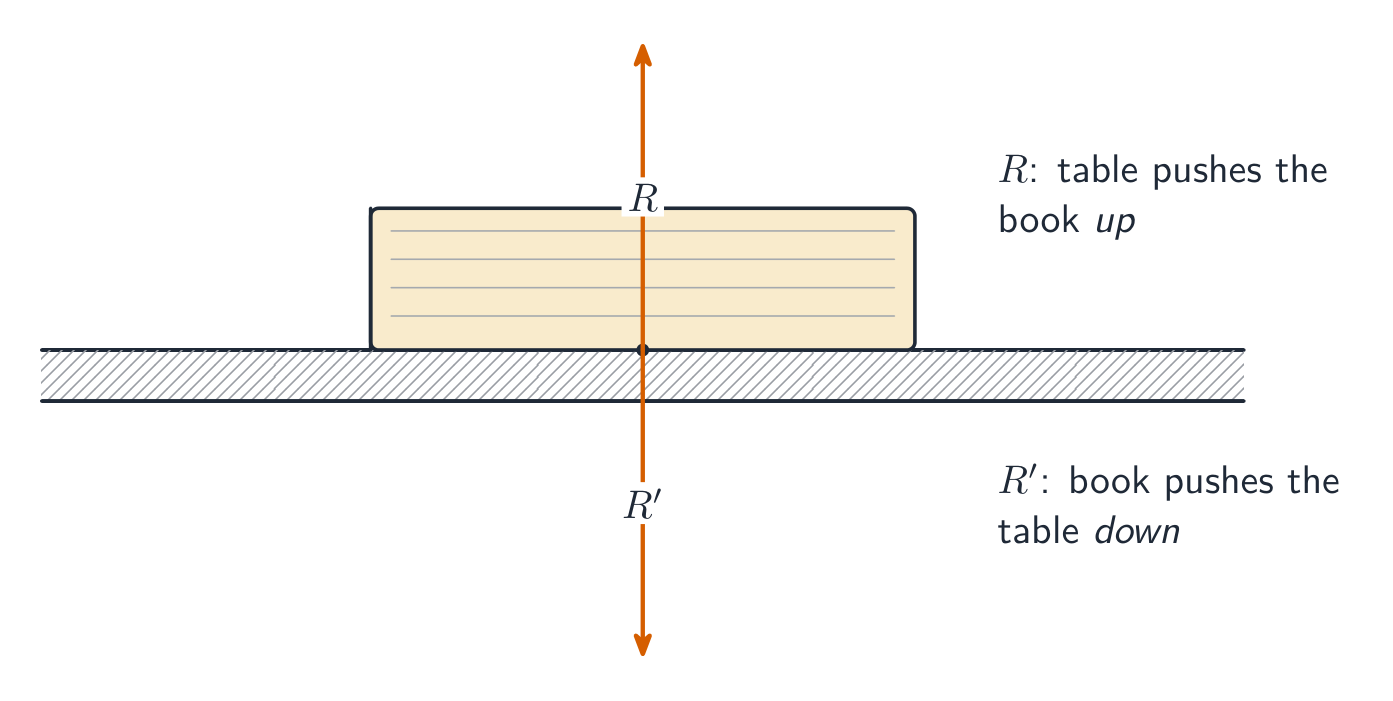
    Newton's third law 牛顿第三定律: if object A pushes on object B, then B pushes back on A with a force equal in size and opposite in direction. These two forces act on different objects, so they never cancel each other. Identify third-law pairs by the "A on B / B on A" wording.

    A Newton's third-law pair: equal and opposite forces on two different objects
    A Newton's third-law pair: equal and opposite forces on two different objects

    A classic trap: the weight of a book and the normal force from the table are not a third-law pair – they act on the same object (the book). The partner of the book's weight is the pull the book exerts on the Earth; the partner of the table's push is the push the book makes on the table.

    Vocabulary · ⁨مفردات⁩ Train · ⁨تدريب⁩
    English العربية
    Newton's third law/ˈnjuːtnz θɜːd lɔː/ القانون الثالث لنيوTON
    2.4

    Newton's First Law

    Syllabus · ⁨المنهج⁩
    English

    Learning Objective 2.4.A: Describe the conditions under which a system's velocity remains constant.

    • 2.4.A.1 The net force on a system is the vector sum of all forces exerted on the system.
    • 2.4.A.2 Translational equilibrium is a configuration of forces such that the net force exerted on a system is zero.
      • Derived equation: $\sum_i \vec{F}_i = 0$
    • 2.4.A.3 Newton's first law states that if the net force exerted on a system is zero, the velocity of that system will remain constant.
    • 2.4.A.4 Forces may be balanced in one dimension but unbalanced in another. The system's velocity will change only in the direction of the unbalanced force.
    • 2.4.A.5 An inertial reference frame is one from which an observer would verify Newton's first law of motion.
    العربية

    هدف التعلم 2.4.A: وصف الظروف التي تظل فيها سرعة النظام ثابتة.

    • 2.4.A.1 محصلة القوى المؤثرة على النظام هي المجموع الاتجاهي لكل القوى المؤثرة عليه.
    • 2.4.A.2 الاتزان الانتقالي هو حالة من القوى تكون فيها محصلة القوى المؤثرة على النظام مساوية للصفر.
      • معادلة مستنتجة: $\sum_i \vec{F}_i = 0$
    • 2.4.A.3 ينص قانون نيوتن الأول على أنه إذا كانت محصلة القوى المؤثرة على نظام ما تساوي الصفر، فإن سرعة ذلك النظام ستبقى ثابتة.
    • 2.4.A.4 يمكن أن تكون القوى متوازنة في بُعد واحد وغير متوازنة في بُعد آخر. ستتغير سرعة النظام فقط في اتجاه القوة غير المتوازنة.
    • 2.4.A.5 الإطار المرجعي القصوري هو إطار يتحقق منه المراقب قانون نيوتن الأول للحركة.

    Source: College Board AP Course and Exam Description · ⁨المصدر: وصف دورة وامتحان College Board AP⁩

    Newton's first law 牛顿第一定律 (the law of inertia 惯性): an object's velocity stays constant unless a net force 合力 acts on it. So zero net force means constant velocity (including rest) – the object is in translational equilibrium 平衡. Inertia is the tendency to resist changes in motion, measured by mass.

    Worked example. A $1200\ \text{kg}$ car cruises at a steady $25\ \text{m/s}$ on a level road. What is the net force on it? Because the velocity is constant, the acceleration is zero, so by the first law the net force is zero – the forward drive force exactly balances drag and friction. "Steady speed" always means balanced forces.

    Vocabulary · ⁨مفردات⁩ Train · ⁨تدريب⁩
    English العربية
    Newton's first law/ˈnjuːtnz fɜːst lɔː/ قانون نيوتن الأول
    inertia/ɪˈnɜːʃə/ القصور الذاتي
    net force/net fɔːs/ القوة المحصلة
    translational equilibrium/trænˈsleɪʃənl ˌiːkwɪˈlɪbrɪəm/ التوازن الانتقالي
    2.5

    Newton's Second Law

    Syllabus · ⁨المنهج⁩
    English

    Learning Objective 2.5.A: Describe the conditions under which a system's velocity changes.

    • 2.5.A.1 Unbalanced forces are a configuration of forces such that the net force exerted on a system is not equal to zero.
    • 2.5.A.2 Newton's second law of motion states that the acceleration of a system's center of mass has a magnitude proportional to the magnitude of the net force exerted on the system and is in the same direction as that net force.
      • Equation: $\vec{a}_{\text{sys}} = \dfrac{\sum \vec{F}}{m_{\text{sys}}} = \dfrac{\vec{F}_{\text{net}}}{m_{\text{sys}}}$
    • 2.5.A.3 The velocity of a system's center of mass will only change if a nonzero net external force is exerted on that system.
    العربية

    هدف التعلم 2.5.A: وصف الظروف التي تتغير فيها سرعة النظام.

    • 2.5.A.1 القوى غير المتوازنة هي حالة من القوى تكون فيها محصلة القوى المؤثرة على النظام لا تساوي الصفر.
    • 2.5.A.2 ينص قانون نيوتن الثاني للحركة على أن تسارع مركز كتلة النظام له مقدار متناسب طردياً مع مقدار محصلة القوى المؤثرة على النظام ويكون في نفس اتجاه تلك المحصلة.
      • المعادلة: $\vec{a}_{\text{sys}} = \dfrac{\sum \vec{F}}{m_{\text{sys}}} = \dfrac{\vec{F}_{\text{net}}}{m_{\text{sys}}}$
    • 2.5.A.3 لن تتغير سرعة مركز كتلة نظام ما إلا إذا أثرت عليه محصلة قوى خارجية غير صفرية.

    Source: College Board AP Course and Exam Description · ⁨المصدر: وصف دورة وامتحان College Board AP⁩

    Newton's second law 牛顿第二定律 relates net force to acceleration:

    $$\vec{a}=\frac{\sum \vec{F}}{m},\qquad\text{i.e.}\qquad \sum\vec{F}=m\vec{a}.$$
    Apply it one axis at a time: add the force components along each axis and set the sum equal to $ma$ for that axis. Acceleration points the same way as the net force.

    Worked example. A $4.0\ \text{kg}$ box is pulled along the floor by a horizontal force of $18\ \text{N}$. Friction on the box is $6.0\ \text{N}$. Find its acceleration. Along the direction of motion the net force is $18-6.0=12\ \text{N}$, so

    $$a=\frac{\sum F}{m}=\frac{12}{4.0}=3.0\ \text{m/s}^2.$$

    Worked example (incline 斜面). A block of mass $m$ slides down a frictionless ramp tilted at angle $\theta$. Find its acceleration. Resolve gravity into components along and perpendicular to the ramp; only the along-ramp part, $mg\sin\theta$, drives the motion, so

    $$a=\frac{mg\sin\theta}{m}=g\sin\theta.$$
    The steeper the ramp, the larger $\sin\theta$ and the faster it accelerates; at $\theta=90^{\circ}$ it is free fall.

    Vocabulary · ⁨مفردات⁩ Train · ⁨تدريب⁩
    English العربية
    Newton's second law/ˈnjuːtnz ˈsekənd lɔː/ القانون الثاني لنيوتن
    incline/ɪnˈklaɪn/ الميلان
    2.6

    Gravitational Force

    Syllabus · ⁨المنهج⁩
    English

    Learning Objective 2.6.A: Describe the gravitational interaction between two objects or systems with mass.

    • 2.6.A.1 Newton's law of universal gravitation describes the gravitational force between two objects or systems as directly proportional to each of their masses and inversely proportional to the square of the distance between the systems' centers of mass.
      • Equation: $\left|\vec{F}_g\right| = G\dfrac{m_1 m_2}{r^2}$
      • 2.6.A.1.i The gravitational force is attractive.
      • 2.6.A.1.ii The gravitational force is always exerted along the line connecting the centers of mass of the two interacting systems.
      • 2.6.A.1.iii The gravitational force on a system can be considered to be exerted on the system's center of mass.
    • 2.6.A.2 A field models the effects of a noncontact force exerted on an object at various positions in space.
      • 2.6.A.2.i The magnitude of the gravitational field created by a system of mass $M$ at a point in space is equal to the ratio of the gravitational force exerted by the system on a test object of mass $m$ to the mass of the test object.
        • Equation: $\left|\vec{g}\right| = \dfrac{\left|\vec{F}_g\right|}{m} = G\dfrac{M}{r^2}$
      • 2.6.A.2.ii If the gravitational force is the only force exerted on an object, the observed acceleration of the object (in m/s$^2$) is numerically equal to the magnitude of the gravitational field strength (in N/kg) at that location.
    • 2.6.A.3 The gravitational force exerted by an astronomical body on a relatively small nearby object is called weight.
      • Equation: $\text{Weight} = F_g = mg$

    Learning Objective 2.6.B: Describe situations in which the gravitational force can be considered constant.

    • 2.6.B.1 If the gravitational force between two systems' centers of mass has a negligible change as the relative position of the two systems changes, the gravitational force can be considered constant at all points between the initial and final positions of the systems.
    • 2.6.B.2 Near the surface of Earth, the strength of the gravitational field is $g \approx 10 \text{ N/kg}$

    Learning Objective 2.6.C: Describe the conditions under which the magnitude of a system's apparent weight is different from the magnitude of the gravitational force exerted on that system.

    • 2.6.C.1 The magnitude of the apparent weight of a system is the magnitude of the normal force exerted on the system.
    • 2.6.C.2 If the system is accelerating, the apparent weight of the system is not equal to the magnitude of the gravitational force exerted on the system.
    • 2.6.C.3 A system appears weightless when there are no forces exerted on the system or when the force of gravity is the only force exerted on the system.
    • 2.6.C.4 The equivalence principle states that an observer in a noninertial reference frame is unable to distinguish between an object's apparent weight and the gravitational force exerted on the object by a gravitational field.

    Learning Objective 2.6.D: Describe inertial and gravitational mass.

    • 2.6.D.1 Objects have inertial mass, or inertia, a property that determines how much an object's motion resists changes when interacting with another object.
    • 2.6.D.2 Gravitational mass is related to the force of attraction between two systems with mass.
    • 2.6.D.3 Inertial mass and gravitational mass have been experimentally verified to be equivalent.
    العربية

    هدف التعلم 2.6.A: وصف التفاعل الجاذب بين جسمين أو نظامين لهما كتلة.

    • 2.6.A.1 ينص قانون نيوتن للجذب العام على أن القوة الجاذبة بين جسمين أو نظامين تتناسب طردياً مع كتلة كل منهما وتتناسب عكسياً مع مربع المسافة بين مركزي كتلتهما.
      • المعادلة: $\left|\vec{F}_g\right| = G\dfrac{m_1 m_2}{r^2}$
      • 2.6.A.1.i القوة الجاذبة قوة تجاذبية.
      • 2.6.A.1.ii تُؤثر القوة الجاذبة دائماً على طول الخط الواصل بين مركزي كتلة النظامين المتفاعلين.
      • 2.6.A.1.iii يمكن اعتبار أن القوة الجاذبة المؤثرة على نظام ما تُؤثر على مركز كتلته.
    • 2.6.A.2 المجال يمثل تأثير قوة غير تلامسية تُؤثر على جسم في مواقع مختلفة في الفضاء.
      • 2.6.A.2.i مقدار المجال الجاذب الذي يولده نظام كتلته $M$ عند نقطة في الفضاء يساوي نسبة القوة الجاذبة التي يبذله该系统 على جسم اختبار كتلته $m$ إلى كتلة الجسم الاختبار.
        • معادلة: $\left|\vec{g}\right| = \dfrac{\left|\vec{F}_g\right|}{m} = G\dfrac{M}{r^2}$
      • 2.6.A.2.ii إذا كانت القوة الجاذبة هي القوة الوحيدة المؤثرة على جسم، فإن التسارع المرصود للجسم (بوحدة m/s$^2$) يساوي عددياً مقدار شدة المجال الجاذب (بوحدة N/kg) في ذلك الموقع.
    • 2.6.A.3 تسمى القوة الجاذبة التي يبذرها جرم فلكي على جسم صغير قريب منه بالوزن.
      • المعادلة: $\text{Weight} = F_g = mg$

    هدف التعلم 2.6.B: وصف الحالات التي يمكن فيها اعتبار القوة الجاذبة ثابتة.

    • 2.6.B.1 إذا كان التغير في القوة الجاذبة بين مركزي كتلة نظامين مهملاً مع تغير وضعيهما النسبي، فيمكن اعتبار القوة الجاذبة ثابتة عند جميع النقاط بين الوضعين الابتدائي والنهائي للنظامين.
    • 2.6.B.2 بالقرب من سطح الأرض، تكون شدة المجال الجاذب $g \approx 10 \text{ N/kg}$

    هدف التعلم 2.6.C: وصف الظروف التي يكون فيها مقدار الوزن الظاهري لنظام مختلفاً عن مقدار القوة الجاذبة المؤثرة عليه.

    • 2.6.C.1 مقدار الوزن الظاهري لنظام هو مقدار القوة العمودية المؤثرة عليه.
    • 2.6.C.2 إذا كان النظام يتسارع، فإن وزنه الظاهري لا يساوي مقدار القوة الجاذبة المؤثرة عليه.
    • 2.6.C.3 يبدو النظام خفيف الوزن عندما لا توجد قوى مؤثرة عليه أو عندما تكون الجاذبية هي القوة الوحيدة المؤثرة عليه.
    • 2.6.C.4 تنص مبدأ التكافؤ على أن المراقب في إطار مرجعي غير قصوري لا يستطيع التمييز بين الوزن الظاهري لجسم ما والقوة الجاذبة المؤثرة عليه من قبل مجال جاذبية.

    الهدف التعليمي 2.6.D: وصف الكتلة القصورية والكتلة الجاذبة.

    • 2.6.D.1 تمتلك الأجسام كتلة قصورية، أو قصوراً (إنرفيا)، وهي خاصية تحدد مدى مقاومة حركة الجسم للتغيرات عند تفاعله مع جسم آخر.
    • 2.6.D.2 ترتبط الكتلة الجاذبة بقوة التجاذب بين نظامين لهما كتلة.
    • 2.6.D.3 تم التحقق تجريبياً من تكافؤ الكتلة القصورية والكتلة الجاذبة.

    Source: College Board AP Course and Exam Description · ⁨المصدر: وصف دورة وامتحان College Board AP⁩

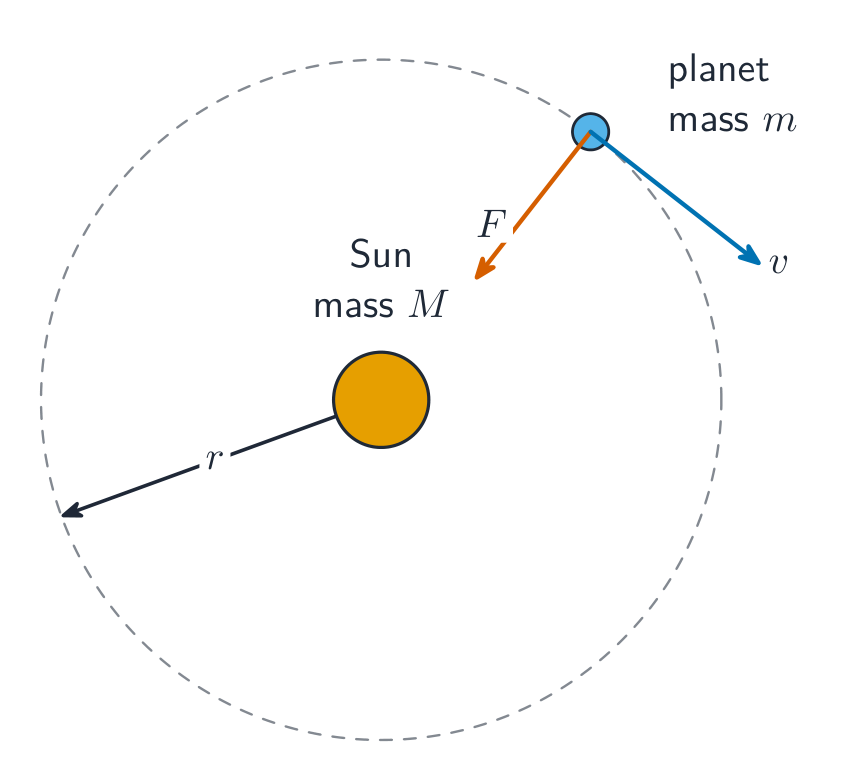
    Orbital motion (Kepler's 2nd law)

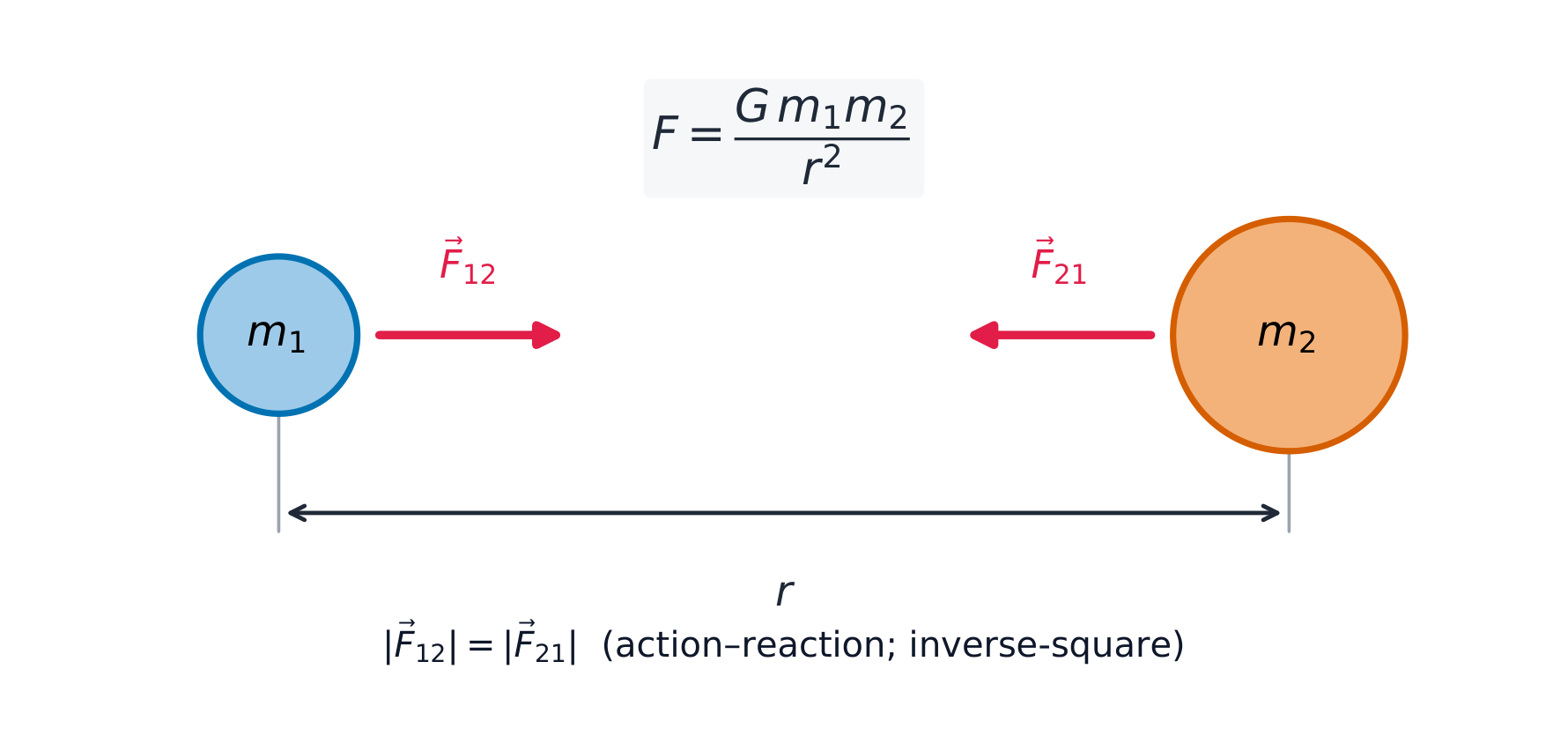
    Near a planet's surface, the gravitational force (weight) is $F_g=mg$, directed down, where $g$ is the gravitational field strength 重力场强度. More generally, Newton's law of gravitation 万有引力定律 gives the attraction between any two masses:

    $$F_g=\frac{G m_1 m_2}{r^2},$$
    directed along the line joining them, weaker as the distance $r$ grows (an inverse-square law). Doubling the separation quarters the force.

    Two masses attract each other with equal, opposite, inverse-square forces along the line joining them
    Two masses attract each other with equal, opposite, inverse-square forces along the line joining them

    Worked example. A $2.0\ \text{kg}$ object weighs $19.6\ \text{N}$ on Earth ($g=9.8\ \text{m/s}^2$). On the Moon $g_{\text{Moon}}=1.6\ \text{m/s}^2$. Its mass is unchanged ($2.0\ \text{kg}$), but its weight becomes $F_g=mg=2.0\times1.6=3.2\ \text{N}$. Mass measures inertia; weight is a force that depends on where you are.

    Mass actually plays two distinct roles. Inertial mass 惯性质量 sets how strongly an object resists acceleration ($F=ma$); gravitational mass 引力质量 sets how strongly it attracts other masses ($F=Gm_1m_2/r^2$). Experiments confirm the two are equal – which is exactly why every object, heavy or light, falls with the same $g$.

    Vocabulary · ⁨مفردات⁩ Train · ⁨تدريب⁩
    English العربية
    gravitational field strength/ˌɡrævɪˈteɪʃənl fiːld streŋθ/ شدة المجال الجاذبي
    Newton's law of gravitation/ˈnjuːtnz lɔː ɒv ˌɡrævɪˈteɪʃn/ قانون نيوتن للجاذبية
    Inertial mass/ɪˈnɜːʃl mæs/ الكتلة القصور الذاتي
    gravitational mass/ˌɡrævɪˈteɪʃənl mæs/ الكتلة الجاذبية
    2.7

    Kinetic and Static Friction

    Syllabus · ⁨المنهج⁩
    English

    Learning Objective 2.7.A: Describe kinetic friction between two surfaces

    • 2.7.A.1 Kinetic friction occurs when two surfaces in contact move relative to each other.
      • 2.7.A.1.i The kinetic friction force is exerted in a direction opposite to the motion of each surface relative to the other surface.
      • 2.7.A.1.ii The force of friction between two surfaces does not depend on the size of the surface area of contact.
    • 2.7.A.2 The magnitude of the kinetic friction force exerted on an object is the product of the normal force the surface exerts on the object and the coefficient of kinetic friction.
      • Equation: $\left|\vec{F}_{f,k}\right| = \left|\mu_k \vec{F}_n\right|$
      • 2.7.A.2.i The coefficient of kinetic friction depends on the material properties of the surfaces that are in contact.
      • 2.7.A.2.ii Normal force is the perpendicular component of the force exerted on an object by the surface with which it is in contact; it is directed away from the surface.

    Learning Objective 2.7.B: Describe static friction between two surfaces.

    • 2.7.B.1 Static friction may occur between the contacting surfaces of two objects that are not moving relative to each other.
    • 2.7.B.2 Static friction adopts the value and direction required to prevent an object from slipping or sliding on a surface.
      • Equation: $\left|\vec{F}_{f,s}\right| \leq \left|\mu_s \vec{F}_n\right|$
      • 2.7.B.2.i Slipping and sliding refer to situations in which two surfaces are moving relative to each other.
      • 2.7.B.2.ii There exists a maximum value for which static friction will prevent an object from slipping on a given surface.
        • Equation: $F_{f,s,\max} = \mu_s F_n$
    • 2.7.B.3 The coefficient of static friction is typically greater than the coefficient of kinetic friction for a given pair of surfaces.
    العربية

    الهدف التعليمي 2.7.A: وصف الاحتكاك الحركي بين سطحين.

    • 2.7.A.1 يحدث الاحتكاك الحركي عندما يتحرك سطحان متلامسان بالنسبة لبعضهما البعض.
      • 2.7.A.1.i تُمارس قوة الاحتكاك الحركي في اتجاه معاكس لحركة كل سطح بالنسبة للسطح الآخر.
      • 2.7.A.1.ii لا تعتمد قوة الاحتكاك بين سطحين على مساحة سطح التلامس.
    • 2.7.A.2 مقدار قوة الاحتكاك الحركي المؤثرة على جسم هو حاصل ضرب القوة العمودية التي يمارسها السطح على الجسم ومعامل الاحتكاك الحركي.
      • المعادلة: $\left|\vec{F}_{f,k}\right| = \left|\mu_k \vec{F}_n\right|$
      • 2.7.A.2.i يعتمد معامل الاحتكاك الحركي على الخصائص المادية للأسطح المتلامسة.
      • 2.7.A.2.ii القوة العمودية هي المكون العمودي للقوة المؤثرة على جسم بواسطة السطح الذي يتلامس معه؛ وتكون موجهة بعيداً عن السطح.

    الهدف التعليمي 2.7.B: وصف الاحتكاك السكوني بين سطحين.

    • 2.7.B.1 قد يحدث الاحتكاك السكوني بين أسطح التلامس لجسمين غير متحركين بالنسبة لبعضهما البعض.
    • 2.7.B.2 يأخذ الاحتكاك السكوني القيمة والاتجاه اللازمين لمنع انزلاق جسم أو انزلاقه على سطح.
      • المعادلة: $\left|\vec{F}_{f,s}\right| \leq \left|\mu_s \vec{F}_n\right|$
      • 2.7.B.2.i يشير الانزلاق والانزلاق إلى مواقف تتحرك فيها سطحان بالنسبة لبعضهما البعض.
      • 2.7.B.2.ii يوجد حد أقصى لقيمة الاحتكاك السكوني التي تمنع جسماً من الانزلاق على سطح معين.
        • معادلة: $F_{f,s,\max} = \mu_s F_n$
    • 2.7.B.3 عادة ما يكون معامل الاحتكاك السكوني أكبر من معامل الاحتكاك الحركي لنظام معين من الأسطح.

    Source: College Board AP Course and Exam Description · ⁨المصدر: وصف دورة وامتحان College Board AP⁩

    Friction 摩擦力 acts along a surface, opposing relative sliding (or the tendency to slide):

    • Kinetic friction 动摩擦 (while sliding): $f_k=\mu_k N$.
    • Static friction 静摩擦 (while not yet sliding): $f_s\le \mu_s N$ – it adjusts up to a maximum to prevent motion.

    Here $N$ is the normal force 法向力 (surface push, perpendicular to the surface) and $\mu$ is the coefficient of friction 摩擦系数.

    Worked example. A $5.0\ \text{kg}$ crate sits on a level floor with $\mu_s=0.40$. Will a horizontal push of $15\ \text{N}$ move it? On a level floor $N=mg=5.0\times9.8=49\ \text{N}$, so the largest static friction is $f_{s,\max}=\mu_s N=0.40\times49=19.6\ \text{N}$. The $15\ \text{N}$ push is smaller than $19.6\ \text{N}$, so friction rises to match it and the crate stays still.

    Explore · ⁨استكشف⁩

    Slide a block down a slope with friction · ⁨زُلِّ كتلة على سطح ميل مع احتكاك⁩

    Friction opposes motion up to a maximum $\mu N$. Tilt the slope until gravity's pull along it beats static friction and the block starts to slide. · ⁨الاحتكاك يعارض الحركة حتى حد أقصى $\mu N$. ميّل السطح حتى يتفوق سحب الجاذبية عليه على الاحتكاك الساكن وتبدأ الكتلة بالزلاق.⁩

    Vocabulary · ⁨مفردات⁩ Train · ⁨تدريب⁩
    English العربية
    Friction/ˈfrɪkʃn/ الاحتكاك
    Kinetic friction/kɪˈnetɪk ˈfrɪkʃn/ الاحتكاك الحركي
    Static friction/ˈstætɪk ˈfrɪkʃn/ الاحتكاك الساكن
    normal force/ˈnɔːml fɔːs/ القوة العمودية
    coefficient of friction/ˌkəʊɪˈfɪʃənt ɒv ˈfrɪkʃn/ معامل الاحتكاك
    2.8

    Spring Forces

    Syllabus · ⁨المنهج⁩
    English

    Learning Objective 2.8.A: Describe the force exerted on an object by an ideal spring

    • 2.8.A.1 An ideal spring has negligible mass and exerts a force that is proportional to the change in its length as measured from its relaxed length.
    • 2.8.A.2 The magnitude of the force exerted by an ideal spring on an object is given by Hooke's law:
      • Equation: $\vec{F}_s = -k\Delta\vec{x}$
    • 2.8.A.3 The force exerted on an object by a spring is always directed toward the equilibrium position of the object–spring system.
    العربية

    الهدف التعليمي 2.8.A: وصف القوة المؤثرة على جسم بواسطة زنبرك مثالي.

    • 2.8.A.1 للزنبرك المثالي كتلة مهملة ويؤثر بقوة متناسبة مع التغير في طوله مقارنة بطوله المسترخى.
    • 2.8.A.2 يُعطى مقدار القوة المؤثرة من قبل زنبرك مثالي على جسم بواسطة قانون هوك:
      • المعادلة: $\vec{F}_s = -k\Delta\vec{x}$
    • 2.8.A.3 تكون القوة المؤثرة على جسم بواسطة زنبرك دائماً موجهة نحو وضع التوازن لنظام الجسم-الزنبرك.

    Source: College Board AP Course and Exam Description · ⁨المصدر: وصف دورة وامتحان College Board AP⁩

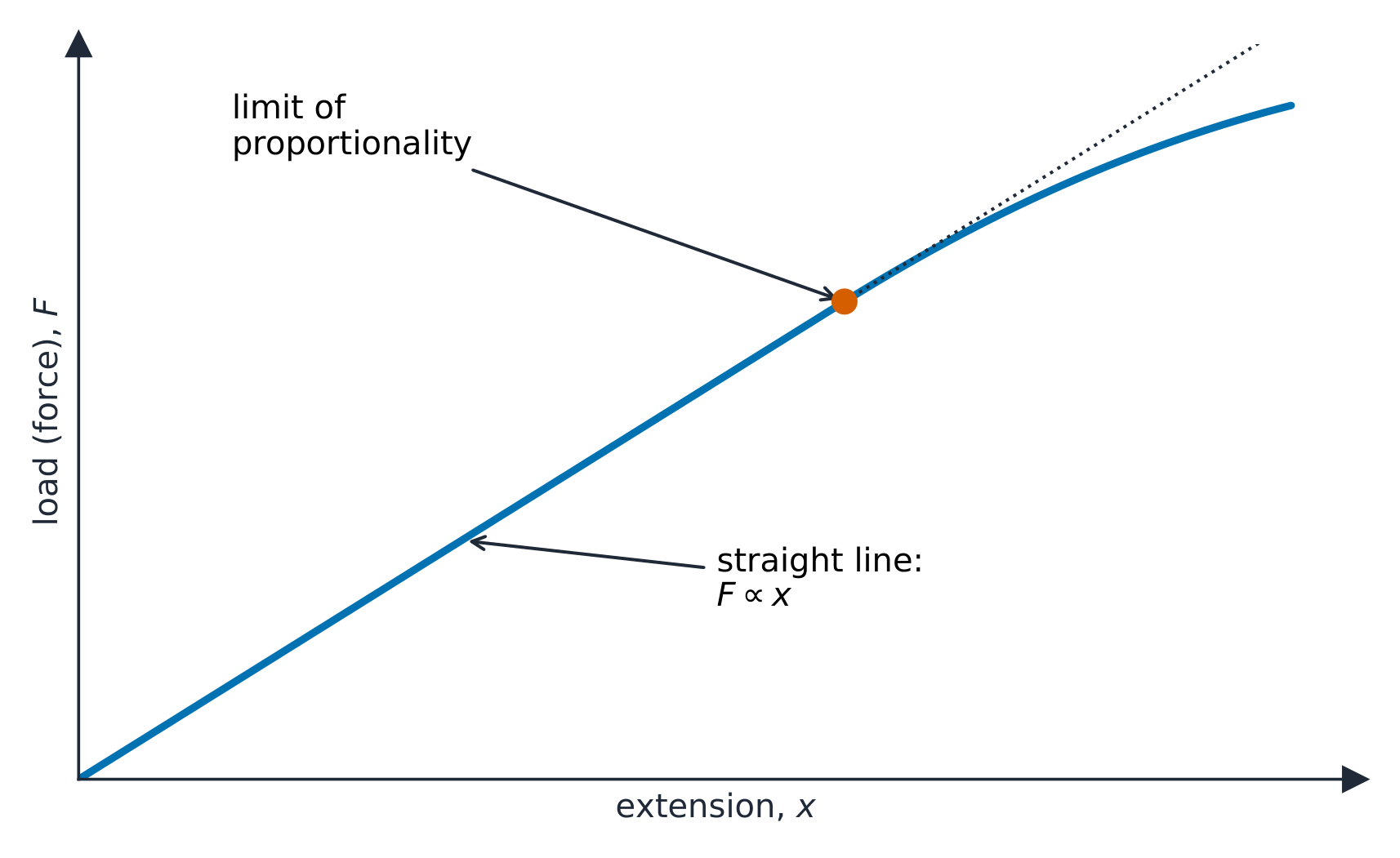
    Hooke's law & the elastic limit

    An ideal spring exerts a restoring force 回复力 proportional to its stretch or compression – Hooke's law 胡克定律:

    $$F_s=-kx,$$
    where $k$ is the spring constant 弹簧常数 (stiffness) and $x$ is the displacement from the spring's natural length. The minus sign means the force points back toward equilibrium.

    Hooke's law: extension is proportional to load up to the limit of proportionality
    Hooke's law: extension is proportional to load up to the limit of proportionality

    Worked example. A spring with $k=200\ \text{N/m}$ hangs vertically and a $0.50\ \text{kg}$ mass is hung on it. How far does it stretch at rest? At rest the spring force balances the weight, $kx=mg$, so

    $$x=\frac{mg}{k}=\frac{0.50\times9.8}{200}=0.025\ \text{m}=2.5\ \text{cm}.$$

    Explore · ⁨استكشف⁩

    Stretch a spring (Hooke's law) · ⁨مدّ نابض (قانون هوك)⁩

    A spring's force is proportional to its extension, $F=kx$ (Hooke's law). Pull harder and the extension grows in step — until the spring's limit. · ⁨قوة النابض متناسبة مع مدّه، $F=kx$ (قانون هوك). اسحب بقوة أكبر وينتشر المد تدريجياً — حتى reaching limit النابض.⁩

    Vocabulary · ⁨مفردات⁩ Train · ⁨تدريب⁩
    English العربية
    restoring force/rɪˈstɔːrɪŋ fɔːs/ القوة المرجعة
    Hooke's law/hʊks lɔː/ قانون هوك
    spring constant/sprɪŋ ˈkɒnstənt/ ثابت الزنبرك
    2.9

    Circular Motion

    Syllabus · ⁨المنهج⁩
    English

    Learning Objective 2.9.A: Describe the motion of an object traveling in a circular path.

    • 2.9.A.1 Centripetal acceleration is the component of an object's acceleration directed toward the center of the object's circular path.
      • 2.9.A.1.i The magnitude of centripetal acceleration for an object moving in a circular path is the ratio of the object's tangential speed squared to the radius of the circular path.
        • Equation: $a_c = \dfrac{v^2}{r}$
      • 2.9.A.1.ii Centripetal acceleration is directed toward the center of an object's circular path.
    • 2.9.A.2 Centripetal acceleration can result from a single force, more than one force, or components of forces exerted on an object in circular motion.
      • 2.9.A.2.i At the top of a vertical, circular loop, an object requires a minimum speed to maintain circular motion. At this point, and with this minimum speed, the gravitational force is the only force that causes the centripetal acceleration.
        • Equation: $v = \sqrt{gr}$
      • 2.9.A.2.ii Components of the static friction force and the normal force can contribute to the net force producing centripetal acceleration of an object traveling in a circle on a banked surface.
      • 2.9.A.2.iii A component of tension contributes to the net force producing centripetal acceleration experienced by a conical pendulum.
    • 2.9.A.3 Tangential acceleration is the rate at which an object's speed changes and is directed tangent to the object's circular path.
    • 2.9.A.4 The net acceleration of an object moving in a circle is the vector sum of the centripetal acceleration and tangential acceleration.
    • 2.9.A.5 The revolution of an object traveling in a circular path at a constant speed (uniform circular motion) can be described using period and frequency.
      • 2.9.A.5.i The time to complete one full circular path, one full rotation, or a full cycle of oscillatory motion is defined as period, $T$.
      • 2.9.A.5.ii The rate at which an object is completing revolutions is defined as frequency, $f$.
        • Equation: $T = \dfrac{1}{f}$
      • 2.9.A.5.iii For an object traveling at a constant speed in a circular path, the period is given by the derived equation
        • Equation: $T = \dfrac{2\pi r}{v}$

    Learning Objective 2.9.B: Describe circular orbits using Kepler's third law.

    • 2.9.B.1 For a satellite in circular orbit around a central body, the satellite's centripetal acceleration is caused only by gravitational attraction. The period and radius of the circular orbit are related to the mass of the central body.
      • Equation: $T^2 = \dfrac{4\pi^2}{GM} R^3$

    Boundary statement: AP Physics 1 only expects students to quantitatively analyze banked curves in which no friction is required to maintain uniform circular motion. Analysis of situations in which friction is required on a banked curve is limited to qualitative descriptions.

    Boundary statement: AP Physics 1 does not expect students to know Kepler's first or second laws of planetary motion.

    العربية

    الهدف التعليمي 2.9.A: وصف حركة جسم يسير في مسار دائري.

    • 2.9.A.1 التسارع المركزي هو مركب تسارع الجسم الموجه نحو مركز المسار الدائري للجسم.
      • 2.9.A.1.i مقدار التسارع المركزي لجسم يتحرك في مسار دائري هو مربع السرعة المماسية للجسم مقسوماً على نصف قطر المسار الدائري.
        • معادلة: $a_c = \dfrac{v^2}{r}$
      • 2.9.A.1.ii التسارع المركزي موجه نحو مركز المسار الدائري للجسم.
    • 2.9.A.2 يمكن أن ينتج التسارع المركزي عن قوة واحدة، أو أكثر من قوة، أو مكونات لقوى مؤثرة على جسم في حركة دائرية.
      • 2.9.A.2.i في أعلى حلقة دائرية رأسية، يحتاج الجسم إلى سرعة دنيا للحفاظ على الحركة الدائرية. عند هذه النقطة وبهذه السرعة الدنيا، تكون قوة الجاذبية هي القوة الوحيدة التي تسبب التسارع المركزي.
        • معادلة: $v = \sqrt{gr}$
      • 2.9.A.2.ii يمكن لمكونات قوة الاحتكاك السكوني والقوة العمودية أن تساهم في محصلة القوى التي تنتج التسارع المركزي لجسم يسير في دائرة على سطح مائل.
      • 2.9.A.2.iii تساهم مركبة الشد في محصلة القوى التي تنتج التسارع المركزي الذي يتعرض له البندول المخروطي.
    • 2.9.A.3 التسارع المماسي هو معدل تغير سرعة الجسم وهو موجه مماسياً للمسار الدائري للجسم.
    • 2.9.A.4 محصلة تسارع جسم يتحرك في دائرة هي المجموع الاتجاهي للتسارع المركزي والتسارع المماسي.
    • 2.9.A.5 يمكن وصف دوران جسم يسير في مسار دائري بسرعة ثابتة (الحركة الدائرية المنتظمة) باستخدام الفترة والتردد.
      • 2.9.A.5.i يُعرف الزمن اللازم لإكمال مسار دائري كامل واحد، أو دورة كاملة واحدة، أو دورة كاملة من الحركة الاهتزازية بالفترة، $T$.
      • 2.9.A.5.ii يُعرف معدل إتمام الجسم للدورات بالتردد، $f$.
        • معادلة: $T = \dfrac{1}{f}$
      • 2.9.A.5.iii بالنسبة لجسم يسير بسرعة ثابتة في مسار دائري، تُعطى الفترة بالمعادلة المشتقة
        • معادلة: $T = \dfrac{2\pi r}{v}$

    الهدف التعليمي 2.9.B: وصف المدارات الدائرية باستخدام قانون كبلر الثالث.

    • 2.9.B.1 بالنسبة لقمر صناعي في مدار دائري حول جسم مركزي، يكون التسارع المركزي للقمر الصناعي ناتجاً فقط عن التجاذب الجاذبي. ترتبط الفترة ونصف قطر المدار الدائري بكتلة الجسم المركزي.
      • المعادلة: $T^2 = \dfrac{4\pi^2}{GM} R^3$

    عبارة الحدود: يقتصر امتحان AP Physics 1 على توقع التحليل الكمي للمنحنيات المائلة التي لا يتطلب الحفاظ على الحركة الدائرية المنتظمة احتكاكاً. يقتصر تحليل الحالات التي يتطلب فيها الاحتكاك على المنحنيات المائلة على الأوصاف النوعية.

    عبارة حدود: لا يُتوقع من طلاب AP Physics 1 معرفة قانون كبلر الأول أو الثاني لحركة الكواكب.

    Source: College Board AP Course and Exam Description · ⁨المصدر: وصف دورة وامتحان College Board AP⁩

    Uniform circular motion

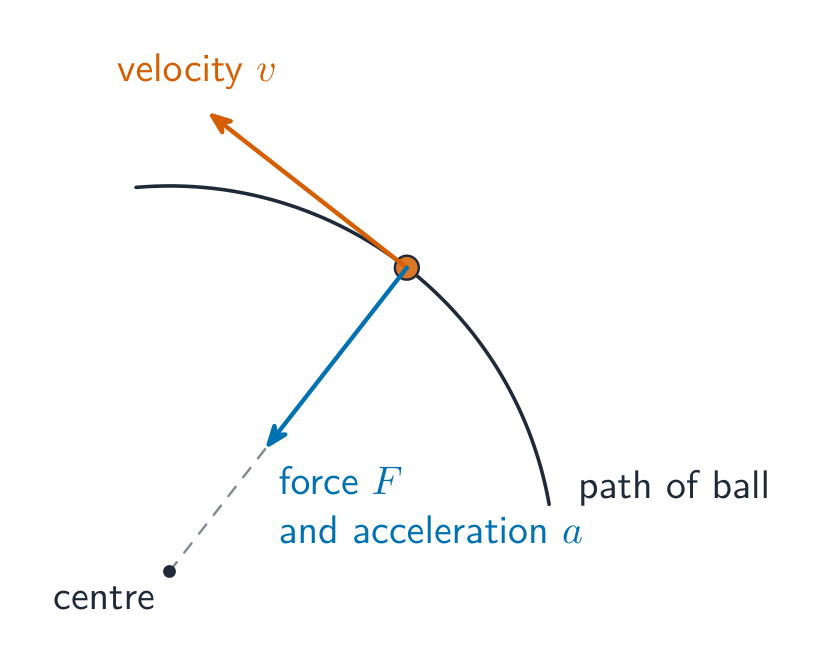
    An object moving in a circle at constant speed still accelerates, because its velocity direction keeps changing. This centripetal acceleration 向心加速度 points toward the center:

    $$a_c=\frac{v^2}{r}.$$
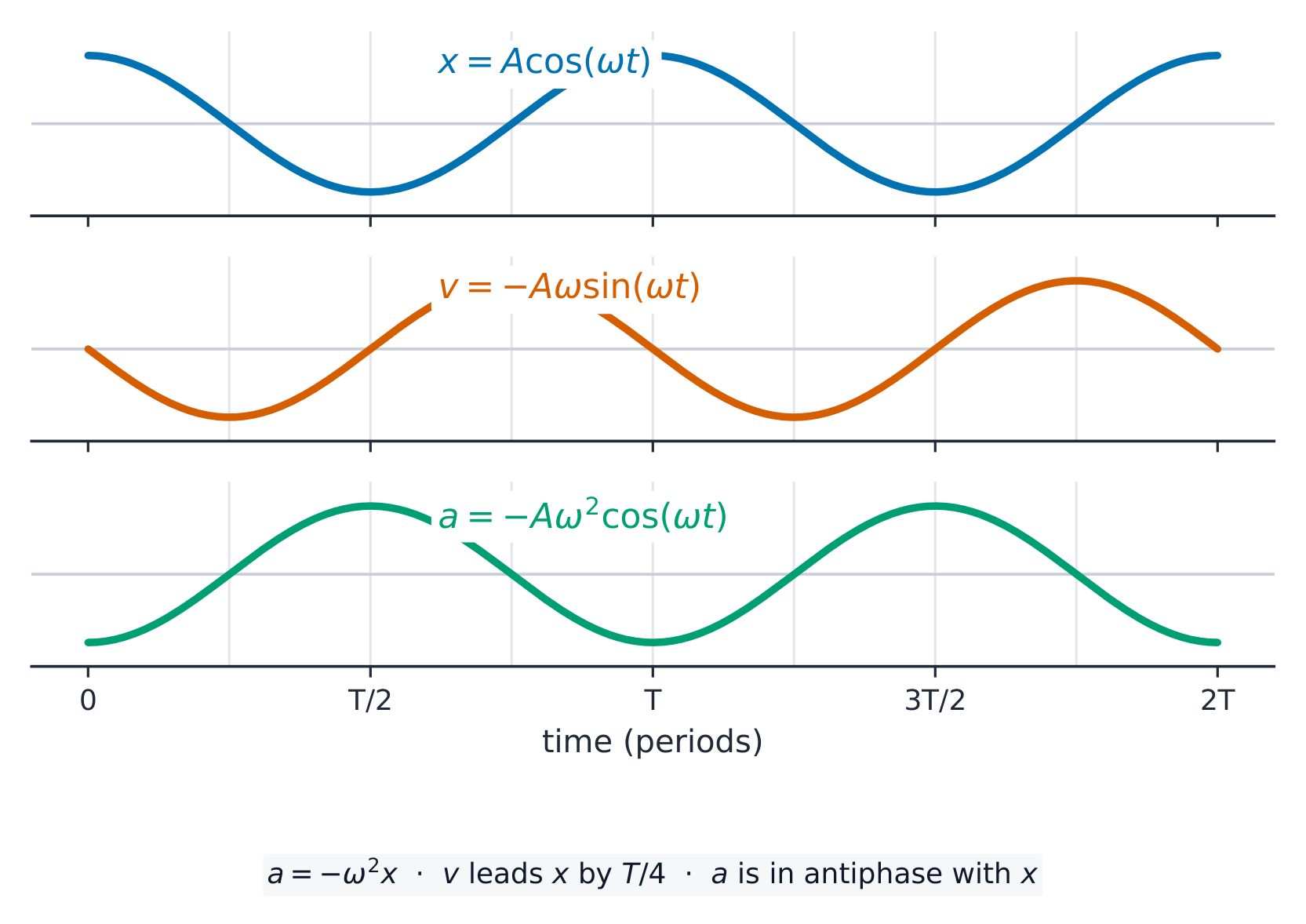
    It is produced by a net inward (centripetal) force 向心力 $F_c=\dfrac{mv^2}{r}$ – supplied by whatever real force points inward (tension, gravity, friction, normal). The time for one full revolution is the period 周期 $T$, and the number of revolutions per second is the frequency 频率 $f$; they are reciprocals, $f = 1/T$, and the same definitions describe any rotation or oscillation.There is no separate outward force; "centrifugal" is only an apparent effect.

    The velocity points along the tangent; the centripetal force and acceleration point to the centre
    The velocity points along the tangent; the centripetal force and acceleration point to the centre

    Worked example. A $0.30\ \text{kg}$ ball on a string is whirled in a horizontal circle of radius $0.80\ \text{m}$ at $4.0\ \text{m/s}$. Find the tension in the string. The tension supplies the whole centripetal force:

    $$T=\frac{mv^2}{r}=\frac{0.30\times4.0^2}{0.80}=6.0\ \text{N}.$$
    If the string can take at most $6.0\ \text{N}$, this is the fastest the ball can go at that radius – spin any faster and the string breaks.

    Vocabulary · ⁨مفردات⁩ Train · ⁨تدريب⁩
    English العربية
    centripetal acceleration/senˈtrɪpɪtl əkˌseləˈreɪʃn/ التسارع المركزي
    net inward (centripetal) force/net ˈɪnwəd fɔːs/ القوة الصافية الداخلية (المركزة)
    period/ˈpɪərɪəd/ الدور
    frequency/ˈfriːkwənsi/ التردد
    2.9

    Exam tips

    • Always draw a free-body diagram first: only real forces on the chosen object (weight, normal, tension, friction, applied) — never an "$ma$" arrow.
    • Apply $\sum F = ma$ one axis at a time; on an incline resolve gravity into $mg\sin\theta$ (along) and $mg\cos\theta$ (perpendicular).
    • A Newton's third-law pair acts on two different objects — a book's weight and the table's normal force are not a pair (both act on the book).
    • Static friction adjusts up to $\mu_s N$ (use it to test whether motion starts); once sliding, use kinetic friction $f_k=\mu_k N$.
    • Circular motion needs a net inward (centripetal) force $mv^2/r$ supplied by a real force — there is no outward "centrifugal" force.
  • 3

    Work, Energy, and Power · ⁨الشغل والطاقة والقوة⁩

    Watch lesson · ⁨شاهد الدرس⁩
    3.1

    Translational Kinetic Energy

    Syllabus · ⁨المنهج⁩
    English

    Learning Objective 3.1.A: Describe the translational kinetic energy of an object in terms of the object's mass and velocity.

    • 3.1.A.1 An object's translational kinetic energy is given by the equation
      • Equation: $K = \dfrac{1}{2}mv^2$
    • 3.1.A.2 Translational kinetic energy is a scalar quantity.
    • 3.1.A.3 Different observers may measure different values of the translational kinetic energy of an object, depending on the observer's frame of reference.
    العربية

    هدف التعلم 3.1.A: وصف الطاقة الحركية الانتقالية لجسم ما بدلالة كتلة الجسم وسرعته.

    • 3.1.A.1 تُعطى الطاقة الحركية الانتقالية لجسم ما بالمعادلة
      • المعادلة: $K = \dfrac{1}{2}mv^2$
    • 3.1.A.2 الطاقة الحركية الانتقالية هي كمية قياسية.
    • 3.1.A.3 قد يقيس المراقبون المختلفون قيمًا مختلفة للطاقة الحركية الانتقالية لجسم ما، اعتمادًا على إطار مرجع المراقب.

    Source: College Board AP Course and Exam Description · ⁨المصدر: وصف دورة وامتحان College Board AP⁩

    Energy 能量 is the capacity to do work, measured in joules 焦耳 (J). A moving object has kinetic energy 动能:

    $$K=\tfrac{1}{2}mv^2.$$
    It depends on the square of the speed, so doubling the speed quadruples the kinetic energy. Kinetic energy is a scalar and is never negative.

    Worked example. A $1500\ \text{kg}$ car travels at $20\ \text{m/s}$. Its kinetic energy is $K=\tfrac12\times1500\times20^2=3.0\times10^{5}\ \text{J}=300\ \text{kJ}$. If it speeds up to $40\ \text{m/s}$ (double), the kinetic energy becomes $4\times$ larger, $1200\ \text{kJ}$ – which is why stopping distance grows so fast with speed.

    Vocabulary · ⁨مفردات⁩ Train · ⁨تدريب⁩
    English العربية
    Energy/ˈenədʒi/ الطاقة
    joules/dʒuːlz/ جول
    kinetic energy/kɪˈnetɪk ˈenədʒi/ الطاقة الحركية
    3.2

    Work

    Syllabus · ⁨المنهج⁩
    English

    Learning Objective 3.2.A: Describe the work done on an object or system by a given force or collection of forces.

    • 3.2.A.1 Work is the amount of energy transferred into or out of a system by a force exerted on that system over a distance.
      • 3.2.A.1.i The work done by a conservative force exerted on a system is path-independent and only depends on the initial and final configurations of that system.
      • 3.2.A.1.ii The work done by a conservative force on a system—or the change in the potential energy of the system—will be zero if the system returns to its initial configuration.
      • 3.2.A.1.iii Potential energies are associated only with conservative forces.
      • 3.2.A.1.iv The work done by a nonconservative force is path-dependent.
      • 3.2.A.1.v Examples of nonconservative forces are friction and air resistance.
    • 3.2.A.2 Work is a scalar quantity that may be positive, negative, or zero.
    • 3.2.A.3 The amount of work done on a system by a constant force is related to the components of that force and the displacement of the point at which that force is exerted.
      • 3.2.A.3.i Only the component of the force exerted on a system that is parallel to the displacement of the point of application of the force will change the system's total energy.
        • Equation: $W = F_{\parallel}d = Fd\cos\theta$
      • 3.2.A.3.ii The component of the force exerted on a system perpendicular to the direction of the displacement of the system's center of mass can change the direction of the system's motion without changing the system's kinetic energy.
    • 3.2.A.4 The work-energy theorem states that the change in an object's kinetic energy is equal to the sum of the work (net work) being done by all forces exerted on the object.
      • Equation: $\Delta K = \sum_{i} W_i = \sum_{i} F_{\parallel,i}\,d$
      • 3.2.A.4.i An external force may change the configuration of a system. The component of the external force parallel to the displacement times the displacement of the point of application of the force gives the change in kinetic energy of the system.
      • 3.2.A.4.ii If the system's center of mass and the point of application of the force move the same distance when a force is exerted on a system, then the system may be modeled as an object, and only the system's kinetic energy can change.
      • 3.2.A.4.iii The energy dissipated by friction is typically equated to the force of friction times the length of the path over which the force is exerted
        • Equation: $\Delta E_{\text{mech}} = F_f\,d\cos\theta$
    • 3.2.A.5 Work is equal to the area under the curve of a graph of $F_{\parallel}$ as a function of displacement.

    Boundary statement: AP Physics 1 only expects students to analyze the transfer of mechanical energy (as defined in Unit 3, Topic 4: Conservation of Energy), although students should be aware that mechanical energy may be dissipated in the form of thermal energy or sound. In AP Physics 2, students will also study how thermal energy can be transferred between systems through heating or cooling.

    العربية

    هدف التعلم 3.2.A: وصف الشغل المبذول على جسم أو نظام بواسطة قوة معينة أو مجموعة من القوى.

    • 3.2.A.1 الشغل هو مقدار الطاقة المنقولة إلى داخل النظام أو خارجه بواسطة قوة تُمارَس على ذلك النظام عبر مسافة.
      • 3.2.A.1.i الشغل المبذول بواسطة قوة محتفظة (conservative) مُمارَس على نظام يكون مستقلاً عن المسار ويعتمد فقط على التكوينات الأولية والنهائية لذلك النظام.
      • 3.2.A.1.ii سيكون الشغل المبذول بواسطة قوة محتفظة على نظام—أو التغير في طاقة الوضع للنظام—صفرًا إذا عاد النظام إلى تكوينه الأولي.
      • 3.2.A.1.iii ترتبط طاقات الوضع فقط بالقوى المحتفظة.
      • 3.2.A.1.iv الشغل المبذول بواسطة قوة غير محتفظة يعتمد على المسار.
      • 3.2.A.1.v أمثلة على القوى غير المحتفظة هي الاحتكاك ومقاومة الهواء.
    • 3.2.A.2 الشغل هو كمية قياسية قد تكون موجبة أو سالبة أو صفرية.
    • 3.2.A.3 يرتبط مقدار الشغل المبذول على نظام بواسطة قوة ثابتة بمكونات تلك القوة وإزاحة النقطة التي تُمارَس عليها تلك القوة.
      • 3.2.A.3.i فقط المكون من القوة المُمارَس على نظام الذي يكون موازيًا لإزاحة نقطة التطبيق سيغير الطاقة الكلية للنظام.
        • معادلة: $W = F_{\parallel}d = Fd\cos\theta$
      • 3.2.A.3.ii يمكن للمكون من القوة المُمارَس على نظام العمودي على اتجاه إزاحة مركز كتلة النظام أن يغير اتجاه حركة النظام دون تغيير الطاقة الحركية للنظام.
    • 3.2.A.4 ينص مبدأ الشغل والطاقة على أن التغير في الطاقة الحركية لجسم ما يساوي مجموع الشغل (الشغل الصافي) المبذول بواسطة جميع القوى المُمارَس على الجسم.
      • المعادلة: $\Delta K = \sum_{i} W_i = \sum_{i} F_{\parallel,i}\,d$
      • 3.2.A.4.i قد تغير قوة خارجية تكوين النظام. يعطي حاصل ضرب المكون من القوة الخارجية الموازي للإزاحة في إزاحة نقطة تطبيق القوة التغير في الطاقة الحركية للنظام.
      • 3.2.A.4.ii إذا تحرك مركز كتلة النظام ونقطة تطبيق القوة نفس المسافة عند ممارسة قوة على نظام، فقد يتم نمذجة النظام كجسم واحد، ويمكن حينها أن يتغير فقط الطاقة الحركية للنظام.
      • 3.2.A.4.iii عادةً ما يُساوى الطاقة المبددة بواسطة الاحتكاك بقوة الاحتكاك مضروبة في طول المسار الذي مُمارست عليه القوة.
        • معادلة: $\Delta E_{\text{mech}} = F_f\,d\cos\theta$
    • 3.2.A.5 الشغل يساوي المساحة تحت منحنى رسم بياني ل $F_{\parallel}$ بدلالة الإزاحة.

    عبارة حدود: يتوقع AP Physics 1 من الطلاب فقط تحليل انتقال الطاقة الميكانيكية (كما تم تعريفها في الوحدة 3، الموضوع 4: حفظ الطاقة)، على الرغم من أنه يجب أن يدرك الطلاب أن الطاقة الميكانيكية قد تُبدد على شكل طاقة حرارية أو صوتية. في AP Physics 2، سيدرس الطلاب أيضًا كيفية انتقال الطاقة الحرارية بين الأنظمة عبر التسخين أو التبريد.

    Source: College Board AP Course and Exam Description · ⁨المصدر: وصف دورة وامتحان College Board AP⁩

    Work 功 is energy transferred by a force acting over a displacement:

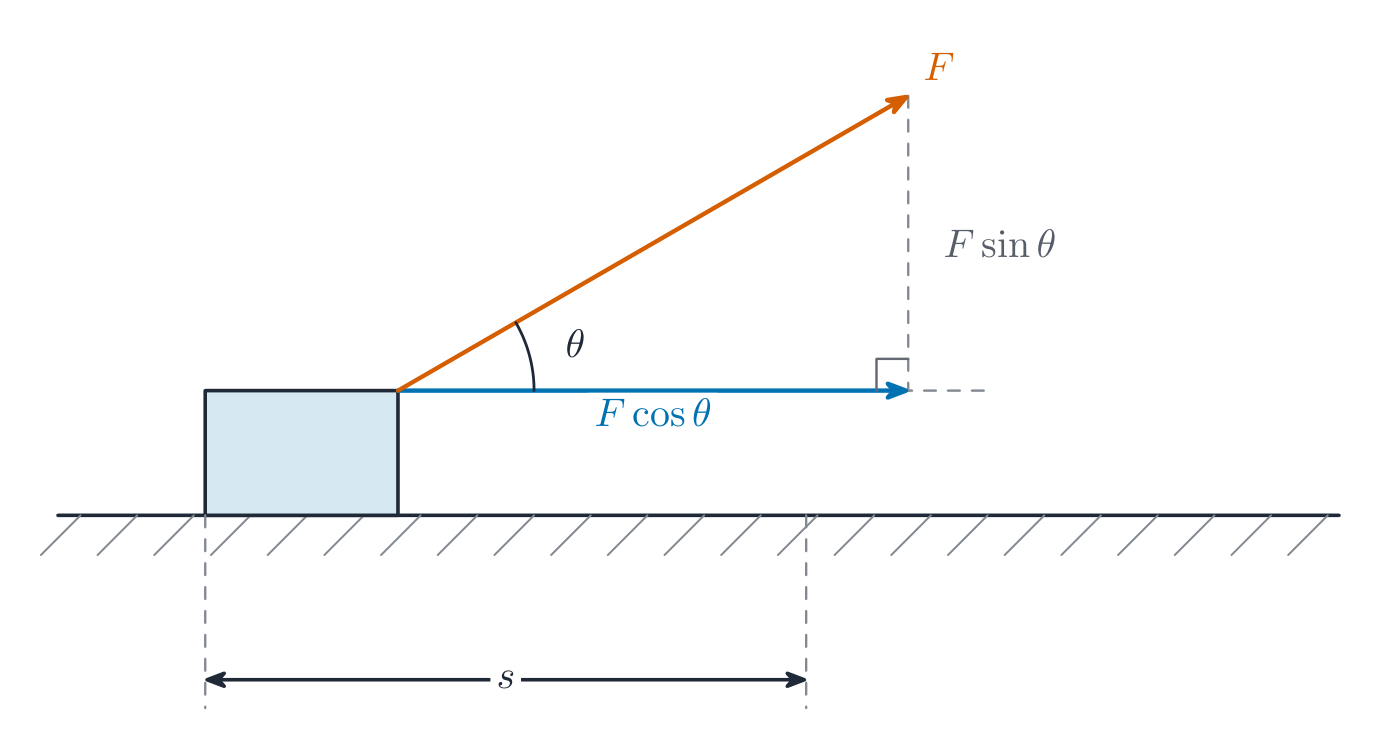
    $$W=F\,d\cos\theta,$$
    where $\theta$ is the angle between the force and the displacement. Work is positive when the force has a component along the motion (adds energy), negative when it opposes the motion (removes energy), and zero when the force is perpendicular. On a force–position graph, work is the area under the curve. The work–energy theorem 动能定理 states that the net work equals the change in kinetic energy: $W_{\text{net}}=\Delta K$.

    Only the force component along the displacement does work
    Only the force component along the displacement does work

    Worked example. A $2.0\ \text{kg}$ block moving at $3.0\ \text{m/s}$ on a frictionless floor is pushed by a $5.0\ \text{N}$ force over $4.0\ \text{m}$ in the direction of motion. Find its final speed. The net work is $W=Fd=5.0\times4.0=20\ \text{J}$, and by the work–energy theorem $W=\tfrac12 m(v^2-v_0^2)$:

    $$20=\tfrac12\times2.0\times(v^2-3.0^2)\;\Rightarrow\;v^2=29\;\Rightarrow\;v=5.4\ \text{m/s}.$$

    Vocabulary · ⁨مفردات⁩ Train · ⁨تدريب⁩
    English العربية
    Work/wɜːk/ الشغل
    work–energy theorem/wɜːk ˈenədʒi ˈθɪərəm/ نظرية الشغل–الطاقة
    3.3

    Potential Energy

    Syllabus · ⁨المنهج⁩
    English

    Learning Objective 3.3.A: Describe the potential energy of a system.

    • 3.3.A.1 A system composed of two or more objects has potential energy if the objects within that system only interact with each other through conservative forces.
    • 3.3.A.2 Potential energy is a scalar quantity associated with the position of objects within a system.
    • 3.3.A.3 The definition of zero potential energy for a given system is a decision made by the observer considering the situation to simplify or otherwise assist in analysis.
    • 3.3.A.4 The potential energy of common physical systems can be described using the physical properties of that system.
      • 3.3.A.4.i The elastic potential energy of an ideal spring is given by the following equation, where $\Delta x$ is the distance the spring has been stretched or compressed from its equilibrium length.
        • Equation: $U_s = \dfrac{1}{2}k(\Delta x)^2$
      • 3.3.A.4.ii The general form for the gravitational potential energy of a system consisting of two approximately spherical distributions of mass (e.g., moons, planets or stars) is given by the equation
        • Equation: $U_g = -G\dfrac{m_1 m_2}{r}$
      • 3.3.A.4.iii Because the gravitational field near the surface of a planet is nearly constant, the change in gravitational potential energy in a system consisting of an object with mass $m$ and a planet with gravitational field of magnitude $g$ when the object is near the surface of the planet may be approximated by the equation
        • Equation: $\Delta U_g = mg\Delta y$
    • 3.3.A.5 The total potential energy of a system containing more than two objects is the sum of the potential energy of each pair of objects within the system.
    العربية

    هدف التعلم 3.3.A: وصف طاقة الوضع لنظام ما.

    • 3.3.A.1 يمتلك نظام مكون من جسمين أو أكثر طاقة وضع إذا كانت الأجسام داخل ذلك النظام تتفاعل مع بعضها البعض فقط عبر قوى محتفظة.
    • 3.3.A.2 طاقة الوضع هي كمية قياسية مرتبطة بموضع الأجسام داخل النظام.
    • 3.3.A.3 تعريف صفر طاقة الوضع لنظام معين هو قرار يتخذه المراقب بناءً على الحالة لتبسيط التحليل أو لمساعدة أخرى في التحليل.
    • 3.3.A.4 يمكن وصف طاقة الوضع للأنظمة الفيزيائية الشائعة باستخدام الخصائص الفيزيائية لذلك النظام.
      • 3.3.A.4.i تُعطى طاقة الوضع المرنة لنابض مثالي بالمعادلة التالية، حيث $\Delta x$ هي المسافة التي تم فيها تمدد النابض أو انضغاطه من طوله المتزن.
        • معادلة: $U_s = \dfrac{1}{2}k(\Delta x)^2$
      • 3.3.A.4.ii يُعطى الشكل العام لطاقة الوضع الجاذبية لنظام يتكون من توزيعين كتليين كرويين تقريبياً (مثل الأقمار أو الكواكب أو النجوم) بالمعادلة
        • معادلة: $U_g = -G\dfrac{m_1 m_2}{r}$
      • 3.3.A.4.iii نظرًا لأن المجال الجاذبي بالقرب من سطح الكوكب شبه ثابت، فإن التغير في طاقة الوضع الجاذبية في نظام يتكون من جسم كتلته $m$ وكوكب له مجال جاذبي مقداره $g$ عندما يكون الجسم قريبًا من سطح الكوكب يمكن تقريبه بالمعادلة
        • معادلة: $\Delta U_g = mg\Delta y$
    • 3.3.A.5 الطاقة الكلية لنظام يحتوي على أكثر من جسمين هي مجموع طاقة الوضع لكل زوج من الأجسام داخل النظام.

    Source: College Board AP Course and Exam Description · ⁨المصدر: وصف دورة وامتحان College Board AP⁩

    Potential energy 势能 is stored energy that depends on position or configuration:

    • Gravitational potential energy 重力势能 near the surface: $U_g=mgh$ (height $h$ above a reference level).
    • Elastic potential energy 弹性势能 in a spring: $U_s=\tfrac{1}{2}kx^2$.

    Potential energy is defined only for conservative forces 保守力 (gravity, springs), for which the stored energy depends on position, not path. Only changes in potential energy matter, so you may put the zero level wherever is convenient.

    The $U_g=mgh$ form only holds near a surface where $g$ is roughly constant. The general form, for two spherical masses a distance $r$ apart, is

    $$U_g=-\frac{G m_1 m_2}{r}.$$
    It is negative and defined to be zero at infinite separation, so gravitational PE rises toward zero as the masses move apart. $mgh$ is simply its near-surface approximation. (This is the form you need for satellites and escape speed.)

    Explore · ⁨استكشف⁩

    Store elastic potential energy in a spring · ⁨خزّن طاقة جهد مرنة في نابض⁩

    Stretching a spring stores elastic potential energy $\tfrac12 kx^2$ — the area under the force-extension line. Release it and that energy becomes kinetic. · ⁨تمديد نابض يخزن طاقة كامنة مرنة $\tfrac12 kx^2$ — وهي المساحة تحت منحنى القوة والامتداد. عند تحريره تتحول تلك الطاقة إلى طاقة حركية.⁩

    Vocabulary · ⁨مفردات⁩ Train · ⁨تدريب⁩
    English العربية
    Potential energy/pəˈtenʃl ˈenədʒi/ الطاقة الكامنة
    Gravitational potential energy/ˌɡrævɪˈteɪʃənl pəˈtenʃl ˈenədʒi/ الطاقة الكامنة الجاذبية
    Elastic potential energy/ɪˈlæstɪk pəˈtenʃl ˈenədʒi/ الطاقة الكامنة المرنة
    conservative forces/kənˈsɜːvətɪv ˈfɔːsɪz/ القوات المحافظة
    3.4

    Conservation of Energy

    Syllabus · ⁨المنهج⁩
    English

    Learning Objective 3.4.A: Describe the energies present in a system.

    • 3.4.A.1 A system composed of only a single object can only have kinetic energy.
    • 3.4.A.2 A system that contains objects that interact via conservative forces or that can change its shape reversibly may have both kinetic and potential energies.

    Learning Objective 3.4.B: Describe the behavior of a system using conservation of mechanical energy principles.

    • 3.4.B.1 Mechanical energy is the sum of a system's kinetic and potential energies.
    • 3.4.B.2 Any change to a type of energy within a system must be balanced by an equivalent change of other types of energies within the system or by a transfer of energy between the system and its surroundings.
    • 3.4.B.3 A system may be selected so that the total energy of that system is constant.
    • 3.4.B.4 If the total energy of a system changes, that change will be equivalent to the energy transferred into or out of the system.

    Learning Objective 3.4.C: Describe how the selection of a system determines whether the energy of that system changes.

    • 3.4.C.1 Energy is conserved in all interactions.
    • 3.4.C.2 If the work done on a selected system is zero and there are no nonconservative interactions within the system, the total mechanical energy of the system is constant.
    • 3.4.C.3 If the work done on a selected system is nonzero, energy is transferred between the system and the environment.

    Boundary statement: AP Physics 1 expects students to know that mechanical energy can be dissipated as thermal energy or sound by nonconservative forces.

    العربية

    هدف التعلم 3.4.A: وصف الطاقات الموجودة في نظام ما.

    • 3.4.A.1 النظام المكون من جسم واحد فقط يمكن أن يمتلك طاقة حركية فقط.
    • 3.4.A.2 النظام الذي يحتوي على أجسام تتفاعل عبر قوى محتفظة أو يمكنه تغيير شكله بشكل عكسي قد يمتلك كلًا من الطاقة الحركية وطاقة الوضع.

    هدف التعلم 3.4.B: وصف سلوك نظام باستخدام مبادئ حفظ الطاقة الميكانيكية.

    • 3.4.B.1 الطاقة الميكانيكية هي مجموع طاقات الحركة والطاقة الكامنة للنظام.
    • 3.4.B.2 أي تغيير في نوع من أنواع الطاقة داخل نظام ما يجب أن يكون مقابلاً لتغير مساوٍ في أنواع أخرى من الطاقة داخل النظام، أو بتحويل طاقة بين النظام ومحيطه.
    • 3.4.B.3 يمكن اختيار نظام بحيث تكون الطاقة الكلية لذلك النظام ثابتة.
    • 3.4.B.4 إذا تغيرت الطاقة الكلية لنظام ما، فإن هذا التغير سيكون مساوياً للطاقة المنقولة إلى النظام أو منه.

    هدف التعلم 3.4.C: صف كيف يحدد اختيار النظام ما إذا كانت طاقة ذلك النظام تتغير.

    • 3.4.C.1 تُحفظ الطاقة في جميع التفاعلات.
    • 3.4.C.2 إذا كان الشغل المبذول على نظام مختار يساوي صفرًا ولم تكن هناك تفاعلات غير محافظية داخل النظام، فإن الطاقة الميكانيكية الكلية للنظام تكون ثابتة.
    • 3.4.C.3 إذا كان الشغل المبذول على نظام مختار لا يساوي صفرًا، فإن الطاقة تنتقل بين النظام والبيئة المحيطة.

    بيان الحدود: يتوقع امتحان الفيزياء AP 1 من الطلاب معرفة أن الطاقة الميكانيكية قد تتبدد على شكل طاقة حرارية أو صوتية بسبب القوى غير المحافظية.

    Source: College Board AP Course and Exam Description · ⁨المصدر: وصف دورة وامتحان College Board AP⁩

    Energy conservation: KE ⇄ PE
    A roller coaster with tall loops of green and red track against the sky
    A roller coaster trades energy back and forth: it is highest (most potential energy) at the top and fastest (most kinetic energy) at the bottom

    The total mechanical energy 机械能 is $E=K+U$. When only conservative forces do work, mechanical energy is conserved 守恒:

    $$K_1+U_1=K_2+U_2.$$
    When friction or other non-conservative forces act, they transfer mechanical energy to thermal energy 热能; then the general statement is that total energy (including thermal) is conserved. Energy bar charts are a good way to track where the energy goes.

    A swinging pendulum trades gravitational potential energy for kinetic energy and back
    A swinging pendulum trades gravitational potential energy for kinetic energy and back

    Worked example. A ball is released from rest at the top of a frictionless ramp $5.0\ \text{m}$ high. Find its speed at the bottom. All the gravitational potential energy becomes kinetic energy:

    $$mgh=\tfrac12 mv^2\;\Rightarrow\;v=\sqrt{2gh}=\sqrt{2\times9.8\times5.0}=9.9\ \text{m/s}.$$
    The mass cancels, so every object reaches the same speed – exactly the free-fall result, now got from energy. If instead $30\ \text{J}$ were lost to friction, you would subtract it: $mgh-30=\tfrac12 mv^2$.

    Explore · ⁨استكشف⁩

    Watch energy convert as an object falls · ⁨راقب تحول الطاقة أثناء سقوط جسم⁩

    With no friction, mechanical energy is conserved: as an object falls, gravitational potential energy turns into kinetic energy while the total stays fixed. · ⁨بدون احتكاك، تحفظ الطاقة الميكانيكية: أثناء سقوط الجسم، تتحول الطاقة الجهدية الجاذبية إلى طاقة حركية بينما تبقى المجموع ثابتاً.⁩

    Vocabulary · ⁨مفردات⁩ Train · ⁨تدريب⁩
    English العربية
    total mechanical energy/ˈtəʊtl mɪˈkænɪkl ˈenədʒi/ إجمالي الطاقة الميكانيكية
    conserved/kənˈsɜːvd/ محفوظة
    thermal energy/ˈθɜːml ˈenədʒi/ طاقة حرارية
    3.5

    Power

    Syllabus · ⁨المنهج⁩
    English

    Learning Objective 3.5.A: Describe the transfer of energy into, out of, or within a system in terms of power.

    • 3.5.A.1 Power is the rate at which energy changes with respect to time, either by transfer into or out of a system or by conversion from one type to another within a system.
    • 3.5.A.2 Average power is the amount of energy being transferred or converted, divided by the time it took for that transfer or conversion to occur.
      • Equation: $P_{\text{avg}} = \dfrac{\Delta E}{\Delta t}$
    • 3.5.A.3 Because work is the change in energy of an object or system due to a force, average power is the total work done, divided by the time during which that work was done.
      • Equation: $P_{\text{avg}} = \dfrac{W}{\Delta t}$
    • 3.5.A.4 The instantaneous power delivered to an object by the component of a constant force parallel to the object's velocity can be described with the derived equation.
      • Equation: $P_{\text{inst}} = F_{\parallel}v = Fv\cos\theta$
    العربية

    هدف التعلم 3.5.A: صف انتقال الطاقة إلى داخل النظام، أو خارجه، أو داخله بدلالة القدرة.

    • 3.5.A.1 القدرة هي معدل تغير الطاقة بالنسبة للزمن، سواء كان ذلك عن طريق نقلها إلى النظام أو منه، أو بتحويلها من نوع إلى آخر داخل النظام.
    • 3.5.A.2 القدرة المتوسطة هي كمية الطاقة المنتقلة أو المحولة، مقسومة على الزمن المستغرق لحدوث هذا النقل أو التحويل.
      • المعادلة: $P_{\text{avg}} = \dfrac{\Delta E}{\Delta t}$
    • 3.5.A.3 نظرًا لأن الشغل هو تغير طاقة جسم أو نظام نتيجة لقوة، فإن القدرة المتوسطة تساوي إجمالي الشغل المبذول مقسومًا على الزمن الذي استغرقه تنفيذ ذلك الشغل.
      • المعادلة: $P_{\text{avg}} = \dfrac{W}{\Delta t}$
    • 3.5.A.4 يمكن وصف القدرة اللحظية المُقدَّمة لجسم بواسطة مركبة قوة ثابتة موازية لمتجه سرعة الجسم باستخدام المعادلة المشتقة.
      • المعادلة: $P_{\text{inst}} = F_{\parallel}v = Fv\cos\theta$

    Source: College Board AP Course and Exam Description · ⁨المصدر: وصف دورة وامتحان College Board AP⁩

    Power 功率 is the rate of doing work or transferring energy, measured in watts 瓦特 (W):

    $$P=\frac{W}{\Delta t}=\frac{\Delta E}{\Delta t},\qquad\text{and instantaneously}\qquad P=Fv.$$
    So the same job done faster requires more power. On an energy–time graph, power is the slope.

    Power is the slope of the work-time graph: the same work in less time means more power
    Power is the slope of the work-time graph: the same work in less time means more power

    Worked example. A motor lifts a $50\ \text{kg}$ load at a steady $2.0\ \text{m/s}$. Because it moves at constant speed, the lifting force equals the weight, so

    $$P=Fv=mgv=50\times9.8\times2.0=980\ \text{W}.$$

    Real machines waste some energy, so we quote efficiency 效率 – useful output power divided by total input power. If this motor draws $1400\ \text{W}$ of electrical power to deliver $980\ \text{W}$ of useful lifting, its efficiency is $980/1400=0.70$, or $70\%$; the other $30\%$ becomes heat and sound.

    A waterfall: power is how quickly energy is transferred — the same drop in less time is more power
    A waterfall: power is how quickly energy is transferred — the same drop in less time is more power
    Vocabulary · ⁨مفردات⁩ Train · ⁨تدريب⁩
    English العربية
    Power/ˈpaʊə/ القدرة
    watts/wɒts/ وات
    efficiency/ɪˈfɪʃənsi/ الكفاءة
    3.5

    Exam tips

    • Use $W=Fd\cos\theta$: work is zero when the force is perpendicular to the motion, and negative when it opposes it.
    • Reach for the work–energy theorem ($W_{\text{net}}=\Delta K$) or energy conservation ($K_1+U_1=K_2+U_2$) instead of forces whenever the path is complicated.
    • When friction acts, mechanical energy is not conserved — subtract the energy lost to heat.
    • Remember $K\propto v^2$: doubling the speed quadruples the kinetic energy (and the stopping distance).
    • Use $P=Fv$ for power at a steady speed; at constant velocity the net force is zero but the power is not.
  • 4

    Linear Momentum · ⁨الزخم الخطي⁩

    Watch lesson · ⁨شاهد الدرس⁩
    4.1

    Linear Momentum · ⁨الزخم الخطي⁩

    Syllabus · ⁨المنهج⁩
    English

    Learning Objective 4.1.A: Describe the linear momentum of an object or system.

    • 4.1.A.1 Linear momentum is defined by the equation $\vec{p} = m\vec{v}$.
      • Equation: $\vec{p} = m\vec{v}$
    • 4.1.A.2 Momentum is a vector quantity and has the same direction as the velocity.
    • 4.1.A.3 Momentum can be used to analyze collisions and explosions.
      • 4.1.A.3.i A collision is a model for an interaction where the forces exerted between the involved objects in the system are much larger than the net external force exerted on those objects during the interaction.
      • 4.1.A.3.ii As only the initial and final states of a collision are analyzed, the object model may be used to analyze collisions.
      • 4.1.A.3.iii An explosion is a model for an interaction in which forces internal to the system move objects within that system apart.

    Boundary statement: Unless otherwise stated, the general term "momentum" will refer specifically to linear momentum.

    العربية

    هدف التعلم 4.1.A: صف الزخم الخطي لجسم أو نظام.

    • 4.1.A.1 يُعرَّف الزخم الخطي بالمعادلة $\vec{p} = m\vec{v}$.
      • المعادلة: $\vec{p} = m\vec{v}$
    • 4.1.A.2 الزخم كمية متجهة ولها نفس اتجاه السرعة.
    • 4.1.A.3 يمكن استخدام الزخم لتحليل الاصطدامات والانفجارات.
      • 4.1.A.3.i الاصطدام هو نموذج لتفاعل تكون فيه القوى المؤثرة بين الأجسام المشاركة في النظام أكبر بكثير من محصلة القوى الخارجية المؤثرة على تلك الأجسام أثناء التفاعل.
      • 4.1.A.3.ii بما أنه يتم تحليل حالة البداية والنهاية فقط للاصطدام، يمكن استخدام نموذج الجسم النقطي لتحليل الاصطدامات.
      • 4.1.A.3.iii الانفجار هو نموذج لتفاعل تتحرك فيه القوى الداخلية للنظام الأجسام الموجودة داخله مبتعدة عن بعضها البعض.

    بيان الحدود: ما لم يُذكر خلاف ذلك، يشير المصطلح العام "الزخم" تحديدًا إلى الزخم الخطي.

    Source: College Board AP Course and Exam Description · ⁨المصدر: وصف دورة وامتحان College Board AP⁩

    English

    Linear momentum 动量 is mass times velocity – a vector pointing the same way as the velocity:

    $$\vec{p}=m\vec{v}.$$
    It measures "how hard it is to stop" a moving object. A heavy slow truck and a light fast ball can have the same momentum. Its unit is $\text{kg m/s}$, the same as $\text{N s}$.

    العربية

    الزخم الخطي هو حاصل ضرب الكتلة في السرعة – وهو متجه يشير في نفس اتجاه السرعة:

    $$\vec{p}=m\vec{v}.$$
    إنه يقيس "مدى صعوبة إيقاف" جسم متحرك. قد يكون شاحنة ثقيلة بطيئة وكرة خفيفة سريعة لهما نفس الزخم. وحدة قياسه هي $\text{kg m/s}$، وهي نفسها $\text{N s}$.

    4.2

    Change in Momentum and Impulse · ⁨التغير في الزخم والدفع⁩

    Syllabus · ⁨المنهج⁩
    English

    Learning Objective 4.2.A: Describe the impulse delivered to an object or system.

    • 4.2.A.1 The rate of change of momentum is equal to the net external force exerted on an object or system.
      • Equation: $\vec{F}_{\text{net}} = \dfrac{\Delta \vec{p}}{\Delta t}$
    • 4.2.A.2 Impulse is defined as the product of the average force exerted on a system and the time interval during which that force is exerted on the system.
      • Equation: $\vec{J} = \vec{F}_{\text{avg}} \Delta t$
    • 4.2.A.3 Impulse is a vector quantity and has the same direction as the net force exerted on the system.
    • 4.2.A.4 The impulse delivered to a system by a net external force is equal to the area under the curve of a graph of the net external force exerted on the system as a function of time.
    • 4.2.A.5 The net external force exerted on a system is equal to the slope of a graph of the momentum of the system as a function of time.

    Learning Objective 4.2.B: Describe the relationship between the impulse exerted on an object or a system and the change in momentum of the object or system.

    • 4.2.B.1 Change in momentum is the difference between a system's final momentum and its initial momentum.
      • Equation: $\Delta \vec{p} = \vec{p} - \vec{p}_0$
    • 4.2.B.2 The impulse–momentum theorem relates the impulse exerted on a system and the system's change in momentum.
      • Equation: $\vec{J} = \vec{F}_{\text{avg}} \Delta t = \Delta \vec{p}$
    • 4.2.B.3 Newton's second law of motion is a direct result of the impulse–momentum theorem applied to systems with constant mass.
      • Equation: $\vec{F}_{\text{net}} = \dfrac{\Delta \vec{p}}{\Delta t} = m\dfrac{\Delta \vec{v}}{\Delta t} = m\vec{a}$

    Boundary statement: AP Physics 1 does not require students to quantitatively analyze systems in which the mass of the system changes with respect to time.

    العربية

    هدف التعلم 4.2.A: صف الدفع المقدم لجسم أو نظام.

    • 4.2.A.1 معدل تغير الزخم يساوي محصلة القوى الخارجية المؤثرة على جسم أو نظام.
      • المعادلة: $\vec{F}_{\text{net}} = \dfrac{\Delta \vec{p}}{\Delta t}$
    • 4.2.A.2 يُعرف الدفع بأنه حاصل ضرب متوسط القوة المؤثرة على النظام في الفترة الزمنية التي تُؤثّر فيها تلك القوة على النظام.
      • المعادلة: $\vec{J} = \vec{F}_{\text{avg}} \Delta t$
    • 4.2.A.3 الدفع كمية متجهة ولها نفس اتجاه محصلة القوى المؤثرة على النظام.
    • 4.2.A.4 الدفع المقدم لنظام بواسطة محصلة قوى خارجية يساوي المساحة تحت منحنى بياني لمحصلة القوى الخارجية المؤثرة على النظام كدالة للزمن.
    • 4.2.A.5 محصلة القوى الخارجية المؤثرة على نظام تساوي ميل بيانية لزخم该系统 كدالة للزمن.

    هدف التعلم 4.2.B: صف العلاقة بين الدفع المؤثر على جسم أو نظام والتغير في زخم ذلك الجسم أو النظام.

    • 4.2.B.1 التغير في الزخم هو الفرق بين الزخم النهائي للنظام وزخمه الابتدائي.
      • المعادلة: $\Delta \vec{p} = \vec{p} - \vec{p}_0$
    • 4.2.B.2 تربط نظرية الدفع-الزخم بين الدفع المؤثر على النظام والتغير في زخمه.
      • المعادلة: $\vec{J} = \vec{F}_{\text{avg}} \Delta t = \Delta \vec{p}$
    • 4.2.B.3 قانون نيوتن الثاني للحركة هو نتيجة مباشرة لتطبيق نظرية الدفع-الزخم على الأنظمة ذات الكتلة الثابتة.
      • المعادلة: $\vec{F}_{\text{net}} = \dfrac{\Delta \vec{p}}{\Delta t} = m\dfrac{\Delta \vec{v}}{\Delta t} = m\vec{a}$

    بيان الحدود: لا يتطلب امتحان الفيزياء AP 1 من الطلاب إجراء تحليل كمي للأنظمة التي تتغير فيها كتلتها بالنسبة للزمن.

    Source: College Board AP Course and Exam Description · ⁨المصدر: وصف دورة وامتحان College Board AP⁩

    English

    A net force acting over time changes momentum. The impulse 冲量 delivered is

    $$\vec{J}=\vec{F}\,\Delta t=\Delta\vec{p}.$$
    This is the impulse–momentum theorem: impulse equals the change in momentum. On a force–time graph, impulse is the area under the curve. It explains why airbags and follow-through help – spreading the same momentum change over a longer time reduces the force.

    Worked example. A $0.15\ \text{kg}$ ball hits a wall at $20\ \text{m/s}$ and bounces straight back at $15\ \text{m/s}$. The contact lasts $0.020\ \text{s}$. Find the average force on the ball. Take the rebound direction as positive, so $u=-20\ \text{m/s}$ and $v=+15\ \text{m/s}$:

    $$\Delta p=m(v-u)=0.15\big(15-(-20)\big)=5.25\ \text{kg m/s},\qquad F=\frac{\Delta p}{\Delta t}=\frac{5.25}{0.020}=260\ \text{N}.$$
    The sign work matters: forgetting that the velocity reverses is the most common mistake here.

    العربية

    قوة محصلة تؤثر لفترة زمنية تُحدث تغيرًا في الزخم. الدفع المُقدَّم هو

    $$\vec{J}=\vec{F}\,\Delta t=\Delta\vec{p}.$$
    هذا هو نظرية الدفع–الزخم: الدفع يساوي التغير في الزخم. على الرسم البياني للقوة–الزمن، يمثل الدفع المساحة تحت المنحنى. إنه يفسر لماذا تساعد الوسائد الهوائية والمتابعة في التحرك – توزيع نفس التغير في الزخم على فترة زمنية أطول يقلل من القوة.

    الدفع هو المساحة تحت منحنى القوة–الزمن، مساوية لمتوسط القوة مضروبًا في زمن التلامس
    الدفع هو المساحة تحت منحنى القوة–الزمن، مساوية لمتوسط القوة مضروبًا في زمن التلامس

    مثال محلل. اصطدمت كرة وزنها $0.15\ \text{kg}$ جدارًا بسرعة $20\ \text{m/s}$ وتردّت بشكل مستقيم بسرعة $15\ \text{m/s}$. استمر التلامس لمدة $0.020\ \text{s}$. أوجد متوسط القوة المؤثرة على الكرة. اعتبر اتجاه الارتداد موجبًا، لذا $u=-20\ \text{m/s}$ و$v=+15\ \text{m/s}$:

    $$\Delta p=m(v-u)=0.15\big(15-(-20)\big)=5.25\ \text{kg m/s},\qquad F=\frac{\Delta p}{\Delta t}=\frac{5.25}{0.020}=260\ \text{N}.$$
    إشارة الشغل مهمة: نسيان أن السرعة تنعكس هو أكثر خطأ شائع هنا.

    Vocabulary · ⁨مفردات⁩ Train · ⁨تدريب⁩
    English العربية
    Linear momentum/ˈlɪnɪə məʊˈmentəm/ الزخم الخطي
    impulse/ˈɪmpʌls/ انفعال
    conserved/kənˈsɜːvd/ محفوظة
    collisions/kəˈlɪʒnz/ التصادمات
    center-of-mass velocity/ˈsentə ɒv mæs vəˈlɒsɪti/ سرعة مركز الكتلة
    elastic collision/ɪˈlæstɪk kəˈlɪʒn/ اصطدام مرن
    inelastic collision/ɪnɪˈlæstɪk kəˈlɪʒn/ اصطدام غير مرن
    recoil/rɪˈkɔɪl/ ارتداد
    4.3

    Conservation of Linear Momentum · ⁨حفظ الزخم الخطي⁩

    Syllabus · ⁨المنهج⁩
    English

    Learning Objective 4.3.A: Describe the behavior of a system using conservation of linear momentum.

    • 4.3.A.1 A collection of objects with individual momenta can be described as one system with one center-of-mass velocity.
      • 4.3.A.1.i For a collection of objects, the velocity of a system's center of mass can be calculated using the equation $\vec{v}_{\text{cm}} = \dfrac{\sum \vec{p}_i}{\sum m_i} = \dfrac{\sum m_i \vec{v}_i}{\sum m_i}$.
      • 4.3.A.1.ii The velocity of a system's center of mass is constant in the absence of a net external force.
    • 4.3.A.2 The total momentum of a system is the sum of the momenta of the system's constituent parts.
    • 4.3.A.3 In the absence of net external forces, any change to the momentum of an object within a system must be balanced by an equivalent and opposite change of momentum elsewhere within the system. Any change to the momentum of a system is due to a transfer of momentum between the system and its surroundings.
      • 4.3.A.3.i The impulse exerted by one object on a second object is equal and opposite to the impulse exerted by the second object on the first. This is a direct result of Newton's third law.
      • 4.3.A.3.ii A system may be selected so that the total momentum of that system is constant.
      • 4.3.A.3.iii If the total momentum of a system changes, that change will be equivalent to the impulse exerted on the system.
        • Equation: $\vec{J} = \Delta \vec{p}$
    • 4.3.A.4 Correct application of conservation of momentum can be used to determine the velocity of a system immediately before and immediately after collisions or explosions.

    Boundary statement: AP Physics 1 includes a quantitative and qualitative treatment of conservation of momentum in one dimension and a semiquantitative treatment of conservation of momentum in two dimensions. Exam questions involving solution of simultaneous equations are not included in AP Physics 1, but the AP Physics 1 Exam may include questions that assess whether students can set up the equations properly and reason about how changing a given mass, speed, or angle would affect other quantities. AP Physics 2 includes a full treatment of conservation of momentum in two dimensions for problems that include one unknown final velocity.

    Learning Objective 4.3.B: Describe how the selection of a system determines whether the momentum of that system changes.

    • 4.3.B.1 Momentum is conserved in all interactions.
    • 4.3.B.2 If the net external force on the selected system is zero, the total momentum of the system is constant.
    • 4.3.B.3 If the net external force on the selected system is nonzero, momentum is transferred between the system and the environment.
    العربية

    هدف التعلم 4.3.A: صف سلوك نظام باستخدام مبدأ حفظ الزخم الخطي.

    • 4.3.A.1 يمكن وصف مجموعة من الأجسام ذات زخم فردي بأنها نظام واحد له سرعة مركز كتلة واحدة.
      • 4.3.A.1.i بالنسبة لمجموعة من الأجسام، يمكن حساب سرعة مركز كتلة النظام باستخدام المعادلة $\vec{v}_{\text{cm}} = \dfrac{\sum \vec{p}_i}{\sum m_i} = \dfrac{\sum m_i \vec{v}_i}{\sum m_i}$.
      • 4.3.A.1.ii سرعة مركز كتلة النظام تكون ثابتة في غياب محصلة القوى الخارجية.
    • 4.3.A.2 الزخم الكلي للنظام هو مجموع زخم أجزاءه المكونة.
    • 4.3.A.3 في غياب محصلة القوى الخارجية، يجب أن يكون أي تغيير في زخم جسم داخل نظام ما مقابلاً لتغير مساوٍ ومعاكس في الزخم في مكان آخر داخل النظام. أي تغيير في زخم النظام ناتج عن انتقال زخم بين النظام ومحيطه.
      • 4.3.A.3.i الدفع المؤثر من جسم أول على جسم ثانٍ يساوي في المقدار وعكس في الاتجاه الدفع المؤثر من الجسم الثاني على الأول. وهذا نتيجة مباشرة لقانون نيوتن الثالث.
      • 4.3.A.3.ii يمكن اختيار نظام بحيث يكون الزخم الكلي لذلك النظام ثابتًا.
      • 4.3.A.3.iii إذا تغير الزخم الكلي لنظام، فإن هذا التغير يعادل الدفع المؤثر على该系统.
        • معادلة: $\vec{J} = \Delta \vec{p}$
    • 4.3.A.4 يمكن استخدام التطبيق الصحيح لحفظ الزخم لتحديد سرعة النظام فورًا قبل وبعد الاصطدامات أو الانفجارات.

    عبارة الحدود: يتضمن امتحان AP Physics 1 معالجة كمية ونوعية لحفظ الزخم في بُعد واحد ومعالجة شبه كمية لحفظ الزخم في بُعدين. لا تُدرج أسئلة الامتحان التي تتضمن حل معادلات متزامنة في امتحان AP Physics 1، لكن قد يتضمن امتحان AP Physics 1 أسئلة تقيّم ما إذا كان الطلاب يستطيعون إعداد المعادلات بشكل صحيح والتفكير في كيفية تأثير تغيير كتلة معينة أو سرعة أو زاوية على كميات أخرى. يتضمن امتحان AP Physics 2 معالجة كاملة لحفظ الزخم في بُعدين لمسائل تتضمن سرعة نهائية مجهولة واحدة.

    الهدف التعليمي 4.3.B: صف كيف يحدد اختيار نظام ما إذا كان زخم ذلك النظام سيتغير.

    • 4.3.B.1 يُحفظ الزخم في جميع التفاعلات.
    • 4.3.B.2 إذا كانت محصلة القوى الخارجية المؤثرة على النظام المختار تساوي صفرًا، فإن الزخم الكلي للنظام يكون ثابتًا.
    • 4.3.B.3 إذا كانت محصلة القوى الخارجية المؤثرة على النظام المختار غير صفرية، يتم نقل الزخم بين النظام والبيئة المحيطة.

    Source: College Board AP Course and Exam Description · ⁨المصدر: وصف دورة وامتحان College Board AP⁩

    English

    If the net external force on a system is zero, its total momentum is conserved 守恒:

    $$\sum \vec{p}_{\text{before}}=\sum \vec{p}_{\text{after}}.$$
    Internal forces (like the push between two colliding carts) come in third-law pairs and cancel, so they cannot change the total momentum. This is the key tool for collisions 碰撞 and explosions – apply it separately in the $x$ and $y$ directions.

    Worked example (recoil 反冲). A $60\ \text{kg}$ skater, initially at rest on frictionless ice, throws a $2.0\ \text{kg}$ ball at $8.0\ \text{m/s}$. Find her recoil speed. The total momentum starts at zero and stays zero:

    $$0=(60)v+(2.0)(8.0)\;\Rightarrow\;v=-\frac{16}{60}=-0.27\ \text{m/s},$$
    so she moves at $0.27\ \text{m/s}$ in the opposite direction to the ball – the principle behind rockets and guns.

    A whole collection of objects can be described by a single center-of-mass velocity 质心速度:

    $$\vec{v}_{\text{cm}}=\frac{\sum m_i\vec{v}_i}{\sum m_i}=\frac{\vec{p}_{\text{total}}}{M_{\text{total}}}.$$
    Since total momentum is conserved when no net external force acts, $\vec{v}_{\text{cm}}$ then stays constant – a $v_{\text{cm}}$-versus-time graph is flat unless an outside force acts. An internal collision or explosion never changes it, however violently the parts fly apart.

    العربية

    إذا كانت القوة الخارجية المحصلة المؤثرة على نظام ما تساوي صفرًا، فإن زخمه الكلي يُحفظ:

    $$\sum \vec{p}_{\text{before}}=\sum \vec{p}_{\text{after}}.$$
    تأتي القوى الداخلية (مثل الدفع بين عربة مصطدمتين) في أزواج من قانون نيوتن الثالث وتُلغي بعضها البعض، لذا لا يمكنها تغيير الزخم الكلي. هذه الأداة الرئيسية لـالتصادمات والانفجارات – طبقها بشكل منفصل في الاتجاهين $x$ و$y$.

    اصطدام أمامي: الزخم الكلي قبل الاصطدام يساوي الزخم الكلي بعده
    اصطدام أمامي: الزخم الكلي قبل الاصطدام يساوي الزخم الكلي بعده

    مثال محلل (الارتداد). قفزّة وزنها $60\ \text{kg}$، كانت في البداية ساكنة على جليد غير احتكاكي، أطلقت كرة وزنها $2.0\ \text{kg}$ بسرعة $8.0\ \text{m/s}$. أوجد سرعة ارتدادها. يبدأ الزخم الكلي من الصفر ويبقى صفرًا:

    $$0=(60)v+(2.0)(8.0)\;\Rightarrow\;v=-\frac{16}{60}=-0.27\ \text{m/s},$$
    لذا فهي تتحرك بسرعة $0.27\ \text{m/s}$ في الاتجاه المعاكس للكرة – وهو المبدأ الذي تقوم عليه الصواريخ والأسلحة.

    يمكن وصف مجموعة كاملة من الأجسام باستخدام سرعة مركز الكتلة واحدة:

    $$\vec{v}_{\text{cm}}=\frac{\sum m_i\vec{v}_i}{\sum m_i}=\frac{\vec{p}_{\text{total}}}{M_{\text{total}}}.$$
    بما أن الزخم الكلي يُحفظ عندما لا تؤثر قوة خارجية محصلة، فإن $\vec{v}_{\text{cm}}$ يبقى ثابتًا – فإن الرسم البياني لـ$v_{\text{cm}}$–الزمن يكون أفقيًا إلا إذا أثرت قوة خارجية. ومع ذلك، فإن التصادم الداخلي أو الانفجار لا يغيره أبدًا، بغض النظر عن شدة انفصال الأجزاء.

    Explore · ⁨استكشف⁩

    Collide two carts and conserve momentum · ⁨اصطدم بعربة أخرى واحفظ الزخم⁩

    In any collision the total momentum $\sum mv$ before equals the total after. Set the masses and speeds and check the momentum bookkeeping. · ⁨في أي تصادم، يكون الزخم الكلي $\sum mv$ قبل التصادم مساويًا له بعد التصادم. حدد الكتل والسرعات وتحقق من حسابات الزخم.⁩

    4.4

    Elastic and Inelastic Collisions · ⁨التصادمات المرنة وغير المرنة⁩

    Syllabus · ⁨المنهج⁩
    English

    Learning Objective 4.4.A: Describe whether an interaction between objects is elastic or inelastic.

    • 4.4.A.1 An elastic collision between objects is one in which the initial kinetic energy of the system is equal to the final kinetic energy of the system.
    • 4.4.A.2 In an elastic collision, the final kinetic energies of each of the objects within the system may be different from their initial kinetic energies.
    • 4.4.A.3 An inelastic collision between objects is one in which the total kinetic energy of the system decreases.
    • 4.4.A.4 In an inelastic collision, some of the initial kinetic energy is not restored to kinetic energy but is transformed by nonconservative forces into other forms of energy.
    • 4.4.A.5 In a perfectly inelastic collision, the objects stick together and move with the same velocity after the collision.
    العربية

    الهدف التعليمي 4.4.A: صف ما إذا كان التفاعل بين الأجسام مرناً أم غير مرن.

    • 4.4.A.1 التصادم المرن بين الأجسام هو الذي تكون فيه الطاقة الحركية الأولية للنظام مساوية للطاقة الحركية النهائية للنظام.
    • 4.4.A.2 في التصادم المرن، قد تختلف الطاقة الحركية النهائية لكل من الأجسام داخل النظام عن طاقتها الحركية الأولية.
    • 4.4.A.3 التصادم غير المرن بين الأجسام هو الذي تنخفض فيه الطاقة الحركية الكلية للنظام.
    • 4.4.A.4 في التصادم غير المرن، لا تُستعاد بعض الطاقة الحركية الأولية كطاقة حركية، بل تتحول بواسطة قوى غير محتفظة إلى أشكال أخرى من الطاقة.
    • 4.4.A.5 في التصادم غير المرن تماماً، تتصل الأجسام ببعضها وتتحرك بنفس السرعة بعد التصادم.

    Source: College Board AP Course and Exam Description · ⁨المصدر: وصف دورة وامتحان College Board AP⁩

    English
    Conservation of momentum in a collision

    Momentum is conserved in every collision (with no external force). Kinetic energy is not:

    • In an elastic collision 弹性碰撞, kinetic energy is also conserved (objects bounce apart cleanly).
    • In an inelastic collision 非弹性碰撞, some kinetic energy becomes heat or deformation. In a perfectly inelastic collision the objects stick together and move with one common velocity afterward.

    Strategy: always write momentum conservation; add energy conservation only if the collision is stated to be elastic. One elastic fact worth memorising: in a 1D elastic collision between equal masses, the two objects simply swap velocities (a moving ball striking an identical stationary one stops dead, and the target flies off at the incoming speed).

    Worked example. A $1000\ \text{kg}$ car moving at $20\ \text{m/s}$ runs into a stationary $1500\ \text{kg}$ car and they lock together. Find their common speed, and the kinetic energy lost. Momentum conservation gives

    $$1000\times20=(1000+1500)\,v\;\Rightarrow\;v=\frac{20000}{2500}=8.0\ \text{m/s}.$$
    Kinetic energy before is $\tfrac12(1000)(20^2)=2.0\times10^{5}\ \text{J}$; after is $\tfrac12(2500)(8.0^2)=8.0\times10^{4}\ \text{J}$. So $1.2\times10^{5}\ \text{J}$ (about $60\%$) is lost to crumpling and heat – momentum is still conserved, but kinetic energy is not.

    العربية
    حفظ الزخم في اصطدام

    يُحفظ الزخم في كل تصادم (بدون قوة خارجية). أما الطاقة الحركية فلا تُحفظ:

    تصادم جانبي، مُحلّل على طول محورين متعامدين
    تصادم جانبي، مُحلّل على طول محورين متعامدين
    • في التصادم المرن، تُحفظ الطاقة الحركية أيضًا (تنفصل الأجسام عن بعضها بنظافة).
    • في التصادم غير المرن، تتحول بعض الطاقة الحركية إلى حرارة أو تشوه. في التصادم غير المرن تمامًا، تلتصق الأجسام معًا وتتحرك بسرعة مشتركة واحدة لاحقًا.

    الاستراتيجية: اكتب دائماً معادلة حفظ الزخم؛ أضف معادلة حفظ الطاقة فقط إذا ذُكر أن التصادم مرن. حقيقة مرنة واحدة تستحق الحفظ: في تصادم مرن ثنائي الأبعاد 1 بين كتلتين متساويتين، يتبادل الجسمان ببساطة سرعتيهما (كرة متحركة تصطدم بكرة ساكنة مماثلة لها فتتوقف تماماً، وتطلق الكرة المستهدفة بسرعة الكرة الساقطة).

    مثال محلول. سيارة $1000\ \text{kg}$ تتحرك بسرعة $20\ \text{m/s}$ تصطدم بسيارة $1500\ \text{kg}$ متوقفة وتلتصقان معاً. أوجد سرعهما المشترك، والطاقة الحركية المفقودة. يعطي حفظ الزخم

    $$1000\times20=(1000+1500)\,v\;\Rightarrow\;v=\frac{20000}{2500}=8.0\ \text{m/s}.$$
    الطاقة الحركية قبل الاصطدام هي $\tfrac12(1000)(20^2)=2.0\times10^{5}\ \text{J}$؛ وبعد الاصطدام هي $\tfrac12(2500)(8.0^2)=8.0\times10^{4}\ \text{J}$. لذا فإن $1.2\times10^{5}\ \text{J}$ (حول $60\%$) تضيع في التشوه والحرارة – الزخم لا يزال محفوظاً، لكن الطاقة الحركية ليست محفوظة.

    منظار نيوتن: خمس كرات فولاذية معلقة في صف واحد
    يُظهر منظار نيوتن مرور الزخم والطاقة الحركية عبر سلسلة من الكرات في اصطدام شبه مرن
    Explore · ⁨استكشف⁩

    Compare elastic and inelastic collisions · ⁨قارن بين التصادم المرن وغير المرن⁩

    Momentum is always conserved, but kinetic energy is only conserved in an elastic collision. In an inelastic one the carts stick and some energy becomes heat. · ⁨يُحفظ الزخم دائمًا، لكن الطاقة الحركية تُحفظ فقط في التصادم المرن. أما في التصادم غير المرن، فتلتصق العربات ببعضها وتتحول بعض الطاقة إلى حرارة.⁩

    4.4

    Exam tips · ⁨نصائح للامتحان⁩

    English
    • Momentum is a vector — assign $+$/$-$ signs before adding; a ball that rebounds reverses its velocity, giving a large $\Delta p$.
    • Momentum is conserved in every collision (no external force); kinetic energy is conserved only if the collision is stated to be elastic.
    • In a perfectly inelastic collision the objects stick and move with one common velocity.
    • Impulse $=F\,\Delta t=\Delta p$ = the area under a force–time graph; spreading a collision over a longer time reduces the force (airbags, bending knees).
    • For recoil/explosions, set the total momentum equal before and after (often zero before).
    العربية
    • الزخم متجه — عين $+$/$-$ الإشارات قبل الجمع؛ الكرة التي ترتد تعكس سرعتها، مما يعطي تغيراً كبيراً في $\Delta p$.
    • يُحفظ الزخم في كل اصطدام (بغياب قوى خارجية)؛ تُحفظ الطاقة الحركية فقط إذا ذُكر أن الاصطدام مرن.
    • في الاصطدام غير المرن تماماً، تلتصق الأجسام وتتحرك بسرعة مشتركة واحدة.
    • الدفع $=F\,\Delta t=\Delta p$ = المساحة تحت منحنى القوة–الزمن؛ توزيع الاصطدام على زمن أطول يقلل من القوة (أكياس الهواء، ثني الركبتين).
    • بالنسبة للانقباض/الانفجارات، ضع الزخم الكلي مساوياً قبل وبعد (غالباً يساوي صفراً قبل).
  • 5

    Torque and Rotational Dynamics · ⁨العزم والديناميكا الدورانية⁩

    Watch lesson · ⁨شاهد الدرس⁩
    5.1

    Rotational Kinematics

    Syllabus · ⁨المنهج⁩
    English

    Learning Objective 5.1.A: Describe the rotation of a system with respect to time using angular displacement, angular velocity, and angular acceleration.

    • 5.1.A.1 Angular displacement is the measurement of the angle, in radians, through which a point on a rigid system rotates about a specified axis.
      • Equation: $\Delta\theta = \theta - \theta_0$
      • 5.1.A.1.i A rigid system is one that holds its shape but in which different points on the system move in different directions during rotation. A rigid system cannot be modeled as an object.
      • 5.1.A.1.ii One direction of angular displacement about an axis of rotation—clockwise or counterclockwise—is typically indicated as mathematically positive, with the other direction becoming mathematically negative.
      • 5.1.A.1.iii If the rotation of a system about an axis may be well described using the motion of the system's center of mass, the system may be treated as a single object. For example, the rotation of Earth about its axis may be considered negligible when considering the revolution of Earth about the center of mass of the Earth–Sun system.
    • 5.1.A.2 Average angular velocity is the average rate at which angular position changes with respect to time.
      • Equation: $\omega_{\text{avg}} = \dfrac{\Delta\theta}{\Delta t}$
    • 5.1.A.3 Average angular acceleration is the average rate at which the angular velocity changes with respect to time.
      • Equation: $\alpha_{\text{avg}} = \dfrac{\Delta\omega}{\Delta t}$
    • 5.1.A.4 Angular displacement, angular velocity, and angular acceleration around one axis are analogous to linear displacement, velocity, and acceleration in one dimension and demonstrate the same mathematical relationships.
      • 5.1.A.4.i For constant angular acceleration, the mathematical relationships between angular displacement, angular velocity, and angular acceleration can be described with the following equations:
        • Equation: $\omega = \omega_0 + \alpha t$
        • Equation: $\theta = \theta_0 + \omega_0 t + \dfrac{1}{2}\alpha t^2$
        • Equation: $\omega^2 = \omega_0^2 + 2\alpha(\theta - \theta_0)$
      • 5.1.A.4.ii Graphs of angular displacement, angular velocity, and angular acceleration as functions of time can be used to find the relationships between those quantities.

    Boundary statement: Descriptions of the directions of rotation for a point or object are limited to clockwise and counterclockwise with respect to a given axis of rotation.

    العربية

    الهدف التعليمي 5.1.A: صف دوران نظام بالنسبة للزمن باستخدام الإزاحة الزاوية والسرعة الزاوية والتسارع الزاوي.

    • 5.1.A.1 الإزاحة الزاوية هي قياس الزاوية بالراديان التي يدور حولها نقطة على نظام صلب حول محور معين.
      • المعادلة: $\Delta\theta = \theta - \theta_0$
      • 5.1.A.1.i النظام الصلب هو نظام يحافظ على شكله ولكن نقاط مختلفة عليه تتحرك في اتجاهات مختلفة أثناء الدوران. لا يمكن نمذجة النظام الصلب كجسم واحد.
      • 5.1.A.1.ii عادةً ما يُشار إلى أحد اتجاهي الإزاحة الزاوية حول محور الدوران—سواء كان عقارب الساعة أو عكس عقارب الساعة—كمقدار رياضي موجب، بينما يصبح الاتجاه الآخر سالباً رياضياً.
      • 5.1.A.1.iii إذا كان دوران النظام حول محور يمكن وصفه جيداً باستخدام حركة مركز كتلته، يمكن التعامل معه كجسم واحد. على سبيل المثال، يمكن اعتبار دوران الأرض حول محورها مهملاً عند النظر في revolution الأرض حول مركز كتل نظام الأرض-الشمس.
    • 5.1.A.2 السرعة الزاوية المتوسطة هي المعدل المتوسط لتغير الموقع الزاوي بالنسبة للزمن.
      • المعادلة: $\omega_{\text{avg}} = \dfrac{\Delta\theta}{\Delta t}$
    • 5.1.A.3 التسارع الزاوي المتوسط هو المعدل المتوسط لتغير السرعة الزاوية بالنسبة للزمن.
      • المعادلة: $\alpha_{\text{avg}} = \dfrac{\Delta\omega}{\Delta t}$
    • 5.1.A.4 الإزاحة الزاوية والسرعة الزاوية والتسارع الزاوي حول محور واحد مماثلة للإزاحة الخطية والسرعة والتسارع في بُعد واحد وتظهر نفس العلاقات الرياضية.
      • 5.1.A.4.i بالنسبة للتسارع الزاوي الثابت، يمكن وصف العلاقات الرياضية بين الإزاحة الزاوية والسرعة الزاوية والتسارع الزاوي بالمعادلات التالية:
        • معادلة: $\omega = \omega_0 + \alpha t$
        • معادلة: $\theta = \theta_0 + \omega_0 t + \dfrac{1}{2}\alpha t^2$
        • معادلة: $\omega^2 = \omega_0^2 + 2\alpha(\theta - \theta_0)$
      • 5.1.A.4.ii يمكن استخدام رسوم بيانية للإزاحة الزاوية والسرعة الزاوية والتسارع الزاوي بدلالة الزمن لإيجاد العلاقات بين تلك الكميات.

    عبارة الحدود: تقتصر وصفات اتجاهات الدوران لنقطة أو جسم على اتجاه عقارب الساعة وعكس عقارب الساعة بالنسبة لمحور دوران محدد.

    Source: College Board AP Course and Exam Description · ⁨المصدر: وصف دورة وامتحان College Board AP⁩

    A crash-test collision: large forces and torques produce rapid changes in linear and angular motion
    A crash-test collision: large forces and torques produce rapid changes in linear and angular motion
    A spring under load: Hooke's law links force and extension — useful context for energy in rotating systems
    A spring under load: Hooke's law links force and extension — useful context for energy in rotating systems

    Rotation is described by angular quantities that mirror the linear ones:

    One radian is the angle whose arc length equals the radius
    One radian is the angle whose arc length equals the radius
    • angular displacement 角位移 $\theta$ (in radians 弧度),
    • angular velocity 角速度 $\omega=\dfrac{\Delta\theta}{\Delta t}$,
    • angular acceleration 角加速度 $\alpha=\dfrac{\Delta\omega}{\Delta t}$.

    For constant $\alpha$, the rotational kinematic equations have the same form as the linear ones, with $\theta,\omega,\alpha$ replacing $x,v,a$: $\omega=\omega_0+\alpha t$, $\theta=\omega_0 t+\tfrac12\alpha t^2$, and $\omega^2=\omega_0^2+2\alpha\theta$.

    Worked example. A wheel starts from rest and speeds up uniformly to $30\ \text{rad/s}$ in $6.0\ \text{s}$. Find its angular acceleration and the total angle turned:

    $$\alpha=\frac{\Delta\omega}{\Delta t}=\frac{30}{6.0}=5.0\ \text{rad/s}^2,\qquad \theta=\tfrac12\alpha t^2=\tfrac12\times5.0\times6.0^2=90\ \text{rad}.$$

    Vocabulary · ⁨مفردات⁩ Train · ⁨تدريب⁩
    English العربية
    angular displacement/ˈæŋɡjʊlə dɪˈspleɪsmənt/ الإزاحة الزاوية
    radians/ˈreɪdɪənz/ راديان
    angular velocity/ˈæŋɡjʊlə vəˈlɒsɪti/ السرعة الزاوية
    angular acceleration/ˈæŋɡjʊlə əkˌseləˈreɪʃn/ التسارع الزاوي
    5.2

    Connecting Linear and Rotational Motion

    Syllabus · ⁨المنهج⁩
    English

    Learning Objective 5.2.A: Describe the linear motion of a point on a rotating rigid system that corresponds to the rotational motion of that point, and vice versa.

    • 5.2.A.1 For a point at a distance $r$ from a fixed axis of rotation, the linear distance $s$ traveled by the point as the system rotates through an angle $\Delta\theta$ is given by the equation $\Delta s = r\Delta\theta$.
    • 5.2.A.2 Derived relationships of linear velocity and of the tangential component of acceleration to their respective angular quantities are given by the following equations:
      • Equation: $s = r\theta$
      • Equation: $v = r\omega$
      • Equation: $a_T = r\alpha$
    • 5.2.A.3 For a rigid system, all points within that system have the same angular velocity and angular acceleration.

    Boundary statement: Descriptions of the directions of rotation for a point or object are limited to clockwise and counterclockwise with respect to a given axis of rotation.

    العربية

    الهدف التعليمي 5.2.A: صف الحركة الخطية لنقطة على نظام صلب دوار تقابل الحركة الدورانية لتلك النقطة، والعكس صحيح.

    • 5.2.A.1 بالنسبة لنقطة على مسافة $r$ من محور دوران ثابت، تُعطى المسافة الخطية $s$ المقطوعة بواسطة النقطة عندما يدور النظام بزاوية $\Delta\theta$ بالمعادلة $\Delta s = r\Delta\theta$.
    • 5.2.A.2 تُعطى العلاقات المشتقة للسرعة الخطية والمكون المماسي للتسارع لكمياتها الزاوية المقابلة بالمعادلات التالية:
      • المعادلة: $s = r\theta$
      • المعادلة: $v = r\omega$
      • المعادلة: $a_T = r\alpha$
    • 5.2.A.3 بالنسبة للنظام الصلب، جميع النقاط داخل ذلك النظام لها نفس السرعة الزاوية والتسارع الزاوي.

    عبارة الحدود: تقتصر وصفات اتجاهات الدوران لنقطة أو جسم على اتجاه عقارب الساعة وعكس عقارب الساعة بالنسبة لمحور دوران محدد.

    Source: College Board AP Course and Exam Description · ⁨المصدر: وصف دورة وامتحان College Board AP⁩

    A point at radius $r$ from the axis has linear quantities tied to the angular ones:

    $$s=r\theta,\qquad v=r\omega,\qquad a_t=r\alpha.$$
    Points farther from the axis move faster. This link lets you switch between "how fast the wheel spins" and "how fast a point on its rim moves."

    As the radius turns through an angle, a point moves along an arc at speed v
    As the radius turns through an angle, a point moves along an arc at speed v

    Worked example. A bicycle wheel of radius $0.35\ \text{m}$ spins at $12\ \text{rad/s}$. A point on the rim (and so the bike) moves at $v=r\omega=0.35\times12=4.2\ \text{m/s}$. A point halfway to the axis moves at half that speed.

    5.3

    Torque

    Syllabus · ⁨المنهج⁩
    English

    Learning Objective 5.3.A: Identify the torques exerted on a rigid system.

    • 5.3.A.1 Torque results only from the force component perpendicular to the position vector from the axis of rotation to the point of application of the force.
    • 5.3.A.2 The lever arm is the perpendicular distance from the axis of rotation to the line of action of the exerted force.

    Learning Objective 5.3.B: Describe the torques exerted on a rigid system.

    • 5.3.B.1 Torques can be described using force diagrams.
      • 5.3.B.1.i Force diagrams are similar to free-body diagrams and are used to analyze the torques exerted on a rigid system.
      • 5.3.B.1.ii Similar to free-body diagrams, force diagrams represent the relative magnitude and direction of the forces exerted on a rigid system. Force diagrams also depict the location at which those forces are exerted relative to the axis of rotation.
    • 5.3.B.2 The magnitude of the torque exerted on a rigid system by a force is described by the following equation, where $\theta$ is the angle between the force vector and the position vector from the axis of rotation to the point of application of the force.
      • Equation: $\tau = rF_{\perp} = rF\sin\theta$

    Boundary statement: While AP Physics 1 expects students to mathematically manipulate the magnitude of torque using vector conventions, the direction of torque is beyond the scope of the course.

    العربية

    الهدف التعليمي 5.3.A: حدد عزوم القوى المؤثرة على نظام صلب.

    • 5.3.A.1 ينتج العزم فقط من مركبة القوة العمودية على متجه الموضع من محور الدوران إلى نقطة تطبيق القوة.
    • 5.3.A.2 ذراع العزم هو المسافة العمودية من محور الدوران إلى خط عمل القوة المؤثرة.

    الهدف التعليمي 5.3.B: وصف العزوم المؤثرة على نظام صلب.

    • 5.3.B.1 يمكن وصف العزوم باستخدام مخططات القوة.
      • 5.3.B.1.i تشبه مخططات القوة مخططات الجسم الحر وتُستخدم لتحليل العزوم المؤثرة على نظام صلب.
      • 5.3.B.1.ii مثل مخططات الجسم الحر، تمثل مخططات القوة المقدار والاتجاه النسبيين للقوى المؤثرة على نظام صلب. كما تصور مخططات القوة الموقع الذي تُطبق فيه تلك القوى بالنسبة لمحور الدوران.
    • 5.3.B.2 يُوصَف مقدار عزم القوة المؤثر على نظام صلب بواسطة المعادلة التالية، حيث $\theta$ هو الزاوية بين متجه القوة ومتجه الموضع من محور الدوران إلى نقطة تطبيق القوة.
      • المعادلة: $\tau = rF_{\perp} = rF\sin\theta$

    عبارة الحدود: بينما يتوقع امتحان AP Physics 1 من الطلاب إجراء عمليات رياضية على مقدار العزم باستخدام قواعد المتجهات، فإن اتجاه العزم خارج نطاق المنهج.

    Source: College Board AP Course and Exam Description · ⁨المصدر: وصف دورة وامتحان College Board AP⁩

    The principle of moments (torque)

    Torque 力矩 is the rotational effect of a force – how effectively it turns an object about an axis:

    $$\tau=r F\sin\theta = F\cdot r_\perp,$$
    where $r_\perp$ is the moment arm 力臂 (the perpendicular distance from the axis to the force's line of action). A force applied farther out, or more perpendicular, produces more torque. Torque has a sign (clockwise vs counterclockwise).

    The moment of a force depends on the perpendicular distance from the pivot
    The moment of a force depends on the perpendicular distance from the pivot

    Worked example. You push with $20\ \text{N}$ at the end of a $0.30\ \text{m}$ wrench. Perpendicular to the wrench the torque is $\tau=rF=0.30\times20=6.0\ \text{N m}$. If you push at $60^{\circ}$ to the wrench instead, only the perpendicular part counts: $\tau=rF\sin 60^{\circ}=0.30\times20\times0.87=5.2\ \text{N m}$ – which is why you push at a right angle for the most turning effect.

    Explore · ⁨استكشف⁩

    Balance torques on a beam · ⁨وازن العزوم على عارضة⁩

    Torque is force times perpendicular distance, $\tau=Fd$. The beam is in rotational equilibrium when the torques on each side are equal. · ⁨العزم هو حاصل ضرب القوة في المسافة العمودية، $\tau=Fd$. تكون العارضة في اتزان دوراني عندما تتساوى العزوم على كلا الجانبين.⁩

    Vocabulary · ⁨مفردات⁩ Train · ⁨تدريب⁩
    English العربية
    Torque/tɔːk/ العزم
    moment arm/ˈməʊmənt ɑːm/ ذراع العزم
    5.4

    Rotational Inertia

    Syllabus · ⁨المنهج⁩
    English

    Learning Objective 5.4.A: Describe the rotational inertia of a rigid system relative to a given axis of rotation.

    • 5.4.A.1 Rotational inertia measures a rigid system's resistance to changes in rotation and is related to the mass of the system and the distribution of that mass relative to the axis of rotation.
    • 5.4.A.2 The rotational inertia of an object rotating a perpendicular distance $r$ from an axis is described by the equation
      • Equation: $I = mr^2$
    • 5.4.A.3 The total rotational inertia of a collection of objects about an axis is the sum of the rotational inertias of each object about that axis:
      • Equation: $I_{\text{tot}} = \sum I_i = \sum m_i r_i^2$

    Learning Objective 5.4.B: Describe the rotational inertia of a rigid system rotating about an axis that does not pass through the system's center of mass.

    • 5.4.B.1 A rigid system's rotational inertia in a given plane is at a minimum when the rotational axis passes through the system's center of mass.
    • 5.4.B.2 The parallel axis theorem uses the following equation to relate the rotational inertia of a rigid system about any axis that is parallel to an axis through its center of mass:
      • Equation: $I' = I_{\text{cm}} + Md^2$

    Boundary statement: AP Physics 1 only expects students to calculate the rotational inertia for systems of five or fewer objects arranged in a two-dimensional configuration.

    Boundary statement: Students do not need to know the rotational inertia of extended rigid systems, as these will be provided within the exam. Students should have a qualitative understanding of the factors that affect rotational inertia; for example, how rotational inertia is greater when mass is farther from the axis of rotation, which is why a hoop has more rotational inertia than a solid disk of the same mass and radius.

    العربية

    الهدف التعليمي 5.4.A: وصف القصور الذاتي الدوراني لنظام صلب بالنسبة لمحور دوران محدد.

    • 5.4.A.1 يقيس القصور الذاتي الدوراني مقاومة النظام الصلب للتغيرات في الدوران وهو مرتبط بكتلة النظام وتوزيع هذه الكتلة بالنسبة لمحور الدوران.
    • 5.4.A.2 يُوصف القصور الذاتي الدوراني لجسم يدور على مسافة عمودية $r$ عن محور بواسطة المعادلة
      • المعادلة: $I = mr^2$
    • 5.4.A.3 القصور الذاتي الدوراني الكلي لمجموعة من الأجسام حول محور هو مجموع القصور الذاتي الدوراني لكل جسم حول ذلك المحور:
      • المعادلة: $I_{\text{tot}} = \sum I_i = \sum m_i r_i^2$

    الهدف التعليمي 5.4.B: وصف القصور الذاتي الدوراني لنظام صلب يدور حول محور لا يمر عبر مركز كتلته.

    • 5.4.B.1 يكون القصور الذاتي الدوراني للنظام الصلب في مستوى معين في أدنى حد له عندما يمر محور الدوران عبر مركز كتلته.
    • 5.4.B.2 يستخدم قانون المحور الموازي المعادلة التالية لربط القصور الذاتي الدوراني لنظام صلب حول أي محور موازٍ لمحور يمر عبر مركز كتلته:
      • المعادلة: $I' = I_{\text{cm}} + Md^2$

    عبارة الحدود: يتوقع امتحان AP Physics 1 فقط من الطلاب حساب القصور الذاتي الدوراني لأنظمة تتكون من خمسة أجسام أو أقل مرتبة في تكوين ثنائي الأبعاد.

    عبارة الحدود: لا يحتاج الطلاب إلى معرفة القصور الذاتي الدوراني للأجسام الصلبة الممتدة، حيث سيتم توفيرها ضمن الامتحان. يجب أن يمتلك الطلاب فهماً نوعياً للعوامل التي تؤثر على القصور الذاتي الدوراني؛ على سبيل المثال، كيف يكون القصور الذاتي الدوراني أكبر عندما تكون الكتلة أبعد عن محور الدوران، ولهذا السبب يكون للحلقة القصور الذاتي الدوراني أكبر من قرص صلب بنفس الكتلة ونصف القطر.

    Source: College Board AP Course and Exam Description · ⁨المصدر: وصف دورة وامتحان College Board AP⁩

    Rotational inertia 转动惯量 (moment of inertia) $I$ measures how hard it is to change an object's rotation – the rotational version of mass. It depends on both the mass and how far that mass sits from the axis: mass spread farther out gives a larger $I$. For a point mass, $I=mr^2$; for extended bodies, standard formulas are provided (a hoop is $mR^2$, a solid disk $\tfrac12 mR^2$). This is why a figure skater spins faster when she pulls her arms in – she reduces $I$.

    Vocabulary · ⁨مفردات⁩ Train · ⁨تدريب⁩
    English العربية
    Rotational inertia/rəʊˈteɪʃənl ɪˈnɜːʃə/ العزم القصور الذاتي
    5.5

    Rotational Equilibrium

    Syllabus · ⁨المنهج⁩
    English

    Learning Objective 5.5.A: Describe the conditions under which a system's angular velocity remains constant.

    • 5.5.A.1 A system may exhibit rotational equilibrium (constant angular velocity) without being in translational equilibrium, and vice versa.
      • 5.5.A.1.i Free-body and force diagrams describe the nature of the forces and torques exerted on an object or rigid system.
      • 5.5.A.1.ii Rotational equilibrium is a configuration of torques such that the net torque exerted on the system is zero.
        • Equation: $\sum \tau_i = 0$
      • 5.5.A.1.iii The rotational analog of Newton's first law is that a system will have a constant angular velocity only if the net torque exerted on the system is zero.
    • 5.5.A.2 A rotational corollary to Newton's second law states that if the torques exerted on a rigid system are not balanced, the system's angular velocity must be changing.

    Boundary statement: AP Physics 1 does not expect students to simultaneously analyze rotation in multiple planes.

    العربية

    الهدف التعليمي 5.5.A: وصف الظروف التي تظل فيها سرعة زاوية النظام ثابتة.

    • 5.5.A.1 قد يظهر النظام توازناً دورانياً (سرعة زاوية ثابتة) دون أن يكون في حالة توازن انتقالي، والعكس صحيح.
      • 5.5.A.1.i تصف مخططات الجسم الحر ومخططات القوة طبيعة القوى والعزوم المؤثرة على جسم أو نظام صلب.
      • 5.5.A.1.ii التوازن الدوراني هو ترتيب للعزوم بحيث يكون صافي العزم المؤثر على النظام مساوياً للصفر.
        • معادلة: $\sum \tau_i = 0$
      • 5.5.A.1.iii النظير الدوراني لقانون نيوتن الأول ينص على أن النظام سيحافظ على سرعة زاوية ثابتة فقط إذا كان صافي العزم المؤثر عليه مساوياً للصفر.
    • 5.5.A.2 ينص نظير دوراني لقانون نيوتن الثاني على أنه إذا كانت العزوم المؤثرة على نظام صلب غير متوازنة، يجب أن تتغير سرعة زاوية النظام.

    عبارة الحدود: لا يتوقع امتحان AP Physics 1 من الطلاب تحليل الدوران في مستويات متعددة في نفس الوقت.

    Source: College Board AP Course and Exam Description · ⁨المصدر: وصف دورة وامتحان College Board AP⁩

    An object is in rotational equilibrium 转动平衡 when the net torque is zero, so its angular velocity stays constant. For a balanced (static) object, both the net force and the net torque are zero. Choosing the axis at an unknown force's location removes it from the torque equation – a useful trick for beam and ladder problems.

    At balance the clockwise and anticlockwise moments about the pivot are equal
    At balance the clockwise and anticlockwise moments about the pivot are equal

    Worked example. A $30\ \text{kg}$ child sits $2.0\ \text{m}$ from the pivot of a seesaw. Where must a $40\ \text{kg}$ child sit on the other side to balance it? Set the clockwise torque equal to the anticlockwise torque (the $g$'s cancel):

    $$30\times2.0=40\times d\;\Rightarrow\;d=\frac{60}{40}=1.5\ \text{m}.$$
    The heavier child sits closer to the pivot – less distance, same torque.

    Explore · ⁨استكشف⁩

    Find the balance point · ⁨أوجد نقطة التوازن.⁩

    For rotational equilibrium the total clockwise torque equals the total anticlockwise torque. Move the forces and distances until the beam balances. · ⁨من أجل الاتزان الدوراني، يجب أن يساوي مجموع عزوم الاتجاه عقاربياً مجموع عزوم الاتجاه المعاكس لعقارب الساعة. حوّل القوى والمسافات حتى تتوازن العارضة.⁩

    Vocabulary · ⁨مفردات⁩ Train · ⁨تدريب⁩
    English العربية
    rotational equilibrium/rəʊˈteɪʃənl ˌiːkwɪˈlɪbrɪəm/ التوازن الدوراني
    5.6

    Newton's Second Law in Rotational Form

    Syllabus · ⁨المنهج⁩
    English

    Learning Objective 5.6.A: Describe the conditions under which a system's angular velocity changes.

    • 5.6.A.1 Angular velocity changes when the net torque exerted on the object or system is not equal to zero.
    • 5.6.A.2 The rate at which the angular velocity of a rigid system changes is directly proportional to the net torque exerted on the rigid system and is in the same direction. The angular acceleration of the rigid system is inversely proportional to the rotational inertia of the rigid system.
      • Equation: $\alpha_{\text{sys}} = \dfrac{\sum \tau}{I_{\text{sys}}} = \dfrac{\tau_{\text{net}}}{I_{\text{sys}}}$
    • 5.6.A.3 To fully describe a rotating rigid system, linear and rotational analyses may need to be performed independently.
    العربية

    الهدف التعليمي 5.6.A: وصف الظروف التي تتغير فيها سرعة زاوية النظام.

    • 5.6.A.1 تتغير السرعة الزاوية عندما لا يساوي صافي العزم المؤثر على الجسم أو النظام الصفر.
    • 5.6.A.2 معدل تغير السرعة الزاوية لنظام صلب يتناسب طردياً مع صافي العزم المؤثر على النظام الصلب ويكون في نفس الاتجاه. يتناسب التسارع الزاوي للنظام الصلب عكسياً مع القصور الذاتي الدوراني للنظام الصلب.
      • المعادلة: $\alpha_{\text{sys}} = \dfrac{\sum \tau}{I_{\text{sys}}} = \dfrac{\tau_{\text{net}}}{I_{\text{sys}}}$
    • 5.6.A.3 لوصف نظام صلب دوار بشكل كامل، قد يلزم إجراء تحليلين خطي ودوراني بشكل مستقل.

    Source: College Board AP Course and Exam Description · ⁨المصدر: وصف دورة وامتحان College Board AP⁩

    Net torque produces angular acceleration, in direct analogy with $F=ma$:

    $$\sum\tau = I\alpha.$$
    So a larger net torque, or a smaller rotational inertia, gives a larger angular acceleration. Solve rotation problems just like translation problems, with $\tau\leftrightarrow F$, $I\leftrightarrow m$, and $\alpha\leftrightarrow a$.

    Worked example. A net torque of $12\ \text{N m}$ acts on a wheel with rotational inertia $I=3.0\ \text{kg m}^2$. Its angular acceleration is $\alpha=\tau/I=12/3.0=4.0\ \text{rad/s}^2$ – the exact rotational twin of $a=F/m$.

    5.6

    Exam tips

    • Torque $\tau=Fr_\perp$ uses the perpendicular distance from the pivot; a force through the pivot gives zero torque.
    • For balance, set clockwise torque = anticlockwise torque; choosing the pivot at an unknown force removes it from the equation.
    • Use the rotational analogues: $\tau\leftrightarrow F$, $I\leftrightarrow m$, $\alpha\leftrightarrow a$, so $\sum\tau=I\alpha$ mirrors $\sum F=ma$.
    • Rotational inertia depends on how far the mass sits from the axis, not just its amount — a hoop resists spinning more than a disc of equal mass.
    • Convert angles to radians and link linear to angular with $v=r\omega$, $a_t=r\alpha$.
  • 6

    Energy and Momentum of Rotating Systems · ⁨الطاقة والزخم للأنظمة الدوارة⁩

    Watch lesson · ⁨شاهد الدرس⁩
    6.1

    Rotational Kinetic Energy

    Syllabus · ⁨المنهج⁩
    English

    Learning Objective 6.1.A: Describe the rotational kinetic energy of a rigid system in terms of the rotational inertia and angular velocity of that rigid system.

    • 6.1.A.1 The rotational kinetic energy of an object or rigid system is related to the rotational inertia and angular velocity of the rigid system and is given by the equation $K = \frac{1}{2} I \omega^2$.
      • 6.1.A.1.i The rotational inertia of an object about a fixed axis can be used to show that the rotational kinetic energy of that object is equivalent to its translational kinetic energy, which is its total kinetic energy.
      • 6.1.A.1.ii The total kinetic energy of a rigid system is the sum of its rotational kinetic energy due to its rotation about its center of mass and the translational kinetic energy due to the linear motion of its center of mass.
    • 6.1.A.2 A rigid system can have rotational kinetic energy while its center of mass is at rest due to the individual points within the rigid system having linear speed and, therefore, kinetic energy.
    • 6.1.A.3 Rotational kinetic energy is a scalar quantity.
    العربية

    الهدف التعليمي 6.1.A: وصف الطاقة الحركية الدورانية لنظام صبل بدلالة القصور الذاتي الدوراني والسرعة الزاوية لذلك النظام الصلب.

    • 6.1.A.1 ترتبط الطاقة الحركية الدورانية لجسم أو نظام صلب بالقصور الذاتي الدوراني والسرعة الزاوية للنظام الصلب وتُعطى بالمعادلة $K = \frac{1}{2} I \omega^2$.
      • 6.1.A.1.i يمكن استخدام القصور الذاتي الدوراني لجسم حول محور ثابت لإظهار أن الطاقة الحركية الدورانية لذلك الجسم تكافئ طاقتها الحركية الانتقالية، وهي طاقتها الحركية الكلية.
      • 6.1.A.1.ii الطاقة الحركية الكلية لنظام صبل هي مجموع طاقتها الحركية الدورانية الناتجة عن دورانها حول مركز كتلتها والطاقة الحركية الانتقالية الناتجة عن الحركة الخطية لمركز كتلتها.
    • 6.1.A.2 يمكن أن يمتلك النظام الصلب طاقة حركية دورانية بينما يكون مركز كتلته ساكناً بسبب امتلاك النقاط الفردية داخل النظام الصلب سرعة خطية وبالتالي طاقة حركية.
    • 6.1.A.3 الطاقة الحركية الدورانية كمية قياسية.

    Source: College Board AP Course and Exam Description · ⁨المصدر: وصف دورة وامتحان College Board AP⁩

    A spinning object has rotational kinetic energy 转动动能, the rotational twin of $\tfrac12 mv^2$:

    $$K_{\text{rot}}=\tfrac{1}{2}I\omega^2.$$
    An object that both moves and spins (like a rolling ball) has both translational and rotational kinetic energy, and its total is $K=\tfrac12 mv^2+\tfrac12 I\omega^2$.

    Vocabulary · ⁨مفردات⁩ Train · ⁨تدريب⁩
    English العربية
    rotational kinetic energy/rəʊˈteɪʃənl kɪˈnetɪk ˈenədʒi/ الطاقة الحركية الدورانية
    6.2

    Torque and Work

    Syllabus · ⁨المنهج⁩
    English

    Learning Objective 6.2.A: Describe the work done on a rigid system by a given torque or collection of torques.

    • 6.2.A.1 A torque can transfer energy into or out of an object or rigid system if the torque is exerted over an angular displacement.
    • 6.2.A.2 The amount of work done on a rigid system by a torque is related to the magnitude of that torque and the angular displacement through which the rigid system rotates during the interval in which that torque is exerted.
      • Equation: $W = \tau \Delta\theta$
    • 6.2.A.3 Work done on a rigid system by a given torque can be found from the area under the curve of a graph of torque as a function of angular position.
    العربية

    هدف التعلم 6.2.A: وصف الشغل المبذول على نظام صلب بواسطة عزم معطى أو مجموعة من العزوم.

    • 6.2.A.1 يمكن للعزم نقل الطاقة إلى جسم أو نظام صلب أو إخراجها إذا تم تطبيق العزم خلال إزاحة زاوية.
    • 6.2.A.2 يرتبط مقدار الشغل المبذول على نظام صلب بعزم معين بمقدار ذلك العزم والإزاحة الزاوية التي يدور خلالها النظام الصب خلال الفترة التي يُطبق فيها العزم.
      • المعادلة: $W = \tau \Delta\theta$
    • 6.2.A.3 يمكن إيجاد الشغل المبذول على نظام صلب بواسطة عزم معين من خلال المساحة تحت منحنى رسم بياني للعزم بدلالة الموضع الزاوي.

    Source: College Board AP Course and Exam Description · ⁨المصدر: وصف دورة وامتحان College Board AP⁩

    A torque acting through an angular displacement does work, changing rotational kinetic energy:

    $$W=\tau\,\Delta\theta,\qquad P=\tau\omega.$$
    This is the rotational form of $W=Fd$ and $P=Fv$, and it extends the work–energy theorem to rotation.

    Worked example. A motor applies a steady torque of $8.0\ \text{N m}$ to a flywheel while it turns through $10\ \text{rad}$. The work done is $W=\tau\,\Delta\theta=8.0\times10=80\ \text{J}$, and if the flywheel started from rest this all becomes rotational kinetic energy.

    Explore · ⁨استكشف⁩

    Balance torques on a seesaw · ⁨وازن العزوم على جسر خفّاف⁩

    Torque is force times perpendicular distance, $\tau = Fd$. The beam balances when the torques on each side are equal — move the forces and distances to find the balance point. · ⁨العزم هو حاصل ضرب القوة في المسافة العمودية، $\tau = Fd$. تتوازن العارضة عندما تتساوى العزوم على كلا الجانبين — حوّل القوى والمسافات لإيجاد نقطة الاتزان.⁩

    6.3

    Angular Momentum and Angular Impulse

    Syllabus · ⁨المنهج⁩
    English

    Learning Objective 6.3.A: Describe the angular momentum of an object or rigid system.

    • 6.3.A.1 The magnitude of the angular momentum of a rigid system about a specific axis can be described with the equation $L = I\omega$.
    • 6.3.A.2 The magnitude of the angular momentum of an object about a given point is $L = rmv \sin\theta$.
      • 6.3.A.2.i The selection of the axis about which an object is considered to rotate influences the determination of the angular momentum of that object.
      • 6.3.A.2.ii The measured angular momentum of an object traveling in a straight line depends on the distance between the reference point and the object, the mass of the object, the speed of the object, and the angle between the radial distance and the velocity of the object.

    Learning Objective 6.3.B: Describe the angular impulse delivered to an object or rigid system by a torque.

    • 6.3.B.1 Angular impulse is defined as the product of the torque exerted on an object or rigid system and the time interval during which the torque is exerted.
      • Equation: $\text{angular impulse} = \tau \Delta t$
    • 6.3.B.2 Angular impulse has the same direction as the torque exerted on the object or system.
    • 6.3.B.3 The angular impulse delivered to an object or rigid system by a torque can be found from the area under the curve of a graph of the torque as a function of time.

    Learning Objective 6.3.C: Relate the change in angular momentum of an object or rigid system to the angular impulse given to that object or rigid system.

    • 6.3.C.1 The magnitude of the change in angular momentum can be described by comparing the magnitudes of the final and initial angular momenta of the object or rigid system: $\Delta L = L - L_0$
    • 6.3.C.2 A rotational form of the impulse–momentum theorem relates the angular impulse delivered to an object or rigid system and the change in angular momentum of that object or rigid system.
      • 6.3.C.2.i The angular impulse exerted on an object or rigid system is equal to the change in angular momentum of that object or rigid system.
        • Equation: $\Delta L = \tau \Delta t$
      • 6.3.C.2.ii The rotational form of the impulse–momentum theorem is a direct result of the rotational form of Newton's second law of motion for cases in which rotational inertia is constant: $\tau_{\text{net}} = \dfrac{\Delta L}{\Delta t} = I \dfrac{\Delta\omega}{\Delta t} = I\alpha$
    • 6.3.C.3 The net torque exerted on an object is equal to the slope of the graph of the angular momentum of an object as a function of time.
    • 6.3.C.4 The angular impulse delivered to an object is equal to the area under the curve of a graph of the net external torque exerted on an object as a function of time.

    Boundary statement: While AP Physics 1 expects that students can mathematically manipulate the magnitude of angular momentum using one-dimensional vector conventions, the direction of angular momentum and angular impulse is beyond the scope of the course.

    العربية

    هدف التعلم 6.3.A: وصف الزخم الزاوي لجسم أو نظام صلب.

    • 6.3.A.1 يمكن وصف مقدار الزخم الزاوي لنظام صلب حول محور محدد بالمعادلة $L = I\omega$.
    • 6.3.A.2 مقدار الزخم الزاوي لجسم حول نقطة معينة هو $L = rmv \sin\theta$.
      • 6.3.A.2.i يؤثر اختيار المحور الذي يُعتبر الجسم يدور حوله على تحديد الزخم الزاوي لذلك الجسم.
      • 6.3.A.2.ii يعتمد الزخم الزاوي المقاس لجسم يتحرك في خط مستقيم على المسافة بين نقطة المرجع والجسم، وكتلة الجسم، وسرعة الجسم، والزاوية بين المسافة الشعاعية وسرعة الجسم.

    هدف التعلم 6.3.B: وصف الدفع الزاوي المُقدَّم لجسم أو نظام صلب بواسطة عزم.

    • 6.3.B.1 يُعرَّف الدفع الزاوي بأنه حاصل ضرب العزم المؤثر على جسم أو نظام صلب في فترة زمنية يتم فيها تطبيق العزم.
      • المعادلة: $\text{angular impulse} = \tau \Delta t$
    • 6.3.B.2 للدفع الزاوي نفس اتجاه العزم المؤثر على الجسم أو النظام.
    • 6.3.B.3 يمكن إيجاد الدفع الزاوي المُقدَّم لجسم أو نظام صلب بواسطة عزم من خلال المساحة تحت منحنى رسم بياني للعزم بدلالة الزمن.

    هدف التعلم 6.3.C: ربط التغير في الزخم الزاوي لجسم أو نظام صلب بالدفع الزاوي المُقدَّم لذلك الجسم أو النظام الصب.

    • 6.3.C.1 يمكن وصف مقدار التغير في الزخم الزاوي بمقارنة مقداري الزخم الزاوي النهائي والأولي للجسم أو النظام الصلب: $\Delta L = L - L_0$
    • 6.3.C.2 يوجد شكل دوار لقانون الدفع–الزخم يربط بين الدفع الزاوي المُقدَّم لجسم أو نظام صلب والتغير في الزخم الزاوي لذلك الجسم أو النظام الصب.
      • 6.3.C.2.i يساوي الدفع الزاوي المؤثر على جسم أو نظام صلب التغير في الزخم الزاوي لذلك الجسم أو النظام الصب.
        • معادلة: $\Delta L = \tau \Delta t$
      • 6.3.C.2.ii الشكل الدوري لقانون الدفع–الزخم هو نتيجة مباشرة للشكل الدوري لقانون نيوتن الثاني للحركة لحالات الثبات الدوراني (ثبات القصور الذاتي الدوراني): $\tau_{\text{net}} = \dfrac{\Delta L}{\Delta t} = I \dfrac{\Delta\omega}{\Delta t} = I\alpha$
    • 6.3.C.3 العزم الصافي المؤثر على جسم يساوي ميل رسم بياني للزخم الزاوي لجسم بدلالة الزمن.
    • 6.3.C.4 يساوي الدفع الزاوي المُقدَّم لجسم المساحة تحت منحنى رسم بياني للعزم الخارجي الصافي المؤثر على جسم بدلالة الزمن.

    عبارة حدودية: بينما يتوقع امتحان AP Physics 1 أن يكون الطلاب قادرين على إجراء عمليات رياضية على مقدار الزخم الزاوي باستخدام قواعد متجهات أحادية البعد، فإن اتجاه الزخم الزاوي والدفع الزاوي يقع خارج نطاق المقرر الدراسي.

    Source: College Board AP Course and Exam Description · ⁨المصدر: وصف دورة وامتحان College Board AP⁩

    Angular momentum 角动量 is the rotational version of linear momentum:

    $$L=I\omega.$$
    A net torque acting over time delivers an angular impulse 角冲量 that changes it: $\tau\,\Delta t=\Delta L$ – the rotational impulse–momentum theorem.

    Vocabulary · ⁨مفردات⁩ Train · ⁨تدريب⁩
    English العربية
    Angular momentum/ˈæŋɡjʊlə məʊˈmentəm/ زخم الزاوية
    angular impulse/ˈæŋɡjʊlə ˈɪmpʌls/ الدفع الزاوي
    6.4

    Conservation of Angular Momentum

    Syllabus · ⁨المنهج⁩
    English

    Learning Objective 6.4.A: Describe the behavior of a system using conservation of angular momentum.

    • 6.4.A.1 The total angular momentum of a system about a rotational axis is the sum of the angular momenta of the system's constituent parts about that axis.
    • 6.4.A.2 Any change to a system's angular momentum must be due to an interaction between the system and its surroundings.
      • 6.4.A.2.i The angular impulse exerted by one object or system on a second object or system is equal and opposite to the angular impulse exerted by the second object or system on the first. This is a direct result of Newton's third law.
      • 6.4.A.2.ii A system may be selected so that the total angular momentum of that system is constant.
      • 6.4.A.2.iii The angular speed of a nonrigid system may change without the angular momentum of the system changing if the system changes shape by moving mass closer to or further from the rotational axis.
      • 6.4.A.2.iv If the total angular momentum of a system changes, that change will be equivalent to the angular impulse exerted on the system.

    Learning Objective 6.4.B: Describe how the selection of a system determines whether the angular momentum of that system changes.

    • 6.4.B.1 Angular momentum is conserved in all interactions.
    • 6.4.B.2 If the net external torque exerted on a selected object or rigid system is zero, the total angular momentum of that system is constant.
    • 6.4.B.3 If the net external torque exerted on a selected object or rigid system is nonzero, angular momentum is transferred between the system and the environment.
    العربية

    هدف التعلم 6.4.A: وصف سلوك نظام باستخدام مبدأ حفظ الزخم الزاوي.

    • 6.4.A.1 الزخم الزاوي الكلي لنظام حول محور دوران هو مجموع عزوم الزخم لمكونات该系统 حول ذلك المحور.
    • 6.4.A.2 أي تغيير في الزخم الزاوي للنظام يجب أن يكون بسبب تفاعل بين النظام ومحيطه.
      • 6.4.A.2.i الدفع الزاوي الذي يبذله جسم أو نظام على جسم أو نظام آخر يساوي في المقدار وعكس في الاتجاه الدفع الزاوي الذي يبذله الجسم أو النظام الثاني على الأول. وهذا نتيجة مباشرة لقانون نيوتن الثالث.
      • 6.4.A.2.ii يمكن اختيار نظام بحيث يكون الزخم الزاوي الكلي لذلك النظام ثابتاً.
      • 6.4.A.2.iii قد تتغير السرعة الزاوية لنظام غير صلب دون أن يتغير الزخم الزاوي للنظام إذا تغير النظام شكله بتحريك كتل أقرب إلى أو أبعد عن محور الدوران.
      • 6.4.A.2.iv إذا تغير الزخم الزاوي الكلي لنظام،那么这个变化将等于施加于该系统的角冲量。

    هدف التعلم 6.4.B: وصف كيفية تحديد اختيار النظام مما إذا كان الزخم الزاوي لذلك النظام سيتغير.

    • 6.4.B.1 يُحفظ الزخم الزاوي في جميع التفاعلات.
    • 6.4.B.2 إذا كان العزم الخارجي الصافي المؤثر على جسم أو نظام صلب مختار يساوي صفراً، فإن الزخم الزاوي الكلي لذلك النظام يكون ثابتاً.
    • 6.4.B.3 إذا كان العزم الخارجي الصافي المؤثر على جسم أو نظام صلب مختار لا يساوي صفراً، فإن الزخم الزاوي ينتقل بين النظام والمحيط.

    Source: College Board AP Course and Exam Description · ⁨المصدر: وصف دورة وامتحان College Board AP⁩

    If the net external torque on a system is zero, its total angular momentum is conserved 守恒:

    $$I_1\omega_1=I_2\omega_2.$$
    So if $I$ decreases, $\omega$ increases to keep $L$ constant – this is why a spinning skater speeds up when pulling their arms in. It applies to collisions and explosions of rotating systems too.

    Worked example. A skater spins at $2.0\ \text{rev/s}$ with rotational inertia $I_1=4.0\ \text{kg m}^2$. She pulls her arms in, dropping her rotational inertia to $I_2=1.6\ \text{kg m}^2$. With no external torque, angular momentum is conserved:

    $$\omega_2=\frac{I_1}{I_2}\,\omega_1=\frac{4.0}{1.6}\times2.0=5.0\ \text{rev/s}.$$
    Her kinetic energy actually rises – the extra energy comes from the work her muscles do pulling her arms in against the outward pull.

    Pulling mass inward lowers I, so ω rises to conserve L = Iω
    Pulling mass inward lowers I, so ω rises to conserve L = Iω
    Vocabulary · ⁨مفردات⁩ Train · ⁨تدريب⁩
    English العربية
    conserved/kənˈsɜːvd/ محفوظة
    6.5

    Rolling

    Syllabus · ⁨المنهج⁩
    English

    Learning Objective 6.5.A: Describe the kinetic energy of a system that has translational and rotational motion.

    • 6.5.A.1 The total kinetic energy of a system is the sum of the system's translational and rotational kinetic energies.
      • Equation: $K_{\text{tot}} = K_{\text{trans}} + K_{\text{rot}}$

    Learning Objective 6.5.B: Describe the motion of a system that is rolling without slipping.

    • 6.5.B.1 While rolling without slipping, the translational motion of a system's center of mass is related to the rotational motion of the system itself with the equations:
      • Equation: $\Delta x_{\text{cm}} = r\Delta\theta$
      • Equation: $v_{\text{cm}} = r\omega$
      • Equation: $a_{\text{cm}} = r\alpha$
    • 6.5.B.2 For ideal cases, rolling without slipping implies that the frictional force does not dissipate any energy from the rolling system.

    Learning Objective 6.5.C: Describe the motion of a system that is rolling while slipping.

    • 6.5.C.1 When slipping, the motion of a system's center of mass and the system's rotational motion cannot be directly related.
    • 6.5.C.2 When a rotating system is slipping relative to another surface, the point of application of the force of kinetic friction exerted on the system moves with respect to the surface, so the force of kinetic friction will dissipate energy from the system.

    Boundary statement: Rolling friction is beyond the scope of AP Physics 1.

    Boundary statement: The precise mathematical relationships between linear and angular quantities while a rigid body is rolling while slipping are beyond the scope of AP Physics 1 and 2, and students will not be expected to model those relationships quantitatively. However, students are expected to qualitatively explain the changes to linear and angular quantities while a rigid body is rolling while slipping.

    العربية

    هدف التعلم 6.5.A: وصف الطاقة الحركية لنظام يمتلك حركة انتقالية ودوارة.

    • 6.5.A.1 الطاقة الحركية الكلية لنظام هي مجموع طاقته الحركية الانتقالية ودوره.
      • المعادلة: $K_{\text{tot}} = K_{\text{trans}} + K_{\text{rot}}$

    هدف التعلم 6.5.B: وصف حركة نظام يتم تدحرجها دون انزلاق.

    • 6.5.B.1 أثناء الدوران دون انزلاق، يرتبط الحركة الانتقالية لمركز كتلة النظام بالحركة الدوارية للنظام نفسه بالمعادلات:
      • المعادلة: $\Delta x_{\text{cm}} = r\Delta\theta$
      • المعادلة: $v_{\text{cm}} = r\omega$
      • المعادلة: $a_{\text{cm}} = r\alpha$
    • 6.5.B.2 بالنسبة للحالات المثالية، يعني الدوران دون انزلاق أن قوة الاحتكاك لا تبذيل أي طاقة من نظام الدوران.

    الهدف التعليمي 6.5.C: وصف حركة نظام يدور مع انزلاق.

    • 6.5.C.1 عند الانزلاق، لا يمكن ربط حركة مركز كتلة النظام والحركة الدوارية للنظام مباشرةً.
    • 6.5.C.2 عندما يدور نظام وينزلق بالنسبة لسطح آخر، يتحرك نقطة تطبيق قوة الاحتكاك الحركي المؤثرة على النظام بالنسبة للسطح، لذا فإن قوة الاحتكاك الحركي ستبذيل طاقة من النظام.

    عبارة حدودية: احتكاك الدوران خارج نطاق AP Physics 1.

    عبارة حدودية: العلاقات الرياضية الدقيقة بين الكميات الخطية والزاوية أثناء دوران جسم صلب مع انزلاق تقع خارج نطاق AP Physics 1 و 2، ولن يُتوقع من الطلاب نمذجة تلك العلاقات كميًا. ومع ذلك، يُتوقع من الطلاب شرح التغيرات في الكميات الخطية والزاوية بشكل نوعي أثناء دوران جسم صلب مع انزلاق.

    Source: College Board AP Course and Exam Description · ⁨المصدر: وصف دورة وامتحان College Board AP⁩

    Rolling without slipping 纯滚动 links the translational and rotational motions: the contact point is momentarily at rest, so

    $$v=r\omega \qquad\text{and}\qquad a=r\alpha.$$
    A rolling object's energy splits between translation and rotation, so on an incline it accelerates more slowly than a frictionless sliding object – some energy goes into spin.

    Worked example. For a solid disk ($I=\tfrac12 mR^2$) that rolls without slipping, what fraction of its kinetic energy is rotational? Using $v=R\omega$, the rotational part is $\tfrac12 I\omega^2=\tfrac12(\tfrac12 mR^2)\omega^2=\tfrac14 mv^2$, while the translational part is $\tfrac12 mv^2$. So the total is $\tfrac34 mv^2$ and the rotational share is $\tfrac{1/4}{3/4}=\tfrac13$. A hoop, with its mass farther out, stores half its energy in spin and rolls down a ramp even more slowly.

    In rolling without slipping the contact point is at rest, so v = rω
    In rolling without slipping the contact point is at rest, so v = rω
    Vocabulary · ⁨مفردات⁩ Train · ⁨تدريب⁩
    English العربية
    Rolling without slipping/ˈrəʊlɪŋ wɪˈðaʊt ˈslɪpɪŋ/ دوران بدون انزلاق
    6.6

    Motion of Orbiting Satellites

    Syllabus · ⁨المنهج⁩
    English

    Learning Objective 6.6.A: Describe the motions of a system consisting of two objects interacting only via gravitational forces.

    • 6.6.A.1 In a system consisting only of a massive central object and an orbiting satellite with mass that is negligible in comparison to the central object's mass, the motion of the central object itself is negligible.
    • 6.6.A.2 The motion of satellites in orbits is constrained by conservation laws.
      • 6.6.A.2.i In circular orbits, the system's total mechanical energy, the system's gravitational potential energy, and the satellite's angular momentum and kinetic energy are constant.
      • 6.6.A.2.ii In elliptical orbits, the system's total mechanical energy and the satellite's angular momentum are constant, but the system's gravitational potential energy and the satellite's kinetic energy can each change.
      • 6.6.A.2.iii The gravitational potential energy of a system consisting of a satellite and a massive central object is defined to be zero when the satellite is an infinite distance from the central object.
        • Equation: $U_g = -G\dfrac{m_1 m_2}{r}$
    • 6.6.A.3 The escape velocity of a satellite is the satellite's velocity such that the mechanical energy of the satellite–central-object system is equal to zero.
      • 6.6.A.3.i When the only force exerted on a satellite is gravity from a central object, a satellite that reaches escape velocity will move away from the central body until its speed reaches zero at an infinite distance from the central body.
      • 6.6.A.3.ii The escape velocity of a satellite from a central body of mass $M$ can be derived using conservation of energy laws.
        • Equation (derived): $v_{\text{esc}} = \sqrt{\dfrac{2GM}{r}}$
    العربية

    الهدف التعليمي 6.6.A: وصف حركات نظام يتكون من جسمين يتفاعلان فقط عبر قوى الجاذبية.

    • 6.6.A.1 في نظام يتكون فقط من جسم مركزي ضخم وقمر صناعي يدور كتلته مهملة مقارنة بكتلة الجسم المركزي، تكون حركة الجسم المركزي نفسه مهملة.
    • 6.6.A.2 تُقيد حركة الأقمار الصناعية في مداراتها بقوانين الحفظ.
      • 6.6.A.2.i في المدارات الدائرية، تكون الطاقة الميكاني الكلية للنظام، وطاقة الجاذبية الكامنة للنظام، وعزم الزاوية للقمر الصناعي وطاقة حركته ثابتة.
      • 6.6.A.2.ii في المدارات الإهليلجية، تكون الطاقة الميكاني الكلية للنظام وعزم الزاوية للقمر الصناعي ثابتين، لكن طاقة الجاذبية الكامنة للنظام وطاقة حركته يمكن أن تتغير كل منهما.
      • 6.6.A.2.iii تُعرف طاقة الجاذبية الكامنة لنظام يتكون من قمر صناعي وجسم مركزي ضخم بأنها صفر عندما يكون القمر الصناعي على مسافة لا نهائية عن الجسم المركزي.
        • معادلة: $U_g = -G\dfrac{m_1 m_2}{r}$
    • 6.6.A.3 سرعة الهروب للقمر الصناعي هي سرعة القمر الصناعي بحيث تكون الطاقة الميكانيكية لنظام القمر الصناعي-الجسم المركزي مساوية للصفر.
      • 6.6.A.3.i عندما تكون القوة الوحيدة المؤثرة على قمر صناعي هي جاذبية جسم مركزي، فإن قمرًا صناعيًا يصل إلى سرعة الهروب سيتبع الجسم المركزي حتى تصل سرعته إلى الصفر على مسافة لا نهائية عنه.
      • 6.6.A.3.ii يمكن اشتقاق سرعة الهروب لقمر صناعي من جسم مركزي كتلته $M$ باستخدام قوانين حفظ الطاقة.
        • معادلة (مشتقة): $v_{\text{esc}} = \sqrt{\dfrac{2GM}{r}}$

    Source: College Board AP Course and Exam Description · ⁨المصدر: وصف دورة وامتحان College Board AP⁩

    Orbital motion (Kepler's 2nd law)

    A satellite 卫星 in orbit is in free fall: gravity provides the exact centripetal force needed to curve its path into an orbit. Setting gravity equal to the centripetal requirement,

    $$\frac{GMm}{r^2}=\frac{mv^2}{r}\ \Rightarrow\ v=\sqrt{\frac{GM}{r}}.$$
    So a larger orbit means a slower speed. For a circular orbit, angular momentum and mechanical energy are both constant; for an elliptical orbit, angular momentum is conserved (no torque about the planet) while speed varies – fastest when closest.

    Gravity provides the centripetal force that keeps a satellite in orbit
    Gravity provides the centripetal force that keeps a satellite in orbit

    Worked example. Find the speed of a satellite in a low orbit just above the Earth, radius $r=6.4\times10^{6}\ \text{m}$, with $GM=4.0\times10^{14}\ \text{m}^3/\text{s}^2$:

    $$v=\sqrt{\frac{GM}{r}}=\sqrt{\frac{4.0\times10^{14}}{6.4\times10^{6}}}=\sqrt{6.25\times10^{7}}\approx 7.9\times10^{3}\ \text{m/s},$$
    about $7.9\ \text{km/s}$ – and notice that the satellite's mass cancels, so all low orbits share this speed.

    A photograph of the International Space Station orbiting Earth
    The International Space Station: a real satellite held in orbit by gravity alone

    Escape velocity 逃逸速度 is the launch speed that just lets an object leave for good: its total mechanical energy is exactly zero, so it slows to zero speed only at infinite distance. Setting $\tfrac12 mv^2 - \dfrac{GMm}{r}=0$ (using the general gravitational PE $U_g=-GMm/r$) and solving for $v$,

    $$v_{\text{esc}}=\sqrt{\frac{2GM}{r}}.$$
    It is $\sqrt2$ times the circular-orbit speed at the same radius, and (like orbital speed) does not depend on the escaping object's mass.

    Explore · ⁨استكشف⁩

    Compare orbits at different radii · ⁨قارن المدارات عند نصف قطر مختلف⁩

    A satellite is in free fall, its gravity supplying the centripetal force. A larger orbit means a slower speed and a longer period — Kepler's third law. · ⁨القمر الصناعي في سقوط حر، حيث توفر الجاذبية قوة الجذب المركزي. المدار الأكبر يعني سرعة أبطأ وفترة أطول — وفق قانون كبلر الثالث.⁩

    Vocabulary · ⁨مفردات⁩ Train · ⁨تدريب⁩
    English العربية
    satellite/ˈsætəlaɪt/ قمر اصطناعي
    Escape velocity/eˈskeɪp vəˈlɒsɪti/ سرعة الهروب
    6.6

    Exam tips

    • Conserve angular momentum $L=I\omega$ when no external torque acts: a smaller $I$ (arms pulled in) gives a larger $\omega$.
    • A rolling object splits its energy between $\tfrac12 mv^2$ and $\tfrac12 I\omega^2$, linked by $v=r\omega$ — so it accelerates down a ramp more slowly than a sliding one.
    • For a circular orbit set gravity equal to the centripetal requirement: $v=\sqrt{GM/r}$, so a larger orbit is slower and the satellite's mass cancels.
    • Pulling in raises the spin and the kinetic energy — the extra energy comes from the work done pulling inward; $L$ is unchanged.
    • Watch which rotational quantity is conserved: $L$ (no torque) versus energy (no friction) are different conditions.
  • 7

    Oscillations · ⁨التذبذبات⁩

    Watch lesson · ⁨شاهد الدرس⁩
    7.1

    Defining Simple Harmonic Motion · ⁨تعريف الحركة التوافقية البسيطة⁩

    Syllabus · ⁨المنهج⁩
    English

    Learning Objective 7.1.A: Describe simple harmonic motion.

    • 7.1.A.1 Simple harmonic motion is a special case of periodic motion.
    • 7.1.A.2 SHM results when the magnitude of the restoring force exerted on an object is proportional to that object's displacement from its equilibrium position.
      • Equation: $ma_x = -k\Delta x$
      • 7.1.A.2.i A restoring force is a force that is exerted in a direction opposite to the object's displacement from an equilibrium position.
      • 7.1.A.2.ii An equilibrium position is a location at which the net force exerted on an object or system is zero.
      • 7.1.A.2.iii The motion of a pendulum with a small angular displacement can be modeled as simple harmonic motion because the restoring torque is proportional to the angular displacement.
    العربية

    الهدف التعليمي 7.1.A: وصف الحركة التوافقية البسيطة.

    • 7.1.A.1 الحركة التوافقية البسيطة حالة خاصة من الحركة الدورية.
    • 7.1.A.2 تنشأ الحركة التوافقية البسيطة عندما يكون مقدار قوة الاستعادة المؤثرة على جسم متناسبًا مع إزاحته عن موضع اتزان.
      • المعادلة: $ma_x = -k\Delta x$
      • 7.1.A.2.i قوة الاستعادة هي قوة تؤثر في اتجاه معاكس لإزاحة الجسم عن موضع اتزان.
      • 7.1.A.2.ii موضع الاتزان هو موقع يكون فيه محصلة القوى المؤثرة على جسم أو نظام تساوي صفرًا.
      • 7.1.A.2.iii يمكن نمذجة حركة بندول بإزاحة زاوية صغيرة كحركة توافقية بسيطة لأن عزم الاستعادة متناسب مع الإزاحة الزاوية.

    Source: College Board AP Course and Exam Description · ⁨المصدر: وصف دورة وامتحان College Board AP⁩

    English
    Simple harmonic motion

    Simple harmonic motion 简谐运动 (SHM) is a back-and-forth oscillation 振动 caused by a restoring force 回复力 that is proportional to the displacement from equilibrium and always points back toward it: $F=-kx$. A mass on a spring and (for small angles) a pendulum are the standard examples. Because the force grows with displacement, the motion is smooth and repeating, tracing a sine curve in time.

    The test for SHM is exactly this: acceleration proportional to displacement and opposite in direction, $a=-\dfrac{k}{m}x$. A pendulum only obeys it for small swings, where $\sin\theta\approx\theta$; large swings are not quite SHM.

    العربية
    الحركة التوافقية البسيطة

    الحركة التوافقية البسيطة (SHM) هي اهتزاز ذهابًا وإيابًا ناتج عن قوة استعادة تتناسب مع الإزاحة عن نقطة الاتزان وتُشير دائمًا نحوها: $F=-kx$. الكتلة المعلقة على نابض والنب pendulum (لزاويات صغيرة) هما المثالان القياسي. نظرًا لأن القوة تزداد مع الإزاحة، تكون الحركة سلسة ومتكررة، ترسم منحنى جيبي بمرور الزمن.

    في الحركة التوافقية البسيطة، التسارع يُشير دائمًا نحو نقطة الاتزان، عكس الإزاحة
    في الحركة التوافقية البسيطة، التسارع يُشير دائمًا نحو نقطة الاتزان، عكس الإزاحة

    اختبار الحركة التوافقية البسيطة هو بالضبط هذا: تسارع متناسب مع الإزاحة وعكس الاتجاه في الاتجاه، $a=-\dfrac{k}{m}x$. لا يتبع الناب Pendulum هذا إلا لـالاهتزازات الصغيرة، حيث $\sin\theta\approx\theta$؛ الاهتزازات الكبيرة ليست حركة توافقية بسيطة تمامًا.

    نابض تحت حمل: قانون هوك F = −kx هو قوة الاستعادة التي تنتج الحركة التوافقية البسيطة
    نابض تحت حمل: قانون هوك F = −kx هو قوة الاستعادة التي تنتج الحركة التوافقية البسيطة
    7.2

    Frequency and Period of SHM · ⁨التردد والدور الزمني للحركة التوافقية البسيطة⁩

    Syllabus · ⁨المنهج⁩
    English

    Learning Objective 7.2.A: Describe the frequency and period of an object exhibiting SHM.

    • 7.2.A.1 The period of SHM is related to the frequency $f$ of the object's motion by the following equation:
      • Equation: $T = \dfrac{1}{f}$
      • 7.2.A.1.i The period of an object–ideal-spring oscillator is given by the equation $T_s = 2\pi\sqrt{\dfrac{m}{k}}$.
      • 7.2.A.1.ii The period of a simple pendulum displaced by a small angle is given by the equation $T_p = 2\pi\sqrt{\dfrac{\ell}{g}}$.
    العربية

    الهدف التعليمي 7.2.A: وصف تردد ودور زمني لجسم يظهر حركة توافقية بسيطة.

    • 7.2.A.1 يرتبط الدور الزمني للحركة التوافقية البسيطة بالتردد $f$ لحركة الجسم بالمعادلة التالية:
      • المعادلة: $T = \dfrac{1}{f}$
      • 7.2.A.1.i يُعطى الدور الزمني لمذبذب جسم-زنبرك مثالي بالمعادلة $T_s = 2\pi\sqrt{\dfrac{m}{k}}$.
      • 7.2.A.1.ii يُعطى الدور الزمني لبندول بسيط مزاح بزاوية صغيرة بالمعادلة $T_p = 2\pi\sqrt{\dfrac{\ell}{g}}$.

    Source: College Board AP Course and Exam Description · ⁨المصدر: وصف دورة وامتحان College Board AP⁩

    English
    • The period 周期 $T$ is the time for one full cycle.
    • The frequency 频率 $f=\dfrac{1}{T}$ is cycles per second (hertz).

    For SHM these depend only on the system, not on the amplitude:

    $$T_{\text{spring}}=2\pi\sqrt{\frac{m}{k}},\qquad T_{\text{pendulum}}=2\pi\sqrt{\frac{L}{g}}.$$
    So a stiffer spring or smaller mass oscillates faster; a longer pendulum swings slower.

    Worked example. A $0.25\ \text{kg}$ mass hangs on a spring of stiffness $k=100\ \text{N/m}$. Its period is

    $$T=2\pi\sqrt{\frac{m}{k}}=2\pi\sqrt{\frac{0.25}{100}}=0.31\ \text{s},\qquad f=\frac{1}{T}=3.2\ \text{Hz}.$$

    Worked example. A pendulum clock ticks with a period of exactly $2.0\ \text{s}$. How long is it? Rearranging $T=2\pi\sqrt{L/g}$,

    $$L=g\left(\frac{T}{2\pi}\right)^2=9.8\times\left(\frac{2.0}{2\pi}\right)^2=0.99\ \text{m}.$$
    Notice the amplitude never entered – a wide or narrow swing keeps the same time, which is what makes pendulums good clocks.

    العربية
    • الزمن الدوري $T$ هو الوقت لدورة كاملة واحدة.
    • التردد $f=\dfrac{1}{T}$ هو الدورات في الثانية (هرتز).

    بالنسبة للحركة التوافقية البسيطة، تعتمد هذه العوامل فقط على النظام، وليس على السعة:

    $$T_{\text{spring}}=2\pi\sqrt{\frac{m}{k}},\qquad T_{\text{pendulum}}=2\pi\sqrt{\frac{L}{g}}.$$
    لذلك فإن النابض الأصلب أو الكتلة الأصغر يهتز أسرع؛ والناب Pendulum الأطول يهتز ببطء.

    مثال محلول. كتلة $0.25\ \text{kg}$ معلقة على نابض صلابته $k=100\ \text{N/m}$. دورها الزمني هو

    $$T=2\pi\sqrt{\frac{m}{k}}=2\pi\sqrt{\frac{0.25}{100}}=0.31\ \text{s},\qquad f=\frac{1}{T}=3.2\ \text{Hz}.$$

    مثال محلول. ساعة نب Pendulum تطقطق بدور زمني قدره $2.0\ \text{s}$ بالضبط. كم طوله؟ بإعادة ترتيب $T=2\pi\sqrt{L/g}$،

    $$L=g\left(\frac{T}{2\pi}\right)^2=9.8\times\left(\frac{2.0}{2\pi}\right)^2=0.99\ \text{m}.$$
    لاحظ أن السعة لم تدخل أبدًا – الاهتزاز الواسع أو الضيق يحافظ على نفس الوقت، وهو ما يجعل نواب Pendulum ساعات جيدة.

    مجموعة من الشوكة الرنانة بأحجام مختلفة
    الشوكة الرنانة: الشوكة الأطول والأثقل تهتز ببطء أكبر، مما يعطي ترددًا أدنى
    Explore · ⁨استكشف⁩

    Time a pendulum's swing · ⁨قياس زمن تأرجح البندول⁩

    A pendulum's period depends on its length and gravity, not its mass or (small) amplitude: $T=2\pi\sqrt{L/g}$. Lengthen it and each swing takes longer. · ⁨دور البندول يعتمد على طوله والجاذبية، وليس كتلته أو سعة اهتزازه الصغيرة: $T=2\pi\sqrt{L/g}$. زِد طوله وستستغرق كل تأرجح وقتًا أطول.⁩

    7.3

    Representing and Analyzing SHM · ⁨تمثيل وتحليل الحركة التوافقية البسيطة⁩

    Syllabus · ⁨المنهج⁩
    English

    Learning Objective 7.3.A: Describe the displacement, velocity, and acceleration of an object exhibiting SHM.

    • 7.3.A.1 For an object exhibiting SHM, the displacement of that object measured from its equilibrium position can be represented by the equations $x = A\cos(2\pi ft)$ or $x = A\sin(2\pi ft)$.
      • 7.3.A.1.i Minima, maxima, and zeros of displacement, velocity, and acceleration are features of harmonic motion.
      • 7.3.A.1.ii Recognizing the positions or times at which the displacement, velocity, and acceleration for SHM have extrema or zeros can help in qualitatively describing the behavior of the motion.
    • 7.3.A.2 Changing the amplitude of a system exhibiting SHM will not change the period of that system.
    • 7.3.A.3 Properties of SHM can be determined and analyzed using graphical representations.
    العربية

    الهدف التعليمي 7.3.A: وصف إزاحة وسرعة وتسارع جسم يظهر حركة توافقية بسيطة.

    • 7.3.A.1 بالنسبة لجسم يظهر حركة توافقية بسيطة، يمكن تمثيل إزاحته مقاسة من موضع اتزان بالمعادلات $x = A\cos(2\pi ft)$ أو $x = A\sin(2\pi ft)$.
      • 7.3.A.1.i القيم الدنيا والعظمى والأصفار للإزاحة والسرعة والتسارع هي خصائص للحركة التوافقية.
      • 7.3.A.1.ii التعرف على المواقع أو الأوقات التي يكون فيها الإزاحة والسرعة والتسارع للحركة التوافقية البسيطة عند قيمها القصوى أو أصفارها يساعد في وصف سلوك الحركة بشكل نوعي.
    • 7.3.A.2 تغيير سعة نظام يظهر حركة توافقية بسيطة لن يغير دوره الزمني لذلك النظام.
    • 7.3.A.3 يمكن تحديد وتحليل خصائص الحركة التوافقية البسيطة باستخدام التمثيلات البيانية.

    Source: College Board AP Course and Exam Description · ⁨المصدر: وصف دورة وامتحان College Board AP⁩

    English

    The displacement varies sinusoidally: $x(t)=A\cos(\omega t)$ (or sine), where $A$ is the amplitude 振幅 (maximum displacement) and $\omega=2\pi f$ is the angular frequency 角频率. Reading the motion:

    • At the extremes ($x=\pm A$): displacement and restoring force are maximum, so acceleration is maximum, but velocity is zero.
    • At equilibrium 平衡 ($x=0$): force and acceleration are zero, but speed is maximum.

    Velocity and acceleration are also sinusoidal, shifted in phase 相位 from the displacement – velocity leads displacement by a quarter cycle, and acceleration is exactly opposite to displacement.

    Read the figure as a story: where $x$ is largest (the turning point), $v$ has just fallen to zero and $a$ is at its most negative, hauling the mass back; a quarter-cycle later the mass races through the middle at top speed with zero acceleration.

    العربية

    الإزاحة تتغير بشكل جيبي: $x(t)=A\cos(\omega t)$ (أو الجيب)، حيث $A$ هي السعة (أقصى إزاحة) و$\omega=2\pi f$ هو التردد الزاوي. قراءة الحركة:

    الإزاحة تتغير جيوبياً مع الزمن في الحركة التوافقية البسيطة
    تتغير الإزاحة جيبيًا مع الزمن في الحركة التوافقية البسيطة
    • عند الأطراف ($x=\pm A$): الإزاحة وقوة الاستعادة عظمى، لذا يكون التسارع عظيمًا، لكن السرعة صفر.
    • عند نقطة الاتزان ($x=0$): القوة والتسارع يساويان الصفر، لكن السرعة عظمى.

    السرعة والتسارع أيضًا جيبيان، مُزاحان في طور عن الإزاحة – السرعة تسبق الإزاحة بنصف دورة ربع، والتسارع معاكس تمامًا للإزاحة.

    الإزاحة والسرعة والتسارع في الحركة التوافقية البسيطة، كل منها بمسافة نصف دورة ربع
    الإزاحة والسرعة والتسارع في الحركة التوافقية البسيطة، كل منها بمسافة نصف دورة ربع

    اقرأ الشكل كقصة: حيث $x$ هي الأكبر (نقطة الانعطاف)، $v$ انخفض للتو إلى الصفر و$a$ في أقل قيمة لها، تسحب الكتلة للخلف؛ بعد نصف دورة ربع، تمر الكتلة عبر المنتصف بأعلى سرعة مع تسارع صفري.

    Vocabulary · ⁨مفردات⁩ Train · ⁨تدريب⁩
    English العربية
    Simple harmonic motion/ˈsɪmpl hɑːˈmɒnɪk ˈməʊʃn/ الحركة التوافقية البسيطة
    oscillation/ˌɒsɪˈleɪʃn/ التذبذب
    restoring force/rɪˈstɔːrɪŋ fɔːs/ القوة المرجعة
    period/ˈpɪərɪəd/ الدور
    frequency/ˈfriːkwənsi/ التردد
    amplitude/ˈæmplɪtjuːd/ السعة
    angular frequency/ˈæŋɡjʊlə ˈfriːkwənsi/ التردد الزاوي
    phase/feɪz/ طور
    equilibrium/ˌiːkwɪˈlɪbrɪəm/ الاتزان
    7.4

    Energy of Simple Harmonic Oscillators · ⁨طاقة المتذبذبات التوافقية البسيطة⁩

    Syllabus · ⁨المنهج⁩
    English

    Learning Objective 7.4.A: Describe the mechanical energy of a system exhibiting SHM.

    • 7.4.A.1 The total energy of a system exhibiting SHM is the sum of the system's kinetic and potential energies.
      • Equation: $E_{\text{total}} = U + K$
    • 7.4.A.2 Conservation of energy indicates that the total energy of a system exhibiting SHM is constant.
    • 7.4.A.3 The kinetic energy of a system exhibiting SHM is at a maximum when the system's potential energy is at a minimum.
    • 7.4.A.4 The potential energy of a system exhibiting SHM is at a maximum when the system's kinetic energy is at a minimum.
      • 7.4.A.4.i The minimum kinetic energy of a system exhibiting SHM is zero.
      • 7.4.A.4.ii Changing the amplitude of a system exhibiting SHM will change the maximum potential energy of the system and, therefore, the total energy of the system.
      • Relevant equation for a spring–object system: $E_{\text{total}} = \dfrac{1}{2}kA^2$
    العربية

    الهدف التعليمي 7.4.A: وصف الطاقة الميكانيكية لنظام يظهر حركة توافقية بسيطة.

    • 7.4.A.1 الطاقة الكلية لنظام يظهر حركة توافقية بسيطة هي مجموع طاقته الحركية وطاقة وضعه.
      • المعادلة: $E_{\text{total}} = U + K$
    • 7.4.A.2 يشير حفظ الطاقة إلى أن الطاقة الكلية لنظام يظهر حركة توافقية بسيطة ثابتة.
    • 7.4.A.3 تكون الطاقة الحركية لنظام يظهر حركة توافقية بسيطة في أقصى قيمة لها عندما تكون طاقة وضعه في أدنى قيمة لها.
    • 7.4.A.4 تكون طاقة الوضع لنظام يظهر حركة توافقية بسيطة في أقصى قيمة لها عندما تكون الطاقة الحركية للنظام في أدنى قيمة لها.
      • 7.4.A.4.i تكون الطاقة الحركية الدنيا لنظام يظهر حركة توافقية بسيطة مساوية للصفر.
      • 7.4.A.4.ii تغيير سعة نظام يظهر حركة توافقية بسيطة سيغير طاقة الوضع القصوى للنظام، وبالتالي الطاقة الكلية للنظام.
      • المعادلة ذات الصلة لنظام الزنبرك-الجسم: $E_{\text{total}} = \dfrac{1}{2}kA^2$

    Source: College Board AP Course and Exam Description · ⁨المصدر: وصف دورة وامتحان College Board AP⁩

    English
    Energy conservation: KE ⇄ PE

    Energy sloshes between kinetic and potential while the total stays constant (no friction):

    $$E=\tfrac{1}{2}kA^2 = \tfrac{1}{2}kx^2+\tfrac{1}{2}mv^2.$$
    At the extremes it is all potential; at equilibrium it is all kinetic (maximum speed). Because $E\propto A^2$, doubling the amplitude quadruples the energy.

    Worked example. A $0.50\ \text{kg}$ mass on a spring of stiffness $k=200\ \text{N/m}$ oscillates with amplitude $A=0.10\ \text{m}$. Find its maximum speed. All the energy is kinetic at the equilibrium point, so $\tfrac12 kA^2=\tfrac12 mv_{\max}^2$:

    $$v_{\max}=A\sqrt{\frac{k}{m}}=0.10\times\sqrt{\frac{200}{0.50}}=0.10\times20=2.0\ \text{m/s}.$$
    The energy method is faster than tracking the sine functions when you only need the greatest speed.

    العربية
    حفظ الطاقة: KE ⇄ PE

    تتبادل الطاقة بين الحركية والجهدية بينما يبقى المجموع ثابتًا (بدون احتكاك):

    $$E=\tfrac{1}{2}kA^2 = \tfrac{1}{2}kx^2+\tfrac{1}{2}mv^2.$$
    عند الأطراف تكون كلها جهدية؛ وعند نقطة الاتزان تكون كلها حركية (أقصى سرعة). نظرًا لأن $E\propto A^2$، مضاعفة السعة تضاعف الطاقة أربع مرات.

    تبادل الطاقة الحركية والكامنة خلال دورة واحدة بينما يبقى المجموع الكلي ثابتًا
    تتبادل الطاقة الحركية والكامنة خلال دورة واحدة بينما تظل الطاقة الكلية ثابتة

    مثال محلول. كتلة $0.50\ \text{kg}$ على نابض صلابته $k=200\ \text{N/m}$ تهتز بسعة $A=0.10\ \text{m}$. أوجد أقصى سرعة لها. جميع الطاقة تكون حركية عند نقطة الاتزان، لذا $\tfrac12 kA^2=\tfrac12 mv_{\max}^2$:

    $$v_{\max}=A\sqrt{\frac{k}{m}}=0.10\times\sqrt{\frac{200}{0.50}}=0.10\times20=2.0\ \text{m/s}.$$
    طريقة الطاقة أسرع من تتبع الدوال الجيبية عندما تحتاج فقط إلى أقصى سرعة.

    Explore · ⁨استكشف⁩

    Trade kinetic and potential energy in SHM · ⁨تبادل الطاقة الحركية والكامنة في الحركة التوافقية البسيطة⁩

    In simple harmonic motion, energy sloshes between kinetic (fastest at the centre) and potential (greatest at the extremes) while the total stays constant. · ⁨في الحركة التوافقية البسيطة، تتناوب الطاقة بين الطاقة الحركية (الأعلى في المركز) والطاقة الكامنة (الأعلى عند الأطراف) بينما يبقى المجموع ثابتًا.⁩

    7.4

    Exam tips · ⁨نصائح للامتحان⁩

    English
    • Test for SHM: the acceleration must be proportional to the displacement and directed back toward the middle ($a=-\tfrac{k}{m}x$).
    • The period does not depend on amplitude — use $T=2\pi\sqrt{m/k}$ (spring) or $T=2\pi\sqrt{L/g}$ (pendulum, small angles).
    • Speed is maximum at the middle (all kinetic) and zero at the extremes (all potential); acceleration is largest at the extremes.
    • Use energy ($\tfrac12 kA^2 = \tfrac12 kx^2 + \tfrac12 mv^2$) to find the maximum speed quickly: $v_{\max}=A\sqrt{k/m}$.
    • Total energy $\propto A^2$, so doubling the amplitude quadruples the energy.
    العربية
    • اختبار الحركة التوافقية البسيطة: يجب أن يكون التسارع متناسبًا مع الإزاحة وموجهًا نحو الوسط ($a=-\tfrac{k}{m}x$).
    • الدور الزمني لا يعتمد على السعة — استخدم $T=2\pi\sqrt{m/k}$ (النابض) أو $T=2\pi\sqrt{L/g}$ (الناب Pendulum، زاوية صغيرة).
    • السرعة عظمى في المنتصف (كلها حركية) وصفر عند الأطراف (كلها جهدية)؛ والتسارع الأكبر عند الأطراف.
    • استخدم الطاقة ($\tfrac12 kA^2 = \tfrac12 kx^2 + \tfrac12 mv^2$) لإيجاد أقصى سرعة بسرعة: $v_{\max}=A\sqrt{k/m}$.
    • الطاقة الكلية $\propto A^2$، لذا مضاعفة السعة تضاعف الطاقة أربع مرات.
  • 8

    Fluids · ⁨الموائع⁩

    Watch lesson · ⁨شاهد الدرس⁩
    8.1

    Internal Structure and Density · ⁨البنية الداخلية والكثافة⁩

    Syllabus · ⁨المنهج⁩
    English

    Learning Objective 8.1.A: Describe the properties of a fluid.

    • 8.1.A.1 Distinguishing properties of solids, liquids, and gases stem from the varying interactions between atoms and molecules.
    • 8.1.A.2 A fluid is a substance that has no fixed shape.
    • 8.1.A.3 Fluids can be characterized by their density. Density is defined as a ratio of mass to volume.
      • Equation: $\rho = \dfrac{m}{V}$
    • 8.1.A.4 An ideal fluid is incompressible and has no viscosity.
    العربية

    الهدف التعليمي 8.1.A: وصف خصائص الموائع.

    • 8.1.A.1 تنبع الخصائص المميزة للمواد الصلبة والسائلة والغازية من الاختلافات في التفاعلات بين الذرات والجزيئات.
    • 8.1.A.2 المائع هو مادة ليس لها شكل ثابت.
    • 8.1.A.3 يمكن تمييز الموائع بكثافتها. تُعرف الكثافة بأنها نسبة الكتلة إلى الحجم.
      • المعادلة: $\rho = \dfrac{m}{V}$
    • 8.1.A.4 المائع المثالي غير قابل للانضغاط وليس له لزوجة.

    Source: College Board AP Course and Exam Description · ⁨المصدر: وصف دورة وامتحان College Board AP⁩

    English

    The differences between solids, liquids, and gases come from how strongly their particles interact. A fluid 流体 (liquid or gas) has no fixed shape – it flows because its particles move past one another. Density 密度 is mass per unit volume:

    $$\rho=\frac{m}{V}.$$
    It depends on the substance and its state. An object sinks or floats depending on how its density compares with the surrounding fluid's – less dense floats, more dense sinks. An ideal fluid 理想流体 is incompressible 不可压缩 (constant density, whatever the pressure) and has no viscosity 黏度 (internal friction) – the model AP uses throughout.

    العربية

    الاختلافات بين المواد الصلبة والسائلة والغازية تنبع من مدى قوة تفاعل جزيئاتها مع بعضها البعض. المائع (سائل أو غاز) ليس له شكل ثابت – يتدفق لأن جزيئاته تتحرك فوق بعضها البعض. الكثافة هي الكتلة لكل وحدة حجم:

    $$\rho=\frac{m}{V}.$$
    تعتمد على المادة وحالتها. يغوص الجسم أو يطفو اعتمادًا على مقارنة كثافته بكثافة المائع المحيط به – الأقل كثافة يطفو، والأكثر كثافة يغوص. المائع المثالي غير قابل للانضغاط (كثافة ثابتة، بغض النظر عن الضغط) ولا يوجد به لزوجة (احتكاك داخلي) – النموذج الذي يستخدمه AP طوال الوقت.

    Explore · ⁨استكشف⁩

    Float or sink by density · ⁨طفو أو غرق بناءً على الكثافة⁩

    An object floats if it is less dense than the fluid. Change the density and watch it ride higher or sink, displacing its own weight of fluid. · ⁨يطفو الجسم إذا كانت كثافته أقل من كثافة السائل. غيّر الكثافة ولاحظ ارتفاعه أو غوصه، مستبدلاً وزنه الخاص من السائل.⁩

    8.2

    Pressure · ⁨الضغط⁩

    Syllabus · ⁨المنهج⁩
    English

    Learning Objective 8.2.A: Describe the pressure exerted on a surface by a given force.

    • 8.2.A.1 Pressure is defined as the magnitude of the perpendicular force component exerted per unit area over a given surface area, as described by the equation
      • Equation: $P = \dfrac{F_\perp}{A}$
    • 8.2.A.2 Pressure is a scalar quantity.
    • 8.2.A.3 The volume and density of a given amount of an incompressible fluid is constant regardless of the pressure exerted on that fluid.

    Learning Objective 8.2.B: Describe the pressure exerted by a fluid.

    • 8.2.B.1 The pressure exerted by a fluid is the result of the entirety of the interactions between the fluid's constituent particles and the surface with which those particles interact.
    • 8.2.B.2 The absolute pressure of a fluid at a given point is equal to the sum of a reference pressure $P_0$, such as the atmospheric pressure $P_{\text{atm}}$, and the gauge pressure $P_{\text{gauge}}$.
      • Equation: $P = P_0 + \rho g h$
    • 8.2.B.3 The gauge pressure of a vertical column of fluid is described by the equation
      • Equation: $P_{\text{gauge}} = \rho g h$
    العربية

    الهدف التعليمي 8.2.A: وصف الضغط المُمارَس على سطح بواسطة قوة معينة.

    • 8.2.A.1 يُعرَّف الضغط بأنه مقدار مركبة القوة العمودية المؤثرة لكل وحدة مساحة على سطح معين، كما هو موضح بالمعادلة
      • المعادلة: $P = \dfrac{F_\perp}{A}$
    • 8.2.A.2 الضغط كمية قياسية.
    • 8.2.A.3 حجم وكثافة كمية معينة من مائع غير قابل للانضغاط ثابتة بغض النظر عن الضغط المُمارَس على ذلك المائع.

    الهدف التعليمي 8.2.B: وصف الضغط المُمارَس بواسطة المائع.

    • 8.2.B.1 الضغط المُمارَس بواسطة المائع هو نتيجة لمجموع التفاعلات بين جسيمات المائع المكونة له والسطح الذي تتفاعل معه تلك الجسيمات.
    • 8.2.B.2 الضغط الكلي للمائع عند نقطة معينة يساوي مجموع ضغط مرجعي $P_0$، مثل الضغط الجوي $P_{\text{atm}}$، وضغط العيار $P_{\text{gauge}}$.
      • المعادلة: $P = P_0 + \rho g h$
    • 8.2.B.3 يُوصف ضغط عيار عمودي من المائع بالمعادلة
      • المعادلة: $P_{\text{gauge}} = \rho g h$

    Source: College Board AP Course and Exam Description · ⁨المصدر: وصف دورة وامتحان College Board AP⁩

    English

    Pressure 压强 is the perpendicular force per unit area, a scalar 标量 measured in pascals (Pa):

    $$P=\frac{F_\perp}{A}.$$
    In a fluid at rest, pressure increases with depth 深度 because of the weight of fluid above:
    $$P=P_0+\rho g h,$$
    where $P_0$ is the pressure at the surface and $h$ is the depth. Pressure acts equally in all directions at a point and pushes perpendicular to any surface.

    Distinguish the two pressures AP asks about: the gauge pressure 表压 is the extra pressure the fluid column adds, $P_{\text{gauge}}=\rho g h$, while the absolute pressure 绝对压强 is the total, $P=P_0+P_{\text{gauge}}$ (with $P_0$ usually atmospheric). A tyre gauge reading "$200\ \text{kPa}$" is gauge pressure; the air inside is really at about $300\ \text{kPa}$ absolute.

    Worked example. Find the total pressure on a diver $10\ \text{m}$ below the surface of water ($\rho=1000\ \text{kg/m}^3$, surface pressure $P_0=1.0\times10^{5}\ \text{Pa}$):

    $$P=P_0+\rho g h=1.0\times10^{5}+1000\times9.8\times10=1.98\times10^{5}\ \text{Pa}.$$
    Every $10\ \text{m}$ of water adds roughly one extra atmosphere of pressure. Notice the pressure does not depend on the shape or width of the container, only on the depth.

    العربية

    الضغط هو القوة العمودية لكل وحدة مساحة، كمية قياسية تقاس بالباسكال (Pa):

    $$P=\frac{F_\perp}{A}.$$
    في مائع ساكن، يزيد الضغط مع العمق بسبب وزن المائع أعلاه:
    $$P=P_0+\rho g h,$$
    حيث $P_0$ هو الضغط عند السطح و$h$ هو العمق. الضغط يؤثر بشكل متساوٍ في جميع الاتجاهات عند نقطة معينة ويدفع عموديًا على أي سطح.

    رأسان هيدروليوان يقفان جنبًا إلى جنب، كل منهما بمقبض مضخة ضيق ورم رفع عريض
    الرؤوس الهيدروليكية: الضغط المطبق على مكبس صغير يتم نقله دون نقص عبر المائع إلى مكبس كبير، لذلك قوة صغيرة ترفع سيارة

    اميز بين الضغطين اللذين يطلبهما AP: ضغط المقاييس هو الضغط الإضافي الذي يضيفه عمود المائع، $P_{\text{gauge}}=\rho g h$، بينما الضغط الكلي هو المجموع، $P=P_0+P_{\text{gauge}}$ (مع $P_0$ عادةً الضغط الجوي). قراءة جهاز قياس الإطارات "$200\ \text{kPa}$" هي ضغط مقاييس؛ الهواء داخله في الواقع عند حوالي $300\ \text{kPa}$ كلياً.

    وزن عمود السائل يحدد الضغط الإضافي عند عمق معين
    وزن عمود السائل يحدد الضغط الإضافي عند عمق معين

    مثال محلول. أوجد الضغط الكلي على غاص $10\ \text{m}$ تحت سطح الماء ($\rho=1000\ \text{kg/m}^3$، ضغط السطح $P_0=1.0\times10^{5}\ \text{Pa}$):

    $$P=P_0+\rho g h=1.0\times10^{5}+1000\times9.8\times10=1.98\times10^{5}\ \text{Pa}.$$
    كل $10\ \text{m}$ من الماء يضيف تقريباً وحدة ضغط إضافية واحدة. لاحظ أن الضغط لا يعتمد على شكل أو عرض الحاوية، بل فقط على العمق.

    بارومتر لا هوائي مع قرص دائري
    يقيس البارومتر اللاهوائي ضغط الهواء باستخدام صندوق معدني مغلق ينثني عند تغير الضغط الخارجي
    Vocabulary · ⁨مفردات⁩ Train · ⁨تدريب⁩
    English العربية
    Pressure/ˈpreʃə/ الضغط
    scalar/ˈskeɪlə/ كمية قياسية
    depth/depθ/ العمق
    gauge pressure/ɡeɪdʒ ˈpreʃə/ الضغط المقاييس
    absolute pressure/ˈæbsəluːt ˈpreʃə/ الضغط المطلق
    buoyant force/ˈbɔɪənt fɔːs/ القوة الدافعة
    Archimedes' principle/ˌɑːkɪˈmiːdiːz ˈprɪnsɪpl/ مبدأ أرخميدس
    Continuity/kɒntɪˈnjuːɪti/ الاستمرارية
    Bernoulli's equation/ˈbɜːnaʊliz ɪˈkweɪʒn/ معادلة برنولي
    8.3

    Fluids and Newton's Laws · ⁨الموائع وقوانين نيوتن⁩

    Syllabus · ⁨المنهج⁩
    English

    Learning Objective 8.3.A: Describe the conditions under which a fluid's velocity changes.

    • 8.3.A.1 Newton's laws can be used to describe the motion of particles within a fluid.
    • 8.3.A.2 The macroscopic behavior of a fluid is a result of the internal interactions between the fluid's constituent particles and external forces exerted on the fluid.

    Learning Objective 8.3.B: Describe the buoyant force exerted on an object interacting with a fluid.

    • 8.3.B.1 The buoyant force is a net upward force exerted on an object by a fluid.
    • 8.3.B.2 The buoyant force exerted on an object by a fluid is a result of the collective forces exerted on the object by the particles making up the fluid.
    • 8.3.B.3 The magnitude of the buoyant force exerted on an object by a fluid is equivalent to the weight of the fluid displaced by the object.
      • Equation: $F_b = \rho V g$
    العربية

    الهدف التعليمي 8.3.A: وصف الظروف التي يتغير فيها سرعة المائع.

    • 8.3.A.1 يمكن استخدام قوانين نيوتن لوصف حركة الجسيمات داخل المائع.
    • 8.3.A.2 السلوك المجهري للمائع هو نتيجة للتفاعلات الداخلية بين جسيمات المائع المكونة له والقوى الخارجية المُمارسة عليه.

    الهدف التعليمي 8.3.B: وصف قوة الطفو المُمارَسة على جسم يتفاعل مع مائع.

    • 8.3.B.1 قوة الطفو هي محصلة قوة رأسية مُمارَسة على جسم بواسطة مائع.
    • 8.3.B.2 قوة الطفو المُمارَسة على جسم بواسطة مائع هي نتيجة لقوات مجتمعة تُمارَس على الجسم بواسطة الجسيمات المكوِّنة للمائع.
    • 8.3.B.3 مقدار قوة الطفو المُمارَسة على جسم بواسطة مائع يساوي وزن المائع المزاح بواسطة الجسم.
      • المعادلة: $F_b = \rho V g$

    Source: College Board AP Course and Exam Description · ⁨المصدر: وصف دورة وامتحان College Board AP⁩

    English
    Buoyancy: float or sink

    An object in a fluid feels an upward buoyant force 浮力 equal to the weight of the fluid it displaces – Archimedes' principle 阿基米德原理:

    $$F_b=\rho_{\text{fluid}}\,g\,V_{\text{displaced}}.$$
    Combine this with Newton's laws: the object floats when buoyancy balances weight, sinks when weight wins, and rises when buoyancy wins. A floating object displaces exactly its own weight of fluid.

    Worked example. A block of density $600\ \text{kg/m}^3$ floats in water ($1000\ \text{kg/m}^3$). What fraction is under the surface? For floating, the buoyant force equals the weight, so $\rho_{\text{fluid}}\,g\,V_{\text{sub}}=\rho_{\text{object}}\,g\,V$:

    $$\frac{V_{\text{sub}}}{V}=\frac{\rho_{\text{object}}}{\rho_{\text{fluid}}}=\frac{600}{1000}=0.60.$$
    So $60\%$ sits below the water – the same reason most of an iceberg (density $\approx 900$) hides underwater.

    العربية
    الطفو والغوص

    الجسم في المائع يشعر بقوة طافية لأعلى تساوي وزن المائع الذي يحل محله – مبدأ أرخميدس:

    $$F_b=\rho_{\text{fluid}}\,g\,V_{\text{displaced}}.$$
    اجمع ذلك مع قوانين نيوتن: يطوف الجسم عندما تتوازن الطفو مع وزنه، يغوص عندما يفوز الوزن، ويرتفع عندما تفوق الطفو. الجسم العائم يحلExactly وزنه الخاص من المائع.

    مثال محلول. كتلة كثافتها $600\ \text{kg/m}^3$ تطوف في الماء ($1000\ \text{kg/m}^3$). ما الكسر الموجود تحت السطح؟ بالنسبة للطفو، قوة الطفو تساوي الوزن، لذا $\rho_{\text{fluid}}\,g\,V_{\text{sub}}=\rho_{\text{object}}\,g\,V$:

    $$\frac{V_{\text{sub}}}{V}=\frac{\rho_{\text{object}}}{\rho_{\text{fluid}}}=\frac{600}{1000}=0.60.$$
    إذن $60\%$ تقع تحت الماء – نفس السبب الذي يجعل معظم الجبل الجليدي (كثافته $\approx 900$) يختفي تحت الماء.

    Vocabulary · ⁨مفردات⁩ Train · ⁨تدريب⁩
    English العربية
    fluid/ˈfluːɪd/ سائل
    Density/ˈdensɪti/ الكثافة
    ideal fluid/aɪˈdɪəl ˈfluːɪd/ السائل المثالي
    incompressible/ˌɪnkəmˈpresəbl/ غير قابل للانضغاط
    viscosity/vɪˈskɒsɪti/ اللزوجة
    8.4

    Fluids and Conservation Laws · ⁨الموائع وقوانين الحفظ⁩

    Syllabus · ⁨المنهج⁩
    English

    Learning Objective 8.4.A: Describe the flow of an incompressible fluid through a cross-sectional area by using mass conservation.

    • 8.4.A.1 A difference in pressure between two locations causes a fluid to flow.
      • 8.4.A.1.i The rate at which matter enters a fluid-filled tube open at both ends must equal the rate at which matter exits the tube.
      • 8.4.A.1.ii The rate at which matter flows into a location is proportional to the cross-sectional area of the flow and the speed at which the fluid flows.
        • Derived equation: $\dfrac{V}{t} = A v$
    • 8.4.A.2 The continuity equation for fluid flow describes conservation of mass flow rate in incompressible fluids.
      • Equation: $A_1 v_1 = A_2 v_2$
    العربية

    الهدف التعليمي 8.4.A: وصف تدفق مائع غير قابل للانضغاط عبر مساحة مقطع مستعرض باستخدام حفظ الكتلة.

    • 8.4.A.1 الفرق في الضغط بين مكانين يسبب تدفق المائع.
      • 8.4.A.1.i معدل دخول المادة إلى أنبوب مليء بالمائع ومفتوح من كلا الطرفين يجب أن يساوي معدل خروج المادة من الأنبوب.
      • 8.4.A.1.ii معدل تدفق المادة نحو موقع ما يتناسب طردياً مع مساحة المقطع المستعرض للتدفق وسرعة تدفق المائع.
        • معادلة مشتقة: $\dfrac{V}{t} = A v$
    • 8.4.A.2 تصف معادلة الاستمرارية لتدفق المائع حفظ معدل تدفق الكتلة في الموائع غير القابلة للانضغاط.
      • المعادلة: $A_1 v_1 = A_2 v_2$

    Source: College Board AP Course and Exam Description · ⁨المصدر: وصف دورة وامتحان College Board AP⁩

    English

    For an ideal fluid flowing steadily, two conservation ideas apply:

    • Continuity 连续性 (conservation of mass): the volume flow rate is constant, so $A_1 v_1 = A_2 v_2$. A narrower pipe forces faster flow.
    • Bernoulli's equation 伯努利方程 (conservation of energy per volume): along a streamline,
      $$P+\tfrac{1}{2}\rho v^2+\rho g y = \text{constant}.$$

    Together they explain why fluid speeds up and its pressure drops where a pipe narrows or where flow is fastest.

    Worked example. Water flows at $2.0\ \text{m/s}$ through a pipe of cross-section $0.010\ \text{m}^2$, then enters a narrower section of $0.0040\ \text{m}^2$. By continuity the speed there is

    $$v_2=\frac{A_1 v_1}{A_2}=\frac{0.010\times2.0}{0.0040}=5.0\ \text{m/s}.$$
    By Bernoulli's equation this faster stream is at lower pressure – the effect that lifts an aeroplane wing and pulls two passing ships together.

    Exam skill. Choose the right law by what changes. If the pipe changes width, start with continuity ($A_1v_1=A_2v_2$) to get the speeds; if you then need a pressure, feed those speeds into Bernoulli. Watch the height term $\rho g y$ only when the pipe also changes level.

    العربية

    بالنسبة لمائع مثالي يتدفق بشكل ثابت، ينطبق مبدأان للحفظ:

    تظهر قوة الدفع لأن الضغط على أسفل الجسم أكبر منه في الأعلى
    تنشأ قوة الدفع لأن الضغط على أسفل الجسم يتجاوز الضغط على الأعلى
    • الاتصال (حفظ الكتلة): معدل التدفق الحجمي ثابت، لذا $A_1 v_1 = A_2 v_2$. الأنبوب الضيق يجبر على تدفق أسرع.
    • معادلة برنولي (حفظ الطاقة لكل حجم): على طول خط التيار،
      $$P+\tfrac{1}{2}\rho v^2+\rho g y = \text{constant}.$$

    معاً يشرحان لماذا يسرع المائع وينخفض ضغطه حيث يضيق الأنبوب أو حيث يكون التدفق الأسرع.

    حيض يضيق الأنبوب يسرع المائع (الاتصال) وينخفض ضغطه (برنولي)
    حيض يضيق الأنبوب يسرع المائع (الاتصال) وينخفض ضغطه (برنولي)

    مثال محلول. يتدفق الماء بسرعة $2.0\ \text{m/s}$ عبر أنبوب مساحته المقطعية $0.010\ \text{m}^2$، ثم يدخل جزءاً أضيق مساحته $0.0040\ \text{m}^2$. بالاتصال تكون السرعة هناك

    $$v_2=\frac{A_1 v_1}{A_2}=\frac{0.010\times2.0}{0.0040}=5.0\ \text{m/s}.$$
    بناءً على معادلة برنولي، هذه التيارات الأسرع تكون ذات ضغط أقل – التأثير الذي يرفع جناح الطائرة ويجذب سفنتين تمرين بعضهما البعض.

    مهارة الامتحان. اختر القانون الصحيح بناءً على ما يتغير. إذا تغير الأنبوب العرض، ابدأ بالاتصال ($A_1v_1=A_2v_2$) للحصول على السرعات؛ إذا كنت تحتاج بعد ذلك إلى ضغط، أدخل تلك السرعات في برنولي. انتبه لحد الارتفاع $\rho g y$ فقط عندما يتغير الأنبوب أيضاً في المستوى.

    8.4

    Exam tips · ⁨نصائح للامتحان⁩

    English
    • Pressure with depth is $P=P_0+\rho g h$ — it depends on depth only, not the container's shape or width.
    • Buoyant force = weight of fluid displaced ($\rho_{\text{fluid}}\,gV_{\text{disp}}$); a floating object displaces its own weight, so the fraction submerged is $\rho_{\text{object}}/\rho_{\text{fluid}}$.
    • Compare densities to predict floating vs sinking; a floating object is in equilibrium (buoyancy = weight), not weightless.
    • Use continuity $A_1v_1=A_2v_2$: a narrower pipe means faster flow.
    • Bernoulli: where a fluid flows faster its pressure is lower (wing lift, spray).
    العربية
    • الضغط مع العمق هو $P=P_0+\rho g h$ — إنه يعتمد على العمق فقط، وليس شكل أو عرض الحاوية.
    • القوة الطافية = وزن المائع المحلوع ($\rho_{\text{fluid}}\,gV_{\text{disp}}$)؛ الجسم العائم يحلوز وزنه الخاص، لذا الكسر المغمور هو $\rho_{\text{object}}/\rho_{\text{fluid}}$.
    • قارن الكثافات للتنبؤ بالطفو مقابل الغوص؛ الجسم العائم في حالة توازن (الطفو = الوزن)، ليس عديم الوزن.
    • استخدم الاتصال $A_1v_1=A_2v_2$: الأنبوب الضيق يعني تدفقاً أسرع.
    • برنولي: حيث يتدفق المائع بأسرع، يكون ضغطه أقل (رفع الأجنحة، الرذاذ).

Log in or create account · ⁨تسجيل الدخول أو إنشاء حساب⁩

IGCSE, A-Level & AP