Skip to content · ⁨الانتقال إلى المحتوى⁩

Economic Indicators and the Business Cycle · ⁨المؤشرات الاقتصادية والدورة التجارية⁩

AP Macroeconomics · ⁨الاقتصاد الكلي (AP)⁩ · Topic 2 · ⁨الموضوع 2⁩

Video lesson for this topic · ⁨درس فيديو لهذا الموضوع⁩ Open the video page · ⁨افتح صفحة الفيديو⁩
9:58

المؤشرات الاقتصادية والدورة التجارية

مشهدان عاديان. ممر في سوبر ماركت، حيث يكلف نفس سلة الطعام أكثر مما كان عليه العام الماضي. وطابور طويل من الناس ينتظرون. لا يعد أي منهما…

English narration · English + 中文 subtitles burned in · ⁨سرد باللغة الإنجليزية · ترجمة مدمجة بالإنجليزية + الصينية⁩

2.1

The Circular Flow and GDP · ⁨التدفق الدائري والناتج المحلي الإجمالي⁩

Syllabus · ⁨المنهج⁩
English

Enduring Understanding (MEA-1): An economy's performance can be measured by different indicators such as gross domestic product (GDP), the inflation rate, and the unemployment rate.

Learning Objective MEA-1.A: a. Define (using the circular flow diagram as appropriate) how GDP is measured and its components. b. Calculate nominal GDP.

  • MEA-1.A.1 GDP is a measure of final output of the economy.
  • MEA-1.A.2 GDP as a total flow of income and expenditure can be represented by the circular flow diagram.
  • MEA-1.A.3 There are three ways of measuring GDP: the expenditures approach, the income approach, and the value-added approach.
العربية

الفهم الدائم (MEA-1): يمكن قياس أداء الاقتصاد بمؤشرات مختلفة مثل الناتج المحلي الإجمالي (GDP)، ومعدل التضخم، ومعدل البطالة.

هدف التعلم MEA-1.A: أ. تعريف (باستخدام مخطط التدفق الدائري عند الحاجة) كيفية قياس الناتج المحلي الإجمالي ومكوناته. ب. حساب الناتج المحلي الإجمالي الاسمي.

  • MEA-1.A.1 الناتج المحلي الإجمالي هو مقياس للنتيجة النهائية للاقتصاد.
  • MEA-1.A.2 يمكن تمثيل الناتج المحلي الإجمالي كتيار إجمالي للدخل والإنفاق بواسطة مخطط التدفق الدائري.
  • MEA-1.A.3 هناك ثلاث طرق لقياس الناتج المحلي الإجمالي: نهج الإنفاق، ونهج الدخل، ونهج القيمة المضافة.

Source: College Board AP Course and Exam Description · ⁨المصدر: وصف دورة وامتحان College Board AP⁩

English

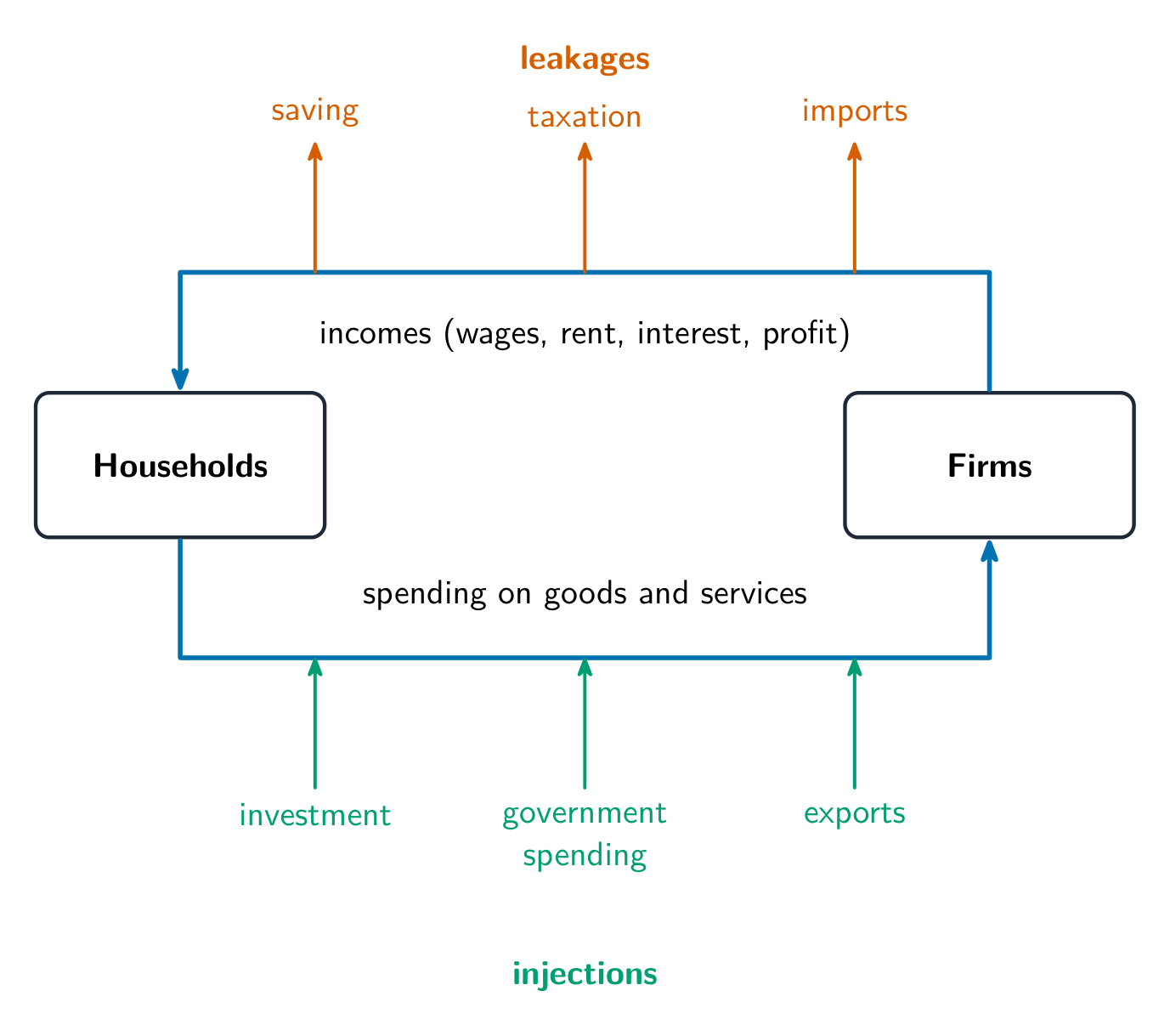
The circular-flow model 循环流动模型 shows money moving between households and firms: households supply factors and earn income; firms sell goods and earn revenue. Every dollar of spending is someone's income, which is why output and income are two sides of the same total.

Gross domestic product (GDP) 国内生产总值 is the market value of all final goods and services produced within a country in a year. Three ways to measure it give the same number:

  • Expenditure approach: $GDP = C + I + G + X_n$ – consumption 消费, investment 投资 (business spending on capital, plus new housing and inventory), government purchases 政府购买, and net exports 净出口 (exports minus imports).
  • Income approach: add up all wages, rent, interest, and profit.

Exclude intermediate goods (avoid double counting), used goods, purely financial transactions, and transfer payments.

العربية

يعرض نموذج التدفق الدائري حركة الأموال بين الأسر والشركات: تقدم الأسر العوامل وتكتسب دخلًا؛ تبيع الشركات السلع وتكتسب إيرادات. كل دولار من الإنفاق هو دخSomeone else, ولهذا السبب يمثل الناتج والدخل وجهين لنفس المجموع الكلي.

التدفق الدائري للدخل مع تسريباته وإدخالاته

الناتج المحلي الإجمالي (GDP) هو القيمة السوقية لجميع السلع والخدمات النهائية المنتجة داخل بلد خلال سنة. ثلاث طرق لقياسه تعطي نفس الرقم:

  • نهج الإنفاق: $GDP = C + I + G + X_n$ – الاستهلاك، الاستثمار (إنفاق الشركات على رأس المال، بالإضافة إلى الإسكان الجديد والمخزون)، مشتريات الحكومة، وصافي الصادرات (الصادرات ناقص الواردات).
  • نهج الدخل: اجمع جميع الأجور، الإيجار، الفائدة، والربح.

استبعد السلع الوسيطة (لتجنب الحساب المزدوج)، والسلع المستعملة، والمعاملات المالية البحتة، ودفعات النقل.

Explore · ⁨استكشف⁩

Follow money around the circular flow · ⁨تابع المال في التدفق الدائري⁩

Money flows from households to firms (spending) and back (wages), while injections (investment, government, exports) and leakages (saving, taxes, imports) can grow or shrink the flow — the size of that flow is GDP. · ⁨يتدفق المال من الأسر إلى الشركات (إنفاق) وعاداً (رواتب)، بينما الإدراجات (استثمار، حكومة، تصدير) والتسربات (ادخار، ضرائب، استيراد) يمكن أن تكبر أو تصغر التدفق — حجم هذا التدفق هو الناتج المحلي الإجمالي.⁩

2.2

Limitations of GDP · ⁨قيود الناتج المحلي الإجمالي⁩

Syllabus · ⁨المنهج⁩
English

Enduring Understanding (MEA-1): An economy's performance can be measured by different indicators such as gross domestic product (GDP), the inflation rate, and the unemployment rate.

Learning Objective MEA-1.B: Define the limitations of GDP.

  • MEA-1.B.1 GDP is a useful indicator of a nation's economic performance, but it has some limitations, such as failing to account for nonmarket transactions.
العربية

الفهم الدائم (MEA-1): يمكن قياس أداء الاقتصاد بمؤشرات مختلفة مثل الناتج المحلي الإجمالي (GDP)، ومعدل التضخم، ومعدل البطالة.

هدف التعلم MEA-1.B: حدد حدود الناتج المحلي الإجمالي.

  • MEA-1.B.1 يُعد الناتج المحلي الإجمالي مؤشراً مفيداً للأداء الاقتصادي للدولة، إلا أن له بعض الحدود، مثل عدم احتساب المعاملات غير السوقية.

Source: College Board AP Course and Exam Description · ⁨المصدر: وصف دورة وامتحان College Board AP⁩

English

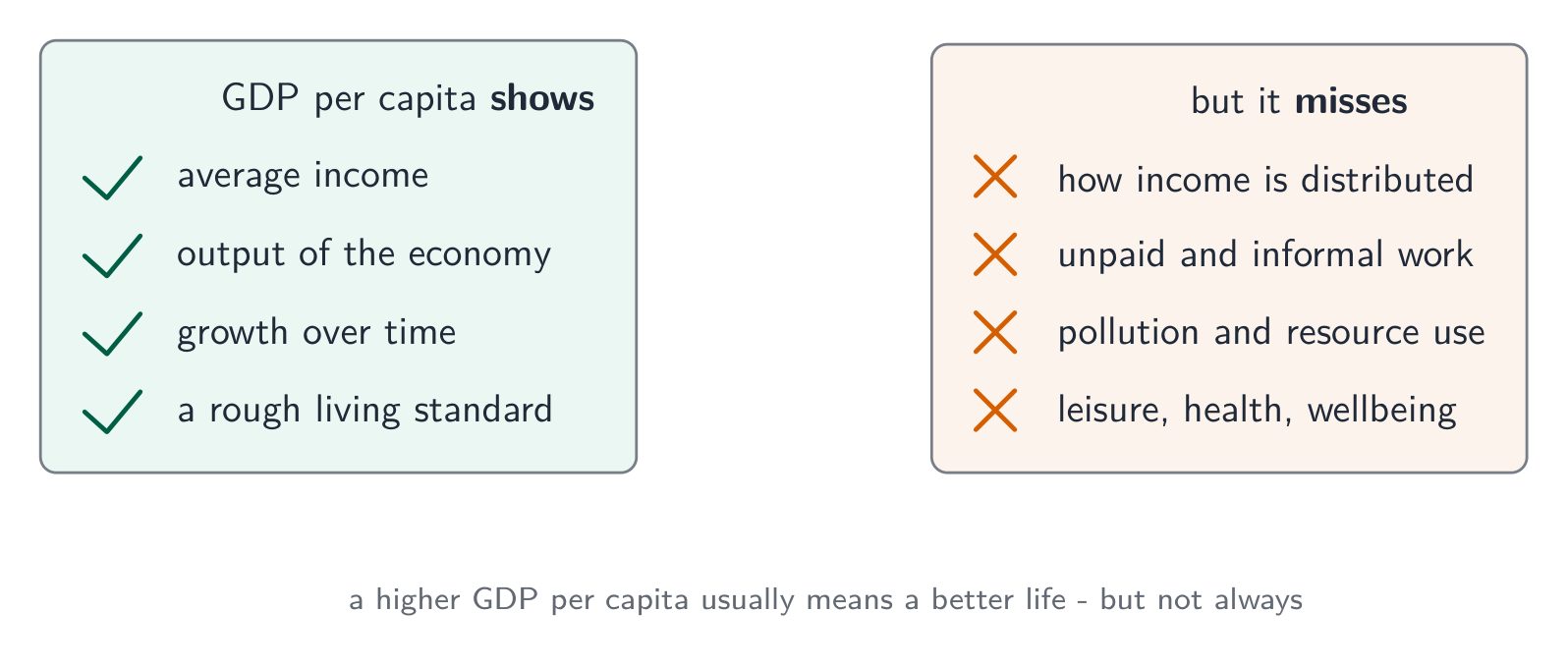
GDP measures market output, not well-being. It omits non-market production (unpaid housework, volunteering), the underground economy 地下经济, leisure, and the distribution of income, and it ignores environmental damage and resource depletion. So a higher GDP does not automatically mean a better standard of living. GDP per capita (GDP $\div$ population) is a better welfare proxy than total GDP.

العربية

يقيس الناتج المحلي الإجمالي الإنتاج في الأسواق، وليس الرفاهية. هو يستبعد الإنتاج غير السوقي (العمل المنزلي غير المدفوع الأجر، والتطوع)، والاقتصاد غير الرسمي، والوقت الفراغ، وتوزيع الدخل، ويتجاهل الأضرار البيئية واستنزاف الموارد. لذلك، لا يعني ارتفاع الناتج المحلي الإجمالي تلقائيًا تحسن مستوى المعيشة. الناتج المحلي الإجمالي للفرد (الناتج المحلي الإجمالي $\div$ عدد السكان) هو مؤشر أفضل للرفاهية من الناتج المحلي الإجمالي الكلي.

يُظهر الناتج المحلي الإجمالي للفرد المتوسط لكنه يتجاوز التوزيع والعمل غير المدفوع والأكثر
2.3

Unemployment · ⁨البطالة⁩

Syllabus · ⁨المنهج⁩
English

Enduring Understanding (MEA-1): An economy's performance can be measured by different indicators such as gross domestic product (GDP), the inflation rate, and the unemployment rate.

Learning Objective MEA-1.C: a. Define the labor force, the unemployment rate, and the labor force participation rate. b. Explain how changes in employment and the labor market affect the unemployment rate and the labor force participation rate. c. Calculate the unemployment rate and the labor force participation rate.

  • MEA-1.C.1 The unemployment rate is the percentage of the labor force that is out of work.
  • MEA-1.C.2 The labor force participation rate is another measure of the labor market activity in an economy. The labor force participation rate is the percentage of the adult population that is in the labor force.

Learning Objective MEA-1.D: Define the limitations of the unemployment rate.

  • MEA-1.D.1 The measured unemployment rate is often criticized for understating the level of joblessness because it excludes groups such as discouraged workers and part-time workers.

Learning Objective MEA-1.E: a. Define the types of unemployment and the natural rate of unemployment. b. Explain changes in the types of unemployment.

  • MEA-1.E.1 Economists primarily focus on three types of unemployment: cyclical, frictional, and structural.
  • MEA-1.E.2 The natural rate of unemployment is the unemployment rate that would exist when the economy produces full-employment real output. It is equal to the sum of frictional and structural unemployment.
  • MEA-1.E.3 The deviation of the actual unemployment rate from the natural rate is cyclical unemployment.
  • MEA-1.E.4 The natural rate of unemployment can gradually change over time because of such things as changes in labor force characteristics.
العربية

الفهم الدائم (MEA-1): يمكن قياس أداء الاقتصاد بمؤشرات مختلفة مثل الناتج المحلي الإجمالي (GDP)، ومعدل التضخم، ومعدل البطالة.

هدف التعلم MEA-1.C: أ. عرّف القوى العاملة، ومعدل البطالة، ومعدل مشاركة القوى العاملة. ب. اشرح كيف تؤثر التغيرات في التشغيل وسوق العمل على معدل البطالة ومعدل مشاركة القوى العاملة. ج. احسب معدل البطالة ومعدل مشاركة القوى العاملة.

  • MEA-1.C.1 معدل البطالة هو النسبة المئوية من القوى العاملة التي لا تعمل.
  • MEA-1.C.2 معدل مشاركة القوى العاملة هو مقياس آخر لنشاط سوق العمل في الاقتصاد. معدل مشاركة القوى العاملة هو النسبة المئوية من السكان البالغين الذين يتواجدون في القوى العاملة.

هدف التعلم MEA-1.D: حدد حدود معدل البطالة.

  • MEA-1.D.1 غالباً ما يُنتقد معدل البطالة المقاس لأنه يقلل من مستوى العاطلة الفعلية لأنه يستبعد مجموعات مثل العمال المستيئنين والعمال بدوام جزئي.

هدف التعلم MEA-1.E: أ. عرّف أنواع البطالة والمعدل الطبيعي للبطالة. ب. اشرح التغيرات في أنواع البطالة.

  • MEA-1.E.1 يركز الاقتصاديون بشكل أساسي على ثلاثة أنواع من البطالة: الدورية، والفركتالية، والهيكلية.
  • MEA-1.E.2 المعدل الطبيعي للبطالة هو معدل البطالة الذي سيوجد عندما ينتج الاقتصاد ناتجاً حقيقياً عند full employment (العمل الكامل). وهو يساوي مجموع البطالة الفركتالية والهيكلية.
  • MEA-1.E.3 الانحراف عن معدل البطالة الفعلي عن المعدل الطبيعي هو البطالة الدورية.
  • MEA-1.E.4 يمكن أن يتغير المعدل الطبيعي للبطالة تدريجياً مع مرور الوقت بسبب أشياء مثل تغيرات خصائص القوى العاملة.

Source: College Board AP Course and Exam Description · ⁨المصدر: وصف دورة وامتحان College Board AP⁩

English

The labor force 劳动力 is the employed plus the unemployed (those without work who are actively looking). People not looking are not in the labor force.

$$\text{Unemployment rate}=\frac{\text{unemployed}}{\text{labor force}}\times 100\%,\qquad \text{Labor-force participation}=\frac{\text{labor force}}{\text{working-age population}}\times100\%.$$

Worked example. A country has $150$ million employed and $10$ million unemployed (actively looking), with $40$ million working-age adults not looking. The labor force is $150+10=160$ million, so the unemployment rate is $\dfrac{10}{160}=6.25\%$ and the participation rate is $\dfrac{160}{200}=80\%$.

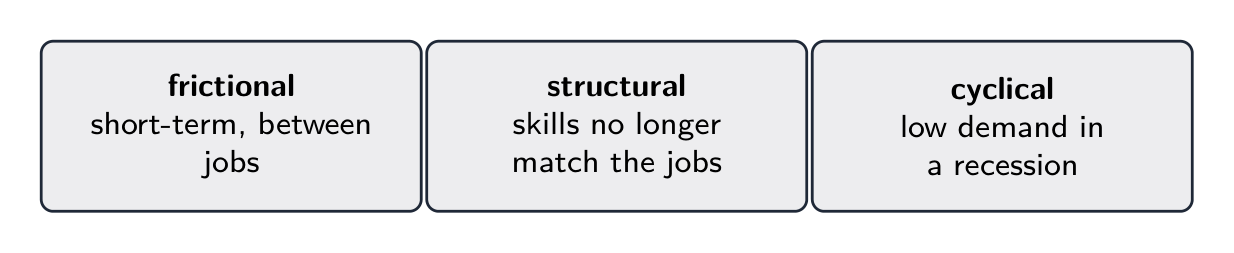
Three types of unemployment:

  • Frictional 摩擦性失业: between jobs or searching for a first job (normal, short).
  • Structural 结构性失业: skills or location don't match available jobs (technology, trade).
  • Cyclical 周期性失业: caused by a recession (a downturn in the business cycle).

Frictional + structural make up the natural rate of unemployment 自然失业率. At the natural rate cyclical unemployment is zero and the economy is at full employment 充分就业. The rate understates joblessness because it omits discouraged workers 灰心工人 and the underemployed.

العربية
طابور طويل من الناس — البطالة هم الأشخاص المستعدون والقادرون على العمل الذين لا يستطيعون إيجاد وظائف
طابور طويل من الناس — البطالة هي الأشخاص الذين يرغبون وقادرون على العمل لكنهم لا يجدون وظائف

القوة العاملة هي العمال المشغولون زائد العاطلون (أولئك الذين ليس لديهم عمل ويبحثون بنشاط). الأشخاص الذين لا يبحثون ليسوا جزءًا من القوة العاملة.

ثلاثة أنواع من البطالة: الاحتكاكية، الهيكلية، والدورية
ثلاثة أنواع من البطالة: الاحتكائية، الهيكلية، والدورية
$$\text{Unemployment rate}=\frac{\text{unemployed}}{\text{labor force}}\times 100\%,\qquad \text{Labor-force participation}=\frac{\text{labor force}}{\text{working-age population}}\times100\%.$$

مثال محلول. بلد لديه $150$ مليون عامل مشغول و$10$ مليون عاطل (باحثين بنشاط)، مع $40$ مليون بالغين في سن العمل لا يبحثون. القوة العاملة تساوي $150+10=160$ مليون، لذا فإن معدل البطالة هو $\dfrac{10}{160}=6.25\%$ ومعدل المشاركة هو $\dfrac{160}{200}=80\%$.

ثلاثة أنواع من البطالة:

  • احتكائي: بين الوظائف أو البحث عن أول وظيفة (طبيعي، قصير).
  • هيكلي: المهارات أو الموقع لا تتوافق مع الوظائف المتاحة (التكنولوجيا، التجارة).
  • دوري: ناتج عن ركود (انخفاض في الدورة الاقتصادية).

الاحتكائي + الهيكلي يشكلان معدل البطالة الطبيعي. عند المعدل الطبيعي تكون البطالة الدورية صفرًا وتكون الاقتصاد في التشغيل الكامل. هذا المعدر يقلل من حجم العاطلين لأنه يستبعد العاملين المستاءين ومنخفضي التشغيل.

Vocabulary · ⁨مفردات⁩ Train · ⁨تدريب⁩
English العربية
circular-flow model/ˈsɜːkjʊlə fləʊ ˈmɒdl/ نموذج التدفق الدائري
Gross domestic product (GDP)/ɡrəʊs dəˈmestɪk ˈprɒdʌkt/ إجمالي الناتج المحلي (GDP)
consumption/kənˈsʌmpʃn/ الاستهلاك
investment/ɪnˈvestmənt/ الاستثمار
government purchases/ˈɡʌvənmənt ˈpɜːtʃɪsɪz/ المشتريات الحكومية
net exports/net ˈekspɔːts/ صافي الصادرات
underground economy/ˌʌndəˈɡraʊnd ɪˈkɒnəmi/ الاقتصاد غير الرسمي
labor force/ˈleɪbə fɔːs/ قوة العمل
Frictional/ˈfrɪkʃənl/ احتكاكية
Structural/ˈstrʌktʃərəl/ بنيوي
Cyclical/ˈsaɪklɪkl/ دورية
natural rate of unemployment/ˈnætʃərəl reɪt ɒv ʌnemˈplɔɪmənt/ معدل البطالة الطبيعي
full employment/fʊl emˈplɔɪmənt/ full employment
discouraged workers/dɪˈskʌrɪdʒd ˈwɜːkəz/ العمال المحبطون
2.4

Price Indices and Inflation · ⁨مؤشرات الأسعار والتضخم⁩

Syllabus · ⁨المنهج⁩
English

Enduring Understanding (MEA-1): An economy's performance can be measured by different indicators such as gross domestic product (GDP), the inflation rate, and the unemployment rate.

Learning Objective MEA-1.F: a. Define the consumer price index (CPI), inflation, deflation, disinflation, the inflation rate, and real variables. b. Explain how price indices can be used to calculate the inflation rate and to compare nominal variables over time periods. c. Calculate the CPI, the inflation rate, and changes in real variables.

  • MEA-1.F.1 The consumer price index (CPI) measures the change in income a consumer would need in order to maintain the same standard of living over time under a new set of prices as under the original set of prices.
  • MEA-1.F.2 The CPI measures the cost of a fixed basket of goods and services in a given year relative to the base year.
    • Exclusion statement: Calculating the producer price index (PPI) is beyond the scope of the course and AP Exam.
  • MEA-1.F.3 The inflation rate is determined by calculating the percentage change in a price index, such as CPI or the GDP deflator.
  • MEA-1.F.4 Real variables, such as real wages, are the nominal variables deflated by the price level.

Learning Objective MEA-1.G: Define the shortcomings of the CPI as a true measure of inflation.

  • MEA-1.G.1 The CPI as a measure of inflation has some shortcomings, such as substitution bias, causing it to overstate the true inflation rate.
العربية

الفهم الدائم (MEA-1): يمكن قياس أداء الاقتصاد بمؤشرات مختلفة مثل الناتج المحلي الإجمالي (GDP)، ومعدل التضخم، ومعدل البطالة.

هدف التعلم MEA-1.F: أ. عرف مؤشر أسعار المستهلك (CPI)، والتضخم، والانكماش، وتباطؤ التضخم، ومعدل التضخم، والمتغيرات الحقيقية. ب. اشرح كيفية استخدام مؤشرات الأسعار لحساب معدل التضخم ومقارنة المتغيرات الاسمية عبر فترات زمنية. ج. احسب مؤشر أسعار المستهلك (CPI)، ومعدل التضخم، والتغيرات في المتغيرات الحقيقية.

  • MEA-1.F.1 يقيس مؤشر أسعار المستهلك (CPI) التغير في الدخل الذي يحتاجه المستهلك للحفاظ على نفس مستوى المعيشة بمرور الوقت تحت مجموعة أسعار جديدة مقارنة بالمجموعة الأصلية.
  • MEA-1.F.2 يقيس مؤشر أسعار المستهلك تكلفة سلة ثابتة من السلع والخدمات في سنة معينة بالنسبة للسنة الأساسية.
    • عبارة الاستبعاد: حساب مؤشر أسعار المنتجين (PPI) خارج نطاق المقرر وامتحان AP.
  • MEA-1.F.3 يُحدد معدل التضخم بحساب التغير النسبي في مؤشر أسعار، مثل مؤشر أسعار المستهلك (CPI) أو قاسي الناتج المحلي الإجمالي.
  • MEA-1.F.4 المتغيرات الحقيقية، مثل الأجور الحقيقية، هي المتغيرات الاسمية المنقحة بمستوى الأسعار.

هدف التعلم MEA-1.G: حدد قصور مؤشر أسعار المستهلك (CPI) كمقياس حقيقي للتضخم.

  • MEA-1.G.1 لمؤشر أسعار المستهلك (CPI) كمقياس للتضخم بعض القصور، مثل تحيز الاستبدال، مما يؤدي إلى مبالغة في معدل التضخم الحقيقي.

Source: College Board AP Course and Exam Description · ⁨المصدر: وصف دورة وامتحان College Board AP⁩

English

Inflation 通货膨胀 is a sustained rise in the average price level. It is measured with a price index 价格指数, most often the consumer price index (CPI) 消费者价格指数, built from a fixed market basket of goods a typical household buys:

$$CPI=\frac{\text{cost of basket this year}}{\text{cost of basket in base year}}\times100.$$

The inflation rate is the percent change in the index between two years. Deflation 通货紧缩 is a falling price level; disinflation is a slowing of inflation.

Worked example. If the CPI is $200$ this year and was $190$ last year, the inflation rate is $\dfrac{200-190}{190}\times100\%=5.3\%$. A basket that cost $\$190$ then costs $\$200$ – the same goods, more dollars.

العربية
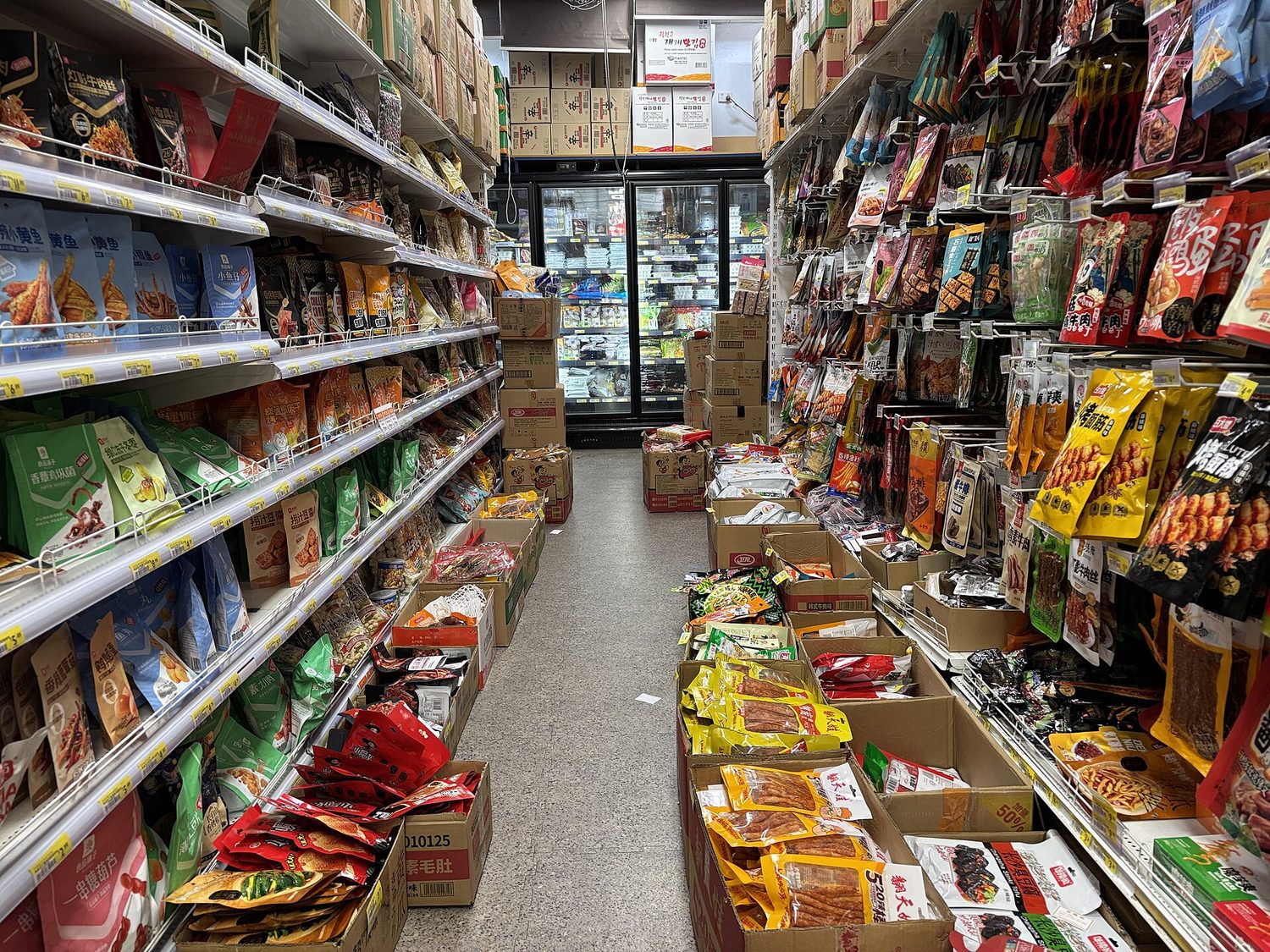
مسار سوبر ماركت: سلة ثابتة من البضائع تقي التضخم عبر مؤشر الأسعار
ممر متجر سوبر ماركت: سلة ثابتة من البضائع تقيس التضخم عبر مؤشر أسعار

التضخم هو ارتفاع مستمر في متوسط مستوى الأسعار. يُقاس باستخدام مؤشر أسعار، وغالبًا ما يكون مؤشر أسعار المستهلك (CPI)، المبني على سلة سوقية ثابتة من البضائع التي تشتريها أسرة نموذجية:

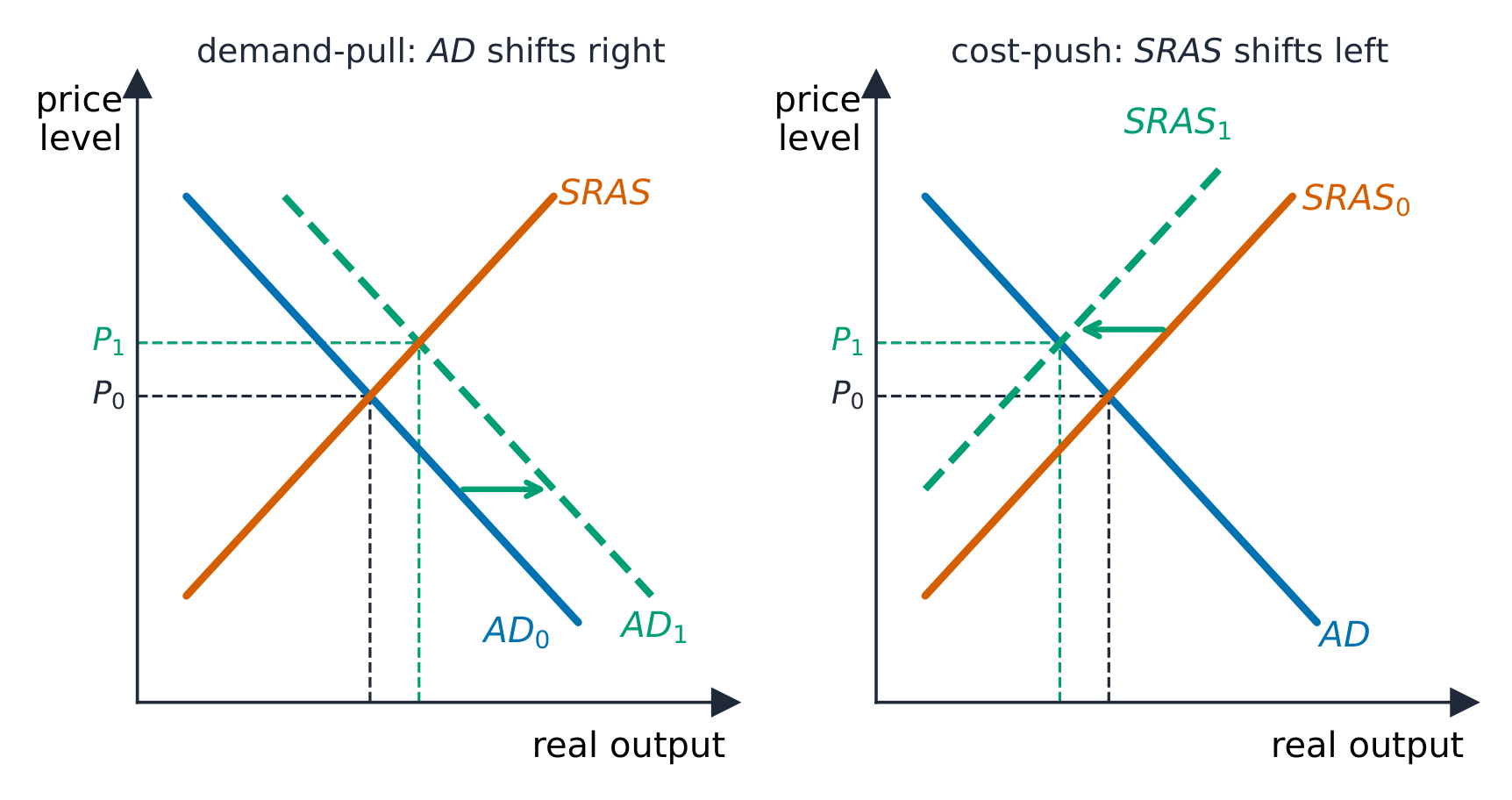
التضخم المستند للطلب والتضخم المستند للتكلفة في رسم AD-AS البياني
$$CPI=\frac{\text{cost of basket this year}}{\text{cost of basket in base year}}\times100.$$

معدل التضخم هو النسبة المئوية للتغير في المؤشر بين عامين. التراجع هو انخفاض مستوى الأسعار؛ تهدئة التضخم هو تباطؤ في التضخم.

مثال محلول. إذا كان مؤشر أسعار المستهلك $200$ هذا العام وكان $190$ العام الماضي، فإن معدل التضخم هو $\dfrac{200-190}{190}\times100\%=5.3\%$. سلة تكلف $\$190$ then costs $\$200$ – نفس البضائع، دولارات أكثر.

Vocabulary · ⁨مفردات⁩ Train · ⁨تدريب⁩
English العربية
Inflation/ɪnˈfleɪʃn/ تضخم
2.5

Costs of Inflation · ⁨تكاليف التضخم⁩

Syllabus · ⁨المنهج⁩
English

Enduring Understanding (MEA-1): An economy's performance can be measured by different indicators such as gross domestic product (GDP), the inflation rate, and the unemployment rate.

Learning Objective MEA-1.H: Explain the costs that unexpected inflation (deflation) imposes on individuals and the economy.

  • MEA-1.H.1 Unexpected inflation arbitrarily redistributes wealth from one group of individuals to another group, such as lenders to borrowers.
العربية

الفهم الدائم (MEA-1): يمكن قياس أداء الاقتصاد بمؤشرات مختلفة مثل الناتج المحلي الإجمالي (GDP)، ومعدل التضخم، ومعدل البطالة.

هدف التعلم MEA-1.H: اشرح التكاليف التي يفرضها التضخم المفاجئ (أو الانكماش) على الأفراد والاقتصاد.

  • MEA-1.H.1 إعادة توزيع الثروة عشوائياً من مجموعة من الأفراد إلى مجموعة أخرى نتيجة للتضخم المفاجئ، مثل من المقرضين إلى المقترضين.

Source: College Board AP Course and Exam Description · ⁨المصدر: وصف دورة وامتحان College Board AP⁩

English

Inflation redistributes and distorts:

  • It hurts lenders and savers and helps borrowers when it is unexpected, because loans are repaid in cheaper dollars. It erodes the value of money and fixed incomes.
  • Menu costs and uncertainty discourage investment.
  • Anticipated inflation is less harmful because contracts and interest rates adjust for it. This is why we separate nominal and real values.
العربية

إعادة توزيع التضخم وتشويهه:

  • يضر المقرضين والموفرين ويساعد المقترضين عندما يكون غير متوقع، لأن القروض تُدفع بدولارات أرخص. إنه يآكل قيمة المال والدخل الثابت.
  • تكلفة القائمة والشكوك تثبت الاستثمار.
  • التضخم المتوقع أقل ضرراً لأن العقود وأسعار الفائدة تتكيف معه. ولهذا السبب نفصل بين القيم الاسمية والحقيقية.
2.6

Real v. Nominal GDP · ⁨الناتج المحلي الإجمالي الحقيقي مقابل الاسمي⁩

Syllabus · ⁨المنهج⁩
English

Enduring Understanding (MEA-1): An economy's performance can be measured by different indicators such as gross domestic product (GDP), the inflation rate, and the unemployment rate.

Learning Objective MEA-1.I: Define nominal GDP and real GDP.

  • MEA-1.I.1 Nominal GDP is a measure of how much is spent on output. Real GDP is a measure of how much is produced.
  • MEA-1.I.2 Nominal GDP measures aggregate output using current prices. Real GDP measures aggregate output using constant prices, thus removing the effect of changes in the overall price level.

Learning Objective MEA-1.J: Calculate real GDP and the GDP deflator.

  • MEA-1.J.1 One way of measuring real GDP is to weigh final goods and services by their prices in a base year. Because this can lead to overstatement of real GDP growth, statistical agencies actually use different methods.
  • MEA-1.J.2 Nominal GDP can be converted to real GDP by using the GDP deflator.
العربية

الفهم الدائم (MEA-1): يمكن قياس أداء الاقتصاد بمؤشرات مختلفة مثل الناتج المحلي الإجمالي (GDP)، ومعدل التضخم، ومعدل البطالة.

هدف التعلم MEA-1.I: عرّف الناتج المحلي الإجمالي الاسمي والناتج المحلي الإجمالي الحقيقي.

  • MEA-1.I.1 الناتج المحلي الإجمالي الاسمي هو مقياس لما يتم إنفاقه على الإنتاج. الناتج المحلي الإجمالي الحقيقي هو مقياس لما يتم إنتاجه.
  • MEA-1.I.2 يقيس الناتج المحلي الإجمالي الاسمي الإنتاج الكلي باستخدام الأسعار الجارية. يقيس الناتج المحلي الإجمالي الحقيقي الإنتاج الكلي باستخدام أسعار ثابتة، مما يلغي تأثير التغيرات في مستوى الأسعار العام.

هدف التعلم MEA-1.J: احسب الناتج المحلي الإجمالي الحقيقي وقاسي الناتج المحلي الإجمالي.

  • MEA-1.J.1 إحدى طرق قياس الناتج المحلي الإجمالي الحقيقي هي وزن البضائع والخدمات النهائية بأسعارها في سنة أساسية. وبما أن هذا قد يؤدي إلى مبالغة في نمو الناتج المحلي الإجمالي الحقيقي، تستخدم الوكالات الإحصائية في الواقع طرقاً مختلفة.
  • MEA-1.J.2 يمكن تحويل الناتج المحلي الإجمالي الاسمي إلى ناتج محلي إجمالي حقيقي باستخدام قاسي الناتج المحلي الإجمالي.

Source: College Board AP Course and Exam Description · ⁨المصدر: وصف دورة وامتحان College Board AP⁩

English
  • Nominal GDP 名义GDP is valued at current prices, so it rises with both output and prices.
  • Real GDP 实际GDP is valued at constant (base-year) prices, stripping out inflation, so it reflects true output. Real GDP is the honest measure of growth.
$$\text{Real GDP}=\frac{\text{Nominal GDP}}{\text{price index}}\times100,\qquad \text{GDP deflator}=\frac{\text{Nominal GDP}}{\text{Real GDP}}\times100.$$

Worked example. Nominal GDP is $\$22$ trillion and the GDP deflator is $110$. Real GDP is $\dfrac{22}{110}\times100=\$20$ trillion. The extra $\$2$ trillion of nominal GDP is pure price rise, not real output – which is why growth is always measured with real GDP.

Exam skill: be fluent converting nominal to real using a price index, and computing an inflation rate or a growth rate as a percent change.

العربية
  • الناتج المحلي الإجمالي الاسمي يُقدر بأسعار حالية، لذلك يرتفع مع كل من الإنتاج والأسعار.
  • الناتج المحلي الإجمالي الحقيقي يُقدر بأسعار ثابتة (سنة الأساس)، مستبعداً التضخم، لذلك يعكس الإنتاج الفعلي. الناتج المحلي الإجمالي الحقيقي هو المقياس الصادق للنمو.
$$\text{Real GDP}=\frac{\text{Nominal GDP}}{\text{price index}}\times100,\qquad \text{GDP deflator}=\frac{\text{Nominal GDP}}{\text{Real GDP}}\times100.$$

مثال محلول. الناتج المحلي الإجمالي الاسمي هو $\$22$ trillion and the GDP deflator is $110$. Real GDP is $\dfrac{22}{110}\times100=\$20$ تريليون. الزيادة $\$2$ تريليون من الناتج المحلي الإجمالي الاسمي هي مجرد ارتفاع في الأسعار، وليس إنتاجاً حقيقياً – وهذا هو سبب قياس النمو دائماً باستخدام الناتج المحلي الإجمالي الحقيقي.

مهارة الامتحان: أن تكون ماهراً في تحويل名义 إلى حقيقي باستخدام مؤشر أسعار، وحساب معدل تضخم أو معدل نمو كنسبة مئوية للتغير.

Vocabulary · ⁨مفردات⁩ Train · ⁨تدريب⁩
English العربية
price index/praɪs ˈɪndeks/ مؤشر الأسعار
consumer price index (CPI)/kənˈsuːmə praɪs ˈɪndeks/ مؤشر أسعار المستهلكين (CPI)
Deflation/diːˈfleɪʃn/ انكماش
Nominal GDP/ˈnɒmɪnl ˌdʒiː diː ˈpiː/ الناتج المحلي الإجمالي الاسمي
Real GDP/rɪəl ˌdʒiː diː ˈpiː/ الناتج المحلي الإجمالي الحقيقي
2.7

Business Cycles · ⁨دورات الأعمال⁩

Syllabus · ⁨المنهج⁩
English

Enduring Understanding (MEA-2): The economy fluctuates between periods of expansion and contraction in the short run, but economic growth can occur in the long run.

Learning Objective MEA-2.A: a. Define (using graphs and data as appropriate) turning points and phases of the business cycle. b. Explain (using graphs and data as appropriate) turning points and phases of the business cycle.

  • MEA-2.A.1 Business cycles are fluctuations in aggregate output and employment because of changes in aggregate supply and/or aggregate demand.
  • MEA-2.A.2 The phases of a business cycle are recession and expansion.
  • MEA-2.A.3 The turning points of a business cycle are peak and trough.
  • MEA-2.A.4 The difference between actual output and potential output is the output gap.
  • MEA-2.A.5 Potential output is also called full-employment output. It is the level of GDP where unemployment is equal to the natural rate of unemployment. [See EK MEA-1.E.2]
العربية

الفهم الدائم (MEA-2): يتذبذب الاقتصاد بين فترات التوسع والانكماش على المدى القصير، ولكن يمكن أن يحدث النمو الاقتصادي على المدى الطويل.

هدف التعلم MEA-2.A: أ. عرّف (باستخدام الرسوم البيانية والبيانات حسب الحاجة) نقاط التحول ومراحل الدورة الاقتصادية. ب. اشرح (باستخدام الرسوم البيانية والبيانات حسب الحاجة) نقاط التحول ومراحل الدورة الاقتصادية.

  • MEA-2.A.1 الدورات الاقتصادية هي تذبذبات في الإنتاج الكلي والتوظيف بسبب تغيرات في العرض الكلي و/أو الطلب الكلي.
  • MEA-2.A.2 مراحل الدورة الاقتصادية هي الركود والتوسع.
  • MEA-2.A.3 نقاط تحول الدورة الاقتصادية هي القمة والقاع.
  • MEA-2.A.4 الفرق بين الإنتاج الفعلي والإنتاج المحتمل هو فجوة الإنتاج.
  • MEA-2.A.5 الناتج المحتمل يُسمى أيضًا ناتج التوظيف الكامل. هو مستوى الناتج المحلي الإجمالي حيث يكون معدل البطالة مساويًا لمعدل البطالة الطبيعي. [انظر EK MEA-1.E.2]

Source: College Board AP Course and Exam Description · ⁨المصدر: وصف دورة وامتحان College Board AP⁩

English
The business cycle

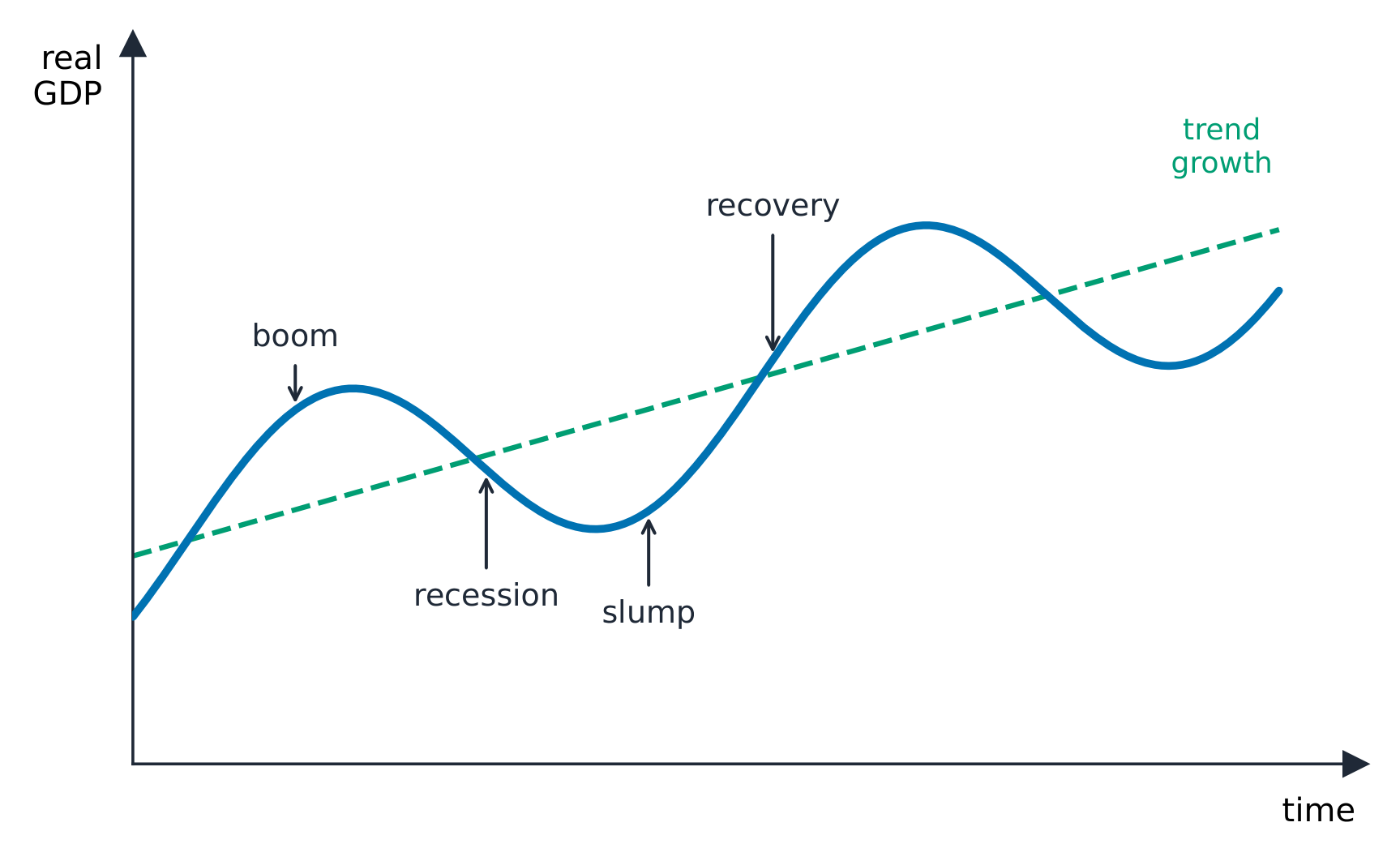
The business cycle 经济周期 is the economy's short-run ups and downs in real GDP around its long-run growth trend: expansion 扩张 (rising output, falling unemployment) up to a peak 顶峰, then contraction/recession 衰退 (falling output, rising cyclical unemployment) down to a trough 谷底, then recovery. A recession is commonly two consecutive quarters of falling real GDP. Unemployment and inflation move roughly opposite over the cycle – the tension the rest of the course tries to manage.

العربية
دورة الأعمال

دورة الأعمال هي الارتفاعات والانخفاضات القصيرة الأمد للاقتصاد في الناتج المحلي الإجمالي الحقيقي حول اتجاه نموه الطويل الأمد: التوسع (ارتفاع الإنتاج، انخفاض البطالة) حتى ذروة، ثم الانكماش/الركود (انخفاض الإنتاج، ارتفاع البطالة الدورية) حتى قاع، ثم التعافي. الرّكود هو عادةً فصلان متتابعان من انخفاض الناتج المحلي الإجمالي الحقيقي. تتحرك البطالة والتضخم تقريباً في اتجاه معاكس خلال الدورة – وهو التوتر الذي يحاول البرنامج الدراسي بأكمله إدارته.

تذبذب الناتج المحلي الإجمالي الحقيقي حول اتجاهه طويل الأمد
Vocabulary · ⁨مفردات⁩ Train · ⁨تدريب⁩
English العربية
business cycle/ˈbɪznəs ˈsaɪkl/ الدورة الاقتصادية
expansion/ekˈspænʃn/ التوسع
peak/piːk/ قمة
contraction/recession/kənˈtrækʃn rɪˈseʃn/ الانكماش/الكساد
trough/trɒf/ القاع
2.7

Exam tips · ⁨نصائح للامتحان⁩

English
  • Compute GDP by the expenditure method $C+I+G+X_n$ and count only final goods (avoid double counting).
  • Unemployment rate = unemployed ÷ labor force; discouraged workers leave the labor force (so the rate can understate joblessness).
  • Know the three unemployment types (frictional, structural, cyclical) and that the natural rate excludes cyclical.
  • Inflation is the % change in the CPI; convert nominal to real with a price index and always use real GDP for growth.
  • Place events on the business cycle (expansion → peak → contraction → trough).
العربية
  • احسب الناتج المحلي الإجمالي بطريقة الإنفاق $C+I+G+X_n$ واحسب فقط السلع ** النهائية** (لتجنب العد المزدوج).
  • معدل البطالة = العاطلون ÷ القوة العاملة؛ العاملون المستاءون يغادرون القوة العاملة (لذلك قد يقلل المعدر من حجم العاطلين).
  • تعرف الأنواع الثلاثة للبطالة (الاحتكائية، الهيكلية، الدورية) وأن المعدل الطبيعي يستبعد البطالة الدورية.
  • التضخم هو التغير % في مؤشر أسعار المستهلك؛ حول名义 إلى حقيقي باستخدام مؤشر أسعار واستخدم دائماً الناتج المحلي الإجمالي الحقيقي للنمو.
  • ضع الأحداث على دورة الأعمال (توسع ← ذروة ← انكماش ← قاع).

Interactive lessons on this topic · ⁨دروس تفاعلية حول هذا الموضوع⁩

Work through it step by step, with instant-check exercises. · ⁨ا-working عليه خطوة بخطوة، مع تمارين تحقق فوري.⁩

Past Papers · ⁨أوراق الامتحانات السابقة⁩

More topics in AP Macroeconomics · ⁨الاقتصاد الكلي (AP)⁩ · ⁨المزيد من المواضيع في AP Macroeconomics · ⁨الاقتصاد الكلي (AP)⁩⁩

Log in or create account · ⁨تسجيل الدخول أو إنشاء حساب⁩

IGCSE, A-Level & AP