Skip to content · ⁨الانتقال إلى المحتوى⁩
Subjects · ⁨المواد⁩

AP Macroeconomics · ⁨الاقتصاد الكلي (AP)⁩

Tips

AP Macroeconomics covers economic indicators and the business cycle, national income and price determination, the financial sector, stabilisation policies, economic growth, and the open economy. It works at the level of a whole country rather than a single market.

Three model diagrams carry the course: AD–AS, the money market, and the loanable-funds market. Almost every free-response question moves between them, so knowing what shifts what, and in which order, is the core skill.

Chains of reasoning are graded. "Interest rates fall → investment rises → AD shifts right → real GDP and the price level rise" is the shape of a full-mark answer. Never skip a link.

The notes run unit by unit with the graphs drawn out — AD-AS, the money market, loanable funds — because most of the marks hang on them. Released FRQs are in the library, and the notes flag the places where a correctly labelled diagram earns the point by itself.

  • 1

    Basic Economic Concepts · ⁨المفاهيم الاقتصادية الأساسية⁩

    Watch lesson · ⁨شاهد الدرس⁩
    1.1

    Scarcity · ⁨الندرة⁩

    Syllabus · ⁨المنهج⁩
    English

    Enduring Understanding (MOD-1): The production possibilities curve (PPC) model is used to demonstrate the full employment level of output and to illustrate changes in full employment.

    Learning Objective MOD-1.A: Define scarcity and economic resources.

    • MOD-1.A.1 Individuals and societies are forced to make choices because most resources are scarce.
    العربية

    الفهم الدائم (MOD-1): يُستخدم نموذج منحنى إمكانيات الإنتاج (PPC) لإظهار مستوى التوظيف الكامل للإنتاج ولتوضيح التغيرات في التوظيف الكامل.

    هدف التعلم MOD-1.A: تعريف الندرة والموارد الاقتصادية.

    • MOD-1.A.1 يُجبر الأفراد والمجتمعات على اتخاذ خيارات لأن معظم الموارد نادرة.
    Source: College Board AP Course and Exam Description · ⁨المصدر: وصف دورة وامتحان College Board AP⁩

    English

    Economics 经济学 begins with scarcity 稀缺性: people's wants are unlimited, but the resources 资源 to satisfy them are limited. The resources – the factors of production 生产要素 – are land, labor 劳动, capital 资本, and entrepreneurship 企业家才能. Scarcity forces every society to choose what, how, and for whom to produce, and it makes trade-offs 权衡 unavoidable.

    العربية
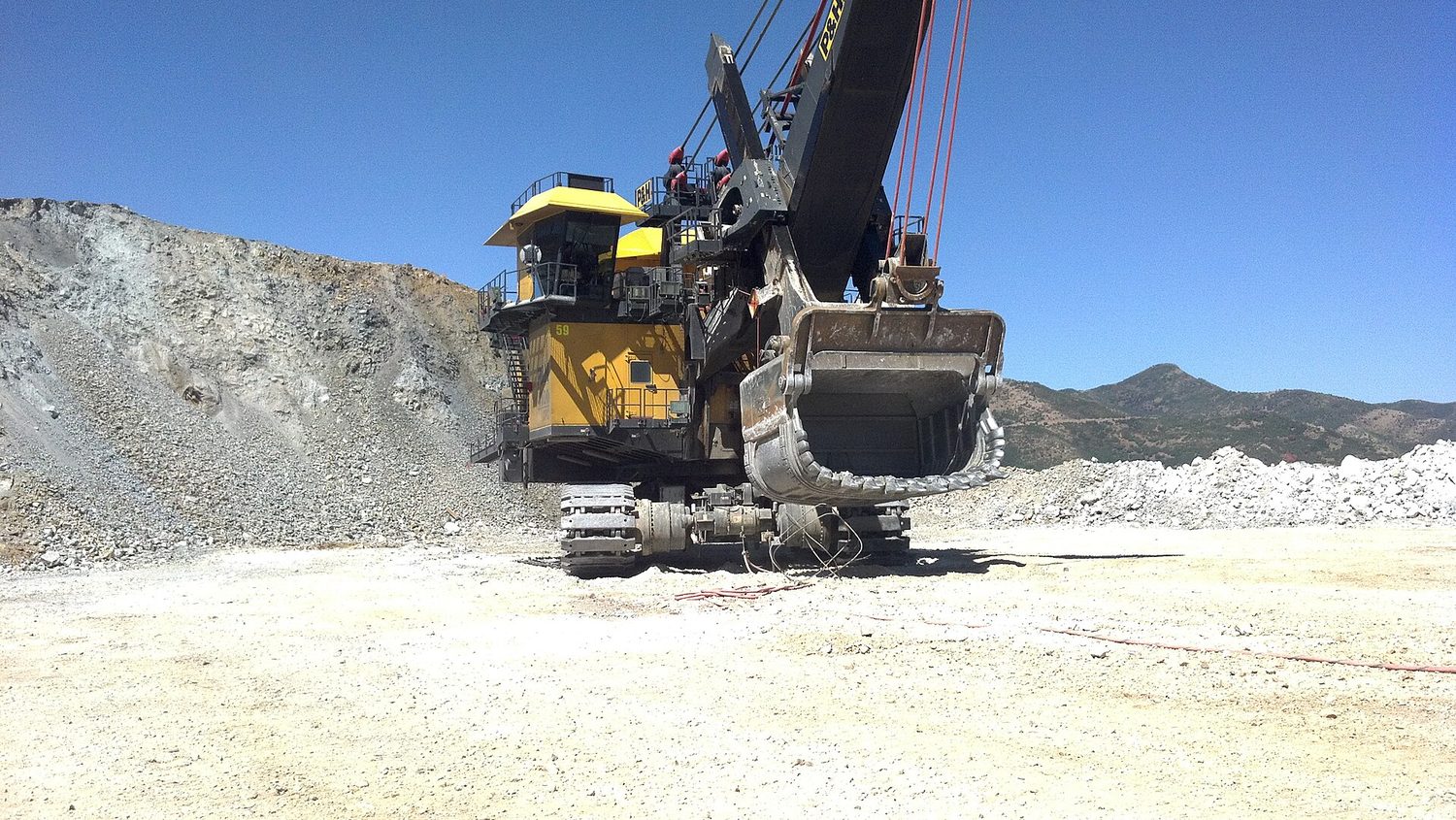
    منجم مفتوح: الأرض والمعادن موارد نادرة ذات تكلفة بديلة
    منجم مفتوح: الأرض والمعادن موارد نادرة ذات تكلفة بديلة

    الاقتصاد يبدأ بـالندرة: رغبات الناس لا حدود لها، لكن الموارد لتلبية هذه الرغبات محدودة. الموارد – وهي عوامل الإنتاج – هي الأرض، والعمل، والرأس المال، وريادة الأعمال. تفرض الندرة على كل مجتمع الاختيار في ماذا وكيف ولمن الإنتاج، وتجعل المفاضلات لا مفر منها.

    Vocabulary · ⁨مفردات⁩ Train · ⁨تدريب⁩
    English العربية
    Economics/ˌiːkəˈnɒmɪks/ الاقتصاد
    scarcity/ˈskeəsɪti/ الندرة
    resources/rɪˈzɔːsɪz/ الموارد
    factors of production/ˈfæktəz ɒv prəˈdʌkʃn/ عوامل الإنتاج
    labor/ˈleɪbə/ العمل
    capital/ˈkæpɪtl/ رأس المال
    entrepreneurship/ˌɒntrɪprəˈnjʊəʃɪp/ ريادة الأعمال
    trade-offs/treɪd ɒfs/ المفاضلات
    1.2

    Opportunity Cost and the Production Possibilities Curve (PPC) · ⁨تكلفة الفرصة البديلة ومنحنى الإمكانيات الإنتاجية (PPC)⁩

    Syllabus · ⁨المنهج⁩
    English

    Enduring Understanding (MOD-1): The production possibilities curve (PPC) model is used to demonstrate the full employment level of output and to illustrate changes in full employment.

    Learning Objective MOD-1.B: a. Define (using graphs as appropriate) the PPC and related terms. b. Explain (using graphs as appropriate) how the PPC illustrates opportunity costs, tradeoffs, inefficiency, efficiency, and economic growth or contraction under various conditions. c. Calculate (using data from PPCs or tables as appropriate) opportunity cost.

    • MOD-1.B.1 The PPC is a model used to show the tradeoffs associated with allocating resources.
    • MOD-1.B.2 The PPC can be used to illustrate the concepts of scarcity, opportunity cost, efficiency, underutilized resources, and economic growth or contraction.
    • MOD-1.B.3 The shape of the PPC depends on whether opportunity costs are constant, increasing, or decreasing.
    • MOD-1.B.4 The PPC can shift because of changes in factors of production as well as changes in productivity/technology.
    • MOD-1.B.5 Economic growth results in an outward shift of the PPC.
    العربية

    الفهم الدائم (MOD-1): يُستخدم نموذج منحنى إمكانيات الإنتاج (PPC) لإظهار مستوى التوظيف الكامل للإنتاج ولتوضيح التغيرات في التوظيف الكامل.

    هدف التعلم MOD-1.B: أ. تعريف (باستخدام الرسوم البيانية عند الحاجة) منحنى إمكانيات الإنتاج والمصطلحات ذات الصلة. ب. شرح (باستخدام الرسوم البيانية عند الحاجة) كيف يوضح منحنى إمكانيات الإنتاج تكاليف الفرصة البديلة، والتبادلات، وعدم الكفاءة، والكفاءة، والنمو الاقتصادي أو الانكماش تحت ظروف مختلفة. ج. حساب (باستخدام بيانات من منحنيات إمكانيات الإنتاج أو الجداول عند الحاجة) تكلفة الفرصة البديلة.

    • MOD-1.B.1 منحنى إمكانيات الإنتاج هو نموذج يستخدم لإظهار التبادلات المرتبطة بتخصيص الموارد.
    • MOD-1.B.2 يمكن استخدام منحنى إمكانيات الإنتاج لتوضيح مفاهيم الندرة، وتكلفة الفرصة البديلة، والكفاءة، واستخدام الموارد دون كفاءة، والنمو الاقتصادي أو الانكماش.
    • MOD-1.B.3 يعتمد شكل منحنى إمكانيات الإنتاج على ما إذا كانت تكاليف الفرصة البديلة ثابتة أو متزايدة أو متناقصة.
    • MOD-1.B.4 يمكن أن ينزاح منحنى إمكانيات الإنتاج بسبب تغيرات في عوامل الإنتاج وكذلك تغيرات في الإنتاجية/التكنولوجيا.
    • MOD-1.B.5 يؤدي النمو الاقتصادي إلى انزاحة منحنى إمكانيات الإنتاج نحو الخارج.

    Source: College Board AP Course and Exam Description · ⁨المصدر: وصف دورة وامتحان College Board AP⁩

    English
    The production possibility frontier

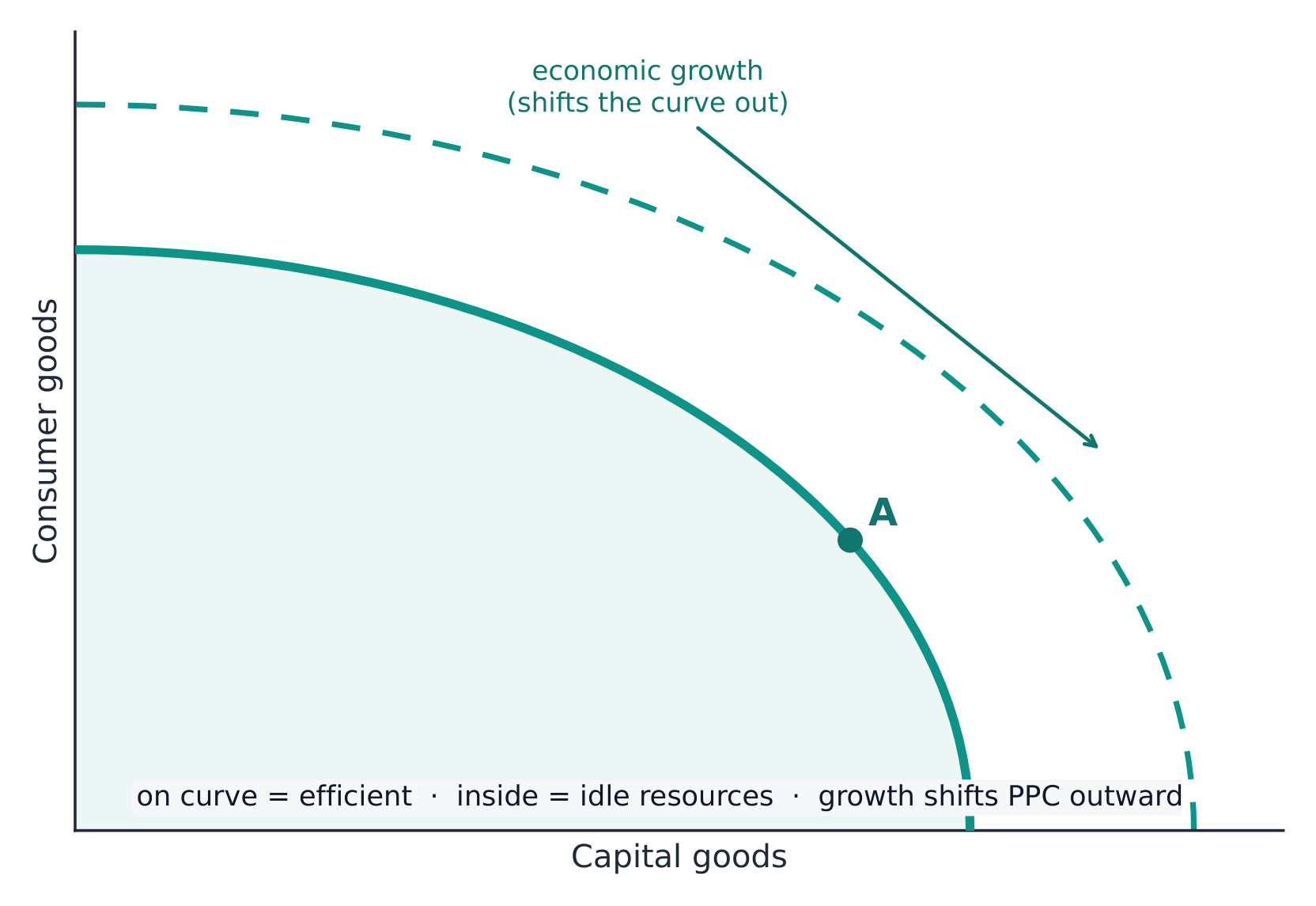
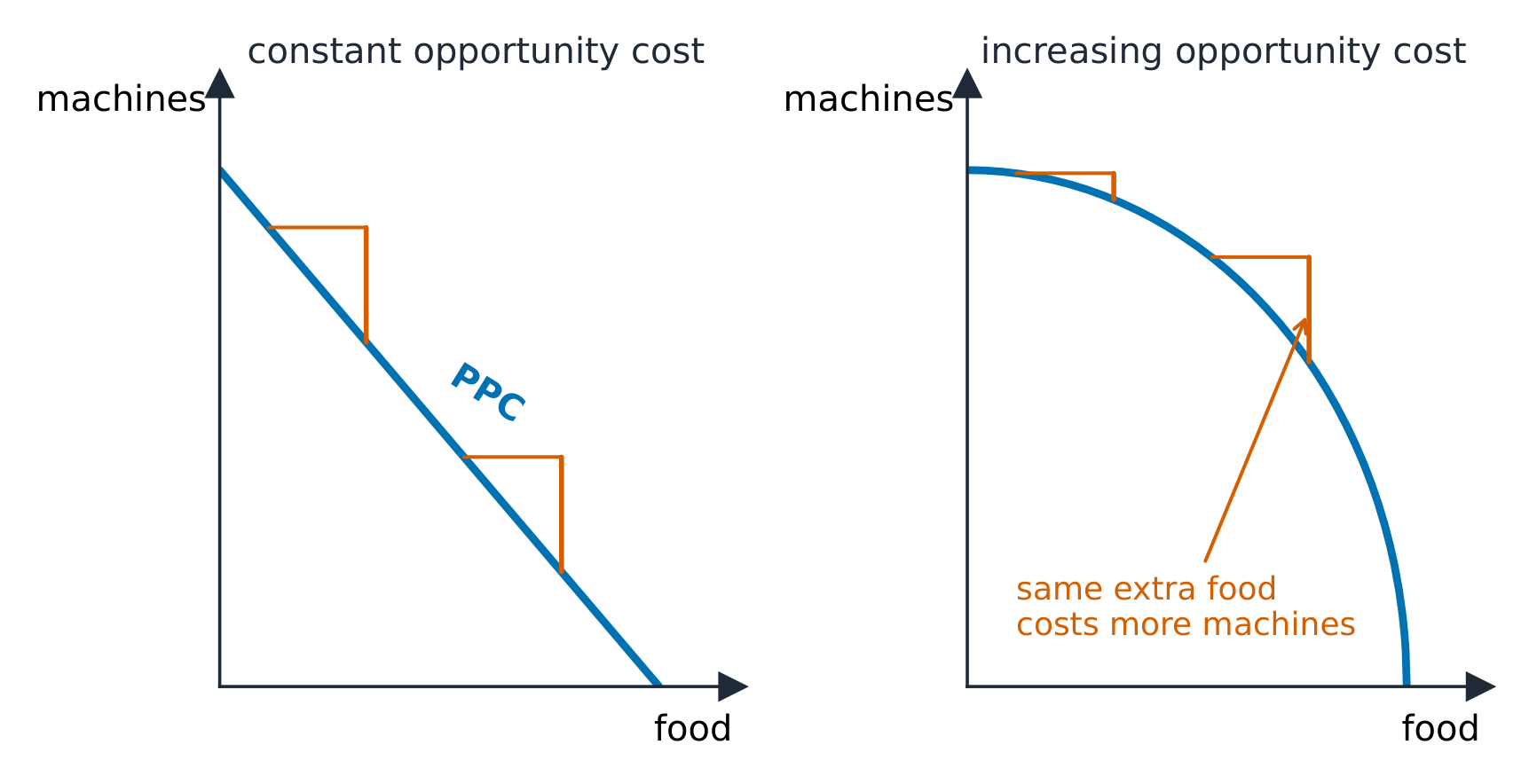
    Every choice has an opportunity cost 机会成本 – the value of the next-best alternative given up. The production possibilities curve (PPC) 生产可能性曲线 shows the maximum combinations of two goods an economy can make when resources are fully and efficiently used.

    • Points on the curve are efficient; inside, inefficient (unemployed resources); outside, unattainable.
    • The downward slope shows opportunity cost; a bowed-out curve shows increasing opportunity cost.
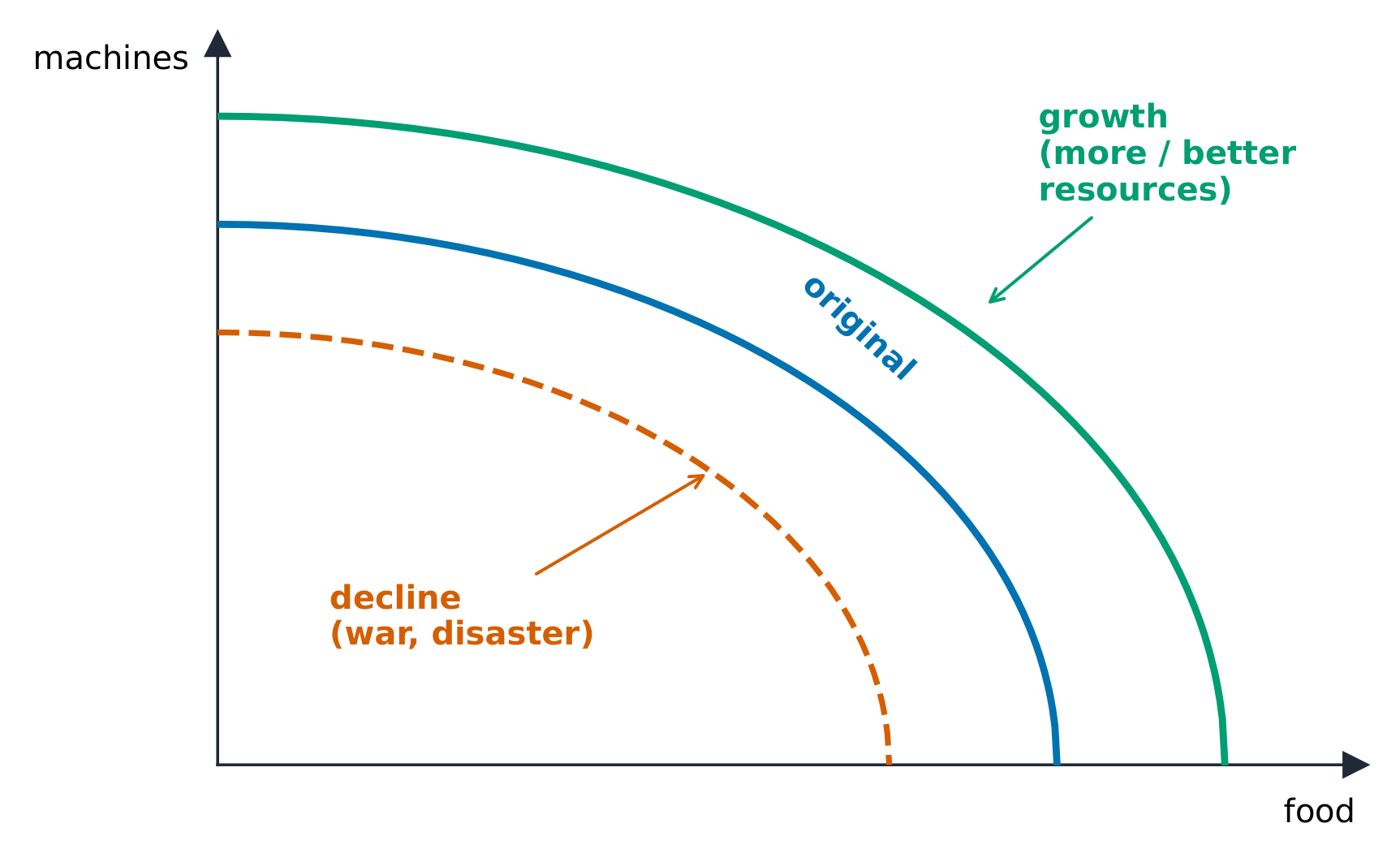
    • More resources or better technology cause economic growth 经济增长, shifting the PPC outward.
    العربية
    frontier الإمكانيات الإنتاجية

    كل اختيار له تكلفة فرصة بديلة – قيمة أفضل بديل تم التخلي عنه. يظهر منحنى الإمكانيات الإنتاجية (PPC) الحد الأقصى لمزيج سلعتين يمكن للاقتصاد إنتاجهما عند الاستخدام الكامل والكفء للموارد.

    منحنى PPC مستقيم يعني تكلفة بديلة ثابتة؛ منحني يعني تكلفة متزايدة
    منحنى PPC مستقيم يعني تكلفة بديلة ثابتة؛ منحني يعني تكلفة متزايدة
    • النقاط على المنحنى كفاءة؛ داخله، عدم كفاءة (موارد عاطلة)؛ خارجه، مستحيل الوصول إليه.
    • الميل السالب يظهر تكلفة الفرصة البديلة؛ المنحنى المقعر للخارج يظهر زيادة تكلفة الفرصة البديلة.
    • زيادة الموارد أو تحسين التكنولوجيا يسبب النمو الاقتصادي، مما يحرك منحنى PPC للخارج.
    منحنى الإمكانيات الإنتاجية؛ الاستثمار في السلع الرأسمالية يحركه للخارج
    منحنى إمكانيات الإنتاج؛ الاستثمار في رأس المال يحركه للخارج
    Explore · ⁨استكشف⁩

    Explore the production possibilities curve · ⁨استكشف منحنى إمكانيات الإنتاج⁩

    Move along the curve — making more capital goods means giving up consumer goods. That lost output is the opportunity cost, and the bowed shape shows it rising with each extra unit. · ⁨تحرك على المنحنى — إنتاج المزيد من البضائع الرأسمالية يعني التخلي عن البضائع الاستهلاكية. الناتج الضائع هو التكلفة البديلة، والشكل المقوس يظهر أنه يرتفع مع كل وحدة إضافية.⁩

    Vocabulary · ⁨مفردات⁩ Train · ⁨تدريب⁩
    English العربية
    opportunity cost/ɒpəˈtjuːnɪti kɒst/ التكلفة البديلة
    production possibilities curve (PPC)/prəˈdʌkʃn ˌpɒsəˈbɪlɪtiz kɜːv/ منحنى إمكانيات الإنتاج (PPC)
    economic growth/ˌiːkəˈnɒmɪk ɡrəʊθ/ النمو الاقتصادي
    absolute advantage/ˈæbsəluːt ədˈvæntɪdʒ/ الميزة المطلقة
    1.3

    Comparative Advantage and Gains from Trade · ⁨الميزة النسبية والمكاسب من التجارة⁩

    Syllabus · ⁨المنهج⁩
    English

    Enduring Understanding (MKT-1): Production and consumption increase by engaging in trade.

    Learning Objective MKT-1.A: a. Define absolute advantage and comparative advantage. b. Determine (using data from PPCs or tables as appropriate) absolute and comparative advantage.

    • MKT-1.A.1 Absolute advantage describes a situation in which an individual, business, or country can produce more of a good or service than any other producer with the same quantity of resources.
    • MKT-1.A.2 Comparative advantage describes a situation in which an individual, business, or country can produce a good or service at a lower opportunity cost than another producer.

    Learning Objective MKT-1.B: a. Explain (using data from PPCs or tables as appropriate) how specialization according to comparative advantage with appropriate terms of trade can lead to gains from trade. b. Calculate (using data from PPCs or tables as appropriate) mutually beneficial terms of trade.

    • MKT-1.B.1 Production specialization according to comparative advantage results in exchange opportunities that lead to consumption opportunities beyond the PPC.
    • MKT-1.B.2 Comparative advantage and opportunity costs determine the terms of trade for exchange under which mutually beneficial trade can occur.
    العربية

    الفهم الدائم (MKT-1): تزداد الإنتاجية والاستهلاك من خلال الانخراط في التجارة.

    هدف التعلم MKT-1.A: أ. تعريف الميزة المطلقة والميزة النسبية. ب. تحديد (باستخدام بيانات من منحنيات إمكانيات الإنتاج أو الجداول عند الحاجة) الميزة المطلقة والنسبية.

    • MKT-1.A.1 تصف الميزة المطلحة حالة يمكن فيها للفرد أو الشركة أو الدولة إنتاج المزيد من سلعة أو خدمة من أي منتج آخر بنفس الكمية من الموارد.
    • MKT-1.A.2 تصف الميزة النسبية حالة يمكن فيها للفرد أو الشركة أو الدولة إنتاج سلعة أو خدمة بتكلفة فرصة بديلة أقل من منتج آخر.

    هدف التعلم MKT-1.B: أ. شرح (باستخدام بيانات من منحنيات إمكانيات الإنتاج أو الجداول عند الحاجة) كيف يمكن أن يؤدي التخصص وفقاً للميزة النسبية مع شروط تجارة مناسبة إلى تحقيق فوائد من التجارة. ب. حساب (باستخدام بيانات من منحنيات إمكانيات الإنتاج أو الجداول عند الحاجة) شروط تجارة مفيدة للطرفين.

    • MKT-1.B.1 يؤدي التخصص في الإنتاج وفقاً للميزة النسبية إلى فرص تبادل تؤدي إلى فرص استهلاك تتجاوز منحنى إمكانيات الإنتاج.
    • MKT-1.B.2 تحدد الميزة النسبية وتكاليف الفرصة البديلة شروط التجارة للتبادل التي يمكن أن تحدث بموجبها تجارة مفيدة للطرفين.

    Source: College Board AP Course and Exam Description · ⁨المصدر: وصف دورة وامتحان College Board AP⁩

    English

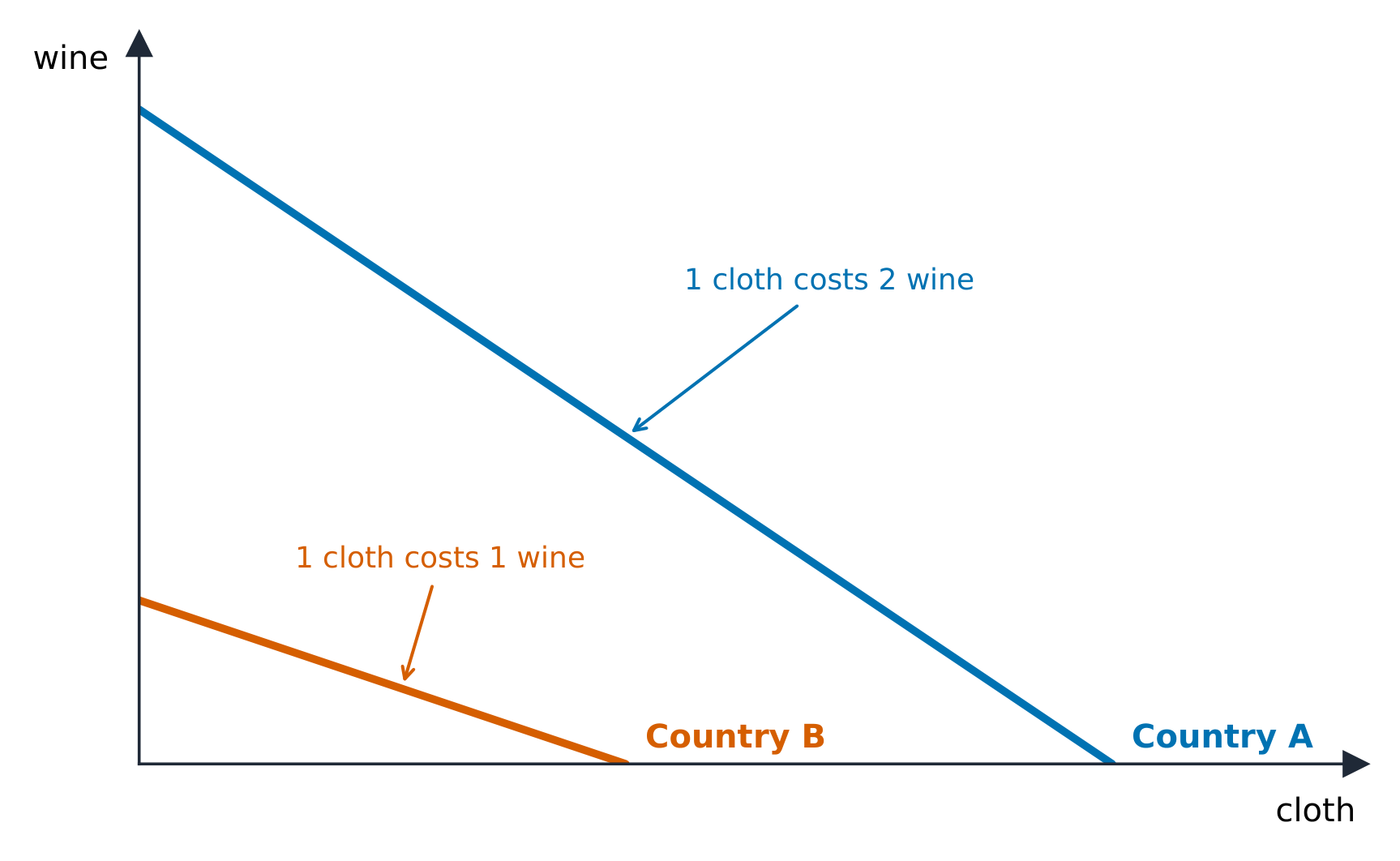
    A producer has an absolute advantage 绝对优势 in a good if it can make more of it. It has a comparative advantage 比较优势 if it has the lower opportunity cost. Nations should specialize in their comparative-advantage goods and trade – both gain if the terms of trade 贸易条件 lie between the two opportunity costs. Trade lets a country consume beyond its own PPC.

    Worked example. Country A can make $10$ wheat or $5$ cloth per day; Country B can make $8$ wheat or $8$ cloth. For A, one cloth costs $\tfrac{10}{5}=2$ wheat; for B it costs $\tfrac{8}{8}=1$ wheat. B's opportunity cost of cloth is lower, so B specializes in cloth. Checking wheat: A gives up $0.5$ cloth per wheat and B gives up $1$, so A specializes in wheat. Trading at any rate between the two costs, both consume beyond their own PPC.

    العربية

    يملك المنتج ميزة مطلقة في سلعة ما إذا كان قادراً على إنتاج كمية أكبر منها. ويملك ميزة نسبية إذا كانت تكلفة الفرصة لديه أقل. يجب على الدول التخصص في سلعها ذات الميزة النسبية والتجارة – فكلتا الدولتين تستفان إذا وقعت شروط التجارة بين تكلفتي الفرصة. تتيح التجارة للدولة استهلاك ما يفوق حدود منحنى إمكانياتها (PPC).

    مثال محلول. يمكن للبلد A إنتاج $10$ قمح أو $5$ قماش يومياً؛ يمكن للبلد B إنتاج $8$ قمح أو $8$ قماش. بالنسبة لـ A، يكلف قماش واحد $\tfrac{10}{5}=2$ قمح؛ بالنسبة لـ B يكلف $\tfrac{8}{8}=1$ قمح. تكلفة الفرصة البديلة للقماش لدى B أقل، لذا يتخصص B في القماش. التحقق من القمح: يخلي A عن $0.5$ قماش لكل قمح ويخلي B عن $1$، لذا يتخصص A في القمح. بالتجارة بأي معدل بين التكاليف الاثنين، يستهلك كلا البلدين ما يتجاوز منحنى إمكانيات الإنتاج الخاص بهما.

    تأتِ الميزة النسبية من منحنيات إمكانيات الإنتاج ذات الميل المختلف
    تأتي الميزة النسبية من منحنيات إمكانيات الإنتاج ذات الميل المختلف
    الشحن بالحاويات: الميزة النسبية والتجارة تسمح للدول بالتخصص وتحقيق المكاسب
    الشحن بالحاويات: الميزة النسبية والتجارة تمكنت الدول من التخصص والربح
    Explore · ⁨استكشف⁩

    See the gains from specialization and trade · ⁨شاهد مكاسب التخصص والتبادل⁩

    A country should specialize where its opportunity cost is lowest, then trade for the rest. Because the terms of trade sit between the two countries' costs, each can consume beyond its own production frontier. · ⁨يجب أن تخصص الدولة حيث تكون تكلفتها البديلة أقل، ثم تتبادل الباقي. بما أن شروط التبادل تقع بين تكاليف الدولتين، يمكن لكل منهما استهلاك خارج حدود إنتاجها الخاصة.⁩

    Vocabulary · ⁨مفردات⁩ Train · ⁨تدريب⁩
    English العربية
    comparative advantage/kəmˈpærətɪv ədˈvæntɪdʒ/ الميزة النسبية
    terms of trade/tɜːmz ɒv treɪd/ شروط التجارة
    1.4

    Demand · ⁨الطلب⁩

    Syllabus · ⁨المنهج⁩
    English

    Enduring Understanding (MKT-2): In a competitive market, demand for and supply of a good or service determine the equilibrium price.

    Learning Objective MKT-2.A: a. Define (using graphs as appropriate) the law of demand. b. Explain (using graphs as appropriate) the relationship between the price of a good or service and the quantity demanded.

    • MKT-2.A.1 The law of demand states there is an inverse relationship between price and quantity demanded, leading to a downward-sloping demand curve.

    Learning Objective MKT-2.B: Explain (using graphs as appropriate) the determinants of demand.

    • MKT-2.B.1 Factors that influence consumer demand, such as changes in consumer income, cause the market demand curve to shift.
    العربية

    الفهم الدائم (MKT-2): في السوق التنافسي، يحدد طلب وسلع خدمة معينة سعر التوازن.

    هدف التعلم MKT-2.A: أ. تعريف (باستخدام الرسوم البيانية عند الحاجة) قانون الطلب. ب. شرح (باستخدام الرسوم البيانية عند الحاجة) العلاقة بين سعر سلعة أو خدمة والكمية المطلوبة.

    • MKT-2.A.1 ينص قانون الطلب على وجود علاقة عكسية بين السعر والكمية المطلوبة، مما يؤدي إلى منحنى طلب هابط.

    هدف التعلم MKT-2.B: اشرح (باستخدام الرسوم البيانية عند الحاجة) محددات الطلب.

    • MKT-2.B.1 العوامل التي تؤثر على طلب المستهلك، مثل تغييرات دخل المستهلك، تسبب انزياح منحنى الطلب السوقي.

    Source: College Board AP Course and Exam Description · ⁨المصدر: وصف دورة وامتحان College Board AP⁩

    English

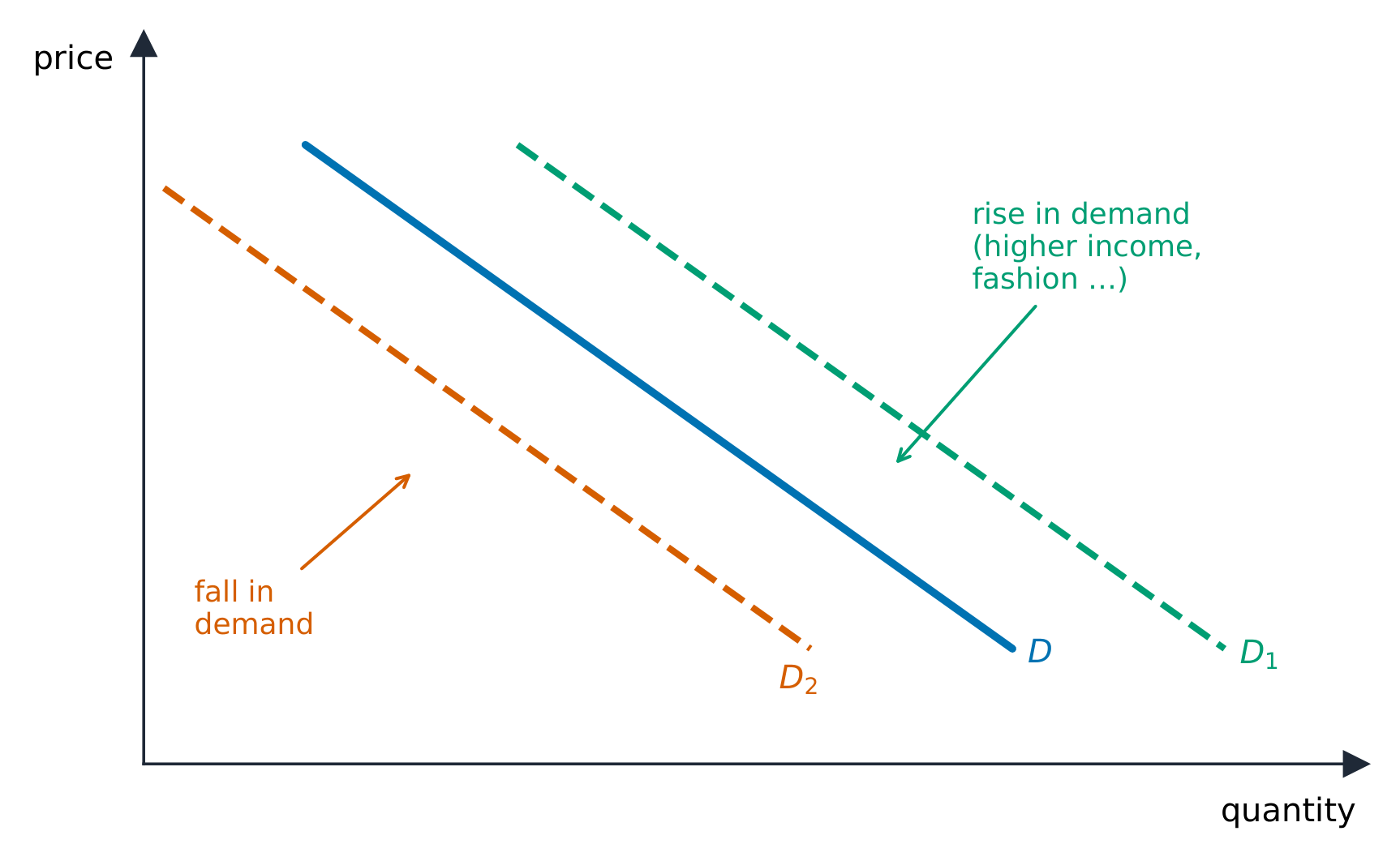
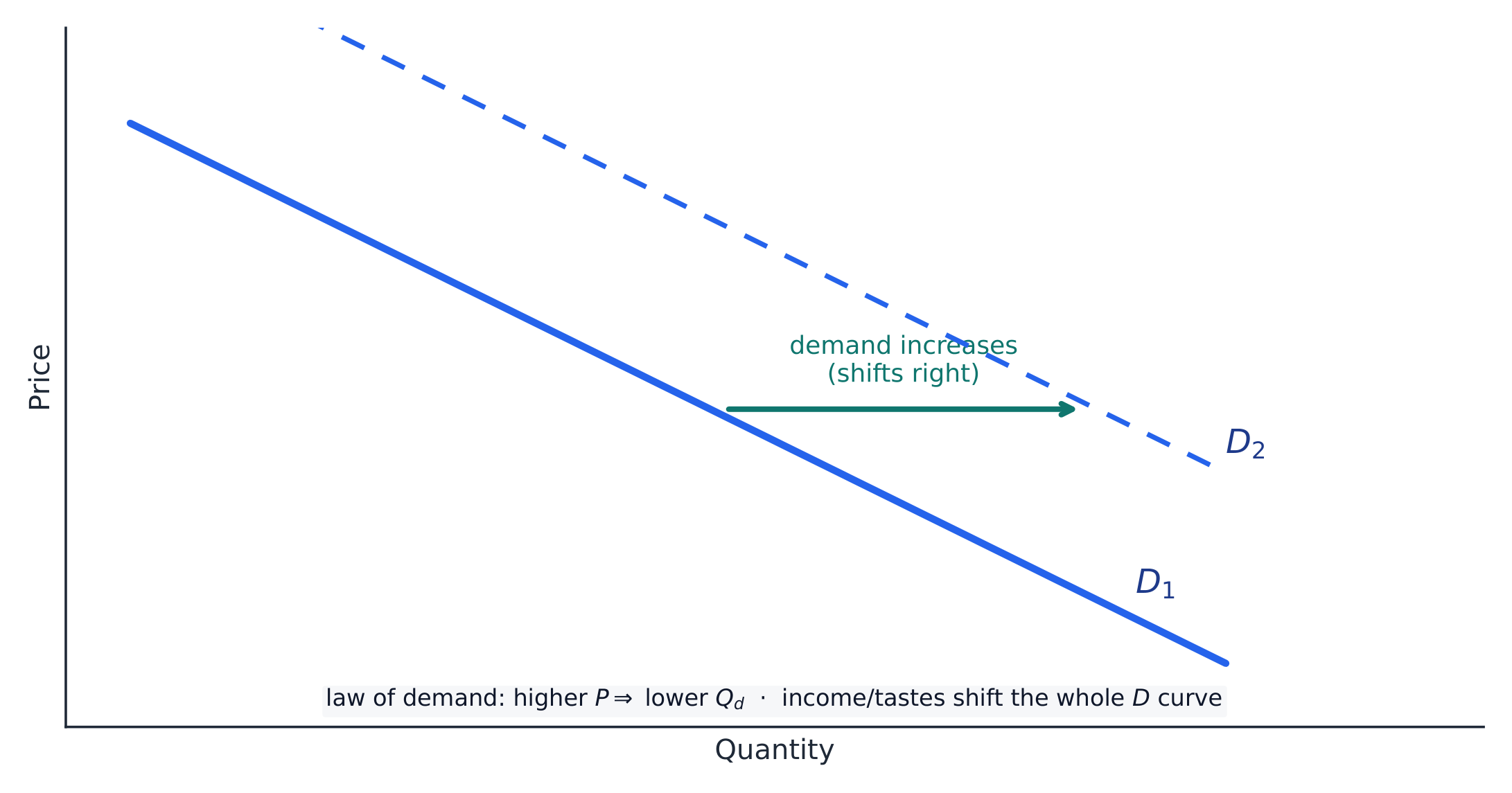
    Demand 需求 relates price to the quantity buyers will buy. The law of demand 需求定律 makes the curve slope downward. A change in the good's own price is a movement along the curve; the determinants (income, tastes, prices of substitutes 替代品 and complements 互补品, number of buyers, expectations) shift the whole curve.

    العربية

    الطلب يربط السعر بالكمية التي سيشتريها المشترون. تجعل قانون الطلب المنحنى متجهاً للأسفل. التغيير في السعر الخاص بالسلعة يمثل حركة على طول المنحنى؛ بينما العوامل المحددة (الدخل، الأذواق، أسعار البديلات والمكمّلات، عدد المشترين، التوقعات) تحرك المنحنى بالكامل.

    منحنى الطلب متجه لأسفل؛ الدخل والأذواق والأسعار ذات الصلة تحركه
    منحنى الطلب متجه لأسفل؛ الدخل والأذواق والأسعار ذات الصلة تحركه
    قانون الطلب يميل المنحنى للأسفل؛ المحدد يُزيح المنحنى بأكمله
    قانون الطلب يجعل المنحنى متجهاً لأسفل؛ العامل المحدد يحرك المنحنى بالكامل
    Explore · ⁨استكشف⁩

    Explore demand — move along vs shift the curve · ⁨استكشف الطلب — تحرك على المنحنى مقابل إزاحته⁩

    A change in the own price moves you along a fixed curve (a change in quantity demanded); a determinant like income or tastes shifts the whole curve ($D_1 \to D_2$) — a change in demand. · ⁨تغيير في السعر الذاتي ينقلك على منحنى ثابت (تغيير في كمية الطلب)؛ محدد مثل الدخل أو الذوق يزيح المنحنى بأكمله ($D_1 \to D_2$) — وهو تغيير في الطلب.⁩

    Vocabulary · ⁨مفردات⁩ Train · ⁨تدريب⁩
    English العربية
    Demand/dɪˈmænd/ الطلب
    law of demand/lɔː ɒv dɪˈmænd/ قانون الطلب
    substitutes/ˈsʌbstɪtjuːts/ بدائل
    complements/ˈkɒmplɪmənts/ متممتان
    1.5

    Supply · ⁨العرض⁩

    Syllabus · ⁨المنهج⁩
    English

    Enduring Understanding (MKT-2): In a competitive market, demand for and supply of a good or service determine the equilibrium price.

    Learning Objective MKT-2.C: a. Define (using graphs as appropriate) the law of supply. b. Explain (using graphs as appropriate) the relationship between the price of a good or service and the quantity supplied.

    • MKT-2.C.1 The law of supply states there is a positive relationship between price and quantity supplied, leading to an upward-sloping supply curve.

    Learning Objective MKT-2.D: Explain (using graphs as appropriate) the determinants of supply.

    • MKT-2.D.1 Factors that influence producer supply, such as changes in input prices, cause the market supply curve to shift.
    العربية

    الفهم الدائم (MKT-2): في السوق التنافسي، يحدد طلب وسلع خدمة معينة سعر التوازن.

    هدف التعلم MKT-2.C: أ. تعريف (باستخدام الرسوم البيانية عند الحاجة) قانون العرض. ب. شرح (باستخدام الرسوم البيانية عند الحاجة) العلاقة بين سعر سلعة أو خدمة والكمية المعروضة.

    • MKT-2.C.1 ينص قانون العرض على وجود علاقة طردية بين السعر والكمية المعروضة، مما يؤدي إلى منحنى عرض صاعد.

    هدف التعلم MKT-2.D: اشرح (باستخدام الرسوم البيانية عند الحاجة) محددات العرض.

    • MKT-2.D.1 العوامل التي تؤثر على عرض المنتج، مثل تغييرات أسعار المدخلات، تسبب انزياح منحنى العرض السوقي.

    Source: College Board AP Course and Exam Description · ⁨المصدر: وصف دورة وامتحان College Board AP⁩

    English

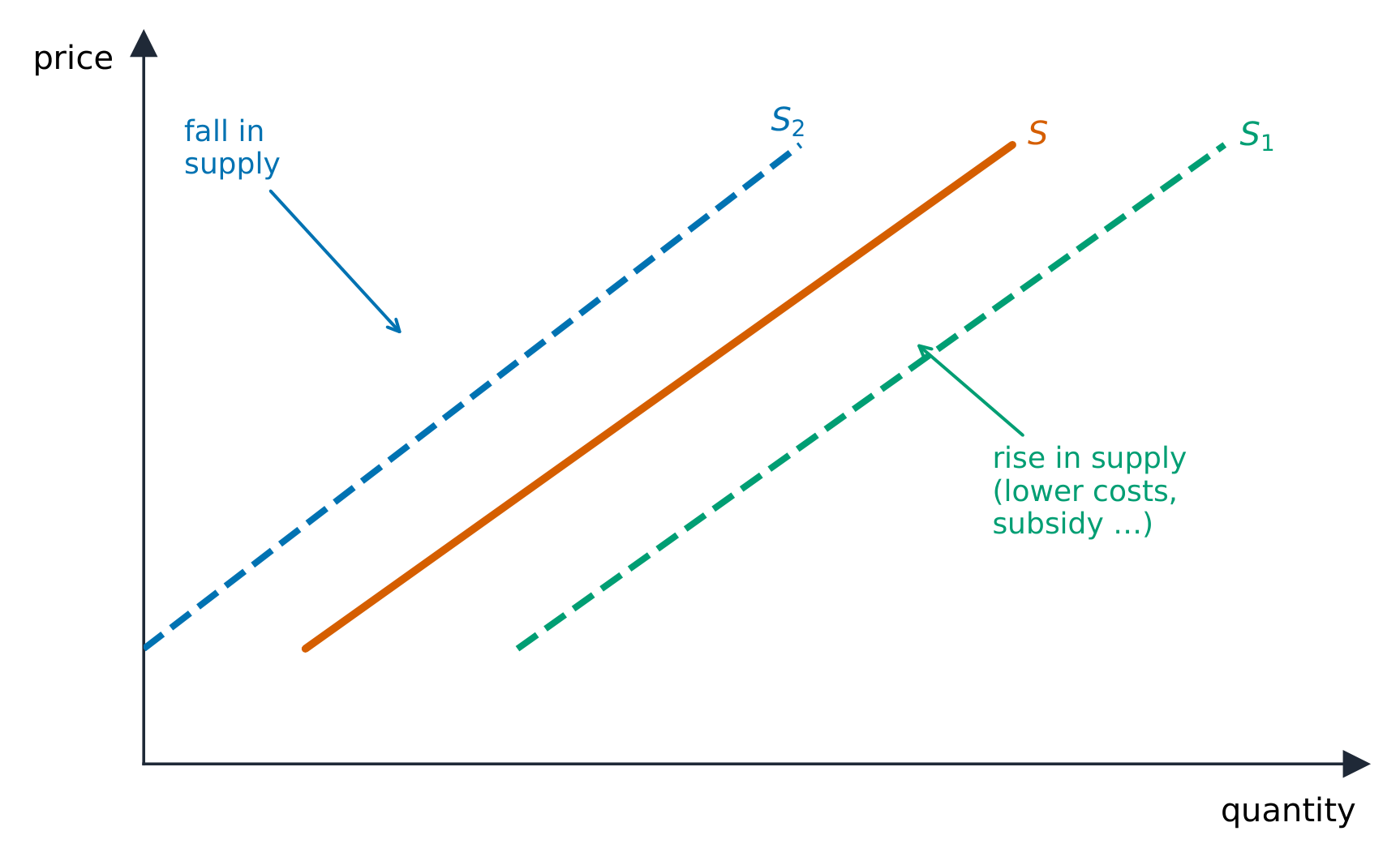
    Supply 供给 relates price to the quantity sellers will offer; the law of supply 供给定律 makes it slope upward. Its determinants – input prices, technology, taxes and subsidies 补贴, number of sellers, expectations – shift the curve, while the good's own price moves along it.

    العربية

    العرض يربط السعر بالكمية التي ستقدمها البائعون؛ يجعل قانون العرض المنحنى متجهاً للأعلى. عوامله المحددة – أسعار المدخلات، التكنولوجيا، الضرائب والبدلات، عدد البائعين، التوقعات – تحرك المنحنى، بينما سعر السلعة الخاص يحركه على طوله.

    منحنى العرض متجه للأعلى؛ التكاليف والتكنولوجيا والضريبة والبدلة تحركه
    منحنى العرض متجه للأعلى؛ التكاليف والتكنولوجيا والضريبة والبدلة تحركه
    Explore · ⁨استكشف⁩

    Explore what moves the supply curve · ⁨استكشف ما يحرك منحنى العرض⁩

    Supply slopes up: a higher price makes selling more worthwhile. A change in costs, technology or the number of sellers shifts the whole curve — not a move along it. Drag the supply line and watch price and quantity respond. · ⁨العرض يرتفع: السعر الأعلى يجعل بيع المزيد مجدياً. تغيير في التكاليف أو التكنولوجيا أو عدد البائعين يزيح المنحنى بالكامل — وليس حركة عليه. اسحب خط العرض وانظر كيف تستجيب السعر والكمية.⁩

    Vocabulary · ⁨مفردات⁩ Train · ⁨تدريب⁩
    English العربية
    Supply/səˈplaɪ/ العرض
    law of supply/lɔː ɒv səˈplaɪ/ قانون العرض
    subsidies/ˈsʌbsɪdiz/ إعانات
    1.6

    Market Equilibrium, Disequilibrium, and Changes in Equilibrium · ⁨توازن السوق، عدم التوازن، وتغيرات التوازن⁩

    Syllabus · ⁨المنهج⁩
    English

    Enduring Understanding (MKT-2): In a competitive market, demand for and supply of a good or service determine the equilibrium price.

    Learning Objective MKT-2.E: Define (using graphs as appropriate) market equilibrium.

    • MKT-2.E.1 Equilibrium is achieved at the price at which quantities demanded and supplied are equal.

    Learning Objective MKT-2.F: a. Define a surplus and shortage. b. Explain (using graphs as appropriate) how prices adjust to restore equilibrium in markets that are experiencing imbalances. c. Calculate (using graphs as appropriate) the surplus or shortage in the market experience an imbalance.

    • MKT-2.F.1 Whenever markets experience imbalances—creating disequilibrium prices, surpluses, and shortages—market forces drive prices toward equilibrium.

    Learning Objective MKT-2.G: Explain (using graphs as appropriate) how changes in demand and supply affect equilibrium price and equilibrium quantity.

    • MKT-2.G.1 Changes in the determinants of supply and/or demand result in a new equilibrium price and quantity.
    العربية

    الفهم الدائم (MKT-2): في السوق التنافسي، يحدد طلب وسلع خدمة معينة سعر التوازن.

    هدف التعلم MKT-2.E: عرّف (باستخدام الرسوم البيانية عند الحاجة) توازن السوق.

    • MKT-2.E.1 يتحقق التوازن عند السعر الذي تتساوى فيه الكميات المطلوبة والمعروضة.

    هدف التعلم MKT-2.F: أ. تعريف الفائض والندرة. ب. شرح (باستخدام الرسوم البيانية عند الحاجة) كيف تتكيف الأسعار لاستعادة التوازن في الأسواق التي تشهد عدم توازن. ج. حساب (باستخدام الرسوم البيانية عند الحاجة) الفائض أو الندرة في السوق الذي يعاني من عدم توازن.
    • MKT-2.F.1 عندما تواجه الأسواق عدم توازن -مما يخلق أسعاراً غير متوازنة وفائضاً وندرة- تدفع قوى السوق الأسعار نحو التوازن.

    هدف التعلم MKT-2.G: اشرح (باستخدام الرسوم البيانية عند الحاجة) كيف تؤثر التغييرات في الطلب والعرض على سعر التوازن وكمية التوازن.

    • MKT-2.G.1 تؤدي التغييرات في محددات العرض و/أو الطلب إلى سعر توازن وكمية توازن جديدة.

    Source: College Board AP Course and Exam Description · ⁨المصدر: وصف دورة وامتحان College Board AP⁩

    English
    Supply & demand: a shift raises P and Q

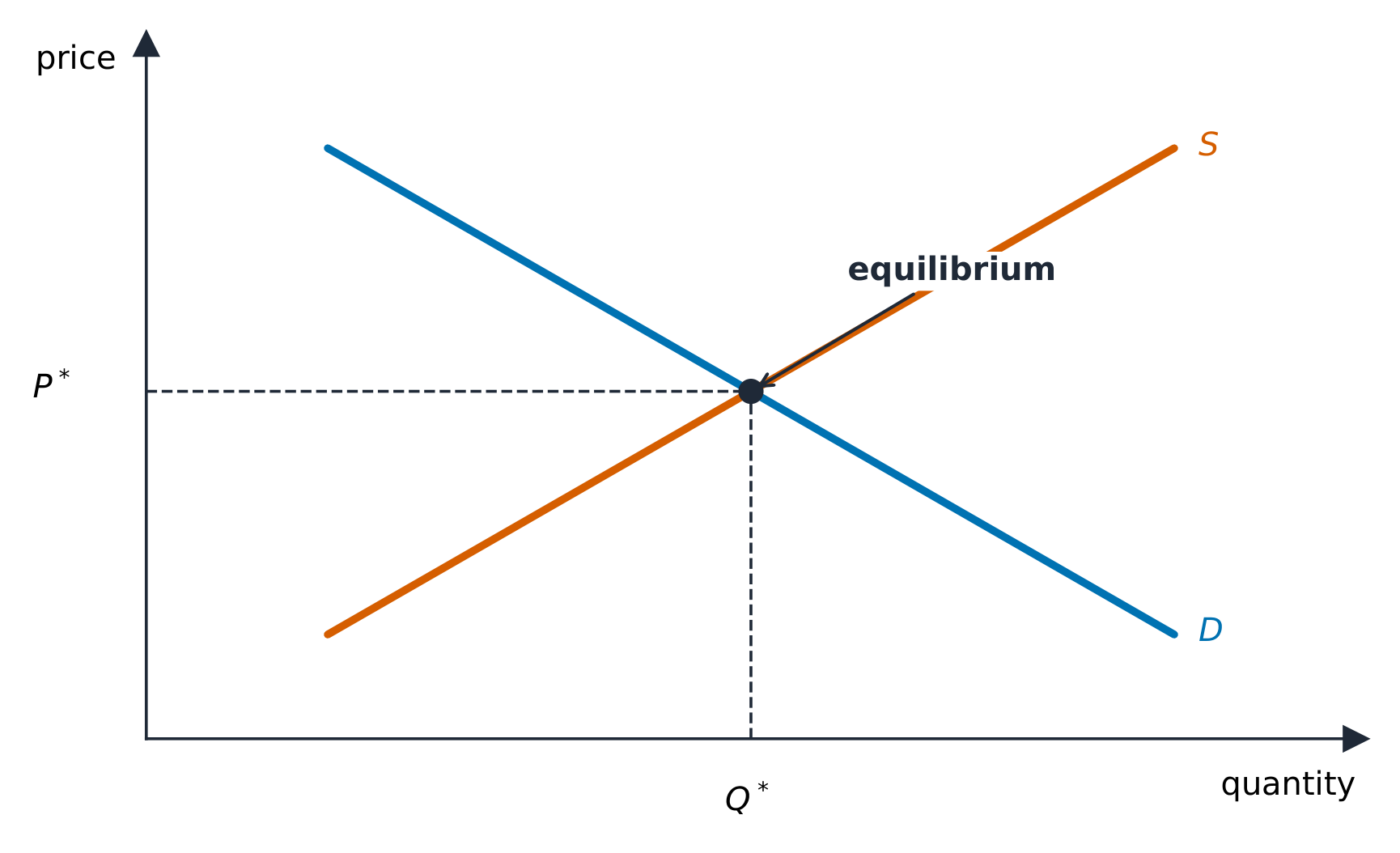
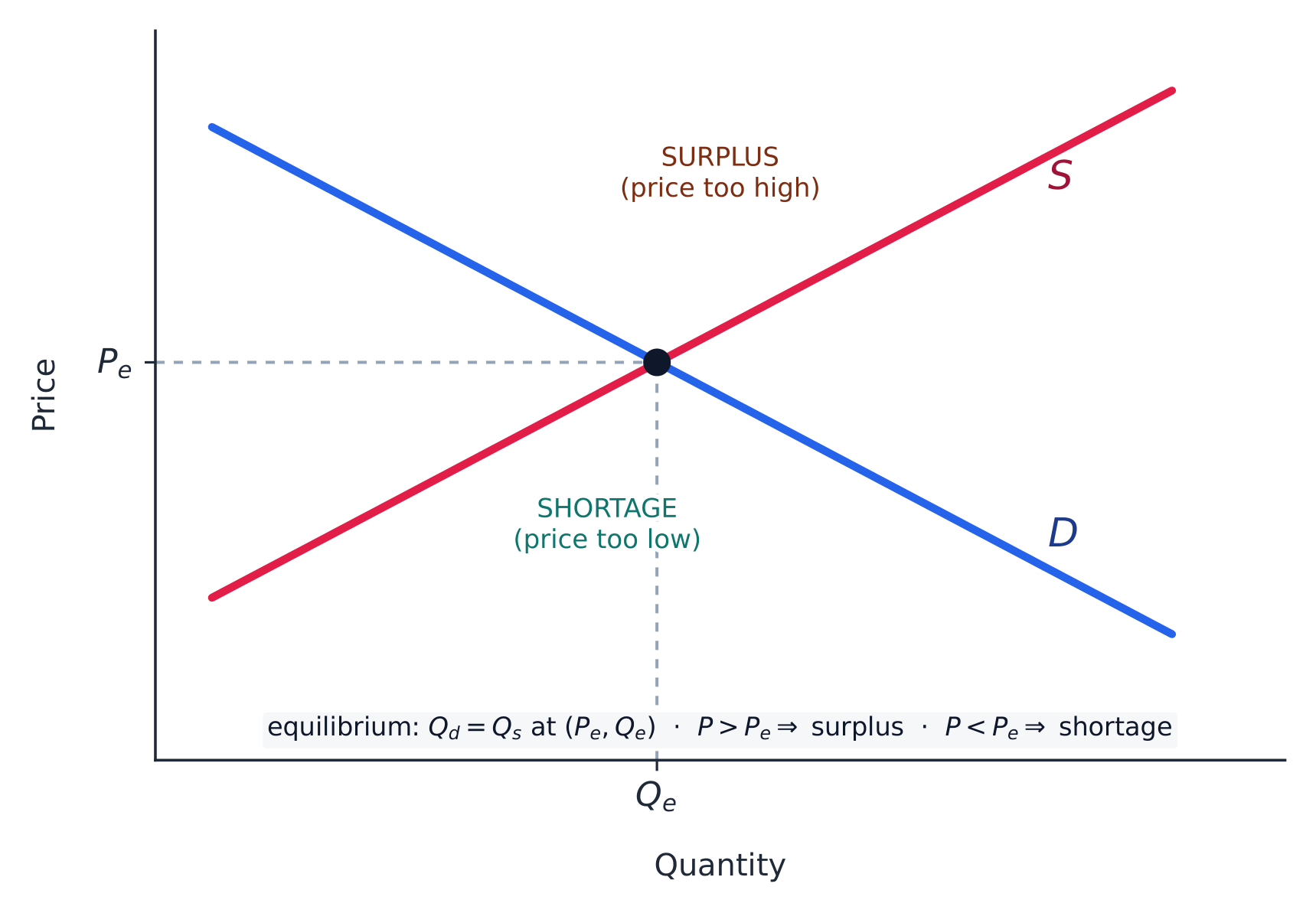
    Equilibrium 均衡 is where supply meets demand, clearing the market. Above the equilibrium price a surplus 过剩 pushes price down; below it a shortage 短缺 pushes price up. When a determinant shifts one curve, price and quantity move predictably; when both shift, one of them is indeterminate.

    Worked example. A new technology lowers producers' costs, shifting supply right. Along the unchanged demand curve, the equilibrium price falls and the equilibrium quantity rises. If instead a rise in incomes shifts demand right at the same time, quantity clearly rises but the effect on price depends on which shift is larger – the "both shift" indeterminate case.

    Exam skill: macro builds on these micro tools – you must draw and shift supply-and-demand and PPC graphs correctly, because the same shift logic drives the aggregate (whole-economy) models later in the course.

    العربية
    سوق نشط: يلتقي العرض والطلب حيث يتفق المشترون والبائعون على سعر
    سوق نشط: يلتقي العرض والطلب حيث يتفق المشترون والبائعون على سعر
    العرض والطلب: التحريك يرفع P وQ

    التوازن هو نقطة التقاء العرض والطلب التي تنظّم السوق. فوق سعر التوازن، يدفع الفائض السعر للأسفل؛ وتحته النقص يدفع السعر للأعلى. عندما يحرك عامل محدد منحنى واحداً، تتحرك السعر والكمية بشكل قابل للتنبؤ؛ وعندما يتحرك كلا المنحنيين، يصبح أحدهما غير محدد.

    مثال محلول. technology جديدة تخفض تكاليف المنتجين، مما يحرك العرض لليمين. على طول منحنى الطلب غير المتغير، ينخفض سعر التوازن وترتفع كمية التوازن. وإذا بدلاً من ذلك أدى ارتفاع incomes إلى تحريك الطلب لليمين في نفس الوقت، فإن الكمية ترتفع بوضوح لكن تأثير السعر يعتمد على أي التحريكين أكبر – حالة "التحرك معاً" غير المحددة.

    سعر وتوازن الكمية حيث يلتقي الطلب والعرض
    سعر وتوازن الكمية حيث يلتقي الطلب والعرض

    مهارة الامتحان: يبنى الاقتصاد الكلي على هذه الأدوات الجزئية – يجب عليك رسم منحنيات العرض والطلب ومنحنى PPC وتحريكها بشكل صحيح، لأن نفس منطق التحريك يقود النماذج الإجمالية (للاقتصاد ككل) لاحقاً في المقرر.

    يقع توازن السوق عند التقاء العرض والطلب؛ وفوقه يوجد فائض ونقص
    يقع توازن السوق عند التقاء العرض والطلب؛ وفوقه يوجد فائض ونقص
    Explore · ⁨استكشف⁩

    Explore market equilibrium, surplus and shortage · ⁨استكشف توازن السوق والفائض والنقص⁩

    The market clears where supply meets demand. Shift a curve and watch the crossing move — a rightward demand shift raises both price and quantity; away from equilibrium a surplus or shortage pushes the price back. · ⁨يتوازن السوق حيث يصل العرض إلى الطلب. أزح المنحنى وانظر إلى تحرك التقاطع — إزاحة الطلب لليمين ترفع كلا من السعر والكمية؛ بعيداً عن التوازن ي دفع الفائض أو النقص السعر للخلف.⁩

    Vocabulary · ⁨مفردات⁩ Train · ⁨تدريب⁩
    English العربية
    Equilibrium/ˌiːkwɪˈlɪbrɪəm/ التوازن
    surplus/ˈsɜːpləs/ فائضاً
    shortage/ˈʃɔːtɪdʒ/ عجزاً
    1.6

    Exam tips · ⁨نصائح للامتحان⁩

    English
    • Opportunity cost is what you give up — read it off a PPC as the slope; a bowed-out PPC shows increasing opportunity cost.
    • Comparative advantage (lower opportunity cost), not absolute advantage, decides who should specialise and trade.
    • Points inside the PPC are inefficient, outside unattainable; more resources/technology shift it out (growth).
    • Distinguish a movement along a demand/supply curve (own price) from a shift (a determinant).
    • These micro tools drive the aggregate models later — draw and shift the correct curve in the correct direction.
    العربية
    • تكلفة الفرصة هي ما تستغله — اقرأها من منحنى PPC كميل؛ يظهر منحنى PPC المقوس تكافئ فرص متزايدة.
    • الميزة النسبية (تكلفة الفرصة الأقل)، وليس الميزة المطلقة، هي التي تحدد من يجب أن يتخصص ويتاجر.
    • النقاط داخل منحنى PPC غير كفءة، والخارجية مستحيلة؛ زيادة الموارد/التكنولوجيا تحركه للخارج (نمو).
    • فرّق بين الحركة على طول منحنى الطلب/العرض (بسبب السعر الخاص) وبين التحرك (بسبب عامل محدد).
    • تقود هذه الأدوات الجزئية النماذج الإجمالية لاحقاً — ارسم وحرك المنحنى الصحيح في الاتجاه الصحيح.
  • 2

    Economic Indicators and the Business Cycle · ⁨المؤشرات الاقتصادية والدورة التجارية⁩

    Watch lesson · ⁨شاهد الدرس⁩
    2.1

    The Circular Flow and GDP · ⁨التدفق الدائري والناتج المحلي الإجمالي⁩

    Syllabus · ⁨المنهج⁩
    English

    Enduring Understanding (MEA-1): An economy's performance can be measured by different indicators such as gross domestic product (GDP), the inflation rate, and the unemployment rate.

    Learning Objective MEA-1.A: a. Define (using the circular flow diagram as appropriate) how GDP is measured and its components. b. Calculate nominal GDP.

    • MEA-1.A.1 GDP is a measure of final output of the economy.
    • MEA-1.A.2 GDP as a total flow of income and expenditure can be represented by the circular flow diagram.
    • MEA-1.A.3 There are three ways of measuring GDP: the expenditures approach, the income approach, and the value-added approach.
    العربية

    الفهم الدائم (MEA-1): يمكن قياس أداء الاقتصاد بمؤشرات مختلفة مثل الناتج المحلي الإجمالي (GDP)، ومعدل التضخم، ومعدل البطالة.

    هدف التعلم MEA-1.A: أ. تعريف (باستخدام مخطط التدفق الدائري عند الحاجة) كيفية قياس الناتج المحلي الإجمالي ومكوناته. ب. حساب الناتج المحلي الإجمالي الاسمي.

    • MEA-1.A.1 الناتج المحلي الإجمالي هو مقياس للنتيجة النهائية للاقتصاد.
    • MEA-1.A.2 يمكن تمثيل الناتج المحلي الإجمالي كتيار إجمالي للدخل والإنفاق بواسطة مخطط التدفق الدائري.
    • MEA-1.A.3 هناك ثلاث طرق لقياس الناتج المحلي الإجمالي: نهج الإنفاق، ونهج الدخل، ونهج القيمة المضافة.

    Source: College Board AP Course and Exam Description · ⁨المصدر: وصف دورة وامتحان College Board AP⁩

    English

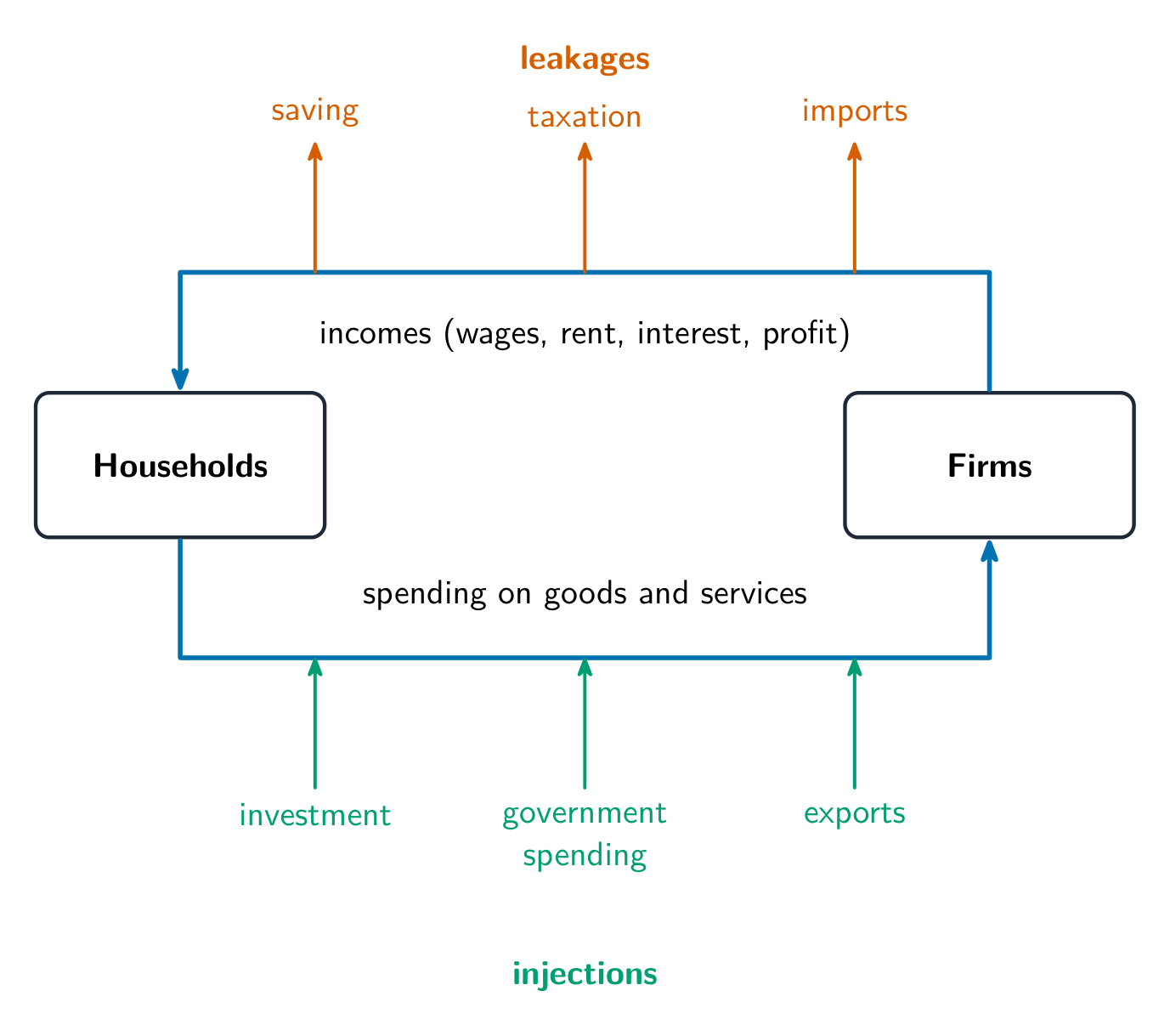
    The circular-flow model 循环流动模型 shows money moving between households and firms: households supply factors and earn income; firms sell goods and earn revenue. Every dollar of spending is someone's income, which is why output and income are two sides of the same total.

    Gross domestic product (GDP) 国内生产总值 is the market value of all final goods and services produced within a country in a year. Three ways to measure it give the same number:

    • Expenditure approach: $GDP = C + I + G + X_n$ – consumption 消费, investment 投资 (business spending on capital, plus new housing and inventory), government purchases 政府购买, and net exports 净出口 (exports minus imports).
    • Income approach: add up all wages, rent, interest, and profit.

    Exclude intermediate goods (avoid double counting), used goods, purely financial transactions, and transfer payments.

    العربية

    يعرض نموذج التدفق الدائري حركة الأموال بين الأسر والشركات: تقدم الأسر العوامل وتكتسب دخلًا؛ تبيع الشركات السلع وتكتسب إيرادات. كل دولار من الإنفاق هو دخSomeone else, ولهذا السبب يمثل الناتج والدخل وجهين لنفس المجموع الكلي.

    التدفق الدائري للدخل مع تسريباته وإدخالاته
    التدفق الدائري للدخل مع تسريباته وإدخالاته

    الناتج المحلي الإجمالي (GDP) هو القيمة السوقية لجميع السلع والخدمات النهائية المنتجة داخل بلد خلال سنة. ثلاث طرق لقياسه تعطي نفس الرقم:

    • نهج الإنفاق: $GDP = C + I + G + X_n$ – الاستهلاك، الاستثمار (إنفاق الشركات على رأس المال، بالإضافة إلى الإسكان الجديد والمخزون)، مشتريات الحكومة، وصافي الصادرات (الصادرات ناقص الواردات).
    • نهج الدخل: اجمع جميع الأجور، الإيجار، الفائدة، والربح.

    استبعد السلع الوسيطة (لتجنب الحساب المزدوج)، والسلع المستعملة، والمعاملات المالية البحتة، ودفعات النقل.

    Explore · ⁨استكشف⁩

    Follow money around the circular flow · ⁨تابع المال في التدفق الدائري⁩

    Money flows from households to firms (spending) and back (wages), while injections (investment, government, exports) and leakages (saving, taxes, imports) can grow or shrink the flow — the size of that flow is GDP. · ⁨يتدفق المال من الأسر إلى الشركات (إنفاق) وعاداً (رواتب)، بينما الإدراجات (استثمار، حكومة، تصدير) والتسربات (ادخار، ضرائب، استيراد) يمكن أن تكبر أو تصغر التدفق — حجم هذا التدفق هو الناتج المحلي الإجمالي.⁩

    2.2

    Limitations of GDP · ⁨قيود الناتج المحلي الإجمالي⁩

    Syllabus · ⁨المنهج⁩
    English

    Enduring Understanding (MEA-1): An economy's performance can be measured by different indicators such as gross domestic product (GDP), the inflation rate, and the unemployment rate.

    Learning Objective MEA-1.B: Define the limitations of GDP.

    • MEA-1.B.1 GDP is a useful indicator of a nation's economic performance, but it has some limitations, such as failing to account for nonmarket transactions.
    العربية

    الفهم الدائم (MEA-1): يمكن قياس أداء الاقتصاد بمؤشرات مختلفة مثل الناتج المحلي الإجمالي (GDP)، ومعدل التضخم، ومعدل البطالة.

    هدف التعلم MEA-1.B: حدد حدود الناتج المحلي الإجمالي.

    • MEA-1.B.1 يُعد الناتج المحلي الإجمالي مؤشراً مفيداً للأداء الاقتصادي للدولة، إلا أن له بعض الحدود، مثل عدم احتساب المعاملات غير السوقية.

    Source: College Board AP Course and Exam Description · ⁨المصدر: وصف دورة وامتحان College Board AP⁩

    English

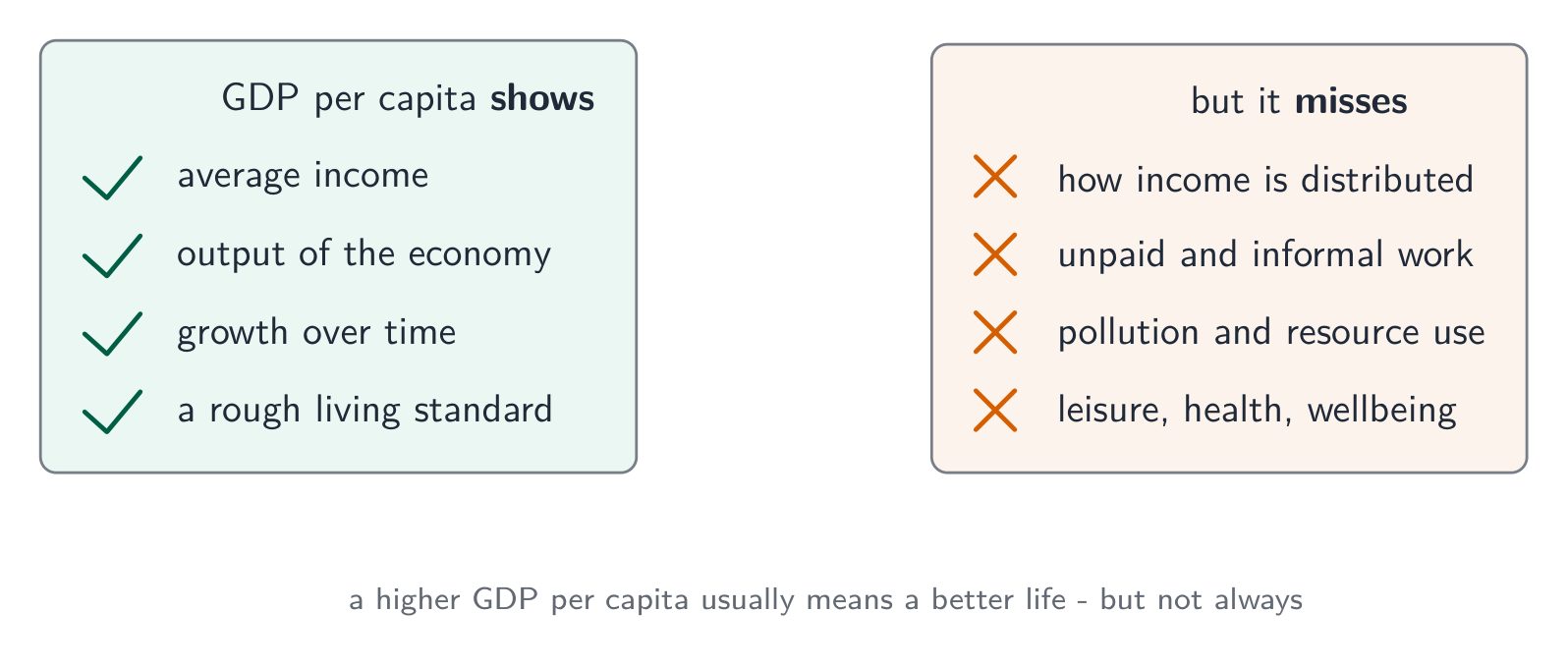
    GDP measures market output, not well-being. It omits non-market production (unpaid housework, volunteering), the underground economy 地下经济, leisure, and the distribution of income, and it ignores environmental damage and resource depletion. So a higher GDP does not automatically mean a better standard of living. GDP per capita (GDP $\div$ population) is a better welfare proxy than total GDP.

    العربية

    يقيس الناتج المحلي الإجمالي الإنتاج في الأسواق، وليس الرفاهية. هو يستبعد الإنتاج غير السوقي (العمل المنزلي غير المدفوع الأجر، والتطوع)، والاقتصاد غير الرسمي، والوقت الفراغ، وتوزيع الدخل، ويتجاهل الأضرار البيئية واستنزاف الموارد. لذلك، لا يعني ارتفاع الناتج المحلي الإجمالي تلقائيًا تحسن مستوى المعيشة. الناتج المحلي الإجمالي للفرد (الناتج المحلي الإجمالي $\div$ عدد السكان) هو مؤشر أفضل للرفاهية من الناتج المحلي الإجمالي الكلي.

    يُظهر الناتج المحلي الإجمالي للفرد المتوسط لكنه يتجاوز التوزيع والعمل غير المدفوع والأكثر
    يُظهر الناتج المحلي الإجمالي للفرد المتوسط لكنه يتجاوز التوزيع والعمل غير المدفوع والأكثر
    2.3

    Unemployment · ⁨البطالة⁩

    Syllabus · ⁨المنهج⁩
    English

    Enduring Understanding (MEA-1): An economy's performance can be measured by different indicators such as gross domestic product (GDP), the inflation rate, and the unemployment rate.

    Learning Objective MEA-1.C: a. Define the labor force, the unemployment rate, and the labor force participation rate. b. Explain how changes in employment and the labor market affect the unemployment rate and the labor force participation rate. c. Calculate the unemployment rate and the labor force participation rate.

    • MEA-1.C.1 The unemployment rate is the percentage of the labor force that is out of work.
    • MEA-1.C.2 The labor force participation rate is another measure of the labor market activity in an economy. The labor force participation rate is the percentage of the adult population that is in the labor force.

    Learning Objective MEA-1.D: Define the limitations of the unemployment rate.

    • MEA-1.D.1 The measured unemployment rate is often criticized for understating the level of joblessness because it excludes groups such as discouraged workers and part-time workers.

    Learning Objective MEA-1.E: a. Define the types of unemployment and the natural rate of unemployment. b. Explain changes in the types of unemployment.

    • MEA-1.E.1 Economists primarily focus on three types of unemployment: cyclical, frictional, and structural.
    • MEA-1.E.2 The natural rate of unemployment is the unemployment rate that would exist when the economy produces full-employment real output. It is equal to the sum of frictional and structural unemployment.
    • MEA-1.E.3 The deviation of the actual unemployment rate from the natural rate is cyclical unemployment.
    • MEA-1.E.4 The natural rate of unemployment can gradually change over time because of such things as changes in labor force characteristics.
    العربية

    الفهم الدائم (MEA-1): يمكن قياس أداء الاقتصاد بمؤشرات مختلفة مثل الناتج المحلي الإجمالي (GDP)، ومعدل التضخم، ومعدل البطالة.

    هدف التعلم MEA-1.C: أ. عرّف القوى العاملة، ومعدل البطالة، ومعدل مشاركة القوى العاملة. ب. اشرح كيف تؤثر التغيرات في التشغيل وسوق العمل على معدل البطالة ومعدل مشاركة القوى العاملة. ج. احسب معدل البطالة ومعدل مشاركة القوى العاملة.

    • MEA-1.C.1 معدل البطالة هو النسبة المئوية من القوى العاملة التي لا تعمل.
    • MEA-1.C.2 معدل مشاركة القوى العاملة هو مقياس آخر لنشاط سوق العمل في الاقتصاد. معدل مشاركة القوى العاملة هو النسبة المئوية من السكان البالغين الذين يتواجدون في القوى العاملة.

    هدف التعلم MEA-1.D: حدد حدود معدل البطالة.

    • MEA-1.D.1 غالباً ما يُنتقد معدل البطالة المقاس لأنه يقلل من مستوى العاطلة الفعلية لأنه يستبعد مجموعات مثل العمال المستيئنين والعمال بدوام جزئي.

    هدف التعلم MEA-1.E: أ. عرّف أنواع البطالة والمعدل الطبيعي للبطالة. ب. اشرح التغيرات في أنواع البطالة.

    • MEA-1.E.1 يركز الاقتصاديون بشكل أساسي على ثلاثة أنواع من البطالة: الدورية، والفركتالية، والهيكلية.
    • MEA-1.E.2 المعدل الطبيعي للبطالة هو معدل البطالة الذي سيوجد عندما ينتج الاقتصاد ناتجاً حقيقياً عند full employment (العمل الكامل). وهو يساوي مجموع البطالة الفركتالية والهيكلية.
    • MEA-1.E.3 الانحراف عن معدل البطالة الفعلي عن المعدل الطبيعي هو البطالة الدورية.
    • MEA-1.E.4 يمكن أن يتغير المعدل الطبيعي للبطالة تدريجياً مع مرور الوقت بسبب أشياء مثل تغيرات خصائص القوى العاملة.

    Source: College Board AP Course and Exam Description · ⁨المصدر: وصف دورة وامتحان College Board AP⁩

    English

    The labor force 劳动力 is the employed plus the unemployed (those without work who are actively looking). People not looking are not in the labor force.

    $$\text{Unemployment rate}=\frac{\text{unemployed}}{\text{labor force}}\times 100\%,\qquad \text{Labor-force participation}=\frac{\text{labor force}}{\text{working-age population}}\times100\%.$$

    Worked example. A country has $150$ million employed and $10$ million unemployed (actively looking), with $40$ million working-age adults not looking. The labor force is $150+10=160$ million, so the unemployment rate is $\dfrac{10}{160}=6.25\%$ and the participation rate is $\dfrac{160}{200}=80\%$.

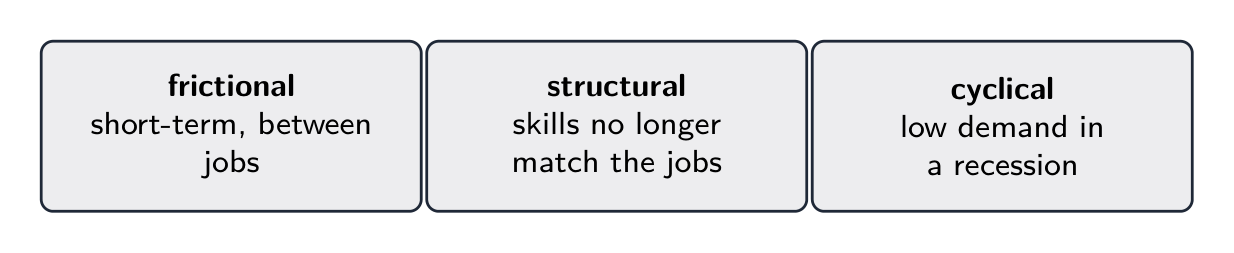
    Three types of unemployment:

    • Frictional 摩擦性失业: between jobs or searching for a first job (normal, short).
    • Structural 结构性失业: skills or location don't match available jobs (technology, trade).
    • Cyclical 周期性失业: caused by a recession (a downturn in the business cycle).

    Frictional + structural make up the natural rate of unemployment 自然失业率. At the natural rate cyclical unemployment is zero and the economy is at full employment 充分就业. The rate understates joblessness because it omits discouraged workers 灰心工人 and the underemployed.

    العربية
    طابور طويل من الناس — البطالة هم الأشخاص المستعدون والقادرون على العمل الذين لا يستطيعون إيجاد وظائف
    طابور طويل من الناس — البطالة هي الأشخاص الذين يرغبون وقادرون على العمل لكنهم لا يجدون وظائف

    القوة العاملة هي العمال المشغولون زائد العاطلون (أولئك الذين ليس لديهم عمل ويبحثون بنشاط). الأشخاص الذين لا يبحثون ليسوا جزءًا من القوة العاملة.

    ثلاثة أنواع من البطالة: الاحتكاكية، الهيكلية، والدورية
    ثلاثة أنواع من البطالة: الاحتكائية، الهيكلية، والدورية
    $$\text{Unemployment rate}=\frac{\text{unemployed}}{\text{labor force}}\times 100\%,\qquad \text{Labor-force participation}=\frac{\text{labor force}}{\text{working-age population}}\times100\%.$$

    مثال محلول. بلد لديه $150$ مليون عامل مشغول و$10$ مليون عاطل (باحثين بنشاط)، مع $40$ مليون بالغين في سن العمل لا يبحثون. القوة العاملة تساوي $150+10=160$ مليون، لذا فإن معدل البطالة هو $\dfrac{10}{160}=6.25\%$ ومعدل المشاركة هو $\dfrac{160}{200}=80\%$.

    ثلاثة أنواع من البطالة:

    • احتكائي: بين الوظائف أو البحث عن أول وظيفة (طبيعي، قصير).
    • هيكلي: المهارات أو الموقع لا تتوافق مع الوظائف المتاحة (التكنولوجيا، التجارة).
    • دوري: ناتج عن ركود (انخفاض في الدورة الاقتصادية).

    الاحتكائي + الهيكلي يشكلان معدل البطالة الطبيعي. عند المعدل الطبيعي تكون البطالة الدورية صفرًا وتكون الاقتصاد في التشغيل الكامل. هذا المعدر يقلل من حجم العاطلين لأنه يستبعد العاملين المستاءين ومنخفضي التشغيل.

    Vocabulary · ⁨مفردات⁩ Train · ⁨تدريب⁩
    English العربية
    circular-flow model/ˈsɜːkjʊlə fləʊ ˈmɒdl/ نموذج التدفق الدائري
    Gross domestic product (GDP)/ɡrəʊs dəˈmestɪk ˈprɒdʌkt/ إجمالي الناتج المحلي (GDP)
    consumption/kənˈsʌmpʃn/ الاستهلاك
    investment/ɪnˈvestmənt/ الاستثمار
    government purchases/ˈɡʌvənmənt ˈpɜːtʃɪsɪz/ المشتريات الحكومية
    net exports/net ˈekspɔːts/ صافي الصادرات
    underground economy/ˌʌndəˈɡraʊnd ɪˈkɒnəmi/ الاقتصاد غير الرسمي
    labor force/ˈleɪbə fɔːs/ قوة العمل
    Frictional/ˈfrɪkʃənl/ احتكاكية
    Structural/ˈstrʌktʃərəl/ بنيوي
    Cyclical/ˈsaɪklɪkl/ دورية
    natural rate of unemployment/ˈnætʃərəl reɪt ɒv ʌnemˈplɔɪmənt/ معدل البطالة الطبيعي
    full employment/fʊl emˈplɔɪmənt/ full employment
    discouraged workers/dɪˈskʌrɪdʒd ˈwɜːkəz/ العمال المحبطون
    2.4

    Price Indices and Inflation · ⁨مؤشرات الأسعار والتضخم⁩

    Syllabus · ⁨المنهج⁩
    English

    Enduring Understanding (MEA-1): An economy's performance can be measured by different indicators such as gross domestic product (GDP), the inflation rate, and the unemployment rate.

    Learning Objective MEA-1.F: a. Define the consumer price index (CPI), inflation, deflation, disinflation, the inflation rate, and real variables. b. Explain how price indices can be used to calculate the inflation rate and to compare nominal variables over time periods. c. Calculate the CPI, the inflation rate, and changes in real variables.

    • MEA-1.F.1 The consumer price index (CPI) measures the change in income a consumer would need in order to maintain the same standard of living over time under a new set of prices as under the original set of prices.
    • MEA-1.F.2 The CPI measures the cost of a fixed basket of goods and services in a given year relative to the base year.
      • Exclusion statement: Calculating the producer price index (PPI) is beyond the scope of the course and AP Exam.
    • MEA-1.F.3 The inflation rate is determined by calculating the percentage change in a price index, such as CPI or the GDP deflator.
    • MEA-1.F.4 Real variables, such as real wages, are the nominal variables deflated by the price level.

    Learning Objective MEA-1.G: Define the shortcomings of the CPI as a true measure of inflation.

    • MEA-1.G.1 The CPI as a measure of inflation has some shortcomings, such as substitution bias, causing it to overstate the true inflation rate.
    العربية

    الفهم الدائم (MEA-1): يمكن قياس أداء الاقتصاد بمؤشرات مختلفة مثل الناتج المحلي الإجمالي (GDP)، ومعدل التضخم، ومعدل البطالة.

    هدف التعلم MEA-1.F: أ. عرف مؤشر أسعار المستهلك (CPI)، والتضخم، والانكماش، وتباطؤ التضخم، ومعدل التضخم، والمتغيرات الحقيقية. ب. اشرح كيفية استخدام مؤشرات الأسعار لحساب معدل التضخم ومقارنة المتغيرات الاسمية عبر فترات زمنية. ج. احسب مؤشر أسعار المستهلك (CPI)، ومعدل التضخم، والتغيرات في المتغيرات الحقيقية.

    • MEA-1.F.1 يقيس مؤشر أسعار المستهلك (CPI) التغير في الدخل الذي يحتاجه المستهلك للحفاظ على نفس مستوى المعيشة بمرور الوقت تحت مجموعة أسعار جديدة مقارنة بالمجموعة الأصلية.
    • MEA-1.F.2 يقيس مؤشر أسعار المستهلك تكلفة سلة ثابتة من السلع والخدمات في سنة معينة بالنسبة للسنة الأساسية.
      • عبارة الاستبعاد: حساب مؤشر أسعار المنتجين (PPI) خارج نطاق المقرر وامتحان AP.
    • MEA-1.F.3 يُحدد معدل التضخم بحساب التغير النسبي في مؤشر أسعار، مثل مؤشر أسعار المستهلك (CPI) أو قاسي الناتج المحلي الإجمالي.
    • MEA-1.F.4 المتغيرات الحقيقية، مثل الأجور الحقيقية، هي المتغيرات الاسمية المنقحة بمستوى الأسعار.

    هدف التعلم MEA-1.G: حدد قصور مؤشر أسعار المستهلك (CPI) كمقياس حقيقي للتضخم.

    • MEA-1.G.1 لمؤشر أسعار المستهلك (CPI) كمقياس للتضخم بعض القصور، مثل تحيز الاستبدال، مما يؤدي إلى مبالغة في معدل التضخم الحقيقي.

    Source: College Board AP Course and Exam Description · ⁨المصدر: وصف دورة وامتحان College Board AP⁩

    English

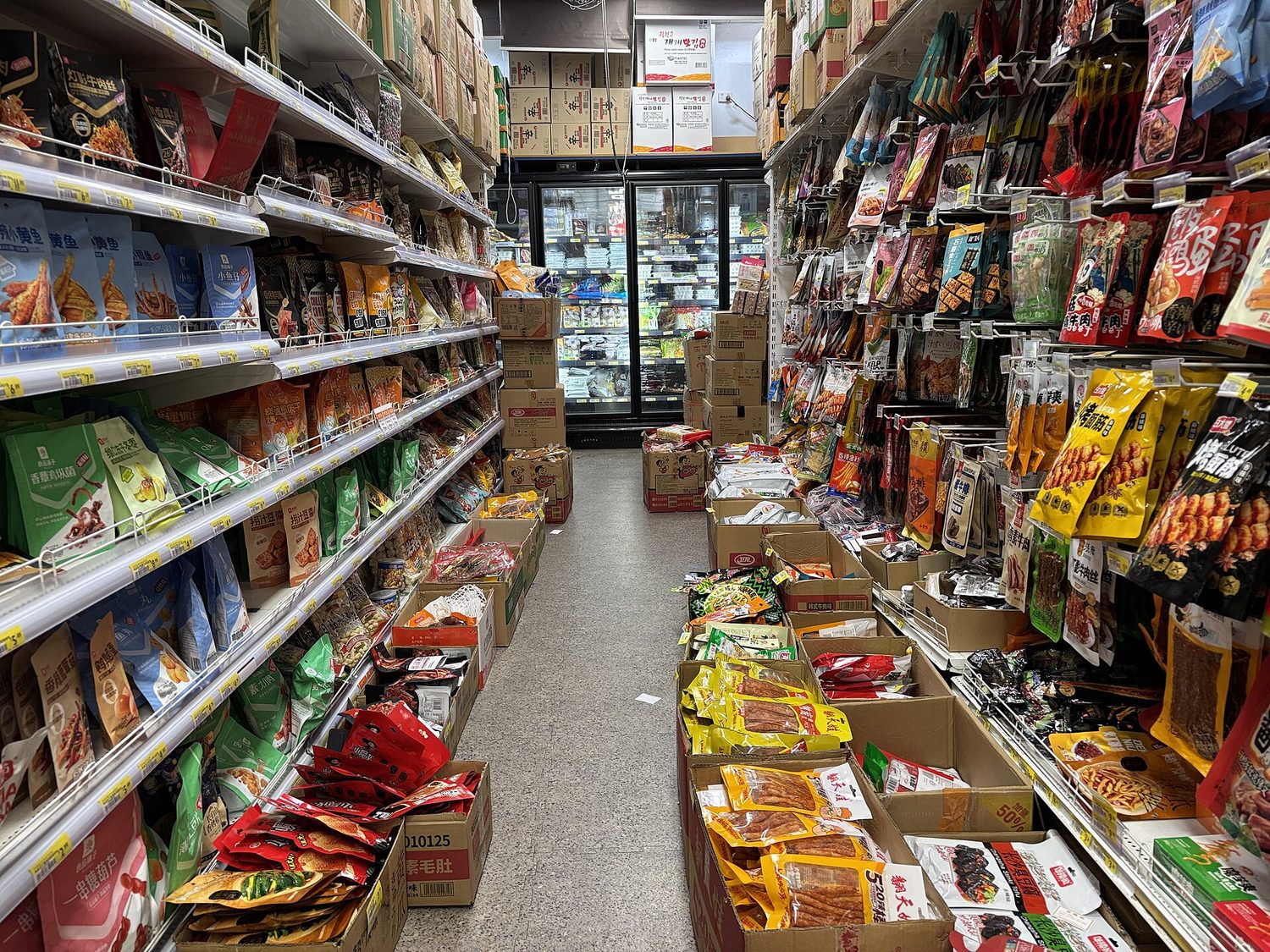
    Inflation 通货膨胀 is a sustained rise in the average price level. It is measured with a price index 价格指数, most often the consumer price index (CPI) 消费者价格指数, built from a fixed market basket of goods a typical household buys:

    $$CPI=\frac{\text{cost of basket this year}}{\text{cost of basket in base year}}\times100.$$

    The inflation rate is the percent change in the index between two years. Deflation 通货紧缩 is a falling price level; disinflation is a slowing of inflation.

    Worked example. If the CPI is $200$ this year and was $190$ last year, the inflation rate is $\dfrac{200-190}{190}\times100\%=5.3\%$. A basket that cost $\$190$ then costs $\$200$ – the same goods, more dollars.

    العربية
    مسار سوبر ماركت: سلة ثابتة من البضائع تقي التضخم عبر مؤشر الأسعار
    ممر متجر سوبر ماركت: سلة ثابتة من البضائع تقيس التضخم عبر مؤشر أسعار

    التضخم هو ارتفاع مستمر في متوسط مستوى الأسعار. يُقاس باستخدام مؤشر أسعار، وغالبًا ما يكون مؤشر أسعار المستهلك (CPI)، المبني على سلة سوقية ثابتة من البضائع التي تشتريها أسرة نموذجية:

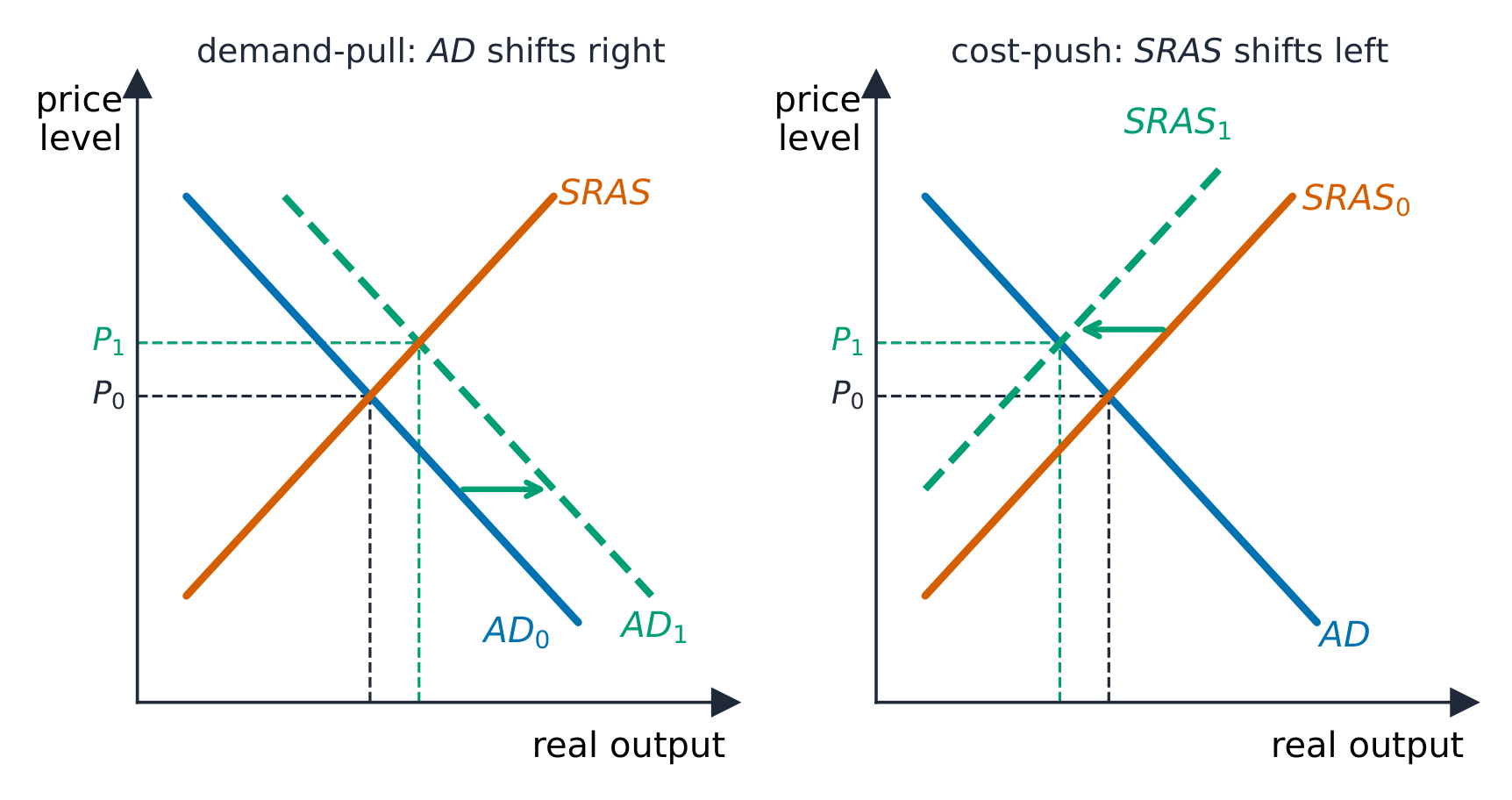
    التضخم المستند للطلب والتضخم المستند للتكلفة في رسم AD-AS البياني
    التضخم المستند للطلب والتضخم المستند للتكلفة في رسم AD-AS البياني
    $$CPI=\frac{\text{cost of basket this year}}{\text{cost of basket in base year}}\times100.$$

    معدل التضخم هو النسبة المئوية للتغير في المؤشر بين عامين. التراجع هو انخفاض مستوى الأسعار؛ تهدئة التضخم هو تباطؤ في التضخم.

    مثال محلول. إذا كان مؤشر أسعار المستهلك $200$ هذا العام وكان $190$ العام الماضي، فإن معدل التضخم هو $\dfrac{200-190}{190}\times100\%=5.3\%$. سلة تكلف $\$190$ then costs $\$200$ – نفس البضائع، دولارات أكثر.

    Vocabulary · ⁨مفردات⁩ Train · ⁨تدريب⁩
    English العربية
    Inflation/ɪnˈfleɪʃn/ تضخم
    2.5

    Costs of Inflation · ⁨تكاليف التضخم⁩

    Syllabus · ⁨المنهج⁩
    English

    Enduring Understanding (MEA-1): An economy's performance can be measured by different indicators such as gross domestic product (GDP), the inflation rate, and the unemployment rate.

    Learning Objective MEA-1.H: Explain the costs that unexpected inflation (deflation) imposes on individuals and the economy.

    • MEA-1.H.1 Unexpected inflation arbitrarily redistributes wealth from one group of individuals to another group, such as lenders to borrowers.
    العربية

    الفهم الدائم (MEA-1): يمكن قياس أداء الاقتصاد بمؤشرات مختلفة مثل الناتج المحلي الإجمالي (GDP)، ومعدل التضخم، ومعدل البطالة.

    هدف التعلم MEA-1.H: اشرح التكاليف التي يفرضها التضخم المفاجئ (أو الانكماش) على الأفراد والاقتصاد.

    • MEA-1.H.1 إعادة توزيع الثروة عشوائياً من مجموعة من الأفراد إلى مجموعة أخرى نتيجة للتضخم المفاجئ، مثل من المقرضين إلى المقترضين.

    Source: College Board AP Course and Exam Description · ⁨المصدر: وصف دورة وامتحان College Board AP⁩

    English

    Inflation redistributes and distorts:

    • It hurts lenders and savers and helps borrowers when it is unexpected, because loans are repaid in cheaper dollars. It erodes the value of money and fixed incomes.
    • Menu costs and uncertainty discourage investment.
    • Anticipated inflation is less harmful because contracts and interest rates adjust for it. This is why we separate nominal and real values.
    العربية

    إعادة توزيع التضخم وتشويهه:

    • يضر المقرضين والموفرين ويساعد المقترضين عندما يكون غير متوقع، لأن القروض تُدفع بدولارات أرخص. إنه يآكل قيمة المال والدخل الثابت.
    • تكلفة القائمة والشكوك تثبت الاستثمار.
    • التضخم المتوقع أقل ضرراً لأن العقود وأسعار الفائدة تتكيف معه. ولهذا السبب نفصل بين القيم الاسمية والحقيقية.
    2.6

    Real v. Nominal GDP · ⁨الناتج المحلي الإجمالي الحقيقي مقابل الاسمي⁩

    Syllabus · ⁨المنهج⁩
    English

    Enduring Understanding (MEA-1): An economy's performance can be measured by different indicators such as gross domestic product (GDP), the inflation rate, and the unemployment rate.

    Learning Objective MEA-1.I: Define nominal GDP and real GDP.

    • MEA-1.I.1 Nominal GDP is a measure of how much is spent on output. Real GDP is a measure of how much is produced.
    • MEA-1.I.2 Nominal GDP measures aggregate output using current prices. Real GDP measures aggregate output using constant prices, thus removing the effect of changes in the overall price level.

    Learning Objective MEA-1.J: Calculate real GDP and the GDP deflator.

    • MEA-1.J.1 One way of measuring real GDP is to weigh final goods and services by their prices in a base year. Because this can lead to overstatement of real GDP growth, statistical agencies actually use different methods.
    • MEA-1.J.2 Nominal GDP can be converted to real GDP by using the GDP deflator.
    العربية

    الفهم الدائم (MEA-1): يمكن قياس أداء الاقتصاد بمؤشرات مختلفة مثل الناتج المحلي الإجمالي (GDP)، ومعدل التضخم، ومعدل البطالة.

    هدف التعلم MEA-1.I: عرّف الناتج المحلي الإجمالي الاسمي والناتج المحلي الإجمالي الحقيقي.

    • MEA-1.I.1 الناتج المحلي الإجمالي الاسمي هو مقياس لما يتم إنفاقه على الإنتاج. الناتج المحلي الإجمالي الحقيقي هو مقياس لما يتم إنتاجه.
    • MEA-1.I.2 يقيس الناتج المحلي الإجمالي الاسمي الإنتاج الكلي باستخدام الأسعار الجارية. يقيس الناتج المحلي الإجمالي الحقيقي الإنتاج الكلي باستخدام أسعار ثابتة، مما يلغي تأثير التغيرات في مستوى الأسعار العام.

    هدف التعلم MEA-1.J: احسب الناتج المحلي الإجمالي الحقيقي وقاسي الناتج المحلي الإجمالي.

    • MEA-1.J.1 إحدى طرق قياس الناتج المحلي الإجمالي الحقيقي هي وزن البضائع والخدمات النهائية بأسعارها في سنة أساسية. وبما أن هذا قد يؤدي إلى مبالغة في نمو الناتج المحلي الإجمالي الحقيقي، تستخدم الوكالات الإحصائية في الواقع طرقاً مختلفة.
    • MEA-1.J.2 يمكن تحويل الناتج المحلي الإجمالي الاسمي إلى ناتج محلي إجمالي حقيقي باستخدام قاسي الناتج المحلي الإجمالي.

    Source: College Board AP Course and Exam Description · ⁨المصدر: وصف دورة وامتحان College Board AP⁩

    English
    • Nominal GDP 名义GDP is valued at current prices, so it rises with both output and prices.
    • Real GDP 实际GDP is valued at constant (base-year) prices, stripping out inflation, so it reflects true output. Real GDP is the honest measure of growth.
    $$\text{Real GDP}=\frac{\text{Nominal GDP}}{\text{price index}}\times100,\qquad \text{GDP deflator}=\frac{\text{Nominal GDP}}{\text{Real GDP}}\times100.$$

    Worked example. Nominal GDP is $\$22$ trillion and the GDP deflator is $110$. Real GDP is $\dfrac{22}{110}\times100=\$20$ trillion. The extra $\$2$ trillion of nominal GDP is pure price rise, not real output – which is why growth is always measured with real GDP.

    Exam skill: be fluent converting nominal to real using a price index, and computing an inflation rate or a growth rate as a percent change.

    العربية
    • الناتج المحلي الإجمالي الاسمي يُقدر بأسعار حالية، لذلك يرتفع مع كل من الإنتاج والأسعار.
    • الناتج المحلي الإجمالي الحقيقي يُقدر بأسعار ثابتة (سنة الأساس)، مستبعداً التضخم، لذلك يعكس الإنتاج الفعلي. الناتج المحلي الإجمالي الحقيقي هو المقياس الصادق للنمو.
    $$\text{Real GDP}=\frac{\text{Nominal GDP}}{\text{price index}}\times100,\qquad \text{GDP deflator}=\frac{\text{Nominal GDP}}{\text{Real GDP}}\times100.$$

    مثال محلول. الناتج المحلي الإجمالي الاسمي هو $\$22$ trillion and the GDP deflator is $110$. Real GDP is $\dfrac{22}{110}\times100=\$20$ تريليون. الزيادة $\$2$ تريليون من الناتج المحلي الإجمالي الاسمي هي مجرد ارتفاع في الأسعار، وليس إنتاجاً حقيقياً – وهذا هو سبب قياس النمو دائماً باستخدام الناتج المحلي الإجمالي الحقيقي.

    مهارة الامتحان: أن تكون ماهراً في تحويل名义 إلى حقيقي باستخدام مؤشر أسعار، وحساب معدل تضخم أو معدل نمو كنسبة مئوية للتغير.

    Vocabulary · ⁨مفردات⁩ Train · ⁨تدريب⁩
    English العربية
    price index/praɪs ˈɪndeks/ مؤشر الأسعار
    consumer price index (CPI)/kənˈsuːmə praɪs ˈɪndeks/ مؤشر أسعار المستهلكين (CPI)
    Deflation/diːˈfleɪʃn/ انكماش
    Nominal GDP/ˈnɒmɪnl ˌdʒiː diː ˈpiː/ الناتج المحلي الإجمالي الاسمي
    Real GDP/rɪəl ˌdʒiː diː ˈpiː/ الناتج المحلي الإجمالي الحقيقي
    2.7

    Business Cycles · ⁨دورات الأعمال⁩

    Syllabus · ⁨المنهج⁩
    English

    Enduring Understanding (MEA-2): The economy fluctuates between periods of expansion and contraction in the short run, but economic growth can occur in the long run.

    Learning Objective MEA-2.A: a. Define (using graphs and data as appropriate) turning points and phases of the business cycle. b. Explain (using graphs and data as appropriate) turning points and phases of the business cycle.

    • MEA-2.A.1 Business cycles are fluctuations in aggregate output and employment because of changes in aggregate supply and/or aggregate demand.
    • MEA-2.A.2 The phases of a business cycle are recession and expansion.
    • MEA-2.A.3 The turning points of a business cycle are peak and trough.
    • MEA-2.A.4 The difference between actual output and potential output is the output gap.
    • MEA-2.A.5 Potential output is also called full-employment output. It is the level of GDP where unemployment is equal to the natural rate of unemployment. [See EK MEA-1.E.2]
    العربية

    الفهم الدائم (MEA-2): يتذبذب الاقتصاد بين فترات التوسع والانكماش على المدى القصير، ولكن يمكن أن يحدث النمو الاقتصادي على المدى الطويل.

    هدف التعلم MEA-2.A: أ. عرّف (باستخدام الرسوم البيانية والبيانات حسب الحاجة) نقاط التحول ومراحل الدورة الاقتصادية. ب. اشرح (باستخدام الرسوم البيانية والبيانات حسب الحاجة) نقاط التحول ومراحل الدورة الاقتصادية.

    • MEA-2.A.1 الدورات الاقتصادية هي تذبذبات في الإنتاج الكلي والتوظيف بسبب تغيرات في العرض الكلي و/أو الطلب الكلي.
    • MEA-2.A.2 مراحل الدورة الاقتصادية هي الركود والتوسع.
    • MEA-2.A.3 نقاط تحول الدورة الاقتصادية هي القمة والقاع.
    • MEA-2.A.4 الفرق بين الإنتاج الفعلي والإنتاج المحتمل هو فجوة الإنتاج.
    • MEA-2.A.5 الناتج المحتمل يُسمى أيضًا ناتج التوظيف الكامل. هو مستوى الناتج المحلي الإجمالي حيث يكون معدل البطالة مساويًا لمعدل البطالة الطبيعي. [انظر EK MEA-1.E.2]

    Source: College Board AP Course and Exam Description · ⁨المصدر: وصف دورة وامتحان College Board AP⁩

    English
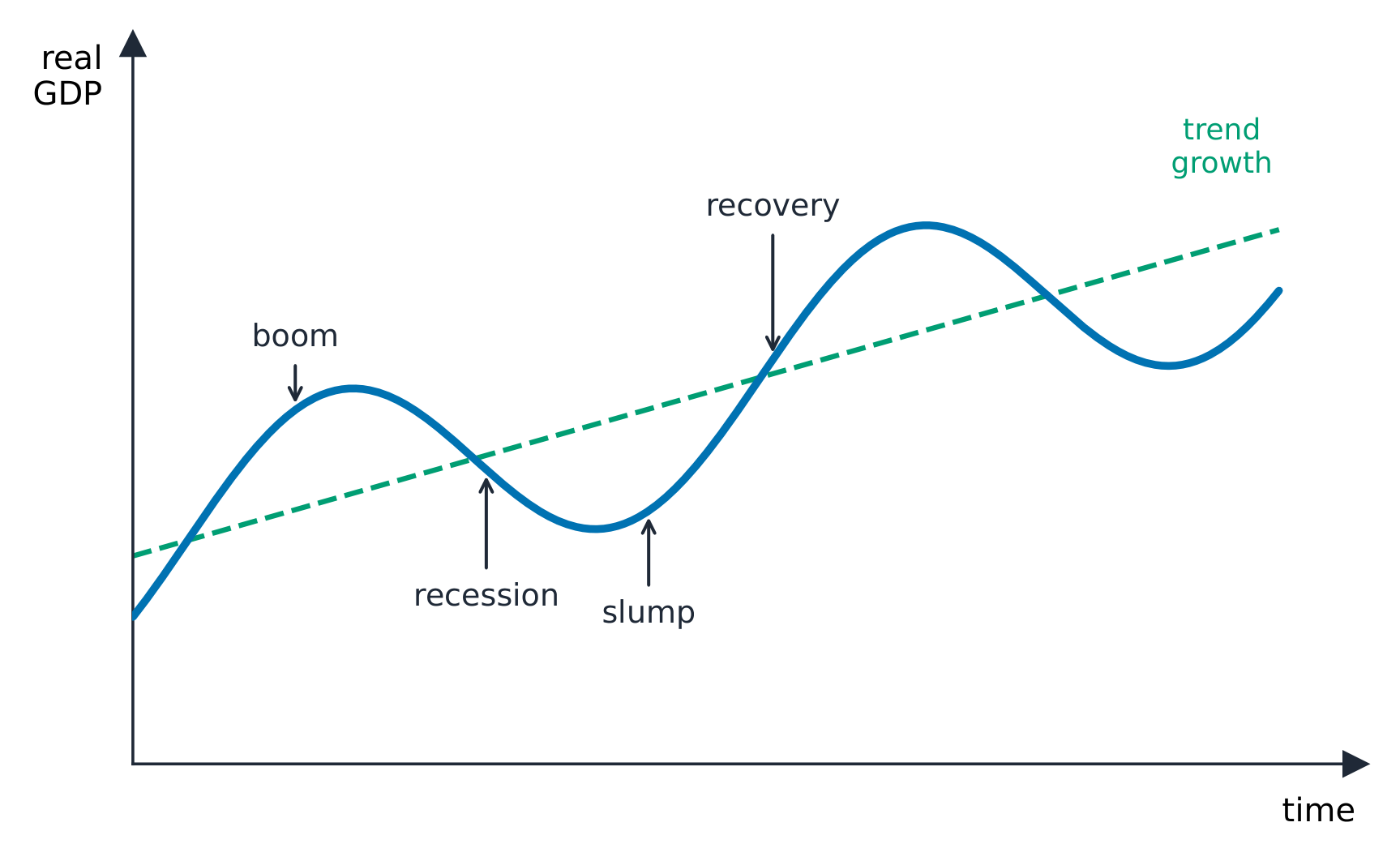
    The business cycle

    The business cycle 经济周期 is the economy's short-run ups and downs in real GDP around its long-run growth trend: expansion 扩张 (rising output, falling unemployment) up to a peak 顶峰, then contraction/recession 衰退 (falling output, rising cyclical unemployment) down to a trough 谷底, then recovery. A recession is commonly two consecutive quarters of falling real GDP. Unemployment and inflation move roughly opposite over the cycle – the tension the rest of the course tries to manage.

    العربية
    دورة الأعمال

    دورة الأعمال هي الارتفاعات والانخفاضات القصيرة الأمد للاقتصاد في الناتج المحلي الإجمالي الحقيقي حول اتجاه نموه الطويل الأمد: التوسع (ارتفاع الإنتاج، انخفاض البطالة) حتى ذروة، ثم الانكماش/الركود (انخفاض الإنتاج، ارتفاع البطالة الدورية) حتى قاع، ثم التعافي. الرّكود هو عادةً فصلان متتابعان من انخفاض الناتج المحلي الإجمالي الحقيقي. تتحرك البطالة والتضخم تقريباً في اتجاه معاكس خلال الدورة – وهو التوتر الذي يحاول البرنامج الدراسي بأكمله إدارته.

    تذبذب الناتج المحلي الإجمالي الحقيقي حول اتجاهه طويل الأمد
    تذبذب الناتج المحلي الإجمالي الحقيقي حول اتجاهه طويل الأمد
    Vocabulary · ⁨مفردات⁩ Train · ⁨تدريب⁩
    English العربية
    business cycle/ˈbɪznəs ˈsaɪkl/ الدورة الاقتصادية
    expansion/ekˈspænʃn/ التوسع
    peak/piːk/ قمة
    contraction/recession/kənˈtrækʃn rɪˈseʃn/ الانكماش/الكساد
    trough/trɒf/ القاع
    2.7

    Exam tips · ⁨نصائح للامتحان⁩

    English
    • Compute GDP by the expenditure method $C+I+G+X_n$ and count only final goods (avoid double counting).
    • Unemployment rate = unemployed ÷ labor force; discouraged workers leave the labor force (so the rate can understate joblessness).
    • Know the three unemployment types (frictional, structural, cyclical) and that the natural rate excludes cyclical.
    • Inflation is the % change in the CPI; convert nominal to real with a price index and always use real GDP for growth.
    • Place events on the business cycle (expansion → peak → contraction → trough).
    العربية
    • احسب الناتج المحلي الإجمالي بطريقة الإنفاق $C+I+G+X_n$ واحسب فقط السلع ** النهائية** (لتجنب العد المزدوج).
    • معدل البطالة = العاطلون ÷ القوة العاملة؛ العاملون المستاءون يغادرون القوة العاملة (لذلك قد يقلل المعدر من حجم العاطلين).
    • تعرف الأنواع الثلاثة للبطالة (الاحتكائية، الهيكلية، الدورية) وأن المعدل الطبيعي يستبعد البطالة الدورية.
    • التضخم هو التغير % في مؤشر أسعار المستهلك؛ حول名义 إلى حقيقي باستخدام مؤشر أسعار واستخدم دائماً الناتج المحلي الإجمالي الحقيقي للنمو.
    • ضع الأحداث على دورة الأعمال (توسع ← ذروة ← انكماش ← قاع).
  • 3

    National Income and Price Determination · ⁨الدخل الوطني وتحديد الأسعار⁩

    Watch lesson · ⁨شاهد الدرس⁩
    3.1

    Aggregate Demand · ⁨الطلب الكلي⁩

    Syllabus · ⁨المنهج⁩
    English

    Enduring Understanding (MOD-2): Economists use the aggregate demand–aggregate supply model to represent the relationship between the price level and aggregate output in an economy and to illustrate how output, employment, and the price level respond to macroeconomic shocks.

    Learning Objective MOD-2.A: a. Define (using graphs as appropriate) the aggregate demand (AD) curve. b. Explain (using graphs as appropriate) the slope of the AD curve and its determinants.

    • MOD-2.A.1 The aggregate demand (AD) curve describes the relationship between the price level and the quantity of goods and services demanded by households (consumption), firms (investment), government (government spending), and the rest of the world (net exports).
    • MOD-2.A.2 The negative slope of the AD curve is explained by the real wealth effect, the interest rate effect, and the exchange rate effect. [See EK MKT-3.A.1]
    • MOD-2.A.3 Any change in the components of aggregate demand (consumption, investment, government spending, or net exports) that is not due to changes in the price level leads to a shift of the AD curve.
    العربية

    فهم دائم (MOD-2): يستخدم الاقتصاديون نموذج الطلب الكلي والعرض الكلي لتمثيل العلاقة بين المستوى العام للأسعار والإنتاج الكلي في اقتصاد ما، ولتوضيح كيف تستجيب الإنتاجية والتوظيف والمستوى العام للأسعار للصدمات الكلية.

    هدف التعلم MOD-2.A: أ. عرّف (باستخدام الرسوم البيانية عند الحاجة) منحنى الطلب الكلي (AD). ب. اشرح (باستخدام الرسوم البيانية عند الحاجة) ميل منحنى الطلب الكلي ومحدداته.

    • MOD-2.A.1 يصف منحنى الطلب الكلي (AD) العلاقة بين المستوى العام للأسعار والكمية المطلوبة من السلع والخدمات من قبل الأسر (الاستهلاك)، والشركات (الاستثمار)، والحكومة (الإنفاق الحكومي)، وبقية العالم (التصديرات الصافية).
    • MOD-2.A.2 يُفسر الميل السالب لمنحنى الطلب الكلي بتأثير الثروة الحقيقية، وتأثير سعر الفائدة، وتأثير سعر الصرف. [انظر EK MKT-3.A.1]
    • MOD-2.A.3 أي تغيير في مكونات الطلب الكلي (الاستهلاك، الاستثمار، الإنفاق الحكومي، أو التصديرات الصافية) الذي لا ينتج عن تغيرات في المستوى العام للأسعار يؤدي إلى إزاحة منحنى الطلب الكلي.

    Source: College Board AP Course and Exam Description · ⁨المصدر: وصف دورة وامتحان College Board AP⁩

    English
    The AD–AS model: a demand shock

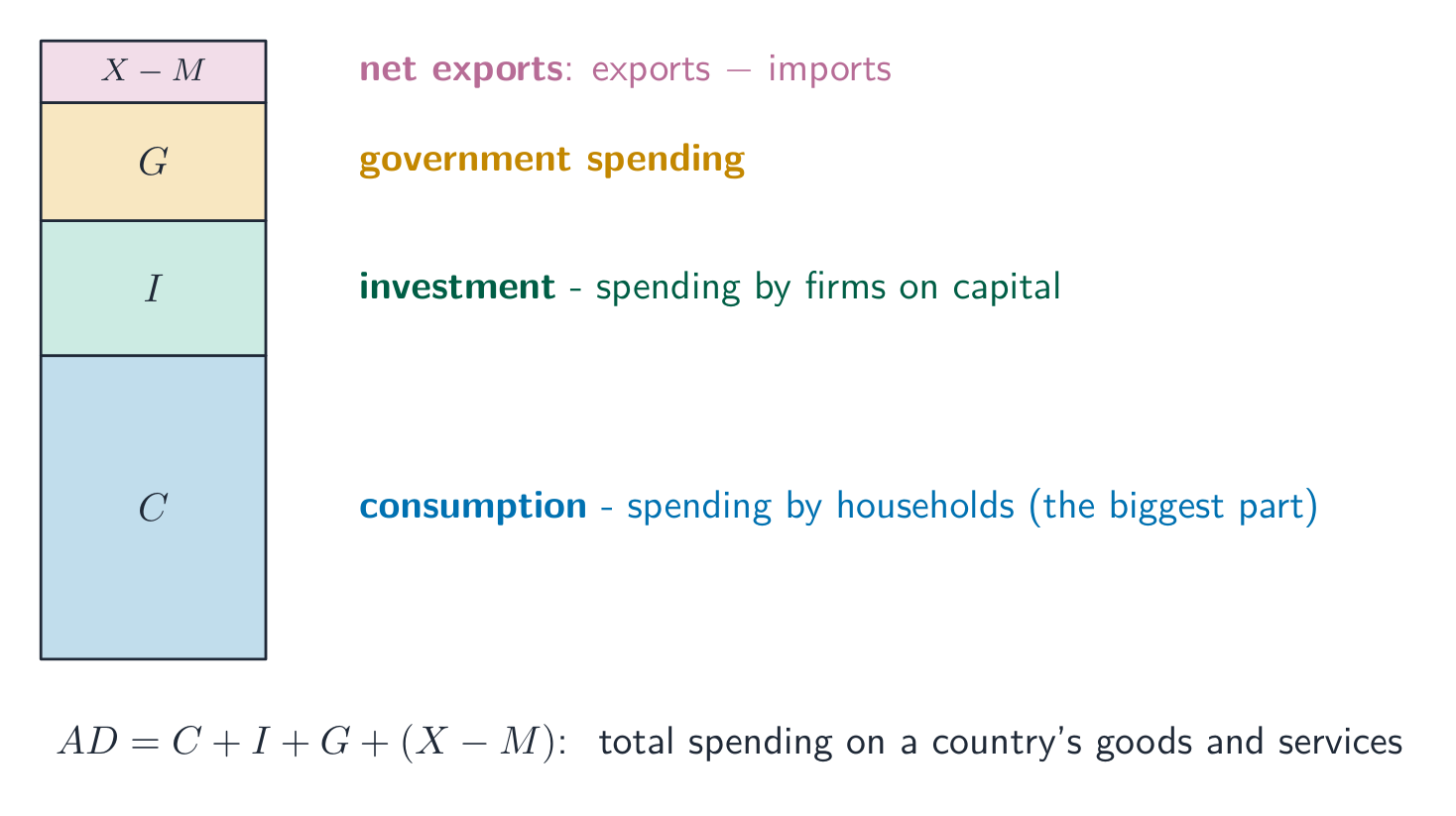
    Aggregate demand (AD) 总需求 shows the total quantity of real output ($C+I+G+X_n$) buyers want at each price level 价格水平. It slopes downward for three reasons special to the whole economy:

    • the wealth effect 财富效应 (a higher price level shrinks the real value of money, so people buy less),
    • the interest-rate effect 利率效应 (a higher price level raises money demand and interest rates, cutting investment),
    • the net-export effect (a higher domestic price level makes exports dearer and imports cheaper).

    A change in the price level is a movement along AD. AD shifts when any component of $C+I+G+X_n$ changes for another reason – consumer confidence, business expectations, government spending, taxes, or foreign incomes.

    العربية
    أفق مدينة: الناتج الوطني والطلب الكلي يعكسان الإنفاق على مستوى الاقتصاد
    أفق مدينة: الناتج الوطني والطلب الكلي يعكسان الإنفاق على مستوى الاقتصاد
    نموذج AD–AS: صدمة الطلب

    الطلب الكلي (AD) يظهر إجمالي كمية الإنتاج الحقيقي ($C+I+G+X_n$) التي يريد المشترون الحصول عليها عند كل مستوى أسعار. ينحدر لأسفل لثلاثة أسباب خاصة بالاقتصاد ككل:

    الطلب الكلي هو إجمالي الإنفاق: الاستهلاك، الاستثمار، الحكومة، والتصدير الصافي
    الطلب الكلي هو إجمالي الإنفاق: الاستهلاك، الاستثمار، الحكومة، والصادرات الصافية
    • تأثير الثروة (ارتفاع مستوى الأسعار يقلل القيمة الحقيقية للنقود، مما يجعل الناس يشترون أقل)،
    • تأثير أسعار الفائدة (ارتفاع مستوى الأسعار يزيد الطلب على النقود وأسعار الفائدة، مما يقلل الاستثمار)،
    • تأثير الصادرات الصافية (ارتفاع مستوى الأسعار المحلي يجعل الصادرات أغلى والواردات أرخص).

    التغير في مستوى الأسعار هو حركة على طول منحنى AD. وينزاح منحنى AD عندما يتغير أي مكون من $C+I+G+X_n$ لسبب آخر – مثل ثقة المستهلكين، وتوقعات الشركات، أو الإنفاق الحكومي، أو الضرائب، أو دخول الدول الأخرى.

    3.2

    The Spending and Tax Multipliers · ⁨مضاعف الإنفاق والضرائب⁩

    Syllabus · ⁨المنهج⁩
    English

    Enduring Understanding (MOD-2): Economists use the aggregate demand–aggregate supply model to represent the relationship between the price level and aggregate output in an economy and to illustrate how output, employment, and the price level respond to macroeconomic shocks.

    Learning Objective MOD-2.B: a. Define the expenditure multiplier, the tax multiplier, the marginal propensity to consume, and the marginal propensity to save. b. Explain how changes in spending and taxes lead to changes in real GDP. c. Calculate how changes in spending and taxes lead to changes in real GDP.

    • MOD-2.B.1 A $\$1$ change to autonomous expenditures leads to further changes in total expenditures and total output.
    • MOD-2.B.2 The expenditure multiplier quantifies the size of the change in aggregate demand as a result of a change in any of the components of aggregate demand.
    • MOD-2.B.3 The tax multiplier quantifies the size of the change in aggregate demand as a result of a change in taxes.
    • MOD-2.B.4 The expenditure multiplier and tax multiplier depend on the marginal propensity to consume.
    • MOD-2.B.5 The marginal propensity to consume is the change in consumer spending divided by the change in disposable income. The sum of the marginal propensity to consume and marginal propensity to save is equal to one.
    العربية

    فهم دائم (MOD-2): يستخدم الاقتصاديون نموذج الطلب الكلي والعرض الكلي لتمثيل العلاقة بين المستوى العام للأسعار والإنتاج الكلي في اقتصاد ما، ولتوضيح كيف تستجيب الإنتاجية والتوظيف والمستوى العام للأسعار للصدمات الكلية.

    هدف التعلم MOD-2.B: أ. عرّف مضاعف الإنفاق، ومضاعف الضرائب، والميل الحدي للاستهلاك، والميل الحدي للادخار. ب. اشرح كيف تؤدي التغيرات في الإنفاق والضرائب إلى تغييرات في الناتج المحلي الإجمالي الحقيقي. ج. احسب كيف تؤدي التغيرات في الإنفاق والضرائب إلى تغييرات في الناتج المحلي الإجمالي الحقيقي.

    • MOD-2.B.1 أي تغيير $\$1$ في الإنفاق المستقل يؤدي إلى تغييرات إضافية في إجمالي الإنفاق وإجمالي الإنتاج.
    • MOD-2.B.2 يقيس مضاعف الإنفاق حجم التغير في الطلب الكلي كنتيجة لتغير في أي من مكونات الطلب الكلي.
    • MOD-2.B.3 يقيس مضاعف الضرائب حجم التغير في الطلب الكلي كنتيجة لتغير في الضرائب.
    • MOD-2.B.4 يعتمد مضاعف الإنفاق ومضاعف الضرائب على الميل الحدي للاستهلاك.
    • MOD-2.B.5 الميل الحدي للاستهلاك هو التغير في إنفاق المستهلك مقسومًا على التغير في الدخل المتاح. مجموع الميل الحدي للاستهلاك والميل الحدي للادخار يساوي واحدًا.

    Source: College Board AP Course and Exam Description · ⁨المصدر: وصف دورة وامتحان College Board AP⁩

    English
    The spending multiplier

    A change in spending sets off further rounds of spending, so the final change in GDP is larger than the initial change – the multiplier effect 乘数效应. It depends on the marginal propensity to consume 边际消费倾向 (MPC), the fraction of extra income that is spent (the rest is the marginal propensity to save 边际储蓄倾向, MPS, with $MPC+MPS=1$):

    $$\text{spending multiplier}=\frac{1}{1-MPC}=\frac{1}{MPS}.$$

    A tax cut works through the multiplier too, but more weakly, because part of the tax cut is saved:

    $$\text{tax multiplier}=-\frac{MPC}{1-MPC}=-\frac{MPC}{MPS}.$$

    The tax multiplier is smaller in size and negative (a tax cut raises GDP; a tax rise lowers it). Total change in GDP $=$ (multiplier) $\times$ (initial change).

    Worked example. If $MPC=0.8$, the spending multiplier is $\dfrac{1}{1-0.8}=5$, so a $\$10$ billion rise in government spending lifts real GDP by $5\times\$10=\$50$ billion. The tax multiplier is $-\dfrac{0.8}{0.2}=-4$, so a $\$10$ billion tax cut raises GDP by only $\$40$ billion – weaker, because part of the tax cut is saved.

    Exam skill: compute both multipliers from the MPC and find the resulting change in real GDP – an almost-guaranteed calculation.

    العربية
    مضاعف الإنفاق

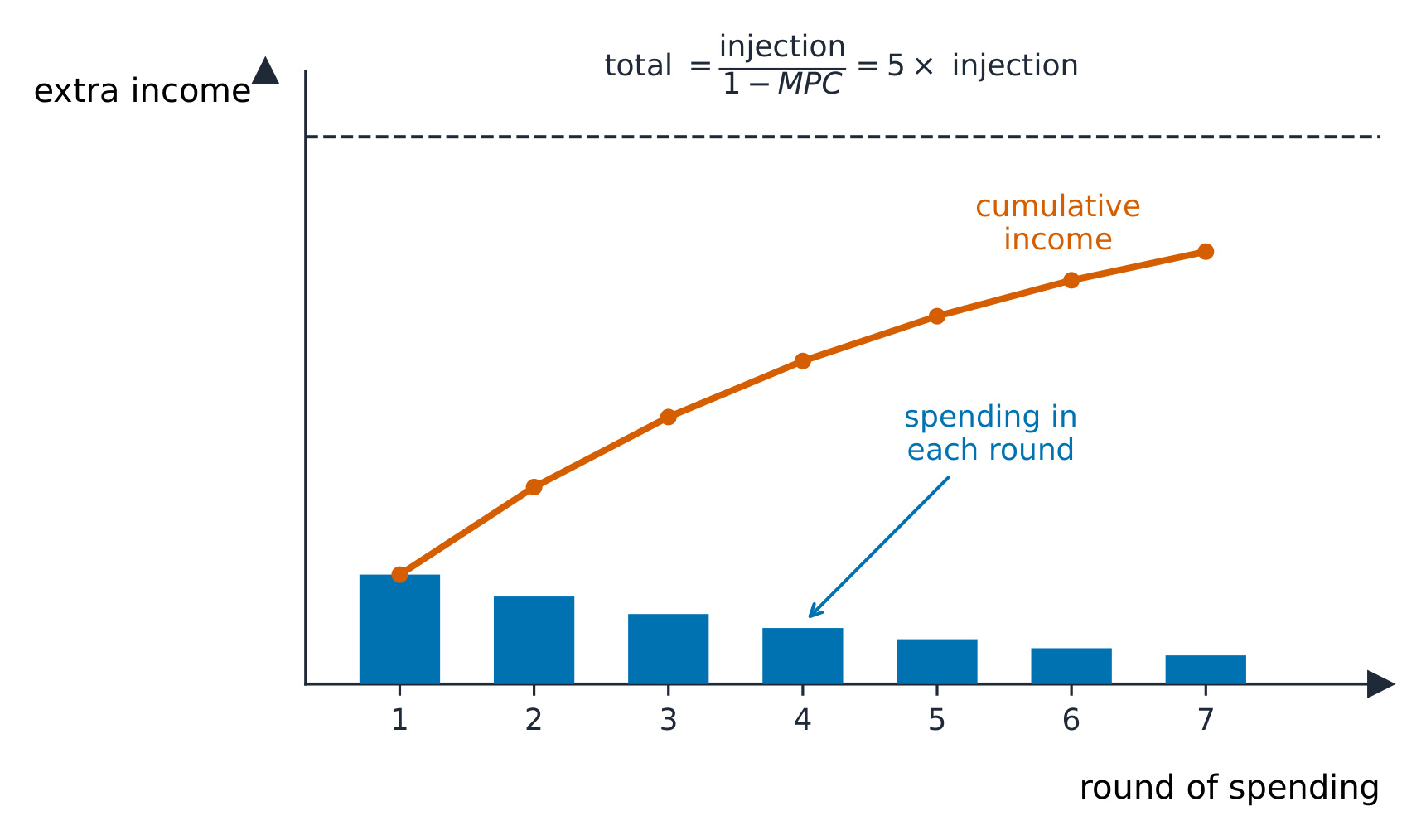
    يُحدث التغير في الإنفاق دورات إضافية من الإنفاق، لذا يكون التغير النهائي في الناتج المحلي الإجمالي أكبر من التغير الأولي – وهو ما يُعرف بـتأثير المضاعف. ويعتمد هذا على الميل الهامشي للاستهلاك (MPC)، وهو الجزء الإضافي من الدخل الذي يُنفق (والباقي هو الميل الهامشي للادخار، MPS، مع $MPC+MPS=1$):

    حقنة واحدة تتضاعف لتصبح ارتفاعًا كليًا أكبر في الدخل
    حقنة واحدة تتضاعف لتصبح ارتفاعًا كليًا أكبر في الدخل
    $$\text{spending multiplier}=\frac{1}{1-MPC}=\frac{1}{MPS}.$$

    يعمل تخفيض الضرائب عبر المضاعف أيضًا، لكن بشكل أضعف، لأن جزءًا من تخفيض الضرائب يتم ادخاره:

    $$\text{tax multiplier}=-\frac{MPC}{1-MPC}=-\frac{MPC}{MPS}.$$

    مضاعف الضريبة أصغر حجمًا وسالب (تخفيض الضرائب يرفع الناتج المحلي الإجمالي؛ وزيادته يخفضه). التغير الكلي في الناتج المحلي الإجمالي $=$ (المضاعف) $\times$ (التغير الأولي).

    مثال محلول. إذا $MPC=0.8$، فإن مضرب الإنفاق هو $\dfrac{1}{1-0.8}=5$، لذا فإن تخفيض ضريبي بمقدار $\$10$ billion rise in government spending lifts real GDP by $5\times\$10=\$50$ billion. The tax multiplier is $-\dfrac{0.8}{0.2}=-4$, so a $\$10$ مليار دولار يُقلل الناتج المحلي الإجمالي بمقدار $\$40$ مليار فقط – وهو تأثير أضعف، لأن جزءاً من التخفيض الضريبي يتم ادخاره.

    مهارة الامتحان: احسب كلا المضاعفين من الميل الهامشي للاستهلاك وأوجد التغير الناتج في الناتج المحلي الإجمالي الحقيقي – وهي عملية حسابية مضمونة تقريبًا.

    Explore · ⁨استكشف⁩

    See the spending multiplier ripple out · ⁨شاهد مضاعف الإنفاق يتموج للخارج⁩

    A dollar of new spending becomes someone's income, part of which they spend again — so the total effect is a multiple of the first injection, set by the marginal propensity to consume (MPC). · ⁨دولار من الإنفاق الجديد يصبح دخلاً لشخص ما، جزء منه يعيد إنفاقه مرة أخرى — لذا التأثير الكلي هو مضاعف للإدراج الأول، تحدده الميل الحدي للاستهلاك (MPC).⁩

    3.3

    Short-Run Aggregate Supply · ⁨العرض الإجمالي قصير الأجل⁩

    Syllabus · ⁨المنهج⁩
    English

    Enduring Understanding (MOD-2): Economists use the aggregate demand–aggregate supply model to represent the relationship between the price level and aggregate output in an economy and to illustrate how output, employment, and the price level respond to macroeconomic shocks.

    Learning Objective MOD-2.C: a. Define (using graphs as appropriate) the short-run aggregate supply (SRAS) curve. b. Explain (using graphs as appropriate) the slope of the SRAS curve and its determinants.

    • MOD-2.C.1 The short-run aggregate supply (SRAS) curve describes the relationship between the price level and the quantity of goods and services supplied in an economy.
    • MOD-2.C.2 The SRAS curve is upward-sloping because of sticky wages and prices. [See EK MOD-2.E.1]
    • MOD-2.C.3 Any factor that causes production costs to change, such as a change in inflationary expectations, will cause the SRAS curve to shift.

    Learning Objective MOD-2.D: Explain (using graphs as appropriate) how movement along the SRAS curve implies a relationship between the price level (and inflation) and unemployment.

    • MOD-2.D.1 Moving along the SRAS curve, an increase in the price level is associated with an increase in output, which means employment must correspondingly rise. With the labor force held constant, unemployment will fall. So, there is a short-run trade-off between inflation and unemployment. [See EK MOD-3.A.1]
    العربية

    فهم دائم (MOD-2): يستخدم الاقتصاديون نموذج الطلب الكلي والعرض الكلي لتمثيل العلاقة بين المستوى العام للأسعار والإنتاج الكلي في اقتصاد ما، ولتوضيح كيف تستجيب الإنتاجية والتوظيف والمستوى العام للأسعار للصدمات الكلية.

    هدف التعلم MOD-2.C: أ. عرّف (باستخدام الرسوم البيانية عند الحاجة) منحنى العرض الكلي قصير الأجل (SRAS). ب. اشرح (باستخدام الرسوم البيانية عند الحاجة) ميل منحنى العرض الكلي قصير الأجل ومحدداته.

    • MOD-2.C.1 يصف منحنى العرض الكلي قصير الأجل (SRAS) العلاقة بين المستوى العام للأسعار والكمية المعروضة من السلع والخدمات في اقتصاد ما.
    • MOD-2.C.2 يكون منحنى SRAS متجهًا للأعلى بسبب ثبات الأجور والأسعار. [انظر EK MOD-2.E.1]
    • MOD-2.C.3 أي عامل يسبب تغيرًا في تكاليف الإنتاج، مثل تغير في التوقعات التضخمية، سيؤدي إلى إزاحة منحنى العرض الكلي قصير الأجل.

    هدف التعلم MOD-2.D: اشرح (باستخدام الرسوم البيانية عند الحاجة) كيف يشير التحرك على طول منحنى العرض الكلي قصير الأجل إلى وجود علاقة بين المستوى العام للأسعار (والتضخم) والبطالة.

    • MOD-2.D.1 مع التحرك على طول منحنى العرض الكلي قصير الأجل، يرتبط ارتفاع المستوى العام للأسعار بزيادة الإنتاج، مما يعني أنه يجب أن ترتفع العمالة بالتناظر. وبثبات القوى العاملة، سينخفض معدل البطالة. لذا، توجد مفاضلة قصيرة الأجل بين التضخم والبطالة. [انظر EK MOD-3.A.1]

    Source: College Board AP Course and Exam Description · ⁨المصدر: وصف دورة وامتحان College Board AP⁩

    English

    Short-run aggregate supply (SRAS) 短期总供给 slopes upward: in the short run some input prices (especially nominal wages 名义工资) are sticky 粘性, so a higher output price level widens profit margins and firms produce more. SRAS shifts with input prices, productivity, taxes/subsidies on producers, and supply shocks (e.g. an oil-price change). A rise in input costs shifts SRAS left.

    العربية
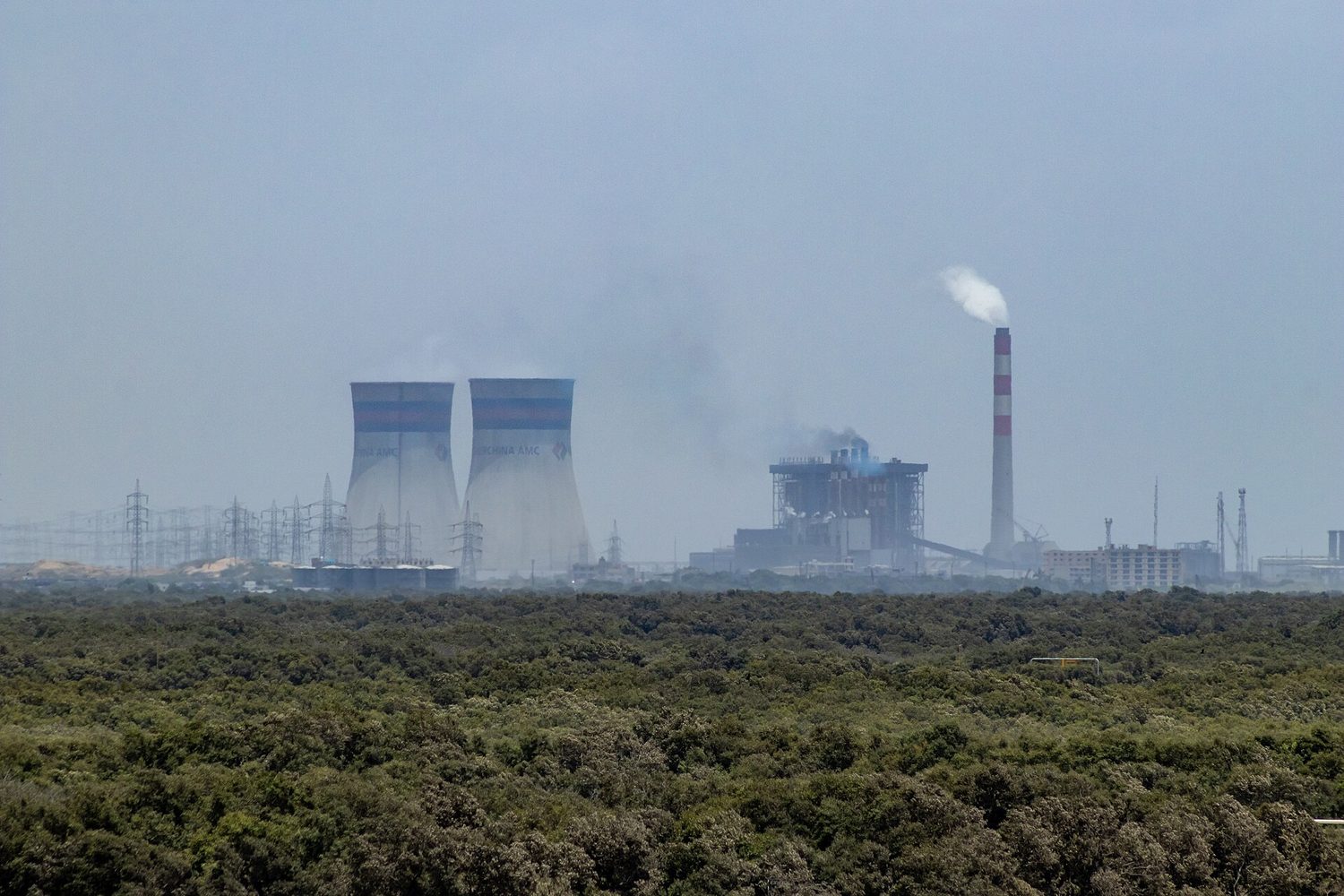
    محطة طاقة وموقع صناعي: يعتمد العرض الإجمالي قصير الأجل على تكاليف الإنتاج
    محطة طاقة وموقع صناعي: يعتمد العرض الإجمالي قصير الأجل على تكاليف الإنتاج

    عرض إجمالي قصير الأجل (SRAS) يتجه للأعلى: ففي قصير الأجل تكون بعض أسعار المدخلات (خاصة الأجور الاسمية) لا مرنة، لذا يؤدي ارتفاع مستوى أسعار المخرجات إلى توسيع هوامش الربح وإنتاج الشركات أكثر. وينزاح عرض SRAS بسبب أسعار المدخلات، والإنتاجية، والضرائب/بدائل الإنتاج، وصدمة العرض (مثل تغير سعر النفط). يؤدي ارتفاع تكاليف المدخلات إلى انزاحة SRAS لليسار.

    3.4

    Long-Run Aggregate Supply · ⁨العرض الإجمالي طويل الأجل⁩

    Syllabus · ⁨المنهج⁩
    English

    Enduring Understanding (MOD-2): Economists use the aggregate demand–aggregate supply model to represent the relationship between the price level and aggregate output in an economy and to illustrate how output, employment, and the price level respond to macroeconomic shocks.

    Learning Objective MOD-2.E: Define (using graphs as appropriate) the short run and the long run.

    • MOD-2.E.1 In the long run all prices and wages are fully flexible, while in the short run some input prices are fixed. A consequence of flexible long-run prices and wages is the lack of a long-run trade-off between inflation and unemployment.

    Learning Objective MOD-2.F: Define (using graphs as appropriate) the long-run aggregate supply (LRAS) curve.

    • MOD-2.F.1 The LRAS curve corresponds to the production possibilities curve (PPC) because they both represent maximum sustainable capacity. Maximum sustainable capacity is the total output an economic system will produce over a set period of time if all resources are fully employed. [See LO MOD-2.I]
    • MOD-2.F.2 The LRAS curve is vertical at the full-employment level of output because in the long run wages and prices fully adjust.
    العربية

    فهم دائم (MOD-2): يستخدم الاقتصاديون نموذج الطلب الكلي والعرض الكلي لتمثيل العلاقة بين المستوى العام للأسعار والإنتاج الكلي في اقتصاد ما، ولتوضيح كيف تستجيب الإنتاجية والتوظيف والمستوى العام للأسعار للصدمات الكلية.

    هدف التعلم MOD-2.E: عرّف (باستخدام الرسوم البيانية عند الحاجة) المدى القصير والمدى الطويل.

    • MOD-2.E.1 في المدى الطويل تكون جميع الأسعار والأجور مرنة تمامًا، بينما في المدى القصير بعض أسعار المدخلات ثابتة. ومن نتائج مرونة الأسعار والأجور طويلة الأجل عدم وجود مفاضلة طويلة الأجل بين التضخم والبطالة.

    هدف التعلم MOD-2.F: عرّف (باستخدام الرسوم البيانية عند الحاجة) منحنى العرض الكلي طويل الأجل (LRAS).

    • MOD-2.F.1 يتوافق منحنى LRAS مع منحنى إمكانيات الإنتاج (PPC) لأن كليهما يمثلان القدرة القصوى المستدامة. القدرة القصوى المستدامة هي إجمالي الإنتاج الذي سيقدمه النظام الاقتصادي خلال فترة زمنية محددة إذا تم توظيف جميع الموارد بالكامل. [انظر LO MOD-2.I]
    • MOD-2.F.2 يكون منحنى LRAS عموديًا عند مستوى التوظيف الكامل للإنتاج لأنه في المدى الطويل تتكيف الأجور والأسعار بالكامل.

    Source: College Board AP Course and Exam Description · ⁨المصدر: وصف دورة وامتحان College Board AP⁩

    English

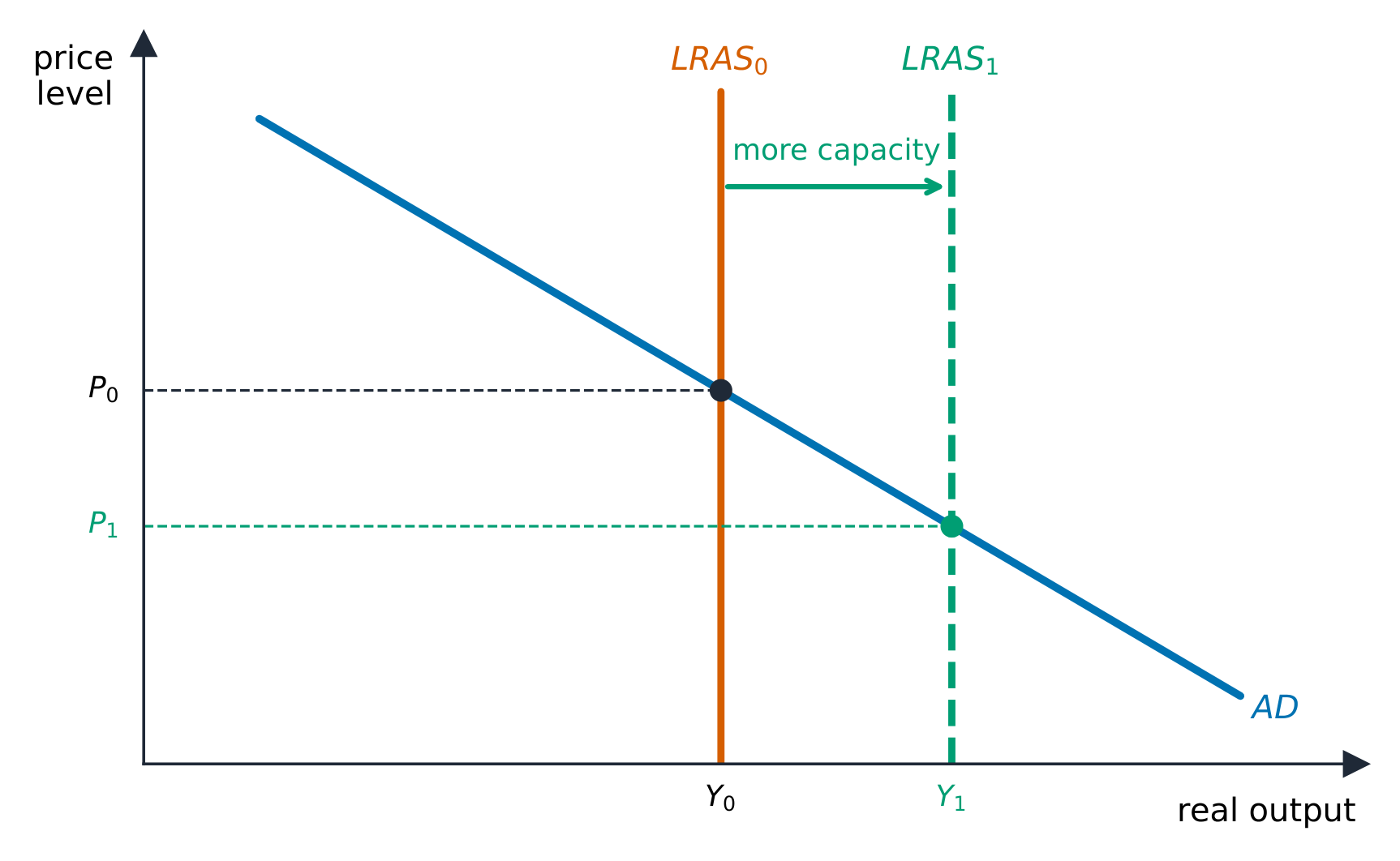
    Long-run aggregate supply (LRAS) 长期总供给 is vertical at the economy's full-employment (potential) output 潜在产出 $Y_f$. In the long run all prices and wages are fully flexible (only in the short run are some input prices fixed), so output depends only on real factors – resources, technology, institutions – not the price level. LRAS shifts only with economic growth (more or better resources). LRAS corresponds to the production possibilities curve (PPC) 生产可能性曲线: both mark the economy's maximum sustainable capacity, so an outward LRAS shift and an outward PPC shift are the same event drawn two ways. The vertical LRAS is why, in the long run, demand policy changes prices, not output.

    العربية

    عرض إجمالي طويل الأجل (LRAS) يكون عموديًا عند الناتج الكامل للتوظيف (ناتج الإمكانات) $Y_f$. وفي طويل الأجل تكون جميع الأسعار والأجور مرنة تمامًا (تبقى بعض أسعار المدخلات ثابتة فقط في قصير الأجل)، لذا يعتمد الناتج فقط على العوامل الحقيقية – الموارد، والتكنولوجيا، والمؤسسات – وليس على مستوى الأسعار. ينزاح LRAS فقط مع النمو الاقتصادي (زيادة أو تحسين الموارد). يرتبط LRAS بـمنحنى إمكانيات الإنتاج (PPC): فكل منهما يشير إلى الحد الأقصى للاستدامة للإنتاج في الاقتصاد، لذا فإن انزاحة LRAS للخارج وانزاحة PPC للخارج هما نفس الحدث مُصوَّرين بطريقتين. ومن هنا يأتي سبب كون منحنى LRAS عموديًا، sehingga في طويل الأجل، تؤدي سياسات الطلب إلى تغيير الأسعار لا الناتج.

    سياسة جانب العرض تنزح العرض الإجمالي طويل الأجل لليمين: زيادة في الناتج، انخفاض في الأسعار
    سياسة جانب العرض تنزح العرض الإجمالي طويل الأجل لليمين: زيادة في الناتج، انخفاض في الأسعار
    3.5

    Equilibrium in the AD-AS Model · ⁨التوازن في نموذج AD-AS⁩

    Syllabus · ⁨المنهج⁩
    English

    Enduring Understanding (MOD-2): Economists use the aggregate demand–aggregate supply model to represent the relationship between the price level and aggregate output in an economy and to illustrate how output, employment, and the price level respond to macroeconomic shocks.

    Learning Objective MOD-2.G: Explain (using graphs as appropriate) the short-run and long-run equilibrium price level and output level.

    • MOD-2.G.1 Short-run equilibrium occurs when the aggregate quantity of output demanded and the aggregate quantity of output supplied are equal—i.e., at the intersection of the AD and SRAS curves.
    • MOD-2.G.2 Long-run equilibrium occurs when the AD and SRAS curves intersect on the LRAS—i.e., at the full-employment level of real output.
    • MOD-2.G.3 The short-run equilibrium output can be at the full-employment level of output, above it, or below it, creating positive (i.e., inflationary) or negative (i.e., recessionary) output gaps.
    العربية

    فهم دائم (MOD-2): يستخدم الاقتصاديون نموذج الطلب الكلي والعرض الكلي لتمثيل العلاقة بين المستوى العام للأسعار والإنتاج الكلي في اقتصاد ما، ولتوضيح كيف تستجيب الإنتاجية والتوظيف والمستوى العام للأسعار للصدمات الكلية.

    هدف التعلم MOD-2.G: اشرح (باستخدام الرسوم البيانية عند الحاجة) المستوى العام للأسعار ومستوى الإنتاج في التوازن قصير الأجل وطويل الأجل.

    • MOD-2.G.1 يحدث التوازن قصير الأجل عندما تتساوى الكمية الكلية للإنتاج المطلوبة والكمية الكلية للإنتاج المعروضة - أي عند تقاطع منحنَيي AD و SRAS.
    • MOD-2.G.2 يحدث التوازن طويل الأجل عندما يتقاطع منحني AD و SRAS على منحنى LRAS - أي عند مستوى التوظيف الكامل للإنتاج الحقيقي.
    • MOD-2.G.3 يمكن أن يكون إنتاج التوازن قصير الأجل عند مستوى التوظيف الكامل للإنتاج، أو فوقه، أو تحته، مما يخلق فجوات إنتاجية إيجابية (أي تضخمية) أو سالبة (أي ركودية).

    Source: College Board AP Course and Exam Description · ⁨المصدر: وصف دورة وامتحان College Board AP⁩

    English

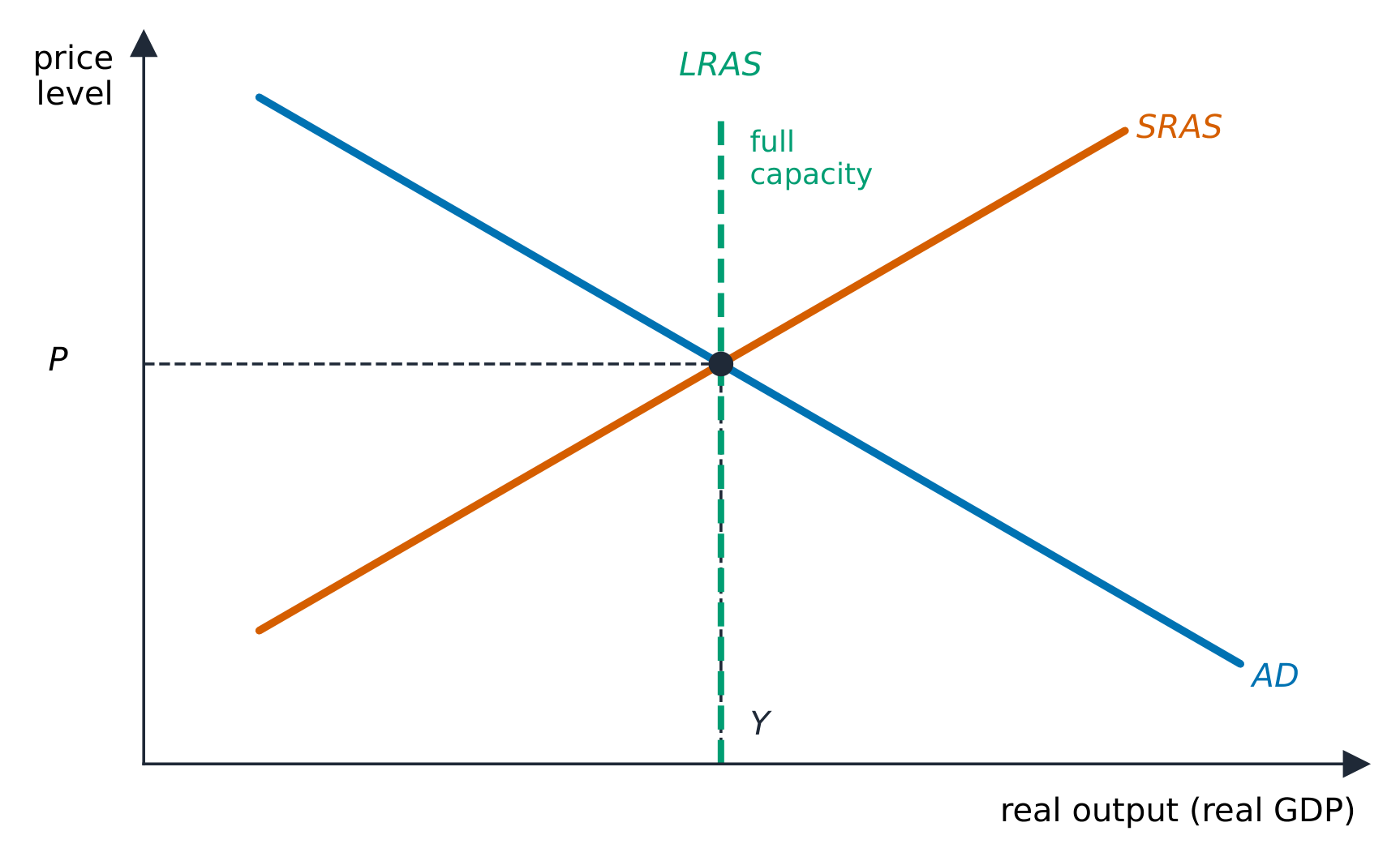
    The economy settles where AD meets SRAS, fixing the equilibrium price level and real GDP. Comparing that output to $Y_f$ (the LRAS line) gives the economy's state:

    • output $: a recessionary gap 衰退缺口 (cyclical unemployment),
    • output $>Y_f$: an inflationary gap 通胀缺口 (overheating),
    • output $=Y_f$: long-run equilibrium.
    العربية

    يستقر الاقتصاد حيث يقابل AD منحنى SRAS، مما يحدد مستوى الأسعار المتوازن والناتج المحلي الإجمالي الحقيقي. ومقارنة هذا الناتج بـ $Y_f$ (خط LRAS) يعطي حالة الاقتصاد:

    توازن ماكرواقتصادي حيث يقابل الطلب الإجمالي العرض الإجمالي
    توازن ماكرواقتصادي حيث يقابل الطلب الإجمالي العرض الإجمالي
    • ناتج $: فجوة ركود (بطالة دورية)،
    • ناتج $>Y_f$: فجوة تضخمية (احتراق اقتصادي)،
    • ناتج $=Y_f$: توازن طويل الأجل.
    Explore · ⁨استكشف⁩

    Find equilibrium in the AD-AS model · ⁨جد التوازن في نموذج AD-AS⁩

    Aggregate demand and aggregate supply cross at the economy's price level and real GDP. A demand or supply shock shifts a curve and moves the whole economy's output and prices. · ⁨الطلب الكلي والعرض الكلي يتقاطعان عند مستوى الأسعار والناتج المحلي الحقيقي للاقتصاد. صدمة طلب أو عرض تزاح منحنى وتحرك ناتج وأسعار الاقتصاد ككل.⁩

    3.6

    Short-Run Changes: Demand and Supply Shocks · ⁨التغيرات قصيرة الأجل: صدمات الطلب والعرض⁩

    Syllabus · ⁨المنهج⁩
    English

    Enduring Understanding (MOD-2): Economists use the aggregate demand–aggregate supply model to represent the relationship between the price level and aggregate output in an economy and to illustrate how output, employment, and the price level respond to macroeconomic shocks.

    Learning Objective MOD-2.H: Explain (using graphs as appropriate) the response of output, employment, and the price level to an aggregate demand or aggregate supply shock in the short run.

    • MOD-2.H.1 A positive (negative) shock in AD causes output, employment, and the price level to rise (fall) in the short run.
    • MOD-2.H.2 A positive (negative) shock in SRAS causes output and employment to rise (fall) and the price level to fall (rise) in the short run.
    • MOD-2.H.3 Inflation can be caused by changes in aggregate demand (demand-pull) or aggregate supply (cost-push).
    العربية

    فهم دائم (MOD-2): يستخدم الاقتصاديون نموذج الطلب الكلي والعرض الكلي لتمثيل العلاقة بين المستوى العام للأسعار والإنتاج الكلي في اقتصاد ما، ولتوضيح كيف تستجيب الإنتاجية والتوظيف والمستوى العام للأسعار للصدمات الكلية.

    هدف التعلم MOD-2.H: اشرح (باستخدام الرسوم البيانية عند الحاجة) استجابة الإنتاج والتوظيف والمستوى العام للأسعار لصدمة الطلب الكلي أو العرض الكلي في المدى القصير.

    • MOD-2.H.1 يؤدي الصدمة الإيجابية (السلبية) في الطلب الكلي إلى ارتفاع (انخفاض) الإنتاج والوظائف ومستوى الأسعار على المدى القصير.
    • MOD-2.H.2 تؤدي الصدمة الإيجابية (السلبية) في عرض العمل الكلي قصير الأجل إلى ارتفاع (انخفاض) الإنتاج والوظائف وانخفاض (ارتفاع) مستوى الأسعار على المدى القصير.
    • MOD-2.H.3 يمكن أن يحدث التضخم نتيجة لتغيرات في الطلب الكلي (الطلب الدافع) أو العرض الكلي (الدفع التكلفة).

    Source: College Board AP Course and Exam Description · ⁨المصدر: وصف دورة وامتحان College Board AP⁩

    English
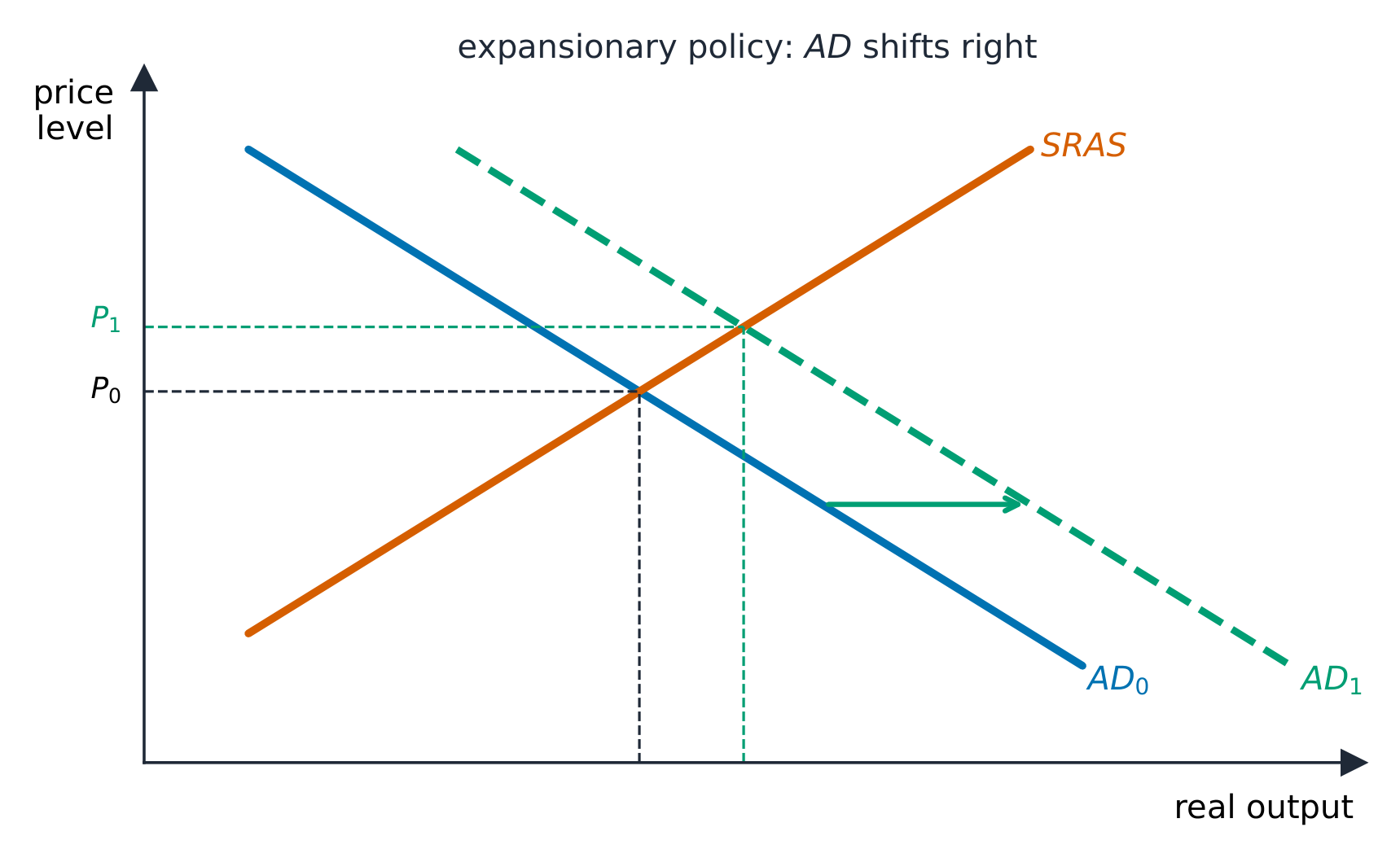
    • A demand shock shifts AD: a positive one (more spending) raises both price level and output (and lowers unemployment); a negative one lowers both.
    • A supply shock shifts SRAS: a negative one (higher input costs) raises the price level and lowers output at once – stagflation 滞胀 – the hardest case for policymakers, because fixing one worsens the other.
    العربية
    • صدمة الطلب تُزوح منحنى AD: إيجابية (زيادة الإنفاق) ترفع كلًا من مستوى الأسعار والناتج (وتقلل البطالة)؛ وسلبية تخفض الاثنين معًا.
    • صدمة العرض تُزوح منحنى SRAS: سلبية (ارتفاع تكاليف المدخلات) ترفع مستوى الأسعار وتخفض الناتج في آن واحد – ركود تضخمي – وهو أصعب scenario للمشرعين، لأن إصلاح أحدهما ي worsens الآخر.
    3.7

    Long-Run Self-Adjustment · ⁨التصحيح الذاتي طويل الأجل⁩

    Syllabus · ⁨المنهج⁩
    English

    Enduring Understanding (MOD-2): Economists use the aggregate demand–aggregate supply model to represent the relationship between the price level and aggregate output in an economy and to illustrate how output, employment, and the price level respond to macroeconomic shocks.

    Learning Objective MOD-2.I: Explain (using graphs as appropriate) the response of output, employment, and the price level to an aggregate demand or aggregate supply shock in the long run.

    • MOD-2.I.1 In the long run, in the absence of government policy actions, flexible wages and prices will adjust to restore full employment and unemployment will revert to its natural rate after a shock to aggregate demand or short-run aggregate supply. [See EK MEA-1.E.2]
    • MOD-2.I.2 Shifts in the long-run aggregate supply curve indicate changes in the full-employment level of output and economic growth.
    العربية

    فهم دائم (MOD-2): يستخدم الاقتصاديون نموذج الطلب الكلي والعرض الكلي لتمثيل العلاقة بين المستوى العام للأسعار والإنتاج الكلي في اقتصاد ما، ولتوضيح كيف تستجيب الإنتاجية والتوظيف والمستوى العام للأسعار للصدمات الكلية.

    هدف التعلم MOD-2.I: اشرح (باستخدام الرسوم البيانية عند الحاجة) استجابة الإنتاج والوظائف ومستوى الأسعار لصدمة الطلب الكلي أو العرض الكلي على المدى الطويل.

    • MOD-2.I.1 على المدى الطويل، وغياب إجراءات السياسة الحكومية، ستقوم الأجور والأسعار المرنة بالتكيف لاستعادة التوظيف الكامل وستعود البطالة إلى معدلها الطبيعي بعد صدمة في الطلب الكلي أو عرض العمل الكلي قصير الأجل. [راجع EK MEA-1.E.2]
    • MOD-2.I.2 تشير تحركات منحنى العرض الكلي طويل الأمد إلى تغيرات في مستوى التوظيف الكامل للإنتاج والنمو الاقتصادي.

    Source: College Board AP Course and Exam Description · ⁨المصدر: وصف دورة وامتحان College Board AP⁩

    English

    Left alone, the economy self-corrects through flexible wages:

    • In a recessionary gap, high unemployment eventually pushes nominal wages down, shifting SRAS right until output returns to $Y_f$ at a lower price level.
    • In an inflationary gap, labor shortages push wages up, shifting SRAS left back to $Y_f$ at a higher price level.

    The debate over how fast this happens is the case for (or against) active policy: self-adjustment is slow and painful, which is the argument for intervening.

    العربية

    مُتركًا لذاته، يصحح الاقتصاد نفسه تلقائيًا عبر مرونة الأجور:

    • في فجوة الركود، يؤدي البطالة المرتفعة في النهاية إلى انخفاض الأجور الاسمية، مما يُزوح SRAS ليمينًا حتى يعود الناتج إلى $Y_f$ عند مستوى أسعار أقل.
    • في الفجوة التضخمية، تؤدي نقص العمالة إلى ارتفاع الأجور، مما يُزوح SRAS يسارًا عائدًا إلى $Y_f$ عند مستوى أسعار أعلى.

    النقاش حول سرعة حدوث ذلك هو جوهر جدلية سياسة التدخل: فالتصحيح الذاتي بطيء ومؤلم، وهو ما يُقدم كحجة للتدخل.

    3.8

    Fiscal Policy · ⁨السياسة المالية⁩

    Syllabus · ⁨المنهج⁩
    English

    Enduring Understanding (POL-1): Fiscal and monetary policy have short-run effects on macroeconomic outcomes.

    Learning Objective POL-1.A: a. Define fiscal policy and related terms. b. Explain (using graphs as appropriate) the short-run effects of a fiscal policy action. c. Calculate the short-run effects of a fiscal policy action.

    • POL-1.A.1 Governments implement fiscal policies to achieve macroeconomic goals, such as full employment.
    • POL-1.A.2 The tools of fiscal policy are government spending and taxes/transfers.
    • POL-1.A.3 Changes in government spending affect aggregate demand directly, and changes in taxes/transfers affect aggregate demand indirectly.
    • POL-1.A.4 The government spending multiplier is greater than the tax multiplier.
    • POL-1.A.5 Expansionary or contractionary fiscal policies are used to restore full employment when the economy is in a negative (i.e., recessionary) or positive (i.e., inflationary) output gap.
    • POL-1.A.6 Fiscal policy can influence aggregate demand, real output, and the price level. [See also EK MKT-5.E.2 for the effect on exchange rates.]
    • POL-1.A.7 The AD–AS model is used to demonstrate the short-run effects of fiscal policy.

    Learning Objective POL-1.B: Define why there are lags to discretionary fiscal policy.

    • POL-1.B.1 In reality, there are lags to discretionary fiscal policy because of factors such as the time it takes to decide on and implement a policy action.
    العربية

    الفهم الدائم (POL-1): للسياسة المالية والنقدية تأثيرات قصيرة الأمد على النتائج الكلية للاقتصاد.

    هدف التعلم POL-1.A: أ. عرّف السياسة المالية والمصطلحات ذات الصلة. ب. اشرح (باستخدام الرسوم البيانية عند الحاجة) التأثيرات قصيرة الأمد لإجراء سياسة مالية. ج. احسب التأثيرات قصيرة الأمد لإجراء سياسة مالية.

    • POL-1.A.1 تطبق الحكومات السياسات المالية لتحقيق أهداف كلية للاقتصاد، مثل التوظيف الكامل.
    • POL-1.A.2 أدوات السياسة المالية هي الإنفاق الحكومي والضرائب/التحويلات.
    • POL-1.A.3 تؤثر التغييرات في الإنفاق الحكومي مباشرة على الطلب الكلي، بينما تؤثر التغييرات في الضرائب/التحويلات على الطلب الكلي بشكل غير مباشر.
    • POL-1.A.4 مضاعف الإنفاق الحكومي أكبر من مضاعف الضرائب.
    • POL-1.A.5 تُستخدم السياسات المالية التوسعية أو الانقباضية لاستعادة التوظيف الكامل عندما يكون الاقتصاد في فجوة إنتاج سلبية (أي انكماشية) أو إيجابية (أي تضخمية).
    • POL-1.A.6 يمكن للسياسة المالية أن تؤثر على الطلب الكلي والإنتاج الحقيقي ومستوى الأسعار. [راجع أيضًا EK MKT-5.E.2 فيما يتعلق بتأثيرها على أسعار الصرف.]
    • POL-1.A.7 يُستخدم نموذج الطلب الكلي وعرض العمل الكلي لإظهار التأثيرات قصيرة الأمد للسياسة المالية.

    هدف التعلم POL-1.B: عرّف أسباب وجود تأخر في السياسة المالية الاختيارية.

    • POL-1.B.1 في الواقع، هناك تأخر في السياسة المالية الاختيارية بسبب عوامل مثل الوقت المستغرق لاتخاذ قرار بشأن تنفيذ إجراء سياسي.

    Source: College Board AP Course and Exam Description · ⁨المصدر: وصف دورة وامتحان College Board AP⁩

    English

    Fiscal policy 财政政策 is the government's use of spending and taxes to shift AD:

    • Expansionary 扩张性 (more spending or lower taxes) shifts AD right to close a recessionary gap.
    • Contractionary 紧缩性 (less spending or higher taxes) shifts AD left to close an inflationary gap.

    Size the policy with the multipliers: to close a gap of a given size, the required change in spending is (gap) $\div$ (spending multiplier). Limits include time lags, crowding out (below), and political difficulty.

    Worked example. An economy has a $\$100$ billion recessionary gap and $MPC=0.75$ (spending multiplier $=\dfrac{1}{0.25}=4$). To close it, the government must raise spending by $\dfrac{\$100\text{ billion}}{4}=\$25$ billion. Using a tax cut instead (tax multiplier $-3$) would require a larger $\dfrac{100}{3}\approx\$33$ billion cut.

    Exam skill: you must draw the correctly labeled AD-AS graph, identify the gap, prescribe the right fiscal action and its direction, and often calculate the exact spending or tax change needed.

    العربية

    السياسة المالية هي استخدام الحكومة لـالإنفاق والضرائب لتحريك منحنى AD:

    السياسة المالية التوسعية تُزوح منحنى AD لليمين، رافعةً الناتج والأسعار
    السياسة المالية التوسعية تُزوح منحنى AD لليمين، رافعةً الناتج والأسعار
    • توسعية (زيادة الإنفاق أو خفض الضرائب) تُزوح منحنى AD ليمينًا لإغلاق فجوة الركود.
    • انقباضية (تقليل الإنفاق أو رفع الضرائب) تُزوح منحنى AD ليسارًا لإغلاق فجوة التضخم.

    تحديد حجم السياسة بالمضاعفات: لإغلاق فجوة بحجم معين، التغير المطلوب في الإنفاق هو (الفجوة) $\div$ (مضاعف الإنفاق). وتشمل الحدود التأخر الزمني، وإزاحة الموارد (أسفل)، وصعوبة سياسية.

    مثال محلول. اقتصاد لديه $\$100$ billion recessionary gap and $MPC=0.75$ (spending multiplier $=\dfrac{1}{0.25}=4$). To close it, the government must raise spending by $\dfrac{\$100\text{ billion}}{4}=\$25$ billion. Using a tax cut instead (tax multiplier $-3$) would require a larger $\dfrac{100}{3}\approx\$33$ مليار تخفيض.

    مهارة الامتحان: يجب أن ترسم رسمًا بيانيًا لـ AD-AS مع تسميات صحيحة، وتحديد الفجوة، واقتراح الإجراء المالي الصحيح واتجاهه، وغالبًا ما تحسب التغير الدقيق في الإنفاق أو الضرائب المطلوب.

    Vocabulary · ⁨مفردات⁩ Train · ⁨تدريب⁩
    English العربية
    Aggregate demand (AD)/ˈæɡrɪɡeɪt dɪˈmænd/ الإجماع الكلي (AD)
    price level/praɪs ˈlevl/ مستوى الأسعار
    wealth effect/welθ ɪˈfekt/ تأثير الثروة
    interest-rate effect/ˈɪntrest reɪt ɪˈfekt/ تأثير معدل الفائدة
    multiplier effect/ˌmʌltɪˈplaɪə ɪˈfekt/ تأثير المضاعف
    marginal propensity to consume/ˈmɑːdʒɪnl prəˈpensɪti tə kənˈsjuːm/ الميل الهامشي للاستهلاك
    marginal propensity to save/ˈmɑːdʒɪnl prəˈpensɪti tə seɪv/ الميل الحدي للادخار
    Short-run aggregate supply (SRAS)/ʃɔːt rʌn ˈæɡrɪɡeɪt səˈplaɪ/ الإجماع الكلي للعرض القصير (SRAS)
    nominal wages/ˈnɒmɪnl ˈweɪdʒɪz/ الأجور الاسمية
    sticky/ˈstɪki/ لزجة
    Long-run aggregate supply (LRAS)/lɒŋ rʌn ˈæɡrɪɡeɪt səˈplaɪ/ الإجماع الكلي للعرض الطويل (LRAS)
    full-employment (potential) output/fʊl emˈplɔɪmənt ˈaʊtpʊt/ إنتاج التشغيل الكامل (الإمكانات)
    production possibilities curve (PPC)/prəˈdʌkʃn ˌpɒsəˈbɪlɪtiz kɜːv/ منحنى إمكانيات الإنتاج (PPC)
    recessionary gap/rɪˈseʃənəri ɡæp/ فجوة انكماشية
    inflationary gap/ɪnˈfleɪʃənəri ɡæp/ فجوة تضخمية
    stagflation/stæɡˈfleɪʃn/ التضخم الركودي
    Fiscal policy/ˈfɪskl ˈpɒlɪsi/ السياسة المالية
    Expansionary/ekˈspænʃənəri/ توسعي
    Contractionary/kənˈtrækʃənəri/ انقباضي
    Automatic stabilizers/ˌɔːtəˈmætɪk ˈsteɪbəlaɪzəz/ المثبتات التلقائية
    discretionary/dɪˈskreʃənəri/ اختياري
    3.9

    Automatic Stabilizers · ⁨Stabilizers التلقائية⁩

    Syllabus · ⁨المنهج⁩
    English

    Enduring Understanding (POL-1): Fiscal and monetary policy have short-run effects on macroeconomic outcomes.

    Learning Objective POL-1.C: a. Define automatic stabilizers. b. Explain how automatic stabilizers moderate business cycles.

    • POL-1.C.1 Automatic stabilizers support the economy during recessions and help prevent the economy from being overheated during expansionary periods.
    • POL-1.C.2 Tax revenues decrease automatically as GDP falls, preventing consumption and the economy from falling further.
    • POL-1.C.3 Tax revenues increase automatically as GDP rises, slowing consumption and preventing the economy from overheating.
    • POL-1.C.4 Government policies, institutions, or agencies may also have social service programs whose transfer payments act as automatic stabilizers.
    العربية

    الفهم الدائم (POL-1): للسياسة المالية والنقدية تأثيرات قصيرة الأمد على النتائج الكلية للاقتصاد.

    هدف التعلم POL-1.C: أ. عرّف المستثباتات التلقائية. ب. اشرح كيف تخفف المستثباتات التلقائية من دورات الأعمال.

    • POL-1.C.1 تدعم المستثباتات التلقائية الاقتصاد أثناء فترات الركود وتساعد في منع الاقتصاد من السخونة الزائدة خلال فترات التوسع.
    • POL-1.C.2 تنخفض إيرادات الضرائب تلقائياً مع انخفاض الناتج المحلي الإجمالي، مما يمنع استهلاك المستهلكين والاقتصاد من الانخفاض أكثر.
    • POL-1.C.3 تزداد إيرادات الضرائب تلقائياً مع ارتفاع الناتج المحلي الإجمالي، مما يبطئ الاستهلاك ويمنع الاقتصاد من السخونة الزائدة.
    • POL-1.C.4 قد تمتلك سياسات الحكومة أو مؤسساتها أو وكالاتها أيضاً برامج خدمات اجتماعية تعمل فيها مدفوعات التحويل كمستثباتات تلقائية.

    Source: College Board AP Course and Exam Description · ⁨المصدر: وصف دورة وامتحان College Board AP⁩

    English

    Automatic stabilizers 自动稳定器 are features that dampen the cycle without new legislation. In a downturn, progressive taxes collect less and transfer payments (unemployment benefits, welfare) rise automatically – cushioning incomes and spending; in a boom they do the reverse. They soften the cycle and act instantly, avoiding the lags of discretionary 相机抉择 policy.

    العربية

    Stabilizers التلقائية هي خصائص تخفف من دورات الاقتصاد بدون تشريعات جديدة. في حالة الركود، تجمع ضرائب متدرجة أقل وترتفع المدفوعات الانتقالية (مثل إعانات البطالة والرفاهية) تلقائيًا – مما يخفف من تأثير على الدخل والإنفاق؛ وفي حالة الازدهار تفعل العكس. فهي تلطف الدورة وتعمل فورًا، متجنبًا تأخيرات السياسة التقديرية.

    3.9

    Exam tips · ⁨نصائح للامتحان⁩

    English
    • Aggregate demand slopes down for the wealth, interest-rate, and net-export effects; it shifts when $C$, $I$, $G$, or $X_n$ changes.
    • Compute the spending multiplier $\tfrac{1}{1-MPC}$ and the smaller, negative tax multiplier $-\tfrac{MPC}{1-MPC}$.
    • Draw a correctly labeled AD–AS graph, identify a recessionary or inflationary gap, and prescribe the right fiscal action.
    • Short-run AS slopes up (sticky wages); long-run AS is vertical at full-employment output.
    • Size a policy with the multipliers: required spending = gap ÷ spending multiplier.
    العربية
    • الطلب الكلي ينحدر لأسفل بسبب تأثير الثروة، وتأثير أسعار الفائدة، وتأثير الصادرات الصافية؛ وينزاح عندما تتغير $C$، $I$، $G$، أو $X_n$.
    • احسب مضاعف الإنفاق $\tfrac{1}{1-MPC}$ ومضاعف الضرائب الأصغر والسالب $-\tfrac{MPC}{1-MPC}$.
    • ارسم رسمًا بيانيًا لـ AD–AS بتسميات صحيحة، وحدد فجوة ركود أو تضخمية، واقترح الإجراء المالي المناسب.
    • منحنى العرض الكلي قصير الأجل يرتفع لأعلى (رواج الرواتب الثابتة)؛ ومنحنى العرض الكلي طويل الأجل يكون عموديًا عند مستوى الناتج عند full-employment.
    • حدد حجم السياسة باستخدام المضاعفات: الإنفاق المطلوب = الفجوة ÷ مضاعف الإنفاق.
  • 4

    Financial Sector · ⁨القطاع المالي⁩

    Watch lesson · ⁨شاهد الدرس⁩
    4.1

    Financial Assets · ⁨الأصول المالية⁩

    Syllabus · ⁨المنهج⁩
    English

    Enduring Understanding (MEA-3): Money makes it possible to compare the value of goods and services, and interest rates provide a measure of the price of money that is borrowed or saved.

    Learning Objective MEA-3.A: a. Define the principal attributes—liquidity, rate of return, and risk—associated with various classes of financial assets, including money. b. Explain the relationship between the price of previously issued bonds and interest rates.

    • MEA-3.A.1 The most liquid forms of money are cash and demand deposits.
    • MEA-3.A.2 Other financial assets people can hold in place of the most liquid forms of money include bonds (interest-bearing assets) and stocks (equity).
    • MEA-3.A.3 The price of previously issued bonds and interest rates on bonds are inversely related.
    • MEA-3.A.4 The opportunity cost of holding money is the interest that could have been earned from holding other financial assets such as bonds.
    العربية

    الفهم الدائم (MEA-3): يجعل المال من الممكن مقارنة قيمة السلع والخدمات، وتوفر أسعار الفائدة مقياساً لسعر المال المقترض أو الموفر.

    هدف التعلم MEA-3.A: أ. عرّف السمات الرئيسية—السيولة، ومعدل العائد، والمخاطر—المرتبطة بفئات مختلفة من الأصول المالية، بما في ذلك النقود. ب. اشرح العلاقة بين سعر السندات التي تم إصدارها مسبقاً وأسعار الفائدة.

    • MEA-3.A.1 الأشكال الأكثر سيولة للنقود هي النقد الورقي والودائع الجارية.
    • MEA-3.A.2 تشمل الأصول المالية الأخرى التي يمكن للأشخاص الاحتفاظ بها بدلاً من الأشكال الأكثر سيولة للنقود السندات (الأصول المحققة للفوائد) والأسهم (حقوق الملكية).
    • MEA-3.A.3 يرتبط سعر السندات التي تم إصدارها مسبقاً وأسعار الفائدة على السندات عكسياً.
    • MEA-3.A.4 تكلفة الفرصة البديلة لامتلاك النقود هي الفائدة التي كان يمكن كسبها من امتلاك أصول مالية أخرى مثل السندات.

    Source: College Board AP Course and Exam Description · ⁨المصدر: وصف دورة وامتحان College Board AP⁩

    English

    A financial asset 金融资产 is a claim that stores value: money, stocks 股票 (ownership shares), bonds 债券 (loans that pay interest), and bank deposits. Assets trade off liquidity 流动性 (how easily converted to cash), risk, and return. A key inverse relationship: bond prices and interest rates move in opposite directions – when market interest rates rise, existing bonds paying the old, lower rate are worth less, so their price falls.

    العربية

    الأصل المالي هو مطالبة تخزن القيمة: النقد، الأسهم (حصص ملكية)، السندات (قروض تدفع فائدة)، وإيداعات البنوك. تتوازن الأصول بين السيولة (سهولة تحويلها إلى نقد)، والمخاطر، والعائد. علاقة عكسية مهمة: أسعار السندات وأسعار الفائدة تتحرك في اتجاهين متعاكسين – عندما ترتفع أسعار الفائدة في السوق، تصبح السندات الحالية التي تدفع معدل الفائدة القديم المنخفض أقل قيمة،因此其价格下跌。

    ساحة التداول المزدحمة في بورصة نيويورك للأسهم
    بورصة الأسهم هي مكان يتم فيها شراء وبيع الأصول المالية، وتحديد الأسعار بناءً على العرض والطلب
    4.2

    Nominal versus Real Interest Rates · ⁨أسعار الفائدة الاسمية والحقيقية⁩

    Syllabus · ⁨المنهج⁩
    English

    Enduring Understanding (MEA-3): Money makes it possible to compare the value of goods and services, and interest rates provide a measure of the price of money that is borrowed or saved.

    Learning Objective MEA-3.B: a. Define the nominal and real interest rate. b. Explain the relationship between changes in nominal interest rates, expected inflation, and real interest rates. c. Calculate the nominal and real interest rate.

    • MEA-3.B.1 A nominal interest rate is the rate of interest paid for a loan, unadjusted for inflation.
    • MEA-3.B.2 Lenders and borrowers establish nominal interest rates as the sum of their expected real interest rate and expected inflation.
    • MEA-3.B.3 A real interest rate can be calculated in hindsight by subtracting the actual inflation rate from the nominal interest rate.
    العربية

    الفهم الدائم (MEA-3): يجعل المال من الممكن مقارنة قيمة السلع والخدمات، وتوفر أسعار الفائدة مقياساً لسعر المال المقترض أو الموفر.

    هدف التعلم MEA-3.B: أ. عرّف سعر الفائدة الاسمي وحقيقي. ب. اشرح العلاقة بين التغيرات في أسعار الفائدة الاسمية والتض的预期 الحقيقي وأسعار الفائدة الحقيقية. ج. احسب سعر الفائدة الاسمي والحقيقي.

    • MEA-3.B.1 سعر الفائدة الاسمي هو معدل الفائدة المدفوع قرض، غير معدّل للتضخم.
    • MEA-3.B.2 يحدد المقرضون والمقرضون أسعار الفائدة الاسمية كمجموع معدل الفائدة الحقيقي المتوقع والتض预期 الحقيقي.
    • MEA-3.B.3 يمكن حساب سعر الفائدة الحقيقي بعقب الأحداث عن طريق طرح معدل التض预期 الفعلي من سعر الفائدة الاسمي.

    Source: College Board AP Course and Exam Description · ⁨المصدر: وصف دورة وامتحان College Board AP⁩

    English
    • The nominal interest rate 名义利率 is the stated rate, not adjusted for inflation.
    • The real interest rate 实际利率 is what you actually earn in purchasing power:
    $$\text{real rate}\approx\text{nominal rate}-\text{inflation rate}\quad(\text{Fisher equation}).$$

    Lenders and borrowers care about the real rate. If inflation turns out higher than expected, real rates fall – helping borrowers and hurting lenders.

    Worked example. A loan carries a nominal rate of $6\%$ while inflation runs at $2\%$. The real rate is $6\%-2\%=4\%$, so the lender's purchasing power grows by $4\%$. If inflation instead jumped to $7\%$, the real rate would be $-1\%$ – the lender would actually lose purchasing power.

    العربية
    • سعر الفائدة الاسمي هو المعدل المعلن، غير معدّل حسب التضخم.
    • سعر الفائدة الحقيقي هو ما تكسبه فعليًا من حيث القدرة الشرائية:
    $$\text{real rate}\approx\text{nominal rate}-\text{inflation rate}\quad(\text{Fisher equation}).$$

    الدائرون والمدينون يهتمون بالمعدل الحقيقي. إذا تبين أن التضخم أعلى من المتوقع، تنخفض معدلات الفائدة الحقيقية – مما يساعد المدينين ويضر الدائرين.

    مثال محلول. قرض يحمل معدل اسمي $6\%$ بينما التضخم يتراوح عند $2\%$. المعدل الحقيقي هو $6\%-2\%=4\%$، لذلك تنمو قدرة الدائن الشرائية بمقدار $4\%$. لو قفز التضخم بدلاً من ذلك إلى $7\%$، ليصبح المعدل الحقيقي $-1\%$ – مما يعني أن الدائن سيخسر فعليًا في قدرته الشرائية.

    4.3

    The Definition, Measurement, and Functions of Money · ⁨التعريف والقياس والوظائف للنقد⁩

    Syllabus · ⁨المنهج⁩
    English

    Enduring Understanding (MEA-3): Money makes it possible to compare the value of goods and services, and interest rates provide a measure of the price of money that is borrowed or saved.

    Learning Objective MEA-3.C: a. Define money and its functions. b. Calculate (using data as appropriate) measures of money.

    • MEA-3.C.1 Money is any asset that is accepted as a means of payment.
    • MEA-3.C.2 Money serves as a medium of exchange, unit of account, and store of value.
    • MEA-3.C.3 The money supply is measured using monetary aggregates designated as M1 and M2.
    • MEA-3.C.4 The monetary base (often labeled as M0 or MB) includes currency in circulation and bank reserves.
    العربية

    الفهم الدائم (MEA-3): يجعل المال من الممكن مقارنة قيمة السلع والخدمات، وتوفر أسعار الفائدة مقياساً لسعر المال المقترض أو الموفر.

    هدف التعلم MEA-3.C: أ. عرّف النقود ووظائفها. ب. احسب (باستخدام البيانات عند الحاجة) مقاييس النقود.

    • MEA-3.C.1 النقود هي أي أصل يتم قبوله كوسيلة للدفع.
    • MEA-3.C.2 تعمل النقود كوسيط للتبادل، ووحدة للحساب، ومخزن للقيمة.
    • MEA-3.C.3 يُقاس عرض النقود باستخدام المجاميع النقدية المحددة باسم M1 وM2.
    • MEA-3.C.4 يشمل الأساس النقدي (يُشار إليه غالباً بـ M0 أو MB) العملة المتداولة واحتياطيات البنوك.

    Source: College Board AP Course and Exam Description · ⁨المصدر: وصف دورة وامتحان College Board AP⁩

    English

    Money 货币 is anything widely accepted in exchange. Its three functions: a medium of exchange 交换媒介 (avoids barter), a unit of account 记账单位 (a common measure of value), and a store of value 价值储藏 (holds value over time). Modern money is fiat money 法定货币 – valuable because the government declares it legal tender and people trust it, not because it is backed by gold.

    Money is measured in tiers by liquidity: M1 (currency plus checkable deposits – the most liquid) and the broader M2 (M1 plus savings deposits and other near-money). Below M1 is the monetary base 基础货币 (M0, or MB) – currency in circulation plus bank reserves. The money multiplier equals money supply ÷ monetary base, so a central-bank action that raises reserves expands the money supply by a larger amount through the multiplier.

    العربية

    النقد هو أي شيء مقبول على نطاق واسع في المقايضة. وظائفه الثلاثة: وسيط للتبادل (يتجنب المقايضة)، وحدة للحساب (مقياس مشترك للقيمة)، ومخزن للقيمة (يحفظ قيمته عبر الزمن). النقد الحديث هو نقد قانوني (fiat money) – قيمته ناشئة عن إعلان الحكومة أنه عملة شرعية وثقة الناس فيه، وليس لأنه مدعوم بالذهب.

    وظائف النقود؛ يختبر امتحان AP الوظائف الثلاث الأولى
    وظائف النقد – يختبر امتحان AP الوظائف الثلاث الأولى (وسيط للتبادل، وحدة للحساب، مخزن للقيمة)؛ معيار الدفع المؤجل خارج نطاق CED

    يُقاس النقد في مستويات حسب السيولة: M1 (النقد Plus إيداعات_checks – الأكثر سيولة) والأوسع M2 (M1 Plus إيداعات توفير وأموال قريبة أخرى). أسفل M1 يوجد القاعدة النقدية (M0, or MB) – النقد المتداول Plus احتياطيات البنوك. مضاعف النقدي يساوي عرض النقود ÷ القاعدة النقدية، لذا فإن إجراء البنك المركزي الذي يرفع الاحتياطيات يوسع عرض النقود بمقدار أكبر من خلال المضاعف.

    مجموعة من الأوراق النقدية يورو ذات قيم مختلفة
    النقد يعمل لأن الجميع يقبلونه: وحدة حساب مشتركة، وسيط للتبادل، ومخزن للقيمة
    Vocabulary · ⁨مفردات⁩ Train · ⁨تدريب⁩
    English العربية
    financial asset/faɪˈnænʃl ˈæset/ الأصل المالي
    stocks/stɒks/ المخزون
    bonds/bɒndz/ السندات
    liquidity/lɪˈkwɪdɪti/ السيولة
    nominal interest rate/ˈnɒmɪnl ˈɪntrest reɪt/ معدل الفائدة الاسمي
    real interest rate/rɪəl ˈɪntrest reɪt/ معدل الفائدة الحقيقي
    Money/ˈmʌni/ المال
    medium of exchange/ˈmiːdɪəm ɒv eksˈtʃeɪndʒ/ وسيط للتبادل
    unit of account/ˈjuːnɪt ɒv əˈkaʊnt/ وحدة حساب
    store of value/stɔː ɒv ˈvæljuː/ مخزن للقيمة
    fiat money/ˈfiːət ˈmʌni/ النقد法定
    monetary base/ˈmʌnɪtəri beɪs/ القاعدة النقدية
    fractional reserve/ˈfrækʃənl rɪˈzɜːv/ احتياطي جزئي
    4.4

    Banking and the Expansion of the Money Supply · ⁨البنوك وتوسيع عرض النقود⁩

    Syllabus · ⁨المنهج⁩
    English

    Enduring Understanding (POL-2): The banking system plays an important role in the expansion of the money supply.

    Learning Objective POL-2.A: a. Define key terms related to the banking system and the expansion of the money supply. b. Explain how the banking system creates and expands the money supply. c. Calculate (using data and balance sheets as appropriate) the effects of changes in the banking system.

    • POL-2.A.1 Depository institutions (such as commercial banks) organize their assets and liabilities on balance sheets.
    • POL-2.A.2 Depository institutions operate using fractional reserve banking.
    • POL-2.A.3 Banks' reserves are divided into required reserves and excess reserves.
    • POL-2.A.4 Excess reserves are the basis of expansion of the money supply by the banking system.
    • POL-2.A.5 The money multiplier is the ratio of the money supply to the monetary base.
    • POL-2.A.6 The size of expansion of the money supply depends on the money multiplier.
    • POL-2.A.7 The maximum value of the money multiplier can be calculated as the reciprocal of the required reserve ratio.
    • POL-2.A.8 The amount predicted by the simple money multiplier may be overstated because it does not take into account a bank's desire to hold excess reserves or the public holding more currency.
    العربية

    الفهم الدائم (POL-2): يلعب النظام البنكي دورًا مهمًا في توسيع عرض النقود.

    هدف التعلم POL-2.A: أ. تعريف المصطلحات الرئيسية المتعلقة بالنظام البنكي وتوسيع عرض النقود. ب. شرح كيف يقوم النظام البنكي بإنشاء وتوسيع عرض النقود. ج. حساب (باستخدام البيانات والموازنات عند الحاجة) تأثير التغيرات في النظام البنكي.

    • POL-2.A.1 المؤسسات الإيداعية (مثل البنوك التجارية) تنظم أصولها والتزاماتها في موازنتها.
    • POL-2.A.2 تعمل المؤسسات الإيداعية بنظام الاحتياطي الكسري.
    • POL-2.A.3 تنقسم احتياطيات البنوك إلى احتياطيات إلزامية واحتياطيات فائقة.
    • POL-2.A.4 تمثل الاحتياطيات الفائقة أساس توسيع عرض النقود من قبل النظام البنكي.
    • POL-2.A.5 مضروب النقود هو نسبة عرض النقود إلى الأساس النقدي.
    • POL-2.A.6 يعتمد حجم توسيع عرض النقود على مضروب النقود.
    • POL-2.A.7 يمكن حساب القيمة القصوى لمضروب النقود كمقلوب نسبة الاحتياطي الإلزامي.
    • POL-2.A.8 قد يكون المقدار المتوقع بمضروب النقود البسيط مبالغًا فيه لأنه لا يأخذ في الاعتبار رغبة البنك في الاحتفاظ باحتياطيات فائقة أو احتفاظ العامة بكميات أكبر من النقد.

    Source: College Board AP Course and Exam Description · ⁨المصدر: وصف دورة وامتحان College Board AP⁩

    English

    Banks operate on a fractional reserve 部分准备金 system: they keep a fraction of deposits as reserves 准备金 and lend the rest. The fraction they must keep is the required reserve ratio 法定准备金率 (rr). Lending creates new deposits, which are re-deposited and re-lent, expanding the money supply by the money multiplier:

    $$\text{money multiplier}=\frac{1}{rr}.$$

    A new $1000 deposit with$rr=0.1$leaves$$900$in excess reserves, so the banking system can expand the money supply by up to$900\times\frac{1}{0.1}=9,000$. Use a bank's T-account (assets = reserves + loans; liabilities = deposits) to track required reserves and excess reserves 超额准备金 (the amount available to lend).

    Worked example. A bank receives a $\$1000$ deposit with $rr=0.20$. It must hold $0.20\times1000=\$200$ as required reserves, leaving $\$800$ of excess reserves to lend. With a money multiplier of $\dfrac{1}{0.20}=5$, that $\$800$ of new lending can expand the money supply by up to $800\times5=\$4000$ across the banking system.

    Exam skill: given a required reserve ratio and a deposit, compute excess reserves, the money multiplier, and the maximum change in the money supply.

    العربية

    تعمل البنوك بنظام احتياطي كسري: تحتفظ بجزء من الإيداعات كـ احتياطيات وتقترض الباقي. الجزء الذي يجب أن تحتفظ به هو نسبة الاحتياطي الإلزامي (rr). يخلق الإقراض إيداعات جديدة، والتي تعاد إيداعها والإقراض مرة أخرى، مما يوسع عرض النقود بواسطة مضاعف النقود:

    $$\text{money multiplier}=\frac{1}{rr}.$$

    جديد $1000 deposit with$rr=0.1$leaves$$900$في فائض الاحتياطيات، لذا يمكن للنظام البنكي توسيع عرض النقود حتى$900\times\frac{1}{0.1}=9,000$. استخدم حساب T للبنك (الأصول = احتياطيات + قروض؛ الخصوم = إيداعات) لتتبع الاحتياطيات الإلزامية وفائض الاحتياطيات (المبلغ المتاح للإقراض).

    مثال محلول. بنك يستقبل $\$1000$ deposit with $rr=0.20$. It must hold $0.20\times1000=\$200$ كاحتياطيات إلزامية، تاركاً $\$800$ of excess reserves to lend. With a money multiplier of $\dfrac{1}{0.20}=5$, that $\$800$ من القروض الجديدة يمكن أن توسع عرض النقود حتى $800\times5=\$4000$ عبر النظام البنكي.

    مهارة الامتحان: مع نسبة الاحتياطي الإلزامي وإيداع، احسب فائض الاحتياطيات، ومضاعف النقود، والتغير الأقصى في عرض النقود.

    Explore · ⁨استكشف⁩

    See banks multiply deposits · ⁨شاهد البنوك تضاعود الودائع⁩

    Banks keep a fraction of deposits as reserves and lend the rest, which is redeposited and lent again — the money multiplier expands the money supply from the initial deposit. · ⁨تحتفظ البنوك بكسر من الودائع كاحتياطيات وتقرض الباقي، الذي يُودع مجدداً ويُقرض مرة أخرى — مضاعف النقود يوسع عرض النقد من الوديعة الأولية.⁩

    Vocabulary · ⁨مفردات⁩ Train · ⁨تدريب⁩
    English العربية
    reserves/rɪˈzɜːvz/ الاحتياطيات
    required reserve ratio/rɪˈkwaɪəd rɪˈzɜːv ˈreɪʃɪəʊ/ نسبة الاحتياطي الإلزامي
    excess reserves/ekˈses rɪˈzɜːvz/ الاحتياطيات الزائدة
    4.5

    The Money Market · ⁨سوق النقود⁩

    Syllabus · ⁨المنهج⁩
    English

    Enduring Understanding (MKT-3): In the money market, demand for and supply of money determine the equilibrium nominal interest rate and influence the value of other financial assets.

    Learning Objective MKT-3.A: a. Define (using graphs as appropriate) the money market, money demand, and money supply. b. Explain (using graphs as appropriate) the relationship between the nominal interest rate and the quantity of money demanded (supplied).

    • MKT-3.A.1 The demand for money shows the inverse relationship between the nominal interest rate and the quantity of money people want to hold.
    • MKT-3.A.2 Given a monetary base determined by a country's central bank, money supply is independent of the nominal interest rate.

    Learning Objective MKT-3.B: Define (using graphs as appropriate) equilibrium in the money market.

    • MKT-3.B.1 In the money market, equilibrium is achieved when the nominal interest rate is such that the quantities demanded and supplied of money are equal.

    Learning Objective MKT-3.C: Explain (using graphs as appropriate) how nominal interest rates adjust to restore equilibrium in the money market.

    • MKT-3.C.1 Disequilibrium nominal interest rates create surpluses and shortages in the money market. Market forces drive nominal interest rates toward equilibrium.

    Learning Objective MKT-3.D: a. Explain (using graphs as appropriate) the determinants of demand and supply in the money market. b. Explain (using graphs as appropriate) how changes in demand and supply in the money market affect the equilibrium nominal interest rate.

    • MKT-3.D.1 Factors that shift the demand for money, such as changes in the price level, and supply of money, such as monetary policy, change the equilibrium nominal interest rate.
    العربية

    الفهم الدائم (MKT-3): في سوق النقود، يحدد الطلب على النقود وعرضها معدل الفائدة الاسمي المتوازن ويؤثر في قيمة الأصول المالية الأخرى.

    هدف التعلم MKT-3.A: أ. تعريف (باستخدام الرسوم البيانية عند الحاجة) سوق النقود، وطلب النقود، وعرض النقود. ب. شرح (باستخدام الرسوم البيانية عند الحاجة) العلاقة بين معدل الفائدة الاسمي والكمية المطلوبة (المقدرة) من النقود.

    • MKT-3.A.1 يظهر طلب النقود العلاقة العكسية بين معدل الفائدة الاسمي والكمية التي يرغب الناس في امتلاكها من النقود.
    • MKT-3.A.2 بناءً على أساس نقدي تحدده بنك البلاد المركزي، يكون عرض النقود مستقلاً عن معدل الفائدة الاسمي.

    هدف التعلم MKT-3.B: تعريف (باستخدام الرسوم البيانية عند الحاجة) التوازن في سوق النقود.

    • MKT-3.B.1 في سوق النقود، يتحقق التوازن عندما يكون معدل الفائدة الاسمي بحيث تتساوى الكميات المطلوبة والمقدرة من النقود.

    هدف التعلم MKT-3.C: شرح (باستخدام الرسوم البيانية عند الحاجة) كيفية ضبط معدلات الفائدة الاسمية لاستعادة التوازن في سوق النقود.

    • MKT-3.C.1 تُحدث معدلات الفائدة الاسمية غير المتوازنة فوائض ونقصاً في سوق النقود. تدفع قوى السوق معدلات الفائدة الاسمية نحو التوازن.

    هدف التعلم MKT-3.D: أ. شرح (باستخدام الرسوم البيانية عند الحاجة) محددات الطلب والعرض في سوق النقود. ب. شرح (باستخدام الرسوم البيانية عند الحاجة) كيف تؤثر التغيرات في الطلب والعرض في سوق النقود على معدل الفائدة الاسمي المتوازن.

    • MKT-3.D.1 العوامل التي تحرك منحنى طلب النقود، مثل تغيرات مستوى الأسعار، وعوامل تحرك منحنى عرض النقود، مثل السياسة النقدية، تغير معدل الفائدة الاسمي المتوازن.

    Source: College Board AP Course and Exam Description · ⁨المصدر: وصف دورة وامتحان College Board AP⁩

    English
    The money market sets the interest rate

    The money market 货币市场 determines the nominal interest rate:

    • Money demand 货币需求 slopes downward against the interest rate – the rate is the opportunity cost of holding money instead of interest-bearing assets. It shifts right with a higher price level or more real GDP.
    • Money supply 货币供给 is vertical – set by the central bank, independent of the interest rate.

    Their intersection sets the equilibrium interest rate. If the central bank increases the money supply, the supply line shifts right and the interest rate falls.

    العربية
    سوق النقود يحدد سعر الفائدة

    يحدد سوق النقود سعر الفائدة الاسمي:

    يتم تحديد معدل الفائدة من خلال الطلب على النقود وعرضها
    سعر الفائدة يُحدد بطلب وعرض النقود
    • طلب النقود ينحدر لأسفل مقابل سعر الفائدة – فالسعر هو تكلفة الفرصة البديلة لحفظ النقود بدلاً من الأصول المدفوعة للفائدة. ينزاح لليمين مع ارتفاع مستوى الأسعار أو زيادة الناتج المحلي الحقيقي.
    • عرض النقود عمودي – محددة من قبل البنك المركزي، ومستقلة عن سعر الفائدة.

    تحدد تقاطعاتها معدل الفائدة في حالة التوازن. إذا زادت البنك المركزي من عرض النقود، تنزاح منحنى العرض إلى اليمين وينخفض معدل الفائدة.

    Explore · ⁨استكشف⁩

    Equilibrium in the money market · ⁨توازن سوق النقود⁩

    The money market sets the interest rate where money demand meets the central bank's money supply. A change in the money supply moves the interest rate. · ⁨سوق النقود يحدد نسبة الفائدة حيث يصل طلب النقود إلى عرض النقد من البنك المركزي. تغيير في عرض النقود يحرك نسبة الفائدة.⁩

    Vocabulary · ⁨مفردات⁩ Train · ⁨تدريب⁩
    English العربية
    money market/ˈmʌni ˈmɑːkɪt/ سوق النقود
    Money demand/ˈmʌni dɪˈmænd/ طلب النقود
    Money supply/ˈmʌni səˈplaɪ/ عرض النقود
    Monetary policy/ˈmʌnɪtəri ˈpɒlɪsi/ السياسة النقدية
    Expansionary (easy)/ekˈspænʃənəri/ توسعي (سهل)
    Contractionary (tight)/kənˈtrækʃənəri/ انقباضي (مشدد)
    open-market operations/ˈəʊpən ˈmɑːkɪt ˌɒpəˈreɪʃnz/ عمليات السوق المفتوحة
    discount rate/ˈdɪskaʊnt reɪt/ معدل الخصم
    interest on reserves (IOR)/ˈɪntrest ɒn rɪˈzɜːvz/ الفائدة على الاحتياطيات (IOR)
    policy rate/ˈpɒlɪsi reɪt/ معدل السياسة
    loanable funds market/ˈləʊnəbl fʌndz ˈmɑːkɪt/ سوق الأموال القابلة للإقراض
    national savings/ˈnæʃənl ˈseɪvɪŋz/ الادخار الوطني
    4.6

    Monetary Policy · ⁨السياسة النقدية⁩

    Syllabus · ⁨المنهج⁩
    English

    Enduring Understanding (POL-1): Fiscal and monetary policy have short-run effects on macroeconomic outcomes.

    Learning Objective POL-1.D: a. Define monetary policy and related terms. b. Explain (using graphs as appropriate) the short-run effects of a monetary policy action. c. Calculate (using data and balance sheets as appropriate) the effects of a monetary policy action.

    • POL-1.D.1 Central banks implement monetary policies to achieve macroeconomic goals, such as price stability.
    • POL-1.D.2 The tools of monetary policy may include the central bank's discount rate and other administered interest rates (e.g., interest on reserves), open market operations, and the required reserve ratio. The tools used and the way in which they are implemented differ between economies that have limited reserves in their banking system and economies that have ample reserves in their banking system. (The banking system in the United States has ample reserves, and the Federal Reserve's key policy tool is interest on reserves.)
    • POL-1.D.3 When the central bank conducts an open-market purchase (sale), reserves increase (decrease), thereby increasing (decreasing) the monetary base.
    • POL-1.D.4 When the central bank conducts an open-market purchase (sale) in an economy with limited reserves, the effect on the money supply is greater than the effect on the monetary base because of the money multiplier.
    • POL-1.D.5 Many central banks carry out policy to hit a target range for an overnight interbank lending rate, sometimes referred to as the central bank's policy rate. (In the United States, this is the federal funds rate.)
    • POL-1.D.6 Central banks can influence the nominal interest rate in the short run, which in turn will affect investment and consumption. [See also EK MKT-5.G.2 for the influence on net capital inflows.] In an economy with limited reserves, the central bank can influence the nominal interest rate by changing the money supply. In an economy with ample reserves, changes in the money supply do not effectively change the nominal interest rate; instead, the central bank can influence the nominal interest rate by changing its administered interest rates.
    • POL-1.D.7 Expansionary or contractionary monetary policies are used to restore full employment when the economy is in a negative (i.e., recessionary) or positive (i.e., inflationary) output gap.
    • POL-1.D.8 Monetary policy can influence interest rates, aggregate demand, real output, and the price level. [See also EK MKT-5.E.3 for the effect on exchange rates.]
    • POL-1.D.9 A money market model, a reserve market model, and/or the AD–AS model may be used to demonstrate the short-run effects of monetary policy.

    Learning Objective POL-1.E: Define why there are lags to monetary policy.

    • POL-1.E.1 In reality, there are lags to monetary policy caused by the time it takes to recognize a problem in the economy and the time it takes the economy to adjust to the policy action.
    العربية

    الفهم الدائم (POL-1): للسياسة المالية والنقدية تأثيرات قصيرة الأمد على النتائج الكلية للاقتصاد.

    هدف التعلم POL-1.D: أ. تعريف السياسة النقدية والمصطلحات ذات الصلة. ب. شرح (باستخدام الرسوم البيانية عند الحاجة) الآثار قصيرة المدى لإجراء سياسي نقدي. ج. حساب (باستخدام البيانات والموازنات عند الحاجة) آثار إجراء سياسي نقدي.

    • POL-1.D.1 تطبق البنوك المركزية سياسات نقدية لتحقيق أهداف اقتصادية كلية، مثل استقرار الأسعار.
    • POL-1.D.2 قد تشمل أدوات السياسة النقدية سعر الخصم للبنك المركزي ومعدلات الفائدة المدارة الأخرى (مثل الفائدة على الاحتياطيات)، والعمليات السوقية المفتوحة، ونسبة الاحتياطي الإلزامي. تختلف الأدوات المستخدمة وكيفية تطبيقها بين الاقتصادات التي تمتلك احتياطيات محدودة في نظامها البنكي والاقتصادات التي تمتلك احتياطيات وفيرة في نظامها البنكي. (النظام البنكي في الولايات المتحدة يمتلك احتياطيات وفيرة، وأداة السياسة الأساسية للبنك المركزي الأمريكي هي الفائدة على الاحتياطيات.)
    • POL-1.D.3 عندما ينفذ البنك المركزي عملية شراء (بيع) في السوق المفتوح، تزداد (تتناقص) الاحتياطيات، مما يؤدي إلى زيادة (نقصان) الأساس النقدي.
    • POL-1.D.4 عندما ينفذ البنك المركزي عملية شراء (بيع) في السوق المفتوح في اقتصاد ذي احتياطيات محدودة، يكون التأثير على عرض النقود أكبر من التأثير على الأساس النقدي بسبب مضروب النقود.
    • POL-1.D.5 تقوم العديد من البنوك المركزية بتنفيذ سياسة للوصول إلى نطاق مستهدف لمعدل القروض الليلي بين البنوك، والذي يُشار أحيانًا إلى معدل السياسة النقدية للبنك المركزي. (في الولايات المتحدة، هذا هو معدل الأموال الفيدرالية.)
    • POL-1.D.6 يمكن للبنوك المركزية التأثير على معدل الفائدة الاسمي على المدى القصير، مما بدوره يؤثر على الاستثمار والاستهلاك. [انظر أيضًا EK MKT-5.G.2 فيما يتعلق بالتأثير على صافي التدفقات الرأسمالية الداخلة.] في اقتصاد ذي احتياطيات محدودة، يمكن للبنك المركزي التأثير على معدل الفائدة الاسمي عن طريق تغيير عرض النقود. في اقتصاد ذي احتياطيات وفيرة، لا تؤدي التغيرات في عرض النقود إلى تغيير فعال في معدل الفائدة الاسمي؛ بدلاً من ذلك، يمكن للبنك المركزي التأثير على معدل الفائدة الاسمي عن طريق تغيير معدلات فائدته المدارة.

    • POL-1.D.7 تُستخدم السياسات النقدية التوسعية أو الانكماشية لاستعادة العمالة الكاملة عندما يكون الاقتصاد في فجوة ناتج سلبية (أي انكماشية) أو إيجابية (أي تضخمية).
    • POL-1.D.8 يمكن للسياسة النقدية أن تؤثر على أسعار الفائدة والطلب الكلي والإنتاج الحقيقي ومستوى الأسعار. [انظر أيضًا EK MKT-5.E.3 فيما يتعلق بالتأثير على أسعار الصرف.]
    • POL-1.D.9 يمكن استخدام نموذج سوق النقود، ونموذج سوق الاحتياطيات و/أو نموذج الطلب الكلي-العرض الكلي لإظهار الآثار قصيرة المدى للسياسة النقدية.
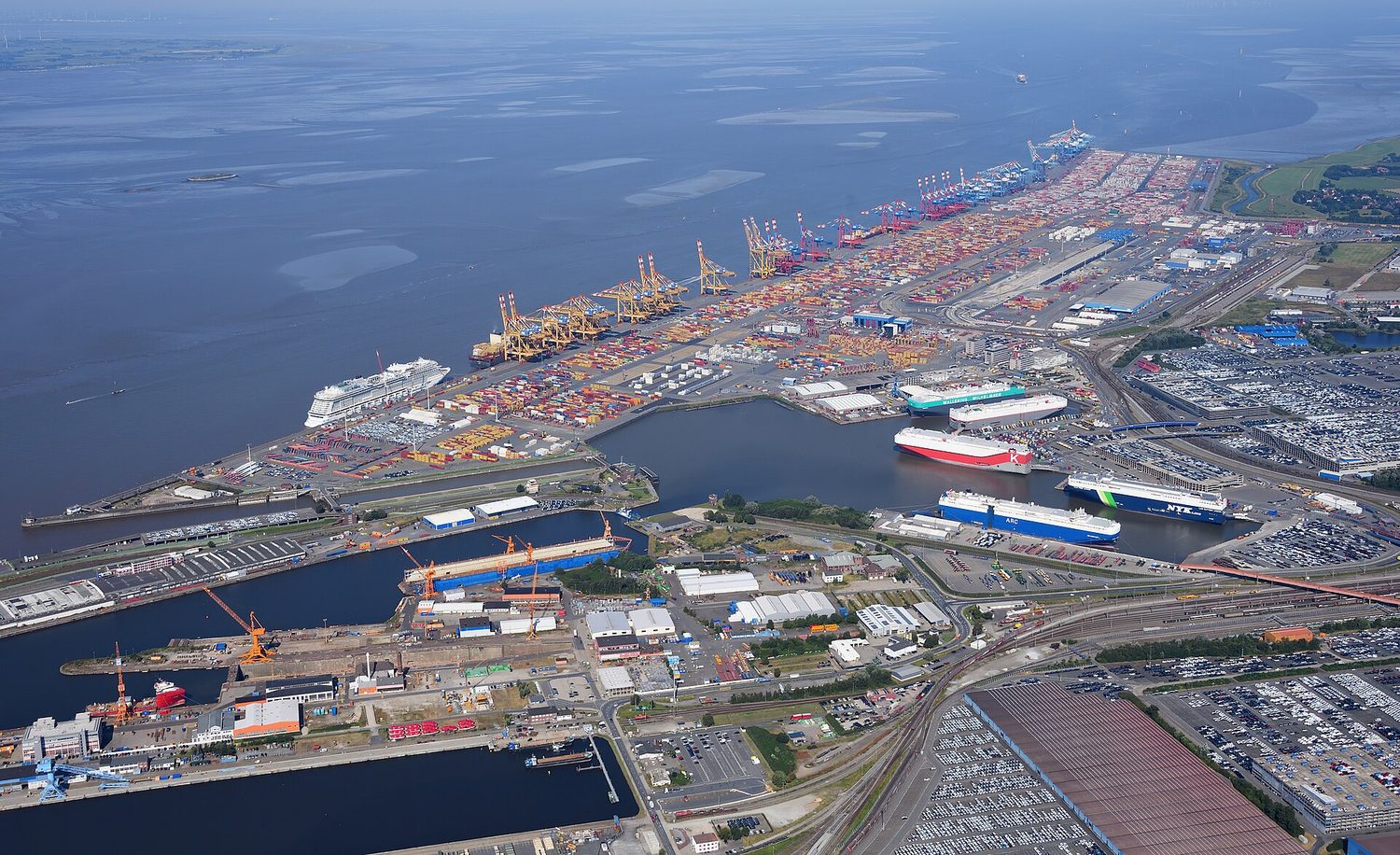
    هدف التعلم POL-1.E: تعريف أسباب التأخر في السياسة النقدية.
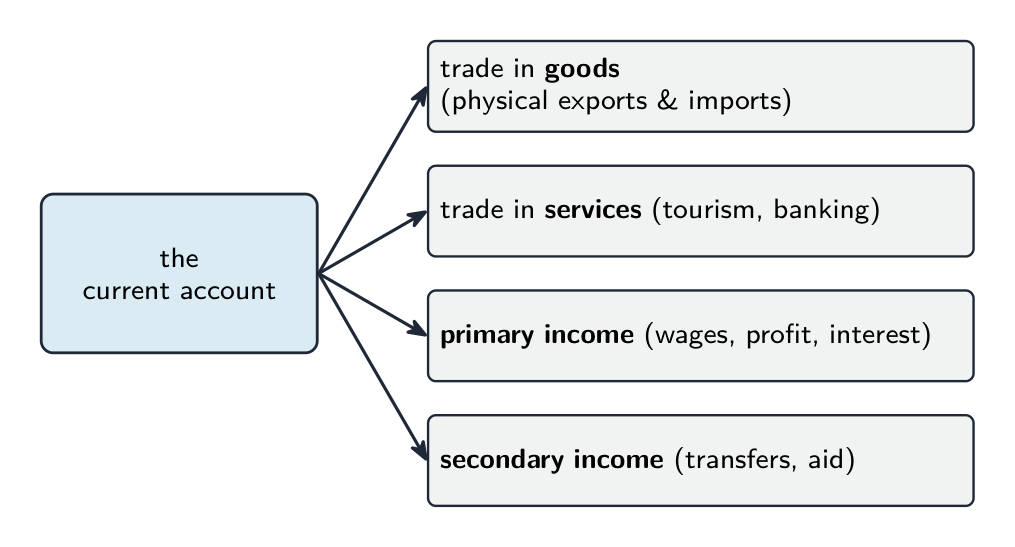
    • POL-1.E.1 في الواقع، توجد تأخيرات في السياسة النقدية ناتجة عن الوقت المستغرق للتعرف على مشكلة في الاقتصاد والوقت الذي يستغرقه الاقتصاد للتكيف مع إجراء السياسة.

    Source: College Board AP Course and Exam Description · ⁨المصدر: وصف دورة وامتحان College Board AP⁩

    English

    Monetary policy 货币政策 is the central bank's (the Federal Reserve's) use of the money supply to steer the economy, working through the interest rate:

    • Expansionary (easy) 扩张性: increase the money supply $\to$ interest rate falls $\to$ investment and consumption rise $\to$ AD shifts right (fights recession).
    • Contractionary (tight) 紧缩性: decrease the money supply $\to$ interest rate rises $\to$ AD shifts left (fights inflation).

    Tools: open-market operations 公开市场操作 (buying bonds injects money, selling bonds withdraws it – the main tool), changing the reserve requirement, and changing the discount rate 贴现率 (the rate banks pay to borrow from the central bank). Follow the full chain on the exam: money supply $\to$ interest rate $\to$ investment $\to$ AD $\to$ output, price level, unemployment.

    Modern central banks run an ample-reserves system. Rather than nudging the money supply, the Fed sets administered rates – chiefly the interest on reserves (IOR) 准备金利息 it pays banks – and this steers the policy rate 政策利率 (the federal funds rate, the overnight rate banks charge one another). In the reserve market, reserve demand slopes downward while the central bank supplies reserves at its chosen rate; raising IOR lifts the whole policy rate to fight inflation, lowering it eases to fight recession. (In the older limited-reserves system the Fed instead shifted the reserve supply through open-market operations.)

    العربية

    السياسة النقدية هي استخدام البنك المركزي (المصرف الفيدرالي) لعرض النقود لتوجيه الاقتصاد، وذلك من خلال معدل الفائدة:

    كيف يعمل ارتفاع معدل الفائدة عبر الاقتصاد لإبطاء التضخم
    كيف يعمل ارتفاع معدل الفائدة عبر الاقتصاد لإبطاء التضخم
    • التوسعية (السهلة): زيادة عرض النقود $\to$ انخفاض معدل الفائدة $\to$ ارتفاع الاستثمارات والاستهلاك $\to$ انزياح AD إلى اليمين (محاربة الركود).
    • التقليصية (الصلبة): تقليل عرض النقود $\to$ ارتفاع معدل الفائدة $\to$ انزياح AD إلى اليسار (محاربة التضخم).

    الأدوات: عمليات السوق المفتوحة (شراء السندات يُحقن النقود، وبيعها يسحبها – وهي الأداة الرئيسية)، وتغيير متطلبات الاحتياطي، وتغيير معدل الخصم (معدل فائدة تدفعه البنوك للامتنان من البنك المركزي). اتبع السلسلة الكاملة في الامتحان: عرض النقود $\to$ معدل الفائدة $\to$ الاستثمارات $\to$ AD $\to$ الناتج، ومستوى الأسعار، والبطالة.

    تدير البنوك المركزية الحديثة نظام الاحتياطيات الوافرة. بدلاً من تحريك عرض النقود، يحدد الفيدرالي المعدلات المُدارَة – ولا سيما فائدة الاحتياطيات (IOR) التي تدفعها للبنوك – وهذا يوجه معدل السياسة (معدل الأموال الفيدرالية، وهو المعدل الليلي الذي تتقاضاه البنوك من بعضها البعض). في سوق الاحتياطيات، ينحدر طلب الاحتياطيات للأسفل بينما يزود البنك المركزي بالاحتياطيات بمعدله المختار؛ رفع IOR يرفع كامل معدل السياسة لمحاربة التضخم، وخفضه يخفف الضغط لمحاربة الركود. (في النظام الأقدم المحدود الاحتياطيات كان الفيدرالي يحرك عرض الاحتياطيات عبر عمليات السوق المفتوحة.)

    مبنى لبنك مركزي: السياسة النقدية تحدد معدلات الفائدة وعرض النقود
    مبنى لبنك مركزي: السياسة النقدية تحدد معدلات الفائدة وعرض النقود
    4.7

    The Loanable Funds Market · ⁨سوق القروض المتاحة⁩

    Syllabus · ⁨المنهج⁩
    English

    Enduring Understanding (MKT-4): The interaction of borrowers, who demand loanable funds, and savers, who supply loanable funds, determines the equilibrium real interest rate.

    Learning Objective MKT-4.A: a. Define (using graphs as appropriate) the loanable funds market, demand for loanable funds, and supply of loanable funds. b. Explain (using graphs as appropriate) the relationship between the real interest rate and the quantity of loanable funds demanded (supplied).

    • MKT-4.A.1 The loanable funds market describes the behavior of savers and borrowers.
    • MKT-4.A.2 The demand for loanable funds shows the inverse relationship between real interest rates and the quantity demanded of loanable funds.
    • MKT-4.A.3 The supply of loanable funds shows the positive relationship between real interest rates and the quantity supplied of loanable funds.

    Learning Objective MKT-4.B: Define national savings in both a closed and an open economy.

    • MKT-4.B.1 In the absence of international borrowing and lending, national savings is the sum of public savings and private savings.
    • MKT-4.B.2 For an open economy, investment equals national savings plus net capital inflow.

    Learning Objective MKT-4.C: Define (using graphs as appropriate) equilibrium in the loanable funds market.

    • MKT-4.C.1 In the loanable funds market, equilibrium is achieved when the real interest rate is such that the quantities demanded and supplied of loanable funds are equal.

    Learning Objective MKT-4.D: Explain (using graphs as appropriate) how real interest rates adjust to restore equilibrium in the loanable funds market.

    • MKT-4.D.1 Disequilibrium real interest rates create surpluses and shortages in the loanable funds market. Market forces drive real interest rates toward equilibrium.

    Learning Objective MKT-4.E: a. Explain (using graphs as appropriate) the determinants of demand and supply in the loanable funds market. b. Explain (using graphs as appropriate) how changes in demand and supply in the loanable funds market affect the equilibrium real interest rate and equilibrium quantity of loanable funds.

    • MKT-4.E.1 The loanable funds market can be used to show the effects of government spending, taxes, and borrowing on interest rates.
    • MKT-4.E.2 Factors that shift the demand (such as an investment tax credit) and supply (such as changes in saving behavior) of loanable funds change the equilibrium interest rate and the equilibrium quantity of funds.
    العربية

    الفهم الدائم (MKT-4): يحدد تفاعل المقترضين، الذين يطلبون الأموال القابلة للتوظيف، والموفرين، الذين يزودون الأموال القابلة للتوظيف، سعر الفائدة الحقيقي المتوازن.

    هدف التعلم MKT-4.A: أ. عرّف (باستخدام الرسوم البيانية عند الاقتضاء) سوق القروض القابلة للتوظيف، والطلب على الأموال القابلة للتوظيف، وعرضها. ب. اشرح (باستخدام الرسوم البيانية عند الاقتضاء) العلاقة بين سعر الفائدة الحقيقي والكمية المطلوبة (المقدّرة) من الأموال القابلة للتوظيف.

    • MKT-4.A.1 يصف سوق القروض القابلة للتوظيف سلوك الموفدين والمقترضين.
    • MKT-4.A.2 يظهر الطلب على الأموال القابلة للتوظيف العلاقة العكسية بين أسعار الفائدة الحقيقية والكمية المطلوبة منها.
    • MKT-4.A.3 يعرض عرض الأموال القابلة للتوظيف العلاقة الإيجابية بين أسعار الفائدة الحقيقية والكمية المقدرة منها.

    هدف التعلم MKT-4.B: تعريف المدخرات الوطنية في كل من الاقتصاد المغلق والاقتصاد المفتوح.

    • MKT-4.B.1 في غياب الاستعارة والاستثمار الدوليين، تكون المدخرات الوطنية مجموع المدخرات العامة والمدخرات الخاصة.
    • MKT-4.B.2 بالنسبة للاقتصاد المفتوح، يساوي الاستثمار المدخرات الوطنية زائد صافي تدفق رأس المال الداخل.

    هدف التعلم MKT-4.C: تعريف التوازن في سوق القروض القابلة للتوظيف (باستخدام الرسوم البيانية عند الاقتضاء).

    • MKT-4.C.1 في سوق القروض القابلة للتوظيف، يتحقق التوازن عندما يكون سعر الفائدة الحقيقي بحيث تتساوى الكميات المطلوبة والمقدرة من الأموال القابلة للتوظيف.

    هدف التعلم MKT-4.D: شرح كيف تتكيف أسعار الفائدة الحقيقية لاستعادة التوازن في سوق القروض القابلة للتوظيف (باستخدام الرسوم البيانية عند الاقتضاء).

    • MKT-4.D.1 تُحدث أسعار الفائدة غير المتوازنة فوائضاً ونقصاً في سوق القروض القابلة للتوظيف. وتدفع قوى السوق أسعار الفائدة الحقيقية نحو التوازن.

    هدف التعلم MKT-4.E: أ. اشرح (باستخدام الرسوم البيانية عند الاقتضاء) محددات الطلب والعرض في سوق القروض القابلة للتوظيف. ب. اشرح (باستخدام الرسوم البيانية عند الاقتضاء) كيف تؤثر التغييرات في الطلب والعرض في سوق القروض القابلة للتوظيف على سعر الفائدة الحقيقي المتوازن والكمية المتوازنة من الأموال.

    • MKT-4.E.1 يمكن استخدام سوق القروض القابلة للتوظيف لإظهار تأثيرات الإنفاق الحكومي والضرائب والاستعارة على أسعار الفائدة.
    • MKT-4.E.2 العوامل التي تحرك الطلب (مثل اعتمار ضريبي على الاستثمار) وعوامل Supply (مثل تغييرات سلوك الادخار) للأموال القابلة للتوظيف تغير سعر الفائدة المتوازن والكمية المتوازنة من الأموال.

    Source: College Board AP Course and Exam Description · ⁨المصدر: وصف دورة وامتحان College Board AP⁩

    English
    The loanable funds market

    The loanable funds market 可贷资金市场 determines the real interest rate and connects saving to investment:

    • Supply of loanable funds comes from saving and slopes upward.
    • Demand for loanable funds comes from borrowers (firms investing, government borrowing) and slopes downward.

    That saving is the economy's national savings 国民储蓄 = private savings (households and firms) + public savings (the government's budget balance – a surplus adds to saving, a deficit subtracts from it). For an open economy, investment = national savings + net capital inflow from abroad. So a bigger budget deficit is negative public saving that shrinks the supply of loanable funds and crowds out investment.

    More saving shifts supply right and lowers the real rate; more government borrowing shifts demand right and raises the real rate – the mechanism behind crowding out. Distinguish the two graphs: the money market sets the nominal rate (vertical money supply), while loanable funds sets the real rate (upward-sloping saving supply).

    Exam skill: know which graph to draw – money market for monetary policy, loanable funds for saving, deficits, and crowding out – and trace how a shift in one feeds into AD-AS.

    العربية
    سوق القروض المتاحة

    يحدد سوق القروض المتاحة معدل الفائدة الحقيقي ويربط بين الادخار والاستثمار:

    • عرض القروض المتاحة يأتي من الادخار وينحدر للأعلى.
    • طلب القروض المتاحة يأتي من المقترضين (الشركات المستثمرة، والحكومة المقترضة) وينحدر للأسفل.

    هذا الادخار هو الادخار الوطني للاقتصاد = الادخار الخاص (الأسر والشركات) + الادخار العام (ميزانية الحكومة – الفائض يزيد من الادخار، والعجز ينقصه). بالنسبة لاقتصاد مفتوح، الاستثمار = الادخار الوطني + صافي التدفق الرأسمالي من الخارج. لذا فإن العجز البيزنطي الأكبر هو ادخار عام سلبي يقلل من عرض القروض المتاحة ويدفع الاستثمارات خارجاً.

    زيادة الادخار تحرك العرض لليمين وتخفض المعدل الحقيقي؛ زيادة اقتراض الحكومة تحرك الطلب لليمين وترفع معدل الفائدة الحقيقي – وهو الآلية وراء الدفع الخارجي. افرق بين الرسمين البيانيين: سوق النقود يحدد المعدل الاسمي (عرض نقدي عمودي)، بينما القروض المتاحة تحدد المعدل الحقيقي (عرض ادخار صاعد).

    مهارة الامتحان: معرفة الرسم البياني المناسب للرسم – سوق النقود للسياسة النقدية، والقروض المتاحة للادخار، والعجز، والدفع الخارجي – وتتبع كيف يؤثر التحرك في واحد على AD-AS.

    4.7

    Exam tips · ⁨نصائح للامتحان⁩

    English
    • Know money's three functions and the M1/M2 measures.
    • The money market sets the nominal interest rate (vertical money supply); more money supply lowers the rate.
    • Compute the money multiplier $\tfrac{1}{rr}$ and the maximum change in the money supply from a new deposit.
    • Trace monetary policy: money supply → interest rate → investment → AD → output.
    • Distinguish the money market (nominal rate) from the loanable-funds market (real rate); use the real rate $=$ nominal $-$ inflation.
    العربية
    • معرفة الوظائف الثلاث للنقود ومقاييس M1/M2.
    • سوق النقود يحدد معدل الفائدة الاسمي (عرض نقدي عمودي)؛ زيادة عرض النقود تخفض المعدل.
    • حساب مضاعف النقود $\tfrac{1}{rr}$ والتغير الأقصى في عرض النقود من إيداع جديد.
    • تتبع السياسة النقدية: عرض النقود → معدل الفائدة → الاستثمارات → AD → الناتج.
    • التفريق بين سوق النقود (المعدل الاسمي) وسوق القروض المتاحة (المعدل الحقيقي)؛ استخدام المعادلة الحقيقية $=$ اسمية $-$ تضخم.
  • 5

    Long-Run Consequences of Stabilization Policies · ⁨عواقب سياسات الاستقرار على المدى الطويل⁩

    Watch lesson · ⁨شاهد الدرس⁩
    5.1

    Fiscal and Monetary Policy in the Short Run

    Syllabus · ⁨المنهج⁩
    English

    Enduring Understanding (POL-1): Fiscal and monetary policy have short-run effects on macroeconomic outcomes.

    Learning Objective POL-1.F: Explain (using graphs as appropriate) the effects of combined fiscal and monetary policy actions.

    • POL-1.F.1 A combination of expansionary or contractionary fiscal and monetary policies may be used to restore full employment when the economy is in a negative (i.e., recessionary) or positive (i.e., inflationary) output gap.
    • POL-1.F.2 A combination of fiscal and monetary policies can influence aggregate demand, real output, the price level, and interest rates. [For additional details on fiscal and monetary policy actions and how to demonstrate their effects graphically, see LO POL-1.A and LO POL-1.D.]
    العربية

    الفهم الدائم (POL-1): للسياسة المالية والنقدية تأثيرات قصيرة الأمد على النتائج الكلية للاقتصاد.

    هدف التعلم POL-1.F: شرح تأثيرات الإجراءات المشتركة للسياسة المالية والنقدية (باستخدام الرسوم البيانية عند الاقتضاء).

    • POL-1.F.1 يمكن استخدام مزيج من السياسات المالية والنقدية التوسعية أو الانقباضية لاستعادة التوظيف الكامل عندما يكون الاقتصاد في فجوة ناتج سلبية (أي انقباضية) أو إيجابية (أي تضخمية).
    • POL-1.F.2 يمكن لمزيج من السياسات المالية والنقدية أن يؤثر على الطلب الكلي والإنتاج الحقيقي ومستوى الأسعار وأسعار الفائدة. [للمزيد من التفاصيل حول إجراءات السياسة المالية والنقدية وكيفية إثبات تأثيراتها بيانياً، انظر LO POL-1.A و LO POL-1.D.]

    Source: College Board AP Course and Exam Description · ⁨المصدر: وصف دورة وامتحان College Board AP⁩

    A parliament building: governments use spending and taxes as fiscal policy tools
    A parliament building: governments use spending and taxes as fiscal policy tools

    Both policies work by shifting AD in the short run. Fiscal policy 财政政策 changes government spending or taxes; monetary policy 货币政策 changes the money supply and thus the interest rate. They can work together (both expansionary to fight a deep recession) or be mixed (e.g. loose fiscal + tight monetary). In the short run, expansionary policy raises output and the price level and lowers unemployment; contractionary policy does the reverse.

    Explore · ⁨استكشف⁩

    Use policy to shift aggregate demand · ⁨استخدم السياسة لإزاحة الطلب الكلي⁩

    In the short run, fiscal (spending/taxes) and monetary (interest-rate) policy shift aggregate demand, moving real GDP and the price level along short-run aggregate supply. · ⁨على المدى القصير، تُحرّك السياسات المالية (الإنفاق/الضرائب) والنقدية (أسعار الفائدة) الإجمالي الطلب، مما يُغيّر الناتج المحلي الإجمالي الحقيقي ومستوى الأسعار على طول منحنى العرض الكلي قصير الأجل.⁩

    Vocabulary · ⁨مفردات⁩ Train · ⁨تدريب⁩
    English العربية
    Fiscal policy/ˈfɪskl ˈpɒlɪsi/ السياسة المالية
    monetary policy/ˈmʌnɪtəri ˈpɒlɪsi/ السياسة النقدية
    5.2

    The Phillips Curve

    Syllabus · ⁨المنهج⁩
    English

    Enduring Understanding (MOD-3): The Phillips curve model is used to represent the relationship between inflation and unemployment and to illustrate how macroeconomic shocks affect inflation and unemployment.

    Learning Objective MOD-3.A: a. Define (using graphs as appropriate) the short-run Phillips curve and the long-run Phillips curve. b. Explain (using graphs as appropriate) short-run and long-run equilibrium in the Phillips curve model.

    • MOD-3.A.1 The short-run trade-off between inflation and unemployment can be illustrated by the downward-sloping short-run Phillips curve (SRPC).
    • MOD-3.A.2 An economy is always operating somewhere along the SRPC.
    • MOD-3.A.3 The long-run relationship between inflation and unemployment can be illustrated by the long-run Phillips curve (LRPC), which is vertical at the natural rate of unemployment.
    • MOD-3.A.4 Long-run equilibrium corresponds to the intersection of the SRPC and the LRPC.
    • MOD-3.A.5 Points to the left of long-run equilibrium represent inflationary gaps, while points to the right of long-run equilibrium represent recessionary gaps.

    Learning Objective MOD-3.B: Explain (using graphs as appropriate) the response of unemployment and inflation in the short run and in the long run.

    • MOD-3.B.1 Demand shocks correspond to movement along the SRPC.
    • MOD-3.B.2 Supply shocks correspond to shifts of the SRPC.
    • MOD-3.B.3 Factors that cause the natural rate of unemployment to change will cause the LRPC to shift.
    العربية

    الفهم الدائم (MOD-3): يُستخدم نموذج منحنى فيليبس لتمثيل العلاقة بين التضخم والبطالة ولتوضيح كيف تؤثر الصدمات الاقتصادية الكلية على التضخم والبطالة.

    هدف التعلم MOD-3.A: أ. عرّف (باستخدام الرسوم البيانية عند الاقتضاء) منحنى فيليبس قصير المدى ومنحنى فيليبس طويل المدى. ب. اشرح (باستخدام الرسوم البيانية عند الاقتضاء) التوازن قصير المدى وطويل المدى في نموذج منحنى فيليبس.

    • MOD-3.A.1 يمكن تمثيل التناقص قصير المدى بين التضخم والبطالة بواسطة منحنى فيليبس قصير المدى الهابط (SRPC).
    • MOD-3.A.2 يعمل الاقتصاد دائمًا في مكان ما على طول منحنى SRPC.
    • MOD-3.A.3 يمكن تمثيل العلاقة طويلة المدى بين التضخم والبطالة بمنحنى فيليبس طويل المدى (LRPC)، وهو عمودي عند معدل البطالة الطبيعي.
    • MOD-3.A.4 يتوافق التوازن طويل المدى مع تقاطع منحنى SRPC ومنحنى LRPC.
    • MOD-3.A.5 تمثل النقاط إلى يسار التوازن طويل المدى فجوات تضخمية، بينما تمثل النقاط إلى يمين التوازن طويل المدى فجوات انكماشية.

    هدف التعلم MOD-3.B: شرح استجابة البطالة والتضخم في المدى القصير وفي المدى الطويل (باستخدام الرسوم البيانية عند الاقتضاء).

    • MOD-3.B.1 تتوافق صدمات الطلب مع الحركة على طول منحنى SRPC.
    • MOD-3.B.2 تتوافق صدمات العرض مع انزياح منحنى SRPC.
    • MOD-3.B.3 العوامل التي تسبب تغييرًا في معدل البطالة الطبيعية ستؤدي إلى انزياح منحنى LRPC.

    Source: College Board AP Course and Exam Description · ⁨المصدر: وصف دورة وامتحان College Board AP⁩

    The short-run Phillips curve

    The Phillips curve 菲利普斯曲线 shows the short-run trade-off between inflation and unemployment:

    The short-run and long-run Phillips curves
    The short-run and long-run Phillips curves
    • The short-run Phillips curve (SRPC) 短期菲利普斯曲线 slopes downward – lower unemployment comes with higher inflation. It is the mirror image of AD-AS: a rightward AD shift moves the economy up-left along the SRPC (less unemployment, more inflation).
    • The long-run Phillips curve (LRPC) 长期菲利普斯曲线 is vertical at the natural rate of unemployment 自然失业率 – the counterpart of vertical LRAS. In the long run there is no trade-off: policy changes inflation, not unemployment.
    • A supply shock shifts the SRPC (a negative shock moves it right – worse inflation and unemployment, i.e. stagflation). A change in expected inflation also shifts the SRPC.

    Exam skill: link the AD-AS and Phillips graphs – a recessionary gap in AD-AS corresponds to a point on the SRPC to the right of the natural rate; know what shifts SRPC versus moves along it.

    Vocabulary · ⁨مفردات⁩ Train · ⁨تدريب⁩
    English العربية
    Phillips curve/ˈfɪlɪps kɜːv/ منحنى فيليبس
    short-run Phillips curve (SRPC)/ʃɔːt rʌn ˈfɪlɪps kɜːv/ منحنى فيليبز القصير (SRPC)
    long-run Phillips curve (LRPC)/lɒŋ rʌn ˈfɪlɪps kɜːv/ منحنى فيليبز الطويل (LRPC)
    natural rate of unemployment/ˈnætʃərəl reɪt ɒv ʌnemˈplɔɪmənt/ معدل البطالة الطبيعي
    5.3

    Money Growth and Inflation

    Syllabus · ⁨المنهج⁩
    English

    Enduring Understanding (POL-3): There are long-run implications of monetary and fiscal policy.

    Learning Objective POL-3.A: a. Explain (using graphs as appropriate) how inflation is a monetary phenomenon. b. Define the quantity theory of money. c. Calculate the money supply, velocity, the price level, and real output using the quantity theory of money.

    • POL-3.A.1 Inflation (deflation) results from increasing (decreasing) the money supply at too rapid of a rate for a sustained period of time.
    • POL-3.A.2 When the economy is at full employment, changes in the money supply have no effect on real output in the long run.
    • POL-3.A.3 In the long run, the growth rate of the money supply determines the growth rate of the price level (inflation rate) according to the quantity theory of money.
    العربية

    الفهم الدائم (POL-3): هناك آثار طويلة المدى للسياسة النقدية والمالية.

    هدف التعلم POL-3.A: أ. اشرح (باستخدام الرسوم البيانية عند الحاجة) كيف أن التضخم ظاهرة نقدية. ب. عرّف نظرية الكمية للنقد. ج. احسب عرض النقد، وسرعة دوران النقود، ومستوى الأسعار، والإنتاج الحقيقي باستخدام نظرية الكمية للنقد.

    • POL-3.A.1 ينتج التضخم (أو الانكماش) عن زيادة (أو نقصان) عرض النقد بمعدل سريع جداً لفترة زمنية مطولة.
    • POL-3.A.2 عندما تكون الاقتصاد في حالة توظيف كامل، لا يكون لتغيرات عرض النقد أي تأثير على الإنتاج الحقيقي على المدى الطويل.
    • POL-3.A.3 على المدى الطويل، يحدد معدل نمو عرض النقد معدل نمو مستوى الأسعار (معدل التضخم) وفقاً لنظرية الكمية للنقد.

    Source: College Board AP Course and Exam Description · ⁨المصدر: وصف دورة وامتحان College Board AP⁩

    In the long run, inflation is a monetary phenomenon. The quantity theory of money 货币数量论 states $M\times V = P\times Y$ (money supply $\times$ velocity $=$ price level $\times$ real output). With velocity $V$ and real output $Y$ roughly stable in the long run, growth in the money supply translates almost one-for-one into inflation. Printing money faster than the economy grows raises the price level, not real output – the root of high inflation and, in the extreme, hyperinflation 恶性通货膨胀.

    Worked example. Suppose the money supply grows $8\%$ per year while real output $Y$ grows $3\%$ and velocity $V$ is stable. Rearranging $M\times V=P\times Y$ into growth rates, inflation $\approx 8\%-3\%=5\%$. The $5\%$ of money growth not matched by extra output simply becomes higher prices.

    More money chasing goods: sustained money growth tends to raise the price level over time
    More money chasing goods: sustained money growth tends to raise the price level over time
    Explore · ⁨استكشف⁩

    Link money growth to inflation · ⁨ربط نمو المال بالثقة⁩

    The quantity theory $MV=PY$: with output and velocity roughly fixed, the price level moves in proportion to the money supply — too much money chasing the same goods is inflation. · ⁨نظرية الكمية $MV=PY$: مع ثبات الإنتاج والسرعة تقريباً، يتحرك مستوى الأسعار بنسبة طردية مع عرض النقود — فزيادة النقود التي تطارد نفس البضائع تسبب التضخم.⁩

    Vocabulary · ⁨مفردات⁩ Train · ⁨تدريب⁩
    English العربية
    quantity theory of money/ˈkwɒntɪti ˈθɪəri ɒv ˈmʌni/ نظرية الكمية النقدية
    hyperinflation/ˌhaɪpərɪnˈfleɪʃn/ تضخم متفشي
    5.4

    Government Deficits and the National Debt

    Syllabus · ⁨المنهج⁩
    English

    Enduring Understanding (POL-3): There are long-run implications of monetary and fiscal policy.

    Learning Objective POL-3.B: a. Define the government budget surplus (deficit) and national debt. b. Explain the issues involved with the burden of the national debt.

    • POL-3.B.1 The government budget surplus (deficit) is the difference between tax revenues and government purchases plus transfer payments in a given year.
    • POL-3.B.2 A government adds to the national debt when it runs a budget deficit.
    • POL-3.B.3 A government must pay interest on its accumulated debt, thus increasing the national debt and increasingly forgoing using those funds for alternative uses. [See also LO POL-3.C on crowding out.]
    العربية

    الفهم الدائم (POL-3): هناك آثار طويلة المدى للسياسة النقدية والمالية.

    هدف التعلم POL-3.B: أ. عرّف الفائض (العجز) في الميزانية الحكومية والديون القومية. ب. اشرح القضايا المتضمنة في عبء الديون القومية.

    • POL-3.B.1 الفائض (العجز) في الميزانية الحكومية هو الفرق بين الإيرادات الضريبية ومصروفات الحكومة ودفوعات التحويل في سنة معينة.
    • POL-3.B.2 تضيف الحكومة إلى الديون القومية عندما تحقق عجزاً في ميزانيتها.
    • POL-3.B.3 يجب على الحكومة دفع فائدة على ديونها المتراكمة، مما يزيد من الديون القومية ويقلل تدريجياً من إمكانية استخدام تلك الأموال لأغراض بديلة. [انظر أيضاً هدف التعلم POL-3.C حول الإزاحة.]

    Source: College Board AP Course and Exam Description · ⁨المصدر: وصف دورة وامتحان College Board AP⁩

    A budget deficit 预算赤字 occurs when government spending exceeds tax revenue in a year (a surplus 盈余 is the reverse). The accumulated total of past deficits is the national debt 国债. Deficits are financed by borrowing – selling government bonds – which adds to the debt and to future interest payments. Persistent deficits raise concerns about crowding out and the burden of servicing the debt.

    Bond and equity markets: government borrowing competes for loanable funds and can crowd out private investment
    Bond and equity markets: government borrowing competes for loanable funds and can crowd out private investment
    Vocabulary · ⁨مفردات⁩ Train · ⁨تدريب⁩
    English العربية
    budget deficit/ˈbʌdʒɪt ˈdefɪsɪt/ عجز الميزانية
    surplus/ˈsɜːpləs/ فائضاً
    national debt/ˈnæʃənl det/ ديونه الوطنية
    5.5

    Crowding Out

    Syllabus · ⁨المنهج⁩
    English

    Enduring Understanding (POL-3): There are long-run implications of monetary and fiscal policy.

    Learning Objective POL-3.C: a. Define crowding out. b. Explain (using graphs as appropriate) how fiscal policy may cause crowding out.

    • POL-3.C.1 When a government is in budget deficit, it typically borrows to finance its spending.
    • POL-3.C.2 A loanable funds market model can be used to show the effect of government borrowing on the equilibrium real interest rate and the resulting crowding out of private investment. [See MKT-4]
    • POL-3.C.3 Crowding out refers to the adverse effect of increased government borrowing, which leads to decreased levels of interest-sensitive private sector spending in the short run.
    • POL-3.C.4 A potential long-run impact of crowding out is a lower rate of physical capital accumulation and less economic growth as a result.
    العربية

    الفهم الدائم (POL-3): هناك آثار طويلة المدى للسياسة النقدية والمالية.

    هدف التعلم POL-3.C: أ. عرّف الإزاحة. ب. اشرح (باستخدام الرسوم البيانية عند الحاجة) كيف قد تتسبب السياسة المالية في حدوث الإزاحة.

    • POL-3.C.1 عندما تكون الحكومة في عجز في ميزانيتها، فإنها عادة ما تقترض لتمويل نفقاتها.
    • POL-3.C.2 يمكن استخدام نموذج سوق قروض الأموال لإظهار تأثير اقتراض الحكومة على معدل الفائدة الحقيقي المتوازن والنتيجة المترتبة على ذلك من إزاحة الاستثمارات الخاصة. [انظر MKT-4]
    • POL-3.C.3 تشير الإزاحة إلى التأثير السلبي لزيادة الاقتراض الحكومي، والذي يؤدي إلى انخفاض مستويات الإنفاق الخاص الحساس لمعدلات الفائدة على المدى القصير.
    • POL-3.C.4 أحد الآثار المحتملة للإزاحة على المدى الطويل هو انخفاض معدل تراكم رأس المال المادي وتراجع النمو الاقتصادي نتيجة لذلك.

    Source: College Board AP Course and Exam Description · ⁨المصدر: وصف دورة وامتحان College Board AP⁩

    Crowding out 挤出效应 is the main long-run cost of deficit-financed fiscal policy. When the government borrows heavily, it increases the demand for loanable funds, raising the real interest rate. Higher rates reduce private investment (and interest-sensitive consumption). So expansionary fiscal policy partly cancels itself: the AD boost is offset by weaker investment. Worse, less investment today means a smaller capital stock and slower long-run growth.

    Government borrowing raises interest rates and crowds out private investment
    Government borrowing raises interest rates and crowds out private investment

    Exam skill: show crowding out on the loanable funds graph – government borrowing shifts demand right, the real interest rate rises, and private investment falls.

    Worked example. A government borrows $\$500$ billion to finance a deficit. On the loanable funds market this shifts the demand for funds right, pushing the real interest rate up (say from $3\%$ to $4\%$). At the higher rate firms scale back investment – perhaps by $\$150$ billion – so the net boost to AD is smaller than the $\$500$ billion, and the lost investment slows long-run growth.

    Vocabulary · ⁨مفردات⁩ Train · ⁨تدريب⁩
    English العربية
    Crowding out/ˈkraʊdɪŋ aʊt/ إزاحة الاستثمارات
    5.6

    Economic Growth

    Syllabus · ⁨المنهج⁩
    English

    Enduring Understanding (MEA-2): The economy fluctuates between periods of expansion and contraction in the short run, but economic growth can occur in the long run.

    Learning Objective MEA-2.B: a. Define measures and determinants of economic growth. b. Explain (using graphs and data as appropriate) the determinants of economic growth. c. Calculate (using graphs and data as appropriate) per capita GDP and economic growth.

    • MEA-2.B.1 Economic growth can be measured as the growth rate in real GDP per capita over time.
    • MEA-2.B.2 Aggregate employment and aggregate output are directly related because firms need to employ more workers in order to produce more output, holding other factors constant. This is captured by the aggregate production function.
    • MEA-2.B.3 Output per employed worker is a measure of average labor productivity.
    • MEA-2.B.4 Productivity is determined by the level of technology and physical and human capital per worker.
    • MEA-2.B.5 The aggregate production function shows that output per capita is positively related to both physical and human capital per capita.
    العربية

    الفهم الدائم (MEA-2): يتذبذب الاقتصاد بين فترات التوسع والانكماش على المدى القصير، ولكن يمكن أن يحدث النمو الاقتصادي على المدى الطويل.

    هدف التعلم MEA-2.B: أ. عرّف مقاييس ومحددات النمو الاقتصادي. ب. اشرح (باستخدام الرسوم البيانية والبيانات عند الحاجة) محددات النمو الاقتصادي. ج. احسب (باستخدام الرسوم البيانية والبيانات عند الحاجة) الناتج المحلي الإجمالي للفرد والنمو الاقتصادي.

    • MEA-2.B.1 يمكن قياس النمو الاقتصادي كمعدل النمو في الناتج المحلي الإجمالي الحقيقي للفرد عبر الزمن.
    • MEA-2.B.2 يرتبط التوظيف الإجمالي والإنتاج الإجمالي ارتباطاً طردياً لأن الشركات تحتاج إلى توظيف عمال أكثر لإنتاج المزيد من المخرجات، مع ثبات العوامل الأخرى. يتم التعبير عن هذا من خلال دالة الإنتاج الكلية.
    • MEA-2.B.3 الإنتاج لكل عامل مشغول هو مقياس لمتوسط إنتاجية العمل.
    • MEA-2.B.4 تحدد الإنتاجية مستوى التكنولوجيا ورأس المال المادي والبشري لكل عامل.
    • MEA-2.B.5 تُظهر دالة الإنتاج الكلية أن الإنتاج للفرد يرتبط ارتباطاً إيجابياً بكل من رأس المال المادي والبشري للفرد.

    Source: College Board AP Course and Exam Description · ⁨المصدر: وصف دورة وامتحان College Board AP⁩

    Economic growth 经济增长 is a sustained rise in real GDP per capita – the true source of higher living standards. It comes from more or better resources and is shown as a rightward shift of LRAS (and an outward shift of the PPC). Its main drivers:

    Economic growth shifts the production possibilities curve outward
    Economic growth shifts the production possibilities curve outward
    • physical capital 实物资本 (more tools and machines per worker),
    • human capital 人力资本 (education, skills, health),
    • technology 技术 and innovation,
    • productivity 生产率 (output per worker) growth, the deepest driver.
    Explore · ⁨استكشف⁩

    Economic growth pushes the frontier out · ⁨النمو الاقتصادي يدفع الحدود للخارج⁩

    Economic growth — more resources, better technology — shifts the whole production possibilities frontier outward, letting the economy produce more of everything. · ⁨النمو الاقتصادي — موارد أكثر، تكنولوجيا أفضل — يزيح حد الإمكانيات الإنتاجية بالكامل للخارج، مما يسمح للاقتصاد بإنتاج المزيد من كل شيء.⁩

    Vocabulary · ⁨مفردات⁩ Train · ⁨تدريب⁩
    English العربية
    Economic growth/ˌiːkəˈnɒmɪk ɡrəʊθ/ النمو الاقتصادي
    physical capital/ˈfɪzɪkl ˈkæpɪtl/ رأس المال المادي
    human capital/ˈhjuːmən ˈkæpɪtl/ رأس المال البشري
    technology/tekˈnɒlədʒi/ تكنولوجيا
    productivity/ˌprɒdəkˈtɪvɪti/ الإنتاجية
    5.7

    Public Policy and Economic Growth

    Syllabus · ⁨المنهج⁩
    English

    Enduring Understanding (POL-4): Authorities and organizations institute policies that affect economic growth.

    Learning Objective POL-4.A: a. Explain (using graphs as appropriate) public policies aimed at influencing long-run economic growth. b. Define supply-side fiscal policies.

    [For a description of economic growth and information about how to show it graphically, see LO MEA-2.B, LO MOD-1.B, and LO MOD-2.I]

    • POL-4.A.1 Public policies that impact productivity and labor force participation affect real GDP per capita and economic growth.
    • POL-4.A.2 Government policies that invest in infrastructure and technology affect growth.
    • POL-4.A.3 Supply-side fiscal policies affect aggregate demand, aggregate supply, and potential output in the short run and long run by influencing incentives that affect household and business economic behavior.
    العربية

    فهم دائم (POL-4): تضع السلطات والمنظمات سياسات تؤثر على النمو الاقتصادي.

    هدف التعلم POL-4.A: أ. اشرح (باستخدام الرسوم البيانية عند الحاجة) السياسات العامة الهادفة إلى التأثير على النمو الاقتصادي طويل الأمد. ب. عرّف السياسات المالية الجانبية للعرض.

    [للحصول على وصف للنمو الاقتصادي ومعلومات حول كيفية عرضه بيانياً، انظر هدف التعلم MEA-2.B، و LO MOD-1.B، و LO MOD-2.I]

    • POL-4.A.1 تؤثر السياسات العامة التي تؤثر على الإنتاجية ومشاركة القوى العاملة على الناتج المحلي الإجمالي للفرد والنمو الاقتصادي.
    • POL-4.A.2 تؤثر سياسات الحكومة التي تستثمر في البنية التحتية والتكنولوجيا على النمو.
    • POL-4.A.3 تؤثر السياسات المالية الجانبية للعرض على الطلب الكلي والعرض الكلي والإنتاج المحتمل على المدى القصير والطويل من خلال التأثير على الحوافز التي توجه سلوك الأسر والشركات الاقتصادية.

    Source: College Board AP Course and Exam Description · ⁨المصدر: وصف دورة وامتحان College Board AP⁩

    A wind farm: public investment in capital can raise long-run economic growth
    A wind farm: public investment in capital can raise long-run economic growth

    Governments can raise long-run growth by policies that build capital and productivity: investment in infrastructure and education, research and development incentives, protecting property rights 产权 and the rule of law, encouraging saving and investment (which finances capital), and keeping inflation low and stable. The recurring long-run theme: policies that crowd out or discourage investment slow growth, while those that encourage capital formation speed it up.

    Vocabulary · ⁨مفردات⁩ Train · ⁨تدريب⁩
    English العربية
    property rights/ˈprɒpəti raɪts/ حقوق الملكية
    5.7

    Exam tips

    • The short-run Phillips curve shows the inflation–unemployment trade-off; the long-run curve is vertical at the natural rate.
    • In the long run inflation is a monetary phenomenon (money growth beyond output growth → inflation).
    • Show crowding out on the loanable-funds graph: government borrowing raises the real rate and cuts private investment.
    • Growth comes from more/better resources — physical capital, human capital, technology — shifting LRAS right.
    • A supply shock moves inflation and unemployment the same way (stagflation), unlike a demand shock.
  • 6

    Open Economy—International Trade and Finance · ⁨الاقتصاد المفتوح – التجارة الدولية والمالية⁩

    Watch lesson · ⁨شاهد الدرس⁩
    6.1

    Balance of Payments Accounts

    Syllabus · ⁨المنهج⁩
    English

    Enduring Understanding (MEA-4): Foreign trade accounting measures the flow of goods, services, and financial capital between countries.

    Learning Objective MEA-4.A: a. Define the current account (CA), the capital and financial account (CFA), and the balance of payments (BOP). b. Explain how changes in the components of the CA and CFA affect a country's BOP. c. Calculate the CA, the CFA, and the BOP.

    • MEA-4.A.1 The current account (CA) records net exports, net income from abroad, and net unilateral transfers.
    • MEA-4.A.2 The CA is not always balanced; it may show a surplus or a deficit. A nation's balance of trade (i.e., net exports) is part of the current account and may also show a surplus or a deficit.
    • MEA-4.A.3 The capital and financial account (CFA) records financial capital transfers and purchases and sales of assets between countries.
    • MEA-4.A.4 The CFA is not always balanced; it may show a surplus (financial capital inflow) or a deficit (financial capital outflow).
    • MEA-4.A.5 The balance of payments (BOP) is an accounting system that records a country's international transactions for a particular time period. It consists of the CA and the CFA.
    • MEA-4.A.6 Any transaction that causes money to flow into a country is a credit to its BOP account, and any transaction that causes money to flow out is a debit. The sum of all credit entries should match the sum of all debit entries ($CA + CFA = 0$).
    العربية

    فهم دائم (MEA-4): تسجل المحاسبة التجارية الخارجية تدفق السلع والخدمات ورأس المال المالي بين الدول.

    هدف التعلم MEA-4.A: أ. عرّف الحساب الجاري (CA)، والحساب الرأسمالي والمالي (CFA)، والميزانية الدولية (BOP). ب. اشرح كيف تؤثر التغيرات في مكونات CA و CFA على ميزانية الدولة الدولية. ج. احسب الحساب الجاري (CA)، والحساب الرأسمالي والمالي (CFA)، والميزانية الدولية (BOP).

    • MEA-4.A.1 يسجل الحساب الجاري (CA) صافي الصادرات، وصافي الدخل من الخارج، وصافي التحويلات أحادية الاتجاه.
    • MEA-4.A.2 ليس الحساب الجاري متوازناً دائماً؛ فقد يظهر فائض أو عجزاً. يُعد رصيد تجارة البلاد (أي صافي الصادرات) جزءاً من الحساب الجاري وقد يظهر أيضاً فائضاً أو عجزاً.
    • MEA-4.A.3 يسجل الحساب الرأسمالي والمالي (CFA) تحويلات رأس المال المالي وشراء وبيع الأصول بين الدول.
    • MEA-4.A.4 ليس الحساب الرأسمالي والمالي متوازناً دائماً؛ فقد يظهر فائضاً (تدفق رأسمالي مالي وارد) أو عجزاً (تدفق رأسمالي مالي صادر).
    • MEA-4.A.5 الميزانية الدولية (BOP) هي نظام محاسي يسجل المعاملات الدولية للبلاد لفترة زمنية معينة. وتتكون من الحساب الجاري (CA) والحساب الرأسمالي والمالي (CFA).
    • MEA-4.A.6 أي عملية تسبب تدفق الأموال إلى البلاد تُسجل كإيداع في حساب ميزانيتها الدولية، وأي عملية تسبب خروج الأموال تُسجل كخصم. يجب أن يتطابق مجموع جميع الإدخالات الإيداعية مع مجموع جميع الإدخالات الخصمية ($CA + CFA = 0$).

    Source: College Board AP Course and Exam Description · ⁨المصدر: وصف دورة وامتحان College Board AP⁩

    A container terminal: exports and imports appear in the balance of payments
    A container terminal: exports and imports appear in the balance of payments

    The balance of payments 国际收支 records all transactions between a country and the rest of the world, in two main accounts:

    The four parts of the current account
    The four parts of the current account
    • The current account 经常账户 tracks trade in goods and services (exports minus imports), plus income and transfers. A trade deficit makes it negative.
    • The capital (financial) account 资本账户 tracks flows of financial assets – foreigners buying domestic assets, and residents buying foreign assets.

    The two are mirror images: a current-account deficit is matched by a capital-account surplus (a country that imports more than it exports pays with assets, so foreign investment flows in). They sum to zero.

    Vocabulary · ⁨مفردات⁩ Train · ⁨تدريب⁩
    English العربية
    balance of payments/ˈbæləns ɒv ˈpeɪmənts/ ميزان المدفوعات
    current account/ˈkʌrənt əˈkaʊnt/ الحساب الجاري
    capital (financial) account/ˈkæpɪtl əˈkaʊnt/ حساب رأس المال (المالي)
    6.2

    Exchange Rates

    Syllabus · ⁨المنهج⁩
    English

    Enduring Understanding (MKT-5): The interaction of buyers and sellers exchanging the currency of one country for the currency of another determines the equilibrium exchange rate in a flexible exchange market and influences the flow of goods, services, and financial capital between countries.

    Learning Objective MKT-5.A: a. Define the exchange rate, currency appreciation, and currency depreciation. b. Explain how currencies are valued relative to one another. c. Calculate the value of one currency relative to another.

    • MKT-5.A.1 In the foreign exchange market, one currency is exchanged for another; the price of one currency in terms of the other is the exchange rate.
    • MKT-5.A.2 If one currency becomes more valuable in terms of the other, it is said to appreciate. If one currency becomes less valuable in terms of the other, it is said to depreciate.
    العربية

    الفهم الدائم (MKT-5): يتحدد معدل الصرف المتوازن في سوق صرف مرنة من خلال تفاعل المشترين والبائعين الذين يستبدلون عملة بلد ما بعملة بلد آخر، مما يؤثر على تدفق البضائع والخدمات ورأس المال المالي بين الدول.

    هدف التعلم MKT-5.A: أ. عرّف معدل الصرف، وتقييم العملة، وتخفيض قيمة العملة. ب. اشرح كيف يتم تقييم العملات بالنسبة لبعضها البعض. ج. احسب قيمة عملة واحدة مقابل أخرى.

    • MKT-5.A.1 في سوق الصرف الأجنبي، تُستبدل عملة بأخرى؛ والسعر الذي يُعبّر به عن عملة واحدة بدلالة الأخرى هو معدل الصرف.
    • MKT-5.A.2 إذا أصبحت عملة واحدة أكثر قيمة بدلالة الأخرى، يُقال إنها قد ارتفعت قيمتها (تُقيَّم). وإذا أصبحت عملة واحدة أقل قيمة بدلالة الأخرى، يُقال إنها قد انخفضت قيمتها (تُخفّض).

    Source: College Board AP Course and Exam Description · ⁨المصدر: وصف دورة وامتحان College Board AP⁩

    A currency exchange board: exchange rates are the price of one currency in terms of another
    A currency exchange board: exchange rates are the price of one currency in terms of another

    An exchange rate 汇率 is the price of one currency in terms of another. A currency appreciates 升值 when it gains value (buys more foreign currency) and depreciates 贬值 when it loses value. Always track which currency: if the US dollar appreciates against the euro, the euro depreciates against the dollar – the same event from two sides.

    Worked example. Suppose $\$1=\text{€}0.90$, so $\text{€}1=\dfrac{1}{0.90}\approx\$1.11$. If the dollar then appreciates to $\$1=\text{€}1.00$, each dollar now buys more euros, while the euro has depreciated – it now buys only $\$1.00$ instead of $\$1.11$. The single event is an appreciation of the dollar and a depreciation of the euro.

    A floating exchange rate set by the demand for and supply of a currency
    A floating exchange rate set by the demand for and supply of a currency

    Most currencies today are floating 浮动, set by supply and demand in the foreign-exchange market.

    Vocabulary · ⁨مفردات⁩ Train · ⁨تدريب⁩
    English العربية
    exchange rate/eksˈtʃeɪndʒ reɪt/ معدل الصرف
    appreciates/əˈpriːʃɪeɪts/ يرتفع قيمته
    depreciates/dɪˈpriːʃɪeɪts/ ينخفض قيمته
    floating/ˈfləʊtɪŋ/ عائم
    6.3

    The Foreign Exchange Market

    Syllabus · ⁨المنهج⁩
    English

    Enduring Understanding (MKT-5): The interaction of buyers and sellers exchanging the currency of one country for the currency of another determines the equilibrium exchange rate in a flexible exchange market and influences the flow of goods, services, and financial capital between countries.

    Learning Objective MKT-5.B: a. Define the foreign exchange market, demand for currency, and supply of currency. b. Explain (using graphs as appropriate) the relationship between the exchange rate and the quantity of currency demanded (supplied).

    • MKT-5.B.1 The demand for a currency in a foreign exchange market arises from the demand for the country's goods, services, and financial assets and shows the inverse relationship between the exchange rate and the quantity demanded of a currency.
    • MKT-5.B.2 The supply of a currency in a foreign exchange market arises from making payments in other currencies and shows the positive relationship between the exchange rate and the quantity supplied of a currency.

    Learning Objective MKT-5.C: Define (using graphs as appropriate) the equilibrium exchange rate.

    • MKT-5.C.1 In the foreign exchange market, equilibrium is achieved when the exchange rate is such that the quantities demanded and supplied of the currency are equal.

    Learning Objective MKT-5.D: Explain (using graphs as appropriate) how exchange rates adjust to restore equilibrium in the foreign exchange market.

    • MKT-5.D.1 Disequilibrium exchange rates create surpluses and shortages in the foreign exchange market. Market forces drive exchange rates toward equilibrium.
    العربية

    الفهم الدائم (MKT-5): يتحدد معدل الصرف المتوازن في سوق صرف مرنة من خلال تفاعل المشترين والبائعين الذين يستبدلون عملة بلد ما بعملة بلد آخر، مما يؤثر على تدفق البضائع والخدمات ورأس المال المالي بين الدول.

    هدف التعلم MKT-5.B: أ. عرّف سوق الصرف الأجنبي، وطلب العملة، وعرض العملة. ب. اشرح (باستخدام الرسوم البيانية عند الحاجة) العلاقة بين معدل الصرف والكمية المطلوبة (المقدرة المعروضة) من العملة.

    • MKT-5.B.1 ينشأ طلب العملة في سوق الصرف الأجنبي من الطلب على بضائع البلاد وخدماتها وأصولها المالية، ويظهر العلاقة العكسية بين معدل الصرف والكمية المطلوبة من العملة.
    • MKT-5.B.2 ينشأ عرض العملة في سوق الصرف الأجنبي من إجراء المدفوعات بالعملات الأخرى، ويظهر العلاقة الطردية بين معدل الصرف والكمية المعروضة من العملة.

    هدف التعلم MKT-5.C: عرّف (باستخدام الرسوم البيانية عند الحاجة) معدل الصرف المتوازن.

    • MKT-5.C.1 في سوق الصرف الأجنبي، يتحقق التوازن عندما يكون معدل الصرف بحيث تتساوى الكميات المطلوبة والمقدرة المعروضة من العملة.

    هدف التعلم MKT-5.D: اشرح (باستخدام الرسوم البيانية عند الحاجة) كيف تتكيف معدلات الصرف لاستعادة التوازن في سوق الصرف الأجنبي.

    • MKT-5.D.1 تُحدث معدلات الصرف غير المتوازنة فوائض ونقصاً في سوق الصرف الأجنبي. وتدفع قوى السوق معدلات الصرف نحو التوازن.

    Source: College Board AP Course and Exam Description · ⁨المصدر: وصف دورة وامتحان College Board AP⁩

    The foreign exchange market

    Each currency has its own supply-and-demand graph (price $=$ the exchange rate, quantity $=$ amount of that currency).

    • Demand for a currency comes from foreigners wanting its goods, services, or assets.
    • Supply of a currency comes from its own residents wanting foreign goods, services, or assets.

    The equilibrium exchange rate is where they cross. A rightward shift in demand for a currency causes it to appreciate; a rightward shift in supply causes it to depreciate.

    Exam skill: always draw the graph for the currency named in the question, label the axis with that currency's price, and shift the correct curve – mixing up the two currencies' graphs is the most common error.

    Explore · ⁨استكشف⁩

    The foreign-exchange market · ⁨سوق العملات الأجنبية⁩

    A currency's exchange rate is set where demand for it meets supply. Higher demand for exports or higher interest rates appreciate the currency. · ⁨يُحدد سعر الصرف لعملة ما عند نقطة تقاطع طلبها وعرضها. يؤدي ارتفاع الطلب على الصادرات أو ارتفاع أسعار الفائدة إلى تعزيز قيمة العملة.⁩

    6.4

    Changes in Policies and Economic Conditions

    Syllabus · ⁨المنهج⁩
    English

    Enduring Understanding (MKT-5): The interaction of buyers and sellers exchanging the currency of one country for the currency of another determines the equilibrium exchange rate in a flexible exchange market and influences the flow of goods, services, and financial capital between countries.

    Learning Objective MKT-5.E: a. Explain (using graphs as appropriate) the determinants of currency demand and supply. b. Explain (using graphs as appropriate) how changes in demand and supply in the foreign exchange market affect the equilibrium exchange rate.

    • MKT-5.E.1 Factors that shift the demand for a currency (such as the demand for that country's goods, services, or assets) and the supply of a currency (such as tariffs or quotas on the other country's goods and services) change the equilibrium exchange rate.
    • MKT-5.E.2 Fiscal policy can influence aggregate demand, real output, the price level, and exchange rates.
    • MKT-5.E.3 Monetary policy can influence aggregate demand, real output, the price level, and interest rates, and thereby affect exchange rates.
    العربية

    الفهم الدائم (MKT-5): يتحدد معدل الصرف المتوازن في سوق صرف مرنة من خلال تفاعل المشترين والبائعين الذين يستبدلون عملة بلد ما بعملة بلد آخر، مما يؤثر على تدفق البضائع والخدمات ورأس المال المالي بين الدول.

    هدف التعلم MKT-5.E: أ. اشرح (باستخدام الرسوم البيانية عند الحاجة) المحددات لطلب العملة وعرضها. ب. اشرح (باستخدام الرسوم البيانية عند الحاجة) كيف تؤثر التغييرات في الطلب والعرض في سوق الصرف الأجنبي على معدل الصرف المتوازن.

    • MKT-5.E.1 العوامل التي تُزيح طلب العملة (مثل الطلب على بضائع ذلك البلد وخدماته أو أصوله) وعرضها (مثل التعريفات الجمركية أو الحصص على بضائع وخدمات البلدان الأخرى) تُغير معدل الصرف المتوازن.
    • MKT-5.E.2 يمكن للسياسة المالية أن تؤثر على الطلب الكلي والإنتاج الفعلي ومستوى الأسعار ومعدلات الصرف.
    • MKT-5.E.3 يمكن للسياسة النقدية أن تؤثر على الطلب الكلي والإنتاج الفعلي ومستوى الأسعار ومعدلات الفائدة، وبالتالي تؤثر على معدلات الصرف.

    Source: College Board AP Course and Exam Description · ⁨المصدر: وصف دورة وامتحان College Board AP⁩

    Exchange rates respond to:

    • Relative interest rates: a higher domestic real interest rate attracts foreign financial investment, raising demand for the currency and causing appreciation.
    • Relative price levels/inflation: higher domestic inflation makes goods less competitive, lowering demand for the currency (depreciation).
    • Relative incomes: higher domestic income raises imports, increasing the supply of domestic currency (depreciation).
    • Tastes and expectations about future value.

    Monetary policy has a strong link: expansionary monetary policy lowers interest rates, reduces demand for the currency, and causes depreciation (which then boosts net exports).

    6.5

    Exchange Rates and Net Exports

    Syllabus · ⁨المنهج⁩
    English

    Enduring Understanding (MKT-5): The interaction of buyers and sellers exchanging the currency of one country for the currency of another determines the equilibrium exchange rate in a flexible exchange market and influences the flow of goods, services, and financial capital between countries.

    Learning Objective MKT-5.F: Explain (using graphs as appropriate) how changes in the value of a currency can lead to changes in a country's net exports and aggregate demand.

    • MKT-5.F.1 Factors that cause a currency to appreciate cause that country's exports to decrease and its imports to increase. As a result, net exports will decrease.
    • MKT-5.F.2 Factors that cause a currency to depreciate cause that country's exports to increase and its imports to decrease. As a result, net exports will increase. [See EK MOD-2.A.3 and EK MOD-2.H.1 for explanations of the effect of changes in net exports on aggregate demand and the resulting effects on output, employment, and the price level.]
    العربية

    الفهم الدائم (MKT-5): يتحدد معدل الصرف المتوازن في سوق صرف مرنة من خلال تفاعل المشترين والبائعين الذين يستبدلون عملة بلد ما بعملة بلد آخر، مما يؤثر على تدفق البضائع والخدمات ورأس المال المالي بين الدول.

    هدف التعلم MKT-5.F: اشرح (باستخدام الرسوم البيانية عند الحاجة) كيف يمكن أن تؤدي التغييرات في قيمة العملة إلى تغييرات في التصدير الصافي للبلد والطلب الكلي.

    • MKT-5.F.1 العوامل التي تسبب ارتفاع قيمة عملة ما تُؤدي إلى انخفاض صادرات ذلك البلد وزيادة وارداته. ونتيجة لذلك، سينخفض التصدير الصافي.
    • MKT-5.F.2 العوامل التي تسبب انخفاض قيمة عملة ما تُؤدي إلى زيادة صادرات ذلك البلد وانخفاض وارداته. ونتيجة لذلك، سيزداد التصدير الصافي. [انظر EK MOD-2.A.3 و EK MOD-2.H.1 للحصول على شروح حول تأثير التغييرات في التصدير الصافي على الطلب الكلي والآثار المترتبة على الإنتاج والتوظيف ومستوى الأسعار.]

    Source: College Board AP Course and Exam Description · ⁨المصدر: وصف دورة وامتحان College Board AP⁩

    Exchange rates feed back into AD through net exports:

    Appreciation makes exports dearer and imports cheaper; depreciation does the reverse
    Appreciation makes exports dearer and imports cheaper; depreciation does the reverse
    • A depreciation makes exports cheaper for foreigners and imports dearer, so net exports rise and AD shifts right.
    • An appreciation makes exports dearer and imports cheaper, so net exports fall and AD shifts left.

    Worked example. A US car priced at $\$30{,}000$ costs a European buyer $\text{€}27{,}000$ when $\$1=\text{€}0.90$. If the dollar depreciates to $\$1=\text{€}0.80$, the same car now costs only $\text{€}24{,}000$ – cheaper for foreigners, so US exports rise while imports (now dearer in dollars) fall, lifting net exports and shifting AD right.

    This is how the foreign-exchange market and the AD-AS model connect – a currency change is a channel through which policy reaches output.

    6.6

    Real Interest Rates and International Capital Flows

    Syllabus · ⁨المنهج⁩
    English

    Enduring Understanding (MKT-5): The interaction of buyers and sellers exchanging the currency of one country for the currency of another determines the equilibrium exchange rate in a flexible exchange market and influences the flow of goods, services, and financial capital between countries.

    Learning Objective MKT-5.G: Explain (using graphs as appropriate) how differences in real interest rates across countries affect financial capital flows, foreign exchange markets, and loanable funds markets.

    • MKT-5.G.1 In an open economy, differences in real interest rates across countries change the relative values of domestic and foreign assets. Financial capital will flow toward the country with the relatively higher interest rate. [See EK MKT-4.E.2 and EK MEA-4.A.6 for explanations of the impact on the loanable funds market and on net exports.]
    • MKT-5.G.2 Central banks can influence the domestic interest rate in the short run, which in turn will affect net capital inflows.
    العربية

    الفهم الدائم (MKT-5): يتحدد معدل الصرف المتوازن في سوق صرف مرنة من خلال تفاعل المشترين والبائعين الذين يستبدلون عملة بلد ما بعملة بلد آخر، مما يؤثر على تدفق البضائع والخدمات ورأس المال المالي بين الدول.

    هدف التعلم MKT-5.G: اشرح (باستخدام الرسوم البيانية عند الحاجة) كيف تؤثر الاختلافات في معدلات الفائدة الحقيقية عبر البلدان على تدفقات رأس المال المالي وسوق الصرف الأجنبي وأسواق الأموال القابلة للتقراض.

    • MKT-5.G.1 في الاقتصاد المفتوح، تُغير الاختلافات في معدلات الفائدة الحقيقية عبر البلدان القيم النسبية للأصول المحلية والأجنبية. سيتدفق رأس المال المالي نحو البلد الذي يتمتع بمعدل فائدة نسبي أعلى. [انظر EK MKT-4.E.2 و EK MEA-4.A.6 للحصول على شروح حول التأثير على سوق الأموال القابلة للتقراض وعلى التصدير الصافي.]
    • MKT-5.G.2 يمكن للبنوك المركزية أن تؤثر على معدل الفائدة المحلي على المدى القصير، مما سيؤثر بدوره على صافي تدفق رأس المال الداخل.

    Source: College Board AP Course and Exam Description · ⁨المصدر: وصف دورة وامتحان College Board AP⁩

    Money chases the highest real return, so capital flows 资本流动 respond to real interest rates:

    • A higher domestic real interest rate attracts inflows of foreign financial capital – foreigners buy domestic bonds, raising currency demand and causing appreciation.
    • A lower real rate causes outflows and depreciation.

    This ties the whole course together: government borrowing raises the real interest rate (loanable funds), which attracts foreign capital, appreciates the currency, and reduces net exports – so a budget deficit can widen a trade deficit (the "twin deficits"). Tracing these linked effects across the loanable-funds, forex, and AD-AS graphs is the capstone skill of AP Macroeconomics.

    Vocabulary · ⁨مفردات⁩ Train · ⁨تدريب⁩
    English العربية
    capital flows/ˈkæpɪtl fləʊz/ تدفقات رأس المال
    6.6

    Exam tips

    • The current account and financial account are mirror images and sum to zero.
    • Always draw the forex graph for the currency named, and label its price with that currency; one currency appreciating is the other depreciating.
    • A depreciation raises net exports (exports cheaper); an appreciation lowers them.
    • Higher domestic real interest rates attract capital inflows → currency appreciates → net exports fall.
    • Link it all: a budget deficit raises the real rate, appreciates the currency, and can widen the trade deficit (twin deficits).

Log in or create account · ⁨تسجيل الدخول أو إنشاء حساب⁩

IGCSE, A-Level & AP