Skip to content · ⁨الانتقال إلى المحتوى⁩

Thermodynamics and Electrochemistry · ⁨الديناميكا الحرارية والكيمياء الكهربائية⁩

AP Chemistry · ⁨AP الكيمياء⁩ · Topic 9 · ⁨الموضوع 9⁩

Video lesson for this topic · ⁨درس فيديو لهذا الموضوع⁩ Open the video page · ⁨افتح صفحة الفيديو⁩
8:16

الديناميكا الحرارية والكيمياء الكهربائية

لغزتان. امسك مكعب ثلج: ينصهر في يدك، حتى أن الانصهار يتطلب طاقة. الآن انظر إلى ألماس. يجب أن يتحول كل ألماس ببطء إلى…

English narration · English + 中文 subtitles burned in · ⁨سرد باللغة الإنجليزية · ترجمة مدمجة بالإنجليزية + الصينية⁩

9.1

Introduction to Entropy · ⁨مقدمة في الإنتروبيا⁩

Syllabus · ⁨المنهج⁩
English

Learning Objective 9.1.A: Identify the sign and relative magnitude of the entropy change associated with chemical or physical processes.

  • 9.1.A.1 Entropy increases when matter becomes more dispersed. For example, the phase change from solid to liquid or from liquid to gas results in a dispersal of matter as the individual particles become freer to move and generally occupy a larger volume. Similarly, for a gas, the entropy increases when there is an increase in volume (at constant temperature), and the gas molecules are able to move within a larger space. For reactions involving gas-phase reactants or products, the entropy generally increases when the total number of moles of gas-phase products is greater than the total number of moles of gas-phase reactants.
  • 9.1.A.2 Entropy increases when energy is dispersed. According to kinetic molecular theory (KMT), the distribution of kinetic energy among the particles of a gas broadens as the temperature increases. As a result, the entropy of the system increases with an increase in temperature.
العربية

الهدف التعليمي 9.1.A: حدد الإشارة والمقدار النسبي لتغير الإنتروبي المرتبط بالعمليات الكيميائية أو الفيزيائية.

  • 9.1.A.1 يزداد الإنتروبي عندما تصبح المادة أكثر انتشاراً. على سبيل المثال، يؤدي تغير الطور من الصلب إلى السائل أو من السائل إلى الغاز إلى انتشار المادة حيث تصبح الجسيمات الفردية حرة الحركة بشكل عام وتشغل حجماً أكبر. وبالمثل، بالنسبة للغاز، يزداد الإنتروبي عندما يزيد الحجم (عند درجة حرارة ثابتة)، وتتمكن جزيئات الغاز من التحرك في مساحة أكبر. بالنسبة للتفاعلات التي تتضمن متفاعلات أو نواتج في الحالة الغازية، يزداد الإنتروبي عادةً عندما يكون العدد الكلي لمولات النواتج الغازية أكبر من العدد الكلي لمولات المتفاعلات الغازية.
  • 9.1.A.2 يزداد الإنتروبي عندما ينتشر الطاقة. وفقاً للنظرية الحركية الجزيئية (KMT)، يتسع توزيع الطاقة الحركية بين جسيمات الغاز كلما زادت درجة الحرارة. ونتيجة لذلك، يزداد إنتروبي النظام مع زيادة درجة الحرارة.
Source: College Board AP Course and Exam Description · ⁨المصدر: وصف دورة وامتحان College Board AP⁩

English

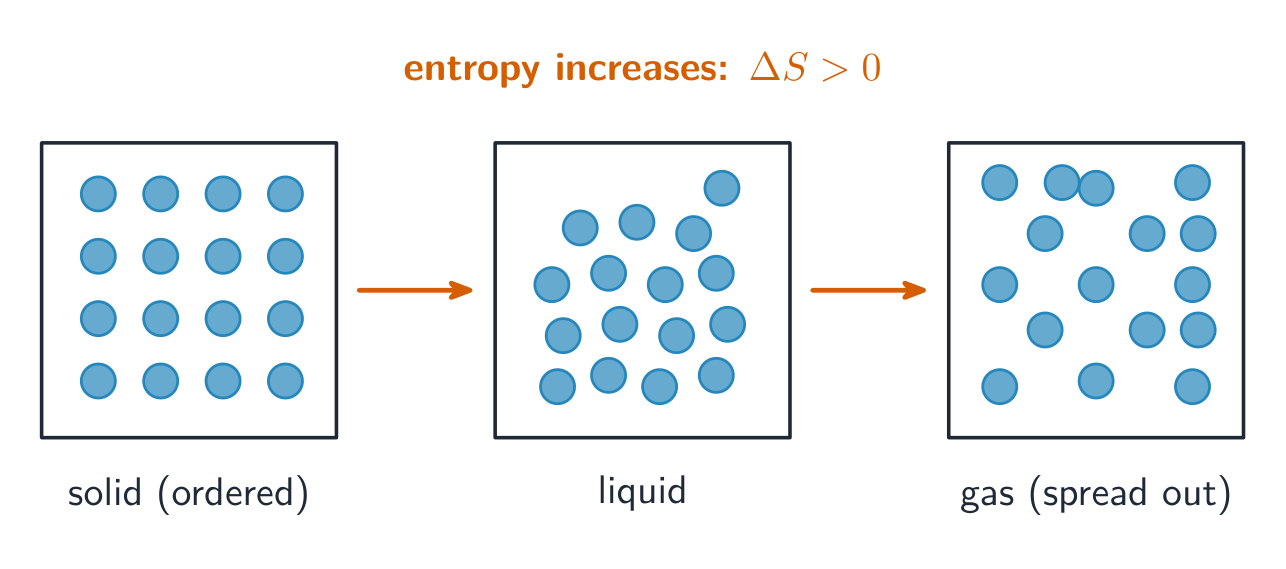
Entropy 熵 $S$ measures the dispersal of energy and matter – loosely, the number of ways to arrange a system. Entropy increases when a substance goes solid → liquid → gas, when a solid dissolves, when gas moles increase, or when temperature rises. More disorder means higher entropy.

العربية
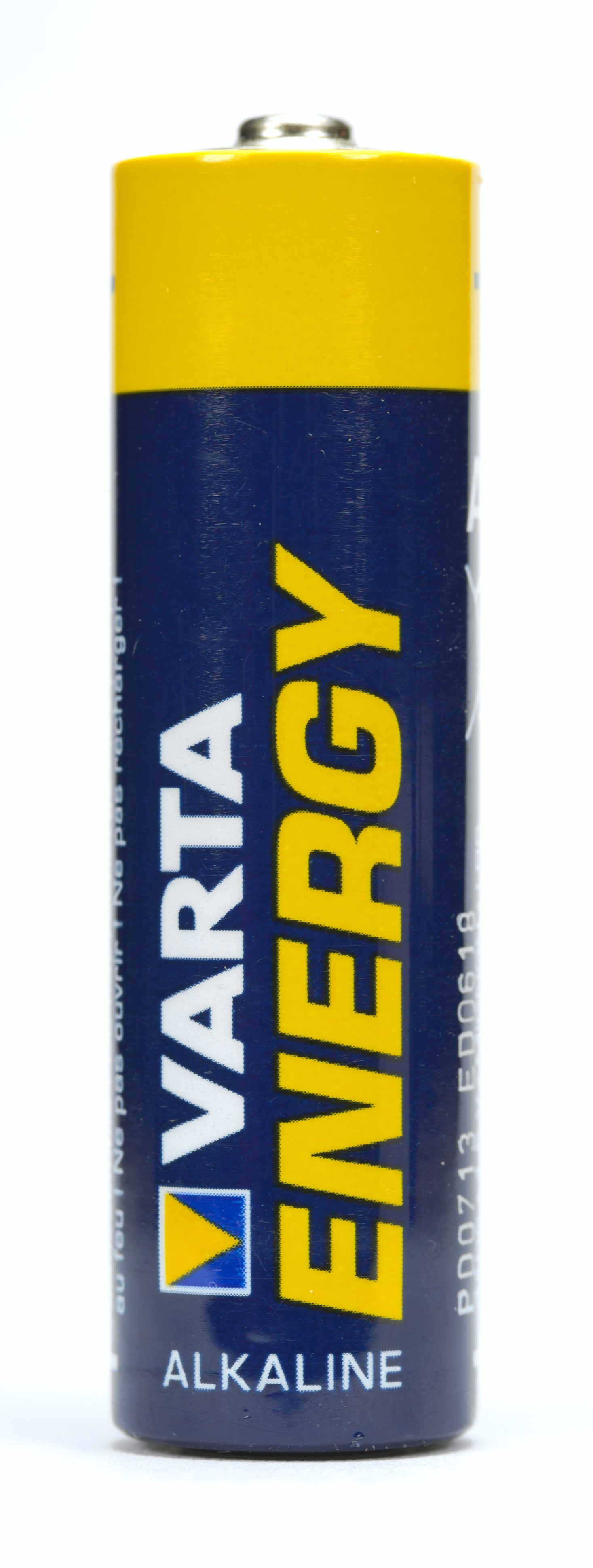
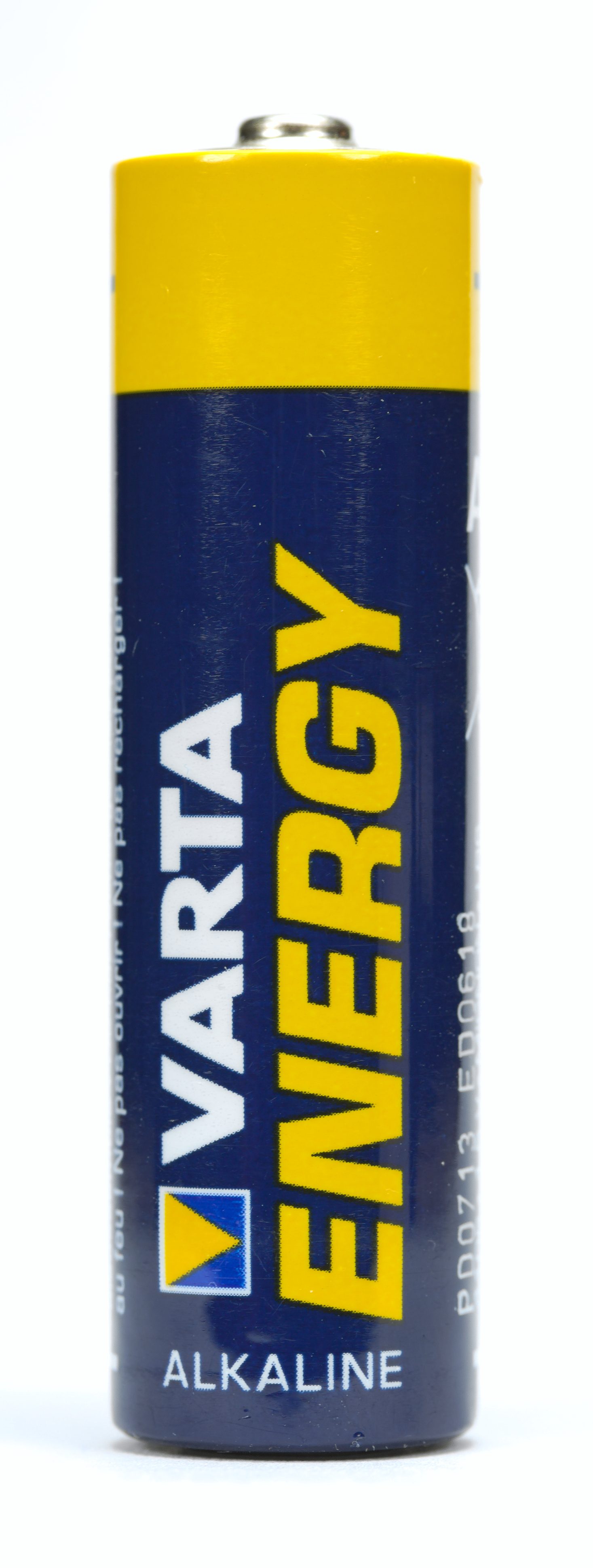
بطاريات منزلية: الخلايا الكهروكيميائية تحول الطاقة الحرة الكيميائية إلى شغل كهربائي

الإنتروبيا $S$ تقيص انتشار الطاقة والمادة – بحرف عام، عدد الطرق لترتيب النظام. تزيد الإنتروبيا عندما تنتقل المادة من صلب → سائل → غاز، أو عند ذوبان الصلب، أو عند زيادة مولات الغاز، أو عند ارتفاع درجة الحرارة. فكلما زاد الفوضى زادت الإنتروبيا.

يزداد الإنتروبيا من الحالة الصلبة إلى السائلة ثم إلى الغازية
Vocabulary · ⁨مفردات⁩ Train · ⁨تدريب⁩
English العربية
Entropy/ˈentrəpi/ الإنتروبيا
Gibbs free energy/ɡɪbz friː ˈenədʒi/ طاقة جيبس الحرة
thermodynamically favorable/ˌθɜːməʊdaɪˈnæmɪkli ˈfeɪvərəbl/ مفضل من الناحية الديناميكية الحرارية
galvanic (voltaic) cell/ɡælˈvænɪk sel/ خلية جلفانية (فولتية)
9.2

Absolute Entropy and Entropy Change · ⁨الإنتروبيا المطلقة وتغير الإنتروبيا⁩

Syllabus · ⁨المنهج⁩
English

Learning Objective 9.2.A: Calculate the standard entropy change for a chemical or physical process based on the absolute entropies (standard molar entropies) of the species involved in the process.

  • 9.2.A.1 The entropy change for a process can be calculated from the absolute entropies of the species involved before and after the process occurs.
    • Equation: $\Delta S^{\circ}_{reaction} = \Sigma S^{\circ}_{products} - \Sigma S^{\circ}_{reactants}$
العربية

الهدف التعليمي 9.2.A: حساب تغير الإنتروبيا القياسي لعملية كيميائية أو فيزيائية بناءً على الإنتروبيات المطلقة (الإنتروبيات المولية القياسية) للأنواع المشاركة في العملية.

  • 9.2.A.1 يمكن حساب تغير الإنتروبيا لعملية ما من خلال الإنتروبيات المطلقة للأنواع المشاركة قبل وبعد حدوث العملية.
    • المعادلة: $\Delta S^{\circ}_{reaction} = \Sigma S^{\circ}_{products} - \Sigma S^{\circ}_{reactants}$

Source: College Board AP Course and Exam Description · ⁨المصدر: وصف دورة وامتحان College Board AP⁩

English

Every substance has a positive absolute entropy $S^\circ$. For a reaction,

$$\Delta S^\circ = \sum S^\circ(\text{products}) - \sum S^\circ(\text{reactants}).$$
Predict its sign from the change in gas moles: making more gas raises entropy ($\Delta S>0$).

العربية

لكل مادة إنتروبيا مطلقة موجبة $S^\circ$. بالنسبة لتفاعل ما،

$$\Delta S^\circ = \sum S^\circ(\text{products}) - \sum S^\circ(\text{reactants}).$$
تنبأ بـ إشارته من خلال التغير في مولات الغاز: إنتاج المزيد من الغاز يرفع الإنتروبيا ($\Delta S>0$).

9.3

Gibbs Free Energy and Thermodynamic Favorability · ⁨طاقة جيبس الحرة والأفضلية الديناميكية الحرارية⁩

Syllabus · ⁨المنهج⁩
English

Learning Objective 9.3.A: Explain whether a physical or chemical process is thermodynamically favored based on an evaluation of $\Delta G^{\circ}$.

  • 9.3.A.1 The Gibbs free energy change for a chemical process in which all the reactants and products are present in a standard state (as pure substances, as solutions of 1.0 M concentration, or as gases at a pressure of 1.0 atm (or 1.0 bar)) is given the symbol $\Delta G^{\circ}$.

  • 9.3.A.2 The standard Gibbs free energy change for a chemical or physical process is a measure of thermodynamic favorability. Historically, the term "spontaneous" has been used to describe processes for which $\Delta G^{\circ} < 0$. The phrase "thermodynamically favored" is preferred instead so that common misunderstandings (equating "spontaneous" with "suddenly" or "without cause") can be avoided. When $\Delta G^{\circ} < 0$ for the process, it is said to be thermodynamically favored.

  • 9.3.A.3 The standard Gibbs free energy change for a physical or chemical process may also be determined from the standard Gibbs free energy of formation of the reactants and products.

    • Equation: $\Delta G^{\circ}_{reaction} = \Sigma \Delta G^{\circ}_{f\ products} - \Sigma \Delta G^{\circ}_{f\ reactants}$
  • 9.3.A.4 In some cases, it is necessary to consider both enthalpy and entropy to determine if a process will be thermodynamically favored. The freezing of water and the dissolution of sodium nitrate are examples of such phenomena.

  • 9.3.A.5 Knowing the values of $\Delta H^{\circ}$ and $\Delta S^{\circ}$ for a process at a given temperature allows $\Delta G^{\circ}$ to be calculated directly.

    • Equation: $\Delta G^{\circ} = \Delta H^{\circ} - T\,\Delta S^{\circ}$
  • 9.3.A.6 In general, the temperature conditions for a process to be thermodynamically favored ($\Delta G^{\circ} < 0$) can be predicted from the signs of $\Delta H^{\circ}$ and $\Delta S^{\circ}$ as shown in the table below:

    $\Delta H^{\circ}$ $\Delta S^{\circ}$ Symbols $\Delta G^{\circ} < 0$, favored at:
    $< 0$ $> 0$ $<\ >$ all $T$
    $> 0$ $< 0$ $>\ <$ no $T$
    $> 0$ $> 0$ $>\ >$ high $T$
    $< 0$ $< 0$ $<\ <$ low $T$

    In cases where $\Delta H^{\circ} < 0$ and $\Delta S^{\circ} > 0$, no calculation of $\Delta G^{\circ}$ is necessary to determine that the process is thermodynamically favored ($\Delta G^{\circ} < 0$). In cases where $\Delta H^{\circ} > 0$ and $\Delta S^{\circ} < 0$, no calculation of $\Delta G^{\circ}$ is necessary to determine that the process is thermodynamically unfavored ($\Delta G^{\circ} > 0$).

العربية

الهدف التعليمي 9.3.A: توضيح ما إذا كانت عملية فيزيائية أو كيميائية مفضلة ديناميكيًا حراريًا بناءً على تقييم $\Delta G^{\circ}$.

  • 9.3.A.1 يُرمز لتغير طاقة جيبس الحرة لعملية كيميائية يكون فيها جميع المتفاعلات والنواتج في حالة قياسية (كمواد نقية، أو كمحاليل بتركيز 1.0 M، أو كغازات عند ضغط 1.0 atm (أو 1.0 bar)) بالرمز $\Delta G^{\circ}$.

  • 9.3.A.2 يمثل التغير في الطاقة الحرة لجيبس القياسية لعمل كيميائي أو فيزيائي مقياساً للأنسجام الديناميكي الحراري. تاريخياً، تم استخدام مصطلح "تلقائي" لوصف العمليات التي تكون فيها $\Delta G^{\circ} < 0$. يُفضل عبارة "مُفضلة ديناميكياً حرارياً" لتجنب سوء الفهم الشائع (الربط بين "تلقائي" و"فجأة" أو "بدون سبب"). عندما تكون $\Delta G^{\circ} < 0$ للعملية، يُقال إنها مُفضلة ديناميكياً حرارياً.

  • 9.3.A.3 يمكن أيضًا تحديد تغير طاقة جيبس الحرة القياسي لعملية فيزيائية أو كيميائية من خلال طاقة جيبس الحرة القياسية للتكوين للمتفاعلات والنواتج.

    • المعادلة: $\Delta G^{\circ}_{reaction} = \Sigma \Delta G^{\circ}_{f\ products} - \Sigma \Delta G^{\circ}_{f\ reactants}$
  • 9.3.A.4 في بعض الحالات، يكون من الضروري النظر في كل من الإنثالبي والإنتروبيا لتحديد ما إذا كانت العملية ستكون مفضلة ديناميكيًا حراريًا. تجمد الماء وذوبان نترات الصوديوم هما مثالان على مثل هذه الظواهر.

  • 9.3.A.5 معرفة قيمتي $\Delta H^{\circ}$ و$\Delta S^{\circ}$ لعملية ما عند درجة حرارة معينة تسمح بحساب $\Delta G^{\circ}$ مباشرة.

    • المعادلة: $\Delta G^{\circ} = \Delta H^{\circ} - T\,\Delta S^{\circ}$
  • 9.3.A.6 بشكل عام، يمكن التنبؤ بشروط درجة الحرارة لعملية ما لتكون مفضلة ديناميكيًا حراريًا ($\Delta G^{\circ} < 0$) من خلال إشارات $\Delta H^{\circ}$ و$\Delta S^{\circ}$ كما هو موضح في الجدول أدناه:

    $\Delta H^{\circ}$ $\Delta S^{\circ}$ الرموز $\Delta G^{\circ} < 0$، مفضلة عند:
    $< 0$ $> 0$ $<\ >$ جميع $T$
    $> 0$ $< 0$ $>\ <$ لا $T$
    $> 0$ $> 0$ $>\ >$ مرتفعة $T$
    $< 0$ $< 0$ $<\ <$ منخفضة $T$

في الحالات التي تكون فيها $\Delta H^{\circ} < 0$ و$\Delta S^{\circ} > 0$، لا حاجة لحساب $\Delta G^{\circ}$ لتحديد أن العملية مفضلة ديناميكيًا حراريًا ($\Delta G^{\circ} < 0$). وفي الحالات التي تكون فيها $\Delta H^{\circ} > 0$ و$\Delta S^{\circ} < 0$، لا حاجة لحساب $\Delta G^{\circ}$ لتحديد أن العملية غير مفضلة ديناميكيًا حراريًا ($\Delta G^{\circ} > 0$).

Source: College Board AP Course and Exam Description · ⁨المصدر: وصف دورة وامتحان College Board AP⁩

English

Gibbs free energy 吉布斯自由能 combines enthalpy and entropy:

$$\Delta G = \Delta H - T\Delta S.$$
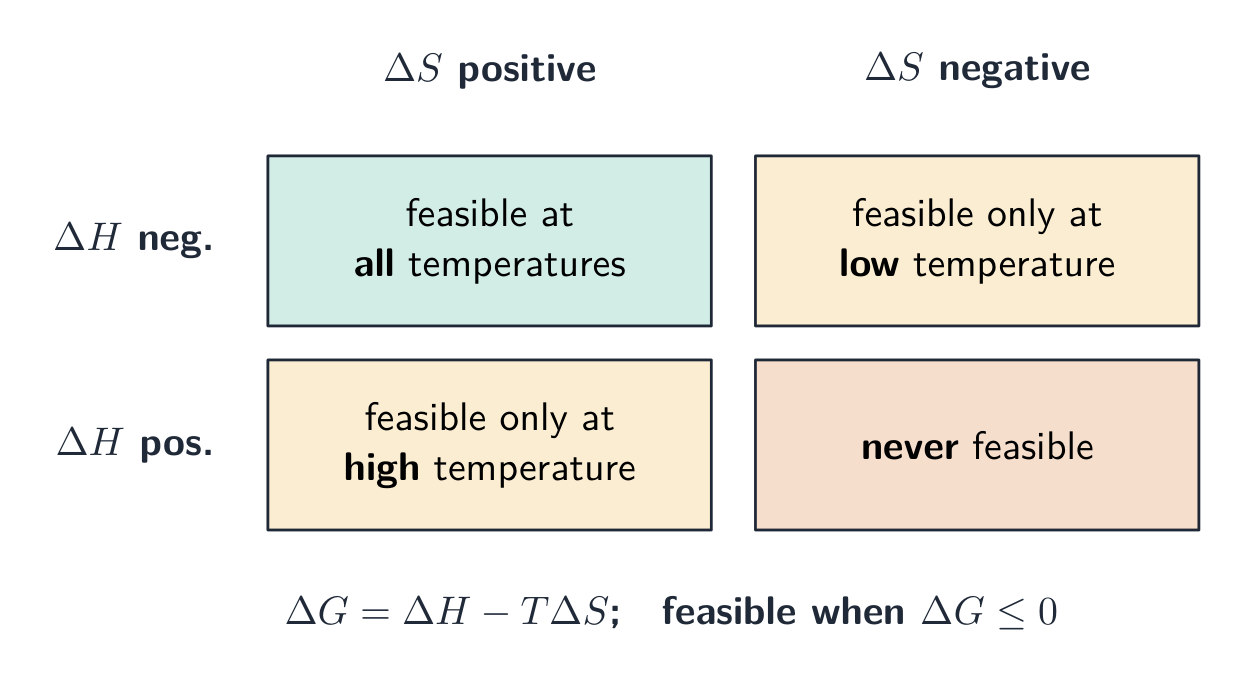
A process is thermodynamically favorable 热力学有利 when $\Delta G<0$. So exothermic ($\Delta H<0$) and entropy-increasing ($\Delta S>0$) reactions are always favorable; when the two oppose, temperature decides.

Worked example. A reaction has $\Delta H=+40\ \text{kJ/mol}$ and $\Delta S=+120\ \text{J/(mol K)}$. It is endothermic (unfavorable enthalpy) but entropy-increasing, so it becomes favorable only when hot enough. Setting $\Delta G=\Delta H-T\Delta S<0$ and matching units ($\Delta S=0.120\ \text{kJ}$):

$$T>\frac{\Delta H}{\Delta S}=\frac{40}{0.120}=333\ \text{K}\;(60\,{}^{\circ}\text{C}).$$

العربية

طاقة جيبس الحرة تجمع بين الإنثالبي والإنتروبيا:

$$\Delta G = \Delta H - T\Delta S.$$
يكون العملية ديناميكياً حرارية مفضلة عندما $\Delta G<0$. لذلك، التفاعلات الطاردة للحرارة ($\Delta H<0$) ومزداد الإنتروبيا ($\Delta S>0$) دائماً مفضلة؛ وعندما يعارض أحدهما الآخر، درجة الحرارة هي التي تحسم الأمر.

هل التفاعل مفضل، بناءً على إشارات تغير الإنثالبي والإنتروبيا

مثال محلل. تفاعل لديه $\Delta H=+40\ \text{kJ/mol}$ و$\Delta S=+120\ \text{J/(mol K)}$. هو تفاعل ماص للحرارة (إنثالبي غير مفضل) لكنه يزداد الإنتروبيا، لذا يصبح مفضلاً فقط عندما يكون ساخناً بما يكفي. بضبط $\Delta G=\Delta H-T\Delta S<0$ ومطابقة الوحدات ($\Delta S=0.120\ \text{kJ}$):

$$T>\frac{\Delta H}{\Delta S}=\frac{40}{0.120}=333\ \text{K}\;(60\,{}^{\circ}\text{C}).$$

9.4

Thermodynamic and Kinetic Control · ⁨التحكم الديناميكي الحراري والحركي⁩

Syllabus · ⁨المنهج⁩
English

Learning Objective 9.4.A: Explain, in terms of kinetics, why a thermodynamically favored reaction might not occur at a measurable rate.

  • 9.4.A.1 Many processes that are thermodynamically favored do not occur to any measurable extent, or they occur at extremely slow rates.
  • 9.4.A.2 Processes that are thermodynamically favored, but do not proceed at a measurable rate, are under "kinetic control." High activation energy is a common reason for a process to be under kinetic control. The fact that a process does not proceed at a noticeable rate does not mean that the chemical system is at equilibrium. If a process is known to be thermodynamically favored, and yet does not occur at a measurable rate, it is reasonable to conclude that the process is under kinetic control.
العربية

الهدف التعليمي 9.4.A: شرح، من منظور الحركية، لماذا قد لا يحدث تفاعل مفضل ديناميكيًا حراريًا بمعدل قابل للقياس.

  • 9.4.A.1许多在热力学上有利(thermodynamically favored)的过程并不以可测量的程度发生,或者它们以极慢的速率发生。
  • 9.4.A.2 在热力学上有利但不以可测量速率进行的过程处于“动力学控制”(kinetic control)之下。高活化能是过程处于动力学控制的常见原因。一个过程不以明显速率进行并不意味着化学系统处于平衡状态。如果已知一个过程在热力学上有利,却未以可测量速率发生,合理推断该过程处于动力学控制之下。

Source: College Board AP Course and Exam Description · ⁨المصدر: وصف دورة وامتحان College Board AP⁩

English

$\Delta G<0$ says a reaction can happen, not that it will happen fast. A reaction can be thermodynamically favorable yet kinetically slow because of a high activation energy (diamond → graphite). Thermodynamics gives the direction; kinetics gives the speed.

العربية

$\Delta G<0$ يقول إن التفاعل يمكن أن يحدث، وليس أنه سيحدث بسرعة. قد يكون التفاعل ديناميكياً حرارياً مفضلاً ولكنه حركياً بطيئاً بسبب طاقة تنشيط عالية (الماس → الغرافيت). الديناميكا الحرارية تعطي الاتجاه؛ الحركية تعطي السرعة.

9.5

Free Energy and Equilibrium · ⁨الطاقة الحرة والتوازن⁩

Syllabus · ⁨المنهج⁩
English

Learning Objective 9.5.A: Explain whether a process is thermodynamically favored using the relationships between $K$, $\Delta G^{\circ}$, and $T$.

  • 9.5.A.1 The phrase "thermodynamically favored" ($\Delta G^{\circ} < 0$) means that the products are favored at equilibrium ($K > 1$) under standard conditions.
  • 9.5.A.2 The equilibrium constant is related to free energy by the equations
    • Equation: $K = e^{-\Delta G^{\circ}/RT}$
    • Equation: $\Delta G^{\circ} = -RT \ln K$
  • 9.5.A.3 Connections between $K$ and $\Delta G^{\circ}$ can be made qualitatively through estimation. When $\Delta G^{\circ}$ is near zero, the equilibrium constant will be close to 1. When $\Delta G^{\circ}$ is much larger or much smaller than $RT$, the value of $K$ deviates strongly from 1.
  • 9.5.A.4 Processes with $\Delta G^{\circ} < 0$ favor products (i.e., $K > 1$) and those with $\Delta G^{\circ} > 0$ favor reactants (i.e., $K < 1$).
العربية

学习目标 9.5.A: 利用 $K$、$\Delta G^{\circ}$ 和 $T$ 之间的关系解释一个过程是否在热力学上有利。

  • 9.5.A.1 “热力学上有利”(thermodynamically favored)($\Delta G^{\circ} < 0$)一词意味着在标准条件下,平衡时产物占优势($K > 1$)。
  • 9.5.A.2 平衡常数与自由能通过以下方程相关联:
    • المعادلة: $K = e^{-\Delta G^{\circ}/RT}$
    • المعادلة: $\Delta G^{\circ} = -RT \ln K$
  • 9.5.A.3 可以通过估算对 $K$ 和 $\Delta G^{\circ}$ 之间的连接进行定性分析。当 $\Delta G^{\circ}$ 接近零时,平衡常数将接近 1。当 $\Delta G^{\circ}$ 远大于或远小于 $RT$ 时,$K$ 的值将强烈偏离 1。
  • 9.5.A.4 $\Delta G^{\circ} < 0$ 为负的过程有利于产物(即 $K > 1$),而 $\Delta G^{\circ} > 0$ 为正的过程有利于反应物(即 $K < 1$)。

Source: College Board AP Course and Exam Description · ⁨المصدر: وصف دورة وامتحان College Board AP⁩

English

Free energy links to the equilibrium constant:

$$\Delta G^\circ = -RT\ln K.$$
So $\Delta G^\circ<0$ gives $K>1$ (products favored), and $\Delta G^\circ>0$ gives $K<1$. At equilibrium $\Delta G=0$.

العربية

ترتبط الطاقة الحرة بثابت التوازن:

$$\Delta G^\circ = -RT\ln K.$$
لذا $\Delta G^\circ<0$ يعطي $K>1$ (المنتجات مفضلة)، و$\Delta G^\circ>0$ يعطي $K<1$. عند التوازن $\Delta G=0$.

البطارية تحول الطاقة الحرة لتفاعل أكسدة-اختزال تلقائي إلى شغل كهربائي
9.6

Free Energy of Dissolution · ⁨طاقة الذوبان الحرة⁩

Syllabus · ⁨المنهج⁩
English

Learning Objective 9.6.A: Explain the relationship between the solubility of a salt and changes in the enthalpy and entropy that occur in the dissolution process.

  • 9.6.A.1 The free energy change ($\Delta G^{\circ}$) for dissolution of a substance reflects a number of factors: the breaking of the intermolecular interactions that hold the solid together, the reorganization of the solvent around the dissolved species, and the interaction of the dissolved species with the solvent. It is possible to estimate the sign and relative magnitude of the enthalpic and entropic contributions to each of these factors. However, making predictions for the total change in free energy of dissolution can be challenging due to the cancellations among the free energies associated with the three factors cited.
العربية

学习目标 9.6.A: 解释盐的溶解度与溶解过程中发生的焓变和熵变之间的关系。

  • 9.6.A.1 يعكس التغير في الطاقة الحرة ($\Delta G^{\circ}$) لذوبان مادة عددًا من العوامل: كسر التفاعلات بين الجزيئات التي تربط المادة الصلبة معًا، وإعادة تنظيم المذيب حول الأنواع المذابة، وتفاعل الأنواع المذابة مع المذيب. يمكن تقدير الإشارة والمقدار النسبي للمساهمات الإنثالبية والإنتروبية لكل من هذه العوامل. ومع ذلك، قد يكون إجراء تنبؤات للتغير الكلي في الطاقة الحرة للذوبان أمرًا صعبًا بسبب التعويض المتبادل بين طاقات الحرية المرتبطة بالعوامل الثلاثة المذكورة.

Source: College Board AP Course and Exam Description · ⁨المصدر: وصف دورة وامتحان College Board AP⁩

English

Whether a salt dissolves depends on the free-energy change of dissolving. Dissolving often increases entropy (ordered solid → dispersed ions) but may cost enthalpy; the sign of $\Delta G$ (and thus $K_{sp}$) follows from $\Delta H - T\Delta S$.

العربية

يعتمد ذوبان الملح على تغير الطاقة الحرة للذوبان. غالباً ما يزيد الذوبان الإنتروبيا (صلب مرتب → أيونات منتشرة) لكن قد يكلف إنثالبي؛ تتبع إشارة $\Delta G$ (وبالتالي $K_{sp}$) من $\Delta H - T\Delta S$.

9.7

Coupled Reactions · ⁨التفاعلات المقترنة⁩

Syllabus · ⁨المنهج⁩
English

Learning Objective 9.7.A: Explain the relationship between external sources of energy or coupled reactions and their ability to drive thermodynamically unfavorable processes.

  • 9.7.A.1 An external source of energy can be used to make a thermodynamically unfavorable process occur. Examples include:
    • 9.7.A.1.i Electrical energy to drive an electrolytic cell or charge a battery.
    • 9.7.A.1.ii Light to drive the overall conversion of carbon dioxide to glucose in photosynthesis.
  • 9.7.A.2 A desired product can be formed by coupling a thermodynamically unfavorable reaction that produces that product to a favorable reaction (e.g., the conversion of $ATP$ to $ADP$ in biological systems). In the coupled system, the individual reactions share one or more common intermediates. The sum of the individual reactions produces an overall reaction that achieves the desired outcome and has $\Delta G^{\circ} < 0$.
العربية

الهدف التعليمي 9.7.A: شرح العلاقة بين مصادر الطاقة الخارجية أو التفاعلات المترابقة وقدرتها على دفع العمليات غير المفضلة ديناميكيًا حراريًا.

  • 9.7.A.1 يمكن استخدام مصدر طاقة خارجي لجعل عملية غير مفضلة ديناميكيًا حراريًا تحدث. تشمل الأمثلة ما يلي:
    • 9.7.A.1.i الطاقة الكهربائية لتدفع خلية إلكتروليتية أو شحن بطارية.
    • 9.7.A.1.ii الضوء لدفع التحويل الإجمالي لثاني أكسيد الكربون إلى جلوكوز في عملية البناء الضوئي.
  • 9.7.A.2 يمكن تكوين منتج مطلوب عن طريق ربط تفاعل غير مفضل ديناميكيًا حراريًا ينتج هذا المنتج بتفاعل مفضل (مثل تحويل $ATP$ إلى $ADP$ في الأنظمة البيولوجية). في النظام المترابط، تتشارك التفاعلات الفردية وسيطًا واحدًا أو أكثر. يؤدي مجموع التفاعلات الفردية إلى تفاعل كلي يحقق النتيجة المرجوة وي possessing $\Delta G^{\circ} < 0$.

Source: College Board AP Course and Exam Description · ⁨المصدر: وصف دورة وامتحان College Board AP⁩

English

An unfavorable reaction ($\Delta G>0$) can be driven by coupling it to a favorable one ($\Delta G<0$) that shares a common intermediate, as long as the sum has $\Delta G<0$. This is how cells use ATP to power otherwise unfavorable processes.

العربية

يمكن دفع تفاعل غير مفضل ($\Delta G>0$) عن طريق اقترانه بتفاعل مفضل ($\Delta G<0$) يشارك فيه وسيط مشترك، طالما أن المجموع يمتلك $\Delta G<0$. هكذا تستخدم الخلايا ATP لتشغيل عمليات كانت غير مفضلة بدورها.

9.8

Galvanic and Electrolytic Cells · ⁨الخلايا الجلفانية والخلايا الإلكتروليتية⁩

Syllabus · ⁨المنهج⁩
English

Learning Objective 9.8.A: Explain the relationship between the physical components of an electrochemical cell and the overall operational principles of the cell.

  • 9.8.A.1 Each component of an electrochemical cell (electrodes, solutions in the half-cells, salt bridge, voltage/current measuring device) plays a specific role in the overall functioning of the cell. The operational characteristics of the cell (galvanic vs. electrolytic, direction of electron flow, reactions occurring in each half-cell, change in electrode mass, evolution of a gas at an electrode, ion flow through the salt bridge) can be described at both the macroscopic and particulate levels.
  • 9.8.A.2 Galvanic, sometimes called voltaic, cells involve a thermodynamically favored reaction, whereas electrolytic cells involve a thermodynamically unfavored reaction. Visual representations of galvanic and electrolytic cells are tools of analysis to identify where half-reactions occur and in what direction current flows.
  • 9.8.A.3 For all electrochemical cells, oxidation occurs at the anode and reduction occurs at the cathode.
    • Exclusion statement: Labeling an electrode as positive or negative will not be assessed on the AP Exam.
العربية

الهدف التعليمي 9.8.A: شرح العلاقة بين المكونات المادية للخلية الكهروكيميائية والمبادئ التشغيلية الكلية للخلية.

  • 9.8.A.1 تلعب كل مكون من مكونات الخلية الكهروكيميائية (الأقطاب، المحاليل في أنصاف الخلايا، الجسر الملحي، جهاز قياس الجهد/التيار) دورًا محددًا في الوظيفة الكلية للخلية. يمكن وصف الخصائص التشغيلية للخلية (الجلفانية مقابل الإلكتروليتية، اتجاه تدفق الإلكترونات، التفاعلات التي تحدث في كل نصف خلية، تغير كتلة القطب، تطور غاز عند قطب، تدفق الأيونات عبر الجسر الملحي) على كل من المستوى العياني والجسيماتي.
  • 9.8.A.2 تتضمن الخلايا الجلفانية، والتي تُسمى أحيانًا خلايا فولتية، تفاعلًا مفضلًا ديناميكيًا حراريًا، بينما تتضمن الخلايا الإلكتروليتية تفاعلًا غير مفضل ديناميكيًا حراريًا. تمثل التمثيلات المرئية للخلايا الجلفانية والإلكتروليتية أدوات تحليل لتحديد مكان حدوث أنصاف التفاعلات واتجاه تدفق التيار.
  • 9.8.A.3 بالنسبة لجميع الخلايا الكهروكيميائية، يحدث الأكسدة عند المصعد ويحدث الاختزال عند المهبط.
    • بيان الاستبعاد: لن يتم تقييم وضع علامات على أنها قطب موجب أو سالب في امتحان AP.

Source: College Board AP Course and Exam Description · ⁨المصدر: وصف دورة وامتحان College Board AP⁩

English
The galvanic cell

Redox reactions can move electrons through a wire:

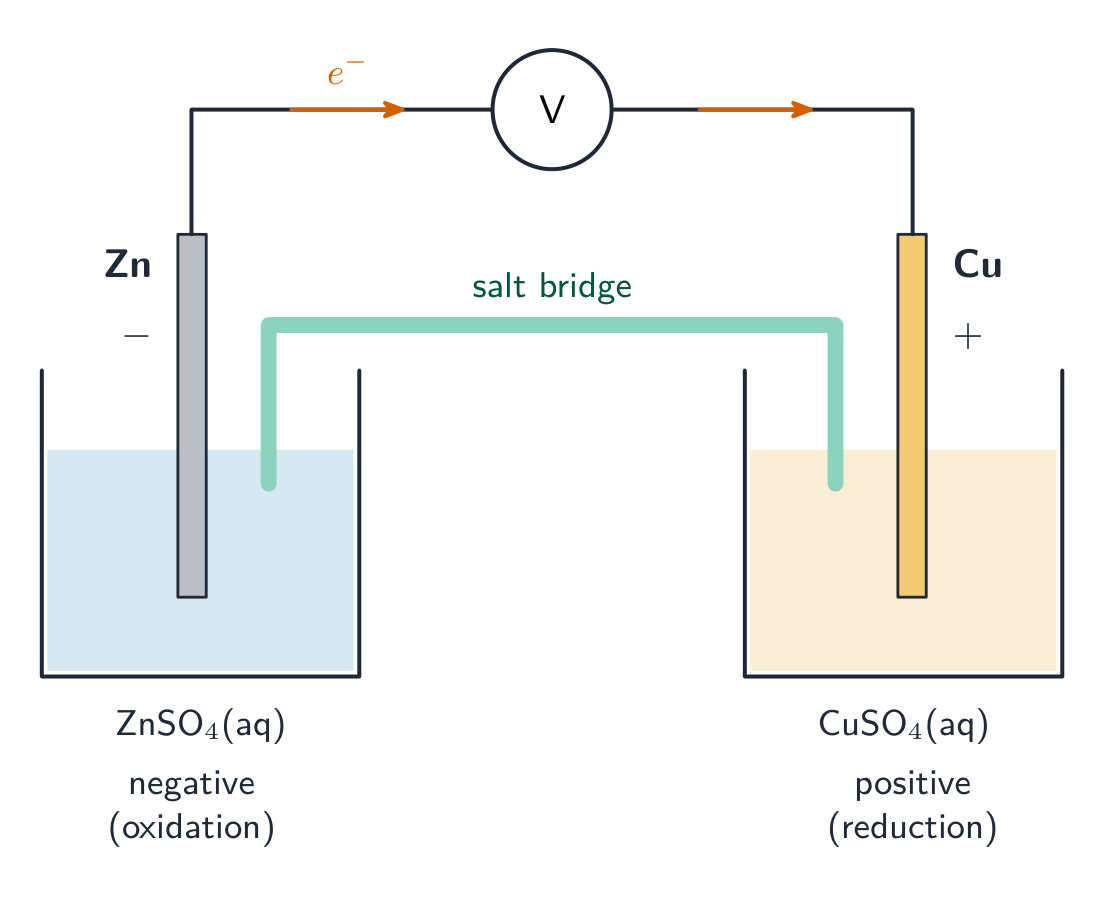
  • A galvanic (voltaic) cell 原电池 uses a favorable reaction ($\Delta G<0$) to produce electricity – a battery.
  • An electrolytic cell 电解池 uses electricity to force an unfavorable reaction ($\Delta G>0$).

In both, oxidation happens at the anode 阳极 and reduction at the cathode 阴极.

العربية
الخلية الجلفانية

يمكن لتفاعلات الأكسدة-اختزال نقل الإلكترونات عبر سلك:

خلية جلفانية مع جسر ملحي وفولتميتر
  • الخلية الجلفانية (الفولطية) تستخدم تفاعلاً مواتياً ($\Delta G<0$) لإنتاج الكهرباء – البطارية.
  • الخلية الإلكتروليتية تستخدم الكهرباء لإجبار تفاعل غير مواتٍ ($\Delta G>0$).

في كلا الحالتين، يحدث الأكسدة عند المصعد والاختزال عند المهبط.

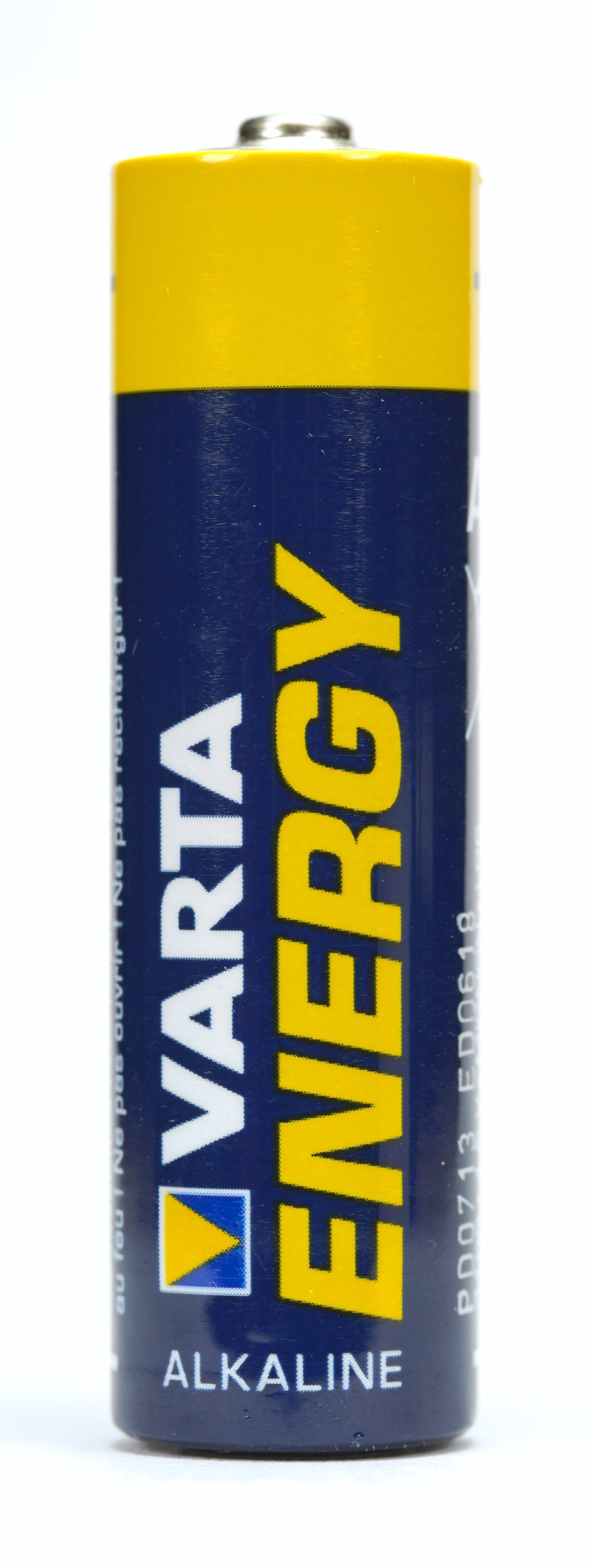
بطاريات تجارية: الخلايا الجلفانية تحول الطاقة الحرة الكيميائية إلى شغل كهربائي
Explore · ⁨استكشف⁩

Transfer electrons in a cell · ⁨نقل الإلكترونات في الخلية⁩

In a galvanic cell a spontaneous redox reaction drives electrons through a wire, doing electrical work; oxidation at one electrode, reduction at the other. · ⁨في الخلية الجلفانية، يوجه تفاعل أكسدة-اختزال تلقائي الإلكترونات عبر سلك، مبذولاً عملاً كهربائياً؛ الأكسدة تحدث عند أحد الأقطاب، والاختزال عند الآخر.⁩

9.9

Cell Potential and Free Energy · ⁨جهد الخلية والطاقة الحرة⁩

Syllabus · ⁨المنهج⁩
English

Learning Objective 9.9.A: Explain whether an electrochemical cell is thermodynamically favored, based on its standard cell potential and the constituent half-reactions within the cell.

  • 9.9.A.1 Electrochemistry encompasses the study of redox reactions that occur within electrochemical cells. The reactions are either thermodynamically favored (resulting in a positive voltage) or thermodynamically unfavored (resulting in a negative voltage and requiring an externally applied potential for the reaction to proceed).
  • 9.9.A.2 The standard cell potential of electrochemical cells can be calculated by identifying the oxidation and reduction half-reactions and their respective standard reduction potentials.
  • 9.9.A.3 $\Delta G^{\circ}$ (standard Gibbs free energy change) is proportional to the negative of the cell potential for the redox reaction from which it is constructed. Thus, a cell with a positive $E^{\circ}$ involves a thermodynamically favored reaction, and a cell with a negative $E^{\circ}$ involves a thermodynamically unfavored reaction.
    • Equation: $\Delta G^{\circ} = -nFE^{\circ}$
العربية

الهدف التعليمي 9.9.A: شرح ما إذا كانت الخلية الكهروكيميائية مفضلة ديناميكيًا حراريًا، بناءً على جهد الخلية القياسي وأنصاف التفاعلات المكونة داخلها.

  • 9.9.A.1 يشمل الكيمياء الكهربية دراسة تفاعلات الأكسدة والاختزال التي تحدث داخل الخلايا الكهروكيميائية. تكون التفاعلات إما مفضلة ديناميكيًا حراريًا (مما يؤدي إلى جهد موجب) أو غير مفضلة ديناميكيًا حراريًا (مما يؤدي إلى جهد سالب ويتطلب جهدًا مطبقًا خارجيًا لاستمرار التفاعل).
  • 9.9.A.2 يمكن حساب جهد الخلية القياسي للخلايا الكهروكيميائية من خلال تحديد أنصاف تفاعلات الأكسدة والاختزال وجهد الاختزال القياسي الخاص بها.
  • 9.9.A.3 $\Delta G^{\circ}$ (التغير في طاقة Gibbs الحرة القياسية) يتناسب طرديًا مع سالب جهد الخلية للتفاعل الذي تم بناؤه منه. وبالتالي، فإن الخلية ذات $E^{\circ}$ موجب تتضمن تفاعلًا مفضلًا ديناميكيًا حراريًا، والخلية ذات $E^{\circ}$ سالب تتضمن تفاعلًا غير مفضل ديناميكيًا حراريًا.
    • المعادلة: $\Delta G^{\circ} = -nFE^{\circ}$

Source: College Board AP Course and Exam Description · ⁨المصدر: وصف دورة وامتحان College Board AP⁩

English

The cell potential 电池电势 $E^\circ_{\text{cell}}$ measures the driving force in volts, found from standard reduction potentials ($E^\circ_{\text{cathode}}-E^\circ_{\text{anode}}$). It links to free energy by

$$\Delta G^\circ = -nFE^\circ_{\text{cell}},$$
where $n$ is moles of electrons and $F$ the Faraday constant. A positive $E^\circ_{\text{cell}}$ means a favorable (galvanic) reaction.

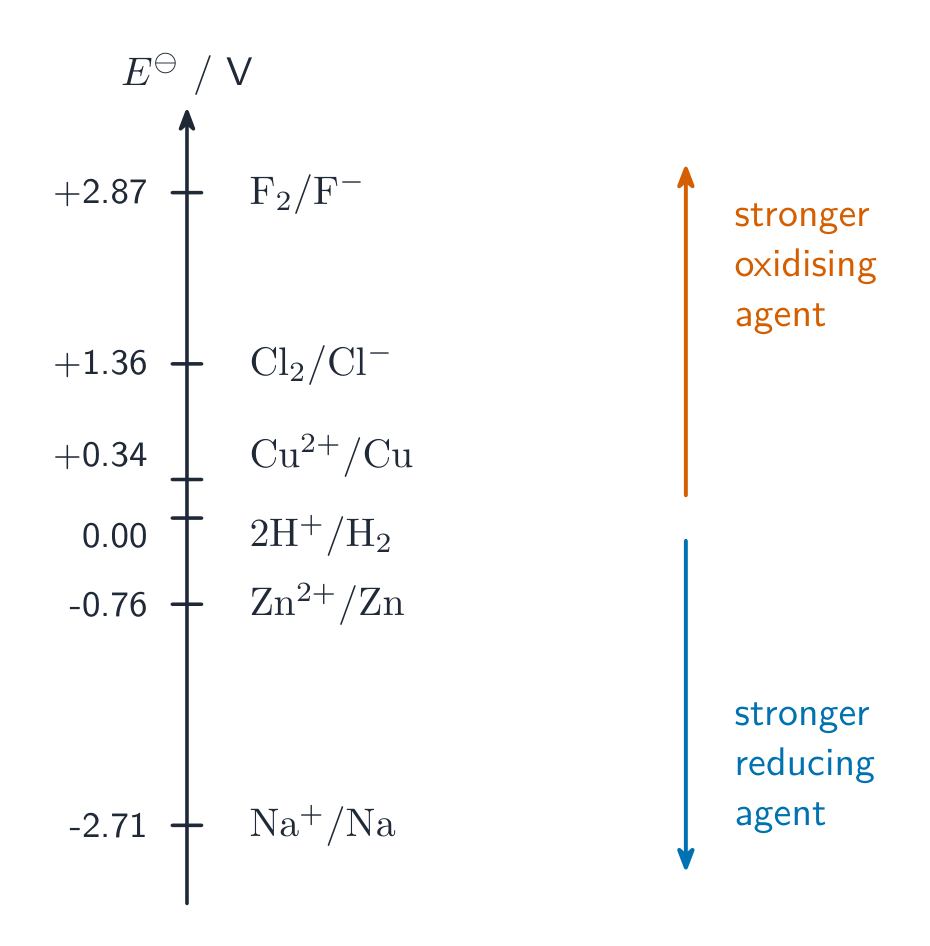
Worked example. A cell pairs a copper cathode ($\text{Cu}^{2+}+2e^-\rightarrow\text{Cu}$, $E^\circ=+0.34\ \text{V}$) with a zinc anode ($\text{Zn}^{2+}+2e^-\rightarrow\text{Zn}$, $E^\circ=-0.76\ \text{V}$). The cell potential is

$$E^\circ_{\text{cell}}=E^\circ_{\text{cathode}}-E^\circ_{\text{anode}}=0.34-(-0.76)=1.10\ \text{V}.$$
It is positive, so the reaction is spontaneous and the cell (a Daniell cell) acts as a battery.

العربية

يجب أن يكون جهد الخلية $E^\circ_{\text{cell}}$ لقياس القوة الدافعة الكهربائية بالفولت، ويحسب من جهود الاختزال القياسية ($E^\circ_{\text{cathode}}-E^\circ_{\text{anode}}$). يرتبط بالطاقة الحرة بـ

$$\Delta G^\circ = -nFE^\circ_{\text{cell}},$$
حيث $n$ هو عدد مولات الإلكترونات و$F$ ثابت فاراداي. يعني جهد الخلية الموجب $E^\circ_{\text{cell}}$ تفاعلاً مواتياً (جلفانياً).

السلسلة الكهروكيميائية لجهد القطب القياسي

مثال محلول. تترابط خلية مهبط نحاسي ($\text{Cu}^{2+}+2e^-\rightarrow\text{Cu}$، $E^\circ=+0.34\ \text{V}$) مع مصعد زنك ($\text{Zn}^{2+}+2e^-\rightarrow\text{Zn}$، $E^\circ=-0.76\ \text{V}$). جهد الخلية هو

$$E^\circ_{\text{cell}}=E^\circ_{\text{cathode}}-E^\circ_{\text{anode}}=0.34-(-0.76)=1.10\ \text{V}.$$
إنه موجب، لذا التفاعل تلقائي وتعمل الخلية (وهي خلية دانييل) كبطارية.

Vocabulary · ⁨مفردات⁩ Train · ⁨تدريب⁩
English العربية
anode/ˈænəʊd/ القطب الموجب
cathode/ˈkæθəʊd/ القطب السالب
cell potential/sel pəˈtenʃl/ جهد الخلية
Nernst equation/nɜːnst ɪˈkweɪʒn/ معادلة نرنست
9.10

Cell Potential Under Nonstandard Conditions · ⁨جهد الخلية تحت ظروف غير قياسية⁩

Syllabus · ⁨المنهج⁩
English

Learning Objective 9.10.A: Explain the relationship between deviations from standard cell conditions and changes in the cell potential.

  • 9.10.A.1 In a real system under nonstandard conditions, the cell potential will vary depending on the concentrations of the active species. The cell potential is a driving force toward equilibrium; the farther the reaction is from equilibrium, the greater the magnitude of the cell potential.

  • 9.10.A.2 Equilibrium arguments such as Le Châtelier's principle do not apply to electrochemical systems, because the systems are not in equilibrium.

  • 9.10.A.3 The standard cell potential $E^{\circ}$ corresponds to the standard conditions of $Q = 1$. As the system approaches equilibrium, the magnitude (i.e., absolute value) of the cell potential decreases, reaching zero at equilibrium (when $Q = K$). Deviations from standard conditions that take the cell further from equilibrium than $Q = 1$ will increase the magnitude of the cell potential relative to $E^{\circ}$. Deviations from standard conditions that take the cell closer to equilibrium than $Q = 1$ will decrease the magnitude of the cell potential relative to $E^{\circ}$. In concentration cells, the direction of spontaneous electron flow can be determined by considering the direction needed to reach equilibrium.

  • 9.10.A.4 Algorithmic calculations using the Nernst equation are insufficient to demonstrate an understanding of electrochemical cells under nonstandard conditions. However, students should qualitatively understand the effects of concentration on cell potential and use conceptual reasoning, including the qualitative use of the Nernst equation:

    • Equation: $E = E^{\circ} - (RT/nF) \ln Q$

    to solve problems.

العربية

الهدف التعليمي 9.10.A: اشرح العلاقة بين الانحرافات عن ظروف الخلية القياسية والتغيرات في جهد الخلية.

  • 9.10.A.1 في نظام حقيقي تحت ظروف غير قياسية، سيتفاوت جهد الخلية اعتماداً على تراكيز الأنواع النشطة. جهد الخلية هو دافع نحو التوازن؛ كلما ابتعدت التفاعل عن التوازن، زاد مقدار جهد الخلية.
  • 9.10.A.2 لا تنطبق الحجج المتعلقة بالتوازن مثل مبدأ لوشاتلييه على الأنظمة الكهروكيميائية، لأن الأنظمة ليست في حالة توازن.
  • 9.10.A.3 جهد الخلية القياسي $E^{\circ}$ يقابل الظروف القياسية لـ $Q = 1$. مع اقتراب النظام من الاتزان، تنخفض القيمة المطلقة لجهد الخلية حتى تصل إلى الصفر عند الاتزان (عندما $Q = K$). الانحرافات عن الظروف القياسية التي تبعد الخلية أكثر عن الاتزان من $Q = 1$ ستزيد من قيمة مطلقة لجهد الخلية مقارنة بـ $E^{\circ}$. الانحرافات عن الظروف القياسية التي تقرب الخلية أكثر من الاتزان من $Q = 1$ ستقلل من القيمة المطلقة لجهد الخلية مقارنة بـ $E^{\circ}$. في خلايا التركيز، يمكن تحديد اتجاه تدفق الإلكترونات التلقائي من خلال النظر في الاتجاه اللازم للوصول إلى الاتزان.
  • 9.10.A.4 الحسابات الخوارزمية باستخدام معادلة نرنست غير كافية لإظهار فهم خلايا الكهرباء كيميائية تحت ظروف غير قياسية. ومع ذلك، يجب على الطلاب فهم تأثيرات التركيز على جهد الخلية بشكل نوعي واستخدام الاستنتاج المفاهيمي، بما في ذلك الاستخدام النوعي لمعادلة نرنست:
    • المعادلة: $E = E^{\circ} - (RT/nF) \ln Q$

لحل المشكلات.

Source: College Board AP Course and Exam Description · ⁨المصدر: وصف دورة وامتحان College Board AP⁩

English

Away from standard conditions, the potential shifts with concentration – the Nernst equation 能斯特方程 (qualitatively): as reactants are consumed, $Q$ rises and $E_{\text{cell}}$ falls, reaching zero at equilibrium (a dead battery). Changing a concentration shifts $E_{\text{cell}}$ the way Le Chatelier predicts.

العربية

بعيداً عن الظروف القياسية، يتغير الجهد مع التركيز – معادلة نيرنست (وصفياً): مع استهلاك المتفاعلات، يرتفع $Q$ وينخفض $E_{\text{cell}}$، ليصل إلى الصفر عند الاتزان (بطارية فارغة). تغيير التركيز يحوّل $E_{\text{cell}}$ بطريقة تتوقعها مبدأ shift Le Chatelier.

9.11

Electrolysis and Faraday's Law · ⁨التحليل الكهربائي وقانون فاراداي⁩

Syllabus · ⁨المنهج⁩
English

Learning Objective 9.11.A: Calculate the amount of charge flow based on changes in the amounts of reactants and products in an electrochemical cell.

  • 9.11.A.1 Faraday's laws can be used to determine the stoichiometry of the redox reaction occurring in an electrochemical cell with respect to the following:
    • 9.11.A.1.i Number of electrons transferred
    • 9.11.A.1.ii Mass of material deposited on or removed from an electrode (as in electroplating)
    • 9.11.A.1.iii Current
    • 9.11.A.1.iv Time elapsed
    • 9.11.A.1.v Charge of ionic species
    • Equation: $I = q/t$
العربية

الهدف التعليمي 9.11.A: احسب كمية تدفق الشحنة بناءً على التغيرات في كميات المتفاعلات والنواتج في خلية كهروكيميائية.

  • 9.11.A.1 يمكن استخدام قوانين فاراداي لتحديد الستوكيوميتريا (النسب المولية) لتفاعل الأكسدة والاختزال الذي يحدث في خلية كهروكيميائية فيما يتعلق بما يلي:
    • 9.11.A.1.i عدد الإلكترونات المنتقلة
    • 9.11.A.1.ii كتلة المادة المترسبة على أو المزالة من أحد الأقطاب (كما في الطلاء الكهربائي)
    • 9.11.A.1.iii التيار الكهربائي
    • 9.11.A.1.iv الزمن المنقضي
    • 9.11.A.1.v شحنة الأنواع الأيونية
    • المعادلة: $I = q/t$

Source: College Board AP Course and Exam Description · ⁨المصدر: وصف دورة وامتحان College Board AP⁩

English
Electrolysis

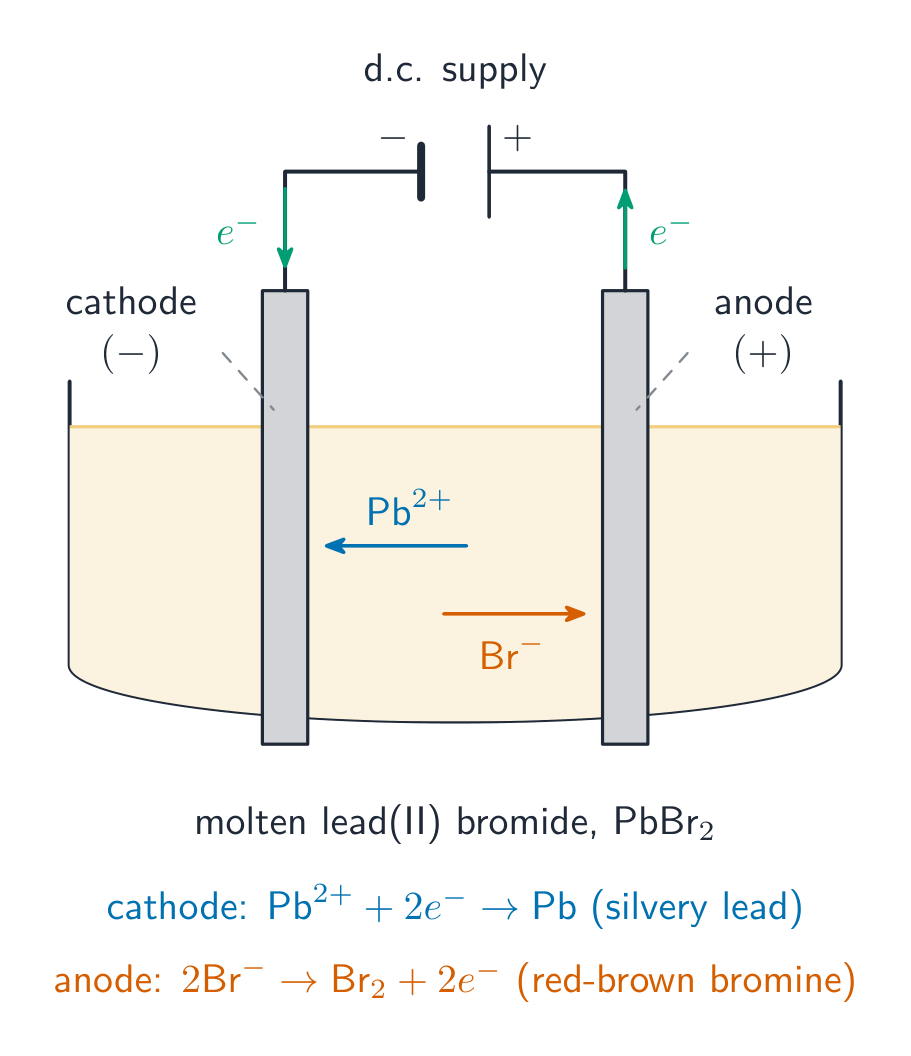
In electrolysis 电解, the charge passed determines how much substance is deposited or produced – Faraday's law 法拉第定律. Convert current × time to charge, charge to moles of electrons ($F=96{,}485$ C/mol), then use the half-reaction's electron ratio to get moles (and mass) of product.

Worked example. A current of $2.0\ \text{A}$ flows for $30\ \text{minutes}$ through copper(II) sulfate ($\text{Cu}^{2+}+2e^-\rightarrow\text{Cu}$). How much copper is deposited? The charge is $Q=It=2.0\times1800=3600\ \text{C}$, giving $3600/96485=0.0373\ \text{mol}$ of electrons. Since each Cu needs $2$ electrons, $0.0187\ \text{mol}$ of Cu forms, a mass of $0.0187\times63.5=1.2\ \text{g}$.

العربية
التحليل الكهربائي

في التحليل الكهربائي، تحدد الشحنة المارة كمية المادة المترسبة أو المنتجة – قانون فاراداي. حوّل التيار × الزمن إلى شحنة، والشحنة إلى مولات إلكترونات ($F=96{,}485$ C/mol)، ثم استخدم نسبة الإلكترون في نصف التفاعل للحصول على مولات (وكافة) المنتج.

التحليل الكهربائي: أيونات تتحرك نحو الأقطاب وتنفصل
التحليل الكهربائي: أيونات تتحرك نحو الأقطاب وتتم تفريغها

مثال محلول. يمر تيار قدره $2.0\ \text{A}$ لمدة $30\ \text{minutes}$ عبر كبريتات النحاس الثنائية ($\text{Cu}^{2+}+2e^-\rightarrow\text{Cu}$). كم مقدار النحاس المترسب؟ الشحنة هي $Q=It=2.0\times1800=3600\ \text{C}$، مما يعطي $3600/96485=0.0373\ \text{mol}$ من الإلكترونات. بما أن كل ذرة Cu تحتاج $2$ إلكترونات، يتكون $0.0187\ \text{mol}$ من Cu، بكتلة قدرها $0.0187\times63.5=1.2\ \text{g}$.

Explore · ⁨استكشف⁩

Electrolyse a molten salt · ⁨تحليل ملح مصهور بالكهرباء⁩

Electrolysis uses current to force a non-spontaneous reaction: positive ions gain electrons at the cathode, negative ions lose them at the anode. Charge sets the amount deposited. · ⁨التحليل الكهربائي يستخدم التيار لإجبار تفاعل غير تلقائي: أيونات موجبة تكتسب إلكترونات عند الكاثود، وأيونات سالبة تفقدها عند الأنود. الشحنة تحدد الكمية المترسبة.⁩

Vocabulary · ⁨مفردات⁩ Train · ⁨تدريب⁩
English العربية
electrolytic cell/ɪˌlektrəˈlɪtɪk sel/ خلية إلكتروليتية
electrolysis/ɪlekˈtrɒləsɪs/ التحليل الكهربائي
Faraday's law/ˈfærədeɪz lɔː/ قانون فاراداي
9.11

Exam tips · ⁨نصائح للامتحان⁩

English
  • A process is thermodynamically favourable when $\Delta G<0$; combine enthalpy and entropy with $\Delta G=\Delta H-T\Delta S$ (match units — kJ vs J).
  • Entropy increases solid→liquid→gas and when more gas moles are produced.
  • Favourable does not mean fast — a high activation energy can make a $\Delta G<0$ reaction extremely slow (kinetic control).
  • In electrochemistry a positive $E^\circ_{\text{cell}}=E^\circ_{\text{cathode}}-E^\circ_{\text{anode}}$ means a spontaneous (galvanic) cell; oxidation is at the anode, reduction at the cathode.
  • In electrolysis the charge passed ($Q=It$) fixes the amount deposited (Faraday's law).
العربية
  • تكون العملية مواتية ديناميكياً حرارياً عندما $\Delta G<0$؛ ادمج الإنثالبي والإنتروبي مع $\Delta G=\Delta H-T\Delta S$ (طابق الوحدات — kJ مقابل J).
  • الإنتروبيا تزداد من صلب→سائل→غاز وعند إنتاج عدد أكبر من مولات الغاز.
  • "ملائم" لا يعني "سريع" — فإن طاقة التنشيط العالية يمكن أن تجعل تفاعلاً $\Delta G<0$ بطيئاً للغاية (تحكم حركي).
  • في الكيمياء الكهربائية، يعني جهد الخلية الموجب $E^\circ_{\text{cell}}=E^\circ_{\text{cathode}}-E^\circ_{\text{anode}}$ خلية تلقائية (جلفانية)؛ الأكسدة عند المصعد، والاختزال عند المهبط.
  • في التحليل الكهربائي، تحدد الشحنة المارة ($Q=It$) الكمية المترسبة (قانون فاراداي).

Interactive lessons on this topic · ⁨دروس تفاعلية حول هذا الموضوع⁩

Work through it step by step, with instant-check exercises. · ⁨ا-working عليه خطوة بخطوة، مع تمارين تحقق فوري.⁩

Past Papers · ⁨أوراق الامتحانات السابقة⁩

More topics in AP Chemistry · ⁨AP الكيمياء⁩ · ⁨المزيد من المواضيع في AP Chemistry · ⁨AP الكيمياء⁩⁩

Log in or create account · ⁨تسجيل الدخول أو إنشاء حساب⁩

IGCSE, A-Level & AP