Skip to content · ⁨الانتقال إلى المحتوى⁩

Atomic Structure and Properties · ⁨البنية والخصائص الذرية⁩

AP Chemistry · ⁨AP الكيمياء⁩ · Topic 1 · ⁨الموضوع 1⁩

Video lesson for this topic · ⁨درس فيديو لهذا الموضوع⁩ Open the video page · ⁨افتح صفحة الفيديو⁩
9:19

البنية والخصائص الذرية

المعادلة الكيميائية تحسب الجسيمات. اثنان من هذا يتفاعل مع واحد من ذلك. لكن الذرات صغيرة جداً بحيث لا يمكن عدها، ولا يوجد جهاز يسلّم لك…

English narration · English + 中文 subtitles burned in · ⁨سرد باللغة الإنجليزية · ترجمة مدمجة بالإنجليزية + الصينية⁩

1.1

Moles and Molar Mass · ⁨المولات والكتلة المولية⁩

Syllabus · ⁨المنهج⁩
English

Learning Objective 1.1.A: Calculate quantities of a substance or its relative number of particles using dimensional analysis and the mole concept.

  • 1.1.A.1 One cannot count particles directly while performing laboratory work. Thus, there must be a connection between the masses of substances reacting and the actual number of particles undergoing chemical changes.
  • 1.1.A.2 Avogadro's number ($N_{\mathrm{A}} = 6.022 \times 10^{23}\ \mathrm{mol}^{-1}$) provides the connection between the number of moles in a pure sample of a substance and the number of constituent particles (or formula units) of that substance.
  • 1.1.A.3 Expressing the mass of an individual atom or molecule in atomic mass units (amu) is useful because the average mass in amu of one particle (atom or molecule) or formula unit of a substance will always be numerically equal to the molar mass of that substance in grams. Thus, there is a quantitative connection between the mass of a substance and the number of particles that the substance contains.
    • Equation: $n = m/M$
العربية

هدف التعلم 1.1.A: حساب كميات المادة أو عددها النسوي للجسيمات باستخدام التحليل البعدي ومفهوم المول.

  • 1.1.A.1 لا يمكن عد الجسيمات بشكل مباشر أثناء إجراء العمل المخبري. وبالتالي، يجب أن يكون هناك ارتباط بين كتل المواد المتفاعلة والعدد الفعلي للجسيمات التي تخضع لتغيرات كيميائية.
  • 1.1.A.2 رقم أفوجادرو ($N_{\mathrm{A}} = 6.022 \times 10^{23}\ \mathrm{mol}^{-1}$) يوفّر العلاقة بين عدد المولات في عينة نقية من مادة ما وعدد الجسيمات المكونة (أو الوحدات الصيغية) لهذه المادة.
  • 1.1.A.3 يُعد التعبير عن كتلة ذرة أو جزيء فردي بوحدة الكتلة الذرية (amu) مفيدًا لأن متوسط الكتلة بالـ amu لجسيم واحد (ذرة أو جزيء) أو وحدة صيغة لمادة ما يساوي دائمًا عدديًا الكتلة المولية لهذه المادة بالغرام. وبالتالي، يوجد ارتباط كمي بين كتل المادة وعدد الجسيمات التي تحتوي عليها.
    • المعادلة: $n = m/M$

Source: College Board AP Course and Exam Description · ⁨المصدر: وصف دورة وامتحان College Board AP⁩

English

Because atoms are far too small to count, chemists count in moles 摩尔. One mole is Avogadro's number 阿伏伽德罗常数 of particles, $N_A=6.022\times10^{23}$. The molar mass 摩尔质量 (grams per mole, read off the periodic table) converts between mass and moles:

$$n=\frac{m}{M}.$$
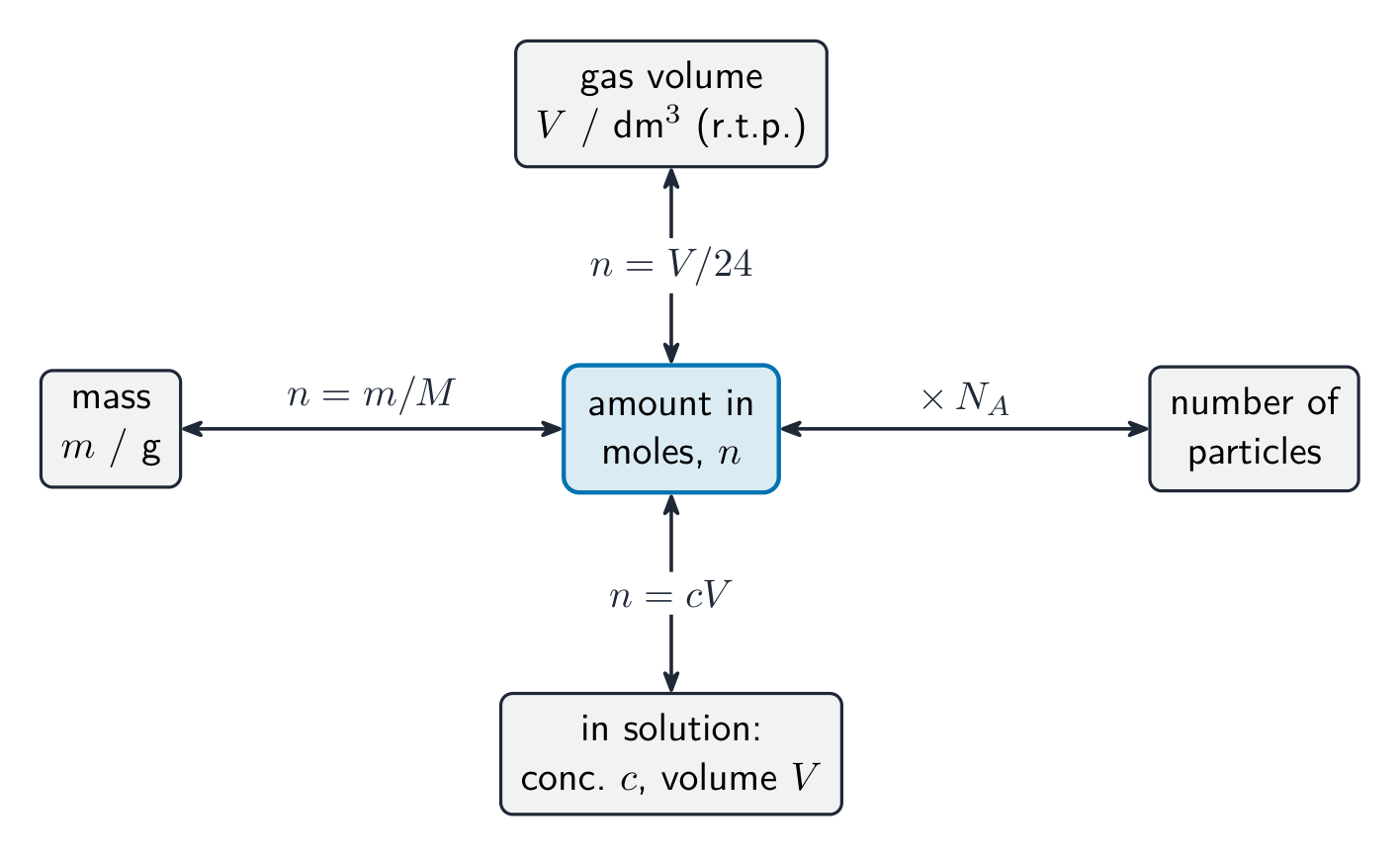
Moles are the bridge between the lab (grams you weigh) and the equation (particles that react).

Worked example. How many moles, and how many molecules, are in $36.0\ \text{g}$ of water ($M=18.0\ \text{g/mol}$)?

$$n=\frac{m}{M}=\frac{36.0}{18.0}=2.0\ \text{mol},\qquad N=n\,N_A=2.0\times6.022\times10^{23}=1.2\times10^{24}\ \text{molecules}.$$

العربية

لأن الذرات صغيرة جداً لعدّها، يحسب الكيميائيون بالـ مولات. المول الواحد هو عدد أفوجادرو من الجسيمات، $N_A=6.022\times10^{23}$. الكتلة المولية (بالجرام لكل مول، تُستخرج من الجدول الدوري) تحول بين الكتلة والمولات:

$$n=\frac{m}{M}.$$
المولات هي الجسر بين المختبر (الجرامات التي تزنّها) والمعادلة (الجسيمات التي تتفاعل).

المول هو المحور: التحويل بين الكتلة، الجسيمات، حجم الغاز، والتركيز

مثال محلول. كم عدد المولات وعدد الجزيئات في $36.0\ \text{g}$ من الماء ($M=18.0\ \text{g/mol}$)؟

$$n=\frac{m}{M}=\frac{36.0}{18.0}=2.0\ \text{mol},\qquad N=n\,N_A=2.0\times6.022\times10^{23}=1.2\times10^{24}\ \text{molecules}.$$

Explore · ⁨استكشف⁩

Link mass, moles and molar mass · ⁨اربط الكتلة، المولات والكتلة المولية⁩

Molar mass $M$ is the bridge between the mass you weigh and the number of moles: $m = M \times n$. Because $M$ is fixed for a substance, mass is proportional to moles — double the moles, double the mass. · ⁨الكتلة المولية $M$ هي الجسر بين الكتلة التي تقاس وعدد المولات: $m = M \times n$. نظرًا لأن $M$ ثابتة للمادة، فإن الكتلة تناسب طرديًا عدد المولات — فضعف عدد المولات يؤدي إلى ضعف الكتلة.⁩

1.2

Mass Spectra of Elements · ⁨الطيف الكتلي للعناصر⁩

Syllabus · ⁨المنهج⁩
English

Learning Objective 1.2.A: Explain the quantitative relationship between the mass spectrum of an element and the masses of the element's isotopes.

  • 1.2.A.1 The mass spectrum of a sample containing a single element can be used to determine the identity of the isotopes of that element and the relative abundance of each isotope in nature.
  • 1.2.A.2 The average atomic mass of an element can be estimated from the weighted average of the isotopic masses using the mass of each isotope and its relative abundance.
    • Exclusion Statement: Interpreting mass spectra of samples containing multiple elements or peaks arising from species other than singly charged monatomic ions will not be assessed on the AP Exam.
العربية

هدف التعلم 1.2.A: شرح العلاقة الكمية بين الطيف الكتوي لعنصر وكتل نظائره.

  • 1.2.A.1 يمكن استخدام الطيف الكتوي لعينة تحتوي على عنصر واحد لتحديد هوية نظائر ذلك العنصر ووفرة كل نظير نسبيًا في الطبيعة.
  • 1.2.A.2 يمكن تقدير الكتلة الذلية المتوسطة لعنصر من خلال المتوسط المرجح لكتل النظائر باستخدام كتلة كل نظير ووفرته النسبية.
    • عبارة الاستثناء: لن يتم تقييم تفسير الأطياف الكتوية لعينات تحتوي على عناصر متعددة أو قمم ناتجة عن أنواع غير أيونات أحادية الذرة ذات شحنة واحدة في امتحان AP.

Source: College Board AP Course and Exam Description · ⁨المصدر: وصف دورة وامتحان College Board AP⁩

English
Mass spectrometry

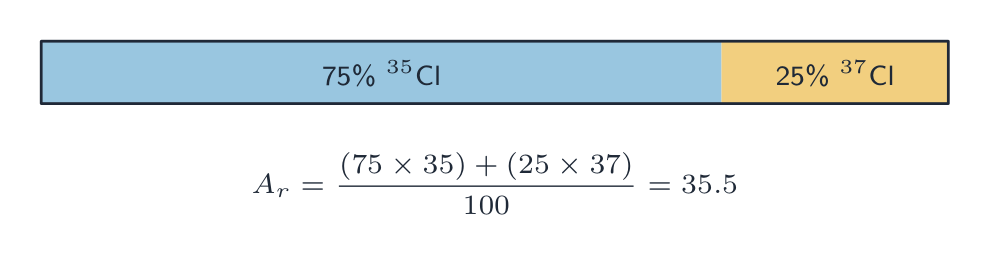
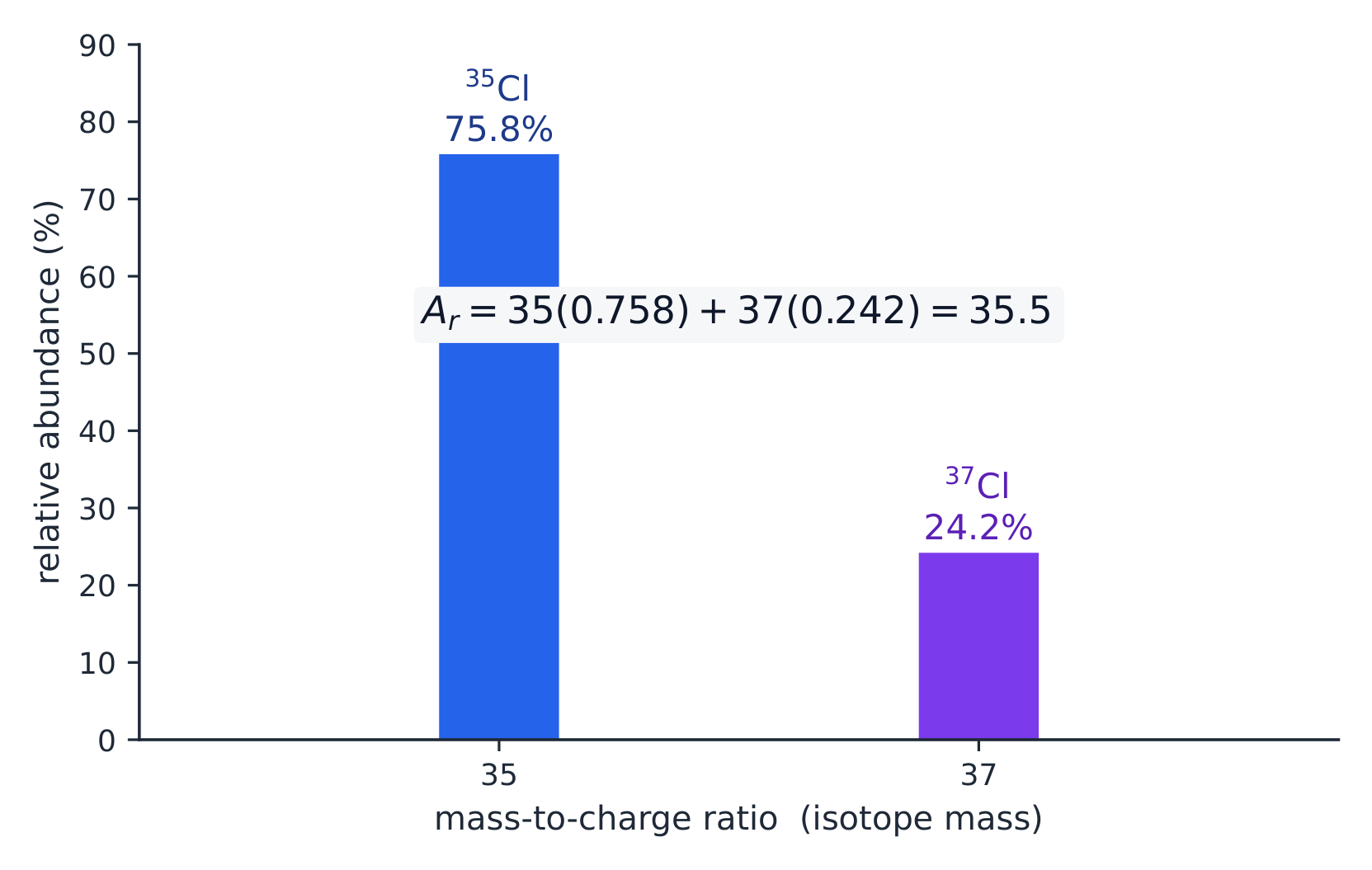
A mass spectrometer 质谱仪 separates atoms by mass, giving a mass spectrum 质谱: peaks at each isotope 同位素 (same element, different neutron count) with heights showing their relative abundance 相对丰度. The element's average atomic mass is the abundance-weighted average of its isotope masses.

Worked example. Chlorine is $75.8\%$ chlorine-35 and $24.2\%$ chlorine-37. Its average atomic mass is

$$A_r=(35)(0.758)+(37)(0.242)=26.5+8.95=35.5.$$
The average lies closer to $35$ because that isotope is more abundant – which is why the periodic-table value is $35.5$, not a whole number.

العربية
الطيف الكتلي

يُفرّق مطياف الكتلة الذرات حسب كتلتها، مما يعطي طيفاً كتلياً: قمم عند كل نظير (نفس العنصر، عدد نيوترون مختلف) مع ارتفاعات تُظهر التوافر النسبي. متوسط الكتلة الذرية للعنصر هو المتوسط المرجح بالتوافر لكتل نظيراته.

الكتلة الذرية النسبية هي المتوسط المرجح بالتوافر للنظائر
الكتلة الذرية النسبية هي المتوسط المرجح بالتوافر لنظيراته
طيف كتلة الكلور: نظيران بتوافرات مختلفة
الطيف الكتلي للكلور: نظيران بتوافرات مختلفة

مثال محلول. الكلور يتكون من $75.8\%$ كلور-35 و$24.2\%$ كلور-37. متوسطه الذري هو

$$A_r=(35)(0.758)+(37)(0.242)=26.5+8.95=35.5.$$
القيمة المتوسطة أقرب إلى $35$ لأن هذا النظير أكثر وفرة – ولهذا السبب قيمة الجدول الدوري هي $35.5$، وليست عدداً صحيحاً.

Explore · ⁨استكشف⁩

Explore isotopes — same element, different mass · ⁨استكشف النظائر — نفس العنصر، كتل مختلفة⁩

Keep the protons fixed but change the neutrons to build the two chlorine isotopes ($^{35}$Cl and $^{37}$Cl). Same element, different mass — exactly the peaks a mass spectrum shows. · ⁨أبقِ البروتونات ثابتة وغير النيوترونات لبناء نظيري الكلور ($^{35}$Cl و$^{37}$Cl). نفس العنصر، كتل مختلفة — تماماً كما تظهر الذروات في طيف الكتلة.⁩

Vocabulary · ⁨مفردات⁩ Train · ⁨تدريب⁩
English العربية
moles/məʊlz/ مولات
Avogadro's number/ˌævəˈɡædrəʊz ˈnʌmbə/ عدد أفوجادرو
molar mass/ˈməʊlə mæs/ كتلته المولية
mass spectrometer/mæs spekˈtrɒmɪtə/ جهاز مطياف الكتلة
mass spectrum/mæs ˈspektrəm/ طيف الكتلة
isotope/ˈaɪsətəʊp/ النظائر
relative abundance/ˈrelətɪv əˈbʌndəns/ الوفرة النسبية
percent composition/pəˈsent ˌkɒmpəˈzɪʃn/ التركيب المئوي
1.3

Elemental Composition of Pure Substances · ⁨التركيب العنصري للمواد الخالصة⁩

Syllabus · ⁨المنهج⁩
English

Learning Objective 1.3.A: Explain the quantitative relationship between the elemental composition by mass and the empirical formula of a pure substance.

  • 1.3.A.1 Some pure substances are composed of individual molecules, while others consist of atoms or ions held together in fixed proportions as described by a formula unit.
  • 1.3.A.2 According to the law of definite proportions, the ratio of the masses of the constituent elements in any pure sample of that compound is always the same.
  • 1.3.A.3 The chemical formula that lists the lowest whole number ratio of atoms of the elements in a compound is the empirical formula.
العربية

هدف التعلم 1.3.A: شرح العلاقة الكمية بين التركيب العنصري بالنسبة للكتلة والصيغة الأولية للمادة النقية.

  • 1.3.A.1 تتكون بعض المواد النقية من جزيئات فردية، بينما تتكون أخرى من ذرات أو أيونات مرتبطة معًا بنسب ثابتة كما هو موصوف بواسطة وحدة الصيغة.
  • 1.3.A.2 وفقًا لقانون النسب الثابتة، فإن نسبة كتل العناصر المكونة في أي عينة نقية من ذلك المركب تكون دائمًا نفسها.
  • 1.3.A.3 الصيغة الكيميائية التي تذكر أدنى نسبة أعداد صحيحة لذرات العناصر في المركب تسمى الصيغة الأولية.

Source: College Board AP Course and Exam Description · ⁨المصدر: وصف دورة وامتحان College Board AP⁩

English

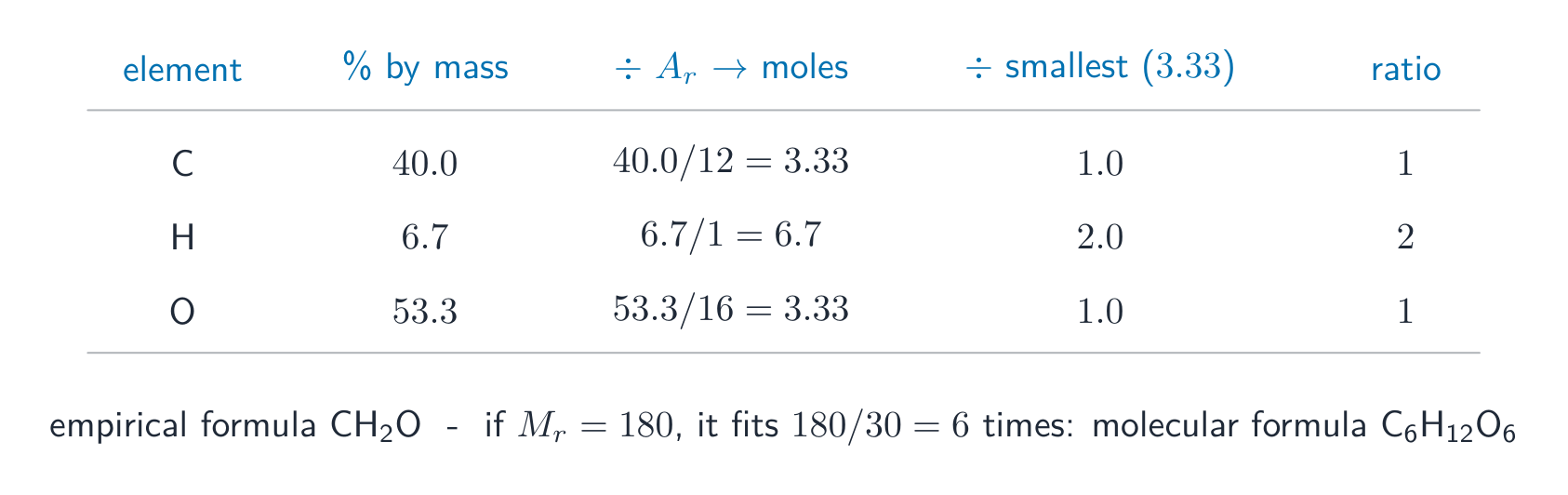
The percent composition 百分组成 of a compound is each element's mass fraction. From it you find the empirical formula 实验式 (simplest whole-number ratio of atoms) by converting each element's mass to moles and dividing by the smallest. The molecular formula 分子式 is a whole-number multiple of the empirical formula, found from the molar mass.

Worked example. A compound is $40.0\%$ C, $6.7\%$ H, and $53.3\%$ O by mass. Assuming $100\ \text{g}$, convert each mass to moles and divide by the smallest:

$$\text{C}:\frac{40.0}{12}=3.33,\quad \text{H}:\frac{6.7}{1}=6.7,\quad \text{O}:\frac{53.3}{16}=3.33 \;\xrightarrow{\div 3.33}\; 1:2:1,$$
so the empirical formula is $\text{CH}_2\text{O}$. If the molar mass were $180\ \text{g/mol}$ ($=6\times30$), the molecular formula would be $\text{C}_6\text{H}_{12}\text{O}_6$ – glucose.

العربية

التركيب المئوي للمركب هو كسر كتلة كل عنصر. منه تستنتج الصيغة الأولية ( أبسط نسبة أعداد صحيحة للذرات) بتحويل كتلة كل عنصر إلى مولات وقسمتها على الأصغر. الصيغة الجزيئية هي مضاعف صحيح للصيغة الأولية، تُستنتج من الكتلة المولية.

إيجاد الصيغة الأولية: الكتلة إلى المولات، القسمة على الأصغر، قراءة النسبة
إيجاد الصيغة الأولية: من الكتلة إلى المولات، قسّم على الأصغر، اقرأ النسبة

مثال محلول. مركب يتكون من $40.0\%$ C، $6.7\%$ H، و$53.3\%$ O بالكتلة. بافتراض $100\ \text{g}$، حوّل كل كتلة إلى مولات وقسّم على الأصغر:

$$\text{C}:\frac{40.0}{12}=3.33,\quad \text{H}:\frac{6.7}{1}=6.7,\quad \text{O}:\frac{53.3}{16}=3.33 \;\xrightarrow{\div 3.33}\; 1:2:1,$$
إذن الصيغة الأولية هي $\text{CH}_2\text{O}$. لو كانت الكتلة المولية $180\ \text{g/mol}$ ($=6\times30$)، لصارت الصيغة الجزيئية $\text{C}_6\text{H}_{12}\text{O}_6$ – الجلوكوز.

Vocabulary · ⁨مفردات⁩ Train · ⁨تدريب⁩
English العربية
empirical formula/emˈpɪrɪkl ˈfɔːmjʊlə/ الصيغة الأولية
molecular formula/məˈlekjʊlə ˈfɔːmjʊlə/ الصيغة الجزيئية
mixture/ˈmɪkstʃə/ خليط
nucleus/ˈnjuːklɪəs/ النواة
electron configuration/ɪˈlektrɒn kənˌfɪɡjəˈreɪʃn/ التوزيع الإلكتروني
valence electrons/ˈveɪləns ɪˈlektrɒnz/ إلكترونات التكافؤ
Photoelectron spectroscopy/ˌfəʊtəʊɪˈlektrɒn spekˈtrɒskəpi/ طيف الإلكترون الضوئي
Atomic radius/əˈtɒmɪk ˈreɪdɪəs/ نصف قطر الذرة
Ionization energy/ˌaɪənaɪˈzeɪʃn ˈenədʒi/ طاقة التأين
1.4

Composition of Mixtures · ⁨تركيب المخاليط⁩

Syllabus · ⁨المنهج⁩
English

Learning Objective 1.4.A: Explain the quantitative relationship between the elemental composition by mass and the composition of substances in a mixture.

  • 1.4.A.1 Pure substances contain atoms, molecules, or formula units of a single type. Mixtures contain atoms, molecules, or formula units of two or more types, whose relative proportions can vary.
  • 1.4.A.2 Elemental analysis can be used to determine the relative numbers of atoms in a substance and to determine its purity.
العربية

هدف التعلم 1.4.A: شرح العلاقة الكمية بين التركيب العنصري بالنسبة للكتلة وتركيب المواد في الخليط.

  • 1.4.A.1 تحتوي المواد النقية على ذرات أو جزيئات أو وحدات صيغة من نوع واحد. أما الخلطات فتحتوي على ذرات أو جزيئات أو وحدات صيغة من نوعين أو أكثر، والتي يمكن أن تتغير نسبها النسبية.
  • 1.4.A.2 يمكن استخدام التحليل العنصري لتحديد الأعداد النسوية للذرات في المادة ولتحديد نقائها.

Source: College Board AP Course and Exam Description · ⁨المصدر: وصف دورة وامتحان College Board AP⁩

English

Unlike a pure compound, a mixture 混合物 has variable composition – its parts keep their own identities. Describe a mixture by the mass or mole fraction of each component; these do not follow a fixed formula. Spectroscopy (like PES or absorption) can measure how much of each component is present.

العربية

على عكس المركب النقي، الخليط له تركيب متغير – parts تحافظ على هويتها الخاصة. وصّف الخليط بكسر الكتلة أو المول لكل مكون؛ هذه لا تتبع صيغة ثابتة. يمكن للتحليل الطيفي (مثل PES أو الامتصاص) قياس كمية كل مكون.

1.5

Atomic Structure and Electron Configuration · ⁨البنية الذرية والتوزيع الإلكتروني⁩

Syllabus · ⁨المنهج⁩
English

Learning Objective 1.5.A: Represent the ground-state electron configuration of an atom of an element or its ions using the Aufbau principle.

  • 1.5.A.1 The atom is composed of negatively charged electrons and a positively charged nucleus that is made of protons and neutrons.
  • 1.5.A.2 Coulomb's law is used to calculate the force between two charged particles.
    • Equation: $F_{coulombic} \propto \dfrac{q_1 q_2}{r^2}$
  • 1.5.A.3 In atoms and ions, the electrons can be thought of as being in "shells (energy levels)" and "subshells (sublevels)," as described by the ground-state electron configuration. Inner electrons are called core electrons, and outer electrons are called valence electrons. The electron configuration is explained by quantum mechanics, as delineated in the Aufbau principle and exemplified in the periodic table of the elements.
    • Exclusion Statement: The assignment of quantum numbers to electrons in subshells of an atom will not be assessed on the AP Exam.
  • 1.5.A.4 The relative energy required to remove an electron from different subshells of an atom or ion or from the same subshell in different atoms or ions (ionization energy) can be estimated through a qualitative application of Coulomb's law. This energy is related to the distance from the nucleus and the effective (shield) charge of the nucleus.
العربية

هدف التعلم 1.5.A: تمثيل التوزيع الإلكتروني لحالة الأساس لذرة عنصر أو أيونه باستخدام مبدأ أوفباو.

  • 1.5.A.1 يتكون الذرة من إلكترونات سالبة الشحنة ونواة موجبة الشحنة تتكون من بروتونات ونيوترونات.
  • 1.5.A.2 يُستخدم قانون كولوم لحساب القوة بين جسيمين مشحونين.
    • المعادلة: $F_{coulombic} \propto \dfrac{q_1 q_2}{r^2}$
  • 1.5.A.3 في الذرات والأيونات، يمكن اعتبار الإلكترونات موجودة في "أغلفة (مستويات طاقة)" و"تفرعات (مستويات فرعية)"، كما هو موضح بالتوزيع الإلكتروني لحالة الأساس. تسمى الإلكترونات الداخلية بالإلكترونات الأساسية، والإلكترونات الخارجية بالإلكترونات التكافؤ. يُفسر التوزيع الإلكتروني بميكانيكا الكم، كما هو محدد في مبدأ أوفباو ومُثّل في الجدول الدوري للعناصر.
    • عبارة الاستثناء: لن يتم تقييم تعيين الأرقام الكمومية للإلكترونات في التفرعات الفرعية للذرة في امتحان AP.
  • 1.5.A.4 يمكن تقدير الطاقة النسوية اللازمة لإزالة إلكترون من التفرعات الفرعية المختلفة للذرة أو الأيون أو من نفس التفرع الفرعي في ذرات أو أيونات مختلفة (طاقة التأين) من خلال تطبيق نوعي لقانون كولوم. ترتبط هذه الطاقة بالمسافة من النواة والشحنة الفعالة (الواقية) للنواة.

Source: College Board AP Course and Exam Description · ⁨المصدر: وصف دورة وامتحان College Board AP⁩

English

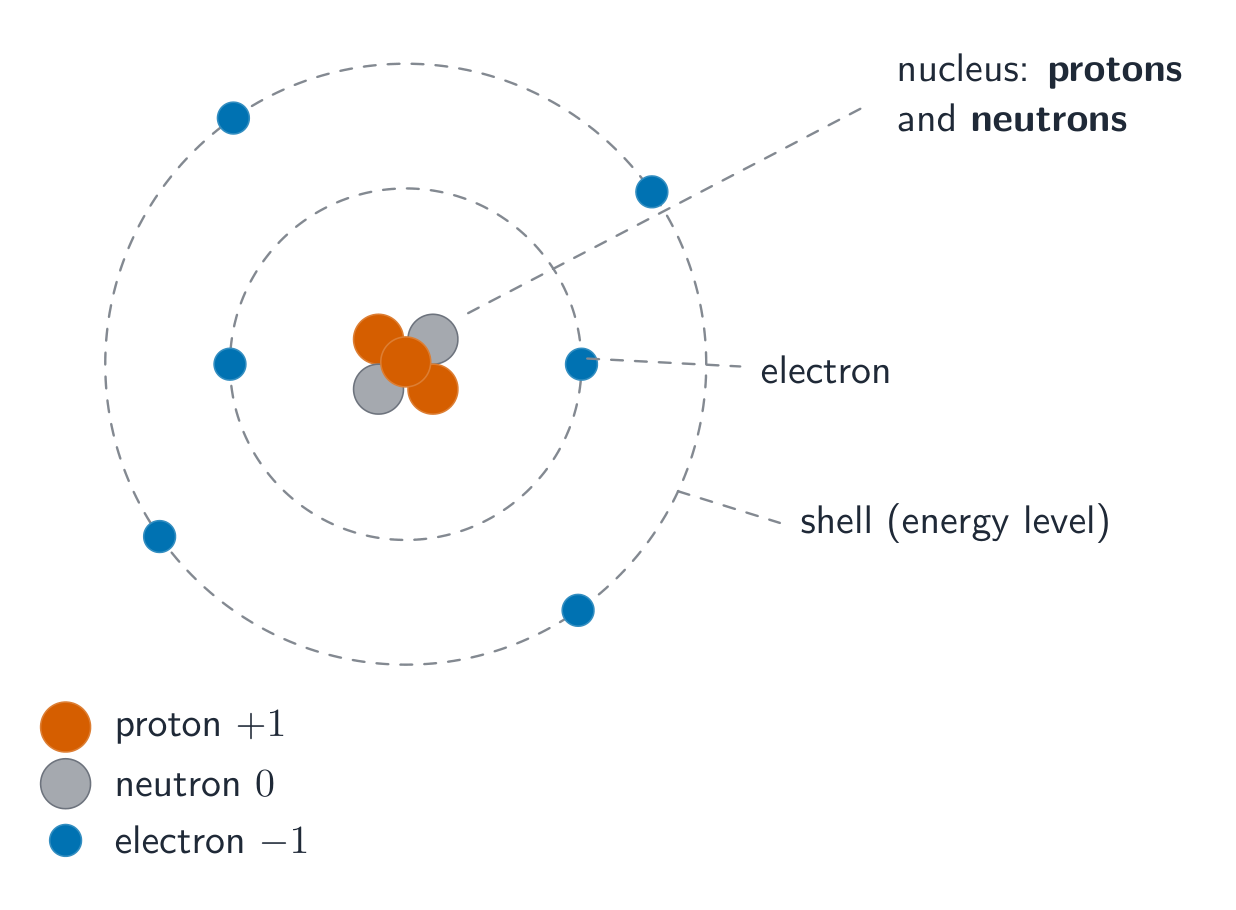
An atom is a tiny nucleus 原子核 (protons and neutrons) surrounded by electrons in shells and subshells (s, p, d, f). The electron configuration 电子排布 lists how electrons fill these, lowest energy first (e.g. $1s^2\,2s^2\,2p^6$). The outermost, highest-energy electrons – the valence electrons 价电子 – control chemistry. Coulomb's law explains their energies: electrons closer to, and less shielded from, the nucleus are held more tightly.

Worked example. Write the electron configuration of sulfur ($Z=16$). Fill subshells in order until $16$ electrons are placed: $1s^2\,2s^2\,2p^6\,3s^2\,3p^4$. The $3s$ and $3p$ electrons (six in total) are the valence electrons, so sulfur tends to gain two electrons to complete its octet.

العربية

الذرة نواة صغيرة (بروتونات ونيوترونات) محاطة بإلكترونات في أغلفة وأغلفة فرعية (s, p, d, f). التوزيع الإلكتروني يسرد كيفية امتلاء هذه المستويات، من الأقل طاقة أولاً (مثلاً $1s^2\,2s^2\,2p^6$). الإلكترونات الخارجية ذات الطاقة الأعلى – إلكترونات التكافؤ – تحكم الكيمياء. قانون كولوم يفسر طاقاتها: الإلكترونات الأقرب للنواة والأقل ظلاً منها تمسك بقوة أكبر.

ذرة: نواة صغيرة من البروتونات والنيوترونات، مع إلكترونات في أغلفة
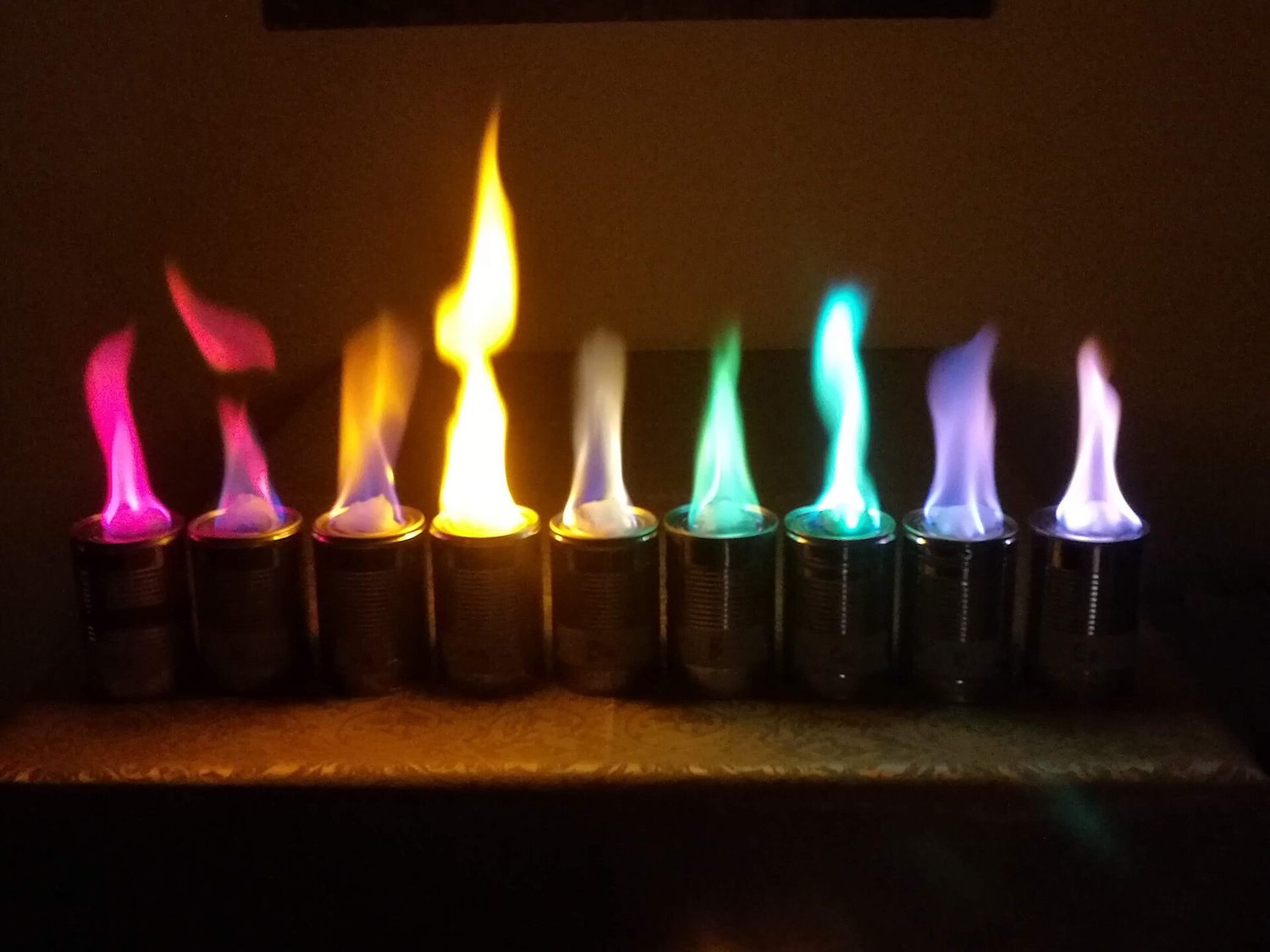
صف من تسعة أوعية تحترق، كل لهب بلون زاهٍ مختلف — قرميدي، برتقالي، أصفر، أخضر، أزرق، بنفسجي
اختبارات اللهب: كل أيون فلز يعطي لونه الخاص لأن الحرارة تهيج إلكتروناته، وعند عودتها للأسفل تُشع ضوءاً بأطوال موجية محددة

مثال محلول. اكتب التوزيع الإلكتروني للكبريت ($Z=16$). املأ الأغلفة الفرعية ترتيباً حتى وضع $16$ إلكترونات: $1s^2\,2s^2\,2p^6\,3s^2\,3p^4$. إلكترونات $3s$ و$3p$ (ستة إجمالاً) هي إلكترونات التكافؤ، لذا يميل الكبريت لكسب إلكترونين لإكمال ثنائياته.

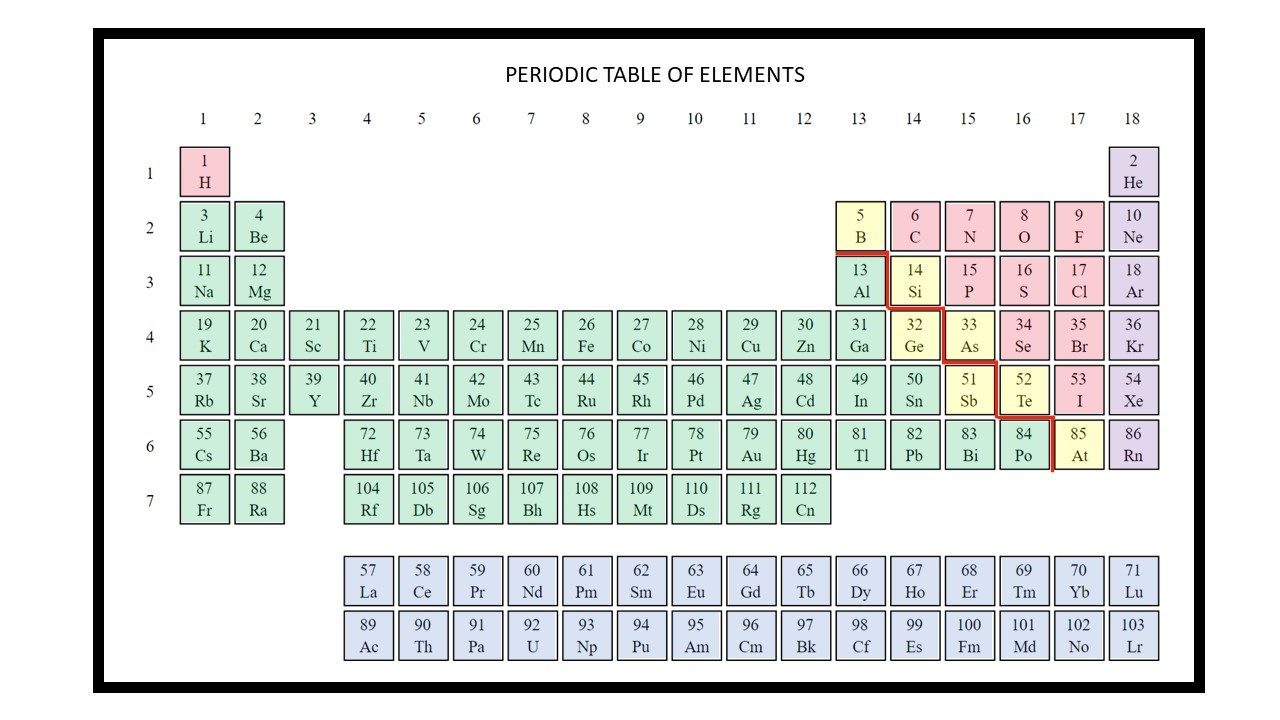
الجدول الدوري ينظم العناصر حسب البنية الذرية — تكوين الإلكترون يفسر الأنماط
الجدول الدوري ينظم العناصر حسب البنية الذرية – التوزيع الإلكتروني يفسر الأنماط
Explore · ⁨استكشف⁩

Explore how electrons fill the shells · ⁨استكشف كيفية امتلاء الإلكترونات للمستويات⁩

Change the atomic number $Z$ and watch the electrons fill the shells lowest-energy-first (the Aufbau principle 构造原理). The outermost electrons are the valence electrons that drive bonding. · ⁨غيّر العدد الذري $Z$ وراقب كيف تمتلئ المستويات الإلكترونية بدءًا من أدنى مستوى طاقة (مبدأ أوفباو). الإلكترونات الخارجية هي إلكترونات التكافؤ التي تحرك عملية الترابط.⁩

1.6

Photoelectron Spectroscopy · ⁨مطيافية الإلكترون الضوئي⁩

Syllabus · ⁨المنهج⁩
English

Learning Objective 1.6.A: Explain the relationship between the photoelectron spectrum of an atom or ion and: i. The ground-state electron configuration of the species. ii. The interactions between the electrons and the nucleus.

  • 1.6.A.1 The energies of the electrons in a given shell can be measured experimentally with photoelectron spectroscopy (PES). The position of each peak in the PES spectrum is related to the energy required to remove an electron from the corresponding subshell, and the relative height of each peak is (ideally) proportional to the number of electrons in that subshell.
العربية

هدف التعلم 1.6.A: شرح العلاقة بين الطيف الفوتوالكتروني للذرة أو الأيون و: i. التوزيع الإلكتروني لحالة الأساس للنوع. ii. التفاعلات بين الإلكترونات والنواة.

  • 1.6.A.1 يمكن قياس طاقات الإلكترونات في غلاف معين تجريبياً باستخدام مطيافية الفوتوالكترون (PES). يرتبط موقع كل قمة في طيف PES بالطاقة اللازمة لإزالة إلكترون من التفرع الفرعي المقابل، وترتفع الارتفاع النسوي لكل قمة (مثاليًا) متناسباً مع عدد الإلكترونات في ذلك التفرع الفرعي.

Source: College Board AP Course and Exam Description · ⁨المصدر: وصف دورة وامتحان College Board AP⁩

English

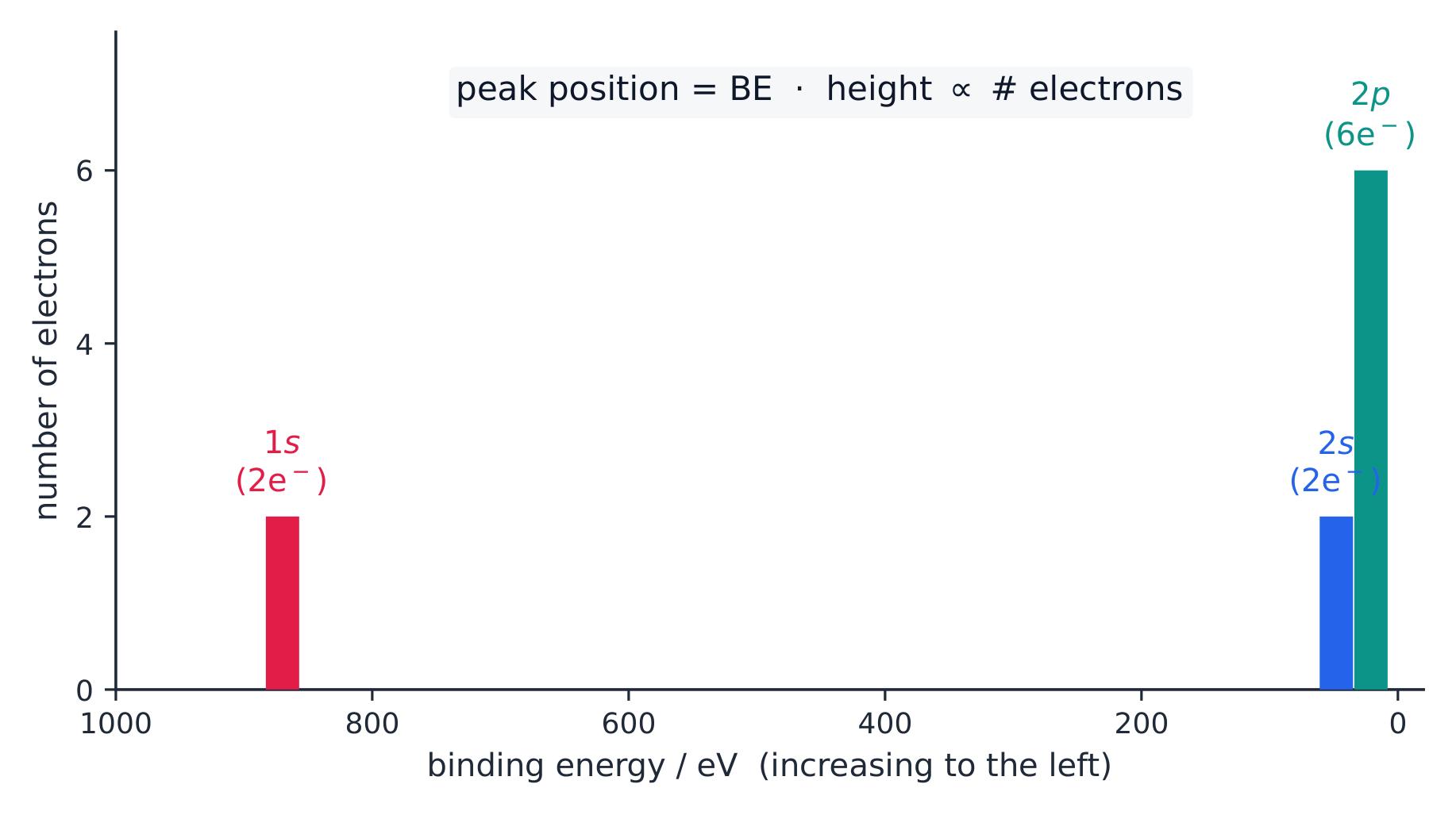
Photoelectron spectroscopy 光电子能谱 (PES) measures the energy needed to remove electrons from each subshell. Each peak is a subshell: its position gives the binding energy (how tightly held) and its height gives the number of electrons in it. PES data let you read an element's electron configuration and confirm shell structure directly.

العربية

مطيافية الإلكترون الضوئي (PES) تقيس الطاقة اللازمة لطرد الإلكترونات من كل غلاف فرعي. كل قمة تمثل غلفاً فرعياً: موقعها يعطي طاقة الربط (مدى تماسكها) وارتفاعها يعطي عدد الإلكترونات فيه. بيانات PES تسمح بقراءة التوزيع الإلكتروني للعنصر وتأكيد بنية الغلاف مباشرة.

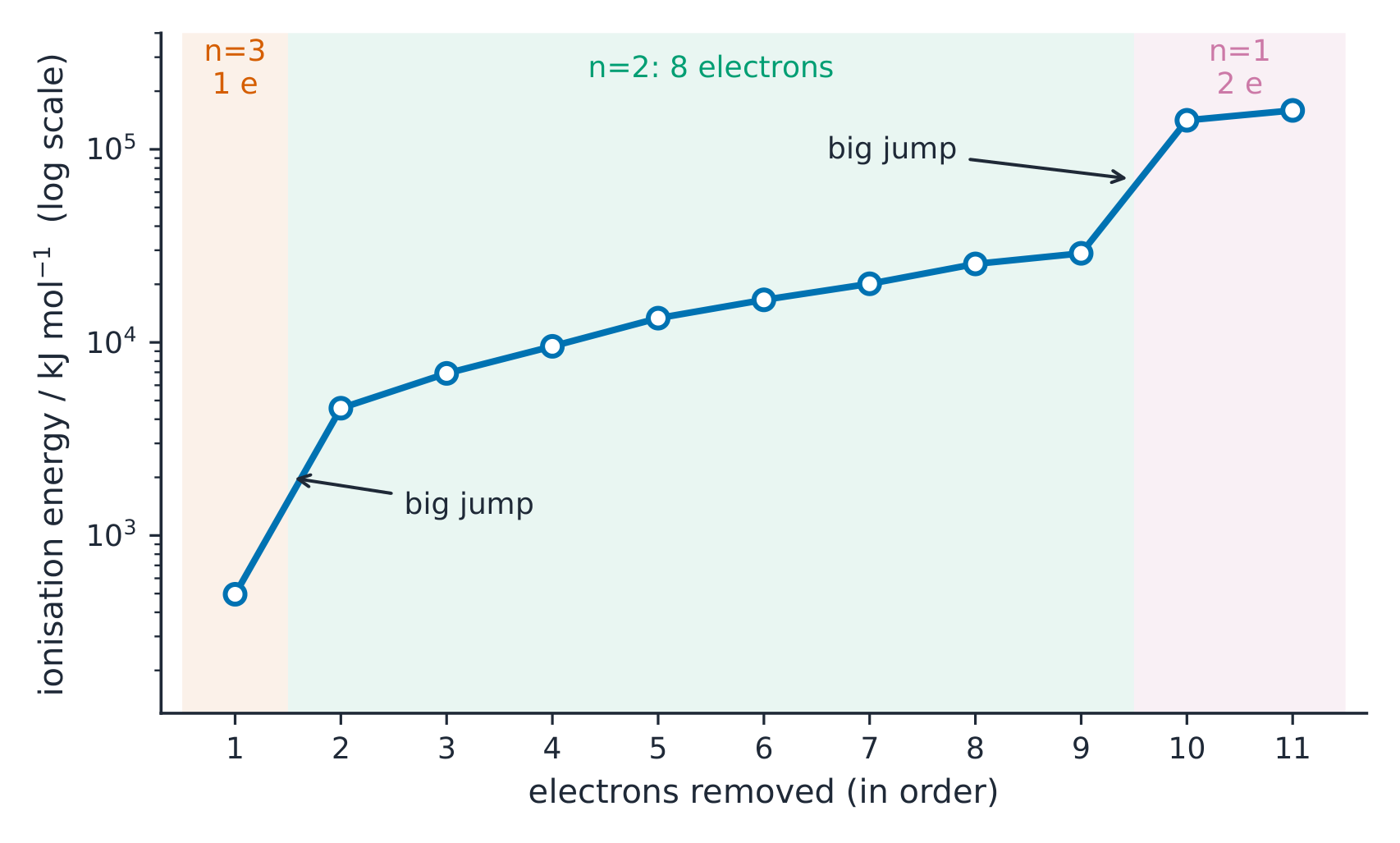
طاقات التأين المتتالية تكشف عن البنية المدارية من خلال قفزات كبيرة
طاقات التأين المتتالية تكشف عن بنية الغلاف عبر قفزات كبيرة
طيف الفوتوإلكترون للنون: ذروة واحدة لكل فرعي، الارتفاع محدد بعدد الإلكترونات
الطيف الإلكتروني الضوئي للنيون: قمة لكل غلاف فرعي، الارتفاع محدد بعدد الإلكترونات
1.7

Periodic Trends · ⁨الاتجاهات الدورية⁩

Syllabus · ⁨المنهج⁩
English

Learning Objective 1.7.A: Explain the relationship between trends in atomic properties of elements and electronic structure and periodicity.

  • 1.7.A.1 The organization of the periodic table is based on patterns of recurring properties of the elements, which are explained by patterns of ground-state electron configurations and the presence of completely or partially filled shells (and subshells) of electrons in atoms.
    • Exclusion Statement: Writing the electron configuration of elements that are exceptions to the aufbau principle will not be assessed on the AP Exam.
  • 1.7.A.2 Trends in atomic properties within the periodic table (periodicity) can be predicted by the position of the element on the periodic table and qualitatively understood using Coulomb's law, the shell model, and the concepts of shielding and effective nuclear charge. These properties include:
    • i. Ionization energy
    • ii. Atomic and ionic radii
    • iii. Electron affinity
    • iv. Electronegativity.
  • 1.7.A.3 The periodicity (in 1.7.A.2) is useful to predict/estimate values of properties in the absence of data.
العربية

هدف التعلم 1.7.A: شرح العلاقة بين اتجاهات الخصائص الذلية للعناصر والبنية الإلكترونية والدورية.

  • 1.7.A.1 يعتمد تنظيم الجدول الدوري على أنماط من الخصائص المتكررة للعناصر، والتي تُفسر بأنماط توزيعات الإلكترونات لحالة الأساس ووجود أغلفة (وتفرعات فرعية) كاملة أو جزئية من الإلكترونات في الذرات.
    • عبارة الاستبعاد: لن يتم تقييم كتابة التوزيع الإلكتروني للعناصر التي تمثل استثناءات لمبدأ أوفباو في امتحان AP.
  • 1.7.A.2 يمكن التنبؤ بالاتجاهات في الخصائص الذرية داخل الجدول الدوري (الدورية) بناءً على موقع العنصر في الجدول الدوري وفهمها بشكل نوعي باستخدام قانون كولوم، ونموذج الغلاف، ومفاهيم الحجب والشحنة النووية الفعالة. تشمل هذه الخصائص:
    • i. طاقة التأين
    • ii. الأقطار الذرية والأيونية
    • iii. إقراب الإلكترون
    • iv. الكهروسالبية.
  • 1.7.A.3 مفيدة الدورية (في 1.7.A.2) للتنبؤ/تقدير قيم الخصائص عند غياب البيانات.

Source: College Board AP Course and Exam Description · ⁨المصدر: وصف دورة وامتحان College Board AP⁩

English

Trends across the periodic table follow from nuclear charge and shielding:

  • Atomic radius 原子半径 decreases across a period (stronger pull) and increases down a group (more shells).
  • Ionization energy 电离能 (energy to remove an electron) increases across, decreases down – opposite to radius.
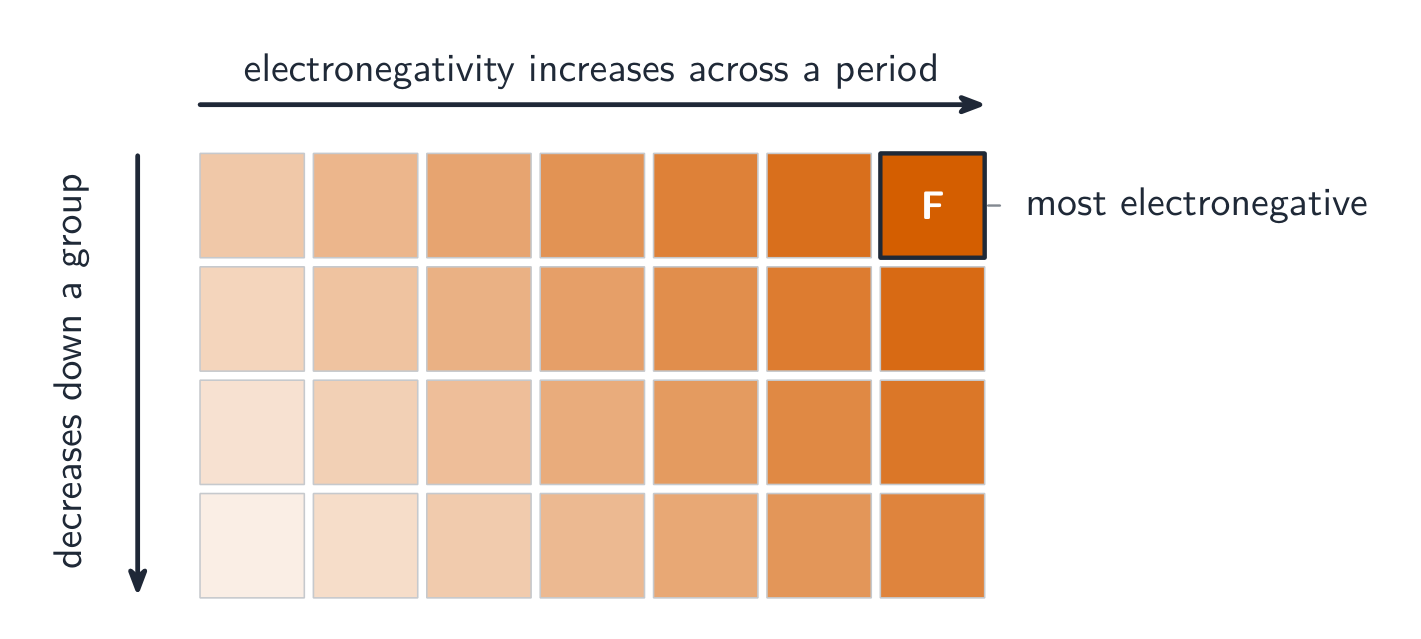
  • Electronegativity 电负性 (pull on shared electrons) increases across and up, toward fluorine.
العربية

الاتجاهات عبر الجدول الدوري تنبع من الشحنة النووية والظل:

تزداد الكهربية السالبة عبر الدورة وتتناقص على طول المجموعة
السالبية الكهربائية ترتفع عبر الدورة وتنخفض عبر المجموعة
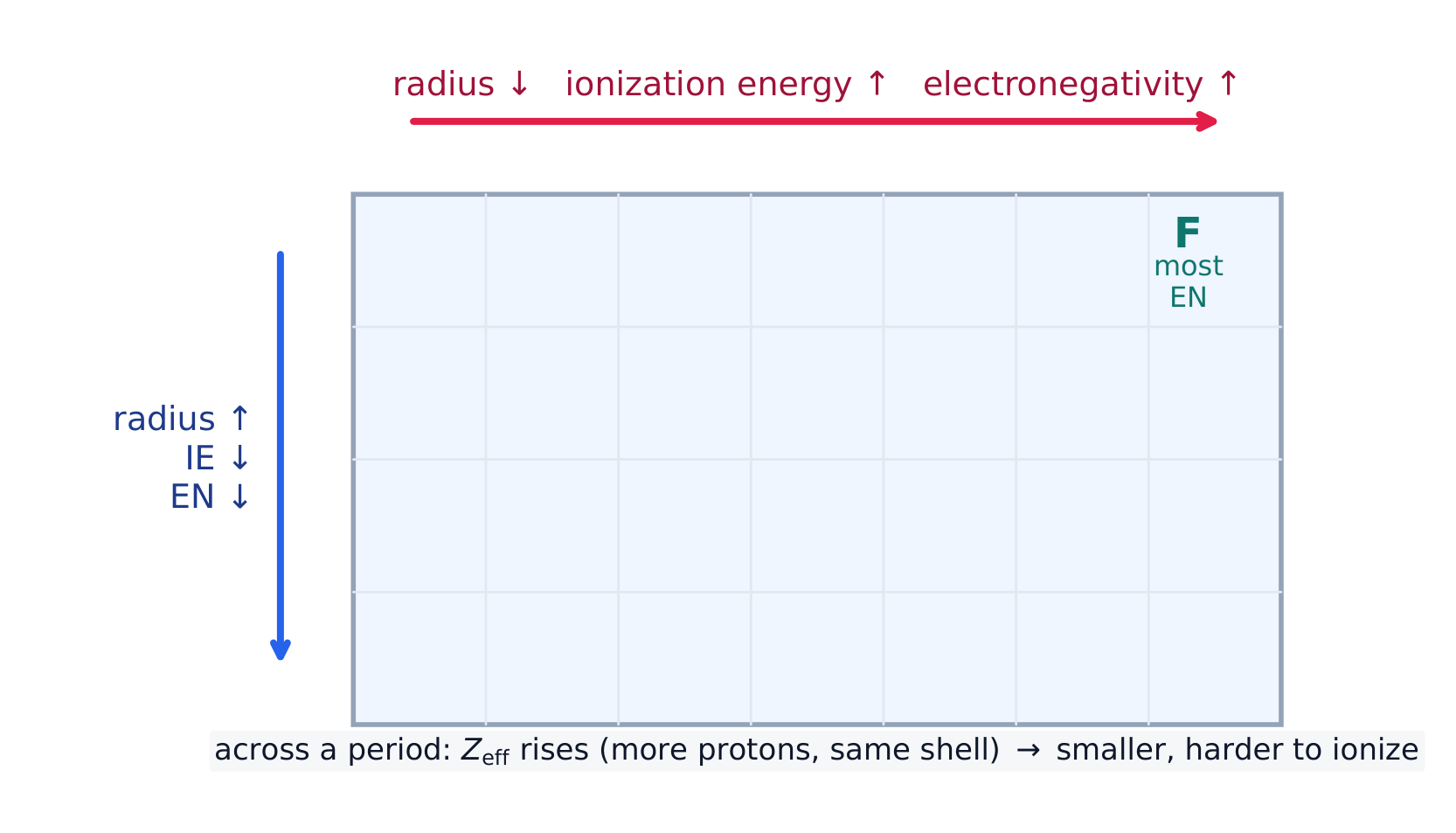
  • نصف القطر الذري يتناقص عبر الدورة (جذب أقوى) ويزداد نحو الأسفل في المجموعة (مستويات طاقة أكثر).
  • طاقة التأين (الطاقة اللازمة لنزع إلكترون) تزداد عبر الدورة، وتنخفض نحو الأسفل – عكس اتجاه نصف القطر.
  • السالبية الكهربية (الجذب على الإلكترونات المشتركة) تزداد عبر الدورة وباتجاه الأعلى، نحو الفلور.
الاتجاهات الدورية: كيف يتغير نصف القطر وطاقة التأين والسالبية الكهربية عبر الدورة ونحو الأسفل
Explore · ⁨استكشف⁩

Explore atomic radius across a period · ⁨استكشف نصف القطر الذري عبر دورة⁩

Step across Period 3 and watch the atomic radius shrink — each added proton raises the effective nuclear charge and pulls the same shell in tighter. · ⁨انتقل عبر الدورة 3 ولاحظ نصف قطر الذرة يتناقص — لأن كل بروتون إضافي يزيد الشحنة النووية الفعالة ويجذب نفس المدار بشكل أكثر إحكامًا.⁩

Vocabulary · ⁨مفردات⁩ Train · ⁨تدريب⁩
English العربية
Electronegativity/ɪˌlektrəʊŋɡəˈtɪvɪti/ السالبية الكهربية
cations/ˈkætaɪənz/ الكاتيونات
anions/ˈænaɪənz/ الأنيونات
ionic compound/aɪˈɒnɪk ˈkɒmpaʊnd/ مركب أيوني
1.8

Valence Electrons and Ionic Compounds · ⁨إلكترونات التكافؤ والمركبات الأيونية⁩

Syllabus · ⁨المنهج⁩
English

Learning Objective 1.8.A: Explain the relationship between trends in the reactivity of elements and periodicity.

  • 1.8.A.1 The likelihood that two elements will form a chemical bond is determined by the interactions between the valence electrons and nuclei of elements.
  • 1.8.A.2 Elements in the same column of the periodic table tend to form analogous compounds.
  • 1.8.A.3 Typical charges of atoms in ionic compounds are governed by the number of valence electrons and predicted by their location on the periodic table.
العربية

الهدف التعليمي 1.8.A: شرح العلاقة بين اتجاهات تفاعل العناصر والدورية.

  • 1.8.A.1 احتمالية تكون عنصرين لرابطة كيميائية تحددها التفاعلات بين إلكترونات التكافؤ وأنوية العناصر.
  • 1.8.A.2 تميل العناصر في نفس عمود الجدول الدوري لتكوين مركبات مماثلة.
  • 1.8.A.3 تُحكم الشحنات النموذجية للذرات في المركبات الأيونية بعدد إلكترونات التكافؤ وتُتوقع بموقعها في الجدول الدوري.

Source: College Board AP Course and Exam Description · ⁨المصدر: وصف دورة وامتحان College Board AP⁩

English

Atoms gain, lose, or share valence electrons to reach stable configurations. Metals (low ionization energy) lose electrons to form cations 阳离子; nonmetals gain electrons to form anions 阴离子. Oppositely charged ions attract into an ionic compound 离子化合物, whose formula balances the charges to make the whole neutral. For example, aluminium ($3+$) and oxide ($2-$) combine as $\text{Al}_2\text{O}_3$ so the $+6$ and $-6$ cancel.

العربية

تكتسب الذرات أو تفقد أو تتشارك إلكترونات التكافؤ للوصول إلى توزيعات مستقرة. تفقد المعادن (ذات طاقة تأين منخفضة) الإلكترونات لتكوين أيونات موجبة (كاتيونات)؛ بينما تكتسب اللافلزات الإلكترونات لتكوين أيونات سالبة (أنيونات). تجذب الأيونات ذات الشحنات المتضادة لتكون مركب أيوني، حيث يوازن صيغته الشحنات لجعل الجزيء متعادلاً. على سبيل المثال، يتحد الألومنيوم ($3+$) وأيون الأكسيد ($2-$) لتكوين $\text{Al}_2\text{O}_3$ بحيث تلغي $+6$ و$-6$ بعضهما البعض.

Explore · ⁨استكشف⁩

Watch an ionic bond form by electron transfer · ⁨راقب تكوين الرابطة الأيونية عن طريق نقل الإلكترونات⁩

A metal gives up its valence electron(s) and a non-metal takes them, so both reach a full shell. The atoms become oppositely charged ions that attract — that electrostatic pull is the ionic bond. · ⁨يعطي المعدن إلكترون(ات) تكافؤه ويتلقاه لا فلز، ليصل كلاهما إلى مستوى ممتلئ. تتحول الذرات إلى أيونات مشحونة بشحنات متعاكسة تنجذب نحو بعضها — هذا السحب الكهروستاتيكي هو الرابطة الأيونية.⁩

1.8

Exam tips · ⁨نصائح للامتحان⁩

English
  • Use the mole as the hub: convert grams↔moles with $n=m/M$ and moles↔particles with Avogadro's number.
  • Relative atomic mass is the abundance-weighted average of the isotopes — it lies closer to the more abundant one, not halfway.
  • For an empirical formula, turn each element's mass into moles and divide by the smallest; scale up to whole numbers.
  • Read periodic trends from nuclear charge and shielding: atomic radius decreases across a period, ionisation energy and electronegativity increase across (and up).
  • Fill electron configurations in energy order; the outer valence electrons control the chemistry.
العربية
  • استخدم المول كعنصر مركزي: حول الجرامات↔مولات باستخدام $n=m/M$، والمولات↔جسيمات باستخدام عدد أفوجادرو.
  • الكتلة الذرية النسبية هي متوسط موزون بالكثافة الطبيعية للنظائر — وتقع أقرب إلى النظير الأكثر وفرة وليس في المنتصف.
  • للحصول على الصيغة الأولية، حوّل كتلة كل عنصر إلى مول وقسم على أصغر قيمة؛ ثم اضرب في عدد صحيح للحصول على أعداد صحيحة.
  • استنتج الاتجاهات الدورية من الشحنة النووية والتأثير العازل: ينقص نصف القطر الذري عبر الدورة، وتزيد طاقة التأين والسالبية الكهربية عبر الدورة (وباتجاه الأعلى).
  • املأ التوزيع الإلكتروني حسب ترتيب الطاقة؛ وتتحكم إلكترونات التكافؤ الخارجية في الكيمياء.

Interactive lessons on this topic · ⁨دروس تفاعلية حول هذا الموضوع⁩

Work through it step by step, with instant-check exercises. · ⁨ا-working عليه خطوة بخطوة، مع تمارين تحقق فوري.⁩

Past Papers · ⁨أوراق الامتحانات السابقة⁩

More topics in AP Chemistry · ⁨AP الكيمياء⁩ · ⁨المزيد من المواضيع في AP Chemistry · ⁨AP الكيمياء⁩⁩

Log in or create account · ⁨تسجيل الدخول أو إنشاء حساب⁩

IGCSE, A-Level & AP