ارتدِ زوجاً من سماعات إلغاء الضوضاء، وتتلاشى هدير محرك الطائرة في صمت. لكن الجزء الغريب هنا: هي لا تحجب الصوت — بل…
English narration · English + 中文 subtitles burned in · سرد باللغة الإنجليزية · ترجمة مدمجة بالإنجليزية + الصينية
8.1
Principle of superposition · مبدأ التراكب
Syllabus · المنهج
English
explain and use the principle of superposition
show an understanding of experiments that demonstrate stationary waves using microwaves, stretched strings and air columns (it will be assumed that end corrections are negligible; knowledge of the concept of end corrections is not required)
explain the formation of a stationary wave using a graphical method, and identify nodes and antinodes
understand how wavelength may be determined from the positions of nodes or antinodes of a stationary wave
العربية
اشرح واستخدم مبدأ التراكب
أظهر فهماً للتجارب التي تبرز الموجات الراكدة باستخدام الموجات الميكروية والأوتار المشدودة وأعمدة الهواء (سيُفترض أن تصحيحات النهاية مهملة؛ لا يُشترط معرفة مفهوم تصحيحات النهاية)
اشرح تكوين الموجة الراكدة باستخدام طريقة بيانية، وحدد العقد والعقد المضادة
افهم كيفية تحديد الطول الموجي من مواقع العقد أو العقد المضادة للموجة الراكدة
Source: Cambridge International syllabus · المصدر: منهج كامبريدج الدولي
English
Two waves make a standing wave
When two or more waves 波 overlap at a point, the displacement 位移 there is the vector sum 矢量和 of the displacements each wave would make on its own. This is the principle of superposition 叠加.
The waves pass through each other and come out unchanged. Superposition is the base of everything in this topic.
For the two-mark statement: when two or more waves meet at a point, the resultant displacement is the sum of the displacements of the individual waves. It is the displacements that add, not the amplitudes or the intensities, and the principle applies whenever waves of the same type overlap; the waves do not have to be coherent or of equal amplitude.
If two waves of amplitude 振幅$A_{1}$ and $A_{2}$ meet:
in phase 同相 (crest 波峰 meets crest): the amplitude is $A_{1} + A_{2}$ (constructive interference 相长干涉).
exactly out of phase (crest meets trough 波谷, phase difference 相位差$\pi$): the amplitude is $|A_{1} - A_{2}|$ (destructive interference 相消干涉).
any other phase difference $\phi$: the amplitude is somewhere between these two.
For intensity 强度, $I \propto A^{2}$. Two equal waves meeting in phase give intensity $(2A)^{2} = 4A^{2}$ — four times the intensity of one wave alone.
Because $I \propto A^{2}$, work in amplitudes first. Two waves of intensities $I$ and $4I$ have amplitudes $A$ and $2A$: superposing in phase gives amplitude $3A$ and intensity $9I$, in antiphase amplitude $A$ and intensity $I$. So two coherent waves of different intensities never cancel completely: the minima have intensity $(A_{2} - A_{1})^{2}$, not zero. A wave of amplitude $2A$ meeting one of amplitude $A/2$ travelling the opposite way gives a resultant that varies between $2.5A$ and $1.5A$, a stationary pattern with no true nodes. Doubling the amplitude of one of two equal waves that meet in phase takes the resultant from $2A$ to $3A$, so the intensity rises from $4A^{2}$ to $9A^{2}$: $2.25$ times.
العربية
موجتان تصنعان موجة واقفة
عند تداخل موجتين أو أكثر عند نقطة ما، تكون الإزاحة هناك هي المجموع الاتجاهي للإزاحات التي ستحدثها كل موجة لو كانت وحدها. هذا هو مبدأ التراكب.
تتجاوز الموجات بعضها البعض وتخرج دون تغيير. التراكب هو أساس كل شيء في هذا الموضوع.
بالنسبة للعبارة ذات الدرجتين: عند اجتماع موجتين أو أكثر عند نقطة ما، تكون الإزاحة المحصلة هي مجموع إزاحات الموجات الفردية. ما يُجمع هو الإزاحات، وليس السعات أو الشدات، وينطبق المبدأ.annotations تتداخل موجات من نفس النوع؛ لا يشترط أن تكون الموجات متناسقة الطور أو متساوية السعة.
إذا التقت موجتان سعتهما$A_{1}$ و$A_{2}$:
في نفس الطور (قمة تقابل قمة): السعة هي $A_{1} + A_{2}$ (تداخل بناء).
خارج الطور تمامًا (قمة تقابل قاع، فرق الطور$\pi$): السعة هي $|A_{1} - A_{2}|$ (تهدم).
أي فرق طور آخر $\phi$: السعة تكون.msg介于 هذين الحدين.
موجتان تصلان في طور واحد تتراكبان لتعطي ضعف السعة (بناء)موجتان تصلان بالضبط خارج طور واحد تلغيان الصفر (هدم)
بالنسبة لـالشدة، $I \propto A^{2}$. موجتان متساويتان تتقابلان في نفس الطور تعطان شدة $(2A)^{2} = 4A^{2}$ — أربع مرات شدة موجة واحدة وحدها.
لأن $I \propto A^{2}$، نعمل أولاً على السعات. موجتان شدة كل منهما $I$ و$4I$ لهما سعتان $A$ و$2A$: عند التراكب في طور واحد تعطي سعة $3A$ وشدة $9I$، وفي عكس الطور سعة $A$ وشدة $I$. لذا فإن موجتين مترابطتين بشدات مختلفة لا تلغيان بعضهما البعض كلياً: الشدة عند النقاط الصغرى هي $(A_{2} - A_{1})^{2}$ وليست صفراً. موجة ذات سعة $2A$ تلتقي بموجة ذات سعة $A/2$ تسير في الاتجاه المعاكس فتنتج موجة محصلة تتراوح بين $2.5A$ و$1.5A$، وهو نمط ثابت بدون عقد حقيقية. مضاعفة سعة واحدة من موجتين متساويتين يلتقيان في طور واحد يرفع المحصلة من $2A$ إلى $3A$، فترتفع الشدة من $4A^{2}$ إلى $9A^{2}$: أي $2.25$ مرة.
Explore · استكشف
Adding two waves · جمع موجتين
Two waves overlap and add. Line them up for constructive interference, or oppose them for destructive — change the phase to see both. · تتداخل موجتان وتجمعان. رصّهما للتداخل البناء، أو عارضهما للتداخل الهدام — غيّر الطور لرؤية الحالتين.
When two identical progressive waves 行波 travel in opposite directions and overlap, they make a stationary wave 驻波. Examples: a wave on a string reflected 反射 from a fixed end overlapping the incoming wave; sound in an air column reflected from a closed end; microwaves between an emitter and a metal sheet.
Explain how the stationary wave is formed (three or four marks, asked for a string, an air column and microwaves alike): the wave from the source travels to the far end (the wall, the closed end, the metal plate) and is reflected; the incident and reflected waves have the same frequency, wavelength and speed and travel in opposite directions; they superpose where they overlap; at the points where they always meet in phase the displacements add to give the maximum amplitude, an antinode, and at the points where they always meet in antiphase they cancel, a node. For "state the conditions": two waves of the same type, with the same frequency (and wavelength) and speed, travelling in opposite directions along the same line; equal amplitudes are needed only for the nodes to have zero amplitude. The metal plate in the microwave experiment is there to reflect the waves back along their own path.
Nodes and antinodes
In a stationary wave:
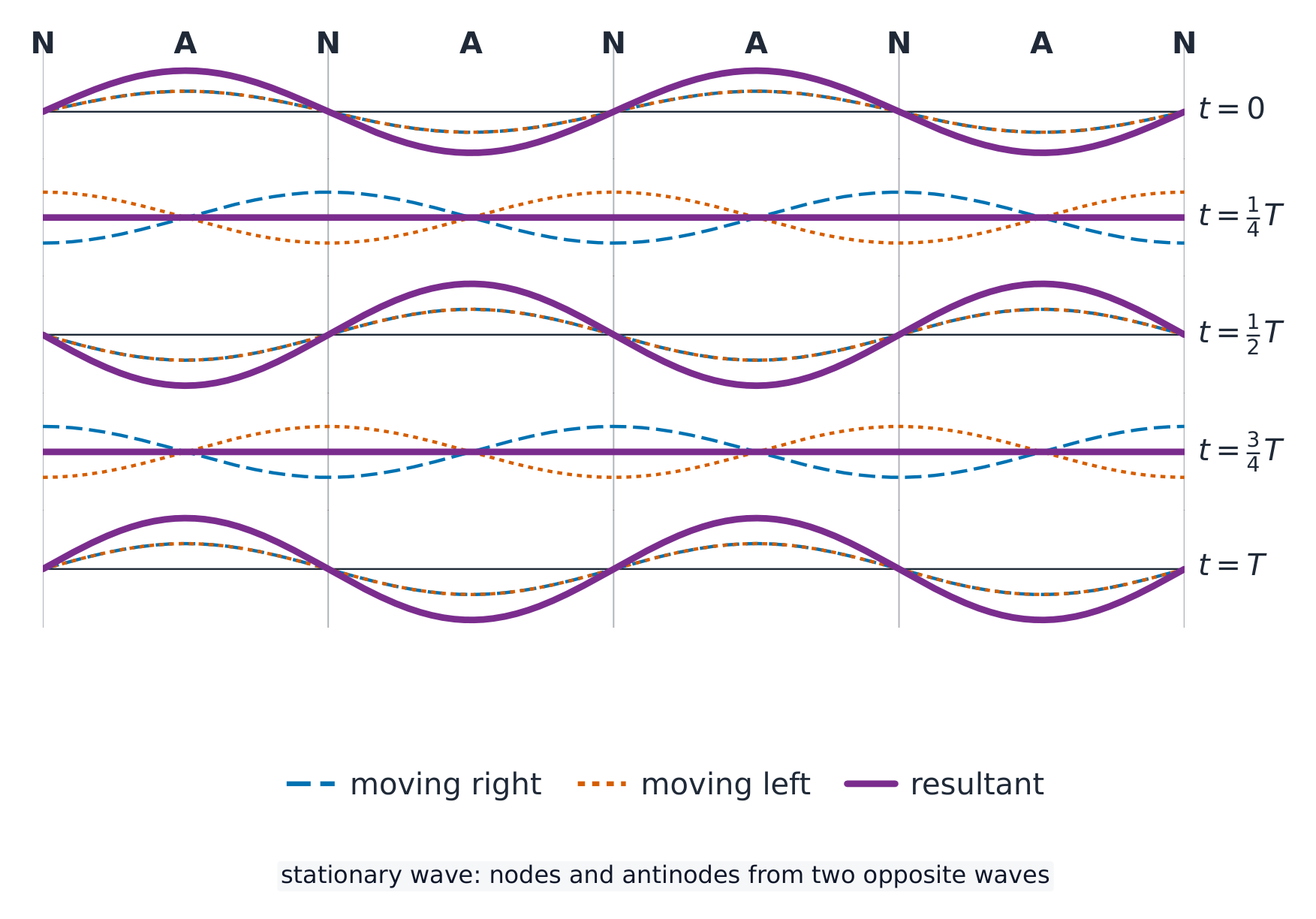
node 波节 — a point that is always at zero displacement (the two waves always cancel). The distance between next-door nodes is $\lambda/2$.
antinode 波腹 — a point of largest amplitude (the two waves always add). The distance between next-door antinodes is $\lambda/2$.
a node and the next antinode are $\lambda/4$ apart.
Particles between two nodes oscillate in phase with each other, but with different amplitudes (largest at the antinode, zero at the nodes). Particles on opposite sides of a node oscillate in antiphase 反相 (phase difference $\pi$).
So the phase difference between two points on the same loop (between adjacent nodes) is $0°$; between points on neighbouring loops it is $180°$; and between points on loops separated by one whole loop it is $0°$ again. Every point reaches its maximum displacement at the same instant and passes through zero at the same instant. A sketch of the string a quarter of a cycle after the instant of maximum displacement is a straight line along the rest position; half a cycle later it is the mirror image of the first sketch. In one period a particle at an antinode travels four amplitudes, so a particle that moves $72\ \text{mm}$ in one and a half periods has an amplitude of $12\ \text{mm}$.
Worked example. A string of length $0.80\ \text{m}$ is fixed at both ends and vibrates in its fundamental mode, where the wave speed is $240\ \text{m s}^{-1}$. Find the fundamental frequency.
One loop fits the string, so $\lambda = 2L = 1.60\ \text{m}$. Then
How a stationary wave differs from a progressive wave: it does not carry energy 能量 along its length, the pattern does not move along, and the nodes stay fixed; a progressive wave has the same amplitude everywhere and carries energy. The three differences the scheme lists: a progressive wave transfers energy and a stationary wave does not; in a progressive wave every point has the same amplitude, in a stationary wave the amplitude varies from zero at a node to a maximum at an antinode; in a progressive wave neighbouring points differ in phase, in a stationary wave all the points between two nodes are in phase.
Measuring wavelength from node spacing
Drive a string with a vibrator at frequency $f$ until a stationary pattern appears. Measure the distance between two well-separated nodes and divide by the number of half-wavelengths 波长 between them. Then $\lambda$ is known, and $v = f\lambda$ gives the wave speed.
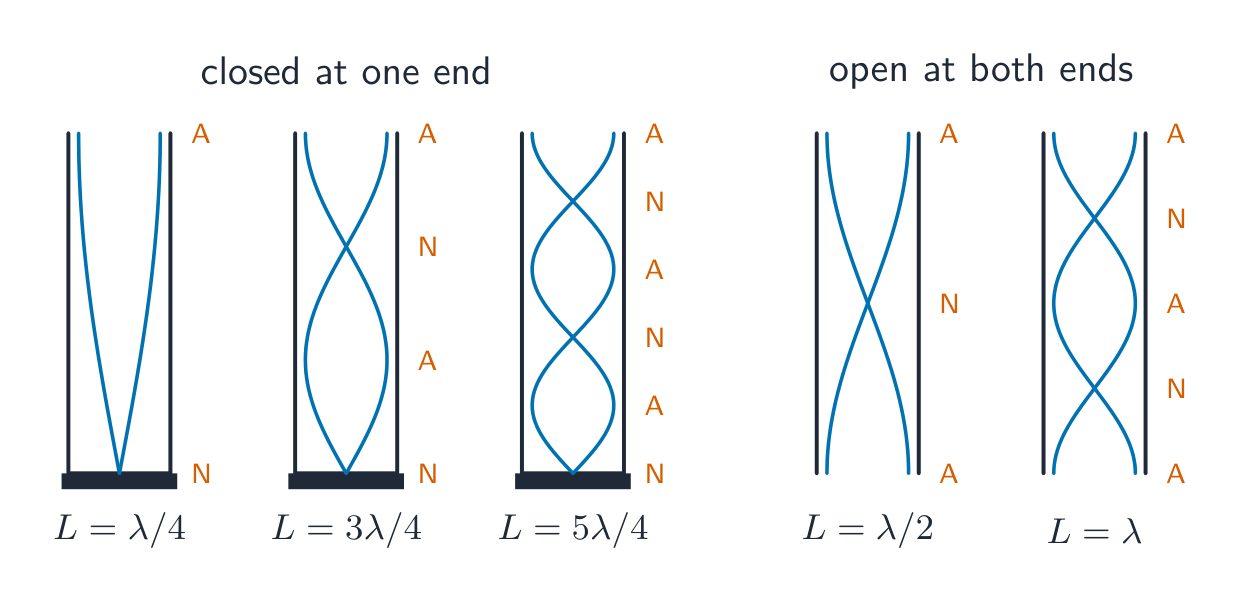
For a tube closed at one end and open at the other (a resonance tube 共鸣管), the closed end is a displacement node and the open end is a displacement antinode. The fundamental 基频 has $L = \lambda/4$; the next resonance is at $L = 3\lambda/4$; and so on. For a tube open at both ends, both ends are antinodes; the fundamental is at $L = \lambda/2$.
The general rule: a closed end is a node and an open end an antinode, and a string fixed at both ends has a node at each end. So a closed pipe fits an odd number of quarter-wavelengths ($L = \lambda/4, 3\lambda/4, 5\lambda/4, \ldots$), while an open pipe and a fixed string fit whole half-wavelengths ($L = \lambda/2, \lambda, 3\lambda/2, \ldots$); a pipe open at both ends with $n$ nodes has $n + 1$ antinodes. Frequencies follow from $f = v/\lambda$: a closed pipe whose lowest note is $820\ \text{Hz}$ has $\lambda = 4L$, and a corridor $13.2\ \text{m}$ long with a reflecting door at each end resonates lowest at $f = v/2L = 330/26.4 = 12.5\ \text{Hz}$.
Worked example. A loudspeaker at the open end of a tube $0.51\ \text{m}$ long, closed at the other end, sets up a stationary wave with two nodes and two antinodes. Find the wavelength and, with $v = 340\ \text{m s}^{-1}$, the frequency.
Two nodes and two antinodes is the second mode of a closed pipe, $L = 3\lambda/4$, so $\lambda = 4 \times 0.51 / 3 = 0.68\ \text{m}$ and $f = 340 / 0.68 = 500\ \text{Hz}$. The longest wavelength that can resonate in this tube is $4L = 2.0\ \text{m}$.
The experiments the syllabus names all measure $\lambda$ from node or antinode spacing. In the resonance tube, a tube is raised out of water while a loudspeaker or tuning fork sounds at its open end; the sound is suddenly loud at the first resonance, when the air column is $\lambda/4$ long, and again at $3\lambda/4$, so the tube moves $\lambda/2$ between the two (a student needs no equipment to detect the resonance: the note becomes loud). In a dust tube, fine powder settles into heaps at the displacement nodes, $\lambda/2$ apart. With microwaves, a receiver moved along the line between the transmitter and a metal reflecting plate reads a minimum every $\lambda/2$: a receiver that starts at a minimum and passes six more minima in $1.05\ \text{m}$ has crossed $3\lambda$, so $\lambda = 0.35\ \text{m}$ and, with $v = 340\ \text{m s}^{-1}$ for the equivalent sound experiment, $f = 970\ \text{Hz}$. A stationary wave in a microwave oven melts chocolate at the antinodes, $\lambda/2$ apart, so the spot spacing and the oven's frequency ($2.45\ \text{GHz}$) give the speed of light from $c = f\lambda$.
العربية
عما تنتشر موجتان موجية تقدمية متطابقتان في اتجاهين متعاكسين وتتداخلان، يتكون موجة موقوفة. أمثلة: موجة على وتر منعكسة من طرف ثابت تتداخل مع الموجة الواردة؛ صوت في عمود هوائي منعكس من طرف مغلق؛ موجات ميكروية بين مُشِعّ وصفيحة معدنية.
اشرح كيف تتشكل الموجة الموقوفة (ثلاث أو أربع علامات، تُطلب للوتر وعمود الهواء والميكرويات على حد سواء): تنتقل الموجة من المصدر إلى الطرف البعيد (الجدار، الطرف المغلق، الصفيحة المعدنية) وتتنعكس؛ للموجات الواردة والمنعكسة نفس التردد والطول الموجي والسرعة وتسير في اتجاهين متعاكسين؛ تتراكب حيثما تتداخلان؛ عند النقاط التي تلتقي فيها دائماً في طور واحد تتجمع الإزاحات لتعطي أقصى سعة، وهي عقدة عكسية، وعند النقاط التي تلتقي فيها دائماً في عكس الطور تلغي بعضها البعض، وهي عقدة. أما بالنسبة لـ "اذكر الشروط": موجتان من نفس النوع، لهما نفس التردد (والطول الموجي) والسرعة، تسيران في اتجاهين متعاكسين على طول خط واحد؛ السعات المتساوية مطلوبة فقط لتكون العقد ذات سعة صفر. توجد الصفيحة المعدنية في تجربة الميكرويات لانعكاس الموجات عائدةً على مسارها الخاص.
تتشكل موجة موقوفة حيث تتقاطع موجتان متعاكستان (N تمثل عقدة، A تمثل عقدة عكسية)
العقد والعقد العكسية
في الموجة الموقوفة:
العقدة — نقطة تكون دائماً عند إزاحة صفر (تلغي الموجتان بعضهما البعض دائماً). المسافة بين العقد المجاورة هي $\lambda/2$.
العقدة العكسية — نقطة ذات أكبر سعة (تتضاف الموجتان دائماً). المسافة بين العقد العكسية المجاورة هي $\lambda/2$.
العقدة والعقدة العكسية التالية تبعدان عن بعضها $\lambda/4$.
الجزيئات بين عقدتين تتذبذبان في طور واحد مع بعضها البعض، ولكن بسعات مختلفة (أكبرها عند العقدة العكسية، وصفار عند العقد). الجزيئات على جانبي العقدة تتذبذبان في عكس الطور (فارق الطور $\pi$).
لذلك فإن فارق الطور بين نقطتين على نفس الحلقة (بين عقدتين مجاورتين) هو $0°$؛ وبين نقطتين على حلقات مجاورة هو $180°$؛ وبين نقطتين على حلقات يفصل بينهما حلقة كاملة كاملة هو $0°$ مرة أخرى. تصل كل نقطة إلى أقصى إزاحة لها في نفس اللحظة وتمرص بالصفر في نفس اللحظة. رسم توضيحي للوتر بعد ربع دورة من لحظة أقصى إزاحة يكون خطاً مستقيماً على وضع السكون؛ وبعد نصف دورة يصبح صورة مرآة للرسم الأول. في دورة واحدة يسافر جزيء عند عقدة عكسية مسافة تساوي أربعة أضعاف السعة، لذا فإن جزيء يتحرك $72\ \text{mm}$ في سنة ونصف له سعة قدرها $12\ \text{mm}$.
وضع أساسي على وتر مشدود — حلقة واحدة، حيث L يساوي نصف طول موجي
مثال محلل. وتر طوله $0.80\ \text{m}$ مثبت من الطرفين ويهتز في وضعه الأساسي، حيث سرعة الموجة هي $240\ \text{m s}^{-1}$. أوجد التردد الأساسي.
حلقة واحدة تناسب الوتر، لذا $\lambda = 2L = 1.60\ \text{m}$. ثم
كيف تختلف الموجة الموقوفة عن الموجة التقدمية: فهي لا تنقل طاقة على طول طولها، والنمط لا يتحرك للأمام، والعقد تظل ثابتة؛ الموجة التقدمية لها نفس السعة في كل مكان وتنقل الطاقة. الفروق الثلاثة التي يذكرها المنهج: الموجة التقدمية تنقل الطاقة والموجة الموقوفة لا تفعل ذلك؛ في الموجة التقدمية لكل نقطة نفس السعة، في الموقوفة تتغير السعة من الصفر عند العقدة إلى الحد الأقصى عند العقدة العكسية؛ في الموجة التقدمية تختلف النقاط المجاورة في الطور، في الموقوفة جميع النقاط بين عقدتين تكون في طور واحد.
قياس الطول الموجي من تباعد العقد
قم بتأثير وتر بوساطة جهاز اهتزاز بتردد $f$ حتى يظهر نمط موقوف. قِس المسافة بين عقدتين مبتعدتين جيداً واقسمها على عدد أنصاف الأطوال الموجية بينهما. حينئذٍ تكون $\lambda$ معلومة، وستعطيك $v = f\lambda$ سرعة الموجة.
بالنسبة لأنبوب مغلق من طرف وفتح من طرف آخر (أنبوب رنين)، فإن الطرف المغلق يمثل عقدة إزاحة والطرف المفتوح يمثل عقدة عكسية لإزاحة. الأساسي يحتوي على $L = \lambda/4$؛ الرنين التالي يكون عند $L = 3\lambda/4$؛ وهكذا. بالنسبة لأنبوب مفتوح من الطرفين، كلا الطرفين عقدتان عكسيتان؛ الأساسي يكون عند $L = \lambda/2$.
القاعدة العامة: النهاية المغلقة عقدة والنهاية المفتوحة قمة، والوتر المثبت من كلا الطرفين له عقدة عند كل نهاية. لذا يتناسب الأنبوب المغلق مع عدد فردي من أرباع الأطوال الموجية ($L = \lambda/4, 3\lambda/4, 5\lambda/4, \ldots$)، بينما يتناسب الأنبوب المفتوح والوتر المثبت مع نصف أطوال موجية كاملة ($L = \lambda/2, \lambda, 3\lambda/2, \ldots$)؛ الأنبوب المفتوح من كلا الطرفين الذي يحتوي على $n$ عقد يحتوي على $n + 1$ قمم. تتحدد الترددات بناءً على $f = v/\lambda$: أنبوب مغلق يكون أدنى نغمة فيه $820\ \text{Hz}$ لديه $\lambda = 4L$، وممر طوله $13.2\ \text{m}$ وباب عاكس في كل طرف يهتز بأدنى تردد عند $f = v/2L = 330/26.4 = 12.5\ \text{Hz}$.
وضعيات عمود الهواء: النهاية المغلقة عقدة، والنهاية المفتوحة قمة
مثال محلول. مكبر صوت عند الطرف المفتوح لأنبوب طوله $0.51\ \text{m}$، مغلق من الطرف الآخر، يُنشئ موجة ثابتة بعقدتين وقمتين. أوجد الطول الموجي، ومع $v = 340\ \text{m s}^{-1}$، التردد.
عقدتان وقمتان هما الوضع الثاني لأنبوب مغلق، $L = 3\lambda/4$، لذا $\lambda = 4 \times 0.51 / 3 = 0.68\ \text{m}$ و$f = 340 / 0.68 = 500\ \text{Hz}$. أطول طول موجي يمكن أن يهتز في هذا الأنبوب هو $4L = 2.0\ \text{m}$.
التجارب التي يذكرها المنهج جميعها تقيس $\lambda$ من مسافة العقدة أو القمة. في أنبوب الرنين، يتم رفع أنبوب من الماء بينما يصدر مكبر صوت أو شوكة رنانة عند فوهته؛ يصبح الصوت مرتفعًا فجأة عند أول رنين، عندما يكون عمود الهواء بطول $\lambda/4$، مرة أخرى عند $3\lambda/4$، لذا يتحرك الأنبوب مسافة $\lambda/2$ بين الاثنين (لا يحتاج الطالب إلى معدات للكشف عن الرنين: تصبح النغمة مرتفعة). في أنبوب الغبار، تستقر المسحوق الدقيق في كومة عند عقد الإزاحة، وهي $\lambda/2$ متباعدة. مع الموجات الميكروية، يعطي مستقبل مُتحرك على طول الخط بين المُرسِل وصفيحة معدنية عاكسة قيمة دنيا كل $\lambda/2$: مستقبلاً يبدأ من قيمة دنى ويمر بستة قيم دنيا إضافية في $1.05\ \text{m}$ قد عبر $3\lambda$، لذا $\lambda = 0.35\ \text{m}$، ومع $v = 340\ \text{m s}^{-1}$ للتجربة الصوتية المكافئة، $f = 970\ \text{Hz}$. موجة ثابتة في فرن الميكروويف تُذوب الشوكولاتة عند القمم، وهي $\lambda/2$ متباعدة، لذا تعطي مسافة البقع وتردد الفرن ($2.45\ \text{GHz}$) سرعة الضوء من $c = f\lambda$.
الوضع الأساسي في الأنبوب المغلق — عقدة عند الطرف المغلق، وقمة عند الطرف المفتوح
A string fixed at both ends only resonates at its harmonics. Drag n to see the nodes, antinodes and how the wavelength changes. · وتر مثبت من الطرفين يتناغم فقط عند توافياته. اسحب n لرؤية العقد والantinodes وكيفية تغير الطول الموجي.
Explore · استكشف
Stationary waves · موجات موقوفة
y = y₁ + y₂
Two waves superpose: where they reinforce you get antinodes, where they cancel, nodes. · يتراكب موجتان: حيث يتعاوضان تحصل على antinodes، حيث تتكافئ، عقد.
show an understanding of experiments that demonstrate diffraction including the qualitative effect of the gap width relative to the wavelength of the wave; for example diffraction of water waves in a ripple tank
العربية
اشرح معنى مصطلح الانحراف
أظهر فهماً للتجارب التي تبرز الانحراف بما في ذلك التأثير النوعي لـعرض الشق نسبةً إلى الطول الموجي للموجة؛ على سبيل المثال انحراف موجات الماء في حوض الأمواج
Source: Cambridge International syllabus · المصدر: منهج كامبريدج الدولي
English
Diffraction 衍射 is the spreading of a wave after it passes through a gap or around an obstacle 障碍物. All waves diffract — water, sound, light, microwaves.
For the two-mark "state what is meant by diffraction": the spreading of a wave as it passes through a gap (an aperture) or around the edge of an obstacle, into the region behind it. Diffraction changes the direction the wave travels in, but not its speed, frequency or wavelength.
The amount of spreading depends on the ratio of wavelength to gap width:
gap much wider than $\lambda$: very little spreading; the wave goes nearly straight through.
gap about the size of$\lambda$: a lot of spreading; the wave fans out.
gap smaller than$\lambda$: very strong spreading; the gap acts almost like a point source.
Show this with water waves in a ripple tank 水波槽: straight waves meet a barrier with a gap, and the waves curve more as the gap is made narrower. The same idea is why you can hear someone around a corner (speech has $\lambda$ near 1 m, close to the gap size) but cannot see them (visible light has $\lambda \sim 500\ \text{nm}$, far smaller than the gap).
For the strongest spreading the gap should be about one wavelength wide. So to increase the diffraction of a given wave, make the gap narrower; for a given gap, use a longer wavelength, which means a lower frequency. Radio waves of wavelength $1.5\ \text{km}$ diffract around a mountain and reach an aerial behind it; microwaves of $1.5\ \text{cm}$ do not. Sound of $0.44\ \text{kHz}$ in air has $\lambda = 330 / 440 = 0.75\ \text{m}$, so features of about $0.75\ \text{m}$ diffract it most, and of the sounds passing through a doorway $0.80\ \text{m}$ wide the low frequencies spread out most. Making the gap many wavelengths wide, or raising the frequency, reduces the spreading.
العربية
الانحراف هو انتشار الموجة بعد مرورها عبر فتحة أو حول عائق. جميع الموجات تنحرف — الماء، الصوت، الضوء، الموجات الميكروية.
للسؤال ذو العلامتين "اذكر ما يُقصد بالانحراف": انتشار الموجة أثناء مرورها عبر فتحة (ثقب) أو حول حافة عائق، إلى المنطقة الواقعة خلفه. يغير الانحراف الاتجاه الذي تسير فيه الموجة، لكن ليس سرعتها أو ترددها أو طولها الموجي.
تعتمد كمية الانتشار على نسبة الطول الموجي إلى عرض الفتحة:
فتحة أوسع بكثير من $\lambda$: انتشار ضئيل جدًا؛ تمر الموجة تقريبًا بشكل مستقيم.
فتحة بحجم تقريبي لـ$\lambda$: الكثير من الانتشار؛ تنتشر الموجة.
فتحة أصغر من$\lambda$: انتشار قوي جدًا؛ تعمل الفتحة تقريبًا كمصدر نقطي.
أظهر ذلك بموجات الماء في حوض الأمواج: موجات مستقيمة تلتقي بحاجز به فتحة، وتنحني الموجات أكثر كلما صُغرت الفتحة. نفس الفكرة هي السبب في أنك تستطيع سماع شخص حول زاوية (لغة بشرة لها $\lambda$ قريبة من 1 م، قريب من حجم الفتحة) لكن لا يمكنك رؤيته (الضوء المرئي له $\lambda \sim 500\ \text{nm}$، أصغر بكثير من الفتحة).
لأقصى انتشار، يجب أن يكون الفجوة بحجم طول موجي واحد تقريباً. لذا لزيادة حيود موجة معينة، اجعل الفجوة أضيق؛ ول فجوة معينة، استخدم طول موجية أطول، مما يعني ترددًا أقل. موجات الراديو بطول موجي $1.5\ \text{km}$ تنحني حول جبل وتصل إلى هوائي خلفه؛ بينما الموجات الميكروية بطول $1.5\ \text{cm}$ لا تفعل ذلك. صوت بتردد $0.44\ \text{kHz}$ في الهواء له طول موجي $\lambda = 330 / 440 = 0.75\ \text{m}$، لذا فإن الملامح بحجم $0.75\ \text{m}$ تحده بشكل أكبر، ومن الأصوات التي تمر عبر باب عرضه $0.80\ \text{m}$، تتوزع الترددات المنخفضة أكثر. جعل الفجوة بعرض عدة أطوال موجية أو رفع التردد يقلل من الانتشار.
الانحراف في خزان الأمواج — فجوة واسعة (أ) تنشر الأمواج قليلاً، وفجوة ضيقة (ب) تنشرها كثيراً
Explore · استكشف
Waves adding and cancelling · موجات تتضافر وتتكافئ
Two overlapping waves add where they are in phase and cancel where out of phase — change the phase to see the result. This is what makes diffraction patterns. · موجتان متداخلتان تتضافران حيث تكونان في طور وتتكافنان حيث تكونان خارج الطور — غيّر الطور لترى النتيجة. هذا ما يُكوّن أنماط الحيود.
show an understanding of experiments that demonstrate two-source interference using water waves in a ripple tank, sound, light and microwaves
understand the conditions required if two-source interference fringes are to be observed
recall and use $\lambda = ax / D$ for double-slit interference using light
العربية
افهم مصطلحي التداخل والاتساق
أظهر فهماً للتجارب التي تبرز تداخل المصدرين باستخدام موجات الماء في حوض الأمواج والصوت والضوء والموجات الميكروية
افهم الشروط اللازمة إذا كانت أشرطة التداخل للمصدرين المرصودة
تذكر واستخدم $\lambda = ax / D$ لـتداخل الشقين باستخدام الضوء
Source: Cambridge International syllabus · المصدر: منهج كامبريدج الدولي
English
Two-slit interference
Interference 干涉 is the superposition of two coherent 相干 waves to give a steady pattern of high-amplitude regions (constructive) and low-amplitude regions (destructive).
Coherence
Two sources are coherent when they emit waves with a constant phase difference (which also needs the same frequency). Two separate lamps are not coherent — their phase changes randomly, so any pattern flickers too fast to see and you get only an average.
The one-mark definition: coherent waves have a constant phase difference, which requires the same frequency. They need not be in phase with each other: two coherent sources emitting $180°$ apart give a pattern whose central line is a minimum. Two separate lasers, or a lamp and a laser, are not coherent even when their frequencies happen to match, so no steady pattern forms.
To make coherent light from one source, pass it through two slits 狭缝 in a double-slit 双缝 setup. Both slits are lit by the same wavefront, so the two beams keep a fixed phase relationship.
Conditions for a clear pattern
To see two-source fringes you need:
two coherent sources (constant phase difference).
roughly equal amplitudes (or the dark regions are not very dark).
the waves overlap where you look.
for light (a transverse wave), the same plane of polarisation 偏振.
In practice, for light: a single slit (or a laser) makes the two slits coherent; the slits are narrow, so each diffracts the light into the region where the two beams overlap; and the slits are close together with the screen far away, so that the fringes are wide enough to see.
Path difference
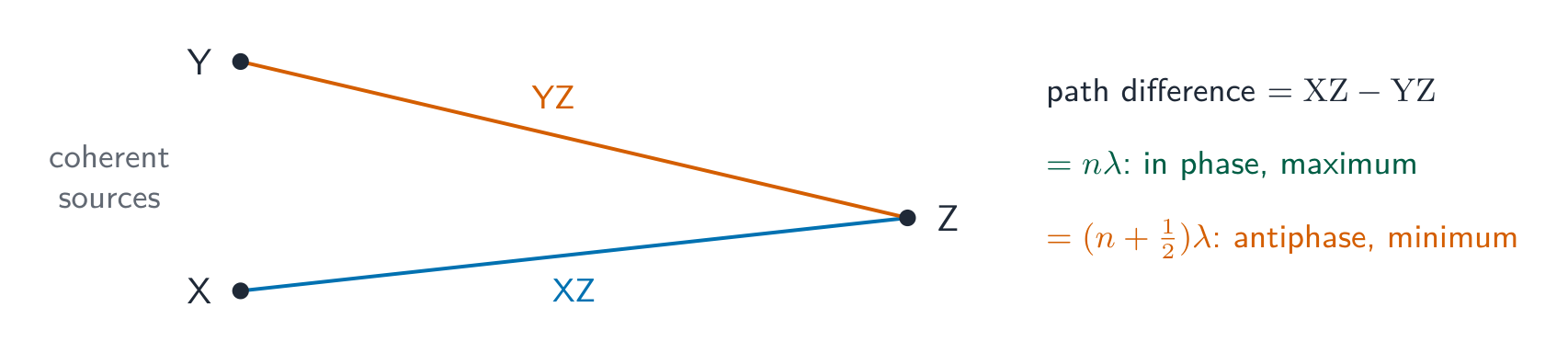
For two coherent sources, what happens at a point depends on the path difference 路程差$\Delta x$ between the two waves arriving there:
destructive: $\Delta x = (n + \tfrac{1}{2})\lambda$.
The path difference fixes the phase difference: one wavelength of path is $360°$. Waves that have travelled $100\ \text{cm}$ and $80\ \text{cm}$ from two in-phase sources of wavelength $8.0\ \text{cm}$ arrive with a path difference of $2.5\lambda$, a phase difference of $180°$, and cancel; microwaves of wavelength $4\ \text{cm}$ whose paths differ by $6\ \text{cm}$ ($1.5\lambda$) give a minimum, of zero intensity only if the two amplitudes are equal. Lowering both source frequencies equally lengthens the wavelength, so the same path difference is a smaller number of wavelengths and the point is no longer a minimum.
Double-slit (Young's) experiment
For two slits a distance $a$ apart, with a screen a distance $D$ away (assume $D \gg a$), light of wavelength $\lambda$ makes fringes on the screen.
The fringe spacing 条纹间距$x$ (one fringe 条纹 to the next) is
$$\lambda = \frac{a x}{D}, \qquad x = \frac{\lambda D}{a}.$$
Bright fringes (maximum 极大) are where the path difference is a whole number of $\lambda$; dark fringes (minimum 极小) where it is $(n + \tfrac{1}{2})\lambda$. The fringes are equally spaced.
To make the fringe spacing smaller: increase $a$ (slits further apart), reduce $D$ (screen closer), or use a shorter $\lambda$ (bluer light).
Explain how the pattern of bright and dark fringes is formed (three marks): the light diffracts at each slit; the two diffracted beams overlap and superpose; where the path difference from the two slits is a whole number of wavelengths the waves arrive in phase and interfere constructively, giving a bright fringe, and where it is an odd number of half-wavelengths they arrive in antiphase and interfere destructively, giving a dark fringe. A brighter source makes the bright fringes brighter but does not change their spacing; changing to blue light makes the spacing smaller, so to keep the same spacing the slits must be moved closer together; making each slit narrower increases the diffraction, so fringes appear across a wider region, with the spacing unchanged.
Worked example. In a double-slit experiment the slits are $0.50\ \text{mm}$ apart and lit by light of wavelength $600\ \text{nm}$. The screen is $2.0\ \text{m}$ away. Find the fringe spacing.
Worked example. Red light of wavelength $680\ \text{nm}$ falls on slits $0.16\ \text{mm}$ apart. The distance between the centres of the first and ninth dark fringes is $3.2\ \text{cm}$. Find the distance $D$ to the screen.
Eight fringe spacings make $3.2\ \text{cm}$, so $x = 4.0\ \text{mm}$ and $D = ax / \lambda = (0.16 \times 10^{-3})(4.0 \times 10^{-3}) / (680 \times 10^{-9}) = 0.94\ \text{m}$. On a screen $5.0\ \text{cm}$ wide centred on the pattern, with $x = 2.4\ \text{mm}$, ten bright fringes fit on each side of the central one: $21$ in all. A graph of $x$ against $a$ is a curve falling as $1/a$; a graph of $x$ against $\lambda$ (or against $D$) is a straight line through the origin with gradient $D/a$ (or $\lambda/a$), from which $a$ can be found.
العربية
تداخل شقينتأتي الألوان المتغيرة على فقاعة الصابون من تداخل الضوء.
التداخل هو تراكب موجتين متناطقتين لإعطاء نمط ثابت لمناطق ذات سعة عالية (بناء) ومناطق ذات سعة منخفضة (هدم).
مصدران متماكانان يعطان خطوط إزاحة قصوى حيث تتقابل القمم مع القممنفس التأثير في حوض أمواج حقيقي — مصدران متناطقان يعطيان نمط تداخل ثابت
التناسق
يكون المصدران متناطقين عندما يشعان موجات بفارق طور ثابت (وهذا يتطلب أيضًا نفس التردد). مصباحان منفصلان ليسا متناطقين — يتغير طورهما عشوائيًا، لذا أي نمط يتوهج بسرعة كبيرة لدرجة لا تُرى ويحصل فقط على متوسط.
تعريف الدرجة الواحدة: الموجات المترابطة تمتلك فرق طور ثابت، مما يتطلب نفس التردد. لا يشترط أن تكون في الطور مع بعضها البعض: مصدران مترابطان يبعثان $180°$ بينهما يعطي نمطاً يكون فيه الخط المركزي حدًا أدنى. ليزران منفصلان، أو مصباح وليزر، ليسا مترابطين حتى لو تطابقت تردداتهما بالصدفة، لذلك لا يتشكل نمط مستقر.
لإنتاج ضوء مترابط من مصدر واحد، مرره عبر شقين في إعدادية الشق المزدوج. كلا الشقين مضاءان بنفس الجبهة الموجية، لذا يحافظ شعاعا الضوء على علاقة طور ثابتة.
شروط ظهور نمط واضح
لملاحظة أهداب المصدرين، تحتاج إلى:
مصدرين مترابطين (فرق طور ثابت).
سعات متقاربة تقريباً (وإلا لن تكون المناطق الداكنة داكنة للغاية).
تتداخل الموجات عند نقطة الرصد.
بالنسبة للضوء (وهو موجة عرضية)، نفس مستوى الاستقطاب.
في الواقع، بالنسبة للضوء: شق واحد (أو ليزر) يجعل الشقين مترابطين؛ الشقوق ضيقة، لذا كل منها يحني الضوء نحو المنطقة التي يتداخل فيها الشعاعان؛ والشقوق متقاربة مع وجود الشاشة بعيداً، بحيث تكون الأهداب واسعة بما يكفي للرؤية.
الفرق في المسار
بالنسبة لمصدرين مترابطين، ما يحدث عند نقطة معينة يعتمد على الفرق في المسار$\Delta x$ بين الموجتين arriving there:
يحدد الفرق في المسار فرق الطور: طول موجي واحد من المسار يساوي $360°$. موجات قطرت مسافات $100\ \text{cm}$ و$80\ \text{cm}$ من مصدرين في الطور بطول موجي $8.0\ \text{cm}$ تصلان بفرق مسار $2.5\lambda$، وفرق طور $180°$، وتلغي بعضهما؛ موجات ميكروية بطول موجي $4\ \text{cm}$ whose paths differ by $6\ \text{cm}$ ($1.5\lambda$) تعطي حدًا أدنى، وكثافة صفر فقط إذا كانت السعات متساوية. lowering both source frequencies equally lengthens the wavelength, so the same path difference is a smaller number of wavelengths and the point is no longer a minimum.
ما يحدث عند Z يعتمد على الفرق في المسار XZ − YZ، مقاساً بالأطوال الموجية
تجربة الشق المزدوج (تجربة يونغ)
بالنسبة لشقين تبعدان مسافة $a$، مع وجود شاشة على مسافة $D$ (افترض $D \gg a$)، ضوء بطول موجي $\lambda$ يشكل أهداباً على الشاشة.
تجربة الشق المزدوج لياونغ — الشق الفردي يجعل الشقين مصدرين متماكنين
تباعد الأهداب$x$ (من هدب إلى الهدب التالي) هو
$$\lambda = \frac{a x}{D}, \qquad x = \frac{\lambda D}{a}.$$
الأهداب المضيئة (حد أقصى) هي حيث الفرق في المسار عدد صحيح من $\lambda$؛ الأهداب الداكنة (حد أدنى) حيث يكون $(n + \tfrac{1}{2})\lambda$. الأهداب متساوية التباعد.
لجعل fringe spacing أصغر: زِد $a$ (الشقوق أبعد عن بعضها)، قلّل $D$ (الشاشة أقرب)، أو استخدم shorter $\lambda$ (ضوء أزرق).
اشرح كيفية تشكل نمط الأهداب المضيئة والداكنة (ثلاث درجات): الضوء ينحني عند كل شق؛ الشعاعان المنحنيان يتداخلان ويتراكبان؛ حيث الفرق في المسار من الشقين عدداً صحيحاً من الأطوال الموجية، تصل الموجات في الطور وتتداخل بناءً، مما يعطي هدباً مضيئاً، وحيث يكون عدداً فردياً من نصف الأطوال الموجية، تصل في عكس الطور وتتداخل هداماً، مما يعطي هدباً داكناً. مصدر أكثر سطوعاً يجعل الأهداب المضيئة أكثر سطوعاً لكن لا يغير تباعدها؛ التحول إلى الضوء الأزرق يصغر التباعد، لذا للحفاظ على نفس التباعد يجب تحريك الشقوق لتصبح أقرب لبعضها؛ جعل كل شق أضيق يزيد الانحراف، فتظهر الأهداب عبر منطقة أوسع، مع ثبات التباعد.
مثال محلول. في تجربة الشق المزدوج تبعد الشقوق $0.50\ \text{mm}$ عن بعضها ومضاءة بضوء بطول موجي $600\ \text{nm}$. الشاشة تبعد $2.0\ \text{m}$. أوجد تباعد الأهداب.
مثال محلول. يسقط ضوء أحمر بطول موجي $680\ \text{nm}$ على شقوق تبعد $0.16\ \text{mm}$ عن بعضها. المسافة بين مركزي الهدب الأول والتاسع الداكنين هي $3.2\ \text{cm}$. أوجد المسافة $D$ إلى الشاشة.
ثمانية فواصل أهداب تساوي $3.2\ \text{cm}$، لذا $x = 4.0\ \text{mm}$ و$D = ax / \lambda = (0.16 \times 10^{-3})(4.0 \times 10^{-3}) / (680 \times 10^{-9}) = 0.94\ \text{m}$. على شاشة بعرض $5.0\ \text{cm}$ مركزية على النمط، مع $x = 2.4\ \text{mm}$، توضع عشرة أهداب مضيئة على كل جانب من الهدب المركزي: $21$ إجمالاً. رسم بياني لـ $x$ مقابل $a$ هو منحنٍ ينخفض كلما زادت $1/a$؛ رسم بياني لـ $x$ مقابل $\lambda$ (أو مقابل $D$) هو خط مستقيم يمر بنقطة الأصل بميل $D/a$ (أو $\lambda/a$)، ومنه يمكن إيجاد $a$.
Explore · استكشف
Interference · التداخل
y = y₁ + y₂
In phase → constructive (bright/loud); antiphase → destructive (dark/quiet). · متطابق الطور → بناء (ساطع/مرتفع); متعاكس الطور → هدمي (داكن/منخفض).
describe the use of a diffraction grating to determine the wavelength of light (the structure and use of the spectrometer are not included)
العربية
تذكر واستخدم $d \sin \theta = n\lambda$
صف استخدام محزز الانحراف لتحديد الطول الموجي للضوء (لا يُدرج تركيب وميكانيكية عمل جهاز المطيافية)
Source: Cambridge International syllabus · المصدر: منهج كامبريدج الدولي
English
A diffraction grating 衍射光栅 has many equally spaced slits — often hundreds or thousands per millimetre. Each slit is a coherent source. A maximum is seen at angle $\theta$ from the normal 法线 to the grating when
$$d \sin\theta = n \lambda,$$
where $d$ is the slit spacing 缝间距 (centre to centre), $n = 0, \pm 1, \pm 2, \ldots$ is the order 级次, and $\lambda$ is the wavelength.
Worked example. A diffraction grating has $500$ lines per mm. Light of wavelength $600\ \text{nm}$ is shone normally on it. Find the angle of the first-order ($n = 1$) maximum.
The slit spacing is $d = \dfrac{1}{500}\ \text{mm} = 2.0 \times 10^{-6}\ \text{m}$, so
Compared with the double slit, a grating gives much sharper maxima, because more slits add together — every other direction is cancelled by many slits.
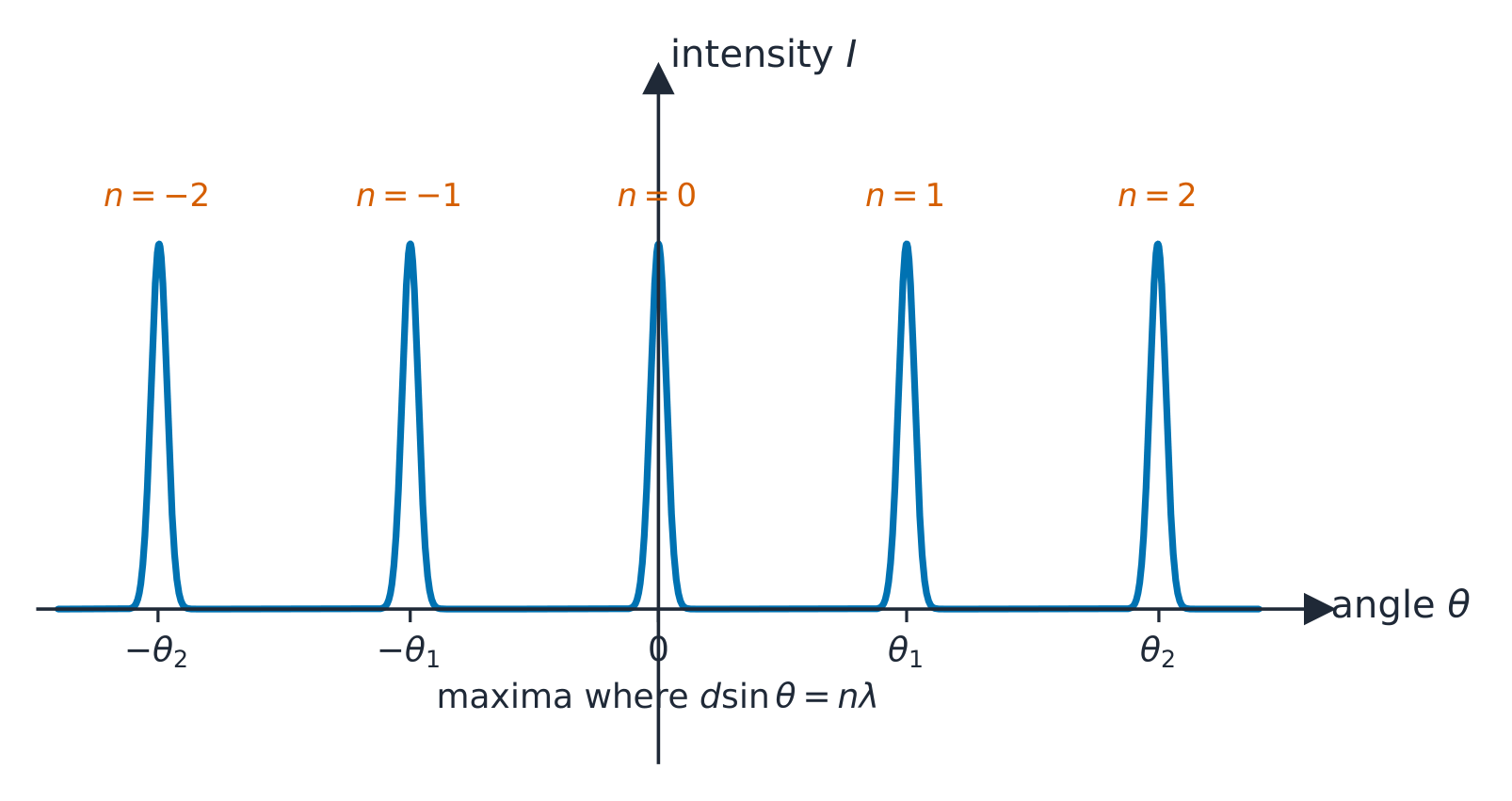
To describe the diffraction at the grating: the light spreads out (diffracts) at every slit, and the waves from all the slits superpose; in the directions where the path difference between neighbouring slits is a whole number of wavelengths they are all in phase, so sharp maxima form there and almost nothing in between. A graph of intensity against angle is a set of narrow peaks at $\theta = 0$ and at $\pm\theta_{1}, \pm\theta_{2}, \ldots$, where $\sin\theta_{n} = n\lambda/d$: equally spaced in $\sin\theta$, so slightly further apart in $\theta$ at the higher orders.
Worked example. Light of wavelength $680\ \text{nm}$ is incident normally on a grating with $450$ lines per mm. Find the angle between the two second-order maxima.
$d = 1/450\ \text{mm} = 2.22 \times 10^{-6}\ \text{m}$, so $\sin\theta_{2} = 2 \times 680 \times 10^{-9} / (2.22 \times 10^{-6}) = 0.612$ and $\theta_{2} = 37.7°$; the two second-order beams are $2\theta_{2} = 75°$ apart.
Slit spacing from "lines per mm"
If a grating has $N$ lines per millimetre, then $d = 1/N$ millimetres $= 10^{-3}/N$ metres. For $450$ lines per mm, $d = 1/450\ \text{mm} \approx 2.22\ \mu\text{m}$.
Highest order
For a given grating and wavelength, $\sin\theta = n\lambda/d$ cannot be more than $1$, so the highest order seen is
If $d/\lambda = 3.27$, orders up to $n = 3$ exist; $n = 4$ would need $\sin\theta > 1$ and is not seen.
So the total number of maxima on a wide screen is $2n_{\text{max}} + 1$: for $700\ \text{nm}$ light and $400$ lines per mm, $d/\lambda = 3.57$, so $n_{\text{max}} = 3$ and seven beams are seen. A shorter wavelength gives more orders at smaller angles. With white light every order except the zero order is a spectrum, violet nearest the centre and red furthest out, because $\theta$ grows with $\lambda$; the zero order stays white. Two wavelengths give a maximum at the same angle when $n_{1}\lambda_{1} = n_{2}\lambda_{2}$: the third order of $400\ \text{nm}$ coincides with the second order of $600\ \text{nm}$.
Finding $\lambda$ with a grating
Shine parallel light of unknown wavelength straight at the grating. Measure the angle $\theta_{1}$ of the first-order maximum from the centre. Then $\lambda = d \sin\theta_{1}$. Repeating for higher orders and averaging reduces error.
Measure the angle between the first-order maxima on the two sides and halve it, which cancels any error in setting the zero; higher orders give larger angles and so a smaller percentage uncertainty; and plotting $\sin\theta$ against $n$ for several orders gives a straight line through the origin of gradient $\lambda/d$, so $\lambda = Gd$ (or, for a known wavelength, $d = \lambda/G$). Two things must be right: $\theta$ is measured from the normal to the grating, not from its surface, and $d$ is the distance between adjacent lines, so $400$ lines per mm means $d = 2.5\ \mu\text{m}$, never $400$.
العربية
شبكة الانحراف تحتوي على العديد من الشقوق المتساوية التباعد — غالباً مئات أو آلاف في المليمتر الواحد. كل شق هو مصدر مترابط. يظهر حد أقصى عند زاوية $\theta$ من العمودي على الشبكة عندما
$$d \sin\theta = n \lambda,$$
حيث $d$ هو تباعد الشقوق (المركز إلى المركز)، $n = 0, \pm 1, \pm 2, \ldots$ هو الرتبة، و$\lambda$ هو الطول الموجي.
مثال محلول. شبكة انحراف بها $500$ خط في المليمتر الواحد. يسقط عليها ضوء بطول موجي $600\ \text{nm}$ بشكل عمودي. أوجد زاوية الحد الأقصى من الرتبة الأولى ($n = 1$).
تباعد الشقوق هو $d = \dfrac{1}{500}\ \text{mm} = 2.0 \times 10^{-6}\ \text{m}$، لذا
مقارنة بالشق المزدوج، تعطي الشبكة حدوداً قصوى أكثر حدة، لأن زيادة عدد الشقوق تجمع تأثيراتها — كل اتجاه آخر يتم إلغاؤه بواسطة العديد من الشقوق.
لوصف انتشار الموجات عبر الشبكة: ينتشر الضوء (يتشذ) عند كل شق، وتتراكب موجات جميع الشقوق؛ وفي الاتجاهات التي يكون فيها الفرق في المسار بين الشقوق المجاورة عدداً صحيحاً من الأطوال الموجية، تكون جميعها في طور واحد، فتتشكل قمم حادة هناك تقريباً ولا يوجد شيء تقريباً بينها. يمثل الرسم البياني للشدة مقابل الزاوية مجموعة من القمم الضيقة عند $\theta = 0$ وعند $\pm\theta_{1}, \pm\theta_{2}, \ldots$، حيث $\sin\theta_{n} = n\lambda/d$: متساوية التباعد في $\sin\theta$، لذا تبعد قليلاً عن بعضها في $\theta$ عند الرتب الأعلى.
الشدة مقابل الزاوية لشبكة: قمم حادة حيث $d\sin\theta = n\lambda$
مثال محلول. ضوء بطول موجي $680\ \text{nm}$ يسقط عمودياً على شبكة بتشتيت $450$ خط في مميليمتر. أوجد الزاوية بين ذرتي الرتبة الثانية.
محزز الحيود يفصل الضوء أحادي اللون إلى قمم حادة على شاشة
تباعد الشقوق من "الخطوط لكل مم"
إذا كانت الشبكة تحتوي على $N$ خطوط لكل مليمتر، فإن $d = 1/N$ مليمتر يساوي $= 10^{-3}/N$ متر. بالنسبة لـ $450$ خطوط لكل مم، فإن $d = 1/450\ \text{mm} \approx 2.22\ \mu\text{m}$.
أعلى رتبة
بالنسبة لشبكة وطول موجي معين، لا يمكن أن يكون $\sin\theta = n\lambda/d$ أكبر من $1$، لذا فإن أعلى رتبة مرئية هي
إذا كان $d/\lambda = 3.27$، توجد رتب تصل إلى $n = 3$؛ أما $n = 4$ فستحتاج إلى $\sin\theta > 1$ ولن تُرى.
لذا العدد الكلي للذروات على شاشة واسعة هو $2n_{\text{max}} + 1$: لضوء بتردد $700\ \text{nm}$ وشبكة بها $400$ خط في مميليمتر، نحصل على $d/\lambda = 3.57$، وبالتالي $n_{\text{max}} = 3$ وسبعة حزم مرئية. يعطي طول موجي أقصر رتباً أكثر عند زوايا أصغر. مع الضوء الأبيض، كل رتبة ما عدا الرتبة صفر تكون طيفاً، حيث البنفسجي الأقرب للمركز والأبعد الأحمر، لأن $\theta$ يزداد مع $\lambda$؛ تظل الرتبة صفر بيضاء. يعطي طولان موجيان ذروة عند نفس الزاوية عندما $n_{1}\lambda_{1} = n_{2}\lambda_{2}$: الرتبة الثالثة لـ $400\ \text{nm}$ تتطابق مع الرتبة الثانية لـ $600\ \text{nm}$.
إيجاد $\lambda$ باستخدام شبكة
أضئ light متوازي بطول موجي مجهول مباشرة نحو grating. قِس الزاوية $\theta_{1}$ لـ first-order maximum من Centre. ثم $\lambda = d \sin\theta_{1}$. تكرار ذلك للأمر higher orders وتوسط النتائج يقلل error.
قِس الزاوية بين قمم الرتبة الأولى من الجانبين وقسّمها على النصف، مما يلغي أي خطأ في ضبط الصفر؛ تعطي الرتب الأعلى زوايا أكبر وبالتالي نسبة عدم يقين أقل؛ ورسم $\sin\theta$ مقابل $n$ لعدة رتب يعطي خطاً مستقيماً يمر بنقطة الأصل بميل $\lambda/d$، إذن $\lambda = Gd$ (أو، لطول موجي معلوم، $d = \lambda/G$). يجب أن يكون شيئان صحيحين: $\theta$ يُقاس من العمود على الشبكة، وليس من سطحها، و$d$ هو المسافة بين الخطوط المتجاورة، لذا $400$ خطوط لكل مم تعني $d = 2.5\ \mu\text{m}$، ولا تعني أبداً $400$.
Explore · استكشف
Why the grating gives sharp maxima · لماذا يعطي المحزز ذروات حادة
Two waves add when in phase and cancel when out of phase — change the phase and watch the resultant. A grating's many slits make the bright fringes razor-sharp. · تتضاف موجتان عند تطابق الطور وتُلغيان عند عدم التطابق — غيّر الطور ولاحظ النتيجة. العديد من الشقوق في المحزز يجعل الأشرطة الساطعة حادة كالشفرة.
Definitions the examiner accepts · التعريفات التي يقبلها المصحح
English
A definition question is marked against fixed wording. Learn these exactly, and give one answer only.
Term
Definition
principle of superposition
when two or more waves meet at a point, the resultant displacement is the sum of the displacements of the individual waves
stationary wave
the pattern formed when two progressive waves of the same frequency and speed travel in opposite directions and superpose, with nodes and antinodes that do not move
node
a point on a stationary wave where the displacement is always zero
antinode
a point on a stationary wave where the amplitude is a maximum
diffraction
the spreading of a wave as it passes through a gap or around the edge of an obstacle
interference
the superposition of waves from coherent sources, giving a steady pattern of maxima and minima
coherence
waves that have a constant phase difference (and so the same frequency)
path difference
the difference between the distances travelled by two waves from their sources to a point
fringe spacing
the distance between the centres of two adjacent bright (or dark) fringes
order of a maximum
the whole number $n$ in $d\sin\theta = n\lambda$, the number of wavelengths of path difference between adjacent slits
العربية
تُصنّف أسئلة التعريف بناءً على صياغة ثابتة. احفظ هذه التعريفات بدقة، وقدم إجابة واحدة فقط.
مصطلح
تعريف
مبدأ التراكب
عندما يلتقي موجتان أو أكثر عند نقطة ما، فإن الإزاحة المحصلة تساوي مجموع إزاحات الموجات الفردية
موجة واقفة
النمط الذي يتشكل عندما تسير موجتان تقدميتان لهما نفس التردد والسرعة في اتجاهين متعاكسين وتتراكبان، مع عقد وكتف لا يتحركان
عقدة
نقطة على موجة واقفة تكون فيها الإزاحة دائماً صفراً
كتف
نقطة على موجة واقفة يكون فيها السعة حدًا أقصى
انتشار الموجات
تمدد الموجة أثناء مرورها عبر فتحة أو حول حافة عائق
تداخل
تراكب موجات من مصادر متماسكة، مما يعطي نمطاً ثابتاً من القمم والقمع
تماسك
موجات لها فرق طور ثابت (وبالتالي نفس التردد)
الفرق في المسار
الفرق بين المسافات التي قطعتها موجتان من مصدريهما إلى نقطة ما
تباعد الأشرطة
المسافة بين مركزين لشريطين مشرقين (أو مظلمين) متجاورين
رتبة القمة
العدد الصحيح $n$ في $d\sin\theta = n\lambda$، وهو عدد الأطوال الموجية للفرق في المسار بين الشقوق المتجاورة
8.4
Exam tips · نصائح للامتحان
English
Two-source interference: constructive when path difference $= n\lambda$, destructive when $= (n + \tfrac{1}{2})\lambda$; the sources must be coherent.
On a stationary wave mark nodes and antinodes; adjacent nodes are $\lambda/2$ apart; it stores energy but does not transfer it.
A stationary wave needs two waves of the same frequency travelling in opposite directions.
Common mistakes
Adding amplitudes or intensities in the principle of superposition. Displacements add; the intensity then follows from the resultant amplitude squared.
"Adjacent nodes are one wavelength apart." Half a wavelength; a node to the next antinode is a quarter.
Using $d =$ lines per millimetre in $d\sin\theta = n\lambda$. Invert: $d = 10^{-3}/N$ metres.
Measuring $\theta$ from the grating surface, or forgetting that the angle between the two first-order beams is $2\theta_{1}$.
Writing "in phase" for coherent. Coherent means a constant phase difference; the sources may be permanently out of step.
Saying the fringe spacing changes when the source is made brighter, or that narrower slits change the spacing. Brightness and slit width change the contrast and the number of visible fringes, not $x = \lambda D/a$.
العربية
تداخل المصدرين: بناء عندما يكون الفرق في المسار $= n\lambda$، هدام عندما $= (n + \tfrac{1}{2})\lambda$؛ يجب أن تكون المصادر متماسكة.
الشق المزدوج: $\lambda = ax/D$؛ شبكة الانتشار: $d\sin\theta = n\lambda$ — احفظ كل رمز.
على الموجة الواقفة، عيّن العقد والكتاف؛ العقد المتجاورة تبعد عن بعضها $\lambda/2$؛ تخزن الطاقة لكنها لا تنقلها.
تحتاج الموجة الواقفة إلى موجتين لهما نفس التردد تسيران في اتجاهين متعاكسين.
أخطاء شائعة
جمع السعات أو الشدة في مبدأ التراكب. تتجمع الإزاحات؛ ثم تتبع الشدة من مربع السعة المحصلة.
"العقد المتجاورة تبعد عن بعضها طول موجي واحد." نصف طول موجي؛ العقدة إلى الكتف التالي هي ربع.
استخدام $d =$ خطوط لكل مليمتر في $d\sin\theta = n\lambda$. اقلب: $d = 10^{-3}/N$ متر.
قياس $\theta$ من سطح الشبكة، أو نسيان أن الزاوية بين شعاعي الرتبة الأولى الأولين هي $2\theta_{1}$.
كتابة "في طور" بدلاً من متماسك. التماسك يعني فرق طور ثابت؛ قد تكون المصادر دائماً خارج الطور.
القول بأن تباعد الأشرطة يتغير عندما يتم جعل المصدر أكثر سطوعاً، أو أن الشقوق narrower تغير التباعد. السطوع وعرض الشق يغيران التباين وعدد الأشرطة المرئية، وليس $x = \lambda D/a$.
Interactive lessons on this topic · دروس تفاعلية حول هذا الموضوع
Work through it step by step, with instant-check exercises. · ا-working عليه خطوة بخطوة، مع تمارين تحقق فوري.
Pick one and the site follows you — notes, papers, videos and practice all open on it. · اختر واحدًا وسيتبعك الموقع — الملاحظات، الأوراق، الفيديوهات والتدريب جميعها تفتح عليه.
Type to search notes, lessons, code, vocabulary and past-paper questions across every subject. · اكتب للبحث عن ملاحظات، دروس، أكواد، مفردات وأسئلة امتحانات سابقة عبر جميع المواد.