قبل أشعة السينية للمعدة، يُطلب من المريض شرب سائل أبيض كثيف. إنه مليء بالباريوم — وأيونات الباريوم سامّة. ابتلع ملح ذائب للباريوم…
English narration · English + 中文 subtitles burned in · سرد باللغة الإنجليزية · ترجمة مدمجة بالإنجليزية + الصينية
10.1
The Group 2 metals · فلزات المجموعة 2
Syllabus · المنهج
English
describe, and write equations for, the reactions of the elements with oxygen, water and dilute hydrochloric and sulfuric acids
describe, and write equations for, the reactions of the oxides, hydroxides and carbonates with water and dilute hydrochloric and sulfuric acids
describe, and write equations for, the thermal decomposition of the nitrates and carbonates, to include the trend in thermal stabilities
describe, and make predictions from, the trends in physical and chemical properties of the elements involved in the reactions in 10.1.1 and the compounds involved in 10.1.2, 10.1.3 and 10.1.5
state the variation in the solubilities of the hydroxides and sulfates
العربية
وصف وكتابة معادلات تفاعل العناصر مع الأكسجين والماء وأحماض الهيدروكلوريك والكبريتيك المخففة
وصف وكتابة معادلات تفاعل أكاسيد الهيدروكسيدات والكربونات مع الماء وأحماض الهيدروكلوريك والكبريتيك المخففة
وصف وكتابة معادلات التحلل الحراري للنترات والكربونات، بما في ذلك اتجاه الثبات الحراري
وصف والتنبؤ من خلال اتجاهات الخواص الفيزيائية والكيميائية للعناصر المشاركة في التفاعلات في 10.1.1 والمركبات المشاركة في 10.1.2 و10.1.3 و10.1.5
بيان التغير في ذوبانية الهيدروكسيدات والكبريتات
Source: Cambridge International syllabus · المصدر: منهج كامبريدج الدولي
English
Group 族 2 holds the metals magnesium, calcium, strontium and barium. They all have two outer electrons, which they lose to form $2+$ ions. Going down the group, the atoms get larger and the outer electrons are easier to lose, so the metals get more reactive — their reactivity 反应活性 increases down the group.
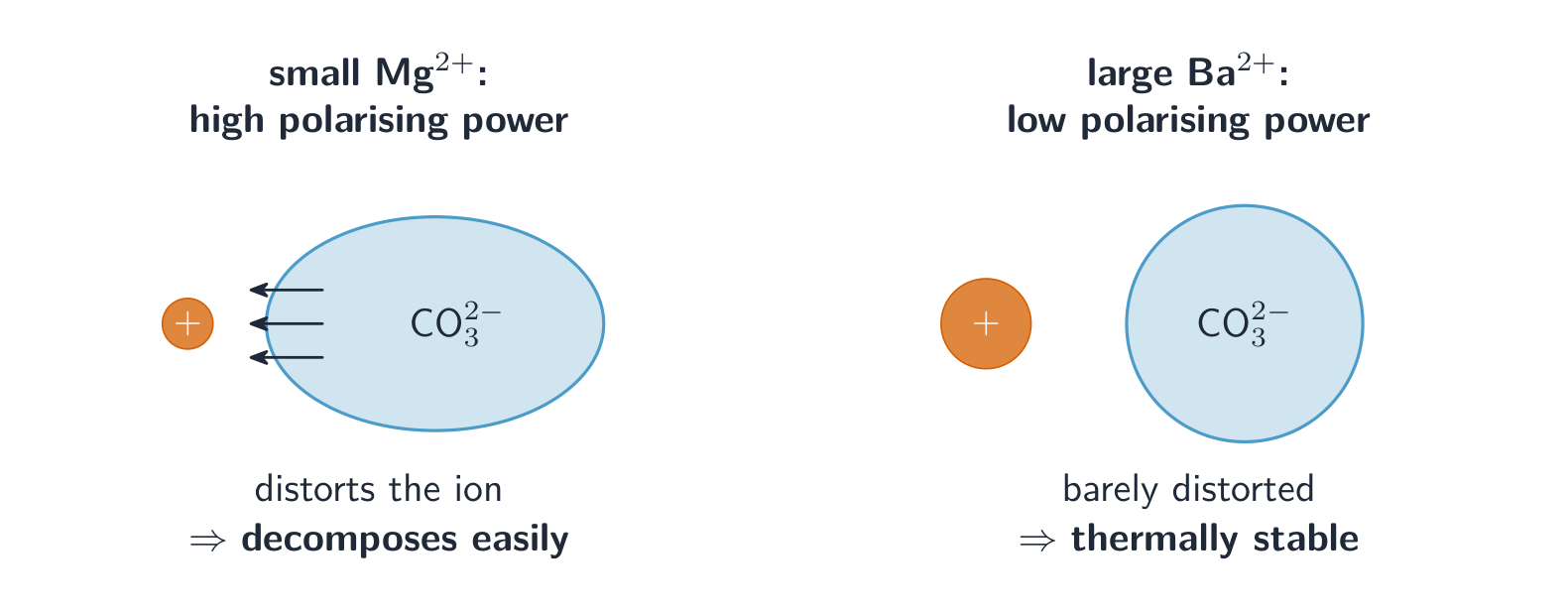
The thermal stability 热稳定性 of both the carbonates and the nitrates increases down the group. A larger metal ion pulls less on the carbonate or nitrate ion, so the compound is harder to break apart — it needs a higher temperature. So magnesium carbonate decomposes most easily, and barium carbonate is the hardest.
Trends in solubility
Compound
Trend in solubility 溶解度 down the group
hydroxides
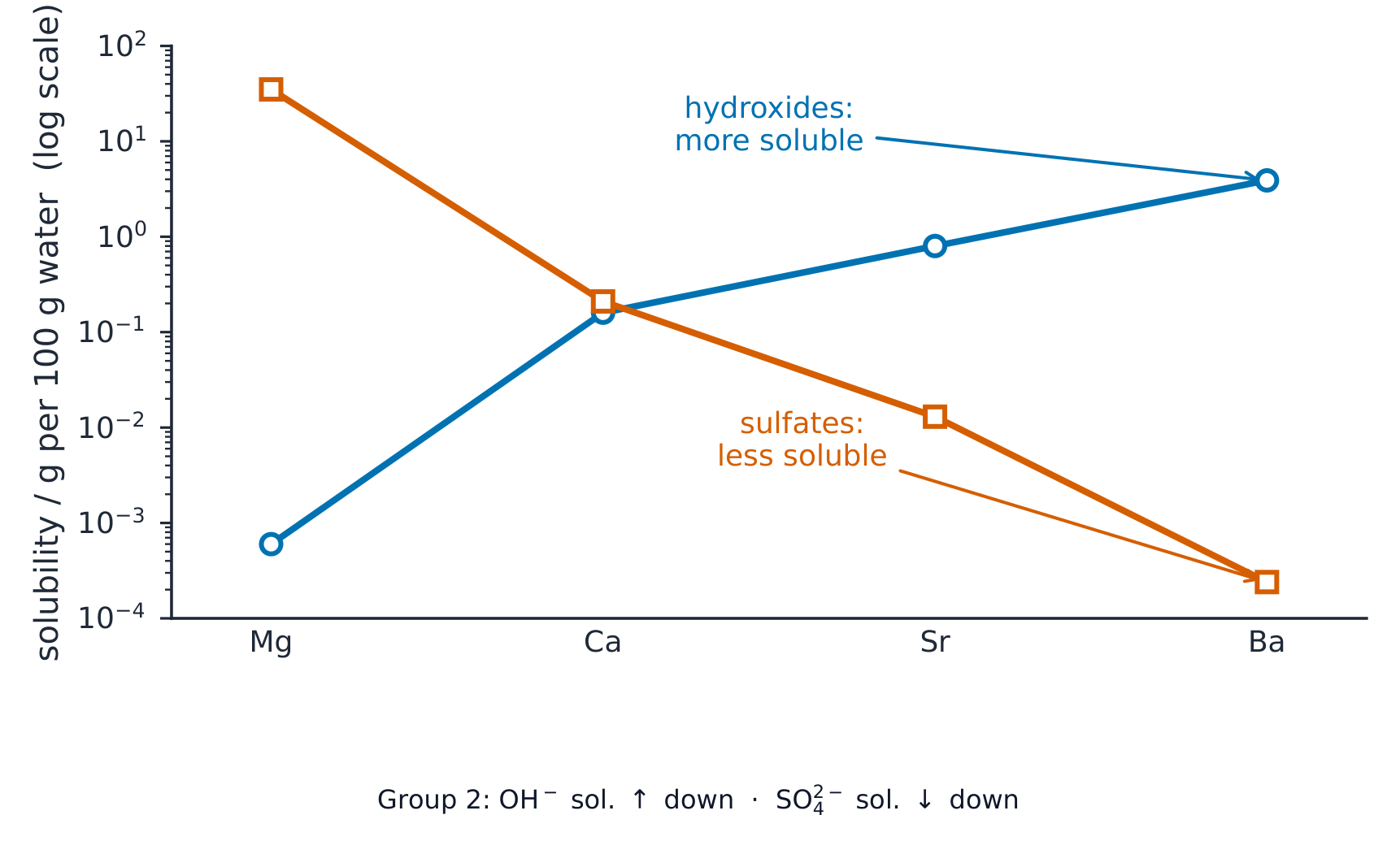
increase (Mg(OH)$_2$ almost insoluble; Ba(OH)$_2$ soluble)
sulfates
decrease (MgSO$_4$ soluble; BaSO$_4$ insoluble)
From these trends you can predict the properties of the next element down, radium, and of its compounds.
Worked example.$\text{MgCO}_3$ decomposes at about $540\ °\text{C}$ and $\text{BaCO}_3$ at about $1360\ °\text{C}$. Explain the trend and predict where $\text{CaCO}_3$ sits. Going down Group 2 the cation gets larger, so its charge is spread over a bigger surface and its polarising power falls. A less polarising cation distorts the carbonate ion less, so the $\text{C-O}$ bond is weakened less and more heat is needed to break it. Thermal stability therefore increases down the group, and $\text{CaCO}_3$, lying between Mg and Ba, decomposes at an intermediate temperature of about $900\ °\text{C}$. Argue the whole chain - cation size, then polarising power, then distortion of the anion; "it is more reactive" explains nothing here.
العربية
الجير هو كربونات الكالسيوم — مركب من فلز المجموعة 2 الكالسيوم.
المجموعة 2 تحتوي على الفلزات المغنيسيوم والكالسيوم والسترونشيوم والباريوم. جميعها possesses two outer electrons، تفقدها لتكوين أيونات $2+$. عند النزول أسفل المجموعة، تصبح الذرات أكبر وتكون الإلكترونات الخارجية أسهل في الفقدان، لذلك تصبح الفلزات أكثر نشاطًا — تزداد نشاطها كلما نزلنا في المجموعة.
يزداد النشاط نزولاً في المجموعة 2: الذرات الأكبر تمسك بإلكتروناتها الخارجية الثنائية بشكل أقل قوة، لذا تفقد بسهولة أكبر
الثبات الحراري لكل من الكربونات والنترات يزداد نزولاً في المجموعة. أيون الفلز الأكبر يسحب أقل على أيون الكربونات أو النترات، لذا يكون المركب أصعب في التكسير — يحتاج إلى درجة حرارة أعلى. لذا تتحلل كربونات المغنيسيوم بسهولة أكبر، وكربونات الباريوم هي الأصعب.
يزداد الثبات الحراري نزولاً في المجموعة: الكاتيون الصغير يستقطب (يشوه) أيون الكربونات أكثر، مما يضعفه ليتحلل بسهولة أكبر
اتجاهات الذوبانية
مركب
اتجاه الذوبانية نزولاً في المجموعة
هيدروكسيدات
تزيد (Mg(OH)$_2$ شبه غير قابل للذوبان؛ Ba(OH)$_2$ قابل للذوبان)
كبريتات
تتناقص (MgSO$_4$ قابل للذوبان؛ BaSO$_4$ غير قابل للذوبان)
نزولاً في المجموعة 2 تصبح الهيدروكسيدات أكثر ذوبانية بينما تصبح الكبريتات أقل ذوبانية (لاحظ المقياس اللوغاريتمي)
من هذه الاتجاهات يمكن التنبؤ بخصائص العنصر التالي نزولاً، الراديوم، ومركباته.
مثال محلول.$\text{MgCO}_3$ يتحلل عند حوالي $540\ °\text{C}$ و$\text{BaCO}_3$ عند حوالي $1360\ °\text{C}$. اشرح الاتجاه وتنبأ بموقع $\text{CaCO}_3$. نزولاً في المجموعة 2 يصبح الكاتيون أكبر، فتنتشر شحنته على مساحة أكبر ويقل قوة الاستقطاب. الكاتيون الأقل استقطاباً يشوه أيون الكربونات أقل، لذا يُضعف الرابطة $\text{C-O}$ بشكل أقل وتُحتاج حرارة أكبر لكسرها. لذلك تزداد الثبات الحراري نزولاً في المجموعة، و$\text{CaCO}_3$، الواقع بين المغنيسيوم والباريوم، يتحلل عند درجة حرارة وسطى تبلغ حوالي $900\ °\text{C}$. برهن على السلسلة كاملة - حجم الكاتيون، ثم قوة الاستقطاب، ثم تشوه الأنيون؛ "إنه أكثر نشاطاً" لا يفسر شيئاً هنا.
Explore · استكشف
Group 2 reactivity ladder · سلم نشاط المجموعة 2
Move down Group 2 and see why reactions become more vigorous. · انزل في المجموعة 2 لترى لماذا تصبح التفاعلات أكثر عنفاً.
Explore · استكشف
Group 2 trend lab · مختبر اتجاهات المجموعة 2
Compare thermal stability and solubility trends down Group 2. · قارن اتجاهات الثبات الحراري والذوبانية عبر المجموعة 2.
Pick one and the site follows you — notes, papers, videos and practice all open on it. · اختر واحدًا وسيتبعك الموقع — الملاحظات، الأوراق، الفيديوهات والتدريب جميعها تفتح عليه.
Type to search notes, lessons, code, vocabulary and past-paper questions across every subject. · اكتب للبحث عن ملاحظات، دروس، أكواد، مفردات وأسئلة امتحانات سابقة عبر جميع المواد.