This is the first course in University Business: an evidence-based introduction to
business and management 基于证据的商务与管理导论. It builds the vocabulary every later
course assumes — accounting, economics, marketing, operations — while training one
habit above all: separating facts 事实 from assumptions 假设, and both from
conclusions 结论.
Units 1.1 to 1.3 map the territory: organisations, stakeholders, ownership and the
external environment.
Units 1.4 to 1.6 look inside: decisions, business models and entrepreneurship.
Unit 1.7 assembles the course's central skill — the evidence-based case analysis.
The running case in this handout is Nimbus Bakery 雨云烘焙, a fictional two-shop
bakery: small enough to reason about completely, real enough that every framework
earns its place. Numbers in worked examples are illustrative and say so. Each unit
opens with a story, shows a picture before the formal idea, defines terms precisely,
works two escalating examples whose arithmetic is machine-verified, names the
mistakes people actually make, and closes with a three-line summary.
evidence-based introduction to business and management/ˈevɪdəns beɪst ˌɪntrəˈdʌkʃn tə ˈbɪznəs ænd ˈmænɪdʒmənt/
基于证据的商务与管理导论
jī yú zhèng jù de shāng wù yǔ guǎn lǐ dǎo lùn
facts/fækts/
事实
shì shí
assumptions/əˈsʌmpʃnz/
假设
jiǎ shè
conclusions/kənˈkluːʒnz/
结论
jié lùn
management/ˈmænɪdʒmənt/
管理
guǎn lǐ
nimbus bakery/ˈnɪmbəs ˈbeɪkəri/
雨云烘焙
yǔ yún hōng bèi
1.1
组织与利益相关者
English
Two friends bake brilliant bread and must decide: sell at a weekend market, contract
independently with cafés, or open one shop together. The last option creates an
organisation 组织 — and this unit explains when that is the cheap choice, and who
then holds power over it.
An organisation is a group of people pursuing a purpose that outlasts any one member
— firms, charities, public agencies. Why they exist at all: when transactions inside
one firm are cheaper than contracting every task separately in the market (hiring a
baker once beats negotiating every loaf), coordination through an organisation wins.
The boundaries move — the same bakery might outsource delivery — wherever the
comparison flips.
Stakeholders 利益相关者 are the people and groups who affect, or are affected by,
the organisation. Map them honestly — influence and interest differ:
Stakeholder
Main interest
Power over Nimbus
Owner-founder
profit, reputation, growth
decides
Customers
quality, price, convenience
choose competitors
Staff
fair pay, stable hours
can leave
Landlord, suppliers
paid on time
can withhold
Where each stakeholder sits decides how you manage them
Worked example 1 (read the map). Nimbus plans Sunday opening. Reading the grid:
customers (high interest, moderate power — they can simply not come) need a reason —
a promoted Sunday item; staff (high interest, low power) need notice and pay, and
their interest can become power if two of four resign; the landlord (high power, low
interest) needs nothing — Sunday opening is inside the lease. The map ranks the
conversations: customers first, staff second, landlord not at all.
Worked example 2 (map the resistance, escalated). The same bakery considers a
supplier switch to a cheaper flour mill. New stakeholder positions: the incumbent
supplier (high interest — this is their revenue; low-to-moderate power — a contract
with 60 days' notice); the new mill (low current interest, rising if it wins the
tender); the owner's bank (low interest unless margins move the loan covenant). The
map's decision content: the veto-free path exists, and the real risk is quality
regression — a customer stakeholder effect, not a supplier one. A stakeholder map
that only lists friends and enemies has missed its job: predicting where the
surprise comes from.
Common mistakes. Treating every stakeholder as equally important — the whole
point is ranking. Forgetting regulators and lenders until they object. Listing
internal departments as external stakeholders.
Summary: organisations exist when internal coordination beats market contracting;
stakeholders map on interest and power; the map ranks whose expectations to manage
first and predicts where resistance will actually come from.
The friends open the shop together — and immediately face the question that shapes
every firm's future: whose money is at risk, who decides, and who can sell out?
The three main ownership forms 企业形式 differ on exactly those three axes —
liability, finance and control:
Form
Liability
Finance
Control
Sole trader 个人独资
unlimited, personal assets at risk
owner's savings, loans
one person
Partnership 合伙
joint and several (usually)
partners' capital
partners agree
Company 公司
limited to what is invested
shares can be sold
shareholders elect directors
Limited liability 有限责任 — shareholders can lose only what they invested — is the
invention that made large-scale risk capital possible: strangers will fund a ship
voyage if the worst case is their ticket, not their house. Its cost:
governance 治理, the system of boards, voting and disclosure that runs the company
on the owners' behalf. Agency problems 代理问题 arise because managers (the
agents) have their own interests — salaries, safety, status — and governance exists
to keep them answerable to the shareholders whose money they spend.
Worked example 1 (the form follows the risk). Three bakery ownership options,
priced: sole trader — the founder's flat is exposed if the business fails;
partnership — each partner can bind the others (joint and several liability), fine
while everyone bakes, lethal when one signs a flour contract alone; company — the
founder pays incorporation and accounting costs but caps the loss at the investment.
For a two-shop bakery with one lease and four staff, the company's protection
usually earns its cost — but that is a judgement about their risk tolerance, and
the analysis says so.
Worked example 2 (the arithmetic of each form, escalated). Year-end profit is
£86,500. Partnership sharing 3:2 (agreed in writing): £51,900 and £34,600 — tax
arrives on each partner's share whether or not it was drawn. As a company: the same
£86,500, of which 25% (£21,625) is retained; the board declares the remaining
£64,875 as dividend on 60,000 £1 shares — £1.08 per share. Same profit, different
cash timing, different tax treatment, different control (the 3:2 partners each
have a vote; the 60/40 shareholders elect the board). Ownership form is not
paperwork — it reallocates money and power, and the numbers show how.
Common mistakes. Confusing limited liability with no responsibility — directors
can still be personally liable for wrongful trading. Assuming the 50/50 partnership
is safe: equal votes plus no tie-break clause equals deadlock. Reading "the
shareholders own the company" as "the shareholders run the company".
Summary: liability, finance and control are the three axes; limited liability
bought scale at the price of governance; profit splits and dividends are where the
form shows up in arithmetic; agency problems are why governance exists.
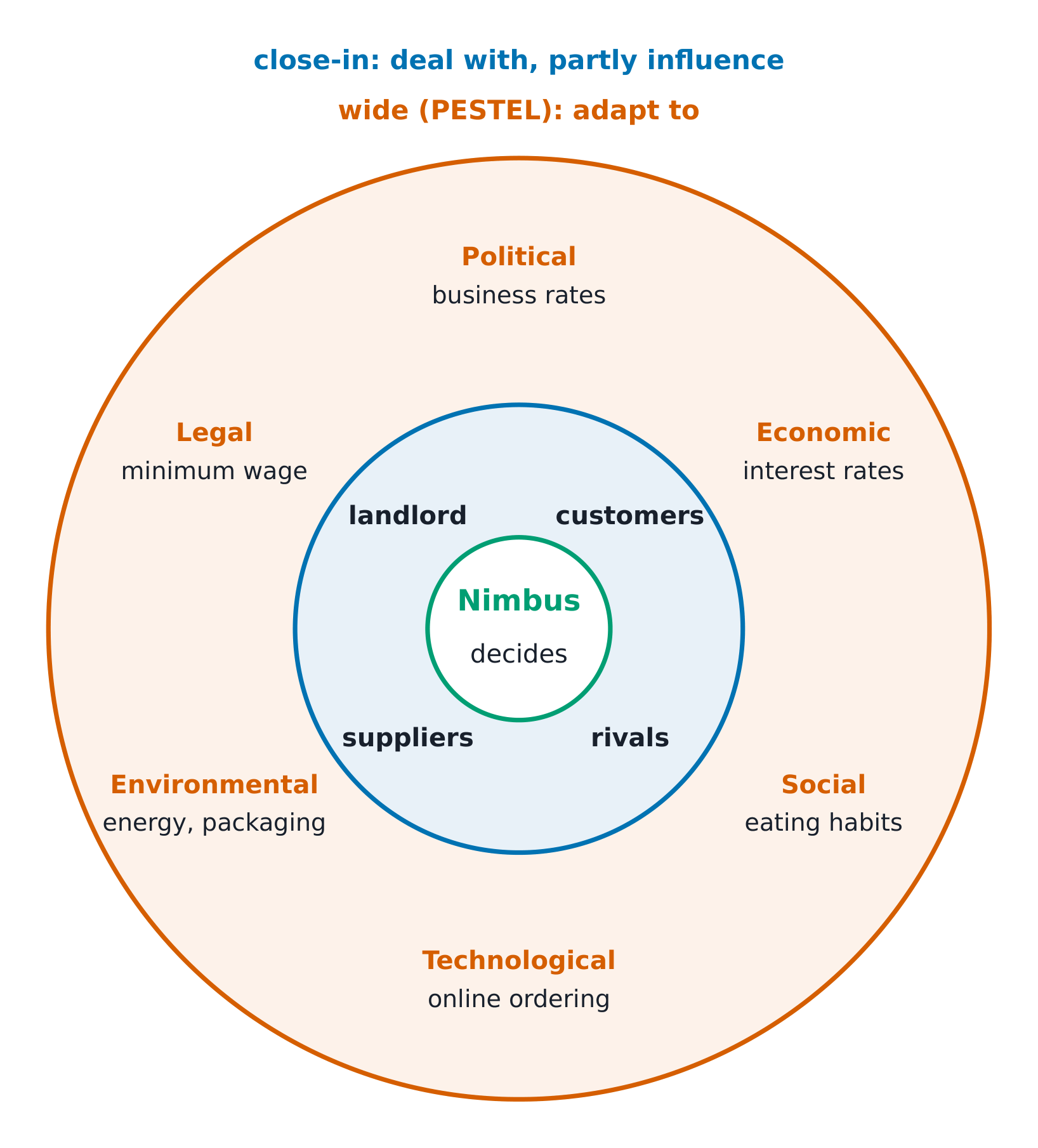
No firm chooses its weather. Bread demand can fall in a recession, a new
low-carb trend can cut breakfast sales, a sugar tax can change the price list —
none of it decided by the bakery. The external environment 外部环境 splits into
the close-in (competitors, suppliers, customers, regulation) and the wide (economic
cycles, technology, social change, law). Frameworks like PESTEL are checklists, not
theories: their value is preventing you from forgetting a factor, not predicting it.
The discipline is evidence: claims about the environment need dates, sources and
definitions. "Bread demand is falling" is a hypothesis until it carries a number, a
period and a geography — and even then, ask what would have to be true for the trend
to reverse. And ask of every driver: can the firm influence it, or only adapt to
it? A bakery cannot move the business cycle; it can move its supplier list.
Worked example 1 (grade the claims). Three claims from a trade article:
"Bakery closures up 12% (source: trade association, 2025, UK)" — a fact, but check
the denominator and the definition of closure; "Consumers want more artisan
products" — an assumption dressed as fact: which consumers, measured how?;
"Rent inflation will continue" — a forecast, i.e. an assumption with a confidence
interval nobody wrote down. Sorting those three is the unit's entire skill:
facts carry sources, assumptions carry owners.
Worked example 2 (driver → decision, escalated). Take the two clean facts —
closures up 12%, and (invented for the case) supermarket in-store bakery prices
down 4% — and walk them to a decision. If closures release skilled bakers, Nimbus'
staffing risk falls (a hiring opportunity); if supermarket prices fall, Nimbus
cannot win a price war and must win on freshness and pre-order convenience — a
positioning conclusion. Each link in that chain is marked: closures → labour
supply (fact → assumption about mobility); prices → positioning (fact → strategic
assumption). The environment unit ends not with a list of forces but with options
the forces have priced.
Common mistakes. Treating PESTEL as an analysis rather than a checklist.
Quoting a percentage without its period, geography and source. Confusing
"influence" with "predict" — the point is to prepare responses, not to foretell.
Summary: close-in versus wide environment; frameworks prevent forgetting, they do
not explain; every environmental claim needs a number, a period, a geography and a
source; walk each driver to a decision and mark the factual and assumptional links.
The bakery's founder faces the course's favourite dilemma: open a third shop, or
expand pre-order? Both sound strategic; both have advocates; the choice will be
made on Tuesday. Management 管理 is exactly this — deciding what to do and making
it happen: planning, organising, leading and controlling — a loop, not a hierarchy.
The course trains one piece deliberately: structured decisions 结构化决策.
Frame the question precisely (a decision to make, not a topic to discuss).
List options that could actually be chosen.
Name the criteria and their weights before seeing the options' scores.
Score the evidence, mark each score as fact or assumption.
Choose, then record what the decision assumes — so reality can prove you wrong.
Weights fixed before scores, every score marked fact or assumption
Bias 偏见 is the standing enemy: anchoring on the first number, confirming what
you already believe, weighting the most recent event too highly. The structure above
exists to slow those down, not because managers enjoy paperwork.
Worked example 1 (the decision table, verified). Nimbus weighs a third shop
against a pre-order expansion. Criteria and weights fixed first: profit impact
(0.5), risk (0.3), fit with staff skills (0.2). Third shop scores 6, 4, 7 →
$0.5\times 6 + 0.3\times 4 + 0.2\times 7 = 5.6$. Pre-order scores 5, 7, 8 →
$0.5\times 5 + 0.3\times 7 + 0.2\times 8 = 6.2$. Pre-order wins — not because it
is exciting, but because the weights said risk and fit matter.
Worked example 2 (the sensitivity that makes the table honest, escalated). The
founder's sister disputes the profit weight: "It's a business — weight profit 0.6."
Recompute with weights 0.6 / 0.25 / 0.15: third shop $0.6\times6 + 0.25\times4 +
0.15\times7 = 5.65$; pre-order $0.6\times5 + 0.25\times7 + 0.15\times8 = 5.95$ —
pre-order still wins. Solve for the flip point: with fit fixed at 0.2, the weighted
totals cross at profit weight 0.65 (both 5.9). So the recommendation is robust
to any profit weight below 0.65 and fragile above it — one number that tells the
family exactly how far their disagreement has to go before the answer changes.
That is what a decision table is for: making the disagreement discussable.
The weights, not the excitement, decide the winner
Common mistakes. Choosing weights after seeing scores — the table then only
decorates the verdict. Scoring on adjectives ("strong") instead of anchored scales
("6 = payback under 3 years"). Forgetting step 5: a decision without recorded
assumptions cannot be audited when it fails.
Summary: management is a loop of planning, organising, leading and controlling;
structure the big decisions — frame, options, weights first, scored evidence,
recorded assumptions; sensitivity analysis converts disagreement into one number.
A second shop in a richer district, a market stall on Saturdays, a pre-order
subscription — each is a different business model 商业模式: a description of how
the organisation creates, delivers and captures value 价值. The classic lens is
the value chain 价值链 — the sequence of activities from inbound ingredients to a
served customer:
inbound logistics → operations → outbound logistics → marketing and sales → service
Nimbus' value chain, link by link
Nimbus' model: fresh-daily baking (operations) sold at premium prices through two
shops and pre-order (marketing and channels), with staff cross-trained (service).
Every link must fit: pre-order only pays if operations can batch it cheaply.
The test of a model is arithmetic, not adjectives: revenue per customer × customers
must cover variable costs, fixed costs and the owner's minimum return — otherwise
the model is a hobby.
Worked example 1 (the model as arithmetic, verified). Nimbus' numbers:
average basket £9.40; about 3,500 customers per shop per week across both shops —
call it 4,200 baskets weekly for two shops open six days. Weekly revenue
$4{,}200 \times 9.40 = £39{,}480$. Ingredients and packaging run 42% of sales
(variable), so contribution is $39{,}480 \times 0.58 = £22{,}898$. Fixed costs
weekly — rent £6,200 (two leases), staff £2,600, energy and other £800 — total
£9,600. Weekly profit $22{,}898 - 9{,}600 = £13{,}298$. Break-even: daily fixed
$9{,}600/6 = £1{,}600$; contribution per basket $9.40 \times 0.58 = £5.45$; each
shop needs $1{,}600 / 5.45 \approx 294$ baskets a day. The model is a model only
because that arithmetic closes — and every one of those figures is marked
assumption until the accounts say otherwise.
Worked example 2 (profit is not cash, escalated). A quieter month: sales made
£34,000, of which £4,000 is a corporate customer still on invoice; expenses
incurred £28,500, of which £600 is a supplier not yet paid. Profit (matching
incurred against earned) is $34{,}000 - 28{,}500 = £5{,}500$. Cash movement is
$(34{,}000 - 4{,}000) - (28{,}500 - 600) = £2{,}100$. Both numbers are true, both
are needed, and the £3,400 gap is exactly the receivable the corporate customer is
holding. A profitable firm without cash fails just as dead: the value chain feeds
the profit line, but the calendar of payments decides survival.
Common mistakes. Describing the model in adjectives with no unit economics.
Confusing revenue (sales made) with profit (revenue minus expenses incurred) with
cash (money in the bank). Testing a model's links separately — the chain only pays
when the links fit together.
Summary: a business model is create-deliver-capture, mapped link by link on the
value chain; the test is arithmetic — baskets × contribution vs fixed costs;
revenue, profit and cash are three different things and all three must survive.
Nimbus' founder is offered a market stall in a neighbouring town: six weekends, a
few hundred pounds of fees, and no idea whether anyone there wants £9 hampers of
sourdough. Entrepreneurship 创业 is pursuing an opportunity under uncertainty
with resources you do not fully control — and this unit is the discipline that
keeps the pursuit honest.
Evaluate the opportunity 机会 before the passion: who exactly has the problem,
how do they solve it today, and why would they switch?
Size the resources honestly: what must be true for this to work, and which of
those things is an assumption rather than a fact?
Plan to learn: small tests first (a market stall before a second shop), milestones
with dates, and an honest statement of what failure would look like.
Risk 风险 is measurable (probabilities known); uncertainty 不确定性 is not.
Entrepreneurship lives in the second, which is why milestone planning beats
five-year forecasting.
Worked example 1 (the stall test, priced honestly). Six weekends at the
neighbouring market: stall fees £350 per weekend; flour, packaging and transport
run 45% of sales. If takings are £3,800 across the six weekends, the result is
$3{,}800 \times 0.55 - 350 \times 6 = 2{,}090 - 2{,}100 = -£10$ — break-even to the
pound. The test was worth running precisely because the answer was marginal: it
bought real demand data (which items sold, at what hours, to whom) for £10, a price
no consultant would quote. Marked honestly: the £3,800 is a fact after the sixth
weekend, an assumption before the first.
Worked example 2 (milestones and runway, escalated). The founder has £26,000
of savings allocated to the second shop and estimates burn (rent deposit fit-out,
pre-opening wages) of £2,200 per week: runway $26{,}000/2{,}200 \approx 11.8$
weeks. The milestone plan that follows: signed lease by week 3 (or walk away with
£19,400 intact); fit-out passed by week 7; opening stock and staff trained by week
10; open by week 11 with £2,000 contingency. Each milestone is a real-option: miss
week 3 and the honest decision is to stop, not to compress every later stage into
the remaining money. Entrepreneurship's arithmetic is the arithmetic of stopping
rules.
Common mistakes. Falling in love with the solution before pricing the problem.
Treating the business plan as a prediction rather than a list of testable
assumptions. Spending to the last pound of runway because stopping feels like
failure — running out mid-build is the actual failure.
Summary: opportunities are evaluated, not felt; small tests buy information at
known prices; milestones with dates turn a runway into a sequence of stopping
rules; risk is measurable, uncertainty is not, and entrepreneurship lives in the
second.
The course's final skill assembles all of the above into a case analysis案例分析:
Situation: what are the facts, with sources? What is merely assumed?
Problem: the decision to be made, stated as a question with options.
Analysis: apply the frameworks that earn their place — stakeholder map, value
chain, decision table — each carrying evidence, not adjectives.
Recommendation: one option, chosen against stated criteria, with its risks
named and its assumptions listed for monitoring.
Review: the metrics that would tell you the recommendation is failing.
Worked example 1 (the case in five lines). Nimbus' Sunday-opening case in the
full frame: Situation — two shops, four staff, weekend competitors opening
(sourced trade listing); Problem — "Should Nimbus open Sundays?" with options
{open both shops, open one, not open}; Analysis — the decision table (worked
example in 1.4) plus staffing interest from 1.1; Recommendation — open one shop,
six-week trial; Review — Sunday baskets/day vs the 294 break-even, staff
turnover, cannibalisation of Saturday. Every framework that appeared earned its
place; none arrived as decoration.
Worked example 2 (assumption audit, escalated). Take the recommendation above
and list what it assumes, each with a monitoring metric: customers will travel on
Sundays (metric: first-four-Sunday baskets vs forecast); the trial will not shift
Saturday demand (metric: Saturday baskets year-on-year); staff will accept the
rota (metric: rota refusals). Three assumptions, three numbers, three dates. When
a classmate says "the analysis was wrong", the audit answers which part — and
that answer, not the original verdict, is what improves the next decision.
Common mistakes. Summarising the case instead of deciding in it. Recommending
"more research" — name the assumption the research would test. Writing a review
section with no numbers or dates; unfalsifiable metrics protect nobody.
Summary: situation-problem-analysis-recommendation-review; frameworks carry
evidence or stay home; recommendations travel with named assumptions and dated,
falsifiable review metrics — and every claim you meet, in a case, a report or a
meeting, gets sorted into fact, assumption or conclusion.