What this course is, and how to use it
This is the second course in University Business: financial accounting 财务会计 — the discipline that turns a year of transactions into three statements a stranger can trust. Accounting is not arithmetic; it is a set of definitions applied consistently, and its central machine is the check: every statement in this handout ties by construction — the balance sheet balances because the arithmetic has no other choice, and the machine verification of every worked example confirms it.
The running case continues course 1: Nimbus Bakery Ltd, the two-shop bakery from course 1, now incorporated. On 1 January the founders buy the company back from themselves: they issue 20,000 £1 shares for cash and sign a £15,000 bank loan at 6% a year. Every unit works the same company forward — transactions, ledger, adjustments, statements, cash flow, ratios — so the numbers you meet in unit 2.4 are the ones you built in unit 2.1.
- Units 2.1–2.2 build the machine: the accounting equation and double entry.
- Units 2.3–2.4 apply time: accruals, adjustments, and the linked statements.
- Units 2.5–2.6 read the result: cash flow and ratios — and their limits.
How to read each unit: a story first, then a picture, then precise definitions, then two escalating worked examples whose numbers are machine-verified, the mistakes people actually make, and a three-line summary. IFRS-based framing; jurisdiction notes appear where they matter.
The accounting equation and elements
Nimbus's founders have £35,000 of starting money between them — savings and a loan approval. The moment it enters the company, a puzzle appears: the company has £35,000 and owes £35,000. To whom? To the people who funded it. That split — what the business holds against who claims it — is the whole of balance-sheet accounting, drawn as a scale that must tip level: the accounting equation 会计等式.
The five elements are defined precisely, not intuitively:
- An asset 资产 is a present economic resource controlled by the entity as a result of past events (the oven it bought, the cash it holds, the flour it will turn into bread).
- A liability 负债 is a present obligation to transfer an economic resource (the bank loan, the supplier not yet paid).
- Equity 所有者权益 is the residual: assets minus liabilities — the funders' claim.
- Income 收入 increases economic benefit and grows equity; an expense 费用 decreases it. Profit = income − expenses, and profit flows into equity.

The derivation. Every transaction is recorded by its double effect 双重影响 on the equation — that is not a rule someone invented but the only way the equation can survive. Issuing shares: an asset rises (cash) and equity rises (share capital) — both sides grow. Buying an oven for cash: one asset swaps for another — the total is unchanged. Buying flour on credit: an asset rises and a liability rises. Selling bread: cash rises (asset) and profit rises (equity), while the flour used leaves the business (inventory falls, equity falls through cost of sales). Five moves, one invariant: $\text{Assets} = \text{Liabilities} + \text{Equity}$, always.
Worked example 1 (the first week, one line at a time). January, day by day:
- Issue 20,000 shares at £1: cash +20,000, equity +20,000. Check: 20,000 = 0 + 20,000 ✓.
- Take the £15,000 loan: cash +15,000, liability +15,000. Check: 35,000 = 15,000 + 20,000 ✓.
- Buy the oven, £6,000 cash: equipment +6,000, cash −6,000. Check: 35,000 = 15,000 + 20,000 ✓ (an asset swap changes no total).
- Buy flour and ingredients, £4,000 on credit: inventory +4,000, payables +4,000. Check: 39,000 = 19,000 + 20,000 ✓.
- The week's bread sells for £3,000 cash, using £1,200 of ingredients: cash +3,000, inventory −1,200, equity +1,800 (revenue 3,000 − cost of sales 1,200). Check: 40,800 = 19,000 + 21,800 ✓.
Worked example 2 (escalated: the end-of-week balance sheet). Post the five transactions to the closing position: assets = cash 32,000 + equipment 6,000 + inventory 2,800 = 40,800; liabilities = loan 15,000 + payables 4,000 = 19,000; equity = share capital 20,000 + week's profit 1,800 = 21,800. The tie-out: 19,000 + 21,800 = 40,800 ✓ (machine-verified). Two readings of the same number: the £40,800 is both what Nimbus holds and who claims it — the bank and supplier claim £19,000; the founders' stake has grown from 20,000 to 21,800 in one week, and the growth is exactly the profit. The equation is not a formula to memorise; it is two lists of the same company.
Common mistakes. Calling the owner's investment an income (it is a capital contribution — equity, not revenue). Reading "asset" as "valuable" (the definition requires control and past events — a brilliant baker's reputation is not yet an asset). And thinking the equation can go out of balance through error — it cannot; a transaction misposted breaks one side, which is exactly how errors are found (unit 2.2).
Summary: five elements, one invariant — assets equal liabilities plus equity; every transaction is a double effect; profit is income minus expenses and lands in equity; the balance sheet is two lists of one company.
Double entry and ledgers
The equation says a transaction has two effects; the ledger 账簿 makes the two effects postable. Each element gets accounts shaped like a T: the left side is the debit 借方, the right the credit 贷方. The rule that falls out of the equation: assets and expenses grow on the debit side; liabilities, equity and income grow on the credit side — and every transaction posts equal debits and credits. That symmetry, not habit, is why the method is called double entry 复式记账.

The derivation. Write the accounting equation as a grid with assets and expenses naturally on the left, liabilities, equity and income on the right. A transaction that increases an asset posts a left-side (debit) entry; one that increases a liability posts a right-side (credit) entry; decreases post on the opposite side. Because every transaction preserves the equation, the sum of all debit entries must equal the sum of all credit entries — the trial balance 试算平衡表 is that sum, and its equality is a theorem, not a hope.
Worked example 1 (post the week, extract the trial balance). The five transactions of unit 2.1, posted:
- Dr Cash 20,000 / Cr Share capital 20,000; then Dr Cash 15,000 / Cr Loan 15,000; then Dr Equipment 6,000 / Cr Cash 6,000; then Dr Inventory 4,000 / Cr Payables 4,000; then Dr Cash 3,000 / Cr Revenue 3,000 and Dr Cost of sales 1,200 / Cr Inventory 1,200.
Closing balances: Cash 32,000 Dr; Equipment 6,000 Dr; Inventory 2,800 Dr; Cost of sales 1,200 Dr; Loan 15,000 Cr; Payables 4,000 Cr; Share capital 20,000 Cr; Revenue 3,000 Cr. Trial balance: debits 42,000 = credits 42,000 ✓ (machine-verified — 32,000 + 6,000 + 2,800 + 1,200 against 15,000 + 4,000 + 20,000 + 3,000).
Worked example 2 (escalated: the errors a trial balance catches — and the ones it cannot). Three deliberate errors, each diagnosed:
- Transposition. A café sale of £3,100 posted to revenue as £1,300 (cash took the right 3,100): the trial balance differs by 1,800. The classic clue: the difference is divisible by 9 (1,800 = 9 × 200) — swapping two digits changes a number by a multiple of 9, so a ÷9 difference sends you hunting for transposed digits.
- One-sided omission. The £4,000 flour purchase never posted to payables: the difference equals the missing entry exactly (4,000), pointing at one account's missing line.
- The invisible one. Wages of £52,000 posted twice: debits and credits both grow by 52,000 — the trial balance still ties, and the profit is understated by 52,000 with no arithmetic alarm. The lesson: the trial balance catches posting asymmetry, not misclassification or duplication — the review layer (unit 2.3's reconciliations) must catch the rest.
Common mistakes. Reading "debit" as "minus" — the words mean left and right, nothing more; whether a debit grows or shrinks an account depends on which side of the equation the account lives. Chasing a difference without first testing it: a difference equal to one entry suggests that entry's other side was never posted; a difference whose half equals an entry suggests that entry was posted on the wrong side (two debits, say); a difference that divides by 9 suggests transposed digits. And trusting a balanced trial balance as proof the books are right — example 2's third error is the counter-example.
Summary: T-accounts, debits left and credits right; assets and expenses grow on the debit, the other three on the credit; the trial balance is a theorem about symmetry; it catches asymmetry, never misclassification.
Accruals and adjustments
The ledger records what happened; the year-end question is when it happened. Nimbus pays a year's shop rent on 1 October; the accrual basis 权责发生制 says the expense belongs to the months the shops were occupied, not the month the cash left. Adjusting is the act of moving entries from the cash's timeline to the work's timeline.
The four recurring adjustments, defined:
- Prepayment 预付款: cash paid before the expense — the unused part is an asset (Nimbus has bought a right to occupy).
- Accrual 应计: expense incurred before the cash is paid — a liability (wages earned by staff in December, paid in January).
- Depreciation 折旧: the cost of a long-lived asset spread over its useful life — Nimbus's oven, straight-line: (cost − residual) ÷ years.
- Revenue receivable: work done but not yet billed or collected — an asset, treated here only when Nimbus starts selling to cafés on credit.

The derivation. Straight-line depreciation is arithmetic honesty: the oven cost £6,000 and will be worth £600 after five years, so five years consume £5,400 of service — £1,080 a year, £90 a month. The accrual logic is the matching principle 匹配原则: expenses are recognised when the associated revenue is earned or the benefit is consumed — which is why the £12,000 rent payment on 1 October leaves only £3,000 as this year's expense, with £9,000 standing on the balance sheet as a prepayment asset.
Worked example 1 (three adjustments in isolation).
- Rent: annual £12,000 paid 1 October for the year to next 30 September; the year end is 31 December. Expense for the three months = 12,000 × 3/12 = 3,000; prepayment asset = 12,000 × 9/12 = 9,000. Check: 3,000 + 9,000 = 12,000, the cash paid ✓.
- Depreciation: (6,000 − 600)/5 = 1,080 a year; the oven carrying amount at 31 December = 6,000 − 1,080 = 4,920.
- Loan interest: 15,000 × 6% = 900 for the year, payable each 1 January — an accrual liability at the year end because the bank's service was consumed before it is paid.
Worked example 2 (escalated: the full year-end adjustment set). Year 1 in full: cash sales 156,000; inventory purchased 66,000, of which 3,600 remains (cost of sales = 66,000 − 3,600 = 62,400); wages 52,000 of which 400 is accrued (staff December rota paid in January); rent 12,000 paid as above; other running costs 8,000 paid; the electricity bill for the quarter, 250, received but unpaid; the oven's first-year depreciation 1,080; loan interest 900 accrued. Profit for year 1 = 156,000 − 62,400 − 52,000 − 3,000 − 8,000 − 1,080 − 250 − 900 = 28,370 (machine-verified). Every adjustment is visible in it: the rent is 3,000, not 12,000; the oven costs 1,080, not 6,000; the electricity and interest appear although no cash has moved. One trap: the wages figure of 52,000 already includes the unpaid 400, so the accrual changes the cash paid (51,600), not the expense. Subtracting another 400 is the classic year-end slip, and it understates profit by exactly 400.
Common mistakes. Double-counting an accrual already inside a stated expense total (the difference between "wages paid 51,600" and "wages expense 52,000" is the accrual — state which you were given). Depreciating to zero rather than to residual value. And calling the prepayment an expense because "the cash has gone" — cash timing is unit 2.5's business; this unit matches work.
Summary: adjustments move entries from the cash timeline to the work timeline; prepayment is an asset, accrual a liability, depreciation spreads cost over life; profit is what the matching principle leaves behind.
Financial statements
Three statements, one company, zero independent numbers: the income statement 利润表 answers "what did the year earn", the statement of financial position 财务状况表 answers "what stands at the year end", and the link between them is a single number — profit — flowing into equity as retained earnings. Build them for Nimbus's year 1 and watch the tie-out.
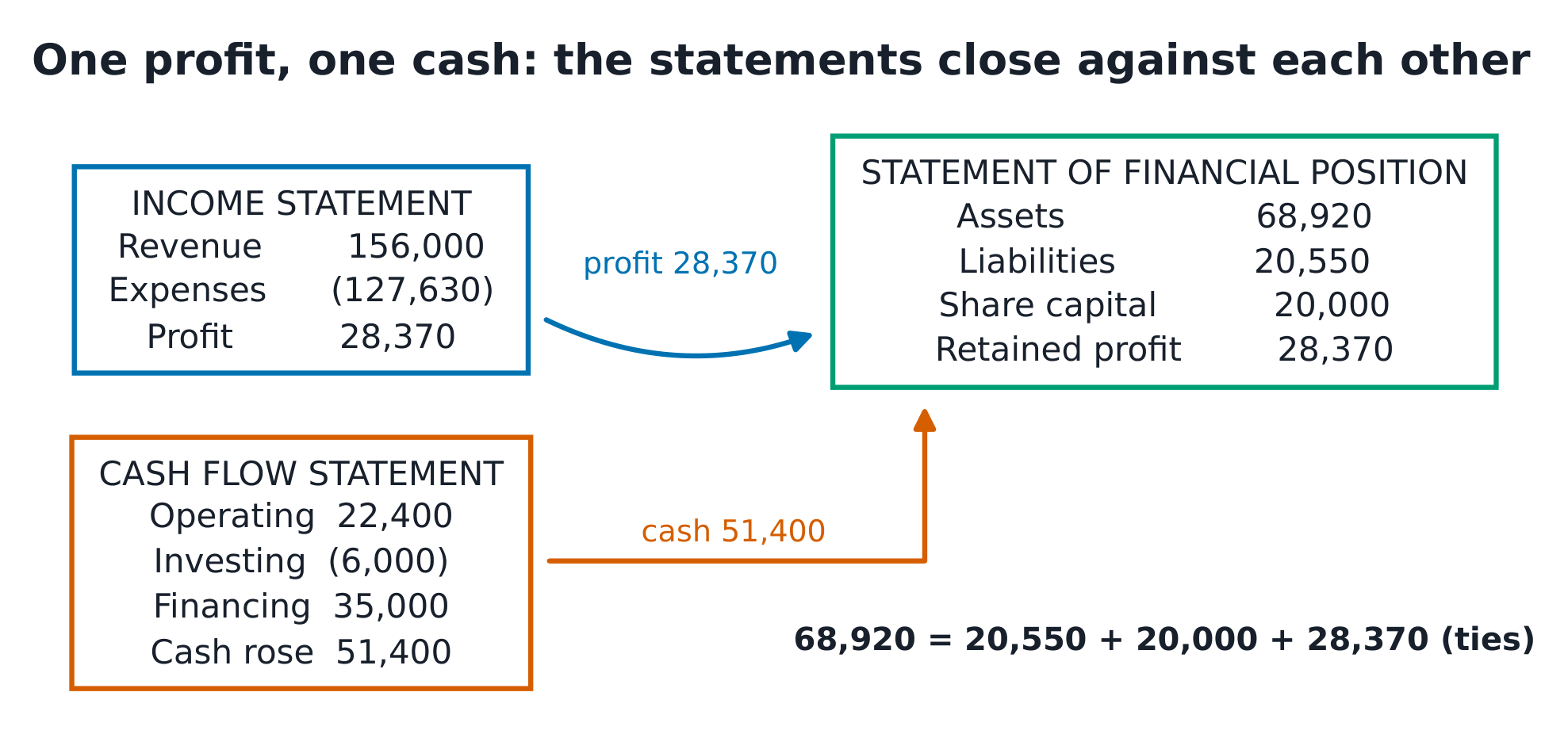
The derivation. The income statement is the equity side of the year in motion: opening equity 20,000, plus income 156,000, minus expenses 127,630, equals closing equity before dividends 48,370 — of which 28,370 is the year's retained profit. The statement of financial position is the same equation at a date, with the profit already inside: assets 68,920 = liabilities 20,550 + equity 48,370. The cash flow statement (unit 2.5) reconciles the other balance-sheet line that moved — cash.
Worked example 1 (the income statement, in a form a non-accountant reads).
| Nimbus Bakery Ltd — income statement, year 1 | £ |
|---|---|
| Revenue | 156,000 |
| Cost of sales | (62,400) |
| Gross profit | 93,600 |
| Wages | (52,000) |
| Rent (3 of 12 months) | (3,000) |
| Other running costs | (8,000) |
| Depreciation | (1,080) |
| Electricity accrued | (250) |
| Loan interest accrued | (900) |
| Profit for the year | 28,370 |
Check: gross profit 60.0% of revenue; the eight expense lines re-derive 28,370 exactly ✓.
Worked example 2 (escalated: the statement of financial position that closes to the penny). Track the cash: inflows 20,000 shares + 15,000 loan
- 156,000 sales = 191,000; outflows 6,000 oven + 62,000 paid of purchases (66,000 bought, 4,000 owing) + 51,600 paid of wages + 12,000 rent + 8,000 other = 139,600; closing cash 51,400. The statement of financial position at 31 December:
| Assets | £ | Liabilities and equity | £ |
|---|---|---|---|
| Cash | 51,400 | Loan | 15,000 |
| Inventory | 3,600 | Payables | 4,000 |
| Prepaid rent | 9,000 | Accrued wages | 400 |
| Equipment (6,000 − 1,080) | 4,920 | Electricity owing | 250 |
| Accrued interest | 900 | ||
| Liabilities | 20,550 | ||
| Share capital | 20,000 | ||
| Retained profit | 28,370 | ||
| Equity | 48,370 | ||
| Total | 68,920 | Total | 68,920 |
The tie: 20,550 + 48,370 = 68,920 ✓ (machine-verified). Every number is one you built: the 9,000 is unit 2.3's prepayment, the 4,920 its carrying amount, the 28,370 its adjusted profit. Nothing new is invented at statement stage — the statements only rearrange the ledger.
Common mistakes. Dropping the depreciation from the balance sheet's equipment line (it belongs to both statements: expense and carrying-amount reduction). Putting the prepayment under liabilities because it feels like "money already spent". And hunting for the "missing" profit number when the balance sheet will not tie — it is always one of: an unposted adjustment, a double-counted accrual, or dividends (which reduce equity outside the income statement, as unit 2.6 will show).
Summary: income statement = the year's revenue and matched expenses; balance sheet = the year-end equation with profit inside equity; the two share every number by construction; dividends reduce equity directly.
Cash flow statements
Nimbus made 28,370 of profit and its cash rose by 51,400 — and neither number explains the other until you build the bridge. The cash flow statement 现金流量表 classifies every movement into operating 经营活动 (the bread business), investing 投资活动 (buying long-lived assets) and financing 筹资活动 (shares and loans), and reconciles profit to operating cash — the single most revealing arithmetic in the statements.

The derivation. Profit is measured on the accrual basis; cash is not. The bridge undoes the accruals one plank at a time: add back depreciation (an expense that moves no cash), add accruals (expenses recognised before paid), subtract the growth in inventory and prepayments (cash spent on things not yet consumed), add the growth in payables (goods consumed but not yet paid). What remains is the cash the operations actually generated.
Worked example 1 (the bridge, plank by plank). Year 1, indirect method: profit 28,370 + depreciation 1,080 + accrued wages 400 + electricity 250 + accrued interest 900 − growth in inventory 3,600 − growth in prepaid rent 9,000 + growth in payables 4,000 = operating cash 22,400 (check the signs: expenses-without-cash add back; cash-without-expense subtracts; payables growing is cash kept). Then investing: oven −6,000. Financing: shares +20,000, loan +15,000. Net change 22,400 − 6,000 + 35,000 = 51,400 — and the balance sheet's cash line says 51,400 ✓ the statements close against each other, machine-verified.
Worked example 2 (escalated: why profit and cash diverge). Three divergence engines, each visible in Nimbus's numbers. Timing: the rent prepayment moved 9,000 of cash a year early. Profit 28,370 against operating cash 22,400 — a 5,970 gap, and the bridge accounts for it exactly: the 9,000 prepaid rent and 3,600 inventory build (12,600 of cash absorbed) against 1,080 of depreciation, 1,550 of accruals and 4,000 of payables growth (6,630 of non-cash offset), and 12,600 − 6,630 = 5,970 ✓ (machine-verified). Growth: a business that doubles its inventory doubles the cash trapped in it while profit looks untouched. Capital structure: the 35,000 of financing cash has nothing to do with profit at all. Year 2 will exercise the timing engine hard when Nimbus starts selling to cafés on 24-day credit.
Common mistakes. Adding back the whole rent payment as "an adjustment" (only the depreciation and accruals are added back; the prepayment lives in the working-capital lines). Classifying loan repayment as operating (it is financing; only the interest is operating). And reading a strong operating cash number as proof of health without asking what financing is doing — a company can look cash-rich while the bank is calling the loan.
Summary: three classes — operating, investing, financing; the bridge from profit adds non-cash expenses and accruals, then moves working capital; divergence has named engines: timing, growth, capital structure.
Ratios and their limits
The statements are built; ratios are the reading. A ratio is one statement number divided by another — margin, liquidity, gearing, return — and each is a question, not a verdict. Nimbus's year-1 numbers make the point forcefully, because a young company's ratios lie in both directions.
The core set, defined:
- Gross margin 毛利率 = gross profit ÷ revenue — pricing power and production cost discipline.
- Operating margin = profit ÷ revenue — what is left of each pound after the whole running of the business.
- Current ratio 流动比率 = current assets ÷ current liabilities — short-term cover.
- Gearing 资本负债率 = debt ÷ (debt + equity) — how much of the company is loan-financed.
- Return on equity (ROE) 净资产收益率 = profit ÷ equity — the funders' rate of return.

Worked example 1 (the year-1 read, computed). From the statements: gross margin = 93,600/156,000 = 60.0%; operating margin = 28,370/156,000 = 18.2%; current assets = 51,400 + 3,600 + 9,000 = 64,000 against current liabilities of 4,000 + 400 + 250 + 900 = 5,550, so current ratio = 11.5; gearing on capital employed = 15,000/(15,000 + 48,370) = 23.7%. The immediate smell test: a current ratio of 11.5 is not "excellent", it is absurd — £64,000 of short-term resources against £5,550 of bills means most of that cash is idle, and idle cash earns nothing. The ratio did not lie; the reader who stopped at "above 2 is good" did.
Worked example 2 (escalated: year 2 changes the story, and the limits bite). Year 2: Nimbus takes café contracts — revenue 182,000, cost of sales 78,300 (gross margin 57.0% — the wholesale price of café bread is below retail), profit 30,100; at the year end receivables are 12,000, inventory 4,400, cash 22,000 (a £20,000 dividend was paid and £5,000 of the loan repaid — so equity = 48,370 + 30,100 − 20,000 = 58,470 and the loan stands at 10,000, gearing 14.6%). Working-capital ratios wake up: receivable days = 12,000/182,000 × 365 = 24.1 days (the credit term is 24 — collection is on target); inventory days = 4,400/78,300 × 365 = 20.5 days. Now the limits, honestly: the year-1 ROE of 28,370/48,370 = 58.7% says more about the founders' small £20,000 stake than about the bakery: a first year's profit set against a capital base that existed only from day one inflates the return (on average equity it is 83%, no better); the year-2 56.3% on average equity is still distorted by the founders' small stake. Ratios need time (trends, not levels), peers (a 60% gross margin means one thing in bread, another in software), and definitions (check which margin, which equity, which debt before comparing a single number).
Common mistakes. Averaging ratios instead of computing on averages. Comparing across sectors or definitions without checking them. And the year-one trap this unit's numbers display: reading liquidity and return off a balance sheet whose cash was raised, not earned. Every ratio in this unit was computed from statements you built — the discipline is the same at any size.
Summary: margins ask about pricing, liquidity about cover, gearing about funding, return about the funders; a ratio is a question asked of two numbers — time, peers and definitions decide whether it can be answered.