English
This handout covers Topic 7, Transformations and vectors. Parts marked (Extended) are only tested on the Extended papers; everything else is for both levels. Vectors as a whole topic are Extended.
IGCSE 数学 · 知识点 7
 7:56
变换与向量
看看这面墙。它看起来很复杂——成百上千的形状相互咬合。但并没有人画出每一块拼图。有人画了一个小形状,然后再次移动它……
英语旁白 · 英中内嵌字幕
This handout covers Topic 7, Transformations and vectors. Parts marked (Extended) are only tested on the Extended papers; everything else is for both levels. Vectors as a whole topic are Extended.

| 学科内容 | 说明与示例 |
|---|---|
| 识别、描述并绘制以下图形变换: | 题目不会涉及多种变换的组合。所有直线边都必须使用直尺绘制。 |
| 1. 形状在垂直或水平直线上的反射(对称)。 | |
| 2. 形状绕原点、顶点或边中点旋转,旋转角度为90°的倍数。 | |
| 3. 以某一点为中心,按比例因子放大形状。 | 仅限正数比例因子和分数比例因子。 |
| 4. 形状按向量 $\begin{pmatrix} x \\ y \end{pmatrix}$ 平移。 |
| 图形变换 | 注释与示例 |
|---|---|
| 识别、描述并绘制以下图形变换: | 题目可能涉及多种变换的组合。所有直线边缘必须使用直尺绘制。 |
| 1. 图形关于一条直线的反射(对称)。 | |
| 2. 图形绕某中心旋转,角度为90°的整数倍。 | |
| 3. 以某中心为位似中心,按比例因子放大或缩小图形。 | 可使用正数、分数及负数比例因子。 |
| 4. 图形按向量 $\begin{pmatrix} x \\ y \end{pmatrix}$ 进行平移。 |
来源:Cambridge International 教学大纲
A transformation 变换 changes the position or size of a shape. The original is the object and the result is the image. There are four types. When asked to describe one, you must name the type and give all the details below.
A reflection 反射 flips the shape over a mirror line 对称轴. Each image point is the same distance from the line as the object point, on the other side.
Worked example. Reflect the point $(3, 2)$ in the $y$-axis. Only the sign of $x$ changes: the image is $(-3, 2)$. (In the $x$-axis it would be $(3, -2)$.)
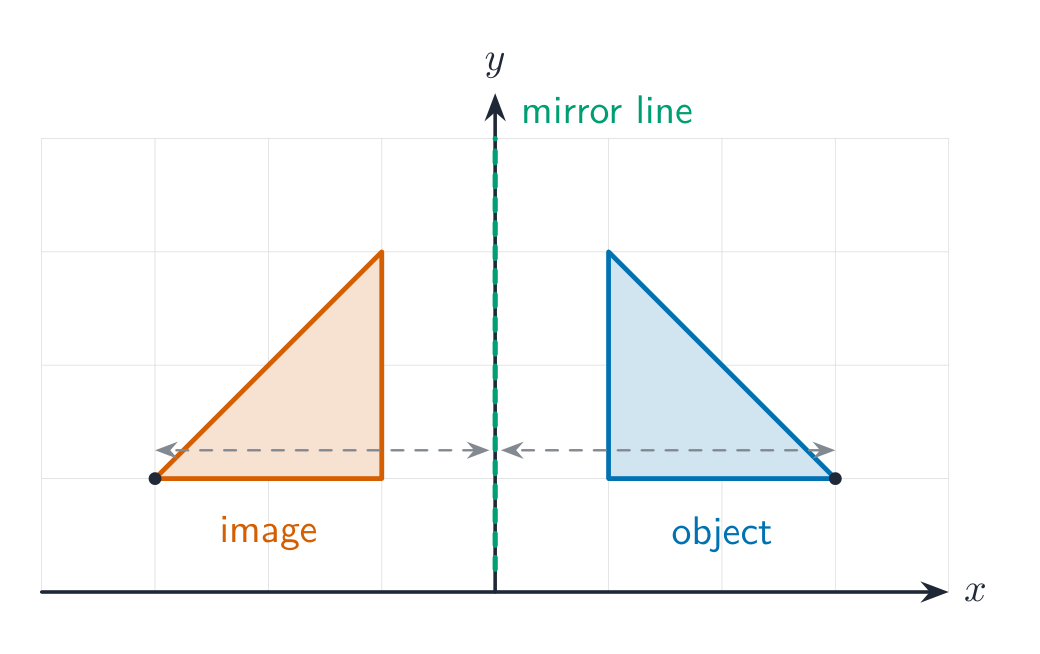
Worked example: other mirror lines. Reflect $(1, 4)$ in the line $x = 3$. The point is $2$ units left of the line, so the image is $2$ units right of it: $(5, 4)$. (Extended: in the line $y = x$ the coordinates swap, so $(1, 4) \to (4, 1)$.)
A rotation 旋转 turns the shape about a fixed point, the centre 中心 of rotation, through multiples of $90^{\circ}$.
Worked example. Rotate $(3, 1)$ by $90^{\circ}$ anticlockwise about the origin. The rule is $(x, y) \to (-y, x)$, so the image is $(-1, 3)$.

Worked example: describe a rotation. Triangle $A$ has vertices $(3, 1)$, $(5, 1)$ and $(3, 3)$. Triangle $B$ has vertices $(3, -1)$, $(3, -3)$ and $(5, -1)$. Describe the single transformation that maps $A$ onto $B$.
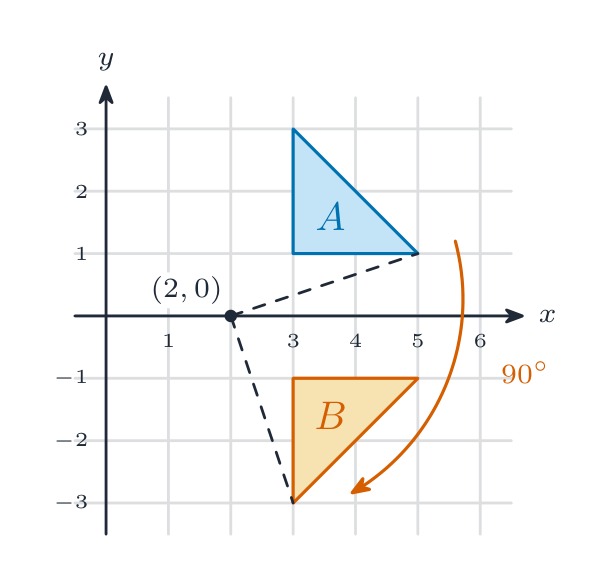
The side from $(3, 1)$ to $(5, 1)$ points right; its image, from $(3, -1)$ to $(3, -3)$, points down. So the shape has turned $90^{\circ}$ clockwise. Try the centre $(2, 0)$: it is $\sqrt{2}$ from both $(3, 1)$ and its image $(3, -1)$, and $\sqrt{10}$ from both $(5, 1)$ and $(3, -3)$. Tracing paper confirms it.
Answer: rotation, $90^{\circ}$ clockwise, centre $(2, 0)$. Three pieces of information give three marks.
An enlargement 放大 changes the size by a scale factor 比例因子 $k$, measured from a fixed centre. Each position relative to the centre is multiplied by $k$; actual distances are multiplied by $|k|$.
Worked example. Enlarge $(1, 2)$ from the origin by scale factor $2$. Multiply both coordinates: the image is $(2, 4)$.
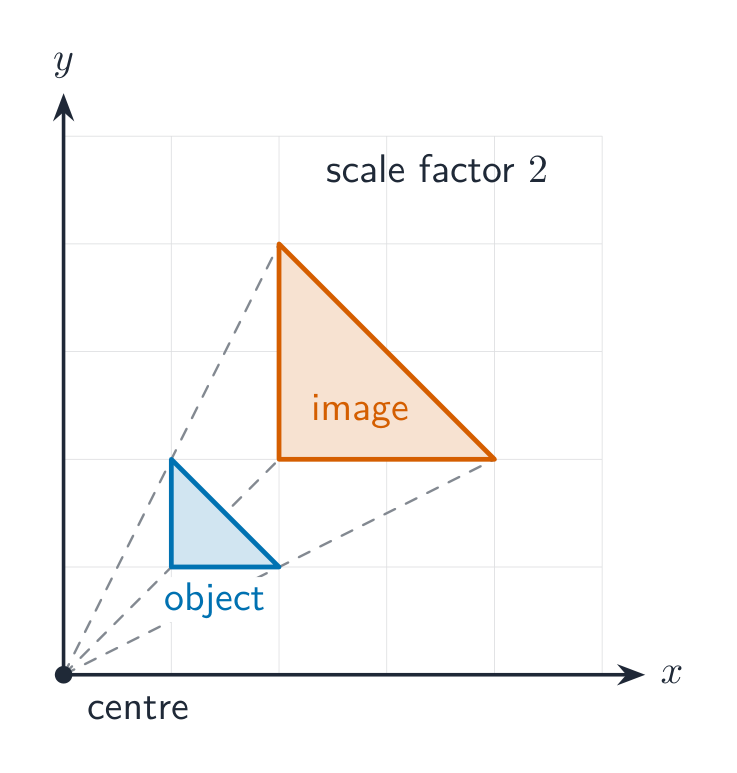
Worked example: find the centre and scale factor. Triangle $P$ has vertices $(1, 1)$, $(2, 1)$ and $(1, 3)$. Triangle $Q$ has vertices $(3, 3)$, $(5, 3)$ and $(3, 7)$. Describe the transformation that maps $P$ onto $Q$.
The side of length $1$ (from $(1,1)$ to $(2,1)$) becomes length $2$, so the scale factor is image length $\div$ object length $= 2 \div 1 = 2$. Draw lines from each image vertex back through the matching object vertex; they meet at the centre $(-1, -1)$. Check: from $(-1, -1)$ to $(1, 1)$ is $\begin{pmatrix} 2 \\ 2 \end{pmatrix}$, and twice that reaches $(3, 3)$.
Answer: enlargement, scale factor $2$, centre $(-1, -1)$.
Worked example: fractional and negative scale factors. From the origin, scale factor $\tfrac{1}{2}$ takes $(4, 6)$ to $(2, 3)$, closer to the centre. (Extended: scale factor $-2$ takes $(2, 1)$ to $(-4, -2)$, on the other side of the centre and twice as far away.)
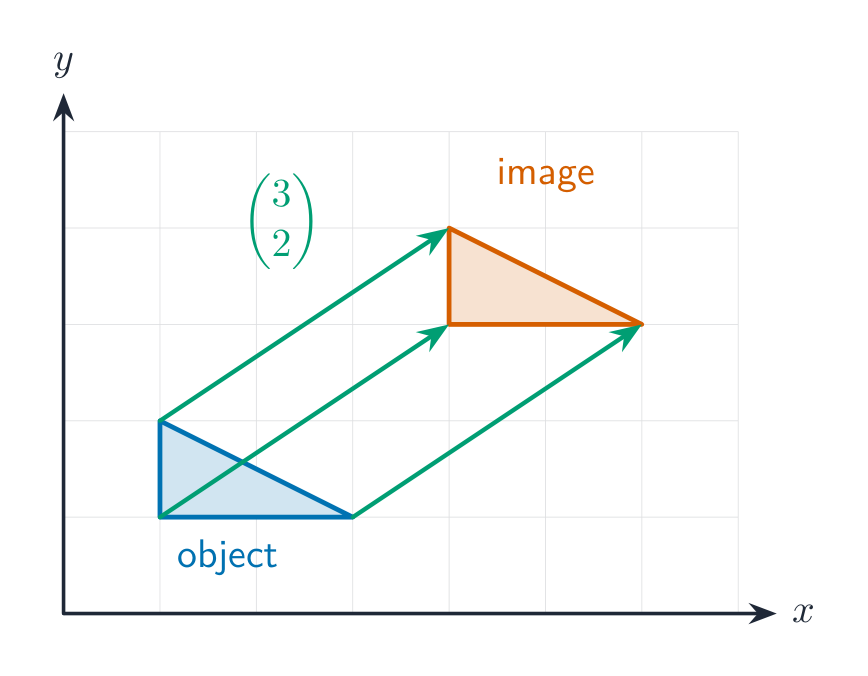
A translation 平移 slides the shape with no turning, by a vector 向量 written as a column vector 列向量 $\begin{pmatrix} x \\ y \end{pmatrix}$ ($x$ across, $y$ up).
Worked example. Translate $(5, 3)$ by $\begin{pmatrix} -2 \\ 4 \end{pmatrix}$: move $2$ left and $4$ up to get $(3, 7)$.
(Extended: a question may ask you to combine two transformations and describe the single transformation that has the same effect.)
Worked example: a combination (Extended). Reflect a shape in the $x$-axis, then reflect the image in the $y$-axis. What single transformation has the same effect?
Follow a general point: $(x, y) \to (x, -y) \to (-x, -y)$. Both signs change, which is a rotation of $180^{\circ}$ about the origin. (For $180^{\circ}$ no direction is needed.)
Common mistakes. Giving two transformations when the question asks for a single one, using words such as "turn" or "move" instead of the proper names, leaving out the direction of a rotation, and writing the scale factor upside down (it is image length $\div$ object length).
平移、反射、旋转或放大图形,观察其落点。
| English | 中文 | 拼音 |
|---|---|---|
| transformation/trænsfɔːˈmeɪʃn/ | 变换 | biàn huàn |
| reflection/rɪˈflekʃn/ | 反射 | fǎn shè |
| mirror line/ˈmɪrə laɪn/ | 对称轴 | duì chèn zhóu |
| rotation/rəʊˈteɪʃn/ | 旋转 | xuán zhuǎn |
| centre/ˈsentə/ | 中心 | zhōng xīn |
| enlargement/enˈlɑːdʒmənt/ | 放大 | fàng dà |
| scale factor/skeɪl ˈfæktə/ | 比例因子 | bǐ lì yīn zǐ |
| translation/trænˈsleɪʃn/ | 平移 | píng yí |
| vector/ˈvektə/ | 向量 | xiàng liàng |
| column vector/ˈkɒlʌm ˈvektə/ | 列向量 | liè xiàng liàng |

| 二维平面中的向量 | 注释与示例 |
|---|---|
| 1 使用列向量 $\begin{pmatrix} x \\ y \end{pmatrix}$、$\overrightarrow{AB}$ 或 $\mathbf{a}$ 描述平移变换。 | 向量将印刷为 $\overrightarrow{AB}$ 或 $\mathbf{a}$。 |
| 2 进行向量的加法和减法运算。 | |
| 3 进行标量与向量的乘法运算。 |
来源:Cambridge International 教学大纲
A vector has both size and direction. It can be written as a column vector, as $\overrightarrow{AB}$ (from $A$ to $B$), or in bold as $\mathbf{a}$.
Worked example. If $\mathbf{a} = \begin{pmatrix} 3 \\ 1 \end{pmatrix}$ and $\mathbf{b} = \begin{pmatrix} 2 \\ -4 \end{pmatrix}$, then
Subtracting works the same way, but take care with the signs:

拖动两个向量并以首尾相接的方式相加,得到合力。
| English | 中文 | 拼音 |
|---|---|---|
| scalar/ˈskeɪlə/ | 标量 | biāo liàng |

| 向量的大小 | 注释与示例 |
|---|---|
| 向量 $\begin{pmatrix} x \\ y \end{pmatrix}$ 的大小计算为 $\sqrt{x^2 + y^2}$。 | 向量的大小通常用模(绝对值符号)表示,例如: • $|\mathbf{a}|$ 表示向量 $\mathbf{a}$ 的大小 • $|\overrightarrow{AB}|$ 表示向量 $\overrightarrow{AB}$ 的大小。 |
来源:Cambridge International 教学大纲
The magnitude 模 (length) of a vector is found with Pythagoras. For $\begin{pmatrix} x \\ y \end{pmatrix}$,
Worked example. The magnitude of $\begin{pmatrix} 3 \\ 4 \end{pmatrix}$ is $\sqrt{3^{2} + 4^{2}} = \sqrt{25} = 5$.
Worked example: from two points. $A$ is $(2, -1)$ and $B$ is $(7, 11)$. Find $\left|\overrightarrow{AB}\right|$.
| English | 中文 | 拼音 |
|---|---|---|
| magnitude/ˈmæɡnɪtjuːd/ | 模 | mó |

| 向量几何 | 注释与示例 |
|---|---|
| 1 用有向线段表示向量。 | |
| 2 使用位置向量。 | |
| 3 利用两个或多个向量的和与差,将给定向量用两个共面向量表示。 | |
| 4 运用向量进行推理并解决几何问题。 | 示例包括: • 证明向量平行 • 证明三点共线 • 求解涉及比率和相似性的向量问题。 |
来源:Cambridge International 教学大纲
A vector can be drawn as a directed line segment 有向线段 (an arrow). The position vector 位置向量 of a point is the vector from the origin $O$ to that point.
A key idea: the vector from $A$ to $B$ is
where $\mathbf{a}$ and $\mathbf{b}$ are the position vectors of $A$ and $B$.
Two non-zero vectors are parallel 平行 if one is a scalar multiple of the other (for example $\overrightarrow{AB} = 2\,\overrightarrow{CD}$). Three distinct points are collinear 共线 (in a straight line) if the connecting vectors are parallel. Any vector in a plane can be expressed using two non-parallel coplanar 共面 vectors in that plane.
Worked example. $O$ is the origin, with $\overrightarrow{OA} = \mathbf{a}$ and $\overrightarrow{OB} = \mathbf{b}$. $M$ is the midpoint of $AB$. Find $\overrightarrow{OM}$ in terms of $\mathbf{a}$ and $\mathbf{b}$.
Worked example: a ratio. With the same $\mathbf{a}$ and $\mathbf{b}$, $P$ lies on $AB$ with $AP : PB = 1 : 3$. Find $\overrightarrow{OP}$.
$AP$ is $\tfrac{1}{4}$ of $AB$ (one part out of $1 + 3 = 4$), so
Worked example: show that points are collinear. $\overrightarrow{OA} = \mathbf{a}$, $\overrightarrow{OB} = \mathbf{b}$ and $\overrightarrow{OC} = 3\mathbf{b} - 2\mathbf{a}$. Show that $A$, $B$ and $C$ lie on a straight line.
So $\overrightarrow{AC} = 3\,\overrightarrow{AB}$: the two vectors are parallel, and they share the point $A$, so $A$, $B$ and $C$ are collinear. Both facts are needed for full marks.
Common mistakes. Writing $\overrightarrow{AB} = \mathbf{a} - \mathbf{b}$ (it is end minus start, $\mathbf{b} - \mathbf{a}$), using $\tfrac{1}{3}$ for the ratio $1 : 3$ (the whole line has $4$ parts), and saying "parallel" without the shared point in a collinearity proof.
resultant = a + b
组合向量到达一个点——合向量是直接的路线。
| English | 中文 | 拼音 |
|---|---|---|
| directed line segment/daɪˈrektɪd laɪn ˈseɡmənt/ | 有向线段 | yǒu xiàng xiàn duàn |
| position vector/pəˈzɪʃn ˈvektə/ | 位置向量 | wèi zhì xiàng liàng |
| parallel/ˈpærəlel/ | 平行 | píng xíng |
| collinear/ˈkɒlɪnɪə/ | 共线 | gòng xiàn |
| coplanar/ˌkəʊˈpleɪnə/ | 共面 | gòng miàn |
逐步完成,配合即时检查练习。
正在加载学科…