本讲义涵盖主题 1,数(Number)。剑桥数学有两个层次:核心(Core)和拓展(Extended)。标记 (Extended) 的部分只在拓展卷上考查;其他一切对两个层次都适用。
IGCSE 数学
学习建议
IGCSE 数学(0580)涵盖数、代数与图像、坐标几何、几何、测量、三角、变换与向量、概率与统计。
报考分 Core 与 Extended,Extended 在代数与三角上延伸明显更远——在选择练习内容前先确认自己的层次。
过程分是按书面步骤给的。答案算错,只要过程写出来,仍能拿到大部分分数;而只有正确答案、没有过程,得分反而更少。把每一步写出来不是为了整洁,是为了分数。
-
1
数
1.1
数的类型

大纲
Subject content Notes and examples Identify and use: • natural numbers • integers (positive, zero and negative) • prime numbers • square numbers • cube numbers • common factors • common multiples • rational and irrational numbers • reciprocals. Example tasks include: • convert between numbers and words, e.g. six billion is 6000000000 10007 is ten thousand and seven • express 72 as a product of its prime factors • find the highest common factor (HCF) of two numbers • find the lowest common multiple (LCM) of two numbers. 来源:剑桥国际大纲
你必须知道不同种类数的词。考官为正确使用它们给分。
每个集合坐在下一个里面:每个自然数是一个整数、每个整数是有理数、每个有理数是实数。无理数是实数但不是有理数。 Counting numbers and integers
- 自然数(natural numbers)——计数的数 $1, 2, 3, 4, \dots$
- 整数(integers)——整的数,正的、负的或零:$\dots, -2, -1, 0, 1, 2, \dots$
Factors and multiples
- 一个数的因数(factor)整除它,不留余数(remainder)。$18$ 的因数是 $1, 2, 3, 6, 9, 18$。
- 一个数的倍数(multiple)是那个数乘以一个整数。$6$ 的倍数是 $6, 12, 18, 24, \dots$
- 两个数的一个公因数(common factor)是两者的一个因数。
- 两个数的一个公倍数(common multiple)是两者的一个倍数。
Prime, square and cube numbers
- 一个质数(prime number)恰好有两个因数:$1$ 和它自身。最先的质数是 $2, 3, 5, 7, 11, 13, \dots$ 注意 $1$ 不是质数。
- 一个平方数(square number)是一个整数乘以它自身:$1, 4, 9, 16, 25, \dots$
- 一个立方数(cube number)把一个整数用三次:$1, 8, 27, 64, \dots$
Rational, irrational and reciprocal
- 一个有理数(rational number)能被写成两个整数的一个分数(fraction)$\frac{a}{b}$。例子:$\frac{3}{4}$、$5$、$0.7$。
- 一个无理数(irrational number)不能这样写。例子:$\pi$ 和 $\sqrt{2}$。
- 一个数的倒数(reciprocal)是 $1$ 除以那个数。$4$ 的倒数是 $\frac{1}{4}$;$0.25$ 的倒数是 $4$;$\frac{2}{3}$ 的倒数是 $\frac{3}{2}$。
Prime factors, HCF and LCM
$1$ 以上的每个整数是质数,或能被写成质数的一个乘积(product)。要把一个数写成它的质因数(prime factors)的乘积,不断除以合适的最小质数。
Worked example. 把 $72$ 写成它的质因数的乘积。
$$72 = 2 \times 36 = 2 \times 2 \times 18 = 2 \times 2 \times 2 \times 9 = 2 \times 2 \times 2 \times 3 \times 3 = 2^{3} \times 3^{2}.$$
不断分裂直到每个分支在一个质数上结束(圈出的);把它们收集起来给出 $72 = 2^{3} \times 3^{2}$。 两个数的最大公因数(HCF)(highest common factor)是它们共享的最大因数。最小公倍数(LCM)(lowest common multiple)是它们共享的最小倍数。质因数给出一个快速的方法。
Worked example. 求 $72$ 和 $120$ 的 HCF 和 LCM。
先把每个写成质数的乘积:
$$72 = 2^{3} \times 3^{2}, \qquad 120 = 2^{3} \times 3 \times 5.$$- HCF:取在两者中出现的每个质数的最低幂:$2^{3} \times 3 = 24$。
- LCM:取出现的每个质数的最高幂:$2^{3} \times 3^{2} \times 5 = 360$。
探索Sets of numbers
Every counting number is also an integer, every integer a rational — see how the number sets nest, and how union and intersection combine them.
词汇表 训练英文 中文 拼音 natural number/ˈnætʃərəl ˈnʌmbə/ 自然数 zì rán shù integer/ˈɪntɪdʒə/ 整数 zhěng shù factor/ˈfæktə/ 因数 yīn shù remainder/rɪˈmeɪndə/ 余数 yú shù multiple/ˈmʌltɪpl/ 倍数 bèi shù common factor/ˈkɒmən ˈfæktə/ 公因数 gōng yīn shù common multiple/ˈkɒmən ˈmʌltɪpl/ 公倍数 gōng bèi shù prime number/praɪm ˈnʌmbə/ 质数 zhì shù square number/skweə ˈnʌmbə/ 平方数 píng fāng shù cube number/kjuːb ˈnʌmbə/ 立方数 lì fāng shù rational number/ˈræʃənl ˈnʌmbə/ 有理数 yǒu lǐ shù fraction/ˈfrækʃn/ 分数 fēn shù irrational number/ɪˈræʃənl ˈnʌmbə/ 无理数 wú lǐ shù reciprocal/rɪˈsɪprəkl/ 倒数 dào shǔ product/ˈprɒdʌkt/ 乘积 chéng jī prime factor/praɪm ˈfæktə/ 质因数 zhì yīn shù highest common factor/ˈhaɪɪst ˈkɒmən ˈfæktə/ 最大公因数 zuì dà gōng yīn shù lowest common multiple/ˈləʊɪst ˈkɒmən ˈmʌltɪpl/ 最小公倍数 zuì xiǎo gōng bèi shù set/set/ 集合 jí hé ratio/ˈreɪʃɪəʊ/ 比 bǐ 1.2
集合

大纲
Subject content Notes and examples Understand and use set language, notation and Venn diagrams to describe sets. Venn diagrams are limited to two sets. The following set notation will be used: • $n(A)$ Number of elements in set $A$ • $A'$ Complement of set $A$ • $\mathscr{E}$ Universal set • $A \cup B$ Union of $A$ and $B$ • $A \cap B$ Intersection of $A$ and $B$. Example definition of sets: $A = \{x : x \text{ is a natural number}\}$ $B = \{a, b, c, \dots\}$ $C = \{x : a \leqslant x \leqslant b\}$. Subject content Notes and examples Understand and use set language, notation and Venn diagrams to describe sets and represent relationships between sets. Venn diagrams are limited to two or three sets. The following set notation will be used: • $n(A)$ Number of elements in set $A$ • $\in$ "... is an element of ..." • $\notin$ "... is not an element of ..." • $A'$ Complement of set $A$ • $\varnothing$ The empty set • $\mathscr{E}$ Universal set • $A \subseteq B$ $A$ is a subset of $B$ • $A \nsubseteq B$ $A$ is not a subset of $B$ • $A \cup B$ Union of $A$ and $B$ • $A \cap B$ Intersection of $A$ and $B$. Example definition of sets: $A = \{x : x \text{ is a natural number}\}$ $B = \{(x, y) : y = mx + c\}$ $C = \{x : a \leqslant x \leqslant b\}$ $D = \{a, b, c, \dots\}$. 来源:剑桥国际大纲
一个集合(set)是对象的一个搜集。集合里的每个对象是集合的一个元素(element)。你应当知道这个记号:
符号 含义 $n(A)$ 集合 $A$ 里的元素数量 $x \in A$ $x$ 是 $A$ 的一个元素 $x \notin A$ $x$ 不是 $A$ 的一个元素 $\mathscr{E}$ 全集(universal set)——正在谈论的一切 $A'$ $A$ 的补集(complement)——不在 $A$ 里的一切 $\varnothing$ 空集(empty set)——一个没有元素的集合 $A \subseteq B$ $A$ 是 $B$ 的一个子集(subset)——$A$ 的每个元素也在 $B$ 里 $A \cup B$ 并集(union)——在 $A$ 或 $B$ 或两者里的元素 $A \cap B$ 交集(intersection)——在 $A$ 和 $B$ 两者里的元素 一个维恩图(Venn diagram)把每个集合画成一个矩形(全集)里的一个圆。核心用两个集合;拓展可能用三个。
Worked example. $\mathscr{E} = \{1,2,3,4,5,6,7,8,9,10\}$,$A = \{\text{even numbers}\}$,$B = \{\text{multiples of } 3\}$。
- $A = \{2,4,6,8,10\}$ 而 $B = \{3,6,9\}$。
- $A \cap B = \{6\}$ ——在两者里的唯一的数。
- $A \cup B = \{2,3,4,6,8,9,10\}$ ——在任一集合里的数。
- $n(A \cup B) = 7$。
$A \cap B = \{6\}$ 是在两个圆里的唯一的数;$A \cup B$ 是任一圆里的一切。 你也可能看到一个集合被写成一个规则,例如 $C = \{x : 1 \leqslant x \leqslant 5\}$ 意思是"所有使得 $1 \leqslant x \leqslant 5$ 的值 $x$"。
探索Venn diagrams
Tap the regions to see union, intersection and complement — the language of sets.
词汇表 训练英文 中文 拼音 element/ˈelɪmənt/ 元素 yuán sù universal set/ˌjuːnɪˈvɜːsl set/ 全集 quán jí complement/ˈkɒmplɪmənt/ 补集 bǔ jí empty set/ˈempti set/ 空集 kōng jí subset/ˈsʌbset/ 子集 zi jí union/ˈjuːnɪən/ 并集 bìng jí intersection/ˌɪntəˈsekʃn/ 交集 jiāo jí Venn diagram/ven ˈdaɪəɡræm/ 维恩图 wéi ēn tú 1.3
幂与根
大纲
Subject content Notes and examples Calculate with the following: • squares • square roots • cubes • cube roots • other powers and roots of numbers. Includes recall of squares and their corresponding roots from 1 to 15, and recall of cubes and their corresponding roots of 1, 2, 3, 4, 5 and 10, e.g.: • Write down the value of $\sqrt{169}$ . • Work out $5^2 \times \sqrt[3]{8}$ . Subject content Notes and examples Calculate with the following: • squares • square roots • cubes • cube roots • other powers and roots of numbers. Includes recall of squares and their corresponding roots from 1 to 15, and recall of cubes and their corresponding roots of 1, 2, 3, 4, 5 and 10, e.g.: • Write down the value of $\sqrt{169}$. • Work out $5^2 \times \sqrt[3]{8}$. 来源:剑桥国际大纲
- 一个幂(power)(也叫一个指数(index),复数 indices)显示把一个数乘以它自身多少次:$2^{5} = 2 \times 2 \times 2 \times 2 \times 2 = 32$。
- 一个数的一个平方根(square root)在平方时给出那个数:$\sqrt{169} = 13$,因为 $13^{2} = 169$。
- 一个立方根(cube root)对立方以同样的方式起作用:$\sqrt[3]{8} = 2$,因为 $2^{3} = 8$。
你应当能够回忆从 $1^2$ 到 $15^2$ 的平方(和它们的根),以及 $1, 2, 3, 4, 5$ 和 $10$ 的立方。
Worked example. 算出 $5^{2} \times \sqrt[3]{8}$。
$$5^{2} \times \sqrt[3]{8} = 25 \times 2 = 50.$$探索Powers and roots lab
square = x^2
Change the base and see powers grow while roots undo powers.
词汇表 训练英文 中文 拼音 power/ˈpaʊə/ 幂 mì index/ˈɪndeks/ 指数 zhǐ shù square root/skweə ruːt/ 平方根 píng fāng gēn cube root/kjuːb ruːt/ 立方根 lì fāng gēn 1.7
指数 I

大纲
Subject content Notes and examples 1 Understand and use indices (positive, zero and negative integers). e.g. find the value of $7^{-2}$. 2 Understand and use the rules of indices. e.g. find the value of $2^{-3} \times 2^4$, $(2^3)^2$, $2^3 \div 2^4$. Subject content Notes and examples 1 Understand and use indices (positive, zero, negative, and fractional). Examples include: • $6^{\frac{1}{2}} = \sqrt{6}$ • $16^{\frac{1}{4}} = \sqrt[4]{16}$ • find the value of $7^{-2}$, $81^{\frac{1}{2}}$, $8^{-\frac{2}{3}}$. 2 Understand and use the rules of indices. e.g. find the value of $2^{-3} \times 2^4$, $(2^3)^2$, $2^3 \div 2^4$. 来源:剑桥国际大纲
当你乘或除同底数(same base)的幂时,用这些规则:
$$a^{m} \times a^{n} = a^{m+n}, \qquad a^{m} \div a^{n} = a^{m-n}, \qquad (a^{m})^{n} = a^{mn}.$$一些特殊的幂:
$$a^{0} = 1, \qquad a^{-n} = \frac{1}{a^{n}}, \qquad a^{\frac{1}{n}} = \sqrt[n]{a}, \qquad a^{\frac{m}{n}} = \left(\sqrt[n]{a}\right)^{m}.$$(像 $a^{\frac{m}{n}}$ 这样的分数幂是拓展(Extended)。)
Worked examples.
- $2^{-3} \times 2^{4} = 2^{-3+4} = 2^{1} = 2.$
- $(2^{3})^{2} = 2^{6} = 64.$
- $2^{3} \div 2^{4} = 2^{3-4} = 2^{-1} = \dfrac{1}{2}.$
- $7^{-2} = \dfrac{1}{7^{2}} = \dfrac{1}{49}.$
- $81^{\frac{1}{2}} = \sqrt{81} = 9.$
- $8^{-\frac{2}{3}} = \dfrac{1}{8^{\frac{2}{3}}} = \dfrac{1}{\left(\sqrt[3]{8}\right)^{2}} = \dfrac{1}{2^{2}} = \dfrac{1}{4}.$
三条指数律:乘加幂、除减它们,幂的幂乘它们 词汇表 训练英文 中文 拼音 base/beɪs/ 底数 dǐ shù 1.8
标准形式(科学记数法)

大纲
Subject content Notes and examples 1 Use the standard form $A \times 10^n$ where $n$ is a positive or negative integer and $1 \leqslant A < 10$. 2 Convert numbers into and out of standard form. 3 Calculate with values in standard form. Core candidates are expected to calculate with standard form only on Paper 3. Subject content Notes and examples 1 Use the standard form $A \times 10^n$ where $n$ is a positive or negative integer and $1 \leqslant A < 10$. 2 Convert numbers into and out of standard form. 3 Calculate with values in standard form. 来源:剑桥国际大纲
一个星系:巨大的距离用科学记数法紧凑地写出。 科学记数法(standard form)把一个数写成 $A \times 10^{n}$,其中 $1 \leqslant A < 10$ 而 $n$ 是一个整数。它用于非常大或非常小的数。
要转换,数小数点移动多少位:
- $4\,500\,000 = 4.5 \times 10^{6}$ ——点向左移 $6$ 位,所以幂是正的。
- $0.00072 = 7.2 \times 10^{-4}$ ——点向右移 $4$ 位,所以幂是负的。
Worked example. 算出 $(3 \times 10^{5}) \times (2 \times 10^{-2})$。
乘前面的数并加幂:
$$3 \times 2 = 6, \qquad 10^{5} \times 10^{-2} = 10^{3}, \qquad \text{so the answer is } 6 \times 10^{3}.$$
Standard form: a number written as a × 10^n with 1 ≤ a < 10 探索Standard form route
Follow a large or small number into a x 10^n form.
词汇表 训练英文 中文 拼音 standard form/ˈstændəd fɔːm/ 科学记数法 kē xué jì shù fǎ 1.18
无理根式

大纲
Subject content Notes and examples 1 Understand and use surds, including simplifying expressions. Examples include: • $\sqrt{20} = 2\sqrt{5}$ • $\sqrt{200} - \sqrt{32} = 6\sqrt{2}$. 2 Rationalise the denominator. Examples include: • $\frac{10}{\sqrt{5}} = 2\sqrt{5}$ • $\frac{1}{-1 + \sqrt{3}} = \frac{1 + \sqrt{3}}{2}$. 来源:剑桥国际大纲
一个根式(surd)是一个无理的根,例如 $\sqrt{5}$。把它留在精确形式而不是舍入。两条有用的规则:
$$\sqrt{a} \times \sqrt{b} = \sqrt{ab}, \qquad \sqrt{\frac{a}{b}} = \frac{\sqrt{a}}{\sqrt{b}}.$$通过取出最大的平方因数来化简一个根式。
Worked example. 化简 $\sqrt{20}$ 和 $\sqrt{200} - \sqrt{32}$。
$$\sqrt{20} = \sqrt{4 \times 5} = \sqrt{4}\,\sqrt{5} = 2\sqrt{5}.$$$$\sqrt{200} - \sqrt{32} = \sqrt{100 \times 2} - \sqrt{16 \times 2} = 10\sqrt{2} - 4\sqrt{2} = 6\sqrt{2}.$$化简一个根式:取出最大的平方因数 分母有理化(rationalise the denominator)意味着从一个分数的底部(分母(denominator))移除一个根式。把上部和底部乘以一个清除根式的值。
Worked example. 有理化 $\dfrac{10}{\sqrt{5}}$ 和 $\dfrac{1}{-1+\sqrt{3}}$。
$$\frac{10}{\sqrt{5}} = \frac{10}{\sqrt{5}} \times \frac{\sqrt{5}}{\sqrt{5}} = \frac{10\sqrt{5}}{5} = 2\sqrt{5}.$$$$\frac{1}{-1+\sqrt{3}} = \frac{1}{\sqrt{3}-1} \times \frac{\sqrt{3}+1}{\sqrt{3}+1} = \frac{\sqrt{3}+1}{3-1} = \frac{1+\sqrt{3}}{2}.$$探索Surd simplification route
Break a surd into square factors and simplify it.
词汇表 训练英文 中文 拼音 surd/sɜːd/ 根式 gēn shì rationalise the denominator/ˈræʃənəlaɪz ðə dɪˈnɒmɪneɪtə/ 分母有理化 fēn mǔ yǒu lǐ huà denominator/dɪˈnɒmɪneɪtə/ 分母 fēn mǔ 1.4
分数、小数与百分数

大纲
Subject content Notes and examples 1 Use the language and notation of the following in appropriate contexts: • proper fractions • improper fractions • mixed numbers • decimals • percentages. Candidates are expected to be able to write fractions in their simplest form. Candidates are not expected to use recurring decimal notation. 2 Recognise equivalence and convert between these forms. Candidates are not expected to demonstrate the conversion of a recurring decimal to a fraction and vice versa. Subject content Notes and examples 1 Use the language and notation of the following in appropriate contexts: • proper fractions • improper fractions • mixed numbers • decimals • percentages. Candidates are expected to be able to write fractions in their simplest form. Recurring decimal notation is required, e.g. • $0.1\dot{7} = 0.1777...$ • $0.1\dot{2}\dot{3} = 0.1232323...$ • $0.\dot{1}2\dot{3} = 0.123123...$ 2 Recognise equivalence and convert between these forms. Includes converting between recurring decimals and fractions and vice versa, e.g. write $0.1\dot{7}$ as a fraction. 来源:剑桥国际大纲
一个分数有一个分子(numerator)(上部)和一个分母(denominator)(底部)。
一个值三种方式:一个分数、一个小数和一个百分比 - 真分数(proper fraction):分子小于分母,例如 $\frac{3}{4}$。
- 假分数(improper fraction):分子相同或更大,例如 $\frac{7}{4}$。
- 带分数(mixed number):一个整数加一个分数,例如 $1\frac{3}{4}$。
在假分数和带分数之间转换:$\frac{7}{4} = 1\frac{3}{4}$,因为 $7 \div 4 = 1$ 余 $3$。
一个小数(decimal)在一个点之后使用位值。一个百分比(percentage)意味着"每 $100$ 中",所以 $37\% = \frac{37}{100} = 0.37$。
Converting between forms
要转换 方法 例子 分数 → 小数 上部除以底部 $\frac{3}{8} = 3 \div 8 = 0.375$ 小数 → 百分比 乘以 $100$ $0.07 = 7\%$ 百分比 → 分数 放在 $100$ 之上、然后化简 $7\% = \frac{7}{100}$ 百分比 → 小数 除以 $100$ $34\% = 0.34$ 通过把上部和底部除以它们的 HCF 把一个分数写成它的最简形式(simplest form):$\frac{18}{24} = \frac{3}{4}$(两者都除以 $6$)。
Recurring decimals (Extended)
一个循环小数(recurring decimal)永远重复相同的数字。点标记重复的部分:$0.1\dot{7} = 0.1777\ldots$ 而 $0.\dot{1}2\dot{3} = 0.123123\ldots$
要把一个循环小数变成一个分数,乘以使重复的部分对齐,然后相减。
Worked example. 把 $0.1\dot{7}$ 写成一个分数。
令 $x = 0.1777\ldots$ 只有 $7$ 重复,所以用 $10x$ 和 $100x$:
$$100x = 17.777\ldots, \qquad 10x = 1.777\ldots$$$$100x - 10x = 16, \qquad 90x = 16, \qquad x = \frac{16}{90} = \frac{8}{45}.$$
对齐重复的尾部、相减,尾部就抵消 探索Number form lab
Classify equivalent number forms and operations.
词汇表 训练英文 中文 拼音 numerator/ˈnjuːməreɪtə/ 分子 fèn zǐ proper fraction/ˈprɒpə ˈfrækʃn/ 真分数 zhēn fēn shù improper fraction/ɪmˈprɒpə ˈfrækʃn/ 假分数 jiǎ fēn shù mixed number/mɪkst ˈnʌmbə/ 带分数 dài fēn shù decimal/ˈdesɪml/ 小数 xiǎo shù percentage/pəˈsentɪdʒ/ 百分比 bǎi fēn bǐ simplest form/ˈsɪmpəlɪst fɔːm/ 最简形式 zuì jiǎn xíng shì recurring decimal/rɪˈkɜːrɪŋ ˈdesɪml/ 循环小数 xún huán xiǎo shù 1.6
四则运算

大纲
Subject content Notes and examples Use the four operations for calculations with integers, fractions and decimals, including correct ordering of operations and use of brackets. Includes: • negative numbers • improper fractions • mixed numbers • practical situations, e.g. temperature changes. 来源:剑桥国际大纲
Order of operations
按这个顺序做——运算顺序(order of operations):先括号、然后指数(幂和根)、然后乘和除(从左到右)、然后加和减(从左到右)。
Worked example. 算出 $-6 \times -3 + 7 \times 2$。
先做乘法:$-6 \times -3 = 18$ 而 $7 \times 2 = 14$。然后加:$18 + 14 = 32$。
运算顺序,应用于已解例子 Negative numbers
- 加一个负数:$5 + (-3) = 5 - 3 = 2$。
- 减一个负数:$5 - (-3) = 5 + 3 = 8$。
- 乘或除:相同的符号给出一个正数;不同的符号给出一个负数。所以 $-6 \times -3 = 18$ 但 $-12 \div 4 = -3$。
温度从 $-5\,{}^{\circ}\text{C}$ 到 $3\,{}^{\circ}\text{C}$ 的一个变化是 $8\,{}^{\circ}\text{C}$ 的一次上升。
Calculating with fractions
- 乘: 乘上部、乘底部:$\frac{2}{3} \times \frac{4}{5} = \frac{8}{15}$。
- 除: 乘以第二个分数的倒数:$\frac{2}{3} \div \frac{4}{5} = \frac{2}{3} \times \frac{5}{4} = \frac{10}{12} = \frac{5}{6}$。
- 加或减: 用一个公分母(底部的 LCM)。
Worked example. 算出 $1\frac{7}{15} - \frac{4}{5}$,以最简形式给出答案。
把带分数变成一个假分数,然后用分母 $15$:
$$1\frac{7}{15} = \frac{22}{15}, \qquad \frac{4}{5} = \frac{12}{15}, \qquad \frac{22}{15} - \frac{12}{15} = \frac{10}{15} = \frac{2}{3}.$$词汇表 训练英文 中文 拼音 order of operations/ˈɔːdə ɒv ˌɒpəˈreɪʃnz/ 运算顺序 yùn suàn shùn xù 1.5
排序
大纲
Subject content Notes and examples Order quantities by magnitude and demonstrate familiarity with the symbols $=, \ne, >, <, \geqslant$ and $\leqslant$. Subject content Notes and examples Order quantities by magnitude and demonstrate familiarity with the symbols $=, \neq, >, <, \geqslant$ and $\leqslant$. 来源:剑桥国际大纲
用这些符号按大小(magnitude)(尺寸)比较数:
符号 含义 $=$ 等于 $\neq$ 不等于 $>$ 大于 $<$ 小于 $\geqslant$ 大于或等于 $\leqslant$ 小于或等于 要把一个混合列表按顺序排列,先把每个值变成一个小数。
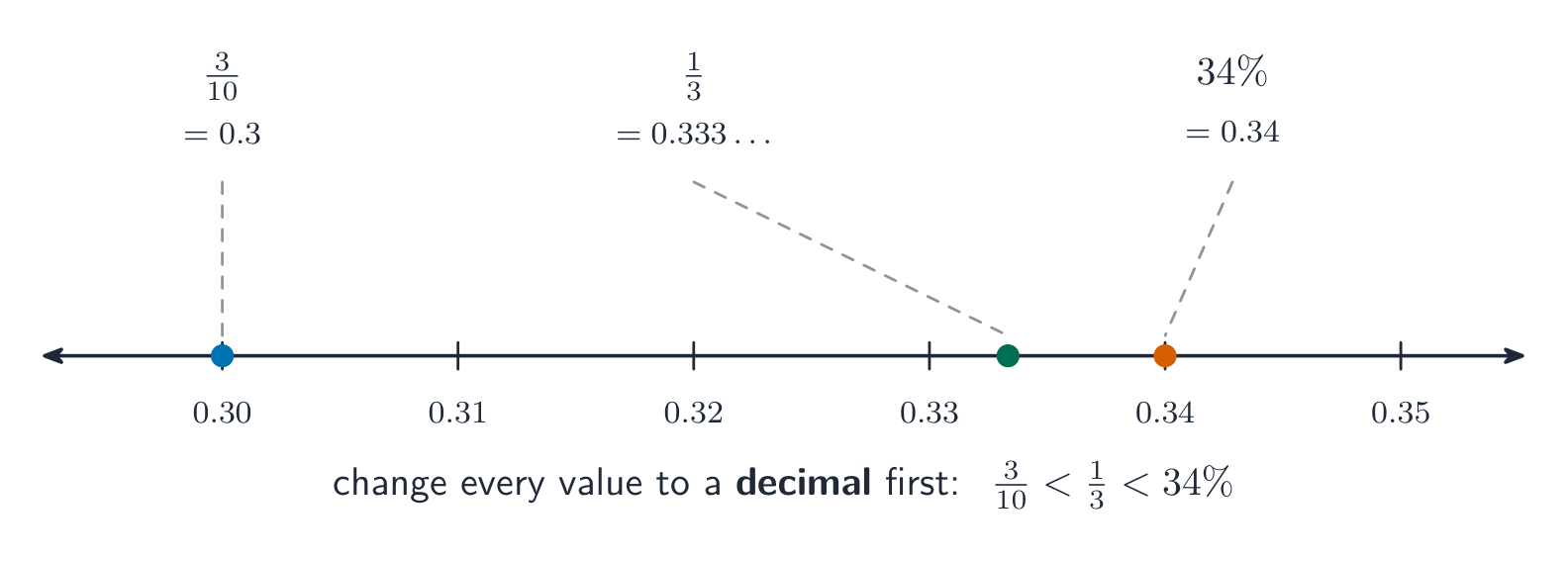
Worked example. 把 $34\%$、$\frac{1}{3}$ 和 $\frac{3}{10}$ 按顺序排列,最小的在先。
作为小数:$34\% = 0.34$,$\frac{1}{3} = 0.333\ldots$,$\frac{3}{10} = 0.3$。所以顺序是
$$\frac{3}{10} < \frac{1}{3} < 34\%.$$把每个值转换成一个小数,然后把它们放在一条数轴上 词汇表 训练英文 中文 拼音 magnitude/ˈmæɡnɪtjuːd/ 大小 dà xiǎo 1.13
百分数

大纲
Subject content Notes and examples 1 Calculate a given percentage of a quantity. 2 Express one quantity as a percentage of another. 3 Calculate percentage increase or decrease. 4 Calculate with simple and compound interest. Formulas are not given. Percentage calculations may include: • deposit • discount • profit and loss (as an amount or a percentage) • earnings • percentages over 100%. Subject content Notes and examples 1 Calculate a given percentage of a quantity. 2 Express one quantity as a percentage of another. 3 Calculate percentage increase or decrease. 4 Calculate with simple and compound interest. Problems may include repeated percentage change. Formulas are not given. 5 Calculate using reverse percentages. e.g. find the cost price given the selling price and the percentage profit. Percentage calculations may include: • deposit • discount • profit and loss (as an amount or a percentage) • earnings • percentages over 100%. 来源:剑桥国际大纲
商店把百分比用于折扣、销售税和利润率。 求一个数额的一个百分比。 $\$80$ 的 $15\% = 0.15 \times 80 = \$12$。
把一个数额写成另一个的一个百分比。 $25$ 中 $18$ 的分数是 $\frac{18}{25} \times 100\% = 72\%$。
百分比增加或减少用
$$\text{percentage change} = \frac{\text{change}}{\text{original amount}} \times 100\%.$$Worked example. 一个价格从 $\$40$ 上升到 $\$50$。求百分比增加。
变化是 $\$10$,所以 $\frac{10}{40} \times 100\% = 25\%$ 增加。
一个快速的方式是一个乘数(multiplier)。要增加 $15\%$,乘以 $1.15$;要减少 $15\%$,乘以 $0.85$。
Simple and compound interest
利息(interest)是为借款或为储蓄而付的钱。本金(principal)是起始数额。
- 单利(simple interest)每年付相同的数额,只在本金上算出:
$$I = \frac{P \times r \times t}{100},$$其中 $P$ 是本金、$r$ 是每年的利率(作为一个百分比)而 $t$ 是年数。
- 复利(compound interest)加上每年的利息,所以下一年在一个更大的总额上赚利息:
$$\text{final value} = P\left(1 + \frac{r}{100}\right)^{t}.$$
Worked example. 求以 $4\%$ 复利储蓄 $3$ 年的 $\$500$ 的值。
$$500 \times 1.04^{3} = 500 \times 1.124864 = \$562.43 \ (\text{to the nearest cent}).$$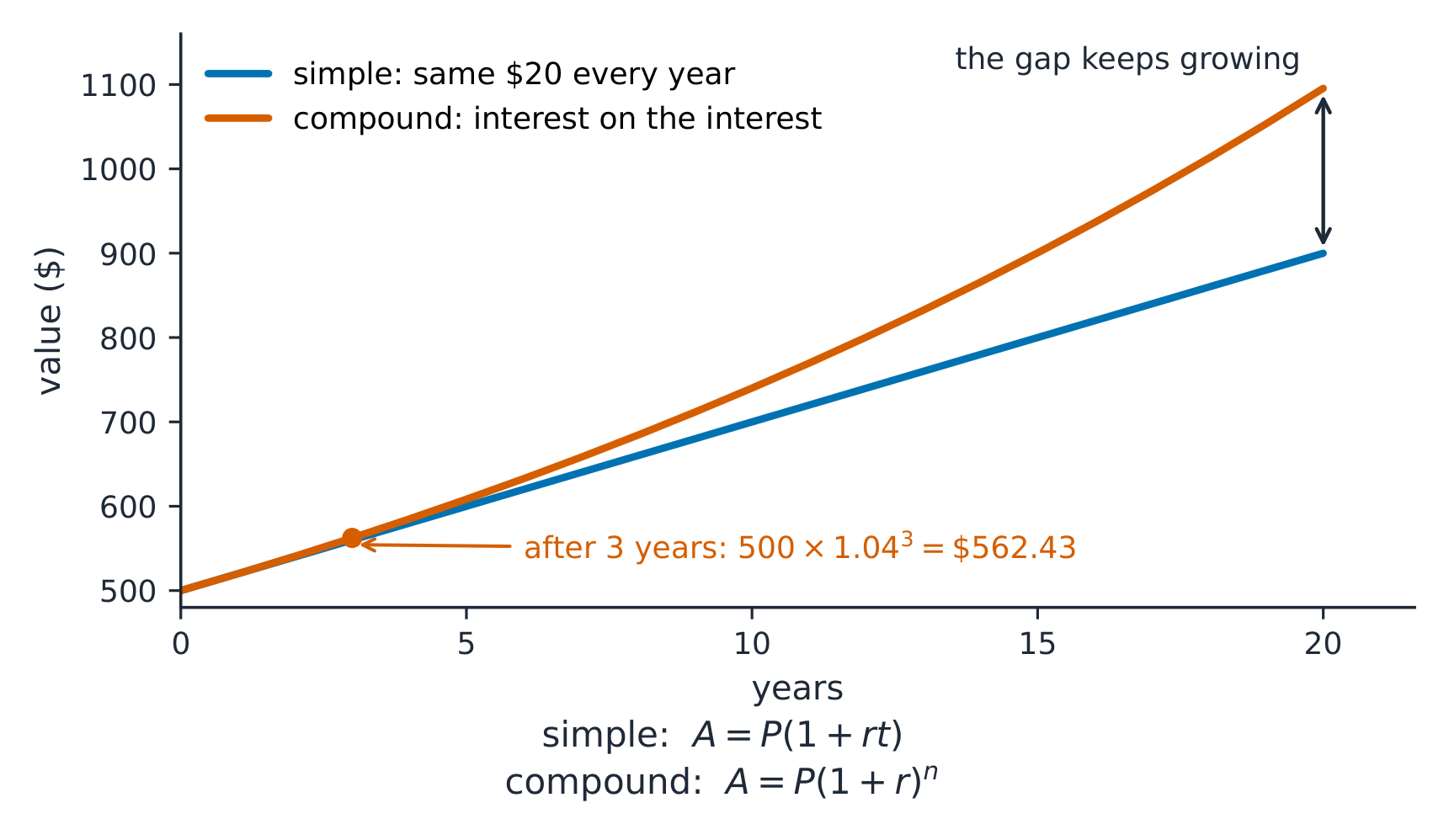
单利以一条直线增长;复利每年增长得更快 Reverse percentages (Extended)
一个逆百分比(reverse percentage)问题给出一次变化之后的数额,并问原来的。要解它,除以乘数——不要只是把百分比减掉。
Worked example. 一件外套在一次 $20\%$ 增加后值 $\$60$。求原来的价格。
$\$60$ 是原来的 $120\%$,所以原来的价格是 $60 \div 1.2 = \$50$。
探索Percentage change lab
new value = old value x multiplier
Change the multiplier and see the final value change.
词汇表 训练英文 中文 拼音 multiplier/ˌmʌltɪˈplaɪə/ 乘数 chéng shù interest/ˈɪntrest/ 利息 lì xī principal/ˈprɪnsɪpl/ 本金 běn jīn simple interest/ˈsɪmpl ˈɪntrest/ 单利 dān lì compound interest/ˈkɒmpaʊnd ˈɪntrest/ 复利 fù lì reverse percentage/rɪˈvɜːs pəˈsentɪdʒ/ 逆百分比 nì bǎi fēn bǐ 1.17
指数增长与衰减
大纲
Subject content Notes and examples Use exponential growth and decay. e.g. depreciation, population change. Knowledge of e is not required. 来源:剑桥国际大纲
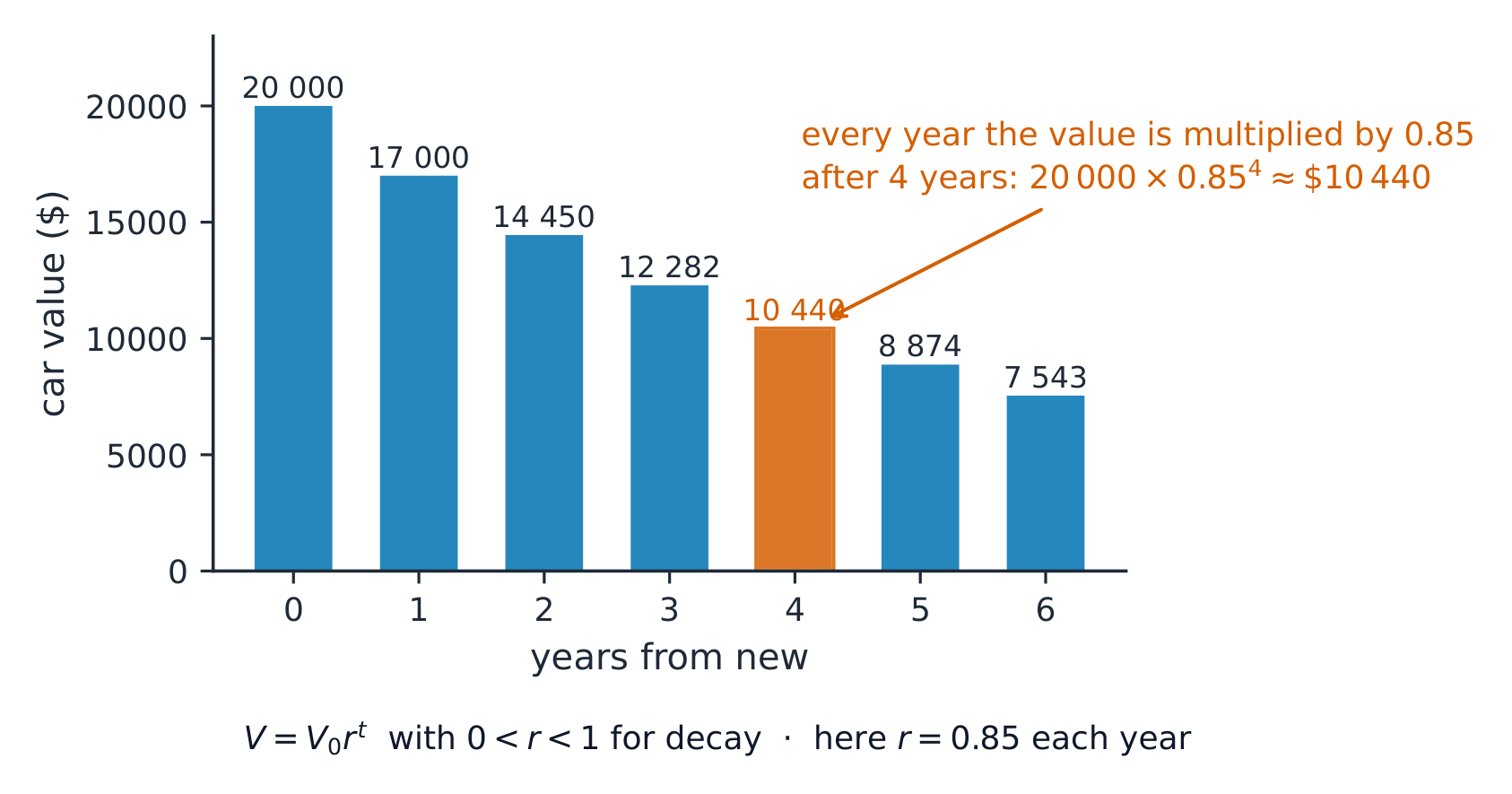
当一个量在每个时间段里以相同的百分比变化时,它显示指数增长(exponential growth)(它变得更大)或指数衰减(exponential decay)(它变得更小)。用复利公式。折旧(depreciation),其中像一辆车这样的东西每年丧失价值,是衰减。
Worked example. 一辆值 $\$20\,000$ 的车每年丧失它价值的 $15\%$。求它 $4$ 年后的值。
乘数是 $0.85$,所以
$$20\,000 \times 0.85^{4} = 20\,000 \times 0.522\ldots = \$10\,440 \ (\text{to the nearest dollar}).$$指数衰减:车每年丧失它当前价值的 $15\%$ 探索Compound interest
Money grows by (1 + r) every year, so compound interest curves above simple interest. Drag the rate and the number of years.
探索Exponential growth & decay
y = a·bˣ
Change the base b: b > 1 grows, 0 < b < 1 decays — useful for interest and populations.
词汇表 训练英文 中文 拼音 exponential growth/ˌekspəˈnenʃl ɡrəʊθ/ 指数增长 zhǐ shù zēng zhǎng exponential decay/ˌekspəˈnenʃl dɪˈkeɪ/ 指数衰减 zhǐ shù shuāi jiǎn depreciation/dɪˌpriːʃɪˈeɪʃn/ 折旧 zhé jiù 1.11
比与比例

大纲
Subject content Notes and examples Understand and use ratio and proportion to: • give ratios in their simplest form e.g. 20:30:40 in its simplest form is 2:3:4. • divide a quantity in a given ratio • use proportional reasoning and ratios in context. e.g. adapt recipes; use map scales; determine best value. 来源:剑桥国际大纲
一个比(ratio)比较量,像 $a:b$ 这样写。像一个分数一样通过除以 HCF 化简它:$20:30:40 = 2:3:4$。
按一个比划分。 按比 $3:5$ 分享 $\$48$。
总份数是 $3 + 5 = 8$。一份是 $48 \div 8 = \$6$。所以各份是 $3 \times 6 = \$18$ 和 $5 \times 6 = \$30$。
按比 $3$ 比 $5$ 分享 $\$48$ 的一个条形模型 比例(proportion)意味着两个比相等。把它用于食谱、地图比例尺(scales)和寻找最佳价值。
Worked example. $3$ 支笔值 $\$1.80$。求 $7$ 支笔的成本。
一支笔值 $1.80 \div 3 = \$0.60$。所以 $7$ 支笔值 $7 \times 0.60 = \$4.20$。
探索Direct proportion
y = ax
Direct proportion is a straight line through the origin — double x and you double y.
词汇表 训练英文 中文 拼音 proportion/prəˈpɔːʃn/ 比例 bǐ lì scale/skeɪl/ 比例尺 bǐ lì chǐ 1.12
比率

大纲
Subject content Notes and examples 1 Use common measures of rate. e.g. calculate with: • hourly rates of pay • exchange rates between currencies • flow rates • fuel consumption. 2 Apply other measures of rate. e.g. calculate with: • pressure • density • population density. Required formulas will be given in the question. 3 Solve problems involving average speed. Knowledge of speed/distance/time formula is required. e.g. A cyclist travels 45 km in 3 hours 45 minutes. What is their average speed? Notation used will be, e.g. m/s (metres per second), $\text{g/cm}^3$ (grams per cubic centimetre). Subject content Notes and examples 1 Use common measures of rate. e.g. calculate with: • hourly rates of pay • exchange rates between currencies • flow rates • fuel consumption. 2 Apply other measures of rate. e.g. calculate with: • pressure • density • population density. Required formulas will be given in the question. 3 Solve problems involving average speed. Knowledge of speed/distance/time formula is required. e.g. A cyclist travels 45 km in 3 hours 45 minutes. What is their average speed? Notation used will be, e.g. m/s (metres per second), g/cm$^{3}$ (grams per cubic centimetre). 来源:剑桥国际大纲
一个比率(rate)比较两个以不同单位衡量的量,例如每千克的价格,或每小时的距离。
平均速度(average speed)用
$$\text{average speed} = \frac{\text{total distance}}{\text{total time}}.$$Worked example. 一个骑车者在 $3$ 小时 $45$ 分钟里行驶 $45\text{ km}$。求平均速度。
先把时间变成小时:$3$ h $45$ min $= 3.75$ h。然后
$$\text{average speed} = \frac{45}{3.75} = 12\text{ km/h}.$$距离-速度-时间三角形:盖住你想要的那个 其他比率以同样的方式起作用。密度(density)从质量(mass)和体积(volume)求出:
$$\text{density} = \frac{\text{mass}}{\text{volume}}.$$其他例子是流量、燃料消耗和人口密度(population density)。若一个比率需要一个特殊公式(例如压强(pressure)),问题会把它给你。
词汇表 训练英文 中文 拼音 rate/reɪt/ 比率 bǐ lǜ average speed/ˈævrɪdʒ spiːd/ 平均速度 píng jūn sù dù density/ˈdensɪti/ 密度 mì dù mass/mæs/ 质量 zhì liàng volume/ˈvɒljuːm/ 体积 tǐ jī population density/ˌpɒpjʊˈleɪʃn ˈdensɪti/ 人口密度 rén kǒu mì dù pressure/ˈpreʃə/ 压强 yā qiáng 1.9
估算
大纲
Subject content Notes and examples 1 Round values to a specified degree of accuracy. Includes decimal places and significant figures. 2 Make estimates for calculations involving numbers, quantities and measurements. e.g. write 5764 correct to the nearest thousand. e.g. by writing each number correct to 1 significant figure, estimate the value of $$\frac{41.3}{9.79 \times 0.765}$$.3 Round answers to a reasonable degree of accuracy in the context of a given problem. Subject content Notes and examples 1 Round values to a specified degree of accuracy. Includes decimal places and significant figures. e.g. write 5764 correct to the nearest thousand. 2 Make estimates for calculations involving numbers, quantities and measurements. e.g. by writing each number correct to 1 significant figure, estimate the value of $$\frac{41.3}{9.79 \times 0.765}$$.3 Round answers to a reasonable degree of accuracy in the context of a given problem. 来源:剑桥国际大纲
Rounding
- 小数位(d.p.)(decimal places):在点之后数的数字。$3.14159$ 到 $2$ d.p. 是 $3.14$。
- 有效数字(s.f.)(significant figures):从第一个非零数字数起的数字。$5764$ 到 $1$ s.f. 是 $6000$;$0.004067$ 到 $2$ s.f. 是 $0.0041$。
规则:看下一个数字。若它是 $5$ 或更多,向上舍入;若它更少,向下舍入。
Estimation
要估算(estimate)一个答案,把每个数舍入到 $1$ s.f.,然后计算。
Worked example. 估算 $\dfrac{41.3}{9.79 \times 0.765}$。
$$\frac{41.3}{9.79 \times 0.765} \approx \frac{40}{10 \times 0.8} = \frac{40}{8} = 5.$$探索Rounding and bounds lab
Classify numbers by the decision needed for accuracy.
词汇表 训练英文 中文 拼音 decimal place/ˈdesɪml pleɪs/ 小数位 xiǎo shù wèi significant figure/sɪɡˈnɪfɪkənt ˈfɪɡə/ 有效数字 yǒu xiào shù zì estimate/ˈestɪmət/ 估算 gū suàn 1.10
精度范围

大纲
Subject content Notes and examples Give upper and lower bounds for data rounded to a specified accuracy. e.g. write down the upper bound of a length measured correct to the nearest metre. Candidates are not expected to find the bounds of the results of calculations which have used data rounded to a specified accuracy. Subject content Notes and examples 1 Give upper and lower bounds for data rounded to a specified accuracy. e.g. write down the upper bound of a length measured correct to the nearest metre. 2 Find upper and lower bounds of the results of calculations which have used data rounded to a specified accuracy. Example calculations include: • calculate the upper bound of the perimeter or the area of a rectangle given dimensions measured to the nearest centimetre • find the lower bound of the speed given rounded values of distance and time. 来源:剑桥国际大纲
一个舍入的值真的可能是任何舍入到它的东西。最小可能的值是下界(lower bound);最大的是上界(upper bound)。对于一个舍入到最近单位的值,界限位于每一侧半个单位处。
Worked example. 一个高度 $h$ 是 $635\text{ m}$,准确到最近的米。给出界限。
$$634.5 \leqslant h < 635.5.$$带里的一切都舍入到 $635$:下界被包含、上界不被包含 所以下界是 $634.5\text{ m}$ 而上界是 $635.5\text{ m}$。
Bounds in calculations (Extended)
组合界限以得到你想要的界限。
Worked example. 一个矩形是 $8\text{ cm}$ 乘 $5\text{ cm}$,每条边到最近的 cm。求最大可能的面积(area)。
用两条边的上界:$8.5 \times 5.5 = 46.75\text{ cm}^{2}$。(最小面积用下界:$7.5 \times 4.5 = 33.75\text{ cm}^{2}$。)
对于一个相除的量,例如 $\text{speed} = \dfrac{\text{distance}}{\text{time}}$,最大速度来自最大距离除以最小时间。
词汇表 训练英文 中文 拼音 lower bound/ˈləʊə baʊnd/ 下界 xià jiè upper bound/ˈʌpə baʊnd/ 上界 shàng jiè area/ˈeərɪə/ 面积 miàn jī 1.15
时间
大纲
Subject content Notes and examples 1 Calculate with time: seconds (s), minutes (min), hours (h), days, weeks, months, years, including the relationship between units. 1 year = 365 days. 2 Calculate times in terms of the 24-hour and 12-hour clock. In the 24-hour clock, for example, 3.15 a.m. will be denoted by 03 15 and 3.15 p.m. by 15 15. 3 Read clocks and timetables. Includes problems involving time zones, local times and time differences. Subject content Notes and examples 1 Calculate with time: seconds (s), minutes (min), hours (h), days, weeks, months, years, including the relationship between units. 1 year = 365 days. 2 Calculate times in terms of the 24-hour and 12-hour clock. In the 24-hour clock, for example, 3.15 a.m. will be denoted by 0315 and 3.15 p.m. by 1515. 3 Read clocks and timetables. Includes problems involving time zones, local times and time differences. 来源:剑桥国际大纲
- $60$ 秒 $= 1$ 分钟,$60$ 分钟 $= 1$ 小时,$24$ 小时 $= 1$ 天,而 $1$ 年 $= 365$ 天。
- 24 小时制把一个时间写成四个数字:下午 $3.15$ 是 $15\,15$。
Worked example. 一部电影在 $19\,35$ 开始并持续 $70$ 分钟。求它结束的时间。
$70$ min $= 1$ h $10$ min。加 $1$ 小时给出 $20\,35$;加 $10$ 分钟给出 $20\,45$。
对于时刻表和时区(time zone)问题,加上或减去各地之间的时差。
探索Time, money and calculator lab
Choose the operation that matches a real measurement problem.
词汇表 训练英文 中文 拼音 time zone/taɪm zəʊn/ 时区 shí qū 1.16
货币
大纲
Subject content Notes and examples 1 Calculate with money. 2 Convert from one currency to another. 来源:剑桥国际大纲
把钱作为普通小数处理,但给出到 $2$ d.p. 的答案(所以 $\$4.8$ 写成 $\$4.80$)。
货币换算。 把汇率(exchange rate)用作一个乘数。
Worked example. 汇率是 $\$1 = €0.92$。把 $\$150$ 换算成欧元,并把 $€138$ 换算回美元。
$$150 \times 0.92 = €138, \qquad 138 \div 0.92 = \$150.$$词汇表 训练英文 中文 拼音 exchange rate/eksˈtʃeɪndʒ reɪt/ 汇率 huì lǜ 1.14
使用计算器
大纲
Subject content Notes and examples 1 Use a calculator efficiently. e.g. know not to round values within a calculation and to only round the final answer. 2 Enter values appropriately on a calculator. e.g. enter 2 hours 30 minutes as 2.5 hours or 2° 30’ 0’’. 3 Interpret the calculator display appropriately. e.g. in money 4.8 means $4.80; in time 3.25 means 3 hours 15 minutes. Subject content Notes and examples 1 Use a calculator efficiently. e.g. know not to round values within a calculation and to only round the final answer. 2 Enter values appropriately on a calculator. e.g. enter 2 hours 30 minutes as 2.5 hours or 2° 30' 0''. 3 Interpret the calculator display appropriately. e.g. in money 4.8 means $4.80; in time 3.25 means 3 hours 15 minutes. 来源:剑桥国际大纲
- 不要在一个计算的中途舍入。保留完整的值,只舍入最终答案。
- 把时间输入为一小时的一个小数:$2$ 小时 $30$ 分钟是 $2.5$ 小时,不是 $2.30$。
- 在上下文里读显示:在钱里,$4.8$ 意味着 $\$4.80$;在时间里,$3.25$ 小时意味着 $3$ 小时 $15$ 分钟。
1.14
考试技巧
- 按顺序遵循 BIDMAS(括号、指数、除/乘、加/减),并记住一个负数乘一个负数是正的。
- 在科学记数法里前面的数在 1 和 10 之间;一个小的数(像 $0.0004$)有一个负的 10 的幂。
- 一个百分比变化在原来的数额上算出。对于一个逆百分比,除以乘数(例如 $\div 1.2$ 撤销一个 $20\%$ 的上升)。
- 不要在中途舍入——保留完整的值,只在最后舍入,到问题要求的准确度(小数位或有效数字)。
- 对于准确度的界限,一个舍入到最近整数的值能是每一侧最多 $0.5$(所以 $8$ 意味着 $7.5 \le x < 8.5$)。
-
2
代数与图像
本讲义涵盖主题 2,代数和图像(Algebra and graphs)。标记 (Extended) 的部分只在拓展卷上考查;其他一切对两个层次都适用。
2.1
代数导论
大纲
Subject content Notes and examples 1 Know that letters can be used to represent generalised numbers. 2 Substitute numbers into expressions and formulas. 来源:剑桥国际大纲
在代数(algebra)里我们用字母代表数。一个值能变化的字母是一个变量(variable)。代入(substitute)意味着把一个数放在一个字母的位置。
Worked example. 当 $x = 4$ 和 $y = 5$ 时求 $3x^{2} - 2y$ 的值。
$$3 \times 4^{2} - 2 \times 5 = 3 \times 16 - 10 = 48 - 10 = 38.$$探索Algebra manipulation route
Follow expression work from collecting terms to solving.
词汇表 训练英文 中文 拼音 algebra/ˈældʒɪbrə/ 代数 dài shù variable/ˈveərɪəbl/ 变量 biàn liàng substitute/ˈsʌbstɪtjuːt/ 代入 dài rù 2.2
代数式的运算

大纲
Subject content Notes and examples 1 Simplify expressions by collecting like terms. Simplify means give the answer in its simplest form, e.g. $2a + 3b + 5a - 9b = 7a - 6b$. 2 Expand products of algebraic expressions. e.g. expand $3x(2x - 4y)$. Includes products of two brackets involving one variable, e.g. expand $(2x + 1)(x - 4)$. 3 Factorise by extracting common factors. Factorise means factorise fully, e.g. $9x^2 + 15xy = 3x(3x + 5y)$. Subject content Notes and examples 1 Simplify expressions by collecting like terms. Simplify means give the answer in its simplest form, e.g. $2a^2 + 3ab - 1 + 5a^2 - 9ab + 4 = 7a^2 - 6ab + 3$. 2 Expand products of algebraic expressions. e.g. expand $3x(2x - 4y)$, $(3x + y)(x - 4y)$. Includes products of more than two brackets, e.g. expand $(x - 2)(x + 3)(2x + 1)$. 3 Factorise by extracting common factors. Factorise means factorise fully, e.g. $9x^2 + 15xy = 3x(3x + 5y)$. 4 Factorise expressions of the form: • $ax + bx + kay + kby$ • $a^2x^2 - b^2y^2$ • $a^2 + 2ab + b^2$ • $ax^2 + bx + c$ • $ax^3 + bx^2 + cx$. 5 Complete the square for expressions in the form $ax^2 + bx + c$. 来源:剑桥国际大纲
一个项(term)是一个表达式(expression)的单个部分,例如 $5a$ 或 $-9b$。同类项(like terms)有恰好相同的字母;你可以加或减它们。字母前面的数是系数(coefficient)。
用一个面积模型展开一个括号 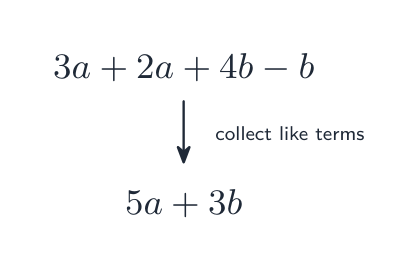
收集同类项:加带相同字母的项 Worked example. 化简 $2a^{2} + 3ab - 1 + 5a^{2} - 9ab + 4$。
收集同类项:$2a^{2} + 5a^{2} = 7a^{2}$,$3ab - 9ab = -6ab$,$-1 + 4 = 3$。所以答案是
$$7a^{2} - 6ab + 3.$$展开(expand)意味着把括号(brackets)乘出来。把里面的每一项乘以外面的项;对于两个括号,把第一个里的每一项乘以第二个里的每一项。
Worked examples.
$$3x(2x - 4y) = 6x^{2} - 12xy.$$$$(2x + 1)(x - 4) = 2x^{2} - 8x + x - 4 = 2x^{2} - 7x - 4.$$对于三个括号(拓展(Extended)),先展开两个,然后乘以第三个:
$$(x - 2)(x + 3)(2x + 1) = (x^{2} + x - 6)(2x + 1) = 2x^{3} + 3x^{2} - 11x - 6.$$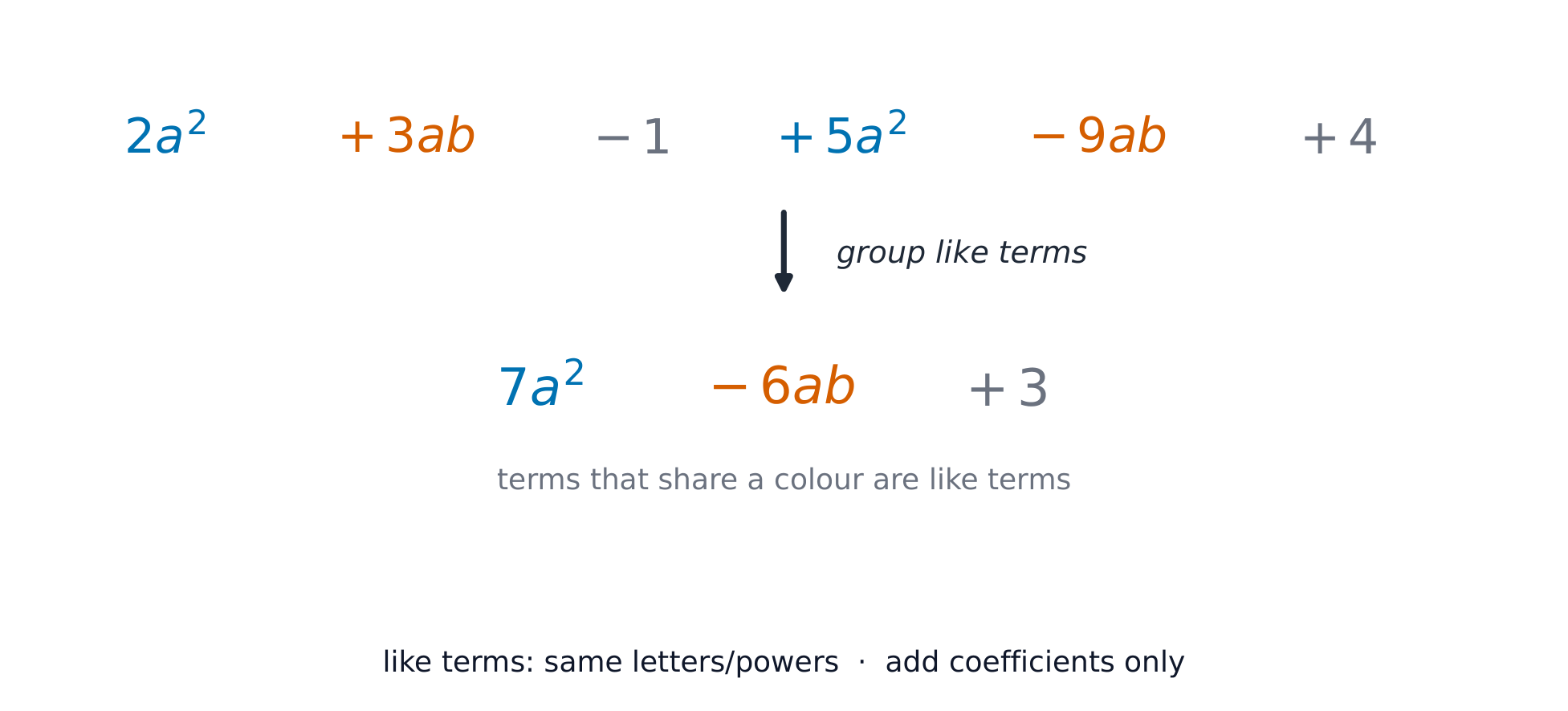
Like terms share the same letters and powers — add coefficients only 
Expand by distributing: a(b+c)=ab+ac (area model) 词汇表 训练英文 中文 拼音 term/tɜːm/ 项 xiàng expression/ekˈspreʃn/ 表达式 biǎo dá shì like terms/laɪk tɜːmz/ 同类项 tóng lèi xiàng coefficient/ˌkəʊɪˈfɪʃənt/ 系数 xì shù expand/ekˈspænd/ 展开 zhǎn kāi brackets/ˈbrækɪts/ 括号 kuò hào area/ˈeərɪə/ 面积 miàn jī 2.2
代数式的运算
大纲
Subject content Notes and examples 1 Simplify expressions by collecting like terms. Simplify means give the answer in its simplest form, e.g. $2a + 3b + 5a - 9b = 7a - 6b$. 2 Expand products of algebraic expressions. e.g. expand $3x(2x - 4y)$. Includes products of two brackets involving one variable, e.g. expand $(2x + 1)(x - 4)$. 3 Factorise by extracting common factors. Factorise means factorise fully, e.g. $9x^2 + 15xy = 3x(3x + 5y)$. Subject content Notes and examples 1 Simplify expressions by collecting like terms. Simplify means give the answer in its simplest form, e.g. $2a^2 + 3ab - 1 + 5a^2 - 9ab + 4 = 7a^2 - 6ab + 3$. 2 Expand products of algebraic expressions. e.g. expand $3x(2x - 4y)$, $(3x + y)(x - 4y)$. Includes products of more than two brackets, e.g. expand $(x - 2)(x + 3)(2x + 1)$. 3 Factorise by extracting common factors. Factorise means factorise fully, e.g. $9x^2 + 15xy = 3x(3x + 5y)$. 4 Factorise expressions of the form: • $ax + bx + kay + kby$ • $a^2x^2 - b^2y^2$ • $a^2 + 2ab + b^2$ • $ax^2 + bx + c$ • $ax^3 + bx^2 + cx$. 5 Complete the square for expressions in the form $ax^2 + bx + c$. 来源:剑桥国际大纲
因式分解(factorise)是展开的反面:把表达式写成括号的一个乘积。总是先取出公因式(common factor)。
Worked example. $9x^{2} + 15xy = 3x(3x + 5y)$,因为 $3x$ 整除两项。
下面的模式是拓展(Extended)。
分组(grouping)(四项):从每一对取出一个公因式。
$$xy + 2x + 3y + 6 = x(y + 2) + 3(y + 2) = (x + 3)(y + 2).$$平方差(difference of two squares):$a^{2} - b^{2} = (a + b)(a - b)$。
$$9x^{2} - 16 = (3x + 4)(3x - 4).$$完全平方(perfect square):$a^{2} + 2ab + b^{2} = (a + b)^{2}$。
$$x^{2} + 6x + 9 = (x + 3)^{2}.$$二次(quadratic)表达式 $ax^{2} + bx + c$:找到两个相乘得 $a \times c$ 而相加得 $b$ 的数,然后拆分中间项。
Worked example. 因式分解 $2x^{2} + 7x + 3$。
这里 $a \times c = 6$ 而 $b = 7$。数 $1$ 和 $6$ 起作用。拆分并分组:
$$2x^{2} + x + 6x + 3 = x(2x + 1) + 3(2x + 1) = (x + 3)(2x + 1).$$对于 $ax^{3} + bx^{2} + cx$,先取出公共的 $x$:$2x^{3} + 7x^{2} + 3x = x(2x^{2} + 7x + 3) = x(x + 3)(2x + 1)$。
词汇表 训练英文 中文 拼音 factorise/ˈfæktəraɪz/ 因式分解 yīn shì fēn jiě common factor/ˈkɒmən ˈfæktə/ 公因式 gōng yīn shì difference of two squares/ˈdɪfrəns ɒv tuː skweəz/ 平方差 píng fāng chà perfect square/ˈpɜːfekt skweə/ 完全平方 wán quán píng fāng quadratic/kwɒˈdrætɪk/ 二次 èr cì 2.2
代数式的运算

大纲
Subject content Notes and examples 1 Simplify expressions by collecting like terms. Simplify means give the answer in its simplest form, e.g. $2a^2 + 3ab - 1 + 5a^2 - 9ab + 4 = 7a^2 - 6ab + 3$. 2 Expand products of algebraic expressions. e.g. expand $3x(2x - 4y)$, $(3x + y)(x - 4y)$. Includes products of more than two brackets, e.g. expand $(x - 2)(x + 3)(2x + 1)$. 3 Factorise by extracting common factors. Factorise means factorise fully, e.g. $9x^2 + 15xy = 3x(3x + 5y)$. 4 Factorise expressions of the form: • $ax + bx + kay + kby$ • $a^2x^2 - b^2y^2$ • $a^2 + 2ab + b^2$ • $ax^2 + bx + c$ • $ax^3 + bx^2 + cx$. 5 Complete the square for expressions in the form $ax^2 + bx + c$. 来源:剑桥国际大纲
一根悬索桥缆绳挂成一条抛物线——一个二次式的图像。 配方法(completing the square)把 $x^{2} + bx + c$ 重写为 $(x + p)^{2} + q$。取 $x$ 系数的一半、把它平方,然后平衡。
Worked example. 把 $x^{2} + 6x + 1$ 写成配方形式。
$6$ 的一半是 $3$,而 $3^{2} = 9$:
$$x^{2} + 6x + 1 = (x + 3)^{2} - 9 + 1 = (x + 3)^{2} - 8.$$当 $x^{2}$ 有一个系数时,先把它从前两项取出:
$$2x^{2} + 8x + 3 = 2(x^{2} + 4x) + 3 = 2\big((x + 2)^{2} - 4\big) + 3 = 2(x + 2)^{2} - 5.$$词汇表 训练英文 中文 拼音 completing the square/kəmˈpliːtɪŋ ðə skweə/ 配方法 pèi fāng fǎ 2.3
代数分式
大纲
Subject content Notes and examples 1 Manipulate algebraic fractions. Examples include: • $\frac{x}{3} + \frac{x - 4}{2}$ • $\frac{2x}{3} - \frac{3(x - 5)}{2}$ • $\frac{3a}{4} \times \frac{9a}{10}$ • $\frac{3a}{4} \div \frac{9a}{10}$ • $\frac{1}{x - 2} + \frac{x + 1}{x - 3}$. 2 Factorise and simplify rational expressions. e.g. $\frac{x^2 - 2x}{x^2 - 5x + 6}$. 来源:剑桥国际大纲
一个分式(algebraic fraction)在上部或底部有代数。用一个公分母加和减;像普通分数一样乘和除。
Worked examples.
$$\frac{x}{3} + \frac{x - 4}{2} = \frac{2x}{6} + \frac{3(x - 4)}{6} = \frac{2x + 3x - 12}{6} = \frac{5x - 12}{6}.$$$$\frac{3a}{4} \div \frac{9a}{10} = \frac{3a}{4} \times \frac{10}{9a} = \frac{30a}{36a} = \frac{5}{6}.$$要化简一个有理式(rational expression),因式分解上部和底部,然后约去公共的括号。
$$\frac{x^{2} - 2x}{x^{2} - 5x + 6} = \frac{x(x - 2)}{(x - 2)(x - 3)} = \frac{x}{x - 3}.$$探索Algebraic fraction route
Simplify algebraic fractions by factorising before cancelling.
词汇表 训练英文 中文 拼音 algebraic fraction/ˌældʒɪˈbreɪɪk ˈfrækʃn/ 分式 fēn shì rational expression/ˈræʃənl ekˈspreʃn/ 有理式 yǒu lǐ shì 2.4
指数 II
大纲
Subject content Notes and examples 1 Understand and use indices (positive, zero and negative). e.g. $2^x = 32$. Find the value of $x$. 2 Understand and use the rules of indices. e.g. simplify: • $(5x^3)^2$ • $12a^5 \div 3a^{-2}$ • $6x^7y^4 \times 5x^{-5}y$. Knowledge of logarithms is not required. Subject content Notes and examples 1 Understand and use indices (positive, zero, negative and fractional). e.g. solve: • $32^x = 2$ • $5^{x+1} = 25^x$. 2 Understand and use the rules of indices. e.g. simplify: • $3x^{-4} \times \frac{2}{3}x^{\frac{1}{2}}$ • $\frac{2}{5}x^{\frac{1}{2}} \div 2x^{-2}$ • $\left(\frac{2x^5}{3}\right)^3$. Knowledge of logarithms is not required. 来源:剑桥国际大纲
指数(indices)律对字母也起作用:$a^{m} \times a^{n} = a^{m+n}$,$a^{m} \div a^{n} = a^{m-n}$,而 $(a^{m})^{n} = a^{mn}$。
Worked examples.
$$(5x^{3})^{2} = 25x^{6}, \qquad 12a^{5} \div 3a^{-2} = 4a^{7}, \qquad 6x^{7}y^{4} \times 5x^{-5}y = 30x^{2}y^{5}.$$你也能通过把两边写成相同的底数(base)来解简单的指数方程。
Worked example. 解 $2^{x} = 32$。因为 $32 = 2^{5}$,你得到 $x = 5$。
探索Algebraic index law lab
Classify index-law examples by the rule being used.
词汇表 训练英文 中文 拼音 indices/ˈɪndɪsiːz/ 指数 zhǐ shù base/beɪs/ 底数 dǐ shù 2.5
方程

大纲
Subject content Notes and examples 1 Construct simple expressions, equations and formulas. e.g. write an expression for a number that is 2 more than $n$. Includes constructing linear simultaneous equations. 2 Solve linear equations in one unknown. Examples include: • $3x + 4 = 10$ • $5 - 2x = 3(x + 7)$. 3 Solve simultaneous linear equations in two unknowns. 4 Change the subject of simple formulas. e.g. change the subject of formulas where: • the subject only appears once • there is not a power or root of the subject. Subject content Notes and examples 1 Construct expressions, equations and formulas. e.g. write an expression for the product of two consecutive even numbers. Includes constructing simultaneous equations. 2 Solve linear equations in one unknown. Examples include: • $3x + 4 = 10$ • $5 - 2x = 3(x + 7)$. 3 Solve fractional equations with numerical and linear algebraic denominators. Examples include: • $\frac{x}{2x + 1} = 4$ • $\frac{2}{x + 2} + \frac{3}{2x - 1} = 1$ • $\frac{x}{x + 2} = \frac{3}{x - 6}$. 4 Solve simultaneous linear equations in two unknowns. 5 Solve simultaneous equations, involving one linear and one non-linear. With powers no higher than two. 6 Solve quadratic equations by factorisation, completing the square and by use of the quadratic formula. Includes writing a quadratic expression in completed square form. Candidates may be expected to give solutions in surd form. The quadratic formula is given in the List of formulas. 7 Change the subject of formulas. e.g. change the subject of a formula where: • the subject appears twice • there is a power or root of the subject. 来源:剑桥国际大纲
联立方程:线在哪里相交 一个方程(equation)说两个表达式相等。要解一个一次(linear)方程,对两边做相同的运算直到未知数(unknown)独立。
通过对两边做相同的来解 Worked example. 解 $5 - 2x = 3(x + 7)$。
$$5 - 2x = 3x + 21 \;\Rightarrow\; 5 - 21 = 3x + 2x \;\Rightarrow\; -16 = 5x \;\Rightarrow\; x = -\tfrac{16}{5}.$$Fractional equations (Extended)
一个分式方程(fractional equation)在一个分母里有未知数。把两边乘以分母来清除它。
Worked example. 解 $\dfrac{x}{2x + 1} = 4$。
$$x = 4(2x + 1) = 8x + 4 \;\Rightarrow\; -7x = 4 \;\Rightarrow\; x = -\tfrac{4}{7}.$$Simultaneous equations
联立方程(simultaneous equations)是一起求解的两个方程。对于两个一次方程,加或减以消去一个字母。
Worked example. 解 $2x + y = 7$ 和 $3x - y = 8$。
相加消去 $y$:$5x = 15$,所以 $x = 3$。然后 $y = 7 - 2(3) = 1$。

联立方程的解是它们的图像相交的地方 对于一个一次和一个二次方程(拓展(Extended)),把一次的代入曲线。
Worked example. 解 $y = x + 2$ 和 $y = x^{2}$。
$$x^{2} = x + 2 \;\Rightarrow\; x^{2} - x - 2 = 0 \;\Rightarrow\; (x - 2)(x + 1) = 0,$$所以 $x = 2$(给出 $y = 4$)或 $x = -1$(给出 $y = 1$)。
Solving quadratic equations (Extended)
有三个方法。
- 通过因式分解: $x^{2} + 5x + 6 = 0 \Rightarrow (x + 2)(x + 3) = 0 \Rightarrow x = -2$ 或 $x = -3$。
- 通过配方法: $x^{2} + 6x + 1 = 0 \Rightarrow (x + 3)^{2} = 8 \Rightarrow x + 3 = \pm 2\sqrt{2} \Rightarrow x = -3 \pm 2\sqrt{2}$。
- 通过求根公式(quadratic formula),它在考试中给出:
$$x = \frac{-b \pm \sqrt{b^{2} - 4ac}}{2a}.$$
Worked example (formula). 解 $2x^{2} + 3x - 1 = 0$。这里 $a = 2$,$b = 3$,$c = -1$:
$$x = \frac{-3 \pm \sqrt{9 + 8}}{4} = \frac{-3 \pm \sqrt{17}}{4}.$$Changing the subject
公式变形(change the subject)一个公式的意味着重新排列它,使一个选定的字母在一边独立。
Worked example. 使 $r$ 成为 $A = \pi r^{2}$ 的主项(拓展(Extended),因为有幂)。
$$r^{2} = \frac{A}{\pi} \;\Rightarrow\; r = \sqrt{\frac{A}{\pi}}.$$当字母出现两次时(拓展(Extended)),收集那些项并因式分解。要使 $x$ 成为 $y = \dfrac{x + 1}{x - 1}$ 的主项:
$$y(x - 1) = x + 1 \;\Rightarrow\; yx - x = 1 + y \;\Rightarrow\; x(y - 1) = 1 + y \;\Rightarrow\; x = \frac{1 + y}{y - 1}.$$探索Solving an equation
y = ax² + bx + c
Solving means finding the roots — where the curve crosses the x-axis.
词汇表 训练英文 中文 拼音 equation/ɪˈkweɪʒn/ 方程 fāng chéng linear/ˈlɪnɪə/ 一次 yī cì unknown/ʌnˈnəʊn/ 未知数 wèi zhī shù fractional equation/ˈfrækʃənl ɪˈkweɪʒn/ 分式方程 fēn shì fāng chéng simultaneous equations/ˌsɪməlˈteɪnɪəs ɪˈkweɪʒnz/ 联立方程 lián lì fāng chéng quadratic formula/kwɒˈdrætɪk ˈfɔːmjʊlə/ 求根公式 qiú gēn gōng shì change the subject/tʃeɪndʒ ðə ˈsʌbdʒekt/ 公式变形 gōng shì biàn xíng 2.6
不等式

大纲
Subject content Notes and examples Represent and interpret inequalities, including on a number line. When representing and interpreting inequalities on a number line: • open circles should be used to represent strict inequalities (<, >) • closed circles should be used to represent inclusive inequalities ($\leqslant$, $\geqslant$) e.g. $-3 \leqslant x < 1$ Subject content Notes and examples 1 Represent and interpret inequalities, including on a number line. When representing and interpreting inequalities on a number line: • open circles should be used to represent strict inequalities (<, >) • closed circles should be used to represent inclusive inequalities ($\leqslant$, $\geqslant$). e.g. $-3 \leqslant x < 1$ 2 Construct, solve and interpret linear inequalities. Examples include: • $3x < 2x + 4$ • $-3 \leqslant 3x - 2 < 7$. 3 Represent and interpret linear inequalities in two variables graphically. The following conventions should be used: • broken lines should be used to represent strict inequalities (<, >) • solid lines should be used to represent inclusive inequalities ($\leqslant$, $\geqslant$) • shading should be used to represent unwanted regions (unless otherwise directed in the question). e.g. graphs of $x < 1$ and $y \geqslant 1$ 4 List inequalities that define a given region. Linear programming problems are not included. 来源:剑桥国际大纲
一个不等式(inequality)用 $<$、$>$、$\leqslant$ 或 $\geqslant$。像一个方程一样解它,但若你乘以或除以一个负数就反转符号。
Worked example. 解 $-3 \leqslant 3x - 2 < 7$。
对所有部分加 $2$,然后除以 $3$:
$$-1 \leqslant 3x < 9 \;\Rightarrow\; -\tfrac{1}{3} \leqslant x < 3.$$在一条数轴(number line)上,对 $<$ 或 $>$ 用一个空心圆(值不被包含),对 $\leqslant$ 或 $\geqslant$ 用一个实心圆(值被包含)。
$-\tfrac{1}{3} \leqslant x < 3$:一个实心圆包含端点值,一个空心圆排除它。 Regions (Extended)
一个两个字母的不等式描述图像的一个区域(region)。画边界线(对 $<$ 或 $>$ 是断的,对 $\leqslant$ 或 $\geqslant$ 是实的)并给不想要的一侧涂阴影。你也可能被要求列出定义一个给定区域的不等式。
探索Inequalities
y = ax + b
An inequality asks where the line is above or below a value.
词汇表 训练英文 中文 拼音 inequality/ɪniːˈkwɒlɪti/ 不等式 bù děng shì number line/ˈnʌmbə laɪn/ 数轴 shù zhóu region/ˈriːdʒn/ 区域 qū yù 2.7
数列

大纲
Subject content Notes and examples 1 Continue a given number sequence or pattern. e.g. write the next two terms in this sequence: 1, 3, 6, 10, 15, ... , ... 2 Recognise patterns in sequences, including the term-to-term rule, and relationships between different sequences. 3 Find and use the $n$th term of the following sequences: (a) linear (b) simple quadratic (c) simple cubic. e.g. find the $n$th term of 2, 5, 10, 17 Subject content Notes and examples 1 Continue a given number sequence or pattern. Subscript notation may be used, e.g. $T_n$ is the $n$th term of sequence $T$. 2 Recognise patterns in sequences, including the term-to-term rule, and relationships between different sequences. Includes linear, quadratic, cubic and exponential sequences and simple combinations of these. 3 Find and use the $n$th term of sequences. 来源:剑桥国际大纲
罗马花椰菜:自相似的螺旋构成一个自然的数模式。 一个数列(sequence)是遵循一个规则的一列数。递推规则(term-to-term rule)告诉你如何从前一项得到下一项。
要找到位置 $n$ 处的项(第 $n$ 个项(term))的规则,看这些项如何变化。
一次数列(linear sequence)(每次这些项上升相同的数额)。差是 $n$ 的倍数。
Worked example. 求 $2, 5, 8, 11, \dots$ 的第 $n$ 项。
这些项上升 $3$,所以从 $3n$ 开始。因为 $3 \times 1 = 3$ 但第一项是 $2$,减 $1$:第 $n$ 项是 $3n - 1$。
二次数列(quadratic sequence)(差本身以相同的数额变化)。二阶差等于 $2 \times$ $n^{2}$ 的系数。
Worked example. 求 $2, 5, 10, 17, \dots$ 的第 $n$ 项。
一阶差是 $3, 5, 7$;二阶差是 $2$,所以 $n^{2}$ 部分是 $1n^{2}$。从数列减去 $n^{2}$($1, 4, 9, 16$)留下 $1, 1, 1, 1$。所以第 $n$ 项是 $n^{2} + 1$。
一个像 $1, 8, 27, 64, \dots$ 这样的三次(cubic)数列有第 $n$ 项 $n^{3}$。一个像 $2, 6, 18, 54, \dots$ 这样的指数数列(exponential sequence)每次乘以一个固定的数;这里第 $n$ 项是 $2 \times 3^{\,n-1}$。
探索Number sequences
Build an arithmetic (add d) or geometric (times r) sequence term by term.
词汇表 训练英文 中文 拼音 sequence/ˈsiːkwəns/ 数列 shù liè term-to-term rule/tɜːm tə tɜːm ruːl/ 递推规则 dì tuī guī zé cubic/ˈkjuːbɪk/ 三次 sān cì exponential sequence/ˌekspəˈnenʃl ˈsiːkwəns/ 指数数列 zhǐ shù shù liè 2.8
比例
大纲
Subject content Notes and examples Express direct and inverse proportion in algebraic terms and use this form of expression to find unknown quantities. Includes linear, square, square root, cube and cube root proportion. Knowledge of proportional symbol ($\propto$) is required. 来源:剑桥国际大纲
两个量成正比例(direct proportion)若一个总是另一个的一个固定倍数:$y \propto x$ 意味着 $y = kx$,其中 $k$ 是一个常数(constant)。它们成反比例(inverse proportion)若一个随着另一个下降而上升:$y \propto \dfrac{1}{x}$ 意味着 $y = \dfrac{k}{x}$。符号 $\propto$ 读作"与……成比例"。你也能有与一个平方、平方根、立方或立方根成比例。
Worked example. $y$ 与 $x$ 成正比例,而当 $x = 3$ 时 $y = 12$。当 $x = 7$ 时求 $y$。
先求 $k$:$12 = k \times 3$,所以 $k = 4$ 而 $y = 4x$。然后 $y = 4 \times 7 = 28$。
探索Inverse proportion
y = a/x
Inverse proportion: as x doubles, y halves — a reciprocal curve with two asymptotes.
词汇表 训练英文 中文 拼音 direct proportion/daɪˈrekt prəˈpɔːʃn/ 正比例 zhèng bǐ lì constant/ˈkɒnstənt/ 常数 cháng shù inverse proportion/ɪnˈvɜːs prəˈpɔːʃn/ 反比例 fǎn bǐ lì 2.9
实际情境中的图像
大纲
Subject content Notes and examples 1 Use and interpret graphs in practical situations including travel graphs and conversion graphs. e.g. interpret the gradient of a straight-line graph as a rate of change. 2 Draw graphs from given data. e.g. draw a distance–time graph to represent a journey. Subject content Notes and examples 1 Use and interpret graphs in practical situations including travel graphs and conversion graphs. Includes estimation and interpretation of the gradient of a tangent at a point. 2 Draw graphs from given data. 3 Apply the idea of rate of change to simple kinematics involving distance–time and speed–time graphs, acceleration and deceleration. 4 Calculate distance travelled as area under a speed–time graph. Areas will involve linear sections of the graph only. 来源:剑桥国际大纲
速度-时间图:斜率和面积 一个图的斜率(gradient)(陡度)显示一个变化率(rate of change)。
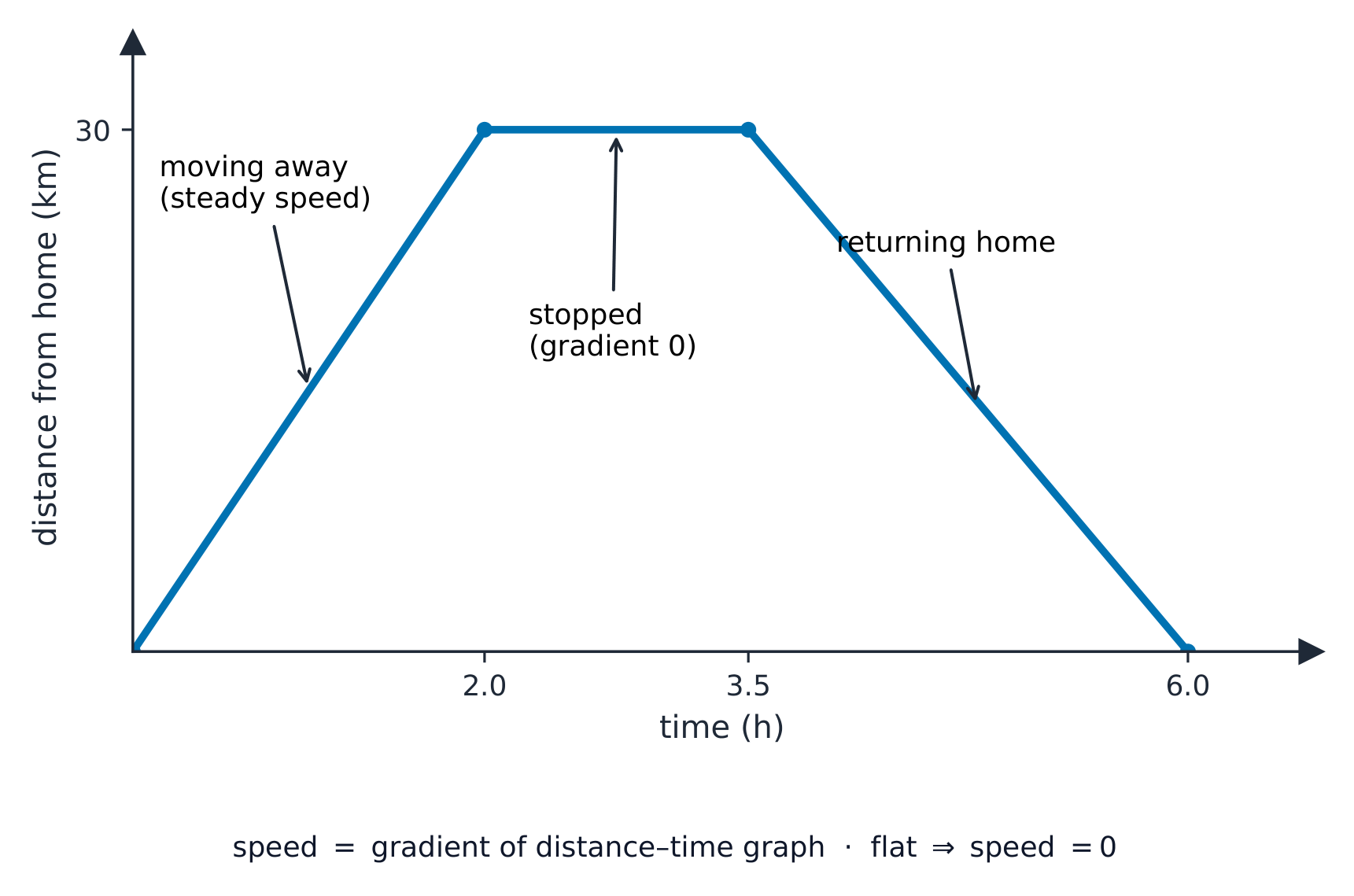
- 一个行程图(travel graph)(距离-时间图)有等于速度的斜率;一个平坦的部分意味着物体不在移动。
- 一个换算图(conversion graph)是用于在两个单位之间转换的一条直线(例如,英里和千米)。
在一个距离-时间图上斜率是速度;一个平坦的部分意味着物体已经停止。 Speed–time graphs (Extended)
在一个速度-时间图上斜率是加速度(acceleration)(若速度下降则是减速度(deceleration)),而图下的面积(area)是行驶的距离(distance)。
Worked example. 一辆车在 $8\text{ s}$ 里从静止加速到 $20\text{ m/s}$,然后在 $20\text{ m/s}$ 保持 $12\text{ s}$。求加速度和总距离。
加速度 $= \dfrac{20}{8} = 2.5\text{ m/s}^{2}$。距离是面积:一个三角形加一个矩形,
$$\tfrac{1}{2} \times 8 \times 20 + 12 \times 20 = 80 + 240 = 320\text{ m}.$$
在一个速度-时间图上斜率是加速度而下面的面积是行驶的距离。 探索Real-life graphs
y = ax + b
A distance–time or cost graph is read from its gradient and its intercept.
词汇表 训练英文 中文 拼音 gradient/ˈɡreɪdɪənt/ 斜率 xié lǜ rate of change/reɪt ɒv tʃeɪndʒ/ 变化率 biàn huà lǜ travel graph/ˈtrævl ɡræf/ 行程图 xíng chéng tú conversion graph/kənˈvɜːʃn ɡræf/ 换算图 huàn suàn tú acceleration/əkˌseləˈreɪʃn/ 加速度 jiā sù dù deceleration/dɪˌseləˈreɪʃn/ 减速度 jiǎn sù dù distance/ˈdɪstəns/ 距离 jù lí 2.10
函数的图像
大纲
Subject content Notes and examples 1 Construct tables of values, and draw, recognise and interpret graphs for functions of the following forms: • $ax + b$ • $\pm x^2 + ax + b$ • $\frac{a}{x} \ (x \neq 0)$ where $a$ and $b$ are integer constants. 2 Solve associated equations graphically, including finding and interpreting roots by graphical methods. e.g. find the intersection of a line and a curve. Subject content Notes and examples 1 Construct tables of values, and draw, recognise and interpret graphs for functions of the following forms: • $a x^n$ (includes sums of no more than three of these) • $a b^x + c$ where $n = -2, -1, -\frac{1}{2}, 0, \frac{1}{2}, 1, 2, 3$; $a$ and $c$ are rational numbers; and $b$ is a positive integer. Examples include: • $y = x^3 + x - 4$ • $y = 2x + \frac{3}{x^2}$ • $y = \frac{1}{4} \times 2^x$. 2 Solve associated equations graphically, including finding and interpreting roots by graphical methods. e.g. finding the intersection of a line and a curve. 3 Draw and interpret graphs representing exponential growth and decay problems. 来源:剑桥国际大纲
要画一个图,做一个数值表(table of values):选择 $x$ 的值、算出 $y$,然后描出坐标(coordinates)并用一条光滑的曲线连接它们。
图穿过 $x$ 轴(水平坐标轴(axis))的点是根(roots)——$y = 0$ 的解。
你能通过读一个图来解一个方程。一条线和一条曲线的交点(intersection point)给出两个方程一起的解。
对于指数增长(exponential growth)和指数衰减(exponential decay),$y = a\,b^{x} + c$ 的图越来越快地上升(或下降)并朝一条水平线变平。
探索Graphing a quadratic
y = ax² + bx + c
Drag a, b and c and watch the parabola move — its turning point and where it crosses the axes.
词汇表 训练英文 中文 拼音 table of values/ˈteɪbl ɒv ˈvæljuːz/ 数值表 shù zhí biǎo coordinates/kəʊˈɔːdɪnəts/ 坐标 zuò biāo axis/ˈæksɪs/ 坐标轴 zuò biāo zhóu roots/ruːts/ 根 gēn intersection point/ˌɪntəˈsekʃn pɔɪnt/ 交点 jiāo diǎn exponential growth/ˌekspəˈnenʃl ɡrəʊθ/ 指数增长 zhǐ shù zēng zhǎng exponential decay/ˌekspəˈnenʃl dɪˈkeɪ/ 指数衰减 zhǐ shù shuāi jiǎn 2.11
草绘曲线
大纲
Subject content Notes and examples Recognise, sketch and interpret graphs of the following functions: (a) linear (b) quadratic. Knowledge of symmetry and roots is required. Knowledge of turning points is not required. Subject content Notes and examples Recognise, sketch and interpret graphs of the following functions: (a) linear (b) quadratic (c) cubic (d) reciprocal (e) exponential. Functions will be equivalent to: • $ax + by = c$ • $y = ax^2 + bx + c$ • $y = ax^3 + b$ • $y = ax^3 + bx^2 + cx$ • $y = \frac{a}{x} + b$ • $y = ar^x + b$ where $a$, $b$ and $c$ are rational numbers and $r$ is a rational, positive number. Knowledge of turning points, roots and symmetry is required. Knowledge of vertical and horizontal asymptotes is required. Finding turning points of quadratics by completing the square is required. 来源:剑桥国际大纲
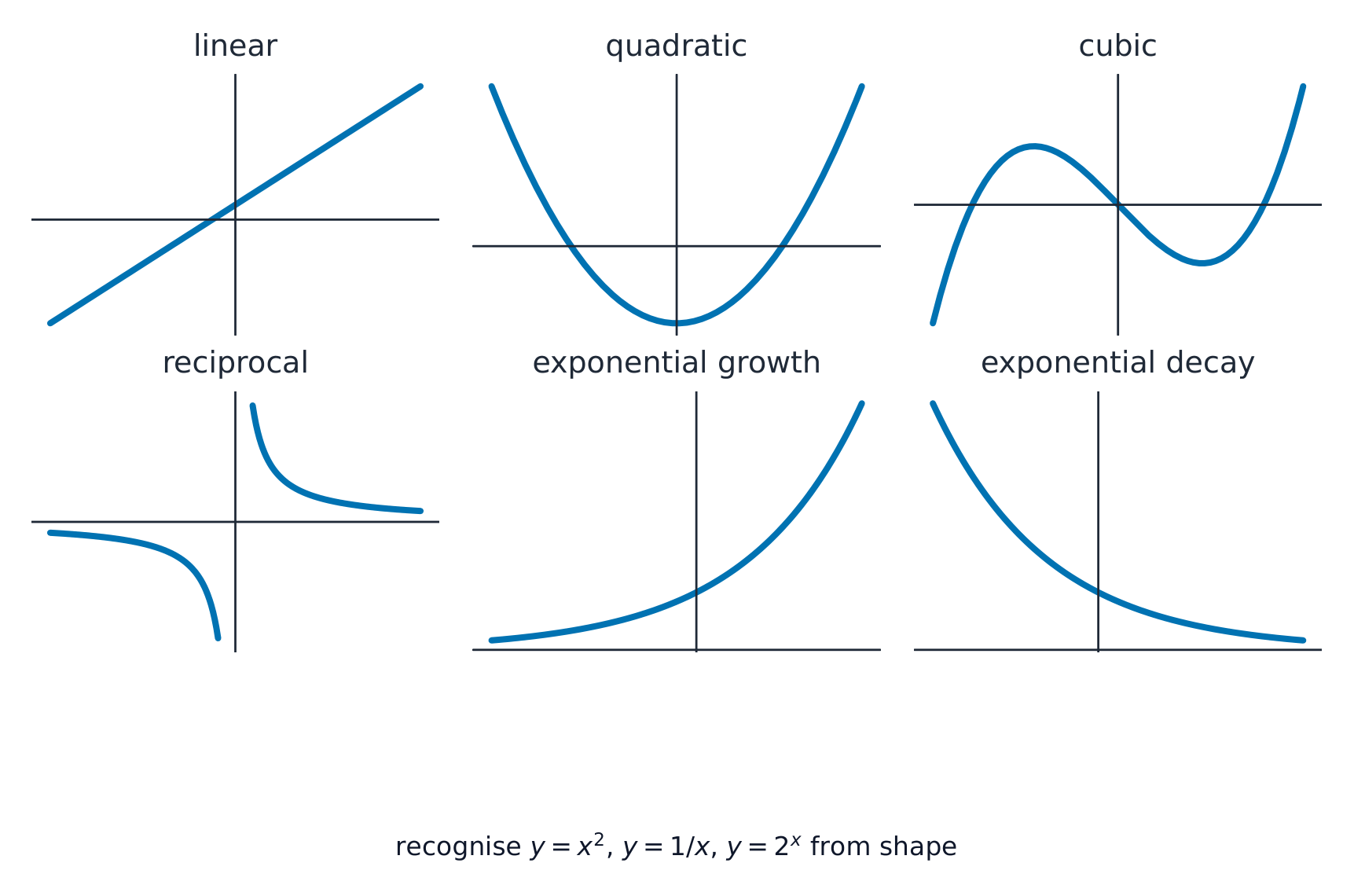
一个快速的草图应当显示正确的形状和关键特征:它在哪里穿过坐标轴、任何对称(symmetry),以及曲线接近的任何线。
函数 形状 一次,$y = mx + c$ 直线;斜率 $m$、$y$-截距(intercept)$c$ 二次,$y = ax^{2} + bx + c$ 一条抛物线(parabola)(若 $a>0$ 是 U 形,若 $a<0$ 是 $\cap$ 形) 三次,$y = ax^{3} + bx + c$ 一条 S 形曲线 反比例,$y = \dfrac{a}{x} + b$ 两条分开的曲线 指数,$y = a\,r^{x} + b$ 快速增长或衰减 基本的图形状;知道每个形状让你能从方程快速草绘。 对于一条抛物线,配方法给出转折点(turning point)(最低或最高的点)。例如 $y = (x + 3)^{2} - 8$ 在 $(-3, -8)$ 处有它的转折点。
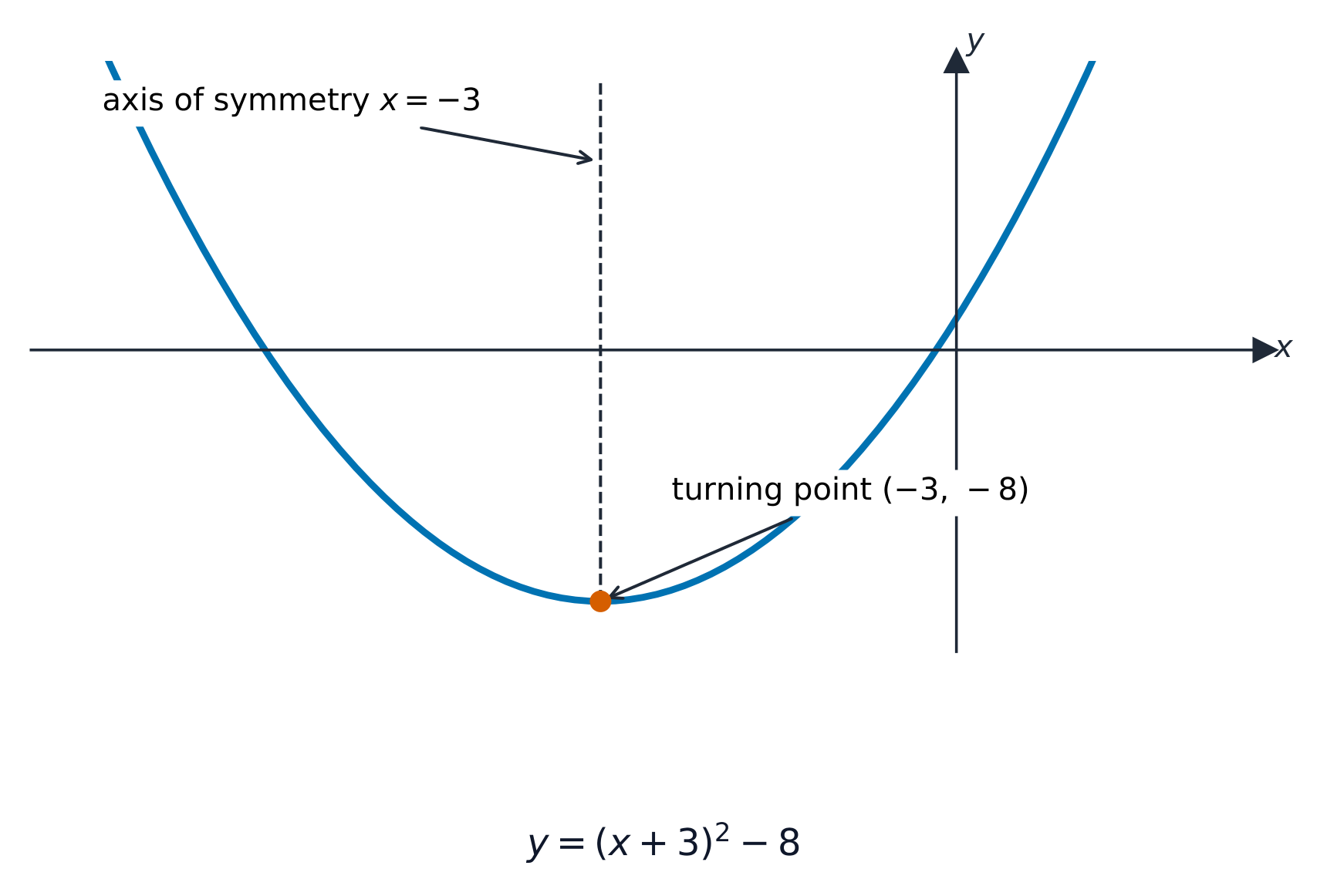
配方法,$y=(x+3)^2-8$,显示转折点 $(-3,-8)$ 和对称轴 $x=-3$。 一条渐近线(asymptote)是曲线越来越接近但从不触及的一条线——例如,$y = \dfrac{a}{x}$ 的 $x$ 轴,或 $y = a\,r^{x} + b$ 的线 $y = b$。
词汇表 训练英文 中文 拼音 symmetry/ˈsɪmətri/ 对称 duì chèn intercept/ˌɪntəˈsept/ 截距 jié jù parabola/pəˈræbələ/ 抛物线 pāo wù xiàn turning point/ˈtɜːnɪŋ pɔɪnt/ 转折点 zhuǎn zhé diǎn asymptote/ˈæsɪmptəʊt/ 渐近线 jiàn jìn xiàn 2.12
微分
大纲
Subject content Notes and examples 1 Estimate gradients of curves by drawing tangents. 2 Use the derivatives of functions of the form $ax^n$, where $a$ is a rational constant and $n$ is a positive integer or zero, and simple sums of not more than three of these. $\frac{\mathrm{d}y}{\mathrm{d}x}$ notation will be expected. 3 Apply differentiation to gradients and stationary points (turning points). 4 Discriminate between maxima and minima by any method. Maximum and minimum points may be identified by: • an accurate sketch • use of the second differential • inspecting the gradient either side of a turning point. Candidates are not expected to identify points of inflection. 来源:剑桥国际大纲
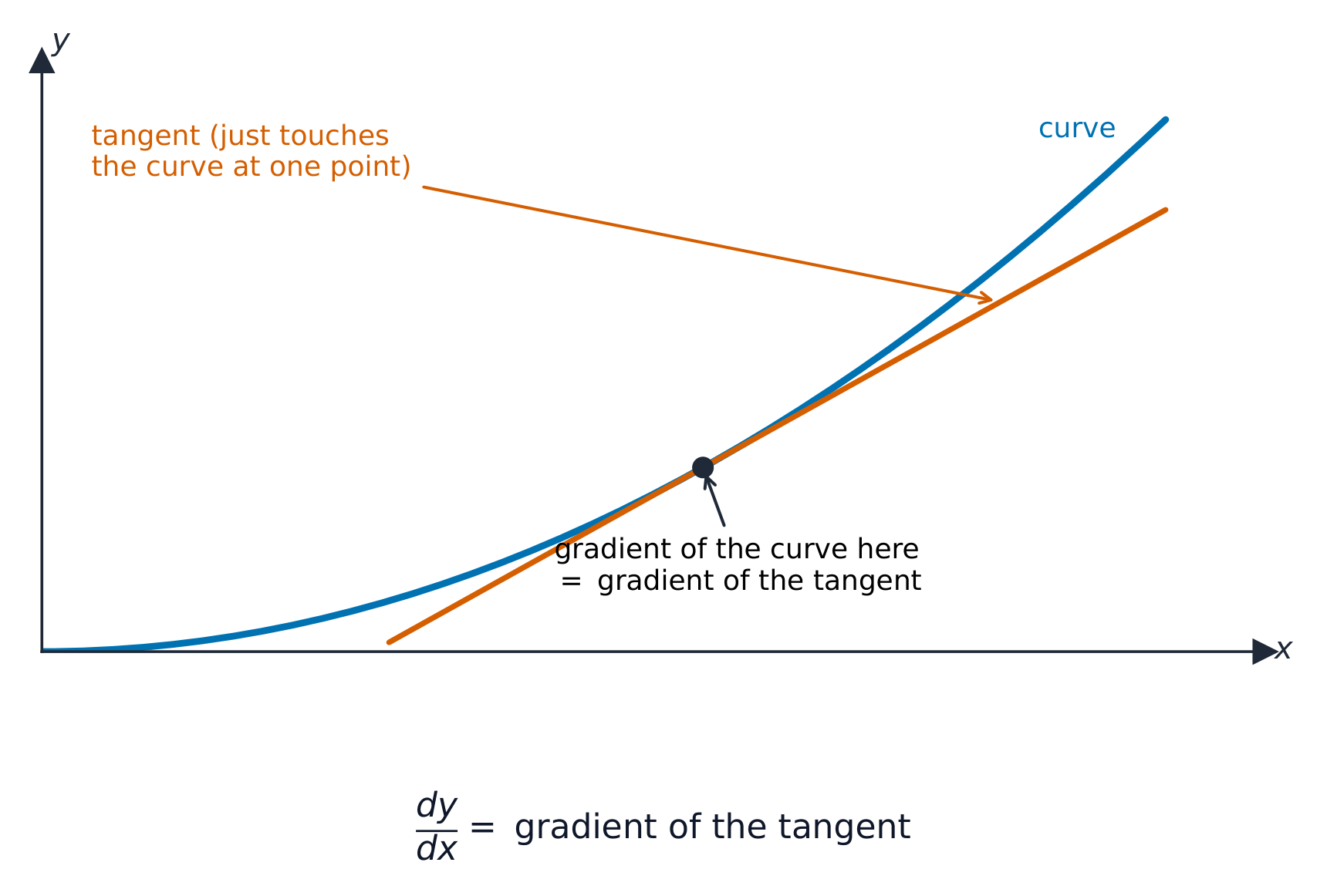
微分(differentiation)求一条曲线在任何点的斜率。你能通过画一条切线(tangent)(一条恰好触及曲线的线)并测量它的斜率来估计它。
一条曲线在一点的斜率等于那里切线的斜率——微分所求的。 精确的规则:若 $y = ax^{n}$,那么导数(derivative)是
$$\frac{\mathrm{d}y}{\mathrm{d}x} = a\,n\,x^{\,n-1}.$$逐项微分一个和。
Worked example. 若 $y = x^{3} + 2x^{2} - 5x$,那么 $\dfrac{\mathrm{d}y}{\mathrm{d}x} = 3x^{2} + 4x - 5$。
一个驻点(stationary point)(转折点)是斜率为零的地方,所以令 $\dfrac{\mathrm{d}y}{\mathrm{d}x} = 0$。
Worked example. 求 $y = x^{2} - 6x + 5$ 的转折点。
$$\frac{\mathrm{d}y}{\mathrm{d}x} = 2x - 6 = 0 \;\Rightarrow\; x = 3, \quad y = 3^{2} - 6(3) + 5 = -4.$$转折点是 $(3, -4)$。要判定一个转折点是一个最大值(maximum)还是一个最小值(minimum),检查每一侧斜率的符号,或用二阶导数(正的意味着一个最小值)。
探索Gradient of a curve
y = ax³ + bx² + cx + d
Move the point: the tangent shows the gradient there, which is what differentiation finds.
词汇表 训练英文 中文 拼音 differentiation/ˌdɪfəˌrenʃɪˈeɪʃn/ 微分 wēi fēn tangent/ˈtændʒənt/ 切线 qiè xiàn derivative/dɪˈrɪvətɪv/ 导数 dǎo shù stationary point/ˈsteɪʃənəri pɔɪnt/ 驻点 zhù diǎn maximum/ˈmæksɪməm/ 最大值 zuì dà zhí minimum/ˈmɪnɪməm/ 最小值 zuì xiǎo zhí 2.13
函数

大纲
Subject content Notes and examples 1 Understand functions, domain and range and use function notation. Examples include: • $f(x) = 3x - 5$ • $g(x) = \frac{3(x + 4)}{5}$ • $h(x) = 2x^2 + 3$. 2 Understand and find inverse functions $f^{-1}(x)$. 3 Form composite functions as defined by $gf(x) = g(f(x))$. e.g. $f(x) = \frac{3}{x + 2}$ and $g(x) = (3x + 5)^2$. Find $fg(x)$. Give your answer as a fraction in its simplest form. Candidates are not expected to find the domains and ranges of composite functions. This topic may include mapping diagrams. 来源:剑桥国际大纲
一个函数(function)把每个输入变成一个输出。我们写 $f(x)$,例如 $f(x) = 3x - 5$,所以 $f(2) = 1$。允许的输入的集合是定义域(domain);可能的输出的集合是值域(range)。
反函数(inverse function)$f^{-1}(x)$ 撤销函数。要找到它,写 $y = f(x)$、交换角色,并使 $x$ 成为主项。
Worked example. 求 $f(x) = 3x - 5$ 的反函数。
$$y = 3x - 5 \;\Rightarrow\; x = \frac{y + 5}{3}, \quad \text{so} \quad f^{-1}(x) = \frac{x + 5}{3}.$$一个函数作为一台机器;反函数向后运行它——反转顺序、撤销每一步 一个复合函数(composite function)一个接一个地应用一个函数:$gf(x)$ 意味着"先做 $f$,然后 $g$"。
Worked example. 若 $f(x) = 2x$ 而 $g(x) = x + 3$,那么
$$gf(x) = g(2x) = 2x + 3, \qquad fg(x) = f(x + 3) = 2(x + 3) = 2x + 6.$$探索Functions
y = f(x)
A function turns each input into exactly one output — watch its shape.
词汇表 训练英文 中文 拼音 function/ˈfʌŋkʃn/ 函数 hán shù domain/dəˈmeɪn/ 定义域 dìng yì yù range/reɪndʒ/ 值域 zhí yù inverse function/ɪnˈvɜːs ˈfʌŋkʃn/ 反函数 fǎn hán shù composite function/ˈkɒmpəzɪt ˈfʌŋkʃn/ 复合函数 fù hé hán shù 2.13
考试技巧
- 当你展开括号时,乘每一项并注意符号,尤其是前面有一个负号时:$-(x - 3) = -x + 3$。
- 要解一个方程,对两边做相同的事。当你把一个不等式乘以或除以一个负数时,翻转符号。
- 完全因式分解:先取出最大公因式,然后寻找一个平方差或一个二次模式。
- 一个二次式通常有两个解——给出两个。检查问题想要因式分解、公式,还是配方法。
- 当代入一个公式时,先把每个值放进括号里,这样符号和幂就出来正确。
-
3
坐标几何
本讲义涵盖主题 3,坐标几何(Coordinate geometry)。标记 (Extended) 的部分只在拓展卷上考查;其他一切对两个层次都适用。
3.1
坐标

大纲
Subject content Notes and examples Use and interpret Cartesian coordinates in two dimensions. 来源:剑桥国际大纲
一座城市街道网格:每个地方由它的坐标固定。 图上的一个点由它的坐标(coordinates)描述,有时称为笛卡尔坐标,写成 $(x, y)$。第一个数是横向的值而第二个是纵向的值。
- 这两条数轴是坐标轴(axes):水平(horizontal)$x$ 轴和竖直(vertical)$y$ 轴。
- 它们在原点(origin)相交,点 $(0, 0)$。
- 坐标轴把网格分成四个象限(quadrants)。
所以点 $(3, -2)$ 通过向右 $3$ 和向下 $2$ 找到。

坐标轴在原点 $O$ 相遇并把平面分成四个象限;$(3,-2)$ 意味着向右 $3$ 然后向下 $2$。 探索The coordinate plane
y = mx + c
Every point has an (x, y) coordinate. A straight line is the set of points where y depends on x in a fixed way.
词汇表 训练英文 中文 拼音 coordinates/kəʊˈɔːdɪnəts/ 坐标 zuò biāo axes/ˈæksɪz/ 坐标轴 zuò biāo zhóu horizontal/ˌhɒrɪˈzɒntl/ 水平 shuǐ píng vertical/ˈvɜːtɪkl/ 竖直 shù zhí origin/ˈɒrɪdʒɪn/ 原点 yuán diǎn quadrants/ˈkwɒdrənts/ 象限 xiàng xiàn 3.5
一次函数图像的方程
大纲
Subject content Notes and examples Interpret and obtain the equation of a straight-line graph in the form $y = mx + c$. Questions may: • use and request lines in the forms $y = mx + c$, $x = k$ • involve finding the equation when the graph is given • ask for the gradient or $y$-intercept of a graph from an equation, e.g. find the gradient and $y$-intercept of the graph with the equation $y = 6x + 3$. Candidates are expected to give equations of a line in a fully simplified form. Subject content Notes and examples Interpret and obtain the equation of a straight-line graph. Questions may: • use and request lines in different forms, e.g. $ax + by = c$, $y = mx + c$, $x = k$ • involve finding the equation when the graph is given • ask for the gradient or $y$-intercept of a graph from an equation, e.g. find the gradient and $y$-intercept of the graph with equation $5x + 4y = 8$. Candidates are expected to give equations of a line in a fully simplified form. 来源:剑桥国际大纲
大多数直线能被写成
$$y = mx + c,$$其中 $m$ 是斜率(gradient)(陡度)而 $c$ 是截距(intercept)——线穿过 $y$ 轴处的 $y$ 值。
- 一条像 $x = k$(例如 $x = 3$)的线是竖直的。
- 一条像 $y = k$(例如 $y = 3$)的线是水平的。
一条线也可能作为 $ax + by = c$ 给出。把它重新排列成 $y = mx + c$ 以读出斜率和截距。
Worked example. 求 $5x + 4y = 8$ 的斜率和 $y$ 截距。
$$4y = -5x + 8 \;\Rightarrow\; y = -\tfrac{5}{4}x + 2.$$所以斜率是 $-\tfrac{5}{4}$ 而 $y$ 截距是 $2$。
探索y = mx + c
y = ax + b
Drag the gradient and the intercept. a is the gradient (steepness) and b is where the line crosses the y-axis.
词汇表 训练英文 中文 拼音 gradient/ˈɡreɪdɪənt/ 斜率 xié lǜ intercept/ˌɪntəˈsept/ 截距 jié jù 3.3
一次函数图像的斜率

大纲
Subject content Notes and examples Find the gradient of a straight line. From a grid only. Subject content Notes and examples 1 Find the gradient of a straight line. 2 Calculate the gradient of a straight line from the coordinates of two points on it. 来源:剑桥国际大纲
$y = mx + c$:斜率和截距,实时 一条陡峭的山路:斜率以竖直变化除以水平变化来衡量陡度。 斜率(gradient)衡量一条线有多陡:
$$m = \frac{\text{change in } y}{\text{change in } x} = \frac{\text{rise}}{\text{run}}.$$一个正斜率向右上升;一个负斜率向右下降。
Worked example. 求过 $(1, 2)$ 和 $(4, 11)$ 的线的斜率。
$$m = \frac{11 - 2}{4 - 1} = \frac{9}{3} = 3.$$
对于 $y=mx+c$,线在 $c$ 处穿过 $y$ 轴而斜率 $m$ 是竖直变化除以水平变化。 探索Gradient
y = ax + b
The gradient a measures steepness — rise over run.
3.2
绘制一次函数图像

大纲
Subject content Notes and examples Draw straight-line graphs for linear equations. Equations will be given in the form $y = mx + c$ (e.g. $y = -2x + 5$), unless a table of values is given. Subject content Notes and examples Draw straight-line graphs for linear equations. Examples include: • $y = -2x + 5$ • $y = 7 - 4x$ • $3x + 2y = 5$. 来源:剑桥国际大纲
要画 $y = mx + c$,最快的方式是:
- 在 $y$ 轴上标记截距 $c$。
- 用斜率步进到更多的点(对于 $m = 3$,向右 $1$ 和向上 $3$)。
- 用一条直线连接这些点。
你也能做一个小的数值表(table of values):选择两个或三个 $x$ 值、算出 $y$,并描出这些点。
快速画一条线:标记截距,然后用斜率步进到新的点 词汇表 训练英文 中文 拼音 table of values/ˈteɪbl ɒv ˈvæljuːz/ 数值表 shù zhí biǎo 3.5
一次函数图像的方程
大纲
Subject content Notes and examples Interpret and obtain the equation of a straight-line graph in the form $y = mx + c$. Questions may: • use and request lines in the forms $y = mx + c$, $x = k$ • involve finding the equation when the graph is given • ask for the gradient or $y$-intercept of a graph from an equation, e.g. find the gradient and $y$-intercept of the graph with the equation $y = 6x + 3$. Candidates are expected to give equations of a line in a fully simplified form. Subject content Notes and examples Interpret and obtain the equation of a straight-line graph. Questions may: • use and request lines in different forms, e.g. $ax + by = c$, $y = mx + c$, $x = k$ • involve finding the equation when the graph is given • ask for the gradient or $y$-intercept of a graph from an equation, e.g. find the gradient and $y$-intercept of the graph with equation $5x + 4y = 8$. Candidates are expected to give equations of a line in a fully simplified form. 来源:剑桥国际大纲
若你知道斜率 $m$ 和线上的一个点,把这个点放进 $y = mx + c$ 以求 $c$。
Worked example. 一条线有斜率 $3$ 并通过 $(1, 2)$。求它的方程。
$$y = 3x + c, \qquad 2 = 3(1) + c, \qquad c = -1.$$所以方程是 $y = 3x - 1$。(若你被给出两个点,先求斜率,然后做这个。)
3.4
长度与中点

大纲
Subject content Notes and examples 1 Calculate the length of a line segment. 2 Find the coordinates of the midpoint of a line segment. 来源:剑桥国际大纲
一条线段(line segment)是两个点之间的直的部分。
要求 $(x_1, y_1)$ 和 $(x_2, y_2)$ 之间线段的长度(length),对水平和竖直的间隙用勾股定理(Pythagoras' theorem):
$$\text{length} = \sqrt{(x_2 - x_1)^2 + (y_2 - y_1)^2}.$$要求中点(midpoint)(恰好在中间的点),对坐标取平均:
$$\text{midpoint} = \left( \frac{x_1 + x_2}{2}, \; \frac{y_1 + y_2}{2} \right).$$Worked example. 求从 $(1, 2)$ 到 $(4, 6)$ 的线段的长度和中点。
$$\text{length} = \sqrt{(4 - 1)^2 + (6 - 2)^2} = \sqrt{9 + 16} = \sqrt{25} = 5.$$$$\text{midpoint} = \left( \frac{1 + 4}{2}, \; \frac{2 + 6}{2} \right) = (2.5, \, 4).$$水平间隙($3$)和竖直间隙($4$)构成一个直角三角形,所以长度是 $\sqrt{3^2+4^2}=5$;中点是坐标的平均。 探索Length and midpoint lab
midpoint is halfway between endpoints
Move along a line segment and see midpoint as halfway.
词汇表 训练英文 中文 拼音 line segment/laɪn ˈseɡmənt/ 线段 xiàn duàn length/leŋθ/ 长度 cháng dù Pythagoras' theorem/paɪˈθæɡərəs ˈθɪərəm/ 勾股定理 gōu gǔ dìng lǐ midpoint/ˈmɪdpɔɪnt/ 中点 zhōng diǎn 3.6
平行线
大纲
Subject content Notes and examples Find the gradient and equation of a straight line parallel to a given line. e.g. find the equation of the line parallel to $y = 4x - 1$ that passes through $(1, -3)$. 来源:剑桥国际大纲
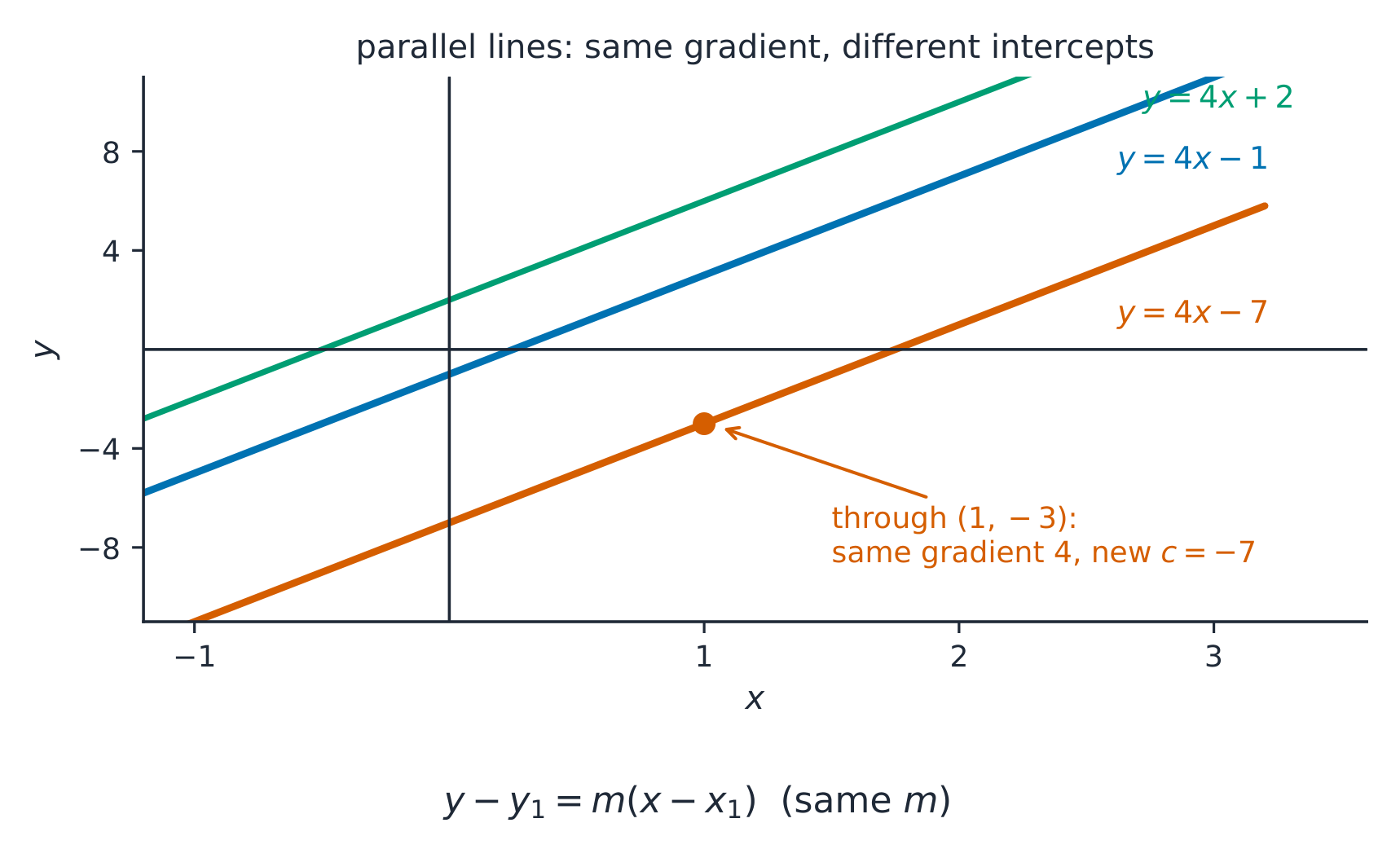
平行(parallel)线从不相遇,所以它们有相同的斜率。
Worked example. 求平行于 $y = 4x - 1$ 并通过 $(1, -3)$ 的线的方程。
斜率也是 $4$。把点放进去:
$$-3 = 4(1) + c \;\Rightarrow\; c = -7,$$所以线是 $y = 4x - 7$。
平行线:相同的斜率、不同的截距 探索Parallel & perpendicular
y = ax + b
Parallel lines share a gradient; perpendicular gradients multiply to −1.
词汇表 训练英文 中文 拼音 parallel/ˈpærəlel/ 平行 píng xíng 3.7
垂直线

大纲
Subject content Notes and examples Find the gradient and equation of a straight line perpendicular to a given line. Examples include: • find the gradient of a line perpendicular to $2y = 3x + 1$ • find the equation of the perpendicular bisector of the line joining the points $(-3, 8)$ and $(9, -2)$. 来源:剑桥国际大纲
两条线垂直(perpendicular)若它们以一个直角(right angle)相遇。它们的斜率相乘得 $-1$:
$$m_1 \times m_2 = -1, \qquad \text{so} \qquad m_2 = -\frac{1}{m_1}.$$用文字说:翻转分数并改变符号。
Worked example. 求垂直于 $2y = 3x + 1$ 的一条线的斜率。
重新排列:$y = \tfrac{3}{2}x + \tfrac{1}{2}$,所以斜率是 $\tfrac{3}{2}$。垂直斜率是 $-\tfrac{2}{3}$。
平行线共享相同的斜率;垂直斜率相乘得 $-1$。 Perpendicular bisector
一条线段的垂直平分线(perpendicular bisector)以一个直角把它切成两半。要求它的方程:得到中点,然后用过那个中点的垂直斜率。
Worked example. 求连接 $(-3, 8)$ 和 $(9, -2)$ 的线段的垂直平分线。
- 中点:$\left( \frac{-3 + 9}{2}, \frac{8 + (-2)}{2} \right) = (3, 3)$。
- 线段的斜率:$\frac{-2 - 8}{9 - (-3)} = \frac{-10}{12} = -\tfrac{5}{6}$。
- 垂直斜率:$\frac{6}{5}$。
过 $(3, 3)$:$\; 3 = \tfrac{6}{5}(3) + c \Rightarrow c = 3 - \tfrac{18}{5} = -\tfrac{3}{5}$。所以平分线是
$$y = \tfrac{6}{5}x - \tfrac{3}{5}.$$词汇表 训练英文 中文 拼音 perpendicular/ˌpɜːpənˈdɪkjʊlə/ 垂直 chuí zhí right angle/raɪt ˈæŋɡl/ 直角 zhí jiǎo perpendicular bisector/ˌpɜːpənˈdɪkjʊlə baɪˈsektə/ 垂直平分线 chuí zhí píng fēn xiàn 3.7
考试技巧
- 直线是 $y = mx + c$:$m$ 是斜率而 $c$ 是线穿过 $y$ 轴的地方。
- 斜率 = ($y$ 的变化) ÷ ($x$ 的变化)。把这两个坐标在上部和底部保持相同的顺序。
- 平行线有相同的斜率;垂直线有相乘得 $-1$ 的斜率(负倒数)。
- 中点是坐标的平均;两个点之间的距离来自对差的勾股定理。
-
4
几何
本讲义涵盖主题 4,几何(Geometry)。标记 (Extended) 的部分只在拓展卷上考查;其他一切对两个层次都适用。在考试中你必须用下面正确的名称给出理由,不只是数字。
4.1
几何术语

大纲
Subject content Notes and examples 1 Use and interpret the following geometrical terms: • point • vertex • line • parallel • perpendicular • bearing • right angle • acute, obtuse and reflex angles • interior and exterior angles • similar • congruent • scale factor. Candidates are not expected to show that two shapes are congruent. 2 Use and interpret the vocabulary of: • triangles • special quadrilaterals • polygons • nets • simple solids. Includes the following terms: Triangles: • equilateral • isosceles • scalene • right-angled. Quadrilaterals: • square • rectangle • kite • rhombus • parallelogram • trapezium. Polygons: • regular and irregular polygons • pentagon • hexagon • octagon • decagon. Simple solids: • cube • cuboid • prism • cylinder • pyramid • cone • sphere (term ‘hemisphere’ not required) • face • surface • edge. 3 Use and interpret the vocabulary of a circle. Includes the following terms: • centre • radius (plural radii) • diameter • circumference • semicircle • chord • tangent • arc • sector • segment. Subject content Notes and examples 1 Use and interpret the following geometrical terms: • point • vertex • line • plane • parallel • perpendicular • perpendicular bisector • bearing • right angle • acute, obtuse and reflex angles • interior and exterior angles • similar • congruent • scale factor. Candidates are not expected to show that two shapes are congruent. 2 Use and interpret the vocabulary of: • triangles • special quadrilaterals • polygons • nets • solids. Includes the following terms. Triangles: • equilateral • isosceles • scalene • right-angled. Quadrilaterals: • square • rectangle • kite • rhombus • parallelogram • trapezium. Polygons: • regular and irregular polygons • pentagon • hexagon • octagon • decagon. Solids: • cube • cuboid • prism • cylinder • pyramid • cone • sphere • hemisphere • frustum • face • surface • edge. 3 Use and interpret the vocabulary of a circle. Includes the following terms: • centre • radius (plural radii) • diameter • circumference • semicircle • chord • tangent • major and minor arc • sector • segment. 来源:剑桥国际大纲
两条线相遇的一个角是一个顶点(vertex)。两条线平行(parallel)若它们从不相遇,而垂直(perpendicular)若它们以一个直角相遇。角按它们的大小命名:
名称 大小 锐角(acute angle) 小于 $90^{\circ}$ 直角(right angle) 恰好 $90^{\circ}$ 钝角(obtuse angle) 在 $90^{\circ}$ 和 $180^{\circ}$ 之间 优角(reflex angle) 在 $180^{\circ}$ 和 $360^{\circ}$ 之间 按大小的角:锐角(小于 $90^\circ$)、直角($90^\circ$,由一个正方形显示)、钝角($90^\circ$–$180^\circ$)和优角($180^\circ$–$360^\circ$)。 我们用三个字母命名一个角,例如角 $ABC$ 是 $B$ 处的角。
探索Shape and angle lab
Classify angle facts by the diagram feature that creates them.
词汇表 训练英文 中文 拼音 vertex/ˈvɜːteks/ 顶点 dǐng diǎn parallel/ˈpærəlel/ 平行 píng xíng perpendicular/ˌpɜːpənˈdɪkjʊlə/ 垂直 chuí zhí acute angle/əˈkjuːt ˈæŋɡl/ 锐角 ruì jiǎo right angle/raɪt ˈæŋɡl/ 直角 zhí jiǎo obtuse angle/ɒbˈtjuːs ˈæŋɡl/ 钝角 dùn jiǎo reflex angle/ˈriːfleks ˈæŋɡl/ 优角 yōu jiǎo 4.6
角

大纲
Subject content Notes and examples 1 Calculate unknown angles and give simple explanations using the following geometrical properties: • sum of angles at a point = 360° • sum of angles at a point on a straight line = 180° • vertically opposite angles are equal • angle sum of a triangle = 180° and angle sum of a quadrilateral = 360°. Knowledge of three-letter notation for angles is required, e.g. angle $ABC$. Candidates are expected to use the correct geometrical terminology when giving reasons for answers. 2 Calculate unknown angles and give geometric explanations for angles formed within parallel lines: • corresponding angles are equal • alternate angles are equal • co-interior angles sum to 180° (supplementary). 3 Know and use angle properties of regular polygons. Includes exterior and interior angles, and angle sum. Subject content Notes and examples 1 Calculate unknown angles and give simple explanations using the following geometrical properties: • sum of angles at a point = 360° • sum of angles at a point on a straight line = 180° • vertically opposite angles are equal • angle sum of a triangle = 180° and angle sum of a quadrilateral = 360°. Knowledge of 3-letter notation for angles is required, e.g. angle $ABC$. Candidates are expected to use the correct geometrical terminology when giving reasons for answers. 2 Calculate unknown angles and give geometric explanations for angles formed within parallel lines: • corresponding angles are equal • alternate angles are equal • co-interior angles sum to 180° (supplementary). 3 Know and use angle properties of regular and irregular polygons. Includes exterior and interior angles, and angle sum. 来源:剑桥国际大纲
学这些基本事实。每一个在考试中都是一个有效的理由。
一个点周围的角加起来等于 $360$ 度 
一条直线上的角加起来等于 $180$ 度 - 一个点处的角加起来等于 $360^{\circ}$。
- 一条直线上的角加起来等于 $180^{\circ}$。
- 对顶角(vertically opposite angles)(由两条相交的线构成)相等。
Worked example. 一条直线上的三个角是 $x$、$50^{\circ}$ 和 $70^{\circ}$。求 $x$。
$$x + 50 + 70 = 180 \;\Rightarrow\; x = 60^{\circ}.$$探索Parallel line and polygon lab
Pick the angle rule that unlocks each diagram.
词汇表 训练英文 中文 拼音 vertically opposite angles/ˈvɜːtɪkli ˈɒpəzɪt ˈæŋɡlz/ 对顶角 duì dǐng jiǎo 4.6
角

大纲
Subject content Notes and examples 1 Calculate unknown angles and give simple explanations using the following geometrical properties: • sum of angles at a point = 360° • sum of angles at a point on a straight line = 180° • vertically opposite angles are equal • angle sum of a triangle = 180° and angle sum of a quadrilateral = 360°. Knowledge of three-letter notation for angles is required, e.g. angle $ABC$. Candidates are expected to use the correct geometrical terminology when giving reasons for answers. 2 Calculate unknown angles and give geometric explanations for angles formed within parallel lines: • corresponding angles are equal • alternate angles are equal • co-interior angles sum to 180° (supplementary). 3 Know and use angle properties of regular polygons. Includes exterior and interior angles, and angle sum. Subject content Notes and examples 1 Calculate unknown angles and give simple explanations using the following geometrical properties: • sum of angles at a point = 360° • sum of angles at a point on a straight line = 180° • vertically opposite angles are equal • angle sum of a triangle = 180° and angle sum of a quadrilateral = 360°. Knowledge of 3-letter notation for angles is required, e.g. angle $ABC$. Candidates are expected to use the correct geometrical terminology when giving reasons for answers. 2 Calculate unknown angles and give geometric explanations for angles formed within parallel lines: • corresponding angles are equal • alternate angles are equal • co-interior angles sum to 180° (supplementary). 3 Know and use angle properties of regular and irregular polygons. Includes exterior and interior angles, and angle sum. 来源:剑桥国际大纲
当一条线穿过两条平行线时:
- 同位角(corresponding angles)(在匹配的位置,一个 "F" 形)相等。
- 内错角(alternate angles)(穿过线的相对两侧,一个 "Z" 形)相等。
- 同旁内角(co-interior angles)(一个 "C" 形)加起来等于 $180^{\circ}$;我们说它们互补(supplementary)。
Worked example. 一条直线穿过两条平行线。一个角是 $110^{\circ}$。同旁内角 $y$ 满足 $110 + y = 180$,所以 $y = 70^{\circ}$。
同位角(F)和内错角(Z)相等;同旁内角(C)加起来等于 $180^\circ$。 词汇表 训练英文 中文 拼音 corresponding angles/ˌkɒrɪˈspɒndɪŋ ˈæŋɡlz/ 同位角 tóng wèi jiǎo alternate angles/ɔːlˈtɜːnət ˈæŋɡlz/ 内错角 nèi cuò jiǎo co-interior angles/kəʊ ɪnˈtɪərɪə ˈæŋɡlz/ 同旁内角 tóng páng nèi jiǎo supplementary/ˌsʌplɪˈmentəri/ 互补 hù bǔ interior angle/ɪnˈtɪərɪə ˈæŋɡl/ 内角 nèi jiǎo 4.1
几何术语

大纲
Subject content Notes and examples 1 Use and interpret the following geometrical terms: • point • vertex • line • parallel • perpendicular • bearing • right angle • acute, obtuse and reflex angles • interior and exterior angles • similar • congruent • scale factor. Candidates are not expected to show that two shapes are congruent. 2 Use and interpret the vocabulary of: • triangles • special quadrilaterals • polygons • nets • simple solids. Includes the following terms: Triangles: • equilateral • isosceles • scalene • right-angled. Quadrilaterals: • square • rectangle • kite • rhombus • parallelogram • trapezium. Polygons: • regular and irregular polygons • pentagon • hexagon • octagon • decagon. Simple solids: • cube • cuboid • prism • cylinder • pyramid • cone • sphere (term ‘hemisphere’ not required) • face • surface • edge. 3 Use and interpret the vocabulary of a circle. Includes the following terms: • centre • radius (plural radii) • diameter • circumference • semicircle • chord • tangent • arc • sector • segment. Subject content Notes and examples 1 Use and interpret the following geometrical terms: • point • vertex • line • plane • parallel • perpendicular • perpendicular bisector • bearing • right angle • acute, obtuse and reflex angles • interior and exterior angles • similar • congruent • scale factor. Candidates are not expected to show that two shapes are congruent. 2 Use and interpret the vocabulary of: • triangles • special quadrilaterals • polygons • nets • solids. Includes the following terms. Triangles: • equilateral • isosceles • scalene • right-angled. Quadrilaterals: • square • rectangle • kite • rhombus • parallelogram • trapezium. Polygons: • regular and irregular polygons • pentagon • hexagon • octagon • decagon. Solids: • cube • cuboid • prism • cylinder • pyramid • cone • sphere • hemisphere • frustum • face • surface • edge. 3 Use and interpret the vocabulary of a circle. Includes the following terms: • centre • radius (plural radii) • diameter • circumference • semicircle • chord • tangent • major and minor arc • sector • segment. 来源:剑桥国际大纲
一个三角形(triangle)有三条边和加起来等于 $180^{\circ}$ 的角。
一个三角形的三个角加起来等于 $180$ 度 类型 性质 等边(equilateral) 所有边相等、所有角 $60^{\circ}$ 等腰(isosceles) 两条边相等、两个角相等 不等边(scalene) 所有边和角都不同 直角 有一个直角 Worked example. 一个三角形有角 $x$、$2x$ 和 $90^{\circ}$。求 $x$。
$$x + 2x + 90 = 180 \;\Rightarrow\; 3x = 90 \;\Rightarrow\; x = 30^{\circ}.$$词汇表 训练英文 中文 拼音 triangle/ˈtraɪæŋɡl/ 三角形 sān jiǎo xíng equilateral/ˌiːkwɪˈlætərəl/ 等边 děng biān isosceles/aɪˈsɒsəliːz/ 等腰 děng yāo scalene/ˈskeɪliːn/ 不等边 bù děng biān 4.1
几何术语
大纲
Subject content Notes and examples 1 Use and interpret the following geometrical terms: • point • vertex • line • parallel • perpendicular • bearing • right angle • acute, obtuse and reflex angles • interior and exterior angles • similar • congruent • scale factor. Candidates are not expected to show that two shapes are congruent. 2 Use and interpret the vocabulary of: • triangles • special quadrilaterals • polygons • nets • simple solids. Includes the following terms: Triangles: • equilateral • isosceles • scalene • right-angled. Quadrilaterals: • square • rectangle • kite • rhombus • parallelogram • trapezium. Polygons: • regular and irregular polygons • pentagon • hexagon • octagon • decagon. Simple solids: • cube • cuboid • prism • cylinder • pyramid • cone • sphere (term ‘hemisphere’ not required) • face • surface • edge. 3 Use and interpret the vocabulary of a circle. Includes the following terms: • centre • radius (plural radii) • diameter • circumference • semicircle • chord • tangent • arc • sector • segment. Subject content Notes and examples 1 Use and interpret the following geometrical terms: • point • vertex • line • plane • parallel • perpendicular • perpendicular bisector • bearing • right angle • acute, obtuse and reflex angles • interior and exterior angles • similar • congruent • scale factor. Candidates are not expected to show that two shapes are congruent. 2 Use and interpret the vocabulary of: • triangles • special quadrilaterals • polygons • nets • solids. Includes the following terms. Triangles: • equilateral • isosceles • scalene • right-angled. Quadrilaterals: • square • rectangle • kite • rhombus • parallelogram • trapezium. Polygons: • regular and irregular polygons • pentagon • hexagon • octagon • decagon. Solids: • cube • cuboid • prism • cylinder • pyramid • cone • sphere • hemisphere • frustum • face • surface • edge. 3 Use and interpret the vocabulary of a circle. Includes the following terms: • centre • radius (plural radii) • diameter • circumference • semicircle • chord • tangent • major and minor arc • sector • segment. 来源:剑桥国际大纲
一个四边形(quadrilateral)有四条边和加起来等于 $360^{\circ}$ 的角。
形状 性质 正方形(square) 四条相等的边、四个直角 矩形(rectangle) 对边相等、四个直角 平行四边形(parallelogram) 对边平行且相等 菱形(rhombus) 四条相等的边、对边平行 鸢形(kite) 两对相邻的相等的边 梯形(trapezium) 一对平行的边 词汇表 训练英文 中文 拼音 quadrilateral/ˌkwɒdrɪˈlætərəl/ 四边形 sì biān xíng square/skweə/ 正方形 zhèng fāng xíng rectangle/ˈrektæŋɡl/ 矩形 jǔ xíng parallelogram/ˌpærəˈleləɡræm/ 平行四边形 píng xíng sì biān xíng rhombus/ˈrɒmbəs/ 菱形 líng xíng kite/kaɪt/ 鸢形 yuān xíng trapezium/trəˈpiːzɪəm/ 梯形 tī xíng 4.6
角

大纲
Subject content Notes and examples 1 Calculate unknown angles and give simple explanations using the following geometrical properties: • sum of angles at a point = 360° • sum of angles at a point on a straight line = 180° • vertically opposite angles are equal • angle sum of a triangle = 180° and angle sum of a quadrilateral = 360°. Knowledge of three-letter notation for angles is required, e.g. angle $ABC$. Candidates are expected to use the correct geometrical terminology when giving reasons for answers. 2 Calculate unknown angles and give geometric explanations for angles formed within parallel lines: • corresponding angles are equal • alternate angles are equal • co-interior angles sum to 180° (supplementary). 3 Know and use angle properties of regular polygons. Includes exterior and interior angles, and angle sum. Subject content Notes and examples 1 Calculate unknown angles and give simple explanations using the following geometrical properties: • sum of angles at a point = 360° • sum of angles at a point on a straight line = 180° • vertically opposite angles are equal • angle sum of a triangle = 180° and angle sum of a quadrilateral = 360°. Knowledge of 3-letter notation for angles is required, e.g. angle $ABC$. Candidates are expected to use the correct geometrical terminology when giving reasons for answers. 2 Calculate unknown angles and give geometric explanations for angles formed within parallel lines: • corresponding angles are equal • alternate angles are equal • co-interior angles sum to 180° (supplementary). 3 Know and use angle properties of regular and irregular polygons. Includes exterior and interior angles, and angle sum. 来源:剑桥国际大纲
一个蜂巢用正六边形镶嵌平面。 一个多边形(polygon)是一个有直边的形状。一个正多边形(regular polygon)有所有边和所有角相等。
边 名称 5 五边形(pentagon) 6 六边形(hexagon) 8 八边形(octagon) 10 十边形(decagon) 对于一个有 $n$ 条边的多边形:
$$\text{sum of interior angles} = (n - 2) \times 180^{\circ}, \qquad \text{sum of exterior angles} = 360^{\circ}.$$每个角处的内角(interior angle)和外角(exterior angle)加起来等于 $180^{\circ}$。
Worked example. 求一个正六边形的每个内角。
外角是 $\dfrac{360^{\circ}}{6} = 60^{\circ}$,所以每个内角是 $180^{\circ} - 60^{\circ} = 120^{\circ}$。

在每个角处内角和外角加起来等于 $180^\circ$;一个正六边形有 $60^\circ$ 外角和 $120^\circ$ 内角。 词汇表 训练英文 中文 拼音 polygon/ˈpɒlɪɡən/ 多边形 duō biān xíng regular polygon/ˈreɡjʊlə ˈpɒlɪɡən/ 正多边形 zhèng duō biān xíng pentagon/ˈpentæɡən/ 五边形 wǔ biān xíng hexagon/ˈheksæɡən/ 六边形 liù biān xíng octagon/ˈɒktæɡən/ 八边形 bā biān xíng decagon/dɪˈkæɡən/ 十边形 shí biān xíng exterior angle/ekˈstɪərɪə ˈæŋɡl/ 外角 wài jiǎo 4.5
对称

大纲
Subject content Notes and examples Recognise line symmetry and order of rotational symmetry in two dimensions. Includes properties of triangles, quadrilaterals and polygons directly related to their symmetries. Subject content Notes and examples 1 Recognise line symmetry and order of rotational symmetry in two dimensions. Includes properties of triangles, quadrilaterals and polygons directly related to their symmetries. 2 Recognise symmetry properties of prisms, cylinders, pyramids and cones. e.g. identify planes and axes of symmetry. 来源:剑桥国际大纲
泰姬陵沿它的中心有一条清晰的对称轴。 - 一个形状有轴对称(line symmetry)若一条镜像线把它分成两个匹配的一半。
- 一个形状有旋转对称(rotational symmetry)若在你转动它时它落到它自身上。阶数是它在一个整圈里落上多少次。
对于立体(拓展(Extended)),一个把立体分成镜像两半的平坦切片是一个对称面(plane of symmetry),而你能围绕它旋转的一条线是一条对称轴(axis of symmetry)。
探索Symmetry as a reflection
A shape has line symmetry if reflecting it leaves it unchanged. Reflect the shape and watch what is preserved.
词汇表 训练英文 中文 拼音 line symmetry/laɪn ˈsɪmətri/ 轴对称 zhóu duì chèn rotational symmetry/rəʊˈteɪʃənl ˈsɪmətri/ 旋转对称 xuán zhuǎn duì chèn plane of symmetry/pleɪn ɒv ˈsɪmətri/ 对称面 duì chèn miàn axis of symmetry/ˈæksɪs ɒv ˈsɪmətri/ 对称轴 duì chèn zhóu 4.1
几何术语

大纲
Subject content Notes and examples 1 Use and interpret the following geometrical terms: • point • vertex • line • parallel • perpendicular • bearing • right angle • acute, obtuse and reflex angles • interior and exterior angles • similar • congruent • scale factor. Candidates are not expected to show that two shapes are congruent. 2 Use and interpret the vocabulary of: • triangles • special quadrilaterals • polygons • nets • simple solids. Includes the following terms: Triangles: • equilateral • isosceles • scalene • right-angled. Quadrilaterals: • square • rectangle • kite • rhombus • parallelogram • trapezium. Polygons: • regular and irregular polygons • pentagon • hexagon • octagon • decagon. Simple solids: • cube • cuboid • prism • cylinder • pyramid • cone • sphere (term ‘hemisphere’ not required) • face • surface • edge. 3 Use and interpret the vocabulary of a circle. Includes the following terms: • centre • radius (plural radii) • diameter • circumference • semicircle • chord • tangent • arc • sector • segment. Subject content Notes and examples 1 Use and interpret the following geometrical terms: • point • vertex • line • plane • parallel • perpendicular • perpendicular bisector • bearing • right angle • acute, obtuse and reflex angles • interior and exterior angles • similar • congruent • scale factor. Candidates are not expected to show that two shapes are congruent. 2 Use and interpret the vocabulary of: • triangles • special quadrilaterals • polygons • nets • solids. Includes the following terms. Triangles: • equilateral • isosceles • scalene • right-angled. Quadrilaterals: • square • rectangle • kite • rhombus • parallelogram • trapezium. Polygons: • regular and irregular polygons • pentagon • hexagon • octagon • decagon. Solids: • cube • cuboid • prism • cylinder • pyramid • cone • sphere • hemisphere • frustum • face • surface • edge. 3 Use and interpret the vocabulary of a circle. Includes the following terms: • centre • radius (plural radii) • diameter • circumference • semicircle • chord • tangent • major and minor arc • sector • segment. 来源:剑桥国际大纲
术语 含义 圆(circle) 与一个圆心距离相同的所有点 圆心(centre) 中间的点 半径(radius) 圆心到边缘(复数 radii) 直径(diameter) 直接穿过圆心($= 2 \times$ 半径) 圆周(circumference) 绕一整圈的距离 弦(chord) 连接圆上两点的一条直线 弧(arc) 圆周的一部分 扇形(sector) 两条半径之间的一个"披萨片" 弓形(segment) 被一条弦切下的区域 半圆(semicircle) 半个圆 切线(tangent) 在一个点触及圆的一条线 一个圆的主要部分:一条弦连接两点,而一条切线只在一点触及。 
一个扇形是两条半径之间的一个片、一个弓形被一条弦切下、一个弧是圆周的一部分,而一个半圆是圆的一半。 探索Arc and sector
Drag the angle and radius to see the arc (part of the circumference) and the sector (pie slice) it cuts off.
词汇表 训练英文 中文 拼音 circle/ˈsɜːkl/ 圆 yuán centre/ˈsentə/ 圆心 yuán xīn radius/ˈreɪdɪəs/ 半径 bàn jìng diameter/daɪˈæmɪtə/ 直径 zhí jìng circumference/sɜːˈkʌmfrəns/ 圆周 yuán zhōu chord/kɔːd/ 弦 xián arc/ɑːk/ 弧 hú sector/ˈsektə/ 扇形 shàn xíng segment/ˈseɡmənt/ 弓形 gōng xíng semicircle/ˈsemɪsɜːkl/ 半圆 bàn yuán tangent/ˈtændʒənt/ 切线 qiè xiàn 4.7 4.8
圆的定理

大纲
Subject content Notes and examples Calculate unknown angles and give explanations using the following geometrical properties of circles: • angle in a semicircle = 90° • angle between tangent and radius = 90°. Candidates will be expected to use the geometrical properties listed in the syllabus when giving reasons for answers. Subject content Notes and examples Calculate unknown angles and give explanations using the following geometrical properties of circles: • angle in a semicircle = 90° • angle between tangent and radius = 90° • angle at the centre is twice the angle at the circumference • angles in the same segment are equal • opposite angles of a cyclic quadrilateral sum to 180° (supplementary) • alternate segment theorem. Candidates are expected to use the geometrical properties listed in the syllabus when giving reasons for answers. Subject content Notes and examples Use the following symmetry properties of circles: • equal chords are equidistant from the centre • the perpendicular bisector of a chord passes through the centre • tangents from an external point are equal in length. Candidates are expected to use the geometrical properties listed in the syllabus when giving reasons for answers. 来源:剑桥国际大纲
半圆里的角:总是 $90$ 度 圆心处的角:总是两倍 用这些来求未知的角,总是给出理由。
对于两个层次:
- 半圆里的角是 $90^{\circ}$。
- 一条切线和一条半径之间的角是 $90^{\circ}$。
两个层次的两个定理:半圆里的角是 $90^\circ$,而一条切线以 $90^\circ$ 遇到一条半径。 拓展(定理 I):
- 圆心处的角是圆周处角的两倍(站在同一条弧上)。
- 同一弓形里的角相等。
- 一个圆内接四边形(cyclic quadrilateral)的对角加起来等于 $180^{\circ}$。
- 弦切角定理(alternate segment theorem):一条切线和一条弦之间的角等于另一个弓形里的角。
拓展(定理 II): 相等的弦与圆心距离相同;一条弦的垂直平分线通过圆心;从同一个外部点的两条切线长度相等。
Worked example. A、B、C 在一个圆上。圆周处的角 $ABC$ 是 $40^{\circ}$。求圆心 $O$ 处的角 $AOC$。
圆心处的角是圆周处角的两倍:$2 \times 40^{\circ} = 80^{\circ}$。

圆心处的角($80^\circ$)是站在同一条弧上圆周处角($40^\circ$)的两倍。 词汇表 训练英文 中文 拼音 cyclic quadrilateral/ˈsaɪklɪk ˌkwɒdrɪˈlætərəl/ 圆内接四边形 yuán nèi jiē sì biān xíng alternate segment theorem/ɔːlˈtɜːnət ˈseɡmənt ˈθɪərəm/ 弦切角定理 xián qiē jiǎo dìng lǐ 4.4
相似
大纲
Subject content Notes and examples Calculate lengths of similar shapes. Subject content Notes and examples 1 Calculate lengths of similar shapes. 2 Use the relationships between lengths and areas of similar shapes and lengths, surface areas and volumes of similar solids. Includes use of scale factor, e.g. $$\frac{\text{Volume of } A}{\text{Volume of } B} = \frac{(\text{Length of } A)^3}{(\text{Length of } B)^3}$$3 Solve problems and give simple explanations involving similarity. Includes showing that two triangles are similar using geometric reasons. 来源:剑桥国际大纲
两个形状相似(similar)若一个是另一个的一个放大:相同的角,而所有边乘以相同的比例因子(scale factor)$k$。(尺寸和形状完全相同的形状是全等(congruent)。)
对于相似的形状和立体:
$$\frac{\text{area of } A}{\text{area of } B} = k^{2}, \qquad \frac{\text{volume of } A}{\text{volume of } B} = k^{3}.$$Worked example. 两个相似的立体有比 $2 : 3$ 的长度。较小的有体积 $40\text{ cm}^{3}$。求较大的体积。
体积比是 $2^{3} : 3^{3} = 8 : 27$。所以较大的体积是 $40 \times \dfrac{27}{8} = 135\text{ cm}^{3}$。
探索Similar shapes — enlargement
Similar shapes are the same shape but a different size. An enlargement scales every length by the same factor; angles stay the same.
词汇表 训练英文 中文 拼音 similar/ˈsɪmɪlə/ 相似 xiāng sì scale factor/skeɪl ˈfæktə/ 比例因子 bǐ lì yīn zi congruent/ˈkɒŋɡruːənt/ 全等 quán děng 4.6
角

大纲
Subject content Notes and examples 1 Calculate unknown angles and give simple explanations using the following geometrical properties: • sum of angles at a point = 360° • sum of angles at a point on a straight line = 180° • vertically opposite angles are equal • angle sum of a triangle = 180° and angle sum of a quadrilateral = 360°. Knowledge of three-letter notation for angles is required, e.g. angle $ABC$. Candidates are expected to use the correct geometrical terminology when giving reasons for answers. 2 Calculate unknown angles and give geometric explanations for angles formed within parallel lines: • corresponding angles are equal • alternate angles are equal • co-interior angles sum to 180° (supplementary). 3 Know and use angle properties of regular polygons. Includes exterior and interior angles, and angle sum. Subject content Notes and examples 1 Calculate unknown angles and give simple explanations using the following geometrical properties: • sum of angles at a point = 360° • sum of angles at a point on a straight line = 180° • vertically opposite angles are equal • angle sum of a triangle = 180° and angle sum of a quadrilateral = 360°. Knowledge of 3-letter notation for angles is required, e.g. angle $ABC$. Candidates are expected to use the correct geometrical terminology when giving reasons for answers. 2 Calculate unknown angles and give geometric explanations for angles formed within parallel lines: • corresponding angles are equal • alternate angles are equal • co-interior angles sum to 180° (supplementary). 3 Know and use angle properties of regular and irregular polygons. Includes exterior and interior angles, and angle sum. 来源:剑桥国际大纲
一个方位角(bearing)把一个方向作为一个三位数的角给出,从北顺时针(clockwise)测量,从 $000^{\circ}$ 到 $360^{\circ}$。所以正东是 $090^{\circ}$ 而正南是 $180^{\circ}$。
Worked example. $B$ 从 $A$ 的方位角是 $025^{\circ}$。求 $A$ 从 $B$ 的方位角。
返回(反向)方位角相差 $180^{\circ}$:$025^{\circ} + 180^{\circ} = 205^{\circ}$。
一个方位角从北顺时针测量为三位数;反向方位角相差 $180^\circ$。 探索Bearings route
Follow how to measure a bearing correctly from north.
词汇表 训练英文 中文 拼音 bearing/ˈbeərɪŋ/ 方位角 fāng wèi jiǎo clockwise/ˈklɒkwaɪz/ 顺时针 shùn shí zhēn 4.2 4.3
几何作图

大纲
Subject content Notes and examples 1 Measure and draw lines and angles. A ruler should be used for all straight edges. Constructions of perpendicular bisectors and angle bisectors are not required. 2 Construct a triangle, given the lengths of all sides, using a ruler and pair of compasses only. e.g. construct a rhombus by drawing two triangles. Construction arcs must be shown. 3 Draw, use and interpret nets. Examples include: • draw nets of cubes, cuboids, prisms and pyramids • use measurements from nets to calculate volumes and surface areas. Subject content Notes and examples 1 Draw and interpret scale drawings. A ruler must be used for all straight edges. 2 Use and interpret three-figure bearings. Bearings are measured clockwise from north (000° to 360°). e.g. find the bearing of A from B if the bearing of B from A is 025°. Includes an understanding of the terms north, east, south and west. e.g. point D is due east of point C. Subject content Notes and examples 1 Draw and interpret scale drawings. A ruler must be used for all straight edges. 2 Use and interpret three-figure bearings. Bearings are measured clockwise from north ($000^{\circ}$ to $360^{\circ}$). e.g. find the bearing of $A$ from $B$ if the bearing of $B$ from $A$ is $025^{\circ}$. Includes an understanding of the terms north, east, south and west. e.g. point $D$ is due east of point $C$. 来源:剑桥国际大纲
- 要从三条给定的边作图(construct)一个三角形,用一把尺子画底边,然后用一副圆规(compasses)把每条其他边标记为一条弧。让作图弧显示出来。
- 一个展开图(net)是一个折叠成一个立体的平坦形状。你能用一个展开图算出表面积。
- 一个比例图(scale drawing)以一个固定的比例更小(或更大)地显示一个真实物体,例如 $1\text{ cm}$ 对 $5\text{ m}$。
展开一个立体给出它的展开图。把各片的面积相加以得到表面积:一个圆柱是 $2\pi r^{2} + 2\pi r h$。 常见的几何体(solids)及其部分:
立体 备注 立方体(cube) / 长方体(cuboid) 盒子形状 棱柱(prism) 沿它整个长度相同的形状 圆柱(cylinder) 一个圆形棱柱 棱锥(pyramid) / 圆锥(cone) 收到一个点 球(sphere) / 半球(hemisphere) 一个球 / 半个球 平截头体(frustum) 一个顶部被切掉的圆锥或棱锥 一个立体的一个平坦的边是一个面(face),两个面在一条棱(edge)相遇,而整个外部是它的表面(surface)。
探索Construction and solid lab
Classify geometry tasks by the tool or representation needed.
词汇表 训练英文 中文 拼音 construct/ˈkɒnstrʌkt/ 作图 zuò tú compasses/ˈkʌmpəsɪz/ 圆规 yuán guī net/net/ 展开图 zhǎn kāi tú scale drawing/skeɪl ˈdrɔːɪŋ/ 比例图 bǐ lì tú solids/ˈsɒlɪdz/ 几何体 jǐ hé tǐ cube/kjuːb/ 立方体 lì fāng tǐ cuboid/ˈkjuːbɔɪd/ 长方体 cháng fāng tǐ prism/ˈprɪzəm/ 棱柱 léng zhù cylinder/ˈsɪlɪndə/ 圆柱 yuán zhù pyramid/ˈpɪrəmɪd/ 棱锥 léng zhuī cone/kəʊn/ 圆锥 yuán zhuī sphere/sfɪə/ 球 qiú hemisphere/ˈhemɪsfɪə/ 半球 bàn qiú frustum/ˈfrʌstəm/ 平截头体 píng jié tóu tǐ face/feɪs/ 面 miàn edge/edʒ/ 棱 léng surface/ˈsɜːfɪs/ 表面 biǎo miàn 4.2 4.3
考试技巧
- 一条直线上的角加起来等于 $180°$、一个点周围等于 $360°$,而一个三角形里等于 $180°$。为一道角题的每一步给出一个理由。
- 学圆定理:圆心处的角是圆周处角的两倍;半圆里的角是 $90°$;同一弓形里的角相等;一个圆内接四边形的对角加起来等于 $180°$。
- 任何多边形的外角加起来等于 $360°$,而每个内角 + 它的外角 = $180°$。
- 方位角从北顺时针测量并总是用三位数写(例如 $072°$)。
-
5
测量
本讲义涵盖主题 5,测量(Mensuration)(测量长度、面积和体积)。这里的核心和拓展内容几乎相同。在考试中,一些公式在公式表(List of formulas)里给出,但你仍应当把它们全部学会。
5.1
度量单位

大纲
Subject content Notes and examples Use metric units of mass, length, area, volume and capacity in practical situations and convert quantities into larger or smaller units. Units include: • mm, cm, m, km • $\text{mm}^2$, $\text{cm}^2$, $\text{m}^2$, $\text{km}^2$ • $\text{mm}^3$, $\text{cm}^3$, $\text{m}^3$ • ml, l • g, kg. Conversion between units includes: • between different units of area, e.g. $\text{cm}^2 \leftrightarrow \text{m}^2$ • between units of volume and capacity, e.g. $\text{m}^3 \leftrightarrow \text{litres}$. 来源:剑桥国际大纲
我们对质量(mass)(g、kg)、长度(length)(mm、cm、m、km)、面积(area)、体积(volume)和容量(capacity)(ml、升——一个容器里面的空间)使用公制(metric)单位。
换算长度单位:向下乘、向上除 要换算单位,对平方和立方要小心:
- 长度:$1\text{ m} = 100\text{ cm}$。
- 面积:$1\text{ m}^{2} = 100^{2} = 10\,000\text{ cm}^{2}$。
- 体积:$1\text{ m}^{3} = 100^{3} = 1\,000\,000\text{ cm}^{3}$。
- 容量:$1\text{ litre} = 1000\text{ cm}^{3}$,所以 $1\text{ m}^{3} = 1000$ 升。
Worked example. 把 $3\text{ m}^{2}$ 换算成 $\text{cm}^{2}$。
$$3 \times 10\,000 = 30\,000\text{ cm}^{2}.$$探索Unit choice lab
Choose the unit that matches the measurement scale.
词汇表 训练英文 中文 拼音 metric/ˈmetrɪk/ 公制 gōng zhì mass/mæs/ 质量 zhì liàng length/leŋθ/ 长度 cháng dù area/ˈeərɪə/ 面积 miàn jī volume/ˈvɒljuːm/ 体积 tǐ jī capacity/kəˈpæsɪti/ 容量 róng liàng 5.2
面积与周长

大纲
Subject content Notes and examples Carry out calculations involving the perimeter and area of a rectangle, triangle, parallelogram and trapezium. Except for area of a triangle, formulas are not given. Subject content Notes and examples Carry out calculations involving the perimeter and area of a rectangle, triangle, parallelogram and trapezium. Except for the area of a triangle, formulas are not given. 来源:剑桥国际大纲
周长(perimeter)是绕一个形状一整圈的距离。面积是它里面平坦空间的量。这里 $b$ 是底(base)而 $h$ 是垂直高(height)。
形状 面积 矩形(rectangle) $\text{length} \times \text{width}$ 三角形(triangle) $\tfrac{1}{2} \times b \times h$ 平行四边形(parallelogram) $b \times h$ 梯形(trapezium) $\tfrac{1}{2}(a + b)h$,其中 $a$ 和 $b$ 是两条平行边 基本形状的面积;$b$ 是底、$h$ 是垂直高,而 $a$、$b$ 是一个梯形的两条平行边。 Worked example. 一个梯形有平行边 $6\text{ cm}$ 和 $10\text{ cm}$,以及高 $4\text{ cm}$。求它的面积。
$$\tfrac{1}{2}(6 + 10) \times 4 = \tfrac{1}{2} \times 16 \times 4 = 32\text{ cm}^{2}.$$探索Area scaling lab
area = side^2
Change side length and see why area grows quadratically.
词汇表 训练英文 中文 拼音 perimeter/pəˈrɪmɪtə/ 周长 zhōu cháng base/beɪs/ 底 dǐ height/haɪt/ 高 gāo rectangle/ˈrektæŋɡl/ 矩形 jǔ xíng triangle/ˈtraɪæŋɡl/ 三角形 sān jiǎo xíng parallelogram/ˌpærəˈleləɡræm/ 平行四边形 píng xíng sì biān xíng trapezium/trəˈpiːzɪəm/ 梯形 tī xíng 5.3
圆、弧与扇形

大纲
Subject content Notes and examples 1 Carry out calculations involving the circumference and area of a circle. Answers may be asked for in terms of $\pi$. 2 Carry out calculations involving arc length and sector area as fractions of the circumference and area of a circle, where the sector angle is a factor of $360^\circ$. Formulas are given in the List of formulas. Subject content Notes and examples 1 Carry out calculations involving the circumference and area of a circle. Answers may be asked for in terms of $\pi$. Formulas are given in the List of formulas. 2 Carry out calculations involving arc length and sector area as fractions of the circumference and area of a circle. Includes minor and major sectors. 来源:剑桥国际大纲
对于一个有半径(radius)$r$(和直径(diameter)$d = 2r$)的圆(circle):
一个圆:圆周 $= \pi d$ 而面积 $= \pi r^2$ $$\text{circumference} = 2\pi r = \pi d, \qquad \text{area} = \pi r^{2}.$$圆周(circumference)是绕圆一圈的距离。
Worked example. 一个圆有半径 $7\text{ cm}$。求它的圆周和面积(在答案里保留 $\pi$)。
$$\text{circumference} = 2\pi \times 7 = 14\pi\text{ cm}, \qquad \text{area} = \pi \times 7^{2} = 49\pi\text{ cm}^{2}.$$词汇表 训练英文 中文 拼音 circle/ˈsɜːkl/ 圆 yuán radius/ˈreɪdɪəs/ 半径 bàn jìng diameter/daɪˈæmɪtə/ 直径 zhí jìng circumference/sɜːˈkʌmfrəns/ 圆周 yuán zhōu 5.3
圆、弧与扇形

大纲
Subject content Notes and examples 1 Carry out calculations involving the circumference and area of a circle. Answers may be asked for in terms of $\pi$. 2 Carry out calculations involving arc length and sector area as fractions of the circumference and area of a circle, where the sector angle is a factor of $360^\circ$. Formulas are given in the List of formulas. Subject content Notes and examples 1 Carry out calculations involving the circumference and area of a circle. Answers may be asked for in terms of $\pi$. Formulas are given in the List of formulas. 2 Carry out calculations involving arc length and sector area as fractions of the circumference and area of a circle. Includes minor and major sectors. 来源:剑桥国际大纲
一个弧(arc)是圆周的一部分。一个扇形(sector)是两条半径之间的一个"披萨片"。若扇形角是 $\theta$,弧和扇形是整个圆的那个分数 $\dfrac{\theta}{360}$:
$$\text{arc length} = \frac{\theta}{360} \times 2\pi r, \qquad \text{sector area} = \frac{\theta}{360} \times \pi r^{2}.$$一个扇形是整个圆的分数 $\tfrac{\theta}{360}$,所以它的弧和面积是圆周和面积的那个分数。 一个小的片是一个小扇形(minor sector);大的其余是一个大扇形(major sector)。
Worked example. 求一个角 $90^{\circ}$、半径 $8\text{ cm}$ 的扇形的弧长(arc length)和面积。
分数是 $\dfrac{90}{360} = \dfrac{1}{4}$,所以
$$\text{arc} = \tfrac{1}{4} \times 2\pi \times 8 = 4\pi\text{ cm}, \qquad \text{area} = \tfrac{1}{4} \times \pi \times 8^{2} = 16\pi\text{ cm}^{2}.$$探索Arcs & sectors
s = rθ · A = ½r²θ
A bigger angle or radius means a longer arc and larger sector area.
探索Arc length and sector area
Change the angle and radius and read off the arc length and sector area — a fraction of the whole circle.
词汇表 训练英文 中文 拼音 arc/ɑːk/ 弧 hú sector/ˈsektə/ 扇形 shàn xíng minor sector/ˈmaɪnə ˈsektə/ 小扇形 xiǎo shàn xíng major sector/ˈmeɪdʒə ˈsektə/ 大扇形 dà shàn xíng arc length/ɑːk leŋθ/ 弧长 hú zhǎng 5.4
表面积与体积

大纲
Subject content Notes and examples Carry out calculations and solve problems involving the surface area and volume of a: • cuboid • prism • cylinder • sphere • pyramid • cone. Answers may be asked for in terms of $\pi$. The following formulas are given in the List of formulas: • curved surface area of a cylinder • curved surface area of a cone • surface area of a sphere • volume of a prism • volume of a pyramid • volume of a cylinder • volume of a cone • volume of a sphere. The term prism refers to any solid with a uniform cross-section, e.g. a cylindrical sector. 来源:剑桥国际大纲
吉萨金字塔是方底棱锥——一个三维立体。 表面积(surface area)是所有外部面的总面积。体积是里面的空间。对于这些立体($r$ = 半径,$h$ = 高):
立体 体积 表面积 长方体(cuboid) $\text{length} \times \text{width} \times \text{height}$ 把六个面相加 棱柱(prism) (横截面(cross-section)面积) $\times$ 长度 — 圆柱(cylinder) $\pi r^{2} h$ $2\pi r h$(侧面积(curved surface area)) $+\, 2\pi r^{2}$ 棱锥(pyramid) $\tfrac{1}{3} \times \text{base area} \times h$ — 圆锥(cone) $\tfrac{1}{3}\pi r^{2} h$ $\pi r l$(侧) $+\, \pi r^{2}$,其中 $l$ 是斜高(slant height) 球(sphere) $\tfrac{4}{3}\pi r^{3}$ $4\pi r^{2}$ 
常见的立体和它们体积和表面积公式里用的尺寸($r$、$h$、$\ell$、斜高 $l$)。 Worked example. 一个圆柱有半径 $5\text{ cm}$ 和高 $10\text{ cm}$。求它的体积和总表面积(以 $\pi$ 表示)。
$$\text{volume} = \pi \times 5^{2} \times 10 = 250\pi\text{ cm}^{3}.$$$$\text{surface area} = 2\pi(5)(10) + 2\pi(5)^{2} = 100\pi + 50\pi = 150\pi\text{ cm}^{2}.$$探索Volume scaling lab
surface area grows with scale^2
Change length scale and see volume grow faster than surface area.
词汇表 训练英文 中文 拼音 surface area/ˈsɜːfɪs ˈeərɪə/ 表面积 biǎo miàn jī cuboid/ˈkjuːbɔɪd/ 长方体 cháng fāng tǐ prism/ˈprɪzəm/ 棱柱 léng zhù cross-section/krɒs ˈsekʃn/ 横截面 héng jié miàn cylinder/ˈsɪlɪndə/ 圆柱 yuán zhù curved surface area/kɜːvd ˈsɜːfɪs ˈeərɪə/ 侧面积 cè miàn jī pyramid/ˈpɪrəmɪd/ 棱锥 léng zhuī cone/kəʊn/ 圆锥 yuán zhuī slant height/slænt haɪt/ 斜高 xié gāo sphere/sfɪə/ 球 qiú 5.5
复合图形与图形的部分

大纲
Subject content Notes and examples 1 Carry out calculations and solve problems involving perimeters and areas of: • compound shapes • parts of shapes. Answers may be asked for in terms of $\pi$. 2 Carry out calculations and solve problems involving surface areas and volumes of: • compound solids • parts of solids. e.g. find the volume of half of a sphere. Subject content Notes and examples 1 Carry out calculations and solve problems involving perimeters and areas of: • compound shapes • parts of shapes. Answers may be asked for in terms of $\pi$. 2 Carry out calculations and solve problems involving surface areas and volumes of: • compound solids • parts of solids. e.g. find the surface area and volume of a frustum. 来源:剑桥国际大纲
堆叠的集装箱是长方体;体积是长度乘宽度乘高度。 一个组合图形(compound shape)通过连接或切割简单形状构成。把它分成你知道的部分,然后加或减。
对于一个圆或立体的"部分",取正确的分数。例如,一个半球(hemisphere)(半个球)有体积
$$\tfrac{1}{2} \times \tfrac{4}{3}\pi r^{3} = \tfrac{2}{3}\pi r^{3}.$$一个平截头体(frustum)是一个顶部被切掉的圆锥或棱锥;通过从整个圆锥减去小的顶部圆锥来求它的体积。
Worked example. 求一个由一个矩形 $8\text{ cm} \times 5\text{ cm}$ 加一端一个直径 $5\text{ cm}$ 的半圆构成的形状的面积。

把一个组合图形分成你知道的部分——这里一个矩形加一个半圆——然后把面积相加。 半圆有半径 $2.5\text{ cm}$:
$$\text{area} = 8 \times 5 + \tfrac{1}{2}\pi (2.5)^{2} = 40 + 3.125\pi \approx 49.8\text{ cm}^{2}.$$探索Compound shape route
Break a compound shape into simple parts, then recombine.
词汇表 训练英文 中文 拼音 compound shape/ˈkɒmpaʊnd ʃeɪp/ 组合图形 zǔ hé tú xíng hemisphere/ˈhemɪsfɪə/ 半球 bàn qiú frustum/ˈfrʌstəm/ 平截头体 píng jié tóu tǐ 5.5
考试技巧
- 把公式匹配到形状:一个圆的面积是 $\pi r^2$、圆周是 $\pi d$(或 $2\pi r$)——不要把它们搞混。
- 保持单位一致,并记住面积单位是平方的而体积单位是立方的(例如 $1\text{ m}^2 = 10\,000\text{ cm}^2$)。
- 对于一个弧或扇形,取整个圆周或面积的分数 $\frac{\theta}{360}$。
- 表面积是所有面的总和——若你不确定就画展开图。只有在问题允许时才以 $\pi$ 表示保留一个答案。
-
6
三角学
本讲义涵盖主题 6,三角学(Trigonometry)。标记 (Extended) 的部分只在拓展卷上考查;其他一切对两个层次都适用。角的答案给到一个小数位。
6.1
勾股定理

大纲
Subject content Notes and examples Know and use Pythagoras’ theorem. 来源:剑桥国际大纲
勾股定理:重排证明 勾股定理(Pythagoras' theorem)连接一个直角三角形(right-angled triangle)(一个有一个 $90^{\circ}$ 角的三角形(triangle))的三条边。若最长的边(斜边(hypotenuse),在直角对面)是 $c$,那么
$$a^{2} + b^{2} = c^{2}.$$用它来求一条缺失的边。
勾股定理作为面积:两条较短的边上的正方形($9+16$)加起来等于斜边上的正方形($25$)。 Worked example. 一个直角三角形有一条 $13\text{ cm}$ 的斜边和一条 $5\text{ cm}$ 的短边。求另一条短边。
$$b^{2} = 13^{2} - 5^{2} = 169 - 25 = 144, \qquad b = \sqrt{144} = 12\text{ cm}.$$探索Pythagoras' theorem
Change the two short sides and see $a^2 + b^2 = c^2$ — the squares on the sides really do add up.
词汇表 训练英文 中文 拼音 Pythagoras' theorem/paɪˈθæɡərəs ˈθɪərəm/ 勾股定理 gōu gǔ dìng lǐ right-angled triangle/raɪt ˈæŋɡld ˈtraɪæŋɡl/ 直角三角形 zhí jiǎo sān jiǎo xíng triangle/ˈtraɪæŋɡl/ 三角形 sān jiǎo xíng hypotenuse/haɪˈpɒtənjuːs/ 斜边 xié biān 6.2
直角三角形

大纲
Subject content Notes and examples 1 Know and use the sine, cosine and tangent ratios for acute angles in calculations involving sides and angles of a right-angled triangle. Angles will be given in degrees and answers should be written in degrees, with decimals correct to one decimal place. 2 Solve problems in two dimensions using Pythagoras’ theorem and trigonometry. Knowledge of bearings may be required. Subject content Notes and examples 1 Know and use the sine, cosine and tangent ratios for acute angles in calculations involving sides and angles of a right-angled triangle. Angles will be given in degrees and answers should be written in degrees, with decimals correct to one decimal place. 2 Solve problems in two dimensions using Pythagoras’ theorem and trigonometry. Knowledge of bearings may be required. 3 Know that the perpendicular distance from a point to a line is the shortest distance to the line. 4 Carry out calculations involving angles of elevation and depression. 来源:剑桥国际大纲
SOH CAH TOA:比属于角 从你正在使用的角标注这些边:对边(opposite)(在角的对面)、邻边(adjacent)(在角旁边),和斜边。这三个比是正弦(sine)、余弦(cosine)和正切(tangent ratio)(sin、cos、tan):
$$\sin\theta = \frac{\text{opp}}{\text{hyp}}, \qquad \cos\theta = \frac{\text{adj}}{\text{hyp}}, \qquad \tan\theta = \frac{\text{opp}}{\text{adj}}.$$把它们记作 SOH-CAH-TOA。要求一个角,用反函数($\sin^{-1}$、$\cos^{-1}$、$\tan^{-1}$)。
从角 $\theta$ 命名这些边:对边在它的对面、邻边在它旁边,而斜边在直角对面(SOH-CAH-TOA)。 Worked example (find a side). 在一个直角三角形里斜边是 $10\text{ cm}$ 而角是 $30^{\circ}$。求对边。
$$\text{opp} = 10 \times \sin 30^{\circ} = 10 \times 0.5 = 5\text{ cm}.$$Worked example (find an angle). 对边是 $4\text{ cm}$ 而邻边是 $3\text{ cm}$。
$$\tan\theta = \frac{4}{3}, \qquad \theta = \tan^{-1}\!\left(\frac{4}{3}\right) = 53.1^{\circ}.$$探索Sine, cosine and tangent
Drag the angle on the unit circle to see where sin, cos and tan come from.
词汇表 训练英文 中文 拼音 opposite/ˈɒpəzɪt/ 对边 duì biān adjacent/əˈdʒeɪsənt/ 邻边 lín biān sine/saɪn/ 正弦 zhèng xián cosine/ˈkəʊsaɪn/ 余弦 yú xián tangent ratio/ˈtændʒənt ˈreɪʃɪəʊ/ 正切 zhèng qiē 6.2
直角三角形

大纲
Subject content Notes and examples 1 Know and use the sine, cosine and tangent ratios for acute angles in calculations involving sides and angles of a right-angled triangle. Angles will be given in degrees and answers should be written in degrees, with decimals correct to one decimal place. 2 Solve problems in two dimensions using Pythagoras’ theorem and trigonometry. Knowledge of bearings may be required. 3 Know that the perpendicular distance from a point to a line is the shortest distance to the line. 4 Carry out calculations involving angles of elevation and depression. 来源:剑桥国际大纲
仰视一座塔涉及一个仰角。 仰角(angle of elevation)是从水平向上到你上方一个物体的角。俯角(angle of depression)是从水平向下到你下方一个物体的角。从一个点到一条线的最短距离是垂直(perpendicular)距离。

仰角从水平向上看;俯角向下看。 Worked example. 从距一座塔的脚 $50\text{ m}$ 的一个点,到顶部的仰角是 $40^{\circ}$。求塔的高度。
$$\text{height} = 50 \times \tan 40^{\circ} = 50 \times 0.839 = 42.0\text{ m}.$$词汇表 训练英文 中文 拼音 angle of elevation/ˈæŋɡl ɒv ˌelɪˈveɪʃn/ 仰角 yǎng jiǎo angle of depression/ˈæŋɡl ɒv dɪˈpreʃn/ 俯角 fǔ jiǎo perpendicular/ˌpɜːpənˈdɪkjʊlə/ 垂直 chuí zhí 6.3
三角函数的精确值

大纲
Subject content Notes and examples Know the exact values of: 1 $\sin x$ and $\cos x$ for $x = 0^\circ, 30^\circ, 45^\circ, 60^\circ$ and $90^\circ$. 2 $\tan x$ for $x = 0^\circ, 30^\circ, 45^\circ$ and $60^\circ$. 来源:剑桥国际大纲
你必须不用计算器就知道这些精确值。
$x$ $0^{\circ}$ $30^{\circ}$ $45^{\circ}$ $60^{\circ}$ $90^{\circ}$ $\sin x$ $0$ $\tfrac{1}{2}$ $\tfrac{\sqrt{2}}{2}$ $\tfrac{\sqrt{3}}{2}$ $1$ $\cos x$ $1$ $\tfrac{\sqrt{3}}{2}$ $\tfrac{\sqrt{2}}{2}$ $\tfrac{1}{2}$ $0$ $\tan x$ $0$ $\tfrac{1}{\sqrt{3}}$ $1$ $\sqrt{3}$ — 这两个特殊三角形是精确值的来源——值得记住。 6.4
三角函数

大纲
Subject content Notes and examples 1 Recognise, sketch and interpret the following graphs for $0^\circ \leqslant x \leqslant 360^\circ$: • $y = \sin x$ • $y = \cos x$ • $y = \tan x$. 2 Solve trigonometric equations involving $\sin x$, $\cos x$ or $\tan x$, for $0^\circ \leqslant x \leqslant 360^\circ$. e.g. solve: • $\sin x = \frac{\sqrt{3}}{2}$ for $0^\circ \leqslant x \leqslant 360^\circ$ • $2 \cos x + 1 = 0$ for $0^\circ \leqslant x \leqslant 360^\circ$. 来源:剑桥国际大纲
一个摩天轮:轮缘上的一个点在转动时描出一条正弦曲线。 对于 $0^{\circ} \leqslant x \leqslant 360^{\circ}$:
- $y = \sin x$ 是一个波,在 $0$ 开始、在 $90^{\circ}$ 达到峰值、在 $180^{\circ}$ 回到 $0$、在 $270^{\circ}$ 下到 $-1$。
- $y = \cos x$ 是同样的波但在 $1$ 开始。
- $y = \tan x$ 陡峭地上升并每 $180^{\circ}$ 重复。

$y=\sin x$ 和 $y=\cos x$ 是 $-1$ 和 $1$ 之间的光滑波;余弦是正弦向左移 $90^\circ$。 一个三角方程(trigonometric equation)在这个范围里常常有不止一个答案。用图(或波的对称)来找到它们全部。
Worked example. 对 $0^{\circ} \leqslant x \leqslant 360^{\circ}$ 解 $\sin x = \tfrac{\sqrt{3}}{2}$。
一个答案是 $x = 60^{\circ}$。正弦波在 $180^{\circ} - 60^{\circ} = 120^{\circ}$ 处也是 $\tfrac{\sqrt{3}}{2}$。所以 $x = 60^{\circ}$ 或 $120^{\circ}$。
Worked example. 对 $0^{\circ} \leqslant x \leqslant 360^{\circ}$ 解 $2\cos x + 1 = 0$。
$$\cos x = -\tfrac{1}{2} \;\Rightarrow\; x = 120^{\circ} \text{ or } 240^{\circ}.$$探索Trig graphs & equations
(cos θ, sin θ)
As θ turns, sin and cos trace their waves — and repeat every 360°.
词汇表 训练英文 中文 拼音 trigonometric equation/ˌtrɪɡənəʊˈmetrɪk ɪˈkweɪʒn/ 三角方程 sān jiǎo fāng chéng 6.5
非直角三角形

大纲
Subject content Notes and examples 1 Use the sine and cosine rules in calculations involving lengths and angles for any triangle. Includes problems involving obtuse angles and the ambiguous case. 2 Use the formula $\text{area of triangle} = \frac{1}{2} ab \sin C$. The sine and cosine rules and the formula for area of a triangle are given in the List of formulas. 来源:剑桥国际大纲
对于任何三角形(不只是直角的),边 $a, b, c$ 在角 $A, B, C$ 的对面:
$$\text{sine rule:}\quad \frac{a}{\sin A} = \frac{b}{\sin B} = \frac{c}{\sin C},$$$$\text{cosine rule:}\quad a^{2} = b^{2} + c^{2} - 2bc\cos A.$$在任何三角形里,边 $a$、$b$、$c$ 位于相同字母的角 $A$、$B$、$C$ 的对面。 当你有一条边和它的对角时用正弦定理(sine rule)。当你有两条边和它们之间的角、或全部三条边时用余弦定理(cosine rule)。用正弦定理时,注意两解情况(ambiguous case),那里一个角可能是锐角或钝角。
任何三角形的面积是
$$\text{area} = \tfrac{1}{2}ab\sin C.$$Worked example. 一个三角形有 $b = 7\text{ cm}$、$c = 8\text{ cm}$ 而它们之间的角 $A = 40^{\circ}$。求边 $a$。
$$a^{2} = 7^{2} + 8^{2} - 2(7)(8)\cos 40^{\circ} = 113 - 112 \times 0.766 = 27.2,$$$$a = \sqrt{27.2} = 5.2\text{ cm}.$$探索Sine & cosine rule
Two sides and the angle between them fix the triangle: the cosine rule finds the third side, the sine rule the other angles.
探索What sin and cos mean
Spin the angle on the unit circle: the horizontal leg is cos θ and the vertical leg is sin θ — the same ratios the sine and cosine rules use.
词汇表 训练英文 中文 拼音 sine rule/saɪn ruːl/ 正弦定理 zhèng xián dìng lǐ cosine rule/ˈkəʊsaɪn ruːl/ 余弦定理 yú xián dìng lǐ ambiguous case/æmˈbɪɡjuːəs keɪs/ 两解情况 liǎng jiě qíng kuàng 6.6
三维中的勾股定理与三角学
大纲
Subject content Notes and examples Carry out calculations and solve problems in three dimensions using Pythagoras' theorem and trigonometry, including calculating the angle between a line and a plane. 来源:剑桥国际大纲
在三维里,在立体里面找到一个直角三角形,然后对它用勾股定理或三角学。一个常见的任务是一条线和一个平坦表面(一个平面(plane))之间的角。
Worked example. 一个盒子有一个 $6\text{ cm}$ 乘 $8\text{ cm}$ 的底和 $5\text{ cm}$ 的高。求一条空间对角线和底之间的角。
先是底对角线:$\sqrt{6^{2} + 8^{2}} = \sqrt{100} = 10\text{ cm}$。这条对角线和高构成一个直角三角形,所以与底的角 $\theta$ 是
$$\tan\theta = \frac{5}{10} = 0.5, \qquad \theta = \tan^{-1}(0.5) = 26.6^{\circ}.$$探索Pythagoras' theorem
In a right-angled triangle a² + b² = c². The same idea, applied twice, gives lengths inside 3-D solids.
词汇表 训练英文 中文 拼音 plane/pleɪn/ 平面 píng miàn 6.6
考试技巧
- 当没有角时用勾股定理($a^2 + b^2 = c^2$);当涉及一个角时用 SOH-CAH-TOA。
- 斜边总是在直角对面。相对于你正在使用的角标注这些边(对边、邻边、斜边)。
- 要求一个角,用反函数($\sin^{-1}$、$\cos^{-1}$、$\tan^{-1}$),并检查你的计算器设置为度。
- 对于一个没有直角的三角形,用正弦定理或余弦定理——当你知道两条边和它们之间的角时用余弦定理。
-
7
变换与向量
本讲义涵盖主题 7,变换和向量(Transformations and vectors)。标记 (Extended) 的部分只在拓展卷上考查;其他一切对两个层次都适用。向量作为一个整体主题是拓展。
7.1
变换

大纲
Subject content Notes and examples Recognise, describe and draw the following transformations: Questions will not involve combinations of transformations. A ruler must be used for all straight edges. 1 Reflection of a shape in a vertical or horizontal line. 2 Rotation of a shape about the origin, vertices or midpoints of edges of the shape, through multiples of 90°. 3 Enlargement of a shape from a centre by a scale factor. Positive and fractional scale factors only. 4 Translation of a shape by a vector $\begin{pmatrix} x \\ y \end{pmatrix}$. Transformations Notes and examples Recognise, describe and draw the following transformations: Questions may involve combinations of transformations. A ruler must be used for all straight edges. 1 Reflection of a shape in a straight line. 2 Rotation of a shape about a centre through multiples of 90°. 3 Enlargement of a shape from a centre by a scale factor. Positive, fractional and negative scale factors may be used. 4 Translation of a shape by a vector $\begin{pmatrix} x \\ y \end{pmatrix}$. 来源:剑桥国际大纲
平移、反射、旋转、放大 几何瓷砖通过反射、旋转和平移形状构建。 一个变换(transformation)改变一个形状的位置或大小。原来的是对象而结果是像。有四种类型。当被要求描述一个时,你必须命名类型并给出下面的全部细节。
Reflection
一个反射(reflection)把形状翻过一条对称轴(mirror line)。每个像点与这条线的距离和对象点相同,在另一侧。
- 要描述它,给出对称轴的方程(对于核心,一条水平或竖直的线;拓展允许任何线,例如 $y = x$)。
Worked example. 把点 $(3, 2)$ 在 $y$ 轴反射。只有 $x$ 的符号改变:像是 $(-3, 2)$。(在 $x$ 轴它会是 $(3, -2)$。)

一个反射把形状翻过一条对称轴(这里是 $y$ 轴);每个点和它的像与这条线距离相同。 Rotation
一个旋转(rotation)把形状绕一个固定的点、旋转的中心(centre)、转动 $90^{\circ}$ 的倍数。
- 要描述它,给出中心、角度和方向(顺时针或逆时针)。
Worked example. 把 $(3, 1)$ 绕原点逆时针旋转 $90^{\circ}$。规则是 $(x, y) \to (-y, x)$,所以像是 $(-1, 3)$。

一个旋转把形状绕一个固定中心转动——这里绕原点逆时针 $90^\circ$。 Enlargement
一个放大(enlargement)以一个比例因子(scale factor)$k$ 改变大小,从一个固定中心测量。从中心的每个距离乘以 $k$。
- 要描述它,给出中心和比例因子。一个分数的比例因子(在 0 和 1 之间)使形状变得更小。对于拓展,$k$ 还可能是负的(像出现在中心的另一侧)。
Worked example. 把 $(1, 2)$ 从原点以比例因子 $2$ 放大。两个坐标都乘:像是 $(2, 4)$。

一个放大把从中心的每个距离乘以比例因子(这里 $2$)。 Translation
一个平移(translation)不转动地滑动形状,以一个写成列向量(column vector)$\begin{pmatrix} x \\ y \end{pmatrix}$ 的向量(vector)($x$ 横向,$y$ 纵向)。
Worked example. 把 $(5, 3)$ 平移 $\begin{pmatrix} -2 \\ 4 \end{pmatrix}$:向左 $2$ 和向上 $4$ 移动得到 $(3, 7)$。

一个平移把每个点滑动相同的列向量,不转动。 (拓展: 一个问题可能要求你组合两个变换并描述有相同效果的单个变换。)
探索Transforming a shape
Translate, reflect, rotate or enlarge the shape and watch where it lands.
词汇表 训练英文 中文 拼音 transformation/trænsfɔːˈmeɪʃn/ 变换 biàn huàn reflection/rɪˈflekʃn/ 反射 fǎn shè mirror line/ˈmɪrə laɪn/ 对称轴 duì chèn zhóu rotation/rəʊˈteɪʃn/ 旋转 xuán zhuǎn centre/ˈsentə/ 中心 zhōng xīn enlargement/enˈlɑːdʒmənt/ 放大 fàng dà scale factor/skeɪl ˈfæktə/ 比例因子 bǐ lì yīn zi translation/trænˈsleɪʃn/ 平移 píng yí vector/ˈvektə/ 向量 xiàng liàng column vector/ˈkɒlʌm ˈvektə/ 列向量 liè xiàng liàng 7.2
二维向量

大纲
Vectors in two dimensions Notes and examples 1 Describe a translation using a vector represented by $\begin{pmatrix} x \\ y \end{pmatrix}$, $\overrightarrow{AB}$ or $\mathbf{a}$. Vectors will be printed as $\overrightarrow{AB}$ or $\mathbf{a}$. 2 Add and subtract vectors. 3 Multiply a vector by a scalar. 来源:剑桥国际大纲
像风这样的力是向量,既有大小又有方向。 一个向量既有大小又有方向。它能被写成一个列向量、作为 $\overrightarrow{AB}$(从 $A$ 到 $B$),或以粗体作为 $\mathbf{a}$。
- 通过分别对上部和底部的数处理来加或减。
- 通过把两个数都乘来乘以一个标量(scalar)(一个普通的数)。
Worked example. 若 $\mathbf{a} = \begin{pmatrix} 3 \\ 1 \end{pmatrix}$ 而 $\mathbf{b} = \begin{pmatrix} 2 \\ -4 \end{pmatrix}$,那么
$$\mathbf{a} + \mathbf{b} = \begin{pmatrix} 5 \\ -3 \end{pmatrix}, \qquad 3\mathbf{a} = \begin{pmatrix} 9 \\ 3 \end{pmatrix}.$$
按三角形法则相加:从 $\mathbf{a}$ 的尖端画 $\mathbf{b}$,而 $\mathbf{a}+\mathbf{b}$ 从起点跑到终点。 探索Adding vectors
Drag two vectors and add them tip to tail to get the resultant.
词汇表 训练英文 中文 拼音 scalar/ˈskeɪlə/ 标量 biāo liàng 7.3
向量的模

大纲
Magnitude of a vector Notes and examples Calculate the magnitude of a vector $\begin{pmatrix} x \\ y \end{pmatrix}$ as $\sqrt{x^2 + y^2}$. The magnitudes of vectors will be denoted by modulus signs, e.g. • $|\mathbf{a}|$ is the magnitude of $\mathbf{a}$ • $|\overrightarrow{AB}|$ is the magnitude of $\overrightarrow{AB}$. 来源:剑桥国际大纲
一个向量的模(magnitude)(长度)用勾股定理求出。对于 $\begin{pmatrix} x \\ y \end{pmatrix}$,
$$\left| \begin{pmatrix} x \\ y \end{pmatrix} \right| = \sqrt{x^{2} + y^{2}}.$$Worked example. $\begin{pmatrix} 3 \\ 4 \end{pmatrix}$ 的模是 $\sqrt{3^{2} + 4^{2}} = \sqrt{25} = 5$。
$\begin{pmatrix}3\\4\end{pmatrix}$ 的模来自对它的水平和竖直部分的勾股定理。 词汇表 训练英文 中文 拼音 magnitude/ˈmæɡnɪtjuːd/ 模 mó 7.4
向量几何

大纲
Vector geometry Notes and examples 1 Represent vectors by directed line segments. 2 Use position vectors. 3 Use the sum and difference of two or more vectors to express given vectors in terms of two coplanar vectors. 4 Use vectors to reason and to solve geometric problems. Examples include: • show that vectors are parallel • show that 3 points are collinear • solve vector problems involving ratio and similarity. 来源:剑桥国际大纲
一个向量能被画成一条有向线段(directed line segment)(一个箭头)。一个点的位置向量(position vector)是从原点 $O$ 到那个点的向量。
一个关键的思想:从 $A$ 到 $B$ 的向量是
$$\overrightarrow{AB} = \mathbf{b} - \mathbf{a},$$其中 $\mathbf{a}$ 和 $\mathbf{b}$ 是 $A$ 和 $B$ 的位置向量。
要从 $A$ 到 $B$,沿 $\mathbf{a}$ 回到 $O$ 然后沿 $\mathbf{b}$ 向前:所以 $\overrightarrow{AB} = \mathbf{b} - \mathbf{a}$。 两个向量平行(parallel)若一个是另一个的一个标量倍(例如 $\overrightarrow{AB} = 2\,\overrightarrow{CD}$)。三个点共线(collinear)(在一条直线上)若它们之间的向量平行并共享一个点。你能用两个共面(coplanar)向量表示任何向量。
Worked example. $O$ 是原点,$\overrightarrow{OA} = \mathbf{a}$ 而 $\overrightarrow{OB} = \mathbf{b}$。$M$ 是 $AB$ 的中点。用 $\mathbf{a}$ 和 $\mathbf{b}$ 求 $\overrightarrow{OM}$。
$$\overrightarrow{OM} = \mathbf{a} + \tfrac{1}{2}\overrightarrow{AB} = \mathbf{a} + \tfrac{1}{2}(\mathbf{b} - \mathbf{a}) = \tfrac{1}{2}(\mathbf{a} + \mathbf{b}).$$探索Vector geometry
resultant = a + b
Combine vectors to reach a point — the resultant is the direct route.
词汇表 训练英文 中文 拼音 directed line segment/daɪˈrektɪd laɪn ˈseɡmənt/ 有向线段 yǒu xiàng xiàn duàn position vector/pəˈzɪʃn ˈvektə/ 位置向量 wèi zhì xiàng liàng parallel/ˈpærəlel/ 平行 píng xíng collinear/ˈkɒlɪnɪə/ 共线 gòng xiàn coplanar/ˌkəʊˈpleɪnə/ 共面 gòng miàn 7.4
考试技巧
- 完全描述每个变换:一个平移(一个向量)、一个反射(对称轴)、一个旋转(中心、角度和方向)、一个放大(中心和比例因子)。
- 一个负比例因子把像通过中心上下颠倒;一个分数的(在 0 和 1 之间)使它更小。
- 首尾相接地加向量——加上部的数、然后底部的数。一个向量的模来自对它分量的勾股定理。
- $\overrightarrow{AB} = \mathbf{b} - \mathbf{a}$(终点减起点)。两个向量平行若一个是另一个的一个标量倍。
-
8
概率
本讲义涵盖主题 8,概率(Probability)。标记 (Extended) 的部分只在拓展卷上考查;其他一切对两个层次都适用。
8.1
概率导论

大纲
Subject content Notes and examples 1 Understand and use the probability scale from 0 to 1. Probability notation is not required. Probabilities should be given as a fraction, decimal or percentage. Problems may require using information from tables, graphs or Venn diagrams (limited to two sets). 2 Calculate the probability of a single event. 3 Understand that the probability of an event not occurring = 1 – the probability of the event occurring. e.g. The probability that a counter is blue is 0.8. What is the probability that it is not blue? Subject content Notes and examples 1 Understand and use the probability scale from 0 to 1. $\text{P}(A)$ is the probability of $A$ 2 Understand and use probability notation. $\text{P}(A')$ is the probability of not $A$ 3 Calculate the probability of a single event. Probabilities should be given as a fraction, decimal or percentage. Problems may require using information from tables, graphs or Venn diagrams. 4 Understand that the probability of an event not occurring = 1 – the probability of the event occurring. e.g. $\text{P}(B) = 0.8$, find $\text{P}(B')$ 来源:剑桥国际大纲
骰子:概率标度从不可能($0$)到确定($1$)。 概率(probability)衡量一个事件(event)有多可能。它在一个从 $0$(不可能)到 $1$(确定)的标度上,而且能被写成一个分数、小数或百分比。我们把事件 $A$ 的概率写成 $\text{P}(A)$。

概率从 $0$(不可能)到 $1$(确定),$\tfrac12$ 是一个均等机会。 对于等可能的结果(outcomes),
$$\text{P}(\text{event}) = \frac{\text{number of favourable outcomes}}{\text{total number of outcomes}}.$$
轮盘:因为每个格子大小相同,各种结果等可能,概率就只是数一数 一个事件不发生的概率是
$$\text{P}(A') = 1 - \text{P}(A).$$Worked example. 一个袋子有 $3$ 个红和 $5$ 个蓝的筹码。求不抽到红的概率。
$$\text{P}(\text{red}) = \frac{3}{8}, \qquad \text{P}(\text{not red}) = 1 - \frac{3}{8} = \frac{5}{8}.$$探索The probability scale
Slide the marker from 0 (impossible) to 1 (certain) to place an event on the probability scale.
词汇表 训练英文 中文 拼音 probability/ˌprɒbəˈbɪlɪti/ 概率 gài lǜ event/ɪˈvent/ 事件 shì jiàn outcome/ˈaʊtkʌm/ 结果 jié guǒ 8.2
相对频率与期望频率
大纲
Subject content Notes and examples 1 Understand relative frequency as an estimate of probability. e.g. use results of experiments with a spinner to estimate the probability of a given outcome. 2 Calculate expected frequencies. e.g. use probability to estimate an expected value from a population. Includes understanding what is meant by fair, bias and random. Subject content Notes and examples 1 Understand relative frequency as an estimate of probability. e.g. use results of experiments with a spinner to estimate the probability of a given outcome. 2 Calculate expected frequencies. e.g. use probability to estimate an expected value from a population. Includes understanding what is meant by fair, bias and random. 来源:剑桥国际大纲
当结果不是等可能时,做一个实验。相对频率(relative frequency)估计概率:
$$\text{relative frequency} = \frac{\text{number of times it happened}}{\text{total number of trials}}.$$你做的试验越多,估计越好。一个公平(fair)的物体给出相等的机会;一个有偏倚(bias)的不给;随机(random)意味着每个结果偶然发生。
期望频数(expected frequency)是你在 $n$ 次试验里期望一个事件多少次:
$$\text{expected frequency} = \text{P}(\text{event}) \times n.$$Worked example. 掷出一个六的概率是 $\tfrac{1}{6}$。在 $300$ 次掷中期望多少个六?
$$\frac{1}{6} \times 300 = 50.$$探索Two-dice probability
Roll the two dice many times: the bars start jumpy but settle into the theoretical triangle peaking at 7 — experimental probability closing in on theory.
词汇表 训练英文 中文 拼音 relative frequency/ˈrelətɪv ˈfriːkwənsi/ 相对频率 xiāng duì pín lǜ fair/feə/ 公平 gōng píng bias/ˈbaɪəs/ 偏倚 piān yǐ random/ˈrændəm/ 随机 suí jī expected frequency/ekˈspektɪd ˈfriːkwənsi/ 期望频数 qī wàng pín shuò 8.3
组合事件的概率

大纲
Subject content Notes and examples Calculate the probability of combined events using, where appropriate: • sample space diagrams • Venn diagrams • tree diagrams. Combined events will only be with replacement. Venn diagrams will be limited to two sets. In tree diagrams, outcomes will be written at the end of the branches and probabilities by the side of the branches. Subject content Notes and examples Calculate the probability of combined events using, where appropriate: • sample space diagrams • Venn diagrams Combined events could be with or without replacement. The notation $\text{P}(A \cap B)$ and $\text{P}(A \cup B)$ may be used in the context of Venn diagrams. • tree diagrams. On tree diagrams outcomes will be written at the end of branches and probabilities by the side of the branches. 来源:剑桥国际大纲
一个公平的转盘:八个相同的扇区,所以每个数字都是等可能的结果。 对于两个或更多事件一起(组合事件(combined events)),两条规则有帮助:
- AND(两者都发生):乘概率——当事件独立(independent)时(一个不影响另一个)。
- OR(任一发生):加概率——当事件互斥(mutually exclusive)时(它们不能都发生)。
三幅图帮助你组织工作。
Sample space diagrams
一个样本空间图(sample space diagram)是列出每个可能结果的一张表或网格——对两个骰子或两个转盘有用。数出你想要的结果占总数。
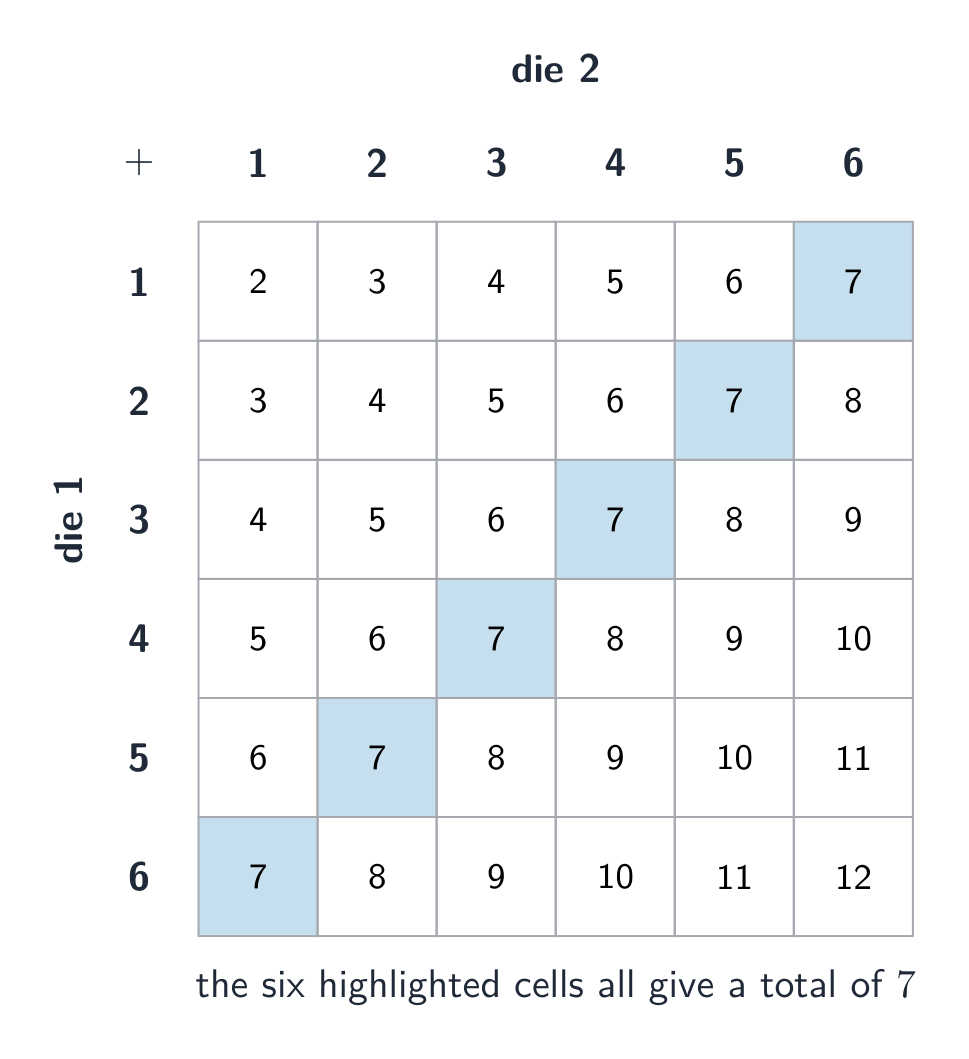
一个样本空间图列出每个结果;对于两个骰子的总和有 $36$ 个等可能的单元。 Venn diagrams
一个维恩图(Venn diagram)把结果分类到重叠的集合里。从它你能读出 $\text{P}(A \cap B)$(在两者里)和 $\text{P}(A \cup B)$(在任一里)。

重叠是 $\text{P}(A\cap B)=0.2$;任一圆里的一切是 $\text{P}(A\cup B)=0.6$;两者外是 $0.4$。 Tree diagrams
一个树状图(tree diagram)把每个阶段显示为一组分支。在每个分支上写概率而在结尾写结果。沿分支乘,然后加你想要的路径。
Worked example (with replacement). 从袋子($3$ 红,$5$ 蓝)抽一个筹码、放回,然后抽第二个。这是有放回(with replacement),所以机会不变。求两个红的概率。
$$\text{P}(\text{red, red}) = \frac{3}{8} \times \frac{3}{8} = \frac{9}{64}.$$
在一个树状图上,沿分支乘概率;四个结果的概率加起来等于 $1$。 Worked example (without replacement, Extended). 现在第一个筹码不放回——无放回(without replacement)地抽取。一个红被拿走后,$7$ 个里剩 $2$ 个红:
$$\text{P}(\text{red, red}) = \frac{3}{8} \times \frac{2}{7} = \frac{6}{56} = \frac{3}{28}.$$探索Probability tree
Multiply the probabilities along each branch; the four outcomes always add up to 1.
探索Combined events
P(A ∩ B) = P(A)·P(B|A)
Combine two events: the area model shows AND (overlap) versus OR (union).
词汇表 训练英文 中文 拼音 combined events/kəmˈbaɪnd ɪˈvents/ 组合事件 zǔ hé shì jiàn independent events/ˌɪndɪˈpendənt ɪˈvents/ 独立事件 dú lì shì jiàn mutually exclusive/ˈmjuːtʃuːəli eksˈkluːsɪv/ 互斥 hù chì sample space diagram/ˈsæmpl speɪs ˈdaɪəɡræm/ 样本空间图 yàng běn kōng jiān tú Venn diagram/ven ˈdaɪəɡræm/ 维恩图 wéi ēn tú tree diagram/triː ˈdaɪəɡræm/ 树状图 shù zhuàng tú with replacement/wɪð rɪˈpleɪsmənt/ 有放回 yǒu fàng huí without replacement/wɪˈðaʊt rɪˈpleɪsmənt/ 无放回 wú fàng huí 8.4
条件概率
大纲
Subject content Notes and examples Calculate conditional probability using Venn diagrams, tree diagrams and tables. Knowledge of notation, $\text{P}(A|B)$, and formulas relating to conditional probability is not required. 来源:剑桥国际大纲
条件概率(conditional probability)是一个事件在另一个已经发生的条件下的概率。通过只看匹配条件的部分,从一个维恩图、双向表或树状图读它。
Worked example. 在一个 $30$ 人的班里,$18$ 人学法语,而在那些人里,$7$ 人也学德语。一个法语学生被选中。求他们也学德语的概率。
只看这 $18$ 个法语学生:
$$\text{P}(\text{German} \mid \text{French}) = \frac{7}{18}.$$探索Probability trees
Change the branch probabilities and read combined and conditional probabilities off the tree.
词汇表 训练英文 中文 拼音 conditional probability/kənˈdɪʃənl ˌprɒbəˈbɪlɪti/ 条件概率 tiáo jiàn gài lǜ 8.4
考试技巧
- 每个概率位于 $0$ 和 $1$ 之间,而所有结果的概率加起来等于 $1$。
- 对于"and"(两个事件)乘概率;对于"or"(任一事件)加它们。在一个树状图上,沿分支乘。
- 注意无放回:第二个概率变化,因为一个物品已经被移除。
- 期望频数 = 概率 × 试验次数。
-
9
统计
本讲义涵盖主题 9,统计学(Statistics)。标记 (Extended) 的部分只在拓展卷上考查;其他一切对两个层次都适用。
9.1 9.2
统计数据的分类

大纲
Subject content Notes and examples Classify and tabulate statistical data. e.g. tally tables, two-way tables. Subject content Notes and examples 1 Read, interpret and draw inferences from tables and statistical diagrams. 2 Compare sets of data using tables, graphs and statistical measures. e.g. compare averages and ranges between two data sets. 3 Appreciate restrictions on drawing conclusions from given data. Subject content Notes and examples 1 Read, interpret and draw inferences from tables and statistical diagrams. 2 Compare sets of data using tables, graphs and statistical measures. e.g. compare averages and measures of spread between two data sets. 3 Appreciate restrictions on drawing conclusions from given data. 来源:剑桥国际大纲
数据从人们那里收集——从一个总体抽取的一个样本。 要组织统计(statistical)数据(data),用:
- 一张计数表(tally table)——为每个值做一个记号,然后数。
- 一张双向表(two-way table)——一次按两个特征把数据分类(例如,男孩/女孩对步行/公交)。
当你读一个图时,只得出数据真正支持的结论。
探索Data handling cycle
Follow a statistical question from collection to display.
词汇表 训练英文 中文 拼音 statistical/stəˈtɪstɪkl/ 统计 tǒng jì data/ˈdeɪtə/ 数据 shù jù tally table/ˈtælɪ ˈteɪbl/ 计数表 jì shù biǎo two-way table/tuː weɪ ˈteɪbl/ 双向表 shuāng xiàng biǎo 9.3
平均数与极差

大纲
Subject content Notes and examples Calculate the mean, median, mode and range for individual data and distinguish between the purposes for which these are used. Data may be in a list or frequency table, but will not be grouped. Subject content Notes and examples 1 Calculate the mean, median, mode, quartiles, range and interquartile range for individual data and distinguish between the purposes for which these are used. 2 Calculate an estimate of the mean for grouped discrete or grouped continuous data. 3 Identify the modal class from a grouped frequency distribution. 来源:剑桥国际大纲
三个平均描述数据的一个典型值,而极差显示它有多分散。每一个用于一个不同的目的:
一个小数据集的平均数、中位数、众数和极差 - 平均数(mean)$= \dfrac{\text{sum of all values}}{\text{how many values}}$。
- 中位数(median)$=$ 数据按顺序排列时中间的值。
- 众数(mode)$=$ 出现最频繁的值。
- 极差(range)$=$ 最大值 $-$ 最小值(它显示数据有多分散)。
Worked example. 求 $4, 7, 7, 2, 5$ 的平均数、中位数、众数和极差。
把数据排序:$2, 4, 5, 7, 7$。
$$\text{mean} = \frac{4 + 7 + 7 + 2 + 5}{5} = \frac{25}{5} = 5, \quad \text{median} = 5, \quad \text{mode} = 7, \quad \text{range} = 7 - 2 = 5.$$探索Average choice lab
Choose the average that fits the data situation.
词汇表 训练英文 中文 拼音 mean/miːn/ 平均数 píng jūn shù median/ˈmiːdiːən/ 中位数 zhōng wèi shù mode/məʊd/ 众数 zhòng shù range/reɪndʒ/ 极差 jí chà 9.3
平均数与极差
大纲
Subject content Notes and examples Calculate the mean, median, mode and range for individual data and distinguish between the purposes for which these are used. Data may be in a list or frequency table, but will not be grouped. Subject content Notes and examples 1 Calculate the mean, median, mode, quartiles, range and interquartile range for individual data and distinguish between the purposes for which these are used. 2 Calculate an estimate of the mean for grouped discrete or grouped continuous data. 3 Identify the modal class from a grouped frequency distribution. 来源:剑桥国际大纲
当数据带它的频数(frequency)(每个值出现多少次)列出时,平均数是
$$\text{mean} = \frac{\sum (\text{value} \times \text{frequency})}{\sum \text{frequency}}.$$Worked example. 值 $1, 2, 3$ 以频数 $4, 5, 1$ 出现。求平均数。
$$\text{mean} = \frac{1(4) + 2(5) + 3(1)}{4 + 5 + 1} = \frac{17}{10} = 1.7.$$Grouped data (Extended)
对于分组数据(grouped data),你不能求出精确的平均数,所以用每组的中点作为值来估计它。众数组(modal class)就是频数最高的组。
词汇表 训练英文 中文 拼音 frequency/ˈfriːkwənsi/ 频数 pín shuò grouped data/ɡruːpt ˈdeɪtə/ 分组数据 fēn zǔ shù jù modal class/ˈməʊdl klæs/ 众数组 zhòng shù zǔ 9.3
平均数与离散程度的度量
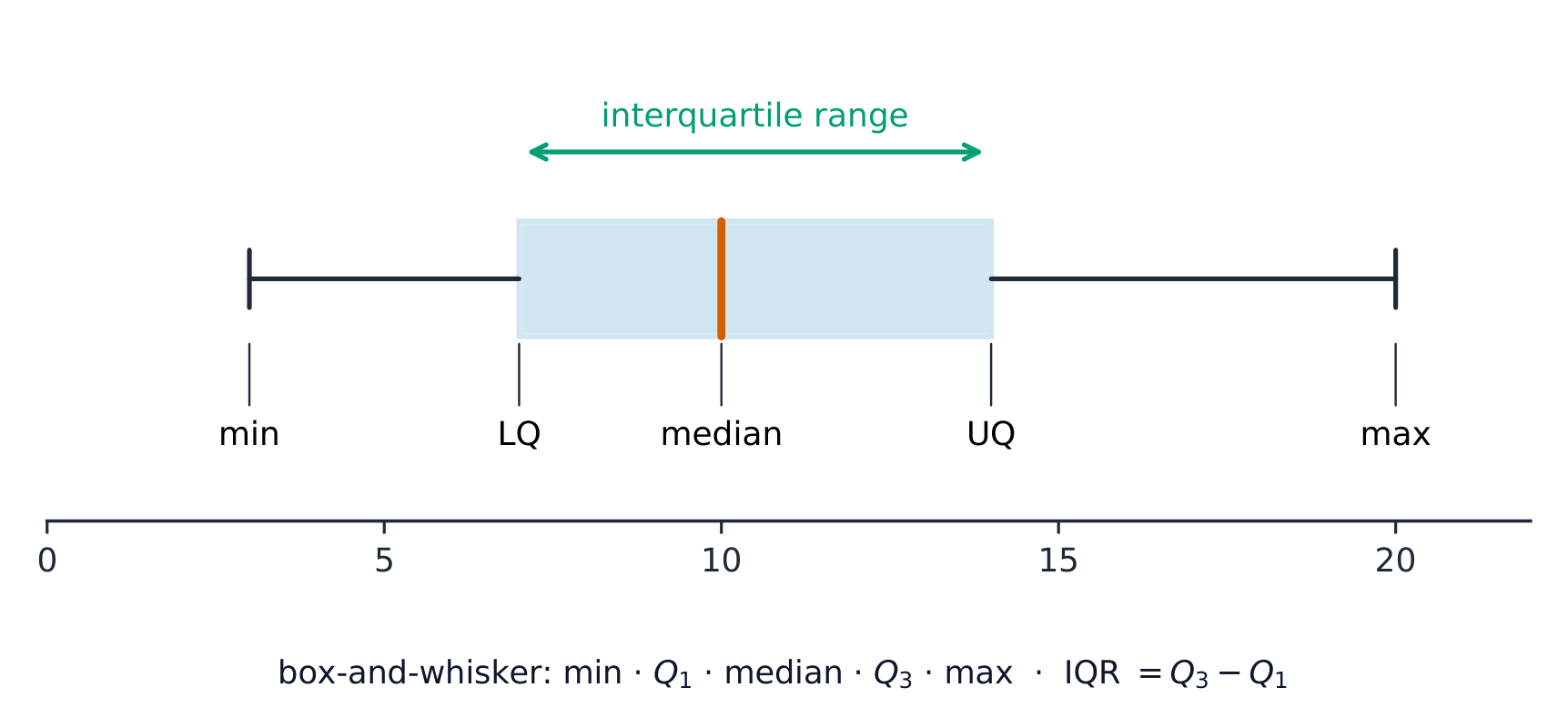
大纲
Subject content Notes and examples 1 Calculate the mean, median, mode, quartiles, range and interquartile range for individual data and distinguish between the purposes for which these are used. 2 Calculate an estimate of the mean for grouped discrete or grouped continuous data. 3 Identify the modal class from a grouped frequency distribution. 来源:剑桥国际大纲
当数据按顺序排列时,四分位数(quartiles)把它切成四个相等的部分。下四分位数(LQ)在四分之一处;上四分位数(UQ)在四分之三处。四分位距(interquartile range)衡量中间一半的分散:
$$\text{interquartile range} = \text{UQ} - \text{LQ}.$$四分位距有用,因为与极差不同,它忽略极端值。
一个箱线图显示五数概括;箱子长度是四分位距。 探索Box-and-whisker plot
Build a box plot from the five-number summary: the box is the middle 50% (the interquartile range) and the median's position shows the skew.
词汇表 训练英文 中文 拼音 quartile/ˈkwɔːtaɪl/ 四分位数 sì fēn wèi shù interquartile range/ˌɪntəˈkwɔːtaɪl reɪndʒ/ 四分位距 sì fēn wèi jù 9.4
统计图表

大纲
Subject content Notes and examples Draw and interpret: (a) bar charts (b) pie charts (c) pictograms (d) stem-and-leaf diagrams (e) simple frequency distributions. Includes composite (stacked) and dual (side-by-side) bar charts. Stem-and-leaf diagrams should have ordered data with a key. 来源:剑桥国际大纲
一个高尔顿板显示数据如何堆积成一个分布。 
一个象形图用一个符号代表若干物品 
一个条形图显示每组的频数 图 它显示什么 条形图(bar chart) 每个类别一根条;高度是频数 饼图(pie chart) 一个圆被分成片,每片是 $360^{\circ}$ 的一个分数 象形图(pictogram) 用一个符号代表若干物品 茎叶图(stem-and-leaf diagram) 保留有序数据的数字,带一个图例 频数分布(frequency distribution) 一张值和它们频数的表 Worked example (pie chart). $120$ 人中,$30$ 人选择茶。求茶片的角度。
$$\frac{30}{120} \times 360^{\circ} = 90^{\circ}.$$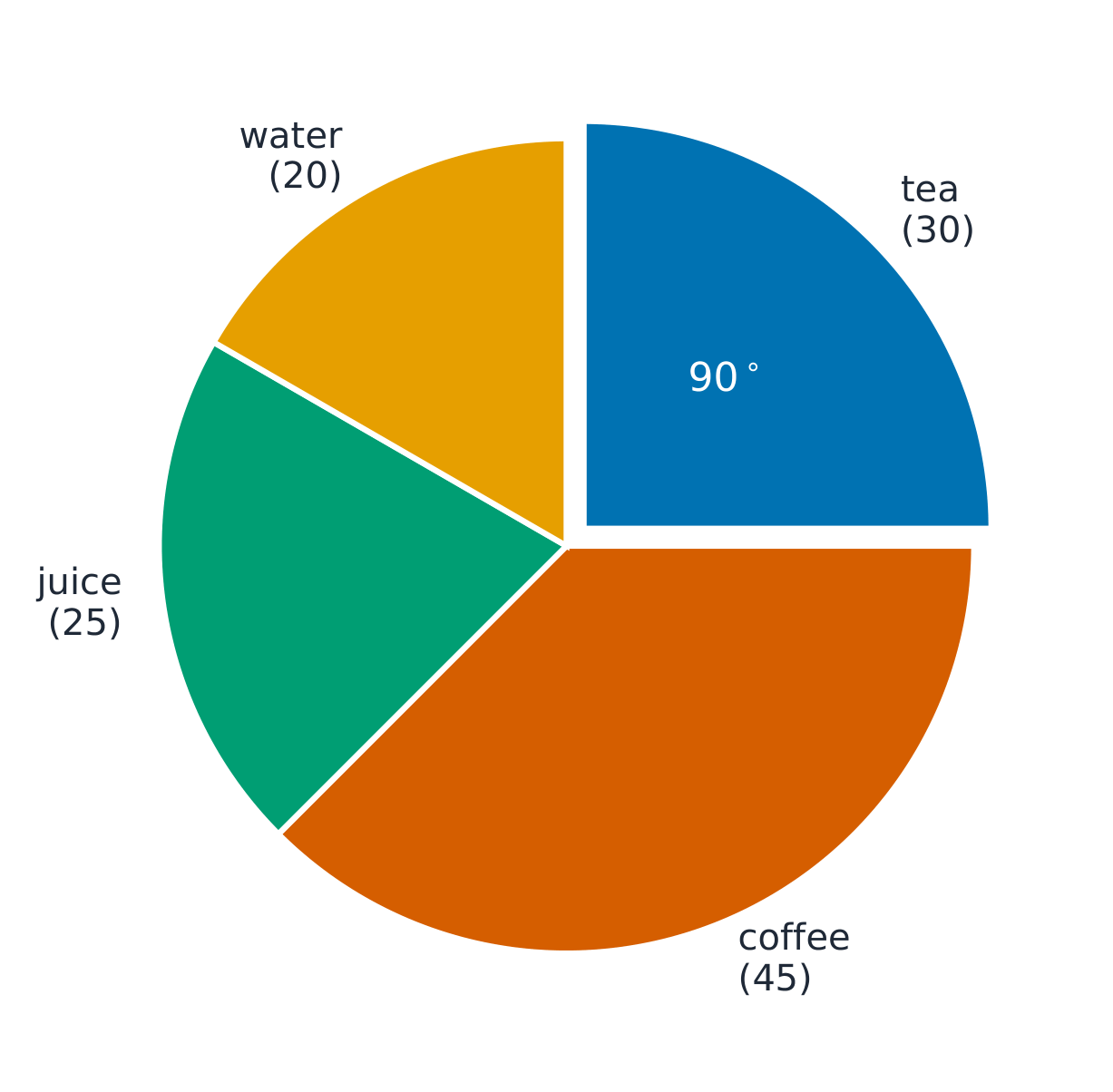
每片是它占 $360^\circ$ 的分数;茶是 $\tfrac{30}{120}\times360^\circ=90^\circ$。 探索Pie-chart angles
Each slice's angle is its share of the whole turned into degrees — frequency ÷ total × 360 — and the slices always add to 360°.
探索Chart choice lab
Choose the chart that fits the kind of data.
词汇表 训练英文 中文 拼音 bar chart/bɑː tʃɑːt/ 条形图 tiáo xíng tú pie chart/paɪ tʃɑːt/ 饼图 bǐng tú pictogram/ˈpɪktəɡræm/ 象形图 xiàng xíng tú stem-and-leaf diagram/stem ænd liːf ˈdaɪəɡræm/ 茎叶图 jīng yè tú frequency distribution/ˈfriːkwənsi ˌdɪstrɪˈbjuːʃn/ 频数分布 pín shuò fēn bù 9.5
散点图

大纲
Subject content Notes and examples 1 Draw and interpret scatter diagrams. Plotted points should be clearly marked, for example as small crosses (×). 2 Understand what is meant by positive, negative and zero correlation. 3 Draw by eye, interpret and use a straight line of best fit. A line of best fit: • should be a single ruled line drawn by inspection • should extend across the full data set • does not need to coincide exactly with any of the points but there should be a roughly even distribution of points either side of the line over its entire length. Subject content Notes and examples 1 Draw and interpret scatter diagrams. Plotted points should be clearly marked, for example as small crosses (x). 2 Understand what is meant by positive, negative and zero correlation. 3 Draw by eye, interpret and use a straight line of best fit. A line of best fit: • should be a single ruled line drawn by inspection • should extend across the full data set • does not need to coincide exactly with any of the points but there should be a roughly even distribution of points either side of the line over its entire length. 来源:剑桥国际大纲
一个散点图(scatter diagram)把成对的值描成点以显示两样东西是否有联系。这个联系是相关性(correlation):
- 正相关(positive correlation)——一个上升时,另一个上升。
- 负相关(negative correlation)——一个上升时,另一个下降。
- 零相关(zero correlation)——没有清晰的联系。
正相关一起上升;负相关随着另一个上升而下降;零相关显示没有清晰的联系。 若有相关性,画一条最佳拟合线(line of best fit):穿过点的中间的一条直的画线,每一侧大约相同数量的点。用它来预测值。

一条最佳拟合线是穿过点的中间的一条直的画线;用它来预测。 探索Scatter and correlation
Change the strength of the relationship and add a line of best fit to spot the trend.
词汇表 训练英文 中文 拼音 scatter diagram/ˈskætə ˈdaɪəɡræm/ 散点图 sàn diǎn tú correlation/ˌkɒrɪˈleɪʃn/ 相关性 xiāng guān xìng positive correlation/ˈpɒzɪtɪv ˌkɒrɪˈleɪʃn/ 正相关 zhèng xiāng guān negative correlation/ˈneɡətɪv ˌkɒrɪˈleɪʃn/ 负相关 fù xiāng guān zero correlation/ˈzɪərəʊ ˌkɒrɪˈleɪʃn/ 零相关 líng xiāng guān line of best fit/laɪn ɒv best fɪt/ 最佳拟合线 zuì jiā nǐ hé xiàn 9.6
累积频数图
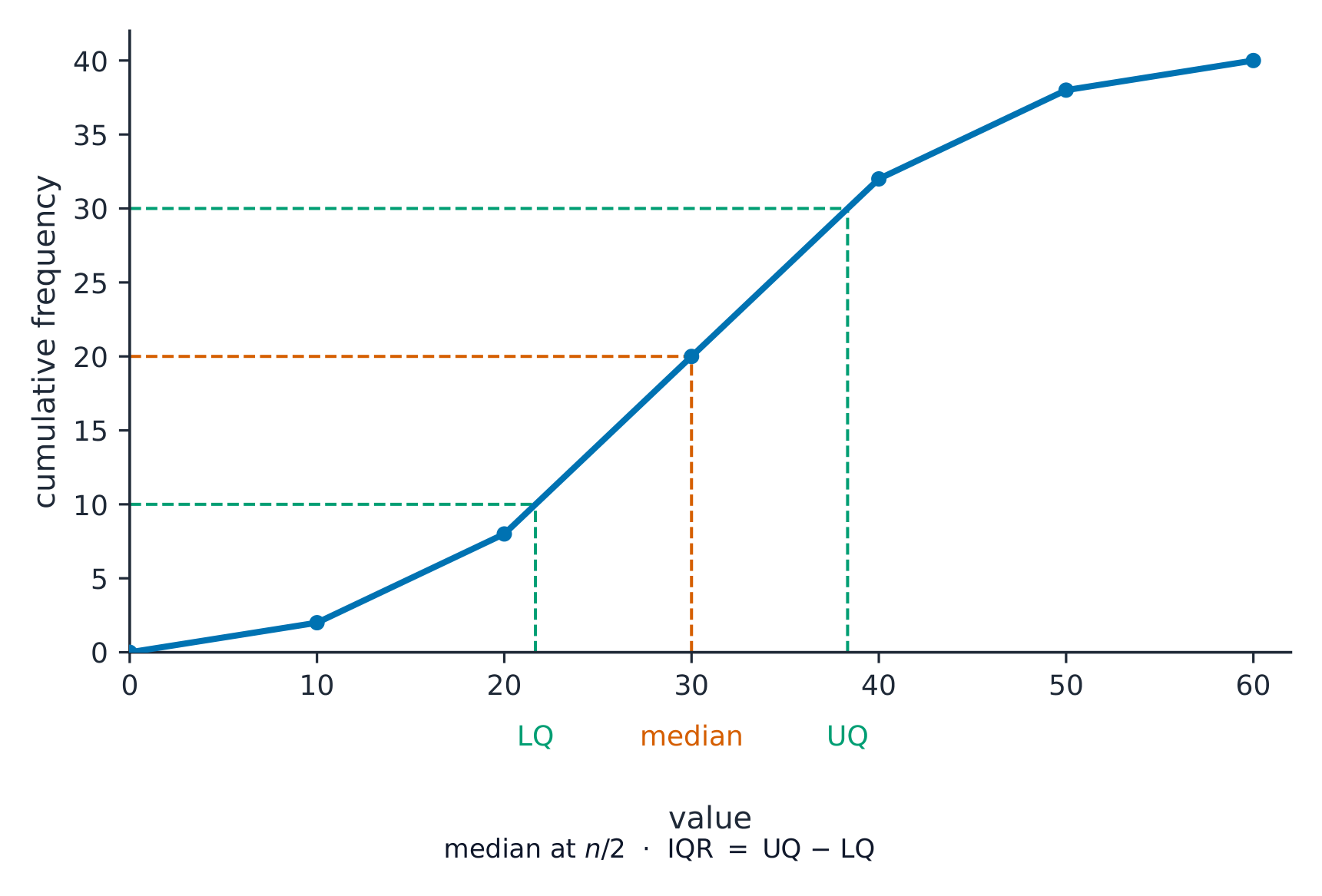
大纲
Subject content Notes and examples 1 Draw and interpret cumulative frequency tables and diagrams. Plotted points on a cumulative frequency diagram should be clearly marked, for example as small crosses (x), and be joined with a smooth curve. 2 Estimate and interpret the median, percentiles, quartiles and interquartile range from cumulative frequency diagrams. 来源:剑桥国际大纲
累积频数(cumulative frequency)是频数的一个连续总计。把它相对于每组的上端描出并用一条光滑曲线连接这些点。
从曲线你能读出中位数(在总数的一半处)、四分位数(在四分之一和四分之三处),以及任何百分位数(percentile)(例如,第 $90$ 百分位数在总数的 $90\%$ 处)。
在总数的一半处读中位数,在四分之一和四分之三处读四分位数:横过到曲线,然后向下。 探索Cumulative frequency route
Follow raw data into a cumulative frequency curve and percentile reading.
词汇表 训练英文 中文 拼音 cumulative frequency/ˈkjuːmjʊlətɪv ˈfriːkwənsi/ 累积频数 lěi jī pín shuò percentile/pəˈsentaɪl/ 百分位数 bǎi fēn wèi shù 9.7
直方图
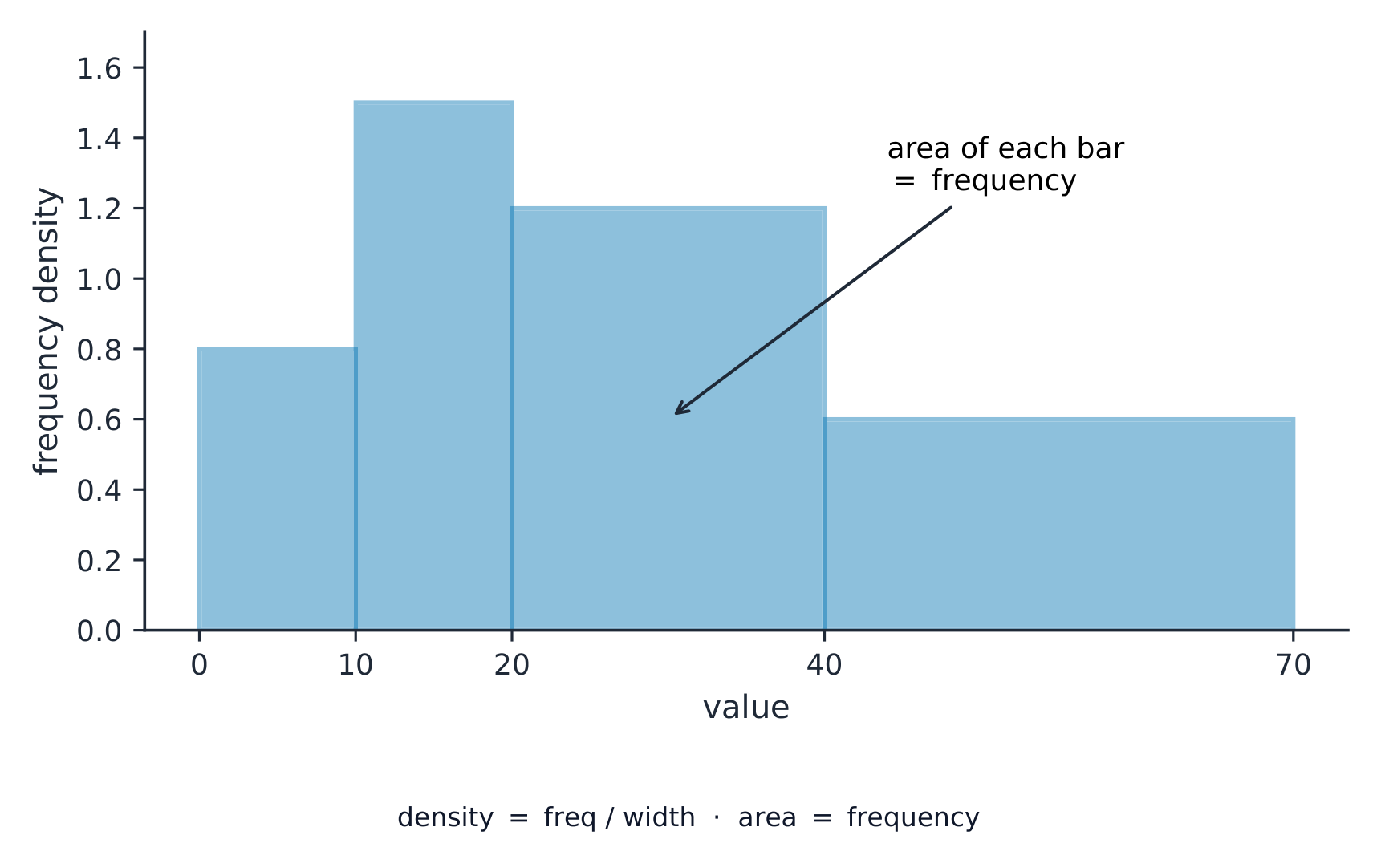
大纲
Subject content Notes and examples 1 Draw and interpret histograms. On histograms, the vertical axis is labelled 'Frequency density'. 2 Calculate with frequency density. Frequency density is defined as $\text{frequency density} = \text{frequency} \div \text{class width}$. 来源:剑桥国际大纲
一个直方图(histogram)看起来像一个条形图,但这些条能有不同的宽度,而每根条的面积(不是它的高度)显示频数。竖轴是频数密度(frequency density):
$$\text{frequency density} = \frac{\text{frequency}}{\text{class width}}.$$用不相等的组宽,条的面积(不是它的高度)是频数,所以坐标轴是频数密度。 Worked example. 一个组有组距(class width)$10$ 和频数 $25$。求频数密度。
$$\text{frequency density} = \frac{25}{10} = 2.5.$$探索Frequency-density histogram
With unequal class widths the bar height is frequency density, so the area (not the height) represents the frequency.
词汇表 训练英文 中文 拼音 histogram/ˈhɪstəɡræm/ 直方图 zhí fāng tú frequency density/ˈfriːkwənsi ˈdensɪti/ 频数密度 pín shuò mì dù class width/klæs wɪtθ/ 组距 zǔ jù 9.7
考试技巧
- 知道三个平均:平均数(加起来 ÷ 有多少个)、中位数(按顺序时中间的值)、众数(最常见的)。极差是最高 − 最低。
- 从一张频数表,平均数是 $\frac{\sum fx}{\sum f}$ ——除以总频数,不是行数。
- 在一个散点图上,把相关性描述为正、负或没有,并穿过平均点画最佳拟合线。
- 对于一个组宽不相等的直方图,高度是频数密度(频数 ÷ 组距),不是频数。