- 解释国家层面的专业化,以及自由国际贸易的利与弊
- 解释自由贸易在提高生活水平方面的作用
国际贸易与全球化
IGCSE 经济学 · 知识点 6
 9:00
国际贸易与全球化
环顾你的房间。你手中的手机,杯中的咖啡,你身上的衣服——几乎没有一样是这里制造的。它们通过海运而来,装在钢铁……中
英语旁白 · 英中内嵌字幕
6.1
专业化与自由贸易

教学大纲
来源:Cambridge International 教学大纲
English
Countries trade 贸易 with each other: they sell some goods and buy others. Just as one worker can focus on one task, a whole country can focus on making the goods it is best at. This is specialisation 专业化 at a national level.


When a country specialises, it sells the goods it makes well (exports 出口) and buys the goods other countries make well (imports 进口).
Free trade
Free trade 自由贸易 means trade between countries with no barriers — no taxes or limits on imports. Its benefits:
- countries can buy some goods more cheaply from abroad than by making them at home.
- consumers get a wider choice of goods.
- firms can sell to bigger markets, so they gain economies of scale.
- more competition makes domestic 国内的 firms (firms in your own country) work harder and improve.
All of this can raise living standards 生活水平: lower prices and more goods for everyone.
Free trade also has disadvantages:
- domestic firms may not be able to compete 竞争 with cheaper foreign goods, so they close. This causes job losses.
- a country can become too dependent 依赖 on other countries for important goods.
- new, small industries may never grow if they face strong foreign rivals from the start.
探索
专业化与贸易
通过在它机会成本最低的地方专业化并贸易,一个国家能消费超过它自己的前沿。
词汇
训练
| English | 中文 | 拼音 |
|---|---|---|
| trade/treɪd/ | 贸易 | mào yì |
| specialisation/ˌspeʃəlaɪˈzeɪʃn/ | 专业化 | zhuān yè huà |
| exports/ˈekspɔːts/ | 出口 | chū kǒu |
| imports/ɪmˈpɔːts/ | 进口 | jìn kǒu |
| free trade/friː treɪd/ | 自由贸易 | zì yóu mào yì |
| domestic/dəˈmestɪk/ | 国内的 | guó nèi de |
| living standards/ˈlɪvɪŋ ˈstændədz/ | 生活水平 | shēng huó shuǐ píng |
| compete/kəmˈpiːt/ | 竞争 | jìng zhēng |
| dependent/dɪˈpendənt/ | 依赖 | yī lài |
6.2
全球化与贸易限制
教学大纲
- 定义全球化,并解释跨国公司的作用及其影响(对东道国的益处与弊端)
- 描述贸易保护的方法(关税、配额、补贴、禁运),以及实施保护的原因和后果
来源:Cambridge International 教学大纲
English
Globalisation 全球化 is the way the world's economies are becoming more and more joined together — through trade, travel, the internet, and firms working across borders.
Multinational companies
A multinational company 跨国公司 (MNC) is a firm that produces in more than one country — for example, a car maker with factories in several countries. The country an MNC sets up in is the host country 东道国.
- Benefits to the host country: new jobs, investment, new skills and technology, and more tax.
- Drawbacks: profits may flow back to the MNC's home country; local firms may be pushed out; and some MNCs pay low wages or pollute (for example, by sending waste to poorer countries).
Trade protection
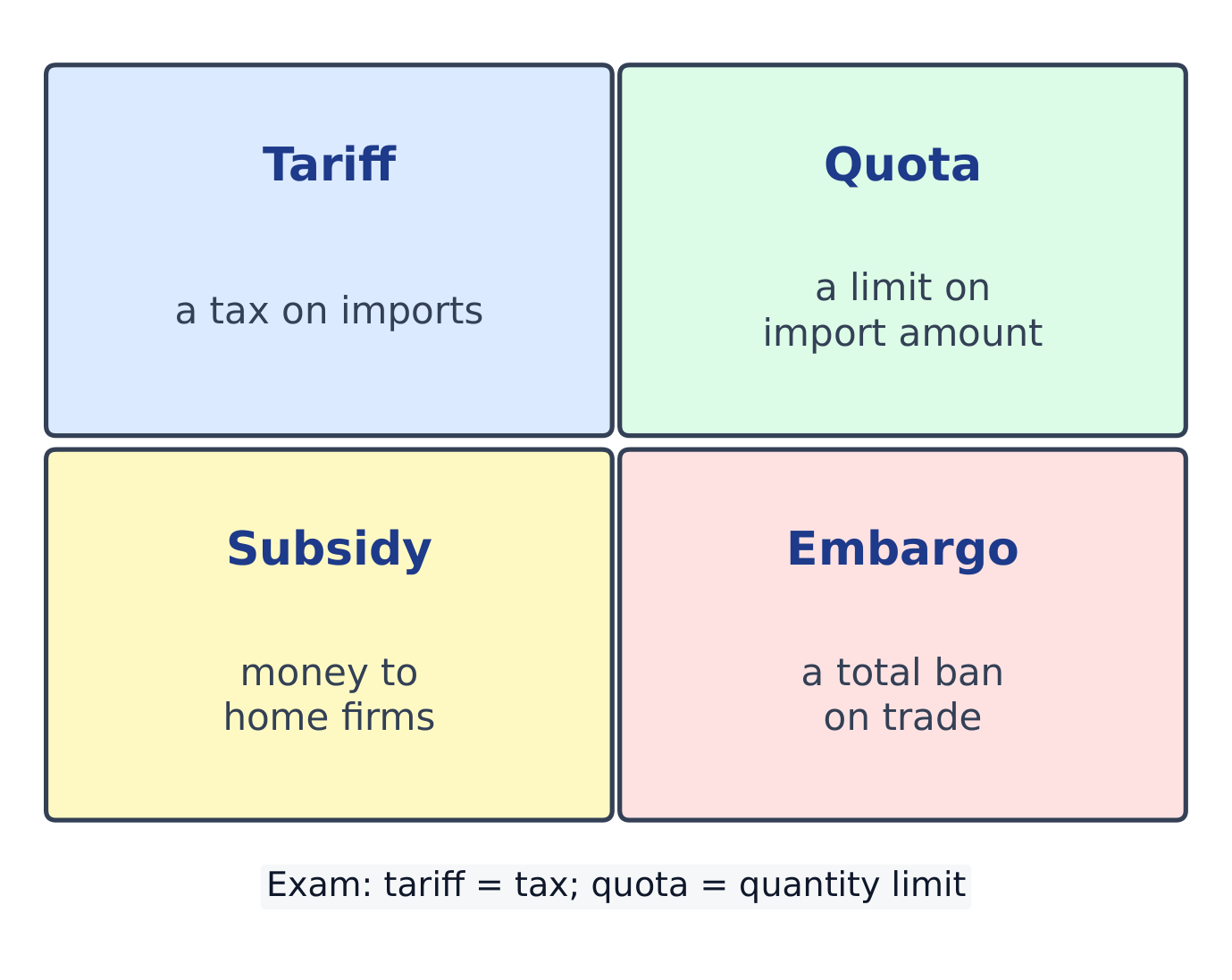
Trade protection 贸易保护 is a government putting up barriers to limit imports and protect its own firms. The main methods:
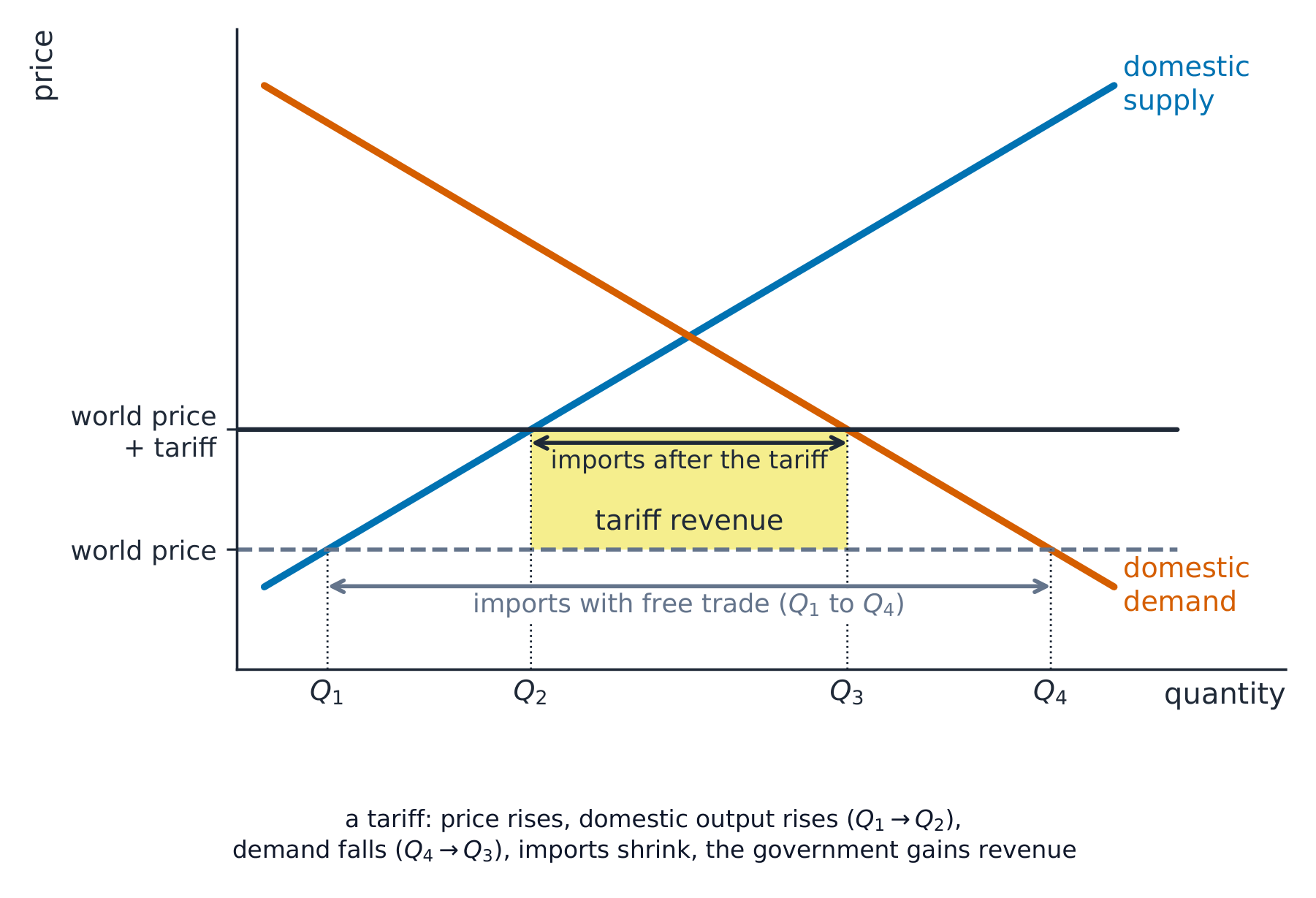
- a tariff 关税 — a tax on imports, which makes them dearer.
- a quota 配额 — a limit on the amount of a good that can be imported.
- a subsidy 补贴 — money paid to domestic firms so they can sell more cheaply than foreign rivals.
- an embargo 禁运 — a total ban on trade in a good, or with a country.
Reasons for protection: to protect jobs; to protect an infant industry 幼稚产业 (a new industry too small to compete yet); to stop dumping 倾销 (foreign firms selling below cost to destroy local rivals); and to raise government revenue from tariffs.
But protection has costs. Prices rise and choice falls for consumers; protected firms stay weak and lazy; and other countries may hit back with their own barriers — a trade war.
探索
市场中的贸易限制
一项关税提高进口的价格,移动有效供给并以消费者为代价保护本国生产者。
词汇
训练
| English | 中文 | 拼音 |
|---|---|---|
| globalisation/ˌɡləʊbəlaɪˈzeɪʃn/ | 全球化 | quán qiú huà |
| multinational company/ˌmʌltɪˈnæʃənl ˈkʌmpəni/ | 跨国公司 | kuà guó gōng sī |
| host country/həʊst ˈkʌntri/ | 东道国 | dōng dào guó |
| trade protection/treɪd prəˈtekʃn/ | 贸易保护 | mào yì bǎo hù |
| tariff/ˈtærɪf/ | 关税 | guān shuì |
| quota/ˈkwəʊtə/ | 配额 | pèi é |
| subsidy/ˈsʌbsɪdi/ | 补贴 | bǔ tiē |
| embargo/emˈbɑːɡəʊ/ | 禁运 | jìn yùn |
| infant industry/ˈɪnfənt ˈɪndʌstri/ | 幼稚产业 | yòu zhì chǎn yè |
| dumping/ˈdʌmpɪŋ/ | 倾销 | qīng xiāo |
6.3
外汇汇率
教学大纲
- 定义汇率,并解释浮动汇率制度下汇率如何由货币供求决定
- 解释汇率变动(升值与贬值)对经济产生的原因及后果
来源:Cambridge International 教学大纲
English
The exchange rate 汇率 is the price of one currency 货币 in terms of another — for example, £1 = 1.30 US dollars.
How the rate is set
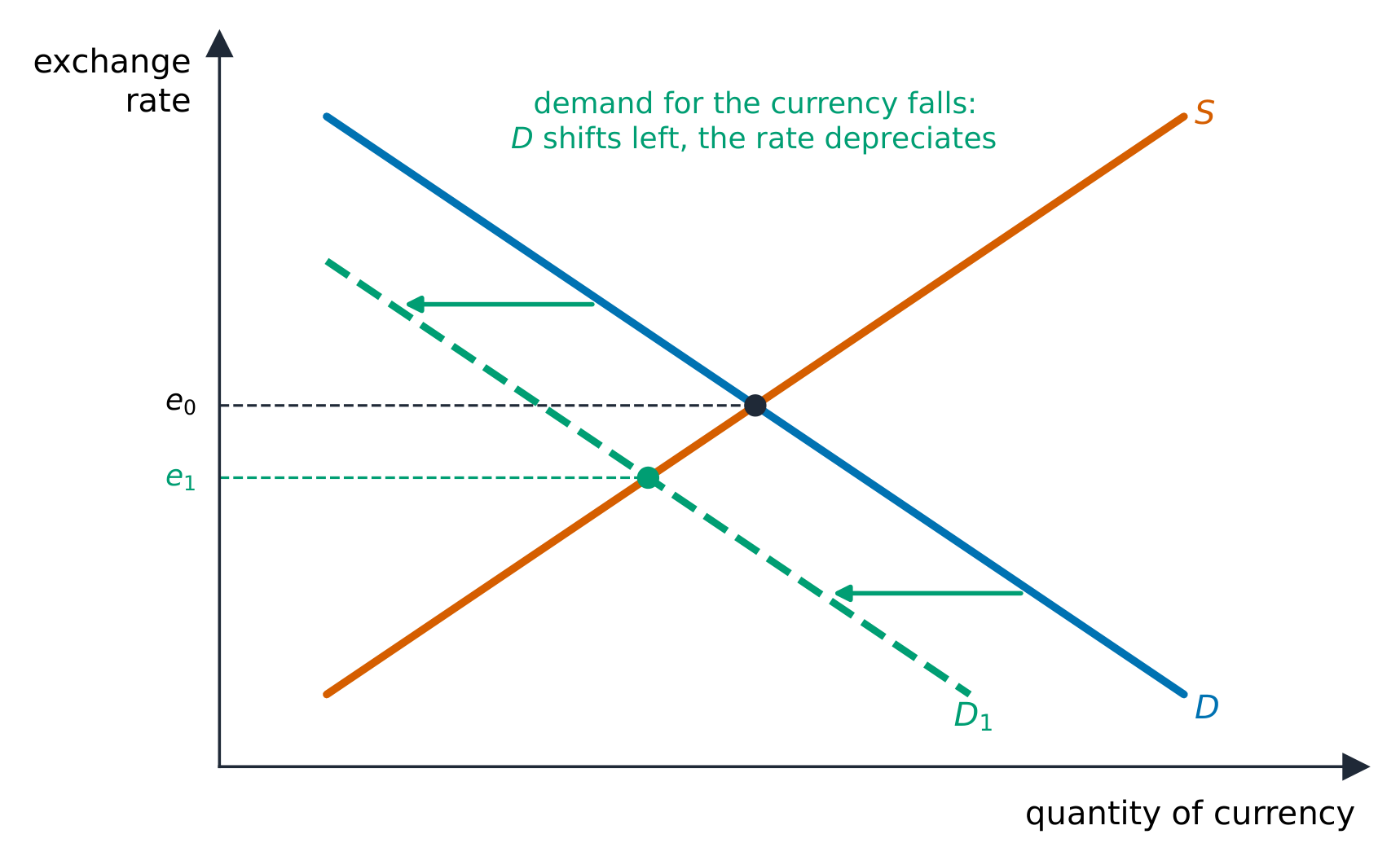
In a floating exchange rate 浮动汇率 system, the rate is set by the demand 需求 for and supply 供给 of the currency, just like any market.
- if more people want a currency — to buy that country's exports, or to invest there — demand for it rises, so its price (the exchange rate) rises.
- for example, if a country's interest rates rise, foreigners want to save money there, so demand for its currency rises and the rate goes up.
Appreciation and depreciation
- appreciation 升值 — the currency rises in value (it buys more foreign money).
- depreciation 贬值 — the currency falls in value.
A change in the rate changes the price of exports and imports:
- if a currency appreciates (rises), its exports become dearer for foreigners and its imports become cheaper. So exports fall and imports rise.
- if a currency depreciates (falls), its exports become cheaper for foreigners and its imports become dearer. So exports rise and imports fall.

Worked example. The exchange rate is £1 = 1.30 US dollars. (a) A UK firm sells a machine for £2,000 — what is its price to a US buyer? (b) A US laptop costs 650 dollars — what does it cost a UK buyer?
- (a) price in dollars = 2,000 × 1.30 = 2,600 dollars.
- (b) price in pounds = 650 ÷ 1.30 = £500.
To change pounds into dollars you multiply by the rate; to change dollars into pounds you divide. Now suppose the pound appreciates to £1 = 1.50 dollars. The same £2,000 machine then costs a US buyer 2,000 × 1.50 = 3,000 dollars — dearer than before, which is why a stronger pound makes a country's exports harder to sell abroad.
探索
外汇市场
一种货币像任何物品一样被买卖。对它更多的需求提高它的汇率——它升值。
词汇
训练
| English | 中文 | 拼音 |
|---|---|---|
| exchange rate/eksˈtʃeɪndʒ reɪt/ | 汇率 | huì lǜ |
| currency/ˈkʌrənsi/ | 货币 | huò bì |
| floating exchange rate/ˈfləʊtɪŋ eksˈtʃeɪndʒ reɪt/ | 浮动汇率 | fú dòng huì lǜ |
| demand/dɪˈmænd/ | 需求 | xū qiú |
| supply/səˈplaɪ/ | 供给 | gōng jǐ |
| appreciation/əˌpriːʃɪˈeɪʃn/ | 升值 | shēng zhí |
| depreciation/dɪˌpriːʃɪˈeɪʃn/ | 贬值 | biǎn zhí |
6.4
国际收支经常账户

教学大纲
- 描述经常账户的结构(货物贸易、服务贸易、初次收入、二次收入)
- 解释经常账户赤字或盈余的成因及后果,并阐述相应的纠正政策
来源:Cambridge International 教学大纲
English
The balance of payments 国际收支 is a record of all the money flowing into and out of a country. Its main part is the current account 经常账户, which has four sections:
- trade in goods 货物贸易 — exports and imports of physical goods (cars, food, oil).
- trade in services 服务贸易 — exports and imports of services (tourism, banking, shipping).
- primary income 初次收入 — wages, interest, and profit earned from abroad.
- secondary income 二次收入 — money sent with nothing given in return, such as aid and gifts.

Deficit and surplus
- a current account deficit 逆差 — more money flows out than in (the country buys more from abroad than it sells).
- a current account surplus 顺差 — more money flows in than out.
Correcting a deficit
A country with a large deficit must borrow money or sell assets to pay for it. To correct a deficit, a government can:
- cut total demand, so people buy fewer imports.
- let the currency depreciate, to make exports cheaper and imports dearer.
- use trade protection (tariffs and quotas) to cut imports.
- use supply-side policy to improve the competitiveness 竞争力 of its firms, so exports rise.
探索
经常账户流量
跟踪进入经常账户的出口、进口和收入流量。
词汇
训练
| English | 中文 | 拼音 |
|---|---|---|
| balance of payments/ˈbæləns ɒv ˈpeɪmənts/ | 国际收支 | guó jì shōu zhī |
| current account/ˈkʌrənt əˈkaʊnt/ | 经常账户 | jīng cháng zhàng hù |
| trade in goods/treɪd ɪn ɡʊdz/ | 货物贸易 | huò wù mào yì |
| trade in services/treɪd ɪn ˈsɜːvɪsɪz/ | 服务贸易 | fú wù mào yì |
| primary income/ˈpraɪməri ˈɪŋkʌm/ | 初次收入 | chū cì shōu rù |
| secondary income/ˈsekəndəri ˈɪŋkʌm/ | 二次收入 | èr cì shōu rù |
| current account deficit/ˈkʌrənt əˈkaʊnt ˈdefɪsɪt/ | 逆差 | nì chà |
| current account surplus/ˈkʌrənt əˈkaʊnt ˈsɜːpləs/ | 顺差 | shùn chā |
| competitiveness/kəmˈpetɪtɪvnəs/ | 竞争力 | jìng zhēng lì |
6.1 6.2 6.3 6.4
专业化与自由贸易
教学大纲
- 解释国家层面的专业化,以及自由国际贸易的利与弊
- 解释自由贸易在提高生活水平方面的作用
- 定义全球化,并解释跨国公司的作用及其影响(对东道国的益处与弊端)
- 描述贸易保护的方法(关税、配额、补贴、禁运),以及实施保护的原因和后果
- 定义汇率,并解释浮动汇率制度下汇率如何由货币供求决定
- 解释汇率变动(升值与贬值)对经济产生的原因及后果
- 描述经常账户的结构(货物贸易、服务贸易、初次收入、二次收入)
- 解释经常账户赤字或盈余的成因及后果,并阐述相应的纠正政策
来源:Cambridge International 教学大纲
English
This question follows the style of Paper 2. Try each part before reading the model answer.
Source: Velmora's falling currency
Velmora exports rice and cotton cloth, and it imports most of its fuel and its cars. Over the past year its currency, the vel, fell from 1 vel = $0.50 to 1 vel = $0.40. Rice farmers say foreign buyers are ordering more. However, the cost of imported fuel has risen sharply, because fuel is priced in U.S. dollars. Velmora's only car factory wants the government to put a 30 % tariff on imported cars "to protect 4 000 jobs".
(a) Identify one good that Velmora imports. [1] Fuel (or cars).
(b) Calculate the percentage change in the value of the vel against the U.S. dollar. [2] $\dfrac{0.40-0.50}{0.50}\times100=-20\%$. The vel has depreciated by 20 %.
(c) Explain how the depreciation affects the price of Velmora's rice to foreign buyers. [4] Suppose a tonne of rice sells for 1 000 vel. Before, a foreign buyer paid $1\,000\times\$0.50=\$500$. Now it costs $1\,000\times\$0.40=\$400$. The rice is cheaper in dollars, although Velmora's farmers still receive 1 000 vel. So foreign buyers want more Velmoran rice, as the farmers report.
(d) Analyse how the depreciation might affect Velmora's current account. [6] Exports become cheaper abroad, so the quantity of exports rises and export revenue tends to rise. Imports become dearer in vel, so Velmorans buy fewer imported goods. Both changes help the current account (exports rise, imports fall). However, fuel is a necessity with few substitutes, so demand for it is price-inelastic: Velmora still buys almost as much fuel at a higher price, and it spends more vel on fuel. So the current account improves only if demand for exports and imports is elastic enough; in the short run it may even get worse.
(e) Discuss whether a 30 % tariff on imported cars would benefit Velmora. [8] Benefits: the tariff makes imported cars dearer, so some buyers switch to cars made in Velmora. The car factory sells more and the 4 000 jobs are safer. The government also collects tariff revenue. (Use the tariff diagram above: domestic supply rises and imports fall.) Costs: every car buyer pays a higher price, including firms that need vans and lorries, so their costs rise too. With less competition, the local factory has less reason to become efficient. Other countries may answer with their own tariffs on Velmora's rice and cloth (retaliation 报复), which could cost more jobs than the tariff saves. Conclusion: the tariff would probably not benefit Velmora as a whole. It protects 4 000 jobs, but the cost falls on millions of car buyers and risks harming the export industries that are now growing because of the weaker vel. It might be justified only for a short time, to give the factory time to become competitive, if it is removed later.
词汇
训练
| English | 中文 | 拼音 |
|---|---|---|
| retaliation/rɪˌtælɪˈeɪʃn/ | 报复 | bào fù |
6.1 6.2 6.3 6.4
考试技巧
English
- To convert currency: pounds → dollars, multiply by the rate; dollars → pounds, divide by the rate.
- When a currency appreciates, its exports become dearer and its imports cheaper (so exports fall, imports rise); a depreciation does the opposite.
- Trade protection (tariffs, quotas, subsidies, embargoes) can protect jobs and infant industries, but it raises prices, cuts choice, and can start a trade war.
- A current account deficit means more money flows out than in. It can be reduced by cutting demand, letting the currency depreciate, or improving competitiveness.
Vocabulary card meanings
domestic: Inside the home country rather than abroad. compete: To try to win buyers or resources against rivals. dependent: Relying on another country or another income in order to continue. host country: The country in which a foreign firm operates. embargo: An official ban on trade with a particular country. infant industry: A new home industry still too small to match foreign rivals, whether or not a government shields it. current account deficit: A shortfall on trade in goods and services, primary income, and current transfers, rather than every payment that leaves the country. current account surplus: An excess on trade in goods and services, primary income, and current transfers, rather than every receipt from abroad.
该知识点的互动课程
逐步完成,配合即时检查练习。