- 理解经济问题:资源是有限的(稀缺的),而欲望是无限的
- 区分经济物品(稀缺,存在机会成本)与免费物品
- 理解经济问题迫使消费者、工人、生产者和政府必须做出选择
基本经济问题
IGCSE 经济学 · 知识点 1
 9:14
基本经济问题
你有十美元。在你面前有一本你想要的书和一个你想要的游戏。你两者都想要。但你只能选一个。所以你选择了书——而那一刻……
英语旁白 · 英中内嵌字幕
1.1
基本经济问题的本质
教学大纲
来源:Cambridge International 教学大纲
English
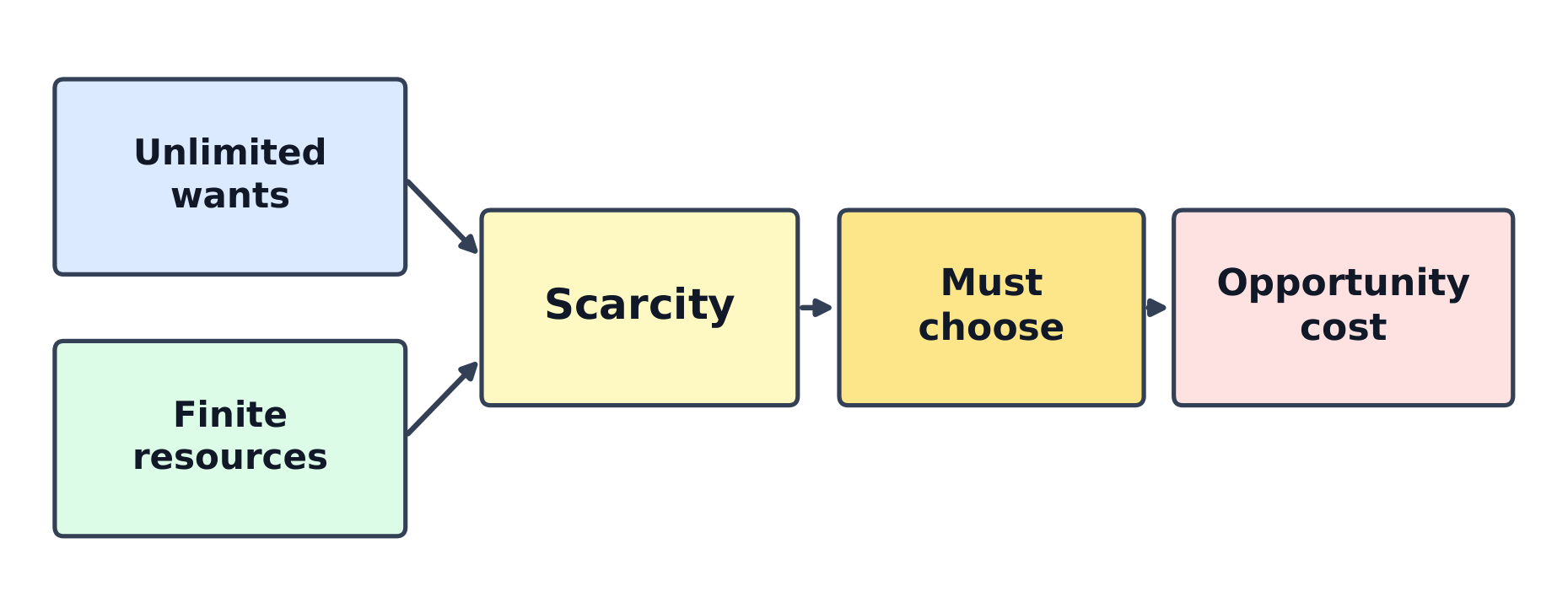
Economics is about how people use resources 资源 to meet their needs and wants. The main idea is simple. People want a lot, but there are not enough resources to make everything. This is the economic problem 经济问题.
Two facts cause the economic problem:
- Resources are finite 有限的. There is only a limited amount of them.
- People's wants 欲望 are unlimited. People always want more and better things.
Because wants are unlimited but resources are limited, resources are scarce 稀缺. We call this problem scarcity 稀缺性. Scarcity is the root of all economics.
Goods, services, and choices
We use resources to make goods 物品 (things you can touch, like food and phones) and services 服务 (jobs done for you, like a haircut or a bus ride).
Because resources are scarce, we cannot have everything. So everyone must make choices. Scarcity forces four groups to choose:
- consumers 消费者 — people who buy and use goods and services. They choose what to buy.
- workers 工人 — they choose which job to do.
- producers 生产者, also called firms 企业 — they make goods and services. They choose what to produce.
- governments 政府 — they choose what to provide and how to spend public money.
Economic goods and free goods
Most things are economic goods 经济物品. They are scarce, so making or using one means giving something else up. Economic goods have an opportunity cost 机会成本 (explained below).
A few things are free goods 免费物品. They are not scarce — there is enough for everyone and they cost nothing to use. Examples are the air you breathe and sunlight. A free good has no opportunity cost.
Be careful: a "free" sample or a "free" gift is not a free good. Resources were used to make it, so it is still an economic good.
探索
稀缺性与选择
有限的资源意味着生产更多一种物品要花费一些另一种——机会成本,由前沿显示。
词汇
训练
| English | 中文 | 拼音 |
|---|---|---|
| resources/rɪˈzɔːsɪz/ | 资源 | zī yuán |
| economic problem/ˌiːkəˈnɒmɪk ˈprɒbləm/ | 经济问题 | jīng jì wèn tí |
| finite/ˈfaɪnaɪt/ | 有限的 | yǒu xiàn de |
| wants/wɒnts/ | 欲望 | yù wàng |
| scarce/skeəs/ | 稀缺 | xī quē |
| scarcity/ˈskeəsɪti/ | 稀缺性 | xī quē xìng |
| goods/ɡʊdz/ | 物品 | wù pǐn |
| services/ˈsɜːvɪsɪz/ | 服务 | fú wù |
| consumers/kənˈsuːməz/ | 消费者 | xiāo fèi zhě |
| workers/ˈwɜːkəz/ | 工人 | gōng rén |
| producers/prəˈdjuːsəz/ | 生产者 | shēng chǎn zhě |
| firms/fɜːmz/ | 企业 | qǐ yè |
| governments/ˈɡʌvənmənts/ | 政府 | zhèng fǔ |
| economic goods/ˌiːkəˈnɒmɪk ɡʊdz/ | 经济物品 | jīng jì wù pǐn |
| opportunity cost/ɒpəˈtjuːnɪti kɒst/ | 机会成本 | jī huì chéng běn |
| free goods/friː ɡʊdz/ | 免费物品 | miǎn fèi wù pǐn |
1.2
生产要素
教学大纲
- 定义四种生产要素:土地、劳动力、资本和企业家才能,并举例说明
- 陈述各生产要素的报酬(地租、工资、利息、利润)
- 解释生产要素的流动性及其数量和质量变化的原因
来源:Cambridge International 教学大纲
English
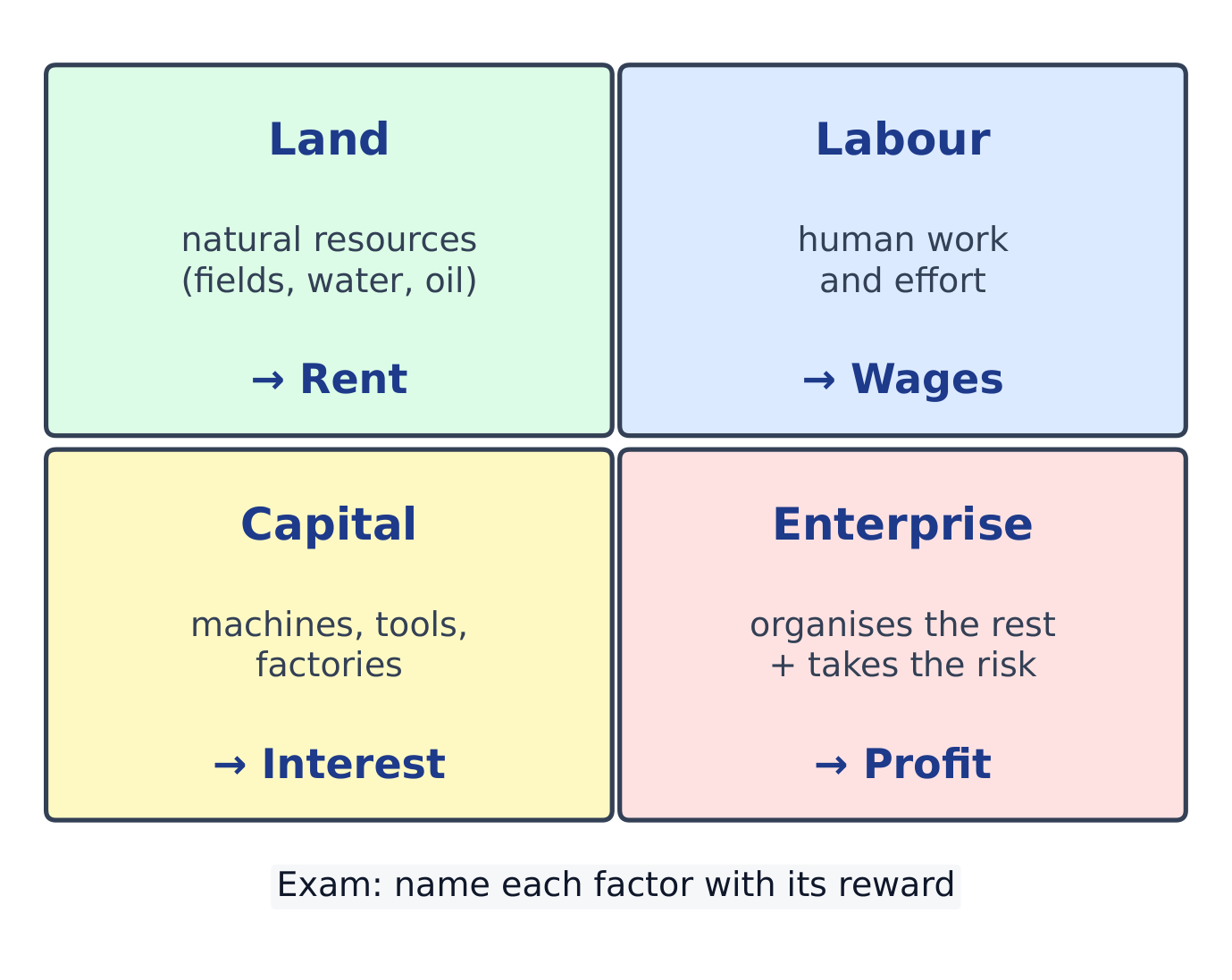
To make goods and services, firms use four types of resource. We call them the factors of production 生产要素.
The four factors
| Factor | What it is | Example |
|---|---|---|
| land 土地 | natural resources | fields, water, oil, forests |
| labour 劳动 | human work | a teacher, a builder, a nurse |
| capital 资本 | man-made things used to produce | machines, tools, factories |
| enterprise 企业家才能 | organising the other three and taking risks | a person who starts a business |
The person who provides enterprise is the entrepreneur 企业家. They bring the other factors together and risk their own money to start and run a business.

The reward to each factor
Each factor earns a reward 报酬 — the income it gets for being used:
| Factor | Reward |
|---|---|
| land | rent 地租 |
| labour | wages 工资 |
| capital | interest 利息 |
| enterprise | profit 利润 |
Mobility, quantity and quality
The mobility 流动性 of a factor means how easily it can move to a different use or place. A worker with many skills can change jobs easily, so labour is mobile. A worker with only one skill, or a factory that cannot be moved, is less mobile.
The quantity and quality of factors can change:
- Quantity can rise or fall. The amount of labour grows if the birth rate rises or people move into the country to work. Land can be lost to the sea or gained by draining it.
- Quality can rise. Training and education make labour better. New technology makes capital better. Higher quality means each factor can produce more.
探索
生产要素实验室
按它们代表的生产要素对实物资源进行排序。
词汇
训练
| English | 中文 | 拼音 |
|---|---|---|
| factors of production/ˈfæktəz ɒv prəˈdʌkʃn/ | 生产要素 | shēng chǎn yào sù |
| land/lænd/ | 土地 | tǔ dì |
| labour/ˈleɪbə/ | 劳动 | láo dòng |
| capital/ˈkæpɪtl/ | 资本 | zī běn |
| enterprise/ˈentəpraɪz/ | 企业家才能 | qǐ yè jiā cái néng |
| entrepreneur/ˌɒntrɪprəˈnjʊə/ | 企业家 | qǐ yè jiā |
| reward/rɪˈwɔːd/ | 报酬 | bào chóu |
| rent/rent/ | 地租 | dì zū |
| wages/ˈweɪdʒɪz/ | 工资 | gōng zī |
| interest/ˈɪntrest/ | 利息 | lì xī |
| profit/ˈprɒfɪt/ | 利润 | lì rùn |
| mobility/məʊˈbɪlɪti/ | 流动性 | liú dòng xìng |
1.3
机会成本

教学大纲
- 将机会成本定义为做出选择时所放弃的次优替代方案
- 解释机会成本如何影响消费者、劳动者、生产者和政府的决策
来源:Cambridge International 教学大纲
English

When you choose one thing, you give up the next best choice. That is the real cost of your decision.
Opportunity cost is the next best alternative 替代选择 you give up when you make a choice.
It affects every decision-maker:
- A consumer who buys a game gives up the book they could have bought instead.
- A worker who takes one job gives up the pay of the next job they could have done.
- A producer who makes more cars uses factors that could have made trucks.
- A government that builds a hospital gives up the school it could have built with the same money.
Opportunity cost matters because resources are scarce. Every choice has a cost, even when no money changes hands.
探索
前沿上的机会成本
沿前沿移动,获得更多一种物品总是意味着放弃一些另一种——那个牺牲就是机会成本。
词汇
训练
| English | 中文 | 拼音 |
|---|---|---|
| alternative/ɔːlˈtɜːnətɪv/ | 替代选择 | tì dài xuǎn zé |
1.4
生产可能性曲线(PPC)图

教学大纲
- 绘制并解读展示两种商品最大组合的生产可能性曲线
- 解释曲线上、内部和外部的点以及沿曲线的移动(机会成本)
- 解释导致生产可能性曲线移动的原因(资源数量/质量的变化、经济增长或衰退)
来源:Cambridge International 教学大纲
English
A production possibility curve 生产可能性曲线 (PPC) shows the largest amounts of two goods a country can make when it uses all its resources fully.
Imagine an economy that makes only two types of good, one on each axis:
- capital goods — used to make other goods, like machines.
- consumer goods — used up by people, like food and clothes.
The PPC is the line joining every point where the economy uses all its resources to make the most it can.
Reading the diagram
Picture the two goods on the two axes. The PPC is a curve that bends from one axis down to the other (it usually bows outward, away from the corner):
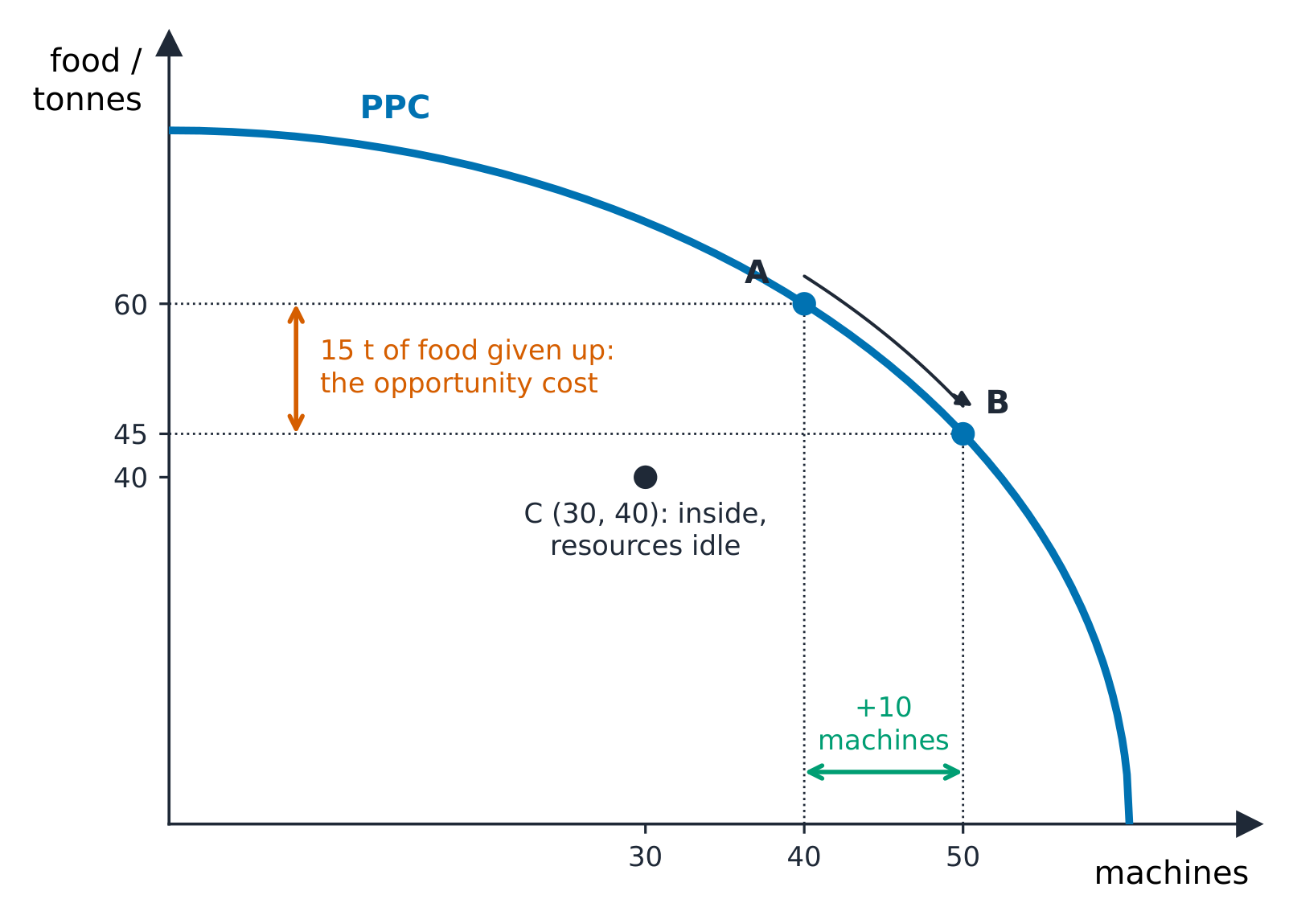
- A point on the curve: all resources are used fully. The economy makes the most it can.
- A point inside the curve: resources are wasted or not all used — for example, there is unemployment 失业. The economy could make more.
- A point outside the curve: this is impossible now. There are not enough resources to reach it.
Movements along the curve
If the economy already uses all its resources (a point on the curve), making more of one good means making less of the other. You must move factors from one good to the other. This is a trade-off 取舍.
The amount of the second good you give up is the opportunity cost of the extra first good. This is why the PPC is a clear picture of opportunity cost.
Worked example. An economy on its PPC makes 40 machines and 60 tonnes of food. To make 50 machines it must cut food to 45 tonnes. Give the opportunity cost of the extra machines. Then say what a point of 30 machines and 40 tonnes of food would tell you. The economy is already on the curve, so more of one good must mean less of the other: the 10 extra machines cost 60 − 45 = 15 tonnes of food. That lost food is the opportunity cost, so quote it in tonnes of food - never in money. The second point lies inside the curve, which means resources are idle or wasted, most likely through unemployment; from there the economy could make more of both goods, so moving out to the curve costs nothing at all. Opportunity cost only bites once you are on the curve.
Shifts of the curve
The whole curve can move:
- It shifts outward (to the right) when the country can make more of both goods. This is economic growth 经济增长. Causes: more resources (a bigger workforce, more land discovered) or better-quality resources (training, new technology).
- It shifts inward (to the left) when the country can make less. This is economic decline 经济衰退. Causes: fewer or worse resources — for example a war, a natural disaster, or using up non-renewable resources 不可再生资源 (resources like oil and coal that cannot be replaced once used).

Do not confuse the two. Moving from inside the curve to the curve (by using idle resources) is a short-term gain. Moving the whole curve outward is a long-term change.
探索
生产可能性曲线
沿曲线移动:生产更多一种商品意味着生产更少另一种商品——这就是机会成本。
词汇
训练
| English | 中文 | 拼音 |
|---|---|---|
| production possibility curve/prəˈdʌkʃn ˌpɒsəˈbɪlɪti kɜːv/ | 生产可能性曲线 | shēng chǎn kě néng xìng qū xiàn |
| unemployment/ʌnemˈplɔɪmənt/ | 失业 | shī yè |
| trade-off/treɪd ɒf/ | 取舍 | qǔ shě |
| economic growth/ˌiːkəˈnɒmɪk ɡrəʊθ/ | 经济增长 | jīng jì zēng zhǎng |
| economic decline/ˌiːkəˈnɒmɪk dɪˈklaɪn/ | 经济衰退 | jīng jì shuāi tuì |
| non-renewable resources/nɒn rɪˈnjuːəbl rɪˈzɔːsɪz/ | 不可再生资源 | bù kě zài shēng zī yuán |
1.2 1.3 1.4
生产要素
教学大纲
- 定义四种生产要素:土地、劳动力、资本和企业家才能,并举例说明
- 陈述各生产要素的报酬(地租、工资、利息、利润)
- 解释生产要素的流动性及其数量和质量变化的原因
- 将机会成本定义为做出选择时所放弃的次优替代方案
- 解释机会成本如何影响消费者、劳动者、生产者和政府的决策
- 绘制并解读展示两种商品最大组合的生产可能性曲线
- 解释曲线上、内部和外部的点以及沿曲线的移动(机会成本)
- 解释导致生产可能性曲线移动的原因(资源数量/质量的变化、经济增长或衰退)
来源:Cambridge International 教学大纲
English
This question follows the style of Paper 2. Try each part before reading the model answer.
Source: Building for the future in Lorvia
Lorvia's government wants the country to produce more capital goods, such as machines and roads, so that it can grow faster. Last year the economy produced 20 units of capital goods and 80 units of consumer goods, using all its resources. The plan for this year is 40 units of capital goods and 60 units of consumer goods. Some families worry that there will be fewer goods in the shops. Lorvia also has many unemployed young people, and some factories stand empty.
(a) Identify one example of a capital good from the source. [1] Machines (or roads).
(b) Calculate the opportunity cost of the extra capital goods in the plan. [2] Capital goods rise by $40-20=20$ units and consumer goods fall by $80-60=20$ units. The opportunity cost of 20 more units of capital goods is the 20 units of consumer goods given up (1 consumer good per capital good).
(c) Explain why producing more capital goods now could let Lorvia produce more of both goods in the future. [4] Capital goods are resources used to make other goods. More machines and roads raise the quantity and quality of Lorvia's factors of production, so the economy can produce more in the future. On a PPC diagram the whole curve shifts outwards, so Lorvia could later have more consumer goods and more capital goods than today.
(d) Analyse, using a PPC diagram, the situation described in the last sentence of the source. [6] Unemployed workers and empty factories mean Lorvia is not using all its resources. It is producing at a point inside its PPC (like the inefficient point in the PPC diagram above). From that point the country could produce more capital goods without giving up any consumer goods, by putting the unemployed workers and empty factories to work. So the opportunity cost of more capital goods would be zero until the economy reaches the curve. Marks: label both axes with the two goods, draw a curved PPC, mark a point inside it and show a move towards the curve.
(e) Discuss whether Lorvia should produce more capital goods and fewer consumer goods. [8] For: more capital goods raise future output, so living standards can rise faster in the long run. New roads and machines can also create jobs for the young unemployed. Against: consumers have fewer goods now, so today's living standards fall. Poorer families may struggle if the goods they need become scarce and their prices rise. The plan's benefits also take years to arrive and are not certain: machines are only useful if workers have the skills to use them. Conclusion: the plan is sensible if Lorvia first uses its unemployed resources, because then it can make more capital goods without cutting consumer goods. The government should move resources away from consumer goods only after that, and slowly, so that poorer families are protected. The answer depends on how many idle resources there are and how soon the new capital raises output.
1.2 1.3 1.4
考试技巧
English
- Scarcity (unlimited wants, limited resources) forces choice, and every choice has an opportunity cost — the next best alternative you give up.
- Learn the four factors of production and the reward each earns: land–rent, labour–wages, capital–interest, enterprise–profit.
- On a PPC, a point on the curve uses all resources fully, inside wastes some (e.g. unemployment), and outside is impossible for now. Moving along the curve shows opportunity cost.
- Moving to the curve (using idle resources) is a short-term gain; shifting the whole curve outward is long-term economic growth from more or better resources.
Vocabulary card meanings
goods: Physical items offered for sale. reward: What a factor of production is paid for its use. rent: Payment to the owner of land for letting others use it. mobility: How easily workers or capital can move to another use. alternative: Another option that could be chosen instead. economic decline: A period when output and incomes fall. non-renewable resources: Natural inputs that are not restored on a human timescale once they are used.
该知识点的互动课程
逐步完成,配合即时检查练习。