跳到主要内容

形容词

HSK 5 · 知识点 1

本主题的视频课程 打开视频页面
4:25

HSK 5 语法 1: 形容词 — 程度与充足

繁忙车站的四种反应。没抢到座位、车厢拥挤、零食价格超出预期、茶水太甜:这四种情境……

英文讲解与普通话例句 · 字幕与原声同步

点击任意汉字可查看拼音和释义。
English

Adjectives that say how much and how. (degree marker)得deextremely / terrible不得了bù dé liǎo and (degree marker)得dedegree / adjective linker很hěn come after an adjective and make it strong; adjective + (completed / change)了le + (one / a一yī)a little点儿diǎnr says something is a bit too much (big大dà(completed / change)了lea little一点儿yì diǎnr, too big); have plenty of有的是yǒu de shì + noun says there is plenty of something. specific; concrete具体jù tǐ asks for specific details (具体来说jù tǐ lái shuō), individual; a few个别gè bié sets a few cases apart, and quickly; rapid迅速xùn sù describes rapid action in writing.

1.1

一目了然

English
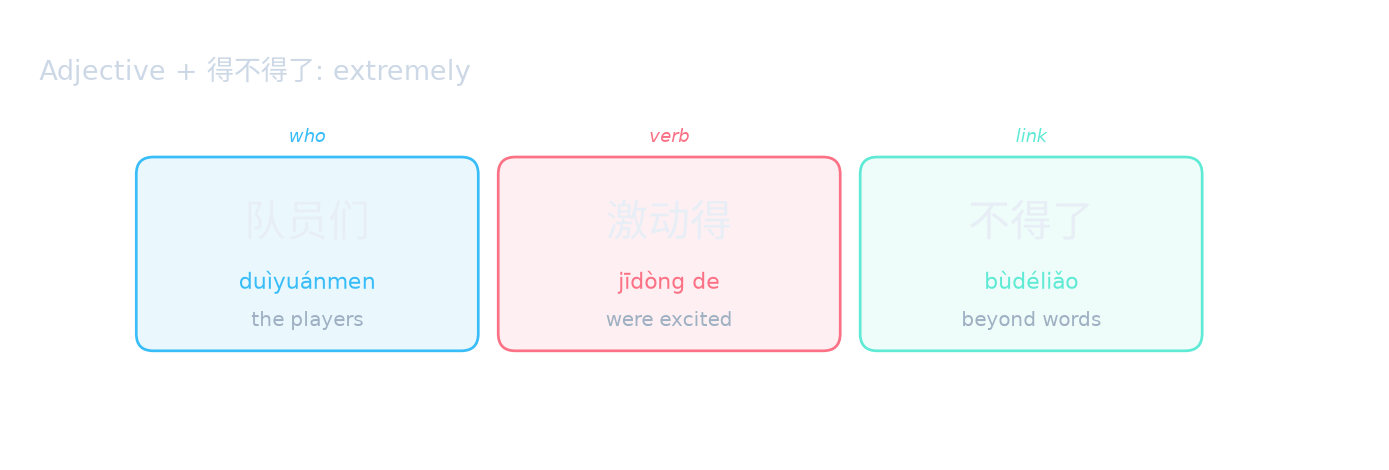
  • 1. Adj + (degree marker)得deextremely / terrible不得了bù dé liǎo – extremely: team member队员duì yuán(plural)们menemotional; worked up激动jī dòng(degree marker)得deextremely / terrible不得了bù dé liǎo。
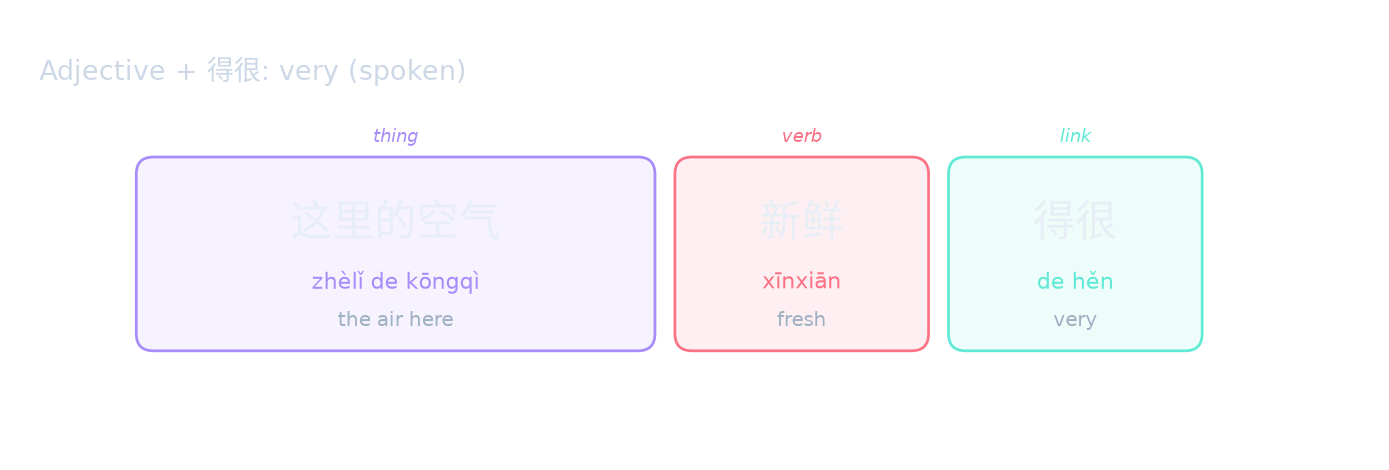
  • 2. Adj + (degree marker)得dedegree / adjective linker很hěn – very: here这里zhè lǐ(modifier / structural particle)的deair空气kōng qìfresh新鲜xīn xiān(degree marker)得dedegree / adjective linker很hěn。
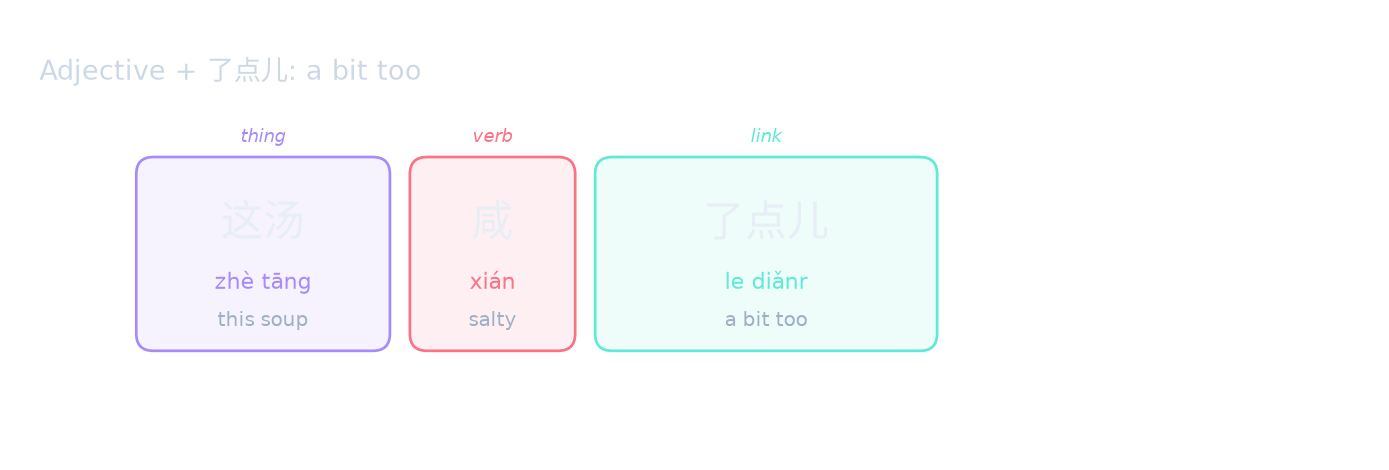
  • 3. Adj + (completed / change)了le + (one / a一yī)a little点儿diǎnr – a bit too: 这汤zhè tāngsalty咸xián(completed / change)了lea little点儿diǎnr。
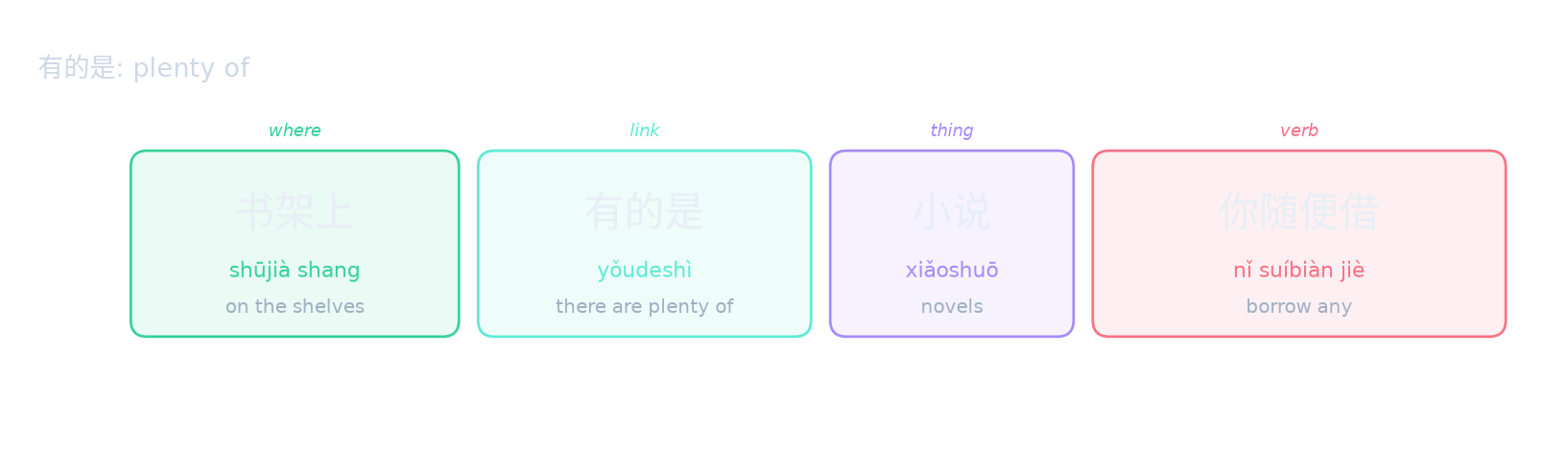
  • 4. have plenty of有的是yǒu de shì + Noun – have plenty of: 书架上shū jià shànghave plenty of有的是yǒu de shìnovel小说xiǎo shuō,you你nǐas you like; casual随便suí biànto borrow借jiè。
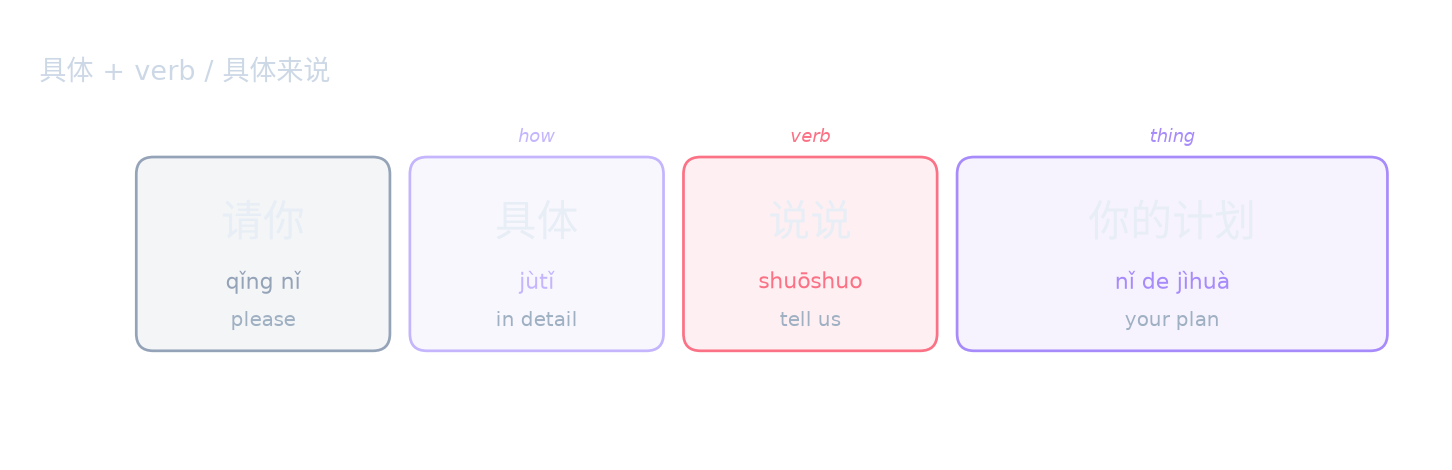
  • 5. specific; concrete具体jù tǐ vs detailed详细xiáng xì – specific, in detail: please; to invite请qǐngyou你nǐspecific; concrete具体jù tǐto speak说shuōto speak说shuōyou你nǐ(modifier / structural particle)的deplan计划jì huà。
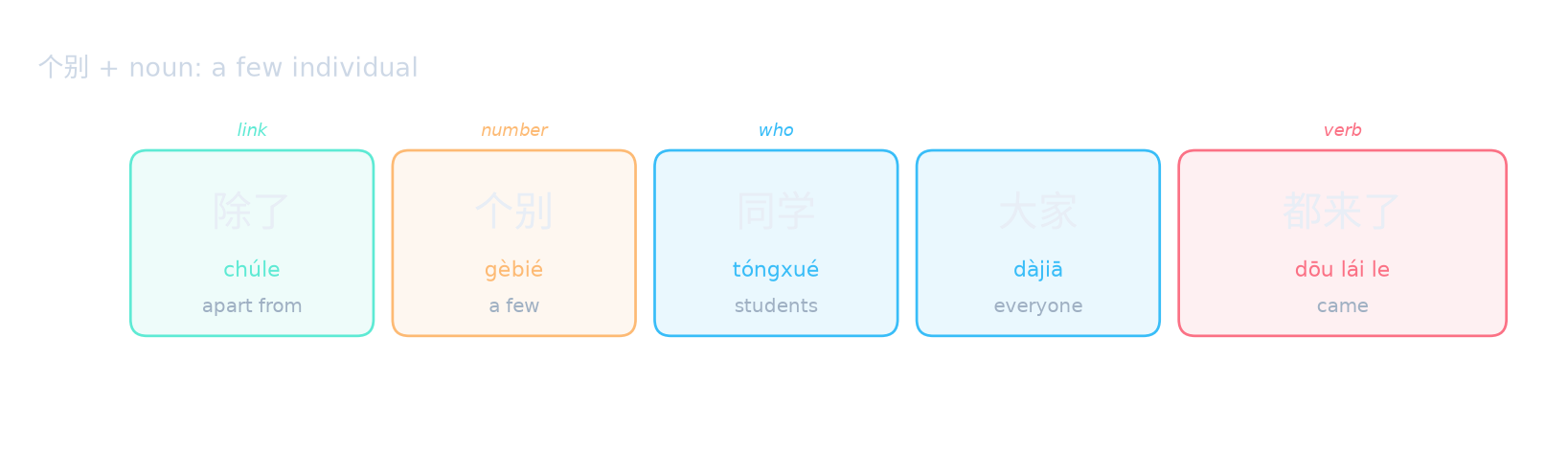
  • 6. individual; a few个别gè bié vs small number少数shǎo shù and some一些yī xiē – a few individual: besides除了chú leindividual; a few个别gè biéclassmate同学tóng xué,everyone大家dà jiāall / both都dōuon time按时àn shíto / arrive / (result: get)到dào(completed / change)了le。
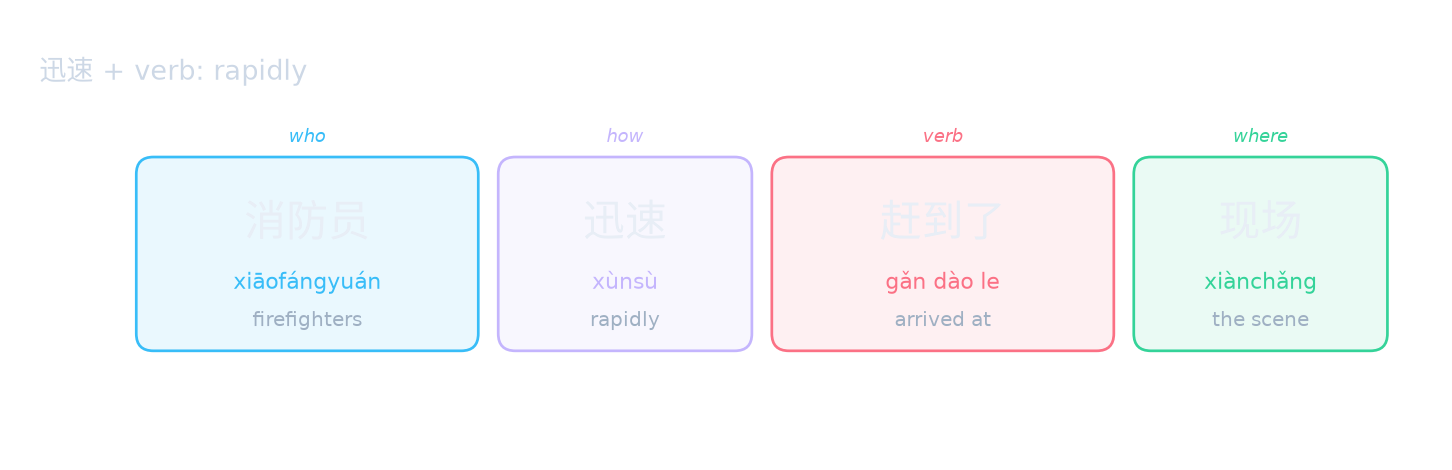
  • 7. quickly; rapid迅速xùn sù vs fast快速kuài sù and at once立刻lì kè – rapidly: firefighter消防员xiāo fáng yuánquickly; rapid迅速xùn sùto hurry (to some place)赶到gǎn dào(completed / change)了lethe scene; on the spot现场xiàn chǎng。
1.2

1. 形容词 + 得不得了(表示程度极高)

English

Form: adjective / feeling verb + (degree marker)得deextremely / terrible不得了bù dé liǎo

  • team member队员duì yuán(plural)们menemotional; worked up激动jī dòng(degree marker)得deextremely / terrible不得了bù dé liǎo。 Duìyuánmen jīdòng de bùdéliǎo. – The players were beside themselves with excitement.
  • today今天jīn tiān热得rè déextremely / terrible不得了bù dé liǎo,I / me我wǒa little一点儿yì diǎnralso也yěnot want to不想bù xiǎngto go out出门chū mén。 – It's unbearably hot today; I don't want to go out at all.
  • to hear (sth said)听说tīng shuōyou你nǐwant / will / need要yàoto come来lái,child孩子hái zi(plural)们menhappy; glad高兴gāo xìng(degree marker)得deextremely / terrible不得了bù dé liǎo。 – When they heard you were coming, the children were overjoyed.

How it works. (degree marker)得de links the adjective to extremely / terrible不得了bù dé liǎo bùdéliǎo ("beyond what can be borne"), which ends the clause and pushes the feeling to an extreme, good or bad.

Expression Meaning
tired累lèi(degree marker)得deextremely / terrible不得了bù dé liǎo exhausted
extremely / terrible不得了bù dé liǎo(completed / change)了le! Oh no, this is serious!
terrific了不得liǎo bù dé remarkable: he / him他tāreally真zhēnterrific了不得liǎo bù dé

Watch out

  • One degree word only: wrong: degree / adjective linker很hěnbusy忙máng(degree marker)得deextremely / terrible不得了bù dé liǎo → busy忙máng(degree marker)得deextremely / terrible不得了bù dé liǎo.
  • Keep (degree marker)得de: wrong: tired累lèiextremely / terrible不得了bù dé liǎo → tired累lèi(degree marker)得deextremely / terrible不得了bù dé liǎo.
Adjective + 得不得了: extremely
词汇 训练
汉字 拼音 English
不得了 bù dé liǎo extremely; terrible
1.3

2. 形容词 + 得很(非常)

English

Form: adjective / feeling verb + (degree marker)得dedegree / adjective linker很hěn

  • here这里zhè lǐ(modifier / structural particle)的deair空气kōng qìfresh新鲜xīn xiān(degree marker)得dedegree / adjective linker很hěn。 Zhèlǐ de kōngqì xīnxiān de hěn. – The air here is really fresh.
  • he / him他tā(modifier / structural particle)的deChinese language中文zhōng wéngood好hǎo(degree marker)得dedegree / adjective linker很hěn,you你nǐneed not不用bù yònganxious担心dān xīn。 – His Chinese is really good; don't worry.
  • 这家zhè jiāhotel酒店jiǔ diàncheap便宜pián yi(degree marker)得dedegree / adjective linker很hěn。 – This hotel is really cheap.
  • good好hǎo(degree marker)得dedegree / adjective linker很hěn,again又yòuto arrive late迟到chí dào(completed / change)了le! – Great, late again! (ironic)

How it works. (degree marker)得dedegree / adjective linker很hěn after an adjective means "very, really", livelier and more emphatic than degree / adjective linker很hěn in front. It ends the clause and also follows feeling verbs: he / him他tāto like喜欢xǐ huan(degree marker)得dedegree / adjective linker很hěn. Said flatly, it can be ironic.

degree / adjective linker很hěnfresh新鲜xīn xiān fresh新鲜xīn xiān(degree marker)得dedegree / adjective linker很hěn fresh新鲜xīn xiān(degree marker)得deextremely / terrible不得了bù dé liǎo
neutral emphatic strongest

Watch out

  • wrong: degree / adjective linker很hěnfresh新鲜xīn xiān(degree marker)得dedegree / adjective linker很hěn → fresh新鲜xīn xiān(degree marker)得dedegree / adjective linker很hěn; wrong: good好hǎodegree / adjective linker很hěn → good好hǎo(degree marker)得dedegree / adjective linker很hěn.
Adjective + 得很: very (spoken)
1.4

3. 形容词 + 了 + (一)点儿(表示程度稍微过高)

English

Form: adjective + (completed / change)了le + (one / a一yī)a little点儿diǎnr (a bit too …)

  • 这汤zhè tāngsalty咸xián(completed / change)了lea little点儿diǎnr。 Zhè tāng xiánle diǎnr. – This soup is a bit too salty.
  • this这zhèmeasure word for long thin things条tiáotrousers裤子kù zilong长cháng(completed / change)了lea little点儿diǎnr。 – These trousers are a bit too long.
  • 八点bā diǎnto hold a meeting开会kāi huì,to / towards / correct对duìI / me我wǒ来说lái shuōearly早zǎo(completed / change)了lea little一点儿yì diǎnr。 – A meeting at eight is a little early for me.
  • price价格jià géexpensive贵guì(completed / change)了lea little点儿diǎnr,can / be able to能néngcheap便宜pián yia little一点儿yì diǎnr(yes/no ?)吗ma? – It's a bit expensive; could you make it a little cheaper?

How it works. Adjective + (completed / change)了le + a little点儿diǎnr measures against the right amount: slightly past it. It is a mild, polite complaint.

big大dà(completed / change)了lea little点儿diǎnr big大dàa little一点儿yì diǎnr slightly有点儿yǒu diǎn érbig大dà too太tàibig大dà(completed / change)了le!
a bit too big a bit bigger (request) a bit big (the feeling) far too big

Watch out

  • To ask for a bigger size, say big大dàa little一点儿yì diǎnr(modifier / structural particle)的de; big大dà(completed / change)了lea little点儿diǎnr says this one is too big.
Adjective + 了点儿: a bit too
1.5

4. 有的是 + 名词(表示数量充足)

English

Form: (topic,) subject + have plenty of有的是yǒu de shì + noun

  • 书架上shū jià shànghave plenty of有的是yǒu de shìnovel小说xiǎo shuō,you你nǐas you like; casual随便suí biànto borrow借jiè。 Shūjià shang yǒudeshì xiǎoshuō, nǐ suíbiàn jiè. – There are plenty of novels on the shelf; borrow whatever you like.
  • don't别biéanxious担心dān xīn,ticket票piàohave plenty of有的是yǒu de shì。 – Don't worry, there are plenty of tickets.
  • this kind of这种zhè zhǒngthing; stuff东西dōng xī,supermarket超市chāo shìinside; in里lǐhave plenty of有的是yǒu de shì。 – Things like this, the supermarket has loads of.
  • he / him他tāhave plenty of有的是yǒu de shìmeans办法bàn fǎ。 – He has plenty of ways to handle it.

How it works. have plenty of有的是yǒu de shì yǒudeshì means "there's no shortage of". It reassures, and adds "so don't worry": to have / there is有yǒu很多hěn duōtime时间shí jiān is neutral; have plenty of有的是yǒu de shìtime时间shí jiān means there's no need to hurry. The topic can come first and have plenty of有的是yǒu de shì last.

have plenty of有的是yǒu de shì + noun to have / there is有yǒu(modifier / structural particle)的de + noun
plenty of some
have plenty of有的是yǒu de shìtime时间shí jiān to have / there is有yǒu(modifier / structural particle)的deperson人rénnot不bùto like喜欢xǐ huanto eat吃chīspicy辣là

Watch out

  • No 很多hěn duō inside: wrong: have plenty of有的是yǒu de shì很多hěn duōmoney钱qián → have plenty of有的是yǒu de shìmoney钱qián.
有的是: plenty of
1.6

5. 具体 vs 详细 (specific, in detail)

English

Form: specific; concrete具体jù tǐ + verb · specific; concrete具体jù tǐ(modifier / structural particle)的de + noun · 具体来说jù tǐ lái shuō,…

  • please; to invite请qǐngyou你nǐspecific; concrete具体jù tǐto speak说shuōto speak说shuōyou你nǐ(modifier / structural particle)的deplan计划jì huà。 Qǐng nǐ jùtǐ shuōshuo nǐ de jìhuà. – Please tell us about your plan in detail.
  • meeting会议huì yì(modifier / structural particle)的despecific; concrete具体jù tǐtime时间shí jiānstill / also / even还hái没定méi dìng。 – The exact time of the meeting hasn't been set yet.
  • 具体来说jù tǐ lái shuō,to participate参加cān jiā(modifier / structural particle)的deperson人rénthan / compared to比bǐlast year去年qù niánmany; much多duō(completed / change)了le一倍yí bèi。 – To be specific, twice as many people took part as last year.

How it works. specific; concrete具体jù tǐ = specific, concrete, not vague. 具体来说jù tǐ lái shuō brings details after a general point. detailed详细xiáng xì = full of details; distinct清楚qīng chǔ = clear. Opposite: abstract抽象chōu xiàng.

specific; concrete具体jù tǐtime时间shí jiān detailed详细xiáng xìto explain / to show说明shuō míng 具体来说jù tǐ lái shuō
exact time full instructions to be specific

Watch out

  • specific; concrete具体jù tǐ = exact, not vague; detailed详细xiáng xì = with many details.
具体 + verb / 具体来说
词汇 训练
汉字 拼音 English
具体 jù tǐ specific; concrete
抽象 chōu xiàng abstract
1.7

6. 个别 vs 少数 and 一些 (a few individual)

English

Form: individual; a few个别gè bié + noun · individual; a few个别gè bié + verb (individually)

  • besides除了chú leindividual; a few个别gè biéclassmate同学tóng xué,everyone大家dà jiāall / both都dōuon time按时àn shíto / arrive / (result: get)到dào(completed / change)了le。 Chúle gèbié tóngxué, dàjiā dōu ànshí dào le. – Apart from a few students, everyone arrived on time.
  • this这zhèmerely只是zhǐ shì个别现象gè bié xiàn xiàng。 – This is just an isolated case.
  • teacher老师lǎo shīcan / will会huì个别辅导gè bié fǔ dǎoachievement成绩chéng jìno good不好bù hǎo(modifier / structural particle)的destudent学生xué shēng。 – The teacher will give individual help to students with low marks.

How it works. individual; a few个别gè bié = a very few individual, isolated cases, set apart from the rest; before a verb, individually. small number少数shǎo shù = a minority; some一些yī xiē = some. Opposite: common; widespread普遍pǔ biàn.

individual; a few个别gè biéclassmate同学tóng xué small number少数shǎo shùperson人rén common; widespread普遍pǔ biàn
a few students a minority widespread

Watch out

  • individual; a few个别gè bié stresses isolated cases; small number少数shǎo shù a minority.
个别 + noun: a few individual
词汇 训练
汉字 拼音 English
个别 gè bié individual; a few
1.8

7. 迅速 vs 快速 and 立刻 (rapidly)

English

Form: quickly; rapid迅速xùn sù + verb · verb + (degree marker)得de + degree / adjective linker很hěnquickly; rapid迅速xùn sù

  • firefighter消防员xiāo fáng yuánquickly; rapid迅速xùn sùto hurry (to some place)赶到gǎn dào(completed / change)了lethe scene; on the spot现场xiàn chǎng。 Xiāofángyuán xùnsù gǎn dào le xiànchǎng. – Firefighters rushed to the scene.
  • 这座zhè zuòcity城市chéng shìto develop; development发展fā zhǎn(degree marker)得devery非常fēi chángquickly; rapid迅速xùn sù。 – This city has developed very rapidly.
  • please; to invite请qǐngat once立刻lì kèto pull up (stop one's…停车tíng chē! – Stop the car immediately!

How it works. quickly; rapid迅速xùn sù = rapidly, a written word for fast action or change. fast快速kuài sù is close (often before nouns). at once立刻lì kè / right away马上mǎ shàng = immediately. In speech: 很快hěn kuài.

quickly; rapid迅速xùn sùto hurry (to some place)赶到gǎn dào to develop; development发展fā zhǎnquickly; rapid迅速xùn sù at once立刻lì kèto pull up (stop one's…停车tíng chē
rush there develop fast stop at once

Watch out

  • In speech, 很快hěn kuài sounds more natural than quickly; rapid迅速xùn sù.
迅速 + verb: rapidly
词汇 训练
汉字 拼音 English
迅速 xùn sù quickly; rapid
立刻 lì kè at once
1.9

练习

English

Cover the teaching pages before you answer. The answers are at the end.

1. Adj + (degree marker)得deextremely / terrible不得了bù dé liǎo (extremely)

1. Complete: “I'm terribly busy this week.” this这个zhè geweek星期xīng qī我忙wǒ máng…………extremely / terrible不得了bù dé liǎo。

2. Which sentence is correct?

  • A. he / him他tāhappy; glad高兴gāo xìng(degree marker)得deextremely / terrible不得了bù dé liǎo。
  • B. he / him他tāextremely / terrible不得了bù dé liǎohappy; glad高兴gāo xìng。
  • C. he / him他tāhappy; glad高兴gāo xìngextremely / terrible不得了bù dé liǎo(degree marker)得de。
  • D. he / him他tādegree / adjective linker很hěnhappy; glad高兴gāo xìng(degree marker)得deextremely / terrible不得了bù dé liǎo。

3. Match each expression to its meaning.

  • (1) tired累lèi(degree marker)得deextremely / terrible不得了bù dé liǎo

  • (2) extremely / terrible不得了bù dé liǎo(completed / change)了le!

  • (3) terrific了不得liǎo bù dé

  • A. remarkable

  • B. exhausted

  • C. oh no, this is serious!

4. Build: “When they heard you were coming, the children were overjoyed.”

Put in order: to hear (sth said)听说tīng shuōyou你nǐwant / will / need要yàoto come来lái / extremely / terrible不得了bù dé liǎo。 / ,child孩子hái zi(plural)们men / happy; glad高兴gāo xìng(degree marker)得de

5. Your school team has just won the city championship after a penalty shoot-out. Use Adj + (degree marker)得deextremely / terrible不得了bù dé liǎo. Write your answer in Chinese, then say it aloud.

2. Adj + (degree marker)得dedegree / adjective linker很hěn (very)

6. Complete: “This hotel is really cheap.” 这家zhè jiāhotel酒店jiǔ diàncheap便宜pián yi…………。

7. Which sentence is correct?

  • A. air空气kōng qìfresh新鲜xīn xiān(degree marker)得dedegree / adjective linker很hěn。
  • B. air空气kōng qìdegree / adjective linker很hěnfresh新鲜xīn xiān(degree marker)得dedegree / adjective linker很hěn。
  • C. air空气kōng qìfresh新鲜xīn xiāndegree / adjective linker很hěn。
  • D. air空气kōng qì(degree marker)得dedegree / adjective linker很hěnfresh新鲜xīn xiān。

8. Build: “His Chinese is really good.”

Put in order: (degree marker)得dedegree / adjective linker很hěn。 / good好hǎo / he / him他tā(modifier / structural particle)的deChinese language中文zhōng wén

9. True or false? (degree marker)得deextremely / terrible不得了bù dé liǎo is usually stronger than (degree marker)得dedegree / adjective linker很hěn. If false, correct it.

10. After a week in a smoggy city, you walk in a mountain park. Use Adj + (degree marker)得dedegree / adjective linker很hěn. Write your answer in Chinese, then say it aloud.

3. Adj + (completed / change)了le + (one / a一yī)a little点儿diǎnr (a bit too)

11. Complete: “These trousers are a bit too long.” this这zhèmeasure word for long thin things条tiáotrousers裤子kù zilong长cháng…………a little点儿diǎnr。

12. You want a slightly bigger size. What do you ask for?

  • A. too太tàibig大dà(completed / change)了le(modifier / structural particle)的de
  • B. big大dà(completed / change)了lea little点儿diǎnr(modifier / structural particle)的de
  • C. slightly有点儿yǒu diǎn érbig大dà(modifier / structural particle)的de
  • D. big大dàa little一点儿yì diǎnr(modifier / structural particle)的de

13. Build: “A meeting at eight is a little early for me.”

Put in order: ,to / towards / correct对duìI / me我wǒ来说lái shuō / early早zǎo(completed / change)了le / a little一点儿yì diǎnr。 / 八点bā diǎnto hold a meeting开会kāi huì

14. True or false? 太咸tài xián(completed / change)了le is a stronger complaint than 咸了xián lea little点儿diǎnr. If false, correct it.

15. You taste the soup your roommate made. It's good, but there's slightly too much salt. Use Adj + (completed / change)了le +. Write your answer in Chinese, then say it aloud.

4. have plenty of有的是yǒu de shì + Noun (have plenty of)

16. Reassure: “Don't worry, there are plenty of tickets.” don't别biéanxious担心dān xīn,ticket票piào…………。

17. What does to have / there is有yǒu(modifier / structural particle)的deperson人rénnot不bùto like喜欢xǐ huanto eat吃chīspicy辣là mean?

  • A. Some people don't like spicy food.
  • B. Plenty of people dislike spicy food.
  • C. Everyone likes spicy food.
  • D. Nobody likes spicy food.

18. Build: “He has plenty of ways (to solve it).”

Put in order: means办法bàn fǎ。 / he / him他tā / have plenty of有的是yǒu de shì

19. True or false? have plenty of有的是yǒu de shìtime时间shí jiān suggests there's no need to hurry. If false, correct it.

20. A friend worries she won't find a novel to read on holiday. Use have plenty of有的是yǒu de shì + Noun. Write your answer in Chinese, then say it aloud.

5. specific; concrete具体jù tǐ vs detailed详细xiáng xì (specific, in detail)

21. Complete: “Please tell us about your plan in detail.” please; to invite请qǐngyou你nǐ…………to speak说shuōto speak说shuōyou你nǐ(modifier / structural particle)的deplan计划jì huà。

22. Which phrase introduces details after a general point?

  • A. general笼统lǒng tǒng来说lái shuō,……
  • B. 具体来说jù tǐ lái shuō,……

23. “The exact time of the meeting hasn't been set yet.” Which fits best?

  • A. meeting会议huì yì(modifier / structural particle)的dedetailed详细xiáng xìtime时间shí jiānstill / also / even还hái没定méi dìng。
  • B. meeting会议huì yì(modifier / structural particle)的despecific; concrete具体jù tǐtime时间shí jiānstill / also / even还hái没定méi dìng。

24. Build: “To be specific, twice as many people took part as last year.”

Put in order: than / compared to比bǐlast year去年qù nián / to participate参加cān jiā(modifier / structural particle)的deperson人rén / many; much多duō(completed / change)了le一倍yí bèi。 / 具体来说jù tǐ lái shuō,

25. True or false? The opposite of specific; concrete具体jù tǐ is abstract抽象chōu xiàng (abstract). If false, correct it.

26. Make a general statement about your school, then support it with 具体来说jù tǐ lái shuō and one specific detail. Use specific; concrete具体jù tǐ or detailed详细xiáng xì. Write your answer in Chinese, then say it aloud.

6. individual; a few个别gè bié vs small number少数shǎo shù and some一些yī xiē (a few individual)

27. Complete: “Apart from a few students, everyone arrived on time.” besides除了chú le…………classmate同学tóng xué,everyone大家dà jiāall / both都dōuon time按时àn shíto / arrive / (result: get)到dào(completed / change)了le。

28. What is the opposite of 个别现象gè bié xiàn xiàng (an isolated case)?

  • A. 普遍现象pǔ biàn xiàn xiàng
  • B. specific; concrete具体jù tǐphenomenon现象xiàn xiàng

29. teacher老师lǎo shīcan / will会huì个别辅导gè bié fǔ dǎoachievement成绩chéng jìno good不好bù hǎo(modifier / structural particle)的destudent学生xué shēng。What does it mean?

  • A. The teacher will help those students one-to-one.
  • B. The teacher will help only one student.

30. Build: “This is just an isolated case.”

Put in order: individual; a few个别gè bié / merely只是zhǐ shì / phenomenon现象xiàn xiàng。 / this这zhè

31. True or false? individual; a few个别gè bié stresses individual, isolated cases, while small number少数shǎo shù stresses a minority. If false, correct it.

32. Report on how your class did in a test, in two sentences: most did well, but a few individual students had problems (individual; a few个别gè bié), and what the teacher will do (个别辅导gè bié fǔ dǎo). Use individual; a few个别gè bié or small number少数shǎo shù and some一些yī xiē. Write your answer in Chinese, then say it aloud.

7. quickly; rapid迅速xùn sù vs fast快速kuài sù and at once立刻lì kè (rapidly)

33. Complete (a news report): “Firefighters rushed to the scene.” firefighter消防员xiāo fáng yuán…………to hurry (to some place)赶到gǎn dào(completed / change)了lethe scene; on the spot现场xiàn chǎng。

34. A parent calls a child in everyday speech – “Come here right now!” Which is most natural?

  • A. quickly; rapid迅速xùn sùto come over过来guò lái!
  • B. right away马上mǎ shàngto come over过来guò lái!

35. Chatting with a friend – which sounds most natural?

  • A. he / him他tāquickly; rapid迅速xùn sù地来dì lái(completed / change)了le。
  • B. he / him他tā很快hěn kuàithen / just就jiùto come来lái(completed / change)了le。

36. Build: “This city has developed very rapidly.”

Put in order: quickly; rapid迅速xùn sù。 / to develop; development发展fā zhǎn(degree marker)得de / very非常fēi cháng / 这座zhè zuòcity城市chéng shì

37. True or false? news; message消息xiāo xīquickly; rapid迅速xùn sù(of news) to spread传开chuán kāi(completed / change)了le means "The news spread rapidly." If false, correct it.

38. Write a two-sentence news item about a problem that was solved quickly. Use quickly; rapid迅速xùn sù twice. Use quickly; rapid迅速xùn sù or fast快速kuài sù and at once立刻lì kè. Write your answer in Chinese, then say it aloud.

1.10

混合练习

English

These questions mix the patterns and use new situations.

39. Choose (degree marker)得deextremely / terrible不得了bù dé liǎo or (completed / change)了lea little一点儿yì diǎnr: 这双鞋zhè shuāng xiébig大dà…………,to have / there is有yǒusmall小xiǎoa little一点儿yì diǎnr(modifier / structural particle)的de(yes/no ?)吗ma? / to hear听到tīng dàothis这个zhè genews; message消息xiāo xī,he / him他tāhappy; glad高兴gāo xìng…………。

40. Your friend worries about time. Say "We have plenty of time."

41. Find and fix the problem. A classmate writes I / me我wǒto have / there is有yǒu很多hěn duō(modifier / structural particle)的deto be / is是shìtime时间shí jiān for "I have plenty of time." Correct it.

42. Use it yourself. Say the journey was extremely tiring, and that there are plenty of seats left.

1.11

答案与解析

English

Mark your work, then correct each mistake in your own words.

1. Adj + (degree marker)得deextremely / terrible不得了bù dé liǎo (extremely)

1. (degree marker)得de

Adj + (degree marker)得de + extremely / terrible不得了bù dé liǎo.

2. A. he / him他tāhappy; glad高兴gāo xìng(degree marker)得deextremely / terrible不得了bù dé liǎo。

he / him他tāhappy; glad高兴gāo xìng(degree marker)得deextremely / terrible不得了bù dé liǎo is right: a bare adjective + (degree marker)得deextremely / terrible不得了bù dé liǎo already means "extremely", so degree / adjective linker很hěn is not added.

3. (1) B: tired累lèi(degree marker)得deextremely / terrible不得了bù dé liǎo = exhausted; (2) C: extremely / terrible不得了bù dé liǎo(completed / change)了le! = oh no, this is serious!; (3) A: terrific了不得liǎo bù dé = remarkable

The position and order of extremely / terrible不得了bù dé liǎo / terrific了不得liǎo bù dé change the meaning.

4. to hear (sth said)听说tīng shuōyou你nǐwant / will / need要yàoto come来lái,child孩子hái zi(plural)们menhappy; glad高兴gāo xìng(degree marker)得deextremely / terrible不得了bù dé liǎo。

Cause, then subject + Adj + (degree marker)得deextremely / terrible不得了bù dé liǎo.

5. Model answer: team member队员duì yuán(plural)们menemotional; worked up激动jī dòng(degree marker)得deextremely / terrible不得了bù dé liǎo。

Check your answer:

  • No degree / adjective linker很hěn / very非常fēi cháng before the adjective: busy忙máng(degree marker)得deextremely / terrible不得了bù dé liǎo, not degree / adjective linker很hěnbusy忙máng(degree marker)得deextremely / terrible不得了bù dé liǎo.
  • Keep (degree marker)得de: tired累lèi(degree marker)得deextremely / terrible不得了bù dé liǎo, not tired累lèiextremely / terrible不得了bù dé liǎo.

2. Adj + (degree marker)得dedegree / adjective linker很hěn (very)

6. (degree marker)得dedegree / adjective linker很hěn

Adj + (degree marker)得dedegree / adjective linker很hěn.

7. A. air空气kōng qìfresh新鲜xīn xiān(degree marker)得dedegree / adjective linker很hěn。

air空气kōng qìfresh新鲜xīn xiān(degree marker)得dedegree / adjective linker很hěn is right: a bare adjective + (degree marker)得dedegree / adjective linker很hěn. A second degree / adjective linker很hěn is redundant, and (degree marker)得de must follow the adjective.

8. he / him他tā(modifier / structural particle)的deChinese language中文zhōng wéngood好hǎo(degree marker)得dedegree / adjective linker很hěn。

Subject + Adj + (degree marker)得dedegree / adjective linker很hěn.

9. True.

The scale is degree / adjective linker很hěn → (degree marker)得dedegree / adjective linker很hěn → (degree marker)得deextremely / terrible不得了bù dé liǎo.

10. Model answer: here这里zhè lǐ(modifier / structural particle)的deair空气kōng qìfresh新鲜xīn xiān(degree marker)得dedegree / adjective linker很hěn。

Check your answer:

  • Do not add degree / adjective linker很hěn before as well: fresh新鲜xīn xiān(degree marker)得dedegree / adjective linker很hěn, not degree / adjective linker很hěnfresh新鲜xīn xiān(degree marker)得dedegree / adjective linker很hěn.
  • Keep (degree marker)得de: good好hǎo(degree marker)得dedegree / adjective linker很hěn, not good好hǎodegree / adjective linker很hěn.

3. Adj + (completed / change)了le + (one / a一yī)a little点儿diǎnr (a bit too)

11. (completed / change)了le

Adj + (completed / change)了le + a little点儿diǎnr = a bit too.

12. D. big大dàa little一点儿yì diǎnr(modifier / structural particle)的de

A request for “a bit bigger” is Adj + a little一点儿yì diǎnr.

13. 八点bā diǎnto hold a meeting开会kāi huì,to / towards / correct对duìI / me我wǒ来说lái shuōearly早zǎo(completed / change)了lea little一点儿yì diǎnr。

Adj + (completed / change)了le + a little一点儿yì diǎnr.

14. True.

True. too太tài…(completed / change)了le is a strong complaint (“far too salty”), while adjective + (completed / change)了lea little点儿diǎnr is mild and polite: 咸了xián lea little点儿diǎnr “a little too salty”.

15. Model answer: 这汤zhè tāngsalty咸xián(completed / change)了lea little点儿diǎnr。

Check your answer:

  • big大dà(completed / change)了lea little点儿diǎnr = a bit too big (off from what's needed). big大dàa little一点儿yì diǎnr = a bit bigger (a comparison or request).
  • It is mild; for a strong complaint use too太tài…(completed / change)了le: 太咸tài xián(completed / change)了le!

4. have plenty of有的是yǒu de shì + Noun (have plenty of)

16. have plenty of有的是yǒu de shì

Topic + have plenty of有的是yǒu de shì = plenty.

17. A. Some people don't like spicy food.

to have / there is有yǒu(modifier / structural particle)的de + noun means “some (of them)”: to have / there is有yǒu(modifier / structural particle)的deperson人rénnot不bùto like喜欢xǐ huanto eat吃chīspicy辣là “Some people don't like spicy food.” It says nothing about how many, so “plenty” overstates it.

18. he / him他tāhave plenty of有的是yǒu de shìmeans办法bàn fǎ。

Subject + have plenty of有的是yǒu de shì + noun.

19. True.

It reassures that there is more than enough.

20. Model answer: 书架上shū jià shànghave plenty of有的是yǒu de shìnovel小说xiǎo shuō,you你nǐas you like; casual随便suí biànto borrow借jiè。

Check your answer:

  • have plenty of有的是yǒu de shì = plenty; to have / there is有yǒu(modifier / structural particle)的de + noun = some: to have / there is有yǒu(modifier / structural particle)的deperson人rénto like喜欢xǐ huan – "some people like it". Do not mix them up.
  • No 很多hěn duō inside: have plenty of有的是yǒu de shìmoney钱qián, not have plenty of有的是yǒu de shì很多hěn duōmoney钱qián.

5. specific; concrete具体jù tǐ vs detailed详细xiáng xì (specific, in detail)

21. specific; concrete具体jù tǐ

Specific, in detail – specific; concrete具体jù tǐ.

22. B. 具体来说jù tǐ lái shuō,……

具体来说jù tǐ lái shuō = to be specific; general笼统lǒng tǒng来说lái shuō = speaking generally.

23. B. meeting会议huì yì(modifier / structural particle)的despecific; concrete具体jù tǐtime时间shí jiānstill / also / even还hái没定méi dìng。

An exact time – specific; concrete具体jù tǐ(modifier / structural particle)的detime时间shí jiān.

24. 具体来说jù tǐ lái shuō,to participate参加cān jiā(modifier / structural particle)的deperson人rénthan / compared to比bǐlast year去年qù niánmany; much多duō(completed / change)了le一倍yí bèi。

具体来说jù tǐ lái shuō + the detail.

25. True.

specific; concrete具体jù tǐ = concrete; abstract抽象chōu xiàng = abstract.

26. Model answer: we / us我们wǒ menschool学校xué xiào非常重视fēi cháng zhòng shìsports体育tǐ yù。具体来说jù tǐ lái shuō,每个měi gèstudent学生xué shēngevery day每天měi tiānall / both都dōuwant / will / need要yàosports / to exercise运动yùn dòng一个yí gèhour小时xiǎo shí,every year每年měi niánalso / there is still还有hái yǒutwice两次liǎng cìsports competition运动会yùn dòng huì。

Check your answer:

  • The general statement comes first.
  • 具体来说jù tǐ lái shuō introduces a specific detail.
  • I said it aloud before comparing with the model.

Your answer need not copy the model. A partner or teacher must hear the spoken response to comment on pronunciation.

6. individual; a few个别gè bié vs small number少数shǎo shù and some一些yī xiē (a few individual)

27. individual; a few个别gè bié

One or two individual cases – individual; a few个别gè bié.

28. A. 普遍现象pǔ biàn xiàn xiàng

individual; a few个别gè bié vs common; widespread普遍pǔ biàn (widespread).

29. A. The teacher will help those students one-to-one.

individual; a few个别gè bié + verb = individually.

30. this这zhèmerely只是zhǐ shì个别现象gè bié xiàn xiàng。

individual; a few个别gè bié + noun.

31. True.

个别现象gè bié xiàn xiàng = an isolated case; small number少数shǎo shùperson人rén = a minority.

32. Model answer: 这次zhè cìexam; to take an exam考试kǎo shìin large part大部分dà bù fènclassmate同学tóng xué考得kǎo dénot bad / pretty good不错bú cuò,only (if) / only have只有zhǐ yǒuindividual; a few个别gè biéclassmate同学tóng xuénot / haven't没méito pass (a test)及格jí gé。teacher老师lǎo shīto speak说shuōnext week下周xià zhōucan / will会huì个别辅导gè bié fǔ dǎothey他们tā men。

Check your answer:

  • individual; a few个别gè bié sets a very small number apart.
  • individual; a few个别gè bié + verb means individually.
  • I said it aloud before comparing with the model.

Your answer need not copy the model. A partner or teacher must hear the spoken response to comment on pronunciation.

7. quickly; rapid迅速xùn sù vs fast快速kuài sù and at once立刻lì kè (rapidly)

33. quickly; rapid迅速xùn sù

Rapidly (written) – quickly; rapid迅速xùn sù.

34. B. right away马上mǎ shàngto come over过来guò lái!

Right now, in speech – right away马上mǎ shàng (or at once立刻lì kè). quickly; rapid迅速xùn sù is a written word for speed.

35. B. he / him他tā很快hěn kuàithen / just就jiùto come来lái(completed / change)了le。

In speech, 很快hěn kuài; quickly; rapid迅速xùn sù is written.

36. 这座zhè zuòcity城市chéng shìto develop; development发展fā zhǎn(degree marker)得devery非常fēi chángquickly; rapid迅速xùn sù。

Verb + (degree marker)得de + quickly; rapid迅速xùn sù.

37. True.

quickly; rapid迅速xùn sù describes fast change.

38. Model answer: 昨天上午zuó tiān shàng wǔ,school学校xué xiào(modifier / structural particle)的de一间yī jiānclassroom教室jiào shìsuddenly突然tū ránto have a power failure停电tíng diàn(completed / change)了le。electrician电工diàn gōngto receive (letter etc)接到jiē dàotelephone电话diàn huàafter / back后hòuquickly; rapid迅速xùn sùto rush over赶来gǎn lái,question / problem问题wèn tí很快hěn kuàithen / just就jiùto solve解决jiě jué(completed / change)了le,news; message消息xiāo xīalso也yěat / in在zàistudent学生xué shēngmiddle / in中zhōngquickly; rapid迅速xùn sù(of news) to spread传开chuán kāi(completed / change)了le。

Check your answer:

  • quickly; rapid迅速xùn sù describes fast action or change.
  • The style fits a news item.
  • I read it aloud before comparing with the model.

Your answer need not copy the model.

Mixed practice

39. 这双鞋zhè shuāng xiébig大dà(completed / change)了lea little一点儿yì diǎnr (a bit too big)。he / him他tāhappy; glad高兴gāo xìng(degree marker)得deextremely / terrible不得了bù dé liǎo (extremely happy).

40. we / us我们wǒ menhave plenty of有的是yǒu de shìtime时间shí jiān。have plenty of有的是yǒu de shì + noun means there is plenty, so don't worry.

41. have plenty of有的是yǒu de shì is a fixed phrase and goes straight before the noun: I / me我wǒhave plenty of有的是yǒu de shìtime时间shí jiān. It already means "plenty", so drop 很多hěn duō.

42. Model answer. 这次zhè cìto travel旅行lǚ xíngtired累lèi(degree marker)得deextremely / terrible不得了bù dé liǎo。don't别biéanxious担心dān xīn,seat座位zuò wèihave plenty of有的是yǒu de shì。

Review later. Tomorrow, use (degree marker)得deextremely / terrible不得了bù dé liǎo, (degree marker)得dedegree / adjective linker很hěn and (completed / change)了lea little一点儿yì diǎnr with three different adjectives.
该知识点的互动课程

逐步完成,配合即时检查练习。

更多 HSK 5 知识点

登录或创建账户

IGCSE, A-Level & AP