Prepositions for formal speech and writing. Some set the time (ever since自从, while (taking the chance)趁), some name who benefits or what something is based on (for / (wéi) to be为, relying on凭, to / for / give给 as a passive), and some limit the topic (to / towards / correct对……(typically preceded by 就……而言, then / just就……来说, included在内, as for至于). They come before the verb or at the start of the sentence.
介词
HSK 5 · 知识点 8
5:48
HSK 5 语法 8:介词
(自)从、为、对……而言、包括在内、凭、1或2。(自)从:自从某个时间点起;自从毕业以来,我一直在北京。为 + 人:为了某人……
英文讲解与普通话例句 · 字幕与原声同步
8.1
一目了然
Time
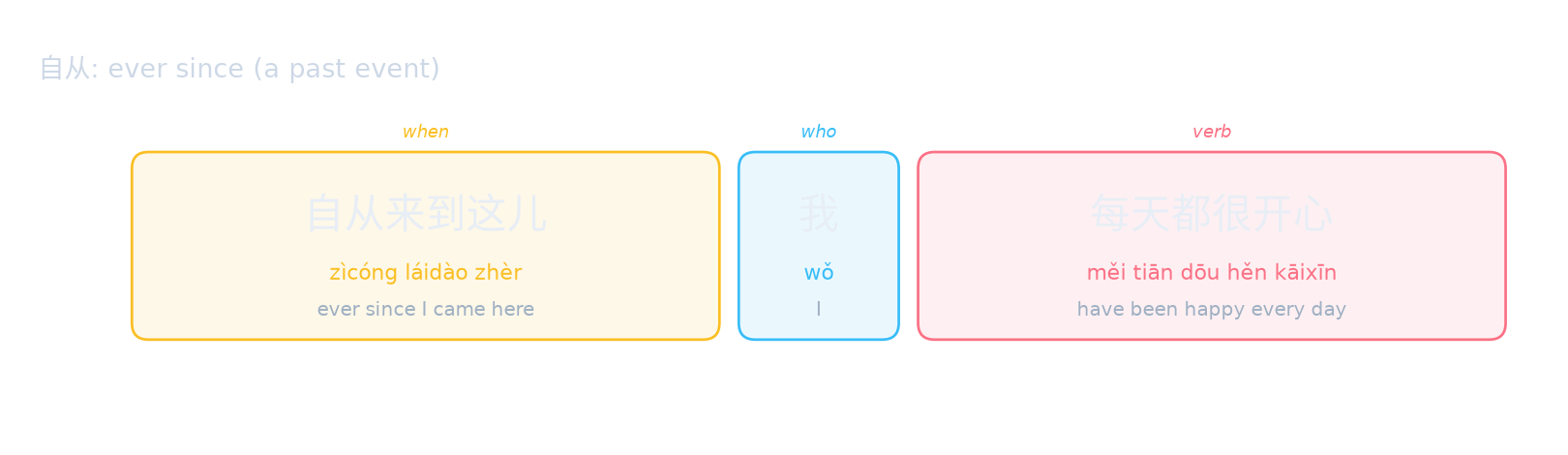
- 1. ever since自从 – ever since: ever since自从to arrive来到here这儿,I / me我every day每天all / both都degree / adjective linker很happy开心。
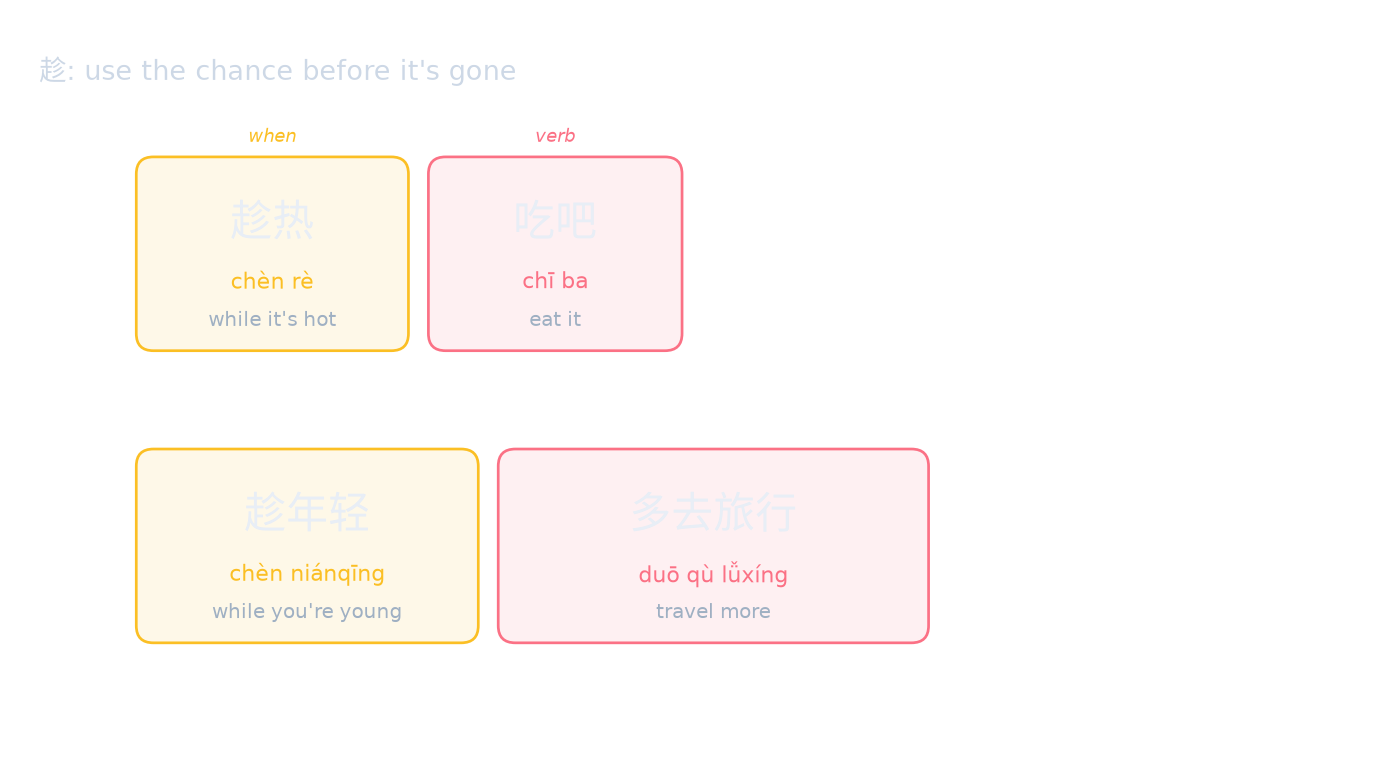
- 2. while (taking the chance)趁 – while / taking advantage of: fast; soon快趁热to eat吃(suggestion)吧!
For whom, and on what basis
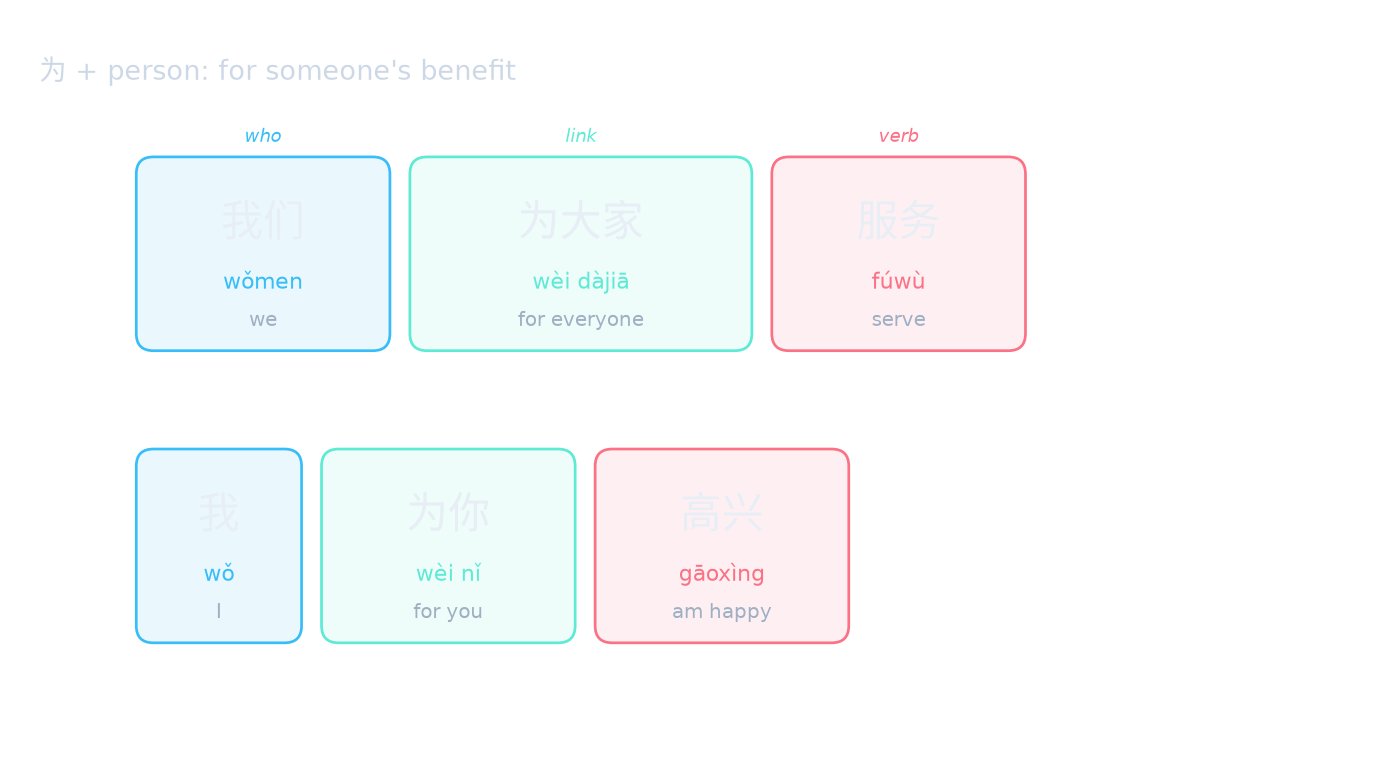
- 3. for / (wéi) to be为 + Person – for someone's sake: we / us我们for / (wéi) to be为everyone大家service / to serve服务。
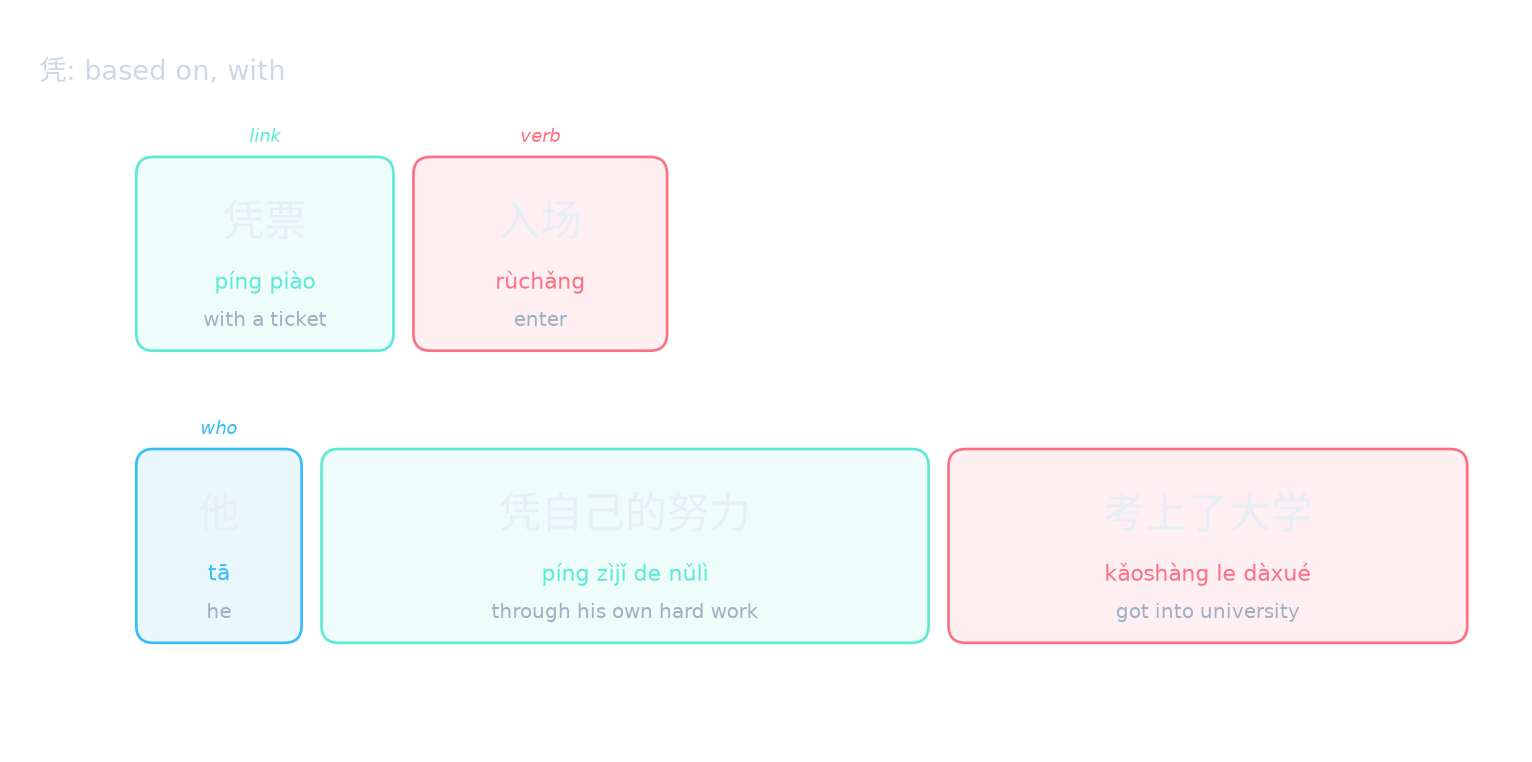
- 4. relying on凭 – on the basis of / by: admission by ticket only凭票入场。
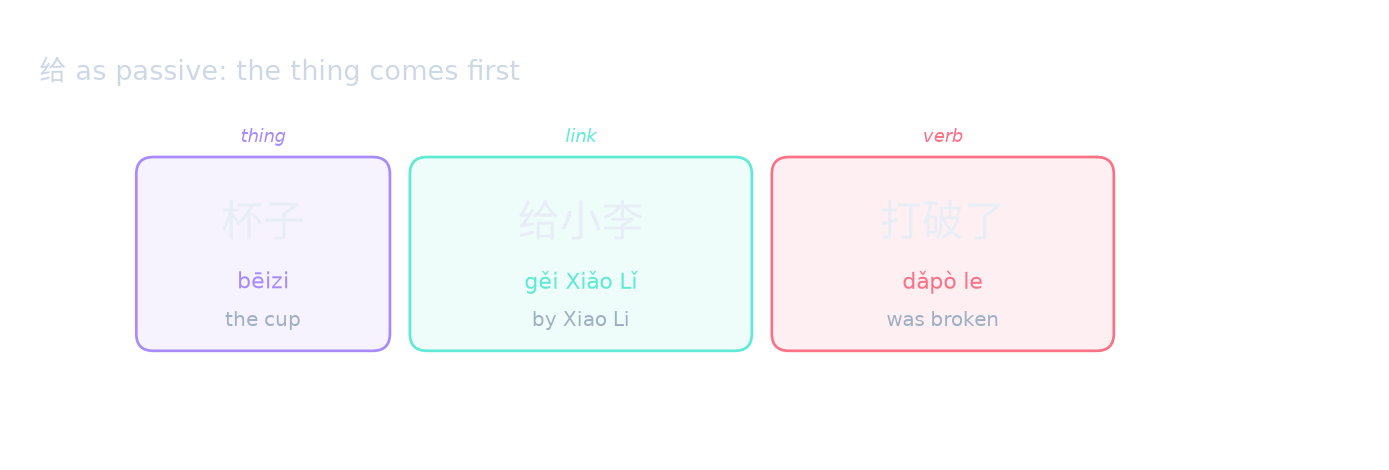
- 5. to / for / give给 – colloquial passive: cup杯子to / for / give给to break打破(completed / change)了!
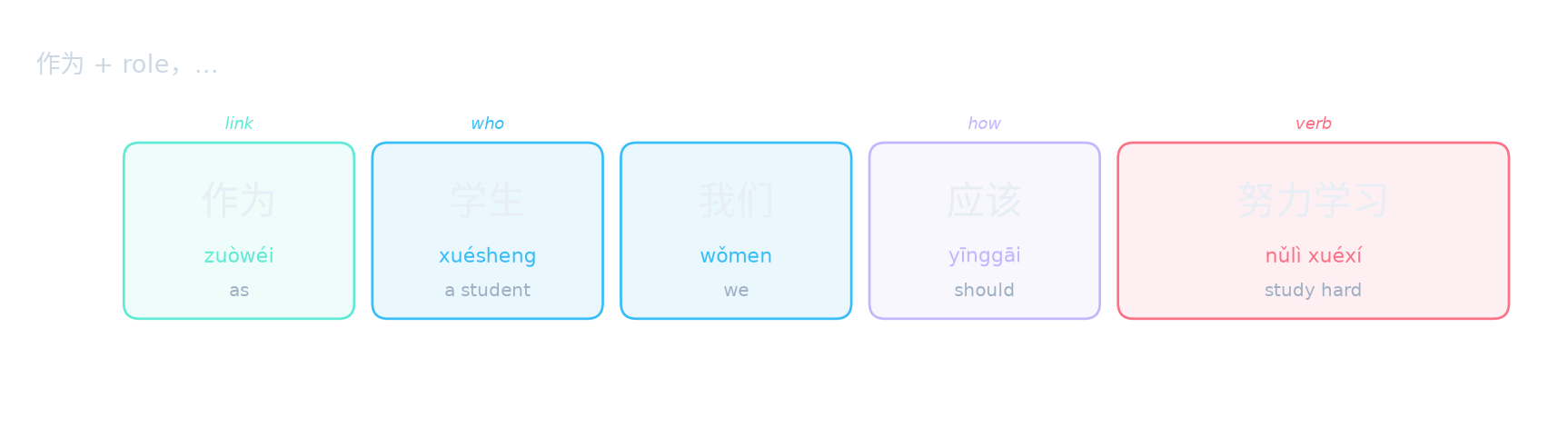
- 6. as (in the role of)作为 – as, in the role of: as (in the role of)作为student学生,we / us我们should应该努力学习。
Limiting the topic
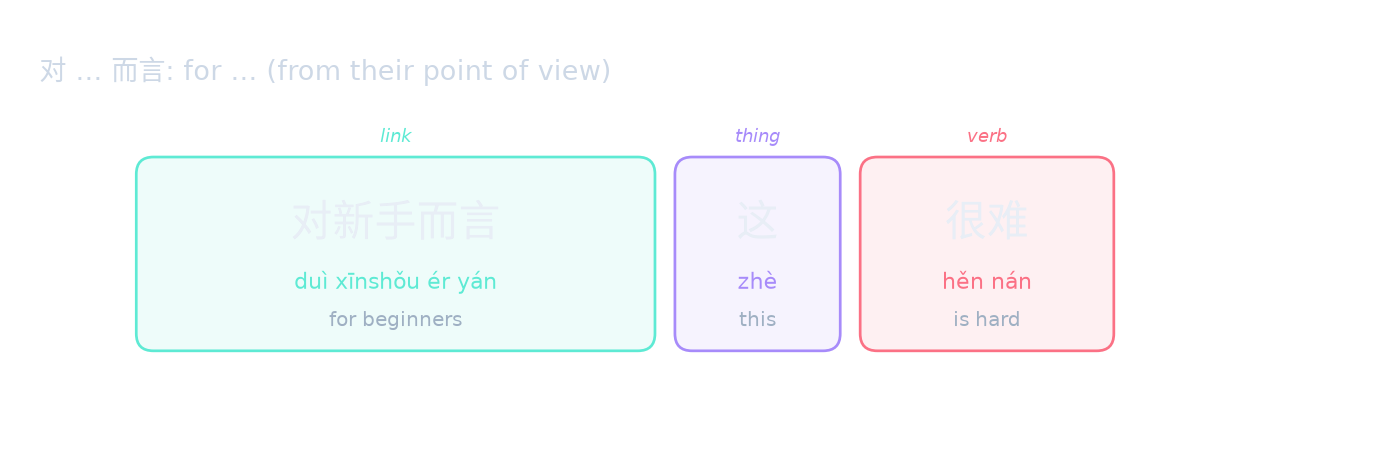
- 7. to / towards / correct对 … (typically preceded by 就……而言 – as far as … is concerned: to / towards / correct对new hand新手(typically preceded by 就……而言,this这degree / adjective linker很difficult / hard难。
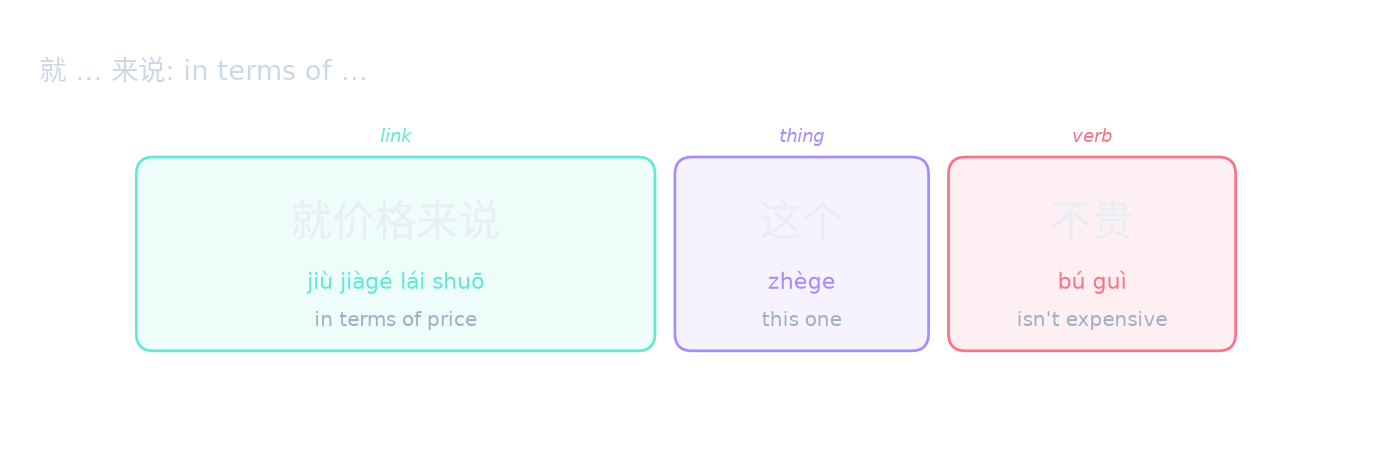
- 8. then / just就 … 来说 – as far as … goes: then / just就price价格来说,this这个not不expensive贵;then / just就quality质量来说,still / also / even还not不to know知道。
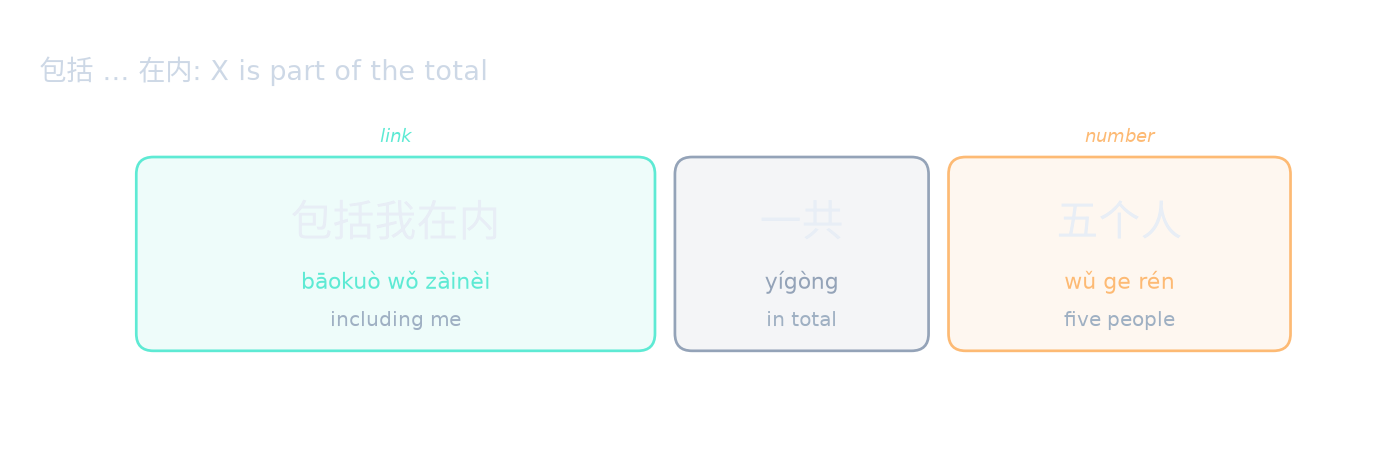
- 9. … included在内 – including: to include包括I / me我included在内,altogether一共五个person人。
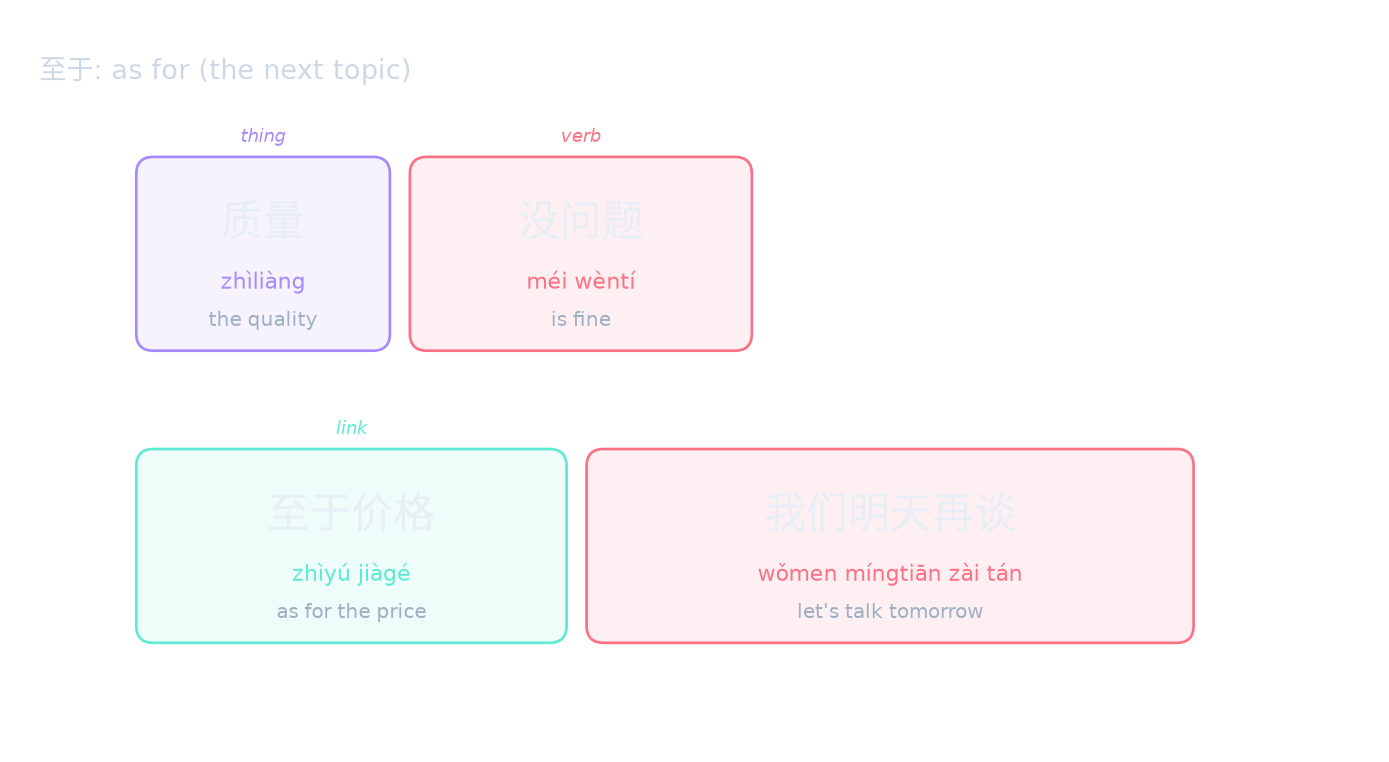
- 10. as for至于 – as for / when it comes to: quality质量not / haven't没question / problem问题。
8.2
1. 自从(从那时起一直)
Form: ever since自从 + earlier event / time,later situation
- ever since自从to come来here这儿,I / me我degree / adjective linker很happy开心。 Zìcóng lái zhèr, wǒ hěn kāixīn. – Ever since I came here, I've been happy.
- ever since自从March三月to move搬to come来,I / me我去过library图书馆three times三次。 – Since moving here in March, I've been to the library three times.
- ever since自从to exchange换(completed / change)了seat座位,I / me我to look at; to watch; to read看blackboard黑板distinct清楚many; much多(completed / change)了。 – Since I changed seats, I can see the board much more clearly.
How it works. ever since自从 zìcóng introduces a past starting point; the main clause gives the state or events since then, up to the time of speaking. A count (three times三次) covers that whole period, not "each day", and an April report stays an April report when read in June.
| ever since自从March三月to move搬to come来 | from从tomorrow明天to start开始 | from从school学校to walk / to leave走to / arrive / (result: get)到rail station车站 |
|---|---|---|
| since a past event | from a future start | from a place (a route) |
Watch out
- ever since自从 is only for a past start; for future starts and places use from从 (wrong: ever since自从tomorrow明天 → from从tomorrow明天to start开始).
- Time order is not proof of cause: the clearer view might also come from new glasses.

| 汉字 | 拼音 | English |
|---|---|---|
| 自从 | zì cóng | ever since |
| 开心 | kāi xīn | happy |
8.3
2. 趁(表示利用时机)
Form: while (taking the chance)趁 + favourable time / situation + action
- 趁热to eat吃(suggestion)吧。 Chèn rè chī ba. – Eat it while it's hot.
- while (taking the chance)趁noon break午休to go去bank银行。 – Go to the bank during the lunch break.
- 趁雨to stop停(completed / change)了,quickly赶快to return home回家。 – The rain has stopped; let's hurry home while we can.
- 趁现在still / also / even还young年轻,多去to travel旅行。 – Travel while you're still young.
How it works. while (taking the chance)趁 chèn names an opportunity that may not last, and the action takes advantage of it. It is more than "at the same time": 雨停(modifier / structural particle)的time; when时候,we / us我们at / in在rail station车站 only says where we were.
Check the window. A break ends at 12:30; a 20-minute task started at 12:20 ends at 12:40, ten minutes too late. while (taking the chance)趁 doesn't make the task fit.
Watch out
- Once the chance has passed (the food is cold), 趁热to eat吃(suggestion)吧 no longer fits.
- while (taking the chance)趁 usually comes before the verb phrase (wrong: to eat吃趁热).

| 汉字 | 拼音 | English |
|---|---|---|
| 趁 | chèn | while (taking the chance) |
| 赶快 | gǎn kuài | quickly |
8.4
3. 为 + 人(为了某人)
Form: subject + for / (wéi) to be为 (wèi) + person + action
- we / us我们for / (wéi) to be为everyone大家service / to serve服务。 Wǒmen wèi dàjiā fúwù. – We serve everyone.
- I / me我for / (wéi) to be为friend朋友to prepare; to plan to准备(completed / change)了evening meal晚饭。 – I made dinner for my friend.
- I / me我for / (wéi) to be为you你happy; glad高兴。 – I'm happy for you.
How it works. for / (wéi) to be为 wèi names the person an action is meant to benefit, and it goes before the verb (wrong: I / me我service / to serve服务for / (wéi) to be为everyone大家). The doer and the person served are different roles. With feelings, for / (wéi) to be为 names whose situation causes the feeling: I / me我for / (wéi) to be为you你happy; glad高兴, 别为I / me我anxious担心.
| for / (wéi) to be为 + person | in order to为了 + goal |
|---|---|
| for / (wéi) to be为friend朋友to prepare; to plan to准备evening meal晚饭 | in order to为了a bit earlier / breakfast早点to / arrive / (result: get)到,I / me我to sit / to take (a bus …)坐(completed / change)了underground railway地铁 |
| for someone's benefit | in order to |
The two overlap in some formal uses (for / (wéi) to be为the people人民service / to serve服务, for / (wéi) to be为health健康sports / to exercise运动), so learn whole phrases.
Watch out
- Purpose isn't success: I / me我for / (wéi) to be为friend朋友to prepare; to plan to准备(completed / change)了evening meal晚饭,but但friend朋友not / haven't没to come来.

8.5
4. 凭(依据或依靠)
Form: relying on凭 + ticket / resource / basis + action
- admission by ticket only凭票入场。 Píng piào rùchǎng. – Admission by ticket only.
- relying on凭to work hard / effort努力,he / him他to succeed; success成功(completed / change)了。 – He succeeded through hard work.
- relying on凭experience (know-how)经验,he / him他to feel / think觉得这台machine机器not / haven't没question / problem问题。 – Going by experience, he thought the machine was fine.
- you你relying on凭what什么to decide / decision决定? – What gives you the right to decide?
How it works. relying on凭 píng names what an action rests on: a document you show, a resource or ability you rely on, or grounds for a judgement. On notices it is formal and brief (admission by ticket only凭票入场, relying on凭identity card身份证to receive领取). relying on凭what什么 asks for someone's grounds and usually sounds like a challenge.
Read the whole notice. relying on凭the same day当天有效票to enter the venue for a…入场 needs a ticket valid that day; an old ticket doesn't qualify.
Watch out
- A basis isn't proof: relying on凭experience (know-how)经验 is not a measured safety check.
- One success (relying on凭to work hard / effort努力,he / him他to succeed; success成功(completed / change)了) doesn't promise that effort always succeeds.

| 汉字 | 拼音 | English |
|---|---|---|
| 凭 | píng | relying on |
| 机器 | jī qì | machine |
8.6
5. 给(口语中的被动表达)
Form: affected thing + to / for / give给 + (doer) + verb + result
- cup杯子to / for / give给to break打破(completed / change)了。 Bēizi gěi dǎpò le. – The cup got broken.
- cup杯子to / for / give给small小Li (surname) / plum李to break打破(completed / change)了。 – The cup got broken by Xiao Li.
- door门to / for / give给to close (a door)关上(completed / change)了。 – The door got shut.
How it works. In speech, to / for / give给 can work like (passive: by)被: the affected thing comes first, and a doer may follow to / for / give给 or be left out. It usually reports something that happened to the thing, often unwelcome. The verb needs a result or (completed / change)了 (to break打破(completed / change)了, to close (a door)关上(completed / change)了).
| 小李to break打破(completed / change)了cup杯子 | cup杯子to / for / give给small小Li (surname) / plum李to break打破(completed / change)了 | cup杯子to / for / give给to break打破(completed / change)了 |
|---|---|---|
| doer first | cup first, doer named | cup first, no doer |
Watch out
- No doer named means unknown, not "the speaker" and not "on purpose".
- to / for / give给 has other jobs: I / me我to / for / give给he / him他一个cup杯子 (give), I / me我to / for / give给he / him他to make a telephone call打电话 (to / for). Decide from the whole sentence.
- In formal writing use (passive: by)被.

8.7
6. 作为 (as, in the role of)
Form: as (in the role of)作为 + role,subject + … · (把: marks the object)把 A as (in the role of)作为 B
- as (in the role of)作为student学生,we / us我们should应该努力学习。 Zuòwéi xuésheng, wǒmen yīnggāi nǔlì xuéxí. – As students, we should study hard.
- as (in the role of)作为you你(modifier / structural particle)的friend朋友,I / me我(degree marker)得to tell告诉you你the truth实话。 – As your friend, I have to tell you the truth.
- we / us我们(把: marks the object)把this这本书as (in the role of)作为textbook课本。 – We use this book as the textbook.
How it works. as (in the role of)作为 + role names the role the subject speaks or acts in; the role must match the subject after the comma. As a verb, as (in the role of)作为 = serve as. Everyday: (把: marks the object)把 A to treat as当作 / to consider as当成 B.
| as (in the role of)作为teacher老师 | as (in the role of)作为case例子 | (把: marks the object)把I / me我to consider as当成friend朋友 |
|---|---|---|
| as a teacher | as an example | treat me as a friend |
Watch out
- wrong: as (in the role of)作为teacher老师,student学生all / both都to like喜欢he / him他 → he / him他to be / is是teacher老师,student学生all / both都to like喜欢he / him他.

| 汉字 | 拼音 | English |
|---|---|---|
| 作为 | zuò wéi | as (in the role of) |
| 实话 | shí huà | the truth |
8.8
7. 对 … 而言 (as far as … is concerned)
Form: to / towards / correct对 + person / group + (typically preceded by 就……而言,comment
- to / towards / correct对I / me我(typically preceded by 就……而言,this这degree / adjective linker很important重要。 Duì wǒ ér yán, zhè hěn zhòngyào. – For me, this is important.
- to / towards / correct对new hand新手(typically preceded by 就……而言,this这degree / adjective linker很difficult / hard难;to / towards / correct对skilled熟练(modifier / structural particle)的person人(typically preceded by 就……而言,this这degree / adjective linker很easy容易。 – For beginners it's hard; for experienced people it's easy.
- to / towards / correct对to live (somewhere)住(degree marker)得far远(modifier / structural particle)的student学生(typically preceded by 就……而言,this这not不convenient方便。 – For students who live far away, this is inconvenient.
How it works. to / towards / correct对……(typically preceded by 就……而言 duì … ér yán names whose point of view the comment takes. It is the formal twin of to / towards / correct对……来说. Different groups can judge the same thing differently without contradiction.
| to / towards / correct对student学生(typically preceded by 就……而言,this这个to arrange / arrangement安排degree / adjective linker很convenient方便 | student学生to speak说this这个to arrange / arrangement安排degree / adjective linker很convenient方便 |
|---|---|
| a judgement from students' angle | reports what students said |
Watch out
- Keep the group in your paraphrase: "important to me", not "important for everyone".
- A comment on one group says nothing about another: to / towards / correct对to live (somewhere)住(degree marker)得far远(modifier / structural particle)的student学生(typically preceded by 就……而言 is not about students living nearby.

| 汉字 | 拼音 | English |
|---|---|---|
| 熟练 | shú liàn | skilled |
8.9
8. 就 … 来说 (as far as … goes)
Form: then / just就 + aspect + 来说,comment
- then / just就price价格来说,not不expensive贵。 Jiù jiàgé lái shuō, bú guì. – Price-wise, it isn't expensive.
- then / just就quality质量来说,still / also / even还to need需要to check检查。 – As for quality, it still needs checking.
- then / just就traffic; transport交通来说,here这里degree / adjective linker很convenient方便。 – In terms of transport, this place is very convenient.
How it works. then / just就……来说 limits the comment to one aspect of the topic. Other aspects need their own comments. For example, for one item: price, not expensive; quality, not tested; delivery, a week. A decision combines them all.
| then / just就price价格来说 | to / towards / correct对I / me我(typically preceded by 就……而言 / to / towards / correct对I / me我来说 |
|---|---|
| frames an aspect of the thing | frames a person's viewpoint |
| not不expensive贵 (for this kind of product) | or / still还是太贵 (for my budget) |
Both comments can be true together.
Watch out
- This then / just就 is part of the frame; it is not "then / at once" as in I / me我吃完饭then / just就to walk / to leave走.

8.10
9. … 在内 (including)
Form: to include包括 + member(s) + included在内,whole / total
- to include包括I / me我included在内,altogether一共五个person人。 Bāokuò wǒ zàinèi, yígòng wǔ gè rén. – Five people in all, including me.
- to include包括两位teacher老师included在内,altogether一共八个person人。 – Eight people in all, including two teachers.
- to include包括weekend周末included在内,every day每天all / both都to open (to the public)开放。 – It's open every day, weekends included.
How it works. The named member sits between to include包括 and included在内, and is already inside the total. Count each person once.
| Sentence | Total | Others |
|---|---|---|
| to include包括I / me我included在内,altogether一共五个person人 | 5 | 4 |
| besides除了I / me我,also / there is still还有五个person人 | 6 | 5 |
| to include包括两位teacher老师included在内,altogether一共八个person人 | 8 | 6 |
Watch out
- included在内 means included (wrong: left out); for leaving out, use besides除了…apart from以外.
- Inclusion tells you what belongs to the set, not other facts: every day每天all / both都to open (to the public)开放 gives no opening hours.

| 汉字 | 拼音 | English |
|---|---|---|
| 开放 | kāi fàng | to open (to the public) |
8.11
10. 至于 (as for / when it comes to)
Form: (earlier topic …),as for至于 + new topic,comment
- quality质量not / haven't没question / problem问题。as for至于price价格,after / from now on以后talk later / besides再说。 Zhìyú jiàgé, yǐhòu zài shuō. – The quality is fine. As for the price, we'll talk about it later.
- as for至于to deliver goods送货time时间,tomorrow明天to confirm确认。 – As for delivery, we'll confirm the time tomorrow.
- as for至于who谁to come来to be in charge of负责,we / us我们still / also / even还not / haven't没to decide / decision决定。 – As for who will be in charge, we haven't decided.
How it works. as for至于 zhìyú turns to a related, separate topic, often after one point is settled. The comment then says what state that topic is in: postponed, undecided or settled. Raising a topic doesn't settle it, and no price or person is decided above.
| as for至于price价格,…… | unlikely to go so far as to不至于so much这么expensive贵(suggestion)吧 |
|---|---|
| as for the price … | it surely isn't that expensive |
Watch out
- unlikely to go so far as to不至于 "not so bad as to" is a separate expression; don't translate it "as for".
- tomorrow明天to confirm确认to deliver goods送货time时间 confirms the time tomorrow; delivery itself may be later.

| 汉字 | 拼音 | English |
|---|---|---|
| 至于 | zhì yú | as for |
| 确认 | què rèn | to confirm |
8.12
练习
Cover the teaching pages before you answer. The answers are at the end.
1. ever since自从 (ever since)
1. Ever since I came here, I've been happy. ………… to come来here这儿,I / me我degree / adjective linker很happy开心。
2. Which sentence is correct?
- A. from从tomorrow明天to start开始,I / me我every day每天to run; to jog跑步。
- B. ever since自从school学校to walk / to leave走to / arrive / (result: get)到rail station车站。
- C. ever since自从tomorrow明天to start开始,I / me我every day每天to run; to jog跑步。
- D. ever since自从next month下个月,I / me我to go去Beijing北京。
3. ever since自从March三月to move搬to come来,I / me我去过library图书馆three times三次。 The three visits happened…
- A. before March
- B. between March and now
- C. in March only
- D. every day since March
4. True or false? ever since自从to exchange换(completed / change)了seat座位,I / me我to look at; to watch; to read看blackboard黑板distinct清楚many; much多(completed / change)了 proves the seat was the only reason. If false, correct it.
5. Say in Chinese: "Since I started exercising, I've slept better."
6. Ever since he moved away, we haven't met.
Put in order: then / just就not / haven't没 / we / us我们 / 见过面。 / he / him他to carry搬走after / from now on以后, / ever since自从
2. while (taking the chance)趁 (while / taking advantage of)
7. Eat it while it's hot. ………… hot热to eat吃(suggestion)吧。
8. Which sentence uses while (taking the chance)趁 correctly?
- A. while (taking the chance)趁to eat吃hot热。
- B. to eat吃趁热(suggestion)吧。
- C. I / me我while (taking the chance)趁。
- D. while (taking the chance)趁young年轻,多去to travel旅行。
9. A break ends at 12:30. A 20-minute task starts at 12:20. When does it finish?
- A. 12:20
- B. 12:50
- C. 12:40
- D. 12:30
10. True or false? 雨停(modifier / structural particle)的time; when时候,we / us我们at / in在rail station车站 uses the pause as an opportunity. If false, correct it.
11. Say in Chinese: "While the rain has stopped, let's hurry home."
12. Go to the bank during your lunch break.
Put in order: to go去 / bank银行。 / while (taking the chance)趁 / noon break午休
3. for / (wéi) to be为 + Person (for someone's sake)
13. We serve everyone. we / us我们 ………… everyone大家service / to serve服务。
14. Which sentence is correct?
- A. we / us我们everyone大家for / (wéi) to be为service / to serve服务。
- B. we / us我们for / (wéi) to be为everyone大家service / to serve服务。
- C. for / (wéi) to be为we / us我们everyone大家service / to serve服务。
- D. we / us我们service / to serve服务for / (wéi) to be为everyone大家。
15. I / me我for / (wéi) to be为you你happy; glad高兴 means…
- A. I'm happy because of me
- B. you are happy for me
- C. I'm happy for you
- D. I make you happy
16. True or false? I / me我for / (wéi) to be为friend朋友to prepare; to plan to准备(completed / change)了evening meal晚饭,but但friend朋友not / haven't没to come来 is a contradiction. If false, correct it.
17. Choose for / (wéi) to be为 or in order to为了: ………… a bit earlier / breakfast早点to / arrive / (result: get)到,I / me我to sit / to take (a bus …)坐(completed / change)了underground railway地铁。
18. Say in Chinese: "Don't worry about me."
4. relying on凭 (on the basis of / by)
19. Admission by ticket only. ………… ticket票to enter the venue for a…入场。
20. you你relying on凭what什么to decide / decision决定? usually sounds like…
- A. a polite thank-you
- B. a compliment
- C. a challenge to someone's right to decide
- D. a request for a ticket
21. The notice says relying on凭the same day当天有效票to enter the venue for a…入场. Which ticket works?
- A. a ticket valid today
- B. yesterday's ticket
- C. any ticket
- D. a ticket for next week
22. True or false? relying on凭to work hard / effort努力,he / him他to succeed; success成功(completed / change)了 promises that hard work always succeeds. If false, correct it.
23. Say in Chinese: "Going by experience, I think it'll rain."
24. Collect your parcel with your ID card.
Put in order: to receive领取 / parcel包裹。 / relying on凭 / identity card身份证 / please; to invite请
5. to / for / give给 (colloquial passive)
25. The cup got broken. cup杯子 ………… to break打破(completed / change)了。
26. cup杯子to / for / give给small小Li (surname) / plum李to break打破(completed / change)了 means…
- A. Xiao Li broke the cup
- B. Xiao Li got a cup
- C. someone gave Xiao Li a cup
- D. the cup broke Xiao Li
27. In which sentence is to / for / give给 NOT a passive marker?
- A. I / me我to / for / give给he / him他一个cup杯子。
- B. door门to / for / give给to close (a door)关上(completed / change)了。
- C. book书to / for / give给person人to take away拿走(completed / change)了。
- D. cup杯子to / for / give给to break打破(completed / change)了。
28. True or false? door门to / for / give给to close (a door)关上(completed / change)了 tells us who closed the door. If false, correct it.
29. Rewrite with (passive: by)被 for formal writing: cup杯子to / for / give给to break打破(completed / change)了。
30. My bike got stolen.
Put in order: person人 / 偷走(completed / change)了。 / I / me我(modifier / structural particle)的bicycle自行车 / to / for / give给
6. as (in the role of)作为 (as, in the role of)
31. Complete: “As your friend, I have to tell you the truth.” …………you你(modifier / structural particle)的friend朋友,I / me我(degree marker)得to tell告诉you你the truth实话。
32. Which is correct?
- A. as (in the role of)作为teacher老师,he / him他to / towards / correct对student学生degree / adjective linker很patient; patience耐心。
- B. as (in the role of)作为teacher老师,student学生all / both都degree / adjective linker很to like喜欢he / him他。
33. “He treats me as a good friend.” Which sounds most natural in speech?
- A. he / him他(把: marks the object)把I / me我to consider as当成good好friend朋友。
- B. he / him他as (in the role of)作为I / me我good好friend朋友。
34. Build: “We use this book as the textbook.”
Put in order: as (in the role of)作为 / (把: marks the object)把this这本书 / textbook课本。 / we / us我们
35. True or false? 这件matter事can / may可以as (in the role of)作为一个case例子 means "This can serve as an example." If false, correct it.
36. Give a short speech opening (two sentences) starting with as (in the role of)作为 + your role: a class monitor, a new student, or a team captain. Write your answer in Chinese, then say it aloud.
7. to / towards / correct对 … (typically preceded by 就……而言 (as far as … is concerned)
37. For me, this is important. to / towards / correct对I / me我 …………,this这degree / adjective linker很important重要。
38. Which is the everyday twin of to / towards / correct对……(typically preceded by 就……而言?
- A. in order to为了……
- B. pertaining to关于……
- C. to / towards / correct对……来说
- D. according to按照……
39. to / towards / correct对new hand新手(typically preceded by 就……而言,this这degree / adjective linker很difficult / hard难 tells us…
- A. beginners said it was hard
- B. experts find it hard too
- C. it's hard from beginners' point of view
- D. it is hard for everyone
40. True or false? to / towards / correct对student学生(typically preceded by 就……而言,this这个to arrange / arrangement安排degree / adjective linker很convenient方便 means the students said it was convenient. If false, correct it.
41. Say in Chinese: "For students who live far away, this is inconvenient."
42. For older people, the internet is not so easy.
Put in order: 不太easy容易。 / to go online上网 / (typically preceded by 就……而言, / old people老年人 / to / towards / correct对
8. then / just就 … 来说 (as far as … goes)
43. Price-wise, it isn't expensive. ………… price价格来说,not不expensive贵。
44. then / just就price价格来说,not不expensive贵 tells us about…
- A. the quality
- B. the delivery time
- C. everything about the item
- D. the price only
45. In which sentence does then / just就 mean "then, at once"?
- A. then / just就traffic; transport交通来说,degree / adjective linker很convenient方便。
- B. then / just就quality质量来说,still / also / even还can / may可以。
- C. then / just就price价格来说,not不expensive贵。
- D. I / me我吃完饭then / just就to walk / to leave走。
46. True or false? then / just就price价格来说,not不expensive贵 and to / towards / correct对I / me我来说,太贵(completed / change)了 can both be true. If false, correct it.
47. Say in Chinese: "In terms of transport, this place is very convenient."
48. As far as quality goes, it still needs checking.
Put in order: 来说, / then / just就 / still / also / even还to need需要 / to check检查。 / quality质量
9. … included在内 (including)
49. Five people in all, including me. to include包括I / me我 …………,altogether一共五个person人。
50. to include包括两位teacher老师included在内,altogether一共八个person人。 How many are not teachers?
- A. 8
- B. 2
- C. 6
- D. 10
51. besides除了I / me我,also / there is still还有五个person人。 How many people in total?
- A. 4
- B. 7
- C. 5
- D. 6
52. True or false? included在内 means the item is left out. If false, correct it.
53. Say in Chinese: "Open every day, weekends included."
54. Including tax, the total is 200 yuan.
Put in order: altogether一共 / included在内, / tax税 / 两百块。 / to include包括
10. as for至于 (as for / when it comes to)
55. As for the price, we'll talk later. ………… price价格,after / from now on以后talk later / besides再说。
56. as for至于who谁to come来to be in charge of负责,we / us我们still / also / even还not / haven't没to decide / decision决定。 Who is in charge?
- A. everyone
- B. the listener
- C. not decided yet
- D. the speaker
57. unlikely to go so far as to不至于so much这么expensive贵(suggestion)吧 means…
- A. surely it isn't that expensive
- B. it's very expensive
- C. how much is it?
- D. as for the price …
58. True or false? as for至于 can open a conversation with no earlier topic. If false, correct it.
59. Say in Chinese: "The quality is fine. As for delivery, we'll confirm tomorrow."
60. I'll book the tickets; as for the hotel, you choose.
Put in order: hotel酒店, / as for至于 / I / me我to book tickets订票, / you你to come来to choose选(suggestion)吧。
8.13
混合练习
These questions mix the patterns and use new situations.
61. Choose ever since自从 or while (taking the chance)趁: …………to move搬to / arrive / (result: get)到Shanghai municipality…上海,he / him他then / just就not / haven't没回过native place老家。 / …………day天still / also / even还not / haven't没black黑,we / us我们fast; soon快to walk / to leave走(suggestion)吧。
62. Choose relying on凭 or for / (wéi) to be为: he / him他…………oneself自己(modifier / structural particle)的to work hard / effort努力to pass a university…考上(completed / change)了university大学。 / mum; mother妈妈…………I / me我to do; to make做(completed / change)了一桌dish (of food); vegetable菜。
63. Say "Ten people came, including me."
64. You have answered about the hotel. Move on to the ticket with as for至于.
65. Find and fix the problem. A classmate thinks I / me我to / for / give给teacher老师to write a letter写信 means the letter has already been handed to the teacher. Correct it.
66. Use it yourself. Say that admission is based on exam results, and suggest going out while it is still sunny.
8.14
答案与解析
Mark your work, then correct each mistake in your own words.
1. ever since自从 (ever since)
1. ever since自从
ever since自从 + past starting point.
2. A. from从tomorrow明天to start开始,I / me我every day每天to run; to jog跑步。
ever since自从 is only for a past start; future starts use from从.
3. B. between March and now
A count after ever since自从 covers the whole period.
4. False.
Time order is not proof of cause.
5. ever since自从to start开始to exercise / training锻炼,I / me我to sleep睡(degree marker)得many好多(completed / change)了。
ever since自从 + event, then the later situation.
6. ever since自从he / him他to carry搬走after / from now on以后,we / us我们then / just就not / haven't没见过面。
ever since自从 + event (after / from now on以后), then the result.
2. while (taking the chance)趁 (while / taking advantage of)
7. while (taking the chance)趁
while (taking the chance)趁 + favourable state + action.
8. D. while (taking the chance)趁young年轻,多去to travel旅行。
while (taking the chance)趁 + opportunity comes before the action.
9. C. 12:40
while (taking the chance)趁noon break午休 doesn't make the task fit.
10. False.
It only says where we were; 趁雨to stop停(completed / change)了,quickly赶快to return home回家 uses the chance.
11. 趁雨to stop停(completed / change)了,quickly赶快回家吧。
while (taking the chance)趁 + window + action.
12. while (taking the chance)趁noon break午休to go去bank银行。
while (taking the chance)趁 + time + action.
3. for / (wéi) to be为 + Person (for someone's sake)
13. for / (wéi) to be为
for / (wéi) to be为 + person, before the verb.
14. B. we / us我们for / (wéi) to be为everyone大家service / to serve服务。
for / (wéi) to be为 + person goes before the verb.
15. C. I'm happy for you
With feelings, for / (wéi) to be为 names whose situation causes them.
16. False.
Purpose isn't success: the dinner was meant for the friend.
17. in order to为了
in order to为了 + goal = in order to.
18. 别为I / me我anxious担心。
for / (wéi) to be为 + person + feeling.
4. relying on凭 (on the basis of / by)
19. relying on凭
relying on凭 + document: what entry rests on.
20. C. a challenge to someone's right to decide
relying on凭what什么 asks for grounds, usually as a challenge.
21. A. a ticket valid today
the same day当天effective有效 narrows which ticket counts.
22. False.
It reports one success; it is no promise.
23. relying on凭experience (know-how)经验,I / me我to feel / think觉得can / will会to rain下雨。
relying on凭 + basis + judgement.
24. please; to invite请relying on凭identity card身份证to receive领取parcel包裹。
relying on凭 + document + action.
5. to / for / give给 (colloquial passive)
25. to / for / give给
Colloquial passive: thing + to / for / give给 + verb + result.
26. A. Xiao Li broke the cup
The doer follows to / for / give给.
27. A. I / me我to / for / give给he / him他一个cup杯子。
I / me我to / for / give给he / him他一个cup杯子: to / for / give给 = give.
28. False.
No doer is named: unknown.
29. cup杯子(passive: by)被to break打破(completed / change)了。
(passive: by)被 is the formal passive.
30. I / me我(modifier / structural particle)的bicycle自行车to / for / give给person人偷走(completed / change)了。
Thing + to / for / give给 + doer + verb + result.
6. as (in the role of)作为 (as, in the role of)
31. as (in the role of)作为
In the role of – as (in the role of)作为.
32. A. as (in the role of)作为teacher老师,he / him他to / towards / correct对student学生degree / adjective linker很patient; patience耐心。
The role (teacher老师) must match the subject after the comma (he / him他).
33. A. he / him他(把: marks the object)把I / me我to consider as当成good好friend朋友。
Everyday – (把: marks the object)把 A to consider as当成 B.
34. we / us我们(把: marks the object)把this这本书as (in the role of)作为textbook课本。
(把: marks the object)把 A as (in the role of)作为 B.
35. True.
as (in the role of)作为 = to serve as.
36. Model answer: as (in the role of)作为class monitor班长,I / me我want / think / miss想first先to thank感谢everyone大家(modifier / structural particle)的to support支持。我会conscientious认真to listen to听每个classmate同学(modifier / structural particle)的opinion; suggestion意见,to let / make让we (including you)咱们class班to become变得更好。
Check your answer:
- The role after as (in the role of)作为 matches the subject that follows.
- The tone fits a speech.
- I said it aloud before comparing with the model.
Your answer need not copy the model. A partner or teacher must hear the spoken response to comment on pronunciation.
7. to / towards / correct对 … (typically preceded by 就……而言 (as far as … is concerned)
37. (typically preceded by 就……而言
to / towards / correct对……(typically preceded by 就……而言 names a viewpoint.
38. C. to / towards / correct对……来说
to / towards / correct对……来说 is common in speech.
39. C. it's hard from beginners' point of view
The comment takes the beginners' angle.
40. False.
It is a judgement from their angle, not a quotation.
41. to / towards / correct对to live (somewhere)住(degree marker)得far远(modifier / structural particle)的student学生(typically preceded by 就……而言,this这not不convenient方便。
to / towards / correct对 + group + (typically preceded by 就……而言, then the comment.
42. to / towards / correct对old people老年人(typically preceded by 就……而言,to go online上网不太easy容易。
Viewpoint first.
8. then / just就 … 来说 (as far as … goes)
43. then / just就
then / just就……来说 limits the comment to one aspect.
44. D. the price only
One aspect per frame.
45. D. I / me我吃完饭then / just就to walk / to leave走。
then / just就 in then / just就……来说 is part of the frame.
46. True.
One frames the item's aspect, the other a person's budget.
47. then / just就traffic; transport交通来说,here这里degree / adjective linker很convenient方便。
then / just就 + aspect + 来说.
48. then / just就quality质量来说,still / also / even还to need需要to check检查。
Frame first, then the comment.
9. … included在内 (including)
49. included在内
to include包括 + member + included在内.
50. C. 6
The teachers are inside the total: 8 − 2.
51. D. 6
besides除了 adds: five others plus me.
52. False.
included在内 means included.
53. to include包括weekend周末included在内,every day每天all / both都to open (to the public)开放。
to include包括……included在内 + the whole.
54. to include包括tax税included在内,altogether一共两百块。
The member sits between to include包括 and included在内.
10. as for至于 (as for / when it comes to)
55. as for至于
as for至于 turns to a separate topic.
56. C. not decided yet
Raising a topic doesn't settle it.
57. A. surely it isn't that expensive
unlikely to go so far as to不至于 = not so bad as to.
58. False.
It needs an earlier point to turn away from.
59. quality质量not / haven't没question / problem问题。as for至于to deliver goods送货time时间,tomorrow明天to confirm确认。
First point, then as for至于 + new point.
60. I / me我to book tickets订票,as for至于hotel酒店,you你to come来to choose选(suggestion)吧。
as for至于 + topic + comment.
Mixed practice
61. ever since自从to move搬to / arrive / (result: get)到Shanghai municipality…上海 (ever since)。趁天still / also / even还not / haven't没black黑 (while the chance is there).
62. he / him他relying on凭oneself自己(modifier / structural particle)的to work hard / effort努力to pass a university…考上(completed / change)了university大学 (on the basis of)。mum; mother妈妈for / (wéi) to be为I / me我to do; to make做(completed / change)了一桌dish (of food); vegetable菜 (for my sake).
63. to come来(completed / change)了十个person人,to include包括I / me我included在内。…included在内 means "including".
64. as for至于ticket票,we / us我们tomorrow明天again / then / (再…也) however再to buy买。as for至于 changes to a related topic.
65. to / for / give给 + person here means "to": "I am writing (or write) a letter to the teacher." It does not say the letter has arrived.
66. Model answer. school学校relying on凭考试成绩to admit (students)录取student学生。while (taking the chance)趁weather天气good好,we / us我们to go out出去走走(suggestion)吧。
Review later. Tomorrow, make one sentence with ever since自从 and one with as for至于.
该知识点的互动课程
逐步完成,配合即时检查练习。