跳到主要内容

副词

HSK 5 · 知识点 2

本主题的视频课程 打开视频页面
12:09

HSK 5 语法 2:副词——强调与判断

大家仍在办公室内。时钟显示十一点四十分,已晚于原定计划时间。一位同学自诩为严谨的编辑,但他标题上的……

英文讲解与普通话例句 · 字幕与原声同步

点击任意汉字可查看拼音和释义。
English

HSK 5 adverbs carry the speaker's attitude: after all毕竟bì jìng explains with a deeper reason, anyway反正fǎn zhèng dismisses details, simply / decisive干脆gān cuì makes a quick decision, simply; practically简直jiǎn zhí exaggerates, white白bái says the effort was wasted. Many sound the same in English ("anyway", "simply", "after all"), so learn each with its typical situation.
2.1

一目了然

English

Attitude and judgement

  • 1. after all毕竟bì jìng – after all: he / him他tāafter all毕竟bì jìngto be / is是shìnew hand新手xīn shǒu,to / for / give给gěihe / him他tāa bit一点yì diǎntime时间shí jiān。
  • 2. anyway反正fǎn zhèng – anyway / in any case: to sit / to take (a bus …)坐zuòwhat什么shén mecar车chēyou你nǐto decide / decision决定jué dìng(suggestion)吧ba,anyway反正fǎn zhèngI / me我wǒ八点bā diǎnto / arrive / (result: get)到dào。
  • 3. simply / decisive干脆gān cuì – just / simply / might as well: simply / decisive干脆gān cuìto exchange换huàn一个yí gè(suggestion)吧ba。
  • 4. simply; practically简直jiǎn zhí – strong evaluation and comparison: here这里zhè lǐ(modifier / structural particle)的descenery风景fēng jǐngsimply; practically简直jiǎn zhíto resemble像xiàngpainting / to draw画huàthe same一样yí yàng!
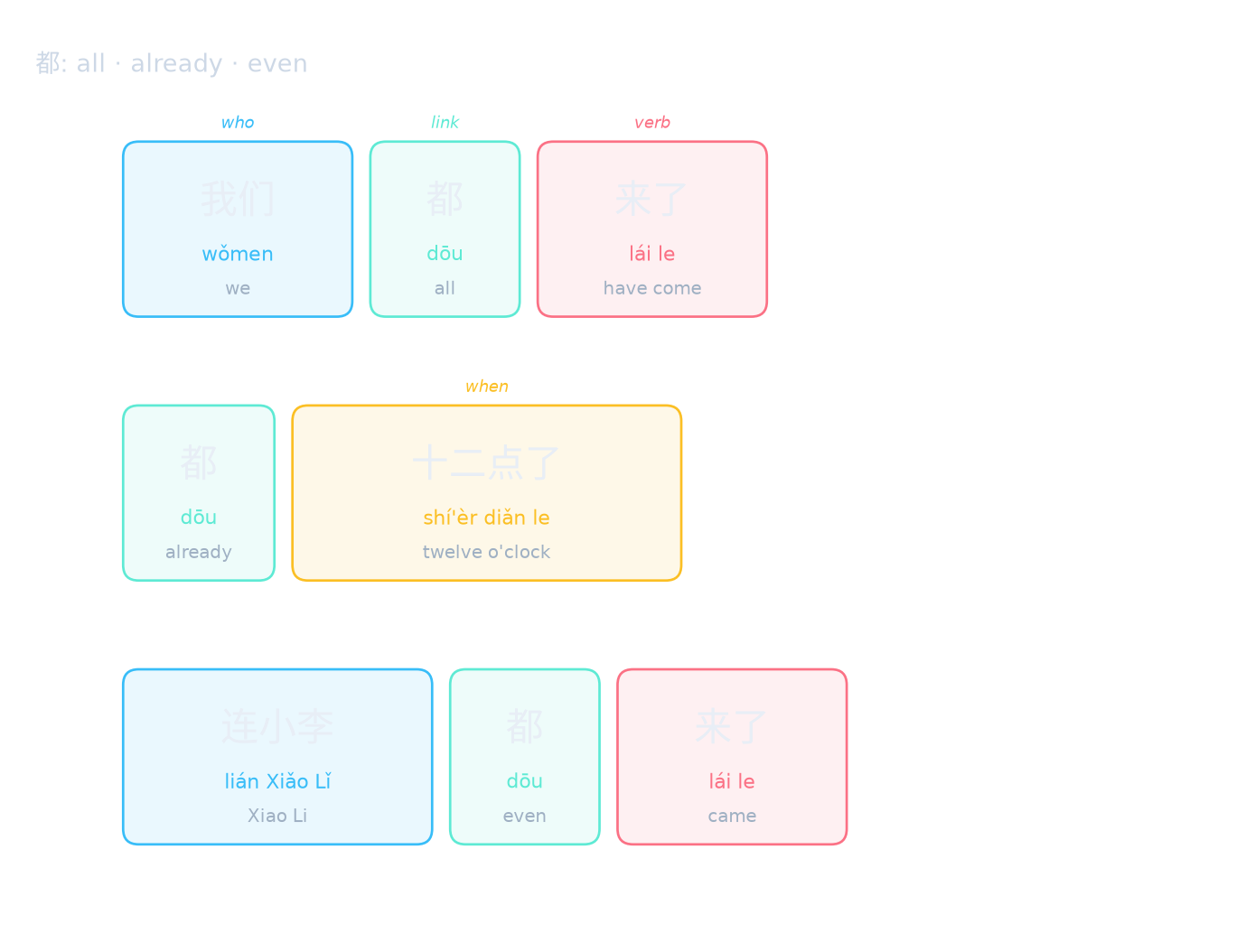
  • 5. Advanced all / both都dōu – already / even: all / both都dōu十二点shí èr diǎn(completed / change)了le,tomorrow明天míng tiānagain / then / (再…也) however再zàito do; to make做zuò(suggestion)吧ba!
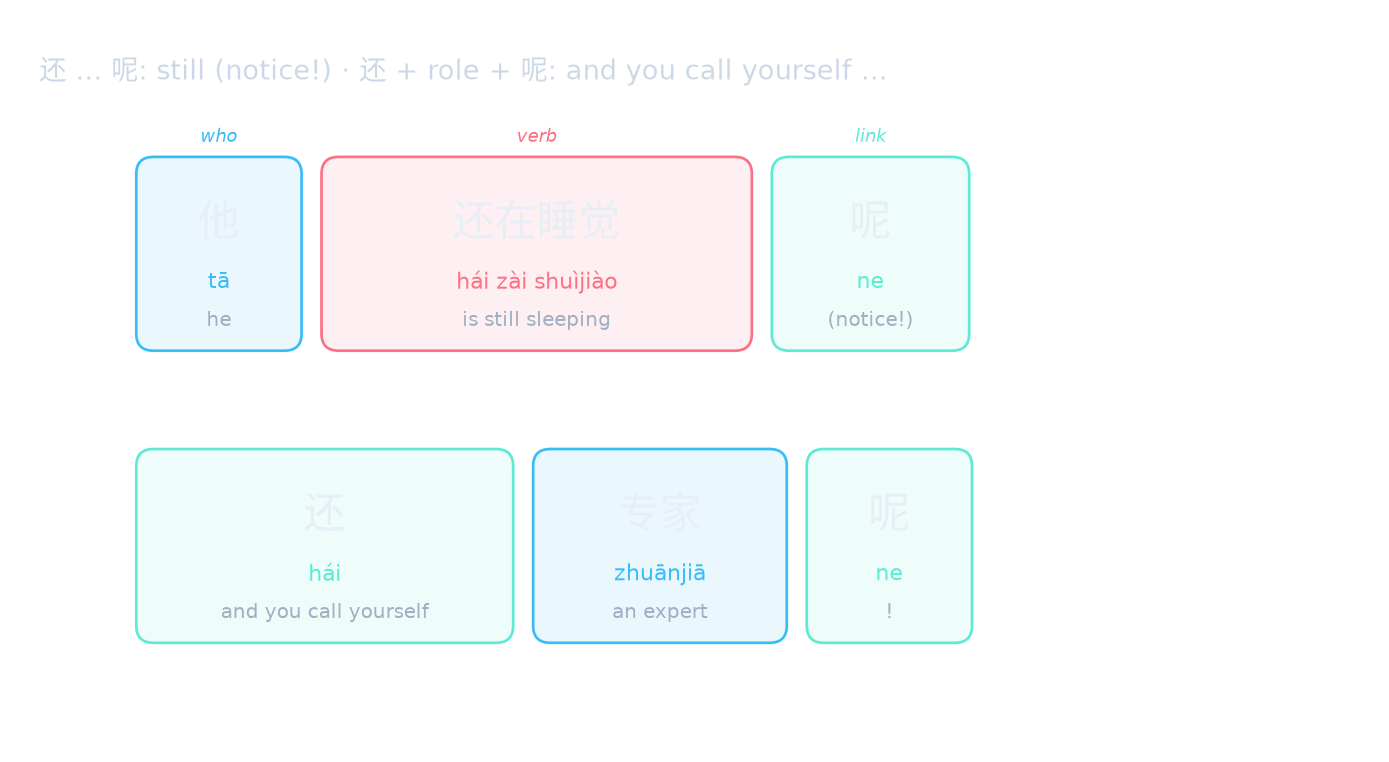
  • 6. Advanced still / also / even还hái … (and …? / softener)呢ne: 小声点xiǎo shēng diǎn,he / him他tāstill / also / even还háiat / in在zàito sleep睡觉shuì jiào(and …? / softener)呢ne。
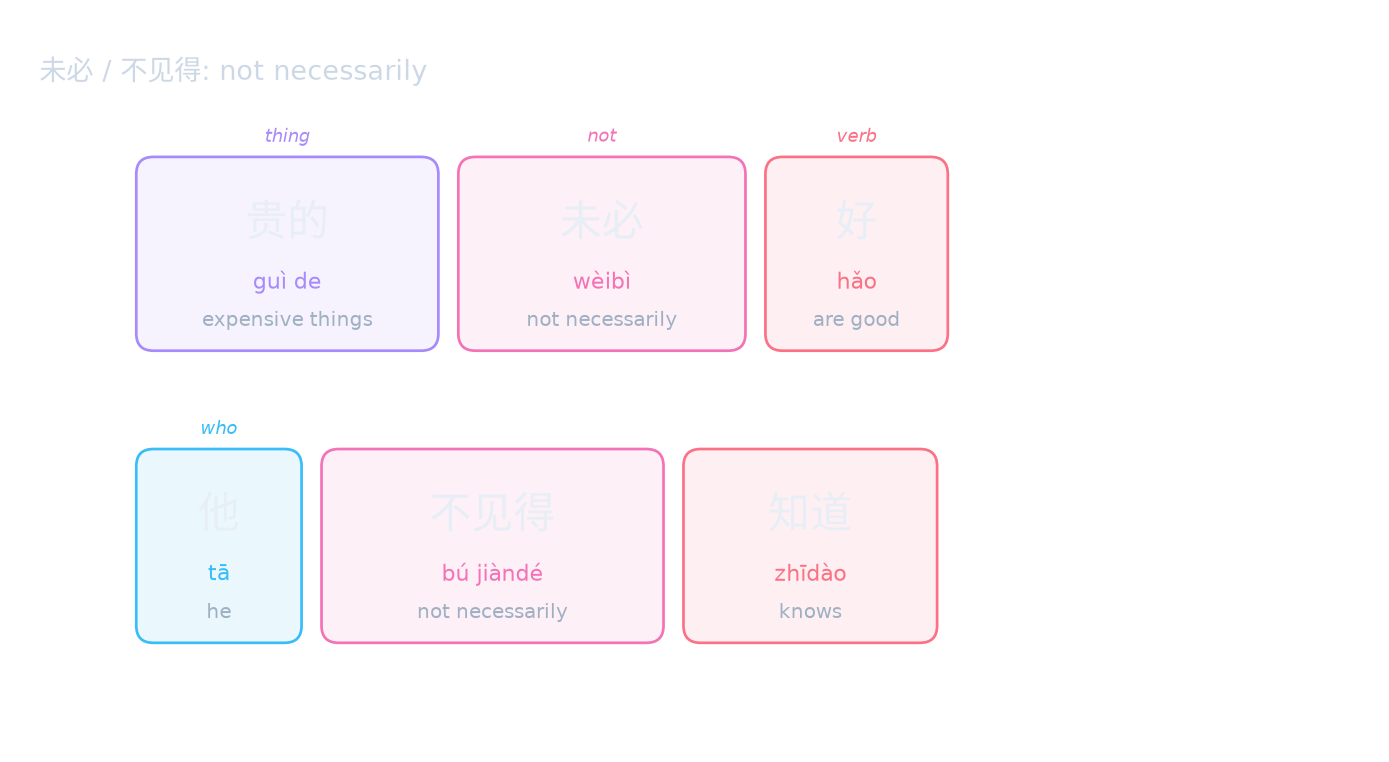
  • 7. not necessarily未必wèi bì / not necessarily (spoken)不见得bú jiàn de – not necessarily: expensive贵guì(modifier / structural particle)的dething; stuff东西dōng xīnot necessarily未必wèi bìgood好hǎo。
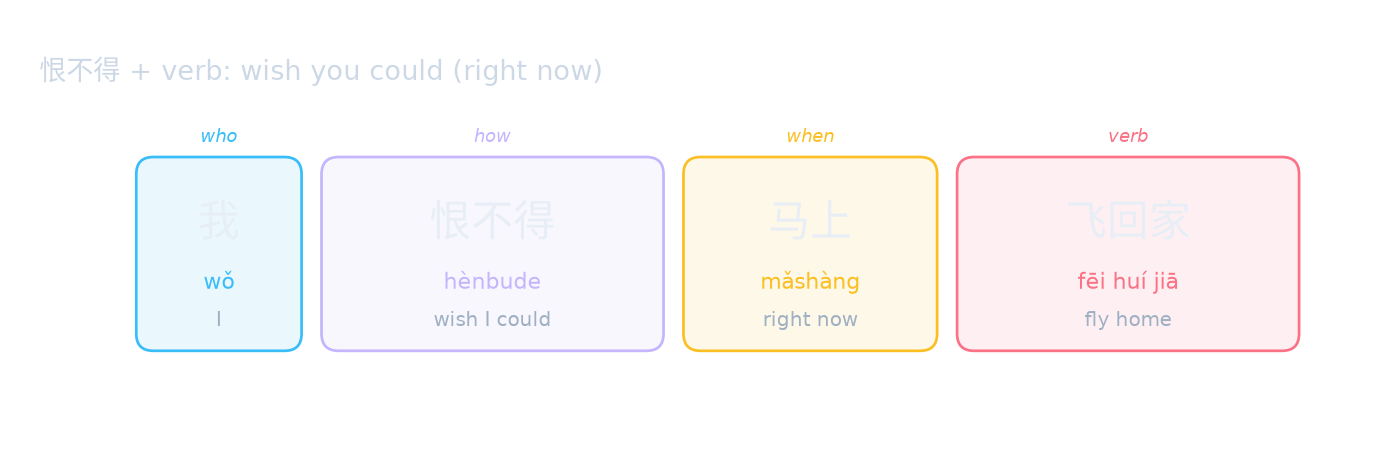
  • 8. wishing one could do sth恨不得hèn bù dé – wish one could / itching to: I / me我wǒwishing one could do sth恨不得hèn bù dé马上飞mǎ shàng fēito return home回家huí jiā。
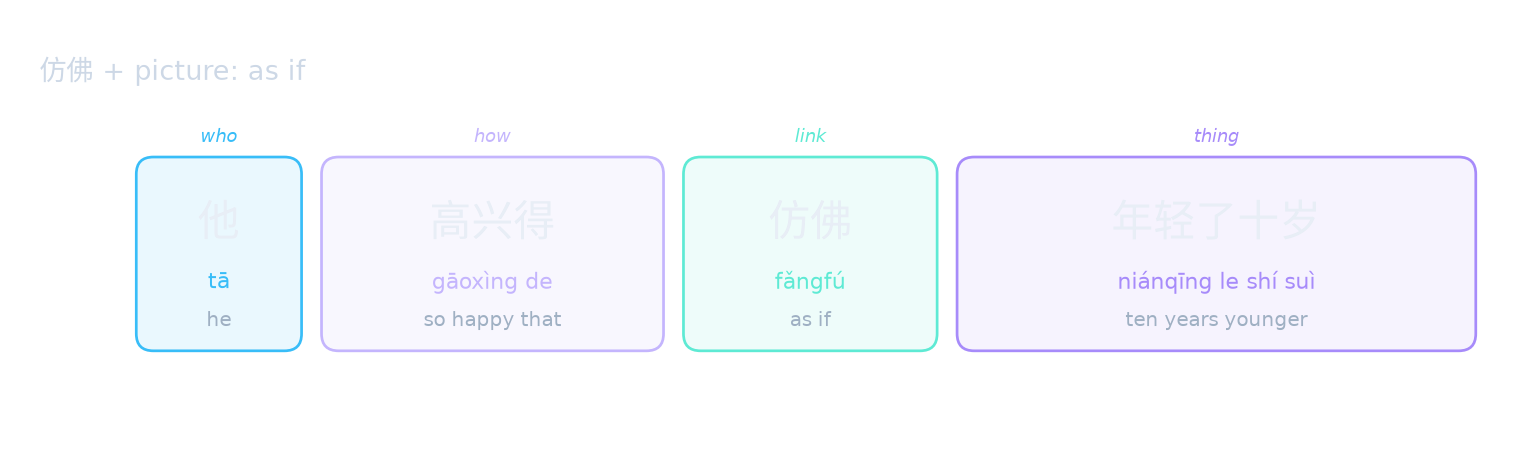
  • 9. as if仿佛fǎng fú – as if: father's father爷爷yé yéhappy; glad高兴gāo xìng(degree marker)得deas if仿佛fǎng fúyoung年轻nián qīng(completed / change)了le十岁shí suì。
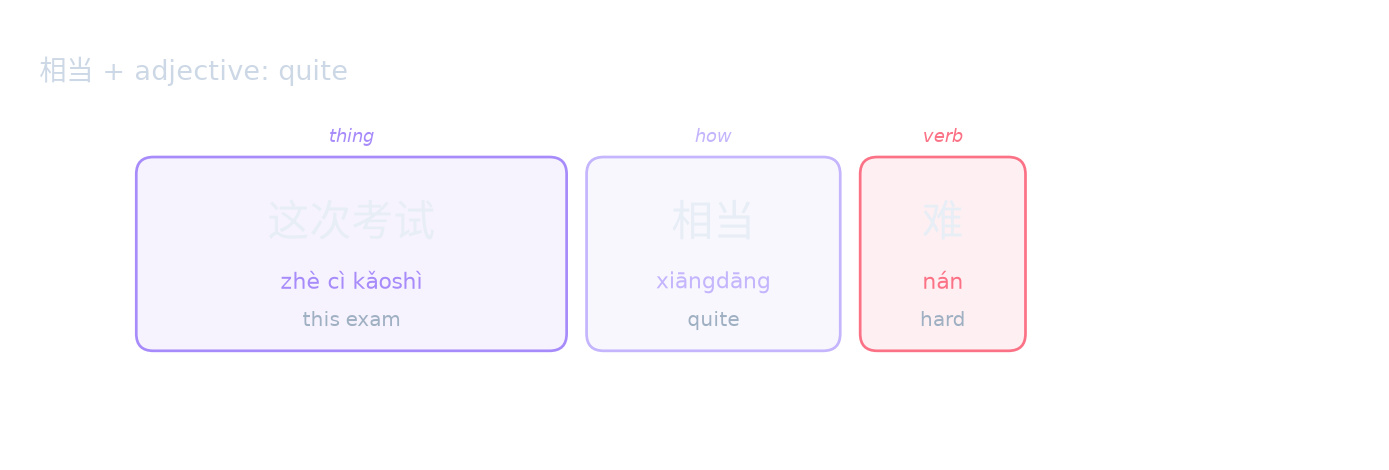
  • 10. quite; equivalent to相当xiāng dāng (quite) and equivalent to相当于xiāng dāng yú – equal to: 这次zhè cìexam; to take an exam考试kǎo shìquite; equivalent to相当xiāng dāngdifficult / hard难nán。
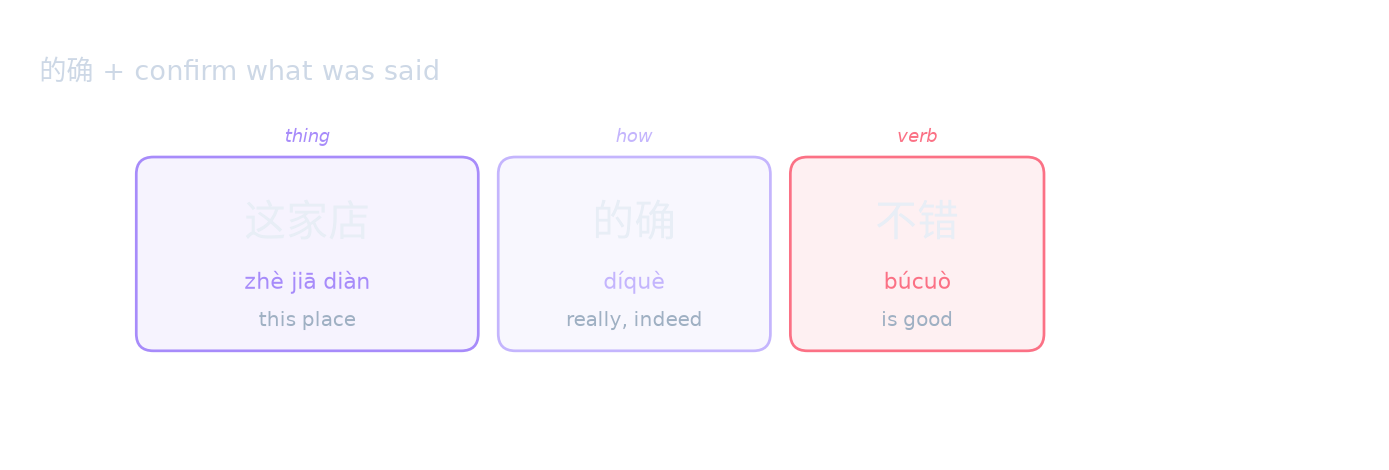
  • 11. indeed的确dí què vs really; indeed确实què shí and really真的zhēn de – indeed: 这家zhè jiāshop店diànindeed的确dí quènot bad / pretty good不错bú cuò。
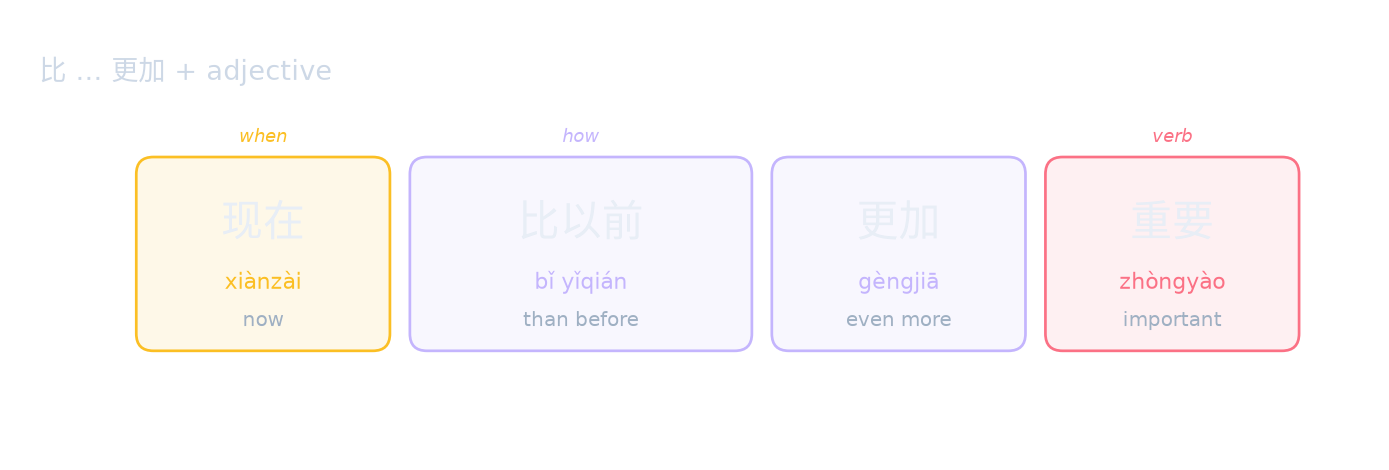
  • 12. more更加gèng jiā vs more更gèng – even more: now现在xiàn zàicomputer电脑diàn nǎothan / compared to比bǐbefore以前yǐ qiánmore更加gèng jiāimportant重要zhòng yào。
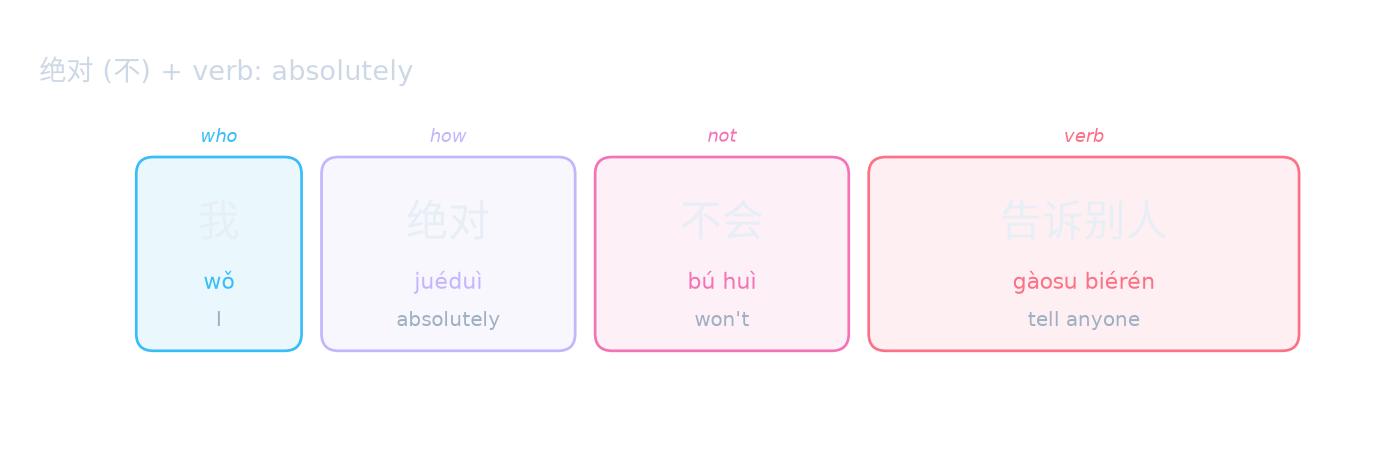
  • 13. absolutely绝对jué duì – absolutely, definitely: to feel relieved放心fàng xīn,I / me我wǒabsolutely绝对jué duìwon't / can't不会bú huìto tell告诉gào sùother people别人bié rén。
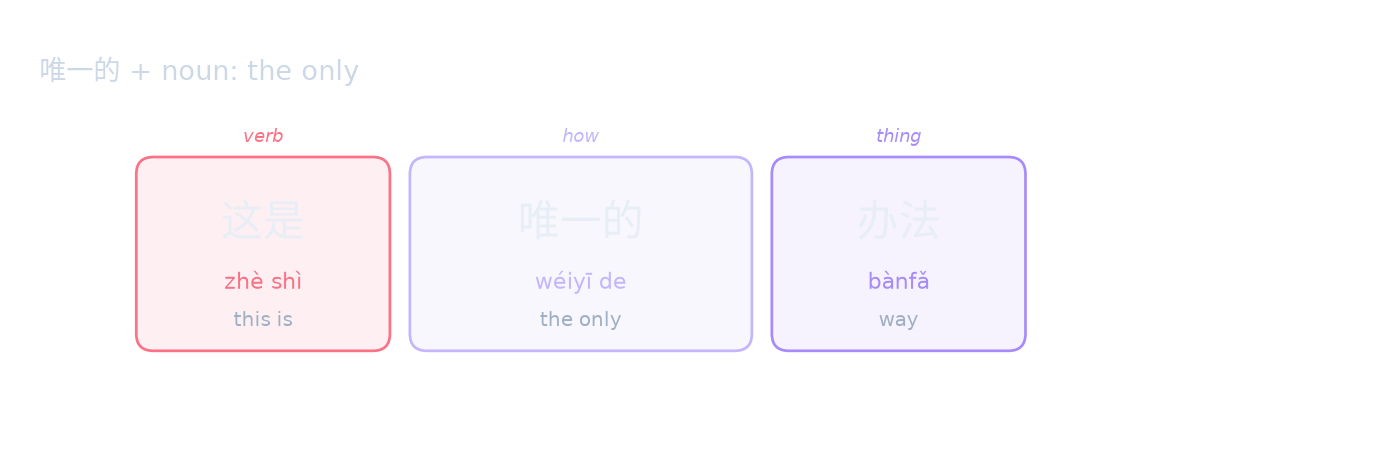
  • 14. the only唯一wéi yī vs only (if) / only have只有zhǐ yǒu – the only: 这是zhè shìthe only唯一wéi yī(modifier / structural particle)的demeans办法bàn fǎ。
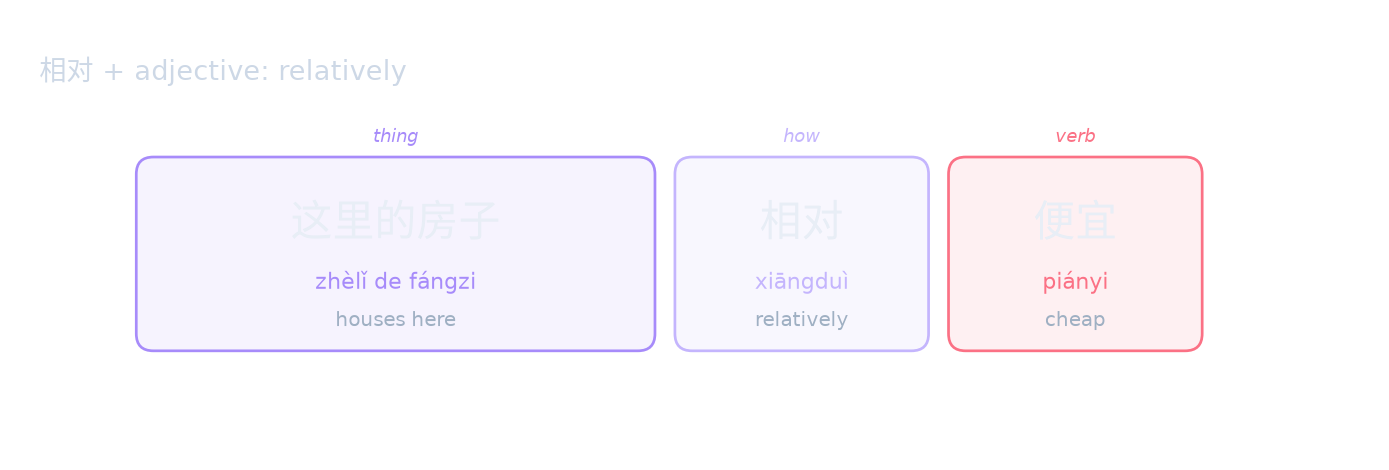
  • 15. relatively相对xiāng duì vs fairly / to compare比较bǐ jiào – relatively: here这里zhè lǐ(modifier / structural particle)的dehouse房子fáng zirelatively相对xiāng duìcheap便宜pián yi。
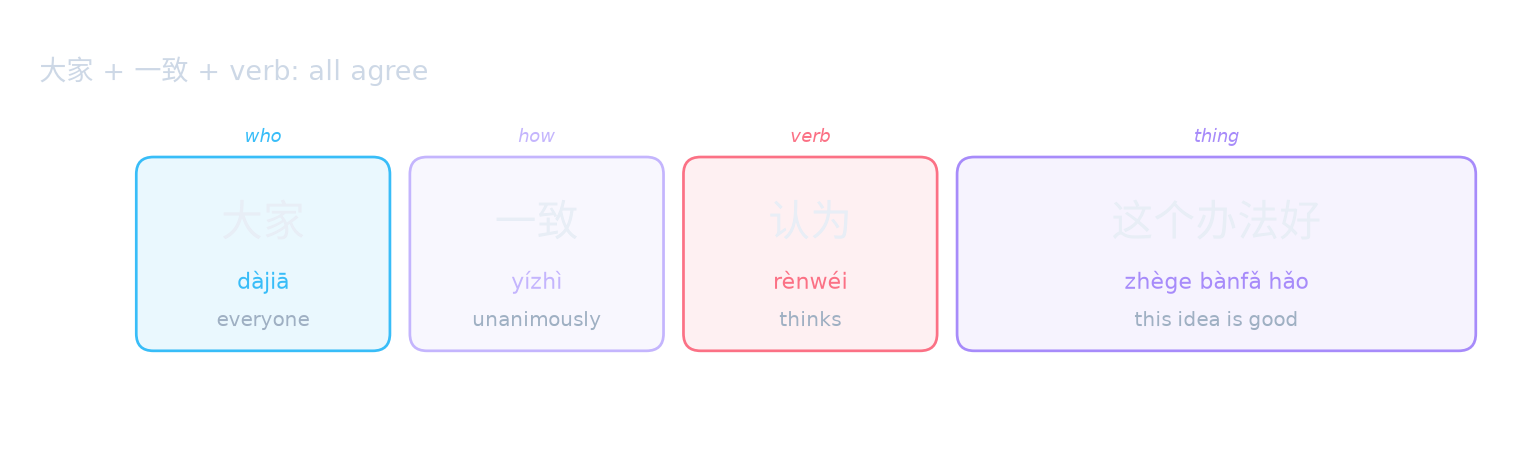
  • 16. in agreement; consistent一致yí zhì – unanimously; consistent: everyone大家dà jiāin agreement; consistent一致yí zhìto think / believe认为rèn wéithis这个zhè gemeans办法bàn fǎgood好hǎo。
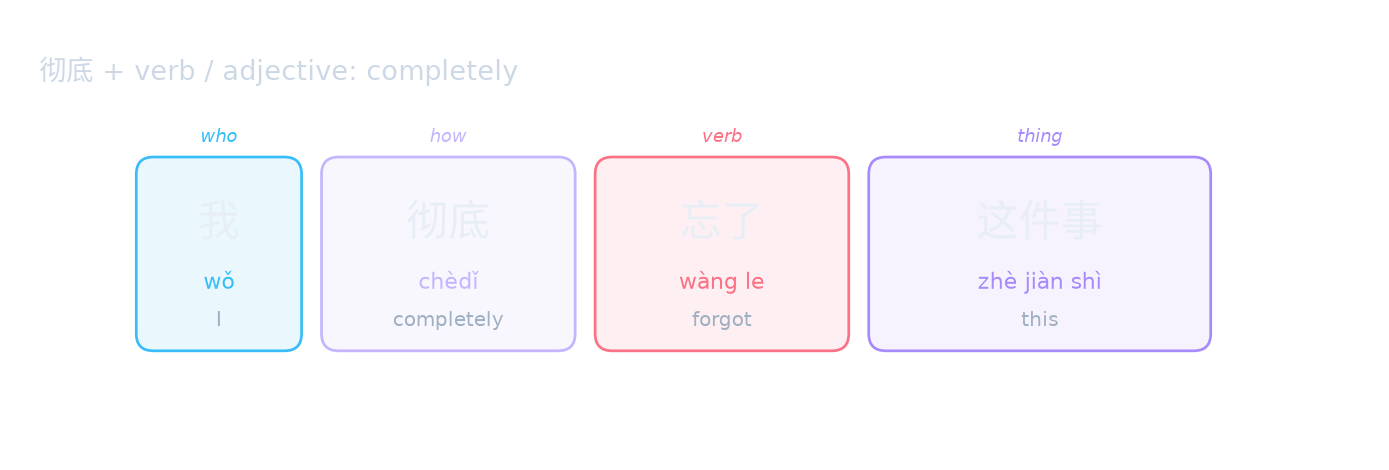
  • 17. thorough彻底chè dǐ vs completely完全wán quán – thoroughly, completely: I'm sorry对不起duì bù qǐ,I / me我wǒthorough彻底chè dǐto forget忘wàng(completed / change)了le!
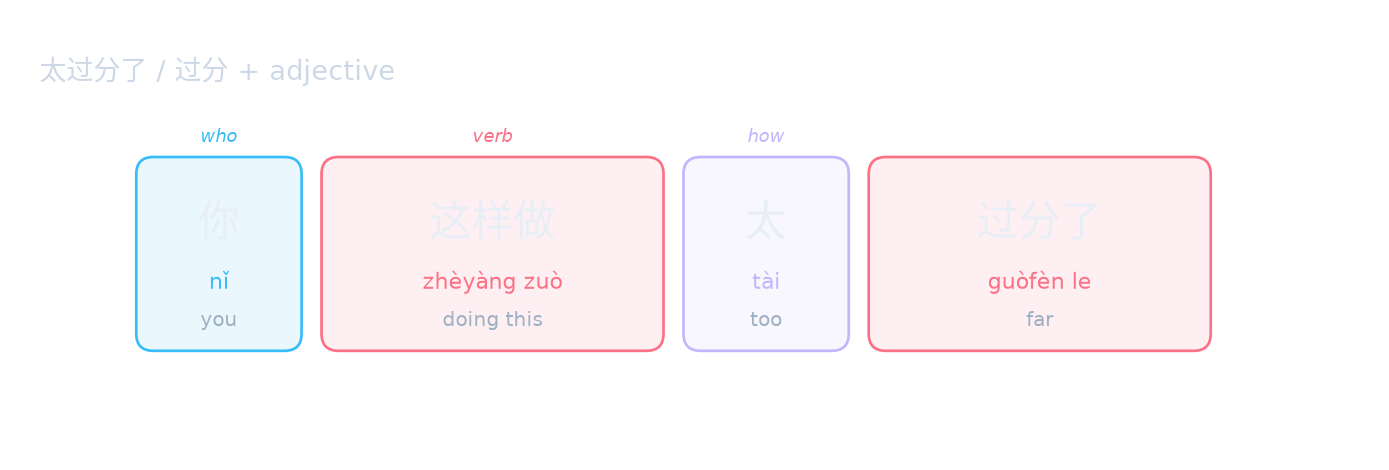
  • 18. excessive过分guò fèn vs too太tài and too much过于guò yú – going too far: you你nǐthis way / so这样zhè yàngto do; to make做zuò太过分tài guò fèn(completed / change)了le!
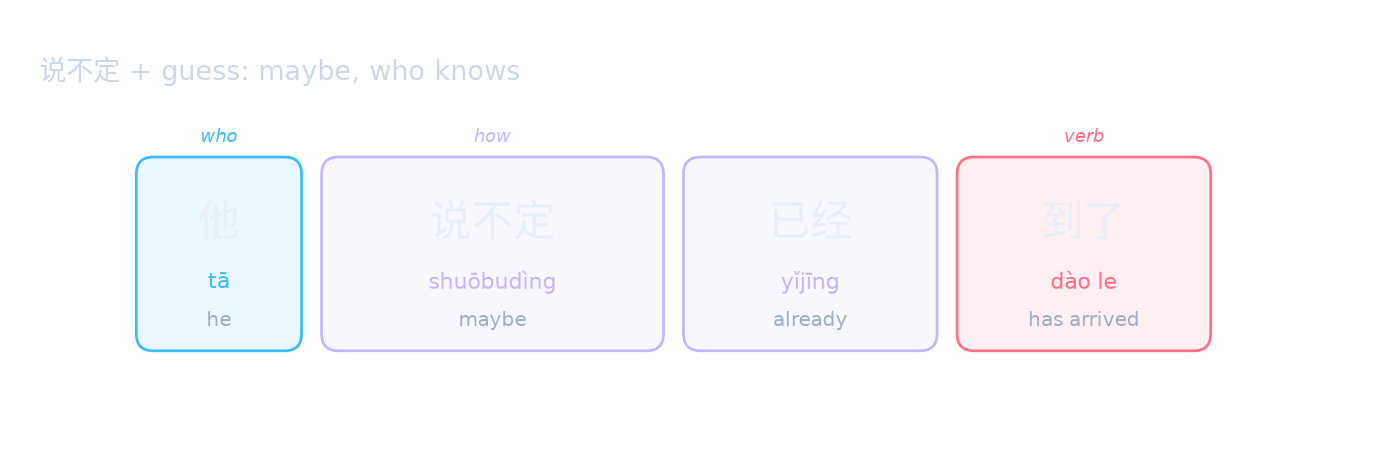
  • 19. maybe; can't say for sure说不定shuō bù dìng vs maybe也许yě xǔ and I'm afraid (that); probably恐怕kǒng pà – maybe, who knows: don't别biéto wait; and so on等děng(completed / change)了le,he / him他tāmaybe; can't say for sure说不定shuō bù dìngalready已经yǐ jīngto go in进去jìn qù(completed / change)了le。

Effort and manner

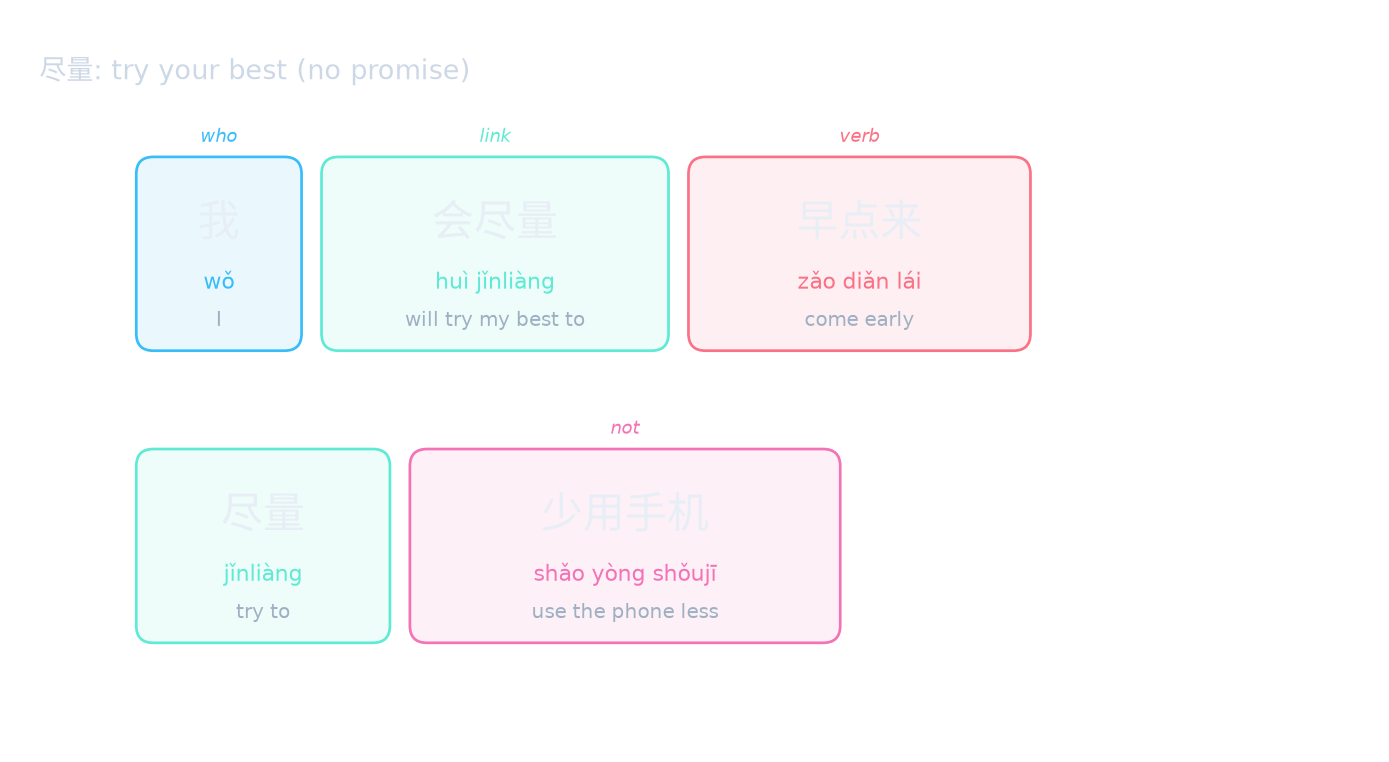
  • 20. as much as possible尽量jǐn liàng + Verb – as much as possible: 我会wǒ huìas much as possible尽量jǐn liànga bit earlier / breakfast早点zǎo diǎnto come来lái。
  • 21. although / feel free to尽管jǐn guǎn + Verb – feel free to: to have / there is有yǒuquestion / problem问题wèn tíalthough / feel free to尽管jǐn guǎnto ask问wèn。
  • 22. each other互相hù xiāng + Verb – each other: they他们tā men互相帮助hù xiāng bāng zhù。
  • 23. on the way; while you're at it顺便shùn biàn – while you're at it / by the way: you你nǐto go去qùlibrary图书馆tú shū guǎn(modifier / structural particle)的detime; when时候shí hòu,on the way; while you're at it顺便shùn biànto help帮bāngI / me我wǒstill / also / even还háithis这zhè本书běn shū(suggestion)吧ba。
  • 24. good好hǎo(not不bù)easy容易róng yì – with great difficulty: I / me我wǒwith great difficulty好不容易hǎo bù róng yìonly then / not until才cáito buy买mǎito / arrive / (result: get)到dàoticket票piào。
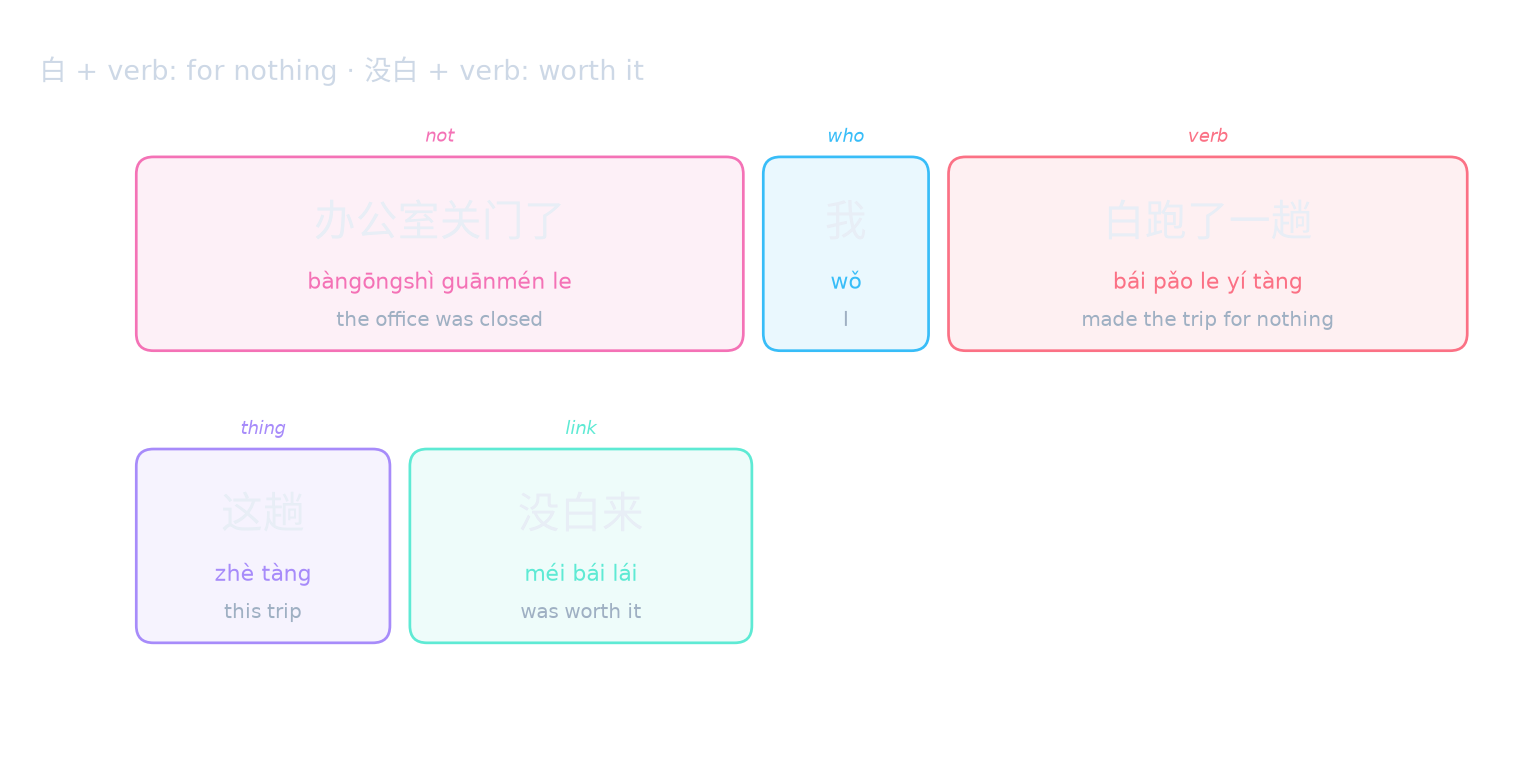
  • 25. white白bái + Verb – in vain / for nothing: office办公室bàn gōng shìto close (the door)关门guān mén(completed / change)了le,I / me我wǒ白跑bái pǎo(completed / change)了le一趟yī tàng。
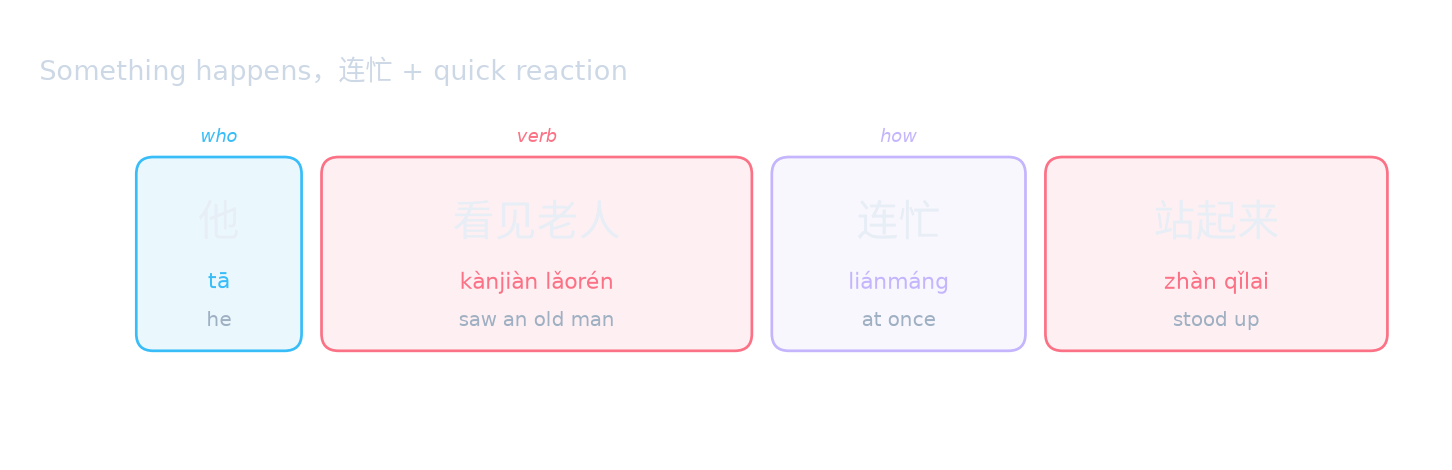
  • 26. at once; quickly (in reaction)连忙lián máng vs hurriedly赶紧gǎn jǐn – hurriedly / hurry up: he / him他tāto see看见kàn jiànold man or woman老人lǎo rénto get on or into (a bus…上车shàng chē,at once; quickly (in reaction)连忙lián mángto stand站zhànget up / (start, become)起来qǐ laito give up one's seat for sb让座ràng zuò。
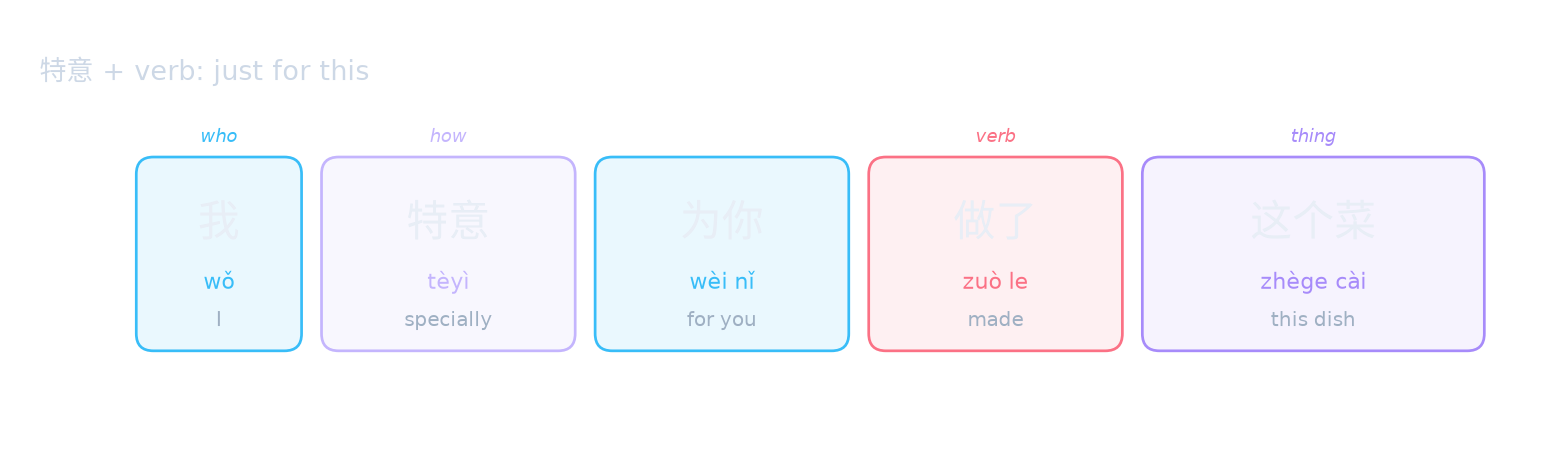
  • 27. specially特意tè yì vs on the way; while you're at it顺便shùn biàn and on purpose故意gù yì – specially / while you're at it / on purpose: I / me我wǒspecially特意tè yìfor / (wéi) to be为wèiyou你nǐto do; to make做zuò(completed / change)了lethis这个zhè gedish (of food); vegetable菜cài。
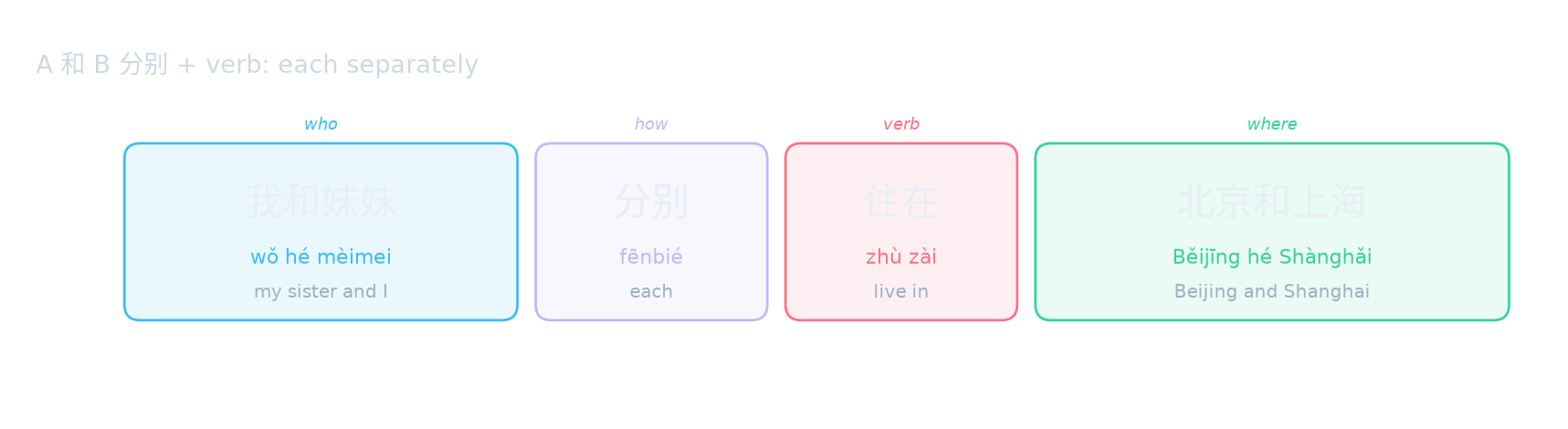
  • 28. separately; to part分别fēn bié – respectively, separately: I / me我wǒand / with和héyounger sister妹妹mèi mèiseparately; to part分别fēn biéto live (somewhere)住zhùat / in在zàiBeijing北京běi jīngand / with和héShanghai municipality…上海shàng hǎi。
  • 29. quietly悄悄qiāo qiāo vs quiet安静ān jìng, stealthily偷偷tōu tōu and lightly轻轻qīng qīng – quietly: he / him他tā悄悄地qiāo qiāo dìto enter走进zǒu jìn(completed / change)了leclassroom教室jiào shì。
  • 30. alone单独dān dú vs alone独自dú zì – alone, separately: teacher老师lǎo shīwant / think / miss想xiǎngalone单独dān dúwith / and跟gēnyou你nǐto discuss谈谈tán tán。

Time and repetition

  • 31. always / total总zǒng – always / keep on: he / him他tāalways / total总zǒngto arrive late迟到chí dào。
  • 32. once (in the past)曾经céng jīng + Verb + (experienced)过guo – once / formerly: I / me我wǒonce (in the past)曾经céng jīngat / in在zàiShanghai municipality…上海shàng hǎito live (somewhere)住zhù(experienced)过guo两年liǎng nián。
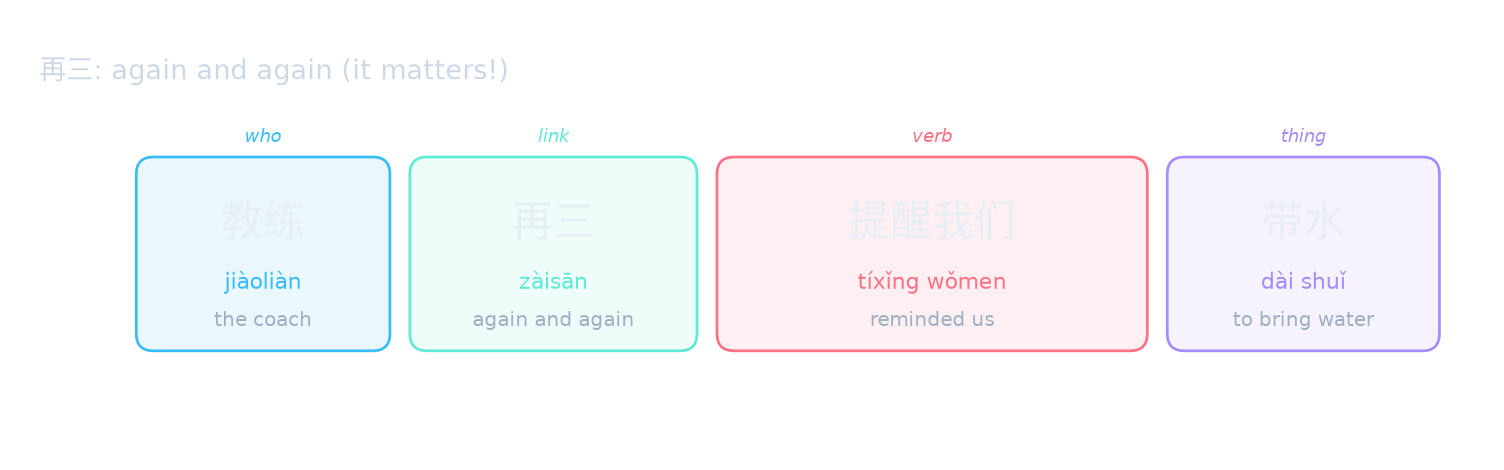
  • 33. over and over again再三zài sān + Verb – over and over: coach教练jiào liànover and over again再三zài sānto remind提醒tí xǐngwe / us我们wǒ men带水dài shuǐ。
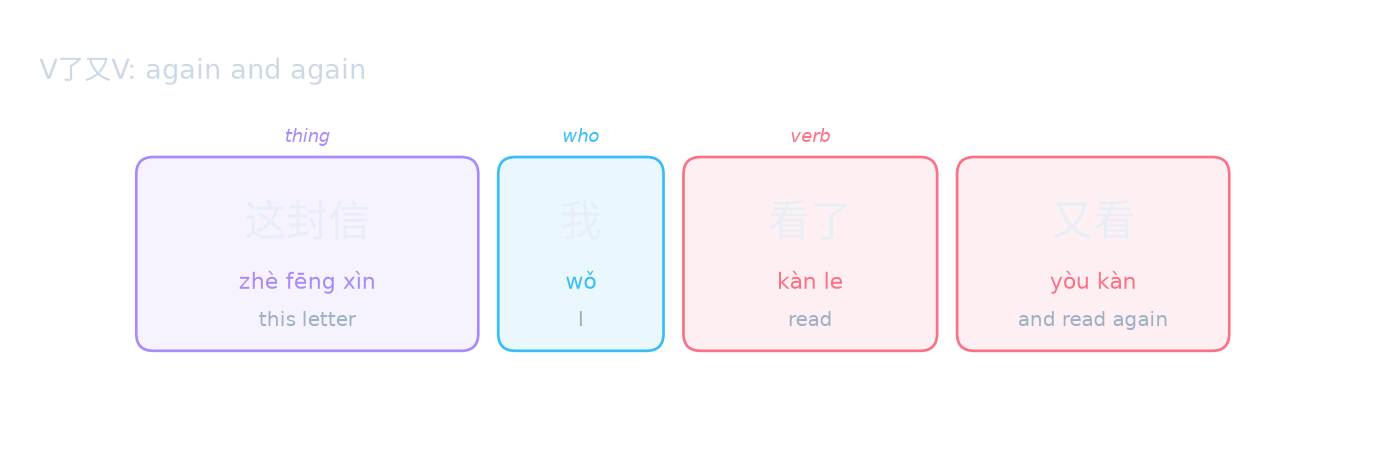
  • 34. Verb + (completed / change)了le + again又yòu + Verb – again and again: this这zhè封信fēng xìnI / me我wǒ看了又看kàn le yòu kàn。
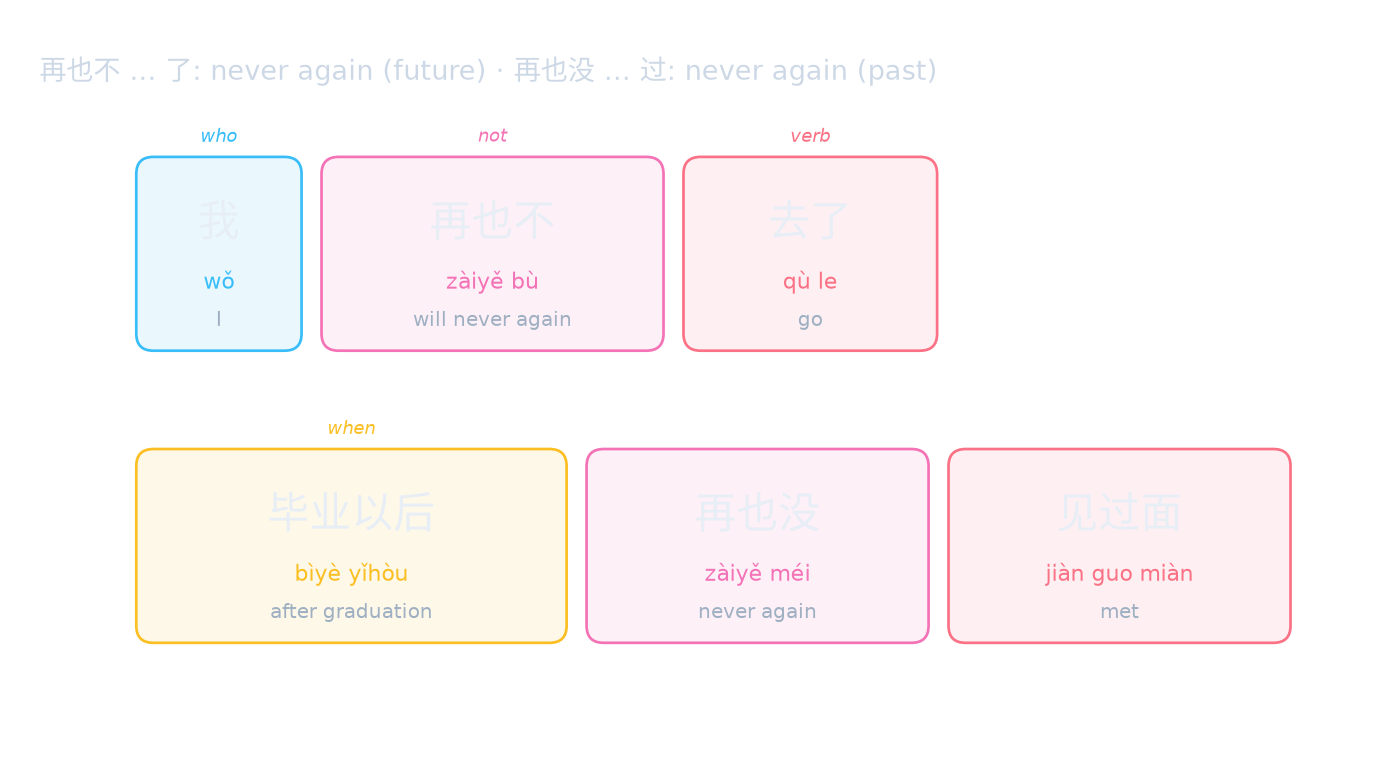
  • 35. (not) any more再也zài yě + not不bù / not / haven't没méi + … (completed / change)了le – never again: to graduate毕业bì yèafter / from now on以后yǐ hòu,we / us我们wǒ men(not) any more再也zài yěnot / haven't没méi见过面jiàn guò miàn。
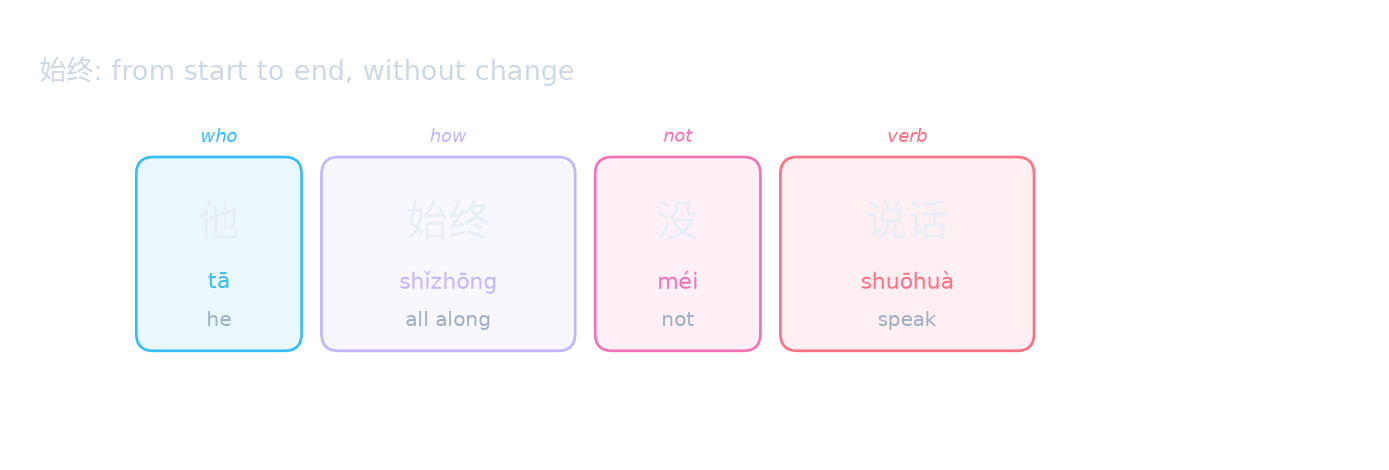
  • 36. all along; from start to finish始终shǐ zhōng – all along / from start to finish: he / him他tāall along; from start to finish始终shǐ zhōngnot / haven't没méito speak; to talk说话shuō huà。
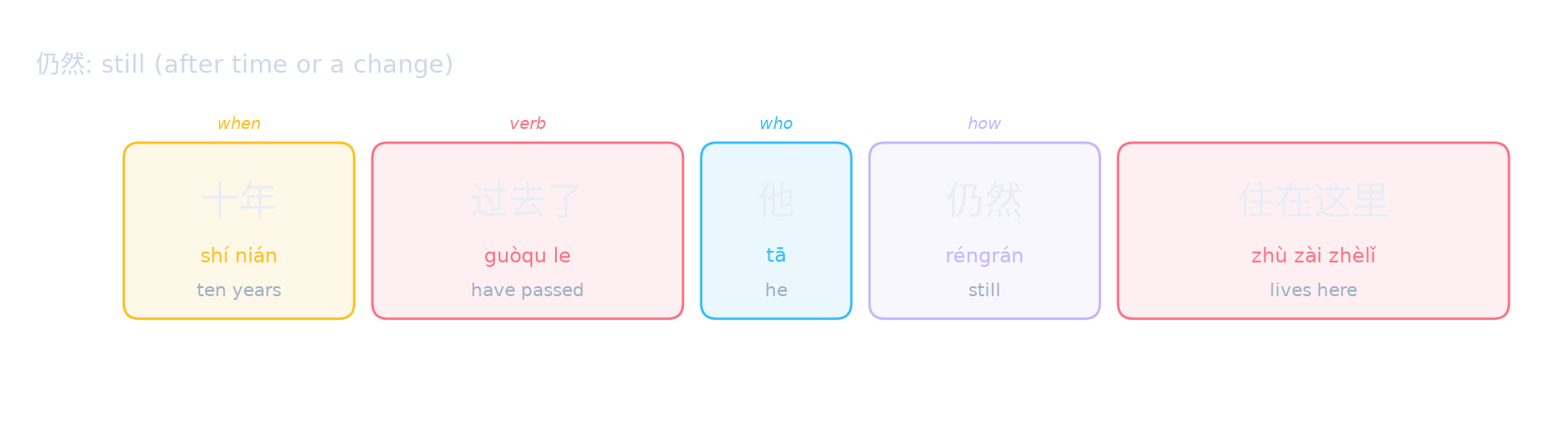
  • 37. still仍然réng rán – still: 十年shí niánpast过去guò qù(completed / change)了le,he / him他tāstill仍然réng ránto live (somewhere)住zhùat / in在zàihere这里zhè lǐ。
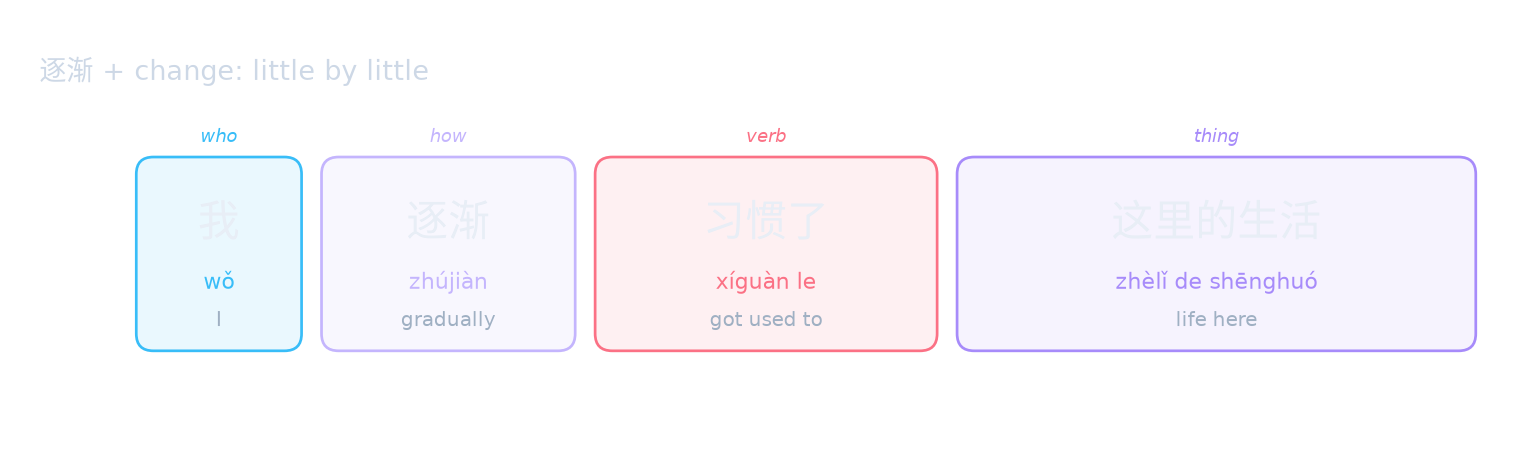
  • 38. gradually逐渐zhú jiàn vs step by step逐步zhú bù – gradually / step by step: I / me我wǒgradually逐渐zhú jiànhabit / be used to习惯xí guàn(completed / change)了lehere这里zhè lǐ(modifier / structural particle)的delife; to live生活shēng huó。
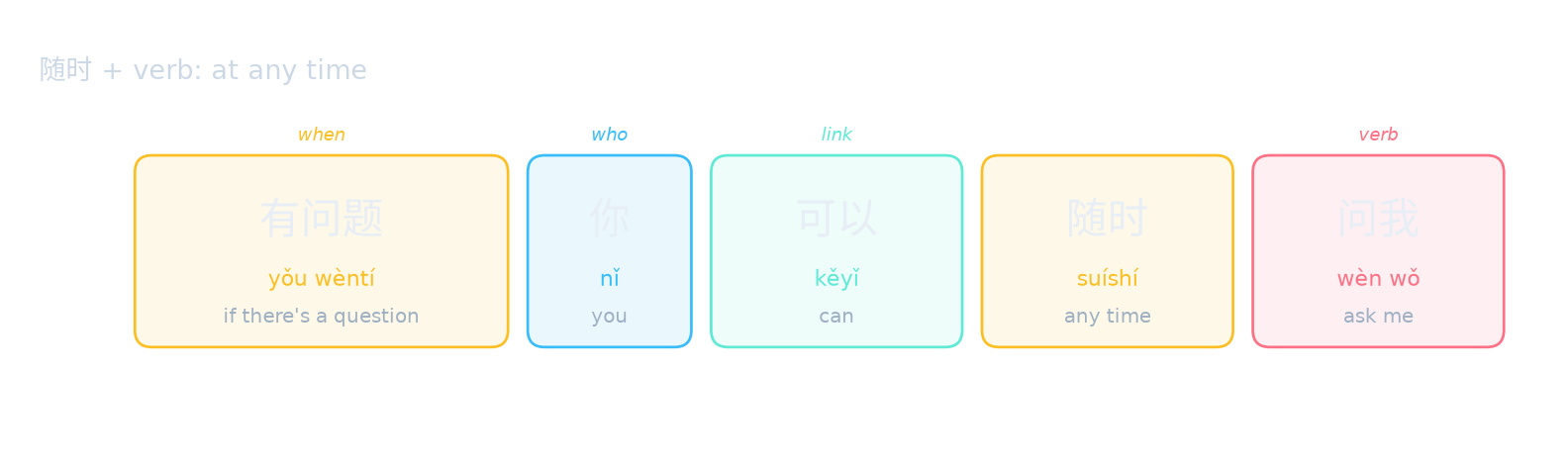
  • 39. at any time随时suí shí – at any time: to have / there is有yǒuquestion / problem问题wèn tícan / may可以kě yǐat any time随时suí shíto ask问wènI / me我wǒ。
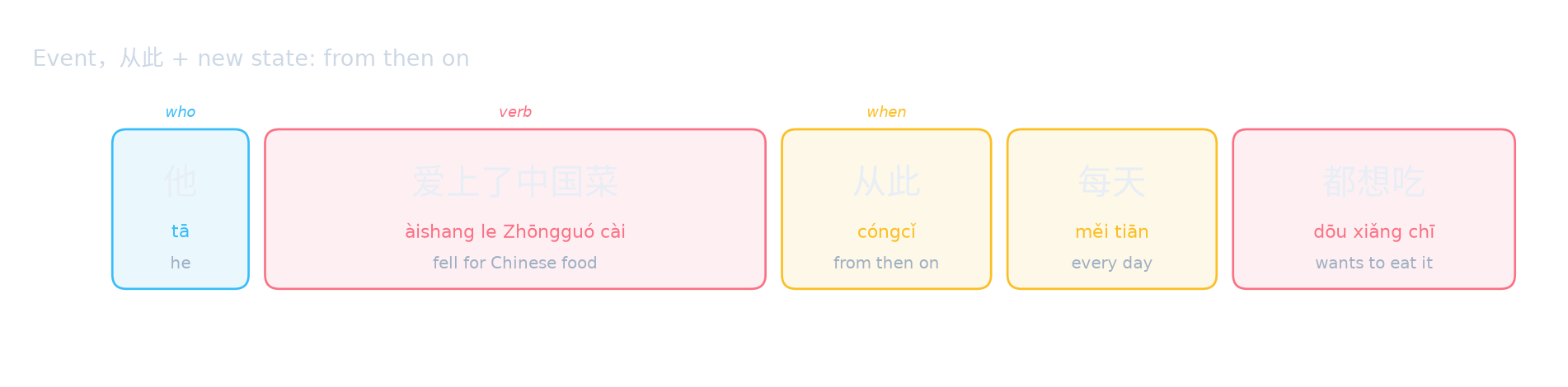
  • 40. from then on从此cóng cǐ and so far至今zhì jīn – from then on / to this day: he / him他tāthe first time第一次dì yī cìto go去qùChengdu subprovincial city…成都chéng dūthen / just就jiùto love爱àiup / on / last; to get on, attend上shàng(completed / change)了lehotpot火锅huǒ guō,from then on从此cóng cǐ每个měi gèweekend周末zhōu mòall / both都dōuwant / will / need要yàoto eat吃chī。
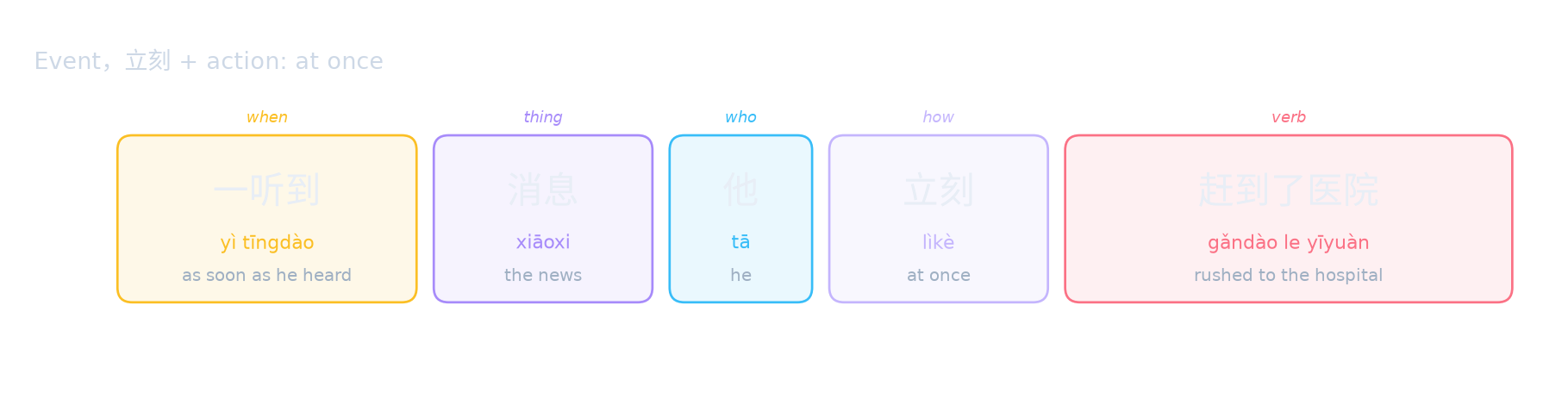
  • 41. at once立刻lì kè and immediately立即lì jí vs right away马上mǎ shàng – at once / soon: one / a一yīto hear听到tīng dàonews; message消息xiāo xī,he / him他tāat once立刻lì kèto hurry (to some place)赶到gǎn dào(completed / change)了lehospital医院yī yuàn。
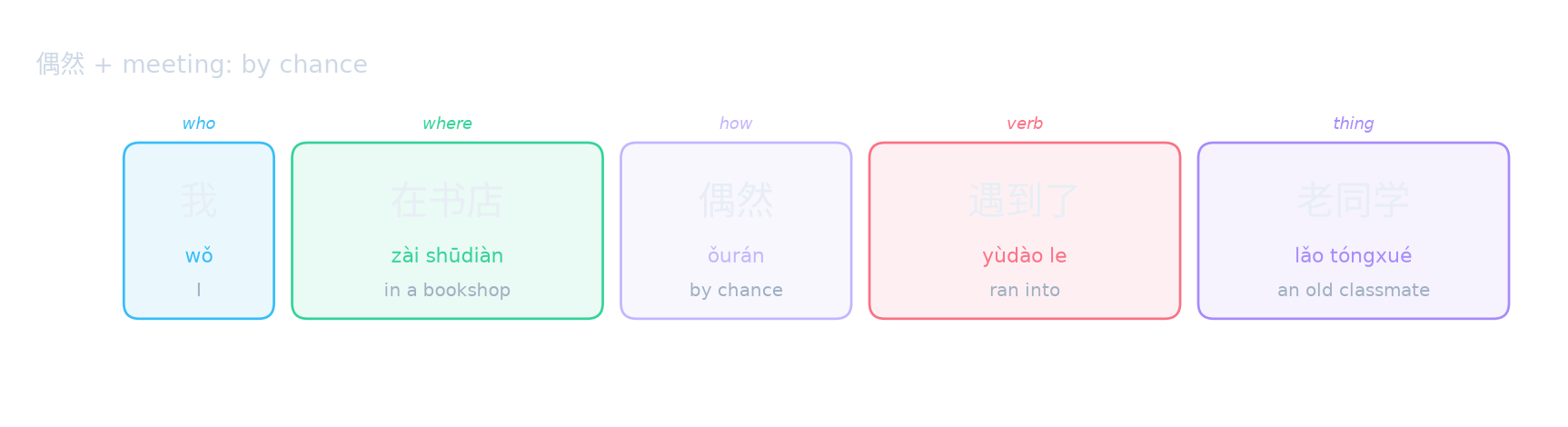
  • 42. by chance偶然ǒu rán vs occasionally偶尔ǒu ěr – by chance / now and then: I / me我wǒat / in在zàibookstore书店shū diànby chance偶然ǒu ránto run into遇到yù dào(completed / change)了le一位yī wèi老同学lǎo tóng xué。
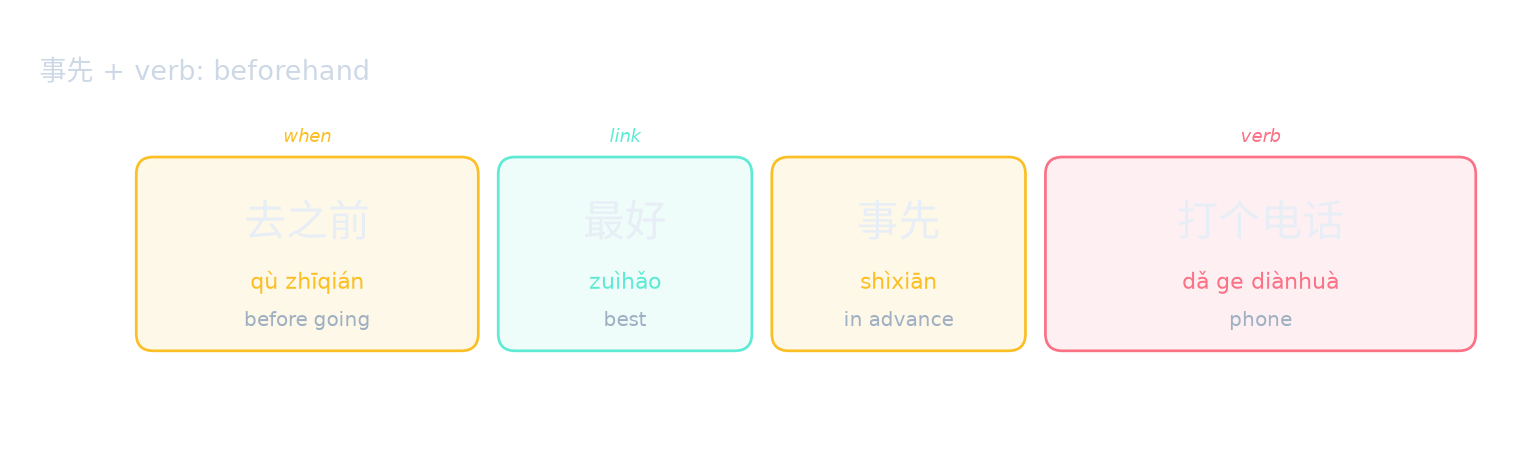
  • 43. in advance事先shì xiān vs in advance / move earlier提前tí qián – beforehand / ahead of time: to go去qùbefore之前zhī qiánhad better; best最好zuì hǎoin advance事先shì xiān打个dǎ gètelephone电话diàn huà。
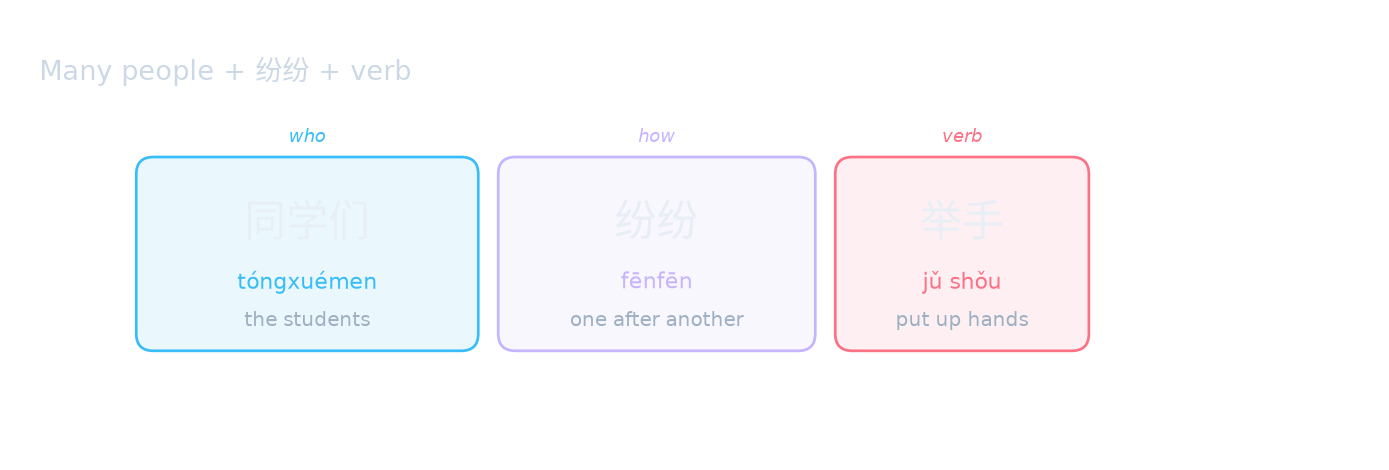
  • 44. one after another (many)纷纷fēn fēn – one after another, many: classmate同学tóng xué(plural)们menone after another (many)纷纷fēn fēnto raise a hand举手jǔ shǒu。
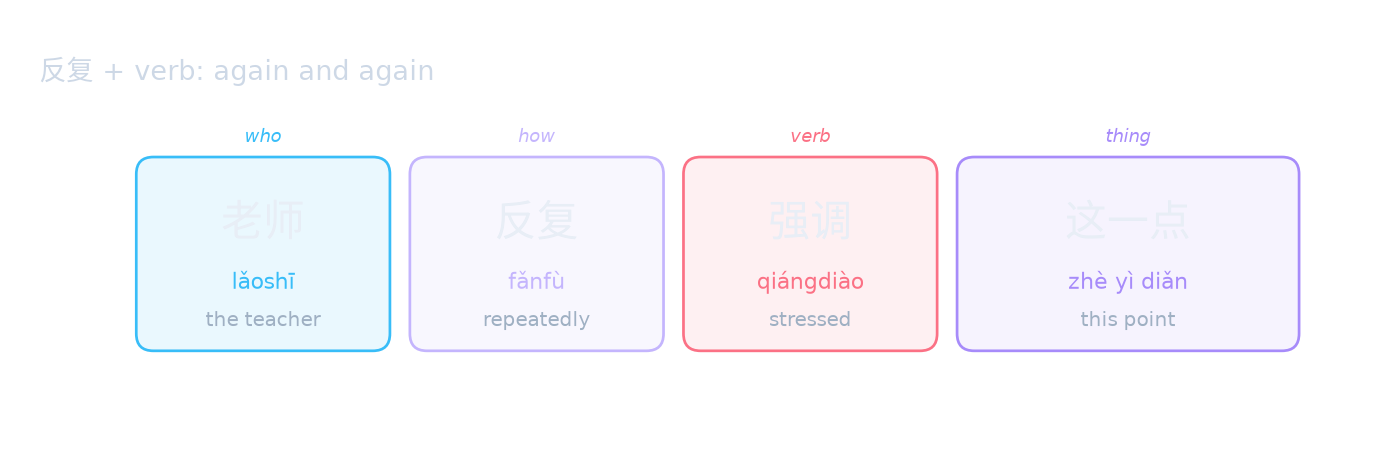
  • 45. repeatedly反复fǎn fù vs to repeat重复chóng fù – again and again / to repeat: teacher老师lǎo shī反复强调fǎn fù qiáng diàothis这zhèa bit一点yì diǎn。
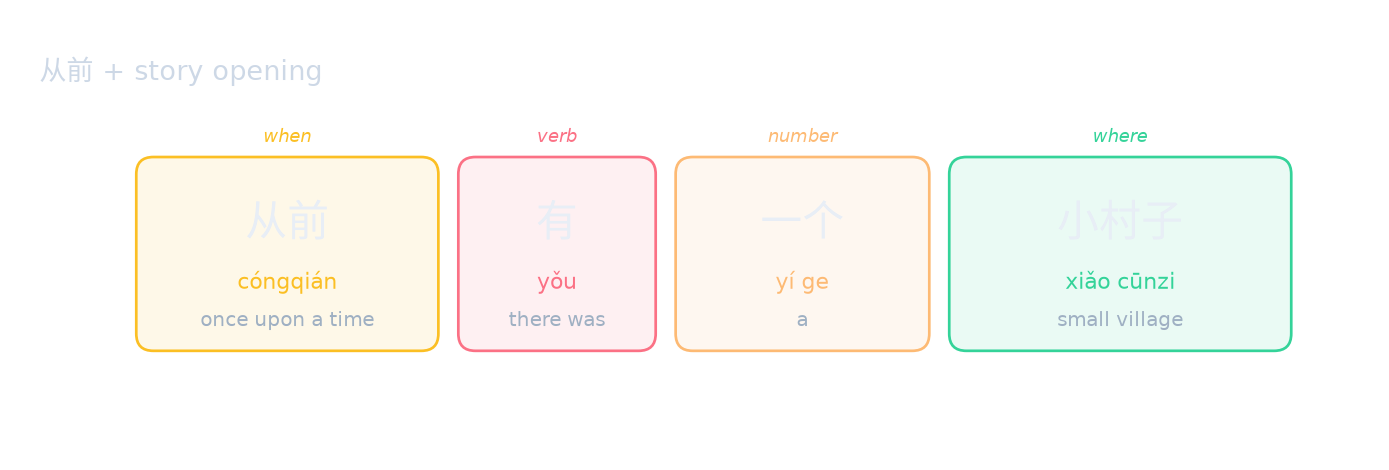
  • 46. in the past; once upon a time从前cóng qián vs before以前yǐ qián and past过去guò qù – long ago: in the past; once upon a time从前cóng qiánhere这里zhè lǐto be / is是shì一片yī piànfarmland农田nóng tián,now现在xiàn zàito become / into成chéng(completed / change)了lemajor city大城市dà chéng shì。
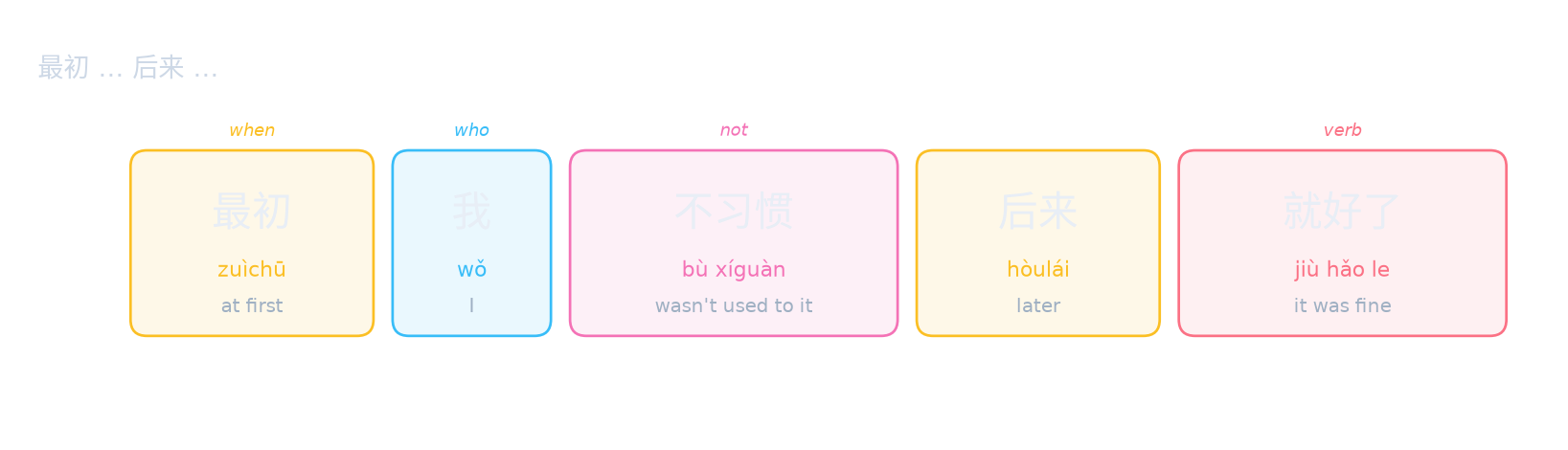
  • 47. at first最初zuì chū vs at first; originally当初dāng chū – at first / back then: at first最初zuì chūI / me我wǒnot不bùtoo太tàihabit / be used to习惯xí guàn,later; afterwards后来hòu láithen / just就jiùgood好hǎo(completed / change)了le。

Near misses, warnings and differences

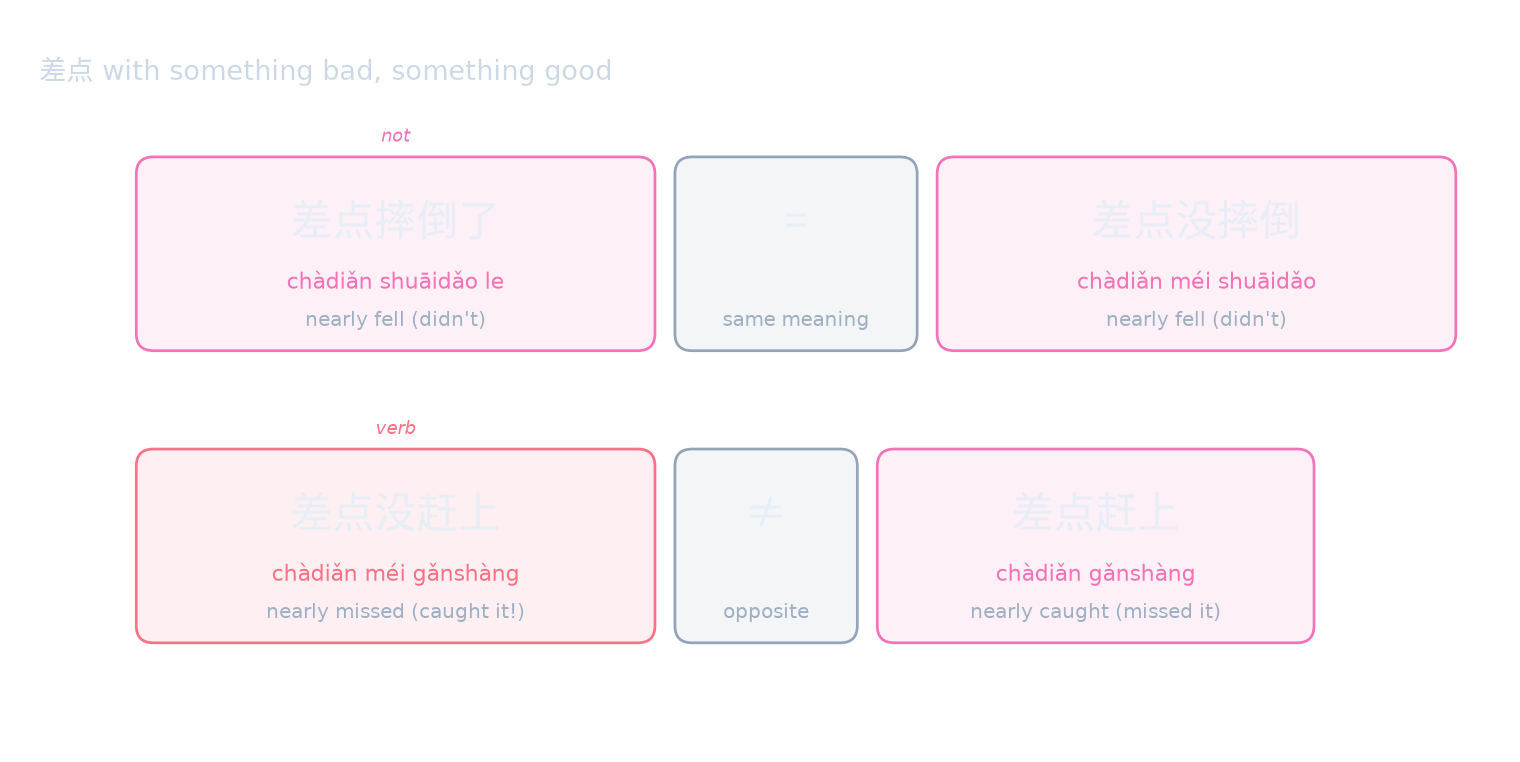
  • 48. almost差点chà diǎnnot / haven't没méi – near misses and context: I / me我wǒalmost差点chà diǎnnot / haven't没méito catch / keep up with赶上gǎn shàngcar车chē,fortunately幸好xìng hǎochauffeur司机sī jīto wait; and so on等děng(completed / change)了leI / me我wǒ。
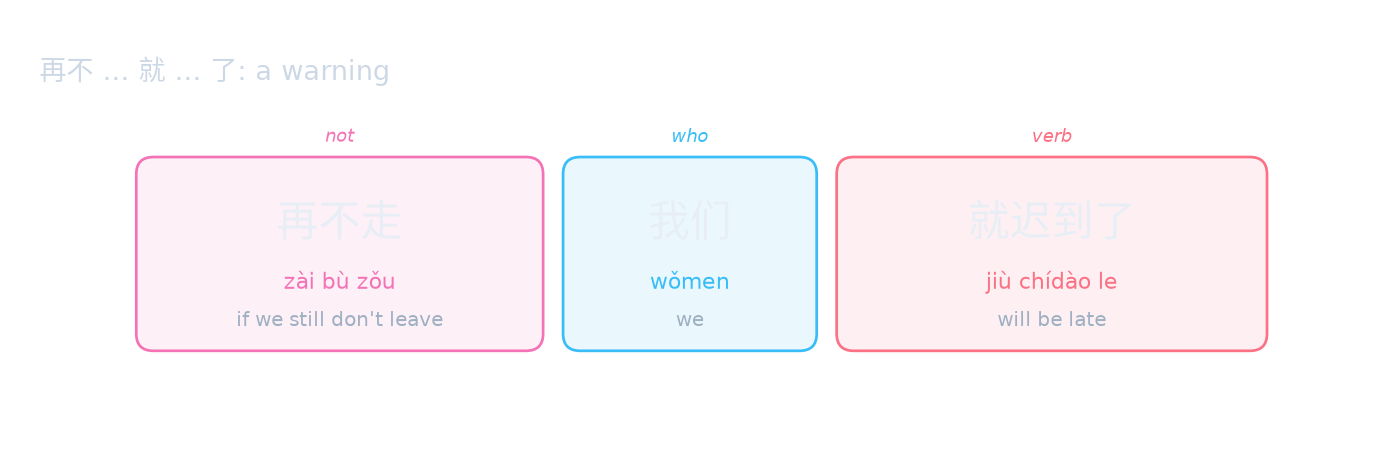
  • 49. again / then / (再…也) however再zàinot不bù…then / just就jiù…(completed / change)了le – a conditional warning: again / then / (再…也) however再zàinot不bùto walk / to leave走zǒu,we / us我们wǒ menthen / just就jiùto arrive late迟到chí dào(completed / change)了le!
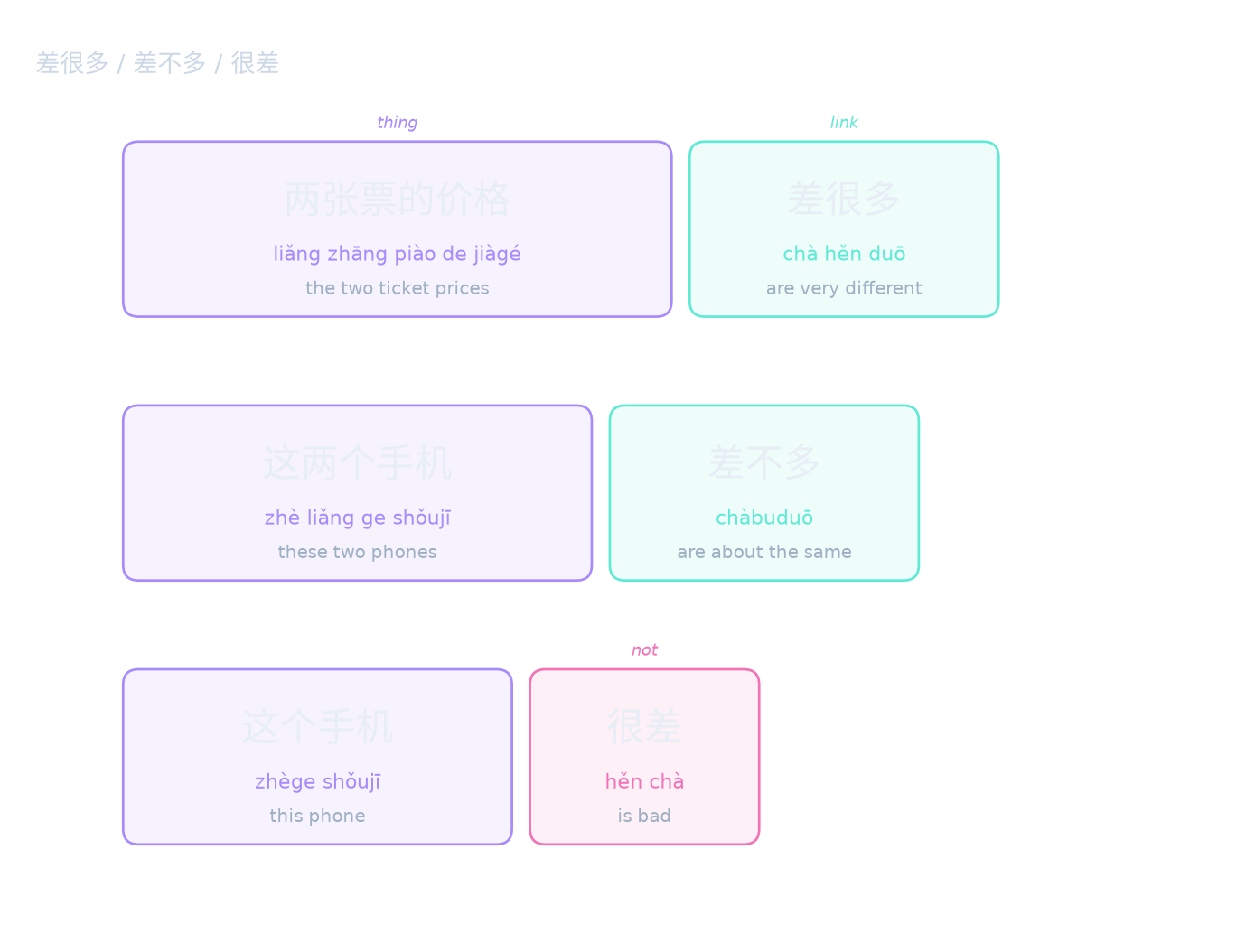
  • 50. poor差chà很多hěn duō – differ a lot: this这zhè两张liǎng zhāngticket票piào(modifier / structural particle)的deprice价格jià gépoor差chà很多hěn duō。
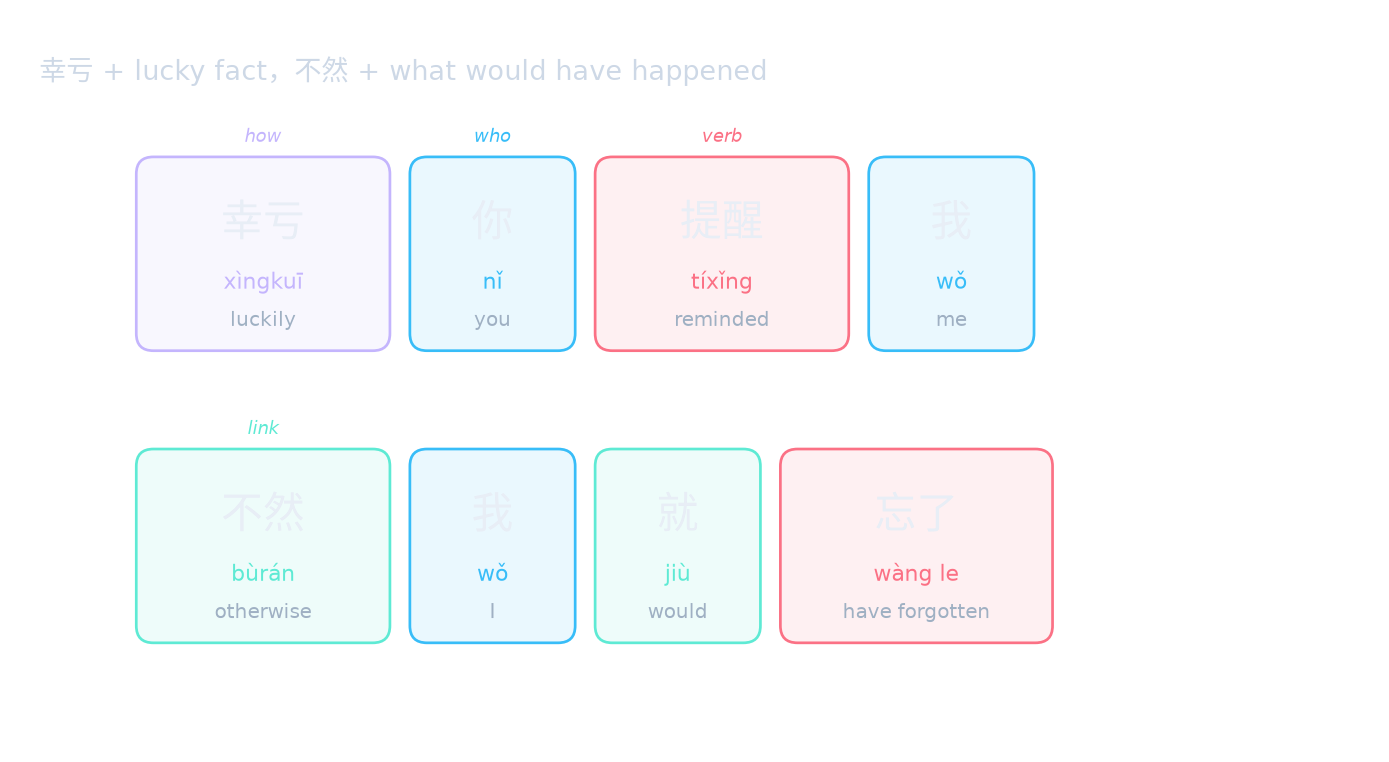
  • 51. fortunately幸亏xìng kuī – luckily / thanks to: fortunately幸亏xìng kuīyou你nǐto remind提醒tí xǐngI / me我wǒto bring带dàiumbrella伞sǎn,otherwise; or else不然bù ránI / me我wǒthen / just就jiùto get soaked淋湿lín shī(completed / change)了le。
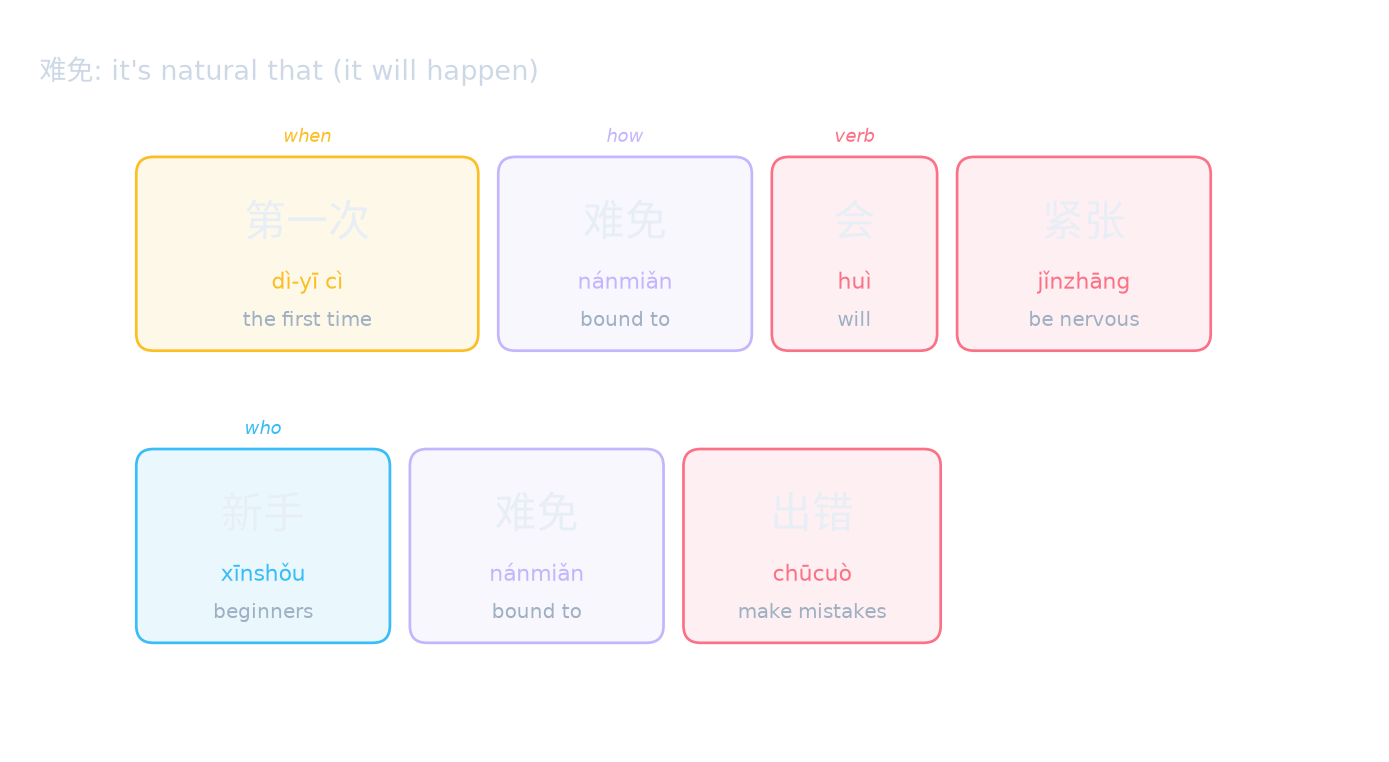
  • 52. hard to avoid难免nán miǎn – bound to / hard to avoid: the first time第一次dì yī cìto go on stage / take office上台shàng tái难免会nán miǎn huìnervous紧张jǐn zhāng。
2.2

1. 毕竟(表示追根究底)

English

Form: subject + after all毕竟bì jìng + predicate · after all毕竟bì jìng + clause

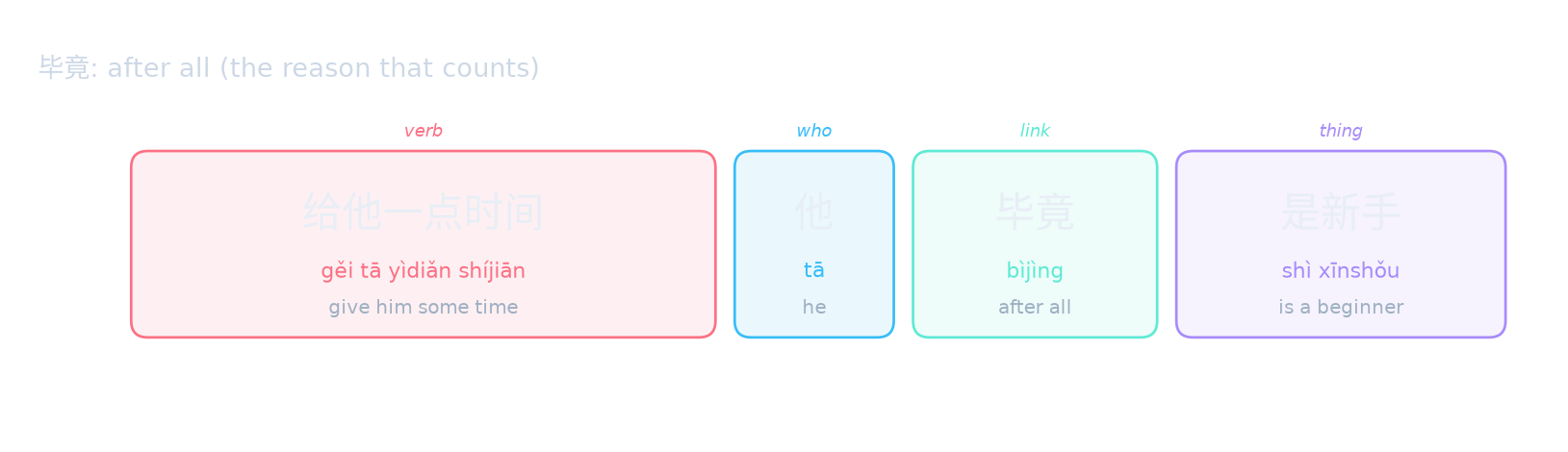
  • he / him他tāafter all毕竟bì jìngto be / is是shìnew hand新手xīn shǒu,to / for / give给gěihe / him他tāa bit一点yì diǎntime时间shí jiān。 Tā bìjìng shì xīnshǒu, gěi tā yìdiǎn shíjiān. – He's a beginner, after all; give him some time.
  • 别太bié tàistrict严格yán gé,he / him他tāafter all毕竟bì jìngor / still还是hái shì(measure word)个gèchild孩子hái zi。 – Don't be too strict; he's still a child, after all.
  • this这zhèafter all毕竟bì jìngto be / is是shìhe / him他tā(modifier / structural particle)的deto decide / decision决定jué dìng,we / us我们wǒ menshould应该yīng gāito respect尊重zūn zhòng。 – It's his decision, after all; we should respect it.

How it works. after all毕竟bì jìng bìjìng "after all" reminds the listener of a reason that supports the speaker's judgement or advice. It goes before the predicate, or at the start of the clause: he / him他tāafter all毕竟bì jìngto be / is是shìnew hand新手xīn shǒu / after all毕竟bì jìnghe / him他tāto be / is是shìnew hand新手xīn shǒu. The reason need not excuse a mistake; it can support respect, patience or caution.

after all毕竟bì jìng anyway反正fǎn zhèng
highlights why a judgement is reasonable holds a point regardless of other options
he / him他tāafter all毕竟bì jìngto be / is是shìnew hand新手xīn shǒu,to / for / give给gěihe / him他tāa bit一点yì diǎntime时间shí jiān anyway反正fǎn zhèngtoday今天jīn tiānnot不bùto hand in; to make (friends)交jiāo,tomorrow明天míng tiānagain / then / (再…也) however再zàito check检查jiǎn chá

Watch out

  • after all毕竟bì jìng presents a reason as relevant; it does not prove it true. he / him他tāafter all毕竟bì jìngto have / there is有yǒuexperience (know-how)经验jīng yàn still needs evidence.
  • Some contexts allow both after all毕竟bì jìng and anyway反正fǎn zhèng, with different emphasis; don't translate every English "anyway" as after all毕竟bì jìng.
毕竟: after all (the reason that counts)
词汇 训练
汉字 拼音 English
毕竟 bì jìng after all
反正 fǎn zhèng anyway
2.3

2. 反正

English

Form: anyway反正fǎn zhèng + clause · subject + anyway反正fǎn zhèng + predicate · no matter; regardless不管bù guǎn …,anyway反正fǎn zhèng …

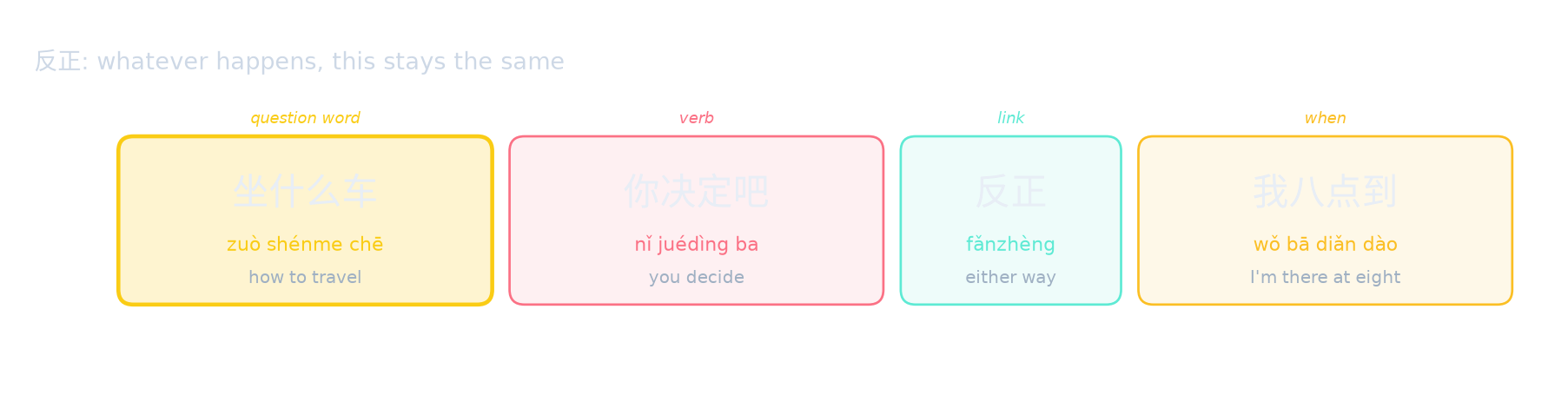
  • to sit / to take (a bus …)坐zuòwhat什么shén mecar车chēyou你nǐto decide / decision决定jué dìng(suggestion)吧ba,anyway反正fǎn zhèngI / me我wǒ八点bā diǎnto / arrive / (result: get)到dào。 Zuò shénme chē nǐ juédìng ba, fǎnzhèng wǒ bā diǎn dào. – You decide how to travel; either way, I'll arrive at eight.
  • no matter; regardless不管bù guǎnyou你nǐ信不信xìn bù xìn,anyway反正fǎn zhèng我信wǒ xìn。 – Whether you believe it or not, I do.
  • anyway反正fǎn zhèngtime时间shí jiānstill / also / even还háiearly早zǎo,we / us我们wǒ menslowly慢慢màn mànto walk / to leave走zǒu。 – There's still time anyway; let's walk slowly.
  • anyway反正fǎn zhèngnow现在xiàn zàistill / also / even还háinot不bùto know知道zhī dào,to wait; and so on等děngto notify / notice通知tōng zhī(suggestion)吧ba。 – We don't know yet anyway; let's wait for the notice.

How it works. anyway反正fǎn zhèng fǎnzhèng holds one point fixed regardless of the alternatives being discussed. First find what stays open (how to travel) and what stays fixed (arriving at eight). The point can be a decision, a practical circumstance, or even admitted uncertainty. The tone can be practical, reassuring or dismissive.

In neutral writing, it comes before the clause or the predicate: anyway反正fǎn zhèngI / me我wǒnot不bùto go去qù / I / me我wǒanyway反正fǎn zhèng不去bù qù.

Watch out

  • anyway反正fǎn zhèng does not always mean a firm personal decision.
  • anyway反正fǎn zhèngI / me我wǒnot不bùto go去qù can sound dismissive in an argument; when your decision affects someone, explain it.
反正: whatever happens, this stays the same
2.4

3. 干脆(索性 / 不如)

English

Form: subject + simply / decisive干脆gān cuì + verb phrase · simply / decisive干脆gān cuì + suggestion + (suggestion)吧ba · verb + (degree marker)得de + degree / adjective linker很hěnsimply / decisive干脆gān cuì (decisive)

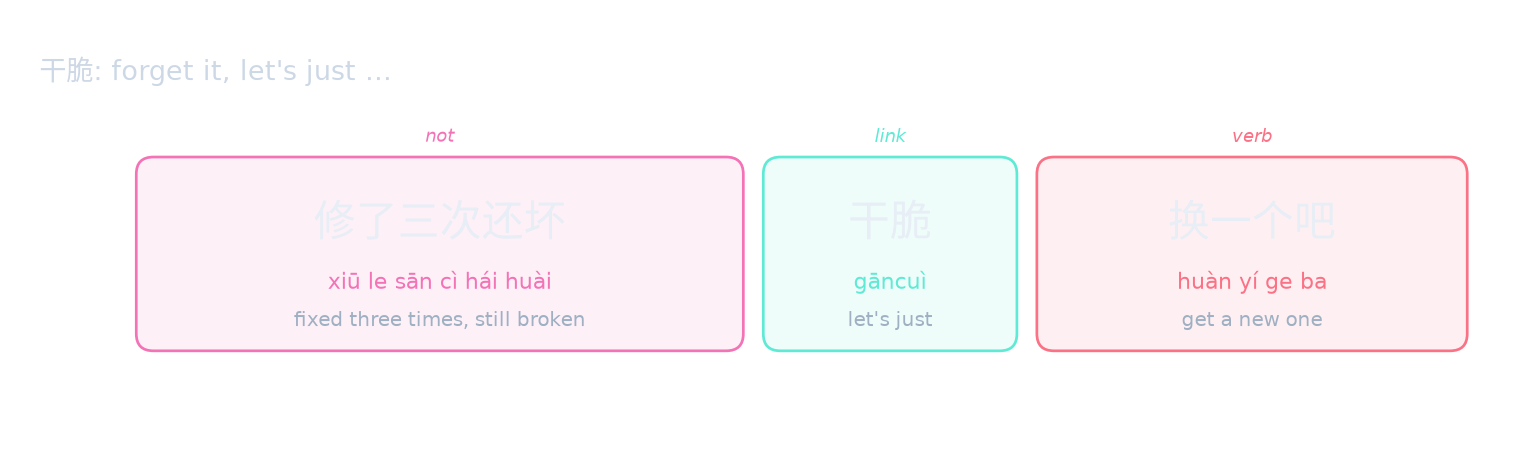
  • to repair / to build修xiū(completed / change)了lethree times三次sān cì还坏hái huài,simply / decisive干脆gān cuìto exchange换huàn一个yí gè(suggestion)吧ba。 Xiūle sān cì hái huài, gāncuì huàn yí ge ba. – It's broken after three repairs; let's just replace it.
  • simply / decisive干脆gān cuìoneself自己zì jǐto do; to make做zuò(suggestion)吧ba。 – Let's just do it ourselves, then.
  • she / her她tāsimply / decisive干脆gān cuìnot不bùto answer回答huí dá(completed / change)了le。 – She simply stopped answering.
  • she / her她tāto answer回答huí dá(degree marker)得dedegree / adjective linker很hěnsimply / decisive干脆gān cuì。 – She answered decisively.

How it works. Before an action, simply / decisive干脆gān cuì gāncuì proposes a direct way out, often after other attempts have failed: "just, simply, might as well". After (degree marker)得de, it describes a clear, decisive manner.

Keep three questions apart: is it a direct choice (simply / decisive干脆gān cuì says yes); is it a good choice; does the person change it later? simply / decisive干脆gān cuì answers only the first. he / him他tāsimply / decisive干脆gān cuìto close关guān(completed / change)了lemobile phone手机shǒu jī,later; afterwards后来hòu láiagain又yòuto open打开dǎ kāi(completed / change)了le is a normal sentence.

Watch out

  • simply / decisive干脆gān cuìto exchange换huàn一个yí gè(suggestion)吧ba does not prove replacing is cheapest or best; a reader can understand it and still disagree.
干脆: forget it, let's just …
词汇 训练
汉字 拼音 English
干脆 gān cuì simply; straightforward
2.5

4. 简直:强烈的评价和比较

English

Form: simply; practically简直jiǎn zhí + strong description · simply; practically简直jiǎn zhí + to resemble像xiàng … the same一样yí yàng

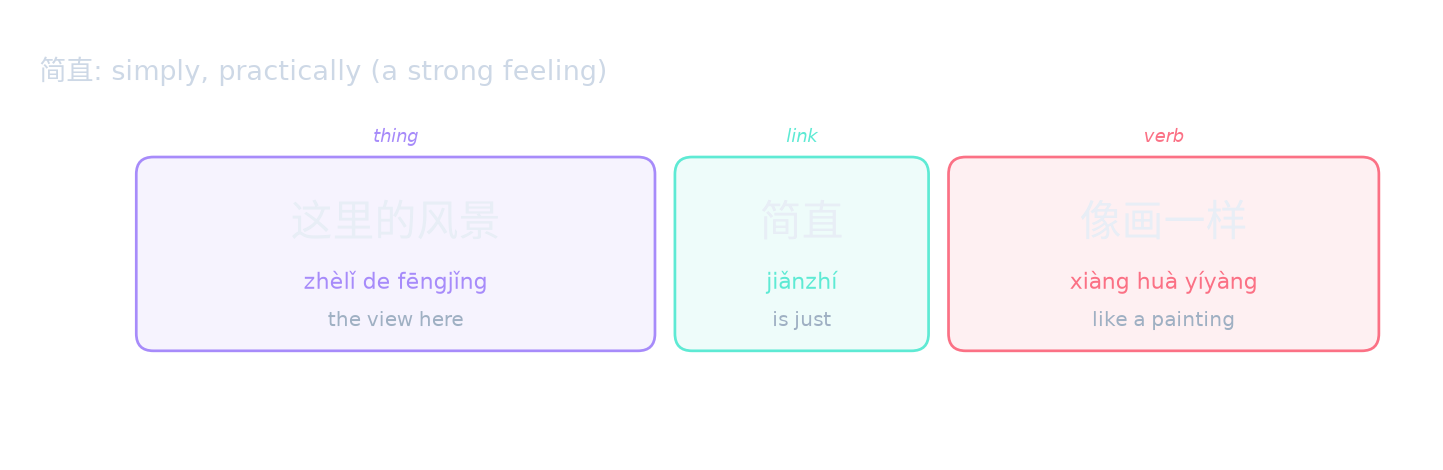
  • here这里zhè lǐ(modifier / structural particle)的descenery风景fēng jǐngsimply; practically简直jiǎn zhíto resemble像xiàngpainting / to draw画huàthe same一样yí yàng。 Zhèlǐ de fēngjǐng jiǎnzhí xiàng huà yíyàng. – The scenery looks just like a painting.
  • this这zhèsimply; practically简直jiǎn zhí太棒了tài bàng le! – This is simply amazing!
  • I / me我wǒsimply; practically简直jiǎn zhí不敢相信bù gǎn xiāng xìnoneself自己zì jǐ(modifier / structural particle)的deeye眼睛yǎn jīng。 – I simply can't believe my eyes.
  • this这zhè(measure: rooms) / between间jiānroom屋子wū zisimply; practically简直jiǎn zhíto resemble像xiàngicebox冰箱bīng xiāngthe same一样yí yàng。 – This room is like a fridge.

How it works. simply; practically简直jiǎn zhí jiǎnzhí strengthens the speaker's evaluation: "simply, just". The description after it gives the direction: simply; practically简直jiǎn zhívery good太好了tài hǎo le (approval), simply; practically简直jiǎn zhí太糟tài zāo(completed / change)了le (disapproval). With to resemble像xiàng……the same一样yí yàng it is a figurative comparison, not a literal claim.

simply; practically简直jiǎn zhíto resemble像xiàng一幅yī fúpainting / to draw画huà 这是zhè shì一幅yī fúpainting / to draw画huà room temperature室温shì wēnto be / is是shìten十shídegree Celsius摄氏度shè shì dù
a strong comparison identifies a painting a measured fact

Watch out

  • Don't translate simply; practically简直jiǎn zhí as "literally": the view is not made of paint, and "like a fridge" gives no temperature.
简直: simply, practically (a strong feeling)
词汇 训练
汉字 拼音 English
简直 jiǎn zhí simply; practically
屋子 wū zi room
2.6

5. 都的高级用法(表示已经或甚至)

English

Form: all / both都dōu + time / reached state + (completed / change)了le · … + all / both都dōu + not不bù / not / haven't没méi (even) · group + all / both都dōu (all)

  • all / both都dōu十二点shí èr diǎn(completed / change)了le,tomorrow明天míng tiānagain / then / (再…也) however再zàito do; to make做zuò(suggestion)吧ba! Dōu shí'èr diǎn le, míngtiān zài zuò ba! – It's already twelve; let's continue tomorrow!
  • cooked rice饭fànall / both都dōuto let sth cool down凉liáng(completed / change)了le。 Fàn dōu liáng le. – The food has gone cold already.
  • he / him他tāurgent / anxious急jí(degree marker)得decooked rice饭fànall / both都dōunot feel like eating吃不下chī bù xià。 – He's so anxious he can't even eat.
  • so much这么zhè mesimple简单jiǎn dān(modifier / structural particle)的dequestion (in a test)题tíall / both都dōuwon't / can't不会bú huìto do; to make做zuò。 – Can't even do such an easy question.

How it works. One character, three readings. Read what all / both都dōu applies to.

Example Reading
we / us我们wǒ menall / both都dōuto come来lái(completed / change)了le。 all of the group
all / both都dōu十二点shí èr diǎn(completed / change)了le! a point already reached, often with surprise or impatience
连小李lián xiǎo lǐall / both都dōuto come来lái(completed / change)了le。 / so much这么zhè mesimple简单jiǎn dān(modifier / structural particle)的dequestion (in a test)题tíall / both都dōuwon't / can't不会bú huìto do; to make做zuò。 "even": an unexpected item in focus

already已经yǐ jīng十二点shí èr diǎn(completed / change)了le also says it is already twelve; all / both都dōu adds emphasis, but the exact attitude depends on context and voice. all / both都dōu often follows the topic or subject; it is not always first.

all / both都dōu十二点shí èr diǎn(completed / change)了le,he / him他tāstill / also / even还háiat / in在zàito work; job工作gōng zuò(and …? / softener)呢ne combines a reached point (all / both都dōu) with a continuing state (still / also / even还hái……(and …? / softener)呢ne).

Watch out

  • Don't translate every all / both都dōu as "all": 连小李lián xiǎo lǐall / both都dōuto come来lái(completed / change)了le singles out Xiao Li; it doesn't say everyone came.
都: all · already · even
2.7

6. 高级用法:还 … 呢

English

Form: subject + still / also / even还hái + predicate + (and …? / softener)呢ne (still) · still / also / even还hái + role + (and …? / softener)呢ne (ironic)

  • 小声点xiǎo shēng diǎn,he / him他tāstill / also / even还háiat / in在zàito sleep睡觉shuì jiào(and …? / softener)呢ne。 Xiǎo shēng diǎn, tā hái zài shuìjiào ne. – Keep your voice down; he's still asleep.
  • time时间shí jiānstill / also / even还háiearly早zǎo(and …? / softener)呢ne,别着急bié zháo jí。 – It's still early; don't rush.
  • still / also / even还háiexpert专家zhuān jiā(and …? / softener)呢ne,even连liánthis这个zhè geall / both都dōunot不bùto understand懂dǒng。 – An expert, supposedly, and you don't even understand this.

How it works. Two patterns look alike.

still / also / even还hái + predicate + (and …? / softener)呢ne still / also / even还hái + role + (and …? / softener)呢ne
a state still continues; (and …? / softener)呢ne draws attention to it challenges a claimed role, ironically
often a reason for a reminder or reassurance can be sharp criticism, not friendly teasing

(and …? / softener)呢ne is not a past-tense marker. Changing the ending changes the sentence: he / him他tāstill / also / even还háiat / in在zàito sleep睡觉shuì jiào(yes/no ?)吗ma? asks whether he is still asleep. still / also / even还háito speak说shuō(and …? / softener)呢ne is a context-dependent spoken reply, often "don't even mention it".

Watch out

  • To explain why someone should be quiet, state the situation (he / him他tāstill / also / even还háiat / in在zàito sleep睡觉shuì jiào(and …? / softener)呢ne), not an ironic role comment.
还 … 呢: still (notice!) · 还 + role + 呢: and you call yourself …
词汇 训练
汉字 拼音 English
专家 zhuān jiā expert
2.8

7. 未必 / 不见得 (not necessarily)

English

Form: subject + not necessarily未必wèi bì / not necessarily (spoken)不见得bú jiàn de + verb / adjective · not necessarily未必wèi bì。/ not necessarily (spoken)不见得bú jiàn de。 as a reply

  • expensive贵guì(modifier / structural particle)的dething; stuff东西dōng xīnot necessarily未必wèi bìgood好hǎo。 Guì de dōngxi wèibì hǎo. – Expensive things are not necessarily good.
  • he / him他tānot necessarily (spoken)不见得bú jiàn deto know知道zhī dào这件zhè jiànmatter事shì。 – He doesn't necessarily know about this.
  • – 这家zhè jiārestaurant饭店fàn diàndefinitely / certain一定yí dìngdegree / adjective linker很hěntasty好吃hǎo chī。– not necessarily (spoken)不见得bú jiàn de。 – "This restaurant must be great." "Not necessarily."

How it works. not necessarily未必wèi bì and not necessarily (spoken)不见得bú jiàn de answer an idea someone takes for granted. They leave the question open: maybe yes, maybe no. not necessarily (spoken)不见得bú jiàn de sounds more spoken. Both can stand alone as a reply.

he / him他tānot不bùto come来lái he / him他tādefinitely / certain一定yí dìngnot不bùto come来lái he / him他tānot necessarily未必wèi bìto come来lái he / him他tānot necessarily未必wèi bìnot不bùto come来lái
he isn't coming he definitely won't come he may not come he may come after all

Watch out

  • not necessarily未必wèi bì is not the same as not不bù: not necessarily未必wèi bìgood好hǎo = not necessarily good; no good不好bù hǎo = not good.
  • not necessarily未必wèi bìnot不bù + verb means "may … after all": he / him他tānot necessarily未必wèi bìnot不bùto know知道zhī dào = he may know after all.
未必 / 不见得: not necessarily
词汇 训练
汉字 拼音 English
未必 wèi bì not necessarily
不见得 bù jiàn de not necessarily (spoken)
2.9

8. 恨不得 (wish one could / itching to)

English

Form: subject + wishing one could do sth恨不得hèn bù dé + (right away马上mǎ shàng / at once立刻lì kè) + verb phrase

  • I / me我wǒwishing one could do sth恨不得hèn bù dé马上飞mǎ shàng fēito return home回家huí jiā。 Wǒ hènbude mǎshàng fēi huí jiā. – I wish I could fly home right now.
  • he / him他tāwishing one could do sth恨不得hèn bù déat once立刻lì kèto tell告诉gào sù所有人suǒ yǒu rén。 – He was itching to tell everyone at once.
  • I / me我wǒwishing one could do sth恨不得hèn bù dé一天yī tiānto have / there is有yǒu四十八个sì shí bā gèhour小时xiǎo shí。 – I wish a day had 48 hours.

How it works. wishing one could do sth恨不得hèn bù dé shows a very strong wish to do something at once, often something you can't really do. to hate恨hèn here does not mean "hate". An action always follows it.

wishing one could do sth恨不得hèn bù déright away马上mǎ shàngto return home回家huí jiā to be eager for巴不得bā bù dé早点儿zǎo diǎn érto have a holiday or…放假fàng jià to be reluctant to (part with)舍不得shě bù déto depart离开lí kāi
wish I could go home now (strong, often impossible) can't wait for the holidays (close, more spoken) can't bear to leave

Watch out

  • wrong: I / me我wǒwishing one could do sth恨不得hèn bù dé一碗yī wǎnflour面miàn → I / me我wǒwishing one could do sth恨不得hèn bù déright away马上mǎ shàngto eat吃chī一碗yī wǎnflour面miàn.
  • Don't negate it: wrong: I / me我wǒnot不bùwishing one could do sth恨不得hèn bù dé; use not want to不想bù xiǎng.
恨不得 + verb: wish you could (right now)
词汇 训练
汉字 拼音 English
立刻 lì kè at once
恨 hèn to hate
舍不得 shě bu de to be reluctant to (part with)
2.10

9. 仿佛 (as if)

English

Form: as if仿佛fǎng fú + picture (+ the same一样yí yàng / as if; like似的shì de)

  • father's father爷爷yé yéhappy; glad高兴gāo xìng(degree marker)得deas if仿佛fǎng fúyoung年轻nián qīng(completed / change)了le十岁shí suì。 Yéye gāoxìng de fǎngfú niánqīng le shí suì. – Grandpa was so happy he looked ten years younger.
  • here这里zhè lǐ(modifier / structural particle)的descenery风景fēng jǐngbeautiful美měi(degree marker)得deas if仿佛fǎng fú一幅yī fúpainting / to draw画huà。 – The scenery here is as beautiful as a painting.
  • he / him他tāto sleep睡shuì(degree marker)得dedegree / adjective linker很hěnfragrant / (sleep) soundly香xiāng,as if仿佛fǎng fúwhat什么shén meall / both都dōunot / haven't没méito happen发生fā shēng(experienced)过guothe same一样yí yàng。 – He slept soundly, as if nothing had happened.

How it works. as if仿佛fǎng fú compares what you see or feel with a picture, often one that isn't really true. to seem; as if好像hǎo xiàng can do this too, in everyday speech. It is mainly written and descriptive. For a plain guess in speech, say to seem; as if好像hǎo xiàng; in careful writing, it seems似乎sì hū.

as if仿佛fǎng fú一幅yī fúpainting / to draw画huà he / him他tāto seem; as if好像hǎo xiàngnot不bùto be at home在家zài jiā it seems似乎sì hūslightly有点儿yǒu diǎn érquestion / problem问题wèn tí
as if it were a painting he doesn't seem to be home there seems to be a problem

Watch out

  • he / him他tāas if仿佛fǎng fúnot不bùto be at home在家zài jiā sounds like a novel; in speech say he / him他tāto seem; as if好像hǎo xiàngnot不bùto be at home在家zài jiā.
仿佛 + picture: as if
词汇 训练
汉字 拼音 English
仿佛 fǎng fú as if
似的 shì de as if; like
似乎 sì hū it seems
2.11

10. 相当 (quite) and 相当于 (equal to)

English

Form: quite; equivalent to相当xiāng dāng + adjective · A equivalent to相当于xiāng dāng yú B

  • 这次zhè cìexam; to take an exam考试kǎo shìquite; equivalent to相当xiāng dāngdifficult / hard难nán。 Zhè cì kǎoshì xiāngdāng nán. – This exam was quite hard.
  • he / him他tā(modifier / structural particle)的deChinese language中文zhōng wénto speak说shuō(degree marker)得dequite; equivalent to相当xiāng dāngfluent流利liú lì。 – He speaks Chinese quite fluently.
  • one / a一yīkilometer公里gōng lǐequivalent to相当于xiāng dāng yútwo两liǎnginside; in里lǐ。 – One kilometre equals two li.

How it works. quite; equivalent to相当xiāng dāng means "quite" and sits between fairly / to compare比较bǐ jiào (fairly) and very非常fēi cháng (very). It is a little formal. equivalent to相当于xiāng dāng yú means "is equal to". Don't add degree / adjective linker很hěn after quite; equivalent to相当xiāng dāng, and don't put it before the adjective in a than / compared to比bǐ sentence.

fairly / to compare比较bǐ jiàospicy辣là quite; equivalent to相当xiāng dāngspicy辣là very非常fēi chángspicy辣là
a bit hot quite hot very hot

Watch out

  • wrong: quite; equivalent to相当xiāng dāngdegree / adjective linker很hěngood好hǎo → quite; equivalent to相当xiāng dānggood好hǎo. wrong: he / him他tāthan / compared to比bǐI / me我wǒquite; equivalent to相当xiāng dāngtall; high高gāo → he / him他tāthan / compared to比bǐI / me我wǒ高得gāo démany; much多duō.
相当 + adjective: quite
词汇 训练
汉字 拼音 English
相当 xiāng dāng quite; equivalent to
2.12

11. 的确 vs 确实 and 真的 (indeed)

English

Form: indeed的确dí què (dí què) + verb / adjective · indeed的确dí què……,but但是dàn shì……

  • 这家zhè jiāshop店diànindeed的确dí quènot bad / pretty good不错bú cuò。 Zhè jiā diàn díquè búcuò. – This place really is good.
  • you你nǐ说得对shuō dé duì,this这个zhè gequestion / problem问题wèn tíindeed的确dí què很难hěn nán。 – You're right – this question really is hard.
  • this这个zhè gemeans办法bàn fǎindeed的确dí quègood好hǎo,but但是dàn shì太花tài huātime时间shí jiān(completed / change)了le。 – This method is indeed good, but it takes too much time.

How it works. indeed的确dí què confirms something, often what someone said. It is close to really; indeed确实què shí (which can also be an adjective); really真的zhēn de is the everyday word and can ask really真的zhēn de(yes/no ?)吗ma?

indeed的确dí quènot bad / pretty good不错bú cuò really; indeed确实què shílike this如此rú cǐ really真的zhēn de(yes/no ?)吗ma?
really is good that's indeed so really?

Watch out

  • Read (modifier / structural particle)的de as dí. wrong: indeed的确dí què(yes/no ?)吗ma? → really真的zhēn de(yes/no ?)吗ma?
的确 + confirm what was said
词汇 训练
汉字 拼音 English
的确 dí què indeed
2.13

12. 更加 vs 更 (even more)

English

Form: (A than / compared to比bǐ B) more更加gèng jiā + two-character adjective / verb

  • now现在xiàn zàicomputer电脑diàn nǎothan / compared to比bǐbefore以前yǐ qiánmore更加gèng jiāimportant重要zhòng yào。 Xiànzài diànnǎo bǐ yǐqián gèngjiā zhòngyào. – Computers are even more important now than before.
  • to listen to听tīng(completed / change)了leteacher老师lǎo shīif (coming after a…的话de huà,he / him他tāto study; to learn学习xué xímore更加gèng jiāto work hard / effort努力nǔ lì(completed / change)了le。 – After the teacher's talk, he studied even harder.
  • today今天jīn tiānthan / compared to比bǐyesterday昨天zuó tiānmore更gèngcold冷lěng。 – Today is even colder than yesterday.

How it works. more更加gèng jiā = even more, like more更gèng but a little more formal, usually before two-character words. more更gèng is everyday and fine with one-character words. more and more越来越yuè lái yuè shows change over time.

more更加gèng jiāimportant重要zhòng yào more更gèngcold冷lěng more and more越来越yuè lái yuècold冷lěng
even more important even colder colder and colder

Watch out

  • wrong: than / compared to比bǐbefore以前yǐ qiándegree / adjective linker很hěnimportant重要zhòng yào → than / compared to比bǐbefore以前yǐ qiánmore更加gèng jiāimportant重要zhòng yào.
比 … 更加 + adjective
词汇 训练
汉字 拼音 English
更加 gèng jiā more
2.14

13. 绝对 (absolutely, definitely)

English

Form: absolutely绝对jué duì (not不bù) + verb / adjective · absolutely绝对jué duì(modifier / structural particle)的de + noun (absolute)

  • to feel relieved放心fàng xīn,I / me我wǒabsolutely绝对jué duìwon't / can't不会bú huìto tell告诉gào sùother people别人bié rén。 Fàngxīn, wǒ juéduì bú huì gàosu biérén. – Don't worry, I absolutely won't tell anyone.
  • 这家zhè jiā(modifier / structural particle)的dedumpling饺子jiǎo ziabsolutely绝对jué duìtasty好吃hǎo chī! – The dumplings here are absolutely delicious!
  • not have / haven't没有méi yǒuabsolutely绝对jué duì(modifier / structural particle)的defreedom自由zì yóu。 – There is no absolute freedom.

How it works. absolutely绝对jué duì makes a statement 100%: strong promises, opinions and refusals (absolutely绝对jué duìwon't do不行bù xíng). For a guess, use maybe / possible可能kě néng / to estimate; probably估计gū jì; for strong advice, definitely / certain一定yí dìngwant / will / need要yào.

absolutely绝对jué duìnot / haven't没méiquestion / problem问题wèn tí definitely / certain一定yí dìngwant / will / need要yàoto come来lái maybe / possible可能kě néngnot不bùto come来lái
no problem at all you must come might not come

Watch out

  • Don't use absolutely绝对jué duì for a guess.
绝对 (不) + verb: absolutely
词汇 训练
汉字 拼音 English
绝对 jué duì absolutely
自由 zì yóu freedom
2.15

14. 唯一 vs 只有 (the only)

English

Form: the only唯一wéi yī(modifier / structural particle)的de + noun · (subject +) the only唯一wéi yī + verb + (modifier / structural particle)的deto be / is是shì …

  • 这是zhè shìthe only唯一wéi yī(modifier / structural particle)的demeans办法bàn fǎ。 Zhè shì wéiyī de bànfǎ. – This is the only way.
  • I / me我wǒthe only唯一wéi yīanxious担心dān xīn(modifier / structural particle)的deto be / is是shìweather天气tiān qì。 – The only thing I'm worried about is the weather.
  • I / me我wǒonly (if) / only have只有zhǐ yǒu一个yí gèolder brother哥哥gē gē。 – I have only one older brother.

How it works. the only唯一wéi yī describes a noun (the only …) or starts "the only thing … is". only (if) / only have只有zhǐ yǒu / only只zhǐ limit a number or an action.

the only唯一wéi yī(modifier / structural particle)的deopportunity机会jī huì only (if) / only have只有zhǐ yǒu一个yí gè the only唯一wéi yīanxious担心dān xīn(modifier / structural particle)的deto be / is是shì
the only chance only one the only worry is

Watch out

  • wrong: I / me我wǒthe only唯一wéi yīto have / there is有yǒu一个yí gèolder brother哥哥gē gē → I / me我wǒonly (if) / only have只有zhǐ yǒu一个yí gèolder brother哥哥gē gē.
唯一的 + noun: the only
词汇 训练
汉字 拼音 English
唯一 wéi yī the only
2.16

15. 相对 vs 比较 (relatively)

English

Form: relatively相对xiāng duì + adjective · 相对来说xiāng duì lái shuō,…

  • here这里zhè lǐ(modifier / structural particle)的dehouse房子fáng zirelatively相对xiāng duìcheap便宜pián yi。 Zhèlǐ de fángzi xiāngduì piányi. – Houses here are relatively cheap.
  • this这个zhè getime季节jì jiétraveler游客yóu kèrelatively相对xiāng duìfew; little少shǎo。 – There are relatively few tourists in this season.
  • 相对来说xiāng duì lái shuō,坐地铁zuò dì tiěthan / compared to比bǐto take a taxi (in town)打车dǎ chēconvenient方便fāng biàn。 – Comparatively speaking, the metro is more convenient than a taxi.

How it works. relatively相对xiāng duì compares with other cases and softens the statement (relatively, not "very"). 相对来说xiāng duì lái shuō starts a balanced comparison. Everyday: fairly / to compare比较bǐ jiào. The opposite is absolutely绝对jué duì.

relatively相对xiāng duìcheap便宜pián yi 相对来说xiāng duì lái shuō fairly / to compare比较bǐ jiàocheap便宜pián yi
relatively cheap comparatively speaking fairly cheap

Watch out

  • relatively相对xiāng duìcheap便宜pián yi is not "very cheap".
相对 + adjective: relatively
词汇 训练
汉字 拼音 English
相对 xiāng duì relatively
2.17

16. 一致 (unanimously; consistent)

English

Form: group + in agreement; consistent一致yí zhì + to think / believe认为rèn wéi / to agree同意tóng yì / to decide / decision决定jué dìng · A and / with和hé B (not不bù)in agreement; consistent一致yí zhì

  • everyone大家dà jiāin agreement; consistent一致yí zhìto think / believe认为rèn wéithis这个zhè gemeans办法bàn fǎgood好hǎo。 Dàjiā yízhì rènwéi zhège bànfǎ hǎo. – Everyone agreed this idea was good.
  • to pass / process经过jīng guòto discuss讨论tǎo lùn,we / us我们wǒ menin agreement; consistent一致yí zhìto decide / decision决定jué dìngSaturday周六zhōu liùto set off出发chū fā。 – After discussing it, we all decided to leave on Saturday.
  • he / him他tāto speak说shuō(modifier / structural particle)的deand / with和héto do; to make做zuò(modifier / structural particle)的denot不bùin agreement; consistent一致yí zhì。 – What he says doesn't match what he does.

How it works. in agreement; consistent一致yí zhì (yízhì) before a verb of opinion or decision means a group agrees with no different view. As an adjective it means the same, consistent. Everyday: all / both都dōu; identical things: identical相同xiāng tóng.

一致同意yí zhì tóng yì view; way of seeing看法kàn fǎin agreement; consistent一致yí zhì not不bùin agreement; consistent一致yí zhì
all agree the same views don't match

Watch out

  • wrong: I / me我wǒin agreement; consistent一致yí zhìto think / believe认为rèn wéi → we / us我们wǒ menin agreement; consistent一致yí zhìto think / believe认为rèn wéi.
大家 + 一致 + verb: all agree
词汇 训练
汉字 拼音 English
一致 yī zhì in agreement; consistent
2.18

17. 彻底 vs 完全 (thoroughly, completely)

English

Form: thorough彻底chè dǐ + to solve解决jiě jué / to change改变gǎi biàn / to forget忘wàng / to give up放弃fàng qì · verb + (degree marker)得de + thorough彻底chè dǐ

  • I'm sorry对不起duì bù qǐ,I / me我wǒthorough彻底chè dǐto forget忘wàng(completed / change)了le! Duìbuqǐ, wǒ chèdǐ wàng le! – Sorry, I completely forgot!
  • 这次zhè cìdefinitely / certain一定yí dìngwant / will / need要yào(把: marks the object)把bǎquestion / problem问题wèn tí彻底解决chè dǐ jiě jué。 – This time we must solve the problem once and for all.
  • I / me我wǒ完全同意wán quán tóng yì。 – I completely agree.

How it works. thorough彻底chè dǐ = thoroughly, to the very bottom, with actions that change, end or clear something. completely完全wán quán = completely, with states (to agree同意tóng yì, not不bùto know知道zhī dào) and many actions. all全quán = all, whole.

彻底解决chè dǐ jiě jué 完全同意wán quán tóng yì the whole class全班quán bān
solve once and for all completely agree the whole class

Watch out

  • wrong: I / me我wǒthorough彻底chè dǐto agree同意tóng yì → I / me我wǒ完全同意wán quán tóng yì.
彻底 + verb / adjective: completely
词汇 训练
汉字 拼音 English
彻底 chè dǐ thorough
2.19

18. 过分 vs 太 and 过于 (going too far)

English

Form: (too太tài / slightly有点儿yǒu diǎn ér) excessive过分guò fèn((completed / change)了le) · excessive过分guò fèn + nervous紧张jǐn zhāng / anxious担心dān xīn

  • you你nǐthis way / so这样zhè yàngto do; to make做zuò太过分tài guò fèn(completed / change)了le! Nǐ zhèyàng zuò tài guòfèn le! – Doing this is going too far!
  • exam; to take an exam考试kǎo shì(modifier / structural particle)的detime; when时候shí hòudon't不要bú yàoexcessive过分guò fènnervous紧张jǐn zhāng。 – Don't get too nervous in the exam.
  • 今天天气jīn tiān tiān qì太热tài rè(completed / change)了le。 – It's too hot today.

How it works. excessive过分guò fèn judges behaviour or feelings that go too far. Before an adjective it means overly. too太tài is the neutral "too"; too much过于guò yú is the written "overly".

太过分tài guò fèn(completed / change)了le excessive过分guò fènnervous紧张jǐn zhāng 太热tài rè(completed / change)了le
that's going too far overly nervous too hot

Watch out

  • wrong: weather天气tiān qìexcessive过分guò fènhot热rè → weather天气tiān qì太热tài rè(completed / change)了le.
太过分了 / 过分 + adjective
词汇 训练
汉字 拼音 English
过分 guò fèn excessive
2.20

19. 说不定 vs 也许 and 恐怕 (maybe, who knows)

English

Form: maybe; can't say for sure说不定shuō bù dìng + guess · (still / also / even还hái)maybe; can't say for sure说不定shuō bù dìng

  • don't别biéto wait; and so on等děng(completed / change)了le,he / him他tāmaybe; can't say for sure说不定shuō bù dìngalready已经yǐ jīngto go in进去jìn qù(completed / change)了le。 Bié děng le, tā shuōbudìng yǐjīng jìnqu le. – Stop waiting – maybe he's already gone in.
  • to bring带dài(把: marks the object)把bǎumbrella伞sǎn(suggestion)吧ba,maybe; can't say for sure说不定shuō bù dìngcan / will会huìto rain下雨xià yǔ。 – Take an umbrella – it might rain.
  • he / him他tāwhat什么shén metime; when时候shí hòuto return回来huí láistill / also / even还háimaybe; can't say for sure说不定shuō bù dìng。 – It's not certain when he'll be back.

How it works. maybe; can't say for sure说不定shuō bù dìng = maybe, who knows (spoken, often a new idea); at the end, "not certain". maybe也许yě xǔ / maybe / possible可能kě néng are neutral. I'm afraid (that); probably恐怕kǒng pà = I'm afraid (a worried guess).

maybe; can't say for sure说不定shuō bù dìngcan / will会huìto rain下雨xià yǔ still / also / even还háimaybe; can't say for sure说不定shuō bù dìng I'm afraid (that); probably恐怕kǒng pàthere's not enough time来不及lái bù jí
it might rain not certain afraid we'll be late

Watch out

  • For a worried guess, I'm afraid (that); probably恐怕kǒng pà fits better.
说不定 + guess: maybe, who knows
词汇 训练
汉字 拼音 English
说不定 shuō bu dìng maybe; can't say for sure
2.21

20. 尽量 + Verb (as much as possible)

English

Form: subject + (can / will会huì) + as much as possible尽量jǐn liàng + action / few; little少shǎo + verb / don't别bié + verb

  • 我会wǒ huìas much as possible尽量jǐn liànga bit earlier / breakfast早点zǎo diǎnto come来lái。 Wǒ huì jǐnliàng zǎodiǎn lái. – I'll try to come as early as I can.
  • 我会wǒ huìas much as possible尽量jǐn liàngto help帮bāngyou你nǐ。 – I'll do what I can to help you.
  • 上课时shàng kè shías much as possible尽量jǐn liàngto use / with用yòngChinese language汉语hàn yǔto exchange; to communicate交流jiāo liú。 – In class, use Chinese as much as you can.
  • 尽量少jǐn liàng shǎoto use / with用yòngmobile phone手机shǒu jī。 / as much as possible尽量jǐn liàngdon't别biéat / in在zàievening晚上wǎn shàng喝咖啡hē kā fēi。 – Use your phone as little as possible. / Try not to drink coffee at night.

How it works. as much as possible尽量jǐn liàng jǐnliàng offers or asks for effort within practical limits. Read the whole phrase: it can increase a useful action (many; much多duō, a bit earlier / breakfast早点zǎo diǎn) or reduce an unwanted one (few; little少shǎo, don't别bié).

as much as possible尽量jǐn liàng definitely / certain一定yí dìng
an effort; the outcome may still fail a commitment to the outcome
我会wǒ huìas much as possible尽量jǐn liànga bit earlier / breakfast早点zǎo diǎnto come来lái I / me我wǒdefinitely / certain一定yí dìng八点bā diǎnto / arrive / (result: get)到dào

If the bus is late, that does not disprove the effort. If an exact time is essential, state it separately.

as much as possible尽量jǐn liàng jǐnliàng although / feel free to尽管jǐn guǎn jǐnguǎn
as much as feasible feel free to
as much as possible尽量jǐn liànga bit earlier / breakfast早点zǎo diǎnto come来lái to have / there is有yǒuquestion / problem问题wèn tíalthough / feel free to尽管jǐn guǎnto ask问wèn
尽量: try your best (no promise)
词汇 训练
汉字 拼音 English
尽量 jǐn liàng as much as possible
2.22

21. 尽管 + Verb (feel free to)

English

Form: although / feel free to尽管jǐn guǎn + verb (feel free to) · although / feel free to尽管jǐn guǎn + fact,(but但是dàn shì) … or / still还是hái shì … (although)

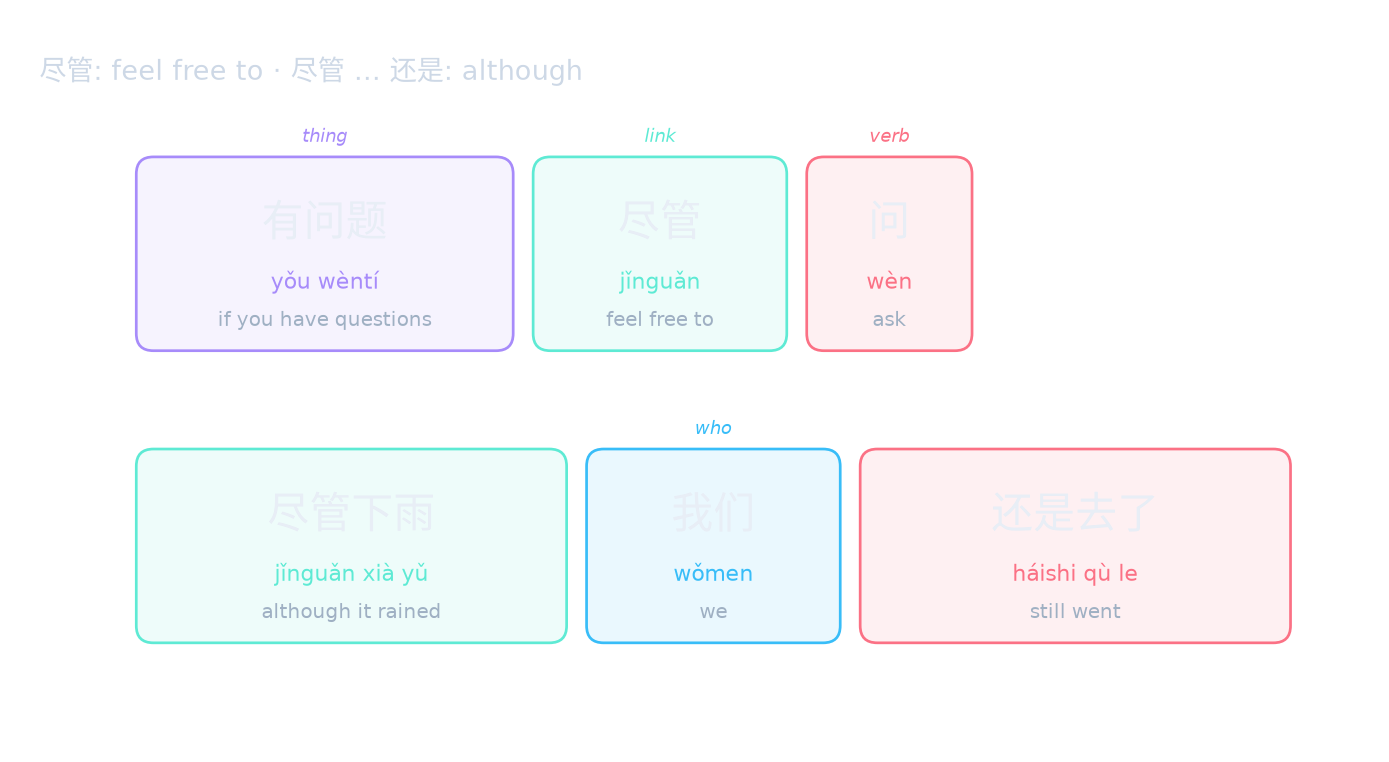
  • to have / there is有yǒuquestion / problem问题wèn tíalthough / feel free to尽管jǐn guǎnto ask问wèn。 Yǒu wèntí jǐnguǎn wèn. – If you have questions, feel free to ask.
  • want / think / miss想xiǎngto eat吃chīwhat什么shén mealthough / feel free to尽管jǐn guǎno'clock; a little点diǎn。 – Order whatever you like.
  • you你nǐalthough / feel free to尽管jǐn guǎnto feel relieved放心fàng xīn,这件zhè jiànmatter事shìto give交给jiāo gěiI / me我wǒ。 – Rest assured; leave this to me.
  • although / feel free to尽管jǐn guǎnto rain下雨xià yǔ,we / us我们wǒ menor / still还是hái shìto go去qù(completed / change)了le。 – Although it rained, we still went.

How it works. One written word, two uses. The complete clauses show which one is meant.

Before an action Opening a clause, then or / still还是hái shì / but但是dàn shì
"feel free to, go ahead" "although" (a concession)
to have / there is有yǒuquestion / problem问题wèn tíalthough / feel free to尽管jǐn guǎnto ask问wèn although / feel free to尽管jǐn guǎnto have / there is有yǒuquestion / problem问题wèn tí,we / us我们wǒ menor / still还是hái shìto complete完成wán chéng(completed / change)了letask任务rèn wù

An invitation covers the stated activity in that exchange, not unrelated actions. It also does not promise that no practical problem can occur.

although / feel free to尽管jǐn guǎn jǐnguǎn as much as possible尽量jǐn liàng jǐnliàng
feel free to / although as much as feasible
尽管: feel free to · 尽管…还是: although
2.23

22. 互相 + Verb (each other)

English

Form: participants + each other互相hù xiāng + verb phrase

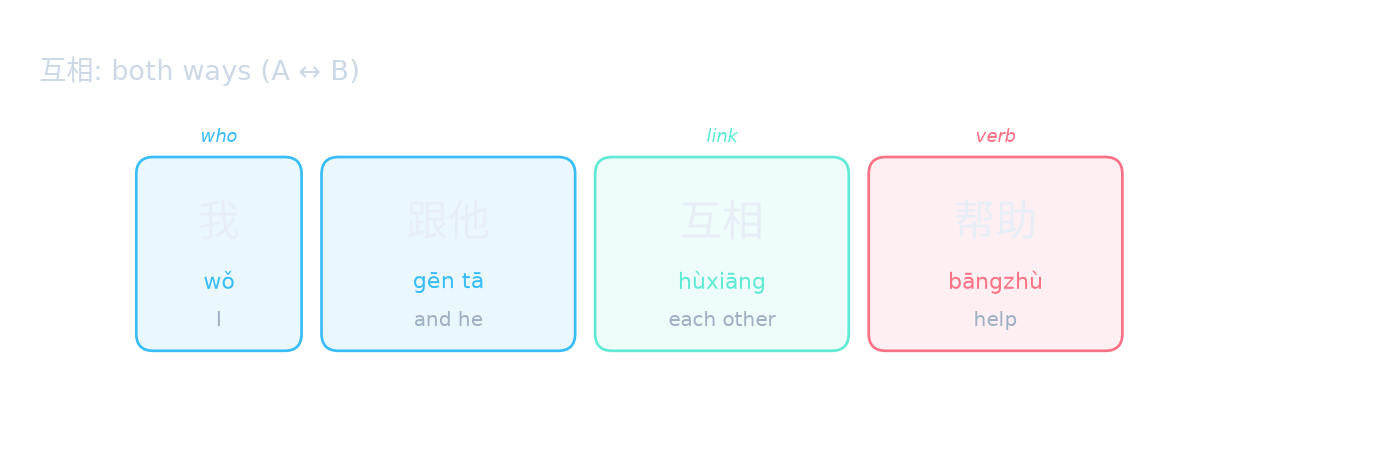
  • they他们tā men互相帮助hù xiāng bāng zhù。 Tāmen hùxiāng bāngzhù. – They help each other.
  • we / us我们wǒ menshould应该yīng gāi互相帮助hù xiāng bāng zhù。 – We should help one another.
  • I / me我wǒwith / and跟gēnhe / him他tā互相帮助hù xiāng bāng zhù。 – He and I help each other.
  • they他们tā meneach other互相hù xiāngto look at; to watch; to read看kàn(completed / change)了lea glance一眼yī yǎn。 – They exchanged a glance.

How it works. each other互相hù xiāng hùxiāng "each other" makes the participants both doers and receivers: A → B and B → A. Name the participants before it, or let the context supply them (I / me我wǒwith / and跟gēnhe / him他tā names both). A mutual action can be one completed event (to look at; to watch; to read看kàn(completed / change)了lea glance一眼yī yǎn); it need not be a habit. In a group, 互相学习hù xiāng xué xí means people learn from one another. The contributions need not be equal: one helps with diagrams, the other with language.

we / us我们wǒ men互相帮助hù xiāng bāng zhù we / us我们wǒ menall / both都dōuto help帮助bāng zhùteacher老师lǎo shī plum梅méito help帮助bāng zhùAalen, town in Germany阿伦ā lún
we help one another each of us helps the teacher one-way help

Watch out

  • each other互相hù xiāng needs a two-way relationship; don't use it as a general word for cooperation.
互相: both ways (A ↔ B)
2.24

23. 顺便 (while you're at it / by the way)

English

Form: main trip / purpose,(subject +) on the way; while you're at it顺便shùn biàn + extra action · on the way; while you're at it顺便shùn biànto ask问wèn(used after a verb) give it…一下yī xià,……

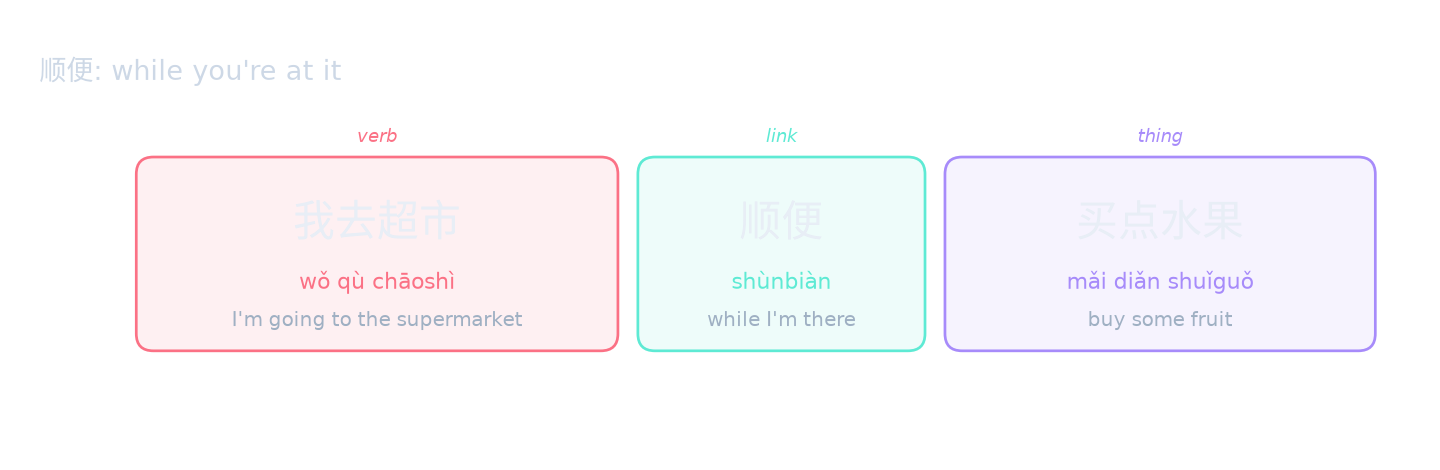
  • I / me我wǒto go去qùlibrary图书馆tú shū guǎn,on the way; while you're at it顺便shùn biànstill / also / even还háithis这zhè本书běn shū。 Wǒ qù túshūguǎn, shùnbiàn huán zhè běn shū. – I'm going to the library, so I'll return this book while I'm there.
  • you你nǐto go out出去chū qù,on the way; while you're at it顺便shùn biàn买点mǎi diǎndish (of food); vegetable菜cài。 – Since you're going out, pick up some groceries.
  • I / me我wǒto go去qùto look at; to watch; to read看kànfriend朋友péng yǒu,on the way; while you're at it顺便shùn biàn(把: marks the object)把bǎbook书shūto return sth to sb还给huán gěishe / her她tā。 – I visited my friend and returned her book while I was at it.
  • on the way; while you're at it顺便shùn biànto ask问wèn(used after a verb) give it…一下yī xià,you你nǐweekend周末zhōu mòto have time (to do sth)有空yǒu kòng(yes/no ?)吗ma? – By the way, are you free this weekend?

How it works. on the way; while you're at it顺便shùn biàn shùnbiàn adds an action to an existing trip, purpose or conversation, so it needs no physical travel (on the way; while you're at it顺便shùn biànto ask问wèn(used after a verb) give it…一下yī xià). The main purpose can come from the context.

on the way; while you're at it顺便shùn biàn + action specially专门zhuān mén + action
an extra on the way the purpose of a special trip
on the way; while you're at it顺便shùn biànreturn books还书huán shū I / me我wǒspecially专门zhuān ménto go去qùstill / also / even还háibook书shū

They can appear together, for different actions: I / me我wǒspecially专门zhuān ménto go去qùbank银行yín hángto handle (affairs)办事bàn shì,on the way; while you're at it顺便shùn biànto buy买mǎi(completed / change)了lebread面包miàn bāo.

Watch out

  • on the way; while you're at it顺便shùn biàn says nothing about how easy the extra task was: on the way; while you're at it顺便shùn biànto buy买mǎi(completed / change)了lebread面包miàn bāo doesn't tell you the shop was next door or the queue short.
顺便: while you're at it
2.25

24. 好(不)容易 (with great difficulty)

English

Form: subject + with great difficulty好不容易hǎo bù róng yì / (idiomatic usage) with…好容易hǎo róng yì + (only then / not until才cái) + achieved result

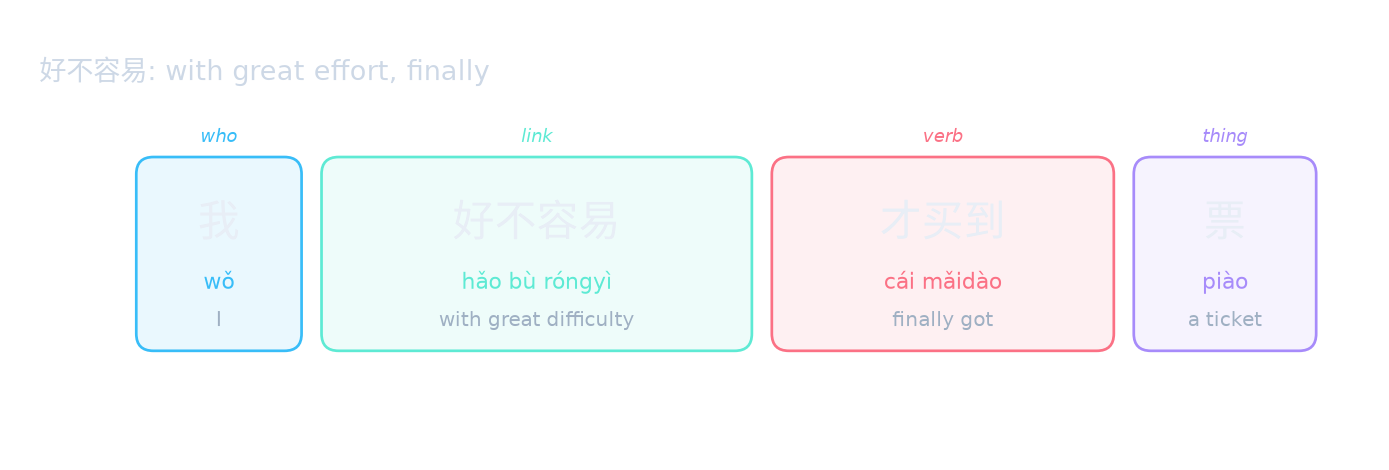
  • I / me我wǒwith great difficulty好不容易hǎo bù róng yìonly then / not until才cáito buy买mǎito / arrive / (result: get)到dàoticket票piào。 Wǒ hǎo bù róngyì cái mǎidào piào. – I only managed to get a ticket with great difficulty.
  • I / me我wǒ(idiomatic usage) with…好容易hǎo róng yìonly then / not until才cáito buy买mǎito / arrive / (result: get)到dàoticket票piào。 – I finally got a ticket, after a struggle.
  • he / him他tāwith great difficulty好不容易hǎo bù róng yìto find找到zhǎo dào(completed / change)了le一份yī fènto work; job工作gōng zuò。 – He finally found a job.
  • I / me我wǒwith great difficulty好不容易hǎo bù róng yìto buy买mǎito / arrive / (result: get)到dàoticket票piào,later; afterwards后来hòu láibut; yet却què(把: marks the object)把bǎticket票piàoto do; to get弄nòngto lose (an object)丢diū(completed / change)了le。 – I got the ticket with great difficulty, then lost it.

How it works. Before an achieved result (to buy买mǎito / arrive / (result: get)到dào, to find找到zhǎo dào), with great difficulty好不容易hǎo bù róng yì and (idiomatic usage) with…好容易hǎo róng yì both mean "with great difficulty, finally". only then / not until才cái adds "only then" but is not required. Neither gives an exact count of attempts or hours; to look for; to give change找zhǎo(completed / change)了leseveral days几天jǐ tiānonly then / not until才cáito find找到zhǎo dào would.

A later change doesn't undo the earlier result: the ticket was bought, then lost.

with great difficulty好不容易hǎo bù róng yìonly then / not until才cáito buy买mǎito / arrive / (result: get)到dào 这道题zhè dào tídegree / adjective linker很hěneasy容易róng yì
hard-won easy

Watch out

  • (idiomatic usage) with…好容易hǎo róng yì is not always the same as with great difficulty好不容易hǎo bù róng yì: in this这个zhè gequestion (in a test)题tí(idiomatic usage) with…好容易hǎo róng yì, it means "very easy". To say something is easy, use degree / adjective linker很hěneasy容易róng yì.
好不容易: with great effort, finally
2.26

25. 白 + Verb (in vain / for nothing)

English

Form: white白bái + verb (in vain) · 没白méi bái + verb (worthwhile)

  • office办公室bàn gōng shìto close (the door)关门guān mén(completed / change)了le,I / me我wǒ白跑bái pǎo(completed / change)了le一趟yī tàng。 Bàngōngshì guān mén le, wǒ bái pǎole yí tàng. – The office was closed, so I went there for nothing.
  • he / him他tānot / haven't没méito come来lái,we / us我们wǒ men白等bái děng(completed / change)了le一个yí gèhour小时xiǎo shí。 – He didn't come, so we waited an hour for nothing.
  • 这趟zhè tàng没白来méi bái lái,to learn (sth)学到xué dào(completed / change)了le很多hěn duō。 – This trip was worth it; I learned a lot.

How it works. white白bái bái before an action says it failed in its intended purpose: 白跑bái pǎo, 白等bái děng, 白忙bái máng. 没白méi bái rejects that: "not in vain". It doesn't mean not / haven't没méito come来lái.

The judgement is about one purpose. I / me我wǒ白跑bái pǎo(completed / change)了le一趟yī tàngpost office邮局yóu jú,not / haven't没méi寄成jì chéngletter信xìn,but不过bú guòat / in在zàion the road路上lù shàngto see见到jiàn dào(completed / change)了lefriend朋友péng yǒu is normal: the mailing failed, the trip had another benefit.

Other white白bái. this这zhè顿饭dùn fànto be / is是shìto eat without paying白吃bái chī(modifier / structural particle)的de in a free-meal context means no payment; 白纸bái zhǐ is white paper. Don't force the "in vain" reading onto every white白bái.

白 + verb: for nothing · 没白 + verb: worth it
词汇 训练
汉字 拼音 English
邮局 yóu jú post office
2.27

26. 连忙 vs 赶紧 (hurriedly / hurry up)

English

Form: event,at once; quickly (in reaction)连忙lián máng + reaction · hurriedly赶紧gǎn jǐn / quickly赶快gǎn kuài + verb

  • he / him他tāto see看见kàn jiànold man or woman老人lǎo rénto get on or into (a bus…上车shàng chē,at once; quickly (in reaction)连忙lián mángto stand站zhànget up / (start, become)起来qǐ laito give up one's seat for sb让座ràng zuò。 Tā kànjiàn lǎorén shàng chē, liánmáng zhàn qǐlai ràng zuò. – Seeing an old man get on, he quickly stood up and offered his seat.
  • fast; soon快kuàito rain下雨xià yǔ(completed / change)了le,hurriedly赶紧gǎn jǐn回家吧huí jiā ba! – It's about to rain – hurry home!
  • he / him他tāhurriedly赶紧gǎn jǐnto / for / give给gěimum; mother妈妈mā mā打了个dǎ le gètelephone电话diàn huà。 – He quickly called his mum.

How it works. at once; quickly (in reaction)连忙lián máng tells how someone reacted at once to something that happened. hurriedly赶紧gǎn jǐn and quickly赶快gǎn kuài also mean "quickly", but they can give orders and advice too.

at once; quickly (in reaction)连忙lián mángto stand站zhànget up / (start, become)起来qǐ lai hurriedly赶紧gǎn jǐnto walk / to leave走zǒu(suggestion)吧ba! I / me我wǒright away马上mǎ shàngthen / just就jiùto come来lái
quickly stood up (story) hurry up and go! I'll be right there

Watch out

  • wrong: you你nǐat once; quickly (in reaction)连忙lián mángto walk / to leave走zǒu(suggestion)吧ba → you你nǐhurriedly赶紧gǎn jǐnto walk / to leave走zǒu(suggestion)吧ba: at once; quickly (in reaction)连忙lián máng can't give orders.
Something happens,连忙 + quick reaction
词汇 训练
汉字 拼音 English
连忙 lián máng at once; quickly (in reaction)
赶紧 gǎn jǐn hurriedly
赶快 gǎn kuài quickly
2.28

27. 特意 vs 顺便 and 故意 (specially / while you're at it / on purpose)

English

Form: specially特意tè yì / specially特地tè dì + verb

  • I / me我wǒspecially特意tè yìfor / (wéi) to be为wèiyou你nǐto do; to make做zuò(completed / change)了lethis这个zhè gedish (of food); vegetable菜cài。 Wǒ tèyì wèi nǐ zuò le zhège cài. – I made this dish specially for you.
  • he / him他tāspecially特意tè yìfrom从cóngShanghai municipality…上海shàng hǎi来看lái kànI / me我wǒ。 – He came all the way from Shanghai just to see me.
  • he / him他tāon purpose故意gù yìto refuse to acknowledge不理bù lǐI / me我wǒ。 – He ignored me on purpose.

How it works. specially特意tè yì (or specially特地tè dì) says you did something just for this purpose, usually as a kind effort. on the way; while you're at it顺便shùn biàn means "while doing something else". on purpose故意gù yì means "deliberately", often for something unkind.

specially特意tè yì来看lái kànI / me我wǒ on the way; while you're at it顺便shùn biànto buy买mǎi(completed / change)了le(postage) stamp邮票yóu piào on purpose故意gù yìto refuse to acknowledge不理bù lǐI / me我wǒ 不是故意bú shì gù yì(modifier / structural particle)的de
came just to see me bought stamps while there ignored me on purpose I didn't mean to

Watch out

  • To annoy or hurt: wrong: he / him他tāspecially特意tè yì(把: marks the object)把bǎcup杯子bēi zito break打破dǎ pò(completed / change)了le → he / him他tāon purpose故意gù yì(把: marks the object)把bǎcup杯子bēi zito break打破dǎ pò(completed / change)了le.
特意 + verb: just for this
词汇 训练
汉字 拼音 English
特意 tè yì specially
2.29

28. 分别 (respectively, separately)

English

Form: A and / with和hé B separately; to part分别fēn bié + verb + C and / with和hé D · separately; to part分别fēn bié + verb (separately) · separately; to part分别fēn bié (to part)

  • I / me我wǒand / with和héyounger sister妹妹mèi mèiseparately; to part分别fēn biéto live (somewhere)住zhùat / in在zàiBeijing北京běi jīngand / with和héShanghai municipality…上海shàng hǎi。 Wǒ hé mèimei fēnbié zhù zài Běijīng hé Shànghǎi. – My sister and I live in Beijing and Shanghai respectively.
  • teacher老师lǎo shīseparately; to part分别fēn biéand / with和hé每个měi gèstudent学生xué shēngto talk (about)谈tán(completed / change)了lewords / speech话huà。 – The teacher talked to each student separately.
  • we / us我们wǒ menseparately; to part分别fēn bié(completed / change)了le十年shí nián。 – We were apart for ten years.

How it works. As an adverb, separately; to part分别fēn bié matches two lists in order (A → C, B → D), or means "separately". As a verb, it means to part. each各自gè zì = each (their own); difference区别qū bié = a difference.

separately; to part分别fēn biéto live (somewhere)住zhùat / in在zàiBeijing北京běi jīngand / with和héShanghai municipality…上海shàng hǎi each各自gè zìto return home回家huí jiā to have / there is有yǒuwhat什么shén medifference区别qū bié
live in … respectively each went home what's the difference

Watch out

  • separately; to part分别fēn bié needs two or more people, things or places to match: wrong: I / me我wǒseparately; to part分别fēn biéto live (somewhere)住zhùat / in在zàiBeijing北京běi jīng.
A 和 B 分别 + verb: each separately
词汇 训练
汉字 拼音 English
分别 fēn bié separately; to part
各自 gè zì each
2.30

29. 悄悄 vs 安静, 偷偷 and 轻轻 (quietly)

English

Form: quietly悄悄qiāo qiāo((adverb -ly)地de) + verb

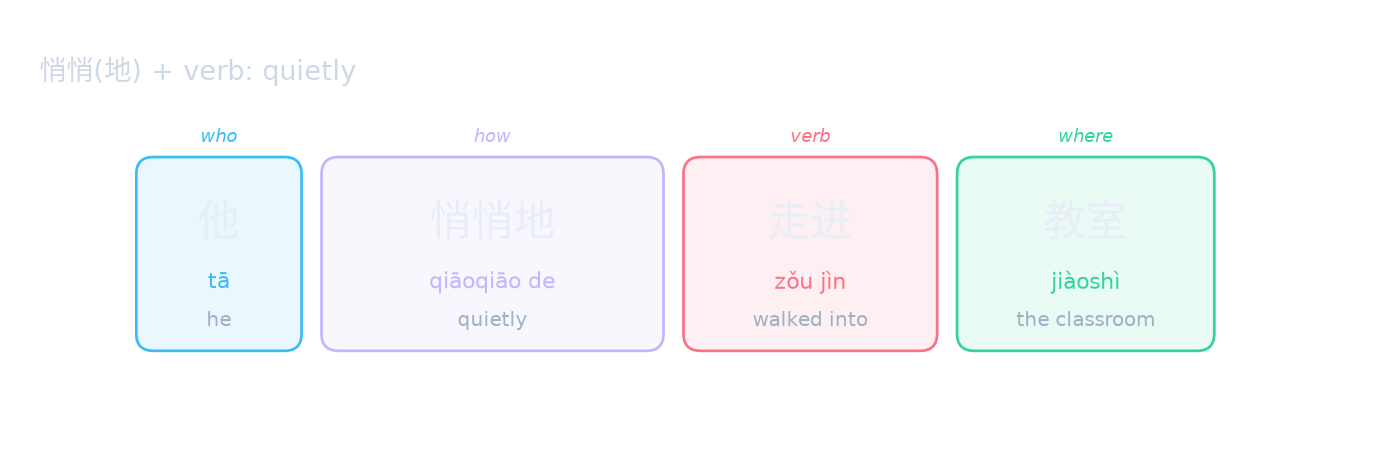
  • he / him他tā悄悄地qiāo qiāo dìto enter走进zǒu jìn(completed / change)了leclassroom教室jiào shì。 Tā qiāoqiāo de zǒu jìn le jiàoshì. – He quietly walked into the classroom.
  • we / us我们wǒ menquietly悄悄qiāo qiāoto prepare; to plan to准备zhǔn bèi(completed / change)了le一个yí gèbirthday生日shēng rìevening party晚会wǎn huì。 – We secretly planned a birthday party.
  • spring (season)春天chūn tiān悄悄地qiāo qiāo dìto come来lái(completed / change)了le。 – Spring has quietly arrived.

How it works. quietly悄悄qiāo qiāo describes an action done quietly or secretly, without others noticing. quiet安静ān jìng is an adjective for a quiet place or person; stealthily偷偷tōu tōu = sneakily; lightly轻轻qīng qīng = gently.

悄悄地qiāo qiāo dìto enter走进zǒu jìnto come来lái classroom教室jiào shìinside; in里lǐdegree / adjective linker很hěnquiet安静ān jìng 轻轻地qīng qīng dìto close (the door)关门guān mén
come in quietly the room is quiet close the door gently

Watch out

  • wrong: classroom教室jiào shìinside; in里lǐdegree / adjective linker很hěnquietly悄悄qiāo qiāo → classroom教室jiào shìinside; in里lǐdegree / adjective linker很hěnquiet安静ān jìng.
悄悄(地) + verb: quietly
词汇 训练
汉字 拼音 English
悄悄 qiāo qiāo quietly
2.31

30. 单独 vs 独自 (alone, separately)

English

Form: alone单独dān dú + verb · alone独自dú zì (一个yí gèperson人rén) + verb

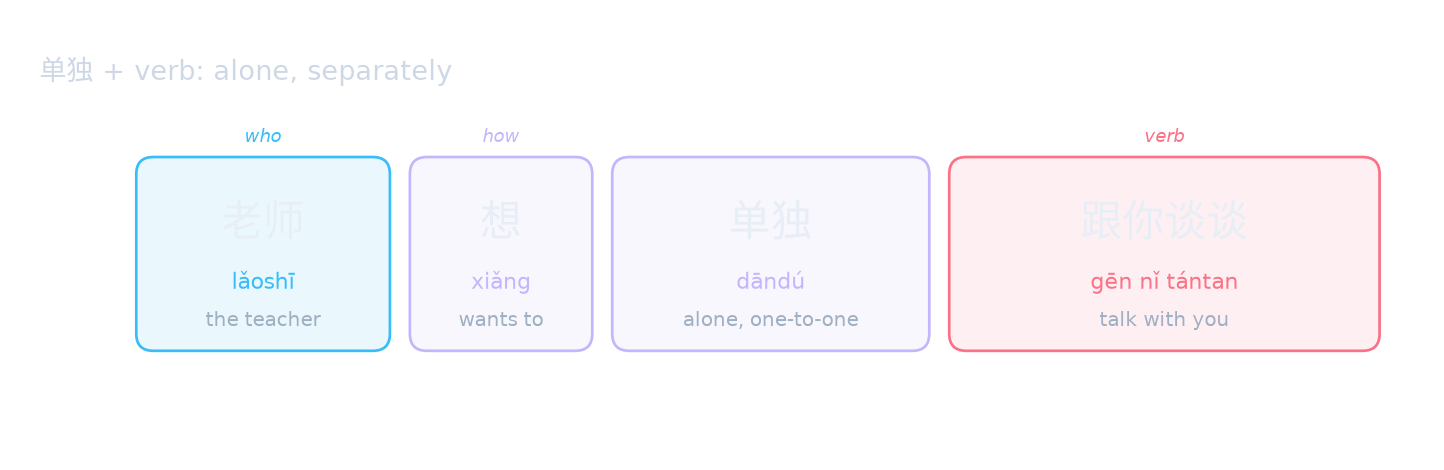
  • teacher老师lǎo shīwant / think / miss想xiǎngalone单独dān dúwith / and跟gēnyou你nǐto discuss谈谈tán tán。 Lǎoshī xiǎng dāndú gēn nǐ tántan. – The teacher wants to talk with you one-to-one.
  • this这个zhè gesuitcase箱子xiāng zifairly / to compare比较bǐ jiàoheavy / important重zhòng,please; to invite请qǐngalone单独dān dúto put / let go放fàng。 – This box is quite heavy; please put it separately.
  • he / him他tāalone独自dú zì一个yí gè人去rén qù(completed / change)了leTibet西藏xī zàng。 – He went to Tibet all by himself.

How it works. alone单独dān dú separates one person or thing from a group (alone, separately, one-to-one). alone独自dú zì is a person doing something by themselves, often with a feeling of being alone. Everyday: 一个yí gèperson人rén.

alone单独dān dúto talk (about)谈tán alone单独dān dúto put / let go放fàng alone独自dú zìto go去qù
talk one-to-one put separately go alone

Watch out

  • To treat a thing separately, use alone单独dān dú.
单独 + verb: alone, separately
词汇 训练
汉字 拼音 English
单独 dān dú alone
重 chóng once again
2.32

31. 总 (always / keep on)

English

Form: subject + (time / situation) + always / total总zǒng(to be / is是shì) + predicate · 总会zǒng huì + outcome

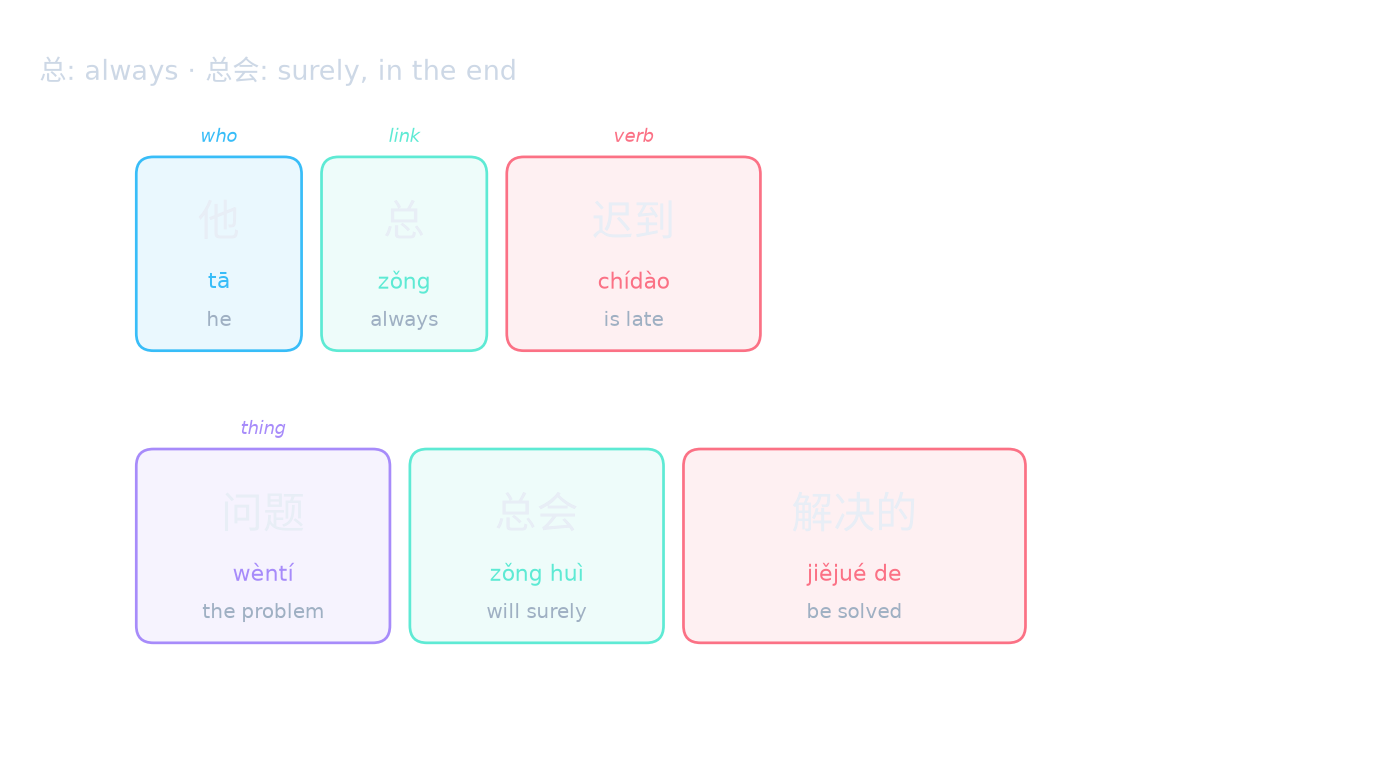
  • he / him他tāalways / total总zǒngto arrive late迟到chí dào。 / he / him他tāalways总是zǒng shìto arrive late迟到chí dào。 Tā zǒng chídào. – He's always late.
  • weekend周末zhōu mòhe / him他tāalways / total总zǒngto sleep睡shuìto / arrive / (result: get)到dàonoon中午zhōng wǔ。 – At weekends he always sleeps until noon.
  • she / her她tāalways / total总zǒngto help帮助bāng zhùother people别人bié rén。 – She's always helping others.
  • 总会zǒng huìgood好hǎo(modifier / structural particle)的de。 Zǒng huì hǎo de. – It'll get better eventually.

How it works. always / total总zǒng zǒng describes a recurring pattern, often within a stated boundary (weekend周末zhōu mò). In this habit use it overlaps with always总是zǒng shì. Recurrence can come with complaint (you你nǐhow / why怎么zěn me总玩zǒng wánmobile phone手机shǒu jī?) or praise; always / total总zǒng itself is not negative. Everyday "always" can exaggerate; if exact counts matter, give them.

always / total总zǒng + predicate one event 总会zǒng huì……(modifier / structural particle)的de
recurring pattern one stated past event an eventual outcome (reassurance)
he / him他tāalways / total总zǒngto arrive late迟到chí dào he / him他tāyesterday昨天zuó tiānto arrive late迟到chí dào(completed / change)了leonce / one time一次yí cì 总会zǒng huìgood好hǎo(modifier / structural particle)的de

Watch out

  • Not every always / total总zǒng can become always总是zǒng shì: always总是zǒng shìcan / will会huìgood好hǎo(modifier / structural particle)的de sounds like a general pattern, while 总会zǒng huìgood好hǎo(modifier / structural particle)的de looks ahead to an outcome.
总: always · 总会: surely, in the end
2.33

32. 曾经 + Verb + 过 (once / formerly)

English

Form: subject + once (in the past)曾经céng jīng + predicate · once (in the past)曾经céng jīng + verb + (experienced)过guo (+ object)

  • I / me我wǒonce (in the past)曾经céng jīngto live (somewhere)住zhùat / in在zàiShanghai municipality…上海shàng hǎi。 Wǒ céngjīng zhù zài Shànghǎi. – I once lived in Shanghai.
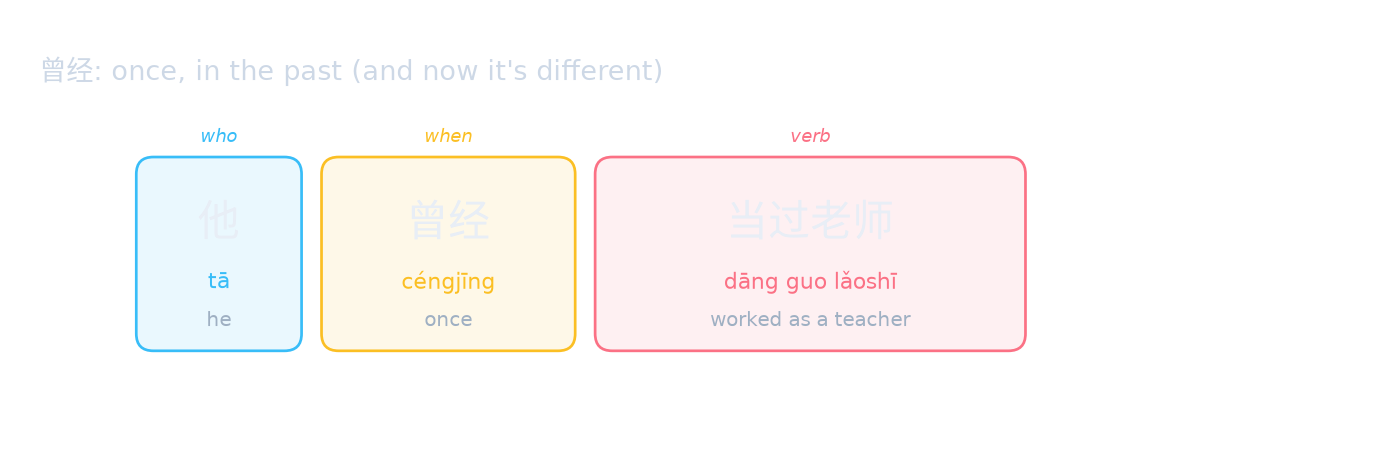
  • he / him他tāonce (in the past)曾经céng jīngto work as当dāng(experienced)过guoteacher老师lǎo shī。 Tā céngjīng dāngguo lǎoshī. – He used to be a teacher.
  • she / her她tāonce (in the past)曾经céng jīngdegree / adjective linker很hěnshy害羞hài xiū,now现在xiàn zàican / be able to能néngconfident自信zì xìn(adverb -ly)地despeech; to give a speech演讲yǎn jiǎng。 – She used to be shy; now she can give speeches confidently.

How it works. once (in the past)曾经céng jīng céngjīng places a state or experience in the past. (experienced)过guo after a suitable verb marks experience (to work as当dāng(experienced)过guo, 去过qù guò), but it is not required: she / her她tāonce (in the past)曾经céng jīngdegree / adjective linker很hěnshy害羞hài xiū is complete without it.

"Once" in English doesn't mean one time here. For an exact count, say it: I / me我wǒ去过qù guòonce / one time一次yí cìShanghai municipality…上海shàng hǎi.

Read only what is stated. I / me我wǒonce (in the past)曾经céng jīngto live (somewhere)住zhùat / in在zàiShanghai municipality…上海shàng hǎi tells you about an earlier time; it says nothing about where the person lives now, unless a later clause adds it (……,now现在xiàn zài……). A past teaching job does not show the current job.

once (in the past)曾经céng jīng + past future plan
I / me我wǒonce (in the past)曾经céng jīng去过qù guòShanghai municipality…上海shàng hǎi I / me我wǒnext year明年míng niáncan / will会huìto go去qùShanghai municipality…上海shàng hǎi
曾经: once, in the past (and now it's different)
词汇 训练
汉字 拼音 English
曾经 céng jīng once (in the past)
自信 zì xìn confident
2.34

33. 再三 + Verb (over and over)

English

Form: subject + over and over again再三zài sān + verb phrase

  • coach教练jiào liànover and over again再三zài sānto remind提醒tí xǐngwe / us我们wǒ men带水dài shuǐ。 Jiàoliàn zàisān tíxǐng wǒmen dài shuǐ. – The coach reminded us over and over to bring water.
  • he / him他tāover and over again再三zài sānto emphasize强调qiáng diàothis这zhèa bit一点yì diǎn。 – He stressed this point again and again.
  • I / me我wǒover and over again再三zài sānto think over考虑kǎo lǜ,or / still还是hái shìto decide / decision决定jué dìngto go去qù。 – I thought it over many times and decided to go.
  • teacher老师lǎo shīover and over again再三zài sānto explain / explanation解释jiě shì,but可是kě shìI / me我wǒor / still还是hái shìnot不bùto understand / clear明白míng bai。 – The teacher explained it again and again, but I still didn't understand.

How it works. over and over again再三zài sān zàisān marks an action repeated with earnest attention, before the verb: over and over again再三zài sānto remind提醒tí xǐng, over and over again再三zài sānto emphasize强调qiáng diào, over and over again再三zài sānto think over考虑kǎo lǜ, over and over again再三zài sānto thank感谢gǎn xiè. Despite the three三sān, it gives no exact count.

over and over again再三zài sānto remind提醒tí xǐng to remind提醒tí xǐng(completed / change)了lethree times三次sān cì always / total总zǒngto arrive late迟到chí dào
repeated emphasis an exact count a recurring habit

Watch out

  • Repetition doesn't guarantee a result: read the outcome clause. over and over again再三zài sānto explain / explanation解释jiě shì,but可是kě shìor / still还是hái shìnot不bùto understand / clear明白míng bai reports failure.
  • If only one reminder is recorded, say she / her她tāto remind提醒tí xǐng(completed / change)了leonce / one time一次yí cì.
再三: again and again (it matters!)
词汇 训练
汉字 拼音 English
再三 zài sān over and over again
教练 jiào liàn coach
强调 qiáng diào to emphasize
2.35

34. Verb + 了 + 又 + Verb (again and again)

English

Form: verb + (completed / change)了le + again又yòu + same verb

  • this这zhè封信fēng xìnI / me我wǒ看了又看kàn le yòu kàn。 Zhè fēng xìn wǒ kànle yòu kàn. – I read this letter over and over.
  • he / him他tā想了又想xiǎng le yòu xiǎng,or / still还是hái shìto refuse拒绝jù jué(completed / change)了le。 – He thought it over again and again, and still said no.
  • yesterday evening昨晚zuó wǎnI / me我wǒ看了又看kàn le yòu kàn,finally终于zhōng yúto notice发现fā xiàn(completed / change)了lemistake; wrong错误cuò wù。 – Last night I checked it again and again and finally found the mistake.

How it works. The same verb repeats around (completed / change)了leagain又yòu to stress repeated action: 看了又看kàn le yòu kàn, 想了又想xiǎng le yòu xiǎng, to ask问wèn(completed / change)了leagain又yòuto ask问wèn. It gives no exact count (he / him他tāto ask问wèn(completed / change)了lethree times三次sān cì would) and no guaranteed result: the next clause tells you what happened. The time comes from the context; (completed / change)了le here is not a general past-tense ending.

看了又看kàn le yòu kàn to look at; to watch; to read看kàn(completed / change)了lecharacter文字wén zì,again又yòuto listen to听tīng(completed / change)了lesound recording录音lù yīn
one action, repeated two different actions in sequence (also correct)
V了又V: again and again
词汇 训练
汉字 拼音 English
错误 cuò wù mistake; wrong
录音 lù yīn sound recording
2.36

35. 再也 + 不 / 没 + … 了 (never again)

English

Form: (not) any more再也zài yěnot不bù + verb + (completed / change)了le (never again) · (not) any more再也zài yěnot / haven't没méi + verb (+ (experienced)过guo) (not again since)

  • I / me我wǒ(not) any more再也zài yě不去bù qù那家店nà jiā diàn(completed / change)了le。 Wǒ zài yě bú qù nà jiā diàn le. – I'll never go to that shop again.
  • to graduate毕业bì yèafter / back后hòuwe / us我们wǒ men(not) any more再也zài yěnot / haven't没méi见过面jiàn guò miàn。 Bìyè hòu wǒmen zài yě méi jiànguo miàn. – We haven't met again since graduation.
  • I / me我wǒ(not) any more再也zài yěto look for; to give change找zhǎonot reach / less than不到bú dào那本书nà běn shū(completed / change)了le。 – I can't find that book any more.

How it works. Read the negative after (not) any more再也zài yě.

Example Meaning
I / me我wǒ(not) any more再也zài yě不去bù qù(completed / change)了le a strong intention about the future
to graduate毕业bì yèafter / back后hòu(not) any more再也zài yěnot / haven't没méito see / meet见jiàn(experienced)过guo no repeat in a stated period (since graduation)
(not) any more再也zài yěto look for; to give change找zhǎonot reach / less than不到bú dào那本书nà běn shū(completed / change)了le inability now

A strong refusal states a present stance; people can still change their minds. A report about the past needs more evidence before it becomes a claim about every future day.

Watch out

  • Final (completed / change)了le is common in the not不bù pattern, but not required in every (not) any more再也zài yě sentence: (not) any more再也zài yěnot / haven't没méi见过面jiàn guò miàn has (experienced)过guo and no (completed / change)了le.
再也不 … 了: never again (future) · 再也没 … 过: never again (past)
2.37

36. 始终 (all along / from start to finish)

English

Form: subject + all along; from start to finish始终shǐ zhōng + verb / adjective · all along; from start to finish始终shǐ zhōngnot / haven't没méi / all along; from start to finish始终shǐ zhōngnot不bù + verb

  • he / him他tāall along; from start to finish始终shǐ zhōngnot / haven't没méito speak; to talk说话shuō huà。 Tā shǐzhōng méi shuōhuà. – He didn't say a word from start to finish.
  • she / her她tāall along; from start to finish始终shǐ zhōngto be convinced相信xiāng xìnoneself自己zì jǐcan / be able to能néngto succeed; success成功chéng gōng。 – She always believed she could succeed.
  • I / me我wǒall along; from start to finish始终shǐ zhōngnot不bùto understand / clear明白míng baihe / him他tāwhy?为什么wèi shén meto walk / to leave走zǒu。 – I never understood why he left.

How it works. all along; from start to finish始终shǐ zhōng covers a whole period, from beginning to end, and says nothing changed. It often describes an attitude or a "never" (all along; from start to finish始终shǐ zhōngnot / haven't没méi, all along; from start to finish始终shǐ zhōngnot不bù).

he / him他tāall along; from start to finish始终shǐ zhōngnot / haven't没méito come来lái tomorrow明天míng tiānI / me我wǒall along / straight一直yì zhíto be at home在家zài jiā all along / straight一直yì zhí往前走wǎng qián zǒu
he never came (the whole time) I'll be home all day tomorrow (only all along / straight一直yì zhí) go straight ahead (only all along / straight一直yì zhí)

Watch out

  • With a set future time (tomorrow明天míng tiān, next month下个月xià gè yuè), use all along / straight一直yì zhí, not all along; from start to finish始终shǐ zhōng.
  • all along; from start to finish始终shǐ zhōng goes after the subject, before the verb.
始终: from start to end, without change
词汇 训练
汉字 拼音 English
始终 shǐ zhōng all along; from start to finish
2.38

37. 仍然 (still)

English

Form: (time / change),subject + still仍然réng rán + verb · although虽然suī rán …,… still仍然réng rán …

  • 十年shí niánpast过去guò qù(completed / change)了le,he / him他tāstill仍然réng ránto live (somewhere)住zhùat / in在zàihere这里zhè lǐ。 Shí nián guòqu le, tā réngrán zhù zài zhèlǐ. – Ten years have passed, and he still lives here.
  • although虽然suī rán很累hěn lèi,he / him他tāstill仍然réng ránto keep at; to insist坚持jiān chíto run跑pǎoto finish完wán(completed / change)了le。 – Although he was tired, he still kept going to the finish.
  • question / problem问题wèn tístill仍然réng ránnot have / haven't没有méi yǒuto solve解决jiě jué。 – The problem has still not been solved.

How it works. still仍然réng rán says a situation stayed the same after time passed or something changed. It is the formal, written form of still / also / even还hái ("still"). still依然yī rán and still仍旧réng jiù mean the same.

he / him他tāstill仍然réng ránto live (somewhere)住zhùat / in在zàihere这里zhè lǐ he / him他tāstill / also / even还háito live (somewhere)住zhùat / in在zàihere这里zhè lǐ I / me我wǒ还要hái yào一杯yī bēi
he still lives here (formal) he still lives here (spoken) I'd like one more (only still / also / even还hái)

Watch out

  • still仍然réng rán only means "still", never "also" or "more".
  • still仍然réng rán goes after the subject, before the verb.
仍然: still (after time or a change)
词汇 训练
汉字 拼音 English
依然 yī rán still
2.39

38. 逐渐 vs 逐步 (gradually / step by step)

English

Form: gradually逐渐zhú jiàn / gradually渐渐jiàn jiàn + change · step by step逐步zhú bù + verb

  • I / me我wǒgradually逐渐zhú jiànhabit / be used to习惯xí guàn(completed / change)了lehere这里zhè lǐ(modifier / structural particle)的delife; to live生活shēng huó。 Wǒ zhújiàn xíguàn le zhèlǐ de shēnghuó. – I gradually got used to life here.
  • weather天气tiān qìgradually逐渐zhú jiàn变冷biàn lěng(completed / change)了le。 – The weather is gradually getting colder.
  • we / us我们wǒ menwant / will / need要yàostep by step逐步zhú bùto solve解决jiě juéthese这些zhè xiēquestion / problem问题wèn tí。 – We need to solve these problems step by step.

How it works. gradually逐渐zhú jiàn (and the more spoken gradually渐渐jiàn jiàn) describes a slow change, above all one that happens by itself. step by step逐步zhú bù describes a change people plan and carry out in stages.

day天tiāngradually逐渐zhú jiànblack黑hēi(completed / change)了le gradually渐渐jiàn jiàn(adverb -ly)地de,雨停yǔ tíng(completed / change)了le 逐步提高zhú bù tí gāolevel水平shuǐ píng
it slowly got dark little by little, the rain stopped raise the level step by step

Watch out

  • wrong: day天tiānstep by step逐步zhú bùblack黑hēi(completed / change)了le: nobody plans a natural change.
逐渐 + change: little by little
词汇 训练
汉字 拼音 English
逐步 zhú bù step by step
2.40

39. 随时 (at any time)

English

Form: at any time随时suí shí + verb · at any time随时suí shímaybe / possible可能kě néng / can / will会huì + verb · anytime and anywhere随时随地suí shí suí dì

  • to have / there is有yǒuquestion / problem问题wèn tícan / may可以kě yǐat any time随时suí shíto ask问wènI / me我wǒ。 Yǒu wèntí kěyǐ suíshí wèn wǒ. – If you have questions, you can ask me any time.
  • day天tiānso much这么zhè meblack黑hēi,at any time随时suí shímaybe / possible可能kě néngto rain下雨xià yǔ。 – It's so dark it could rain at any moment.
  • to use / with用yòngmobile phone手机shǒu jīcan / may可以kě yǐanytime and anywhere随时随地suí shí suí dìto study; to learn学习xué xí。 – With a phone you can study any time, anywhere.

How it works. at any time随时suí shí means "at any time": whenever someone wants (offers) or any moment something may happen (warnings with maybe / possible可能kě néng / can / will会huì). It goes before the verb.

at any time随时suí shíto ask问wènI / me我wǒ always总是zǒng shìto arrive late迟到chí dào in time; timely及时jí shíto remind提醒tí xǐng
ask me any time always late remind in time

Watch out

  • wrong: he / him他tāat any time随时suí shíto arrive late迟到chí dào → he / him他tāalways总是zǒng shìto arrive late迟到chí dào (always).
随时 + verb: at any time
词汇 训练
汉字 拼音 English
随时 suí shí at any time
2.41

40. 从此 and 至今 (from then on / to this day)

English

Form: event,from then on从此cóng cǐ + new state · so far至今zhì jīn (still / also / even还hái / still仍然réng rán) …

  • he / him他tā(passive: by)被bèiteacher老师lǎo shīto criticize批评pī píng(completed / change)了leonce / one time一次yí cì,from then on从此cóng cǐ(not) any more再也zài yěnot / haven't没méito arrive late迟到chí dào(experienced)过guo。 Tā bèi lǎoshī pīpíng le yí cì, cóngcǐ zài yě méi chídào guo. – He was told off by the teacher once, and from then on he was never late again.
  • 这件zhè jiànmatter事shìI / me我wǒso far至今zhì jīnstill / also / even还háito remember记得jì de。 – I still remember this to this day.
  • he / him他tā十年shí niánfront / before前qiánto depart离开lí kāi(completed / change)了lehometown家乡jiā xiāng,so far至今zhì jīnnot have / haven't没有méi yǒuto return回去huí qù(experienced)过guo。 – He left his hometown ten years ago and hasn't been back since.

How it works. from then on从此cóng cǐ follows an event and gives the new situation that started there. so far至今zhì jīn looks back from today: something is still true now. never从来不cóng lái bù / not / haven't没méi means "never" with no turning point.

from then on从此cóng cǐ(not) any more再也zài yěnot / haven't没méito arrive late迟到chí dào so far至今zhì jīnstill / also / even还háito remember记得jì de never从来不cóng lái bù喝咖啡hē kā fēi
never late again from then on still remember to this day never drinks coffee

Watch out

  • wrong: I / me我wǒfrom then on从此cóng cǐto like喜欢xǐ huanhotpot火锅huǒ guō: from then on从此cóng cǐ needs an event before it.
Event,从此 + new state: from then on
词汇 训练
汉字 拼音 English
从此 cóng cǐ from then on
至今 zhì jīn so far
家乡 jiā xiāng hometown
2.42

41. 立刻 and 立即 vs 马上 (at once / soon)

English

Form: at once立刻lì kè / immediately立即lì jí + action · right away马上mǎ shàng (will就要jiù yào … (completed / change)了le)

  • one / a一yīto hear听到tīng dàonews; message消息xiāo xī,he / him他tāat once立刻lì kèto hurry (to some place)赶到gǎn dào(completed / change)了lehospital医院yī yuàn。 Yì tīngdào xiāoxi, tā lìkè gǎndào le yīyuàn. – As soon as he heard the news, he rushed straight to the hospital.
  • please; to invite请qǐngimmediately立即lì jíto depart离开lí kāibuilding (a relatively…大楼dà lóu。 – Please leave the building immediately.
  • right away马上mǎ shàngwill就要jiù yàoto have a holiday or…放假fàng jià(completed / change)了le。 – The holidays are coming soon.

How it works. at once立刻lì kè and immediately立即lì jí mean "at once, with no delay"; immediately立即lì jí is more formal. right away马上mǎ shàng means "right away" but also "soon", so only right away马上mǎ shàng works for something a few days away.

at once立刻lì kèthen / just就jiùto go去qù immediately立即lì jíto depart离开lí kāi right away马上mǎ shàngwill就要jiù yàoto have a holiday or…放假fàng jià(completed / change)了le
go right now leave immediately the holidays are coming soon

Watch out

  • wrong: at once立刻lì kèwill就要jiù yàoexam; to take an exam考试kǎo shì(completed / change)了le (next week) → right away马上mǎ shàngwill就要jiù yàoexam; to take an exam考试kǎo shì(completed / change)了le.
Event,立刻 + action: at once
词汇 训练
汉字 拼音 English
立即 lì jí immediately
2.43

42. 偶然 vs 偶尔 (by chance / now and then)

English

Form: by chance偶然ǒu rán + verb · by chance偶然ǒu rán(modifier / structural particle)的de + noun · is not / no不是bú shìby chance偶然ǒu rán(modifier / structural particle)的de

  • I / me我wǒat / in在zàibookstore书店shū diànby chance偶然ǒu ránto run into遇到yù dào(completed / change)了le一位yī wèi老同学lǎo tóng xué。 Wǒ zài shūdiàn ǒurán yùdào le yí wèi lǎo tóngxué. – I ran into an old classmate by chance in a bookshop.
  • at / in在zàionce / one time一次yí cìby chance偶然ǒu rán(modifier / structural particle)的deopportunity机会jī huìmiddle / in中zhōng,I / me我wǒto know (a person); to recognise认识rèn shí(completed / change)了leshe / her她tā。 – I met her by chance.
  • he / him他tā(modifier / structural particle)的deto succeed; success成功chéng gōngis not / no不是bú shìby chance偶然ǒu rán(modifier / structural particle)的de。 – His success is no accident.

How it works. by chance偶然ǒu rán means "by chance, not planned". It goes before the verb or, with (modifier / structural particle)的de, before a noun. Don't confuse it with occasionally偶尔ǒu ěr (now and then, how often). The opposite of by chance偶然ǒu rán is inevitable必然bì rán (bound to happen).

by chance偶然ǒu ránto run into遇到yù dào occasionally偶尔ǒu ěrto go去qùto look at; to watch; to read看kànfilm; movie电影diàn yǐng inevitable必然bì rán(modifier / structural particle)的deresult; as a result结果jié guǒ
meet by chance go to the cinema now and then an inevitable result

Watch out

  • wrong: I / me我wǒby chance偶然ǒu ránto go去qùto look at; to watch; to read看kànfilm; movie电影diàn yǐng (how often) → I / me我wǒoccasionally偶尔ǒu ěrto go去qùto look at; to watch; to read看kànfilm; movie电影diàn yǐng.
偶然 + meeting: by chance
词汇 训练
汉字 拼音 English
偶然 ǒu rán by chance
必然 bì rán inevitable
2.44

43. 事先 vs 提前 (beforehand / ahead of time)

English

Form: in advance事先shì xiān + verb · in advance / move earlier提前tí qián (+ amount of time) + verb · in advance / move earlier提前tí qiánto / arrive / (result: get)到dào + time

  • to go去qùbefore之前zhī qiánhad better; best最好zuì hǎoin advance事先shì xiān打个dǎ gètelephone电话diàn huà。 Qù zhīqián zuìhǎo shìxiān dǎ ge diànhuà. – You'd better phone in advance before you go.
  • we / us我们wǒ menin advance / move earlier提前tí qián十分钟shí fēn zhōngto / arrive / (result: get)到dào(completed / change)了le。 – We arrived ten minutes early.
  • meeting会议huì yìin advance / move earlier提前tí qiánto / arrive / (result: get)到dàoWednesday星期三xīng qī sān(completed / change)了le。 – The meeting has been moved forward to Wednesday.

How it works. in advance事先shì xiān means "beforehand": you prepare, ask or tell before an event. in advance / move earlier提前tí qián means "earlier than planned"; it can take an amount of time, and it can be a verb (exam; to take an exam考试kǎo shìin advance / move earlier提前tí qián(completed / change)了le).

in advance事先shì xiānto prepare; to plan to准备zhǔn bèigood好hǎo in advance / move earlier提前tí qián十分钟shí fēn zhōngto / arrive / (result: get)到dào meeting会议huì yìin advance / move earlier提前tí qián(completed / change)了le
prepare in advance arrive ten minutes early the meeting was moved earlier

Watch out

  • wrong: in advance事先shì xiān十分钟shí fēn zhōngto / arrive / (result: get)到dào → in advance / move earlier提前tí qián十分钟shí fēn zhōngto / arrive / (result: get)到dào. wrong: exam; to take an exam考试kǎo shìin advance事先shì xiān(completed / change)了le → exam; to take an exam考试kǎo shìin advance / move earlier提前tí qián(completed / change)了le.
事先 + verb: beforehand
词汇 训练
汉字 拼音 English
事先 shì xiān in advance
2.45

44. 纷纷 (one after another, many)

English

Form: many people / things + one after another (many)纷纷fēn fēn + verb

  • classmate同学tóng xué(plural)们menone after another (many)纷纷fēn fēnto raise a hand举手jǔ shǒu。 Tóngxuémen fēnfēn jǔ shǒu. – The students put up their hands one after another.
  • news; message消息xiāo xī一出yī chū,online friend网友wǎng yǒu(plural)们menone after another (many)纷纷fēn fēnto publish; to express发表fā biǎoview; way of seeing看法kàn fǎ。 – As soon as the news came out, people online gave their opinions one after another.
  • autumn秋天qiū tiānto / arrive / (result: get)到dào(completed / change)了le,tree leaves树叶shù yèone after another (many)纷纷fēn fēnto fall落下là xià。 – Autumn has come, and the leaves are falling one after another.

How it works. one after another (many)纷纷fēn fēn describes many people or things doing the same thing one after another, often as a reaction. It needs many doers and can't give an order. in succession; bit by bit陆续lù xù = one after another over a period of time.

everyone大家dà jiāone after another (many)纷纷fēn fēnto raise a hand举手jǔ shǒu visitor客人kè rénin succession; bit by bit陆续lù xùto / arrive / (result: get)到dào(completed / change)了le 一个yí gè一个yí gè(adverb -ly)地deto come in进来jìn lái
hands went up one after another guests arrived over time come in one by one

Watch out

  • wrong: he / him他tāone after another (many)纷纷fēn fēnto raise a hand举手jǔ shǒu (one person). wrong: please; to invite请qǐngeveryone大家dà jiāone after another (many)纷纷fēn fēnto make a speech发言fā yán → please; to invite请qǐngeveryone大家dà jiāpositive; active积极jī jíto make a speech发言fā yán.
Many people + 纷纷 + verb
词汇 训练
汉字 拼音 English
纷纷 fēn fēn one after another (many)
发表 fā biǎo to publish; to express
陆续 lù xù in succession; bit by bit
发言 fā yán to make a speech
2.46

45. 反复 vs 重复 (again and again / to repeat)

English

Form: repeatedly反复fǎn fù + verb · to repeat重复chóng fù (one time (all the way…一遍yī biàn) · again and again一再yī zài + verb

  • teacher老师lǎo shī反复强调fǎn fù qiáng diàothis这zhèa bit一点yì diǎn。 Lǎoshī fǎnfù qiángdiào zhè yì diǎn. – The teacher stressed this point again and again.
  • please; to invite请qǐngyou你nǐagain / then / (再…也) however再zàito repeat重复chóng fùone time (all the way…一遍yī biàn。 – Please say it once more.
  • he / him他tāagain and again一再yī zàito remind提醒tí xǐng我带wǒ dàipassport护照hù zhào。 – He kept reminding me to bring my passport.

How it works. repeatedly反复fǎn fù says how you do a verb: again and again, often with care (repeatedly反复fǎn fùto practice练习liàn xí, repeatedly反复fǎn fùto check检查jiǎn chá). to repeat重复chóng fù is the verb "to repeat" (the same words or act), or "duplicated". again and again一再yī zài = again and again, often requests or warnings.

repeatedly反复fǎn fùto practice练习liàn xí to repeat重复chóng fùone time (all the way…一遍yī biàn again and again一再yī zàito remind提醒tí xǐng
practise again and again repeat once keep reminding

Watch out

  • wrong: please; to invite请qǐngrepeatedly反复fǎn fùone time (all the way…一遍yī biàn → please; to invite请qǐngto repeat重复chóng fùone time (all the way…一遍yī biàn.
反复 + verb: again and again
词汇 训练
汉字 拼音 English
反复 fǎn fù repeatedly
重复 chóng fù to repeat
2.47

46. 从前 vs 以前 and 过去 (long ago)

English

Form: in the past; once upon a time从前cóng qián … (,now现在xiàn zài …) · event + before以前yǐ qián · past过去guò qù (the past)

  • in the past; once upon a time从前cóng qiánto have / there is有yǒu一个yí gè小村子xiǎo cūn zi…… Cóngqián yǒu yí ge xiǎo cūnzi … – Once upon a time there was a small village …
  • in the past; once upon a time从前cóng qiánhere这里zhè lǐto be / is是shì一片yī piànfarmland农田nóng tián,now现在xiàn zàito become / into成chéng(completed / change)了lemajor city大城市dà chéng shì。 – Long ago this was farmland; now it's a big city.
  • to sleep睡觉shuì jiàobefore以前yǐ qiánwant / will / need要yàoto brush one's teeth刷牙shuā yá。 – Brush your teeth before going to bed.

How it works. in the past; once upon a time从前cóng qián is a time word for the distant past and opens stories; it sounds a little written. before以前yǐ qián is everyday and can follow an event (to sleep睡觉shuì jiàobefore以前yǐ qián), even in the future. past过去guò qù = the past, also a noun.

in the past; once upon a time从前cóng qiánto have / there is有yǒu一个yí gèvillage村子cūn zi to sleep睡觉shuì jiàobefore以前yǐ qián past过去guò qù(modifier / structural particle)的dematter事shì
once upon a time, a village before bed things in the past

Watch out

  • wrong: to sleep睡觉shuì jiàoin the past; once upon a time从前cóng qián → to sleep睡觉shuì jiàobefore以前yǐ qián.
从前 + story opening
词汇 训练
汉字 拼音 English
从前 cóng qián in the past; once upon a time
2.48

47. 最初 vs 当初 (at first / back then)

English

Form: at first最初zuì chū …,later; afterwards后来hòu lái / now现在xiàn zài … · at first最初zuì chū(modifier / structural particle)的de + noun · at first; originally当初dāng chū (back then)

  • at first最初zuì chūI / me我wǒnot不bùtoo太tàihabit / be used to习惯xí guàn,later; afterwards后来hòu láithen / just就jiùgood好hǎo(completed / change)了le。 Zuìchū wǒ bú tài xíguàn, hòulái jiù hǎo le. – At first I wasn't really used to it, but later it was fine.
  • I / me我wǒat first最初zuì chū(modifier / structural particle)的deway of thinking想法xiǎng fǎto be / is是shìto study medicine学医xué yī。 – My first idea was to study medicine.
  • early早zǎoto know知道zhī dàothis way / so这样zhè yàng,at first; originally当初dāng chūthen / just就jiùshould not不该bù gāito come来lái。 – If I'd known, I shouldn't have come back then.

How it works. at first最初zuì chū marks the start of a process and often pairs with later; afterwards后来hòu lái or now现在xiàn zài. at first; originally当初dāng chū looks back at a past decision, often with regret. Everyday: one / a一yīto start开始kāi shǐ; written: originally起初qǐ chū.

at first最初zuì chū … later; afterwards后来hòu lái … at first; originally当初dāng chū one / a一yīto start开始kāi shǐ
at first … later … back then at first (speech)

Watch out

  • For regret about a past choice, use at first; originally当初dāng chū, not at first最初zuì chū.
最初 … 后来 …
词汇 训练
汉字 拼音 English
最初 zuì chū at first
2.49

48. 差点没: near misses and context

English

Form: almost差点chà diǎn(not / haven't没méi) + verb,+ clause giving the actual outcome

  • I / me我wǒalmost差点chà diǎnnot / haven't没méito catch / keep up with赶上gǎn shàngcar车chē,fortunately幸好xìng hǎochauffeur司机sī jīto wait; and so on等děng(completed / change)了leI / me我wǒ。 Wǒ chàdiǎn méi gǎnshang chē, xìnghǎo sījī děngle wǒ. – I almost missed the bus; luckily the driver waited for me.
  • I / me我wǒalmost差点chà diǎnto catch / keep up with赶上gǎn shàngcar车chē,but可是kě shìcar车chēto go (of car, train etc)开走kāi zǒu(completed / change)了le。 – I almost caught the bus, but it left.
  • I / me我wǒalmost差点chà diǎnto fall down摔倒shuāi dǎo,fortunately幸好xìng hǎo扶住fú zhù(completed / change)了lerailing栏杆lán gān。 – I almost fell; luckily I grabbed the rail.
  • I / me我wǒnot / haven't没méito catch / keep up with赶上gǎn shàngcar车chē,to have no choice but to只好zhǐ hǎoto wait; and so on等děngdown / next; to fall (rain), get off下xià一班yī bān。 – I missed the bus and had to wait for the next one.

How it works. Separate the close call from what actually happened. The following clause (fortunately幸好xìng hǎo……, but可是kě shì……, result; as a result结果jié guǒor / still还是hái shì……) usually settles the outcome.

Account Actual result
I / me我wǒalmost差点chà diǎnnot / haven't没méito catch / keep up with赶上gǎn shàng,fortunately幸好xìng hǎofinally; last最后zuì hòuto catch / keep up with赶上gǎn shàng(completed / change)了le。 caught it
I / me我wǒalmost差点chà diǎnto catch / keep up with赶上gǎn shàngcar车chē,but可是kě shìcar车chēto go (of car, train etc)开走kāi zǒu(completed / change)了le。 missed it
I / me我wǒalmost差点chà diǎnto fall down摔倒shuāi dǎo,fortunately幸好xìng hǎo扶住fú zhù(completed / change)了lerailing栏杆lán gān。 didn't fall

In near-accidents, speakers also say I / me我wǒalmost差点chà diǎnnot / haven't没méito fall down摔倒shuāi dǎo with the same meaning: here not / haven't没méi does not work like an ordinary negative. The "wanted / unwanted result" tendency (HSK 4) helps, but it does not settle every isolated sentence.

Watch out

  • Don't decide the outcome by counting negatives. If it matters, state it: I / me我wǒalmost差点chà diǎnnot / haven't没méito catch / keep up with赶上gǎn shàng,fortunately幸好xìng hǎofinally; last最后zuì hòuto catch / keep up with赶上gǎn shàng(completed / change)了le. If an account leaves it unclear, ask.
差点 with something bad, something good
2.50

49. 再不…就…了: a conditional warning

English

Form: (subject +) again / then / (再…也) however再zàinot不bù + action,(subject +) then / just就jiù + consequence + (completed / change)了le

  • again / then / (再…也) however再zàinot不bùto walk / to leave走zǒu,we / us我们wǒ menthen / just就jiùto arrive late迟到chí dào(completed / change)了le。 Zài bù zǒu, wǒmen jiù chídào le. – If we don't leave now, we'll be late.
  • you你nǐagain / then / (再…也) however再zàinot不bùto review复习fù xí,then / just就jiùthere's not enough time来不及lái bù jí(completed / change)了le。 – If you don't start revising, it'll be too late.
  • again / then / (再…也) however再zài不下雨bù xià yǔ,farm crop庄稼zhuāng jiàwill就要jiù yào干死gàn sǐ(completed / change)了le。 – If it doesn't rain soon, the crops will die.
  • train火车huǒ chē八点bā diǎnto open; to drive开kāi,again / then / (再…也) however再zàinot不bùto walk / to leave走zǒuthen / just就jiùthere's not enough time来不及lái bù jí(completed / change)了le。 – The train leaves at eight; if we don't go now, we won't make it.

How it works. A warning: if the action still doesn't happen soon (condition), the consequence follows. The consequence is predicted, not yet real. The condition can be a natural situation, not only something the listener chooses. For a warning people can check, state the deadline separately.

again / then / (再…也) however再zàinot不bù + verb,then / just就jiù…… (not) any more再也zài yěnot不bù + verb + (completed / change)了le
warns against further delay a strong "never again"
再不去zài bù qù,then / just就jiùthere's not enough time来不及lái bù jí(completed / change)了le I / me我wǒ(not) any more再也zài yě不去bù qù(completed / change)了le
再不 … 就 … 了: a warning
2.51

50. 差很多 (differ a lot)

English

Form: A and / with和hé B (modifier / structural particle)的de + dimension + poor差chà很多hěn duō · poor差chà + exact amount

  • this这zhè两张liǎng zhāngticket票piào(modifier / structural particle)的deprice价格jià gépoor差chà很多hěn duō。 Zhè liǎng zhāng piào de jiàgé chà hěn duō. – The prices of these two tickets are very different.
  • we / us我们wǒ mentwo (people)俩liǎ(modifier / structural particle)的deway of thinking想法xiǎng fǎpoor差chà很多hěn duō。 – Our ideas are very different.
  • this这zhè两张liǎng zhāngticket票piàoseparately; to part分别fēn biéto be / is是shì二十元èr shí yuánand / with和héeighty八十bā shíyuan元yuán,price价格jià gépoor差chà六十元liù shí yuán。 – The two tickets cost 20 and 80 yuan: a difference of 60 yuan.

How it works. poor差chà chà states a gap between a named pair on one dimension: price, quality, ideas. poor差chà很多hěn duō adds the speaker's judgement that the gap is large; whether it is large depends on the scale (2 yuan on 45 is small). Give the values when you have them. To say which side is higher, add it: 第一家dì yī jiācheap便宜pián yi六十元liù shí yuán.

poor差chà很多hěn duō almost / about the same差不多chà bu duō 很差hěn chà almost差点chà diǎn
very different about the same poor (one thing) nearly
quality质量zhì liàngpoor差chà很多hěn duō price价格jià géalmost / about the same差不多chà bu duō quality质量zhì liàng很差hěn chà almost差点chà diǎnto arrive late迟到chí dào

Watch out

  • poor差chà很多hěn duō doesn't tell you which is cheaper or better, and a price gap doesn't prove a quality gap.
差很多 / 差不多 / 很差
2.52

51. 幸亏 (luckily / thanks to)

English

Form: fortunately幸亏xìng kuī + lucky fact,otherwise; or else不然bù rán / otherwise要不然yào bù rán + (then / just就jiù) bad result · fortunately幸亏xìng kuī …,only then / not until才cái …

  • fortunately幸亏xìng kuīyou你nǐto remind提醒tí xǐngI / me我wǒto bring带dàiumbrella伞sǎn,otherwise; or else不然bù ránI / me我wǒthen / just就jiùto get soaked淋湿lín shī(completed / change)了le。 Xìngkuī nǐ tíxǐng wǒ dài sǎn, bùrán wǒ jiù línshī le. – Luckily you reminded me to bring an umbrella, or I'd have got soaked.
  • fortunately幸亏xìng kuīhe / him他tāto drive a car开车kāi chēto give (as a gift); to see off送sòngI / me我wǒ,I / me我wǒonly then / not until才cáito catch / keep up with赶上gǎn shàng(completed / change)了leairplane飞机fēi jī。 – Luckily he drove me, so I made the plane.
  • we / us我们wǒ menfortunately幸亏xìng kuīearly早zǎoto set off出发chū fā(completed / change)了le。 – Luckily we set off early.

How it works. fortunately幸亏xìng kuī points to the fact that saved you from something bad. The next clause says what would have happened without it (otherwise; or else不然bù rán … then / just就jiù …) or what it made possible (only then / not until才cái …). fortunately幸好xìng hǎo means the same.

fortunately幸亏xìng kuīto bring带dài(completed / change)了leumbrella伞sǎn good好hǎoat / in在zàito bring带dài(completed / change)了leumbrella伞sǎn degree / adjective linker很hěnlucky幸运xìng yùn
luckily (a bad result avoided) at least (one good point) lucky (plain good news)

Watch out

  • wrong: fortunately幸亏xìng kuīI / me我wǒ抽到chōu dào(completed / change)了lefirst prize一等奖yì děng jiǎng → I / me我wǒdegree / adjective linker很hěnlucky幸运xìng yùn,抽到chōu dào(completed / change)了lefirst prize一等奖yì děng jiǎng (no danger was avoided).
  • wrong: I / me我wǒdegree / adjective linker很hěnfortunately幸亏xìng kuī: fortunately幸亏xìng kuī is an adverb.
幸亏 + lucky fact,不然 + what would have happened
词汇 训练
汉字 拼音 English
幸亏 xìng kuī fortunately
不然 bù rán otherwise; or else
幸运 xìng yùn lucky
2.53

52. 难免 (bound to / hard to avoid)

English

Form: situation + hard to avoid难免nán miǎn (can / will会huì) + unwelcome result · … to be / is是shìhard to avoid难免nán miǎn(modifier / structural particle)的de

  • the first time第一次dì yī cìto go on stage / take office上台shàng tái难免会nán miǎn huìnervous紧张jǐn zhāng。 Dì-yī cì shàng tái nánmiǎn huì jǐnzhāng. – It's natural to be nervous the first time you're on stage.
  • new hand新手xīn shǒuhard to avoid难免nán miǎnto make a mistake出错chū cuò。 – Beginners are bound to make mistakes.
  • to quarrel吵架chǎo jiàto be / is是shìhard to avoid难免nán miǎn(modifier / structural particle)的de。 – Arguments are unavoidable.

How it works. hard to avoid难免nán miǎn says that, in this situation, something (usually unwelcome) is hard to avoid. It is often used to comfort ("it's normal") or to warn. unavoidable免不了miǎn bù liǎo means the same and is more spoken.

hard to avoid难免nán miǎnto make a mistake出错chū cuò to avoid避免bì miǎnto make a mistake出错chū cuò to make a mistake出错chū cuòto be / is是shìhard to avoid难免nán miǎn(modifier / structural particle)的de
bound to make mistakes avoid making mistakes mistakes are unavoidable

Watch out

  • to avoid避免bì miǎn is a verb (to avoid); hard to avoid难免nán miǎn says it can't be avoided.
  • hard to avoid难免nán miǎnnot不bùto make a mistake出错chū cuò usually means the same as hard to avoid难免nán miǎnto make a mistake出错chū cuò; write the simple form.
难免: it's natural that (it will happen)
词汇 训练
汉字 拼音 English
吵架 chǎo jià to quarrel
避免 bì miǎn to avoid
2.54

练习

English

Cover the teaching pages before you answer. The answers are at the end.

1. after all毕竟bì jìng (after all)

1. Don't be too strict; he's only a child, after all. 别太bié tàistrict严格yán gé,he / him他tā ………… or / still还是hái shì(measure word)个gèchild孩子hái zi。

2. Which reason fits he / him他tāafter all毕竟bì jìngto be / is是shìnew hand新手xīn shǒu,……?

  • A. ……,we / us我们wǒ mento expel开除kāi chúhe / him他tā(suggestion)吧ba。
  • B. ……,he / him他tāto be / is是shìexpert专家zhuān jiā。
  • C. ……,to / for / give给gěihe / him他tāa bit一点yì diǎntime时间shí jiān。
  • D. ……,he / him他tāalways (so far); never (with 不 / 没)从来cóng láinot bad / pretty good不错bú cuò。

3. Which word order is correct?

  • A. he / him他tāto be / is是shìafter all毕竟bì jìngnew hand新手xīn shǒu。
  • B. after all毕竟bì jìnghe / him他tāto be / is是shìnew hand新手xīn shǒu。
  • C. he / him他tāto be / is是shìnew hand新手xīn shǒuafter all毕竟bì jìng。
  • D. new hand新手xīn shǒuhe / him他tāafter all毕竟bì jìngto be / is是shì。

4. True or false? after all毕竟bì jìng proves that the reason is true. If false, correct it.

5. Say in Chinese: "It's his decision, after all; we should respect it."

6. After all, it's his first time.

Put in order: after all毕竟bì jìng / the first time第一次dì yī cì。 / 这是zhè shì / he / him他tā

2. anyway反正fǎn zhèng (anyway / in any case)

7. You decide; I'm free either way. you你nǐto decide / decision决定jué dìng(suggestion)吧ba,………… I / me我wǒall / both都dōuto have time (to do sth)有空yǒu kòng。

8. Choose the best ending: no matter; regardless不管bù guǎnyou你nǐ信不信xìn bù xìn,……

  • A. because因为yīn wèi我信wǒ xìn。
  • B. so / therefore所以suǒ yǐ我信wǒ xìn。
  • C. anyway反正fǎn zhèng我信wǒ xìn。
  • D. but但是dàn shì我信wǒ xìn(yes/no ?)吗ma?

9. In anyway反正fǎn zhèngtime时间shí jiānstill / also / even还háiearly早zǎo,we / us我们wǒ menslowly慢慢màn mànto walk / to leave走zǒu, what does anyway反正fǎn zhèng do?

  • A. asks a question
  • B. gives a deadline
  • C. marks the past
  • D. gives a reason that makes the suggestion fine

10. True or false? anyway反正fǎn zhèng always means the speaker has made a firm decision. If false, correct it.

11. Say in Chinese: "We don't know yet anyway; let's wait for the notice."

12. Whatever you say, I'm going anyway.

Put in order: want / will / need要yàoto go去qù。 / I / me我wǒ / anyway反正fǎn zhèng / no matter; regardless不管bù guǎnyou你nǐ / how / why怎么zěn meto speak说shuō,

3. simply / decisive干脆gān cuì (just / simply / might as well)

13. It's broken after three repairs; let's just buy a new one. to repair / to build修xiū(completed / change)了lethree times三次sān cì还坏hái huài,………… 买个mǎi gènew新xīn(modifier / structural particle)的de(suggestion)吧ba。

14. In she / her她tāto answer回答huí dá(degree marker)得dedegree / adjective linker很hěnsimply / decisive干脆gān cuì, simply / decisive干脆gān cuì describes…

  • A. doing something in vain
  • B. the time
  • C. a decisive, clear manner
  • D. a reason

15. Which sentence uses simply / decisive干脆gān cuì to suggest a simpler option?

  • A. he / him他tāto speak说shuō(degree marker)得desimply / decisive干脆gān cuì(completed / change)了le(yes/no ?)吗ma?
  • B. simply / decisive干脆gān cuìdegree / adjective linker很hěngood好hǎo。
  • C. he / him他tāsimply / decisive干脆gān cuì(modifier / structural particle)的deperson人rén。
  • D. to take a taxi (in town)打车dǎ chē太贵tài guì,simply / decisive干脆gān cuìto walk走路zǒu lùto go去qù(suggestion)吧ba。

16. True or false? simply / decisive干脆gān cuìnot不bùto answer回答huí dá(completed / change)了le means she answered quickly. If false, correct it.

17. Say in Chinese: "Let's just do it ourselves."

18. She simply stopped talking.

Put in order: simply / decisive干脆gān cuì / she / her她tā / not不bù / to speak; to talk说话shuō huà / (completed / change)了le。

4. simply; practically简直jiǎn zhí: strong evaluation and comparison

19. The scenery is just like a painting. here这里zhè lǐ(modifier / structural particle)的descenery风景fēng jǐng ………… to resemble像xiàngpainting / to draw画huàthe same一样yí yàng。

20. this这zhè(measure: rooms) / between间jiānroom屋子wū zisimply; practically简直jiǎn zhíto resemble像xiàngicebox冰箱bīng xiāngthe same一样yí yàng means…

  • A. the room is small
  • B. the room has a fridge
  • C. the room is a fridge
  • D. the room is extremely cold

21. Which sentence uses simply; practically简直jiǎn zhí naturally?

  • A. simply; practically简直jiǎn zhíhe / him他tāto walk / to leave走zǒu(completed / change)了le。
  • B. I / me我wǒsimply; practically简直jiǎn zhí不敢相信bù gǎn xiāng xìn!
  • C. he / him他tāsimply; practically简直jiǎn zhíto be / is是shì三点sān diǎnto come来lái(modifier / structural particle)的de。
  • D. I / me我wǒsimply; practically简直jiǎn zhíto have / there is有yǒuone / a一yī本书běn shū。

22. True or false? simply; practically简直jiǎn zhí can strengthen criticism as well as praise. If false, correct it.

23. Say in Chinese: "This is simply amazing!"

24. I simply can't believe my eyes.

Put in order: I / me我wǒ / 不敢相信bù gǎn xiāng xìn / simply; practically简直jiǎn zhí / oneself自己zì jǐ(modifier / structural particle)的deeye眼睛yǎn jīng。

5. Advanced all / both都dōu (already / even)

25. It's already eleven; let's go to bed. ………… 十一点shí yì diǎn(completed / change)了le,to sleep睡觉shuì jiào(suggestion)吧ba!

26. In he / him他tāurgent / anxious急jí(degree marker)得decooked rice饭fànall / both都dōunot feel like eating吃不下chī bù xià, what does all / both都dōu mean?

  • A. already
  • B. always
  • C. all of them
  • D. even

27. Which sentence says "everyone came"?

  • A. all / both都dōuwe / us我们wǒ mento come来lái(completed / change)了le。
  • B. we / us我们wǒ menall / both都dōuto come来lái(completed / change)了le。
  • C. we / us我们wǒ mento come来láiall / both都dōu(completed / change)了le。
  • D. we / us我们wǒ mento come来lái(completed / change)了leall / both都dōu。

28. True or false? In cooked rice饭fànall / both都dōuto let sth cool down凉liáng(completed / change)了le, all / both都dōu means "all the rice". If false, correct it.

29. Correct the mistake: so much这么zhè mesimple简单jiǎn dān(modifier / structural particle)的dequestion (in a test)题tíhe / him他tānot不bùall / both都dōucan / will会huìto do; to make做zuò。

30. Can't even do such an easy question.

Put in order: all / both都dōu / not不bù / so much这么zhè mesimple简单jiǎn dān(modifier / structural particle)的dequestion (in a test)题tí / can / will会huìto do; to make做zuò。

6. Advanced still / also / even还hái … (and …? / softener)呢ne

31. Keep your voice down; the baby is still asleep. 小声点xiǎo shēng diǎn,child孩子hái zi ………… at / in在zàito sleep睡觉shuì jiào(and …? / softener)呢ne。

32. What does still / also / even还háiexpert专家zhuān jiā(and …? / softener)呢ne,even连liánthis这个zhè geall / both都dōunot不bùto understand懂dǒng express?

  • A. praise for an expert
  • B. that he is still an expert
  • C. a question about his job
  • D. mockery of someone who claims to be an expert

33. Which sentence reassures someone who is rushing?

  • A. still / also / even还háitime时间shí jiānearly早zǎo(and …? / softener)呢ne。
  • B. time时间shí jiānstill / also / even还háiearly早zǎo(and …? / softener)呢ne,别着急bié zháo jí。
  • C. time时间shí jiānearly早zǎostill / also / even还hái(and …? / softener)呢ne。
  • D. still / also / even还háiexpert专家zhuān jiā(and …? / softener)呢ne!

34. True or false? still / also / even还háiteacher老师lǎo shī(and …? / softener)呢ne,even连liánthis这个zhè geChinese character字zìall / both都dōunot不bùto know (a person); to recognise认识rèn shí is friendly praise. If false, correct it.

35. It's still raining outside.

Put in order: (and …? / softener)呢ne。 / to rain下雨xià yǔ / still / also / even还hái / outside外面wài miàn / at / in在zài

36. Say in Chinese: "He hasn't come back yet."

7. not necessarily未必wèi bì / not necessarily (spoken)不见得bú jiàn de (not necessarily)

37. Complete: “Expensive things are not necessarily good.” expensive贵guì(modifier / structural particle)的dething; stuff东西dōng xī…………good好hǎo。

38. Build: “He doesn't necessarily know about this.”

Put in order: to know知道zhī dào / not necessarily (spoken)不见得bú jiàn de / 这件zhè jiànmatter事shì。 / he / him他tā

39. What does cheap便宜pián yi(modifier / structural particle)的denot necessarily未必wèi bìno good不好bù hǎo mean?

  • A. Cheap things are never good.
  • B. Cheap things aren't necessarily bad.
  • C. Cheap things are always bad.

40. True or false? he / him他tānot necessarily未必wèi bìto come来lái and he / him他tādefinitely / certain一定yí dìngnot不bùto come来lái mean the same. If false, correct it.

41. “This film will definitely be popular.” You doubt it. Which short reply fits?

  • A. not不bùto know知道zhī dào(degree marker)得de。
  • B. not necessarily未必wèi bìnot不bù。
  • C. not necessarily (spoken)不见得bú jiàn de。

42. A classmate says: "Students who study the longest always get the best marks." Disagree politely in two sentences, using not necessarily未必wèi bì or not necessarily (spoken)不见得bú jiàn de. Use not necessarily未必wèi bì / not necessarily (spoken)不见得bú jiàn de. Write your answer in Chinese, then say it aloud.

8. wishing one could do sth恨不得hèn bù dé (wish one could / itching to)

43. Complete: “I wish I could fly home right now.” I / me我wǒ…………马上飞mǎ shàng fēito return home回家huí jiā。

44. Build: “I wish a day had 48 hours.”

Put in order: 一天yī tiān / wishing one could do sth恨不得hèn bù dé / to have / there is有yǒu四十八个sì shí bā gèhour小时xiǎo shí。 / I / me我wǒ

45. Which sentence is correct?

  • A. I / me我wǒnot不bùwishing one could do sth恨不得hèn bù dé喝咖啡hē kā fēi。
  • B. I / me我wǒwishing one could do sth恨不得hèn bù dé一杯yī bēicoffee咖啡kā fēi。
  • C. I / me我wǒwishing one could do sth恨不得hèn bù déright away马上mǎ shàng喝一杯hē yī bēicoffee咖啡kā fēi。

46. “I can't bear to leave my old friends.” Which word fits? I / me我wǒ____to depart离开lí kāiold friend老朋友lǎo péng yǒu。

  • A. to be eager for巴不得bā bù dé
  • B. wishing one could do sth恨不得hèn bù dé
  • C. to be reluctant to (part with)舍不得shě bù dé

47. True or false? In wishing one could do sth恨不得hèn bù dé, to hate恨hèn means "hate". If false, correct it.

48. You are stuck in a long, boring meeting and your favourite team is playing. Say what you wish you could do, using wishing one could do sth恨不得hèn bù dé. Write your answer in Chinese, then say it aloud.

9. as if仿佛fǎng fú (as if)

49. Complete: “Grandpa was so happy he looked ten years younger.” father's father爷爷yé yéhappy; glad高兴gāo xìng(degree marker)得de…………young年轻nián qīng(completed / change)了le十岁shí suì。

50. Build: “He slept soundly, as if nothing had happened.”

Put in order: what什么shén meall / both都dōunot / haven't没méito happen发生fā shēng(experienced)过guo / as if仿佛fǎng fú / the same一样yí yàng。 / he / him他tāto sleep睡shuì(degree marker)得dedegree / adjective linker很hěnfragrant / (sleep) soundly香xiāng,

51. “He doesn't seem to be home.” Which is the everyday way to say it?

  • A. he / him他tāto seem; as if好像hǎo xiàngnot不bùto be at home在家zài jiā。
  • B. he / him他tāas if仿佛fǎng fúnot不bùto be at home在家zài jiā。

52. Which word can close a as if仿佛fǎng fú picture at the end of the clause?

  • A. that's all而已ér yǐ
  • B. as if; like似的shì de
  • C. if (coming after a…的话de huà

53. True or false? as if仿佛fǎng fú is mainly used in written descriptions and stories. If false, correct it.

54. Describe a beautiful place you have visited in two sentences. Use as if仿佛fǎng fú once with a picture, and close it with the same一样yí yàng or as if; like似的shì de. Write your answer in Chinese, then say it aloud.

10. quite; equivalent to相当xiāng dāng (quite) and equivalent to相当于xiāng dāng yú (equal to)

55. Complete: “He speaks Chinese quite fluently.” he / him他tā(modifier / structural particle)的deChinese language中文zhōng wénto speak说shuō(degree marker)得de…………fluent流利liú lì。

56. Which sentence is correct?

  • A. 这家zhè jiārestaurant饭馆fàn guǎnquite; equivalent to相当xiāng dānggood好hǎo。
  • B. 这家zhè jiārestaurant饭馆fàn guǎnquite; equivalent to相当xiāng dāngdegree / adjective linker很hěngood好hǎo。

57. “He is much taller than me.” Which is right?

  • A. he / him他tāthan / compared to比bǐI / me我wǒ高得gāo démany; much多duō。
  • B. he / him他tāthan / compared to比bǐI / me我wǒquite; equivalent to相当xiāng dāngtall; high高gāo。

58. Build: “One kilometre equals two li.”

Put in order: equivalent to相当于xiāng dāng yú / inside; in里lǐ。 / two两liǎng / one / a一yīkilometer公里gōng lǐ

59. Put them in the usual order, from weakest to strongest.

  • A. quite; equivalent to相当xiāng dāng → fairly / to compare比较bǐ jiào → very非常fēi cháng
  • B. very非常fēi cháng → quite; equivalent to相当xiāng dāng → fairly / to compare比较bǐ jiào
  • C. fairly / to compare比较bǐ jiào → quite; equivalent to相当xiāng dāng → very非常fēi cháng

60. Describe your new school or job in two sentences: use quite; equivalent to相当xiāng dāng once, and compare two amounts with equivalent to相当于xiāng dāng yú. Write your answer in Chinese, then say it aloud.

11. indeed的确dí què vs really; indeed确实què shí and really真的zhēn de (indeed)

61. Complete: “You're right – this question really is hard.” you你nǐ说得对shuō dé duì,this这个zhè gequestion / problem问题wèn tí…………很难hěn nán。

62. How is (modifier / structural particle)的de read in indeed的确dí què?

  • A. dí
  • B. de

63. Build: “This method is indeed good, but it takes too much time.”

Put in order: indeed的确dí quègood好hǎo, / this这个zhè gemeans办法bàn fǎ / but但是dàn shì / 太花tài huātime时间shí jiān(completed / change)了le。

64. Which word can you use alone as a question, "Really?"

  • A. really真的zhēn de(yes/no ?)吗ma?
  • B. indeed的确dí què(yes/no ?)吗ma?

65. True or false? really; indeed确实què shí can also be an adjective, as in news; message消息xiāo xīreally; indeed确实què shí. If false, correct it.

66. A classmate says online classes are convenient. Agree with indeed的确dí què, then add a problem with but但是dàn shì. Use indeed的确dí què or really; indeed确实què shí and really真的zhēn de. Write your answer in Chinese, then say it aloud.

12. more更加gèng jiā vs more更gèng (even more)

67. Complete: “Computers are even more important now than before.” now现在xiàn zàicomputer电脑diàn nǎothan / compared to比bǐbefore以前yǐ qián…………important重要zhòng yào。

68. Which is correct?

  • A. now现在xiàn zàithan / compared to比bǐbefore以前yǐ qiándegree / adjective linker很hěnimportant重要zhòng yào。
  • B. now现在xiàn zàithan / compared to比bǐbefore以前yǐ qiánmore更加gèng jiāimportant重要zhòng yào。

69. “It's getting colder and colder.” Which is right?

  • A. weather天气tiān qìmore and more越来越yuè lái yuècold冷lěng(completed / change)了le。
  • B. weather天气tiān qìmore更加gèng jiācold冷lěng(completed / change)了le。

70. Build: “After the teacher's talk, he studied even harder.”

Put in order: he / him他tāto study; to learn学习xué xí / to work hard / effort努力nǔ lì(completed / change)了le。 / more更加gèng jiā / to listen to听tīng(completed / change)了leteacher老师lǎo shīif (coming after a…的话de huà,

71. True or false? Before a one-character adjective like good好hǎo, more更gèng sounds more natural than more更加gèng jiā. If false, correct it.

72. Compare your Chinese now with a year ago in two sentences: one in everyday speech with more更gèng, one for a written report with more更加gèng jiā. Use more更加gèng jiā or more更gèng. Write your answer in Chinese, then say it aloud.

13. absolutely绝对jué duì (absolutely, definitely)

73. Complete: “Don't worry, I absolutely won't tell anyone.” to feel relieved放心fàng xīn,I / me我wǒ…………won't / can't不会bú huìto tell告诉gào sùother people别人bié rén。

74. You see your friend's lights are off, but you're not sure. Which fits?

  • A. he / him他tāmaybe / possible可能kě néngnot不bùto be at home在家zài jiā。
  • B. he / him他tāabsolutely绝对jué duìnot不bùto be at home在家zài jiā。

75. “You must come!” (strong advice) Which is most natural?

  • A. you你nǐdefinitely / certain一定yí dìngwant / will / need要yàoto come来lái!
  • B. you你nǐabsolutely绝对jué duìwant / will / need要yàoto come来lái!

76. Build: “The dumplings here are absolutely delicious!”

Put in order: dumpling饺子jiǎo zi / absolutely绝对jué duì / tasty好吃hǎo chī! / 这家zhè jiā(modifier / structural particle)的de

77. True or false? not have / haven't没有méi yǒuabsolutely绝对jué duì(modifier / structural particle)的defreedom自由zì yóu uses absolutely绝对jué duì as an adjective, "absolute". If false, correct it.

78. Recommend a restaurant or shop to a friend. Use absolutely绝对jué duì for one strong opinion and maybe / possible可能kě néng for one thing you are not sure about. Write your answer in Chinese, then say it aloud.

14. the only唯一wéi yī vs only (if) / only have只有zhǐ yǒu (the only)

79. Complete: “This is the only way.” 这是zhè shì…………(modifier / structural particle)的demeans办法bàn fǎ。

80. “I have only one older brother.” Which is right?

  • A. I / me我wǒthe only唯一wéi yīto have / there is有yǒu一个yí gèolder brother哥哥gē gē。
  • B. I / me我wǒonly (if) / only have只有zhǐ yǒu一个yí gèolder brother哥哥gē gē。

81. “He is my only older brother.” Which is right?

  • A. he / him他tāto be / is是shìI / me我wǒthe only唯一wéi yī(modifier / structural particle)的deolder brother哥哥gē gē。
  • B. he / him他tāto be / is是shìI / me我wǒonly (if) / only have只有zhǐ yǒu(modifier / structural particle)的deolder brother哥哥gē gē。

82. Build: “The only thing I'm worried about is the weather.”

Put in order: the only唯一wéi yīanxious担心dān xīn(modifier / structural particle)的de / weather天气tiān qì。 / to be / is是shì / I / me我wǒ

83. True or false? the only唯一wéi yī usually takes (modifier / structural particle)的de before a noun. If false, correct it.

84. Describe your class or family in two sentences: who is the only one who can do something (the only唯一wéi yī), and what the only thing you worry about is. Use the only唯一wéi yī or only (if) / only have只有zhǐ yǒu. Write your answer in Chinese, then say it aloud.

15. relatively相对xiāng duì vs fairly / to compare比较bǐ jiào (relatively)

85. Complete: “Houses here are relatively cheap.” here这里zhè lǐ(modifier / structural particle)的dehouse房子fáng zi…………cheap便宜pián yi。

86. here这里zhè lǐ(modifier / structural particle)的dehouse房子fáng zirelatively相对xiāng duìcheap便宜pián yi。What does it mean?

  • A. Houses here are very cheap.
  • B. Houses here are cheaper than in other places.

87. Build: “Comparatively speaking, the metro is more convenient than a taxi.”

Put in order: than / compared to比bǐto take a taxi (in town)打车dǎ chē / convenient方便fāng biàn。 / 相对来说xiāng duì lái shuō, / 坐地铁zuò dì tiě

88. Which word is the opposite of relatively相对xiāng duì?

  • A. absolutely绝对jué duì
  • B. fairly / to compare比较bǐ jiào

89. True or false? relatively相对xiāng duì can describe tourists, prices or time, compared with other cases. If false, correct it.

90. Compare two ways of studying (in a library or at home, alone or in a group) in two balanced sentences. Use 相对来说xiāng duì lái shuō and relatively相对xiāng duì + adjective. Use relatively相对xiāng duì or fairly / to compare比较bǐ jiào. Write your answer in Chinese, then say it aloud.

16. in agreement; consistent一致yí zhì (unanimously; consistent)

91. Complete: “Everyone agreed this idea was good.” everyone大家dà jiā…………to think / believe认为rèn wéithis这个zhè gemeans办法bàn fǎgood好hǎo。

92. Which is correct?

  • A. we / us我们wǒ menin agreement; consistent一致yí zhìto think / believe认为rèn wéithis这个zhè gemeans办法bàn fǎgood好hǎo。
  • B. I / me我wǒin agreement; consistent一致yí zhìto think / believe认为rèn wéithis这个zhè gemeans办法bàn fǎgood好hǎo。

93. he / him他tāto speak说shuō(modifier / structural particle)的deand / with和héto do; to make做zuò(modifier / structural particle)的denot不bùin agreement; consistent一致yí zhì。What does it mean?

  • A. What he says doesn't match what he does.
  • B. He says and does nothing.

94. Build: “After discussing it, we all decided to leave on Saturday.”

Put in order: in agreement; consistent一致yí zhìto decide / decision决定jué dìng / to pass / process经过jīng guòto discuss讨论tǎo lùn, / Saturday周六zhōu liùto set off出发chū fā。 / we / us我们wǒ men

95. True or false? In in agreement; consistent一致yí zhì, one / a一yī is read yí. If false, correct it.

96. Report the result of a class discussion in two sentences: what everyone agreed (in agreement; consistent一致yí zhì), and one point where views were not the same (not不bùin agreement; consistent一致yí zhì). Write your answer in Chinese, then say it aloud.

17. thorough彻底chè dǐ vs completely完全wán quán (thoroughly, completely)

97. Complete: “This time we must solve the problem once and for all.” 这次zhè cìdefinitely / certain一定yí dìngwant / will / need要yào(把: marks the object)把bǎquestion / problem问题wèn tí…………to solve解决jiě jué。

98. “I completely agree.” Which is right?

  • A. I / me我wǒthorough彻底chè dǐto agree同意tóng yì。
  • B. I / me我wǒ完全同意wán quán tóng yì。

99. “The whole class came.” Which is right?

  • A. the whole class全班quán bānall / both都dōuto come来lái(completed / change)了le。
  • B. thorough彻底chè dǐclass班bānall / both都dōuto come来lái(completed / change)了le。

100. Build: “The big clean should be a bit more thorough.”

Put in order: 大扫除dà sǎo chú / a little一点儿yì diǎnr。 / thorough彻底chè dǐ / want / will / need要yàoto do; to make做zuò(degree marker)得de

101. True or false? I / me我wǒcompletely完全wán quánnot不bùto know知道zhī dào means "I had no idea at all." If false, correct it.

102. Describe a habit you changed completely (彻底改变chè dǐ gǎi biàn / thorough彻底chè dǐto give up放弃fàng qì), and say one thing you completely agree with (完全同意wán quán tóng yì). Use thorough彻底chè dǐ or completely完全wán quán. Write your answer in Chinese, then say it aloud.

18. excessive过分guò fèn vs too太tài and too much过于guò yú (going too far)

103. Complete: “Doing this is going too far!” you你nǐthis way / so这样zhè yàngto do; to make做zuòtoo太tài…………(completed / change)了le!

104. “It's too hot today.” Which is right?

  • A. 今天天气jīn tiān tiān qì太热tài rè(completed / change)了le。
  • B. 今天天气jīn tiān tiān qìexcessive过分guò fènhot热rè。

105. “Don't get too nervous in the exam.” Which fits?

  • A. exam; to take an exam考试kǎo shì(modifier / structural particle)的detime; when时候shí hòudon't不要bú yàoexcessive过分guò fènhot热rè。
  • B. exam; to take an exam考试kǎo shì(modifier / structural particle)的detime; when时候shí hòudon't不要bú yàoexcessive过分guò fènnervous紧张jǐn zhāng。

106. Build: “What he said was a bit over the top.”

Put in order: slightly有点儿yǒu diǎn ér / excessive过分guò fèn。 / he / him他tāto speak说shuōif (coming after a…的话de huà

107. True or false? too much过于guò yú is a written word for "overly". If false, correct it.

108. Tell a friend about something someone did that went too far (太过分tài guò fèn(completed / change)了le), and give one piece of advice with don't不要bú yàoexcessive过分guò fèn + feeling. Use excessive过分guò fèn or too太tài and too much过于guò yú. Write your answer in Chinese, then say it aloud.

19. maybe; can't say for sure说不定shuō bù dìng vs maybe也许yě xǔ and I'm afraid (that); probably恐怕kǒng pà (maybe, who knows)

109. Complete: “Take an umbrella – it might rain.” to bring带dài(把: marks the object)把bǎumbrella伞sǎn(suggestion)吧ba,…………can / will会huìto rain下雨xià yǔ。

110. You're late for a train and worried. Which fits best?

  • A. maybe; can't say for sure说不定shuō bù dìngthere's not enough time来不及lái bù jí(completed / change)了le,very good太好了tài hǎo le!
  • B. I'm afraid (that); probably恐怕kǒng pàthere's not enough time来不及lái bù jí(completed / change)了le。

111. he / him他tāwhat什么shén metime; when时候shí hòuto return回来huí láistill / also / even还háimaybe; can't say for sure说不定shuō bù dìng。What does it mean?

  • A. It's not certain when he'll be back.
  • B. He will certainly be back soon.

112. Build: “Stop waiting – maybe he's already gone in.”

Put in order: maybe; can't say for sure说不定shuō bù dìng / he / him他tā / don't别biéto wait; and so on等děng(completed / change)了le, / already已经yǐ jīngto go in进去jìn qù(completed / change)了le。

113. True or false? maybe; can't say for sure说不定shuō bù dìng他会tā huìto agree同意tóng yì(and …? / softener)呢ne! sounds hopeful. If false, correct it.

114. A friend is sad they didn't get into a club. Cheer them up with maybe; can't say for sure说不定shuō bù dìng, and add one worried thought with I'm afraid (that); probably恐怕kǒng pà. Use maybe; can't say for sure说不定shuō bù dìng or maybe也许yě xǔ and I'm afraid (that); probably恐怕kǒng pà. Write your answer in Chinese, then say it aloud.

20. as much as possible尽量jǐn liàng + Verb (as much as possible)

115. I'll try to come as early as possible. 我会wǒ huì ………… a bit earlier / breakfast早点zǎo diǎnto come来lái。

116. Which means "Try not to drink coffee at night"?

  • A. as much as possible尽量jǐn liàng喝咖啡hē kā fēiat / in在zàievening晚上wǎn shàng。
  • B. don't别biéas much as possible尽量jǐn liàngevening晚上wǎn shàng喝咖啡hē kā fēi。
  • C. as much as possible尽量jǐn liàngdon't别biéat / in在zàievening晚上wǎn shàng喝咖啡hē kā fēi。
  • D. evening晚上wǎn shàngas much as possible尽量jǐn liàngcoffee咖啡kā fēi。

117. Which promise is stronger than 我会wǒ huìas much as possible尽量jǐn liàngto come来lái?

  • A. I / me我wǒmaybe也许yě xǔto come来lái。
  • B. I / me我wǒit may be assumed that想来xiǎng lái。
  • C. I / me我wǒmaybe / possible可能kě néngto come来lái。
  • D. I / me我wǒdefinitely / certain一定yí dìngto come来lái。

118. True or false? 我会wǒ huìas much as possible尽量jǐn liàngto help帮bāngyou你nǐ promises that the problem will be solved. If false, correct it.

119. Say in Chinese: "Use your phone as little as possible."

120. In class, use Chinese as much as you can.

Put in order: 上课时shàng kè shí / to use / with用yòngChinese language汉语hàn yǔ / to exchange; to communicate交流jiāo liú。 / as much as possible尽量jǐn liàng

21. although / feel free to尽管jǐn guǎn + Verb (feel free to)

121. If you have questions, feel free to ask. to have / there is有yǒuquestion / problem问题wèn tí ………… to ask问wèn。

122. In although / feel free to尽管jǐn guǎnto rain下雨xià yǔ,we / us我们wǒ menor / still还是hái shìto go去qù(completed / change)了le, although / feel free to尽管jǐn guǎn means…

  • A. because
  • B. feel free to
  • C. although
  • D. if

123. Choose the best second half: although / feel free to尽管jǐn guǎnhe / him他tādegree / adjective linker很hěntired累lèi,……

  • A. because因为yīn wèihe / him他tādegree / adjective linker很hěnbusy忙máng。
  • B. he / him他tāor / still还是hái shì(把: marks the object)把bǎto work; job工作gōng zuòto do; to make做zuòto finish完wán(completed / change)了le。
  • C. so / therefore所以suǒ yǐhe / him他tāto sleep睡觉shuì jiào(completed / change)了le。
  • D. although / feel free to尽管jǐn guǎnto ask问wèn(suggestion)吧ba。

124. True or false? In you你nǐalthough / feel free to尽管jǐn guǎnto feel relieved放心fàng xīn, although / feel free to尽管jǐn guǎn means "although". If false, correct it.

125. Say in Chinese: "Order whatever you like."

126. Although it was late, he still called me.

Put in order: he / him他tā / or / still还是hái shì / degree / adjective linker很hěnlate / evening晚wǎn(completed / change)了le, / although / feel free to尽管jǐn guǎn / to / for / give给gěiI / me我wǒto hit / play / make (a call)打dǎ(completed / change)了letelephone电话diàn huà。

22. each other互相hù xiāng + Verb (each other)

127. We should help each other. we / us我们wǒ menshould应该yīng gāi ………… to help帮助bāng zhù。

128. Which sentence is correct?

  • A. we / us我们wǒ men互相帮助hù xiāng bāng zhù。
  • B. each other互相hù xiāngwe / us我们wǒ mento help帮助bāng zhù。
  • C. we / us我们wǒ men互相帮助hù xiāng bāng zhùhe / him他tā。
  • D. we / us我们wǒ mento help帮助bāng zhùeach other互相hù xiāng。

129. they他们tā meneach other互相hù xiāngto look at; to watch; to read看kàn(completed / change)了lea glance一眼yī yǎn means…

  • A. they looked for a long time
  • B. they each looked at something
  • C. one looked at the other
  • D. they exchanged a glance

130. True or false? he / him他tāto help帮助bāng zhùI / me我wǒ says the same as we / us我们wǒ men互相帮助hù xiāng bāng zhù. If false, correct it.

131. Correct the mistake: we / us我们wǒ menwant / will / need要yàoto study; to learn学习xué xíeach other互相hù xiāng。

132. He and I help each other.

Put in order: each other互相hù xiāng / with / and跟gēn / he / him他tā / to help帮助bāng zhù。 / I / me我wǒ

23. on the way; while you're at it顺便shùn biàn (while you're at it / by the way)

133. Since you're going out, pick up some vegetables. you你nǐto go out出去chū qù,………… 买点mǎi diǎndish (of food); vegetable菜cài。

134. Which sentence uses on the way; while you're at it顺便shùn biàn correctly?

  • A. I / me我wǒ顺便去shùn biàn qùlibrary图书馆tú shū guǎn。
  • B. I / me我wǒto go去qùlibrary图书馆tú shū guǎn,on the way; while you're at it顺便shùn biànreturn books还书huán shū。
  • C. I / me我wǒto go去qùon the way; while you're at it顺便shùn biànlibrary图书馆tú shū guǎn。
  • D. on the way; while you're at it顺便shùn biànI / me我wǒdegree / adjective linker很hěnbusy忙máng。

135. on the way; while you're at it顺便shùn biànto ask问wèn(used after a verb) give it…一下yī xià,you你nǐweekend周末zhōu mòto have time (to do sth)有空yǒu kòng(yes/no ?)吗ma? What does on the way; while you're at it顺便shùn biànto ask问wèn(used after a verb) give it…一下yī xià do?

  • A. raises a side question: by the way
  • B. asks an urgent question
  • C. apologises
  • D. ends the conversation

136. True or false? on the way; while you're at it顺便shùn biàn means the extra task is easy. If false, correct it.

137. Say in Chinese: "I visited my friend and returned her book while I was at it."

138. On my way to work I'll post the letter.

Put in order: this这zhè封信fēng xìn。 / on the way; while you're at it顺便shùn biàn / to mail寄jì / I / me我wǒto go去qùto go to work上班shàng bān,

24. good好hǎo(not不bù)easy容易róng yì (with great difficulty)

139. I finally got a ticket after a lot of trouble. I / me我wǒ ………… only then / not until才cáito buy买mǎito / arrive / (result: get)到dàoticket票piào。

140. I / me我wǒ(idiomatic usage) with…好容易hǎo róng yìonly then / not until才cáito find找到zhǎo dàohe / him他tā means…

  • A. I didn't find him
  • B. I find him easily every time
  • C. it was very easy to find him
  • D. I found him with great difficulty

141. In 这道题zhè dào tí(idiomatic usage) with…好容易hǎo róng yì, what does (idiomatic usage) with…好容易hǎo róng yì mean?

  • A. with great difficulty
  • B. very easy
  • C. finally
  • D. not easy

142. True or false? with great difficulty好不容易hǎo bù róng yì tells you exactly how many tries it took. If false, correct it.

143. Say in Chinese: "He finally found a job."

144. We finally got home.

Put in order: only then / not until才cái / we / us我们wǒ men / to get home到家dào jiā。 / with great difficulty好不容易hǎo bù róng yì

25. white白bái + Verb (in vain / for nothing)

145. The office was closed, so I went for nothing. office办公室bàn gōng shìto close (the door)关门guān mén(completed / change)了le,I / me我wǒ ………… to run跑pǎo(completed / change)了le一趟yī tàng。

146. 这趟zhè tàng没白来méi bái lái means…

  • A. the trip was worth it
  • B. I didn't come
  • C. the trip was white
  • D. I came for free

147. Which sentence uses white白bái as "in vain"?

  • A. he / him他tāto wear穿chuān白衬衫bái chèn shān。
  • B. he / him他tānot / haven't没méito come来lái,we / us我们wǒ men白等bái děng(completed / change)了le。
  • C. daytime白天bái tiāndegree / adjective linker很hěnhot热rè。
  • D. this这个zhè geto be / is是shìwhite白báito / for / give给gěi(modifier / structural particle)的de。

148. True or false? to eat without paying白吃bái chī can mean "eat for free". If false, correct it.

149. Say in Chinese: "We waited an hour for nothing."

150. All that effort was in vain.

Put in order: (completed / change)了le。 / to waste (one's energy etc)白费bái fèi / to work hard / effort努力nǔ lì / these这些zhè xiē / all / both都dōu

26. at once; quickly (in reaction)连忙lián máng vs hurriedly赶紧gǎn jǐn (hurriedly / hurry up)

151. Complete: “Hearing a knock, she hurried to open the door.” to hear听到tīng dào敲门声qiāo mén shēng,she / her她tā…………to go去qùto open a door (lit. and…开门kāi mén。

152. “You'd better leave right away.” Which is right?

  • A. you你nǐhurriedly赶紧gǎn jǐnto walk / to leave走zǒu(suggestion)吧ba。
  • B. you你nǐat once; quickly (in reaction)连忙lián mángto walk / to leave走zǒu(suggestion)吧ba。

153. Build: “It's about to rain – hurry home!”

Put in order: to return home回家huí jiā / fast; soon快kuàito rain下雨xià yǔ(completed / change)了le, / hurriedly赶紧gǎn jǐn / (suggestion)吧ba!

154. “I'll be right there.” Which is the usual way to say it?

  • A. I / me我wǒright away马上mǎ shàngthen / just就jiùto come来lái。
  • B. I / me我wǒat once; quickly (in reaction)连忙lián mángthen / just就jiùto come来lái。

155. True or false? we / us我们wǒ men(degree marker)得deat once; quickly (in reaction)连忙lián mángto set off出发chū fā is correct. If false, correct it.

156. Tell a short story: you smelled smoke in the kitchen. Use at once; quickly (in reaction)连忙lián máng for what you did, then hurriedly赶紧gǎn jǐn for what you told your brother. Use at once; quickly (in reaction)连忙lián máng or hurriedly赶紧gǎn jǐn. Write your answer in Chinese, then say it aloud.

27. specially特意tè yì vs on the way; while you're at it顺便shùn biàn and on purpose故意gù yì (specially / while you're at it / on purpose)

157. Complete: “He came all the way from Shanghai just to see me.” he / him他tā…………from从cóngShanghai municipality…上海shàng hǎi来看lái kànI / me我wǒ。

158. “I went to the post office and bought some stamps while I was there.” I / me我wǒto go去qùpost office邮局yóu jú寄信jì xìn,____to buy买mǎi(completed / change)了le几张jǐ zhāng(postage) stamp邮票yóu piào。

  • A. specially特意tè yì
  • B. on the way; while you're at it顺便shùn biàn

159. “He ignored me on purpose.” he / him他tā____to refuse to acknowledge不理bù lǐI / me我wǒ。

  • A. on purpose故意gù yì
  • B. specially特意tè yì

160. True or false? I / me我wǒ不是故意bú shì gù yì(modifier / structural particle)的de means "I didn't mean to." If false, correct it.

161. Build: “I made this dish specially for you.”

Put in order: I / me我wǒ / for / (wéi) to be为wèiyou你nǐ / specially特意tè yì / to do; to make做zuò(completed / change)了lethis这个zhè gedish (of food); vegetable菜cài。

162. A friend came a long way for your birthday. Thank them with specially特意tè yì, and say what you did with on the way; while you're at it顺便shùn biàn when you picked them up at the station. Use specially特意tè yì or on the way; while you're at it顺便shùn biàn and on purpose故意gù yì. Write your answer in Chinese, then say it aloud.

28. separately; to part分别fēn bié (respectively, separately)

163. Complete: “My sister and I live in Beijing and Shanghai respectively.” I / me我wǒand / with和héyounger sister妹妹mèi mèi…………to live (somewhere)住zhùat / in在zàiBeijing北京běi jīngand / with和héShanghai municipality…上海shàng hǎi。

164. I / me我wǒand / with和héyounger sister妹妹mèi mèiseparately; to part分别fēn biéto live (somewhere)住zhùat / in在zàiBeijing北京běi jīngand / with和héShanghai municipality…上海shàng hǎi。Where does the sister live?

  • A. Beijing
  • B. Shanghai

165. “We were apart for ten years.” Which is right?

  • A. we / us我们wǒ menseparately; to part分别fēn bié(completed / change)了le十年shí nián。
  • B. we / us我们wǒ mendifference区别qū bié(completed / change)了le十年shí nián。

166. Build: “The teacher talked to each student separately.”

Put in order: to talk (about)谈tán(completed / change)了lewords / speech话huà。 / separately; to part分别fēn bié / and / with和hé每个měi gèstudent学生xué shēng / teacher老师lǎo shī

167. True or false? this这zhè两个liǎng gè词有cí yǒuwhat什么shén medifference区别qū bié? asks about the difference between two words. If false, correct it.

168. Describe two family members or friends in one sentence each with separately; to part分别fēn bié: where they live, or what they study. Write your answer in Chinese, then say it aloud.

29. quietly悄悄qiāo qiāo vs quiet安静ān jìng, stealthily偷偷tōu tōu and lightly轻轻qīng qīng (quietly)

169. Complete: “He quietly walked into the classroom.” he / him他tā…………(adverb -ly)地deto enter走进zǒu jìn(completed / change)了leclassroom教室jiào shì。

170. “The classroom is very quiet.” Which is right?

  • A. classroom教室jiào shìinside; in里lǐdegree / adjective linker很hěnquietly悄悄qiāo qiāo。
  • B. classroom教室jiào shìinside; in里lǐdegree / adjective linker很hěnquiet安静ān jìng。

171. “Close the door gently.” Which is right?

  • A. 轻轻地qīng qīng dì关上门guān shàng mén。
  • B. 偷偷地tōu tōu dì关上门guān shàng mén。

172. Build: “We secretly planned a birthday party.”

Put in order: to prepare; to plan to准备zhǔn bèi(completed / change)了le / 一个yí gèbirthday生日shēng rìevening party晚会wǎn huì。 / we / us我们wǒ men / quietly悄悄qiāo qiāo

173. True or false? stealthily偷偷tōu tōu often suggests doing something you shouldn't. If false, correct it.

174. Tell a short story about a surprise for a friend, in two or three sentences. Use quietly悄悄qiāo qiāo and one of lightly轻轻qīng qīng or quiet安静ān jìng. Use quietly悄悄qiāo qiāo or quiet安静ān jìng, stealthily偷偷tōu tōu and lightly轻轻qīng qīng. Write your answer in Chinese, then say it aloud.

30. alone单独dān dú vs alone独自dú zì (alone, separately)

175. Complete: “The teacher wants to talk with you one-to-one.” teacher老师lǎo shīwant / think / miss想xiǎng…………with / and跟gēnyou你nǐto discuss谈谈tán tán。

176. “We'll go over this question separately.” Which is right?

  • A. 这道题zhè dào tíwe / us我们wǒ menalone单独dān dúto speak讲jiǎng。
  • B. 这道题zhè dào tíwe / us我们wǒ menalone独自dú zìto speak讲jiǎng。

177. “He went to Tibet all by himself.” Which fits best?

  • A. he / him他tāalone单独dān dú一个yí gèsuitcase箱子xiāng zito go去qù(completed / change)了leTibet西藏xī zàng。
  • B. he / him他tāalone独自dú zì一个yí gè人去rén qù(completed / change)了leTibet西藏xī zàng。

178. Build: “This box is quite heavy; please put it separately.”

Put in order: please; to invite请qǐng / alone单独dān dú / to put / let go放fàng。 / this这个zhè gesuitcase箱子xiāng zifairly / to compare比较bǐ jiàoheavy / important重zhòng,

179. True or false? alone独自dú zì stresses doing something without company. If false, correct it.

180. Tell a friend about a trip or activity you did by yourself (alone独自dú zì), and something you asked to do separately (alone单独dān dú). Use alone单独dān dú or alone独自dú zì. Write your answer in Chinese, then say it aloud.

31. always / total总zǒng (always / keep on)

181. He's always late. he / him他tā ………… to arrive late迟到chí dào。

182. Which means "It'll get better eventually"?

  • A. can / will会huì总好zǒng hǎo(modifier / structural particle)的de。
  • B. good好hǎo总会zǒng huì(modifier / structural particle)的de。
  • C. 总会zǒng huìgood好hǎo(modifier / structural particle)的de。
  • D. always总是zǒng shìgood好hǎo(modifier / structural particle)的de。

183. Where does always / total总zǒng go in "At weekends he always sleeps until noon"?

  • A. weekend周末zhōu mòhe / him他tāto sleep睡shuìto / arrive / (result: get)到dàonoon中午zhōng wǔalways / total总zǒng。
  • B. always / total总zǒngweekend周末zhōu mòhe / him他tāto sleep睡shuìto / arrive / (result: get)到dàonoon中午zhōng wǔ。
  • C. weekend周末zhōu mòhe / him他tāto sleep睡shuì总到zǒng dàonoon中午zhōng wǔ。
  • D. weekend周末zhōu mòhe / him他tāalways / total总zǒngto sleep睡shuìto / arrive / (result: get)到dàonoon中午zhōng wǔ。

184. True or false? always / total总zǒng always expresses a complaint. If false, correct it.

185. Complain to a friend: "Why are you always on your phone?"

186. She's always helping others.

Put in order: she / her她tā / to help帮助bāng zhù / always / total总zǒng / other people别人bié rén。

32. once (in the past)曾经céng jīng + Verb + (experienced)过guo (once / formerly)

187. I once lived in Shanghai. I / me我wǒ ………… to live (somewhere)住zhùat / in在zàiShanghai municipality…上海shàng hǎi。

188. Which is correct?

  • A. he / him他tāonce (in the past)曾经céng jīngto work as当dāng(experienced)过guoteacher老师lǎo shī。
  • B. he / him他tāto work as当dāngonce (in the past)曾经céng jīng(experienced)过guoteacher老师lǎo shī。
  • C. he / him他tāonce (in the past)曾经céng jīngto work as当dāngteacher老师lǎo shī(experienced)过guo。
  • D. once (in the past)曾经céng jīnghe / him他tā(experienced)过guoto work as当dāngteacher老师lǎo shī。

189. she / her她tāonce (in the past)曾经céng jīngdegree / adjective linker很hěnshy害羞hài xiū suggests…

  • A. she is still very shy
  • B. she was shy before (probably not now)
  • C. she will be shy
  • D. she was shy once only

190. True or false? once (in the past)曾经céng jīng means "one time". If false, correct it.

191. Say in Chinese: "He used to be a doctor."

192. We once climbed this mountain.

Put in order: 这座zhè zuòmountain山shān。 / we / us我们wǒ men / to crawl爬pá(experienced)过guo / once (in the past)曾经céng jīng

33. over and over again再三zài sān + Verb (over and over)

193. The coach reminded us over and over to bring water. coach教练jiào liàn ………… to remind提醒tí xǐngwe / us我们wǒ men带水dài shuǐ。

194. I / me我wǒover and over again再三zài sānto think over考虑kǎo lǜ,or / still还是hái shìto decide / decision决定jué dìngto go去qù means…

  • A. I thought it over many times and decided to go
  • B. I thought about it three times exactly
  • C. I decided again
  • D. I never thought about it

195. Which phrase is NOT a common over and over again再三zài sān combination?

  • A. over and over again再三zài sānto remind提醒tí xǐng
  • B. over and over again再三zài sānto emphasize强调qiáng diào
  • C. over and over again再三zài sānto think over考虑kǎo lǜ
  • D. over and over again再三zài sāntall; high高gāo

196. True or false? teacher老师lǎo shīover and over again再三zài sānto explain / explanation解释jiě shì guarantees that the students understood. If false, correct it.

197. Say in Chinese: "He thanked us again and again."

198. He stressed this point again and again.

Put in order: over and over again再三zài sān / this这zhèa bit一点yì diǎn。 / he / him他tā / to emphasize强调qiáng diào

34. Verb + (completed / change)了le + again又yòu + Verb (again and again)

199. I read this letter over and over. this这zhè封信fēng xìnI / me我wǒto look at; to watch; to read看kàn(completed / change)了le ………… to look at; to watch; to read看kàn。

200. Which form is correct?

  • A. to look at; to watch; to read看kànagain又yòu(completed / change)了leto look at; to watch; to read看kàn
  • B. to look at; to watch; to read看kàn(completed / change)了leto look at; to watch; to read看kànagain又yòu
  • C. 看了又看kàn le yòu kàn
  • D. again又yòuto look at; to watch; to read看kàn(completed / change)了leto look at; to watch; to read看kàn(completed / change)了le

201. he / him他tā想了又想xiǎng le yòu xiǎng,or / still还是hái shìto refuse拒绝jù jué(completed / change)了le。 Did he agree?

  • A. Yes
  • B. No
  • C. We can't tell

202. True or false? to ask问wèn(completed / change)了leagain又yòuto ask问wèn tells you he asked exactly twice. If false, correct it.

203. Say in Chinese: "She checked it again and again and finally found the mistake."

204. He thought it over and over.

Put in order: he / him他tā / want / think / miss想xiǎng。 / again又yòu / want / think / miss想xiǎng(completed / change)了le

35. (not) any more再也zài yě + not不bù / not / haven't没méi + … (completed / change)了le (never again)

205. I'll never go to that shop again. I / me我wǒ ………… 不去bù qù那家店nà jiā diàn(completed / change)了le。

206. to graduate毕业bì yèafter / back后hòuwe / us我们wǒ men(not) any more再也zài yěnot / haven't没méi见过面jiàn guò miàn means…

  • A. we met again
  • B. we met once
  • C. we will never meet
  • D. we haven't met since graduation

207. Which says "I can't find that book any more"?

  • A. I / me我wǒ(not) any more再也zài yěto look for; to give change找zhǎonot reach / less than不到bú dào那本书nà běn shū(completed / change)了le。
  • B. I / me我wǒno more不再bù zàialso也yěto look for; to give change找zhǎobook书shū。
  • C. I / me我wǒto look for; to give change找zhǎo(not) any more再也zài yěnot reach / less than不到bú dàobook书shū。
  • D. I / me我wǒ(not) any more再也zài yě没找méi zhǎo那本书nà běn shū。

208. True or false? I / me我wǒ(not) any more再也zài yě不吃bù chīspicy辣là(completed / change)了le is about the future. If false, correct it.

209. Correct the mistake: I / me我wǒ(not) any more再也zài yěnot see / missing不见bú jiàn(experienced)过guohe / him他tā。

210. He never came back.

Put in order: not / haven't没méi / to return回来huí lái / he / him他tā / (experienced)过guo。 / (not) any more再也zài yě

36. all along; from start to finish始终shǐ zhōng (all along / from start to finish)

211. Complete: “He didn't say a word the whole time.” he / him他tā…………not / haven't没méito speak; to talk说话shuō huà。

212. Build: “She always believed she could succeed.”

Put in order: all along; from start to finish始终shǐ zhōng / to be convinced相信xiāng xìn / oneself自己zì jǐcan / be able to能néngto succeed; success成功chéng gōng。 / she / her她tā

213. “Go straight ahead and you will see the bank.” Which word fits? ____往前走wǎng qián zǒu,then / just就jiùcan / be able to能néngto see看到kàn dàobank银行yín háng。

  • A. all along; from start to finish始终shǐ zhōng
  • B. all along / straight一直yì zhí

214. “I'll be at home all day tomorrow.” Which is right?

  • A. tomorrow明天míng tiānI / me我wǒall along; from start to finish始终shǐ zhōngto be at home在家zài jiā。
  • B. tomorrow明天míng tiānI / me我wǒall along / straight一直yì zhíto be at home在家zài jiā。

215. True or false? I / me我wǒall along; from start to finish始终shǐ zhōngnot不bùto understand / clear明白míng bai means "I never understood (the whole time)". If false, correct it.

216. Describe someone whose opinion never changed during a long discussion. Use all along; from start to finish始终shǐ zhōng twice: once with not不bù or not / haven't没méi, once with a verb like to be convinced相信xiāng xìn or to think / believe认为rèn wéi. Write your answer in Chinese, then say it aloud.

37. still仍然réng rán (still)

217. Complete: “Ten years have passed, and he still lives here.” 十年shí niánpast过去guò qù(completed / change)了le,he / him他tā…………to live (somewhere)住zhùat / in在zàihere这里zhè lǐ。

218. Build: “The problem has still not been solved.”

Put in order: still仍然réng rán / to solve解决jiě jué。 / not have / haven't没有méi yǒu / question / problem问题wèn tí

219. “I'd like one more cup.” Which is right?

  • A. I / me我wǒstill仍然réng ránwant / will / need要yào一杯yī bēi。
  • B. I / me我wǒ还要hái yào一杯yī bēi。

220. Complete: although虽然suī rán很累hěn lèi,he / him他tā____to keep at; to insist坚持jiān chíto run跑pǎoto finish完wán(completed / change)了le。

  • A. so / therefore所以suǒ yǐ
  • B. also也yěto be / is是shì
  • C. still仍然réng rán

221. True or false? still依然yī rán and still仍然réng rán both mean "still". If false, correct it.

222. Write two sentences for a short essay about your hometown: something has changed, but something is still the same. Use although虽然suī rán … still仍然réng rán …. Write your answer in Chinese, then say it aloud.

38. gradually逐渐zhú jiàn vs step by step逐步zhú bù (gradually / step by step)

223. Complete: “The weather is gradually getting colder.” weather天气tiān qì…………变冷biàn lěng(completed / change)了le。

224. Build: “We need to solve these problems step by step.”

Put in order: want / will / need要yào / we / us我们wǒ men / step by step逐步zhú bù / to solve解决jiě juéthese这些zhè xiēquestion / problem问题wèn tí。

225. “It slowly got dark.” Which is natural?

  • A. day天tiāngradually逐渐zhú jiànblack黑hēi(completed / change)了le。
  • B. day天tiānstep by step逐步zhú bùblack黑hēi(completed / change)了le。

226. “The school plans to introduce the new method in three stages.” school学校xué xiàoplan计划jì huàminute / point / to divide分fēn三个sān gèstage阶段jiē duàn____to promote; to spread推广tuī guǎngthis kind of这种zhè zhǒngnew新xīnmethod方法fāng fǎ。

  • A. suddenly突然tū rán
  • B. step by step逐步zhú bù

227. True or false? gradually渐渐jiàn jiàn(adverb -ly)地de can start a sentence. If false, correct it.

228. Describe how your Chinese has changed since you started. Use gradually逐渐zhú jiàn once (a natural change) and step by step逐步zhú bù once (your plan). Use gradually逐渐zhú jiàn or step by step逐步zhú bù. Write your answer in Chinese, then say it aloud.

39. at any time随时suí shí (at any time)

229. Complete: “If you have questions, you can ask me any time.” to have / there is有yǒuquestion / problem问题wèn tícan / may可以kě yǐ…………to ask问wènI / me我wǒ。

230. Build: “It's so dark it could rain at any moment.”

Put in order: at any time随时suí shí / to rain下雨xià yǔ。 / maybe / possible可能kě néng / day天tiānso much这么zhè meblack黑hēi,

231. “He is always late.” Which is right?

  • A. he / him他tāalways总是zǒng shìto arrive late迟到chí dào。
  • B. he / him他tāat any time随时suí shíto arrive late迟到chí dào。

232. “Luckily you reminded me in time.” fortunately幸亏xìng kuīyou你nǐ____to remind提醒tí xǐngI / me我wǒ。

  • A. in time; timely及时jí shí
  • B. at any time随时suí shí

233. True or false? anytime and anywhere随时随地suí shí suí dì means "any time, anywhere". If false, correct it.

234. A new classmate has just arrived. Make two friendly offers with at any time随时suí shí. Write your answer in Chinese, then say it aloud.

40. from then on从此cóng cǐ and so far至今zhì jīn (from then on / to this day)

235. Complete: “He was told off once, and from then on he was never late again.” he / him他tā(passive: by)被bèiteacher老师lǎo shīto criticize批评pī píng(completed / change)了leonce / one time一次yí cì,…………(not) any more再也zài yěnot / haven't没méito arrive late迟到chí dào(experienced)过guo。

236. Complete: “I still remember this to this day.” 这件zhè jiànmatter事shìI / me我wǒ…………still / also / even还háito remember记得jì de。

237. Which sentence is correct?

  • A. I / me我wǒat / in在zàiChengdu subprovincial city…成都chéng dūto eat吃chī(completed / change)了leonce / one time一次yí cìhotpot火锅huǒ guō,from then on从此cóng cǐthen / just就jiùto like喜欢xǐ huanup / on / last; to get on, attend上shàng(completed / change)了le。
  • B. I / me我wǒfrom then on从此cóng cǐto like喜欢xǐ huanhotpot火锅huǒ guō。

238. “He never drinks coffee.” (a habit, no turning point) he / him他tā____not不bù喝咖啡hē kā fēi。

  • A. so far至今zhì jīn
  • B. from then on从此cóng cǐ
  • C. always (so far); never (with 不 / 没)从来cóng lái

239. Build: “He left his hometown ten years ago and hasn't been back since.”

Put in order: to return回去huí qù(experienced)过guo。 / he / him他tā十年shí niánfront / before前qiánto depart离开lí kāi(completed / change)了lehometown家乡jiā xiāng, / not have / haven't没有méi yǒu / so far至今zhì jīn

240. Tell about one moment that changed one of your habits. Use from then on从此cóng cǐ for the change and so far至今zhì jīn for how things are today. Use from then on从此cóng cǐ and so far至今zhì jīn. Write your answer in Chinese, then say it aloud.

41. at once立刻lì kè and immediately立即lì jí vs right away马上mǎ shàng (at once / soon)

241. Complete: “As soon as he heard the news, he rushed straight to the hospital.” one / a一yīto hear听到tīng dàonews; message消息xiāo xī,he / him他tā…………to hurry (to some place)赶到gǎn dào(completed / change)了lehospital医院yī yuàn。

242. “The exams are coming soon” (next week). Which is right?

  • A. at once立刻lì kèwill就要jiù yàoexam; to take an exam考试kǎo shì(completed / change)了le。
  • B. right away马上mǎ shàngwill就要jiù yàoexam; to take an exam考试kǎo shì(completed / change)了le。

243. Which word fits a fire notice best? please; to invite请qǐng____to depart离开lí kāibuilding (a relatively…大楼dà lóu。

  • A. occasionally偶尔ǒu ěr
  • B. immediately立即lì jí
  • C. gradually逐渐zhú jiàn

244. Build: “The holidays are coming soon.”

Put in order: right away马上mǎ shàng / (completed / change)了le。 / will就要jiù yào / to have a holiday or…放假fàng jià

245. True or false? immediately立即lì jí is more formal than at once立刻lì kè. If false, correct it.

246. Write a short notice for your class: what to do immediately if the fire alarm rings (immediately立即lì jí), and a sentence saying the drill is coming soon (right away马上mǎ shàng). Use at once立刻lì kè and immediately立即lì jí or right away马上mǎ shàng. Write your answer in Chinese, then say it aloud.

42. by chance偶然ǒu rán vs occasionally偶尔ǒu ěr (by chance / now and then)

247. Complete: “I ran into an old classmate by chance in a bookshop.” I / me我wǒat / in在zàibookstore书店shū diàn…………to run into遇到yù dào(completed / change)了le一位yī wèi老同学lǎo tóng xué。

248. “I go to the cinema now and then.” I / me我wǒ____to go去qùto look at; to watch; to read看kànfilm; movie电影diàn yǐng。

  • A. by chance偶然ǒu rán
  • B. occasionally偶尔ǒu ěr

249. “a chance opportunity” – which is right?

  • A. 一个yí gèby chance偶然ǒu rán(modifier / structural particle)的deopportunity机会jī huì
  • B. 一个yí gèoccasionally偶尔ǒu ěr(modifier / structural particle)的deopportunity机会jī huì

250. “His success was bound to happen.” he / him他tā(modifier / structural particle)的deto succeed; success成功chéng gōngto be / is是shì____(modifier / structural particle)的de。

  • A. inevitable必然bì rán
  • B. by chance偶然ǒu rán

251. True or false? this这zhèis not / no不是bú shìby chance偶然ǒu rán(modifier / structural particle)的de means "This is no accident." If false, correct it.

252. Tell how you found a favourite place (a café, a park, a shop). Use by chance偶然ǒu rán for how you found it and occasionally偶尔ǒu ěr for how often you go now. Use by chance偶然ǒu rán or occasionally偶尔ǒu ěr. Write your answer in Chinese, then say it aloud.

43. in advance事先shì xiān vs in advance / move earlier提前tí qián (beforehand / ahead of time)

253. Complete: “Let me know beforehand.” …………to tell告诉gào sùI / me我wǒa sound / (告诉我一声) let me know一声yì shēng。

254. “We arrived ten minutes early.” Which is right?

  • A. we / us我们wǒ menin advance / move earlier提前tí qián十分钟shí fēn zhōngto / arrive / (result: get)到dào(completed / change)了le。
  • B. we / us我们wǒ menin advance事先shì xiān十分钟shí fēn zhōngto / arrive / (result: get)到dào(completed / change)了le。

255. “The exam has been moved earlier.” Which is right?

  • A. exam; to take an exam考试kǎo shìin advance事先shì xiān(completed / change)了le。
  • B. exam; to take an exam考试kǎo shìin advance / move earlier提前tí qián(completed / change)了le。

256. Build: “The meeting has been moved forward to Wednesday.”

Put in order: meeting会议huì yì / (completed / change)了le。 / in advance / move earlier提前tí qián / to / arrive / (result: get)到dàoWednesday星期三xīng qī sān

257. True or false? in advance事先shì xiān goes before the verb. If false, correct it.

258. You are organising a class trip. Write two instructions: one with in advance事先shì xiān (what to prepare) and one with in advance / move earlier提前tí qián (when to arrive). Use in advance事先shì xiān or in advance / move earlier提前tí qián. Write your answer in Chinese, then say it aloud.

44. one after another (many)纷纷fēn fēn (one after another, many)

259. Complete: “The students put up their hands one after another.” classmate同学tóng xué(plural)们men…………to raise a hand举手jǔ shǒu。

260. Which is correct?

  • A. everyone大家dà jiāone after another (many)纷纷fēn fēnto raise a hand举手jǔ shǒu。
  • B. he / him他tāone after another (many)纷纷fēn fēnto raise a hand举手jǔ shǒu。

261. The teacher wants students to speak up. Which is right?

  • A. please; to invite请qǐngeveryone大家dà jiāone after another (many)纷纷fēn fēnto make a speech发言fā yán。
  • B. please; to invite请qǐngeveryone大家dà jiāpositive; active积极jī jíto make a speech发言fā yán。

262. Build: “Autumn has come, and the leaves are falling one after another.”

Put in order: autumn秋天qiū tiānto / arrive / (result: get)到dào(completed / change)了le, / to fall落下là xià。 / tree leaves树叶shù yè / one after another (many)纷纷fēn fēn

263. True or false? in succession; bit by bit陆续lù xù is better than one after another (many)纷纷fēn fēn for guests arriving slowly over an evening. If false, correct it.

264. Write two sentences for a school news report: something was announced, and how students reacted. Use one after another (many)纷纷fēn fēn once. Write your answer in Chinese, then say it aloud.

45. repeatedly反复fǎn fù vs to repeat重复chóng fù (again and again / to repeat)

265. Complete: “The teacher stressed this point again and again.” teacher老师lǎo shī…………to emphasize强调qiáng diàothis这zhèa bit一点yì diǎn。

266. “Please say it once more.” Which is right?

  • A. please; to invite请qǐngyou你nǐagain / then / (再…也) however再zàirepeatedly反复fǎn fùone time (all the way…一遍yī biàn。
  • B. please; to invite请qǐngyou你nǐagain / then / (再…也) however再zàito repeat重复chóng fùone time (all the way…一遍yī biàn。

267. “We discussed this question again and again, but still couldn’t agree.” Which is right?

  • A. this这个zhè gequestion / problem问题wèn tíwe / us我们wǒ mento repeat重复chóng fù(completed / change)了leto discuss讨论tǎo lùn,or / still还是hái shìnot have / haven't没有méi yǒuresult; as a result结果jié guǒ。
  • B. this这个zhè gequestion / problem问题wèn tíwe / us我们wǒ menrepeatedly反复fǎn fùto discuss讨论tǎo lùn(completed / change)了le,or / still还是hái shìnot have / haven't没有méi yǒuresult; as a result结果jié guǒ。

268. Build: “I read this article three times over before I understood it.”

Put in order: only then / not until才cái / to read and understand读懂dú dǒng。 / I / me我wǒrepeatedly反复fǎn fùto read (aloud); to study读dú(completed / change)了le三遍sān biàn / this这zhè篇文章piān wén zhāng

269. True or false? again and again一再yī zài is often used for repeated requests or warnings. If false, correct it.

270. Tell a friend how you prepared for a speaking test. Use repeatedly反复fǎn fù once and to repeat重复chóng fù once. Use repeatedly反复fǎn fù or to repeat重复chóng fù. Write your answer in Chinese, then say it aloud.

46. in the past; once upon a time从前cóng qián vs before以前yǐ qián and past过去guò qù (long ago)

271. Complete (a story): “Once upon a time there was a small village …” …………to have / there is有yǒu一个yí gè小村子xiǎo cūn zi……

272. “Brush your teeth before going to bed.” Which is right?

  • A. to sleep睡觉shuì jiàoin the past; once upon a time从前cóng qiánwant / will / need要yàoto brush one's teeth刷牙shuā yá。
  • B. to sleep睡觉shuì jiàobefore以前yǐ qiánwant / will / need要yàoto brush one's teeth刷牙shuā yá。

273. “Call me before you leave tomorrow.” Which is right?

  • A. tomorrow明天míng tiānto set off出发chū fābefore以前yǐ qiánto / for / give给gěiI / me我wǒto make a telephone call打电话dǎ diàn huà。
  • B. tomorrow明天míng tiānto set off出发chū fāin the past; once upon a time从前cóng qiánto / for / give给gěiI / me我wǒto make a telephone call打电话dǎ diàn huà。

274. Build: “Long ago this was farmland; now it's a big city.”

Put in order: now现在xiàn zài / to become / into成chéng(completed / change)了le / in the past; once upon a time从前cóng qiánhere这里zhè lǐto be / is是shì一片yī piànfarmland农田nóng tián, / major city大城市dà chéng shì。

275. True or false? past过去guò qù can be a noun, "the past". If false, correct it.

276. Describe how your town or school has changed, in two sentences: in the past; once upon a time从前cóng qián …,now现在xiàn zài …. Use in the past; once upon a time从前cóng qián or before以前yǐ qián and past过去guò qù. Write your answer in Chinese, then say it aloud.

47. at first最初zuì chū vs at first; originally当初dāng chū (at first / back then)

277. Complete: “At first I wasn't really used to it, but later it was fine.” …………I / me我wǒnot不bùtoo太tàihabit / be used to习惯xí guàn,later; afterwards后来hòu láithen / just就jiùgood好hǎo(completed / change)了le。

278. “If I'd known, I shouldn't have come back then.” Which fits best?

  • A. early早zǎoto know知道zhī dàothis way / so这样zhè yàng,at first; originally当初dāng chūthen / just就jiùshould not不该bù gāito come来lái。
  • B. early早zǎoto know知道zhī dàothis way / so这样zhè yàng,at first最初zuì chūthen / just就jiùshould not不该bù gāito come来lái。

279. Build: “My first idea was to study medicine.”

Put in order: way of thinking想法xiǎng fǎ / at first最初zuì chū(modifier / structural particle)的de / to be / is是shìto study medicine学医xué yī。 / I / me我wǒ

280. this这个zhè gecompany公司gōng sīat first最初zuì chūonly (if) / only have只有zhǐ yǒu五个wǔ gèperson人rén,now现在xiàn zàito have / there is有yǒu两百多liǎng bǎi duōperson人rén(completed / change)了le。What does the sentence show?

  • A. How the company changed from the start to now
  • B. That the company made a bad decision

281. True or false? one / a一yīto start开始kāi shǐ is the everyday way to say "at first". If false, correct it.

282. Describe how you started a hobby or a subject and how it changed. Use at first最初zuì chū and later; afterwards后来hòu lái (or now现在xiàn zài). Use at first最初zuì chū or at first; originally当初dāng chū. Write your answer in Chinese, then say it aloud.

48. almost差点chà diǎnnot / haven't没méi: near misses and context

283. I / me我wǒalmost差点chà diǎnnot / haven't没méito catch / keep up with赶上gǎn shàngcar车chē,fortunately幸好xìng hǎochauffeur司机sī jīto wait; and so on等děng(completed / change)了leI / me我wǒ。 Did the speaker catch the bus?

  • A. No
  • B. Yes
  • C. We can't tell

284. I / me我wǒalmost差点chà diǎnto catch / keep up with赶上gǎn shàngcar车chē,but可是kě shìcar车chēto go (of car, train etc)开走kāi zǒu(completed / change)了le。 Did the speaker catch the bus?

  • A. Yes
  • B. No
  • C. We can't tell

285. I almost fell; luckily I grabbed the rail. I / me我wǒ ………… to fall down摔倒shuāi dǎo,fortunately幸好xìng hǎo扶住fú zhù(completed / change)了lerailing栏杆lán gān。

286. True or false? With an unwanted event such as to fall down摔倒shuāi dǎo, almost差点chà diǎnto fall down摔倒shuāi dǎo and almost差点chà diǎnnot / haven't没méito fall down摔倒shuāi dǎo both mean "almost fell, but didn't". If false, correct it.

287. Say in Chinese: "I almost forgot your birthday."

288. I nearly missed the train.

Put in order: I / me我wǒ / almost差点chà diǎn / to catch / keep up with赶上gǎn shàng / not / haven't没méi / train火车huǒ chē。

49. again / then / (再…也) however再zàinot不bù…then / just就jiù…(completed / change)了le: a conditional warning

289. If we don't leave now, we'll be late. ………… to walk / to leave走zǒu,we / us我们wǒ menthen / just就jiùto arrive late迟到chí dào(completed / change)了le。

290. Choose the best ending: you你nǐagain / then / (再…也) however再zàinot不bùto review复习fù xí,……

  • A. so / therefore所以suǒ yǐto review复习fù xí。
  • B. then / just就jiùthere's not enough time来不及lái bù jí(completed / change)了le。
  • C. then / just就jiùto review复习fù xí(completed / change)了le。
  • D. also也yědegree / adjective linker很hěngood好hǎo。

291. again / then / (再…也) however再zài不下雨bù xià yǔ,farm crop庄稼zhuāng jiàwill就要jiù yào干死gàn sǐ(completed / change)了le means…

  • A. if it doesn't rain soon, the crops will die
  • B. it rained, so the crops died
  • C. the crops need sun
  • D. it will never rain again

292. True or false? again / then / (再…也) however再zàinot不bùto walk / to leave走zǒuthen / just就jiùto arrive late迟到chí dào(completed / change)了le reports that they were late. If false, correct it.

293. Say in Chinese: "If you don't eat now, the food will get cold."

294. If he doesn't come soon, we'll go without him.

Put in order: we / us我们wǒ men / to walk / to leave走zǒu(completed / change)了le。 / then / just就jiù / 再不来zài bù lái, / he / him他tā

50. poor差chà很多hěn duō (differ a lot)

295. The prices of these two tickets are very different. this这zhè两张liǎng zhāngticket票piào(modifier / structural particle)的deprice价格jià gé ………… 很多hěn duō。

296. The tickets cost 20 and 80 yuan. How much is price价格jià gépoor差chà?

  • A. 20yuan元yuán
  • B. 60yuan元yuán
  • C. 80yuan元yuán
  • D. 100yuan元yuán

297. Which says "Our ideas are very different"?

  • A. we / us我们wǒ men差俩chà liǎway of thinking想法xiǎng fǎ。
  • B. we / us我们wǒ mentwo (people)俩liǎway of thinking想法xiǎng fǎ很差hěn chà。
  • C. we / us我们wǒ mentwo (people)俩liǎ(modifier / structural particle)的deway of thinking想法xiǎng fǎpoor差chà很多hěn duō。
  • D. we / us我们wǒ men很多hěn duōpoor差chàway of thinking想法xiǎng fǎ。

298. True or false? price价格jià gépoor差chà很多hěn duō tells you which ticket is more expensive. If false, correct it.

299. Say in Chinese: "The two phones differ by 500 yuan."

300. True or false? I / me我wǒ(modifier / structural particle)的deachievement成绩chéng jì很差hěn chà means "my grades are poor". If false, correct it.

51. fortunately幸亏xìng kuī (luckily / thanks to)

301. Complete: “Luckily you reminded me, otherwise I would have forgotten.” fortunately幸亏xìng kuīyou你nǐto remind提醒tí xǐngI / me我wǒ,…………I / me我wǒthen / just就jiùto forget忘wàng(completed / change)了le。

302. Build: “Luckily he drove me, so I caught the plane.”

Put in order: I / me我wǒ / only then / not until才cái / to catch / keep up with赶上gǎn shàng(completed / change)了le / airplane飞机fēi jī。 / fortunately幸亏xìng kuīhe / him他tāto drive a car开车kāi chēto give (as a gift); to see off送sòngI / me我wǒ,

303. Which sentence uses fortunately幸亏xìng kuī correctly?

  • A. fortunately幸亏xìng kuīI / me我wǒtoday今天jīn tiāndegree / adjective linker很hěnhappy开心kāi xīn。
  • B. fortunately幸亏xìng kuīwe / us我们wǒ menearly早zǎoto set off出发chū fā(completed / change)了le,otherwise; or else不然bù ránthen / just就jiùto arrive late迟到chí dào(completed / change)了le。
  • C. I / me我wǒdegree / adjective linker很hěnfortunately幸亏xìng kuī,to find找到zhǎo dào(completed / change)了leto work; job工作gōng zuò。

304. True or false? fortunately幸好xìng hǎo can replace fortunately幸亏xìng kuī in fortunately幸亏xìng kuīyou你nǐto remind提醒tí xǐngI / me我wǒ. If false, correct it.

305. You won a prize in a lucky draw. There was no danger. Which fits?

  • A. I / me我wǒdegree / adjective linker很hěnlucky幸运xìng yùn,抽到chōu dào(completed / change)了leprize奖jiǎng。
  • B. fortunately幸亏xìng kuīI / me我wǒ抽到chōu dào(completed / change)了leprize奖jiǎng。

306. Tell a friend about a near problem: you almost missed an exam, but your alarm went off just in time. Use fortunately幸亏xìng kuī … otherwise; or else不然bù rán …. Write your answer in Chinese, then say it aloud.

52. hard to avoid难免nán miǎn (bound to / hard to avoid)

307. Complete: “Beginners are bound to make mistakes.” new hand新手xīn shǒu…………to make a mistake出错chū cuò。

308. Build: “When you have just arrived somewhere new, it's natural to feel homesick.”

Put in order: can / will会huì / 刚到gāng dào一个yí gènew新xīnarea地方dì fāng, / hard to avoid难免nán miǎn / homesick想家xiǎng jiā。

309. “We must avoid making the same mistake again.” Which word fits? we / us我们wǒ menwant / will / need要yào____to repeat a crime再犯zài fànsame同样tóng yàng(modifier / structural particle)的demistake; wrong错误cuò wù。

  • A. hard to avoid难免nán miǎn
  • B. to avoid避免bì miǎn

310. True or false? the first time第一次dì yī cìto do; to make做zuò,unavoidable免不了miǎn bù liǎonervous紧张jǐn zhāng means about the same as the first time第一次dì yī cìto do; to make做zuò,hard to avoid难免nán miǎnnervous紧张jǐn zhāng. If false, correct it.

311. Which sentence is correct?

  • A. to quarrel吵架chǎo jiàto be / is是shìhard to avoid难免nán miǎn(modifier / structural particle)的de。
  • B. to quarrel吵架chǎo jiàhard to avoid难免nán miǎnto be / is是shì(modifier / structural particle)的de。
  • C. to quarrel吵架chǎo jiàto be / is是shìto avoid避免bì miǎn(modifier / structural particle)的de。

312. A younger student is upset after a bad first week at a new school. Comfort them in two sentences using hard to avoid难免nán miǎn. Write your answer in Chinese, then say it aloud.

2.55

混合练习

English

These questions mix the patterns and use new situations.

313. Choose after all毕竟bì jìng or anyway反正fǎn zhèng: 别怪bié guàihe / him他tā,he / him他tā…………only then / not until才cái十岁shí suì。 / …………I / me我wǒalso也yěit's not important没事méi shì,I / me我wǒ陪你去péi nǐ qù(suggestion)吧ba。

314. Choose simply / decisive干脆gān cuì or as much as possible尽量jǐn liàng: bus公共汽车gōng gòng qì chēall along / straight一直yì zhínot不bùto come来lái,we / us我们wǒ men…………to walk走路zǒu lùto go去qù(suggestion)吧ba。 / 我会wǒ huì…………早点儿zǎo diǎn érto / arrive / (result: get)到dào。

315. Choose white白bái or once (in the past)曾经céng jīng: shop商店shāng diànto close (the door)关门guān mén(completed / change)了le,we / us我们wǒ men…………to run跑pǎo(completed / change)了le一趟yī tàng。 / he / him他tā…………at / in在zàiBeijing北京běi jīngto live (somewhere)住zhù(experienced)过guo三年sān nián。

316. Which sentence is a warning?

  • A. you你nǐagain / then / (再…也) however再zàinot不bùto walk / to leave走zǒuthen / just就jiùto arrive late迟到chí dào(completed / change)了le。
  • B. you你nǐ(not) any more再也zài yěnot不bùto walk / to leave走zǒu(completed / change)了le。
  • C. you你nǐover and over again再三zài sānto walk / to leave走zǒu(completed / change)了le。

317. Say "I finally bought the ticket, with great difficulty."

318. Find and fix the problem. A classmate thinks I / me我wǒ白跑bái pǎo(completed / change)了le一趟yī tàng means the trip was free. What does it mean?

319. Use it yourself. Describe a trip that was for nothing, and warn a friend that if they don't leave now they will be late.

2.56

答案与解析

English

Mark your work, then correct each mistake in your own words.

1. after all毕竟bì jìng (after all)

1. after all毕竟bì jìng

after all毕竟bì jìng reminds the listener of a reason.

2. C. ……,to / for / give给gěihe / him他tāa bit一点yì diǎntime时间shí jiān。

Being a beginner is a reason to be patient.

3. B. after all毕竟bì jìnghe / him他tāto be / is是shìnew hand新手xīn shǒu。

after all毕竟bì jìng goes before the predicate or at the start of the clause.

4. False.

It presents a reason the speaker considers obvious; the listener can still question it.

5. this这zhèafter all毕竟bì jìngto be / is是shìhe / him他tā(modifier / structural particle)的deto decide / decision决定jué dìng,we / us我们wǒ menshould应该yīng gāito respect尊重zūn zhòng。

after all毕竟bì jìng + reason, then the advice.

6. after all毕竟bì jìngthis这zhèto be / is是shìhe / him他tāthe first time第一次dì yī cì。

after all毕竟bì jìng can open the clause.

2. anyway反正fǎn zhèng (anyway / in any case)

7. anyway反正fǎn zhèng

anyway反正fǎn zhèng holds one point fixed whatever the choice.

8. C. anyway反正fǎn zhèng我信wǒ xìn。

no matter; regardless不管bù guǎn……,anyway反正fǎn zhèng……: the point holds regardless.

9. D. gives a reason that makes the suggestion fine

anyway反正fǎn zhèng + fact: since that's the case anyway.

10. False.

It can hold a fact fixed too: anyway反正fǎn zhèngnow现在xiàn zàistill / also / even还háinot不bùto know知道zhī dào.

11. anyway反正fǎn zhèngnow现在xiàn zàistill / also / even还háinot不bùto know知道zhī dào,to wait; and so on等děngto notify / notice通知tōng zhī(suggestion)吧ba。

anyway反正fǎn zhèng + fact, then a suggestion.

12. no matter; regardless不管bù guǎnyou你nǐhow / why怎么zěn meto speak说shuō,anyway反正fǎn zhèng我要wǒ yàoto go去qù。

no matter; regardless不管bù guǎn……,anyway反正fǎn zhèng + fixed point.

3. simply / decisive干脆gān cuì (just / simply / might as well)

13. simply / decisive干脆gān cuì

simply / decisive干脆gān cuì proposes a direct way out.

14. C. a decisive, clear manner

After (degree marker)得de, simply / decisive干脆gān cuì means decisive.

15. D. to take a taxi (in town)打车dǎ chē太贵tài guì,simply / decisive干脆gān cuìto walk走路zǒu lùto go去qù(suggestion)吧ba。

simply / decisive干脆gān cuì + action + (suggestion)吧ba: just do this instead.

16. False.

It means she simply stopped answering.

17. simply / decisive干脆gān cuìwe / us我们wǒ menoneself自己zì jǐto do; to make做zuò(suggestion)吧ba。

simply / decisive干脆gān cuì + suggestion + (suggestion)吧ba.

18. she / her她tāsimply / decisive干脆gān cuìnot不bùto speak; to talk说话shuō huà(completed / change)了le。

simply / decisive干脆gān cuì before the action.

4. simply; practically简直jiǎn zhí: strong evaluation and comparison

19. simply; practically简直jiǎn zhí

simply; practically简直jiǎn zhí strengthens the speaker's evaluation.

20. D. the room is extremely cold

simply; practically简直jiǎn zhíto resemble像xiàng……the same一样yí yàng is figurative.

21. B. I / me我wǒsimply; practically简直jiǎn zhí不敢相信bù gǎn xiāng xìn!

simply; practically简直jiǎn zhí goes with strong descriptions.

22. True.

simply; practically简直jiǎn zhí太糟tài zāo(completed / change)了le is criticism; simply; practically简直jiǎn zhí太棒了tài bàng le praise.

23. this这zhèsimply; practically简直jiǎn zhí太棒了tài bàng le!

simply; practically简直jiǎn zhí + too太tài……(completed / change)了le.

24. I / me我wǒsimply; practically简直jiǎn zhí不敢相信bù gǎn xiāng xìnoneself自己zì jǐ(modifier / structural particle)的deeye眼睛yǎn jīng。

simply; practically简直jiǎn zhí before the description.

5. Advanced all / both都dōu (already / even)

25. all / both都dōu

all / both都dōu + time + (completed / change)了le: a point already reached.

26. D. even

After a striking example, all / both都dōu means "even".

27. B. we / us我们wǒ menall / both都dōuto come来lái(completed / change)了le。

all / both都dōu "all" goes after the group and before the verb.

28. False.

It means "already": the food has already gone cold.

29. so much这么zhè mesimple简单jiǎn dān(modifier / structural particle)的dequestion (in a test)题tíhe / him他tāall / both都dōuwon't / can't不会bú huìto do; to make做zuò。

"Even" all / both都dōu comes before the negative: all / both都dōuwon't / can't不会bú huì.

30. so much这么zhè mesimple简单jiǎn dān(modifier / structural particle)的dequestion (in a test)题tíall / both都dōuwon't / can't不会bú huìto do; to make做zuò。

The striking example comes first, then all / both都dōu + not不bù.

6. Advanced still / also / even还hái … (and …? / softener)呢ne

31. still / also / even还hái

still / also / even还hái + predicate + (and …? / softener)呢ne: a state still continues.

32. D. mockery of someone who claims to be an expert

still / also / even还hái + role + (and …? / softener)呢ne challenges a claimed role.

33. B. time时间shí jiānstill / also / even还háiearly早zǎo(and …? / softener)呢ne,别着急bié zháo jí。

still / also / even还hái + predicate + (and …? / softener)呢ne: there is still time.

34. False.

It is sharp criticism: a teacher should know the character.

35. outside外面wài miànstill / also / even还háiat / in在zàito rain下雨xià yǔ(and …? / softener)呢ne。

still / also / even还hái before the predicate, (and …? / softener)呢ne at the end.

36. he / him他tāstill / also / even还háinot / haven't没méito return回来huí lái(and …? / softener)呢ne。

still / also / even还háinot / haven't没méi + verb + (and …? / softener)呢ne: not yet.

7. not necessarily未必wèi bì / not necessarily (spoken)不见得bú jiàn de (not necessarily)

37. not necessarily未必wèi bì

not necessarily未必wèi bì + adjective = not necessarily.

38. he / him他tānot necessarily (spoken)不见得bú jiàn deto know知道zhī dào这件zhè jiànmatter事shì。

not necessarily (spoken)不见得bú jiàn de goes before the verb.

39. B. Cheap things aren't necessarily bad.

not necessarily未必wèi bìno good不好bù hǎo = not necessarily bad; it may be good after all.

40. False.

not necessarily未必wèi bìto come来lái leaves it open (he may not come); definitely / certain一定yí dìngnot不bùto come来lái is sure he won't.

41. C. not necessarily (spoken)不见得bú jiàn de。

not necessarily (spoken)不见得bú jiàn de (or not necessarily未必wèi bì) can stand alone as a reply.

42. Model answer: to study; to learn学习xué xítime时间shí jiān最长zuì zhǎng(modifier / structural particle)的deperson人rénnot necessarily未必wèi bìachievement成绩chéng jìhad better; best最好zuì hǎo。method方法fāng fǎnot不bùto / towards / correct对duìif (coming after a…的话de huà,学得xué démany; much多duōalso也yěnot necessarily (spoken)不见得bú jiàn deuseful有用yǒu yòng。

Check your answer:

  • I used not necessarily未必wèi bì or not necessarily (spoken)不见得bú jiàn de before a verb or adjective.
  • My answer leaves the question open rather than saying a flat "no".
  • I said it aloud before comparing with the model.

Your answer need not copy the model. A partner or teacher must hear the spoken response to comment on pronunciation.

8. wishing one could do sth恨不得hèn bù dé (wish one could / itching to)

43. wishing one could do sth恨不得hèn bù dé

wishing one could do sth恨不得hèn bù dé + a verb phrase, often with right away马上mǎ shàng.

44. I / me我wǒwishing one could do sth恨不得hèn bù dé一天yī tiānto have / there is有yǒu四十八个sì shí bā gèhour小时xiǎo shí。

wishing one could do sth恨不得hèn bù dé + a wish that can't really come true.

45. C. I / me我wǒwishing one could do sth恨不得hèn bù déright away马上mǎ shàng喝一杯hē yī bēicoffee咖啡kā fēi。

wishing one could do sth恨不得hèn bù dé needs an action (to drink喝hē), and it is not negated.

46. C. to be reluctant to (part with)舍不得shě bù dé

to be reluctant to (part with)舍不得shě bù dé = can't bear to part with.

47. False.

wishing one could do sth恨不得hèn bù dé shows a very strong wish, not hate.

48. Model answer: can / will会huìto open; to drive开kāi(degree marker)得detoo太tàilong长cháng(completed / change)了le,I / me我wǒwishing one could do sth恨不得hèn bù déright away马上mǎ shàngto return home回家huí jiāto look at; to watch; to read看kàncompetition比赛bǐ sài。

Check your answer:

  • wishing one could do sth恨不得hèn bù dé is followed by an action.
  • The wish sounds strong (right away马上mǎ shàng / at once立刻lì kè helps).
  • I said it aloud before comparing with the model.

Your answer need not copy the model. A partner or teacher must hear the spoken response to comment on pronunciation.

9. as if仿佛fǎng fú (as if)

49. as if仿佛fǎng fú

as if仿佛fǎng fú paints a picture that isn't really true.

50. he / him他tāto sleep睡shuì(degree marker)得dedegree / adjective linker很hěnfragrant / (sleep) soundly香xiāng,as if仿佛fǎng fúwhat什么shén meall / both都dōunot / haven't没méito happen发生fā shēng(experienced)过guothe same一样yí yàng。

as if仿佛fǎng fú … the same一样yí yàng closes the picture.

51. A. he / him他tāto seem; as if好像hǎo xiàngnot不bùto be at home在家zài jiā。

For a plain guess in speech, to seem; as if好像hǎo xiàng.

52. B. as if; like似的shì de

as if仿佛fǎng fú … as if; like似的shì de / the same一样yí yàng = as if ….

53. True.

In everyday speech to seem; as if好像hǎo xiàng is more common.

54. Model answer: early morning早上zǎo shàng(modifier / structural particle)的de湖面hú miàndegree / adjective linker很hěnquiet安静ān jìng,as if仿佛fǎng fúone side / (见一面) meet once一面yí miànbig大dàmirror镜子jìng zi。to stand站zhànat / in在zàion the mountain山上shān shangtowards往wǎngdown / next; to fall (rain), get off下xiàto look at; to watch; to read看kàn,city城市chéng shìas if仿佛fǎng fúto change into变成biàn chéng(completed / change)了letoy玩具wán jùthe same一样yí yàng。

Check your answer:

  • as if仿佛fǎng fú compares the scene with a picture.
  • I closed one picture with the same一样yí yàng or as if; like似的shì de.
  • I read it aloud before comparing with the model.

Your answer need not copy the model.

10. quite; equivalent to相当xiāng dāng (quite) and equivalent to相当于xiāng dāng yú (equal to)

55. quite; equivalent to相当xiāng dāng

quite; equivalent to相当xiāng dāng + adjective = quite.

56. A. 这家zhè jiārestaurant饭馆fàn guǎnquite; equivalent to相当xiāng dānggood好hǎo。

Don't add degree / adjective linker很hěn after quite; equivalent to相当xiāng dāng.

57. A. he / him他tāthan / compared to比bǐI / me我wǒ高得gāo démany; much多duō。

quite; equivalent to相当xiāng dāng doesnt go before the adjective after than / compared to比bǐ; say 高得gāo démany; much多duō.

58. one / a一yīkilometer公里gōng lǐequivalent to相当于xiāng dāng yútwo两liǎnginside; in里lǐ。

A equivalent to相当于xiāng dāng yú B = A equals B.

59. C. fairly / to compare比较bǐ jiào → quite; equivalent to相当xiāng dāng → very非常fēi cháng

fairly / to compare比较bǐ jiào (fairly) → quite; equivalent to相当xiāng dāng (quite) → very非常fēi cháng (very).

60. Model answer: we / us我们wǒ menschool学校xué xiàoquite; equivalent to相当xiāng dāngbig大dà,to walk / to leave走zǒu一圈yī quānwant / will / need要yào二十分钟èr shí fēn zhōng。here这里zhè lǐ(modifier / structural particle)的de一节课yī jié kèequivalent to相当于xiāng dāng yúbefore以前yǐ qiánschool学校xué xiào(modifier / structural particle)的de两节课liǎng jié kè。

Check your answer:

  • quite; equivalent to相当xiāng dāng comes before an adjective, without degree / adjective linker很hěn.
  • equivalent to相当于xiāng dāng yú compares two amounts.
  • I said it aloud before comparing with the model.

Your answer need not copy the model. A partner or teacher must hear the spoken response to comment on pronunciation.

11. indeed的确dí què vs really; indeed确实què shí and really真的zhēn de (indeed)

61. indeed的确dí què

Confirming what was said – indeed的确dí què.

62. A. dí

indeed的确dí què = dí què.

63. this这个zhè gemeans办法bàn fǎindeed的确dí quègood好hǎo,but但是dàn shì太花tài huātime时间shí jiān(completed / change)了le。

indeed的确dí què accepts the point; but但是dàn shì adds the problem.

64. A. really真的zhēn de(yes/no ?)吗ma?

really真的zhēn de(yes/no ?)吗ma is the everyday question; indeed的确dí què is mostly used to confirm (的确如此dí què rú cǐ(yes/no ?)吗ma? is a formal question).

65. True.

news; message消息xiāo xīreally; indeed确实què shí = the news is reliable.

66. Model answer: online classes网课wǎng kèindeed的确dí quèdegree / adjective linker很hěnconvenient方便fāng biàn,to be at home在家zài jiāthen / just就jiùcan / be able to能néngto go to class上课shàng kè。but但是dàn shìall along / straight一直yì zhíto look at; to watch; to read看kàncomputer电脑diàn nǎo,eye眼睛yǎn jīngdegree / adjective linker很hěneasy容易róng yìtired累lèi,moreover而且ér qiě很难hěn nánto concentrate集中jí zhōngattention注意力zhù yì lì。

Check your answer:

  • indeed的确dí què confirms the classmate's point.
  • but但是dàn shì adds a different point.
  • I said it aloud before comparing with the model.

Your answer need not copy the model. A partner or teacher must hear the spoken response to comment on pronunciation.

12. more更加gèng jiā vs more更gèng (even more)

67. more更加gèng jiā

Even more – more更加gèng jiā (or more更gèng).

68. B. now现在xiàn zàithan / compared to比bǐbefore以前yǐ qiánmore更加gèng jiāimportant重要zhòng yào。

A than / compared to比bǐ sentence takes more更gèng / more更加gèng jiā, not degree / adjective linker很hěn.

69. A. weather天气tiān qìmore and more越来越yuè lái yuècold冷lěng(completed / change)了le。

A change over time – more and more越来越yuè lái yuè.

70. to listen to听tīng(completed / change)了leteacher老师lǎo shīif (coming after a…的话de huà,he / him他tāto study; to learn学习xué xímore更加gèng jiāto work hard / effort努力nǔ lì(completed / change)了le。

more更加gèng jiā + two-character word.

71. True.

更好gèng hǎo is the usual form.

72. Model answer: I / me我wǒnow现在xiàn zàito speak说shuōChinese language中文zhōng wénthan / compared to比bǐlast year去年qù niánmore更gèngfluent流利liú lì(completed / change)了le。(report; to report报告bào gào:to pass / process经过jīng guò一年yī nián(modifier / structural particle)的deto study; to learn学习xué xí,I / me我wǒ(modifier / structural particle)的deto hear (sth said)听说tīng shuōability能力néng lì进一步提高jìn yí bù tí gāo,to / towards / correct对duìChina中国zhōng guóculture文化wén huàalso也yěmore更加gèng jiāto understand了解liǎo jiě(completed / change)了le。)

Check your answer:

  • more更加gèng jiā is before a two-character word.
  • I didn't use degree / adjective linker很hěn in a than / compared to比bǐ sentence.
  • I said it aloud before comparing with the model.

Your answer need not copy the model. A partner or teacher must hear the spoken response to comment on pronunciation.

13. absolutely绝对jué duì (absolutely, definitely)

73. absolutely绝对jué duì

A 100% promise – absolutely绝对jué duì.

74. A. he / him他tāmaybe / possible可能kě néngnot不bùto be at home在家zài jiā。

For a guess, maybe / possible可能kě néng; absolutely绝对jué duì leaves no room for doubt.

75. A. you你nǐdefinitely / certain一定yí dìngwant / will / need要yàoto come来lái!

definitely / certain一定yí dìngwant / will / need要yào is the usual form for strong advice.

76. 这家zhè jiā(modifier / structural particle)的dedumpling饺子jiǎo ziabsolutely绝对jué duìtasty好吃hǎo chī!

absolutely绝对jué duì + adjective.

77. True.

absolutely绝对jué duì(modifier / structural particle)的de + noun = absolute ….

78. Model answer: school学校xué xiàobeside; next to旁边páng biānthat那nàhome / family / (measure: shops)家jiā面馆miàn guǎnabsolutely绝对jué duìtasty好吃hǎo chī,you你nǐdefinitely / certain一定yí dìngwant / will / need要yàoto go去qù试试shì shì。but不过bú guòweekend周末zhōu mòperson人rénmaybe / possible可能kě néngfairly / to compare比较bǐ jiàomany; much多duō,had better; best最好zuì hǎo早点儿zǎo diǎn érto go去qù。

Check your answer:

  • absolutely绝对jué duì is for something I'm completely sure of.
  • maybe / possible可能kě néng is for a guess.
  • I said it aloud before comparing with the model.

Your answer need not copy the model. A partner or teacher must hear the spoken response to comment on pronunciation.

14. the only唯一wéi yī vs only (if) / only have只有zhǐ yǒu (the only)

79. the only唯一wéi yī

The only – the only唯一wéi yī(modifier / structural particle)的de.

80. B. I / me我wǒonly (if) / only have只有zhǐ yǒu一个yí gèolder brother哥哥gē gē。

Limiting a number – only (if) / only have只有zhǐ yǒu.

81. A. he / him他tāto be / is是shìI / me我wǒthe only唯一wéi yī(modifier / structural particle)的deolder brother哥哥gē gē。

Describing the noun – the only唯一wéi yī(modifier / structural particle)的de.

82. I / me我wǒthe only唯一wéi yīanxious担心dān xīn(modifier / structural particle)的deto be / is是shìweather天气tiān qì。

the only唯一wéi yī + verb + (modifier / structural particle)的deto be / is是shì ….

83. True.

the only唯一wéi yī(modifier / structural particle)的demeans办法bàn fǎ, the only唯一wéi yī(modifier / structural particle)的deopportunity机会jī huì.

84. Model answer: I / me我wǒto be / is是shìwe / us我们wǒ menhome / family / (measure: shops)家jiāthe only唯一wéi yīcan / will会huìto drive a car开车kāi chē(modifier / structural particle)的deperson人rén。这次zhè cìto travel旅行lǚ xíng,I / me我wǒthe only唯一wéi yīanxious担心dān xīn(modifier / structural particle)的deto be / is是shìon the road路上lù shàngcan / will会huìwon't / can't不会bú huìtraffic jam堵车dǔ chē。

Check your answer:

  • the only唯一wéi yī describes a noun or starts "the only thing … is".
  • I didn't use the only唯一wéi yī to limit a number.
  • I said it aloud before comparing with the model.

Your answer need not copy the model. A partner or teacher must hear the spoken response to comment on pronunciation.

15. relatively相对xiāng duì vs fairly / to compare比较bǐ jiào (relatively)

85. relatively相对xiāng duì

Relatively – relatively相对xiāng duì (everyday fairly / to compare比较bǐ jiào).

86. B. Houses here are cheaper than in other places.

relatively相对xiāng duì compares; it isn't "very".

87. 相对来说xiāng duì lái shuō,坐地铁zuò dì tiěthan / compared to比bǐto take a taxi (in town)打车dǎ chēconvenient方便fāng biàn。

相对来说xiāng duì lái shuō starts the comparison.

88. A. absolutely绝对jué duì

relatively相对xiāng duì (relative) vs absolutely绝对jué duì (absolute).

89. True.

this这个zhè getime季节jì jiétraveler游客yóu kèrelatively相对xiāng duìfew; little少shǎo.

90. Model answer: at / in在zàilibrary图书馆tú shū guǎnto study; to learn学习xué xírelatively相对xiāng duìquiet安静ān jìng,easy容易róng yìto concentrate集中jí zhōngattention注意力zhù yì lì。相对来说xiāng duì lái shuō,to be at home在家zài jiāto study; to learn学习xué xímore更gèngconvenient方便fāng biàn,but但是dàn shìalso也yěmore更gèngeasy容易róng yì(passive: by)被bèimobile phone手机shǒu jīto disturb打扰dǎ rǎo。

Check your answer:

  • relatively相对xiāng duì softens the comparison.
  • Both sides get a point.
  • I said it aloud before comparing with the model.

Your answer need not copy the model. A partner or teacher must hear the spoken response to comment on pronunciation.

16. in agreement; consistent一致yí zhì (unanimously; consistent)

91. in agreement; consistent一致yí zhì

All together, no different opinion – in agreement; consistent一致yí zhì.

92. A. we / us我们wǒ menin agreement; consistent一致yí zhìto think / believe认为rèn wéithis这个zhè gemeans办法bàn fǎgood好hǎo。

in agreement; consistent一致yí zhì needs a group.

93. A. What he says doesn't match what he does.

A and / with和hé B not不bùin agreement; consistent一致yí zhì = A doesn't match B.

94. to pass / process经过jīng guòto discuss讨论tǎo lùn,we / us我们wǒ menin agreement; consistent一致yí zhìto decide / decision决定jué dìngSaturday周六zhōu liùto set off出发chū fā。

Group + in agreement; consistent一致yí zhì + to decide / decision决定jué dìng.

95. True.

Before fourth-tone to send致zhì, one / a一yī becomes yí.

96. Model answer: to pass / process经过jīng guòto discuss讨论tǎo lùn,everyone大家dà jiā一致同意yí zhì tóng yìat / in在zàischool学校xué xiàoto hold (an event)举办jǔ bànonce / one time一次yí cì读书节dú shū jié。but不过bú guò,pertaining to关于guān yútime时间shí jiān,everyone大家dà jiā(modifier / structural particle)的deopinion; suggestion意见yì jiànstill / also / even还háinot不bùtoo太tàiin agreement; consistent一致yí zhì。

Check your answer:

  • in agreement; consistent一致yí zhì + verb has a group as subject.
  • not不bùin agreement; consistent一致yí zhì compares views.
  • I said it aloud before comparing with the model.

Your answer need not copy the model. A partner or teacher must hear the spoken response to comment on pronunciation.

17. thorough彻底chè dǐ vs completely完全wán quán (thoroughly, completely)

97. thorough彻底chè dǐ

Once and for all – thorough彻底chè dǐ.

98. B. I / me我wǒ完全同意wán quán tóng yì。

A state (agreeing) – completely完全wán quán.

99. A. the whole class全班quán bānall / both都dōuto come来lái(completed / change)了le。

All, whole – all全quán.

100. 大扫除dà sǎo chúwant / will / need要yàoto do; to make做zuò(degree marker)得dethorough彻底chè dǐa little一点儿yì diǎnr。

Verb + (degree marker)得de + thorough彻底chè dǐ.

101. True.

completely完全wán quán + not不bù = not at all.

102. Model answer: last year去年qù niánI / me我wǒ彻底改变chè dǐ gǎi biàn(completed / change)了leto stay up late or all night熬夜áo yè(modifier / structural particle)的dehabit / be used to习惯xí guàn,now现在xiàn zàievery day每天měi tiān十一点shí yì diǎnfront / before前qiánto sleep睡觉shuì jiào。I / me我wǒ完全同意wán quán tóng yì"early to bed, early to rise早睡早起zǎo shuì zǎo qǐbody; health身体shēn tǐgood好hǎo"这句zhè jùwords / speech话huà。

Check your answer:

  • thorough彻底chè dǐ goes with a change or an ending.
  • completely完全wán quán goes with a state.
  • I said it aloud before comparing with the model.

Your answer need not copy the model. A partner or teacher must hear the spoken response to comment on pronunciation.

18. excessive过分guò fèn vs too太tài and too much过于guò yú (going too far)

103. excessive过分guò fèn

Going too far – excessive过分guò fèn.

104. A. 今天天气jīn tiān tiān qì太热tài rè(completed / change)了le。

Neutral "too" – too太tài.

105. B. exam; to take an exam考试kǎo shì(modifier / structural particle)的detime; when时候shí hòudon't不要bú yàoexcessive过分guò fènnervous紧张jǐn zhāng。

excessive过分guò fèn + a feeling = overly.

106. he / him他tāto speak说shuōif (coming after a…的话de huàslightly有点儿yǒu diǎn érexcessive过分guò fèn。

slightly有点儿yǒu diǎn ér + excessive过分guò fèn.

107. True.

过于自信guò yú zì xìn – overconfident.

108. Model answer: I / me我wǒ(modifier / structural particle)的deroommate室友shì yǒu每天晚上měi tiān wǎn shànga bit一点yì diǎnstill / also / even还háiat / in在zài打游戏dǎ yóu xì,voice声音shēng yīn很大hěn dà,indeed真是zhēn shì太过分tài guò fèn(completed / change)了le。but不过bú guòI / me我wǒalso也yěnot want to不想bù xiǎngexcessive过分guò fènto get angry生气shēng qì,tomorrow明天míng tiānwant / think / miss想xiǎngwell好好hǎo hǎowith / and跟gēnhe / him他tāto discuss谈谈tán tán。

Check your answer:

  • excessive过分guò fèn judges behaviour or a feeling.
  • Neutral "too" uses too太tài.
  • I said it aloud before comparing with the model.

Your answer need not copy the model. A partner or teacher must hear the spoken response to comment on pronunciation.

19. maybe; can't say for sure说不定shuō bù dìng vs maybe也许yě xǔ and I'm afraid (that); probably恐怕kǒng pà (maybe, who knows)

109. maybe; can't say for sure说不定shuō bù dìng

Maybe, who knows – maybe; can't say for sure说不定shuō bù dìng.

110. B. I'm afraid (that); probably恐怕kǒng pàthere's not enough time来不及lái bù jí(completed / change)了le。

A worried guess – I'm afraid (that); probably恐怕kǒng pà.

111. A. It's not certain when he'll be back.

still / also / even还háimaybe; can't say for sure说不定shuō bù dìng = not certain yet.

112. don't别biéto wait; and so on等děng(completed / change)了le,he / him他tāmaybe; can't say for sure说不定shuō bù dìngalready已经yǐ jīngto go in进去jìn qù(completed / change)了le。

maybe; can't say for sure说不定shuō bù dìng before the guess.

113. True.

maybe; can't say for sure说不定shuō bù dìng can open a hopeful possibility.

114. Model answer: 别难过bié nán guò,maybe; can't say for sure说不定shuō bù dìng下学期xià xué qīalso / there is still还有hái yǒuopportunity机会jī huì(and …? / softener)呢ne!but不过bú guòthis这zhèterm学期xué qīI'm afraid (that); probably恐怕kǒng pànot have / haven't没有méi yǒuempty place空位kòng wèi(completed / change)了le,we / us我们wǒ menfirst先xiānto do; to make做zuòa little点儿diǎnrelse别的bié de(suggestion)吧ba。

Check your answer:

  • maybe; can't say for sure说不定shuō bù dìng opens a hopeful possibility.
  • I'm afraid (that); probably恐怕kǒng pà gives a worried guess.
  • I said it aloud before comparing with the model.

Your answer need not copy the model. A partner or teacher must hear the spoken response to comment on pronunciation.

20. as much as possible尽量jǐn liàng + Verb (as much as possible)

115. as much as possible尽量jǐn liàng

as much as possible尽量jǐn liàng + action: as much as you can.

116. C. as much as possible尽量jǐn liàngdon't别biéat / in在zàievening晚上wǎn shàng喝咖啡hē kā fēi。

as much as possible尽量jǐn liàng + don't别bié + verb: avoid it as far as you can.

117. D. I / me我wǒdefinitely / certain一定yí dìngto come来lái。

as much as possible尽量jǐn liàng offers effort; definitely / certain一定yí dìng promises the result.

118. False.

It promises effort within practical limits.

119. 尽量少jǐn liàng shǎoto use / with用yòngmobile phone手机shǒu jī。

as much as possible尽量jǐn liàng + few; little少shǎo + verb.

120. 上课时shàng kè shías much as possible尽量jǐn liàngto use / with用yòngChinese language汉语hàn yǔto exchange; to communicate交流jiāo liú。

as much as possible尽量jǐn liàng before the action.

21. although / feel free to尽管jǐn guǎn + Verb (feel free to)

121. although / feel free to尽管jǐn guǎn

although / feel free to尽管jǐn guǎn + action: go ahead, don't hesitate.

122. C. although

although / feel free to尽管jǐn guǎn opening a clause with or / still还是hái shì later = although.

123. B. he / him他tāor / still还是hái shì(把: marks the object)把bǎto work; job工作gōng zuòto do; to make做zuòto finish完wán(completed / change)了le。

although / feel free to尽管jǐn guǎn A,or / still还是hái shì B: B happens despite A.

124. False.

Before an action it means "feel free to": rest assured.

125. want / think / miss想xiǎngto eat吃chīwhat什么shén mealthough / feel free to尽管jǐn guǎno'clock; a little点diǎn。

although / feel free to尽管jǐn guǎn + verb invites the listener.

126. although / feel free to尽管jǐn guǎndegree / adjective linker很hěnlate / evening晚wǎn(completed / change)了le,he / him他tāor / still还是hái shìto / for / give给gěiI / me我wǒto hit / play / make (a call)打dǎ(completed / change)了letelephone电话diàn huà。

although / feel free to尽管jǐn guǎn + fact, or / still还是hái shì + result.

22. each other互相hù xiāng + Verb (each other)

127. each other互相hù xiāng

each other互相hù xiāng + verb: both are doers and receivers.

128. A. we / us我们wǒ men互相帮助hù xiāng bāng zhù。

each other互相hù xiāng goes before the verb and takes no other object.

129. D. they exchanged a glance

A mutual action can be one event.

130. False.

he / him他tāto help帮助bāng zhùI / me我wǒ is one-way; each other互相hù xiāng is both ways.

131. we / us我们wǒ menwant / will / need要yào互相学习hù xiāng xué xí。

each other互相hù xiāng before the verb.

132. I / me我wǒwith / and跟gēnhe / him他tā互相帮助hù xiāng bāng zhù。

I / me我wǒwith / and跟gēnhe / him他tā names both participants.

23. on the way; while you're at it顺便shùn biàn (while you're at it / by the way)

133. on the way; while you're at it顺便shùn biàn

on the way; while you're at it顺便shùn biàn adds an action to an existing trip.

134. B. I / me我wǒto go去qùlibrary图书馆tú shū guǎn,on the way; while you're at it顺便shùn biànreturn books还书huán shū。

The main purpose comes first, the extra action after on the way; while you're at it顺便shùn biàn.

135. A. raises a side question: by the way

In conversation, on the way; while you're at it顺便shùn biàn adds a side topic.

136. False.

It means it fits into something you are already doing.

137. I / me我wǒto go去qùto look at; to watch; to read看kànfriend朋友péng yǒu,on the way; while you're at it顺便shùn biàn(把: marks the object)把bǎbook书shūto return sth to sb还给huán gěishe / her她tā(completed / change)了le。

Main trip, then on the way; while you're at it顺便shùn biàn + extra action.

138. I / me我wǒto go去qùto go to work上班shàng bān,on the way; while you're at it顺便shùn biànto mail寄jìthis这zhè封信fēng xìn。

on the way; while you're at it顺便shùn biàn + extra action.

24. good好hǎo(not不bù)easy容易róng yì (with great difficulty)

139. with great difficulty好不容易hǎo bù róng yì / (idiomatic usage) with…好容易hǎo róng yì

Before an achieved result, both mean "with great difficulty".

140. D. I found him with great difficulty

Before an achieved result with only then / not until才cái, (idiomatic usage) with…好容易hǎo róng yì = with great difficulty好不容易hǎo bù róng yì.

141. B. very easy

As a plain description, (idiomatic usage) with…好容易hǎo róng yì means "very easy".

142. False.

It gives no count, only the difficulty.

143. he / him他tāwith great difficulty好不容易hǎo bù róng yìto find找到zhǎo dào(completed / change)了le一份yī fènto work; job工作gōng zuò。

with great difficulty好不容易hǎo bù róng yì + achieved result.

144. we / us我们wǒ menwith great difficulty好不容易hǎo bù róng yìonly then / not until才cáito / arrive / (result: get)到dàohome / family / (measure: shops)家jiā。

with great difficulty好不容易hǎo bù róng yì + only then / not until才cái + result.

25. white白bái + Verb (in vain / for nothing)

145. white白bái

white白bái + verb: the action failed in its purpose.

146. A. the trip was worth it

没白méi bái + verb: not in vain.

147. B. he / him他tānot / haven't没méito come来lái,we / us我们wǒ men白等bái děng(completed / change)了le。

white白bái also means "white", "free" and "daytime".

148. True.

white白bái has several meanings; the context decides.

149. we / us我们wǒ men白等bái děng(completed / change)了le一个yí gèhour小时xiǎo shí。

white白bái + verb + duration.

150. these这些zhè xiēto work hard / effort努力nǔ lìall / both都dōuto waste (one's energy etc)白费bái fèi(completed / change)了le。

to waste (one's energy etc)白费bái fèi = wasted.

26. at once; quickly (in reaction)连忙lián máng vs hurriedly赶紧gǎn jǐn (hurriedly / hurry up)

151. at once; quickly (in reaction)连忙lián máng

A quick reaction in a story – at once; quickly (in reaction)连忙lián máng.

152. A. you你nǐhurriedly赶紧gǎn jǐnto walk / to leave走zǒu(suggestion)吧ba。

at once; quickly (in reaction)连忙lián máng can't give an order; use hurriedly赶紧gǎn jǐn.

153. fast; soon快kuàito rain下雨xià yǔ(completed / change)了le,hurriedly赶紧gǎn jǐn回家吧huí jiā ba!

hurriedly赶紧gǎn jǐn + verb gives advice or an order.

154. A. I / me我wǒright away马上mǎ shàngthen / just就jiùto come来lái。

right away马上mǎ shàng works for plans and promises; at once; quickly (in reaction)连忙lián máng only tells what happened.

155. False.

at once; quickly (in reaction)连忙lián máng can't follow (degree marker)得de / want / will / need要yào / can / will会huì. Say we / us我们wǒ men(degree marker)得dehurriedly赶紧gǎn jǐnto set off出发chū fā.

156. Model answer: I / me我wǒto smell闻到wén dàokitchen厨房chú fánginside; in里lǐto have / there is有yǒucigarette or pipe tobacco烟yān,at once; quickly (in reaction)连忙lián mángto run跑pǎopast过去guò qùto close关guān(completed / change)了lefire火huǒ。then / after然后rán hòuI / me我wǒto / towards / correct对duìyounger brother弟弟dì dito speak说shuō:“hurriedly赶紧gǎn jǐn(把: marks the object)把bǎwindow窗户chuāng hùto open打开dǎ kāi!”

Check your answer:

  • at once; quickly (in reaction)连忙lián máng tells what someone did quickly.
  • hurriedly赶紧gǎn jǐn gives an order.
  • I said it aloud before comparing with the model.

Your answer need not copy the model. A partner or teacher must hear the spoken response to comment on pronunciation.

27. specially特意tè yì vs on the way; while you're at it顺便shùn biàn and on purpose故意gù yì (specially / while you're at it / on purpose)

157. specially特意tè yì

Just for this purpose – specially特意tè yì.

158. B. on the way; while you're at it顺便shùn biàn

While doing something else – on the way; while you're at it顺便shùn biàn.

159. A. on purpose故意gù yì

A bad action on purpose – on purpose故意gù yì.

160. True.

It is the usual apology for an accident.

161. I / me我wǒspecially特意tè yìfor / (wéi) to be为wèiyou你nǐto do; to make做zuò(completed / change)了lethis这个zhè gedish (of food); vegetable菜cài。

specially特意tè yì comes before for / (wéi) to be为wèi + person and the verb.

162. Model answer: to thank谢谢xiè xièyou你nǐspecially特意tè yìfrom从cóngBeijing北京běi jīngto come来láito / for / give给gěiI / me我wǒ过生日guò shēng rì。I / me我wǒto go去qùrail station车站chē zhànto receive接jiēyou你nǐ(modifier / structural particle)的detime; when时候shí hòu,on the way; while you're at it顺便shùn biànto buy买mǎi(completed / change)了le一个yí gècake蛋糕dàn gāo。

Check your answer:

  • specially特意tè yì shows the trip was just for this.
  • on the way; while you're at it顺便shùn biàn adds a side action.
  • I said it aloud before comparing with the model.

Your answer need not copy the model. A partner or teacher must hear the spoken response to comment on pronunciation.

28. separately; to part分别fēn bié (respectively, separately)

163. separately; to part分别fēn bié

Two people, two places, in order – separately; to part分别fēn bié.

164. B. Shanghai

The orders match – I / me我wǒ → Beijing北京běi jīng, younger sister妹妹mèi mèi → Shanghai municipality…上海shàng hǎi.

165. A. we / us我们wǒ menseparately; to part分别fēn bié(completed / change)了le十年shí nián。

separately; to part分别fēn bié (verb) = to part; difference区别qū bié is a difference.

166. teacher老师lǎo shīseparately; to part分别fēn biéand / with和hé每个měi gèstudent学生xué shēngto talk (about)谈tán(completed / change)了lewords / speech话huà。

separately; to part分别fēn bié before the verb phrase.

167. True.

difference区别qū bié = a difference.

168. Model answer: I / me我wǒ(modifier / structural particle)的de两个liǎng gèolder brother哥哥gē gēseparately; to part分别fēn biéat / in在zàihospital医院yī yuànand / with和hébank银行yín hángto work; job工作gōng zuò。I / me我wǒ(modifier / structural particle)的degood好hǎofriend朋友péng yǒu小张xiǎo zhāngand / with和hé小王xiǎo wángseparately; to part分别fēn biéto learn学xuéeconomy经济jīng jìand / with和hélaw法律fǎ lǜ。

Check your answer:

  • The two lists are in the same order.
  • There are at least two people before separately; to part分别fēn bié.
  • I said it aloud before comparing with the model.

Your answer need not copy the model. A partner or teacher must hear the spoken response to comment on pronunciation.

29. quietly悄悄qiāo qiāo vs quiet安静ān jìng, stealthily偷偷tōu tōu and lightly轻轻qīng qīng (quietly)

169. quietly悄悄qiāo qiāo

Quietly, so nobody notices – quietly悄悄qiāo qiāo.

170. B. classroom教室jiào shìinside; in里lǐdegree / adjective linker很hěnquiet安静ān jìng。

quiet安静ān jìng describes a place; quietly悄悄qiāo qiāo goes before a verb.

171. A. 轻轻地qīng qīng dì关上门guān shàng mén。

lightly轻轻qīng qīng = gently; stealthily偷偷tōu tōu = sneakily.

172. we / us我们wǒ menquietly悄悄qiāo qiāoto prepare; to plan to准备zhǔn bèi(completed / change)了le一个yí gèbirthday生日shēng rìevening party晚会wǎn huì。

quietly悄悄qiāo qiāo + verb.

173. True.

he / him他tā偷偷地tōu tōu dìto play玩wánmobile phone手机shǒu jī – he sneakily played on his phone.

174. Model answer: friend朋友péng yǒubirthday生日shēng rìthat day那天nà tiān,we / us我们wǒ men悄悄地qiāo qiāo dì(把: marks the object)把bǎclassroom教室jiào shìto arrange; to decorate布置bù zhìgood好hǎo(completed / change)了le。he / him他tāto come in进来jìn lái(modifier / structural particle)的detime; when时候shí hòu,everyone大家dà jiāall / both都dōudegree / adjective linker很hěnquiet安静ān jìng,then / after然后rán hòutogether一起yì qǐto yell喊hǎn:"Happy birthday生日快乐shēng rì kuài lè!"

Check your answer:

  • quietly悄悄qiāo qiāo is before a verb.
  • quiet安静ān jìng or lightly轻轻qīng qīng is used in the right way.
  • I said it aloud before comparing with the model.

Your answer need not copy the model. A partner or teacher must hear the spoken response to comment on pronunciation.

30. alone单独dān dú vs alone独自dú zì (alone, separately)

175. alone单独dān dú

One-to-one – alone单独dān dú.

176. A. 这道题zhè dào tíwe / us我们wǒ menalone单独dān dúto speak讲jiǎng。

Treating a thing separately – alone单独dān dú. (alone独自dú zìto speak讲jiǎng would mean "explain it alone".)

177. B. he / him他tāalone独自dú zì一个yí gè人去rén qù(completed / change)了leTibet西藏xī zàng。

A person by himself – alone独自dú zì (一个yí gèperson人rén).

178. this这个zhè gesuitcase箱子xiāng zifairly / to compare比较bǐ jiàoheavy / important重zhòng,please; to invite请qǐngalone单独dān dúto put / let go放fàng。

alone单独dān dú + verb.

179. True.

he / him他tāalone独自dú zì一个yí gè人去rén qù(completed / change)了leTibet西藏xī zàng – no one went with him.

180. Model answer: last year去年qù niánsummer vacation暑假shǔ jiàI / me我wǒalone独自dú zìto go去qù(completed / change)了le一趟yī tàngChengdu subprovincial city…成都chéng dū。at / in在zàirestaurant饭馆fàn guǎninside; in里lǐ,I / me我wǒplease; to invite请qǐngwaiter服务员fú wù yuán(把: marks the object)把bǎhot pepper辣椒là jiāoalone单独dān dúto put / let go放fàng,this way / so这样zhè yàngI / me我wǒcan / may可以kě yǐoneself自己zì jǐto add加jiā。

Check your answer:

  • alone独自dú zì is for me doing something alone.
  • alone单独dān dú separates a thing or an arrangement.
  • I said it aloud before comparing with the model.

Your answer need not copy the model. A partner or teacher must hear the spoken response to comment on pronunciation.

31. always / total总zǒng (always / keep on)

181. always / total总zǒng / always总是zǒng shì

always / total总zǒng (to be / is是shì) + predicate: a recurring pattern.

182. C. 总会zǒng huìgood好hǎo(modifier / structural particle)的de。

总会zǒng huì + outcome: it will happen sooner or later.

183. D. weekend周末zhōu mòhe / him他tāalways / total总zǒngto sleep睡shuìto / arrive / (result: get)到dàonoon中午zhōng wǔ。

Time frame first, then subject, then always / total总zǒng before the verb.

184. False.

It can praise too: she / her她tāalways / total总zǒngto help帮助bāng zhùother people别人bié rén.

185. you你nǐhow / why怎么zěn me总玩zǒng wánmobile phone手机shǒu jī?

how / why怎么zěn me + always / total总zǒng turns a habit into a complaint.

186. she / her她tāalways / total总zǒngto help帮助bāng zhùother people别人bié rén。

Subject + always / total总zǒng + verb phrase.

32. once (in the past)曾经céng jīng + Verb + (experienced)过guo (once / formerly)

187. once (in the past)曾经céng jīng

once (in the past)曾经céng jīng places a state in the past.

188. A. he / him他tāonce (in the past)曾经céng jīngto work as当dāng(experienced)过guoteacher老师lǎo shī。

once (in the past)曾经céng jīng + verb + (experienced)过guo + object.

189. B. she was shy before (probably not now)

once (in the past)曾经céng jīng places the state in the past.

190. False.

It means "once, at one time"; for an exact count use once / one time一次yí cì.

191. he / him他tāonce (in the past)曾经céng jīngto work as当dāng(experienced)过guodoctor医生yī shēng。

once (in the past)曾经céng jīng + to work as当dāng(experienced)过guo.

192. we / us我们wǒ menonce (in the past)曾经céng jīngto crawl爬pá(experienced)过guo这座zhè zuòmountain山shān。

once (in the past)曾经céng jīng + verb + (experienced)过guo.

33. over and over again再三zài sān + Verb (over and over)

193. over and over again再三zài sān

over and over again再三zài sān + verb: repeated with earnest attention.

194. A. I thought it over many times and decided to go

over and over again再三zài sān gives no exact count.

195. D. over and over again再三zài sāntall; high高gāo

over and over again再三zài sān goes with verbs of saying, thinking and asking.

196. False.

Repetition doesn't guarantee the result: but可是kě shìI / me我wǒor / still还是hái shìnot不bùto understand / clear明白míng bai.

197. he / him他tāover and over again再三zài sānto thank感谢gǎn xièwe / us我们wǒ men。 / he / him他tāover and over again再三zài sāntowards向xiàngwe / us我们wǒ men表示感谢biǎo shì gǎn xiè。

over and over again再三zài sān + to thank感谢gǎn xiè.

198. he / him他tāover and over again再三zài sānto emphasize强调qiáng diàothis这zhèa bit一点yì diǎn。

over and over again再三zài sān before the verb.

34. Verb + (completed / change)了le + again又yòu + Verb (again and again)

199. again又yòu

verb + (completed / change)了le + again又yòu + same verb: repeated action.

200. C. 看了又看kàn le yòu kàn

The same verb repeats around (completed / change)了leagain又yòu.

201. B. No

or / still还是hái shìto refuse拒绝jù jué(completed / change)了le: he still refused.

202. False.

It stresses repetition with no exact count.

203. she / her她tāto research查chá(completed / change)了leagain又yòuto research查chá,finally终于zhōng yúto notice发现fā xiàn(completed / change)了lemistake; wrong错误cuò wù。

Repeated action, then the result.

204. he / him他tā想了又想xiǎng le yòu xiǎng。

Verb + (completed / change)了le + again又yòu + verb.

35. (not) any more再也zài yě + not不bù / not / haven't没méi + … (completed / change)了le (never again)

205. (not) any more再也zài yě

(not) any more再也zài yěnot不bù……(completed / change)了le: never again (an intention).

206. D. we haven't met since graduation

(not) any more再也zài yěnot / haven't没méi + verb + (experienced)过guo: no repeat in that period.

207. A. I / me我wǒ(not) any more再也zài yěto look for; to give change找zhǎonot reach / less than不到bú dào那本书nà běn shū(completed / change)了le。

(not) any more再也zài yě + potential negative: inability now.

208. True.

(not) any more再也zài yěnot不bù……(completed / change)了le states a strong intention.

209. I / me我wǒ(not) any more再也zài yěnot / haven't没méito see / meet见jiàn(experienced)过guohe / him他tā。

For past experience, use not / haven't没méi with (experienced)过guo.

210. he / him他tā(not) any more再也zài yěnot / haven't没méito return回来huí lái(experienced)过guo。

(not) any more再也zài yěnot / haven't没méi + verb + (experienced)过guo.

36. all along; from start to finish始终shǐ zhōng (all along / from start to finish)

211. all along; from start to finish始终shǐ zhōng

all along; from start to finish始终shǐ zhōngnot / haven't没méi = never, from start to finish.

212. she / her她tāall along; from start to finish始终shǐ zhōngto be convinced相信xiāng xìnoneself自己zì jǐcan / be able to能néngto succeed; success成功chéng gōng。

Subject + all along; from start to finish始终shǐ zhōng + verb.

213. B. all along / straight一直yì zhí

Only all along / straight一直yì zhí can mean "straight on".

214. B. tomorrow明天míng tiānI / me我wǒall along / straight一直yì zhíto be at home在家zài jiā。

With a set future time span, use all along / straight一直yì zhí. all along; from start to finish始终shǐ zhōng is not used that way.

215. True.

all along; from start to finish始终shǐ zhōngnot不bù / all along; from start to finish始终shǐ zhōngnot / haven't没méi = never, from start to finish.

216. Model answer: we / us我们wǒ mento discuss讨论tǎo lùn(completed / change)了le两个liǎng gèhour小时xiǎo shí,he / him他tāall along; from start to finish始终shǐ zhōngnot不bùto agree同意tóng yì。he / him他tā始终认为shǐ zhōng rèn wéioneself自己zì jǐ(modifier / structural particle)的demeans办法bàn fǎhad better; best最好zuì hǎo。

Check your answer:

  • Each all along; from start to finish始终shǐ zhōng comes after the subject and before the verb.
  • The sentences look back over a finished period.
  • I said it aloud before comparing with the model.

Your answer need not copy the model. A partner or teacher must hear the spoken response to comment on pronunciation.

37. still仍然réng rán (still)

217. still仍然réng rán

After time passing, still仍然réng rán says the situation stayed the same.

218. question / problem问题wèn tístill仍然réng ránnot have / haven't没有méi yǒuto solve解决jiě jué。

still仍然réng rán comes before the negative and the verb.

219. B. I / me我wǒ还要hái yào一杯yī bēi。

still / also / even还hái can mean "more"; still仍然réng rán only means "still".

220. C. still仍然réng rán

although虽然suī rán …,… still仍然réng rán … = although …, still ….

221. True.

still依然yī rán is a little more literary, but the meaning is the same.

222. Model answer: although虽然suī ránI / me我wǒ(modifier / structural particle)的dehometown家乡jiā xiāng变化很大biàn huà hěn dà,but但是dàn shì那条nà tiáoLao Cai, Vietnam老街lǎo jiēstill仍然réng ránat / in在zàithere那里nà lǐ。很多hěn duōold man or woman老人lǎo rénstill仍然réng ránevery day每天měi tiānearly morning早上zǎo shàngat / in在zàithere那儿nà érto drink tea喝茶hē chá。

Check your answer:

  • The first part shows time passing or a change.
  • still仍然réng rán comes after the subject and before the verb.
  • I said it aloud before comparing with the model.

Your answer need not copy the model. A partner or teacher must hear the spoken response to comment on pronunciation.

38. gradually逐渐zhú jiàn vs step by step逐步zhú bù (gradually / step by step)

223. gradually逐渐zhú jiàn

A natural, slow change – gradually逐渐zhú jiàn (or gradually渐渐jiàn jiàn).

224. we / us我们wǒ menwant / will / need要yàostep by step逐步zhú bùto solve解决jiě juéthese这些zhè xiēquestion / problem问题wèn tí。

step by step逐步zhú bù goes before the verb.

225. A. day天tiāngradually逐渐zhú jiànblack黑hēi(completed / change)了le。

Nobody plans the dark, so gradually逐渐zhú jiàn.

226. B. step by step逐步zhú bù

Planned stages – step by step逐步zhú bù.

227. True.

gradually渐渐jiàn jiàn(adverb -ly)地de,雨停yǔ tíng(completed / change)了le = Little by little, the rain stopped.

228. Model answer: just now刚gāngto start开始kāi shǐI / me我wǒunable to make sense of…听不懂tīng bù dǒngteacher老师lǎo shīto speak说shuōif (coming after a…的话de huà,later; afterwards后来hòu láigradually逐渐zhú jiànto understand (on hearing)听懂tīng dǒng(completed / change)了le。now现在xiàn zàiI / me我wǒto plan打算dǎ suàn逐步提高zhú bù tí gāooneself自己zì jǐ(modifier / structural particle)的de写作水平xiě zuò shuǐ píng。

Check your answer:

  • gradually逐渐zhú jiàn describes a slow, natural change.
  • step by step逐步zhú bù describes something done in planned stages.
  • I said it aloud before comparing with the model.

Your answer need not copy the model. A partner or teacher must hear the spoken response to comment on pronunciation.

39. at any time随时suí shí (at any time)

229. at any time随时suí shí

at any time随时suí shí + verb = at any time.

230. day天tiānso much这么zhè meblack黑hēi,at any time随时suí shímaybe / possible可能kě néngto rain下雨xià yǔ。

at any time随时suí shímaybe / possible可能kě néng = could … at any moment.

231. A. he / him他tāalways总是zǒng shìto arrive late迟到chí dào。

always总是zǒng shì = always. at any time随时suí shí = at any time (whenever needed).

232. A. in time; timely及时jí shí

in time; timely及时jí shí = in time, before it was too late.

233. True.

to use / with用yòngmobile phone手机shǒu jīcan / may可以kě yǐanytime and anywhere随时随地suí shí suí dìto study; to learn学习xué xí.

234. Model answer: you你nǐto have / there is有yǒuwhat什么shén menot不bùto understand懂dǒng(modifier / structural particle)的de,can / may可以kě yǐat any time随时suí shíto ask问wènI / me我wǒ。weekend周末zhōu mòto welcome欢迎huān yíngyou你nǐat any time随时suí shíto come来lái我家wǒ jiāto play玩儿wán ér。

Check your answer:

  • at any time随时suí shí comes before the verb.
  • My sentences are offers, not "always".
  • I said it aloud before comparing with the model.

Your answer need not copy the model. A partner or teacher must hear the spoken response to comment on pronunciation.

40. from then on从此cóng cǐ and so far至今zhì jīn (from then on / to this day)

235. from then on从此cóng cǐ

An event, then from then on从此cóng cǐ + the new situation.

236. so far至今zhì jīn

so far至今zhì jīn looks back from today.

237. A. I / me我wǒat / in在zàiChengdu subprovincial city…成都chéng dūto eat吃chī(completed / change)了leonce / one time一次yí cìhotpot火锅huǒ guō,from then on从此cóng cǐthen / just就jiùto like喜欢xǐ huanup / on / last; to get on, attend上shàng(completed / change)了le。

from then on从此cóng cǐ needs an event before it.

238. C. always (so far); never (with 不 / 没)从来cóng lái

never从来不cóng lái bù = never, as a general habit.

239. he / him他tā十年shí niánfront / before前qiánto depart离开lí kāi(completed / change)了lehometown家乡jiā xiāng,so far至今zhì jīnnot have / haven't没有méi yǒuto return回去huí qù(experienced)过guo。

so far至今zhì jīn + not / haven't没méi(to have / there is有yǒu) … (experienced)过guo = hasn't … up to now.

240. Model answer: last year去年qù niánI / me我wǒto look at; to watch; to read看kàn(completed / change)了le一部yī bùpertaining to关于guān yúeco-friendly / environmental protection环保huán bǎo(modifier / structural particle)的defilm; movie电影diàn yǐng,from then on从此cóng cǐno more不再bù zàito use / with用yòngplastic bag塑料袋sù liào dài(completed / change)了le。this这个zhè gehabit / be used to习惯xí guànI / me我wǒso far至今zhì jīnstill / also / even还háito keep保持bǎo chí(ongoing -ing)着zhe。

Check your answer:

  • from then on从此cóng cǐ follows the event that changed things.
  • so far至今zhì jīn describes the situation today.
  • I said it aloud before comparing with the model.

Your answer need not copy the model. A partner or teacher must hear the spoken response to comment on pronunciation.

41. at once立刻lì kè and immediately立即lì jí vs right away马上mǎ shàng (at once / soon)

241. at once立刻lì kè

An action with no delay – at once立刻lì kè (or immediately立即lì jí, right away马上mǎ shàng).

242. B. right away马上mǎ shàngwill就要jiù yàoexam; to take an exam考试kǎo shì(completed / change)了le。

For "soon", use right away马上mǎ shàng; at once立刻lì kè means this very moment.

243. B. immediately立即lì jí

immediately立即lì jí = immediately, formal.

244. right away马上mǎ shàngwill就要jiù yàoto have a holiday or…放假fàng jià(completed / change)了le。

right away马上mǎ shàngwill就要jiù yào … (completed / change)了le = soon.

245. True.

You see immediately立即lì jí in notices and news.

246. Model answer: to hear听到tīng dào警报声jǐng bào shēng,please; to invite请qǐngeveryone大家dà jiāimmediately立即lì jíto depart离开lí kāiclassroom教室jiào shì,from从cóngstair楼梯lóu tīto go downstairs下楼xià lóu。right away马上mǎ shàngwill就要jiù yàoto carry out进行jìn xíng消防演习xiāo fáng yǎn xí(completed / change)了le,please; to invite请qǐngconscientious认真rèn zhēnto prepare; to plan to准备zhǔn bèi。

Check your answer:

  • immediately立即lì jí / at once立刻lì kè is used for an action with no delay.
  • right away马上mǎ shàng is used for "soon".
  • I read it aloud before comparing with the model.

Your answer need not copy the model.

42. by chance偶然ǒu rán vs occasionally偶尔ǒu ěr (by chance / now and then)

247. by chance偶然ǒu rán

Unplanned – by chance偶然ǒu rán.

248. B. occasionally偶尔ǒu ěr

How often – occasionally偶尔ǒu ěr.

249. A. 一个yí gèby chance偶然ǒu rán(modifier / structural particle)的deopportunity机会jī huì

A chance opportunity – by chance偶然ǒu rán(modifier / structural particle)的deopportunity机会jī huì. (occasionally偶尔ǒu ěr(modifier / structural particle)的de would mean "occasional".)

250. A. inevitable必然bì rán

inevitable必然bì rán = bound to happen, the opposite of by chance偶然ǒu rán.

251. True.

It happened for a reason.

252. Model answer: last year去年qù niánI / me我wǒby chance偶然ǒu ránto notice发现fā xiàn(completed / change)了leschool学校xué xiàonearby附近fù jìn(modifier / structural particle)的deone (family / company)一家yì jiācafé咖啡馆kā fēi guǎn。now现在xiàn zàiI / me我wǒweekend周末zhōu mòoccasionally偶尔ǒu ěrto go去qùthere那儿nà érto read看书kàn shū。

Check your answer:

  • by chance偶然ǒu rán = by chance, occasionally偶尔ǒu ěr = now and then.
  • Both come before the verb.
  • I said it aloud before comparing with the model.

Your answer need not copy the model. A partner or teacher must hear the spoken response to comment on pronunciation.

43. in advance事先shì xiān vs in advance / move earlier提前tí qián (beforehand / ahead of time)

253. in advance事先shì xiān

Before the event – in advance事先shì xiān (in advance / move earlier提前tí qián also works here).

254. A. we / us我们wǒ menin advance / move earlier提前tí qián十分钟shí fēn zhōngto / arrive / (result: get)到dào(completed / change)了le。

With an amount of time, in advance / move earlier提前tí qián.

255. B. exam; to take an exam考试kǎo shìin advance / move earlier提前tí qián(completed / change)了le。

in advance / move earlier提前tí qián can be a verb; in advance事先shì xiān can't.

256. meeting会议huì yìin advance / move earlier提前tí qiánto / arrive / (result: get)到dàoWednesday星期三xīng qī sān(completed / change)了le。

in advance / move earlier提前tí qiánto / arrive / (result: get)到dào + new time.

257. True.

in advance事先shì xiānto prepare; to plan to准备zhǔn bèi, in advance事先shì xiānto tell告诉gào sù, in advance事先shì xiānto make a telephone call打电话dǎ diàn huà.

258. Model answer: please; to invite请qǐngeveryone大家dà jiāin advance事先shì xiānto prepare; to plan to准备zhǔn bèi好水hǎo shuǐand / with和héto eat吃chī(modifier / structural particle)的de。to set off出发chū fāthat day那天nà tiānplease; to invite请qǐngin advance / move earlier提前tí qián十五分钟shí wǔ fēn zhōngto / arrive / (result: get)到dàoschool学校xué xiàodoorway门口mén kǒu。

Check your answer:

  • in advance事先shì xiān comes before a verb of preparing or telling.
  • in advance / move earlier提前tí qián takes an amount of time.
  • I read it aloud before comparing with the model.

Your answer need not copy the model.

44. one after another (many)纷纷fēn fēn (one after another, many)

259. one after another (many)纷纷fēn fēn

Many people doing the same thing one after another – one after another (many)纷纷fēn fēn.

260. A. everyone大家dà jiāone after another (many)纷纷fēn fēnto raise a hand举手jǔ shǒu。

one after another (many)纷纷fēn fēn needs many doers.

261. B. please; to invite请qǐngeveryone大家dà jiāpositive; active积极jī jíto make a speech发言fā yán。

one after another (many)纷纷fēn fēn describes what a crowd does; it sounds wrong in a request.

262. autumn秋天qiū tiānto / arrive / (result: get)到dào(completed / change)了le,tree leaves树叶shù yèone after another (many)纷纷fēn fēnto fall落下là xià。

Many things + one after another (many)纷纷fēn fēn + verb.

263. True.

in succession; bit by bit陆续lù xù = one after another over a period of time.

264. Model answer: school学校xué xiàoto declare; to announce宣布xuān bùnext week下周xià zhōuto hold (an event)举办jǔ bànsports competition运动会yùn dòng huì。news; message消息xiāo xī一出yī chū,classmate同学tóng xué(plural)们menone after another (many)纷纷fēn fēnto sign up报名bào míngto participate参加cān jiā。

Check your answer:

  • one after another (many)纷纷fēn fēn has many doers before it.
  • It describes a reaction, not an order.
  • I read it aloud before comparing with the model.

Your answer need not copy the model.

45. repeatedly反复fǎn fù vs to repeat重复chóng fù (again and again / to repeat)

265. repeatedly反复fǎn fù

Again and again – repeatedly反复fǎn fù.

266. B. please; to invite请qǐngyou你nǐagain / then / (再…也) however再zàito repeat重复chóng fùone time (all the way…一遍yī biàn。

to repeat重复chóng fù is the verb "to repeat".

267. B. this这个zhè gequestion / problem问题wèn tíwe / us我们wǒ menrepeatedly反复fǎn fùto discuss讨论tǎo lùn(completed / change)了le,or / still还是hái shìnot have / haven't没有méi yǒuresult; as a result结果jié guǒ。

repeatedly反复fǎn fù + verb = again and again; to repeat重复chóng fù(completed / change)了leto discuss讨论tǎo lùn is not natural.

268. this这zhè篇文章piān wén zhāngI / me我wǒrepeatedly反复fǎn fùto read (aloud); to study读dú(completed / change)了le三遍sān biànonly then / not until才cáito read and understand读懂dú dǒng。

repeatedly反复fǎn fù + verb, then only then / not until才cái = not until.

269. True.

he / him他tāagain and again一再yī zàito remind提醒tí xǐngI / me我wǒ – he kept reminding me.

270. Model answer: in order to为了wèi leto prepare; to plan to准备zhǔn bèicolloquial speech口语kǒu yǔexam; to take an exam考试kǎo shì,I / me我wǒ(把: marks the object)把bǎ每个měi gètopic话题huà tíall / both都dōurepeatedly反复fǎn fùto practice练习liàn xí(completed / change)了le好几遍hǎo jǐ biàn。I / me我wǒstill / also / even还háiplease; to invite请qǐngfriend朋友péng yǒuto listen to听tīngI / me我wǒto speak说shuō,说错shuō cuò(completed / change)了lethen / just就jiùto repeat重复chóng fùone time (all the way…一遍yī biàn。

Check your answer:

  • repeatedly反复fǎn fù goes before a verb; to repeat重复chóng fù is the verb.
  • My sentences sound natural.
  • I said it aloud before comparing with the model.

Your answer need not copy the model. A partner or teacher must hear the spoken response to comment on pronunciation.

46. in the past; once upon a time从前cóng qián vs before以前yǐ qián and past过去guò qù (long ago)

271. in the past; once upon a time从前cóng qián

The classic story opening – in the past; once upon a time从前cóng qián.

272. B. to sleep睡觉shuì jiàobefore以前yǐ qiánwant / will / need要yàoto brush one's teeth刷牙shuā yá。

Event + before以前yǐ qián; in the past; once upon a time从前cóng qián can't follow an event.

273. A. tomorrow明天míng tiānto set off出发chū fābefore以前yǐ qiánto / for / give给gěiI / me我wǒto make a telephone call打电话dǎ diàn huà。

Event + before以前yǐ qián can point to the future; in the past; once upon a time从前cóng qián is only the past.

274. in the past; once upon a time从前cóng qiánhere这里zhè lǐto be / is是shì一片yī piànfarmland农田nóng tián,now现在xiàn zàito become / into成chéng(completed / change)了lemajor city大城市dà chéng shì。

in the past; once upon a time从前cóng qián … now现在xiàn zài … contrasts the past and now.

275. True.

past过去guò qù(modifier / structural particle)的dematter事shì = things in the past.

276. Model answer: in the past; once upon a time从前cóng qiánwe / us我们wǒ menschool学校xué xiàoonly (if) / only have只有zhǐ yǒu一栋yī dòngbuilding楼lóu,student学生xué shēngalso也yěnot不bùmany; much多duō。now现在xiàn zàischool学校xué xiàoto change变biànbig大dà(completed / change)了le,to have / there is有yǒu(completed / change)了lenew新xīn(modifier / structural particle)的delibrary图书馆tú shū guǎnand / with和hégym体育馆tǐ yù guǎn。

Check your answer:

  • in the past; once upon a time从前cóng qián starts the past part; now现在xiàn zài starts the present part.
  • The change is clear.
  • I said it aloud before comparing with the model.

Your answer need not copy the model. A partner or teacher must hear the spoken response to comment on pronunciation.

47. at first最初zuì chū vs at first; originally当初dāng chū (at first / back then)

277. at first最初zuì chū

At first – at first最初zuì chū, then later; afterwards后来hòu lái.

278. A. early早zǎoto know知道zhī dàothis way / so这样zhè yàng,at first; originally当初dāng chūthen / just就jiùshould not不该bù gāito come来lái。

Looking back at a decision with regret – at first; originally当初dāng chū.

279. I / me我wǒat first最初zuì chū(modifier / structural particle)的deway of thinking想法xiǎng fǎto be / is是shìto study medicine学医xué yī。

at first最初zuì chū(modifier / structural particle)的de + noun.

280. A. How the company changed from the start to now

at first最初zuì chū … now现在xiàn zài … shows a change.

281. True.

one / a一yīto start开始kāi shǐI / me我wǒunable to make sense of…听不懂tīng bù dǒng – at first I couldn't understand.

282. Model answer: at first最初zuì chū我学wǒ xuéguitar (loanword)吉他jí tāmerely只是zhǐ shìto feel / think觉得jué defun好玩hǎo wán,every day每天měi tiānto practice练liàn十分钟shí fēn zhōng。later; afterwards后来hòu láimore and more越来越yuè lái yuèto like喜欢xǐ huan,now现在xiàn zàievery day每天měi tiānall / both都dōuwant / will / need要yàoto practice练liàn一个yí gèhour小时xiǎo shí。

Check your answer:

  • at first最初zuì chū marks the start; later; afterwards后来hòu lái / now现在xiàn zài shows the change.
  • The change is clear.
  • I said it aloud before comparing with the model.

Your answer need not copy the model. A partner or teacher must hear the spoken response to comment on pronunciation.

48. almost差点chà diǎnnot / haven't没méi: near misses and context

283. B. Yes

fortunately幸好xìng hǎochauffeur司机sī jīto wait; and so on等děng(completed / change)了leI / me我wǒ settles it: they caught it.

284. B. No

but可是kě shìcar车chēto go (of car, train etc)开走kāi zǒu(completed / change)了le: they nearly caught it but missed it.

285. almost差点chà diǎn

almost差点chà diǎn + unwanted event: it almost happened.

286. True.

For bad events the two forms usually mean the same; the next clause confirms it.

287. I / me我wǒalmost差点chà diǎnto forget忘wàng(completed / change)了leyou你nǐ(modifier / structural particle)的debirthday生日shēng rì。

almost差点chà diǎn + to forget忘wàng(completed / change)了le.

288. I / me我wǒalmost差点chà diǎnnot / haven't没méito catch / keep up with赶上gǎn shàngtrain火车huǒ chē。

almost差点chà diǎnnot / haven't没méi + verb, here meaning nearly missed (but caught it).

49. again / then / (再…也) however再zàinot不bù…then / just就jiù…(completed / change)了le: a conditional warning

289. again / then / (再…也) however再zàinot不bù

again / then / (再…也) however再zàinot不bù + action,then / just就jiù + consequence.

290. B. then / just就jiùthere's not enough time来不及lái bù jí(completed / change)了le。

The consequence is a warning.

291. A. if it doesn't rain soon, the crops will die

The consequence is predicted, not yet real.

292. False.

It warns about a possible consequence.

293. again / then / (再…也) however再zài不吃bù chī,cooked rice饭fànthen / just就jiùto let sth cool down凉liáng(completed / change)了le。

again / then / (再…也) however再zàinot不bù + verb,then / just就jiù + result + (completed / change)了le.

294. he / him他tā再不来zài bù lái,we / us我们wǒ menthen / just就jiùto walk / to leave走zǒu(completed / change)了le。

again / then / (再…也) however再zàinot不bù + action,subject + then / just就jiù + consequence.

50. poor差chà很多hěn duō (differ a lot)

295. poor差chà

A and / with和hé B (modifier / structural particle)的de + dimension + poor差chà很多hěn duō.

296. B. 60yuan元yuán

80 − 20 = 60.

297. C. we / us我们wǒ mentwo (people)俩liǎ(modifier / structural particle)的deway of thinking想法xiǎng fǎpoor差chà很多hěn duō。

Name the pair and the dimension, then poor差chà很多hěn duō.

298. False.

It says the gap is large, not which side is higher.

299. this这zhè两部liǎng bùmobile phone手机shǒu jīpoor差chà五百块wǔ bǎi kuài。

poor差chà + exact amount.

300. True.

As an adjective, poor差chà means poor or bad.

51. fortunately幸亏xìng kuī (luckily / thanks to)

301. otherwise; or else不然bù rán

The second clause says what would have happened without the lucky fact.

302. fortunately幸亏xìng kuīhe / him他tāto drive a car开车kāi chēto give (as a gift); to see off送sòngI / me我wǒ,I / me我wǒonly then / not until才cáito catch / keep up with赶上gǎn shàng(completed / change)了leairplane飞机fēi jī。

fortunately幸亏xìng kuī …,only then / not until才cái … = only thanks to that.

303. B. fortunately幸亏xìng kuīwe / us我们wǒ menearly早zǎoto set off出发chū fā(completed / change)了le,otherwise; or else不然bù ránthen / just就jiùto arrive late迟到chí dào(completed / change)了le。

fortunately幸亏xìng kuī marks a lucky fact that stopped something bad (to arrive late迟到chí dào).

304. True.

fortunately幸好xìng hǎo and fortunately幸亏xìng kuī swap freely.

305. A. I / me我wǒdegree / adjective linker很hěnlucky幸运xìng yùn,抽到chōu dào(completed / change)了leprize奖jiǎng。

For plain good luck with no danger avoided, use degree / adjective linker很hěnlucky幸运xìng yùn.

306. Model answer: fortunately幸亏xìng kuīalarm clock闹钟nào zhōngto ring; loud响xiǎng(completed / change)了le,otherwise; or else不然bù ránI / me我wǒthen / just就jiùto miss (train, opportunity…错过cuò guòexam; to take an exam考试kǎo shì(completed / change)了le。

Check your answer:

  • fortunately幸亏xìng kuī introduces the lucky fact.
  • otherwise; or else不然bù rán / otherwise要不然yào bù rán introduces what would have happened.
  • I said it aloud before comparing with the model.

Your answer need not copy the model. A partner or teacher must hear the spoken response to comment on pronunciation.

52. hard to avoid难免nán miǎn (bound to / hard to avoid)

307. hard to avoid难免nán miǎn

hard to avoid难免nán miǎn + the unwelcome result.

308. 刚到gāng dào一个yí gènew新xīnarea地方dì fāng,难免会nán miǎn huìhomesick想家xiǎng jiā。

Situation, then hard to avoid难免nán miǎn + can / will会huì + result.

309. B. to avoid避免bì miǎn

to avoid避免bì miǎn is the verb "to avoid". hard to avoid难免nán miǎn says something cannot be avoided.

310. True.

unavoidable免不了miǎn bù liǎo is the spoken twin of hard to avoid难免nán miǎn.

311. A. to quarrel吵架chǎo jiàto be / is是shìhard to avoid难免nán miǎn(modifier / structural particle)的de。

… to be / is是shìhard to avoid难免nán miǎn(modifier / structural particle)的de = … is unavoidable.

312. Model answer: 刚到gāng dàonew新xīnschool学校xué xiào,难免会nán miǎn huìnot不bùhabit / be used to习惯xí guàn。the first time第一次dì yī cìexam; to take an exam考试kǎo shì考得kǎo déno good不好bù hǎoalso也yěto be / is是shìhard to avoid难免nán miǎn(modifier / structural particle)的de,after / from now on以后yǐ hòucan / will会huìgood好hǎo(modifier / structural particle)的de。

Check your answer:

  • The situation comes first, then hard to avoid难免nán miǎn + the unwelcome result.
  • I used … to be / is是shìhard to avoid难免nán miǎn(modifier / structural particle)的de once.
  • I said it aloud before comparing with the model.

Your answer need not copy the model. A partner or teacher must hear the spoken response to comment on pronunciation.

Mixed practice

313. he / him他tāafter all毕竟bì jìngonly then / not until才cái十岁shí suì (the deeper reason to keep in mind)。anyway反正fǎn zhèngI / me我wǒalso也yěit's not important没事méi shì (it makes no difference, so …).

314. we / us我们wǒ mensimply / decisive干脆gān cuìto walk走路zǒu lùto go去qù(suggestion)吧ba (a quick, decisive choice)。我会wǒ huìas much as possible尽量jǐn liàng早点儿zǎo diǎn érto / arrive / (result: get)到dào (as much as possible).

315. we / us我们wǒ men白跑bái pǎo(completed / change)了le一趟yī tàng (for nothing)。he / him他tāonce (in the past)曾经céng jīngat / in在zàiBeijing北京běi jīngto live (somewhere)住zhù(experienced)过guo三年sān nián (once, in the past; note (experienced)过guo).

316. A. again / then / (再…也) however再zàinot不bù……then / just就jiù……(completed / change)了le: if you still don't …, then (something bad) will happen.

317. I / me我wǒwith great difficulty好不容易hǎo bù róng yìonly then / not until才cáito buy买mǎito / arrive / (result: get)到dàoticket票piào。with great difficulty好不容易hǎo bù róng yì and (idiomatic usage) with…好容易hǎo róng yì both mean "with great difficulty" here, and only then / not until才cái usually follows.

318. white白bái + verb means "for nothing": you went, but did not get what you went for. It says nothing about the cost.

319. Model answer. library图书馆tú shū guǎntoday今天jīn tiānto close (the door)关门guān mén,I / me我wǒ白跑bái pǎo(completed / change)了le一趟yī tàng。you你nǐagain / then / (再…也) however再zàinot不bùto walk / to leave走zǒuwill就要jiù yàoto arrive late迟到chí dào(completed / change)了le。

Review later. Tomorrow, make one sentence each with after all毕竟bì jìng, anyway反正fǎn zhèng and simply / decisive干脆gān cuì.

该知识点的互动课程

逐步完成,配合即时检查练习。

更多 HSK 5 知识点

登录或创建账户

IGCSE, A-Level & AP