跳到主要内容

助词

HSK 5 · 知识点 6

查看幻灯片
本主题的视频课程 打开视频页面
2:54

HSK 5 语法 6:助词

动词 + 了 + 宾语 vs. 动词 + 宾语 + 了。“了”附着于动词(表示完成动作):他关了窗。 “了”置于句末(表示事态变化)……

英文讲解与普通话例句 · 字幕与原声同步

点击任意汉字可查看拼音和释义。
English

Four particles at the end of a clause. (completed / change)了le shows a change or a completed action, and its place in the sentence changes the meaning; (obviously)嘛ma says something should be obvious; (and …? / softener)呢ne asks a follow-up question or keeps a situation going.

6.1

一目了然

English
  • 1. Final (completed / change)了le – change and completion in context: I / me我wǒto have a meal吃饭chī fàn(completed / change)了le。
  • 2. Verb + (completed / change)了le + Complement – le after the verb: I / me我wǒto look at; to watch; to read看kàn(completed / change)了le两个liǎng gèhour小时xiǎo shíbook书shū。
  • 3. Statement + (obviously)嘛ma – obviously / you know: he / him他tāto be / is是shìnew hand新手xīn shǒu(obviously)嘛ma,slowly慢慢màn mànthen / just就jiùcan / will会huì(completed / change)了le。
  • 4. (and …? / softener)呢ne – follow-up questions and shared context: I / me我wǒto live (somewhere)住zhùat / in在zàiShanghai municipality…上海shàng hǎi,you你nǐ(and …? / softener)呢ne?
6.2

1. 句末的了:语境中的变化和完成

English

Form: sentence + (completed / change)了le (a new or now-relevant situation)

  • I / me我wǒto have a meal吃饭chī fàn(completed / change)了le。 Wǒ chī fàn le. – I've eaten. (in reply to a lunch offer)
  • to have a meal吃饭chī fàn(completed / change)了le! – Dinner's ready! (calling people to the table)
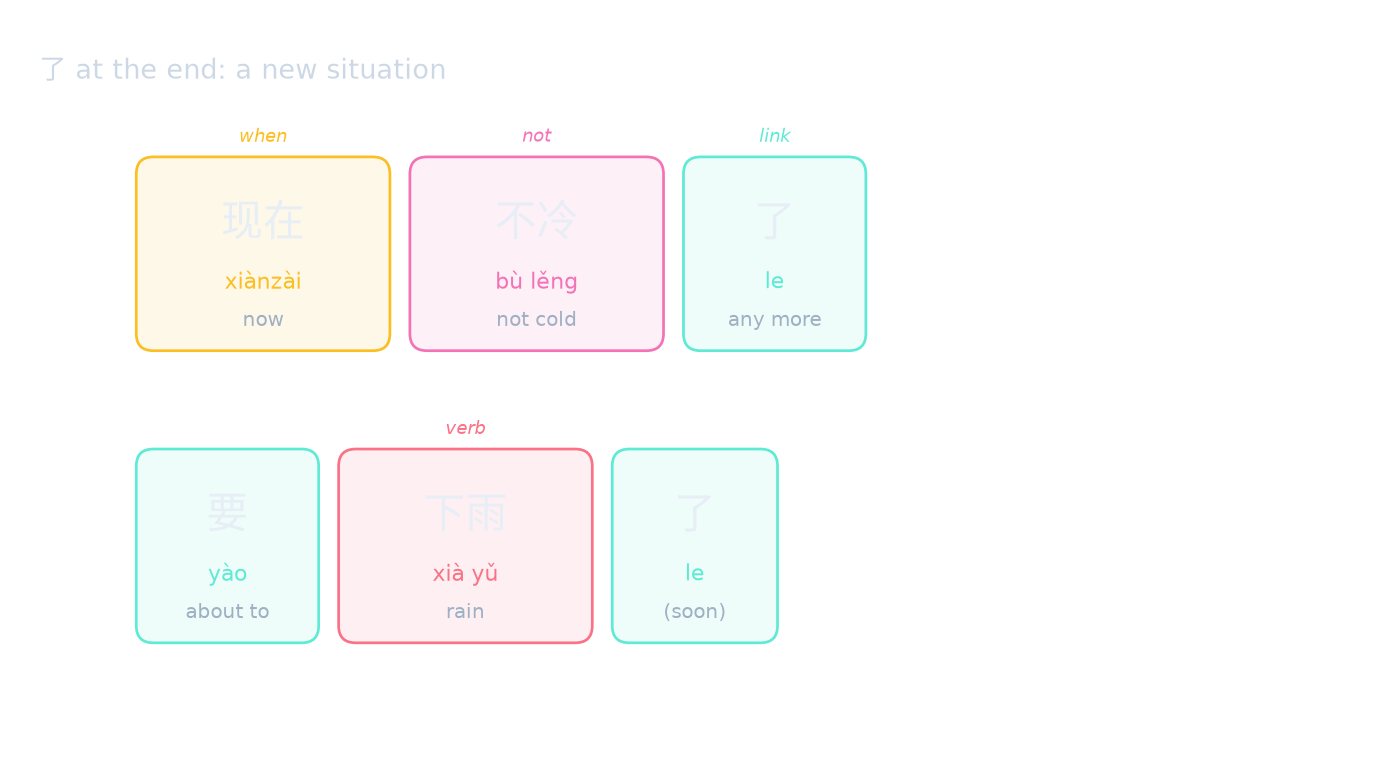
  • now现在xiàn zài不冷bù lěng(completed / change)了le。 – It's not cold any more.
  • want / will / need要yàoto rain下雨xià yǔ(completed / change)了le。 – It's about to rain.

How it works. (completed / change)了le at the end of a sentence presents a changed or newly relevant situation. It is not a general past tense; the situation decides the meaning.

Example What (completed / change)了le does
I / me我wǒto have a meal吃饭chī fàn(completed / change)了le。 eating has happened, so the lunch offer is answered
to have a meal吃饭chī fàn(completed / change)了le! announces mealtime: come and eat
now现在xiàn zài不冷bù lěng(completed / change)了le。 a changed state
want / will / need要yàoto rain下雨xià yǔ(completed / change)了le。 an approaching event
I / me我wǒnot不bùat / in在zàihere这里zhè lǐto have a meal吃饭chī fàn(completed / change)了le。 a changed habit: no longer

Positions. I / me我wǒto eat吃chī(completed / change)了le三碗sān wǎncooked rice饭fàn puts (completed / change)了le right after the verb: the eating is carried out. I / me我wǒto eat吃chī(completed / change)了le三碗sān wǎncooked rice饭fàn(completed / change)了le has both: three bowls so far (whether a fourth follows isn't stated).

Watch out

  • Denying a completed action uses not / haven't没méi and drops (completed / change)了le: I / me我wǒnot / haven't没méito have a meal吃饭chī fàn.
了 at the end: a new situation
6.3

2. 动词 + 了 + 补语(了位于动词之后)

English

Form: verb + (completed / change)了le + duration / quantity (+ object)

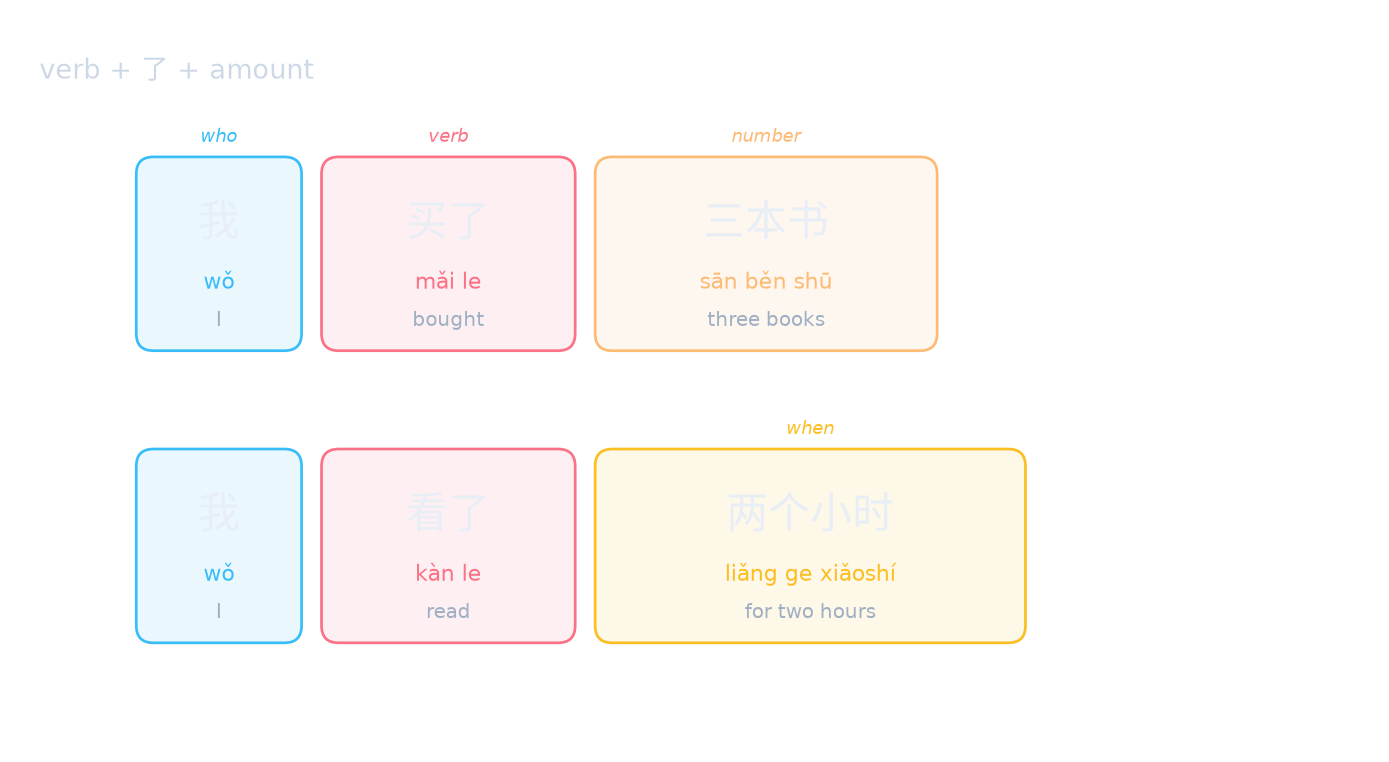
  • I / me我wǒto look at; to watch; to read看kàn(completed / change)了le两个liǎng gèhour小时xiǎo shí。 Wǒ kànle liǎng gè xiǎoshí. – I read for two hours.
  • I / me我wǒto buy买mǎi(completed / change)了lethree三sān本书běn shū。 – I bought three books.
  • to wait; and so on等děngI / me我wǒto look at; to watch; to read看kàn(completed / change)了lethis这zhè本书běn shū,again / then / (再…也) however再zàiand / with和héyou你nǐto discuss讨论tǎo lùn。 – Once I've read this book, I'll discuss it with you.
  • I / me我wǒto look at; to watch; to read看kàn(completed / change)了le两个liǎng gèhour小时xiǎo shí(completed / change)了le,now现在xiàn zàistill / also / even还háiat / in在zàito look at; to watch; to read看kàn。 – I've been reading for two hours, and I'm still at it.

How it works. (completed / change)了le right after the verb presents the action as carried out, and the quantity after it says how long or how many. It is not a past tense: in to wait; and so on等děngI / me我wǒto look at; to watch; to read看kàn(completed / change)了lethis这zhè本书běn shū it marks a step completed before a future one. A second (completed / change)了le at the end (to look at; to watch; to read看kàn(completed / change)了le两个liǎng gèhour小时xiǎo shí(completed / change)了le) counts up to now; the context says whether the activity continues.

The sentence answers Example
how long? to look at; to watch; to read看kàn(completed / change)了le两个liǎng gèhour小时xiǎo shí
how many? to buy买mǎi(completed / change)了lethree三sān本书běn shū
how long ago? 两个liǎng gèhour小时xiǎo shífront / before前qiánto look at; to watch; to read看kàn(modifier / structural particle)的de

Negatives. I / me我wǒ没买书méi mǎi shū denies the action and drops (completed / change)了le. I / me我wǒnot / haven't没méito look at; to watch; to read看kàn两个liǎng gèhour小时xiǎo shí,only只zhǐto look at; to watch; to read看kàn(completed / change)了le一个yí gèhour小时xiǎo shí denies only the length: some reading happened.

Watch out

  • A duration doesn't prove the book was finished; I / me我wǒto look at; to watch; to read看kàn(completed / change)了le两个liǎng gèhour小时xiǎo shí means two hours of reading (120 minutes), not "two hours ago".
verb + 了 + amount
6.4

3. 陈述句 + 嘛(显而易见 / 你知道的)

English

Form: statement + (obviously)嘛ma

  • this这zhèdegree / adjective linker很hěnsimple简单jiǎn dān(obviously)嘛ma。 Zhè hěn jiǎndān ma. – It's simple, you know.
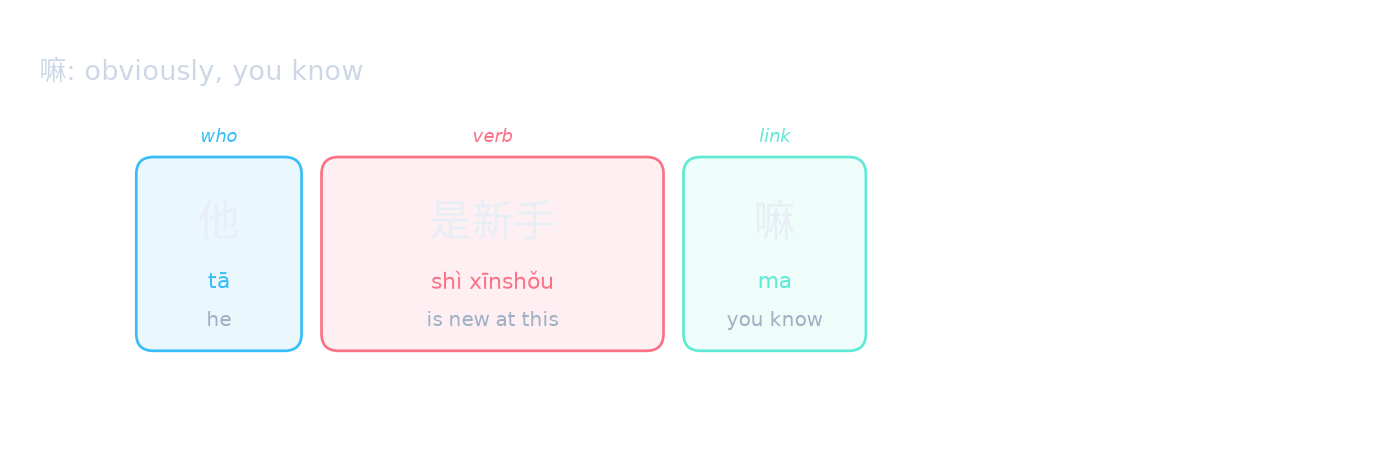
  • he / him他tāto be / is是shìnew hand新手xīn shǒu(obviously)嘛ma。 – He's a beginner, after all.
  • 别着急bié zháo jí(obviously)嘛ma。 – Don't rush, come on.

How it works. (obviously)嘛ma at the end of a statement presents it as obvious or understood in the speaker's view: "you know", "after all". It often gives a reason (he / him他tāto be / is是shìnew hand新手xīn shǒu(obviously)嘛ma, so help him). The listener can still disagree (to / towards / correct对duìI / me我wǒ来说lái shuōnot不bùsimple简单jiǎn dān), so (obviously)嘛ma is a stance, not proof. Tone decides whether it reassures or sounds impatient; the written particle doesn't show that.

this这zhèdegree / adjective linker很hěnsimple简单jiǎn dān(obviously)嘛ma。 this这zhèdegree / adjective linker很hěnsimple简单jiǎn dān(yes/no ?)吗ma? you你nǐto feel / think觉得jué de(and …? / softener)呢ne?
presents it as obviously easy asks whether it's easy invites the other view

Watch out

  • (obviously)嘛ma and (yes/no ?)吗ma are both ma without tone, but different jobs: a statement vs. a yes/no question.
  • The reason must fit the facts: if the teammate is experienced, he / him他tāto be / is是shìnew hand新手xīn shǒu(obviously)嘛ma no longer works.
嘛: obviously, you know
6.5

4. 呢:后续问题与共同语境

English

Form: you你nǐto feel / think觉得jué de(and …? / softener)呢ne? · topic + (and …? / softener)呢ne? (and …? / where is …?)

  • I / me我wǒto feel / think觉得jué demorning (before noon)上午shàng wǔgood好hǎo,you你nǐto feel / think觉得jué de(and …? / softener)呢ne? Wǒ juéde shàngwǔ hǎo, nǐ juéde ne? – I think the morning is better. What do you think?
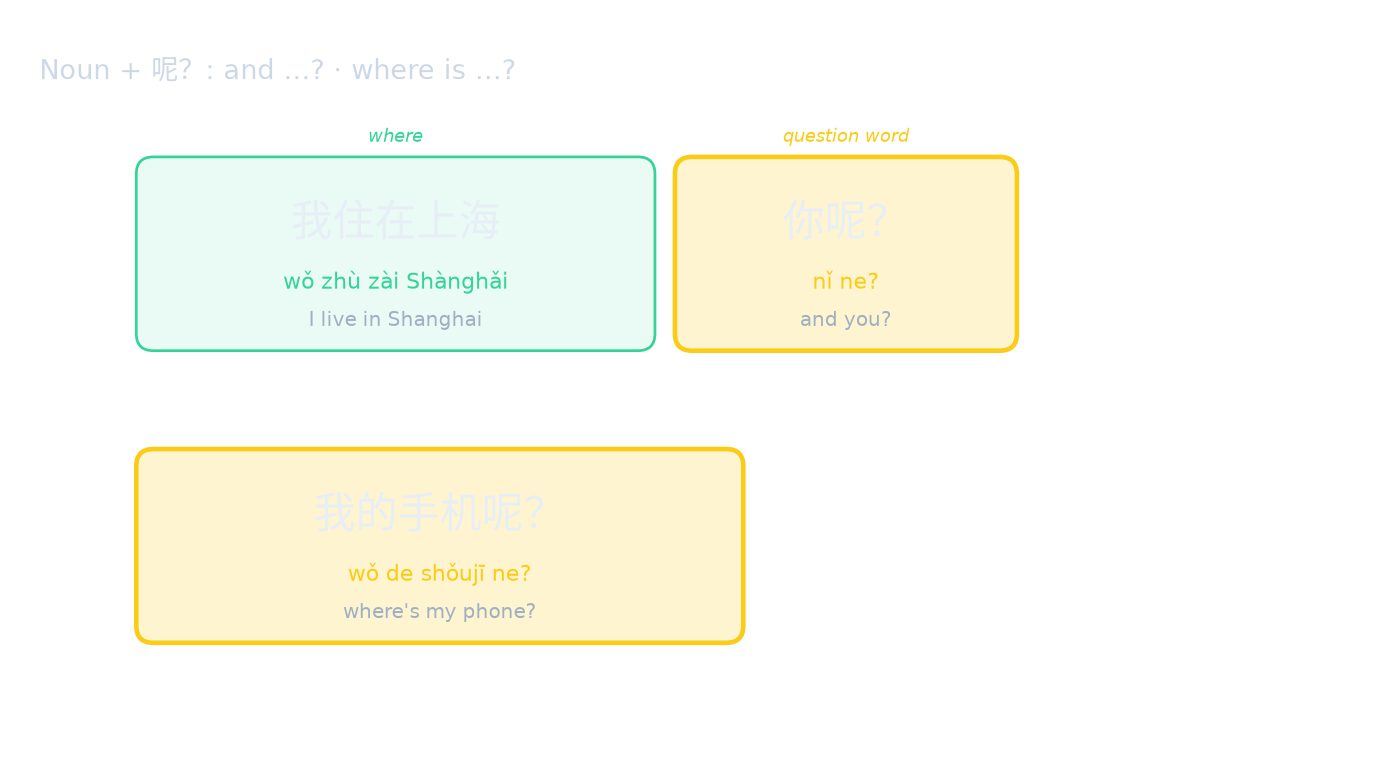
  • 我住wǒ zhùShanghai municipality…上海shàng hǎi,you你nǐ(and …? / softener)呢ne? – I live in Shanghai. And you?
  • I / me我wǒ(modifier / structural particle)的demobile phone手机shǒu jī(and …? / softener)呢ne? – Where's my phone?
  • this这zhèpair双shuānghow many / how much多少duō shaomoney钱qián?……this这个zhè ge(and …? / softener)呢ne? – How much is this pair? … And this one?

How it works. (and …? / softener)呢ne asks a follow-up, and the earlier talk supplies the missing question. After 我住wǒ zhùShanghai municipality…上海shàng hǎi, you你nǐ(and …? / softener)呢ne? asks where you live; after I / me我wǒlunch午饭wǔ fànto eat吃chīcooked rice米饭mǐ fàn, the same words ask about your lunch. With a missing object (I / me我wǒ(modifier / structural particle)的demobile phone手机shǒu jī(and …? / softener)呢ne?) it asks where it is.

(and …? / softener)呢ne asks (yes/no ?)吗ma asks
follow-up from shared context, or with a question word (you你nǐat / in在zàito look at; to watch; to read看kànwhat什么shén me(and …? / softener)呢ne?) yes/no: this这zhèdegree / adjective linker很hěnsimple简单jiǎn dān(yes/no ?)吗ma?

Watch out

  • Not every (and …? / softener)呢ne is a question: I / me我wǒin the middle of正在zhèng zàito read看书kàn shū(and …? / softener)呢ne is a statement (in progress).
  • Don't swap (yes/no ?)吗ma for (and …? / softener)呢ne in every yes/no question.
  • If the topic isn't clear, name it: you你nǐto feel / think觉得jué dethis这个zhè geplan计划jì huàhow about怎么样zěn me yàng(and …? / softener)呢ne?
Noun + 呢?: and …? · where is …?
6.6

练习

English

Cover the teaching pages before you answer. The answers are at the end.

1. Final (completed / change)了le: change and completion in context

1. It's not cold any more. now现在xiàn zài不冷bù lěng …………。

2. Someone offers you lunch. Which reply says "I've already eaten"?

  • A. I / me我wǒnot不bùto have a meal吃饭chī fàn。
  • B. I / me我wǒto have a meal吃饭chī fàn(completed / change)了le。
  • C. 我要wǒ yàoto have a meal吃饭chī fàn。
  • D. I / me我wǒto have a meal吃饭chī fàn(yes/no ?)吗ma?

3. I / me我wǒnot不bùat / in在zàihere这里zhè lǐto have a meal吃饭chī fàn(completed / change)了le means…

  • A. I'm eating here now
  • B. I no longer eat here
  • C. I didn't eat here
  • D. I will eat here

4. True or false? want / will / need要yàoto rain下雨xià yǔ(completed / change)了le means it has just rained. If false, correct it.

5. Correct the mistake: I / me我wǒnot / haven't没méito have a meal吃饭chī fàn(completed / change)了le。

6. I / me我wǒto eat吃chī(completed / change)了le三碗sān wǎncooked rice饭fàn(completed / change)了le means…

  • A. three bowls every day
  • B. three bowls, finished eating
  • C. three bowls so far
  • D. three bowls tomorrow

2. Verb + (completed / change)了le + Complement (le after the verb)

7. I read for two hours. I / me我wǒto look at; to watch; to read看kàn ………… 两个liǎng gèhour小时xiǎo shí。

8. I / me我wǒto look at; to watch; to read看kàn(completed / change)了le两个liǎng gèhour小时xiǎo shí means…

  • A. I read for two hours
  • B. I will read for two hours
  • C. I read two books
  • D. I read two hours ago

9. Which means "two hours ago"?

  • A. 两个liǎng gèhour小时xiǎo shíto look at; to watch; to read看kàn(completed / change)了le
  • B. 两个liǎng gèhour小时xiǎo shífront / before前qiánto look at; to watch; to read看kàn(modifier / structural particle)的de
  • C. to look at; to watch; to read看kàn(completed / change)了le两个liǎng gèhour小时xiǎo shí
  • D. to look at; to watch; to read看kàn两个liǎng gèhour小时xiǎo shí(completed / change)了le

10. True or false? to wait; and so on等děngI / me我wǒto look at; to watch; to read看kàn(completed / change)了lethis这zhè本书běn shū,again / then / (再…也) however再zàiand / with和héyou你nǐto discuss讨论tǎo lùn talks about the future. If false, correct it.

11. Correct the mistake: I / me我wǒnot / haven't没méito buy买mǎi(completed / change)了lebook书shū。

12. I / me我wǒto look at; to watch; to read看kàn(completed / change)了le两个liǎng gèhour小时xiǎo shí(completed / change)了le,now现在xiàn zàistill / also / even还háiat / in在zàito look at; to watch; to read看kàn。 Is the speaker still reading?

  • A. We can't tell
  • B. Yes
  • C. No

3. Statement + (obviously)嘛ma (obviously / you know)

13. It's simple, you know. this这zhèdegree / adjective linker很hěnsimple简单jiǎn dān …………。

14. Which is a yes/no question?

  • A. this这zhèdegree / adjective linker很hěnsimple简单jiǎn dān(obviously)嘛ma。
  • B. this这zhèdegree / adjective linker很hěnsimple简单jiǎn dān(yes/no ?)吗ma?
  • C. 别着急bié zháo jí(obviously)嘛ma。
  • D. he / him他tāto be / is是shìnew hand新手xīn shǒu(obviously)嘛ma。

15. he / him他tāto be / is是shìnew hand新手xīn shǒu(obviously)嘛ma is most likely said to…

  • A. explain why his mistake is understandable
  • B. end a meeting
  • C. ask whether he is a beginner
  • D. praise his skill

16. True or false? After this这zhèdegree / adjective linker很hěnsimple简单jiǎn dān(obviously)嘛ma, the listener must agree. If false, correct it.

17. Say in Chinese, gently: "Don't rush, come on."

18. The new teammate has ten years of experience. Which sentence no longer fits?

  • A. he / him他tāto know知道zhī dào(obviously)嘛ma。
  • B. he / him他tāto be / is是shìnew hand新手xīn shǒu(obviously)嘛ma。
  • C. he / him他tāto do; to make做zuò(degree marker)得dedegree / adjective linker很hěngood好hǎo(obviously)嘛ma。
  • D. he / him他tādegree / adjective linker很hěnto have / there is有yǒuexperience (know-how)经验jīng yàn(obviously)嘛ma。

4. (and …? / softener)呢ne: follow-up questions and shared context

19. I think the morning is better. What do you think? I / me我wǒto feel / think觉得jué demorning (before noon)上午shàng wǔgood好hǎo,you你nǐto feel / think觉得jué de …………?

20. 我住wǒ zhùShanghai municipality…上海shàng hǎi,you你nǐ(and …? / softener)呢ne? asks…

  • A. whether you like it
  • B. your name
  • C. where you live
  • D. what you think of Shanghai

21. You can't find your phone. What do you say?

  • A. I / me我wǒ(modifier / structural particle)的demobile phone手机shǒu jī(yes/no ?)吗ma?
  • B. I / me我wǒ(modifier / structural particle)的demobile phone手机shǒu jī(obviously)嘛ma。
  • C. I / me我wǒ(modifier / structural particle)的demobile phone手机shǒu jī(completed / change)了le。
  • D. I / me我wǒ(modifier / structural particle)的demobile phone手机shǒu jī(and …? / softener)呢ne?

22. True or false? I / me我wǒin the middle of正在zhèng zàito read看书kàn shū(and …? / softener)呢ne is a question. If false, correct it.

23. Correct the mistake: you你nǐto like喜欢xǐ huanto drink tea喝茶hē chá(and …? / softener)呢ne? (a yes/no question)

24. In a shoe shop: this这zhèpair双shuānghow many / how much多少duō shaomoney钱qián?……this这个zhè ge(and …? / softener)呢ne? The second question asks…

  • A. the brand
  • B. the colour
  • C. the size
  • D. the price
6.7

混合练习

English

These questions mix the patterns and use new situations.

25. Explain the difference: I / me我wǒ吃了饭chī le fàn。 / I / me我wǒto have a meal吃饭chī fàn(completed / change)了le。

26. Choose (obviously)嘛ma or (and …? / softener)呢ne: you你nǐ别着急bié zháo jí,he / him他tāto be / is是shì新来xīn lái(modifier / structural particle)的de…………。 / I / me我wǒ去过qù guò(completed / change)了le,you你nǐ…………?

27. Find and fix the problem. Someone says I / me我wǒnot不bù喝咖啡hē kā fēi(completed / change)了le. A classmate reports "I didn't drink coffee yesterday." What is lost?

28. Use it yourself. Say you have finished today's reading and that you are no longer going out.

6.8

答案与解析

English

Mark your work, then correct each mistake in your own words.

1. Final (completed / change)了le: change and completion in context

1. (completed / change)了le

Sentence-final (completed / change)了le: a changed state.

2. B. I / me我wǒto have a meal吃饭chī fàn(completed / change)了le。

Final (completed / change)了le: eating has happened, so the offer is answered.

3. B. I no longer eat here

not不bù……(completed / change)了le: a changed habit.

4. False.

want / will / need要yào……(completed / change)了le = about to happen.

5. I / me我wǒnot / haven't没méito have a meal吃饭chī fàn。

Denying a completed action uses not / haven't没méi and drops (completed / change)了le.

6. C. three bowls so far

Verb-(completed / change)了le plus final (completed / change)了le: a total so far.

2. Verb + (completed / change)了le + Complement (le after the verb)

7. (completed / change)了le

Verb + (completed / change)了le + duration.

8. A. I read for two hours

A duration after verb-(completed / change)了le answers "how long".

9. B. 两个liǎng gèhour小时xiǎo shífront / before前qiánto look at; to watch; to read看kàn(modifier / structural particle)的de

front / before前qián answers "how long ago".

10. True.

Verb-(completed / change)了le marks a step completed before a future one.

11. I / me我wǒ没买书méi mǎi shū。

not / haven't没méi replaces verb-(completed / change)了le.

12. B. Yes

now现在xiàn zàistill / also / even还háiat / in在zàito look at; to watch; to read看kàn says so; the double (completed / change)了le counts up to now.

3. Statement + (obviously)嘛ma (obviously / you know)

13. (obviously)嘛ma

Statement + (obviously)嘛ma: presented as obvious.

14. B. this这zhèdegree / adjective linker很hěnsimple简单jiǎn dān(yes/no ?)吗ma?

(yes/no ?)吗ma asks; (obviously)嘛ma presents as obvious.

15. A. explain why his mistake is understandable

(obviously)嘛ma presents an understood reason.

16. False.

The listener can reply to / towards / correct对duìI / me我wǒ来说lái shuōnot不bùsimple简单jiǎn dān.

17. 别着急bié zháo jí(obviously)嘛ma。

(obviously)嘛ma softens a request.

18. B. he / him他tāto be / is是shìnew hand新手xīn shǒu(obviously)嘛ma。

The reason must fit the facts.

4. (and …? / softener)呢ne: follow-up questions and shared context

19. (and …? / softener)呢ne

(and …? / softener)呢ne asks a follow-up from the shared topic.

20. C. where you live

The earlier sentence supplies the missing question.

21. D. I / me我wǒ(modifier / structural particle)的demobile phone手机shǒu jī(and …? / softener)呢ne?

Noun + (and …? / softener)呢ne? asks where something is.

22. False.

It is a statement: an action in progress.

23. you你nǐto like喜欢xǐ huanto drink tea喝茶hē chá(yes/no ?)吗ma?

Yes/no questions take (yes/no ?)吗ma.

24. D. the price

The shared topic is price.

Mixed practice

25. I / me我wǒ吃了饭chī le fàn needs more (I / me我wǒ吃了饭chī le fànthen / just就jiùto walk / to leave走zǒu) or a number (to eat吃chī(completed / change)了le两碗饭liǎng wǎn fàn); it stresses the completed action. I / me我wǒto have a meal吃饭chī fàn(completed / change)了le reports a new situation: I have eaten, or I'm going to eat now.

26. he / him他tāto be / is是shì新来xīn lái(modifier / structural particle)的de(obviously)嘛ma (it's obvious, so be patient)。you你nǐ(and …? / softener)呢ne?(a follow-up question).

27. This (completed / change)了le shows a change: "I don't drink coffee any more" (or "I've decided not to have one"). It is not about yesterday.

28. Model answer. today今天jīn tiān(modifier / structural particle)的debook书shūI / me我wǒto look at; to watch; to read看kànto finish完wán(completed / change)了le。I / me我wǒnot不bùto go out出去chū qù(completed / change)了le。

Review later. Tomorrow, make one (completed / change)了le sentence for a completed action and one for a change.

该知识点的互动课程

逐步完成,配合即时检查练习。

更多 HSK 5 知识点

登录或创建账户

IGCSE, A-Level & AP