Verb + 了 + Complement (le after the verb)
引入您的已保存位置保留在此浏览器中。恢复操作不会完成课程或回答其中的问题。
How long did you read?
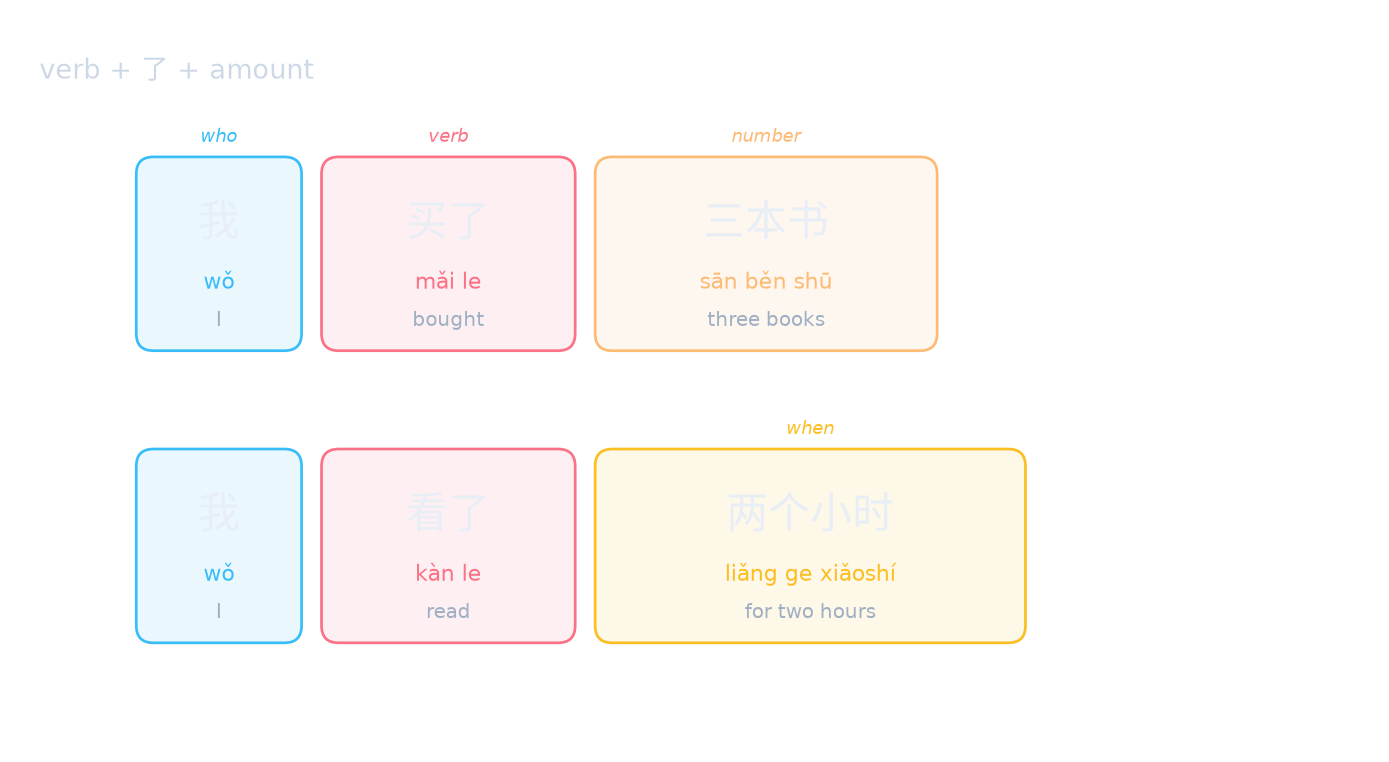
- Your friend asks about your afternoon. You answer: I我read看(done)了two (with measure word 个)两个hours小时books书。 — "I read for two hours."
- Goal: put (done)了 straight after the verb when the action happened and you add how much / how long (an amount, a duration, a result).
Verb + (done)了 + amount / duration
- Verb + (done)了 + number + measure word + noun: I我buy买(done)了three三book / books (with measure word 本)本书。 — "I bought three books."
- Verb + (done)了 + duration: I我read看(done)了two (with measure word 个)两个hours小时。 — "I read for two hours." (done)了 sticks to the verb; the amount comes after it.
I我buy买(done)了three三本books书。
Complete: “I read for two hours.” 我看____两个小时。
难度 1/5 · 今日首次完成可获 100 金币及少量额外奖励
Verb + 了 + duration.
Build: “I bought three books.”
难度 3/5 · 今日首次完成可获 200 金币及少量额外奖励
Verb + 了 + number + measure word + noun.
Also for the future: "after … has been done"
- (done)了 after a verb doesn't mean past. to wait; and so on等I我read看(done)了this这book / books (with measure word 本)本书,again / then / (再…也) however再and / with和you你to discuss讨论。 — "Once I've read this book, I'll discuss it with you."
- tomorrow明天down / next; to fall (rain), get off下(done)了lesson课,we / us我们to go去to have a meal吃饭(suggestion)吧。 — "Tomorrow after class, let's go and eat."
In 等我看了这本书,再和你讨论, the reading happened in the past.
难度 1/5 · 今日首次完成可获 100 金币及少量额外奖励
It is a future plan. Verb-了 means "once it has been done".
Still going? Add a second (done)了
- I我read看(done)了two (with measure word 个)两个hours小时(done)了。 — "I've been reading for two hours (and I'm still reading)." The final (done)了 means "up to now".
- Compare: I我read看(done)了two (with measure word 个)两个hours小时。 — "I read for two hours (and stopped)."
What does 我学了三年汉语了 tell you?
难度 1/5 · 今日首次完成可获 100 金币及少量额外奖励
The second 了 at the end = up to now, still going.
Common mistakes
- (done)了 goes after the verb, not after the amount: ✓ buy买(done)了three三book / books (with measure word 本)本书 ✗ buy买three三book / books (with measure word 本)本书(done)了 (that means "I've bought three books so far").
- In a negative, drop (done)了: ✓ I我not / haven't没buy买books书。 ✗ I我not / haven't没buy买(done)了books书. With a bare object and no amount, use final (done)了 instead: ✓ I我buy买books书(done)了。
Which sentence is correct?
难度 1/5 · 今日首次完成可获 100 金币及少量额外奖励
没 + verb, no 了.
Recap
- Verb + (done)了 + amount / duration = the action happened (to this extent): buy买(done)了three三book / books (with measure word 本)本书, read看(done)了two (with measure word 个)两个hours小时.
- Verb + (done)了 … (done)了 = so far, still going. not / haven't没 + verb has no (done)了. Verb-(done)了 can also be in a future plan.
Read the full reference: HSK 5 grammar — Particles.
Tell a friend what you did last weekend with two amounts, and what you have been doing for a long time up to now.
Your answer need not copy the model. A partner or teacher must hear the spoken response to comment on pronunciation.