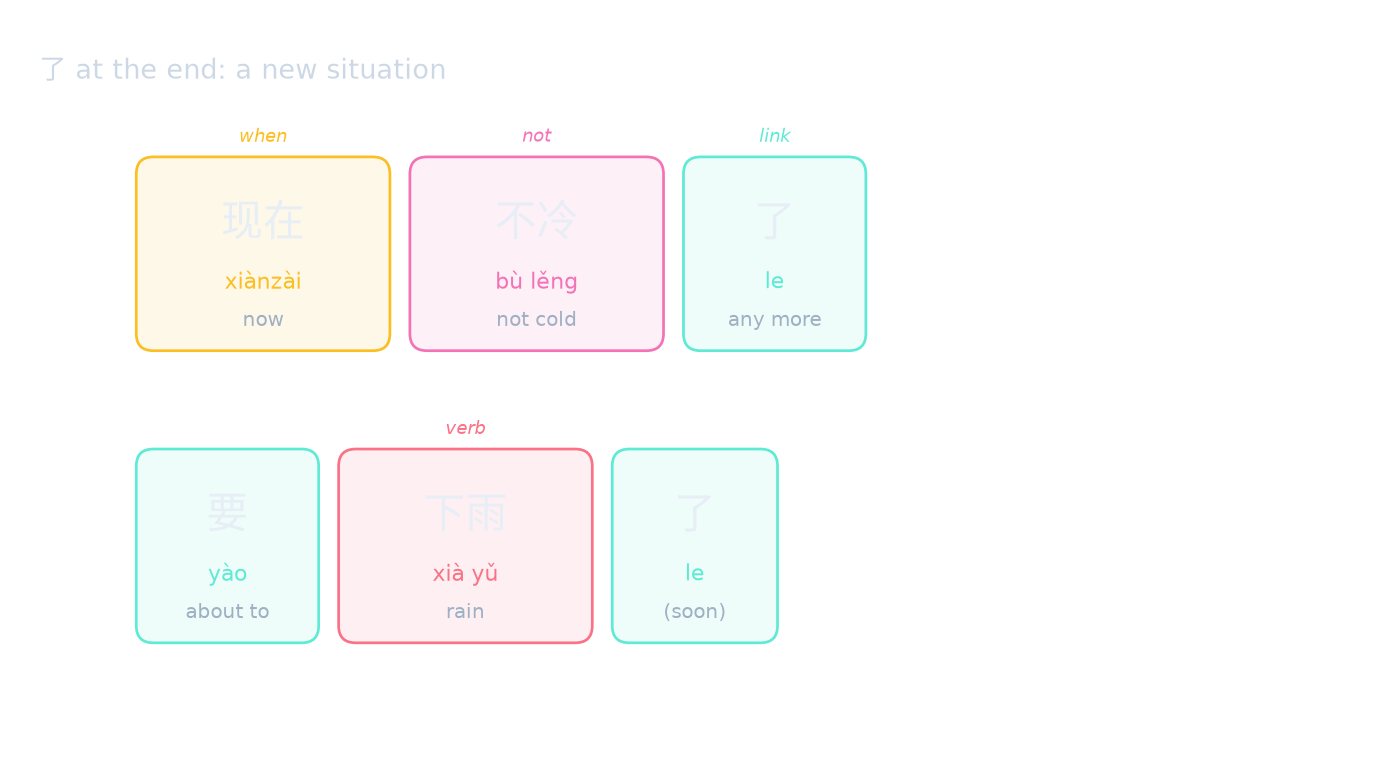
Final (completed / change)了: change and completion in context
Form: sentence + (completed / change)了 (a new or now-relevant situation)
- I / me我to have a meal吃饭(completed / change)了。 Wǒ chī fàn le. – I've eaten. (in reply to a lunch offer)
- to have a meal吃饭(completed / change)了! – Dinner's ready! (calling people to the table)
- now现在不冷(completed / change)了。 – It's not cold any more.
- want / will / need要to rain下雨(completed / change)了。 – It's about to rain.
How it works. (completed / change)了 at the end of a sentence presents a changed or newly relevant situation. It is not a general past tense; the situation decides the meaning.
| Example | What (completed / change)了 does |
|---|---|
| I / me我to have a meal吃饭(completed / change)了。 | eating has happened, so the lunch offer is answered |
| to have a meal吃饭(completed / change)了! | announces mealtime: come and eat |
| now现在不冷(completed / change)了。 | a changed state |
| want / will / need要to rain下雨(completed / change)了。 | an approaching event |
| I / me我not不at / in在here这里to have a meal吃饭(completed / change)了。 | a changed habit: no longer |
Positions. I / me我to eat吃(completed / change)了三碗cooked rice饭 puts (completed / change)了 right after the verb: the eating is carried out. I / me我to eat吃(completed / change)了三碗cooked rice饭(completed / change)了 has both: three bowls so far (whether a fourth follows isn't stated).
Watch out
- Denying a completed action uses not / haven't没 and drops (completed / change)了: I / me我not / haven't没to have a meal吃饭.
Verb + (completed / change)了 + Complement (le after the verb)
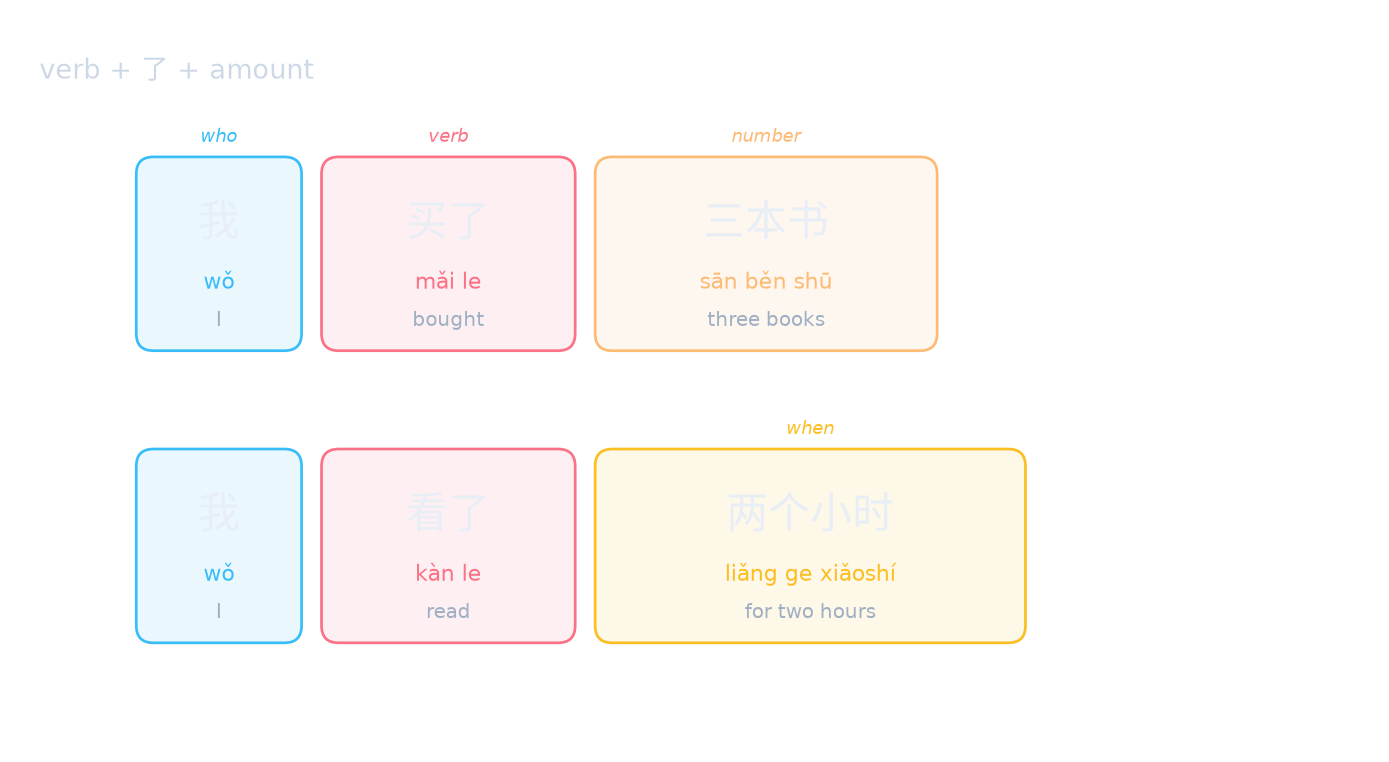
Form: verb + (completed / change)了 + duration / quantity (+ object)
- I / me我to look at; to watch; to read看(completed / change)了两个hour小时。 Wǒ kànle liǎng gè xiǎoshí. – I read for two hours.
- I / me我to buy买(completed / change)了three三本书。 – I bought three books.
- to wait; and so on等I / me我to look at; to watch; to read看(completed / change)了this这本书,again / then / (再…也) however再and / with和you你to discuss讨论。 – Once I've read this book, I'll discuss it with you.
- I / me我to look at; to watch; to read看(completed / change)了两个hour小时(completed / change)了,now现在still / also / even还at / in在to look at; to watch; to read看。 – I've been reading for two hours, and I'm still at it.
How it works. (completed / change)了 right after the verb presents the action as carried out, and the quantity after it says how long or how many. It is not a past tense: in to wait; and so on等I / me我to look at; to watch; to read看(completed / change)了this这本书 it marks a step completed before a future one. A second (completed / change)了 at the end (to look at; to watch; to read看(completed / change)了两个hour小时(completed / change)了) counts up to now; the context says whether the activity continues.
| The sentence answers | Example |
|---|---|
| how long? | to look at; to watch; to read看(completed / change)了两个hour小时 |
| how many? | to buy买(completed / change)了three三本书 |
| how long ago? | 两个hour小时front / before前to look at; to watch; to read看(modifier / structural particle)的 |
Negatives. I / me我没买书 denies the action and drops (completed / change)了. I / me我not / haven't没to look at; to watch; to read看两个hour小时,only只to look at; to watch; to read看(completed / change)了一个hour小时 denies only the length: some reading happened.
Watch out
- A duration doesn't prove the book was finished; I / me我to look at; to watch; to read看(completed / change)了两个hour小时 means two hours of reading (120 minutes), not "two hours ago".
Statement + (obviously)嘛 (obviously / you know)
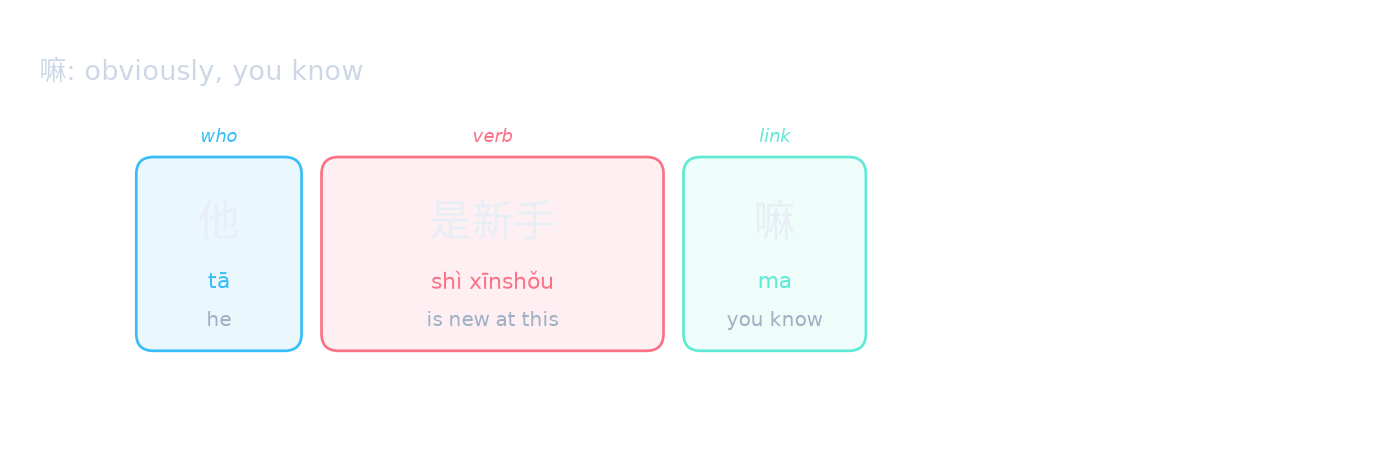
Form: statement + (obviously)嘛
- this这degree / adjective linker很simple简单(obviously)嘛。 Zhè hěn jiǎndān ma. – It's simple, you know.
- he / him他to be / is是new hand新手(obviously)嘛。 – He's a beginner, after all.
- 别着急(obviously)嘛。 – Don't rush, come on.
How it works. (obviously)嘛 at the end of a statement presents it as obvious or understood in the speaker's view: "you know", "after all". It often gives a reason (he / him他to be / is是new hand新手(obviously)嘛, so help him). The listener can still disagree (to / towards / correct对I / me我来说not不simple简单), so (obviously)嘛 is a stance, not proof. Tone decides whether it reassures or sounds impatient; the written particle doesn't show that.
| this这degree / adjective linker很simple简单(obviously)嘛。 | this这degree / adjective linker很simple简单(yes/no ?)吗? | you你to feel / think觉得(and …? / softener)呢? |
|---|---|---|
| presents it as obviously easy | asks whether it's easy | invites the other view |
Watch out
- (obviously)嘛 and (yes/no ?)吗 are both ma without tone, but different jobs: a statement vs. a yes/no question.
- The reason must fit the facts: if the teammate is experienced, he / him他to be / is是new hand新手(obviously)嘛 no longer works.
(and …? / softener)呢: follow-up questions and shared context
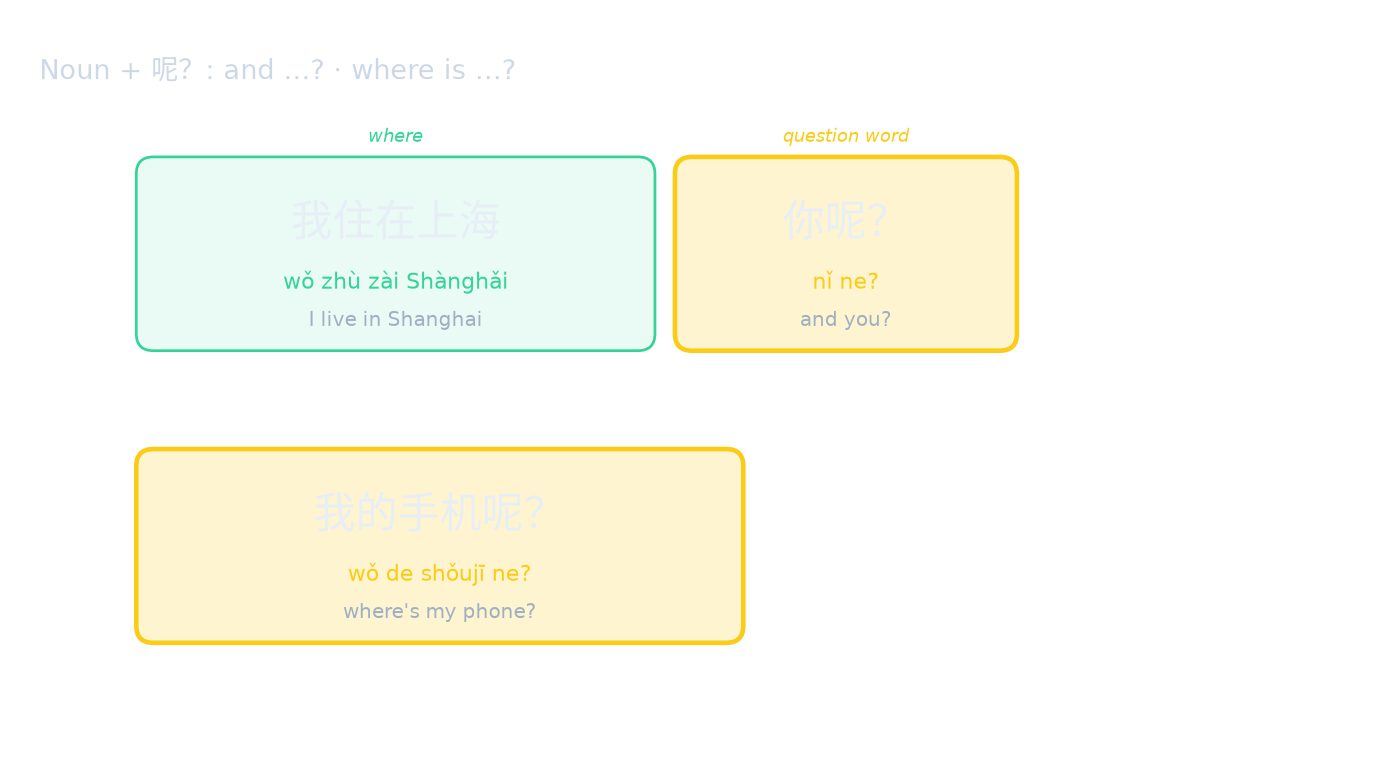
Form: you你to feel / think觉得(and …? / softener)呢? · topic + (and …? / softener)呢? (and …? / where is …?)
- I / me我to feel / think觉得morning (before noon)上午good好,you你to feel / think觉得(and …? / softener)呢? Wǒ juéde shàngwǔ hǎo, nǐ juéde ne? – I think the morning is better. What do you think?
- 我住Shanghai municipality…上海,you你(and …? / softener)呢? – I live in Shanghai. And you?
- I / me我(modifier / structural particle)的mobile phone手机(and …? / softener)呢? – Where's my phone?
- this这pair双how many / how much多少money钱?……this这个(and …? / softener)呢? – How much is this pair? … And this one?
How it works. (and …? / softener)呢 asks a follow-up, and the earlier talk supplies the missing question. After 我住Shanghai municipality…上海, you你(and …? / softener)呢? asks where you live; after I / me我lunch午饭to eat吃cooked rice米饭, the same words ask about your lunch. With a missing object (I / me我(modifier / structural particle)的mobile phone手机(and …? / softener)呢?) it asks where it is.
| (and …? / softener)呢 asks | (yes/no ?)吗 asks |
|---|---|
| follow-up from shared context, or with a question word (you你at / in在to look at; to watch; to read看what什么(and …? / softener)呢?) | yes/no: this这degree / adjective linker很simple简单(yes/no ?)吗? |
Watch out
- Not every (and …? / softener)呢 is a question: I / me我in the middle of正在to read看书(and …? / softener)呢 is a statement (in progress).
- Don't swap (yes/no ?)吗 for (and …? / softener)呢 in every yes/no question.
- If the topic isn't clear, name it: you你to feel / think觉得this这个plan计划how about怎么样(and …? / softener)呢?
Practice without the models
Cover the teaching sections before you answer. The answers follow.
Final (completed / change)了: change and completion in context
1. It's not cold any more. now现在不冷 …………。
2. Someone offers you lunch. Which reply says "I've already eaten"?
- A. I / me我not不to have a meal吃饭。
- B. I / me我to have a meal吃饭(completed / change)了。
- C. 我要to have a meal吃饭。
- D. I / me我to have a meal吃饭(yes/no ?)吗?
3. I / me我not不at / in在here这里to have a meal吃饭(completed / change)了 means…
- A. I'm eating here now
- B. I no longer eat here
- C. I didn't eat here
- D. I will eat here
4. True or false? want / will / need要to rain下雨(completed / change)了 means it has just rained. If false, correct it.
5. Correct the mistake: I / me我not / haven't没to have a meal吃饭(completed / change)了。
6. I / me我to eat吃(completed / change)了三碗cooked rice饭(completed / change)了 means…
- A. three bowls every day
- B. three bowls, finished eating
- C. three bowls so far
- D. three bowls tomorrow
Verb + (completed / change)了 + Complement (le after the verb)
7. I read for two hours. I / me我to look at; to watch; to read看 ………… 两个hour小时。
8. I / me我to look at; to watch; to read看(completed / change)了两个hour小时 means…
- A. I read for two hours
- B. I will read for two hours
- C. I read two books
- D. I read two hours ago
9. Which means "two hours ago"?
- A. 两个hour小时to look at; to watch; to read看(completed / change)了
- B. 两个hour小时front / before前to look at; to watch; to read看(modifier / structural particle)的
- C. to look at; to watch; to read看(completed / change)了两个hour小时
- D. to look at; to watch; to read看两个hour小时(completed / change)了
10. True or false? to wait; and so on等I / me我to look at; to watch; to read看(completed / change)了this这本书,again / then / (再…也) however再and / with和you你to discuss讨论 talks about the future. If false, correct it.
11. Correct the mistake: I / me我not / haven't没to buy买(completed / change)了book书。
12. I / me我to look at; to watch; to read看(completed / change)了两个hour小时(completed / change)了,now现在still / also / even还at / in在to look at; to watch; to read看。 Is the speaker still reading?
- A. We can't tell
- B. Yes
- C. No
Statement + (obviously)嘛 (obviously / you know)
13. It's simple, you know. this这degree / adjective linker很simple简单 …………。
14. Which is a yes/no question?
- A. this这degree / adjective linker很simple简单(obviously)嘛。
- B. this这degree / adjective linker很simple简单(yes/no ?)吗?
- C. 别着急(obviously)嘛。
- D. he / him他to be / is是new hand新手(obviously)嘛。
15. he / him他to be / is是new hand新手(obviously)嘛 is most likely said to…
- A. explain why his mistake is understandable
- B. end a meeting
- C. ask whether he is a beginner
- D. praise his skill
16. True or false? After this这degree / adjective linker很simple简单(obviously)嘛, the listener must agree. If false, correct it.
17. Say in Chinese, gently: "Don't rush, come on."
18. The new teammate has ten years of experience. Which sentence no longer fits?
- A. he / him他to know知道(obviously)嘛。
- B. he / him他to be / is是new hand新手(obviously)嘛。
- C. he / him他to do; to make做(degree marker)得degree / adjective linker很good好(obviously)嘛。
- D. he / him他degree / adjective linker很to have / there is有experience (know-how)经验(obviously)嘛。
(and …? / softener)呢: follow-up questions and shared context
19. I think the morning is better. What do you think? I / me我to feel / think觉得morning (before noon)上午good好,you你to feel / think觉得 …………?
20. 我住Shanghai municipality…上海,you你(and …? / softener)呢? asks…
- A. whether you like it
- B. your name
- C. where you live
- D. what you think of Shanghai
21. You can't find your phone. What do you say?
- A. I / me我(modifier / structural particle)的mobile phone手机(yes/no ?)吗?
- B. I / me我(modifier / structural particle)的mobile phone手机(obviously)嘛。
- C. I / me我(modifier / structural particle)的mobile phone手机(completed / change)了。
- D. I / me我(modifier / structural particle)的mobile phone手机(and …? / softener)呢?
22. True or false? I / me我in the middle of正在to read看书(and …? / softener)呢 is a question. If false, correct it.
23. Correct the mistake: you你to like喜欢to drink tea喝茶(and …? / softener)呢? (a yes/no question)
24. In a shoe shop: this这pair双how many / how much多少money钱?……this这个(and …? / softener)呢? The second question asks…
- A. the brand
- B. the colour
- C. the size
- D. the price
Answers and explanations
Final (completed / change)了: change and completion in context
1. (completed / change)了
Sentence-final (completed / change)了: a changed state.
2. B. I / me我to have a meal吃饭(completed / change)了。
Final (completed / change)了: eating has happened, so the offer is answered.
3. B. I no longer eat here
not不……(completed / change)了: a changed habit.
4. False.
want / will / need要……(completed / change)了 = about to happen.
5. I / me我not / haven't没to have a meal吃饭。
Denying a completed action uses not / haven't没 and drops (completed / change)了.
6. C. three bowls so far
Verb-(completed / change)了 plus final (completed / change)了: a total so far.
Verb + (completed / change)了 + Complement (le after the verb)
7. (completed / change)了
Verb + (completed / change)了 + duration.
8. A. I read for two hours
A duration after verb-(completed / change)了 answers "how long".
9. B. 两个hour小时front / before前to look at; to watch; to read看(modifier / structural particle)的
front / before前 answers "how long ago".
10. True.
Verb-(completed / change)了 marks a step completed before a future one.
11. I / me我没买书。
not / haven't没 replaces verb-(completed / change)了.
12. B. Yes
now现在still / also / even还at / in在to look at; to watch; to read看 says so; the double (completed / change)了 counts up to now.
Statement + (obviously)嘛 (obviously / you know)
13. (obviously)嘛
Statement + (obviously)嘛: presented as obvious.
14. B. this这degree / adjective linker很simple简单(yes/no ?)吗?
(yes/no ?)吗 asks; (obviously)嘛 presents as obvious.
15. A. explain why his mistake is understandable
(obviously)嘛 presents an understood reason.
16. False.
The listener can reply to / towards / correct对I / me我来说not不simple简单.
17. 别着急(obviously)嘛。
(obviously)嘛 softens a request.
18. B. he / him他to be / is是new hand新手(obviously)嘛。
The reason must fit the facts.
(and …? / softener)呢: follow-up questions and shared context
19. (and …? / softener)呢
(and …? / softener)呢 asks a follow-up from the shared topic.
20. C. where you live
The earlier sentence supplies the missing question.
21. D. I / me我(modifier / structural particle)的mobile phone手机(and …? / softener)呢?
Noun + (and …? / softener)呢? asks where something is.
22. False.
It is a statement: an action in progress.
23. you你to like喜欢to drink tea喝茶(yes/no ?)吗?
Yes/no questions take (yes/no ?)吗.
24. D. the price
The shared topic is price.