Original teaching practice. Read one pattern, cover its model and try the questions before checking the separate answer section. Examples adapted from Chinese Grammar Wiki (AllSet Learning, CC BY-NC-SA) retain the course-reference provenance.
seemingly看起来 vs apparently看来 (looks vs it seems)
Looks versus conclusions
- Your colleague looks pale, and he hasn't touched his lunch.
- he / him他seemingly看起来很累,apparently看来yesterday evening昨晚again又to work overtime加班(completed / change)了。 — "He looks tired — it seems he worked late again last night."
seemingly看起来 = looks (an impression from sight)
- Subject + seemingly看起来 + description = looks, appears: she / her她seemingly看起来degree / adjective linker很young年轻, this这个vegetable菜seemingly看起来degree / adjective linker很to be fond of eating好吃.
- It describes what you see directly.
she她looks看起来very很young年轻。

apparently看来 = it seems (a conclusion)
- apparently看来,… draws a conclusion from evidence: on the ground地上moist湿(completed / change)了,apparently看来下过(literary) to rain雨.
- It usually starts the clause and is followed by the conclusion.
the ground地上wet湿了,it seems看来has rained下过rain雨。
Position gives it away
- seemingly看起来 follows the subject and comes before a description: he / him他seemingly看起来很累.
- apparently看来 starts a clause before a conclusion: apparently看来he / him他degree / adjective linker很rope累. Not he / him他apparently看来degree / adjective linker很young年轻 for "he looks young".
at / in在…apparently看来 = in someone's view
- in my opinion在我看来,this这个plan计划不太reality现实。 — "In my view, this plan isn't very realistic."
- at / in在…apparently看来 gives an opinion, not a visual impression.
in在my我view看来,this这个plan计划not very不太realistic现实。
Recap
- seemingly看起来 = looks (from sight, after the subject); apparently看来 = it seems (a conclusion, at the start).
- at / in在…apparently看来 = in someone's opinion.
Practise this pattern step by step.
to seem显得 vs seemingly看起来 (comes across as vs looks)
The new haircut
- Your friend got a short haircut and now everyone says she looks different.
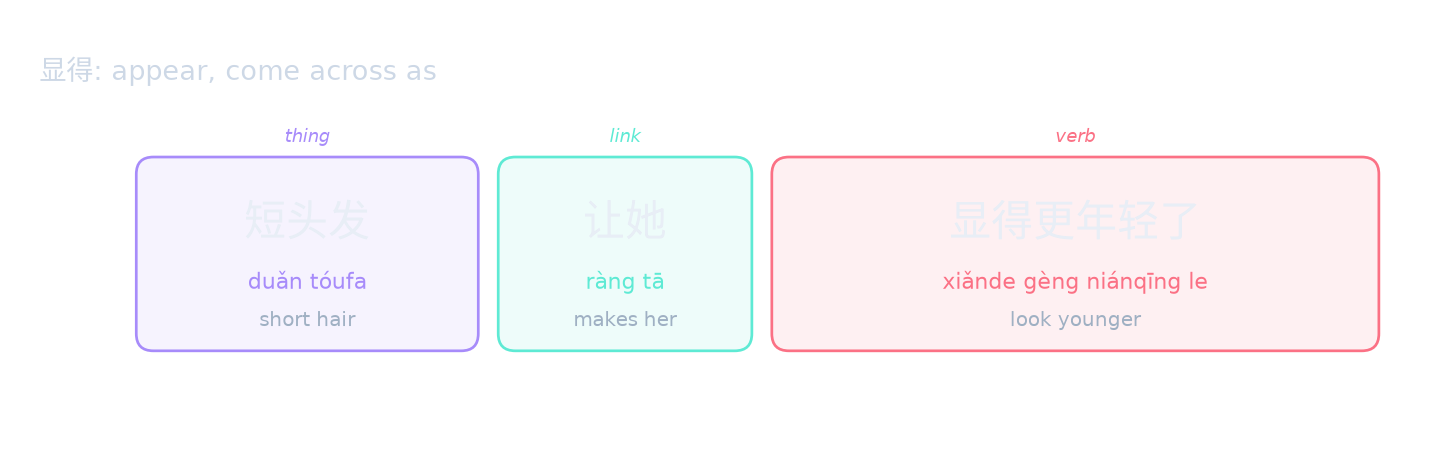
- short短hair (on the head)头发to let / make让she / her她to seem显得more更young年轻(completed / change)了。 — "Short hair makes her look younger."
to seem显得 + description = come across as, appear (in effect)
- to seem显得 says how something comes across, often because of a cause or comparison: to seem显得更大, to seem显得degree / adjective linker很nervous紧张.
- It often follows to let / make让 / to make使 or a cause: white白色to let / make让room房间to seem显得更大.
white白色makes让the room房间appear显得more更spacious大。
seemingly看起来 = looks (a direct impression)
- seemingly看起来 reports your direct impression: she / her她seemingly看起来degree / adjective linker很happy高兴.
- to seem显得 adds that something (a colour, a situation, a contrast) produces this effect.
she她looks看起来very很happy高兴。
Effect versus impression
- Use to seem显得 when a cause or contrast produces the look: at / in在crowd人群to hit (the mark)中to seem显得很矮 — "looks short in the crowd".
- to seem显得 takes a description, not an object: she / her她to seem显得degree / adjective linker很young年轻, not to seem显得she / her她young年轻.
In context and contrast
- at / in在一群adult大人the middle中间,he / him他to seem显得unusual特别small小。 — "Among a group of adults, he seems especially small."
- he / him他seemingly看起来很小 just reports your impression.
among在adults大人(middle)中间,he他seems显得especially特别small小。
Recap
- to seem显得 = comes across as, because of a cause or contrast (to let / make让room房间to seem显得更大).
- seemingly看起来 = looks (direct impression).
Practise this pattern step by step.
Practice without the models
seemingly看起来 vs apparently看来 (looks vs it seems)
2901.1 The ground is wet: “It seems it rained.” on the ground地上moist湿(completed / change)了,…………下过(literary) to rain雨。
2901.2 “This dish looks delicious.” Which fits?
- A. at / in在this这个vegetable菜apparently看来degree / adjective linker很to be fond of eating好吃。
- B. apparently看来this这个vegetable菜degree / adjective linker很to be fond of eating好吃。
- C. this这个vegetable菜seemingly看起来degree / adjective linker很to be fond of eating好吃。
- D. this这个vegetable菜degree / adjective linker很to be fond of eating好吃apparently看来。
2901.3 Build: “In my view, this plan isn't realistic.”
Arrange all chunks: this这个plan计划 / , / 不太reality现实。 / in my opinion在我看来
2901.4 seemingly看起来 describes what you see directly.
True or false? Explain or repair the statement.
2901.5 Your colleague looks pale, and he hasn't touched his lunch. Close the examples. Say a Mandarin response, then write it in Chinese. Explain briefly in English what the lesson’s pattern adds. Compare with the model, then change one detail and try again.
Write or say your own response before reading the key.
to seem显得 vs seemingly看起来 (comes across as vs looks)
2902.1 Complete: “The white walls make the room look bigger.” white白色(modifier / structural particle)的wall墙to let / make让room房间…………更大。
2902.2 Which stresses contrast? “Among the adults, he seems especially small.”
- A. at / in在adult大人the middle中间,he / him他to seem显得unusual特别small小。
- B. apparently看来he / him他很小。
- C. he / him他variant of 吃吃(after a verb) indicating…起来很小。
- D. he / him他seemingly看起来很小。
2902.3 Build: “Short hair makes her look younger.”
Arrange all chunks: short短hair (on the head)头发 / more更young年轻(completed / change)了。 / to let / make让she / her她 / to seem显得
2902.4 seemingly看起来 simply reports a direct impression.
True or false? Explain or repair the statement.
2902.5 Your friend got a short haircut and now everyone says she looks different. Close the examples. Say a Mandarin response, then write it in Chinese. Explain briefly in English what the lesson’s pattern adds. Compare with the model, then change one detail and try again.
Write or say your own response before reading the key.
Answers and explanations
seemingly看起来 vs apparently看来 (looks vs it seems)
2901.1 apparently看来
A conclusion from evidence takes apparently看来.
2901.2 C. this这个vegetable菜seemingly看起来degree / adjective linker很to be fond of eating好吃。
seemingly看起来 describes how something looks: this这个vegetable菜seemingly看起来degree / adjective linker很to be fond of eating好吃. apparently看来 is a judgement from evidence and starts the sentence (apparently看来he / him他not不to come来(completed / change)了), so it does not describe appearance.
2901.3 in my opinion在我看来,this这个plan计划不太reality现实。
at / in在…apparently看来 + opinion.
2901.4 True.
apparently看来 draws a conclusion instead.
2901.5 One possible response: he / him他seemingly看起来很累,apparently看来yesterday evening昨晚again又to work overtime加班(completed / change)了。
Check meaning and form:
- My response conveys a message that fits the opening situation.
- I can explain the meaning of the pattern, rather than only naming it.
- seemingly看起来 follows the subject and comes before a description: he / him他seemingly看起来很累.
- apparently看来 starts a clause before a conclusion: apparently看来he / him他degree / adjective linker很rope累. Not he / him他apparently看来degree / adjective linker很young年轻 for "he looks young".
- I tried a second response with a name, time, place, or description changed.
This is supported productive practice. Compare meaning and structure; your answer need not copy the model. A partner or teacher must hear the spoken response to comment on pronunciation.
to seem显得 vs seemingly看起来 (comes across as vs looks)
2902.1 to seem显得
A cause producing an effect: to seem显得.
2902.2 A. at / in在adult大人the middle中间,he / him他to seem显得unusual特别small小。
to seem显得 fits an effect produced by contrast.
2902.3 short短hair (on the head)头发to let / make让she / her她to seem显得more更young年轻(completed / change)了。
Cause + to let / make让 + person + to seem显得 + description.
2902.4 True.
to seem显得 adds a cause or contrast.
2902.5 One possible response: short短hair (on the head)头发to let / make让she / her她to seem显得more更young年轻(completed / change)了。
Check meaning and form:
- My response conveys a message that fits the opening situation.
- I can explain the meaning of the pattern, rather than only naming it.
- Use to seem显得 when a cause or contrast produces the look: at / in在crowd人群to hit (the mark)中to seem显得很矮 – "looks short in the crowd".
- to seem显得 takes a description, not an object: she / her她to seem显得degree / adjective linker很young年轻, not to seem显得she / her她young年轻.
- I tried a second response with a name, time, place, or description changed.
This is supported productive practice. Compare meaning and structure; your answer need not copy the model. A partner or teacher must hear the spoken response to comment on pronunciation.