Nouns and frames that place things in a group or in time. among / in the middle当中 means "among"; each other彼此 means "each other"; ……since以来 means "ever since"; to work as当……(modifier / structural particle)的time; when时候 means "when"; Noun + this这个 + category sizes something up (he / him他this这个person人degree / adjective linker很cordial热情); a certain某 means "a certain" (not named); and the rest其余 means "the rest" of a group.
名词
HSK 5 · 知识点 5
3:21
HSK 5 语法 5:名词与时间框架
当中:在……之中,或在中间。“当中”指某人或某物处于群体、地点或过程内部,意为“在……之中”、“在中心”、“在……活动过程中”……
英文讲解与普通话例句 · 字幕与原声同步
5.1
一目了然
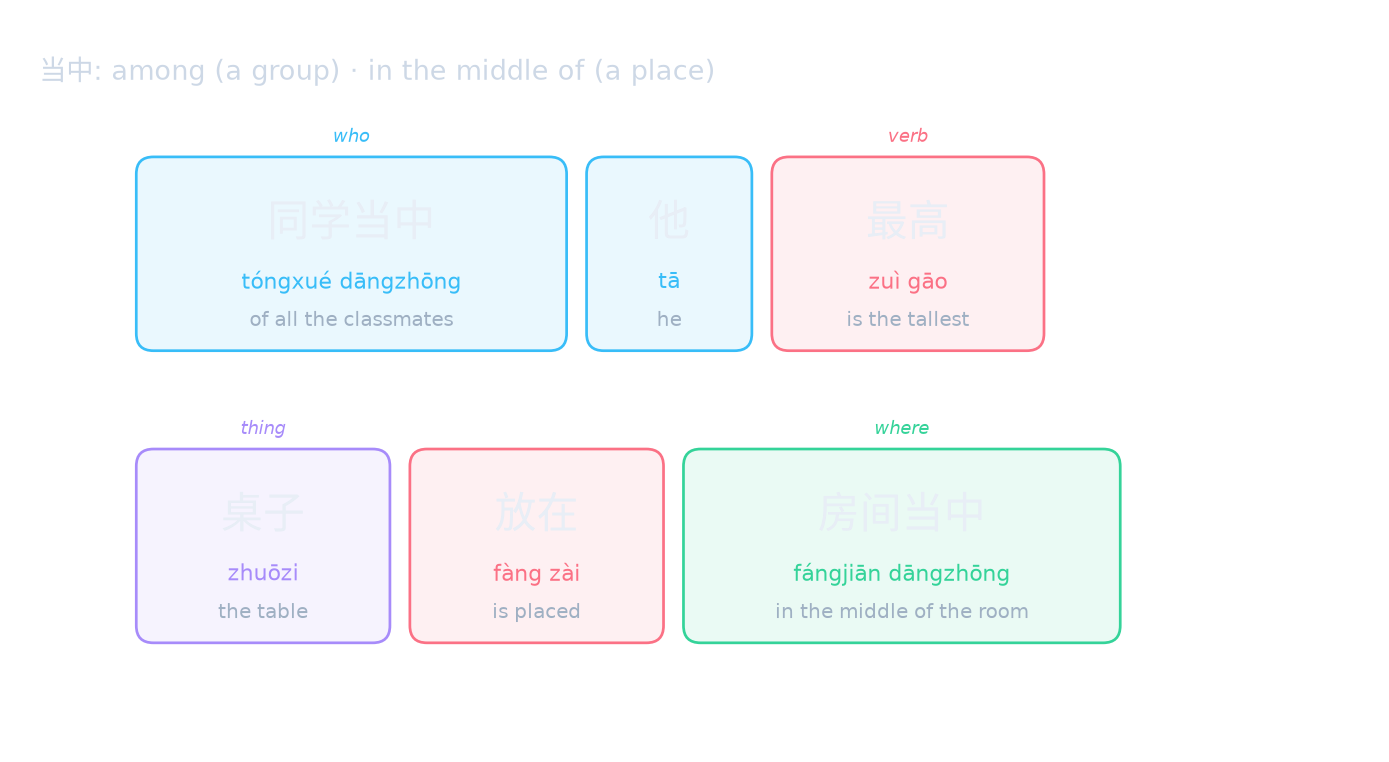
- 1. among / in the middle当中 – among / in the middle of: classmate同学among / in the middle当中,he / him他tallest最高。
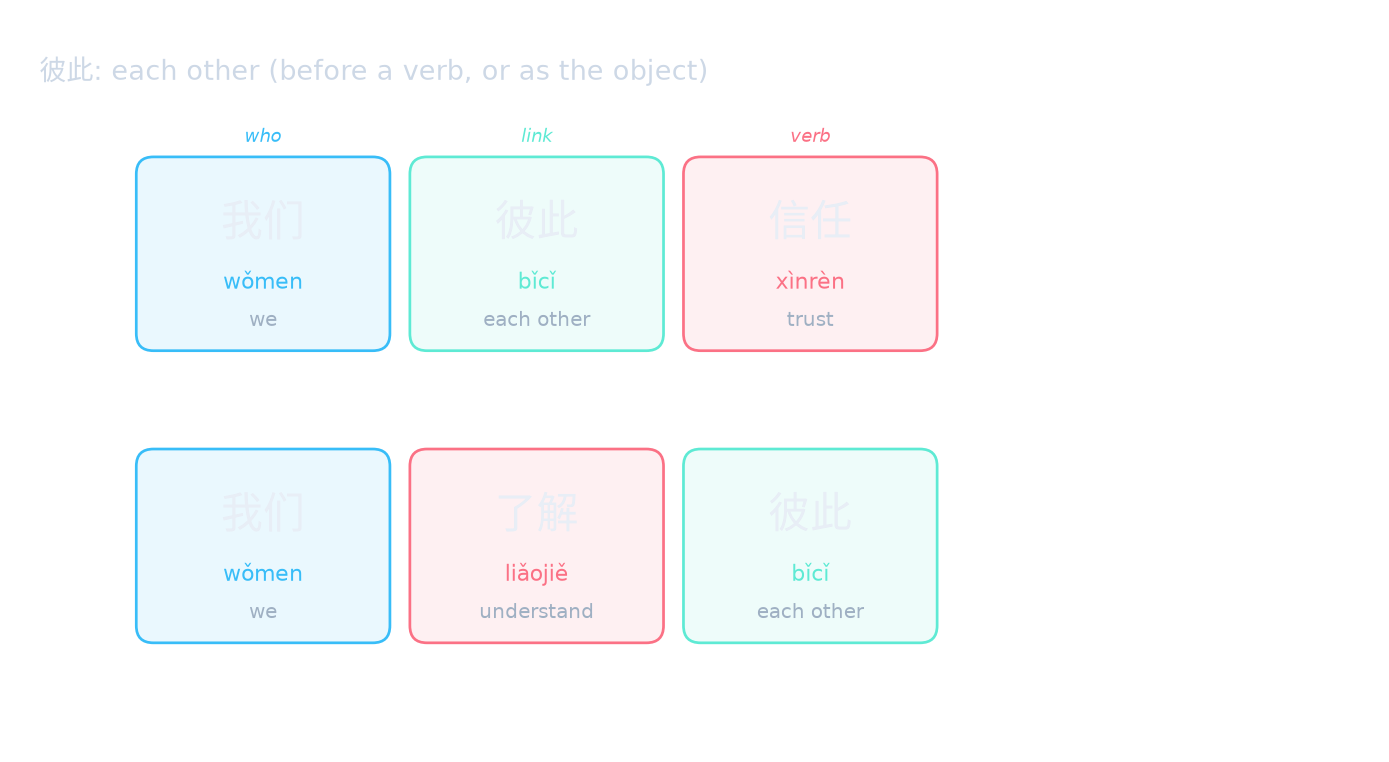
- 2. each other彼此 – each other / one another: we / us我们each other彼此to trust信任。
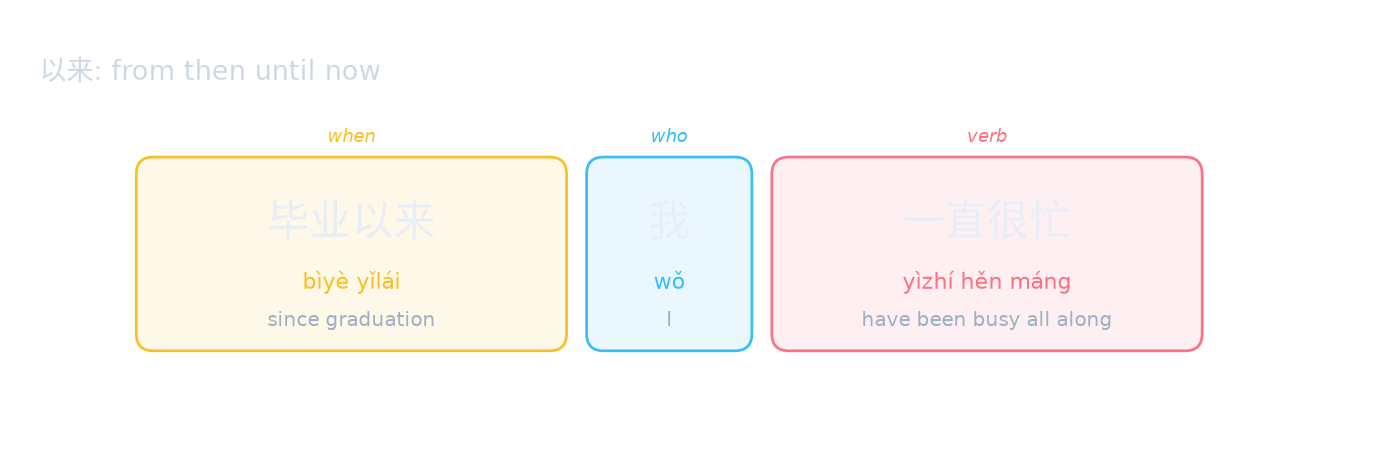
- 3. … since以来 – ever since: to graduate毕业since以来,I / me我all along / straight一直degree / adjective linker很busy忙。
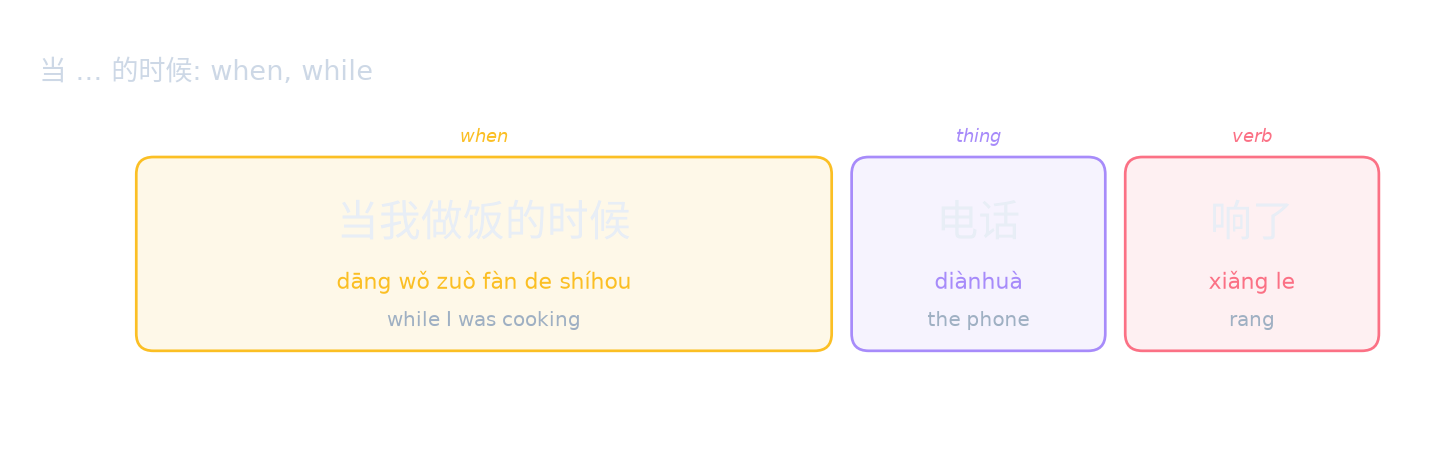
- 4. to work as当 … (modifier / structural particle)的time; when时候 – when …: to work as当I / me我to prepare a meal做饭(modifier / structural particle)的time; when时候,电话响(completed / change)了。
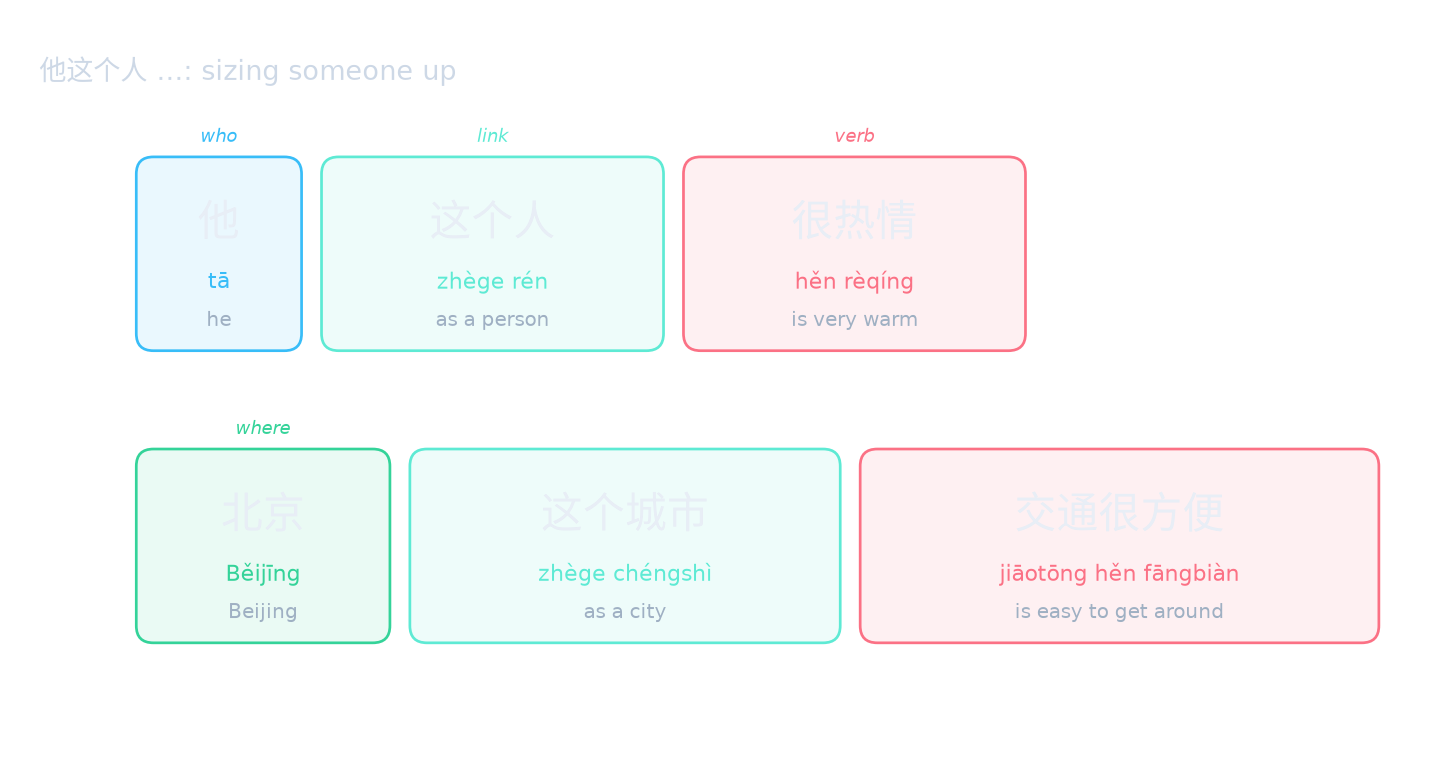
- 5. Noun + this这个 + Category – sizing up: he / him他this这个person人degree / adjective linker很cordial热情。
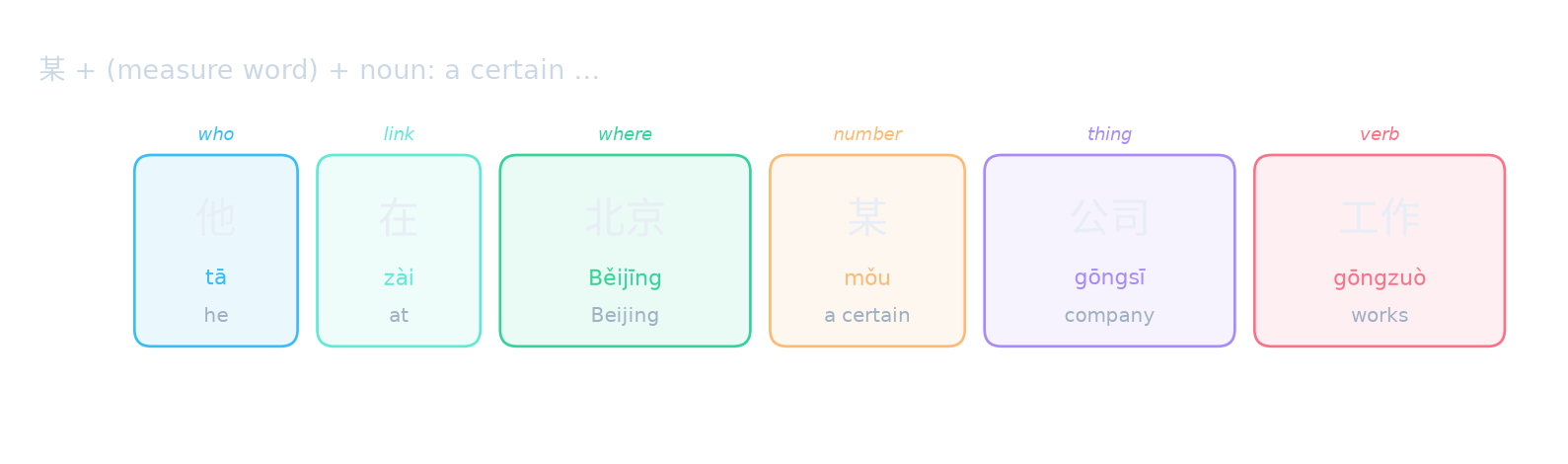
- 6. a certain某 – a certain …: he / him他at / in在Beijing北京a certain某company公司to work; job工作。
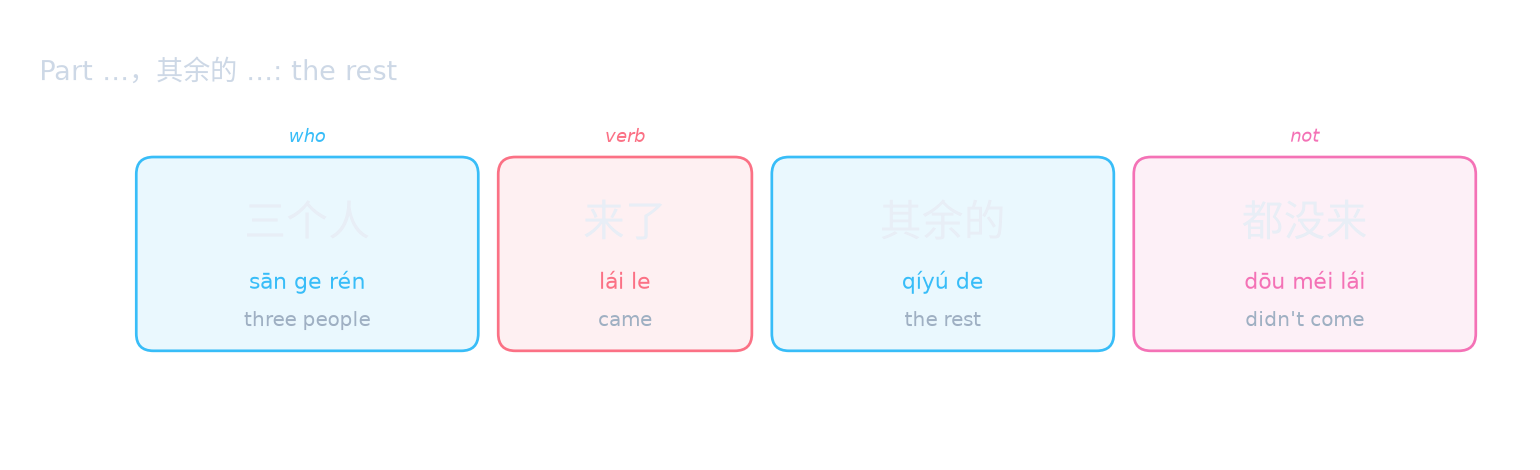
- 7. the rest其余 vs other其他 and else别的 – the rest / other: 只来(completed / change)了三个person人,the rest其余(modifier / structural particle)的all / both都not / haven't没to come来。
5.2
1. 当中(在……之中)
Form: (at / in在) + group + among / in the middle当中,comment · place + among / in the middle当中 (the middle)
- classmate同学among / in the middle当中,he / him他tallest最高。 Tóngxué dāngzhōng, tā zuì gāo. – Of all the classmates, he's the tallest.
- at / in在these这些student学生among / in the middle当中,she / her她most最to have / there is有experience (know-how)经验。 – Among these students, she has the most experience.
- these这些student学生among / in the middle当中,to have / there is有三个人会to swim游泳。 – Three of these students can swim.
- table桌子放在room房间among / in the middle当中。 – The table is in the middle of the room.
How it works. Group + among / in the middle当中 dāngzhōng sets the frame for the statement: the comment is true within that group. With a place, among / in the middle当中 means the physical middle.
Keep the scope. classmate同学among / in the middle当中,he / him他tallest最高 ranks him among the classmates being discussed; a pupil in another class could be taller. this这四个to design设计among / in the middle当中,Bmost最cheap便宜 is about those four designs only; when a new design joins, check again.
The frame doesn't make the comment true of every member: to have / there is有三个人会to swim游泳 is about three of them. he / him他tallest最高 ranks (most最); he / him他degree / adjective linker很tall; high高 just describes.

| 汉字 | 拼音 | English |
|---|---|---|
| 设计 | shè jì | to design |
5.3
2. 彼此(相互)
Form: participants + each other彼此 + verb · verb + each other彼此 (object) · you and me both彼此彼此 (same here)
- we / us我们each other彼此to trust信任。 / we / us我们each other互相to trust信任。 Wǒmen bǐcǐ xìnrèn. – We trust each other.
- we / us我们to understand了解each other彼此。 – We understand each other.
- they他们each other彼此to remind提醒。 – They remind each other.
- A: I / me我(modifier / structural particle)的Chinese character字to write写(degree marker)得degree / adjective linker很messy乱。 B: you and me both彼此彼此。 – "My handwriting is messy." "Same here."
How it works. each other彼此 bǐcǐ "each other" describes a relationship in both directions. Before a verb it overlaps with each other互相. Unlike each other互相, it can also be the object: to understand了解each other彼此 (with each other互相, say we / us我们each other互相to understand了解). As a reply, you and me both彼此彼此 acknowledges a shared situation.
| we / us我们each other彼此to understand了解 | we / us我们all / both都to understand了解teacher老师 | I / me我to trust信任she / her她,she / her她not不to trust信任I / me我 |
|---|---|---|
| we understand one another | each of us understands the teacher | one-way |
Watch out
- Check the participants first: joining the same team doesn't prove mutual trust.
- Mutual is not equal: they他们each other彼此to help帮助 doesn't mean each spent the same time.

| 汉字 | 拼音 | English |
|---|---|---|
| 彼此 | bǐ cǐ | each other |
5.4
3. … 以来(从某时起一直到现在)
Form: event / date / duration + since以来,comment
- to graduate毕业since以来,I / me我all along / straight一直degree / adjective linker很busy忙。 Bìyè yǐlái, wǒ yìzhí hěn máng. – I've been busy ever since I graduated.
- to graduate毕业since以来,I / me我to return / (times)回school学校three times三次(completed / change)了。 – Since graduating, I've been back to school three times.
- this这个month月since以来,我读(completed / change)了两本书。 – So far this month, I've read two books.
- 三年since以来 – over the past three years
How it works. since以来 yǐlái goes after the starting point and frames a period from then up to the reference point (usually now). The rest of the sentence says what happened in it: a continuing state (all along / straight一直degree / adjective linker很busy忙) or counted events (three times三次). since以来 itself gives no frequency.
| to graduate毕业since以来 | to graduate毕业after / from now on以后 | to graduate毕业before以前 |
|---|---|---|
| period since graduation, up to now | at some point after | before graduation |
| to return / (times)回school学校three times三次(completed / change)了 | I / me我to move搬to / arrive / (result: get)到(completed / change)了Shanghai municipality…上海 |
Watch out
- A dated text has its own "now": a 2024 report saying 2020year年since以来,school学校to open; to drive开(completed / change)了Sanmen county in Taizhou…三门新课 counts up to 2024. Check later events before repeating the count.

| 汉字 | 拼音 | English |
|---|---|---|
| 以来 | yǐ lái | since |
5.5
4. 当 … 的时候(在……时)
Form: to work as当 + clause + (modifier / structural particle)的time; when时候,main clause
- to work as当I / me我to return home回家(modifier / structural particle)的time; when时候,to get dark天黑(completed / change)了。 Dāng wǒ huí jiā de shíhou, tiān hēi le. – When I got home, it was dark.
- to work as当I / me我to prepare a meal做饭(modifier / structural particle)的time; when时候,电话响(completed / change)了。 – While I was cooking, the phone rang.
- to work as当you你to need需要to help帮助(modifier / structural particle)的time; when时候,to / for / give给I / me我to make a telephone call打电话。 – Call me when you need help.
How it works. to work as当……(modifier / structural particle)的time; when时候 frames when the main event happens. The actions decide whether the frame is an interval (to prepare a meal做饭: the call came during it) or a moment (to get home到家). It works for the past, the future and recurring situations; it is not a past-tense marker. Shorter forms also exist: I / me我to return home回家(modifier / structural particle)的time; when时候.
| to work as当I / me我to prepare a meal做饭(modifier / structural particle)的time; when时候,电话响(completed / change)了 | I / me我to do; to make做完饭after / from now on以后,电话响(completed / change)了 |
|---|---|
| during cooking | after cooking |
Watch out
- A time frame is not a cause: to work as当I / me我to / arrive / (result: get)到home / family / (measure: shops)家(modifier / structural particle)的time; when时候,to rain下雨(completed / change)了 doesn't mean arriving caused the rain, or say who phoned.

5.6
5. 名词 + 这个 + 类别(表示评价)
Form: person / name + this这个 + category (person人, city城市 …) + comment
- he / him他this这个person人degree / adjective linker很cordial热情。 Tā zhège rén hěn rèqíng. – He's a really warm person.
- he / him他this这个person人slightly有点儿careless粗心。 – He's a bit careless, as a person.
- Beijing北京this这个城市交通degree / adjective linker很convenient方便。 – Getting around Beijing is very convenient.
How it works. this这个 + category frames the topic "as a person / as a city" for the comment that follows. The comment decides whether it is praise or criticism; the frame itself doesn't. he / him他degree / adjective linker很cordial热情 is also correct; the frame puts the person in focus. Choose a category that fits; don't add this这个 before every noun.
| he / him他this这个person人degree / adjective linker很cordial热情 | this这个person人to be / is是I / me我(modifier / structural particle)的teacher老师 | this这个……I / me我still / also / even还not / haven't没to decide / decision决定 |
|---|---|---|
| frames him for a comment | simply identifies "this person" | spoken hesitation, "um …" |
Watch out
- The comment covers only what it says: traffic; transport交通degree / adjective linker很convenient方便 is about transport, not every part of life there.

5.7
6. 某 (a certain …)
Form: a certain某 + (measure word) + noun · surname + a certain某
- he / him他at / in在Beijing北京a certain某company公司to work; job工作。 Tā zài Běijīng mǒu gōngsī gōngzuò. – He works at a certain company in Beijing.
- due to由于某种原因,meeting会议to postpone推迟(completed / change)了。 – For some reason, the meeting was postponed.
- to have / there is有一天I / me我at / in在on the road路上to run into遇到(completed / change)了he / him他。 – One day I ran into him on the street. (spoken)
How it works. a certain某 refers to a person, place or time without naming it; it is written (news, notices). Surname + a certain某 hides a full name. In speech, 一个 / to have / there is有一天. to have / there is有(modifier / structural particle)的 = some of a group.
| someone某人 | 某种原因 | 王某 |
|---|---|---|
| someone | some reason | a person surnamed Wang |
Watch out
- In speech, to have / there is有一天 sounds more natural than a certain某day天.

| 汉字 | 拼音 | English |
|---|---|---|
| 某 | mǒu | a certain |
5.8
7. 其余 vs 其他 and 别的 (the rest / other)
Form: part …,the rest其余((modifier / structural particle)的) (all / both都) … · other其他 + noun
- 只来(completed / change)了三个person人,the rest其余(modifier / structural particle)的all / both都not / haven't没to come来。 Zhǐ lái le sān ge rén, qíyú de dōu méi lái. – Only three people came; the rest didn't.
- these这些book书I / me我to look at; to watch; to read看(completed / change)了两本,the rest其余(modifier / structural particle)的still / also / even还not / haven't没to look at; to watch; to read看。 – I've read two of these books; I haven't read the rest yet.
- also / there is still还有other其他question / problem问题(yes/no ?)吗? – Are there any other questions?
How it works. the rest其余 = all that's left after a part is named, often with all / both都. other其他 = other (a bit formal); else别的 = other (everyday).
| the rest其余(modifier / structural particle)的all / both都not / haven't没to come来 | other其他question / problem问题 | else别的 |
|---|---|---|
| the rest didn't come | other questions | something else |
Watch out
- For "any other …" in a question, use other其他 or else别的.

| 汉字 | 拼音 | English |
|---|---|---|
| 其余 | qí yú | the rest |
5.9
练习
Cover the teaching pages before you answer. The answers are at the end.
1. among / in the middle当中 (among / in the middle of)
1. Of all the classmates, she is the tallest. classmate同学 …………,she / her她tallest最高。
2. this这四个to design设计among / in the middle当中,Bmost最cheap便宜 compares B with…
- A. every design in the world
- B. the four designs being discussed
- C. one other design
- D. nothing
3. Which sentence uses among / in the middle当中 for a physical middle?
- A. classmate同学among / in the middle当中he / him他tallest最高。
- B. these这些book书among / in the middle当中I / me我most最to like喜欢这本。
- C. student学生among / in the middle当中to have / there is有三个人会to swim游泳。
- D. table桌子放在room房间among / in the middle当中。
4. True or false? these这些student学生among / in the middle当中,to have / there is有三个人会to swim游泳 means all these students can swim. If false, correct it.
5. Say in Chinese: "Among these students, she has the most experience."
6. Of these three books, I like this one best.
Put in order: I / me我 / among / in the middle当中, / most最to like喜欢 / 这本。 / 这三本书
2. each other彼此 (each other / one another)
7. We trust each other. we / us我们 ………… to trust信任。
8. Which sentence uses each other彼此 as an object?
- A. we / us我们each other互相each other彼此。
- B. each other彼此we / us我们to understand了解。
- C. we / us我们each other彼此to help帮助。
- D. we / us我们should应该to understand了解each other彼此。
9. A: I / me我(modifier / structural particle)的Chinese character字to write写(degree marker)得degree / adjective linker很messy乱。 B: you and me both彼此彼此。 What does B mean?
- A. Mine is too, same here.
- B. You're right, it's messy.
- C. Thank you.
- D. Let's write together.
10. True or false? they他们each other彼此to help帮助 means they each spent the same amount of time helping. If false, correct it.
11. Correct the mistake: we / us我们should应该to understand了解each other互相。
12. They remind each other.
Put in order: each other彼此 / to remind提醒。 / they他们
3. … since以来 (ever since)
13. I've been busy ever since I graduated. to graduate毕业 …………,I / me我all along / straight一直degree / adjective linker很busy忙。
14. Which means "Since graduating, I've been back to school three times"?
- A. to graduate毕业before以前,I / me我to return / (times)回school学校three times三次(completed / change)了。
- B. to graduate毕业after / from now on以后three times三次,I / me我to return / (times)回school学校。
- C. to graduate毕业since以来,I / me我to return / (times)回school学校three times三次(completed / change)了。
- D. since以来to graduate毕业,I / me我to return / (times)回school学校three times三次(completed / change)了。
15. Where does since以来 go?
- A. before the starting point: since以来三年
- B. after the verb
- C. after the starting point: 三年since以来
- D. at the end of the sentence
16. True or false? to graduate毕业since以来 and to graduate毕业after / from now on以后 mean exactly the same. If false, correct it.
17. Say in Chinese: "So far this month, I've read two books."
18. True or false? A 2024 report says 2020year年since以来,school学校to open; to drive开(completed / change)了Sanmen county in Taizhou…三门新课. The count runs up to 2024. If false, correct it.
4. to work as当 … (modifier / structural particle)的time; when时候 (when …)
19. Call me when you need help. ………… you你to need需要to help帮助(modifier / structural particle)的time; when时候,to / for / give给I / me我to make a telephone call打电话。
20. to work as当I / me我to prepare a meal做饭(modifier / structural particle)的time; when时候,电话响(completed / change)了 means the phone rang…
- A. because I was cooking
- B. after cooking
- C. while I was cooking
- D. before cooking
21. Which says "after I finished cooking"?
- A. to work as当I / me我to prepare a meal做饭(modifier / structural particle)的time; when时候
- B. I / me我to do; to make做完饭after / from now on以后
- C. I / me我to prepare a meal做饭to work as当time; when时候
- D. to work as当I / me我to prepare a meal做饭
22. True or false? to work as当……(modifier / structural particle)的time; when时候 can only be used for the past. If false, correct it.
23. Correct the mistake: to work as当I / me我to return home回家,to get dark天黑(completed / change)了。
24. When I got home, it was dark.
Put in order: to get dark天黑(completed / change)了。 / I / me我 / (modifier / structural particle)的time; when时候, / to return home回家 / to work as当
5. Noun + this这个 + Category (sizing up)
25. He's a really warm person. he / him他 ………… person人degree / adjective linker很cordial热情。
26. Which sentence frames a city for a comment?
- A. Beijing北京this这个城市交通degree / adjective linker很convenient方便。
- B. this这个city城市to be / is是Beijing北京。
- C. this这个Beijing北京city城市。
- D. Beijing北京city城市this这个degree / adjective linker很convenient方便。
27. he / him他this这个person人slightly有点儿careless粗心 is…
- A. a hesitation
- B. criticism
- C. an introduction
- D. praise
28. True or false? In this这个person人to be / is是I / me我(modifier / structural particle)的teacher老师, this这个 frames a comment about his character. If false, correct it.
29. Say in Chinese: "She's a very patient person."
30. My brother, as a person, is very funny.
Put in order: this这个person人 / I / me我older brother哥哥 / interesting有意思。 / degree / adjective linker很
6. a certain某 (a certain …)
31. Complete (a news story): “He works at a certain company in Beijing.” he / him他at / in在Beijing北京…………company公司to work; job工作。
32. Telling a friend a story – which is more colloquial?
- A. a certain某day天I / me我at / in在on the road路上to run into遇到(completed / change)了he / him他。
- B. to have / there is有一天I / me我at / in在on the road路上to run into遇到(completed / change)了he / him他。
33. In a news report, 王某 means …
- A. a person surnamed Wang (full name hidden)
- B. all people called Wang
34. Build: “For some reason, the meeting was postponed.”
Put in order: 某种原因, / due to由于 / to postpone推迟(completed / change)了。 / meeting会议
35. True or false? to have / there is有(modifier / structural particle)的 means "some (of a group)", as in to have / there is有(modifier / structural particle)的person人to like喜欢,to have / there is有(modifier / structural particle)的person人not不to like喜欢. If false, correct it.
36. Write a two-sentence school notice that doesn't name the student who found something. Use a certain某 at least once, and say clearly where to collect it. Write your answer in Chinese, then say it aloud.
7. the rest其余 vs other其他 and else别的 (the rest / other)
37. Complete: “Only three people came; the rest didn't.” 只来(completed / change)了三个person人,…………(modifier / structural particle)的all / both都not / haven't没to come来。
38. At the end of a talk – “Are there any other questions?” Which is right?
- A. also / there is still还有the rest其余question / problem问题(yes/no ?)吗?
- B. also / there is still还有other其他question / problem问题(yes/no ?)吗?
39. Chatting at dinner – “Do you want to eat anything else?” Which is most natural?
- A. you你still / also / even还want / think / miss想to eat吃the rest其余(yes/no ?)吗?
- B. you你still / also / even还want / think / miss想to eat吃else别的(yes/no ?)吗?
40. Build: “I've read two of these books; I haven't read the rest yet.”
Put in order: the rest其余(modifier / structural particle)的 / still / also / even还 / not / haven't没to look at; to watch; to read看。 / these这些book书I / me我to look at; to watch; to read看(completed / change)了两本,
41. True or false? the rest其余 often goes with all / both都, because it covers everything that remains. If false, correct it.
42. Report on your class's homework in two sentences: how many finished, and what the rest did (the rest其余). Then ask if there are other questions (other其他). Use the rest其余 or other其他 and else别的. Write your answer in Chinese, then say it aloud.
5.10
混合练习
These questions mix the patterns and use new situations.
43. Choose among / in the middle当中 or since以来: we / us我们class班…………,he / him他to run跑(degree marker)得最快。 / (of a student) to start…开学…………,I / me我all along / straight一直degree / adjective linker很busy忙。
44. Say "We have known each other for ten years."
45. Find and fix the problem. A report says ever since自从(of a student) to start…开学since以来,he / him他every day每天to review复习. A classmate thinks the reviewing stopped when term started. Correct the timeline.
46. Use it yourself. Describe one change since you moved, and pick out one person from a group with among / in the middle当中.
5.11
答案与解析
Mark your work, then correct each mistake in your own words.
1. among / in the middle当中 (among / in the middle of)
1. among / in the middle当中
Group + among / in the middle当中 sets the frame.
2. B. the four designs being discussed
The comment holds within the named group.
3. D. table桌子放在room房间among / in the middle当中。
Place + among / in the middle当中 = the middle of it.
4. False.
Only three of them can.
5. at / in在these这些student学生among / in the middle当中,she / her她most最to have / there is有experience (know-how)经验。
at / in在 + group + among / in the middle当中, then the comment.
6. 这三本书among / in the middle当中,I / me我most最to like喜欢这本。
Group + among / in the middle当中 first.
2. each other彼此 (each other / one another)
7. each other彼此 / each other互相
each other彼此 before a verb overlaps with each other互相.
8. D. we / us我们should应该to understand了解each other彼此。
each other彼此 can be the object; each other互相 can't.
9. A. Mine is too, same here.
you and me both彼此彼此 = same here.
10. False.
Mutual doesn't mean equal.
11. we / us我们should应该each other互相to understand了解。 / we / us我们should应该to understand了解each other彼此。
each other互相 must go before the verb.
12. they他们each other彼此to remind提醒。
Participants + each other彼此 + verb.
3. … since以来 (ever since)
13. since以来
Starting point + since以来: from then until now.
14. C. to graduate毕业since以来,I / me我to return / (times)回school学校three times三次(completed / change)了。
since以来 frames the period; the predicate gives the count.
15. C. after the starting point: 三年since以来
since以来 follows the event, date or duration.
16. False.
since以来 covers the period up to now; after / from now on以后 is just a point after.
17. this这个month月since以来,我读(completed / change)了两本书。
Period + since以来, then what happened in it.
18. True.
A dated text counts up to its own date.
4. to work as当 … (modifier / structural particle)的time; when时候 (when …)
19. to work as当
to work as当……(modifier / structural particle)的time; when时候 frames the time.
20. C. while I was cooking
to work as当……(modifier / structural particle)的time; when时候 = when / while.
21. B. I / me我to do; to make做完饭after / from now on以后
"After" needs after / from now on以后, not to work as当……(modifier / structural particle)的time; when时候.
22. False.
It works for the past, the future and habits.
23. to work as当I / me我to return home回家(modifier / structural particle)的time; when时候,to get dark天黑(completed / change)了。
to work as当 is completed by (modifier / structural particle)的time; when时候.
24. to work as当I / me我to return home回家(modifier / structural particle)的time; when时候,to get dark天黑(completed / change)了。
to work as当 + clause + (modifier / structural particle)的time; when时候, then the main clause.
5. Noun + this这个 + Category (sizing up)
25. this这个
Person + this这个 + category, then the comment.
26. A. Beijing北京this这个城市交通degree / adjective linker很convenient方便。
Name + this这个 + category + comment.
27. B. criticism
The comment decides: careless粗心 is a criticism.
28. False.
It simply identifies "this person".
29. she / her她this这个person人degree / adjective linker很to have / there is有patient; patience耐心。
Person + this这个person人 + comment.
30. I / me我older brother哥哥this这个person人degree / adjective linker很interesting有意思。
The frame comes before the comment.
6. a certain某 (a certain …)
31. a certain某
Not named – a certain某.
32. B. to have / there is有一天I / me我at / in在on the road路上to run into遇到(completed / change)了he / him他。
In speech, to have / there is有一天 is more usual; a certain某day天 sounds more written.
33. A. a person surnamed Wang (full name hidden)
Surname + a certain某 hides the full name.
34. due to由于某种原因,meeting会议to postpone推迟(completed / change)了。
some kind (of)某种 + noun.
35. True.
to have / there is有(modifier / structural particle)的 divides a group.
36. Model answer: 昨天下午,某班一名classmate同学at / in在操场上to pick up捡to / arrive / (result: get)到(completed / change)了一个purse钱包。to lose丢失purse钱包(modifier / structural particle)的classmate同学please; to invite请to / arrive / (result: get)到school学校lost-and-found失物招领place处to receive领取。
Check your answer:
- a certain某 hides a name that doesn't need to be given; the place to collect it is clear.
- The style fits a notice.
- I read it aloud before comparing with the model.
Your answer need not copy the model.
7. the rest其余 vs other其他 and else别的 (the rest / other)
37. the rest其余
Everyone left after the part named – the rest其余.
38. B. also / there is still还有other其他question / problem问题(yes/no ?)吗?
Any other … in a question – other其他.
39. B. you你still / also / even还want / think / miss想to eat吃else别的(yes/no ?)吗?
Everyday "else / other" – else别的.
40. these这些book书I / me我to look at; to watch; to read看(completed / change)了两本,the rest其余(modifier / structural particle)的still / also / even还not / haven't没to look at; to watch; to read看。
Part named, then the rest其余(modifier / structural particle)的.
41. True.
the rest其余(modifier / structural particle)的all / both都not / haven't没to come来.
42. Model answer: we / us我们class班三十个person人,二十五个person人on time按时交了school assignment作业,the rest其余(modifier / structural particle)的to speak说tomorrow明天to hand in; to make (friends)交。everyone大家also / there is still还有other其他question / problem问题(yes/no ?)吗?
Check your answer:
- the rest其余 comes after a part is named.
- other其他 is used for "other" in the question.
- I said it aloud before comparing with the model.
Your answer need not copy the model. A partner or teacher must hear the spoken response to comment on pronunciation.
Mixed practice
43. we / us我们class班among / in the middle当中,he / him他to run跑(degree marker)得最快 (among)。(of a student) to start…开学since以来,I / me我all along / straight一直degree / adjective linker很busy忙 (ever since).
44. we / us我们each other彼此to know (a person); to recognise认识十年(completed / change)了。each other彼此 = each other.
45. ever since自从……since以来 marks a starting point that runs until now: since term started, he has reviewed every day.
46. Model answer. to move house搬家since以来,I / me我every day每天to walk走路to go to school上学。we / us我们class班among / in the middle当中,she / her她(modifier / structural particle)的Chinese language中文had better; best最好。
Review later. Tomorrow, describe someone with Noun + this这个 + person人: he / him他this这个person人……
该知识点的互动课程
逐步完成,配合即时检查练习。