跳到主要内容

波、声音与物理光学

AP 物理 2 · 第 14 主题

训练
讲义 词汇表
14.1

波脉冲与波的性质

大纲
Learning ObjectiveEssential Knowledge

14.1.A
Describe the physical properties of waves and wave pulses.

  • 14.1.A.1 Waves transfer energy between two locations without transferring matter between those locations.
    • 14.1.A.1.i A wave pulse is a single disturbance that transfers energy without transferring matter between two locations.
    • 14.1.A.1.ii A wave is modeled as a continuous, periodic disturbance with well-defined wavelength and frequency.
  • 14.1.A.2 Mechanical waves or wave pulses require a medium in which to propagate. Electromagnetic waves or wave pulses do not require a medium in which to propagate.
  • 14.1.A.3 The speed at which a wave or wave pulse propagates through a medium depends on the type of wave and the properties of the medium.
    • 14.1.A.3.i The speed of all electromagnetic waves in a vacuum is a universal physical constant, $c = 3.00 \times 10^{8}$ m/s.
    • 14.1.A.3.ii The speed at which a wave pulse or wave propagates along a string is dependent upon the tension in the string, $F_T$, and the mass per length of the string.
      • Equation: $v_{\text{string}} = \sqrt{\dfrac{F_T}{m/\ell}}$
    • 14.1.A.3.iii In a given medium, the speed of sound waves increases with the temperature of the medium.
  • 14.1.A.4 In a transverse wave, the direction of the disturbance is perpendicular to the direction of propagation of the wave.
  • 14.1.A.5 In a longitudinal wave, the direction of the disturbance is parallel to the direction of propagation of the wave.
    • 14.1.A.5.i Sound waves are modeled as mechanical longitudinal waves.
    • 14.1.A.5.ii The regions of high and low pressure in a sound wave are called compressions and rarefactions, respectively.
  • 14.1.A.6 Amplitude is the maximum displacement of a wave from its equilibrium position.
    • 14.1.A.6.i The amplitude of a longitudinal pressure wave may be determined by the maximum increase or decrease in pressure from equilibrium pressure.
    • 14.1.A.6.ii The loudness of a sound increases with increasing amplitude.
    • 14.1.A.6.iii The energy carried by a wave increases with increasing amplitude.

来源:美国大学理事会 AP 课程与考试说明

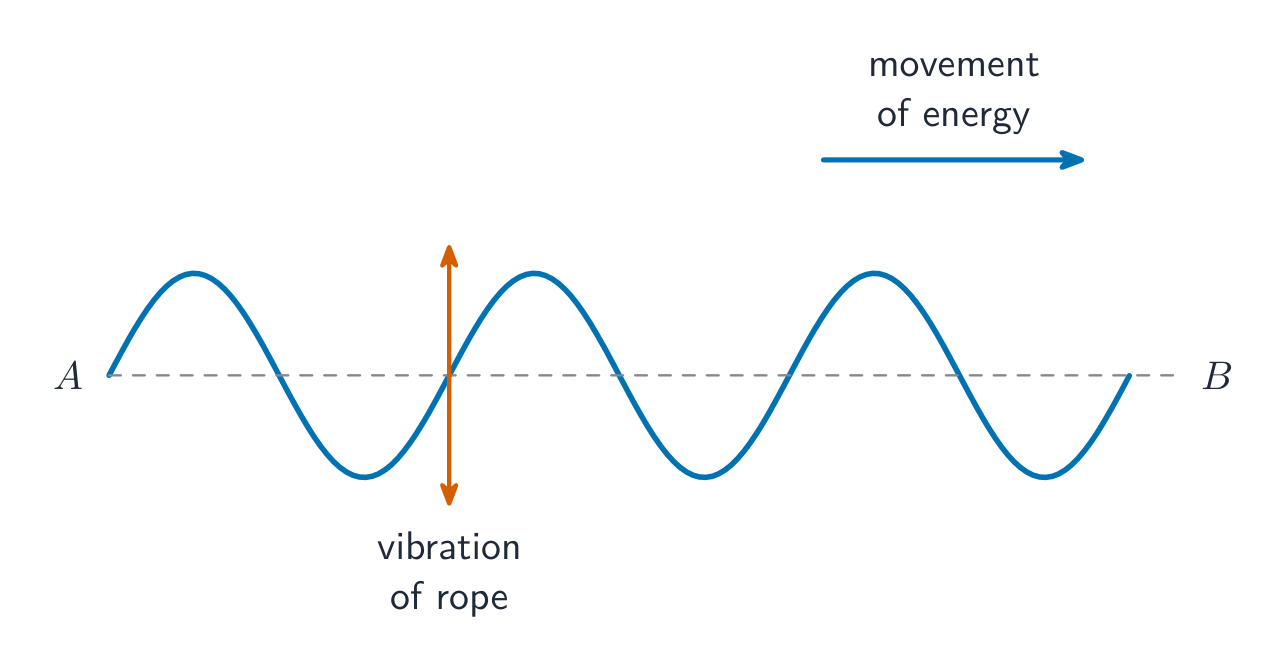
一个(wave)通过一个介质(或空间)携带能量而不携带物质。一个单一的扰动是一个脉冲(pulse);一个重复的是一个波。两种类型:

一个横波:介质以直角于波的行进移动
一个横波:介质以直角于波的行进移动
  • 横波(transverse):介质垂直于波的行进移动(一根绳上的波、光)。
  • 纵波(longitudinal):介质沿行进方向移动(声音)。
词汇表 训练
英文 中文 拼音
wave
Transverse 横波 héng bō
Longitudinal 纵波 zòng bō
14.2

周期波

大纲
Learning ObjectiveEssential Knowledge

14.2.A
Describe the physical properties of a periodic wave.

  • 14.2.A.1 Periodic waves have regular repetitions that can be described using period and frequency.
    • 14.2.A.1.i The period is the time for one complete oscillation of the wave.
    • 14.2.A.1.ii The frequency is the rate at which the wave repeats.
      • Equation: $T = \dfrac{1}{f}$
    • 14.2.A.1.iii The amplitude of a wave is independent of the period and the frequency of that wave.
    • 14.2.A.1.iv The energy of a wave increases with increasing frequency.
    • 14.2.A.1.v The frequency of a sound wave is related to its pitch.
    • 14.2.A.1.vi Wavelength is the distance between successive corresponding positions (such as peaks or troughs) on a wave.
  • 14.2.A.2 A sinusoidal wave can be described by equations for the displacement from equilibrium at a specific location as a function of time. A wave can also be described by an equation for the displacement from equilibrium at a specific time as a function of position.
    • Equation: $x(t) = A\cos(\omega t) = A\cos(2\pi f t)$
    • Equation: $y(x) = A\cos\left(2\pi \dfrac{x}{\lambda}\right)$
  • 14.2.A.3 For a periodic wave, the wavelength is proportional to the wave's speed and inversely proportional to the wave's frequency.
    • Equation: $\lambda = \dfrac{v}{f}$

来源:美国大学理事会 AP 课程与考试说明

横波与纵波

一个重复的波由以下描述:

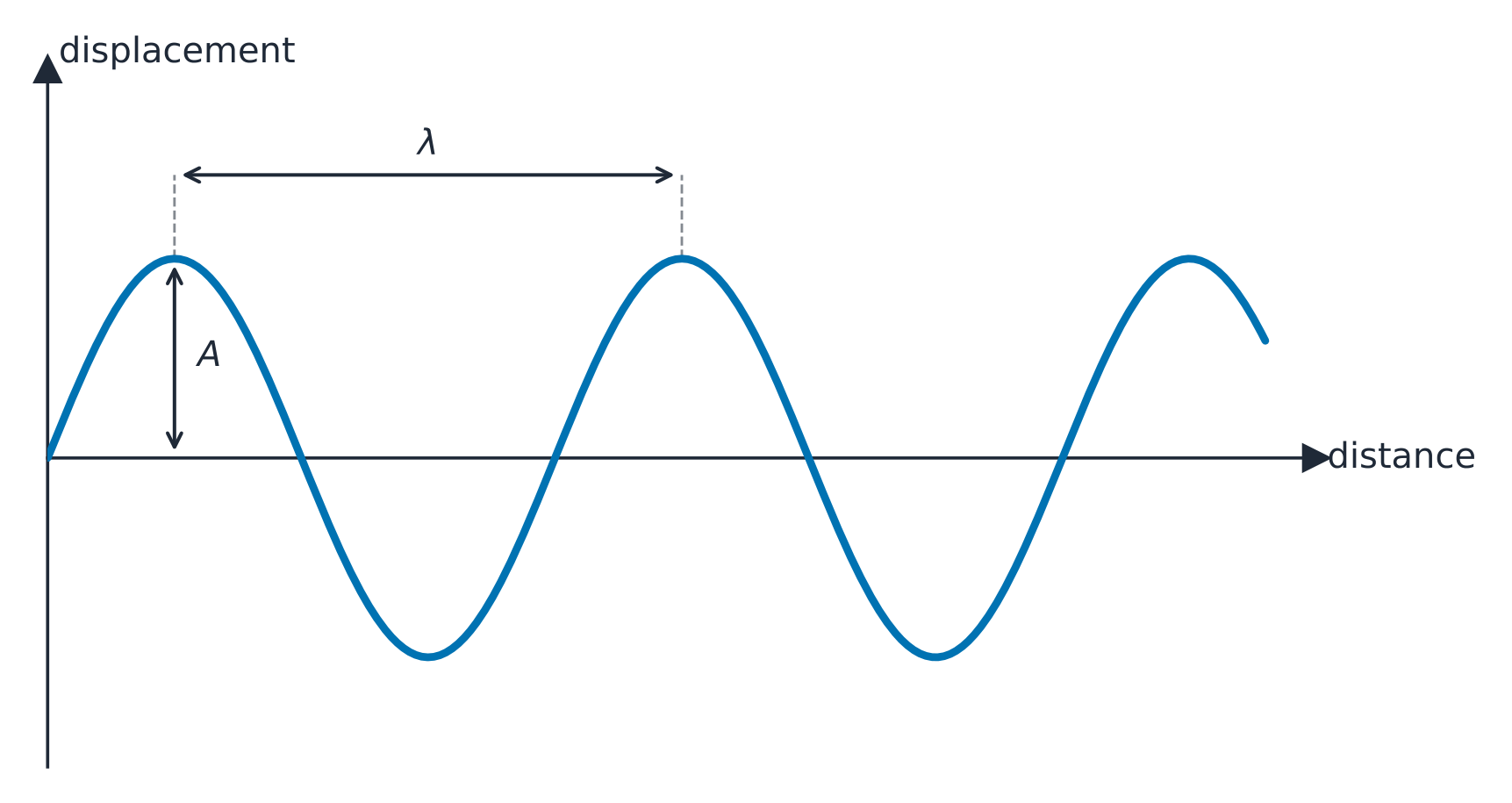
一个位移-距离图显示振幅和波长
一个位移-距离图显示振幅和波长
  • 波长(wavelength)$\lambda$(重复之间的距离),
  • 频率(frequency)$f$(每秒的循环)和周期(period)$T=1/f$,
  • 振幅(amplitude)$A$(最大位移——与能量相关),
  • 波速(wave speed)$v=f\lambda$,由介质、不是源设定。

Worked example. 一个音符有频率 $340\ \text{Hz}$ 而声速是 $340\ \text{m/s}$。它的波长是 $\lambda=v/f=340/340=1.0\ \text{m}$。若同一个音符进入水(那里声音以 $\approx 1500\ \text{m/s}$ 移动)频率保持 $340\ \text{Hz}$ 但波长拉伸到 $1500/340\approx 4.4\ \text{m}$ ——源设定频率,介质设定速率因而波长。

探索

Send a periodic wave

A periodic wave carries energy without moving matter. Its speed $v=f\lambda$ links frequency and wavelength; raise the frequency and the wavelength shrinks.

词汇表 训练
英文 中文 拼音
wavelength 波长 bō cháng
frequency 频率 pín lǜ
amplitude 振幅 zhèn fú
wave speed 波速 bō sù
练习卷
14.3

波的边界行为与偏振

大纲
Learning ObjectiveEssential Knowledge

14.3.A
Describe the interaction between a wave and a boundary.

  • 14.3.A.1 A wave that travels from one medium to another can be transmitted or reflected, depending on the properties of the boundary separating the two media.
    • 14.3.A.1.i A wave traveling from one medium to another (for example, a wave traveling between low-mass and high-mass strings) will result in reflected and transmitted waves.
    • 14.3.A.1.ii A reflected wave is inverted if the transmitted wave travels into a medium in which the speed of the wave decreases.
    • 14.3.A.1.iii A reflected wave is not inverted if the transmitted wave travels into a medium in which the speed of the wave increases.
    • 14.3.A.1.iv The frequency of a wave does not change when it travels from one medium to another.
  • 14.3.A.2 Transverse waves that are reflected from a surface, refracted through a medium, or pass through specific openings may be polarized.
    • 14.3.A.2.i Transverse waves can be polarized and oscillate in a single plane.
    • 14.3.A.2.ii Longitudinal waves cannot be polarized.
  • 14.3.A.3 Polarization of a wave may result in a reduction of the wave's intensity.
    • 14.3.A.3.i Intensity is a measure of the amount of power transferred per unit area.
    • 14.3.A.3.ii The intensity of a wave is the average power per unit area over one period of the wave.

来源:美国大学理事会 AP 课程与考试说明

全反射

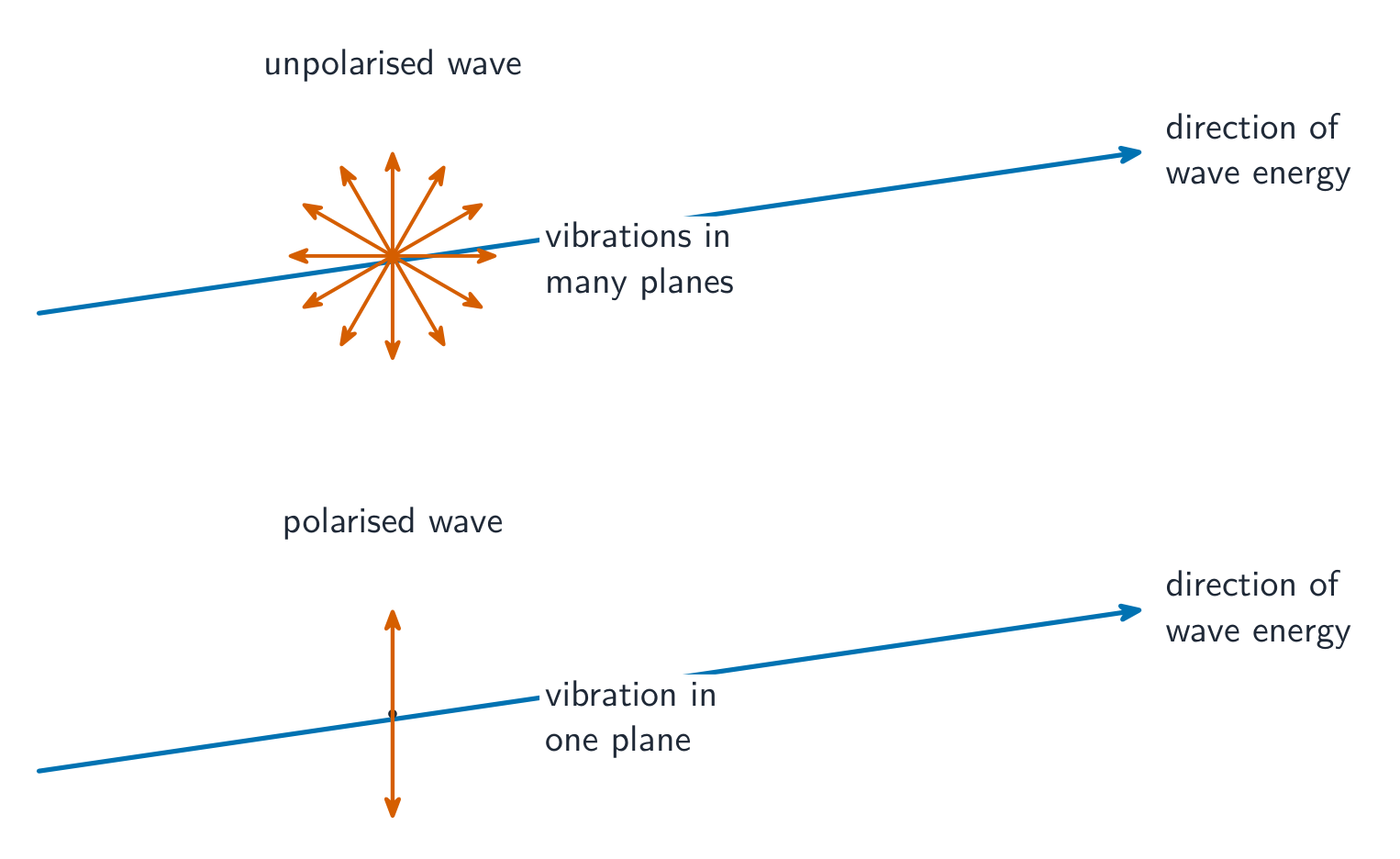
在一个边界一个波部分反射部分透射。从一个更密介质反射反转波;从一个较不密介质不反转。偏振(polarization)只适用于横波:一个偏振器只让一个振荡方向通过,这就是为什么偏振太阳镜削减眩光。

偏振器的效果是通过强度(intensity)来衡量的 —— 强度是一个波在一个周期内单位面积上传递的平均功率,单位是 $\text{W m}^{-2}$。因为偏振器移除了与它不对齐的那些振荡分量,它会降低波的强度:非偏振光通过一个理想偏振器后降到原一半的强度,而以某个角度放置的第二个偏振器会把它进一步削减。强度也随着离开波源的距离而下降,因为同样的功率铺展在更大的面积上。

非偏振波在许多平面里振动;一个偏振波在一个里振动
词汇表 训练
英文 中文 拼音
Polarization 偏振 piān zhèn
intensity 强度 qiáng dù
练习卷
14.4

电磁波

大纲
Learning ObjectiveEssential Knowledge

14.4.A
Describe the properties of an electromagnetic wave.

  • 14.4.A.1 Electromagnetic waves consist of oscillating electric and magnetic fields that are mutually perpendicular.
    • 14.4.A.1.i Electromagnetic waves are transverse waves because the oscillations of the electric and magnetic fields are perpendicular to the direction of propagation.
    • 14.4.A.1.ii Electromagnetic waves are commonly assumed to be plane waves, which are characterized by planar wave fronts.
  • 14.4.A.2 Electromagnetic waves do not need a medium through which to propagate.
  • 14.4.A.3 Categories of electromagnetic waves are characterized by their wavelengths.
    • 14.4.A.3.i Categories of electromagnetic waves include (in order of decreasing wavelength, spanning a range from kilometers to picometers) radio waves, microwaves, infrared, visible, ultraviolet, X-rays, and gamma rays.
    • 14.4.A.3.ii Visible electromagnetic waves are further broken into categories of color, including (in order of decreasing wavelength) red, orange, yellow, green, blue, and violet.
    • 14.4.A.3.iii Visible electromagnetic waves are also called light. Sometimes, electromagnetic waves of all wavelengths are collectively referred to as light or electromagnetic radiation.

Boundary statement: AP Physics 2 expects students to know the ordering of the electromagnetic spectrum (including visible light). However, students will not be expected to define exact wavelength ranges within the electromagnetic spectrum.

来源:美国大学理事会 AP 课程与考试说明

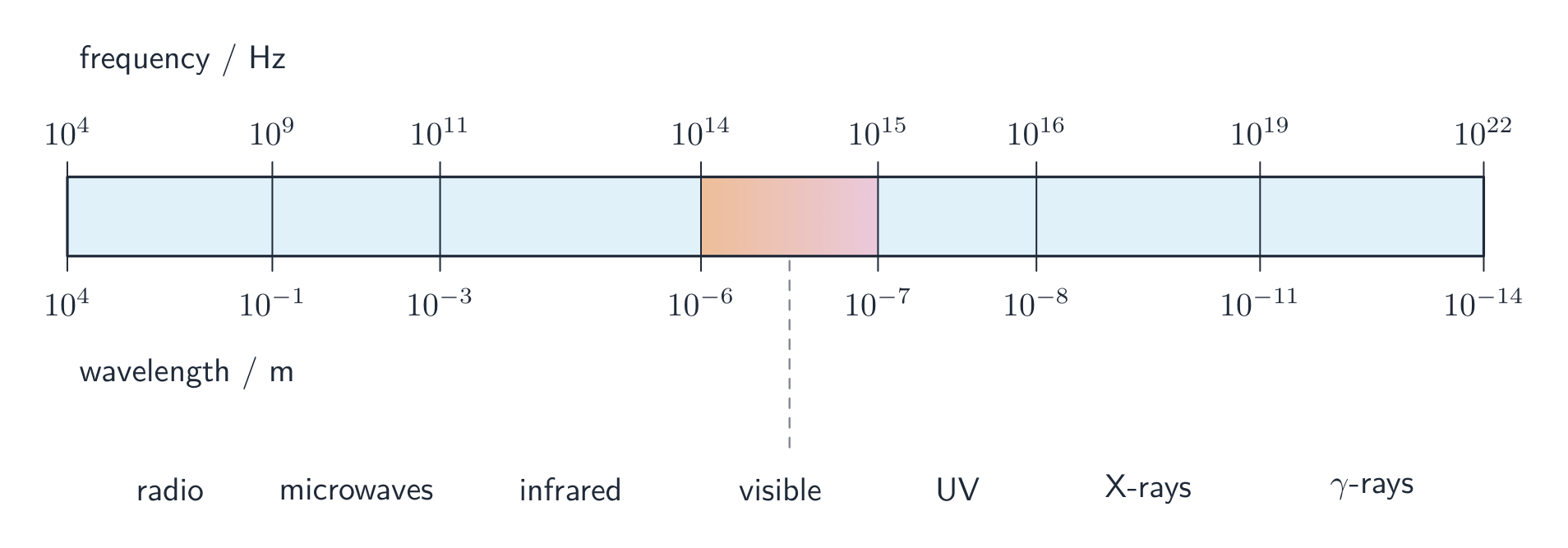
电磁波(electromagnetic waves)是以光速 $c$ 穿过真空行进的振荡的电场和磁场,不需要介质。它们横跨从无线电到伽马射线的谱;更高的频率意味着更短的波长和更高的光子能量。

电磁谱,从无线电波到伽马射线
电磁谱,从无线电波到伽马射线
词汇表 训练
英文 中文 拼音
Electromagnetic waves 电磁波 diàn cí bō
14.5

多普勒效应

大纲
Learning ObjectiveEssential Knowledge

14.5.A
Describe the properties of a wave based on the relative motion between the source of the wave and the observer of the wave.

  • 14.5.A.1 The Doppler effect describes the relationship between the rest frequency of a wave source, the observed frequency of the source, and the relative velocity of the source and the observer.
  • 14.5.A.2 A greater relative velocity results in a greater measured difference between the observed and rest frequencies.
    • 14.5.A.2.i For a wave source moving at the same velocity as the observer, the observed frequency is equal to the rest frequency.
    • 14.5.A.2.ii For a wave source moving toward an observer, the observed frequency is greater than the rest frequency.
    • 14.5.A.2.iii For a wave source moving away from an observer, the observed frequency is less than the rest frequency.

Boundary statement: Only qualitative treatments of the Doppler effect are required for AP Physics 2.

来源:美国大学理事会 AP 课程与考试说明

多普勒效应

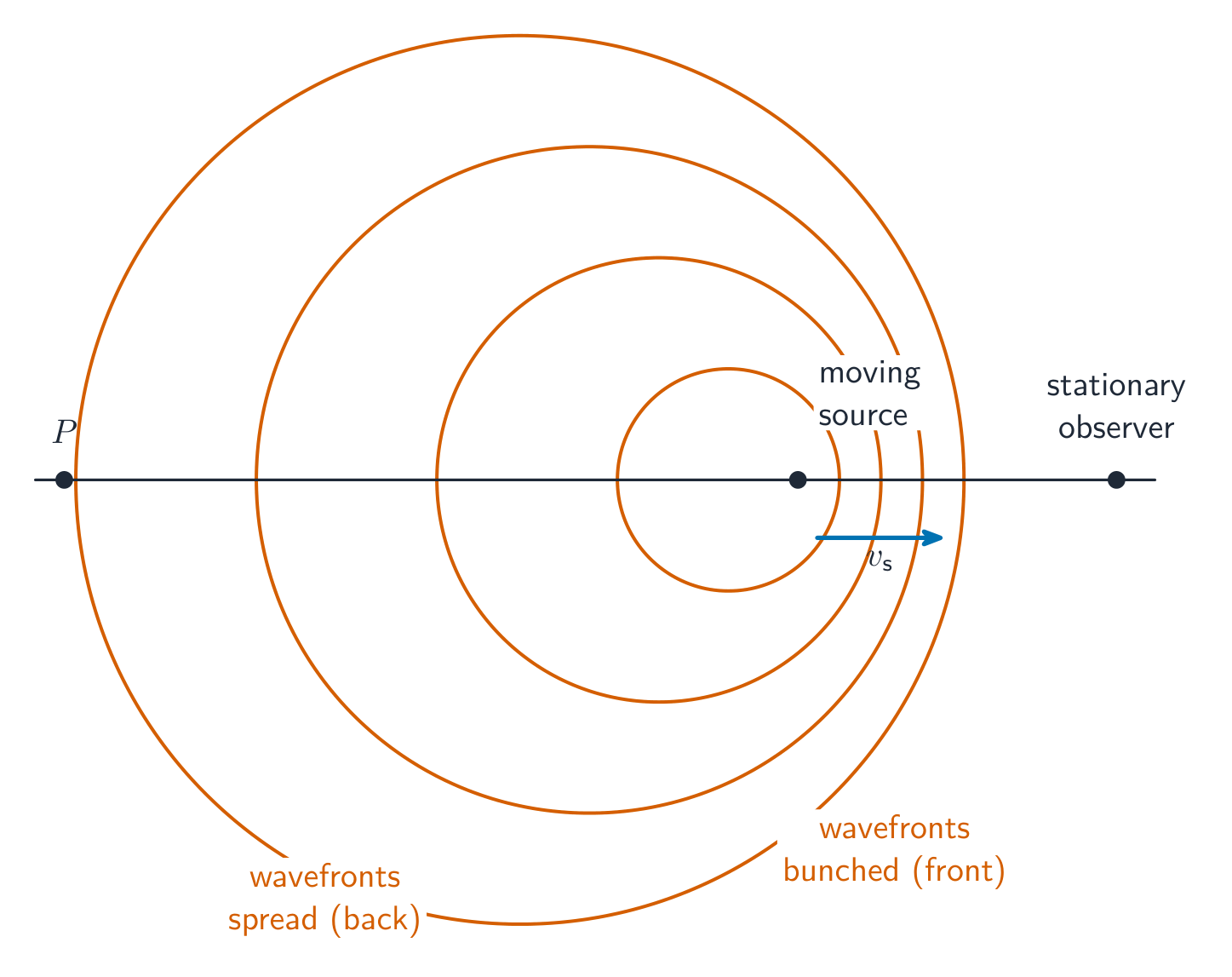
多普勒效应(Doppler effect)是当一个波源和观察者相对彼此移动时观察到的频率的变化。接近 $\Rightarrow$ 更高的频率(更短的波长);后退 $\Rightarrow$ 更低的频率。它解释一个经过的警笛音高的下降和后退星系的红移。

一个移动的源挤压它前方的波前,提高观察到的频率
探索

Hear the Doppler shift

When a source moves, waves bunch up ahead (higher frequency) and stretch behind (lower) — the Doppler effect. Speed it up to exaggerate the shift.

词汇表 训练
英文 中文 拼音
Doppler effect 多普勒效应 duō pǔ lè xiào yìng
14.6

波的干涉与驻波

大纲
Learning ObjectiveEssential Knowledge

14.6.A
Describe the net disturbance that occurs when two or more wave pulses or waves overlap.

  • 14.6.A.1 Wave interference is the interaction of two or more wave pulses or waves.
  • 14.6.A.2 When two or more wave pulses or waves interact with each other, they travel through each other and overlap rather than bouncing off each other.
  • 14.6.A.3 When two or more wave pulses or waves overlap, the resulting displacement can be determined by adding the individual displacements. This is called superposition.
  • 14.6.A.4 Wave interference may be constructive or destructive.
    • 14.6.A.4.i When the displacements of the superposed wave pulses or waves are in the same direction, the interaction is called constructive interference.
    • 14.6.A.4.ii When the displacements of the superposed wave pulses or waves are in opposite directions, the interaction is called destructive interference.
    • 14.6.A.4.iii Two or more traveling wave pulses or waves can interact in such a way as to produce amplitude variations in the resultant wave pulse or wave.
  • 14.6.A.5 Visual representations of wave pulses or waves are useful in determining the result of two interacting wave pulses or waves.
  • 14.6.A.6 Beats arise from the addition of two waves of slightly different frequency.
    • 14.6.A.6.i Waves with different frequencies are sometimes in phase and sometimes out of phase at locations along the waves, causing periodic amplitude changes in the resultant wave.
    • 14.6.A.6.ii The beat frequency is the difference in the frequencies of the two waves.
      • Equation: $\left|f_{\text{beat}}\right| = \left|f_1 - f_2\right|$
    • 14.6.A.6.iii Tuning forks are devices that are commonly used to demonstrate beat frequencies.

14.6.B
Describe the properties of a standing wave.

  • 14.6.B.1 Standing waves can result from interference between two waves that are confined to a region and traveling in opposite directions.
    • 14.6.B.1.i Standing waves have nodes and antinodes. A node is a point on the standing wave where the amplitude is always zero. An antinode is a point on the standing wave where the amplitude is always at maximum.
    • 14.6.B.1.ii The possible wavelengths of a standing wave are determined by the size and boundary conditions of the region to which it is confined.
    • 14.6.B.1.iii Common regions where standing waves can form include pipes with open or closed ends, as well as strings with fixed or loose ends.
  • 14.6.B.2 A standing wave with the longest possible wavelength is called the fundamental or first harmonic. The second-longest wavelength is typically called the second harmonic, the third-longest wavelength is called the third harmonic, and so on. However, for a standing wave with a node at one end and an antinode at the other end, only odd harmonics can be established.
  • 14.6.B.3 Visual representations of standing waves are useful in determining the relationships between length of the region, wavelength, frequency, wave speed, and harmonic.

来源:美国大学理事会 AP 课程与考试说明

驻波

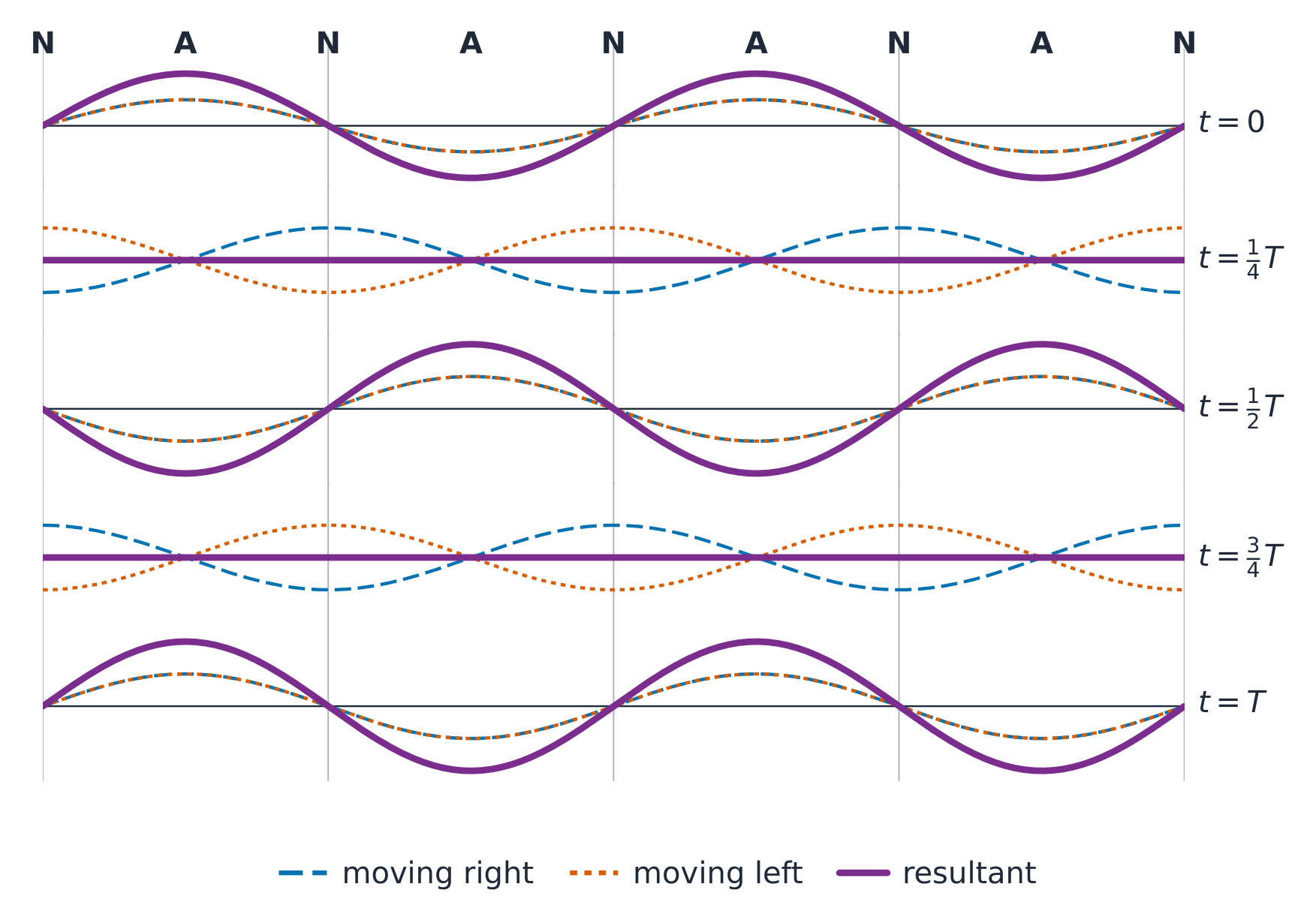
当波重叠时它们叠加(superpose)(相加)。相长干涉(constructive interference)(波峰对齐)给出一个更大的波;相消干涉(destructive interference)(波峰对波谷)抵消。在一个有界介质里两个相反方向行进的波形成一个带固定的波节(nodes)(无运动)和波腹(antinodes)(最大运动)的驻波(standing wave)——弦上和管里共振的基础。

两个相反方向行进的波重叠的地方形成一个驻波

Worked example. 一根 $0.65\ \text{m}$ 长的吉他弦两端固定。它的基频(fundamental)(第一谐波)在两端之间容纳半个波长,所以 $\lambda=2L=1.30\ \text{m}$。若波沿弦以 $260\ \text{m/s}$ 行进,音符的频率是 $f=v/\lambda=260/1.30=200\ \text{Hz}$。缩短弦(一个品)提高音高。

当两个频率略有不同的波叠加时,它们逐渐进出同步,所以合成的声音在一个缓慢的震颤里忽响忽弱,叫做(beats)。拍频(beat frequency)就是两个频率之差:

$$f_{\text{beat}}=|f_1-f_2|.$$
一起发声的 $256\ \text{Hz}$$260\ \text{Hz}$ 两个音叉每秒给出 $|260-256|=4$ 拍;乐手通过把拍减慢到零来对着一个参考音调音。

探索

Set up a standing wave

Two waves travelling opposite ways interfere into a standing wave with fixed nodes and antinodes. Only certain frequencies fit, giving the harmonics.

词汇表 训练
英文 中文 拼音
Constructive interference 相长干涉 xiāng zhǎng gān shè
destructive interference 相消干涉 xiāng xiāo gān shè
standing wave 驻波 zhù bō
nodes 波节 bō jié
antinodes 波腹 bō fù
beats pāi
beat frequency 拍频 pāi pín
练习卷
14.7

衍射

大纲
Learning ObjectiveEssential Knowledge

14.7.A
Describe the behavior of a wave and the diffraction pattern resulting from a wave passing through a single opening.

  • 14.7.A.1 Diffraction is the spreading of a wave around the edges of an obstacle or through an opening.
  • 14.7.A.2 Diffraction is most pronounced when the size of the opening is comparable to the wavelength of the wave.
  • 14.7.A.3 Diffraction of multiple wavefronts through a single opening leads to observable interference patterns.
  • 14.7.A.4 Diffraction is commonly demonstrated by monochromatic light of wavelength $\lambda$ incident on a narrow opening of width $a$ that is a distance $L$ from a screen.
    • 14.7.A.4.i Constructive and destructive interference of multiple wavefronts originating from the opening will result in bright and dark bands on the screen.
    • 14.7.A.4.ii The amount of interference between two wavefronts depends on the path length difference $\Delta D$ of the wavefronts.
    • 14.7.A.4.iii The path length difference $\Delta D$ can be described in terms of the opening width $a$ and the angle $\theta$ between the direction of propagation of the wavefront and the normal to the opening by the equation $\Delta D = a\sin\theta$.
    • 14.7.A.4.iv For small angles, where $\theta < 10°$, the small angle approximation can be used to relate $\lambda$, $a$, and $L$ to $y_{\min}$, the distance from the middle of the central bright fringe to the $m^{\text{th}}$ order of minimum brightness on the screen.
      • Equation: $a\left(\dfrac{y_{\min}}{L}\right) \approx m\lambda$
  • 14.7.A.5 The diffraction pattern produced by a wave passing through an opening depends on the shape of the opening.
  • 14.7.A.6 Visual representations of single-slit diffraction patterns are useful in determining the physical properties of the slit and the interacting waves.

来源:美国大学理事会 AP 课程与考试说明

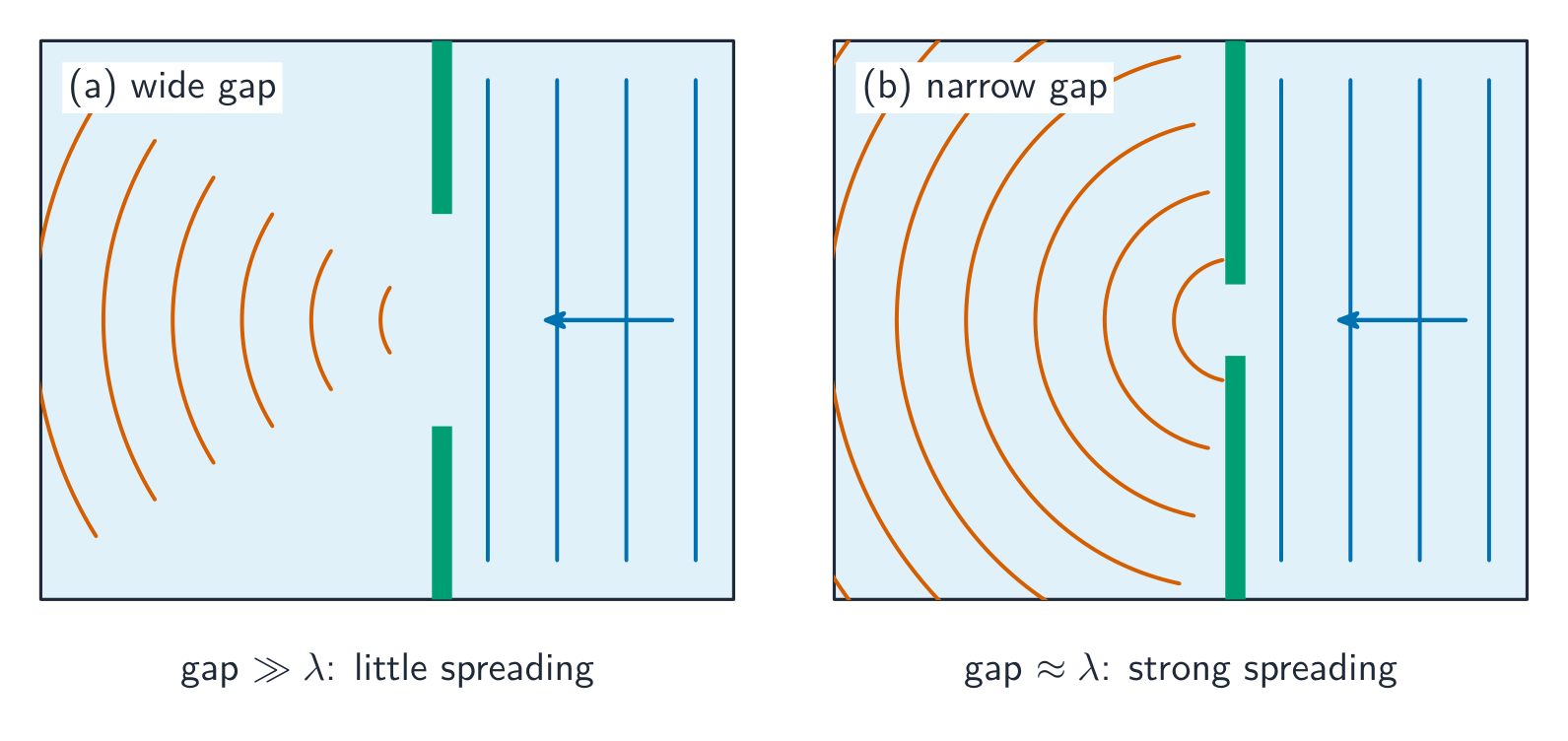
衍射(diffraction)是波在边缘周围或通过开口的弯曲和扩散。当开口与波长相当时扩散显著——所以声音(长波长)容易绕门口弯曲,而光(微小波长)需要一个很窄的缝。

波在通过一个间隙时扩散(衍射)
波在通过一个间隙时扩散(衍射)
词汇表 训练
英文 中文 拼音
Diffraction 衍射 yǎn shè
14.8

双缝干涉与衍射光栅

大纲
Learning ObjectiveEssential Knowledge

14.8.A
Describe the behavior of a wave and the diffraction pattern resulting from the wave passing through multiple openings.

  • 14.8.A.1 The pattern resulting from monochromatic light of wavelength $\lambda$ incident on two slits a distance $d$ apart is caused by a combination of wave diffraction and wave interference.
    • 14.8.A.1.i When only considering wave interference, a double slit creates a pattern of uniformly spaced maxima.
    • 14.8.A.1.ii Constructive and destructive interference of the wavefronts originating from each slit will result in bright and dark bands on the screen.
    • 14.8.A.1.iii The amount of interference between two wavefronts depends on the path length difference $\Delta D$ of the wavefronts.
    • 14.8.A.1.iv The path length difference $\Delta D$ can be described in terms of the slit separation $d$ and the angle $\theta$ between the direction of propagation of the wavefront and the normal to the opening by the equation $\Delta D = d\sin\theta$.
    • 14.8.A.1.v For small angles, where $\theta < 10°$, the small angle approximation can be used to relate $\lambda$, $d$, and $L$ to $y_{\max}$, the distance from the middle of the central bright fringe to the $m^{\text{th}}$ order of maximum brightness on the screen.
      • Equation: $d\left(\dfrac{y_{\max}}{L}\right) \approx m\lambda$
    • 14.8.A.1.vi When considering wave interference and wave diffraction, a double slit creates an interference pattern of maxima and minima superimposed within the envelope created by single-slit diffraction.
  • 14.8.A.2 Interference patterns produced by light interacting with a double slit indicate that light has wave properties. The source of this discovery was Young's double-slit experiment.
  • 14.8.A.3 Visual representations of double-slit diffraction patterns are useful in determining the physical properties of the slits and the interacting waves.
  • 14.8.A.4 A diffraction grating is a collection of evenly spaced parallel slits or openings that produce an interference pattern that is the combination of numerous diffraction patterns superimposed on each other.
  • 14.8.A.5 When white light is incident on a diffraction grating, the center maximum is white and the higher-order maxima disperse white light into a rainbow of colors, with the longest-wavelength light (red) appearing farthest from the central maximum.

来源:美国大学理事会 AP 课程与考试说明

双源干涉

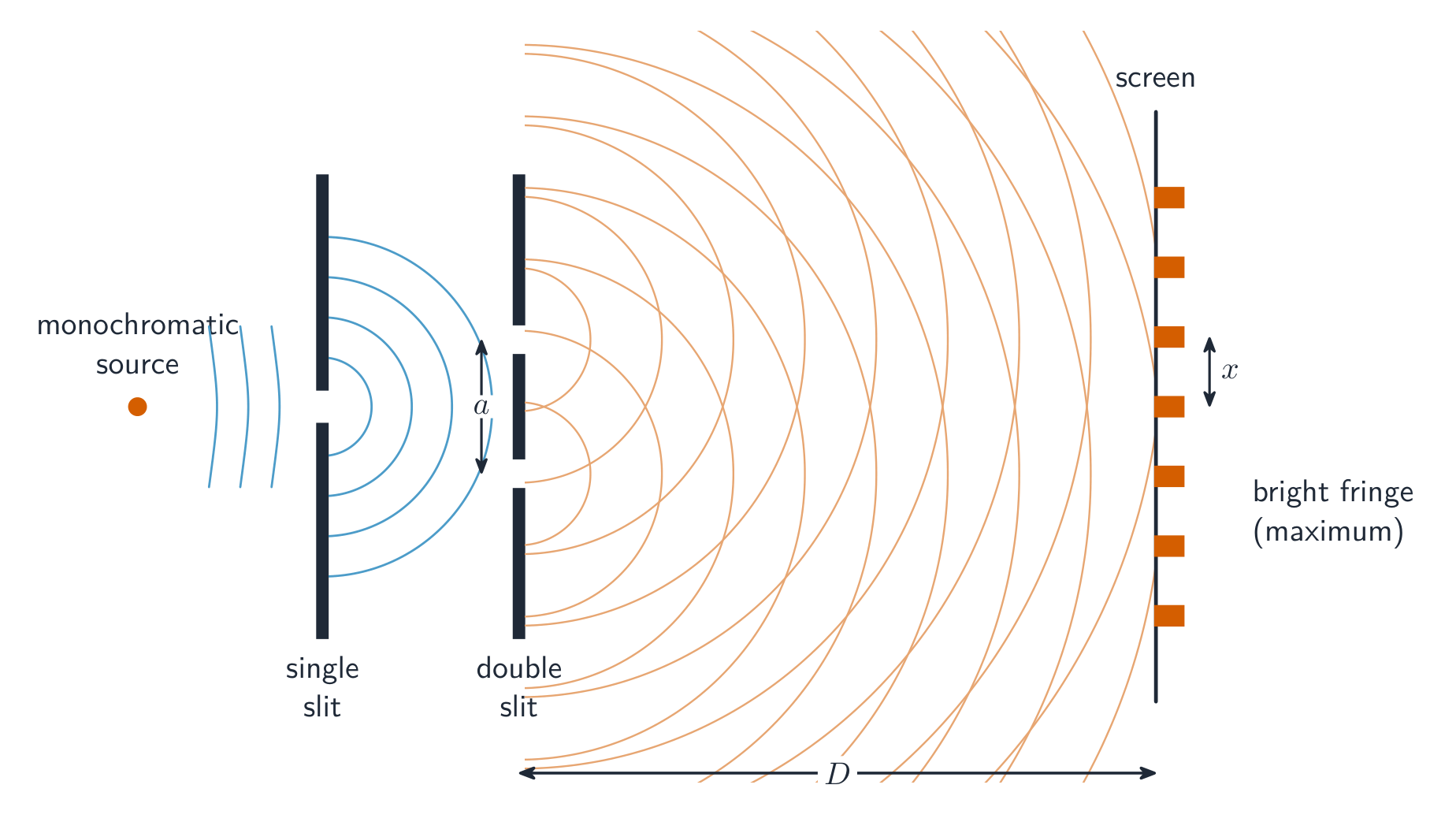
相干(coherent)光通过两个紧密间隔的缝产生一个明暗条纹的模式。明条纹出现在光程差是整数个波长的地方:

$$d\sin\theta=m\lambda.$$
一个衍射光栅(diffraction grating)有许多缝,给出锐利的、宽间隔的明线——对把光分成它的波长有用。

杨氏双缝给出一个明暗条纹的干涉模式
杨氏双缝给出一个明暗条纹的干涉模式

Worked example. 波长 $600\ \text{nm}$ 的光通过相距 $0.20\ \text{mm}$ 的两个缝。第一个明条纹($m=1$)坐在

$$\sin\theta=\frac{m\lambda}{d}=\frac{1\times600\times10^{-9}}{0.20\times10^{-3}}=3.0\times10^{-3}\;\Rightarrow\;\theta=0.17^{\circ}.$$
这个微小的角是为什么缝必须很接近而屏幕很远才能清晰地看到条纹。

探索

Superpose two waves

Where two waves arrive in phase they add (bright fringe); out of phase they cancel (dark fringe). That interference makes the double-slit pattern.

词汇表 训练
英文 中文 拼音
Coherent 相干 xiāng gān
diffraction grating 衍射光栅 yǎn shè guāng shān
练习卷
14.9

薄膜干涉

大纲
Learning ObjectiveEssential Knowledge

14.9.A
Describe the behavior of light that interacts with a thin film.

  • 14.9.A.1 When light travels from one medium to another, some of the light is transmitted, some is reflected, and some is absorbed.
  • 14.9.A.2 The phase change of a reflected ray depends on the relative indices of refraction of the materials with which the ray interacts.
    • 14.9.A.2.i A phase change of 180 degrees occurs when a light ray is reflected from a medium with a greater index of refraction than the medium through which the ray is traveling.
    • 14.9.A.2.ii No phase change occurs when a light ray is reflected from a medium with a lower index of refraction than the medium through which the ray is traveling.
  • 14.9.A.3 The phase of a wave does not change when it is refracted as it passes from one medium into another.
  • 14.9.A.4 Thin-film interference occurs when light interacts with a medium whose thickness is comparable to the light's wavelength.
    • 14.9.A.4.i The interactions between the initial reflected light and the light exiting the thin film after being reflected from the second interface exhibit wave interference behavior, resulting in a single wave that is the sum of the two interacting waves.
    • 14.9.A.4.ii The amount of constructive or destructive interference between the two reflected waves depends on the relationship between the thickness of the film, the wavelength of light, any phase shifts, and the angle at which the incident light strikes the film.
  • 14.9.A.5 Practical examples of thin-film interference include the color variations seen in soap bubbles and oil films, as well as antireflection coatings.
    • 14.9.A.5.i The spectrum of colors observed in oil films and soap bubbles arises from differences in the thickness of the film.
    • 14.9.A.5.ii Antireflection coatings eliminate reflected light by applying the relationships between indices of refraction, phase shift, and wave interference to create destructive interference of the light reflected from the two surfaces of the coating.
    • 14.9.A.5.iii The simplest antireflection coating has a thickness equal to one-quarter of the wavelength of the light in the coating, and the index of refraction of the coating is greater than that of air and less than that of the surface upon which the coating is applied. This assumes incident light is normal to the surface.

Boundary statement: Quantitative analysis of thin-film interference is limited to waves that are normal to the incident surface.

来源:美国大学理事会 AP 课程与考试说明

从一个薄膜(thin film)(肥皂泡、油膜)的顶部和底部反射的光与它自己干涉。取决于膜的厚度和从一个更密介质反射时一个可能的半波长相位翻转,特定的波长相长干涉——产生你看到的移动的颜色。

同样的物理被用在相机镜头、眼镜和太阳能电池上的增透膜(antireflection coating)里:一层薄的透明层,它的两束反射波相消干涉,所以几乎没有光反射而更多被透射。最简单的膜是四分之一波长厚(在膜中测量),它的折射率介于空气和下面玻璃之间,所以反射的光把自己抵消掉。

词汇表 训练
英文 中文 拼音
thin film 薄膜 báo mó
antireflection coating 增透膜 zēng tòu mó
14.9

考试技巧

  • $v=f\lambda$;源设定频率,而当一个波进入一个新介质时频率保持固定而速率和波长变化。
  • 横波(振动垂直,能被偏振)与纵波(振动沿行进,例如声音)区分开。
  • 相长干涉需要一个整数个波长的光程差;相消需要一个半奇数。
  • 在一根两端固定的弦上基频容纳半个波长($\lambda=2L$)。
  • 衍射只在间隙与波长相当时显著——声音绕门口弯曲,光需要一个很窄的缝。
  • :两个频率略有不同的波以 $f_{\text{beat}}=|f_1-f_2|$ 震颤(例如两个音叉;调到零拍)。
  • 一个增透膜是一层四分之一波长厚的膜(折射率介于空气和玻璃之间),它的两束反射相消,减少反射的光。

本主题的互动课程

逐步学习,并即时检测练习。

AP 物理 2历年真题

AP 物理 2的更多主题

登录或创建账号

IGCSE, A-Level & AP