| Learning Objective | Essential Knowledge |
|---|---|
10.1.A |
|
10.1.B |
|
10.1.C |
Boundary statement: AP Physics 2 only expects students to make calculations of the electric force between four or fewer interacting charged objects or systems. The analysis of the resulting electric force from more charges is allowed in situations of high symmetry. |
电力、电场与电势
AP 物理 2 · 第 10 主题
 8:05
8:05
Electric Force, Field, and Potential
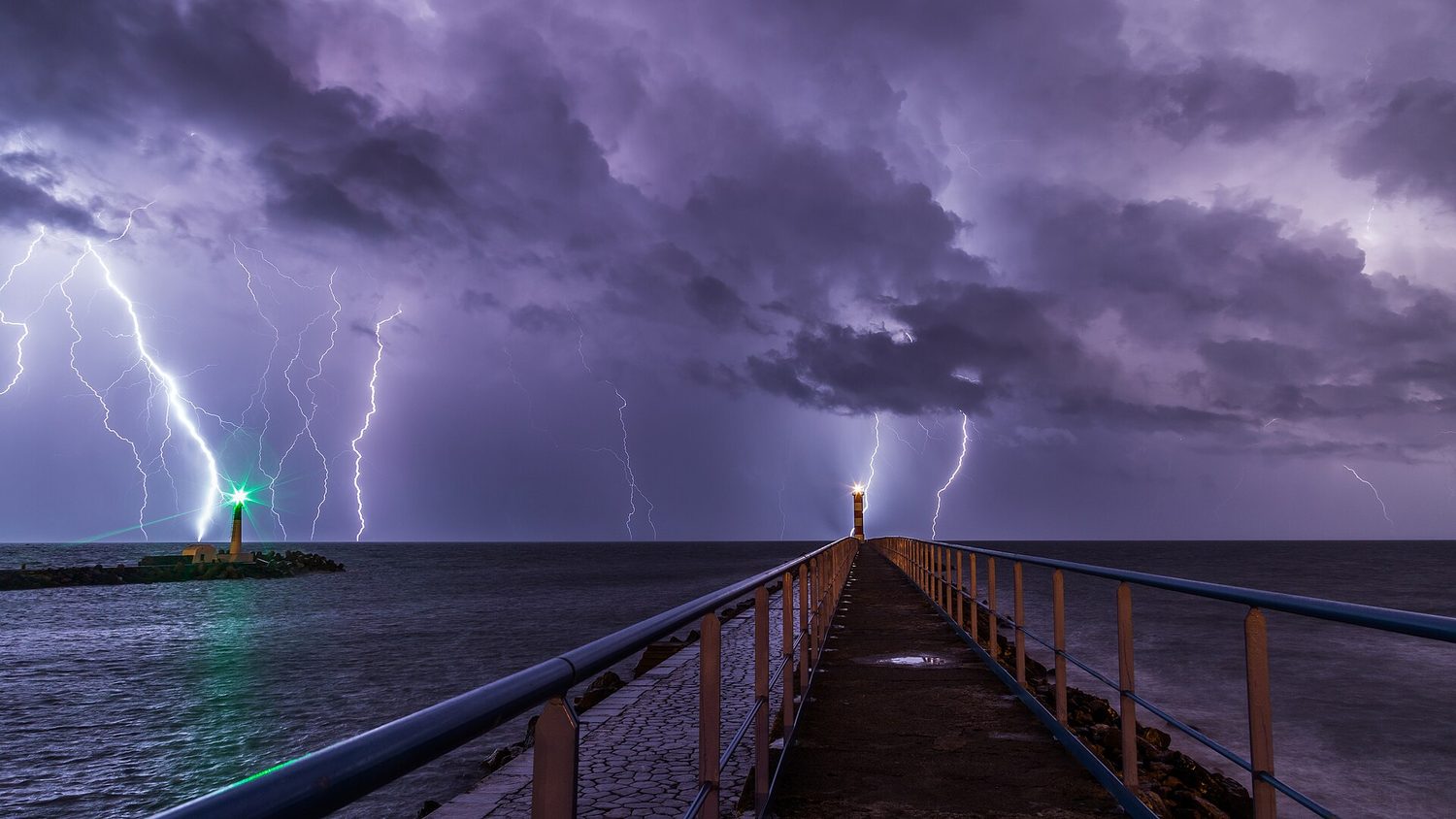
A thundercloud is a charge factory. Ice crystals crash inside it, and electrons collect at the bottom of the cloud. The ground below turns positive. Nothing…
英文讲解 · 内嵌中英文字幕
10.1
电荷与电力
大纲
来源:美国大学理事会 AP 课程与考试说明
电荷(electric charge)是物质的一个基本属性,它有两种,正和负;同种电荷排斥而相反电荷吸引。电荷守恒且量子化(基本电荷 $e$ 的一个倍数)。两个点电荷之间的力是库仑定律(Coulomb's law):
$$F=\frac{k q_1 q_2}{r^2},$$
沿连接它们的线——一个像重力的平方反比定律,但它能推或拉。
常数 $k$ 里藏着介质的一个属性:介电常数(permittivity)。自由空间有一个固定的真空介电常数 $\varepsilon_0$(其中 $k = 1/4\pi\varepsilon_0$),而物质的介电常数不同于 $\varepsilon_0$,取决于材料的组成和排列 - 这就是为什么两个电荷之间放一种材料会改变力。还要注意,尽管电力比重力强得多,在大尺度上却是重力占主导,因为大物体通常是电中性的(正负相等),只剩下重力起作用。
Worked example. 两个点电荷,$+3.0\ \mu\text{C}$ 和 $-2.0\ \mu\text{C}$,相距 $0.10\ \text{m}$($k=9.0\times10^{9}$)。它们之间的力是
$$F=\frac{k q_1 q_2}{r^2}=\frac{9.0\times10^{9}\times(3.0\times10^{-6})(2.0\times10^{-6})}{(0.10)^2}=5.4\ \text{N},$$
吸引的,因为电荷有相反的符号。(用大小求大小并从符号决定方向。)
词汇表
训练
| 英文 | 中文 | 拼音 |
|---|---|---|
| Electric charge/ɪˈlektrɪk tʃɑːdʒ/ | 电荷 | diàn hè |
| Coulomb's law/ˈkuːlɒmz lɔː/ | 库仑定律 | kù lún dìng lǜ |
| permittivity/ˌpɜːmɪˈtɪvəti/ | 介电常数 | jiè diàn cháng shù |
10.2
起电的过程
大纲
| Learning Objective | Essential Knowledge |
|---|---|
10.2.A |
|
来源:美国大学理事会 AP 课程与考试说明
物体通过移动电子充电。一个导体(conductor)让电荷自由移动;一个绝缘体(insulator)把它保持在原位。三种方法:
- 摩擦(friction):摩擦转移电子。
- 接触起电(conduction):触碰共享电荷。
- 感应起电(induction):一个附近的电荷在一个中性物体里重新排列电荷,它然后能被接地以使它带电。
探索
Charge an object by rubbing
Rubbing transfers electrons from one surface to another, leaving one positively and one negatively charged. Like charges repel, opposite charges attract.
词汇表
训练
| 英文 | 中文 | 拼音 |
|---|---|---|
| conductor/kənˈdʌktə/ | 导体 | dǎo tǐ |
| insulator/ˈɪnsjuːleɪtə/ | 绝缘体 | jué yuán tǐ |
| Conduction/kənˈdʌkʃn/ | 接触起电 | jiē chù qǐ diàn |
| Induction/ɪnˈdʌkʃn/ | 感应起电 | gǎn yìng qǐ diàn |
10.3
电场
大纲
| Learning Objective | Essential Knowledge |
|---|---|
10.3.A |
|
10.3.B |
Boundary statement: AP Physics 2 only expects students to make calculations of the electric field resulting from four or fewer charged objects or systems. Analysis of the electric field resulting from more charges is allowed in situations of high symmetry. Students will only be expected to perform qualitative analysis of electric fields within insulators. |
来源:美国大学理事会 AP 课程与考试说明
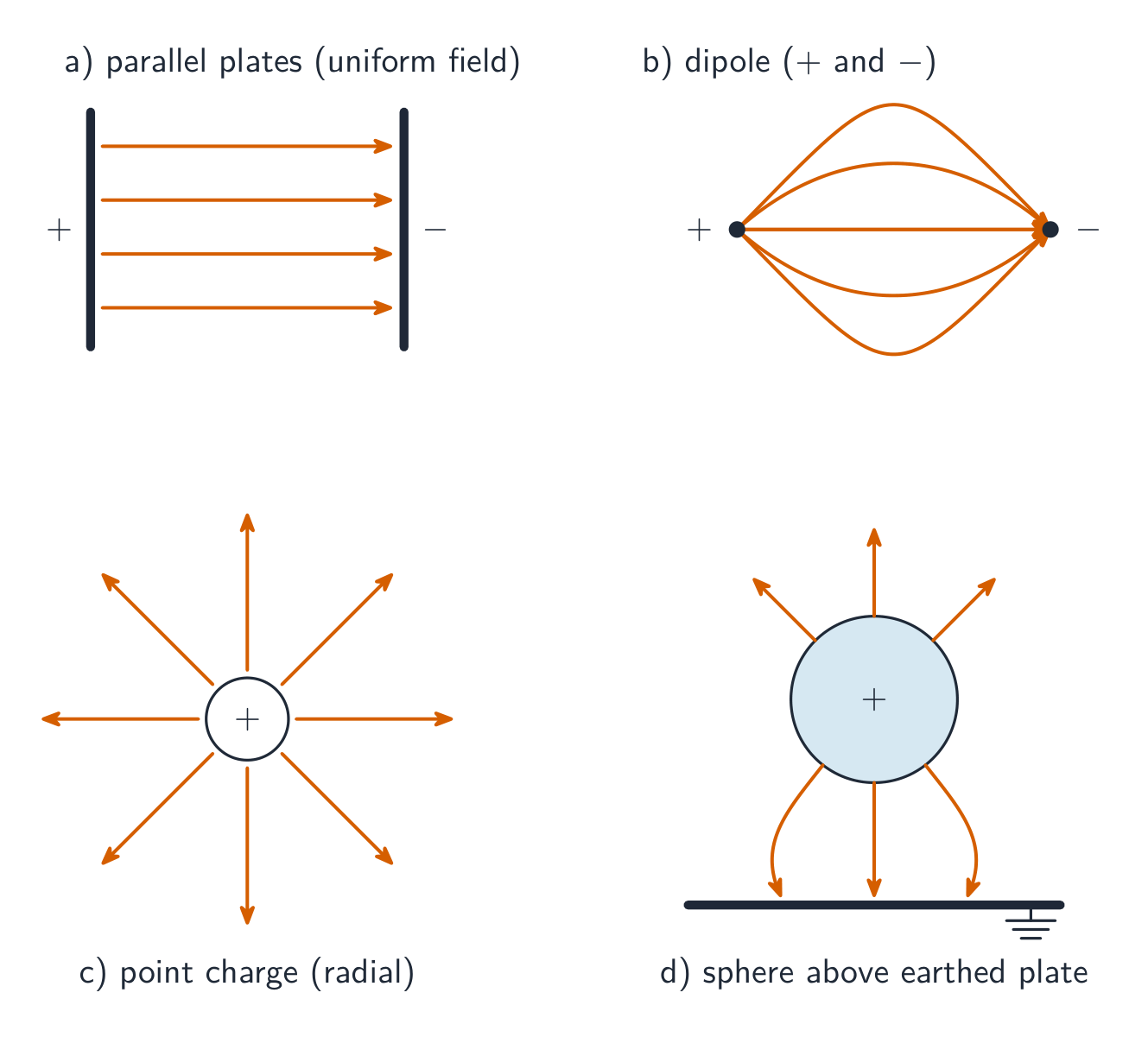
一个电场(electric field)$\vec{E}$ 是一个小的正测试电荷会感受的每单位电荷的力:
$$\vec{E}=\frac{\vec{F}}{q},\qquad E=\frac{kQ}{r^2}\ \text{for a point charge}.$$
场线从正电荷指向外并朝向负的;它们更密的地方,场更强。一个场里的电荷感受 $\vec{F}=q\vec{E}$。
Worked example. 求距一个 $+5.0\ \mu\text{C}$ 点电荷 $0.20\ \text{m}$ 的电场:$E=\dfrac{kQ}{r^2}=\dfrac{9.0\times10^{9}\times5.0\times10^{-6}}{(0.20)^2}=1.1\times10^{6}\ \text{N/C}$,从电荷指向外。放在那里的一个 $+2\ \text{nC}$ 电荷会感受 $F=qE=2\times10^{-9}\times1.1\times10^{6}=2.2\times10^{-3}\ \text{N}$。
探索
Map the field around a charge
An electric field points the way a positive test charge would be pushed: away from a positive charge, toward a negative one. Closer lines mean a stronger field.
词汇表
训练
| 英文 | 中文 | 拼音 |
|---|---|---|
| electric field/ɪˈlektrɪk fiːld/ | 电场 | diàn chǎng |
10.4
电势能
大纲
| Learning Objective | Essential Knowledge |
|---|---|
10.4.A |
Boundary statement: As the methods to calculate the electric potential energy due to extended charge distributions exceed the scope of the course, AP Physics 2 only requires that students calculate the electric potential energy of configurations of four or fewer point charges. |
来源:美国大学理事会 AP 课程与考试说明
两个电荷有储存在它们的排列里的电势能(electric potential energy):
$$U=\frac{k q_1 q_2}{r}.$$
被推到一起的同种电荷储存正能量;相反电荷有负能量(被束缚)。移动一个电荷改变 $U$,而电力做等于 $-\Delta U$ 的功。
词汇表
训练
| 英文 | 中文 | 拼音 |
|---|---|---|
| electric potential energy/ɪˈlektrɪk pəˈtenʃl ˈenədʒi/ | 电势能 | diàn shì néng |
| Electric potential/ɪˈlektrɪk pəˈtenʃl/ | 电势 | diàn shì |
10.5
电势
大纲
| Learning Objective | Essential Knowledge |
|---|---|
10.5.A |
|
10.5.B |
Boundary statement: As the methods to calculate the electric potential due to extended charges exceed the scope of the course, AP Physics 2 only expects that students calculate the electric potential of configurations of four or fewer particles (or more in situations of high symmetry). |
来源:美国大学理事会 AP 课程与考试说明
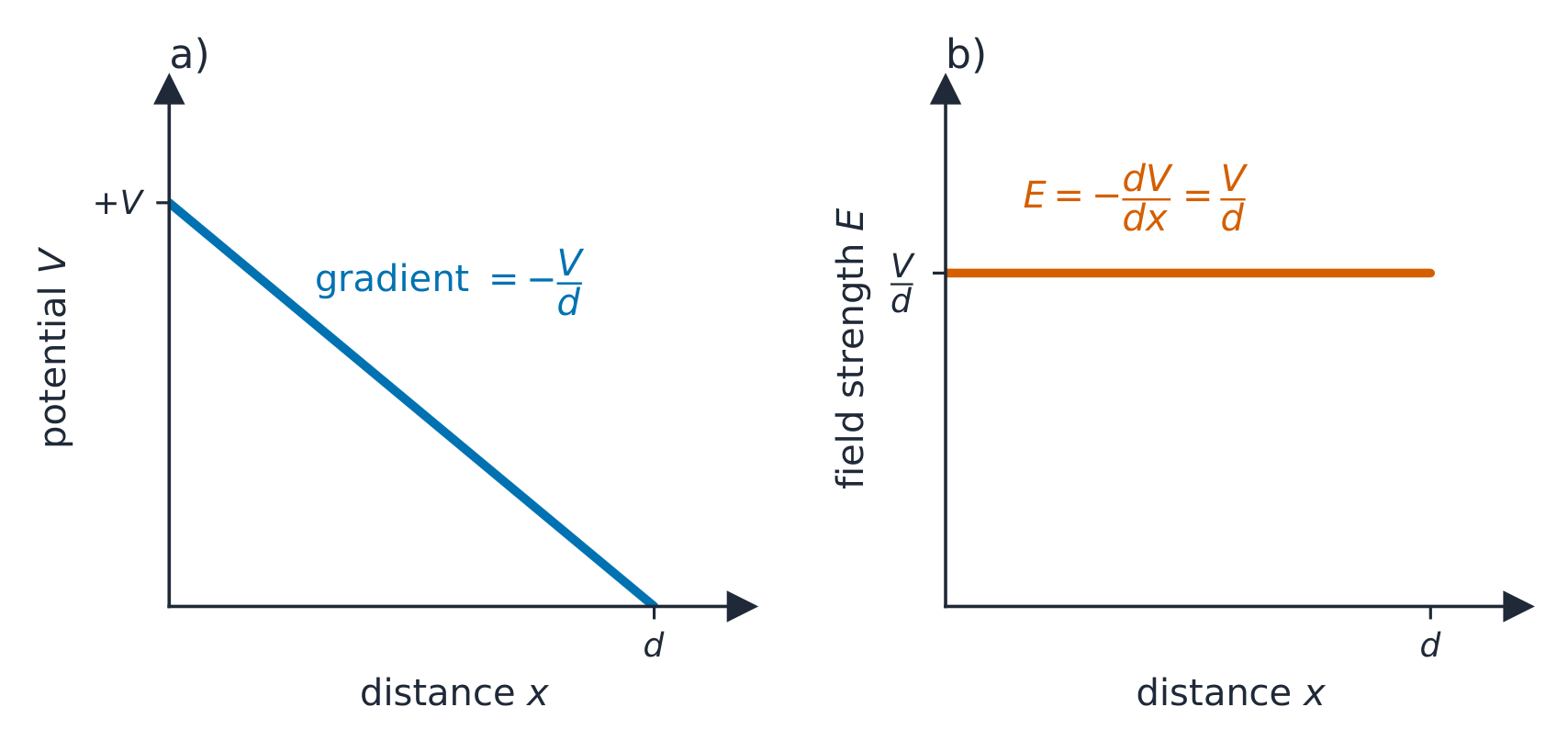
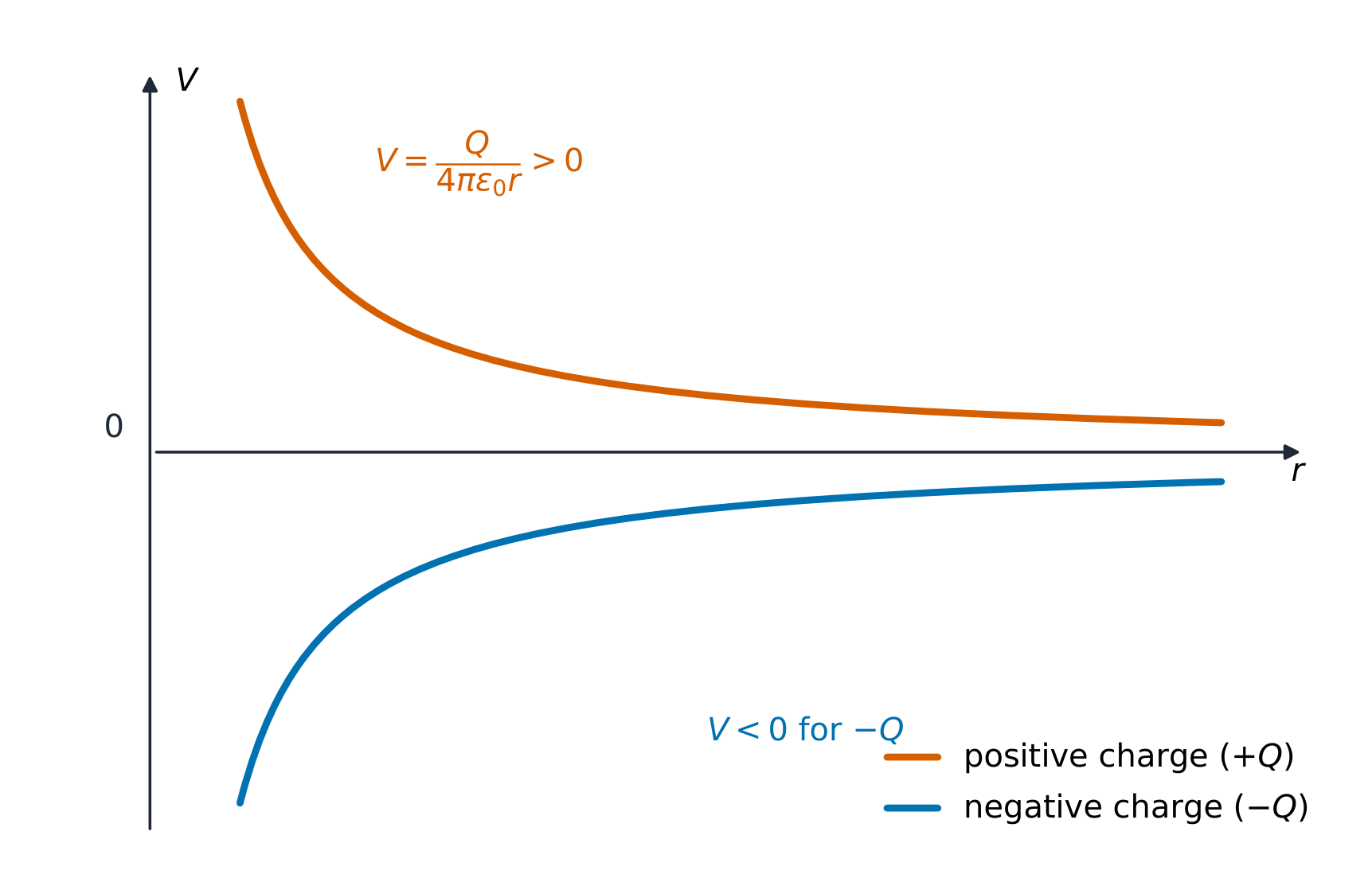
电势(electric potential)$V$ 是每单位电荷的势能——一个标量场,以伏特测量:
$$V=\frac{U}{q}=\frac{kQ}{r}.$$
两点之间的电势差(电压)(potential difference)是移动它们之间每单位电荷的功:$\Delta V=\dfrac{\Delta U}{q}$,而 $U=qV$。正电荷自己从高电势移向低电势。因为电势是一个标量,把来自几个电荷的电势相加比相加场矢量容易得多。
词汇表
训练
| 英文 | 中文 | 拼音 |
|---|---|---|
| potential difference/pəˈtenʃl ˈdɪfrəns/ | 电压 | diàn yā |
10.6
电容器
大纲
| Learning Objective | Essential Knowledge |
|---|---|
10.6.A |
Boundary statement: While other shapes are also able to separate charges, only the analysis and descriptions of parallel-plate capacitors are required for AP Physics 2. Edge effects will be ignored unless explicitly stated otherwise. |
来源:美国大学理事会 AP 课程与考试说明
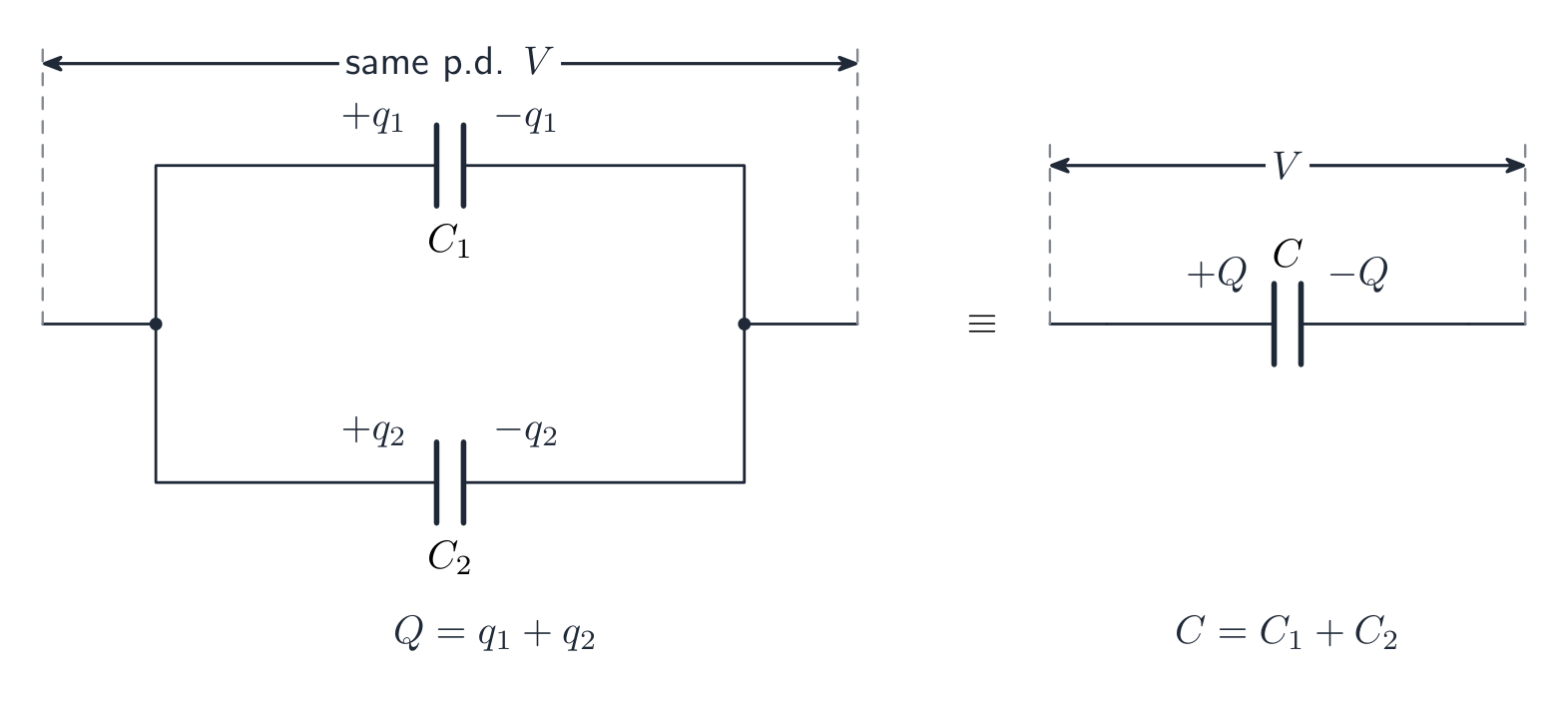
一个电容器(capacitor)在被一个间隙分开的两个导体上储存电荷和能量。它的电容(capacitance)把电荷与电压关联:
$$C=\frac{Q}{V},$$
而储存的能量是 $U=\tfrac{1}{2}CV^2$。电容取决于板的几何和它们之间的材料,不取决于放在它上的电荷。
Worked example. 一个 $100\ \mu\text{F}$ 的电容器被充电到 $12\ \text{V}$。它容纳 $Q=CV=100\times10^{-6}\times12=1.2\times10^{-3}\ \text{C}$ 的电荷并储存 $U=\tfrac12 CV^2=\tfrac12\times100\times10^{-6}\times12^2=7.2\times10^{-3}\ \text{J}$ 的能量。
探索
Charge and discharge a capacitor
A capacitor stores charge on two plates. It fills and empties exponentially, set by the time constant $\tau = RC$ — bigger $R$ or $C$ means slower charging.
词汇表
训练
| 英文 | 中文 | 拼音 |
|---|---|---|
| capacitor/kəˈpæsɪtə/ | 电容器 | diàn róng qì |
| capacitance/kəˈpæsɪtəns/ | 电容 | diàn róng |
10.7
电能守恒
大纲
| Learning Objective | Essential Knowledge |
|---|---|
10.7.A |
|
来源:美国大学理事会 AP 课程与考试说明
能量对电荷守恒,正如对质量。一个在场里释放的电荷把电势能转换成动能:
$$q\,\Delta V=\tfrac{1}{2}mv^2 \quad(\text{gaining speed as it "falls" through a potential difference}).$$
Worked example. 一个电子($q=1.6\times10^{-19}\ \text{C}$,$m=9.1\times10^{-31}\ \text{kg}$)从静止通过一个 $100\ \text{V}$ 的电势差加速。它的最终速率是
$$v=\sqrt{\frac{2q\,\Delta V}{m}}=\sqrt{\frac{2\times1.6\times10^{-19}\times100}{9.1\times10^{-31}}}=5.9\times10^{6}\ \text{m/s}.$$
这正是一台旧电视里的电子枪或一台电子显微镜如何工作。
10.7
考试技巧
- 库仑定律和点电荷场是平方反比的——把间距加倍使力(或场)小四倍。
- 用大小求一个力的大小并从符号决定方向;场指向一个正测试电荷会移动的方向。
- 电势($V$)是一个标量,所以来自几个电荷的电势简单地相加;场($E$)是一个矢量且必须按方向相加。
- 对通过一个电压加速的一个电荷用能量守恒 $qV=\tfrac12 mv^2$。
- 电容器关系:$C=Q/V$(电容由几何固定)和能量 $U=\tfrac12 CV^2$。
本主题的互动课程
逐步学习,并即时检测练习。