| Learning Objective | Essential Knowledge |
|---|---|
9.1.A |
|
9.1.B |
Boundary statement: AP Physics 2 only expects students to perform qualitative and quantitative analysis of collisions in one and two dimensions. Students are not expected to know the functional form of the Maxwell-Boltzmann distribution but are expected to be familiar with how features of the distribution are related to the temperature of the gas. |
AP 物理 2
学习建议
AP 物理 2 把基于代数的物理延伸到热力学、电场力、电场与电势、电路、磁、几何光学、波与物理光学,以及近代物理。它默认你已掌握物理 1 的力学,不会重讲。
场是看不见的,而考试正抓住这一点。题目问:某个量改变时另一个量会怎样——距离加倍、插入电介质、电流反向——并要求在不算数值的情况下论证。
把每个关系当作正比/反比来理解,而不只是公式。这才能应付这类题目。
笔记逐单元覆盖流体、热学、静电、电路、磁学、光学与近代物理,不易想象的部分配图。资料库中有公开历年真题;物理 2 很看重用文字解释为什么,所以要练写推理过程,而不只是算出数字。
-
9
热力学
9.1
温度与压强的分子运动论
大纲
来源:美国大学理事会 AP 课程与考试说明
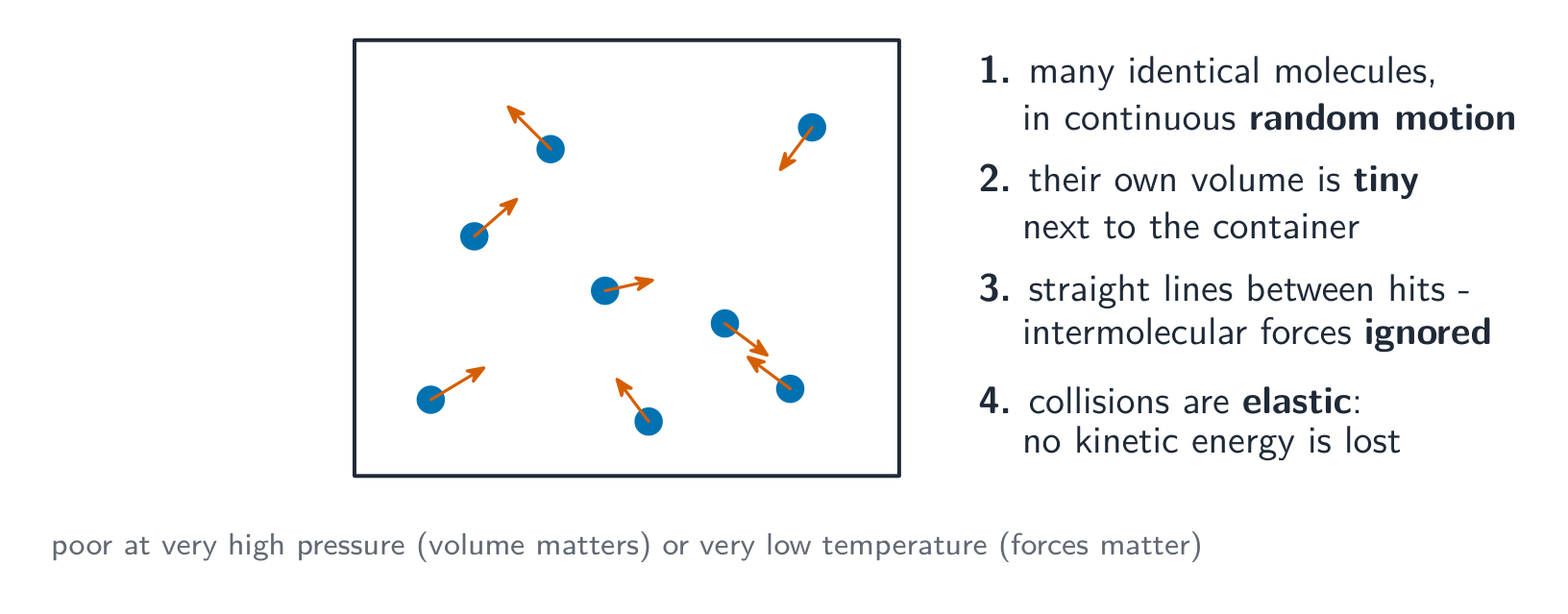
气体分子运动论:压强 热力学(thermodynamics)研究大量粒子集合里的热和能量。分子运动论(kinetic theory)从它分子的随机运动解释气体行为:
一个理想气体分子运动论的关键假设 - 温度(temperature)是分子平均动能的一个衡量:$K_{\text{avg}}=\tfrac{3}{2}k_B T$($T$ 以开尔文)。更热意味着移动更快的分子。
- 压强(pressure)来自分子与容器壁碰撞——更频繁或更硬的碰撞给出更多压强。
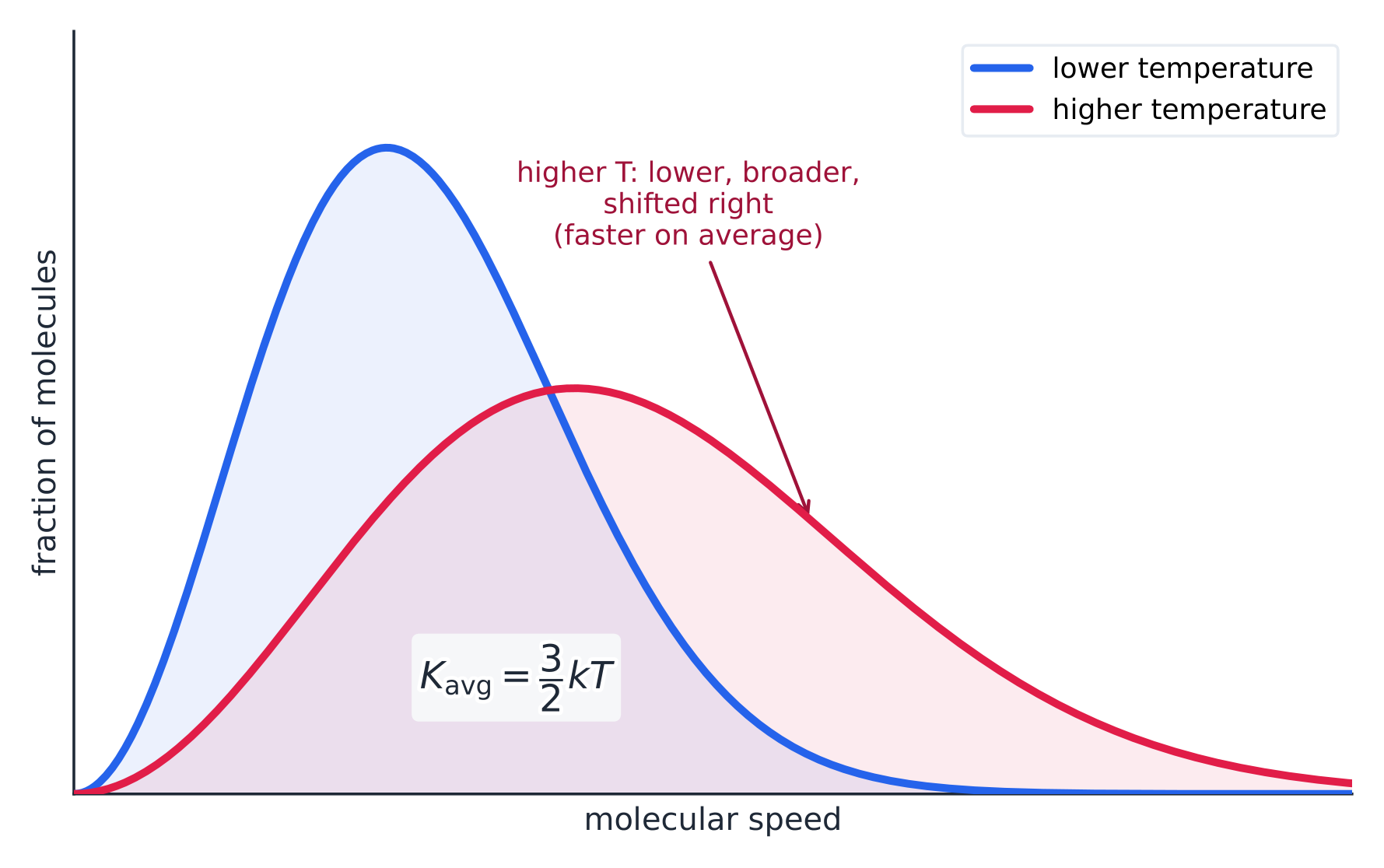
麦克斯韦-玻尔兹曼速率分布在更高温度向右移并变平 Worked example. 用 $k_B=1.38\times10^{-23}\ \text{J/K}$,求 $300\ \text{K}$ 一个气体分子的平均动能:
$$K_{\text{avg}}=\tfrac32 k_B T=1.5\times1.38\times10^{-23}\times300=6.2\times10^{-21}\ \text{J}.$$它只取决于温度,不取决于气体的类型——在相同的 $T$,轻和重的分子共享相同的平均动能(所以轻的移动更快)。探索Explore the spread of molecular speeds
Raise the temperature and watch the whole speed distribution shift right and flatten — the particles move faster on average, which is exactly what $\bar K = \tfrac{3}{2} k_B T$ means.
词汇表 训练英文 中文 拼音 Thermodynamics/ˌθɜːməʊdaɪˈnæmɪks/ 热力学 rè lì xué kinetic theory/kɪˈnetɪk ˈθɪəri/ 分子运动论 fēn zǐ yùn dòng lùn Temperature/ˈtemprɪtʃə/ 温度 wēn dù Pressure/ˈpreʃə/ 压强 yā qiáng 9.2
理想气体定律
大纲
Learning Objective Essential Knowledge 9.2.A
Describe the properties of an ideal gas.- 9.2.A.1 The classical model of an ideal gas assumes that the instantaneous velocities of atoms are random, the volumes of the atoms are negligible compared to the total volume occupied by the gas, the atoms collide elastically, and the only appreciable forces on the atoms are those that occur during collisions.
- 9.2.A.2 An ideal gas is one in which the relationships between pressure, volume, the number of moles or number of atoms, and temperature of a gas can be modeled using the equation
- Equation: $PV = nRT = N k_B T$
- 9.2.A.3 Graphs modeling the pressure, temperature, and volume of gases can be used to describe or determine properties of that gas.
- 9.2.A.4 A temperature at which an ideal gas has zero pressure can be extrapolated from a graph of pressure as a function of temperature.
来源:美国大学理事会 AP 课程与考试说明
一个理想气体(ideal gas)遵循
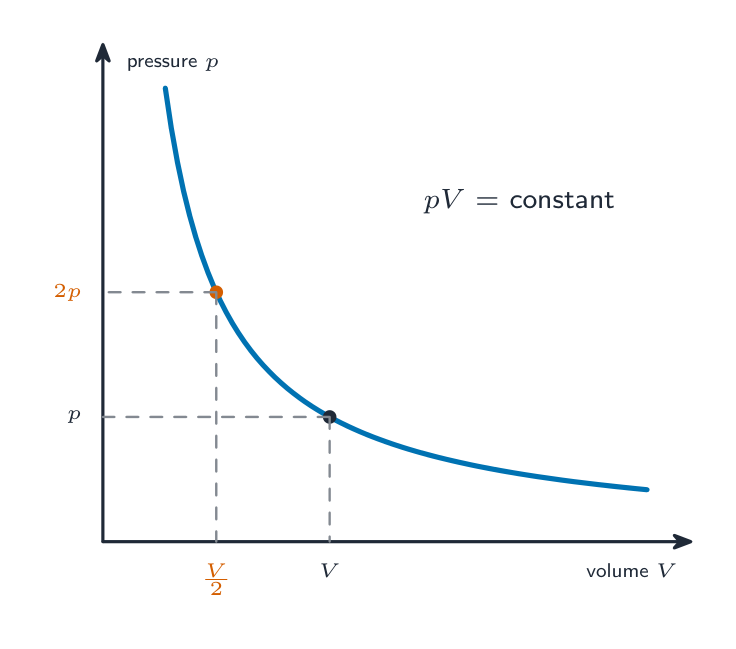
$$PV=nRT \qquad(\text{or } PV=Nk_B T),$$联系压强 $P$、体积 $V$、量($n$ 摩尔或 $N$ 分子),和绝对温度 $T$。用它来预测当你改变一个量而保持其他固定时一个气体如何反应(例如在恒定体积加热提高压强)。玻意耳定律:在恒定温度,压强乘体积恒定 Worked example. 一个密封的刚性气体容器在 $1.0\times10^{5}\ \text{Pa}$ 和 $300\ \text{K}$。它被加热到 $450\ \text{K}$。因为体积和量固定,$P/T$ 恒定:
$$P_2=P_1\frac{T_2}{T_1}=1.0\times10^{5}\times\frac{450}{300}=1.5\times10^{5}\ \text{Pa}.$$在使用一个气体定律之前总是把温度转换成开尔文——这里用摄氏会给出胡说。探索Explore squeezing a gas
Slide the piston in to shrink the volume. The same particles are crammed into less space, so they hit the walls more often and the pressure climbs — while $PV$ stays constant at fixed temperature.
词汇表 训练英文 中文 拼音 ideal gas/aɪˈdɪəl ɡæs/ 理想气体 lǐ xiǎng qì tǐ 9.3
热能传递与热平衡
大纲
Learning Objective Essential Knowledge 9.3.A
Describe the transfer of energy between two systems in thermal contact due to temperature differences of those two systems.- 9.3.A.1 Two systems are in thermal contact if the systems may transfer energy by thermal processes.
- 9.3.A.1.i Heating is the transfer of energy into a system by thermal processes.
- 9.3.A.1.ii Cooling is the transfer of energy out of a system by thermal processes.
- 9.3.A.2 The thermal processes by which energy may be transferred between systems at different temperatures are conduction, convection, and radiation.
- 9.3.A.3 Energy is transferred through thermal processes spontaneously from a higher-temperature system to a lower-temperature system.
- 9.3.A.3.i In collisions between atoms from different systems, energy is most likely to be transferred from higher-energy atoms to lower-energy atoms.
- 9.3.A.3.ii After many collisions of atoms from different systems, the most probable state is one in which both systems have the same temperature.
- 9.3.A.4 Thermal equilibrium results when no net energy is transferred by thermal processes between two systems in thermal contact with each other.
来源:美国大学理事会 AP 课程与考试说明
热量(heat)$Q$ 是因为一个温度差而转移的能量;它从热流向冷。两个接触的物体在它们共享相同温度时达到热平衡(thermal equilibrium),而净热流停止。三种转移方法是传导(conduction)、对流(convection)和辐射(radiation)。
探索Add heat and watch the temperature
Adding heat usually raises temperature, but during a phase change the temperature holds flat while the energy breaks bonds. Two bodies in contact settle at one temperature — thermal equilibrium.
词汇表 训练英文 中文 拼音 Heat/hiːt/ 热量 rè liàng thermal equilibrium/ˈθɜːml ˌiːkwɪˈlɪbrɪəm/ 热平衡 rè píng héng conduction/kənˈdʌkʃn/ 传导 chuán dǎo convection/kənˈvekʃn/ 对流 duì liú radiation/ˌreɪdɪˈeɪʃn/ 辐射 fú shè 9.4
热力学第一定律
大纲
Learning Objective Essential Knowledge 9.4.A
Describe the internal energy of a system.- 9.4.A.1 The internal energy of a system is the sum of the kinetic energy of the objects that make up the system and the potential energy of the configuration of those objects.
- 9.4.A.1.i The atoms in an ideal gas do not interact with each other via conservative forces, and the internal structure is not considered. Therefore, an ideal gas does not have internal potential energy.
- 9.4.A.1.ii The internal energy of an ideal monatomic gas is the sum of the kinetic energies of the constituent atoms in the gas.
- Equation: $U = \dfrac{3}{2} nRT = \dfrac{3}{2} N k_B T$
- 9.4.A.2 Changes to a system's internal energy can result in changes to the internal structure and internal behavior of that system without changing the motion of the system's center of mass.
9.4.B
Describe the behavior of a system using thermodynamic processes.- 9.4.B.1 The first law of thermodynamics is a restatement of conservation of energy that accounts for energy transferred into or out of a system by work, heating, or cooling.
- 9.4.B.1.i For an isolated system, the total energy is constant.
- 9.4.B.1.ii For a closed system, the change in internal energy is the sum of energy transferred to or from the system by heating, or work done on the system.
- Equation: $\Delta U = Q + W$
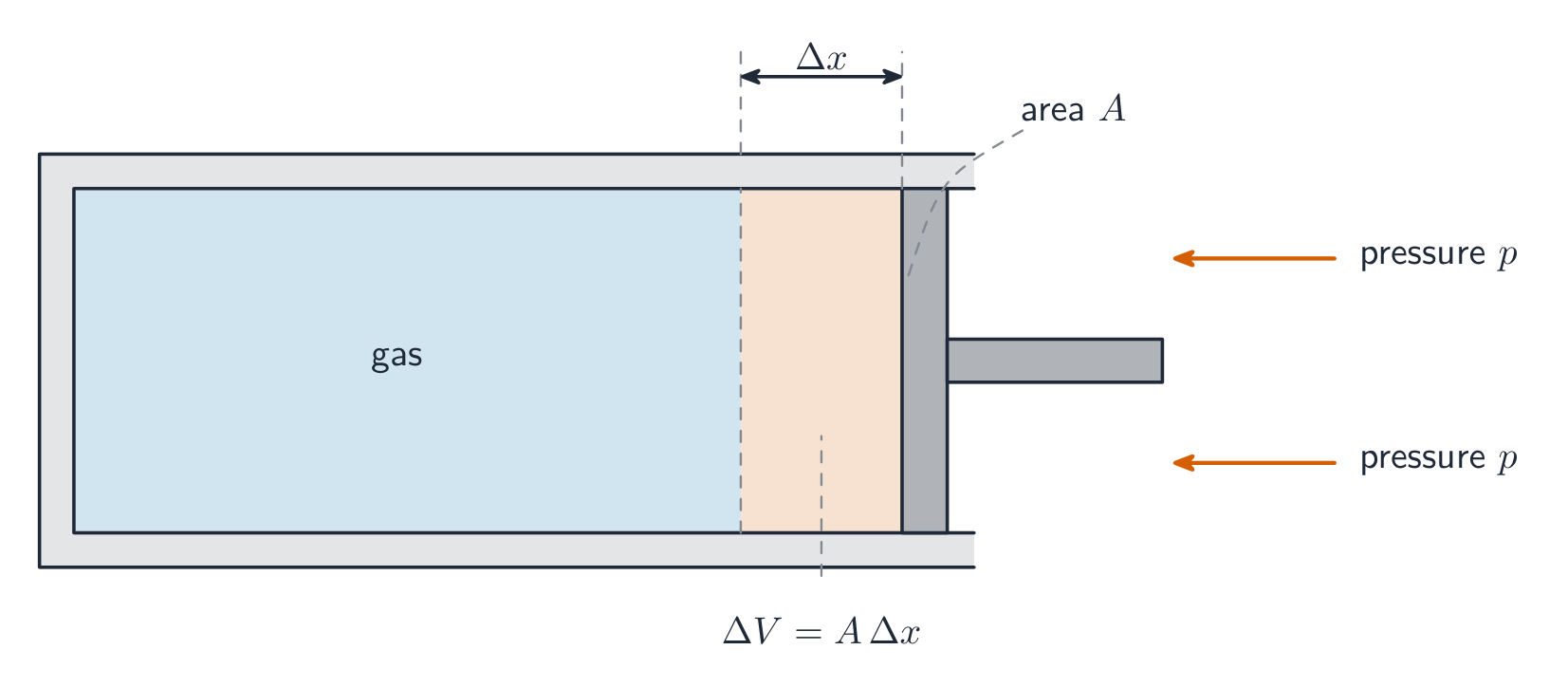
- 9.4.B.1.iii The work done on a system by a constant or average external pressure that changes the volume of that system (for example, a piston compressing a gas in a container) is defined as
- Equation: $W = -P \Delta V$
- 9.4.B.2 Pressure-volume graphs (also known as PV diagrams) are representations used to represent thermodynamic processes.
- 9.4.B.2.i Lines of constant temperature on a PV diagram are called isotherms.
- 9.4.B.2.ii The absolute value of the work done on a gas when the gas expands or compresses is equal to the area underneath the curve of a plot of pressure vs. volume for the gas.
- 9.4.B.3 Special cases of thermal processes depend on the relationship between the configuration of the system, the nature of the work done on the system, and the system's surroundings. These include constant volume (isovolumetric), constant temperature (isothermal), and constant pressure (isobaric), as well as processes where no energy is transferred to or from the system through thermal processes (adiabatic).
来源:美国大学理事会 AP 课程与考试说明
热力学第一定律(first law)是气体的能量守恒:
$$\Delta U = Q + W,$$其中 $\Delta U$ 是内能(internal energy)(与温度绑定)的变化,$Q$ 是加给气体的热,而 $W$ 是对气体做的功。在一个压强-体积图上,气体做的功是过程曲线下的面积。注意符号:压缩一个气体对它做正功。一个气体把一个活塞推出一个小距离做的功等于 p 乘体积变化 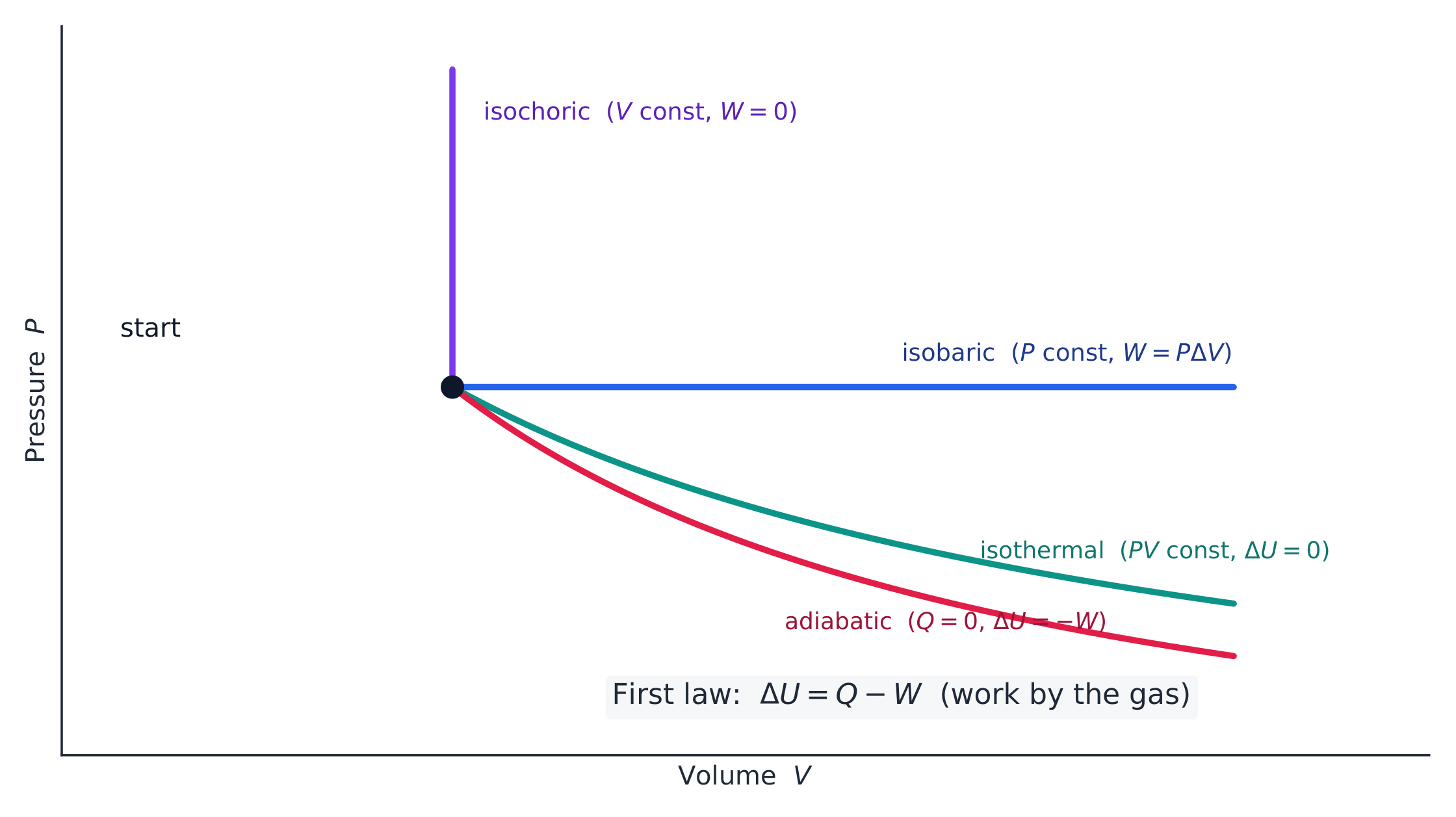
从 PV 图上一个共同起始状态画的四个热力学过程 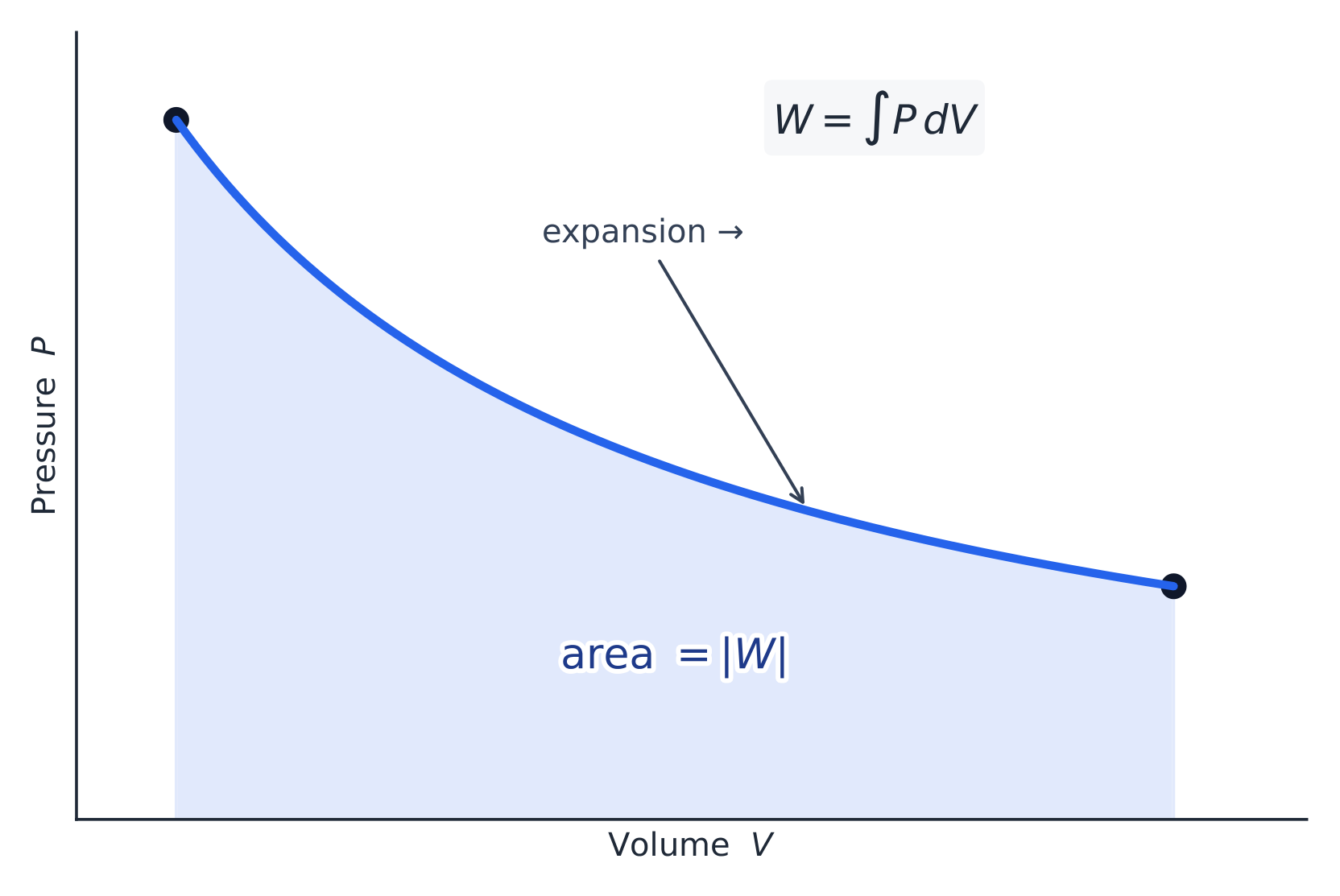
一次体积变化期间做的功等于 P-V 曲线下的面积 Worked example. 一个气体吸收 $500\ \text{J}$ 的热,而当它膨胀时,对它的环境做 $200\ \text{J}$ 的功。求它内能的变化。对气体做的功是 $W=-200\ \text{J}$(它做功,所以它失去那个能量):
$$\Delta U=Q+W=500+(-200)=300\ \text{J}.$$内能上升 $300\ \text{J}$,所以气体最终更热。把 $W$ 的符号搞对是第一定律问题的全部关键。词汇表 训练英文 中文 拼音 first law/fɜːst lɔː/ 热力学第一定律 rè lì xué dì yí dìng lǜ internal energy/ɪnˈtɜːnl ˈenədʒi/ 内能 nèi néng 9.5
比热容与热导率
大纲
Learning Objective Essential Knowledge 9.5.A
Describe the energy required to change the temperature of an object by a certain amount.- 9.5.A.1 The amount of energy required to change the temperature of a material is related to the material's specific heat.
- Equation: $Q = mc\Delta T$
- 9.5.A.2 The specific heat of a material is an intrinsic property of that material that depends on the arrangement and interactions of the atoms that make up the material.
9.5.B
Describe the rate at which energy is transferred by conduction through a given material.- 9.5.B.1 The rate at which energy is transferred by conduction through a given material is related to the thermal conductivity, the physical dimensions of the material, and the temperature difference across the material.
- Equation: $\dfrac{Q}{\Delta t} = \dfrac{kA\Delta T}{L}$
- 9.5.B.2 The thermal conductivity of a material is an intrinsic property of that material that depends on the arrangement and interactions of the atoms that make up the material.
Boundary statement: AP Physics 2 will model specific heat as independent of temperature.
来源:美国大学理事会 AP 课程与考试说明
- 比热容(specific heat)$c$ 是把一千克提高一度所需的热:$Q=mc\,\Delta T$。一个高比热容(像水的)意味着一个物质抵抗温度变化。
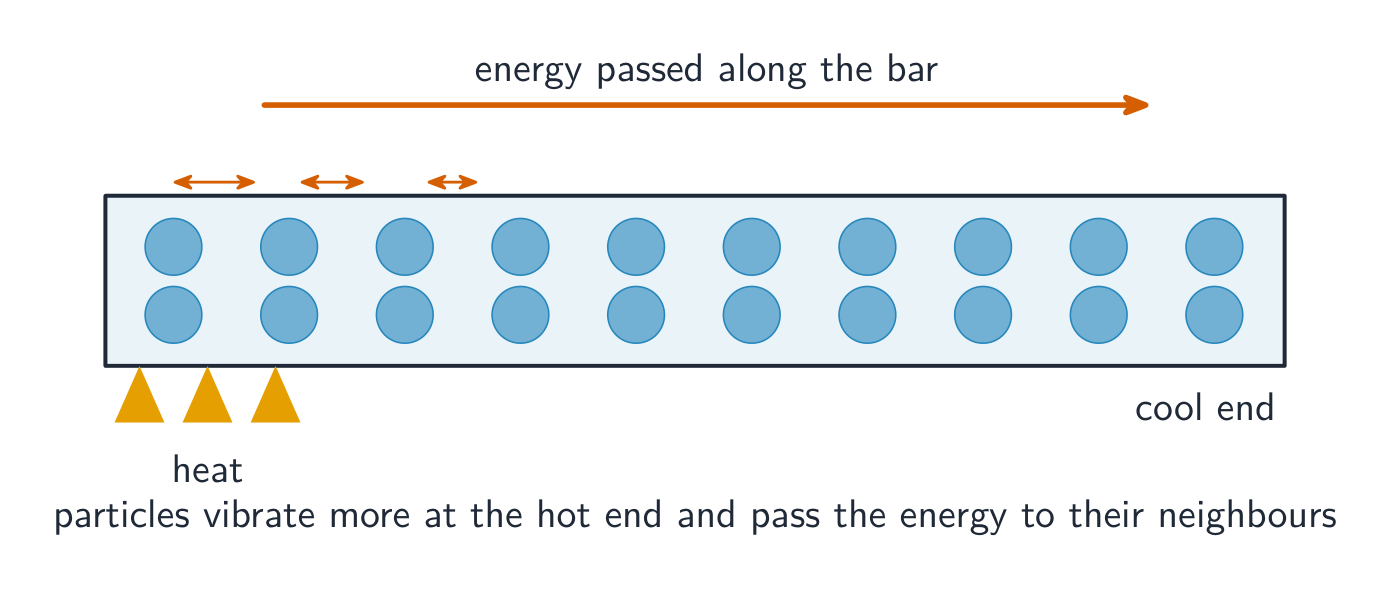
- 热导率(thermal conductivity)测量热通过一种材料传导多快;传导的速率随面积和温度差上升而随厚度下降。
传导:振动的粒子沿一根金属棒传递能量 Worked example. 多少热把 $2.0\ \text{kg}$ 水的温度从 $20\,{}^{\circ}\text{C}$ 提高到 $80\,{}^{\circ}\text{C}$?水的比热容是 $c=4200\ \text{J/(kg}\,{}^{\circ}\text{C)}$:
$$Q=mc\,\Delta T=2.0\times4200\times(80-20)=5.0\times10^{5}\ \text{J}.$$水的大比热容是为什么它被用作冷却剂以及为什么沿海气候温和。探索Explore how much energy heats a material
Pick a material, set the mass and temperature rise, and read the energy from $Q = mc\,\Delta T$. Water needs far more energy than the metals to warm by the same amount.
词汇表 训练英文 中文 拼音 Specific heat/spəˈsɪfɪk hiːt/ 比热容 bǐ rè róng Thermal conductivity/ˈθɜːml kɒndəkˈtɪvɪti/ 热导率 rè dǎo lǜ 9.6
熵与热力学第二定律
大纲
Learning Objective Essential Knowledge 9.6.A
Describe the change in entropy for a given system over time.- 9.6.A.1 The second law of thermodynamics states that the total entropy of an isolated system can never decrease and is constant only when all processes the system undergoes are reversible.
- 9.6.A.2 Entropy can be qualitatively described as the tendency of energy to spread or the unavailability of some of the system's energy to do work.
- 9.6.A.2.i Localized energy will tend to disperse and spread out.
- 9.6.A.2.ii Entropy is a state function and therefore only depends on the current state or configuration of a system, not how the system reached that state.
- 9.6.A.2.iii Maximum entropy occurs when a system is in thermodynamic equilibrium.
- 9.6.A.3 The change in a system's entropy is determined by the system's interactions with its surroundings.
- 9.6.A.3.i Isolated systems spontaneously move toward thermodynamic equilibrium.
- 9.6.A.3.ii The entropy of an isolated system never decreases, but the entropy of a closed system can decrease because energy can be transferred into or out of the system.
Boundary statement: Only qualitative treatment of the second law of thermodynamics is within the scope of AP Physics 2.
来源:美国大学理事会 AP 课程与考试说明
熵(entropy)测量一个系统的无序,或排列它的方式数目。热力学第二定律(second law):一个孤立系统的总熵从不减少——能量自然地散开。这设定过程的方向:热自己从热→冷流动,从不相反,而没有引擎能把热完全转换成功。
词汇表 训练英文 中文 拼音 Entropy/ˈentrəpi/ 熵 shāng second law/ˈsekənd lɔː/ 热力学第二定律 rè lì xué dì èr dìng lǜ 9.6
考试技巧
- 在使用任何气体定律之前总是把温度转换成开尔文($T_{\text{K}}=T_{\text{C}}+273$)。
- 在第一定律 $\Delta U = Q + W$ 里,把 $W$ 的符号搞对:对气体做的功是正的;当气体膨胀并对它的环境做功时,$W$ 是负的。
- 温度测量粒子的平均动能,所以在相同的 $T$ 更轻的分子移动更快。
- 在一个 PV 图上气体做的功是过程曲线下的面积。
- 对温度变化用 $Q=mc\,\Delta T$;第二定律固定方向——热从热→冷流动而总熵从不减少。
-
10
电力、电场与电势
10.1
电荷与电力
大纲
Learning Objective Essential Knowledge 10.1.A
Describe the electric force that results from the interactions between charged objects or systems.- 10.1.A.1 Charge is a fundamental property of all matter.
- 10.1.A.1.i Charge is described as positive or negative.
- 10.1.A.1.ii The magnitude of the charge of a single electron or proton, the elementary charge $e$, can be considered to be the smallest indivisible amount of charge.
- 10.1.A.1.iii The charge of an electron is $-e$, the charge of a proton is $+e$, and a neutron has no electric charge.
- 10.1.A.1.iv A point charge is a model in which the physical size of a charged object or system is negligible in the context of the situation being analyzed.
- 10.1.A.2 Coulomb's law describes the electrostatic force between two charged objects as directly proportional to the magnitude of each of the charges and inversely proportional to the square of the distance between the objects.
- Equation: $\left|\vec{F}_E\right| = \dfrac{1}{4\pi\varepsilon_0}\dfrac{\left|q_1 q_2\right|}{r^2} = k\dfrac{\left|q_1 q_2\right|}{r^2}$
- 10.1.A.3 The direction of the electrostatic force depends on the signs of the charges of the interacting objects and is parallel to the line of separation between the objects.
- 10.1.A.3.i Two objects with charges of the same sign exert repulsive forces on each other.
- 10.1.A.3.ii Two objects with charges of opposite signs exert attractive forces on each other.
- 10.1.A.4 Electric forces are responsible for some of the macroscopic properties of objects in everyday experiences. However, the large number of particle interactions that occur make it more convenient to treat everyday forces in terms of nonfundamental forces called contact forces, such as normal force, friction, and tension.
10.1.B
Describe the electric and gravitational forces that result from interactions between charged objects with mass.- 10.1.B.1 Electrostatic forces can be attractive or repulsive, while gravitational forces are always attractive.
- 10.1.B.2 For any two objects that have mass and electric charge, the magnitude of the gravitational force is usually much smaller than the magnitude of the electrostatic force.
- 10.1.B.3 Gravitational forces dominate at larger scales even though they are weaker than electrostatic forces, because systems at large scales tend to be electrically neutral.
10.1.C
Describe the electric permittivity of a material or medium.- 10.1.C.1 Electric permittivity is a measurement of the degree to which a material or medium is polarized in the presence of an electric field.
- 10.1.C.2 Electric polarization can be modeled as the induced rearrangement of electrons by an external electric field, resulting in a separation of positive and negative charges within a material or medium.
- 10.1.C.3 Free space has a constant value of electric permittivity, $\varepsilon_0$, that appears in physical relationships.
- 10.1.C.4 The permittivity of matter has a value different from that of free space that arises from the matter's composition and arrangement.
- 10.1.C.4.i In a given material, electric permittivity is determined by the ease with which electrons can change configurations within the material.
- 10.1.C.4.ii Conductors are made from electrically conducting materials in which charge carriers move easily; insulators are made from electrically nonconducting materials in which charge carriers cannot move easily.
Boundary statement: AP Physics 2 only expects students to make calculations of the electric force between four or fewer interacting charged objects or systems. The analysis of the resulting electric force from more charges is allowed in situations of high symmetry.
来源:美国大学理事会 AP 课程与考试说明
电荷(electric charge)是物质的一个基本属性,它有两种,正和负;同种电荷排斥而相反电荷吸引。电荷守恒且量子化(基本电荷 $e$ 的一个倍数)。两个点电荷之间的力是库仑定律(Coulomb's law):
$$F=\frac{k q_1 q_2}{r^2},$$沿连接它们的线——一个像重力的平方反比定律,但它能推或拉。常数 $k$ 里藏着介质的一个属性:介电常数(permittivity)。自由空间有一个固定的真空介电常数 $\varepsilon_0$(其中 $k = 1/4\pi\varepsilon_0$),而物质的介电常数不同于 $\varepsilon_0$,取决于材料的组成和排列 - 这就是为什么两个电荷之间放一种材料会改变力。还要注意,尽管电力比重力强得多,在大尺度上却是重力占主导,因为大物体通常是电中性的(正负相等),只剩下重力起作用。
Worked example. 两个点电荷,$+3.0\ \mu\text{C}$ 和 $-2.0\ \mu\text{C}$,相距 $0.10\ \text{m}$($k=9.0\times10^{9}$)。它们之间的力是
$$F=\frac{k q_1 q_2}{r^2}=\frac{9.0\times10^{9}\times(3.0\times10^{-6})(2.0\times10^{-6})}{(0.10)^2}=5.4\ \text{N},$$吸引的,因为电荷有相反的符号。(用大小求大小并从符号决定方向。)词汇表 训练英文 中文 拼音 Electric charge/ɪˈlektrɪk tʃɑːdʒ/ 电荷 diàn hè Coulomb's law/ˈkuːlɒmz lɔː/ 库仑定律 kù lún dìng lǜ permittivity/ˌpɜːmɪˈtɪvəti/ 介电常数 jiè diàn cháng shù 10.2
起电的过程
大纲
Learning Objective Essential Knowledge 10.2.A
Describe the behavior of a system using conservation of charge.- 10.2.A.1 The net charge or charge distribution of a system can change in response to the presence of, or changes in, the net charge or charge distribution of other systems.
- 10.2.A.1.i The net charge of a system can change due to friction or contact between systems.
- 10.2.A.1.ii Induced charge separation occurs when the electrostatic force between two systems alters the distribution of charges within the systems, resulting in the polarization of one or both systems.
- 10.2.A.1.iii Induced charge separation can occur in neutral systems.
- 10.2.A.2 Any change to a system's net charge is due to a transfer of charge between the system and its surroundings.
- 10.2.A.2.i The charging of a system typically involves the transfer of electrons to and from the system.
- 10.2.A.2.ii The net charge of a system will be constant unless there is a transfer of charge to or from the system.
- 10.2.A.3 Grounding involves electrically connecting a charged system to a much larger and approximately neutral system (e.g., Earth).
来源:美国大学理事会 AP 课程与考试说明
物体通过移动电子充电。一个导体(conductor)让电荷自由移动;一个绝缘体(insulator)把它保持在原位。三种方法:
- 摩擦(friction):摩擦转移电子。
- 接触起电(conduction):触碰共享电荷。
- 感应起电(induction):一个附近的电荷在一个中性物体里重新排列电荷,它然后能被接地以使它带电。
探索Charge an object by rubbing
Rubbing transfers electrons from one surface to another, leaving one positively and one negatively charged. Like charges repel, opposite charges attract.
词汇表 训练英文 中文 拼音 conductor/kənˈdʌktə/ 导体 dǎo tǐ insulator/ˈɪnsjuːleɪtə/ 绝缘体 jué yuán tǐ Conduction/kənˈdʌkʃn/ 接触起电 jiē chù qǐ diàn Induction/ɪnˈdʌkʃn/ 感应起电 gǎn yìng qǐ diàn 10.3
电场
大纲
Learning Objective Essential Knowledge 10.3.A
Describe the electric field produced by a charged object or configuration of point charges.- 10.3.A.1 Electric fields may originate from charged objects.
- 10.3.A.2 The electric field at a given point is the ratio of the electric force exerted on a test charge at that point to the charge of the test charge.
- Equation: $\vec{E} = \dfrac{\vec{F}_E}{q}$
- 10.3.A.2.i A test charge is a point charge of small enough magnitude such that its presence does not significantly affect an electric field in its vicinity.
- 10.3.A.2.ii An electric field points away from isolated positive charges and toward isolated negative charges.
- 10.3.A.2.iii The electric force exerted on a positive test charge by an electric field is in the same direction as the electric field.
- 10.3.A.3 The electric field is a vector quantity and can be represented in space using vector field maps.
- 10.3.A.3.i The net electric field at a given location is the vector sum of individual electric fields created by nearby charged objects.
- 10.3.A.3.ii Electric field maps use vectors to depict the magnitude and direction of the electric field at many locations within a given region.
- 10.3.A.3.iii Electric field line diagrams are simplified models of electric field maps and can be used to determine the relative magnitude and direction of the electric field at any position in the diagram.
10.3.B
Describe the electric field generated by charged conductors or insulators.- 10.3.B.1 While in electrostatic equilibrium, the excess charge of a solid conductor is distributed on the surface of the conductor, and the electric field within the conductor is zero.
- 10.3.B.1.i At the surface of a charged conductor, the electric field is perpendicular to the surface.
- 10.3.B.1.ii The electric field outside an isolated sphere with spherically symmetric charge distribution is the same as the electric field due to a point charge with the same net charge as the sphere located at the center of the sphere.
- 10.3.B.2 While in electrostatic equilibrium, the excess charge of an insulator is distributed throughout the interior of the insulator as well as at the surface, and the electric field within the insulator may have a nonzero value.
Boundary statement: AP Physics 2 only expects students to make calculations of the electric field resulting from four or fewer charged objects or systems. Analysis of the electric field resulting from more charges is allowed in situations of high symmetry. Students will only be expected to perform qualitative analysis of electric fields within insulators.
来源:美国大学理事会 AP 课程与考试说明
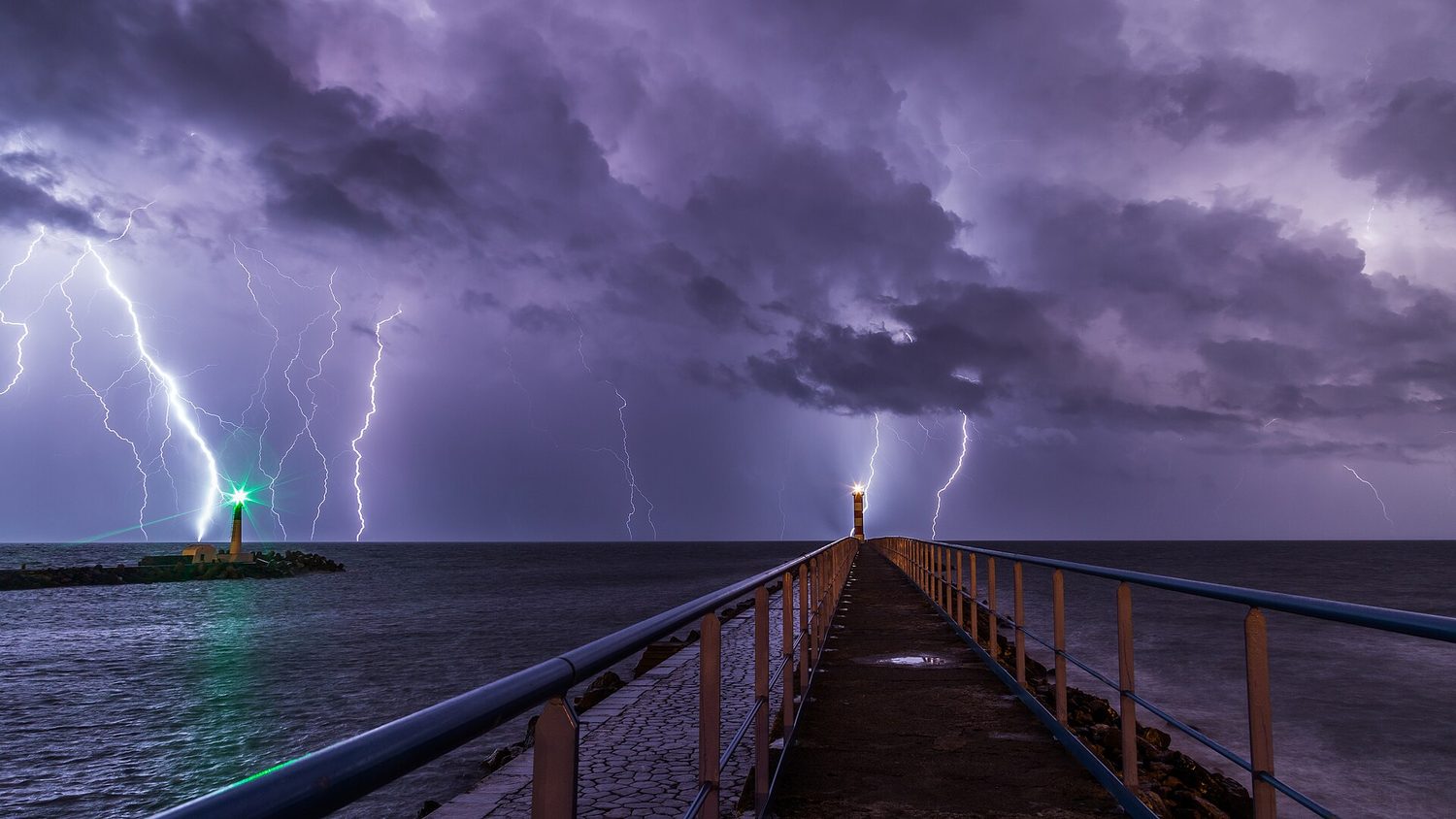
偶极子的电场 闪电:电荷不断累积,直到云和地面之间的电场强到足以把电子从空气分子上撕下来,于是一股巨大的电流流过 一个电场(electric field)$\vec{E}$ 是一个小的正测试电荷会感受的每单位电荷的力:
$$\vec{E}=\frac{\vec{F}}{q},\qquad E=\frac{kQ}{r^2}\ \text{for a point charge}.$$场线从正电荷指向外并朝向负的;它们更密的地方,场更强。一个场里的电荷感受 $\vec{F}=q\vec{E}$。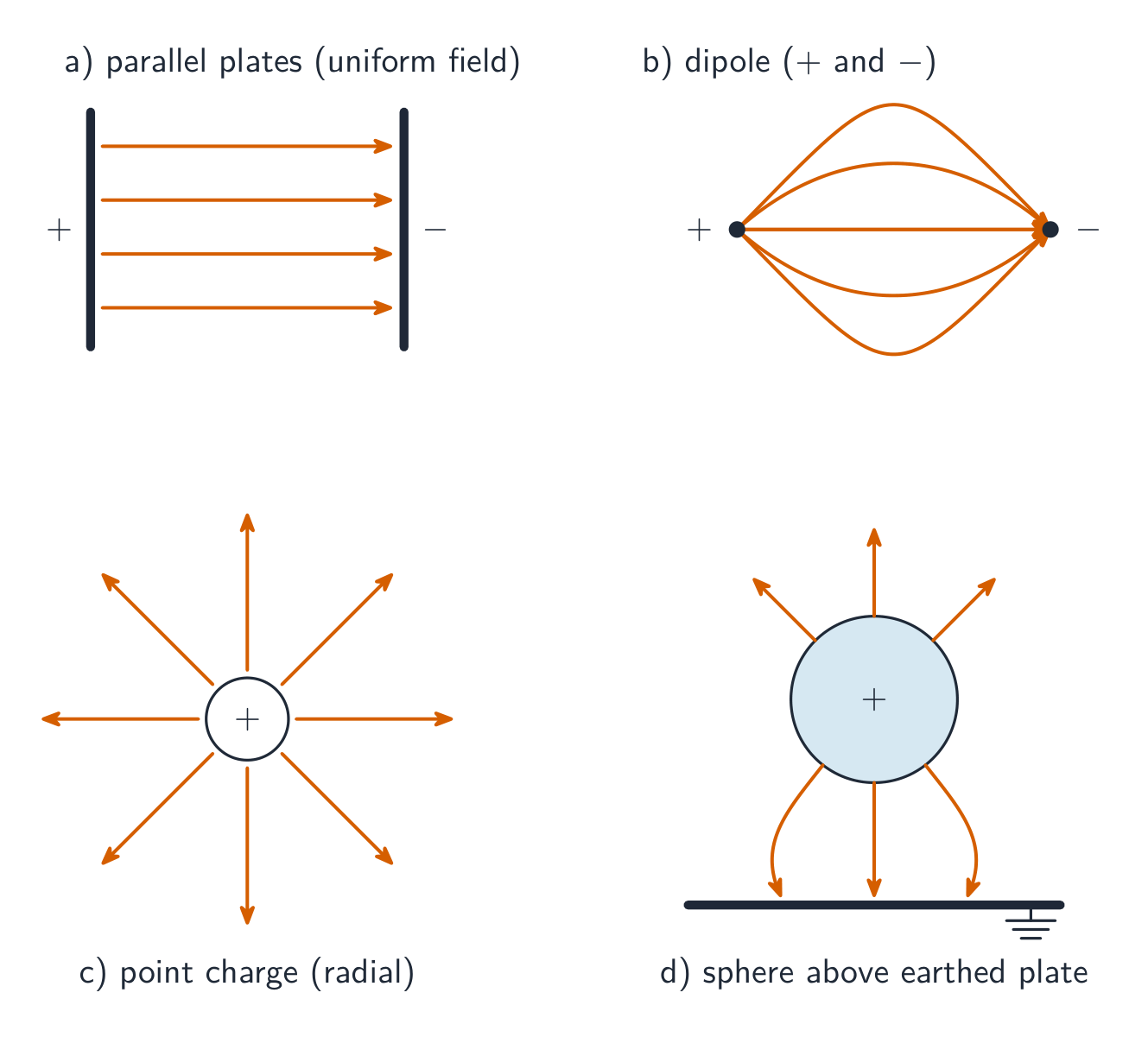
平行板、一个偶极子和一个点电荷的电场线模式 Worked example. 求距一个 $+5.0\ \mu\text{C}$ 点电荷 $0.20\ \text{m}$ 的电场:$E=\dfrac{kQ}{r^2}=\dfrac{9.0\times10^{9}\times5.0\times10^{-6}}{(0.20)^2}=1.1\times10^{6}\ \text{N/C}$,从电荷指向外。放在那里的一个 $+2\ \text{nC}$ 电荷会感受 $F=qE=2\times10^{-9}\times1.1\times10^{6}=2.2\times10^{-3}\ \text{N}$。
探索Map the field around a charge
An electric field points the way a positive test charge would be pushed: away from a positive charge, toward a negative one. Closer lines mean a stronger field.
词汇表 训练英文 中文 拼音 electric field/ɪˈlektrɪk fiːld/ 电场 diàn chǎng 10.4
电势能
大纲
Learning Objective Essential Knowledge 10.4.A
Describe the electric potential energy of a system.- 10.4.A.1 The electric potential energy of a system of two point charges equals the amount of work required for an external force to bring the point charges to their current positions from infinitely far away.
- 10.4.A.2 The general form for the electric potential energy of two charged objects is given by the equation
- Equation: $U_E = \dfrac{1}{4\pi\varepsilon_0}\dfrac{q_1 q_2}{r} = k\dfrac{q_1 q_2}{r}$
- 10.4.A.3 The total electric potential energy of a system can be determined by finding the sum of the electric potential energies of the individual interactions between each pair of charged objects in the system.
Boundary statement: As the methods to calculate the electric potential energy due to extended charge distributions exceed the scope of the course, AP Physics 2 only requires that students calculate the electric potential energy of configurations of four or fewer point charges.
来源:美国大学理事会 AP 课程与考试说明
两个电荷有储存在它们的排列里的电势能(electric potential energy):
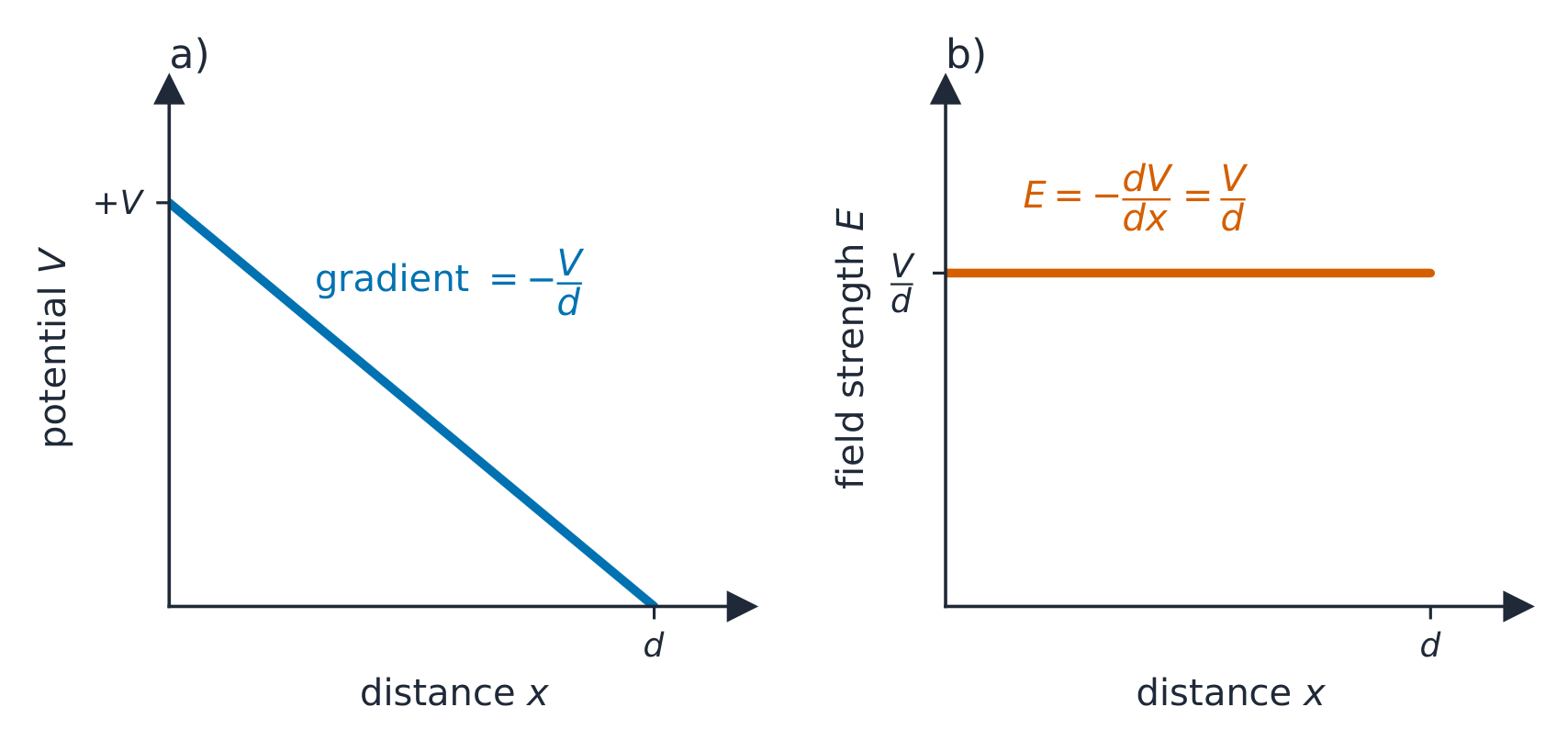
$$U=\frac{k q_1 q_2}{r}.$$被推到一起的同种电荷储存正能量;相反电荷有负能量(被束缚)。移动一个电荷改变 $U$,而电力做等于 $-\Delta U$ 的功。在一个均匀场里电势随距离稳定地下降,所以 E 与 V 相关 词汇表 训练英文 中文 拼音 electric potential energy/ɪˈlektrɪk pəˈtenʃl ˈenədʒi/ 电势能 diàn shì néng Electric potential/ɪˈlektrɪk pəˈtenʃl/ 电势 diàn shì 10.5
电势
大纲
Learning Objective Essential Knowledge 10.5.A
Describe the electric potential due to a configuration of charged objects.- 10.5.A.1 Electric potential describes the electric potential energy per unit charge at a point in space.
- 10.5.A.2 The electric potential due to multiple point charges can be determined by the principle of scalar superposition of the electric potential due to each of the point charges.
- Equation: $V = \dfrac{1}{4\pi\varepsilon_0}\sum_{i}\dfrac{q_i}{r_i}$
- 10.5.A.3 The electric potential difference between two points is the change in electric potential energy per unit charge when a test charge is moved between the two points.
- Equation: $\Delta V = \dfrac{\Delta U_E}{q}$
- 10.5.A.3.i Electric potential difference may also result from chemical processes that cause positive and negative charges to separate, such as in a battery.
- 10.5.A.4 When conductors are in electrical contact, electrons will be redistributed such that the surfaces of the conductors are at the same electric potential.
10.5.B
Describe the relationship between electric potential and electric field.- 10.5.B.1 The average electric field between two points in space is equal to the electric potential difference between the two points divided by the distance between the two points.
- Equation: $\left|\vec{E}\right| = \left|\dfrac{\Delta V}{\Delta r}\right|$
- 10.5.B.2 Electric field vector maps and equipotential lines are tools to describe the field produced by a charge or configuration of charges and can be used to predict the motion of charged objects in the field.
- 10.5.B.2.i Equipotential lines represent lines of equal electric potential in space. These lines are also referred to as isolines of electric potential.
- 10.5.B.2.ii Isolines are perpendicular to electric field vectors. An isoline map of electric potential can be constructed from an electric field vector map, and an electric field map may be constructed from an isoline map.
- 10.5.B.2.iii An electric field vector points in the direction of decreasing potential.
- 10.5.B.2.iv There is no component of an electric field along an isoline.
Boundary statement: As the methods to calculate the electric potential due to extended charges exceed the scope of the course, AP Physics 2 only expects that students calculate the electric potential of configurations of four or fewer particles (or more in situations of high symmetry).
来源:美国大学理事会 AP 课程与考试说明
电势(electric potential)$V$ 是每单位电荷的势能——一个标量场,以伏特测量:
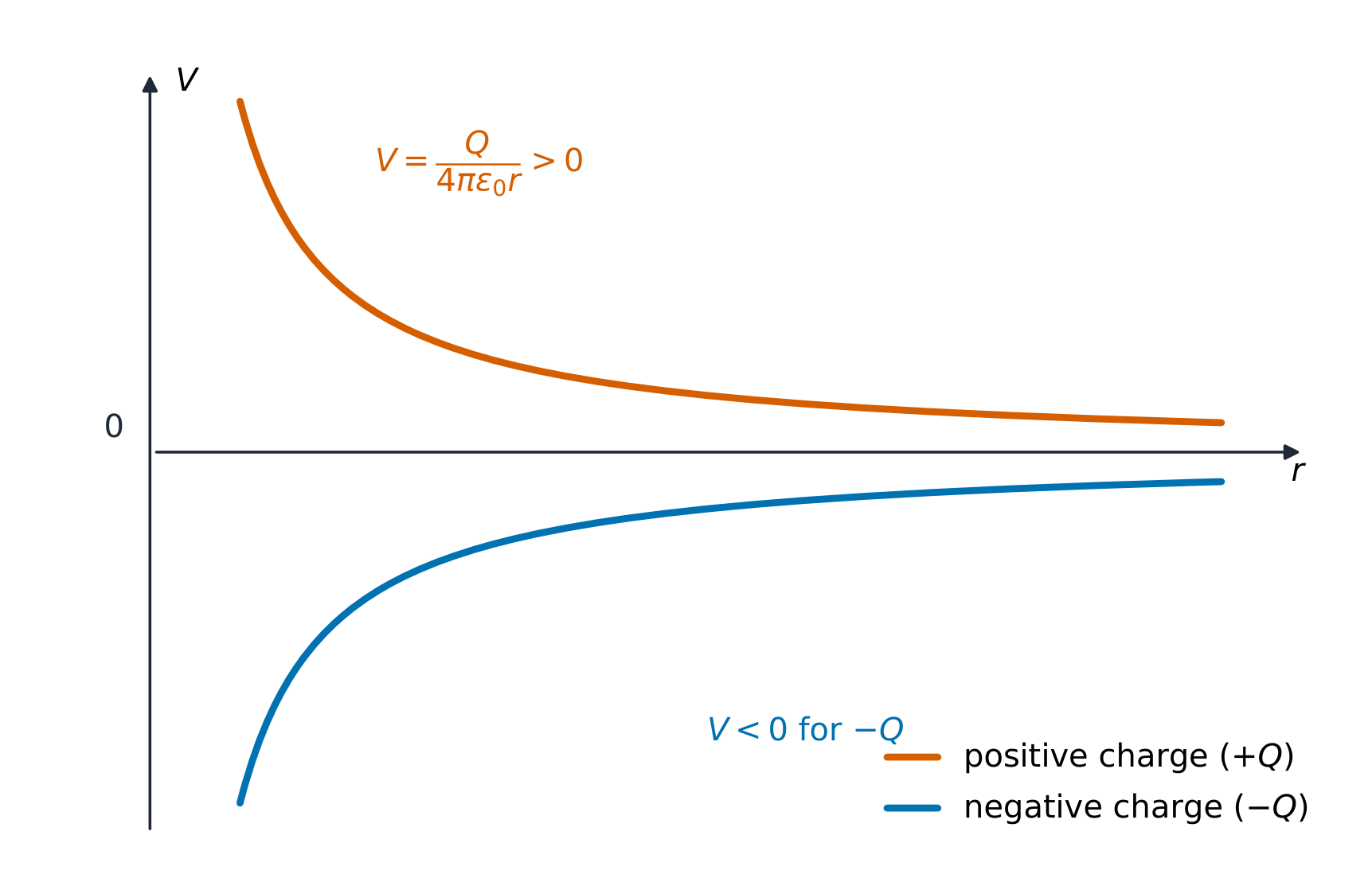
$$V=\frac{U}{q}=\frac{kQ}{r}.$$两点之间的电势差(电压)(potential difference)是移动它们之间每单位电荷的功:$\Delta V=\dfrac{\Delta U}{q}$,而 $U=qV$。正电荷自己从高电势移向低电势。因为电势是一个标量,把来自几个电荷的电势相加比相加场矢量容易得多。一个点电荷附近的电势随 1/r 变化 词汇表 训练英文 中文 拼音 potential difference/pəˈtenʃl ˈdɪfrəns/ 电压 diàn yā 10.6
电容器
大纲
Learning Objective Essential Knowledge 10.6.A
Describe the physical properties of a parallel-plate capacitor.- 10.6.A.1 A parallel-plate capacitor consists of two separated parallel conducting surfaces that can hold equal amounts of charge with opposite signs.
- 10.6.A.2 Capacitance relates the magnitude of the charge stored on each plate to the electric potential difference created by the separation of those charges.
- Equation: $C = \dfrac{Q}{\Delta V}$
- 10.6.A.2.i The capacitance of a capacitor depends only on the physical properties of the capacitor, such as the capacitor's shape and the material used to separate the plates.
- 10.6.A.2.ii The capacitance of a parallel-plate capacitor is proportional to the area of one of its plates and inversely proportional to the distance between its plates. The constant of proportionality is the product of the dielectric constant, $\kappa$, of the material between the plates and the electric permittivity of free space, $\varepsilon_0$.
- Equation: $C = \kappa\varepsilon_0\dfrac{A}{d}$
- 10.6.A.3 The electric field between two charged parallel plates with uniformly distributed electric charge, such as in a parallel-plate capacitor, is constant in both magnitude and direction, except near the edges of the plates.
- 10.6.A.3.i The magnitude of the electric field between two charged parallel plates, where the plate separation is much smaller than the dimensions of the plates, can be described with the equation
- Equation: $E_C = \dfrac{Q}{\kappa\varepsilon_0 A}$
- 10.6.A.3.ii A charged particle between two oppositely charged parallel plates undergoes constant acceleration and therefore its motion shares characteristics with the projectile motion of an object with mass in the gravitational field near Earth's surface.
- 10.6.A.3.i The magnitude of the electric field between two charged parallel plates, where the plate separation is much smaller than the dimensions of the plates, can be described with the equation
- 10.6.A.4 The electric potential energy stored in a capacitor is equal to the work done by an external force to separate that amount of charge on the capacitor.
- 10.6.A.5 The electric potential energy stored in a capacitor is described by the equation
- Equation: $U_C = \dfrac{1}{2}Q\Delta V$
- 10.6.A.6 Adding a dielectric between two plates of a capacitor changes the capacitance of the capacitor and induces an electric field in the dielectric in the opposite direction to the field between the plates.
Boundary statement: While other shapes are also able to separate charges, only the analysis and descriptions of parallel-plate capacitors are required for AP Physics 2. Edge effects will be ignored unless explicitly stated otherwise.
来源:美国大学理事会 AP 课程与考试说明
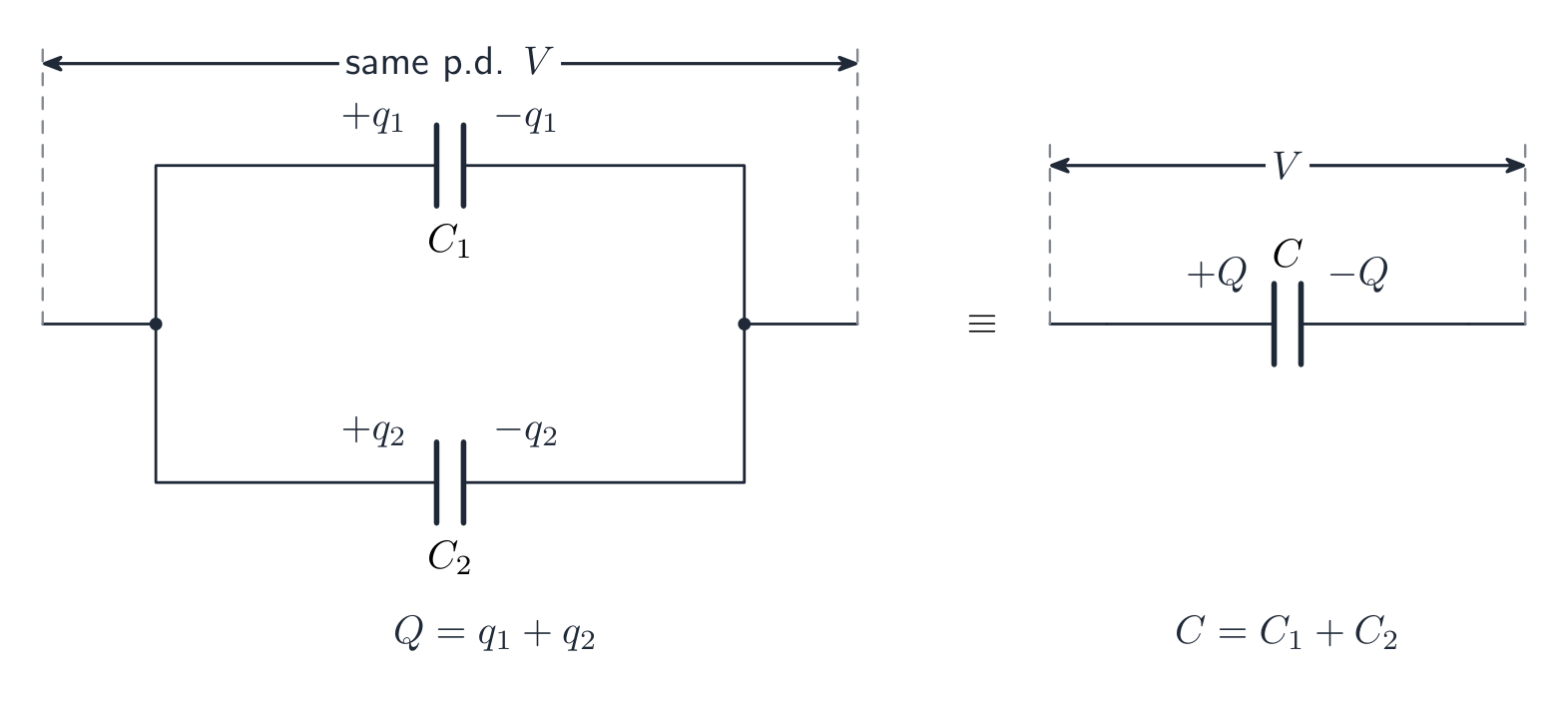
电容放电:τ = RC 电容器充电(RC) 一个电容器(capacitor)在被一个间隙分开的两个导体上储存电荷和能量。它的电容(capacitance)把电荷与电压关联:
$$C=\frac{Q}{V},$$而储存的能量是 $U=\tfrac{1}{2}CV^2$。电容取决于板的几何和它们之间的材料,不取决于放在它上的电荷。并联的电容器共享相同的电势差,而它们的电荷相加 Worked example. 一个 $100\ \mu\text{F}$ 的电容器被充电到 $12\ \text{V}$。它容纳 $Q=CV=100\times10^{-6}\times12=1.2\times10^{-3}\ \text{C}$ 的电荷并储存 $U=\tfrac12 CV^2=\tfrac12\times100\times10^{-6}\times12^2=7.2\times10^{-3}\ \text{J}$ 的能量。
探索Charge and discharge a capacitor
A capacitor stores charge on two plates. It fills and empties exponentially, set by the time constant $\tau = RC$ — bigger $R$ or $C$ means slower charging.
词汇表 训练英文 中文 拼音 capacitor/kəˈpæsɪtə/ 电容器 diàn róng qì capacitance/kəˈpæsɪtəns/ 电容 diàn róng 10.7
电能守恒
大纲
Learning Objective Essential Knowledge 10.7.A
Describe changes in energy in a system due to a difference in electric potential between two locations.- 10.7.A.1 When a charged object moves between two locations with different electric potentials, the resulting change in the electric potential energy of the object-field system is given by the following equation.
- Equation: $\Delta U_E = q\Delta V$
- 10.7.A.2 The movement of a charged object between two points with different electric potentials results in a change in kinetic energy of the object consistent with the conservation of energy.
来源:美国大学理事会 AP 课程与考试说明
能量对电荷守恒,正如对质量。一个在场里释放的电荷把电势能转换成动能:
$$q\,\Delta V=\tfrac{1}{2}mv^2 \quad(\text{gaining speed as it "falls" through a potential difference}).$$Worked example. 一个电子($q=1.6\times10^{-19}\ \text{C}$,$m=9.1\times10^{-31}\ \text{kg}$)从静止通过一个 $100\ \text{V}$ 的电势差加速。它的最终速率是
$$v=\sqrt{\frac{2q\,\Delta V}{m}}=\sqrt{\frac{2\times1.6\times10^{-19}\times100}{9.1\times10^{-31}}}=5.9\times10^{6}\ \text{m/s}.$$这正是一台旧电视里的电子枪或一台电子显微镜如何工作。10.7
考试技巧
- 库仑定律和点电荷场是平方反比的——把间距加倍使力(或场)小四倍。
- 用大小求一个力的大小并从符号决定方向;场指向一个正测试电荷会移动的方向。
- 电势($V$)是一个标量,所以来自几个电荷的电势简单地相加;场($E$)是一个矢量且必须按方向相加。
- 对通过一个电压加速的一个电荷用能量守恒 $qV=\tfrac12 mv^2$。
- 电容器关系:$C=Q/V$(电容由几何固定)和能量 $U=\tfrac12 CV^2$。
- 10.1.A.1 Charge is a fundamental property of all matter.
-
11
电路
11.1
电流
大纲
Learning Objective Essential Knowledge 11.1.A
Describe the movement of electric charges through a medium.- 11.1.A.1 Current is the rate at which charge passes through a cross-sectional area of a wire.
- Equation: $I = \dfrac{\Delta q}{\Delta t}$
- 11.1.A.1.i Electric charge moves in a circuit in response to an electric potential difference, sometimes referred to as electromotive force, or $\mathrm{emf}$ ($\varepsilon$).
- 11.1.A.1.ii If the current is zero in a section of wire, the net motion of charge carriers in the wire is also zero, although individual charge carriers will not have zero speed.
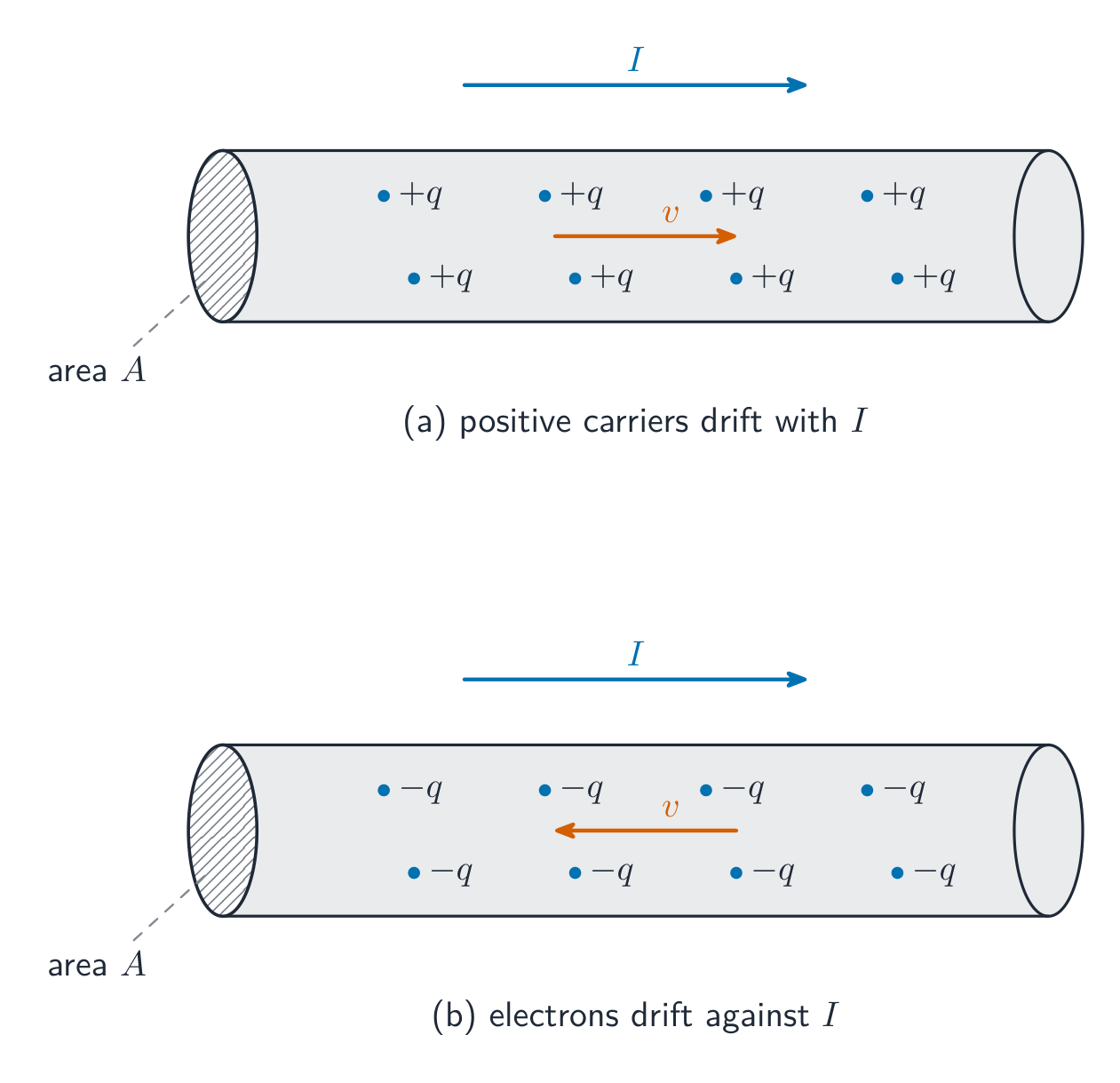
- 11.1.A.2 Although current is not a vector quantity, it does have a direction. The direction of current is associated with what the motion of positive charge would be but not with any coordinate system in space.
- 11.1.A.2.i The direction of conventional current is chosen to be the direction in which positive charge would move.
- 11.1.A.2.ii In common circuits, current is actually due to the movement of electrons (negative charge carriers).
来源:美国大学理事会 AP 课程与考试说明
电流(electric current)是电荷流过一点的速率,以安培(amperes)(A)测量:
$$I=\frac{\Delta q}{\Delta t}.$$按惯例,电流指向正电荷会移动的方向(与一根导线里的电子相反)。一个稳定的电流需要一个完整的回路和一个能量源(一个电池的电动势(electromotive force),或 emf)。载流子缓慢地漂移过一个导体以形成一个电流 词汇表 训练英文 中文 拼音 Electric current/ɪˈlektrɪk ˈkʌrənt/ 电流 diàn liú amperes/ˈæmpeəz/ 安培 ān péi 11.2
简单电路
大纲
Learning Objective Essential Knowledge 11.2.A
Describe the behavior of a circuit.- 11.2.A.1 A circuit is composed of electrical loops, which may include circuit elements such as wires, batteries, resistors, lightbulbs, capacitors, switches, ammeters, and voltmeters.
- 11.2.A.2 A closed electrical loop is a closed path through which charges may flow.
- 11.2.A.2.i A closed circuit is one in which charges would be able to flow.
- 11.2.A.2.ii An open circuit is one in which charges would not be able to flow.
- 11.2.A.2.iii A short circuit is one in which charges would be able to flow with no change in potential difference.
- 11.2.A.3 A single circuit element may be part of multiple electrical loops.
- 11.2.A.4 Circuit schematics are representations used to describe and analyze electric circuits.
- 11.2.A.4.i The properties of an electric circuit are dependent on the physical arrangement of its constituent elements.
- 11.2.A.4.ii Circuit elements have common symbols that are used to create schematic diagrams. Variable elements are indicated by a diagonal strikethrough arrow across the standard symbol for that element. (Standard symbols: Battery, Bulb, Switch, Capacitor, Resistor, Ammeter, Voltmeter.)
Boundary statement: Unless otherwise specified, all circuit schematic diagrams will be drawn using conventional current.
来源:美国大学理事会 AP 课程与考试说明
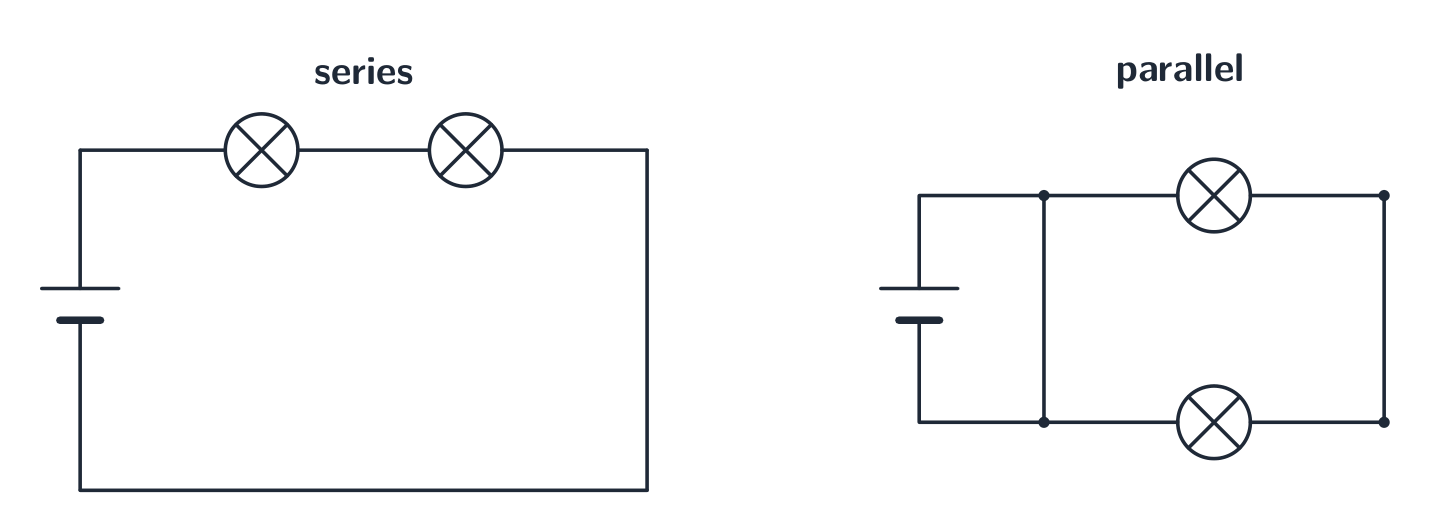
一个电路(circuit)是一个导体、一个源(电池)和元件的闭合回路。在一条串联(series)路径里相同的电流流过每个元件;在一条并联(parallel)路径里相同的电压跨每个支路。一张电路图(circuit diagram)使用标准符号;正确地读它是任何电路问题的第一步。
元件能被串联或并联连接 探索Build series and parallel circuits
In series the same current flows through every bulb and voltage divides; in parallel each branch gets the full voltage. Switch mode to see the bulbs' brightness change.
词汇表 训练英文 中文 拼音 series/ˈsɪəriːz/ 串联 chuàn lián parallel/ˈpærəlel/ 并联 bìng lián 11.3
电阻、电阻率与欧姆定律
大纲
Learning Objective Essential Knowledge 11.3.A
Describe the resistance of an object using physical properties of that object.- 11.3.A.1 Resistance is a measure of the degree to which an object opposes the movement of electric charge.
- 11.3.A.2 The resistance of a resistor with uniform geometry is proportional to its resistivity and length and is inversely proportional to its cross-sectional area.
- Equation: $R = \dfrac{\rho \ell}{A}$
- 11.3.A.2.i Resistivity is a fundamental property of a material that depends on its atomic and molecular structure and quantifies how strongly the material opposes the motion of electric charge.
- 11.3.A.2.ii The resistivity of a conductor typically increases with temperature.
11.3.B
Describe the electrical characteristics of elements of a circuit.- 11.3.B.1 Ohm's law relates current, resistance, and potential difference across a conductive element of a circuit.
- Equation: $I = \dfrac{\Delta V}{R}$
- 11.3.B.1.i Materials that obey Ohm's law have constant resistance for all currents and are called ohmic materials.
- 11.3.B.1.ii The resistivity of an ohmic material is constant regardless of temperature.
- 11.3.B.1.iii Resistors can also convert electrical energy to thermal energy, which may change the temperature of both the resistor and the resistor's environment.
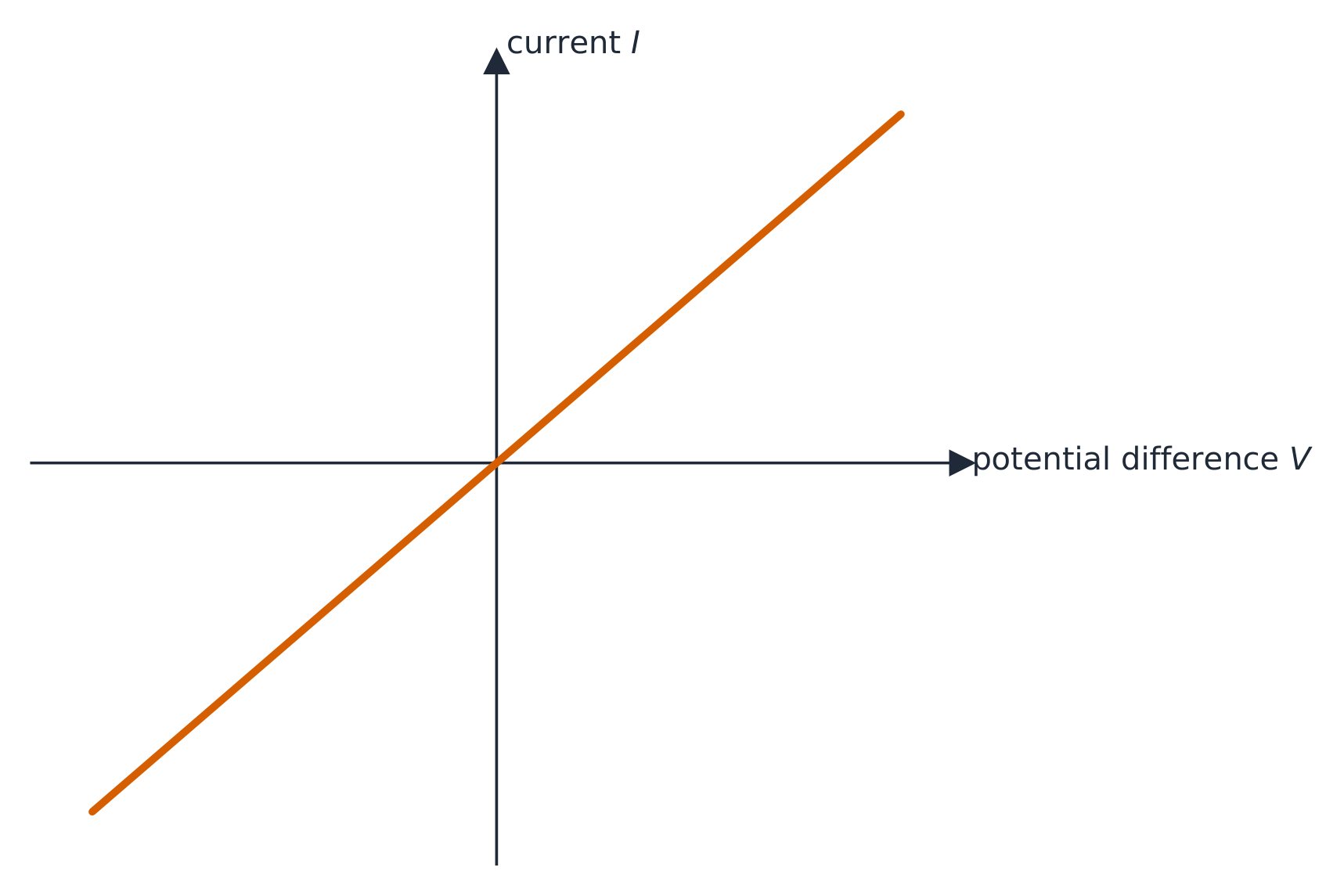
- 11.3.B.1.iv The resistance of an ohmic circuit element can be determined from the slope of a graph of the current in the element as a function of the potential difference across the element.
来源:美国大学理事会 AP 课程与考试说明
电阻(resistance)$R$ 反对电流,以欧姆测量。欧姆定律(Ohm's law)联系三个关键量:
$$V=IR.$$一个元件的电阻取决于材料的电阻率(resistivity)$\rho$、它的长度,和它的横截面积:$R=\dfrac{\rho L}{A}$ ——更长更细意味着更多电阻。一个欧姆导体的 I-V 线是通过原点的直线 Worked example. 一个 $2.0\ \text{A}$ 的电流流过一个 $6.0\ \Omega$ 的电阻。跨它的电压是 $V=IR=2.0\times6.0=12\ \text{V}$。
探索Apply Ohm's law
Ohm's law $V=IR$: for a fixed resistance, current is proportional to voltage. Raise the resistance and the same voltage pushes less current.
词汇表 训练英文 中文 拼音 Resistance/rɪˈzɪstəns/ 电阻 diàn zǔ Ohm's law/əʊmz lɔː/ 欧姆定律 ōu mǔ dìng lǜ resistivity/ˌriːzɪˈstɪvəti/ 电阻率 diàn zǔ lǜ 11.4
电功率
大纲
Learning Objective Essential Knowledge 11.4.A
Describe the transfer of energy into, out of, or within an electric circuit, in terms of power.- 11.4.A.1 The rate at which energy is transferred, converted, or dissipated by a circuit element depends on the current in the element and the electric potential difference across it.
- Equation: $P = I \Delta V$
- Equation (derived): $P = I^2 R = \dfrac{(\Delta V)^2}{R}$
- 11.4.A.2 The brightness of a bulb increases with power, so power can be used to qualitatively predict the brightness of bulbs in a circuit.
来源:美国大学理事会 AP 课程与考试说明
电功率(electric power)是一个元件转换电能(到热、光、运动)的速率:
$$P=IV=I^2R=\frac{V^2}{R}.$$挑选使用你知道的量的形式。一个电阻的功率全都变成热。Worked example. 上面的 $6.0\ \Omega$ 电阻,携带 $2.0\ \text{A}$,耗散 $P=I^2R=2.0^2\times6.0=24\ \text{W}$ ——等价地 $P=IV=2.0\times12=24\ \text{W}$。
一个灯泡(light bulb)只是一个会发光的电阻,它的亮度(brightness)随它耗散的功率上升。所以要给灯泡排名,就比较它们的功率。在一条串联串里每个灯泡携带相同的电流,所以按 $P=I^2R$,电阻最大的灯泡最亮;并联接线时每个灯泡得到全部电池电压,所以按 $P=V^2/R$,电阻最小的灯泡最亮。
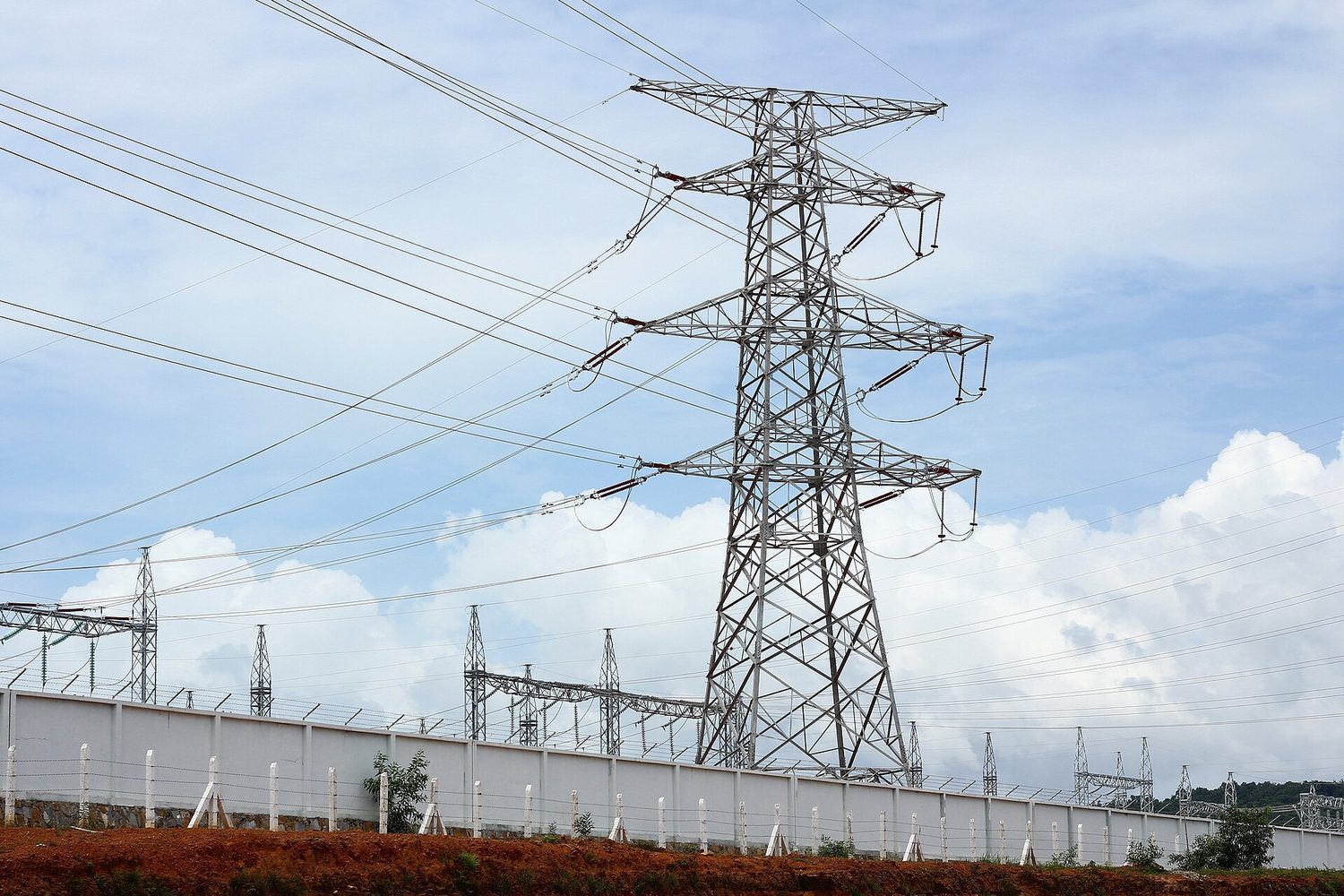
High-voltage power lines: electrical power is transmitted as high voltage so current (and I²R loss) stays low 探索Read an I-V characteristic
Power is $P=IV$. A resistor's I-V line is straight, but a lamp curves as it heats and its resistance rises. The area under I-V relates to the energy delivered.
词汇表 训练英文 中文 拼音 Electric power/ɪˈlektrɪk ˈpaʊə/ 电功率 diàn gōng lǜ light bulb/laɪt bʌlb/ 灯泡 dēng pào brightness/ˈbraɪtnəs/ 亮度 liàng dù 11.5
复合直流电路

大纲
Learning Objective Essential Knowledge 11.5.A
Describe the equivalent resistance of multiple resistors connected in a circuit.- 11.5.A.1 Circuit elements may be connected in series and/or in parallel.
- 11.5.A.1.i A series connection is one in which any charge passing through one circuit element must proceed through all elements in that connection and has no other path available. The current in each element in series must be the same.
- 11.5.A.1.ii A parallel connection is one in which charges may flow through one of two or more paths. Across each path, the potential difference is the same.
- 11.5.A.2 A collection of resistors in a circuit may be analyzed as though it were a single resistor with an equivalent resistance $R_{\text{eq}}$.
- 11.5.A.2.i The equivalent resistance of a set of resistors in series is the sum of the individual resistances.
- Equation: $R_{\text{eq},s} = \sum_i R_i$
- 11.5.A.2.ii The inverse of the equivalent resistance of a set of resistors connected in parallel is equal to the sum of the inverses of the individual resistances.
- Equation: $\dfrac{1}{R_{\text{eq},p}} = \sum_i \dfrac{1}{R_i}$
- 11.5.A.2.iii When resistors are connected in parallel, the number of paths available to charges increases, and the equivalent resistance of the group of resistors decreases.
- 11.5.A.2.i The equivalent resistance of a set of resistors in series is the sum of the individual resistances.
11.5.B
Describe a circuit with resistive wires and a battery with internal resistance.- 11.5.B.1 Ideal batteries have negligible internal resistance. Ideal wires have negligible resistance.
- 11.5.B.1.i The resistance of wires that are good conductors may normally be neglected, because their resistance is much smaller than that of other elements of a circuit.
- 11.5.B.1.ii The resistance of wires may only be neglected if the circuit contains other elements that do have resistance.
- 11.5.B.1.iii The potential difference a battery would supply if it were ideal is the potential difference measured across the terminals when there is no current in the battery and is sometimes referred to as its $\mathrm{emf}$ ($\varepsilon$).
- 11.5.B.2 The internal resistance of a nonideal battery may be treated as the resistance of a resistor in series with an ideal battery and the remainder of the circuit.
- 11.5.B.3 When there is current in a nonideal battery with internal resistance $r$, the potential difference across the terminals of the battery is reduced relative to the potential difference when there is no current in the battery.
- Equation (derived): $\Delta V_{\text{terminal}} = \varepsilon - Ir$
11.5.C
Describe the measurement of current and potential difference in a circuit.- 11.5.C.1 Ammeters are used to measure current at a specific point in a circuit.
- 11.5.C.1.i Ammeters must be connected in series with the element in which current is being measured.
- 11.5.C.1.ii Ideal ammeters have zero resistance so that they do not affect the current in the element that they are in series with.
- 11.5.C.2 Voltmeters are used to measure electric potential difference between two points in a circuit.
- 11.5.C.2.i Voltmeters must be connected in parallel with the element across which potential difference is being measured.
- 11.5.C.2.ii Ideal voltmeters have an infinite resistance so that no charge flows through them.
- 11.5.C.3 Nonideal ammeters and voltmeters will change the properties of the circuit being measured.
Boundary statement: AP Physics 2 only expects students to qualitatively discuss how a nonideal ammeter or voltmeter will affect the results of measurements. Unless otherwise stated, all batteries, wires, and meters are assumed to be ideal.
Boundary statement: Circuits with batteries of different potential differences connected in parallel will not be assessed.
来源:美国大学理事会 AP 课程与考试说明
组合电阻以求一个等效电阻(equivalent resistance):
串联的电阻相加成一个单一的等效电阻 - 串联: $R_{\text{eq}}=R_1+R_2+\cdots$(电阻相加)。
- 并联: $\dfrac{1}{R_{\text{eq}}}=\dfrac{1}{R_1}+\dfrac{1}{R_2}+\cdots$(总量小于最小的)。
一步一步地简化网络以求来自电池的总电流,然后向回工作到每个元件。
Worked example. 一个 $12\ \text{V}$ 的电池驱动一个 $4.0\ \Omega$ 和一个 $12\ \Omega$ 的电阻并联。先组合它们:$\dfrac{1}{R_{\text{eq}}}=\dfrac14+\dfrac{1}{12}=\dfrac{4}{12}\Rightarrow R_{\text{eq}}=3.0\ \Omega$。来自电池的总电流是 $I=\dfrac{V}{R_{\text{eq}}}=\dfrac{12}{3.0}=4.0\ \text{A}$,它分割使得更小的电阻携带更大的份额(通过 $4\ \Omega$ 的 $3.0\ \text{A}$、通过 $12\ \Omega$ 的 $1.0\ \text{A}$)。
词汇表 训练英文 中文 拼音 equivalent resistance/ɪˈkwɪvələnt rɪˈzɪstəns/ 等效电阻 děng xiào diàn zǔ 11.5
复合直流电路
大纲
Learning Objective Essential Knowledge 11.5.A
Describe the equivalent resistance of multiple resistors connected in a circuit.- 11.5.A.1 Circuit elements may be connected in series and/or in parallel.
- 11.5.A.1.i A series connection is one in which any charge passing through one circuit element must proceed through all elements in that connection and has no other path available. The current in each element in series must be the same.
- 11.5.A.1.ii A parallel connection is one in which charges may flow through one of two or more paths. Across each path, the potential difference is the same.
- 11.5.A.2 A collection of resistors in a circuit may be analyzed as though it were a single resistor with an equivalent resistance $R_{\text{eq}}$.
- 11.5.A.2.i The equivalent resistance of a set of resistors in series is the sum of the individual resistances.
- Equation: $R_{\text{eq},s} = \sum_i R_i$
- 11.5.A.2.ii The inverse of the equivalent resistance of a set of resistors connected in parallel is equal to the sum of the inverses of the individual resistances.
- Equation: $\dfrac{1}{R_{\text{eq},p}} = \sum_i \dfrac{1}{R_i}$
- 11.5.A.2.iii When resistors are connected in parallel, the number of paths available to charges increases, and the equivalent resistance of the group of resistors decreases.
- 11.5.A.2.i The equivalent resistance of a set of resistors in series is the sum of the individual resistances.
11.5.B
Describe a circuit with resistive wires and a battery with internal resistance.- 11.5.B.1 Ideal batteries have negligible internal resistance. Ideal wires have negligible resistance.
- 11.5.B.1.i The resistance of wires that are good conductors may normally be neglected, because their resistance is much smaller than that of other elements of a circuit.
- 11.5.B.1.ii The resistance of wires may only be neglected if the circuit contains other elements that do have resistance.
- 11.5.B.1.iii The potential difference a battery would supply if it were ideal is the potential difference measured across the terminals when there is no current in the battery and is sometimes referred to as its $\mathrm{emf}$ ($\varepsilon$).
- 11.5.B.2 The internal resistance of a nonideal battery may be treated as the resistance of a resistor in series with an ideal battery and the remainder of the circuit.
- 11.5.B.3 When there is current in a nonideal battery with internal resistance $r$, the potential difference across the terminals of the battery is reduced relative to the potential difference when there is no current in the battery.
- Equation (derived): $\Delta V_{\text{terminal}} = \varepsilon - Ir$
11.5.C
Describe the measurement of current and potential difference in a circuit.- 11.5.C.1 Ammeters are used to measure current at a specific point in a circuit.
- 11.5.C.1.i Ammeters must be connected in series with the element in which current is being measured.
- 11.5.C.1.ii Ideal ammeters have zero resistance so that they do not affect the current in the element that they are in series with.
- 11.5.C.2 Voltmeters are used to measure electric potential difference between two points in a circuit.
- 11.5.C.2.i Voltmeters must be connected in parallel with the element across which potential difference is being measured.
- 11.5.C.2.ii Ideal voltmeters have an infinite resistance so that no charge flows through them.
- 11.5.C.3 Nonideal ammeters and voltmeters will change the properties of the circuit being measured.
Boundary statement: AP Physics 2 only expects students to qualitatively discuss how a nonideal ammeter or voltmeter will affect the results of measurements. Unless otherwise stated, all batteries, wires, and meters are assumed to be ideal.
Boundary statement: Circuits with batteries of different potential differences connected in parallel will not be assessed.
来源:美国大学理事会 AP 课程与考试说明
两种仪表读一个电路。一个电流表(ammeter)测量一点处的电流,所以它必须串联接线——你想测量的电流必须流过它。一个电压表(voltmeter)测量两点之间的电位差,所以它并联接线,跨接在你想要电压的元件上。
一个仪表要读出真实的值,它必须几乎不扰动电路:
- 一个理想电流表有零电阻,所以把它串联接入不减小它所读的电流;
- 一个理想电压表有无穷大电阻,所以几乎没有电流经它分流。
一个真实的、非理想(nonideal)的仪表并不完美:一个真实的电流表有一点电阻(它稍微降低电流),而一个真实的电压表让一点电流漏过(它稍微降低它所读的电压)。所以连接任何仪表都会稍微改变它正在测量的那个量。
词汇表 训练英文 中文 拼音 ammeter/ˈæmiːtə/ 电流表 diàn liú biǎo voltmeter/ˈvəʊltmiːtə/ 电压表 diàn yā biǎo nonideal/ˌnɒnaɪˈdɪəl/ 非理想 fēi lǐ xiǎng 11.6
基尔霍夫电压定律
大纲
Learning Objective Essential Knowledge 11.6.A
Describe a circuit or elements of a circuit by applying Kirchhoff's loop rule.- 11.6.A.1 Energy changes in simple electrical circuits may be represented in terms of charges moving through electric potential differences within circuit elements.
- Equation: $\Delta U_E = q \Delta V$
- 11.6.A.2 Kirchhoff's loop rule is a consequence of the conservation of energy.
- 11.6.A.3 Kirchhoff's loop rule states that the sum of potential differences across all circuit elements in a single closed loop must equal zero.
- Equation: $\sum \Delta V = 0$
- 11.6.A.4 The values of electric potential at points in a circuit can be represented by a graph of electric potential as a function of position within a loop.
来源:美国大学理事会 AP 课程与考试说明
基尔霍夫电压定律(Kirchhoff's loop rule)(能量守恒):围绕任何闭合回路,电压增益和降落加起来等于零。在你绕行时加电池的 emf 并减每个 $IR$ 降落。这给每个独立回路一个方程。
词汇表 训练英文 中文 拼音 Kirchhoff's loop rule/ˈkɜːkhɒfs luːp ruːl/ 基尔霍夫电压定律 jī ěr huò fū diàn yā dìng lǜ 11.7
基尔霍夫电流定律
大纲
Learning Objective Essential Knowledge 11.7.A
Describe a circuit or elements of a circuit by applying Kirchhoff's junction rule.- 11.7.A.1 Kirchhoff's junction rule is a consequence of the conservation of electric charge.
- 11.7.A.2 Kirchhoff's junction rule states that the total amount of charge entering a junction per unit time must equal the total amount of charge exiting that junction per unit time.
- Equation: $\sum I_{\text{in}} = \sum I_{\text{out}}$
来源:美国大学理事会 AP 课程与考试说明
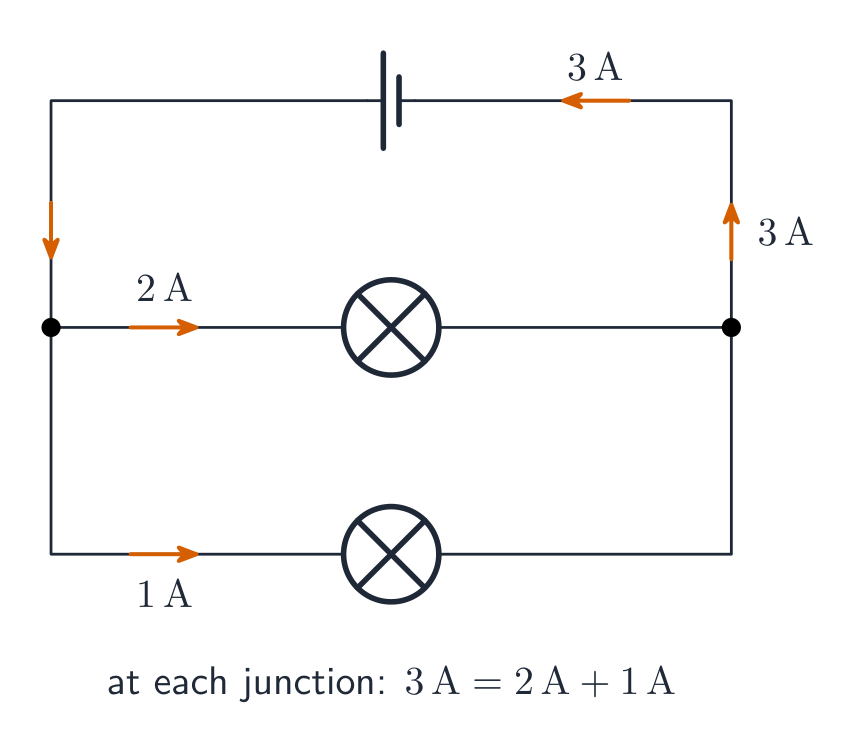
基尔霍夫电流定律(Kirchhoff's junction rule)(电荷守恒):进入任何节点的总电流等于流出的总电流。与回路定律一起,它让你能为任何多回路电路求它未知的电流。
电流在一个节点分开:流进的等于流出的 词汇表 训练英文 中文 拼音 Kirchhoff's junction rule/ˈkɜːkhɒfs ˈdʒʌŋkʃn ruːl/ 基尔霍夫电流定律 jī ěr huò fū diàn liú dìng lǜ 11.8
RC 电路
大纲
Learning Objective Essential Knowledge 11.8.A
Describe the equivalent capacitance of multiple capacitors.- 11.8.A.1 A collection of capacitors in a circuit may be analyzed as though it were a single capacitor with an equivalent capacitance $C_{\text{eq}}$.
- 11.8.A.1.i The inverse of the equivalent capacitance of a set of capacitors connected in series is equal to the sum of the inverses of the individual capacitances.
- Equation: $\dfrac{1}{C_{\text{eq},s}} = \sum_i \dfrac{1}{C_i}$
- 11.8.A.1.ii The equivalent capacitance of a set of capacitors in series is less than the capacitance of the smallest capacitor.
- 11.8.A.1.iii The equivalent capacitance of a set of capacitors in parallel is the sum of the individual capacitances.
- Equation: $C_{\text{eq},p} = \sum_i C_i$
- 11.8.A.1.i The inverse of the equivalent capacitance of a set of capacitors connected in series is equal to the sum of the inverses of the individual capacitances.
- 11.8.A.2 As a result of conservation of charge, each of the capacitors in series must have the same magnitude of charge on each plate.
11.8.B
Describe the behavior of a circuit containing combinations of resistors and capacitors.- 11.8.B.1 The time constant $\tau$ is a significant feature of an RC circuit.
- 11.8.B.1.i The time constant of an RC circuit is a measure of how quickly the capacitor will charge or discharge and is defined as $\tau = R_{\text{eq}} C_{\text{eq}}$.
- 11.8.B.1.ii For a charging capacitor, the time constant represents the time required for the capacitor's charge to increase from zero to approximately 63 percent of its final asymptotic value.
- 11.8.B.1.iii For a discharging capacitor, the time constant represents the time required for the capacitor's charge to decrease from fully charged to approximately 37 percent of its initial value.
- 11.8.B.2 The potential difference across a capacitor and the current in the branch of the circuit containing the capacitor each change over time as the capacitor charges and discharges, but both will reach a steady state after a long time interval.
- 11.8.B.2.i Immediately after being placed in a circuit, an uncharged capacitor acts like a wire, and charge can easily flow to or from the plates of the capacitor.
- 11.8.B.2.ii As a capacitor charges, changes to the potential difference across the capacitor affect the charge on the plates of the capacitor, the current circuit branch in which the capacitor is located, and the electric potential energy stored in the capacitor.
- 11.8.B.2.iii The potential difference across a capacitor, the current in the circuit branch in which the capacitor is located, and the electric potential energy stored in the capacitor all change with respect to time and asymptotically approach steady state conditions.
- 11.8.B.2.iv After a long time, a charging capacitor approaches a state of being fully charged, reaching a maximum potential difference at which there is zero current in the circuit branch in which the capacitor is located.
- 11.8.B.2.v Immediately after a charged capacitor begins discharging, the amount of charge on the capacitor plates and the energy stored in the capacitor begin to decrease.
- 11.8.B.2.vi As a capacitor discharges, the amount of charge on the capacitor, the potential difference across the capacitor, and the current in the circuit branch in which the capacitor is located all decrease until a steady state is reached.
- 11.8.B.2.vii After either charging or discharging for times much greater than the time constant, the capacitor and the relevant circuit branch may be modeled using steady-state conditions.
Boundary statement: Descriptions of charging/discharging RC circuits in AP Physics 2 are limited to qualitative descriptions and representations. While students should be able to mathematically describe initial and final states of RC circuits, students are not expected to mathematically model these behaviors with respect to time.
来源:美国大学理事会 AP 课程与考试说明
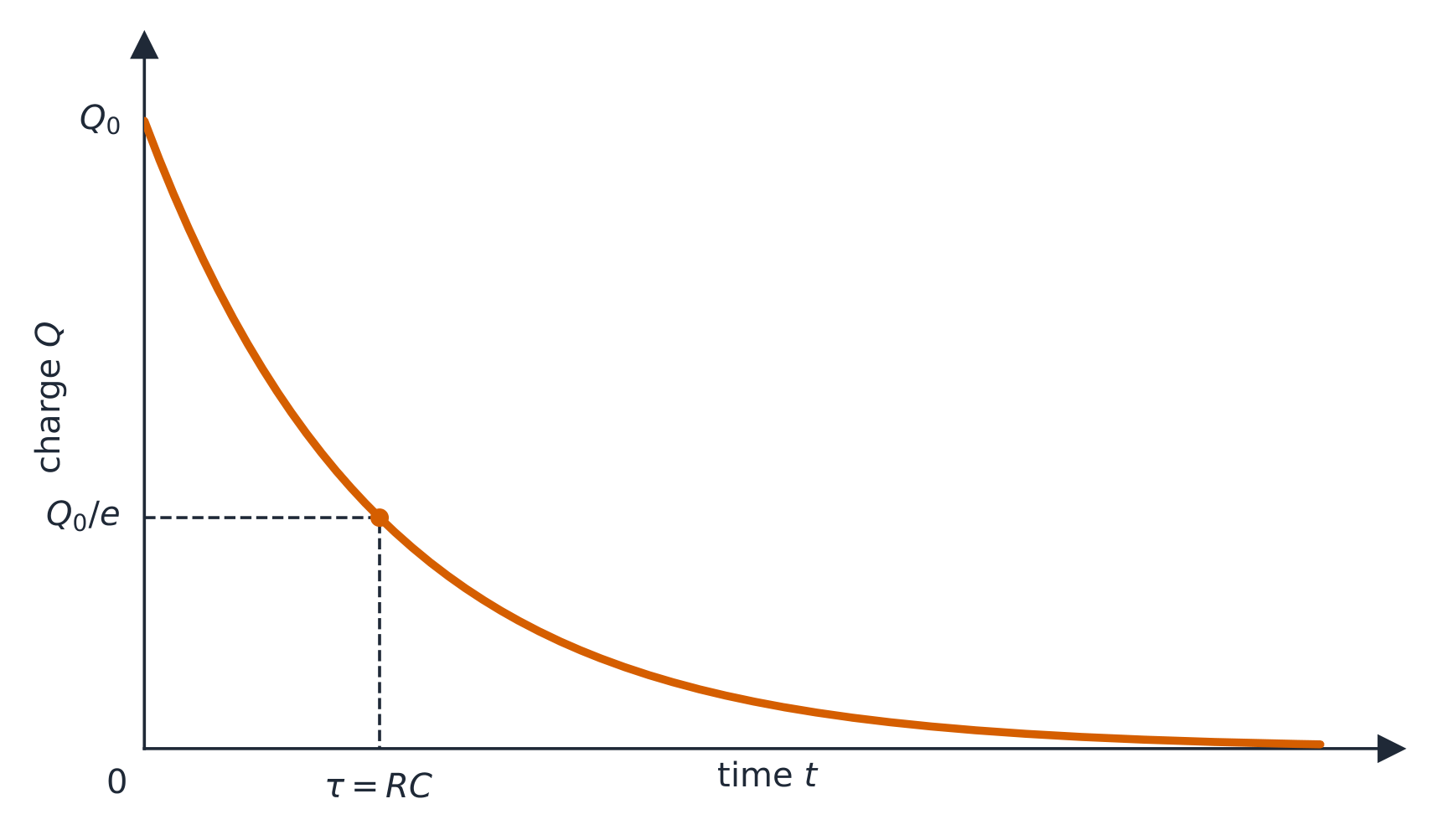
电容器充电(RC) 一个 RC电路(RC circuit)包含一个电阻和一个电容器。当充电时,电容器的电压上升而电流下降,两者都指数地,在一个特征时间 $\tau=RC$ 上。关键的极限:在第一个瞬间未充电的电容器像一根普通的导线(最大电流);很长时间后它完全充电并阻挡电流(像一个断路)。
一个电容器上的电荷在它放电时指数地衰减 Worked example. 对于 $R=10\ \text{k}\Omega$ 和 $C=100\ \mu\text{F}$,时间常数是 $\tau=RC=(10\times10^{3})(100\times10^{-6})=1.0\ \text{s}$。一个时间常数后电容器达到约 $63\%$ 的供应电压;约 $5\tau$ 后它基本上完全充电。
词汇表 训练英文 中文 拼音 RC circuit/ˌɑː ˈsiː ˈsɜːkɪt/ RC电路 RC diàn lù 11.8
考试技巧
- 在串联里电流始终相同;在并联里电压跨每个支路相同——绝不把这些搞混。
- 组合电阻:串联相加;并联 $1/R_{\text{eq}}=\sum 1/R_i$(总量小于最小的)。
- 应用基尔霍夫定律:节点(电流进 = 电流出,电荷守恒)和回路(电压加起来等于零,能量守恒)。
- 挑选适合你已知的功率形式:$P=IV=I^2R=V^2/R$。
- 一个电流表串联接入(理想:零电阻);一个电压表并联接入(理想:无穷大电阻)。一个真实的仪表会稍微扰动它所测量的电路。
- 一个灯泡在耗散更多功率时更亮——串联里电阻最大的($I^2R$)最亮,并联里电阻最小的($V^2/R$)最亮。
- 在一个 RC 电路里电容器在它开始充电的瞬间像一根普通的导线,而一旦完全充电像一个断路。
- 11.1.A.1 Current is the rate at which charge passes through a cross-sectional area of a wire.
-
12
磁学与电磁学
12.1
磁场

大纲
Learning Objective Essential Knowledge 12.1.A
Describe the properties of a magnetic field.- 12.1.A.1 A magnetic field is a vector field that can be used to determine the magnetic force exerted on moving electric charges, electric currents, or magnetic materials.
- 12.1.A.1.i Magnetic fields can be produced by magnetic dipoles or combinations of dipoles, but never by monopoles.
- 12.1.A.1.ii Magnetic dipoles have north and south polarity.
- 12.1.A.2 A magnetic field is a vector quantity and can be represented using vector field maps.
- 12.1.A.2.i Magnetic field lines form closed loops.
- 12.1.A.2.ii Magnetic fields in a bar magnet form closed loops, with the external magnetic field pointing away from one end (defined as the north pole) and returning to the other end (defined as the south pole).
12.1.B
Describe the magnetic behavior of a material as a result of the configuration of magnetic dipoles in the material.- 12.1.B.1 Magnetic dipoles result from the circular or rotational motion of electric charges. In magnetic materials, this can be the motion of electrons.
- 12.1.B.1.i Permanent magnetism and induced magnetism are system properties that both result from the alignment of magnetic dipoles within a system.
- 12.1.B.1.ii No magnetic north pole is ever found in isolation from a south pole. For example, if a bar magnet is broken in half, both halves are magnetic dipoles.
- 12.1.B.1.iii Magnetic poles of the same polarity will repel; magnetic poles of opposite polarity will attract.
- 12.1.B.1.iv The magnitude of the magnetic field from a magnetic dipole decreases with increasing distance from the dipole.
- 12.1.B.2 A magnetic dipole, such as a magnetic compass, placed in a magnetic field will tend to align with the magnetic field.
- 12.1.B.3 A material's composition influences its magnetic behavior in the presence of an external magnetic field.
- 12.1.B.3.i Ferromagnetic materials such as iron, nickel, and cobalt can be permanently magnetized by an external field that causes the alignment of magnetic domains or atomic magnetic dipoles.
- 12.1.B.3.ii Paramagnetic materials such as aluminum, titanium, and magnesium interact weakly with an external magnetic field, in that the magnetic dipoles of the material do not remain aligned after the external field is removed.
- 12.1.B.3.iii All materials have the property of diamagnetism, in that their electronic structure creates a usually weak alignment of the dipole moments of the material opposite the external magnetic field.
- 12.1.B4 Earth's magnetic field may be approximated as a magnetic dipole.
12.1.C
Describe the magnetic permeability of a material.- 12.1.C.1 Magnetic permeability is a measurement of the amount of magnetization in a material in response to an external magnetic field.
- 12.1.C.2 Free space has a constant value of magnetic permeability, known as the vacuum permeability $\mu_0$, that appears in equations representing physical relationships.
- 12.1.C.3 The permeability of matter has values different from that of free space and arises from the matter's composition and arrangement. It is not a constant for a material and varies based on many factors, including temperature, orientation, and strength of the external field.
来源:美国大学理事会 AP 课程与考试说明
电流周围的磁场 极光:来自太阳的带电粒子被地球磁场引向两极,在那里撞击空气使它发光 不同的材料对磁场的响应差别很大,本课程点名三种。铁磁性(ferromagnetic)材料(铁、镍、钴)的磁偶极子强烈对齐并保持对齐,所以能成为永久磁体。顺磁性(paramagnetic)材料(铝、钛)只微弱地对齐,且不保持对齐。抗磁性(diamagnetic)材料 - 事实上所有材料都有一些抗磁性 - 微弱地朝相反于磁场的方向对齐。这种行为来自一个材料属性,即磁导率(permeability):自由空间有一个固定的真空磁导率 $\mu_0$,而物质的磁导率不同于它,对于给定材料甚至不是常数。
一个磁场(magnetic field)$\vec{B}$ 围绕磁体和移动的电荷。场线在磁体外部从一个磁体的北极跑向它的南极,而更密的线意味着一个更强的场。磁极总是成对出现——把一个磁体切成一半制造两个更小的磁体,从不制造一个孤立的极。
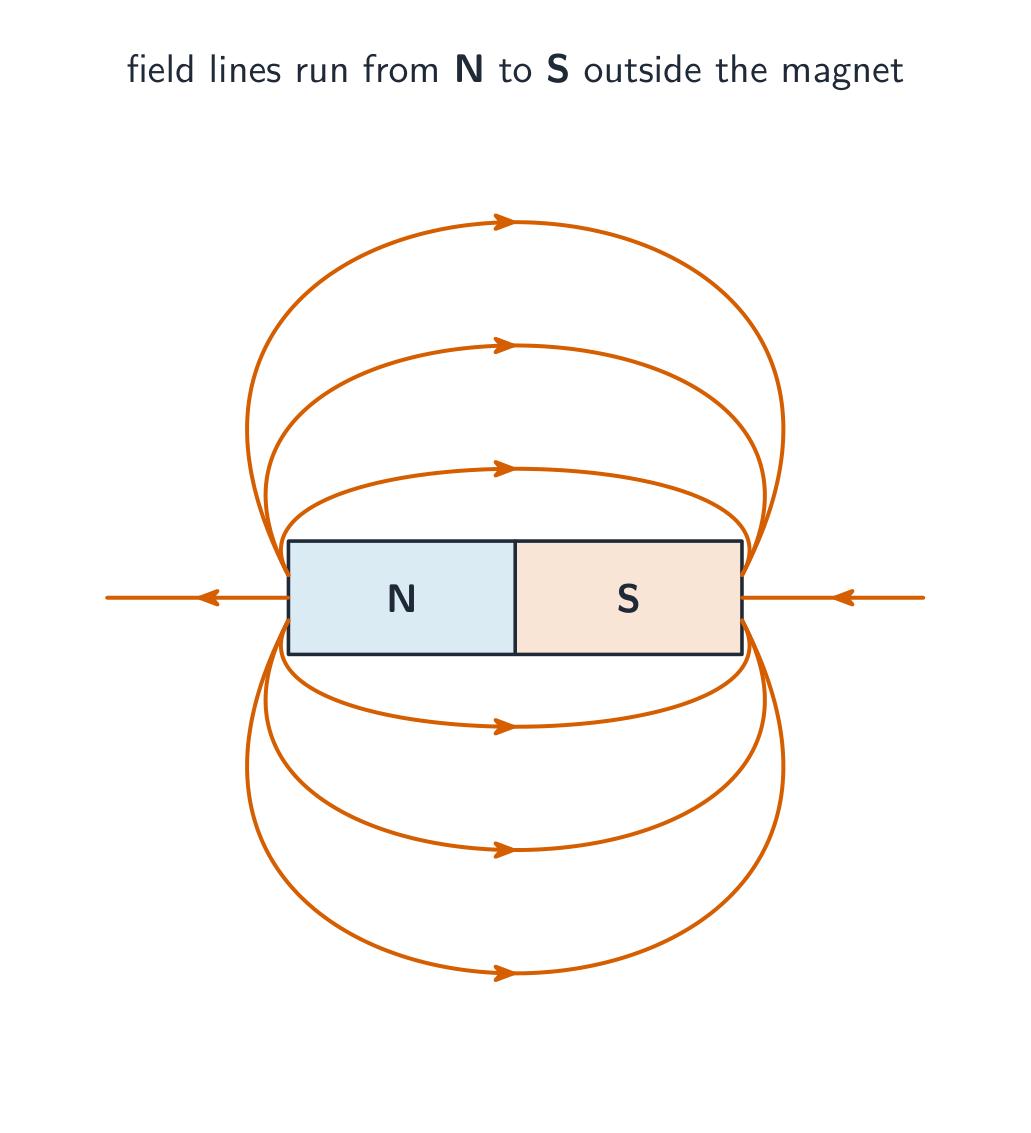
场线在一根条形磁体外部从 N 跑向 S,场更强的地方更近 探索See a magnet's field lines
Magnetic field lines run from the north pole to the south pole outside the magnet. Where the lines crowd together the field is strongest.
词汇表 训练英文 中文 拼音 Ferromagnetic/ˌferəməɡˈnetɪk/ 铁磁性 tiě cí xìng Paramagnetic/ˌpærəməɡˈnetɪk/ 顺磁性 shùn cí xìng Diamagnetic/ˌdaɪəməɡˈnetɪk/ 抗磁性 kàng cí xìng permeability/ˌpɜːməˈbɪlɪti/ 磁导率 cí dǎo lǜ magnetic field/mæɡˈnetɪk fiːld/ 磁场 cí chǎng 12.2
磁场与运动电荷
大纲
Learning Objective Essential Knowledge 12.2.A
Describe the magnetic field produced by moving charged objects.- 12.2.A.1 A single moving charged object produces a magnetic field.
- 12.2.A.1.i The magnetic field at a particular point produced by a moving charged object depends on the object's velocity and the distance between the point and the object.
- 12.2.A.1.ii At a point in space, the direction of the magnetic field produced by a moving charged object is perpendicular to both the velocity of the object and the position vector from the object to that point in space and can be determined using the right-hand rule.
- 12.2.A.1.iii The magnitude of the magnetic field is a maximum when the velocity vector and the position vector from the object to that point in space are perpendicular.
12.2.B
Describe the force exerted on moving charged objects by a magnetic field.- 12.2.B.1 Magnetic forces describe interactions between moving charged objects.
- 12.2.B.2 A magnetic field may exert a force on a charged object moving in that field.
- 12.2.B.2.i The magnitude of the force exerted by a magnetic field on a moving charged object is proportional to the magnitude of the charge, the magnitude of the charged object's velocity, and the magnitude of the magnetic field and also depends on the angle between the velocity and magnetic field vectors.
- Equation: $F_B = qvB\sin\theta$
- 12.2.B.2.ii The direction of the force exerted by a magnetic field on a moving charged object is perpendicular to both the direction of the magnetic field and the velocity of the charge, as defined by the right-hand rule.
- 12.2.B.2.i The magnitude of the force exerted by a magnetic field on a moving charged object is proportional to the magnitude of the charge, the magnitude of the charged object's velocity, and the magnitude of the magnetic field and also depends on the angle between the velocity and magnetic field vectors.
- 12.2.B.3 In a region containing both a magnetic field and an electric field, a moving charged object will experience independent forces from each field.
- 12.2.B.4 The Hall effect describes the potential difference created in a conductor by an external magnetic field that has a component perpendicular to the direction of charges moving in the conductor.
Boundary statement: Quantitative treatment of the magnitude of the magnetic force exerted by a magnetic field on a moving charge is limited to angles of 0, 90, and 180 degrees between the velocity and the magnetic field. Qualitative analysis of other angles is permitted.
来源:美国大学理事会 AP 课程与考试说明
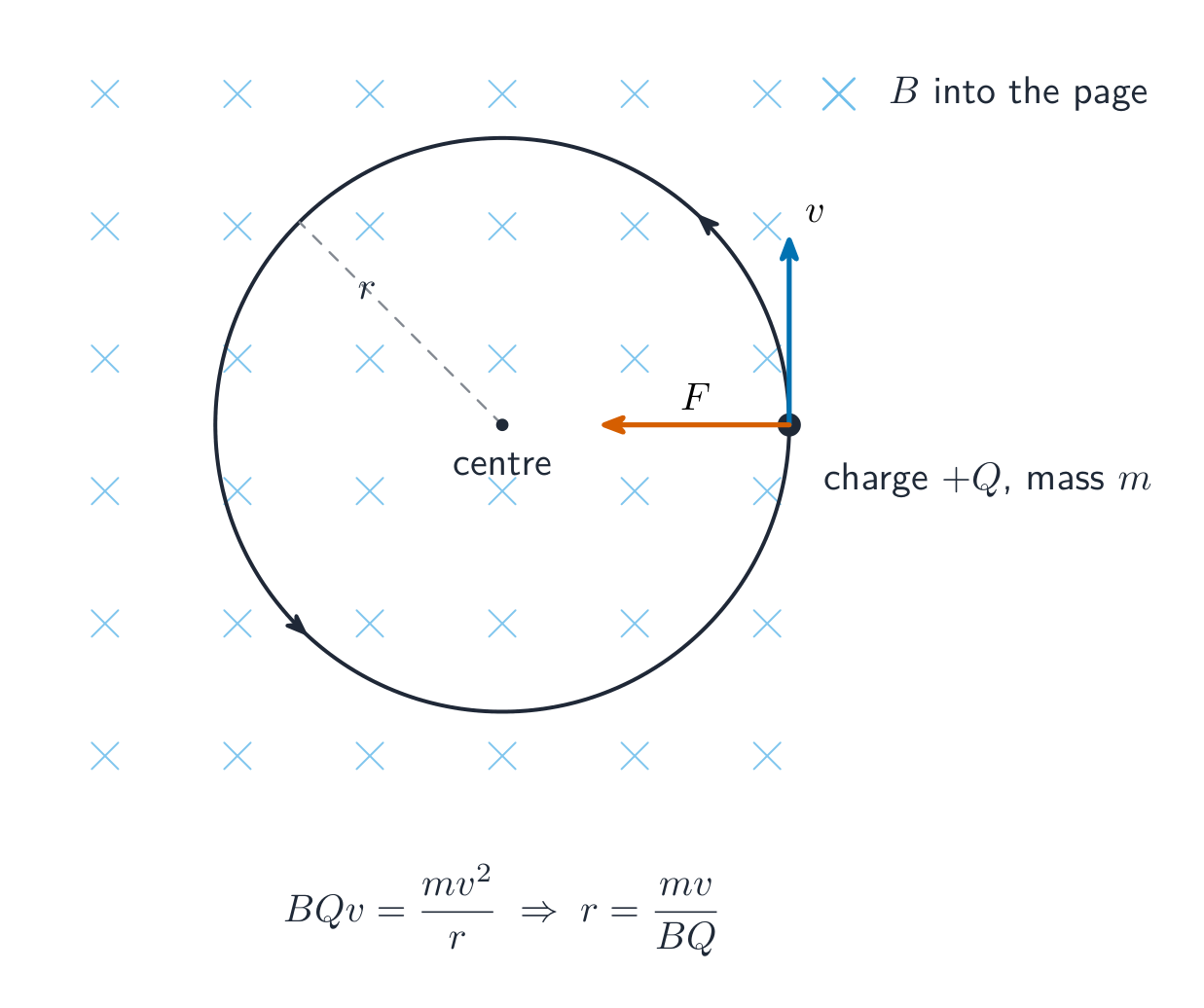
磁场中的运动电荷 一个移动过一个磁场的电荷感受一个磁力(magnetic force):
$$F=qvB\sin\theta,$$其中 $\theta$ 是速度和场之间的角。力垂直于 $\vec{v}$ 和 $\vec{B}$ 两者(用右手定则),所以它改变方向但不改变速率——一个垂直于一个均匀场移动的电荷以一个圆行进。一个静止的电荷,或一个平行于场移动的电荷,感受不到磁力。一个横穿一个磁场移动的带电粒子遵循一条圆形路径 Worked example. 一个质子($q=1.6\times10^{-19}\ \text{C}$,$m=1.67\times10^{-27}\ \text{kg}$)以 $2.0\times10^{5}\ \text{m/s}$、与场成直角进入一个 $0.50\ \text{T}$ 的场。磁力是
$$F=qvB=1.6\times10^{-19}\times2.0\times10^{5}\times0.50=1.6\times10^{-14}\ \text{N}.$$这个力是向心力,所以它把质子弯曲成一个半径的圆$$r=\frac{mv}{qB}=\frac{1.67\times10^{-27}\times2.0\times10^{5}}{1.6\times10^{-19}\times0.50}=4.2\times10^{-3}\ \text{m}.$$令 $qvB=\dfrac{mv^2}{r}$ 并约去给出那个利落的 $r=mv/(qB)$ ——质谱仪背后的原理。词汇表 训练英文 中文 拼音 magnetic force/mæɡˈnetɪk fɔːs/ 磁力 cí lì 12.3
磁场与载流导线
大纲
Learning Objective Essential Knowledge 12.3.A
Describe the magnetic field produced by a current-carrying wire.- 12.3.A.1 A current-carrying wire produces a magnetic field.
- 12.3.A.1.i The magnetic field vectors around a long, straight, current-carrying wire are tangent to concentric circles centered on that wire. The field has no component toward, away from, or parallel to the long, straight, current-carrying wire.
- 12.3.A.1.ii At a point in space, the magnitude of the magnetic field due to a long, straight, current-carrying wire is proportional to the magnitude of the current in the wire and inversely proportional to the perpendicular distance from the central axis of the wire to the point.
- Equation: $B = \dfrac{\mu_0}{2\pi}\dfrac{I}{r}$
- 12.3.A.1.iii The direction of the magnetic field created by a current-carrying wire is determined with the right-hand rule.
- 12.3.A.1.iv The direction of the magnetic field at the center of a current-carrying loop is directed along the axis of the loop and can be found using the right-hand rule.
- 12.3.A.1.v The magnetic field at a location near two or more current-carrying wires can be determined using vector addition principles.
12.3.B
Describe the force exerted on a current-carrying wire by a magnetic field.- 12.3.B.1 A magnetic field may exert a force on a current-carrying wire.
- 12.3.B.1.i The magnitude of the force exerted by a magnetic field on a current-carrying wire is proportional to the current, the length of the portion of the wire within the magnetic field, and the magnitude of the magnetic field, and also depends on the angle between the direction of the current in the wire and the direction of the magnetic field.
- Equation: $F_B = I\ell B\sin\theta$
- 12.3.B.1.ii The direction of the force exerted by the magnetic field on a current-carrying wire is determined by the right-hand rule.
- 12.3.B.1.i The magnitude of the force exerted by a magnetic field on a current-carrying wire is proportional to the current, the length of the portion of the wire within the magnetic field, and the magnitude of the magnetic field, and also depends on the angle between the direction of the current in the wire and the direction of the magnetic field.
来源:美国大学理事会 AP 课程与考试说明
因为一个电流是移动的电荷,一个磁场推一根载流导线:
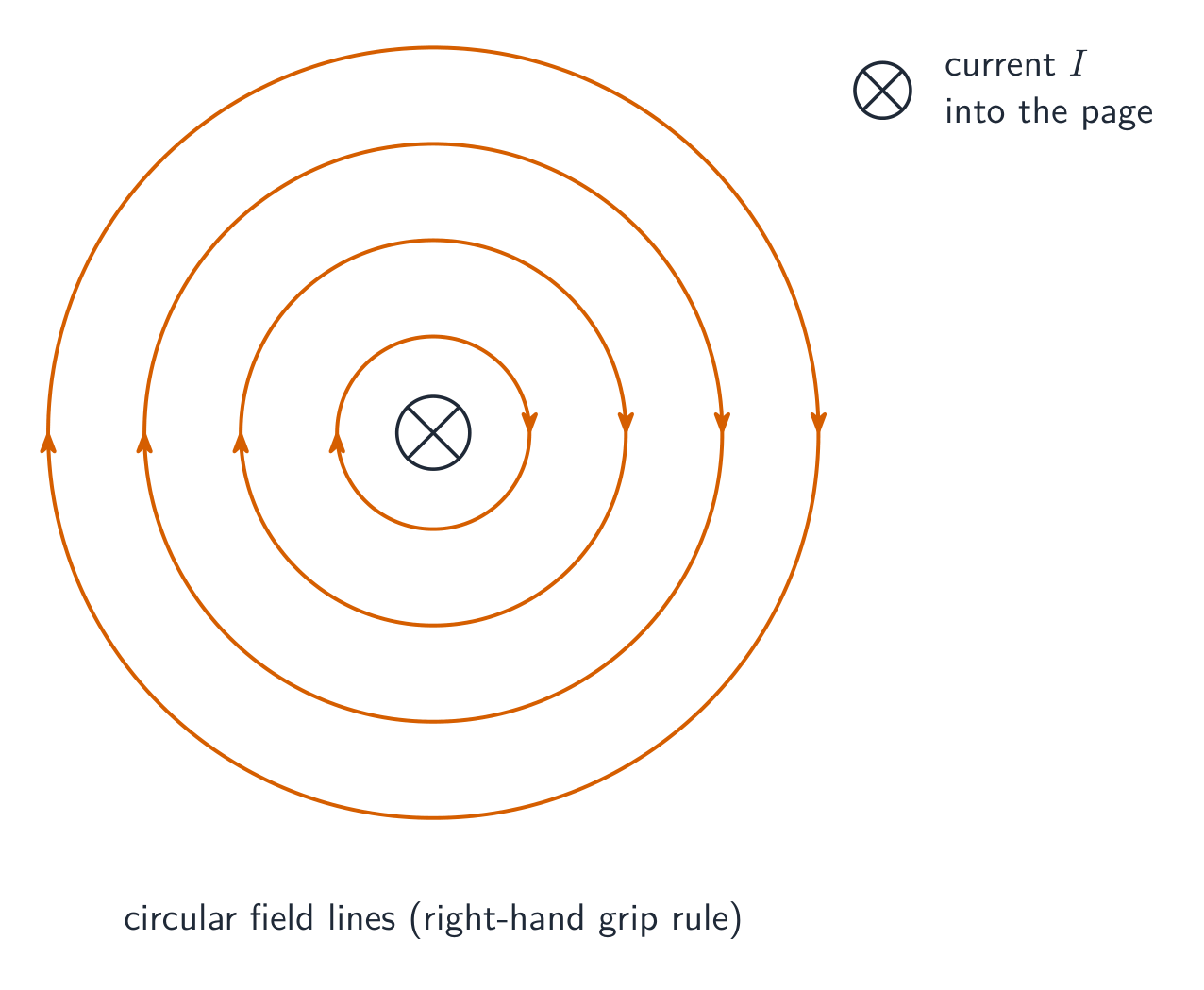
$$F=BIL\sin\theta.$$一个电流也创造它自己的磁场:圆形场线缠绕一根直导线(右手定则),而一个线圈(螺线管)制造一个像条形磁体的场。这就是电磁体和马达如何工作。同心的圆形场线围绕一根直的载流导线 Worked example. 一段 $0.30\ \text{m}$ 长的导线以直角于一个 $0.20\ \text{T}$ 的场携带 $4.0\ \text{A}$。它上的力是 $F=BIL=0.20\times4.0\times0.30=0.24\ \text{N}$ ——转动一个马达线圈的推力。
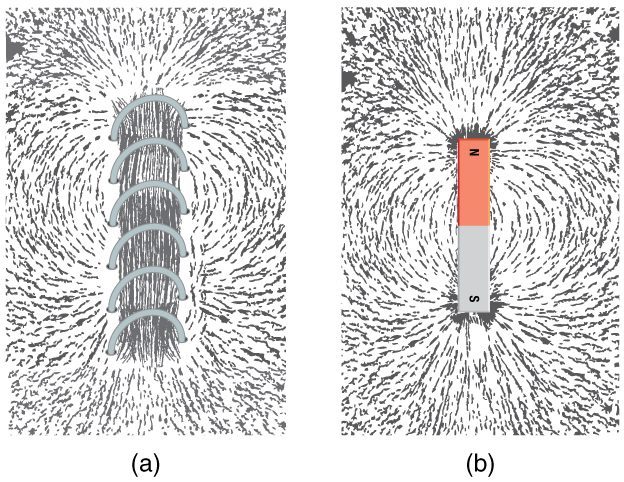
A current-carrying coil (solenoid) makes a magnetic field shaped just like a bar magnet's 探索Find the force on a current in a field
A current in a magnetic field feels a force $F = BIL$, at right angles to both. Use the left-hand rule; reverse the current or field and the force flips.
12.4
电磁感应与法拉第定律
大纲
Learning Objective Essential Knowledge 12.4.A
Describe the induced electric potential difference resulting from a change in magnetic flux.- 12.4.A.1 Magnetic flux is a description of the amount of the component of a magnetic field that is perpendicular to a cross-sectional area.
- 12.4.A.2 Magnetic flux through a surface is proportional to the magnitude of the component of the magnetic field perpendicular to the surface and to the cross-sectional area of the surface.
- Equation: $\Phi_B = BA\cos\theta$
- 12.4.A.2.i The area vector is defined to be perpendicular to the plane of the surface and directed outward from a closed surface.
- 12.4.A.2.ii The sign of the magnetic flux indicates whether the magnetic field is parallel to or antiparallel to the area vector.
- 12.4.A.3 Faraday’s law describes the relationship between changing magnetic flux and the resulting induced emf in a system.
- Equation: $|\mathcal{E}| = \left|\dfrac{\Delta\Phi_B}{\Delta t}\right|$
- 12.4.A.4 Lenz’s law is used to determine the direction of an induced emf resulting from a changing magnetic flux.
- Equation: $\mathcal{E} = -\dfrac{\Delta\Phi_B}{\Delta t} = -\dfrac{\Delta(BA\cos\theta)}{\Delta t}$
- 12.4.A.4.i An induced emf generates a current that creates a magnetic field that opposes the change in magnetic flux.
- 12.4.A.4.ii The right-hand rule is used to determine the relationships between current, emf, and magnetic flux.
- 12.4.A.5 A common example of electromagnetic induction is a conducting rod on conducting rails in a region with a uniform magnetic field.
- Derived equation: $\mathcal{E} = B\ell v$
来源:美国大学理事会 AP 课程与考试说明
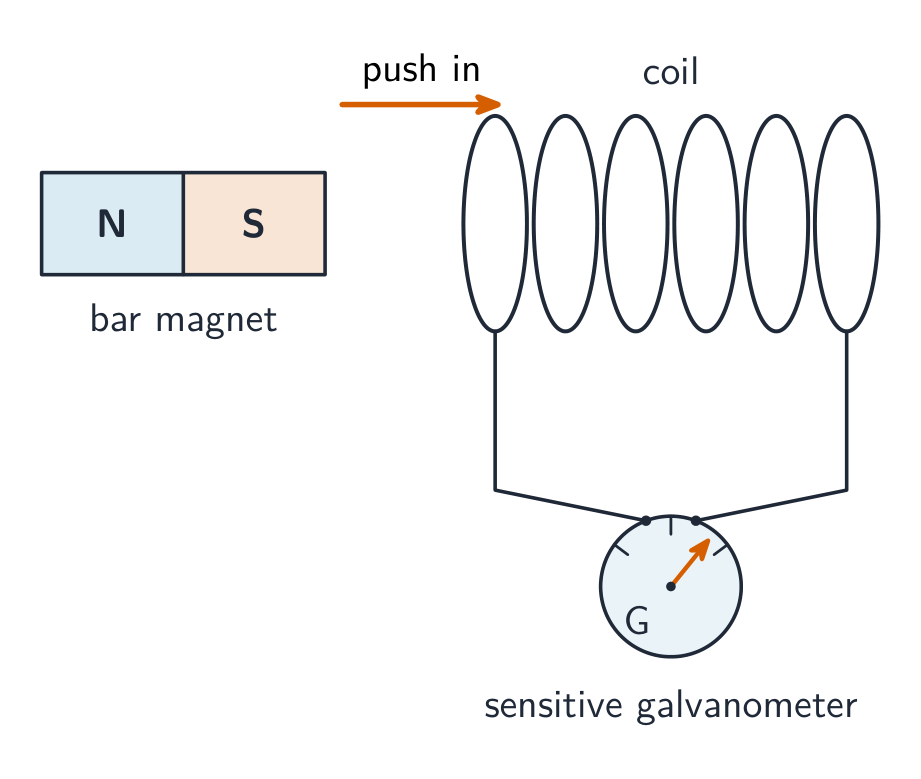
电磁感应 一个通过一个环的变化的磁场驱动一个电流——电磁感应(electromagnetic induction)。磁通量(magnetic flux)$\Phi=BA\cos\theta$ 测量多少场通过环。法拉第定律(Faraday's law)给出感应 emf:
$$\varepsilon=-\frac{\Delta\Phi}{\Delta t}.$$若场、面积或环的取向变化,磁通量就变化。楞次定律(Lenz's law)(负号)说感应电流流动以反对造成它的变化——发电机的基础。把一个磁体移进一个线圈感应一个驱动一个电流的 emf Worked example. 通过一个单一环的磁通量在 $0.030\ \text{s}$ 里从 $0.020\ \text{Wb}$ 降到 $0.008\ \text{Wb}$。平均感应 emf 是
$$\varepsilon=\left|\frac{\Delta\Phi}{\Delta t}\right|=\frac{0.020-0.008}{0.030}=0.40\ \text{V}.$$一个 $N$ 匝的线圈会给出这的 $N$ 倍——这就是为什么发电机和变压器使用多匝线圈。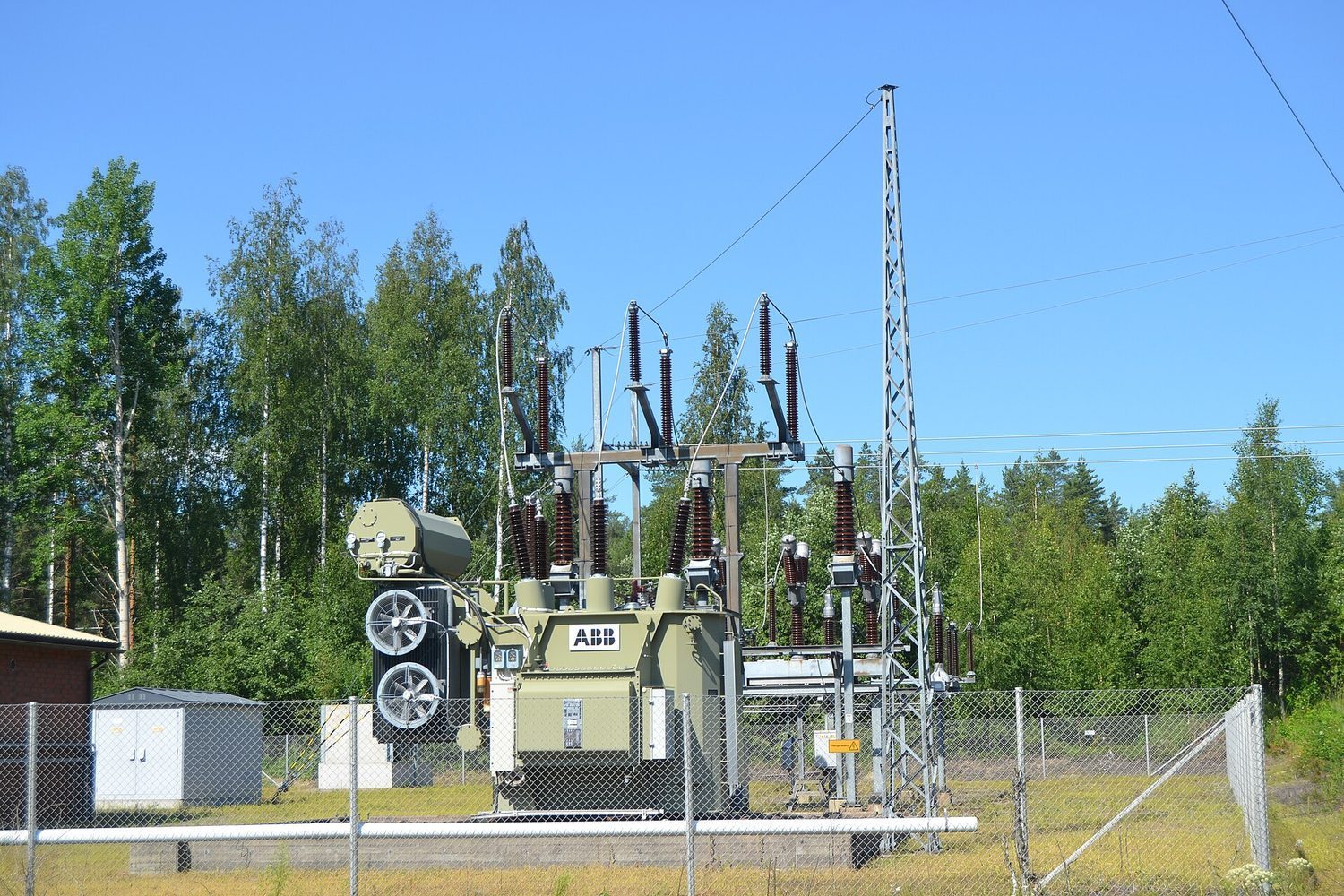
A substation transformer: changing magnetic flux in coils induces the voltages that power the grid 探索Induce a voltage by moving a magnet
Faraday's law: a changing magnetic flux through a coil induces a voltage. Move the magnet faster and the induced EMF grows; Lenz's law sets its direction to oppose the change.
词汇表 训练英文 中文 拼音 electromagnetic induction/ɪˌlektrəʊməɡˈnetɪk ɪnˈdʌkʃn/ 电磁感应 diàn cí gǎn yìng magnetic flux/mæɡˈnetɪk flʌks/ 磁通量 cí tōng liàng Faraday's law/ˈfærədeɪz lɔː/ 法拉第定律 fǎ lā dì dìng lǜ Lenz's law/ˈlentsɪz lɔː/ 楞次定律 léng cì dìng lǜ 12.4
考试技巧
- 磁力 $F=qvB\sin\theta$ 垂直于速度,所以它改变方向(一个圆)但不改变速率;一个静止的电荷或一个沿场移动的电荷感受不到力。
- 对一根载流导线上的力用 $F=BIL$(马达效应)。
- 一个电流创造一个磁场(围绕一根导线的圆;一个螺线管像一根条形磁体)。
- 感应需要一个变化的磁通量 $\Phi=BA$ ——一个线圈里的静止磁体感应不出任何东西。
- 法拉第:$\varepsilon=\Delta\Phi/\Delta t$(乘 $N$ 匝);楞次:感应电流反对变化(能量守恒)。
- 12.1.A.1 A magnetic field is a vector field that can be used to determine the magnetic force exerted on moving electric charges, electric currents, or magnetic materials.
-
13
几何光学
13.1
反射
大纲
Learning Objective Essential Knowledge 13.1.A
Describe light as a ray.- 13.1.A.1 A light ray is a straight line that is perpendicular to the wavefront of a light wave and points in the direction of travel of the wave.
- 13.1.A.1.i Light rays can be used to determine the behavior of light in geometric optics, where the wave nature of light can be neglected.
- 13.1.A.1.ii Rays are not sufficient to understand the spreading of light. In interference and diffraction, the wave nature of the light is important.
- 13.1.A.1.iii A laser is a common source of a single coherent, monochromatic beam of light that can be modeled as a ray. The wave nature of lasers will be considered in Unit 14.
- 13.1.A.2 Ray diagrams depict the path of light before and after an interaction with matter.
13.1.B
Describe the reflection of light from a surface.- 13.1.B.1 Light that is incident on a surface can be reflected.
- 13.1.B.2 The law of reflection states that the angle between the incident ray and the normal (the line perpendicular to the surface) is equal to the angle between the reflected ray and the normal.
- Equation: $\theta_i = \theta_r$
- 13.1.B.3 Diffuse reflection is the reflection of light from a rough surface and results in light reflected in many different directions, because the line normal to the surface varies over the area over which the light is incident.
- 13.1.B.4 Specular reflection is the reflection of light from a smooth surface and results in light uniformly reflected from the surface, because the line normal to the surface has an approximately constant direction over the area the light strikes.
来源:美国大学理事会 AP 课程与考试说明
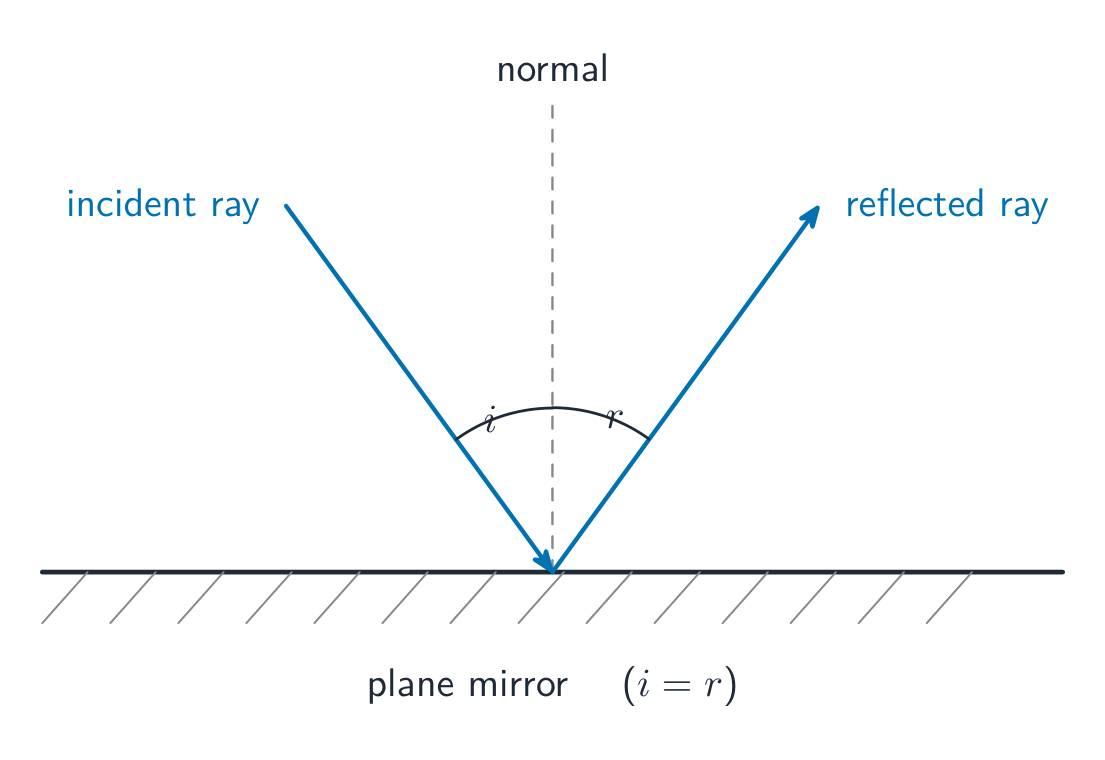
几何光学(geometric optics)把光当作直线光线。反射定律(law of reflection):当光从一个表面弹回时,入射角(angle of incidence)等于反射角(angle of reflection),两者都从法线(normal)(垂直于表面的线)测量。光滑的表面反射一个清晰的图像;粗糙的表面散射光线。
反射定律:入射角等于反射角 词汇表 训练英文 中文 拼音 Geometric optics/ˌdʒiːəʊˈmetrɪk ˈɒptɪks/ 几何光学 jǐ hé guāng xué law of reflection/lɔː ɒv rɪˈflekʃn/ 反射定律 fǎn shè dìng lǜ angle of incidence/ˈæŋɡl ɒv ˈɪnsɪdəns/ 入射角 rù shè jiǎo angle of reflection/ˈæŋɡl ɒv rɪˈflekʃn/ 反射角 fǎn shè jiǎo 13.2
镜成像
大纲
Learning Objective Essential Knowledge 13.2.A
Describe the image formed by a mirror.- 13.2.A.1 Incident light rays parallel to the principal axis of a concave (converging) mirror will be reflected toward a common location, called the focal point.
- 13.2.A.2 Incident light rays parallel to the principal axis of a convex (diverging) mirror will be reflected such that they appear to have originated from a common location behind the mirror, called the focal point.
- 13.2.A.3 The focal point of a plane mirror is an infinite distance from the mirror.
- 13.2.A.4 The focal point of a spherical mirror may be approximated as a point located on the principal axis of the mirror halfway between the surface of the mirror and the center of the mirror's radius of curvature.
- 13.2.A.5 A real image is formed by a mirror when light rays emanating from a common point are reflected and then intersect at a common point.
- 13.2.A.6 A virtual image is formed by a mirror when reflected light rays diverge such that they appear to have originated from a common point.
- 13.2.A.7 The location of an image depends on the focal length of the mirror and the distance between the object and the surface of the mirror.
- Equation: $\dfrac{1}{s_i} + \dfrac{1}{s_o} = \dfrac{1}{f}$
- 13.2.A.7.i The locations of a mirror's focal point, an object near the mirror, and the image of the object formed by the mirror follow sign conventions that are used to determine those locations relative to the mirror itself.
- 13.2.A.7.ii The distance between the image formed and a plane mirror is equal to the distance between the object and the plane mirror.
- 13.2.A.8 The magnification of an image formed by a mirror is the ratio of the size of the image produced to the size of the object itself and depends on the locations of the object and image relative to the mirror.
- Equation: $|M| = \left| \dfrac{h_i}{h_o} \right| = \left| \dfrac{s_i}{s_o} \right|$
- 13.2.A.9 Ray diagrams can be used to determine the location, type, size, and orientation of images formed by mirrors.
- 13.2.A.9.i The three principal rays are typically used to find the images formed by mirrors. The principal rays are 1) the ray parallel to the principal axis, 2) the ray that reflects at the center of the mirror where the principal axis intersects the mirror, and 3) the ray that passes through the focal point of the mirror.
- 13.2.A.9.ii Images formed by a mirror can be upright or inverted, virtual or real, and reduced, enlarged, or the same size as the object.
Boundary statement: AP Physics 2 limits the study of mirrors to plane mirrors, convex spherical mirrors, and concave spherical mirrors.
来源:美国大学理事会 AP 课程与考试说明
一个弯曲的镜子在它的焦点(focal point)聚焦平行光线,距镜子一个距离 $f$。镜面方程(mirror equation)关联物和像的距离:
$$\frac{1}{d_o}+\frac{1}{d_i}=\frac{1}{f},\qquad m=-\frac{d_i}{d_o}.$$一个凹面镜(concave mirror)(会聚)能形成一个实像(real image)(光线实际相遇、可投影、倒立);一个凸面镜(convex mirror)总是形成一个虚像(virtual image)(光线只看似相遇、正立、缩小)。放大率(magnification)$m$ 给出像的大小和取向。符号惯例重要:一个负的像距意味着镜子或透镜后面的一个虚像。探索Form an image with a curved mirror
A concave mirror reflects rays through its focus. The object's distance relative to the focal length decides whether the image is real or virtual, enlarged or reduced.
词汇表 训练英文 中文 拼音 concave mirror/kɒnˈkeɪv ˈmɪrə/ 凹面镜 āo miàn jìng real image/rɪəl ˈɪmɪdʒ/ 实像 shí xiàng convex mirror/kɒnˈveks ˈmɪrə/ 凸面镜 tū miàn jìng virtual image/ˈvɜːtʃuːəl ˈɪmɪdʒ/ 虚像 xū xiàng 13.3
折射
大纲
Learning Objective Essential Knowledge 13.3.A
Describe the refraction of light between two media.- 13.3.A.1 Refraction is the change in direction of a light ray as the ray passes from one medium into another.
- 13.3.A.2 Refraction is a result of the speed of light changing when light enters a new medium.
- 13.3.A.3 The index of refraction of a given medium is inversely proportional to the speed of light in the medium.
- Equation: $n = \dfrac{c}{v}$
- 13.3.A.4 Snell's law relates the angles of incidence and refraction of a light ray passing from one medium into another to the indices of refraction of the two media.
- Equation: $n_1 \sin\theta_1 = n_2 \sin\theta_2$
- 13.3.A.4.i When a light ray travels from a medium with a higher index of refraction into a medium with a lower index of refraction, the ray refracts away from the normal.
- 13.3.A.4.ii When a light ray travels from a medium with a lower index of refraction into a medium with a higher index of refraction, the ray refracts toward the normal.
- 13.3.A.4.iii When a light ray is incident along the normal to a surface, the transmitted ray is not refracted.
- 13.3.A.5 Total internal reflection may occur when light passes from one medium into another medium with a lower index of refraction.
- 13.3.A.5.i Total internal reflection of light occurs beyond a critical angle of incidence.
- Derived equation: $\theta_{\text{critical}} = \sin^{-1}\left( \dfrac{n_2}{n_1} \right)$
- 13.3.A.5.ii For incident rays at the critical angle, the ray refracts at 90 degrees and travels along the surface of the material.
- 13.3.A.5.iii For incident rays beyond the critical angle, all light is reflected (no light is transmitted into the other medium).
- 13.3.A.5.i Total internal reflection of light occurs beyond a critical angle of incidence.
来源:美国大学理事会 AP 课程与考试说明
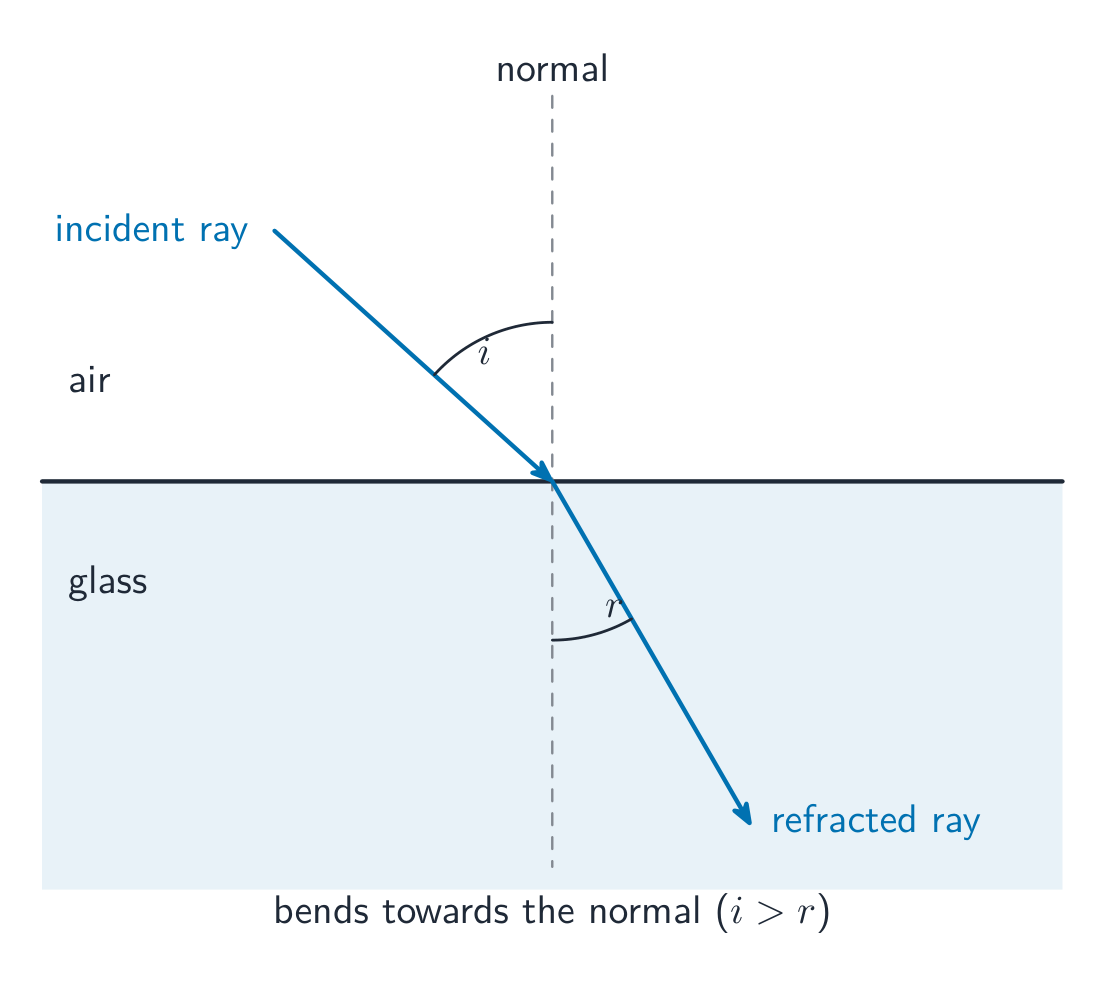
光在材料之间通过时弯曲,因为它的速率变化——折射(refraction)。每种材料有一个折射率(index of refraction)$n=\dfrac{c}{v}$(它把光减慢多少)。斯涅尔定律(Snell's law):
$$n_1\sin\theta_1=n_2\sin\theta_2.$$进入一个更密介质(更大 $n$)的光朝法线弯曲。超过一个临界角,去往一个较不密介质的光完全反射——全反射(total internal reflection),用于光纤。光折射,在它进入玻璃时朝法线弯曲 Worked example. 一条空气($n_1=1.00$)里的光线以与法线 $40^{\circ}$ 撞水($n_2=1.33$)。由斯涅尔定律,
$$\sin\theta_2=\frac{n_1}{n_2}\sin\theta_1=\frac{1.00}{1.33}\sin 40^{\circ}=0.483\;\Rightarrow\;\theta_2=29^{\circ}.$$光线朝法线弯曲,正如进入更密介质所预期。Worked example (critical angle). 对于试图从玻璃($n=1.50$)离开去空气的光,全反射在临界角 $\theta_c$ 开始,那里折射光线掠过表面:
$$\sin\theta_c=\frac{1}{n}=\frac{1}{1.50}=0.667\;\Rightarrow\;\theta_c=42^{\circ}.$$任何比 $42^{\circ}$ 更陡地撞内表面的光线被困住——光纤传送光数千米的原因。探索Bend light as it enters glass
Light refracts (bends) when it changes speed between media, following Snell's law. The denser the medium, the more it bends toward the normal.
词汇表 训练英文 中文 拼音 refraction/rɪˈfrækʃn/ 折射 zhé shè index of refraction/ˈɪndeks ɒv rɪˈfrækʃn/ 折射率 zhé shè lǜ Snell's law/snelz lɔː/ 斯涅尔定律 sī niè ěr dìng lǜ total internal reflection/ˈtəʊtl ɪnˈtɜːnl rɪˈflekʃn/ 全反射 quán fǎn shè 13.4
透镜成像
大纲
Learning Objective Essential Knowledge 13.4.A
Describe the image formed by a lens.- 13.4.A.1 Incident light rays parallel to the principal axis of a thin convex (converging) lens will be refracted and converge toward a common location on the transmitted side of the lens, called the focal point.
- 13.4.A.2 Incident light rays parallel to the principal axis of a thin concave (diverging) lens will be refracted and diverge as if they originated from a focal point on the incident side of the lens.
- 13.4.A.3 A real image is formed by a lens when light rays originating from a common point are refracted such that they intersect at another common point.
- 13.4.A.4 A virtual image is formed by a lens when refracted light rays diverge such that they appear to have originated from a common point.
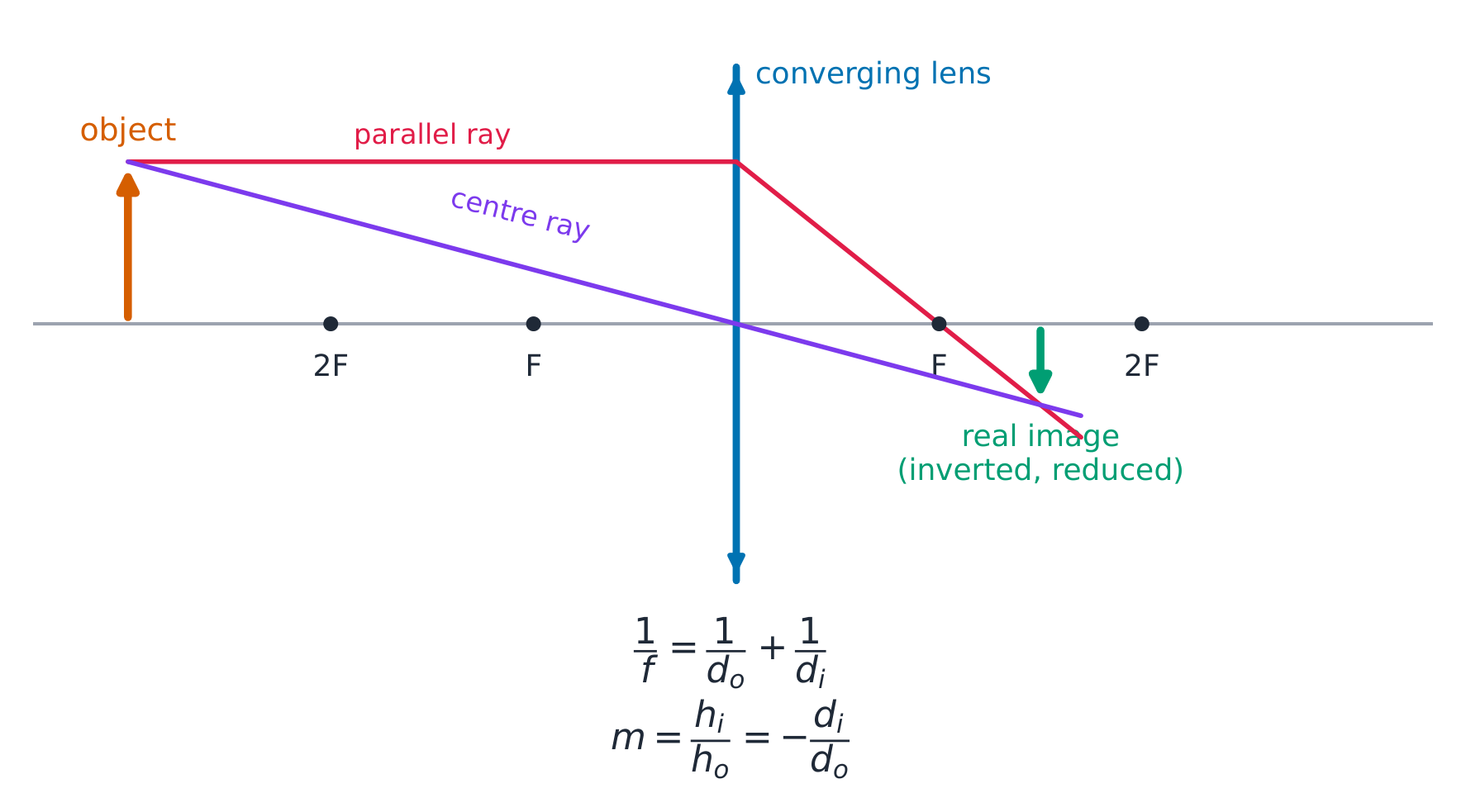
- 13.4.A.5 For a thin lens, the location of an image depends on the focal length of the lens and the distance between the object and the midline of the lens, as given by the thin-lens equation:
- Equation: $\dfrac{1}{s_i} + \dfrac{1}{s_o} = \dfrac{1}{f}$
- 13.4.A.5.i The locations of a lens's focal point, an object, and the image of the object formed by the lens follow sign conventions that are used to determine those locations relative to the lens itself.
- 13.4.A.5.ii Lenses have a focal point on both sides of the lens that depends on the shape of the respective side of the lens.
- 13.4.A.6 For a thin lens, the magnification of an image is the ratio of the size of the image produced to the size of the object itself and depends on the locations of the object and image relative to the lens.
- Equation: $|M| = \left| \dfrac{h_i}{h_o} \right| = \left| \dfrac{s_i}{s_o} \right|$
- 13.4.A.7 Ray diagrams can be used to determine the location, type, size, and orientation of images formed by lenses.
- 13.4.A.7.i The three principal rays are typically used to find the images formed by lenses. The principal rays are 1) the ray parallel to the principal axis, 2) the ray that passes through the center of the lens where the principal axis intersects the lens, and 3) the ray that passes through the focal point of the lens.
- 13.4.A.7.ii Images formed by a lens can be upright or inverted, virtual or real, and reduced, enlarged, or the same size as the object.
来源:美国大学理事会 AP 课程与考试说明
凸透镜成实像 一个透镜(lens)通过折射弯曲光。薄透镜方程(thin-lens equation)有与镜面方程相同的形式:
$$\frac{1}{d_o}+\frac{1}{d_i}=\frac{1}{f},\qquad m=-\frac{d_i}{d_o}.$$一个会聚(converging)(凸)透镜能形成一个实的、倒立的像,或者,对一个近的物体,一个虚的、正立的、放大的像(一个放大镜)。一个发散(diverging)(凹)透镜总是形成一个虚的、正立的、缩小的像。光线图用两条容易的光线快速定位像:一条平行于轴的光线弯曲通过远焦点,而一条直接通过透镜中心(不偏折)。两条光线定位像:平行然后焦点,和直接通过中心 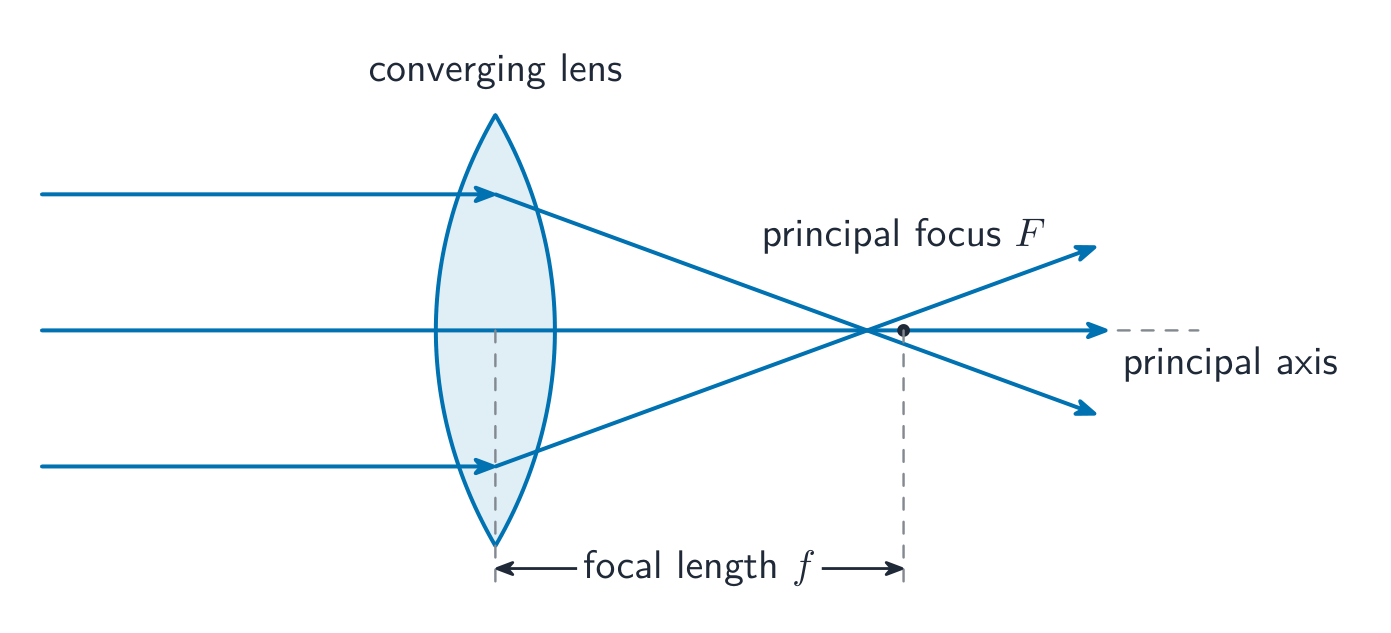
一个会聚透镜把平行光线带到它的主焦点 Worked example. 一个物体坐在距一个焦距 $f=10\ \text{cm}$ 的会聚透镜 $30\ \text{cm}$ 处。求像。由薄透镜方程,
$$\frac{1}{d_i}=\frac{1}{f}-\frac{1}{d_o}=\frac{1}{10}-\frac{1}{30}=\frac{2}{30}\;\Rightarrow\;d_i=15\ \text{cm},$$而放大率是 $m=-d_i/d_o=-15/30=-0.5$。像是实的(正的 $d_i$)、倒立的(负的 $m$),而物体大小的一半——正是一个相机镜头所做的。探索Form an image with a converging lens
A converging lens bends parallel rays to its focal point. Move the object and watch the image change from large and inverted to virtual and upright inside the focal length.
词汇表 训练英文 中文 拼音 converging/kənˈvɜːdʒɪŋ/ 会聚 huì jù diverging/daɪˈvɜːdʒɪŋ/ 发散 fā sàn 13.4
考试技巧
- 从法线、不是表面测量所有的角。
- 进入一个更密介质(更大 $n$)的光朝法线弯曲;用斯涅尔定律 $n_1\sin\theta_1=n_2\sin\theta_2$。
- 全反射只在进入一个较不密介质、超过临界角($\sin\theta_c=1/n$)时发生。
- 对镜子和透镜用 $\tfrac1{d_o}+\tfrac1{d_i}=\tfrac1f$ 和 $m=-d_i/d_o$:一个正的 $d_i$ 是一个实像,负的是虚的。
- $n=c/v$,所以一个更大的折射率意味着材料里一个更慢的光速。
- 13.1.A.1 A light ray is a straight line that is perpendicular to the wavefront of a light wave and points in the direction of travel of the wave.
-
14
波、声音与物理光学
14.1
波脉冲与波的性质
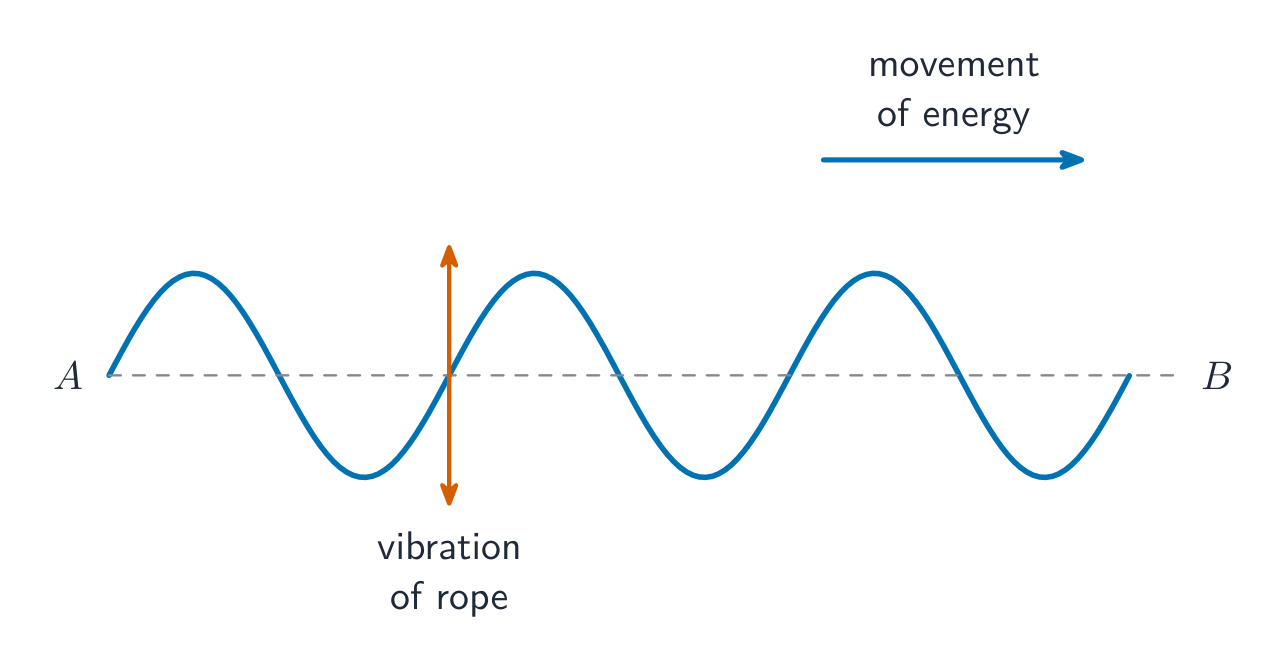
大纲
Learning Objective Essential Knowledge 14.1.A
Describe the physical properties of waves and wave pulses.- 14.1.A.1 Waves transfer energy between two locations without transferring matter between those locations.
- 14.1.A.1.i A wave pulse is a single disturbance that transfers energy without transferring matter between two locations.
- 14.1.A.1.ii A wave is modeled as a continuous, periodic disturbance with well-defined wavelength and frequency.
- 14.1.A.2 Mechanical waves or wave pulses require a medium in which to propagate. Electromagnetic waves or wave pulses do not require a medium in which to propagate.
- 14.1.A.3 The speed at which a wave or wave pulse propagates through a medium depends on the type of wave and the properties of the medium.
- 14.1.A.3.i The speed of all electromagnetic waves in a vacuum is a universal physical constant, $c = 3.00 \times 10^{8}$ m/s.
- 14.1.A.3.ii The speed at which a wave pulse or wave propagates along a string is dependent upon the tension in the string, $F_T$, and the mass per length of the string.
- Equation: $v_{\text{string}} = \sqrt{\dfrac{F_T}{m/\ell}}$
- 14.1.A.3.iii In a given medium, the speed of sound waves increases with the temperature of the medium.
- 14.1.A.4 In a transverse wave, the direction of the disturbance is perpendicular to the direction of propagation of the wave.
- 14.1.A.5 In a longitudinal wave, the direction of the disturbance is parallel to the direction of propagation of the wave.
- 14.1.A.5.i Sound waves are modeled as mechanical longitudinal waves.
- 14.1.A.5.ii The regions of high and low pressure in a sound wave are called compressions and rarefactions, respectively.
- 14.1.A.6 Amplitude is the maximum displacement of a wave from its equilibrium position.
- 14.1.A.6.i The amplitude of a longitudinal pressure wave may be determined by the maximum increase or decrease in pressure from equilibrium pressure.
- 14.1.A.6.ii The loudness of a sound increases with increasing amplitude.
- 14.1.A.6.iii The energy carried by a wave increases with increasing amplitude.
来源:美国大学理事会 AP 课程与考试说明
一个波(wave)通过一个介质(或空间)携带能量而不携带物质。一个单一的扰动是一个脉冲(pulse);一个重复的是一个波。两种类型:
一个横波:介质以直角于波的行进移动 - 横波(transverse):介质垂直于波的行进移动(一根绳上的波、光)。
- 纵波(longitudinal):介质沿行进方向移动(声音)。
词汇表 训练英文 中文 拼音 wave/weɪv/ 波 bō Transverse/trænsˈvɜːs/ 横波 héng bō Longitudinal/ˌlɒŋɡɪˈtjuːdɪnl/ 纵波 zòng bō 14.2
周期波
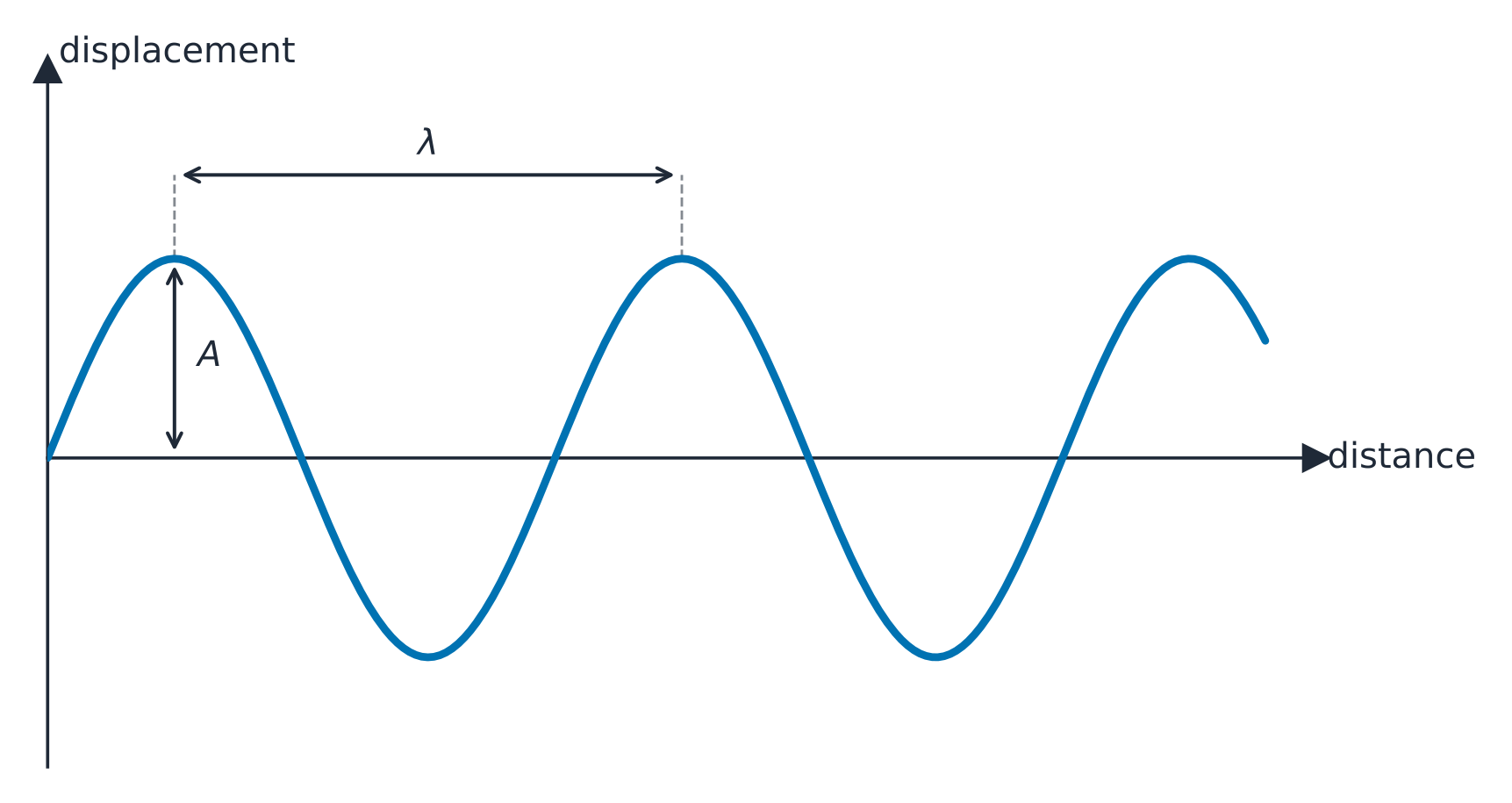
大纲
Learning Objective Essential Knowledge 14.2.A
Describe the physical properties of a periodic wave.- 14.2.A.1 Periodic waves have regular repetitions that can be described using period and frequency.
- 14.2.A.1.i The period is the time for one complete oscillation of the wave.
- 14.2.A.1.ii The frequency is the rate at which the wave repeats.
- Equation: $T = \dfrac{1}{f}$
- 14.2.A.1.iii The amplitude of a wave is independent of the period and the frequency of that wave.
- 14.2.A.1.iv The energy of a wave increases with increasing frequency.
- 14.2.A.1.v The frequency of a sound wave is related to its pitch.
- 14.2.A.1.vi Wavelength is the distance between successive corresponding positions (such as peaks or troughs) on a wave.
- 14.2.A.2 A sinusoidal wave can be described by equations for the displacement from equilibrium at a specific location as a function of time. A wave can also be described by an equation for the displacement from equilibrium at a specific time as a function of position.
- Equation: $x(t) = A\cos(\omega t) = A\cos(2\pi f t)$
- Equation: $y(x) = A\cos\left(2\pi \dfrac{x}{\lambda}\right)$
- 14.2.A.3 For a periodic wave, the wavelength is proportional to the wave's speed and inversely proportional to the wave's frequency.
- Equation: $\lambda = \dfrac{v}{f}$
来源:美国大学理事会 AP 课程与考试说明
横波与纵波 一个重复的波由以下描述:
一个位移-距离图显示振幅和波长 - 波长(wavelength)$\lambda$(重复之间的距离),
- 频率(frequency)$f$(每秒的循环)和周期(period)$T=1/f$,
- 振幅(amplitude)$A$(最大位移——与能量相关),
- 波速(wave speed)$v=f\lambda$,由介质、不是源设定。
Worked example. 一个音符有频率 $340\ \text{Hz}$ 而声速是 $340\ \text{m/s}$。它的波长是 $\lambda=v/f=340/340=1.0\ \text{m}$。若同一个音符进入水(那里声音以 $\approx 1500\ \text{m/s}$ 移动)频率保持 $340\ \text{Hz}$ 但波长拉伸到 $1500/340\approx 4.4\ \text{m}$ ——源设定频率,介质设定速率因而波长。
探索Send a periodic wave
A periodic wave carries energy without moving matter. Its speed $v=f\lambda$ links frequency and wavelength; raise the frequency and the wavelength shrinks.
词汇表 训练英文 中文 拼音 wavelength/ˈweɪvleŋθ/ 波长 bō cháng frequency/ˈfriːkwənsi/ 频率 pín lǜ amplitude/ˈæmplɪtjuːd/ 振幅 zhèn fú wave speed/weɪv spiːd/ 波速 bō sù 14.3
波的边界行为与偏振
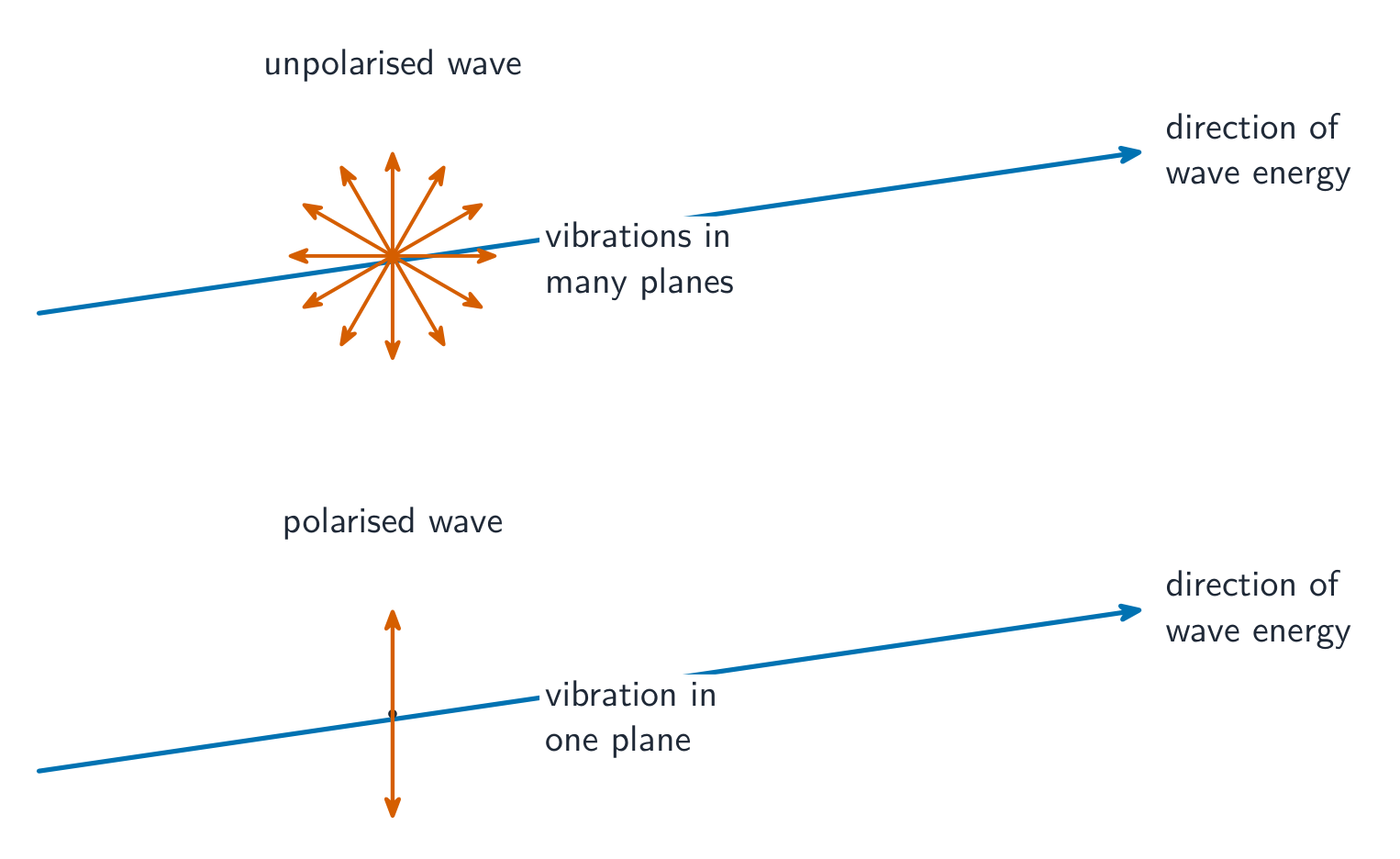
大纲
Learning Objective Essential Knowledge 14.3.A
Describe the interaction between a wave and a boundary.- 14.3.A.1 A wave that travels from one medium to another can be transmitted or reflected, depending on the properties of the boundary separating the two media.
- 14.3.A.1.i A wave traveling from one medium to another (for example, a wave traveling between low-mass and high-mass strings) will result in reflected and transmitted waves.
- 14.3.A.1.ii A reflected wave is inverted if the transmitted wave travels into a medium in which the speed of the wave decreases.
- 14.3.A.1.iii A reflected wave is not inverted if the transmitted wave travels into a medium in which the speed of the wave increases.
- 14.3.A.1.iv The frequency of a wave does not change when it travels from one medium to another.
- 14.3.A.2 Transverse waves that are reflected from a surface, refracted through a medium, or pass through specific openings may be polarized.
- 14.3.A.2.i Transverse waves can be polarized and oscillate in a single plane.
- 14.3.A.2.ii Longitudinal waves cannot be polarized.
- 14.3.A.3 Polarization of a wave may result in a reduction of the wave's intensity.
- 14.3.A.3.i Intensity is a measure of the amount of power transferred per unit area.
- 14.3.A.3.ii The intensity of a wave is the average power per unit area over one period of the wave.
来源:美国大学理事会 AP 课程与考试说明
全反射 在一个边界一个波部分反射部分透射。从一个更密介质反射反转波;从一个较不密介质不反转。偏振(polarization)只适用于横波:一个偏振器只让一个振荡方向通过,这就是为什么偏振太阳镜削减眩光。
偏振器的效果是通过强度(intensity)来衡量的 —— 强度是一个波在一个周期内单位面积上传递的平均功率,单位是 $\text{W m}^{-2}$。因为偏振器移除了与它不对齐的那些振荡分量,它会降低波的强度:非偏振光通过一个理想偏振器后降到原一半的强度,而以某个角度放置的第二个偏振器会把它进一步削减。强度也随着离开波源的距离而下降,因为同样的功率铺展在更大的面积上。
非偏振波在许多平面里振动;一个偏振波在一个里振动 词汇表 训练英文 中文 拼音 Polarization/ˌpəʊləraɪˈzeɪʃn/ 偏振 piān zhèn intensity/ɪnˈtensɪti/ 强度 qiáng dù 14.4
电磁波
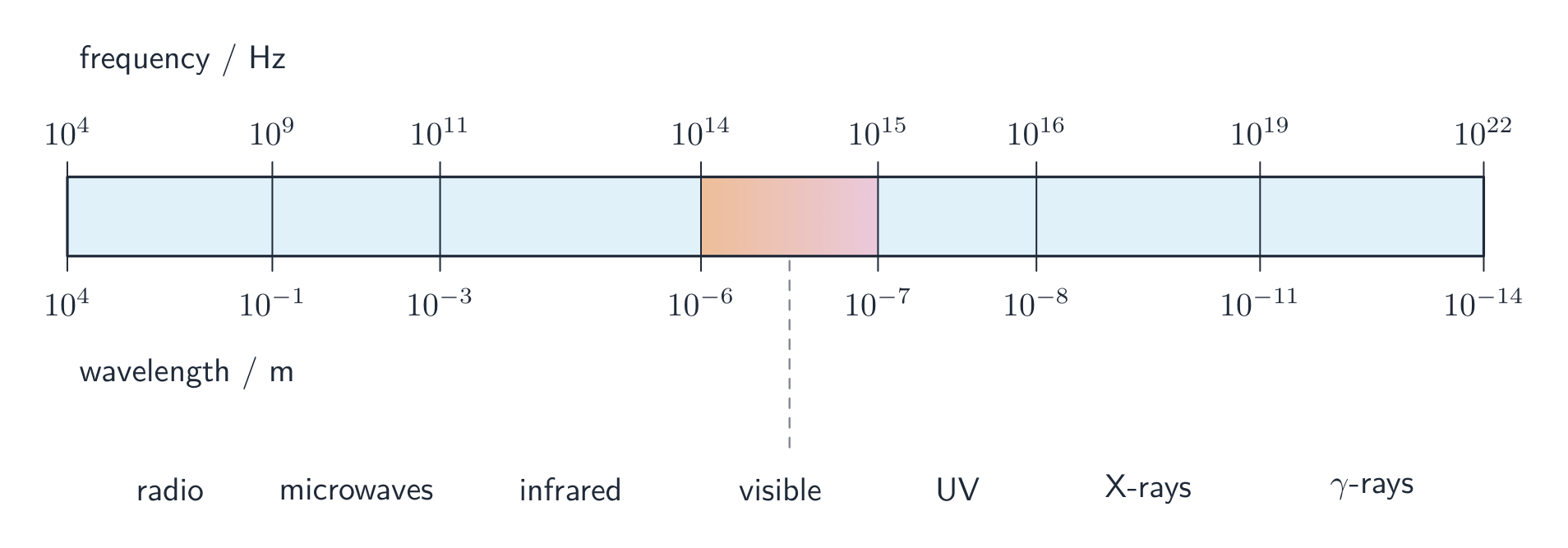
大纲
Learning Objective Essential Knowledge 14.4.A
Describe the properties of an electromagnetic wave.- 14.4.A.1 Electromagnetic waves consist of oscillating electric and magnetic fields that are mutually perpendicular.
- 14.4.A.1.i Electromagnetic waves are transverse waves because the oscillations of the electric and magnetic fields are perpendicular to the direction of propagation.
- 14.4.A.1.ii Electromagnetic waves are commonly assumed to be plane waves, which are characterized by planar wave fronts.
- 14.4.A.2 Electromagnetic waves do not need a medium through which to propagate.
- 14.4.A.3 Categories of electromagnetic waves are characterized by their wavelengths.
- 14.4.A.3.i Categories of electromagnetic waves include (in order of decreasing wavelength, spanning a range from kilometers to picometers) radio waves, microwaves, infrared, visible, ultraviolet, X-rays, and gamma rays.
- 14.4.A.3.ii Visible electromagnetic waves are further broken into categories of color, including (in order of decreasing wavelength) red, orange, yellow, green, blue, and violet.
- 14.4.A.3.iii Visible electromagnetic waves are also called light. Sometimes, electromagnetic waves of all wavelengths are collectively referred to as light or electromagnetic radiation.
Boundary statement: AP Physics 2 expects students to know the ordering of the electromagnetic spectrum (including visible light). However, students will not be expected to define exact wavelength ranges within the electromagnetic spectrum.
来源:美国大学理事会 AP 课程与考试说明
电磁波(electromagnetic waves)是以光速 $c$ 穿过真空行进的振荡的电场和磁场,不需要介质。它们横跨从无线电到伽马射线的谱;更高的频率意味着更短的波长和更高的光子能量。
电磁谱,从无线电波到伽马射线 词汇表 训练英文 中文 拼音 Electromagnetic waves/ɪˌlektrəʊməɡˈnetɪk weɪvz/ 电磁波 diàn cí bō 14.5
多普勒效应
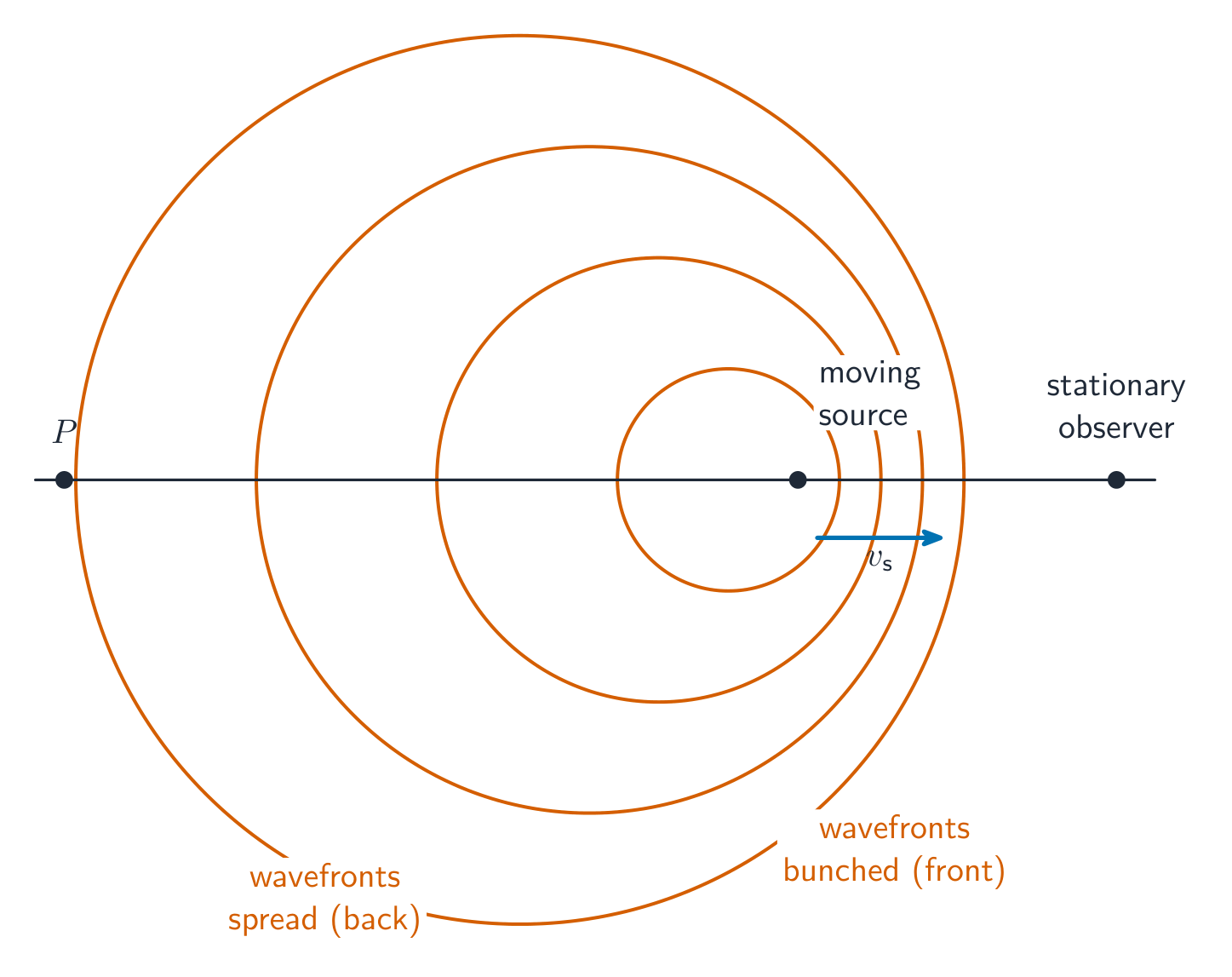
大纲
Learning Objective Essential Knowledge 14.5.A
Describe the properties of a wave based on the relative motion between the source of the wave and the observer of the wave.- 14.5.A.1 The Doppler effect describes the relationship between the rest frequency of a wave source, the observed frequency of the source, and the relative velocity of the source and the observer.
- 14.5.A.2 A greater relative velocity results in a greater measured difference between the observed and rest frequencies.
- 14.5.A.2.i For a wave source moving at the same velocity as the observer, the observed frequency is equal to the rest frequency.
- 14.5.A.2.ii For a wave source moving toward an observer, the observed frequency is greater than the rest frequency.
- 14.5.A.2.iii For a wave source moving away from an observer, the observed frequency is less than the rest frequency.
Boundary statement: Only qualitative treatments of the Doppler effect are required for AP Physics 2.
来源:美国大学理事会 AP 课程与考试说明
多普勒效应 多普勒效应(Doppler effect)是当一个波源和观察者相对彼此移动时观察到的频率的变化。接近 $\Rightarrow$ 更高的频率(更短的波长);后退 $\Rightarrow$ 更低的频率。它解释一个经过的警笛音高的下降和后退星系的红移。
一个移动的源挤压它前方的波前,提高观察到的频率 探索Hear the Doppler shift
When a source moves, waves bunch up ahead (higher frequency) and stretch behind (lower) — the Doppler effect. Speed it up to exaggerate the shift.
词汇表 训练英文 中文 拼音 Doppler effect/ˈdɒplə ɪˈfekt/ 多普勒效应 duō pǔ lè xiào yìng 14.6
波的干涉与驻波
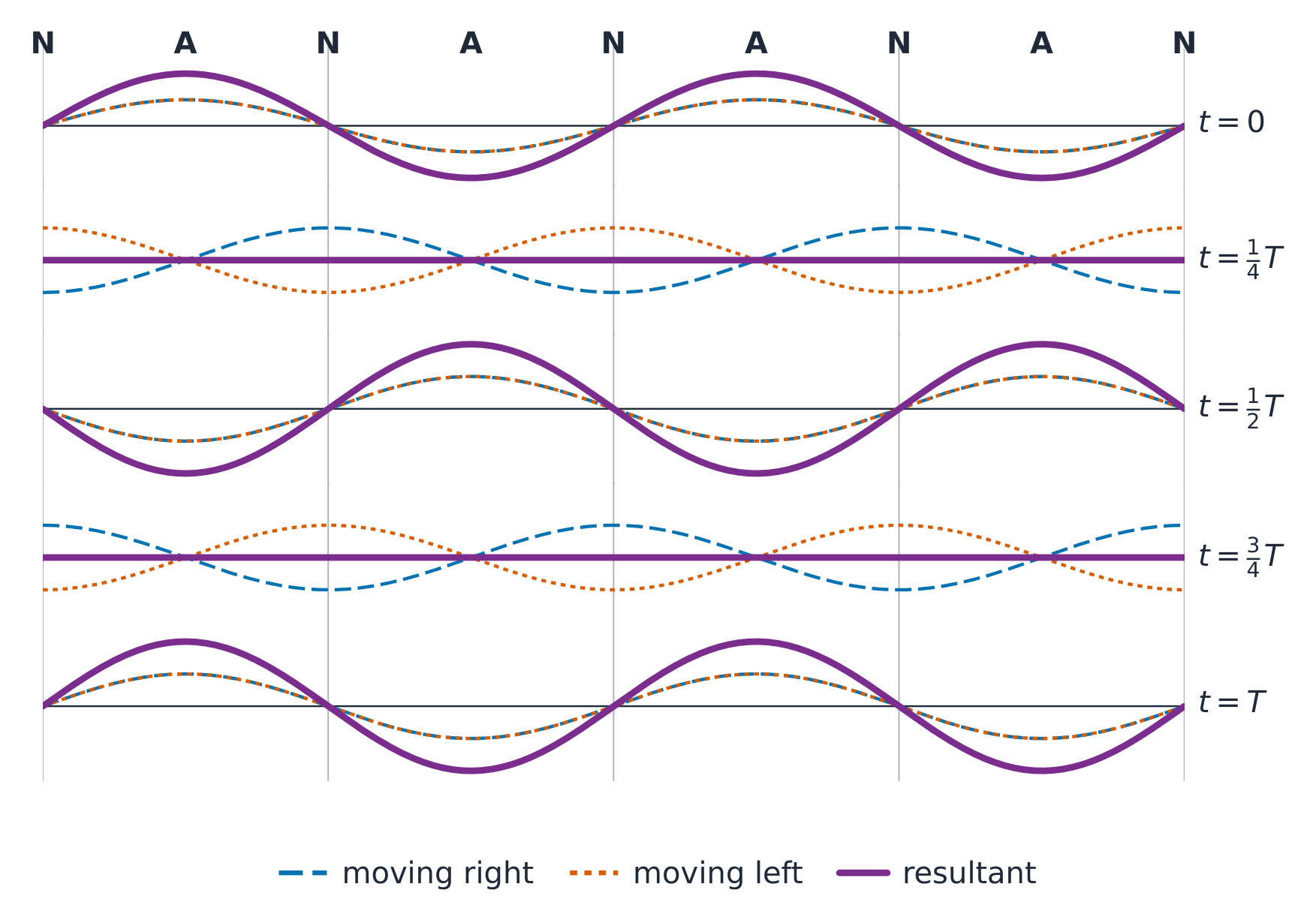
大纲
Learning Objective Essential Knowledge 14.6.A
Describe the net disturbance that occurs when two or more wave pulses or waves overlap.- 14.6.A.1 Wave interference is the interaction of two or more wave pulses or waves.
- 14.6.A.2 When two or more wave pulses or waves interact with each other, they travel through each other and overlap rather than bouncing off each other.
- 14.6.A.3 When two or more wave pulses or waves overlap, the resulting displacement can be determined by adding the individual displacements. This is called superposition.
- 14.6.A.4 Wave interference may be constructive or destructive.
- 14.6.A.4.i When the displacements of the superposed wave pulses or waves are in the same direction, the interaction is called constructive interference.
- 14.6.A.4.ii When the displacements of the superposed wave pulses or waves are in opposite directions, the interaction is called destructive interference.
- 14.6.A.4.iii Two or more traveling wave pulses or waves can interact in such a way as to produce amplitude variations in the resultant wave pulse or wave.
- 14.6.A.5 Visual representations of wave pulses or waves are useful in determining the result of two interacting wave pulses or waves.
- 14.6.A.6 Beats arise from the addition of two waves of slightly different frequency.
- 14.6.A.6.i Waves with different frequencies are sometimes in phase and sometimes out of phase at locations along the waves, causing periodic amplitude changes in the resultant wave.
- 14.6.A.6.ii The beat frequency is the difference in the frequencies of the two waves.
- Equation: $\left|f_{\text{beat}}\right| = \left|f_1 - f_2\right|$
- 14.6.A.6.iii Tuning forks are devices that are commonly used to demonstrate beat frequencies.
14.6.B
Describe the properties of a standing wave.- 14.6.B.1 Standing waves can result from interference between two waves that are confined to a region and traveling in opposite directions.
- 14.6.B.1.i Standing waves have nodes and antinodes. A node is a point on the standing wave where the amplitude is always zero. An antinode is a point on the standing wave where the amplitude is always at maximum.
- 14.6.B.1.ii The possible wavelengths of a standing wave are determined by the size and boundary conditions of the region to which it is confined.
- 14.6.B.1.iii Common regions where standing waves can form include pipes with open or closed ends, as well as strings with fixed or loose ends.
- 14.6.B.2 A standing wave with the longest possible wavelength is called the fundamental or first harmonic. The second-longest wavelength is typically called the second harmonic, the third-longest wavelength is called the third harmonic, and so on. However, for a standing wave with a node at one end and an antinode at the other end, only odd harmonics can be established.
- 14.6.B.3 Visual representations of standing waves are useful in determining the relationships between length of the region, wavelength, frequency, wave speed, and harmonic.
来源:美国大学理事会 AP 课程与考试说明
驻波 当波重叠时它们叠加(superpose)(相加)。相长干涉(constructive interference)(波峰对齐)给出一个更大的波;相消干涉(destructive interference)(波峰对波谷)抵消。在一个有界介质里两个相反方向行进的波形成一个带固定的波节(nodes)(无运动)和波腹(antinodes)(最大运动)的驻波(standing wave)——弦上和管里共振的基础。
两个相反方向行进的波重叠的地方形成一个驻波 Worked example. 一根 $0.65\ \text{m}$ 长的吉他弦两端固定。它的基频(fundamental)(第一谐波)在两端之间容纳半个波长,所以 $\lambda=2L=1.30\ \text{m}$。若波沿弦以 $260\ \text{m/s}$ 行进,音符的频率是 $f=v/\lambda=260/1.30=200\ \text{Hz}$。缩短弦(一个品)提高音高。
当两个频率略有不同的波叠加时,它们逐渐进出同步,所以合成的声音在一个缓慢的震颤里忽响忽弱,叫做拍(beats)。拍频(beat frequency)就是两个频率之差:
$$f_{\text{beat}}=|f_1-f_2|.$$一起发声的 $256\ \text{Hz}$ 和 $260\ \text{Hz}$ 两个音叉每秒给出 $|260-256|=4$ 拍;乐手通过把拍减慢到零来对着一个参考音调音。探索Set up a standing wave
Two waves travelling opposite ways interfere into a standing wave with fixed nodes and antinodes. Only certain frequencies fit, giving the harmonics.
词汇表 训练英文 中文 拼音 Constructive interference/kənˈstrʌktɪv ˌɪntəˈfɪərəns/ 相长干涉 xiāng zhǎng gān shè destructive interference/dɪˈstrʌktɪv ˌɪntəˈfɪərəns/ 相消干涉 xiāng xiāo gān shè standing wave/ˈstændɪŋ weɪv/ 驻波 zhù bō nodes/nəʊdz/ 波节 bō jié antinodes/ˌæntɪˈnəʊdz/ 波腹 bō fù beats/biːts/ 拍 pāi beat frequency/biːt ˈfriːkwənsi/ 拍频 pāi pín 14.7
衍射
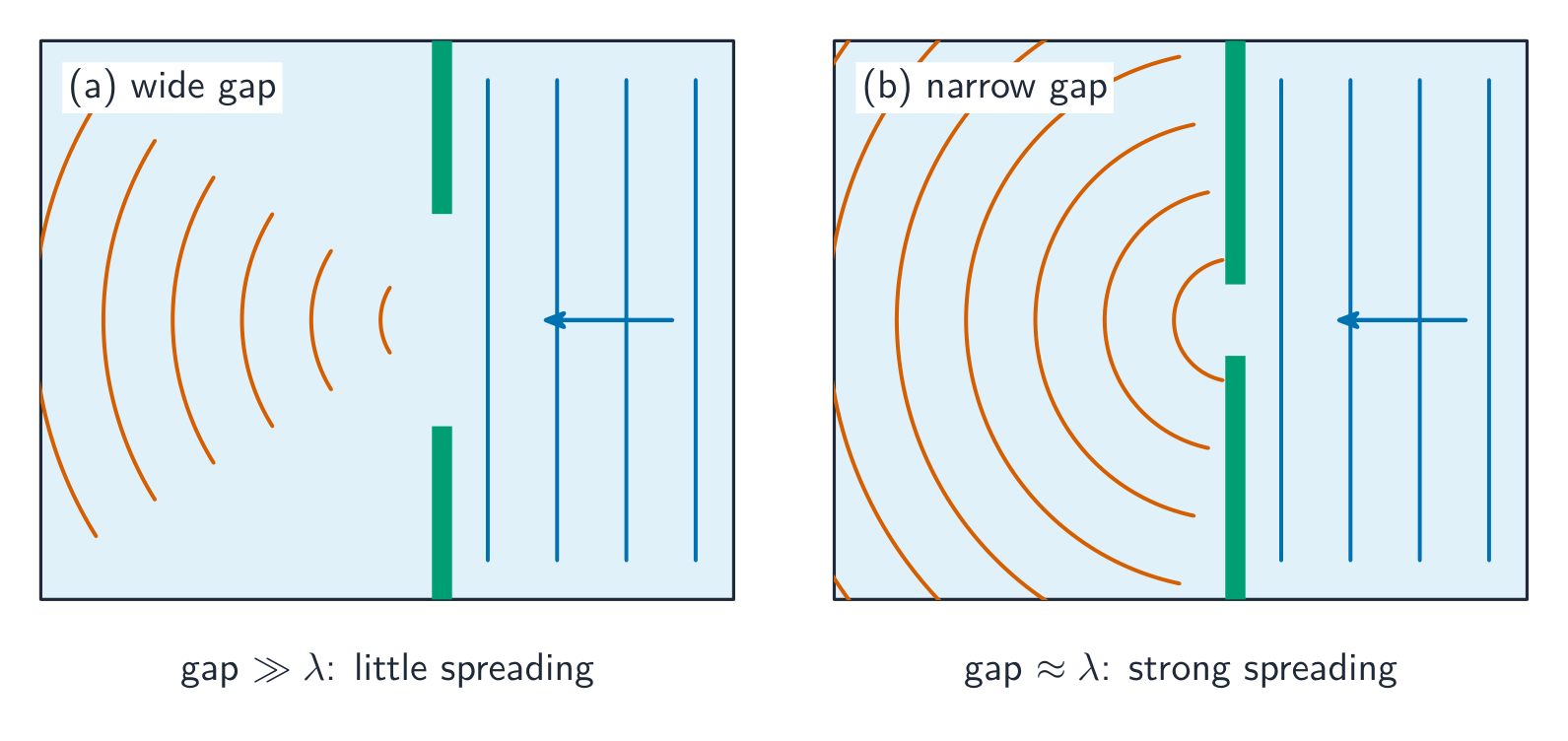
大纲
Learning Objective Essential Knowledge 14.7.A
Describe the behavior of a wave and the diffraction pattern resulting from a wave passing through a single opening.- 14.7.A.1 Diffraction is the spreading of a wave around the edges of an obstacle or through an opening.
- 14.7.A.2 Diffraction is most pronounced when the size of the opening is comparable to the wavelength of the wave.
- 14.7.A.3 Diffraction of multiple wavefronts through a single opening leads to observable interference patterns.
- 14.7.A.4 Diffraction is commonly demonstrated by monochromatic light of wavelength $\lambda$ incident on a narrow opening of width $a$ that is a distance $L$ from a screen.
- 14.7.A.4.i Constructive and destructive interference of multiple wavefronts originating from the opening will result in bright and dark bands on the screen.
- 14.7.A.4.ii The amount of interference between two wavefronts depends on the path length difference $\Delta D$ of the wavefronts.
- 14.7.A.4.iii The path length difference $\Delta D$ can be described in terms of the opening width $a$ and the angle $\theta$ between the direction of propagation of the wavefront and the normal to the opening by the equation $\Delta D = a\sin\theta$.
- 14.7.A.4.iv For small angles, where $\theta < 10°$, the small angle approximation can be used to relate $\lambda$, $a$, and $L$ to $y_{\min}$, the distance from the middle of the central bright fringe to the $m^{\text{th}}$ order of minimum brightness on the screen.
- Equation: $a\left(\dfrac{y_{\min}}{L}\right) \approx m\lambda$
- 14.7.A.5 The diffraction pattern produced by a wave passing through an opening depends on the shape of the opening.
- 14.7.A.6 Visual representations of single-slit diffraction patterns are useful in determining the physical properties of the slit and the interacting waves.
来源:美国大学理事会 AP 课程与考试说明
衍射(diffraction)是波在边缘周围或通过开口的弯曲和扩散。当开口与波长相当时扩散显著——所以声音(长波长)容易绕门口弯曲,而光(微小波长)需要一个很窄的缝。
波在通过一个间隙时扩散(衍射) 词汇表 训练英文 中文 拼音 Diffraction/dɪˈfrækʃn/ 衍射 yǎn shè 14.8
双缝干涉与衍射光栅
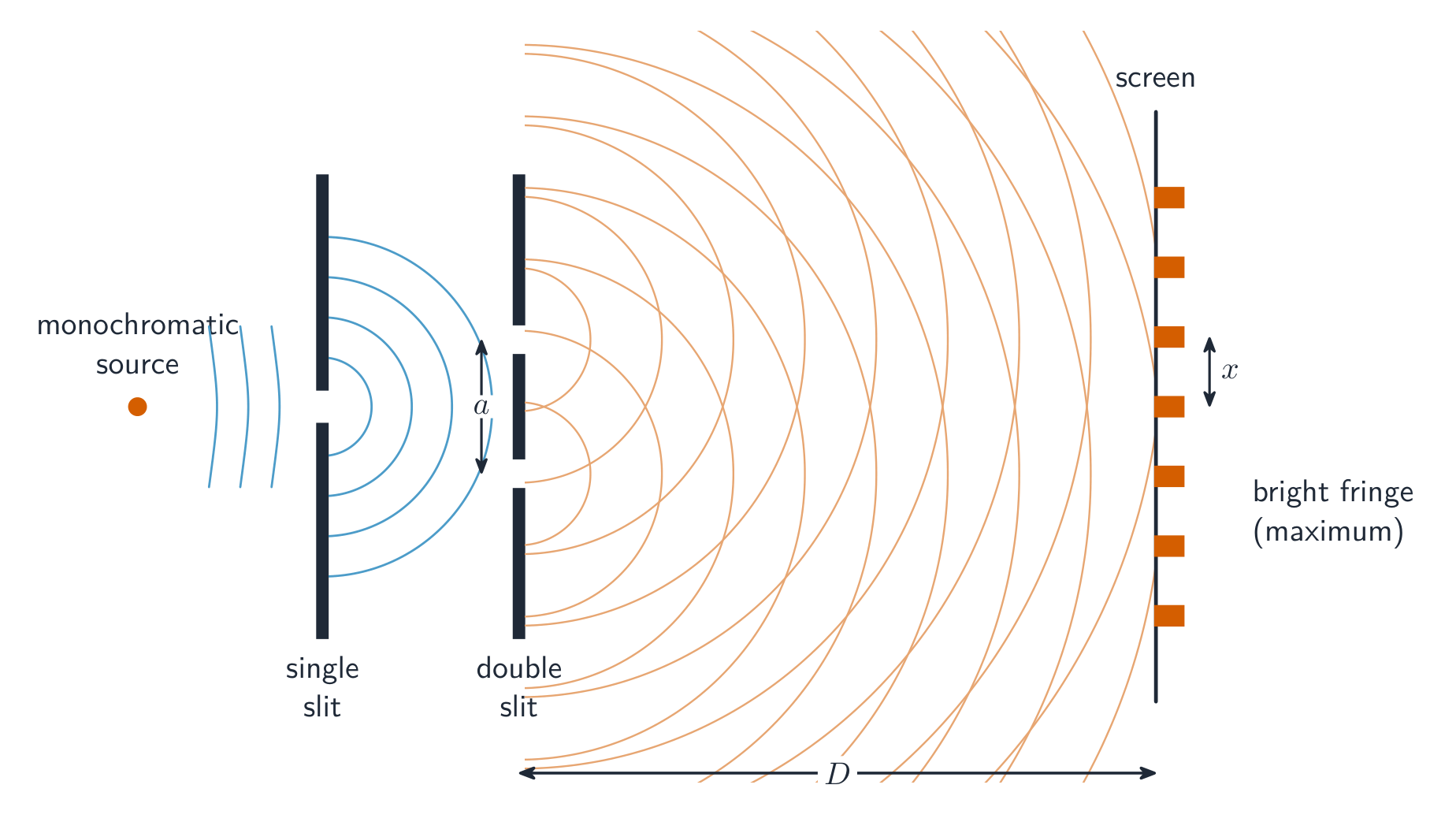
大纲
Learning Objective Essential Knowledge 14.8.A
Describe the behavior of a wave and the diffraction pattern resulting from the wave passing through multiple openings.- 14.8.A.1 The pattern resulting from monochromatic light of wavelength $\lambda$ incident on two slits a distance $d$ apart is caused by a combination of wave diffraction and wave interference.
- 14.8.A.1.i When only considering wave interference, a double slit creates a pattern of uniformly spaced maxima.
- 14.8.A.1.ii Constructive and destructive interference of the wavefronts originating from each slit will result in bright and dark bands on the screen.
- 14.8.A.1.iii The amount of interference between two wavefronts depends on the path length difference $\Delta D$ of the wavefronts.
- 14.8.A.1.iv The path length difference $\Delta D$ can be described in terms of the slit separation $d$ and the angle $\theta$ between the direction of propagation of the wavefront and the normal to the opening by the equation $\Delta D = d\sin\theta$.
- 14.8.A.1.v For small angles, where $\theta < 10°$, the small angle approximation can be used to relate $\lambda$, $d$, and $L$ to $y_{\max}$, the distance from the middle of the central bright fringe to the $m^{\text{th}}$ order of maximum brightness on the screen.
- Equation: $d\left(\dfrac{y_{\max}}{L}\right) \approx m\lambda$
- 14.8.A.1.vi When considering wave interference and wave diffraction, a double slit creates an interference pattern of maxima and minima superimposed within the envelope created by single-slit diffraction.
- 14.8.A.2 Interference patterns produced by light interacting with a double slit indicate that light has wave properties. The source of this discovery was Young's double-slit experiment.
- 14.8.A.3 Visual representations of double-slit diffraction patterns are useful in determining the physical properties of the slits and the interacting waves.
- 14.8.A.4 A diffraction grating is a collection of evenly spaced parallel slits or openings that produce an interference pattern that is the combination of numerous diffraction patterns superimposed on each other.
- 14.8.A.5 When white light is incident on a diffraction grating, the center maximum is white and the higher-order maxima disperse white light into a rainbow of colors, with the longest-wavelength light (red) appearing farthest from the central maximum.
来源:美国大学理事会 AP 课程与考试说明
双源干涉 相干(coherent)光通过两个紧密间隔的缝产生一个明暗条纹的模式。明条纹出现在光程差是整数个波长的地方:
$$d\sin\theta=m\lambda.$$一个衍射光栅(diffraction grating)有许多缝,给出锐利的、宽间隔的明线——对把光分成它的波长有用。杨氏双缝给出一个明暗条纹的干涉模式 Worked example. 波长 $600\ \text{nm}$ 的光通过相距 $0.20\ \text{mm}$ 的两个缝。第一个明条纹($m=1$)坐在
$$\sin\theta=\frac{m\lambda}{d}=\frac{1\times600\times10^{-9}}{0.20\times10^{-3}}=3.0\times10^{-3}\;\Rightarrow\;\theta=0.17^{\circ}.$$这个微小的角是为什么缝必须很接近而屏幕很远才能清晰地看到条纹。探索Superpose two waves
Where two waves arrive in phase they add (bright fringe); out of phase they cancel (dark fringe). That interference makes the double-slit pattern.
词汇表 训练英文 中文 拼音 Coherent/kəʊˈhɪərənt/ 相干 xiāng gān diffraction grating/dɪˈfrækʃn ˈɡreɪtɪŋ/ 衍射光栅 yǎn shè guāng shān 14.9
薄膜干涉
大纲
Learning Objective Essential Knowledge 14.9.A
Describe the behavior of light that interacts with a thin film.- 14.9.A.1 When light travels from one medium to another, some of the light is transmitted, some is reflected, and some is absorbed.
- 14.9.A.2 The phase change of a reflected ray depends on the relative indices of refraction of the materials with which the ray interacts.
- 14.9.A.2.i A phase change of 180 degrees occurs when a light ray is reflected from a medium with a greater index of refraction than the medium through which the ray is traveling.
- 14.9.A.2.ii No phase change occurs when a light ray is reflected from a medium with a lower index of refraction than the medium through which the ray is traveling.
- 14.9.A.3 The phase of a wave does not change when it is refracted as it passes from one medium into another.
- 14.9.A.4 Thin-film interference occurs when light interacts with a medium whose thickness is comparable to the light's wavelength.
- 14.9.A.4.i The interactions between the initial reflected light and the light exiting the thin film after being reflected from the second interface exhibit wave interference behavior, resulting in a single wave that is the sum of the two interacting waves.
- 14.9.A.4.ii The amount of constructive or destructive interference between the two reflected waves depends on the relationship between the thickness of the film, the wavelength of light, any phase shifts, and the angle at which the incident light strikes the film.
- 14.9.A.5 Practical examples of thin-film interference include the color variations seen in soap bubbles and oil films, as well as antireflection coatings.
- 14.9.A.5.i The spectrum of colors observed in oil films and soap bubbles arises from differences in the thickness of the film.
- 14.9.A.5.ii Antireflection coatings eliminate reflected light by applying the relationships between indices of refraction, phase shift, and wave interference to create destructive interference of the light reflected from the two surfaces of the coating.
- 14.9.A.5.iii The simplest antireflection coating has a thickness equal to one-quarter of the wavelength of the light in the coating, and the index of refraction of the coating is greater than that of air and less than that of the surface upon which the coating is applied. This assumes incident light is normal to the surface.
Boundary statement: Quantitative analysis of thin-film interference is limited to waves that are normal to the incident surface.
来源:美国大学理事会 AP 课程与考试说明
从一个薄膜(thin film)(肥皂泡、油膜)的顶部和底部反射的光与它自己干涉。取决于膜的厚度和从一个更密介质反射时一个可能的半波长相位翻转,特定的波长相长干涉——产生你看到的移动的颜色。
同样的物理被用在相机镜头、眼镜和太阳能电池上的增透膜(antireflection coating)里:一层薄的透明层,它的两束反射波相消干涉,所以几乎没有光反射而更多被透射。最简单的膜是四分之一波长厚(在膜中测量),它的折射率介于空气和下面玻璃之间,所以反射的光把自己抵消掉。
词汇表 训练英文 中文 拼音 thin film/θɪn fɪlm/ 薄膜 báo mó antireflection coating/ˌæntɪrɪˈflekʃn ˈkəʊtɪŋ/ 增透膜 zēng tòu mó 14.9
考试技巧
- 用 $v=f\lambda$;源设定频率,而当一个波进入一个新介质时频率保持固定而速率和波长变化。
- 把横波(振动垂直,能被偏振)与纵波(振动沿行进,例如声音)区分开。
- 相长干涉需要一个整数个波长的光程差;相消需要一个半奇数。
- 在一根两端固定的弦上基频容纳半个波长($\lambda=2L$)。
- 衍射只在间隙与波长相当时显著——声音绕门口弯曲,光需要一个很窄的缝。
- 拍:两个频率略有不同的波以 $f_{\text{beat}}=|f_1-f_2|$ 震颤(例如两个音叉;调到零拍)。
- 一个增透膜是一层四分之一波长厚的膜(折射率介于空气和玻璃之间),它的两束反射相消,减少反射的光。
- 14.1.A.1 Waves transfer energy between two locations without transferring matter between those locations.
-
15
近代物理
15.1
量子理论与波粒二象性
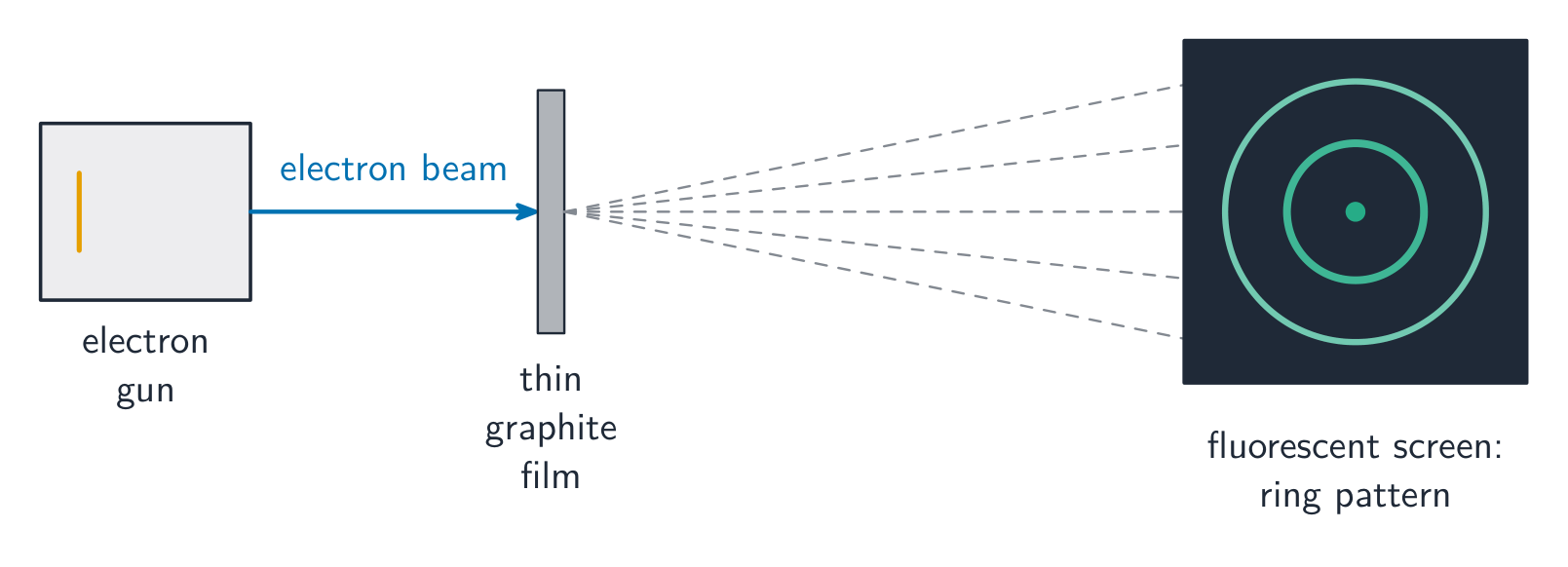
大纲
Learning Objective Essential Knowledge 15.1.A
Describe the properties and behavior of an object that exhibits both particle-like and wave-like behavior.- 15.1.A.1 Quantum theory was developed to explain observations of matter and energy that could not be explained using classical mechanics. These phenomena include, but are not limited to, atomic spectra, blackbody radiation, and the photoelectric effect.
- 15.1.A.1.i Quantum theory is necessary to describe the properties of matter at atomic and subatomic scales.
- 15.1.A.1.ii In quantum theory, fundamental particles can exhibit both particle-like and wave-like behavior.
- 15.1.A.2 Light can be modeled both as a wave and as discrete particles, called photons.
- 15.1.A.2.i A photon is a massless, electrically neutral particle with energy proportional to the photon's frequency.
- Relevant equations:
- $E = hf$
- $\lambda = \dfrac{c}{f}$
- 15.1.A.2.ii Photons travel in straight lines unless they interact with matter.
- 15.1.A.2.i A photon is a massless, electrically neutral particle with energy proportional to the photon's frequency.
- 15.1.A.3 The speed of a photon depends on the medium through which the photon travels.
- 15.1.A.3.i The speed of all photons in free space is equal to the speed of light, $c = 3.00 \times 10^{8}$ m/s.
- 15.1.A.3.ii In general, the speed of photons through a given medium is inversely proportional to the index of refraction of that medium.
- 15.1.A.4 Particles can demonstrate wave properties, as shown by variations of Young's double-slit experiment.
- 15.1.A.4.i A wave model of matter is quantified by the de Broglie wavelength, which increases as the momentum of a particle decreases.
- Relevant equation:
- $\lambda = \dfrac{h}{p}$
- 15.1.A.4.ii Quantum theory is necessary to describe systems where the de Broglie wavelength is comparable to the size of the system.
- 15.1.A.4.i A wave model of matter is quantified by the de Broglie wavelength, which increases as the momentum of a particle decreases.
- 15.1.A.5 Values of energy and momentum have discrete, or quantized, values for bound systems described by quantum theory.
来源:美国大学理事会 AP 课程与考试说明
在微小的尺度上,能量以叫量子(quanta)的离散包出现。光由光子(photons)携带,每个的能量由它的频率设定:
$$E=hf,$$其中 $h$ 是普朗克常数。波粒二象性(wave–particle duality):光和物质各显示波行为(干涉、衍射)和粒子行为(光子、电子作为局域的击中)。一个粒子也有一个物质波长 $\lambda=\dfrac{h}{p}$,而且粒子真的会产生干涉 - 用电子做的杨氏双缝实验(double-slit experiment)的一个变体,会累积出和光一样的条纹图样。电子形成一个衍射模式,显示粒子有一个波性质 Worked example. 求频率 $5.0\times10^{14}\ \text{Hz}$ 的橙光的一个光子的能量($h=6.63\times10^{-34}\ \text{J s}$):$E=hf=6.63\times10^{-34}\times5.0\times10^{14}=3.3\times10^{-19}\ \text{J}$,它约是 $2.1\ \text{eV}$(除以 $1.6\times10^{-19}$)。可见光光子携带几个电子伏特——正好触发视觉和光合作用的化学。
词汇表 训练英文 中文 拼音 quanta/ˈkwɒntə/ 量子 liàng zǐ photons/ˈfəʊtɒnz/ 光子 guāng zi Wave–particle duality/weɪv ˈpɑːtɪkl djuːˈælɪti/ 波粒二象性 bō lì èr xiàng xìng double-slit experiment/ˈdʌbl slɪt ekˈsperɪmənt/ 双缝实验 shuāng fèng shí yàn 15.2
玻尔原子模型
大纲
Learning Objective Essential Knowledge 15.2.A
Describe the properties of an atom.- 15.2.A.1 Atoms have internal structure.
- 15.2.A.1.i Atoms consist of a small, positively charged nucleus surrounded by one or more negatively charged electrons.
- 15.2.A.1.ii The nucleus of an atom is made up of protons and neutrons.
- 15.2.A.1.iii The number of neutrons and protons in an atom can be represented using nuclear notation.
- 15.2.A.1.iv An ion is an atom with a nonzero net electric charge.
- 15.2.A.2 Each atomic element has a unique number of protons.
- 15.2.A.2.i The number and arrangements of electrons affects how atoms interact.
- 15.2.A.2.ii The total number of neutrons and protons identifies the isotope of an element.
- 15.2.A.2.iii The mass of an atom is dominated by the total mass of the protons and neutrons in its nucleus.
- 15.2.A.3 The Bohr model of the atom is based on classical physics and was the historical representation of the atom that led to the description of the hydrogen atom in terms of discrete energy states.
- 15.2.A.3.i In the Bohr model of the atom, electrons are modeled as moving around the nucleus in circular orbits determined by the electron's charge and mass, as well as the electric force between the electron and the nucleus.
- Relevant equations:
- $F_e = k\dfrac{q_1 q_2}{r^2}$
- $F_{\text{net}} = m\dfrac{v^2}{r}$
- 15.2.A.3.ii The standing wave model of electrons accounts for the existence of specific allowed energy states of an electron in an atom, because the electron orbit's circumference must be an integer multiple of the electron's de Broglie wavelength.
- 15.2.A.3.i In the Bohr model of the atom, electrons are modeled as moving around the nucleus in circular orbits determined by the electron's charge and mass, as well as the electric force between the electron and the nucleus.
Boundary statement: The analysis and description of electron structure is limited to energy levels and will not include such advanced descriptions as orbitals, orbital shapes, or probability functions.
来源:美国大学理事会 AP 课程与考试说明
玻尔模型(Bohr model)把电子描绘成只在某些允许的能级(energy levels)绕原子核轨道运行。一个电子只能通过吸收或发射一个能量恰好匹配间隙的光子在能级之间跳跃:
$$E_{\text{photon}}=|E_{\text{final}}-E_{\text{initial}}|.$$因为能级是离散的,只有特定的光子能量被允许。词汇表 训练英文 中文 拼音 Bohr model/ˈbəʊə ˈmɒdl/ 玻尔模型 bō ěr mó xíng energy levels/ˈenədʒi ˈlevlz/ 能级 néng jí 15.3
发射光谱与吸收光谱
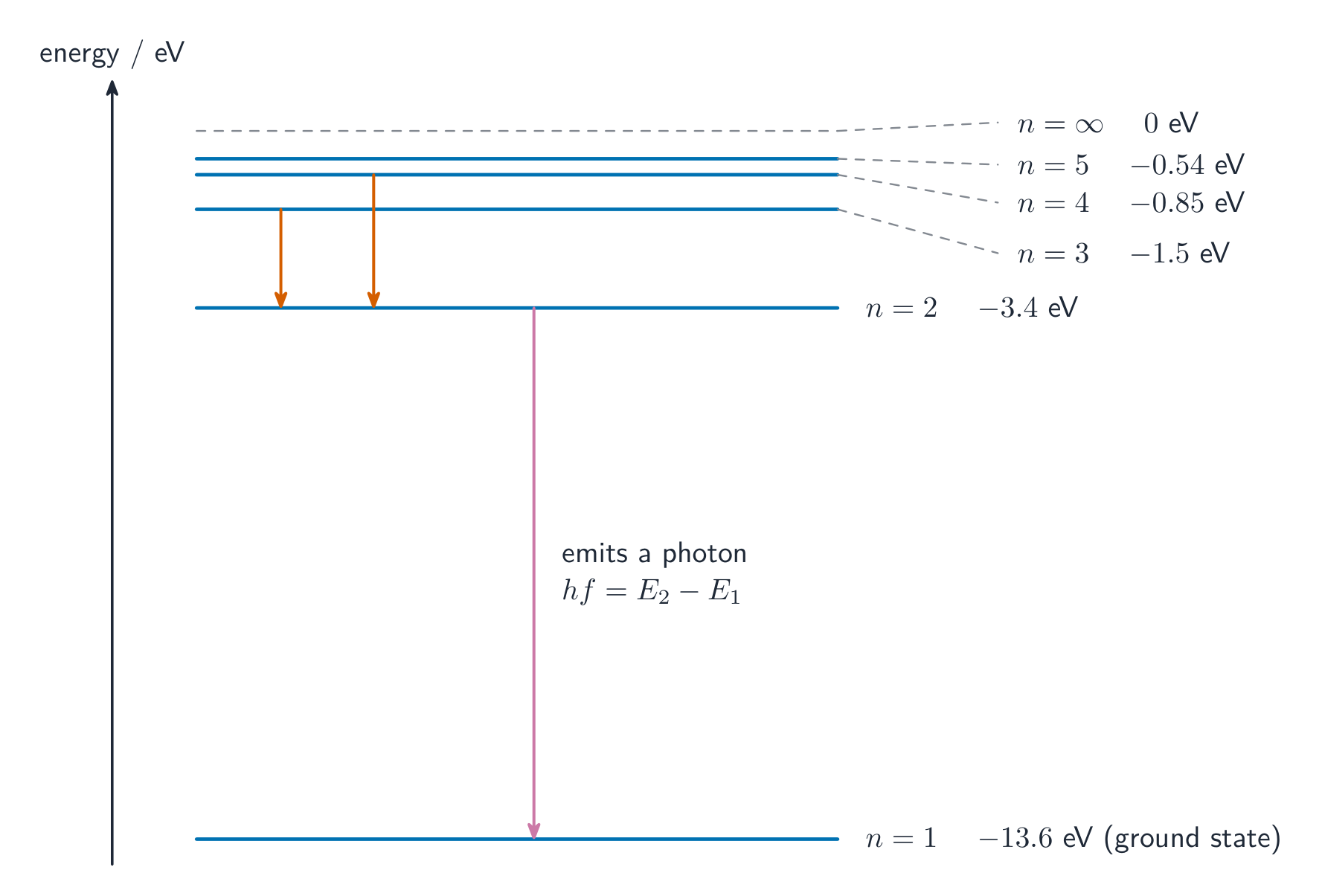
大纲
Learning Objective Essential Knowledge 15.3.A
Describe the emission or absorption of photons by atoms.- 15.3.A.1 Energy transfer occurs when photons are absorbed or emitted by an atom, which is modeled as a system consisting of a nucleus and an electron.
- 15.3.A.2 Energy can only be absorbed or emitted by an atom if the amount of energy being absorbed or emitted corresponds to the energy difference between two atomic energy states.
- 15.3.A.2.i An atom in a given energy state may absorb a photon of the appropriate energy and transition to a higher energy state.
- 15.3.A.2.ii An atom in an excited energy state may emit a photon of the appropriate energy to spontaneously move to a lower energy state.
- 15.3.A.2.iii Because an atom is modeled as a system consisting of an electron and a nucleus, a change in the energy state of an atom corresponds to a change in the interaction energy between the electron and the nucleus.
- 15.3.A.3 Transitions between two energy states of an atom correspond to the absorption or emission of a photon of a single frequency and, therefore, a single wavelength.
- 15.3.A.4 Atoms of each element have a unique set of allowed energy levels and thereby a unique set of absorption and emission frequencies. The unique set of frequencies determines the element's spectrum.
- 15.3.A.4.i An emission spectrum can be used to determine the elements in a source of light.
- 15.3.A.4.ii An absorption spectrum can be used to determine the elements composing a substance by observing what light the substance has absorbed.
- 15.3.A.4.iii Energy level diagrams are commonly used to visually represent the energy states of an atom.
- 15.3.A.5 Binding energy is the energy required to remove an electron from an atom, causing the atom to become ionized. An atom in the lowest energy level (ground state) will require the greatest amount of energy to remove the electron from the atom.
Boundary statement: In AP Physics 2, only energy level diagrams of single-electron atoms will be considered.
来源:美国大学理事会 AP 课程与考试说明
- 一个发射光谱(emission spectrum)是当电子落到较低能级时发出的明线的集合——每条线一个特定的波长。
- 一个吸收光谱(absorption spectrum)是那些相同波长从一个连续源被吸收的暗线的集合。
氢的离散能级产生一个线光谱 线的模式是元素的一个指纹,因为每个元素有它自己的能级。
探索See an element's line spectrum
Electrons jump between fixed energy levels, emitting or absorbing photons of exact wavelengths — a line spectrum that fingerprints the element.
词汇表 训练英文 中文 拼音 emission spectrum/ɪˈmɪʃn ˈspektrəm/ 发射光谱 fā shè guāng pǔ absorption spectrum/əbˈsɔːpʃn ˈspektrəm/ 吸收光谱 xī shōu guāng pǔ 15.4
黑体辐射
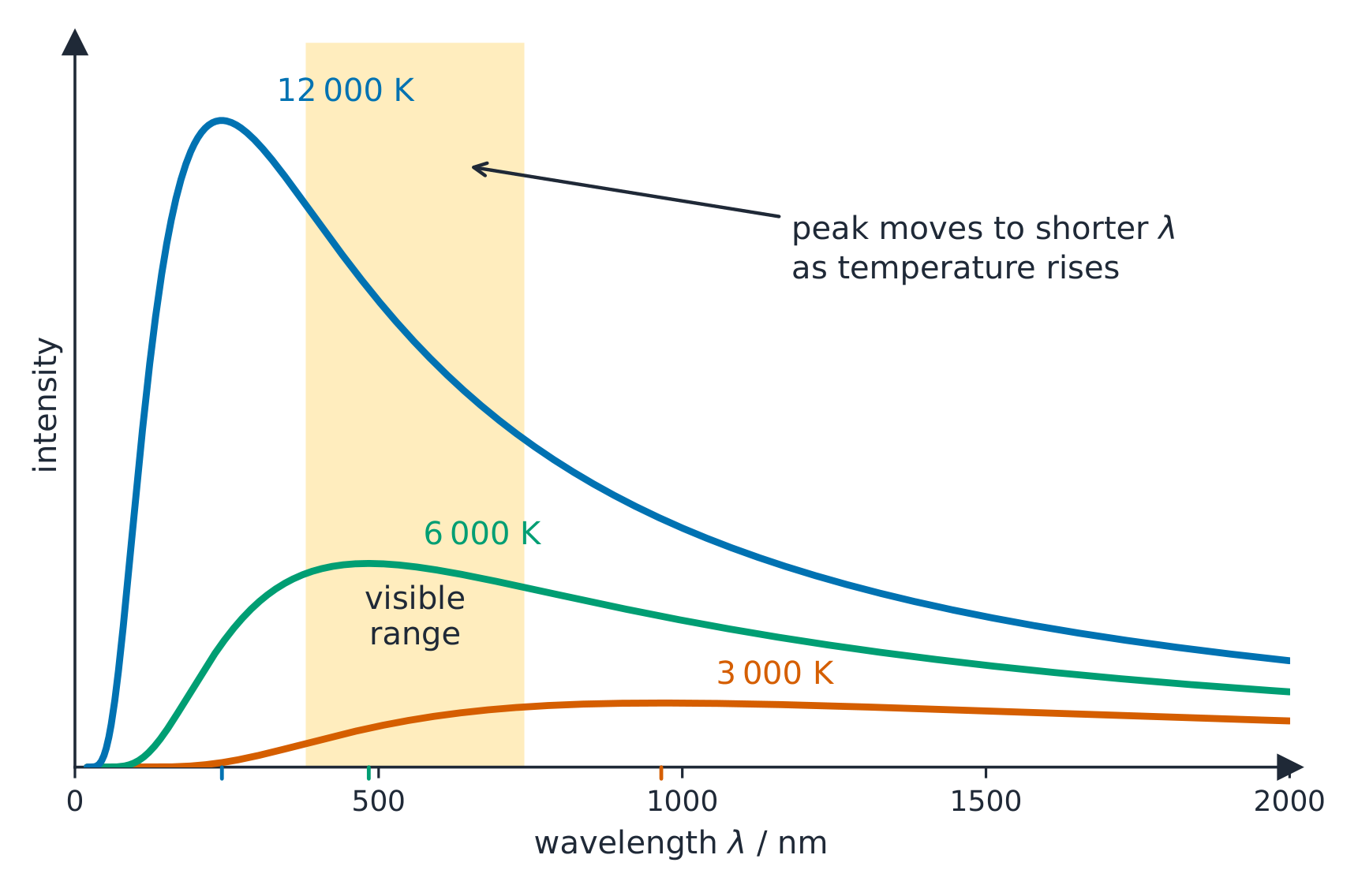
大纲
Learning Objective Essential Knowledge 15.4.A
Describe the electromagnetic radiation emitted by an object due to its temperature.- 15.4.A.1 Matter will spontaneously convert some of its internal thermal energy into electromagnetic energy.
- 15.4.A.2 A blackbody is an idealized model of matter that absorbs all radiation that falls on the body. If the body is in equilibrium at a constant temperature, then it must in turn emit energy.
- 15.4.A.3 A blackbody will emit a continuous spectrum that only depends on the body's temperature. The radiation emitted by a blackbody is often modeled by plotting intensity per unit wavelength as a function of wavelength.
- 15.4.A.3.i The distribution of the intensity of a blackbody's spectrum as a function of temperature cannot be modeled using only classical physics concepts. A blackbody's spectrum is described by Planck's law, which assumes that the energy of light is quantized.
- 15.4.A.3.ii The peak wavelength emitted by a blackbody (the wavelength at which the blackbody emits the greatest amount of radiation per unit wavelength) decreases with increasing temperature, as described by Wien's law.
- Relevant equation:
- $\lambda_{\max} = \dfrac{b}{T}$
- 15.4.A.3.iii The rate at which energy is emitted (power) by a blackbody is proportional to the surface area of the body and to the temperature of the body raised to the fourth power, as described by the Stefan-Boltzmann law.
- Relevant equation:
- $P = A\sigma T^4$
来源:美国大学理事会 AP 课程与考试说明
一个黑体(blackbody)发射一个只取决于它温度的连续光谱。更热的物体发光更亮并在更短的波长达到峰值(红热到白热到蓝热)。解释这个光谱需要量子化的能量——量子理论的一个奠基问题。
一个更热的黑体辐射更多,而它的峰值移向更短的波长 词汇表 训练英文 中文 拼音 blackbody/ˈblækbɒdi/ 黑体 hēi tǐ 15.5
光电效应
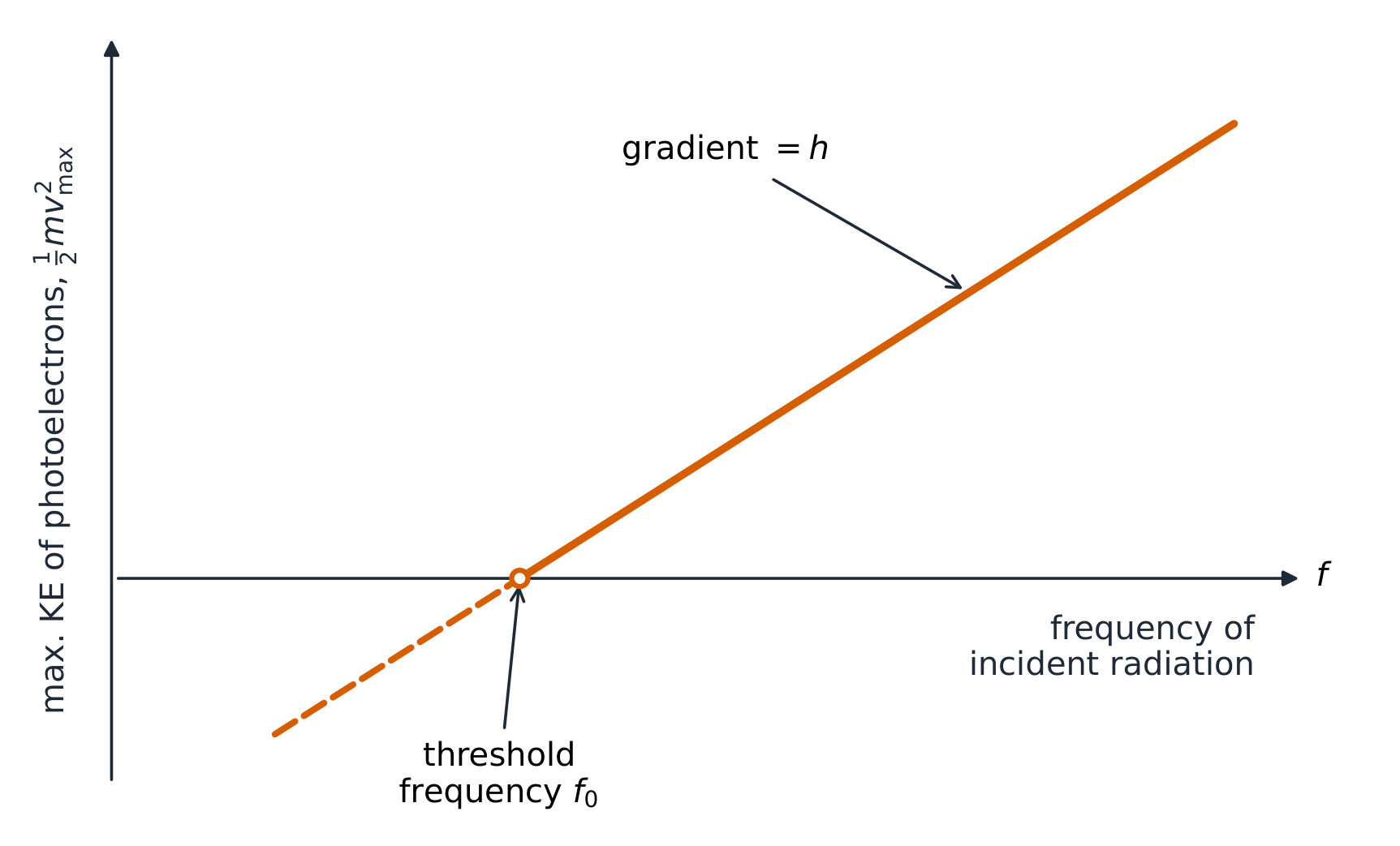
大纲
Learning Objective Essential Knowledge 15.5.A
Describe an interaction between photons and matter using the photoelectric effect.- 15.5.A.1 The photoelectric effect is the emission of electrons when electromagnetic radiation is incident upon a photoactive material.
- 15.5.A.2 The emission of electrons via the photoelectric effect requires a minimum frequency of incident light, called the threshold frequency.
- 15.5.A.2.i Light that is incident on a material and is at the threshold frequency or higher will induce electron emission, regardless of the number of photons that strike the material.
- 15.5.A.2.ii The energy of the emitted electrons is not dependent on the number of photons that are incident upon the material, which provides evidence that light is a collection of discrete, quantized energy packets called photons.
- 15.5.A.3 The maximum kinetic energy of an emitted electron is related to the frequency of the incident light and the work function of the material, $\phi$.
- 15.5.A.3.i The work function of a material is the minimum energy required to emit an electron from atoms in the material.
- 15.5.A.3.ii The maximum kinetic energy of an emitted electron is given by the equation $K_{\max} = hf - \phi$.
- 15.5.A.3.iii In a typical experimental setup to demonstrate the photoelectric effect and determine the work function of a metal, two metal plates are placed in a vacuum chamber and connected to a variable source of potential difference. One of the plates is illuminated by monochromatic light that causes electrons to be ejected and the potential difference between the plates is adjusted until no current is measured in the circuit.
Boundary statement: Where applicable, work functions for materials will be provided on the exam; students are not expected to know values of work functions or variables of a material that influence the magnitude of its work function.
来源:美国大学理事会 AP 课程与考试说明
光电效应 把光照在一个金属上能弹出电子——光电效应(photoelectric effect)。关键事实(只有光子图像解释):电子只有在光子的频率超过一个阈值时才出来,无论一个更暗、更低频率的光多亮。能量守恒给出
$$K_{\max}=hf-\phi,$$其中 $\phi$ 是金属的逸出功(work function)(释放一个电子的能量)。光电子的最大动能随频率线性上升 Worked example. 频率 $8.0\times10^{14}\ \text{Hz}$ 的光落在一个逸出功 $\phi=3.0\times10^{-19}\ \text{J}$ 的金属上。最有能量的电子以以下出来
$$K_{\max}=hf-\phi=(6.63\times10^{-34}\times8.0\times10^{14})-3.0\times10^{-19}=5.3\times10^{-19}-3.0\times10^{-19}=2.3\times10^{-19}\ \text{J}.$$低于阈值频率 $\phi/h$,$K_{\max}$ 会是负的——意味着完全没有电子逃逸,无论光多亮。词汇表 训练英文 中文 拼音 photoelectric effect/ˌfəʊtəʊɪˈlektrɪk ɪˈfekt/ 光电效应 guāng diàn xiào yìng work function/wɜːk ˈfʌŋkʃn/ 逸出功 yì chū gōng 15.6
康普顿散射
大纲
Learning Objective Essential Knowledge 15.6.A
Describe the interaction between photons and matter using Compton scattering.- 15.6.A.1 In Compton scattering, a photon interacts with a free electron. The Compton effect is when a photon that emerges from the interaction has a lower energy and longer wavelength than the incoming photon. The magnitude of the change is related to the direction of the photon after the collision.
- 15.6.A.2 Compton scattering provides evidence that light is a collection of discrete, quantized energy packets called photons.
- 15.6.A.2.i Compton scattering can be explained by treating a photon as a particle and applying conservation of energy and conservation of momentum to the collision between the photon and electron.
- 15.6.A.2.ii The transfer of a photon's energy to an electron results in the energy, momentum, frequency, and wavelength of the photon changing.
- Relevant equations:
- $E = hf$
- $\lambda = \dfrac{h}{p}$
- 15.6.A.3 The change in wavelength experienced by a photon after colliding with an electron is related to how much the photon's direction changes.
- Relevant equation:
- $\Delta\lambda = \dfrac{h}{m_e c}(1 - \cos\theta)$
Boundary statement: AP Physics 2 includes full quantitative and qualitative treatments of conservation of momentum in two dimensions.
来源:美国大学理事会 AP 课程与考试说明
在康普顿散射(Compton scattering)里,一个光子像两个粒子那样与一个电子碰撞,转移一些能量和动量。散射的光子以更少能量(更长波长)出来。这是光子携带动量并表现为粒子的直接证据。
词汇表 训练英文 中文 拼音 Compton scattering/ˈkɒmptn ˈskætərɪŋ/ 康普顿散射 kāng pǔ dùn sǎn shè 15.7
裂变、聚变与核衰变
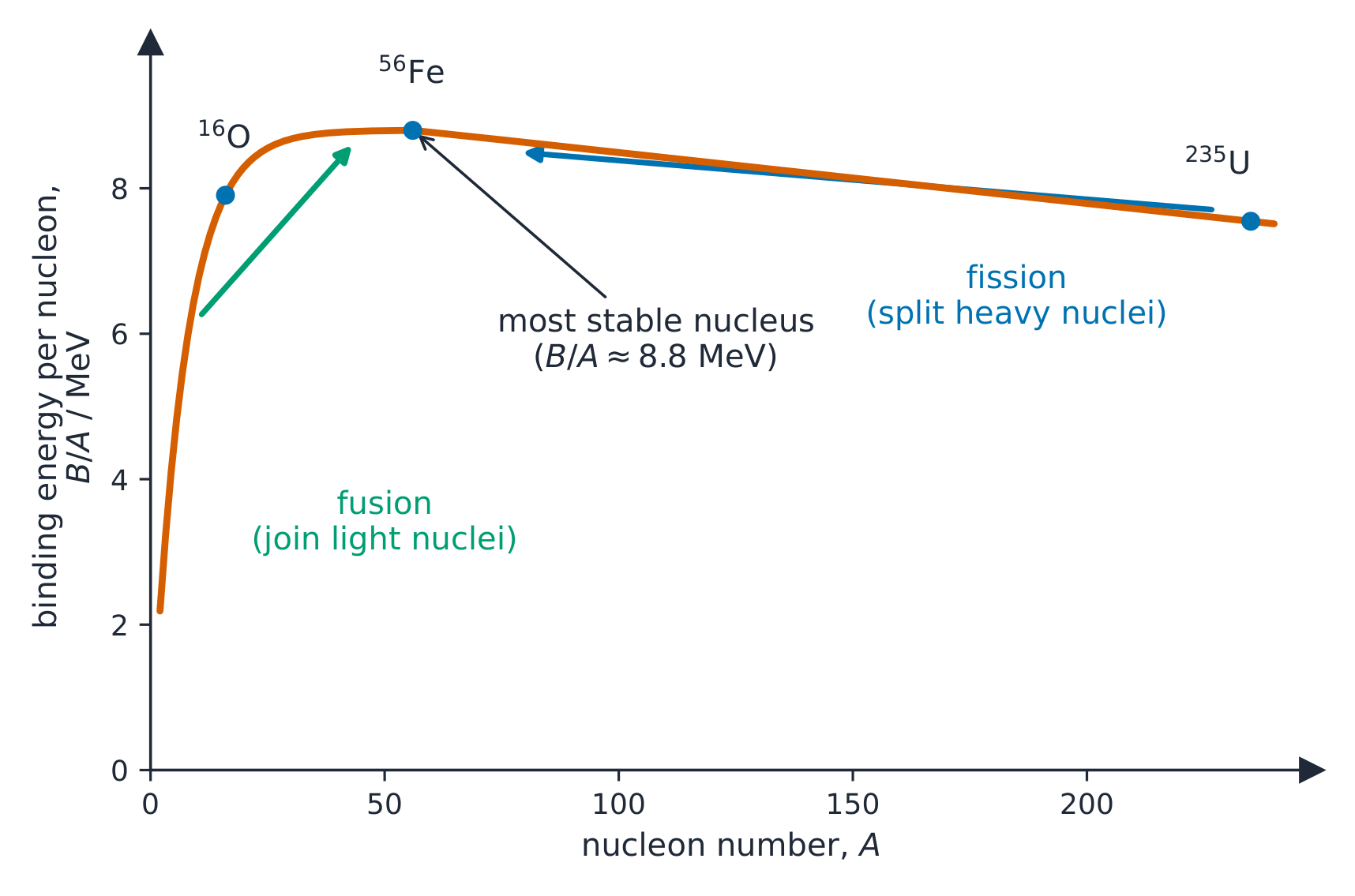
大纲
Learning Objective Essential Knowledge 15.7.A
Describe the physical properties that constrain the behavior of interacting nuclei, subatomic particles, and nucleons.- 15.7.A.1 The strong force is exerted at nuclear scales and dominates the interactions of nucleons (protons or neutrons).
- 15.7.A.2 Possible nuclear reactions are constrained by the law of conservation of nucleon number.
- 15.7.A.3 The behavior of the constituent particles of a nuclear reaction is constrained by laws of conservation of energy, energy-mass equivalence, and conservation of momentum.
- 15.7.A.4 For all nuclear reactions, mass and energy may be exchanged due to mass-energy equivalence.
- Relevant equation:
- $E = mc^2$
- 15.7.A.5 Energy may be released in nuclear processes in the form of kinetic energy of the products or as photons.
- 15.7.A.6 Nuclear fusion is the process by which two or more smaller nuclei combine to form a larger nucleus, as well as subatomic particles.
- 15.7.A.7 Nuclear fission is the process by which the nucleus of an atom splits into two or more smaller nuclei, as well as subatomic particles.
- 15.7.A.8 Nuclear fission may occur spontaneously or may require an energy input, depending on the binding energy of the nucleus.
15.7.B
Describe the radioactive decay of a given sample of material consisting of a finite number of nuclei.- 15.7.B.1 Radioactive decay is the spontaneous transformation of a nucleus into one or more different nuclei.
- 15.7.B.1.i The time at which an individual nucleus undergoes radioactive decay is indeterminable, but decay rates can be described using probability
- 15.7.B.1.ii The half-life, $t_{1/2}$, of a radioactive material is the time it takes for half of the initial number of radioactive nuclei to have spontaneously decayed.
- 15.7.B.1.iii The decay constant $\lambda$ can be related to the half-life of a radioactive material with the equation $\lambda = \dfrac{\ln 2}{t_{1/2}}$.
- 15.7.B.2 A material's decay constant may be used to predict the number of nuclei remaining in a sample after a period of time, or the age of a material if the initial amount of material is known.
- Relevant equation:
- $N = N_0 e^{-\lambda t}$
- Derived equation:
- $\ln\left(\dfrac{N}{N_0}\right) = -\lambda t$
- 15.7.B.3 Different unstable elements and isotopes may have vastly different half-lives, ranging from fractions of a second to billions of years.
来源:美国大学理事会 AP 课程与考试说明
原子核(nucleus)储存巨大的能量。裂变(fission)把一个重原子核分裂成更轻的,释放能量(核反应堆、炸弹)。聚变(fusion)把轻原子核连接成一个更重的(太阳的能量)。两者都释放能量,因为产物有略更少的质量,由 $E=mc^2$ 转换。
每核子结合能在铁附近达到峰值,所以聚变和裂变都能释放能量 Worked example. 即使一个微小的质量也转换成一个巨大的能量。若一个核反应损失 $1.0\times10^{-3}\ \text{kg}$ 的质量,它释放 $E=mc^2=1.0\times10^{-3}\times(3.0\times10^{8})^2=9.0\times10^{13}\ \text{J}$ ——大致是 $20\,000$ 吨 TNT 的能量。
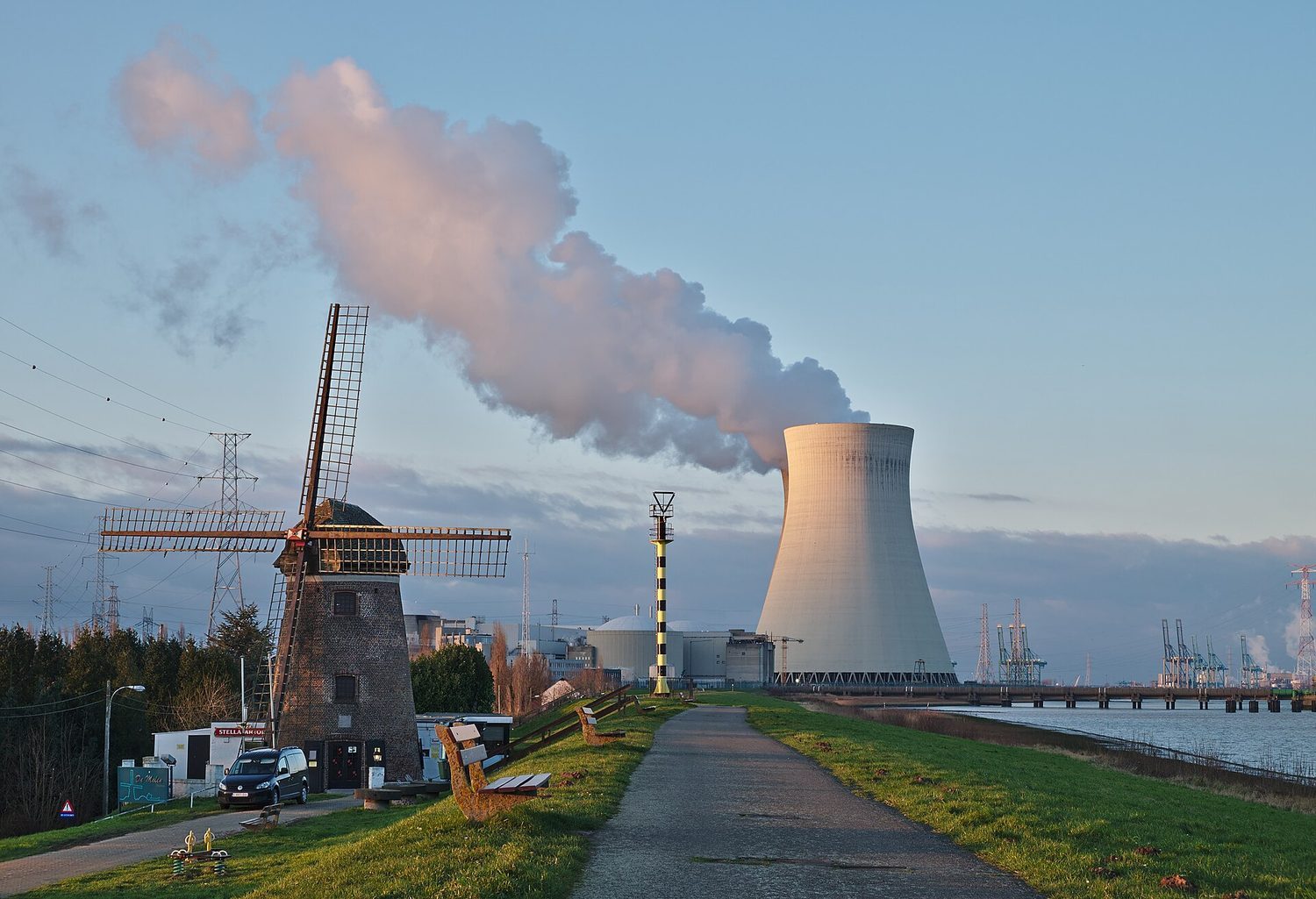
A nuclear power station: fission of heavy nuclei releases the energy that drives the plant 探索Balance a nuclear decay equation
In alpha, beta and gamma decay, nucleon and charge numbers must balance. Pick a mode and see how the parent turns into the daughter nuclide.
词汇表 训练英文 中文 拼音 nucleus/ˈnjuːklɪəs/ 原子核 yuán zǐ hé Fission/ˈfɪʃn/ 裂变 liè biàn Fusion/ˈfjuːʒn/ 聚变 jù biàn 15.8
放射性衰变的类型
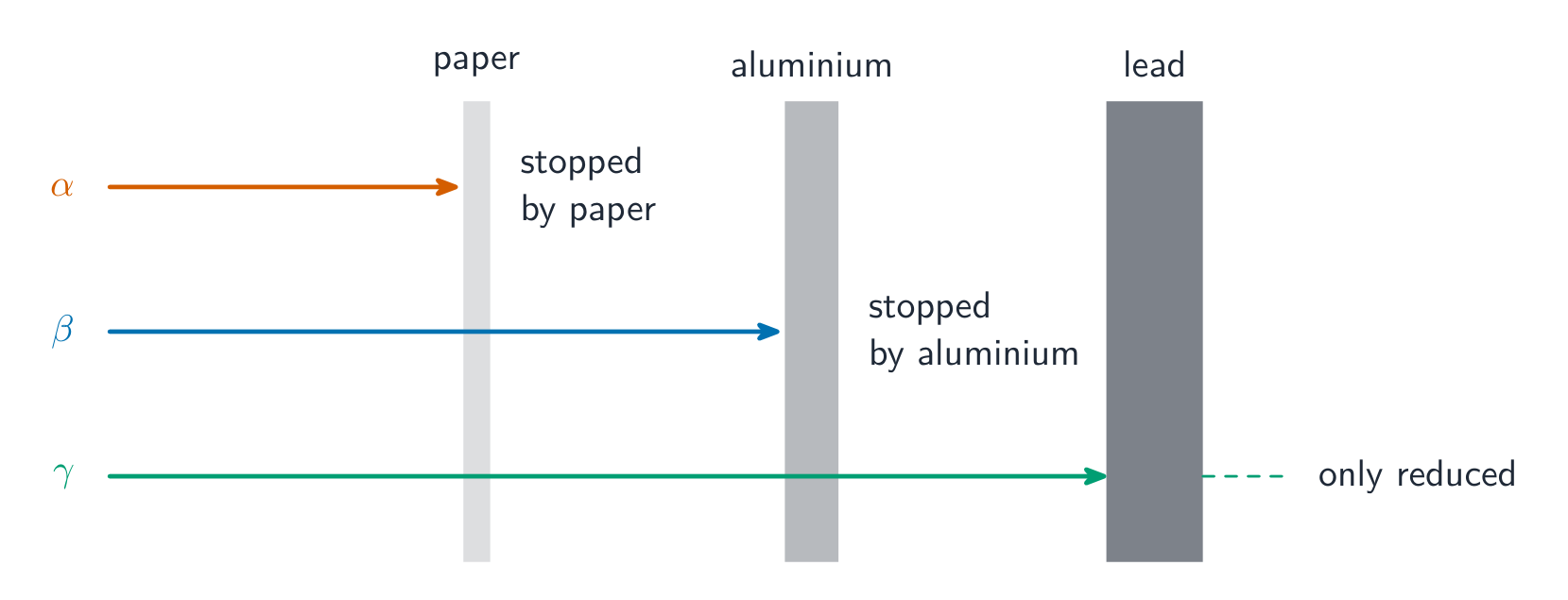
大纲
Learning Objective Essential Knowledge 15.8.A
Describe the processes by which individual nuclei decay.- 15.8.A.1 Some processes by which nuclei decay emit subatomic particles with unique properties.
- 15.8.A.1.i An alpha particle, or helium nucleus, consists of two neutrons and two protons and is symbolized by $\alpha$ or $\text{He}^{2+}$. (In Physics 2, only He-4 nuclei will be considered.)
- 15.8.A.1.ii Neutrinos and antineutrinos are subatomic particles that have no electrical charge, have negligible mass, and are symbolized by $\nu$ and $\bar{\nu}$, respectively.
- 15.8.A.1.iii Neutrinos and antineutrinos only interact with matter via the weak force and the gravitational force, which results in very little interaction with normal matter.
- 15.8.A.1.iv Positrons, or antielectrons, are subatomic particles that have an electric charge opposite that of an electron, have the same mass as an electron, and are symbolized by $e^+$ or $\beta^+$.
- 15.8.A.2 Nuclei can undergo radioactive decay via alpha decay, beta-minus decay ($\beta^-$), beta-plus decay ($\beta^+$), and gamma decay ($\gamma$).
- 15.8.A.2.i In all nuclear decays, nucleon number (the number of neutrons and protons), lepton number (the number of electrons and neutrinos), and charge are conserved.
- 15.8.A.2.ii Alpha decay occurs when a nucleus ejects an alpha particle.
- 15.8.A.2.iii Beta-minus decay occurs when a neutron changes to a proton by emitting an electron and antineutrino.
- 15.8.A.2.iv Beta-plus decay occurs when a proton changes to a neutron by emitting a positron and neutrino.
- 15.8.A.2.v Gamma decay occurs after a nucleus has undergone alpha or beta decay and the excited nucleus decays to a lower energy state by emitting a photon.
- 15.8.A.3 The type of decay exhibited by a given nucleus is determined by the isotope of the element.
Boundary statement: AP Physics 2 does not expect students to memorize the processes by which specific isotopes decay or the half-lives of specific isotopes. Neutron emission and electron capture are not included in the AP Physics 2 curriculum framework. Additionally, types of neutrinos, the characteristics that distinguish neutrinos and antineutrinos, and an explanation or application of the weak force are not within the scope of this course.
来源:美国大学理事会 AP 课程与考试说明
放射性衰变与半衰期 不稳定的原子核经历放射性衰变(radioactive decay),发射:
阿尔法、贝塔和伽马辐射的穿透力 - 阿尔法衰变(alpha decay)($\alpha$):一个氦核——质量数下降 4。
- 贝塔衰变(beta decay)($\beta$)有两种。在贝塔负($\beta^-$)里一个中子变成一个质子,放出一个电子和一个反中微子(antineutrino):$n\rightarrow p+e^-+\bar{\nu}$。在贝塔正($\beta^+$)里一个质子变成一个中子,放出一个正电子(positron)和一个中微子(neutrino):$p\rightarrow n+e^++\nu$。
- 伽马衰变(gamma decay)($\gamma$):一个高能光子——原子核脱掉多余的能量。
中微子和反中微子(符号 $\nu$、$\bar{\nu}$)是微小的、无电荷的、几乎无质量的粒子,它们带走能量并使贝塔衰变保持平衡。衰变是随机的,但一个样本每个半衰期(half-life)减半:每个半衰期后,剩下原子核的一半已经衰变。每个衰变方程守恒三个量:核子数(质量数)、电荷和轻子数(lepton number)——一个电子或中微子记为 $+1$ 轻子,一个正电子或反中微子记为 $-1$,两边的总数必须相等。
Worked example. 一个放射性样本有一个 $8.0$ 天的半衰期。$24$ 天后剩多少分数?那是 $24/8.0=3$ 个半衰期,所以剩下的分数是 $\left(\tfrac12\right)^3=\tfrac18$ ——约 $12.5\%$。在铀-238($^{238}_{\ 92}\text{U}$)的一次阿尔法衰变里,子体有质量数 $238-4=234$ 和原子序数 $92-2=90$:钍-234。
探索Watch a sample decay
Radioactive nuclei decay randomly with a fixed half-life: each half-life halves the number remaining. Step forward and watch the sample shrink.
词汇表 训练英文 中文 拼音 radioactive decay/ˌreɪdɪəʊˈæktɪv dɪˈkeɪ/ 放射性衰变 fàng shè xìng shuāi biàn Alpha decay/ˈælfə dɪˈkeɪ/ 阿尔法衰变 ā ěr fǎ shuāi biàn Beta decay/ˈbiːtə dɪˈkeɪ/ 贝塔衰变 bèi tǎ shuāi biàn antineutrino/ˌæntɪnjuːˈtriːnəʊ/ 反中微子 fǎn zhōng wēi zǐ positron/ˈpɒzɪtrɒn/ 正电子 zhèng diàn zi neutrino/njuːˈtriːnəʊ/ 中微子 zhōng wēi zǐ Gamma decay/ˈɡæmə dɪˈkeɪ/ 伽马衰变 gā mǎ shuāi biàn half-life/hɑːf laɪf/ 半衰期 bàn shuāi qī lepton number/ˈleptɒn ˈnʌmbə/ 轻子数 qīng zi shù 15.8
考试技巧
- 光子能量是 $E=hf$;低于阈值频率没有电子被发射无论光多亮(光电效应)。
- 对最快的光电子用 $K_{\max}=hf-\phi$($\phi$ = 逸出功)。
- 电子通过吸收/发射一个能量等于能级间隙的光子在离散能级之间跳跃——线光谱的来源。
- 在裂变和聚变里,损失的小质量通过 $E=mc^2$ 变成能量。
- 通过守恒质量数、电荷和轻子数配平衰变方程(在 $\beta^-$ 里写反中微子,在 $\beta^+$ 里写中微子),并每个半衰期($n$ 个半衰期后 $(\tfrac12)^n$)把样本减半。
- 15.1.A.1 Quantum theory was developed to explain observations of matter and energy that could not be explained using classical mechanics. These phenomena include, but are not limited to, atomic spectra, blackbody radiation, and the photoelectric effect.