| Learning Objective | Essential Knowledge |
|---|---|
12.1.A |
|
12.1.B |
|
12.1.C |
|
磁学与电磁学
AP 物理 2 · 第 12 主题
 9:21
9:21
Magnetism and Electromagnetism
High over the Arctic, the night sky glows green. These curtains of light are not fire. They are charged particles from the Sun, arriving at a million…
英文讲解 · 内嵌中英文字幕
12.1
磁场

大纲
来源:美国大学理事会 AP 课程与考试说明
不同的材料对磁场的响应差别很大,本课程点名三种。铁磁性(ferromagnetic)材料(铁、镍、钴)的磁偶极子强烈对齐并保持对齐,所以能成为永久磁体。顺磁性(paramagnetic)材料(铝、钛)只微弱地对齐,且不保持对齐。抗磁性(diamagnetic)材料 - 事实上所有材料都有一些抗磁性 - 微弱地朝相反于磁场的方向对齐。这种行为来自一个材料属性,即磁导率(permeability):自由空间有一个固定的真空磁导率 $\mu_0$,而物质的磁导率不同于它,对于给定材料甚至不是常数。
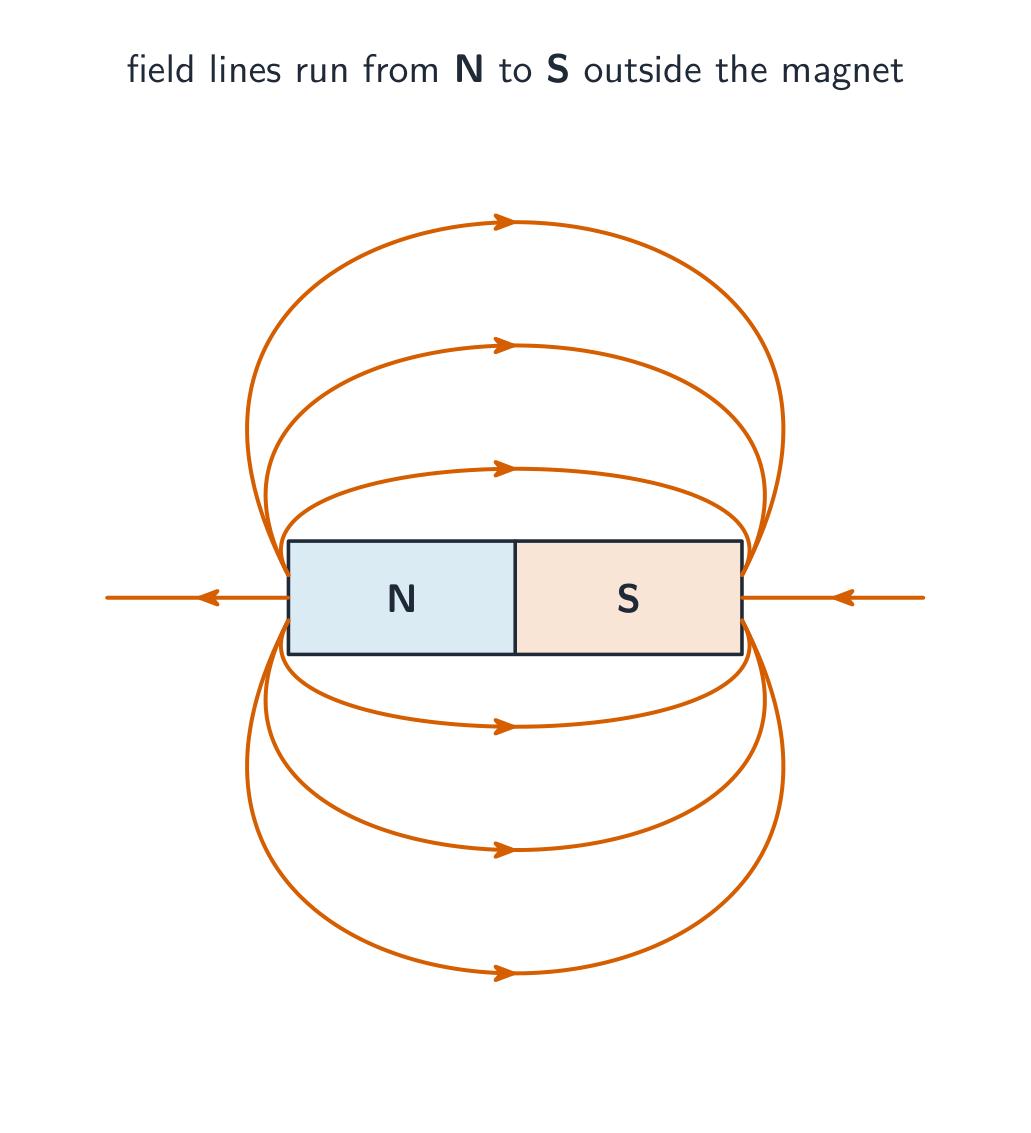
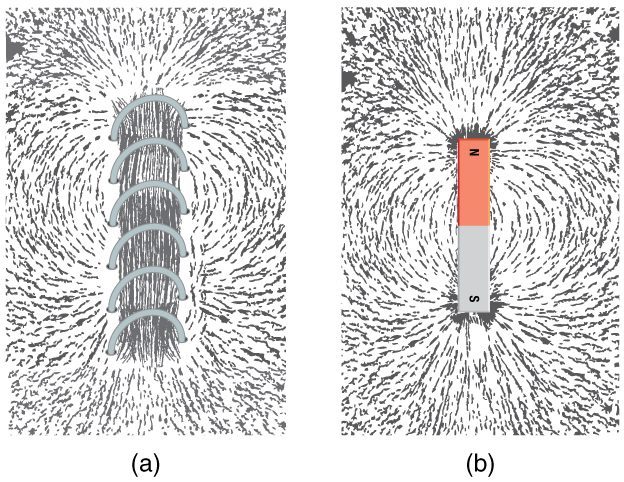
一个磁场(magnetic field)$\vec{B}$ 围绕磁体和移动的电荷。场线在磁体外部从一个磁体的北极跑向它的南极,而更密的线意味着一个更强的场。磁极总是成对出现——把一个磁体切成一半制造两个更小的磁体,从不制造一个孤立的极。
探索
See a magnet's field lines
Magnetic field lines run from the north pole to the south pole outside the magnet. Where the lines crowd together the field is strongest.
词汇表
训练
| 英文 | 中文 | 拼音 |
|---|---|---|
| Ferromagnetic/ˌferəməɡˈnetɪk/ | 铁磁性 | tiě cí xìng |
| Paramagnetic/ˌpærəməɡˈnetɪk/ | 顺磁性 | shùn cí xìng |
| Diamagnetic/ˌdaɪəməɡˈnetɪk/ | 抗磁性 | kàng cí xìng |
| permeability/ˌpɜːməˈbɪlɪti/ | 磁导率 | cí dǎo lǜ |
| magnetic field/mæɡˈnetɪk fiːld/ | 磁场 | cí chǎng |
12.2
磁场与运动电荷
大纲
| Learning Objective | Essential Knowledge |
|---|---|
12.2.A |
|
12.2.B |
Boundary statement: Quantitative treatment of the magnitude of the magnetic force exerted by a magnetic field on a moving charge is limited to angles of 0, 90, and 180 degrees between the velocity and the magnetic field. Qualitative analysis of other angles is permitted. |
来源:美国大学理事会 AP 课程与考试说明
一个移动过一个磁场的电荷感受一个磁力(magnetic force):
$$F=qvB\sin\theta,$$
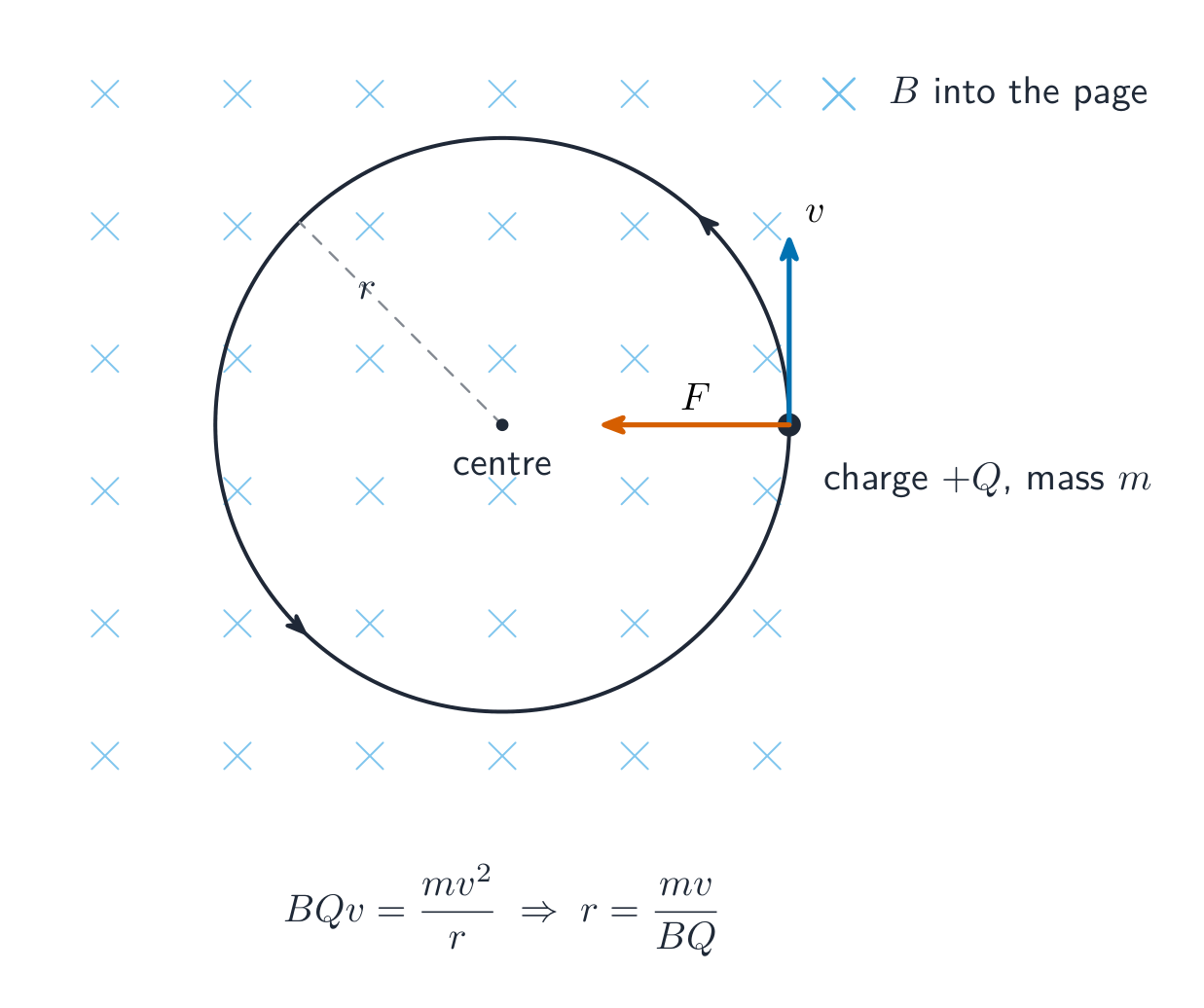
其中 $\theta$ 是速度和场之间的角。力垂直于 $\vec{v}$ 和 $\vec{B}$ 两者(用右手定则),所以它改变方向但不改变速率——一个垂直于一个均匀场移动的电荷以一个圆行进。一个静止的电荷,或一个平行于场移动的电荷,感受不到磁力。
Worked example. 一个质子($q=1.6\times10^{-19}\ \text{C}$,$m=1.67\times10^{-27}\ \text{kg}$)以 $2.0\times10^{5}\ \text{m/s}$、与场成直角进入一个 $0.50\ \text{T}$ 的场。磁力是
$$F=qvB=1.6\times10^{-19}\times2.0\times10^{5}\times0.50=1.6\times10^{-14}\ \text{N}.$$
这个力是向心力,所以它把质子弯曲成一个半径的圆
$$r=\frac{mv}{qB}=\frac{1.67\times10^{-27}\times2.0\times10^{5}}{1.6\times10^{-19}\times0.50}=4.2\times10^{-3}\ \text{m}.$$
令 $qvB=\dfrac{mv^2}{r}$ 并约去给出那个利落的 $r=mv/(qB)$ ——质谱仪背后的原理。
词汇表
训练
| 英文 | 中文 | 拼音 |
|---|---|---|
| magnetic force/mæɡˈnetɪk fɔːs/ | 磁力 | cí lì |
12.3
磁场与载流导线
大纲
| Learning Objective | Essential Knowledge |
|---|---|
12.3.A |
|
12.3.B |
|
来源:美国大学理事会 AP 课程与考试说明
因为一个电流是移动的电荷,一个磁场推一根载流导线:
$$F=BIL\sin\theta.$$
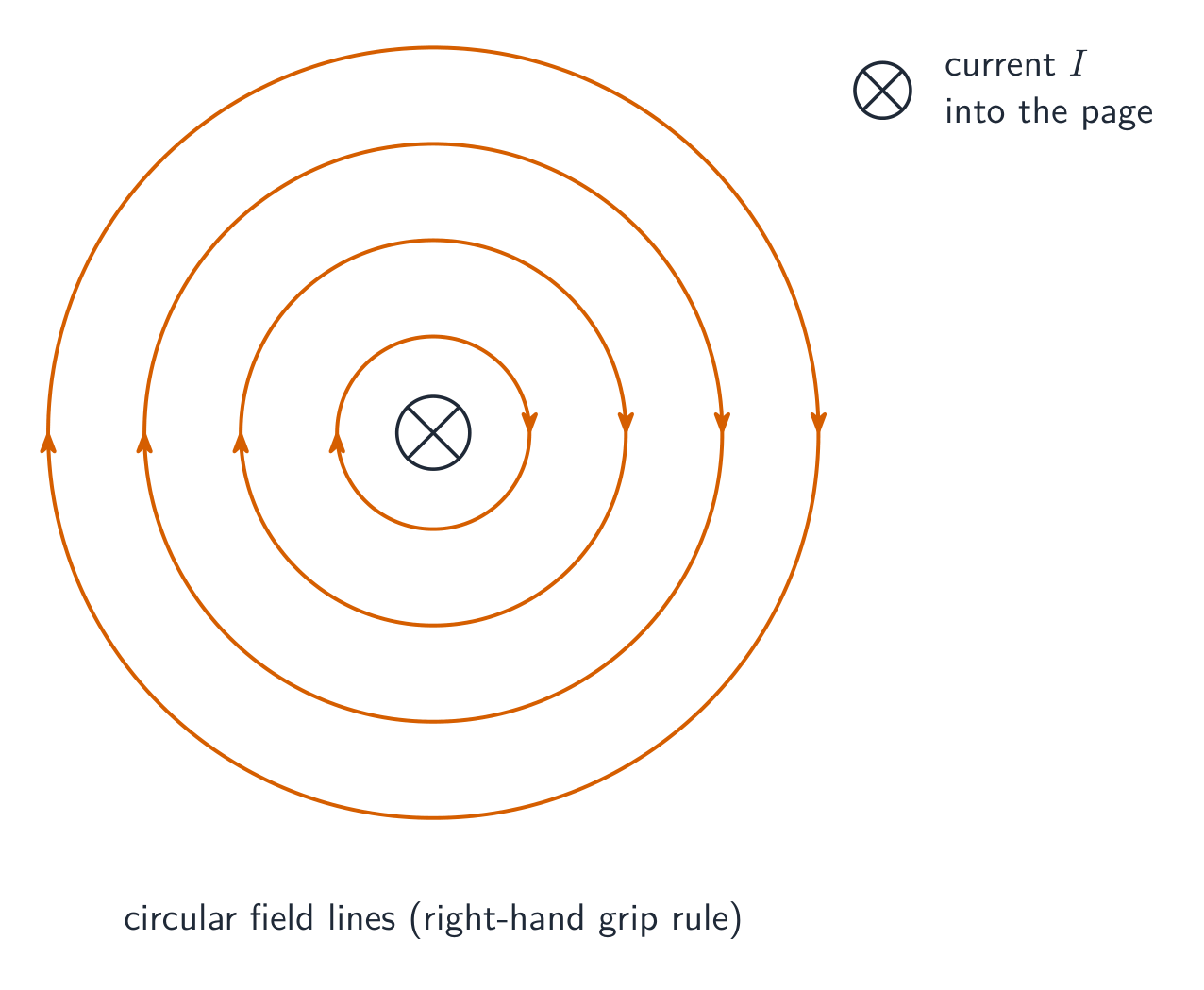
一个电流也创造它自己的磁场:圆形场线缠绕一根直导线(右手定则),而一个线圈(螺线管)制造一个像条形磁体的场。这就是电磁体和马达如何工作。
Worked example. 一段 $0.30\ \text{m}$ 长的导线以直角于一个 $0.20\ \text{T}$ 的场携带 $4.0\ \text{A}$。它上的力是 $F=BIL=0.20\times4.0\times0.30=0.24\ \text{N}$ ——转动一个马达线圈的推力。
探索
Find the force on a current in a field
A current in a magnetic field feels a force $F = BIL$, at right angles to both. Use the left-hand rule; reverse the current or field and the force flips.
12.4
电磁感应与法拉第定律
大纲
| Learning Objective | Essential Knowledge |
|---|---|
12.4.A |
|
来源:美国大学理事会 AP 课程与考试说明
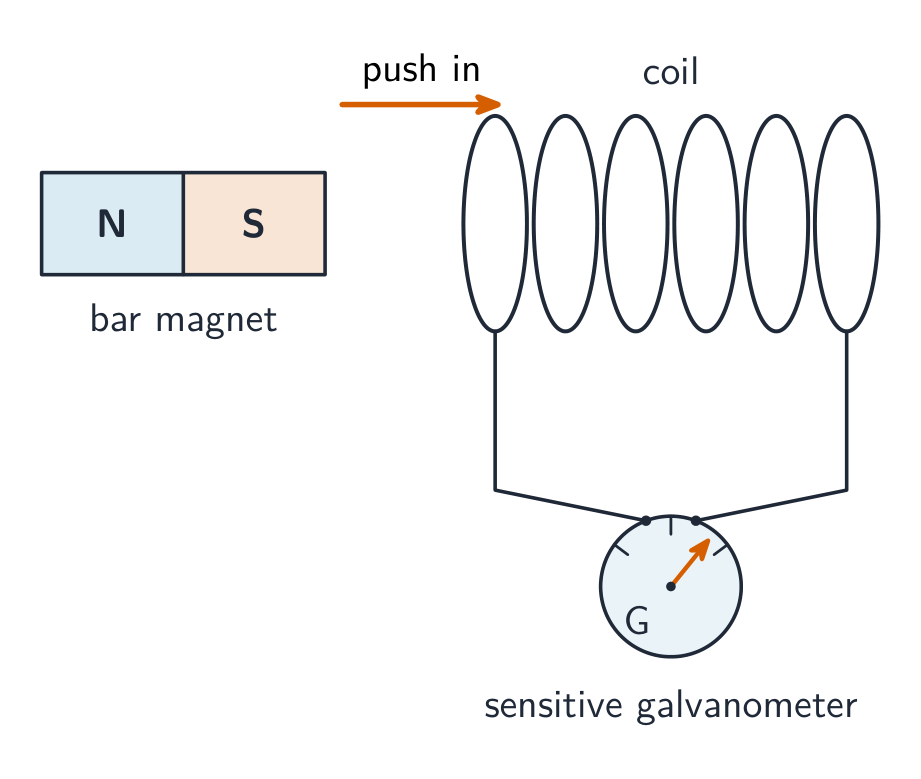
一个通过一个环的变化的磁场驱动一个电流——电磁感应(electromagnetic induction)。磁通量(magnetic flux)$\Phi=BA\cos\theta$ 测量多少场通过环。法拉第定律(Faraday's law)给出感应 emf:
$$\varepsilon=-\frac{\Delta\Phi}{\Delta t}.$$
若场、面积或环的取向变化,磁通量就变化。楞次定律(Lenz's law)(负号)说感应电流流动以反对造成它的变化——发电机的基础。
Worked example. 通过一个单一环的磁通量在 $0.030\ \text{s}$ 里从 $0.020\ \text{Wb}$ 降到 $0.008\ \text{Wb}$。平均感应 emf 是
$$\varepsilon=\left|\frac{\Delta\Phi}{\Delta t}\right|=\frac{0.020-0.008}{0.030}=0.40\ \text{V}.$$
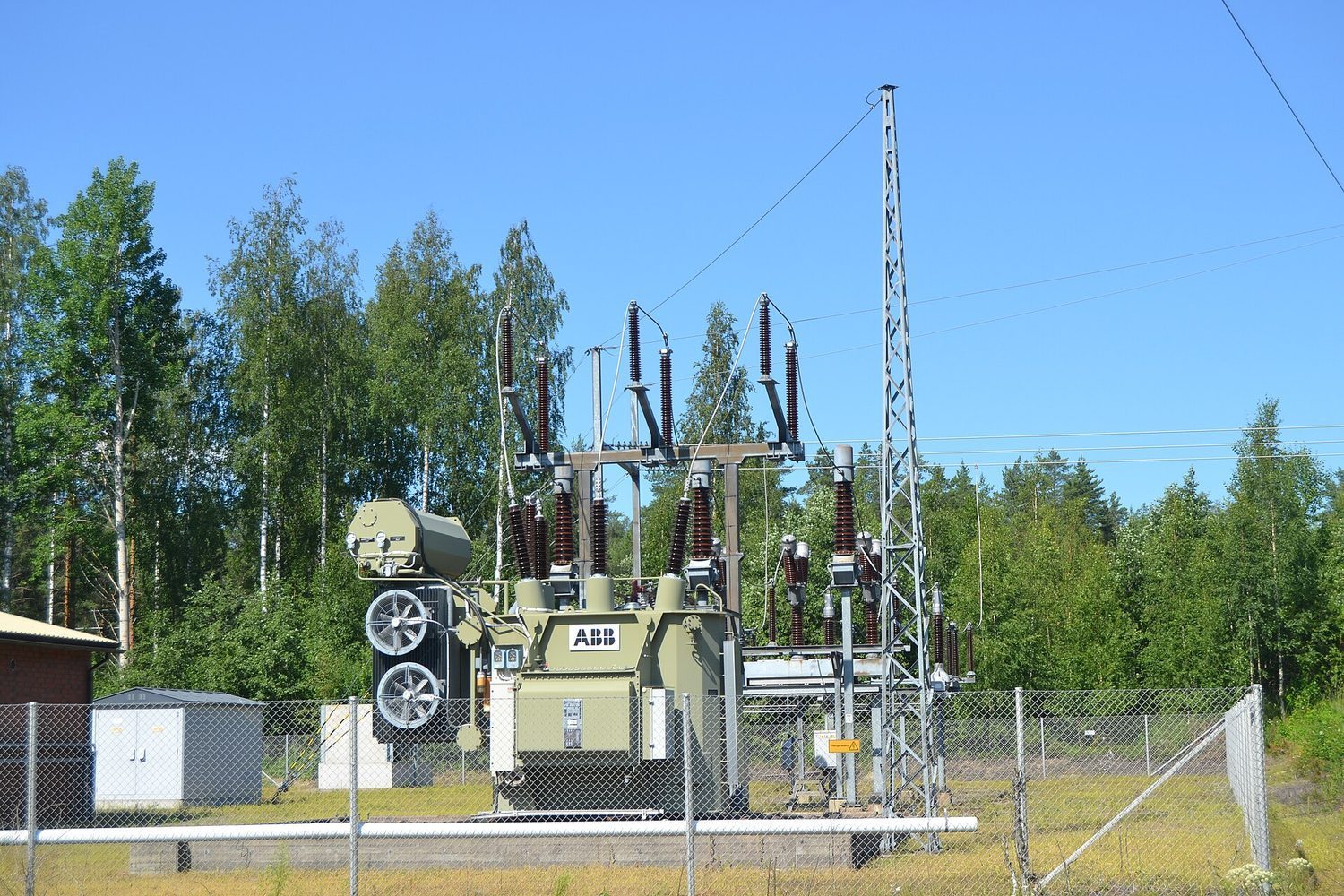
一个 $N$ 匝的线圈会给出这的 $N$ 倍——这就是为什么发电机和变压器使用多匝线圈。
探索
Induce a voltage by moving a magnet
Faraday's law: a changing magnetic flux through a coil induces a voltage. Move the magnet faster and the induced EMF grows; Lenz's law sets its direction to oppose the change.
词汇表
训练
| 英文 | 中文 | 拼音 |
|---|---|---|
| electromagnetic induction/ɪˌlektrəʊməɡˈnetɪk ɪnˈdʌkʃn/ | 电磁感应 | diàn cí gǎn yìng |
| magnetic flux/mæɡˈnetɪk flʌks/ | 磁通量 | cí tōng liàng |
| Faraday's law/ˈfærədeɪz lɔː/ | 法拉第定律 | fǎ lā dì dìng lǜ |
| Lenz's law/ˈlentsɪz lɔː/ | 楞次定律 | léng cì dìng lǜ |
12.4
考试技巧
- 磁力 $F=qvB\sin\theta$ 垂直于速度,所以它改变方向(一个圆)但不改变速率;一个静止的电荷或一个沿场移动的电荷感受不到力。
- 对一根载流导线上的力用 $F=BIL$(马达效应)。
- 一个电流创造一个磁场(围绕一根导线的圆;一个螺线管像一根条形磁体)。
- 感应需要一个变化的磁通量 $\Phi=BA$ ——一个线圈里的静止磁体感应不出任何东西。
- 法拉第:$\varepsilon=\Delta\Phi/\Delta t$(乘 $N$ 匝);楞次:感应电流反对变化(能量守恒)。
本主题的互动课程
逐步学习,并即时检测练习。