跳到主要内容

几何光学

AP 物理 2 · 第 13 主题

训练
讲义 词汇表
13.1

反射

大纲
Learning ObjectiveEssential Knowledge

13.1.A
Describe light as a ray.

  • 13.1.A.1 A light ray is a straight line that is perpendicular to the wavefront of a light wave and points in the direction of travel of the wave.
    • 13.1.A.1.i Light rays can be used to determine the behavior of light in geometric optics, where the wave nature of light can be neglected.
    • 13.1.A.1.ii Rays are not sufficient to understand the spreading of light. In interference and diffraction, the wave nature of the light is important.
    • 13.1.A.1.iii A laser is a common source of a single coherent, monochromatic beam of light that can be modeled as a ray. The wave nature of lasers will be considered in Unit 14.
  • 13.1.A.2 Ray diagrams depict the path of light before and after an interaction with matter.

13.1.B
Describe the reflection of light from a surface.

  • 13.1.B.1 Light that is incident on a surface can be reflected.
  • 13.1.B.2 The law of reflection states that the angle between the incident ray and the normal (the line perpendicular to the surface) is equal to the angle between the reflected ray and the normal.
    • Equation: $\theta_i = \theta_r$
  • 13.1.B.3 Diffuse reflection is the reflection of light from a rough surface and results in light reflected in many different directions, because the line normal to the surface varies over the area over which the light is incident.
  • 13.1.B.4 Specular reflection is the reflection of light from a smooth surface and results in light uniformly reflected from the surface, because the line normal to the surface has an approximately constant direction over the area the light strikes.

来源:美国大学理事会 AP 课程与考试说明

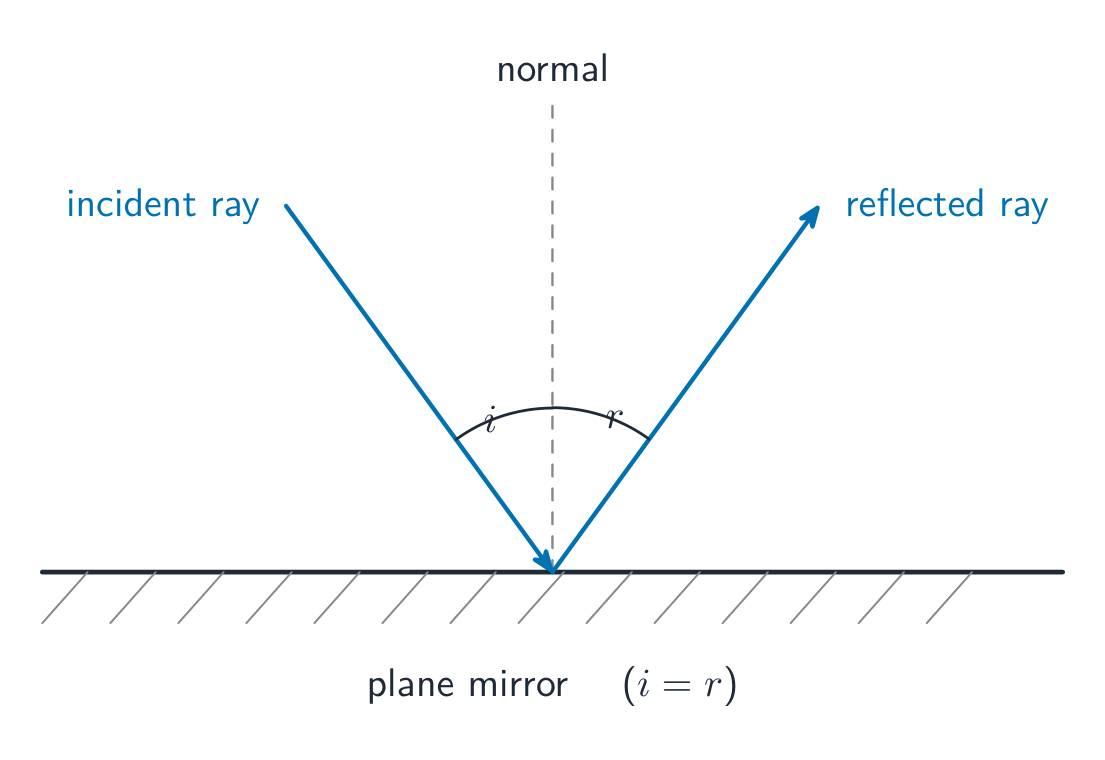
几何光学(geometric optics)把光当作直线光线。反射定律(law of reflection):当光从一个表面弹回时,入射角(angle of incidence)等于反射角(angle of reflection),两者都从法线(normal)(垂直于表面的线)测量。光滑的表面反射一个清晰的图像;粗糙的表面散射光线。

反射定律:入射角等于反射角
反射定律:入射角等于反射角
词汇表 训练
英文 中文 拼音
Geometric optics 几何光学 jǐ hé guāng xué
law of reflection 反射定律 fǎn shè dìng lǜ
angle of incidence 入射角 rù shè jiǎo
angle of reflection 反射角 fǎn shè jiǎo
13.2

镜成像

大纲
Learning ObjectiveEssential Knowledge

13.2.A
Describe the image formed by a mirror.

  • 13.2.A.1 Incident light rays parallel to the principal axis of a concave (converging) mirror will be reflected toward a common location, called the focal point.
  • 13.2.A.2 Incident light rays parallel to the principal axis of a convex (diverging) mirror will be reflected such that they appear to have originated from a common location behind the mirror, called the focal point.
  • 13.2.A.3 The focal point of a plane mirror is an infinite distance from the mirror.
  • 13.2.A.4 The focal point of a spherical mirror may be approximated as a point located on the principal axis of the mirror halfway between the surface of the mirror and the center of the mirror's radius of curvature.
  • 13.2.A.5 A real image is formed by a mirror when light rays emanating from a common point are reflected and then intersect at a common point.
  • 13.2.A.6 A virtual image is formed by a mirror when reflected light rays diverge such that they appear to have originated from a common point.
  • 13.2.A.7 The location of an image depends on the focal length of the mirror and the distance between the object and the surface of the mirror.
    • Equation: $\dfrac{1}{s_i} + \dfrac{1}{s_o} = \dfrac{1}{f}$
    • 13.2.A.7.i The locations of a mirror's focal point, an object near the mirror, and the image of the object formed by the mirror follow sign conventions that are used to determine those locations relative to the mirror itself.
    • 13.2.A.7.ii The distance between the image formed and a plane mirror is equal to the distance between the object and the plane mirror.
  • 13.2.A.8 The magnification of an image formed by a mirror is the ratio of the size of the image produced to the size of the object itself and depends on the locations of the object and image relative to the mirror.
    • Equation: $|M| = \left| \dfrac{h_i}{h_o} \right| = \left| \dfrac{s_i}{s_o} \right|$
  • 13.2.A.9 Ray diagrams can be used to determine the location, type, size, and orientation of images formed by mirrors.
    • 13.2.A.9.i The three principal rays are typically used to find the images formed by mirrors. The principal rays are 1) the ray parallel to the principal axis, 2) the ray that reflects at the center of the mirror where the principal axis intersects the mirror, and 3) the ray that passes through the focal point of the mirror.
    • 13.2.A.9.ii Images formed by a mirror can be upright or inverted, virtual or real, and reduced, enlarged, or the same size as the object.

Boundary statement: AP Physics 2 limits the study of mirrors to plane mirrors, convex spherical mirrors, and concave spherical mirrors.

来源:美国大学理事会 AP 课程与考试说明

一个弯曲的镜子在它的焦点(focal point)聚焦平行光线,距镜子一个距离 $f$镜面方程(mirror equation)关联物和像的距离:

$$\frac{1}{d_o}+\frac{1}{d_i}=\frac{1}{f},\qquad m=-\frac{d_i}{d_o}.$$
一个凹面镜(concave mirror)(会聚)能形成一个实像(real image)(光线实际相遇、可投影、倒立);一个凸面镜(convex mirror)总是形成一个虚像(virtual image)(光线只看似相遇、正立、缩小)。放大率(magnification)$m$ 给出像的大小和取向。符号惯例重要:一个的像距意味着镜子或透镜后面的一个虚像。

探索

Form an image with a curved mirror

A concave mirror reflects rays through its focus. The object's distance relative to the focal length decides whether the image is real or virtual, enlarged or reduced.

词汇表 训练
英文 中文 拼音
concave mirror 凹面镜 āo miàn jìng
real image 实像 shí xiàng
convex mirror 凸面镜 tū miàn jìng
virtual image 虚像 xū xiàng
13.3

折射

大纲
Learning ObjectiveEssential Knowledge

13.3.A
Describe the refraction of light between two media.

  • 13.3.A.1 Refraction is the change in direction of a light ray as the ray passes from one medium into another.
  • 13.3.A.2 Refraction is a result of the speed of light changing when light enters a new medium.
  • 13.3.A.3 The index of refraction of a given medium is inversely proportional to the speed of light in the medium.
    • Equation: $n = \dfrac{c}{v}$
  • 13.3.A.4 Snell's law relates the angles of incidence and refraction of a light ray passing from one medium into another to the indices of refraction of the two media.
    • Equation: $n_1 \sin\theta_1 = n_2 \sin\theta_2$
    • 13.3.A.4.i When a light ray travels from a medium with a higher index of refraction into a medium with a lower index of refraction, the ray refracts away from the normal.
    • 13.3.A.4.ii When a light ray travels from a medium with a lower index of refraction into a medium with a higher index of refraction, the ray refracts toward the normal.
    • 13.3.A.4.iii When a light ray is incident along the normal to a surface, the transmitted ray is not refracted.
  • 13.3.A.5 Total internal reflection may occur when light passes from one medium into another medium with a lower index of refraction.
    • 13.3.A.5.i Total internal reflection of light occurs beyond a critical angle of incidence.
      • Derived equation: $\theta_{\text{critical}} = \sin^{-1}\left( \dfrac{n_2}{n_1} \right)$
    • 13.3.A.5.ii For incident rays at the critical angle, the ray refracts at 90 degrees and travels along the surface of the material.
    • 13.3.A.5.iii For incident rays beyond the critical angle, all light is reflected (no light is transmitted into the other medium).

来源:美国大学理事会 AP 课程与考试说明

光在材料之间通过时弯曲,因为它的速率变化——折射(refraction)。每种材料有一个折射率(index of refraction)$n=\dfrac{c}{v}$(它把光减慢多少)。斯涅尔定律(Snell's law):

$$n_1\sin\theta_1=n_2\sin\theta_2.$$
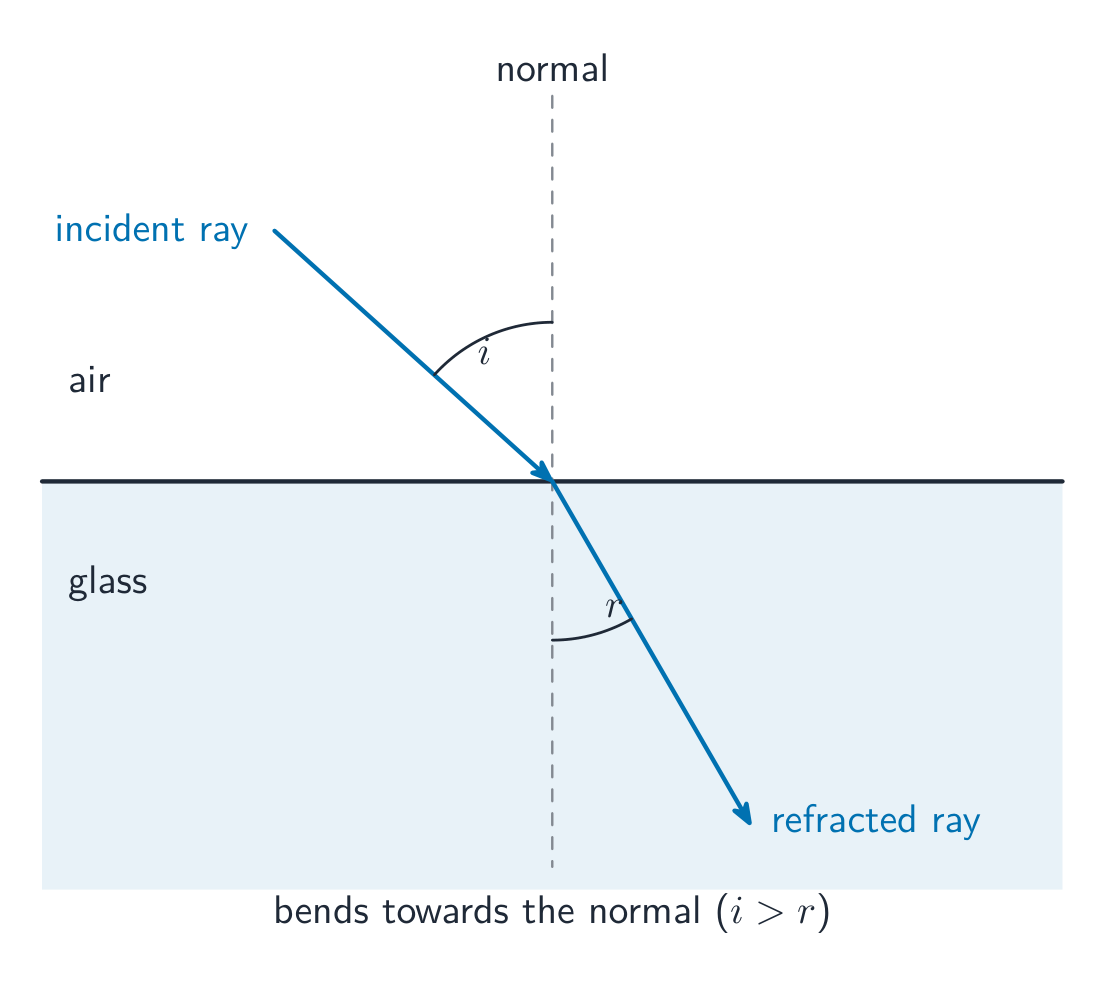
进入一个更密介质(更大 $n$)的光法线弯曲。超过一个临界角,去往一个较不密介质的光完全反射——全反射(total internal reflection),用于光纤。

光折射,在它进入玻璃时朝法线弯曲
光折射,在它进入玻璃时朝法线弯曲

Worked example. 一条空气($n_1=1.00$)里的光线以与法线 $40^{\circ}$ 撞水($n_2=1.33$)。由斯涅尔定律,

$$\sin\theta_2=\frac{n_1}{n_2}\sin\theta_1=\frac{1.00}{1.33}\sin 40^{\circ}=0.483\;\Rightarrow\;\theta_2=29^{\circ}.$$
光线朝法线弯曲,正如进入更密介质所预期。

Worked example (critical angle). 对于试图从玻璃($n=1.50$)离开去空气的光,全反射在临界角 $\theta_c$ 开始,那里折射光线掠过表面:

$$\sin\theta_c=\frac{1}{n}=\frac{1}{1.50}=0.667\;\Rightarrow\;\theta_c=42^{\circ}.$$
任何比 $42^{\circ}$ 更陡地撞内表面的光线被困住——光纤传送光数千米的原因。

探索

Bend light as it enters glass

Light refracts (bends) when it changes speed between media, following Snell's law. The denser the medium, the more it bends toward the normal.

词汇表 训练
英文 中文 拼音
refraction 折射 zhé shè
index of refraction 折射率 zhé shè lǜ
Snell's law 斯涅尔定律 sī niè ěr dìng lǜ
total internal reflection 全反射 quán fǎn shè
13.4

透镜成像

大纲
Learning ObjectiveEssential Knowledge

13.4.A
Describe the image formed by a lens.

  • 13.4.A.1 Incident light rays parallel to the principal axis of a thin convex (converging) lens will be refracted and converge toward a common location on the transmitted side of the lens, called the focal point.
  • 13.4.A.2 Incident light rays parallel to the principal axis of a thin concave (diverging) lens will be refracted and diverge as if they originated from a focal point on the incident side of the lens.
  • 13.4.A.3 A real image is formed by a lens when light rays originating from a common point are refracted such that they intersect at another common point.
  • 13.4.A.4 A virtual image is formed by a lens when refracted light rays diverge such that they appear to have originated from a common point.
  • 13.4.A.5 For a thin lens, the location of an image depends on the focal length of the lens and the distance between the object and the midline of the lens, as given by the thin-lens equation:
    • Equation: $\dfrac{1}{s_i} + \dfrac{1}{s_o} = \dfrac{1}{f}$
    • 13.4.A.5.i The locations of a lens's focal point, an object, and the image of the object formed by the lens follow sign conventions that are used to determine those locations relative to the lens itself.
    • 13.4.A.5.ii Lenses have a focal point on both sides of the lens that depends on the shape of the respective side of the lens.
  • 13.4.A.6 For a thin lens, the magnification of an image is the ratio of the size of the image produced to the size of the object itself and depends on the locations of the object and image relative to the lens.
    • Equation: $|M| = \left| \dfrac{h_i}{h_o} \right| = \left| \dfrac{s_i}{s_o} \right|$
  • 13.4.A.7 Ray diagrams can be used to determine the location, type, size, and orientation of images formed by lenses.
    • 13.4.A.7.i The three principal rays are typically used to find the images formed by lenses. The principal rays are 1) the ray parallel to the principal axis, 2) the ray that passes through the center of the lens where the principal axis intersects the lens, and 3) the ray that passes through the focal point of the lens.
    • 13.4.A.7.ii Images formed by a lens can be upright or inverted, virtual or real, and reduced, enlarged, or the same size as the object.

来源:美国大学理事会 AP 课程与考试说明

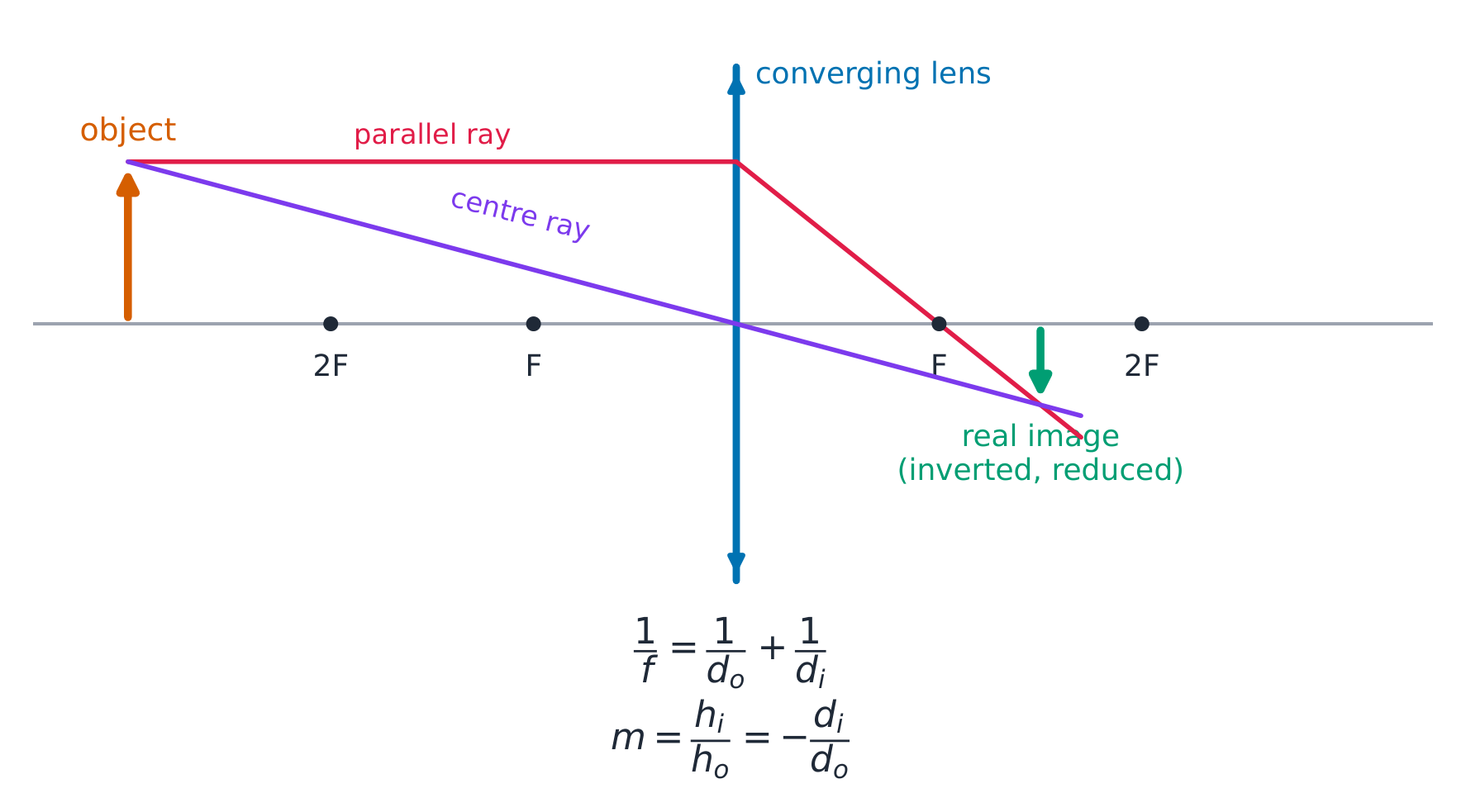
凸透镜成实像

一个透镜(lens)通过折射弯曲光。薄透镜方程(thin-lens equation)有与镜面方程相同的形式:

$$\frac{1}{d_o}+\frac{1}{d_i}=\frac{1}{f},\qquad m=-\frac{d_i}{d_o}.$$
一个会聚(converging)(凸)透镜能形成一个实的、倒立的像,或者,对一个近的物体,一个虚的、正立的、放大的像(一个放大镜)。一个发散(diverging)(凹)透镜总是形成一个虚的、正立的、缩小的像。光线图用两条容易的光线快速定位像:一条平行于轴的光线弯曲通过远焦点,而一条直接通过透镜中心(不偏折)。
两条光线定位像:平行然后焦点,和直接通过中心
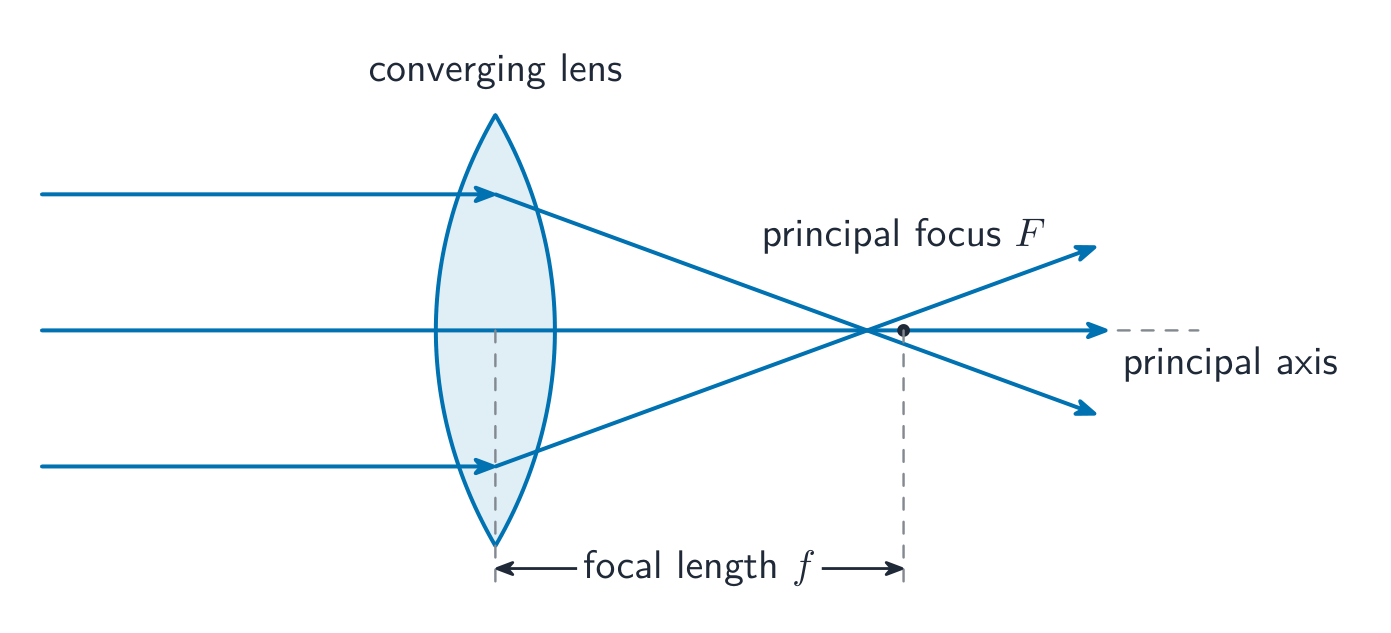
一个会聚透镜把平行光线带到它的主焦点
一个会聚透镜把平行光线带到它的主焦点

Worked example. 一个物体坐在距一个焦距 $f=10\ \text{cm}$ 的会聚透镜 $30\ \text{cm}$ 处。求像。由薄透镜方程,

$$\frac{1}{d_i}=\frac{1}{f}-\frac{1}{d_o}=\frac{1}{10}-\frac{1}{30}=\frac{2}{30}\;\Rightarrow\;d_i=15\ \text{cm},$$
而放大率是 $m=-d_i/d_o=-15/30=-0.5$。像是实的(正的 $d_i$)、倒立的(负的 $m$),而物体大小的一半——正是一个相机镜头所做的。

探索

Form an image with a converging lens

A converging lens bends parallel rays to its focal point. Move the object and watch the image change from large and inverted to virtual and upright inside the focal length.

词汇表 训练
英文 中文 拼音
converging 会聚 huì jù
diverging 发散 fā sàn
练习卷
13.4

考试技巧

  • 法线、不是表面测量所有的角。
  • 进入一个更密介质(更大 $n$)的光法线弯曲;用斯涅尔定律 $n_1\sin\theta_1=n_2\sin\theta_2$
  • 全反射只在进入一个较不密介质、超过临界角($\sin\theta_c=1/n$)时发生。
  • 对镜子和透镜用 $\tfrac1{d_o}+\tfrac1{d_i}=\tfrac1f$$m=-d_i/d_o$:一个$d_i$ 是一个实像,负的是虚的。
  • $n=c/v$,所以一个更大的折射率意味着材料里一个更慢的光速。

本主题的互动课程

逐步学习,并即时检测练习。

AP 物理 2历年真题

AP 物理 2的更多主题

登录或创建账号

IGCSE, A-Level & AP