跳到主要内容

电路

AP 物理 2 · 第 11 主题

训练
讲义 词汇表
11.1

电流

大纲
Learning ObjectiveEssential Knowledge

11.1.A
Describe the movement of electric charges through a medium.

  • 11.1.A.1 Current is the rate at which charge passes through a cross-sectional area of a wire.
    • Equation: $I = \dfrac{\Delta q}{\Delta t}$
    • 11.1.A.1.i Electric charge moves in a circuit in response to an electric potential difference, sometimes referred to as electromotive force, or $\mathrm{emf}$ ($\varepsilon$).
    • 11.1.A.1.ii If the current is zero in a section of wire, the net motion of charge carriers in the wire is also zero, although individual charge carriers will not have zero speed.
  • 11.1.A.2 Although current is not a vector quantity, it does have a direction. The direction of current is associated with what the motion of positive charge would be but not with any coordinate system in space.
    • 11.1.A.2.i The direction of conventional current is chosen to be the direction in which positive charge would move.
    • 11.1.A.2.ii In common circuits, current is actually due to the movement of electrons (negative charge carriers).

来源:美国大学理事会 AP 课程与考试说明

电流(electric current)是电荷流过一点的速率,以安培(amperes)(A)测量:

$$I=\frac{\Delta q}{\Delta t}.$$
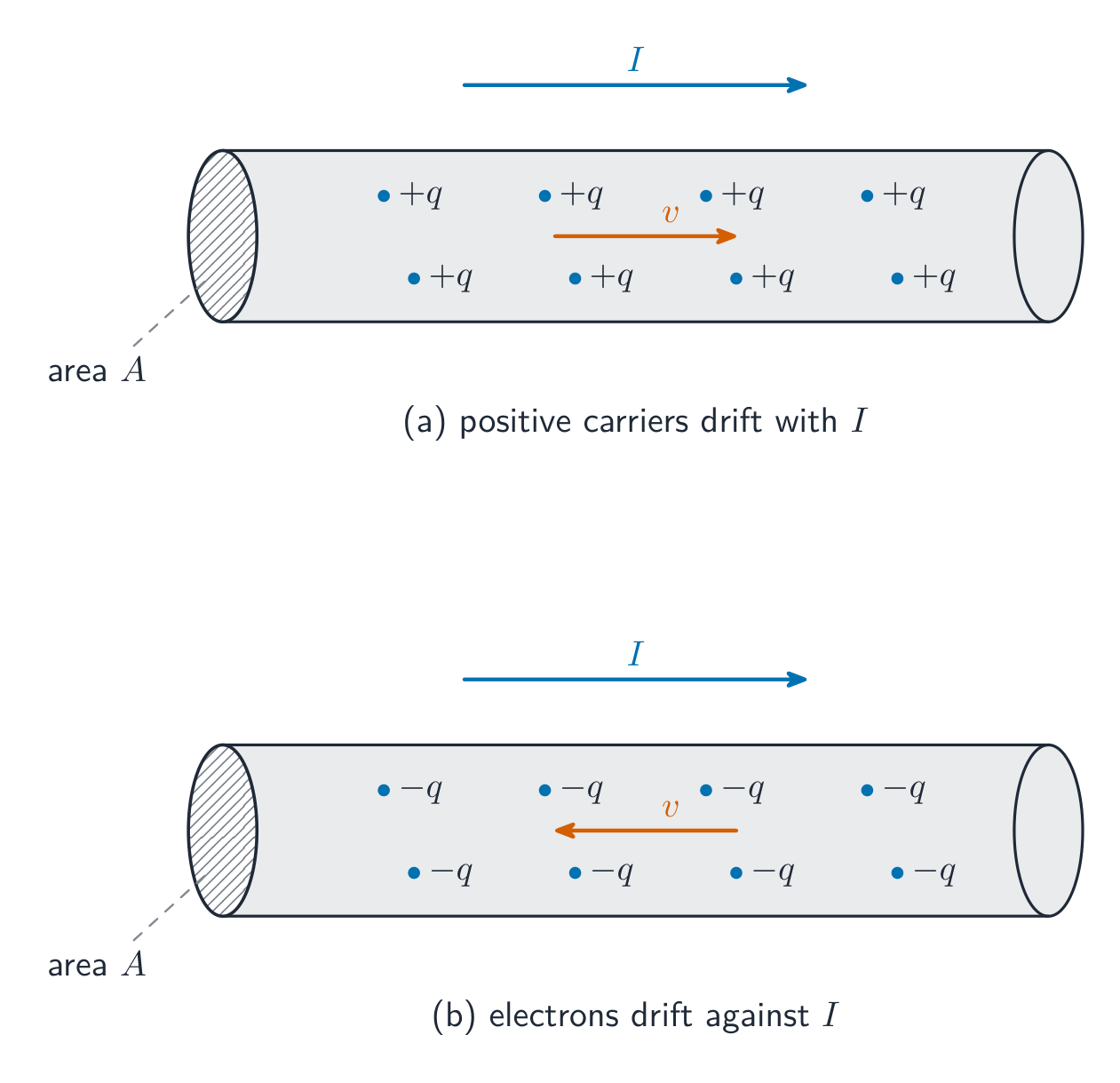
按惯例,电流指向电荷会移动的方向(与一根导线里的电子相反)。一个稳定的电流需要一个完整的回路和一个能量源(一个电池的电动势(electromotive force),或 emf)。

载流子缓慢地漂移过一个导体以形成一个电流
词汇表 训练
英文 中文 拼音
Electric current 电流 diàn liú
amperes 安培 ān péi
11.2

简单电路

大纲
Learning ObjectiveEssential Knowledge

11.2.A
Describe the behavior of a circuit.

  • 11.2.A.1 A circuit is composed of electrical loops, which may include circuit elements such as wires, batteries, resistors, lightbulbs, capacitors, switches, ammeters, and voltmeters.
  • 11.2.A.2 A closed electrical loop is a closed path through which charges may flow.
    • 11.2.A.2.i A closed circuit is one in which charges would be able to flow.
    • 11.2.A.2.ii An open circuit is one in which charges would not be able to flow.
    • 11.2.A.2.iii A short circuit is one in which charges would be able to flow with no change in potential difference.
  • 11.2.A.3 A single circuit element may be part of multiple electrical loops.
  • 11.2.A.4 Circuit schematics are representations used to describe and analyze electric circuits.
    • 11.2.A.4.i The properties of an electric circuit are dependent on the physical arrangement of its constituent elements.
    • 11.2.A.4.ii Circuit elements have common symbols that are used to create schematic diagrams. Variable elements are indicated by a diagonal strikethrough arrow across the standard symbol for that element. (Standard symbols: Battery, Bulb, Switch, Capacitor, Resistor, Ammeter, Voltmeter.)

Boundary statement: Unless otherwise specified, all circuit schematic diagrams will be drawn using conventional current.

来源:美国大学理事会 AP 课程与考试说明

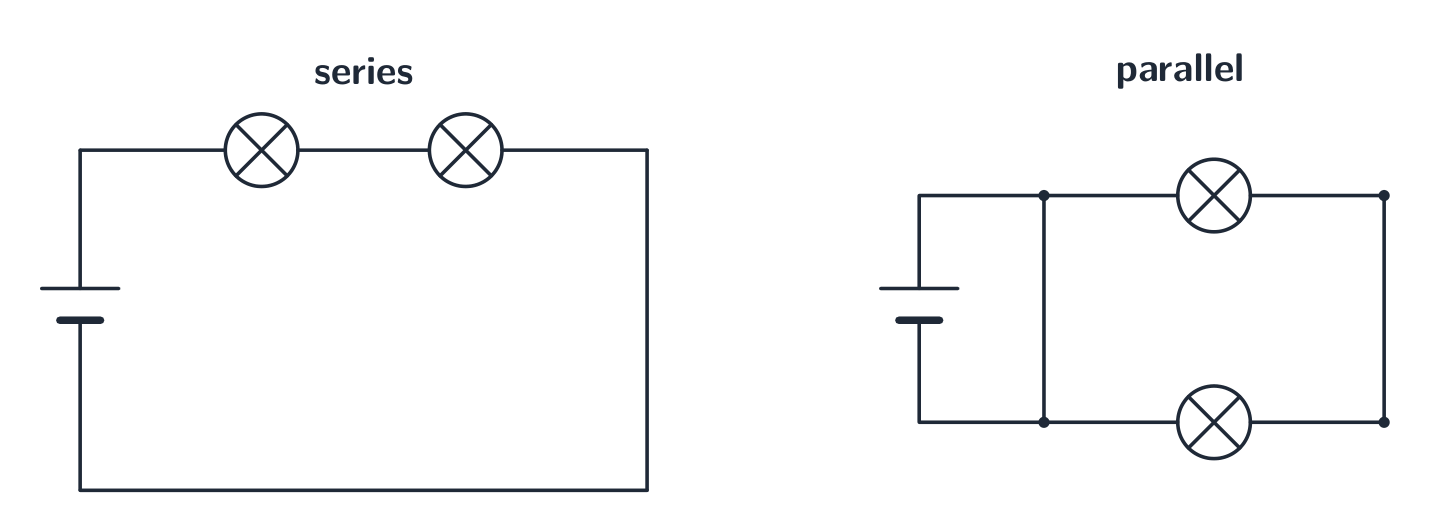
一个电路(circuit)是一个导体、一个源(电池)和元件的闭合回路。在一条串联(series)路径里相同的电流流过每个元件;在一条并联(parallel)路径里相同的电压跨每个支路。一张电路图(circuit diagram)使用标准符号;正确地读它是任何电路问题的第一步。

元件能被串联或并联连接
元件能被串联或并联连接
探索

Build series and parallel circuits

In series the same current flows through every bulb and voltage divides; in parallel each branch gets the full voltage. Switch mode to see the bulbs' brightness change.

词汇表 训练
英文 中文 拼音
series 串联 chuàn lián
parallel 并联 bìng lián
11.3

电阻、电阻率与欧姆定律

大纲
Learning ObjectiveEssential Knowledge

11.3.A
Describe the resistance of an object using physical properties of that object.

  • 11.3.A.1 Resistance is a measure of the degree to which an object opposes the movement of electric charge.
  • 11.3.A.2 The resistance of a resistor with uniform geometry is proportional to its resistivity and length and is inversely proportional to its cross-sectional area.
    • Equation: $R = \dfrac{\rho \ell}{A}$
    • 11.3.A.2.i Resistivity is a fundamental property of a material that depends on its atomic and molecular structure and quantifies how strongly the material opposes the motion of electric charge.
    • 11.3.A.2.ii The resistivity of a conductor typically increases with temperature.

11.3.B
Describe the electrical characteristics of elements of a circuit.

  • 11.3.B.1 Ohm's law relates current, resistance, and potential difference across a conductive element of a circuit.
    • Equation: $I = \dfrac{\Delta V}{R}$
    • 11.3.B.1.i Materials that obey Ohm's law have constant resistance for all currents and are called ohmic materials.
    • 11.3.B.1.ii The resistivity of an ohmic material is constant regardless of temperature.
    • 11.3.B.1.iii Resistors can also convert electrical energy to thermal energy, which may change the temperature of both the resistor and the resistor's environment.
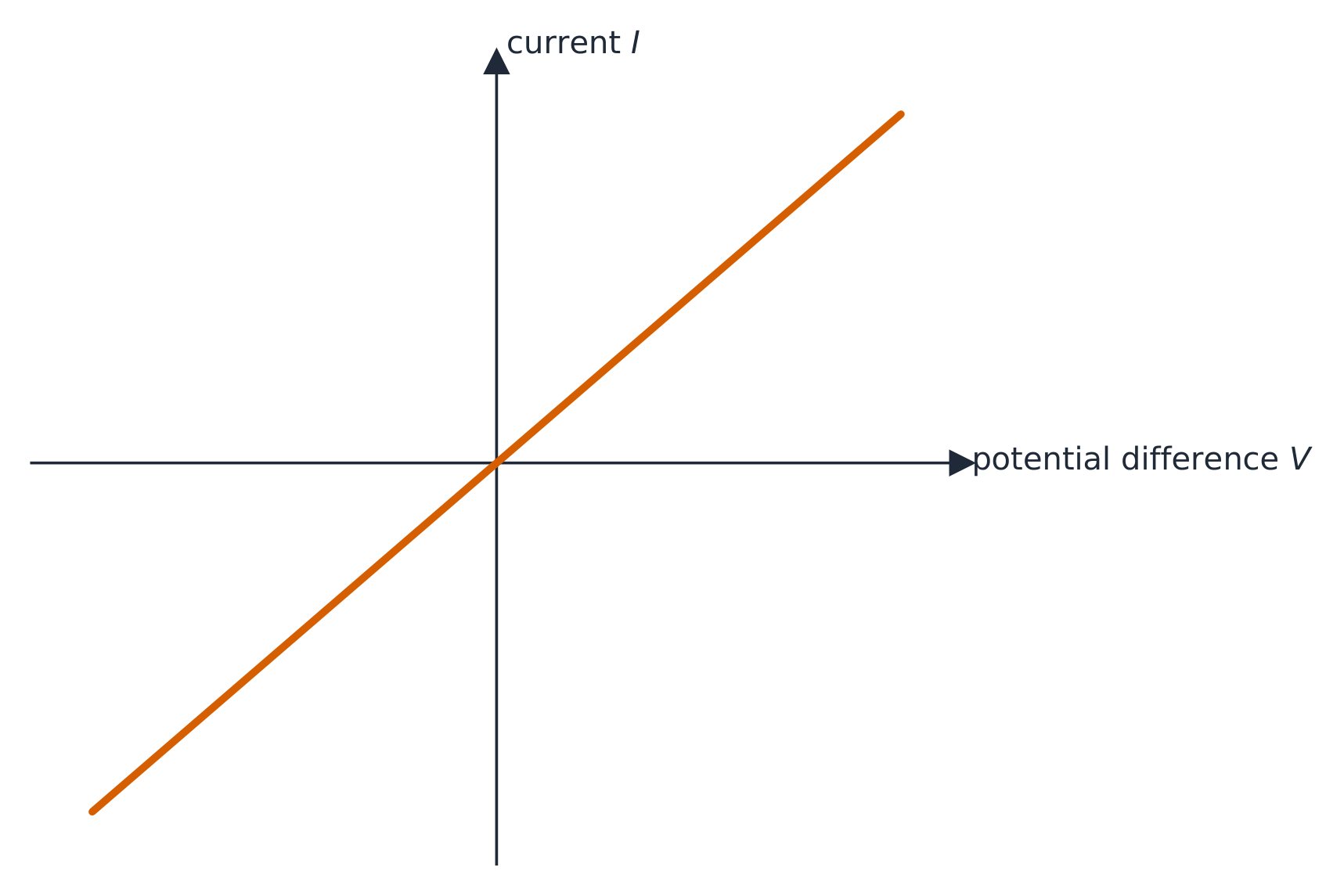
    • 11.3.B.1.iv The resistance of an ohmic circuit element can be determined from the slope of a graph of the current in the element as a function of the potential difference across the element.

来源:美国大学理事会 AP 课程与考试说明

电阻(resistance)$R$ 反对电流,以欧姆测量。欧姆定律(Ohm's law)联系三个关键量:

$$V=IR.$$
一个元件的电阻取决于材料的电阻率(resistivity)$\rho$、它的长度,和它的横截面积:$R=\dfrac{\rho L}{A}$ ——更长更细意味着更多电阻。

一个欧姆导体的 I-V 线是通过原点的直线

Worked example. 一个 $2.0\ \text{A}$ 的电流流过一个 $6.0\ \Omega$ 的电阻。跨它的电压是 $V=IR=2.0\times6.0=12\ \text{V}$

探索

Apply Ohm's law

Ohm's law $V=IR$: for a fixed resistance, current is proportional to voltage. Raise the resistance and the same voltage pushes less current.

词汇表 训练
英文 中文 拼音
Resistance 电阻 diàn zǔ
Ohm's law 欧姆定律 ōu mǔ dìng lǜ
resistivity 电阻率 diàn zǔ lǜ
11.4

电功率

大纲
Learning ObjectiveEssential Knowledge

11.4.A
Describe the transfer of energy into, out of, or within an electric circuit, in terms of power.

  • 11.4.A.1 The rate at which energy is transferred, converted, or dissipated by a circuit element depends on the current in the element and the electric potential difference across it.
    • Equation: $P = I \Delta V$
    • Equation (derived): $P = I^2 R = \dfrac{(\Delta V)^2}{R}$
  • 11.4.A.2 The brightness of a bulb increases with power, so power can be used to qualitatively predict the brightness of bulbs in a circuit.

来源:美国大学理事会 AP 课程与考试说明

电功率(electric power)是一个元件转换电能(到热、光、运动)的速率:

$$P=IV=I^2R=\frac{V^2}{R}.$$
挑选使用你知道的量的形式。一个电阻的功率全都变成热。

Worked example. 上面的 $6.0\ \Omega$ 电阻,携带 $2.0\ \text{A}$,耗散 $P=I^2R=2.0^2\times6.0=24\ \text{W}$ ——等价地 $P=IV=2.0\times12=24\ \text{W}$

一个灯泡(light bulb)只是一个会发光的电阻,它的亮度(brightness)随它耗散的功率上升。所以要给灯泡排名,就比较它们的功率。在一条串联串里每个灯泡携带相同的电流,所以按 $P=I^2R$,电阻最大的灯泡最亮;并联接线时每个灯泡得到全部电池电压,所以按 $P=V^2/R$,电阻最小的灯泡最亮。

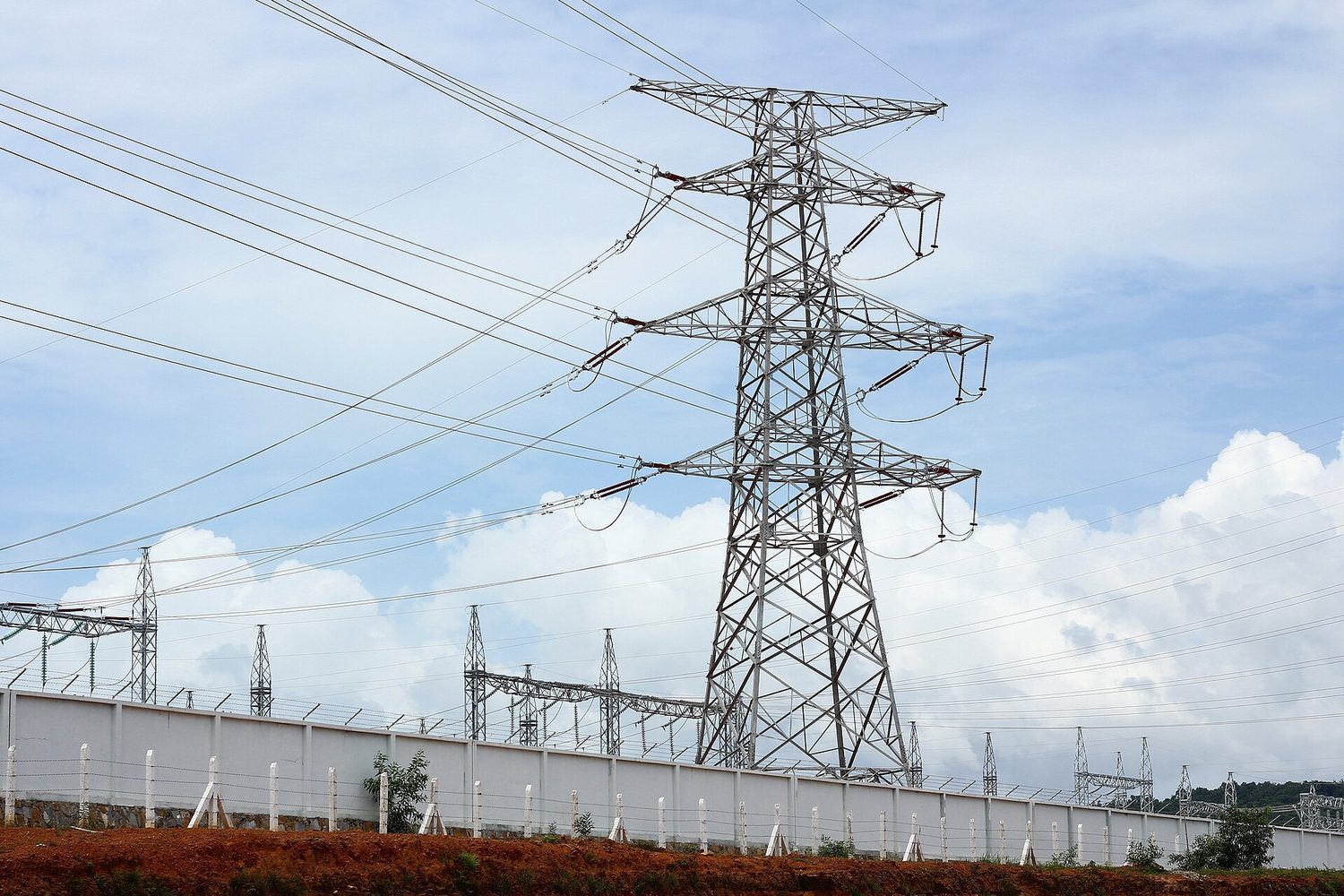
High-voltage power lines: electrical power is transmitted as high voltage so current (and I²R loss) stays low
探索

Read an I-V characteristic

Power is $P=IV$. A resistor's I-V line is straight, but a lamp curves as it heats and its resistance rises. The area under I-V relates to the energy delivered.

词汇表 训练
英文 中文 拼音
Electric power 电功率 diàn gōng lǜ
light bulb 灯泡 dēng pào
brightness 亮度 liàng dù
11.5

复合直流电路

大纲
Learning ObjectiveEssential Knowledge

11.5.A
Describe the equivalent resistance of multiple resistors connected in a circuit.

  • 11.5.A.1 Circuit elements may be connected in series and/or in parallel.
    • 11.5.A.1.i A series connection is one in which any charge passing through one circuit element must proceed through all elements in that connection and has no other path available. The current in each element in series must be the same.
    • 11.5.A.1.ii A parallel connection is one in which charges may flow through one of two or more paths. Across each path, the potential difference is the same.
  • 11.5.A.2 A collection of resistors in a circuit may be analyzed as though it were a single resistor with an equivalent resistance $R_{\text{eq}}$.
    • 11.5.A.2.i The equivalent resistance of a set of resistors in series is the sum of the individual resistances.
      • Equation: $R_{\text{eq},s} = \sum_i R_i$
    • 11.5.A.2.ii The inverse of the equivalent resistance of a set of resistors connected in parallel is equal to the sum of the inverses of the individual resistances.
      • Equation: $\dfrac{1}{R_{\text{eq},p}} = \sum_i \dfrac{1}{R_i}$
    • 11.5.A.2.iii When resistors are connected in parallel, the number of paths available to charges increases, and the equivalent resistance of the group of resistors decreases.

11.5.B
Describe a circuit with resistive wires and a battery with internal resistance.

  • 11.5.B.1 Ideal batteries have negligible internal resistance. Ideal wires have negligible resistance.
    • 11.5.B.1.i The resistance of wires that are good conductors may normally be neglected, because their resistance is much smaller than that of other elements of a circuit.
    • 11.5.B.1.ii The resistance of wires may only be neglected if the circuit contains other elements that do have resistance.
    • 11.5.B.1.iii The potential difference a battery would supply if it were ideal is the potential difference measured across the terminals when there is no current in the battery and is sometimes referred to as its $\mathrm{emf}$ ($\varepsilon$).
  • 11.5.B.2 The internal resistance of a nonideal battery may be treated as the resistance of a resistor in series with an ideal battery and the remainder of the circuit.
  • 11.5.B.3 When there is current in a nonideal battery with internal resistance $r$, the potential difference across the terminals of the battery is reduced relative to the potential difference when there is no current in the battery.
    • Equation (derived): $\Delta V_{\text{terminal}} = \varepsilon - Ir$

11.5.C
Describe the measurement of current and potential difference in a circuit.

  • 11.5.C.1 Ammeters are used to measure current at a specific point in a circuit.
    • 11.5.C.1.i Ammeters must be connected in series with the element in which current is being measured.
    • 11.5.C.1.ii Ideal ammeters have zero resistance so that they do not affect the current in the element that they are in series with.
  • 11.5.C.2 Voltmeters are used to measure electric potential difference between two points in a circuit.
    • 11.5.C.2.i Voltmeters must be connected in parallel with the element across which potential difference is being measured.
    • 11.5.C.2.ii Ideal voltmeters have an infinite resistance so that no charge flows through them.
  • 11.5.C.3 Nonideal ammeters and voltmeters will change the properties of the circuit being measured.

Boundary statement: AP Physics 2 only expects students to qualitatively discuss how a nonideal ammeter or voltmeter will affect the results of measurements. Unless otherwise stated, all batteries, wires, and meters are assumed to be ideal.

Boundary statement: Circuits with batteries of different potential differences connected in parallel will not be assessed.

来源:美国大学理事会 AP 课程与考试说明

组合电阻以求一个等效电阻(equivalent resistance):

串联的电阻相加成一个单一的等效电阻
串联的电阻相加成一个单一的等效电阻
  • 串联: $R_{\text{eq}}=R_1+R_2+\cdots$(电阻相加)。
  • 并联: $\dfrac{1}{R_{\text{eq}}}=\dfrac{1}{R_1}+\dfrac{1}{R_2}+\cdots$(总量小于最小的)。

一步一步地简化网络以求来自电池的总电流,然后向回工作到每个元件。

Worked example. 一个 $12\ \text{V}$ 的电池驱动一个 $4.0\ \Omega$ 和一个 $12\ \Omega$ 的电阻并联。先组合它们:$\dfrac{1}{R_{\text{eq}}}=\dfrac14+\dfrac{1}{12}=\dfrac{4}{12}\Rightarrow R_{\text{eq}}=3.0\ \Omega$。来自电池的总电流是 $I=\dfrac{V}{R_{\text{eq}}}=\dfrac{12}{3.0}=4.0\ \text{A}$,它分割使得更小的电阻携带更大的份额(通过 $4\ \Omega$$3.0\ \text{A}$、通过 $12\ \Omega$$1.0\ \text{A}$)。

词汇表 训练
英文 中文 拼音
equivalent resistance 等效电阻 děng xiào diàn zǔ
11.5

复合直流电路

大纲
Learning ObjectiveEssential Knowledge

11.5.A
Describe the equivalent resistance of multiple resistors connected in a circuit.

  • 11.5.A.1 Circuit elements may be connected in series and/or in parallel.
    • 11.5.A.1.i A series connection is one in which any charge passing through one circuit element must proceed through all elements in that connection and has no other path available. The current in each element in series must be the same.
    • 11.5.A.1.ii A parallel connection is one in which charges may flow through one of two or more paths. Across each path, the potential difference is the same.
  • 11.5.A.2 A collection of resistors in a circuit may be analyzed as though it were a single resistor with an equivalent resistance $R_{\text{eq}}$.
    • 11.5.A.2.i The equivalent resistance of a set of resistors in series is the sum of the individual resistances.
      • Equation: $R_{\text{eq},s} = \sum_i R_i$
    • 11.5.A.2.ii The inverse of the equivalent resistance of a set of resistors connected in parallel is equal to the sum of the inverses of the individual resistances.
      • Equation: $\dfrac{1}{R_{\text{eq},p}} = \sum_i \dfrac{1}{R_i}$
    • 11.5.A.2.iii When resistors are connected in parallel, the number of paths available to charges increases, and the equivalent resistance of the group of resistors decreases.

11.5.B
Describe a circuit with resistive wires and a battery with internal resistance.

  • 11.5.B.1 Ideal batteries have negligible internal resistance. Ideal wires have negligible resistance.
    • 11.5.B.1.i The resistance of wires that are good conductors may normally be neglected, because their resistance is much smaller than that of other elements of a circuit.
    • 11.5.B.1.ii The resistance of wires may only be neglected if the circuit contains other elements that do have resistance.
    • 11.5.B.1.iii The potential difference a battery would supply if it were ideal is the potential difference measured across the terminals when there is no current in the battery and is sometimes referred to as its $\mathrm{emf}$ ($\varepsilon$).
  • 11.5.B.2 The internal resistance of a nonideal battery may be treated as the resistance of a resistor in series with an ideal battery and the remainder of the circuit.
  • 11.5.B.3 When there is current in a nonideal battery with internal resistance $r$, the potential difference across the terminals of the battery is reduced relative to the potential difference when there is no current in the battery.
    • Equation (derived): $\Delta V_{\text{terminal}} = \varepsilon - Ir$

11.5.C
Describe the measurement of current and potential difference in a circuit.

  • 11.5.C.1 Ammeters are used to measure current at a specific point in a circuit.
    • 11.5.C.1.i Ammeters must be connected in series with the element in which current is being measured.
    • 11.5.C.1.ii Ideal ammeters have zero resistance so that they do not affect the current in the element that they are in series with.
  • 11.5.C.2 Voltmeters are used to measure electric potential difference between two points in a circuit.
    • 11.5.C.2.i Voltmeters must be connected in parallel with the element across which potential difference is being measured.
    • 11.5.C.2.ii Ideal voltmeters have an infinite resistance so that no charge flows through them.
  • 11.5.C.3 Nonideal ammeters and voltmeters will change the properties of the circuit being measured.

Boundary statement: AP Physics 2 only expects students to qualitatively discuss how a nonideal ammeter or voltmeter will affect the results of measurements. Unless otherwise stated, all batteries, wires, and meters are assumed to be ideal.

Boundary statement: Circuits with batteries of different potential differences connected in parallel will not be assessed.

来源:美国大学理事会 AP 课程与考试说明

两种仪表读一个电路。一个电流表(ammeter)测量一点处的电流,所以它必须串联接线——你想测量的电流必须流它。一个电压表(voltmeter)测量两点之间的电位差,所以它并联接线,跨接在你想要电压的元件上。

一个仪表要读出真实的值,它必须几乎不扰动电路:

  • 一个理想电流表零电阻,所以把它串联接入不减小它所读的电流;
  • 一个理想电压表无穷大电阻,所以几乎没有电流经它分流。

一个真实的、非理想(nonideal)的仪表并不完美:一个真实的电流表有一点电阻(它稍微降低电流),而一个真实的电压表让一点电流漏过(它稍微降低它所读的电压)。所以连接任何仪表都会稍微改变它正在测量的那个量。

词汇表 训练
英文 中文 拼音
ammeter 电流表 diàn liú biǎo
voltmeter 电压表 diàn yā biǎo
nonideal 非理想 fēi lǐ xiǎng
11.6

基尔霍夫电压定律

大纲
Learning ObjectiveEssential Knowledge

11.6.A
Describe a circuit or elements of a circuit by applying Kirchhoff's loop rule.

  • 11.6.A.1 Energy changes in simple electrical circuits may be represented in terms of charges moving through electric potential differences within circuit elements.
    • Equation: $\Delta U_E = q \Delta V$
  • 11.6.A.2 Kirchhoff's loop rule is a consequence of the conservation of energy.
  • 11.6.A.3 Kirchhoff's loop rule states that the sum of potential differences across all circuit elements in a single closed loop must equal zero.
    • Equation: $\sum \Delta V = 0$
  • 11.6.A.4 The values of electric potential at points in a circuit can be represented by a graph of electric potential as a function of position within a loop.

来源:美国大学理事会 AP 课程与考试说明

基尔霍夫电压定律(Kirchhoff's loop rule)(能量守恒):围绕任何闭合回路,电压增益和降落加起来等于。在你绕行时加电池的 emf 并减每个 $IR$ 降落。这给每个独立回路一个方程。

词汇表 训练
英文 中文 拼音
Kirchhoff's loop rule 基尔霍夫电压定律 jī ěr huò fū diàn yā dìng lǜ
11.7

基尔霍夫电流定律

大纲
Learning ObjectiveEssential Knowledge

11.7.A
Describe a circuit or elements of a circuit by applying Kirchhoff's junction rule.

  • 11.7.A.1 Kirchhoff's junction rule is a consequence of the conservation of electric charge.
  • 11.7.A.2 Kirchhoff's junction rule states that the total amount of charge entering a junction per unit time must equal the total amount of charge exiting that junction per unit time.
    • Equation: $\sum I_{\text{in}} = \sum I_{\text{out}}$

来源:美国大学理事会 AP 课程与考试说明

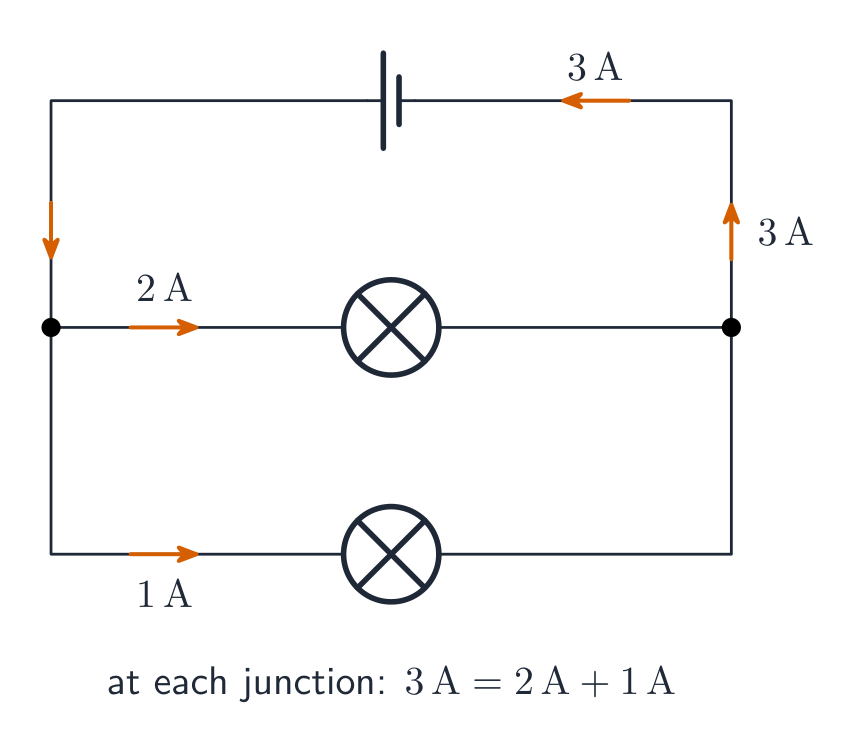
基尔霍夫电流定律(Kirchhoff's junction rule)(电荷守恒):进入任何节点的总电流等于流出的总电流。与回路定律一起,它让你能为任何多回路电路求它未知的电流。

电流在一个节点分开:流进的等于流出的
电流在一个节点分开:流进的等于流出的
词汇表 训练
英文 中文 拼音
Kirchhoff's junction rule 基尔霍夫电流定律 jī ěr huò fū diàn liú dìng lǜ
11.8

RC 电路

大纲
Learning ObjectiveEssential Knowledge

11.8.A
Describe the equivalent capacitance of multiple capacitors.

  • 11.8.A.1 A collection of capacitors in a circuit may be analyzed as though it were a single capacitor with an equivalent capacitance $C_{\text{eq}}$.
    • 11.8.A.1.i The inverse of the equivalent capacitance of a set of capacitors connected in series is equal to the sum of the inverses of the individual capacitances.
      • Equation: $\dfrac{1}{C_{\text{eq},s}} = \sum_i \dfrac{1}{C_i}$
    • 11.8.A.1.ii The equivalent capacitance of a set of capacitors in series is less than the capacitance of the smallest capacitor.
    • 11.8.A.1.iii The equivalent capacitance of a set of capacitors in parallel is the sum of the individual capacitances.
      • Equation: $C_{\text{eq},p} = \sum_i C_i$
  • 11.8.A.2 As a result of conservation of charge, each of the capacitors in series must have the same magnitude of charge on each plate.

11.8.B
Describe the behavior of a circuit containing combinations of resistors and capacitors.

  • 11.8.B.1 The time constant $\tau$ is a significant feature of an RC circuit.
    • 11.8.B.1.i The time constant of an RC circuit is a measure of how quickly the capacitor will charge or discharge and is defined as $\tau = R_{\text{eq}} C_{\text{eq}}$.
    • 11.8.B.1.ii For a charging capacitor, the time constant represents the time required for the capacitor's charge to increase from zero to approximately 63 percent of its final asymptotic value.
    • 11.8.B.1.iii For a discharging capacitor, the time constant represents the time required for the capacitor's charge to decrease from fully charged to approximately 37 percent of its initial value.
  • 11.8.B.2 The potential difference across a capacitor and the current in the branch of the circuit containing the capacitor each change over time as the capacitor charges and discharges, but both will reach a steady state after a long time interval.
    • 11.8.B.2.i Immediately after being placed in a circuit, an uncharged capacitor acts like a wire, and charge can easily flow to or from the plates of the capacitor.
    • 11.8.B.2.ii As a capacitor charges, changes to the potential difference across the capacitor affect the charge on the plates of the capacitor, the current circuit branch in which the capacitor is located, and the electric potential energy stored in the capacitor.
    • 11.8.B.2.iii The potential difference across a capacitor, the current in the circuit branch in which the capacitor is located, and the electric potential energy stored in the capacitor all change with respect to time and asymptotically approach steady state conditions.
    • 11.8.B.2.iv After a long time, a charging capacitor approaches a state of being fully charged, reaching a maximum potential difference at which there is zero current in the circuit branch in which the capacitor is located.
    • 11.8.B.2.v Immediately after a charged capacitor begins discharging, the amount of charge on the capacitor plates and the energy stored in the capacitor begin to decrease.
    • 11.8.B.2.vi As a capacitor discharges, the amount of charge on the capacitor, the potential difference across the capacitor, and the current in the circuit branch in which the capacitor is located all decrease until a steady state is reached.
    • 11.8.B.2.vii After either charging or discharging for times much greater than the time constant, the capacitor and the relevant circuit branch may be modeled using steady-state conditions.

Boundary statement: Descriptions of charging/discharging RC circuits in AP Physics 2 are limited to qualitative descriptions and representations. While students should be able to mathematically describe initial and final states of RC circuits, students are not expected to mathematically model these behaviors with respect to time.

来源:美国大学理事会 AP 课程与考试说明

电容器充电(RC)

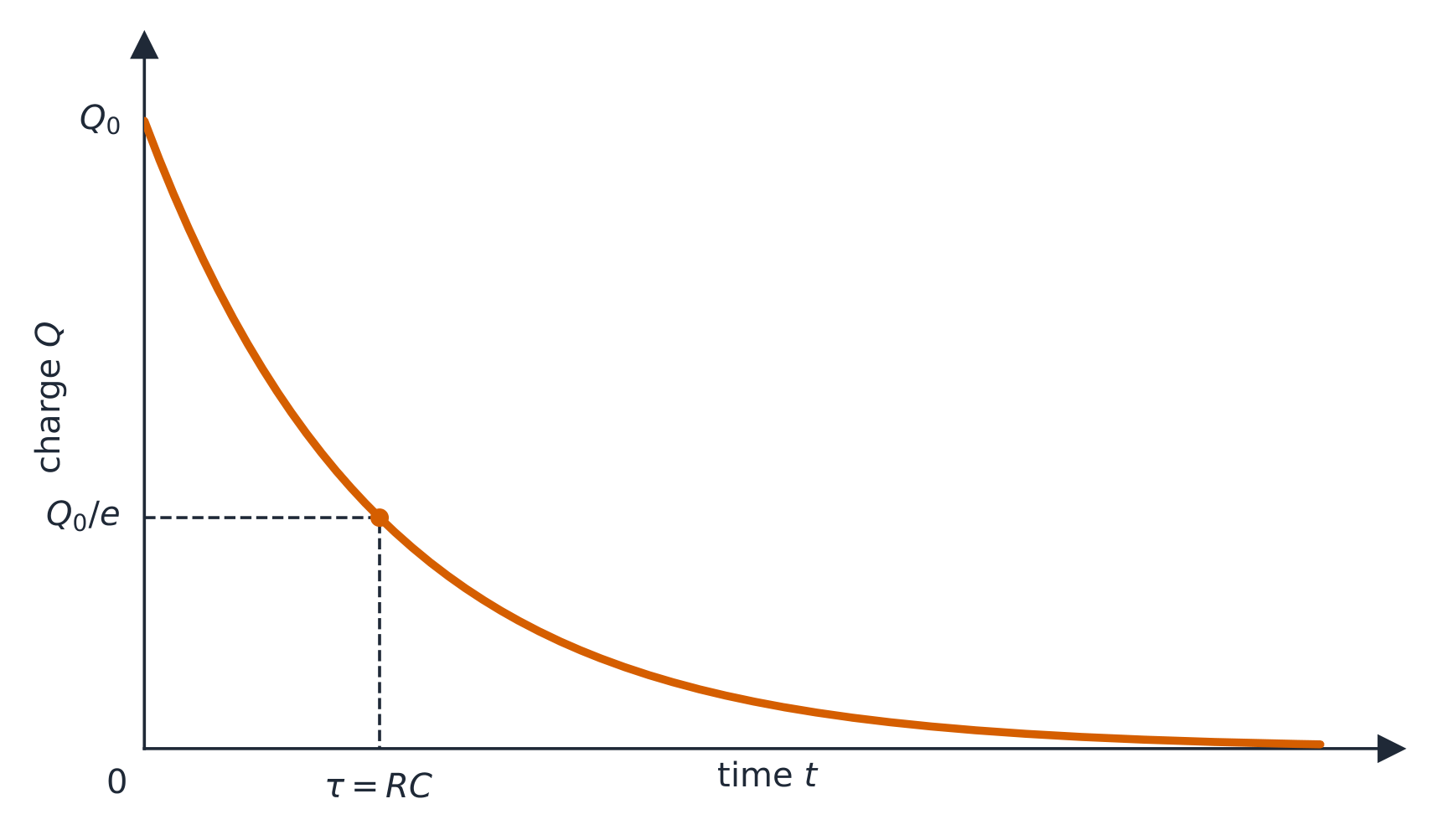
一个 RC电路(RC circuit)包含一个电阻和一个电容器。当充电时,电容器的电压上升而电流下降,两者都指数地,在一个特征时间 $\tau=RC$ 上。关键的极限:在第一个瞬间未充电的电容器像一根普通的导线(最大电流);很长时间后它完全充电并阻挡电流(像一个断路)。

一个电容器上的电荷在它放电时指数地衰减
一个电容器上的电荷在它放电时指数地衰减

Worked example. 对于 $R=10\ \text{k}\Omega$$C=100\ \mu\text{F}$,时间常数是 $\tau=RC=(10\times10^{3})(100\times10^{-6})=1.0\ \text{s}$。一个时间常数后电容器达到约 $63\%$ 的供应电压;约 $5\tau$ 后它基本上完全充电。

词汇表 训练
英文 中文 拼音
RC circuit RC电路 RC diàn lù
练习卷
11.8

考试技巧

  • 串联里电流始终相同;在并联里电压跨每个支路相同——绝不把这些搞混。
  • 组合电阻:串联相加;并联 $1/R_{\text{eq}}=\sum 1/R_i$(总量小于最小的)。
  • 应用基尔霍夫定律:节点(电流进 = 电流出,电荷守恒)和回路(电压加起来等于零,能量守恒)。
  • 挑选适合你已知的功率形式:$P=IV=I^2R=V^2/R$
  • 一个电流表串联接入(理想:零电阻);一个电压表并联接入(理想:无穷大电阻)。一个真实的仪表会稍微扰动它所测量的电路。
  • 一个灯泡在耗散更多功率时更亮——串联里电阻最大的($I^2R$)最亮,并联里电阻最小的($V^2/R$)最亮。
  • 在一个 RC 电路里电容器在它开始充电的瞬间像一根普通的导线,而一旦完全充电像一个断路。

本主题的互动课程

逐步学习,并即时检测练习。

AP 物理 2历年真题

AP 物理 2的更多主题

登录或创建账号

IGCSE, A-Level & AP