Kirchhoff's Loop Rule
Introduced| English |
|---|
| Kirchhoff's loop rule/ˈkɜːkhɒfs luːp ruːl/ |
Walk a full loop and you end up at the same height
- Hike around a mountain trail that returns to the start — your net change in height is zero.
- Trace a charge around a full circuit loop and its net change in potential is zero too.
- This simple truth is Kirchhoff's loop rule 基尔霍夫回路定律.
- It lets you crack circuits too tangled for the series/parallel shortcuts alone.
The loop rule
- Around any complete loop, the voltage gains and drops sum to zero: $\sum V = 0$.
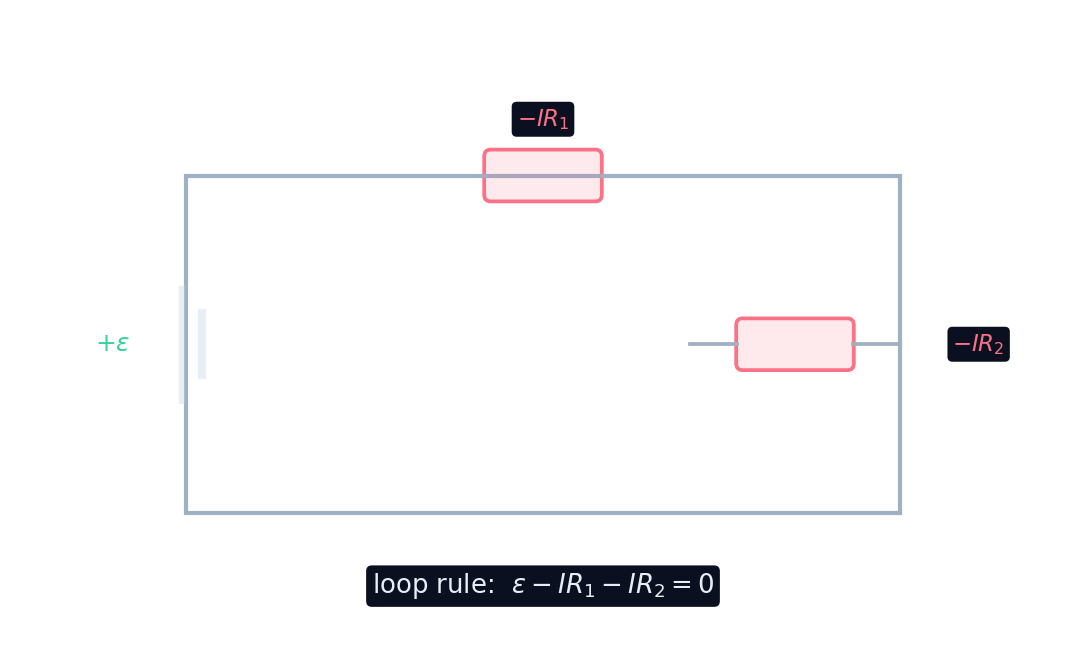
- A battery is a gain (+EMF); each resistor is a drop ($-IR$).
- It is really conservation of energy: energy gained per charge equals energy given up.
- Add them up going once around, and the total must return to zero.
Kirchhoff's loop rule is a statement of the conservation of:
Voltages sum to zero because energy per charge is conserved around a loop.
Around any complete loop, the sum of the voltage gains and drops equals ____.
$\sum V = 0$ around a loop.
Gains and drops
- Cross a battery from − to + and you gain its EMF (energy added per charge).
- Cross a resistor in the current's direction and you lose $IR$ (energy given to heat).
- The supply voltage is shared out among the components as drops.
- For a simple loop: $\varepsilon = IR_1 + IR_2 + \cdots$ — the EMF equals the total of the drops.
Crossing a battery from − to + in a loop, the potential:
A battery adds energy per charge, a rise equal to its EMF.
In a simple single-loop circuit, the battery's EMF equals the sum of the resistor voltage drops.
$\varepsilon = IR_1 + IR_2 + \cdots$ — the loop rule for a single loop.
Using it to solve circuits
- Write $\sum V = 0$ for each independent loop, then solve for the unknown currents.
- The loop rule handles multi-battery and bridge circuits that series/parallel cannot.
- Combined with the junction rule (next lesson), it solves any DC circuit.
- Keep the signs consistent: gains positive, drops negative, going one way round.
Kirchhoff's loop rule
Around any closed loop, the voltage gains equal the voltage drops. Sort each crossing.
A $9\ \text{V}$ battery drives current through $R_1 = 2\ \Omega$ and $R_2 = 1\ \Omega$ in series. Using the loop rule, what is the current, in $\text{A}$?
$9 - 2I - I = 0 \Rightarrow 9 = 3I \Rightarrow I = 3\ \text{A}$.
Select all correct statements about the loop rule.
The loop rule ($\sum V = 0$, gains + / drops −) works for any loop, not just single-resistor ones.
The loop rule is about energy per charge, so mind the signs: a battery adds voltage (+EMF), a resistor removes it ($-IR$). Go consistently one way around the loop. Mixing up the direction of a drop is the most common loop-rule error.
A $9\ \text{V}$ battery drives current through two resistors in series, $R_1 = 2\ \Omega$ and $R_2 = 1\ \Omega$. Find the current.
- Loop rule: $9 - I(2) - I(1) = 0 \Rightarrow 9 = 3I$.
- $I = \dfrac{9}{3} = 3\ \text{A}$ — the same result as adding the resistances.
Kirchhoff's loop rule: around any closed loop, $\sum V = 0$ — the battery's gain (+EMF) equals the sum of the resistor drops ($IR$). It is energy conservation for charge, and (with the junction rule) it solves any circuit. Keep the signs consistent.