Reflection · 反思
| English | 中文 | Pinyin · 拼音 |
|---|---|---|
| law of reflection/lɔː ɒv rɪˈflekʃn/ | 反射定律 | fǎn shè dìng lǜ |
| normal/ˈnɔːml/ | 法线 | fǎ xiàn |
Light bounces off a mirror at a precise angle
- Shine a torch at a mirror and the beam bounces off — but not just anywhere.
- It leaves at exactly the same angle it arrived, mirror-flipped.
- This is the law of reflection 反射定律, obeyed by every mirror and shiny surface.
- Get this one rule and mirror images make perfect sense.
光以精确的角度从镜子上弹开
- 把手电筒照向镜子,光束弹了回来——但不是随便哪个方向。
- 它离开的角度恰好和它到达的角度相同,只是镜像翻转。
- 这就是反射定律,每一面镜子和光亮表面都遵守它。
- 掌握这一条规则,镜中的像就完全说得通了。
The law of reflection
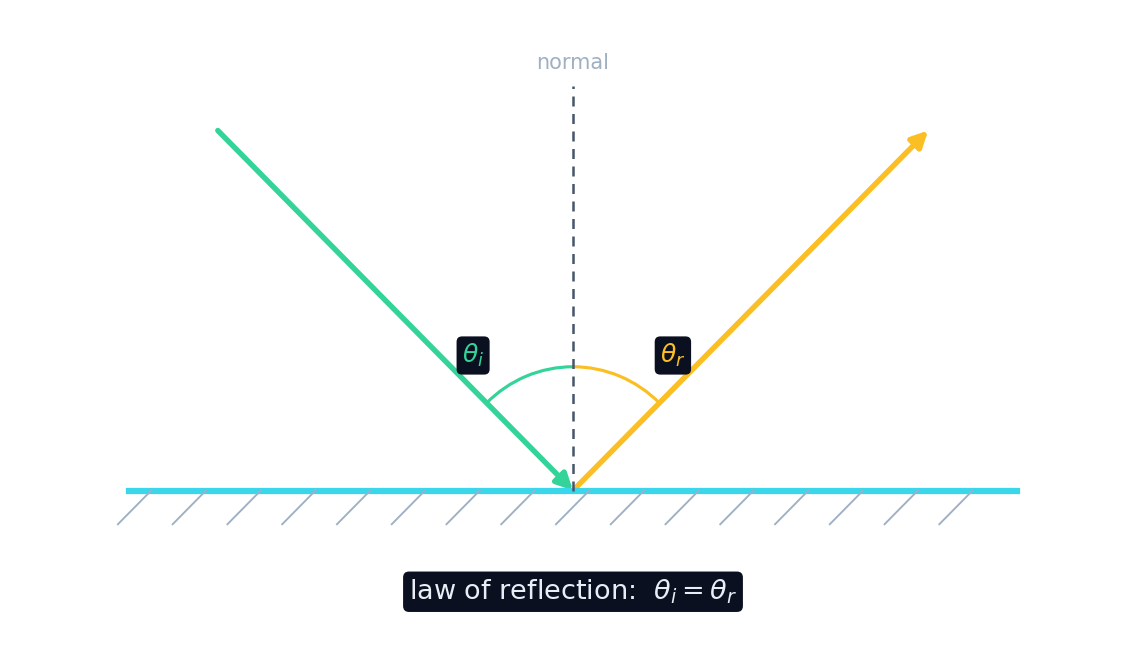
- Angles are measured from the normal 法线 — the line perpendicular to the surface.
- The angle of incidence equals the angle of reflection: $\theta_i = \theta_r$.
- The incoming ray, the reflected ray and the normal all lie in one plane.
- This holds no matter what the angle — steep or shallow.
反射定律
- 角度从法线量起——垂直于表面的那条线。
- 入射角等于反射角:$\theta_i = \theta_r$。
- 入射光线、反射光线和法线都在同一平面内。
- 无论角度陡还是缓,这都成立。
A ray strikes a mirror at $30^\circ$ to the normal. At what angle to the normal does it reflect, in degrees? · 一束光线以$30^\circ$角射向镜面法线。它以多少度角相对于法线反射?
$\theta_r = \theta_i = 30^\circ$ by the law of reflection. · 根据反射定律,$\theta_r = \theta_i = 30^\circ$。
The law of reflection states that: · 反射定律指出:
$\theta_i = \theta_r$, both measured from the normal. · $\theta_i = \theta_r$,均从法线测量。
Smooth vs rough surfaces
- A smooth surface (a mirror) reflects a beam neatly — specular reflection.
- A rough surface scatters light every which way — diffuse reflection.
- Both obey $\theta_i = \theta_r$ at each tiny point; the roughness just points the normals every way.
- Diffuse reflection is why you can see this page from any angle.
光滑与粗糙的表面
- 光滑的表面(镜子)整齐地反射光束——镜面反射。
- 粗糙的表面把光散射到各个方向——漫反射。
- 两者在每一个微小点上都遵守 $\theta_i = \theta_r$;粗糙只是让法线指向各个方向。
- 漫反射就是你能从任何角度看到这一页的原因。
Why can you read this page from many angles? · 为什么你可以从多个角度阅读此页面?
The rough paper scatters light diffusely, so it reaches your eyes from any angle. · 粗糙的纸张发生漫反射,使光从任何角度都能进入你的眼睛。
Select all · 所有 true statements about reflection. · 选择关于反射的所有正确陈述。
Reflection obeys $\theta_i = \theta_r$ from the normal, smooth = specular. Rough surfaces still obey it at each point. · 反射遵循$\theta_i = \theta_r$于法线,光滑=镜面反射。粗糙表面在每个点仍然遵循它。
Always measure from the normal
- The single most common slip is measuring the angle from the surface instead of the normal.
- The normal is the perpendicular line; angles in optics are always taken from it.
- A ray hitting a mirror "flat" ($\theta_i \approx 90^\circ$ from the normal) grazes off almost flat.
- A ray straight down the normal ($\theta_i = 0$) reflects straight back.
永远从法线量起
- 最常见的失误,是从表面而非法线量角度。
- 法线是那条垂直线;光学中的角度永远从它量起。
- 一束"平贴"打到镜子的光($\theta_i \approx 90^\circ$,从法线量)几乎平贴地掠开。
- 一束沿法线直下的光($\theta_i = 0$)沿原路直接反射回去。
The law of reflection · 反射定律
For a mirror, the angle of reflection always equals the angle of incidence - a straight line through the origin. · 对于镜面,反射角始终等于入射角——一条过原点的直线。
In optics, angles are always measured from the ____ (the perpendicular line). · 在光学中,角度总是从____(垂线)测量。
The normal is perpendicular to the surface; all optics angles use it. · 法线垂直于表面;所有光学角度都使用它。
A ray at $30^\circ$ to the mirror surface is at $60^\circ$ to the normal. · 一束与镜面成$30^\circ$角的光,与法线成$60^\circ$角。
Surface and normal are perpendicular, so the two angles add to $90^\circ$. · 表面与法线垂直,因此这两个角之和为$90^\circ$。
Always measure the angles from the normal (the perpendicular), not from the mirror surface. A ray at $30^\circ$ to the surface is at $60^\circ$ to the normal — and $60^\circ$ is what goes into $\theta_i = \theta_r$.
角度永远从法线(那条垂线)量起,而非从镜面量起。与表面成 $30^\circ$ 的光线,与法线成 $60^\circ$——代入 $\theta_i = \theta_r$ 的是 $60^\circ$。
A ray strikes a mirror at $30^\circ$ to the normal. At what angle does it reflect?
- By the law of reflection, $\theta_r = \theta_i = 30^\circ$ to the normal.
The total angle between the incoming and outgoing rays is $60^\circ$.
一束光与法线成 $30^\circ$ 打到镜子上。它以什么角度反射?
- 由反射定律,$\theta_r = \theta_i = 30^\circ$,从法线量起。
入射光线和出射光线之间的总夹角是 $60^\circ$。
The law of reflection: the angle of incidence equals the angle of reflection ($\theta_i = \theta_r$), both measured from the normal. Smooth surfaces give clear specular reflection; rough ones give scattered diffuse reflection. Always measure from the normal.
反射定律:入射角等于反射角($\theta_i = \theta_r$),都从法线量起。光滑表面给出清晰的镜面反射;粗糙表面给出散射的漫反射。永远从法线量起。