| Learning Objective | Essential Knowledge |
|---|---|
9.1.A |
|
9.1.B |
Boundary statement: AP Physics 2 only expects students to perform qualitative and quantitative analysis of collisions in one and two dimensions. Students are not expected to know the functional form of the Maxwell-Boltzmann distribution but are expected to be familiar with how features of the distribution are related to the temperature of the gas. |
热力学
AP 物理 2 · 第 9 主题
 8:56
8:56
Thermodynamics
Put a hot cup of coffee on a table. It always cools down. It never warms back up by taking heat out of the cool room. Both directions would balance the energy…
英文讲解 · 内嵌中英文字幕
9.1
温度与压强的分子运动论
大纲
来源:美国大学理事会 AP 课程与考试说明
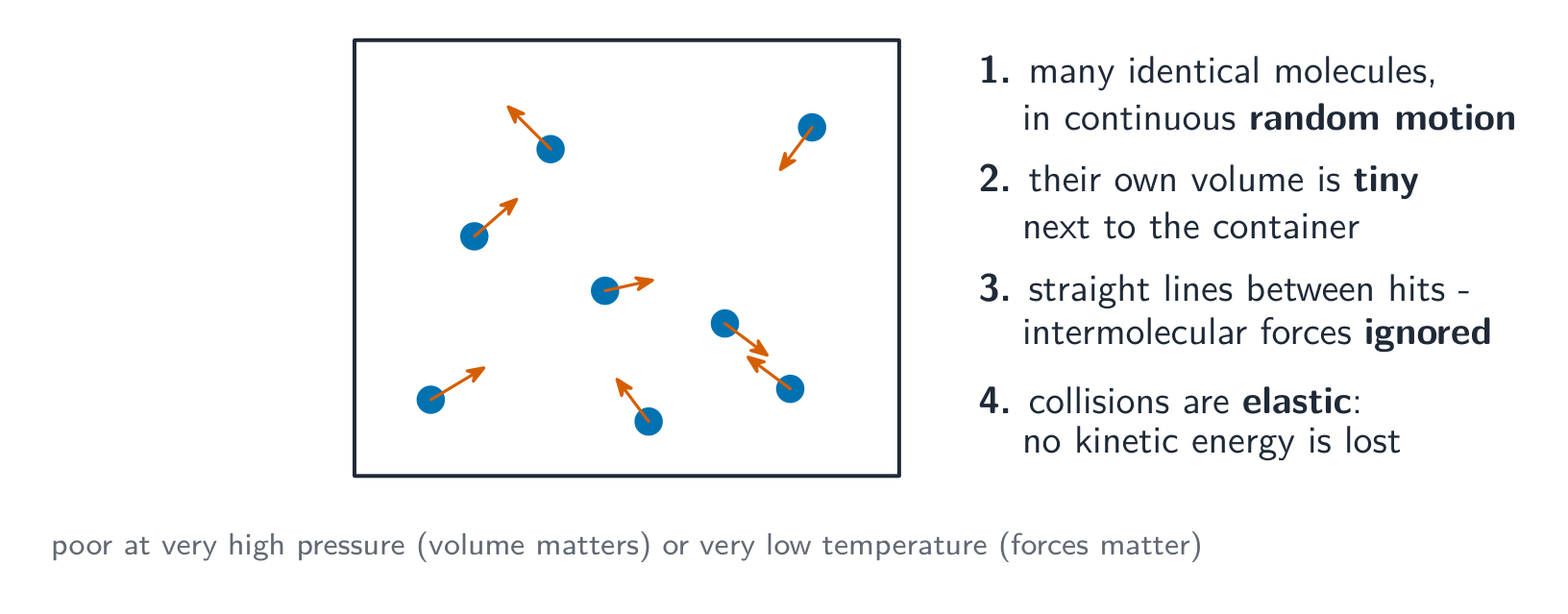
热力学(thermodynamics)研究大量粒子集合里的热和能量。分子运动论(kinetic theory)从它分子的随机运动解释气体行为:
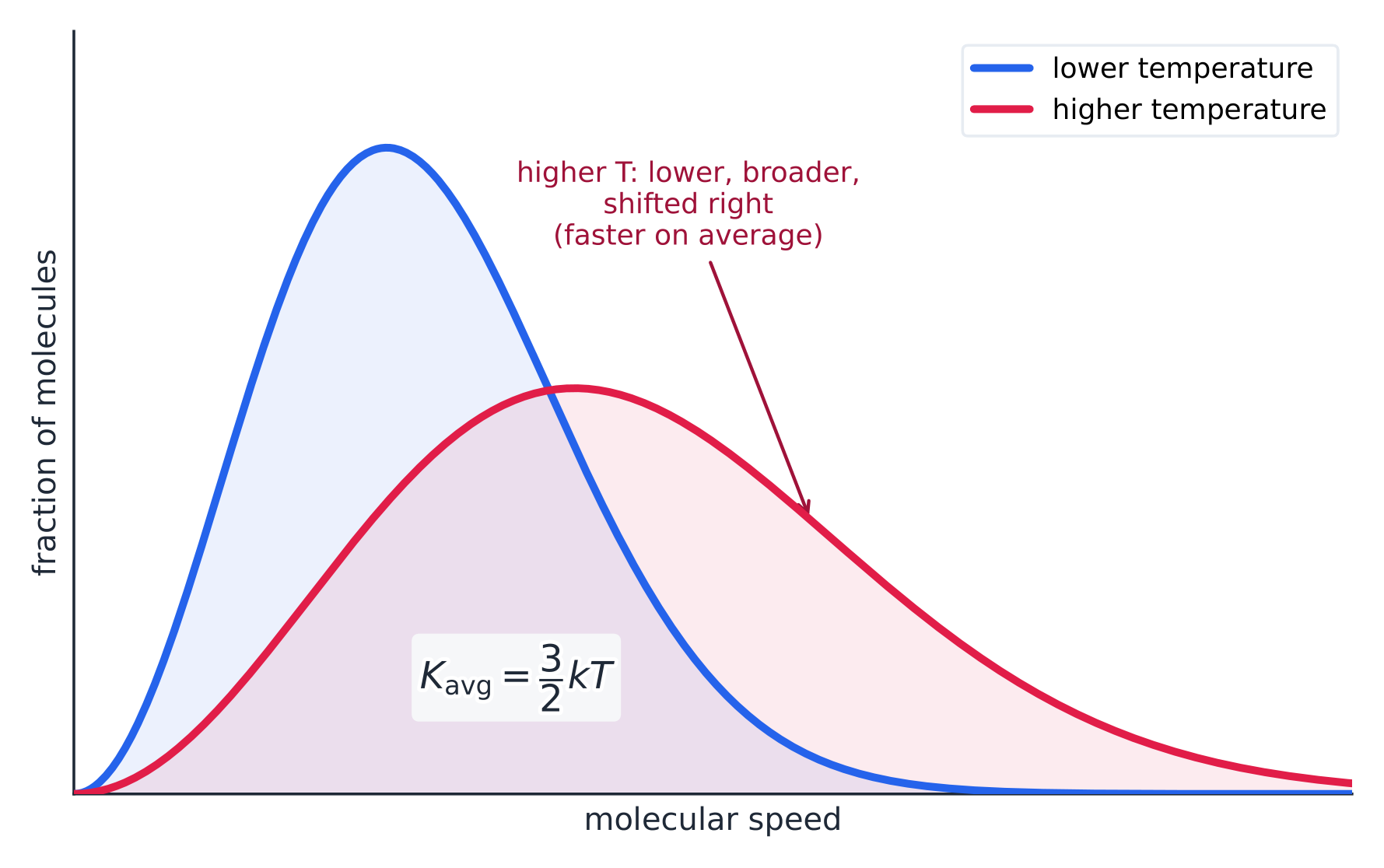
- 温度(temperature)是分子平均动能的一个衡量:$K_{\text{avg}}=\tfrac{3}{2}k_B T$($T$ 以开尔文)。更热意味着移动更快的分子。
- 压强(pressure)来自分子与容器壁碰撞——更频繁或更硬的碰撞给出更多压强。
Worked example. 用 $k_B=1.38\times10^{-23}\ \text{J/K}$,求 $300\ \text{K}$ 一个气体分子的平均动能:
$$K_{\text{avg}}=\tfrac32 k_B T=1.5\times1.38\times10^{-23}\times300=6.2\times10^{-21}\ \text{J}.$$
它只取决于温度,不取决于气体的类型——在相同的 $T$,轻和重的分子共享相同的平均动能(所以轻的移动更快)。
探索
Explore the spread of molecular speeds
Raise the temperature and watch the whole speed distribution shift right and flatten — the particles move faster on average, which is exactly what $\bar K = \tfrac{3}{2} k_B T$ means.
词汇表
训练
| 英文 | 中文 | 拼音 |
|---|---|---|
| Thermodynamics/ˌθɜːməʊdaɪˈnæmɪks/ | 热力学 | rè lì xué |
| kinetic theory/kɪˈnetɪk ˈθɪəri/ | 分子运动论 | fēn zǐ yùn dòng lùn |
| Temperature/ˈtemprɪtʃə/ | 温度 | wēn dù |
| Pressure/ˈpreʃə/ | 压强 | yā qiáng |
9.2
理想气体定律
大纲
| Learning Objective | Essential Knowledge |
|---|---|
9.2.A |
|
来源:美国大学理事会 AP 课程与考试说明
一个理想气体(ideal gas)遵循
$$PV=nRT \qquad(\text{or } PV=Nk_B T),$$
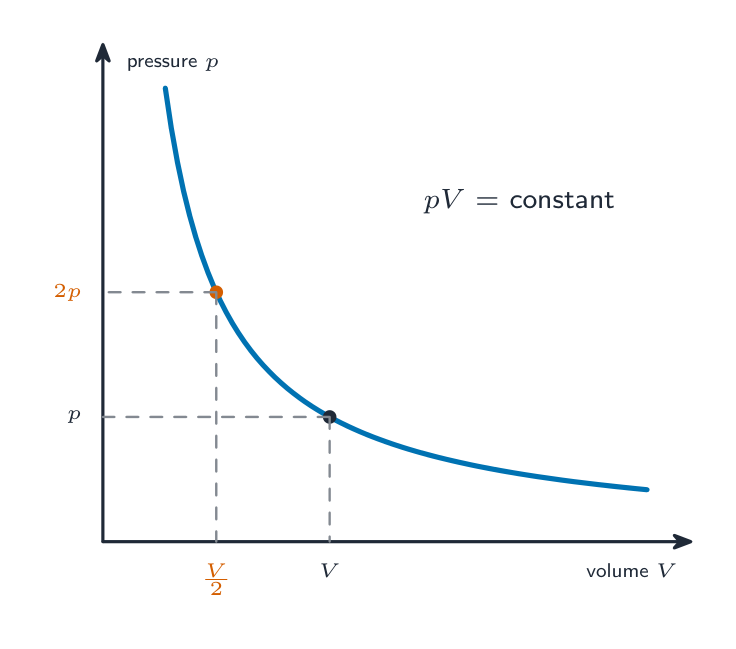
联系压强 $P$、体积 $V$、量($n$ 摩尔或 $N$ 分子),和绝对温度 $T$。用它来预测当你改变一个量而保持其他固定时一个气体如何反应(例如在恒定体积加热提高压强)。
Worked example. 一个密封的刚性气体容器在 $1.0\times10^{5}\ \text{Pa}$ 和 $300\ \text{K}$。它被加热到 $450\ \text{K}$。因为体积和量固定,$P/T$ 恒定:
$$P_2=P_1\frac{T_2}{T_1}=1.0\times10^{5}\times\frac{450}{300}=1.5\times10^{5}\ \text{Pa}.$$
在使用一个气体定律之前总是把温度转换成开尔文——这里用摄氏会给出胡说。
探索
Explore squeezing a gas
Slide the piston in to shrink the volume. The same particles are crammed into less space, so they hit the walls more often and the pressure climbs — while $PV$ stays constant at fixed temperature.
词汇表
训练
| 英文 | 中文 | 拼音 |
|---|---|---|
| ideal gas/aɪˈdɪəl ɡæs/ | 理想气体 | lǐ xiǎng qì tǐ |
9.3
热能传递与热平衡
大纲
| Learning Objective | Essential Knowledge |
|---|---|
9.3.A |
|
来源:美国大学理事会 AP 课程与考试说明
热量(heat)$Q$ 是因为一个温度差而转移的能量;它从热流向冷。两个接触的物体在它们共享相同温度时达到热平衡(thermal equilibrium),而净热流停止。三种转移方法是传导(conduction)、对流(convection)和辐射(radiation)。
探索
Add heat and watch the temperature
Adding heat usually raises temperature, but during a phase change the temperature holds flat while the energy breaks bonds. Two bodies in contact settle at one temperature — thermal equilibrium.
词汇表
训练
| 英文 | 中文 | 拼音 |
|---|---|---|
| Heat/hiːt/ | 热量 | rè liàng |
| thermal equilibrium/ˈθɜːml ˌiːkwɪˈlɪbrɪəm/ | 热平衡 | rè píng héng |
| conduction/kənˈdʌkʃn/ | 传导 | chuán dǎo |
| convection/kənˈvekʃn/ | 对流 | duì liú |
| radiation/ˌreɪdɪˈeɪʃn/ | 辐射 | fú shè |
9.4
热力学第一定律
大纲
| Learning Objective | Essential Knowledge |
|---|---|
9.4.A |
|
9.4.B |
|
来源:美国大学理事会 AP 课程与考试说明
热力学第一定律(first law)是气体的能量守恒:
$$\Delta U = Q + W,$$
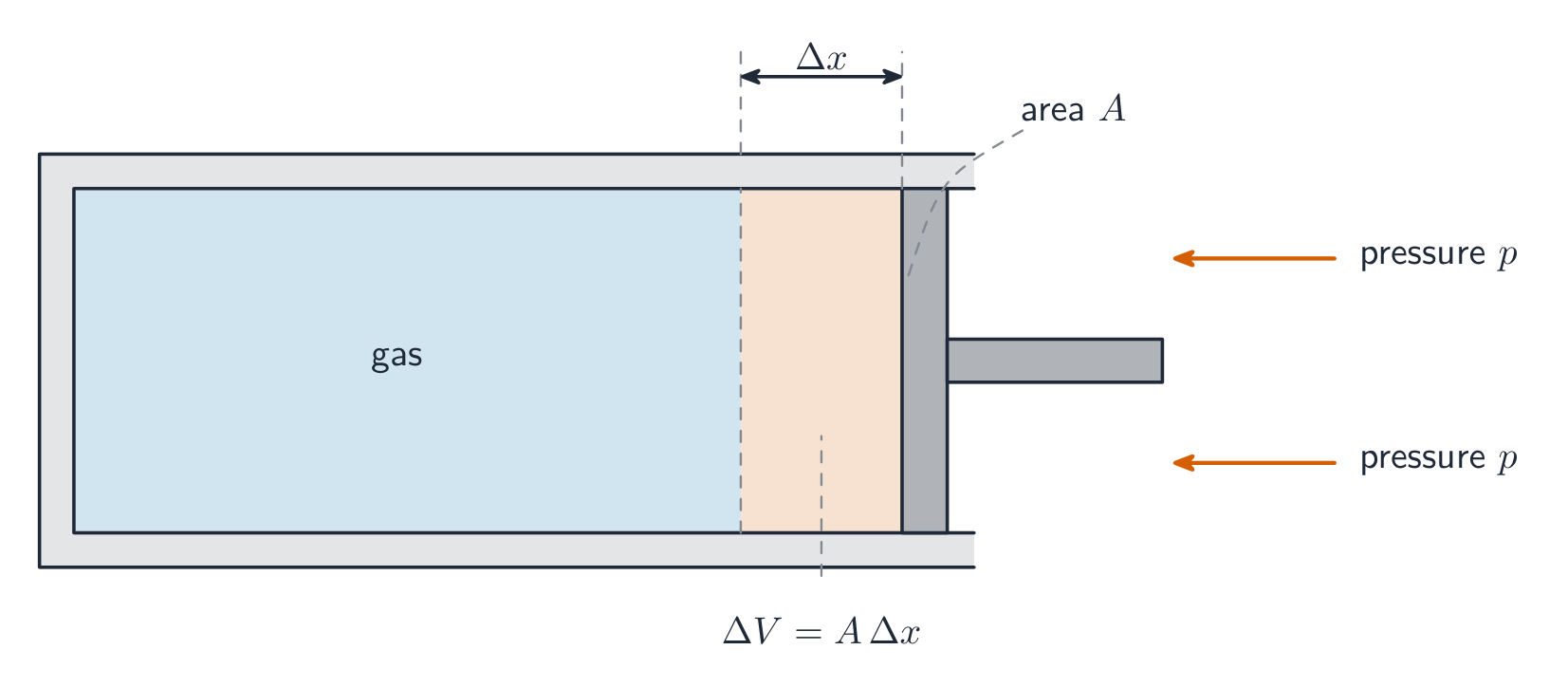
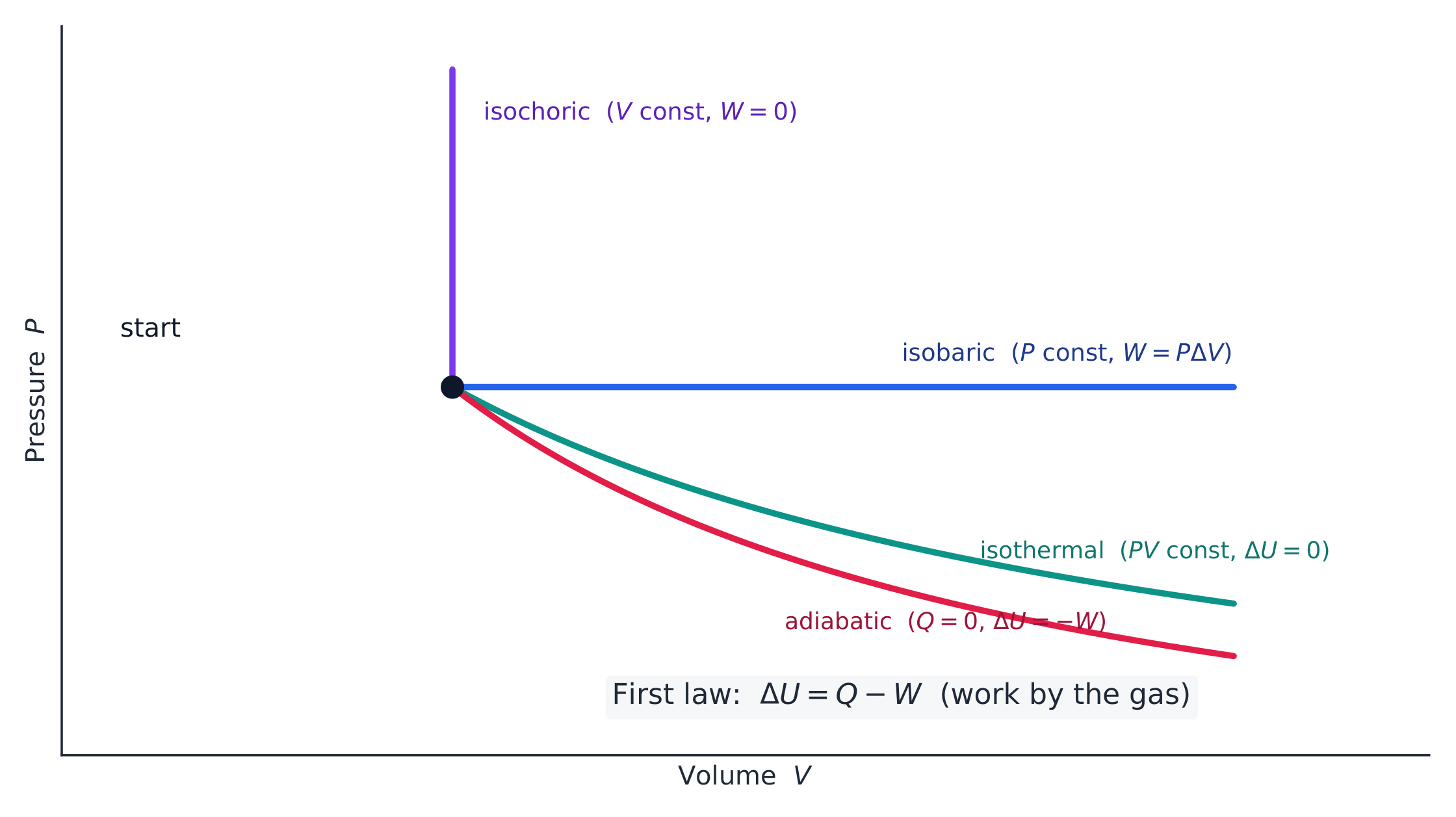
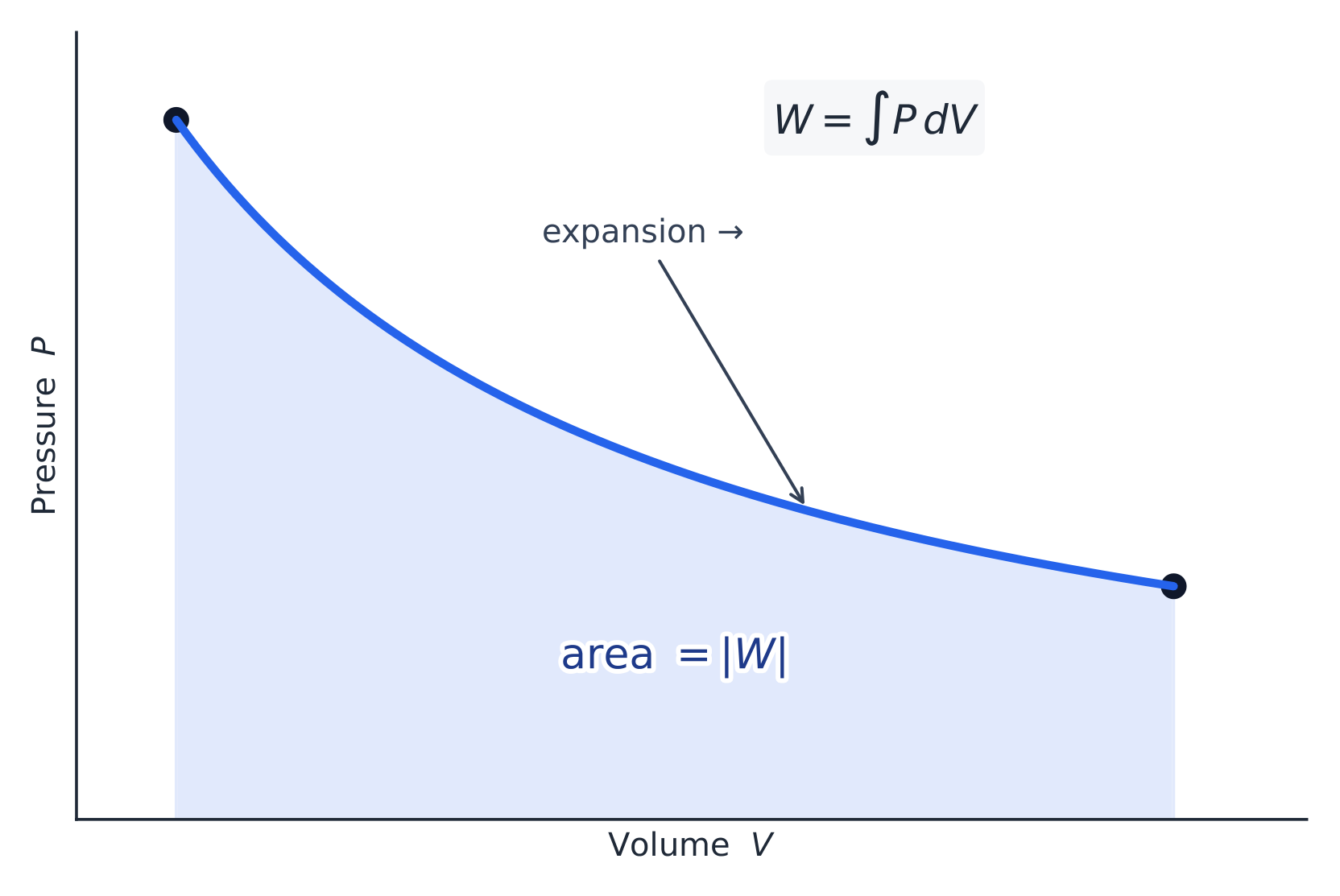
其中 $\Delta U$ 是内能(internal energy)(与温度绑定)的变化,$Q$ 是加给气体的热,而 $W$ 是对气体做的功。在一个压强-体积图上,气体做的功是过程曲线下的面积。注意符号:压缩一个气体对它做正功。
Worked example. 一个气体吸收 $500\ \text{J}$ 的热,而当它膨胀时,对它的环境做 $200\ \text{J}$ 的功。求它内能的变化。对气体做的功是 $W=-200\ \text{J}$(它做功,所以它失去那个能量):
$$\Delta U=Q+W=500+(-200)=300\ \text{J}.$$
内能上升 $300\ \text{J}$,所以气体最终更热。把 $W$ 的符号搞对是第一定律问题的全部关键。
词汇表
训练
| 英文 | 中文 | 拼音 |
|---|---|---|
| first law/fɜːst lɔː/ | 热力学第一定律 | rè lì xué dì yí dìng lǜ |
| internal energy/ɪnˈtɜːnl ˈenədʒi/ | 内能 | nèi néng |
9.5
比热容与热导率
大纲
| Learning Objective | Essential Knowledge |
|---|---|
9.5.A |
|
9.5.B |
Boundary statement: AP Physics 2 will model specific heat as independent of temperature. |
来源:美国大学理事会 AP 课程与考试说明
- 比热容(specific heat)$c$ 是把一千克提高一度所需的热:$Q=mc\,\Delta T$。一个高比热容(像水的)意味着一个物质抵抗温度变化。
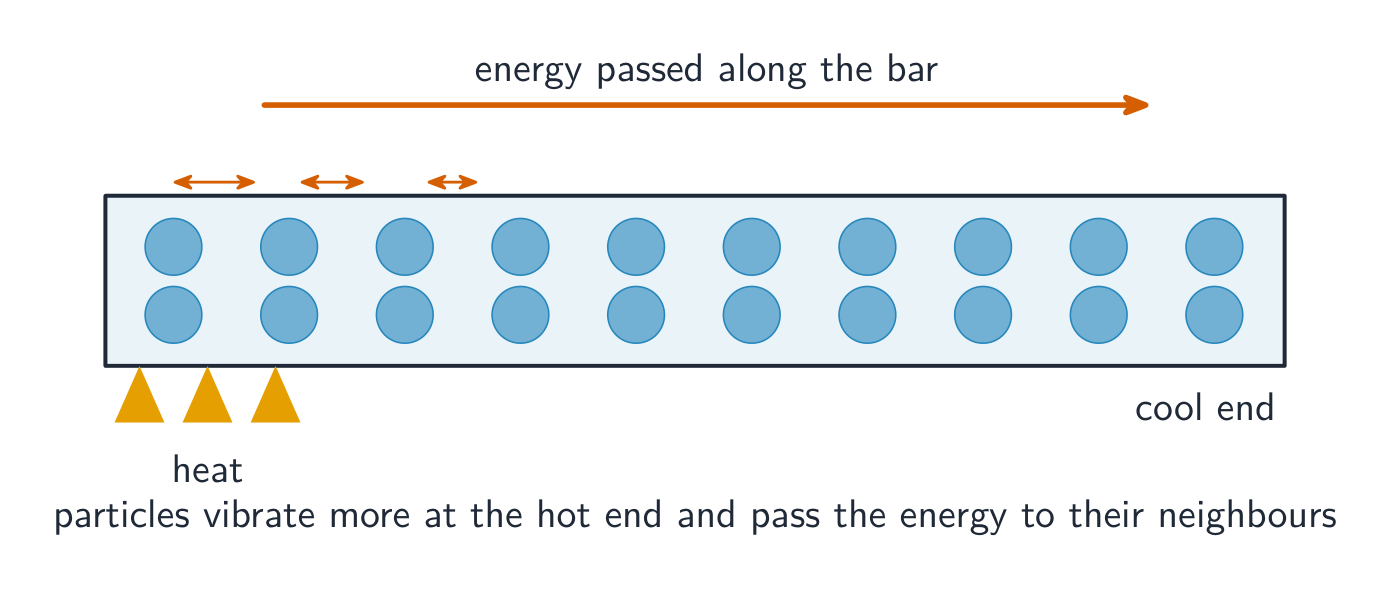
- 热导率(thermal conductivity)测量热通过一种材料传导多快;传导的速率随面积和温度差上升而随厚度下降。
Worked example. 多少热把 $2.0\ \text{kg}$ 水的温度从 $20\,{}^{\circ}\text{C}$ 提高到 $80\,{}^{\circ}\text{C}$?水的比热容是 $c=4200\ \text{J/(kg}\,{}^{\circ}\text{C)}$:
$$Q=mc\,\Delta T=2.0\times4200\times(80-20)=5.0\times10^{5}\ \text{J}.$$
水的大比热容是为什么它被用作冷却剂以及为什么沿海气候温和。
探索
Explore how much energy heats a material
Pick a material, set the mass and temperature rise, and read the energy from $Q = mc\,\Delta T$. Water needs far more energy than the metals to warm by the same amount.
词汇表
训练
| 英文 | 中文 | 拼音 |
|---|---|---|
| Specific heat/spəˈsɪfɪk hiːt/ | 比热容 | bǐ rè róng |
| Thermal conductivity/ˈθɜːml kɒndəkˈtɪvɪti/ | 热导率 | rè dǎo lǜ |
9.6
熵与热力学第二定律
大纲
| Learning Objective | Essential Knowledge |
|---|---|
9.6.A |
Boundary statement: Only qualitative treatment of the second law of thermodynamics is within the scope of AP Physics 2. |
来源:美国大学理事会 AP 课程与考试说明
熵(entropy)测量一个系统的无序,或排列它的方式数目。热力学第二定律(second law):一个孤立系统的总熵从不减少——能量自然地散开。这设定过程的方向:热自己从热→冷流动,从不相反,而没有引擎能把热完全转换成功。
词汇表
训练
| 英文 | 中文 | 拼音 |
|---|---|---|
| Entropy/ˈentrəpi/ | 熵 | shāng |
| second law/ˈsekənd lɔː/ | 热力学第二定律 | rè lì xué dì èr dìng lǜ |
9.6
考试技巧
- 在使用任何气体定律之前总是把温度转换成开尔文($T_{\text{K}}=T_{\text{C}}+273$)。
- 在第一定律 $\Delta U = Q + W$ 里,把 $W$ 的符号搞对:对气体做的功是正的;当气体膨胀并对它的环境做功时,$W$ 是负的。
- 温度测量粒子的平均动能,所以在相同的 $T$ 更轻的分子移动更快。
- 在一个 PV 图上气体做的功是过程曲线下的面积。
- 对温度变化用 $Q=mc\,\Delta T$;第二定律固定方向——热从热→冷流动而总熵从不减少。
本主题的互动课程
逐步学习,并即时检测练习。