The Ideal Gas Law
Introduced| English |
|---|
| ideal gas law/aɪˈdɪəl ɡæs lɔː/ |
Pump up a tyre — it gets hot and hard
- Push a bike pump and the barrel warms up while the tyre grows firm.
- You squeezed the gas into less space, and its pressure and temperature climbed.
- One tidy equation ties pressure, volume, temperature and amount of gas together.
- It is the ideal gas law 理想气体定律, the workhorse of thermodynamics.
The equation
- The ideal gas law is $PV = nRT$.
- $P$ is pressure, $V$ volume, $n$ the amount of gas (in moles), $T$ the kelvin temperature.
- $R$ is the universal gas constant, the same for every ideal gas.
- Know any three of $P, V, T$ (for fixed $n$) and the fourth is fixed.
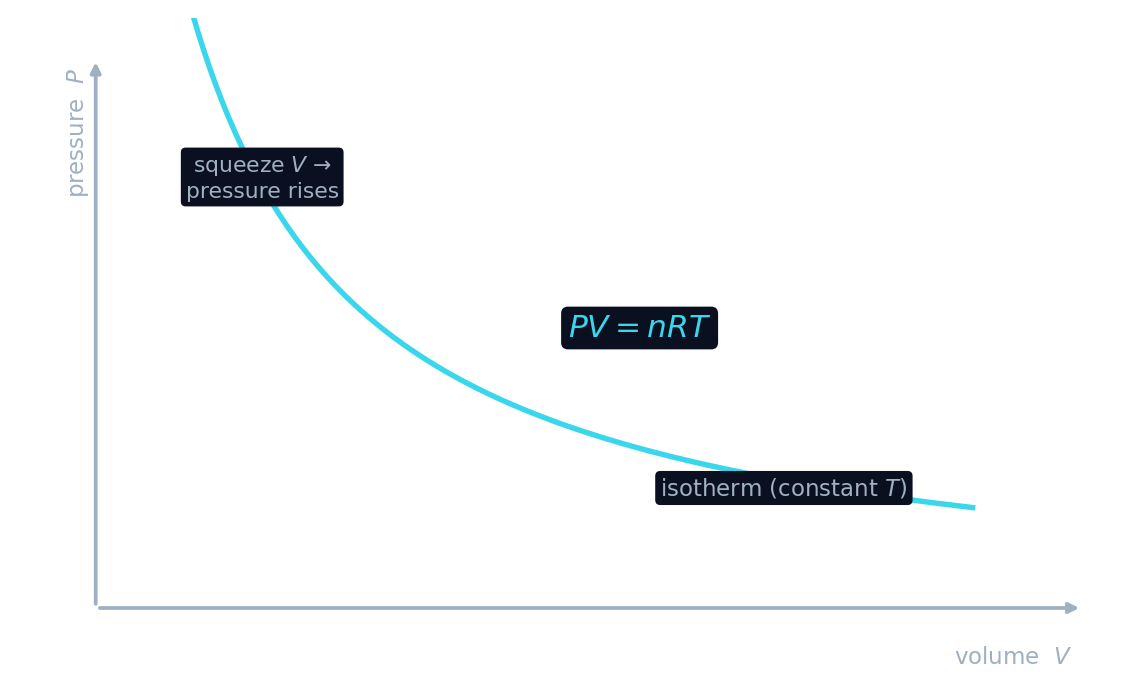
Squeeze the gas
Change the volume and watch the pressure respond along an isotherm — PV stays constant.
Which is the ideal gas law?
$PV = nRT$ links pressure, volume, amount and temperature.
In $PV = nRT$, the symbol $n$ is the amount of gas measured in ____.
$n$ is the number of moles of gas.
The relationships inside it
- At constant temperature, $P$ and $V$ are inversely related: squeeze $V$, and $P$ rises.
- At constant volume, $P$ rises in proportion to the kelvin temperature.
- At constant pressure, volume rises in proportion to temperature.
- Each is a special case of the one master equation $PV = nRT$.
A gas at $100\ \text{kPa}$, $2\ \text{m}^3$ is squeezed to $0.5\ \text{m}^3$ at constant temperature. What is the new pressure, in $\text{kPa}$?
$P_1V_1 = P_2V_2 \Rightarrow 200 = 0.5 P_2 \Rightarrow P_2 = 400\ \text{kPa}$.
At constant temperature, if you halve a gas's volume, its pressure:
$PV$ is constant, so halving $V$ doubles $P$.
A gas at $300\ \text{K}$ has pressure $200\ \text{kPa}$ in a rigid container. Heated to $600\ \text{K}$, what is its new pressure, in $\text{kPa}$?
At constant volume, $P \propto T$: doubling the kelvin temperature doubles the pressure to $400\ \text{kPa}$.
When it works
- The law is exact for an ideal gas — particles with no size and no forces between them.
- Real gases follow it closely at ordinary pressures and well above their boiling point.
- It breaks down near condensation, where particle forces matter.
- For AP problems, treat gases as ideal unless told otherwise.
Temperature in the ideal gas law must be in kelvin.
The law is proportional in kelvin; using $^\circ\text{C}$ gives wrong ratios.
Always put temperature in kelvin in $PV = nRT$. Using $^\circ\text{C}$ gives nonsense — for example, "doubling from $10\,{}^\circ\text{C}$ to $20\,{}^\circ\text{C}$" is not doubling the temperature ($283\ \text{K}$ to $293\ \text{K}$ is only a $3.5\%$ rise).
A gas at pressure $100\ \text{kPa}$ and volume $2\ \text{m}^3$ is squeezed to $0.5\ \text{m}^3$ at constant temperature. Find the new pressure.
- At constant $T$, $P_1 V_1 = P_2 V_2 \Rightarrow 100 \times 2 = P_2 \times 0.5$.
- $P_2 = \dfrac{200}{0.5} = 400\ \text{kPa}$ — four times larger, as the volume shrank fourfold.
The ideal gas law is $PV = nRT$ (temperature in kelvin). At constant $T$, $P$ and $V$ are inversely related ($P_1V_1 = P_2V_2$); at constant $V$ or $P$, the others rise with temperature. It holds well for real gases away from condensation.