Wave Interference and Standing Waves · 波的干涉与驻波
| English | 中文 | Pinyin · 拼音 |
|---|---|---|
| standing wave/ˈstændɪŋ weɪv/ | 驻波 | zhù bō |
Two waves meet — and can make silence
- Point two loudspeakers at each other and, at certain spots, the sound cancels to near silence.
- At other spots it gets louder. Two waves have overlapped and added.
- When waves meet, they superpose — their displacements add point by point.
- This gives us interference patterns and the standing waves that make music.
两道波相遇——竟能造出寂静
- 让两个扬声器对着彼此,在某些位置,声音相消到近乎寂静。
- 在另一些位置它变得更响。两道波重叠并相加了。
- 当波相遇时,它们叠加——它们的位移逐点相加。
- 这带给我们干涉图样,以及造就音乐的驻波。
Superposition and interference
- Superposition: where waves overlap, the total displacement is the sum of the individual ones.
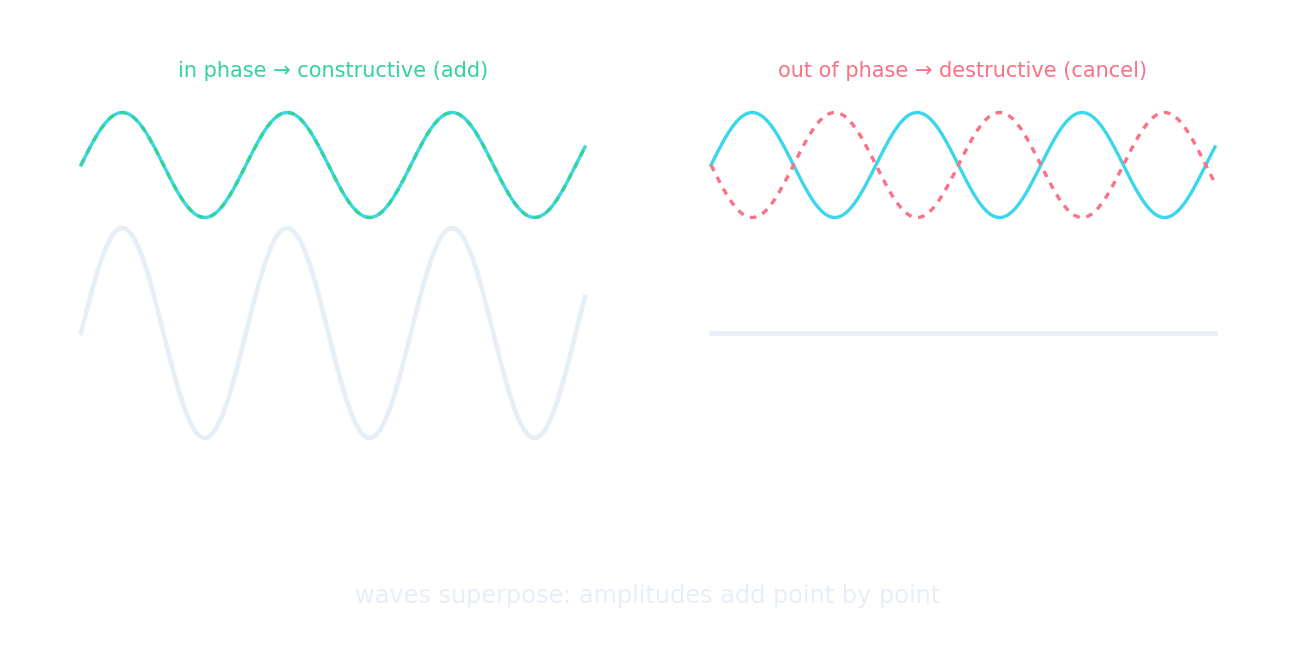
- In phase (crest on crest) → they add → constructive interference (bigger amplitude).
- Out of phase (crest on trough) → they cancel → destructive interference (smaller or zero).
- After overlapping, the waves pass through and carry on unchanged.
叠加与干涉
- 叠加:波重叠处,总位移是各个位移之和。
- 同相(峰对峰)→ 相加 → 相长干涉(更大的振幅)。
- 反相(峰对谷)→ 相消 → 相消干涉(更小或为零)。
- 重叠之后,波穿过彼此并不变地继续前行。
Two waves of amplitude $3\ \text{cm}$ meet exactly in phase. What is the amplitude where they overlap, in cm? · 两列振幅为 $3\ \text{cm}$ 的波完全同相相遇。重叠处的振幅是多少,单位为 cm?
Constructive: $3 + 3 = 6\ \text{cm}$. · 相长干涉:$3 + 3 = 6\ \text{cm}$。
Two identical waves meet exactly out of phase (crest on trough). The result is: · 两列相同的波完全反相相遇(波峰对波谷)。结果是:
Crest on trough cancels — destructive interference. · 波峰对波谷相互抵消——相消干涉。
Standing waves
- A wave reflecting back on itself interferes with the incoming wave to make a standing wave 驻波.
- The pattern seems to stand still: some points never move, others swing widely.
- Nodes are points of no movement; antinodes swing with maximum amplitude.
- Standing waves form on guitar strings, in flutes, and in microwave ovens.
驻波
- 一道反射回自身的波与入射波干涉,形成驻波。
- 图样看起来静止不动:有些点从不移动,另一些大幅摆动。
- 波节是不动的点;波腹以最大振幅摆动。
- 驻波在吉他弦、长笛和微波炉中形成。
Nodes and antinodes · 节点与腹点
Change the harmonic number and watch the standing-wave pattern gain more nodes. · 改变谐波数并观察驻波图案中节点数量增加。
In a standing wave, a point that never moves is called a . · 在驻波中,一个永远不动的点称为。
Nodes are the stationary points; antinodes swing the most. · 节点是静止点;腹点振动幅度最大。
A standing wave forms when: · 当满足以下条件时形成驻波:
A wave reflecting back interferes with the incoming wave to make a standing pattern. · 反射回来的波与入射波干涉,形成驻波图样。
Select all · 所有 true statements about interference and standing waves. · 选择关于干涉和驻波的所有正确陈述。
In phase = constructive, out of phase = destructive, standing waves have nodes/antinodes. Energy is never destroyed. · 同相即相长,反相即相消,驻波有节点/腹点。能量永远不会被破坏。
Why instruments have set notes
- A string or air column only "fits" whole numbers of half-wavelengths — its harmonics.
- These allowed standing waves are the notes the instrument can play.
- A longer string or pipe fits longer waves, giving lower notes.
- Music is standing-wave physics you can hear.
乐器为何有固定的音
- 一根弦或一段气柱只"容纳"整数个半波长——它的谐波。
- 这些被允许的驻波就是乐器能演奏的音。
- 更长的弦或管容纳更长的波,给出更低的音。
- 音乐是你能听见的驻波物理。
Destructive interference does not destroy energy — it just redistributes it. Where waves cancel at one point, they add somewhere else, so the total energy is conserved. And a "standing" wave isn't frozen: its antinodes are vibrating hardest of all.
相消干涉不毁灭能量——它只是把能量重新分配。波在一点相消处,会在别处相加,所以总能量守恒。而"驻"波并非冻结:它的波腹振动得最厉害。
Destructive interference destroys energy at the points where waves cancel. · 相消干涉并不会在波抵消的点处破坏能量。
Energy is redistributed, not destroyed — it adds up elsewhere. Total energy is conserved. · 能量被重新分布,而非被破坏——它会在别处叠加。总能量守恒。
Two waves of amplitude $3\ \text{cm}$ meet exactly in phase. What is the amplitude where they overlap?
- Constructive: the amplitudes add, $3 + 3 = 6\ \text{cm}$.
If they met exactly out of phase, they would cancel to $0\ \text{cm}$.
两道振幅 $3\ \text{cm}$ 的波恰好同相相遇。它们重叠处的振幅是多少?
- 相长:振幅相加,$3 + 3 = 6\ \text{cm}$。
若它们恰好反相相遇,就会相消到 $0\ \text{cm}$。
Overlapping waves superpose (displacements add). In phase → constructive (add); out of phase → destructive (cancel). A wave reflecting on itself makes a standing wave with fixed nodes and swinging antinodes — the physics behind musical notes. No energy is lost, only redistributed.
重叠的波叠加(位移相加)。同相 → 相长(相加);反相 → 相消(抵消)。反射回自身的波形成有固定波节和摆动波腹的驻波——音符背后的物理。没有能量损失,只是重新分配。