- understand that electromagnetic radiation has a particulate nature
- understand that a photon is a quantum of electromagnetic energy
- recall and use $E = hf$
- use the electronvolt (eV) as a unit of energy
- understand that a photon has momentum and that the momentum is given by $p = E/c$
量子物理
A-Level 物理 · 第 22 主题
 15:44
15:44
Photons
Here is a puzzle that broke classical physics. Shine the brightest red lamp you can find onto a metal plate. Pour on more and more light. And yet — nothing…
英文讲解 · 内嵌中英文字幕
22.1
光子的能量与动量

大纲
来源:剑桥国际大纲
电磁辐射既像波、也像粒子。电磁辐射的粒子是光子(photons)——以光速传播的电磁能量小包("量子"(quanta))。
"说明光子是什么意思"(两分)。 光子是电磁辐射能量的一个量子(一个分立的能量包)。 两半都得分:量子或能量包(或"分立的量"),以及电磁辐射的(或"光的")。只说"光的粒子"不够。辐射以这样的能量包出现,就是教学大纲所说的粒子性(particulate nature):能量以 $hf$ 为单位成块传递,决不更小。
光子的能量
一个频率(frequency)为 $f$ 的光子有能量
$$E = h f,$$
其中 $h = 6.63 \times 10^{-34}\ \text{J s}$ 是普朗克常量(Planck constant)。用 $c = f\lambda$:
$$E = \frac{h c}{\lambda}.$$
例题。 求波长 $500\ \text{nm}$ 的绿光光子的能量。($h = 6.63 \times 10^{-34}\ \text{J s}$,$c = 3.0 \times 10^{8}\ \text{m s}^{-1}$。)
$$E = \frac{hc}{\lambda} = \frac{(6.63 \times 10^{-34})(3.0 \times 10^{8})}{500 \times 10^{-9}} \approx 4.0 \times 10^{-19}\ \text{J}\ (\approx 2.5\ \text{eV}).$$
频率越高(波长(wavelength)越短)的光子携带越多的能量:一个 $\gamma$ 射线光子携带的远多于一个无线电光子。
电子伏特
电子伏特(electronvolt,eV)是原子尺度上一个方便的能量单位:
$$1\ \text{eV} = 1.60 \times 10^{-19}\ \text{J}.$$
它是一个电子(electron)通过 1 V 的电势差(potential difference)所获得的动能(kinetic energy)。例如,一个可见光光子($\lambda \approx 500\ \text{nm}$)有能量 $\approx 2.5\ \text{eV}$。eV → J 乘以 $1.60 \times 10^{-19}$;J → eV 除以它。
使用电子伏特。 光子能量、逸出功和能级都是几个 eV,所以考试这样给出,并要求你不费力地在单位之间转换:$2.0\ \text{eV}$ 的逸出功是 $2.0 \times 1.60 \times 10^{-19} = 3.2 \times 10^{-19}\ \text{J}$;$4.0 \times 10^{-19}\ \text{J}$ 的光子是 $2.5\ \text{eV}$。求波长的一个有用捷径:$hc = 1.99 \times 10^{-25}\ \text{J m} = 1240\ \text{eV nm}$,所以 $2.0\ \text{eV}$ 的光子有 $\lambda = 1240/2.0 = 620\ \text{nm}$(红光),而 $400\ \text{nm}$ 的光子携带 $3.1\ \text{eV}$。
光子的动量
光子还携带动量(momentum):
$$p = \frac{E}{c} = \frac{h}{\lambda}.$$
它有零静止质量,但有一个非零的动量 $E/c$。辐射压强(光子推压一个表面)由此而来。
"证明 $p = h/\lambda$。" 从两个光子关系出发:$E = hf$ 和 $p = E/c$。于是 $p = hf/c$,又因为 $c = f\lambda$,$f/c = 1/\lambda$,所以 $p = h/\lambda$。要给出两个起始方程和波动方程;分数在于推导链,不在结果。
例题。 自由空间中一个光子的动量为 $9.5 \times 10^{-28}\ \text{N s}$。证明它是一个红光光子。
$\lambda = h/p = 6.63 \times 10^{-34}/9.5 \times 10^{-28} = 7.0 \times 10^{-7}\ \text{m} = 700\ \text{nm}$,位于可见光谱($400$–$700\ \text{nm}$)的红端。能量为 $pc = 2.9 \times 10^{-19}\ \text{J} = 1.8\ \text{eV}$。
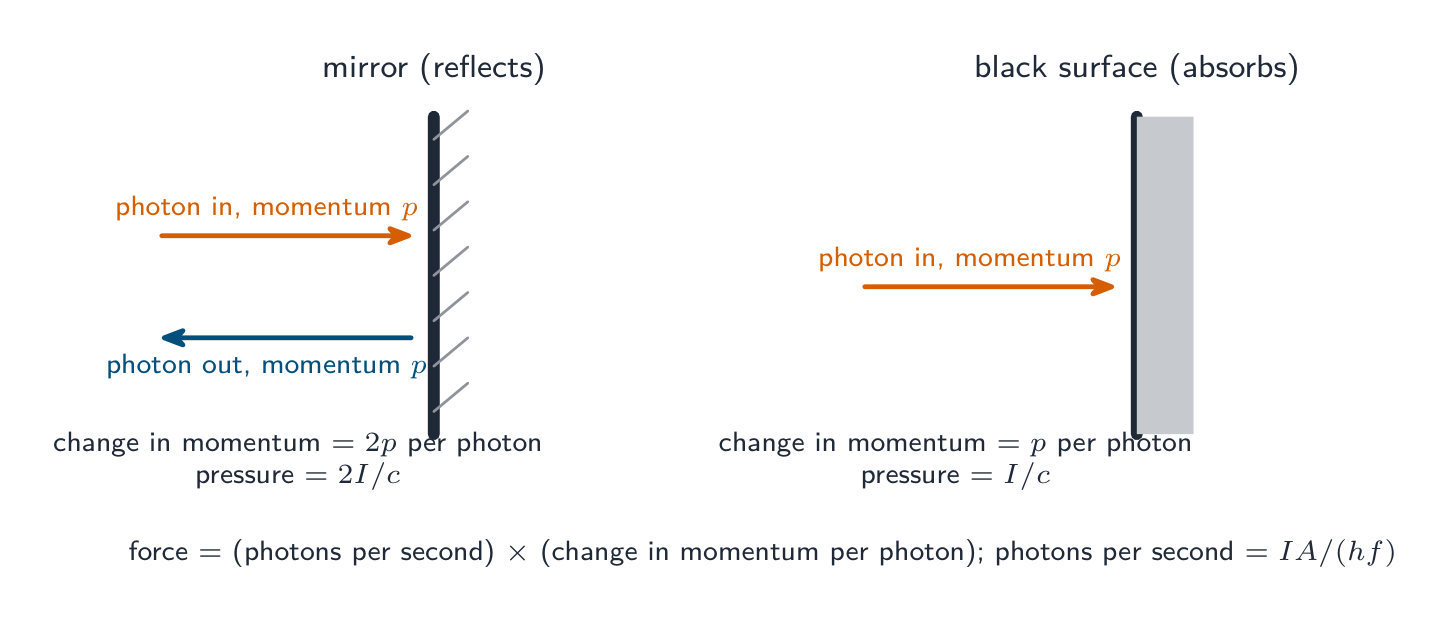
辐射压(radiation pressure)。强度为 $I$(单位面积功率)的光束落在面积 $A$ 上,每秒送来 $IA/(hf)$ 个光子,每个动量为 $h/\lambda$。力是动量的变化率。在镜子上每个光子反弹回去,动量变化 $2p$,力为 $F = 2IA/c$(压强 $2I/c$);在黑色表面上每个光子被吸收,变化为 $p$,压强为 $I/c$。由此得出两点,都会考:压强取决于强度而不是颜色,因为同样强度的蓝光每秒光子更少但每个光子携带成比例更多的动量;而且即使是阳光($I \approx 1\ \text{kW m}^{-2}$)也只施加几微帕。
例题。 强度 $160\ \text{W m}^{-2}$ 的红光垂直落在一面平面镜上;每个光子的动量为 $9.5 \times 10^{-28}\ \text{N s}$。求每秒打在镜子 $1.0\ \text{m}^{2}$ 上的光子数,以及对它的压强。
光子能量 $E = pc = (9.5 \times 10^{-28})(3.00 \times 10^{8}) = 2.85 \times 10^{-19}\ \text{J}$。每秒落在 $1.0\ \text{m}^{2}$ 上的光子数:$160/2.85 \times 10^{-19} = 5.6 \times 10^{20}\ \text{s}^{-1}$。每个都被反射,所以 $1.0\ \text{m}^{2}$ 上的力为 $F = 5.6 \times 10^{20} \times 2 \times 9.5 \times 10^{-28} = 1.1 \times 10^{-6}\ \text{N}$:压强 $1.1 \times 10^{-6}\ \text{Pa}$(检验:$2I/c = 320/3.00 \times 10^{8} = 1.1 \times 10^{-6}\ \text{Pa}$)。换成同样强度的蓝光,压强不变。
例题。 一台激光器发出 $2.0\ \text{mW}$、波长 $650\ \text{nm}$ 的光。求它每秒发出的光子数,以及对一个完全吸收该光束的表面的力。
$E = hc/\lambda = (6.63 \times 10^{-34})(3.00 \times 10^{8})/(650 \times 10^{-9}) = 3.06 \times 10^{-19}\ \text{J}$,所以速率为 $P/E = 2.0 \times 10^{-3}/3.06 \times 10^{-19} = 6.5 \times 10^{15}\ \text{s}^{-1}$。力是每秒传递的动量:$F = P/c = 2.0 \times 10^{-3}/3.00 \times 10^{8} = 6.7 \times 10^{-12}\ \text{N}$(或 $6.5 \times 10^{15} \times h/\lambda$,一回事)。
探索
Energy of a photon
E = h·f
Photon energy is proportional to frequency — the gradient is Planck's constant h.
词汇表
训练
| 英文 | 中文 | 拼音 |
|---|---|---|
| photon/ˈfəʊtɒn/ | 光子 | guāng zi |
| quanta/ˈkwɒntə/ | 量子 | liàng zǐ |
| particulate nature/pəˈtɪkjʊleɪt ˈneɪtʃə/ | 粒子性 | lì zi xìng |
| frequency/ˈfriːkwənsi/ | 频率 | pín lǜ |
| Planck constant/plæŋk ˈkɒnstənt/ | 普朗克常量 | pǔ lǎng kè cháng liàng |
| wavelength/ˈweɪvleŋθ/ | 波长 | bō cháng |
| electronvolt/ɪˈlektrɒnvəʊlt/ | 电子伏特 | diàn zi fú tè |
| kinetic energy/kɪˈnetɪk ˈenədʒi/ | 动能 | dòng néng |
| electron/ɪˈlektrɒn/ | 电子 | diàn zi |
| potential difference/pəˈtenʃl ˈdɪfrəns/ | 电势差 | diàn shì chā |
| momentum/məʊˈmentəm/ | 动量 | dòng liàng |
| Radiation pressure/ˌreɪdɪˈeɪʃn ˈpreʃə/ | 辐射压 | fú shè yā |
22.2
光电效应

大纲
- understand that photoelectrons may be emitted from a metal surface when it is illuminated by electromagnetic radiation
- understand and use the terms threshold frequency and threshold wavelength
- explain photoelectric emission in terms of photon energy and work function energy
- recall and use $hf = \Phi + \frac{1}{2}m{v_{\text{max}}}^2$
- explain why the maximum kinetic energy of photoelectrons is independent of intensity, whereas the photoelectric current is proportional to intensity
来源:剑桥国际大纲
当频率足够高的电磁辐射击中一块金属时,电子被发射出来。这些是光电子(photoelectrons),这个效应是光电效应(photoelectric effect)。
"说明光电效应是什么意思。" 当频率足够高的电磁辐射入射到金属(表面)上时,电子从金属中发射出来。 两分:电子的发射以及从被电磁辐射照射的金属表面(或"当光照在它上面时")。它是教学大纲中辐射粒子性的证据,因为波无法解释接下来的现象。


极限频率和逸出功
每种金属有一个最低的光子频率,即极限频率(threshold frequency)$f_{0}$,在它以下不会有电子出来,无论光多亮。逸出功(work function)$\Phi$ 是从表面释放一个电子所需的最小能量:
$$\Phi = h f_{0}.$$
不同的金属有不同的逸出功(约 $2$–$5\ \text{eV}$)。
两分定义。 金属的逸出功是把一个电子从金属表面移走所需的最小能量。 "最小"和"从表面"都有分:更深处的电子需要更多能量,这正是方程给出的是最大动能的原因。极限频率是能发射光电子的辐射的最小频率,而极限波长(threshold wavelength)$\lambda_{0} = c/f_{0} = hc/\Phi$ 是对应的最大波长:更长的波长什么也做不了。
例题。 波长 $400\ \text{nm}$ 的光落在四种金属上,它们的逸出功为:铯 $2.1\ \text{eV}$、钠 $2.3\ \text{eV}$、锌 $4.3\ \text{eV}$、铂 $5.6\ \text{eV}$。哪些发射光电子,最大动能是多少?
光子能量为 $hc/\lambda = 1240/400 = 3.1\ \text{eV}$。发射需要 $hf \geq \Phi$,所以铯($3.1 - 2.1 = 1.0\ \text{eV}$)和钠($0.8\ \text{eV}$)发射;锌和铂不发射,不论光多强。要让锌发射,波长必须低于 $\lambda_{0} = 1240/4.3 = 290\ \text{nm}$,在紫外区,这就是验电器演示要用紫外灯照锌的原因。
例题。 真空中一块抛光的镁片只有当紫外线频率至少为 $8.8 \times 10^{14}\ \text{Hz}$ 时才发射电子。用 $1.2 \times 10^{15}\ \text{Hz}$ 照射它。求逸出功和光电子的最大速率。
$\Phi = hf_{0} = (6.63 \times 10^{-34})(8.8 \times 10^{14}) = 5.8 \times 10^{-19}\ \text{J}$($3.6\ \text{eV}$)。然后 $\tfrac{1}{2}mv_{\text{max}}^{2} = h(f - f_{0}) = (6.63 \times 10^{-34})(1.2 \times 10^{15} - 8.8 \times 10^{14}) = 2.1 \times 10^{-19}\ \text{J}$,所以 $v_{\text{max}} = \sqrt{2 \times 2.1 \times 10^{-19}/9.11 \times 10^{-31}} = 6.8 \times 10^{5}\ \text{m s}^{-1}$。先把频率相减再乘 $h$;把 $hf$ 和 $\Phi$ 分别舍入会在这个小差值中丢掉一位有效数字。
爱因斯坦光电方程
一个光子把它全部的能量给一个电子。如果光子能量 $hf$ 大于逸出功,电子以直到一个最大值的动能逃逸:
$$h f = \Phi + \tfrac{1}{2} m v_{\text{max}}^{2}, \qquad\text{so}\qquad \tfrac{1}{2} m v_{\text{max}}^{2} = h(f - f_{0}).$$
例题。 一块金属的逸出功是 $2.0\ \text{eV}$。由能量 $3.5\ \text{eV}$ 光子组成的光照在它上面。求光电子的最大动能。
$$\tfrac{1}{2}mv_{\text{max}}^{2} = hf - \Phi = 3.5 - 2.0 = 1.5\ \text{eV}\ (= 2.4 \times 10^{-19}\ \text{J}).$$
所以光电子的最大动能与频率线性相关,而不是与亮度。
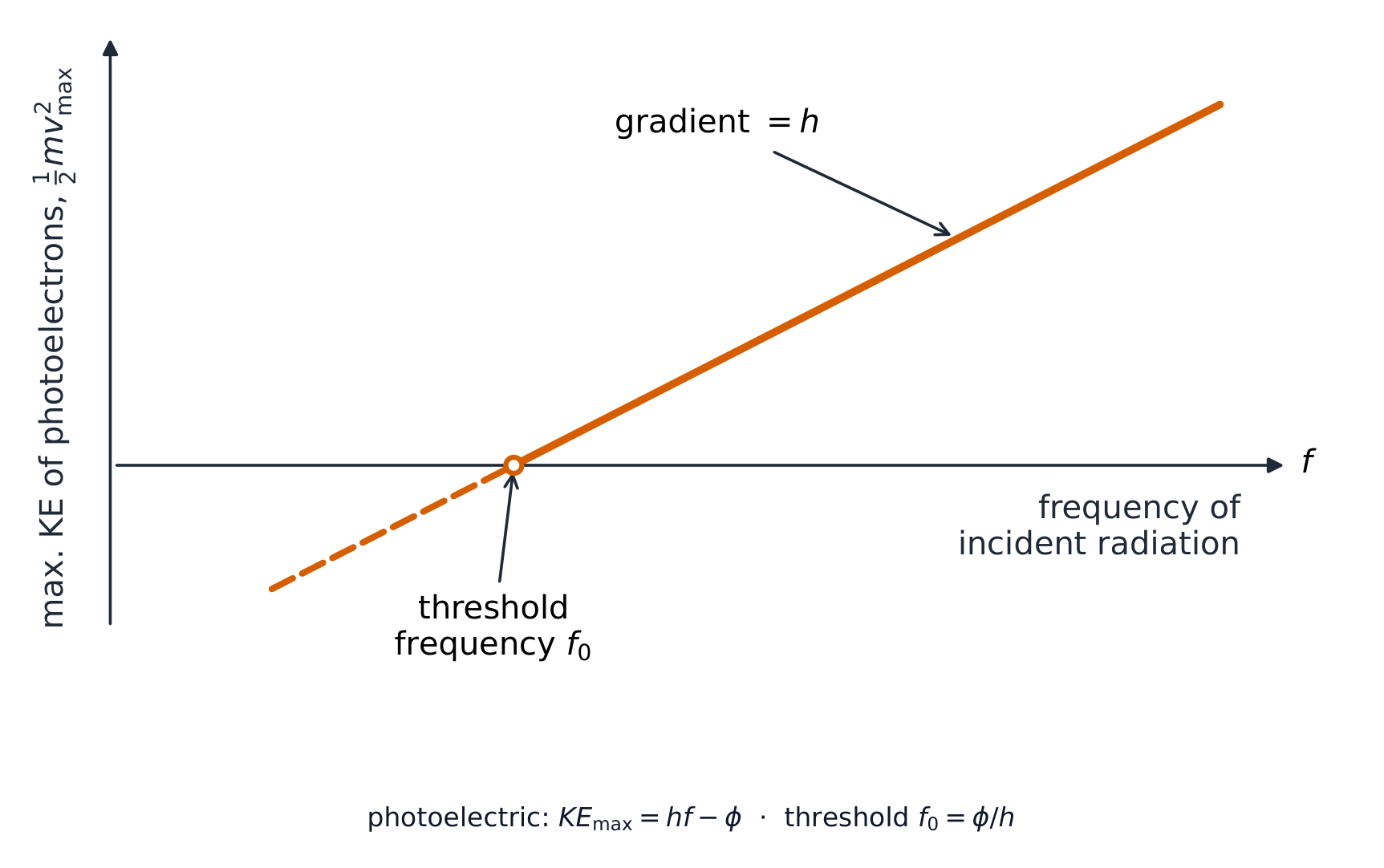
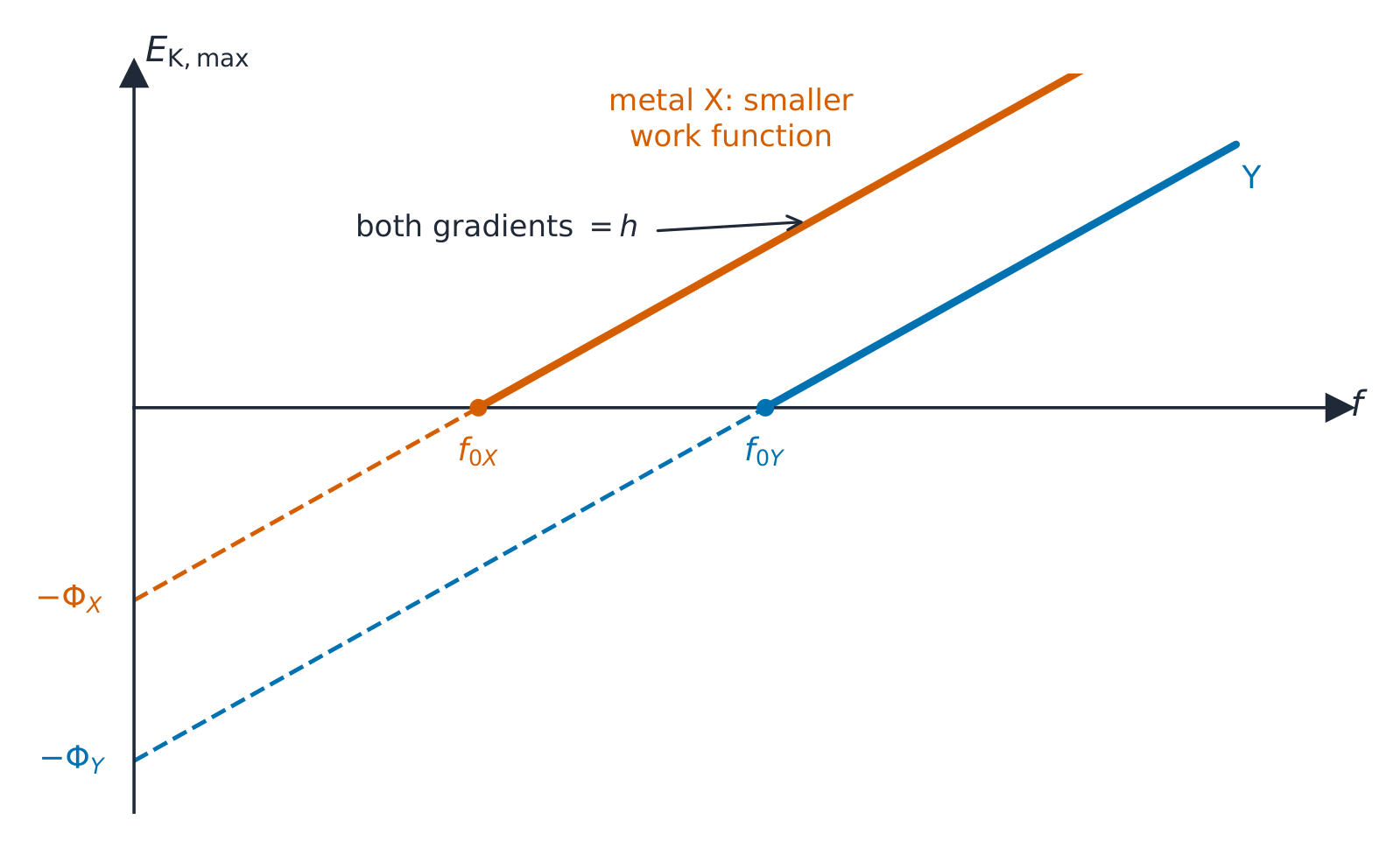
读图。 把方程写成 $E_{\text{K,max}} = hf - \Phi$:一条斜率为 $h$ 的直线,在能量轴上的截距为 $-\Phi$,在频率轴上为 $f_{0} = \Phi/h$。所以两种金属的图显示两条平行线(每种金属的斜率都是同一个 $h$),逸出功较大的金属在更靠右处切频率轴;光的强度不会移动任何一条线。这就是测量普朗克常量的方法,"画出金属 Y 的线"正是按这两个特征评分的。
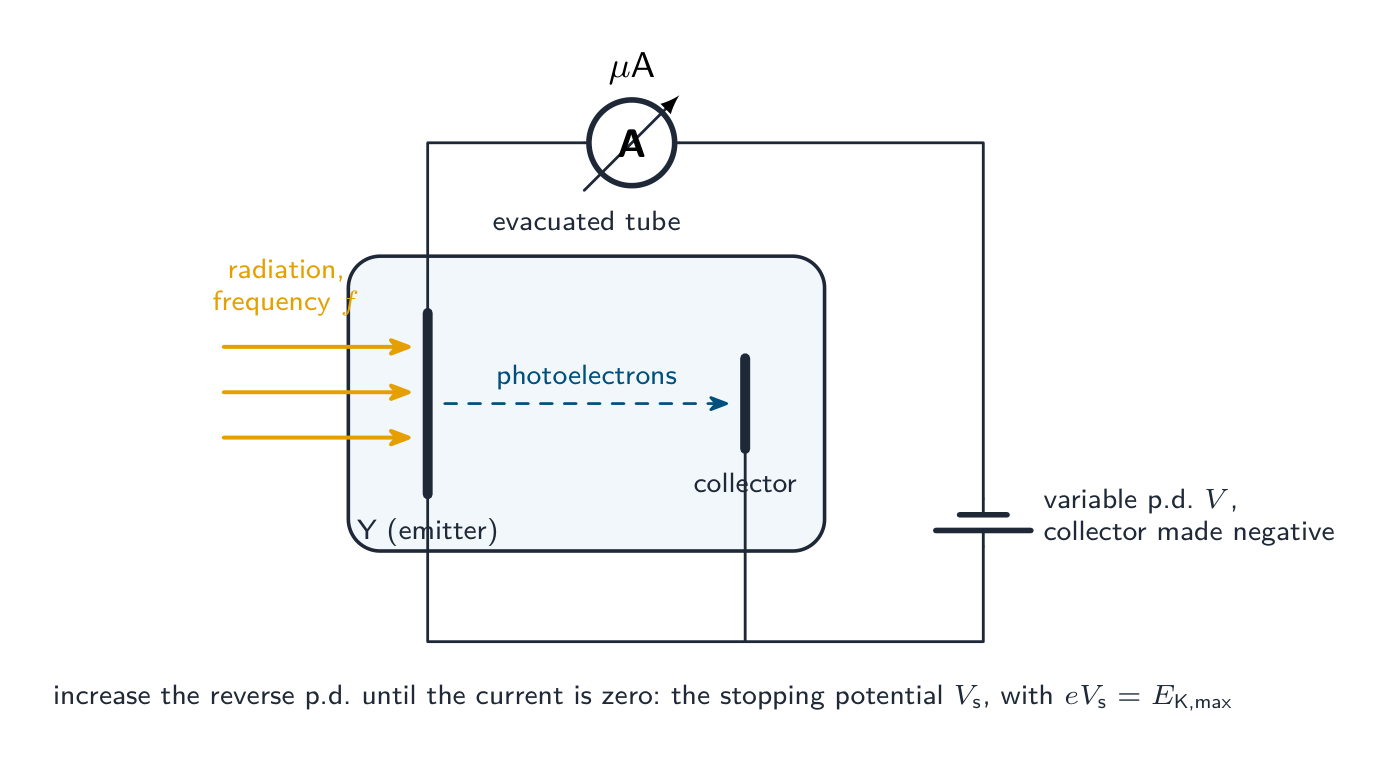
测量最大动能。 在光电管中光电子越过真空到达集电极,电流就是每秒电子数的计数。把集电极变为负,电子就必须爬一个电势坡;增大反向电势差直到电流恰好为零,即遏止电势(stopping potential)$V_{\text{s}}$,于是 $eV_{\text{s}} = E_{\text{K,max}}$。两个结果都会考:频率固定时,强度加倍使低反向电势差下的电流加倍但 $V_{\text{s}}$ 不变;提高频率使 $V_{\text{s}}$ 升高,但在强度固定时不增大电流。
为什么波动模型失败
波动模型预言亮度应当决定电子的动能,而且只要有足够的时间,任何频率都应当发生发射。但实验表明:
- 在极限频率以下没有发射,无论多亮。
- 在极限频率处或以上立即发射,即使很暗。
- 最大动能取决于频率,而不是亮度。
- 光电子的数目(电流)取决于亮度。
光子模型解释了这一点:光作为每个能量为 $hf$ 的光子到来。一次光子-电子相互作用要么有足够的能量释放电子($hf \geq \Phi$),要么没有。
为什么最大动能固定但电流随亮度增长
相同频率的更亮的束有每秒更多的光子,但每个仍携带 $hf$。所以任何电子的最大动能是 $hf - \Phi$(只由 $f$ 决定),而发射速率(电流)随光子数目增长,即随亮度增长。亮度翻倍使电流翻倍,但不改变最大动能。
写出解释(标准三分题)。 (1) 每个光子与一个电子相互作用,并把全部能量给它。(2) 光子能量 $hf$ 只取决于频率,所以电子能带走的最大能量 $hf - \Phi$ 由频率决定。(3) 在同一频率下增大强度增大的是每秒的光子数,所以每秒发射更多电子(更大的电流),但每个电子得到的能量相同。相反,波会把能量铺在表面上,所以更亮的波应当给出更快的电子,而暗的波应当需要延迟来积累能量;两者都没有发生。
探索
The photoelectric effect
KEmax = h·f − φ
Max KE is a straight line in frequency, with intercept −φ (the work function).
词汇表
训练
| 英文 | 中文 | 拼音 |
|---|---|---|
| work function/wɜːk ˈfʌŋkʃn/ | 逸出功 | yì chū gōng |
| photoelectric effect/ˌfəʊtəʊɪˈlektrɪk ɪˈfekt/ | 光电效应 | guāng diàn xiào yìng |
| photoelectron/ˌfəʊtəʊɪˈlektrɒn/ | 光电子 | guāng diàn zi |
| threshold frequency/ˈθreʃəʊld ˈfriːkwənsi/ | 极限频率 | jí xiàn pín lǜ |
| threshold wavelength/ˈθreʃəʊld ˈweɪvleŋθ/ | 极限波长 | jí xiàn bō cháng |
| stopping potential/ˈstɒpɪŋ pəˈtenʃl/ | 遏止电势 | è zhǐ diàn shì |
22.3
波粒二象性

大纲
- understand that the photoelectric effect provides evidence for a particulate nature of electromagnetic radiation while phenomena such as interference and diffraction provide evidence for a wave nature
- describe and interpret qualitatively the evidence provided by electron diffraction for the wave nature of particles
- understand the de Broglie wavelength as the wavelength associated with a moving particle
- recall and use $\lambda = h/p$
来源:剑桥国际大纲
光电效应是光的粒子性的有力证据。但干涉(interference,杨氏双缝、衍射光栅(diffraction grating))和衍射(diffraction)显示它的波性。所以光同时有波和粒子两面——这就是波粒二象性(wave–particle duality)。
"描述波粒二象性是什么意思"(两分)。 电磁辐射(和物质)既能表现出波的性质,如干涉和衍射,也能表现出粒子的性质,如光电效应(对物质则是分立的碰撞)。 被要求对辐射的每种本性各给一条证据时,给出:粒子性,光电效应(极限频率和立即发射);波动性,衍射或干涉(杨氏双缝、衍射光栅)。对物质,波动性的证据是电子衍射。
德布罗意假说
如果波能像粒子那样行事,也许粒子能像波那样行事。德布罗意提出任何运动的粒子有一个德布罗意波长(de Broglie wavelength):
$$\lambda = \frac{h}{p},$$
其中 $p = mv$。例子:一个 $v = 4.9 \times 10^{7}\ \text{m s}^{-1}$ 的电子有 $p = 4.46 \times 10^{-23}\ \text{kg m s}^{-1}$,所以 $\lambda = 1.49 \times 10^{-11}\ \text{m} \approx 0.015\ \text{nm}$——接近原子间距。
"说明德布罗意波长是什么意思。" 与一个运动粒子相关联的波长,或与动量为 $p$ 的粒子相关联的波的波长,由 $\lambda = h/p$ 给出,其中 $h$ 是普朗克常量。在"写出公式并说明其他符号的含义"中,要说明 $h$ 是普朗克常量,$p$ 是粒子的动量。波长很小是因为 $h$ 很小:以 $10\ \text{m s}^{-1}$ 运动的 $0.10\ \text{kg}$ 的球有 $\lambda = 6.6 \times 10^{-34}\ \text{m}$,远小于任何狭缝或晶格间距,这就是日常物体不显示衍射的原因。
电子衍射
当电子射向一个晶格(crystal lattice,例如薄石墨)时,它们在屏上形成一个亮环的衍射图样——正是波长为 $\lambda = h/p$ 的波会做的。这是粒子的波性(电子衍射(electron diffraction))的直接证据:只有波会衍射,而电子会。
更快的电子有更大的动量,所以有更短的德布罗意波长,衍射得更少——环靠得更近。使电子变慢会把环分得更开。计算:$p = \sqrt{2 m E_{\text{K}}}$,对于通过电势差 $V$ 加速的电子,$E_{\text{K}} = eV$,所以 $\lambda = h/\sqrt{2m_{e} e V}$。
例题。 一个电子从静止通过 $2500\ \text{V}$ 的电势差加速。求它的德布罗意波长。($m_{e} = 9.11 \times 10^{-31}\ \text{kg}$,$e = 1.6 \times 10^{-19}\ \text{C}$,$h = 6.63 \times 10^{-34}\ \text{J s}$。)
它的动能是 $E_{\text{K}} = eV$,所以 $\lambda = \dfrac{h}{\sqrt{2 m_{e} e V}}$:
$$\lambda = \frac{6.63 \times 10^{-34}}{\sqrt{2(9.11 \times 10^{-31})(1.6 \times 10^{-19})(2500)}} \approx 2.5 \times 10^{-11}\ \text{m}.$$
这接近晶体中原子之间的间距,这就是为什么电子在石墨上衍射。
推导加速电子的 $\lambda$。 质量 $m$、电荷 $q$ 的电子从静止经电势差 $V$ 加速后获得动能 $qV = \tfrac{1}{2}mv^{2}$,所以 $v = \sqrt{2qV/m}$,$p = mv = \sqrt{2mqV}$;因此 $\lambda = h/\sqrt{2mqV}$。考试会问的两个推论:增大 $V$ 增大动量并缩短波长,所以衍射环向中心收缩;波长减半需要四倍的电势差。
描述电子衍射(四分)。 (1) 来自热灯丝的电子经高电势差加速成束。(2) 电子束遇到一层薄的多晶(polycrystalline)石墨膜;碳原子约 $10^{-10}\ \text{m}$ 的规则间距起衍射光栅的作用。(3) 在荧光屏上电子产生一个明亮的中心点,周围是同心环。(4) 环是衍射图样,而衍射是波的性质,所以电子表现得像波;环的半径与波长 $h/p$ 相符,这证实了德布罗意关系。要把图样画成环,不是点或条纹图样。更快的电子束给出半径更小的环。
探索
The de Broglie wavelength
λ = h/p
A particle's wavelength is inversely proportional to its momentum — faster, heavier particles have shorter waves.
词汇表
训练
| 英文 | 中文 | 拼音 |
|---|---|---|
| wave–particle duality/weɪv ˈpɑːtɪkl djuːˈælɪti/ | 波粒二象性 | bō lì èr xiàng xìng |
| interference/ˌɪntəˈfɪərəns/ | 干涉 | gān shè |
| diffraction grating/dɪˈfrækʃn ˈɡreɪtɪŋ/ | 衍射光栅 | yǎn shè guāng shān |
| diffraction/dɪˈfrækʃn/ | 衍射 | yǎn shè |
| electron diffraction/ɪˈlektrɒn dɪˈfrækʃn/ | 电子衍射 | diàn zi yǎn shè |
| de Broglie wavelength/də ˈbrəʊli ˈweɪvleŋθ/ | 德布罗意波长 | dé bù luó yì bō cháng |
| crystal lattice/ˈkrɪstl ˈlætɪs/ | 晶格 | jīng gé |
| polycrystalline/ˌpɒlɪˈkrɪstəlaɪn/ | 多晶的 | duō jīng de |
22.4
原子能级与线状光谱

大纲
- understand that there are discrete electron energy levels in isolated atoms (e.g. atomic hydrogen)
- understand the appearance and formation of emission and absorption line spectra
- recall and use $hf = E_1 - E_2$
来源:剑桥国际大纲
在一个孤立的原子中,电子只能位于某些分立(discrete)的能级(energy levels)上——决不在其间。最低的是基态(ground state);其余的是激发态(excited states)。
按惯例,能量写成负值,一个刚好脱离原子的电子取 $E = 0$。对于氢,基态是 $E_{1} = -13.6\ \text{eV}$;更高的态趋近零。
发射光谱
当一个电子从较高的能级 $E_{2}$ 落到较低的能级 $E_{1}$ 时,它发射一个能量为下式的光子
$$h f = E_{2} - E_{1}.$$
(两个能量都是负的;它们的差是正的。)因为能级是分立的,只有某些光子能量——因而某些波长——会出来。发射光谱(emission spectrum)是暗背景上的一组尖锐亮线,每一次跃迁(transition)对应一条线。这个图样是该元素的"指纹"。
解释线状光谱(标准四分题)。 (1) 孤立原子中的电子只能占据分立的能级。(2) 处于激发态的电子落到较低的能级,失去的能量作为一个光子发射出来。(3) 光子能量等于两个能级之差,$hf = E_{2} - E_{1}$,所以只发射某些频率(波长)。(4) 每个可能的跃迁给出一条谱线;同一组能级每次给出同样的谱线,这就是光谱能识别元素的原因。被要求把谱线与跃迁配对时:最大的能量差给出频率最高、波长最短的谱线。


吸收光谱
当白光穿过一团冷气体时,能量恰好匹配一次向上跃迁的光子被吸收。光于是显示出亮背景上的暗线——吸收光谱(absorption spectrum)。暗线位于与同一气体的发射线相同的波长处。
解释暗线。 能量等于两个能级之差的光子被吸收,把一个电子提升到较高的能级;受激的电子很快落回并重新发射一个相同能量的光子,但方向随机,所以几乎没有这种光沿原来的路径继续。白光的其余部分,其光子与任何能级差都不匹配,原样通过。因此暗线恰好出现在同一气体会发射的那些波长处:太阳光谱显示的是它外层较冷气体的吸收线。

计算
对于两个已知能级之间的跃迁:
$$hf = E_{2} - E_{1}, \qquad \lambda = \frac{hc}{E_{2} - E_{1}}.$$
用一致的单位——在以米求 $\lambda$ 之前把 eV 换成焦耳(× $1.60 \times 10^{-19}$),或用 $hc \approx 1240\ \text{eV nm}$ 作快速估算。
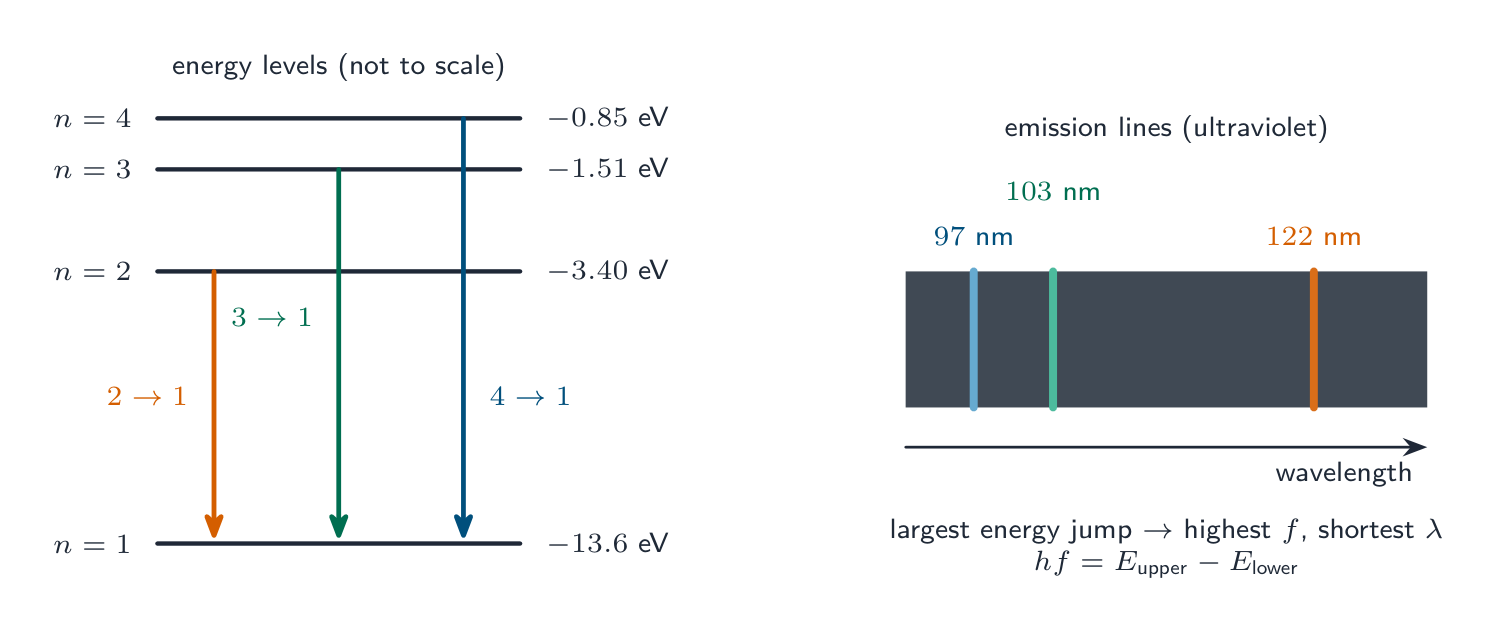
例题。 氢最低的四个能级为 $-13.6$、$-3.40$、$-1.51$ 和 $-0.85\ \text{eV}$。求跃迁到基态所产生的三条谱线的波长,以及这四个能级总共能产生的谱线数。
跃迁 $2 \to 1$:$\Delta E = 13.6 - 3.40 = 10.2\ \text{eV}$,所以 $\lambda = 1240/10.2 = 122\ \text{nm}$。$3 \to 1$:$12.09\ \text{eV}$,$\lambda = 103\ \text{nm}$。$4 \to 1$:$12.75\ \text{eV}$,$\lambda = 97.3\ \text{nm}$:全是紫外线,最大的跃变给出最短的波长。四个能级允许 $4 \to 3$、$4 \to 2$、$4 \to 1$、$3 \to 2$、$3 \to 1$ 和 $2 \to 1$:六条谱线。氢的可见红线是 $3 \to 2$:$1.89\ \text{eV}$,$656\ \text{nm}$。(用焦耳计算:$10.2\ \text{eV} = 1.63 \times 10^{-18}\ \text{J}$,$\lambda = hc/E = 1.99 \times 10^{-25}/1.63 \times 10^{-18} = 1.22 \times 10^{-7}\ \text{m}$。)
例题。 一台激光器在电子从一个能级落到另一个能级时发出波长 $650\ \text{nm}$ 的红光。求两个能级之间的能量差。
$\Delta E = hc/\lambda = 1240/650 = 1.91\ \text{eV} = 3.1 \times 10^{-19}\ \text{J}$。决定颜色的是能级差,而不是任何一个能级:能级不同但能级差相同的两种原子发出同一条谱线。
例题(湮灭)。 一个电子和一个正电子都在缓慢运动,相遇并湮灭(annihilate),产生两个相同的光子。求每个光子的波长。($m_{\text{e}} = 9.11 \times 10^{-31}\ \text{kg}$。)
每个粒子的静止能量为 $E = mc^{2} = (9.11 \times 10^{-31})(3.00 \times 10^{8})^{2} = 8.2 \times 10^{-14}\ \text{J}$($0.51\ \text{MeV}$),动量守恒使能量在两个反向运动的光子之间平分,所以每个携带 $8.2 \times 10^{-14}\ \text{J}$:$\lambda = hc/E = 1.99 \times 10^{-25}/8.2 \times 10^{-14} = 2.4 \times 10^{-12}\ \text{m}$,一条伽马射线。(这对粒子原有的任何动能都会加到光子能量上。)
探索
Make an element's spectral lines
An electron dropping between fixed energy levels emits a photon of exactly the gap's energy — a fixed wavelength and colour. Each jump is one line of the element's barcode.
词汇表
训练
| 英文 | 中文 | 拼音 |
|---|---|---|
| discrete/dɪˈskriːt/ | 分立 | fēn lì |
| energy level/ˈenədʒi ˈlevl/ | 能级 | néng jí |
| ground state/ɡraʊnd steɪt/ | 基态 | jī tài |
| excited states/ekˈsaɪtɪd steɪts/ | 激发态 | jī fā tài |
| excited state/ekˈsaɪtɪd steɪt/ | 激发态 | jī fā tài |
| transition/trænˈsɪʃn/ | 跃迁 | yuè qiān |
| emission spectrum/ɪˈmɪʃn ˈspektrəm/ | 发射光谱 | fā shè guāng pǔ |
| absorption spectrum/əbˈsɔːpʃn ˈspektrəm/ | 吸收光谱 | xī shōu guāng pǔ |
| annihilate/əˈnaɪəleɪt/ | 湮灭 | yān miè |
22.4
考官认可的定义
定义题按固定措辞评分。准确学会这些,只给一个答案。
| 术语 | 定义 |
|---|---|
| 光子 | 电磁辐射能量的一个量子(分立的能量包) |
| 电子伏特 | 一个电子经一伏特电势差加速所获得的能量;$1.60 \times 10^{-19}\ \text{J}$ |
| 光电效应 | 当频率足够高的电磁辐射入射到金属表面时电子从金属中发射出来 |
| 逸出功 | 把一个电子从金属表面移走所需的最小能量 |
| 极限频率 | 能使金属发生光电发射的辐射的最小频率 |
| 极限波长 | 能引起光电发射的辐射的最大波长,$\lambda_{0} = hc/\Phi$ |
| 波粒二象性 | 辐射和物质既表现出波的性质(衍射、干涉),也表现出粒子的性质(光电效应、分立的碰撞) |
| 德布罗意波长 | 与一个运动粒子相关联的波长,$\lambda = h/p$ |
| 能级 | 孤立原子中的电子可以具有的分立能量之一 |
| 发射线状光谱 | 一组波长确定的亮线,每条来自两个能级之间的一次跃迁 |
| 吸收线状光谱 | 连续光谱上的暗线,位于向较高能级跃迁所吸收的波长处 |
22.4
考试技巧
- 光子:$E = hf = hc/\lambda$,$p = E/c = h/\lambda$。用 $hc = 1240\ \text{eV nm}$ 在波长和以 eV 计的能量之间转换,只在答案要求时才换成焦耳。
- 光电方程 $hf = \Phi + \tfrac{1}{2}mv_{\text{max}}^{2}$:最大能量,一个光子对一个电子;$E_{\text{K,max}}$ 对 $f$ 的图斜率为 $h$,截距为 $f_{0}$ 和 $-\Phi$。
- 强度改变每秒光子的数目(电流);频率改变每个光子的能量(最大动能)。把这两句话分开,每个解释就自然写出来了。
- 证据:光电效应说明粒子性,衍射和干涉说明波动性;电子衍射说明物质的波动性,$\lambda = h/p = h/\sqrt{2mqV}$。
- 线状光谱:分立的能级,每次跃迁一个光子,$hf = E_{2} - E_{1}$;最大的能级差给出最短的波长;吸收线位于发射线所在的位置,因为被吸收的光向各个方向重新发射。
- 辐射压:力 $=$ 每秒光子数 $\times$ 每个光子的动量变化;镜子为 $2p$,吸收体为 $p$;压强取决于强度,不取决于颜色。
常见错误
- 把光子定义为"光的粒子"而没有"能量的量子/能量包",或定义逸出功时没有"最小"和"从表面"。
- 说更亮的光给出更快的光电子,或说在极限频率以下发射终究会发生。
- 在一个方程中混用 eV 和焦耳;忘记减去逸出功;在 $\tfrac{1}{2}mv^{2}$ 中用以 eV 计的最大动能。
- 把加速电子的德布罗意波长写成用猜测的 $v$ 算的 $h/(mv)$,而不是 $h/\sqrt{2mqV}$。
- 把电子衍射描述成亮条纹或亮点;图样是同心环,更高的电势差使它们变小。
- 弄错跃迁的方向:发射是落到较低能级,吸收是升高;光子能量是能级差,决不是某一个能级的能量。
- 声称最大的能级差给出最长的波长。
- 忘记反射光子的动量变化为 $2p$,或忘记同样强度的蓝光的压强与红光相同。
本主题的互动课程
逐步学习,并即时检测练习。