- understand that a gravitational field is an example of a field of force and define gravitational field as force per unit mass
- represent a gravitational field by means of field lines
引力场
A-Level 物理 · 第 13 主题
 12:15
12:15
Gravitational Fields
An apple falls from a tree. The Moon sails around the Earth. For thousands of years, no one saw any connection between them. Then Isaac Newton had one of the…
英文讲解 · 内嵌中英文字幕
13.1
引力场

大纲
来源:剑桥国际大纲
定义
重力场(gravitational field)是一个质量(mass)会感受到来自其他质量的力(force)的区域。某点的重力场强度(gravitational field strength)$g$ 是放在那里的一个小检验质量(test mass)所受的每单位质量的重力:
$$g = \frac{F}{m}.$$
单位:$\text{N kg}^{-1}$(与 $\text{m s}^{-2}$ 相同——场中自由落体的加速度)。$g$ 是一个矢量(vector),指向力作用的方向——朝向源质量。
考官的措辞。 重力场是质量在其中受到力的空间区域。某点的重力场强度是作用于放在该点的小检验质量上的每单位质量的重力。某点场线的方向是放在该处的(小检验)质量所受力的方向。三者都是一分的定义;"每单位质量的力"是得分的说法,"1 kg 所受的力"不是。
场线
一个重力场用指向力对检验质量作用方向的场线(field lines)来画:
- 在一个质点(point mass)或一个均匀球(从外部看当作质点)周围,场线是径向的(radial),指向内。
- 在地球表面附近的一小片区域上,场线近似平行且等间距,笔直向下——一个匀强场(uniform field)。
场线越密表示场越强。
用场线解释为什么 $g$ 在表面附近恒定(两分的解释):在一个尺寸远小于地球半径的区域内,径向场线几乎平行,间距随高度几乎不变,所以场强——由间距表示——在区域顶部与底部几乎相同。就整个行星而言,场线随距离散开,场减弱。
例题。 点 P 代表一个质点。画线表示 P 周围的重力场,并说明线的方向表示什么。
从 P 出发的直线径向线,在 P 周围均匀分布,箭头向内指向 P。线的方向是放在该处的小检验质量所受力的方向——总是指向产生场的质量,因为重力只有吸引。
探索
A radial field
Change the mass. The field lines point inward and get denser close in, where the field is stronger — a radial field around a point mass.
词汇表
训练
| 英文 | 中文 | 拼音 |
|---|---|---|
| gravitational field/ˌɡrævɪˈteɪʃənl fiːld/ | 重力场 | zhòng lì chǎng |
| mass/mæs/ | 质量 | zhì liàng |
| force/fɔːs/ | 力 | lì |
| gravitational field strength/ˌɡrævɪˈteɪʃənl fiːld streŋθ/ | 重力场强度 | zhòng lì chǎng qiáng dù |
| test mass/test mæs/ | 检验质量 | jiǎn yàn zhì liàng |
| vector/ˈvektə/ | 矢量 | shǐ liàng |
| field line/fiːld laɪn/ | 场线 | chǎng xiàn |
| field lines/fiːld laɪnz/ | 场线 | chǎng xiàn |
| point mass/pɔɪnt mæs/ | 质点 | zhì diǎn |
| radial/ˈreɪdɪəl/ | 径向 | jìng xiàng |
| uniform field/ˈjuːnɪfɔːm fiːld/ | 匀强场 | yún qiáng chǎng |
13.2 13.3
质点间的引力

大纲
- understand that, for a point outside a uniform sphere, the mass of the sphere may be considered to be a point mass at its centre
- recall and use Newton's law of gravitation $F = Gm_1m_2 / r^2$ for the force between two point masses
- analyse circular orbits in gravitational fields by relating the gravitational force to the centripetal acceleration it causes
- understand that a satellite in a geostationary orbit remains at the same point above the Earth's surface, with an orbital period of 24 hours, orbiting from west to east, directly above the Equator
- derive, from Newton's law of gravitation and the definition of gravitational field, the equation $g = GM/r^2$ for the gravitational field strength due to a point mass
- recall and use $g = GM/r^2$
- understand why $g$ is approximately constant for small changes in height near the Earth's surface
来源:剑桥国际大纲
对于相距 $r$ 的两个质点 $m_{1}, m_{2}$,每个所受的力是
$$F = \frac{G m_{1} m_{2}}{r^{2}},$$
沿连线把它们拉到一起。这就是万有引力定律(Newton's law of gravitation)。常数 $G = 6.67 \times 10^{-11}\ \text{N m}^{2}\ \text{kg}^{-2}$ 是万有引力常量(universal gravitational constant)。
按标准答案要求的文字表述: 两个质点之间的引力与它们质量的乘积成正比,与它们间距的平方成反比——两个正比关系都要写,还要有"质点"。被要求"写出方程并说明其他符号的含义"时,给出 $F = Gm_{1}m_{2}/r^{2}$,其中 $G$ 是引力常量,$r$ 是两中心之间的距离。
例题。 两个孤立的均匀球,质量各为 $1.0 \times 10^{3}\ \text{kg}$,中心相距 $2.0\ \text{m}$。求它们之间的引力并评论其大小。
$F = \dfrac{6.67 \times 10^{-11} \times 1.0 \times 10^{3} \times 1.0 \times 10^{3}}{2.0^{2}} = 1.7 \times 10^{-5}\ \text{N}$。这约是每个球重力($9.8 \times 10^{3}\ \text{N}$)的 $10^{-9}$:日常物体之间的引力可以忽略,只有行星尺度的质量才产生可察觉的场。题目中的"孤立"意味着不必考虑其他质量。
把球当作质点
对于一个均匀球(例如行星或恒星),外部任何一点的场都与位于中心、质量等于总质量的一个质点相同。所以从表面上方来看,你可以把地球当作位于其中心的一个质点。(球内部的点是不同的,不在大纲内。)

在两个质量之间,场相减而势相加。 场强是矢量:在连接两个球的直线上,两个场方向相反,所以存在一点它们相互抵消、合场为零。势是标量:两个势直接相加,而且都为负,所以在场为零的那一点势最不负(是极大值)。
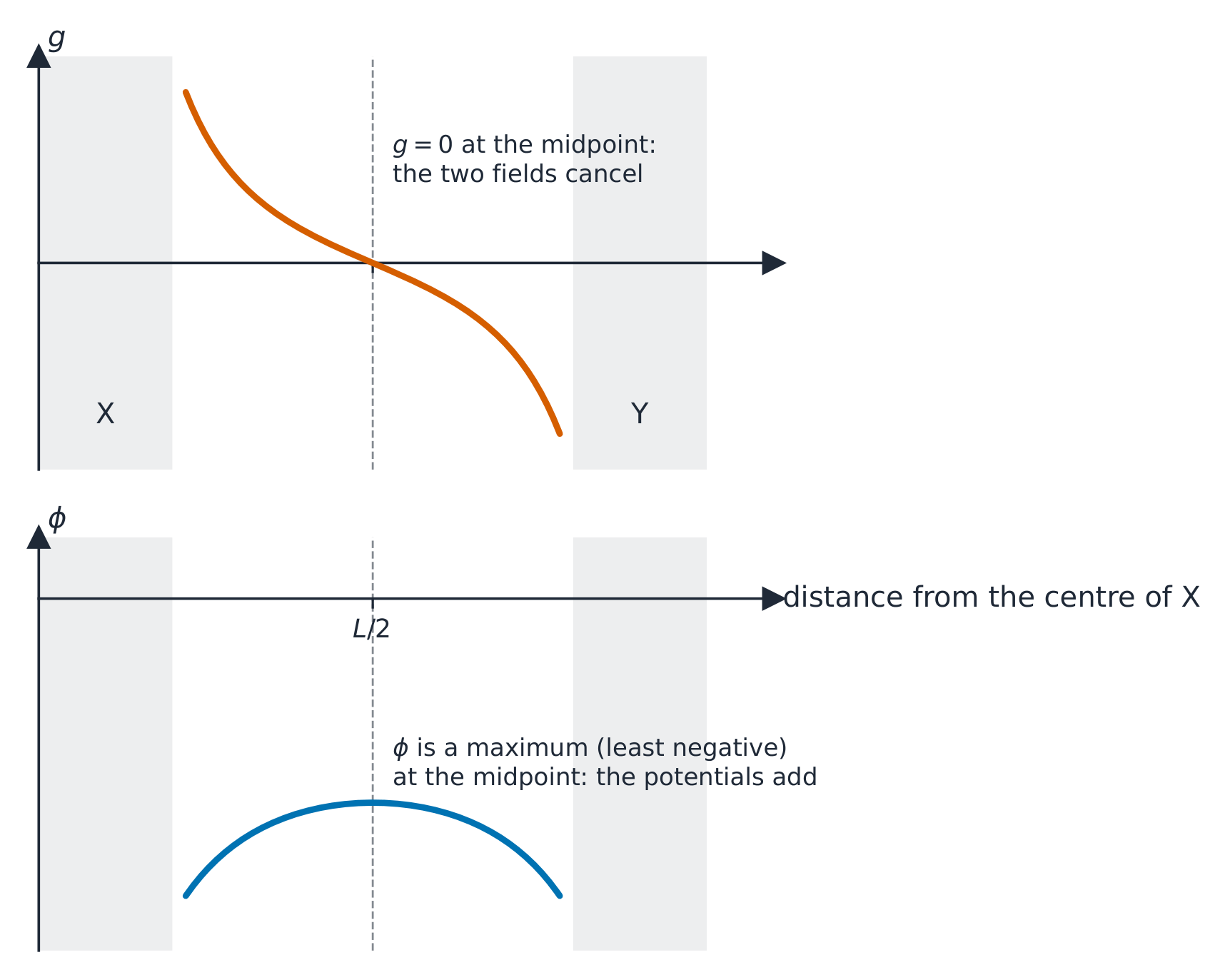
例题。 两个相同的孤立均匀球 X 和 Y,质量各为 $M$、半径 $R$,中心相距 $L$。点 P 在两中心的连线上。说明合场强在线上何处为零,并求那里的引力势。
由对称性,X 和 Y 的场在中点(离每个中心 $L/2$)大小相等、方向相反,所以合场在那里为零。P 处的势是两者之和 $\phi = -\dfrac{GM}{L/2} - \dfrac{GM}{L/2} = -\dfrac{4GM}{L}$。在 P 处释放的质量会停在那里;在线上其他任何位置释放的质量会落向较近的球。
质点的场强
把距离质点 $M$ 为 $r$ 处的检验质量 $m$ 所受的重力代入 $g = F/m$:
$$F = \frac{G M m}{r^{2}}, \qquad g = \frac{G M}{r^{2}}.$$
所以你离开源越远,$g$ 就按 $1/r^{2}$ 衰减。
两分的推导。 距质点 $M$ 为 $r$ 处的检验质量 $m$ 所受的力是 $F = GMm/r^{2}$(牛顿引力定律)。场强是每单位质量的力,$g = F/m$,所以 $g = GM/r^{2}$。两行都要写:定律和定义就是那两分。因为 $g \propto 1/r^{2}$,距离减半使场强变为四倍:在距离 $x/2$ 处场为 $4g$,方向相同,指向 $M$。

例题。 求地球表面的重力场强度。(地球质量 $M = 6.0 \times 10^{24}\ \text{kg}$,半径 $R = 6.4 \times 10^{6}\ \text{m}$,$G = 6.67 \times 10^{-11}\ \text{N m}^{2}\ \text{kg}^{-2}$。)
$$g = \frac{GM}{R^{2}} = \frac{(6.67 \times 10^{-11})(6.0 \times 10^{24})}{(6.4 \times 10^{6})^{2}} \approx 9.8\ \text{N kg}^{-1}.$$
为什么在地球表面附近 $g$ 几乎恒定
地球半径是 $R \approx 6.4 \times 10^{6}\ \text{m}$。上升到高度 $h$ 使离中心的距离从 $R$ 变到 $R + h$。对于 $h \ll R$(任何建筑或山),$(R + h)/R \approx 1$,所以 $g$ 几乎不变——从 $5\ \text{m}$ 升到 $10\ \text{m}$ 高使 $r$ 改变约百万分之一。在实验室里,$g$ 实际上是恒定的。
探索
Newton's law of gravitation
F ∝ Mm / r²
Gravity pulls inward and weakens with the square of the distance.
词汇表
训练
| 英文 | 中文 | 拼音 |
|---|---|---|
| Newton's law of gravitation/ˈnjuːtnz lɔː ɒv ˌɡrævɪˈteɪʃn/ | 万有引力定律 | wàn yǒu yǐn lì dìng lǜ |
| universal gravitational constant/ˌjuːnɪˈvɜːsl ˌɡrævɪˈteɪʃənl ˈkɒnstənt/ | 万有引力常量 | wàn yǒu yǐn lì cháng liàng |
13.2 13.3
引力场中的轨道运动


对于一个质量为 $m$ 的卫星(satellite)在半径为 $r$ 的圆轨道(orbit)上绕一个质量为 $M$ 的天体运行,重力提供向心力(centripetal force):
$$\frac{G M m}{r^{2}} = \frac{m v^{2}}{r}.$$
约去 $m$(轨道速率不取决于卫星的质量):
$$v = \sqrt{\frac{G M}{r}}.$$
例题。 一颗卫星在半径 $r = 7.0 \times 10^{6}\ \text{m}$ 的圆轨道上绕地球运行。求它的轨道速率。(对地球,$GM = 4.0 \times 10^{14}\ \text{m}^{3}\ \text{s}^{-2}$。)
$$v = \sqrt{\frac{GM}{r}} = \sqrt{\frac{4.0 \times 10^{14}}{7.0 \times 10^{6}}} \approx 7.6 \times 10^{3}\ \text{m s}^{-1}.$$
周期(period)由 $T = 2\pi r / v$ 得到:
$$T = 2\pi \sqrt{\frac{r^{3}}{G M}}, \quad\text{so}\quad T^{2} = \frac{4\pi^{2}}{G M} \cdot r^{3}.$$
这是圆轨道的开普勒第三定律(Kepler's third law):$T^{2} \propto r^{3}$。$T^{2}$ 对 $r^{3}$ 的图是过原点、斜率为 $4\pi^{2}/(GM)$ 的直线,所以轨道数据给出中心天体的质量。

考试设置的两分推导。 质量 $m$ 的卫星在质量 $M$ 的行星周围做半径 $R$、周期 $T$ 的圆轨道运动:引力提供向心力,$\dfrac{GMm}{R^{2}} = mR\omega^{2}$,且 $\omega = 2\pi/T$;所以 $\dfrac{GM}{R^{2}} = \dfrac{4\pi^{2}R}{T^{2}}$,得 $T^{2} = \dfrac{4\pi^{2}R^{3}}{GM}$。对半径 $R_{\text{p}}$ 的行星上方高度 $h$ 处的轨道,轨道半径是 $R_{\text{p}} + h$,所以 $T^{2} = 4\pi^{2}(R_{\text{p}} + h)^{3}/GM$:$T^{2}$ 对 $(R_{\text{p}} + h)^{3}$ 的图是过原点的直线,斜率给出 $M$。
例题。 卫星 X 质量 $M_{\text{s}}$,在距行星中心 $4R$ 处绕行;卫星 Y 质量 $2M_{\text{s}}$,在 $3R$ 处绕行。比较它们的速率、周期和动能。
由 $v = \sqrt{GM/r}$,$\dfrac{v_{\text{Y}}}{v_{\text{X}}} = \sqrt{\dfrac{4R}{3R}} = 1.15$:Y 更快,而卫星质量不出现。由 $T \propto r^{3/2}$,$\dfrac{T_{\text{Y}}}{T_{\text{X}}} = \left(\dfrac{3}{4}\right)^{3/2} = 0.65$。动能 $= \tfrac{1}{2}mv^{2} = \dfrac{GMm}{2r}$,所以 $\dfrac{E_{\text{Y}}}{E_{\text{X}}} = \dfrac{2M_{\text{s}}/3R}{M_{\text{s}}/4R} = \dfrac{8}{3}$。比值题先约去 $G$、$M$ 和卫星质量;只有不同的半径和质量留下来。
双星。 质量为 $M_{\text{A}}$ 和 $M_{\text{B}}$、相距 $d$ 的两颗恒星绕它们共同的质心(centre of mass)运行,始终位于质心两侧,周期相同。质心按质量的反比分割 $d$,即 $M_{\text{A}}r_{\text{A}} = M_{\text{B}}r_{\text{B}}$ 且 $r_{\text{A}} + r_{\text{B}} = d$,同一个引力 $GM_{\text{A}}M_{\text{B}}/d^{2}$ 是每颗恒星的向心力。
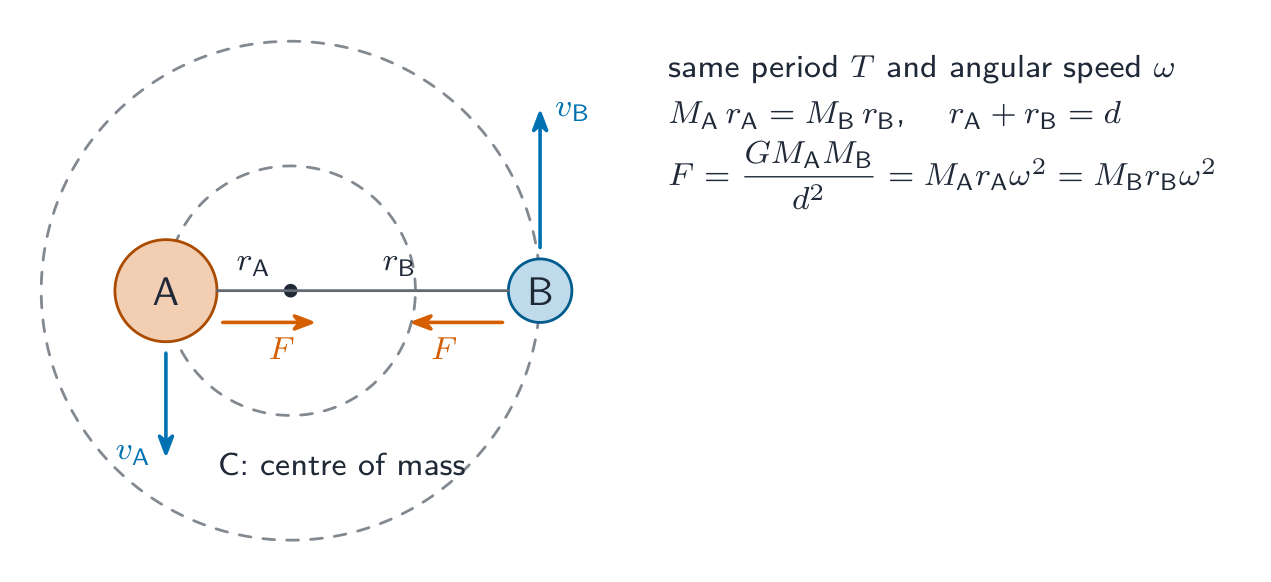
例题。 一个双星由质量 $4.0 \times 10^{30}\ \text{kg}$ 的恒星 A 和质量 $2.0 \times 10^{30}\ \text{kg}$ 的恒星 B 组成,中心相距 $3.3 \times 10^{11}\ \text{m}$。求 A 到质心的距离和轨道周期。
由 $M_{\text{A}}r_{\text{A}} = M_{\text{B}}r_{\text{B}}$ 及 $r_{\text{A}} + r_{\text{B}} = 3.3 \times 10^{11}$ 得 $r_{\text{A}} = \dfrac{2.0}{6.0} \times 3.3 \times 10^{11} = 1.1 \times 10^{11}\ \text{m}$(以及 $r_{\text{B}} = 2.2 \times 10^{11}\ \text{m}$)。对恒星 A:$\dfrac{GM_{\text{A}}M_{\text{B}}}{d^{2}} = M_{\text{A}}r_{\text{A}}\omega^{2}$,所以 $\omega^{2} = \dfrac{GM_{\text{B}}}{d^{2}r_{\text{A}}} = \dfrac{6.67 \times 10^{-11} \times 2.0 \times 10^{30}}{(3.3 \times 10^{11})^{2} \times 1.1 \times 10^{11}} = 1.1 \times 10^{-14}\ \text{s}^{-2}$,$\omega = 1.06 \times 10^{-7}\ \text{rad s}^{-1}$,$T = 2\pi/\omega = 6.0 \times 10^{7}\ \text{s}$,约 $1.9$ 年。力里用 $d$、向心项里用 $r_{\text{A}}$,这正是这道题的要点。
地球同步轨道
一颗地球同步(geostationary)卫星:
- 停在地球上同一点的正上方(所以固定的天线总是指向它),
- 周期为 24 小时(与地球自转相同),
- 自西向东运行(与地球转动方向相同),
- 必须在赤道(equator)正上方。
它必须与地球有相同的角速度(angular speed)、相同的方向,在赤道平面内(否则它会在一天内南北漂移)。由 $T = 24\ \text{h}$ 和 $T^{2} = 4\pi^{2} r^{3}/(GM)$,半径为 $r \approx 4.2 \times 10^{7}\ \text{m}$(在表面上方约 $3.6 \times 10^{7}\ \text{m}$)。
例题。 计算地球($M = 5.98 \times 10^{24}\ \text{kg}$)同步轨道的半径,并解释为什么轨道半径和周期都相同的卫星仍可能不是地球同步的。
$T = 24 \times 3600 = 8.64 \times 10^{4}\ \text{s}$;$r^{3} = \dfrac{GMT^{2}}{4\pi^{2}} = \dfrac{6.67 \times 10^{-11} \times 5.98 \times 10^{24} \times (8.64 \times 10^{4})^{2}}{4\pi^{2}} = 7.5 \times 10^{22}\ \text{m}^{3}$,所以 $r = 4.2 \times 10^{7}\ \text{m}$——离地面高约 $3.6 \times 10^{7}\ \text{m}$。周期为此值的卫星只有当轨道在赤道平面内并自西向东运行时才是地球同步的;周期相同但轨道倾斜(比如经过两极)的卫星每天回到同一点,却并不总在它上方。火星约 $25$ 小时自转一周,所以停在火星某点上方的卫星周期为 $25$ 小时,并具有同样的另外两个特征。
词汇表
训练
| 英文 | 中文 | 拼音 |
|---|---|---|
| orbit/ˈɔːbɪt/ | 轨道 | guǐ dào |
| centripetal force/senˈtrɪpɪtl fɔːs/ | 向心力 | xiàng xīn lì |
| satellite/ˈsætəlaɪt/ | 卫星 | wèi xīng |
| period/ˈpɪərɪəd/ | 周期 | zhōu qī |
| Kepler's third law/ˈkepləz θɜːd lɔː/ | 开普勒第三定律 | kāi pǔ lēi dì sān dìng lǜ |
| centre of mass/ˈsentə ɒv mæs/ | 质心 | zhì xīn |
| geostationary/ˌdʒiːəʊˈsteɪʃənəri/ | 地球同步 | dì qiú tóng bù |
| equator/ɪˈkweɪtə/ | 赤道 | chì dào |
| angular speed/ˈæŋɡjʊlə spiːd/ | 角速度 | jiǎo sù dù |
13.4
引力势

大纲
- define gravitational potential at a point as the work done per unit mass in bringing a small test mass from infinity to the point
- use $\phi = -GM/r$ for the gravitational potential in the field due to a point mass
- understand how the concept of gravitational potential leads to the gravitational potential energy of two point masses and use $E_P = -GMm/r$
来源:剑桥国际大纲
某点的引力势(gravitational potential)$\phi$ 是把一个小检验质量从无穷远(infinity)带到那一点所做的每单位质量的功:
$$\phi = \frac{W}{m}.$$
单位:$\text{J kg}^{-1}$。
势取为在无穷远处为零。当检验质量朝源落入时,重力替你做功,所以除无穷远处外 $\phi$ 处处为负。对于距离 $r$ 处的质点 $M$:
$$\phi = -\frac{G M}{r}.$$
$\phi$ 是一个标量(scalar)。对于几个质量,把势相加。
两分的定义,以及为什么为负。 某点的引力势是把一个小检验质量从无穷远移到该点时每单位质量所做的功。 势规定在无穷远处为零;重力是吸引的,所以检验质量从无穷远进来时,场对它做功、质量放出能量——外力必须做的功是负的。因此任何有限距离处的势都低于零。(正电荷附近的电势为正,原因相反:那个场是排斥的,把正检验电荷移进来必须做功。)
与电势的异同。 两者都定义为从无穷远起每单位质量或每单位正电荷所做的功,都是标量,都随离点源的距离按 $1/r$ 变化,在无穷远处都为零。区别:引力势总是负的,因为重力只有吸引;而电势可以为正或为负,取决于电荷的符号。
读势的图。 题目中出现两种图。在 $\phi$ 对 $r$ 的图上曲线是 $-GM/r$:表面值 $\phi_{\text{s}} = -GM/R$ 给出行星质量,任一点的斜率给出那里的场强,因为 $g = -\dfrac{\Delta\phi}{\Delta r}$——场强是势梯度的负值(这就是题目可能要求的"势与场强的关系")。在 $\phi$ 对 $1/r$ 的图上是过原点的直线,斜率为 $-GM$,这是求 $M$ 更利落的办法。
例题。 月球是质量 $7.3 \times 10^{22}\ \text{kg}$、半径 $1.7 \times 10^{6}\ \text{m}$ 的孤立均匀球。计算其表面的引力势,以及粒子离开表面后能逃逸的最小速率。
$\phi = -\dfrac{GM}{R} = -\dfrac{6.67 \times 10^{-11} \times 7.3 \times 10^{22}}{1.7 \times 10^{6}} = -2.9 \times 10^{6}\ \text{J kg}^{-1}$。要逃逸,粒子每单位质量的动能必须等于势阱的深度:$\tfrac{1}{2}v^{2} = 2.9 \times 10^{6}$,所以 $v = \sqrt{2 \times 2.9 \times 10^{6}} = 2.4 \times 10^{3}\ \text{m s}^{-1}$。负号承载着含义:每千克必须提供 $2.9\ \text{MJ}$ 的能量才能把粒子提出来。
两个质点的重力势能
如果一个检验质量 $m$ 位于势为 $\phi$ 的地方,这一对的重力势能(gravitational potential energy)是
$$E_{\text{P}} = m \phi = -\frac{G M m}{r}.$$
与势一样,$E_{\text{P}}$ 为负,只有在无穷远分离时才达到零。靠得越近的质量势能越负(束缚得越紧)。
与 $\Delta E_{\text{P}} = mg\Delta h$ 的联系
对于表面附近的小高度变化,$r$ 几乎不变,所以 $\Delta E_{\text{P}} \approx mg\Delta h$。对于大的变化(卫星移到更高的轨道),在每个半径处用 $-GMm/r$ 并取差:
$$\Delta E_{\text{P}} = GMm\left(\frac{1}{r_{1}} - \frac{1}{r_{2}}\right) \quad (r_{2} > r_{1}),$$
它是正的(必须提供能量才能把卫星升高)。
例题。 一颗质量 $1200\ \text{kg}$ 的卫星从半径 $7.0 \times 10^{6}\ \text{m}$ 的圆轨道移到半径 $8.0 \times 10^{6}\ \text{m}$ 的圆轨道(地球 $GM = 4.0 \times 10^{14}\ \text{m}^{3}\ \text{s}^{-2}$)。求它的重力势能、动能和总能量的变化。
$\Delta E_{\text{P}} = GMm\left(\dfrac{1}{r_{1}} - \dfrac{1}{r_{2}}\right) = 4.0 \times 10^{14} \times 1200 \times \left(\dfrac{1}{7.0 \times 10^{6}} - \dfrac{1}{8.0 \times 10^{6}}\right) = +8.6 \times 10^{9}\ \text{J}$。圆轨道中 $E_{\text{K}} = \tfrac{1}{2}mv^{2} = \dfrac{GMm}{2r}$,所以 $\Delta E_{\text{K}} = \dfrac{GMm}{2}\left(\dfrac{1}{r_{2}} - \dfrac{1}{r_{1}}\right) = -4.3 \times 10^{9}\ \text{J}$:更高的卫星运动得更慢。总能量 $E_{\text{K}} + E_{\text{P}} = -\dfrac{GMm}{2r}$ 增加 $+4.3 \times 10^{9}\ \text{J}$,这就是火箭发动机必须提供的能量。卫星的总能量为负——它被束缚着——轨道变大时变得不那么负。
逃逸速度(由能量守恒)
要从半径 $r$ 逃逸到无穷远,一个物体的动能(kinetic energy)必须等于它重力势能的大小:
$$\tfrac{1}{2} m v_{\text{esc}}^{2} = \frac{G M m}{r}, \qquad v_{\text{esc}} = \sqrt{\frac{2 G M}{r}}.$$
在地球表面,逃逸速度(escape velocity)$\approx 11\ \text{km s}^{-1}$。它不取决于物体的质量。
例题。 求从地球表面的逃逸速度。(对地球,$GM = 4.0 \times 10^{14}\ \text{m}^{3}\ \text{s}^{-2}$,$R = 6.4 \times 10^{6}\ \text{m}$。)
$$v_{\text{esc}} = \sqrt{\frac{2GM}{R}} = \sqrt{\frac{2 (4.0 \times 10^{14})}{6.4 \times 10^{6}}} \approx 1.1 \times 10^{4}\ \text{m s}^{-1}\ (= 11\ \text{km s}^{-1}).$$
例题。 一个粒子从半径 $R$、表面引力势为 $\phi_{\text{s}}$ 的孤立行星表面竖直向上射出。证明当发射速率 $v$ 满足 $\tfrac{1}{2}v^{2} = -\phi_{\text{s}}\left(1 - \dfrac{R}{r}\right)$ 时它恰好到达离中心 $r$ 处,并推出逃逸速率。
势按 $1/r$ 变化,所以距离 $r$ 处的势是 $\phi_{\text{s}}R/r$。粒子停下时,它每单位质量的动能全部变成了每单位质量的势能:$\tfrac{1}{2}v^{2} = \phi(r) - \phi_{\text{s}} = \phi_{\text{s}}\dfrac{R}{r} - \phi_{\text{s}} = -\phi_{\text{s}}\left(1 - \dfrac{R}{r}\right)$,因为 $\phi_{\text{s}}$ 为负,这是正的。令 $r \to \infty$ 得 $\tfrac{1}{2}v_{\text{esc}}^{2} = -\phi_{\text{s}} = GM/R$——又是逃逸速率的结果,这次直接从势读出。
探索
Gravitational potential
V = −GM / r
Potential ∝ −1/r — deep near the mass, flattening with distance.
词汇表
训练
| 英文 | 中文 | 拼音 |
|---|---|---|
| scalar/ˈskeɪlə/ | 标量 | biāo liàng |
| gravitational potential/ˌɡrævɪˈteɪʃənl pəˈtenʃl/ | 引力势 | yǐn lì shì |
| kinetic energy/kɪˈnetɪk ˈenədʒi/ | 动能 | dòng néng |
| infinity/ɪnˈfɪnɪti/ | 无穷远 | wú qióng yuǎn |
| gravitational potential energy/ˌɡrævɪˈteɪʃənl pəˈtenʃl ˈenədʒi/ | 重力势能 | zhòng lì shì néng |
| escape velocity/eˈskeɪp vəˈlɒsɪti/ | 逃逸速度 | táo yì sù dù |
13.4
考官认可的定义
定义题按固定措辞给分。把这些记准,并且只给一个答案。
| 术语 | 定义 |
|---|---|
| 重力场 | 质量在其中受到力的空间区域 |
| 重力场强度 | 作用于放在该点的小检验质量上的每单位质量的重力 |
| 场线(方向) | 放在该点的小检验质量所受力的方向 |
| 牛顿引力定律 | 两个质点之间的引力与它们质量的乘积成正比,与它们间距的平方成反比 |
| 引力势 | 把一个小检验质量从无穷远移到该点时每单位质量所做的功 |
| 重力势能(两个质点) | 把两个质量从无穷远移到它们的间距处所做的功,$E_{\text{P}} = -GMm/r$ |
| 地球同步轨道 | 周期为 24 小时、自西向东、位于赤道正上方的轨道,使卫星停在地表同一点上方 |
| 逃逸速率 | 物体离开表面后能以零动能到达无穷远所需的最小速率 |
| 质心(双星) | 两颗恒星共同绕行的点,按质量的反比分割它们的间距 |
13.4
考试技巧
- 万有引力定律 $F = GMm/r^2$(平方反比);场强 $g = GM/r^2$——推导写成两行:定律和 $g$ 的定义。
- 区分引力势($\phi = -GM/r$,总为负,在无穷远处为零)和场强;$g$ 是 $\phi$–$r$ 图斜率的负值。
- 对于轨道,令重力 $=$ 向心力得到 $T^2 \propto r^3$;地球同步轨道 $T = 24\ \text{h}$ 外还有两个特征:在赤道上方,自西向东。
- 用轨道半径(中心到中心,$R_{\text{p}} + h$),绝不用高度;双星的力里用间距 $d$,向心项里用轨道半径 $r_{\text{A}}$。
- 能量变化来自每个半径处的 $-GMm/r$;圆轨道中 $E_{\text{K}} = GMm/2r$,总能量为 $-GMm/2r$。
常见错误
- 把势定义成"每单位质量的力",或把场强定义成"每单位质量所做的功"。两者一换,两分全丢。
- 说势为负"因为重力是吸引的"就停下。得分需要做功的论证:无穷远处为零,质量进来时由场做功。
- 在 $GM/r^{2}$ 或 $T^{2} \propto r^{3}$ 中把离地高度当作 $r$。先加上行星半径。
- 把开普勒定律写成 $T \propto r$ 或 $T^{2} \propto r^{2}$。它是 $T^{2} \propto r^{3}$:只有在 $T^{2}$ 对 $r^{3}$ 的图上才是直线。
- 让"地球同步"只意味着"24 小时周期"。没有赤道平面和自西向东,就不是地球同步。
- 忘了卫星升到更高轨道时动能减小,尽管必须提供能量。
本主题的互动课程
逐步学习,并即时检测练习。