这份讲义涵盖主题 5:概率统计(Probability & Statistics)1。它是关于描述数据、计数选择,以及算出事件的机会。
概率与统计1
A-Level 数学 · 第 5 主题
 11:38
11:38
Probability & Statistics 1
Roll a single die, and the result is anyone's guess. But roll it thousands of times, or measure the heights of thousands of people, and something remarkable…
英文讲解 · 内嵌中英文字幕
5.1
数据的表示

大纲
| Candidates should be able to: | Notes and examples |
|---|---|
| • select a suitable way of presenting raw statistical data, and discuss advantages and/or disadvantages that particular representations may have | |
| • draw and interpret stem-and-leaf diagrams, box-and-whisker plots, histograms and cumulative frequency graphs | Including back-to-back stem-and-leaf diagrams. |
| • understand and use different measures of central tendency (mean, median, mode) and variation (range, interquartile range, standard deviation) | e.g. in comparing and contrasting sets of data. |
| • use a cumulative frequency graph | e.g. to estimate medians, quartiles, percentiles, the proportion of a distribution above (or below) a given value, or between two values. |
| • calculate and use the mean and standard deviation of a set of data (including grouped data) either from the data itself or from given totals $\Sigma x$ and $\Sigma x^2$, or coded totals $\Sigma(x - a)$ and $\Sigma(x - a)^2$, and use such totals in solving problems which may involve up to two data sets. |
来源:剑桥国际大纲
选择一个适合数据的图。你应当能够画和读:
- 一个茎叶图(stem-and-leaf diagram,保留原始值并显示形状);两个数据集用一个背靠背(back-to-back)版本比较——一个共享的中央茎,一个数据集的叶向左增大而另一个向右,这样你能一眼比较它们的中位数和离散程度;
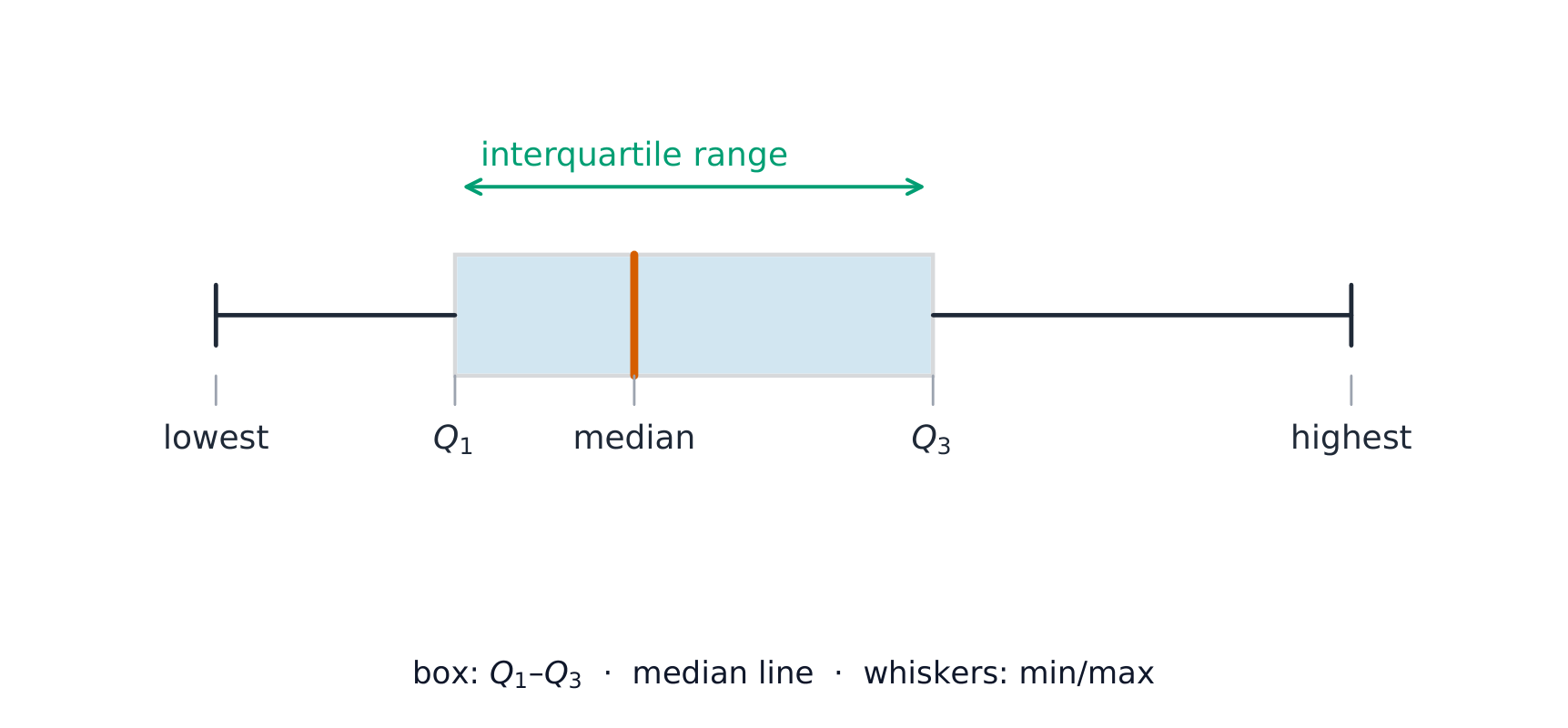
- 一个箱线图(box-and-whisker plot,显示最低值、三个四分位数和最高值);
- 一个直方图(histogram,用于分组数据,每个条的面积显示频数);
- 一个累积频数(cumulative frequency)图(累加的总数,用来估计中位数和四分位数)。
Averages and spread
一个集中趋势(measure of central tendency)是一个单一的"中间"值:
- 平均数(mean)$\bar{x} = \dfrac{\sum x}{n}$(平均);
- 中位数(median,数据按顺序时的中间值);
- 众数(mode,最常见的值)。
一个离散程度(variation)的量度显示数据铺开多少:
- 极差(range of data,最高 $-$ 最低);
- 四分位距(interquartile range,上四分位数 $-$ 下四分位数);
- 标准差(standard deviation)$\sigma = \sqrt{\dfrac{\sum x^2}{n} - \bar{x}^2}$。
你常常从总数 $\sum x$ 和 $\sum x^2$ 工作。标准差的平方是方差(variance)。
例题。 对于 $10$ 个值,$\sum x = 50$ 且 $\sum x^2 = 300$。求平均数和标准差。
$$\bar{x} = \frac{50}{10} = 5, \qquad \sigma = \sqrt{\frac{300}{10} - 5^2} = \sqrt{30 - 25} = \sqrt{5} = 2.24.$$
编码(coding)使大数字更容易。用一个方便的假定平均数(assumed mean)$a$,把每个值换成 $t=x-a$。那么 $\bar{x}=a+\bar{t}$,而标准差不变(把每个值平移不改变数据的离散)。所以从编码后的总和 $\sum(x-a)$ 和 $\sum(x-a)^2$ 你直接得到 $\bar x$ 和 $\sigma$,而两个数据集能通过它们编码后的总和比较。
探索
Spread and the bell
P(−k < Z < k)
Spread is measured in standard deviations — about 68% of data lies within 1 sd, 95% within 2.
词汇表
训练
| 英文 | 中文 | 拼音 |
|---|---|---|
| stem-and-leaf diagram/stem ænd liːf ˈdaɪəɡræm/ | 茎叶图 | jīng yè tú |
| back-to-back/bæk tə bæk/ | 背靠背 | bèi kào bèi |
| box-and-whisker plot/bɒks ænd ˈwɪskə plɒt/ | 箱线图 | xiāng xiàn tú |
| histogram/ˈhɪstəɡræm/ | 直方图 | zhí fāng tú |
| cumulative frequency/ˈkjuːmjʊlətɪv ˈfriːkwənsi/ | 累积频数 | lěi jī pín shuò |
| measure of central tendency/ˈmeʒə ɒv ˈsentrəl ˈtendənsi/ | 集中趋势 | jí zhōng qū shì |
| mean/miːn/ | 平均数 | píng jūn shù |
| median/ˈmiːdiːən/ | 中位数 | zhōng wèi shù |
| mode/məʊd/ | 众数 | zhòng shù |
| variation/ˌveərɪˈeɪʃn/ | 离散程度 | lí sàn chéng dù |
| range (of data)/reɪndʒ/ | 极差 | jí chà |
| interquartile range/ˌɪntəˈkwɔːtaɪl reɪndʒ/ | 四分位距 | sì fēn wèi jù |
| standard deviation/ˈstændəd ˌdiːvɪˈeɪʃn/ | 标准差 | biāo zhǔn chà |
| variance/ˈveərɪəns/ | 方差 | fāng chà |
| Coding/ˈkəʊdɪŋ/ | 编码 | biān mǎ |
| assumed mean/əˈsjuːmd miːn/ | 假定平均数 | jiǎ dìng píng jūn shù |
| central tendency/ˈsentrəl ˈtendənsi/ | 集中趋势 | jí zhōng qū shì |
5.2
排列与组合

大纲
| Candidates should be able to: | Notes and examples |
|---|---|
| • understand the terms permutation and combination, and solve simple problems involving selections | |
| • solve problems about arrangements of objects in a line, including those involving – repetition (e.g. the number of ways of arranging the letters of the word ‘NEEDLESS’) – restriction (e.g. the number of ways several people can stand in a line if two particular people must, or must not, stand next to each other). | Questions may include cases such as people sitting in two (or more) rows. Questions about objects arranged in a circle will not be included. |
来源:剑桥国际大纲
一个排列(permutation)是顺序重要的一个安排;一个组合(combination)是顺序不重要的一个选择。这些数是
$${}^nP_r = \frac{n!}{(n-r)!}, \qquad {}^nC_r = \binom{n}{r} = \frac{n!}{r!\,(n-r)!}.$$
要在一条线上安排物体,当一些被重复时,除以每个重复计数的阶乘。
例题。 单词 NEEDLESS 的字母有多少个不同的安排?
有 $8$ 个字母,E 重复 $3$ 次而 S 重复 $2$ 次:
$$\frac{8!}{3!\,2!} = \frac{40320}{6 \times 2} = 3360.$$

探索
Permutation or combination lab
Choose whether order matters in a counting problem.
词汇表
训练
| 英文 | 中文 | 拼音 |
|---|---|---|
| permutation/ˌpɜːmjuːˈteɪʃn/ | 排列 | pái liè |
| combination/ˌkɒmbɪˈneɪʃn/ | 组合 | zǔ hé |
5.3
概率

大纲
| Candidates should be able to: | Notes and examples |
|---|---|
| evaluate probabilities in simple cases by means of enumeration of equiprobable elementary events, or by calculation using permutations or combinations | e.g. the total score when two fair dice are thrown. e.g. drawing balls at random from a bag containing balls of different colours. |
| use addition and multiplication of probabilities, as appropriate, in simple cases | Explicit use of the general formula $\text{P}(A \cup B) = \text{P}(A) + \text{P}(B) - \text{P}(A \cap B)$ is not required. |
| understand the meaning of exclusive and independent events, including determination of whether events $A$ and $B$ are independent by comparing the values of $\text{P}(A \cap B)$ and $\text{P}(A) \times \text{P}(B)$ | |
| calculate and use conditional probabilities in simple cases. | e.g. situations that can be represented by a sample space of equiprobable elementary events, or a tree diagram. The use of $\text{P}(A|B) = \frac{\text{P}(A \cap B)}{\text{P}(B)}$ may be required in simple cases. |
来源:剑桥国际大纲
通过计数等可能的结果、或通过用排列和组合来求一个概率。用这些规则组合概率:
- 对"或"用加法:$P(A \cup B) = P(A) + P(B) - P(A \cap B)$;
- 当事件独立时对"且"用乘法:$P(A \cap B) = P(A)\,P(B)$。

若两个事件不能都发生,它们是互斥事件(mutually exclusive events);若一个发生不改变另一个的机会,它们是独立事件(independent events)。要测试独立性,检查是否 $P(A \cap B) = P(A)\times P(B)$。一个条件概率(conditional probability)是在 $B$ 已发生的情况下 $A$ 的机会:$P(A \mid B) = \dfrac{P(A \cap B)}{P(B)}$。
例题。 事件有 $P(A) = 0.5$、$P(B) = 0.4$ 和 $P(A \cap B) = 0.2$。$A$ 和 $B$ 独立吗?
测试:$P(A)\times P(B) = 0.5 \times 0.4 = 0.2 = P(A \cap B)$。这些值相等,所以 $A$ 和 $B$ 独立。
探索
Conditional probability
Change the probabilities and read the tree. This is how P(A and B) and conditional probability fit together.
词汇表
训练
| 英文 | 中文 | 拼音 |
|---|---|---|
| mutually exclusive events/ˈmjuːtʃuːəli eksˈkluːsɪv ɪˈvents/ | 互斥事件 | hù chì shì jiàn |
| independent events/ˌɪndɪˈpendənt ɪˈvents/ | 独立事件 | dú lì shì jiàn |
| conditional probability/kənˈdɪʃənl ˌprɒbəˈbɪlɪti/ | 条件概率 | tiáo jiàn gài lǜ |
5.4
离散随机变量
大纲
| Candidates should be able to: | Notes and examples |
|---|---|
| draw up a probability distribution table relating to a given situation involving a discrete random variable $X$, and calculate $\text{E}(X)$ and $\text{Var}(X)$ | |
| use formulae for probabilities for the binomial and geometric distributions, and recognise practical situations where these distributions are suitable models | Including the notations $\text{B}(n, p)$ and $\text{Geo}(p)$. $\text{Geo}(p)$ denotes the distribution in which $p_r = p(1 - p)^{r-1}$ for $r = 1, 2, 3, \dots$. |
| use formulae for the expectation and variance of the binomial distribution and for the expectation of the geometric distribution. | Proofs of formulae are not required. |
来源:剑桥国际大纲
一个离散型随机变量(discrete random variable)$X$ 取分开的值,每个带一个概率。把它们列在一个概率分布表(probability distribution table)里;概率必须加起来为 $1$。然后期望(expectation,平均)和方差是
$$E(X) = \sum x\,P(X = x), \qquad \mathrm{Var}(X) = \sum x^2\,P(X = x) - \big(E(X)\big)^2.$$
两个特殊的模型:
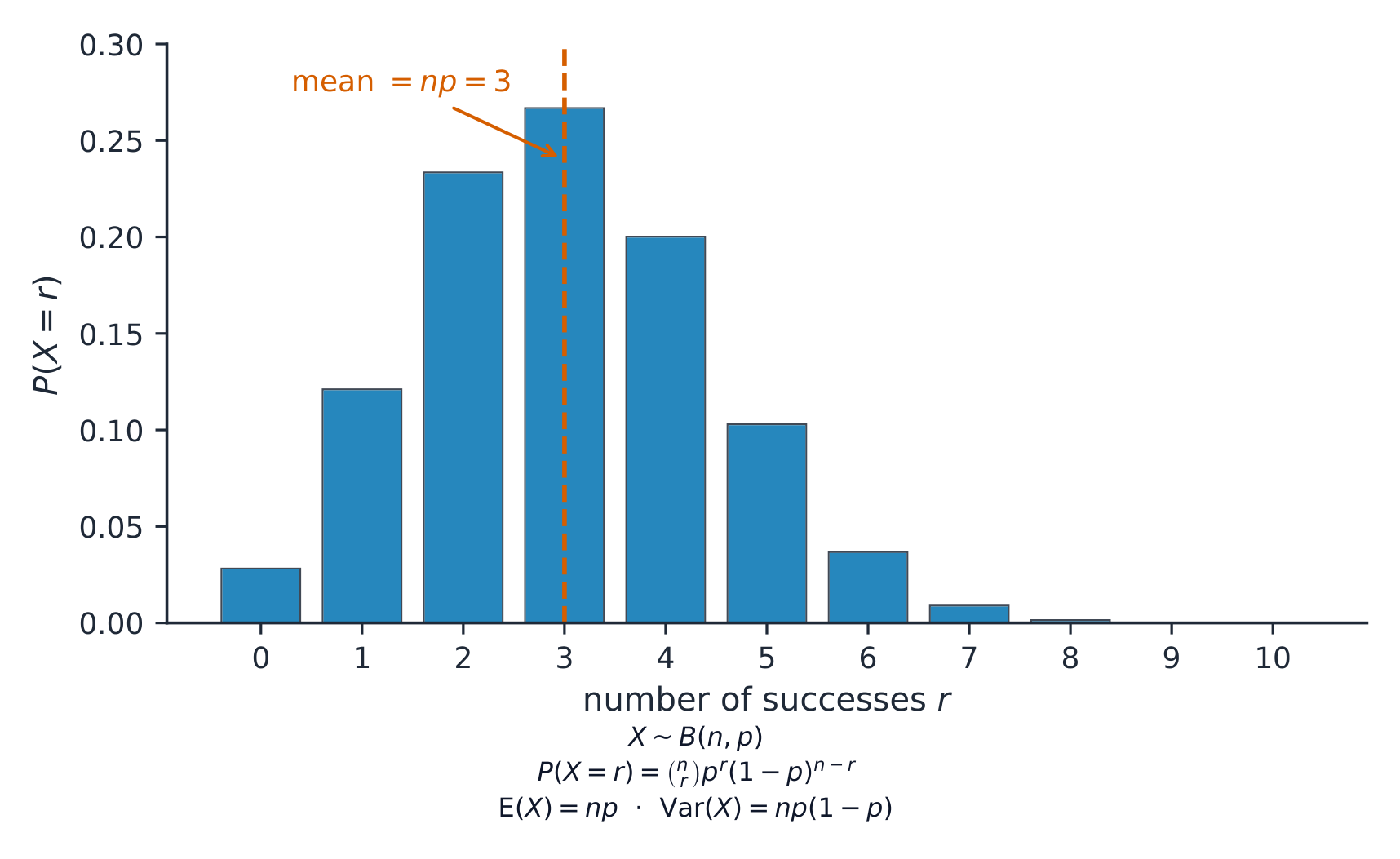
- 二项分布(binomial distribution)$X \sim B(n, p)$,用于 $n$ 个独立试验中成功的数目:$P(X = r) = \binom{n}{r}p^r(1-p)^{n-r}$,带 $E(X) = np$ 和 $\mathrm{Var}(X) = np(1-p)$;
- 几何分布(geometric distribution),用于第一次成功发生的试验:$P(X = r) = (1-p)^{r-1}p$,带 $E(X) = \dfrac{1}{p}$。
例题。 $X \sim B(10, 0.3)$。求 $P(X = 2)$ 和 $E(X)$。
$$P(X = 2) = \binom{10}{2}(0.3)^2(0.7)^8 = 45 \times 0.09 \times 0.05765 = 0.233, \qquad E(X) = 10 \times 0.3 = 3.$$
探索
A discrete distribution
Change n and p for a binomial distribution and watch the bars — the probability of each number of successes.
词汇表
训练
| 英文 | 中文 | 拼音 |
|---|---|---|
| discrete random variable/dɪˈskriːt ˈrændəm ˈveərɪəbl/ | 离散型随机变量 | lí sàn xíng suí jī biàn liàng |
| probability distribution table/ˌprɒbəˈbɪlɪti ˌdɪstrɪˈbjuːʃn ˈteɪbl/ | 概率分布表 | gài lǜ fēn bù biǎo |
| expectation/ekspɪkˈteɪʃn/ | 期望 | qī wàng |
| binomial distribution/baɪˈnəʊmɪəl ˌdɪstrɪˈbjuːʃn/ | 二项分布 | èr xiàng fēn bù |
| geometric distribution/ˌdʒiːəʊˈmetrɪk ˌdɪstrɪˈbjuːʃn/ | 几何分布 | jǐ hé fēn bù |
5.5
正态分布

大纲
| Candidates should be able to: | Notes and examples |
|---|---|
| understand the use of a normal distribution to model a continuous random variable, and use normal distribution tables | Sketches of normal curves to illustrate distributions or probabilities may be required. |
| solve problems concerning a variable $X$, where $X \sim N(\mu, \sigma^2)$, including: – finding the value of $P(X > x_1)$, or a related probability, given the values of $x_1$, $\mu$, $\sigma$. – finding a relationship between $x_1$, $\mu$ and $\sigma$ given the value of $P(X > x_1)$ or a related probability | For calculations involving standardisation, full details of the working should be shown. e.g. $Z = \frac{(X - \mu)}{\sigma}$ |
| recall conditions under which the normal distribution can be used as an approximation to the binomial distribution, and use this approximation, with a continuity correction, in solving problems. | $n$ sufficiently large to ensure that both $np > 5$ and $nq > 5$. |
来源:剑桥国际大纲
正态分布(normal distribution)以一个对称的钟形为一个连续型随机变量(continuous random variable)建模。写 $X \sim N(\mu, \sigma^2)$,其中 $\mu$ 是平均值而 $\sigma$ 是标准差。要用表,通过标准化(standardisation)转换到变量 $Z \sim N(0, 1)$:
$$Z = \frac{X - \mu}{\sigma}.$$
然后 $P(X < x) = P\!\left(Z < \dfrac{x - \mu}{\sigma}\right)$,你从正态表 $\Phi$ 读它。

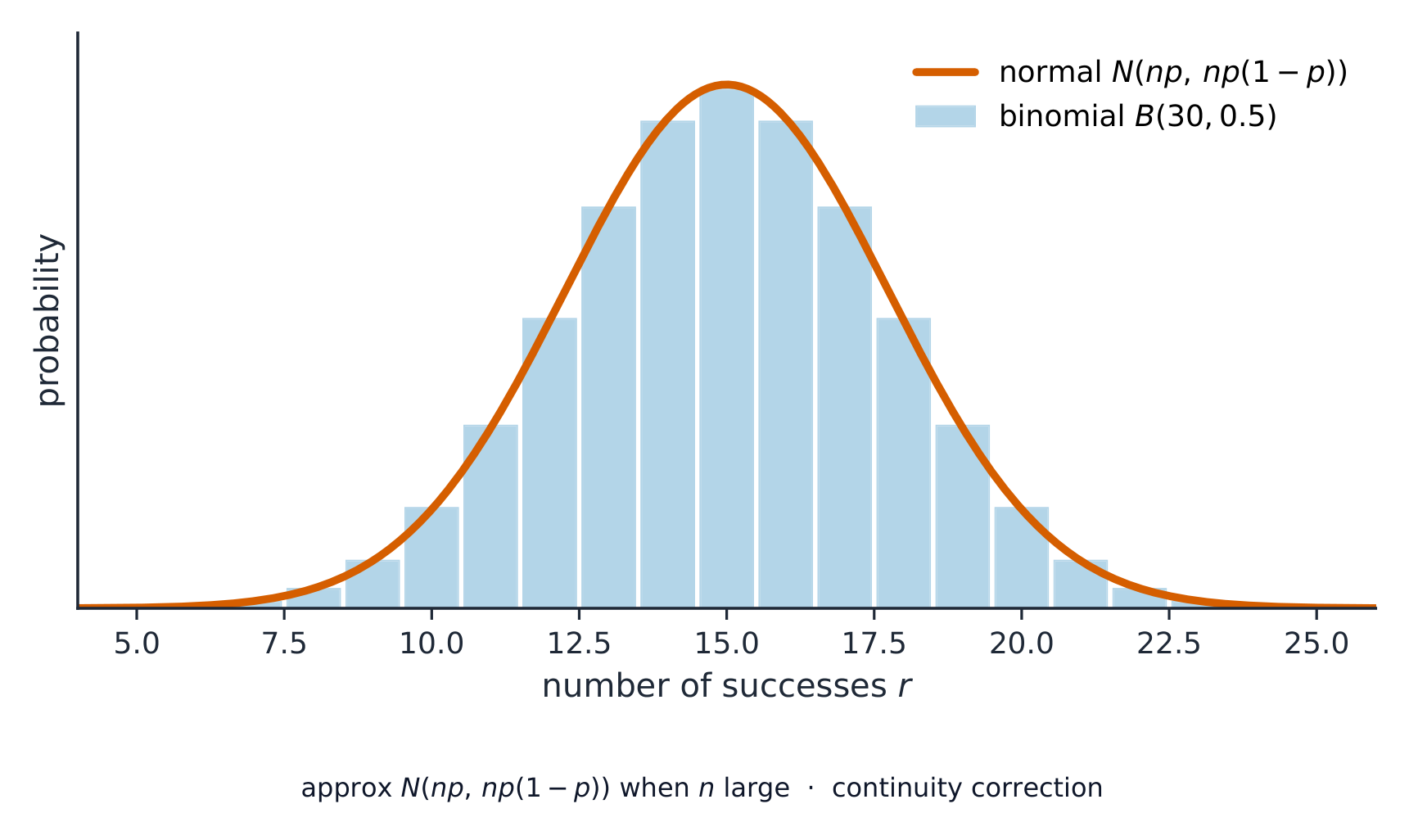
当 $n$ 大时,正态分布也是二项的一个好近似(approximation)。因为你用一个连续变量替换一个离散变量,应用一个连续性校正(continuity correction,调整 $0.5$)。
例题。 米袋有质量 $X \sim N(\mu, 0.14^2)$。给定 $P(X < 1.48) = 0.22$,求 $\mu$。
从表,$P(Z < z) = 0.22$ 给出 $z = -0.772$。所以
$$\frac{1.48 - \mu}{0.14} = -0.772 \;\Rightarrow\; \mu = 1.48 + 0.772 \times 0.14 = 1.59\ \text{kg (3 s.f.)}.$$
探索
The normal distribution
Shade the area to find a probability. A z-value measures how many standard deviations a point is from the mean.
词汇表
训练
| 英文 | 中文 | 拼音 |
|---|---|---|
| normal distribution/ˈnɔːml ˌdɪstrɪˈbjuːʃn/ | 正态分布 | zhèng tài fēn bù |
| continuous random variable/kənˈtɪnjuːəs ˈrændəm ˈveərɪəbl/ | 连续型随机变量 | lián xù xíng suí jī biàn liàng |
| standardisation/ˌstændədaɪˈzeɪʃn/ | 标准化 | biāo zhǔn huà |
| approximation/əˌprɒksɪˈmeɪʃn/ | 近似 | jìn sì |
| continuity correction/kɒntɪˈnjuːɪti kəˈrekʃn/ | 连续性校正 | lián xù xìng jiào zhèng |
| Probability & Statistics/ˌprɒbəˈbɪlɪti ænd stəˈtɪstɪks/ | 概率统计 | gài lǜ tǒng jì |
5.5
考试技巧
- 决定顺序是否重要:重要时用排列($^nP_r$),不重要时用组合($^nC_r$)。
- 对于一个离散型随机变量,检查概率加起来为 $1$ 并用 $E(X) = \sum x\,P(X=x)$。
- 对于正态分布,用 $z = (x - \mu)/\sigma$ 标准化、作草图并着色,然后读表。
- 当用正态近似一个离散变量时应用一个连续性校正。
本主题的互动课程
逐步学习,并即时检测练习。