这份讲义涵盖主题 1:纯数学(Pure Mathematics)1。它是本课程的代数(algebra)和微积分(calculus)核心。每个 ## 节是一个考纲子主题。
纯数学1
A-Level 数学 · 第 1 主题
 28:42
28:42
Pure Mathematics 1
Look at a great suspension bridge. Its huge cable is not a random shape — it hangs in a perfect parabola, a curve you can write with a single equation. The…
英文讲解 · 内嵌中英文字幕
讲义
双页
词汇表
双页
词汇测验 1
双页
词汇测验 2
双页
词汇测验 3
双页
词汇测验 4
双页
词汇测验 5
双页
词汇测验 6
双页
词汇测验 7
双页
词汇测验 8
双页
词汇测验 18
双页
1.1
二次函数

大纲
| Candidates should be able to: | Notes and examples |
|---|---|
| carry out the process of completing the square for a quadratic polynomial $ax^2 + bx + c$ and use a completed square form | e.g. to locate the vertex of the graph of $y = ax^2 + bx + c$ or to sketch the graph |
| find the discriminant of a quadratic polynomial $ax^2 + bx + c$ and use the discriminant | e.g. to determine the number of real roots of the equation $ax^2 + bx + c = 0$. Knowledge of the term ‘repeated root’ is included. |
| solve quadratic equations, and quadratic inequalities, in one unknown | By factorising, completing the square and using the formula. |
| solve by substitution a pair of simultaneous equations of which one is linear and one is quadratic | e.g. $x + y + 1 = 0$ and $x^2 + y^2 = 25$, $2x + 3y = 7$ and $3x^2 = 4 + 4xy$. |
| recognise and solve equations in $x$ which are quadratic in some function of $x$. | e.g. $x^4 - 5x^2 + 4 = 0$, $6x + \sqrt{x} - 1 = 0$, $\tan^2 x = 1 + \tan x$. |
来源:剑桥国际大纲
一个二次式(quadratic)是形如 $ax^2 + bx + c$ 的一个表达式,其中 $a \neq 0$。字母 $a$、$b$、$c$ 是系数(coefficients,固定的数)。这一节的大部分是关于解方程 $ax^2 + bx + c = 0$。
Completing the square
配方(complete the square)意味着把二次式写成
$$a(x + p)^2 + q.$$
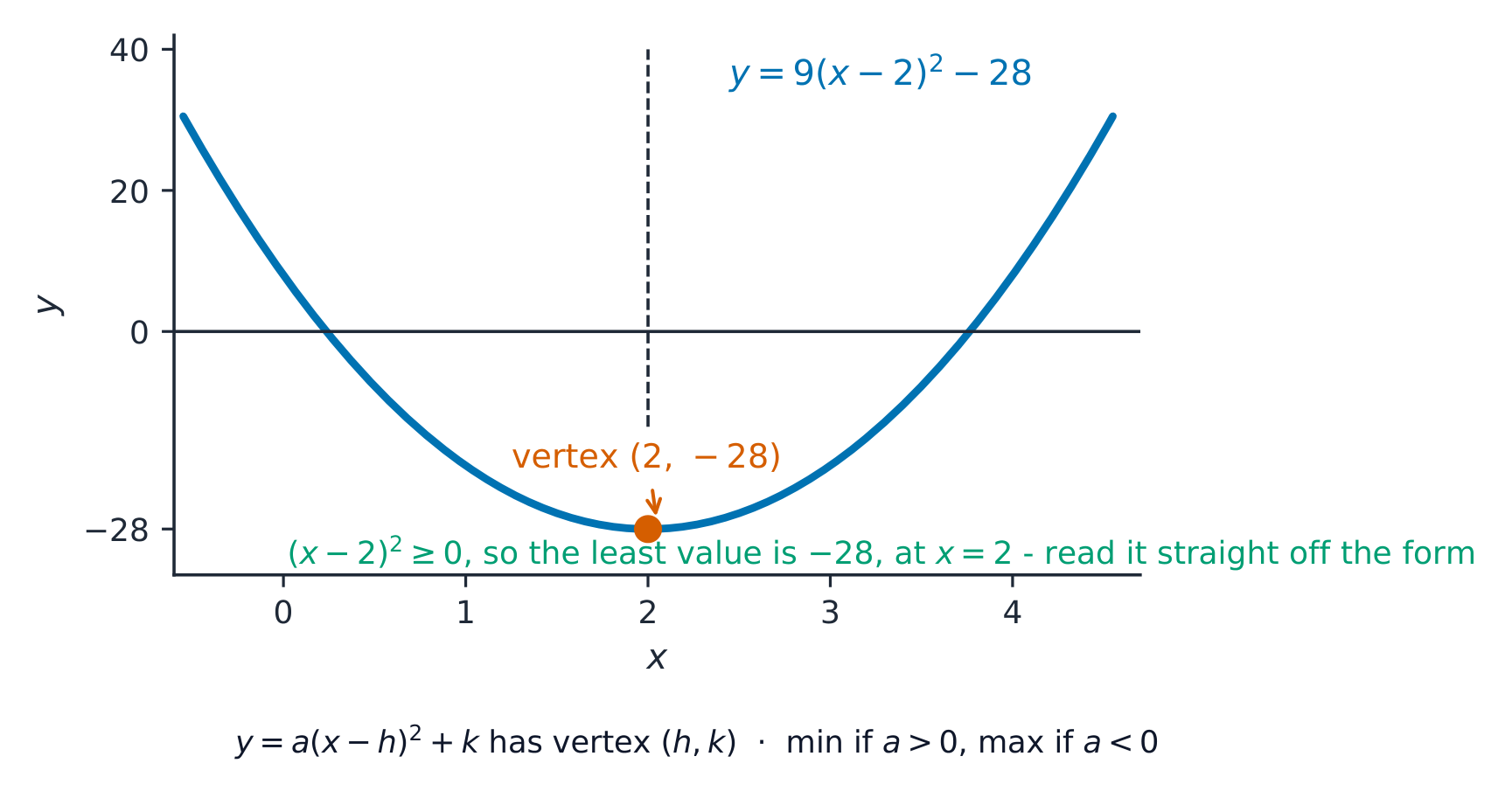
这个形式有用:它在 $(-p,\ q)$ 显示曲线的顶点(vertex,转折点),而且它给出一个解方程的快速方法。
例题。 把 $9x^2 - 36x + 8$ 写成 $p(x + q)^2 + r$ 的形式。
把因子 $9$ 从前两项提出来,然后在里面配方:
$$\begin{aligned}
9x^2 - 36x + 8 &= 9\left(x^2 - 4x\right) + 8 \\
&= 9\left((x - 2)^2 - 4\right) + 8 \\
&= 9(x - 2)^2 - 36 + 8 = 9(x - 2)^2 - 28.
\end{aligned}$$
所以 $p = 9$,$q = -2$,$r = -28$。
The discriminant
$ax^2 + bx + c$ 的判别式(discriminant)是
$$\Delta = b^2 - 4ac.$$
它告诉你方程 $ax^2 + bx + c = 0$ 有多少个实根(real roots,实数解):
| 判别式 | 根 |
|---|---|
| $b^2 - 4ac > 0$ | 两个相异(distinct)实根 |
| $b^2 - 4ac = 0$ | 一个重复的实根 |
| $b^2 - 4ac < 0$ | 没有实根 |

例题。 求常数 $k$ 的值,使 $3kx^2 + (k + 8)x + 3 = 0$ 有两个相异实根。
这里 $a = 3k$,$b = k + 8$,$c = 3$。要两个相异实根你需要 $b^2 - 4ac > 0$:
$$(k + 8)^2 - 4(3k)(3) > 0 \;\Rightarrow\; k^2 + 16k + 64 - 36k > 0 \;\Rightarrow\; k^2 - 20k + 64 > 0.$$
因式分解:$(k - 4)(k - 16) > 0$,所以 $k < 4$ 或 $k > 16$。你也需要 $a \neq 0$,所以 $k \neq 0$。
Quadratic equations and inequalities
要解一个二次方程(quadratic equation),因式分解、配方,或用公式
$$x = \frac{-b \pm \sqrt{b^2 - 4ac}}{2a}.$$
要解一个二次不等式(quadratic inequality)如 $(k - 4)(k - 16) > 0$,找到两个根,然后决定每个根的哪一侧使陈述成立。抛物线(parabola)的一个草图有帮助:曲线在根外面在 $x$ 轴之上(正),在它们之间在它之下(负)。
Simultaneous equations
要解一对联立方程(simultaneous equations),其中一个是线性的、一个是二次的,用代入(substitution):把线性方程重排解出一个字母,然后把它代入二次方程。这给出一个单一的二次方程去解。
Equations that are quadratic in disguise
一些方程在 $x$ 的某个函数上是二次的。例如 $x^4 - 5x^2 + 4 = 0$ 在 $x^2$ 上是二次的:令 $u = x^2$,解 $u^2 - 5u + 4 = 0$,然后回到 $x$。你会在三角学中再次用这个思想。
探索
The shape of a quadratic
y = ax² + bx + c
Drag a, b and c. Watch the vertex, the line of symmetry and the roots (where it cuts the x-axis) move as the coefficients change.
词汇表
训练
| 英文 | 中文 | 拼音 |
|---|---|---|
| Pure Mathematics/pjʊə ˌmæθɪˈmætɪks/ | 纯数学 | chún shù xué |
| quadratic/kwɒˈdrætɪk/ | 二次式 | èr cì shì |
| coefficients/ˌkəʊɪˈfɪʃənts/ | 系数 | xì shù |
| complete the square/kəmˈpliːt ðə skweə/ | 配方 | pèi fāng |
| vertex/ˈvɜːteks/ | 顶点 | dǐng diǎn |
| discriminant/dɪˈskrɪmɪnənt/ | 判别式 | pàn bié shì |
| real roots/rɪəl ruːts/ | 实根 | shí gēn |
| distinct/dɪˈstɪŋkt/ | 相异 | xiāng yì |
| quadratic equation/kwɒˈdrætɪk ɪˈkweɪʒn/ | 二次方程 | èr cì fāng chéng |
| quadratic inequality/kwɒˈdrætɪk ɪniːˈkwɒlɪti/ | 二次不等式 | èr cì bù děng shì |
| simultaneous equations/ˌsɪməlˈteɪnɪəs ɪˈkweɪʒnz/ | 联立方程 | lián lì fāng chéng |
| substitution/ˌsʌbstɪˈtjuːʃn/ | 代入 | dài rù |
| coefficient/ˌkəʊɪˈfɪʃənt/ | 系数 | xì shù |
| parabola/pəˈræbələ/ | 抛物线 | pāo wù xiàn |
1.2
函数
大纲
| Candidates should be able to: | Notes and examples |
|---|---|
| understand the terms function, domain, range, one-one function, inverse function and composition of functions | |
| identify the range of a given function in simple cases, and find the composition of two given functions | e.g. range of $f : x \mapsto \frac{1}{x}$ for $x \geqslant 1$ and range of $g : x \mapsto x^2 + 1$ for $x \in \mathbb{R}$. Including the condition that a composite function $gf$ can only be formed when the range of $f$ is within the domain of $g$. |
| determine whether or not a given function is one-one, and find the inverse of a one-one function in simple cases | e.g. finding the inverse of $h : x \mapsto (2x + 3)^2 - 4$ for $x < -\frac{3}{2}$. |
| illustrate in graphical terms the relation between a one-one function and its inverse | Sketches should include an indication of the mirror line $y = x$. |
| understand and use the transformations of the graph of $y = f(x)$ given by $y = f(x) + a$, $y = f(x + a)$, $y = af(x)$, $y = f(ax)$ and simple combinations of these. | Including use of the terms ‘translation’, ‘reflection’ and ‘stretch’ in describing transformations. Questions may involve algebraic or trigonometric functions, or other graphs with given features. |
来源:剑桥国际大纲
一个函数(function)是把每个输入送到恰好一个输出的一个规则。把它写作 $f(x)$。复合函数(composition of functions)$fg(x)$ 意味着先应用 $g$,然后对结果应用 $f$。
- 定义域(domain)是允许的输入 $x$ 的集合。
- 值域(range)是函数实际产生的输出的集合。
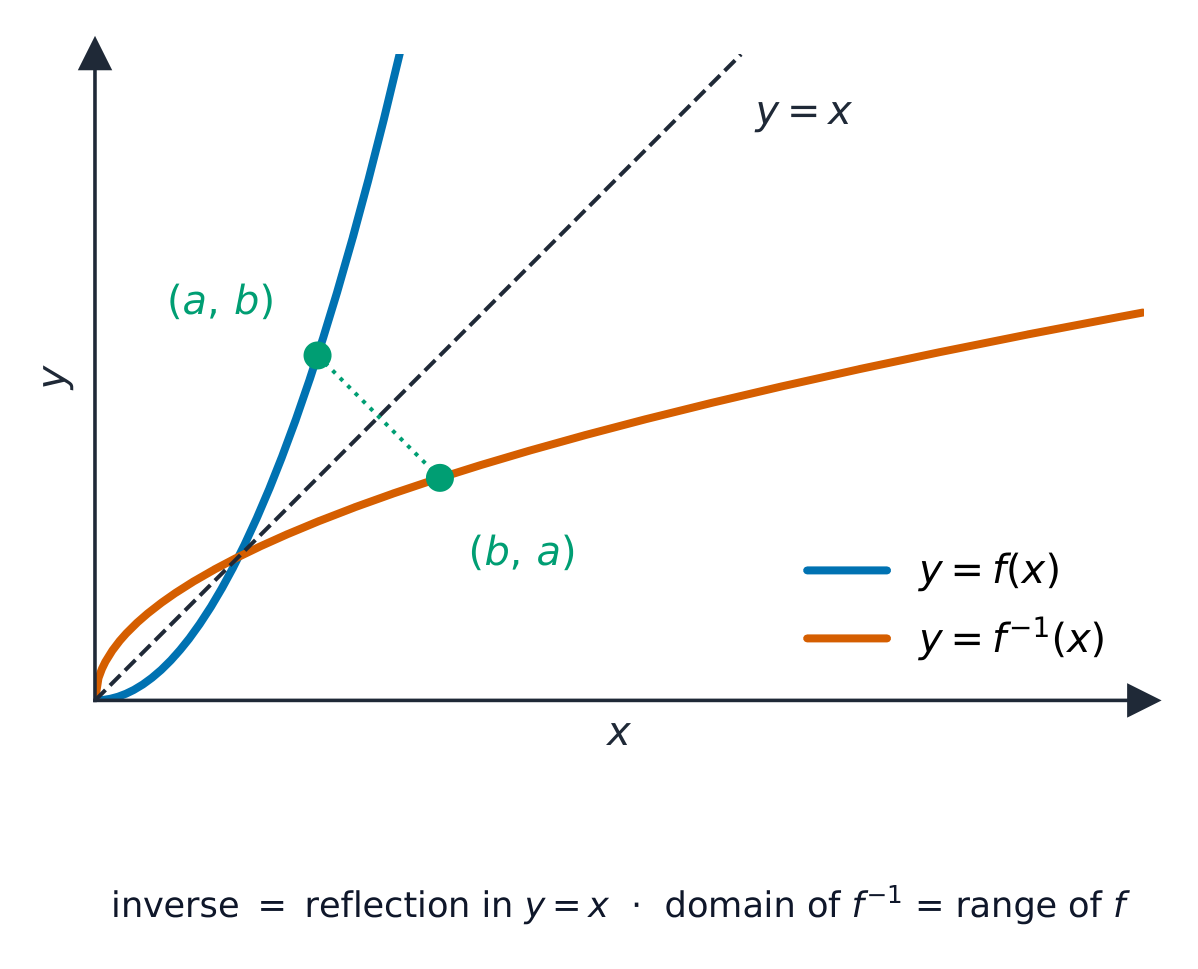
若不同的输入总是给出不同的输出,一个函数是一一对应(one-one)的。(没有输出被重复。)只有一一对应的函数才有一个反函数(inverse function)$f^{-1}$,它逆转规则。
两个函数的复合(composition)意味着一个接一个地做。$fg(x)$ 意味着"先做 $g$,然后 $f$":$fg(x) = f(g(x))$。复合函数 $fg$ 只在 $g$ 的值域位于 $f$ 的定义域内时存在。
Finding an inverse
要找 $f^{-1}$:写 $y = f(x)$,把 $x$ 变成主语,然后交换字母。
例题。 函数 $f(x) = (x + 3)^2 - 12$ 对 $x \geqslant 0$ 定义。求 $f^{-1}(x)$。
写 $y = (x + 3)^2 - 12$ 并解出 $x$:
$$(x + 3)^2 = y + 12 \;\Rightarrow\; x + 3 = \sqrt{y + 12} \;\Rightarrow\; x = \sqrt{y + 12} - 3.$$
你取正平方根,因为 $x \geqslant 0$ 意味着 $x + 3 \geqslant 3 > 0$。所以
$$f^{-1}(x) = \sqrt{x + 12} - 3.$$
Graphs of inverses and transformations
$y = f^{-1}(x)$ 的图形是 $y = f(x)$ 在直线 $y = x$ 中的反射(reflection)。
你应当知道 $y = f(x)$ 的这些变换(transformations):
| 新方程 | 对图形的效果 |
|---|---|
| $y = f(x) + a$ | 向上平移(translation)$a$ |
| $y = f(x + a)$ | 向左平移 $a$ |
| $y = a\,f(x)$ | 在 $y$ 方向的伸缩(stretch),比例因子 $a$ |
| $y = f(ax)$ | 在 $x$ 方向的伸缩,比例因子 $\tfrac{1}{a}$ |
当两个变换被组合时,顺序可能重要。完整地陈述每一个(类型、方向和量)。

探索
Explore a function
y = ax³ + bx² + cx + d
A function turns each input into exactly one output — drag the coefficients and watch where the curve rises and falls.
词汇表
训练
| 英文 | 中文 | 拼音 |
|---|---|---|
| function/ˈfʌŋkʃn/ | 函数 | hán shù |
| composition of functions/ˌkɒmpəˈzɪʃn ɒv ˈfʌŋkʃnz/ | 复合函数 | fù hé hán shù |
| domain/dəˈmeɪn/ | 定义域 | dìng yì yù |
| range/reɪndʒ/ | 值域 | zhí yù |
| one-one/wʌn wʌn/ | 一一对应 | yī yī duì yìng |
| inverse function/ɪnˈvɜːs ˈfʌŋkʃn/ | 反函数 | fǎn hán shù |
| composition/ˌkɒmpəˈzɪʃn/ | 复合 | fù hé |
| reflection/rɪˈflekʃn/ | 反射 | fǎn shè |
| transformations/trænsfɔːˈmeɪʃnz/ | 变换 | biàn huàn |
| translation/trænˈsleɪʃn/ | 平移 | píng yí |
| stretch/stretʃ/ | 伸缩 | shēn suō |
1.3
坐标几何

大纲
| Candidates should be able to: | Notes and examples |
|---|---|
| find the equation of a straight line given sufficient information | e.g. given two points, or one point and the gradient. |
| interpret and use any of the forms $y = mx + c$, $y - y_1 = m(x - x_1)$, $ax + by + c = 0$ in solving problems | Including calculations of distances, gradients, midpoints, points of intersection and use of the relationship between the gradients of parallel and perpendicular lines. |
| understand that the equation $(x - a)^2 + (y - b)^2 = r^2$ represents the circle with centre $(a, b)$ and radius $r$ | Including use of the expanded form $x^2 + y^2 + 2gx + 2fy + c = 0$. |
| use algebraic methods to solve problems involving lines and circles | Including use of elementary geometrical properties of circles, e.g. tangent perpendicular to radius, angle in a semicircle, symmetry. Implicit differentiation is not included. |
| understand the relationship between a graph and its associated algebraic equation, and use the relationship between points of intersection of graphs and solutions of equations. | e.g. to determine the set of values of $k$ for which the line $y = x + k$ intersects, touches or does not meet a quadratic curve. |
来源:剑桥国际大纲
坐标几何(coordinate geometry)用它们的方程研究直线和圆。
Straight lines
连接 $(x_1, y_1)$ 和 $(x_2, y_2)$ 的直线的斜率(gradient,陡度)是
$$m = \frac{y_2 - y_1}{x_2 - x_1}.$$
你可以把直线方程(equation of a straight line)写成这些形式的任何一个:
$$y = mx + c, \qquad y - y_1 = m(x - x_1), \qquad ax + by + c = 0.$$
当两条直线的斜率相等时它们平行(parallel),当它们斜率的乘积是 $-1$ 时它们垂直(perpendicular,成直角)。
Circles
圆心(centre)$(a, b)$、半径(radius)$r$ 的圆(circle)有方程
$$(x - a)^2 + (y - b)^2 = r^2.$$
一个展开的形式如 $x^2 + y^2 - 6x + 10y - 27 = 0$ 是同一个圆:对 $x$ 和 $y$ 配方以找到圆心和半径。
圆的一条切线(tangent)在一个点触到它,并在那个点垂直于半径。这个直角事实解决大多数圆的问题。
例题。 点 $P(1, 1)$ 和 $Q(7, 11)$ 是一个圆的一条直径(diameter)的端点。求圆的方程。
圆心是 $PQ$ 的中点:
$$\left(\frac{1 + 7}{2},\ \frac{1 + 11}{2}\right) = (4, 6).$$
半径是 $PQ$ 长度的一半:
$$r = \tfrac12\sqrt{(7 - 1)^2 + (11 - 1)^2} = \tfrac12\sqrt{36 + 100} = \tfrac12\sqrt{136} = \sqrt{34}.$$
所以圆是 $(x - 4)^2 + (y - 6)^2 = 34$。
探索
The straight line
y = ax + b
The gradient a tilts the line; the intercept b slides it up and down.
词汇表
训练
| 英文 | 中文 | 拼音 |
|---|---|---|
| Coordinate geometry/kəʊˈɔːdɪnət dʒiˈɒmətri/ | 坐标几何 | zuò biāo jǐ hé |
| gradient/ˈɡreɪdɪənt/ | 斜率 | xié lǜ |
| equation of a straight line/ɪˈkweɪʒn əvə streɪt laɪn/ | 直线方程 | zhí xiàn fāng chéng |
| parallel/ˈpærəlel/ | 平行 | píng xíng |
| perpendicular/ˌpɜːpənˈdɪkjʊlə/ | 垂直 | chuí zhí |
| circle/ˈsɜːkl/ | 圆 | yuán |
| centre/ˈsentə/ | 圆心 | yuán xīn |
| radius/ˈreɪdɪəs/ | 半径 | bàn jìng |
| tangent/ˈtændʒənt/ | 切线 | qiè xiàn |
| diameter/daɪˈæmɪtə/ | 直径 | zhí jìng |
1.4
弧度制

大纲
| Candidates should be able to: | Notes and examples |
|---|---|
| understand the definition of a radian, and use the relationship between radians and degrees | |
| use the formulae $s = r\theta$ and $A = \frac{1}{2}r^2\theta$ in solving problems concerning the arc length and sector area of a circle. | Including calculation of lengths and angles in triangles and areas of triangles. |
来源:剑桥国际大纲
Radians
一个弧度(radian)是另一种测量角的方式。一个弧度是一个圆的中心处截出一段长度等于半径的弧(arc)的角。弧度和度(degrees)之间的联系是
$$\pi \text{ radians} = 180^\circ.$$
所以要把度变成弧度,乘以 $\dfrac{\pi}{180}$;要把弧度变成度,乘以 $\dfrac{180}{\pi}$。
Arc length and sector area
对于半径 $r$、角 $\theta$ 以弧度计的一个扇形(sector):
$$\text{arc length} = s = r\theta, \qquad \text{sector area} = A = \tfrac12 r^2 \theta.$$
一条弦(chord)把扇形切成一个三角形和一个弓形(segment)。弓形面积是扇形减三角形:
$$\text{segment} = \tfrac12 r^2 \theta - \tfrac12 r^2 \sin\theta = \tfrac12 r^2(\theta - \sin\theta).$$

例题。 一个扇形有中心 $O$,而 $O$ 处的角是 $\tfrac{2}{3}\pi$ 弧度。证明弦截出的弓形有约 $0.614 r^2$ 的面积。
$$\text{segment} = \tfrac12 r^2\left(\tfrac{2}{3}\pi - \sin\tfrac{2}{3}\pi\right) = \tfrac12 r^2(2.0944 - 0.8660) = \tfrac12 r^2(1.2284) \approx 0.614 r^2.$$
探索
Radians, arcs and sectors
Change the angle (in radians) and radius. See the arc length $s = r\theta$ and the sector area $\tfrac12 r^2\theta$ update.
词汇表
训练
| 英文 | 中文 | 拼音 |
|---|---|---|
| radian/ˈreɪdɪən/ | 弧度 | hú dù |
| arc/ɑːk/ | 弧 | hú |
| degrees/dɪˈɡriːz/ | 度 | dù |
| sector/ˈsektə/ | 扇形 | shàn xíng |
| chord/kɔːd/ | 弦 | xián |
| segment/ˈseɡmənt/ | 弓形 | gōng xíng |
1.5
三角学

大纲
| Candidates should be able to: | Notes and examples |
|---|---|
| sketch and use graphs of the sine, cosine and tangent functions (for angles of any size, and using either degrees or radians) | Including e.g. $y = 3 \sin x$, $y = 1 - \cos 2x$, $y = \tan(x + \frac{1}{4}\pi)$. |
| use the exact values of the sine, cosine and tangent of $30^\circ$, $45^\circ$, $60^\circ$, and related angles | e.g. $\cos 150^\circ = -\frac{1}{2}\sqrt{3}$, $\sin \frac{3}{4}\pi = \frac{1}{\sqrt{2}}$. |
| use the notations $\sin^{-1} x$, $\cos^{-1} x$, $\tan^{-1} x$ to denote the principal values of the inverse trigonometric relations | No specialised knowledge of these functions is required, but understanding of them as examples of inverse functions is expected. |
| use the identities $\frac{\sin \theta}{\cos \theta} \equiv \tan \theta$ and $\sin^2 \theta + \cos^2 \theta \equiv 1$ | e.g. in proving identities, simplifying expressions and solving equations. |
| find all the solutions of simple trigonometrical equations lying in a specified interval (general forms of solution are not included). | e.g. solve $3 \sin 2x + 1 = 0$ for $-\pi < x < \pi$, $3 \sin^2 \theta - 5 \cos \theta - 1 = 0$ for $0^\circ \leqslant \theta \leqslant 360^\circ$. |
来源:剑桥国际大纲
Graphs and exact values
你必须知道正弦(sine)、余弦(cosine)和正切函数(tangent function,写作 $\sin$、$\cos$、$\tan$)的图形的形状。正弦和余弦图形在 $-1$ 和 $1$ 之间波动,并每 $360^\circ$($2\pi$)重复。学习这些精确值:
| $\theta$ | $30^\circ$ | $45^\circ$ | $60^\circ$ |
|---|---|---|---|
| $\sin\theta$ | $\tfrac12$ | $\tfrac{1}{\sqrt2}$ | $\tfrac{\sqrt3}{2}$ |
| $\cos\theta$ | $\tfrac{\sqrt3}{2}$ | $\tfrac{1}{\sqrt2}$ | $\tfrac12$ |
| $\tan\theta$ | $\tfrac{1}{\sqrt3}$ | $1$ | $\sqrt3$ |

记号 $\sin^{-1}x$、$\cos^{-1}x$、$\tan^{-1}x$ 意味着反(inverse)角(主值(principal value))。
Identities
一个恒等式(identity)对角的每个值都为真。你必须知道的两个是
$$\tan\theta \equiv \frac{\sin\theta}{\cos\theta}, \qquad \sin^2\theta + \cos^2\theta \equiv 1.$$
用它们重写一个方程,使它只含一个三角函数。
Solving trigonometric equations
要解一个三角方程(trigonometric equation),先把它化简到一个函数,然后在给定的区间里找到每个解。
例题。 解 $6\sin\theta = 1 + \dfrac{2}{\sin\theta}$,对 $-180^\circ < \theta < 180^\circ$。
两边乘以 $\sin\theta$ 以消去分数。这构成一个 $\sin\theta$ 的二次式:
$$6\sin^2\theta - \sin\theta - 2 = 0 \;\Rightarrow\; (3\sin\theta - 2)(2\sin\theta + 1) = 0.$$
所以 $\sin\theta = \tfrac23$ 或 $\sin\theta = -\tfrac12$。
- $\sin\theta = \tfrac23$:$\theta = 41.8^\circ$ 或 $\theta = 180^\circ - 41.8^\circ = 138.2^\circ$。
- $\sin\theta = -\tfrac12$:$\theta = -30^\circ$ 或 $\theta = -150^\circ$。
四个解是 $\theta = -150^\circ,\ -30^\circ,\ 41.8^\circ,\ 138.2^\circ$。
探索
Sine & cosine graphs
Drag the amplitude, period and shifts of y = a·sin(bx + c) + d and watch the curve change against the base wave.
探索
Sine and cosine on the unit circle
Drag the angle round the unit circle. The height is $\sin\theta$, the across-distance is $\cos\theta$ — that's where the graphs come from.
词汇表
训练
| 英文 | 中文 | 拼音 |
|---|---|---|
| sine/saɪn/ | 正弦 | zhèng xián |
| cosine/ˈkəʊsaɪn/ | 余弦 | yú xián |
| tangent function/ˈtændʒənt ˈfʌŋkʃn/ | 正切 | zhèng qiē |
| principal value/ˈprɪnsɪpl ˈvæljuː/ | 主值 | zhǔ zhí |
| identity/aɪˈdentɪti/ | 恒等式 | héng děng shì |
| trigonometric equation/ˌtrɪɡənəʊˈmetrɪk ɪˈkweɪʒn/ | 三角方程 | sān jiǎo fāng chéng |
1.6
级数

大纲
| Candidates should be able to: | Notes and examples |
|---|---|
| use the expansion of $(a + b)^n$, where $n$ is a positive integer | Including the notations $\begin{pmatrix} n \\ r \end{pmatrix}$ and $n!$ Knowledge of the greatest term and properties of the coefficients are not required. |
| recognise arithmetic and geometric progressions | |
| use the formulae for the $n$th term and for the sum of the first $n$ terms to solve problems involving arithmetic or geometric progressions | Including knowledge that numbers $a$, $b$, $c$ are 'in arithmetic progression' if $2b = a + c$ (or equivalent) and are 'in geometric progression' if $b^2 = ac$ (or equivalent). Questions may involve more than one progression. |
| use the condition for the convergence of a geometric progression, and the formula for the sum to infinity of a convergent geometric progression. |
来源:剑桥国际大纲
The binomial expansion
对于一个正整数 $n$,二项展开式(binomial expansion)是
$$(a + b)^n = a^n + \binom{n}{1}a^{n-1}b + \binom{n}{2}a^{n-2}b^2 + \cdots + b^n,$$
其中 $\binom{n}{r} = \dfrac{n!}{r!\,(n - r)!}$ 是一个二项式系数(binomial coefficient)。
例题。 求 $(2 - px)^5$ 按 $x$ 的升幂的前三项。
$$(2 - px)^5 = 2^5 + \binom{5}{1}2^4(-px) + \binom{5}{2}2^3(-px)^2 + \cdots = 32 - 80px + 80p^2x^2 + \cdots$$
Arithmetic and geometric progressions
一个数列(progression,序列)是遵循一个规则的一列项。
- 一个等差数列(arithmetic progression,AP)每步加一个固定的公差(common difference)$d$。第 $n$ 个项(term)是 $u_n = a + (n - 1)d$,而前 $n$ 项的和是 $S_n = \tfrac{n}{2}\big(2a + (n - 1)d\big)$。
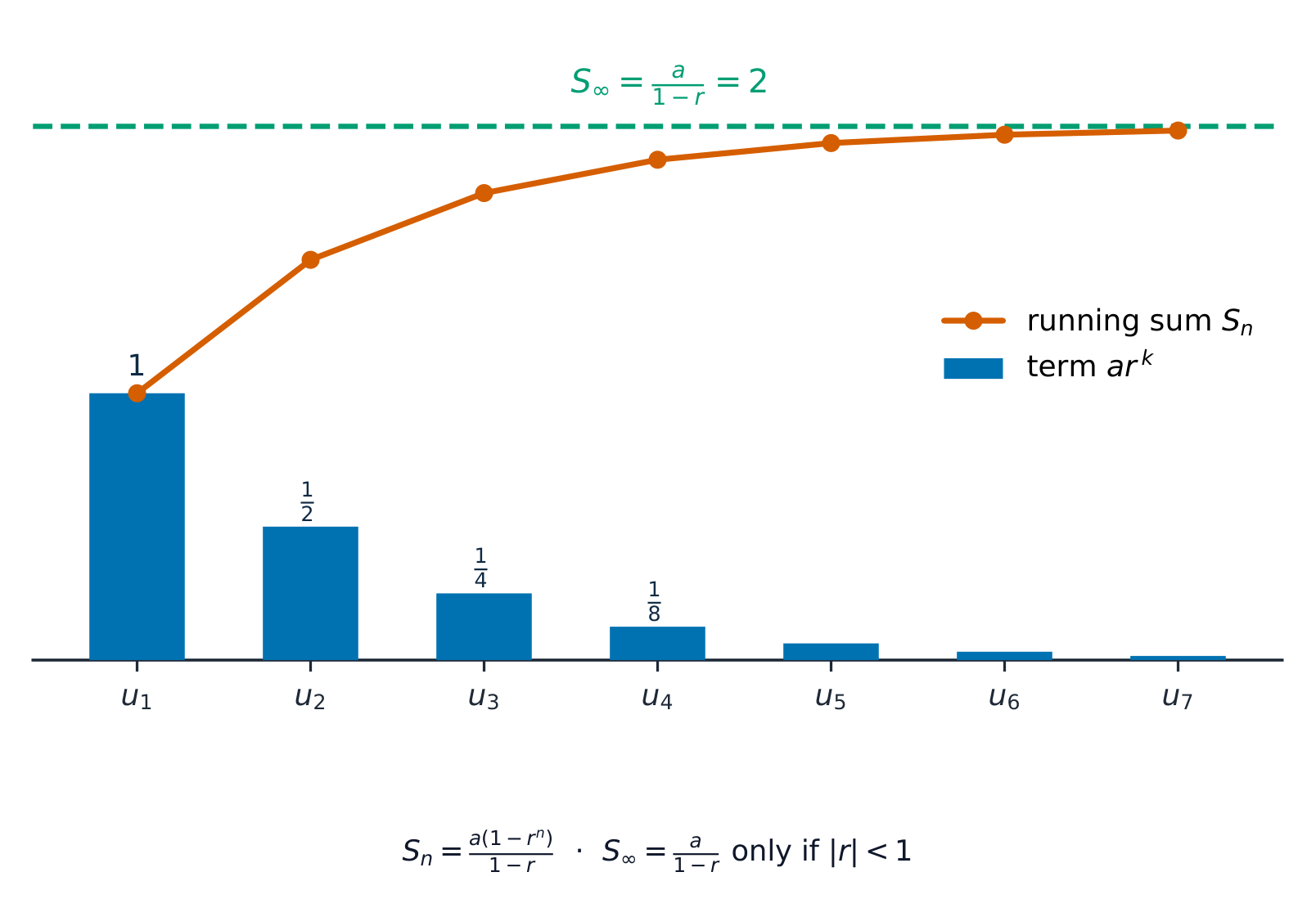
- 一个等比数列(geometric progression,GP)每步乘一个固定的公比(common ratio)$r$。第 $n$ 个项是 $u_n = ar^{\,n-1}$,而 $S_n = \dfrac{a(1 - r^n)}{1 - r}$。
一个 GP 是收敛的——当 $|r| < 1$ 时它收敛(converges,趋于一个极限)。那么它有一个无穷和(sum to infinity)
$$S_\infty = \frac{a}{1 - r}.$$
例题。 一个 GP 的第三项是 $18$,而前三项的和是 $26$。公比是负的。求无穷和。
从 $ar^2 = 18$ 你得到 $a = \dfrac{18}{r^2}$。把这个代入 $a(1 + r + r^2) = 26$:
$$18(1 + r + r^2) = 26r^2 \;\Rightarrow\; 8r^2 - 18r - 18 = 0 \;\Rightarrow\; (4r + 3)(r - 3) = 0.$$
比是负的,所以 $r = -\tfrac34$ 而 $a = \dfrac{18}{(3/4)^2} = 32$。然后
$$S_\infty = \frac{32}{1 - (-\tfrac34)} = \frac{32}{\tfrac74} = \frac{128}{7}.$$
探索
Arithmetic and geometric sequences
Switch between an arithmetic (add d) and a geometric (multiply by r) sequence and watch the terms and their sum build up.
词汇表
训练
| 英文 | 中文 | 拼音 |
|---|---|---|
| binomial expansion/baɪˈnəʊmɪəl ekˈspænʃn/ | 二项展开式 | èr xiàng zhǎn kāi shì |
| binomial coefficient/baɪˈnəʊmɪəl ˌkəʊɪˈfɪʃənt/ | 二项式系数 | èr xiàng shì xì shù |
| progression/prəˈɡreʃn/ | 数列 | shù liè |
| arithmetic progression/əˈrɪθmətɪk prəˈɡreʃn/ | 等差数列 | děng chā shù liè |
| common difference/ˈkɒmən ˈdɪfrəns/ | 公差 | gōng chāi |
| term/tɜːm/ | 项 | xiàng |
| geometric progression/ˌdʒiːəʊˈmetrɪk prəˈɡreʃn/ | 等比数列 | děng bǐ shù liè |
| common ratio/ˈkɒmən ˈreɪʃɪəʊ/ | 公比 | gōng bǐ |
| converges/kənˈvɜːdʒɪz/ | 收敛 | shōu liǎn |
| sum to infinity/sʌm tʊ ɪnˈfɪnɪti/ | 无穷和 | wú qióng hé |
1.7
微分
大纲
| Candidates should be able to: | Notes and examples |
|---|---|
| understand the gradient of a curve at a point as the limit of the gradients of a suitable sequence of chords, and use the notations $f'(x)$, $f''(x)$, $\frac{\text{d}y}{\text{d}x}$, and $\frac{\text{d}^2y}{\text{d}x^2}$ for first and second derivatives | Only an informal understanding of the idea of a limit is expected. e.g. includes consideration of the gradient of the chord joining the points with $x$ coordinates $2$ and $(2 + h)$ on the curve $y = x^3$. Formal use of the general method of differentiation from first principles is not required. |
| use the derivative of $x^n$ (for any rational $n$), together with constant multiples, sums and differences of functions, and of composite functions using the chain rule | e.g. find $\frac{\text{d}y}{\text{d}x}$, given $y = \sqrt{2x^3 + 5}$. |
| apply differentiation to gradients, tangents and normals, increasing and decreasing functions and rates of change | Including connected rates of change, e.g. given the rate of increase of the radius of a circle, find the rate of increase of the area for a specific value of one of the variables. |
| locate stationary points and determine their nature, and use information about stationary points in sketching graphs. | Including use of the second derivative for identifying maxima and minima; alternatives may be used in questions where no method is specified. Knowledge of points of inflexion is not included. |
来源:剑桥国际大纲
微分(differentiation)找出每个点处的曲线斜率(gradient of a curve)。斜率是越来越短的弦的斜率的极限(limit),叫导数(derivative)。
The rules
把导数写作 $f'(x)$ 或 $\dfrac{dy}{dx}$。基本规则是
$$\frac{d}{dx}\left(x^n\right) = n x^{n-1} \quad \text{for any rational } n.$$
逐项微分和,并对一个函数内部的一个函数用链式法则(chain rule):
$$\frac{d}{dx}\,f(g(x)) = f'(g(x)) \cdot g'(x).$$
再次微分给出二阶导数(second derivative)$f''(x)$ 或 $\dfrac{d^2y}{dx^2}$。
Using the derivative
- 切线和法线。 曲线在一个点的斜率是那里切线(tangent)的斜率。法线(normal)垂直于切线,所以它的斜率是 $-\dfrac{1}{\text{(tangent gradient)}}$。
- 递增或递减。 函数在 $\dfrac{dy}{dx} > 0$ 处是一个增函数(increasing function),在 $\dfrac{dy}{dx} < 0$ 处是一个减函数(decreasing function)。
- 变化率。 一个导数是一个变化率(rate of change)。相连的变化率用链式法则,例如 $\dfrac{dy}{dt} = \dfrac{dy}{dx}\cdot\dfrac{dx}{dt}$。
Stationary points
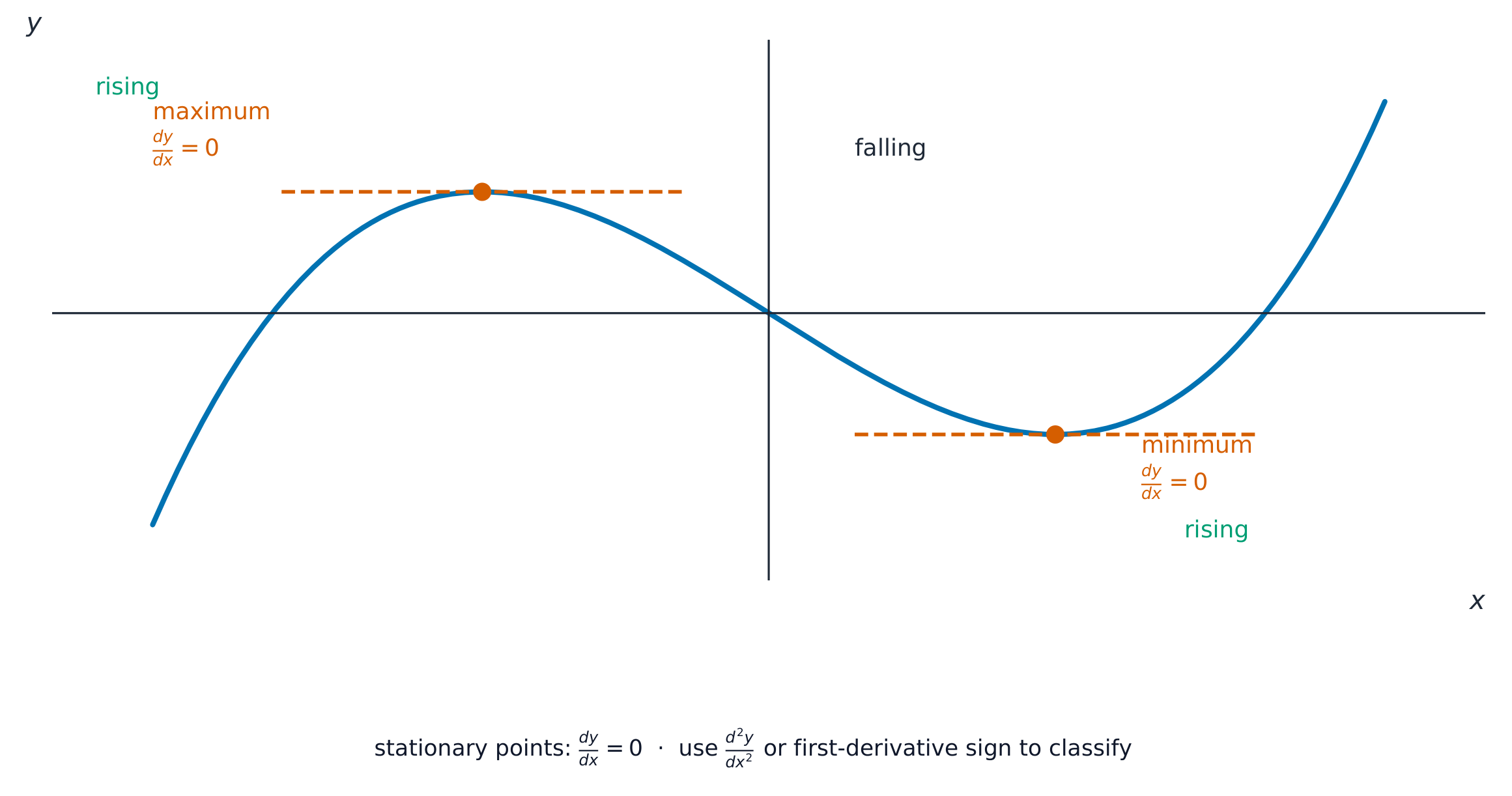
一个驻点(stationary point)是 $\dfrac{dy}{dx} = 0$ 的地方。用二阶导数测试它的性质:$f''(x) > 0$ 给出一个极小值点(minimum point),而 $f''(x) < 0$ 给出一个极大值点(maximum point)。当 $f''(x) = 0$ 时测试不确定:该点可能是一个拐点(point of inflexion),曲线在那里改变凹凸方向(弯曲的方式)——检查 $\dfrac{dy}{dx}$ 在它前后的符号来判定。
例题。 曲线 $y = 4x^{1/2} - x$ 在 $x = a$ 有一个极大值点。求 $a$。
$$\frac{dy}{dx} = 2x^{-1/2} - 1 = 0 \;\Rightarrow\; \frac{2}{\sqrt{x}} = 1 \;\Rightarrow\; \sqrt{x} = 2 \;\Rightarrow\; x = 4.$$
所以 $a = 4$。
探索
The gradient at a point
y = ax³ + bx² + cx + d
Slide the point along the curve. The tangent shows the gradient $\frac{dy}{dx}$ there — steeper where the curve bends more.
词汇表
训练
| 英文 | 中文 | 拼音 |
|---|---|---|
| Differentiation/ˌdɪfəˌrenʃɪˈeɪʃn/ | 微分 | wēi fēn |
| gradient of a curve/ˈɡreɪdɪənt əvə kɜːv/ | 曲线斜率 | qū xiàn xié lǜ |
| limit/ˈlɪmɪt/ | 极限 | jí xiàn |
| derivative/dɪˈrɪvətɪv/ | 导数 | dǎo shù |
| chain rule/tʃeɪn ruːl/ | 链式法则 | liàn shì fǎ zé |
| second derivative/ˈsekənd dɪˈrɪvətɪv/ | 二阶导数 | èr jiē dǎo shù |
| normal/ˈnɔːml/ | 法线 | fǎ xiàn |
| increasing function/ɪnˈkriːsɪŋ ˈfʌŋkʃn/ | 增函数 | zēng hán shù |
| decreasing function/ˈdiːkriːsɪŋ ˈfʌŋkʃn/ | 减函数 | jiǎn hán shù |
| rate of change/reɪt ɒv tʃeɪndʒ/ | 变化率 | biàn huà lǜ |
| stationary point/ˈsteɪʃənəri pɔɪnt/ | 驻点 | zhù diǎn |
| minimum point/ˈmɪnɪməm pɔɪnt/ | 极小值点 | jí xiǎo zhí diǎn |
| maximum point/ˈmæksɪməm pɔɪnt/ | 极大值点 | jí dà zhí diǎn |
| point of inflexion/pɔɪnt ɒv ɪnˈflekʃn/ | 拐点 | guǎi diǎn |
1.8
积分
大纲
| Candidates should be able to: | Notes and examples |
|---|---|
| understand integration as the reverse process of differentiation, and integrate $(ax + b)^n$ (for any rational $n$ except $-1$), together with constant multiples, sums and differences | e.g. $\int (2x^3 - 5x + 1) \text{d}x$, $\int \frac{1}{(2x + 3)^2} \text{d}x$. |
| solve problems involving the evaluation of a constant of integration | e.g. to find the equation of the curve through $(1, -2)$ for which $\frac{\text{d}y}{\text{d}x} = \sqrt{2x + 1}$. |
| evaluate definite integrals | Including simple cases of 'improper' integrals, such as $\int_{0}^{1} x^{-\frac{1}{2}} \text{d}x$ and $\int_{1}^{\infty} x^{-2} \text{d}x$. |
| use definite integration to find: - the area of a region bounded by a curve and lines parallel to the axes, or between a curve and a line or between two curves - a volume of revolution about one of the axes. | A volume of revolution may involve a region not bounded by the axis of rotation, e.g. the region between $y = 9 - x^2$ and $y = 5$ rotated about the $x$-axis. |
来源:剑桥国际大纲
积分(integration)是微分的逆。逆转幂法则给出
$$\int (ax + b)^n \, dx = \frac{(ax + b)^{n+1}}{a(n + 1)} + C \quad (n \neq -1).$$
$+\,C$ 是积分常数(constant of integration)。若你知道曲线上一个点,代入它以找到 $C$。
Definite integrals and area
一个定积分(definite integral)有限,并给出一个数:
$$\int_p^q f(x)\, dx = \big[F(x)\big]_p^q = F(q) - F(p).$$
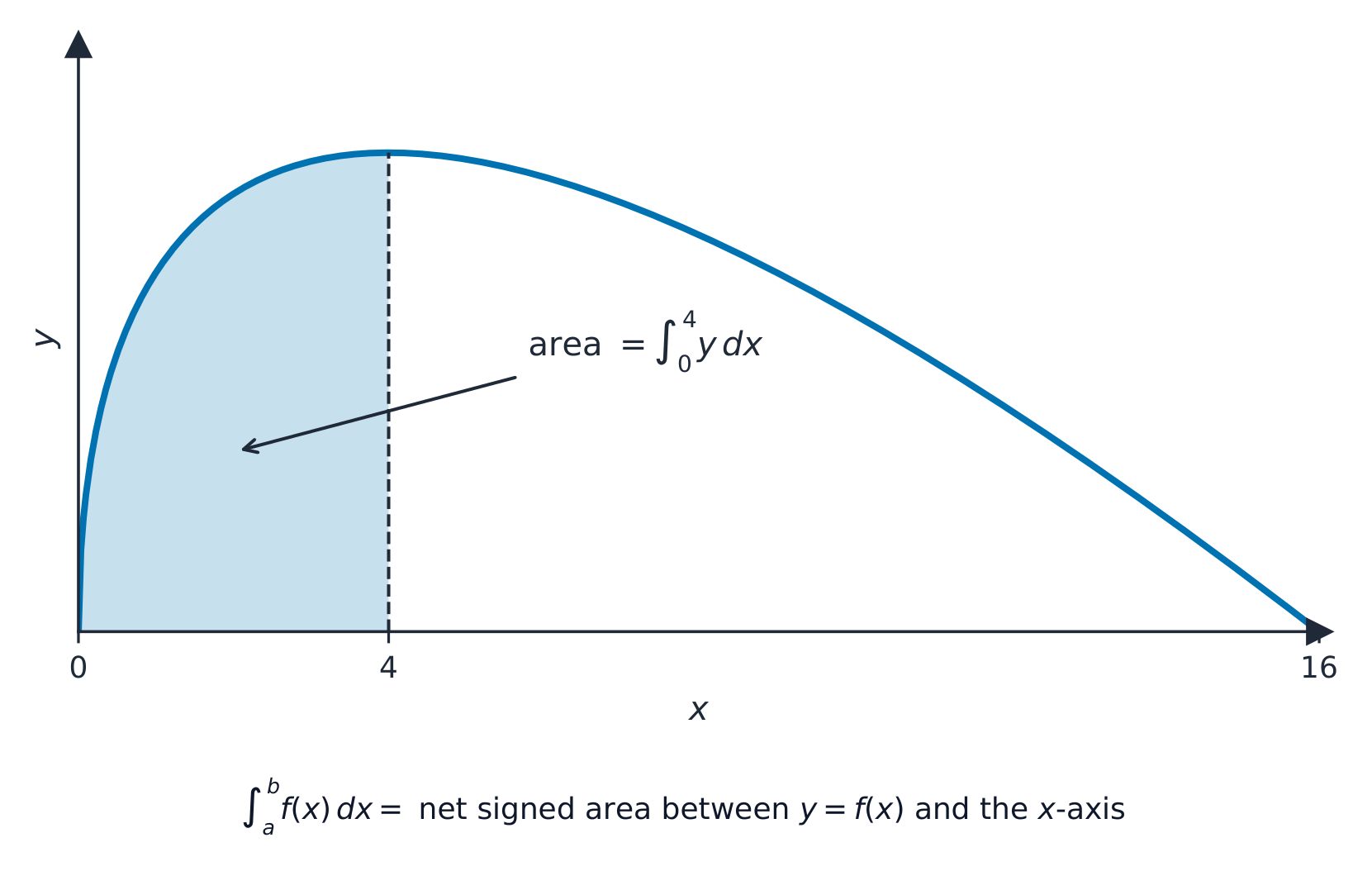
一条曲线和 $x$ 轴之间从 $x = p$ 到 $x = q$ 的区域(region)的面积是 $\displaystyle\int_p^q y \, dx$。对于两条曲线之间的面积,积分(上曲线 $-$ 下曲线)。
例题。 曲线 $y = 4x^{1/2} - x$ 在 $x = 16$ 再次与 $x$ 轴相遇。求曲线和 $x$ 轴之间从 $x = 0$ 到 $x = 4$ 的面积。
$$\int_0^4 \left(4x^{1/2} - x\right) dx = \left[\frac{8}{3}x^{3/2} - \frac{x^2}{2}\right]_0^4 = \frac{8}{3}(8) - \frac{16}{2} = \frac{64}{3} - 8 = \frac{40}{3}.$$
一个广义积分(improper integral)有一个无穷的上下限,或一个被积函数无定义的端点;把它作为一个极限求值。例如,
$$\int_1^{\infty}x^{-2}\, dx=\lim_{b\to\infty}\left[-\frac1x\right]_1^{b}=\lim_{b\to\infty}\left(1-\frac1b\right)=1,$$
而 $\displaystyle\int_0^{1}x^{-1/2}\, dx=\left[2x^{1/2}\right]_0^{1}=2$,尽管被积函数在 $x=0$ 处发散,它仍是有限的。
Volume of revolution
当一个区域绕一个轴一路旋转时,它扫出一个立体。绕 $x$ 轴的旋转体体积(volume of revolution)是
$$V = \pi \int_p^q y^2 \, dx,$$
而绕 $y$ 轴它是 $V = \pi \displaystyle\int x^2 \, dy$。例如,$y = \sqrt{x}$ 下从 $x = 0$ 到 $x = 4$ 的区域,绕 $x$ 轴旋转,有体积 $\pi\displaystyle\int_0^4 x\, dx = \pi\big[\tfrac{x^2}{2}\big]_0^4 = 8\pi$。

探索
Area under a curve
y = ax³ + bx² + cx + d
Drag the limits. The definite integral is the shaded area between the curve and the x-axis.
词汇表
训练
| 英文 | 中文 | 拼音 |
|---|---|---|
| Integration/ˌɪntɪˈɡreɪʃn/ | 积分 | jī fēn |
| constant of integration/ˈkɒnstənt ɒv ˌɪntɪˈɡreɪʃn/ | 积分常数 | jī fēn cháng shù |
| definite integral/ˈdefɪnət ˈɪntɪɡrəl/ | 定积分 | dìng jī fēn |
| region/ˈriːdʒn/ | 区域 | qū yù |
| improper integral/ɪmˈprɒpə ˈɪntɪɡrəl/ | 广义积分 | guǎng yì jī fēn |
| volume of revolution/ˈvɒljuːm ɒv ˌrevəˈluːʃn/ | 旋转体体积 | xuán zhuǎn tǐ tǐ jī |
| algebra/ˈældʒɪbrə/ | 代数 | dài shù |
| calculus/ˈkælkjʊləs/ | 微积分 | wēi jī fēn |
1.8
考试技巧
- 显示代数的每一行——跳步会失去方法分;用判别式 $b^2 - 4ac$ 来决定实根的数目。
- 对圆的度量用弧度工作(弧 $= r\theta$、扇形面积 $= \frac{1}{2}r^2\theta$),以及对三角函数的微积分。
- 对于微分,令 $\frac{dy}{dx} = 0$ 求驻点,并用二阶导数给它们分类。
- 对于积分,给一个不定积分加 $+ c$ 并用限求面积;轴以下的一个面积给出一个负积分。
本主题的互动课程
逐步学习,并即时检测练习。