这份讲义涵盖主题 2:进阶纯数学(Further Pure Mathematics)2。它增加双曲函数、特征值、新的微分和积分、棣莫弗定理,以及微分方程的方法。
进阶纯数学2
A-Level 进阶数学 · 第 2 主题
 11:29
11:29
Further Pure Mathematics 2
Look at any hanging chain, any power line, any suspension cable. It always settles into one special curve. You might guess a parabola — but it is not. It is…
英文讲解 · 内嵌中英文字幕
2.1
双曲函数

大纲
| Candidates should be able to: | Notes and examples |
|---|---|
| understand the definitions of the hyperbolic functions $\sinh x$, $\cosh x$, $\tanh x$, $\text{sech } x$, $\text{cosech } x$, $\text{coth } x$ in terms of the exponential function | |
| sketch the graphs of hyperbolic functions | |
| prove and use identities involving hyperbolic functions | e.g. $\cosh^2 x - \sinh^2 x \equiv 1$, $\sinh 2x \equiv 2 \sinh x \cosh x$, and similar results corresponding to the standard trigonometric identities. |
| understand and use the definitions of the inverse hyperbolic functions and derive and use the logarithmic forms |
来源:剑桥国际大纲
双曲函数(hyperbolic functions)从指数函数构建:
$$\cosh x = \frac{e^x + e^{-x}}{2}, \qquad \sinh x = \frac{e^x - e^{-x}}{2}, \qquad \tanh x = \frac{\sinh x}{\cosh x}.$$
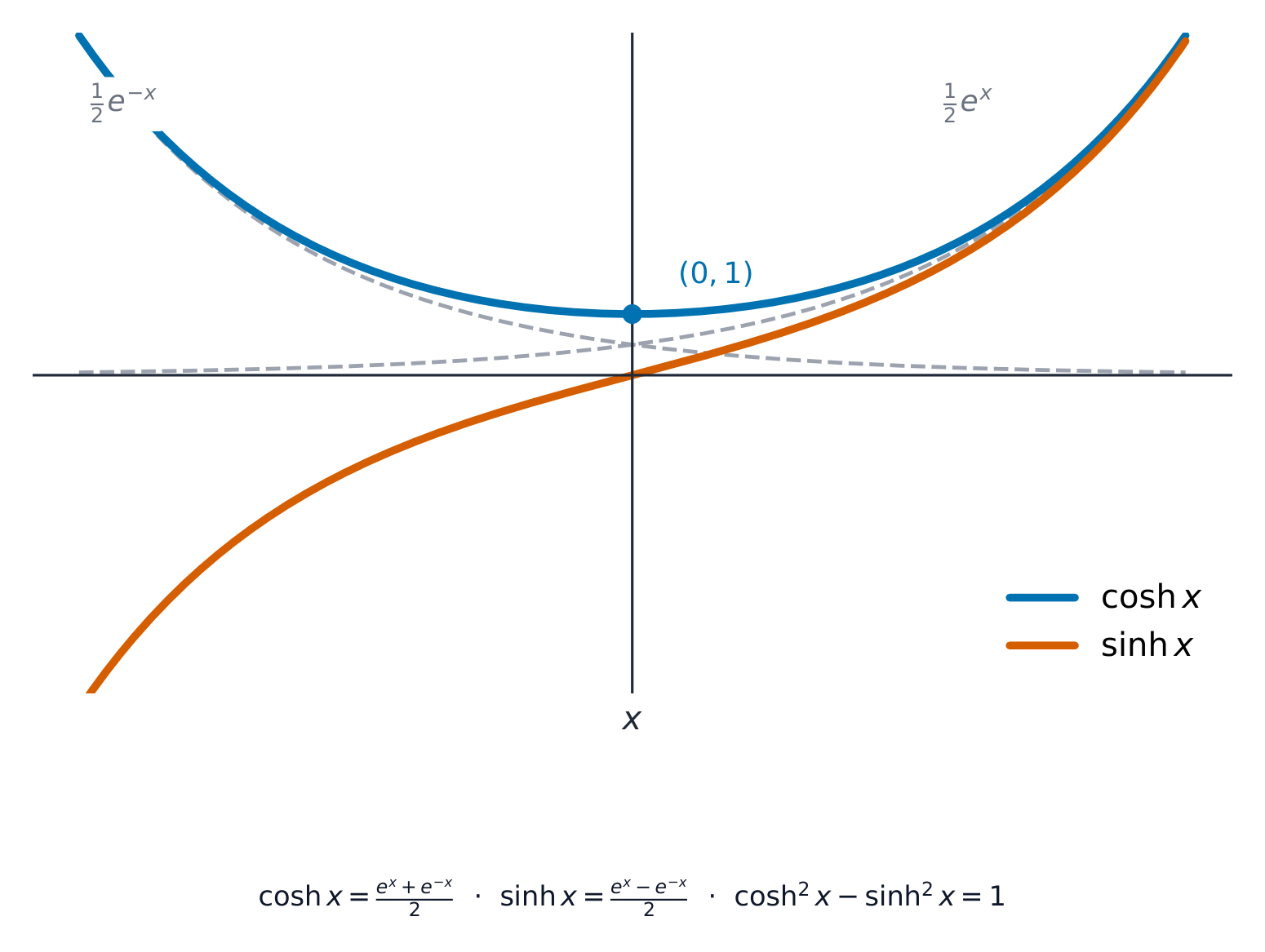
它们遵守很像三角函数的恒等式,主要的一个是 $\cosh^2 x - \sinh^2 x = 1$。三个倒数补全这一组:$\operatorname{sech} x = \dfrac{1}{\cosh x}$、$\operatorname{cosech} x = \dfrac{1}{\sinh x}$,和 $\coth x = \dfrac{1}{\tanh x} = \dfrac{\cosh x}{\sinh x}$——也都由 $e^x$ 构成,值得在积分和评分方案里认出来。反双曲函数(inverse hyperbolic functions)有一个对数形式(logarithmic form),例如 $\sinh^{-1} x = \ln\!\left(x + \sqrt{x^2 + 1}\right)$。
例题。 证明 $\cosh^2 x - \sinh^2 x = 1$。
$$\cosh^2 x - \sinh^2 x = \frac{(e^x + e^{-x})^2 - (e^x - e^{-x})^2}{4} = \frac{(e^{2x} + 2 + e^{-2x}) - (e^{2x} - 2 + e^{-2x})}{4} = \frac{4}{4} = 1.$$
探索
Hyperbolic functions
y = a cosh(x)
cosh is the catenary (a hanging chain) — even, with its minimum at (0, a).
词汇表
训练
| 英文 | 中文 | 拼音 |
|---|---|---|
| Further Pure Mathematics/ˈfɜːðə pjʊə ˌmæθɪˈmætɪks/ | 进阶纯数学 | jìn jiē chún shù xué |
| hyperbolic functions/ˌhaɪpəˈbɒlɪk ˈfʌŋkʃnz/ | 双曲函数 | shuāng qū hán shù |
| inverse hyperbolic functions/ɪnˈvɜːs ˌhaɪpəˈbɒlɪk ˈfʌŋkʃnz/ | 反双曲函数 | fǎn shuāng qū hán shù |
| logarithmic form/ˌlɒɡəˈrɪθmɪk fɔːm/ | 对数形式 | duì shù xíng shì |
2.2
矩阵

大纲
| Candidates should be able to: | Notes and examples |
|---|---|
| formulate a problem involving the solution of 3 linear simultaneous equations in 3 unknowns as a problem involving the solution of a matrix equation, or vice versa | |
| understand the cases that may arise concerning the consistency or inconsistency of 3 linear simultaneous equations, relate them to the singularity or otherwise of the corresponding matrix, solve consistent systems, and interpret geometrically in terms of lines and planes | e.g. three planes meeting in a common point, or in a common line, or having no common points. |
| understand the terms 'characteristic equation', 'eigenvalue' and 'eigenvector', as applied to square matrices | Including use of the definition $\mathbf{Ae} = \lambda \mathbf{e}$ to prove simple properties, e.g. that $\lambda^n$ is an eigenvalue of $\mathbf{A}^n$. |
| find eigenvalues and eigenvectors of $2 \times 2$ and $3 \times 3$ matrices | Restricted to cases where the eigenvalues are real and distinct. |
| express a square matrix in the form $\mathbf{QDQ}^{-1}$, where $\mathbf{D}$ is a diagonal matrix of eigenvalues and $\mathbf{Q}$ is a matrix whose columns are eigenvectors, and use this expression | e.g. in calculating powers of $2 \times 2$ or $3 \times 3$ matrices. |
| use the fact that a square matrix satisfies its own characteristic equation. | e.g. in finding successive powers of a matrix or finding an inverse matrix; restricted to $2 \times 2$ or $3 \times 3$ matrices only. |
来源:剑桥国际大纲
你能把三个未知数的三个线性方程写成一个单一的矩阵方程(matrix equation)$A\mathbf{x} = \mathbf{b}$。若 $A$ 非奇异有一个解;若 $A$ 奇异,这些方程要么不相容(无解)要么有无穷多个。
对一个方阵 $A$,特征方程(characteristic equation)是 $\det(A - \lambda I) = 0$。它的解是特征值(eigenvalues)$\lambda$,而对每个,满足 $A\mathbf{v} = \lambda\mathbf{v}$ 的向量 $\mathbf{v}$ 是一个特征向量(eigenvector)。你随即能写 $A = QDQ^{-1}$,其中 $D$ 是一个特征值的对角矩阵(diagonal matrix)而 $Q$ 的列是特征向量。
例题。 求 $A = \begin{pmatrix} 2 & 1 \\ 1 & 2 \end{pmatrix}$ 的特征值。
特征方程是
$$\det\begin{pmatrix} 2 - \lambda & 1 \\ 1 & 2 - \lambda \end{pmatrix} = (2 - \lambda)^2 - 1 = 0 \;\Rightarrow\; 2 - \lambda = \pm 1.$$
所以 $\lambda = 1$ 或 $\lambda = 3$。($\lambda = 3$ 的特征向量是 $\begin{pmatrix} 1 \\ 1 \end{pmatrix}$,而 $\lambda = 1$ 的是 $\begin{pmatrix} 1 \\ -1 \end{pmatrix}$。)
探索
Transformations and the determinant
Change the matrix to rotate, stretch or shear the unit square; the determinant shows how area changes.
词汇表
训练
| 英文 | 中文 | 拼音 |
|---|---|---|
| matrix equation/ˈmeɪtrɪks ɪˈkweɪʒn/ | 矩阵方程 | jǔ zhèn fāng chéng |
| characteristic equation/ˌkærɪktəˈrɪstɪk ɪˈkweɪʒn/ | 特征方程 | tè zhēng fāng chéng |
| eigenvalues/ˈaɪdʒənvæljuːz/ | 特征值 | tè zhēng zhí |
| eigenvector/ˈaɪdʒənvektə/ | 特征向量 | tè zhēng xiàng liàng |
| diagonal matrix/daɪˈæɡənl ˈmeɪtrɪks/ | 对角矩阵 | duì jiǎo jǔ zhèn |
2.3
微分
大纲
| Candidates should be able to: | Notes and examples |
|---|---|
| • differentiate hyperbolic functions and differentiate $\sin^{-1}x$, $\cos^{-1}x$, $\sinh^{-1}x$, $\cosh^{-1}x$ and $\tanh^{-1}x$ | |
| • obtain an expression for $\frac{\text{d}^2y}{\text{d}x^2}$ in cases where the relation between $x$ and $y$ is defined implicitly or parametrically | |
| • derive and use the first few terms of a Maclaurin's series for a function. | Derivation of a general term is not included, but successive 'implicit' differentiation steps may be required, e.g. for $y = \tan x$ following an initial differentiation rearranged as $y' = 1 + y^2$. |
来源:剑桥国际大纲
你现在能微分双曲函数和反函数 $\sin^{-1}x$、$\tan^{-1}x$、$\sinh^{-1}x$ 等等。你也能对隐式或参数给出的曲线求 $\dfrac{d^2y}{dx^2}$。
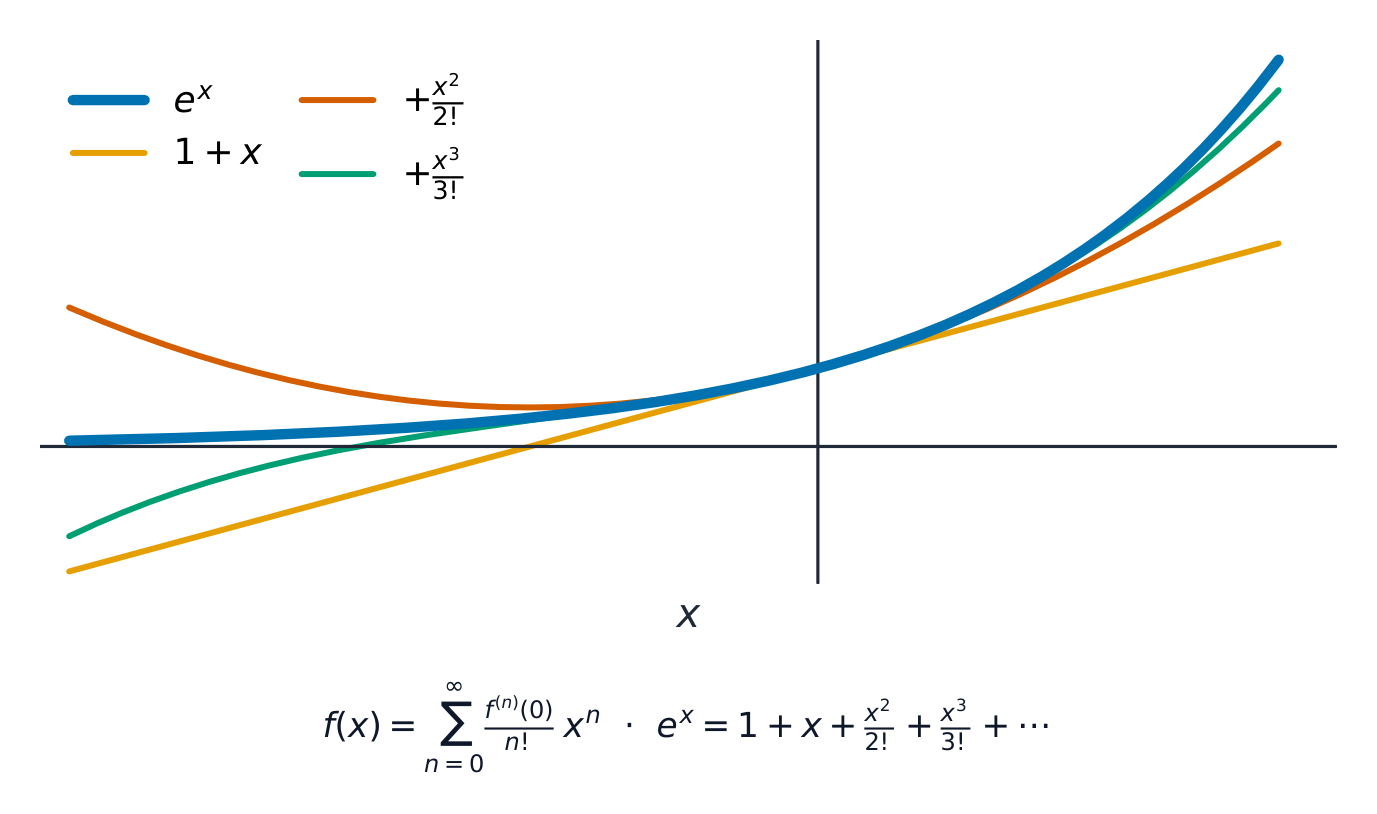
一个麦克劳林级数(Maclaurin's series)把一个函数写成一个幂级数:
$$f(x) = f(0) + f'(0)\,x + \frac{f''(0)}{2!}\,x^2 + \frac{f'''(0)}{3!}\,x^3 + \cdots$$
例如 $e^x = 1 + x + \dfrac{x^2}{2!} + \dfrac{x^3}{3!} + \cdots$
例题。 求 $f(x) = \ln(1+x)$ 到 $x^3$ 项的麦克劳林级数。
$f(0) = 0$;$f'(x) = \dfrac{1}{1+x}$ 所以 $f'(0) = 1$;$f''(x) = \dfrac{-1}{(1+x)^2}$ 所以 $f''(0) = -1$;$f'''(x) = \dfrac{2}{(1+x)^3}$ 所以 $f'''(0) = 2$。代入级数:
$$\ln(1+x) = x - \frac{x^2}{2} + \frac{x^3}{3} - \cdots$$
探索
The gradient at a point
gradient = dy/dx
The derivative is the slope of the tangent, however exotic the function.
词汇表
训练
| 英文 | 中文 | 拼音 |
|---|---|---|
| Maclaurin's series/məˈklɔːrɪnz ˈsɪəriːz/ | 麦克劳林级数 | mài kè láo lín jí shù |
2.4
积分
大纲
| Candidates should be able to: | Notes and examples |
|---|---|
| • integrate hyperbolic functions and recognise integrals of functions of the form $\frac{1}{\sqrt{a^2 - x^2}}$, $\frac{1}{\sqrt{x^2 + a^2}}$ and $\frac{1}{\sqrt{x^2 - a^2}}$, and integrate associated functions using trigonometric substitutions or hyperbolic substitutions as appropriate | Including use of completing the square where necessary, e.g. to integrate $\frac{1}{\sqrt{x^2 + x}}$. |
| • derive and use reduction formulae for the evaluation of definite integrals | e.g. $\int_0^{\frac{1}{2}\pi} \sin^n x \text{ d}x$, $\int_0^1 \text{e}^{-x}(1-x)^n \text{ d}x$. In harder cases hints may be given, e.g. $\int_0^{\frac{1}{4}\pi} \sec^n x \text{ d}x$ by considering $\frac{\text{d}}{\text{d}x}(\tan x \sec^n x)$. |
| • understand how the area under a curve may be approximated by areas of rectangles, and use rectangles to estimate or set bounds for the area under a curve or to derive inequalities or limits concerning sums | Questions may involve either rectangles of unit width or rectangles whose width can tend to zero, e.g. $1 + \ln n > \sum_{r=1}^n \frac{1}{r} > \ln(n+1)$, $\sum_{r=1}^n \frac{1}{n}\left(1 + \frac{r}{n}\right)^{-1} \approx \int_0^1 (1+x)^{-1} \text{ d}x$. continued |
| • use integration to find – arc lengths for curves with equations in Cartesian coordinates, including the use of a parameter, or in polar coordinates – surface areas of revolution about one of the axes for curves with equations in Cartesian coordinates, including the use of a parameter. | Any questions involving integration may require techniques from Cambridge International A Level Mathematics (9709) applied to more difficult cases, e.g. integration by parts for $\int e^x \sin x \mathrm{d}x$, or use of the substitution $t = \tan \frac{1}{2}x$. Surface areas of revolution for curves with equations in polar coordinates will not be required. |
来源:剑桥国际大纲
学习这些标准积分:
$$\int \frac{1}{a^2 + x^2}\,dx = \frac{1}{a}\tan^{-1}\frac{x}{a} + C, \qquad \int \frac{1}{\sqrt{a^2 - x^2}}\,dx = \sin^{-1}\frac{x}{a} + C.$$
一个三角替换、一个双曲替换,或分母中的配方法(completing the square)处理相关的形式。一个递推公式(reduction formula)把一个积分 $I_n$ 与 $I_{n-1}$ 联系起来,所以你能一步步往下算。积分也给出一条曲线的弧长(arc length),以及当一条曲线绕一个轴旋转时的旋转曲面面积(surface area of revolution)。
例题。 求 $\displaystyle\int \frac{1}{\sqrt{4 - x^2}}\,dx$。
这里 $a^2 = 4$,所以 $a = 2$ 且
$$\int \frac{1}{\sqrt{4 - x^2}}\,dx = \sin^{-1}\frac{x}{2} + C.$$
用积分界定一个和。 在一条递减曲线(如 $y=\frac1x$)下方或上方画单位宽的矩形。每个高 $\frac1r$ 的矩形被夹在两个积分条之间,所以求和给出
$$\ln(n+1) < \sum_{r=1}^{n}\frac1r < 1 + \ln n.$$
把矩形宽度缩到 $\frac1n\to 0$,这样一个和就变成一个在极限里等于积分的黎曼和(Riemann sum),例如 $\displaystyle\lim_{n\to\infty}\frac1n\sum_{r=1}^{n}f\!\left(\frac{r}{n}\right)=\int_0^1 f(x)\,dx$。
探索
The area under the curve
area = ∫ f(x) dx
Every integral measures the area under the curve — drag the limits.
词汇表
训练
| 英文 | 中文 | 拼音 |
|---|---|---|
| completing the square/kəmˈpliːtɪŋ ðə skweə/ | 配方法 | pèi fāng fǎ |
| reduction formula/rɪˈdʌkʃn ˈfɔːmjʊlə/ | 递推公式 | dì tuī gōng shì |
| arc length/ɑːk leŋθ/ | 弧长 | hú zhǎng |
| surface area of revolution/ˈsɜːfɪs ˈeərɪə ɒv ˌrevəˈluːʃn/ | 旋转曲面面积 | xuán zhuǎn qū miàn miàn jī |
| Riemann sum/ˈriːmən sʌm/ | 黎曼和 | lí màn hé |
2.5
复数

大纲
| Candidates should be able to: | Notes and examples |
|---|---|
| • understand de Moivre’s theorem, for a positive or negative integer exponent, in terms of the geometrical effect of multiplication and division of complex numbers | |
| • prove de Moivre’s theorem for a positive integer exponent | e.g. by induction. |
| • use de Moivre’s theorem for a positive or negative rational exponent | e.g. expressing $\cos 5\theta$ in terms of $\cos \theta$ or $\tan 5\theta$ in terms of $\tan \theta$. |
| – to express trigonometrical ratios of multiple angles in terms of powers of trigonometrical ratios of the fundamental angle | e.g. expressing $\sin^6 \theta$ in terms of $\cos 2\theta$, $\cos 4\theta$ and $\cos 6\theta$. |
| – to express powers of $\sin \theta$ and $\cos \theta$ in terms of multiple angles | |
| – in the summation of series | e.g. using the '$C + \mathrm{i}S$' method to sum series such as $\sum_{r=1}^{n} \binom{n}{r} \sin r\theta$. |
| – in finding and using the $n$th roots of unity. |
来源:剑桥国际大纲
极坐标形式的一个复数(complex number)是 $z = r(\cos\theta + i\sin\theta)$。棣莫弗定理(De Moivre's theorem)说对任何整数 $n$,
$$(\cos\theta + i\sin\theta)^n = \cos n\theta + i\sin n\theta.$$
它被用来把 $\cos n\theta$ 和 $\sin n\theta$ 展开成幂、求级数的和,并求 $n$ 个单位根(roots of unity,$z^n = 1$ 的解,在单位圆周围等间距)。

例题。 用棣莫弗定理把 $\cos 3\theta$ 用 $\cos\theta$ 表示。
取 $(\cos\theta + i\sin\theta)^3 = \cos 3\theta + i\sin 3\theta$ 的实部:
$$\cos 3\theta = \cos^3\theta - 3\cos\theta\sin^2\theta = \cos^3\theta - 3\cos\theta(1 - \cos^2\theta) = 4\cos^3\theta - 3\cos\theta.$$
探索
The Argand diagram
Drag the point to explore modulus and argument — the language of complex numbers in polar (modulus–argument) form.
词汇表
训练
| 英文 | 中文 | 拼音 |
|---|---|---|
| complex number/ˈkɒmpleks ˈnʌmbə/ | 复数 | fù shù |
| De Moivre's theorem/də ˈmɔɪvəz ˈθɪərəm/ | 棣莫弗定理 | dì mò fú dìng lǐ |
| roots of unity/ruːts ɒv ˈjuːnɪti/ | 单位根 | dān wèi gēn |
2.6
微分方程

大纲
| Candidates should be able to: | Notes and examples |
|---|---|
| • find an integrating factor for a first order linear differential equation, and use an integrating factor to find the general solution | e.g. $\frac{\mathrm{d}y}{\mathrm{d}x} - 2y = x^2$, $x\frac{\mathrm{d}y}{\mathrm{d}x} - y = x^4$, $\frac{\mathrm{d}y}{\mathrm{d}x} + y\coth x = \cosh x$. |
| • recall the meaning of the terms 'complementary function' and 'particular integral' in the context of linear differential equations, and recall that the general solution is the sum of the complementary function and a particular integral | |
| find the complementary function for a first or second order linear differential equation with constant coefficients | For second order equations, including the cases where the auxiliary equation has distinct real roots, a repeated real root or conjugate complex roots. |
| recall the form of, and find, a particular integral for a first or second order linear differential equation in the cases where a polynomial or $ae^{bx}$ or $a\cos px + b\sin px$ is a suitable form, and in other simple cases find the appropriate coefficient(s) given a suitable form of particular integral | e.g. evaluate $k$ given that $kx \cos 2x$ is a particular integral of $$\frac{\text{d}^2y}{\text{d}x^2} + 4y = \sin 2x$$ . |
| use a given substitution to reduce a differential equation to a first or second order linear equation with constant coefficients or to a first order equation with separable variables | e.g. the substitution $x = e^t$ to reduce to linear form a differential equation with terms of the form $$ax^2\frac{\text{d}^2y}{\text{d}x^2} + bx\frac{\text{d}y}{\text{d}x} + cy$$ , or the substitution $y = ux$ to reduce $$\frac{\text{d}y}{\text{d}x} = \frac{x+y}{x-y}$$ to separable form. |
| use initial conditions to find a particular solution to a differential equation, and interpret a solution in terms of a problem modelled by a differential equation. |
来源:剑桥国际大纲
对一个一阶线性方程 $\dfrac{dy}{dx} + P(x)\,y = Q(x)$,乘以积分因子(integrating factor)$\mu = e^{\int P\,dx}$。左边随即变成 $\dfrac{d}{dx}(\mu y)$,所以你能直接积分。
对一个常系数线性方程,通解(general solution)是两部分的和:余函数(complementary function,右边设为 $0$ 的方程的解,从辅助方程求得)和一个特积分(particular integral,完整方程的任何一个解)。初始条件随即确定这些常数以给出特解(particular solution);更简单的带可分离变量(separable variables)的方程直接积分。
例题。 解 $\dfrac{dy}{dx} + 2y = e^x$。
积分因子是 $\mu = e^{\int 2\,dx} = e^{2x}$。乘过给出 $\dfrac{d}{dx}\!\left(y\,e^{2x}\right) = e^{3x}$,所以
$$y\,e^{2x} = \tfrac13 e^{3x} + C \;\Rightarrow\; y = \tfrac13 e^x + C e^{-2x}.$$
二阶常系数。 对 $\dfrac{d^2y}{dx^2}+b\dfrac{dy}{dx}+cy=f(x)$,解辅助方程(auxiliary equation)$m^2+bm+c=0$。余函数取决于它的根:
- 两个不同的实根 $m_1,m_2$:$y=Ae^{m_1x}+Be^{m_2x}$;
- 一个重根 $m$:$y=(A+Bx)e^{mx}$;
- 复根 $p\pm qi$:$y=e^{px}(A\cos qx+B\sin qx)$。
然后加一个特积分,试一个匹配 $f(x)$ 的形式(一个多项式、$ae^{bx}$,或 $a\cos px+b\sin px$);若那个试探已经出现在余函数里,就把它乘以 $x$。
例题。 解 $\dfrac{d^2y}{dx^2}-4\dfrac{dy}{dx}+4y=0$。辅助方程 $m^2-4m+4=(m-2)^2=0$ 有一个重根 $m=2$,所以 $y=(A+Bx)e^{2x}$。
探索
Differential equations
dy/dx = a y
The equation sets the slope everywhere; the solution follows those slopes.
词汇表
训练
| 英文 | 中文 | 拼音 |
|---|---|---|
| integrating factor/ˈɪntɪɡreɪtɪŋ ˈfæktə/ | 积分因子 | jī fēn yīn zi |
| general solution/ˈdʒenərəl səˈluːʃn/ | 通解 | tōng jiě |
| complementary function/ˌkɒmplɪˈmentəri ˈfʌŋkʃn/ | 余函数 | yú hán shù |
| particular integral/pəˈtɪkjʊlə ˈɪntɪɡrəl/ | 特积分 | tè jī fēn |
| particular solution/pəˈtɪkjʊlə səˈluːʃn/ | 特解 | tè jiě |
| separable variables/ˈsepərəbl ˈveərɪəblz/ | 可分离变量 | kě fēn lí biàn liàng |
| auxiliary equation/ɔːkˈsɪlɪəri ɪˈkweɪʒn/ | 辅助方程 | fǔ zhù fāng chéng |
2.6
考试技巧
- 学习双曲恒等式和导数,并在积分中用反双曲函数。
- 把一个线性微分方程解成余函数 $+$ 特积分,然后应用边界条件。
- 用棣莫弗定理求复数的幂和根,并推导三角恒等式。
- 通过一个陈述的替换把一个积分化到一个标准形式。
本主题的互动课程
逐步学习,并即时检测练习。