- 对于含有多个官能团的有机分子:(a) 利用教学大纲中的反应识别有机官能团;(b) 预测性质和反应
- 设计使用教学大纲中反应的多步合成路线以制备有机分子
- 分析给定的合成路线,包括每步反应的类型、所用试剂以及可能的副产物
有机合成
A-Level 化学 · 知识点 21
 8:01
有机合成
看看几乎任何药物。它是一个复杂的分子,最初源于某种简单的物质——通常来自原油的小分子。单一反应无法将……
英语旁白 · 英中内嵌字幕
21.1
有机合成

教学大纲
来源:Cambridge International 教学大纲
English
This topic does not add new reactions. Instead it asks you to join up the reactions you already know, so you can build a target molecule in several steps.
Identifying functional groups
A molecule may have more than one functional group 官能团. Use the test reactions from the syllabus to identify each one, and then predict how the molecule will behave. For example:
- decolourises bromine water → a C=C double bond (an alkene 烯烃).
- after warming with $\text{NaOH(aq)}$ and acidifying with dilute $\text{HNO}_3$, gives a precipitate with silver nitrate → a halogenoalkane 卤代烷.
- orange $\text{K}_2\text{Cr}_2\text{O}_7$ turns green → a primary or secondary alcohol 醇.
- orange precipitate with 2,4-DNPH → an aldehyde 醛 or ketone 酮.
- fizzes with a carbonate → a carboxylic acid 羧酸.

A map of the AS reactions
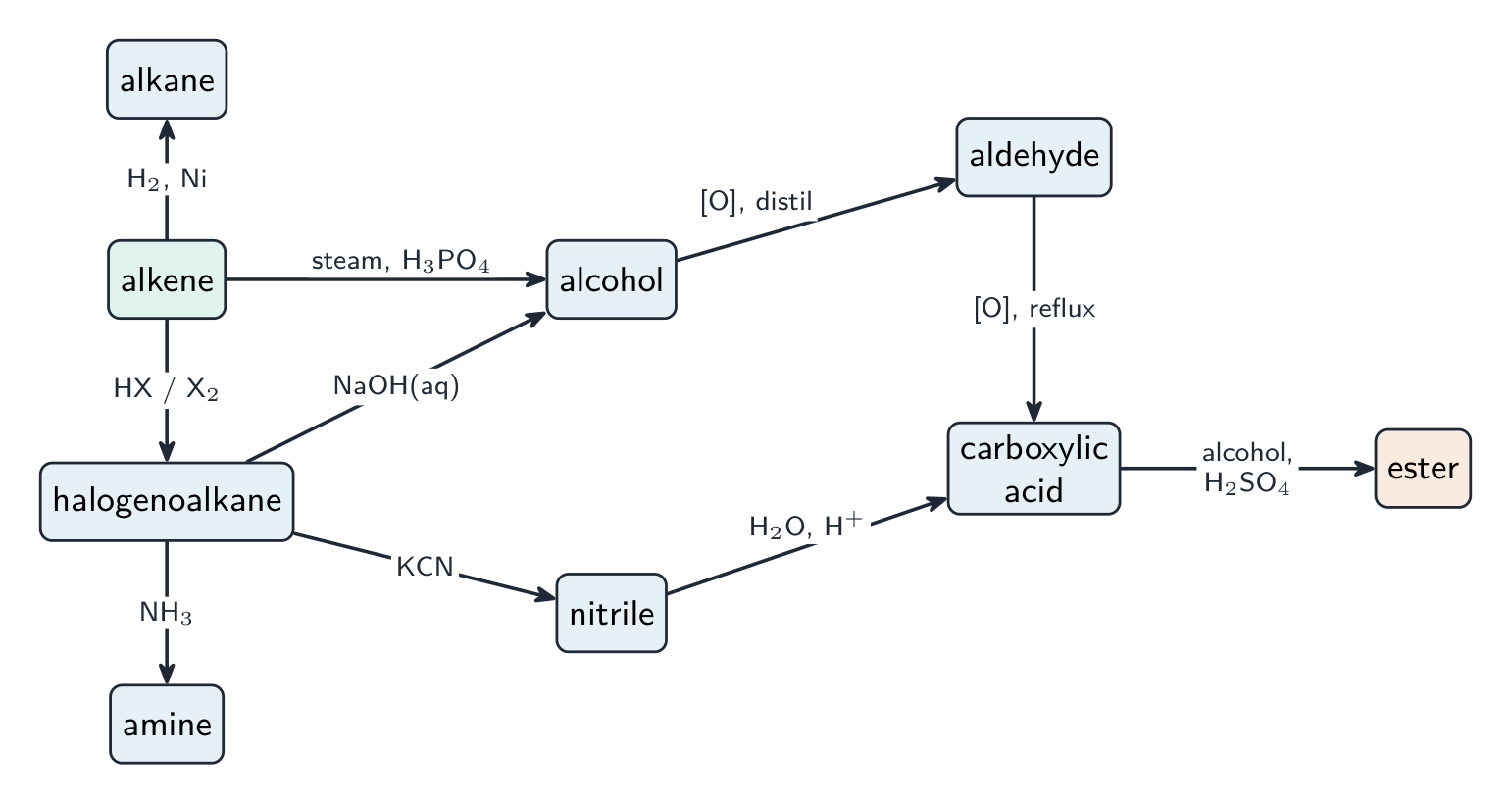
Each row turns one functional group into another. Learn it as a map you can travel around:
| Start | Reagent and conditions | Product |
|---|---|---|
| alkene | $\text{H}_2$, Ni | alkane |
| alkene | $\text{HX}$, or $\text{X}_2$ | halogenoalkane |
| alkene | steam, $\text{H}_3\text{PO}_4$ | alcohol |
| halogenoalkane | $\text{NaOH(aq)}$, heat | alcohol |
| halogenoalkane | $\text{KCN}$ in ethanol, heat | a nitrile 腈 (adds one carbon) |
| halogenoalkane | $\text{NH}_3$ in ethanol, pressure | an amine 胺 |
| alcohol | $\text{K}_2\text{Cr}_2\text{O}_7$, distil / reflux | aldehyde / carboxylic acid |
| alcohol | concentrated acid, heat | alkene |
| aldehyde or ketone | $\text{NaBH}_4$ | alcohol |
| aldehyde or ketone | $\text{HCN}$, $\text{KCN}$ | hydroxynitrile |
| nitrile | dilute acid, heat | carboxylic acid |
| carboxylic acid + alcohol | concentrated $\text{H}_2\text{SO}_4$ | an ester 酯 |
Planning a multi-step route
To devise a synthetic route 合成路线:
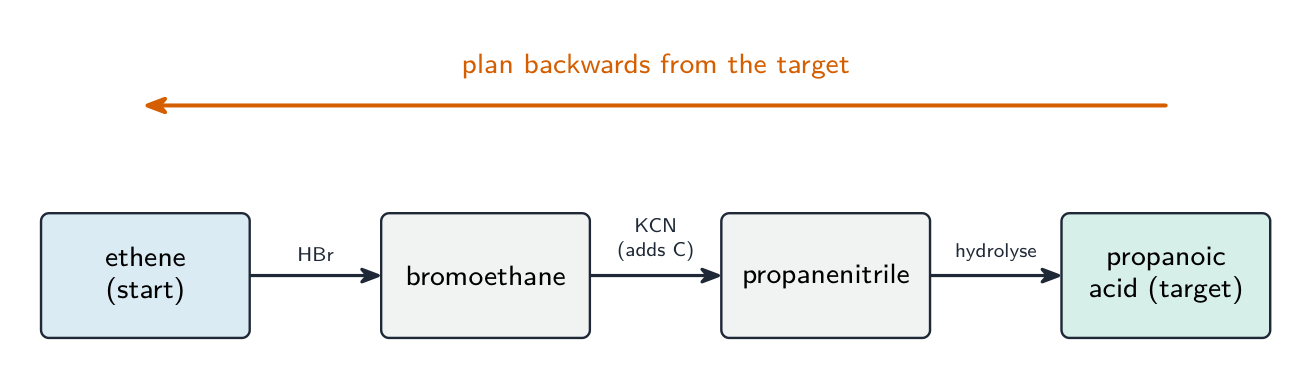
- compare the target with the starting material — what has changed (the functional group, the number of carbons)?
- work backwards from the target: which single reaction could make it, and from what?
- repeat until you reach the starting material.
- write each step with its reagent 试剂 and conditions.
If you need to add a carbon, use a cyanide step. These are the only AS reactions that lengthen the chain: $\text{KCN}$ with a halogenoalkane gives a nitrile, and $\text{HCN}$ adding to an aldehyde or ketone gives a hydroxynitrile.
Analysing a route
When you are given a route, for each step state the type of reaction (such as oxidation 氧化, reduction 还原, substitution, addition or elimination) and the reagent used. Also think about possible by-products 副产物 — for example, making an amine from a halogenoalkane also gives a mixture of further-substituted amines, so the yield of the simple amine is low.


Worked example. Devise a route from propene to propanone, $\text{CH}_3\text{COCH}_3$. Work backwards from the target. A ketone comes from oxidising a secondary alcohol, so the step before propanone is propan-2-ol with acidified $\text{K}_2\text{Cr}_2\text{O}_7$ under reflux. Propan-2-ol comes from propene by adding steam over an $\text{H}_3\text{PO}_4$ catalyst - and Markovnikov's rule conveniently puts the $\text{OH}$ on the middle carbon, which is exactly the secondary alcohol needed. So the route is: propene, then steam with $\text{H}_3\text{PO}_4$, giving propan-2-ol; then acidified $\text{K}_2\text{Cr}_2\text{O}_7$ under reflux, giving propanone. Give a reagent and its conditions on every arrow: a route with the right intermediates but no reagents scores very little.
Common mistakes.
- Adding silver nitrate straight to a halogenoalkane. The halogen is bonded covalently, so there are no free halide ions: hydrolyse first with warm $\text{NaOH(aq)}$, acidify with dilute $\text{HNO}_3$, then add $\text{AgNO}_3$.
- Oxidising to a carboxylic acid by distilling. Distil to collect the aldehyde as it forms; heat under reflux to oxidise all the way to the carboxylic acid.
- Expecting a tertiary alcohol to turn dichromate green. Tertiary alcohols are not oxidised, so the orange colour stays.
- Getting the wrong alcohol from steam addition. By Markovnikov's rule propene gives mainly propan-2-ol, not propan-1-ol.
- Using $\text{KCN}$ in water. Use $\text{KCN}$ in ethanol, heated under reflux; in water the hydroxide ions give an alcohol instead.
- Forgetting the carbon count. Only the cyanide steps add a carbon; a route that needs one more carbon must include $\text{KCN}$ or $\text{HCN}$.
探索
反应图实验室
对识别官能团和反应途径的线索分类。
探索
合成路线规划实验室
跟踪一个目标分子如何向后规划然后向前制造。
词汇
训练
| English | 中文 | 拼音 |
|---|---|---|
| functional group/ˈfʌŋkʃənl ɡruːp/ | 官能团 | guān néng tuán |
| alkene/ˈælkiːn/ | 烯烃 | xī tīng |
| halogenoalkane/ˈheɪləʊdʒnəʊlkeɪn/ | 卤代烷 | lǔ dài wán |
| alcohol/ˈælkəhɒl/ | 醇 | chún |
| aldehyde/ˈældɪhaɪd/ | 醛 | quán |
| ketone/ˈketəʊn/ | 酮 | tóng |
| carboxylic acid/ˌkɑːbəkˈsɪlɪk ˈæsɪd/ | 羧酸 | suō suān |
| nitrile/ˈnaɪtraɪl/ | 腈 | jīng |
| amine/ˈæmaɪn/ | 胺 | àn |
| ester/ˈestə/ | 酯 | zhǐ |
| synthetic route/sɪnˈθetɪk ruːt/ | 合成路线 | hé chéng lù xiàn |
| reagent/rɪˈeɪdʒənt/ | 试剂 | shì jì |
| oxidation/ˌɒksɪˈdeɪʃn/ | 氧化 | yǎng huà |
| reduction/rɪˈdʌkʃn/ | 还原 | huán yuán |
| by-product/baɪ ˈprɒdʌkt/ | 副产物 | fù chǎn wù |
21.1
考试技巧
English
- Learn the reagents and conditions for each conversion — that is exactly what synthesis questions test.
- Plan multi-step routes by functional group and watch the carbon count (KCN adds one carbon).
- Choose the shortest valid route and state every reagent and condition.
该知识点的互动课程
逐步完成,配合即时检查练习。