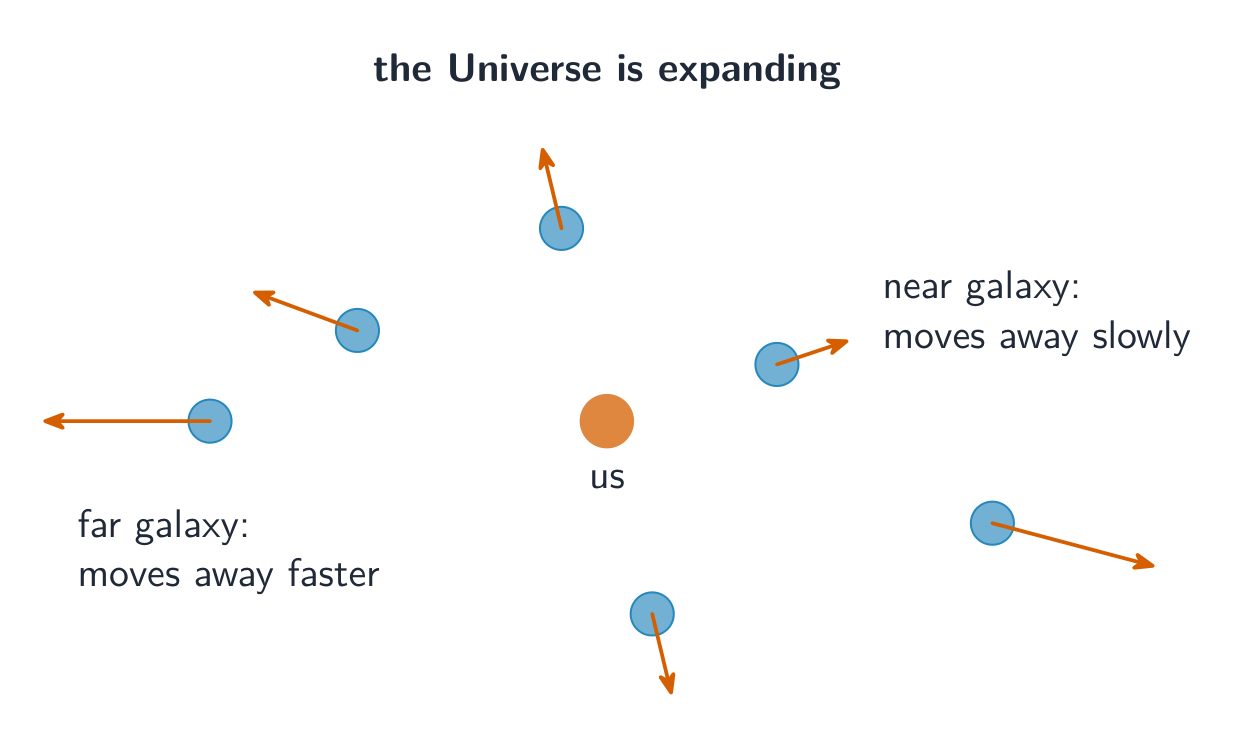
IGCSE Vật lý (0625) có sáu chủ đề: chuyển động, lực và năng lượng; vật lý nhiệt; sóng; điện và từ; vật lý hạt nhân; vật lý thiên văn.
Kiểm tra cấp độ của bạn trước. Có các đề thi cho sáu thành phần, và bạn sẽ tham gia thi thành phần nào phụ thuộc vào việc bạn đăng ký Nền tảng (Core) hay Nâng cao (Extended). Nội dung chỉ dành cho Nâng cao chiếm một phần lớn trong chương trình và sẽ vô ích nếu bạn học ở cấp độ Nền tảng.
Lỗi mất điểm phổ biến nhất là những lỗi dễ sửa nhất: thiếu đơn vị, số lượng chữ số có nghĩa không đúng, và câu trả lời chỉ đưa ra con số mà không kèm theo công thức tạo ra nó. Các định nghĩa được chấm dựa trên lời văn chính xác — hãy học thuộc chúng đúng như cách viết, không phải theo cách nhớ.
1 Describe the use of rulers and measuring cylinders to find a length or a volume
2 Describe how to measure a variety of time intervals using clocks and digital timers
3 Determine an average value for a small distance and for a short interval of time by measuring multiples (including the period of oscillation of a pendulum)
4 Understand that a scalar quantity has magnitude (size) only and that a vector quantity has magnitude and direction
5 Know that the following quantities are scalars: distance, speed, time, mass, energy and temperature
6 Know that the following quantities are vectors: force, weight, velocity, acceleration, momentum, electric field strength and gravitational field strength
7 Determine, by calculation or graphically, the resultant of two vectors at right angles, limited to forces or velocities only
Tiếng Việt
Cốt lõi
Bổ sung
1 Mô tả việc sử dụng thước kẻ và bình đo để tìm độ dài hoặc thể tích
2 Mô tả cách đo các khoảng thời gian khác nhau bằng đồng hồ và bộ đếm điện tử
3 Xác định giá trị trung bình cho một khoảng cách nhỏ và một khoảng thời gian ngắn bằng cách đo nhiều lần (bao gồm chu kỳ dao động của con lắc đơn)
4 Hiểu rằng đại lượng vô hướng chỉ có độ lớn (kích thước) và đại lượng vectơ có cả độ lớn và hướng
5 Biết rằng các đại lượng sau là đại lượng vô hướng: quãng đường, tốc độ, thời gian, khối lượng, năng lượng và nhiệt độ
6 Biết rằng các đại lượng sau là vector: lực, trọng lượng, vận tốc, gia tốc, động lượng, cường độ điện trường và cường độ trường hấp dẫn
7 Xác định, bằng tính toán hoặc đồ thị, hợp lực của hai vector vuông góc, chỉ giới hạn ở lực hoặc vận tốc
Source: Cambridge International syllabus · Nguồn: Chương trình Cambridge International
Resolving a vector into components
Length and volume
Use a ruler 直尺 to measure length. Read the scale with your eye straight in front of the mark to avoid a reading error.
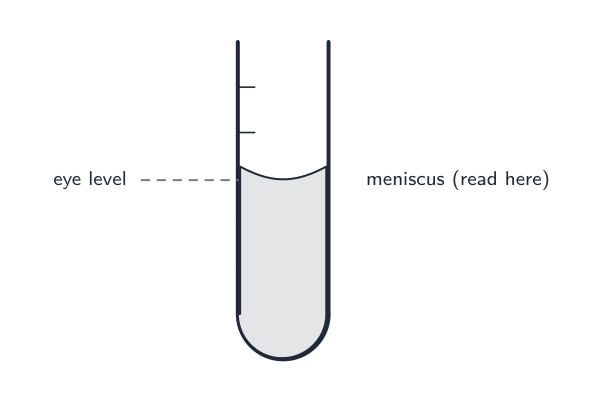
The water an irregular solid pushes up gives its volumeRead a measuring cylinder at the bottom of the meniscus, with your eye level
Use a measuring cylinder 量筒 to measure the volume of a liquid. Read the scale at the bottom of the curved surface (the meniscus 弯月面), with your eye level with it.
Measuring time
Use a stopwatch 秒表 or a digital timer 数字计时器 to measure a time interval. A clock is fine for long times (minutes or hours). A stopwatch is started and stopped by hand, so each reading has a reaction time 反应时间 error of about 0.2 s. To make this error matter less, time a long interval, or time many repeats and divide (see below).
Measuring small amounts
A single small length or a short time is hard to measure well. The trick is to measure many and divide 测多个再相除:
To find the thickness of one page, measure 100 pages and divide by 100.
To find the time for one swing of a pendulum 摆, measure the time for 20 swings and divide by 20. One full swing is called the period 周期.
This makes the uncertainty 不确定度 (the size of the error) much smaller.
Scalars and vectors
A scalar quantity 标量 has size (magnitude 大小) only. A vector quantity 矢量 has size and direction.
Scalars: distance, speed, time, mass 质量, energy 能量, temperature 温度.
Vectors: force 力, weight 重力, velocity 速度, acceleration 加速度, momentum 动量, electric field strength 电场强度, gravitational field strength 重力场强度.
To add two vectors at right angles (90°), draw them as two sides of a rectangle. The resultant 合矢量 is the diagonal. Find its size with Pythagoras and its direction with trigonometry.
$$R = \sqrt{a^2 + b^2}$$
Two vectors at right angles add to a resultant $R$, the diagonal of the rectangle
Explore · Khám phá
Scalars & vectors · Vô hướng & có hướng
resultant = a + b · hợp lực = a + b
Add two vectors tip-to-tail to find the resultant. · Thêm hai vectơ đầu nối đuôi để tìm vectơ hợp.
gravitational field strength/ˌɡrævɪˈteɪʃənl fiːld streŋθ/
cường độ trường hấp dẫn
resultant/rɪˈzʌltənt/
hợp lực
1.2
Motion 运动
Syllabus · Chương trình
English
Core
Supplement
1 Define speed as distance travelled per unit time; recall and use the equation
$$v = \frac{s}{t}$$
2 Define velocity as speed in a given direction
3 Recall and use the equation
$$\text{average speed} = \frac{\text{total distance travelled}}{\text{total time taken}}$$
9 Define acceleration as change in velocity per unit time; recall and use the equation
$$a = \frac{\Delta v}{\Delta t}$$
4 Sketch, plot and interpret distance–time and speed–time graphs
5 Determine, qualitatively, from given data or the shape of a distance–time graph or speed–time graph when an object is: (a) at rest (b) moving with constant speed (c) accelerating (d) decelerating
10 Determine from given data or the shape of a speed–time graph when an object is moving with: (a) constant acceleration (b) changing acceleration
6 Calculate speed from the gradient of a straight-line section of a distance–time graph
11 Calculate acceleration from the gradient of a speed–time graph
7 Calculate the area under a speed–time graph to determine the distance travelled for motion with constant speed or constant acceleration
12 Know that a deceleration is a negative acceleration and use this in calculations
8 State that the acceleration of free fall $g$ for an object near to the surface of the Earth is approximately constant and is approximately $9.8\text{ m/s}^2$
13 Describe the motion of objects falling in a uniform gravitational field with and without air/ liquid resistance, including reference to terminal velocity
Tiếng Việt
Cốt lõi
Bổ sung
1 Định nghĩa tốc độ là quãng đường đi được trên một đơn vị thời gian; nhớ và sử dụng phương trình
$$v = \frac{s}{t}$$
2 Định nghĩa vận tốc là tốc độ theo một hướng xác định
3 Nhớ lại và sử dụng phương trình
$$\text{average speed} = \frac{\text{total distance travelled}}{\text{total time taken}}$$
9 Định nghĩa gia tốc là sự thay đổi vận tốc trên một đơn vị thời gian; nhớ lại và sử dụng phương trình
$$a = \frac{\Delta v}{\Delta t}$$
4 Vẽ, biểu diễn và giải thích đồ thị quãng thời gian và đồ thị tốc độ–thời gian
5 Xác định, theo定性 (chất), từ dữ liệu đã cho hoặc hình dạng của đồ thị quãng thời gian hay đồ thị tốc độ–thời gian khi vật đang: (a) đứng yên (b) chuyển động với tốc độ không đổi (c) tăng tốc (d) giảm tốc
10 Xác định từ dữ liệu đã cho hoặc hình dạng của đồ thị tốc độ–thời gian khi vật đang chuyển động với: (a) gia tốc không đổi (b) gia tốc thay đổi
6 Tính tốc độ từ độ dốc của phần thẳng trên đồ thị quãng thời gian
11 Tính gia tốc từ độ dốc của đồ thị tốc độ–thời gian
7 Tính diện tích dưới đồ thị tốc độ–thời gian để xác định quãng đường di chuyển đối với chuyển động có tốc độ không đổi hoặc gia tốc không đổi
12 Biết rằng giảm tốc là gia tốc âm và sử dụng điều này trong tính toán
8 Nêu rằng gia tốc rơi tự do $g$ của một vật gần bề mặt Trái Đất xấp xỉ không đổi và xấp xỉ $9.8\text{ m/s}^2$
13 Mô tả chuyển động của các vật rơi trong trường hấp dẫn đều có và không có sức cản không khí/chất lỏng, bao gồm cả tham chiếu đến vận tốc cuối cùng
Source: Cambridge International syllabus · Nguồn: Chương trình Cambridge International
Speed and velocity
Speed 速率 is the distance travelled per unit time.
$$v = \frac{s}{t}$$
Velocity is speed in a stated direction. So velocity is a vector but speed is a scalar.
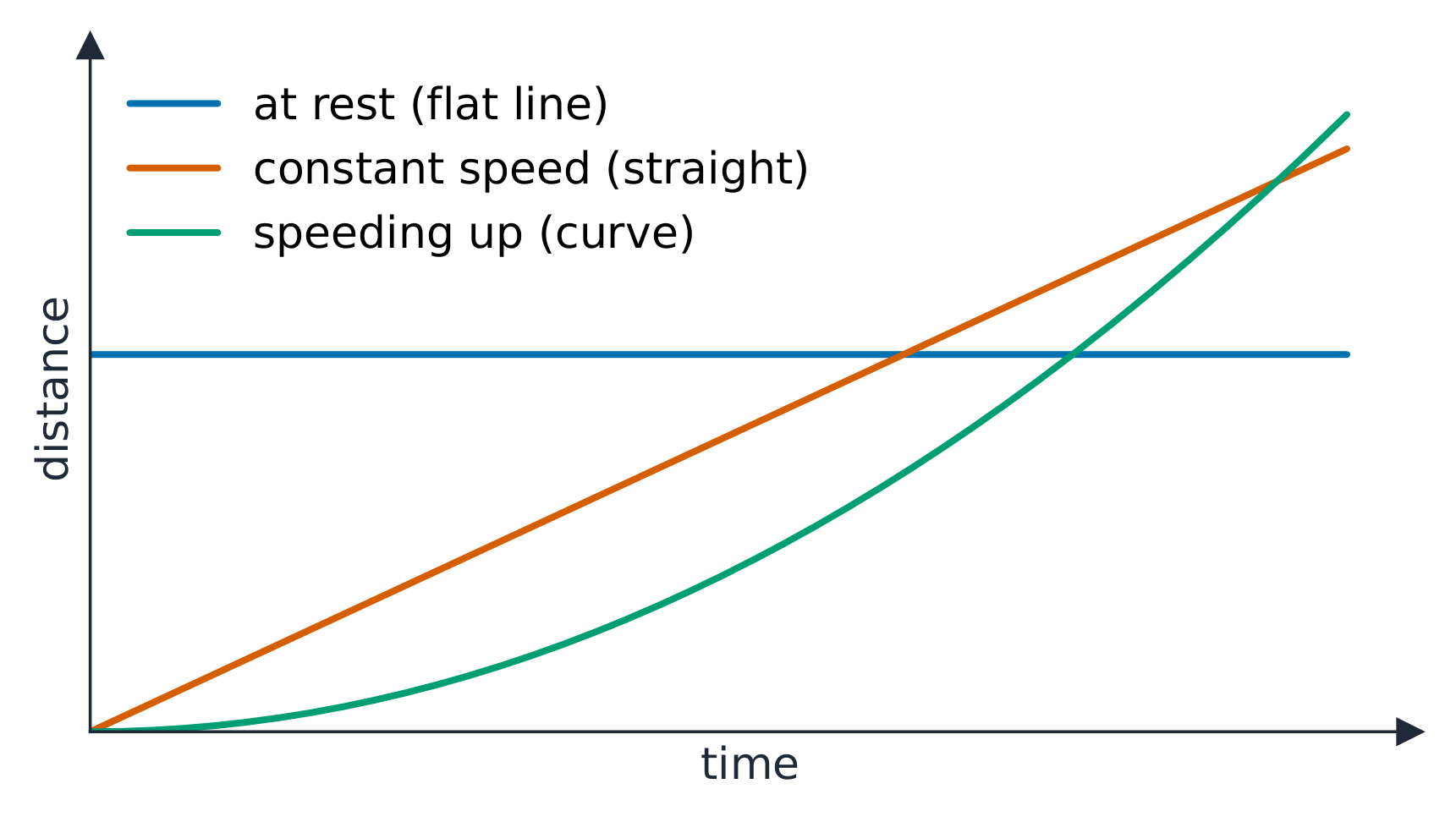
A distance–time graph 距离-时间图 shows how far an object has gone:
A flat (horizontal) line means the object is at rest 静止.
A straight slope means constant speed. The gradient 斜率 (steepness) is the speed.
A curve that gets steeper means the object is speeding up.
The shape of a distance–time line: flat is at rest, a straight slope is constant speed, a rising curve is speeding up
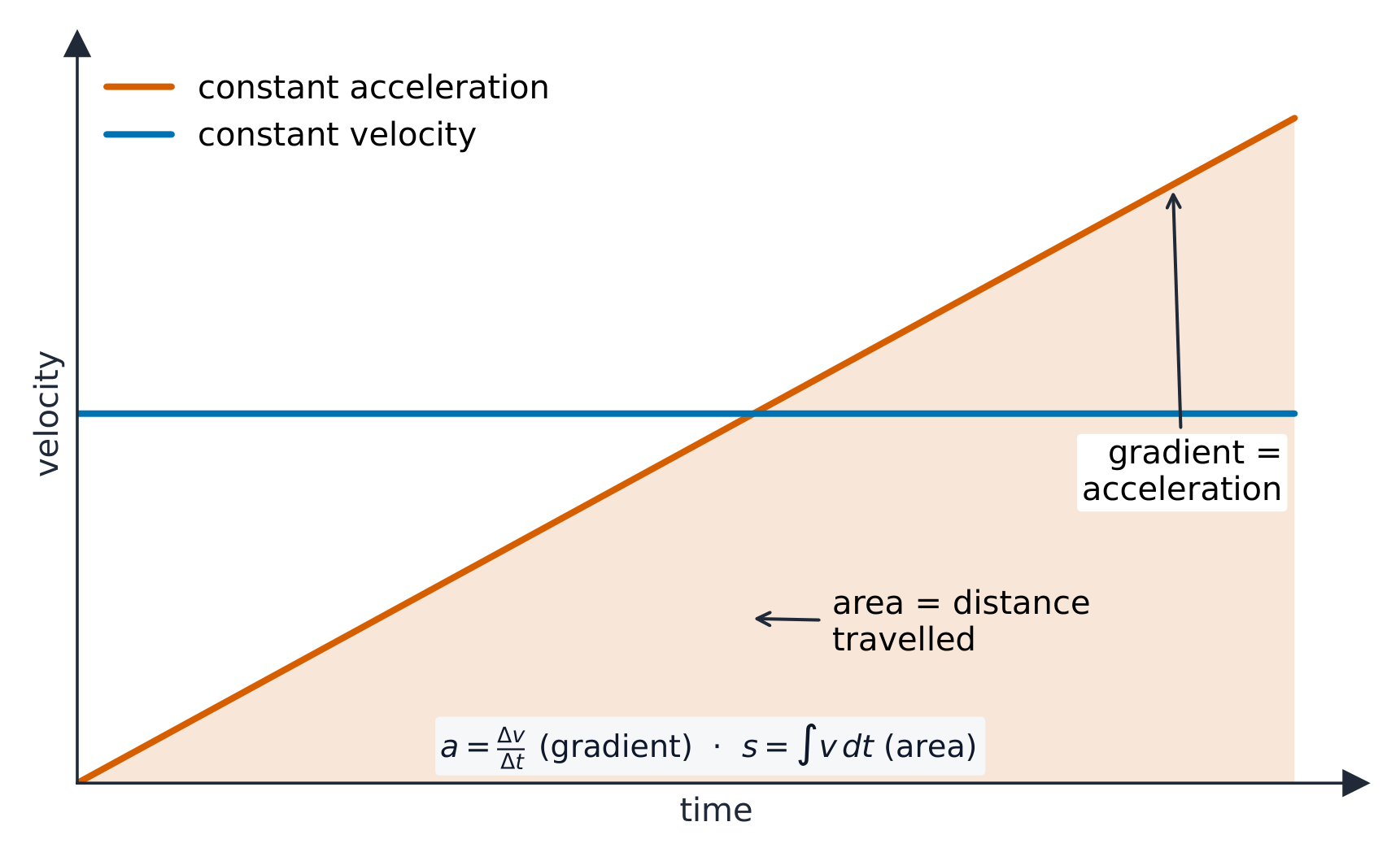
A speed–time graph 速度-时间图 shows how fast an object is going:
A flat line means constant speed.
A straight slope means constant acceleration. The gradient is the acceleration.
The area under the line 线下面积 is the distance travelled.
On a velocity–time graph the gradient is the acceleration and the area under the line is the distance travelled
Falling objects
Near the Earth the gravitational field is uniform 均匀 (the same strength everywhere), so all objects speed up as they fall at the same rate. This is the acceleration of free fall 自由落体加速度, $g \approx 9.8\ \text{m/s}^2$.
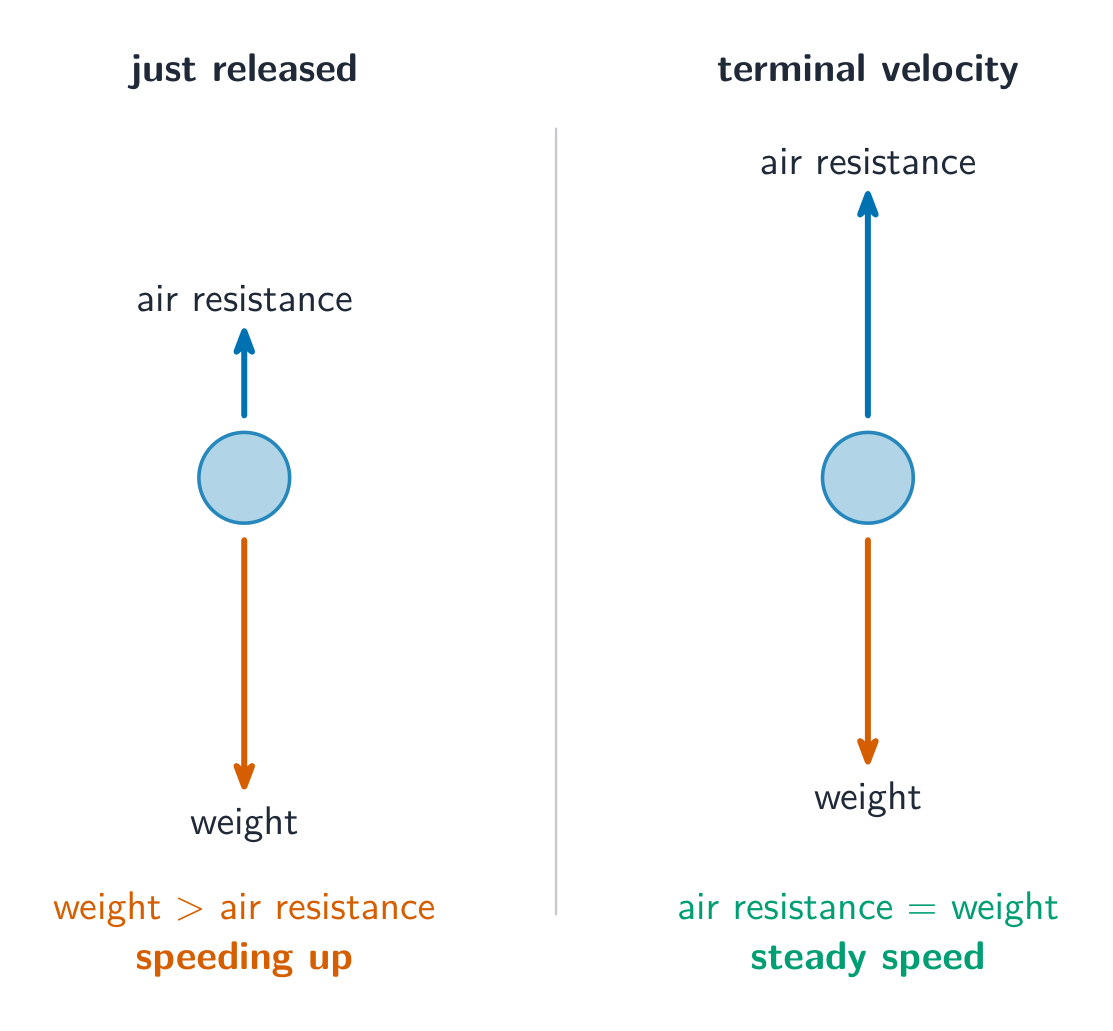
When an object falls through air, air resistance 空气阻力 (a drag force) acts upward. As it speeds up, air resistance grows. When air resistance equals the weight, the resultant force is zero and the object stops speeding up. It then falls at a steady terminal velocity 收尾速度.
At first the weight is bigger than the air resistance, so the object speeds up; at terminal velocity the two are equal and the speed is steady
Explore · Khám phá
Velocity–time graph · Đồ thị vận tốc - thời gian
Change u and a. The gradient is the acceleration; the area under the line is the distance travelled. · Thay đổi u và a. Hệ số góc là gia tốc; diện tích dưới đường là quãng đường đã đi.
acceleration of free fall/əkˌseləˈreɪʃn ɒv friː fɔːl/
gia tốc rơi tự do
air resistance/eə rɪˈzɪstəns/
lực cản không khí
terminal velocity/ˈtɜːmɪnl vəˈlɒsɪti/
tốc độ cuối
1.3
Mass and weight
Syllabus · Chương trình
English
Core
Supplement
1 State that mass is a measure of the quantity of matter in an object at rest relative to the observer
2 State that weight is a gravitational force on an object that has mass
5 Describe, and use the concept of, weight as the effect of a gravitational field on a mass
3 Define gravitational field strength as force per unit mass; recall and use the equation
$$g = \frac{W}{m}$$
and know that this is equivalent to the acceleration of free fall
4 Know that weights (and masses) may be compared using a balance
Tiếng Việt
Cốt lõi
Bổ sung
1 Nêu rằng khối lượng là thước đo lượng chất matter trong một vật đang đứng yên so với người quan sát
2 Nêu rằng trọng lượng là lực hấp dẫn tác dụng lên một vật có khối lượng
5 Mô tả, và sử dụng khái niệm về trọng lượng như là hiệu ứng của trường hấp dẫn lên một khối lượng
3 Định nghĩa cường độ trường trọng lực là lực trên một đơn vị khối lượng; nhớ lại và sử dụng phương trình
$$g = \frac{W}{m}$$
và biết rằng nó tương đương với gia tốc rơi tự do
4 Biết rằng trọng lượng (và khối lượng) có thể được so sánh bằng cách dùng cân
Source: Cambridge International syllabus · Nguồn: Chương trình Cambridge International
Mass is the amount of matter 物质 in an object. It is measured in kilograms (kg) and does not change when you move the object.
Weight is the force of gravity on a mass. It is measured in newtons (N). Weight can change: it is smaller on the Moon because the Moon's gravity is weaker.
Gravitational field strength is the force per unit mass:
$$g = \frac{W}{m}$$
This $g$ has the same value as the acceleration of free fall ($\approx 9.8\ \text{N/kg}$). You can compare masses with a balance 天平.
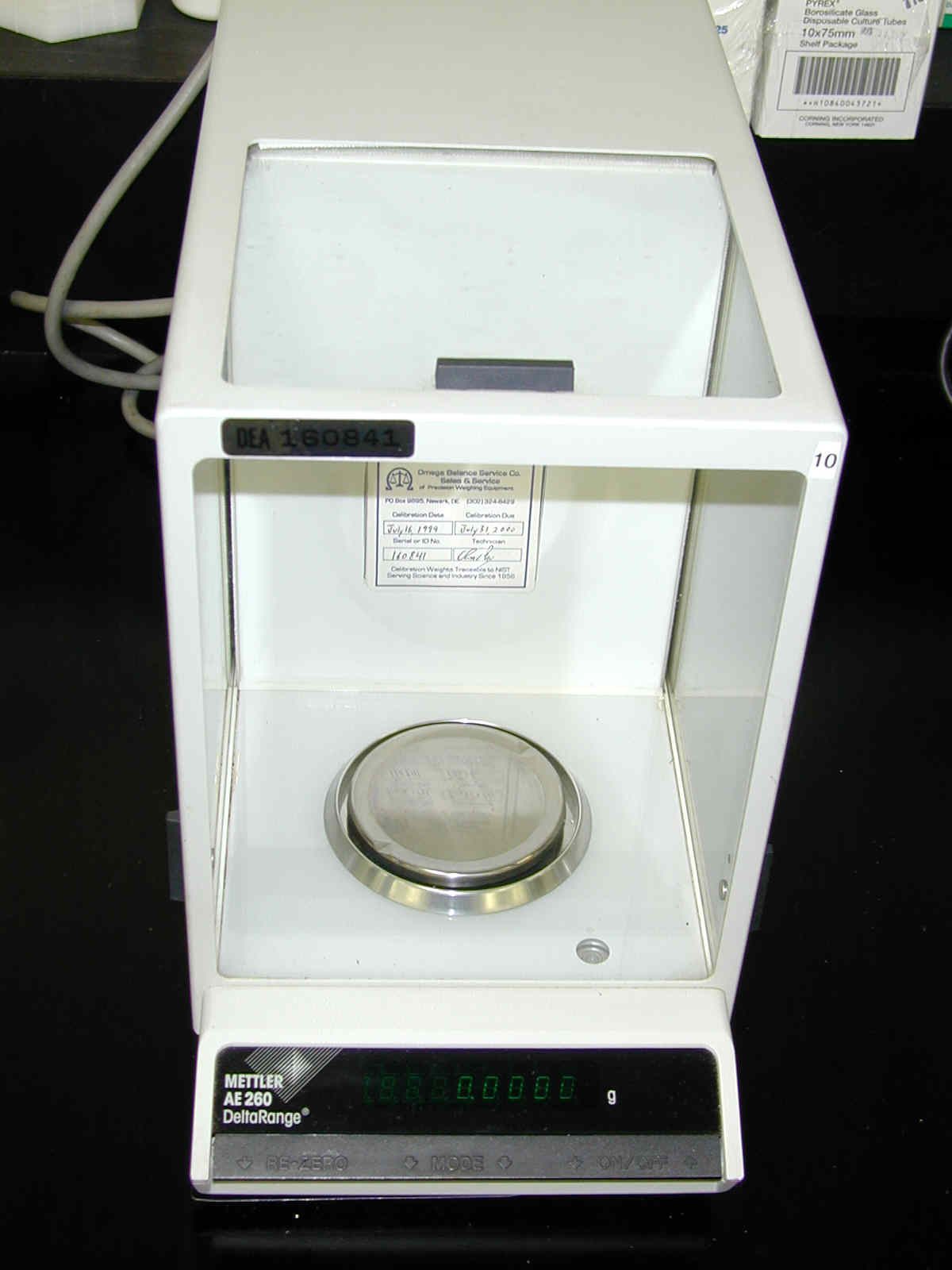
A laboratory balance measures mass; weight is the gravitational force on that mass
Explore · Khám phá
Weight and mass · Trọng lực và khối lượng
W = mg
Weight is proportional to mass — the gradient is the gravitational field strength g (about 10 N/kg on Earth). · Trọng lực tỷ lệ thuận với khối lượng — hệ số góc chính là cường độ trường gravitation g (khoảng 10 N/kg trên Trái Đất).
1 Define density as mass per unit volume; recall and use the equation
$$\rho = \frac{m}{V}$$
2 Describe how to determine the density of a liquid, of a regularly shaped solid and of an irregularly shaped solid which sinks in a liquid (volume by displacement), including appropriate calculations
3 Determine whether an object floats based on density data
4 Determine whether one liquid will float on another liquid based on density data given that the liquids do not mix
Tiếng Việt
Cốt lõi
Bổ sung
1 Định nghĩa mật độ là khối lượng trên một đơn vị thể tích; nhớ và sử dụng phương trình
$$\rho = \frac{m}{V}$$
2 Mô tả cách xác định mật độ của chất lỏng, của vật rắn có hình dạng đều và của vật rắn có hình dạng không đều chìm trong chất lỏng (thể tích bằng phương pháp đẩy nước), bao gồm cả các phép tính phù hợp
3 Xác định xem một vật có nổi hay dựa trên dữ liệu mật độ
4 Xác định xem một chất lỏng có nổi trên chất lỏng khác hay dựa trên dữ liệu mật độ đã cho, biết rằng các chất lỏng không hòa tan vào nhau
Source: Cambridge International syllabus · Nguồn: Chương trình Cambridge International
Density is the mass per unit volume.
$$\rho = \frac{m}{V}$$
The symbol $\rho$ is the Greek letter "rho". The unit is $\text{kg/m}^3$ or $\text{g/cm}^3$.
To find density: measure the mass with a balance, find the volume, then divide.
Regular solid 规则固体 (like a box): measure the sides and calculate the volume.
Irregular solid 不规则固体 (a strange shape): lower it into water in a measuring cylinder. The rise in water level is its volume. This is the displacement method 排水法.
Liquid: put an empty measuring cylinder on the balance and read its mass. Pour in the liquid, read the volume on the cylinder, and read the mass again. The mass of the liquid is the difference between the two mass readings.
An object floats 漂浮 if its density is less than the density of the liquid. It sinks if its density is greater. In the same way, one liquid floats on top of another (if the two do not mix) when its density is lower: oil floats on water.
Worked example. A stone of mass $54\ \text{g}$ is lowered into a measuring cylinder. The water level rises from $20\ \text{cm}^3$ to $40\ \text{cm}^3$. Find the density of the stone.
The volume of the stone is the rise in water level, $40 - 20 = 20\ \text{cm}^3$, so
An iceberg floats with most of its volume hidden: ice is slightly less dense than water
Explore · Khám phá
Floating and density · Nổi và mật độ
Change the object's density and the liquid: it floats if it's less dense, and the denser it is the more sits underwater. Iron sinks in water but floats on mercury. · Thay đổi mật độ của vật và chất lỏng: vật nổi nếu ít đậm đặc hơn, và càng đậm đặc thì phần chìm dưới nước càng nhiều. Sắt chìm trong nước nhưng nổi trên thủy ngân.
1 Know that forces may produce changes in the size and shape of an object
9 Define the spring constant as force per unit extension; recall and use the equation
$$k = \frac{F}{x}$$
2 Sketch, plot and interpret load–extension graphs for an elastic solid and describe the associated experimental procedures
10 Define and use the term ‘limit of proportionality’ for a load–extension graph and identify this point on the graph (an understanding of the elastic limit is not required)
3 Determine the resultant of two or more forces acting along the same straight line
11 Recall and use the equation $F = ma$ and know that the force and the acceleration are in the same direction
4 Know that an object either remains at rest or continues in a straight line at constant speed unless acted on by a resultant force
5 State that a resultant force may change the velocity of an object by changing its direction of motion or its speed
12 Describe, qualitatively, motion in a circular path due to a force perpendicular to the motion as: (a) speed increases if force increases, with mass and radius constant (b) radius decreases if force increases, with mass and speed constant (c) an increased mass requires an increased force to keep speed and radius constant ($F = \frac{mv^2}{r}$ is not required)
6 Describe solid friction as the force between two surfaces that may impede motion and produce heating
7 Know that friction (drag) acts on an object moving through a liquid
8 Know that friction (drag) acts on an object moving through a gas (e.g. air resistance)
1.5.2 Turning effect of forces
Core
Supplement
1 Describe the moment of a force as a measure of its turning effect and give everyday examples
2 Define the moment of a force as $\text{moment} = \text{force} \times \text{perpendicular distance from the pivot}$; recall and use this equation
3 Apply the principle of moments to situations with one force each side of the pivot, including balancing of a beam
5 Apply the principle of moments to other situations, including those with more than one force each side of the pivot
4 State that, when there is no resultant force and no resultant moment, an object is in equilibrium
6 Describe an experiment to demonstrate that there is no resultant moment on an object in equilibrium
1.5.3 Centre of gravity
Core
Supplement
1 State what is meant by centre of gravity
2 Describe an experiment to determine the position of the centre of gravity of an irregularly shaped plane lamina
3 Describe, qualitatively, the effect of the position of the centre of gravity on the stability of simple objects
Tiếng Việt
1.5.1 Tác dụng của lực
Cốt lõi
Bổ sung
1 Biết rằng lực có thể tạo ra sự thay đổi về kích thước và hình dạng của một vật
9 Định nghĩa hệ số lò xo là lực trên một đơn vị độ dãn; nhớ và sử dụng phương trình
$$k = \frac{F}{x}$$
2 Vẽ, biểu diễn và giải thích đồ thị tải–độ dãn cho vật rắn đàn hồi và mô tả các quy trình thí nghiệm liên quan
10 Định nghĩa và sử dụng thuật ngữ ‘giới hạn tỷ lệ’ cho đồ thị tải–độ dãn và xác định điểm này trên đồ thị (không yêu cầu hiểu về giới hạn đàn hồi)
3 Xác định hợp lực của hai hoặc nhiều lực tác dụng dọc theo cùng một đường thẳng
11 Nhớ và sử dụng phương trình $F = ma$ và biết rằng lực và gia tốc nằm cùng một hướng
4 Biết rằng một vật sẽ ở trạng thái đứng yên hoặc tiếp tục chuyển động thẳng với tốc độ không đổi nếu không chịu tác dụng của hợp lực
5 Nêu rằng hợp lực có thể làm thay đổi vận tốc của vật bằng cách thay đổi hướng chuyển động hoặc tốc độ của nó
12 Mô tả, theo定性 (chất), chuyển động trên quỹ đạo tròn do lực vuông góc với chuyển động gây ra như: (a) tốc độ tăng nếu lực tăng, với khối lượng và bán kính không đổi (b) bán kính giảm nếu lực tăng, với khối lượng và tốc độ không đổi (c) khối lượng tăng đòi hỏi lực tăng để giữ tốc độ và bán kính không đổi ($F = \frac{mv^2}{r}$ không yêu cầu)
6 Mô tả lực ma sát cứng là lực giữa hai bề mặt có thể cản trở chuyển động và sinh nhiệt
7 Biết rằng ma sát (lực cản) tác dụng lên vật đang chuyển động qua chất lỏng
8 Biết rằng ma sát (lực cản) tác dụng lên vật đang chuyển động qua khí (ví dụ: lực cản không khí)
1.5.2 Tác dụng quay của lực
Cốt lõi
Bổ sung
1 Mô tả mô-men của lực là thước đo tác dụng quay của nó và đưa ra ví dụ trong đời sống hàng ngày
2 Định nghĩa mô-men của lực là $\text{moment} = \text{force} \times \text{perpendicular distance from the pivot}$; nhớ và sử dụng phương trình này
3 Áp dụng nguyên lý mô-men cho các tình huống có một lực ở mỗi bên bản lề, bao gồm cả việc cân bằng thanh
5 Áp dụng nguyên lý mô-men cho các tình huống khác, bao gồm cả những tình huống có hơn một lực ở mỗi bên bản lề
4 Nêu rằng, khi không có hợp lực và không có hợp mô-men, một vật đang ở trạng thái cân bằng
6 Mô tả thí nghiệm để chứng minh rằng không có hợp mô-men tác dụng lên vật đang ở trạng thái cân bằng
1.5.3 Trọng tâm
Cốt lõi
Bổ sung
1 Nêu ý nghĩa của trọng tâm
2 Mô tả thí nghiệm để xác định vị trí trọng tâm của một tấm phẳng có hình dạng không đều
3 Mô tả, theo定性 (chất), ảnh hưởng của vị trí trọng tâm lên sự ổn định của các vật đơn giản
Source: Cambridge International syllabus · Nguồn: Chương trình Cambridge International
The principle of momentsHooke's law & the elastic limit
A force is a push or a pull. A force can change the shape 形状, the speed, or the direction of an object.
Stretching (Hooke's law)
When you hang a load on a spring, it stretches. The stretch is called the extension 伸长量.
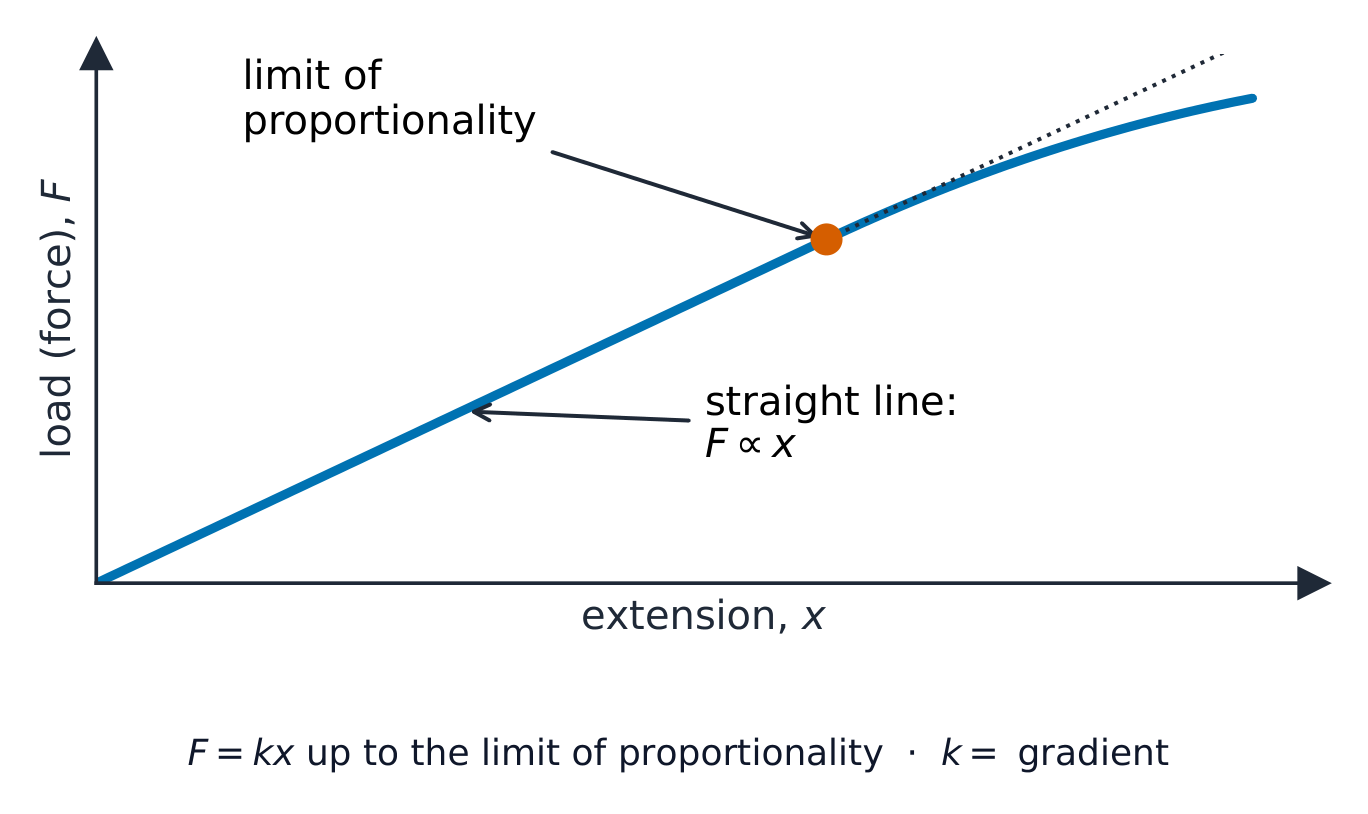
On a load–extension graph 载荷-伸长图 the line is straight at first: extension is proportional to load. The point where the line stops being straight is the limit of proportionality 比例极限.
Load is proportional to extension until the limit of proportionality, then the line curves
The experiment. Hang the spring from a clamp and stand a ruler beside it. Read the position of the bottom of the spring with no load: this is the original length. Add loads one at a time (for example 1 N each) and record the new length each time. The extension is the new length minus the original length. Plot load on the y-axis against extension on the x-axis.
The spring constant 弹簧常数 is the force per unit extension:
$$k = \frac{F}{x}$$
A large $k$ means a stiff spring.
Resultant force and Newton's laws
Add forces on a straight line to get the resultant force 合力 (forces one way are positive, the other way negative).
If the resultant force is zero, the object stays at rest or keeps moving in a straight line at constant speed. (Newton's first law.)
If the resultant force is not zero, the object accelerates in the direction of the force:
$$F = ma$$
A free-body diagram shows every force on the box as a labelled arrow
Worked example. A $1200\ \text{kg}$ car has a $3000\ \text{N}$ driving force and $600\ \text{N}$ of friction. Find its acceleration.
First find the resultant force: $3000 - 600 = 2400\ \text{N}$. Then
A resultant force at right angles to the motion does not change the speed. It changes the direction, so the object moves in a circle at a steady speed. This is circular motion 圆周运动. The force always points towards the centre of the circle: the pull of the string on a whirling ball, or the gravity of the Sun on a planet.
For an object moving in a circle:
a bigger force is needed to keep the same mass moving at a higher speed in a circle of the same radius 半径;
a bigger force makes the same mass at the same speed move in a smaller circle (a smaller radius);
a bigger mass needs a bigger force to keep the same speed and the same radius.
Friction
Friction 摩擦力 is the force between two surfaces that touch. It tries to stop motion and makes things heat up. Drag (friction in a liquid or gas, like air resistance) also slows objects down.
Moments — the turning effect
The moment 力矩 of a force is its turning effect about a pivot 支点.
$$\text{moment} = \text{force} \times \text{perpendicular distance from the pivot}$$
The unit is the newton metre (N m).
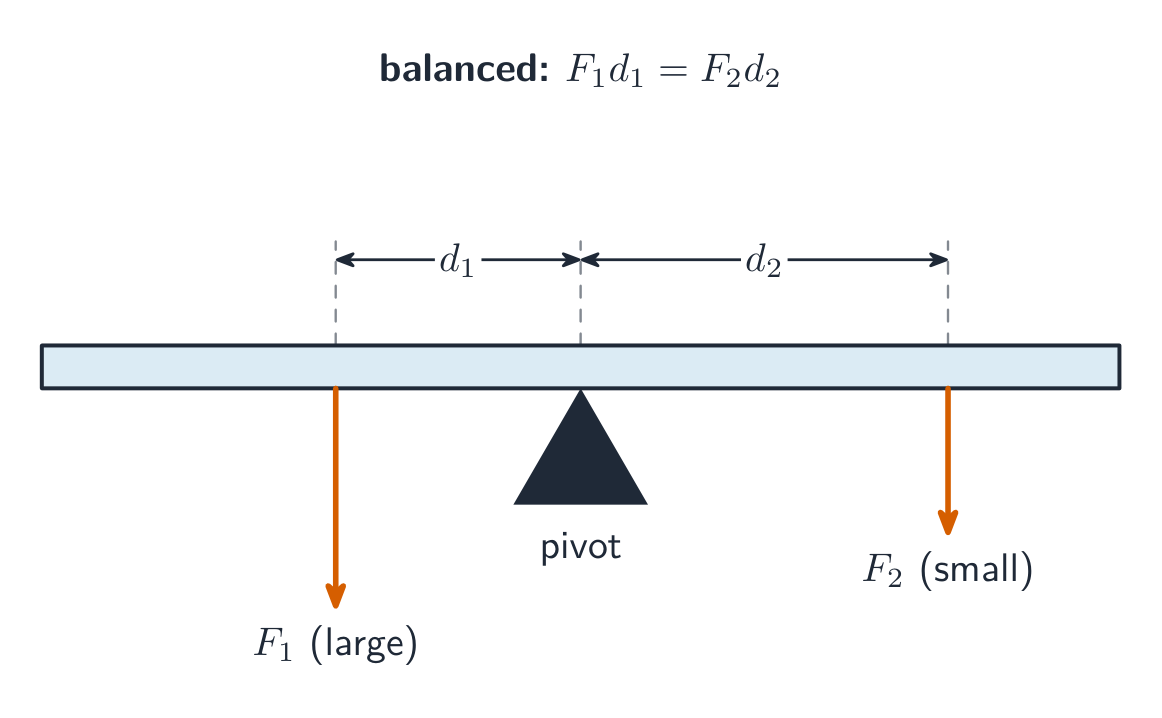
Principle of moments 力矩原理: when an object is balanced (in equilibrium 平衡),
An object is in equilibrium when there is no resultant force and no resultant moment.
The beam balances when the clockwise moment equals the anticlockwise moment
Worked example. A $30\ \text{N}$ weight sits $0.20\ \text{m}$ to the left of a pivot. How far to the right must a $20\ \text{N}$ weight sit to balance the beam?
Balanced, so anticlockwise moment $=$ clockwise moment:
$$30 \times 0.20 = 20 \times d \quad\Rightarrow\quad d = \frac{6.0}{20} = 0.30\ \text{m}$$
Checking the principle by experiment. Balance a metre rule at its centre on a pivot. Hang a known weight on each side and move them until the rule balances again. Measure each distance from the pivot. Force × distance on the left equals force × distance on the right, within the small errors of measurement, so there is no resultant moment on a balanced object.
Centre of gravity
The centre of gravity 重心 is the single point where all the weight of an object seems to act.
For a flat shape (lamina 薄片), hang it from a pin and let it settle; draw a vertical line down from the pin using a plumb line. Repeat from another point. The centre of gravity is where the lines cross.
The stability 稳定性 of an object depends on where its centre of gravity is. An object is more stable 稳定 when its centre of gravity is low and its base is wide. It tips over when a vertical line down from the centre of gravity passes outside the base.
Explore · Khám phá
Forces & Newton's laws · Lực & Các định luật Newton
F = ma (resultant) · F = ma (hợp lực)
The resultant force sets the acceleration; balanced forces ⇒ none. · Hợp lực tạo ra gia tốc; các lực cân bằng ⇒ không có gia tốc.
limit of proportionality/ˈlɪmɪt ɒv prəˌpɔːʃəˈnælɪti/
điểm gãy
spring constant/sprɪŋ ˈkɒnstənt/
hằng số lò xo
resultant force/rɪˈzʌltənt fɔːs/
lực hợp
circular motion/ˈsɜːkjʊlə ˈməʊʃn/
chuyển động tròn
radius/ˈreɪdɪəs/
bán kính
friction/ˈfrɪkʃn/
lực ma sát
moment/ˈməʊmənt/
thời điểm
pivot/ˈpɪvət/
bản lù
principle of moments/ˈprɪnsɪpl ɒv ˈməʊmənts/
mô-men
equilibrium/ˌiːkwɪˈlɪbrɪəm/
cân bằng
centre of gravity/ˈsentə ɒv ˈɡrævɪti/
trọng tâm
lamina/ˈlæmɪnə/
phiên bản
stability/stəˈbɪlɪti/
sự bền vững
stable/ˈsteɪbl/
ổn định
1.6
Momentum
Syllabus · Chương trình
English
Core
Supplement
1 Define momentum as mass $\times$ velocity; recall and use the equation $p = mv$
2 Define impulse as force $\times$ time for which force acts; recall and use the equation $\text{impulse} = F\Delta t = \Delta(mv)$
3 Apply the principle of the conservation of momentum to solve simple problems in one dimension
4 Define resultant force as the change in momentum per unit time; recall and use the equation $F = \frac{\Delta p}{\Delta t}$
Tiếng Việt
Cốt lõi
Bổ sung
1 Định nghĩa động lượng là khối lượng $\times$ vận tốc; nhớ và sử dụng phương trình $p = mv$
2 Định nghĩa xung lực là lực $\times$ thời gian mà lực tác dụng; nhớ và sử dụng phương trình $\text{impulse} = F\Delta t = \Delta(mv)$
3 Áp dụng nguyên lý bảo toàn động lượng để giải các bài toán đơn giản trong một chiều
4 Định nghĩa lực tổng hợp là độ biến thiên động lượng theo đơn vị thời gian; nhớ và sử dụng phương trình $F = \frac{\Delta p}{\Delta t}$
Source: Cambridge International syllabus · Nguồn: Chương trình Cambridge International
Conservation of momentum in a collision
Momentum is mass times velocity. It is a vector.
$$p = mv$$
Impulse 冲量 is the force times the time it acts, and it equals the change in momentum:
$$\text{impulse} = F\,\Delta t = \Delta(mv)$$
So the resultant force is the change in momentum per unit time:
$$F = \frac{\Delta p}{\Delta t}$$
Conservation of momentum 动量守恒: when objects collide and no outside force acts, the total momentum before equals the total momentum after.
$$m_1 u_1 + m_2 u_2 = m_1 v_1 + m_2 v_2$$
(Here $u$ is a velocity before and $v$ is a velocity after.)
Worked example. A $2.0\ \text{kg}$ trolley moving at $3.0\ \text{m/s}$ hits a stationary $1.0\ \text{kg}$ trolley and they stick together. Find their common velocity afterwards.
Momentum in a collision · Động lượng trong va chạm
Set the masses and speeds and collide them. Total momentum is conserved. · Thiết lập khối lượng và vận tốc và va chạm chúng. Tổng động lượng được bảo toàn.
conservation of momentum/ˌkɒnsəˈveɪʃn ɒv məʊˈmentəm/
bảo toàn động lượng
1.7
Energy, work and power
Syllabus · Chương trình
English
1.7.1 Energy
Core
Supplement
1 State that energy may be stored as kinetic, gravitational potential, chemical, elastic (strain), nuclear, electrostatic and internal (thermal)
2 Describe how energy is transferred between stores during events and processes, including examples of transfer by forces (mechanical work done), electrical currents (electrical work done), heating, and by electromagnetic, sound and other waves
4 Recall and use the equation for kinetic energy $E_k = \frac{1}{2}mv^2$
5 Recall and use the equation for the change in gravitational potential energy $\Delta E_p = mg\Delta h$
3 Know the principle of the conservation of energy and apply this principle to simple examples including the interpretation of simple flow diagrams
6 Know the principle of the conservation of energy and apply this principle to complex examples involving multiple stages, including the interpretation of Sankey diagrams
1.7.2 Work
Core
Supplement
1 Understand that mechanical or electrical work done is equal to the energy transferred
2 Recall and use the equation for mechanical working $W = Fd = \Delta E$
1.7.3 Energy resources
Core
Supplement
1 Describe how useful energy may be obtained, or electrical power generated, from: (a) chemical energy stored in fossil fuels (b) chemical energy stored in biofuels (c) water, including the energy stored in waves, in tides and in water behind hydroelectric dams (d) geothermal resources (e) nuclear fuel (f) light from the Sun to generate electrical power (solar cells) (g) infrared and other electromagnetic waves from the Sun to heat water (solar panels) and be the source of wind energy including references to a boiler, turbine and generator where they are used
4 Know that radiation from the Sun is the main source of energy for all our energy resources except geothermal, nuclear and tidal
2 Describe advantages and disadvantages of each method in terms of renewability, availability, reliability, scale and environmental impact
5 Know that energy is released by nuclear fusion in the Sun
6 Know that research is being carried out to investigate how energy released by nuclear fusion can be used to produce electrical energy on a large scale
3 Understand, qualitatively, the concept of efficiency of energy transfer
7 Define efficiency as: (a) $(\%) \text{ efficiency} = \frac{\text{(useful energy output)}}{\text{(total energy input)}} (\times 100\%)$ (b) $(\%) \text{ efficiency} = \frac{\text{(useful power output)}}{\text{(total power input)}} (\times 100\%)$ recall and use these equations
1.7.4 Power
Core
Supplement
1 Define power as work done per unit time and also as energy transferred per unit time; recall and use the equations (a) $P = \frac{W}{t}$ (b) $P = \frac{\Delta E}{t}$
Tiếng Việt
1.7.1 Năng lượng
Cốt lõi
Bổ sung
1 Nêu rằng năng lượng có thể được lưu trữ dưới dạng động năng, thế năng trọng trường, hóa năng, đàn hồi (biến dạng), nhân, tĩnh điện và nội năng (nhiệt)
2 Mô tả cách năng lượng được chuyển giao giữa các kho dự trữ trong các sự kiện và quá trình, bao gồm ví dụ về sự chuyển giao bởi lực (công cơ học), dòng điện (công điện), gia nhiệt, và bởi sóng điện từ, sóng âm và các loại sóng khác
4 Nhớ và sử dụng phương trình tính động năng $E_k = \frac{1}{2}mv^2$
5 Nhớ và sử dụng phương trình tính độ biến thiên thế năng trọng trường $\Delta E_p = mg\Delta h$
3 Biết nguyên lý bảo toàn năng lượng và áp dụng nguyên lý này vào các ví dụ đơn giản, bao gồm việc diễn giải sơ đồ dòng chảy đơn giản
6 Biết nguyên lý bảo toàn năng lượng và áp dụng nguyên lý này vào các ví dụ phức tạp liên quan đến nhiều giai đoạn, bao gồm việc diễn giải sơ đồ Sankey
1.7.2 Công
Cốt lõi
Bổ sung
1 Hiểu rằng công cơ học hoặc công điện bằng với năng lượng được truyền tải
2 Nhớ và sử dụng phương trình tính công cơ học $W = Fd = \Delta E$
1.7.3 Nguồn năng lượng
Cốt lõi
Bổ sung
1 Mô tả cách thu được năng lượng hữu ích hoặc tạo ra điện năng từ: (a) hóa năng được lưu trữ trong nhiên liệu hóa thạch (b) hóa năng được lưu trữ trong sinh nhiên liệu (c) nước, bao gồm năng lượng được lưu trữ trong sóng, thủy triều và nước sau đập thủy điện (d) tài nguyên địa nhiệt (e) nhiên liệu hạt nhân (f) ánh sáng từ Mặt Trời để tạo ra điện năng (pin mặt trời) (g) tia hồng ngoại và các sóng điện từ khác từ Mặt Trời để làm nóng nước (tấm pin năng lượng mặt trời) và là nguồn năng lượng gió, bao gồm tham chiếu đến lò hơi, tua-bin và máy phát điện khi chúng được sử dụng
4 Biết rằng bức xạ từ Mặt Trời là nguồn năng lượng chính cho tất cả các nguồn năng lượng của chúng ta trừ địa nhiệt, hạt nhân và thủy triều
2 Mô tả ưu điểm và nhược điểm của mỗi phương pháp dựa trên khả năng tái tạo, sự sẵn có, độ tin cậy, quy mô và tác động môi trường
5 Biết rằng năng lượng được giải phóng bởi phản ứng tổng hợp hạt nhân trong Mặt Trời
6 Biết rằng nghiên cứu đang được thực hiện để tìm hiểu cách năng lượng giải phóng bởi phản ứng tổng hợp hạt nhân có thể được sử dụng để sản xuất điện năng trên quy mô lớn
3 Hiểu, định tính, khái niệm hiệu suất của quá trình truyền tải năng lượng
7 Định nghĩa hiệu suất là: (a) $(\%) \text{ efficiency} = \frac{\text{(useful energy output)}}{\text{(total energy input)}} (\times 100\%)$ (b) $(\%) \text{ efficiency} = \frac{\text{(useful power output)}}{\text{(total power input)}} (\times 100\%)$ nhớ và sử dụng các phương trình này
1.7.4 Công suất
Cốt lõi
Bổ sung
1 Định nghĩa công suất là công thực hiện được trên một đơn vị thời gian và cũng là năng lượng truyền tải trên một đơn vị thời gian; nhớ lại và sử dụng các phương trình (a) $P = \frac{W}{t}$ (b) $P = \frac{\Delta E}{t}$
Source: Cambridge International syllabus · Nguồn: Chương trình Cambridge International
Energy stores
Energy can be stored 储存 in different ways: kinetic 动能, gravitational potential 重力势能, chemical 化学能, elastic (strain) 弹性势能, nuclear 核能, electrostatic 静电能, and internal (thermal) 内能.
Energy is transferred 转移 between stores by forces (mechanical work), by electric currents, by heating, and by waves (such as light and sound).
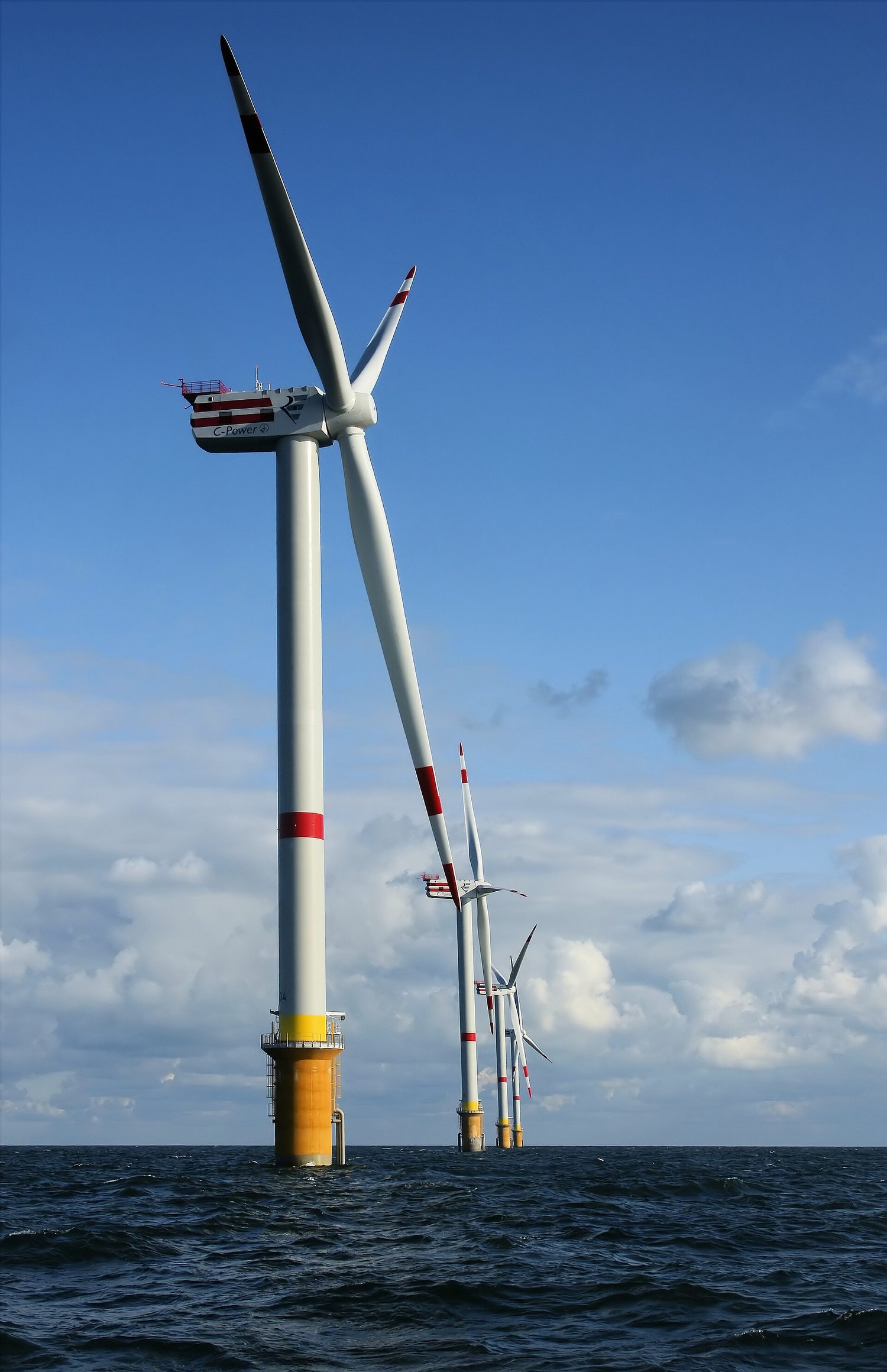
Wind turbines transfer energy from the kinetic store of the moving air to electricity
Kinetic and potential energy
Kinetic energy is the energy of a moving object:
$$E_k = \frac{1}{2}mv^2$$
The change in gravitational potential energy when an object goes up or down by a height $\Delta h$:
$$\Delta E_p = mg\,\Delta h$$
Conservation of energy
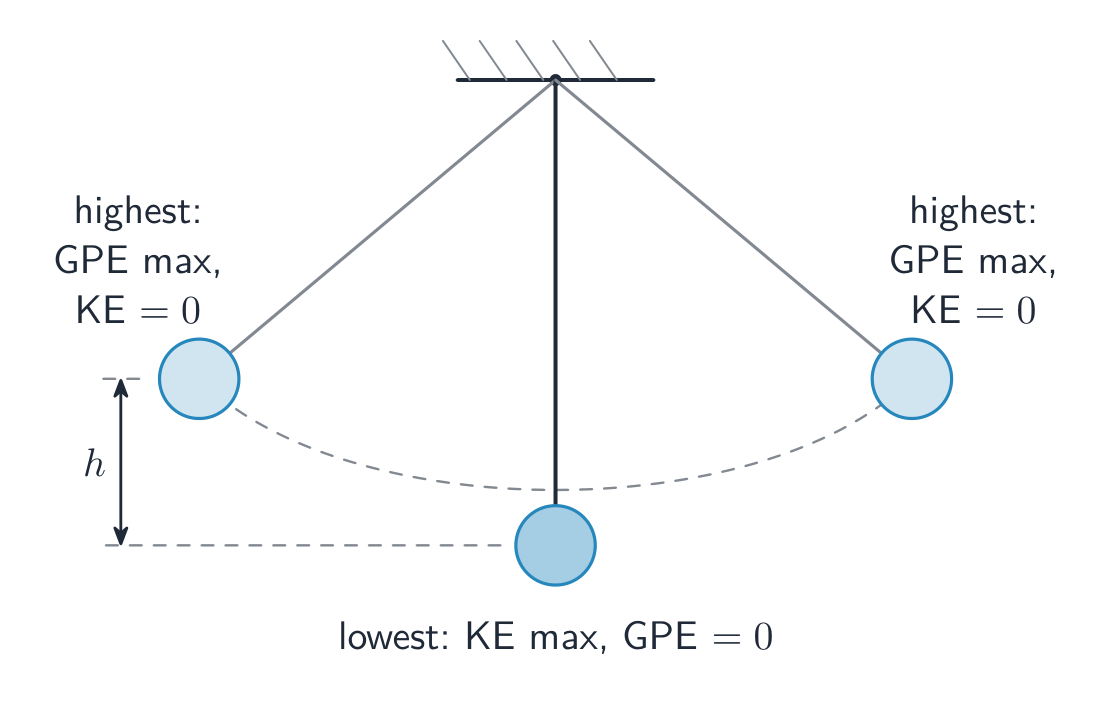
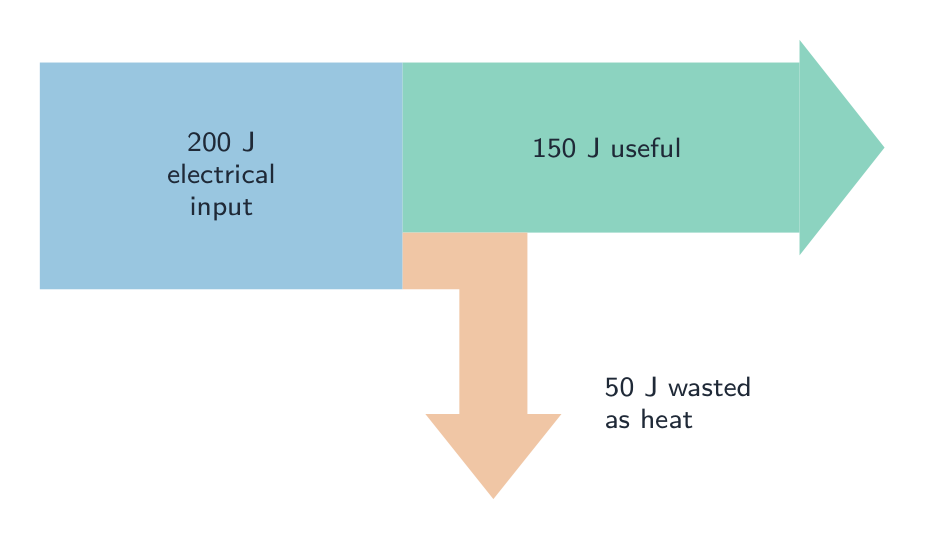
The principle of conservation of energy 能量守恒定律 says energy is never made or destroyed; it only moves between stores. A falling object turns gravitational potential energy into kinetic energy. A Sankey diagram 桑基图 shows how the input energy splits into useful energy and wasted 浪费 energy.
Energy moves between gravitational potential energy (at the highest points) and kinetic energy (at the lowest point)On a roller-coaster, gravitational potential energy stored at the top of the hill becomes kinetic energy as the cars speed down
Worked example. A $0.50\ \text{kg}$ ball is dropped from a height of $1.8\ \text{m}$. Ignoring air resistance, find its speed just before it lands. (Take $g = 10\ \text{m/s}^2$.)
All the gravitational potential energy becomes kinetic energy, so $\tfrac{1}{2}mv^2 = mg\,\Delta h$. The mass cancels, leaving $v^2 = 2g\,\Delta h$:
Because the mass cancels, every object dropped from this height would land at the same speed.
Work
Work done 做功 equals the energy transferred. When a force moves an object:
$$W = Fd = \Delta E$$
The unit of work and energy is the joule 焦耳 (J).
Power
Power 功率 is the work done (or energy transferred) per unit time.
$$P = \frac{W}{t} = \frac{\Delta E}{t}$$
The unit is the watt 瓦特 (W). $1\ \text{W} = 1\ \text{J/s}$.
Efficiency
Efficiency 效率 tells you how much of the input energy becomes useful energy.
$$\text{efficiency} = \frac{\text{useful energy output}}{\text{total energy input}} \times 100\%$$
Efficiency is always less than 100% because some energy is always wasted (usually as heat). The same idea works with power:
$$\text{efficiency} = \frac{\text{useful power output}}{\text{total power input}} \times 100\%$$
Worked example. A motor is supplied with $200\ \text{J}$ of electrical energy and lifts a load, giving it $150\ \text{J}$ of gravitational potential energy. Find its efficiency.
A Sankey diagram for this motor: the band widths are proportional to the energy, so the 200 J input splits into 150 J useful and 50 J wasted as heat
Energy resources
We generate electricity from many energy resources. Most spin a turbine that drives a generator – often by boiling water to make steam (fossil fuels, nuclear fuel, geothermal, biofuels), or directly by moving water or air (hydroelectric, waves, tides, wind). Solar cells make electricity from sunlight directly; solar panels heat water.
Resource
Renewable?
Notes
fossil fuels (coal, oil, gas)
no
reliable, high output, but CO₂ and pollution
nuclear fuel
no
huge output, no CO₂, but radioactive waste
biofuels
yes
roughly carbon-neutral if replanted
hydroelectric
yes
reliable, but a dam floods land
wind
yes
clean, but intermittent
solar
yes
clean, but only in daylight
geothermal / tidal
yes
reliable but limited to certain places
When you compare resources, use these five ideas: renewability 可再生性 (will it run out?), availability 可用性 (is it always there? the wind can drop and the Sun sets), reliability 可靠性 (does it give a steady output?), scale 规模 (how much energy can it supply?) and environmental impact 环境影响 (pollution, carbon dioxide, land flooded by a dam).
Most of these trace back to the Sun (fossil fuels are ancient stored sunlight; wind and waves come from solar heating) – the exceptions are geothermal, nuclear, and tidal energy. The Sun itself is powered by nuclear fusion 核聚变, joining hydrogen nuclei into helium. Scientists are researching how to use fusion in power stations on Earth, but no fusion reactor yet gives out more electrical energy than it uses.
Explore · Khám phá
Energy flow & efficiency · Dòng chảy năng lượng & hiệu suất
Input energy splits into useful output and wasted energy; efficiency is the useful fraction, and the total is always conserved. · Năng lượng đầu vào chia thành năng lượng hữu ích và năng lượng lãng phí; hiệu suất là tỷ lệ phần hữu ích, và tổng luôn được bảo toàn.
Explore · Khám phá
Conservation of energy · Bảo toàn năng lượng
Drop the object: GPE turns into KE, and the total stays the same when there's no friction. · Rơi vật: Thế năng gravitation chuyển thành Động năng, và tổng không đổi khi không có ma sát.
principle of conservation of energy/ˈprɪnsɪpl ɒv ˌkɒnsəˈveɪʃn ɒv ˈenədʒi/
nguyên lý bảo toàn năng lượng
Sankey diagram/ˈsæŋki ˈdaɪəɡræm/
biểu đồ Sankey
wasted/ˈweɪstɪd/
lãng phí
work done/wɜːk dʌn/
công thực hiện
joule/dʒuːl/
joule
power/ˈpaʊə/
công suất
watt/wɒt/
watt
efficiency/ɪˈfɪʃənsi/
đầu ra hữu ích chia cho đầu vào tổng cộng
renewability/rɪˌnjuːəˈbɪlɪti/
tái tạo
availability/əˌveɪləˈbɪlɪti/
sẵn sàng sử dụng
reliability/rɪˌlaɪəˈbɪlɪti/
độ tin cậy
scale/skeɪl/
tỷ lệ
environmental impact/enˌvaɪrənˈmentl ˈɪmpækt/
tác động môi trường
nuclear fusion/ˈnjuːklɪə ˈfjuːʒn/
hợp nhất hạt nhân
1.8
Pressure 压强
Syllabus · Chương trình
English
Core
Supplement
1 Define pressure as force per unit area; recall and use the equation $p = \frac{F}{A}$
2 Describe how pressure varies with force and area in the context of everyday examples
3 Describe, qualitatively, how the pressure beneath the surface of a liquid changes with depth and density of the liquid
4 Recall and use the equation for the change in pressure beneath the surface of a liquid $\Delta p = \rho g \Delta h$
Tiếng Việt
Cốt lõi
Bổ sung
1 Định nghĩa áp suất là lực trên đơn vị diện tích; nhớ và sử dụng phương trình $p = \frac{F}{A}$
2 Mô tả cách áp suất thay đổi theo lực và diện tích trong bối cảnh các ví dụ hàng ngày
3 Mô tả, định tính, cách áp suất bên dưới bề mặt chất lỏng thay đổi theo độ sâu và mật độ của chất lỏng
4 Nhớ và sử dụng phương trình tính độ biến thiên áp suất bên dưới bề mặt chất lỏng $\Delta p = \rho g \Delta h$
Source: Cambridge International syllabus · Nguồn: Chương trình Cambridge International
Pressure is the force per unit area.
$$p = \frac{F}{A}$$
The unit is the pascal 帕斯卡 (Pa). $1\ \text{Pa} = 1\ \text{N/m}^2$.
A small area gives a large pressure (a sharp knife cuts well). A large area gives a small pressure (snowshoes stop you sinking).
Pressure in a liquid
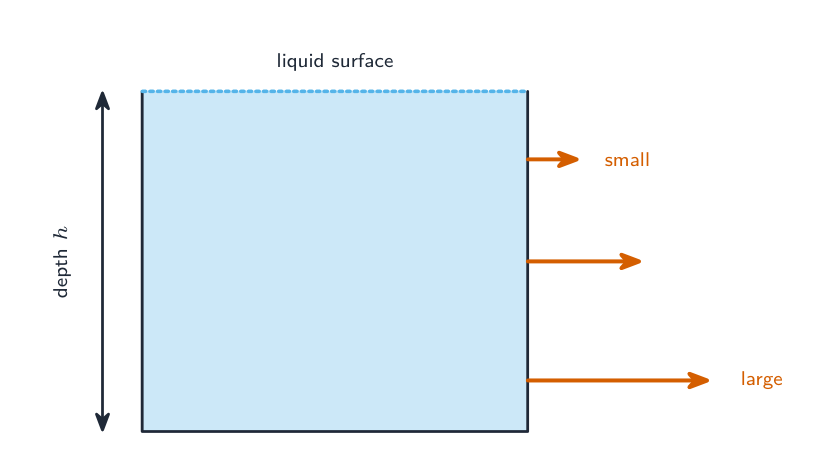
In a liquid, pressure increases with depth 深度 and with the liquid's density:
$$\Delta p = \rho g \,\Delta h$$
This is why a dam is built thicker at the bottom, where the water pressure is greatest. Pressure in a liquid acts in all directions.
The deeper the liquid, the greater the pressure, so the outward push on the wall grows with depthA real dam is built much thicker at the bottom, because the water pushes hardest where it is deepest
Worked example. Find the extra pressure at a depth of $2.0\ \text{m}$ in water (density $1000\ \text{kg/m}^3$, $g = 10\ \text{N/kg}$).
$$\Delta p = \rho g\,\Delta h = 1000 \times 10 \times 2.0 = 20\,000\ \text{Pa}$$
Explore · Khám phá
Pressure · Áp suất
p = ρg·h
Pressure in a liquid is proportional to depth. · Áp suất trong chất lỏng tỷ lệ thuận với độ sâu.
On a distance–time graph the gradient is the speed; on a speed–time graph the gradient is the acceleration and the area under the line is the distance travelled. Never read one graph as if it were the other.
Mass (kg) is the amount of matter and is the same everywhere; weight (N) is the force of gravity, $W = mg$. On the Moon your mass is unchanged but your weight is smaller.
Speed is a scalar; velocity is a vector. Something moving at steady speed around a curve is still accelerating, because its direction keeps changing.
In Hooke's law, load is proportional to extension only up to the limit of proportionality. Use the extension (stretched length − original length), never the whole length.
Momentum$p = mv$ is conserved in a collision. Give each velocity a $+$ or $-$ sign for its direction before you add them.
Convert units first (cm → m, g → kg). Use $p = F/A$ for a solid pressing on a surface, but $p = \rho g h$ for the pressure inside a liquid — they are different formulas.
1 Know the distinguishing properties of solids, liquids and gases
2 Know the terms for the changes in state between solids, liquids and gases (gas to solid and solid to gas transfers are not required)
2.1.2 Particle model
Core
Supplement
1 Describe the particle structure of solids, liquids and gases in terms of the arrangement, separation and motion of the particles and represent these states using simple particle diagrams
6 Know that the forces and distances between particles (atoms, molecules, ions and electrons) and the motion of the particles affects the properties of solids, liquids and gases
2 Describe the relationship between the motion of particles and temperature, including the idea that there is a lowest possible temperature ($-273\,{}^{\circ}\text{C}$), known as absolute zero, where the particles have least kinetic energy
3 Describe the pressure and the changes in pressure of a gas in terms of the motion of its particles and their collisions with a surface
7 Describe the pressure and the changes in pressure of a gas in terms of the forces exerted by particles colliding with surfaces, creating a force per unit area
4 Know that the random motion of microscopic particles in a suspension is evidence for the kinetic particle model of matter
8 Know that microscopic particles may be moved by collisions with light fast-moving molecules and correctly use the terms atoms or molecules as distinct from microscopic particles
5 Describe and explain this motion (sometimes known as Brownian motion) in terms of random collisions between the microscopic particles in a suspension and the particles of the gas or liquid
2.1.3 Gases and the absolute scale of temperature
Core
Supplement
1 Describe qualitatively, in terms of particles, the effect on the pressure of a fixed mass of gas of: (a) a change of temperature at constant volume (b) a change of volume at constant temperature
3 Recall and use the equation $pV = \text{constant}$ for a fixed mass of gas at constant temperature, including a graphical representation of this relationship
2 Convert temperatures between kelvin and degrees Celsius; recall and use the equation $T\text{ (in K)} = \theta\text{ (in }^{\circ}\text{C)} + 273$
Tiếng Việt
2.1.1 Các trạng thái của vật chất
Cốt lõi
Bổ sung
1Know các đặc điểm phân biệt của rắn, lỏng và khí
2Know các thuật ngữ cho sự thay đổi trạng thái giữa rắn, lỏng và khí (chuyển pha từ khí sang rắn và từ rắn sang khí không yêu cầu)
2.1.2 Mô hình hạt
Cốt lõi
Bổ sung
1Mô tả cấu trúc hạt của rắn, lỏng và khí dựa trên sắp xếp, khoảng cách và chuyển động của các hạt và biểu diễn các trạng thái này bằng các sơ đồ hạt đơn giản
6Know rằng lực và khoảng cách giữa các hạt (nguyên tử, phân tử, ion và electron) cùng với chuyển động của các hạt ảnh hưởng đến tính chất của rắn, lỏng và khí
2Mô tả mối liên hệ giữa chuyển động của các hạt và nhiệt độ, bao gồm ý tưởng rằng tồn tại một mức nhiệt độ thấp nhất ($-273\,{}^{\circ}\text{C}$), được gọi là không tuyệt đối, nơi các hạt có ít động năng nhất
3Mô tả áp suất và sự thay đổi áp suất của khí dựa trên chuyển động của các hạt và va chạm của chúng với bề mặt
7Mô tả áp suất và sự thay đổi áp suất của khí dựa trên lực do các hạt va chạm với bề mặt tạo ra, tạo thành lực trên đơn vị diện tích
4Know rằng chuyển động ngẫu nhiên của các hạt vi mô trong hỗn hợp là bằng chứng cho mô hình hạt động học của vật chất
8Know rằng các hạt vi mô có thể bị di chuyển bởi va chạm với các phân tử di chuyển nhanh và sử dụng đúng các thuật ngữ nguyên tử hoặc phân tử phân biệt với các hạt vi mô
5Mô tả và giải thích chuyển động này (đôi khi được gọi là chuyển động Brown) dựa trên các va chạm ngẫu nhiên giữa các hạt vi mô trong hỗn hợp và các hạt của khí hoặc chất lỏng
2.1.3 Khí và thang đo nhiệt độ tuyệt đối
Cốt lõi
Bổ sung
1Mô tả, định tính, dựa trên các hạt, tác động lên áp suất của một khối khí cố định của: (a) sự thay đổi nhiệt độ ở thể tích không đổi (b) sự thay đổi thể tích ở nhiệt độ không đổi
3Nhớ và sử dụng phương trình $pV = \text{constant}$ cho một khối khí cố định ở nhiệt độ không đổi, bao gồm biểu diễn đồ thị của mối quan hệ này
2Chuyển đổi nhiệt độ giữa kelvin và độ Celsius; nhớ và sử dụng phương trình $T\text{ (in K)} = \theta\text{ (in }^{\circ}\text{C)} + 273$
Source: Cambridge International syllabus · Nguồn: Chương trình Cambridge International
Kinetic theory: gas pressure
Matter exists in three states: solid 固体, liquid 液体 and gas 气体.
State
Shape
Volume
Particles
Solid
fixed
fixed
close together, in a regular pattern, vibrating
Liquid
takes the shape of the container
fixed
close together, no pattern, can move past each other
Gas
fills the container
changes
far apart, fast, random motion
The changes of state are: melting (solid → liquid), boiling/evaporating (liquid → gas), condensation 凝结 (gas → liquid) and solidification 凝固 (liquid → solid). In condensation the gas particles slow down and come close together to form a liquid. In solidification the liquid particles lose energy and settle into fixed positions.
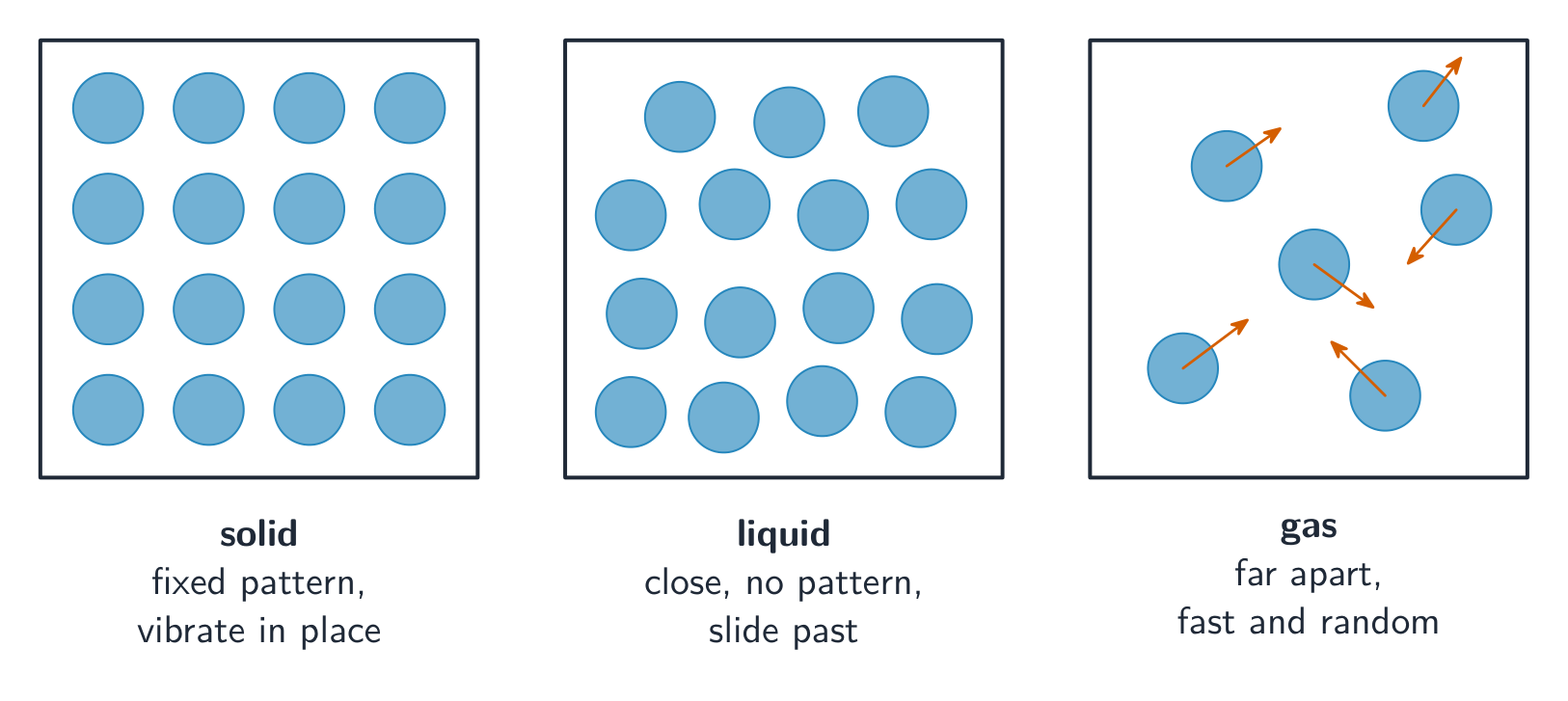
All matter is made of tiny particles 粒子 that are always moving. This is the kinetic particle model.
In a solid the particles only vibrate 振动 about fixed positions.
In a liquid they are still close but can slide past each other.
In a gas they are far apart and move quickly in random directions.
The same particles in three states: fixed and ordered in a solid, close but disordered in a liquid, far apart and fast in a gas
Temperature and particle energy
When you heat a substance, its particles move faster, so they have more kinetic energy 动能. Temperature 温度 is a measure of the average kinetic energy of the particles.
The lowest possible temperature is absolute zero 绝对零度, $-273\,{}^{\circ}\text{C}$. At this point the particles have the least possible energy.
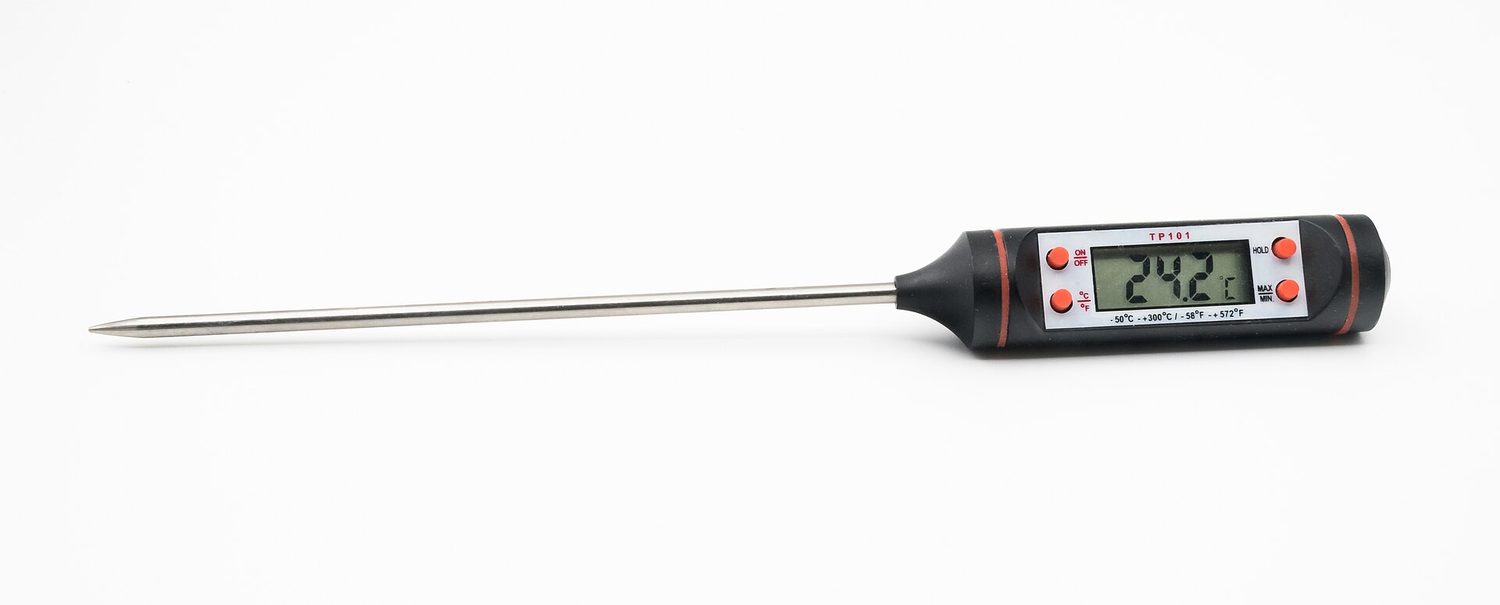
A digital thermometer measures temperature by sensing the kinetic energy of the particles it touches
Gas pressure
Gas particles hit the walls of their container. Each hit is a tiny push. The pressure 压强 of the gas is the total force of these hits per unit area.
The gas pressure is the total force of countless particle hits on each unit area of the wall
Heating a gas (at constant volume) makes particles move faster and hit harder and more often, so the pressure rises.
Squeezing a gas into a smaller volume (at constant temperature) means more hits per second on each unit of area, so the pressure rises.
For a fixed mass of gas at constant temperature:
$$pV = \text{constant}$$
So if the volume halves, the pressure doubles.
At constant temperature the pressure–volume graph is a curve: halve the volume and the pressure doubles, so $pV$ stays constant
Worked example. A gas has a volume of $200\ \text{cm}^3$ at a pressure of $100\ \text{kPa}$. It is squeezed to $50\ \text{cm}^3$ at constant temperature. Find the new pressure.
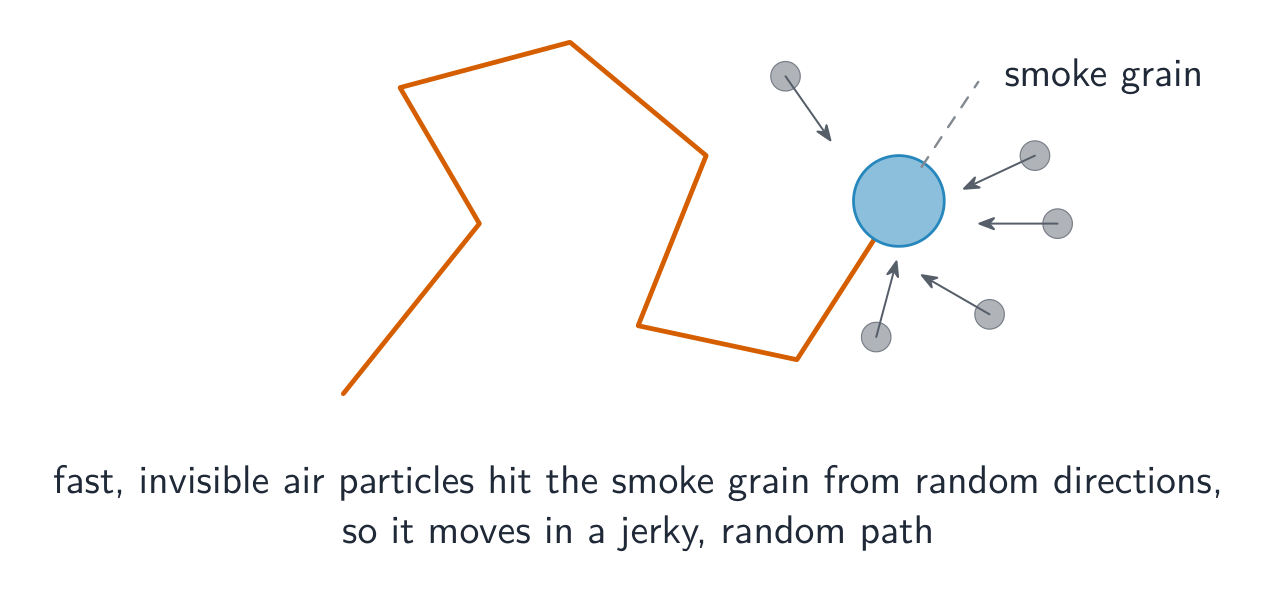
If you look at smoke in air under a microscope, you see tiny specks moving in a jerky, random way. This is Brownian motion 布朗运动. The specks are pushed by fast, invisible air particles hitting them. It is strong evidence for the kinetic particle model.
Random hits from fast air particles push a smoke grain along a jerky, random path
The kelvin scale
Scientists often use the kelvin 开尔文 (K) temperature scale, which starts at absolute zero. To convert:
$$T\text{ (in K)} = \theta\text{ (in }^{\circ}\text{C}) + 273$$
So $0\,{}^{\circ}\text{C} = 273\ \text{K}$.
Worked example. Convert $25\,{}^{\circ}\text{C}$ to kelvin, and $200\ \text{K}$ to degrees Celsius.
Squeeze a gas (Boyle's law) · Nén khí (định luật Boyle)
Slide the piston in to shrink the volume. The same particles get crammed into less space, so they hit the walls more often and the pressure climbs — while pressure × volume stays constant. · Trượt xi-lanh vào để thu nhỏ thể tích. Cùng số hạt bị nhét vào không gian nhỏ hơn, nên chúng va chạm thành bình thường xuyên hơn và áp suất tăng — trong khi áp suất × thể tích vẫn không đổi.
2.2.1 Thermal expansion of solids, liquids and gases
Core
Supplement
1 Describe, qualitatively, the thermal expansion of solids, liquids and gases at constant pressure
3 Explain, in terms of the motion and arrangement of particles, the relative order of magnitudes of the expansion of solids, liquids and gases as their temperatures rise
2 Describe some of the everyday applications and consequences of thermal expansion
2.2.2 Specific heat capacity
Core
Supplement
1 Know that a rise in the temperature of an object increases its internal energy
2 Describe an increase in temperature of an object in terms of an increase in the average kinetic energies of all of the particles in the object
3 Define specific heat capacity as the energy required per unit mass per unit temperature increase; recall and use the equation
$$c = \frac{\Delta E}{m\Delta\theta}$$
4 Describe experiments to measure the specific heat capacity of a solid and a liquid
2.2.3 Melting, boiling and evaporation
Core
Supplement
1 Describe melting and boiling in terms of energy input without a change in temperature
6 Describe the differences between boiling and evaporation
2 Know the melting and boiling temperatures for water at standard atmospheric pressure
3 Describe condensation and solidification in terms of particles
4 Describe evaporation in terms of the escape of more-energetic particles from the surface of a liquid
7 Describe how temperature, surface area and air movement over a surface affect evaporation
5 Know that evaporation causes cooling of a liquid
8 Explain the cooling of an object in contact with an evaporating liquid
Tiếng Việt
2.2.1 Sự giãn nở nhiệt của chất rắn, chất lỏng và chất khí
Cốt lõi
Bổ sung
1 Mô tả, một cách định tính, sự giãn nở nhiệt của chất rắn, chất lỏng và chất khí ở áp suất không đổi
3 Giải thích, dựa trên chuyển động và sắp xếp của các hạt, thứ tự tương đối về độ lớn sự giãn nở của chất rắn, chất lỏng và chất khí khi nhiệt độ tăng lên
2 Mô tả một số ứng dụng thực tế và hệ quả của sự giãn nở nhiệt
2.2.2 Nhiệt dung riêng
Cốt lõi
Bổ sung
1 Biết rằng sự gia tăng nhiệt độ của một vật làm tăng năng lượng nội tại của vật đó
2 Mô tả sự gia tăng nhiệt độ của một vật dưới góc độ tăng năng lượng động trung bình của tất cả các hạt trong vật đó
3 Định nghĩa nhiệt dung riêng là năng lượng cần thiết cho mỗi đơn vị khối lượng để tăng nhiệt độ thêm một đơn vị; ghi nhớ và sử dụng phương trình
$$c = \frac{\Delta E}{m\Delta\theta}$$
4 Mô tả các thí nghiệm đo nhiệt dung riêng của chất rắn và chất lỏng
2.2.3 Nóng chảy, sôi và bay hơi
Cốt lõi
Bổ sung
1 Mô tả nóng chảy và sôi dưới góc độ cung cấp năng lượng mà không có sự thay đổi nhiệt độ
6 Mô tả sự khác nhau giữa sôi và bay hơi
2 Biết nhiệt độ nóng chảy và nhiệt độ sôi của nước ở áp suất khí quyển tiêu chuẩn
3 Mô tả sự ngưng tụ và đông đặc dưới góc độ các hạt
4 Mô tả bay hơi dưới góc độ sự thoát ra của các hạt có năng lượng cao hơn từ bề mặt chất lỏng
7 Mô tả cách nhiệt độ, diện tích bề mặt và dòng không khí trên bề mặt ảnh hưởng đến sự bay hơi
5 Biết rằng sự bay hơi gây ra hiện tượng làm lạnh chất lỏng
8 Giải thích sự làm lạnh của một vật tiếp xúc với chất lỏng đang bay hơi
Source: Cambridge International syllabus · Nguồn: Chương trình Cambridge International
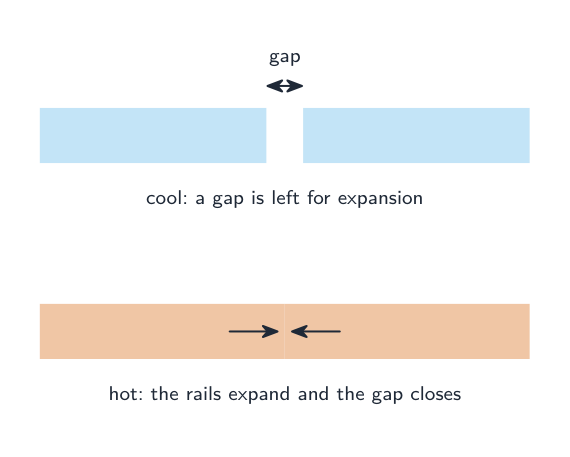
When matter is heated, its particles move more and take up more space, so the material expands. Gases expand the most, then liquids, then solids. This order comes from the forces between the particles: in a solid the particles are held tightly in a lattice 晶格 (a fixed pattern), so they can only vibrate a little more; in a liquid they are held less strongly; in a gas the forces are very weak, so the particles spread out much more.
Everyday examples: gaps are left between railway lines; bridges sit on rollers; a tight metal lid loosens when heated.
A small gap is left between rails when cool, so when they expand in the heat the gap closes instead of buckling the track
Explore · Khám phá
Heating and specific heat capacity · Gia nhiệt và nhiệt dung riêng
Q = mcΔT
The heat energy needed is proportional to the temperature rise for a given mass of material. · Năng lượng nhiệt cần thiết tỷ lệ thuận với độ tăng nhiệt độ đối với một khối lượng vật liệu xác định.
The internal energy 内能 of an object is the total energy of all its particles. Heating an object raises its internal energy and usually its temperature.
The specific heat capacity 比热容 is the energy needed to raise the temperature of 1 kg of a material by 1 °C.
$$c = \frac{\Delta E}{m\,\Delta\theta}$$
A material with a high specific heat capacity (like water) needs a lot of energy to warm up and cools down slowly.
Worked example. How much energy is needed to heat $2.0\ \text{kg}$ of water from $20\,{}^{\circ}\text{C}$ to $70\,{}^{\circ}\text{C}$? The specific heat capacity of water is $4200\ \text{J/(kg}\,{}^{\circ}\text{C)}$.
Rearranging $c = \frac{\Delta E}{m\,\Delta\theta}$ gives $\Delta E = mc\,\Delta\theta$, with $\Delta\theta = 70 - 20 = 50\,{}^{\circ}\text{C}$:
Measuring specific heat capacity. For a solid, use a metal block with two holes: one for an electric heater 加热器 and one for a thermometer 温度计. Measure the mass $m$ of the block. Switch on the heater for a measured time $t$ and record the current $I$ and the voltage $V$, so the energy supplied is $E = IVt$ (or read the energy from a joulemeter). Record the temperature rise $\Delta\theta$. Then $c = \dfrac{E}{m\,\Delta\theta}$. For a liquid, heat a measured mass of the liquid in a container and stir it, so the temperature is the same all through. Wrap the block or the container in insulating material 隔热材料, so less energy escapes to the air.
Boiling water: internal energy rises with temperature; specific heat capacity is energy per kg per °C
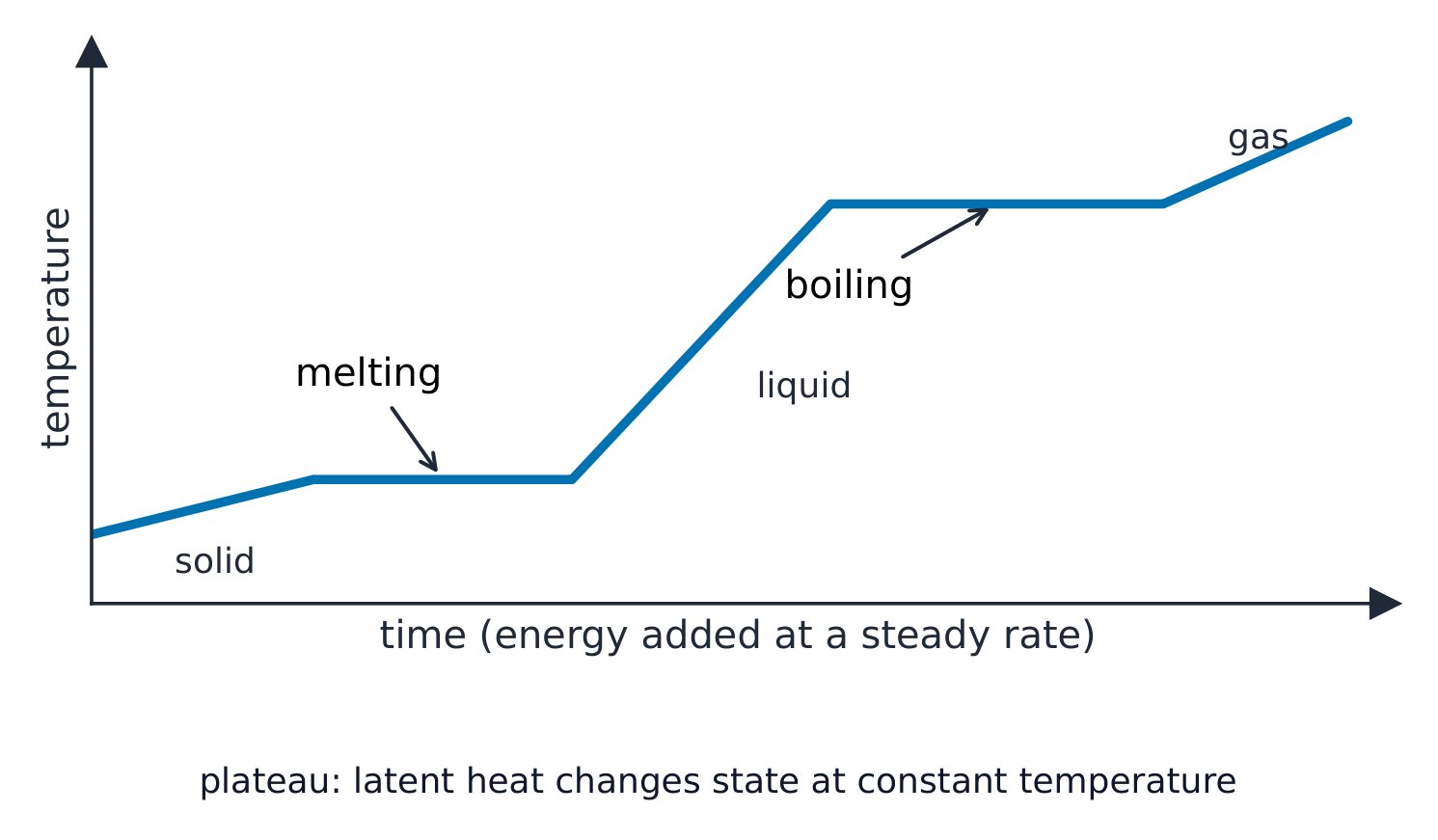
Melting 熔化 and boiling 沸腾 need energy, but the temperature stays the same while the state changes. This energy breaks the forces between particles. For water at normal air pressure, melting is at $0\,{}^{\circ}\text{C}$ and boiling at $100\,{}^{\circ}\text{C}$.
While the substance melts and while it boils the temperature stays flat, even though energy is still being added
Evaporation 蒸发 is when a liquid changes to a gas at its surface, below the boiling point. The fastest particles escape from the surface. Because the fastest (most energetic) particles leave, the average energy of those left behind falls, so the liquid cools down 冷却. An object touching an evaporating liquid also cools, because the liquid takes energy from it: this is why sweat cools your skin.
Evaporation is faster when the temperature is higher, the surface area is larger, and there is more air movement over the surface.
Explore · Khám phá
The heating curve — watch the temperature pause · Đường cong gia nhiệt — hãy chú ý nhiệt độ tạm dừng
While the substance is melting or boiling the temperature stays flat, even though heat is still going in — the energy breaks bonds instead of warming it. · Trong khi chất đang nóng chảy hoặc sôi, nhiệt độ duy trì ổn định, mặc dù nhiệt vẫn tiếp tục truyền vào — năng lượng dùng để phá vỡ liên kết thay vì làm nóng nó.
1 Describe experiments to demonstrate the properties of good thermal conductors and bad thermal conductors (thermal insulators)
2 Describe thermal conduction in all solids in terms of atomic or molecular lattice vibrations and also in terms of the movement of free (delocalised) electrons in metallic conductors
3 Describe, in terms of particles, why thermal conduction is bad in gases and most liquids
4 Know that there are many solids that conduct thermal energy better than thermal insulators but do so less well than good thermal conductors
2.3.2 Convection
Core
Supplement
1 Know that convection is an important method of thermal energy transfer in liquids and gases
2 Explain convection in liquids and gases in terms of density changes and describe experiments to illustrate convection
2.3.3 Radiation
Core
Supplement
1 Know that thermal radiation is infrared radiation and that all objects emit this radiation
2 Know that thermal energy transfer by thermal radiation does not require a medium
4 Know that for an object to be at a constant temperature it needs to transfer energy away from the object at the same rate that it receives energy
3 Describe the effect of surface colour (black or white) and texture (dull or shiny) on the emission, absorption and reflection of infrared radiation
5 Know what happens to an object if the rate at which it receives energy is less or more than the rate at which it transfers energy away from the object
6 Know how the temperature of the Earth is affected by factors controlling the balance between incoming radiation and radiation emitted from the Earth’s surface
7 Describe experiments to distinguish between good and bad emitters of infrared radiation
8 Describe experiments to distinguish between good and bad absorbers of infrared radiation
9 Describe how the rate of emission of radiation depends on the surface temperature and surface area of an object
2.3.4 Consequences of thermal energy transfer
Core
Supplement
1 Explain some of the basic everyday applications and consequences of conduction, convection and radiation, including: (a) heating objects such as kitchen pans (b) heating a room by convection
2 Explain some of the complex applications and consequences of conduction, convection and radiation where more than one type of thermal energy transfer is significant, including: (a) a fire burning wood or coal (b) a radiator in a car
Tiếng Việt
2.3.1 Dẫn nhiệt
Cốt lõi
Bổ sung
1 Mô tả các thí nghiệm minh họa tính chất của các chất dẫn nhiệt tốt và chất dẫn nhiệt kém (chất cách nhiệt)
2 Mô tả sự dẫn nhiệt trong tất cả các chất rắn dưới góc độ dao động mạng tinh thể nguyên tử hoặc phân tử, cũng như dưới góc độ chuyển động của các electron tự do (phân tán) trong các vật dẫn kim loại
3 Giải thích, dựa trên các hạt, vì sao sự dẫn nhiệt kém trong chất khí và hầu hết các chất lỏng
4 Biết rằng có nhiều chất rắn dẫn nhiệt tốt hơn so với chất cách nhiệt nhưng kém hơn so với các chất dẫn nhiệt tốt
2.3.2 Đối lưu
Cốt lõi
Bổ sung
1 Biết rằng đối lưu là một phương pháp quan trọng trong việc truyền nhiệt ở chất lỏng và chất khí
2 Giải thích đối lưu trong chất lỏng và chất khí dưới góc độ sự thay đổi mật độ và mô tả các thí nghiệm minh họa cho đối lưu
2.3.3 Bức xạ nhiệt
Cốt lõi
Bổ sung
1 Biết rằng bức xạ nhiệt chính là bức xạ hồng ngoại và mọi vật đều phát ra bức xạ này
2 Biết rằng sự truyền nhiệt bằng bức xạ nhiệt không cần môi trường
4 Biết rằng để một vật ở trạng thái cân bằng nhiệt (nhiệt độ không đổi), nó phải mất năng lượng đi với tốc độ bằng đúng tốc độ nhận năng lượng vào
3 Mô tả ảnh hưởng của màu sắc bề mặt (đen hay trắng) và kết cấu bề mặt (nhám hay bóng) đến khả năng phát, hấp thụ và phản xạ bức xạ hồng ngoại
5 Biết điều gì sẽ xảy ra với một vật nếu tốc độ nhận năng lượng nhỏ hơn hoặc lớn hơn tốc độ mất năng lượng của vật đó
6 Biết cách nhiệt độ Trái Đất bị ảnh hưởng bởi các yếu tố kiểm soát sự cân bằng giữa bức xạ tới và bức xạ phát ra từ bề mặt Trái Đất
7 Mô tả các thí nghiệm phân biệt giữa các vật phát bức xạ hồng ngoại tốt và kém
8 Mô tả các thí nghiệm phân biệt giữa các vật hấp thụ bức xạ hồng ngoại tốt và kém
9 Mô tả cách tốc độ phát bức xạ phụ thuộc vào nhiệt độ bề mặt và diện tích bề mặt của một vật
2.3.4 Hệ quả của sự truyền nhiệt
Cốt lõi
Bổ sung
1 Giải thích một số ứng dụng cơ bản và hệ quả trong đời sống hàng ngày của dẫn nhiệt, đối lưu và bức xạ, bao gồm: (a) làm nóng các vật dụng như nồi chảo nhà bếp (b) làm ấm phòng bằng đối lưu
2 Giải thích một số ứng dụng phức tạp và hệ quả của dẫn nhiệt, đối lưu và bức xạ nơi mà hơn một loại hình truyền nhiệt đóng vai trò quan trọng, bao gồm: (a) lửa đốt gỗ hoặc than (b) bộ tản nhiệt trong ô tô
Source: Cambridge International syllabus · Nguồn: Chương trình Cambridge International
Thermal energy moves from hotter places to colder places in three ways.
Conduction
Conduction 热传导 is the transfer of thermal energy through a material without the material moving. The particles in a solid sit in a lattice. Heated particles vibrate more and pass the energy to their neighbours. In metals, free electrons (delocalised electrons 自由电子) carry energy quickly, so metals are good thermal conductors 热导体.
Materials that conduct badly (like air, wood and plastic) are thermal insulators 热绝缘体.
Testing conductors. Fix a drawing pin with a little wax to one end of rods of copper, iron, glass and wood, and heat the other ends equally. The pin drops first from the copper rod, then from the iron rod, and last (or never) from the glass and the wood: metals are the best conductors. A metal rod held in a flame soon feels hot; a wooden rod does not.
Gases and most liquids are bad conductors because their particles are far apart and only pass on energy when they happen to collide. There is no lattice and there are no free electrons.
In conduction the vibrating particles pass energy to their neighbours, so energy flows from the hot end to the cool end
Convection
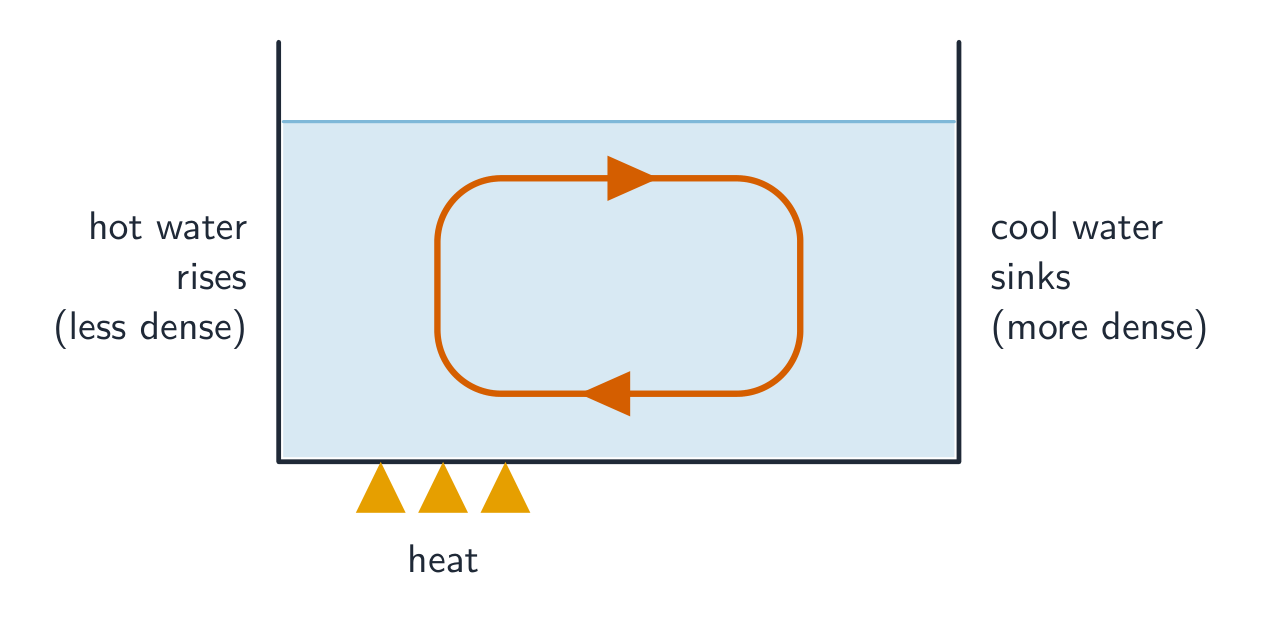
Convection 对流 happens in liquids and gases. When a fluid is heated it expands, becomes less dense, and rises. Cooler, denser fluid sinks to take its place. This circle of moving fluid is a convection current.
Heated fluid rises and cooler fluid sinks, setting up a convection current
Showing convection. Drop a crystal of purple potassium permanganate 高锰酸钾 into a beaker of water and heat the beaker gently under the crystal. A coloured stream rises above the heat, spreads across the top and sinks at the sides. In air, a lit candle under one chimney of a smoke box pulls smoke down the other chimney and up above the flame.
Convection cannot happen in a solid because the particles cannot move from place to place.
Radiation
Thermal radiation 热辐射 is energy carried by infrared 红外线 waves. All objects emit it, and it needs no material to travel through — it can cross empty space (this is how energy reaches us from the Sun).
A surface that is dull 暗淡 and black is a good emitter 发射体 and a good absorber 吸收体 of infrared. A surface that is shiny and white is a poor emitter and a good reflector 反射体.
A dull black surface emits (and absorbs) infrared much better than a shiny, white one
Comparing surfaces. Fill two cans, one dull black and one shiny silver, with hot water at the same temperature, and put a thermometer in each. The black can cools faster, so it is the better emitter. Then put the same two cans, full of cold water, at equal distances from a heater. The black can warms faster, so it is the better absorber. A Leslie cube 莱斯利立方体 (a metal box with one side of each finish) shows the same thing.
A thermal (infrared) camera turns the infrared given off by a warm hand into a picture; brighter means hotter
An object stays at a constant temperature when it emits energy at the same rate as it absorbs energy. The rate of emission is greater when the surface is hotter and larger. If an object absorbs energy faster than it emits it, its temperature rises; if it emits faster than it absorbs, its temperature falls.
The Earth's temperature. The Earth absorbs radiation from the Sun and emits infrared radiation back into space. Its average temperature stays constant only when the two rates are equal. Anything that changes this balance changes the temperature. Gases in the atmosphere 大气 such as carbon dioxide absorb some of the emitted infrared and send part of it back down, so more of these gases warms the Earth. Clouds and ice reflect incoming sunlight, so less ice means more energy is absorbed, and the Earth warms further.
Everyday examples
A kitchen pan has a metal base that conducts energy quickly to the food, and a plastic or wooden handle that is an insulator, so you can hold it.
A radiator 散热器 heats a room by convection: the air next to it warms, rises, and cooler air flows in to take its place, so the whole room warms.
Sitting near a fire you feel its radiation on your face at once; the air between you and the fire is a poor conductor.
A vacuum flask 保温瓶 keeps a drink hot by stopping all three transfers: the vacuum between its double walls stops conduction and convection, and its shiny silver surfaces stop radiation.
Explore · Khám phá
Heat transfer lab · Phòng thí nghiệm về sự truyền nhiệt
Compare the routes by which thermal energy moves. · So sánh các con đường mà nhiệt năng di chuyển.
In the kinetic particle model, heating a gas makes its particles move faster and hit the walls harder and more often, so the pressure rises. The particles themselves do not get bigger.
Evaporation happens only at the surface and at any temperature; boiling happens throughout the liquid at one fixed temperature. Evaporation cools the liquid left behind, because the fastest particles escape.
During melting and boiling the temperature stays constant even though energy is still being supplied — that energy breaks the forces between particles.
For specific heat capacity use $\Delta E = mc\,\Delta\theta$, where $\Delta\theta$ is the change in temperature, not the final temperature.
Dull black surfaces are the best emitters and absorbers of infrared; shiny, light surfaces are the best reflectors. Convection needs a fluid to flow, so it cannot happen in a solid.
1 Know that waves transfer energy without transferring matter
2 Describe what is meant by wave motion as illustrated by vibrations in ropes and springs, and by experiments using water waves
3 Describe the features of a wave in terms of wavefront, wavelength, frequency, crest (peak), trough, amplitude and wave speed
4 Recall and use the equation for wave speed $v = f \lambda$
5 Know that for a transverse wave, the direction of vibration is at right angles to the direction of propagation and understand that electromagnetic radiation, water waves and seismic S-waves (secondary) can be modelled as transverse
6 Know that for a longitudinal wave, the direction of vibration is parallel to the direction of propagation and understand that sound waves and seismic P-waves (primary) can be modelled as longitudinal
7 Describe how waves can undergo: (a) reflection at a plane surface (b) refraction due to a change of speed (c) diffraction through a narrow gap
9 Describe how wavelength and gap size affects diffraction through a gap
8 Describe the use of a ripple tank to show: (a) reflection at a plane surface (b) refraction due to a change in speed caused by a change in depth (c) diffraction due to a gap (d) diffraction due to an edge
10 Describe how wavelength affects diffraction at an edge
Tiếng Việt
Cốt lõi
Bổ sung
1 Biết rằng sóng truyền năng lượng mà không truyền vật chất
2 Mô tả ý nghĩa của chuyển động sóng được minh họa qua dao động trong dây thừng và lò xo, cũng như qua các thí nghiệm sử dụng sóng nước
3 Mô tả các đặc điểm của sóng dưới góc độ mặt sóng, bước sóng, tần số, sóng đỉnh (đỉnh), sóng đáy, biên độ và vận tốc sóng
4 Ghi nhớ và sử dụng phương trình vận tốc sóng $v = f \lambda$
5 Biết rằng đối với sóng ngang, hướng dao động vuông góc với hướng lan truyền và hiểu rằng bức xạ điện từ, sóng nước và sóng S địa chấn (sóng thứ cấp) có thể được mô hình hóa là sóng ngang
6 Biết rằng đối với sóng dọc, hướng dao động song song với hướng lan truyền và hiểu rằng sóng âm thanh và sóng P địa chấn (sóng sơ cấp) có thể được mô hình hóa là sóng dọc
7 Mô tả cách sóng có thể trải qua: (a) phản xạ tại bề mặt phẳng (b) khúc xạ do sự thay đổi vận tốc (c) nhiễu xạ qua khe hẹp
9 Mô tả cách bước sóng và kích thước khe ảnh hưởng đến nhiễu xạ qua khe
8 Mô tả việc sử dụng bể gợn sóng để biểu diễn: (a) phản xạ tại bề mặt phẳng (b) khúc xạ do sự thay đổi vận tốc gây ra bởi sự thay đổi độ sâu (c) nhiễu xạ do khe hở (d) nhiễu xạ do mép vật cản
10 Mô tả cách bước sóng ảnh hưởng đến nhiễu xạ tại mép vật cản
Source: Cambridge International syllabus · Nguồn: Chương trình Cambridge International
Transverse vs longitudinal waves
A wave 波 carries energy 能量 from place to place without carrying matter. For example, a water wave makes a floating cork bob up and down, but the cork does not travel along with the wave. You can make a wave on a rope by shaking one end up and down, or on a long spring by pushing one end back and forth. In a ripple tank 波纹水槽 (a shallow tray of water with a light above it) you can watch water waves on a screen below.
Describing a wave
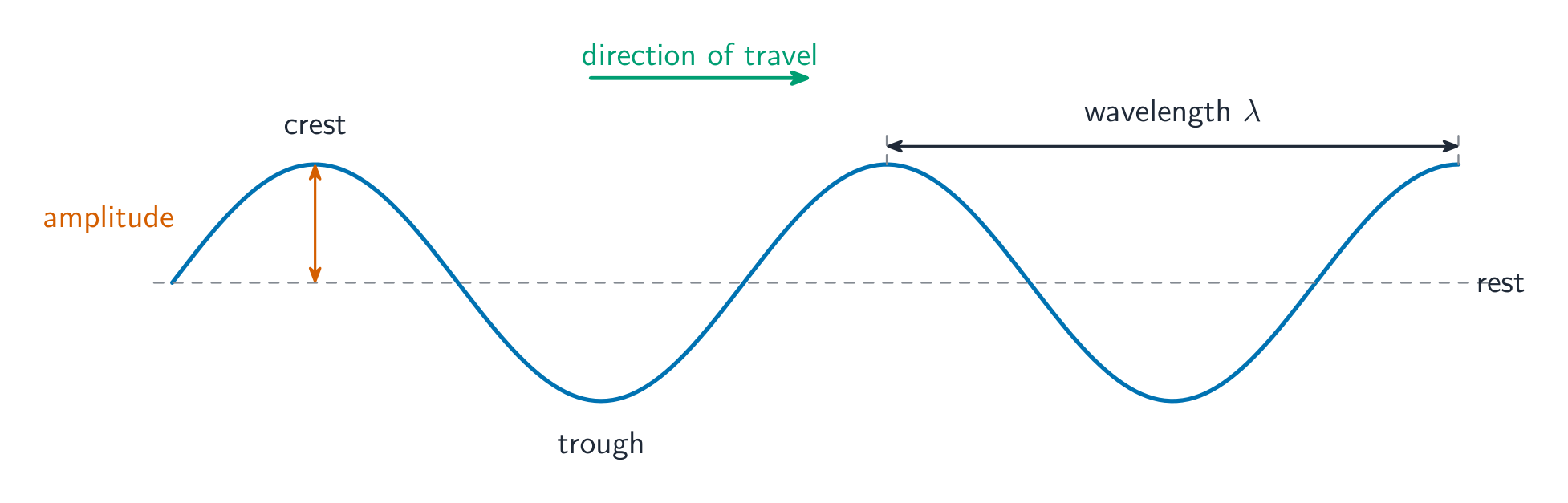
wavefront 波前: a line joining points on a wave that move together (for example, the top of one ripple)
wavelength 波长 ($\lambda$): the distance between two neighbouring wavefronts (one full wave)
frequency 频率 ($f$): the number of waves passing a point each second, measured in hertz (Hz)
crest 波峰 (also called the peak 峰, the top) and trough 波谷 (bottom)
amplitude 振幅: the largest distance a point moves from its rest position
wave speed 波速 ($v$): how fast a wavefront travels
The parts of a wave: wavelength, amplitude, crest and trough
These are linked by the wave equation:
$$v = f\lambda$$
The wavelength is the distance between two crests; the amplitude is the height from the rest position to a crest
Worked example. A sound wave travels at $340\ \text{m/s}$ and has a frequency of $170\ \text{Hz}$. Find its wavelength.
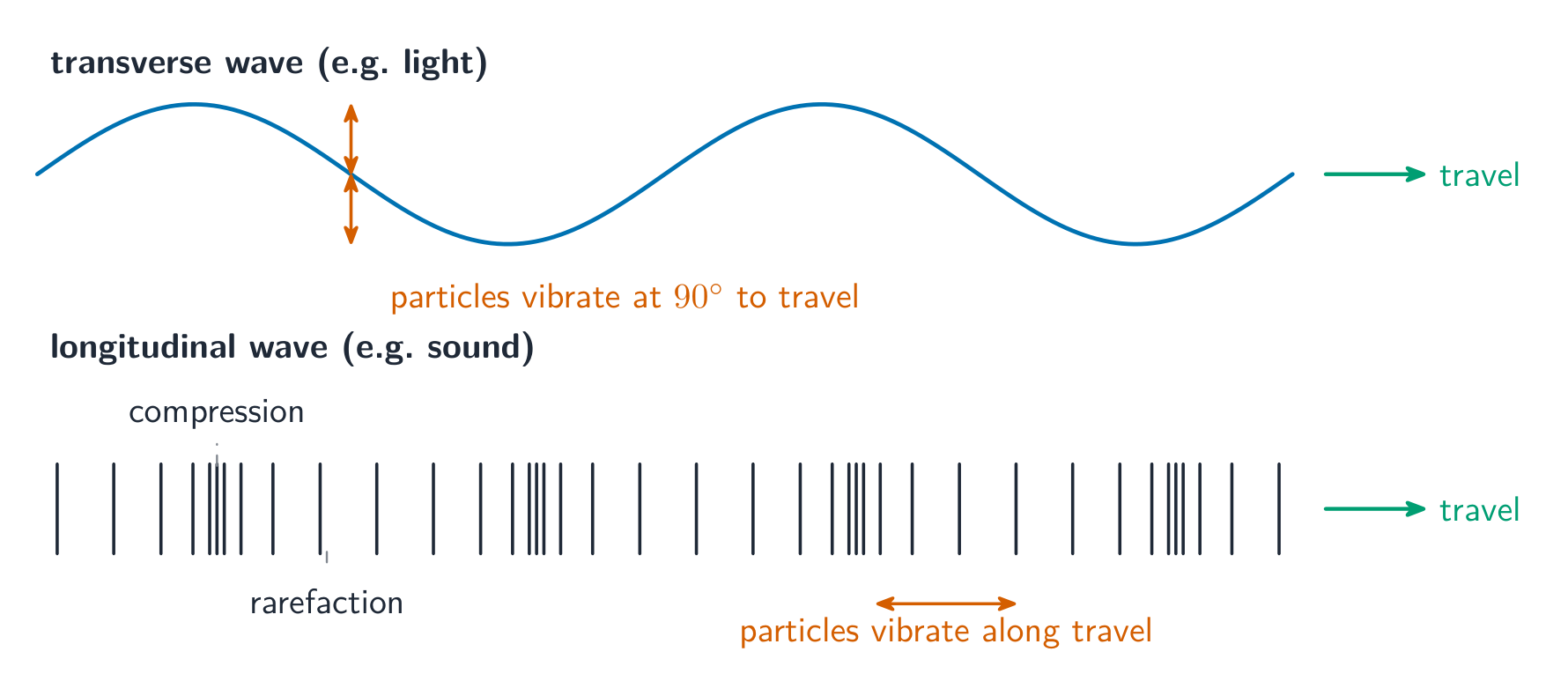
In a transverse wave 横波 the particles vibrate at right angles (90°) to the direction the wave travels (its propagation 传播). Light, water waves and seismic S-waves (the sideways shaking in an earthquake) are transverse.
In a longitudinal wave 纵波 the particles vibrate along the same direction as the wave travels. Sound and seismic P-waves are longitudinal.
In a transverse wave the particles vibrate across the travel direction; in a longitudinal wave they vibrate along it, making compressions and rarefactions
Wave behaviour
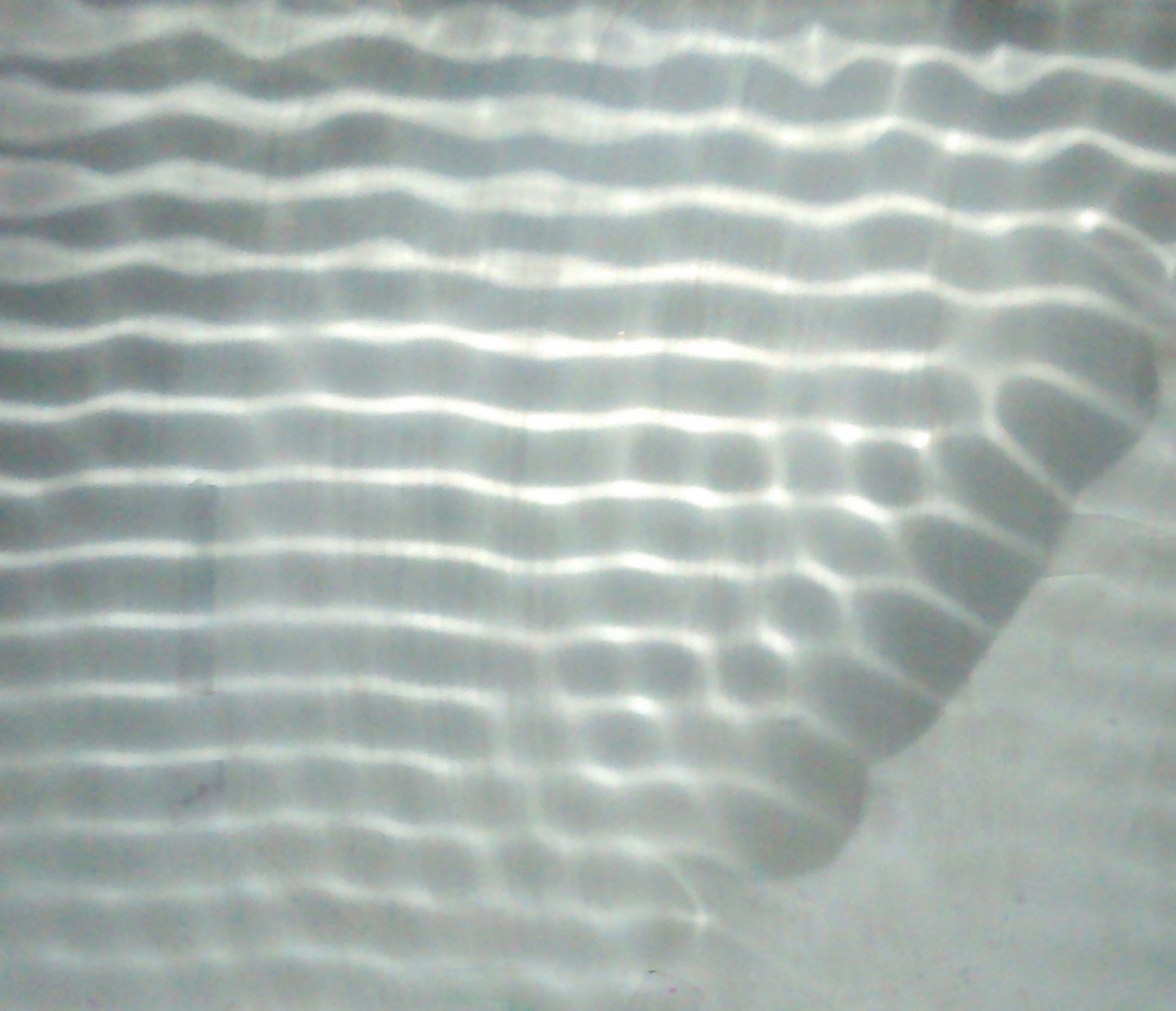
All waves can show three behaviours, which you can see in a ripple tank:
reflection 反射: the wave bounces off a surface.
refraction 折射: the wave changes speed (and usually direction) when it enters a different material or depth.
diffraction 衍射: the wave spreads out after passing through a gap or around an edge. The spreading is greatest when the gap is about the same size as the wavelength.
Plane waves passing through a narrow gap spread out into curved waves — diffraction is strongest when the gap is about one wavelength widePlane waves in a ripple tank reflect off a straight barrier: the reflected wavefronts leave at the same angle they arrived
Explore · Khám phá
Properties of waves · Tính chất của sóng
y = a sin(bx + c)
A wave: a is amplitude, b sets the wavelength. · Một sóng: a là biên độ, b xác định bước sóng.
Flip between a transverse wave (particles bob up and down, like water and light) and a longitudinal one (particles slide back and forth, bunching into compressions, like sound). The wave moves; the particles stay put. · Chuyển đổi giữa sóng ngang (các hạt chuyển động lên xuống, giống như nước và ánh sáng) và sóng dọc (các hạt trượt qua lại, tạo thành vùng nén, giống như âm thanh). Sóng di chuyển; các hạt đứng yên tại chỗ.
Explore · Khám phá
Two waves overlapping · Hai sóng chồng chập lên nhau
Change the second wave. Where waves meet they add — sometimes reinforcing, sometimes cancelling. · Thay đổi sóng thứ hai. Nơi sóng gặp nhau chúng cộng — đôi khi tăng cường, đôi khi triệt tiêu.
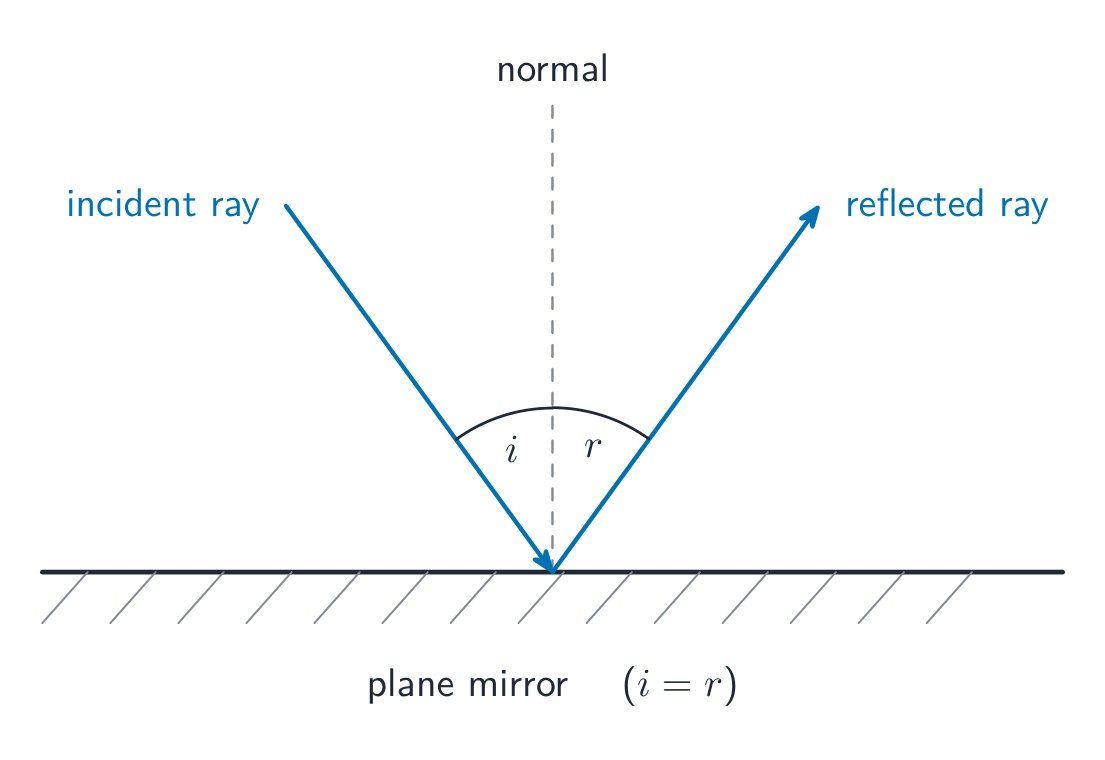
1 Define and use the terms normal, angle of incidence and angle of reflection
2 Describe the formation of an optical image by a plane mirror and give its characteristics, i.e. same size, same distance from mirror, virtual
3 State that for reflection, the angle of incidence is equal to the angle of reflection; recall and use this relationship
4 Use simple constructions, measurements and calculations for reflection by plane mirrors
3.2.2 Refraction of light
Core
Supplement
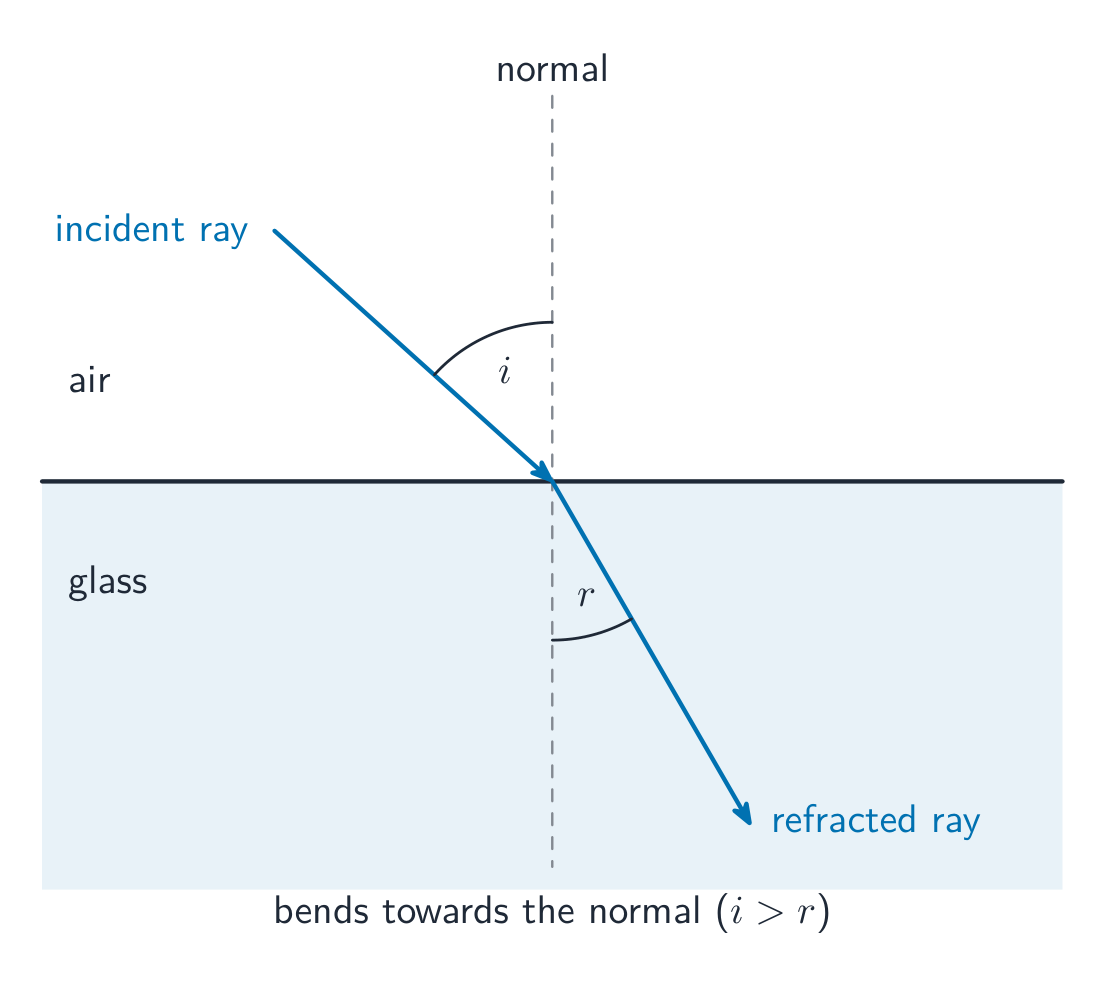
1 Define and use the terms normal, angle of incidence and angle of refraction
2 Describe an experiment to show refraction of light by transparent blocks of different shapes
6 Define refractive index, $n$, as the ratio of the speeds of a wave in two different regions
3 Describe the passage of light through a transparent material (limited to the boundaries between two mediums only)
7 Recall and use the equation
$$n = \frac{\sin i}{\sin r}$$
4 State the meaning of critical angle
8 Recall and use the equation
$$n = \frac{1}{\sin c}$$
5 Describe internal reflection and total internal reflection using both experimental and everyday examples
9 Describe the use of optical fibres, particularly in telecommunications
3.2.3 Thin lenses
Core
Supplement
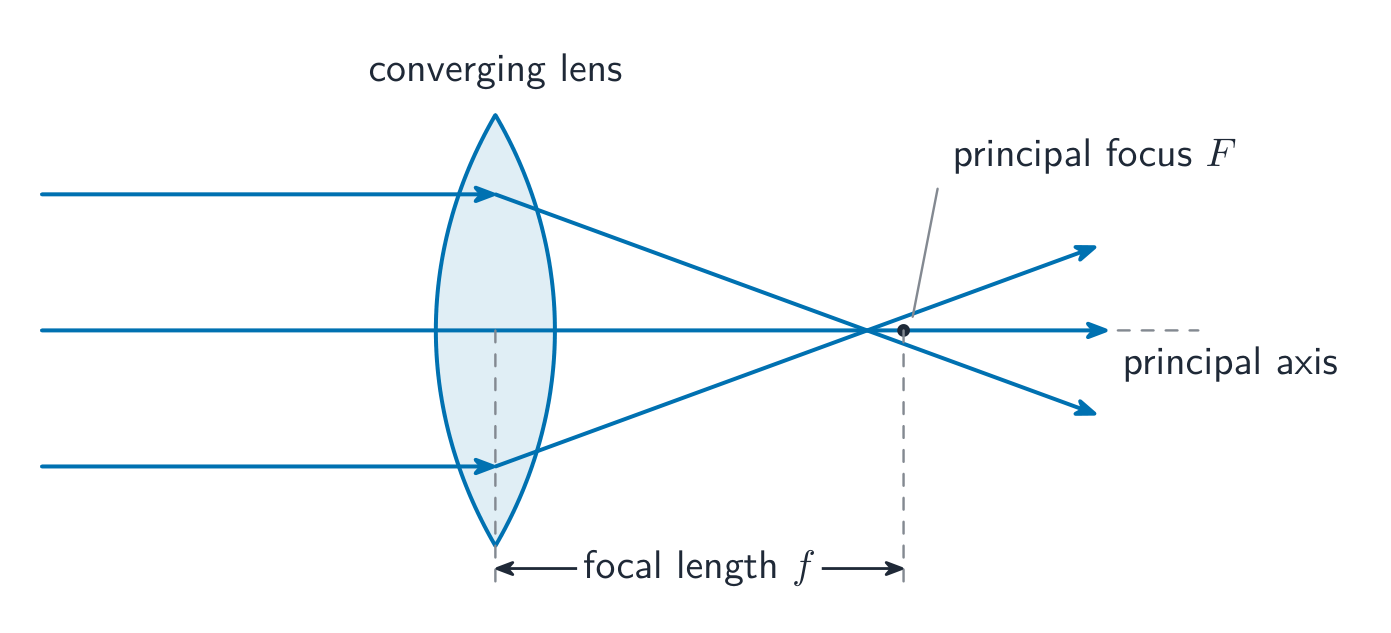
1 Describe the action of thin converging and thin diverging lenses on a parallel beam of light
2 Define and use the terms focal length, principal axis and principal focus (focal point)
3 Draw and use ray diagrams for the formation of a real image by a converging lens
6 Draw and use ray diagrams for the formation of a virtual image by a converging lens
4 Describe the characteristics of an image using the terms enlarged/same size/diminished, upright/inverted and real/virtual
7 Describe the use of a single lens as a magnifying glass
5 Know that a virtual image is formed when diverging rays are extrapolated backwards and does not form a visible projection on a screen
8 Describe the use of converging and diverging lenses to correct long-sightedness and short-sightedness
3.2.4 Dispersion of light
Core
Supplement
1 Describe the dispersion of light as illustrated by the refraction of white light by a glass prism
2 Know the traditional seven colours of the visible spectrum in order of frequency and in order of wavelength
3 Recall that visible light of a single frequency is described as monochromatic
Tiếng Việt
3.2.1 Phản xạ ánh sáng
Cốt lõi
Bổ sung
1 Định nghĩa và sử dụng các thuật ngữ pháp tuyến, góc tới và góc phản xạ
2 Mô tả sự tạo ảnh quang học bởi gương phẳng và nêu các đặc điểm của nó, tức là: cùng kích thước, cùng khoảng cách từ gương, ảnh ảo
3 Nêu rằng đối với phản xạ, góc tới bằng góc phản xạ; nhớ lại và sử dụng mối quan hệ này
4 Sử dụng các phép dựng hình đơn giản, đo lường và tính toán cho hiện tượng phản xạ trên gương phẳng
3.2.2 Sự khúc xạ ánh sáng
Cốt lõi
Bổ sung
1 Định nghĩa và sử dụng các thuật ngữ pháp tuyến, góc tới và góc khúc xạ
2 Mô tả một thí nghiệm để chứng minh sự khúc xạ ánh sáng qua các khối trong suốt có hình dạng khác nhau
6 Định nghĩa chỉ số khúc xạ, $n$, là tỷ lệ giữa tốc độ của sóng trong hai môi trường khác nhau
3 Mô tả đường truyền của ánh sáng đi qua vật liệu trong suốt (chỉ giới hạn ở các mặt phân cách giữa hai môi trường)
7 Nhớ lại và sử dụng phương trình
$$n = \frac{\sin i}{\sin r}$$
4 Nêu ý nghĩa của góc tới hạn
8 Nhớ lại và sử dụng phương trình
$$n = \frac{1}{\sin c}$$
5 Mô tả phản xạ nội bộ và phản xạ toàn phần bằng cả ví dụ thực nghiệm và đời sống hàng ngày
9 Mô tả ứng dụng của sợi quang, đặc biệt trong viễn thông
3.2.3 Thấu kính mỏng
Cốt lõi
Bổ sung
1 Mô tả tác động của thấu kính hội tụ và thấu kính phân kỳ mỏng lên chùm tia sáng song song
2 Định nghĩa và sử dụng các thuật ngữ tiêu cự, trục chính và tiêu điểm (điểm tiêu cự)
3 Vẽ và sử dụng sơ đồ tia sáng để mô tả sự tạo ảnh thật bởi thấu kính hội tụ
6 Vẽ và sử dụng sơ đồ tia sáng để mô tả sự tạo ảnh ảo bởi thấu kính hội tụ
4 Mô tả các đặc điểm của ảnh sử dụng các thuật ngữ phóng to/cùng kích thước/nhỏ hơn, thẳng/đảo chiều và thật/ảo
7 Mô tả việc sử dụng thấu kính đơn làm kính lúp
5 Biết rằng ảnh ảo được tạo ra khi các tia phân kỳ được kéo dài ngược về phía sau và không thể chiếu lên màn hình
8 Mô tả việc sử dụng thấu kính hội tụ và thấu kính phân kỳ để chỉnh thị cận thị và thị già
3.2.4 Sự tán sắc ánh sáng
Cốt lõi
Bổ sung
1 Mô tả sự tán sắc của ánh sáng như được minh họa qua sự khúc xạ của ánh sáng trắng qua lăng kính thủy tinh
2 Biết thứ tự bảy màu truyền thống của quang phổ khả kiến theo tần số và theo bước sóng
3 Nhớ lại rằng ánh sáng khả kiến có một tần số duy nhất được gọi là ánh sáng đơn sắc
Source: Cambridge International syllabus · Nguồn: Chương trình Cambridge International
A converging lens forms an imageTotal internal reflection
Reflection
When light hits a mirror, it reflects. We measure angles from the normal 法线 (a line at 90° to the surface).
The law of reflection: the angle of incidence 入射角 equals the angle of reflection 反射角.
A plane mirror 平面镜 forms an image that is the same size as the object, the same distance behind the mirror, and virtual (it cannot be caught on a screen).
At a plane mirror the angle of incidence $i$ equals the angle of reflection $r$, both measured from the normal
Refraction
When light passes from one material into another, it changes speed and bends. The angle in the second material is the angle of refraction 折射角.
Going from air into glass the light slows down and bends towards the normal, so $i > r$
Seeing refraction. Shine a narrow ray from a ray box 光线盒 into a rectangular glass block standing on paper. Mark the ray going in and the ray coming out, remove the block, and join the marks to draw the ray inside the glass. Draw the normal where the ray enters and measure the angle of incidence and the angle of refraction with a protractor. Repeat with a semicircular block or a prism: the ray always bends towards the normal on entering the glass and away from the normal on leaving.
The refractive index 折射率$n$ compares the speed of light in the two materials:
$$n = \frac{\sin i}{\sin r}$$
Worked example. A ray of light passes from air into glass. The angle of incidence is 60° and the angle of refraction is 35°. Find the refractive index of the glass. (Take $\sin i = 0.87$ and $\sin r = 0.57$.)
When light tries to leave glass or water and the angle is too large, it cannot get out and instead reflects completely. This is total internal reflection 全反射. It happens when the angle inside is bigger than the critical angle 临界角$c$:
$$n = \frac{1}{\sin c}$$
Below the critical angle the light refracts out; above it the light is totally internally reflected
This effect is used in optical fibres 光纤, thin glass threads that carry light signals for telephones and the internet.
Total internal reflection keeps light bouncing along each fibre until it shines out at the tip
Lenses
A converging lens 凸透镜 (fat in the middle) bends parallel rays inwards to a point called the principal focus 焦点. The principal axis 主光轴 is the straight line through the centre of the lens at right angles to it; the principal focus lies on this axis. The distance from the centre of the lens to the principal focus is the focal length 焦距. A diverging lens 凹透镜 (thin in the middle) spreads parallel rays out, as if they came from a focus on the incoming side.
A converging lens bends parallel rays to meet at the principal focus; the focal length $f$ is the lens-to-focus distance
A converging lens can form a real image 实像 (rays really meet; can be shown on a screen) or, when the object is very close, a virtual image 虚像 (rays only seem to come from it). Used close to the eye, a converging lens is a magnifying glass 放大镜.
Describe an image with three pairs of words: enlarged 放大的 or diminished 缩小的 (or the same size), upright 正立 or inverted 倒立 (upside down), and real or virtual. An object far beyond the focus gives a diminished, inverted, real image (as in a camera). An object between the focus and the lens gives an enlarged, upright, virtual image (a magnifying glass).
Correcting sight. A person with short-sightedness 近视 sees near things clearly but distant things are blurred: the eye focuses the light in front of the retina 视网膜 (the back of the eye). A diverging lens in front of the eye spreads the rays out first, so they focus on the retina. A person with long-sightedness 远视 sees distant things clearly but near things are blurred: the eye focuses the light behind the retina. A converging lens brings the rays together a little before they enter the eye.
Held away from the eye, a converging lens forms a real image – here the houses behind it appear upside down
Dispersion
A glass prism 棱镜 splits white light into the colours of the spectrum 光谱. This splitting is called dispersion 色散.
A prism refracts violet light most and red light least, so white light spreads into a spectrum
The order of colours is red, orange, yellow, green, blue, indigo, violet. Red light has the longest wavelength and the lowest frequency; violet is the opposite. Light of a single frequency (one pure colour) is monochromatic 单色.
White light entering a real glass prism spreads into the full spectrum of colours
Explore · Khám phá
Bend a light ray · Làm cong tia sáng
Shine light into water, glass or diamond and change the angle. The ray slows and bends toward the normal — the denser the material (higher n), the more it bends. That bending is why a straw looks broken in a glass, and why diamonds sparkle. · Chiếu ánh sáng vào nước, thủy tinh hay kim cương và thay đổi góc tới. Tia sáng chậm lại và bẻ cong về phía pháp tuyến — vật liệu càng đặc (chỉ số n càng cao), tia càng bẻ cong nhiều. Sự bẻ cong này là lý do tại sao chiếc đũa trông bị gãy trong ly nước, và tại sao kim cương lấp lánh.
Explore · Khám phá
Image formation by a converging lens · Tạo ảnh bởi thấu hội tụ
Trace the three special rays from the object — where they meet is the image. Move the object closer than the focal point to flip it into a magnifying glass. · Vẽ ba tia đặc biệt từ vật — nơi chúng giao nhau là vị trí ảnh. Di chuyển vật vào gần tiêu điểm hơn để tạo thành kính lúp.
total internal reflection/ˈtəʊtl ɪnˈtɜːnl rɪˈflekʃn/
phản xạ toàn phần
critical angle/ˈkrɪtɪkl ˈæŋɡl/
góc tới giới hạn
optical fibre/ˈɒptɪkl ˈfaɪbə/
sợi quang
converging lens/kənˈvɜːdʒɪŋ lenz/
thấu kính hội tụ
principal focus/ˈprɪnsɪpl ˈfəʊkəs/
tiêu điểm chính
principal axis/ˈprɪnsɪpl ˈæksɪs/
trục chính
focal length/ˈfəʊkl leŋθ/
tiêu cự
diverging lens/daɪˈvɜːdʒɪŋ lenz/
thấu kính phân kỳ
real image/rɪəl ˈɪmɪdʒ/
ảnh thật
virtual image/ˈvɜːtʃuːəl ˈɪmɪdʒ/
ảnh ảo
magnifying glass/ˈmæɡnɪfaɪɪŋ ɡlæs/
kính lúp
enlarged/enˈlɑːdʒd/
phóng to
diminished/dɪˈmɪnɪʃt/
thu nhỏ
upright/ˈʌpraɪt/
đứng thẳng
inverted/ɪnˈvɜːtɪd/
bị đảo pha
short-sightedness/ʃɔːt ˈsaɪtɪdnəs/
viễn thị
retina/ˈretɪnə/
màng mắt
long-sightedness/lɒŋ ˈsaɪtɪdnəs/
thận thị
prism/ˈprɪzəm/
lăng kính
spectrum/ˈspektrəm/
quang phổ
dispersion/dɪˈspɜːʃn/
phân tán
monochromatic/ˌmɒnəʊkrəʊˈmætɪk/
một màu
3.3
The electromagnetic spectrum 电磁波谱
Syllabus · Chương trình
English
Core
Supplement
1 Know the main regions of the electromagnetic spectrum in order of frequency and in order of wavelength
2 Know that all electromagnetic waves travel at the same high speed in a vacuum
6 Know that the speed of electromagnetic waves in a vacuum is $3.0 \times 10^8\text{ m/s}$ and is approximately the same in air
3 Describe typical uses of the different regions of the electromagnetic spectrum including: (a) radio waves; radio and television transmissions, astronomy, radio frequency identification (RFID) (b) microwaves; satellite television, mobile phones (cell phones), microwave ovens (c) infrared; electric grills, short range communications such as remote controllers for televisions, intruder alarms, thermal imaging, optical fibres (d) visible light; vision, photography, illumination (e) ultraviolet; security marking, detecting fake bank notes, sterilising water (f) X-rays; medical scanning, security scanners (g) gamma rays; sterilising food and medical equipment, detection of cancer and its treatment
4 Describe the harmful effects on people of excessive exposure to electromagnetic radiation, including: (a) microwaves; internal heating of body cells (b) infrared; skin burns (c) ultraviolet; damage to surface cells and eyes, leading to skin cancer and eye conditions (d) X-rays and gamma rays; mutation or damage to cells in the body
5 Know that communication with artificial satellites is mainly by microwaves: (a) some satellite phones use low orbit artificial satellites (b) some satellite phones and direct broadcast satellite television use geostationary satellites
7 Know that many important systems of communications rely on electromagnetic radiation including: (a) mobile phones (cell phones) and wireless internet use microwaves because microwaves can penetrate some walls and only require a short aerial for transmission and reception (b) Bluetooth uses radio waves because radio waves pass through walls but the signal is weakened on doing so (c) optical fibres (visible light or infrared) are used for cable television and high-speed broadband because glass is transparent to visible light and some infrared; visible light and short wavelength infrared can carry high rates of data
8 Know the difference between a digital and analogue signal
9 Know that a sound can be transmitted as a digital or analogue signal
10 Explain the benefits of digital signalling including increased rate of transmission of data and increased range due to accurate signal regeneration
Tiếng Việt
Cốt lõi
Bổ sung
1 Biết các vùng chính của quang phổ điện từ theo thứ tự tăng dần của tần số và theo thứ tự giảm dần của bước sóng
2 Biết rằng tất cả các sóng điện từ đều truyền với cùng một tốc độ cao trong chân không
6 Biết rằng tốc độ của sóng điện từ trong chân không là $3.0 \times 10^8\text{ m/s}$ và xấp xỉ bằng nhau trong không khí
3 Mô tả các ứng dụng điển hình của các vùng khác nhau trong quang phổ điện từ bao gồm: (a) sóng vô tuyến; truyền thanh và truyền hình, thiên văn học, nhận diện tần số vô tuyến (RFID) (b) sóng vi ba; truyền hình vệ tinh, điện thoại di động (điện thoại cầm tay), lò vi sóng (c) tia hồng ngoại; bếp nướng điện, liên lạc tầm ngắn như điều khiển từ xa cho truyền hình, báo động trộm cắp, chụp ảnh nhiệt, sợi quang (d) ánh sáng khả kiến; thị giác, nhiếp ảnh, chiếu sáng (e) tia tử ngoại; đánh dấu an ninh, phát hiện tiền giả, tiệt trùng nước (f) tia X; chụp cắt lớp y tế, máy quét an ninh (g) tia gamma; tiệt trùng thực phẩm và thiết bị y tế, phát hiện ung thư và điều trị ung thư
4 Mô tả các tác hại đối với con người do tiếp xúc quá mức với bức xạ điện từ, bao gồm: (a) sóng vi ba; làm nóng bên trong các tế bào cơ thể (b) tia hồng ngoại; bỏng da (c) tia tử ngoại; gây tổn thương các tế bào bề mặt và mắt, dẫn đến ung thư da và các bệnh về mắt (d) tia X và tia gamma; đột biến hoặc gây hư hại cho các tế bào trong cơ thể
5 Biết rằng liên lạc với vệ tinh nhân tạo chủ yếu sử dụng sóng vi ba: (a) một số điện thoại vệ tinh sử dụng vệ tinh quỹ đạo thấp (b) một số điện thoại vệ tinh và truyền hình trực tiếp vệ tinh sử dụng vệ tinh địa tĩnh
7 Biết rằng nhiều hệ thống truyền thông quan trọng dựa vào bức xạ điện từ bao gồm: (a) điện thoại di động (điện thoại cầm tay) và mạng không dây sử dụng sóng vi ba vì sóng vi ba có thể xuyên qua một số bức tường và chỉ cần anten ngắn để truyền và thu (b) Bluetooth sử dụng sóng vô tuyến vì sóng vô tuyến đi qua tường nhưng tín hiệu bị suy yếu khi làm vậy (c) sợi quang (ánh sáng khả kiến hoặc tia hồng ngoại) được sử dụng cho truyền hình cáp và băng thông rộng tốc độ cao vì thủy tinh trong suốt với ánh sáng khả kiến và một số tia hồng ngoại; ánh sáng khả kiến và tia hồng ngoại bước sóng ngắn có thể mang lượng dữ liệu lớn
8 Phân biệt giữa tín hiệu kỹ thuật số và tín hiệu tương tự
9 Biết rằng âm thanh có thể được truyền dưới dạng tín hiệu kỹ thuật số hoặc tín hiệu tương tự
10 Giải thích lợi ích của tín hiệu kỹ thuật số bao gồm tốc độ truyền dữ liệu tăng và phạm vi hoạt động mở rộng nhờ tái sinh tín hiệu chính xác
Source: Cambridge International syllabus · Nguồn: Chương trình Cambridge International
The electromagnetic spectrum is a family of waves that all travel at the same high speed in a vacuum 真空, $3.0 \times 10^8\ \text{m/s}$. In order from longest wavelength (lowest frequency) to shortest:
As you go from radio waves to gamma rays, the frequency rises, the wavelength falls, and the energy (and danger) rises. The speed of electromagnetic waves in air is almost the same as in a vacuum.
Satellites. Communication with artificial satellites 人造卫星 mainly uses microwaves, because they pass through the atmosphere. Some satellite phones use satellites in low orbit 低轨道, close to the Earth. Other satellite phones, and direct broadcast satellite television, use satellites in geostationary orbit 地球静止轨道, which stay above the same point on the Earth.
From radio waves to gamma rays the wavelength falls while the frequency and energy rise
Digital and analogue signals
Radio waves and microwaves carry information as signals, and a signal is either analogue 模拟 or digital 数字. An analogue signal varies continuously and can take any value; a digital signal is a stream of just two values, on or off (1 or 0). Sound can be sent as either kind of signal: a microphone gives an analogue signal, which can be turned into a digital one.
Modern communication prefers digital signalling for two reasons the exam asks for:
a higher rate of data transmission;
a greater range: a weak digital signal can be regenerated back to a clean 1/0 exactly, because only two levels have to be told apart, so noise picked up along the way is removed. An analogue signal cannot be cleaned up this way, so its noise builds up.
Explore · Khám phá
Slide across the spectrum · Trượt dọc theo phổ
Radio waves, visible light and gamma rays are all the same wave — only the wavelength changes, and with it the frequency, photon energy and everyday use. · Sóng vô tuyến, ánh sáng nhìn thấy và tia gamma đều là cùng một loại sóng — chỉ có bước sóng thay đổi, và随之频率、光子能量和日常用途也随之改变。
1 Describe the production of sound by vibrating sources
2 Describe the longitudinal nature of sound waves
10 Describe compression and rarefaction
3 State the approximate range of frequencies audible to humans as 20Hz to 20000Hz
4 Know that a medium is needed to transmit sound waves
5 Know that the speed of sound in air is approximately 330–350m/s
11 Know that, in general, sound travels faster in solids than in liquids and faster in liquids than in gases
6 Describe a method involving a measurement of distance and time for determining the speed of sound in air
7 Describe how changes in amplitude and frequency affect the loudness and pitch of sound waves
8 Describe an echo as the reflection of sound waves
9 Define ultrasound as sound with a frequency higher than 20kHz
12 Describe the uses of ultrasound in non-destructive testing of materials, medical scanning of soft tissue and sonar including calculation of depth or distance from time and wave speed
Tiếng Việt
Cốt lõi
Bổ sung
1 Mô tả sự tạo ra âm thanh từ các nguồn dao động
2 Mô tả bản chất dọc của sóng âm
10 Mô tả vùng nén và vùng giãn
3 Nêu dải tần số nghe được của con người xấp xỉ từ 20Hz đến 20000Hz
4 Biết rằng cần có môi trường để truyền sóng âm
5 Biết rằng tốc độ âm thanh trong không khí xấp xỉ 330–350m/s
11 Biết rằng nói chung, âm thanh truyền nhanh trong chất rắn hơn trong chất lỏng và nhanh trong chất lỏng hơn trong chất khí
6 Mô tả một phương pháp liên quan đến đo khoảng cách và thời gian để xác định tốc độ âm thanh trong không khí
7 Mô tả cách thay đổi biên độ và tần số ảnh hưởng đến độ to và độ cao của sóng âm
8 Mô tả vọng âm là sự phản xạ của sóng âm
9 Định nghĩa siêu âm là âm thanh có tần số cao hơn 20kHz
12 Mô tả các ứng dụng của siêu âm trong kiểm tra không phá hủy vật liệu, chụp cắt lớp mô mềm y tế và sonar bao gồm tính toán độ sâu hoặc khoảng cách từ thời gian và tốc độ sóng
Source: Cambridge International syllabus · Nguồn: Chương trình Cambridge International
Sound is made by a vibrating object. It is a longitudinal wave: the air is squeezed into a compression 压缩 (particles close together) and stretched into a rarefaction 稀疏 (particles far apart).
Sound needs a medium 介质 (a material) to travel through, so it cannot travel through a vacuum.
Humans can hear frequencies from about $20\ \text{Hz}$ to $20\,000\ \text{Hz}$.
Sound travels much slower than light (about $340\ \text{m/s}$ in air), and faster in liquids and solids than in gases.
A larger amplitude makes a louder sound (greater loudness 响度); a higher frequency makes a higher pitch 音调. So a dolphin's rapid clicks are high-pitched, and a hard drum-hit (big vibration) is loud.
A reflected sound is an echo 回声.
Measuring the speed of sound. Two students stand a known distance apart, for example 500 m, measured with a tape or a trundle wheel. One bangs two blocks of wood together. The other starts a stopwatch when they see the blocks hit and stops it when they hear the bang. Light arrives almost at once, so the time measured is the time the sound takes, and speed = distance ÷ time. Repeat and take an average to reduce the reaction-time error. The echo method needs one person: clap at a known distance from a large wall and time the reflected sound, remembering that the sound travels there and back.
Worked example. A student stands 85 m from a large wall and claps once. The echo returns 0.50 s later. Find the speed of sound.
The sound travels to the wall and back, a distance of $2 \times 85 = 170\ \text{m}$, in $0.50\ \text{s}$:
Ultrasound 超声波 is sound above $20\,000\ \text{Hz}$ – too high for humans to hear. Its uses rely on reflection: sonar measures water depth, medical scanning images a baby or soft tissue, and non-destructive testing finds cracks inside metal without cutting it open. Like an echo, an ultrasound pulse travels there and back, so halve the total distance to reach the object.
Worked example. A sonar pulse returns from the seabed $0.10\ \text{s}$ after it is sent; sound travels at $1500\ \text{m/s}$ in water. The pulse covers $s = v\times t = 1500\times0.10 = 150\ \text{m}$ there and back, so the sea is $150/2 = 75\ \text{m}$ deep.
A microphone converts sound vibrations in air into an electrical signal
Explore · Khám phá
Sound · Âm thanh
y = a sin(bt + c)
Louder = bigger amplitude; higher pitch = higher frequency. · Âm to hơn = biên độ lớn hơn; âm cao hơn = tần số cao hơn.
Learn $v = f\lambda$ and be ready to rearrange it. Measure all angles of incidence, reflection and refraction from the normal (the line at 90° to the surface), never from the surface itself.
Transverse waves vibrate across the direction of travel (light, water); longitudinal waves vibrate along it (sound). Sound needs a medium, so it cannot cross a vacuum; light can.
Total internal reflection happens only when light travels from a denser material to a less dense one and the angle inside is bigger than the critical angle.
Know the electromagnetic spectrum in order — radio, microwave, infrared, visible, ultraviolet, X-ray, gamma. All travel at the same speed in a vacuum; frequency and energy rise from radio to gamma.
Going into a denser material (air → glass) light slows down and bends towards the normal; leaving it (glass → air) light speeds up and bends away.
1 Describe the forces between magnetic poles and between magnets and magnetic materials, including the use of the terms north pole (N pole), south pole (S pole), attraction and repulsion, magnetised and unmagnetised
10 Explain that magnetic forces are due to interactions between magnetic fields
2 Describe induced magnetism
3 State the differences between the properties of temporary magnets (made of soft iron) and the properties of permanent magnets (made of steel
4 State the difference between magnetic and non-magnetic materials
5 Describe a magnetic field as a region in which a magnetic pole experiences a force
6 Draw the pattern and direction of magnetic field lines around a bar magnet
11 Know that the relative strength of a magnetic field is represented by the spacing of the magnetic field lines
7 State that the direction of a magnetic field at a point is the direction of the force on the N pole of a magnet at that point
8 Describe the plotting of magnetic field lines with a compass or iron filings and the use of a compass to determine the direction of the magnetic field
9 Describe the uses of permanent magnets and electromagnets
Tiếng Việt
Cốt lõi
Bổ sung
1 Mô tả các lực giữa các cực từ và giữa nam châm với vật liệu từ tính, bao gồm việc sử dụng các thuật ngữ cực bắc (cực N), cực nam (cực S), lực hút và lực đẩy, đã từ hóa và chưa từ hóa
10 Giải thích rằng các lực từ là do tương tác giữa các trường từ
2 Mô tả từ tính cảm ứng
3 Nêu sự khác biệt giữa tính chất của nam châm tạm thời (làm bằng sắt mềm) và tính chất của nam châm vĩnh cửu (làm bằng thép)
4 Nêu sự khác biệt giữa vật liệu từ tính và phi từ tính
5 Mô tả trường từ là vùng mà tại đó một cực từ chịu tác dụng của lực
6 Vẽ sơ đồ và hướng của đường sức từ xung quanh nam châm thanh
11 Biết rằng độ mạnh tương đối của trường từ được biểu thị bởi khoảng cách giữa các đường sức từ
7 Nêu rằng hướng của trường từ tại một điểm là hướng của lực tác dụng lên cực N của nam châm tại điểm đó
8 Mô tả phương pháp vẽ các đường sức từ bằng la bàn hoặc vụn sắt và sử dụng la bàn để xác định hướng của trường từ
9 Mô tả các ứng dụng của nam châm vĩnh cửu và điện từ
Source: Cambridge International syllabus · Nguồn: Chương trình Cambridge International
A magnet 磁体 can attract some metals. Every magnet has two ends, called poles 磁极: a north pole 北极 (N pole) and a south pole 南极 (S pole).
Like poles repel; unlike poles attract
The rule for two poles is like the rule for charges:
Poles that are the same (N and N, or S and S) repel 排斥 (push apart): this is repulsion 排斥力.
Poles that are different (N and S) attract 吸引 (pull together): this is attraction 吸引力.
A magnet attracts a magnetic material 磁性材料, such as iron, steel, cobalt and nickel. Other materials (copper, plastic, wood) are non-magnetic and feel no force.
Induced magnetism
Put a piece of iron near or touching a magnet, and the iron becomes a magnet itself. This is induced magnetism 感应磁性. The end of the iron nearest the magnet gains the opposite pole, so the two then attract.
Temporary and permanent magnets
Soft iron 软铁 is easy to magnetise 磁化 but loses its magnetism quickly. It is used for a temporary magnet 临时磁体.
Steel 钢 is harder to magnetise but keeps its magnetism. It is used for a permanent magnet 永磁体.
So an unmagnetised 未磁化 piece of soft iron is the best core for an electromagnet, while steel is best for a bar magnet.
Magnetic fields
A magnetic field 磁场 is a region 区域 where a magnetic pole feels a force. We draw it with magnetic field lines 磁场线:
The lines come out of the N pole and go into the S pole.
The field direction at a point is the direction of the force on the N pole of a small test magnet placed there.
Where the lines are close together the field is strong; where they are far apart the field is weak.
The field lines of a bar magnet come out of the N pole and go into the S pole
You can show the pattern by sprinkling iron filings 铁屑 on paper over a magnet, or by moving a small plotting compass 指南针 around it (the needle points along the field).
Iron filings line up along the field lines, showing the field pattern of a bar magnet
Uses of magnets
Permanent magnets: fridge door catches, compass needles, loudspeakers.
Electromagnets 电磁铁 (magnetic only while a current flows): cranes that lift scrap iron, electric bells, relays. An electromagnet can be switched on and off and made stronger, which a permanent magnet cannot.
Magnetic forces happen because the fields of the two magnets push and pull on each other.
Explore · Khám phá
Make the magnetic field visible · Làm cho từ trường trở nên nhìn thấy được
Compass needles trace the field from N to S; switch between attract and repel and watch the whole pattern reorganise, with a neutral point appearing for like poles. · Kim la bàn vẽ đường sức từ từ N sang S; chuyển giữa hút và đẩy và quan sát toàn bộ mẫu hình tái tổ chức, với điểm trung hòa xuất hiện khi hai cực giống nhau.
1 State that there are positive and negative charges
7 State that charge is measured in coulombs
2 State that positive charges repel other positive charges, negative charges repel other negative charges, but positive charges attract negative charges
8 Describe an electric field as a region in which an electric charge experiences a force
3 Describe simple experiments to show the production of electrostatic charges by friction and to show the detection of electrostatic charges
9 State that the direction of an electric field at a point is the direction of the force on a positive charge at that point
4 Explain that charging of solids by friction involves only a transfer of negative charge (electrons)
10 Describe simple electric field patterns, including the direction of the field: (a) around a point charge (b) around a charged conducting sphere (c) between two oppositely charged parallel conducting plates (end effects will not be examined)
5 Describe an experiment to distinguish between electrical conductors and insulators
6 Recall and use a simple electron model to explain the difference between electrical conductors and insulators and give typical examples
4.2.2 Electric current
Core
Supplement
1 Know that electric current is related to the flow of charge
5 Define electric current as the charge passing a point per unit time; recall and use the equation $I = \frac{Q}{t}$
2 Describe the use of ammeters (analogue and digital) with different ranges
3 Describe electrical conduction in metals in terms of the movement of free electrons
6 State that conventional current is from positive to negative and that the flow of free electrons is from negative to positive
4 Know the difference between direct current (d.c.) and alternating current (a.c.)
4.2.3 Electromotive force and potential difference
Core
Supplement
1 Define electromotive force (e.m.f.) as the electrical work done by a source in moving a unit charge around a complete circuit
6 Recall and use the equation for e.m.f. $E = \frac{W}{Q}$
2 Know that e.m.f. is measured in volts (V)
3 Define potential difference (p.d.) as the work done by a unit charge passing through a component
7 Recall and use the equation for p.d. $V = \frac{W}{Q}$
4 Know that the p.d. between two points is measured in volts (V)
5 Describe the use of voltmeters (analogue and digital) with different ranges
4.2.4 Resistance
Core
Supplement
1 Recall and use the equation for resistance$R = \frac{V}{I}$
4 Sketch and explain the current–voltage graphs for a resistor of constant resistance, a filament lamp and a diode
2 Describe an experiment to determine resistance using a voltmeter and an ammeter and do the appropriate calculations
3 State, qualitatively, the relationship of the resistance of a metallic wire to its length and to its cross-sectional area
5 Recall and use the following relationship for a metallic electrical conductor: (a) resistance is directly proportional to length (b) resistance is inversely proportional to cross-sectional area
4.2.5 Electrical energy and electrical power
Core
Supplement
1 Understand that electric circuits transfer energy from a source of electrical energy, such as an electrical cell or mains supply, to the circuit components and then into the surroundings
2 Recall and use the equation for electrical power $P = IV$
3 Recall and use the equation for electrical energy $E = IVt$
4 Define the kilowatt-hour (kWh) and calculate the cost of using electrical appliances where the energy unit is the kWh
Tiếng Việt
4.2.1 Điện tích
Cốt lõi
Bổ sung
1 Nêu rằng có điện tích dương và điện tích âm
7 Nêu rằng điện tích được đo bằng coulomb
2 Nêu rằng điện tích dương đẩy các điện tích dương khác, điện tích âm đẩy các điện tích âm khác, nhưng điện tích dương hút điện tích âm
8 Mô tả trường điện là vùng mà tại đó một điện tích chịu tác dụng của lực
3 Mô tả các thí nghiệm đơn giản để chứng minh sự tạo ra điện tích tĩnh do ma sát và để phát hiện điện tích tĩnh
9 Nêu rằng hướng của trường điện tại một điểm là hướng của lực tác dụng lên điện tích dương tại điểm đó
4 Giải thích rằng quá trình nạp điện cho vật rắn do ma sát chỉ liên quan đến sự chuyển dịch điện tích âm (electron)
10 Mô tả các mẫu trường điện đơn giản, bao gồm hướng của trường: (a) xung quanh điện tích điểm (b) xung quanh quả cầu dẫn điện mang điện (c) giữa hai bản dẫn điện song song mang điện trái dấu (hiệu ứng đầu sẽ không được kiểm tra)
5 Mô tả một thí nghiệm để phân biệt giữa các chất dẫn điện và chất cách điện
6 Nhớ lại và sử dụng mô hình electron đơn giản để giải thích sự khác biệt giữa chất dẫn điện và chất cách điện, đưa ra các ví dụ điển hình
4.2.2 Dòng điện
Cốt lõi
Bổ sung
1 Biết rằng dòng điện liên quan đến sự di chuyển của điện tích
5 Định nghĩa dòng điện là điện tích đi qua một điểm trong một đơn vị thời gian; nhớ lại và sử dụng phương trình $I = \frac{Q}{t}$
2 Mô tả việc sử dụng ampe kế (đồng hồ kim và kỹ thuật số) với các thang đo khác nhau
3 Mô tả sự dẫn điện trong kim loại dựa trên sự di chuyển của electron tự do
6 Nêu rằng dòng điện quy ước đi từ dương sang âm và sự di chuyển của electron tự do đi từ âm sang dương
4 Phân biệt được giữa dòng điện một chiều (DC) và dòng điện xoay chiều (AC)
4.2.3 suất điện động và hiệu điện thế
Cốt lõi
Bổ sung
1 Định nghĩa suất điện động (e.m.f.) là công điện do nguồn thực hiện khi di chuyển một đơn vị điện tích quanh toàn bộ mạch
6 Nhớ lại và sử dụng phương trình cho e.m.f. $E = \frac{W}{Q}$
2 Biết rằng e.m.f. được đo bằng volt (V)
3 Định nghĩa hiệu điện thế (p.d.) là công thực hiện bởi một đơn vị điện tích khi đi qua một linh kiện
7 Nhớ lại và sử dụng phương trình cho p.d. $V = \frac{W}{Q}$
4 Biết rằng hiệu điện thế giữa hai điểm được đo bằng volt (V)
5 Mô tả việc sử dụng vôn kế (đồng hồ kim và kỹ thuật số) với các thang đo khác nhau
4.2.4 Điện trở
Cốt lõi
Bổ sung
1 Nhớ lại và sử dụng phương trình cho điện trở$R = \frac{V}{I}$
4 Phác thảo và giải thích các đồ thị cường độ điện áp – điện áp cho điện trở có điện trở không đổi, bóng đèn sợi đốt và diode
2 Mô tả một thí nghiệm để xác định điện trở bằng cách sử dụng vôn kế và ampe kế và thực hiện các phép tính phù hợp
3 Nêu, theo định tính, mối quan hệ giữa điện trở của dây kim loại với chiều dài và tiết diện của nó
5 Nhớ lại và sử dụng các mối quan hệ sau đối với vật dẫn điện kim loại: (a) điện trở tỷ lệ thuận với chiều dài (b) điện trở tỷ lệ nghịch với tiết diện
4.2.5 Năng lượng điện và công suất điện
Cốt lõi
Bổ sung
1 Hiểu rằng các mạch điện truyền năng lượng từ nguồn năng lượng điện, chẳng hạn như pin hoặc nguồn điện lưới, đến các linh kiện trong mạch và sau đó vào môi trường xung quanh
2 Nhớ lại và sử dụng phương trình cho công suất điện $P = IV$
3 Nhớ lại và sử dụng phương trình cho điện năng $E = IVt$
4 Định nghĩa kilowatt-giờ (kWh) và tính chi phí sử dụng các thiết bị điện khi đơn vị năng lượng là kWh
Source: Cambridge International syllabus · Nguồn: Chương trình Cambridge International
There are two kinds of electric charge 电荷: positive charge 正电荷 and negative charge 负电荷. The rule is like the rule for poles — same charges repel, different charges attract.
Every hair picks up the same charge from the dome, and like charges repel — so the hairs push apart
Charging by friction
When you rub two different materials together, electrons 电子 (tiny negative particles) move from one to the other. This is charging by friction 摩擦起电.
The material that gains electrons becomes negative.
The material that loses electrons becomes positive.
Only the negative electrons move; the positive charge stays in place. For example, a plastic rod rubbed with a cloth becomes negative because electrons move from the cloth onto the rod, leaving the cloth positive.
Detecting a charge. A charged rod picks up small pieces of paper, and it bends a thin stream of water from a tap. Hang one charged rod from a thread and bring another charged rod near it: if the two have the same kind of charge, the hanging rod swings away. Repulsion is the only sure test for a charge, because attraction also happens with uncharged objects.
Conductors and insulators
A conductor 导体 (copper and other metals) lets charge flow through it easily, because it has free electrons that can move.
An insulator 绝缘体 (plastic, rubber, glass) does not let charge flow, because its electrons cannot move freely.
To test a material, join it in a circuit with a lamp and a battery: the lamp lights only for a conductor.
Electric fields and ions
Charge is measured in coulombs 库仑 (C). An electric field 电场 is a region where an electric charge feels a force. Its direction at a point is the direction of the force on a positive charge. Simple field patterns (the arrows show the direction):
around a point charge 点电荷: straight lines, pointing away from a positive charge and towards a negative charge;
around a charged ball (sphere): the same, spreading out evenly all around;
between two parallel plates with opposite charges: straight, evenly spaced lines from the positive plate to the negative plate.
Electric field lines point away from a positive charge and towards a negative one; between parallel plates the field is uniform
An atom is normally neutral. If it loses electrons it becomes a positive ion 离子; if it gains electrons it becomes a negative ion.
Explore · Khám phá
Rub a balloon and watch it charge · Cọ một quả bóng bay và xem nó bị tích điện
Rubbing moves electrons onto the balloon, making it negative — then it attracts a neutral wall or your hair, but repels another negative balloon. · Ma sát di chuyển electron lên bóng bay, làm cho nó mang điện âm — sau đó nó hút một bức tường trung hòa hoặc tóc của bạn, nhưng đẩy lùi một bóng bay mang điện âm khác.
An electric current 电流 is a flow of electric charge. It is measured in amperes 安培 (A) with an ammeter 电流表, joined in series in the circuit.
An analogue 模拟 ammeter has a needle that moves over a scale; a digital 数字 ammeter shows the reading as a number. Both come with different ranges 量程. Choose the range just above the biggest current you expect, so the reading is accurate: a 0–1 A range for a current of about 0.4 A, or a 0–100 mA range for a few milliamps.
Current is the charge that passes a point each second:
$$I = \frac{Q}{t}$$
Here $I$ is current (A), $Q$ is charge (C) and $t$ is time (s). Rearranged, $Q = It$.
Worked example. A current of $3.0\ \text{A}$ flows through a lamp for $20\ \text{s}$. How much charge passes through it?
$$Q = It = 3.0 \times 20 = 60\ \text{C}$$
In a metal the current is a flow of free electrons 自由电子. There are two "directions" to know:
Conventional current 常规电流 is taken to flow from + to − round the outside of the cell.
The free electrons really drift the other way, from − to +.
A direct current 直流电 (d.c.) always flows one way, as from a battery. An alternating current 交流电 (a.c.) keeps swapping direction many times each second, as from the mains supply 市电.
Direct current is steady in one direction; alternating current keeps swapping direction, crossing zero many times each second
A cell gives energy 能量 to the charges that move through it. Two quantities describe this, and both are measured in volts 伏特 (V).
The electromotive force 电动势 (e.m.f.) of a source is the electrical work it does to drive unit charge all the way round a complete circuit 电路.
The potential difference 电势差 (p.d.) across a component is the work done by unit charge as it passes through that component.
A voltmeter 电压表 measures e.m.f. or p.d. It is joined in parallel (across the component). Like ammeters, voltmeters are analogue or digital and have different ranges: pick the range just above the largest voltage you expect.
A voltmeter across the cell reads the e.m.f. (energy each coulomb is given); a voltmeter across the lamp reads the p.d. (energy each coulomb spends there).
Both are work done per unit charge:
$$E = \frac{W}{Q}, \qquad V = \frac{W}{Q}$$
where $W$ is the energy transferred (J) and $Q$ is the charge (C). For example, if a cell does $120\ \text{J}$ of work moving $60\ \text{C}$ of charge round a circuit, its e.m.f. is $120 / 60 = 2\ \text{V}$.
Resistance 电阻 measures how hard it is for current to flow. A bigger resistance gives a smaller current. It is measured in ohms 欧姆 (Ω).
$$R = \frac{V}{I}$$
Measuring resistance. Connect the component in series with a cell, a switch, an ammeter and a variable resistor 可变电阻器, and connect a voltmeter across the component. Close the switch, read $I$ and $V$, then change the variable resistor to get several more pairs of readings. Either calculate $R = V/I$ for each pair and take the average, or plot $V$ against $I$: for a metal wire at constant temperature the graph is a straight line through the origin, and its gradient is $R$.
Worked example. A $12\ \text{V}$ battery drives a current of $0.50\ \text{A}$ through a lamp. Find the lamp's resistance.
a longer wire has a bigger resistance — resistance is directly proportional 成正比 to length, $R \propto l$;
a thicker wire has a smaller resistance — resistance is inversely proportional 成反比 to cross-sectional area 横截面积, $R \propto \dfrac{1}{A}$.
So doubling the length doubles the resistance; doubling the area halves it. (Area depends on the diameter squared, so a small change in diameter changes the resistance a lot.)
Current–voltage graphs show how three components behave:
Component
Shape of the I–V graph
What it tells you
resistor 电阻器 (fixed)
straight line through the origin
resistance is constant, so $I \propto V$
filament lamp 灯丝灯泡
S-shaped, getting flatter as $V$ rises
the wire heats up, so its resistance rises
diode 二极管
current one way only
very high resistance the "wrong" way
A resistor gives a straight line; a filament lamp curves as it heats up; a diode lets current pass only one way
Explore · Khám phá
Ohm's law · Định luật Ohm
V = IR
For an ohmic conductor the current is proportional to the voltage — the gradient is 1/resistance. · Đối với vật dẫn tuân theo định luật Ohm, dòng điện tỷ lệ thuận với điện áp — độ dốc là 1/điện trở.
Explore · Khám phá
I–V characteristics · Đặc tuyến I–V
A resistor gives a straight line; a filament lamp and a diode do not. Pick a component and read I and R off the curve. · Điện trở tạo ra đường thẳng; bóng đèn sợi đốt và diode thì không. Chọn một linh kiện và đọc giá trị I và R từ đồ thị.
Explore · Khám phá
Resistance · Kháng cự
V = R·I
Ohm's law: voltage is proportional to current — the gradient is the resistance R. · Định luật Ohm: hiệu điện thế tỷ lệ thuận với dòng điện — hệ số góc chính là điện trở R.
A circuit transfers energy from a source (a cell or the mains) to the components, and then into the surroundings (often as heat, light or sound).
Electrical power 电功率 is the energy transferred each second, measured in watts 瓦特 (W):
$$P = IV$$
The electrical energy 电能 transferred in a time $t$, measured in joules 焦耳 (J), is:
$$E = IVt$$
Worked example. A $12\ \text{V}$ motor draws a current of $2.0\ \text{A}$. Find its power, and the energy it transfers in $30\ \text{s}$.
$$P = IV = 2.0 \times 12 = 24\ \text{W}$$
$$E = Pt = 24 \times 30 = 720\ \text{J}$$
The kilowatt-hour
Home electricity bills use a bigger energy unit, the kilowatt-hour 千瓦时 (kWh). One kilowatt-hour is the energy used by a $1\ \text{kW}$appliance 电器 in $1$ hour.
$$\text{cost} = \text{energy (kWh)} \times \text{price per kWh}$$
For example, a $2\ \text{kW}$heater 加热器 used for $3$ hours uses $2 \times 3 = 6\ \text{kWh}$. If one kWh costs $20$ cents, the cost is $6 \times 20 = 120$ cents.
A household electricity meter counts the energy used, in kilowatt-hours (kWh) — the number it shows is what you pay for
1 Draw and interpret circuit diagrams containing cells, batteries, power supplies, generators, potential dividers, switches, resistors (fixed and variable), heaters, thermistors (NTC only), light-dependent resistors (LDRs), lamps, motors, bells, ammeters, voltmeters, magnetising coils, transformers, fuses and relays and know how these components behave in the circuit
2 Draw and interpret circuit diagrams containing diodes and light-emitting diodes (LEDs) and know how these components behave in the circuit
4.3.2 Series and parallel circuits
Core
Supplement
1 Know that the current at every point in a series circuit is the same
8 Recall and use in calculations, the fact that: (a) the sum of the currents entering a junction in a parallel circuit is equal to the sum of the currents that leave the junction (b) the total p.d. across the components in a series circuit is equal to the sum of the individual p.d.s across each component (c) the p.d. across an arrangement of parallel resistances is the same as the p.d. across one branch in the arrangement of the parallel resistances
2 Know how to construct and use series and parallel circuits
3 Calculate the combined e.m.f. of several sources in series
4 Calculate the combined resistance of two or more resistors in series
5 State that, for a parallel circuit, the current from the source is larger than the current in each branch
9 Explain that the sum of the currents into a junction is the same as the sum of the currents out of the junction
6 State that the combined resistance of two resistors in parallel is less than that of either resistor by itself
10 Calculate the combined resistance of two resistors in parallel
7 State the advantages of connecting lamps in parallel in a lighting circuit
4.3.3 Action and use of circuit components
Core
Supplement
1 Know that the p.d. across an electrical conductor increases as its resistance increases for a constant current
2 Describe the action of a variable potential divider
3 Recall and use the equation for two resistors used as a potential divider
$$\frac{R_1}{R_2} = \frac{V_1}{V_2}$$
Tiếng Việt
4.3.1 Sơ đồ mạch và linh kiện mạch
Cốt lõi
Bổ sung
1 Vẽ và giải thích sơ đồ mạch điện chứa pin, bộ pin, nguồn điện, máy phát điện, bộ chia điện thế, công tắc, điện trở (cố định và biến trở), máy sưởi, nhiệt điện trở (chỉ NTC), quang điện trở (LDR), bóng đèn, động cơ, chuông, ampe kế, vôn kế, cuộn từ hóa, máy biến áp, cầu chì và rơ le, đồng thời hiểu cách các linh kiện này hoạt động trong mạch
2 Vẽ và giải thích sơ đồ mạch điện chứa diode và điốt phát sáng (LED) và hiểu cách các linh kiện này hoạt động trong mạch
4.3.2 Mạch nối tiếp và mạch song song
Cốt lõi
Bổ sung
1 Biết rằng cường độ dòng điện tại mọi điểm trong một mạch nối tiếp đều bằng nhau
8 Nhớ và sử dụng trong tính toán, thực tế rằng: (a) tổng các dòng điện đi vào một nút giao trong mạch song song bằng tổng các dòng điện đi ra khỏi nút giao đó (b) hiệu điện thế toàn phần giữa các linh kiện trong mạch nối tiếp bằng tổng các hiệu điện thế riêng lẻ trên mỗi linh kiện (c) hiệu điện thế giữa một tập hợp các điện trở mắc song song bằng hiệu điện thế giữa một nhánh bất kỳ trong tập hợp các điện trở mắc song song đó
2 Hiểu cách xây dựng và sử dụng mạch nối tiếp và mạch song song
3 Tính tổng suất điện động của nhiều nguồn mắc nối tiếp
4 Tính tổng điện trở của hai hoặc nhiều điện trở mắc nối tiếp
5 Phát biểu rằng, đối với mạch song song, dòng điện từ nguồn lớn hơn dòng điện trong từng nhánh
9 Giải thích rằng tổng các dòng điện đi vào một nút giao bằng tổng các dòng điện đi ra khỏi nút giao đó
6 Phát biểu rằng tổng điện trở của hai điện trở mắc song song nhỏ hơn điện trở của từng điện trở khi mắc riêng lẻ
10 Tính tổng điện trở của hai điện trở mắc song song
7 Phát biểu những lợi ích của việc mắc bóng đèn song song trong mạch chiếu sáng
4.3.3 Tác dụng và ứng dụng của các linh kiện mạch điện
Cốt lõi
Bổ sung
1 Biết rằng hiệu điện thế giữa một vật dẫn điện tăng lên khi điện trở của nó tăng lên đối với dòng điện không đổi
2 Mô tả tác dụng của một bộ chia điện thế biến thiên
3 Nhớ và sử dụng phương trình cho hai điện trở dùng làm bộ chia điện thế
$$\frac{R_1}{R_2} = \frac{V_1}{V_2}$$
Source: Cambridge International syllabus · Nguồn: Chương trình Cambridge International
Circuit components
You should know these components and how they behave:
Component
What it does
cell 电池 / battery 电池组
drives current round the circuit (a battery is two or more cells)
power supply 电源
a source of d.c. or a.c.
switch 开关
breaks or completes the circuit
resistor (fixed)
gives a fixed resistance
variable resistor
a resistance you can change, to control the current
fuse 保险丝
melts and breaks the circuit if the current is too big
lamp / heater
turns electrical energy into light / into heat
thermistor 热敏电阻
its resistance falls as it gets hotter
light-dependent resistor 光敏电阻 (LDR)
its resistance falls as the light gets brighter
diode / light-emitting diode 发光二极管 (LED)
lets current one way only; an LED also gives out light
relay 继电器
a switch worked by an electromagnet (small current controls a big one)
motor 电动机
turns electrical energy into movement
bell 电铃
makes a sound
transformer 变压器
changes the size of an a.c. voltage
The standard symbols used to draw circuit diagramsReal resistors: the coloured bands give each one's resistance in ohms
Series and parallel
In a series 串联 circuit the parts form one single loop:
the current is the same at every point;
the supply p.d. is shared between the components;
cells in series add their e.m.f.s (when they point the same way);
resistors in series add up: $R_{\text{total}} = R_1 + R_2 + \dots$
In a parallel 并联 circuit the parts are on separate branches:
each branch gets the full supply p.d.;
the current splits, so the current from the source is bigger than the current in any one branch;
the total resistance 总电阻 is less than the smallest single resistance.
Lamps in a home are wired in parallel: each gets the full voltage, and if one fails the others stay on.
In a series circuit the components share one loop; in a parallel circuit each lamp has its own branch
For calculations (with the rules above):
at a junction 节点, the total current flowing in equals the total current flowing out;
in series, the supply p.d. equals the sum of the p.d.s across the components;
in parallel, the p.d. across each branch is the same;
Notice the combined resistance ($2\ \Omega$) is smaller than the smaller of the two resistors.
Potential dividers
Two resistors in series share the supply voltage. This is a potential divider 分压器. For the same current, a bigger resistance has a bigger p.d. across it, so the bigger resistor takes the bigger share:
$$\frac{R_1}{R_2} = \frac{V_1}{V_2}$$
A variable potential divider (or a variable resistor) lets you change the output voltage smoothly, for example from $0\ \text{V}$ up to the full supply. If you use a thermistor or an LDR as one of the resistors, the output voltage changes with temperature or light — handy for switching a heater or a lamp on and off automatically.
Explore · Khám phá
Build the current with Ohm's law · Xây dựng dòng điện bằng định luật Ohm
Turn up the voltage and the electrons speed up and the bulb glows brighter; add resistance and the current drops. I = V/R, brightness = power. · Tăng điện áp và các electron di chuyển nhanh hơn, bóng đèn sáng hơn; tăng điện trở và dòng điện giảm. I = V/R, độ sáng = công suất.
1 State the hazards of: (a) damaged insulation (b) overheating cables (c) damp conditions (d) excess current from overloading of plugs, extension leads, single and multiple sockets when using a mains supply
2 Know that a mains circuit consists of a live wire (line wire), a neutral wire and an earth wire and explain why a switch must be connected to the live wire for the circuit to be switched off safely
3 Explain the use and operation of trip switches and fuses and choose appropriate fuse ratings and trip switch settings
4 Explain why the outer casing of an electrical appliance must be either non-conducting (double-insulated) or earthed
5 State that a fuse without an earth wire protects the circuit and the cabling for a double-insulated appliance
Tiếng Việt
Cốt lõi
Bổ sung
1 Nêu các mối nguy hiểm của: (a) lớp cách điện bị hư hỏng (b) dây cáp quá nóng (c) điều kiện ẩm ướt (d) dòng điện quá mức do quá tải phích cắm, dây nối dài, ổ cắm đơn và ổ cắm đa năng khi sử dụng nguồn điện lưới
2 Biết rằng mạch điện lưới bao gồm dây pha (dây nóng), dây trung hòa và dây nối đất và giải thích tại sao công tắc phải được mắc vào dây pha để mạch có thể ngắt an toàn
3 Giải thích công dụng và nguyên lý hoạt động của công tắc bảo vệ tự động và cầu chì và chọn mức định giá cầu chì và cài đặt công tắc bảo vệ tự động phù hợp
4 Giải thích tại sao vỏ ngoài của thiết bị điện phải là chất cách điện (cách điện kép) hoặc phải được nối đất
5 Phát biểu rằng cầu chì không có dây nối đất sẽ bảo vệ mạch và hệ thống dây cáp cho thiết bị cách điện kép
Source: Cambridge International syllabus · Nguồn: Chương trình Cambridge International
A home is fed by the mains. The mains is dangerous if it is used wrongly.
Hazards
These are hazards 危险 (dangers) with mains electricity:
damaged insulation 绝缘层 — bare wires can give a shock or start a fire;
overheating 过热 cables — too much current makes a cable hot, which can start a fire;
damp 潮湿 conditions — water lets current pass into a person, raising the risk of a shock;
overloading 过载 — plugging too many appliances into one socket 插座 draws too much current.
Live, neutral and earth
A mains cable has three wires:
the live wire 火线 carries the high voltage;
the neutral wire 零线 completes the circuit at about zero voltage;
the earth wire 地线 is a safety wire joined to the ground.
A switch (and a fuse) must be fitted in the live wire. Then, when the switch is off, the appliance is cut off from the high voltage and is safe to touch.
In a three-pin plug the live (brown) and neutral (blue) carry the current, the earth (green/yellow) is the safety wire, and the fuse always sits in the live wire.
Fuses, trip switches and earthing
A fuse is a thin wire that melts if the current gets too big, breaking the circuit before the cable overheats. Choose a fuse rating 额定值 just above the normal working current — for example a $13\ \text{A}$ fuse for an appliance that normally uses about $10\ \text{A}$.
A trip switch 跳闸开关 (circuit breaker) does the same job but acts faster and can be reset instead of replaced.
The metal casing 外壳 of an appliance must be made safe in one of two ways:
earthed 接地: the casing is joined to the earth wire. If a live wire touches the casing, a large current flows to earth and blows the fuse.
double-insulated 双重绝缘: the casing is plastic, so it can never become live. Such an appliance needs no earth wire; its fuse still protects the cable.
A home consumer unit: each MCB is a trip switch that cuts off its circuit when the current gets too big; the RCD (80 A, 30 mA) cuts off even faster if it detects a fault to earth
Explore · Khám phá
Electrical safety route · Lộ trình an toàn điện
Follow fault current and see how safety devices protect people. · Theo dõi dòng điện sự cố và xem cách thiết bị an toàn bảo vệ con người.
1 Know that a conductor moving across a magnetic field or a changing magnetic field linking with a conductor can induce an e.m.f. in the conductor
4 Know that the direction of an induced e.m.f. opposes the change causing it
2 Describe an experiment to demonstrate electromagnetic induction
5 State and use the relative directions of force, field and induced current
3 State the factors affecting the magnitude of an induced e.m.f.
4.5.2 The a.c. generator
Core
Supplement
1 Describe a simple form of a.c. generator (rotating coil or rotating magnet) and the use of slip rings and brushes where needed
2 Sketch and interpret graphs of e.m.f. against time for simple a.c. generators and relate the position of the generator coil to the peaks, troughs and zeros of the e.m.f.
4.5.3 Magnetic effect of a current
Core
Supplement
1 Describe the pattern and direction of the magnetic field due to currents in straight wires and in solenoids
4 State the qualitative variation of the strength of the magnetic field around straight wires and solenoids
2 Describe an experiment to identify the pattern of the magnetic field (including direction) due to currents in straight wires and in solenoids
3 Describe how the magnetic effect of a current is used in relays and loudspeakers and give examples of their application
5 Describe the effect on the magnetic field around straight wires and solenoids of changing the magnitude and direction of the current
4.5.4 Force on a current-carrying conductor
Core
Supplement
1 Describe an experiment to show that a force acts on a current-carrying conductor in a magnetic field, including the effect of reversing: (a) the current (b) the direction of the field
2 Recall and use the relative directions of force, magnetic field and current
3 Determine the direction of the force on beams of charged particles in a magnetic field
4.5.5 The d.c. motor
Core
Supplement
1 Know that a current-carrying coil in a magnetic field may experience a turning effect and that the turning effect is increased by increasing: (a) the number of turns on the coil (b) the current (c) the strength of the magnetic field
2 Describe the operation of an electric motor, including the action of a split-ring commutator and brushes
4.5.6 The transformer
Core
Supplement
1 Describe the construction of a simple transformer with a soft-iron core, as used for voltage transformations
6 Explain the principle of operation of a simple iron-cored transformer
2 Use the terms primary, secondary, step-up and step-down
3 Recall and use the equation
$$\frac{V_p}{V_s} = \frac{N_p}{N_s}$$
where p and s refer to primary and secondary
7 Recall and use the equation for 100% efficiency in a transformer
$$I_p V_p = I_s V_s$$
where p and s refer to primary and secondary
4 Describe the use of transformers in high-voltage transmission of electricity
5 State the advantages of high-voltage transmission
8 Recall and use the equation
$$P = I^2 R$$
to explain why power losses in cables are smaller when the voltage is greater
Tiếng Việt
4.5.1 Cảm ứng điện từ
Cốt lõi
Bổ sung
1 Biết rằng một vật dẫn chuyển động cắt qua từ trường hoặc từ trường biến đổi liên kết với vật dẫn có thể sinh ra suất điện động cảm ứng trong vật dẫn
4 Biết rằng chiều của suất điện động cảm ứng oppose lại sự thay đổi gây ra nó
2 Mô tả một thí nghiệm để chứng minh cảm ứng điện từ
5 Phát biểu và sử dụng các hướng tương đối của lực, từ trường và dòng điện cảm ứng
3 Phát biểu các yếu tố ảnh hưởng đến độ lớn của suất điện động cảm ứng
4.5.2 Máy phát điện xoay chiều
Cốt lõi
Bổ sung
1 Mô tả một dạng đơn giản của máy phát điện xoay chiều (cuộn quay hoặc nam châm quay) và việc sử dụng vòng trượt và chổi than khi cần thiết
2 Vẽ sơ đồ và giải thích đồ thị của suất điện động theo thời gian đối với máy phát điện xoay chiều đơn giản và liên hệ vị trí của cuộn máy phát với các đỉnh, đáy và điểm không của suất điện động
4.5.3 Từ tính của dòng điện
Cốt lõi
Bổ sung
1 Mô tả hình dạng và chiều của từ trường do dòng điện trong dây dẫn thẳng và trong ống dây (solenoid) tạo ra
4 Phát biểu sự biến thiên định tính về độ mạnh của từ trường quanh dây dẫn thẳng và ống dây
2 Mô tả một thí nghiệm để xác định hình dạng từ trường (bao gồm cả chiều) do dòng điện trong dây dẫn thẳng và trong ống dây tạo ra
3 Mô tả cách sử dụng từ tính của dòng điện trong rơ le và loa, cùng các ví dụ về ứng dụng của chúng
5 Mô tả tác động lên từ trường quanh dây dẫn thẳng và ống dây khi thay đổi độ lớn và chiều của dòng điện
4.5.4 Lực tác dụng lên vật dẫn mang dòng điện
Cốt lõi
Bổ sung
1 Mô tả một thí nghiệm để chứng minh rằng có một lực tác dụng lên vật dẫn mang dòng điện trong từ trường, bao gồm cả hiệu ứng của việc đảo ngược: (a) dòng điện (b) chiều của từ trường
2 Nhớ và sử dụng các hướng tương đối của lực, từ trường và dòng điện
3 Xác định chiều của lực tác dụng lên chùm hạt mang điện trong từ trường
4.5.5 Động cơ điện một chiều
Cốt lõi
Bổ sung
1 Biết rằng một cuộn dây mang dòng điện trong từ trường có thể chịu tác dụng của lực quay và lực quay này được tăng lên bằng cách tăng: (a) số vòng dây của cuộn (b) dòng điện (c) độ mạnh của từ trường
2 Mô tả nguyên lý hoạt động của động cơ điện, bao gồm tác dụng của phân cực commutator (vòng phân cực) và chổi than
4.5.6 Máy biến áp
Cốt lõi
Bổ sung
1 Mô tả cấu tạo của một máy biến áp đơn giản có lõi sắt mềm, như được sử dụng để biến đổi điện áp
6 Giải thích nguyên lý hoạt động của một máy biến áp lõi sắt đơn giản
2 Sử dụng các thuật ngữ cuộn sơ cấp, cuộn thứ cấp, tăng áp và giảm áp
3 Nhớ và sử dụng phương trình
$$\frac{V_p}{V_s} = \frac{N_p}{N_s}$$
trong đó p và s tương ứng với cuộn dây sơ cấp và thứ cấp
7 Nhớ và sử dụng phương trình cho hiệu suất 100% của máy biến áp
$$I_p V_p = I_s V_s$$
trong đó p và s tương ứng với cuộn dây sơ cấp và thứ cấp
4 Mô tả việc sử dụng máy biến áp trong truyền tải điện áp cao
5 Nêu lợi ích của việc truyền tải điện áp cao
8 Nhớ và sử dụng phương trình
$$P = I^2 R$$
để giải thích tại sao tổn hao công suất trên cáp điện nhỏ hơn khi điện áp lớn hơn
Source: Cambridge International syllabus · Nguồn: Chương trình Cambridge International
The transformer: turns ratioElectromagnetic induction
The magnetic effect of a current
A current in a wire makes a magnetic field around it.
Around a straight wire the field lines are circles around the wire; the field is stronger close to the wire. Reverse the current and the field reverses.
A solenoid 螺线管 (a long coil 线圈 of wire) makes a field just like a bar magnet, with a N pole at one end and a S pole at the other. The field inside is strong and even.
You can show both patterns with iron filings or a plotting compass. The field gets stronger if you increase the current, add more turns, or place a soft-iron core inside.
A current makes circular field lines around a straight wire, and a bar-magnet-like field for a solenoid
The magnetic effect is used in a relay and in a loudspeaker. In a relay, a small current in a coil magnetises a soft-iron core, which pulls a switch closed in a second circuit. The second circuit can carry a large current, so a small switch or a sensor can safely control a motor or a heater (for example, the ignition switch of a car starts its motor through a relay). In a loudspeaker 扬声器 a changing current in a coil makes the coil push and pull a paper cone, which moves the air and makes sound.
Electromagnetic induction
When a wire moves across a magnetic field, or the field through a coil changes, an e.m.f. is induced in the wire. If the wire is part of a complete circuit, this e.m.f. drives a current. This is electromagnetic induction 电磁感应.
To show it: move a magnet in and out of a coil joined to a sensitive meter, and watch the needle flick. The induced e.m.f. is bigger when you use a stronger magnet, move faster, or use more turns on the coil. The induced e.m.f. always acts to oppose the change that causes it. The direction of the induced current is given by Fleming's right-hand rule 弗莱明右手定则: hold the thumb, first finger and second finger of the right hand at right angles to one another; the thumb points along the motion of the wire, the first finger along the field (N to S), and the second finger then gives the induced current.
The a.c. generator
An a.c. generator 交流发电机 turns movement into electricity. A coil is spun in a magnetic field (or a magnet is spun near a coil). As it turns, the field through the coil keeps changing, so an alternating e.m.f. is induced.
Slip rings 滑环 and carbon brushes 电刷 carry the current out to the circuit while the coil keeps turning.
The e.m.f. is largest when the coil is flat (moving fastest across the field) and zero when the coil is upright (moving along the field). So the e.m.f.–time graph is a wave: peak, zero, opposite peak, zero, for each turn.
Turning the coil induces an alternating e.m.f.; the slip rings carry the a.c. out to the circuit
Force on a current-carrying conductor
When a current-carrying wire lies in a magnetic field, the field of the wire and the field of the magnet push on each other, so the wire feels a force. This is the motor effect.
Reverse the current, or reverse the field, and the force reverses.
Make the current bigger or the field stronger, and the force is bigger.
The force, the field and the current are at right angles to one another. You can find the force direction with Fleming's left-hand rule 弗莱明左手定则: thumb = force (motion), first finger = field (N to S), second finger = current.
Showing the force. Lay a stiff copper wire (or a strip of aluminium foil) between the poles of a U-shaped magnet and connect it to a cell through a switch. When the current flows, the wire jumps up or down. Reverse the cell and the wire jumps the other way; turn the magnet over and it reverses again. A bigger current or a stronger magnet gives a bigger jump.
A current-carrying wire in a magnetic field feels a force at right angles to both the field and the current
A moving stream of charged particles is a current, so a magnetic field pushes it sideways too — it deflects 偏转 the beam. (Remember electrons flow opposite to the conventional current.)
The d.c. motor
A coil carrying a current in a magnetic field feels a turning effect 转动效应, because the forces on its two sides act in opposite directions. This is a d.c. motor 直流电动机. The turning effect is bigger with more turns on the coil, a bigger current, or a stronger field.
A split-ring commutator 换向器 swaps the current direction in the coil every half-turn. This keeps the coil turning the same way instead of stopping after half a turn.
The forces on the two sides of the coil form a couple; the split-ring commutator keeps it turning one wayIn a real d.c. machine, carbon brushes press on the copper commutator bars to feed current to the spinning coil
The transformer
A transformer changes the size of an a.c. voltage. It has two coils wound on a soft-iron core 软铁芯:
the primary coil 原线圈 takes in the a.c. voltage;
the secondary coil 副线圈 gives out the changed voltage.
The a.c. in the primary makes a changing magnetic field in the core. The core carries this field to the secondary, where it induces an a.c. e.m.f. The voltages and the numbers of turns are linked by:
$$\frac{V_p}{V_s} = \frac{N_p}{N_s}$$
Worked example. A transformer has $1200$ turns on the primary coil and $100$ turns on the secondary coil. The primary is connected to a $240\ \text{V}$ a.c. supply. Find the secondary voltage.
Fewer turns on the secondary, so this is a step-down transformer.
The changing field in the core links the two coils; the voltage ratio equals the turns ratioA real transformer on a power pole steps the high voltage in the cables down to a safer voltage for homes
If the secondary has more turns it is a step-up 升压 transformer (voltage rises); fewer turns make a step-down 降压 transformer (voltage falls). For example, a transformer changing $240\ \text{V}$ to $12\ \text{V}$ is a step-down type, and the primary has $20$ times as many turns as the secondary.
If a transformer is 100% efficient, the power in equals the power out:
$$I_p V_p = I_s V_s$$
So a step-up transformer raises the voltage but lowers the current.
Why we use high voltage to send power
Electricity is sent across the country by high-voltage transmission 高压输电. The power lost as heat in the cables is
$$P = I^2 R$$
where $R$ is the resistance of the cables. A step-up transformer raises the voltage and so lowers the current for the same power ($P = IV$). A smaller current means much less power wasted in the cables. A step-down transformer then lowers the voltage again to a safe value before it reaches homes.
Pylons hold the cables that carry electricity at very high voltage, which keeps the current — and the wasted power — low
Explore · Khám phá
The force that spins a motor · Lực quay động cơ
A current in a magnetic field is pushed at right angles to both — reverse the current or flip the magnet and it pushes the other way. That is what turns a motor. · Dòng điện trong từ trường bị đẩy vuông góc với cả hai — đảo ngược dòng điện hoặc lật nam châm thì nó đẩy về phía ngược lại. Đó chính là thứ làm quay động cơ.
Explore · Khám phá
The generator · Máy phát điện
V = a sin(bt)
A spinning coil induces a sinusoidal voltage — the AC output. · Một cuộn quay cảm ứng ra điện áp hình sin — đó là tín hiệu ra xoay chiều.
Explore · Khám phá
Transformer · Máy biến áp
Add turns to the secondary to step the voltage up, fewer to step it down — Vs/Vp = Ns/Np, exactly how the grid moves power efficiently. · Thêm vòng vào cuộn thứ cấp để tăng hiệu điện thế, giảm số vòng để hạ hiệu điện thế xuống — Vs/Vp = Ns/Np, chính xác là cách lưới điện di chuyển công suất hiệu quả.
Current is the same everywhere in a series circuit; in a parallel circuit it splits between the branches. Voltage (p.d.) is shared out in series, but is the same across every parallel branch.
Adding resistors in series increases the total resistance ($R_1 + R_2$); adding them in parallel makes the total less than the smallest single resistor.
An ammeter goes in series and has very low resistance; a voltmeter goes in parallel across a component and has very high resistance.
In a transformer$\dfrac{V_p}{V_s} = \dfrac{N_p}{N_s}$: more turns on the secondary steps the voltage up, fewer steps it down. Transformers only work on a.c.
Power is sent across country at high voltage so the current — and the heat wasted in the cables, $P = I^2R$ — is small.
Fit the switch and the fuse in the live wire, and choose a fuse rating just above the appliance's normal working current.
1 Describe the structure of an atom in terms of a positively charged nucleus and negatively charged electrons in orbit around the nucleus
3 Describe how the scattering of alpha ($\alpha$) particles by a sheet of thin metal supports the nuclear model of the atom, by providing evidence for: (a) a very small nucleus surrounded by mostly empty space (b) a nucleus containing most of the mass of the atom (c) a nucleus that is positively charged
2 Know how atoms may form positive ions by losing electrons or form negative ions by gaining electrons
5.1.2 The nucleus
Core
Supplement
1 Describe the composition of the nucleus in terms of protons and neutrons
6 Describe the processes of nuclear fission and nuclear fusion as the splitting or joining of nuclei, to include the nuclide equation and qualitative description of mass and energy changes without values
2 State the relative charges of protons, neutrons and electrons as +1, 0 and –1 respectively
3 Define the terms proton number (atomic number) $Z$ and nucleon number (mass number) $A$ and be able to calculate the number of neutrons in a nucleus
7 Know the relationship between the proton number and the relative charge on a nucleus
8 Know the relationship between the nucleon number and the relative mass of a nucleus
4 Use the nuclide notation $^{A}_{Z}\text{X}$
5 Explain what is meant by an isotope and state that an element may have more than one isotope
Tiếng Việt
5.1.1 Nguyên tử
Cốt lõi
Bổ sung
1 Mô tả cấu trúc của nguyên tử dưới dạng một hạt nhân mang điện tích dương và các electron mang điện tích âm quay xung quanh hạt nhân
3 Mô tả cách tán xạ các hạt alpha ($\alpha$) bởi một tấm kim loại mỏng hỗ trợ mô hình hạt nhân của nguyên tử, bằng cách cung cấp bằng chứng cho: (a) một hạt nhân rất nhỏ bao quanh chủ yếu là không gian trống (b) một hạt nhân chứa phần lớn khối lượng của nguyên tử (c) một hạt nhân mang điện tích dương
2 Hiểu cách nguyên tử có thể tạo thành ion dương bằng cách mất electron hoặc tạo thành ion âm bằng cách nhận thêm electron
5.1.2 Hạt nhân
Cốt lõi
Bổ sung
1 Mô tả thành phần của hạt nhân theo proton và neutron
6 Mô tả các quá trình phân hạch hạt nhân và tổng hợp hạt nhân dưới dạng sự tách rời hoặc liên kết của các hạt nhân, bao gồm phương trình nuclide và mô tả định tính về sự thay đổi khối lượng và năng lượng mà không cần giá trị cụ thể
2 Nêu điện tích tương đối của proton, neutron và electron lần lượt là +1, 0 và –1
3 Định nghĩa các thuật ngữ số hiệu nguyên tử (số hiệu nguyên tố) $Z$ và số khối (số nucleon) $A$ và có khả năng tính số lượng neutron trong một hạt nhân
7 Hiểu mối quan hệ giữa số hiệu nguyên tử và điện tích tương đối của hạt nhân
8 Hiểu mối quan hệ giữa số khối và khối lượng tương đối của hạt nhân
4 Sử dụng ký hiệu nuclide $^{A}_{Z}\text{X}$
5 Giải thích ý nghĩa của đồng vị và nêu rằng một nguyên tố có thể có nhiều hơn một đồng vị
Source: Cambridge International syllabus · Nguồn: Chương trình Cambridge International
English
An atom 原子 is made of a tiny central nucleus 原子核 with electrons 电子 moving around it (in orbit 轨道, like planets around the Sun).
The nucleus has a positive charge 电荷.
The electrons have a negative charge.
The atom as a whole is neutral, because the positive and negative charges are equal.
Almost all the mass 质量 is in the nucleus, but the nucleus is very small compared with the whole atom. So an atom is mostly empty space.
Ions
An atom is neutral, but it can gain or lose electrons to become an ion 离子.
Lose one or more electrons → a positive ion (now there are more protons than electrons).
Gain one or more electrons → a negative ion.
The alpha-scattering experiment
This experiment gave the evidence for the nuclear model. Alpha particles α粒子 (small, fast, positive) were fired at a very thin gold foil 金箔, and the scattering 散射 (the way they bounced off) was watched.
The results and what they tell us:
Almost all the alpha particles went straight through. → The atom is mostly empty space.
A few were deflected 偏转 (bent) through small angles. → The nucleus has a positive charge, which pushes the positive alpha particles away.
A very few bounced almost straight back. → The nucleus is very small and very heavy, and holds most of the mass of the atom.
Tiếng Việt
Một nguyên tử gồm một hạt nhân trung tâm rất nhỏ có electron chuyển động xung quanh (trong quỹ đạo, giống như các hành tinh quay quanh Mặt Trời).
Hạt nhân mang tích điện dương.
Các electron mang tích điện âm.
Nguyên tử về tổng thể trung hòa vì tích điện dương và âm bằng nhau.
Hầu hết khối lượng nằm ở hạt nhân, nhưng hạt nhân rất nhỏ so với nguyên tử toàn phần. Vì vậy, nguyên tử chủ yếu là khoảng trống.
Nguyên tử hạt nhân: hạt nhân nhỏ đặc gồm proton và neutron, với electron trên các quỹ đạo xung quanh
Ion
Một nguyên tử trung hòa, nhưng nó có thể nhận hoặc mất electron để trở thành ion.
Mất một hoặc nhiều electron → ion dương (lúc này số proton nhiều hơn số electron).
Nhận một hoặc nhiều electron → ion âm.
Thí nghiệm tán xạ alpha
Thí nghiệm này cung cấp bằng chứng cho mô hình hạt nhân. Hạt alpha α (nhỏ, nhanh, dương) được bắn vào một lá vàng mỏng cực kỳ, và sự tán xạ (cách chúng bật lại) được quan sát.
Kết quả và những gì chúng tiết lộ:
Hầu hết các hạt alpha bay thẳng qua. → Nguyên tử chủ yếu là khoảng trống.
Một ít hạt bị bẻ lệch (uốn cong) qua góc nhỏ. → Hạt nhân mang tích điện dương, đẩy các hạt alpha dương ra xa.
Rất ít hạt bật gần như thẳng ngược lại. → Hạt nhân rất nhỏ và rất nặng, chứa hầu hết khối lượng của nguyên tử.
Hầu hết hạt alpha bay thẳng qua; một ít bị bẻ lệch và rất ít bật ngược lại từ hạt nhân nhỏ đặc
Explore · Khám phá
Inside the atom · Bên trong nguyên tử
A tiny dense nucleus sits at the centre with electrons in shells around it — drag the proton number and watch the shells fill outward. · Một hạt nhân nhỏ, đặc nằm ở trung tâm với các electron trong các vỏ xung quanh — kéo số proton và quan sát các vỏ được lấp đầy từ trong ra ngoài.
The nucleus is made of two kinds of particle, together called nucleons 核子:
protons 质子, which have a relative 相对 charge of $+1$;
neutrons 中子, which have a relative charge of $0$ (they are neutral).
An electron has a relative charge of $-1$. A proton and a neutron each have a relative mass of about $1$; an electron is almost massless in comparison.
Two numbers describe a nucleus:
the proton number 质子数$Z$ (also called the atomic number) — the number of protons;
the nucleon number 核子数$A$ (also called the mass number) — the number of protons plus neutrons.
So the number of neutrons is $A - Z$.
We write a nucleus in nuclide 核素 notation:
$$^{A}_{Z}\text{X}$$
where X is the chemical symbol. For example, $^{197}_{\ 79}\text{Au}$ has $79$ protons and $197 - 79 = 118$ neutrons. The relative charge of the whole nucleus is just $+Z$ (here $+79$), and its relative mass is about $A$.
Isotopes
Isotopes 同位素 are atoms of the same element (the same $Z$) but with different numbers of neutrons (different $A$). They behave the same in chemistry but differently in the nucleus. For example, $^{12}_{\ 6}\text{C}$ and $^{14}_{\ 6}\text{C}$ are both carbon.
Nuclear fission and fusion
In nuclear fission 核裂变, a heavy nucleus absorbs a neutron and then splits into two smaller nuclei, giving out two or three neutrons and a lot of energy 能量:
The top numbers (nucleon numbers) balance on both sides, and so do the bottom numbers (proton numbers). You can use this to find a missing number — for example, how many neutrons are released.
In nuclear fusion 核聚变, two light nuclei join to make a heavier one, also giving out energy. This is how the Sun makes its energy, joining hydrogen 氢 nuclei to make helium 氦. The reaction below — two heavy forms of hydrogen (deuterium and tritium) joining into helium — is the one used in fusion reactors on Earth:
In both fission and fusion, a small amount of mass is lost and turned into energy.
Tiếng Việt
Hạt nhân gồm hai loại hạt, gọi chung là nucleon:
Proton, có tích điện tương đối là $+1$;
Neutron, có tích điện tương đối là $0$ (chúng trung hòa).
Electron có tích điện tương đối là $-1$. Proton và neutron mỗi hạt có khối lượng tương đối khoảng $1$; electron gần như không có khối lượng so với chúng.
Hai con số mô tả một hạt nhân:
Số hiệu nguyên tử$Z$ (còn gọi là số nguyên tử) — số lượng proton;
Số khối$A$ (còn gọi là số nucleon) — tổng số proton và neutron.
Vì vậy, số lượng neutron là $A - Z$.
Ta viết một hạt nhân theo ký hiệu nuclide:
$$^{A}_{Z}\text{X}$$
trong đó X là ký hiệu hóa học. Ví dụ, $^{197}_{\ 79}\text{Au}$ có $79$ proton và $197 - 79 = 118$ neutron. Tích điện tương đối của toàn bộ hạt nhân chỉ là $+Z$ (ở đây là $+79$), và khối lượng tương đối của nó khoảng $A$.
Đồng vị
Đồng vị là các nguyên tử của cùng một nguyên tố (cùng $Z$) nhưng có số lượng neutron khác nhau (khác $A$). Chúng có tính chất hóa học giống nhau nhưng khác nhau trong hạt nhân. Ví dụ, $^{12}_{\ 6}\text{C}$ và $^{14}_{\ 6}\text{C}$ đều là carbon.
Các đồng vị của carbon đều có sáu proton nhưng số lượng neutron khác nhau, nên chúng là cùng một nguyên tố với khối lượng khác nhau
Phân hạch và tổng hợp hạt nhân
Trong phân hạch hạt nhân, một hạt nhân nặng hấp thụ một neutron rồi tách thành hai hạt nhân nhỏ hơn, giải phóng hai hoặc ba neutron và một lượng lớn năng lượng:
Một neutron làm tách hạt nhân U-235 thành hai hạt nhân nhỏ hơn, giải phóng thêm neutron và năng lượng
Các số phía trên (số khối) cân bằng ở cả hai vế, và cũng vậy với các số phía dưới (số hiệu nguyên tử). Bạn có thể dùng điều này để tìm số còn thiếu — ví dụ, bao nhiêu neutron được giải phóng.
Trong tổng hợp hạt nhân, hai hạt nhân nhẹ kết hợp tạo thành một hạt nhân nặng hơn, cũng giải phóng năng lượng. Đây là cách Mặt Trời tạo ra năng lượng, liên kết các hạt nhân hydro để tạo thành helium. Phản ứng bên dưới — hai dạng nặng của hydro (deuterium và tritium) kết hợp thành helium — là phản ứng được sử dụng trong các lò phản ứng tổng hợp trên Trái Đất:
Trong tổng hợp, hai hạt nhân nhẹ kết hợp thành một hạt nhân nặng hơn, giải phóng một neutron và năng lượng — phản ứng deuterium–tritium được sử dụng trong lò phản ứng tổng hợp
Cả trong phân hạch và tổng hợp, một lượng nhỏ khối lượng bị mất và chuyển hóa thành năng lượng.
Nhà máy điện hạt nhân sử dụng năng lượng từ phân hạch để sản xuất điện; các tháp giải phóng nhiệt thải dưới dạng hơi nước
Explore · Khám phá
The fission chain reaction · Phản ứng dây chuyền phân hạch
A neutron splits a uranium nucleus, which releases energy AND more neutrons — those split more nuclei, and so on. · Một neutron làm vỡ một hạt nhân urani, giải phóng năng lượng VÀ thêm neutron — những neutron này lại làm vỡ thêm hạt nhân khác, và cứ thế tiếp diễn.
2 Know the sources that make a significant contribution to background radiation including: (a) radon gas (in the air) (b) rocks and buildings (c) food and drink (d) cosmic rays
3 Know that ionising nuclear radiation can be measured using a detector connected to a counter
4 Use count rate measured in counts / s or counts / minute
5 Use measurements of background radiation to determine a corrected count rate
5.2.2 The three types of nuclear emission
Core
Supplement
1 Describe the emission of radiation from a nucleus as spontaneous and random in direction
2 Identify alpha ($\alpha$), beta ($\beta$) and gamma ($\gamma$) emissions from the nucleus by recalling: (a) their nature (b) their relative ionising effects (c) their relative penetrating abilities ($\beta^+$ are not included, $\beta$-particles will be taken to refer to $\beta^-$)
3 Describe the deflection of $\alpha$-particles, $\beta$-particles and $\gamma$-radiation in electric fields and magnetic fields
4 Explain their relative ionising effects with reference to: (a) kinetic energy (b) electric charge
5.2.3 Radioactive decay
Core
Supplement
1 Know that radioactive decay is a change in an unstable nucleus that can result in the emission of $\alpha$-particles or $\beta$-particles and/or $\gamma$-radiation and know that these changes are spontaneous and random
3 Know that isotopes of an element may be radioactive due to an excess of neutrons in the nucleus and/or the nucleus being too heavy
2 State that during $\alpha$-decay or $\beta$-decay, the nucleus changes to that of a different element
4 Describe the effect of $\alpha$-decay, $\beta$-decay and $\gamma$-emissions on the nucleus, including an increase in stability and a reduction in the number of excess neutrons; the following change in the nucleus occurs during $\beta$-emission neutron $\rightarrow$ proton + electron
5 Use decay equations, using nuclide notation, to show the emission of $\alpha$-particles, $\beta$-particles and $\gamma$-radiation
5.2.4 Half-life
Core
Supplement
1 Define the half-life of a particular isotope as the time taken for half the nuclei of that isotope in any sample to decay; recall and use this definition in simple calculations, which might involve information in tables or decay curves (calculations will not include background radiation)
2 Calculate half-life from data or decay curves from which background radiation has not been subtracted
3 Explain how the type of radiation emitted and the half-life of an isotope determine which isotope is used for applications including: (a) household fire (smoke) alarms (b) irradiating food to kill bacteria (c) sterilisation of equipment using gamma rays (d) measuring and controlling thicknesses of materials with the choice of radiations used linked to penetration and absorption (e) diagnosis and treatment of cancer using gamma rays
5.2.5 Safety precautions
Core
Supplement
1 State the effects of ionising nuclear radiations on living things, including cell death, mutations and cancer
2 Describe how radioactive materials are moved, used and stored in a safe way
3 Explain safety precautions for all ionising radiation in terms of reducing exposure time, increasing distance between source and living tissue and using shielding to absorb radiation
Tiếng Việt
5.2.1 Phát hiện bức xạ phóng xạ
Cốt lõi
Bổ sung
1 Hiểu thế nào là bức xạ nền
2 Hiểu các nguồn phát sinh đóng góp đáng kể vào bức xạ nền bao gồm: (a) khí radon (trong không khí) (b) đá và nhà cửa (c) thực phẩm và đồ uống (d) tia vũ trụ
3 Hiểu rằng bức xạ hạt nhân ion hóa có thể được đo bằng đầu dò kết nối với bộ đếm
4 Sử dụng tốc độ đếm đo được tính bằng counts / s hoặc counts / phút
5 Sử dụng các phép đo bức xạ nền để xác định tốc độ đếm đã hiệu chỉnh
5.2.2 Ba loại bức xạ hạt nhân
Cốt lõi
Bổ sung
1 Mô tả sự phát ra bức xạ từ hạt nhân là tự phát và ngẫu nhiên theo hướng
2 Xác định các loại bức xạ alpha ($\alpha$), beta ($\beta$) và gamma ($\gamma$) từ hạt nhân bằng cách nhớ lại: (a) bản chất của chúng (b) tác động ion hóa tương đối của chúng (c) khả năng xuyên thấu tương đối của chúng ($\beta^+$ không được đưa vào, $\beta$-particles sẽ được hiểu là $\beta^-$)
3 Mô tả sự lệch hướng của $\alpha$-particles, $\beta$-particles và $\gamma$-radiation trong điện trường và từ trường
4 Giải thích tác động ion hóa tương đối của chúng liên quan đến: (a) động năng (b) điện tích
5.2.3 Phân rã phóng xạ
Cốt lõi
Bổ sung
1 Hiểu rằng phân rã phóng xạ là sự thay đổi ở hạt nhân không ổn định có thể dẫn đến sự phát ra $\alpha$-particles hoặc $\beta$-particles và/hoặc $\gamma$-radiation và biết rằng những thay đổi này là tự phát và ngẫu nhiên
3 Hiểu rằng các đồng vị của một nguyên tố có thể bị phóng xạ do dư thừa neutron trong hạt nhân và/hoặc hạt nhân quá nặng
2 Nêu rằng trong quá trình phân rã $\alpha$ hoặc $\beta$, hạt nhân chuyển sang hạt nhân của một nguyên tố khác
4 Mô tả ảnh hưởng của phân rã $\alpha$, $\beta$ và phát xạ $\gamma$ lên hạt nhân, bao gồm sự tăng cường độ ổn định và giảm số lượng neutron dư thừa; sự thay đổi sau xảy ra trong hạt nhân trong quá trình phát xạ $\beta$ neutron $\rightarrow$ proton + electron
5 Sử dụng phương trình phân rã, dùng ký hiệu nuclide, để minh họa sự phát ra $\alpha$-particles, $\beta$-particles và $\gamma$-radiation
5.2.4 Chu kỳ bán rã
Cốt lõi
Bổ sung
1 Định nghĩa chu kỳ bán rã của một đồng vị cụ thể là thời gian cần thiết để một nửa số hạt nhân của đồng vị đó trong bất kỳ mẫu vật nào phân rã; nhớ và sử dụng định nghĩa này trong các phép tính đơn giản, có thể bao gồm thông tin trong bảng hoặc đường cong phân rã (các phép tính sẽ không bao gồm bức xạ nền)
2 Tính chu kỳ bán rã từ dữ liệu hoặc đường cong phân rã chưa trừ đi bức xạ nền
3 Giải thích làm thế nào loại bức xạ phát ra và chu kỳ bán rã của một đồng vị quyết định việc sử dụng đồng vị đó trong các ứng dụng bao gồm: (a) báo cháy gia đình (cảm biến khói) (b) chiếu xạ thực phẩm để tiêu diệt vi khuẩn (c) tiệt trùng thiết bị bằng tia gamma (d) đo lường và kiểm soát độ dày của vật liệu với việc lựa chọn bức xạ phù hợp dựa trên khả năng xuyên thấu và hấp thụ (e) chẩn đoán và điều trị ung thư bằng tia gamma
5.2.5 Biện pháp an toàn
Cốt lõi
Bổ sung
1 Nêu tác động của bức xạ hạt nhân ion hóa lên sinh vật sống, bao gồm chết tế bào, đột biến và ung thư
2 Mô tả cách di chuyển, sử dụng và lưu trữ vật liệu phóng xạ một cách an toàn
3 Giải thích biện pháp an toàn đối với tất cả bức xạ ion hóa theo hướng giảm thời gian tiếp xúc, tăng khoảng cách giữa nguồn phát và mô sống, và sử dụng lớp chắn để hấp thụ bức xạ
Source: Cambridge International syllabus · Nguồn: Chương trình Cambridge International
English
Radioactive decay & half-life
A nucleus that is unstable 不稳定 will sooner or later break down and give out radiation 辐射. This is radioactive 放射性decay 衰变. A nucleus may be unstable because it has too many neutrons, or because it is too heavy.
Decay is spontaneous 自发 (it happens on its own, and you cannot speed it up or slow it down) and random 随机 (you cannot say which nucleus will decay next, or exactly when).
Background radiation
Some radiation is around us all the time. This is background radiation 背景辐射. Its main sources are:
radon 氡 gas in the air (usually the biggest source);
rocks and buildings;
food and drink;
cosmic rays 宇宙射线 from space.
Measuring radiation
Radiation can be measured with a detector 探测器 joined to a counter 计数器. The count rate 计数率 is the number of counts each second (or each minute).
To find the true count rate from a source, first measure the background count rate on its own, then subtract it. The answer is the corrected 修正 count rate:
Worked example. A detector placed next to a source reads $250$ counts/min. With the source taken away, the background count rate is $30$ counts/min. Find the corrected count rate.
$$250 - 30 = 220\ \text{counts/min}$$
Tiếng Việt
Phân rã phóng xạ & thời gian bán rã
Một hạt nhân không ổn định sẽ sớm muộn gì cũng phân rã và phát ra bức xạ. Đây là quá trình phân rã phóng xạ. Hạt nhân có thể không ổn định vì có quá nhiều neutron, hoặc vì quá nặng.
Phân rã là tự phát (xảy ra tự nhiên, bạn không thể tăng tốc hay giảm tốc quá trình này) và ngẫu nhiên (bạn không thể dự đoán hạt nhân nào sẽ phân rã tiếp theo, hoặc chính xác khi nào).
Bức xạ nền
Một số bức xạ luôn hiện diện xung quanh ta. Đó là bức xạ nền. Nguồn gốc chính của nó bao gồm:
khí radon trong không khí (thường là nguồn lớn nhất);
đá và công trình xây dựng;
thức ăn và đồ uống;
tia vũ trụ từ không gian.
Đo lường bức xạ
Bức xạ có thể được đo bằng máy dò nối với mạch đếm. Tốc độ đếm là số lần đếm mỗi giây (hoặc mỗi phút).
Để tìm tốc độ đếm thực tế từ một nguồn, trước tiên hãy đo tốc độ đếm nền riêng biệt, sau đó trừ đi. Kết quả là tốc độ đếm đã hiệu chỉnh:
Ví dụ có lời giải. Một máy đếm đặt cạnh nguồn phát đọc được $250$ số đếm/phút. Khi lấy nguồn đi, tốc độ nền là $30$ số đếm/phút. Tính tốc độ đếm đã hiệu chỉnh.
$$250 - 30 = 220\ \text{counts/min}$$
Máy Geiger cầm tay phát hiện bức xạ ion hóa và hiển thị tốc độ đếm trên màn hình
Explore · Khám phá
Radioactive decay · Phân rã phóng xạ
N = N₀·bᵗ
The number of unstable nuclei decays exponentially. · Số lượng hạt nhân không bền phân rã theo hàm mũ.
The radiation can be one of three types. Each type is ionising 电离, which means it can knock electrons off atoms in its path.
Type
What it is
Ionising effect
Stopped by
alpha (α)
a helium nucleus: 2 protons + 2 neutrons, charge $+2$
strongest
a sheet of paper, or a few cm of air
beta (β)
a fast-moving electron, charge $-1$
medium
a few mm of aluminium 铝
gamma (γ)
a high-energy electromagnetic wave 电磁波, no charge
weakest
thick lead 铅 or concrete (only reduced, never fully stopped)
So an alpha particle is the most ionising but the least penetrating 穿透 (it is easily absorbed 吸收). A beta particle β粒子 is in the middle. Gamma radiation γ射线 is the least ionising but the most penetrating.
We can explain the ionising effects from charge and kinetic energy 动能: an alpha particle has a large charge ($+2$) and is slow and heavy, so it pulls strongly on the electrons it passes and ionises a lot. A beta particle has a smaller charge and moves faster, so it ionises less.
Deflection in fields
Because alpha and beta particles are charged, they are deflected by an electric field 电场 and by a magnetic field 磁场. They bend in opposite directions, because their charges have opposite signs, and the lighter beta particle bends more. Gamma rays have no charge, so they are not deflected at all.
Tiếng Việt
Bức xạ có thể thuộc một trong ba loại. Mỗi loại đều bị ion hóa, nghĩa là nó có thể bứt electron khỏi các nguyên tử trên đường đi của nó.
Loại
Bản chất
Tác động ion hóa
Bị ngăn bởi
alpha (α)
hạt nhân heli: 2 proton + 2 neutron, điện tích $+2$
mạnh nhất
một tờ giấy, hoặc vài cm không khí
beta (β)
electron chuyển động nhanh, điện tích $-1$
trung bình
vài mm nhôm
gamma (γ)
sóng điện từ năng lượng cao, không mang điện tích
yếu nhất
chì dày hoặc bê tông (chỉ giảm, không bao giờ bị chặn hoàn toàn)
Vì vậy, hạt alpha là bị ion hóa nhiều nhất nhưng xuyên thấu kém nhất (nó dễ bị hấp thụ). Hạt beta β nằm ở mức trung bình. Bức xạ gamma γ bị ion hóa ít nhất nhưng xuyên thấu tốt nhất.
Giấy ngăn alpha, vài milimét nhôm ngăn beta, và chì dày chỉ làm giảm gamma
Chúng ta có thể giải thích tác động ion hóa dựa trên điện tích và động năng: hạt alpha có điện tích lớn ($+2$) và chuyển động chậm, nặng, nên kéo mạnh electron mà nó đi qua và gây ion hóa nhiều. Hạt beta có điện tích nhỏ hơn và di chuyển nhanh hơn, nên gây ion hóa ít hơn.
Độ lệch trong trường
Vì hạt alpha và beta mang điện tích, chúng bị lệch bởi điện trường và từ trường. Chúng bẻ cong theo hướng ngược nhau, vì điện tích của chúng trái dấu, và hạt beta nhẹ hơn sẽ bẻ cong nhiều hơn. Tia gamma không mang điện tích, nên không bị lệch chút nào.
Alpha và beta bẻ cong theo hướng ngược nhau; hạt beta nhẹ hơn bẻ cong nhiều hơn, và gamma không mang điện không bị lệch
5.2
Decay equations · Phương trình phân rã
English
When a nucleus decays, the nucleon and proton numbers must balance on both sides.
Alpha decay — the nucleus loses 2 protons and 2 neutrons, so $A$ falls by $4$ and $Z$ falls by $2$. It becomes a different element:
Gamma emission — the nucleus loses only energy, so $A$ and $Z$ do not change. Alpha and beta decay leave the nucleus more stable 稳定; gamma is often given out at the same time to carry away spare energy.
Tiếng Việt
Khi một hạt nhân phân rã, số nucleon và số proton phải cân bằng ở cả hai vế.
Phân rã alpha — hạt nhân mất 2 proton và 2 neutron, do đó $A$ giảm đi $4$ và $Z$ giảm đi $2$. Nó trở thành một nguyên tố khác:
Phát xạ gamma — hạt nhân chỉ mất năng lượng, nên $A$ và $Z$ không thay đổi. Phân rã alpha và beta khiến hạt nhân bền vững hơn; gamma thường được phát ra cùng lúc để mang phần năng lượng dư thừa đi.
5.2
Half-life · Bán衰期
English
Because decay is random, we cannot follow one nucleus. Instead we describe a large sample 样品 using its half-life.
The half-life 半衰期 of an isotope is the time taken for half the unstable nuclei in a sample to decay. After each half-life, the count rate (or the number of unstable nuclei left) falls to half.
For example, if a source has a count rate of $800$ counts/min and a half-life of $3$ hours:
Time / hours
0
3
6
9
Count rate / (counts/min)
800
400
200
100
After $6$ hours (two half-lives) the count rate has halved twice: $800 \to 400 \to 200$. You can read a half-life off a decay graph by finding the time for the count rate to drop from any value to half of it. If the readings include background radiation, subtract the background count rate from every reading first, then find the half-life from the corrected values.
Worked example. The activity of a source falls from $800$ counts/min to $100$ counts/min. Its half-life is $5$ days. How long did this take?
Count the halvings: $800 \to 400 \to 200 \to 100$ is three half-lives, so the time is $3 \times 5 = 15\ \text{days}$.
Tiếng Việt
Vì sự phân rã là ngẫu nhiên, ta không thể theo dõi một hạt nhân riêng lẻ. Thay vào đó, ta mô tả một mẫu lớn thông qua bán衰期 của nó.
Bán衰期 của một đồng vị là thời gian cần thiết để một nửa các hạt nhân không bền trong mẫu phân rã. Sau mỗi lần bán衰期, tốc độ đếm (hoặc số hạt nhân không bền còn lại) giảm xuống còn một nửa.
Ví dụ, nếu một nguồn có tốc độ đếm là $800$ số đếm/phút và bán衰期 là $3$ giờ:
Thời gian / giờ
0
3
6
9
Tốc độ đếm / (số đếm/phút)
800
400
200
100
Sau $6$ giờ (hai chu kỳ bán rã), tốc độ đếm đã giảm một nửa hai lần: $800 \to 400 \to 200$. Bạn có thể đọc được chu kỳ bán rã từ đồ thị phân rã bằng cách tìm thời gian để tốc độ đếm giảm từ bất kỳ giá trị nào xuống còn một nửa của nó. Nếu các giá trị đọc bao gồm bức xạ nền, hãy trừ tốc độ đếm nền khỏi mỗi giá trị đọc trước, sau đó tìm chu kỳ bán rã từ các giá trị đã điều chỉnh.
Ví dụ có lời giải. Hoạt tính của một nguồn giảm từ $800$ số đếm/phút xuống $100$ số đếm/phút. Bán衰期 của nó là $5$ ngày. Quá trình này diễn ra trong bao lâu?
Đếm số lần giảm một nửa: $800 \to 400 \to 200 \to 100$ tương ứng với ba lần bán衰期, nên thời gian là $3 \times 5 = 15\ \text{days}$.
Mỗi lần bán衰期$T$, tốc độ đếm giảm một nửa: $N_0 \to N_0/2 \to N_0/4 \to N_0/8$
Explore · Khám phá
Half-life — watch the nuclei decay · Chu kỳ bán rã — theo dõi sự phân rã của hạt nhân
Each nucleus has a fixed chance of decaying, at random. Move time forward: about half the remaining nuclei decay every half-life — so the count halves, then halves again. · Mỗi hạt nhân có xác suất phân rã cố định, ngẫu nhiên. Đẩy thời gian tiến lên: khoảng một nửa số hạt nhân còn lại sẽ phân rã mỗi chu kỳ bán rã — do đó số đếm giảm đi một nửa, rồi lại giảm một nửa nữa.
5.2
Uses of radioactivity · Ứng dụng của phóng xạ
English
The isotope chosen for a job depends on its type of radiation and its half-life:
smoke alarms 烟雾报警器 use an alpha source (alpha is easily blocked, so it is safe outside the alarm, and a long half-life means it lasts for years);
using radiation on food, or on equipment, kills bacteria 细菌 and germs — this needs penetrating gamma rays to sterilise 消毒 the sealed item;
measuring and controlling the thickness of paper or metal sheets uses a beta source (the amount that passes through changes with the thickness);
a medical tracer 医用示踪剂 is a small amount of a gamma-emitting isotope with a short half-life, injected into the body: a detector outside the body follows where it goes, gamma rays escape from the body easily, and the activity soon falls to a safe level;
gamma rays are used to find and to treat cancer 癌症 inside the body, because they can pass out of (or into) the body.
Tiếng Việt
Đồng vị được chọn cho một công việc phụ thuộc vào loại bức xạ và bán衰期 của nó:
cảm biến khói sử dụng nguồn alpha (alpha dễ bị chặn, nên an toàn bên ngoài cảm biến, và bán衰期 dài có nghĩa là nó tồn tại hàng năm);
sử dụng bức xạ lên thực phẩm hoặc thiết bị để tiêu diệt vi khuẩn và mầm bệnh — điều này cần tia gamma xuyên thấu để khử trùng vật phẩm kín;
đo lường và kiểm soát độ dày của giấy hoặc tấm kim loại sử dụng nguồn beta (lượng truyền qua thay đổi theo độ dày);
dấu vết y tế là một lượng nhỏ đồng vị phát gamma có bán衰期 ngắn, được tiêm vào cơ thể: một máy dò bên ngoài cơ thể theo dõi nơi nó đi, tia gamma thoát ra khỏi cơ thể dễ dàng, và hoạt tính nhanh chóng giảm xuống mức an toàn;
tia gamma được dùng để tìm và điều trị ung thư bên trong cơ thể, vì chúng có thể xuyên qua (hoặc đi vào) cơ thể.
Xạ trị: mặt nạ lưới giữ bệnh nhân yên tĩnh trong khi tia laser căn chỉnh chiếu chính xác tia gamma vào khối u để điều trị ung thư
5.2
Safety · An toàn
English
Ionising radiation harms living cells 细胞. It can cause cell death, mutations 突变 (changes to the genes) and cancer.
When working with radioactive sources, keep the dose 剂量 (the amount of radiation received) low by:
reducing the exposure 照射 time — spend as little time near the source as possible;
increasing the distance between you and the source;
using shielding 屏蔽, such as lead, between the source and your body.
Radioactive sources should be handled with tongs (not bare hands), kept pointing away from people, and stored in a lead-lined box.
Tiếng Việt
Bức xạ ion hóa gây hại cho tế bào sống. Nó có thể dẫn đến chết tế bào, đột biến (thay đổi gen) và ung thư.
Khi làm việc với nguồn phóng xạ, hãy giữ liều lượng (lượng bức xạ nhận được) ở mức thấp bằng cách:
giảm thời gian tiếp xúc — dành càng ít thời gian gần nguồn càng tốt;
tăng khoảng cách giữa bạn và nguồn phát;
sử dụng vật chắn, như chì, đặt giữa nguồn phát và cơ thể bạn.
Các nguồn phóng xạ nên được xử lý bằng nhíp (không dùng tay trần), luôn hướng đầu ra xa người, và cất giữ trong hộp lót chì.
5.2
Exam tips · Mẹo làm bài thi
English
The nucleon number (top) is protons + neutrons; the proton number (bottom) is protons only. Number of neutrons = nucleon number − proton number.
Isotopes have the same proton number but different nucleon numbers — the same element with a different number of neutrons.
Rank the radiations two ways: alpha is the most ionising but least penetrating (stopped by paper); gamma is the least ionising but most penetrating (needs thick lead). Beta is in between (stopped by a few mm of aluminium).
In every decay equation the top numbers must balance and the bottom numbers must balance. Alpha decay: $A-4$, $Z-2$. Beta decay: $A$ unchanged, $Z+1$.
Always subtract the background count rate before using a source's readings. After $n$ half-lives the count rate has halved $n$ times — count the halvings rather than guessing from the total time.
Tiếng Việt
Số nucleon (trên) là tổng số proton + neutron; số hiệu nguyên tử (dưới) chỉ là số proton. Số lượng neutron = số nucleon − số hiệu nguyên tử.
Đồng vị có cùng số hiệu nguyên tử nhưng khác số nucleon — cùng một nguyên tố nhưng có số lượng neutron khác nhau.
Sắp xếp các loại bức xạ theo hai tiêu chí: alpha là mạnh nhất về khả năng ion hóa nhưng kém khả năng xuyên thấu nhất (bị giấy ngăn lại); gamma là yếu nhất về khả năng ion hóa nhưng xuyên thấu nhất (cần chì dày). Beta nằm ở mức trung bình (bị vài mm nhôm ngăn lại).
Trong mọi phương trình phân rã, tổng các số ở trên phải cân bằng và tổng các số ở dưới cũng phải cân bằng. Phân rã alpha: $A-4$, $Z-2$. Phân rã beta: $A$ không thay đổi, $Z+1$.
Luôn trừ tốc độ đếm nền trước khi sử dụng kết quả đo của nguồn phát. Sau $n$ chu kỳ bán rã, tốc độ đếm đã giảm một nửa $n$ lần — hãy đếm số lần giảm một nửa thay vì ước tính từ tổng thời gian.
The Earth, the Sun and the Moon · Trái Đất, Mặt Trời và Mặt Trăng
Syllabus · Chương trình
English
6.1.1 The Earth
Core
Supplement
1 Know that the Earth is a planet that rotates on its axis, which is tilted, once in approximately 24 hours, and use this to explain observations of the apparent daily motion of the Sun and the periodic cycle of day and night
2 Know that the Earth orbits the Sun once in approximately 365 days and use this to explain the periodic nature of the seasons
4 Define average orbital speed from the equation $v = \frac{2\pi r}{T}$ where $r$ is the average radius of the orbit and $T$ is the orbital period; recall and use this equation
3 Know that it takes approximately one month for the Moon to orbit the Earth and use this to explain the periodic nature of the Moon’s cycle of phases
6.1.2 The Solar System
Core
Supplement
1 Describe the Solar System as containing: (a) one star, the Sun (b) the eight named planets and know their order from the Sun (c) minor planets that orbit the Sun, including dwarf planets such as Pluto and asteroids in the asteroid belt (d) moons, that orbit the planets (e) smaller Solar System bodies, including comets and natural satellites
7 Know that planets, minor planets and comets have elliptical orbits, and recall that the Sun is not at the centre of the elliptical orbit, except when the orbit is approximately circular
8 Analyse and interpret planetary data about orbital distance, orbital duration, density, surface temperature and uniform gravitational field strength at the planet’s surface
2 Know that, in comparison to each other, the four planets nearest the Sun are rocky and small and the four planets furthest from the Sun are gaseous and large, and explain this difference by referring to an accretion model for Solar System formation, to include: (a) the model’s dependence on gravity (b) the presence of many elements in interstellar clouds of gas and dust (c) the rotation of material in the cloud and the formation of an accretion disc
3 Know that the strength of the gravitational field (a) at the surface of a planet depends on the mass of the planet (b) around a planet decreases as the distance from the planet increases
4 Calculate the time it takes light to travel a significant distance such as between objects in the Solar System
5 Know that the Sun contains most of the mass of the Solar System and this explains why the planets orbit the Sun
6 Know that the force that keeps an object in orbit around the Sun is the gravitational attraction of the Sun
9 Know that the strength of the Sun’s gravitational field decreases and that the orbital speeds of the planets decrease as the distance from the Sun increases
10 Know that an object in an elliptical orbit travels faster when closer to the Sun and explain this using the conservation of energy
Tiếng Việt
6.1.1 Trái Đất
Cốt lõi
Bổ sung
1 Hiểu rằng Trái Đất là một hành tinh quay quanh trục của mình, trục này bị nghiêng, một lần trong khoảng 24 giờ, và sử dụng điều này để giải thích các quan sát về chuyển động biểu kiến hàng ngày của Mặt Trời và chu kỳ tuần hoàn giữa ngày và đêm
2 Hiểu rằng Trái Đất quỹ đạo quanh Mặt Trời một lần trong khoảng 365 ngày và sử dụng điều này để giải thích tính chu kỳ của các mùa
4 Định nghĩa tốc độ quỹ đạo trung bình từ phương trình $v = \frac{2\pi r}{T}$ trong đó $r$ là bán kính quỹ đạo trung bình và $T$ là chu kỳ quỹ đạo; ghi nhớ và sử dụng phương trình này
3 Hiểu rằng mất khoảng một tháng để Mặt Trăng quỹ đạo quanh Trái Đất và sử dụng điều này để giải thích tính chu kỳ của chu kỳ pha mặt trăng
6.1.2 Hệ Mặt Trời
Cốt lõi
Bổ sung
1 Mô tả Hệ Mặt Trời bao gồm: (a) một ngôi sao, Mặt Trời (b) tám hành tinh có tên và biết thứ tự của chúng từ Mặt Trời (c) các tiểu hành tinh quay quanh Mặt Trời, bao gồm cả hành tinh lùn như Pluto và các thiên thể trong vành đai tiểu hành tinh (d) vệ tinh, những vật thể quay quanh hành tinh (e) các vật thể nhỏ hơn trong Hệ Mặt Trời, bao gồm comét và vệ tinh tự nhiên
7 Hiểu rằng các hành tinh, tiểu hành tinh và comét có quỹ đạo elip, và ghi nhớ rằng Mặt Trời không nằm ở tâm của quỹ đạo elip, ngoại trừ khi quỹ đạo xấp xỉ hình tròn
8 Phân tích và diễn giải dữ liệu hành tinh về khoảng cách quỹ đạo, thời gian quỹ đạo, mật độ, nhiệt độ bề mặt và gia trọng trường đồng nhất tại bề mặt hành tinh
2 Hiểu rằng, so với nhau, bốn hành tinh gần Mặt Trời nhất có cấu tạo đá và kích thước nhỏ, còn bốn hành tinh xa Mặt Trời nhất có cấu tạo khí và kích thước lớn, và giải thích sự khác biệt này bằng cách tham chiếu đến mô hình bồi tụ cho sự hình thành Hệ Mặt Trời, bao gồm: (a) sự phụ thuộc của mô hình vào lực hấp dẫn (b) sự hiện diện của nhiều nguyên tố trong các đám mây liên sao gồm khí và bụi (c) sự quay của vật chất trong đám mây và sự hình thành đĩa bồi tụ
3 Hiểu rằng độ mạnh của trường hấp dẫn (a) tại bề mặt một hành tinh phụ thuộc vào khối lượng của hành tinh đó (b) xung quanh một hành tinh giảm dần khi khoảng cách từ hành tinh tăng lên
4 Tính toán thời gian ánh sáng truyền đi một khoảng cách đáng kể chẳng hạn như giữa các vật thể trong Hệ Mặt Trời
5 Hiểu rằng Mặt Trời chứa phần lớn khối lượng của Hệ Mặt Trời và điều này giải thích tại sao các hành tinh quỹ đạo quanh Mặt Trời
6 Hiểu rằng lực giữ cho một vật thể quỹ đạo quanh Mặt Trời là lực hút hấp dẫn của Mặt Trời
9 Hiểu rằng độ mạnh của trường hấp dẫn của Mặt Trời giảm dần và tốc độ quỹ đạo của các hành tinh giảm xuống khi khoảng cách từ Mặt Trời tăng lên
10 Hiểu rằng một vật thể trong quỹ đạo elip di chuyển nhanh hơn khi gần Mặt Trời hơn và giải thích điều này bằng định luật bảo toàn năng lượng
Source: Cambridge International syllabus · Nguồn: Chương trình Cambridge International
English
The Earth spins (rotates 自转) on its axis 轴 once in about $24$ hours. The axis is tilted 倾斜 (not straight up). This spin gives us day and night, and makes the Sun 太阳 appear to move across the sky each day.
The Earth also moves around the Sun in an orbit 轨道, once in about $365$ days (one year). Because the axis is tilted, different parts of the Earth lean towards the Sun at different times of the year. This gives the seasons 季节: it is summer in the half of the Earth that leans towards the Sun.
The Moon 月球 orbits the Earth once in about one month. As it goes round, we see different amounts of its lit side, which gives the phases 月相 of the Moon (new moon, half moon, full moon).
So, from shortest to longest: one day (Earth's spin) < one month (Moon's orbit) < one year (Earth's orbit).
Tiếng Việt
Trái Đất tự quay (quay quanh trục) một vòng trong khoảng $24$ giờ. Trục này bị ngả nghiêng (không thẳng đứng). Sự quay này tạo ra ngày đêm, và khiến Mặt Trời trông như đang di chuyển trên bầu trời mỗi ngày.
Trái Đất cũng di chuyển quanh Mặt Trời theo một quỹ đạo, một vòng mất khoảng $365$ ngày (một năm). Vì trục bị ngả nghiêng, các khu vực khác nhau của Trái Đất nghiêng về phía Mặt Trời vào những thời điểm khác nhau trong năm. Điều này tạo ra các mùa: mùa hè diễn ra ở nửa Trái Đất nghiêng về phía Mặt Trời.
Trục giữ nguyên độ nghiêng suốt cả năm, nên mỗi bán cầu đều nghiêng về phía Mặt Trời trong một nửa quỹ đạo và lệch ra trong nửa còn lại
Mặt Trăng orbit quanh Trái Đất một vòng trong khoảng một tháng. Khi di chuyển, chúng ta nhìn thấy các phần sáng tối khác nhau của mặt trăng, tạo nên các hình thái của Mặt Trăng (mặt trăng non, mặt trăng nửa vầng, mặt trăng tròn).
Nửa sáng của Mặt Trăng luôn hướng về phía Mặt Trời, nên khi nó orbit, chúng ta nhìn thấy các phần khác nhau: mặt trăng non nằm giữa chúng ta và Mặt Trời, mặt trăng tròn nằm đối diện Mặt Trời, và mặt trăng nửa vầng nằm ở giữa
Vì vậy, từ ngắn nhất đến dài nhất: một ngày (quay của Trái Đất) < một tháng (quỹ đạo của Mặt Trăng) < một năm (quỹ đạo của Trái Đất).
Mặt Trăng tròn, vệ tinh tự nhiên của Trái Đất
Explore · Khám phá
Why the Moon changes shape · Tại sao hình dạng Mặt Trăng thay đổi
The Sun always lights half the Moon; the phase is simply how much of that lit half faces us as the Moon orbits — it is not Earth's shadow. · Mặt Trời luôn chiếu sáng một nửa Mặt Trăng; pha của nó đơn giản là phần bề mặt đã được chiếu sáng đang hướng về phía chúng ta khi Mặt Trăng quay quanh — đó không phải là bóng tối của Trái Đất.
For an object going round a circle, the distance for one full orbit is the circumference 周长$2\pi r$, where $r$ is the radius of the orbit. The orbital speed 轨道速率 is this distance divided by the period 周期$T$ (the time for one orbit):
$$v = \frac{2\pi r}{T}$$
The same equation works for planets, moons and satellites.
Worked example. A space station orbits the Earth at a radius of $r = 7000\ \text{km}$ and takes $T = 5800\ \text{s}$ for one orbit. Find its orbital speed.
First convert the radius to metres: $7000\ \text{km} = 7.0 \times 10^6\ \text{m}$. Then
Đối với vật thể chuyển động tròn, quãng đường cho một vòng orbit hoàn chỉnh là chu vi$2\pi r$, trong đó $r$ là bán kính của quỹ đạo. Tốc độ quỹ đạo là quãng đường này chia cho chu kỳ$T$ (thời gian để thực hiện một vòng orbit):
$$v = \frac{2\pi r}{T}$$
Phương trình tương tự áp dụng cho các hành tinh, vệ tinh tự nhiên và vệ tinh nhân tạo.
Ví dụ minh họa. Một trạm không gian orbit quanh Trái Đất ở bán kính $r = 7000\ \text{km}$ và mất $T = 5800\ \text{s}$ cho một vòng orbit. Tìm tốc độ quỹ đạo của nó.
Đầu tiên chuyển đổi bán kính sang mét: $7000\ \text{km} = 7.0 \times 10^6\ \text{m}$. Sau đó
ISS đang orbit: tốc độ quỹ đạo là tốc độ giúp giữ vệ tinh chuyển động tròn rơi tự do
6.1
The Solar System · Hệ Mặt Trời
English
The Solar System 太阳系 has one star, the Sun, at its centre. Around it move the eight planets 行星. In order from the Sun they are: Mercury, Venus, Earth, Mars, Jupiter, Saturn, Uranus and Neptune.
The four planets nearest the Sun are small and rocky 岩石.
The four planets furthest from the Sun are large and gaseous 气态 — they are made mostly of gas 气体, with no solid surface to stand on.
The two nearer giants, Jupiter and Saturn, are gas giants 气态巨行星. The two outer giants, Uranus and Neptune, are ice giants 冰巨行星: they hold much more ice, so they are not true gas giants.
The Solar System also contains:
minor planets, such as dwarf planets 矮行星 like Pluto, and asteroids 小行星 (most lie in the asteroid belt between Mars and Jupiter);
moons (natural satellites 卫星) that orbit the planets;
comets 彗星 and other small bodies.
Orbits and gravity
The Sun holds most of the mass of the Solar System. Its gravity 引力 (gravitational pull) reaches out and keeps the planets in their orbits. This force is the gravitational attraction of the Sun.
The gravitational field strength 重力场强度 tells you how strong gravity is:
at the surface of a planet it is bigger for a planet with more mass;
around a planet it gets weaker as you move further away.
In the same way, the Sun's gravity gets weaker further out, so the outer planets move more slowly (smaller orbital speed) than the inner ones.
Planetary data
Exam questions often give a table like this one and ask you to read a pattern from it.
Planet
Distance from Sun / million km
Orbital period
Density / g/cm³
Surface temperature / °C
Surface $g$ / N/kg
Mercury
58
88 days
5.4
170
3.7
Venus
108
225 days
5.2
460
8.9
Earth
150
365 days
5.5
15
9.8
Mars
228
687 days
3.9
−60
3.7
Jupiter
779
11.9 years
1.3
−110
23
Saturn
1430
29.5 years
0.7
−140
9.0
Uranus
2870
84 years
1.3
−195
8.7
Neptune
4500
165 years
1.6
−200
11
Patterns to notice: the further a planet is from the Sun, the longer its orbital period and the lower its surface temperature. The four inner planets are dense (rock and metal), while the four outer planets have low densities (gas and ice). The gravitational field strength at the surface depends on the planet's mass and size, not on its distance from the Sun.
Elliptical orbits
Most orbits are not perfect circles but ellipses 椭圆 (a stretched circle), and the Sun is not at the centre of the ellipse. A comet has a very stretched orbit. An object in an elliptical orbit moves faster when it is closer to the Sun. We explain this with the conservation of energy 能量守恒 — the total energy 能量 stays the same, so as the object's gravitational potential energy 重力势能 falls (coming closer), its kinetic energy 动能 rises (it speeds up).
Light travel time
Distances in space are huge, so we often work out how long light takes to cross them. Light travels at $3.0 \times 10^8\ \text{m/s}$. Using $\text{time} = \dfrac{\text{distance}}{\text{speed}}$, light from the Sun (about $1.5 \times 10^{11}\ \text{m}$ away) takes about $500\ \text{s}$, which is roughly $8$ minutes, to reach the Earth.
Tiếng Việt
Hệ Mặt Trời có một ngôi sao là Mặt Trời ở trung tâm. Xung quanh nó là tám hành tinh. Theo thứ tự từ Mặt Trời ra, chúng là: Thủy Tinh, Kim Tinh, Trái Đất, Hỏa Tinh, Mộc Tinh, Thổ Tinh, Thiên Vương Tinh và Hải Vương Tinh.
Bốn hành tinh gần Mặt Trời nhất nhỏ bé và bề mặt đá.
Bốn hành tinh xa Mặt Trời nhất lớn và khí; chúng chủ yếu cấu tạo từ khí, không có bề mặt rắn vững chắc để đứng lên.
Hai thiên thể khổng lồ gần hơn, Mộc Tinh và Thổ Tinh, là khí khổng lồ. Hai thiên thể khổng lồ ngoài cùng, Thiên Vương Tinh và Hải Vương Tinh, là băng khổng lồ: chúng chứa nhiều băng hơn, nên không phải là khí khổng lồ thực sự.
Mặt Trời và tám hành tinh theo thứ tự: bốn hành tinh nhỏ bề mặt đá, rồi vành đai tiểu hành tinh, rồi bốn hành tinh lớn khí — khí khổng lồ Mộc Tinh và Thổ Tinh, và băng khổng lồ Thiên Vương Tinh và Hải Vương Tinh (không đúng tỷ lệ)Sao Hỏa, hành tinh đỏ, một trong những hành tinh nội hành tinh đáJupiter, hành tinh lớn nhất, với các dải khí xoáySao Thổ và các vành đai, do tàu Cassini chụp ảnh
Hệ Mặt Trời cũng bao gồm:
hành tinh lùn, như hành tinh lùn Pluto, và tiểu hành tinh (hầu hết nằm trong vành đai tiểu hành tinh giữa Hỏa Tinh và Mộc Tinh);
vệ tinh (vệ tinh tự nhiên) orbit quanh các hành tinh;
comet và các thiên thể nhỏ khác.
Quỹ đạo và lực hấp dẫn
Mặt Trời chiếm phần lớn khối lượng của Hệ Mặt Trời. Lực hấp dẫn (lực hút hấp dẫn) của nó kéo dài ra và giữ các hành tinh trên quỹ đạo của mình. Lực này chính là lực hút hấp dẫn của Mặt Trời.
Cường độ trường hấp dẫn cho biết lực hấp dẫn mạnh hay yếu thế nào:
tại bề mặt một hành tinh, nó lớn hơn đối với hành tinh có khối lượng lớn hơn;
xung quanh một hành tinh, nó yếu đi khi bạn di chuyển ra xa.
Tương tự, lực hấp dẫn của Mặt Trời yếu dần ở khoảng cách xa hơn, nên các hành tinh bên ngoài chuyển động chậm hơn (tốc độ quỹ đạo nhỏ hơn) so với các hành tinh bên trong.
Dữ liệu hành tinh
Các câu hỏi thi thường cung cấp bảng dữ liệu như thế này và yêu cầu bạn đọc ra quy luật từ đó.
Hành tinh
Khoảng cách từ Mặt Trời / triệu km
Chu kỳ quỹ đạo
Mật độ / g/cm³
Nhiệt độ bề mặt / °C
Trường trọng lực bề mặt / N/kg $g$
Thủy Tinh
58
88 ngày
5.4
170
3.7
Kim Tinh
108
225 ngày
5.2
460
8.9
Trái Đất
150
365 ngày
5.5
15
9.8
Hỏa Tinh
228
687 ngày
3.9
−60
3.7
Mộc Tinh
779
11.9 năm
1.3
−110
23
Thổ Tinh
1430
29.5 năm
0.7
−140
9.0
Thiên Vương Tinh
2870
84 năm
1.3
−195
8.7
Hải Vương Tinh
4500
165 năm
1.6
−200
11
Các quy luật cần lưu ý: hành tinh càng xa Mặt Trời thì chu kỳ quỹ đạo càng dài và nhiệt độ bề mặt càng thấp. Bốn hành tinh bên trong có mật độ cao (đá và kim loại), trong khi bốn hành tinh bên ngoài có mật độ thấp (khí và băng). Cường độ trường trọng lực tại bề mặt phụ thuộc vào khối lượng và kích thước của hành tinh, không phải khoảng cách từ Mặt Trời.
Quỹ đạo hình elip
Hầu hết các quỹ đạo không phải là hình tròn hoàn hảo mà là hình elip (một hình tròn bị kéo dài), và Mặt Trời không nằm ở tâm của hình elip. Một sao chổi có quỹ đạo bị kéo dài rất nhiều. Một vật thể trên quỹ đạo elip di chuyển nhanh hơn khi nó gần Mặt Trời hơn. Chúng ta giải thích điều này bằng định luật bảo toàn năng lượng — tổng năng lượng được giữ nguyên, do đó khi thế năng hấp dẫn của vật thể giảm xuống (di chuyển lại gần), động năng của nó tăng lên (vật tốc độ nhanh hơn).
Mặt Trời nằm tại một tiêu điểm của hình elip; hành tinh tăng tốc khi đến gần và giảm tốc khi rời xa
Thời gian truyền ánh sáng
Khoảng cách trong vũ trụ rất lớn, vì vậy chúng ta thường tính toán xem ánh sáng mất bao lâu để đi qua những khoảng cách đó. Ánh sáng di chuyển với vận tốc $3.0 \times 10^8\ \text{m/s}$. Sử dụng $\text{time} = \dfrac{\text{distance}}{\text{speed}}$, ánh sáng từ Mặt Trời (cách chúng ta khoảng $1.5 \times 10^{11}\ \text{m}$) mất khoảng $500\ \text{s}$, tức xấp xỉ $8$ phút, để đến Trái Đất.
Explore · Khám phá
Watch the planets race · Xem cuộc đua của các hành tinh
The closer a planet is to the Sun, the faster it orbits — Mercury in 88 days, Jupiter in 12 years — because the Sun's gravity is stronger close in. · Hành tinh càng gần Mặt Trời thì quay越快 — Thủy Tinh trong 88 ngày, Mộc Tinh trong 12 năm — vì lực hấp dẫn của Mặt Trời mạnh hơn ở gần.
How the Solar System formed · Sự hình thành của Hệ Mặt Trời
English
The planets formed from a giant cloud of gas and dust 尘埃 in space, which contained many chemical elements 元素. This is the accretion 吸积 model:
gravity pulled the cloud together;
the cloud was spinning, so it flattened into a spinning accretion disc 吸积盘;
most of the matter fell to the centre and became the Sun, while the planets grew from the leftover material in the disc.
Near the hot young Sun, only rock and metal could stay solid, so the inner planets are rocky. Far out, where it was cold, gases could also collect, so the outer planets grew large and gaseous.
Tiếng Việt
Các hành tinh hình thành từ một đám mây khổng lồ gồm khí và bụi trong không gian, chứa đựng nhiều nguyên tố hóa học. Đây là mô hình tích tụ:
lực hấp dẫn kéo đám mây lại với nhau;
đám mây đang quay, nên nó dẹt lại thành một đĩa tích tụ đang quay;
phần lớn vật chất rơi vào trung tâm và trở thành Mặt Trời, trong khi các hành tinh phát triển từ phần vật chất dư thừa còn sót lại trong đĩa.
Gần Mặt Trời trẻ nóng, chỉ có đá và kim loại mới có thể duy trì trạng thái rắn, nên các hành tinh bên trong có cấu tạo từ đá. Ở khoảng cách xa, nơi có nhiệt độ lạnh, khí cũng có thể tụ tập, nên các hành tinh bên ngoài phát triển to lớn và chủ yếu là khí.
Một đĩa tích tụ thực sự xung quanh ngôi sao trẻ HL Tauri: các khe tối là nơi các hành tinh mới đang thu gom bụi — Hệ Mặt Trời của chúng ta đã bắt đầu theo cách tương tự
1 Know that the Sun is a star of medium size, consisting mostly of hydrogen and helium, and that it radiates most of its energy in the infrared, visible light and ultraviolet regions of the electromagnetic spectrum
2 Know that stars are powered by nuclear reactions that release energy and that in stable stars the nuclear reactions involve the fusion of hydrogen into helium
6.2.2 Stars
Core
Supplement
1 State that: (a) galaxies are each made up of many billions of stars (b) the Sun is a star in the galaxy known as the Milky Way (c) other stars that make up the Milky Way are much further away from the Earth than the Sun is from the Earth (d) astronomical distances can be measured in light-years, where one light-year is the distance travelled in (the vacuum of) space by light in one year
2 Know that one light-year is equal to $9.5 \times 10^{15}$ m
3 Describe the life cycle of a star: (a) a star is formed from interstellar clouds of gas and dust that contain hydrogen (b) a protostar is an interstellar cloud collapsing and increasing in temperature as a result of its internal gravitational attraction (c) a protostar becomes a stable star when the inward force of gravitational attraction is balanced by an outward force due to the high temperature in the centre of the star (d) all stars eventually run out of hydrogen as fuel for the nuclear reaction (e) most stars expand to form red giants and more massive stars expand to form red supergiants when most of the hydrogen in the centre of the star has been converted to helium (f) a red giant from a less massive star forms a planetary nebula with a white dwarf star at its centre (g) a red supergiant explodes as a supernova, forming a nebula containing hydrogen and new heavier elements, leaving behind a neutron star or a black hole at its centre (h) the nebula from a supernova may form new stars with orbiting planets
6.2.3 The Universe
Core
Supplement
1 Know that the Milky Way is one of many billions of galaxies making up the Universe and that the diameter of the Milky Way is approximately 100 000 light-years
2 Describe redshift as an increase in the observed wavelength of electromagnetic radiation emitted from receding stars and galaxies
3 Know that the light emitted from distant galaxies appears redshifted in comparison with light emitted on the Earth
4 Know that redshift in the light from distant galaxies is evidence that the Universe is expanding and supports the Big Bang Theory
5 Know that microwave radiation of a specific frequency is observed at all points in space around us and is known as cosmic microwave background radiation (CMBR)
6 Explain that the CMBR was produced shortly after the Universe was formed and that this radiation has been expanded into the microwave region of the electromagnetic spectrum as the Universe expanded
7 Know that the speed $v$ at which a galaxy is moving away from the Earth can be found from the change in wavelength of the galaxy’s starlight due to redshift
8 Know that the distance $d$ of a far galaxy can be determined using the brightness of a supernova in that galaxy
9 Define the Hubble constant$H_0$ as the ratio of the speed at which the galaxy is moving away from the Earth to its distance from the Earth; recall and use the equation
$$H_0 = \frac{v}{d}$$
10 Know that the current estimate for $H_0$ is $2.2 \times 10^{-18}$ per second
11 Know that the equation
$$\frac{d}{v} = \frac{1}{H_0}$$
represents an estimate for the age of the Universe and that this is evidence for the idea that all the matter in the Universe was present at a single point
Tiếng Việt
6.2.1 Mặt Trời như một ngôi sao
Cốt lõi
Bổ sung
1 Hiểu rằng Mặt Trời là một ngôi sao có kích thước trung bình, chủ yếu gồm hydro và heli, và nó phát ra phần lớn năng lượng của mình trong vùng hồng ngoại, ánh sáng nhìn thấy và tia cực tím của phổ điện từ
2 Hiểu rằng các ngôi sao được cung cấp năng lượng bởi phản ứng hạt nhân giải phóng năng lượng và rằng trong các ngôi sao ổn định, các phản ứng hạt nhân liên quan đến quá trình tổng hợp hydro thành heli
6.2.2 Các Ngôi Sao
Cốt lõi
Bổ sung
1 Phát biểu rằng: (a) thiên hà mỗi cái đều được cấu tạo từ hàng tỷ ngôi sao (b) Mặt Trời là một ngôi sao trong thiên hà được gọi là Dải Ngân Hà (c) các ngôi sao khác tạo nên Dải Ngân Hà nằm xa Trái Đất hơn rất nhiều so với khoảng cách từ Trái Đất đến Mặt Trời (d) khoảng cách thiên văn có thể được đo bằng năm ánh sáng, trong đó một năm ánh sáng là quãng đường ánh sáng đi được trong (chân không) không gian trong một năm
2 Hiểu rằng một năm ánh sáng bằng $9.5 \times 10^{15}$ m
3 Mô tả vòng đời của một ngôi sao: (a) một ngôi sao được hình thành từ các đám mây liên sao gồm khí và bụi chứa hydro (b) một protostar là một đám mây liên sao đang sụp đổ và tăng nhiệt độ do lực hấp dẫn nội tại (c) một protostar trở thành một ngôi sao ổn định khi lực hướng vào do lực hút hấp dẫn được cân bằng bởi lực hướng ra do nhiệt độ cao ở trung tâm ngôi sao (d) tất cả các ngôi sao cuối cùng sẽ cạn kiệt hydro làm nhiên liệu cho phản ứng hạt nhân (e) hầu hết các ngôi sao mở rộng thành sao đỏ và các ngôi sao có khối lượng lớn hơn mở rộng thành siêu sao đỏ khi phần lớn hydro ở trung tâm ngôi sao đã được chuyển hóa thành heli (f) một sao đỏ từ một ngôi sao ít mass hơn tạo thành tinh vân hành tinh với một sao lùn trắng ở trung tâm (g) một siêu sao đỏ nổ tung thành supernova, tạo ra tinh vân chứa hydro và các nguyên tố nặng mới, để lại một sao neutron hoặc lỗ đen ở trung tâm (h) tinh vân từ supernova có thể tạo ra các ngôi sao mới với các hành tinh orbiting
6.2.3 Vũ Trụ
Cốt lõi
Bổ sung
1 Hiểu rằng Dải Ngân Hà là một trong hàng tỷ thiên hà tạo nên Vũ Trụ và đường kính của Dải Ngân Hà khoảng 100 000 năm ánh sáng
2 Mô tả dịch chuyển đỏ như là sự gia tăng bước sóng quan sát được của bức xạ điện từ phát ra từ các ngôi sao và thiên hà đang rời xa
3 Hiểu rằng ánh sáng phát ra từ các thiên hà xa trông có vẻ dịch chuyển đỏ so với ánh sáng phát ra trên Trái Đất
4 Hiểu rằng dịch chuyển đỏ trong ánh sáng từ các thiên hà xa là bằng chứng cho thấy Vũ Trụ đang giãn nở và hỗ trợ Lý thuyết Big Bang
5 Hiểu rằng bức xạ vi sóng có tần số cụ thể được quan sát tại mọi điểm trong không gian xung quanh chúng và được gọi là bức xạ nền vi sóng vũ trụ (CMBR)
6 Giải thích rằng CMBR được tạo ra ngay sau khi Vũ Trụ được hình thành và bức xạ này đã bị kéo dãn sang vùng vi sóng của phổ điện từ khi Vũ Trụ giãn nở
7 Biết rằng tốc độ $v$ mà một thiên hà đang di chuyển ra xa Trái Đất có thể được xác định từ sự thay đổi bước sóng của ánh sáng sao do hiệu ứng dịch chuyển đỏ
8 Biết rằng khoảng cách $d$ đến một thiên hà xa có thể được xác định bằng cách sử dụng độ sáng của một siêu tân tinh trong thiên hà đó
9 Định nghĩa hằng số Hubble$H_0$ là tỷ lệ giữa tốc độ di chuyển ra xa Trái Đất và khoảng cách từ thiên hà đến Trái Đất; nhớ và sử dụng phương trình
$$H_0 = \frac{v}{d}$$
10 Biết rằng ước tính hiện tại cho $H_0$ là $2.2 \times 10^{-18}$ mỗi giây
11 Biết rằng phương trình
$$\frac{d}{v} = \frac{1}{H_0}$$
biểu diễn ước tính về tuổi của Vũ trụ và đây là bằng chứng cho quan điểm rằng tất cả vật chất trong Vũ trụ đã tồn tại tại một điểm duy nhất
Source: Cambridge International syllabus · Nguồn: Chương trình Cambridge International
English
The Sun is a star 恒星 of medium size, made mostly of hydrogen 氢 and helium 氦. It radiates most of its energy in the infrared, visible light and ultraviolet 紫外线 parts of the electromagnetic spectrum 电磁波谱.
A star is powered by nuclear reactions 核反应 in its core. In a stable star, the reaction is nuclear fusion 核聚变: hydrogen nuclei join to make helium, releasing huge amounts of energy.
Tiếng Việt
Mặt Trời là một ngôi sao có kích thước trung bình, chủ yếu được cấu tạo từ hydro và helium. Nó phát xạ phần lớn năng lượng của mình trong vùng hồng ngoại, ánh sáng nhìn thấy và tím ngoại của phổ điện từ.
Một ngôi sao được cung cấp năng lượng bởi các phản ứng hạt nhân ở lõi. Trong một ngôi sao ổn định, phản ứng xảy ra là phòng hợp nhất hạt nhân: các hạt nhân hydro kết hợp để tạo thành heli, giải phóng một lượng năng lượng khổng lồ.
Mặt Trời, ngôi sao gần nhất của chúng ta, được quan sát bằng tia cực tím
Stars, galaxies and the Universe · Các ngôi sao, thiên hà và Vũ trụ
English
A galaxy 星系 is a group of many billions of stars held together by gravity. Our Sun is one star in the galaxy called the Milky Way 银河系. All the other stars in the Milky Way are very much further from the Earth than the Sun is.
Distances between stars are so big that we measure them in light-years 光年. One light-year is the distance light travels in one year (in the vacuum of space), which is about $9.5 \times 10^{15}\ \text{m}$.
The Milky Way is about $100\,000$ light-years across (its diameter 直径). It is just one of many billions of galaxies. All of these galaxies together make up the Universe 宇宙.
Tiếng Việt
Một thiên hà là một nhóm gồm hàng tỷ ngôi sao được giữ chặt với nhau bởi lực hấp dẫn. Mặt Trời của chúng ta là một ngôi sao trong thiên hà mang tên Dải Ngân Hà. Tất cả các ngôi sao khác trong Dải Ngân Hà đều nằm xa Trái Đất hơn nhiều so với khoảng cách của Mặt Trời.
Một thiên hà xoắn ốc: hàng tỷ ngôi sao được liên kết bởi lực hấp dẫn
Khoảng cách giữa các ngôi sao rất lớn nên chúng ta đo lường chúng bằng đơn vị năm ánh sáng. Một năm ánh sáng là khoảng cách mà ánh sáng di chuyển trong một năm (trong chân không của không gian), tương đương khoảng $9.5 \times 10^{15}\ \text{m}$.
Dải Ngân Hà rộng khoảng $100\,000$ năm ánh sáng (theo đường kính của nó). Nó chỉ là một trong số hàng tỷ thiên hà. Tất cả các thiên hà này cùng nhau tạo nên Vũ trụ.
Một chiếc kính thiên văn khổng lồ nghiên cứu bầu trời đêm; tia laser giúp nó tạo ra những bức ảnh sắc nét của các ngôi sao ở khoảng cách xa
The life cycle of a star · Vòng đời của một ngôi sao
English
A star is born, lives and dies over a very long time:
A star forms from an interstellar cloud 星际云 of gas and dust that contains hydrogen.
Gravity pulls the cloud inwards, and it heats up. This collapsing, heating cloud is a protostar 原恒星.
The protostar becomes a stable 稳定 star when the inward pull of gravity is balanced by an outward push caused by the very high temperature in its centre.
In time, every star runs out of hydrogen fuel 燃料 for fusion.
What happens next depends on the mass of the star:
A medium star (like the Sun) swells into a red giant 红巨星. It then throws off its outer layers as a glowing cloud called a planetary nebula 星云, leaving a small, hot white dwarf 白矮星 at the centre.
A much heavier star swells into a red supergiant 红超巨星 and then explodes as a supernova 超新星. This blast spreads out a nebula containing hydrogen and new, heavier elements, and leaves behind a neutron star 中子星 or a black hole 黑洞.
The nebula from a supernova can later form new stars, with planets orbiting them — so our own Solar System came from earlier stars.
Tiếng Việt
Một ngôi sao sinh ra, sống và chết trong một khoảng thời gian rất dài:
Một ngôi sao hình thành từ một đám mây liên sao gồm khí và bụi chứa hydro.
Lực hấp dẫn kéo đám mây co lại, khiến nó nóng lên. Đám mây đang co rút và nóng lên này gọi là sao tiền thân.
Sao tiền thân trở thành một ngôi sao ổn định khi lực kéo hướng vào của lực hấp dẫn được cân bằng bởi lực đẩy hướng ra ngoài gây ra bởi nhiệt độ cực cao ở trung tâm của nó.
Về lâu dài, mọi ngôi sao đều sẽ cạn kiệt nhiên liệu hydro cho quá trình tổng hợp hạt nhân.
Điều gì sẽ xảy ra tiếp theo phụ thuộc vào khối lượng của ngôi sao:
Một ngôi sao kích thước trung bình (như Mặt Trời) phồng to thành một siêu sao đỏ. Sau đó, nó tống các lớp vỏ ngoài ra ngoài thành một đám mây phát sáng gọi là tinh vân hành tinh, để lại một sao lùn trắng nhỏ, nóng ở trung tâm.
Một ngôi sao có khối lượng lớn hơn nhiều phồng to thành một siêu sao đỏ sau đó nổ tung thành một siêu tân tinh. Vụ nổ này lan tỏa một tinh vân chứa hydro và các nguyên tố nặng mới, đồng thời để lại một sao neutron hoặc một lỗ đen.
Mọi ngôi sao đều bắt đầu từ một tinh vân; cách nó kết thúc phụ thuộc vào khối lượng của nó
Tinh vân từ một vụ siêu tân tinh sau này có thể tạo ra những ngôi sao mới, với các hành tinh quay quanh chúng — vì vậy Hệ Mặt Trời của chúng ta cũng đến từ những ngôi sao trước đó.
Explore · Khám phá
The life cycle of a star · Chu kỳ sống của một ngôi sao
Gravity pulls a gas cloud together; fusion lights the star; when its fuel runs low it swells and finally fades. · Lực hấp dẫn kéo một đám mây khí lại; phản ứng tổng hợp hạt nhân thắp sáng ngôi sao; khi nhiên liệu cạn kiệt, nó nở to ra và cuối cùng tắt dần.
Explore · Khám phá
The life cycle of a Sun-like star · Chu kỳ sống của sao giống Mặt Trời
Step through how a star like our Sun is born, lives and dies. · Lặp qua quá trình sinh ra, sống và chết của một ngôi sao giống như Mặt Trời của chúng ta.
When a star or galaxy moves away from us (it is receding 退行), the light we receive from it has a longer wavelength 波长 than normal — it is shifted towards the red end of the spectrum. This is redshift 红移.
The light from distant galaxies is redshifted, and the further away a galaxy is, the bigger its redshift. This tells us that the galaxies are moving apart: the Universe is expanding 膨胀. Running this backwards, everything was once together at a single point — this is the evidence for the Big Bang 大爆炸 theory.
More evidence and the age of the Universe
Faint microwave 微波radiation 辐射 is found coming from every direction in space. This is the cosmic microwave background radiation 宇宙微波背景辐射 (CMBR). It was made as high-energy radiation soon after the Big Bang, and has been stretched out into the microwave part of the spectrum as the Universe expanded.
For a distant galaxy:
its speed $v$ of moving away can be found from the redshift of its starlight;
its distance $d$ can be found from the brightness of a supernova seen in it.
The Hubble constant 哈勃常数$H_0$ links these two:
$$H_0 = \frac{v}{d}$$
Its value today is about $2.2 \times 10^{-18}$ per second. Turning this around gives an estimate for the age of the Universe:
$$\frac{d}{v} = \frac{1}{H_0}$$
Worked example. The Hubble constant is about $H_0 = 2.2 \times 10^{-18}$ per second. Estimate the age of the Universe.
This works because every galaxy seems to have started from the same single point at the same time — more support for the Big Bang.
Tiếng Việt
Khi một ngôi sao hoặc thiên hà di chuyển ra xa chúng ta (nó đang lùi), ánh sáng chúng ta thu nhận được từ đó có bước sóng dài hơn bình thường — nó bị dịch chuyển về phía cuối màu đỏ của quang phổ. Đây là dịch chuyển đỏ.
Các vạch tối trong quang phổ của một thiên hà xa bị dịch chuyển về phía cuối màu đỏ — đây là dịch chuyển đỏ
Ánh sáng từ các thiên hà xa bị dịch chuyển đỏ, và thiên hà càng xa thì độ dịch chuyển đỏ càng lớn. Điều này cho thấy các thiên hà đang rời xa nhau: Vũ trụ đang giãn nở. Nếu chạy ngược lại quá trình này, mọi thứ từng nằm ở cùng một điểm duy nhất — đây là bằng chứng cho thuyết Big Bang.
Mỗi thiên hà đều đang di chuyển xua away khỏi chúng ta, và những thiên hà xa hơn di chuyển xua away nhanh hơn — Vũ trụ đang mở rộng
Bằng chứng thêm và tuổi của Vũ trụ
Bức xạ vi ba mờ nhạt được tìm thấy đến từ mọi hướng trong không gian. Đây là bức xạ nền vi ba vũ trụ (CMBR). Nó được tạo ra dưới dạng bức xạ năng lượng cao ngay sau Big Bang, và đã bị kéo dãn ra phần vi ba của quang phổ khi Vũ trụ giãn nở.
Toàn bộ bầu trời được lập bản đồ bằng sóng vi ba: ánh sáng mờ này đến với chúng ta từ mọi hướng như là nhiệt dư của Vũ trụ sơ khai — bằng chứng mạnh mẽ cho Big Bang
Đối với một thiên hà xa:
tốc độ $v$ di chuyển ra xa của nó có thể tìm được từ sự dịch chuyển đỏ của ánh sao;
khoảng cách $d$ của nó có thể tìm thấy từ độ sáng của một siêu tân tinh quan sát được trong đó.
Hằng số Hubble $H_0$ liên kết hai đại lượng này:
$$H_0 = \frac{v}{d}$$
Giá trị của nó hiện nay là khoảng $2.2 \times 10^{-18}$ mỗi giây. Đảo ngược giá trị này cho phép ước tính tuổi của Vũ trụ:
$$\frac{d}{v} = \frac{1}{H_0}$$
Ví dụ giải. Hằng số Hubble là khoảng $H_0 = 2.2 \times 10^{-18}$ mỗi giây. Hãy ước tính tuổi của Vũ trụ.
Cách làm này hoạt động vì mỗi thiên hà dường như đều bắt đầu từ cùng một điểm duy nhất tại cùng một thời điểm — thêm sự hỗ trợ cho thuyết Big Bang.
Explore · Khám phá
The expanding Universe · Vũ trụ đang giãn nở
v = H₀·d
Galaxies recede faster the farther they are — speed is proportional to distance. · Các thiên hà lùi xa càng nhanh khi chúng càng xa — tốc độ tỷ lệ thuận với khoảng cách.
In $v = \dfrac{2\pi r}{T}$, $r$ is the orbit radius and $T$ is the time for one full orbit in seconds — convert km to m and hours to seconds first.
Planets closer to the Sun feel stronger gravity, so they orbit faster and take less time. In an elliptical orbit a body speeds up as it nears the Sun (gravitational potential energy turns into kinetic energy).
A light-year is a distance, not a time — how far light travels in one year.
A star is stable when the inward pull of gravity is balanced by the outward push from the energy released by fusion in its core. What it becomes when its fuel runs out depends on its mass.
Redshift — light from distant galaxies shifted to longer (redder) wavelengths, with a bigger shift the further away — is the evidence that the Universe is expanding, which supports the Big Bang.
Tiếng Việt
Trong $v = \dfrac{2\pi r}{T}$, $r$ là bán kính quỹ đạo và $T$ là thời gian cho một vòng quay hoàn chỉnh tính bằng giây — hãy đổi km sang m và giờ sang giây trước.
Các hành tinh gần Mặt Trời hơn sẽ chịu lực hấp dẫn mạnh hơn, nên chúng quay nhanh hơn và mất ít thời gian hơn. Trong một quỹ đạo elip, một vật thể tăng tốc khi tiến gần Mặt Trời (thế năng hấp dẫn chuyển hóa thành động năng).
Một năm ánh sáng là khoảng cách, không phải thời gian — khoảng cách mà ánh sáng đi được trong một năm.
Một ngôi sao bền vững khi lực hút vào trong của lực hấp dẫn được cân bằng bởi lực đẩy ra ngoài từ năng lượng giải phóng do hợp nhân trong lõi của nó. Số phận của nó khi nhiên liệu cạn kiệt phụ thuộc vào khối lượng.
Dịch chuyển đỏ — ánh sáng từ các thiên hà xa bị dịch chuyển sang bước sóng dài hơn (đỏ hơn), với độ dịch chuyển lớn hơn ở khoảng cách xa hơn — là bằng chứng cho thấy Vũ trụ đang giãn nở, điều này ủng hộ thuyết Big Bang.
Pick one and the site follows you — notes, papers, videos and practice all open on it. · Chọn một môn và trang sẽ điều hướng theo — ghi chú, tài liệu, video và bài tập đều mở ở đó.
Type to search notes, lessons, code, vocabulary and past-paper questions across every subject. · Nhập để tìm ghi chú, bài học, mã, từ vựng và câu hỏi đề thi cũ trên mọi môn học.