English
Learning Objective 13.1.A: Describe light as a ray.
- 13.1.A.1 A light ray is a straight line that is perpendicular to the wavefront of a light wave and points in the direction of travel of the wave.
- 13.1.A.1.i Light rays can be used to determine the behavior of light in geometric optics, where the wave nature of light can be neglected.
- 13.1.A.1.ii Rays are not sufficient to understand the spreading of light. In interference and diffraction, the wave nature of the light is important.
- 13.1.A.1.iii A laser is a common source of a single coherent, monochromatic beam of light that can be modeled as a ray. The wave nature of lasers will be considered in Unit 14.
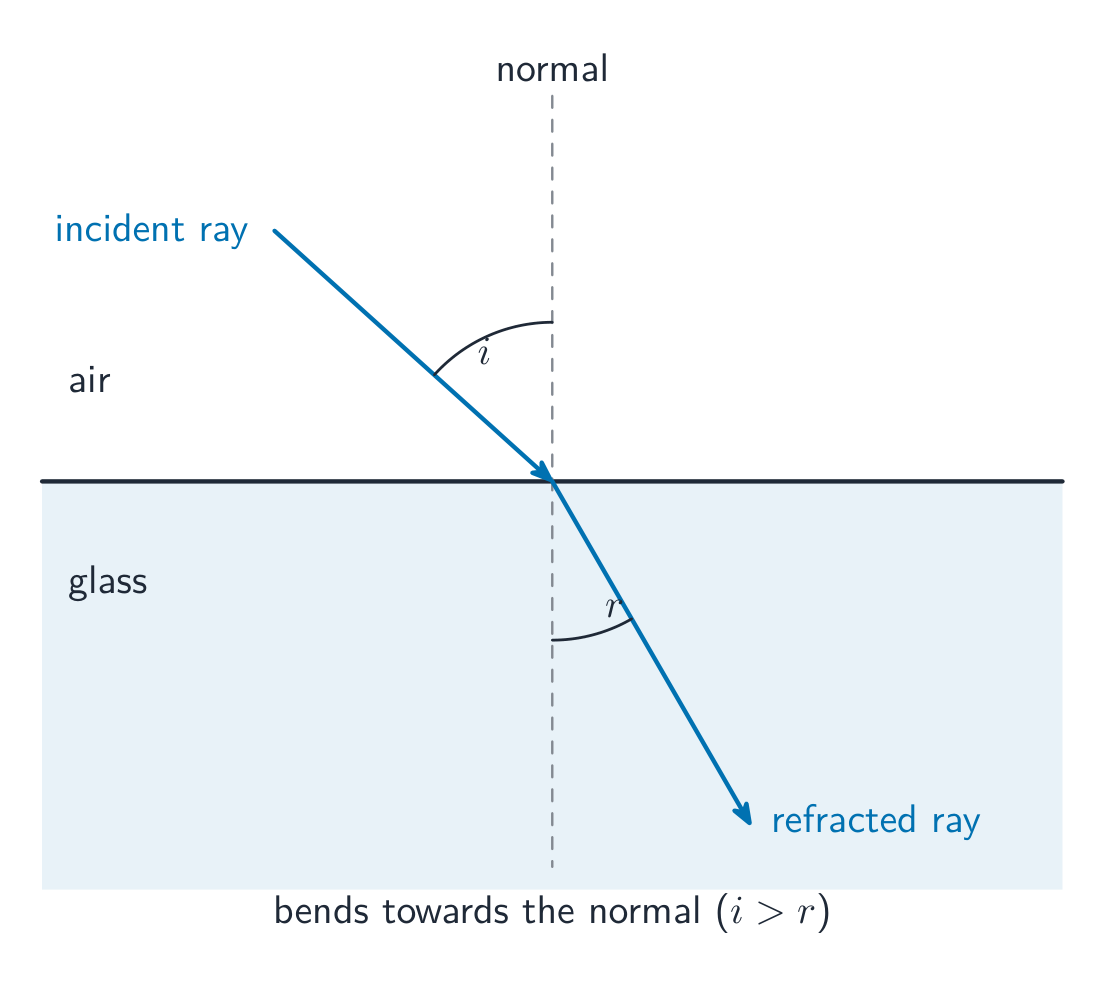
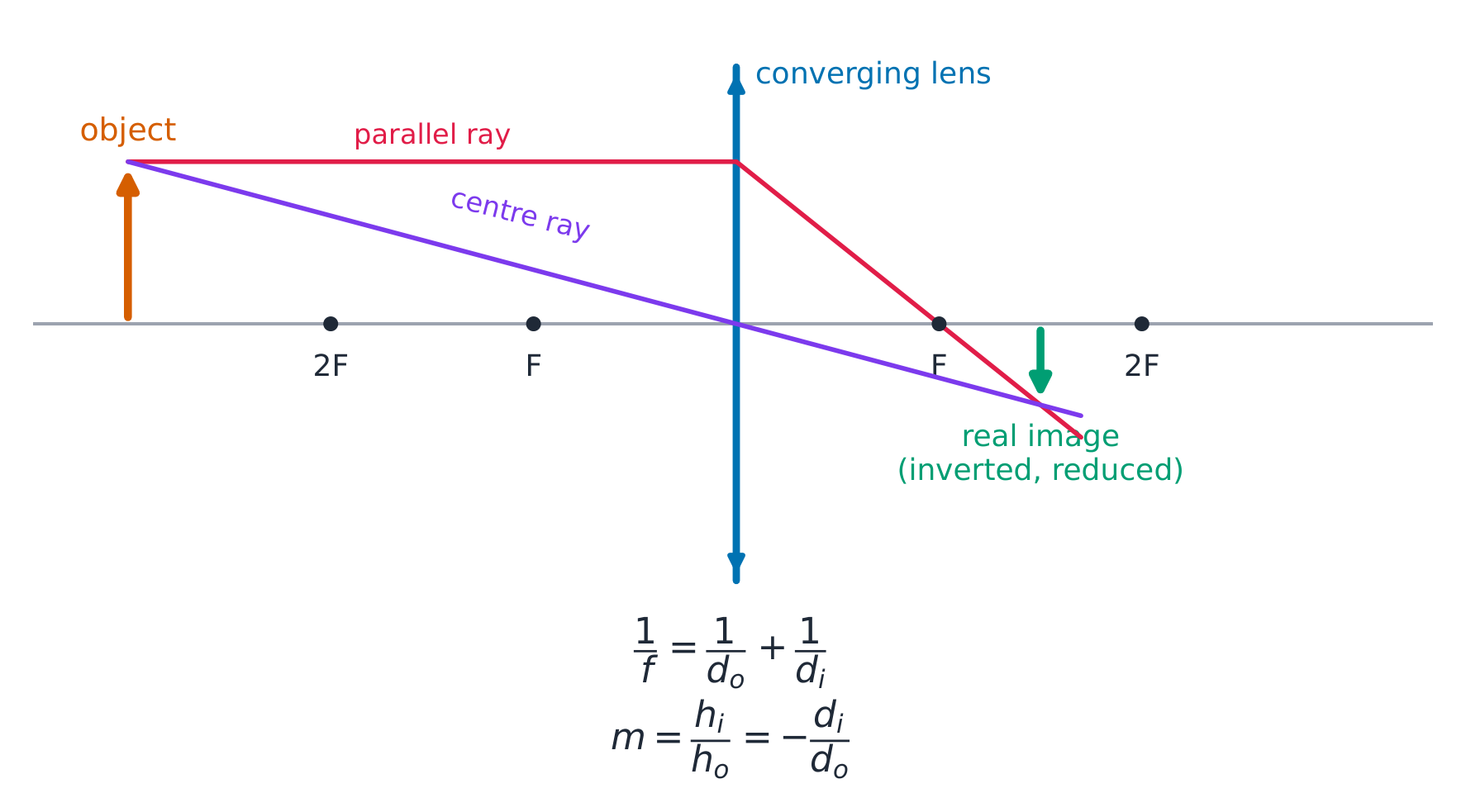
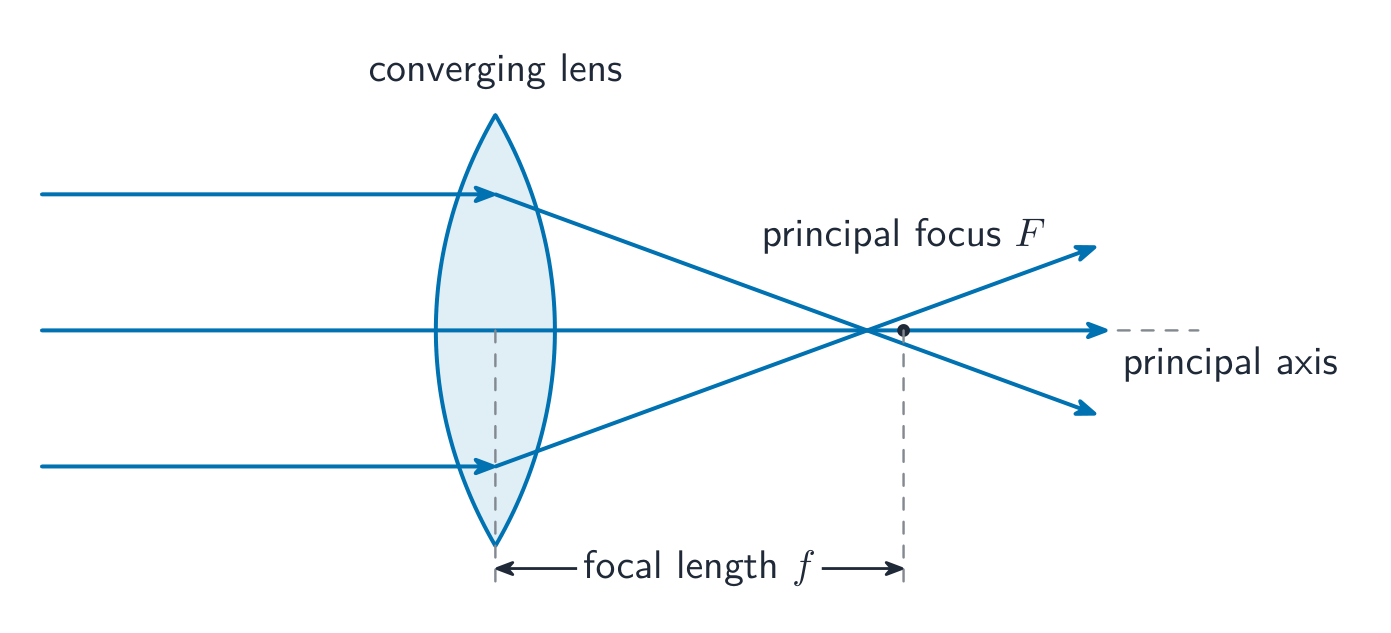
- 13.1.A.2 Ray diagrams depict the path of light before and after an interaction with matter.
Learning Objective 13.1.B: Describe the reflection of light from a surface.
- 13.1.B.1 Light that is incident on a surface can be reflected.
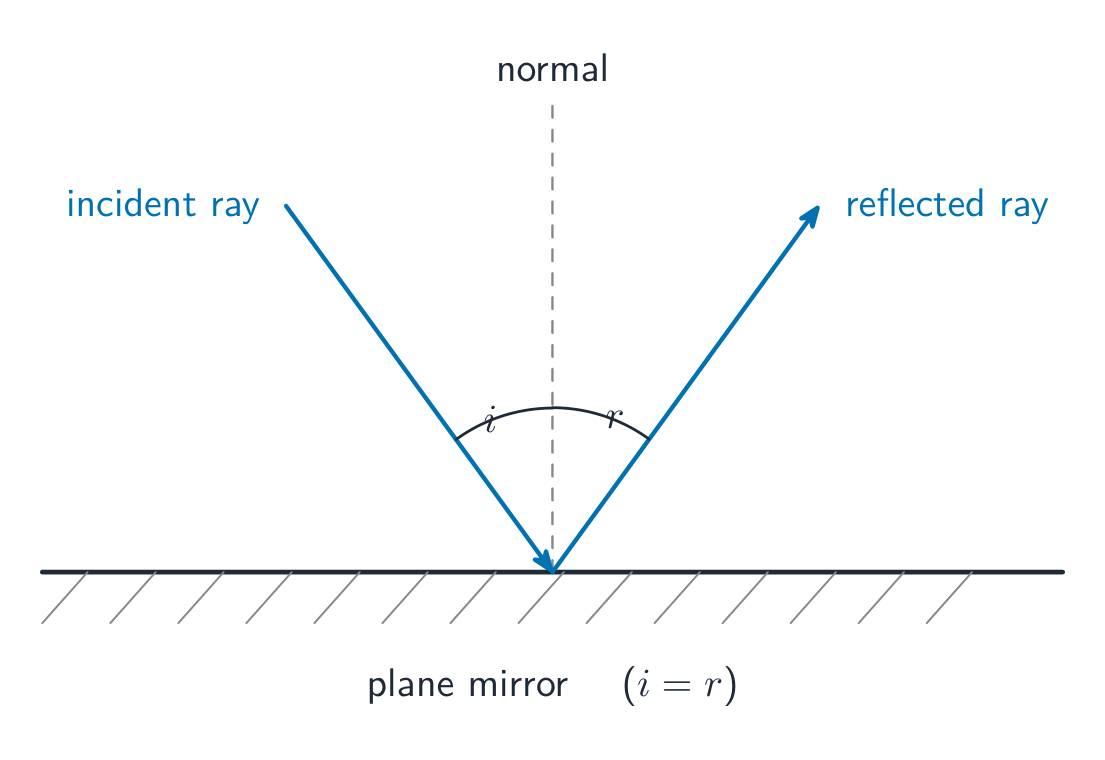
- 13.1.B.2 The law of reflection states that the angle between the incident ray and the normal (the line perpendicular to the surface) is equal to the angle between the reflected ray and the normal.
- Equation: $\theta_i = \theta_r$
- 13.1.B.3 Diffuse reflection is the reflection of light from a rough surface and results in light reflected in many different directions, because the line normal to the surface varies over the area over which the light is incident.
- 13.1.B.4 Specular reflection is the reflection of light from a smooth surface and results in light uniformly reflected from the surface, because the line normal to the surface has an approximately constant direction over the area the light strikes.
Tiếng Việt
Mục tiêu học tập 13.1.A: Mô tả ánh sáng dưới dạng tia sáng.
- 13.1.A.1 Tia sáng là một đường thẳng vuông góc với mặt sóng của sóng ánh sáng và chỉ theo hướng truyền của sóng.
- 13.1.A.1.i Tia sáng có thể được sử dụng để xác định hành vi của ánh sáng trong quang học hình học, nơi tính chất sóng của ánh sáng có thể bị bỏ qua.
- 13.1.A.1.ii Các tia sáng không đủ để giải thích sự lan tỏa của ánh sáng. Trong hiện tượng giao thoa và nhiễu xạ, tính chất sóng của ánh sáng đóng vai trò quan trọng.
- 13.1.A.1.iii Laser là nguồn phát tia sáng đơn sắc, đồng pha phổ biến, có thể được mô hình hóa như một tia sáng. Tính chất sóng của laser sẽ được xem xét trong Chương 14.
- 13.1.A.2 Sơ đồ tia biểu diễn đường đi của ánh sáng trước và sau khi tương tác với vật chất.
Mục tiêu học tập 13.1.B: Mô tả sự phản xạ của ánh sáng từ một bề mặt.
- 13.1.B.1 Ánh sáng tới trên một bề mặt có thể bị phản xạ.
- 13.1.B.2 Định luật phản xạ phát biểu rằng góc hợp bởi tia tới và pháp tuyến (đường thẳng vuông góc với bề mặt) bằng với góc hợp bởi tia phản xạ và pháp tuyến.
- Phương trình: $\theta_i = \theta_r$
- 13.1.B.3 Phản xạ khuếch tán là sự phản xạ ánh sáng từ bề mặt nhám, dẫn đến ánh sáng phản xạ lan tỏa theo nhiều hướng khác nhau, do pháp tuyến của bề mặt thay đổi trên diện tích mà ánh sáng tới chiếu vào.
- 13.1.B.4 Phản xạ gương là sự phản xạ ánh sáng từ bề mặt nhẵn, dẫn đến ánh sáng phản xạ đều trên bề mặt, do pháp tuyến của bề mặt có hướng xấp xỉ không đổi trên diện tích mà ánh sáng tới chiếu vào.